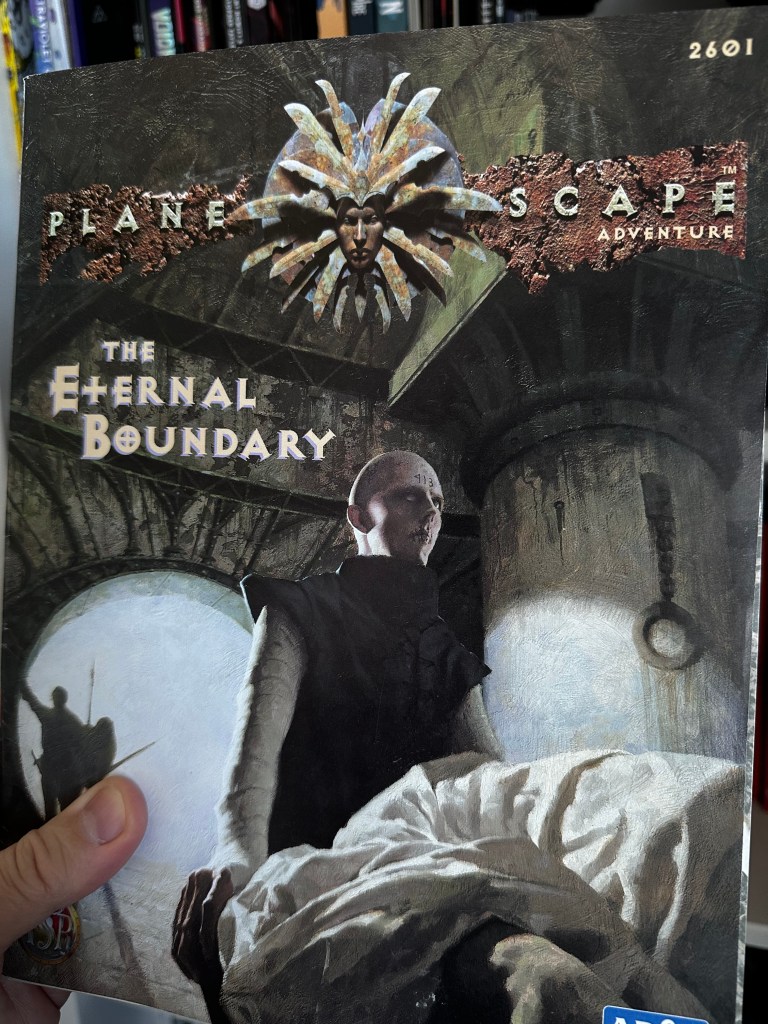
The Editioning, AD&D 2nd Edition, Part 5

Surprise!

Welcome back, dear reader, to the Editioning, our challenge to play an adventure in every major edition of D&D over a period of about two years. We’ve already completed OD&D and Basic D&D adventures. Had a great time with them. They were both quite rules-light, even if some of the mechanics were not exactly instinctive. And, even if you didn’t know any given rule and you couldn’t find it in the book, the DM could easily make a ruling in the moment. AD&D 2nd Edition is another beast.

Now, I will preface the following complaints with the fact that I am really trying to play each edition as close to rules-as-written as possible. One of the things I wanted to get out of the Editioning was to be able to learn all those rules and another was to be able to compare them to each other. There are, of course, a lot of similarities across each of the editions. They’re all still D&D, after all. But some things change in every edition for some reason. Surprise is one of these things, initiative is another. Today, I want to discuss Surprise in AD&D 2E… because I have a bone to pick.

You know, it’s not even the rule itself that I have a problem with. The rule is pretty simple, actually. Each side, if there’s a chance they could be surprised in the situation, rolls 1d10. If they roll a 1, 2 or 3, they are surprised. There are a bunch of modifiers that can be applied to this roll, including a PC’s reaction adjustment, which comes from their Dexterity. But that’s it. Easy, right? Easy to find? WRONG!

Where would you expect that rule to exist, dear reader? Well, let me tell you where I thought it would be. I thought it would be in the Combat chapter of the Player’s Handbook. But to narrow things down, I checked that book’s index. S, s, s… there it was! Surprise, pages 89, 112 and 113. OK, I thought, now I’ll find out how to determine Surprise in AD&D 2E. WRONG! Page 89 provided me a definition of the term, “surprise.”

Surprise can happen any time characters meet another group unexpectedly(monsters, evil knights, peasants etc.). Surprise us simply what happens when one side–a person or party–is taken unawares, unable to react until they gather their wits. Their opponents, if unsurprised, are allowed a bonus round of action while the surprised characters recover. It’s entirely possible for both sides in a given situation to be surprised!

This is only the first of three paragraphs telling me about the concept of Surprise. At no point does it actually explain the rule to me, however.

I cannot quite express to you, dear reader, how much unnecessary text is contained in the PHB. I don’t think the majority of people reading this book require a definition of surprise, especially when it is not immediately followed by the rules for it.
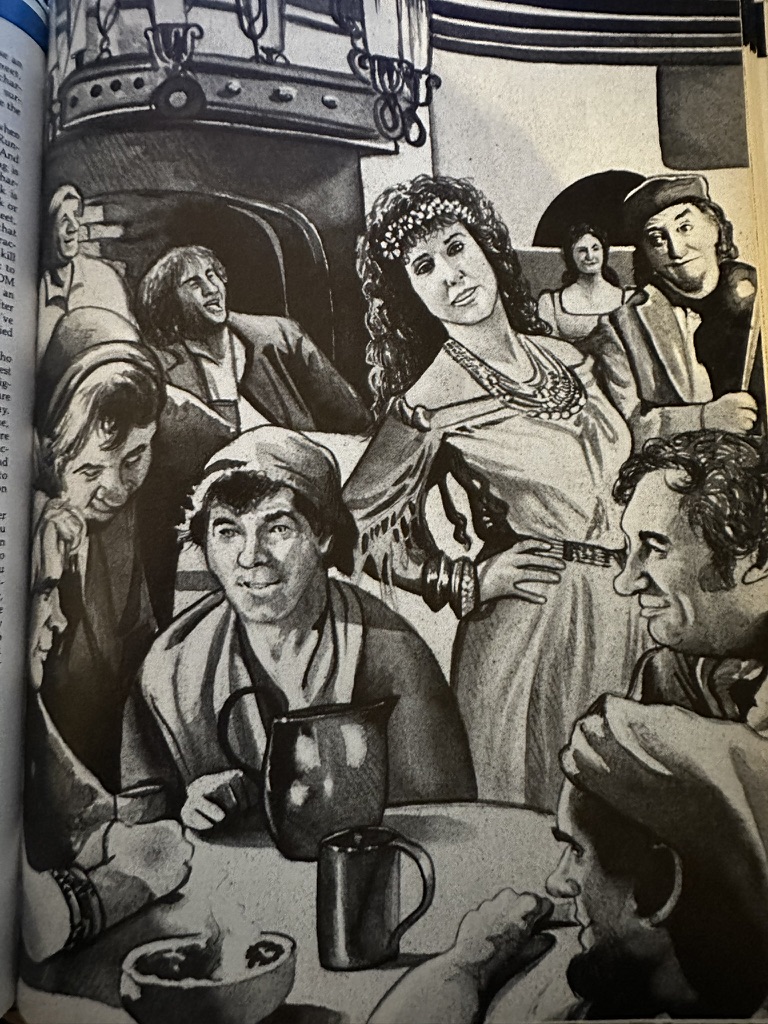
Medieval Cheers
Medieval Cheers

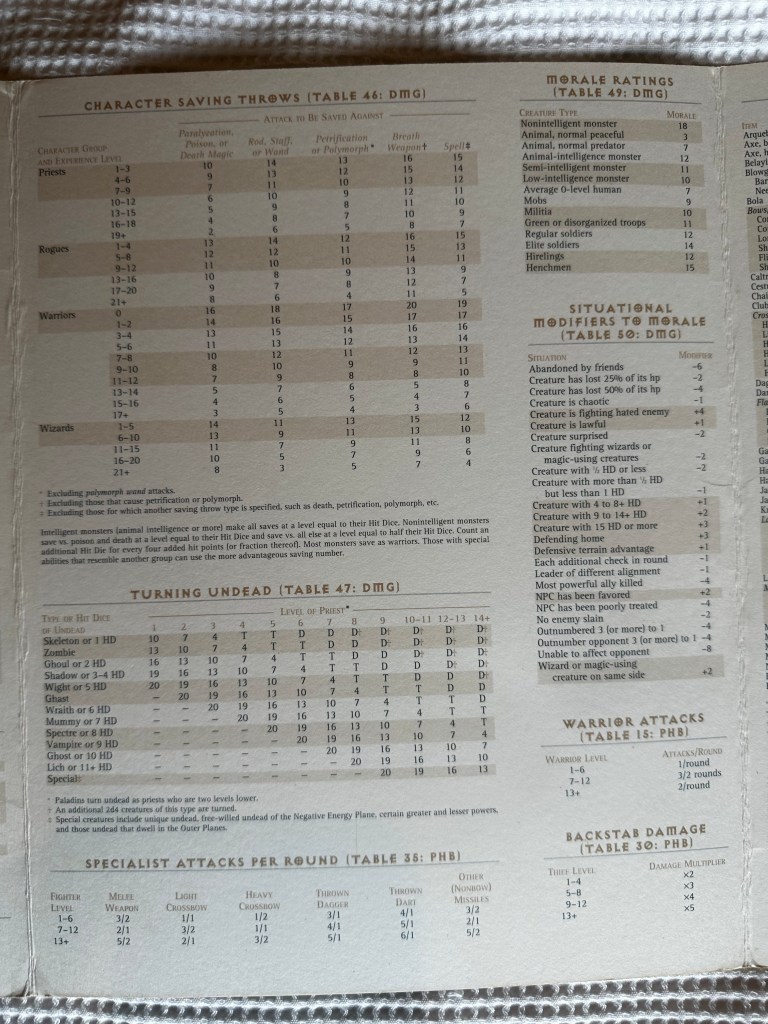
On to page 112 and 113 then. The index gets this slightly wrong. It should read 111 and 112. 113 is a full page illustration. One of my favourites in the book actually, medieval Cheers! Anyway, we are now in Chapter 11: Encounters. The Surprise Roll is finally described here in some five paragraphs. Here’s an example of some of the absolute sawdust they used to fill out this book.

Naturally, surprise does not happen all the time. There are many easy and intelligent ways it can be prevented. The most obvious is if the player characters can see those they are about to encounter well before getting close. For example, the characters may see the dust of a group of horsemen coming their way, or notice the lanterns of a group of peasants coming through the woods, or hear the grunting barks of a gnoll war party closing through the trees. In these cases there is no way the characters are going to be surprised by the encounter.

And it’s not just a matter of ignoring this bumph. The rules are cleverly hidden away within paragraphs like this!

Anyway, this section has finally described the rule for me, and even told me what the effects of surprise are for both sides! The surpriser gets a free round of attacks but not spells and the surprisee is caught flat-footed so loses their Dex bonus to AC.

But here’s the kicker:

The surprise roll can also be modified by Dexterity, race, class, cleverness, and situation.

I’m sure the designers of this fine game thought to do something as convenient as to provide the potential modifiers to a rule on the same page as the rule itself. WRONG!

The DM has the listing of modifiers that apply to given situations.

“I do?” I thought.

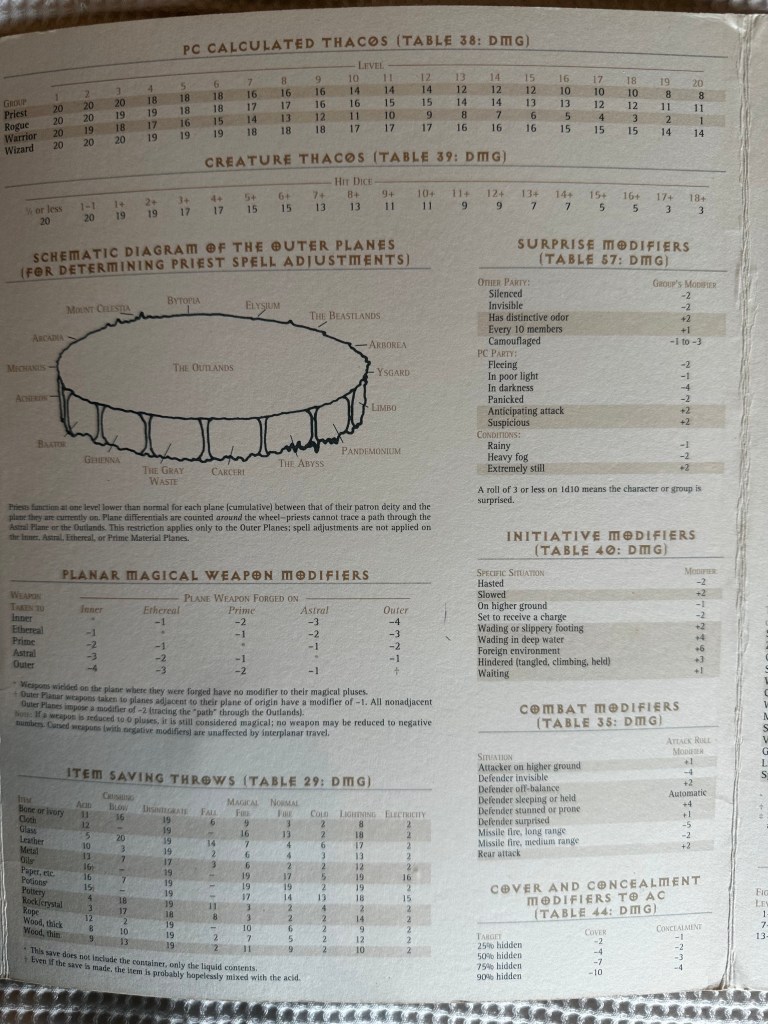
At this point, I was close to despair, dear reader. I had a little cry and a big swig of my beer and dove back in. But this time, I used my noggin. I googled it and found the answers I needed here on the Murphy’s Victim blog. By which I mean I discovered that the table of modifiers I needed was on page 102 of the Dungeon Master’s Guide, in the Encounters chapter of that book. So, at least it’s consistent.
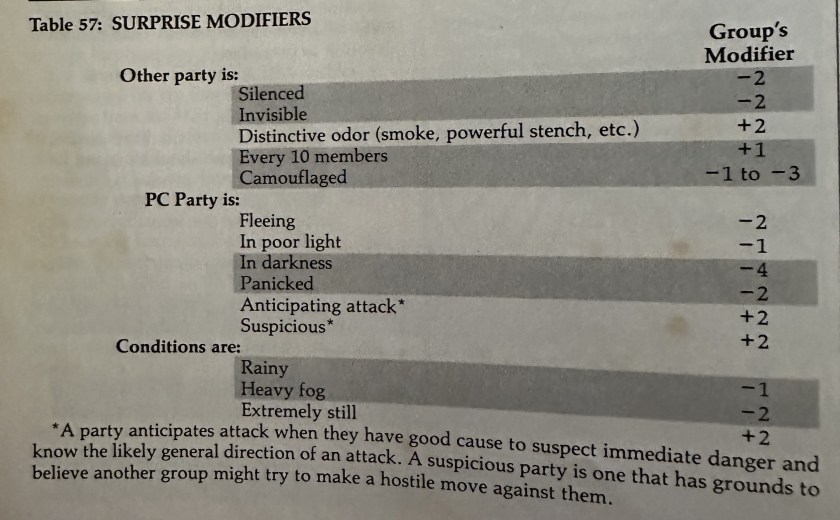
The Surprise Modifiers table from the DMG

Anyway, there I discovered that the PCs, being in poor light, would have a -1 modifier to their surprise roll. None of the other modifiers applied in their situation.

Dear reader, they rolled a 6, meaning they were not surprised. Nonetheless, they still lost a full round of attacks because they had just been rousted from their makeshift beds and were still a little bit eepy.

I went exploring this rabbit-hole because of a single line in the description of the encounter Sunday’s session started with. This is from the Shadows Abroad in Sigil section on Chapter II The Mortuary:

If the PCs have no watch and are awakened in the middle of the night, the Shadowknave and his men have a +4 bonus on their chance of surprise.

This is an awkwardly phrased sentence, but, essentially, what it means is that, should the Shadowknave and his mates roll to be the ones who are surprised, they would get a +4 bonus on that roll. This would, most certainly, make it more harder for them to be surprised. But, why in the Nine Hells would they ever have the potential to be surprised in a situation where they are breaking down the door to the home of four sleeping individuals who they know for a fact are inside and sleeping? But, since I didn’t understand the surprise rules when I first read that sentence I had to look them up to understand what they meant.

Dear reader, I did not make a surprise roll for the Shadowknave and his lads. That would have been absurd.

This is a pretty good point to segue into what happened last session.

To the Mortuary

It was a hard fought battle in the little run-down church to Varuna that they call home. The PCs were caught off guard (if not precisely surprised) and lost a full round while the mercenaries burst into the church. The enemy spell-caster immediately used his Sleep spell, downing Glaermond the Paladin again straight away. I ruled that our tiefling, Trance, as a half-lower-planar creature, was allowed a saving throw. She managed to save and, somehow, avoided getting hit by the three mercs attacking her and immediately kicked the Paladin to wake him up. The three attackers on Devansh Rao, our Cleric, were not so unlucky (he’s got a Dex of 4, so no surprise.) They knocked him out and then went to focus on the Necromancer who lived in the basement. Aurora managed to use her wand to move the earth from the walls and floor to block off the entrance to her underground lair, while her goat familiar and Spectral Hand continued the attack. Back upstairs, the spell-caster Scared and Slowed everyone in the church, his own men included, and Trance cast a sphere of Darkness that encompassed the entire interior. The Paladin, who had the Blind Fighting proficiency, managed to get a couple of licks in. Trance climbed up into the rafters and then through the front window dropping down silently behind the hooded spell-caster to successfully back-stab him. When he turned to face her, she saw that it was the same half-elf they had seen leaving a “dead” body on the floor of an alley in the Hive the previous day. At this point, the half-elf issued the order to retreat. The mercs grabbed Devansh and his stuff and scarpered. Glaermond managed to take out one of them as they ran off but they soon lost them in the maze of Sigil’s streets.

Devansh woke hours later in a vault otherwise occupied by a foursome of skeletons and a sarcophagus. He had a look around, experimented with the skeletons and examined the sarcophagus. He discovered the skeletons only reacted when he made for the door and then found that there was a cache of useful and incriminating items inside the sarcophagus. Long story short, Toranna the Grey, of the Dustmen faction was involved with someone called Marvent and had something to do with the disappearances of the barmies from the Hive. He also got his stuff back and immediately turned the skeletons with his holy symbol. Unfortunately he was still locked in the vault.
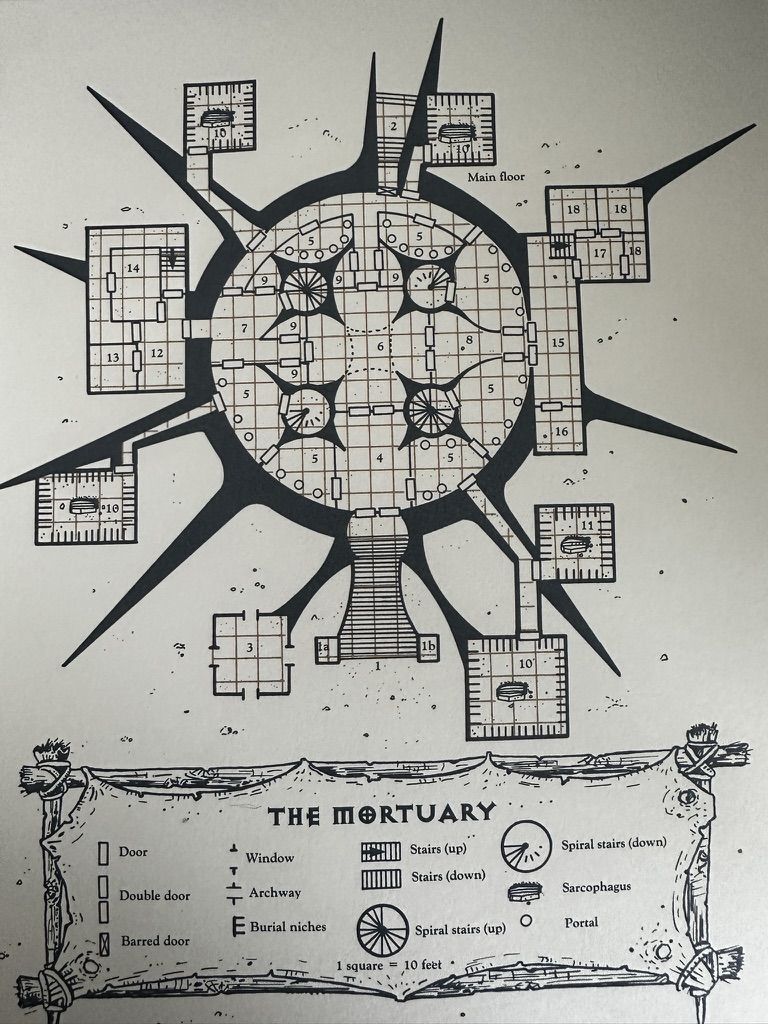
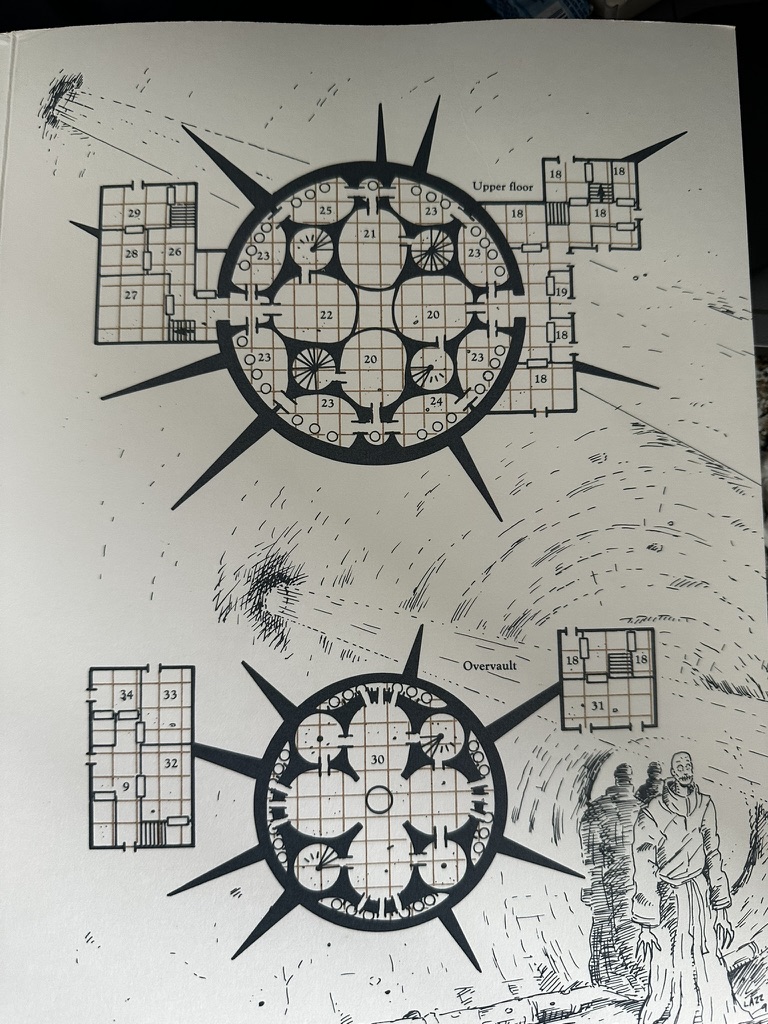
Meanwhile, the others returned to Bendon Mawl, their patron, to explain what happened and to pick some useful items, Oil of Elemental Resistance (fire) and a Potion of Invisibility. Interestingly, these matched the sorts of useful items that Devansh found in the sarcophagus. Then they formulated a cunning plan involving a coffin delivery that allowed them all to enter the Mortuary by the back door. Once there, they soon heard Devansh calling for help and freed him from his vault. Once they were all together and disguised in Dustmen robes, they ascended all the way to the Overvalue where the portal to the Elemental Plane of Fire was. All the evidence they had gathered so far suggested that there was some connection between Toranna, this portal, the disappearances of the barmies and the return of Eliath and the Dancing Man to Sigil. Toranna was there, feeding another barmy into the portal. The party watched as they planned what to do next…

Conclusion

I was glad I didn’t have to look up that surprise rule at the table. I did all that before the start of the session. But just imagine if you did have to? I would simply not have bothered. I would have made a ruling as soon as I got stymied in the PHB Combat section.

I don’t really remember how I dealt with these situations when I was originally playing AD&D back in the ’90s. I do think I had a better grasp on the rules back then, but I also remember having a fair amount of frustration with the game too.

Despite all of this, I think we’re all having a good time with the adventure still and even with the system, in many ways.

I’ll be back with more Editioning in a couple of weeks, dear reader. In the meantime, don’t be Surprised if I am back with some other post next week.
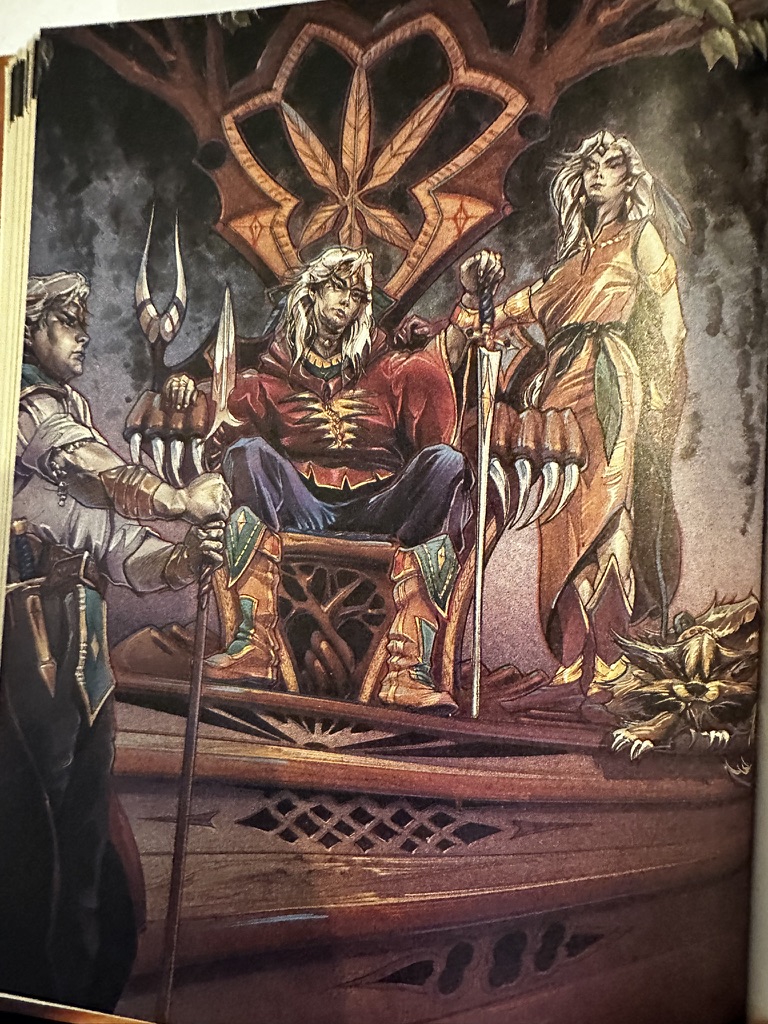
An elven king on his throne with a guard on one side and an elven woman on the other
Elven King

Star Trek Adventures Advancement

Character Growth

There are more ways to deal with character advancement in RPGs than I could even attempt to name, never mind describe. A number of them depend on XP, whether it’s in large numbers, like D&D, or in relatively small numbers like Dungeon World or Blades in the Dark. Maybe you use those numbers in a direct, 1:1 ratio to improve abilities or add new powers. Then again, maybe you just add them up until you hit a new level.
Maybe your favourite system eschews XP in favour of improvement rolls, like in Troika, Mörk Borg, or Call of Cthulhu, where your fate might be to not improve at all, or even get worse, despite everything you’ve done. That one can seem cruel sometimes, but, then again, rolling dice is fun, right?
Well, the advancement mechanic in Star Trek Adventures 2E is not like any of the above, and that’s what I’m here to discuss today.

The Character Arc

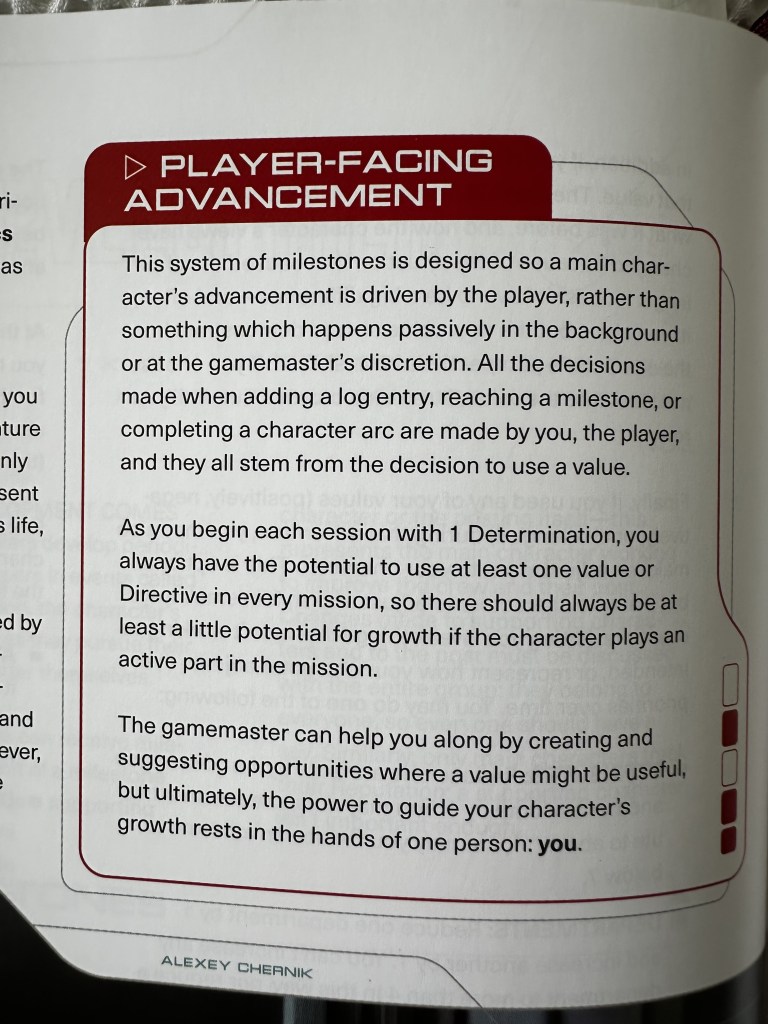
Player-Facing
Advancement:
This system of milestones is designed so a main character’s
advancement is driven by the player, rather than
something which happens passively in the background
or at the gamemaster’s discretion. All the decisions
made when adding a log entry, reaching a milestone, or
completing a character arc are made by you, the player,
and they all stem from the decision to use a value.
As you begin each session with 1 Determination, you
always have the potential to use at least one value or
Directive in every mission, so there should always be at
least a little potential for growth if the character plays an
active part in the mission.
The gamemaster can help you along by creating and
suggesting opportunities where a value might be useful,
but ultimately, the power to guide your character’s
growth rests in the hands of one person: you.
Player-Facing
Advancement

We’ve all heard of a character arc in a TV show or movie. We want to see growth and change in our favourite heroes or, for that matter, in our antagonists too. That change we want to see? Is it a matter of them growing tougher, or more powerful? Do we want to see them gain new skills or contacts? I mean, maybe sometimes, but growing in power does not produce a character arc. Not alone at least. Is it more important that Peter Parker gained the proportional speed and strength of a spider, or that he learned that with great power comes great responsibility? Because without internalising that lesson, suddenly, Spiderman is a villain, or, at best like one of those “super heroes” from “the Boys.” Of course that wasn’t the end of Peter’s character arc, though you could argue that it was the end of one of his character arcs.

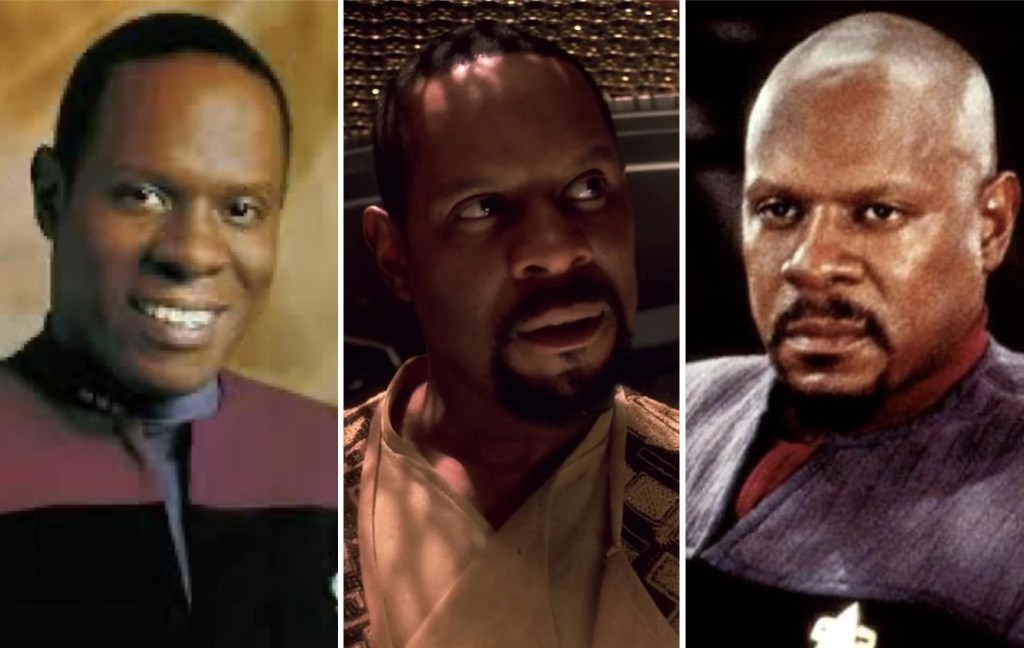
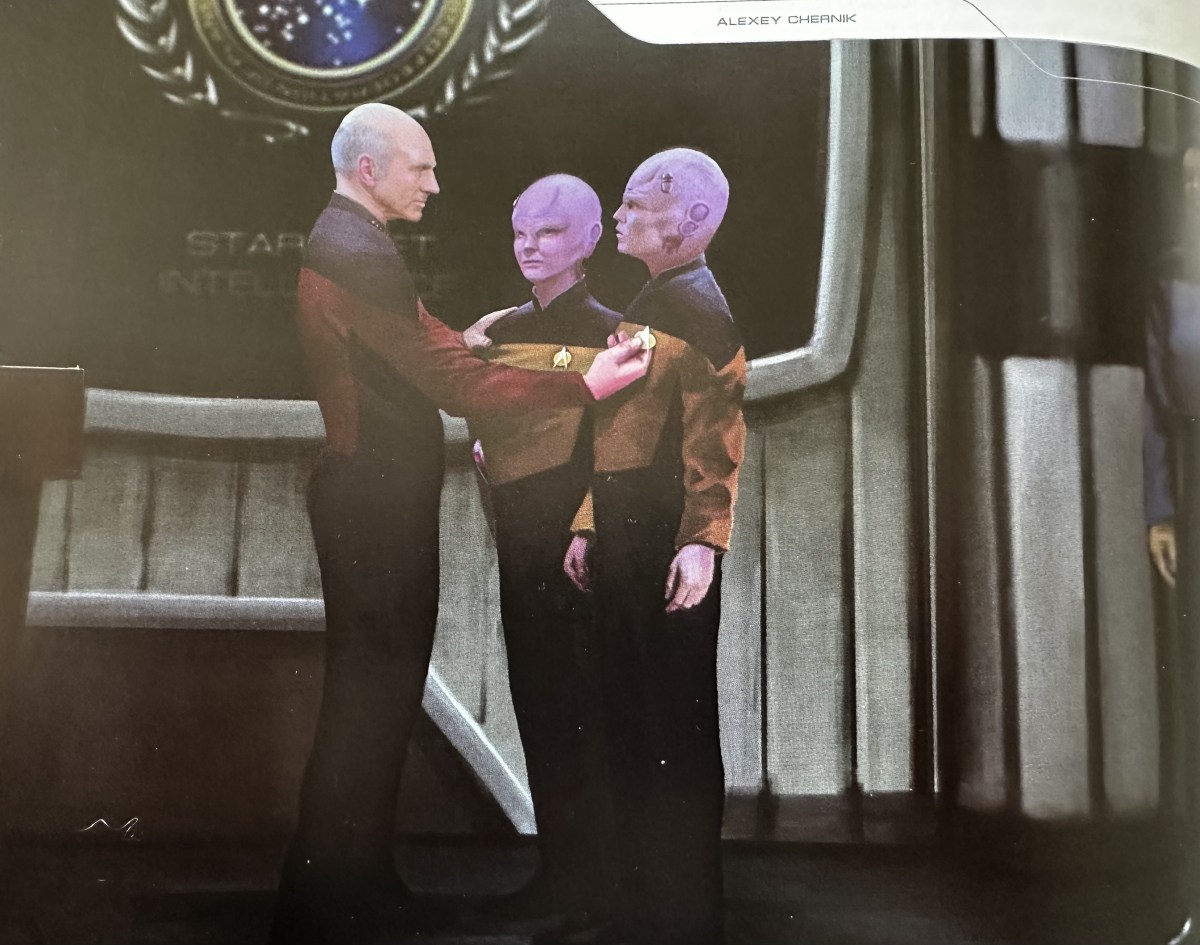
Commander to Captain, Benjamin Sisko

How about an example from Star Trek, since that’s what we’re talking about. Ben Sisko, Commander of Deep Space 9 arrived on the station, not expecting to be there for more than a few months. He was scarred and bitter from his experience with the Borg when he lost his wife. His only joy in life was his son, Jake. The Bajorans name him the Emissary, a religious figure of great significance. He is uncomfortable with that. Through the course of the show’s seven seasons, he heals the scars caused by the Borg and the loss of his wife, which leads him to accept his new life fully, and eventually, a new love. He becomes devoted to Deep Space 9, its crew and everything it represents and goes to any lengths to defend it. He embraces his position as Emissary and even prioritises it above all other concerns on several occasions. Through all of this, he is promoted, left in charge of the defence of the Alpha Quadrant against the Dominion, gets a cool new ship and enjoys political influence across two quadrants. But the recognisable gains in temporal power are all reflections of his emotional and personal breakthroughs.

This is what Start Trek Adventures is trying to do, and I think I might love it? I am reserving judgement until my PCs get to the point where they can actually achieve a full character arc themselves.

Milestones

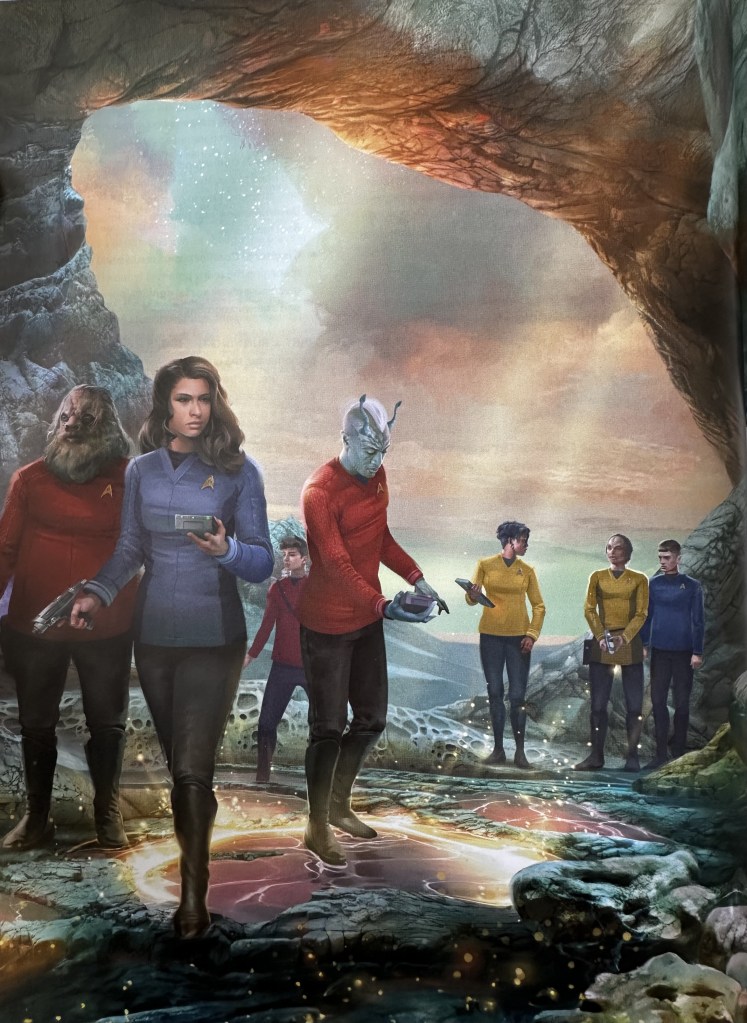
A variety of TOS era Star Fleet officers on the surface of a planet.

This is not an unknown term in the area of levelling up characters, but in the context of this game, Milestones are handled somewhat differently than in D&D 5E. In D&D, Milestone Levelling is simply an alternative to doling out XP. The DM decides at which points of their adventures the adventuring party deserve to level up. It rarely has anything to do with what the players want, although, if timed correctly, it has the potential to be narratively pleasing.

In Star Trek Adventures, each PC makes a note about each adventure in their own personal log. They can write as much or as little about it as they like, but, at the very least, they should note the name of the adventure. I think it could be helpful to also write down the major events of the adventure and the Values they used during them, as that will be relevant to the advancement process.

All PCs have Values. They are important to this process. You can take a look at my character creation post for a bit more on Values, but I can also save you a little time by quoting myself here:

Values – a few brief sentences that describe what your character believes, treasures, and thinks. They should guide roleplaying more than any other aspect of the character

A PC uses their Values to either spend or gain Determination, one of the several currencies you use in this game to improve your chances of succeeding at tasks. After a PC either Challenges or Complies with a Value, they gain Determination. If they chose to Challenge it, they get the opportunity to change their Value to something new, reflecting the lesson they learned in the situation.

If you used a Value during an adventure, you can take the chance at the end to make an adjustment to your PC:

  • Improve an Attribute by 1 point to a maximum of 11 and at the expense of a point from a different Attribute, which cannot be reduced below 7
  • Improve a Department by 1 point to a max of 4 and at the expense of a point from a different Department, which cannot be reduced below 1
  • Replace an existing Focus with a new one
  • Gain an existing Talent with a new one
  • Change a Supporting Character in a similar way

Later, you need to reach a point in another adventure when you want to use one of your Values, and when you do that, link it to a previous adventure when you used that same Value. You have to show how the current situation is influenced by that first one. If you can, you gain a point of Determination. You can only use each log entry once like this, so you mark it to show it has been used. Then, at the end of the latest adventure, you write down in your log that you gained a Milestone and the log entry you used to get it. When you do that, you can make an improvement to your character!

You can do one of the following:

  • Improve an Attribute by 1 point to a maximum of 11
  • Improve a Department by 1 point to a max of 4
  • Gain a new Focus
  • Gain a new Talent
  • Improve a Supporting Character in a similar way
  • Improve one of the Ship’s Systems at the expense of another System
  • Improve one of the Ship’s Departments at the expense of another one
  • Swap a Ship’s Talent

Now, finally, if you can link the use of that Value to the Milestone you achieved previously? Paydirt. You have yourself a Character Arc. And if you can do that, you can improve even more:

  • Improve an Attribute by 1 point to a maximum of 12
  • Improve a Department by 1 point to a max of 5
  • Gain a new Value
  • Improve one of the Ship’s Systems
  • Improve one of the Ship’s Departments
  • Add a new Ship’s Talent

Every time to you complete a character arc, the next one must involve an additional Milestone, so, that means, another adventure too. I like that this represents the concept of becoming stuck in your ways.

I think this system is a little cumbersome, if I’m honest. At least on paper, it involves a lot of admin from the players in linking their Values and Milestones, not to mention remembering all of this in play. But I love the idea of this guided change in characters’ personalities and Values bringing about significant mechanical changes. This is what I was trying to convey in the summary of Sisko’s arcs above.

Repututation

This is an entirely separate advancement track for your Star Trek Adventures character. It can lead to promotion or demotion, awards or reprimands and it adds another layer to how you might play when you know your PC’s reputation might be on the line.

Your Main Character in Star Trek Adventures starts off with a Reputation score of 3. This represents the score of a reliable Star Fleet officer. Someone their superiors can count on. But you are barely distinguished from the rest of the crew. Of course, reputations change. They can be made or broken by your own actions and how they’re perceived.

To determine how your Reputation might be affected by your actions and words during the course of an adventure you have to make a roll. The Reputation Roll is much like any other task roll except that the target number is your current Reputation score + 7, and the size of your dice pool and the Difficulty of the task are determined by how you answered a series of questions about the adventure you just finished. These questions can be tailored for the specific adventure but the Core Book provides a set of standard ones:

POSITIVE INFLUENCES
Answering yes to the following questions are considered positive influences:

  • Was your mission successful?
  • Did you positively use one or more of the mission’s Directives? Did you obey the orders given to you by your superiors? Did you prevent combat from occurring, or avoid escalating hostilities? Did you establish common ground or peaceful cooperation with those who were newly encountered or who were previously hostile to you?
  • Did you directly contribute to saving the lives of innocent people or your fellow crew?
  • Did you take all reasonable action to render aid to those in urgent need or distress?

NEGATIVE INFLUENCES
Answering yes to the following questions is considered negative influence on the character’s Reputation:

  • Was your mission a failure?
  • Did you challenge one of the mission’s Directives?
  • Were you disobedient to your superiors?
  • Were personnel under your command killed during the mission?
  • Did you employ force to any ends other than the defense of self, ship, crew, or innocent life?
  • Did you employ lethal force during the mission?
  • Did you take any unnecessary risks during the mission?
  • Did you cause, or allow through inaction, innocent lives to be lost during the mission?
  • Did you lie, cheat, threaten, or coerce others to achieve objectives during the mission?
  • Did you permit a colleague or subordinate to act unethically or illegally during the performance of their duties?

The number of Positive Influence questions you can truthfully answer “yes” to, is the number of d20s you roll for the Reputation Roll. The number of Negative Influence questions you truthfully answer “yes” is your Difficulty for the Reputation Roll.

After our first adventure we ran through all of these questions. Most of the answers were straight-forward but some elicited lively debates on what might be considered “unethical” or what is meant by “coercion.” In the end, the players enjoyed a pretty high number of successes as they had Difficulty ratings of no more than 1 or 2 but were rolling 6 or 7 dice! For each success above the Difficulty, they gained a point of Acclaim. It is possible to roll lower than the Difficulty. In this case, you get Reprimand points instead.

You can use Acclaim for the following:

  • Awards – claim Awards like the “Christopher Pike Medal of Valor” or the “Star Cross.” Each Award comes with a beneficial mechanical effect
  • Commend Another – add dice to a colleague’s Reputation Roll
  • Elevation – boost a non-commissioned officer to officer status
  • Gain Favour – Ask an NPC for a favour
  • Increase Reputation – Spend Acclaim equal to the new Reputation to get an increase
  • Promotion – Go up one rank unless the commanding officer refuses
  • Status – gain a new trait for your PC that reflects the experiences they have lived through

On the other hand, Reprimands can lead to detention, being stripped of an award, demotion or even Court Martial! So, best to try and avoid those unless you want a bit of drama.

Conclusion

I think the Reputation system is a fun way to facilitate a very different type of advancement for a Star Trek Adventures character. The Milestone system linked to Values is very personality focused and linked to the PC’s own personal narrative, but Reputation is more like career development and the benefits from that are too. It is, perhaps a little over-designed, in my opinion. Do we really need to have both Reputation Points and Acclaim Points? Couldn’t we find a way to achieve the same ends with one or the other?

But, as I said at the top of this blog post, I think I need to reserve full judgement until we have had a few more Star Trek Adventures. In the meantime, dear reader, live long and prosper!

Star Trek Adventures 2E, Incursion Point

Starter Campaign

Dear reader, last week, I created a character for Star Trek Adventures 2E. His name was Mesh and he was an Orion Star Fleet Officer on the command track. The lifepath character generation system was satisfying and sufficiently different from other games that I felt it novel and enjoyable. But, the fact is, I’m unlikely to ever get to play a character in a Star Trek Adventures game, since I’m the one running it.

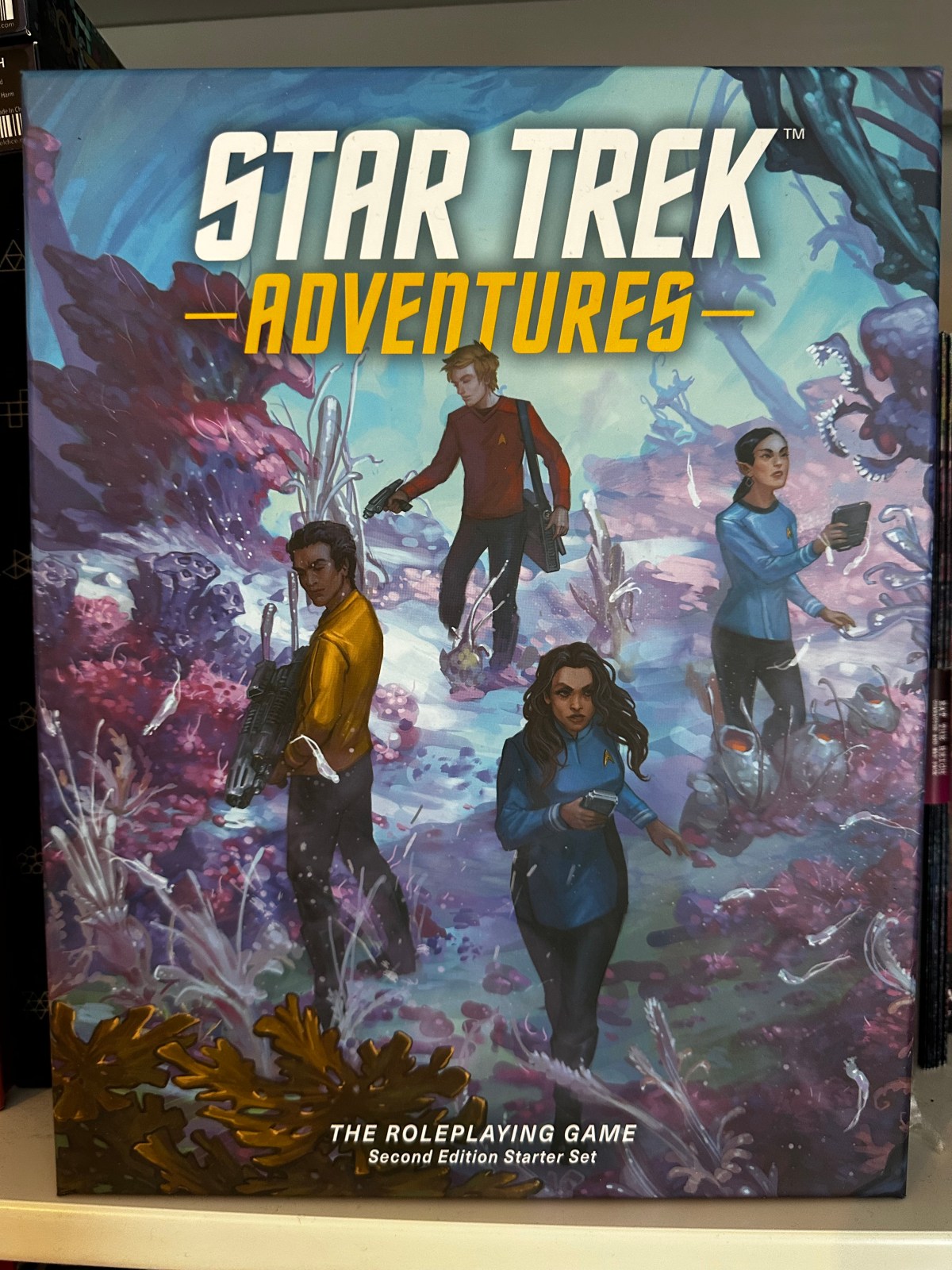
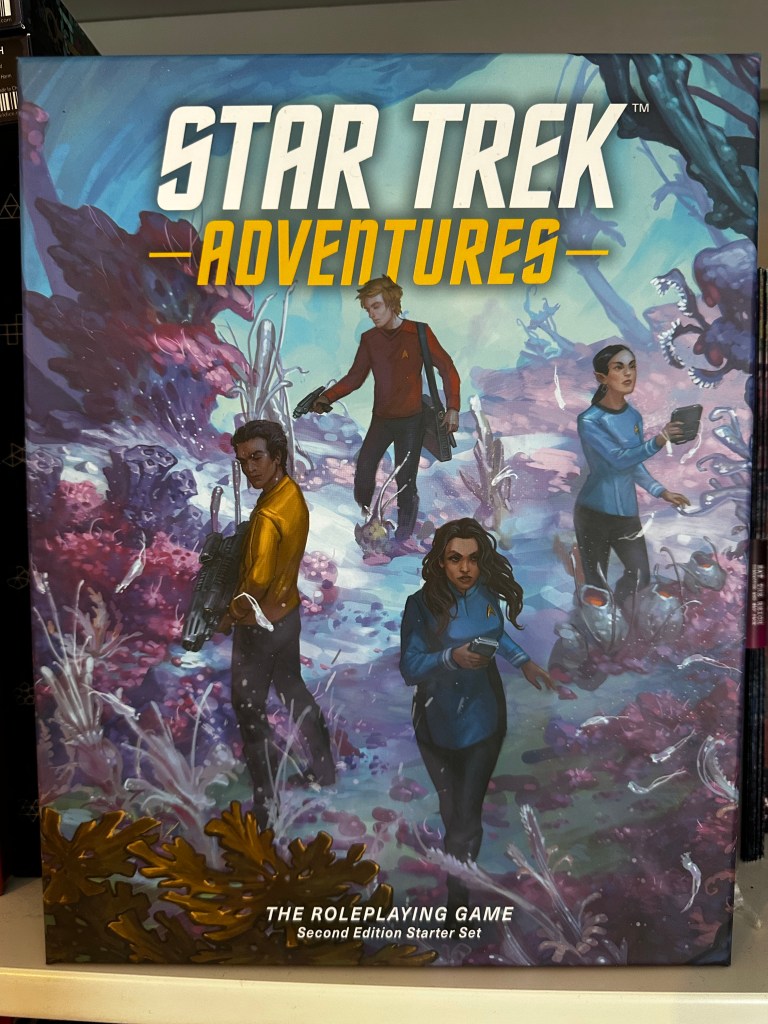
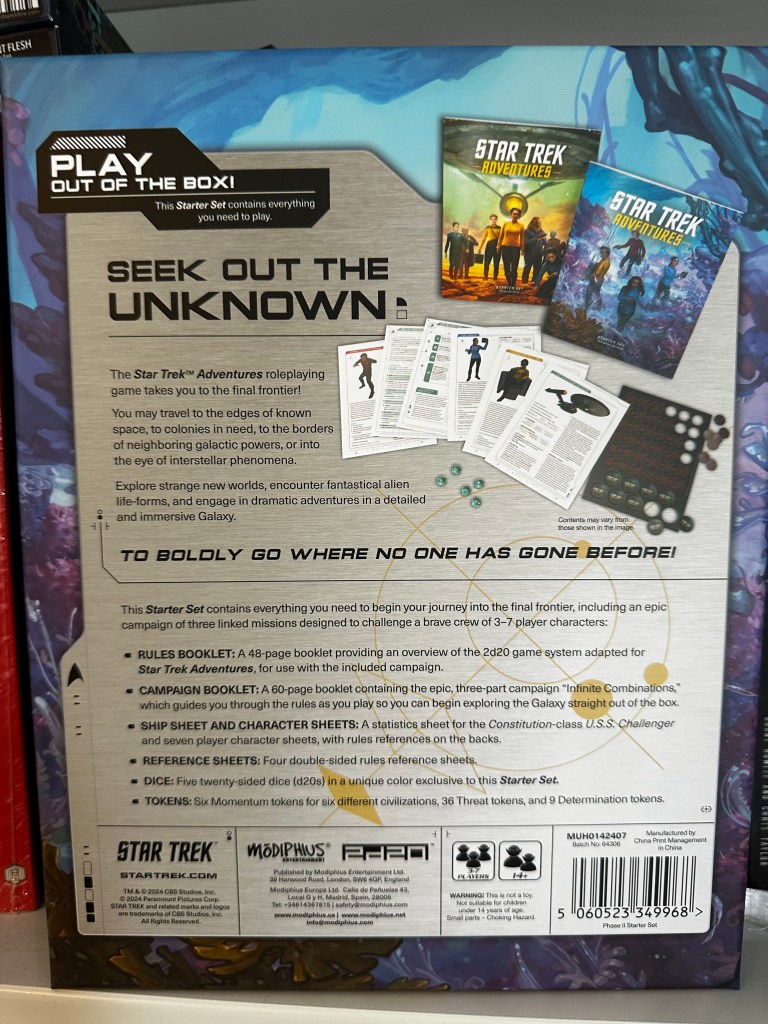
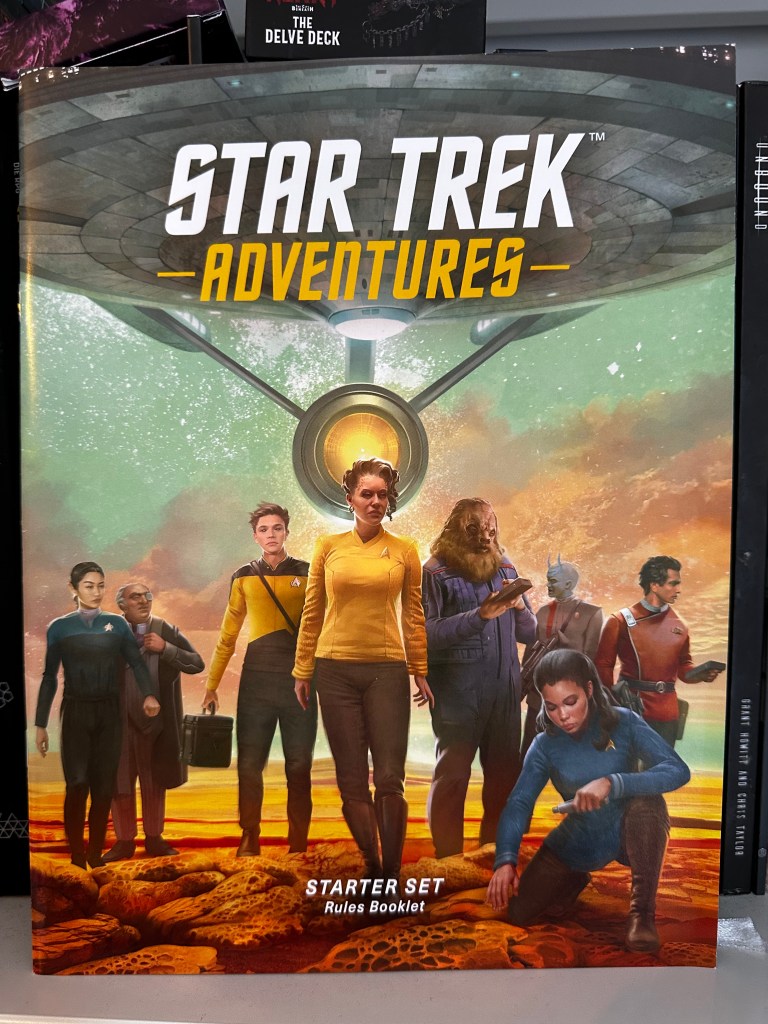
I picked up the Star Trek Adventures 2E Starter Set and Core Rulebook a couple of months ago when Modiphius was having a sale and I haven’t regretted it. Sometimes, when I buy the core rulebook for a game that I’m interested in along with its Starter Set, I wonder why. The starter set can feel like a waste of money. But, the truth is almost always contrary. The general quality of boxed starter sets recently has been really good. Free League are the masters of producing sets of such high quality and with such a wealth of content that I would generally always advise you to pick it up, even if you’re getting the core rules as well. I have played or run starter set adventures of the One Ring, Tales from the Loop and the Bladerunner RPG. All great quality adventures too! The Bladerunner one sticks out as a real highlight for me. The casefile, Electric Dreams was a brilliant intro to the game and the world but was also an engaging and evocative adventure in its own right. That’s a game you could run without ever reading the core rulebook, as long as you have the starter set and you don’t mind pregenerated PCs. We got four sessions out of that game, and I considered that extremely good value for money.

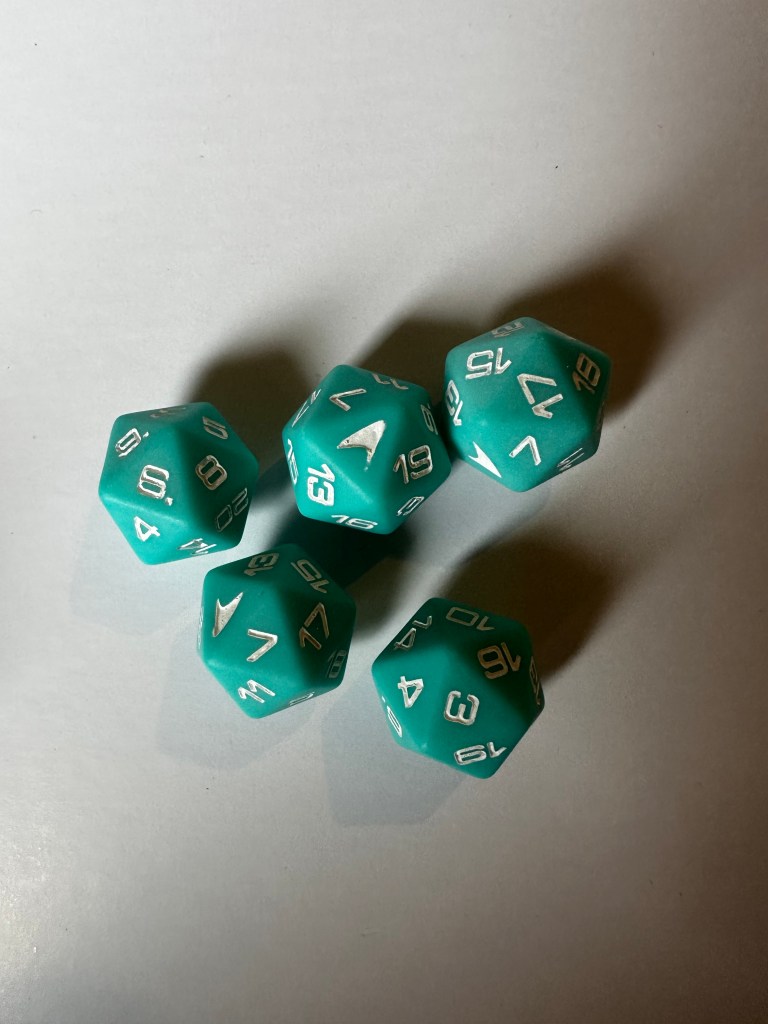
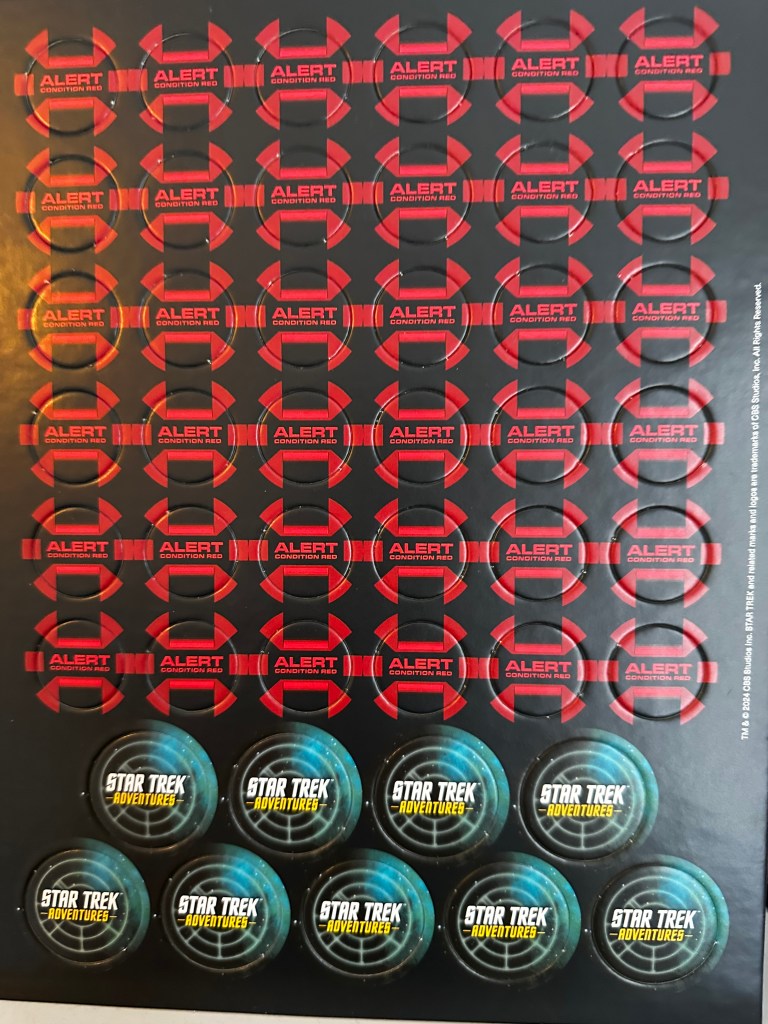
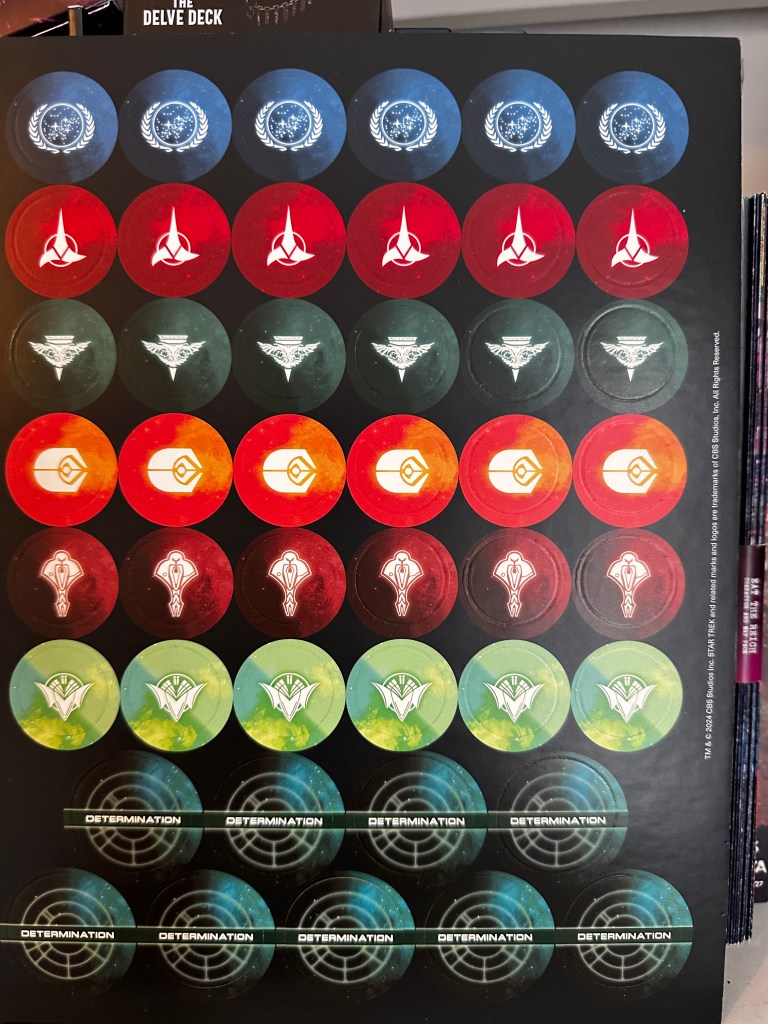
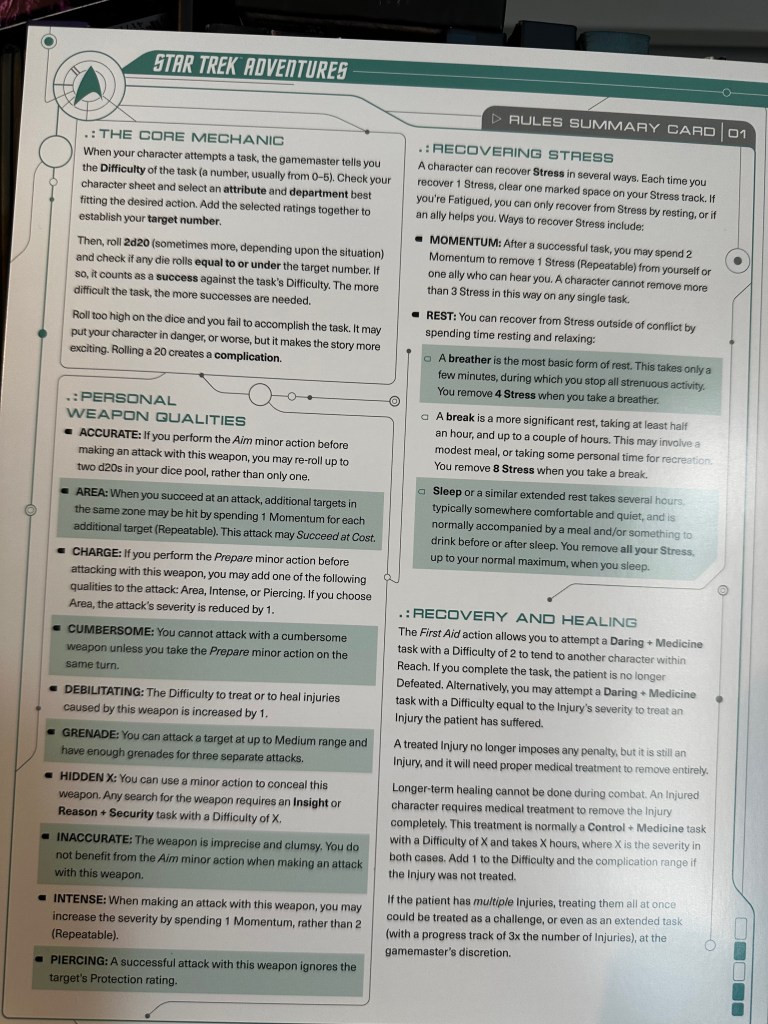
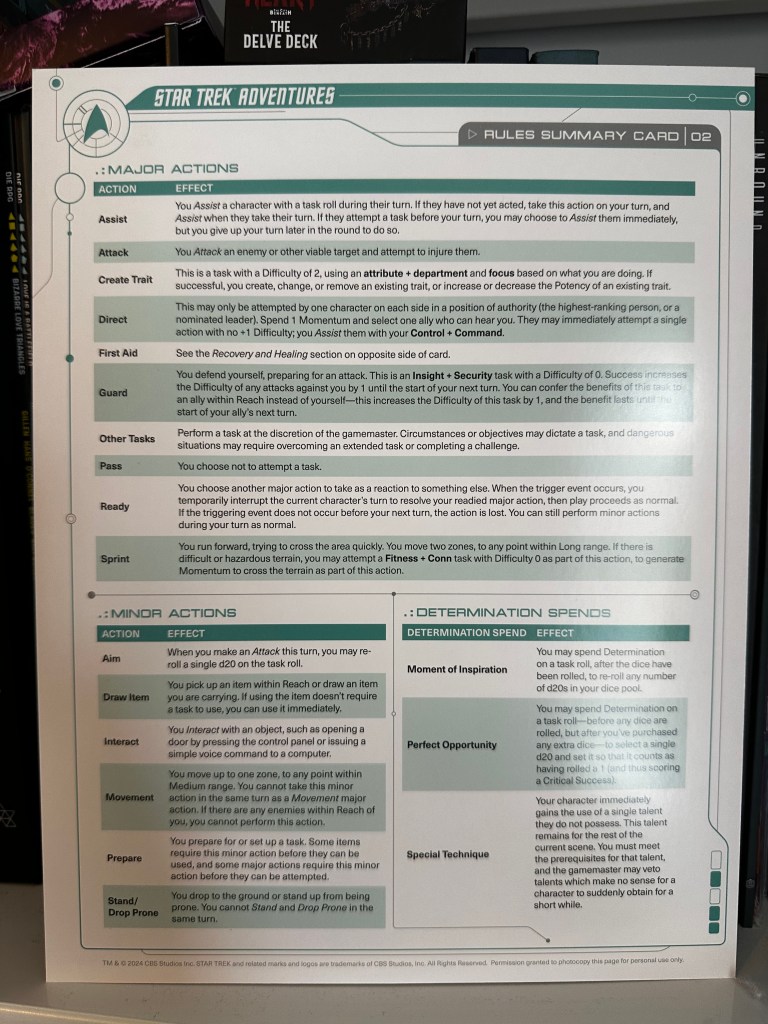
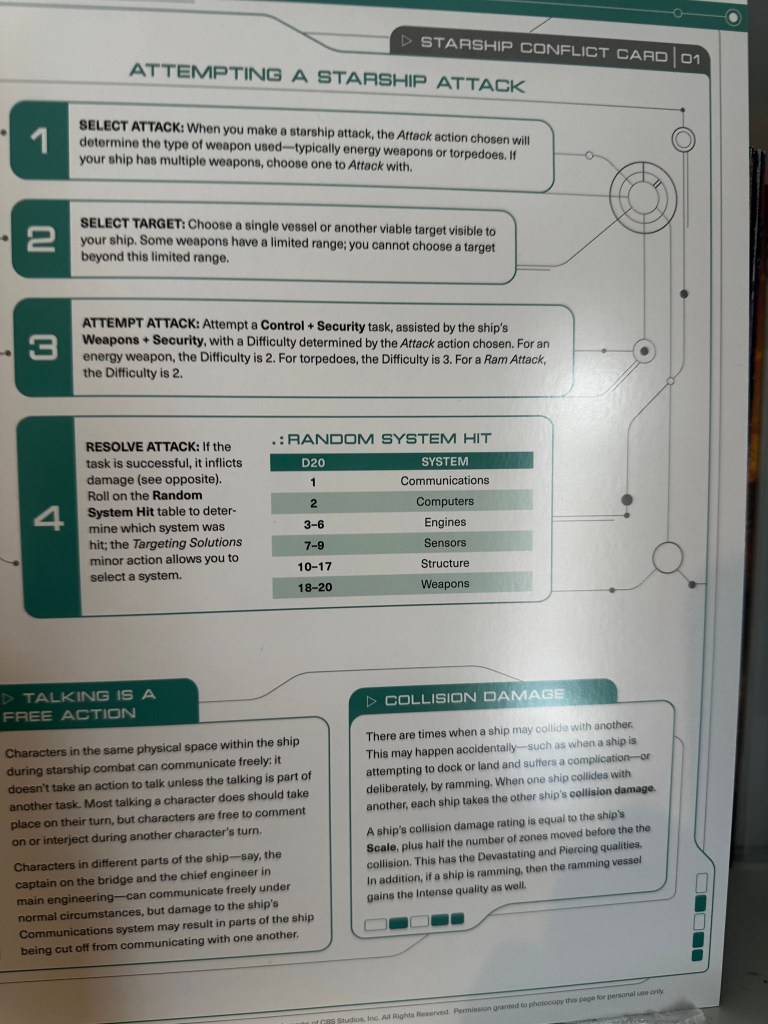
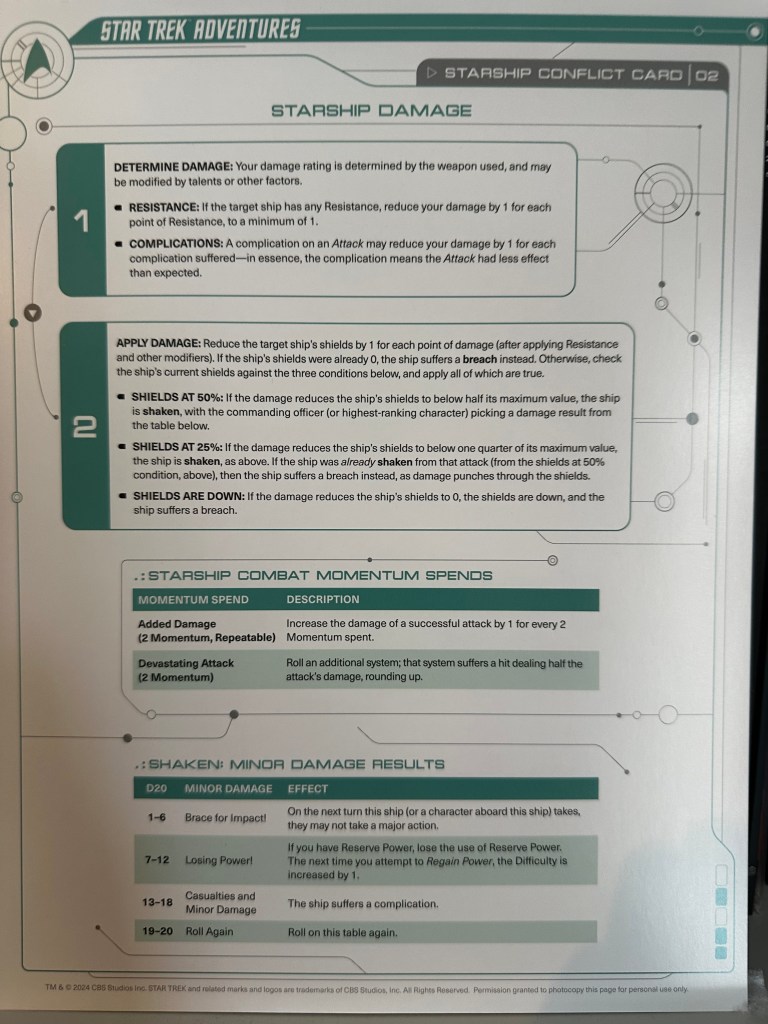
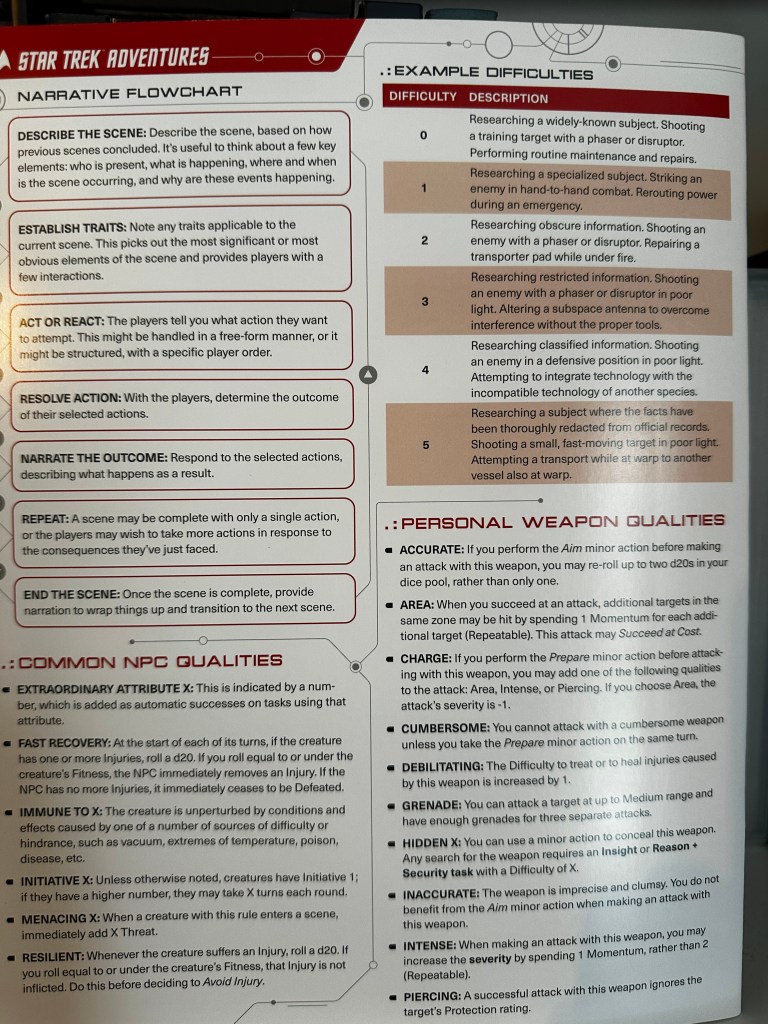
And then we have the Star Trek Adventures 2E Starter Set. In the box, you’ve got a set of five Star Fleet themed d20s, a sheet of tokens, a bunch of handouts which include pregens and rules references and, of course, a rules booklet. This booklet provides you with almost everything to run this game. The biggest omission is, of course, character creation rules. But, as I said above, if you don’t mind the pregens, that’s fine. The campaign booklet is just that: a booklet with a campaign in it. Inside the sixty pages are three interconnected adventures and three mission briefs, which act as adventure frameworks. After three sessions, I can confidently say, the Campaign Booklet, if played in full, is likely to bring you fifteen or sixteen sessions of play in the Star Trek universe. Now that’s making your latinum strips go a long way! Quark would be proud of you, Modiphius!

Rules

Star Trek Adventures 2E uses Modiphius’ own 2d20 system. Despite owning multiple Modiphius games, this is the first time I or, indeed, any of my players have had the pleasure of using it. I was expecting this to be a lot more trad than it is. It is actually really narrative-focused.

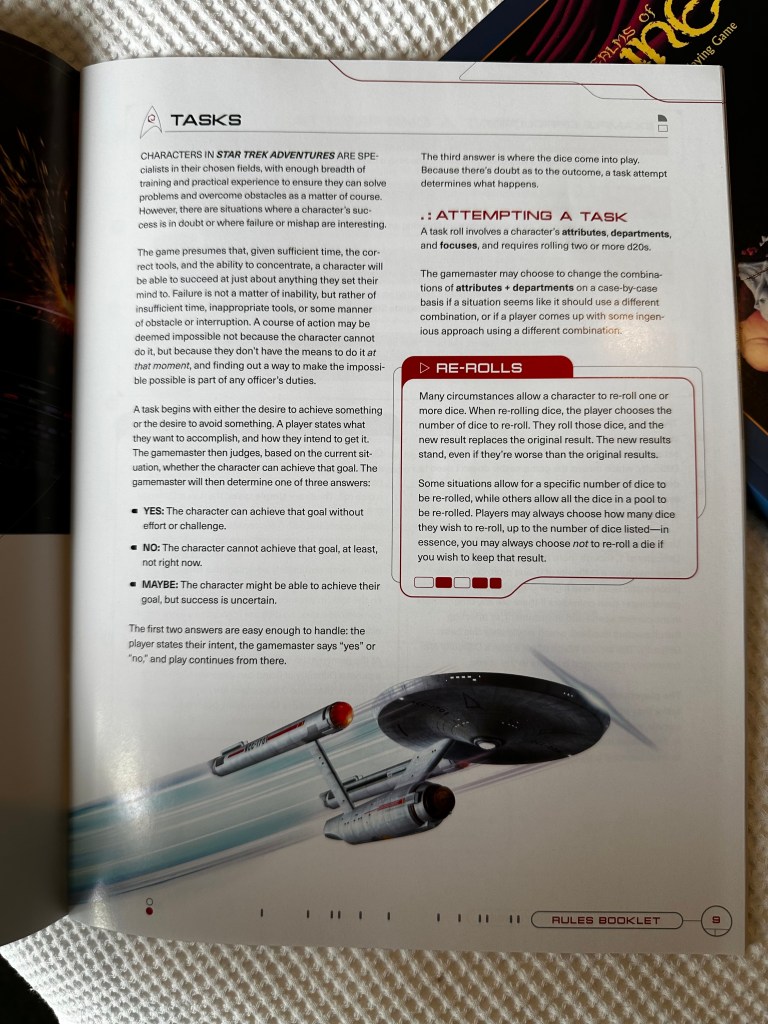
The core mechanic is simple. Every character has six attributes and six departments (see my last post for more detail on these.) When you are asked to perform a task, the GM will tell you which attribute and which department you need to use. So you might be using your Daring attribute of 9 and your Conn department of 3 to chase an enemy craft through an asteroid belt. You add the two scores to give you you target number. In this example, that would be 12. If you roll equal to or below that, that’s a success. You automatically get to roll at least 2d20, but you have various ways to add dice to that pool. A task’s Difficulty rating tells you how many successes you need to complete the task. So, for a Difficulty 3 task, you better get more dice, pray for a crit (a 1 counts as two success) or reduce the Difficulty somehow.

Momentum is a resource that the PCs share. They build it up by scoring more successes on rolls than they need. So, in the example above, if you managed to roll four successes on the Difficulty 3 task, you get to add 1 point of Momentum to your pool. That Momentum pool can’t go above 6 points so you are incentivised to use it up. They can use a point of Momentum to add a die to a pool, three points to add two dice and six points for three dice. There are other ways to spend this resource too, such as to get the GM to give you more info on a particular scene.

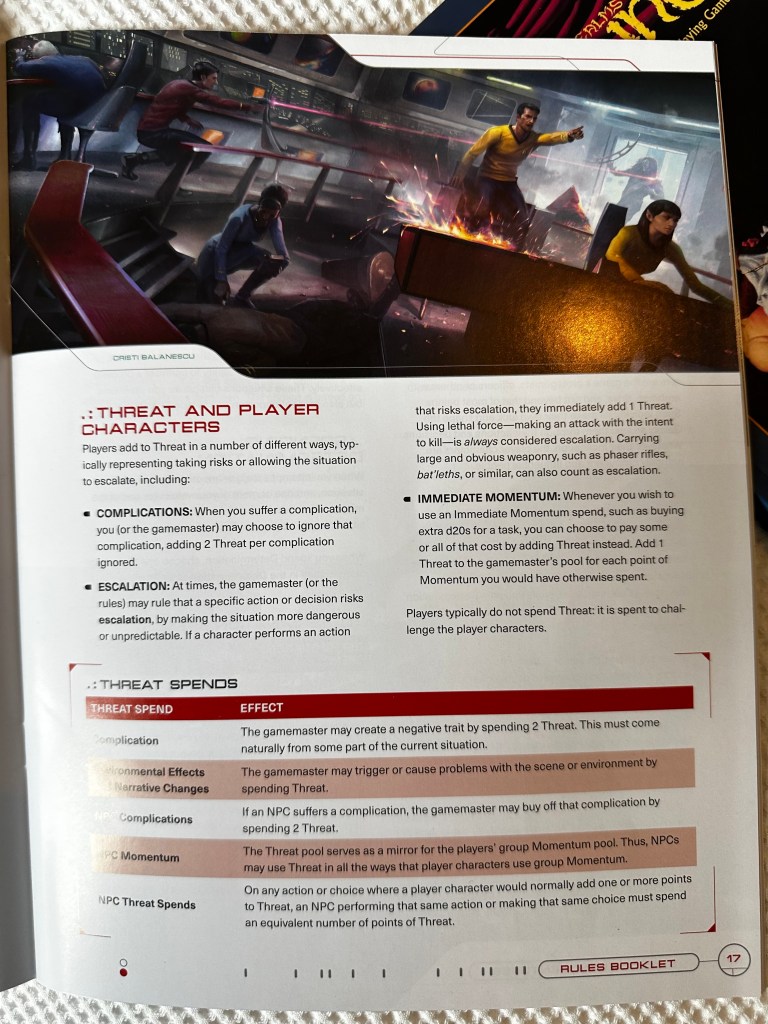
Threat is a resource for the GM to use that mirrors Momentum. The PCs can add a Threat for more dice in the same sort of way as spending Momentum. The GM gets to use threat to increase the likelihood of Complications occurring (this happens on the roll of a 20 usually.) Complications can come in many different forms. They might be a simple and mechanical as causing an injury. But they also might take the form of a massive narrative twist that really sticks spanner on the works of the PCs’ plans. This comes up way more often than I expected.

Those are the basics. There’s other stuff like taking Stress to Avoid Injury, Extended Tasks that use tracks, Resistance on tasks and in conflicts that absorb successes, but we don’t need to go into them here. If you are interested to learn more, check out the free Quickstart guide here.

Part One, Incursion Point

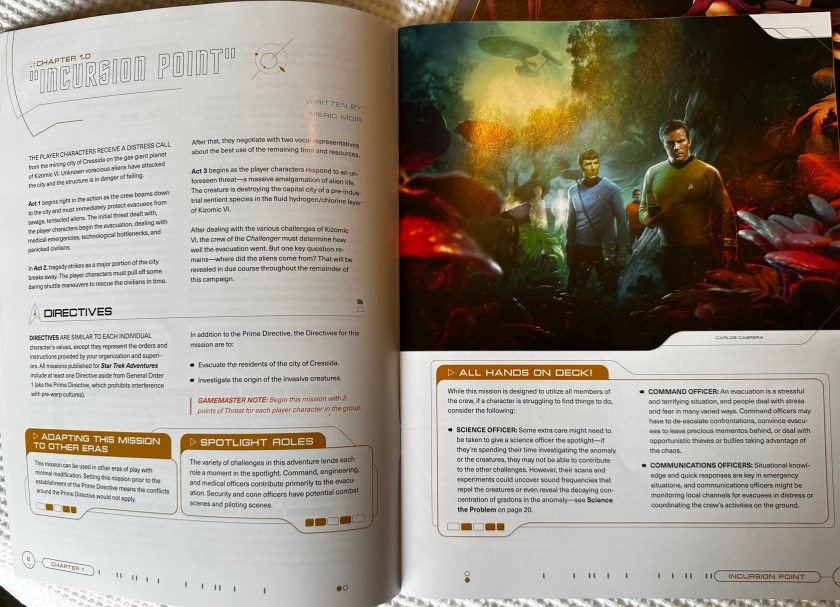
Opening page of the adventure, Incursion Point. Two page spread. One page features and illustration of Kirk and Spock.
Incursion Point

Incursion Point is the first adventure in the campaign contained in the Starter Set. The campaign is entitled “Infinite Combinations,” but the reasons for that are not really obvious from reading or playing this first part of it. It was written by Meric Moir.

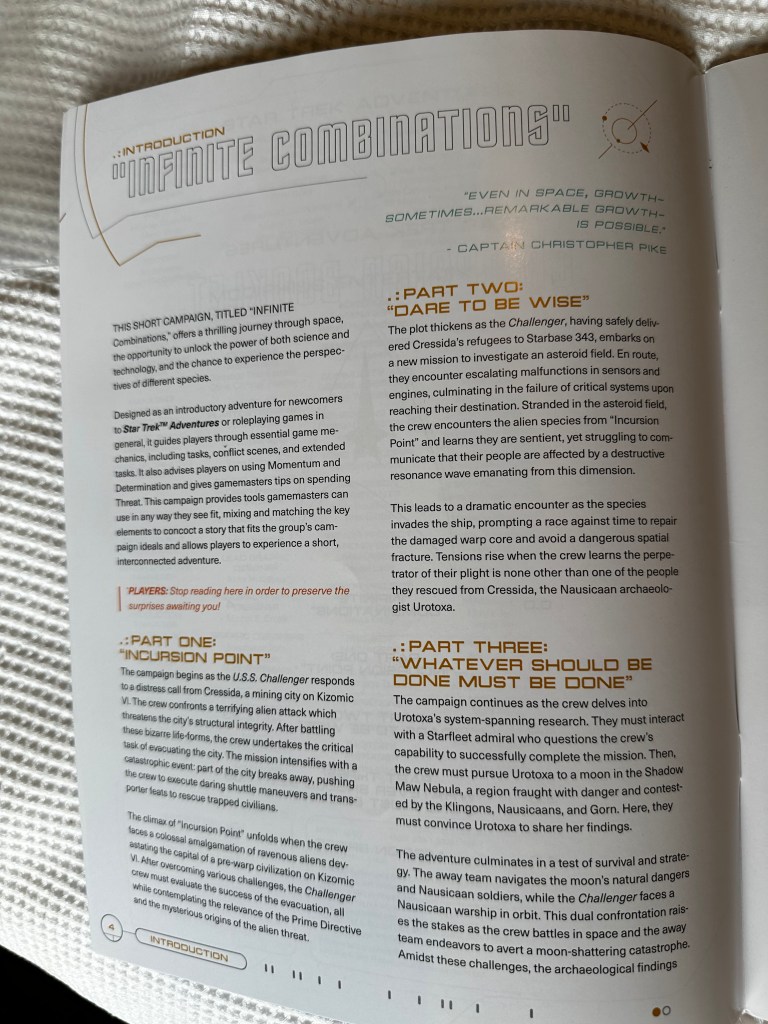
Summaries of each part of the campaign, Inifinite Combinations.

This is quite explicitly a teaching adventure. In fact, the whole campaign is there to teach you how to run and play this game. It has lots of callouts to help out the new GM, from suggestions on what each type of character might do in the current situation, to advice on what to do if your players roll real bad. Much of the text itself is also devoted to explaining how to handle each situation as and when it’s likely to come up. For instance, the first scene has a high likelihood of conflict so the text runs you through how to order actions, resolve and attack and what to do if a PC gets injured. Where necessary, it will direct you to the relevant part of the Rules Booklet. In my experience, it was incredibly effective in teaching me what to do in my first few sessions. Of course, my clever and adaptable players got the hang of it without the need for such hand-holding. Before the first session was over they were stacking and spending Momentum like they’d been doing it all their lives. By session two, the risk of adding more Threat points to my pool was outweighed by their ambition and they were using it to do just oh so much cool shit.

Dear reader, if you think you might be lucky enough to play in this adventure, stop reading now. I’ve got loads of other posts, go and read one of them. There’ll be SPOILERS below.

Stardate 3422.1: We have received an urgent distress call from the independent floating city of Cressida, a resource-gathering collective on the gaseous world Kizomic VI. Creatures of unknown origin have attacked, causing casualties as well as compromising the city’s superstructure. We have responded to the distress call and are proceeding to Kizomic VI at high warp.

When we arrive, we will have only a few short hours to evacuate the city’s 600 inhabitants before the structure fails entirely and sinks into the crushing gravitational depths of the planet. With the number of beings to be evacuated, our first order of business will be to set up pattern enhancers and then direct the locals to the beam-out sites.

The Captain or other commanding officer is supposed to read out this log entry to introduce us to the current situation. We didn’t really have such a PC in our group, so I read it, which was fine. I like the conceit of this as it immediately feels trekkie.

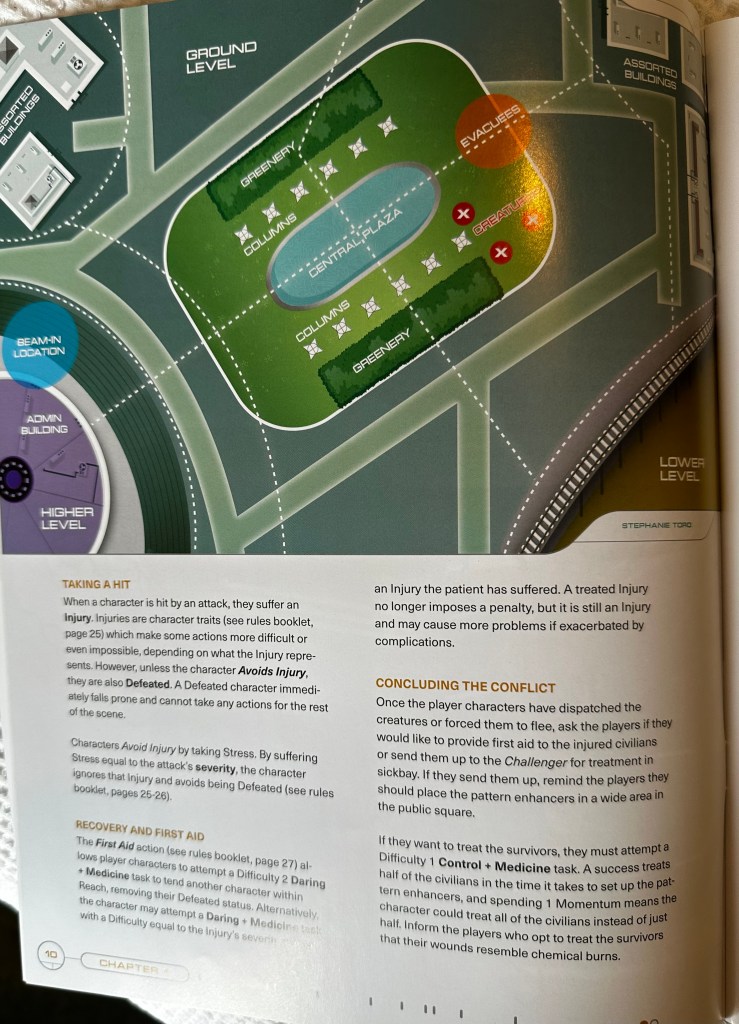
Map of the initial beam in point. Also has details on taking a hit, healing and concluding the conflict with the Bryozoans.
Map of the initial beam in point.

The situation is dire and quickly worsening. The PCs are left to come up with ways to evacuate the citizens as quickly as possible. And that’s when the plant-like aliens they will come to know as Bryozoans seem to attack the evacuees. This is the start of Act 1: Operation Evacuate! In our game, the PCs, Lieutenant Commander Burk ven Jaxa, the Tellarite engineer, Lieutenant Junior Grade Rashid Kemal, our hotshot pilot, and Ensign Laniyar Tennan, Betazoid technician, stunned one Bryyozoan and frightened off the other before quickly moving onto ways they could speed up evacuation. Everything from locating more survivors to constructing elaborate containers to transport more people at a time, (the human cattle container was the term, I believe) were put into practice. With each success, they ate away at an Extended Task track which continued for the rest of the adventure.

Cressida Falling apart - illustration shows a shuttle pursuing the plummetting dome that broke away from Cressida.
Cressida Falling

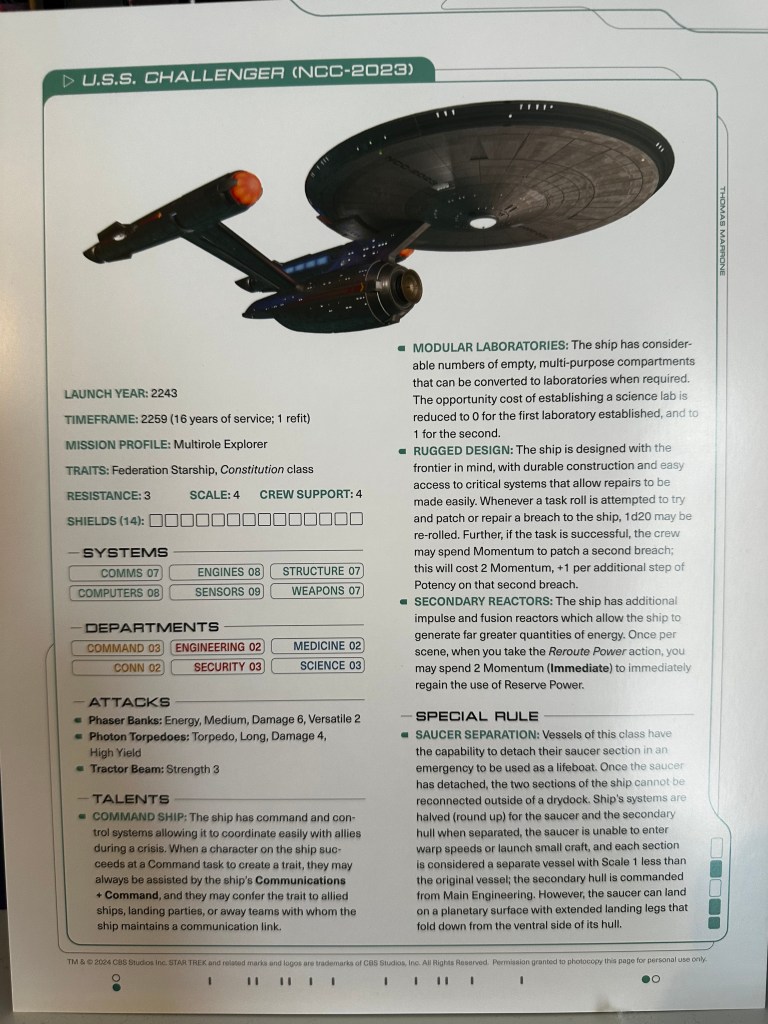
Act 2: The Fall of Cressida started with a huge chunk of city breaking off and falling into the lower atmosphere of the gas giant. The PCs hopped in a shuttle without so much as a call to the bridge of their ship, the USS Challenger. They shot down after the plummeting hunk of city and managed to land almost safely. This is when I started to really spend Threat and introduce Complications. The shuttle door was jammed and they began to be attacked by more Bryzoans. The PCs quickly took steps to uncomplicated matters and save the citizens who had been trapped on the falling district just before it broke up into so much debris. They brought them back to the ship and escorted them to Sick Bay. Here the PCs encountered some NPCs. This was really the first opportunity any of had to do a little roleplaying in this adventure, and this was session two. It’s a high-speed scenario that demands quick action and decisive play.

Anyway, a well-dressed Orion woman, Administrator Demaad wanted use of the transporters to beam up valuable trade goods. Meanwhile, Urotoxa, an older Nausiccan academic, wanted them to help the humanoid inhabitants of the planet’s fluidic layer far below by bringing them a shipment of phasers. She was sure they would be decimated by the Bryozoans, and, as she had been in communication with them, she wanted to help them.

During this three-sided interaction, they discovered a lot through the use of Tennant’s Betazoid telepathy. They found out that Demaad had an underhanded ulterior motive and that Urotoxa was probably the cause of the entire disaster befalling the planet and its inhabitants. Despite neither woman coming out of the conversation smelling like roses, the PCs decided to try to convince the Captain of the Challenger to let them help the Kizomans, although, perhaps not by breaking the Prime Directive to furnish them with advanced weapons.

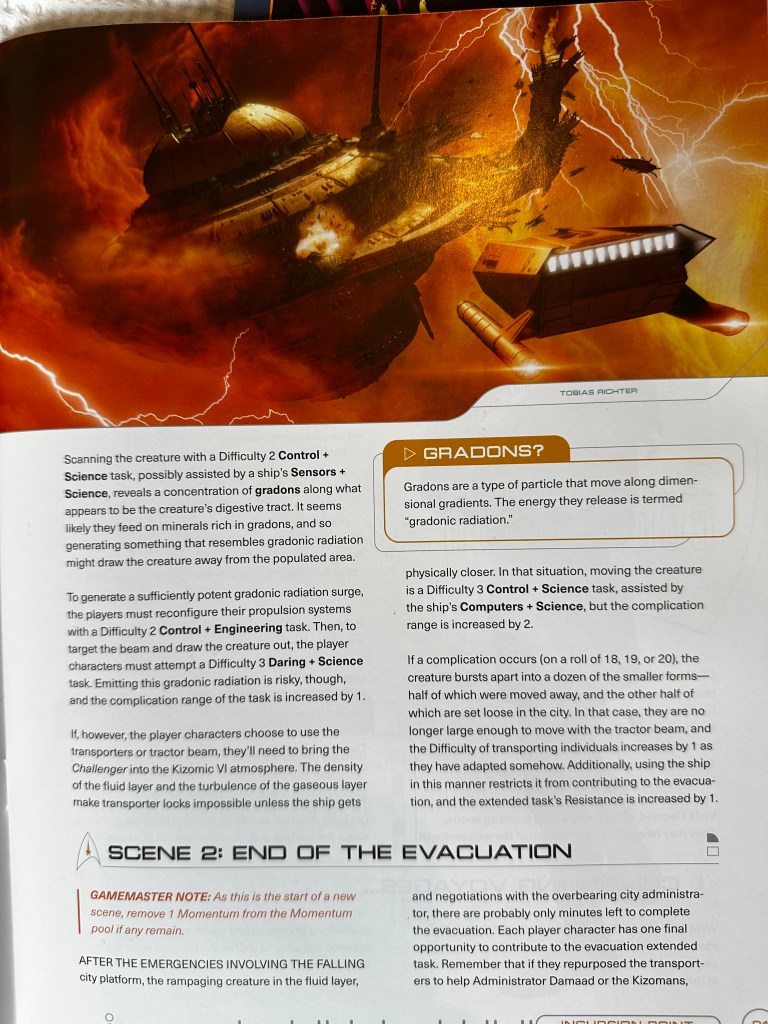
In Act 3: The Fate of Kizomic VI, we saw our heroes contending with the Bryozoan Terror, a massive amalgamation of smaller aliens that they had detected swimming towards the main population centre of the Kizoman people in the fluidic layer. They boarded the shuttle Galileo with a probe ripe for jury-rigging and a trio of EVA suits. While Tennan and Burk worked to modify the probe to emit a high-level of gradonic radiation, (they had figured out earlier that that’s what the Bryozoans fed on, destroying the inanimate objects that contained it in the process) Kemal piloted the shuttle down, down, down until it became a submarine. In modifying the probe, they were too successful, as it turned out. It drew the Terror to them before they had even had a chance to launch the probe towards one of the few remaining rifts that the creatures had emerged through in the first place. The shuttle took corrosive damage that left it immobile and losing structural integrity. They eventually managed to launch the probe to draw the Terror away, but two of them had to exit the craft to effect repairs. They managed it with only moments to spare before their suits ruptured. Kemal got them to the gaseous layer before the hull gave out, just in time to be transported back to the ship. Whew! That was quite the finale! Except there was more.

Here’s where the PCs get one final opportunity to make some headway on that Evacuation Extended Task. They had to each take actions to try to help save some more citizens of Cressida. And they did fine, managing to rescue most of the inhabitants before the city crumbled away to nothing in the atmosphere of Kizomic VI. This felt anticlimactic, though, I won’t lie. I should have taken this part of the adventure and moved it to a point before they went to deal with the Bryozoan Terror.

Conclusion

This was a very well put together adventure. As I mentioned above, the teaching elements worked very well, at least when I got to use them. Actually the most gratifying part of it was that the players avoided doing most things the adventure expected of them. Generally, they avoided violence whenever possible, which felt very Star Trek, and this was great because it got me to engage fully with the mechanics and think on my feet as a GM too.

But also, each Act lasted exactly one session. No overlap, no worries about not getting it finished on the night. Nothing but net. They clearly play-tested the hell out of it.

It could maybe have done with a few more opportunities for role-play, but then again, that’s just not the type of adventure it was. In Act 2, there was that interaction between the PCs, Demaad and Urotoxa, which highlighted social conflict and it worked really well.

Honestly, the only real issue was that ending. The adventure directs you to ask the PCs for more tasks to help complete the evacuation once the finale had already occurred in my opinion. It was an anti-climax and the players agreed. If I had it to do over, I would have taken this and placed it before the Bryozoan Terror encounter.

We are looking forward to continuing the campaign! The players are looking for a bit more of a chance to role-play so I think we’ll have a Starbase episode next!

One More Shot to the Heart

Dear Reader, I was away on holidays in the scorched and parched East of England again last week. I enjoyed the break but it has left me with no enough time to write up a new post for this week. I have one in the works but it is far from ready, I’m afraid. Instead, I thought I would share with you again a post from this time last year. Here is my advice for running Heart: The City Beneath as a one-shot. Hope you enjoy it!

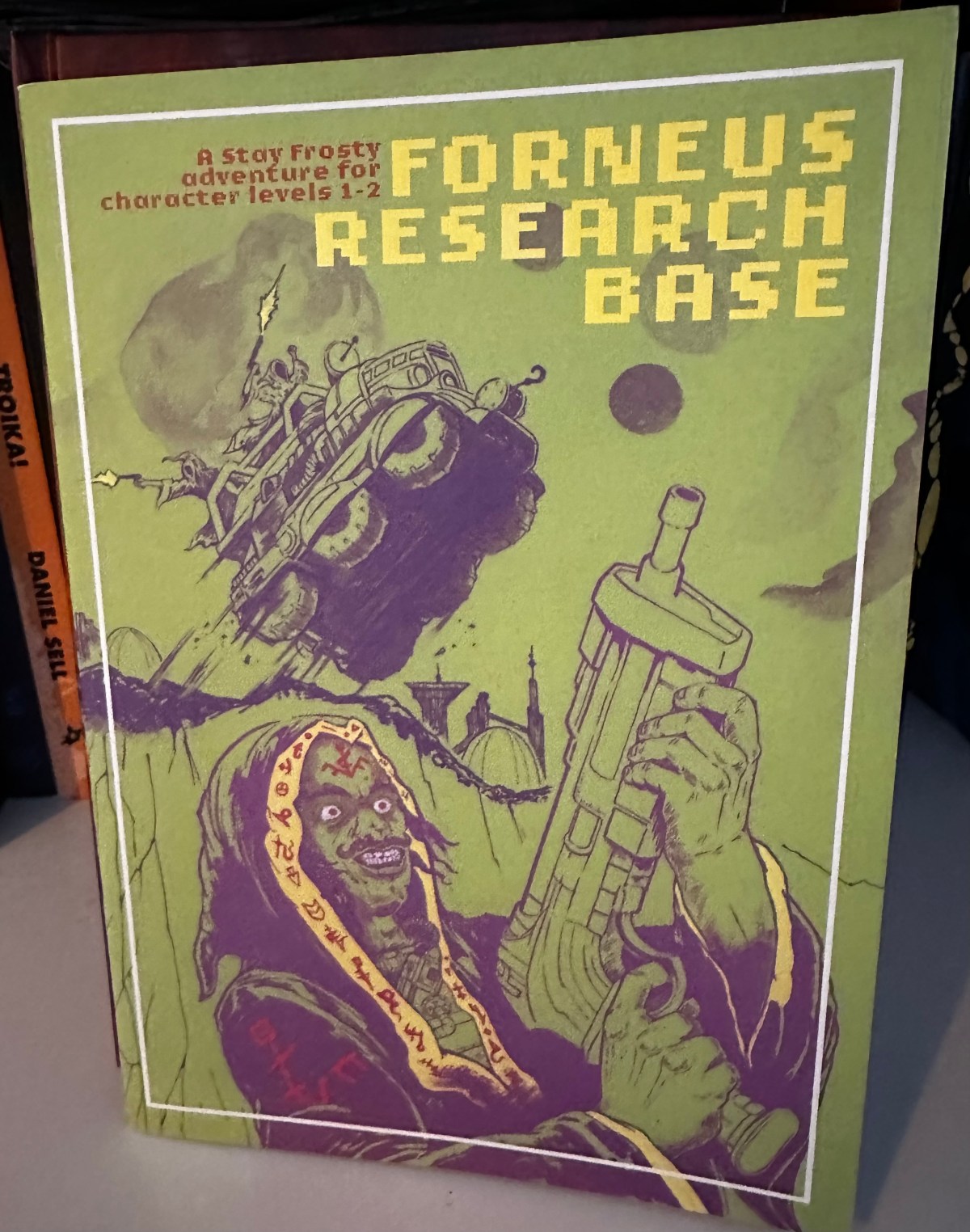
Stay Frosty, Forneus Research Base Review

Zero Prep

It’s the dream, wouldn’t you say, dear reader? Pick up and play. Many claim it, few deliver. One thing I’ll say about this Stay Frosty adventure, and, to be fair, any Stay Frosty adventure I’ve read (which isn’t many,) is that you can pick it up and play it with pretty much no preparation. I mean, that goes for Stay Frosty to a certain extent too. I discovered that when I reviewed the game itself last October.

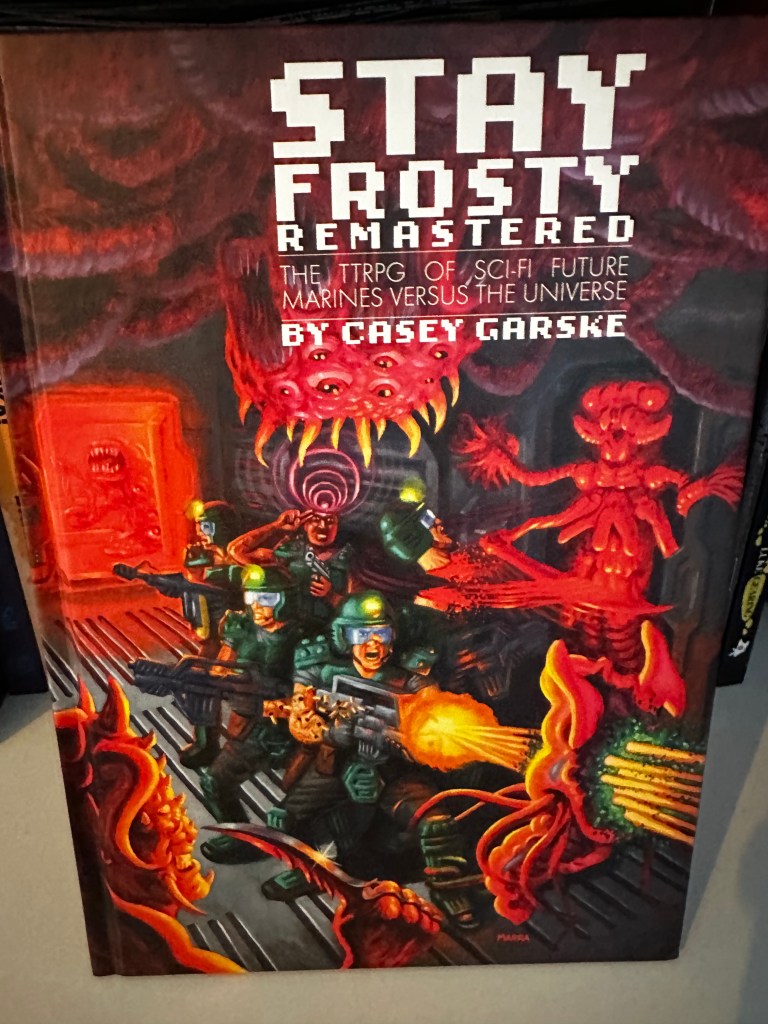
The cover of Stay Frosty Remastered by Casey Garske. Space Marines fighting aliens/demons
Stay Frosty Remastered

But, of course, zero prep is not all you might want from an adventure. In fact, for some GMs, prep is as much fun as play. So what else has Andrew Walter’s Forneus Research Base got going for it?

Well, Tom, Isaac and I played it over the space of three sessions recently. In fact, we just finished it the other night. I have thoughts.

Action

There’s no fucking around with Stay Frosty, no long opening scene to allow for introductions of our characters, just a short summary for the PCs, of what they’re doing out there in space and an immediate crash landing at the eponymous Research Base. Oh, the crash landing was caused by black ooze exploding from the controls of their shuttle btw.

As I stated, there is a short read-aloud piece of text at the start. It explains that the PCs are private marines, employed by the United Universal Corporation to check in on its research colonies. As they are doing this, they are forced to crash land.

As I said, Stay Frosty is not really interested in your PCs feelings, unless they involve terror or going apeshit. At no point is anyone encouraged to take a moment to express their concern for their fellow marines or, for that matter, the colonists they were supposedly there to protect. This is a DOOM simulator. The PCs are there to shoot shotguns and blow up demons. And Forneus Research Base is all action from the get-go.

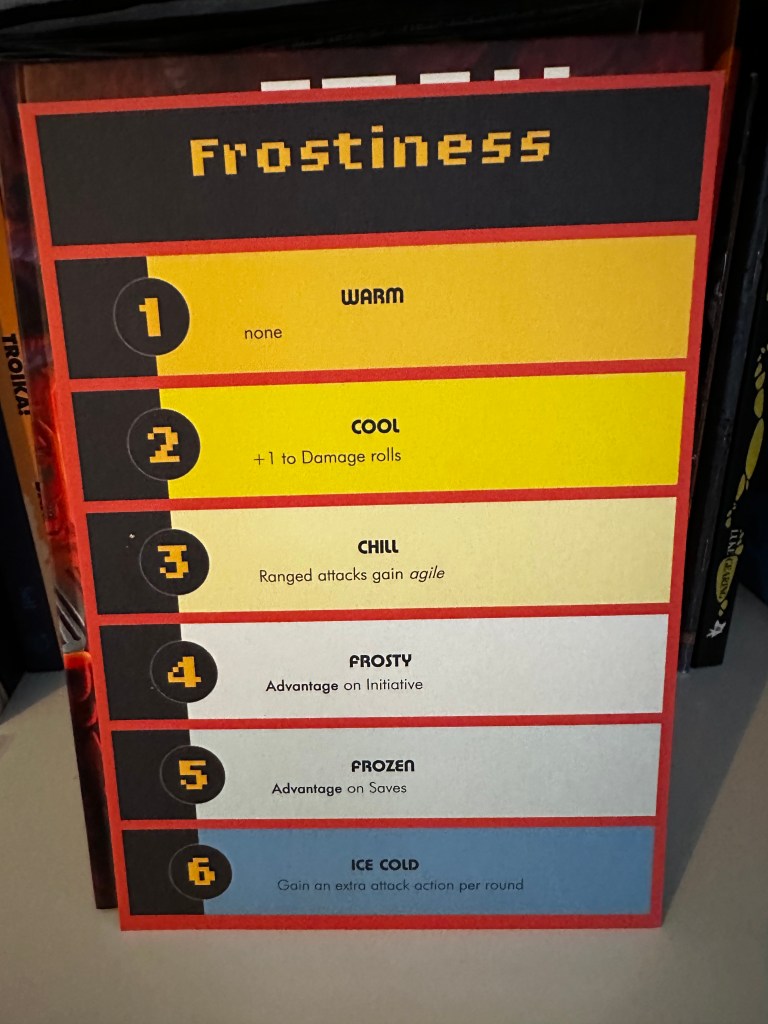
The Frostiness Tracker goes from Warm to Ice Cold
Frostiness Tracker

As soon as they emerged from the wreckage, the PCs realised they were not going to be able to take off again without significant work on the shuttle, so they decided to make their way to the base. Meanwhile, I’m rolling the Danger Die every time they move from one location to another, take a look around or stop to think, as intended by the rules. The Danger Die works a bit like a random encounter table. You roll a d6 and the result will give you one of the following:

  1. Encounter and Stress – i.e. roll on the relevant encounter table. Forneus has one table for the moon’s surface and one for inside the base. Stress is added to the PCs to build Tension. Tension also equals Frostiness. They higher the Frostiness level the better as it gives PCs bonuses like advantage on initiative and even extra attacks. But Tension can also explode. See below for more on that.
  2. In dangerous areas, Encounter, otherwise, Environment – Forneus has its own Environment table also. But this didn’t come up too often, to be honest.
  3. Environment – as above
  4. Stress – see point 1
  5. Entropy – for some reason, I rolled this one a lot and it had no effect. It’s only relevant if the PCs are using a thing constantly that has its own Supply die. For instance, if they are using Combat Drugs or Fuel when they’re driving a vehicle. The idea is that when Entropy is rolled, the Supply Die for that thing goes down to the next lowest die size. But whenever this was rolled, they had nothing to decrease.
  6. TENSION EXPLODES! – Only rolled this once. The idea here is that when this comes up, the PCs make a Willpower Save. If they succeed, they get to reduce their Tension by one. If they fail though, they take Tension x level damage and reduce their Tension to 1. Then they roll on the Going Apeshit table if their HP are reduced to 0 by the damage. The effects of this can be anything from getting Advantage on damage rolls but constantly rolling your Ammo Die (like a Supply Die for your weapons,) to Last Stand: going down mano-a-mano with your enemies. I actually adjudicated this mechanic incorrectly at the table. I didn’t allow them the Willpower Save, I just rolled the Tension damage and gave it to every PC. Also, this damage is not supposed to be applied to attribute scores when all HP are gone, as normal damage is. Only one PC had to roll on the Going Apeshit table. She ran for her goddamn life and they had to manacle her to the ATV to stop her.

(I only just realised I was calling this the Doom Die the whole way through our game. Oops.)

The Danger Die is the mechanic that really keeps things interesting in Stay Frosty. Many of the locations in the Forneus Research Base, for instance, have no pre-written encounters or much of interest at all, so the random encounters, environmental hazards and ratcheting Tension from the Danger Die are doing a lot of the work. This works fairly successfully but I found I was rolling up Encounters a lot, since a third of the possible Danger Die results give you one most of the time, and after a certain event in Forneus, you actually get Encounters on a roll of 1 to 3. So the marines were drifting from one Encounter to another with only cursory exploration in between.

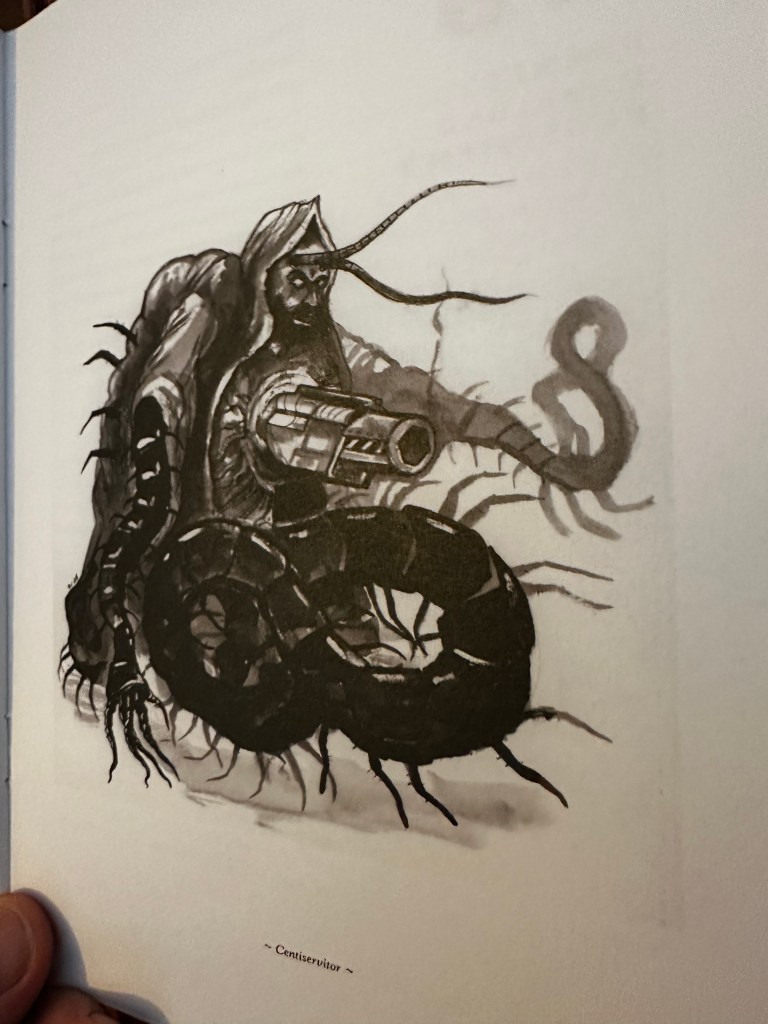
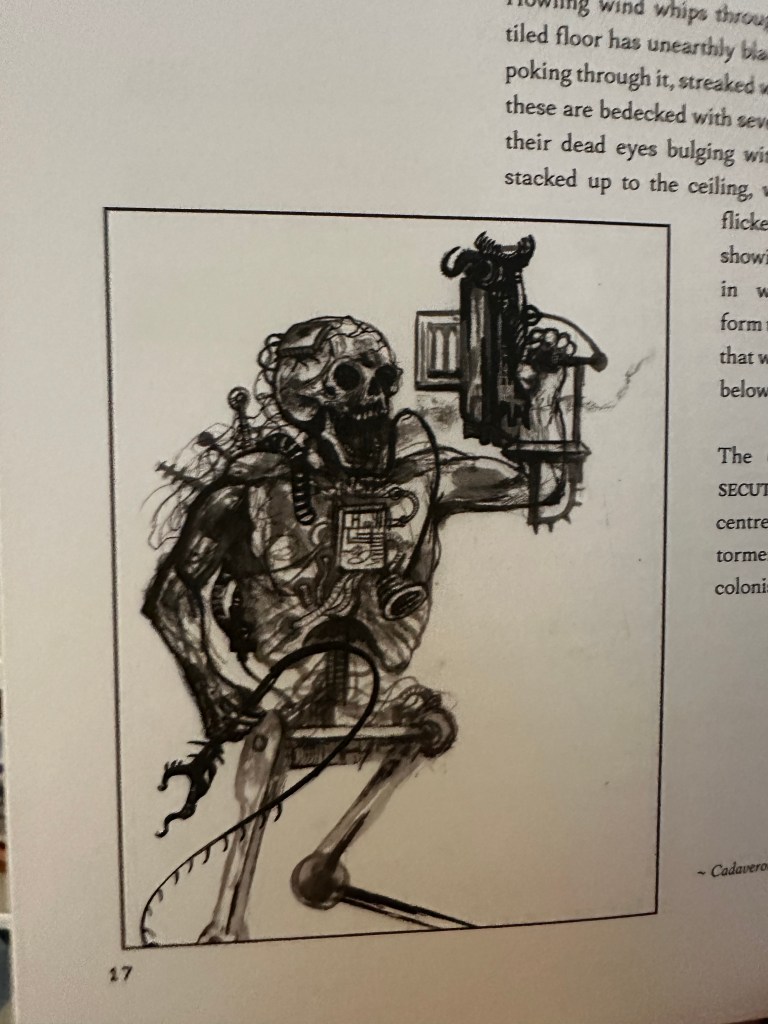
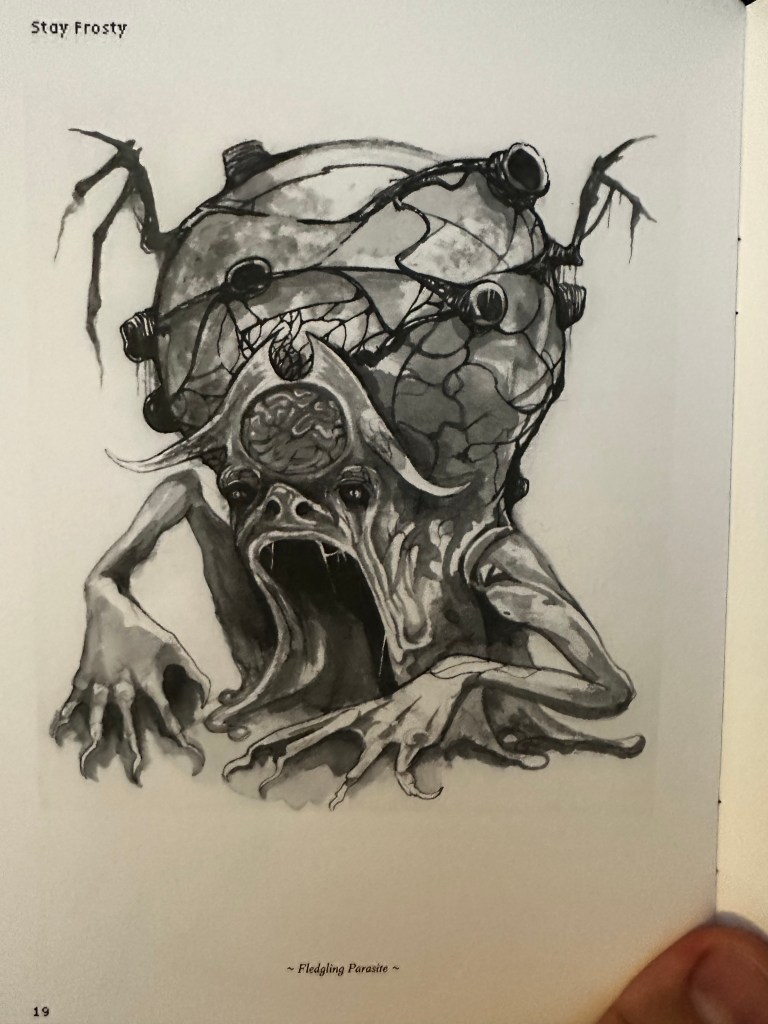
At least the variety of enemies is suitably gristly, demonic and fun. You have the obvious demons, like the Black Leathery Imps, that used poison to make their enemies fire on each other. Then you have the basic cultists who just have guns, the mutated cultists who have been transformed to allow them to fly with their fiendish lord Xithrabla through the cosmos, sucking from his hellish teats and the Centiservitor who is a cultist combined with a centipede with a plasma cannon in its chest. On top of that you have the real horrors like the Cadaverous Persecutor, a giant cyborg corpse with a rocket launcher, and the Fledgeling Pest (The Final Boss,) a sickening, enormous baby’s head with a partially exposed brain and a vicious bite.

We found the lower level encounters were essentially just target practice. Since we only had two players, I gave them each three marines and decided to treat it a bit like a funnel. I think this was too many for this adventure. Four would have been a bit more balanced. The main reason I think this is because of the initiative roll in Stay Frosty. Whoever makes a successful Dexterity check gets to go before the enemy in this game. This generally meant that a significant portion of the six characters got to act before the demons and cultists. There were enough weapons between the marines that could do blast damage (flamers, grenades etc.) that they could wipe out the opposition before they ever got a shot off. It felt too easy at times. But, it also seemed to accurately emulate the feeling of playing a video game like Doom. At one point they were crossing a bridge over a chasm and being swarmed by imps and cultists. There were 26 opponents and the party defeated them in two rounds, just mowing them down in waves of gunfire and explosions. In only the second encounter, they came up against a group of six foaming cultists, one of whom was holding a grenade in each hand and standing near a leaky fuel tank. One well-placed shot from the grenade launcher took out the whole bunch with a mushroom cloud left in their wake. These moments felt hilarious, exhilarating and hilarious.

But when it comes to the more challenging opponents like the Centiservitor, the Cadaverous Persecutor and the Fledgeling Pest, I can’t stress how important it is to use the Powerful Opponents mechanic in Stay Frosty. That rule states that when there is a disparity on either side of a fight, the side with fewer Hit Dice, should subtract the difference between their HD and their Opponents’s HD from their attack rolls. For example, when my PCs were facing the Fledgeling Pest at the end of the adventure, the 1 HD/Level 1 marines had to subtract 3 from every one of their attacks against it because it had 4 HD. This meant that they were not able to overwhelm it by sheer numbers in the first round or two. Many shots that might have hit, did not, because of this nicely scaling rule. However, when they were up against the Centiservitor, I forgot to apply the Powerful Opponents rule and they slaughtered it before it ever got a chance to fire off its cool weapon.

My main complaint when it comes to the action in this adventure is that the Fledgeling Pest, labelled as the Final Boss, is quite avoidable. It is described as being attached to a wall by its very flesh in one of the Hangars, which have been converted to perform devilish rituals. But there is no reason for them to go to the Hangars in the adventure. I made one up, of course, to try and get them there. One of the NPCs they met told them there could be a working shuttle in one of them. This did lead them to the Hangars, but as soon as they got there, Tension Exploded and one of their number went running off across the moon’s surface so they hopped in the ATVs they had just found and booked it after her. After that, they decided to egg it as well. Since they had the ATVs, they were better able to make it back to their own shuttle. I had to think on my feet here or they were going to miss out on the best couple of encounters of the whole adventure. So, first, I had the Demon Arms (also restricted to the hangars) appear out of a hellish portal in the ground ahead of one of the ATVs, grabbing the driver and causing he vehicle to flip over. The mouth in the hand of one of the arms devoured one of the party but they won out. Then they moved on again and just as they were about to reach their shuttle the giant demonic archway (also found in the hangars) appeared in the air before them, with the Fledgeling Pest emerging out of it to attack them along with a few of its cultists. This was a genuinely tough fight and resulted in the death of a couple more party members. I might have just let them make it to the shuttle, I suppose, but I didn’t want to deprive the players of the Final Boss.

Non-action

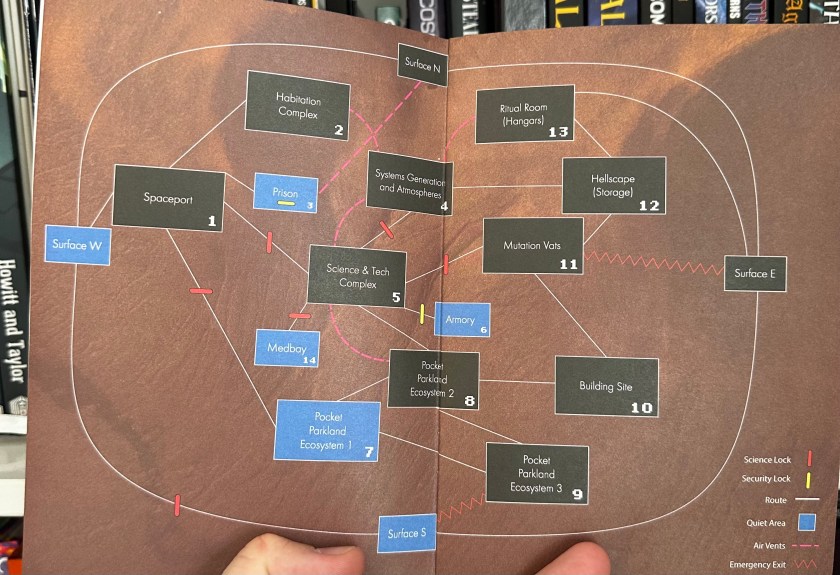
Of course, it wasn’t all action. There was some exploration. This is done in a point-crawl style as you can see by the map here.

The Forneus Research base point-crawl map.
Point-crawl Map

The descriptions of the locations in the adventure are pretty bare-bones. At times, I found I wanted a bit more. For instance, the Systems, Generator & Atmosphere area is supposed to be enormous and encapsulates everything from winding, labyrinthine machine rooms to massive bridges spanning deep chasms. To be honest, these feel like they should be separate, individual locations. Another point about this area in particular is that we’re told that the communications can be turned back on and full computer bank access can be gained here, but not what that might achieve. I had no idea what the computer banks might tell them and I had no idea who they might communicate with off-world. That’s a lot to leave in the lap of a GM, especially when the rest of this adventure is pretty much zero-prep, as I mentioned before.

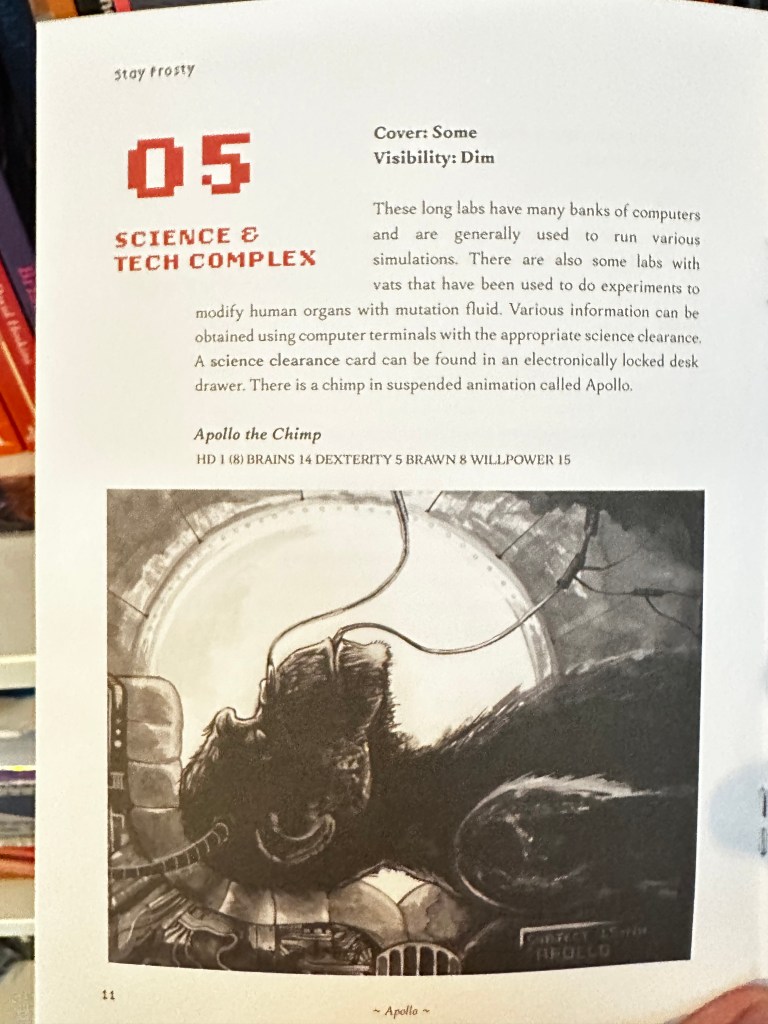
Apollo, in stasis - a chimp in profile, lying on a table with tubes going into his mouth and nose.
Apollo

Actually, it is really hard for the PCs to get much information about what has happened here. Even the few living, rational NPCs they meet had no way of knowing what happened on the base, since one was a prisoner and had been kept out of the loop the whole time, one was in a coma and one was a talking chimp, named Apollo, who was in stasis the whole time. It would have been more interesting if at least one of these guys had the full story for the marines. I should have improvised that, in hindsight. Of course, the PCs did recruit both Apollo, the chimp, and Jamal, the prisoner, gave them guns and got them shooting, so that was fun.

Conclusion

I ran this, as I mentioned above, for two players with three PCs each. I think this was a mistake. I mean, once they had recruited the NPCs, they had a squad of eight and they were just mulching the hostiles at every turn, until the very end. Four PCs would have been about right to make it a challenge. Also, I thought I might be able to run it as a one-shot, but that was highly unrealistic. It took three sessions in all, and they did not explore any more than about half the locations.

If I had to do it over again, I might have seeded some of the locations or NPCs with a bit more information on the background of the adventure, but I would still keep preparation time to near zero.

All in all, it was fun, exploding demon sort of romp as an adventure and a system that we all enjoyed, although I expected Tension to Explode more often.

The Editioning, AD&D 2nd Edition, Part 3

It’s thedicepool.com’s second birthday today! Two years ago I decided it was time to stop keeping all my thoughts on RPGs to myself and start writing them down for other people to read.

Anniversary Post

It’s thedicepool.com’s second birthday today! Two years ago I decided it was time to stop keeping all my thoughts on RPGs to myself and start writing them down for other people to read. Why? Well, at the time, dear reader, it was not for the edification or entertainment of others. I was just looking for a creative outlet other than RPGs themselves. Blogging is good for that! It makes you organise and record your thoughts, it can promote interesting discussion, and in writing about a topic, you invariably unearth opinions and insights you might not otherwise have realised you even possessed. It’s a cool pastime. You should try it.

Anyway, this is my second anniversary and my 213th post. In some ways I am returning to a topic that I first brought up waaay back on July 24th 2024: returning to Ad&D 2nd Edition. That post was more Dark Sun focused, but it asked the questions that I’m answering now, during the Editioning, our challenge to play every version of D&D, from OD&D to 5.5E. The main question was, why? Why play this mouldering old edition that is, arguably, overly complicated, over-written and under-nuanced compared to more modern RPGs? Why play a game that I have played, without fear of hyperbole, a shit-tonne of already? Why not play something new instead?

Back in that original post, I admitted to a

morbid curiosity to try it out. More as a historical research project than anything else. How would it compare to more modern systems like 5E or the Year Zero engine or even actual OSR systems?

That sentence, right there, that I wrote two years ago, was the seed that grew into the Editioning. Come to think of it, I may have initiated the Editioning purely so that I had an excuse to play AD&D 2nd Edition again. And, so far, I’m not regretting it.

Back to the Eternal Boundary

The investigation progresses well. It has become very clear to the members of the party that there is something very strange afoot. If you need a recap, feel free to have a look at my last AD&D 2nd Ed post.

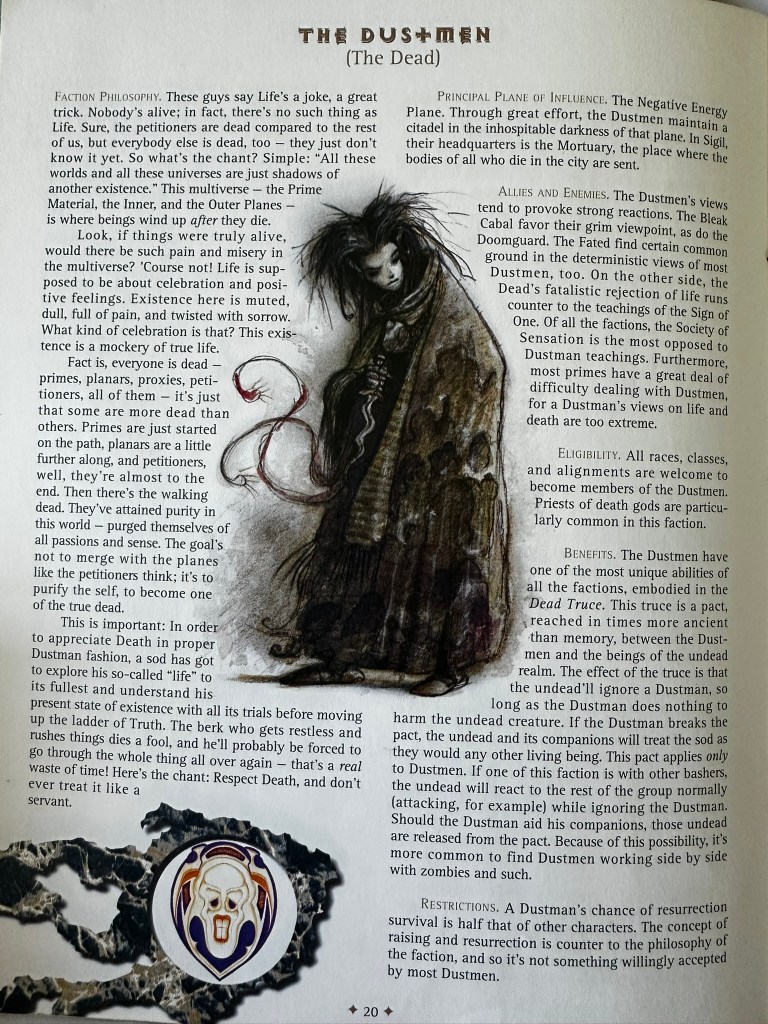
Page from the Player's Guide to the Planes from the original Planescape boxed Set. It describes the Dustmen. The illustration is of a Curehead in a long dark robe.
The Dustmen

Aurora ended the last session on her way to the Mortuary, headquarters of her own faction, the Dead, aka the Dustmen. Here she encountered Toranna the Grey, another Dustman, whose job was to send unclaimed bodies to the Elemental Plane of Fire using one of the many interplanar portals located in the building. She consulted her records to discover that the barmy, Eliath, was sent to his ever-lasting reward through that portal just last week. His possessions, likewise, were gone, having been distributed to other Dustmen.

Disappointed, Aurora went to await the arrival of the rest of the party. This dead-end (pun intended) left them at a loose end. They decided to go and visit one of the other locations on the point-crawl style map of the Hive Ward, presented in the adventure, the Blood Pit. This is the most famous pit-fighting arena in the city. It is a centre of gambling and considered neutral ground for the factions.

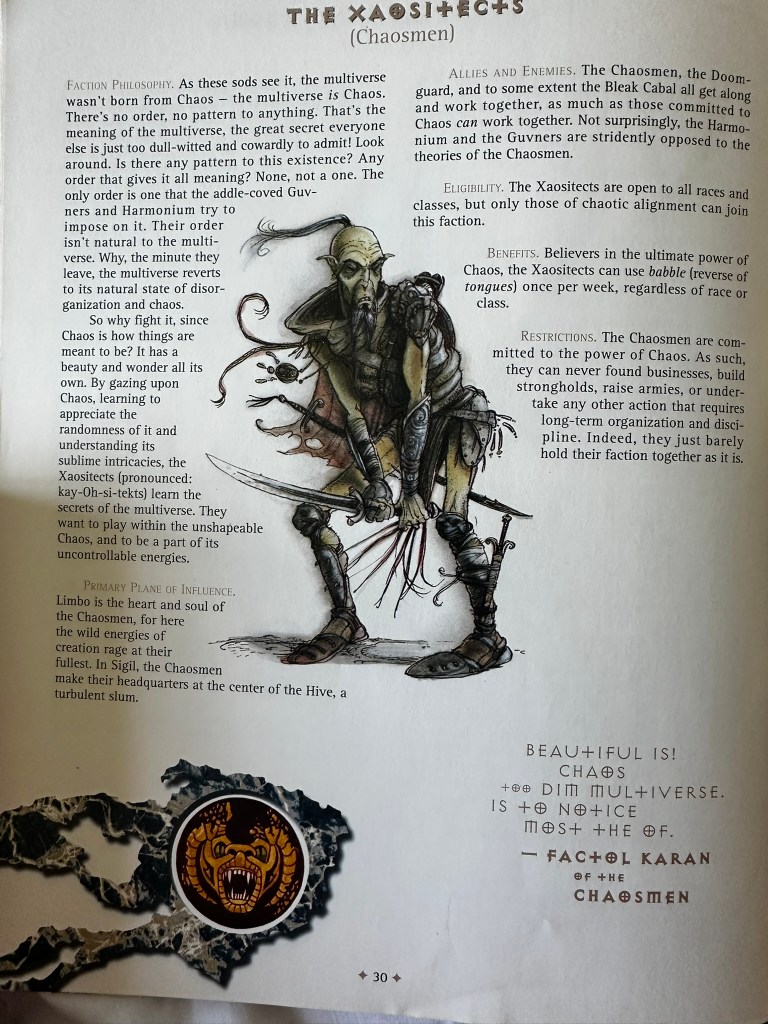
On the way, however, they decided to revisit the alley where Aurora had seen the corpse of the Dancing Man. It was no longer there. Instead, as the thief and the necromancer argued about what to do next, the ever quiet paladin noticed that they were quickly becoming surrounded by Chaosmen. The Chaosmen, or Xaositects, are another Faction that makes there home in the Hive. They believe in the primacy of chaos in the multiverse and they like the barmies, who they see as inherently chaotic. Chaosmen also have a mixed up, garbled way of speaking that was fun to role-play with. It took a moment before speaking each sentence aloud to just throw all the words into a mental hat and then pick them out at random. This particular group of Xaositects made the assumption that the PCs were responsible for the murder of the barmies on their turf so they showed up and demanded the party’s surrender. Unsurprisingly, they refused and our first combat ensued!

Fight!

Page from the Player's Guide to the Planes from the original Planescape boxed Set. It describes the faction, the Xaositects. The illustration is of a githzerai with a sword
Xaositects

I gave the PCs a chance to surprise their opponents here, as our tiefling thief, Trance, had an idea to drop a sphere of Darkness over the battle-ground right off the bat. I had to double-check both the surprise and initiative rules since they have changed from earlier editions. In order to gain surprise on an opponent, the opponent rolls a d10. If they roll a 1 or a 2 (a variety of adjustments can be made to this roll), they’re surprised. Since I rolled a 9, we went straight to initiative, instead. Initiative in 2nd Ed is also rolled with a d10. Each side rolls, just once, rather than once per round. The side that rolls lower gets to go first. There is a weapon speed modifier to initiative, technically, but I decided not to use it as it’s very fiddly. The Chaosmen won initiative and attacked when they saw their opponents not dropping their weapons. They had a priest with them, who Blessed the others. A big fighter named Mordrigaarz Antill, led them into battle and immediately went to focus on Glaermond, the paladin. The other combatants, all mercs ran into attack everyone else. Fighter and paladin spent the fight smashing each other in the plate armour to no effect but the mercs had more success, landing several significant blows in the first round. When it came to the PCs turn, Aurora sent her familiar, a goat to charge at the priest and did a frankly disgusting 15 damage, leaving the poor bastard with a single hit point. Trance dropped the Darkness and then crept through it to finish off the priest with a backstab. Devansh, our priest of Varuna, decided enough was enough and cast Command on Mordrigaarz, ordering him to surrender. He failed his save and dropped his weapon. The mercs followed suit and that was the end of that. After demanding they hand over their valuables, they had a chat with Mordrigaaarz, who told them they wanted to stop the murders of the barmies in the Hive and that they thought the PCs must have been responsible. Satisfied that they weren’t to blame, he left with the remainder of his group and let the PCs go on to the Blood Pit.

The Blood Pit

Page from the Player's Guide to the Planes from the original Planescape boxed Set. It describes the Faction, the Fraternity of Order. The illustration is of a human man with a headress and a white mustache, sitting in a chair holding a book.
The Guvners

At the Blood Pit, they got to talk to the ale-tap tender, a high-pitched gnome named Felgar. Regular told them a tall-tale about a Guvnor (a nick-name for the Fraternity of Order, another Faction of Sigil. They serve as judges and lawyers for the city.) This Guvnor allegedly discovered a way to transform into a demon to devour the souls of the Hive’s barmies and bubbers. Apparently this was to gather enough power to challenge the Lady of Pain, herself, for supremacy in the city. Aurora did not want to pass up the opportunity to have a little flutter on the fights while they were there. I made this mini-game up on the spot. I told them the next fight to occur in the cage in the centre of this dilapidated warehouse on the outskirts of the Hive, was between a nimble, leather-clad human rogue and a muscle-bound, scarred ogre. Then I got two of the other players to roll for each side. There was a roll off for each of three rounds of the bout. The first round went to the human rogue as he flitted around his opponent. The second was taken by the ogre who smacked the rogue a good one with his windmilling tree-trunk-like arms. The third round, was a tie so they died together as the human stabbed the ogre in the neck as he was crushed by a bear-hug. Aurora got her money back and counted herself lucky.

Page from the Player's Guide to the Planes from the original Planescape boxed Set. It describes the faction, the Doomguard. The illustration is of a dark haired humanoid woman holding a knife.
The Doomguard

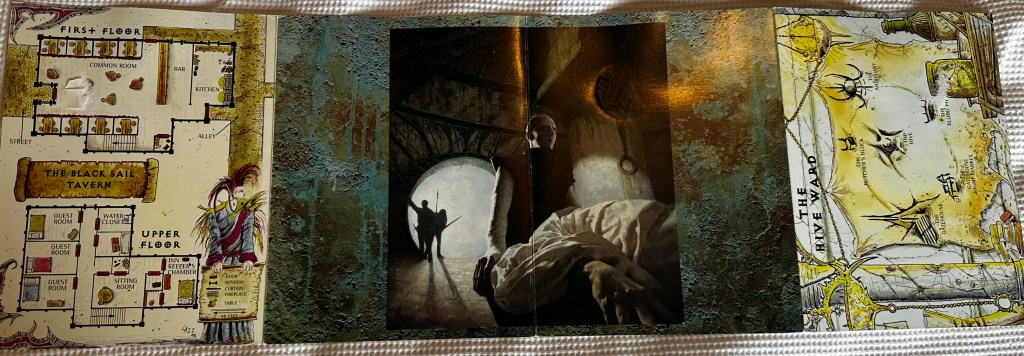
While in the Blood Pit, Trance was again approached by the messenger urchin from the start of the adventure. They were summoned to Bendon Mawl. They had a rest that night and went to see their patron the next morning. He told them that Eliath, the very barmy they’d been looking for, the man who Toranna the Grey had said was so much ash in the Elemental Plane of Fire, had been seen in a pub in the Lower Ward. Not only that but he didn’t look too barmy anymore and he seemed to have joined the Doomguard (yet another Faction, who believes in the inevitability of entropy.) Off they went to investigate this new lead. Eliath had been seen with a group of Doomguard in the Black Sail, a tavern near the Doomguard’s HQ, the Armoury. The building itself is the prow of a galleon sticking out from between two more mundane frontages. Its sail hangs low and is stained coal black from years of exposure to the smokes billowing from the Armoury. They got a room and set themselves up for a stake-out.

Conclusion

Page from the Player's Guide to the Planes from the original Planescape boxed Set. It describes the faction, the Society of Sensation. The illustration is of a human wiman kneeling and holding a sceptre.
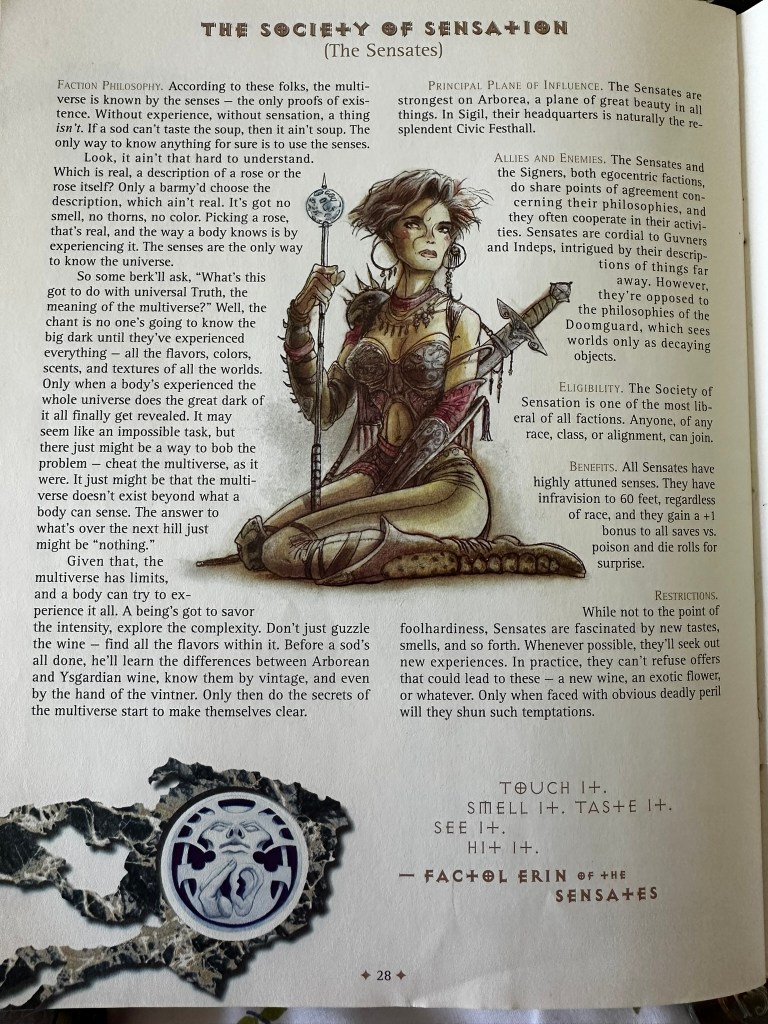
The Sensates

We have such a wonderfully diverse and interesting selection of characters in the party that it has promoted some genuinely engrossing philosophical arguments. There are three different factions represented, to lawful characters and two chaotic. Our priest is a Guvnor, so has to continually justify the party’s less than law-abiding actions, or, simply try to ignore them. He could not gamble at the Blood Pit but did consider just leaving some of his gold out on counter for Aurora to gamble with for him. Our Dustman and our Sensate, despite both being Chaotic, are furthest apart, philosophically, however, and this has encouraged some truly fascinating discussions, with the Sensate thinking that the Dead are, perhaps, responsible for what is happening in the Hive. Meanwhile, our paladin, somewhat deficient in smarts, is content to simply be led around by the nose to do whatever. This could come back to bite him in the arse at some stage, given how unforgiving the gods can be when it comes to paladins committing what they may deem evil acts.

Our first combat was quite successful! I had to check a couple of rules on the fly and I was caught flat footed by movement speeds, but otherwise, I think we all enjoyed it. It certainly helped that it was brought to a swift end, rather than turning into a war of attrition. Also, I am vindicated in starting our PCs off at 3rd level. It gave them a wider choice of abilities and spells to choose from and made the fight a lot more interesting.

OK, I’m off to my second birthday party. Gonna sit in my high-chair and plaster myself in cake and banana.

The Editioning, AD&D 2nd Edition, Part 2

Character-work

We’re back in Sigil, dear reader, and it feels like coming home. Long has it been since my players had their characters sneak around its darkened byways and razorvine-choked alleys, avoiding the Hardheads. Years have passed since they were introduced to the Cage’s many factions, wards, points of interest, cranium rats, and, of course, deranged NPCs.

Back then, I took a peculiar pleasure in populating the City of Doors with the sorts of unusual cutters that one might expect from such a cosmopolitan, diverse crossroads. There was the BDSM dwarf who served them up cocktails and information in a leathery sort of club, the down-on-their-luck founding members of the Mundane, a faction who took great pride in their rejection of magic despite its ubiquity, and the gnome mage who filled the street outside his bookshop with lava to prove a point.

The first of those was all me. Pulled him out of thin air when the party said they went into the nearest pub to ask for info. The other two were inspired by one of my player’s characters and by a character presented in the excellent AD&D 2E Planescape sourcebook, Uncaged: Faces of Sigil.

With our latest foray into the city, I have continued on form. I am still taking inspiration, of course, but have particularly enjoyed making the people and places my own.

The first was Trunfeld Three-teeth, (a delightful tongue-twister, particularly for those of particularly Hibernian dialect.) Trunfeld is a “vile-tempered creature of disgusting personal habits,” according his description in the adventure, The Eternal Boundary. He is also a peculiarly intelligent ogre, and he runs the notorious den of scum and villainy known as the Butcher’s Block. The adventure gave me, I think, just enough to build a voice and personality for this character and, let me tell you, I really went for it. Trunfeld stank to high-heaven of sweat, picked his nose and wiped it on the paladin’s breastplate, breathed his hot, rotten breath on them and offered them some unidentifiable stew. Our cleric, Devansh Rao, used a spell to purify their drinks when they were served, and this was entirely apropos. Trunfeld was hanging out with an honest-to-gods demon when the PCs walked in, and they were lucky not to provoke its ire when they made the mistake of interrupting their conversation. I bellowed at them from the depths of my chest for Trunfeld’s voice. It felt good. He cursed them in his cockney rumble and eyed the priest and the paladin suspiciously. Luckily, the presence of the holy-joes was tempered sufficiently by their companions, the necromantic witch and the thieving tiefling, who were regulars in the ogre’s bar. So they managed to strike up a bargain. As he promised to keep an ear to the ground for them, I am relishing the prospect of getting to play this rancid brute again.

The second was Mourner Tom, another NPC given a brief description in the adventure. He is the leader of a band of Collectors. These poor unfortunates scrape an execrable living on the streets of the Cage by locating, looting and transporting corpses they find to the Mortuary. They have a deal with the Dustmen (the faction that runs the Mortuary, also known as the Dead.) He is described only as a down-on-his-luck thief, but the text does provide a few quotes of his. These are what led me to voice him almost exactly as Danny, the drug-dealer from Withnail and I. So if you know that character and his many famously quotable lines, you’ll understand why quotes like this drew me to him:

It’s like they fall asleep and don’t wake up. Very peaceful, that
We might’ve seen ‘I’m but our memory’s none too good.

Hopefully you get the idea. If not, here’s a link to a helpful YouTube clip of Danny:

I didn’t lean quite as heavily on the speech impediment, but I think you get the idea.

Of course, its not just speech-patterns and accents that make an NPC, Mourner Tom was also dressed in a battered top-hat and tatty tails, all stolen from corpses he’d found on the job. And he had his motivations. Unsurprisingly, his was jink, gold, money. He was another helpful one, explaining, after he’d been paid, that the barmy the PCs were looking for was one they’d picked up recently and brought to the Mortuary, since he was dead.

We have a lot more NPCs to meet. There is a good chance that the PCs are going to be interacting with a few more factions and other non-affiliated weirdos over the coming weeks so I’m looking forward to coming up with more unlikely voices and mannerisms.

To the Adventure!

Honestly, it took us a while to get really started with the first session. Some characters were not quite finished. This was largely due to the arcane (pun intended) categorisation of priestly spell spheres and the added complication of choosing an appropriate faction. But, I also wanted to establish some background and motivation for the PCs.

It’s a rather unlikely story, so I think it’s worth telling here. Our paladin, Glaermond, having recently completed his training, was asked to leave his temple and, being a little on the innocent and simple side (read “thick-as-plank”) decided he wanted something to spend his small reservoir of coin on. He encountered Devansh Rao, the cleric of Varuna and they went about finding a ruined old temple to that god in the Lower Ward of the city. Small, dirty and crumbling though it was, they decided to devote their efforts to restoring it, as not another temple to Varuna existed in the city anymore. Glaermond was happy to have discovered such a noble endeavour to pursue, but neither he nor Devansh knew anything about money, and they would need that… Enter Trance, the tiefling accountant (thief.) She told them she could help them manage their gold and brought in Aurora, the bariaur witch, who would be happy to occupy the basement and use it to conduct her necromantic experiments (not that she told them that!) And so, out odd party was born!

To begin the adventure proper, I had a typical cockney urchin approach Trance with a message from one of her fellow faction members and ask her to bring friends to the headquarters of the Society of Sensation, the Civic Festhall. There, they met Bendon Mawl, a tiefling with some influence in the faction, who told them they wanted to find a barmy in the Hive who is said to have the key to a very important portal in Sigil. This barmy’s name was Eliath and it seemed like he might have been a wizard. They were offered a cut of the profits gained from this portal. Since the PCs had a church to restore, and they were all out of donations, they jumped at the chance.

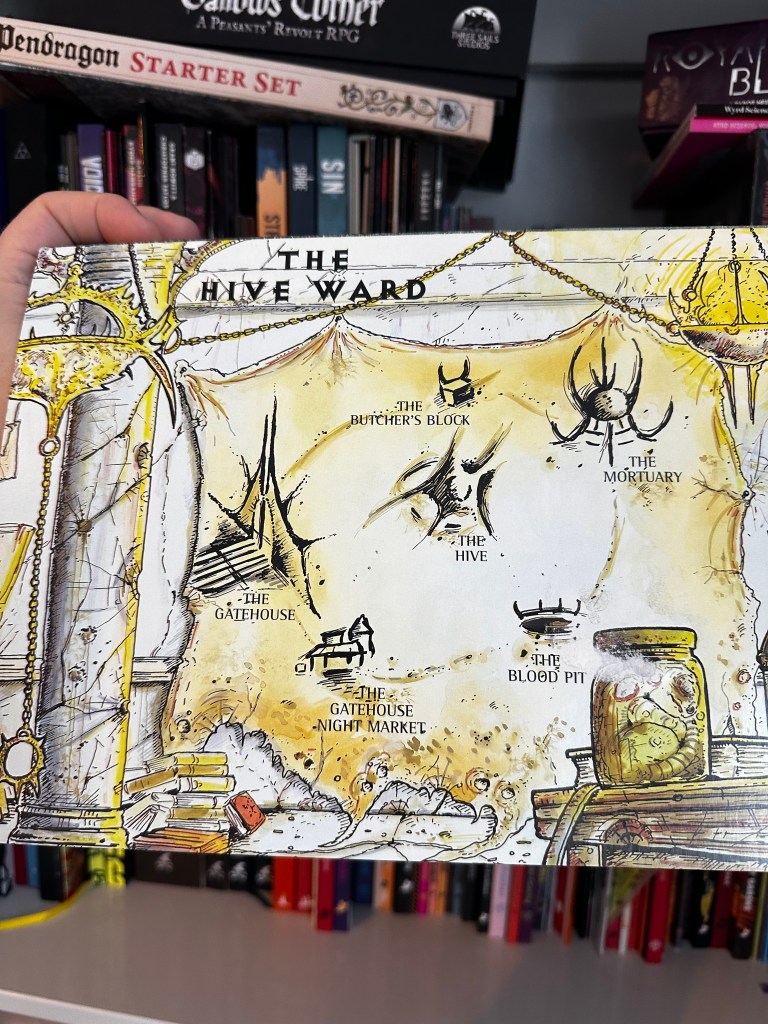
The Point Crawl Map of the Hive Ward. Locations include the Butcher's Block, the Mortuary and the Blood Pit.
The Hive Map

They went immediately to the Hive. The adventure provides a point-crawl-style map of the ward on the inside of the DM screen that came with the adventure.

I have to say, this is an old-school design element that is sorely missed from newer modules. It was not at all unusual to get an adventure specific DM screen in the pack with the adventure back in the old days. Wizards of the Coast now want you to pay another £15 or more for the privilege. I have really been appreciating this DM screen actually. Not only does it have several key maps, but it also has all the stat blocks for the major NPCs and encounters in the adventure! Invaluable, tbh. My only dilemma is whether to use the adventure-specific screen or the utter treasure that is the one from he Planescape boxed set. Its got all the Planescape tables you might need, like how the various factions might react to one-another and how spells are effected on various planes, and on top of that, it also has stuff like THAC0 tables and saving throws.

Back to the Adventure! Their first port of call was the afore-mentioned Butcher’s Block where they interacted with Trunfeld Three-teeth, to my utter delight. He was able to tell them that barmies (lunatics) and bubbers (drunks) have been turning up dead more than usual and said he would keep an ear out for news of Eliath.

Then they decided to split up. Why? Well, Aurora the witch is a member of the Dustmen, so it seemed like a good idea for her to go and see if their barmy had turned up at the headquarters of that faction, the Mortuary…

Meanwhile, the others wandered the streets in hopes of finding a clue. Before long, they did. They turned onto an alley and found a disturbing scene, a ragged collection of men, gathered over the dead body of some poor berk on the ground, talking about how they should loot and transport him. Before it could come to blows, they discover that this was a crew of Collectors led by Mourner Tom. As I mentioned above, I had a great time playing him and he was able to tell them that they had collected someone matching Eliath’s description recently. Should be in the Mortuary.

Speaking of which, Aurora, perhaps a little nervous traversing Sigil’s most infamous ward on her own, had an encounter of her own. She was faced with a gangly, dancing man bounding down the street towards her, shouting and mumbling and singing the names of the Princes of the Ba’atezu fiends. She noted the names he was chanting but was about to go about her own business when she heard a shriek from the alleyway he had entered. Investigating, she discovered his fresh corpse lying on the cobbles, not a mark on him…

Conclusion

My conclusion so far is that I am having a ball with Planescape,
As I expected. It is one of my all time favourite D&D settings and it gives me free-rein to invent the most deranged little cockneys I can think of.

But we have only barely interacted with the mechanics so far, no more than a spell cast and a non-weapon proficiency attempted, so I am very interested to see how smoothly that goes.

Stay tuned, dear reader!

The Editioning, Week Eleven, OD&D

The First Ending

Last night we finished up the first of our games within the Editioning, our challenge to play all the major editions of D&D from Original Dungeons & Dragons (1974) to Dungeons & Dragon 5.5 (2024) over about 24 months or so.

I thoroughly enjoyed creating, running and playing this game as referee. I think the ending worked well, and I have gotten generally good feedback from the players.

Playing this very first iteration of the venerable old man of roleplaying games has taught me a few lessons about RPGs in general, D&D in particular and gave me many insights into the OSR.

Illustration from OD&D supplement III, Eldritch Wizardy. A fighter with a aword and shield and a magic user with a glowing wand face-off against a serpentine demoness with six arms and many weapons as a monster attacks from the rear.
Watch Out!

First though, let’s do a quick recap of the final session.

Malfunction

Last we left off, the PCs had discovered the holo-log belonging to the captain of the alien space-ship they had just teleported to. The captain appeared as the hologram of a crystal humanoid and spoke to them. The log described the dire straits the ship found itself in, crash-landed, engines damaged so badly all they produced was the crystalline by-product of their fuel. They had taken the decision to hand responsibility for their escape or rescue to the main computer while the crew went into stasis. Of course, they had already discovered that the computer had re-interpreted its orders to ‘crystal-form’ the surrounding planet to suit the physiology of its makers as, perhaps, escape and rescue were deemed impossible. I didn’t write much in the way of plot for this adventure. In fact, this about sums it up! You can read more about my methods in this respect in my previous post.

Armed with this knowledge about the computer, the adventurers were more determined than ever to find and destroy it. So, they girded their collective loins and prepared to move on through the ship. The next door was jammed so they spent some time using tools to wedge it open. While they did this, another information Assistant appeared to them. They asked it to open the door for them, which it did, but, more importantly, it showed them a map of the whole ship and its current surroundings. In practical terms, this allowed me to reveal the full map to the players on Roll20. This was a blessing as the partial-reveal functionality in Roll20 does not work very well in my experience. It has a rectangular reveal and a polygonal reveal option but, quite often, I find the polygonal one simply doesn’t work. Revealing a curved area with the rectangular tool is frustrating and time-consuming.

The Information Assistant was able to help them further by describing the adjoining chambers, the engine room and the computer and stasis chamber. It told them they could enter that final chamber by “simply passing through the wall.” They didn’t push the assistant on this point. Instead, I guess they decided they would pass through that wall when they got to it.

Having emptied and passed through the partially submerged chamber next to the bridge, they descended to the engine room. Here they discovered a number of crystalline golems running the engines to produce the fuel by-product which they were using to crystalform the surrounding countryside. The golems in this room were not fooled by the bio-hazard suits as the other ones had been so they attacked the entire party. Here they lost another dwarf hireling, leaving then with just one of the humans who’d accompanied them from the start of the adventure and one Dwarf, the leader, Gilda. While the melee progressed around them, Abbiss, the halfling thief and Ilaina, the elven magic user, tried to find a way through the wall, as they heard the approach of yet more golems from the other side of the engine room. Eventually, their listen and Intelligence checks paid off when Ilaina realised there was a connection between the frequency of the sound they could hear emanating from the wall and the ccredential crystals they recovered from the lockers on level 2. They downed the last of the golems held hands and pushed through the wall, crystals first.

On the other side they discovered a circular chamber. The wall was dotted at regular intervals with stasis pods. Each one contained a grey and brittle crystalline being, clearly long dead. In the centre of the room, the computer loomed. It was a 12ft tall, 10ft diameter, iPod-white, capsule-shaped machine with four long tentacles protruding from its carapace. It ‘spoke’ them in a loud and high-pitched form of crystalline speech they could not understand and then it attacked.

Tadhg, the cleric started off strong, throwing a lit oil skin at it. The fire licked at the outer shell and seemed to ignite some wires emerging from a gap in the casing at the top of the computer, but otherwise did no damage. As Siward the fighting man and the hirelings went in to attack the outer casing, Abbiss decided to climb up and examine the cracked area. Meanwhile, Ilaina used her last flying crystal to get up there as well.

The computer was able to use some spells during the fight. I gave it Charm Person, Phantasmal Forces and Confusion but only got to use the first two. It used Charm person on their remaining dwarf, Gilda, to get her to attack the ground based PCs. Ever the gallant, Siward refused to fight back, instead focusing on defeating the computer in the hope that that would end the effect. Siward was also the subject of the Phantasmal Forces. Spells in this game are interesting because they are so imprecisely described that, in some cases, even their effects are not obvious. Look at this description of the Slow Spell, for instance:

Slow Spell: A broad-area spell which affects up to 24 creatures in a maximum area of 6” × 12”. Duration: 3 turns. Range: 24”.

That’s great Gary, but what does it do?
This one stood out to me because I was going to give this to the computer as well before I read it.

Also, our cleric, Tadhg, had reason to use his last spell slot to heal Abbiss at one point. That was interesting for a few reasons. The first reason was that, after Abbiss widened the crack in the computer’s casing even further, Ilaina stuck a few fingers in there and let the innards have the full blast of a fifth level fireball. Unable to contain the full power of that, the casing belched flames out of the crack on top. Luckily, I decided to give them a Save vs Spell to avoid half the damage but this still hit Abbiss for 12 points. (This is another point about spells. Fireball has no Save mentioned in its description, so I had to home-rule that.) Our thief, already hurt from the precious fight and a couple of whacks from the tentacles, needed some healing. Now, in later versions of D&D, Cure Light Wounds, or any Cure Woulds spell, in fact, required the caster to touch the subject. Not so in OD&D:

Cure Light Wounds: During the course of one full turn this spell will remove hits from a wounded character (including elves, dwarves, etc.). A die is rolled, one pip added, and the resultant total subtracted from the hit points the character has taken. Thus from 2–7 hit points of damage can be removed.

Leaving to one side the mercurial and perverse wording of this description, you will note the complete omission of any sort of range. So, I ruled that Tadhg could, effectively use it to heal anyone on the face of the planet. Lucky too, as Abbiss was still on top of the computer and he was on the floor.

The combat continued, both sides hit and missed, but in the final round, all actions were resolved simultaneously so, even as the tentacles reached out to reduce our halfling once more to just one HP, and the Gilda the dwarf pressed the attack against Siward, our heroes hit it till it cracked open, finally reducing the crystal inside to a dull, grey ruin. They discovered treasure in some shiny lockers there in the computer room, and then they used the teleportation pads in the dungeon to take them back to the village.

After that, we did what I always like to do to wrap up a campaign, I asked them for epilogues for each of their character s. I asked one what they would be doing a week from the end of the adventure, one what they would be up to a month later, then a year and finally a decade. I loved what they came up with but I won’t go into it here. I recommend this as a nice way to wrap things up as it puts the final words in the mouths of the players and allows them free rein.

Conclusion

So, I ran this game while being very conscious of the history behind it. It’s hard to overstate the impact this game has had. It is, arguably, the origin of our hobby, the starting point for the world-beating phenomenon that is D&D today and, as well as that, its the kind of wonky, imprecise, strange love-child of a war-game and nerdy obsession with fantasy and myth.

DD&D never tried to be all things to all people, even though it did include a couple of different options for your combat rules, ie, the combat table in Men & Magic, the first booklet, or the detailed and labyrinthine war-game rules from Chainmail. It gave options but it never pretended to have all the answers. It is the very epitome of the OSR pillar, rulings, not rules. Sure, it has “rules,” but these are clearly only there as guidelines. Just look at those spell descriptions above. Look at the complete lack of mechanics for ability tests. In the end, I imported the roll-under mechanic from Basic D&D to allow for things like Intelligence and Dexterity checks. I resisted doing this sort of thing in the first few sessions. Instead I wanted to try to resolve situations using only the mechanics in the books. But, I quickly realised that, even at the time, OD&D was a work in progress. So many sourcebooks were released to clarify, overwrite, or even ridicule the rules from the first three booklets that it is impossible to ignore the fact that, even those people using the books to play in 1974, were not sticking to rules as written. They were house-ruling it, they were hacking the system and they were adding their own tweaks and options constantly. So that’s the way I began to treat it too. And it only got better as I did that.

One of the things I wanted to reveal in the Editioning was exactly how the game has changed over the decades and how it changed from one edition to the next. I suspect I will find that, over time, the rules became more exacting and less flexible. Of course, that is yet to be seen as we play through the editions. So come back for more insights into D&D and its evolution, dear reader. The Editioning is still in its infancy so there’s plenty more to come.

The Editioning, Weeks Nine and Ten, OD&D

Welcome back, dear reader, to the Woes of Sorrowfield, my homebrew adventure for OD&D. You check out the rest of my posts on this game here. We are playing this as part of the challenge I made up in February, the Editioning, which involves playing every major edition of D&D from OD&D right up to D&D 5.5E as I understand we’re calling it now. This was supposed to take place all in the space of twelve months, but at this pace, we’ll maybe get half way through the nine editions by February next year.

Revelations

So, returning Woes of Sorrowfield readers will be aware that I am creating this adventure myself. I started by taking advice from Gary and Dave. They have a lot of good, if basic advice for the beginning referee in terms of dungeon design, populating your dungeon with monsters, traps and treasure, running wilderness adventures etc. Essentially, I followed that advice until I didn’t. There was a point at which, the stuff they presented in the original white books fell short of my own decades of experience.

One thing that I’ve been quietly proud of is providing revelation and information through simple and, hopefully, not overly expository means throughout the game.

For example, the PCs discovered that a lake and river flowing through the Barrenwood had been polluted with some sort of magically glowing crystal that was turning the whole forest to crystal. Later, once they entered the dungeon, they found living beings, trapped in there, also being turned to crystal in a lab setting. Further down, they found a Flight Practice chamber which allowed them to literally fly around in the air. And finally, on a crashed space ship at the bottom of the dungeon, far beneath the earth and sea they discovered an illusory representation of another world that where flying crystalline aliens could be seen spreading the crystal pollution from high above in the atmosphere “crystal-forming” the surface for their own comfort. There’s more to the plot, but already, without any exposition or need for long diary entries or anything like that, I slowly revealed the nature of the threat they faced.

One thing that I am sure helped me do this was not over preparing before starting the adventure. I had a vague outline of the plot, the threat and the enemy before we started playing, but I never wrote down any specifics. I was creating new dungeon levels almost week-to-week. Doing it this way allowed me lots of room to improvise and also to play off things the players had said or directions they were planning to take.

As things all came together in the last session, and the entirety of the plot was revealed, I felt it was finally ok to include a small snippet of exposition, a captains log they discovered on the bridge of the alien vessel, which revealed that even the aliens on the ship had not wanted to necessarily crystal-form the PCs’ world. Instead, they were hoping for a rescue after their crash. In the recording, the captain indicated in a few short sentences, that the crew had gone into stasis and left the main computer in charge. It was the computer that decided to start the crystal-forming process, in the interests of maintaining the lives of its makers while they waited for rescue.

Back up

I skipped to the end a bit there, so here’s a recapitulation of the events of the two sessions that led us there since my last OD&D post.

The adventurers continued their experiments in the Flight Practice chamber. Abbiss tried again to fly but continued to prove completely inept. Still, she and the others made it up onto the shelf 10 feet above the main floor after defeating another two crystallised gargoyles. They managed to hit all three buttons on that level simultaneously and received a reward: a rain of gems! But not without the loss of two of their dwarven hirelings. During the fight, Abbiss had her left hand crystallised by one of the gargoyles. Also Siward suffered a crystallised pinkie from an attack.

Next, Ilaina decided to give this flight business a try, and, sure enough, she proved to be a natural at it. She was able to fly up to the hanging platforms in area 3. The first one spiked her and she had a toe crystallised. The other platform simply dropped to the floor far below when she threw a knife onto it.

Abbiss took a close look at the water fifty feet below in the southern section of the level. She realised she could see a gap down there that must provide access to the next level down. They all began to make plans for the descent. While Siward abseiled down and onto the fallen platform which he had thrown onto the surface of the violet coloured waves, Ilaina was able to fly down under her own power. Tadhg, Bryn and the Dwarves all followed Abbiss down the rope and Siward kept the floating platform steady as they ferried themselves across the narrow span of water one after another. Eventually, they all made it.

On the other side of the glass wall holding in the water on the next level, it looked like an aquarium. As they were searching the hall they found themselves in, another Information Assistant appeared and addressed the party members dressed in bio-hazard suits and holding credentials crystals. It informed them that this was the Teleportation Chamber Level and that it could guide them around it and in the use of the teleportation facilities if they wanted. It led them through a door and into and armoury where Abbis picked up a +1 Crystal Dagger and Siward and the dwarves also acquired some shiny new weapons. Little did they know that using the weapons would provoke a Save vs Stone or have a random body part turn to crystal. From the armoury, the Information Assistant passed through another door into a room with an elevator door with and up arrow on it and a number of crystal golems with sword-like arms phasing out of the floor. They moved to intercept the party members with no bio-hazard suits.

The fight started off badly enough for both sides. The golems won initiative but failed to hit anything. Siward hid behind the cover of the control console in the room, along with the hirelings and they generally also failed to hit. Using the advantage of the bio-hazard suit making her essentially invulnerable to the golems, however, Abbiss got a back stab in on another of them. Meanwhile, Ilaina, using her noggin, attempted to deactivate the golems through the use of the console. She succeeded only in turning out the lights, but at least she cast infravision on Siward. Moving into round two, Tadhg, with the same impulse, asked the Information Assistant for help in calling off the golems, which it promptly did.

They followed the IA into the Teleportation chamber. It was able to reveal there the three platforms. One could transport them anywhere on the surface but could only be used once, the second one could transport them to the ship below and the third one was being used by the computer to transport the fuel by-product from the ship’s engines high into the atmosphere from where it rained down like a crystalline bombardment on the surrounding countryside. Ilaina sent the IA into a buffering loop by having it refer to the makers who, it revealed, were all in stasis on the ship. The paradox that it was talking to what it thought were “makers” gave it a bad headache.

They also explored an adjoining room that was filled with crystalline barrels full of the fuel by-product, the crystal corruption that was transforming their lands.

My map of the alien ship crashed into a sea cave - the final level in my dungeon. It looks like a flying saucer with a crumpled hull at the bottom of the map.
Crashed ship map

It took them very little time to decide to teleport down to the ship to deal with the computer. From the teleportation room on the ship, they first went and explored the holo-deck room where they saw the vision of the alien world I described above. And then, after a random encounter with some star shaped crystal drones, they checked out the bridge where they found the holo-log of the captain.

Conclusion

Not just yet. Actually, the conclusion of the Woes of Sorrowfield is definitely coming next week. Looking forward to it! I have a big finale encounter planned. I hope all these PCs survive it. I’ve gotten really rather attached to them.
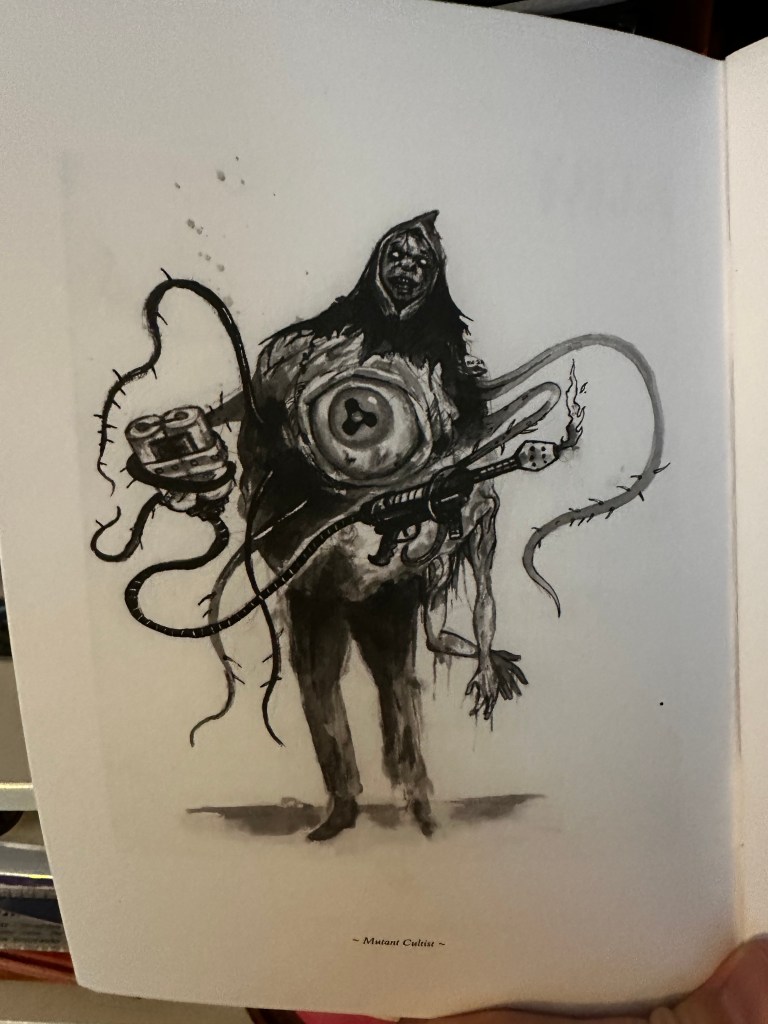
The cover of Planescape adventure, the Eternal Boundary. A pale, bald dustman pushes a gurney with a sheet-covered corpse in the foreground. The silhouettes of adventurers peek through an archway in the background.
The Eternal Boundary

In other Editioning news, our AD&D 2nd Edition journey starts this evening! We’re going to be playing the Eternal Boundary, a starting adventure for the original Planescape setting. I’ve already warned the players that making AD&D PCs is not like Basic or OD&D. I expect us to take the whole session just to roll them up, choose races, classes, kits, proficiencies, spells, equipment, factions (Planescape-specific but very important) etc. Its been so long since I’ve played this game… Can’t wait!

The Editioning, Weeks Seven and Eight, Basic D&D

The Basic Box

The Shop on the Borderlands has me in its thrall, dear reader. Every Friday, about lunchtime I receive their newsletter, News from the Borderlands, and my wallet doth quake with fear. There is, invariably, a long list of classic D&D titles newly received as stock. They tend to get them in job-lots, so one week, there might be a preponderance of AD&D 1st edition Greyhawk books, and the next there’ll be a dragon’s hoard of DCC adventures. In fact, it has been invaluable in building my collection of D&D books for the Editioning. The vast majority of books that I didn’t already own, came from the Shop on the Borderlands. It’s great. It has an amazing selection of used and new RPG books, from the original OD&D books going for thousands of pounds, to the latest 5E titles, not to mention all the other RPGs they stock. I would highly recommend checking them out, particularly if you’re in the UK. Check out one of my newest purchases in the gallery below. It’s the 11th printing of the Moldvay Basic D&D set. It’s missing the dice and the rulebook has seen better days, but, since I didn’t buy it as a collector’s item or an investment, that doesn’t bother me. I have been using it at the table while we continue our adventures in the module included in this very set, The Keep on the Borderlands!
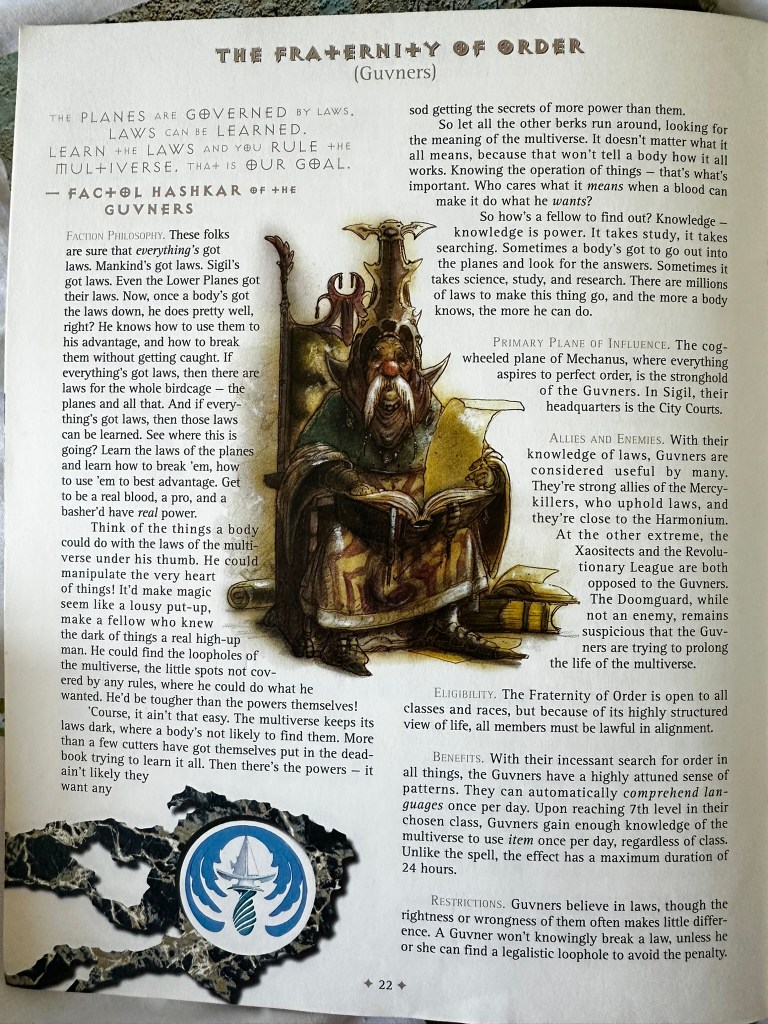
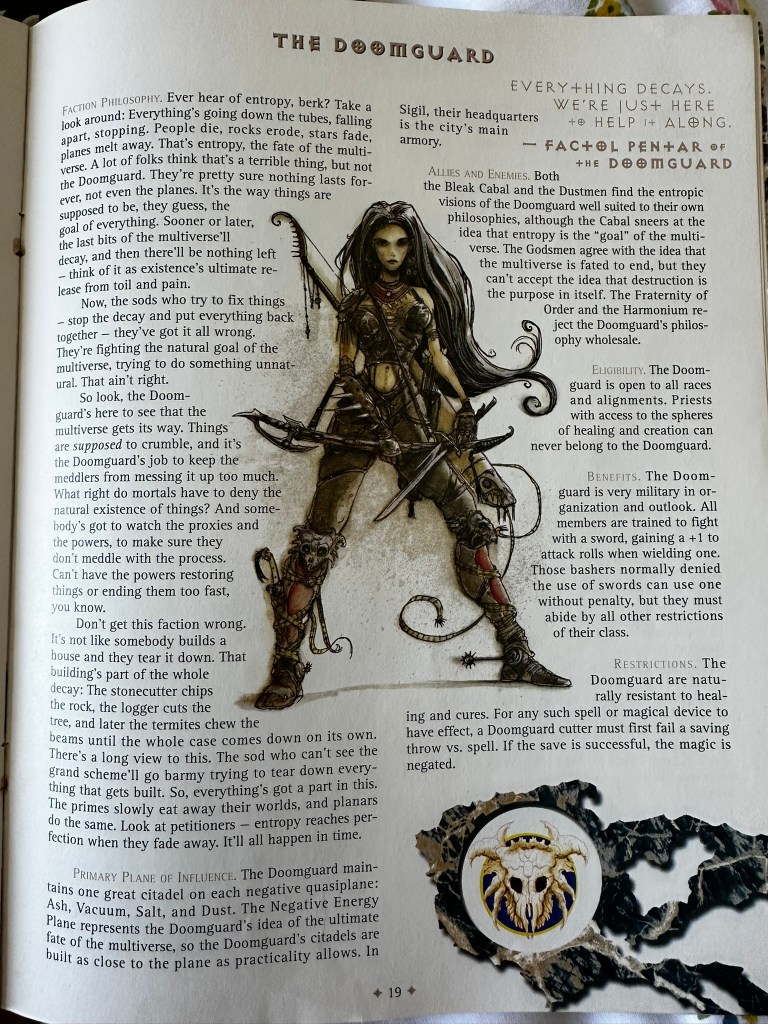
Hard on the Hirelings

One moment, things are going your way. You and your mates have gone out on adventure, sowed seeds of war between rival clans of humanoids living in the Caves of Chaos, gained the respect of the local authorities and have even made a coins along the way. And then, dear reader, the random encounter table just fucks you. We have learned this the hard way, over and over in this adventure. We’ve been unlucky with our encounter rolls most of the time. On our very first encounter, my first PC, Edmund, went down to the very first arrow that was loosed in an ambush of Ospreys. Later, after braving and surviving the storied Caves of Chaos, our resident halfling PC, Lotharia was brutally disembowelled by a griffon while returning to the keep with a spell book delivery. In our most recent random encounter disaster, we lost half of our eight hirelings in an encounter with a troll on the road back from the Caves. We defeated it narrowly and followed its trail back to its stinking, filthy lair, where we took care of some larval trolls too, but not without first losing another of our hirelings.

These were heavy losses, all of them, although, I’ll be honest and say we had a respectfully understated celebration of the fact that we didn’t have to split the xp between all eleven of us…

Anyway, the point is to expect the unexpected in old school play. Also, that the more hirelings you have the more targets there are that aren’t PCs, so that’s been helpful.

Murder and Intrigue

Adventurers! A black and white illustration from the rule book depicting a variety of adventurers
Adventurers!

Events are moving along without us, or, perhaps because of some of our choices. As I noted in my last Basic D&D post, we’ve taken the side of the castellan of the Keep and taken the ears of a number of Ospreys, the rebel band who want to overthrow him. Perhaps, if we had decided to support the rebels instead, the most recent shocking events might have been prevented (though probably at a very high cost in lives.)

In the last Basic D&D post I mentioned we had been attacked by a band of mercs sent to kill my character, Thaddeus Nightbane. After killing them, we proceeded on to the caves of the Shakkelwart Clan of orcs. We spotted and safely set off a trap in the mouth of the cave. This attracted the attention of the guards, who we convinced to allow us to talk to their leader, Baralgus Dorden (no idea if that’s spelled right.) We convinced her to welcome us in and we feasted with them before delivering the arms sent by the Thyrenian Guild. This was a fun scene where we learned a lot and, hopefully, planted some seeds of doubt in Baralgus’ mind regarding her allies, the Barrowdelve clan and the gnolls as well. We gained a RESPECTED reputation with the Shakkelwarts in the process.

By the way, I mentioned in a previous post that there was a reputation mechanic built into this module, but that’s not true. Instead, this is actually DM Isaac’s genius addition to it. He was inspired by the Root RPG, and it has enriched our experience of the game. We are actually going out of our way to ingratiate ourselves with particular factions to improve our standing with them, instead of thinking of them all as fair game.

Following this, we returned to visit our other besties in the Caves of Chaos, the goblins led by Sharktroll. We delivered another cache of weapons and armour to them (in fact, this is just stuff we’d picked up from looted enemies, some of whom belonged to this very goblin clan!) We’re hoping for all out war between the orcs and the goblins, and we might get it if we keep pushing this way. The goblins also released some prisoners that our Thyrenian Guild contact, Richard “Dick” Kirkdon, has asked us to retrieve for him.

With that, we set off back to the Keep again. And that’s when we ran into the aforementioned troll. I have to give props to Isaac here once again. Trolls are common enough in D&D and related media, that we generally feel we know them, we might fear them a little given their regenerative abilities and all, but, the knowledge of them makes them a little less scary. Isaac turned this on its head with his sensory descriptions of its look, its smell, its otherness. Scared the pants off us. And then it started killing hirelings. Anyway, that was bad, as I mentioned before, but we did get some treasure out of it.

Back at the Keep, we went first to the Temple of the Holy Sun, where the entire populace had gathered for the funeral of Father Burgoyne. The mourners were giving Tom’s Elf character, Eandril, the dirty eye. We soon discovered that this was because the priest had been murdered by the Castellan’s elven advisor. So, of course, we went to talk to our good buddy, the castellan. After enduring some more anti-elfism from he guards, we were granted an audience. He explained that Cywyn Morningflower, he advisor had been accused by Father Burgoyne of being a member of the reviled Serpent Cult that had once made its home in the Caves of Chaos. In response, the elf had drawn his sword and run the priest through. The castellan had little choice but to imprison his advisor since the murder had happened in his hall and in his presence!

We told him we’d crack this case wide open so he let us talk to Cywyn (genuinely have no idea about this spelling either btw.) Turns out, the elf was just sick and tired of Burgoyne and his constant racism and this was the final straw. He really did murder him in anger. But one other thing came up. The priest had claimed that he had evidence that proved Cywyn’s cultishness and that it was in his chambers beneath the altar in the church.

Next stop, church! I distracted the gathered acolytes while the Anastasia and Eandril investigated the hidden chambers below. They discovered no evidence against Cywyn, but they did find a snake staff and some magical armour and maces, which raised questions more about the church than the elf.

Conclusion

How to use the dice. Black and white illustration depicting some polyhedral dice, a mini, a pencil and some paper
How to Use the Dice

I think there might only be a couple more sessions of our adventures on the Borderlands. I’ll miss it when it’s over. I have grown fond of our little band and and the relationships we’ve built in this place.

I probably won’t miss the random encounter tables quite so much, but even they have introduced elements of true peril and danger to get the blood really pumping.

Back with more soon.