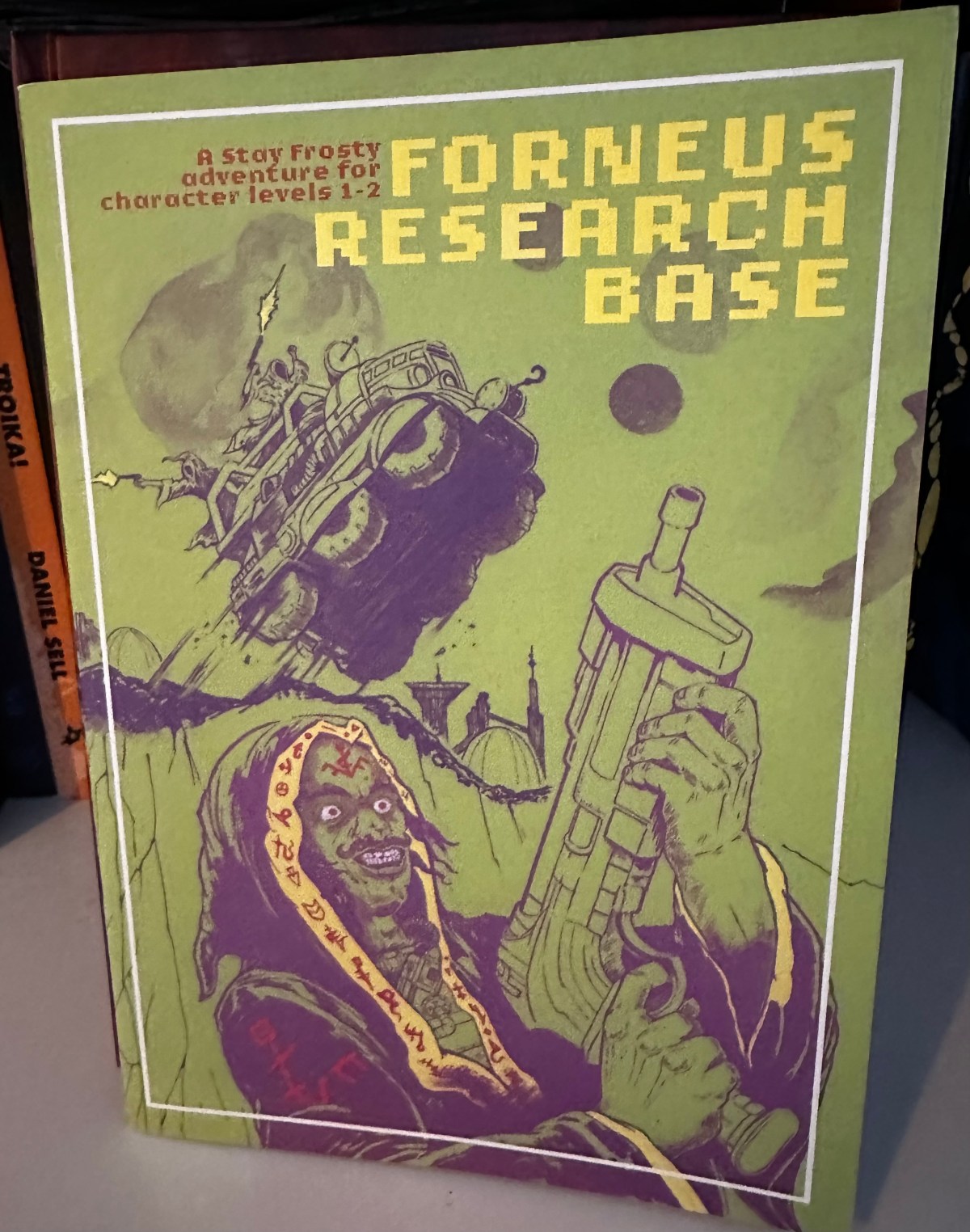
Stay Frosty, Forneus Research Base Review

Zero Prep

It’s the dream, wouldn’t you say, dear reader? Pick up and play. Many claim it, few deliver. One thing I’ll say about this Stay Frosty adventure, and, to be fair, any Stay Frosty adventure I’ve read (which isn’t many,) is that you can pick it up and play it with pretty much no preparation. I mean, that goes for Stay Frosty to a certain extent too. I discovered that when I reviewed the game itself last October.

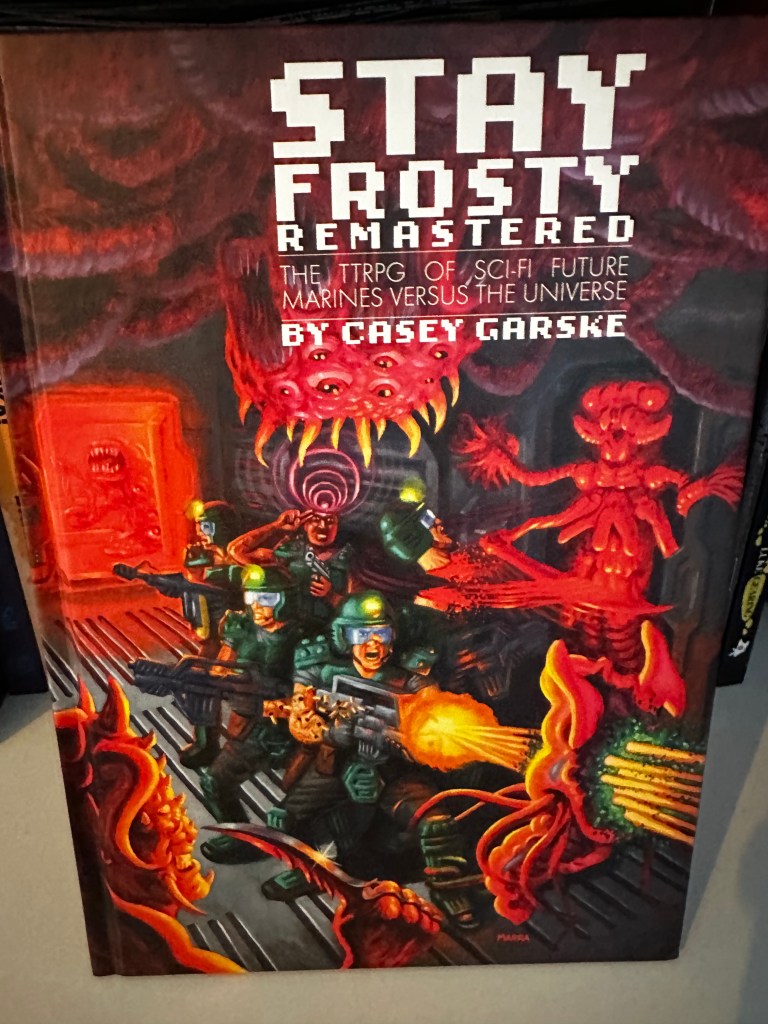
The cover of Stay Frosty Remastered by Casey Garske. Space Marines fighting aliens/demons
Stay Frosty Remastered

But, of course, zero prep is not all you might want from an adventure. In fact, for some GMs, prep is as much fun as play. So what else has Andrew Walter’s Forneus Research Base got going for it?

Well, Tom, Isaac and I played it over the space of three sessions recently. In fact, we just finished it the other night. I have thoughts.

Action

There’s no fucking around with Stay Frosty, no long opening scene to allow for introductions of our characters, just a short summary for the PCs, of what they’re doing out there in space and an immediate crash landing at the eponymous Research Base. Oh, the crash landing was caused by black ooze exploding from the controls of their shuttle btw.

As I stated, there is a short read-aloud piece of text at the start. It explains that the PCs are private marines, employed by the United Universal Corporation to check in on its research colonies. As they are doing this, they are forced to crash land.

As I said, Stay Frosty is not really interested in your PCs feelings, unless they involve terror or going apeshit. At no point is anyone encouraged to take a moment to express their concern for their fellow marines or, for that matter, the colonists they were supposedly there to protect. This is a DOOM simulator. The PCs are there to shoot shotguns and blow up demons. And Forneus Research Base is all action from the get-go.

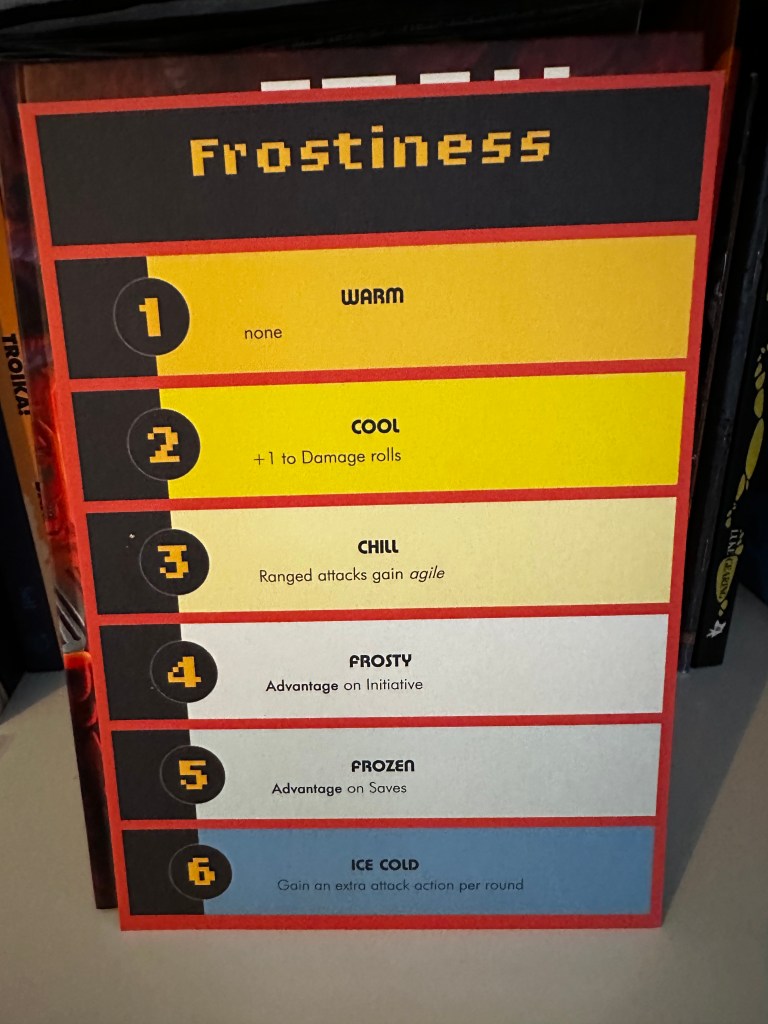
The Frostiness Tracker goes from Warm to Ice Cold
Frostiness Tracker

As soon as they emerged from the wreckage, the PCs realised they were not going to be able to take off again without significant work on the shuttle, so they decided to make their way to the base. Meanwhile, I’m rolling the Danger Die every time they move from one location to another, take a look around or stop to think, as intended by the rules. The Danger Die works a bit like a random encounter table. You roll a d6 and the result will give you one of the following:

  1. Encounter and Stress – i.e. roll on the relevant encounter table. Forneus has one table for the moon’s surface and one for inside the base. Stress is added to the PCs to build Tension. Tension also equals Frostiness. They higher the Frostiness level the better as it gives PCs bonuses like advantage on initiative and even extra attacks. But Tension can also explode. See below for more on that.
  2. In dangerous areas, Encounter, otherwise, Environment – Forneus has its own Environment table also. But this didn’t come up too often, to be honest.
  3. Environment – as above
  4. Stress – see point 1
  5. Entropy – for some reason, I rolled this one a lot and it had no effect. It’s only relevant if the PCs are using a thing constantly that has its own Supply die. For instance, if they are using Combat Drugs or Fuel when they’re driving a vehicle. The idea is that when Entropy is rolled, the Supply Die for that thing goes down to the next lowest die size. But whenever this was rolled, they had nothing to decrease.
  6. TENSION EXPLODES! – Only rolled this once. The idea here is that when this comes up, the PCs make a Willpower Save. If they succeed, they get to reduce their Tension by one. If they fail though, they take Tension x level damage and reduce their Tension to 1. Then they roll on the Going Apeshit table if their HP are reduced to 0 by the damage. The effects of this can be anything from getting Advantage on damage rolls but constantly rolling your Ammo Die (like a Supply Die for your weapons,) to Last Stand: going down mano-a-mano with your enemies. I actually adjudicated this mechanic incorrectly at the table. I didn’t allow them the Willpower Save, I just rolled the Tension damage and gave it to every PC. Also, this damage is not supposed to be applied to attribute scores when all HP are gone, as normal damage is. Only one PC had to roll on the Going Apeshit table. She ran for her goddamn life and they had to manacle her to the ATV to stop her.

(I only just realised I was calling this the Doom Die the whole way through our game. Oops.)

The Danger Die is the mechanic that really keeps things interesting in Stay Frosty. Many of the locations in the Forneus Research Base, for instance, have no pre-written encounters or much of interest at all, so the random encounters, environmental hazards and ratcheting Tension from the Danger Die are doing a lot of the work. This works fairly successfully but I found I was rolling up Encounters a lot, since a third of the possible Danger Die results give you one most of the time, and after a certain event in Forneus, you actually get Encounters on a roll of 1 to 3. So the marines were drifting from one Encounter to another with only cursory exploration in between.

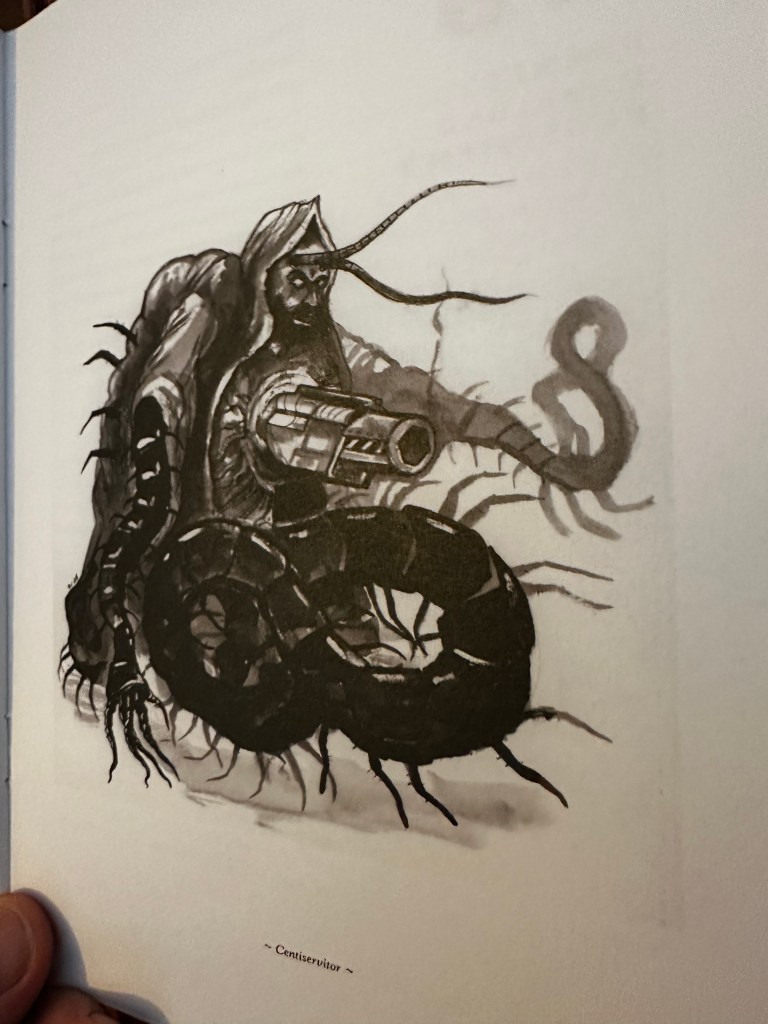
At least the variety of enemies is suitably gristly, demonic and fun. You have the obvious demons, like the Black Leathery Imps, that used poison to make their enemies fire on each other. Then you have the basic cultists who just have guns, the mutated cultists who have been transformed to allow them to fly with their fiendish lord Xithrabla through the cosmos, sucking from his hellish teats and the Centiservitor who is a cultist combined with a centipede with a plasma cannon in its chest. On top of that you have the real horrors like the Cadaverous Persecutor, a giant cyborg corpse with a rocket launcher, and the Fledgeling Pest (The Final Boss,) a sickening, enormous baby’s head with a partially exposed brain and a vicious bite.

We found the lower level encounters were essentially just target practice. Since we only had two players, I gave them each three marines and decided to treat it a bit like a funnel. I think this was too many for this adventure. Four would have been a bit more balanced. The main reason I think this is because of the initiative roll in Stay Frosty. Whoever makes a successful Dexterity check gets to go before the enemy in this game. This generally meant that a significant portion of the six characters got to act before the demons and cultists. There were enough weapons between the marines that could do blast damage (flamers, grenades etc.) that they could wipe out the opposition before they ever got a shot off. It felt too easy at times. But, it also seemed to accurately emulate the feeling of playing a video game like Doom. At one point they were crossing a bridge over a chasm and being swarmed by imps and cultists. There were 26 opponents and the party defeated them in two rounds, just mowing them down in waves of gunfire and explosions. In only the second encounter, they came up against a group of six foaming cultists, one of whom was holding a grenade in each hand and standing near a leaky fuel tank. One well-placed shot from the grenade launcher took out the whole bunch with a mushroom cloud left in their wake. These moments felt hilarious, exhilarating and hilarious.

But when it comes to the more challenging opponents like the Centiservitor, the Cadaverous Persecutor and the Fledgeling Pest, I can’t stress how important it is to use the Powerful Opponents mechanic in Stay Frosty. That rule states that when there is a disparity on either side of a fight, the side with fewer Hit Dice, should subtract the difference between their HD and their Opponents’s HD from their attack rolls. For example, when my PCs were facing the Fledgeling Pest at the end of the adventure, the 1 HD/Level 1 marines had to subtract 3 from every one of their attacks against it because it had 4 HD. This meant that they were not able to overwhelm it by sheer numbers in the first round or two. Many shots that might have hit, did not, because of this nicely scaling rule. However, when they were up against the Centiservitor, I forgot to apply the Powerful Opponents rule and they slaughtered it before it ever got a chance to fire off its cool weapon.

My main complaint when it comes to the action in this adventure is that the Fledgeling Pest, labelled as the Final Boss, is quite avoidable. It is described as being attached to a wall by its very flesh in one of the Hangars, which have been converted to perform devilish rituals. But there is no reason for them to go to the Hangars in the adventure. I made one up, of course, to try and get them there. One of the NPCs they met told them there could be a working shuttle in one of them. This did lead them to the Hangars, but as soon as they got there, Tension Exploded and one of their number went running off across the moon’s surface so they hopped in the ATVs they had just found and booked it after her. After that, they decided to egg it as well. Since they had the ATVs, they were better able to make it back to their own shuttle. I had to think on my feet here or they were going to miss out on the best couple of encounters of the whole adventure. So, first, I had the Demon Arms (also restricted to the hangars) appear out of a hellish portal in the ground ahead of one of the ATVs, grabbing the driver and causing he vehicle to flip over. The mouth in the hand of one of the arms devoured one of the party but they won out. Then they moved on again and just as they were about to reach their shuttle the giant demonic archway (also found in the hangars) appeared in the air before them, with the Fledgeling Pest emerging out of it to attack them along with a few of its cultists. This was a genuinely tough fight and resulted in the death of a couple more party members. I might have just let them make it to the shuttle, I suppose, but I didn’t want to deprive the players of the Final Boss.

Non-action

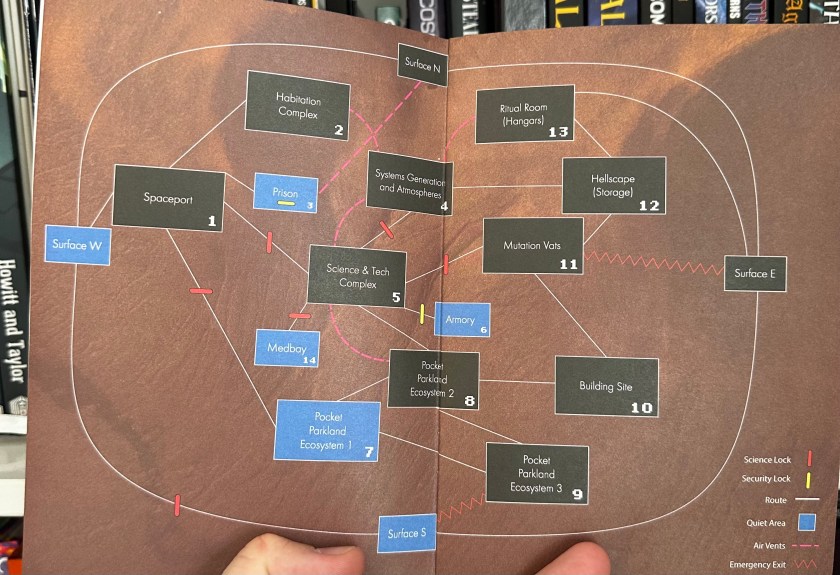
Of course, it wasn’t all action. There was some exploration. This is done in a point-crawl style as you can see by the map here.

The Forneus Research base point-crawl map.
Point-crawl Map

The descriptions of the locations in the adventure are pretty bare-bones. At times, I found I wanted a bit more. For instance, the Systems, Generator & Atmosphere area is supposed to be enormous and encapsulates everything from winding, labyrinthine machine rooms to massive bridges spanning deep chasms. To be honest, these feel like they should be separate, individual locations. Another point about this area in particular is that we’re told that the communications can be turned back on and full computer bank access can be gained here, but not what that might achieve. I had no idea what the computer banks might tell them and I had no idea who they might communicate with off-world. That’s a lot to leave in the lap of a GM, especially when the rest of this adventure is pretty much zero-prep, as I mentioned before.

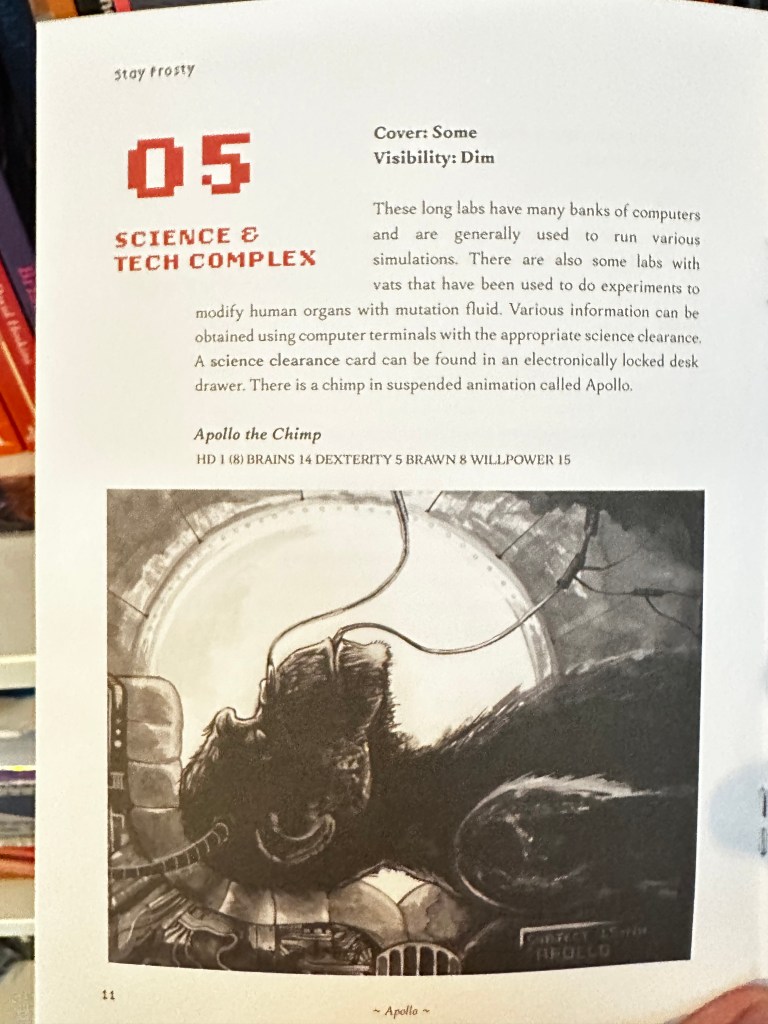
Apollo, in stasis - a chimp in profile, lying on a table with tubes going into his mouth and nose.
Apollo

Actually, it is really hard for the PCs to get much information about what has happened here. Even the few living, rational NPCs they meet had no way of knowing what happened on the base, since one was a prisoner and had been kept out of the loop the whole time, one was in a coma and one was a talking chimp, named Apollo, who was in stasis the whole time. It would have been more interesting if at least one of these guys had the full story for the marines. I should have improvised that, in hindsight. Of course, the PCs did recruit both Apollo, the chimp, and Jamal, the prisoner, gave them guns and got them shooting, so that was fun.

Conclusion

I ran this, as I mentioned above, for two players with three PCs each. I think this was a mistake. I mean, once they had recruited the NPCs, they had a squad of eight and they were just mulching the hostiles at every turn, until the very end. Four PCs would have been about right to make it a challenge. Also, I thought I might be able to run it as a one-shot, but that was highly unrealistic. It took three sessions in all, and they did not explore any more than about half the locations.

If I had to do it over again, I might have seeded some of the locations or NPCs with a bit more information on the background of the adventure, but I would still keep preparation time to near zero.

All in all, it was fun, exploding demon sort of romp as an adventure and a system that we all enjoyed, although I expected Tension to Explode more often.

DCC Day 2026

Collections

It’s been a long time since I collected anything. I used to collect comics, although it wasn’t a conscious choice to build a collection. I just bought 2000AD every week and didn’t throw it out as that seemed rude. Those comics went the way of all things for one reason or another, and any comics I bought after that were digital. I even gave up on that when Amazon bought Comixology and ruined it as a service. I used to have a small collection of DVDs and Blurays. Still have a lot of them in the attic, actually. But with the advent of streaming services, I don’t purchase too many of those anymore.

RPGs, though… When I got back into playing them around 2014/2015, I was only playing 4E because I had the books. Then I decided to see what this whole 5E thing was about. That quickly ballooned out of all sense. Frustration with that brought me to discover indie RPGs starting with Spire and then everything that Rowan, Rook and Decard ever produced. That’s when things started to really get out of hand. Now I seem to never have quite enough shelf space. Every time I buy a new set of book shelves, I fill them immediately and then a new kickstarter fulfilment or three arrives.

DCC has been a major contributor to my collection woes. I have backed a number of Goodman Games crowd-funders in the last couple of years, including the recently arrived Dungeon Denizens II, Terror from the Underdeep (a 5E set, but still Goodman Games) and Caverns of Thracia. Also, there are just so many adventures, taken on their own, mere booklets, a few pages. But its hard to buy just one…

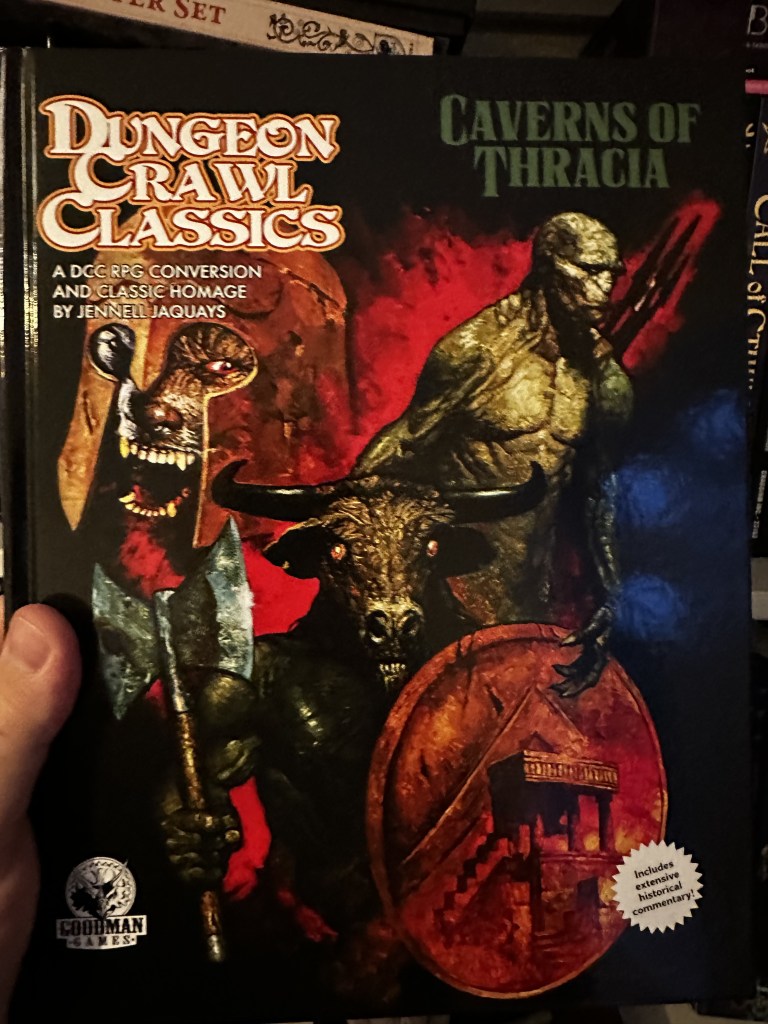
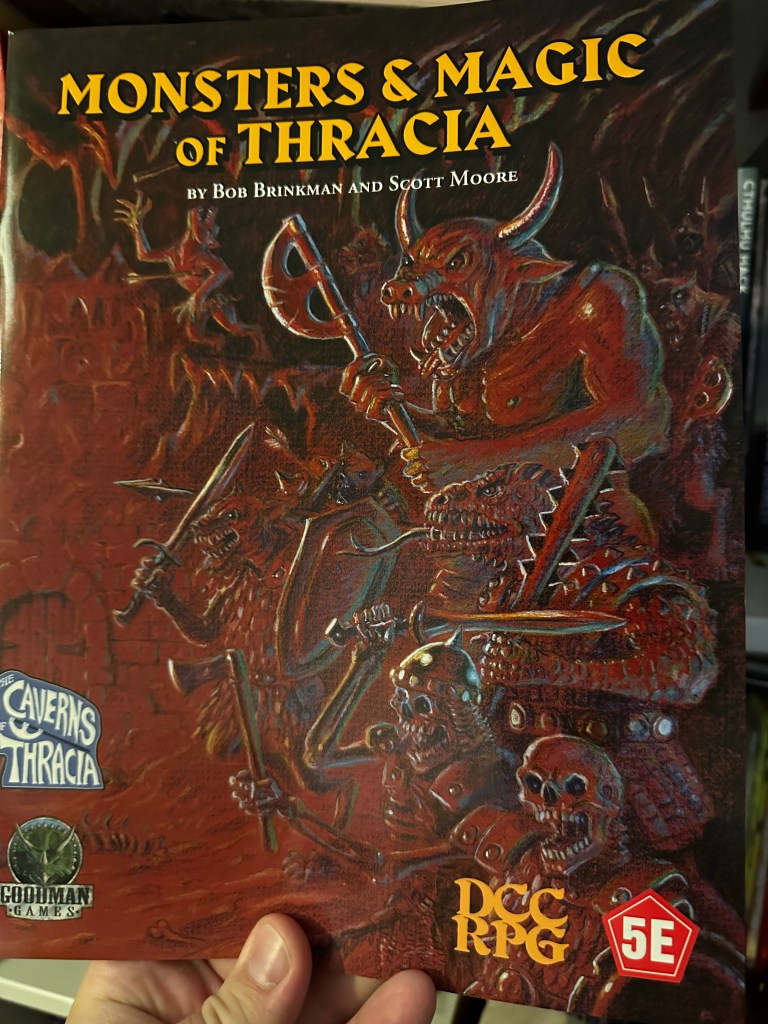
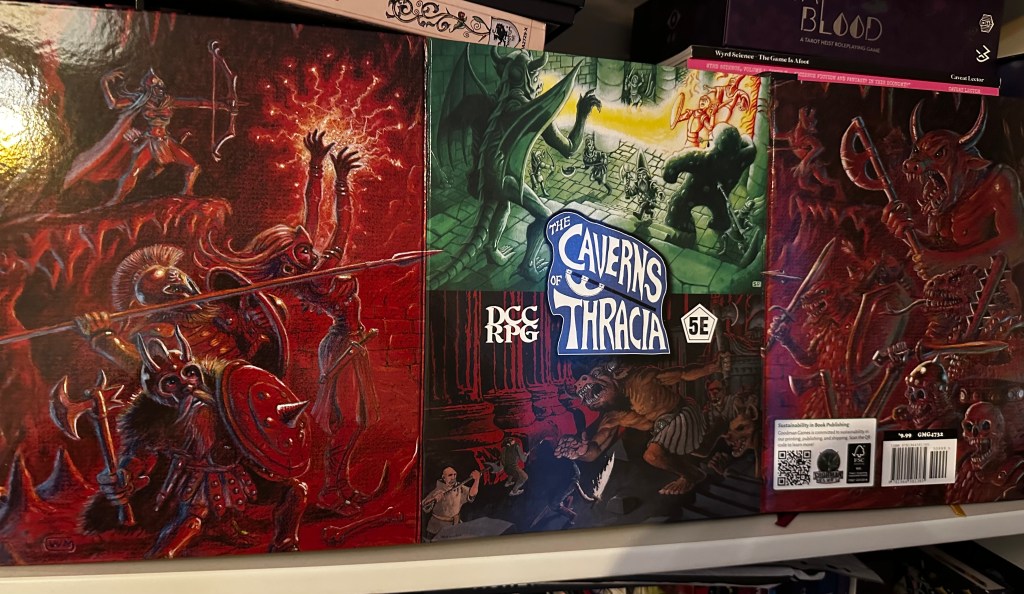
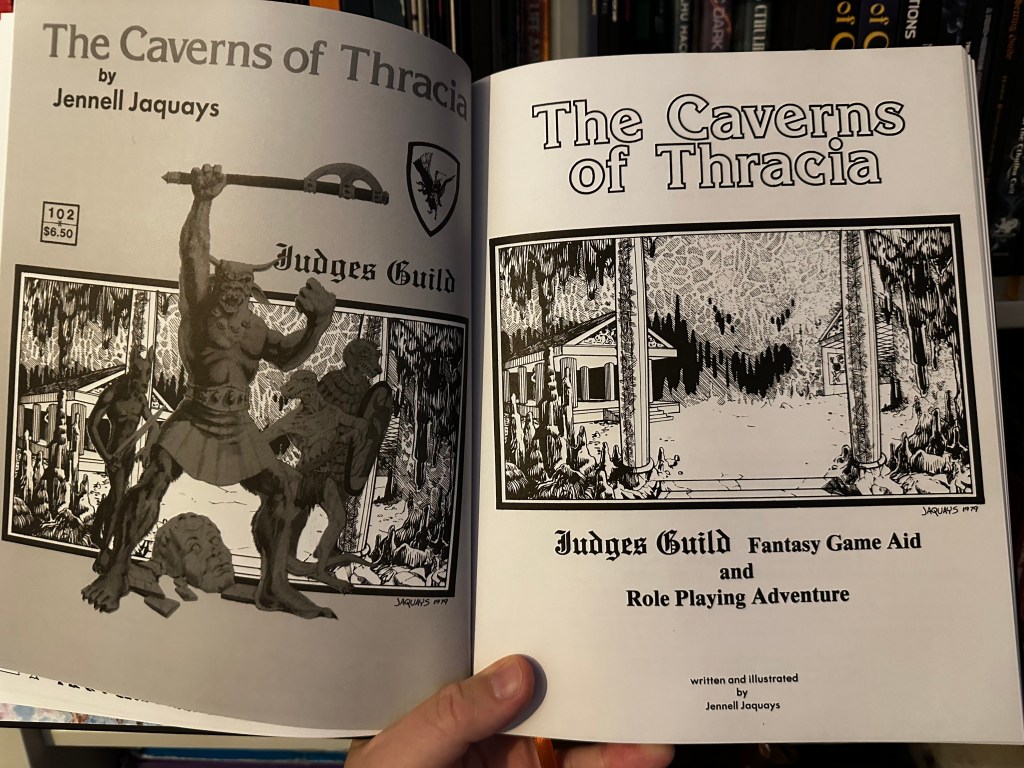
Anyway, back to the Caverns of Thracia. The kickstarter was to produce a book that included both the original Judges’ Guild mega-dungeon adventure by Jennell Jaquays and the newly realised version for DCC (or 5E.) It came with a bunch of add-ons like fold-out maps, a handout booklet, a GM screen and a few side adventures that were set in the same general area as the main one. So, I have been thinking recently, especially as I retread old ground in the Editioning, that I should be using some of these books! I thoroughly enjoy DCC but I have only ever run two funnel adventures and a 1st level one. So, I decided to take one of those side adventures from my Caverns of Thracia haul and run it for DCC Day 2026, which just passed on July 18th.

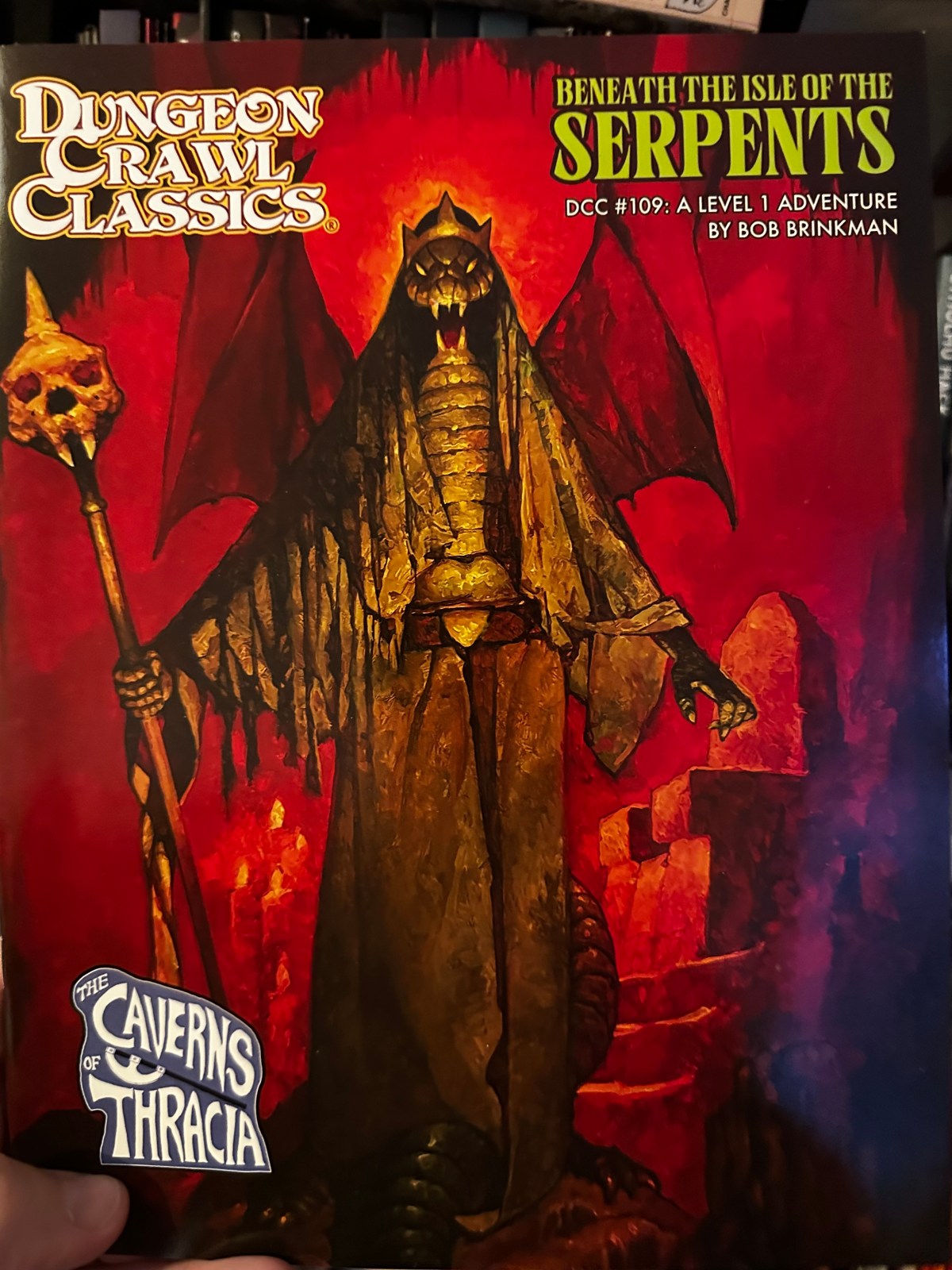
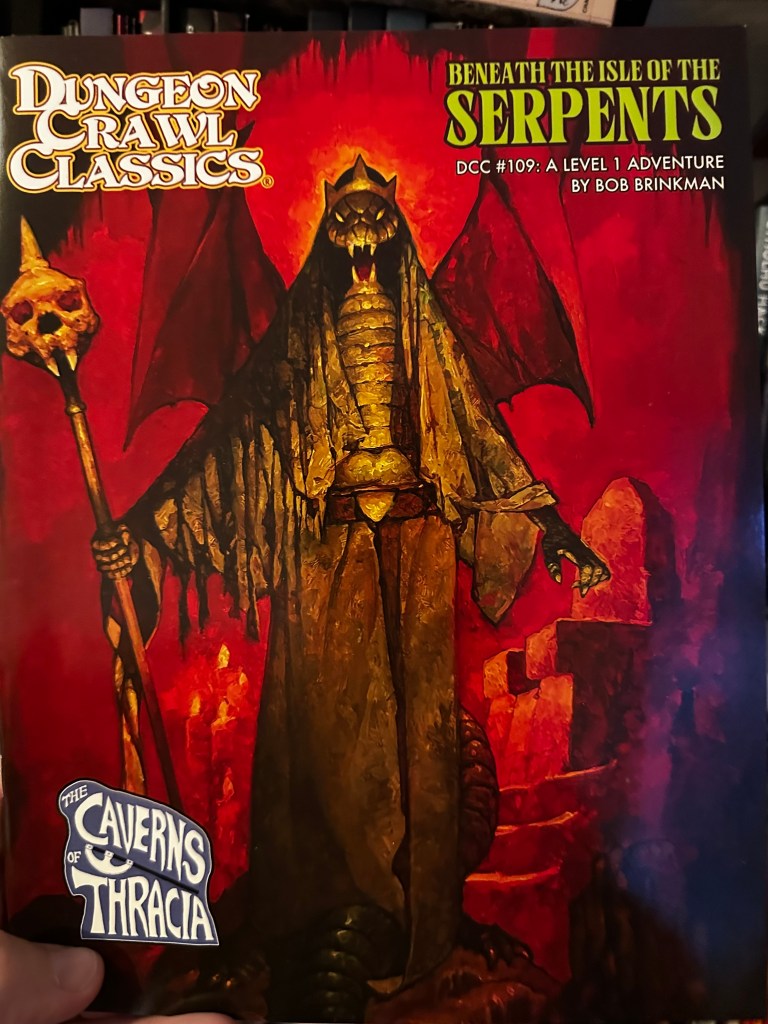
Beneath the Isle of the Serpents

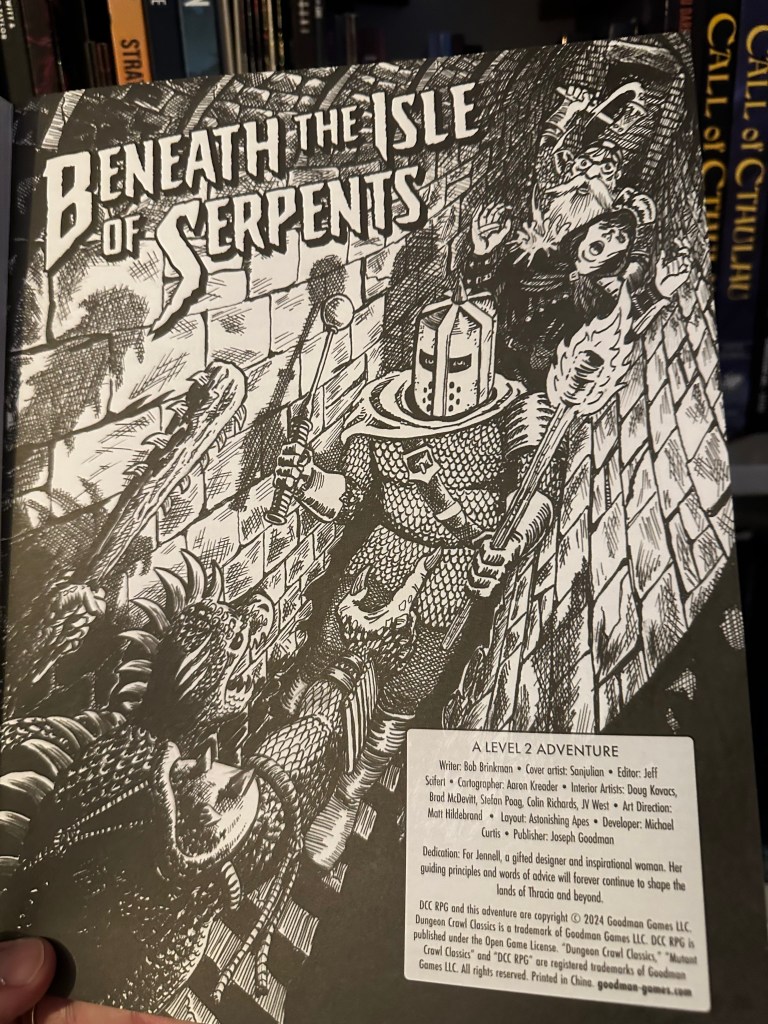
Beneath the Isle of Serpents inside cover illustration shows a band of adventurers filing down a narrow corridor with a warrior in front, a Wizard in the middle and a hypnotised Dwarf in the rear, attacking the Wizard. They are being attacked by a Serpent man who looks a lot like a Lizard man if I'm being honest about it.
Hypnotise!

I settled on DCC # 109 Beneath the Isle of the Serpents by Bob Brinkman as a suitably evocative scenario that would showcase a pretty cool dungeon and could easily be finished in two sessions. I have already learned that, no matter how short a DCC adventure is, you are not likely to finish it in one session without severely editing it or via TPK. Turns out I had more lessons to learn.

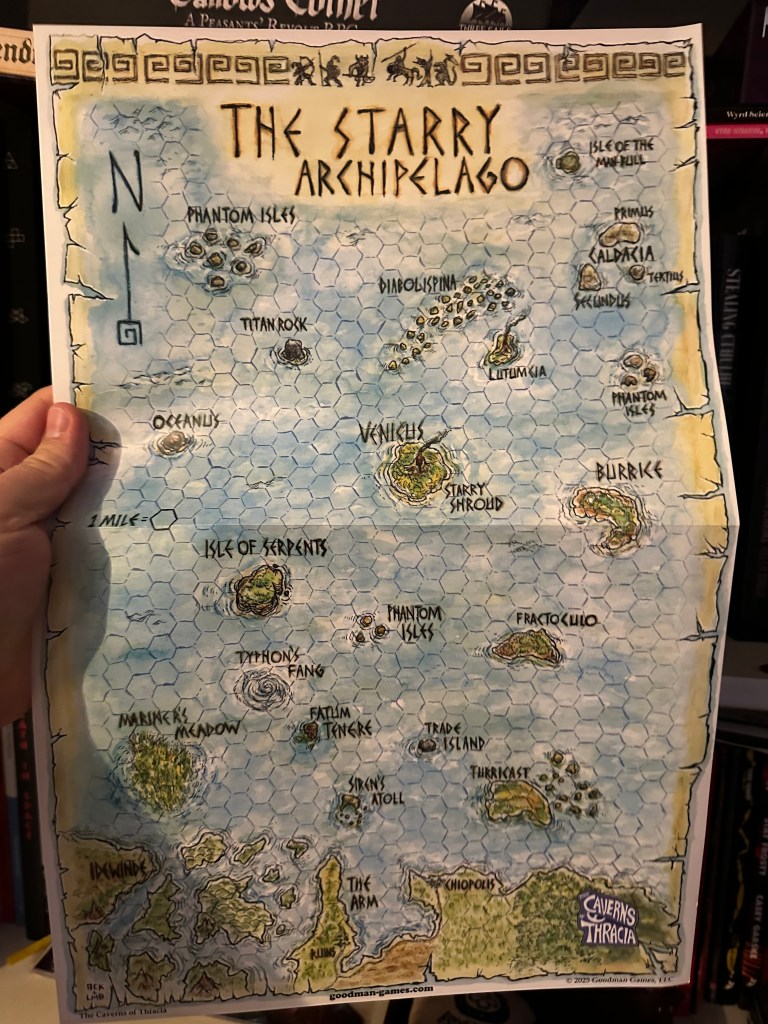
We started the adventure in montage. My players, just two for this DCC Day, had a couple of PCs each. One of these was a Wizard, and one of the adventure hooks is that the Wizard’s patron calls in one of the many favours owed them. Hilda’s patron Ydd’grrl, demanded that she and her friends deal with the burgeoning evil beneath the Isle of the Serpents on the Starry Archipelago. So they trekked across the continent, traveling largely by map. They got to a fishing village on the mainland closest to the Isle of the Serpents and then a fisherman, named Kamay, offered to take them where they wanted to go. No-one else would…

Map of the Starry Archipelago. A number of green islands dotted acorss a blue sea.
Starry Archipelago: its fun to say. Try it!

Kamay dropped them off at the black sand beach on the south of the island. Here they faced the terror that was a Giant Devil Crab. They largely had the measure of this thing, but when it hit, it hit hard. After a couple of rounds where they battered away at its devilish shell, one of its claw attacks impaled Hilda, killing her instantly. Kinda, I mean, we fucked up here. It has been about ten months since we last played with these characters so we forgot how they worked. It looked like our Hilda had 15 HP, but we all thought that must be some mistake for a level 1 Wizard, right? Wrong, it was only after the session, when Hilda’s player, Tom, was trying to figure out where the 15 came from that they realised it was one of the benefits she got from her familiar! So, when I ruled that she couldn’t have had so many HP, and must have been killed by the 8 devil claw damage, I killed her without due process or any real legal basis. Some Judge! Anyway, once we knew what had happened, we ret-conned the death. Instead, she awoke amidst the devastation of the devil crab, stripped of all her belongings by her fellows, and badly injured. “Fuck this,” she thought, and went back to the boat.

While she was “dead/unconscious” however, I asked Tom to roll up a new PC using purplesorceror.com as I was worried about the ability of the party to survive the dungeon when there were just three of them. Tom rolled up Glagrill, a Dwarf who they’d all forgotten was asleep in the hold of Kamay’s fishing boat the whole time.

The Island

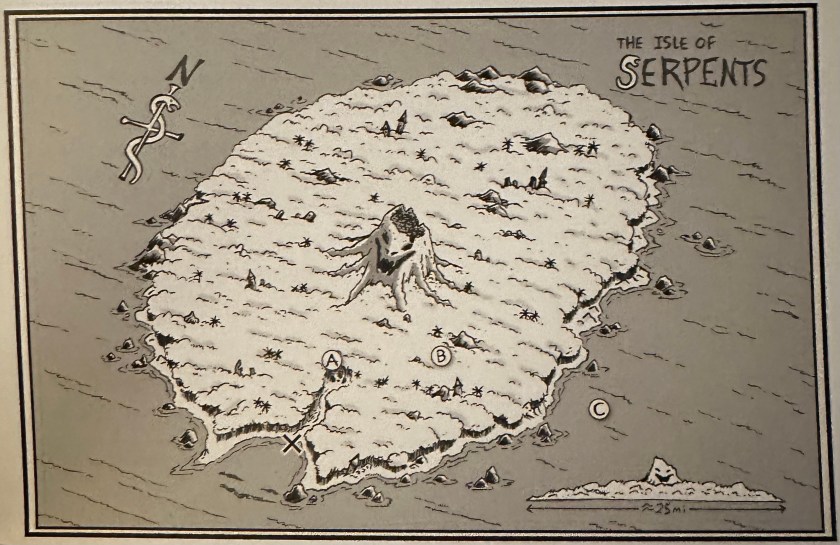
The map of the isle of Serpents. It is vaguely oblong with a volcano with a face in the middle. No hexes.
No hexes here.

The adventure provides a really great random encounter table for those parties that decide to explore the island’s surface. Now, there’s a perfectly good, relatively recently forged path through the jungle that leads directly to the main dungeon entrance. If they take that path, they get to move full speed and forgo having to roll for any random encounters at all! so those PCs who avoid that are probably just paranoid. No good reason to do that, surely!

Now, I will say that while the encounter table is great, if a bit over the top for what is probably going to be a very minor aspect of the adventure, the text tells the Judge to roll for a random encounter every two hexes traveled by the party, but the island map ain’t got no hexes so you would need to kind of guess how far two hexes might be, I suppose.

The Dungeon

Anyway, my clever party took the safe option and went straight down the path and straight down the ancient, root-choked chimney to the buried temple to some chaos God. Here they discovered some indecipherable wall art, a room filled with rust-midges and a grate in the floor, below which those blessed with infravision could see barely living bodies of humans hanging by manacles from the sloping ceiling of what looked like a sluice. And that was the end of session 1.

Session 2 saw them descend the winding staircase out of that first chamber. They found it ill-suited to them, too narrow, with steps too long and too low, as though built for a very different type of body. Before long, they encountered an opening in the wall on one side. Our Dwarf, Glagrill, checked it over but made some noise in the process. So, when he made his way into the chamber beyond, he found two Serpent Men and one Cobra Sub-commander on their way to attack. Unfortunately, the narrowness of the doorway meant only one PC could stand in the front. The Sub-commander attempted to hypnotize the PC right behind the Dwarf, but Glagrill did his best to defend, and Helfgott, our Cleric, cast darkness to prevent any more hypnosis attacks. Three against four, this turned into a war of attrition, which is bad news for a band of 1st level characters. Eventually, the darkness failed and Magnolia, our Halfling, was hypnotized by the Cobra Sub-commander. She had no choice but to attack Helfgott. She critted and did an extra 2d6 damage on top of her normal weapon damage. Helfgott only had 3 HP. He was one of the longer lived PCs. Isaac had had him since Sailors on the Starless Sea. It was a tough way to go but the others looted his corpse and moved on after they killed the two guards. The Sub-commander had locked himself in his room in the back of these guard quarters. On their way through they found a pair of lucky dice, some coin and a barrel of human hands, feet and other bits.

Eventually, they decided to open the door and deal with their opponent. This time, Melmoth, Isaac’s Elf character was the one to suffer the hypnosis of the Cobra Sub-commander. He was forced to turn on his new associate, Glagrill. He critted… Glagrill, so new to the world, was sent out of it again in but a moment. The two remaining adventurers, taking no chances, fire-bombed the trapped Cobra Sub-commander to death and found a bunch of treasure in the ruin of his chamber.

Not even half way through this adventure and technically, three PCs down. This was the dice telling a story. I was rolling so well, I felt bad about it. Tom and Isaac had never rolled worse, except when they were under the Cobra Sub-commander’s sway and they critted. There was shock, sorrow and outrage on display at the table. Everyone was questioning their choices. We laughed and cried. This is why I play these games to be honest. Not to kill characters but to experience the extremes of those moments.

Conclusion

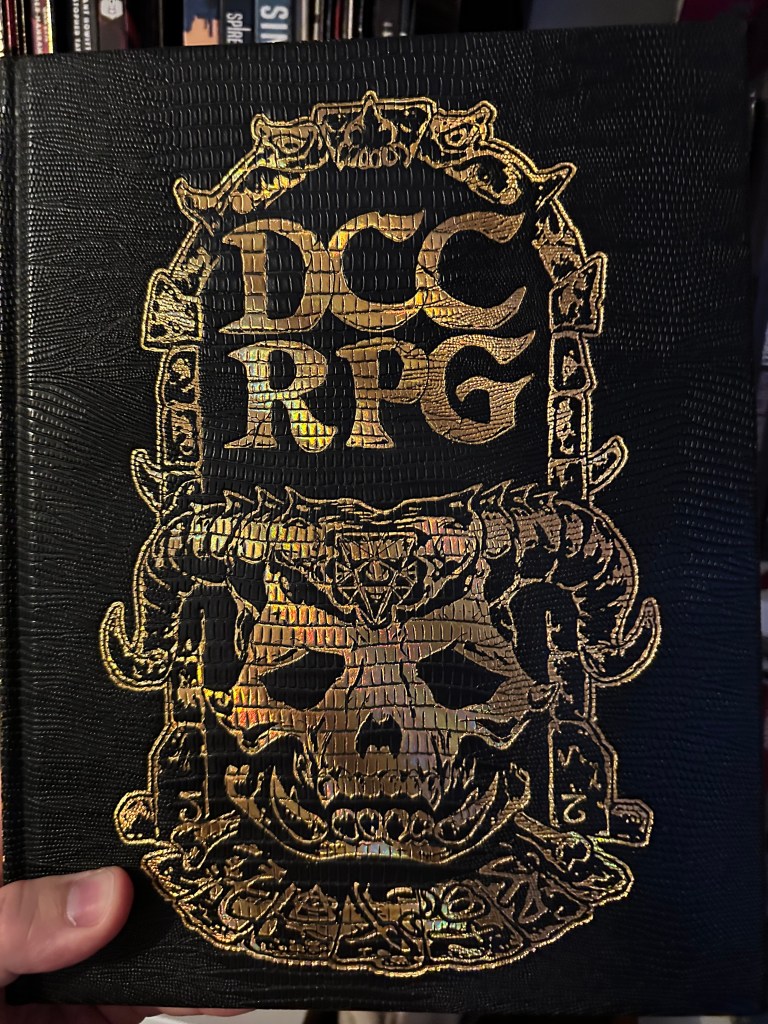
The Cover of the Special Edition of DCC RPG. it has a gold embossed demon skull complete with horns on the faux-leather black cover.
DCC RPG Demon Skull

Eventually they trudged back towards the beach, thinking to retreat. Meanwhile, Kamay the fisherman started lifting the anchor. Hilda asked where he thought he was going. He told her his business was done here. She sent him into a deep and magical sleep and made for shore where she reunited with her former companions. They decided one more try was in order.

DCC Day 2026 may be done, but the expedition Beneath the Isle of the Serpents is far from over, dear reader. Join me again soon, when I will complete my review of this deadly module.

Blades in the Dark, Thoughts

Set-up

I made quite a big deal, last year, about the process of choosing an RPG to play. For months, I perused books and created characters to get a feel for a selection of games. Most of these games I would put squarely in the story game or, at least, narratively focused category. Blades in the Dark beat out Triangle Agency, Slugblaster, Wildsea and Deathmatch Island to name a few.

Once I had decided on Blades, I wrote a bunch of posts relating to the advice presented in Blades and its recent expansion, Deep Cuts. Reading the books and absorbing the advice helped to boost my enthusiasm for it.

We got into Blades well. We had a regular game every three weeks and we found a natural rhythm of having a score session followed by a downtime session. I had always planned to have only six sessions in our Season 1 of the game. This seemed like a reasonable amount of time for all of us to get a good taste for the game, the setting, the system, the characters and the crew.

We had our sixth session last week, so I thought I would take this opportunity to gather my thoughts, lay them out and examine them.

Up-sides

The scores; it’s what it’s all about. Even in the instances where I had no time to prepare and found myself recycling old ideas, we got really into the scores. The players seemed to enjoy the freedom of the narrative-first style that allowed them to fully describe an entire action scene rather than just rolling a die to see if they hit a guy. This bred inventiveness both in-score and out so that they pushed the envelope of what was possible even during downtime.

I enjoyed them because I found I had a curious amount of control over the proceedings. If we had a full session for the score, it was easy and fun to allow the PCs as much leeway and time to describe and indulge in their scenes. Conversely, if time was against us, I was able to push things to a conclusion with the flick of a narrative switch. I used clocks in every score, which will be no surprise to anyone, but, for me, it was remarkable. Looking back, I feel like I could have utilised them more often and to better effect. Almost every score involved just one clock representing the PCs goal and one representing the potential negative consequences. Especially in the final score, it would have been fun to introduce other clocks representing minor peripheral goals or dangers as well, but I didn’t think of it at the time so it didn’t happen. But, what I’m saying is that I like the use of clocks to track eventualities and possibilities. They are easy for everyone to understand and impress on all players the urgencies and exigencies of their situations.

Secondly, I loved the player-characters. The playbooks are iconic and the players loved to lean into them in fun and notable ways. I think the players all became attached to their characters in short order, which was essential since we had only six sessions. The crew became almost a character of its own, especially with its reliable cohort of thugs. I liked that the crew had a sense of ambition. They wanted to become the number one gang in Crow’s Foot, and by the end of the season, they had made significant headway towards that goal, defeating the Red Sashes in a war and capturing their leader. But they also each had their own motivations, religious or “scientific” or naval(?) I think the game itself has something to do with that, with stress and heat and reputation all conspiring to drive them in certain directions. But, I also know that my incredible group of players would build memorable characters no matter the influence of a ruleset so I don’t want to overstate that.

Thirdly, the setting. Duskwall is such an evocative setting. The eternal darkness, the ghostly hauntings, the leviathans and the empire. The nobility, the workers, the weird science and the gangs. It is rich and deep and you would be hard-pressed to fail to come up with interesting things to do in it. But it is not oppressive in its richness. We never felt as though we had to stick to some Akorosi canon. There is a freedom to create parts of the world that you would never get in, for instance, a published D&D setting. But, on the other hand, the books provide a wonderful assortment of factions, places, NPCs and items that can come in handy when you need something specific or general in a pinch. I was rarely left scrabbling for a needed detail. There was always something close to hand.

Up-hill Climb

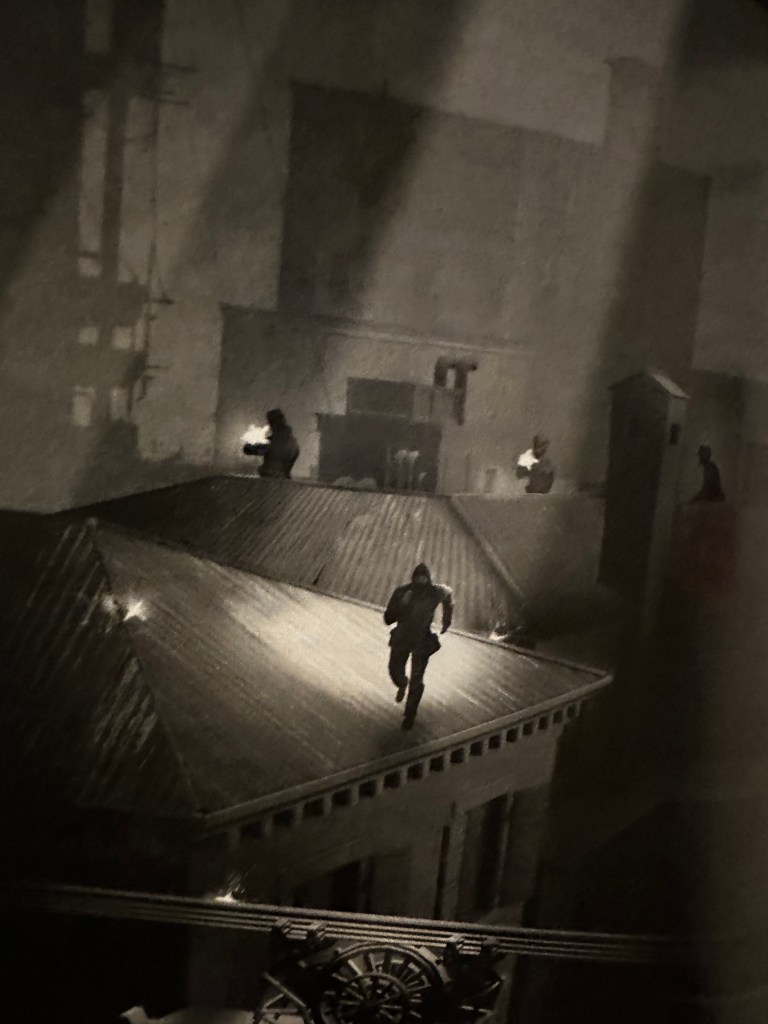
Light shines down from above on a scoundrel running acorss the rooftops of Doskvol
Light shines down from above on a scoundrel running across the rooftops of Doskvol

But we had some significant issues in our six sessions. Now, some of these are entirely my fault. Some of them are a symptom of having only six sessions to become familiar with the game and some arose because we sometimes struggled to keep our sessions regular. But still, they were there so I’ve got to discuss them.

Downtime was the biggest struggle for me. Now this was, perhaps, the part that I can take most responsibility for, but there are elements that we found just rubbed us up the wrong way. So, firstly, about half way through, I decided to start introducing downtime rules from Deep Cuts. I liked these alternate rules. They were largely diceless and gave the PCs a bunch of other things to spend Coin on. I thought they would speed things along a bit more, compared to the original downtime rules. But it introduced confusion more than anything else. Because we had had so little time to get used to the original rules, and I had an imperfect understanding of the Deep Cuts rules, we ended up often very confused about what was needed for any given downtime activity. We often ended up mixing the two rulesets into some unholy abomination that we could never remember at the next downtime. I wish now that I had started with the Deep Cuts rules and used them the whole way through. I think they are, comparatively, smoother and more interesting overall.

But the main issue I had with downtime was the idea of having a separate and overtly different phase of play. The fact that you need to use a completely different set of rules for it delineates it deliberately from the score. It slows things down, it deals with each PC so separately that they are largely on their own for long periods of the game. This meant that the only other person they were interacting with most of the time at the table during downtime was me. This is a significant increase in mental load for the GM. On top of that, each PC has a few notable NPCs and I was responsible for voicing, playing and inventing them almost from scratch. That’s a lot to remember and a lot to do at the table.

And, the mechanics themselves, to me, made this part of play feel like I was constantly explaining the rules of a board-game to the players. All those currencies and meta-currencies, Coin, Rep, XP, Heat, Wanted Level, Status, Stress. There is so much to keep track of and it often feels like shuffling tokens and cards around on a board. I am not a big player of board-games. Given a choice, I would choose an RPG any day. Combining the two in this manner did not endear the game to me. And all the sheets required to keep track of everything go to evidence exactly how much admin is involved in Blades in the Dark. Now, I understand that this is actually a positive for many people. It’s just not for me.

In general, I found that role-playing, as one might traditionally think of it, was difficult to work into sessions of such heavy admin. Even in the score sessions, there is little time for inter-character development, so focused is the whole crew on the goal of the thing. This is, perhaps, a symptom of the style of play I am used to. Generally, in OSR or more trad games, the players are often role-playing amongst themselves constantly and then with me, as the GM, whenever they need to interact with an NPC in the world. Blades requires the players to know what sort of scenes they might want to role-play, set them up with the GM and know when to end them as well. So, that might be our relative inexperience with this type of game showing. But, if I might be allowed to make a comparison, I never felt like this when playing Spire or Heart, which are hardly OSR or trad. It think they sit more firmly on the story-game side of the divide, but we never had any issue with fitting in role-play in our campaigns of those games. I think this is due to the fact there was so little admin in those games. They feel more streamlined to me. Not perfect, by any means, but, perhaps, more to my taste.

Everyone agreed the character sheets were an issue. This was more from the player side than from me. The design of the character sheets is too busy and the text is too small and the little boxes to fill in are fiddly. In general, there is far too much text on them, even though I know the idea is that the player has everything they need at their fingertips. Interestingly, one of the things some players said was that, even with the quantum equipment rule where you don’t have to mark a piece of gear until you say you’re using it, they found the item list restrictive. They would often look at that list when trying to figure out what to do with their turn. Too often, they could see nothing of use, and instead, just defaulted to the usual skirmish or shoot. I thought this was a very interesting observation, that the design of the character sheet or the item list, at least, conspired to stunt their creativity in the moment.

Up-shot

Now, like I said at the start of the last section, its possible that a lot of these negative views are due to the way I ran the game, the irregular nature of the sessions, the limited exposure to the game, but I think its equally possible that I bumped up against it because I have a particular preference for a different type of game.

I confess that most of my best and most memorable experiences with RPGs recently has been with the OSR. Mythic Bastionland, Mothership, Black Sword Hack, Old School D&D. I am rooted in old school play after all. But, then again, I have played other story-games, like Heart and Spire, like Trophy, Root and Dungeon World and I have enjoyed them immensely. I might be forced to come to the conclusion that Blades is just not for me…

I guess we’ll see when we go back for season 2 of the Death Knells.

UVG x Troika

Vibes

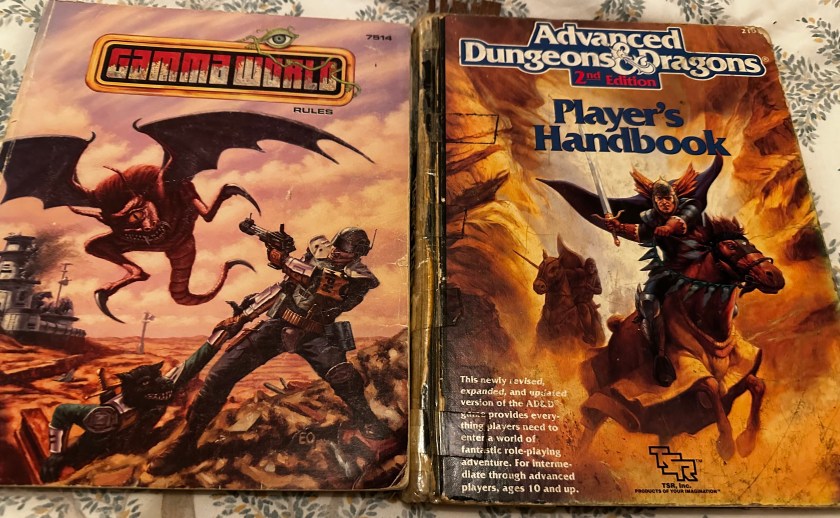
It’s easy to categorise RPGs by genre. Traveller is sci fi, D&D is fantasy, Cyberpunk Red is, well, cyberpunk, Call of Cthulhu is horror. There’s no real question about that. But, when you want to do an RPG medley, you’ve got to consider rulesets and vibes. D&D and Gamma World are basically the same ruleset, which makes it handy to mash ‘em up. But more importantly, their vibes are vibing on the same frequency. This has a lot to do with the art style in the books and the ways in which the games themselves are presented as well as the settings. I’m sure I’m not the only one to take their Gamma World players through a portal to a D&D fantasy world where they could blast dragons with their enormous radiation guns. It just made sense because of the vibes.

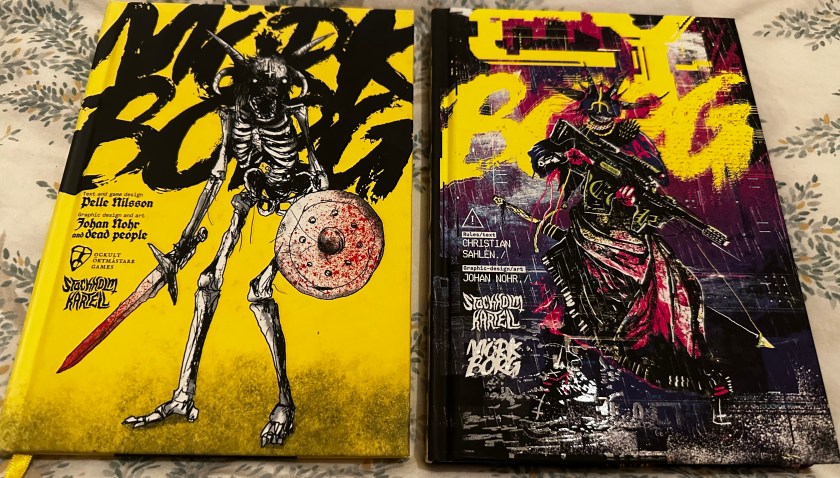
We finished a Mörk Borg campaign earlier this year. Got all the way to the end of the world, believe it or not. Cleverly, our GM, Isaac, ended that world and then woke us up from the the virtual reality game our Cy-Borg characters had all been immersed in. Someday, we’ll return to this game that’s also a new game. Now the vibes of these to are so obviously similar because they were both made by the Stockholm Kartell and designed by Johan Nohr. The art style is brash and neon and loud for both so you feel like they vibe together naturally.

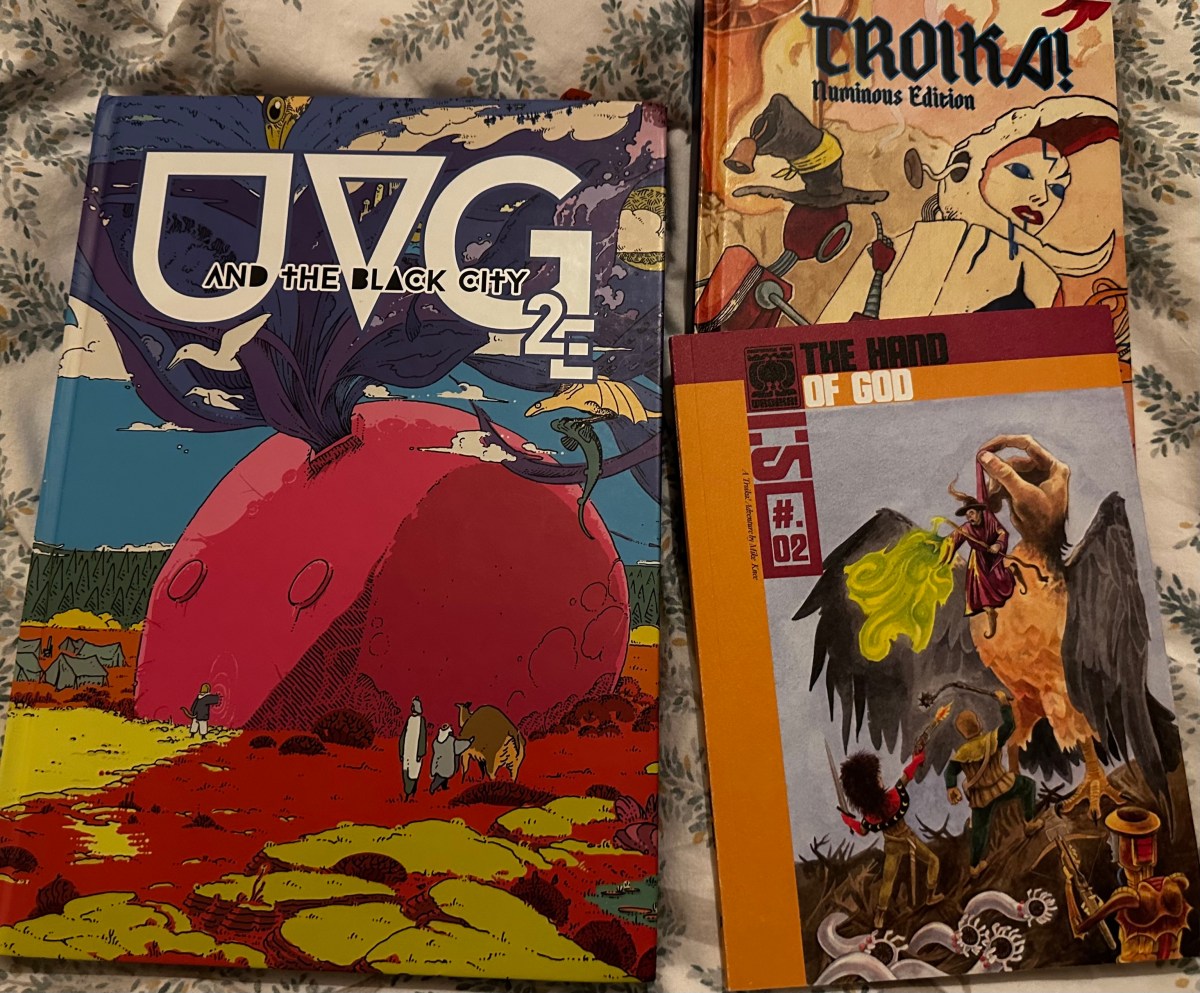
Today I want to discuss a couple of games that you might not automatically mention in the same breath, Ultraviolet Grasslands, Luka Rejec’s psychedelic, prog-rock fuelled old school trading simulator, and Troika, Daniel Sell’s Science Fantasy Moorcock/Wolfe mashup using the rules for Fighting Fantasy and the surreal art stylings of Shuyi Zhang and Andrew Walter among others. OK, you might mention them in the same breath, actually. They both tickle a very particular armpit, in between the arm of sci-fi and the torso of fantasy, and, to me, their vibes intersect perfectly. So much so that I decided to employ a Troika adventure in UVG.

The Adventure So Far

The PCs have been on the road for more than six weeks. From the Violet City on the shores of the Circle Sea they have traveled west through the Ultraviolet Grasslands. They’ve encountered Lime Nomads, giant mushroom-tending armadillos, cyborg-like bio-tech lifeforms called vomes, and even a furniture trader named Jonky Bonko so far. And at every point along the way they have gathered resources and items to trade, hopefully for a profit. This has been their over-riding motivation thus far in the campaign. The players are utterly invested in the success of their joint business venture, which they have named Isosceles Inc. Watching their Cash numbers go up has definitely been exciting for them, especially when they make a really good market research roll, or haggle their way into a selling price three times higher than their buying price. But I have been wanting a bit more old-school in it too. To that end, I’ve been seeding something in the otherwise completely randomly generated adventures. It originated in a random encounter, but I kept it running through a couple of other random encounters.

They rescued the daughter of a Lime Nomad clan chief and returned her to her mother. The mother, grateful and impressed, entrusted them with a message in the form of an item known as a portable illusion. She asked them to take it to her sponsor, a Porcelain Prince called Black Pot 5-Body at the Porcelain Citadel. Almost immediately, they rolled up another random encounter with a Porcelain Prince out on the road. A Porcelain Prince is an intelligence that’s distributed across a number of humanoid bodies that wear matching porcelain masks. The PCs, wary and out-numbered mentioned that they were on the way to see Black Pot 5-Body in the Porcelain Citadel in the hope that it would encourage this Prince to treat them favourably. On the contrary, the mention of Black Pot seemed to cause something of a stir. The Prince promptly sent a messenger off in the direction of the city. The PCs promptly killed the messenger in the grasslands and buried him in a shallow grave.

Later, at the Low Road and the High trading post, they heard a rumour that an ultra-conservative Porcelain Prince, Meissen 13-Unity had dedicated themself to restoring the Citadel to the unity of thought not exemplified since the end of the Properly Recorded Period. Not only that but that Sunfire 3-body, who they had met on the road, was an adherent of theirs. At this stage, the PCs were not able to put things together. But once they pushed on towards the Citadel they ran into a random encounter, the caravan of another Porcelain Prince, this time, an ally of Black Pot 5-body. This time, the Prince sold them a pass to get them into the Upper Citadel, where they could do business and find the Prince they were looking for.

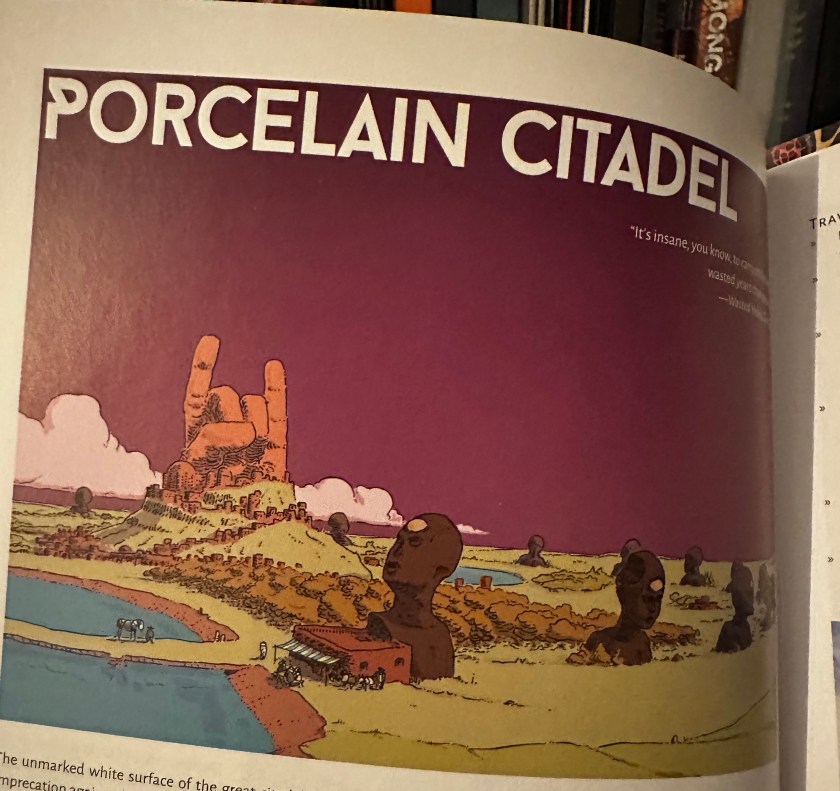
Finally, they reached the Porcelain Citadel, the great hand-shaped edifice towering over the grasslands doing devil’s horns. They had been eager to do some carousing here. The PCs had a taste of it in the Violet City at the start of the campaign and gained a lot of XP from it so they saw it as a short-cut. This time, one of their number got completely fucked up on drugs and managed to lose most of their Cash as a consequence of a particularly poor Carousing roll. So they needed to make some money quick. The next day they went to visit Black Pot 5-Body in their workshop. There they presented the eccentric Prince with the Portable Illusion. They activated it and they all witnessed a Porcelain Prince being abducted from a camp by an enormous winged creature with a hand where its head should have been. They were dumped in an enormous nest at the top of a massive index finger stretched up into the sky, as high as a mountaintop. From there the view within the illusion changed and they saw the Prince negotiating with a wizard in a black tower atop another digit of this huge hand. He exchanged a copy of a book for the wizard to help him escape back to the Grasslands. And then the illusion ended. Black Pot was very excited. This was their chance! They had finally found the evidence they had needed for so long. The original book that would prove that the laughable philosophy of their political rival, Meissen 13-Unity was based on nothing more than a work of fiction designed to satirise the exact sort of overtly conservative views they thought were espoused by it.

That’s a lot of backstory. Suffice it to say, Black Pot employed the PCs to get abducted from their dreams by the bird-with-a-hand-for-its-head so they could be taken to the mountainous hand and retrieve that book. They went into the grasslands and did just that. They woke up in the nest, just like in the Illusion. After avoiding the gaze of THOG, the bird-thing, they killed some worms escaped the nest and found themselves on the tip of that cyclopean index finger looking out on a wide green land and a cerulean blue sky. They knew immediately that they weren’t in Kansas anymore.

I loved this moment. At this point, the players did not know they had just transitioned from UVG-proper to the Troika adventure, The Hand of God, so they had no reason to suspect anything. Also, there have been hints of portals and other worlds dotted around the plains in our campaign so far, so they had no reason to think this was anything but more UVG weirdness. I kept up the pretence as long as I could. But, eventually I shared one of the illustrations from the adventure in our chat and Isaac was quickly able to identify the distinctive style of Andre Walter, so well known for his Troika work. He asked me if this was a Troika adventure and I answered honestly as is the law.

But that was ok! It helped me in fact. The players understood that I would have a little work to do to translate from one ruleset to the other when I had to spring things on them so they have been quite forgiving.

Conversion

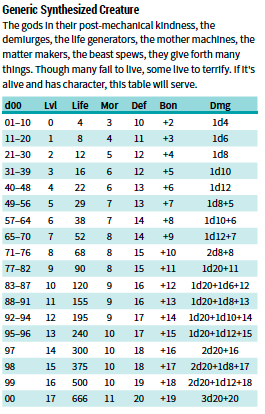
For the first session in the Hand of God, I didn’t even do any preparation of encounters in UVG terms. I winged it completely and that was fine. It would absolutely have been better if I had prepped, but it was ok. The nice thing about both rulesets is that they are light. A UVG creature’s strength is based largely on levels/hit dice, in a very D&D-esque way. So I was able to use the following table to work things out approximately while my players waited patiently.

But the fact was, the only combat encounter they had was with a couple of weak and lowly Prayer Worms. In Troika terms, they had low Skill and medium Stamina and their only special was screaming when they died so it was was easy to look at that table and decide to make them level 0.

I rolled up another random encounter as two of the three PCs made their way down through the index finger’s stony interior. There, on the stair, they found a poor undead whose body had been crushed by a fallen boulder. She told them she would reward them if they would bring her to the undead village of Jigigji over on the Little Finger. So they re-reanimated her decimated body and brought her along with them. Meanwhile, the third member of Isosceles glided across the span to the next finger on his handy glider. He landed on the opposite side of the bridge long before the other two made it there. At this point I knew they would be running into a lot of potentially tricky encounters that I thought I should prepare better. So we left that till the next session. In between, I converted all the stats for all the potential encounters, whether random or planned. The conversion did not always fit neatly into the rows of the table above. Sometimes I would add more hit dice if they had more Stamina than Skill, and I would always look at the potential damage on the Troika damage tables to decide the dice and bonuses to give them in the UVG context. None of this was particularly taxing, although I’m sure some GMs would do the conversion differently to me, if they wanted something more or less balanced.

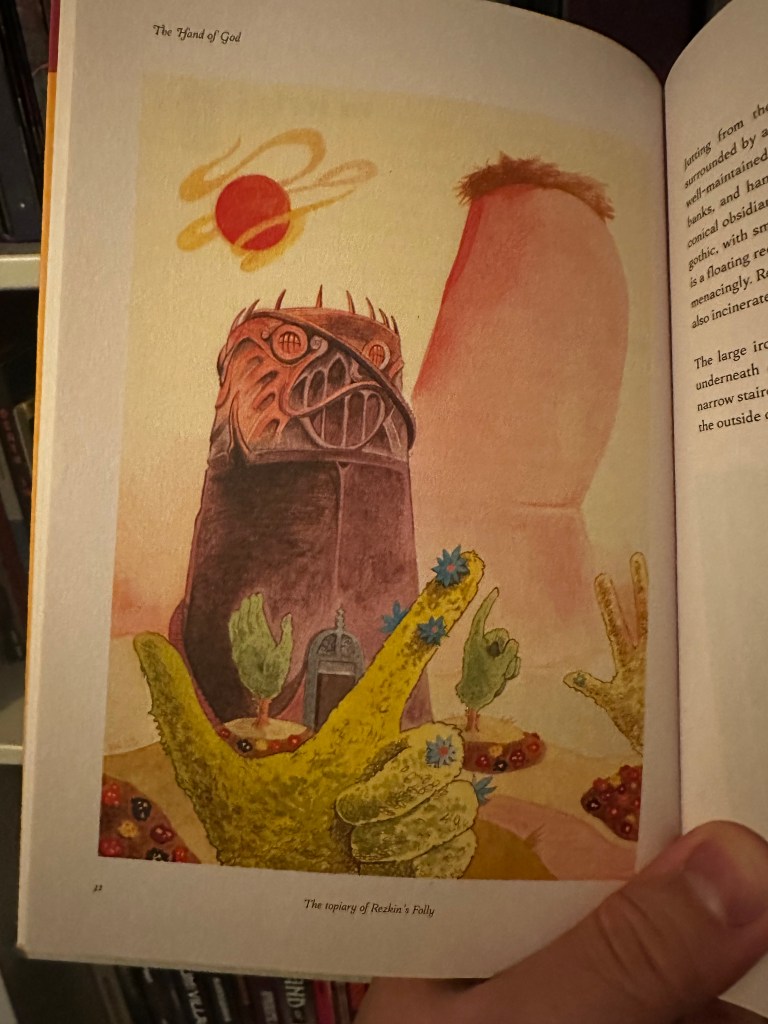
The next session they dealt with a bridge troll and his gremlin minions, but realised they were in for a tough time on this adventure quite quickly. Once they got across the bridge, they soon reached the black tower of the wizard as shown to them by the Portable Illusion. In the adventure, this is known as Rezkin’s Folly. All they would have to do is get into this powerful wizard’s abode, avoiding the fireballs being flung by the magical orb security system and all the weird shit inside, and they would get the chance to maybe retrieve that book!

The Folly is presented as a mini dungeon within the context of the overall adventure. It has fourteen rooms and its spread over a mere eight pages. It is very easy to read and absorb and most of it is usable in any system, with only the creature stats requiring conversion.

There are some Wizard spells referenced in the adventure that are taken directly from the Troika core book. I had to spend a bit of time looking up UVG spells that worked as alternatives to their Troika counterparts. None of these were really done on a one-to-one basis. Troika spells are generally fairly D&Dish, but UVG spells might really do anything, conceivably. I used both the UVG core-book and the forthcoming Wastelands Guidebook to help with this.

Conclusion

Well, we haven’t concluded this adventure by any means. Isosceles Inc have only made it into the tower’s lowest floor. They have encountered a gossamer assassin creature and survived, but still have to make it to the treasure room and out again. They also need to bring their undead companion back to Jgigji and then escape this potential dreamworld to get back to the Grasslands!

So far, I am loving how well the Troika adventure vibes with UVG. There are some anachronisms, like trolls and gremlins, which seem a little too generic-fantasy for the weirdness of UVG, but, on the other hand (if you’ll excuse the pun) they’re on a ginormous hand and they were sent there by a weirdo who lives in a giant hand. This was obviously the thing that linked UVG and the Hand of God in my head. Somehow, this dreamworld leaked into the “real world” of UVG and led the Porcelain Princes to build their Citadel. And, perhaps, the item that same their citadel from repression is contained in it.

Anyway, this adventure will continue soon, hopefully. Our gaming has been dominated by the Editioning recently, but, hopefully, we’ll get some more UVG x Troika in soon!

The Bloggies 2026

It’s Bloggies time again! This year, I’m not nominated, mainly because I didn’t nominate myself, which is what I did last year. But there are lots of great blog posts involved. I recommend you go and treat yourself to some of them.

This year, it’s being run by Clayton Notestine, last years’ winner over on the Explorer’s Design blog. It’s a lot of work! The honour of winning is tempered by the commitment of time and effort it requires to run it the next year. But he’s doing a brilliant job so far.

Today, I’m going to highlight one of my favourite posts from each category. The categories are:

  • Advice
  • Critique
  • Gameable
  • Meta
  • Theory
  • Debut Blog
  • Blog Series

For voting purposes, the posts are all paired, so they’ll be pitted against each other in a brutal gladiatorial blog-off. There can be only one!

You can read them all using the links provided on this page. Or you can join me in listening to them via the We Read the Bloggies podcast, to which many members of the TTRPG/blogging community have so generously donated their time.

Advice

This is my pick from the Advice category:

Just Tell Them What They Need! by Nate Whittington of the Grinning Rat blog. It was published on December 9th 2025.

If you have ever read a TTRPG adventure and screamed at it to provide you with the relevant information on a dungeon room, an NPC or a situation, this one’s for you.

Critique

This review of Mausritter, and, more specifically, the campaign set, The Estate, for that game, is really interesting. Recently, Quinns was on the Dice Exploder podcast talking about his love of the tactile, chit-based inventory system Mausritter uses. But, in this review, although the author, Malmuria, likes the way the system works, they point out that it’s a lot of work just to keep track of all those little pieces.

Gameable

On the d4 Caltrops blog, we have a very short but incredibly useful post on the stocking of wilderness hexes in OSR games. The main resource here is a d66 table which identifies discoveries as:

  • Landmarks
  • Lairs
  • Resources
  • Special
  • Hazard

Or some combination of these. Mostly, it provides sparks of inspiration to allow a GM to come up with discoveries that make sense in their campaigns/worlds. Here’s an example:

Hazard/Resource: Consider a Hazard that renders the Resource invaluable or inaccessible in some way.

Doesn’t that get your little GM brain whirring?

Theory

I love this post about Making Hacking an OSR Style Problem from the goblin.zone blog. I don’t play a lot of cyberpunk games or even games set in the modern day so this is not a subject that comes up very often in my gaming life. I am, however, in my day job, responsible for system security and data protection so I particularly clicked with Part 2: Useful Real World Concepts

Meta

I write RPG reviews here on the dice pool dot com. Some are better than others, but I do always try to make them useful to the reader, the potential player/GM or the prospective buyer. I don’t often think about how I go about doing this. But, if I did, it would probably be encapsulated in this post from The Dodecahedron blog. It references another post from one of my go-to reviewers, Idle Cartulary, on the Playful Void blog, which also did a lot to lay out what reviews should do. I appreciate any writing that makes me consider what it is that I’m doing and both of these posts did that.

Best Debut Blog

My pick in this category is the Valeria Loves blog. Here’s the post that got me hooked. Valeria has a compelling and entertaining voice:

I am a priestess of Blorb. Just as the map is not the territory, the rules are not the fiction. You do not need a codified movement speed to permit player characters to move.

And there is a satisfying assortment of blog posts so you’re sure to find something to your liking.

Best Blog Series

It’s the Playful Void again. Over the Christmas/New Years period Idle Cartulary reviewed a truly staggering number of games/modules for Critique Navidad. It was one a day for thirty days. I wrote a blog a day during my first month on the dice pool dot com. I can tell you, that’s a lot of work! And I was only prattling away about the shit the occurred to me, not reading, critiquing and writing about the work of others in a thoughtful and fair manner. That’s what this series is. Go check it out.

The Sutra of Pale Leaves, The Fixer

Goodbye Carcosa

Dear reader, last week, we took a look at the final part of the Sutra of Pale Leaves campaign. Today, we’re looking at the Fixer, the final scenario in Carcosa Manifest, the second book in the series. Its part of the Sutra of Pale Leaves, but its not necessarily part of a campaign. You could play it as a stand-alone module, but you could also play it as a coda to your SoPL game. It makes as much sense as the very loose way the campaign is presented, if not the way you might actually find yourself playing it.

The Repairer of Reputations

The Fixer is based on the short story by Robert W Chambers, the Repairer of Reputations. I’ve just listened to it on Youtube. It’s a story of insanity, ambition and murder, which is told from the point of view of a man who has come under the influence of the King in Yellow and a deformed, yellow Repairer of Reputations named Mr Wilde. Go listen to it or read it here. It’s not very long and I think it’s worth reading. The story and the scenario share a few major scenes and themes, but the Fixer is resembles the Repairer of Reputations only loosely. For one thing, the original was set in a then future New York City, while the scenario is based in 1990s Tokyo. The main thing, of course, is that it’s an RPG scenario for a number of players, and that necessitates a few things. The PCs need to have something to do, there has to be room for all of them to be the “main character” and it has to have enough meat on its bones to keep them going for a few sessions of play. I think the Fixer is quite successful at doing these things.

Beginnings

There is an interesting conceit here, that the investigators are down on their luck. They are members of Tokyo’s growing homeless community and are lacking money and respect. It’s possible that they are the same investigators that played through the full Sutra of Pale Leaves campaign. In fact it’s suggested that that’s the reason for their current predicament. Perhaps the things they were forced to do to fight the Pale Prince got them arrested or sent to a psych ward. Maybe they became social outcasts due to their talk about mind viruses and Carcosa and faceless people. Whatever the reason, they have ended up on the streets.

But then they’re given an opportunity by Mr Nomura to make some good money and repair their reputations, restoring their lot in life. Nomura is a strange man with terrible disfigurements and an ever-increasing number of cats. He acts as a wakaresaseya, a breaker-upper, if you will. This is a real business in Japan, and it fits in the scenario perfectly. In fact, in the short story, we never discover what it is that Mr Wilde actually does to Repair Reputations and I’m not sure that such a job ever truly existed in history. So, I like this logical adaptation in the scenario. He calls on the PCs to target several “wrong-doers who have made it into his ledgers.” These include a politician, a dirty cop, a buddhist abbott, a yakuza gangster and a fashion CEO. These are known as the Strawmen. He doesn’t want them killed or physically harmed. Rather, he would like the investigators to humiliate and humble them in particular ways.

Episodic

The visual flow chart of the scenario features the five portraits of the strwmen from the scenario at each of the points of a pentagram with a portait of the Fixer, Nomura above them all.
The Fixer Flow Chart

This scenario bucks the trend when it comes to format. Rather than simply following leads from location to location as the other SoPL scenarios, the investigators need to deal with each of the Strawmen one by one. Now, these people are all assholes in one way or another, even the buddhist abbott is a drug-addict who tricked his way into inheriting his title from his father by convincing the old man that his brother was actually the junkie. So, the investigators are unlikely to feel too bad about bringing them down. In fact, each of the strawman sections details the exact kind of shitheel each one is, their background, their weaknesses and where they’re most likely to be found. For instance, the politician can usually be intercepted at the National Diet (Japanese parliament) or on the golf course. Most useful is the “possible approaches” part in each strawman section. Obviously, this is Keeper-facing information, but it can be used to confirm that the investigators are on the right track. Generally, they are going to have to overcome things like getting onto a golf course or into parliament buildings while being homeless person. But once they get there, they get to do fun things like blackmail, or just straight-up releasing blackmail material to destroy them.

I can see each of the strawmen maybe taking a single session, with an episodic, strawman of the week type game. This would be interspersed with the results of the investigators’ efforts. You see, the truth is that targeting these individuals is essential to the completion of a ritual that will succeed in bringing Carcosa into our world. Nomura wants to overwrite Akihabara with the home of the Prince of Pale Leaves. They will start to see changes such as the police station being turned into changed into a castle looming over the town market square of Carcosa, or the National Diet transforming into the Royal Ballroom. As the city changes, so too does Nomura himself. His simple silicone prosthetic fingers become a cybernetic arm, and eventually he wears a porcelain mask and he is completely subsumed in some sort of cloak of scales with odd protuberances. I really like the gradual change in this villain and in the world. The investigators must assume their actions have something to do with these changes. The become more extreme with each strawman they bring low. And yet, the scenario assumes they continue to do what they have been employed to do.

Endings

Nomura, the Fixer pictured with his cybernetic arms on the table in front of him. He is otherwise a normal enough looking Japanese man wearing a light coloured shirt. There are cats in both the foreground and the background.
Nomura, the Fixer

Once Carcosa has been fully unlocked by the actions of the PCs, Nomura will attempt to fulfil their bargain by offering them positions of authority in his new city. The scenario provides us with a number of lore sheets, which the Keeper can give to any investigators that agree to this. These include, the Rightful Crown Prince, the Royal Matchmaker and the Judge of the Star Chamber. These are to be assigned to particular investigators, not randomly. For instance, the Rightful Crown Prince is supposed to be given to a PC with a good reason to despise the politician strawman so that they can rightfully exceed his level of political power. Even if the PCs don’t want to take on these roles in Nomura’s new world, they might anyway, if they enter into a period of underlying insanity, or if their Exposure Points get high enough, which is fun.

As a truly standalone scenario, we are told that the Fixer is not proscriptive on how it might end. It provides a couple of potential climaxes but it could really go any way. It does, however, still have the numbered Endings common to all these scenarios. I don’t know how we square that circle, to be honest. Anyway, here are the Endings:

  1. Party Wipe (Failure)
  2. Carcosa Manifests (Bad Ending)
  3. Reality prevails (Good Ending)
  4. Split Decision (Umwelt Ending)

Conclusion

I like this scenario. It’s weird and contains some potentially amazing scenes and revelations for the players. The NPCs are well drawn and the events are memorable. I think it would be a perfect way to wrap up your time with the Sutra of Pale Leaves and would act as a fun epilogue to the campaign.

All in all, I’m happy I took this deep dive into these books. I haven’t all that much experience running Call of Cthulhu but I think I would run this full campaign because it resonates with me personally. I think the Prince of Pale Leaves is an insidious and threatening unbeatable villain. The setting is one that I think will fascinate many people and the themes revolving around elements of Japanese culture and society work really well. The variety in the scenarios would, I think, keep it compelling and interesting for both Keeper and players. But I don’t think I would take their advice on running the scenarios in any order other than the one they are presented in and I can’t imagine myself playing it more than once, as they suggest is possible in the intro.

Jailbreak – A Spire One-shot

Break Time

Our Blades in the Dark campaign is going well. We’ve only had three sessions but the players are moving the plot forward all on their own and are developing their characters in unusual and gratifying ways. But, for reasons, we’ve had to move our recent sessions to the weekend. So that has left us with a Wednesday gap. I grew bored of wasting my Wednesday evenings on housework, dog-walking and reading so I cooked up a plan to go back to Spire. But, since the change to our Blades schedule is only temporary, I wanted to make this a short one. To be certain we could wrap up our game, I decided to make it a one-shot. A city-break, if you will.

Shadow Operations

Cover of Shadow Operations - the city in red and black
Shadow Operations

A few years ago, Rowan Rook and Decard published a book called Shadow Operations. It’s a collection of eleven scenarios meant to be played in a single sitting, and it’s great.

It does a couple of things cleverly and well. The first thing is that it presents a template for a Spire one-shot and then has every scenario in the book stick to it. Not only does this make the reading and digestion of the scenarios easy for the GM, it also provides them with the basis for creating their own one-shots. You can see this Scenario Breakdown in the image below.

Scenario Breakdown
Scenario Breakdown

The other thing I really like about this book is the Iconic NPCs it provides. These are a list of statted out archetypes. They have titles such as “the Enforcer,” “the Queen,” and “the Vizier.” Then, throughout the book, each of the major NPCs presented in the scenarios fit into one of these archetypes. You don’t need stats for each NPC that way, you just use those iconic cookie cutters and refer to the handy reference page in the front if you need some stats for them. For a game like Spire, where there really isn’t anything like a bestiary or monster manual, and the enemies are just different types of people, this is a game changer. You can see the Iconic NPC stats in the image below.

Iconic NPCs
Iconic NPCs

Other than these introductory sections, there is a page of advice on Running One-shots in the back. This is pretty bare-bones, to be honest. It does tell you its best to “be up-front with your players.” Which is a great advice. You won’t have time for hidden agendas, secrets and mysteries that require deep investigations to reveal. Just lay it all out for them or you will leave them frustrated and the scenario unfinished. I couldn’t agree with this more. But the main piece of advice is to use index cards to write down the various locations, NPCs, PCs and props on. Once you have done that, you can group them appropriately, kind of like a game of Cluedo (or Clue for my dear readers from across the Pond.) There is nothing wrong with this advice. As much as I could, I went with it, insofar as I could playing on Roll20. But, as it turned out, we never really used my virtual index cards. The players had no real problem remembering where their characters or any other NPCs were at any given time or where any particular location was in relation to any other. So, I can’t help but feel that this advice only scrapes the surface of what the prospective one-shot GM needs to know. So much better is the advice in Heart. In Heart we are told to pay particular attention to pacing, to start fast and keep the pace up as much as possible. A one-shot is a sprint, not a marathon. Provide necessary information in flashback or in summary and get the PCs started right in the middle of the action. Give them an achievable goal. I wrote a whole blogpost on this a while ago. You can check it out here. One thing I’ll say, however, is that much of the need for this advice is obviated by the structure of the scenarios in the book and the directions within each one on how, where and when to start, and what the PCs’ aim is.

Running One-shots - advice page from the back of Shadow Operations
Running One-shots – advice page from the back of Shadow Operations

Speaking of the individual scenarios, I found it quite tough to choose the one I wanted to run, especially as I only left myself about three days to decide on it and prepare it.

Here are a few that I considered:

  • Life and Soul – Go kill Mr Winters, one of Spire’s most prominent gangsters, at his own birthday party
  • The Last Train – Get aboard the Last Train travelling the Vermissian and steal it or the tech that powers it
  • These Feral Saints – Find and recruit a newly reincarnated Hallow (drow saint) in Pilgrim’s Walk before some other cult does

But the one I went with was Jailbreak, a mission to infiltrate the Hive, Spire’s most notorious and terrifying prison, and, once there, ensure the aelfir can’t execute their prize prisoner, the Gnoll Warlord, Brakesh Gold-Tongue.

Jailbreak

There will be SPOILERS ahead, so, if you care about that sort of thing, look away now.

If you’re still here, welcome to the Hive. I’m going to discuss, briefly, my experience with Jailbreak as a scenario, playing Spire as a one-shot and whether or not I would recommend it.

I had four players for this one-shot and exactly three hours to complete it in. I like having time-constraints like this in some ways, as it gives me a very clear idea of how long I can spend in the various sections of the session. I was able to wrap it up within the time, although it was tight. We played online for convenience and because there was a gale-force wind and torrential rain that evening. We used Roll20, as I alluded to above. We found the Spire character sheets on that platform to be quite user-friendly and easy to navigate once you got used to them. It helps that Spire is a relatively rules-light game, certainly. There is a button you use to make rolls when necessary, which is handy as it combines your dice pool automatically. However, I will say that in instances where you have to apply a Difficulty to a roll you are forced to roll each d10 individually, because you can only see the highest die roll if you use the button. If an opponent has a Difficulty of 2, it means you have to take away your top two die rolls from the dice pool and go with the third highest. It’s a small thing but it did come a up a couple of times during play.

Suggested Classes

Character Sheet for the pregenerated Bound character, Sansel from the Spire Quickstart Guide.

Another piece of advice that I feel should be central to running a one-shot of Spire, much like my advice for a Heart one-shot, is to make sure you have pregenerated PCs. When time is of the essence, you can’t be spending an hour creating a set of custom characters. One of the most useful parts of the scenario structure provided is the Suggested Classes. For Jailbreak, these were Bound, Carrion Priest, Lajhan, Midwife and Shadow Agent. So I stole and tweaked a number of pregens from other Spire products such as the Quickstart and the campaign frame, Eidolon Sky. The only one I had to create from scratch was the Shadow Agent as I couldn’t find one already made in any of the Spire books I own. The most time-consuming element of this was just copying and pasting a bunch of stuff into the Roll20 character sheets. But there is no doubt about how much time it saved on the night. I could have done a better job with some of the characters to be honest, but when they are only in the spotlight for such a short period of time, a long and complicated backstory can be a hindrance, actually.

Finally we get down to the scenario itself. As I mentioned above, the central goal is to infiltrate the Hive and get Brackesh Gold-Tongue out. But, the Intro actually asks you to start the PCs already inside the prison. You then just ask them how they managed it! I loved this as it got them started right in the action and removed all the time-consuming planning that such an undertaking would usually require. My players went straight in the front door in disguise, in a meat cart or as a sort of chaplain for the drow guards and prisoners.

Intro

The Cover of Sin showing two drow looking out over a dark city in flames.
The Cover of Sin

You are then asked to describe the Hive. Now, there is minimal description of the prison in the main Spire book. It introduces it as a jail built into the living walls of Spire itself. It has rows of hexagonal cells which can be dropped individually from the wall in the event of an escape attempt. The unfortunate inmate would fall inside their cell all the way through the central abyss of the city, possibly all the way down to the Heart beneath. This is a terrifying prospect but, as I said, the description of the building, its inmates and staff etc, is brief. I was happy I had a copy of Sin. That book contains a much more evocative section on the Hive that was written, as it so happens, by Basheer Ghouse, the author of Jailbreak. It provides juicy tidbits like the way there are lots of walkways spanning the chasm below the prison, but they don’t have any handholds. Gulp. It also provides some great examples of the types of poor mutated experiments of creatures that are resident in the Menagerie. The Menagerie a part of the Hive where the aelfir send their old pets, experiments and art projects when they’re done with them. One of the main NPCs in Jailbreak is Dawn-Upon-Ice, a hobbling former aelfir who now acts as an information broker of sorts and can produce all sorts of nasty poisons in her guts for a price.

NPCs

Speaking of NPCs, Jailbreak has five, which is an easily manageable number. I will say, we didn’t interact with all of them, we skipped Qadiv Love-Fool, a sort of gnoll collaborator, purely due to the fact that the PCs did not pursue the information they gained about him. Brakesh Gold-Tongue, himself and Dew-In-Shattered-Mountains, the aelfir poet-interrogator, were my favourite to play. Neither lasted long against the PCs.

Suggested Scenes

After the NPCs section, there’s the suggested scenes. With the sort of structure you’ve got in these scenarios, this is really useful. Essentially, all you’re given to work with is a starting situation. The PCs are expected to push everything on from there. The suggested scenes allow the GM to pepper their descriptions of the infiltrators’ journey through the prison with interesting moments and opportunities to introduce the major NPCs. Here’s an example of one that I found particularly useful:

Smiling Kas spots the characters as she escorts Dew about the Deep Cells. She asks precisely no questions and accepts any excuse or alibi, no matter how ridiculous. If the characters have not threatened her and seem new to the Hive, she warns them not to stay in the Deep Cells too long.

I made liberal use of these suggested scenes.

Locations and Props

The next section describes the major Locations. I gave each one of these a little box drawn on the map on Roll20, thinking I would move the players’ tokens around from one to the next as their PCs moved. But, in practice, I didn’t really use them at all. Each of the Locations, which included the Menagerie, the Offices, the Guard Quarters, Watch Posts and The Deep Cells contain a brief description of the place, where it is in relation to at least one other place and the sorts of people and props that might be there. They are all short and to the point. Very easy to use on the fly. This section is supported by the prop section, which comes next. Props include unnamed NPCs like patrolling guards and menagerie experiments, by the way.

Twist

Each scenario has a Twist. Jailbreak’s twist is that Brakesh is a real asshole and has been going around the Hive murdering people, guards and prisoners alike. He was betrayed by his own side and left for dead before he was captured because he was kind of a psycho. He won’t leave with the PCs unless they either help him to kill each of the other named NPCs or offer him a shot at Snow-On-Stone, the aelfir commander who captured him. My players only encountered him about ten minutes before the end of the session. This worked out fine because their attempts to convince him to come with them failed so miserably that he attacked them and they were forced to kill him before escaping through an exploded front door to the prison. This worked out fine for them, as it happened. The Ministry wanted things to get messy to gain the attention of the papers and they were happy as long as the aelfir no longer had Brakesh as a source of information and didn’t get the opportunity to execute him publicly.

Conclusion

I love the way Shadow Operations is presented and it has a great variety of one-shot scenarios with an eclectic variety of settings and characters. Each of the scenarios is presented in only four pages, including one full page illustration. They are tight and easy to use because of the format. I do think it could do with some better advice on running a one-shot but, as I said above, if you follow the scenario structure, you’ll be alright.

Jailbreak was fun. It had a great setting. I loved describing a scene where the guards dropped one of the cells out of the wall and the PCs watched it plummet and the moment when they discovered one of Brakesh’s murder victims stuffed under the stairs was good too. But I found we had not enough time for the characters to shine as much as I would like. Maybe this is just one-shots in general, or maybe it’s how I handled it, but I would have liked a bit more room for the PCs’ characters to breathe.

I will definitely be going back to mine that rich seam of Shadow Operations in the future. It was so easy to pick up Jailbreak and run it with minimal prep. I would recommend it!

2025 in Numbers

This has been a banner year for games in our little, local TTRPG community, Tables and Tales. 2025 was our first full year in operation, having started only the previous summer. But, if things continued this way, I’m sure we’d all be very happy indeed.

12 Months

It’s all over except the Stars and Wishes, dear reader, so I thought I’d look back at 2025 for my last post of the year. To help me achieve this, I’m going to utilise the twin wonders, data and spreadsheets. You can read other year end reviews from the RPG blogosphere by checking out the hashtag #Endies2025 on socials.

The Dice Pool

How has the blog gone in 2025? In short, it’s grown, at least in terms of views and visitors. In the first six month of this year, I got a little over 2,300 views. In the last six months, there have been over 5,200, bringing the total to over 7,500. That sort of increase is always nice to see, of course, even if it doesn’t seem huge compared to other sites. What I feel is feeding that growth is largely the sheer number of posts I’ve published. Including this post, I’ve published 96 this year, bringing the total on the site to 184. I get hits on a lot of them quite regularly.

Here are the top ten pages/posts:

  1. Homepage (Latest posts)674 – The rest of the numbers below are skewed because of this one. My homepage has that infinite scroll sort of thing going on, so it’s hard to see what visitors to this page are actually stopping to read. Although, I generally assume that it’s the latest post.
  2. Triangle Agency: Character Creation306 – I was fortunate that I published this one around the same time that Quinns released his review of Triangle Agency.
  3. Dagger in the Heart287 – I’d like to think that all of these views come from people interested in my review of the Heart campaign by Gareth Ryder-Hanrahan, but I suspect a lot of these clicks come from people looking for Daggerheart stuff
  4. After the Mind the World Again270 – This is the highest ranked post that was kindly linked by Thomas Manuel of the indie RPG Newsletter. He has driven a lot of traffic my way over the last year so I would like to thank him for that!
  5. Cosmic Dark: Assignment Report204 – This post was also linked by the Indie RPG Newsletter, as well as Graham Walsley himself on Bluesky. This is the sort of thing that makes me love the Indie TTRPG space so much!
  6. Alien RPG’s Hope’s Last Day: A Review 185 – Yet another post shared by Thomas Manuel. This one has gotten a few hits recently, I think due to the release of the Alien RPG Evolved Edition Starter Set, which has this adventure in the box.
  7. Inspiration175 – I re-shared the piece I wrote as a tribute to my brother last year. I think the traffic mainly came from family and friends, many of whom would previously never have known I even had a blog.
  8. Blades in the Dark Best Practices and Bad Habits164 – The generous and supportive John Harper himself, re-skeeted this one on Bluesky. Along with several other Blades-related posts. This has contributed to Bluesky becoming my second highest referrer.
  9. Ultraviolet Grasslands Character Creation146 – No idea why this one is in the top ten. I suspect its because players are desperate for UVG content and assistance in running it.
  10. Blades in the Dark GM Tools134 – Once again, John Harper shared this one on Bluesky.

What does it mean?

Not really sure, to be honest. I can see the line on the graph going up for views and visitors generally. Like I said, that’s nice. And I get a little thrill when someone shares a post, talks about it or recommends it. But I get very few subscribers; only 31 in the last year and a half. I understand that, to be fair. I don’t claim to be a news site. I’m not reporting on the latest releases or current events in the industry most of the time. I’m writing what I want, when I want, and I’m generally happy with that. I also have no frame of reference; I don’t know what sort of numbers other similar sites might expect to get, so all I can do is compare against my own past performance. What all this means for the site is that I’m going to keep going and hoping that you are getting something out of it, dear reader.

Tables and Tales

This has been a banner year for games in our little, local TTRPG community, Tables and Tales. 2025 was our first full year in operation, having started only the previous summer. But, if things continued this way, I’m sure we’d all be very happy indeed.

I put together a spreadsheet to measure the exact number of games and sessions I was involved in over the year. Here’s a link to it, in case you’re interested. Otherwise, here’s a screenshot.

As you can see I played in or ran a total of 106 sessions of 26 games this year. This is a lot. I don’t have any numbers for previous years, but I would go so far as to say this is far more than I have ever played any previous year of my life. And, not only that, but I’ve played with more different people than ever before, 17, in all! Our community continues to grow slowly but manageably. We’ve even welcomed a couple more members from a little further afield. We now have folks in the Ireland, North and South, Scotland and England! As such, we have begun to run a few more online sessions, though the vast majority are still in person.

If you’re interested in learning more about the games in the spreadsheet, I’ve written about most of them on this very blog! You can use my handy-dandy search bar or the tag cloud in the side bar (you might have to scroll to the bottom of a post to see these things if you’re on mobile.)

I don’t have the full numbers for all of the community’s games, but I can confidently say I have been involved in about 85% of all sessions played this year so you could work it out from that. Is this sustainable for me? Just about! You can see that there were months where I played far fewer sessions than others, August and November stick out there. This was usually due to illness, work, holidays and other scheduling issues. We also mix it up quite a bit, as you can tell. We run lots of one-shots and short campaigns and these serve to keep things interesting. We also tend to take breaks from longer campaigns to try to avoid burnout or boredom. Our October Halloween Event was brilliant for this. Tables and Tales played 5 or 6 games that month that we had little or no previous experience with. These strategies are generally quite successful in achieving those goals.

I would never be able to pick out a favourite from the list but I want to give a particular shout-out to two campaigns. The Mörk Borg campaign, the Great Borgin’ Campaign, as it was named by our GM, Isaac, had the joint highest number of sessions in 2025. Thirteen sessions! It was a stonking good run, which combined Isaac’s own home-brew adventures, dungeons published specifically for use with Mörk Borg, some system-agnostic stuff and even one adventure for Warhammer Fantasy Role Play! Every session was a delight and every PC was a filthy, murderous nutcase in the very best way (another shoutout to Jude, Tom and Shannen, you absolute weirdos.) And almost all of us (RIP Torvul) made it to the very end of the world itself. Or was it just the end of a virtual reality video game that was being enjoyed by potential future characters in Cy-borg, Mörk Borg’s cyber-punk sister? Hopefully!

The joint highest number of sessions was in the fantasic Dungeon World campaign run by Tom! This is fully homebrew, from the world and the species to the dungeons and the NPCs. It has been quite collaborative at the table and it has had an intimate feeling with just three players, me, Jude and Isaac. You can check out the post I wrote on the game earlier this year, here, where I talk about how good and unexpected it was to get such an old school feel from a PBTA game.

HNY

Dear reader, as you can see, I’ve had a good year on the blog and in Tables and Tales. Here’s hoping 2026 will be even better. Happy New Year to you and yours!

Sleighed

You might remember a few weeks ago… I reviewed Slow Sleigh to Plankton Downs. Well, the disclaimer on that review, that I had not played or run it is no longer valid.

Nun too soon for an update

Just a short one this week, dear reader.

You might remember a few weeks ago, for my Halloween post, I reviewed Slow Sleigh to Plankton Downs. Well, the disclaimer on that review, that I had not played or run it is no longer valid. Sister Majid, the Misstep Monastic (a type of nun) and Lee Tuluk, the Scud Miller (meat grinder) formed an unlikely friendship through a misallocated cabin and a game of chance and before you know it they were investigating a murder!

We played one session on Halloween and just finished it up last night. It took about six hours altogether, although there was some time spent on character creation in the first session.

Take a butcher’s at this!

A nun with an ice adze dressed in gold

Here are some things I loved about running this adventure:

  1. The new backgrounds are great. Most of them are really far out there but the two that my players chose were obviously quite mundane. They still had some incredible Advanced Skills that got milked for all they were worth. Somehow, our nun used “Reconcile God’s Glory with the Failings of Mortals” constantly. Meanwhile, the Scud Miller managed to use “Fix Anything, Not Necessarily Well, Even with the Wrong Tools” on everything, including relationships. Use the backgrounds if you’re going to play this.
  2. It’s so easy to prepare and run. The keyed descriptions are short enough to easily use on the fly, the premise of the adventure is straight-forward and there are only a couple of unavoidable events that are not difficult to get to grips with. I read it through once, fully, and then reviewed particular sections such as basics of the adventure and the murders before actually running it. It doesn’t take long to do this; its a svelte little scenario.
  3. I really got into describing the aftermaths of the murders and the effects they had on the crew and other NPCs. As rumours spread I had nuns moving in pods and whispering about terrible occurences while blessing themselves, while the porters and mates dealt with grief at the passing of their colleague. Upon the discovery of the second victim, the security guards were puking in corners and staring blankly at blood-soaked toilet stalls. The creature has a silly name, which my players refused to say right, but the murders are gruesome and horrific. It felt important to play into that.
  4. The map of the Nantucket Sleigh Ride. We used this work of art throughout. It was so useful to help the players orient themselves on the hovercraft and it was a genuine pleasure to refer to it. Its beautiful.
  5. The Weather table. I got the players to roll for weather right before the final encounter and they rolled us up a storm. The ship was forced to drop its robotic anchors and ride it out just after the second murder. They figured out who the murderer was and that they were outside on the Observation Deck. What a setup for the final showdown. It was poetic.
A victim, missing its maxilla in a toilet stall. The Maxillary Uslurper in the air vent above.
Aftermath

Conclusion

Dear reader, I would highly recommend you take the Nantucket Sleigh Ride on a trip to Plankton Downs. If you have a couple of evenings to spare and a couple of friends who might enjoy a who-nunnit, as it were, you could do a lot worse. It’s not your typical Troika fare but I am beginning to think there may not be such a thing. You will have horror, you will have laughs and you will definitely have fun.

Kanabo

The best part of the whole How to Play section is the list of Best Practices…We have gems like, “Ask questions. Take Notes. Draw diagrams. Write in pen” and “Fight unfairly. Lay ambushes. Hit below the belt. Run away.” And familiar old favourites like “Play to find out what happens, and how it happens” and “Strive for victory, but revel in your defeats.”

Waku Waku

Dear reader, my excitement is threatening to overwhelm me. As some of you may know, I studied Japanese in university and lived and worked in Japan for about three years in total. It’s hard to put into words exactly how I feel knowing that, this weekend (probably yesterday by the time I publish this post), I’ll be going to see the Ireland vs Japan rugby match in Dublin and next weekend I’ll be finally going back to Japan for the first time in eight years! I think the right word is probably わくわく (waku waku, loosely translated as excited.)
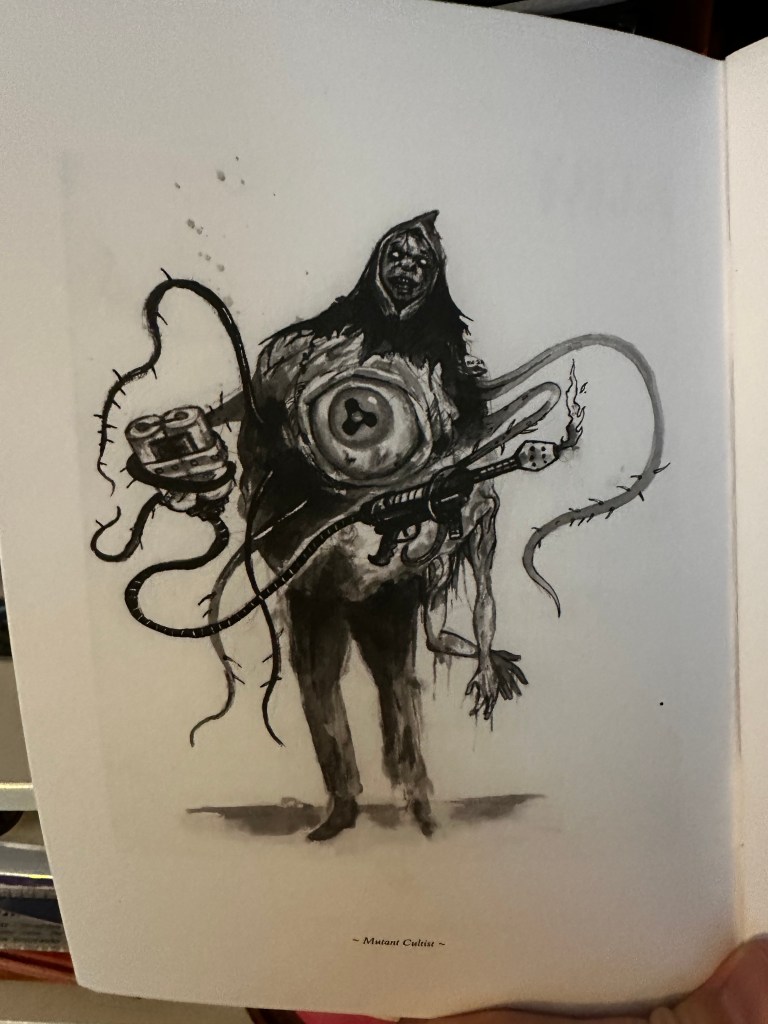
Anyway, as a build up to that, I thought I would look at an RPG based on a Japanese historical period.

Kanabo: Fantasy Role-Playing Adventure in Tokugawa-Era Japan

A Kanabo is a Japanese weapon, a long metal club, adorned with spikes or studs. The game, Kanabo by N Masyk, is an RPG published by Monkey’s Paw Games. It comes in the form of three neat booklets, Volume 1, Characters, Volume 2, Chroniclers and Volume 3, Adventure. It was gifted to me by friends and all round good eggs, Tom and Isaac several years ago. I can’t remember which year exactly and I don’t see a publication date on any of the booklets so I am going to guess and say it was sometime between 2020 and 2022.

These booklets truly are only wee. The longest of them is 21 pages of A5. But they pack a lot into each one.

Volume 1, Characters

The cover of Kanabo, Volume 1, Characters. It has a mythical Japanese warrior wielding a spear and a bow at once, while dancing on the back of a great black boar, possibly in the clouds.
Magic Man on Magic Boar

This booklet, as is the case for each one, begins with the credits. N Masyk did the words and the layout, “Dead People” did the artwork and the Hexmap uses the Highland Paranormal Society Cartography Kit, by Nate Treme. Finally, consulting was done by James Mendez Hodes. I think you will notice a peculiarly Western bent to the people associated with this project, other than the Dead People who are all Japanese (by the looks of their artistic styles) but remain conspicuously unnamed.

It starts off with an intro section that explains briefly what the game is about and suggests the use of safety tools such as Lines and Veils and the X Card. The “What is this?” section tells us that this is a game set in the Tokugawa period of Japanese history. It informs us that this is the time after the Warring States Period when the country is united but many wandering Travelers are abroad, “seeking fame, fortune, justice, revenge, or simply the freedom to roam.” That’s the PCs! I like this as a time period and setting. The Tokugawa era was long, more than 250 years. It was a time when Japan was cut off from the rest of the world, guarded its coast jealously and avoided the great changes that engulfed the other regions during the same time. The role of the Samurai was slowly being eroded, nobles were forced to pilgrimage from their lands to the capital under their own expense to keep them in line, the Shogun ruled the land and Japanese culture deepened. But I also like that there is a paragraph here on historical accuracy. Masyk takes pains to explain that, despite the potential realities of the place and time, as players of a game, we must strive to be inclusive before being accurate. Japan of this time was a place of terrible inequality, Kanabo at the table does not have to be.
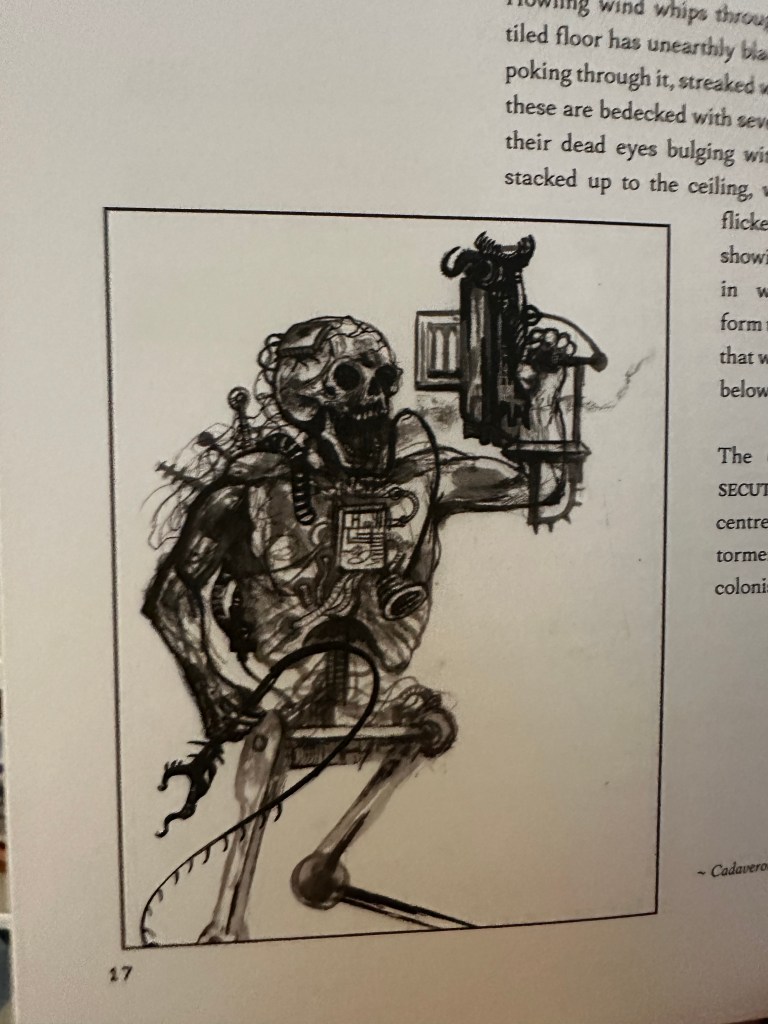
The introduction section is reprinted in Volume 2, Chroniclers and Volume 3, Adventure. I wonder, in a set of booklets of such limited page-count, if this was necessary. Perhaps it was felt that the Characters booklet, meant largely for the players, and the Chroniclers booklet, meant only for the Chronicler had to both have it to refer back to regularly, but I would question that, especially as the Adventure booklet is also meant for the Chronicler exclusively. Maybe its so the kid who finds one of these booklets all on its own, tucked into a box in the dark reaches of a secondhand bookshop thirty years from now, knows what it is they’ve found.

Stats

The Stats section actually introduces the entire character creation process. Stats themselves are only one part of that. You roll 2d10+20 for each stat, for a maximum of 40.

I was expecting this ruleset to be a D&D clone or maybe an Odd-like but I was surprised to discover this is a percentile system. When you want to do something you roll a d100 and hope for a result equal to or under the stat you are rolling on. You will notice that this makes it necessary to roll really rather low to succeed, but there are several ways to gain a +10 to your rolls, such as using the right piece of equipment, possessing just the right skill, spending a filled segment of your Fate Clock or, in battle, gaining Advantage. There are three specific ways to accumulate +10s in a battle. If you want to disengage from combat safely, you can expend all of them and do so.

The Stats themselves are incredibly and deliberately abstract:

  • Fire: confrontation, aggression, force
  • Water: tranquility, inquisitiveness, exploration
  • Earth: stoicism, calculation, discipline
  • Wind: intuition, reflection, grace

As such, there is a lot of potential leeway in the decision on which stat to roll in any given situation. I like this sort of thing. I imagine Blades in the Dark style negotiations occurring as to how they might work out in play. However, I struggle a little with the whimsicality of the naming convention. It has a sort of mah-jong flavour to it, I’ll admit, which is not, in itself a bad thing. But, if you were to choose particular Chinese characters from the available mah-jong tiles, there are others that really describe human traits that might work better. I am thinking of things like 力, chikara (strength,) 心, kokoro (heart) etc. The use of the four elements makes it feel a little more like Avatar than any of the sword-fighting movies that inspired this game. It is a stylistic choice, though, and I’m sure it would work just fine at the table.

There are other elements to character creation, of course. Some of them remind me, quite delightfully of making a DCC character. Others have an Into the Odd feeling which I enjoy.

You can roll for your Chinese Zodiac sign. Whatever sign you roll, you can take it and apply a +5 to a stat that you think it reflects positively on. It would have been fun to have to apply a -5 to a different stat in this step I think.

When you roll on the Birthplace table, you will get somewhere like “Fishing Village,” “Hill Fort,” or even “Haunted Ruin.” Depending on what you get here, you will start with a different piece of equipment, such as a “fishing rod,” “spear,” or “lucky charm.”

Next up you roll on the Career table, which will give you another piece of equipment. Soldiers start with a matchlock pistol but Farmers only get a straw hat!
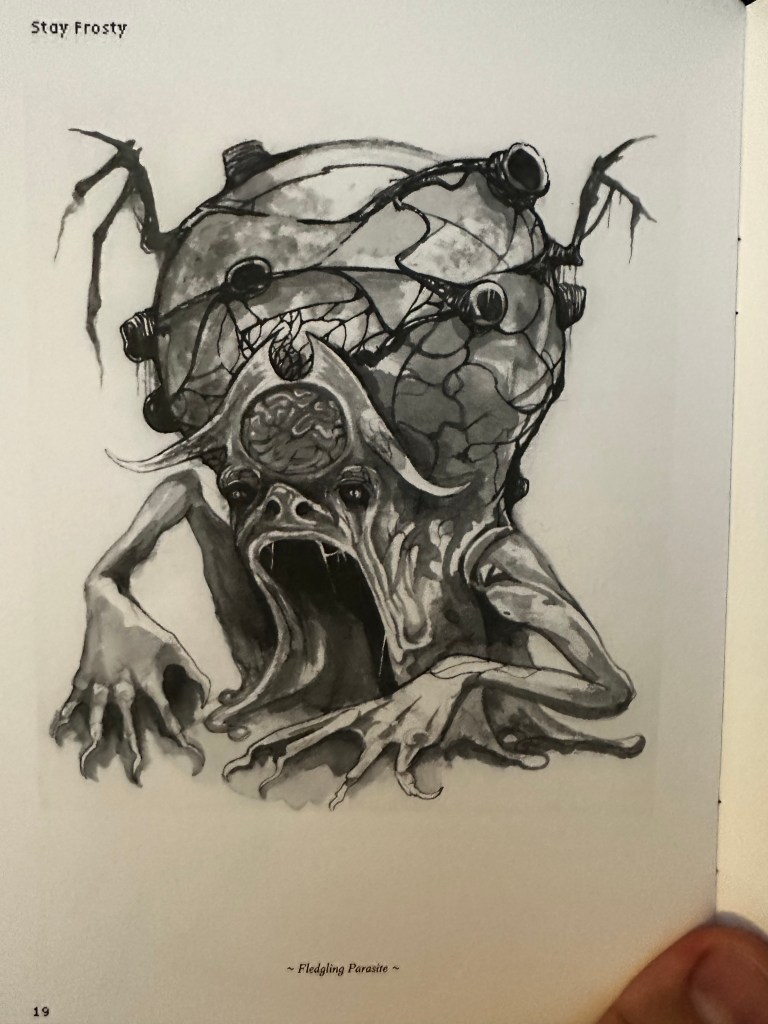
Your birthplace and career also allow you to list two things you know about or are skilled in. These can give you +10 to rolls in certain situations.

By rolling on the Curio table you might find yourself starting with a lucky cricket, a mask or maybe some rice balls. Each curio comes with a question that might help to round out your character.

After this you have a bunch of tables that will help you describe your PC. You have Mannerisms, Clothes, Face, Names etc. There should be plenty here to give you a very clear picture of your Traveler.

How to Play

This section lays out the rules quite economically. I’ve given you the basics already and there isn’t too much more to them than that, which is great.

There is a PBTA element to the rolls. You only roll when there is some risk, of course, but if you succeed, you do so without consequence. If you fail, you can still succeed, but with consequences. In combat, this means that you trade harm.

Kanabo character sheet on the back of the Characters booklet. There are spaces for Name, stats, zodia, career, birthplace, curio, description, Knowledge & Skills, Inventory, Wounds and a Fate clock split into eight wedges.
Kanabo Character Sheet

You get a Fate Clock on your character sheet. It has eight segments, which you will be filling and erasing as you gain and spend them. You gain a segment whenever you roll doubles on a d100 roll. I choose to interpret this as 11, 22, 33 etc. You can choose to erase a segment to give yourself +10 to a roll, prevent 1 Harm, recover 1d10 wounds or survive past your 5th wound. It’s a bit like stress in Blades in the Dark, a superpower that these Travelers have that allows them to contend against terrible odds and powerful forces.

Some few paragraphs are devoted to the idea of Travel. Kanabo assumes you will be hex-crawling and lays out the rules for that in relation to time, encounters, foraging, rest & healing etc. This is presented in a way that is player friendly and does not blind anyone with science. I appreciate it.

Character Advancement gets one very short section. Characters can choose one of two options at the end of each session, “increase a stat by 1” or “write down a new skill or piece of knowledge.” It’s neat and lacks frills. No room for confusion at all.

The booklet is rounded off with sections on hiring help, common equipment and refreshments. They are presented in several short and entirely non-exhaustive lists that are merely starting points for the interested player to do some research on what stuff might have been available in Tokugawa-era Japan.

The best part of the whole How to Play section is the list of Best Practices. Many of these will be familiar to the those of you who have been reading my series on Blades in the Dark recently. We have gems like, “Ask questions. Take Notes. Draw diagrams. Write in pen” and “Fight unfairly. Lay ambushes. Hit below the belt. Run away.” And familiar old favourites like “Play to find out what happens, and how it happens” and “Strive for victory, but revel in your defeats.”

Volume 2, Chroniclers

Kanabo Volume 2, Chroniclers has the image of mythical Japanese creature, the Kirin, across between a dragon, a horse and a giraffe, dancing across the waves.
This is a Kirin. Interestingly, the Japanese word for giraffe is also Kirin. It’s also a good beer.

After the repeated intro section we get straight into a section on how to run the game. Let me reproduce here the entirety of that section:

You control the world around the Travelers and the people within in, and the places they have built for themselves. Fill that world with adventure, danger and magic.
There are no further words by witch I might describe or prepare you for the journey ahead.
The contents of this tome, much like the contents of the Universe, are mostly lies.

I think this is probably one of the most uniquely unhelpful such sections I have ever read. I understand that the author is trying for poetry instead of boring old instruction, but it reads as though they want you to think there is no advice that might help a prospective Chronicler. There is something to be said for the idea that a GM/referee/judge/whatever should trust their instincts, but it is certainly not always true. Also, there is an enormous wealth of real advice out there, both in printed books and for free on the internet. I understand the author had limited room here, so, perhaps they could have directed the newbie GM to the blogosphere, or a particular publication that they thought aligned with their own design ethos.

Anyway, as soon as they have described everything in the “tome” as lies, they go on to provide guidance on how to run the game… and it’s useful! It’s practical and answers the sorts of questions that would definitely come up at the table when playing Kanabo! Things like discussing the possible consequences of rolls before making them, determining the effectiveness of successes etc. So, my main takeaway from all this is don’t believe the bit that tells you its lying to you…

There are a couple of pages here devoted to describing very Japanese-themed encounters, we have Kappa, Oni, Kitsune etc, without ever using those words. I like the pared down descriptions and the minimal stats presented, and I can see the idea of removing the Japanese names so as to allow a Chronicler to set their game of Kanabo in a non-Japanese context. Or maybe it’s done to for localisation purposes. I don’t know really, but, personally, I would prefer to use the Japanese names. It feels wrong to me to do otherwise.

Hexcrawl section from Chroniclers booklet. There are several landmark and terrain tables and the top half of a hex rose here.
Hexcrawl

I think another very interesting element to this game is that, despite its semi-PBTA roots, you are expected to run it Old School. We have Weather tables, advice on rolling for encounters, an encounter reaction table and a whole bunch of tables to help you build your once-a-session hex map. These are, honestly, great. They are extremely practical and useful with lots of tables of landmarks for a variety of terrain types from Grassland to Hamlet. There are more tables for Factions, Communities, and Adventure Sites that would allow a Chronicler to build an engaging monster-of-the-week-style adventure with little to no prep required.

But, the advice for doing all this is limited within the booklet itself. The third of the the three booklets, however, serves to illustrate how it should work!

Volume 3, Adventure

The cover of Kanabo Volume 3, Adventure. It shows the image of a woman, or maybe a bodhisatva playing a shamisen on the edge of a cliff.
Magic music

This one if incredibly short, only eight pages, two of which have the intro again. After that, we get a bunch of ten point lists, which come together to create Peach Trees Village. The list of Locals describes each one in a single line, provides a piece of their dialogue and outlines an adventure hook. Here’s the first one:

Asuka. A farmer. So forgetful; “did my apprentice bring the cattle in?” Needs someone to go check. Something’s been at the cattle.

I love this way of presenting information. It’s incredibly efficient and is just enough to spark the imagination. You get something similar from the Shops and the Rumours lists.

Next, we have The Surrounding Wilderness section. This kicks off with a hex rose, already filled in to give the Chronicler an idea of how it’s done. Each of the 19 hexes is described in a similar way to the Locals above. Here’s no. 10:

Frozen wood. Snow-blanketed trees. A dead mile where nothing grows. Strange lights at night. What is causing the lights?

Once again, it’s just enough to spark the imaginations of both Chronicler and Travelers to perhaps pursue the mystery of the lights in the woods, without bogging you down with established fiction.

A “Searching, you find…” D100 table rounds this adventure booklet out.

Conclusion

All in all, I think this little RPG punches above its weight. I question some of the choices made regarding naming conventions, use of space and GM advice but otherwise, I am quietly impressed. I would like to try running it, but it will have to wait till after my own adventure in Japan!