Starter Campaign
Dear reader, last week, I created a character for Star Trek Adventures 2E. His name was Mesh and he was an Orion Star Fleet Officer on the command track. The lifepath character generation system was satisfying and sufficiently different from other games that I felt it novel and enjoyable. But, the fact is, I’m unlikely to ever get to play a character in a Star Trek Adventures game, since I’m the one running it.
I picked up the Star Trek Adventures 2E Starter Set and Core Rulebook a couple of months ago when Modiphius was having a sale and I haven’t regretted it. Sometimes, when I buy the core rulebook for a game that I’m interested in along with its Starter Set, I wonder why. The starter set can feel like a waste of money. But, the truth is almost always contrary. The general quality of boxed starter sets recently has been really good. Free League are the masters of producing sets of such high quality and with such a wealth of content that I would generally always advise you to pick it up, even if you’re getting the core rules as well. I have played or run starter set adventures of the One Ring, Tales from the Loop and the Bladerunner RPG. All great quality adventures too! The Bladerunner one sticks out as a real highlight for me. The casefile, Electric Dreams was a brilliant intro to the game and the world but was also an engaging and evocative adventure in its own right. That’s a game you could run without ever reading the core rulebook, as long as you have the starter set and you don’t mind pregenerated PCs. We got four sessions out of that game, and I considered that extremely good value for money.
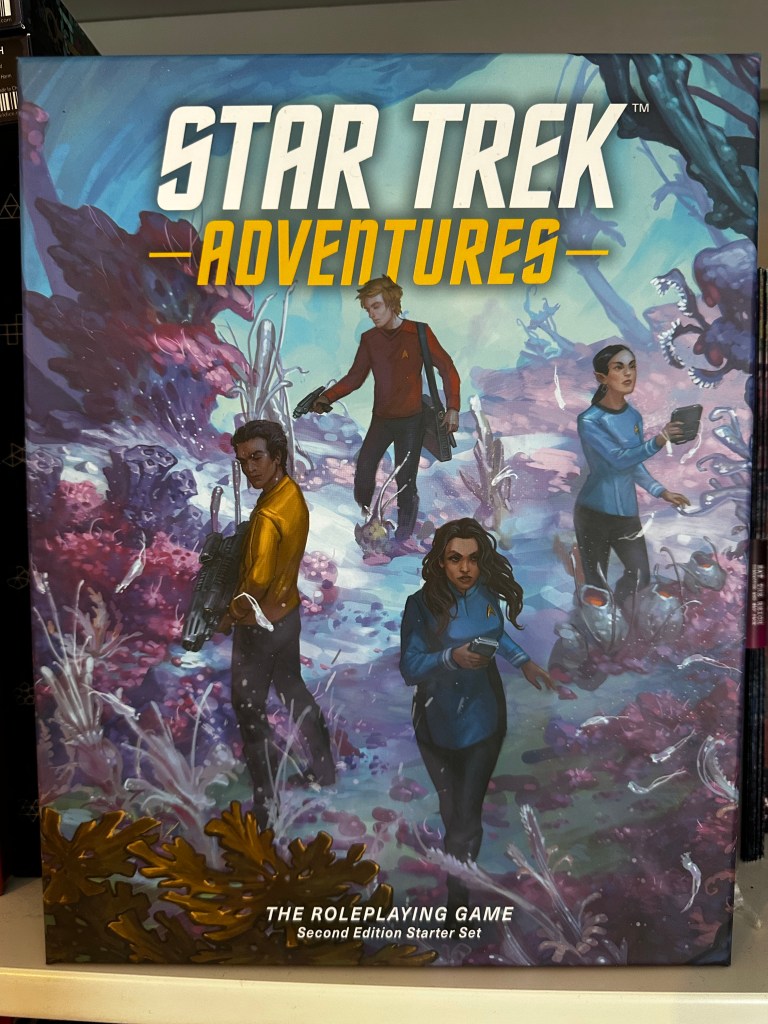
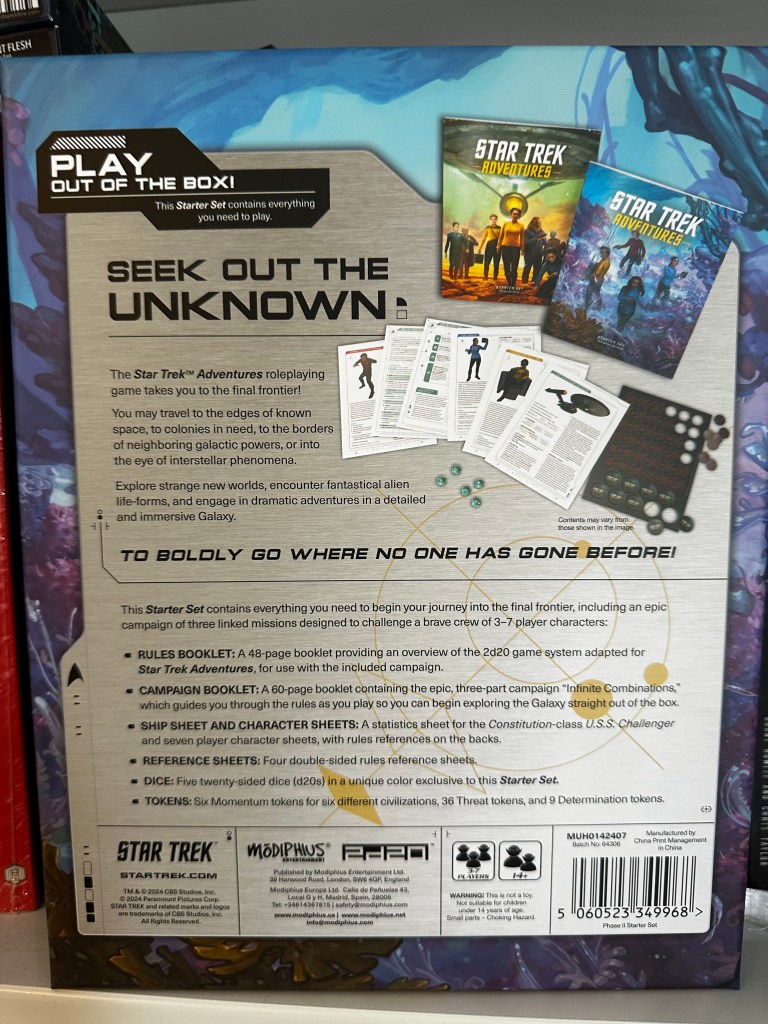
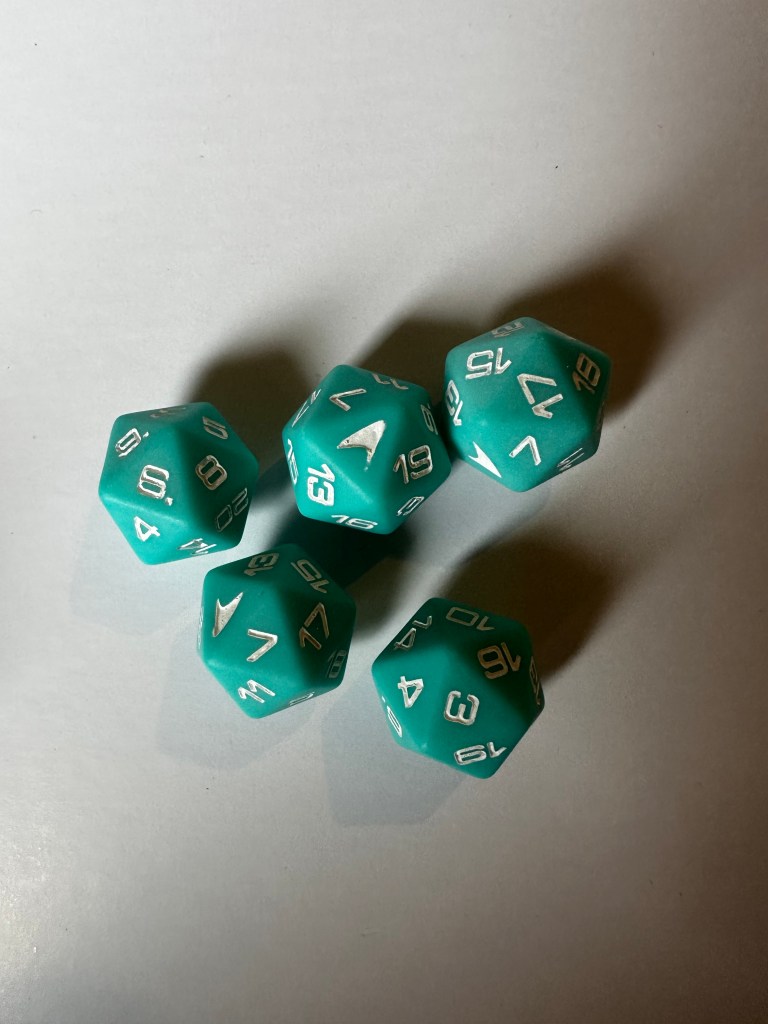
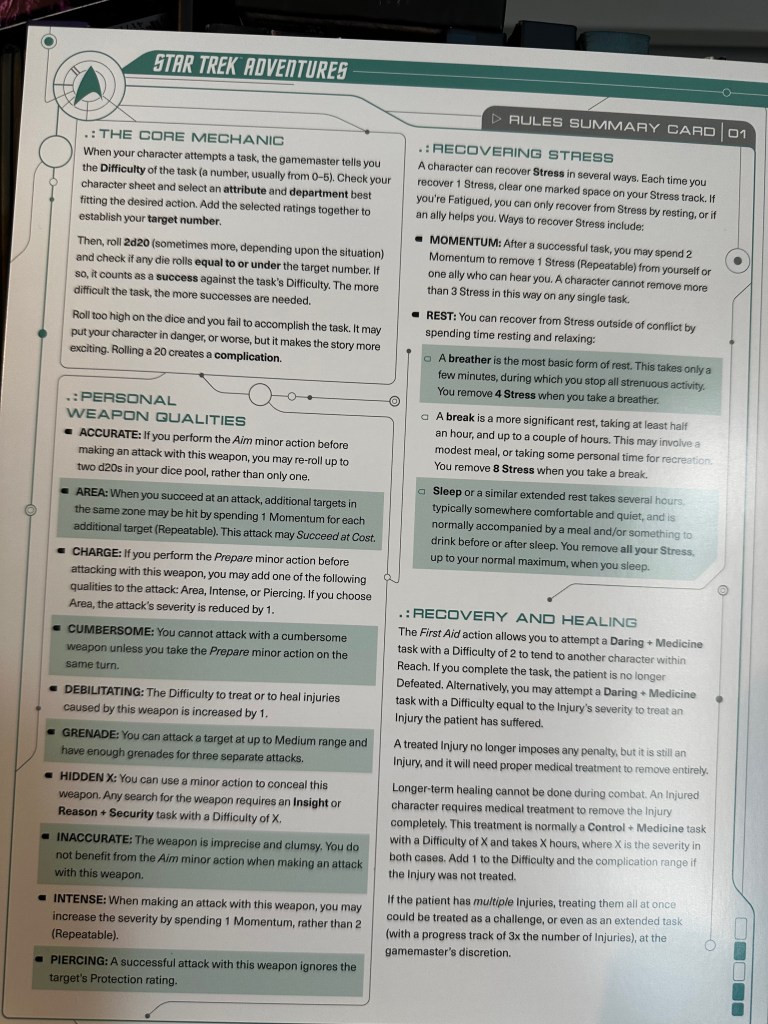
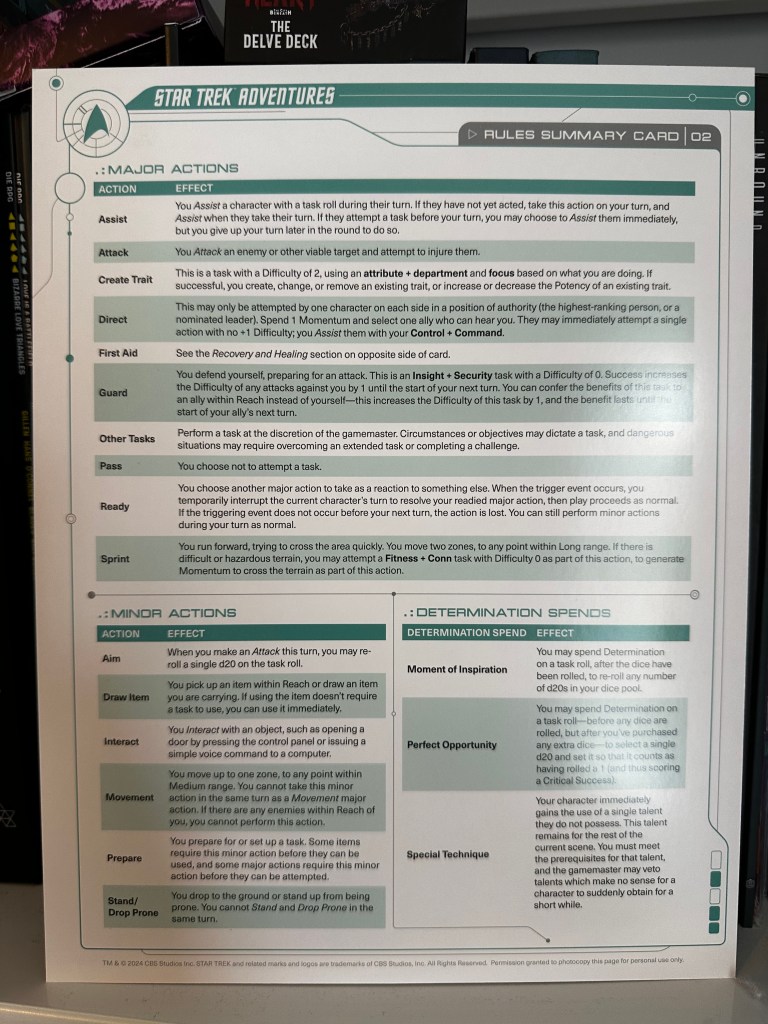
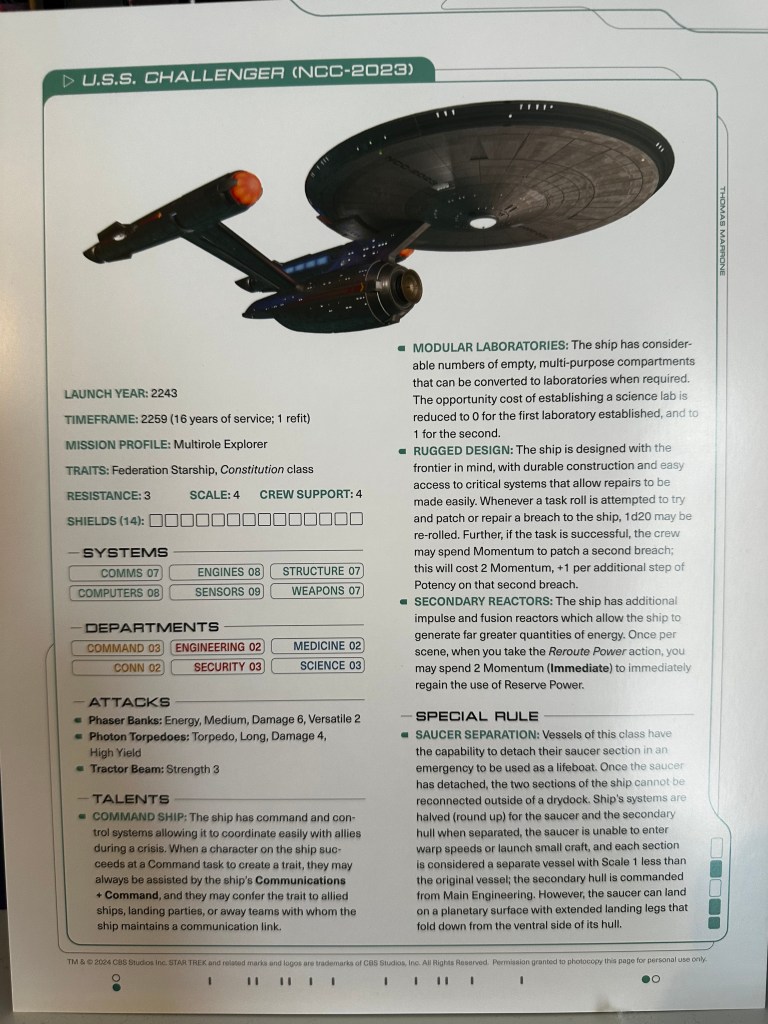
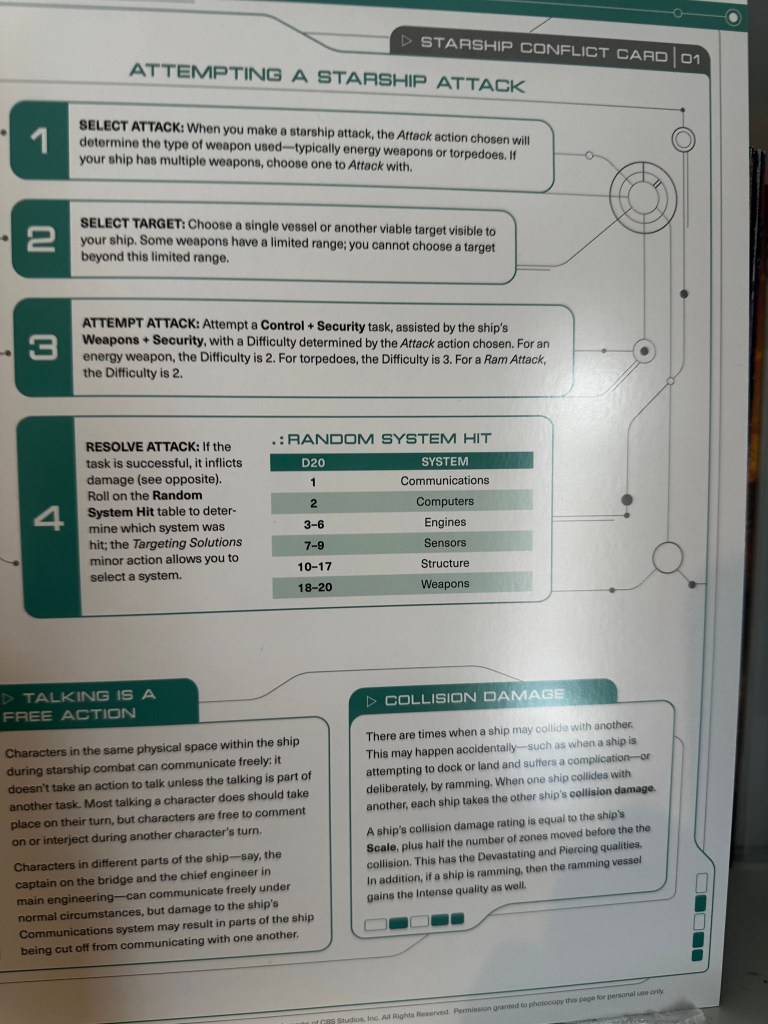
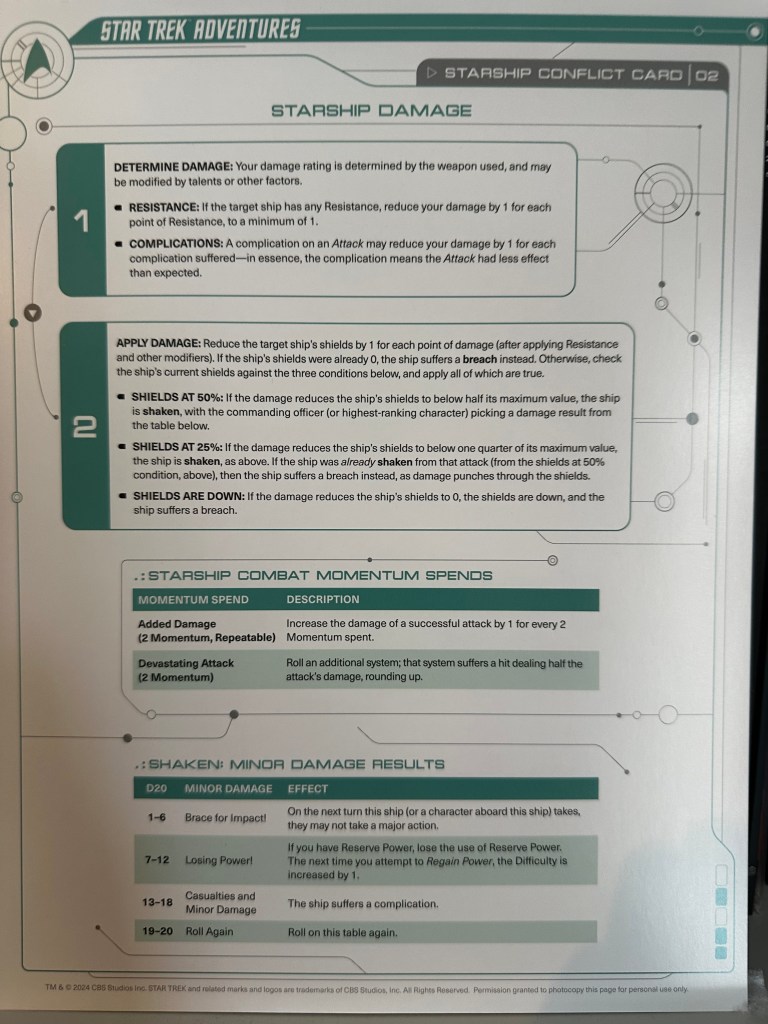
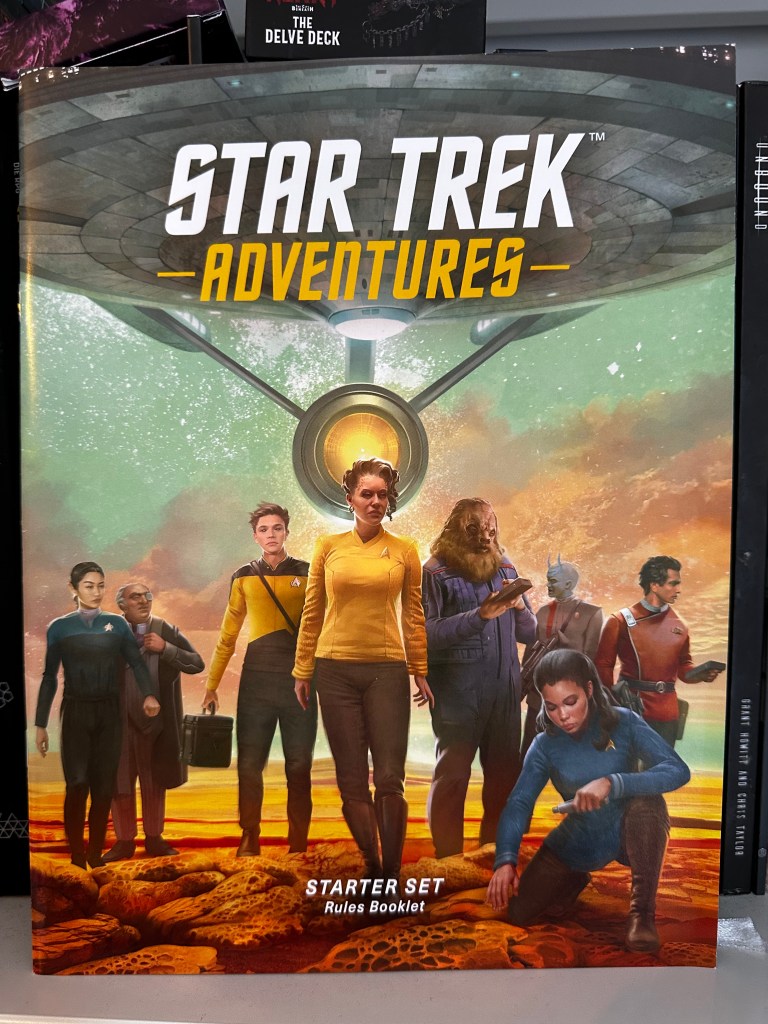
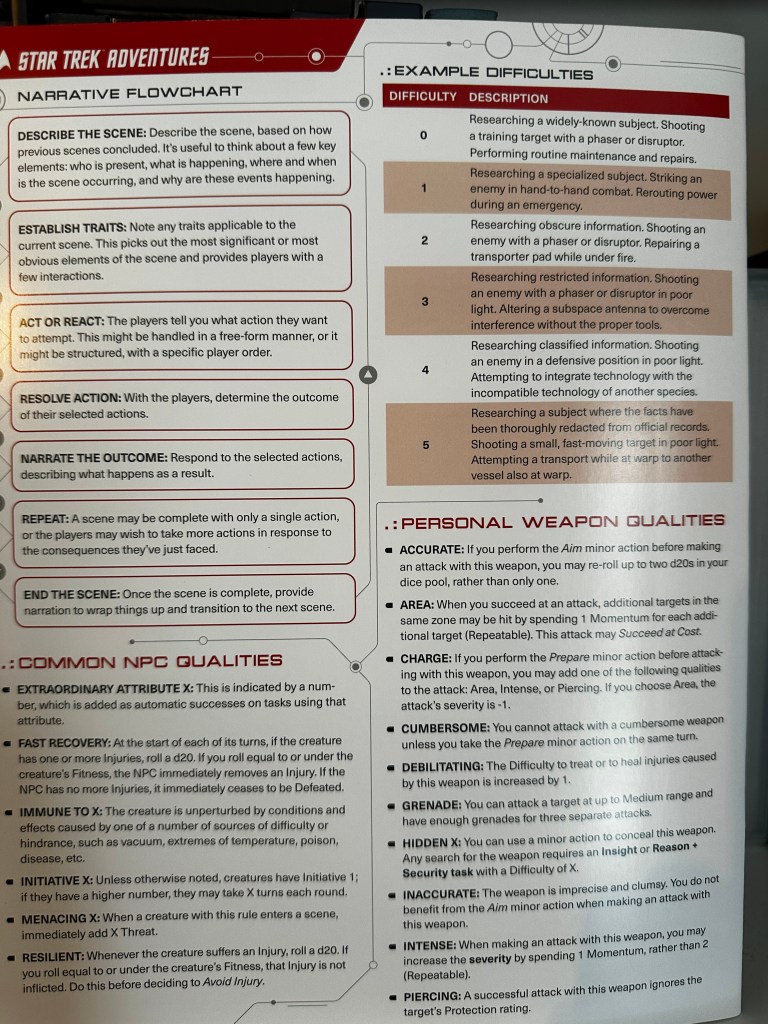
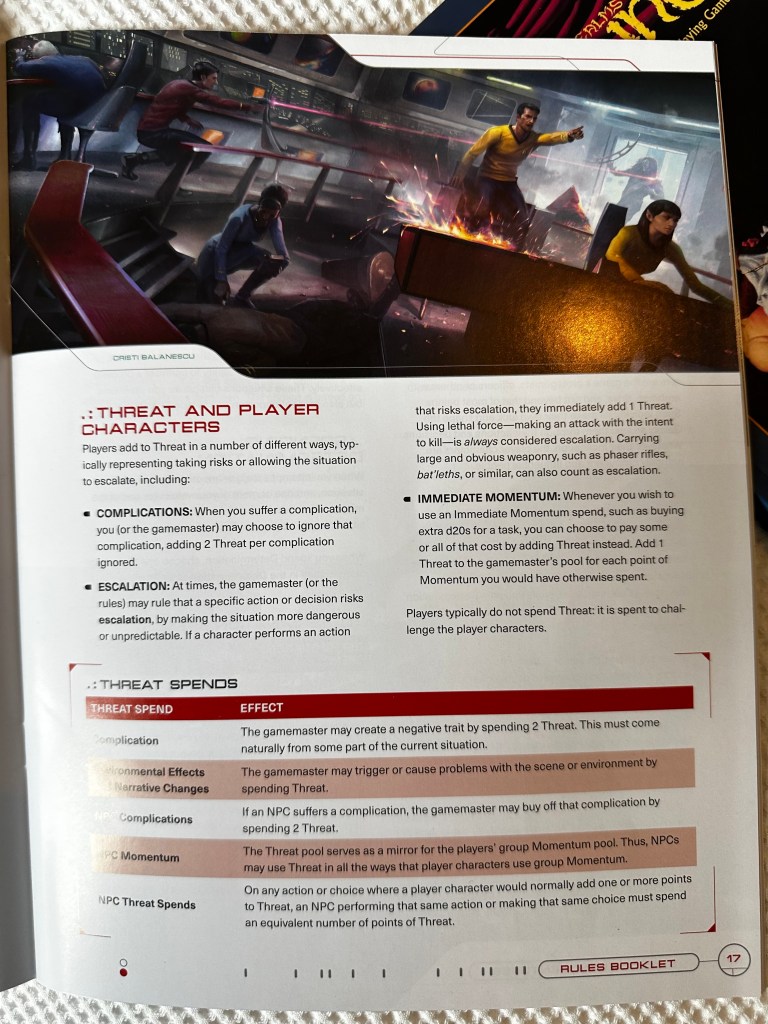
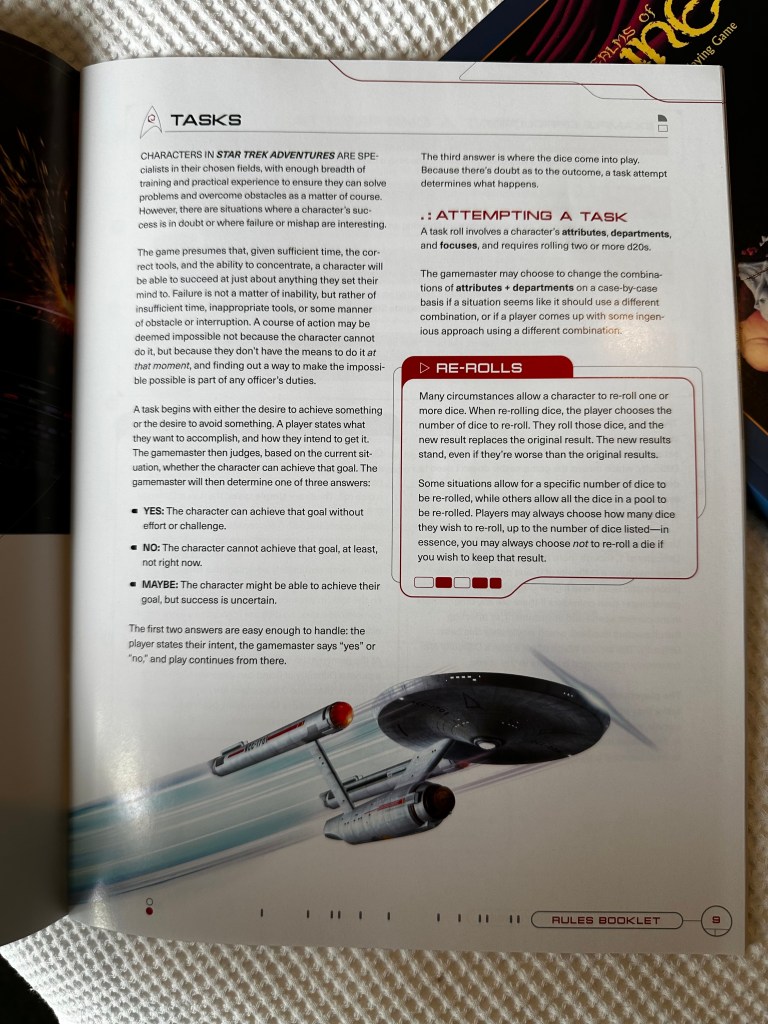
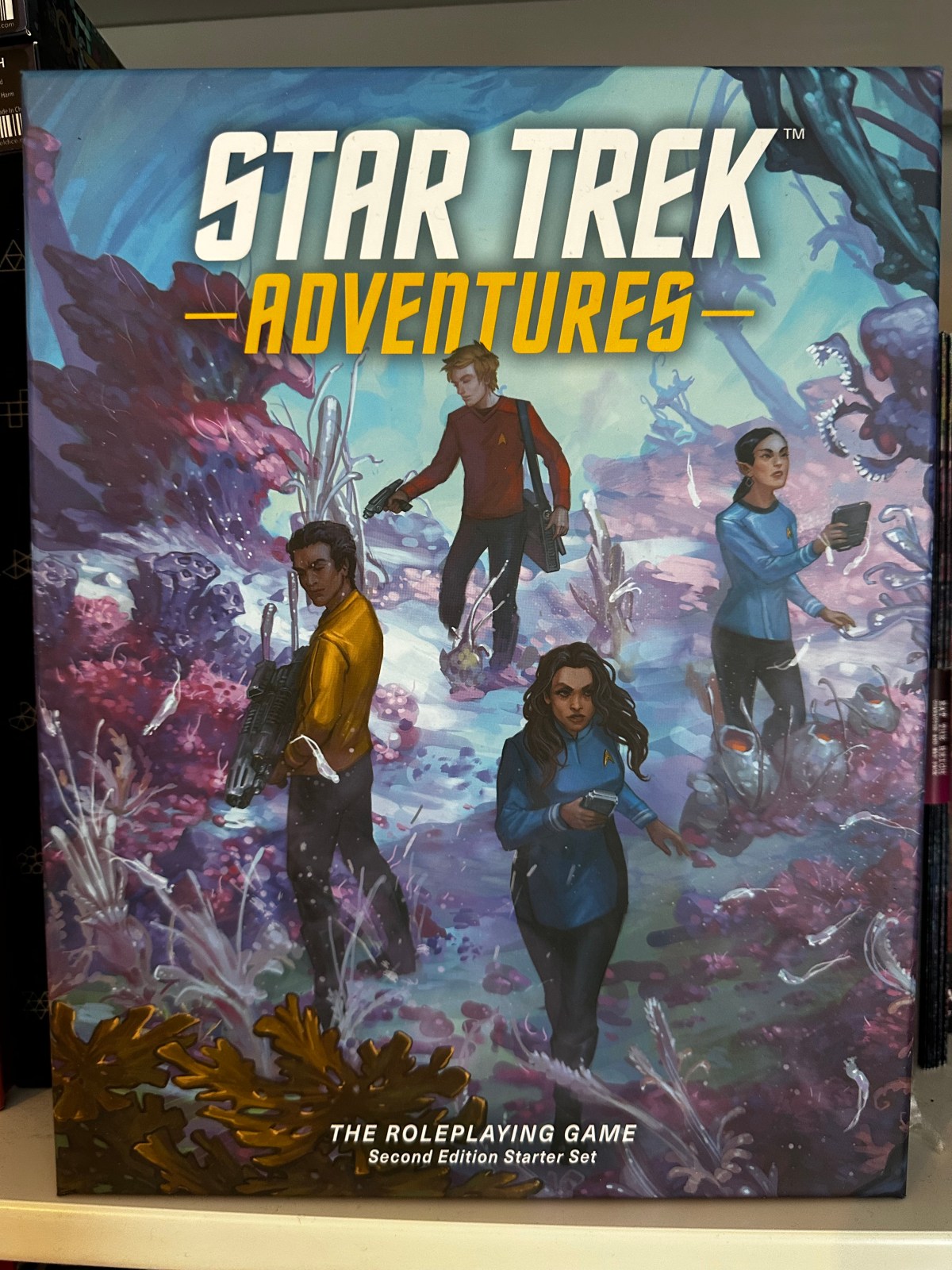
And then we have the Star Trek Adventures 2E Starter Set. In the box, you’ve got a set of five Star Fleet themed d20s, a sheet of tokens, a bunch of handouts which include pregens and rules references and, of course, a rules booklet. This booklet provides you with almost everything to run this game. The biggest omission is, of course, character creation rules. But, as I said above, if you don’t mind the pregens, that’s fine. The campaign booklet is just that: a booklet with a campaign in it. Inside the sixty pages are three interconnected adventures and three mission briefs, which act as adventure frameworks. After three sessions, I can confidently say, the Campaign Booklet, if played in full, is likely to bring you fifteen or sixteen sessions of play in the Star Trek universe. Now that’s making your latinum strips go a long way! Quark would be proud of you, Modiphius!
Rules
Star Trek Adventures 2E uses Modiphius’ own 2d20 system. Despite owning multiple Modiphius games, this is the first time I or, indeed, any of my players have had the pleasure of using it. I was expecting this to be a lot more trad than it is. It is actually really narrative-focused.
The core mechanic is simple. Every character has six attributes and six departments (see my last post for more detail on these.) When you are asked to perform a task, the GM will tell you which attribute and which department you need to use. So you might be using your Daring attribute of 9 and your Conn department of 3 to chase an enemy craft through an asteroid belt. You add the two scores to give you you target number. In this example, that would be 12. If you roll equal to or below that, that’s a success. You automatically get to roll at least 2d20, but you have various ways to add dice to that pool. A task’s Difficulty rating tells you how many successes you need to complete the task. So, for a Difficulty 3 task, you better get more dice, pray for a crit (a 1 counts as two success) or reduce the Difficulty somehow.
Momentum is a resource that the PCs share. They build it up by scoring more successes on rolls than they need. So, in the example above, if you managed to roll four successes on the Difficulty 3 task, you get to add 1 point of Momentum to your pool. That Momentum pool can’t go above 6 points so you are incentivised to use it up. They can use a point of Momentum to add a die to a pool, three points to add two dice and six points for three dice. There are other ways to spend this resource too, such as to get the GM to give you more info on a particular scene.
Threat is a resource for the GM to use that mirrors Momentum. The PCs can add a Threat for more dice in the same sort of way as spending Momentum. The GM gets to use threat to increase the likelihood of Complications occurring (this happens on the roll of a 20 usually.) Complications can come in many different forms. They might be a simple and mechanical as causing an injury. But they also might take the form of a massive narrative twist that really sticks spanner on the works of the PCs’ plans. This comes up way more often than I expected.
Those are the basics. There’s other stuff like taking Stress to Avoid Injury, Extended Tasks that use tracks, Resistance on tasks and in conflicts that absorb successes, but we don’t need to go into them here. If you are interested to learn more, check out the free Quickstart guide here.
Part One, Incursion Point
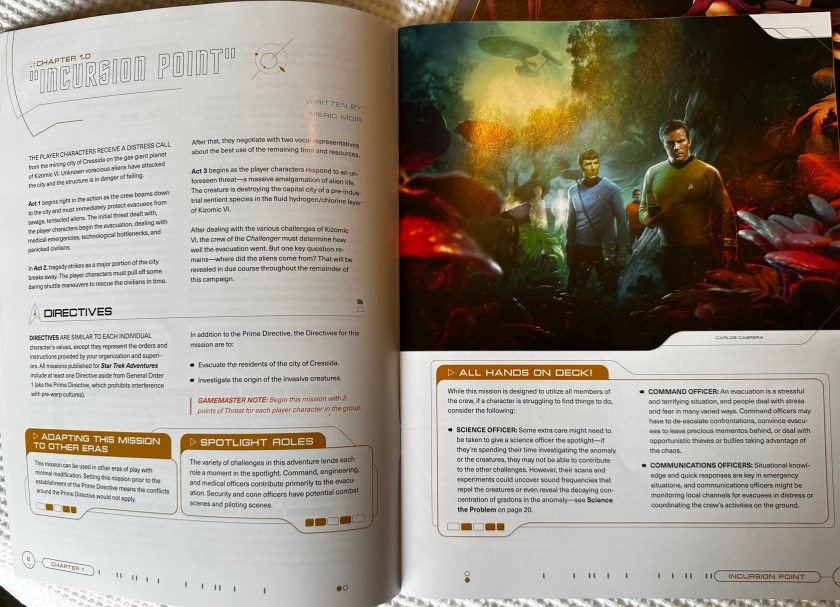
Incursion Point is the first adventure in the campaign contained in the Starter Set. The campaign is entitled “Infinite Combinations,” but the reasons for that are not really obvious from reading or playing this first part of it. It was written by Meric Moir.
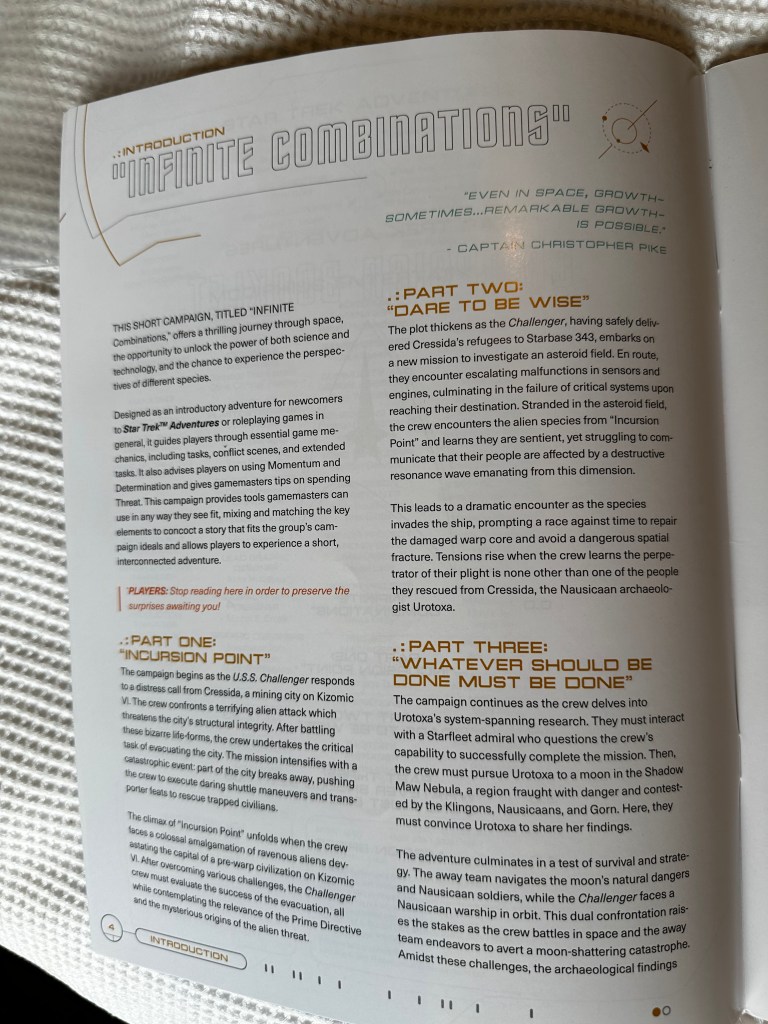
This is quite explicitly a teaching adventure. In fact, the whole campaign is there to teach you how to run and play this game. It has lots of callouts to help out the new GM, from suggestions on what each type of character might do in the current situation, to advice on what to do if your players roll real bad. Much of the text itself is also devoted to explaining how to handle each situation as and when it’s likely to come up. For instance, the first scene has a high likelihood of conflict so the text runs you through how to order actions, resolve and attack and what to do if a PC gets injured. Where necessary, it will direct you to the relevant part of the Rules Booklet. In my experience, it was incredibly effective in teaching me what to do in my first few sessions. Of course, my clever and adaptable players got the hang of it without the need for such hand-holding. Before the first session was over they were stacking and spending Momentum like they’d been doing it all their lives. By session two, the risk of adding more Threat points to my pool was outweighed by their ambition and they were using it to do just oh so much cool shit.
Dear reader, if you think you might be lucky enough to play in this adventure, stop reading now. I’ve got loads of other posts, go and read one of them. There’ll be SPOILERS below.
Stardate 3422.1: We have received an urgent distress call from the independent floating city of Cressida, a resource-gathering collective on the gaseous world Kizomic VI. Creatures of unknown origin have attacked, causing casualties as well as compromising the city’s superstructure. We have responded to the distress call and are proceeding to Kizomic VI at high warp.
When we arrive, we will have only a few short hours to evacuate the city’s 600 inhabitants before the structure fails entirely and sinks into the crushing gravitational depths of the planet. With the number of beings to be evacuated, our first order of business will be to set up pattern enhancers and then direct the locals to the beam-out sites.
The Captain or other commanding officer is supposed to read out this log entry to introduce us to the current situation. We didn’t really have such a PC in our group, so I read it, which was fine. I like the conceit of this as it immediately feels trekkie.
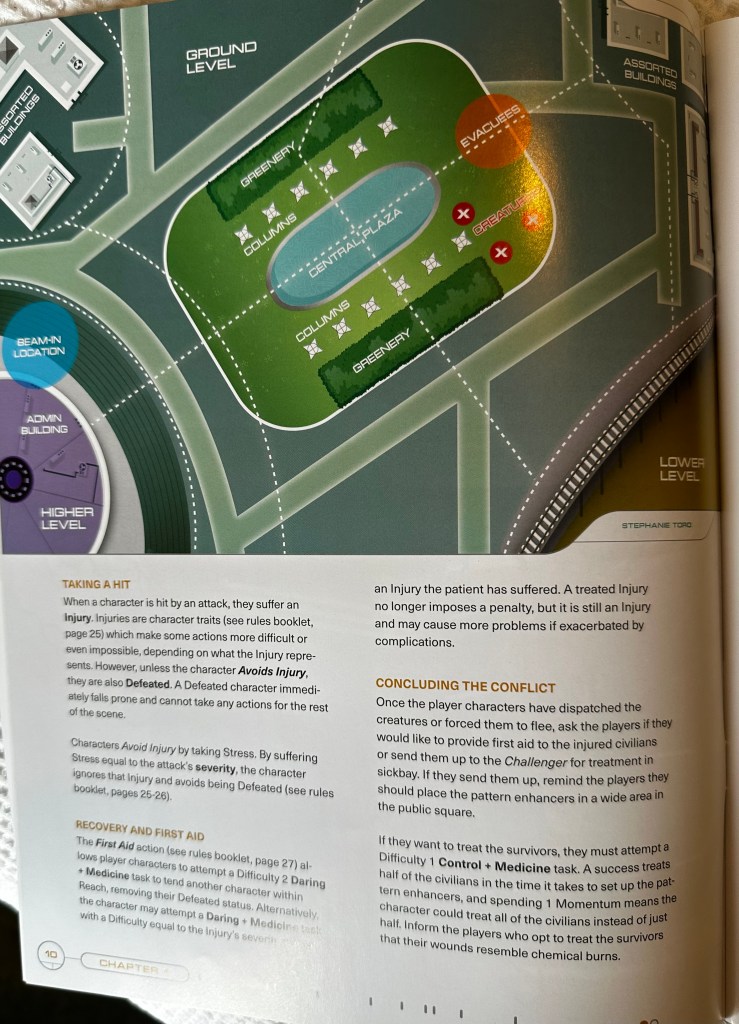
The situation is dire and quickly worsening. The PCs are left to come up with ways to evacuate the citizens as quickly as possible. And that’s when the plant-like aliens they will come to know as Bryozoans seem to attack the evacuees. This is the start of Act 1: Operation Evacuate! In our game, the PCs, Lieutenant Commander Burk ven Jaxa, the Tellarite engineer, Lieutenant Junior Grade Rashid Kemal, our hotshot pilot, and Ensign Laniyar Tennan, Betazoid technician, stunned one Bryyozoan and frightened off the other before quickly moving onto ways they could speed up evacuation. Everything from locating more survivors to constructing elaborate containers to transport more people at a time, (the human cattle container was the term, I believe) were put into practice. With each success, they ate away at an Extended Task track which continued for the rest of the adventure.
Act 2: The Fall of Cressida started with a huge chunk of city breaking off and falling into the lower atmosphere of the gas giant. The PCs hopped in a shuttle without so much as a call to the bridge of their ship, the USS Challenger. They shot down after the plummeting hunk of city and managed to land almost safely. This is when I started to really spend Threat and introduce Complications. The shuttle door was jammed and they began to be attacked by more Bryzoans. The PCs quickly took steps to uncomplicated matters and save the citizens who had been trapped on the falling district just before it broke up into so much debris. They brought them back to the ship and escorted them to Sick Bay. Here the PCs encountered some NPCs. This was really the first opportunity any of had to do a little roleplaying in this adventure, and this was session two. It’s a high-speed scenario that demands quick action and decisive play.
Anyway, a well-dressed Orion woman, Administrator Demaad wanted use of the transporters to beam up valuable trade goods. Meanwhile, Urotoxa, an older Nausiccan academic, wanted them to help the humanoid inhabitants of the planet’s fluidic layer far below by bringing them a shipment of phasers. She was sure they would be decimated by the Bryozoans, and, as she had been in communication with them, she wanted to help them.
During this three-sided interaction, they discovered a lot through the use of Tennant’s Betazoid telepathy. They found out that Demaad had an underhanded ulterior motive and that Urotoxa was probably the cause of the entire disaster befalling the planet and its inhabitants. Despite neither woman coming out of the conversation smelling like roses, the PCs decided to try to convince the Captain of the Challenger to let them help the Kizomans, although, perhaps not by breaking the Prime Directive to furnish them with advanced weapons.
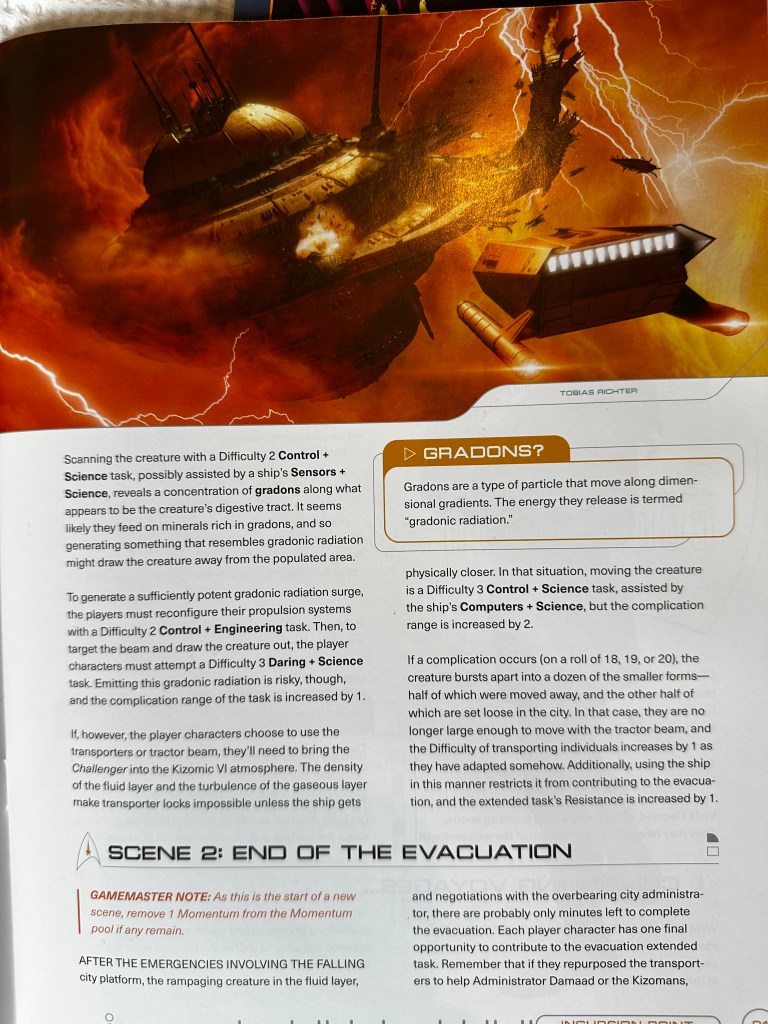
In Act 3: The Fate of Kizomic VI, we saw our heroes contending with the Bryozoan Terror, a massive amalgamation of smaller aliens that they had detected swimming towards the main population centre of the Kizoman people in the fluidic layer. They boarded the shuttle Galileo with a probe ripe for jury-rigging and a trio of EVA suits. While Tennan and Burk worked to modify the probe to emit a high-level of gradonic radiation, (they had figured out earlier that that’s what the Bryozoans fed on, destroying the inanimate objects that contained it in the process) Kemal piloted the shuttle down, down, down until it became a submarine. In modifying the probe, they were too successful, as it turned out. It drew the Terror to them before they had even had a chance to launch the probe towards one of the few remaining rifts that the creatures had emerged through in the first place. The shuttle took corrosive damage that left it immobile and losing structural integrity. They eventually managed to launch the probe to draw the Terror away, but two of them had to exit the craft to effect repairs. They managed it with only moments to spare before their suits ruptured. Kemal got them to the gaseous layer before the hull gave out, just in time to be transported back to the ship. Whew! That was quite the finale! Except there was more.
Here’s where the PCs get one final opportunity to make some headway on that Evacuation Extended Task. They had to each take actions to try to help save some more citizens of Cressida. And they did fine, managing to rescue most of the inhabitants before the city crumbled away to nothing in the atmosphere of Kizomic VI. This felt anticlimactic, though, I won’t lie. I should have taken this part of the adventure and moved it to a point before they went to deal with the Bryozoan Terror.
Conclusion
This was a very well put together adventure. As I mentioned above, the teaching elements worked very well, at least when I got to use them. Actually the most gratifying part of it was that the players avoided doing most things the adventure expected of them. Generally, they avoided violence whenever possible, which felt very Star Trek, and this was great because it got me to engage fully with the mechanics and think on my feet as a GM too.
But also, each Act lasted exactly one session. No overlap, no worries about not getting it finished on the night. Nothing but net. They clearly play-tested the hell out of it.
It could maybe have done with a few more opportunities for role-play, but then again, that’s just not the type of adventure it was. In Act 2, there was that interaction between the PCs, Demaad and Urotoxa, which highlighted social conflict and it worked really well.
Honestly, the only real issue was that ending. The adventure directs you to ask the PCs for more tasks to help complete the evacuation once the finale had already occurred in my opinion. It was an anti-climax and the players agreed. If I had it to do over, I would have taken this and placed it before the Bryozoan Terror encounter.
We are looking forward to continuing the campaign! The players are looking for a bit more of a chance to role-play so I think we’ll have a Starbase episode next!
Discover more from The Dice Pool
Subscribe to get the latest posts sent to your email.


