DCC Day 2026 Part 2

A Case of Mistaken Death

Below, you will find some spoilers for DCC adventure #109 Beneath the Isle of Serpents, just so you know, dear reader.

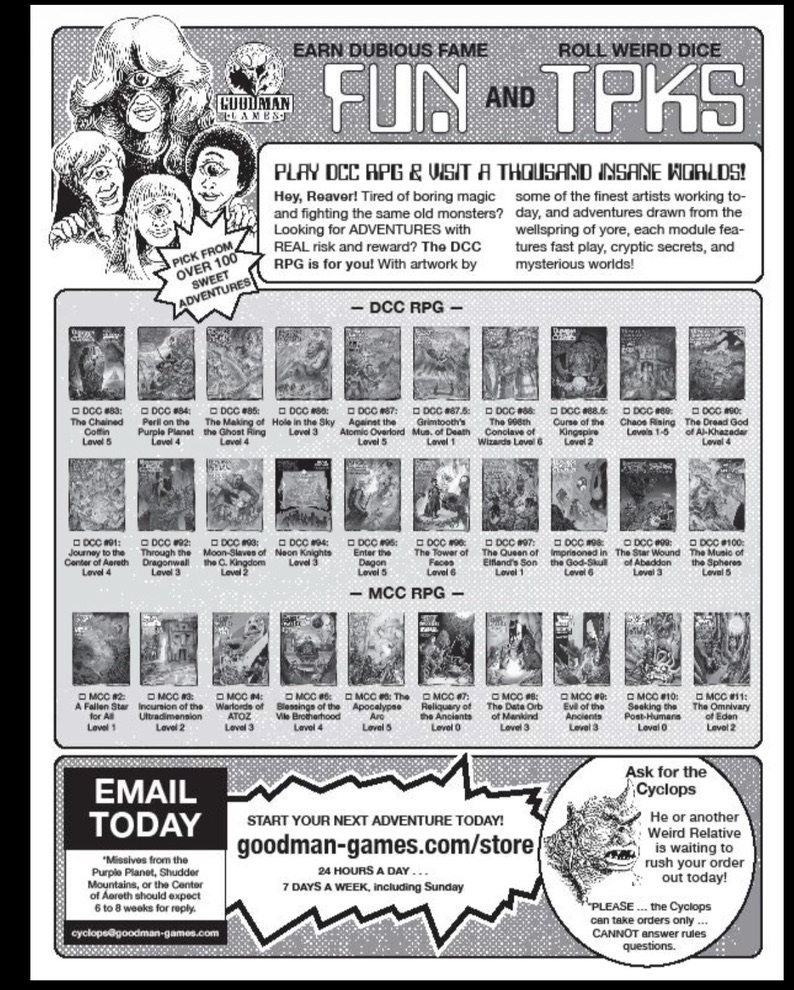
Fun & TPKs ad in the back of the adventure booklet. Shows a lot of black and white covers of other DCC adventures. Reminiscent of old ads in the '80s and '90s era of RPG magazines.
Fun & TPKs

At this point, I don’t think any of us are going into a DCC game thinking, you know what? This is going to be a piece of cake. You expect to be challenged by lethal traps, dangerous surprises, gonzo monsters and a general air of lethality. But there’s one encounter in Beneath the Isle of the Serpents that has the potential to tip the scales so far from balanced that you could be looking at a one or two round TPK. It almost did in our third session of this adventure. There’s a giant, two-headed viper hiding to one side of a door in one room. It’s given a +6 to initiative to account for surprise. Then, once it probably gets the initiative, it’s got two bite attacks at a +8 to hit. That’s not the worst of it, once it inevitably hits, it’s got 3d6 damage for each bite! Now, please bear in mind that this is an adventure for 1st level DCC characters. Few, if any, will have hit points matching even an average roll of those damage dice. But then, there’s a DCC ad in the back of this adventure entitled “Fun & TPKs.” So, that’s what you’re up against, I suppose. Don’t get me wrong; I actually do enjoy knowing that the dungeon is genuinely scary, that characters can and will die, that the stakes are high. That makes their actions to overcome the dangers all the more significant. It creates an aura of tension that is hard to synthesise in any way other than the players knowing that their characters could be walking to their deaths. We had already had 2.5 deaths by the point they got to this encounter after all. But those deaths were a little more acceptable. The PCs had done everything they could to prevent them up to the point they didn’t, up to the point when I got luckier in my rolls than they did. Not only that, each death was poetic and emotional and caused by a hypnotised member of their own party. You couldn’t write a better death.

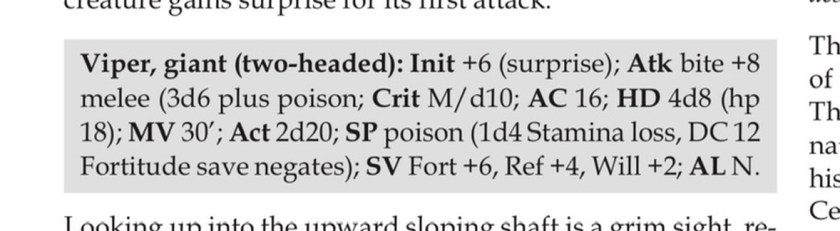
Viper, giant (two-headed): Init +6 (surprise); Atk bite +8 melee (3d6 plus poison; Crit M/d10; AC 16; HD 4d8 (hp 18); MV 30’; Act 2d20; SP poison (1d4 Stamina loss, DC 12 Fortitude save negates); SV Fort +6, Ref +4, Will +2; AL N.
Giant Two-headed Viper stats

But this giant two-headed viper? It had the cards stacked in its favour by the stats, the map, the circumstances. Even then, despite that initiative bonus, it still went after three of the party members. The players got a little bit lucky with that, but it was all fair and square. So they attacked, two hits out of three and the snake was down two thirds of its hit points. But then it had its attacks; two heads = two attacks. It hit one PC with one attack, killed her outright, and then hit the second PC because it had a + frikkin’ 8 to hit, so, of course it did, and killed him outright too. Half the party was dead in a single round. And, you know, I’ll be honest here, I thought 3d6 damage for a single attack on a first level character? That’s insane, so I reduced it to 2d6 and it still killed ‘em both… The players looked upon the ruin of their party. Rember, dear reader, there were only two players in this adventure. One had only one of two PCs left and one had none. That last suriving PC was ready to run, but then remembered that the Wizard’s familiar was supposed to go on her turn. The dice were rolled and that dog ripped out at least one of the viper’s throats! We retconned the deaths and were able to finish out the dungeon.

And look, this was dramatic and all, they scraped through when they probably should have died, but it was so ridiculously overpowered as an encounter that we questioned how well this adventure could have been play-tested. Combine this with a couple of other strangenesses and errors and I am not sure, honestly, if I can recommend it without the Judge spending a fair bit of time preparing things and making a few necessary changes.

Mapping Errors

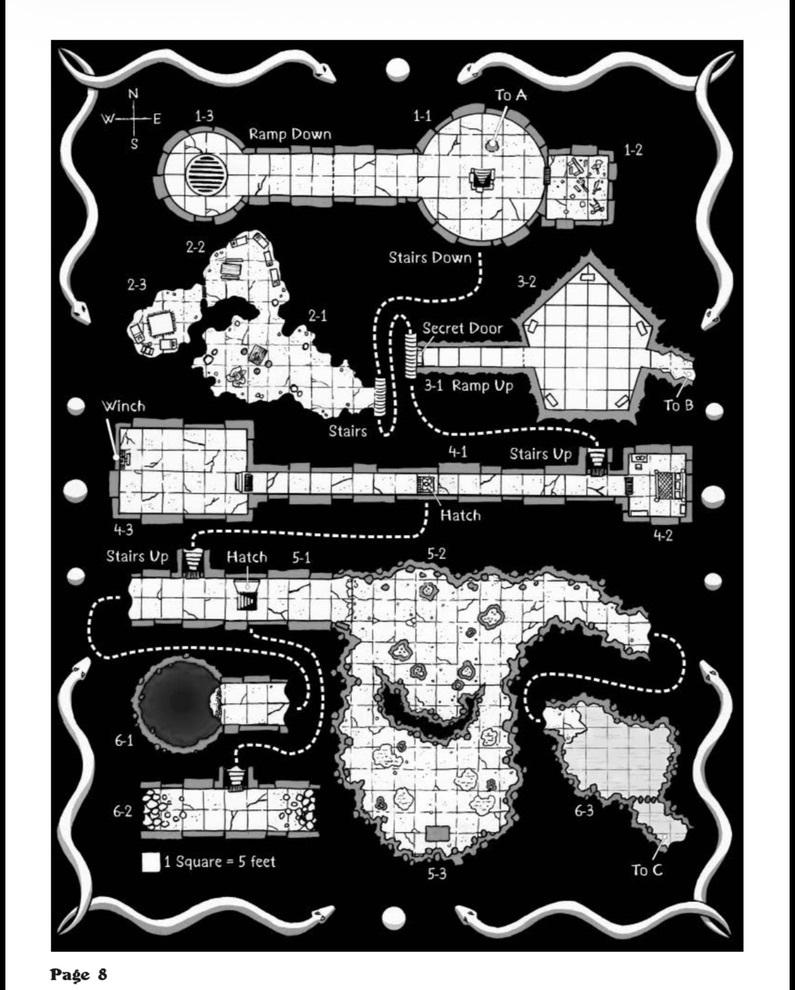
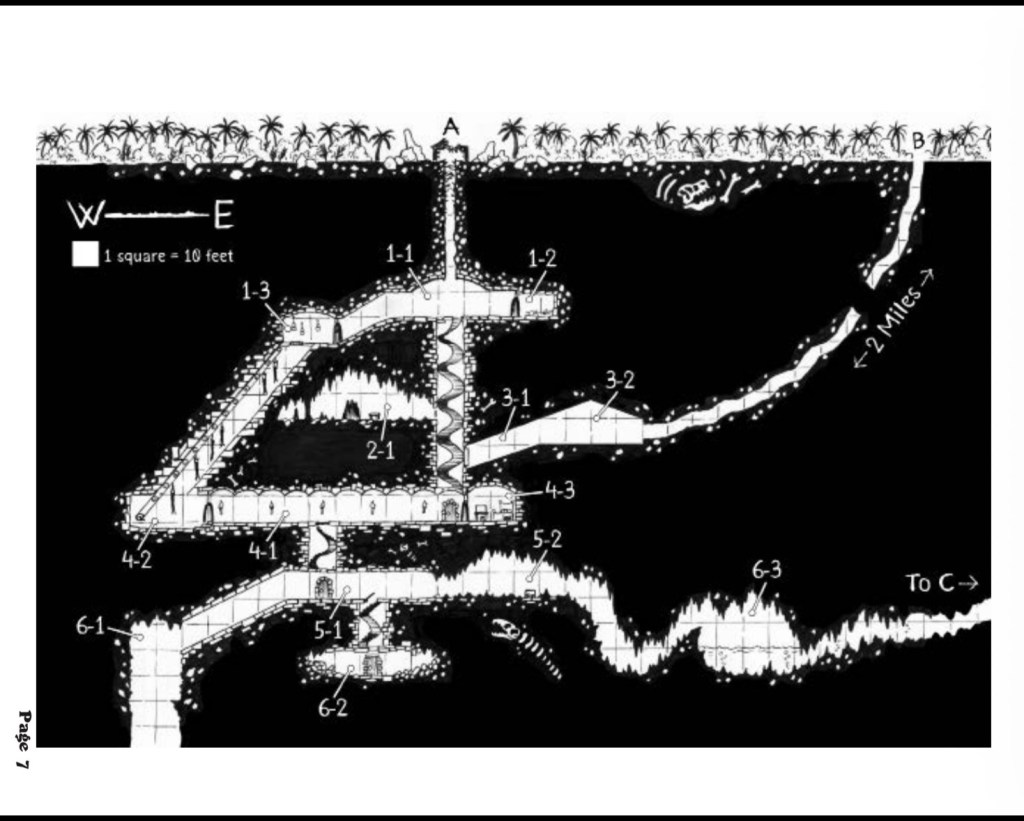
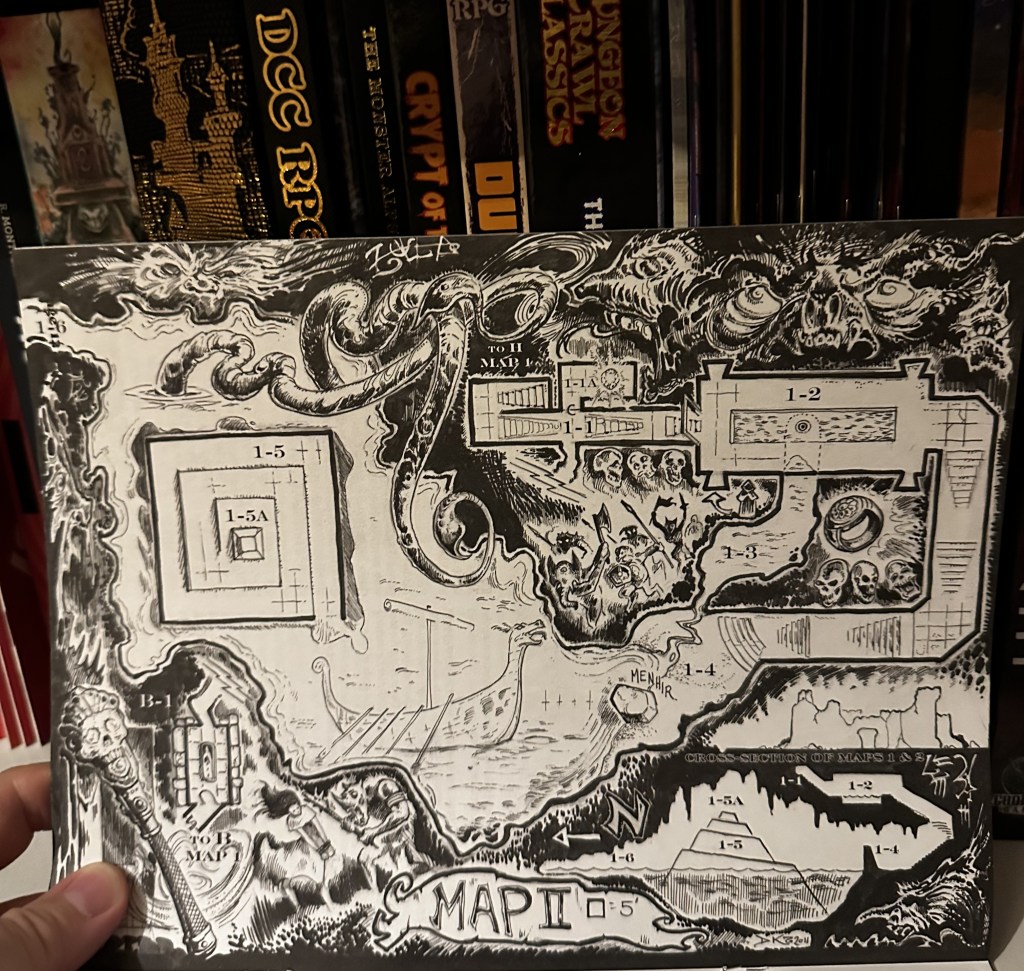
I love DCC maps. They’re almost always beautiful and functional and genuine pieces of art in their own right. That can be said for the maps in this adventure too, in fact. They are, perhaps, not quite as memorable or gnarly as an Doug Kovacs map from, say, Sailors on the Starless Sea, or the Mark Allen one from Hole in the Sky but they are functional and effective. You can compare for yourself:

But there is a very small problem with the dungeon map/key that left me scratching my head and cursing the adventure for wasting my time at the table. If you look closely, dear reader, you will see that Room 4-2 and Room 4-3 are labelled differently on the plan compared to the cross-section. Now, as the PCs explored Level 4, I was really just looking at the plan map so I didn’t notice this error. The problem is, it’s the plan map that’s wrong. 4-2 is where 4-3 should be and vice versa. This might seem like a small issue, and perhaps I’m making too big a deal of it, but when you only encounter it for the first time at the table? Confusion, frustration, struggle. It’s a waste of time and mental energy that could better be spent on building atmosphere, answering player questions or, like, role-playing.

And if this was the only map problem in the module, I might be a bit more forgiving, but I mentioned in the last DCC Day 2026 post, that the island map should have hexes to allow you to calculate how often to roll on the overland encounter table, but it doesn’t so, once again, the Judge is just left to guess at the table, when they are already juggling a lot.

I will say this is not the only potentially bad labelling in this adventure. On the cover, it defines it as an adventure for Level 1 PCs, but on the inside, it says it’s for Level 2 PCs. This could actually explain the extra lethality. Maybe my party were just too wee?

So

Here’s what happened at the end of the adventure (if you want to catch up, go check out my first post about it here.)

The party, now three-strong since Hilda the Wizard met up with them back on the beach, returned to the point they left off in the dungeon. They picked up some of the weapons and armour belonging to the Serpent-men and continued down the winding, narrow stairway until they discovered a secret door in the wall. Cleverly, they decided to treat it with some care, stepping to either side of it when it opened, thus avoiding the burning oil trap. There is a high probability that this trap was not going to ignite but, ignite it did, to no effect of course. They continued into an uncanny corridor that seemed to have been wrought in a strange way. It was as if the rock had been disintegrated to create this corridor and the pentagonal chamber beyond. In that chamber, by the way, was an Elder Thing. It had come here to observe the Serpent-men and the Cobra-men, apparently, but that does not particularly describe the reason for it to appear in the adventure, if I’m honest. It had a deleterious effect on a couple of the PCs. There’s a table to tell you what happens if you fail a Willpower save upon seeing this Cthulhu-Mythos-ass creature. Anyway, one of the PCs froze and one fled. I’m just glad none of them rolled “fight” because that would have surely been the end of the adventure. The other one found she was able to communicate with it in a rudimentary telepathic way. It was able to tell her there was another exit from its chamber to the surface, and that there was some sort of conflict between the Serpent-men and another sect who worshipped Sett. It then began packing up its things. Now that the PCs had uncovered its ingenious hiding place, it had no choice but to leave, apparently. So they left it to its business.

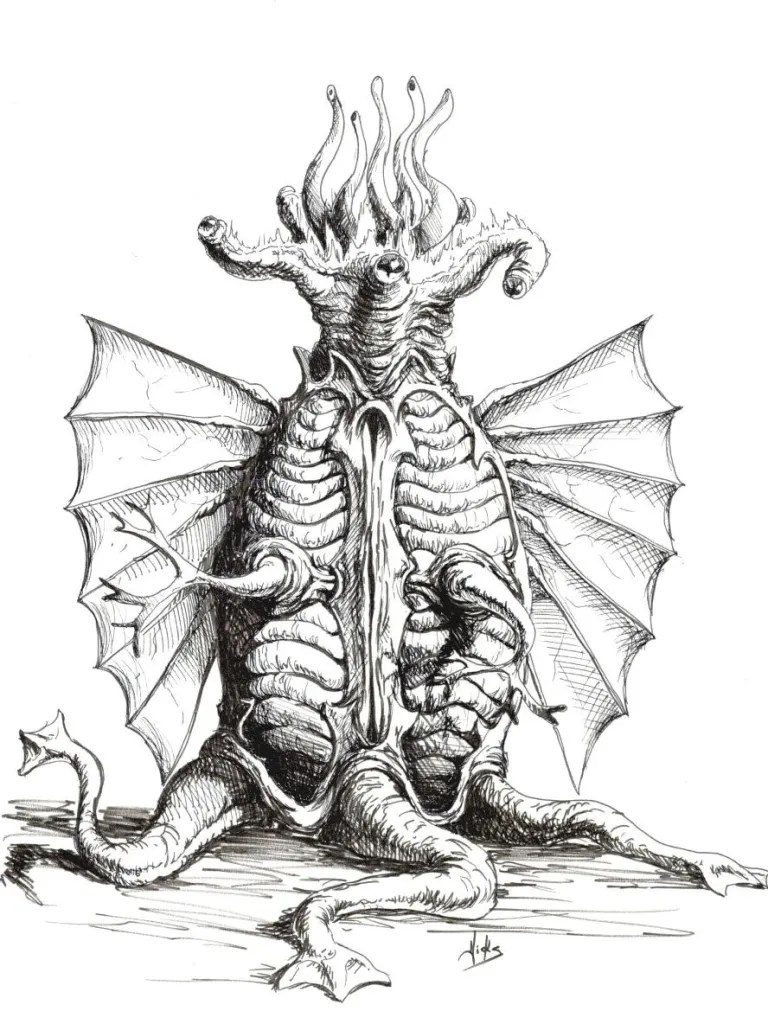
The Elder Thing: This ancient race has inhabited the earth for many millions of years and may have created life on earth as it appears today. Older creatures prefer water as their habitat, but can also move effortlessly on land and even fly.

The appearance resembles a cylindrical shape a good two meters high, the ends of each tapering slightly, so that an Elder Thing resembles almost a barrel. Furrows and ridges cover the body with strange growths, and the wings and strange head, shaped like a five-pointed starfish, give the creature characteristics of both animal and plant life.

The Elder Things established at least one major city in Antarctica and created the Shoggoths there who used them as slaves. During the millions of years of their existence on Earth, the Elder Things fought many conflicts, but now seem to have retired. From: https://cthulhueternal.com/creatures/elder-thing/
https://cthulhueternal.com/creatures/elder-thing/

I have several questions about this encounter. The main one is just why? Why is it in this dungeon? It lends nothing to the otherwise decidedly snake-based vibe. If the PCs end up attacking either because the players think its a good idea or because they failed their save and rolled “fight” on the reaction table, they would be killed quicker than you could say “Beyond the Mountains of Madness.” Another why. Why is it watching the Serpent-men? Not really explained. Still whying. Why is is the trap protecting its lair so shitty? This unfathomable monstrosity has the power to disintegrate a lair for itself in the rock, and observe the inhabitants of the dungeon without their knowledge through the walls, but it can’t put a decent security system in? The trap is the kind of thing you might find in an incompetent bandit’s lair. Here’s a what. What use is the other exit? It’s difficult to climb and leads to a part of the island that is much more dangerous than the main entrance. Admittedly, the players did make use of the Elder Thing again later, though.

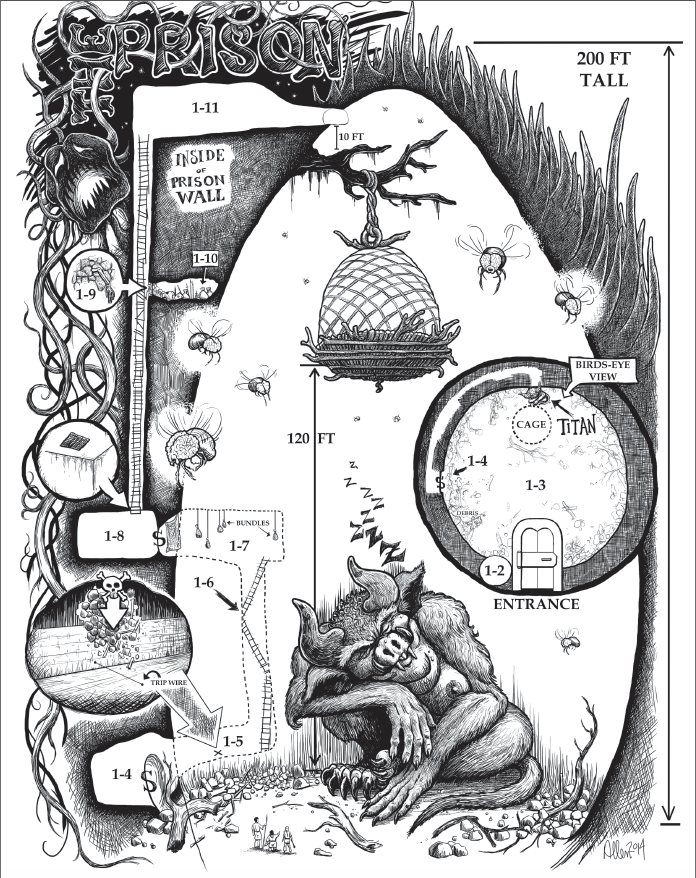
Once they descended the stairs they came to level 4. This is where I ran into the trouble with the mislabeled rooms and where they ran into decidedly more trouble with the Giant Two-headed Viper. Anyway, once we got past all that, they were able to explore the chamber where the viper was hiding. If you look at the map, you can see that the sluice they discovered beneath the grating on level 1 leads down to that room. There were humanoids manacled and hanging from the ceiling of that sluice. They had been unable to get to them from above. They were able to use the winch here to bring them all down. Some were already dead, but those that could be saved, they brought to the Elder Thing. It agreed to heal them as long as they covered their eyes. With a little healing, one of them even turned out to be an Elf who was happy to join the party and aid them in discovering the evil that imprisoned, enslaved and devoured them. This became our latest PC, replacing Helfgott the Cleric. The rest of the prisoners were sent back to the fishing boat with strict instructions not to let Kamay try to leave again on the off-chance he woke up.

Back to full strength, the party went to investigate the other room on this level. This proved to be the apartment of the leader of this breakaway sect. As at least one of the PCs had the Serpent-man language skill, they were able to discover a plot when they searched through her correspondence. Human and Demi-human adherents of the demonic god, Nehebkau, were worming their way into positions of power and influence across the nations in and bordering Thracia. What their ultimate goal was? Unclear, except that they were to sow chaos and division to leave opportunities open for the Serpent-men. They also found some loot in here, which was nice. Then they opened a hatch in the corridor and went down even deeper.

They skipped Level 5 at first and went down again to Level 6. This level proved to consist only a single tunnel which was collapsed on either end. Slaves were working to dig it out, guarded by a couple of Serpent-man. When the PCs attacked the slaves immediately revolted and with their help, the guards were quickly dispatched. The prisoners are started out in the adventure as a swarm. Only AoE attacks could do any more than a single point of damage, but a single point of damage was also enough to kill one member of the swarm of ten so they were only going to last so long. Still, they were happy to come along and help the PCs in their fight.

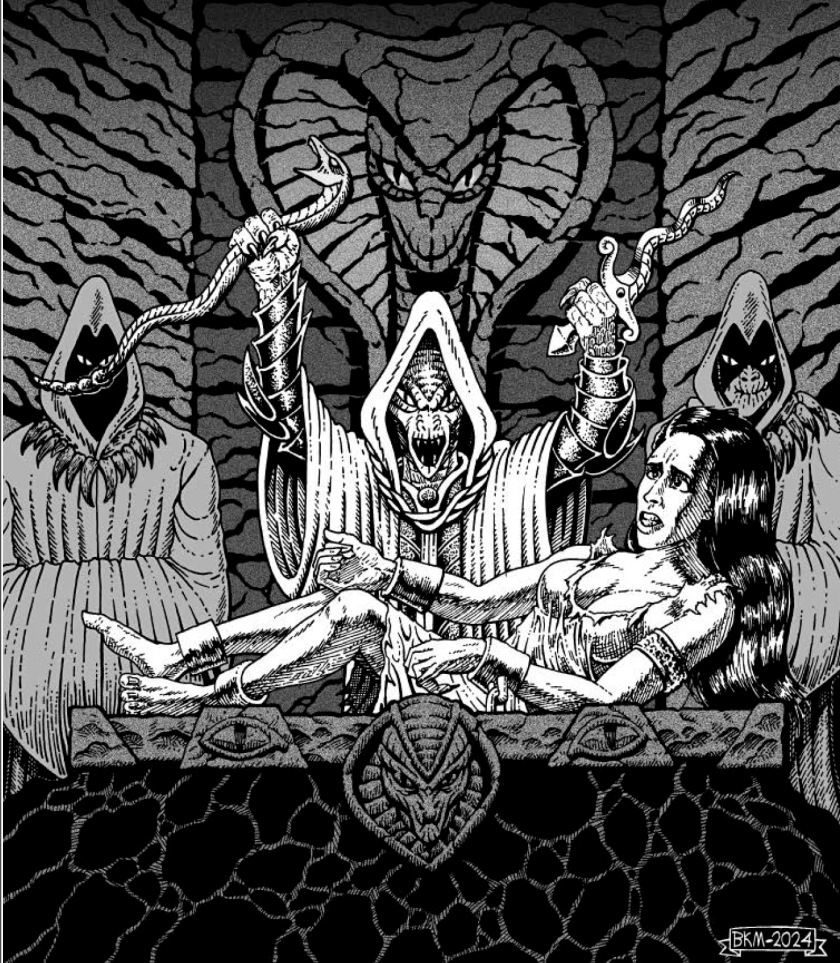
They returned to Level 5 and proceeded into the Temple of Nehebkau. This is the finale to this adventure and it didn’t disappoint. The setup coming from the room alone was cool. There are pools of magma dotting the floor and lava domes casting their eerie glow. On top of that, there are drips of acid coming from the roof, ready to burn anyone who goes prone. This happens a lot in the ensuing battle. The PCs entered from the north-west and there is a ritual happening in the southern part of the chamber, which is accessible only through a short passage not he east and west sides. The ritual involves the sect’s leader ritually murdering prisoners by pouring molten magma into their chest cavities. Yup. If she and her three flunkies get to finish it, a demonic Magma viper will be summoned. Added complication? Sure, there are also four Serpent-man guards stationed to stop anyone who tries to interfere.

The PCs ruthlessly sacrificed the prisoner swarm in a full frontal assault on the guards while they attempted to deal with the leader and the cultists. There were some dicey moments, like when one of them got hypnotised again, when they got down to the last sacrifice and just managed to defeat the last remaining cultist before they could kill her and when their swarm was reduced to just two members. But they persisted and played it clever, using the spells and abilities they had to their greatest advantage. Sleep was the best spell in their arsenal to be honest. There were a lot of fun moments provided not only by the rolls on the individual spell tables but also on the mercurial magic tables, grit tables and fumble tables. DCC is all about the tables, isn’t it? It brings new meaning to the word random. You are never quite sure what will happen, especially when you cast a spell. It might work just fine and achieve the goal you intended. It could even result in a far more powerful effect than you could have imagined. But it could also fizzle out and mean you can’t cast it again that day. Or worse…

Conclusion

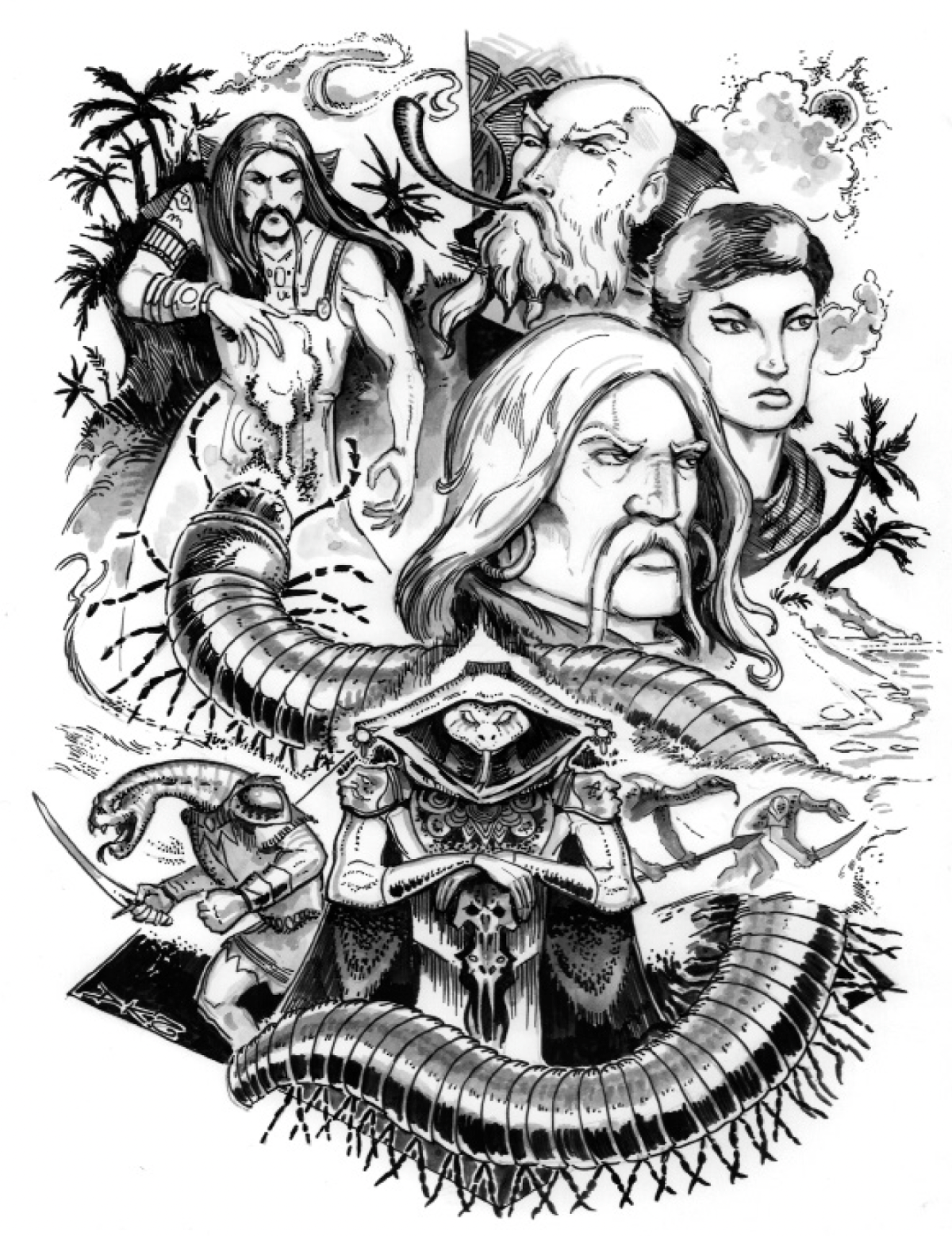
Three Serpent-folk performing a sacrifice of a human woman chained to an altar.

This is the joy of playing DCC with PCs of more than 0-Level. The funnels are fun and all, but access to magic and other special abilities really elevates this game, if you ask me.

There were a couple of other beats once they defeated the cult leader and prevented the performance of the ritual but they were not worth mentioning, to be honest. They went back to the boat and returned to the mainland with all the freed prisoners that survived. It was a bitter-sweet ending, however, considering how many they lost along the way.

I think, if I were to run it again, I would prepare a few things. I’d pop some hexes on the map of the island to make the random encounter table useful. I’d probably remove the Elder Thing encounter and replace the Giant Two-headed Viper encounter with something a little less lethal. I’d also seed some more information about what’s going on in the dungeon, throughout the actual dungeon, because, as it stands, there’s no way the PCs could know that the finale ritual is actually going on. They just happen to stumble across it whenever they decide to show up at the Temple chamber.

In the end, though, we all enjoyed the adventure, despite its flaws. I would definitely consider running the main Caverns of Thracia campaign at some point too. Probably once this whole Editioning Business is behind us.

The Editioning: Weeks One and Two, Basic D&D

The Keep on the Borderlands

Friend of the blog, Isaac has generously offered his time and effort to take on the Editioning with me. He’s DMing Basic D&D for us right now. He decided on the Keep on the Borderlands as the adventure for this edition, and I couldn’t be happier. It’s the iconic first scenario for many, many adventurers in the 80s. I actually think I might have played at least part of it as a novice, although I have no real memory of it.

For those who don’t know it, here’s the set up. The PCs arrive at the Keep on the Borderlands, a remote and embattled outpost, that has been recently assaulted by a group of creatures that have come from the nearby Caves of Chaos. They use the keep as a base of operations to set out and explore the caves and other locations in the area.

It’s got a few interesting NPCs with their own specific motivations and desires and a couple of different factions to keep things interesting, including the Ospreys, a rebellious bandit clan, the current ruler in the keep, the Castellan, and the Thyrenian Guild.

A lot of these older modules are designed for unusually large numbers of PCs. I think this one is designed for 6 to 9 players. As we started off with just two players (now expanded to three) it was essential to hire a whole bunch of hirelings. We started off with four but quickly decided we should max out that number and hired three more. By the time we set out to the Caves of Chaos, in our third session, we had a small army, including a slightly suspicious priest by the name of Jabeck and his acolytes. This should make combat interesting.

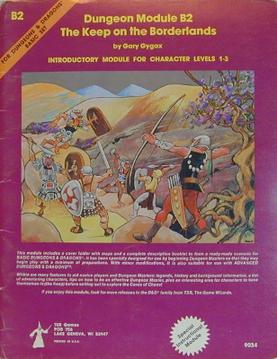
The cover of B2, The Keep on the Borderlands. A purple cover with the name of the module and a colour illustraiton in the middle: a piched battle on the road between adventurers and monsters.
By Scanned by DM2ortiz, Fair use, https://en.wikipedia.org/w/index.php?curid=505624

How its going

I say we set out for the caves in session 3, but actually, that was just our most recent and successful foray. Here’s the story of the first one.

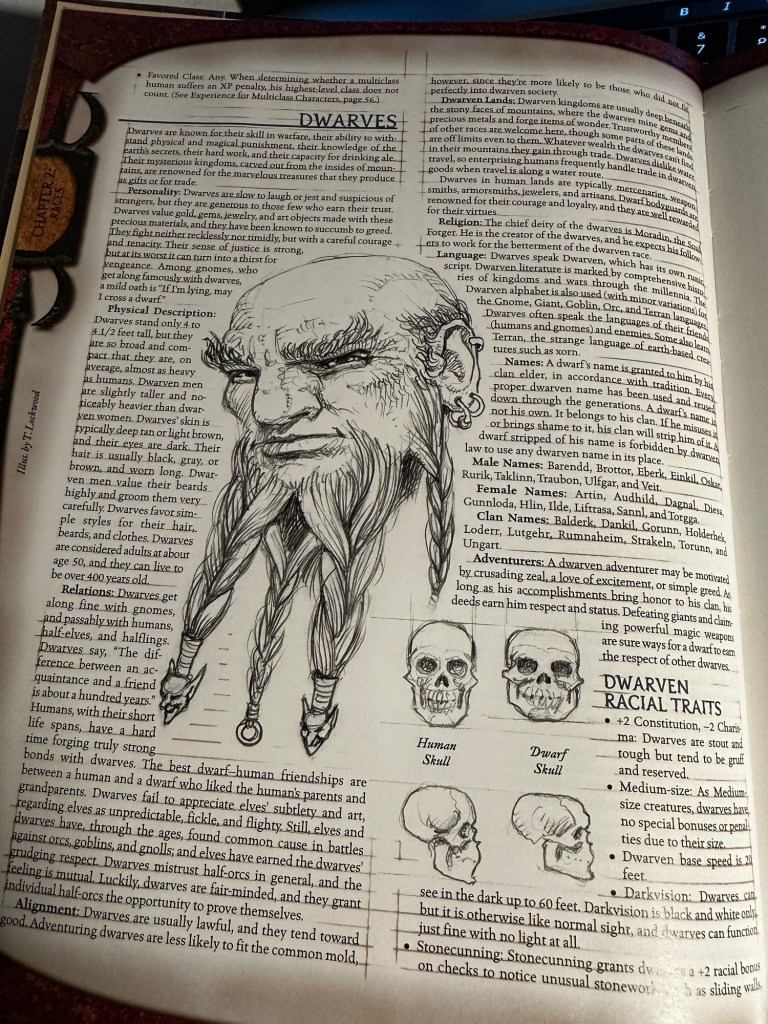
So, in the first session, Tom and I made characters. As per the rules, we rolled up our ability scores first and determined the character class best suited to those scores afterwards. Tom rolled pretty well and decided on an Elf character, Eandril Summerstream, which made a lot of sense as elves had the benefit of spells and proficiency with melee and ranged weapons too. Given our smaller party size, that flexibility could be useful. I rolled execrably:

Str: 6
Int: 6
Wis: 12
Dex: 5
Con: 9
Cha: 10

There was only one option with those scores, so I created Edmund of the Sun, a Cleric of the Sun. He’s a lovely fellow, but thick as pig shit. I played into the idea that he was barely literate and couldn’t remember an NPC name if his life depended on it. I outfitted him in plate armour because his dexterity was so bad and he only had 2 hit points. Between the two of us, we represented the only two survivors of our mercenary band called the Company of the Summer Sun (a clever play on the names of the two characters) who arrived at the keep with the hope of rebuilding.

I genuinely had a great time roleplaying Edmund in the keep and getting pissed in the tavern with the party’s new hirelings. We awoke in the street the next day, suffering from alcohol poisoning and set off with Jabeck and his mates to explore the Caves of Chaos. Now, we had been warned about Jabeck by the keep’s chaplain, Father Burgoyne, who asked us to watch him and find out what we could about him. He suspected that he was a spy for the Great Serpent Cult, which operated out of the caves. But Father Burgoyne was incredibly racist against elves and Jabeck seemed reasonable when we went to talk to him. He also plied us with ale, which endeared him to us. So, I guess we took his side. That’s how he ended up accompanying us to the caves. I really hope he doesn’t betray us…

Anyway, on the way, Isaac had us roll for a random encounter, which resulted in an ambush by the aforementioned Ospreys. Now, we had been given a token by one of the guards in the keep to take to the Ospreys to maybe do some work for them. However, there was also a bounty on them, which was worth 10GP per right ear returned to the keep. Being rather lawful types, we decided to go anti-Osprey in our outlook. Edmund tried to throw them off by deliberately mistaking the voice of the unseen Osprey in the roadside bushes for a lad he knew in seminary. He trusted in his armour to protect him from any potential attacks. Turned out this was a mistake. They got tired of Edmund’s sass and rolled initiative. We lost, they won, one of them fired an arrow. It lodged in Edmund’s eye-socket, killing him immediately and outright, with 2 points of damage. The first combat roll of the game killed my boy. It was a bit of a shock, even though I had predicted Edmund’s early and brutal demise from the outset, given his atrocious stats.

From there, Eandril led the charge and killed the three bandits. I picked up one of the hirelings to control for that battle but wanted to make my own character again. So as the rest of the party turned around and returned to the keep to regroup, I started rolling. Oddly, by the time Eandril and the hirelings got back from chasing down the Ospreys, to the road where Edmund’s corpse lay, it was gone, taken, they assumed, by Jabeck to dispose of as per the rites of their shared religion.

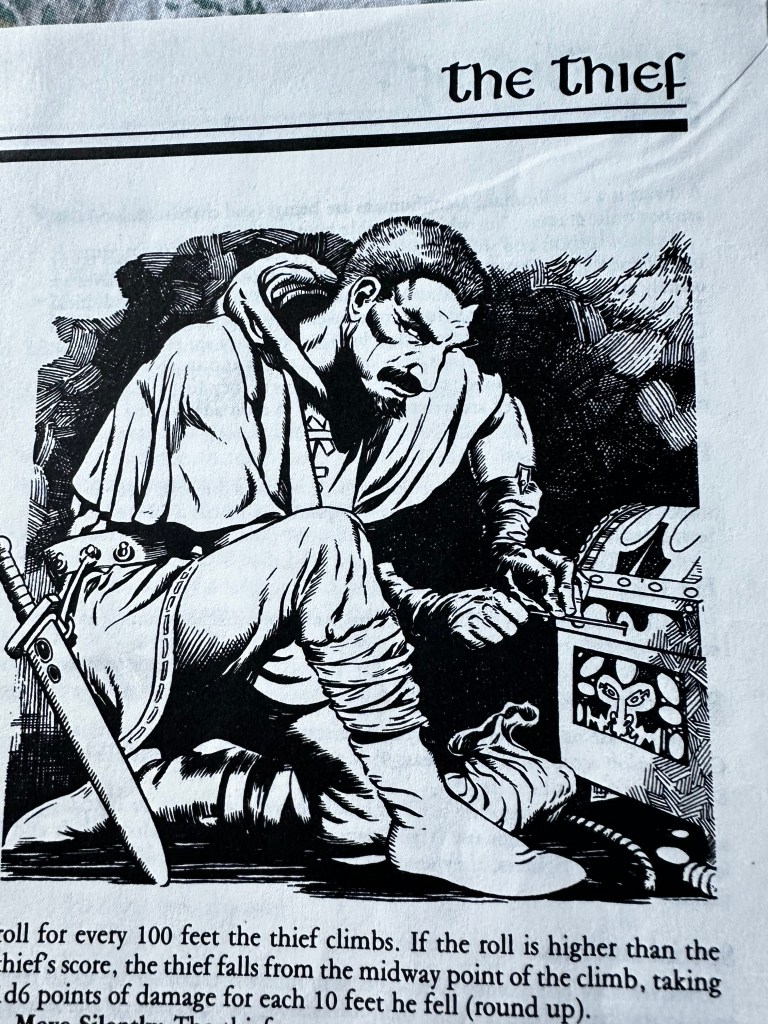
A thief in a black and white illustration from the Basic Rule Book
Yoink

Despite the loss of Edmund, the encounter proved quite profitable, between the 30gp for the Osprey ears and the horses they left behind, Eandril did well. By the time they returned to Father Burgoyne to tell of Edmund’s demise, I had my next PC ready. Thaddeus Nightbane is a thief, obviously. I rolled significantly better for this character so hopefully he will last a little longer. This would be unlike every family member, friend and acquaintance he had ever had, however, as they have all perished tragically somewhere in his backstory. Despite this slight worry, Eandril decided to take him on as a full party member.

To the Caves

Finally, with session 3 on Wednesday, we actually made it to the Caves of Chaos. We were joined by another player, who rolled up a Halfling. We also created some backup characters for everyone, given the obvious lethality of the system and the adventure. There is no doubt that the lack of hit points, the lack of healing, or spells of any kind for the cleric, the swinginess of the combat and the potential for unbalanced encounters is pretty rough on these little adventurers, so its best to go in prepared. Unfortunately, my backup character is just as bad as Edmund, and is, possibly, one of his peers, as I had to go Cleric again. With all this character creation, we didn’t get too much time to play. But we did make it down the road without a random encounter this time.

When we got to the caves we discovered a group of goblins moving something around down there in sacks (the sneakier PCs went in to hide in shadows and spy on the inhabitants.) Our plan is to draw them out of the caves as much as possible and ambush them in a pincer. We have executed the first part, gaining their attention with some elven lullabies, so out of place in the darkened caverns. And last we left off, we were getting ready to roll initiative! Exciting! Hopefully Thaddeus lasts a little longer than Edmund.

The Basics

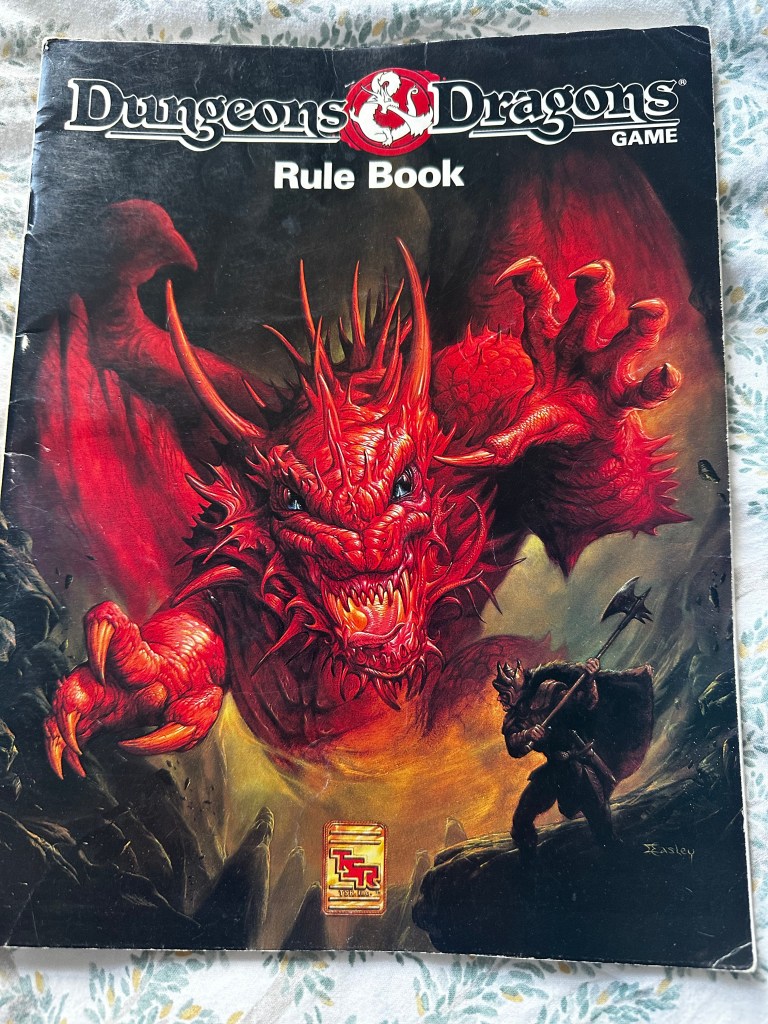
Dungeons and Dragons Game Rule Book cover. A red dragon menaces a warrior wielding an axe.
Big Red

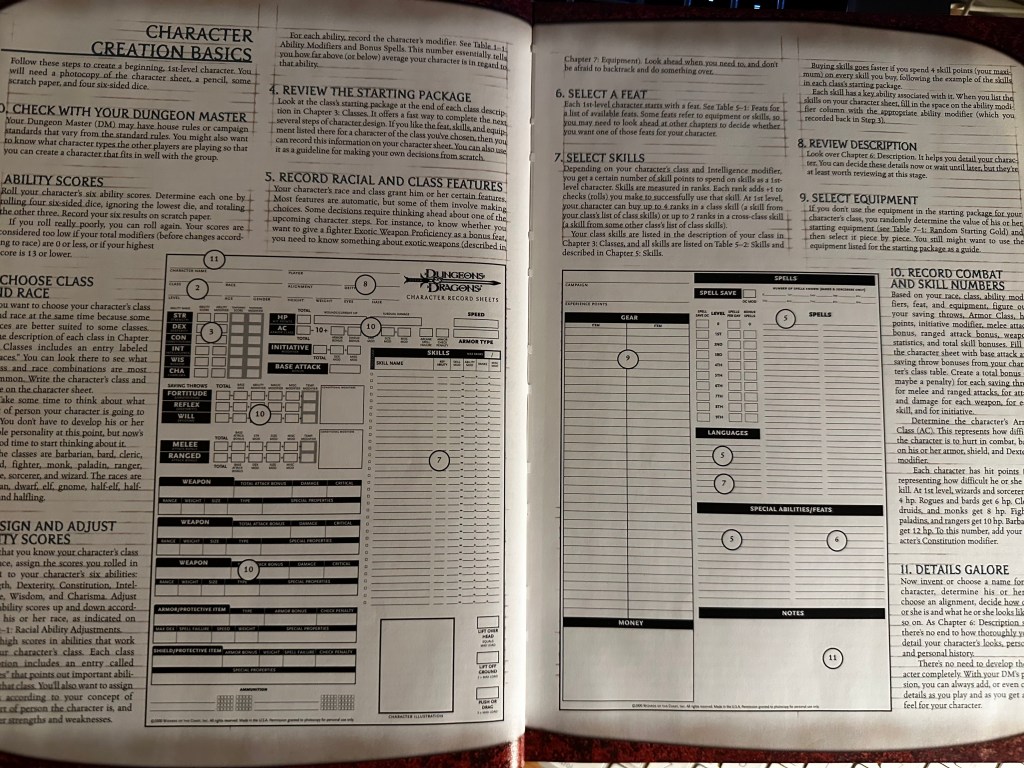
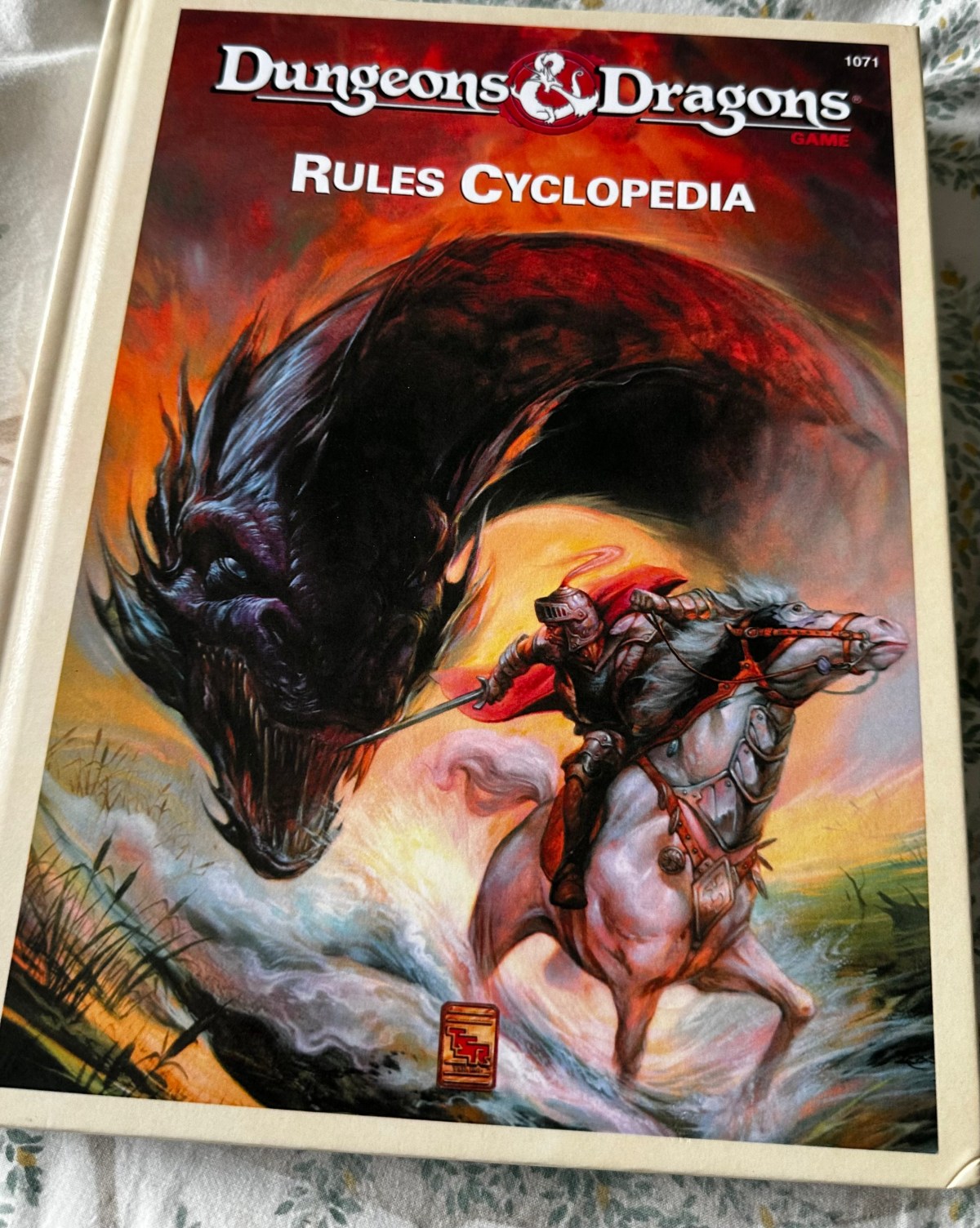
There are too many possible versions of Basic D&D to definitively say that we’re playing the version. I mean, we’re not even really using one version at the table. We have the Rules Cyclopedia, which contains all the rules from the entire BECMI line, the Dungeons and Dragons Rule Book also printed in 1991, which only contains he Basic rules for levels 1 to 3. Isaac also has been referring to the Moldvay rules, a kind of 2nd edition of the Basic set, and we have even been using resources and specific rules from OSE, which is essentially the same ruleset.

In general, this hasn’t been an issue. We have come across some conflicting rules. Encumbrance was the first one. Isaac simply made a ruling to go with the encumbrance from OSE rather than the Cyclopedia. We have discovered a could have differences in spell descriptions, but they were functionally unimportant so we could safely ignore them or Isaac would make a ruling as to which version to use.

I have to say, stuff like the class sheets from OSE, printed out and handed to the players, have actually been very useful and don’t have any deleterious impact on the “playing Basic D&D experience.”

As for interaction with the rules, Some have found THAC0 and descending AC to be a bit of a leap to understand, but, luckily, the character sheets Isaac has selected have the full range of “to hit” numbers laid out so all we have to do is roll the dice and refer to the table.

Things like the rolls for thief skills are weird and anomalous but not difficult to understand. Once again, as long as you have them laid out for you, its easy to know what you’re rolling and what you need to get below to succeed, whether its on a D6 or a d100.

Conclusion

It’s too early for a conclusion, but, despite the death of my first PC on the first combat roll of the game, I am enjoying the game and the adventure. The old school style has been particularly refreshing. It’s interesting that we need to rely on a cadre of mercenaries to even attempt the adventure and I like the randomness that’s inherent in it.

I’ll be back with more reports once we have a couple more sessions, dear reader, so stick around!

Time-loop

Spell Jammin’

The Editioning has started. We made some characters for OD&D the other night. We have one Fighting Man, one Magic User, one Cleric and one Thief, just as Gygax (or maybe Arneson) intended. But today, I want to write about a mini 5E campaign we just ended.

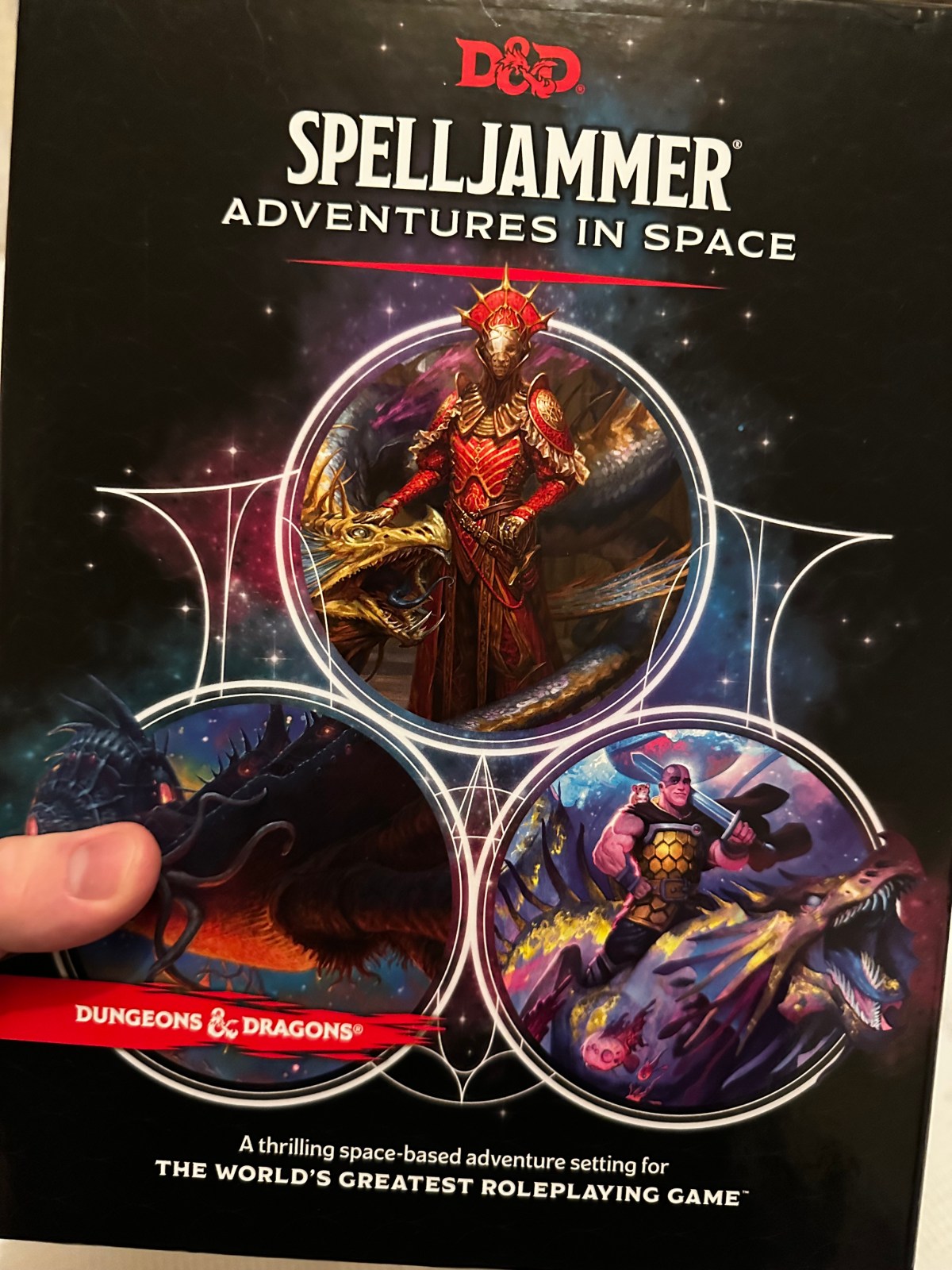
I have been running a Spelljammer campaign on and off for the last three years or so. The main campaign is, I guess, nearing a conclusion. I had always envisioned a particular timeline for it, factored in major plot beats, character moments, significant locations and events, but underestimated exactly how long a lot of that would take and, of course, where the PCs would take the game in some cases. So, last year, I decided to take a break from it. But, some months before the break, one of our number was launched into the IRL adventure of welcoming his second child into the world. When he and the rest of us came back to Spelljammer, I wanted to play something that would explain where his character had been in the interim.

The Wild-spacer Giff, Azimuth, is our resident Charisma Fighter. Or, he was. Now, he’s a Fighter/Paladin. He used his charm to get the group out of a couple of tight spots and himself into a couple of hot dates. He had a troubled back-story. The rest of the crew picked him up after he had been left stranded in Wildspace when some disaster befell his own ship, captained by his father, Parallax, also known as “the Admiral.” He didn’t know what had happened and he was driven to find out. When their adventures took them to the Rock of Bral, he did some investigation and discovered that something was happening to ships in a region of space known as the Amos Expanse. This struck a chord with Azimuth. So he put a crew of his own together while his erstwhile companions pursued their own goals, and he set off into the Expanse to find his dad. We called it, “The Search for the Admiral,” or “Dad-quest” for short.

Side Quest

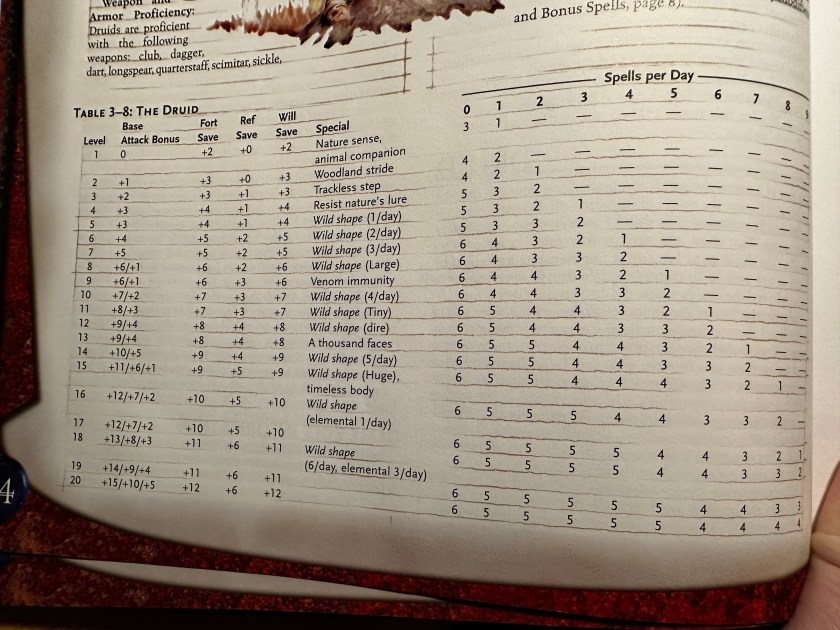
This is how I handled it. We took another extended break from the main campaign and I got the other players to create new characters to act as the crew for Azimuth’s own ship. They all had a connection of some sort to the Admiral so it made sense that they would want to help find him. The players really got into this! They loved the opportunity to play new PCs in the same world, and even, in a way, the same campaign as their older characters had been in for a couple of years. They came up with some incredibly different characters compared to their original ones. My wife was playing a gnomish artificer in the main campaign and decided to create an Astral Elf Circle of Stars Druid who talked like Jennifer Coolidge (like many of the people I play with, my wife is a fully paid up member of the funny voice club.) I wrote, last summer, about the idea of allowing the players to use their two characters interchangeably from now on.

Giff! He's a hippo in a victorian military uniform holding a blunderbuss
Giff! He’s a hippo in a victorian military uniform holding a blunderbuss

The bulk of the seven session campaign was spent searching and investigating the Amos Expanse. I handled this as described in this post. TL;DR they rolled on a few encounter tables and they marked progress points when they rolled a 6. In the end, they rolled on those encounter tables quite a few times. What I enjoyed most about this part was that they found a through-line of a plot in the random encounters that I had never intended. There were a number of different hazards, problems and encounters that involved Kindori, the whale analogues in Spelljammer. There was an encounter with some space-vikings who were hunting them. Another involved the corpse of a Kindori that was being mined for space-ambergris and another was an encounter with a Kindori ghost. I had come up with these by using the spark-tabes in Between the Skies but never saw them as connected. And they wouldn’t have been if it hadn’t been for the order they were rolled up by the players during their journey. Anyway, on 5 progress points, they found what they were looking for.

Loop

It just so happened that the last encounter they rolled up before the finale was a big one. They encountered a Void-frost Elemental that was holding open an anomalous portal from the Elemental Place of Frost into Wildspace and it was spreading out from there. The PCs’ ship got caught in the ice (along with another Kindori who ended up helping them) They were forced to trudge across the space-ice-floe and defeat the elemental to close the portal and release their ship. It was a tough fight and they took a lot of damage to achieve their goals, but they won out in the end. When they did, of course, the enormous portal popped out of existence. This event drew the Crimson Cloud they had been hearing about to that spot, to fill the “void” it had left. It also trapped the PCs inside the cloud!

It turns out this was a fortuitous happenstance since this is also where Azimuth’s Da had been all this time. He, along with all his crew and a whole other ship had been trapped in a time loop inside the cloud ever since the disaster that had left Azimuth stranded at the start of the campaign!

Here’s what happened. Azimuth’s Dad, Captain Parallax, had been commanding his ship through the expanse when it encountered the Crimson Cloud. The Cloud was a temporal anomaly that allowed beings and objects to travel in time. Inside the anomaly, they got hit by another ship that had also been caught in it. This other ship also bore Azimuth’s Dad, just a much younger version of him. And it was a mercenary ship from decades earlier. The mercs rammed into the Admiral’s innocent merchant ship, assuming they were their target. And that’s when they got stuck in the time-loop. A device aboard the Admiral’s ship, a sort of Portable Dungeon, meant to trap whole armies in a prison demi-plane, interacted with the temporal anomaly and trapped them in the time-loop.

The way I planned it, the loop would last only about 15 minutes. As such, the two crews and the two versions of Azimuth’s Dad had done this over and over again, hundreds or thousands of times. But none of them were aware until the PCs also got sucked in, half way through a loop.

This is what I did to handle the loop. I established the events that would happen without the intervention of any outside influence such as the PCs. Here is the basic set of events:

  1. The ships enter the cloud/loop after colliding – The Mastodon’s Breath (Parallax Senior’s ship) is damaged but not completely wrecked. It has a great hole near the prow. The Jackpot (Parallax Junior’s ship) has only taken minor damage, but, unknown to them, it is enough to cause a massive blowback effect when they fire the cannon into the Mastodon’s Breath. It will be enough to destroy both ships in a cataclysmic explosion.
  2. Xenotermination giff marines get together to make an assault on the Mastodon’s Breath. Lieutenant Parallax is cheering them on from the spelljamming helm. The assault is met with surprising opposition from the elves in Lord Faewynd’s retinue (these guys were being transported by Parallax along with their cargo) and the crew of the Mastodon’s Breath, not to mention the distraught Captain Parallax himself. The fighting is bloody and results in the marines retreating, badly hurt.
  3. Fearing the worst, Lord Faewynd and a bodyguard escape the MB on a small tender with the spelljammer helm from the ship and the Astral Dungeon on board. Meanwhile, both crews take the time to rest and heal.
  4. Just as the Jackpot’s captain, Captain Lagrange orders the firing of the main cannon, Lieutenant Parallax and Captain Parallax finally see each other from opposite decks. That’s when both ships explode in a fiery blaze.
  5. Not long afterwards, the Astral Dungeon will reset, taking everything back to the starting point, just after the two ships collided.

Live. Die. Repeat.

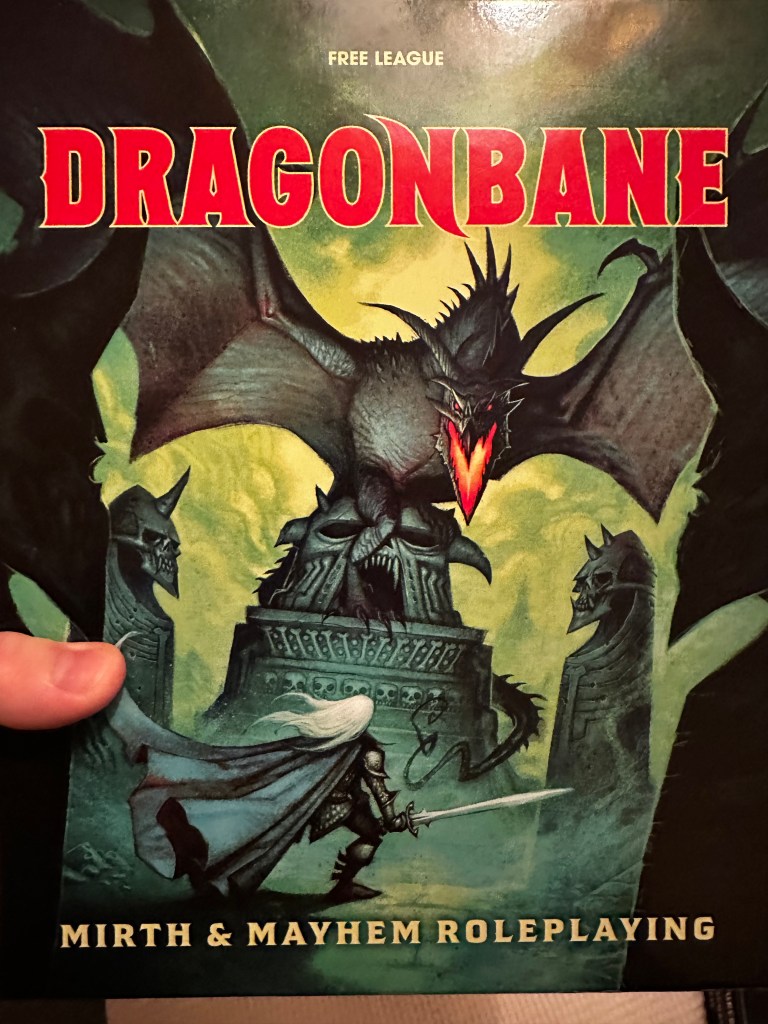
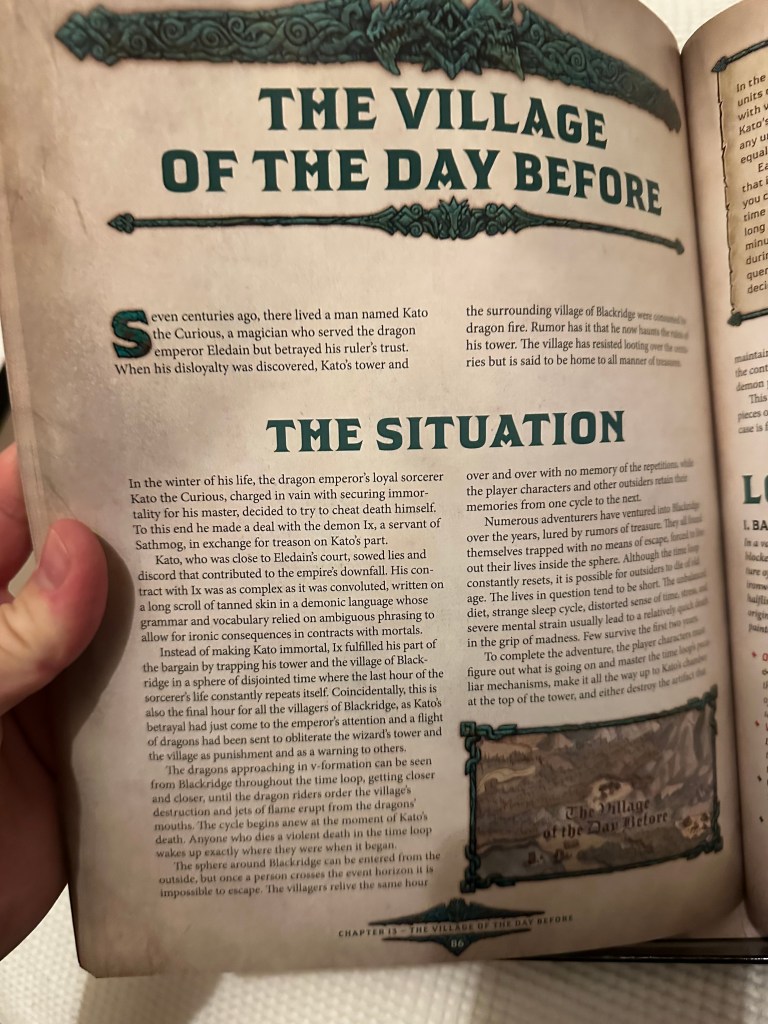
I got the idea to do this, partly because my wife is a big fan of time-loop movies like Groundhog Day and Edge of Tomorrow and I wanted to give her that experience. But also, I had read a clever adventure in the Dragonbane boxed set that showed me it was possible to create an adventure like this. In fact, it made it seem relatively easy. It hinged on the series of events, of course, but “The Village of the Day Before” was far more complicated, in many ways than what I had planned. It had a lot of NPCs you had to locate and keep track of, for one thing. I didn’t need to do that so much since everyone was restricted to one of two ships. In fact, it was surprisingly easy to run, is what I found, as long as I kept the timeline in mind.

The PCs experienced three iterations of the time-loop. On the first two times, they got blown to smithereens along with everything else trapped in the anomaly when the merc ship fired their enormous cannon and blew up the Astral Dungeon. They reappeared on the edge of the map each time. On the second go, they noticed the interaction between the explosion from the cannon and the Astral Dungeon in the middle of a pitched battle with the giff marines. By the third one, they had figured out they had to prevent the cannon from blowing that thing up and they had to get to it and find out some way to shut it off to free themselves. And that’s what they did. They had to kill the mercenary captain and fight the marines to a standstill while they figured it out, but they managed it.

Conclusion

In the end, there was no “big bad” to fight to end the adventure. There was just a puzzle to solve and some chances to take. The players did that and they escaped the time trap. It was exactly what I wanted and the players seemed to enjoy it too.

If you’re thinking about running a time-loop adventure, DMs out there, do it! But let me warn you, it’s hard to keep it to yourself when you’re planning it!

Japanese FLGS Visit

Sayonara Nihon

I’m still coming to terms with the fact that I’m home. I’m not fully on board with the situation, to be honest. I guess I can continue to dream that I’m back in Japan again, walking though the riverside yattai food stalls of Fukuoka, sampling the okonomiyaki of Hiroshima, slurping ramen at the counter in Oita. But it’s no substitute for the real thing. I used to live there a long time ago, dear reader, and my feeling about the second-hand experience can be summed up thusly. I have been consuming below-par sushi from a little place near my office in Ireland for years, fooling myself into thinking it was quite good, actually. But our generous friends and hosts took us out for the most affordable conveyor-belt sushi in Oita City last weekend and when I popped that first maguro nigiri into my gob, I realised I had forgotten how good it could be. I almost cried. I’ll never be able to return to that little lunchtime sushi place without the sure knowledge that they have been hoodwinking me for years.

Yellow Submarine

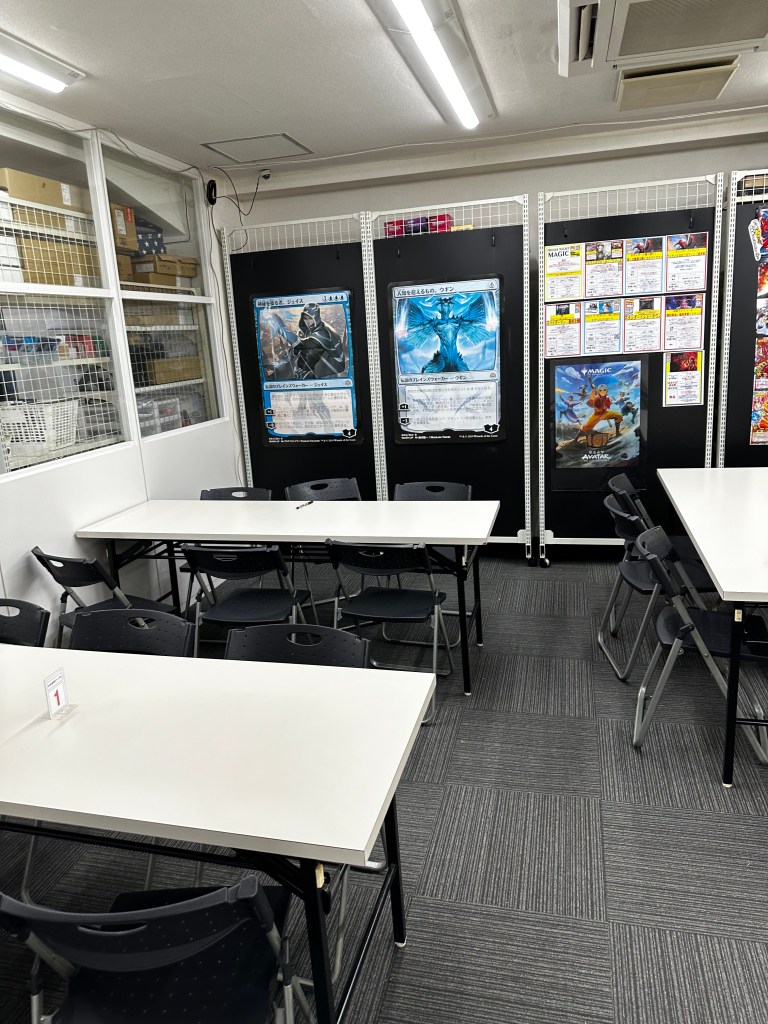
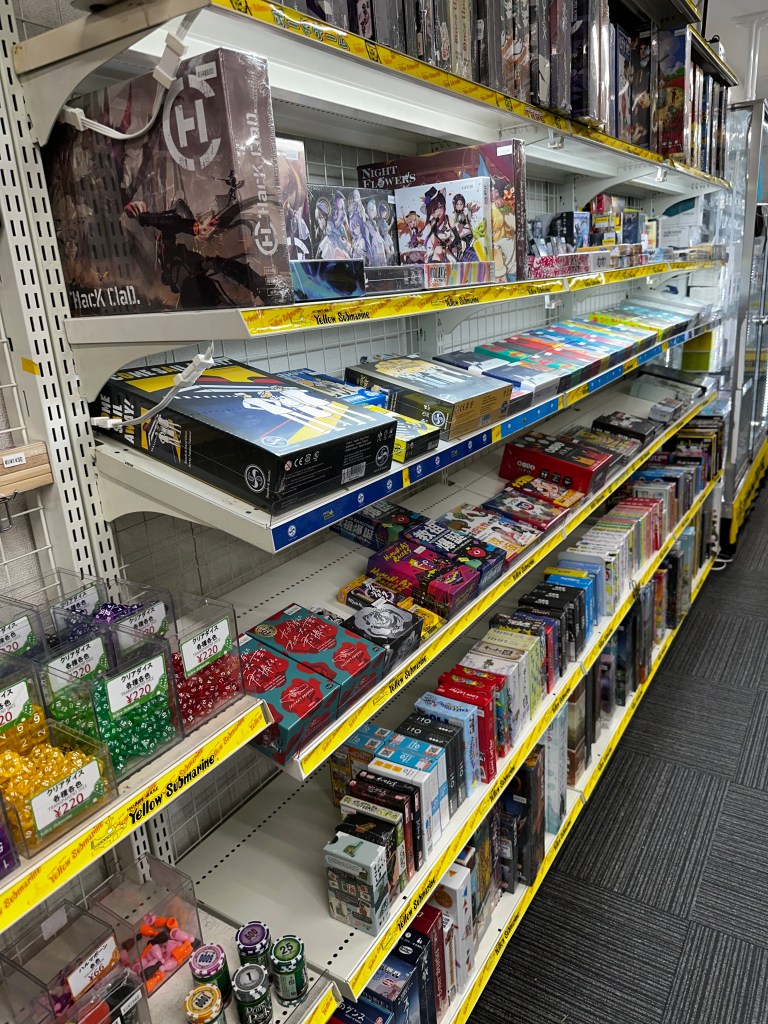
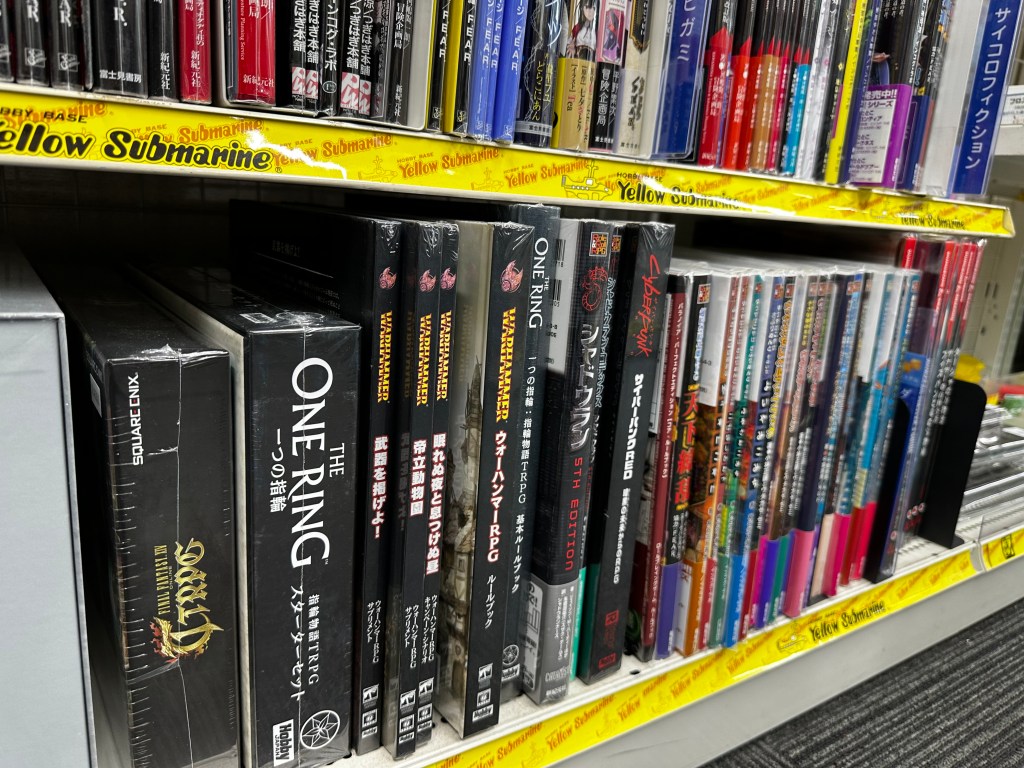
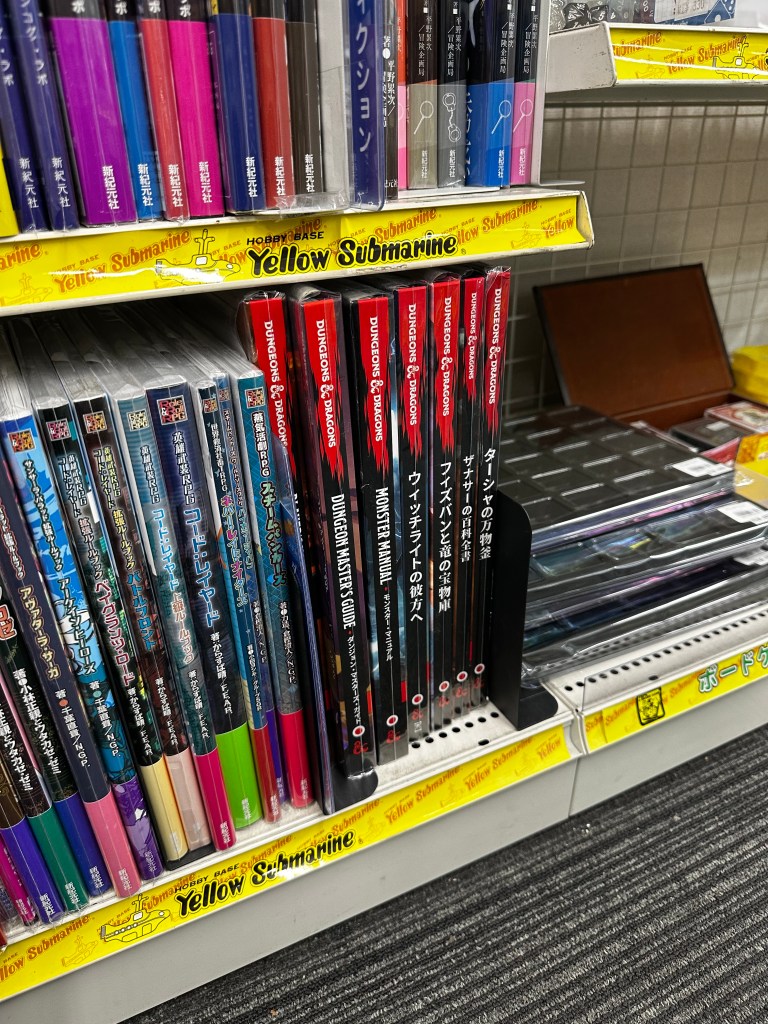
Anyway, I visited a branch of the Japan-wide chain of table-top and card game store, Yellow Submarine, while I was in Fukuoka for a couple of days. It was not easy to find! It occupied the third floor of a narrow building sandwiched in between a dentist and a beauty salon and it only opened at 12 pm, which seemed like a good idea, in fact. In addition to being, what appeared to be the only specialist store in the city, it also runs TCG games and tournaments in its decently sized play space. It was very quiet when I got there just after opening, which made it a bit easier for me to get some photos. The majority of the display areas were dedicated to glass cases filled with row after row of Pokemon, Digimon and Magic cards as well as several I had never heard of. It did have a small, but perfectly formed TRPG コーナー, or TTRPG Corner, though. Since it was so quiet, I got to spend quite a bit of time exploring it.

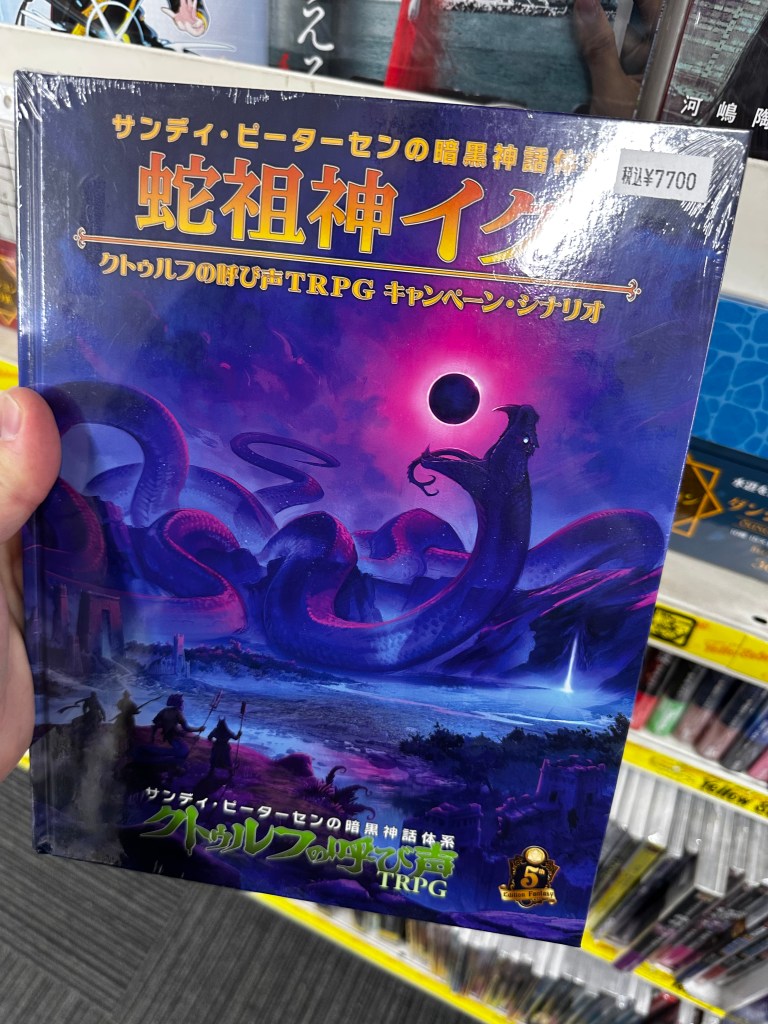
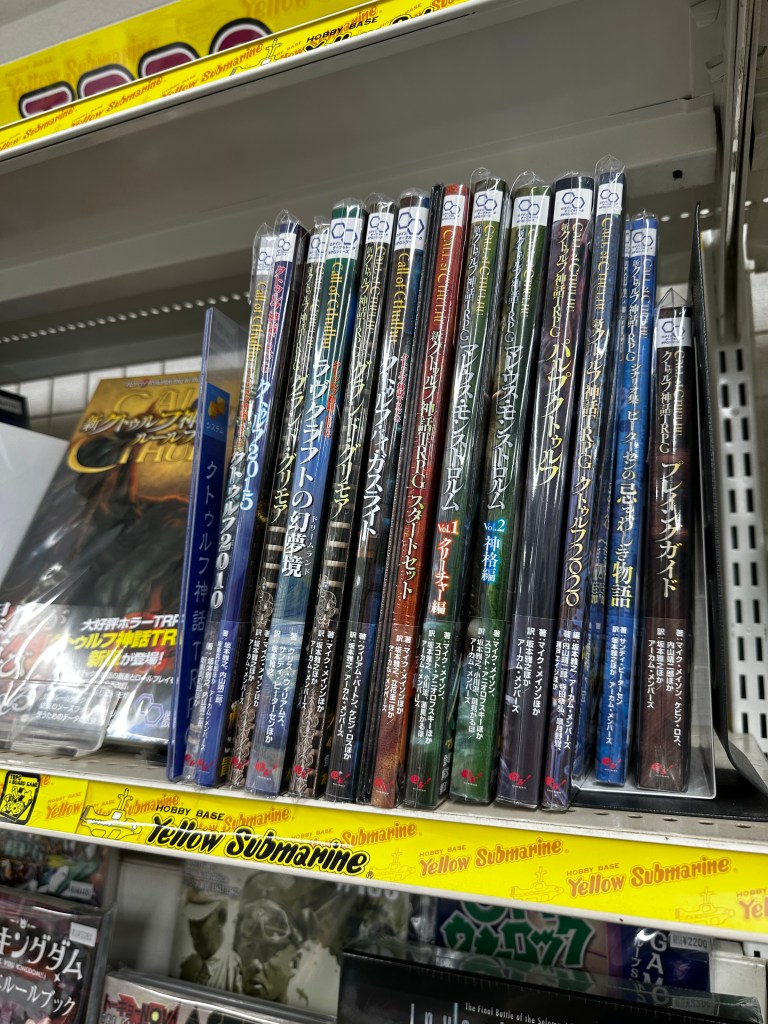
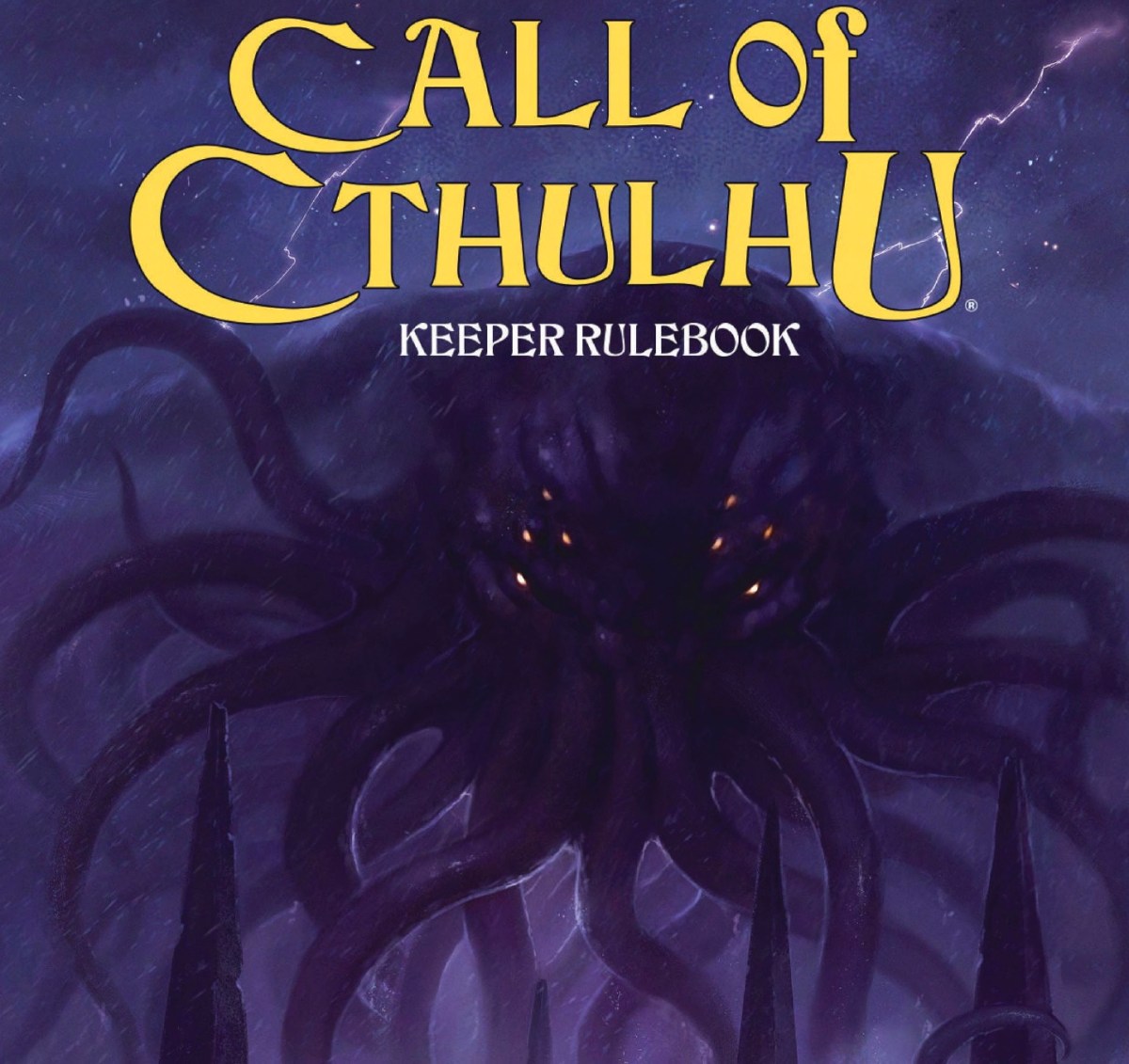
What I discovered, might, I think, surprise some Western TTRPGers. Call of Cthulhu is massive, it occupied pride of place, at eye-level (the buy-level, as anyone who has worked retail will be aware.) There were easily twice as many CoC books as there were for any other game and they looked so good. I wished I could have picked up the core book in Japanese but my suitcases were already creaking under the wait of the stuff I was taking home as it was. I did get a nice picture of the cover though. Look at that metal af artwork!

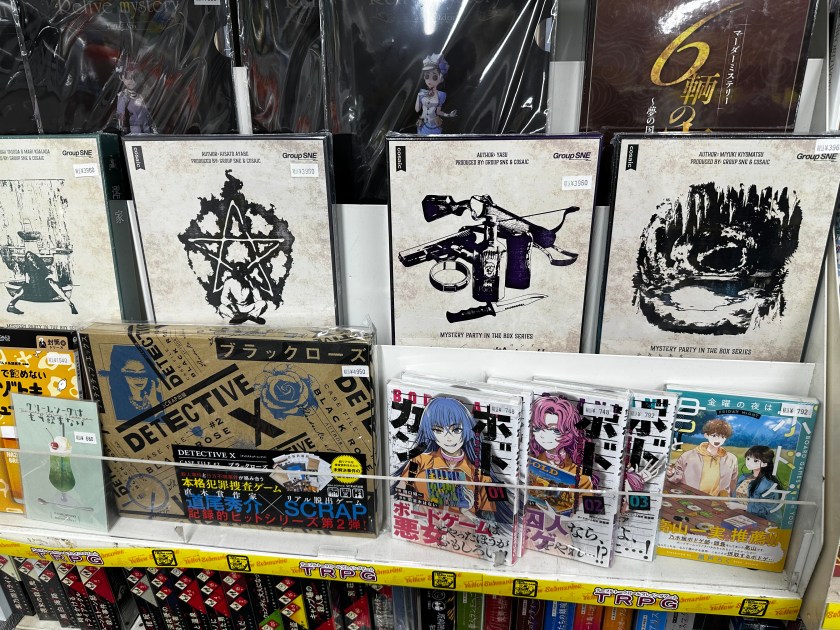
I think its a relatively well known fact, at this point, that Call of Cthulhu outsells most other RPGs in Japan quite substantially, in fact, but I wasn’t prepared for the amount of Jubensha on sale here. They were stocked in magazine racks and there was an impressive variety of them. They were not noticeably referred to by that term as far as I could tell, but I am not surprised by that. While we were in Japan, yet another spat broke out between the Japanese and Chinese governments over something relatively innocuous. Chinese people started cancelling holidays in Japan and the Japanese said they didn’t want them coming over anyway… This sort of thing goes on a lot and it’s no secret that there is generally no love lost between the two peoples who have had a troubled and violent history since the 19th century. So that’s why I was surprised to see the popularity of this Chinese LARP game format in Japan.

I think it’s also fairly well known that D&D and other such games has never done particularly well in Japan, despite numerous attempts by both TSR and Wizards of the Coast to push it. They had a massive publicity campaign for the most recent edition of the which involved this pretty incredible ad:

Maybe it’s doing better in other parts of the country, but in Fukuoka, 5E is relegated to the bottom-most shelf along with most of the other foreign games like the One Ring and Cyberpunk Red. Not only that, they didn’t have a single copy of any of the 2024 rulebooks. So, I’m guessing the ad campaign didn’t really work too well.

Meanwhile, the big Japanese fantasy adventure game, Sword World had a pretty generous degree of real estate on the shelves (I somehow managed not to take any photos of it, sorry!) It had a couple of editions there, the most recent of which has all the rules contained in a single tome (it usually comes in three books.) Once again, I really wanted to purchase it, but my bags objected. Luckily, it looks like there’s an English-language version in the works so I will be looking at backing that when it gets going.

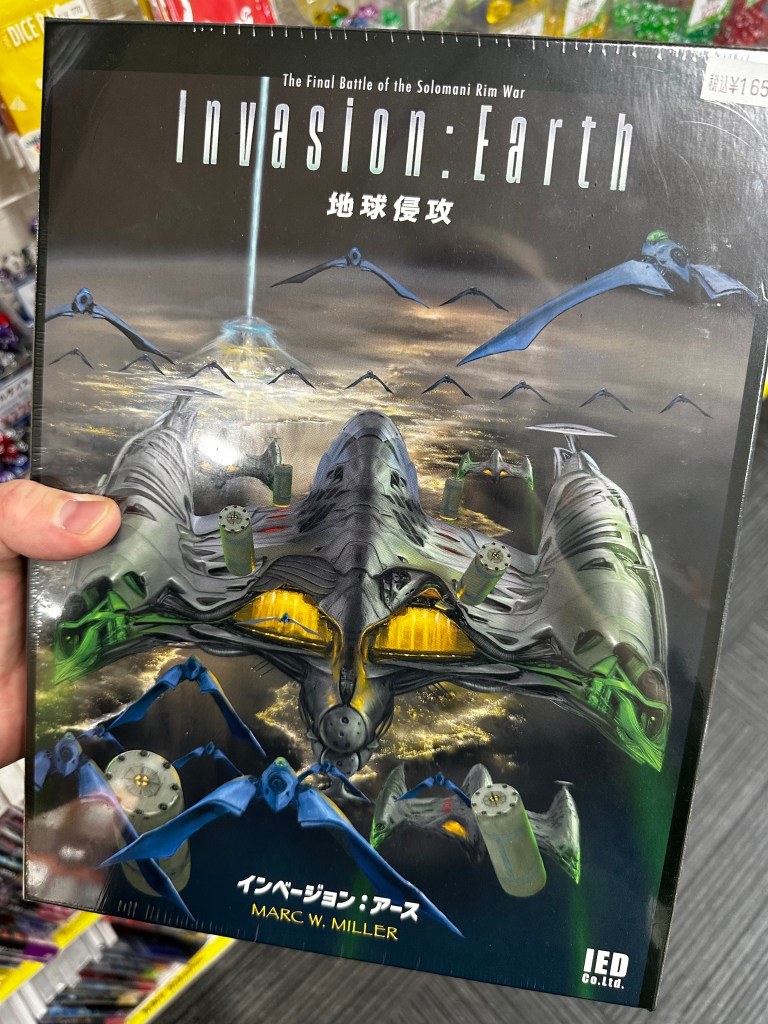
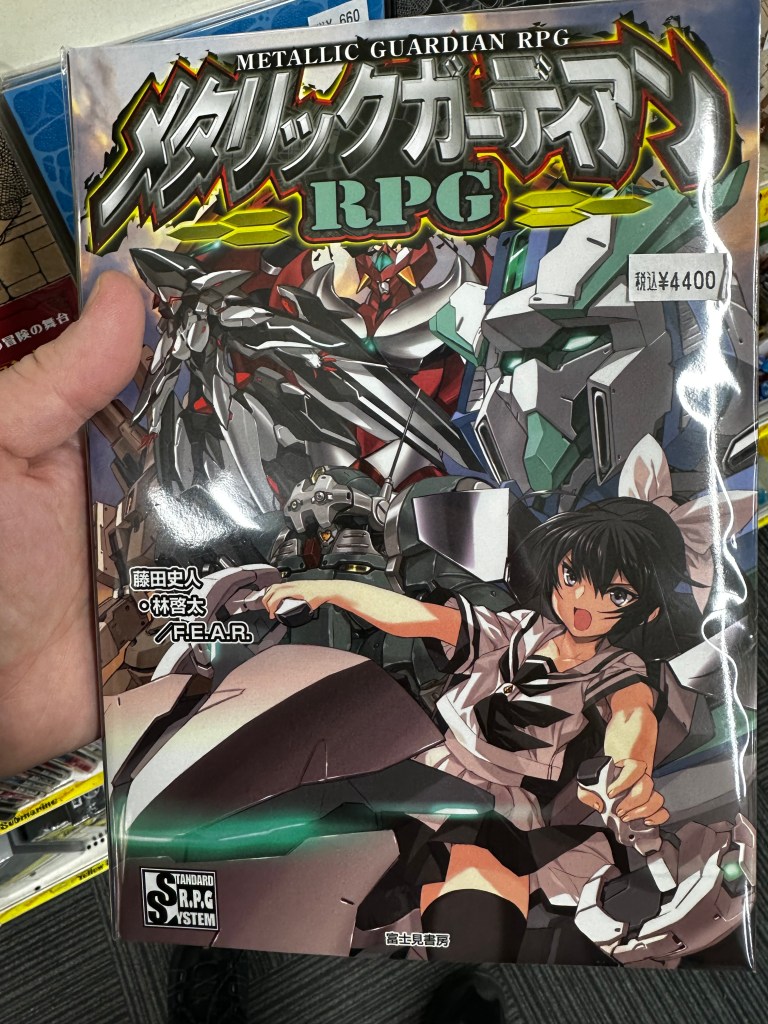
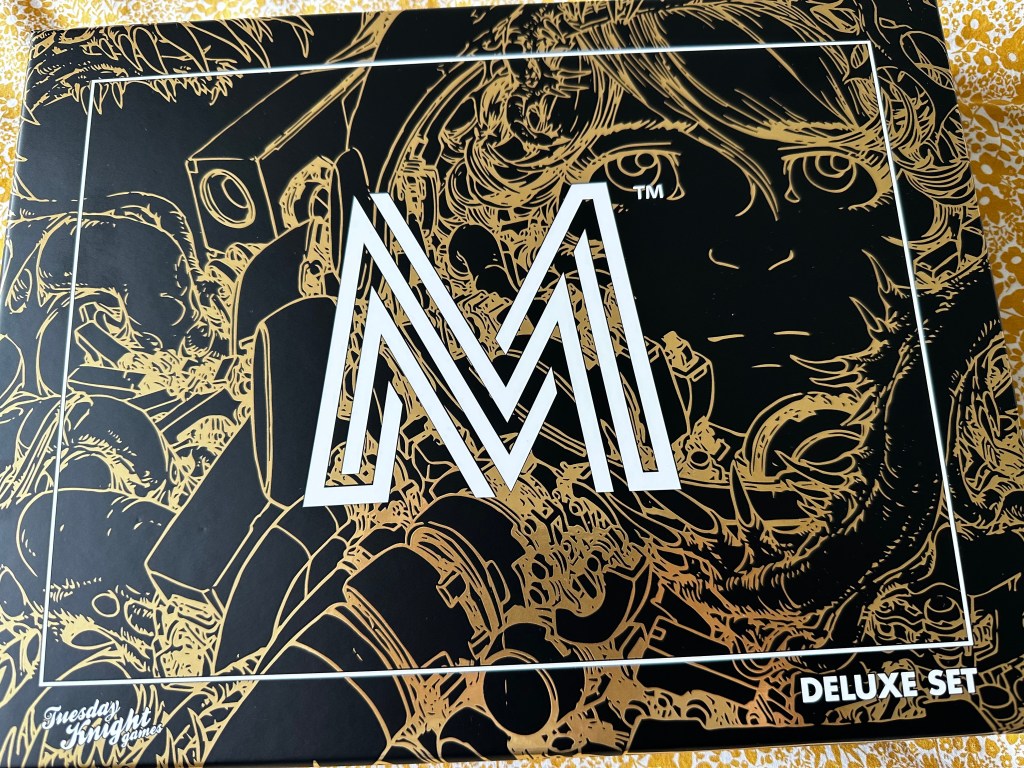
A very pleasant surprise was that there were just so many Japanese TRPGs here that I had never heard of. They have never been translated to English to my knowledge and they represent a bewildering variety of themes, genres, styles and rulesets. Please enjoy the small selection of covers in the gallery below that I was able to take photos of. I wish I had the time and the bag-space to buy more of these.

TRPG + Accessory Getto!

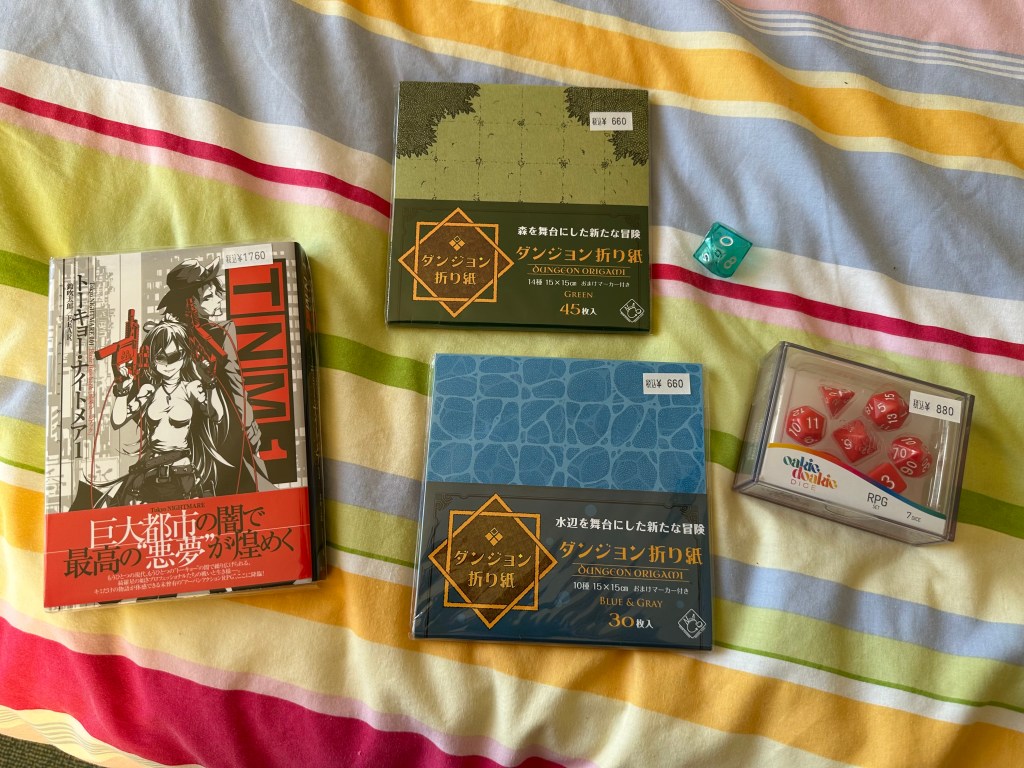
Here’s what I picked up for myself.

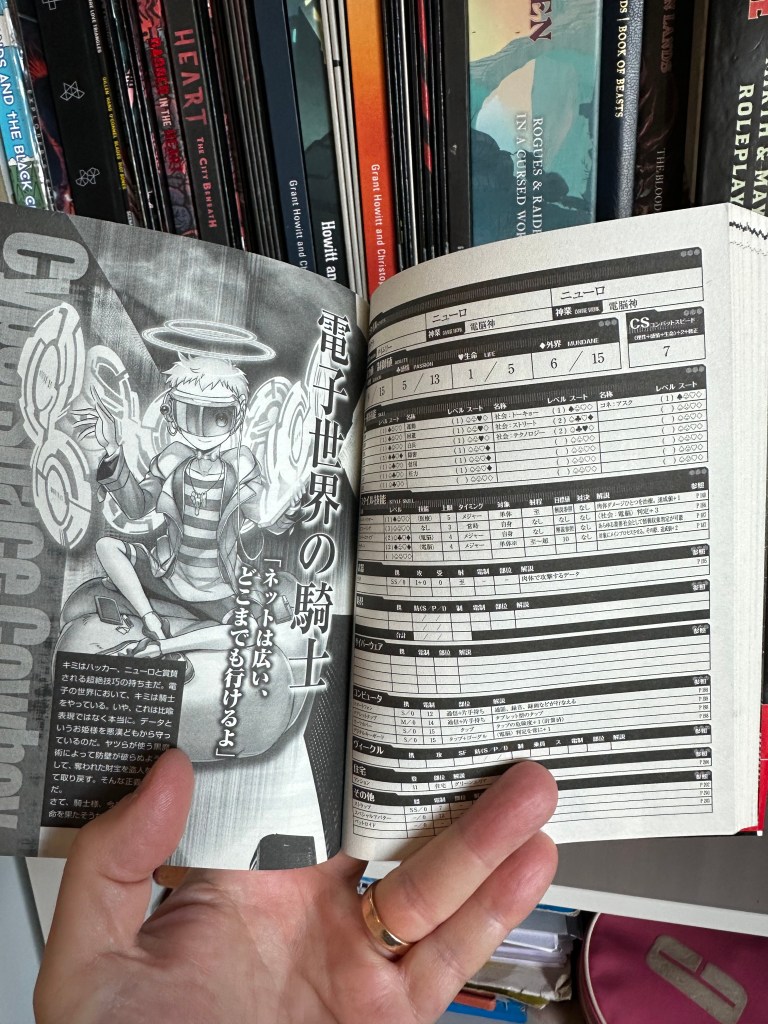
  • Tokyo Nightmare 001 Basic Rulebook – this is the rulebook for the Urban Action TRPG, Tokyo Nightmare, from now on referred to as TNM. It only cost about 1700 Yen (around £8.50 or $10.50.) There were a number of other books in this series but this one seems to have everything you might need to run a game of it. Contained in it are the basic rules, which are based, not on dice rolls but on playing cards. You also have a “Replay” section, which presents a comprehensive example of play. Interestingly, this is the first section of the book. After that you have the Rules Section, a World Section, a “Ruler” (that’s what they GM is called in this game) Section, a Scenario and several sheets including Character, Act and Battle. As a whole, TNM’s really interesting especially with its card-based rules and I’m looking forward to testing my Japanese language skills while exploring it. In fact, I was determined to get at least one RPG book from the start to help me improve my Japanese, which has been getting worse and worse for years.
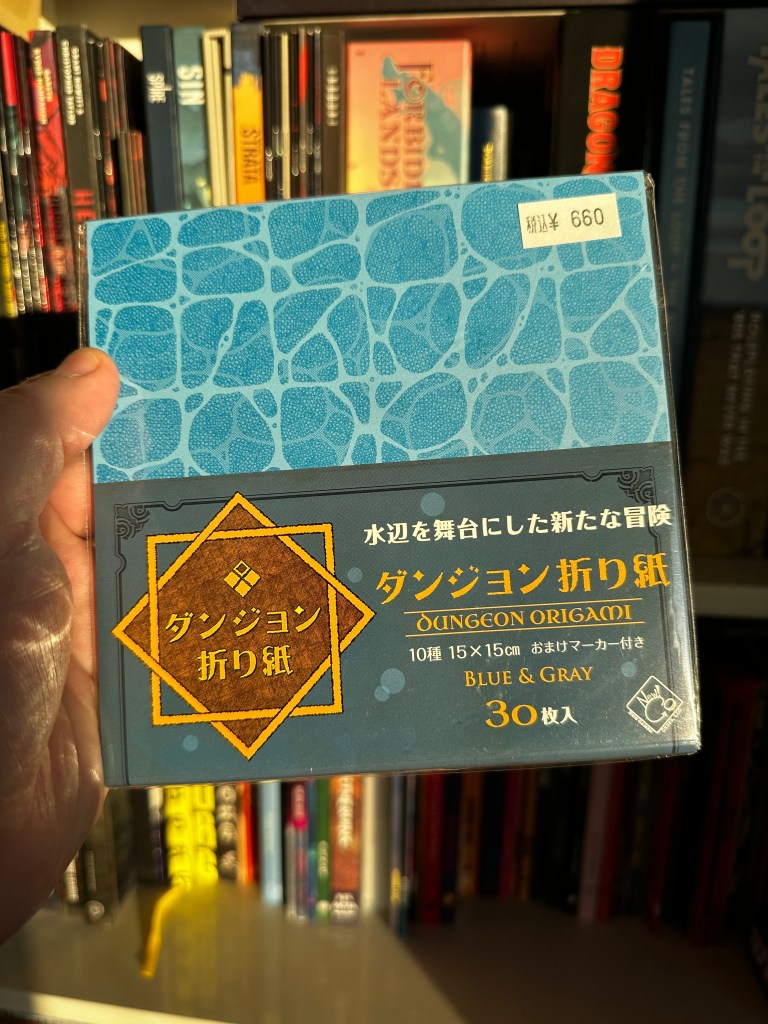
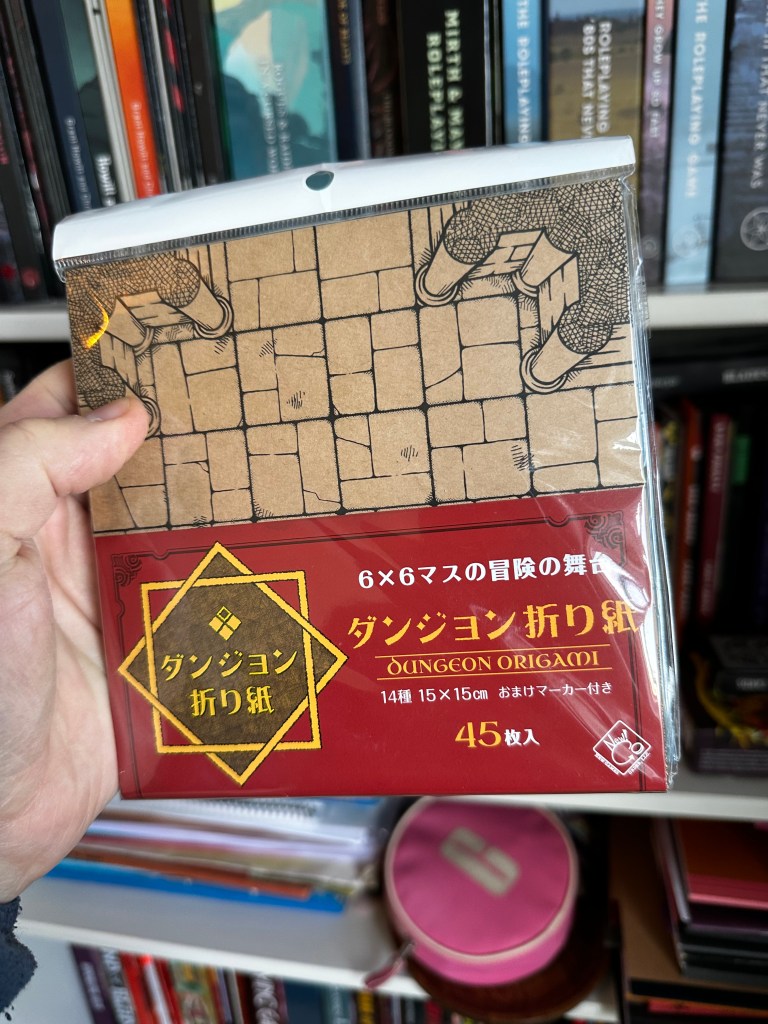
  • Dungeon Origami Tiles – I loved these things as soon as I saw them. I don’t use a lot of battle maps these days but these little collections of paper tiles that you can use to create maybe a randomly generated terrain or dungeon seemed so ingenious and cost-effective that I couldn’t resist. Each pack contains 45 sheets of top-down dungeon or terrain tiles. There are three or more copies of each tile in a pack, along with a thicker one with items (what they call markers) like logs and doors that you can cut out and place where you like. These are so versatile and useful I couldn’t believe they were so cheap! Only about 660 Yen per set! (that’s about £3.30 or $4.20!)
  • Cheap-ass red dice – These come from a German company call Oakey-Doakey Dice. They come in a plastic drawer that can be used as a case/dice tray in a pinch. Very handy and very cheap. Only 880 Yen (£4.40 or $5.60!) The d20, upon testing, however, is only good in roll-under games.
  • An incredibly clever d100 – There is a little d10 inside the bigger, transparent d10. Much less unwieldy than using one of those baseball sized d100s that actually has 100 sides, if you want to make a roll with a single die.

Conclusion

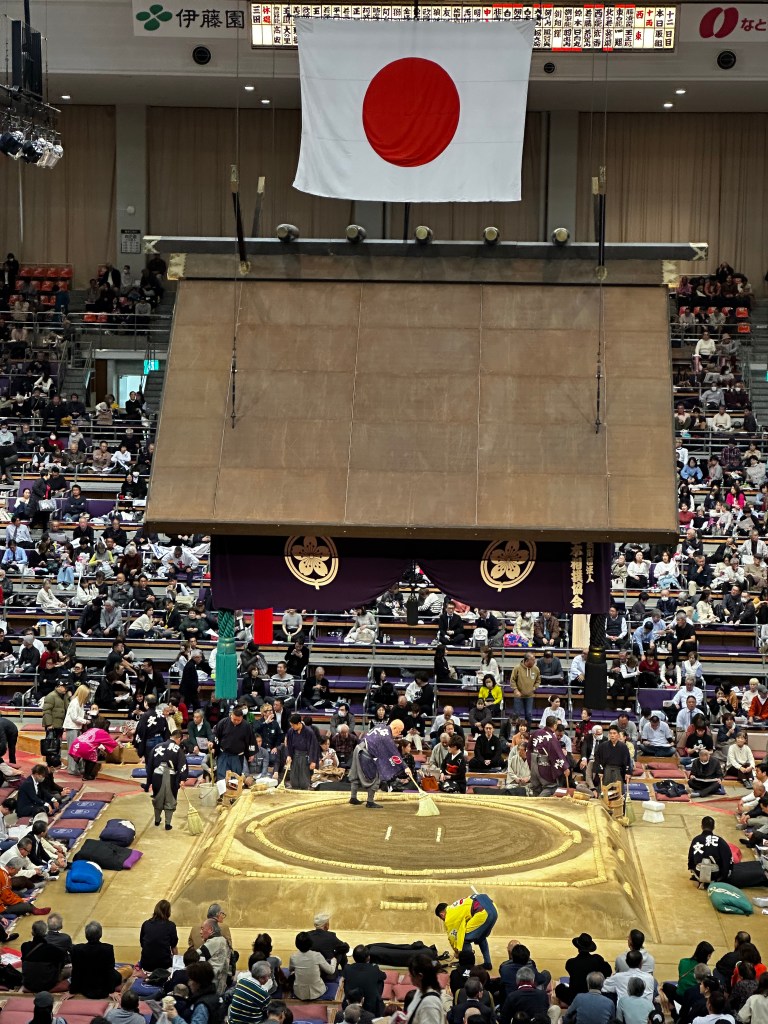
I’m going to be moping around dreaming of Miyajima, Katsu Curry and Sumo for the next couple of weeks, but at least I’ll have these few meagre Japanese TRPG items to cheer me up and keep me busy for a while.

I hope you enjoyed my report on a trip to a Japanese FLGS, dear reader! What’s your experience with Japanese role playing games, if any? And what do you think of them?

Answering the Call of Cthulhu

Seasonal Event

Our local RPG community, Tables and Tales, has just kicked off a month-long event to help introduce some of our newer members to the joys of halloween/spooky/goblin themed games through the timeless medium of the one-shot horror in which you play some dreadful miscreant and revel in their inevitable and total annihilation.

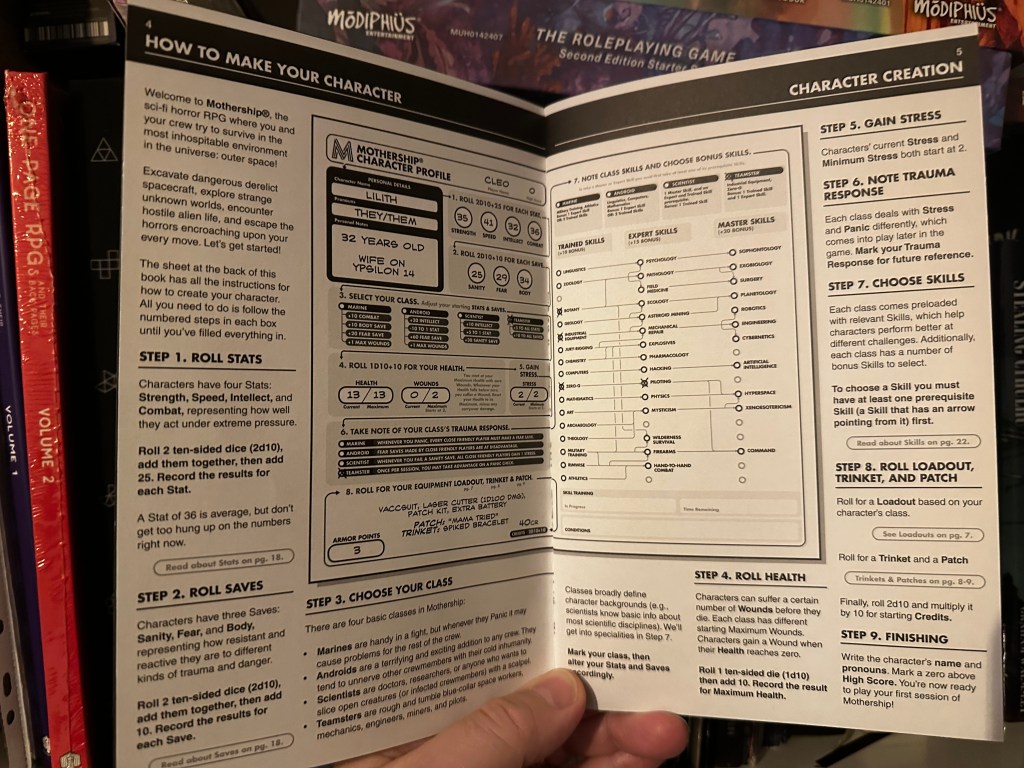
So far so good! We kicked things off last night with Another Bug Hunt, Mothership’s introductory scenario, immediately breaking with the format for the event by not finishing it in a single session. Following rules is for squares, says our Warden, Isaac. I’m playing an absolutely jacked exobioligist who should not have been trusted with the submachine gun he was issued for the mission. None of the PCs have died yet, although, the NPCs haven’t been so lucky.

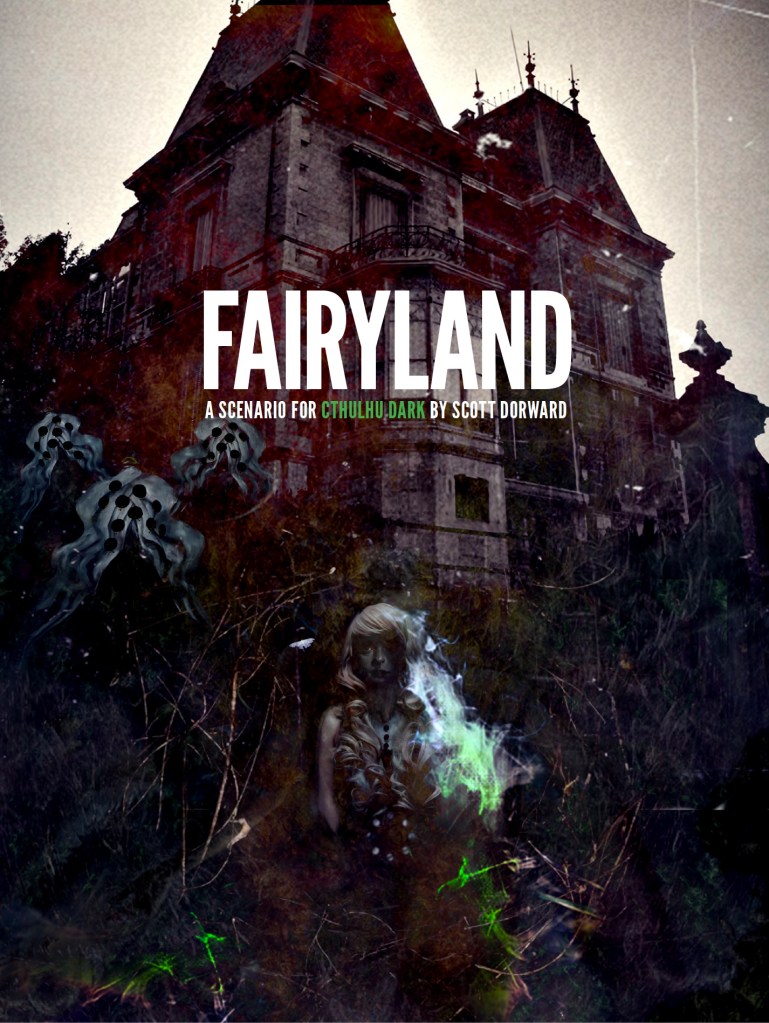
We have a few more sessions lined up in the coming weeks, Shannen is acting as the chaperone for Goblin Prom which is a Honey Heist hack that’s pretty much exactly what it sounds like. Tom is planning a Thirsty Sword Lesbians one-shot with a creepy flavour too! I have a couple of games lined up for the event. Later in the month, I’ll be facilitating the move of the family Balfour to the Scottish Borders in the late 19th century for Scott Dorward’s excellent Cthulhu Dark scenario, Fairyland (check out the actual play run by Dorward himself on the Ain’t Slayed Nobody podcast here. It’s one of my favourites.) But before that, I’ll be acting as Keeper for the first time in a Call of Cthulhu game.

The Game

Push the Roll with Ross Bryant

Call of Cthulhu is a phenomenon. A horror game made by Chaosium and based on the works of HP Lovecraft, its been around almost as long as RPGs have and has had an enduring legacy and impact on not just the TTRPG space but the wider culture in general (although I understand that it is difficult to truly assess its cultural effects separately from its literary inspirations.) It’s the single most popular TTRPG in Japan and it has a dedicated following and niche actual play market that seems to have been thriving in recent years. You should check out the brand spanking new and fully improvised Push the Roll with Ross Bryant as soon as possible. Isaac and Tom have run several scenarios for us, which have gone down as some of the founding lore of our RPG group. And yet, I have never run a session of it.

I’m going to change that next Friday. Honestly, I think my interest in doing this is largely down to Mr Bryant’s new podcast, which I’ve been eagerly devouring. As a pretty traditional game, it’s a little crunchy but when you listen to the podcast, you get the impression that the mechanics can be left behind if and when they get in the way, especially with an enthusiastic and role-play-focused party. I remember getting frustrated with the truly execrable skill scores of my PCs in past CoC games until I realised that was by design. As ordinary civilians facing up against the terrifying reality of cosmic horror, you are supposed to fail and there are supposed to be serious consequences for those failures. That is what makes it horror. Well, that and the Sanity rolls. So, the mechanics can also be used to reinforce the themes of the game, when they need to. If you want fantasy heroes, you’re in the wrong place. If you want the thrill of terror when confronted by your inevitable and immediate doom, Call of Cthulhu is the game for you. Listening to Push the Roll has given me the taste of that again so I thought it was about time I put myself on the obverse of the Keeper’s screen to see what that felt like.

The Scenario

The cover of Petersen's Abominations showing a mouthy and betentacled horror alongside several tv screens showing the faces of people.
Petersen’s Abominations

My Call of Cthulhu library isn’t huge so I went out to my local game shop, Replay and picked up the anthology of short scenarios, Petersen’s Abominations written by Sandy Petersen, the creator of the Call of Cthulhu roleplaying game. It’s a nicely presented book with five “tales of modern horror.” This is one of the reasons I chose this anthology. I have been craving a game set in the modern world recently, and this scratches that itch. It also contains a set of pregenerated investigators for each scenario. This is a pre-requisite since I have so little time to work with. Finally, there is a nice selection of player facing maps and handouts in the back of the book for every adventure.

I chose the Derelict, for my one-shot. I decided on this one for a few reasons. First, it seems like the one I could most reliably start and finish in a single session of three hours or so. Second, I love the pregens presented for it because I think the players will easily get into them. Finally, the setting, a luxury yacht sailing the North Atlantic, is unique and I know its enticing for a couple of the players so it’s good for sign-ups!

The premise is a simple one: the yacht’s owner, a stock-broker (see my opening paragraph!) who lost his fortune in the 2008 financial crisis (its set in that time-period) is taking his rich and famous friends on one final voyage on the Delilah. He’s taking it to Liverpool to sell it. But on the way, they encounter the Derelict… I don’t want to give too much away at this stage in case my players decide to read this, but I’ll be back afterwards for a full report!