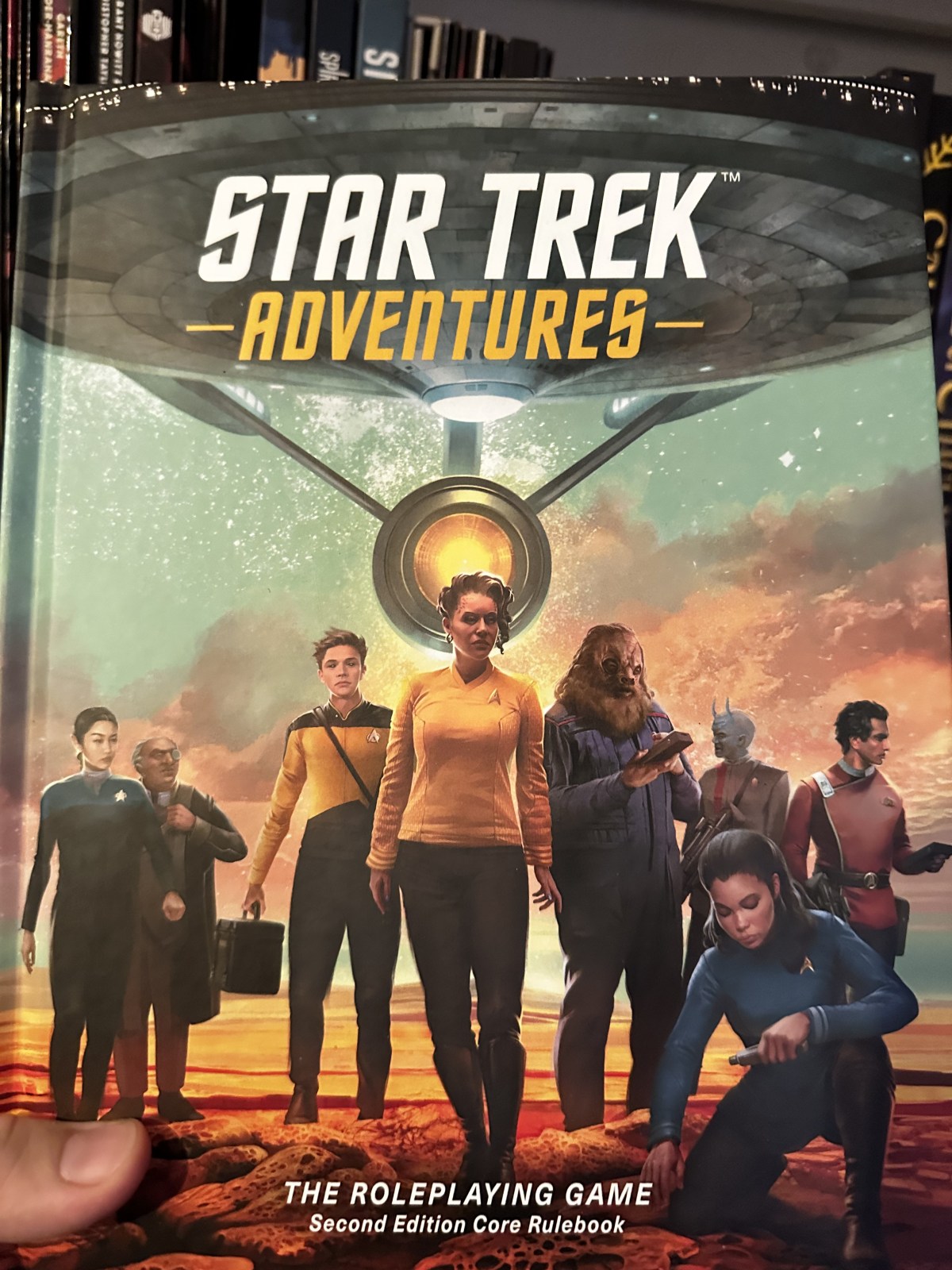
Star Trek Adventures 2E Character Creation

Boldly Going

Dear reader, if you have been around here for a while, you might be aware that I have an interest in Star Trek. I don’t know if I’m what you would call hardcore, but I am currently in the process of watching every episode of every Star Trek series I can get my hands on. I started more than a year ago on Star Trek The Next Generation and never intended to branch out of the TNG era. I continued watching Deep Space 9 and Voyager. As I approach the end of that series, I have found myself unwilling to give up just yet, so I’ve gone back to the Original Series as well. I’d seen a lot of them before. TOS was required watching in my house when I was a kid and I can vividly remember rushing home to watch TNG after school as a teenager. Anyway, I have more than a passing knowledge of the TV shows and movies, the universe, the tropes and the types of stories that Star Trek tackles. And yet, I had never played a Star Trek RPG! Since I have been on this marathon rewatch recently and because I picked up Modiphius’ Star Trek Adventure 2E in their Summer sale, I thought it was high time I rectified that.
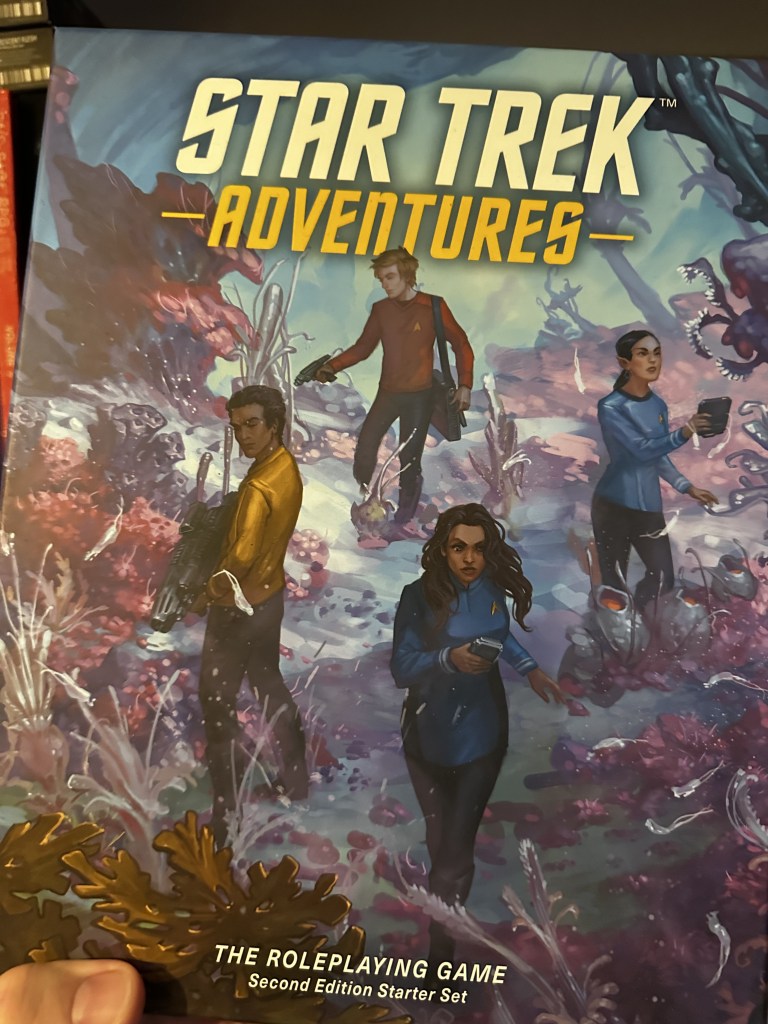
The cover of the Star Trek Adventures 2E Start Set Campaign Book. A variety of TOS era characters are gathered performing investigative tasks on a planet's surface.
Star Trek Adventures 2E Starter Set

A review of the system, the game, and our campaign will follow in the future. We have only had two sessions so far, so I don’t want to jump the gun. Today, instead, I thought I would do a character creation post. Haven’t had one of them in a while, and they always prove quite popular. Also, since we are playing the campaign from the Starter Set, we are using pregenerated characters from that. The pregens are great, but, using them means I have not experienced the joys of character creation in this system. It always teaches me a lot about a game, so I think this will be a worth-while exercise.

Player Characters
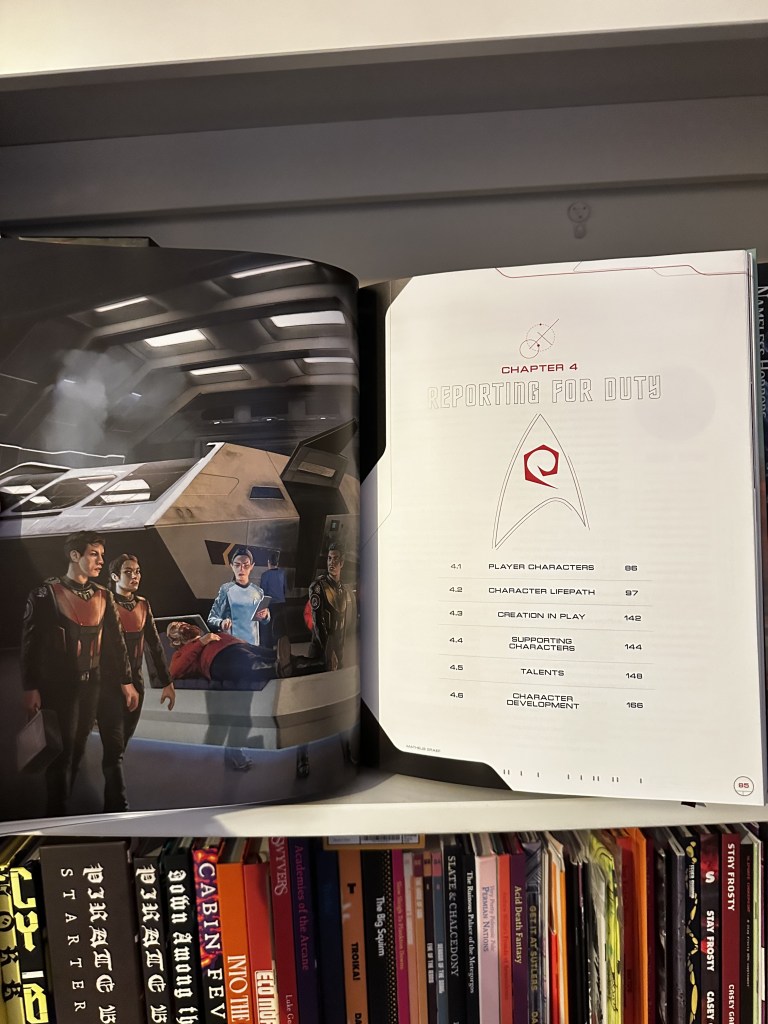
Reporting For Duty Chapter two-page spread.  Illustration of a number of crewmembers escorting an injured crewmember on a gurney through a shuttle bay.
Reporting for Duty

Chapter 4.1 begins with an explanation of the types of player characters in Star Trek Adventures. These are split between Main Characters and Supporting Characters. Imagine the Main Character as being your regular PC, a member of the Starship’s bridge crew. Someone like Mr Sulu or Commander Riker, Supporting Characters, on the other hand, are created when needed. They might be a relatively random red-shirt who the players need to march off to investigate a suspicious crater on an alien moon or a transporter chief who needs to modify the transporter to beam back the away team full of Main Characters on the planet’s surface.

Next we have a look at the building blocks that go together to construct a character in this game:

  • Traits – a word or phrase that describes the essence of the character. Generally these would be things like Vulcan and Star Fleet Officer
  • Values – a few brief sentences that describe what your character believes, treasures, and thinks. They should guide roleplaying more than any other aspect of the character
  • Attributes – In this game these are:
    • Control
    • Daring
    • Fitness
    • Insight
    • Presence
    • Reason
  • Departments – These represent the general roles that Star Fleet officers might encompass. They are the areas they would be trained in. You add an Attribute value to a Department value to come up with the Target Number for you to roll equal to or under on 2d20 to complete tasks. That’s the core mechanic for this and other Modiphius games, Here’s the list of Departments:
    • Command
    • Conn
    • Engineering
    • Security
    • Medicine
    • Science
  • Stress – Like in Blades in the Dark, this is a Star Trek Adventures character’s super-power. If they ever want to avoid an injury, they can choose to take the equivalent amount of Stress instead and keep going. This is particularly important in a system where gaining an injury leads to the PC being Defeated, and essentially out of play.
  • Focuses – these are your character’s specialisms. A Main character has 6 of these
  • Talents and Special Rules – These are special benefits that are often selectable by members of particular species or by characters with certain departments above a specific rating. They can bestow bonuses of several kinds. Other special abilities are Species or Role specific.

Lifepath or Creation in Play
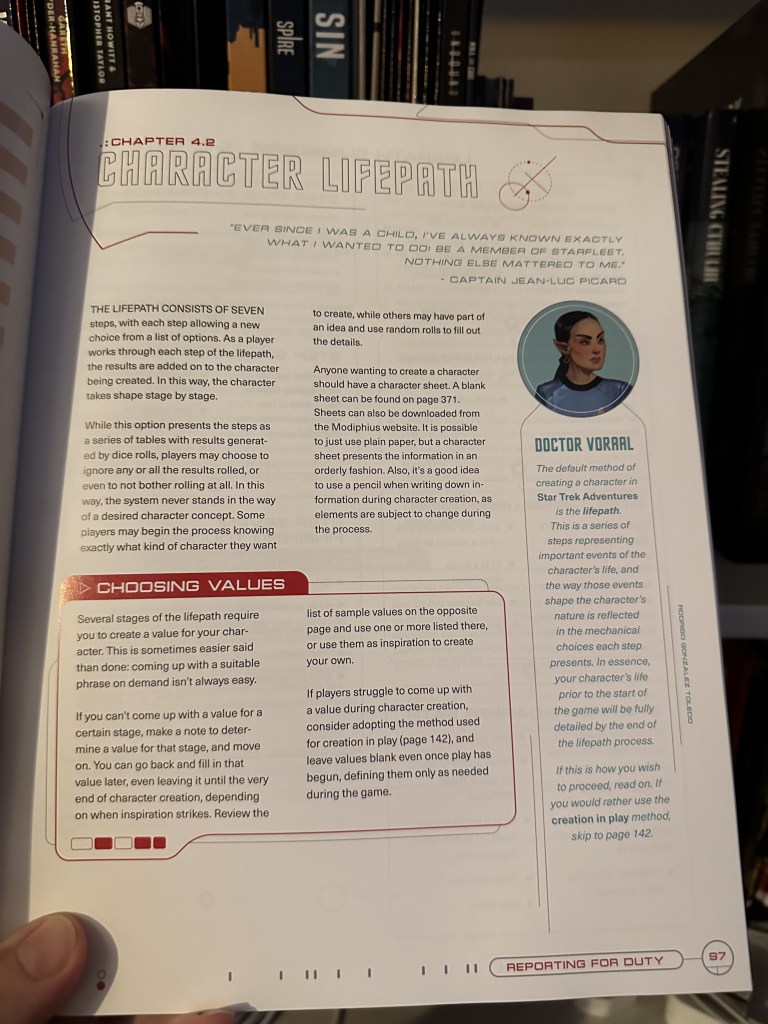
Star Trek Adventures presents the player with two options for character creation. The first, and most detailed, is the Lifepath method. It’s difficult not to think of the Traveller character creation method as a major influence on the choice of the designers to include this as the default option. It’s highly detailed, provides a wealth of tables to roll on or choose from and allows for the creation of the type of character you didn’t know you always wanted. Traveller, the OG space exploration sci-fi game, was doing doing this decades before anyone else, of course.

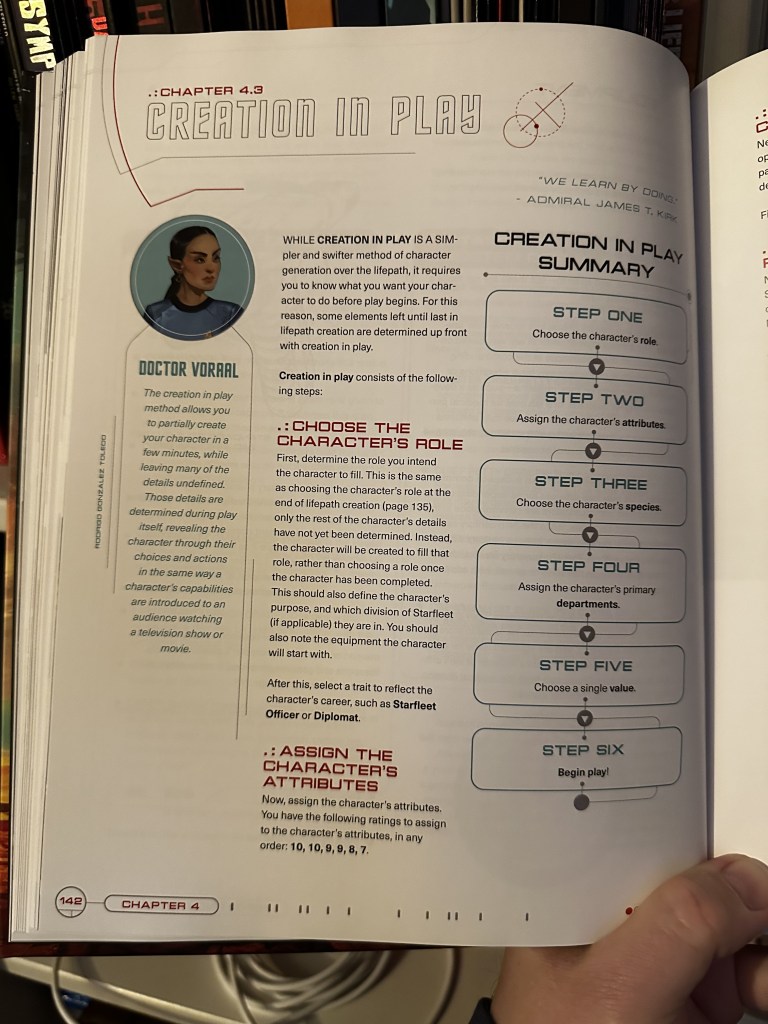
The other option is called Creation in Play. This simplifies the character generation system for those who already have a clear idea of the character they want to play and just need to construct them with stats etc.

It’s my habit is to create characters in as random a method as possible. As such, I have no choice but to go Lifepath here.

The Game of Life(path)

This is split handily into seven steps.
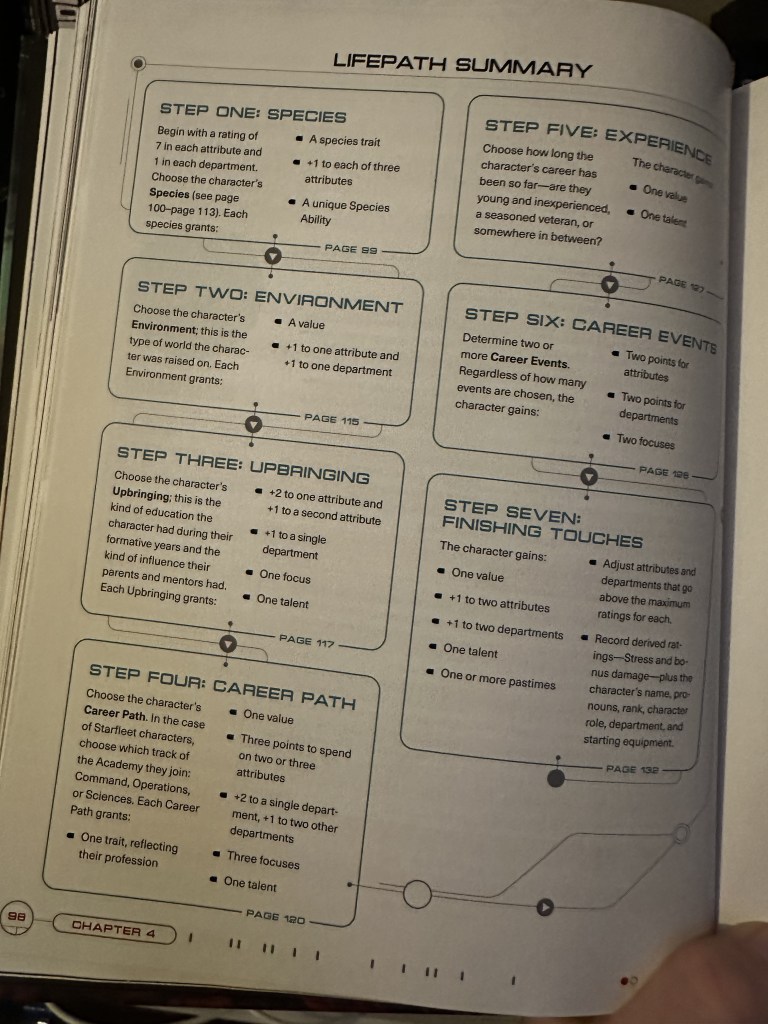
The steps of the Lifepath Creation method.

Step One: Species

You can ostensibly choose any species you can think of from the Star Trek universe, bearing in mind the species who have been contacted by Star Fleet during the era you want to set your game in. So, no Jem’Hadar in the TOS era, for instance. But, they have provided a one-pager on each of the major species from across multiple Star Trek shows, so I think it would be crazy not to choose one of those. Now, since the game I’m currently playing is set in the time of Captain Kirk’s famous five-year mission across the galaxy, I think I will choose to go for a TNG/DS9/Voyager era character. I have a much deeper knowledge of that time anyway. Also, it allows for far more options since many of the species listed are enemies of the Federation during that TOS era. There are 14 species to choose from so I’ll roll my DCC d14 for this:

  1. Andorian
  2. Aenar
  3. Bajoran
  4. Betazoid
  5. Cardassian
  6. Denobulan
  7. Ferengi
  8. Human
  9. Klingon
  10. Orion
  11. Romulan
  12. Tellarite
  13. Trill
  14. Vulcan

I got a 10! That’s Orion. An Orion appeared in the very first pilot of the the Original Star Trek show, but they have had more prominent roles in more recent ones like Discovery and Lower Decks.

They are green-skinned humanoids who are known as traders. The Orion Syndicate is an infamous criminal organisation that spans half the galaxy, also, so they come with some baggage.
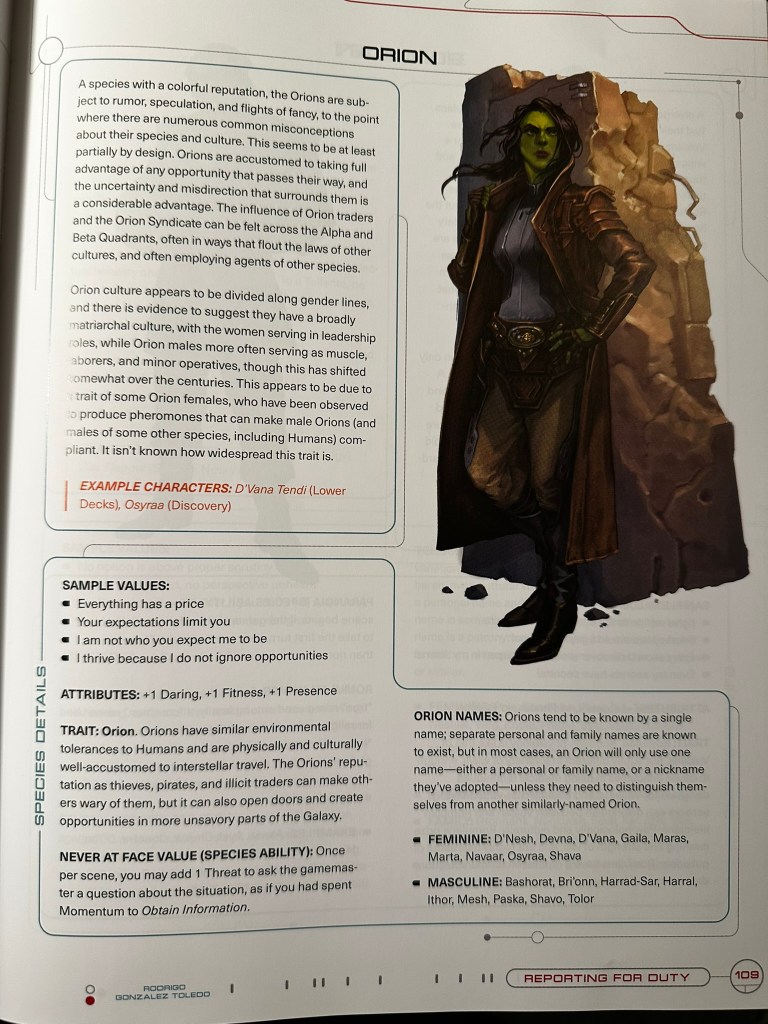
Orion Page
Orion Page

Now that I know the Species I can start building my character

Every PC starts with a rating of 7 in each attribute and a rating of 1 in each department. But an Orion character starts with a +1 in Daring, Fitness and Presence. So here are my attributes at this stage:

- Control - 7
- Daring - 8
- Fitness - 8
- Insight - 7
- Presence - 8
- Reason - 7

They also gain the following trait:

Trait: Orion – Orions have similar environmental tolerances to Humans and are physically and culturally well-accustomed to interstellar travel. The Orions’ reputation as thieves, pirates, and illicit traders can make others wary of them, but it can also open doors and create opportunities in more unsavory parts of the Galaxy.

And the following Species Ability:

NEVER AT FACE VALUE (SPECIES ABILITY): Once per scene, you may add 1 Threat to ask the gamemaster a question about the situation, as if you had spent Momentum to Obtain Information.

That’s a handy little ability.

Step Two: Environment

There’s a table for the environment your character grew up in:

D20 ENVIRONMENT
1–3 Another Species’ World
4–6 Busy Colony
7–9 Frontier Colony
10–12 Homeworld
13–15 Isolated Colony
16–18 Starship or Starbase
19–20 Roll Again or Choose

The text of the section provides a short description of each of the options in the table, but it’s fairly self-explanatory, I think.

Anyway, I rolled a 12, which gives me “Homeworld.”

I need to choose a Value at this stage. Since several sample Values were provided in the description of the Orions as a Species, it seems right to take one of those for a personal from the Orion homeworld.

First Value – I thrive because I do not ignore opportunities.

On top of that, I get to add 1 to one of the attributes I improved when I settled on Orion as a species. I’ll add to Presence, making it a 9.

Finally, in the Environment step, I can add 1 to Command, Security or Science departments. I am beginning to see a potential role for this character so I will choose to add it to Command, making that a 2.

Step 3: Upbringing

It is interesting here that you can choose to either accept or rebel against your upbringing, and this will have a material effect on the character.

Here’s the table:

D20 UPBRINGING
1–3 Agriculture or Rural
4–6 Artistic and Creative
7–9 Business or Trade
10–12 Diplomacy and Politics
13–15 Science and Technology
16–18 Starfleet or Military
19–20 Roll Again or Choose

That’s a 1. Agricultural or rural. I think there is no doubt that this character rebelled against the life of a hydroponics farmer in the hinterlands of the Orion homeworld. They fled to the cities and the stars at the first opportunity.

Given that choice, they get to increase their Presence by 1 point again, making it 10. They also get to add 2 to Reason, bringing it to 9.

Next, they can increase one of the following departments by 1: Conn, Security or Medicine. I think they should be a good pilot. So Conn increases to 2.

I get to choose a Focus at this stage as well. They provide several examples that suit the upbringing. I’m going to choose Navigation as my first Focus.

This step also provides access to a talent. But you are given the option to wait until the end of character creation to choose it, so I’m going to do that since many of the talents have strict attribute requirements that this character cannot fulfil at this stage.

Step Four: Career Path

This is the most important step in building a character for Star Trek Adventures.
So, normally, I would make a roll for every aspect of a character I make on the blog, but, I have a clear idea of this PC being a Command track Star Fleet Officer. It is possible to roll for this. Here are the tables, if you’re interested in what else is available:

D20 CAREER PATH
1–4 Starfleet (Officer)
5–8 Starfleet (Enlisted)
9–10 Starfleet (Intelligence)
11–12 Diplomatic Corps
13–14 Civilian (Physician)
15–16 Civilian (Scientist)
17–18 Civilian (Official)
19–20 Civilian (Trader)

D20 TRACK
1–6 Command
7–12 Operations
13–18 Sciences
19–20 Roll Again or Choose

But, as I mentioned, I have already made the choice. Here’s what I get for my Orion character on the Star Fleet Command track Career Path:

  • Trait: Starfleet Officer
  • Value: The Prime Directive is there to remind us we are not gods and should not act like them. (This is one of several examples provided here. I like it as a stepping stone for the PC.)
  • Attributes: 3 points to be split between two or three attributes. I am choosing to add 2 to Control (now 9) and 1 to Daring (now 9.)
  • Departments: +2 to either Command or Conn and +1 to any two others. Can’t have any department over 4 at this stage. I’m going to top out Conn at 4, and I am going to make Command 3 and Security 2.
  • Focuses: These should reflect the Command track. I’m going to choose Inspiration, Persuasion and Helm Operations
  • Talent: another talent. Still saving these up till the end

Step Five: Experience

There is no table to roll on this time. I must choose Novice, Experienced or Veteran. I think my Orion is a brash young go-getter, so I will choose Novice.
Here’s what the Novice gets:

  • Value: I must prove myself (once again, chosen from some examples)
  • Talent: I receive the Talent, Untapped Potential
    • This means I can’t have any attribute above 11 or any department above 4 but when it has the potential to gain you extra Momentum during play whenever you succeed at a task.

Step Six: Career Events
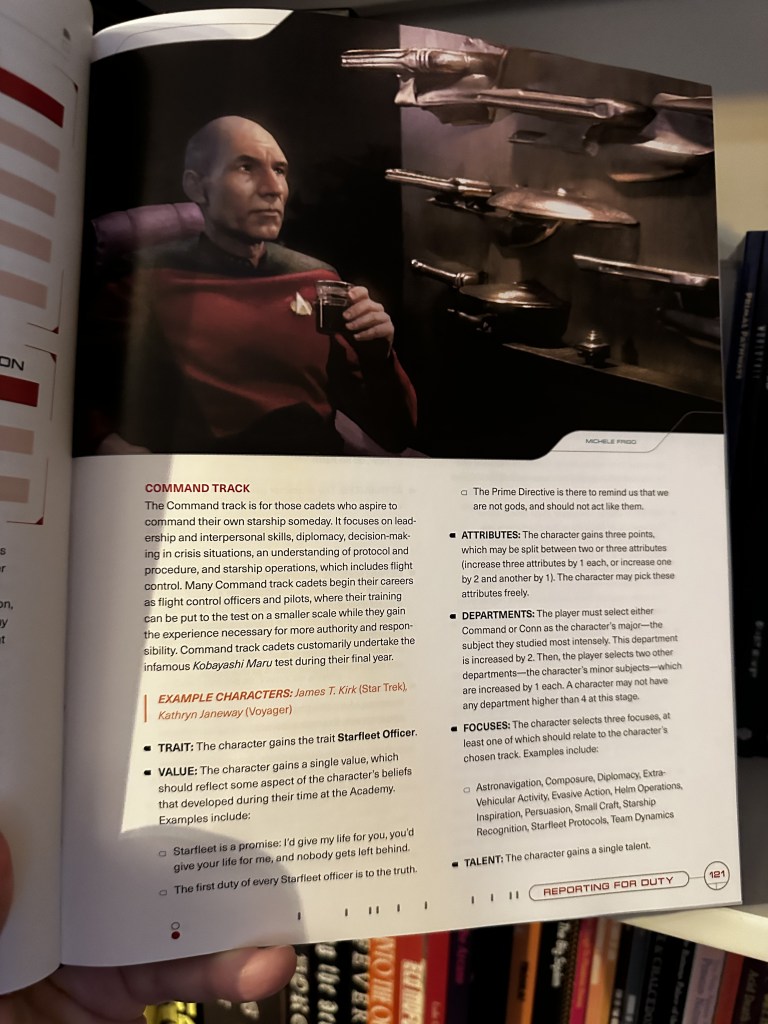
Captain Picard overseas the Command Track.

You get two major career events that are likely to have shaped the character. There is a table for this that I can roll on twice. Here’s the table:

D20 CAREER EVENT
1 Betrayed Ideals for a Superior
2 Breakthrough or Invention
3 Called Out a Superior
4 Conflict with a Hostile Culture
5 Dealt with a Plague
6 Death of a Friend
7 Discovered an Artifact
8 Encountered a Truly Alien Being
9 First Contact
10 Lauded by Another Culture
11 Learned Unique Language
12 Mentored
13 Negotiated a Treaty
14 New Battle Strategy
15 Required to Take Command
16 Serious Injury
17 Ship Destroyed
18 Solved an Engineering Crisis
19 Special Commendation
20 Transporter Accident

I got a 15 – Required to Take Command for my first one.
In this case, since my PC is a novice, I am imagining a scenario in which their instructor at the academy was gravely injured in a shuttle crash during a training exercise. My PC was the first to get the situation under control and co-ordinate the efforts of the other cadets to repair the ship, call for rescue and stabilise their instructor.

Gains:
Attribute: +1 Daring (now 10)
Department: +1 Command (now 4)
Focus: Composure

Second roll, 10 – Lauded by Another Culture.
On their first mission, my Orion was involved in the rescue of a Ferengi trading vessel. On board the drifting ship, they managed to restore power, save the lives of the Damon and his crew and even brokered a profitable deal between them and the Federation.

Attribute: +1 Presence (Now 11)
Department: +1 Science (Now 2)
Focus: Ferengi Culture
Trait: Ferengi Trading Partner

Step Seven: Finishing Touches

Almost done. This step provides a little bit of everything and the necessary personal details that round out any character.

Value: Your expectations limit you (one of the Orion examples. They are still an Orion at heart, even if they are a Star Fleet Officer now)
Attributes: +1 to Daring (Now 9) and +1 to Fitness (Now 9)
Here are the final attribute scores:
– Control – 9
– Daring – 10
– Fitness – 9
– Insight – 7
– Presence – 11
– Reason – 9
Departments: +1 to Security (now 3) and +1 to Science (Now 3)
Here are the final department scores:
– Command – 4
– Conn – 4
– Engineering – 1
– Security – 3
– Medicine – 1
– Science – 3
Focuses: Got all 6, Navigation, Ferengi Culture, Composure, Inspiration, Persuasion and Helm Operations
Talents: Time to choose these. I should have two more in addition to Untapped Potential

  • Bargain: REQUIREMENT: Command 3+
    When you use Negotiation to make an offer to someone during social conflict, you may re-roll a single d20 on your next Persuade task to convince that person. If the social conflict with that person involves an extended task, your Impact is increased by 1.
  • Follow My Lead: REQUIREMENT: Command 3+
    When you succeed at a task during combat or another perilous situation, you may spend Determination. If you do, choose a single ally who can hear you. The next task that ally attempts counts as having assistance from you, using your Presence + Command. On this task, do not roll your assistance die: it counts as having already rolled a 1.
  • Final Details:
    Mesh is this character’s name and he uses the pronouns he/him.
    He is 22 years old.
    His passtime is Parisi Squares (a dangerous sport.)
    Mesh’s role is that of the Executive Officer. He gets:
  • ROLE BENEFIT: When an allied character in communication
    with you spends Determination, you may spend 3 Momentum (Immediate) to enable that character to regain the spent point of Determination.
    His rank is Lieutenant Junior Grade.
    Equipment is not important to this exercise so I’ll skip it.

Conclusion

This has taken a lot longer than I expected when I set out to make the character. My advice would be to leave a whole session for several players to make their characters, tweak them, decide on their relationships to the other PCs etc.

But it was fun. I enjoyed delving into the Star Trekness of it all and I think I would actually like to play Mesh, my Orion Lieutenant Junior Grade who dreams one day of commanding a ship of his own.
The Editioning, AD&D 2nd Edition, Part 1

The Editioning Format

Just in case you’re new here, the Editioning is a challenge that my fellow members of our little, local TTRPG community, Tables and Tales and I have taken upon ourselves (ok, fine, I came up with it and pretty much forced everyone else to take part.) It involves playing an adventure/short campaign in every major edition of Dungeons & Dragons from the original 1974 version to D&D 5.5E, which came out fifty years later, in 2024. We hope to complete this task within about 24 months. So far, we have completed one adventure in OD&D and are close to the end of another in Basic or B/X D&D.

I’ve been titling these posts with the numbers of the weeks of the challenge, but, honestly, even keeping track of which week we’re on is becoming a challenge in itself. So, I’m just going to number them from now on. As such, this post will be Part 1 of the Advanced Dungeons & Dragons 2nd Edition series. Hope that makes sense, dear reader!

Welcome to Sigil

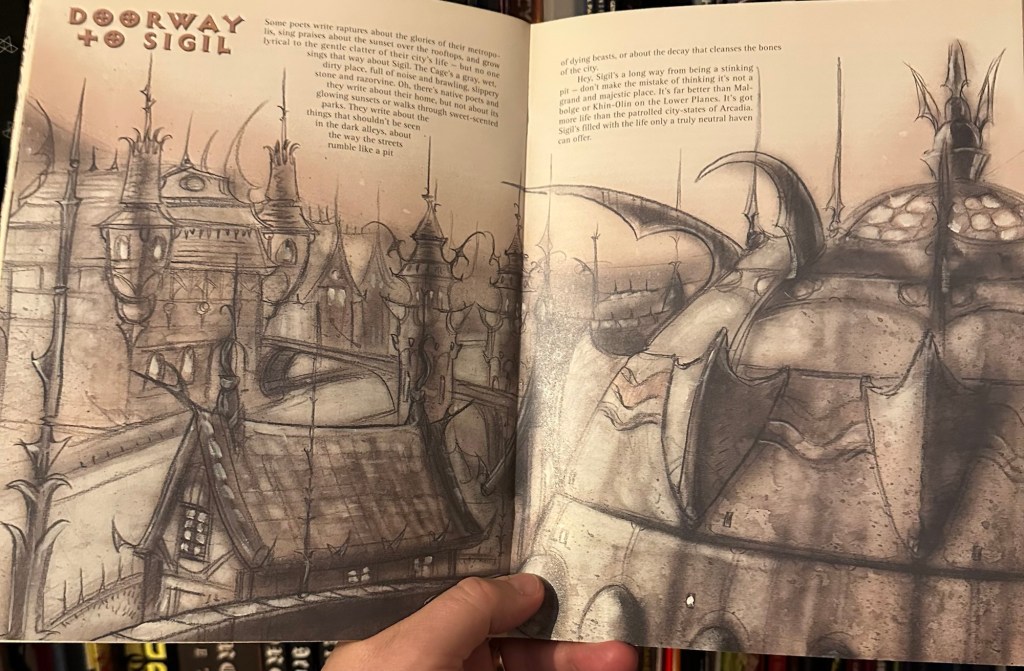
An illustration of the rooftops of Sigil from the book, Sigil and Beyond from the Planescape Boxed Set. It is entitled Doorway to Sigil.
The enigmatic rooftops of Sigil by Tony Di Terlizzi

What? Are you Clueless, berk? Cutter like you should find out the dark of things in the Cage. Could make a little jink if you manage to sway the high-up men and stay out of the Mazes. Want the advice of an old basher like me? Go chat up a factol, maybe one o’ them Mercykillers or even the Hardheads. They’re always looking for cutters who’ll do some business and keep their bone-boxes shut. You don’t fancy them? Go talk to the Bleakers, maybe. Just watch out for the barmies in the Hive if you go that way. I heard a bunch of them have been put in the dead book of late. Just stay peery on the streets and alleys of the City of Doors, cutter, and if you see death coming for you, just give ‘em the laugh and don’t end up swinging from the old leafless tree, alright?

That’s an example of the type of writing that exists throughout the entire Planescape line of books. OK, it’s not all written like that, but in many parts the voice of a local guide like this is used to inject some really effective flavour. They introduced this sort of patter and unique dialect to set Planescape apart from the more traditional fantasy fare like Forgotten Realms and Dragonlance. I Remember the first time I read it as wide-eyed teenaged ingenue. I was immediately drawn in. None of the other settings had ever appealed to me so thoroughly through the voice of the books themselves. This despite the fact that I had spent a couple of years playing the more unique settings of Dark Sun and Ravenloft.

Why? Well, the speech pattern was curiously familiar to anyone with a passing interest in cockney slang, victorian working class dialects and Blackadder. That was me, honestly. So it caught my attention.

Now, admittedly, the portions of the books written in this patter are confined mainly to the introductions and the odd in-character paragraph, but it’s enough to liven up what is normally a very dull business (AD&D modules.)

But, of course, there is so much more to recommend the setting. The factions of Sigil, where philosophical standpoints come to life in their members. Their Cold War or kriegstanz that bubbles under the surface of the city. The Lady of Pain, enigmatic ruler and all-powerful protector of the City of Doors, who sends her greatest trespassers to the Mazes for eternal torment. And beyond Sigil, why, there is only the infinite vastness of the outer planes, the inner planes and every place in between! Every one of them filled to bursting with bizarre landscapes, gods, angels, demons, devils, elementals of every flavour and don’t forget the fairies and other planar beings beyond count or description.

In fact, it can be a little overwhelming. I remember that’s how it felt when trying to write my own adventures for it back in the ‘90s. There were too many options, many of them very lethal and many of them utterly beyond my own meagre abilities to incorporate into my simple AD&D games.

That’s one of the reasons I decided to run a pre-written adventure for this portion of the Editioning.

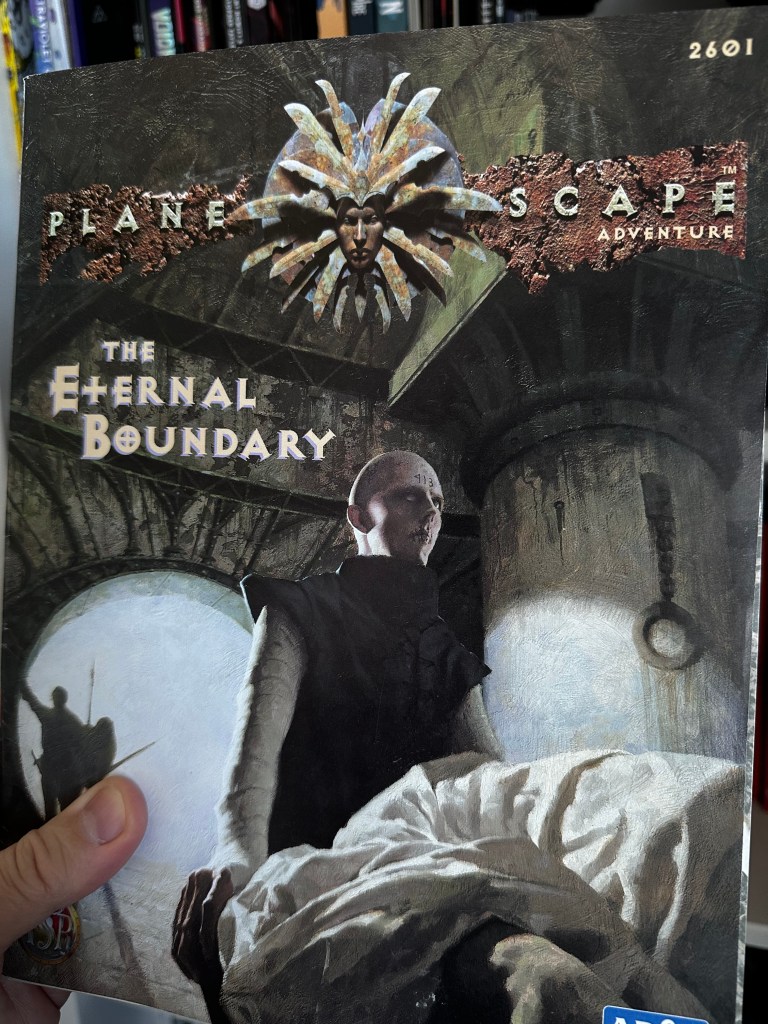
The Eternal Boundary

The cover of Planescape adventure, the Eternal Boundary. A pale, bald dustman pushes a gurney with a sheet-covered corpse in the foreground. The silhouettes of adventurers peek through an archway in the background.
The Eternal Boundary

This adventure was one of the first produced for the Planescape setting. It’s written by L. Richard Baker III whose other credits include the Planescape Monstrous Compendium 2 and Valley of Dust and Fire for Dark Sun.

I don’t want to provide any spoilers at this point so I’ll only give you the basics that PCs will learn not long after starting to play.

In the Hive Ward of Sigil, barmies and bubbers are disappearing and turning up dead in much larger numbers than usual. The PCs are sent to find one of them, a barmy called Eliath, who knows the dark of a very special portal key. Various factions are at play in the Hive and there is something sinister going on there. The PCs must uncover it is they are going to complete their mission. It will lead them all over the Hive Ward and far, far beyond.

I chose this adventure for a couple of reasons. Firstly, I thought it was a great introduction to the City of Sigil, its Factions, the kinds of strange goings-on they might encounter there and a large cast of NPCs with a fun variety of faction-alignments, personalities and motivations. And second, it was the right length for what I had in mind. I actually think this one might end up being shorter than my recently concluded OD&D game. Of course, I have been silly enough to think such thoughts before, and I’ve been frequently proven wrong so we’ll see how that works out.

Character Creation

Our Session 0 was an epic crusade deep into the depths of not only the Player’s Handbook but also the Complete Wizard’s Handbook, the Complete Thief’s Handbook, the Complete Priest’s Handbook, Legends and Lore, the Player’s Guide to the Planes, and the Planewalker’s Handbook.

It took over four hours and resulted in a great deal of cursing, misunderstandings, frustrations, arguments, concessions, delight, confusion, amusement, nostalgia, and, finally, I think, satisfaction. The AD&D 2nd edition character creation process could be straight-forward enough. If one sticks to the most simple form of ability score generation (just roll 2d6 for each ability and keep it no matter what,) thus forcing the player’s to choose the classes most suited to their ability scores, forgoes the use of non-weapon proficiencies in favour of the far less complicated secondary skill system, restricts the PCs to options only taken from the Player’s Handbook and sets their game in the most vanilla of fantasy worlds, you could probably create a full party of PCs in an hour or so. But that’s not what I wanted. I wanted my players to have the full AD&D 2nd Edition experience that I remembered with such fondness. I wanted them to be unsure of their choice of class or race until they had a clear vision of a character. I wanted them passing around all those sourcebooks, to get, at least a look at all the various options. I wanted them to not know really anything about their characters until they all came together miraculously in the last half an hour. And that’s exactly how it happened. The character creation system, when you factor in all the optional books, has so many possibilities, dependencies, restrictions, bonuses, minuses, and choice that you simply cannot get a full picture of the character until they are most of the way finished. This differs to such a great extent from modern role-playing games that are not Pathfinder, that I think it’s quite difficult to explain without experiencing it. For a taster, please do check out my AD&D 2nd Edition Character Creation series where I make a Dark Sun halfling Cleric. It takes three full posts and around 6000 words and is, by far, the longest character creation I have ever done on this humble blog.

We ended up with an all-star cast. Our Paladin, Glaermond, completely illiterate but stout of heart and sinew, is the party’s lawful good defender. Aurora, our chaotic good Bariaur magic user, took the Witch kit from the Complete Wizard’s Handbook, and, as a member of the Dustmen faction, has decided to focus on necromancy. Trance, the Tiefling Thief is a member of the Society of Sensation and is driven to experience new things whenever possible. And, finally, Devansh Rao is our Aasimar cleric of Varuna, the guardian of cosmic order and lord of the sky. The players are currently discussing the wisdom of using Devansh’s little church to Varuna as their base of operations and gathering a tithe to fund their adventures in the name of the Great Lord of Order on our discord channel.

This is, potentially, the perfect combination of classes and factions for this adventure so I am very excited to get it started. And that will happen this very Sunday, dear reader. So watch this space if you’re interested to find out where this band go as the delve into the Hive.

Time for a Choice

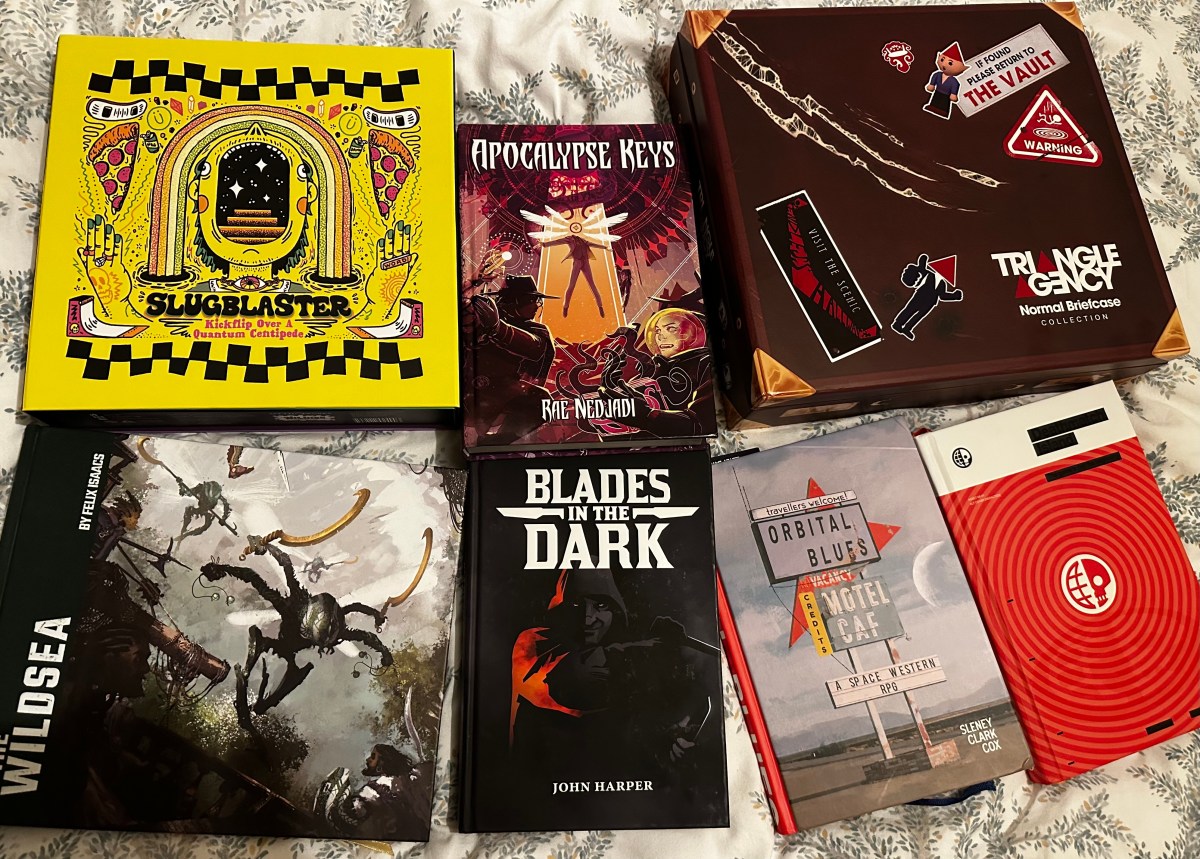
From each genre, I’ll take a look at the games, their appeal, and, of course, their character creation posts to eliminate some. Hopefully, once I’ve done that, I’ll be able to come to a well-informed decision.

Decisions, Decisions

So, the characters have been created, the conclusions have been drawn, I am as familiar with the 7 games on offer as I’m going to get before actually playing them—its time to make a decision.

Before getting to that, though, I think it’s worth pointing out that this is, far and away, the most effort I’ve ever put into a decision of what game to play next. Since starting to write this blog I’ve spent a lot of time and not a little cash on new games. I’ve never had so many to choose from before. And I’m not even including the ones I’ve only got in PDF form. Long ago, as a teenager, I actually did run a variety of games; AD&D, of course, but also Gamma World, TMNT and Other Strangeness, Beyond the Supernatural, Robotech, Shadowrun. Back then, I just wanted to run the newest thing, the shiniest game, whatever had the bulk of my attention. But, I didn’t have so many to choose from, of course. There was no such thing as buying a game and never running it! I didn’t have that sort of money! These days, we are living in a golden age of tabletop games. There are so many RPGs of so many genres, utilising such an array of play styles and rulesets that it can be bewildering, overwhelming and paralysing. So, as I sail out of my majority-D&D era, navigate my way through the OSR and explore the unknown waters of the story-game, I have found this process incredibly helpful, if time-consuming. It has also been educational, interesting and fun. But there’s another aspect to this too: whatever game I choose, it’s one that my players and I will be with for weeks, hours of play and hours in between sessions thinking about. I want that to be good, or, hopefully, great!

The Competition

There are seven games to choose from, as laid out back in the original post. I could just take them one by one, as I did when writing their character creation posts, but, instead, I will separate them into genre groups. From each genre, I’ll take a look at the games, their appeal, and, of course, their character creation posts to eliminate some. Hopefully, once I’ve done that, I’ll be able to come to a well-informed decision.

Supernatural Investigations

We’ve got two games in this genre (I suppose this is more a of a sub-genre, but heigh-ho, it’s my blog-post.)

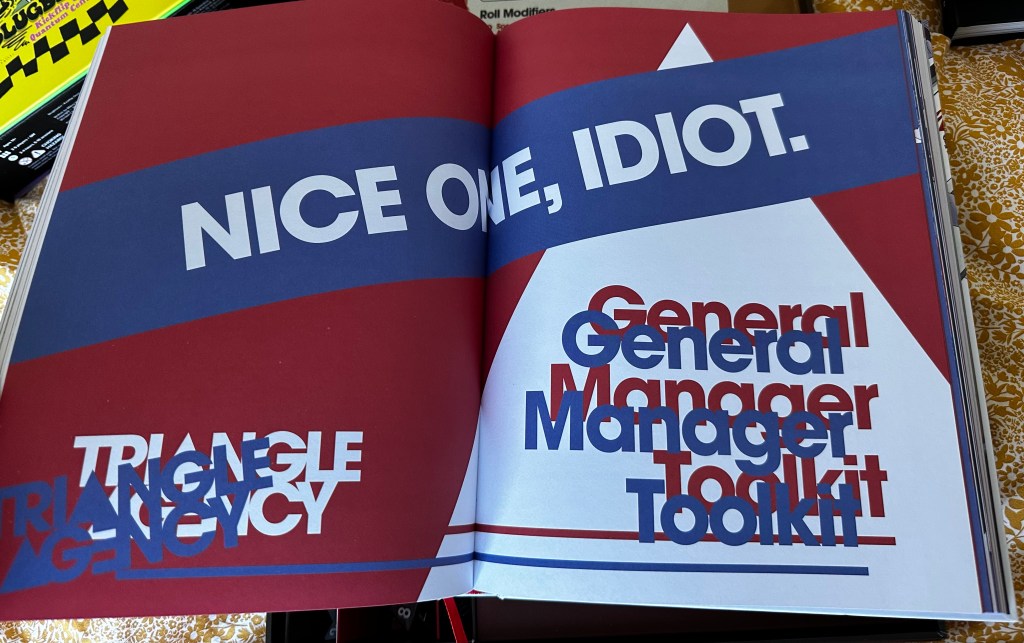
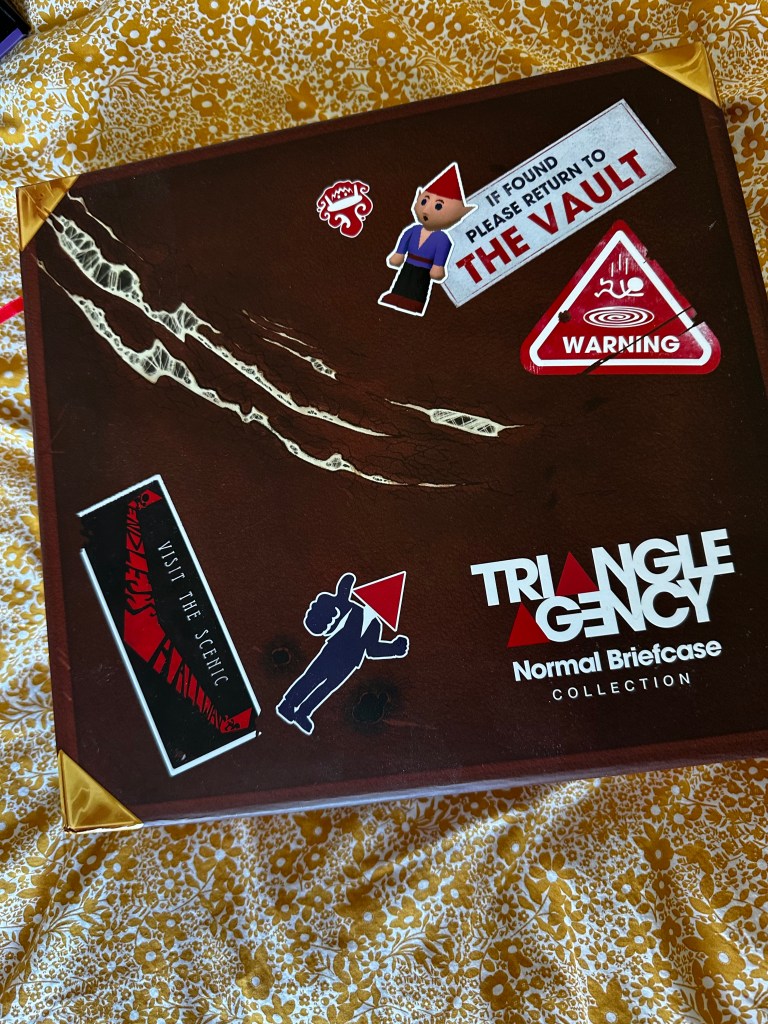
  • Triangle Agency – this was the first character creation post I made as part of this series. I think, at the time, that was because it was the game I was most interested in. It didn’t hurt that it came in a very impressive box. The presentation is altogether impeccable. This applies also to the text itself, which styles itself as the manual to a game to be played by actual agents of the Triangle Agency. The character creation process taught me a lot about how the game would be played and was particularly successful at making, not just a character, but a personality, history and motivation.
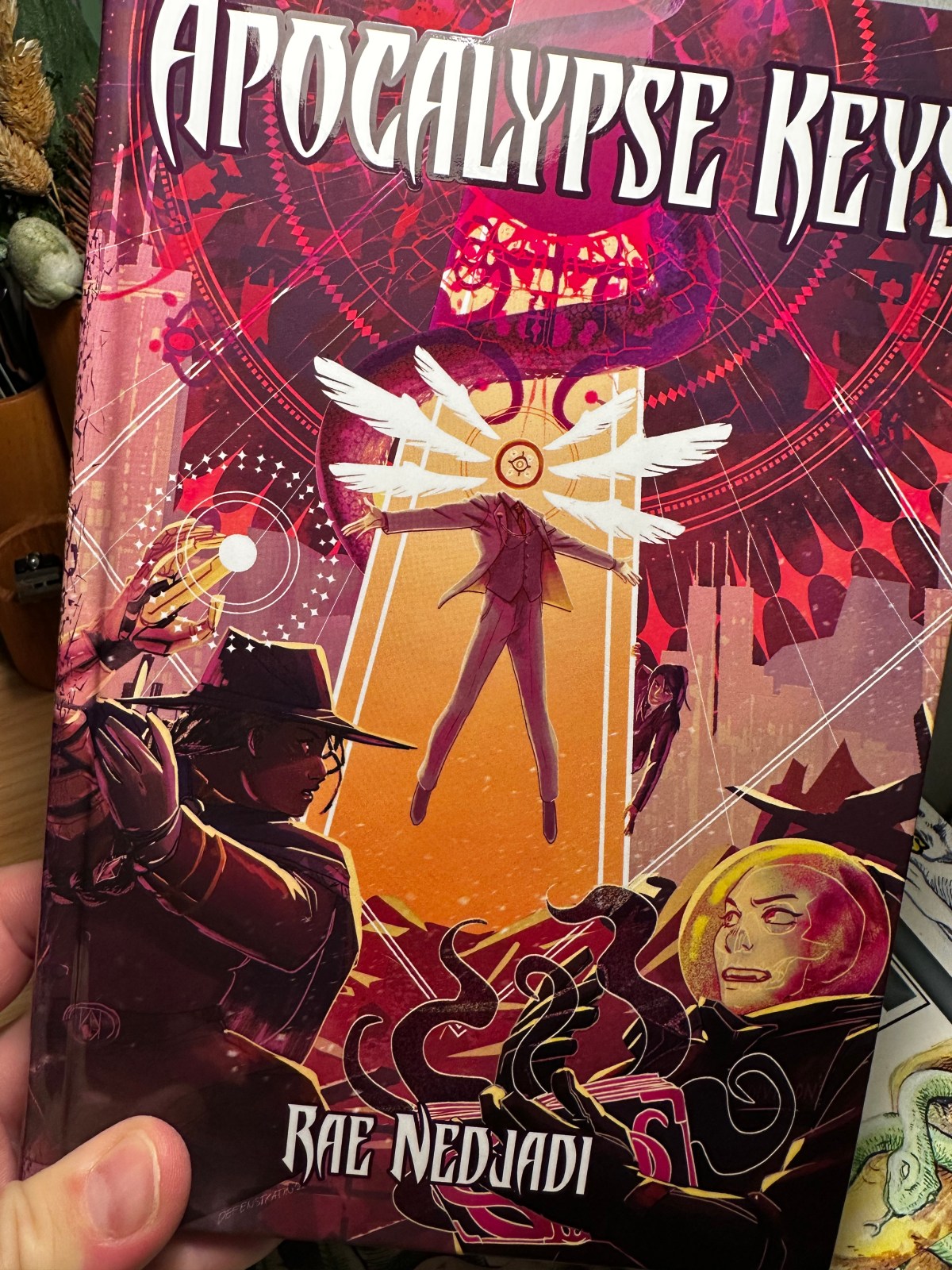
  • Apocalypse Keys – this, was the last of the character creation posts I did. I’m going to cut to the chase with Apocalypse Keys; I don’t think it’s for me. It might suit some of my players, but not others. I would rather the Triangle Agency’s tongue-in-cheek take on the genre than the melodrama inherent in Apocalypse Keys.

Triangle Agency wins!

Fantastic Voyages

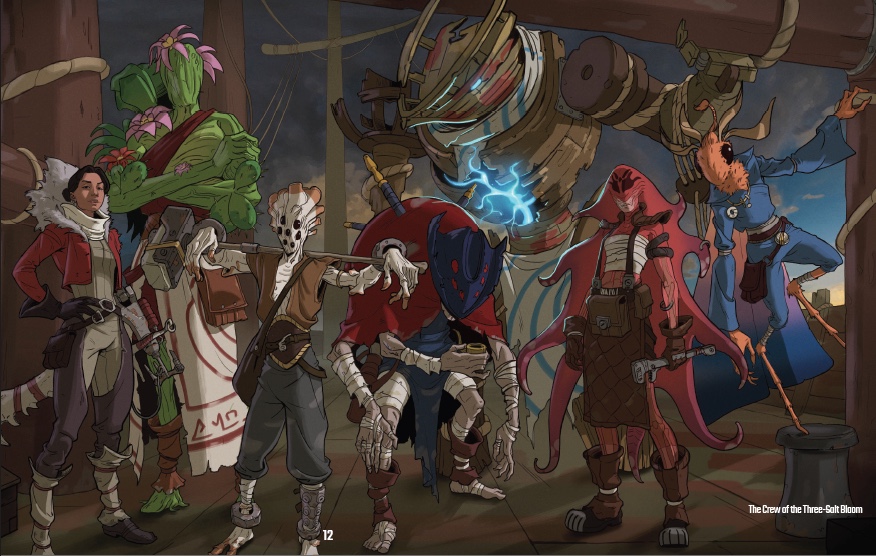
I’m stretching the term ‘genre’ here once again. But I’m adding two games to this one anyway. Both of these involve ship creation as part of the character creation process, and a crew of misfits to go with it.

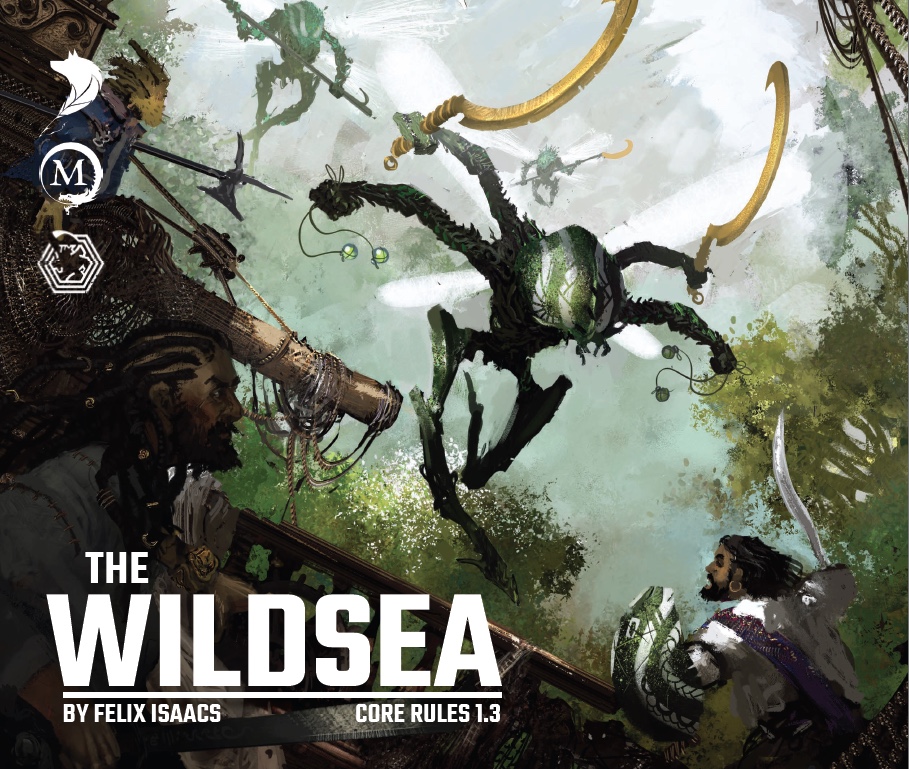
  • The Wildsea – Its got a fascinating setting, a rich and engrossing vibe and a beautiful presentation. This is very much a fantasy game that’s determined to get you into trouble out on the emerald waves of the Wildsea. You will spend a long time making your character, as evidenced by the length of my character creation post. There are many, many choices to be made at every step and that doesn’t even take into account the ship creation process. For the campaign I’m imagining, a maximum of about ten sessions, I feel like this is too much. I’d rather spend the time playing than making Wildsailors. But, its definitely one that I might return to someday.
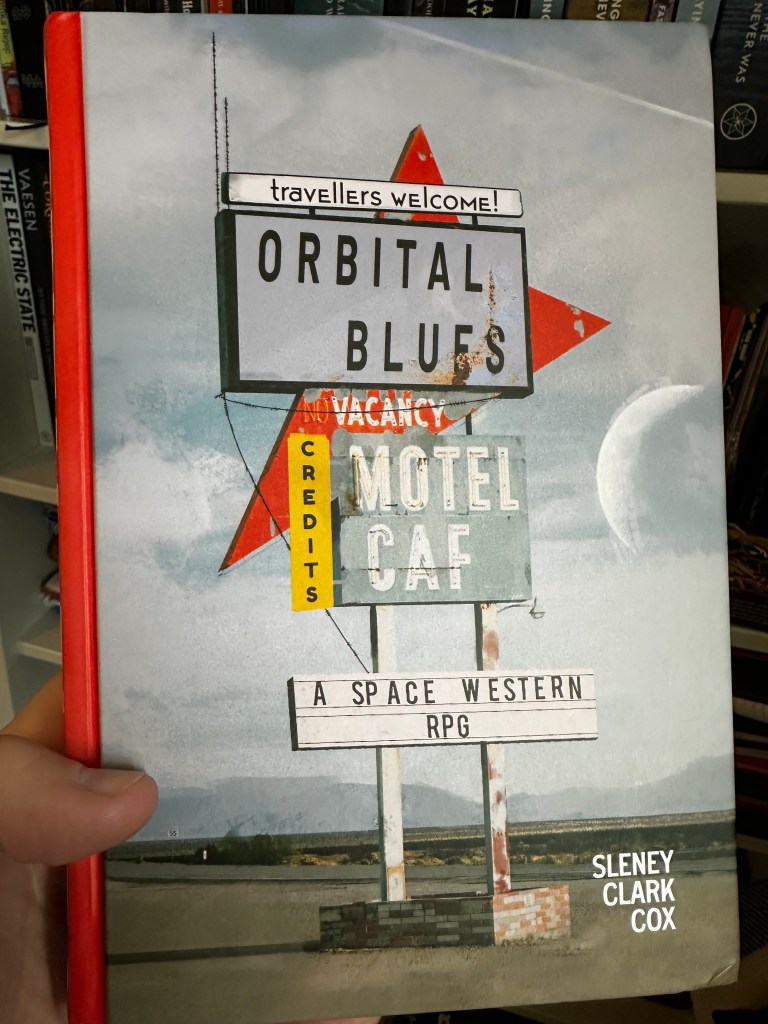
  • Orbital Blues – This is a game set in a far flung future where everyone has spaceships but its grimy, debt-ridden and kind of sad. Its a game that’s underpinned by themes that we can easily all understand, the hell of living in a late-stage capitalist economy, the mental health toll taken by the struggle to just survive from day-to-day in the gig economy etc. The character creation really stoked my imagination and conjured images of my sad space cowboy. And it was the exact opposite of the Wildsea in that it was just so quick and easy.

Orbital Blues wins!

The Others!

I gave up trying to come up with a way to link these final three games. Slugblaster and Blades in the Dark share a system, sort of, and Deathmatch Island is based on a system that was originally created by the author of Blades in the Dark, but that’s pretty tenuous. They all do have an important similarity in the way they are played in distinct phases, though.

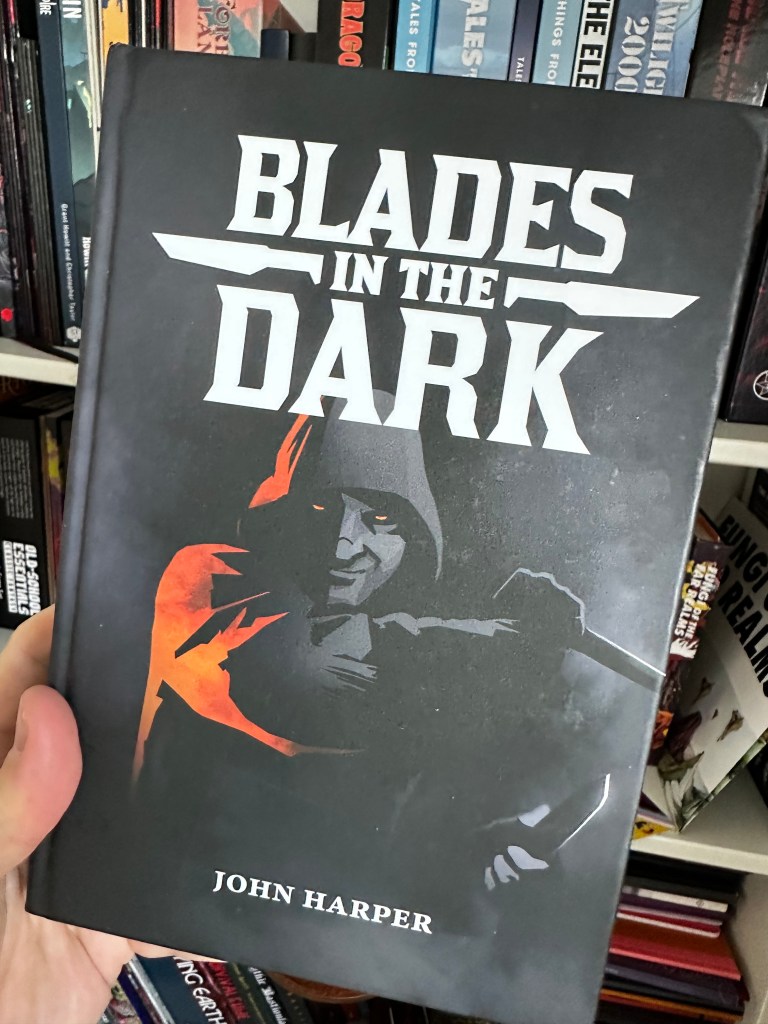
  • Blades in the Dark – This is such an iconic game and its the favourite of many an RPG enthusiast whose opinions I respect. The vibes of Blades are also perfect. Dark city, supernatural threats and heists. I think my players would love that shit. Also, the character creation is comparatively straight-forward and gives you a good idea of your character before you even start playing. This is the only game on the list that I have actually played before and, I’m not going to lie, it has an advantage because of that.
  • Deathmatch Island – This game is on the list because I finished a rewatch of Lost this year and because I backed it and got a lot of really cool materials for it. But it has so much more to recommend it. The premise is great, the fundamental decisions your characters have to make about the nature of their realities are compelling and the rules are simple enough to require very little time to master. However, its strength in this respect is also a weakness. I think I could easily get a small group together at short notice to play this game as a one-shot or very short campaign and I might consider it for that. But I’m not sure I want to run it for longer. Which is pretty much the conclusion I came to the first time I looked at it on this blog.
  • Slugblaster – Another gorgeously presented book. It has world-building oozing from every paragraph, illustration and fictional ad. The subject matter is not quite my bag though. I have no idea about skater culture. Although I am inspired by many of the touchstones Mikey Hamm names for Slugblaster, it doesn’t seem quite enough for me, I’m afraid. I also had some issues with the character creation process which I went into in that post. Maybe I’ll come back to this one someday. But, for now, it’s a no from me.

Blades in the Dark wins!

The Semis

I’m glad to be dealing with a semifinal now after Ireland went out of the Women’s Rugby World Cup in devastating fashion at the quarter final stage earlier today. We’ll see a semifinal one day!

Anyway, we have three games left:

  • Triangle Agency – A unique take on the genre of supernatural investigation with an original ruleset and a lightly comedic vibe
  • Orbital Blues – A space cowboy sci-fi game of disillusionment with the universe and characters who grow through expressions of depression as they journey through the stars
  • Blades in the Dark – a classic supernatural, victorian heist game that has launched a thousand other games.

I have to eliminate Orbital Blues here. This is a bit disappointing, to be honest, but I have a good reason. I’m already running a Spelljammer game at the moment, as well as Ultraviolet Grasslands. That’s a lot of journeying from one place to another in a ship/caravan. I don’t want to start a new game with a similar format. Maybe if and when either of those two games comes to a conclusion, I’ll come back to Orbital Blues. But for now, it’s got to go, I’m afraid.

The Final

So we have two games to choose from in the end, as it should be.

  • Triangle Agency
  • Blades in the Dark

I can’t choose between them. I’d be very excited to run either one. If I could find the time, I would run both. If I could find the time, I’d run every game on this list! But as they say in Highlander, there can be only one. Fittingly, It’s going to come down to a dice roll. 1d6. 1 to 3, its Triangle Agency, 4 to 6, Blades in the Dark.

Here we go!

Its a 4!

It’s time to sharpen your blades and take that Devil’s Bargain with the rest of the crew. We’re off to Doskvol…

Apocalypse Keys Character Creation

it has a very specific flavour. The PCs are monsters in the vein of Doom Patrol or the X-men. There is a lot of significance to the emotions of the characters and there is a fair bit of angst and drama involved from what I can tell.

This is the eighth in a series of character creation posts I’m using to figure out which game I want to schedule for our next campaign. You can find the Triangle Agency one here. And you can find the Slugblaster one here. You can find the Blades in the Dark one here. We took a slight detour for this one, here’s the Wildsea Ship Creation post. And then got back on track with the Wildsea Character Creation post. This is where you can find the Deathmatch Island one. You will find the Orbital Blues character creation post here. Back in this post I named Apocalypse Keys as an outside contender for the new campaign. This will be the last post in the series so I’ll be forced to make a decision on the next campaign soon.

DIVISION and Conquer

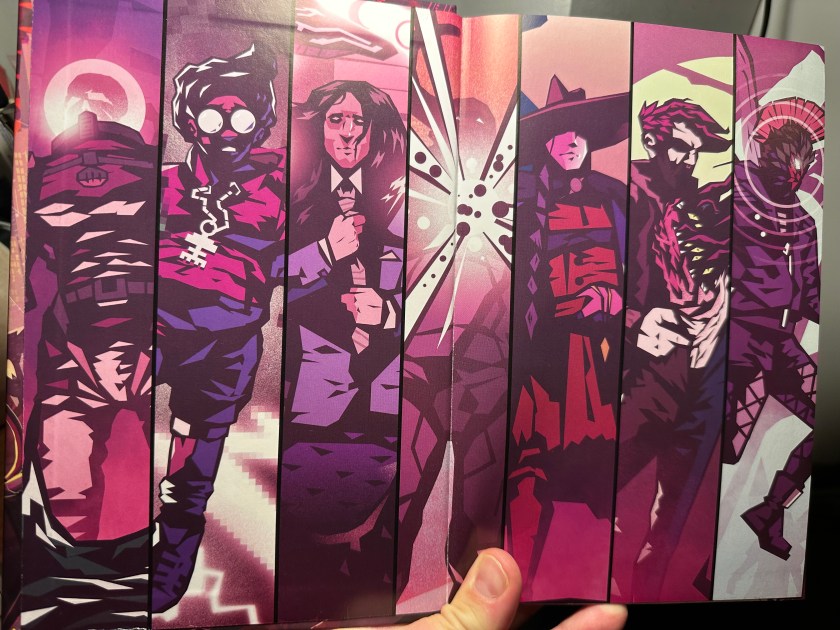
The illustrations of each of the Playbooks all together.

Apocalypse Keys by Rae Nedjadi is a Powered by the Apocalypse game in which you play members of a super-team of sorts. You are wielded like weapons by a shadowy organisation called DIVISION (which is an initialism, kinda like S.H.I.E.L.D.) in an effort to prevent apocalypses. How? Well, you gather Keys, which are essentially clues you will use to find and open Doom’s Door before the bad guy can. The bad guys are known as Harbingers and they are Omens, like you, but more world-endy.

The game is very much PBTA in its design, with a few extras. Although you roll 2d6 for most things, if you roll an 11 or higher, you overshoot, you blow the whole warehouse up instead of just the gates, your powers leave the security guard a blubbering mess instead of just plucking some thoughts from his head, you get the idea.

Also, it has some Carved from Brindlewood flavour to it too. The Keys you gather improve your chances of finding the Doom’s Door you’re looking for. For each one you get, you increase your chance that the theory you have come up with is correct and you know where to find it.

Ruin seems to have been taken from Trophy. Although it’s used a little differently. As you gain it, you get closer to becoming one of those bad guys, the Harbingers. It can also give you special Advances (abilities.)

One last thing: PCs gain Darkness Tokens as they make particular types of narrative choices that align with the emotional themes of the playbook. You spend these tokens to give you modifiers to rolls.

I think it’s important to know these things as we go into character creation for this game. Also, it has a very specific flavour. The PCs are monsters in the vein of Doom Patrol or the X-men. There is a lot of significance to the emotions of the characters and there is a fair bit of angst and drama involved from what I can tell.

Creating Monsters of DIVISION

The book provides us with a step by step guide to character creation which I love to see. It was something I missed from the process in Orbital Blues. Lets take a look:

  • Step 1: Choose a Playbook
  • Step 2: Bring Your Character to Life
  • Step 3: Refine Your Abilities
  • Step 4: Introduce Your Character to the Other Players
  • Step 5: Create Your Starting Bonds

As this is purely an exercise the last couple of steps probably won’t happen.

Choose a Playbook

Like other PBTA games, you choose a playbook to get started. Your character might decide to switch playbooks further down the line, depending on the narrative choices that are made at the table but most are likely to select one and stick with it. It’s like a character class in other games.

Here are the available playbooks in Apocalypse Keys:

  • The Summoned: a being summoned from another place. Violent, aggressive, antagonistic to prophecy, wants love more than anything
  • The Surge: Massively powerful but not in control. Wants help to contain it. “Explosive, uncontrollable and alienating.” Friendly fire and collateral damage and toxic relationships are the themes
  • The Found: Psychic amnesiac. They are very odd, but curious and highly emotional. They can have surprisingly intimate knowledge of other peoples’ inner lives and thoughts but do they know what’s best for others?
  • The Shade: A super intellect who cheated death. Thematically, they are for players who want to forge a difficult relationship with death and struggle with the costs of great knowledge
  • The Last: The last of their kind from another world. “Their power is reflective, sorrowful and hopeful.” Unsurprisingly the themes here are heavy, loss, tragedy and how these things are inevitable.
  • The Fallen: Elements of Lucifer, a fallen angel. “Their power is intoxicating, damaged, deceitful.” Thematically, hubris, the two sides of worship and an over-riding want for what was lost.
  • The Hungry: It is what it says. “Their power is intimate, transformative, and harrowing.” Getting big vampire vibes here. They are looking to feed, get truly close to someone and deal with the idea of body horror, unsurprisingly.

I could roll 1d7 to pick here, but there is one I’m drawn to most. That is the Fallen. They are all pretty goth but it feels gothiest to me.

The Fallen

The Fallen illustration from the book. A man in a suit with long, dark hair, a suit and tie ad a dragon coiled around him.
The Fallen illustration from the book

I am a pale reflection of the glory I once was
I embody the hubris and volatility of the Apocalypse
My power is faded, cracked, and deceitful
My heart yearns to worship and be worshipped

Bring Your Character to Life

I’ll be using a series of prompts provided in the playbook description to do this next part.

Your Name

There are four options here:

  • A name god gave me with love
  • a name I earned through fear and terror
  • a name that can never be said out loud
  • a name you need to give someone else one day

I choose the third one, because it’s cool, honestly. The name is Duma, after the Angel of Silence. In fact, I think this character will only communicate through signing.

Your Look

There are several options here. I won’t list them all, just the three I’m taking:

  • a multitude of wings made of light and sound
  • a cracked halo that bleeds
  • mismatched clothing hastily thrown together

I love these touches. I imagine the halo just constantly dripping blood onto Duma’s face, forcing him to close his eyes to the horrors of the world. The wings, once flapping silently, feathery and white, now buzz and flicker like an insect’s. The clothing, whatever he could find, an old army surplus jacket, some discarded cream chinos and a pair of scuffed tennis shoes.

Your Origin

I have to choose one of these four options for Duma’s origin:

  • I was once a mighty god of this Earth but I was killed by my worshipers
  • I once claimed hell for my own but I was betrayed
  • I was an angelic creature destroyed by my jealous god
  • something else that describes how far I have truly fallen and all I have lost

It’s nice to have that last option there for anyone who has their own idea of their character’s origin. For me, though, it has to be the third one. I think Duma was silent before as a way to show his devotion to his god, but is silent now because he has vowed never to speak until he regains the trust of his god or destroys him.

Who are the Gods Who Taunt You?

I only choose one of these:

  • those who I betrayed seek to destroy me once and for all
  • ancient gods who have lost their power and ache for what is left of my divinity
  • twisted gods I corrupted who are now monsters of myth and legend
  • divine servants who grow in power as I have weakened
  • something else that feeds my spite and sharpens my hubris

I like the idea of other bully angels coming down to tease Duma while he seethes and silently curses them so I’ll go for the fourth one.

Your Impulse

This is an interesting departure from other PBTA games I’ve played. Usually, you have particular character goals that mostly remain static, and if you manage to achieve them in a session, you gain 1 XP. In Apocalypse Keys, you choose one of the listed Impulses each session and work to explore it. If you do, you can gain 1 XP OR 1 Ruin. I’m not going to list them all, but here are a couple that I like:

  • Did you bless the weak with the immeasurable glory of your presence?
  • Did you taunt or seduce those who would seek to destroy you?

I think, as a starting Impulse, I would go with the first of those two, just to start things off as I meant to go on.

Your Powers of Darkness

These are largely thematic flavour for your character to throw on a standard move. They are pretty much open to interpretation every time you use them.
I can choose two from the following:

  • Soul Venom
  • Fae Glamour – Just so Duma can walk around town.
  • Fear Manipulation
  • Weapons of Light and Sound – This seems very angelic.
  • Many Forms of Mythic Animals

I’ll take Fae Glamour and Weapons of Light and Sound

What Does the Darkness Demand of You?

This is such an important question to the character and for the Keeper to know how to interact with them. There are quite a few, so I’m going to only list the two I am choosing:

  • To storm heaven
  • to curse the one I love

Man, that’s melodramatic!

Gaining Darkness Tokens

This is an important part of the process. It will define the way I play the character to a large extent. Duma will get 2-4 Darkness Tokens every time he does any of the following:

  • Feel others are beneath me
  • React with spite or arrogance
  • Ask someone to worship me
  • Ask someone to betray another
  • Embody a condition that effects me

Interestingly, the Conditions I might gain as the Fallen are different to those other playbooks might get.
Here are mine:

  • Lustful
  • Raging
  • Forlorn
  • Obsessed

All extremes of emotion. Unsurprising really.

Breaking Point

The Fallen's Breaking Point page. Also includes the Call Me Master move and an illustration of a glowing person bringing people under their control.
The Fallen’s Breaking Point page.

This is what happens when you are full up on Conditions. If you mark all four, you hit your Breaking Point. It is unique for each playbook and it serves to illustrate your character at their most emotionally overwhelmed. You just can’t take it anymore. You must have a scene to describe what happens. For your troubles you get to clear your Conditions and get a point of Ruin.

You were once beautiful and loved, perfect and beyond despair. You are gripped with how far you have fallen, how much of your glory was ripped away from you. You are unworthy of love, and your heart screams in anguish
Describe how you use what little power you have left to bring you painfully close to your former divinity, and how it twists and consumes everything around you. The Keeper will tell you what horrors you birth and what twisted shadow of a god escapes quietly into the world.

Ooof.

Playbook Moves

Each Playbook gets one move that is only for them. Normally when you advance, you can take moves from other playbooks, but not the signature one. The Fallen gets:

Call Me Master

This is a move designed to snare other beings into worshiping you, or at the very least, doing your bidding. If it goes wrong, it might make an old enemy act against the Fallen or maybe make you display your real being, forcing you to lose a Bond, or, at worst, awaken a sleeping horror.

One More

Other than Call Me Master, I get to choose one more from the playbook description. Here is a list of those I can choose from:

  • Mother of Monsters – Just imagine what could go wrong…
  • Fleeting Divinity – Relics with your power contained in them. Use them for modifiers to rolls
  • Honeyed Tongue and Clouded Minds – Use this to get extras when you Unleash the Dark, such as gaining more knowledge or making lies truth
  • You Loved Me Once – Make an NPC one of your former worshipers. They might still be, or they might serve your ancient enemies
  • The Lies that Serve Me – Your mistruths can become real for a time but if you fail… you might lose that part of you that made it.

I love the idea of just declaring a new NPC or faction were once your devotees and seeing what happens. Wow, that could go so wrong in so many interesting ways. But the ways it might go right are equally interesting so I am going for “You Loved Me Once.”

Ruin Moves

I only get to choose one of these. Another option is to choose a DIVISION move instead. And, although that is of interest, I’d rather stick to the stuff that’s specific to the playbook. Also, Ruin is just more interesting to me. Here are the Ruin Moves for the Fallen:

  • Tremble Before Me – One of the basic moves is Unleash the Dark. It is used when imposing your will on someone. Tremble Before Me allows you to mark a point of Ruin to get a better result when you do that.
  • My Beloved Nemesis – When you do this, you have two options, mark one Ruin and get to clear your Conditions while explaining how your betrayer is out in the world, or mark two Ruin and have them appear in the scene! You form a Bond with them either way. If you choose the second one you form a Bond with What the Darkness Demands of You.
  • Desire Dressed as Faith – You can make people want to do something or possess someone. Spend one or two Ruin for varying extremes of desire.
  • I Will Rise Again – When you work towards regaining your old glory, you make this Move. You get to choose from a long list of steps forward you can take which include doing things like avoiding all notice, imbuing your forces with magic weapons and killing the only one who could stop you. But the Keeper gets to screw you for it.

For me, the one that works most for the playbook and the character is that last one. It feels like the kind of thing the Fallen should be working towards from the start. So I will take I Will Rise Again as Duma’s Ruin Move.

Conclusion

This has turned into another monster post, pun very much intended. So I am going to skip the Bonds for this character, mainly because I don’t have any other PCs to Bond with anyway.

There are things about this game that I find too overwrought, too melodramatic for my tastes. But there are things in the character creation process that I enjoy. The moves are great and so imaginative and evocative of the genres this game is inspired by. But it’s similar enough to Triangle Agency to put them into direct competition with each other. Also, I’d like to actually play Duma, but I don’t know if I want to GM this game…

Orbital Blues Character Creation

I’ve played RPGs where your character is supposed to be weak, where they’re meant to be weird, where coolness or badassness is the point, but I have never before played one where the entire premise is that you are a sad, potentially depressed outlaw trying to get by in a universe that’s against them.

This is the seventh in a series of character creation posts I’m using to figure out which game I want to schedule for our next campaign. You can find the Triangle Agency one here. And you can find the Slugblaster one here. You can find the Blades in the Dark one here. We took a slight detour for this one, here’s the Wildsea Ship Creation post. And then got back on track with the Wildsea Character Creation post. This is where you can find the Deathmatch Island one. Back in this post I named Orbital Blues as an outsider in this process since I’d barely even cracked it open. This was good motivation to read the book. Since then, I have read most of it and I have to say, I’m generally impressed. It’s very much in the running now.

Sadness is the Point

I’ve played RPGs where your character is supposed to be weak, where they’re meant to be weird, where coolness or badassness is the point, but I have never before played one where the entire premise is that you are a sad, potentially depressed outlaw trying to get by in a universe that’s against them.

That’s Orbital Blues, by Sam Sleney and Zachary Cox, illustrated by Josh Clark and published by Soul Muppet. This is how it is described on the back of the beautifully realised book:

It is an intergalactic age of bounty hunters, vagrants and bleeding heart outlaws.
The galaxy is a lawless expanse, and you are an INTERSTELLAR OUTLAW. Together with your SHIP and your CREW, you must eke out a living in the frontier, and close down the intergalactic dream of freedom and success.

What this blurb doesn’t convey is that, for an Orbital Blues character, the sadder you are, the better (mechanically anyway.) Your PC is going to start with Troubles and they are going to give them the Blues and those two things just serve to compound each-other over the course of the game to give them more abilities as well as more narrative motivation.

Before I get into this, I would like to once again plug the My First Dungeon podcast. They have a complete season of an Orbital Blues actual play that has helped me to get to grips with the game, the system, the vibe and, of particular importance to this post, character creation. Go check it out here.

Start with the Concept

Character Creation chapter with poncho clad back of a space cowboy

I haven’t played a lot of games where the player is supposed to start with an idea of their character first. Never Tell Me the Odds does it, but I am struggling to think of another. Of course, a lot of players will go into every game with their concept in their heads already, but few demand it. Orbital Blues wants you to do some imaginative labour before moving on to stats and abilities.

So, let’s look at the touchstones for this game. What kinds of characters does this sort of game want you to make? Cowboy Bebop, Firefly and Guardians of the Galaxy are all pretty obvious sources of inspiration that are explicitly mentioned in the book, so I’m going to use the characters from those IPs as fodder too.

I remember watching Cowboy Bebop during its original run when I lived in Okinawa in the late 90s. It captivated me with its evocative and anachronistic world and its lowlife, flawed yet oh so sympathetic characters. I was obsessed with Spike. He was such an asshole and yet he could always surprise you with moments of genuine heart and kindness, while being forever haunted by his dark past. It’s a classic character archetype, of course, but that’s with good reason. We relate to their brokenness while we aspire to their ultra-competency.

Anyway, that’s my main point of reference, a slick-looking guy with a past he’d rather forget. I’m imagining him as a crack-shot and a card-sharp, not an arm-wrestler or a fist-fighter. This guy drinks too much and always has a cigarette between his lips.

Name

The very next thing in the process and the book, is to roll up or choose your name. There is an excellent d100 table here for this so I am not going to pass up the opportunity to roll on it. Now, this is not necessarily meant to be your PC’s full legal name. In fact, it is more likely to be a nickname or a persona and usually just a single name. There are some great names in here, including “Indiana,” “Ripley,” and “Valentine.”

I rolled a 34 so that’s Avery. Nice!

On the same page is an exhortation to “pull it together.” This means thinking about what brought the character to the life of an outlaw. What kinds of problems follow them and what might they do about them?

I’m thinking Avery, a former military sharpshooter, quit the space-corps to find his own way in life, only to end up working as a hitman for some bad people. The crime boss he worked for had some juicy blackmail material on Avery. Thinking about this from a game perspective, I would want to eke this story out during play rather than spilling it all in character creation. But I am thinking he killed the wrong person, someone known to his family, and he doesn’t want that to get back to his parents. But he left the employ of the crime boss by faking his own death. This was all before he started going by the name, Avery.

Stats

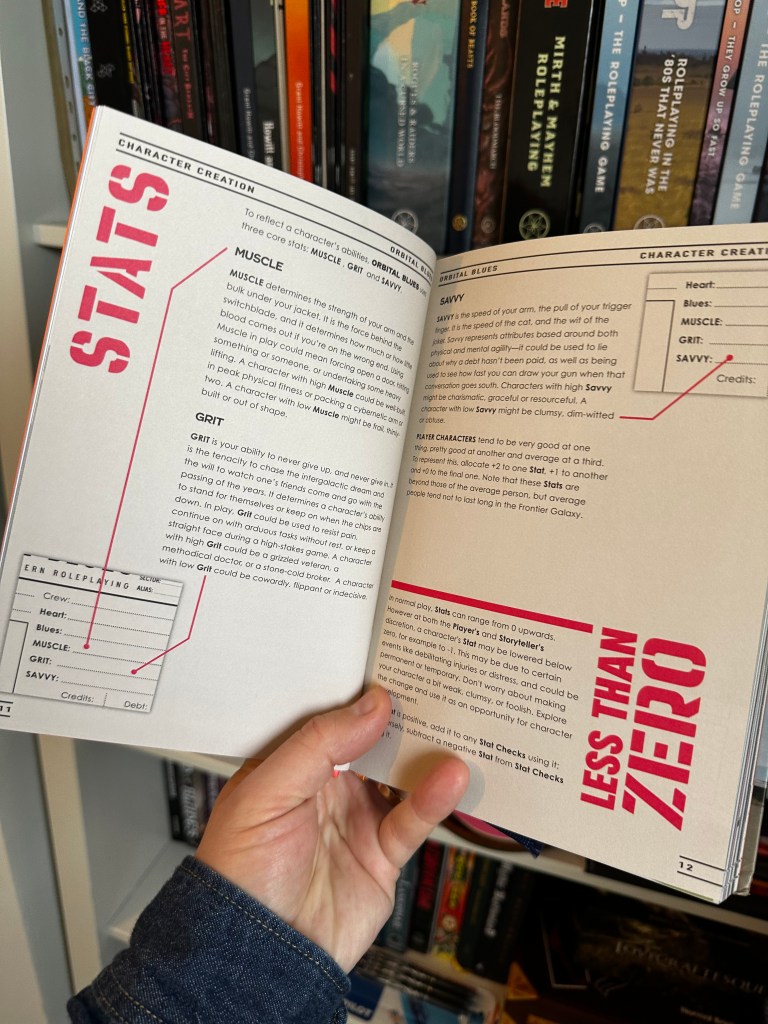
Stats: Muscle, Grit and Savvy

You only get three stats as an Orbital Blues character:

  • Muscle: speaks for itself really, Although it could be used for intimidation too. Also, it has a bearing on your Heart score, which is analogous to your hit points
  • Grit: How far will you go? How much can you take and keep on trucking? Your Grit determines that
  • Savvy: Quickness of mind and trigger finger. This is where I’ll be investing highly for Avery.

There is no dice-rolling involved in your stats. Instead, you choose one to be 0, one to be +1 and one to be +2. Simple.

Avery:

  • Muscle: 0
  • Grit: +1
  • Savvy: +2

This seems to suit the character concept I’ve come up with so far.

At this point, it’s worth noting that you do stuff in this game by rolling 2d6, usually, and add the relevant stat to the roll. The target is always 8.

Sometimes, if you are rolling with the Upper Hand you roll 3d6 and take the top two rolls. In contrast, if you are rolling Against the Odds you roll 3d6 and take the lowest two rolls.

You can use Exertion to spend points of Heart to add to your rolls too.

The Crew

Crew titles

This next part will be a little difficult for me since this is a Solo endeavour (that’s just a little space outlaw humour there.) But still, I can follow the advice presented to a certain extent. There is a colourful double-page spread of titles to help. I can adopt one of these for my own character. Once I have done that, I can choose at least one more title and decide how Avery might relate to another character with that title.

Avery has a lot of options here. There are titles such as “the Queen,” “the Freak,” “the Heart-breaker” and, of course, “the Cowboy.” But I think the one that suits him is “the Quick.” He’s fast on the draw, nimble-fingered and quick-witted.

I think there is another member of the crew who has “the Ace,” title. Let’s call them Rivers. They’re good and they know it. This pisses Avery off and wakens his competitive side.

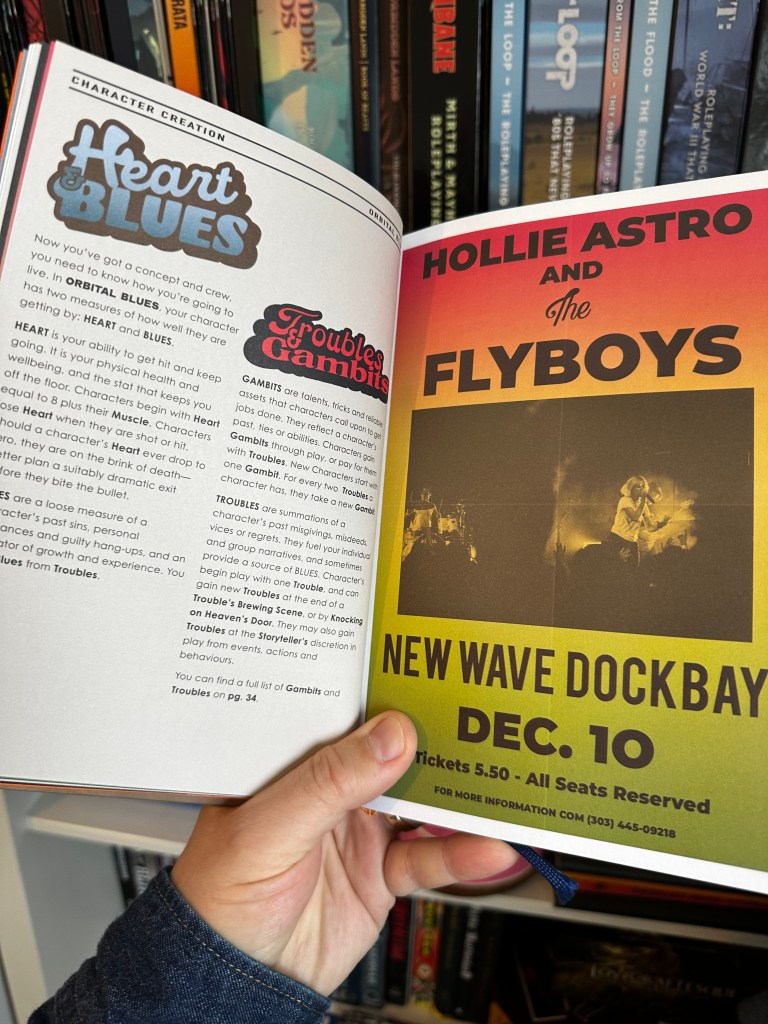
Heart and Blues

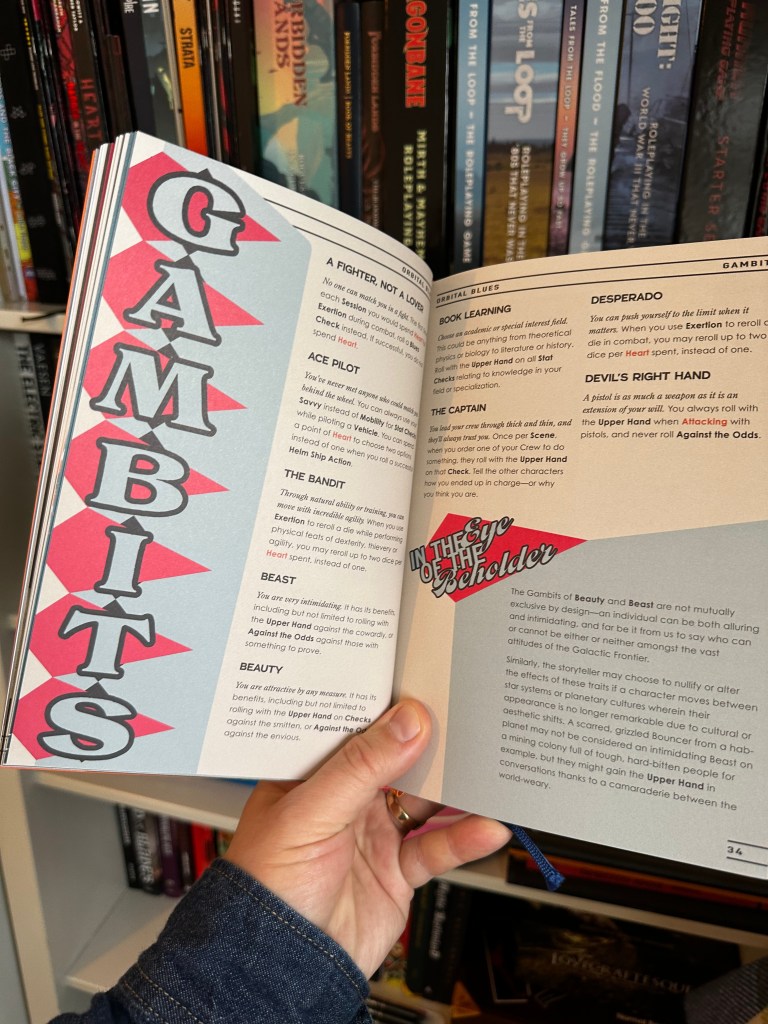
Heart and Blues, Gambits and Troubles

This is an easy one. Heart, which, as I noted, is the HP score, is calculated by adding 8 to your Muscle score. So:

  • Heart: 8

Blues are the way you measure the effects of your character’s “past sins, personal grievances and guilty hangups.” As you build Blues points, you get to improve your character. You gain Blues points, unsurprisingly, through your Troubles.

Troubles and Gambits

A space cowboy starts with one Gambit. It’s a talent, ability or resource that can help in all sorts of situations. You can gain more during play. For every 2 Troubles, you can get another Gambit. Here are a few that I might consider taking for Avery:

  • Devil’s Right Hand – Roll with the Upper Hand when using pistols
  • The Gambler – get two points for every point of Heart spent when using Exertion while gambling

But the one I’m going for is:

  • Marksman – Long range attacks ignore penalties from range etc. and always get the Upper Hand when taking time to aim. It’s the one that suits Avery’s story the most

You could be forgiven for thinking that a character’s Troubles are purely narrative, maybe coming from their backstory. But in this game, you have a set list of Troubles to choose from and they have specific mechanical effects. Avery will start with one Trouble although, he could resolve it and pick up some more during play. Here are a selection of Troubles to choose from:

  • Devil in the Bottle – You get to answer questions like, what was the worst thing you ever did while pissed, who’s your oldest drinking buddy and what’s your favourite booze. You get Blues whenever you have to deal with a hangover or go cold turkey for a couple of days.
  • On the Run – Some of your questions: Who are you on the run from and why? Who helped you get away? Who was left behind? You get Blues when evading a problem, and abandoning someone else to escape.

But Avery’s starting Trouble has to be

  • “In too Deep – You got involved with the wrong people and did things you ain’t proud of”
    • Which underworld organisation did you get involved with? The Reno Snakes is a gang that’s mentioned in the scenario provided in the book, so that’s what I’ll go for
    • Who, in law enforcement remembers you? Galactic Marshall Dell Walker. He’s never believed Avery was really dead
    • I’ll get Blues when I:
      • rely on a talent I learned from an old friend
      • restrain myself from the familiar old violence
      • make someone do something they don’t wanna

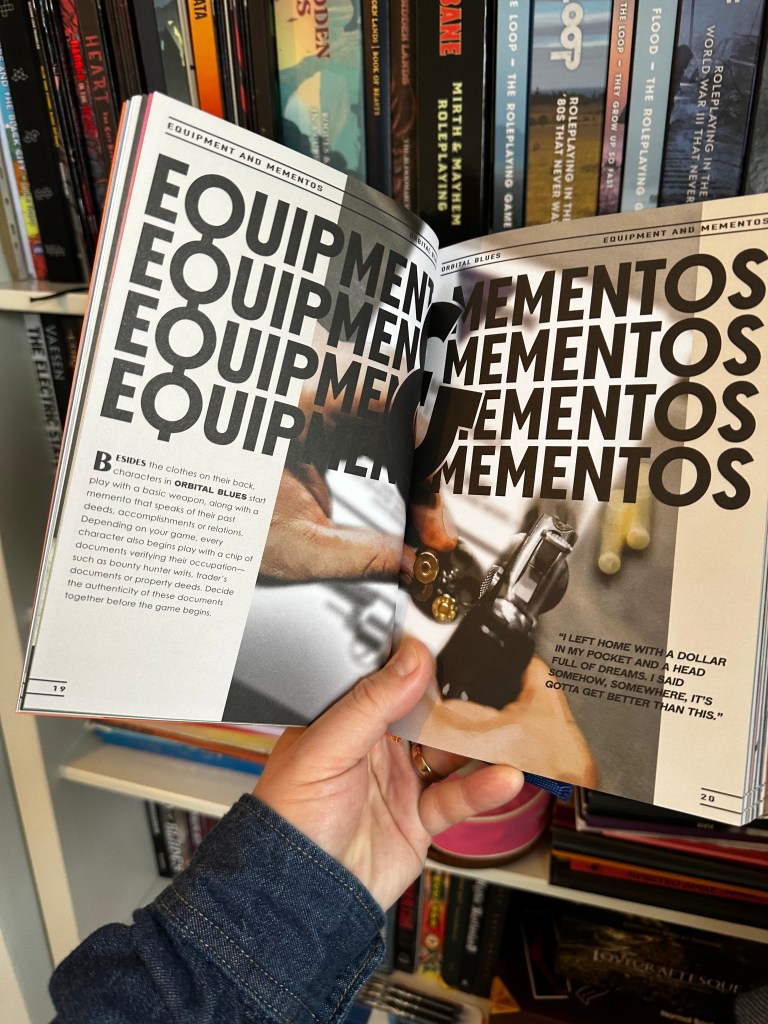
Equipment and Mementos

Equipment and Mementos

Avery gets one weapon, a memento and one piece of crew equipment.
I could roll a d12 to determine the starting weapon but I think it makes sense that Avery takes a sniper rifle given his background and gambit.

There is also a (1-18?) table for mementos but I spotted one on it that simply fits so well, its “Bounty on a former lover.” I would like to change it from “former lover” to “step-father,” though.

Finally, the piece of crew equipment: A night-vision scanner makes sense here, I think.

Soundtrack

Your Soundtrack
Your Soundtrack

Avery needs his own theme tune to act as a leitmotif for him at those most dramatic of moments. This is such a cool idea that reminds me of Tales from the Loop and the best actual plays. I think Avery’s soundtrack tune is Sweet Jane by Cowboy Junkies

Conclusion

I might actually come back and make a ship for Avery and his pals as well, but this post is already long enough. I’ve had fun making this character. The process asks some really interesting questions of the player to make a troubled and complex outlaw who is likely to get more and more troubled as time goes on. The rules are simple, and very easy to grasp. Character creation was also pretty straightforward, although I did find there was quite a lot of flipping back and forth through the book during character creation. But that is just a small quibble really.

For now, see you, space cowboy…

Deathmatch Island Character Creation

Today, I’ll be making a competitor for Deathmatch Island, a regular person with a normal-arse job, someone you might meet at the gym or in the supermarket.

This is the sixth in a series of character creation posts I’m using to figure out which game I want to schedule for our next campaign. You can find the Triangle Agency one here. And you can find the Slugblaster one here. You can find the Blades in the Dark one here. We took a slight detour for this one, here’s the Wildsea Ship Creation post. And then got back on track with the Wildsea Character Creation post.

Competitor Registration

Competitor Registration

Today, I’ll be making a competitor for Deathmatch Island, a regular person with a normal-arse job, someone you might meet at the gym or in the supermarket. This is not going to be a superhero, or a secret agent or a wizard. This totally ordinary person is going to be thrown into a situation unimaginable to most of us, having to fight for their lives, form alliances recruit followers and solve puzzles, with the reward of nothing more complicated than survival. And they will have to do all this with an enormous gap in their memories that relate to their lives before the competition.

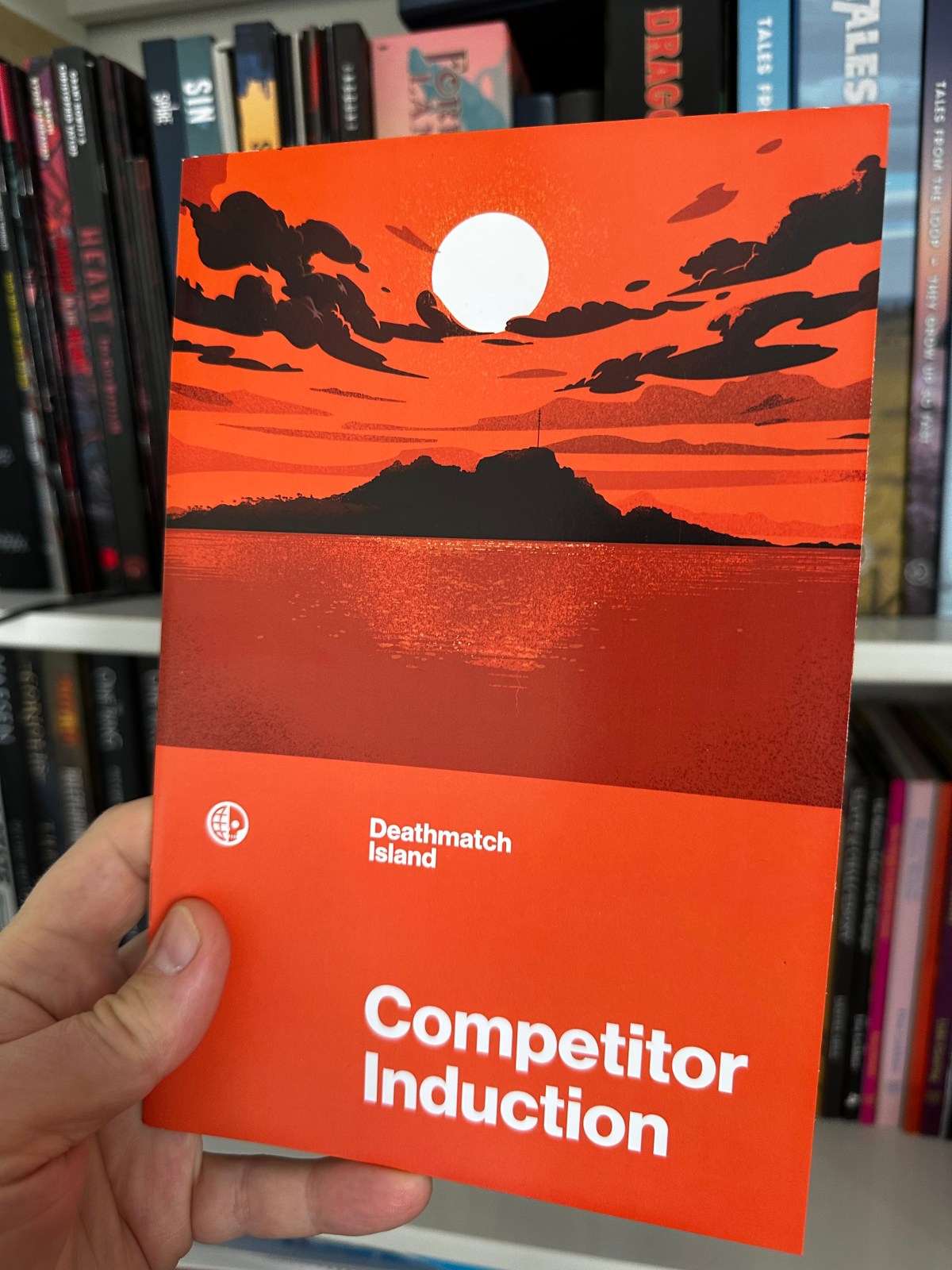
I wrote a piece about the game, which will give you the basics. You can read it here. So I am going to push straight on with Competitor Registration. One of my Kickstarter rewards was a Competitor Induction booklet. This holds a player’s hand through the relatively painless registration process and also provides some tips for Competitor Players in playing Death Match island. So, let’s open it up and get started.

Occupation

Occupation tables
Occupation tables

The first step is rolling up my Occupation. This part MUST be rolled randomly. It will allow me to add a die to my dice pool in contests if I believe my Occupation would be relevant. The Occupation will also determine my Competitor’s Favoured Capability (the type of contests the Competitor is specialised in.) All Competitors have the following Capabilities:

  • Social Game – using charm and social bonds to resolve contests
  • Snake Mode – solving contests using deception, stealth and straight-up lies
  • Challenge Beast – Not just physical ability but also a talent for puzzle solving
  • Deathmatch – The violent option: tactics, firearms and ruthlessness
  • Redacted – This is the one used when the Player Competitor strays out of the bounds of the game and into restricted areas. The Production Player (GM) has ways to counter these methods…

The Favoured Capability gets a d8, all the rest get d6s. These can be improved through gameplay later.

So, let’s roll on the tables. There are four Occupation tables, so I’ll start by rolling 1d4 to determine which one I roll on. That’s a 2! Then I roll 2d8 on Occupation Table 2. That’s a 7 and a 4. That gives me:

  • Firefighter (Challenge Beast)

So, with this Occupation, I’m imagining someone physically fit but also intelligent in spatial awareness, environmental hazards and safety concerns.

Name and Competitor Number

Name tables
Name tables

The name of a Player Competitor is more than just what the other characters call them. It has a mechanical impact. Part of the game is attracting followers, getting your name out there and increasing your popularity. This is so important that you add a Name die to every Contest roll in the game. It starts as a d6 but gets bigger as you accumulate followers.

You don’t have to roll for your name. If you want to play a Competitor with a specific nationality, ethnicity etc, you might want to choose the name for yourself. But, in the tradition of my character creation posts, I’m going to roll for as much as I can. There are three first name tables so I’ll start by rolling a d3 to pick the one I’ll roll on. That’s a 3! Now I’ll roll 2d8 to determine my first name. That’s a 5 and a 7, giving me:

  • Sakae – a Japanese name, normally male but sometimes female. It usually means, glory or prosperity, which seems auspicious. I think I will go with he/him pronouns for Sakae

The surnames are a little more straight-forward. I just roll 1d8 and 1d20 to figure it out. That’s a 4 and a 5, which gives me:

  • Kogoya – an Indonesian name. Egianus Kogoya is a military leader in the “Free Papua” movement

Sakae Kogoya is, I think, a civilian firefighter from the island of Okinawa (a place I actually lived for a year in the nineties.) His mother is Okinawan Japanese and his father is an Indonesian American who came with the American military forces but stayed when he found love. He opened an Indonesian restaurant in the city of Ginowan where Sakae grew up.

Next, I just roll a d100 to get Sakae’s competitor number. That’s 095.

Distinguishing Features

Uniform and Characters

There are a few random tables to determine some random features for your Competitor in the booklet. Once again, the player is free to choose from these tables or make up their own if they have a clear idea of them already. These features have no mechanical effects at all, unlike Name and Occupation. They are just to help distinguish the character. I’m going to roll on each table for the sake of randomness.

  • Eyes (1d20) – 19 – Beady (could also have had the likes of Glacial, Twitchy and my personal fave, Haunted)
  • Build – (1d20) – 20! – Willowy (other possibilities include Beefy, Towering and Average)
  • Hair – (1d20) – 5 – Striking (I’m imaging something that takes a lot of product and looks like something from an anime. I could also have rolled up Nest, Bangs or Boring)
  • Detail – (1d20) – Another frikking nat 20! – Strong hands (other options here included Unusual face, Eye-patch and Pleasant scent)

Uniform

Uniform tables
Uniform tables

All the Competitors start with the same uniform when you begin a game of Deathmatch Island. This also has no mechanical impact. There are six style options presented and six colours. I would say a lot of groups would want to discuss this amongst themselves and select the one that most appeals to them but, obviously, I’m going to roll for it.

  • Uniform Type (1d6) – 4 – Blazer and turtleneck!
  • Uniform Colour (1d6) – 4 – Goldenrod!

Wow! That’s quite a combo. Seems incredibly impractical. Not much stretch in a blazer and that colour is going to make sneaking extra challenging! But that’s what I rolled, so that’s what Sakae Kogoya and his fellow contestants are stuck with.

Please see below, the welcome letter that Sakae is presented with when he first wakes up on the boat taking him the ISLAND ONE.

Welcome to ISLAND ONE letter

Conclusion

Sakae Kogoya Competitor Registration sheet

And that’s it! That was refreshingly fast. You’ll notice, from the screenshot of Sakae’s character sheet, that there is a lot of empty space on it. There’s a lot that you only get in play in Deathmatch Island, so, even though I’m finished character creation, there’s a lot of room for growth, improvement and notes. I like this approach a lot. It leaves much of the character building to happen in the context of the game, rather than before you even start. It’s particularly appropriate in the scenario where your character is suffering from selective amnesia. I feel like, with this quick Competitor Registration and the relatively simple rules, you could get some people around a table and run a session of Deathmatch Island with little or no hassle or delay. The structure of the game and the way the Production player chooses casts allows you to run it with very little prep, also. This is a big tick in the pro column for me these days.

So, dear reader, what do you think of the Deathmatch Island character creation process in comparison to the other games in the series? I still have a few more I could fit in here, like Apocalypse Keys and Orbital Blues, which I listed as outside contenders way back here, in the post that started it all. But right now, I think Deathmatch Island is a strong contender, if only for the fact that I could get it off the ground so quickly and potentially complete a campaign in 3 or 6 sessions.

The Wildsea Character Creation

The book presents many, many options in each step, and that’s even using the Quickstart kits. Without the Quickstart rules, you can really choose any options from any bloodlines, origins and posts, to truly customise your character as you like.

This is the fifth in a series of character creation posts I’m using to figure out which game I want to schedule for our next campaign. You can find the Triangle Agency one here. And you can find the Slugblaster one here. You can find the Blades in the Dark one here. And most relevant to today’s post, here’s the Wildsea Ship Creation post.

A Character to Fit the Beacon

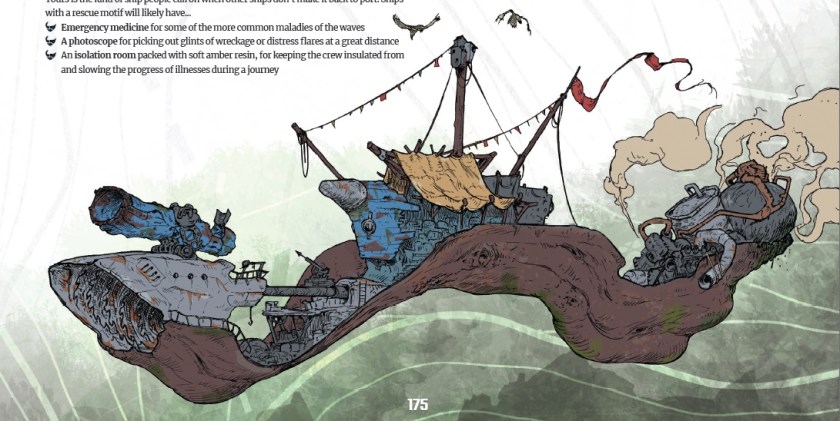
In my last post, I created a ship for my Wildsea character to pilot across the Thrash. The ship, it turned out, is a research vessel, fast and dangerous, but not very manoeuvrable or stealthy. It’s got a beehive for an engine and an acid-cannon for protection. It also has a colony of glow bugs that follow the crew around illuminating their surroundings for them. I named the ship the Beacon.

So, what kind of wildsailor am I going to come up with to match the vibes of the Beacon? Let’s find out, dear reader!

Character Creation Steps

Character Creation chapter illustration

There are three important choices to be made in this process:

  • Your Bloodline
  • Your Origin
  • Your Post

Now, while these choices are minimally restrictive, the beginning of the Character Elements chapter encourages you to build a narrative background around the framework of the mechanical choices. In fact, throughout character creation, you are encouraged to be creative and to make unique wildsailors that no-one else has ever made before.

Also, there are many other elements to a Wildsea character, it’s just that most of them hang off these three choices. All of these are explained in the Character Elements chapter.

At this point, I think it’s important to point out that the Character Elements chapter is there only to explain those elements, not to help you create your actual character. That’s all in the following chapter. One thing I have found with the Wildsea is that it devotes a lot of space to explaining everything. Occasionally, I find that this is at the expense of functionality. The book goes to some lengths to inform you what the Cook skill allows you to do, when, in a storytelling game, this could usefully just be left up to the players around the table. It’s also because so many of the terms used in play are quite unique, Twist, Edges, Whispers, Cut etc. Although most of these bear some resemblance to elements of other games, the resistance to using those better known terms means they require more explanation. I found this also in Slugblaster, an ostensibly Forged in the Dark game that uses a lot of setting/genre-specific terminology for concepts that are more functionally named in Blades in the Dark.

Anyway, I’m going to move on from the Character Elements chapter immediately. If I need to explain anything, I’ll do it as I build the character.

Young Guns or Old Dogs

This is a welcome choice to start with. It reflects the type of game you’re preparing for. If you go for a Young Gun, you start with fewer skills, aspects and resources, leaving the character more room to grow. The Old Dog has more going for them, but is meant for one-shots or short campaigns. For my purposes, I’m going to create an Old Dog, to show off more of the character elements in this blog post.
So, an Old Dog starts with the following:

  • 1 Bloodline, 1 Origin, and 1 Post
  • 3 edges
  • 15 skill / language ranks (maximum starting rank 3)
  • 6 aspects taken from any bloodlines, origins, or posts
  • 6 resources
  • 3 drives and 3 mires
Ardent Quickstart Kit

For ease of one-shot character creation, there is a Quickstart Kit presented in the section for each bloodline, origin and post. These break it down to a selection of easy choices.

In the interests of keeping this post below 2000 words, I’m going to use the Quickstart kits as and when I feel its appropriate.

Bloodline

Here are the options for Bloodline:

  • Ardent – human
  • Ektus – cactus-folk
  • Gau- fungus-folk
  • Ironbound – ship-ghosts with bodies of salvage
  • Ketra – gelatinous humanoids
  • Mothryn – moth people
  • Tzelicrae – hive-mind spider colonies in a human skin
A Ketra with a chart

Remember this is a Researcher we’re making here, so I think it would be useful for them to be good with technology. The Ketra are described in the book as “tech-savvy.” So, I think that’s what I will go for.

The ketra are the descendants of those fragments of ancient humanity trapped in tunnels and sturdy temple complexes, mineshafts, and mountain-seams. Like the ardent, they have adapted to face the post-Verdant world, but with a far more dramatic biological change – tentacular mantles, translucent fl esh, and swirling, ever-moving inkblot patternings are common. Many ketra reinforce their malleable forms with selfmade skeletons of salvaged driftwood or repurposed scrap-metal.

Questions

The first thing to do with your new ketra is answer the following questions:

Q: Have you spent any time in the ‘ancestral’ ketra places and, if so, how did you find their dark, crampled confines?
A: Yes, my character spent the early part of their life below the waves. Only as a young adult did they venture above the Thrash where they were discovered by the original owner of the Beacon, an Ardent named Benida Hoffspring

Q: How original is your skeleton, and if you’ve replaced parts of it yourself, what new materials do you rely on for support?
A: Many parts of their skeleton have been replaced, most notably, the lower jaw is shaped by a perfectly formed piece of Ironwood. It juts out more than it should. Other bones have been replaced with sturdy pieces of salvaged metal and ceramic.

Q: Were you passed down any stories of your family’s old human days, or is your preverdant lineage lost to history?
A: There was an old album of photos, preserved in plastic. It revealed a world long gone, of Ardent cities and water-going ships. Their ancestors were sailors…

Bloodline Aspects

Aspects differentiate your character from another one with the same bloodline, origin or post. They make them unique. They can take the form of a physical trait, a companion, or a piece of gear. So, with the Old Gun type of character, you can choose 6 Aspects from bloodline, origin or post. As a Quickstart character, I’ll choose two from each step.
If I list off every Aspect from every step, this post will be another giant. Instead, I am going to list only those that catch my eye for the character. Here are the bloodline aspects I want to choose from:

Scrapper Enzymes 3-Track Trait
You can use salvage as a component when concocting a potion or chemical mixture, no matter its form.

Scrap-Metal Skeleton 3-Track Gear
The internal structures you’ve collected can store biovoltaic energy. Use a task to create a resource, Scrap-Bone Battery.

Drone Attendant 3-Track Companion
A simple punchcard-driven repair construct. Increase impact when repairing or tinkering with other machines.

From these three, I love the idea of this character brewing up potions and stuff on the fly so I am going choose Scrapper Enzymes for that. I also have simply got to choose a companion when available and narratively fitting, so Drone Attendant is coming too.

Bloodline Edges

Edges are areas of talent. They literally give your character an edge in certain situations, meaning you get an extra 1d6 in your dice pool if appropriate. They are rather poetically named, but mostly speak for themselves nonetheless. Here are the edges presented in the Ketra Quickstart kit:

  • Iron – “An edge of force, determination, & willpower”
  • Sharps – “An edge of logic, wit, & planning”
  • Veils – “An edge of shadows, ciphers, & secrecy”

For this ketra researcher who crawled out of the depths on their own, I’m going to choose Iron and Sharps.

Bloodline Skills and Languages

These get ranks. You start at rank one and go up to rank three. You get an extra d6 in your dice pool for each rank in the skill you are using when appropriate. I have to choose five of these.
Here are the available skills in the Quickstart Kit:

Concoct, Delve, Outwit, Scavenge, Sense, Sway, Vault

I’m going to take Concoct, for sure, to go with the Scrapper Enzymes Aspect. I’m also going to take Delve, as someone show used to live in the ruins beneath the wildsea. And for my final Skill, I will take Scavenge, an important one for a scientific researcher/person who replaces their bones with random stuff.

And here are the available languages (you get a certain amount of lore with these too):

  • Chthonic – old human
  • Raka Spit – “The rapid patter of hunting-families and leviathaneers”
  • Signalling – inter-ship communication

Got to take Chthonic, probably their native tongue. Also, I just love the name of the language, Raka Spit, so I’ve got to take that too. Everyone gets a rank three skill in the trade-tongue, Low Sour, also.

Bloodline Resources

Resources can be used to get advantage on an action roll. They come in four different types as you can see below. I have to choose two of these to start with:

Salvage: Ceremonial Dynamite, Old Driftwood
Specimens: Luminescent Bone, Curled Centipede
Whispers: The Comforting Dark, All Tunnels End
Charts: A Faded Schematic

As a researcher, I think I have to take at least one specimen and the “Luminescent Bone” is the most thematic for this character. Perhaps it’s one of their own old bones?

I love the concept of Whispers in this game. They are like memes that can be passed on, inherited or sold, but once they are used, they are gone forever. I’ll take “the Comforting Dark.”

Bloodline Drives and Mires

Before making this decision, we need to understand the concept of Milestones in this game. They come in minor and major flavours and you write them for yourself. They work a bit like Beats in Heart. Achieving a major milestone allows you to improve your character more than a minor one.

So Drives, then, are the goals your character works towards to gain milestones. You can also gain a Whisper, or clear a mark of Mire when you move towards your drive goals. It’s important to note that they can change over time too, particularly if and when you achieve one of them.

Mires, then, are the negative psychological and physical effects of long-term exposure to the Wildsea. They will cut one or two dice from your rolls whenever you act against the effect of the mire.

Here are my options:
Drives

  • “Raise a pre-verdant structure” – this makes the most sense to me as a curious scientist
  • “Hoard treasures of the wider waves”Mires
  • “Sparks and jolts course through your extremities” – got metal bones, will take this one
  • “Your inkblot patterns whirl dizzyingly”

Origin

What were you before you were a wild sailor?
The options:

  • Amberclad – like Captain America but in amber
  • Anchored – ghosts of the Wildsea returned to life
  • Ridgeback – mountain folk
  • Rootless – born on the waves
  • Shankling – raised in the tallest trees
  • Spit-Born – brought up in the safety of an island or ruin

For this scientifically minded wild sailor, with the sort of backstory I have already incorporated, I think it would be very fun if they were an Anchored!

An Ardent Anchored
An Ardent Anchored

the anchored, a tangible, physical presence on the waves despite being, by almost all definitions, very much dead. These souls are given substance by their anchor, a single physical object that was left at the surface when their body fell. It might be a memento, a favoured weapon, a chart pointing the way home – whatever it is, it was enough of a tether to keep them from passing over, and to confer a level of impressive material control.

Normally, this would mean they came from above and their body was lost below, but for this ketra, I think it would be the opposite. When their original body died, just as they first emerged from above the surface, they reformed around a tether, something they brought with them from home. That was when they were brought aboard the Beacon for the first time. Their Anchor was the only thing left of them when they died, that wooden jaw.

Anchored Questions

Q: Do you remember your death? If so, what caused it?
A: No. The exact circumstances are hazy and plot-relevant
Q: To what extent do you feel connected to the world around you, now that you don’t follow quite the same rules of physicality as most?
A: They constantly strive to understand the world around them, scientifically, intellectually, and emotionally
Q: Have you ever come close to losing your anchor? If so, what happened?
A: No, as an integral part of the body, it has never been removed.

Anchored Aspects

Spectral Variance 3-Track Trait
Mark to become insubstantial for a short time, allowing you to float and pass through solid objects.

Geist Hand 3-Track Trait
You can manipulate nearby objects without touching them, though the heavier they are, the harder it is.

Tempered Anchor 5-Track Gear
Your anchor to the world is reinforced against damage and tampering, a wise move for a fleeting ghost.

I’m going to go for Geist Hand as suitably spooky and Tempered Anchor for purely practical purposes.

Anchored Edges

Here are the options:
Iron – already took this one
Tides – “An edge of exploration, learning, & lore”
Veils – “An edge of shadows, ciphers, & secrecy”

I guess it has to be Tides and Veils. Tides is particularly fitting for the researcher, I think.

Anchored Skills and Languages

Skills: Brace, Delve, Hack, Hunt, Outwit,
Sense, Wavewalk
Languages: Old Hand, Signalling

Going to take lots of skills this time. Brace is a defensive skill that will be generally useful. Outwit is a good one for a ghost, Sense seems equally appropriate for the Anchored. Also Wavewalk, normally meaning the ability to navigate the wildsea without a ship, could mean gliding along it spectrally. Also going to take Old hand (sign language) as a language.

Anchored Resources

Salvage: Old Memento, Broken Locket
Specimens: Glowing Plasm, Spectral Flower
Whispers: Back from Beyond, Drowned and Not
Charts: A Sketch of Shadowed Paths

Absolutely must take Back from Beyond as one of these. Also, a Broken Locket from Benida Hoffspring.

Anchored Drives and Mires

Drives

  • “Send other spirits to a peaceful rest”
  • “Reconnect with your friends and family” – This could be a fun adventure beneath the waves. I’ll take it!

Mires

  • “Your material control wavers erratically” – classic ghost-trope. Thanks.
  • “Visions of your past death are difficult to banish”

Post

Your Post is essentially your job on the ship. There are a lot of options here:
Alchemist – speaks for itself
Char – cook (sorta)
Corsair – swashbuckler
Crash – demolitions expert
Dredger – scavenger
Hacker – hacking through the wildsea
Horizoneer – adventurer
Hunter – ‘nuff said
Mesmer – mind-controllers
Navigator – yep
Rattlehand – engineer
Screw – Magnetos
Slinger – ranged attackers
Steep – tea-brewers
Surgeon – you know what this is
Tempest – Electro
Wordbearer – postman

There are several that are very tempting, like the Tempest, the Mesmer and the Char, but I think there is only one logical answer here, Alchemist. Right?

Alchemist
Alchemist

Alchemists are masters of concoction and reaction, able to combine chemicals and arconautic knowledge with unexpected (and occasionally unstable) results. Some alchemists focus on the healing arts, some on transformation and understanding, and others on more… explosive pursuits.

Alchemist Questions

Q: Do you specialise in certain ingredients, or take whatever you find and do your best?
A: They are curious about everything. Experimentation is key
Q: What was the worst unexpected side-effect you (or an unfortunate crewmember) ever experienced from one of your alchemical creations?
A: For a brief time, a crew mate died and became spectral like them, but just for a few minutes
Q: What draws you to such a specialised field of study? The lure of knowledge and understanding, or the power to change the world to your own design?
A: They are obsessed with the building of knowledge to understand this world and what they are doing in it still.

Alchemist Aspects

I will choose two from the following three:

Ulcerous Alembic 3-Track Trait
You can swallow two alchemical components, keeping them safely in your stomach. You can concoct them internally when you choose, benefitting immediately from the results or spitting the resulting solution out.

Baseline 3-Track Trait
Mark to briefly ignore any positive or negative effects stemming from a temporary benefit or injury. You are always immune to the negative effects of crezzerin.

Explosive Vials 3-Track Gear
Not an endless supply, but potent and disorienting. Mark to deal LR Blast, Salt, Acid, or Toxin damage to multiple nearby foes.

I’m going to take Baseline, since it makes sense due to my bloodline and origins. I’m also going to take Explosive Vials for fun.

Alchemist Edges

These are the options:

  • Grace – “An edge of elegance, precision, & agility”
  • Sharps – got it
  • Tides – and this

So I will take Grace, but I will need to choose another that isn’t listed. There are only two more that I don’t already have. I will go with:
Instinct – “An edge of sense, intuition, & reaction.” Which just feels right.

Alchemist Skills and Languages

Skills: Brace, Break, Concoct, Harvest, Scavenge, Study, Tend
Languages: Highvin, Brasstongue

No doubt I’m taking Break, Harvest and Study as skills. And with my last two skill ranks, I am going to upgrade Concoct and Study to Rank 2.

Alchemist Resources

Salvage: Pouch of Vials, Rust Extract
Specimens: Dried Locusts, Draketongue Root, Beast
Blood, Poison Glands
Whispers: A Tale of Choking Mists
Charts: A Stained Snapograph

I will take one Salvage this time, Pouch of Vials, and also another Specimen, Poison Glands.

Alchemist Drives and Mires

Drives

  • “Discover a previously unknown alchemical effect”
  • “Gather bile from an ancient leviathan” – maybe on the way down to visit their family?

Mires

  • “You’re the perfect test subject for your own work”
  • “Explosives are unstable around you” – this is too funny to pass up.

Final Touches

Name: Dhalsim Goodbottle
Pronouns: They/Them

Lets put it all together

Background

Bloodline: Ketra
Origin: Anchored
Post: Alchemist

Edges

  • Grace
  • Iron
  • Instinct
  • Sharps
  • Tides
  • Veils

Skills

  • Brace 1
  • Break 1
  • Concoct 2
  • Delve 1
  • Harvest 1
  • Outwit 1
  • Sense 1
  • Study 2
  • Wavewalk 1

Languages

  • Low Sour 3
  • Chthonic 1
  • Raka Spit 1
  • Old Hand 1

Resources

  • Salvage: A Broken Locket, a Pouch of Vials
  • Specimens: Luminescent Bone, Poison Glands
  • Whispers: The Comforting Dark, Back from Beyond

Aspects

Scrapper Enzymes 3-Track Trait
You can use salvage as a component when concocting a potion or chemical mixture, no matter its form.

Drone Attendant 3-Track Companion
A simple punchcard-driven repair construct. Increase impact when repairing or tinkering with other machines.

Geist Hand 3-Track Trait
You can manipulate nearby objects without touching them, though the heavier they are, the harder it is.

Tempered Anchor 5-Track Gear
Your anchor to the world is reinforced against damage and tampering, a wise move for a fleeting ghost.

Baseline 3-Track Trait
Mark to briefly ignore any positive or negative effects stemming from a temporary benefit or injury. You are always immune to the negative effects of crezzerin.

Explosive Vials 3-Track Gear
Not an endless supply, but potent and disorienting. Mark to deal LR Blast, Salt, Acid, or Toxin damage to multiple nearby foes.

Drives

“Raise a pre-verdant structure”
“Reconnect with your friends and family”
“Gather bile from an ancient leviathan”

Mires

“Sparks and jolts course through your extremities”
“Your material control wavers erratically”
“Explosives are unstable around you”

Conclusion

Well, that was pretty epic, wasn’t it, dear reader? Excepting only the Dark Sun character creation post, that was the longest one I’ve ever done. There are a lot of choices to be made in this process. The book presents many, many options in each step, and that’s even using the Quickstart kits. Without the Quickstart rules, you can really choose any options from any bloodlines, origins and posts, to truly customise your character as you like. I imagine that would be nigh on impossible to do without an encyclopaedic knowledge of the options presented in about 60 pages. I would not even attempt to do it without having made a Quickstart character or two first.
On the plus side, it was quite fun. The options presented are incredibly evocative and helped me envision my character aboard the Beacon. The drives and mires, in particular gave me a peek into the heart of Dhalsim Goodbottle. The other options gave me an exceptionally good look into the world of this game.

Dear reader, have you had any experience with the Wildsea? Have you sailed its verdant waves? Have you plumbed its leafy depths?

The Wildsea Ship Creation

Felix Isaacs has suggested that you start by creating your ship and only then move on to the creation of the characters who will crew it. And who am I to argue with Mr Isaacs?

This is the fourth in a series of character creation posts I’m using to figure out which game I want to schedule for our next campaign. You can find the Triangle Agency one here. And you can find the Slugblaster one here. You can find the Blades in the Dark one here.

Shipbuilding

I recently reposted a piece I wrote last year about the Wildsea and how it exemplifies the tradition of giving your PCs something to care about and then fucking with it. Please check it out for the basics of the game, the setting, and the ruleset. In that post, I pointed out that, creator of the Wildsea, Felix Isaacs, has suggested that you start by creating your ship and only then move on to the creation of the characters who will crew it. And who am I to argue with Mr Isaacs?

Stakes

How much do you have to spend on your new ship? Well, the buying process is abstracted out to a number of stakes. You don’t need to worry about defining the exact amount of currency required to outfit a new boat, you just split it up like a pie. Each crew starts with 6 stakes to spend on ship creation, with an additional 3 per PC who will be crewing it. Most options will cost a single stake but some more powerful ones will cost two or three. Since I don’t have a real party, I’m going to pretend I have a full compliment of three, leaving me with a total of 15 stakes.

You can’t get any more Stakes to improve your ship during play, but it is possible to trade cargo for the same upgrades later.

Next, in the Ships & Shipbuilding chapter, it has a short section on “Personal Touches.” I think these are important to making a ship feel like your own, but I think I’ll keep them to the end of the process.

Creating Your Ship

A Wildsea ship
A Wildsea ship

The next page tells us about the steps to make your ship. There are three overall stages:

  • Design – you have to choose an option for each of the following:
    • Size
    • Frame
    • Hull
    • Bite
    • Engine
  • Fittings – these are all optional but they come in the following categories:
    • Motifs
    • Additions
    • Rooms
    • Armaments
    • Outriders
  • Undercrew – optional choices that come in the following types:
    • Officers
    • Gangs
    • Packs

On the same page, there is a helpful example ship statted out for us. It is essentially just a list of chosen options beneath each of the three stages. Beside each option is the cost in Stakes and the benefit it provides for the ship if appropriate.

It also lists the Ratings for the ship.

Ratings

These are tracks (tracks are like clocks in Blades in the Dark, in some instances and like health bars in others) that are used to record the current status of various aspects of the ship. Every ship will have all six of these:

  • Armour – speaks for itself
  • Seals – How well your ship keeps out the nastiness from the Wildsea
  • Speed – ‘nuff said
  • Saws – most ships use giant chainsaws or something similar to power their way through the waves of leaves and branches.
  • Stealth – how well can your ship pass undetected?
  • Tilt – this is your ship’s manoeuvrability

Each one of these Ratings starts as a 1-track but we’ll be adding to that as we progress.
Keep these Ratings in mind as we go through the process!

Step One – Design

Normally, this would be done by committee. Every player should be involved in the decisions on which the foundations of the ship are built. But, obviously, in my case, that’s not possible. Anyway, here we go!

Size

There are four sizes available and they each cost 1 Stake:

  • Nano – big enough for one person and maybe a passenger. +1 Stealth
  • Small – can easily accommodate between two and four sailors. A good starter ship. +1 Speed
  • Standard – perfect for five to ten people. +1 Armour
  • Large – ideal for ten to twenty people. +1 Armour and -1 Stealth

I have a limited number of Stakes so I feel like a Small ship is the way to go. Also, it’s for a crew of up to four, so it’s just right.

Frame

The Frame, the book tells us, betrays a certain attitude that you want your ship to give off to other wild sailors. Your choice will also give Rating modifiers like Size does. Here are the six available Frames:

  • Sturdy – meant to weather storms and bombardments both. +1 Armour
  • Moulded – somehow constructed from a single piece of some material. +1 Seals
  • Light – lightweight and dainty. +1 Speed
  • Scything – all about cutting through the treetops as well as they can. +1 Saws
  • Sleek – Keeps you “low to the waves,” and as quiet as possible. +1 Stealth
  • Flexible – bend before breaking. +1 Tilt

I personally think that one of the coolest aspects of these wildsea vessels is the fact that they use enormous chainsaws to cut through the canopy. So, I’m going to lean into that and choose the Scything Frame, giving +1 Saws and costing 1 Stake.

Hull

Interestingly, you can have more than one of these, if you like, but you must have at least one, for obvious reasons. There are twelve Common Hulls and three more Unique ones listed here. The cost ranges from free to 3 Stakes. Here are the Common ones:

  • Reef-Iron – 1 Stake, +1 Armour
  • Leviathan Bone – 1 Stake, +1 Seals
  • Broadwood – 1 Stake, +1 Tilt
  • Rough Bark – 1 Stake, +1 Stealth
  • Chitinous – 1 Stake, +1 Speed
  • Razorscale – 1 Stake, +1 Saws
  • Beastback – 2 Stakes, +1 Seals, +1 Tilt, “A half-living hull of flesh and bone, flexible and unsettlingly warm.”
  • Ceramic – 2 Stakes, +1 Armour, +1 Seals
  • Chrysalid – 2 Stakes, +1 Seals, +1 Stealth, “A hull adapted from the cast-off chrysalis of a massive insect, excellent protection against the sea’s incursion.”
  • Ghost-Oak – 2 Stakes, +1 Armour, +1 Stealth
  • Arachnesque – 2 Stakes, +1 Tilt, +1 Stealth, “Less of a hull and more of a giant insect grown to fit the specifications of your frame, usually something spider-like.
  • Exile’s Copper – 2 Stakes, +1 Armour, +1 Speed

Here are the three Unique Hulls:

  • Junk-Strung – Free, +1 Armour, -1 Seals, can salvage parts from it
  • Floraflage – 2 Stakes, +2 Stealth, -1 Armour, undetectable while stopped
  • Monument – 3 Stakes, +2 Armour, +2 Seals, made from mountain stone so can’t “Forge-ahead during a journey”

I like the idea of adding a little Armour Rating at this stage but also building on the Speed I improved before so I am going to go with Exile’s Copper for the Hull giving me a +1 Armour and +1 Speed. It will cost 2 Stakes but I think its worth it.

Bite

This determines the way your ship is propelled. It will also have an effect on your ramming damage and the ease by which others might track you. There are twelve Common Bites listed, as well as several different types of sails and a trio of Unique Bites as well. Here are the Common ones:

  • Sawprow – 1 Stake, +1 Saws, big chainsaws! Close Quarters (CQ) Serrated damage
  • Impellers – 1 Stake, +1 Speed, outboard engines. CQ Blast damage
  • Crawler – 1 Stake, +1 Tilt, kinda like crab legs? CQ Blunt damage
  • Underscales – 1 Stake, +1 Stealth, snakey. CQ Keen damage
  • Jag-Tracks – 1 Stake, +1 Armour, “Motorised grapple tracks.” CQ Hewing damage
  • Sluicejets – 1 Stake, +1 Seals, chemicals that push you along. CQ Acid damage
  • Longjaw – 2 Stakes, +1 Saws, +1 Speed, “An underslung chainsaw arrangement.” CQ Serrated damage
  • Propeller-Cage – 2 Stakes, +1 Speed, +1 Armour. CQ Blunt damage
  • Navapede Limbs – 2 Stakes, +1 Tilt, +1 Stealth. Like a centipede. CQ Spike damage
  • Voltaic Runners – 2 Stakes, +2 Seals, like the electric ships in the Matrix, I imagine? CQ Volt damage
  • Mulcher – 2 Stakes, +2 Saws, +1 Armour, -1 Stealth, “grinding teeth in a lamprey-style mouth.” CQ Serrated damage
  • Tentaculari – 2 Stakes, +2 Tilt, it’s tentacles. CQ Salt(!) damage

I am not going to go into all the Sail and Unique options here because there are too many already, to be honest, and I know I don’t want any of them. I need to stick to my guns, or my chainsaws in this instance. As I am worried about the number of Stakes I have left to spend, I won’t go for the Longjaw. Instead I’ll go for option number one, Sawprow, for 1 Stake, giving me +1 Saws.

Engine

This is the last bit in the Design stage. A few things to note about the ship’s Engine:

  • It can be used for more than just propulsion
  • It will require a specific type of fuel
  • In most instances, don’t worry about tracking the fuel

There are eleven Common Engines and four more Unique ones. Here are the Common ones:

  • Chemical Compressor – 1 Stake, +1 Speed. Fuel – crushed fruit and insect husks
  • Springwork – 1 Stake, +1 Saws. Fuel – manual labour
  • Parasite Pitcher (Plant) – 1 Stake, +1 Stealth. Fuel – living matter
  • Steam Piping – 1 Stake, +1 Seals. Fuel – water
  • Ratwheel Exchange – 1 Stake, +1 Tilt. Fuel – feed the rats
  • Pulsing Cocoon – 1 Stake, +1 Armour. Fuel – dreams
  • Jawbox – 1 Stake, +1 Saws, +1 Speed, -1 Stealth. Fuel – wood
  • Solar Compressor – 2 Stakes, +1 Speed, +1 Stealth. Fuel – sunlight
  • Magnetic Coils – 2 Stakes, +1 Tilt, +1 Stealth. Fuel – magnetic scrap
  • Ceramic Batteries – 2 Stakes, +1 Saws, +1 Seals. Fuel – lightning strikes
  • Acid Maw – 2 Stakes, +2 Saws. Fuel – salvage and scrap

The Unique Engines are fun too. One of them is this:

  • Tamed Hive – 2 Stakes, +1 Speed, +1 Seals. It’s a massive hive and can produce honey. Fuel – flowers and pollen

I love the whimsy of the Tamed Hive so much that I must have it! That’s 2 Stakes but it adds +1 Speed and +1 Seals

There won’t be any more changes to the Ratings from the remaining steps so our final Ratings are:

  • Armour – 2
  • Seals – 2
  • Speed – 4
  • Saws – 3
  • Stealth – 1
  • Tilt – 1
A weird looking wildsea ship

Step Two – Fittings

Pretty much every part of this is optional, which is just as well because I only have eight Stakes left…

Motif

So this is the general theme and purpose of the ship. Choosing one can help the whole crew get a clear vision of the vessel and will also influence how others see you and it. They provide specific things like emergency medicine, gaudy appearance or a reinforced engine room. They do not provide mechanical effects but they may play a part narratively.

Here are the available Motifs. They each cost two Stakes:

  • Transport
  • Hauling
  • Hunting
  • Salvaging
  • Pathfinding
  • Raiding
  • Rescue
  • Research
  • Entertainment

You don’t have to choose a Motif for your ship but I am enamoured by the idea of a Research vessel out there on the wild waves. Perhaps the unconventional engine was something we discovered during a past expedition and we figured out how to make our ship go with it through the power of research!

A Research vessel:

  • has better tech on show than most ships
  • contains a research library
  • houses a snapograph arrangement. Its a sort of big camera

Additions

There are so many of these, most of them costing a single Stake. We’ve got Firefly Lanterns, a Cargo Crane, a Steam Whistle and lots more. But, as I am getting worried about how much I’ve spent already, I am only going to pick up:

  • Anchor System – Its Free!
  • Tethered Kitesail – 1 Stake – its a glider that is hooked to the deck. Lets us go up and get a bird’s eye view when the wind’s up

Rooms

On a Small Size vessel it’s not a great idea to split your already limited space up any further. You already have the following rooms on your ship:

  • A Pilot’s Cabin
  • A Main Deck
  • Crew Quarters
  • An Engine Room
  • A Cargo Bay

You can add a lot of different types of rooms like a Galley, a Navigational Suite, a Tap-Room or a Brig and they are all optional.

But this is a Research vessel now and I feel like we need a good way to observe stuff. We have the glider to allow us to watch from above. I would like to add a Cupola to the hull, near the rear of the ship, giving a great view of the Underthrash. That costs one Stake. I am down to just four Stakes left.

Armaments

Weapons are next on the Fittings list. These, too, are optional. In this case, they are either placed on deck or fixed to the Hull. I’m not crazy about the idea of armaments for a Research vessel, however, since our Stealth sucks, I think it’s prudent.

We have a lot of choices, from Trebuchet to Storm-Rail to Broadside Cannons and a Bladed Prow. But I’m going to pick up something suitably sciencey:

  • Viper’s Tooth – 2 Stakes, sprays an acid of some sort dealing Long Range Acid Damage.

Outriders

This is another option for defence. Honestly, with a Small ship, I don’t have the space for this and I also don’t have the Stakes to spend on it. You have to build an Outrider much like a ship, although it only has two components. You will also then need to add a way to store and deploy it from your actual ship. It seems like a fun extra but I can’t afford it.

Step Three – Undercrew

Octopus crew
Octopus crew

These come in three varieties: Officers, Gangs and Packs. I’m not going to go into detail on each variety as this post is already way too long. Suffice it to say, the officers are Skilled, Experienced or Well-Travelled, the Gangs are not necessarily what you might think of when you think of Gangs (some of them are Tinkers, some are Spear-Fishers, but some are actual Marauders) and the Packs are animals…

You can have Spring-Foxes which leap along beside your ship to warn of danger, Rig-Ferrets who can do knots, Squirrel Flingers who will fight to defend your vessel. But what I want is one of the Insect Packs:

  • Glowbug Parade – 2 Stakes, they follow the crew members around and illuminate their surroundings for them!

Personal Touches

And so, with all Stakes spent, we come back to the start and our little idiosyncrasies. The book suggests describing the following, so I will:

  • Colour and Style – I think it was once a scientific grey and white, all straight lines but now it is a dark shade of honey as the insects crawled all over it. It’s all smeared and waxy. The crew have left it that way as they think it protects from parasites
  • Shape and Construction – I think this ship is quite blocky, almost as though it was constructed from prefab elements. But, once again, the engine bees have shored up all the joints and seams with wax and honey, making it look far more organic
  • Quarters Decoration – I don’t have my character created yet so I am going to revisit this when I have made them. I expect that all the crew sleep in a single chamber, though. They might each have a personalised corner
  • Quirk – Sometimes the bees go to sleep at night and we can’t get the engine to start
  • History – This has always been our ship. It has been on a mission of discovery and research for several years now. We were originally led by an old eccentric who built it and funded it. Now she’s gone, we carry on in her place

The final step? A name of course!

I name this good ship, The Beacon…

And here is a list of the options I have taken:

The Beacon

Design

Small Size (1 Stake, +1 Speed)
Scything Frame (1 Stake, +1 Saws)
Exile’s Copper Hull (2 Stakes, +1 Armour, +1 Speed)
Sawprow Bite (1 Stake, +1 Saws, Massive CQ Serrated Damage)
Tamed Hive Engine (2 Stakes, +1 Speed, +1 Seals, honey)

Fittings

Research Motif (2 Stakes)
Anchor System Addition (Free)
Tethered Kitesail Addition (1 Stake)
Cupola Room (1 Stake)
Viper’s Tooth Armament (2 Stakes, Massive LR Acid Damage)
No Outriders

Undercrew

No Officers
No Gangs
Glowing Parade Insect Pack (2 Stakes)

Conclusion

I’ll keep this short as that was very long. You should set aside a session just for this process, dear reader. There are a lot of choices and I can only imagine how much longer it would take with four or five people trying to come to agreement on it! However, it has given me a very clear idea of the Ship I just created and a few ideas for the type of character who might crew it.

On to character creation!

Blades in the Dark Character Creation

You play a scoundrel…doing [heists] with your crew. The setting is Doskvol, a city in perpetual darkness beset by inter-faction strife, corrupt leaders, and supernatural entities. The end goal for the character is usually to retire from that life with enough coin in their stash to live safely and securely without worrying about rivals or the authorities.

This is the third in a series of character creation posts I’m using to figure out which game I want to schedule of our next campaign. You can find the Triangle Agency one here. And you can find the Slugblaster one here.

Forging a New Era

From top left, clockwise, the covers of Bump in the Dark, Band of Blades, The Wildsea and Slugblaster

Blades in the Dark, by John Harper has had such a profound impact on the TTRPG landscape since its release in 2017, that it’s hard to overstate it. It has a devoted following, it consistently appears on top ten RPG lists and it has spawned a bewildering array of games based on its system and setting. Forged in the Dark games like Band of Blades, Girl by Moonlight, Bump in the Dark, Slugblaster and Wildsea (debatably.) You can find a non-exhaustive list here.

The system is story-focused, encouraging players as well as GM to take a hand in building the narrative. Near the start of the book, it is pointed out that, “no-one is in charge of the story.” If I were to encourage you to take anything from this short summary, it would be that.

As in Slugblaster, you roll a D6 when attempting something. 1-3 is a failure, 4/5 is a success with consequences and 6 is a full success. The consequences from a failure or mixed success can come in the form of Stress, and thereby Harm and Trauma Conditions, which have more of an narrative effect on the story than a mechanical one (although they certainly have that too.) You can also add more dice to your roll and build a dice pool to give you more chance of rolling higher. You do this in several ways, by using pushing yourself, getting assistance or taking a Devil’s Bargain.

In all of these Forged in the Dark games, the rolls you make are highly abstracted. Instead of making a stealth roll, an investigation roll or a thieves’ tools roll, you describe what your character wants to do and then roll with the appropriate Action Rating. In most cases the Action encompasses a character’s whole part in a scene, rather than a single, explicit skill or combat thing like in D&D and similar games. The choice of the Action Rating used is explicitly left up to the player, but if the GM thinks it might be more effective to use a different one, they can reduce the impact of the action or increase the danger of the PC’s position, making the consequences for failure more severe.

Blades has several really cool mechanics, like the Flashback to go back and prepare something for the situation you find yourself in, but I don’t have the space to go into every rule here. Maybe I’ll do more of a deep-dive into the rules in another post. For now, let’s go about creating my Scoundrel.

Dark Heists

It’s important to remember the setting and the type of game this is. You play a scoundrel of some sort, doing jobs/heists/cons with your crew. The setting is Doskvol (or Duskwall), a city in perpetual darkness beset by inter-faction strife, corrupt leaders, and supernatural entities. The end goal for the character is usually to retire from that life with enough coin in their stash to live safely and securely without worrying about rivals or the authorities.

Blades in the Dark character creation steps

Playbooks

The types of characters available to play are suitably goth.

  1. Cutter – violent and intimidating
  2. Hound – crack-shot tracker
  3. Leech – explosive alchemist
  4. Lurk – shadowy sneak-thief
  5. Slide – social and manipulative
  6. Spider – factional mastermind
  7. Whisper – magic and ghosts

There are seven of them, as you will have noticed. So, I’m breaking out the DCC zocchi dice again. I got a 4 on the d7 making this character a Lurk.

The Lurk

The Lurk playbook in Blades in the Dark

There is no longer any sunlight — the world is plunged into eternal night. There are scoundrels who live in the darkness, who prowl the underworld unseen, trespassing where they will. They are the burglars, the spies, the infiltrators, the cut-throats — commonly called Lurks.

After this pleasing intro, the playbook description tells me that my Lurk will gain xp whenever they “address a challenge with stealth or evasion.” Each of the playbooks have a different way to earn xp that’s individual to them.

Here also, it asks a couple of questions to get the player thinking, not just about the mechanics of the playbook, but about the personality and background of their character:

Q. How did you learn the stealthy arts of the Lurk?
A. I was taken in at a young age by a band of pickpockets and sneak-thieves.

Q. Which Aspect are you drawn to most? The invisible watcher, spying on the unwary? The adroit acrobat, racing across rooftops? The deadly ambush predator, waiting for a victim in the darkness?
A. The intimate knowledge of the city’s underworld, its back alleys and interconnected cellars, its rooftops and sewers. Where to spy from, where to approach a potential mark/victim from and how.

Starting Actions

Everyone has three Attributes:

  • Insight
  • Prowess
  • Resolve

Each of these has four Action Ratings hanging off it.
Insight has

  • Hunt
  • Study
  • Survey
  • Tinker

Prowess has

  • Finesse
  • Prowl
  • Skirmish
  • Wreck

Resolve has

  • Attune
  • Command
  • Consort
  • Sway

You can have up to four points, or dots, in each Action Rating although you can only have up to two dots at the start.
The Attribute Ratings will equal the number of associated Action Ratings they have any score in. So if you have any dots in Attune and any dots in Command, you will have a Resolve of 2. You use the Attribute Ratings to resist different types of stress.

In the case of the Lurk, I start off with 1 point in Finesse and 2 in Prowl. I will add four more points to Action Ratings at a later step.

Shady Friends/Rivals

Your connections to NPCs can be key to a successful or disastrous career as a scoundrel. There is a list of five in a table here. I’m going to roll my d5 once for a Friend and once for a Rival

  • Friend – 3 – Frake. This is a locksmith who has taught me everything I know about lock-picking. He has an encyclopaedic knowledge of every type of lock, chest, safe and safe room in the city
  • Rival – 2 – Darmot. Once, he was one of our band of pickpockets, now, he uses his knowledge against them. He’s busted me many times

Lurk Special Abilities

You only get one of the eight listed abilities to start with.

  1. Infiltrator – you don’t suffer negative effects due to higher quality security measures employed by higher Tier enemies
  2. Ambush – Gives you an extra d6 when attacking from hiding
  3. Daredevil – get a bonus die if you take a desperate action as long as you take -1d6 to resist any consequences of it
  4. The Devil’s Footsteps – push yourself to do the impossible. This ability has a variety of effects
  5. Expertise – you have to choose an action rating and when you lead a group action with that, you can only take a maximum of 1 stress
  6. Ghost Veil – go completely invisible by shifting into the ghost field. Just take some stress to do it
  7. Reflexes – who should act first? You should, of course!
  8. Shadow – use your special armour to resist consequences from security measures or pushing yourself in physical endeavours

The book suggests taking the first one listed if you can’t decide between them. However, I am going to roll a d8 to make the decision for me. That’s an 8!

Shadow

You may expend your special armor to resist a consequence from detection or security measures, or to push yourself for a feat of athletics or stealth.
When you use this ability, tick the special armor box on your playbook sheet. If you “resist a consequence” of the appropriate type, you avoid it completely. If you use this ability to push yourself, you get one of the benefits (+1d, +1 effect, act despite severe harm) but you don’t take 2 stress. Your special armor is restored at the beginning of downtime.

I like this a lot. It matches the growing image of this character that I have in my mind.

Lurk Items

There is a section in the playbook description for items specific to the Lurk, but there is no need to choose anything at this stage. In Blades in the Dark, you simply indicate at the start of a Score how heavy a Loadout you have on you. That gives you a number of Load points to assign as the Score progresses. When you come across a situation in which you need “Dark-sight goggles” for instance, you write them down and mark the 1 Load that they take up. You never need to describe the items you have in your pack beforehand.

Heritages

The Shattered Isles map and description

There are six options here. Your Heritage is more akin to a real-world ethnicity or national background than a race or species. It is quite likely to shape your character’s politics, social circles and general way of thinking. It is unlikely to have any mechanical effect.
Here are the Heritages:

  1. Akoros – big, industrialised land. Like Europe. Duskwall is here.
  2. Dagger Isles – peopled by corsairs and merchants who sail the seas between their isles and beyond
  3. Iruvia – a desert kingdom to the south. Think Egypt.
  4. Severos – a wild place with nomadic people who survive in the ruins of ages past
  5. Skovlan – recently colonised by Doskvol. Many refugees from here have come to the city to look for opportunity
  6. Tycheros – a far-away land where the people are part demon. These characters get demonic telltales that mark them physically

Rolling a d6 for this as well: That’s a 1! Akoros. This is a local person whose family fell on hard times. While their parents were out looking for work, this guy was out running around with their gang, stealing and sneaking.

Backgrounds

What did this character do before going their crew? There are 7 options:

  1. Academic
  2. Labour
  3. Law
  4. Trade
  5. Military
  6. Noble
  7. Underworld

I would normally roll for this but I feel like I already have such a solid picture of this Lurk in my head that I am going to have to go for Underworld here. They were a street kid, a pickpocket within a network of urchins that spanned the city.

Assigning Action Dots

There are only a couple of rules to the way you can assign these dots (points) on your character sheet. You can’t start with more than two points in any one Action Rating. Also you should add one dot to an Action rating that reflects your Heritage and one dot to an Action Rating that reflects your Background.

I think, as a local in this industrial city, this character would get a dot in Tinker and as a wee guttersnipe, they would need a dot in Skirmish. I get two more dots to spend freely so I would like to add one to Hunt and one to Attune.

Vices

In your downtime between Scores, you might want to blow off some steam to relieve stress. That’s why you need a good vice!

Here are the options:

  1. Faith
  2. Gambling
  3. Luxury
  4. Obligation
  5. Pleasure
  6. Stupor
  7. Weird

There is a great deal of leeway to describe the specifics of your vice within the confines of the category. I’m going to roll a d7 for this. That’s a 1, Faith. I think my Scoundrel has found his place amongst an underground cult in the city. In fact, I think the band of urchins they have been part of since childhood is led by a prophet, a visionary with the ability to speak to god through the dead.

Name, Alias and Look

Name: Arvus Arran (I chose this from the long list of names in the book)
Alias: Bug (small, sneaky, seems to fly)
Looks: Non-binary, delicate, Fitted Leggings, Hooded Coat, Long Scarf.

Arvus Arran Lurk Character Sheet
Arvus Arran Lurk Character Sheet: Get yours here: https://ad1066.com/bens-character-sheets/blades-in-the-dark-playbooks

Crew Creation

Just like in Slugblaster, you really need a crew to finish out a Blades in the Dark character, but this isn’t really possible here, except to say there are a few crew types:

  • Assassins
  • Bravos
  • Cult
  • Hawkers
  • Shadows
  • Smugglers

And Cult seems to make sense here, imagining that the rest of the crew are also members of Arvus’ gang.

Conclusion

This is such a straight-forward character creation process that involves very little flipping between sections of the book. With a new character, you don’t have too many decisions to make and you can begin to get a feel for the character you’re creating very quickly. You can also see the potential for future stories and drama in elements of the process such as the friends and rivals.

I have only played the one campaign of Blades in the Dark but writing this post has whetted my appetite for more!

Slugblaster Character Creation

But what is the aim of this game? Well, its to be the most teen teen you can been.

This is the second in a series of character creation posts I’m using to figure out which game I want to schedule of our next campaign. You can find the last one here.

Kick-flip Over a Quantum Centipede

That’s it. That’s the game. This is the kind of weird shit your character should be doing, or, at least, trying to be doing. “What is a Quantum Centipede?” I hear you ask. If you have to ask, you’re just proving you’re a dork. Not like me and my crew. We’re Slugblasters and we go Slugblasting across the frikkin’ multiverse on our boards. Or, like, it will be me, after I get finished making this character.

Slugblaster

Slugblaster GOTY boxed set cover

Slugblaster is a game by Mikey Hamm. It was released by Mythworks in 2024. It uses a Forged in the Dark system which means it’s based on Blades in the Dark. I will be making a Blades character as part of this series too, but for some perverse reason, I decided to do this one first.

Essentially, in a Forged in the Dark system you build a dice pool of D6s through various means. When you roll your dice pool to try and achieve something, the highest roll is generally the only one that counts. A 6 is a full success (and, actually, if you get more than one 6, in Slugblaster, it gives you 1 Style point.) A 4 or a 5 means you succeed but introduce a problem of some kind. Anything else is a failure.

There are other rules, of course, but that is the essence of it.

But what is the aim of this game? Well, its to be the most teen teen you can been. You have to do kick-ass tricks on your board, hack gear, get into drama with your teammates and rivals, and have “touching narrative downtime arcs.”

And the “classes” available to us reflect all of that so well.

Pick Your Personality

In this game, Personality is the closest thing to a character class or playbook. Here are the available Personalities:

  1. The Grit
  2. The Guts
  3. The Smarts
  4. The Heart
  5. The Chill

As the book tells us, “Your personality isn’t about what you can do, it’s about how.” Which seems appropriate in a game about teenagers. It also means that any PC can do anything, as long as they describe it in terms of the way their Personality would handle it. I like this a lot. It’s a strong foundation for a heavily narrative game. Anyway, I’m going to roll a d5 to see which Personality I go with. I got a 5, which makes my character the Chill. This is, by far the most important decision/roll you make regarding your character. The Personality itself defines most of the things that make you you.

The Chill

“Play as the Chill if you want to crack jokes, eat some snacks, let problems solve themselves, and not think too much.”

Maybe the Chill is just lucky or maybe they notice things the others never do. Things work out for the Chill, that’s all.

Here are some of the things the Chill gets:

Extra Gear

1-2 Something You Found on Your Way Here
or
3-4 A Pet

I rolled a 2 on a d4 so I’m going to take Something I Found on My Way Here. That is incredibly wide open. Could be anything at all. I’m going to say it’s something that all adventurers should have, a long length of cabling. It was just lying there on the pavement in front of Old Swenson’s ‘shop, wrapped in plastic and taped up. It took a while to get it open with my Swiss Army knife to see what it was. It adorns my shoulder, cross-body.

I think, technically, this item is whatever you need at the time during the Run. I don’t think you need to actually decide what the item is until its needed.

Style Bonus

I get 1 Style after a run in which I express “ease or flow.”
Style is a currency that you gain by doing cool stuff and playing to character. You can spend it during downtime to gain Beats, propelling the story in the way you want it to go.

Attitude

I get to add an extra d6 to all actions! Ad infinitum! This is massive. If I could otherwise only manage 1d6 for an action, this immediately doubles my chances of a favourable outcome. Don’t forget, it’s only the top result on your dice that matters.

Traits

You only get to pick one of these to start with. As you hit your Trait Beats, you get to choose more. For now, let’s take a look at what’s available. There are five to choose from:

  1. Steezey – Gets me an extra style if I roll doubles
  2. Umm… Guys – I happen across the stuff nobody else does
  3. Button Masher – I can utilise a “locked mod” but only for one action. You can normally only mod your devices when you have the correct set of components for them. You can also normally only use mods that you have on your own Signature gear. This would let me momentarily yoink a crewmate’s mod and use it for my own nefarious purposes
  4. Lucky – I can use this to have one thing go my way that otherwise would have gone south. But I could only use it once per Run
  5. Quirk – I would get to choose one thing that I’m inexplicably proficient in doing. If I can relate it to the action I am taking, I can upgrade any 1-3 roll to a 4/5 instead. What am I good at? Could be practically anything.

It would obviously be better to choose the perfect starting trait for the character you want to build, but I’m going to roll for it again. I rolled a 4 on my d5! That makes me Lucky! I’m quite happy with that. It is very thematic for this Personality and can be used in almost any situation.

Beats

So, you don’t start with any of these, since they are all about the advancement of your Slugblaster. But, I thought it would be fun to introduce the concept and some of the Arcs they can lead to. This system of Beats is heavily inspired by its namesake in Heart the City Beneath, which I discussed in this post last year. In Slugblaster, the Beats are a little more focused and you have to spend currencies like Style and Trouble to buy them. That allows you to play out a scene and send the story off in a way that you and your character want it to. This might be something to do with your Traits, like introducing your Origin Story, it might be something to do with your Family, showing your Trouble at Home or the Final Straw for your parents. It might be more to do with your Personality. Here is the Chill Arc:

  • Caught in a Plot – this costs 1 Style. Wrong place at the wrong time? Right place at the right time? Somehow your luck makes sure you discover some sort of plot.
  • Serendipity – this costs 2 Style. The plot thickens. Your crew might have something to say about it. This one gives you +1 Legacy. Legacy goes towards your ultimate Epilogue, deciding the type of life your teen will have in the future.
  • In Too Deep – This one costs 4 Trouble, which is quite a lot. The corner you painted yourself into with this case of mistaken identity has gotten very narrow and claustrophobic. You get found out. Things are going bad and one of your teammates notices how bad. This one gives you +1 Doom, which has a similar, if more negative effect on your Epilogue.
  • Somehow Works Out – The last Beat in the Chill Arc costs 3 Style. As the Chill, everything always works out in the end. Why were you ever worried? -1 Doom, +1 Legacy and +1 Trait.

Like I said, I can’t pick any of these at this stage, I just wanted you to get a feel for the types of Beats available to a Slugblaster character, dear reader.

Vibes

This one is an actual d6 table. Nice.
Here are the options:
“

  1. Space cadet
  2. Just woke up
  3. Laundry day
  4. deadpan
  5. Always eating a bag of chips
  6. Kisses their mom on the lips and isn’t weird about it” (!)

Here we go! That’s a 3 on a d6. That gives my Laundry Day. Just out there wearing the punishment underwear and the ripped jeans.

Look

There is another table, this time a d6xd6 table that will help me define this Slugblaster’s looks. The first roll is a 1 and the second roll is a 5. That gives me the result, “ballcap.” I think this a baseball cap given to me by my brother, who has left for college.

I’m going to roll again on this table, because just “ballcap” isn’t much of a look. This time I get a 4 and a 4. That’s “chains.” I’m imaging a lot of different sized chains hanging off a thick leather belt connected to a bunch of different things like keys, that Swiss Army knife, a little flashlight, an oversized Garbage Pail Kid keyring.

Family

Another d6xd6 roll here: I get a 5 and a 4, which gives me “sheltered.” Maybe that means they are a family who distrusts the rest of society, and they just want to be left alone to do things their own way. I imagine this could lead to an interesting Family arc! You are supposed to roll on this table twice, so I rolled again and got a 6 and a 2, “relaxed.” This seems to be at odds with the first one, but maybe it just refines the story a bit. Maybe the family has been sheltered for so long that they have become complacent about the outside world. Maybe, when to comes back to bite them, things will change.

Bond

This one is not really possible for right now. It requires there to be other actual players. The book suggests that everyone should choose the PC of the player sitting to their right to have a bond with. This is a nice random way to conduct this sort of thing. Sometimes, you find that a player is most likely to choose the other player that they already know best for this sort of bond. In my car, I am going to just roll a d4 to decide the other Personality type that I am Bonded with. I rolled a 2, which gives me the Guts. That’s the Personality with lots of confidence and “sass.” There is a d6 table here that you can roll on to better define the type of relationship you both have. I rolled a 1, which means we were childhood friends.

Gear

Rayguns
Rayguns

Everyone starts with a phone, a raygun and a hoverboard as well as the extra gear provided in your Personality description.

Since the Phone section suggests that it doesn’t need to be phone shaped, I think I will go for a wrist-console

I get a Raygun… There are two steps to making it. Step A and Step B, each of which involves a d6xd6 table. I got a 1 and a 3 for Step A and a 3 and a 5 for Step B. This gives me a Particle Blaster.

And then there’s the Board. Obviously the average Slugblaster’s most price piece of kit. The “Your Board” section of the book has a nice intro to the origin of the Nth Gear Hoverboard and how it revolutionised the world. The section also has several tables to help you design your board. So here we go!:

Grip Colour – 2 and 3 gives me “red.” I’m thinking gaudy, tie-dyed red
Grip Cut – 4 and 3 gives me “logo.” The stylised face of a little gremlin
Deck Graphic – 2 and 5 give me “name of a sponsor.” The sponsor is called “Gremling”
Type of board – I got a 5 and a 1, “oldschool”

You also get two pieces of gear from the list on page 66 of the book. I’m going to check that out right now.

Here are the two items I have selected from page 66:

  • Grappling Hook – it has 100 feet of cable, can stick to almost anything and has a handy winch
  • Pro Camera Gear – This could be anything from a decent DSLR camera and tripod to “shoulder-mounted 3D rigs”

Pick Your Signature

Signatures
Signatures

This is the item you are probably going to use to solve most of your problems given half a chance. People know you by this item and it’s your most prized possession. I’m going to use the table to help me describe it! 3 and 3 means its dirty/worn.

But, what exactly is the item? There are twelve listed so I’m going to roll a d12 for it obviously. That’s a 10, which gives me a Kinetic Deck, which allows my oldschool board to go faster over solid ground and make it super-heavy at will.

I get one mod to start with, although there are five listed. I’m going to go for the Stasis Anchor which can make the board totally immovable until its deactivated.

You get some more tables to add flavour to your Signature.

  • Origin – 4 – made it myself
  • Form – 3 – There’s an enamel pin made by my best friend, the Guts, stuck to the front of the board
  • Slogan – 26 – “ALT” and its got a holographic face that keeps changing as the angle changes

Name Yourself

My parents know me as Benji McWhirter. My friends call me Bench and I call myself Alter.

Conclusion

And that’s it, that’s the whole character creation process. I imagine, if you’re not writing about every step, it is probably quite quick to roll up a new character. There are a lot of fun ways to customise the base character but the fun seems to be in advancing, gaining Beats and Traits, Doom and Legacy and Fracture (another type of currency which is used to break up the crew!) But it starts you off with the tools to make things really awesome and dramatic as the game goes on, and that’s what it’s all about. I have a couple of gripes and they involve the gear. What you get to start with is stated in a couple of different places, but in each one, the list of things you start with is different. Also, there is an element of confusion around the Signature still. I am not sure if my Signature is my oldschool board that has this Kinetic Deck upgrade, or is that another piece of equipment on top of my board? It’s not super clear.

Otherwise, I have one more mechanics-related complaint and that is about the jargon used in place of more (for me) understandable terms. Boost, kick, turbo, slam… is it because I’m not a skater? The meaning of these slides off my brain, unlike the terms used in Blades in the Dark: goal, action rating, position, effect, harm.

Maybe I would get used it in play.

It is a gorgeous book, I have to say. The artwork is colourful and creative and inspiring and the writing is witty and just right, theme-wise.

Have you any experience with Slugblasting, dear reader? I’d love to hear your thoughts.