The Editioning, AD&D 2nd Edition, Part 3

It’s thedicepool.com’s second birthday today! Two years ago I decided it was time to stop keeping all my thoughts on RPGs to myself and start writing them down for other people to read.

Anniversary Post

It’s thedicepool.com’s second birthday today! Two years ago I decided it was time to stop keeping all my thoughts on RPGs to myself and start writing them down for other people to read. Why? Well, at the time, dear reader, it was not for the edification or entertainment of others. I was just looking for a creative outlet other than RPGs themselves. Blogging is good for that! It makes you organise and record your thoughts, it can promote interesting discussion, and in writing about a topic, you invariably unearth opinions and insights you might not otherwise have realised you even possessed. It’s a cool pastime. You should try it.

Anyway, this is my second anniversary and my 213th post. In some ways I am returning to a topic that I first brought up waaay back on July 24th 2024: returning to Ad&D 2nd Edition. That post was more Dark Sun focused, but it asked the questions that I’m answering now, during the Editioning, our challenge to play every version of D&D, from OD&D to 5.5E. The main question was, why? Why play this mouldering old edition that is, arguably, overly complicated, over-written and under-nuanced compared to more modern RPGs? Why play a game that I have played, without fear of hyperbole, a shit-tonne of already? Why not play something new instead?

Back in that original post, I admitted to a

morbid curiosity to try it out. More as a historical research project than anything else. How would it compare to more modern systems like 5E or the Year Zero engine or even actual OSR systems?

That sentence, right there, that I wrote two years ago, was the seed that grew into the Editioning. Come to think of it, I may have initiated the Editioning purely so that I had an excuse to play AD&D 2nd Edition again. And, so far, I’m not regretting it.

Back to the Eternal Boundary

The investigation progresses well. It has become very clear to the members of the party that there is something very strange afoot. If you need a recap, feel free to have a look at my last AD&D 2nd Ed post.

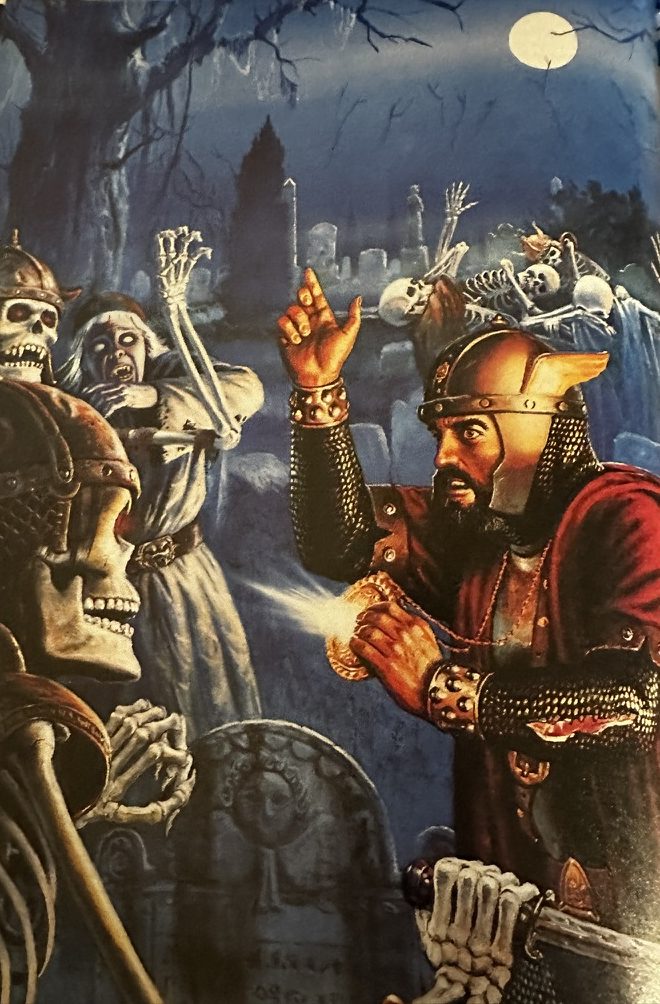
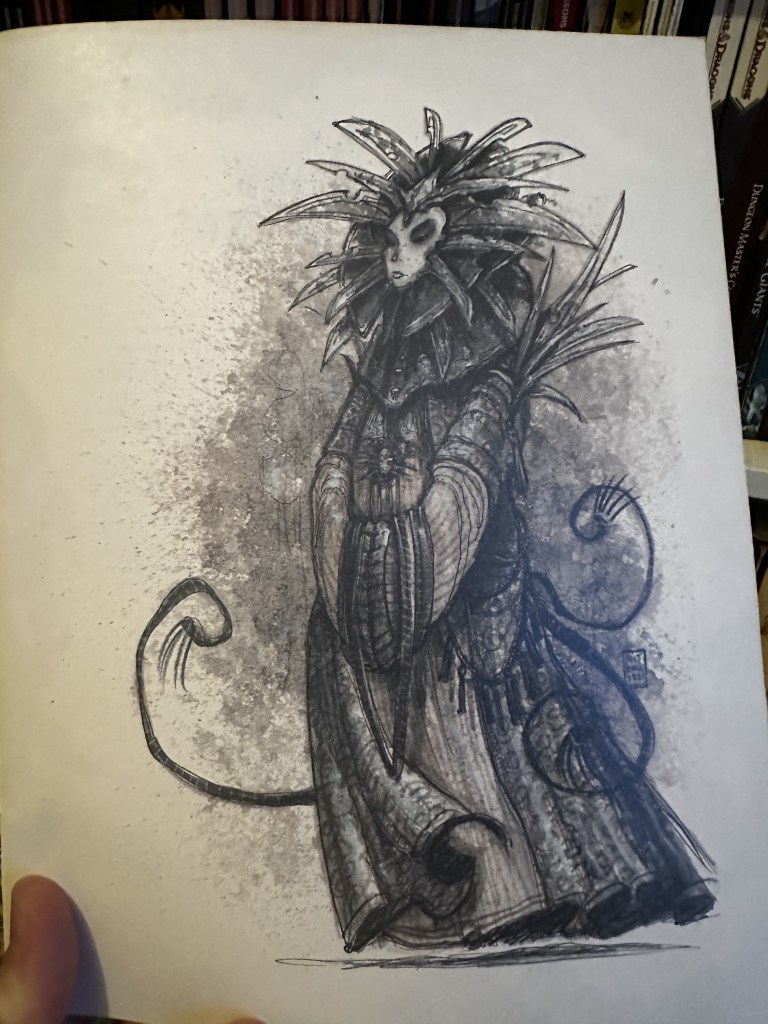
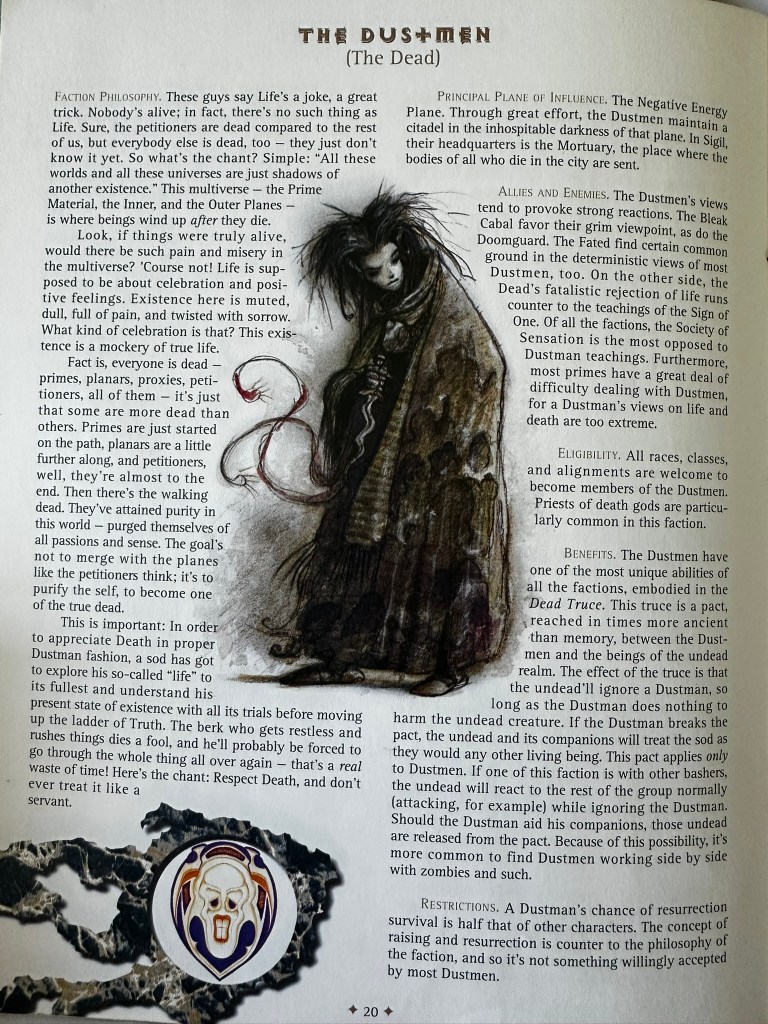
Page from the Player's Guide to the Planes from the original Planescape boxed Set. It describes the Dustmen. The illustration is of a Curehead in a long dark robe.
The Dustmen

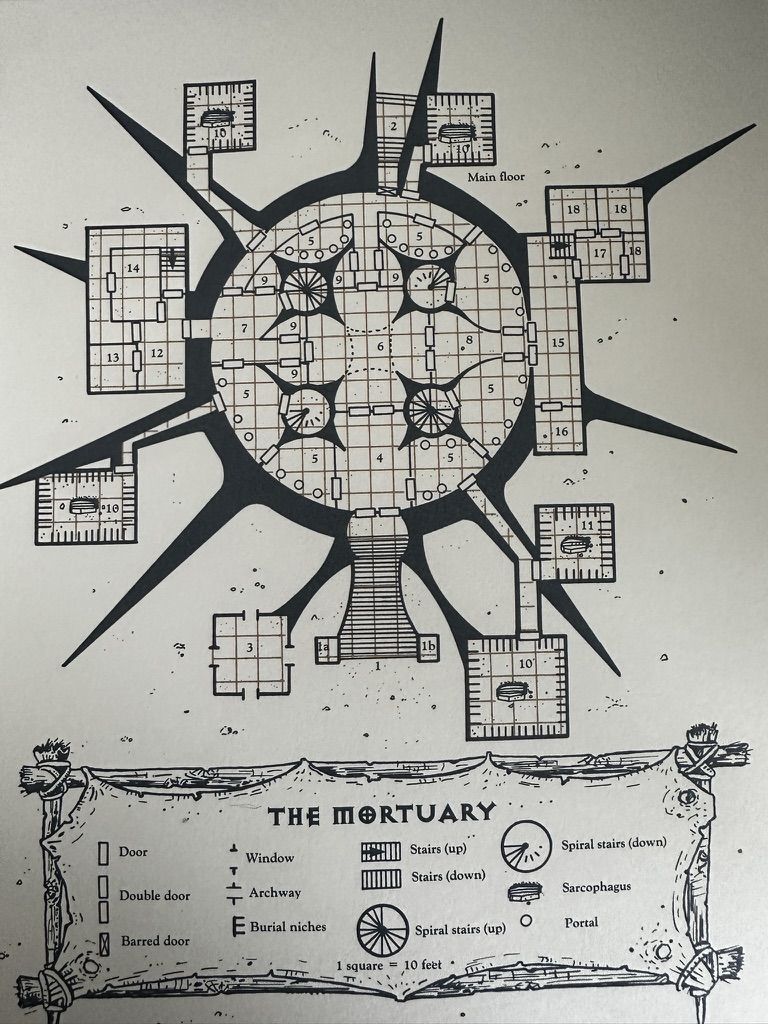
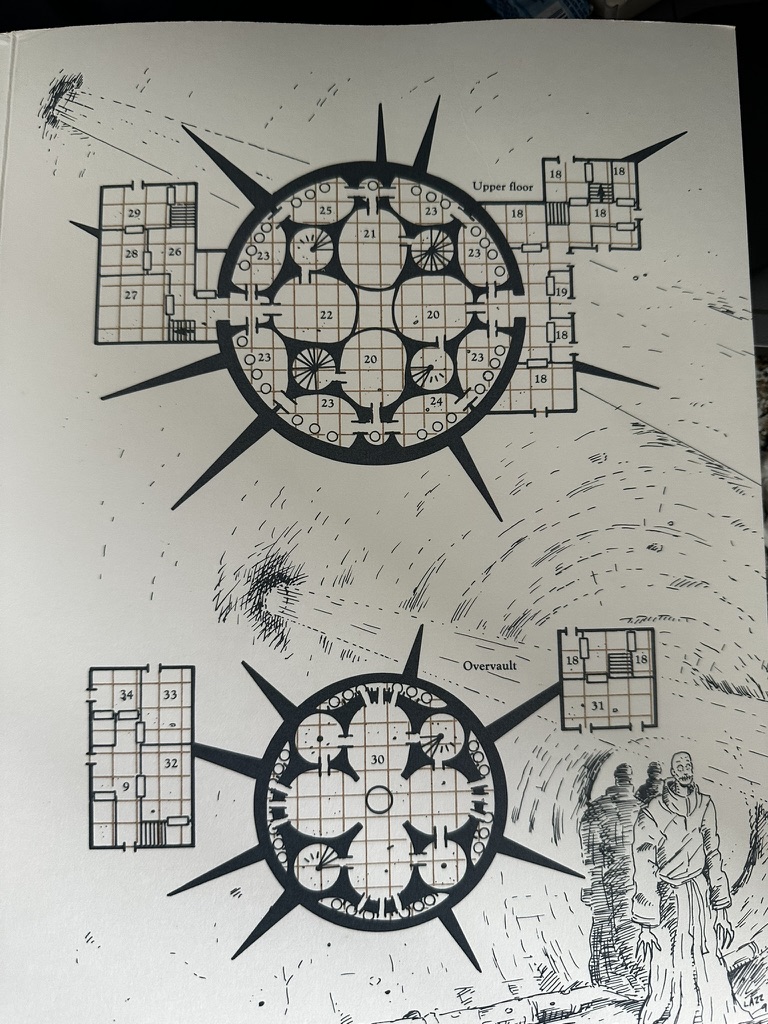
Aurora ended the last session on her way to the Mortuary, headquarters of her own faction, the Dead, aka the Dustmen. Here she encountered Toranna the Grey, another Dustman, whose job was to send unclaimed bodies to the Elemental Plane of Fire using one of the many interplanar portals located in the building. She consulted her records to discover that the barmy, Eliath, was sent to his ever-lasting reward through that portal just last week. His possessions, likewise, were gone, having been distributed to other Dustmen.

Disappointed, Aurora went to await the arrival of the rest of the party. This dead-end (pun intended) left them at a loose end. They decided to go and visit one of the other locations on the point-crawl style map of the Hive Ward, presented in the adventure, the Blood Pit. This is the most famous pit-fighting arena in the city. It is a centre of gambling and considered neutral ground for the factions.

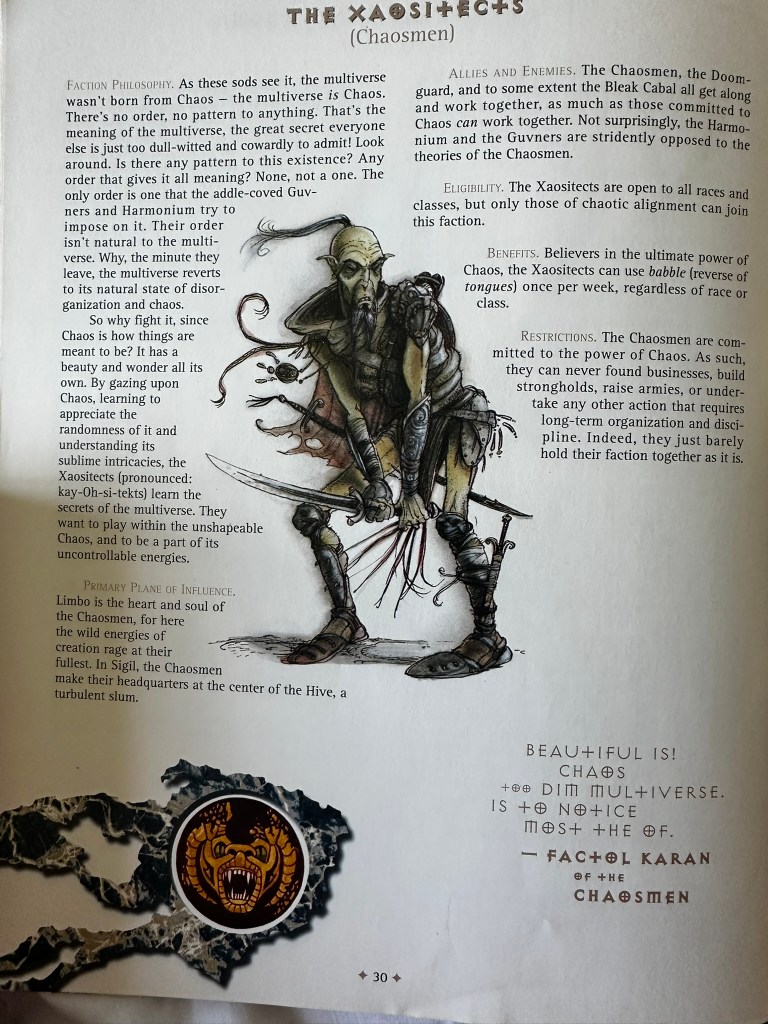
On the way, however, they decided to revisit the alley where Aurora had seen the corpse of the Dancing Man. It was no longer there. Instead, as the thief and the necromancer argued about what to do next, the ever quiet paladin noticed that they were quickly becoming surrounded by Chaosmen. The Chaosmen, or Xaositects, are another Faction that makes there home in the Hive. They believe in the primacy of chaos in the multiverse and they like the barmies, who they see as inherently chaotic. Chaosmen also have a mixed up, garbled way of speaking that was fun to role-play with. It took a moment before speaking each sentence aloud to just throw all the words into a mental hat and then pick them out at random. This particular group of Xaositects made the assumption that the PCs were responsible for the murder of the barmies on their turf so they showed up and demanded the party’s surrender. Unsurprisingly, they refused and our first combat ensued!

Fight!

Page from the Player's Guide to the Planes from the original Planescape boxed Set. It describes the faction, the Xaositects. The illustration is of a githzerai with a sword
Xaositects

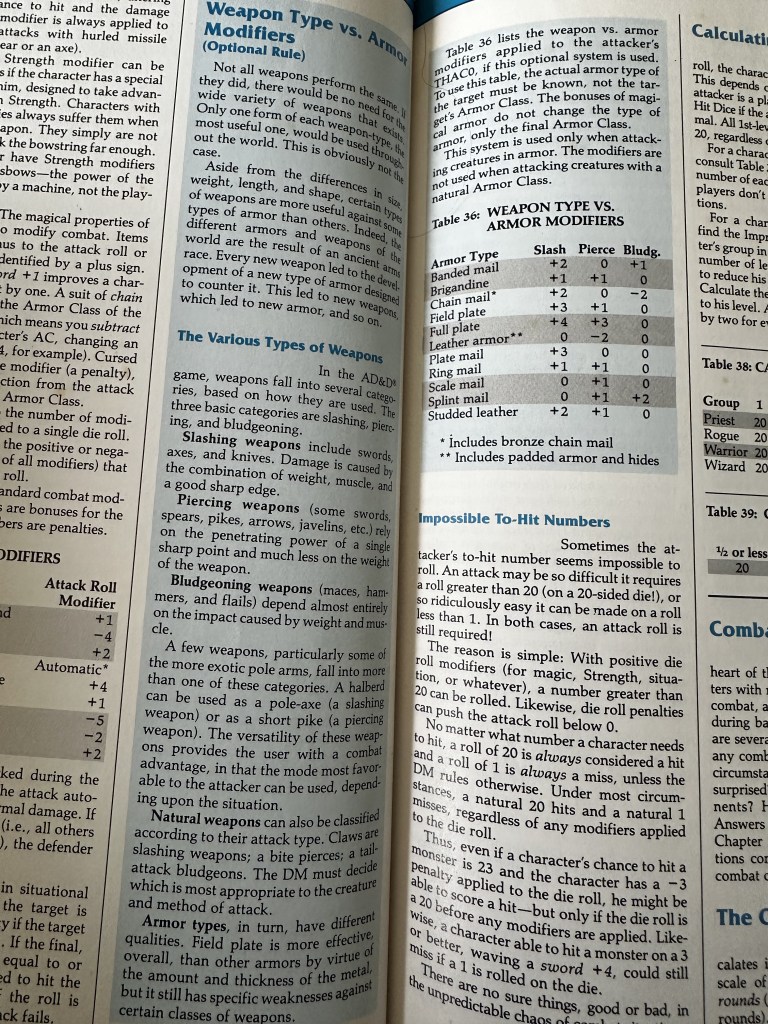
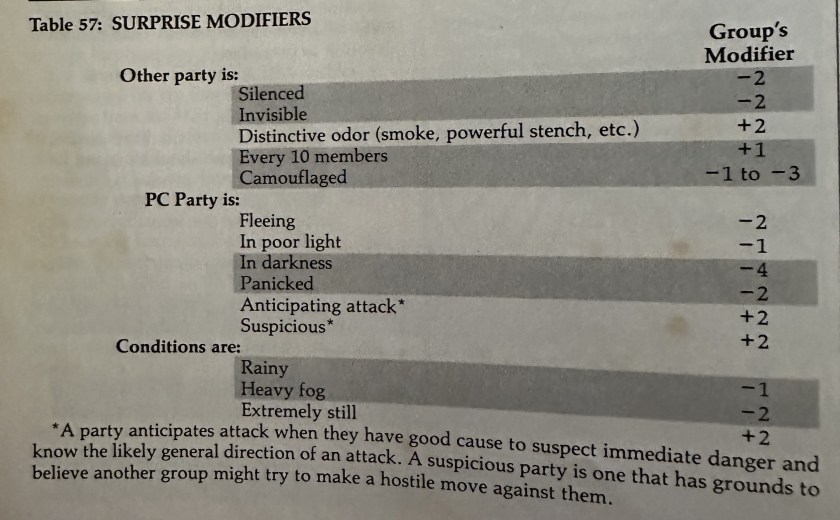
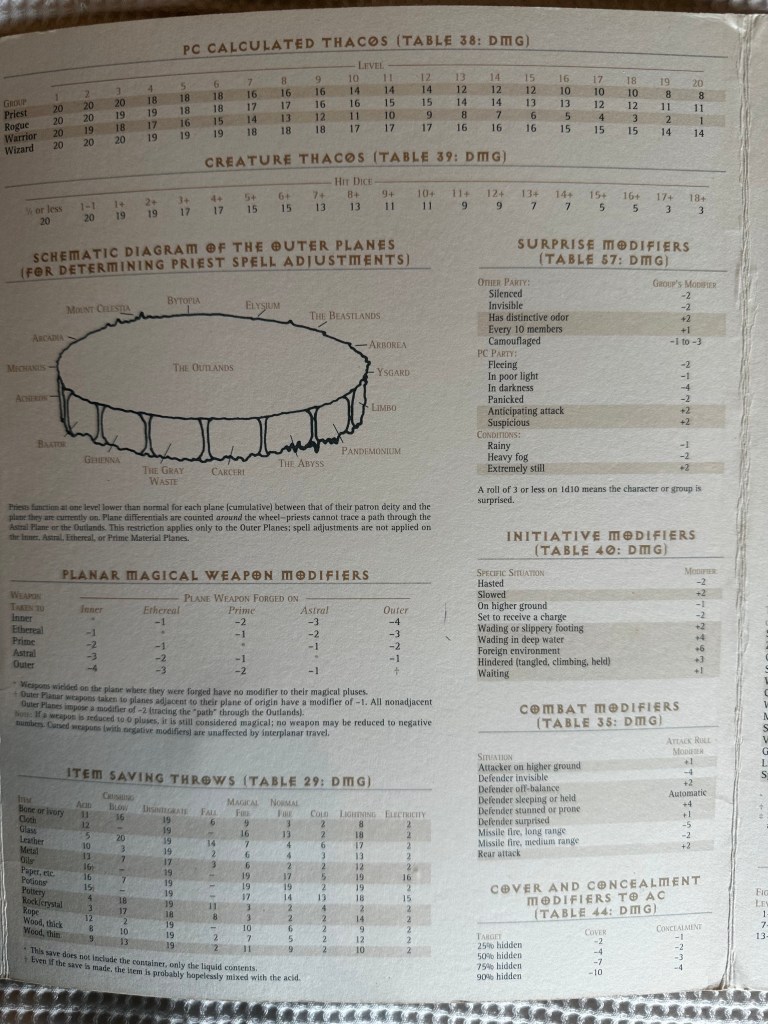
I gave the PCs a chance to surprise their opponents here, as our tiefling thief, Trance, had an idea to drop a sphere of Darkness over the battle-ground right off the bat. I had to double-check both the surprise and initiative rules since they have changed from earlier editions. In order to gain surprise on an opponent, the opponent rolls a d10. If they roll a 1 or a 2 (a variety of adjustments can be made to this roll), they’re surprised. Since I rolled a 9, we went straight to initiative, instead. Initiative in 2nd Ed is also rolled with a d10. Each side rolls, just once, rather than once per round. The side that rolls lower gets to go first. There is a weapon speed modifier to initiative, technically, but I decided not to use it as it’s very fiddly. The Chaosmen won initiative and attacked when they saw their opponents not dropping their weapons. They had a priest with them, who Blessed the others. A big fighter named Mordrigaarz Antill, led them into battle and immediately went to focus on Glaermond, the paladin. The other combatants, all mercs ran into attack everyone else. Fighter and paladin spent the fight smashing each other in the plate armour to no effect but the mercs had more success, landing several significant blows in the first round. When it came to the PCs turn, Aurora sent her familiar, a goat to charge at the priest and did a frankly disgusting 15 damage, leaving the poor bastard with a single hit point. Trance dropped the Darkness and then crept through it to finish off the priest with a backstab. Devansh, our priest of Varuna, decided enough was enough and cast Command on Mordrigaarz, ordering him to surrender. He failed his save and dropped his weapon. The mercs followed suit and that was the end of that. After demanding they hand over their valuables, they had a chat with Mordrigaaarz, who told them they wanted to stop the murders of the barmies in the Hive and that they thought the PCs must have been responsible. Satisfied that they weren’t to blame, he left with the remainder of his group and let the PCs go on to the Blood Pit.

The Blood Pit

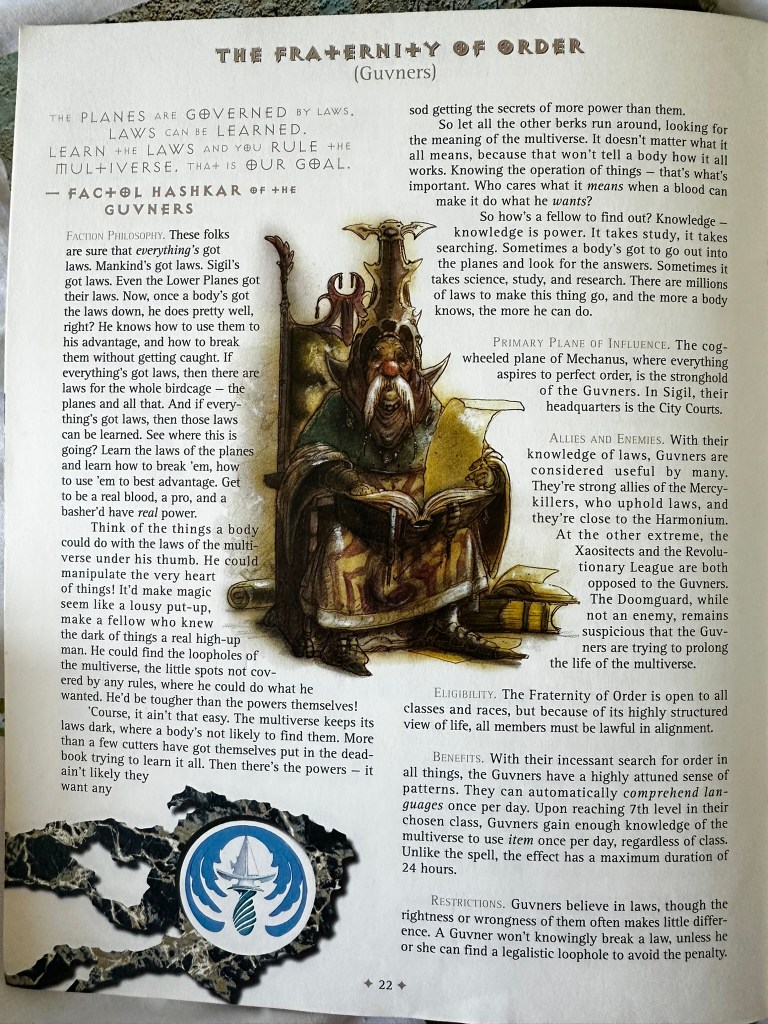
Page from the Player's Guide to the Planes from the original Planescape boxed Set. It describes the Faction, the Fraternity of Order. The illustration is of a human man with a headress and a white mustache, sitting in a chair holding a book.
The Guvners

At the Blood Pit, they got to talk to the ale-tap tender, a high-pitched gnome named Felgar. Regular told them a tall-tale about a Guvnor (a nick-name for the Fraternity of Order, another Faction of Sigil. They serve as judges and lawyers for the city.) This Guvnor allegedly discovered a way to transform into a demon to devour the souls of the Hive’s barmies and bubbers. Apparently this was to gather enough power to challenge the Lady of Pain, herself, for supremacy in the city. Aurora did not want to pass up the opportunity to have a little flutter on the fights while they were there. I made this mini-game up on the spot. I told them the next fight to occur in the cage in the centre of this dilapidated warehouse on the outskirts of the Hive, was between a nimble, leather-clad human rogue and a muscle-bound, scarred ogre. Then I got two of the other players to roll for each side. There was a roll off for each of three rounds of the bout. The first round went to the human rogue as he flitted around his opponent. The second was taken by the ogre who smacked the rogue a good one with his windmilling tree-trunk-like arms. The third round, was a tie so they died together as the human stabbed the ogre in the neck as he was crushed by a bear-hug. Aurora got her money back and counted herself lucky.

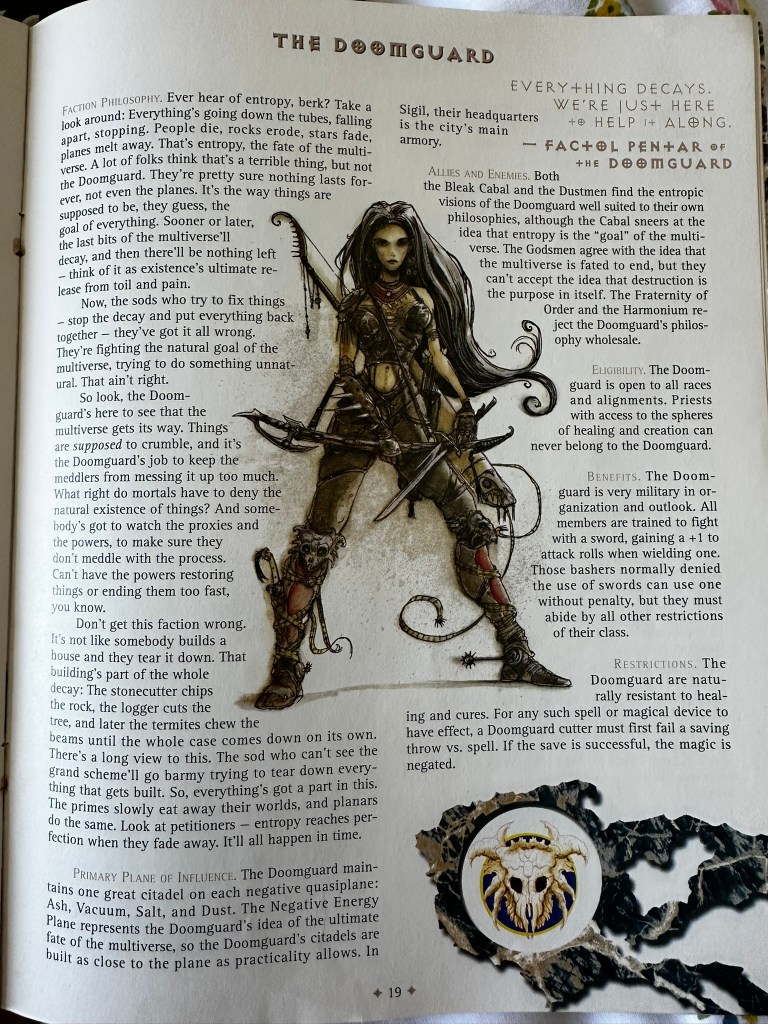
Page from the Player's Guide to the Planes from the original Planescape boxed Set. It describes the faction, the Doomguard. The illustration is of a dark haired humanoid woman holding a knife.
The Doomguard

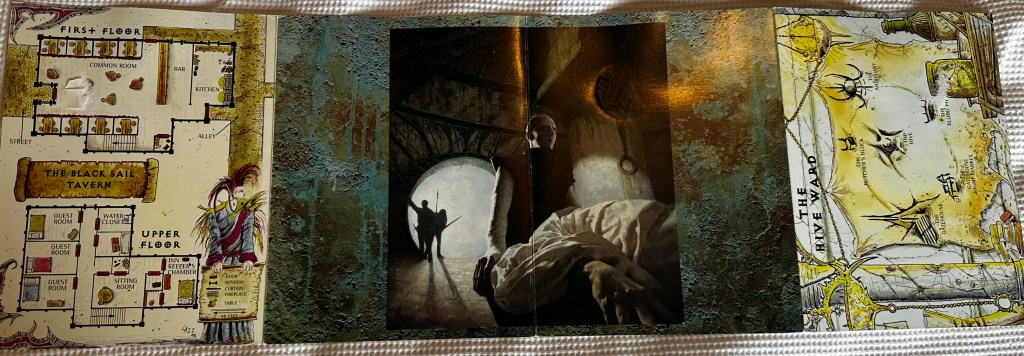
While in the Blood Pit, Trance was again approached by the messenger urchin from the start of the adventure. They were summoned to Bendon Mawl. They had a rest that night and went to see their patron the next morning. He told them that Eliath, the very barmy they’d been looking for, the man who Toranna the Grey had said was so much ash in the Elemental Plane of Fire, had been seen in a pub in the Lower Ward. Not only that but he didn’t look too barmy anymore and he seemed to have joined the Doomguard (yet another Faction, who believes in the inevitability of entropy.) Off they went to investigate this new lead. Eliath had been seen with a group of Doomguard in the Black Sail, a tavern near the Doomguard’s HQ, the Armoury. The building itself is the prow of a galleon sticking out from between two more mundane frontages. Its sail hangs low and is stained coal black from years of exposure to the smokes billowing from the Armoury. They got a room and set themselves up for a stake-out.

Conclusion

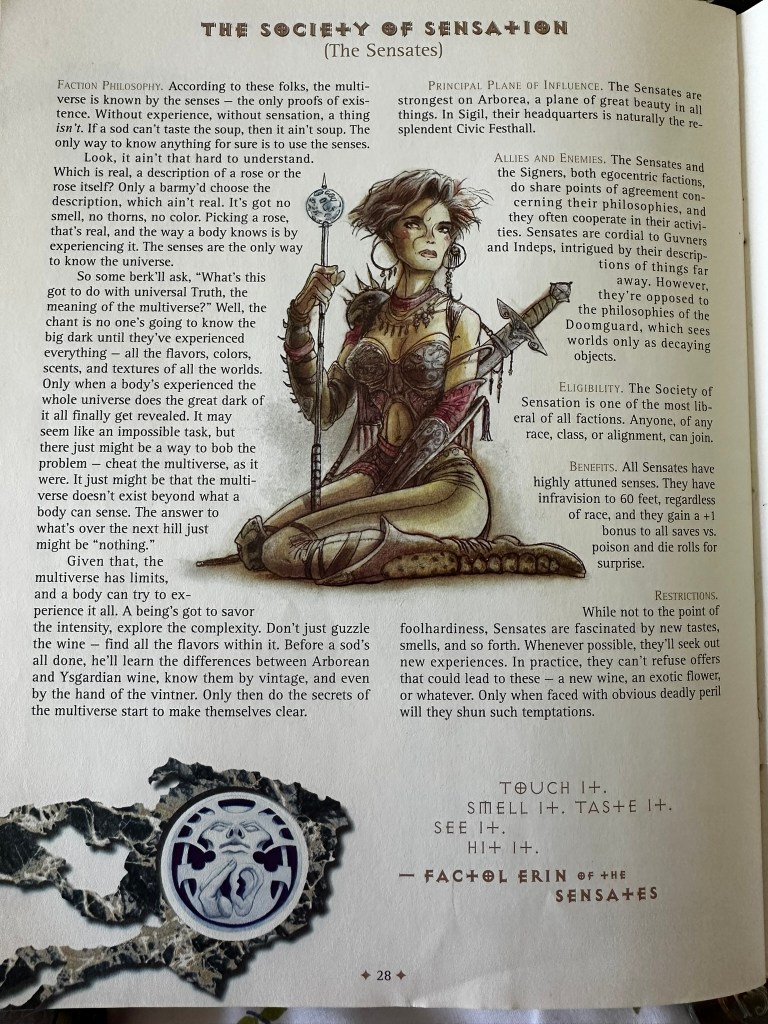
Page from the Player's Guide to the Planes from the original Planescape boxed Set. It describes the faction, the Society of Sensation. The illustration is of a human wiman kneeling and holding a sceptre.
The Sensates

We have such a wonderfully diverse and interesting selection of characters in the party that it has promoted some genuinely engrossing philosophical arguments. There are three different factions represented, to lawful characters and two chaotic. Our priest is a Guvnor, so has to continually justify the party’s less than law-abiding actions, or, simply try to ignore them. He could not gamble at the Blood Pit but did consider just leaving some of his gold out on counter for Aurora to gamble with for him. Our Dustman and our Sensate, despite both being Chaotic, are furthest apart, philosophically, however, and this has encouraged some truly fascinating discussions, with the Sensate thinking that the Dead are, perhaps, responsible for what is happening in the Hive. Meanwhile, our paladin, somewhat deficient in smarts, is content to simply be led around by the nose to do whatever. This could come back to bite him in the arse at some stage, given how unforgiving the gods can be when it comes to paladins committing what they may deem evil acts.

Our first combat was quite successful! I had to check a couple of rules on the fly and I was caught flat footed by movement speeds, but otherwise, I think we all enjoyed it. It certainly helped that it was brought to a swift end, rather than turning into a war of attrition. Also, I am vindicated in starting our PCs off at 3rd level. It gave them a wider choice of abilities and spells to choose from and made the fight a lot more interesting.

OK, I’m off to my second birthday party. Gonna sit in my high-chair and plaster myself in cake and banana.

The Editioning, AD&D 2nd Edition, Part 2

Character-work

We’re back in Sigil, dear reader, and it feels like coming home. Long has it been since my players had their characters sneak around its darkened byways and razorvine-choked alleys, avoiding the Hardheads. Years have passed since they were introduced to the Cage’s many factions, wards, points of interest, cranium rats, and, of course, deranged NPCs.

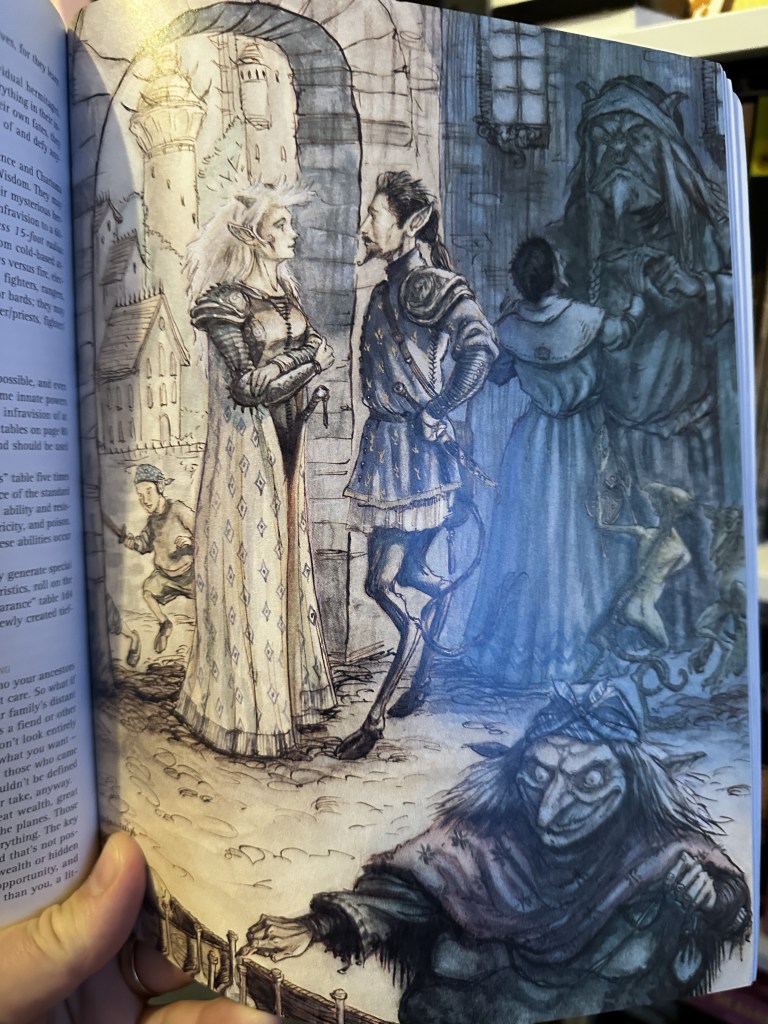
Back then, I took a peculiar pleasure in populating the City of Doors with the sorts of unusual cutters that one might expect from such a cosmopolitan, diverse crossroads. There was the BDSM dwarf who served them up cocktails and information in a leathery sort of club, the down-on-their-luck founding members of the Mundane, a faction who took great pride in their rejection of magic despite its ubiquity, and the gnome mage who filled the street outside his bookshop with lava to prove a point.

The first of those was all me. Pulled him out of thin air when the party said they went into the nearest pub to ask for info. The other two were inspired by one of my player’s characters and by a character presented in the excellent AD&D 2E Planescape sourcebook, Uncaged: Faces of Sigil.

With our latest foray into the city, I have continued on form. I am still taking inspiration, of course, but have particularly enjoyed making the people and places my own.

The first was Trunfeld Three-teeth, (a delightful tongue-twister, particularly for those of particularly Hibernian dialect.) Trunfeld is a “vile-tempered creature of disgusting personal habits,” according his description in the adventure, The Eternal Boundary. He is also a peculiarly intelligent ogre, and he runs the notorious den of scum and villainy known as the Butcher’s Block. The adventure gave me, I think, just enough to build a voice and personality for this character and, let me tell you, I really went for it. Trunfeld stank to high-heaven of sweat, picked his nose and wiped it on the paladin’s breastplate, breathed his hot, rotten breath on them and offered them some unidentifiable stew. Our cleric, Devansh Rao, used a spell to purify their drinks when they were served, and this was entirely apropos. Trunfeld was hanging out with an honest-to-gods demon when the PCs walked in, and they were lucky not to provoke its ire when they made the mistake of interrupting their conversation. I bellowed at them from the depths of my chest for Trunfeld’s voice. It felt good. He cursed them in his cockney rumble and eyed the priest and the paladin suspiciously. Luckily, the presence of the holy-joes was tempered sufficiently by their companions, the necromantic witch and the thieving tiefling, who were regulars in the ogre’s bar. So they managed to strike up a bargain. As he promised to keep an ear to the ground for them, I am relishing the prospect of getting to play this rancid brute again.

The second was Mourner Tom, another NPC given a brief description in the adventure. He is the leader of a band of Collectors. These poor unfortunates scrape an execrable living on the streets of the Cage by locating, looting and transporting corpses they find to the Mortuary. They have a deal with the Dustmen (the faction that runs the Mortuary, also known as the Dead.) He is described only as a down-on-his-luck thief, but the text does provide a few quotes of his. These are what led me to voice him almost exactly as Danny, the drug-dealer from Withnail and I. So if you know that character and his many famously quotable lines, you’ll understand why quotes like this drew me to him:

It’s like they fall asleep and don’t wake up. Very peaceful, that
We might’ve seen ‘I’m but our memory’s none too good.

Hopefully you get the idea. If not, here’s a link to a helpful YouTube clip of Danny:

I didn’t lean quite as heavily on the speech impediment, but I think you get the idea.

Of course, its not just speech-patterns and accents that make an NPC, Mourner Tom was also dressed in a battered top-hat and tatty tails, all stolen from corpses he’d found on the job. And he had his motivations. Unsurprisingly, his was jink, gold, money. He was another helpful one, explaining, after he’d been paid, that the barmy the PCs were looking for was one they’d picked up recently and brought to the Mortuary, since he was dead.

We have a lot more NPCs to meet. There is a good chance that the PCs are going to be interacting with a few more factions and other non-affiliated weirdos over the coming weeks so I’m looking forward to coming up with more unlikely voices and mannerisms.

To the Adventure!

Honestly, it took us a while to get really started with the first session. Some characters were not quite finished. This was largely due to the arcane (pun intended) categorisation of priestly spell spheres and the added complication of choosing an appropriate faction. But, I also wanted to establish some background and motivation for the PCs.

It’s a rather unlikely story, so I think it’s worth telling here. Our paladin, Galermond, having recently completed his training, was asked to leave his temple and, being a little on the innocent and simple side (read “thick-as-plank”) decided he wanted something to spend his small reservoir of coin on. He encountered Devansh Rao, the cleric of Varuna and they went about finding a ruined old temple to that god in the Lower Ward of the city. Small, dirty and crumbling though it was, they decided to devote their efforts to restoring it, as not another temple to Varuna existed in the city anymore. Glaermond was happy to have discovered such a noble endeavour to pursue, but neither he nor Devansh knew anything about money, and they would need that… Enter Trance, the tiefling accountant (thief.) She told them she could help them manage their gold and brought in Aurora, the bariaur witch, who would be happy to occupy the basement and use it to conduct her necromantic experiments (not that she told them that!) And so, out odd party was born!

To begin the adventure proper, I had a typical cockney urchin approach Trance with a message from one of her fellow faction members and ask her to bring friends to the headquarters of the Society of Sensation, the Civic Festhall. There, they met Bendon Mawl, a tiefling with some influence in the faction, who told them they wanted to find a barmy in the Hive who is said to have the key to a very important portal in Sigil. This barmy’s name was Eliath and it seemed like he might have been a wizard. They were offered a cut of the profits gained from this portal. Since the PCs had a church to restore, and they were all out of donations, they jumped at the chance.

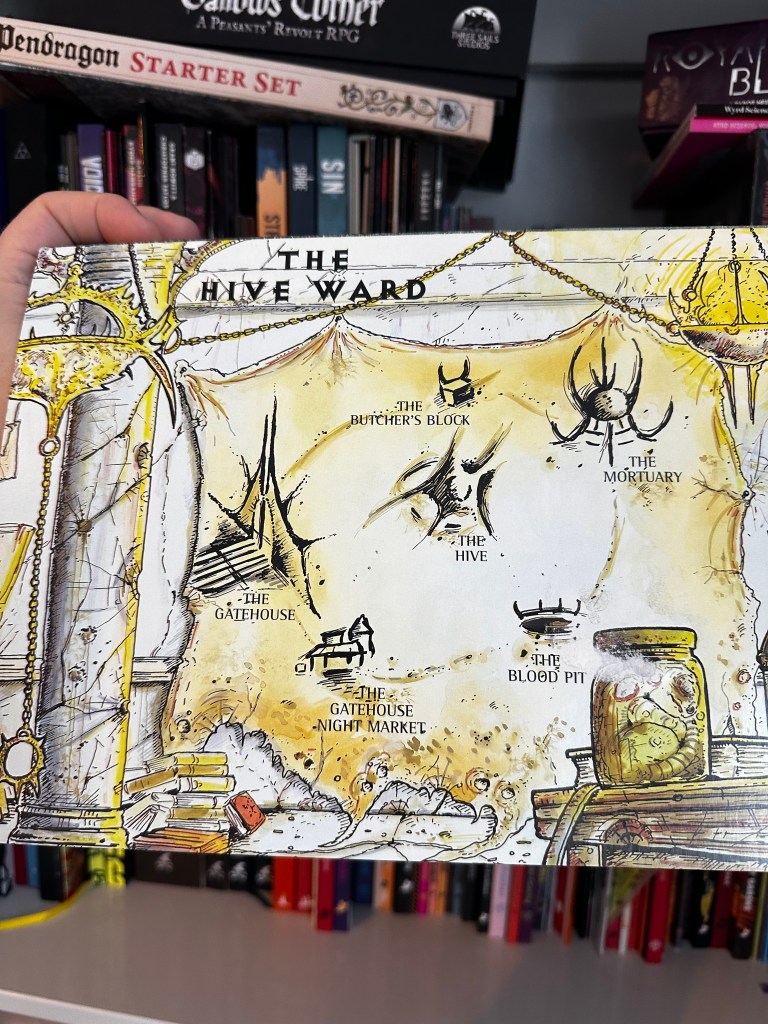
The Point Crawl Map of the Hive Ward. Locations include the Butcher's Block, the Mortuary and the Blood Pit.
The Hive Map

They went immediately to the Hive. The adventure provides a point-crawl-style map of the ward on the inside of the DM screen that came with the adventure.

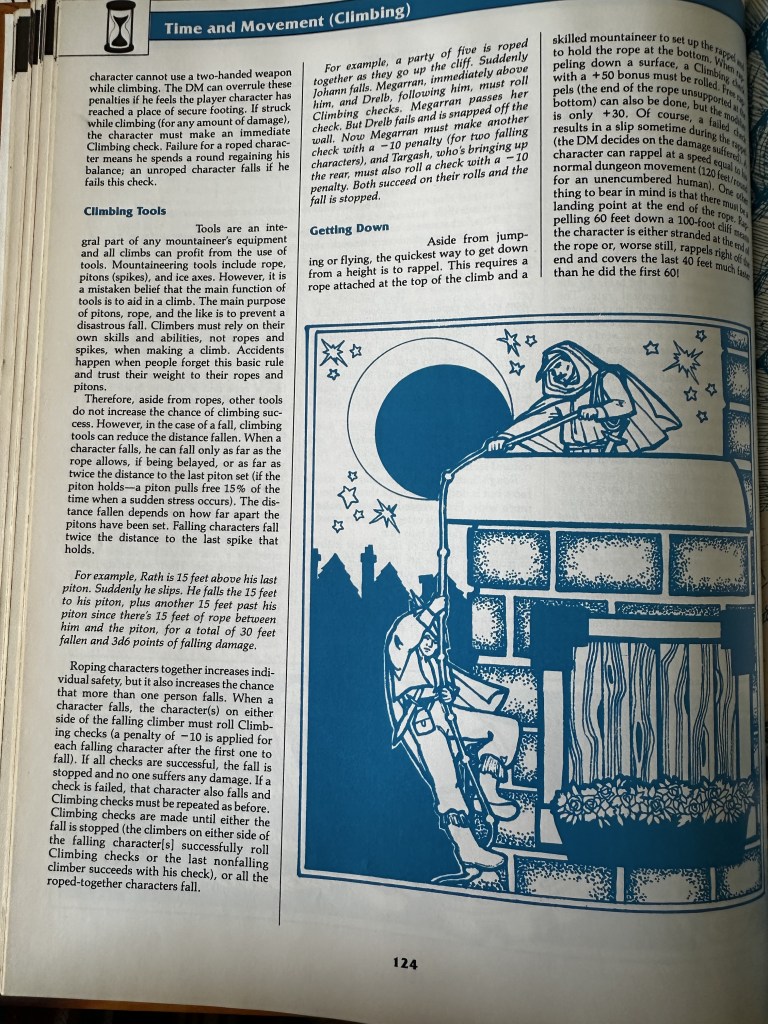
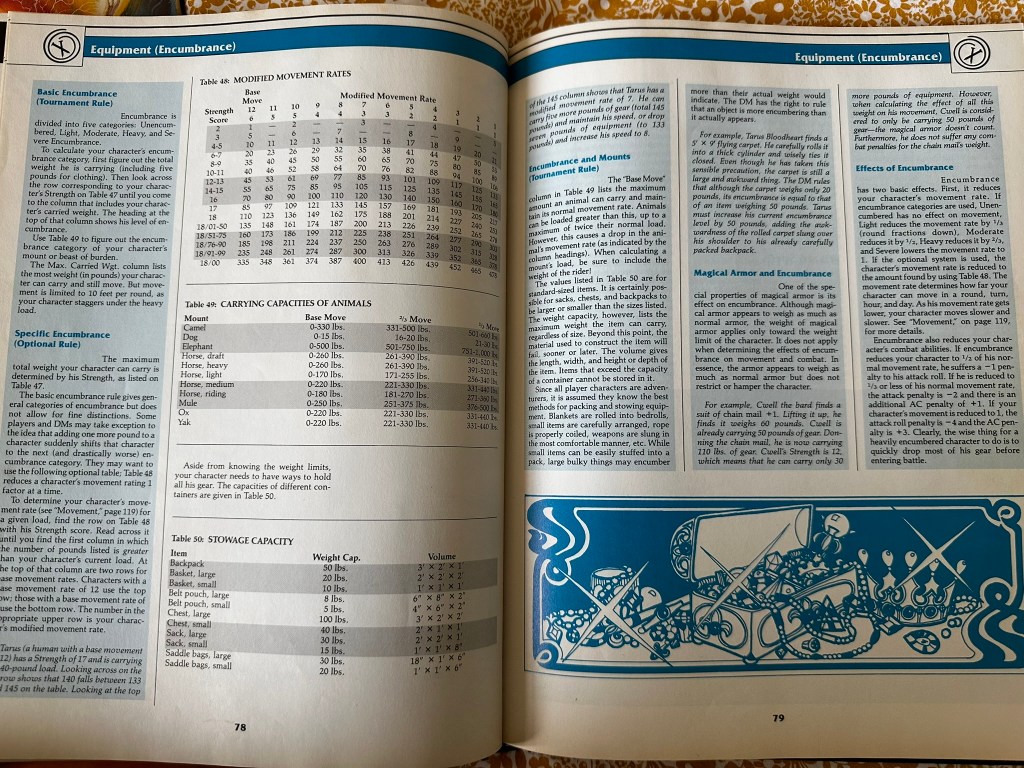
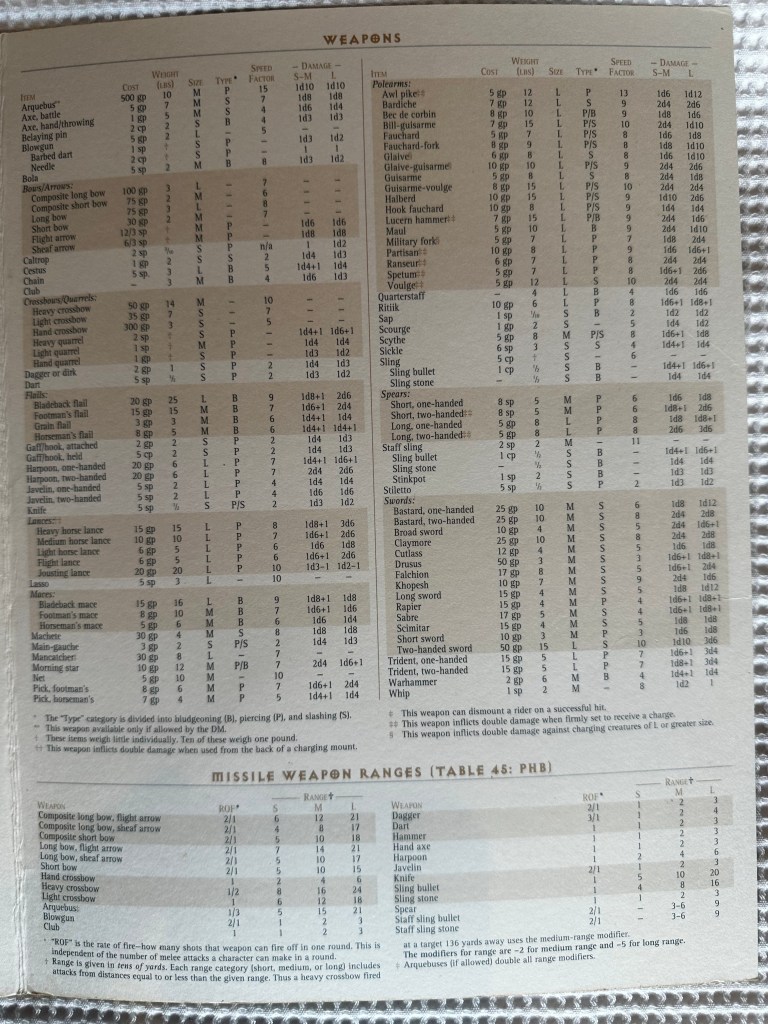
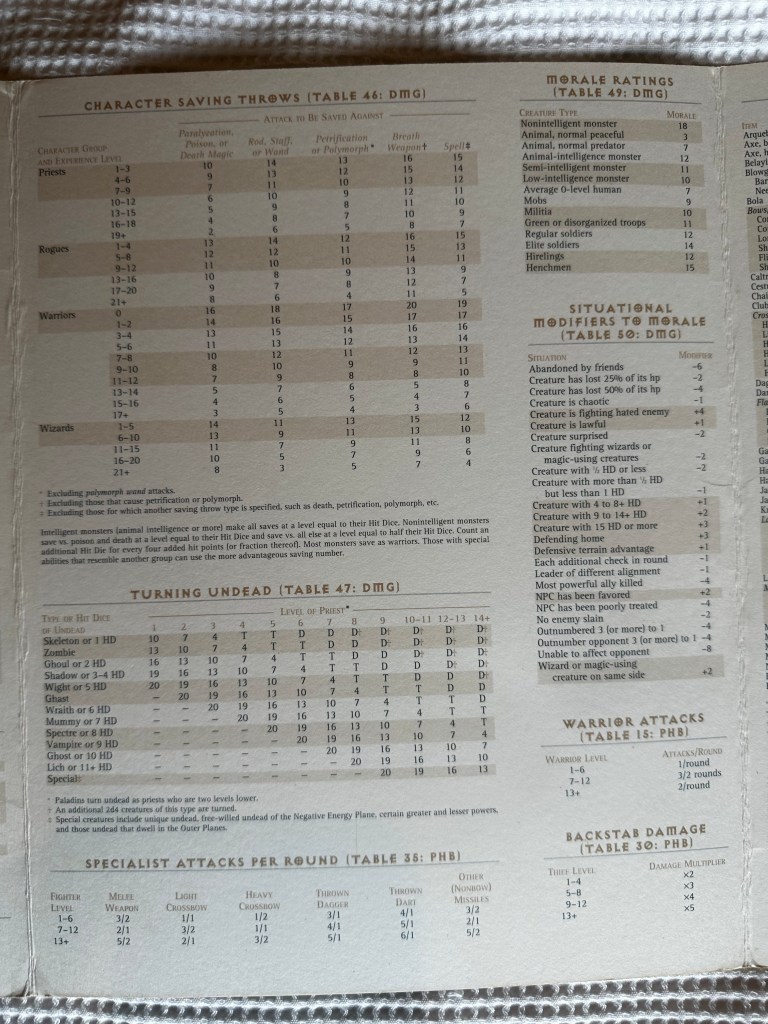
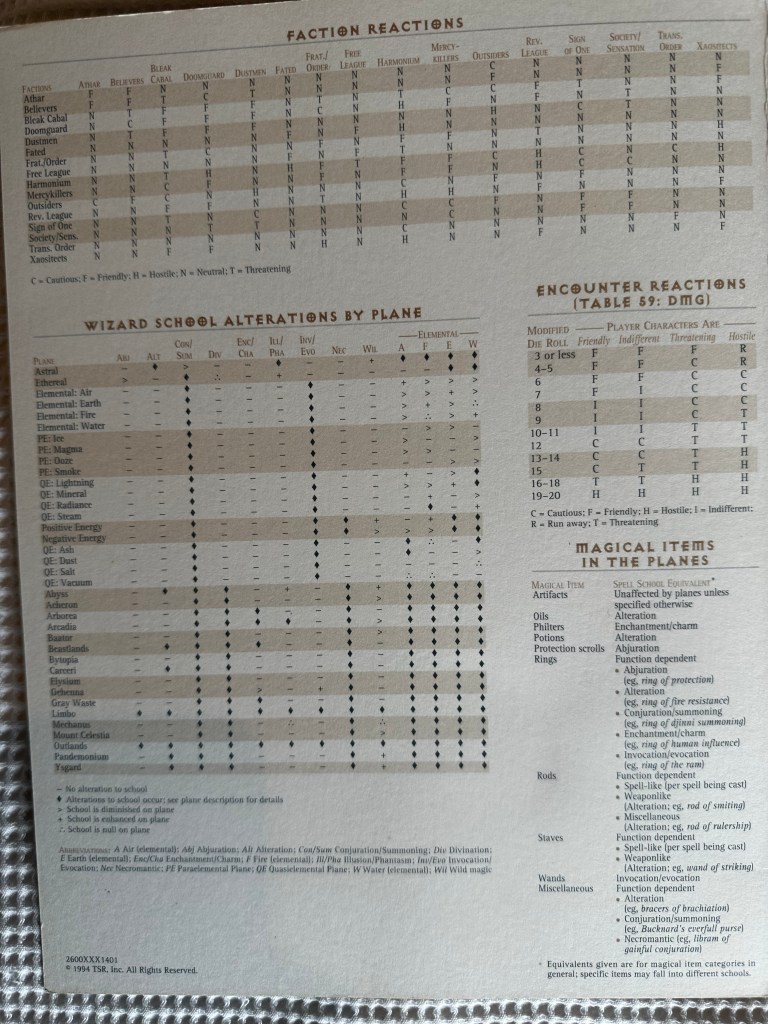
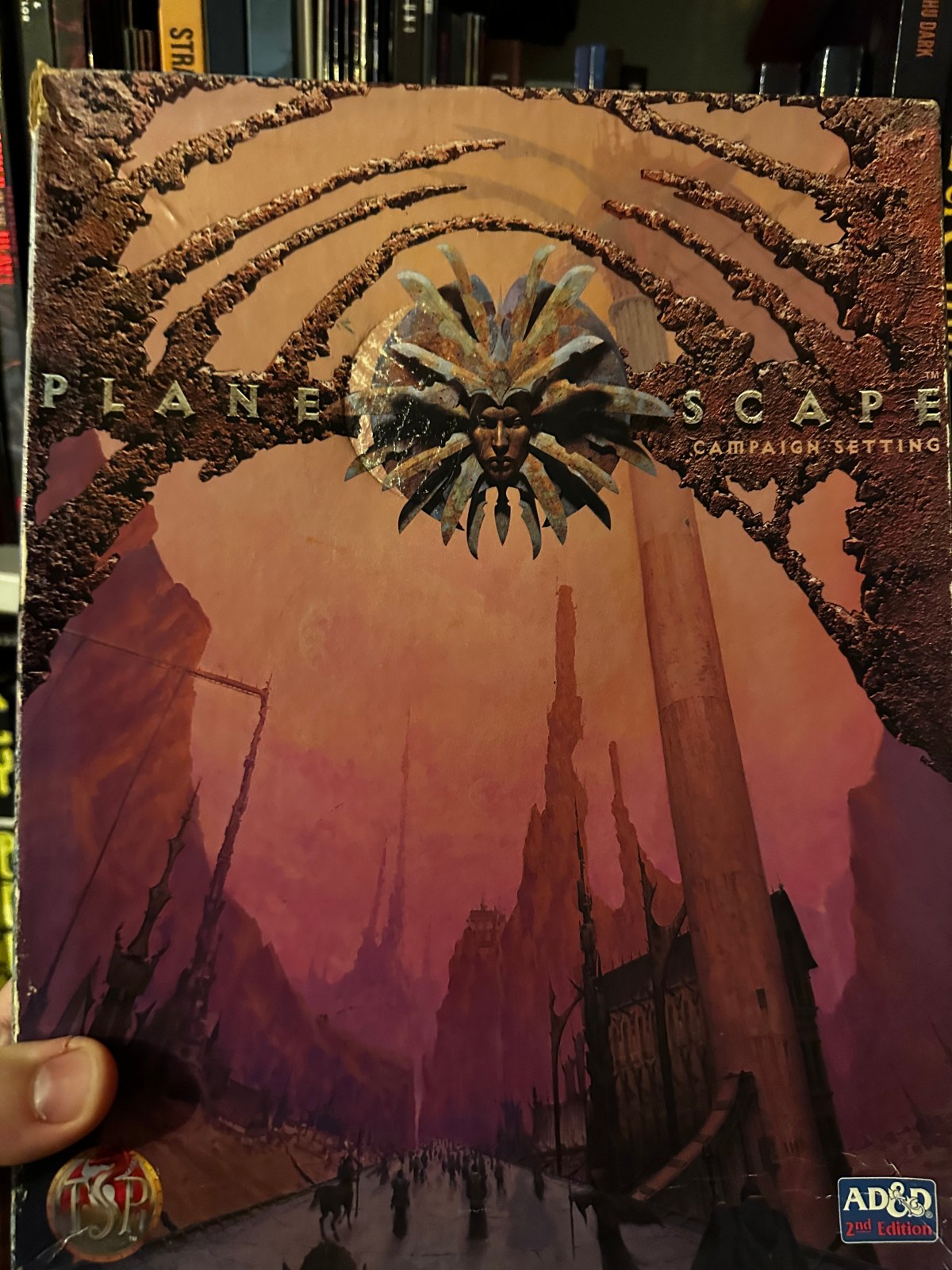
I have to say, this is an old-school design element that is sorely missed from newer modules. It was not at all unusual to get an adventure specific DM screen in the pack with the adventure back in the old days. Wizards of the Coast now want you to pay another £15 or more for the privilege. I have really been appreciating this DM screens actually. Not only does it have several key maps, but it also has all the stat blocks for the major NPCs and encounters in the adventure! Invaluable, tbh. My only dilemma is whether to use the adventure-specific screen or the utter treasure that is the one from he Planescape boxed set. Its got all the Planescape tables you might need, like how the various factions might react to one-another and how spells are effected on various planes, and on top of that, it also has stuff like ThAC0 tables and saving throws.

Back to the Adventure! Their first port of call was the afore-mentioned Butcher’s Block where they interacted with Trunfeld Three-teeth, to my utter delight. He was able to tell them that barmies (lunatics) and bubbers (drunks) have been turning up dead more than usual and said he would keep an ear out for news of Eliath.

Then they decided to split up. Why? Well, Aurora the witch is a member of the Dustmen, so it seemed like a good idea for her to go and see if their barmy had turned up at the headquarters of that faction, the Mortuary…

Meanwhile, the others wandered the streets in hopes of finding a clue. Before long, they did. They turned onto an alley and found a disturbing scene, a ragged collection of men, gathered over the dead body of some poor berk on the ground, talking about how they should loot and transport him. Before it could come to blows, they discover that this was a crew of Collectors led by Mourner Tom. As I mentioned above, I had a great time playing him and he was able to tell them that they had collected someone matching Eliath’s description recently. Should be in the Mortuary.

Speaking of which, Aurora, perhaps a little nervous traversing Sigil’s most infamous ward on her own, had an encounter of her own. She was faced with a gangly, dancing man bounding down the street towards her, shouting and mumbling and singing the names of the Princes of the Ba’atezu fiends. She noted the names he was chanting but was about to go about her own business when she heard a shriek from the alleyway he had entered. Investigating, she discovered his fresh corpse lying on the cobbles, not a mark on him…

Conclusion

My conclusion so far is that I am having a ball with Planescape,
As I expected. It is one of my all time favourite D&D settings and it gives me free-rein to invent the most deranged little cockneys I can think of.

But we have only barely interacted with the mechanics so far, no more than a spell cast and a non-weapon proficiency attempted, so I am very interested to see how smoothly that goes.

Stay tuned, dear reader!

The Editioning, AD&D 2nd Edition, Part 1

The Editioning Format

Just in case you’re new here, the Editioning is a challenge that my fellow members of our little, local TTRPG community, Tables and Tales and I have taken upon ourselves (ok, fine, I came up with it and pretty much forced everyone else to take part.) It involves playing an adventure/short campaign in every major edition of Dungeons & Dragons from the original 1974 version to D&D 5.5E, which came out fifty years later, in 2024. We hope to complete this task within about 24 months. So far, we have completed one adventure in OD&D and are close to the end of another in Basic or B/X D&D.

I’ve been titling these posts with the numbers of the weeks of the challenge, but, honestly, even keeping track of which week we’re on is becoming a challenge in itself. So, I’m just going to number them from now on. As such, this post will be Part 1 of the Advanced Dungeons & Dragons 2nd Edition series. Hope that makes sense, dear reader!

Welcome to Sigil

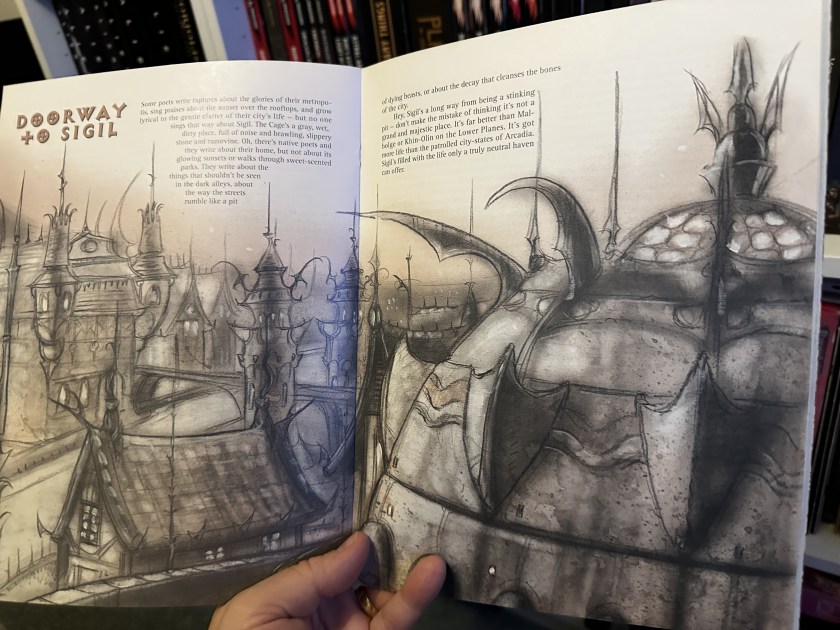
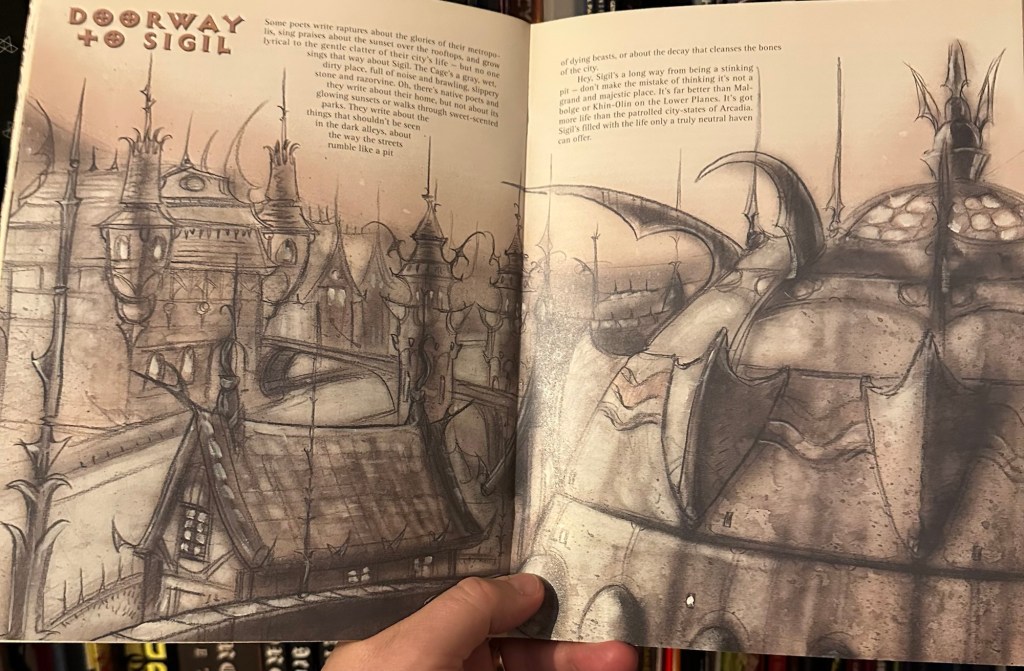
An illustration of the rooftops of Sigil from the book, Sigil and Beyond from the Planescape Boxed Set. It is entitled Doorway to Sigil.
The enigmatic rooftops of Sigil by Tony Di Terlizzi

What? Are you Clueless, berk? Cutter like you should find out the dark of things in the Cage. Could make a little jink if you manage to sway the high-up men and stay out of the Mazes. Want the advice of an old basher like me? Go chat up a factol, maybe one o’ them Mercykillers or even the Hardheads. They’re always looking for cutters who’ll do some business and keep their bone-boxes shut. You don’t fancy them? Go talk to the Bleakers, maybe. Just watch out for the barmies in the Hive if you go that way. I heard a bunch of them have been put in the dead book of late. Just stay peery on the streets and alleys of the City of Doors, cutter, and if you see death coming for you, just give ‘em the laugh and don’t end up swinging from the old leafless tree, alright?

That’s an example of the type of writing that exists throughout the entire Planescape line of books. OK, it’s not all written like that, but in many parts the voice of a local guide like this is used to inject some really effective flavour. They introduced this sort of patter and unique dialect to set Planescape apart from the more traditional fantasy fare like Forgotten Realms and Dragonlance. I Remember the first time I read it as wide-eyed teenaged ingenue. I was immediately drawn in. None of the other settings had ever appealed to me so thoroughly through the voice of the books themselves. This despite the fact that I had spent a couple of years playing the more unique settings of Dark Sun and Ravenloft.

Why? Well, the speech pattern was curiously familiar to anyone with a passing interest in cockney slang, victorian working class dialects and Blackadder. That was me, honestly. So it caught my attention.

Now, admittedly, the portions of the books written in this patter are confined mainly to the introductions and the odd in-character paragraph, but it’s enough to liven up what is normally a very dull business (AD&D modules.)

But, of course, there is so much more to recommend the setting. The factions of Sigil, where philosophical standpoints come to life in their members. Their Cold War or kriegstanz that bubbles under the surface of the city. The Lady of Pain, enigmatic ruler and all-powerful protector of the City of Doors, who sends her greatest trespassers to the Mazes for eternal torment. And beyond Sigil, why, there is only the infinite vastness of the outer planes, the inner planes and every place in between! Every one of them filled to bursting with bizarre landscapes, gods, angels, demons, devils, elementals of every flavour and don’t forget the fairies and other planar beings beyond count or description.

In fact, it can be a little overwhelming. I remember that’s how it felt when trying to write my own adventures for it back in the ‘90s. There were too many options, many of them very lethal and many of them utterly beyond my own meagre abilities to incorporate into my simple AD&D games.

That’s one of the reasons I decided to run a pre-written adventure for this portion of the Editioning.

The Eternal Boundary

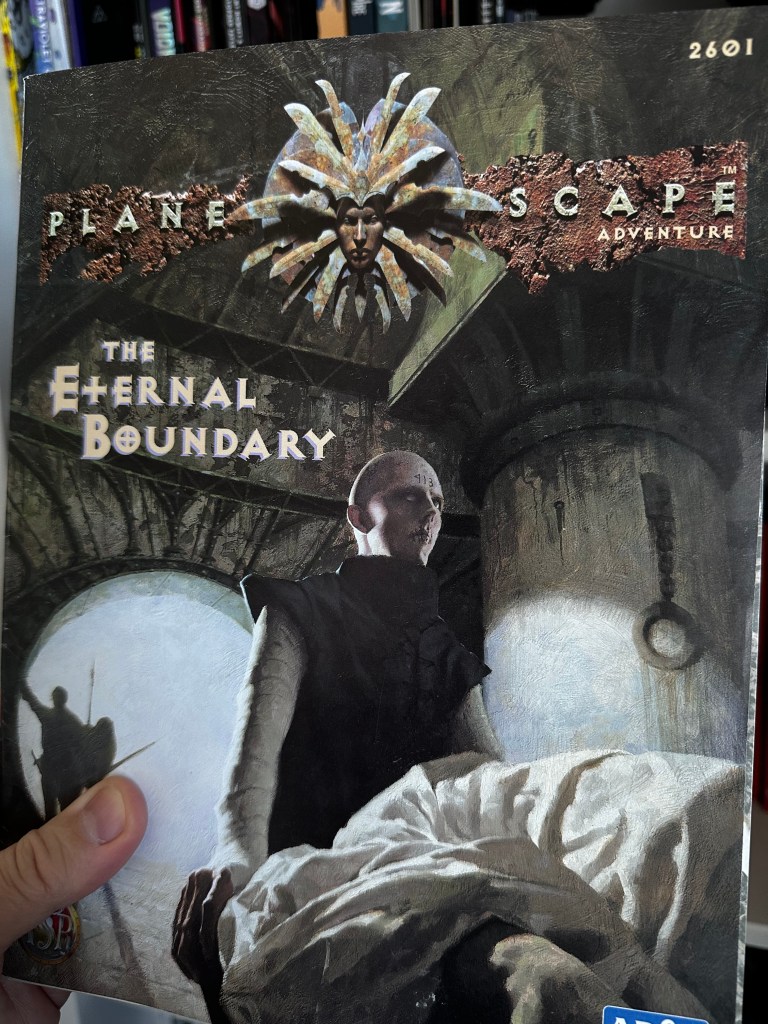
The cover of Planescape adventure, the Eternal Boundary. A pale, bald dustman pushes a gurney with a sheet-covered corpse in the foreground. The silhouettes of adventurers peek through an archway in the background.
The Eternal Boundary

This adventure was one of the first produced for the Planescape setting. It’s written by L. Richard Baker III whose other credits include the Planescape Monstrous Compendium 2 and Valley of Dust and Fire for Dark Sun.

I don’t want to provide any spoilers at this point so I’ll only give you the basics that PCs will learn not long after starting to play.

In the Hive Ward of Sigil, barmies and bubbers are disappearing and turning up dead in much larger numbers than usual. The PCs are sent to find one of them, a barmy called Eliath, who knows the dark of a very special portal key. Various factions are at play in the Hive and there is something sinister going on there. The PCs must uncover it is they are going to complete their mission. It will lead them all over the Hive Ward and far, far beyond.

I chose this adventure for a couple of reasons. Firstly, I thought it was a great introduction to the City of Sigil, its Factions, the kinds of strange goings-on they might encounter there and a large cast of NPCs with a fun variety of faction-alignments, personalities and motivations. And second, it was the right length for what I had in mind. I actually think this one might end up being shorter than my recently concluded OD&D game. Of course, I have been silly enough to think such thoughts before, and I’ve been frequently proven wrong so we’ll see how that works out.

Character Creation

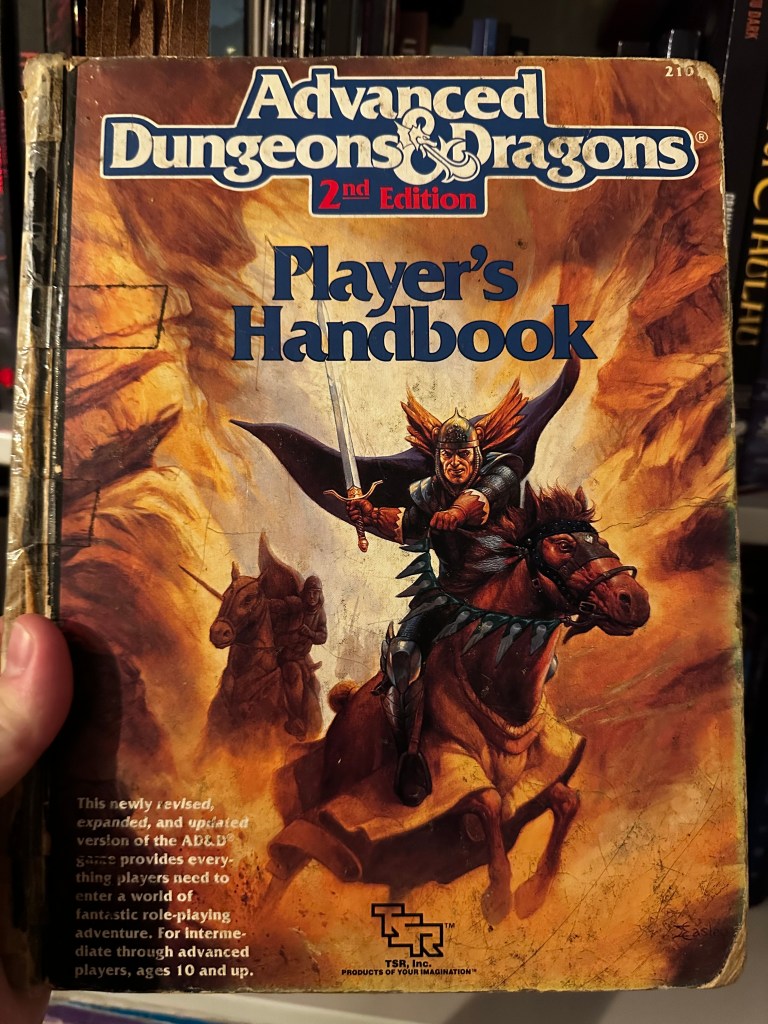
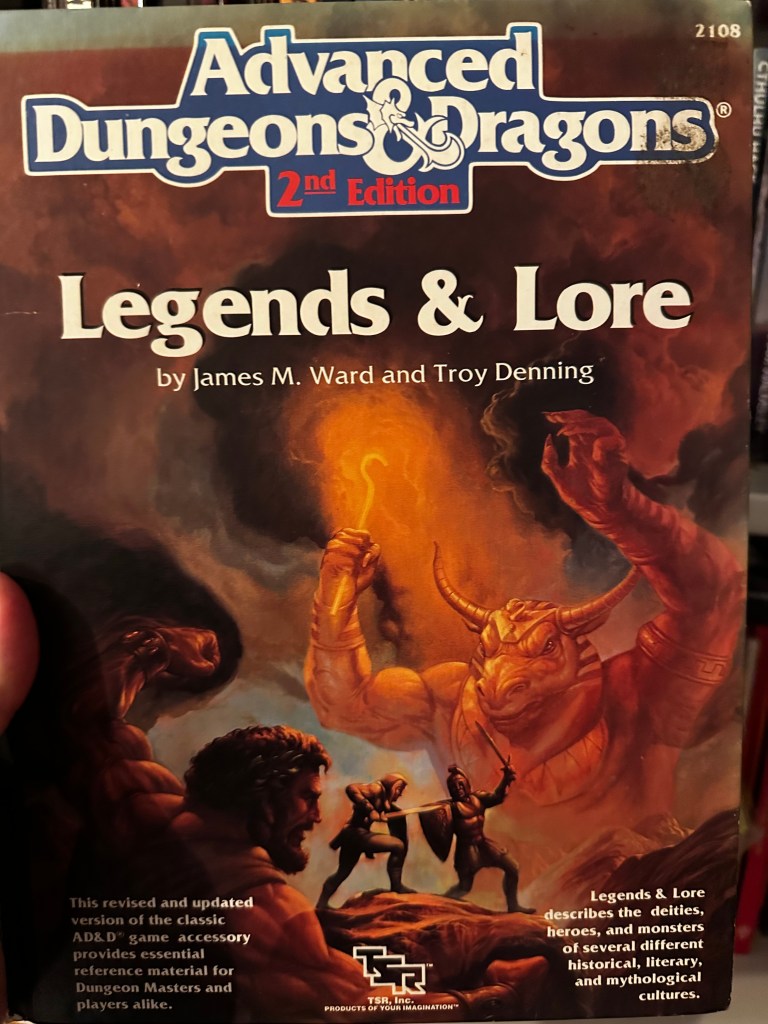
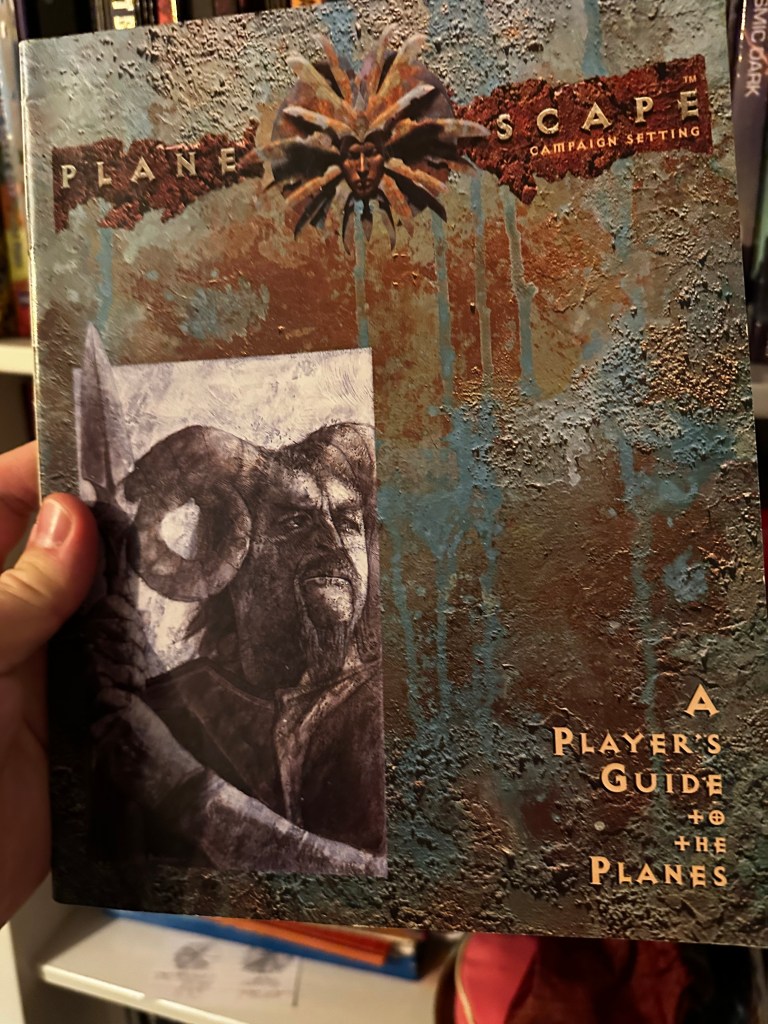
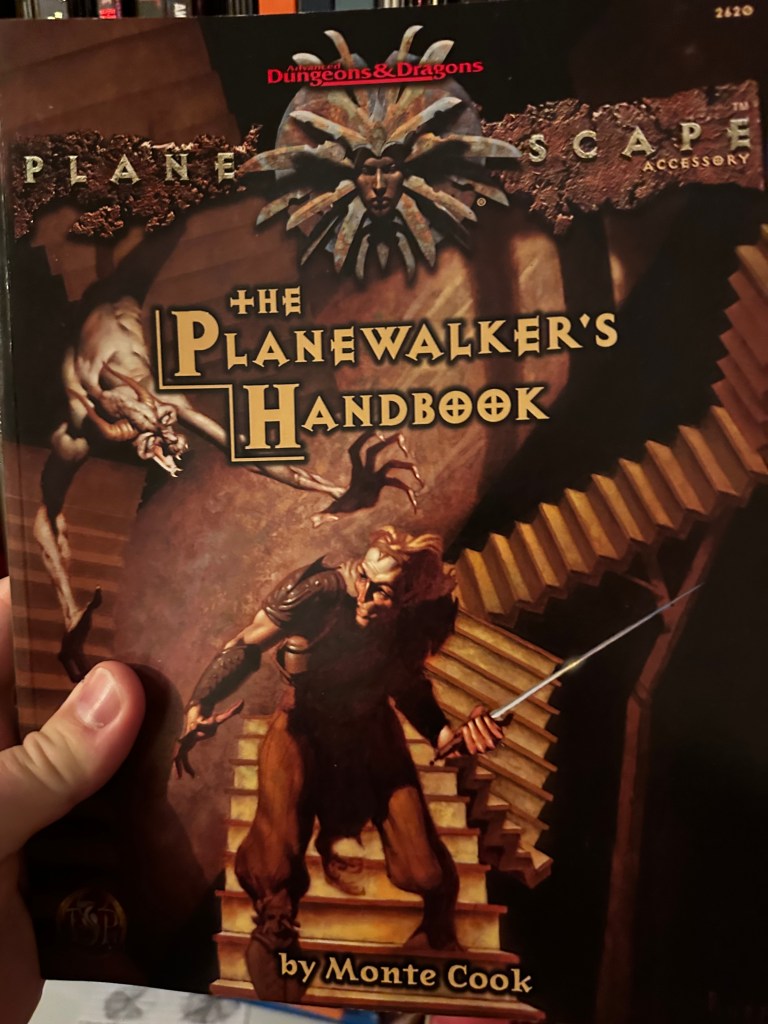
Our Session 0 was an epic crusade deep into the depths of not only the Player’s Handbook but also the Complete Wizard’s Handbook, the Complete Thief’s Handbook, the Complete Priest’s Handbook, Legends and Lore, the Player’s Guide to the Planes, and the Planewalker’s Handbook.

It took over four hours and resulted in a great deal of cursing, misunderstandings, frustrations, arguments, concessions, delight, confusion, amusement, nostalgia, and, finally, I think, satisfaction. The AD&D 2nd edition character creation process could be straight-forward enough. If one sticks to the most simple form of ability score generation (just roll 2d6 for each ability and keep it no matter what,) thus forcing the player’s to choose the classes most suited to their ability scores, forgoes the use of non-weapon proficiencies in favour of the far less complicated secondary skill system, restricts the PCs to options only taken from the Player’s Handbook and sets their game in the most vanilla of fantasy worlds, you could probably create a full party of PCs in an hour or so. But that’s not what I wanted. I wanted my players to have the full AD&D 2nd Edition experience that I remembered with such fondness. I wanted them to be unsure of their choice of class or race until they had a clear vision of a character. I wanted them passing around all those sourcebooks, to get, at least a look at all the various options. I wanted them to not know really anything about their characters until they all came together miraculously in the last half an hour. And that’s exactly how it happened. The character creation system, when you factor in all the optional books, has so many possibilities, dependencies, restrictions, bonuses, minuses, and choice that you simply cannot get a full picture of the character until they are most of the way finished. This differs to such a great extent from modern role-playing games that are not Pathfinder, that I think it’s quite difficult to explain without experiencing it. For a taster, please do check out my AD&D 2nd Edition Character Creation series where I make a Dark Sun halfling Cleric. It takes three full posts and around 6000 words and is, by far, the longest character creation I have ever done on this humble blog.

We ended up with an all-star cast. Our Paladin, Glaermond, completely illiterate but stout of heart and sinew, is the party’s lawful good defender. Aurora, our chaotic good Bariaur magic user, took the Witch kit from the Complete Wizard’s Handbook, and, as a member of the Dustmen faction, has decided to focus on necromancy. Trance, the Tiefling Thief is a member of the Society of Sensation and is driven to experience new things whenever possible. And, finally, Devansh Rao is our Aasimar cleric of Varuna, the guardian of cosmic order and lord of the sky. The players are currently discussing the wisdom of using Devansh’s little church to Varuna as their base of operations and gathering a tithe to fund their adventures in the name of the Great Lord of Order on our discord channel.

This is, potentially, the perfect combination of classes and factions for this adventure so I am very excited to get it started. And that will happen this very Sunday, dear reader. So watch this space if you’re interested to find out where this band go as the delve into the Hive.
The Editioning: From OD&D to 5E 2024

Bloggies Inspiration

I have read a lot of TTRPG blogs in the last few weeks, dear reader. I imagine the chances are good that you have too, if you’ve been following the Bloggies awards over on Explorer’s Design. There have been so many wonderful reads, I really did find it hard to choose between many of them. What a I liked most of all were the posts that expressed their enthusiasm for the hobby in one way or another. You can feel it shine from a d66 table of carefully curated results as much as you can from the effusive prose of some bloggers. And there were blogs about every aspect of this weird pastime from story-telling to initiative methods and everything in between. So often, what I found is that writers went back to the source material for inspiration, those historical tomes that defined the RPG scene and continue to play an outsized part in it, whether we like it or not. Most of these we were OSR bloggers with a keen interest in the original D&D from 1974. But you would occasionally see other editions get a shout out. On top of this, I get a newsletter from the Shop on the Borderlands that tempts me weekly with a lot of old dragon game shit I don’t need… Unless, what if I did need it?
The Editioning

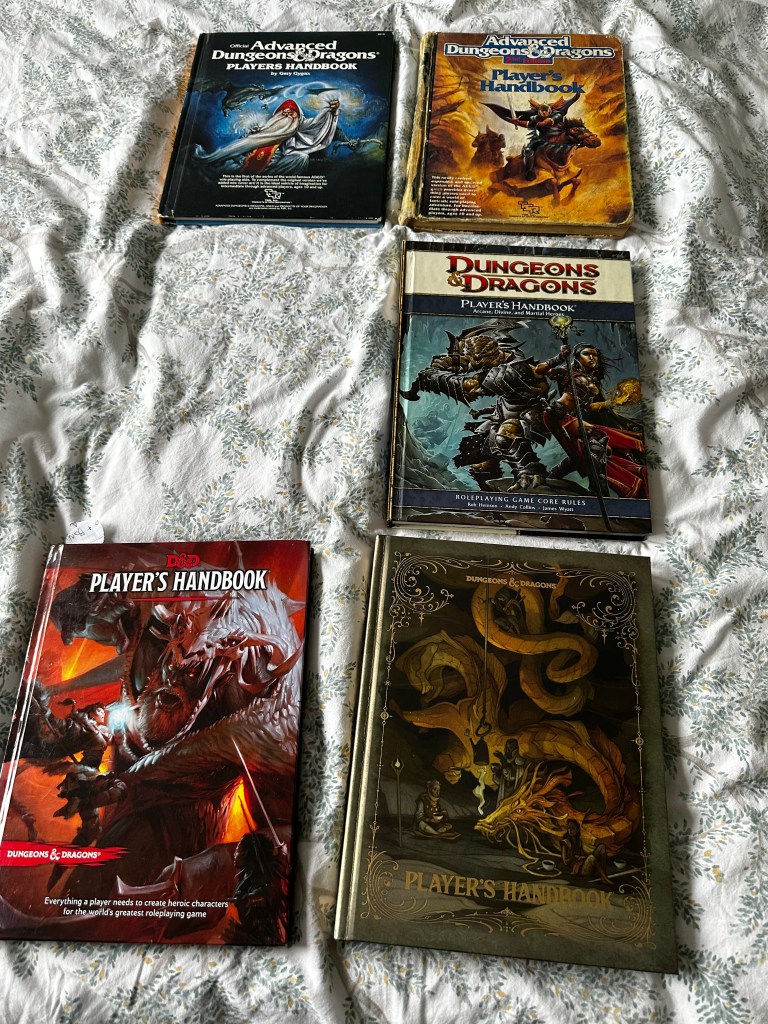
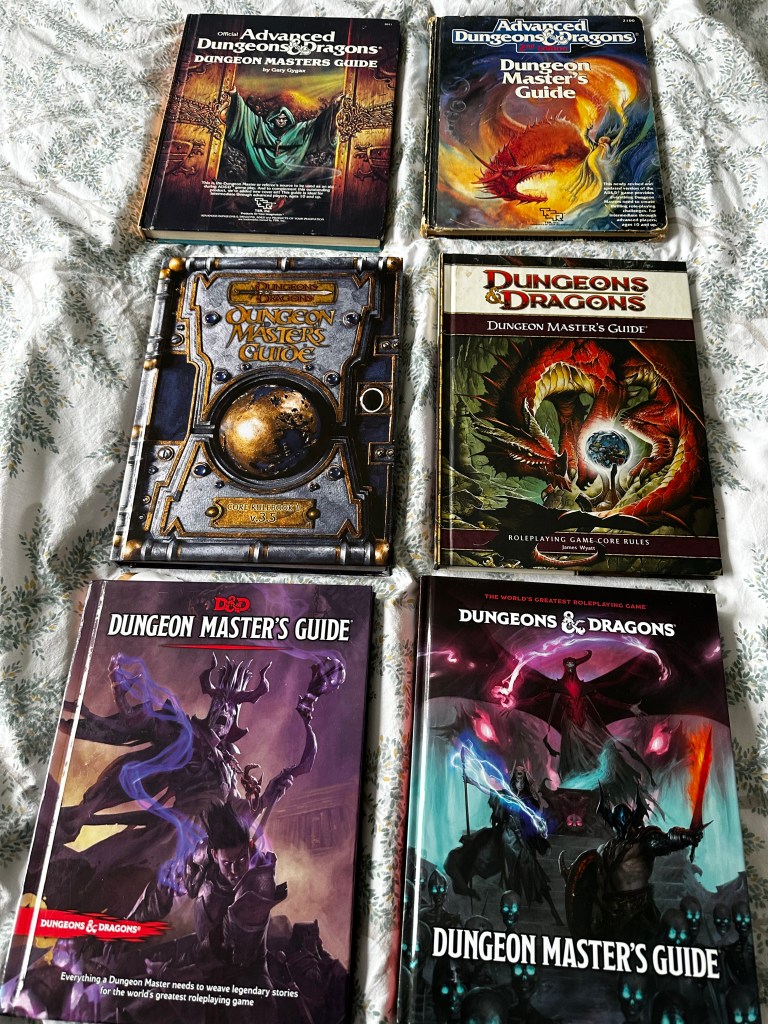
Now, I have some to lots of experience with most of the editions of the game, and I already have a bookshelf full of D&D, mostly AD&D 2nd Ed and 5E, but also several 4E books, a smattering of 3rd Ed and a couple of 1st Edition tomes. So, I figured, if I undertook a challenge to play a full adventure in every edition of D&D during the next twelve months, I wouldn’t need to supplement my collection too much to make it possible.

So, that’s where we are now. The Editioning is coming to pass. The plan is to play every edition of the D&D game, in order (although there may be some overlap) in our gaming community, Tables and Tales, between now and February next year. Isaac has agreed to take up DM duties for several editions. I will run OD&D, AD&D 2nd Ed, 3rd Edition and 3.5 and Isaac has said he would like to run B/X D&D, Ad&D 1st Edition and 4E. Someone else in the community might run 5E 2014 and 2024, but if not, I’ll probably do those too.

Pre-loved

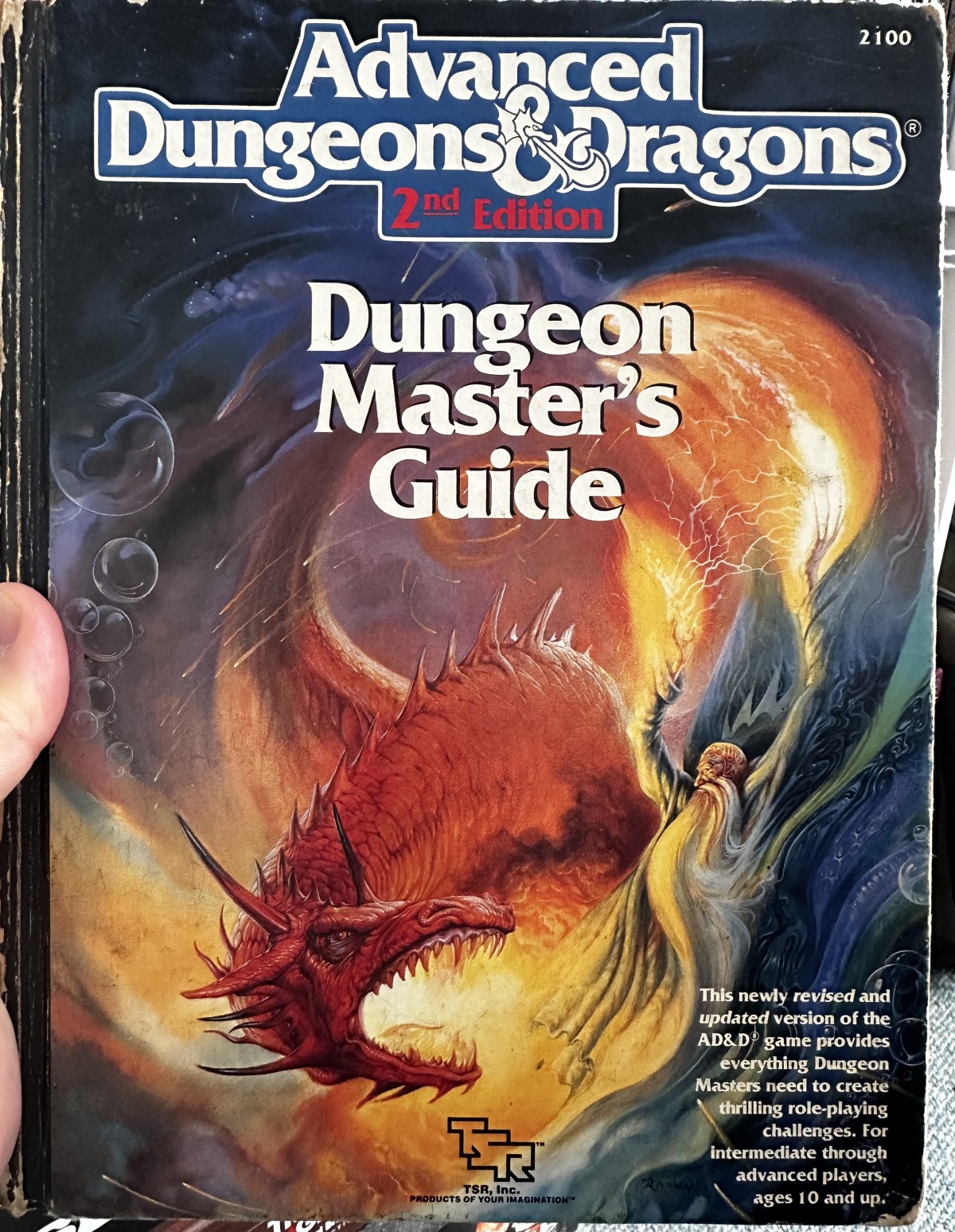
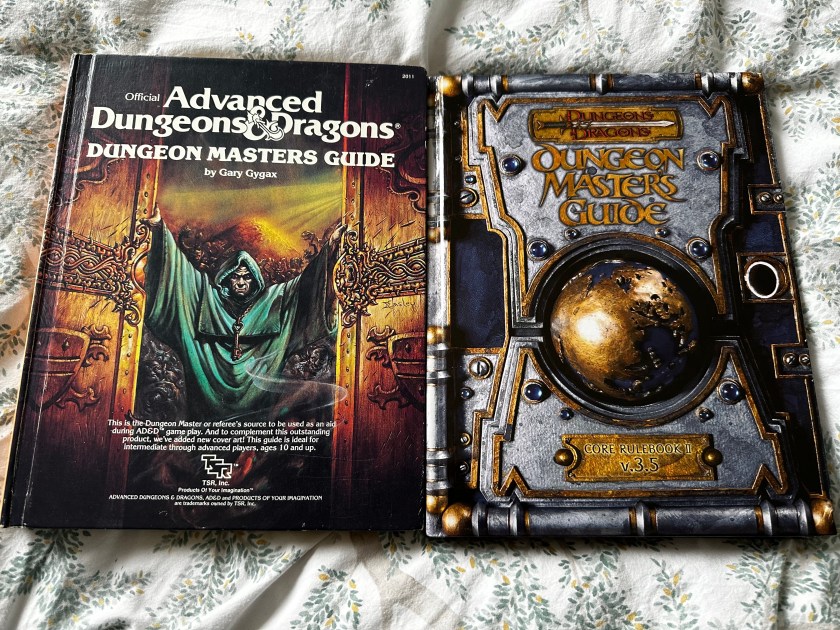
The covers of the AD&D 1st Edition Dungoen Master's Guide and the D&D 3.5 E DMG.
Just arrived!

I’m trying to source second-hand copies of the main rule books of each edition where possible. It seems more like a real history project when you have relics, primary sources, legendary tomes. It’s part of the adventure. I like to think about others using the books to play their own campaigns twenty, thirty, forty years ago. It puts me in touch with my own teenaged self and allows me to tap into the enthusiasm I had for the game back in the day. Also, its just cool to have them.

I’ve been surprised to find that you can get most of them for prices that I don’t consider extortionate, either on Shop on the Borderland or Ebay. I started shopping for them last week and a couple of DMGs showed up on Friday, AD&D 1st Edition and D&D 3.5E. They’re in good condition considering how much I paid for them. But before we get to those editions, we need to take a look at OD&D and D&D Basic/Expert.

The Educationing

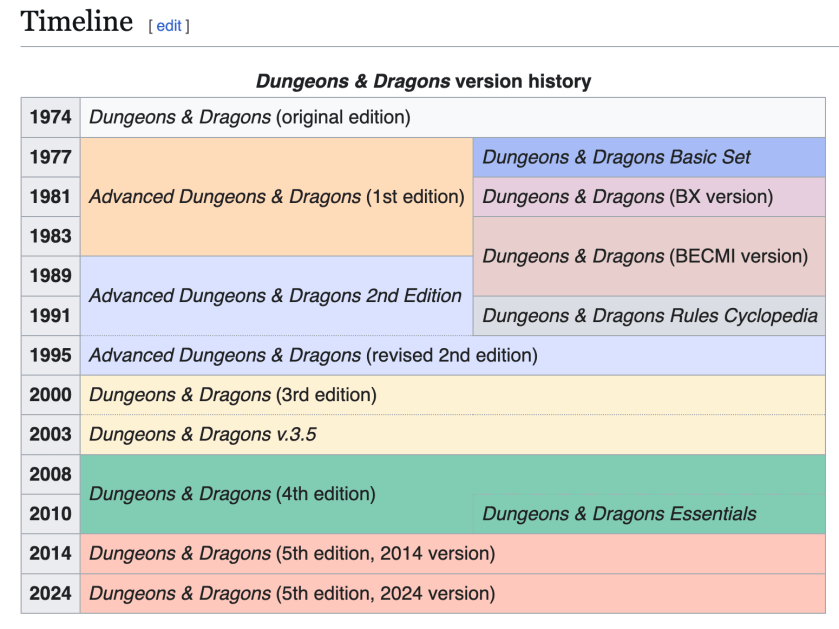
This undertaking has taken me to school. I had to figure out which editions were really distinct enough to deserve to be a part of it. I started by looking up the full list of editions here. I found this useful table:

A table nicked from the Wikipedia entry for Editions of Dungeons and Dragons. it shows all the versions from OD&D to 5E 2024.
From Wikipedia

You can see that it clearly shows the parallel evolution of Dungeons & Dragons and Advanced Dungeons & Dragons. I remember, as a young DM being quite dismissive of the non-Advanced version of the game. I had cut my teeth on the Basic Set but felt as though I had graduated past it to AD&D after a year or two. Never-the-less, I did play it in the nineties. A friend DMed it for us using the Rules Cyclopedia and the Hollow World campaign setting. Looking back at it now, I wish I had had more of an interest in it. Above any other version of the game, except, perhaps OD&D, it seems to have had the greatest influence on the modern OSR. Hindsight is 20/20 I suppose.

I have seen the terms B/X and BECMI and Blueholme and The Red Box and whatnot, for a long time. But this was the first time I bothered my arse to figure out the differences between them. This despite having actually played the using the Basic Set myself. I did not know that the confusing “abbreviation,” B/X referred to the first two boxed sets of the D&D rules, Basic and Expert, which allowed play from level 1 to level 14. I also had not known that the initialism, BECMI, referred to the full set of five rule-books, Basic, Expert (why is Expert shortened to ‘X’ in B/X but ‘E’ in BECMI? Make it make sense!) Companion, Master and Immortal. BECMI supported advancement all the way from 1st level to 36th!

Anyway, I made the executive decision to collapse all these versions into one, and just refer to it as B/X, since the main difference seems to be the extension of level caps with each successive book and we will not be playing long enough for that to be an issue. Nonetheless I have ordered both the Basic Set rule book and the Rules Cyclopedia, just to make sure we have all our bases covered.

Whither Adventure?

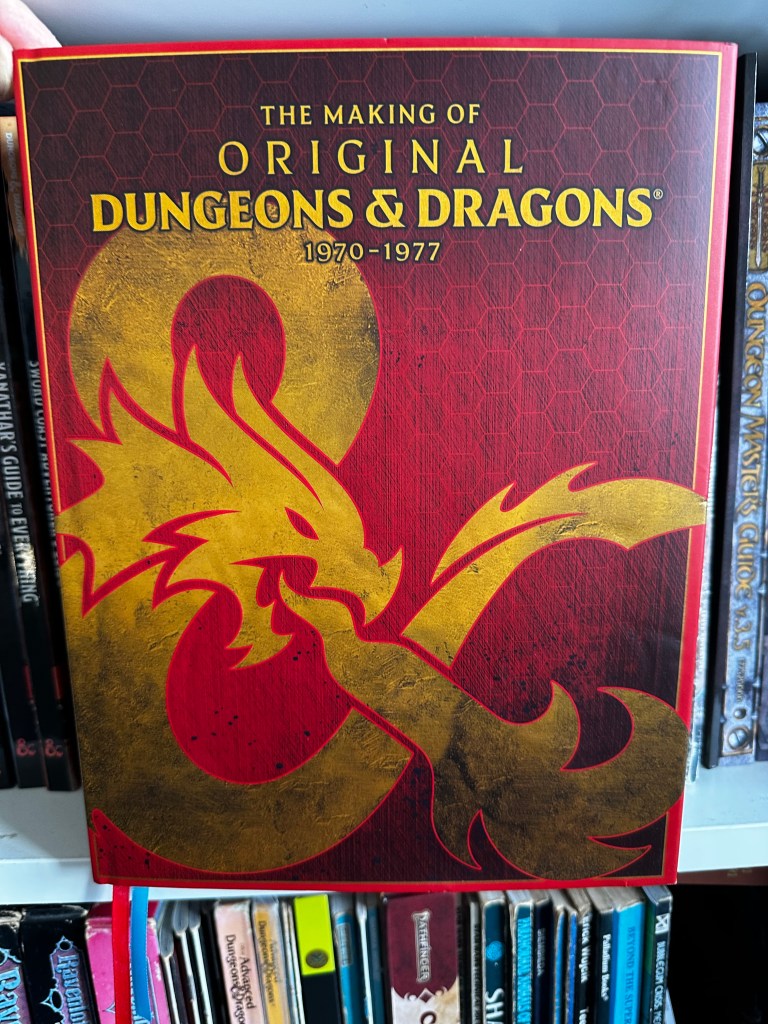
The cover of the Making of the Original Dungeons and Dragons. It has a red cover with a big gold ampersand on it.
The cover of the Making of the Original Dungeons and Dragons.

There are still a few decisions to make. And there is a lot of work to do to prepare.

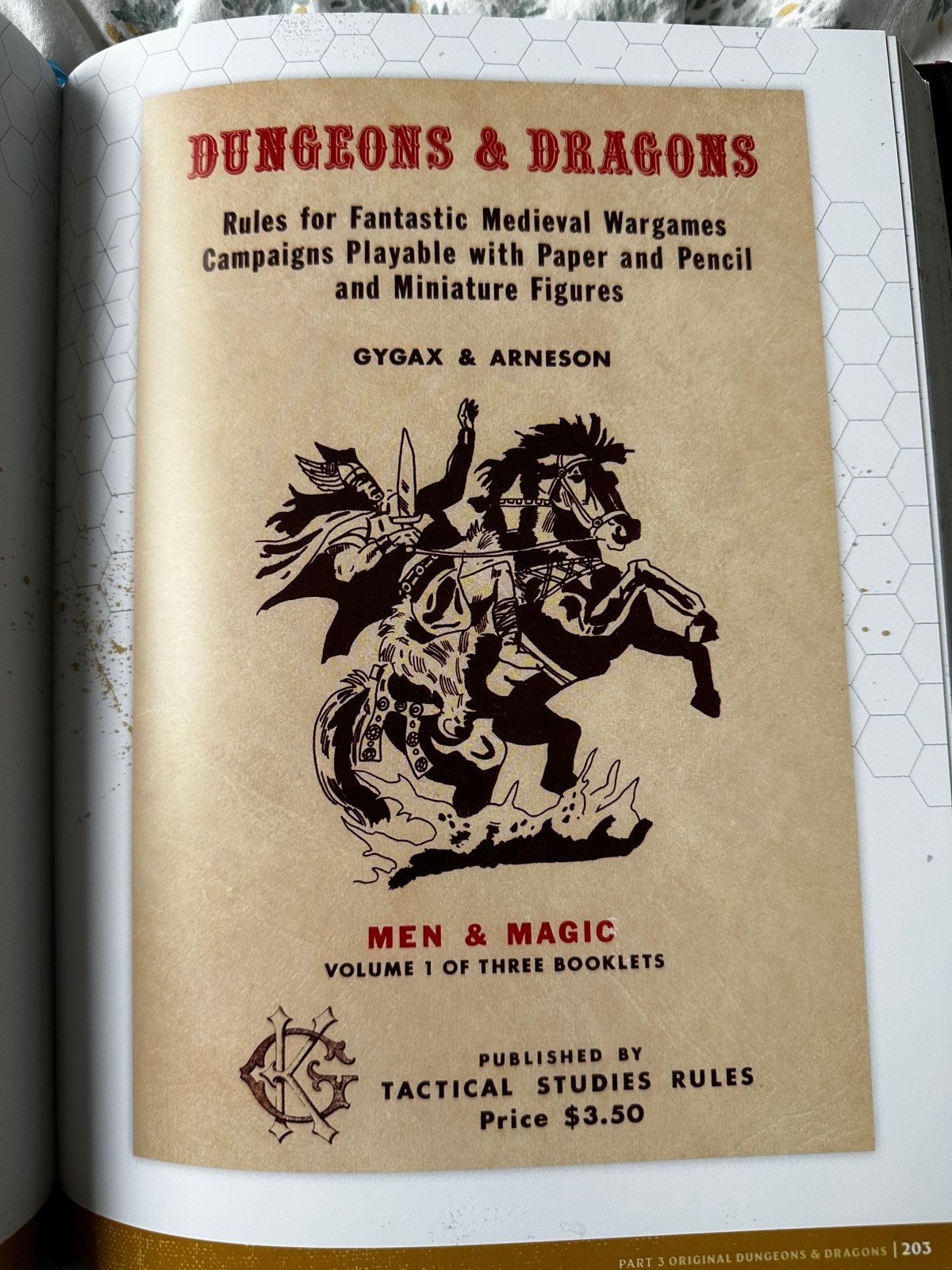
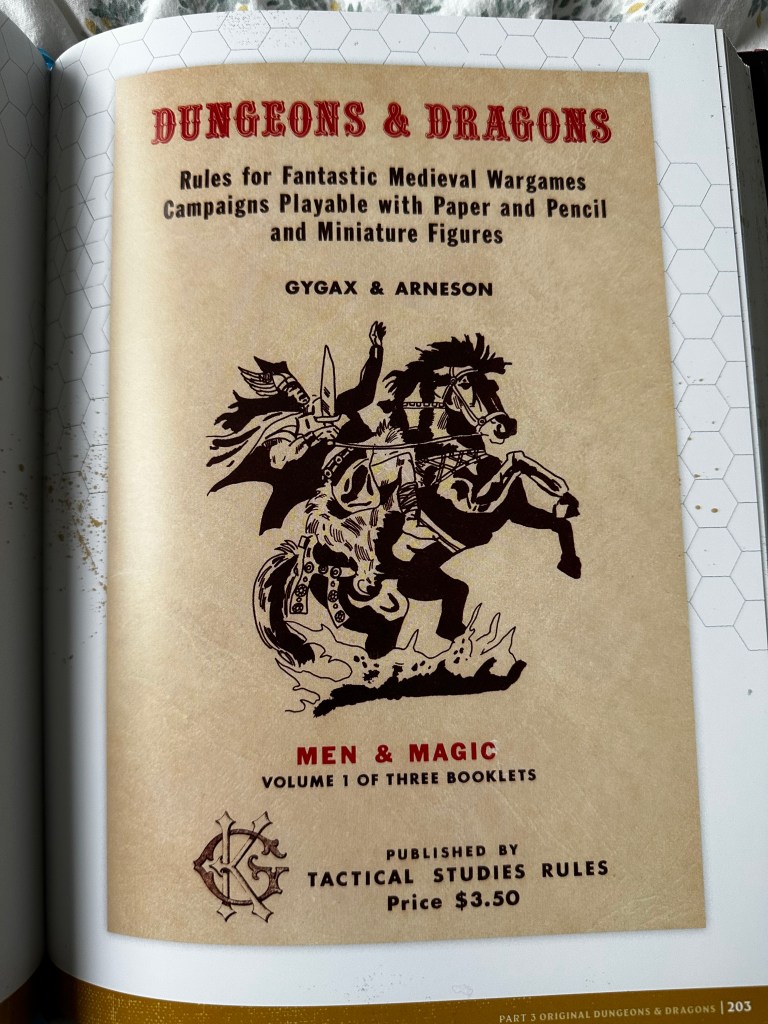
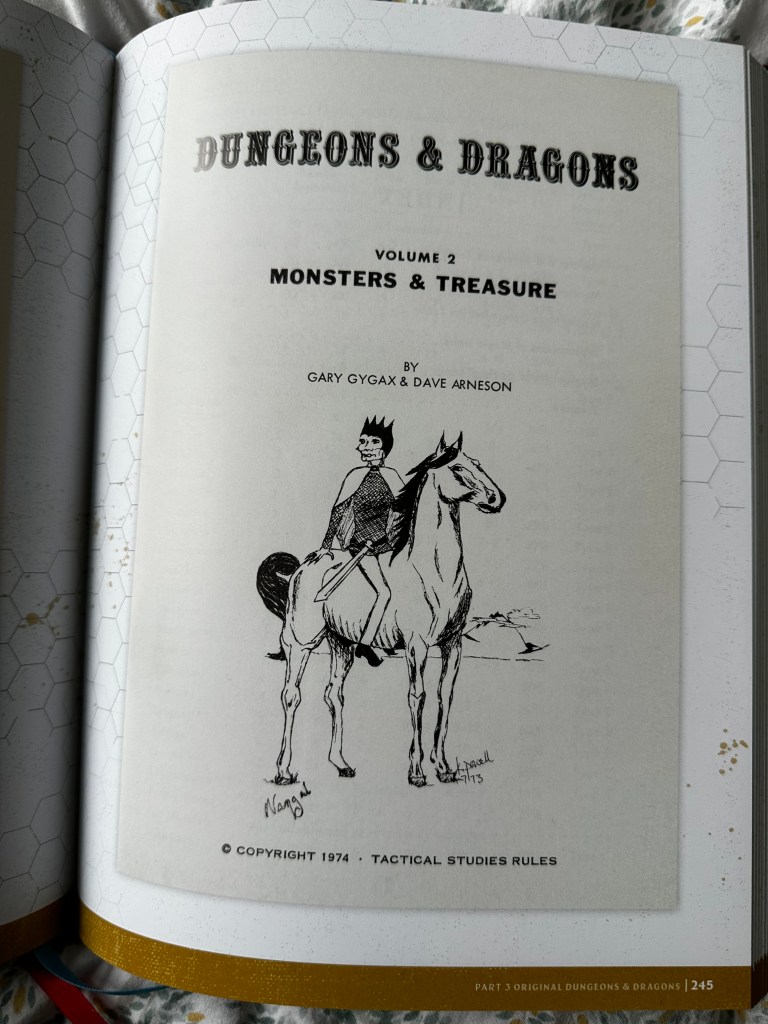
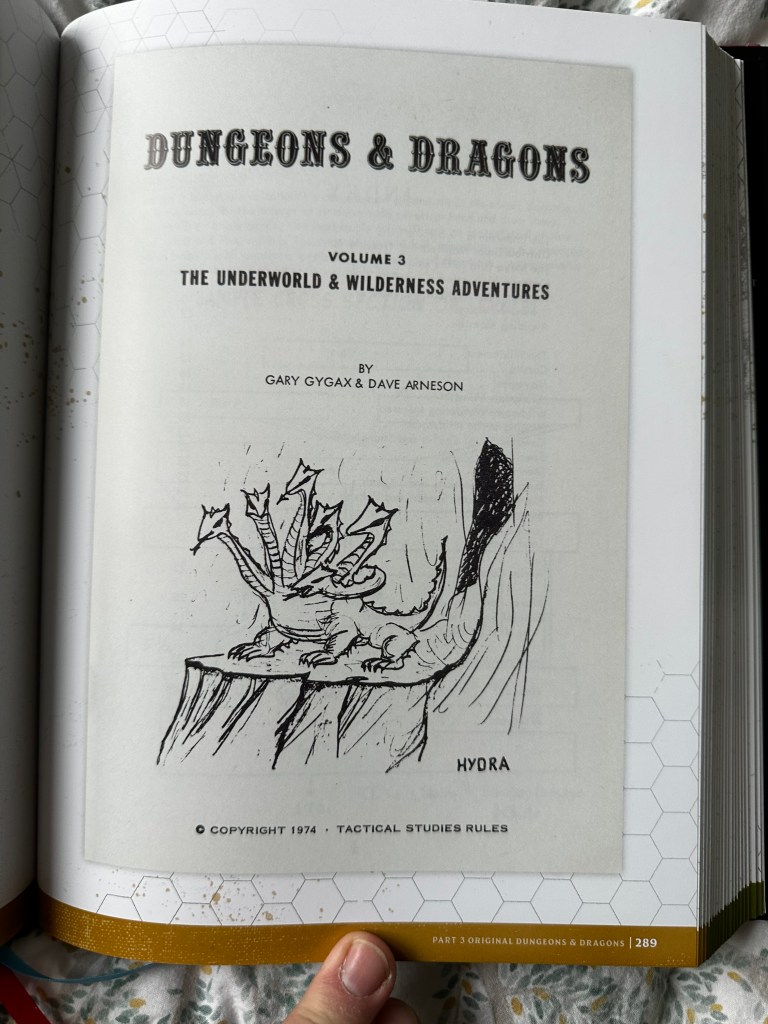
I have a relatively easy task to begin with, and that’s the reading of the OD&D books. I picked up the PDFs of these from Drivethru for a song. I do have them in a a slightly unwieldy printed form in “The Making of the Original Dungeons & Dragons” book that a friend kindly gifted me at Christmas, so I am happy not to need to empty my bank account to purchase a vintage copy of those books. I’ve quickly realised that I would also need the Greyhawk supplement since, otherwise, I would need to use the Chainmail medieval miniature war-game to run combat, and that was a bridge too far for me. The Greyhawk supplement included the first iteration of the D&D combat system that we might recognise today.

On top of that, we have to decide on what adventure modules to run for each edition. I would like to use vintage adventures that were made for the particular edition that we’ll be playing. For B/X, AD&D etc. there are tonnes of options, which means we’ll have to narrow them down somehow. But for OD&D, we have a very different problem. Adventure design appears to have been mainly the domain of the DM. The main books give you rules and tables, monsters, treasures etc, but mainly they encourage the DM to create their own stuff. Which is great! But it leaves me with the question, is that what I should do? Since that’s the intention? Or, should I use the one adventure I could find in any of the OD&D supplements, Blackmoor? The adventure is “The Temple of the Frog,” and I haven’t finished reading it yet. But it does strike me as the sort of scenario that could be quite lethal unless the PCs turn up with an army of hirelings. If that’s what’s intended, maybe that’s just what we should go for.

Conclusion

I don’t yet know which way I’ll go with that decision, dear reader. I would welcome feedback from anyone with more experience of OD&D or the Temple of the Frog than me.
In general, this challenge has got me quite excited about playing D&D for the first time in quite a while. I wrote a few posts about maybe getting back into playing AD&D back in 2024, specifically I wanted to play Dark Sun. The experience of even making a character put me off it. But I now think that, with other players involved, it could be not only of historical interest, but it could be really fun! I know some of our players in Tables & Tales really like a bit of crunch, while others love the OSR principles of rulings above rules that OD&D might bring.

One thing you can be assured of, dear reader, is that I’ll be taking you with me along the way. I hope to have some interesting things to write about reading, prepping and playing these games, so stick around!