The Editioning Weeks Five and Six, Basic D&D

Taking Sides

The Keep on the Borderland wants you to commit to a faction, become their champion and do quests for them. Or, at the very least, it wants you to pretend you’re doing that so you play one faction off against another. We got deep into these politics in our latest session.

Losing Friends and Making New Ones

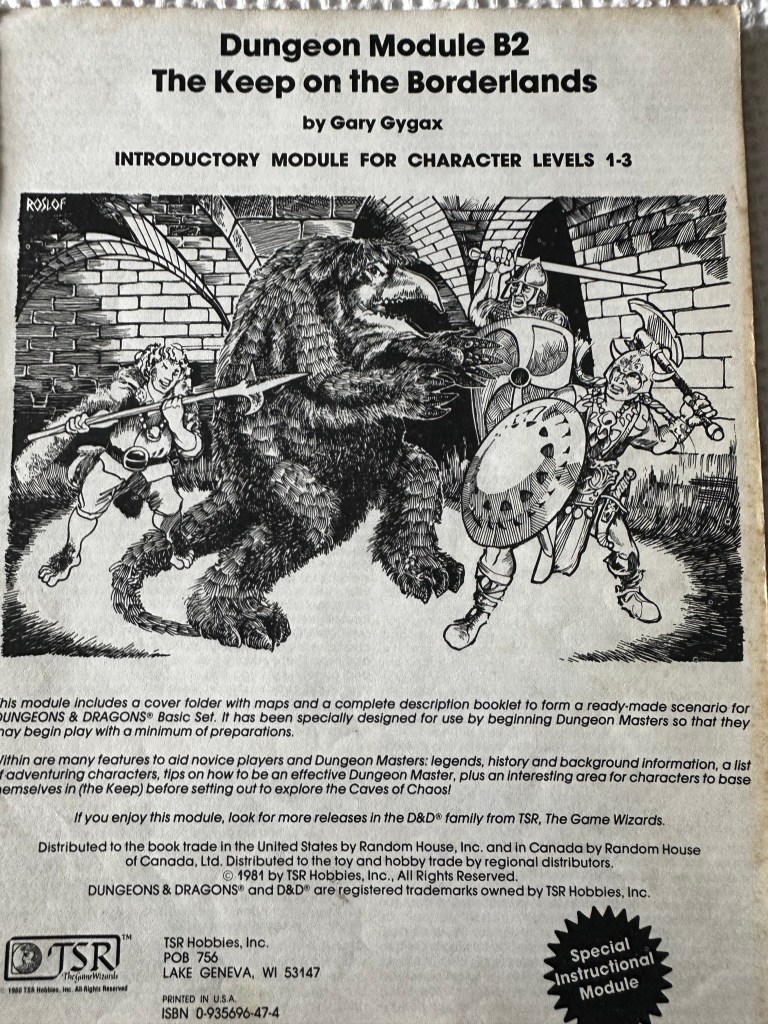
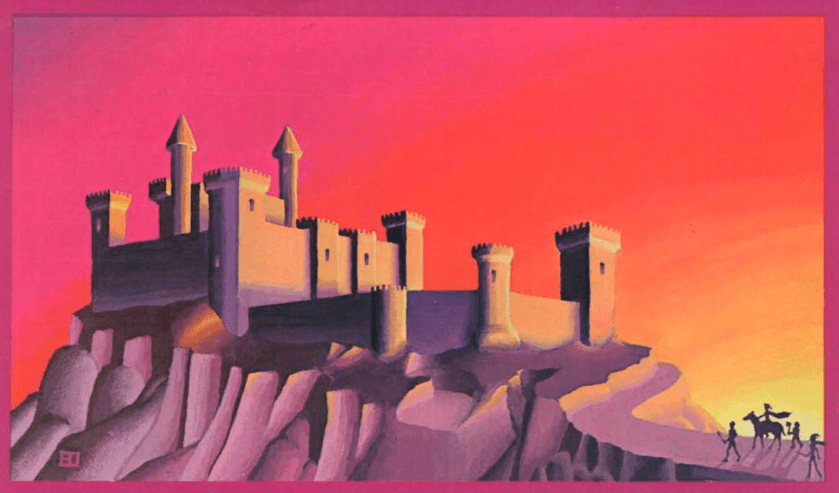
The image of the Keep on the Borderlands on the back cover of the adventure, showing a large keep at sunset, a group of adventurers running up the road towards it.
The Keep

We have been growing in the esteem of various factions and drawing the ire of others for the last few sessions. For instance, as I mentioned before, we have ingratiated ourselves to the Castellan of the eponymous Keep, but, we have decided to go against the Ospreys, the bandit-like rebel band who want to overthrow our friendly Castellan. With that in mind we used an osprey feather and a secret handshake to convince a group of these bandits we wanted to join them. This turned into a fight, of course, since they came in force and, although we only needed to capture one of them for questioning in the keep, we couldn’t separate them. This all worked out in our favour as we came away with not one, but two prisoners, one of whom was a high-ranking lieutenant. But one of them escaped the ambush, no doubt returning to Lord Osprey himself. I’m pretty sure we’ve ruined any chances of being best buds with that guy.

Anyway, we went back to the Keep for some carousing and continued making enemies and rivals. Our DM, Isaac’s carousing table has not necessarily been very kind to us so far. This time proved to be even worse than the last. The only thing that happened last time was that we woke up in the street. This time, my thief, Thaddeus Nightbane, got barred from the Blue Wine Tavern for being a know-it-all, Tom’s elf, Eandril, managed to get into a duel with the keep’s armourer and Lotharia, Charlie’s halfling, pissed on the spell book of Thaumic Juggernaut Billiam Asda (is that right, Issac?) Now, we had a bunch of booze back in our apartments so I didn’t mind getting barred too much and Eandril won the duel, impressing the armourer so much that she offered us discounts. But Lotharia? Well, the only way we could satisfy the Thaumic Juggernaut was to quest in search of a replacement spell book. So, we took ourselves off into the mountain woods in search of the Hermit, Dimblemist. It wasn’t too hard to find him, but we wanted to get out of there as quickly as we could. The frog-like man gave us all the ick. Anyway, we traded my ill-fated first character, Edmund of the Sun’s old holy symbol for the spell book. Dimblemist hung the symbol on his pet puma’s collar, oddly enough. They both seemed pleased with the result.

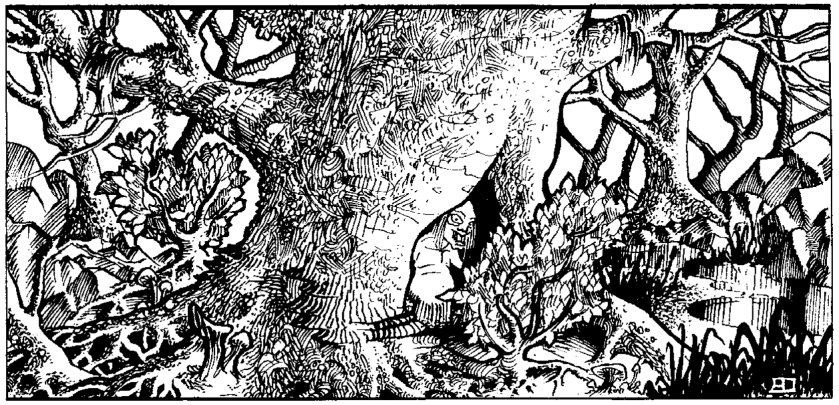
Dimblemist the horrid little hermit in his tree home.

It was on the return journey that we ran into a random encounter. A griffon attacked a shepherd and his flock right in front of us not he road. The shepherd was already a goner but the time we got there, so we decided to try sneaking around to avoid a fight. No such luck. The bird-brained pussycat spotted us and attacked, making short work of Lotharia. She was rent asunder by the beast’s great talons. I’m sure it would have killed us all if we hadn’t had a small army of hirelings with us. So we defeated it with sheer numbers. Poor Lotharia, we barely knew her! She was only the second PC fatality. I’m sure there will be more to come…

Anyway, we returned to town with the replacement spell book and poor Lotharia’s corpse, in an effort to glean a little sympathy from Thaumic Juggernaut, Billiam Asda. Surprisingly, he paid us 100 GP towards the funeral costs. We later heard that Billiam had Power Word: Deathed a man in the pub for shit-talking his mum or something. Counting ourselves lucky, we wrapped that session.

Ethics in Business

Look, this is a game, alright? I want you all to remember that before you judge Tom, Charlie and me on the paragraphs below. Especially as, you know, we’re just doing what our characters would do or whatever.

We buried Lotharia and greeted Charlie’s new PC, Anastasia, Cleric of the Sun and newest member of the Company of the Dark Sun (we change the name from the Company of the Summer Sun after Edmund died.) Soon after we received a visit from Richard Kirkdon of the the Thyrenian Guild, a group of merchants with a base of operations in the Keep. They had been paying us for Osprey ears and, unsurprisingly, were very happy to hear with had ambushed a bunch of them and taken prisoners. Dick paid us 900 GP just for being cool. He then offered us a small fortune to find some of his mates who had been captured by the hobgoblins in the Caves of Chaos and, oh yeah, to deliver a shipment of arms to the Shakkelwart Clan of orcs, also of the Caves of Chaos. He even paid us a third of the fee up front. We agreed, and bid him farewell.

Now, Thaddeus Nightbane’s immediate instinct was to sell out the Thyrenians to the Castellan for arming his enemies. He saw it as a win-win, especially as we had already been paid so much for doing nothing. But the other PCs talked me around. Several other plans were thought up and shot down. We considered damaging the shipment and delivering it to the orcs, thereby damaging their relationship with the Thyrenain Guild. We thought of just destroying the shipment and telling Dick we delivered it. In the end, after a debate that consumed the lion’s share of the session, we decided to deliver the shipment as requested, but also to deliver another shipment of arms and armour to the goblins we’d made friends with earlier. The idea was that, if both sides were well armed, they might just weaken each other enough to make them both easy pickings for the keep’s forces, thereby increasing out standing with the Castellan and earning the rest of the gold promised us by the Guild.

So, off we went, back to the ravine containing the Caves of Chaos. As we were scouting out the best way to approach the Shakkelwart Clan’s caves, we encountered a few representatives of a rival mercenary group, known as the Great Company. They took one of our hirelings hostage but we managed to defeat them despite that. In searching their belongings, we discovered they had been contracted to find and eliminate Thaddeus Nightbane!

Conclusion

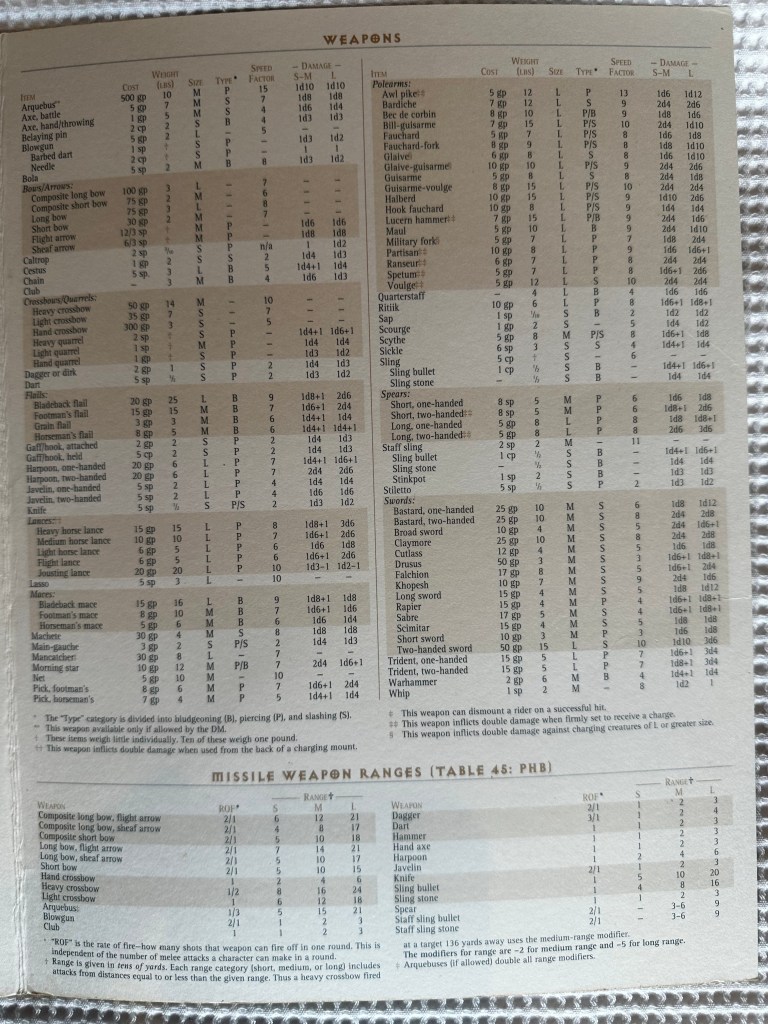
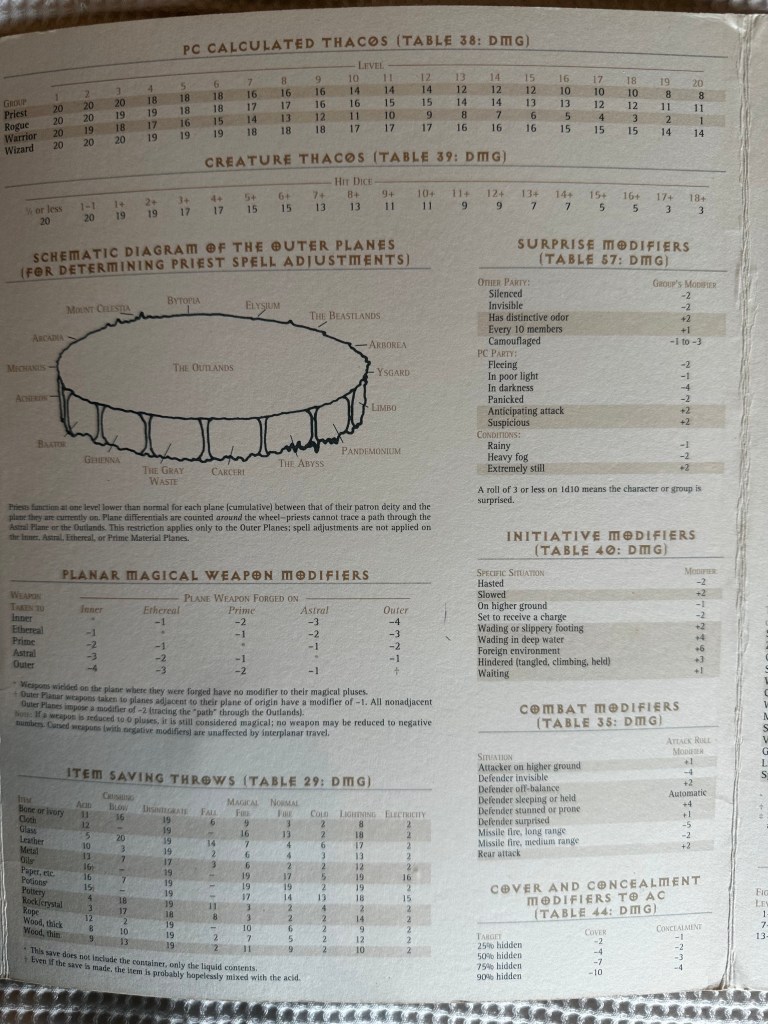
Less and less am I concerned with the mechanics of playing the game, now. We almost never need to refer to the rules or even question the way things work in Basic D&D. Its fair to say that “basic” is the right word for it. Your characters are simple, the rules are straightforward and everything that isn’t spelled out can easily be ruled upon by the DM.

More and more am I invested in the occurrences of the adventure, the faction play, the NPCs and the quandaries we are presented with. We are figuring out what we want from this whole caper and we are also figuring out how the various groups involved can help or hinder us. It is bringing the Machiavelli out in us quite a bit, whether we’re lawful, chaotic or neutral. And it’s very fun.

The last session we played was Session 7, which is one more than I thought we’d be playing for this whole adventure. Isaac asked us if we wanted to continue until we reach a reasonable end point. This obviously sticks a spanner in the works of the Editioning plan, but I had already come to the conclusion that if we were having fun with it, we may as well keep playing. I’m coming to the realisation, actually, that we won’t get through an adventure in each edition in a single yer. More likely, it’ll take two. And I’m fine with that because, right now, I’m enjoying it so much!

The Editioning Week Four, OD&D

The Woes of Sorrowfield, Session Three

The hex-crawl continues through the Barrenwood. The PCs have been doing their best in difficult circumstances. Sorrowfield is a miserable place right now. There have been some sort of magical ballistics going off over town and country, undead and chimerae stalk the land and the bloody rain hasn’t stopped in weeks. Perhaps it was the constant and growing danger around them that prompted the adventurers to finally question the motives of the pixies they’d been following for a few hours through the forest.

The pixies, you see, had been trying to get them to the lake in the northwest part of the woods. Once they reached it, however, they could see a soft, violet glow from the waters. It matched the glow from the crystals they had discovered throughout the forest so far. The pixies hovered above the lake and asked them to dive in, claiming the source of the corruption was submerged beneath the unsettled waters. The PCs thought better of it despite the pixies’ mocking and cajoling. They wanted to circumnavigate the lake to see what sort of traps the mischievous little fae had in store for them, but that proved difficult. To the east, the river emerged from the lake’s waters, and there were no convenient trees to chop down to act as a bridge this time. To the northwest, they found a vast patch of crystalline briars. Since the briars covered the entire hex, they eventually decided to go one hex further around to the west, avoiding it entirely. This forced them into a a hex that was particularly confusing, with lots of entangling plants that tried to trip them. I asked them to roll a d6 to see if they got lost. They avoided rolling a 1 so they were able to press on in their desired direction.

All of the above; the pixies, the briars, the hex of confusion, all came from encounter table rolls. You can see that table on my last OD&D post here. They have all come together to make some interesting challenges and have forced the PCs to explore further than they might otherwise have. I’m fairly satisfied with most entries on the table. I feel like there’s a good mix of combat and non-combat encounters that require a good variety of solutions, skills and ingenuity to deal with. But there were two entries I really hoped they would roll up. Lucky me, those were their next two rolls!

The very next hex they entered, they rolled an 8, so they came across the Hermit’s Shack. They knew from rumours gathered in town, that there was a Hermit out in the woods somewhere, so it wasn’t a big surprise. They approached politely and Breandan welcomed them in, offering them tea and “biscuits.” I had a great time playing this guy. After a couple of sessions of mainly exploration and combat, it was refreshing to have some solid role-play. He was eccentric but friendly enough. He explained that he had run into the other group of adventurers who had been sent from the town of East Barrens. They had come across his shack on the way back from the ruined wizard’s tower on the coast to the west. They explained to him that they had been rebuffed in their attempts to delve into the dungeon beneath the ruins. Wave after wave of undead appeared as if by magic on the first level below. There was no way through… These adventurers had moved on after a restful visit, turning back towards the town.

Breandan also had a quest for the adventurers. He wanted them to hunt down and slay the carnivorous crystal elk that had been terrorising him of late. He wanted to travel up along the river to the north to see if he could escape this crystalline corruption, but every time he attempted the journey, the elk chased him back home. He promised the PCs a valuable reward if they would do this for them. They readily agreed and, after resting up in his cabin for a few hours, they set off to do just that.

Now, I considered just having the elk itself as the encounter in the next hex, but I decided, in the end, to stick to my own rules. I got them to roll on the encounter table again. This time they rolled a 6. The halfling heard them before she saw them, a shambling, groaning group of partly crystallised undead amongst the trees ahead. She tried moving silently through the woods to flank them and get a better look, but she failed badly, and got slammed to the floor by a zombie instead. This encounter was really over before it began, even though the zombies won the initiative roll. They couldn’t hit any of the other PCs, and then Tadhg, the cleric, now on Village Priest level (level 3) stepped in. A Village Priest can ably and automatically turn zombies, just have to roll 2d6 to figure out how many are affected. Well, Tadhg turned all four of them. But as he did so, the party got a good look at the zombies, two humans, a dwarf and a halfling, the exact make-up of the other band of adventurers. Now, this encounter on the table also involved the reward of an adventuring diary, which the PCs would have gotten if they had a chance to loot them. Since they sent them running instead, I decided to bring the elk into play. As the dwarven zombie was scarpering, the monstrous crystal antlers of the carnivorous elk emerged from between the trees, skewering him and sending him flying through the air. And suddenly, they were back in combat.

I like the “per-side” round by round initiative roll of OD&D. I like that it utilises a simple d6. I even like that, if both sides rolls are equal, then everything happens simultaneously. All of this adds a bit more randomness to the proceedings and keeps it interesting. Especially in this system where each combat round equals a full minute, you can imagine the ebb and flow of combat evolving constantly, with the momentum swinging one way for a time, and reversing quickly and unexpectedly when the enemy spots a weakness or exploits their opponents’ mistakes.

This was the strongest monster they had faced yet but I was only reminded of the primacy of action economy in D&D. It applies as much in this version as it does in 5E. One combatant against six is not an equal fight, no matter how many hit dice that one enemy has, unless they’ve also got six attacks per round. So, of course, they made relatively short work of it, and somehow, managed to avoid any further damage as well. What these two fights combined really showed, though, was the full range of combat abilities in the group. We had turning undead and healing magic, we had magic missiles and invisibility, and, as well as that we had backstabs and the Fighting Man even got in a mighty blow or two.

After they had dealt with the elk, they investigated the body of the dwarven zombie. Finding a diary on it, they were able to confirm that the corpse used to be Ferris, the son of the town’s blacksmith and stonemason. The PCs had been asked to keep an eye out for him by his mother so finding him like this was a poignant moment. His diary described his journey to the old wizard’s tower, the hidden entrance to the underground dungeon and the desperate fight with the hordes of undead in the basement. They had been forced to retreat, as Breandan had said earlier.

With that, they took the head of the elk and the body of Ferris back to Brendan’s place. They asked if he would return the body to his parents in town but he refused, conceding instead that they could bury him there on his land. They did so and held an impromptu funeral for the boy. It was a touching scene. That done, they received their reward from the hermit and rested up again that night before setting out for the wizard’s tower the next morning.

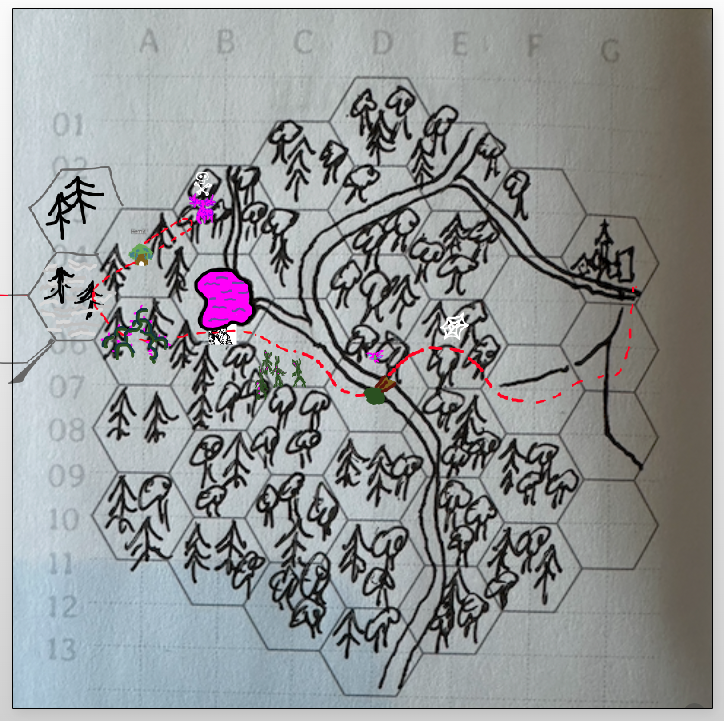
I just want to share with you the hex map as it looks now. The players, totally unbidden, have been filling it in with the things they’ve encountered on their way through the Barrenwood on the Roll20 map. I love this!

The hex map of Barrenwood. Now with added colour!
The players have been drawing on my map and I love it!
Conclusion

We had a couple more level ups following that session so some of the band are now level 4! I will be honest, I had not totally foreseen the speed they would be levelling at. Still, it was my decision to make levelling as easy as possible. For instance, I am allowing level-ups at the ends of each session, rather than the ends of adventures and I am handing out plenty of gold and treasure (1GP + 1XP in this edition), as well as bonus xp for completing quests and clever solutions to problems. So, I’m actually quite happy with the situation.
What it does mean though, is that I will have to upgrade some of the encounters I had planned for the dungeon itself. Since I don’t have the whole thing prepared yet and I’m not writing up entire stat blocks for encountered monsters anyway, it’s really no more work in prep than I was going to have anyway. I plucked that elk out of the Monsters & Treasure book’s list of monster stats at the last minute. It was a just a re-skinned unicorn. I love being able to do this quickly and easily when I don’t feel beholden to the 1000 entries in various monster books to choose from. I would often find myself in decision paralysis when presented with all the monsters available in official products for 5E, unable to find the exact right one for a given encounter, despite the sheer number of them. I don’t have that problem here at all since all the monsters are just a collection of hit dice and ACs with maybe a special feature to set them apart. It’s very easy to imagine that line of stats as representing any monster at all, or to customise them as you see fit.

Anyway, that’s it for the report on Session Three. It might be a few weeks before there’s another one, what with various IRL happenings. But I’ll be back next week, probably with a post on my current UVG exploits utilising the Troika adventure, The Hand of God. See you then, dear reader.

The Editioning Weeks Three and Four, Basic D&D

Keepin’ on Keepin’ on

We’re two more sessions into the classic Basic D&D adventure, the Keep on the Borderlands. And we’re getting into the meat of it now, I think. We’ve got multiple factions, both in the Keep itself and in the Caves of Chaos. We’ve got spying and betrayal. We’ve got court intrigue! But most of all, we’ve had laughs and fun with this.

Donkey Konging

There are some spoilers for the Keep on the Borderlands below. If you think you might want to be a player in that adventure, you might want to choose a different post to read.

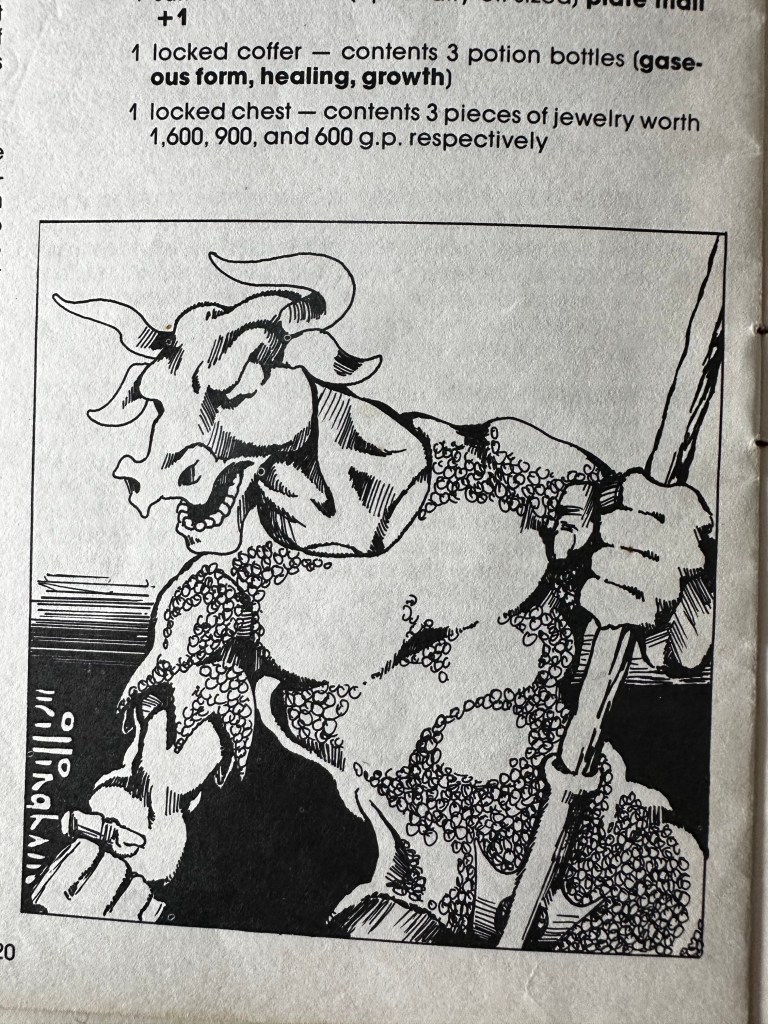
We launched straight into a fight at the start of session three. We managed to trick and ambush a dozen strong goblin patrol, trapping them in a pincer movement. The fight didn’t last too long, actually. We took out their leader and the rest pretty much dropped their weapons and happily consented to be tied up and gagged so they couldn’t follow us as we went to pillage their home. We did bring one of them with us as a kind of guide. Gaw was a congenial sort of goblin, and very eager to help. He told us about their leader, Sharktroll. Now, Sharktroll, is, it turns out, neither shark nor troll, despite the name. She’s a goblin and the other goblins seem pretty scared of her. Armed with this knowledge, we proceeded along the tunnel to the west, keeping a sharp eye and ear out as we went.

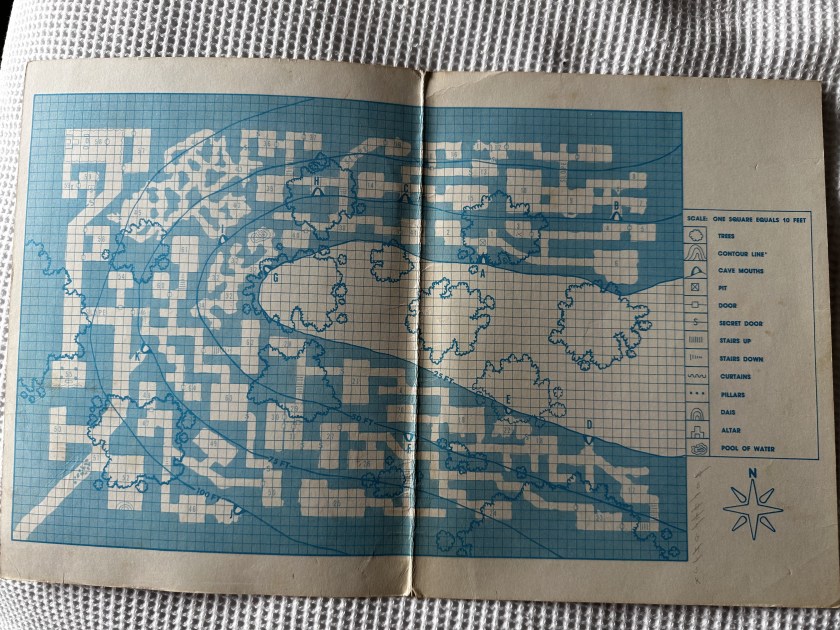
At the start of the campaign, Isaac presented us with a list of traditional roles for players that he cribbed from the Retired Adventurer blog. Tom took the Quartermaster and Timekeeper roles. I got the Rules Coordinator and Mapper ones. Normally, in our groups, the GM just gives out the map and trusts in the ability of the players to compartmentalise the knowledge they have, with the understanding that the characters don’t have it. It works well, saves time and avoids frustration. But we thought it would be an interesting experiment to do it the old fashioned way. So far, it’s going ok. Isaac has been good about providing accurate measurements for rooms and corridors, and I’m using graph paper to maintain consistency. At times, it has been hard to picture some of the rooms correctly in my head, but in those instances, Isaac has kindly showed us that part of the dungeon map from the adventure. Keeps me busy.

A map drawn with pen on graph paper. It shows a wide canyon and a caves sytem where the goblins live.
A photo of the crude map I have drawn so far of the goblin caves in the Caves of Chaos

So, we went exploring the goblin caves, found a sack full of gold which we robbed, and a barrel full of javelins, which Thaddeus Nightbane, my thief, peed in. Of course, we almost immediately found cause to use those miturated upon javelins as another goblin patrol approached the guard room where we found that stuff. We were able to get ourselves set up to launch a surprise attack on them, chucking spears and, even more fun than that, rolling barrels of water down the narrow tunnel! Donkey Konged the hell out of those gobbos. Killed ‘em all in one fell swoop. It felt like a really great old school moment; setting up a ridiculous plan with very little time and only the few items to hand. Surprising that it worked out so well, though, to be honest.

Snakey

We pushed on, thinking to find this Sharktroll character and maybe do her in. But, instead, we found a large room full of goblins: men, women and children. We didn’t alert them to our presence, luckily, but this “family room” as we called it, gave us pause. We all cooled on the idea of clearing out these goblins, now that the ramifications of doing that were staring at us with big green, baby eyes. It was at this point, in the tunnel outside that room, that we turned to Jabeck, the so-called Priest of the Sun who had asked us to accompany him to rid the caves of the monsters. We delicately questioned his real motives here. And with the lightest of verbal jabs, he revealed his true colours, as an adherent of the Cult of the Great Serpent! He and his acolytes attacked and we were forced to kill them. The acolytes went down without much hassle, but Jabeck weathered round after round of attacks. He was wearing magic plate mail, so his AC was ridiculously low. He did us some damage too, but, eventually, we brought him down and took his stuff, and his head.

I had known there was a treacherous priest somewhere in this adventure, as it happens. I think I read it in the Wikipedia article I linked above, in fact. But I didn’t know which priest. It could just as well have been the racist one back in the keep, who had asked us to keep an eye on Jabeck. So, it was fun to discover this in this way, while delving this dungeon.

Of course, the noise of battle attracted the attention of the goblin civilians. We spotted them in the entrance and then all our torches went out (thanks to Tom’s timekeeping for that incredibly dramatic event!) some of them ran to get Sharktroll, who returned with her bodyguards and wives. Through our goblin-speaking dwarven hireling, Gimleth, we conducted some negotiations. I remembered that the rumour I had received about this place was that the Great Serpent cult had been wiped out by the goblins, orcs and gnolls so they could take over the caves. Deploying this bit of knowledge, we convinced her that Jabeck was the one who was to blame for any deaths amongst her people, that we might have caused. Unlikely as it may sound, she bought it. She seemed far more pre-occupied by the enmity between the goblins and the orcs and gnolls who occupied the other side of the canyon. On top of this, someone was stealing from their stores. Loot, food, everything was going missing, and they wanted us to help discover the culprits.

Our elf, Eandril, Tom’s character, used his secret door seeking abilities in the store room and immediately discovered a hidden entrance to the lair of the hobgoblins, Sharktroll’s erstwhile allies. So, we convinced her that it must have been the hobgoblins who were creeping in and stealing their hard earned booty, right from under their noses. We got her good and riled up and sent her off into the hobgoblin tunnels with a warband and a whole lot of righteous indignation.

We did not accompany them. Instead, we left them to it and scarpered off back home. Isaac rolled up the results of the goblin assault and was able to determine that they were successful in defeating the hobgoblins roundly. Huzzah! This seemed pretty good to us, as it reduced the number of Caves of Chaos factions we had to deal with by one.

Factioning

Back at the Keep, we returned to the racist priest with Jabeck’s head. In fact, I threw open the church doors while Lotharia the halfling, atop Eandril’s shoulders, hoisted aloft the head, declaring for all to hear that we had killed the priest! This didn’t go down very well with the other members of the clergy there gathered, and for a second, we were about to get into another fight. But then Father Burgoyne intervened, calming the situation when we told him what happened and showed him Jabeck’s forked tongue. Burgoyne congratulated us on a job well done and then went off to report these happenings to the castellan. We blagged our way into an invite to talk to his castellanship. We told him what we had found out about the goblins, how we had gotten them to defeat the hobgoblins and what had happened with Jabeck. In turn, he rewarded us handsomely. He gave us the use of Jabeck’s quarters, exempted us from the 10% gold tax at the gate of the keep and trusted us with an all important mission to capture one of the rebellious Ospreys alive!

On top of this, Isaac informed us that we were now RESPECTED with the Castellan. Not only that, but had also gained important reputation boosts with the church so that we were ESTEEMED in their eyes. We had even, somehow, gained respect amongst Sharktroll’s goblins! This reputation game was not something I knew was part of the adventure but it’s very welcome actually. Oddly, it struck me, at first, as a very video-gamey element. It reminded me of the reputation trackers you get in games like World of Warcraft. Indeed, the reps in the Keep on the Borderlands work very similarly as they unlock new quests and options within the confines of the adventure, as you can see by the offering of the quest to discover the thief in the goblin lair and the unlocking of the quest to help the castellan with the Ospreys. It adds a richness to the adventure and makes it, perhaps, quite re-playable. I imagine that, if we had gone to meet the Ospreys representative on our first night in the Keep, things might have turned out very differently indeed. Or if we had decided to explore the hobgoblin caves before the goblin ones, maybe the goblins would be the faction that got wiped out first instead. The possibilities are fascinating. I’m beginning to see why this module is so well loved.

Conclusion

We’re all getting very invested in this adventure. We’ve had a little while with our respective characters and they are very much developing their own personalities. Equally, there is an inter-character dynamic appearing too. The NPCs are compelling, especially as portrayed by Isaac, and the plot is doing enough to keep me interested in getting involved in it. What I had thought would be a relatively standard dungeon crawl is turning into something with far more bite and complexity, or it is the way we’re playing it, anyway.

As for the D&D Basic rules; I feel as though we have all more-or-less adjusted to things like THAC0, descending AC, etc, and, where the rules fall short, Isaac has been very pro-active in rulings. In several instances, he decided that the best way to resolve an action was just to make an ability check, i.e. a d20 roll under the PC’s defined ability score, such as a Strength check to lift those barrels of water to go Donkey Kong on those goblins. This has served to move things along nicely in instances which could have been bogged down in rule-checking.

I think we will be having a bit of an Editioning break over the next couple of weeks. I have another report on my last session. Of OD&D to come next week though, so please do come back for that, dear reader!

Jailbreak – A Spire One-shot

Break Time

Our Blades in the Dark campaign is going well. We’ve only had three sessions but the players are moving the plot forward all on their own and are developing their characters in unusual and gratifying ways. But, for reasons, we’ve had to move our recent sessions to the weekend. So that has left us with a Wednesday gap. I grew bored of wasting my Wednesday evenings on housework, dog-walking and reading so I cooked up a plan to go back to Spire. But, since the change to our Blades schedule is only temporary, I wanted to make this a short one. To be certain we could wrap up our game, I decided to make it a one-shot. A city-break, if you will.

Shadow Operations

Cover of Shadow Operations - the city in red and black
Shadow Operations

A few years ago, Rowan Rook and Decard published a book called Shadow Operations. It’s a collection of eleven scenarios meant to be played in a single sitting, and it’s great.

It does a couple of things cleverly and well. The first thing is that it presents a template for a Spire one-shot and then has every scenario in the book stick to it. Not only does this make the reading and digestion of the scenarios easy for the GM, it also provides them with the basis for creating their own one-shots. You can see this Scenario Breakdown in the image below.

Scenario Breakdown
Scenario Breakdown

The other thing I really like about this book is the Iconic NPCs it provides. These are a list of statted out archetypes. They have titles such as “the Enforcer,” “the Queen,” and “the Vizier.” Then, throughout the book, each of the major NPCs presented in the scenarios fit into one of these archetypes. You don’t need stats for each NPC that way, you just use those iconic cookie cutters and refer to the handy reference page in the front if you need some stats for them. For a game like Spire, where there really isn’t anything like a bestiary or monster manual, and the enemies are just different types of people, this is a game changer. You can see the Iconic NPC stats in the image below.

Iconic NPCs
Iconic NPCs

Other than these introductory sections, there is a page of advice on Running One-shots in the back. This is pretty bare-bones, to be honest. It does tell you its best to “be up-front with your players.” Which is a great advice. You won’t have time for hidden agendas, secrets and mysteries that require deep investigations to reveal. Just lay it all out for them or you will leave them frustrated and the scenario unfinished. I couldn’t agree with this more. But the main piece of advice is to use index cards to write down the various locations, NPCs, PCs and props on. Once you have done that, you can group them appropriately, kind of like a game of Cluedo (or Clue for my dear readers from across the Pond.) There is nothing wrong with this advice. As much as I could, I went with it, insofar as I could playing on Roll20. But, as it turned out, we never really used my virtual index cards. The players had no real problem remembering where their characters or any other NPCs were at any given time or where any particular location was in relation to any other. So, I can’t help but feel that this advice only scrapes the surface of what the prospective one-shot GM needs to know. So much better is the advice in Heart. In Heart we are told to pay particular attention to pacing, to start fast and keep the pace up as much as possible. A one-shot is a sprint, not a marathon. Provide necessary information in flashback or in summary and get the PCs started right in the middle of the action. Give them an achievable goal. I wrote a whole blogpost on this a while ago. You can check it out here. One thing I’ll say, however, is that much of the need for this advice is obviated by the structure of the scenarios in the book and the directions within each one on how, where and when to start, and what the PCs’ aim is.

Running One-shots - advice page from the back of Shadow Operations
Running One-shots – advice page from the back of Shadow Operations

Speaking of the individual scenarios, I found it quite tough to choose the one I wanted to run, especially as I only left myself about three days to decide on it and prepare it.

Here are a few that I considered:

  • Life and Soul – Go kill Mr Winters, one of Spire’s most prominent gangsters, at his own birthday party
  • The Last Train – Get aboard the Last Train travelling the Vermissian and steal it or the tech that powers it
  • These Feral Saints – Find and recruit a newly reincarnated Hallow (drow saint) in Pilgrim’s Walk before some other cult does

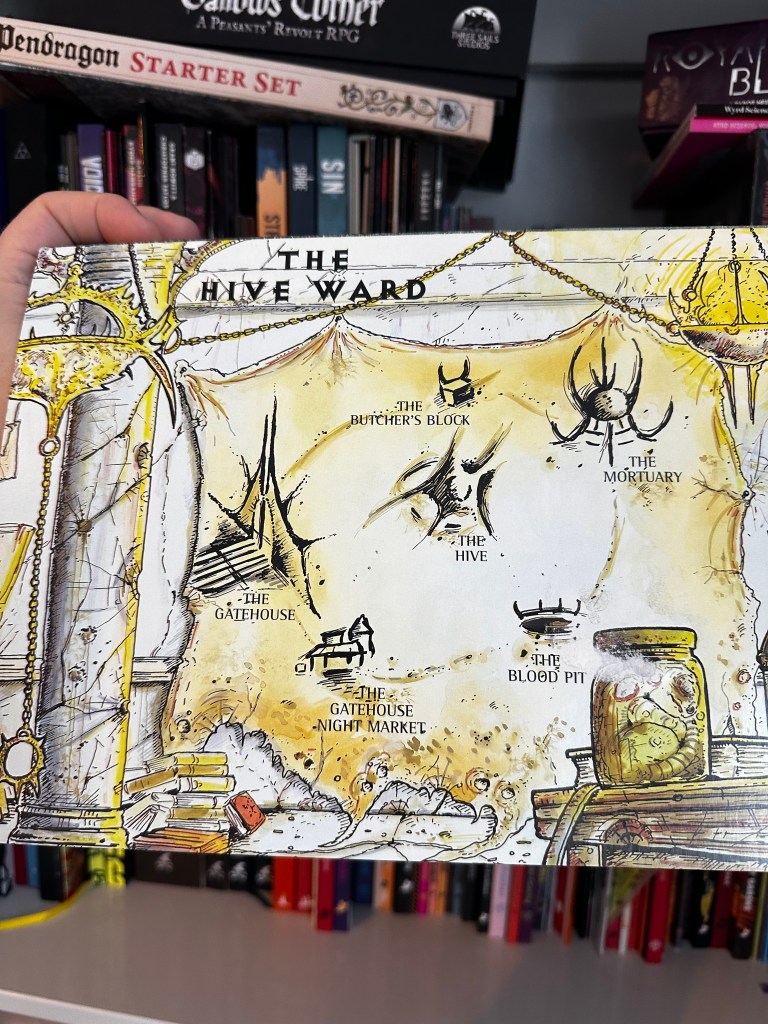
But the one I went with was Jailbreak, a mission to infiltrate the Hive, Spire’s most notorious and terrifying prison, and, once there, ensure the aelfir can’t execute their prize prisoner, the Gnoll Warlord, Brakesh Gold-Tongue.

Jailbreak

There will be SPOILERS ahead, so, if you care about that sort of thing, look away now.

If you’re still here, welcome to the Hive. I’m going to discuss, briefly, my experience with Jailbreak as a scenario, playing Spire as a one-shot and whether or not I would recommend it.

I had four players for this one-shot and exactly three hours to complete it in. I like having time-constraints like this in some ways, as it gives me a very clear idea of how long I can spend in the various sections of the session. I was able to wrap it up within the time, although it was tight. We played online for convenience and because there was a gale-force wind and torrential rain that evening. We used Roll20, as I alluded to above. We found the Spire character sheets on that platform to be quite user-friendly and easy to navigate once you got used to them. It helps that Spire is a relatively rules-light game, certainly. There is a button you use to make rolls when necessary, which is handy as it combines your dice pool automatically. However, I will say that in instances where you have to apply a Difficulty to a roll you are forced to roll each d10 individually, because you can only see the highest die roll if you use the button. If an opponent has a Difficulty of 2, it means you have to take away your top two die rolls from the dice pool and go with the third highest. It’s a small thing but it did come a up a couple of times during play.

Suggested Classes

Character Sheet for the pregenerated Bound character, Sansel from the Spire Quickstart Guide.

Another piece of advice that I feel should be central to running a one-shot of Spire, much like my advice for a Heart one-shot, is to make sure you have pregenerated PCs. When time is of the essence, you can’t be spending an hour creating a set of custom characters. One of the most useful parts of the scenario structure provided is the Suggested Classes. For Jailbreak, these were Bound, Carrion Priest, Lajhan, Midwife and Shadow Agent. So I stole and tweaked a number of pregens from other Spire products such as the Quickstart and the campaign frame, Eidolon Sky. The only one I had to create from scratch was the Shadow Agent as I couldn’t find one already made in any of the Spire books I own. The most time-consuming element of this was just copying and pasting a bunch of stuff into the Roll20 character sheets. But there is no doubt about how much time it saved on the night. I could have done a better job with some of the characters to be honest, but when they are only in the spotlight for such a short period of time, a long and complicated backstory can be a hindrance, actually.

Finally we get down to the scenario itself. As I mentioned above, the central goal is to infiltrate the Hive and get Brackesh Gold-Tongue out. But, the Intro actually asks you to start the PCs already inside the prison. You then just ask them how they managed it! I loved this as it got them started right in the action and removed all the time-consuming planning that such an undertaking would usually require. My players went straight in the front door in disguise, in a meat cart or as a sort of chaplain for the drow guards and prisoners.

Intro

The Cover of Sin showing two drow looking out over a dark city in flames.
The Cover of Sin

You are then asked to describe the Hive. Now, there is minimal description of the prison in the main Spire book. It introduces it as a jail built into the living walls of Spire itself. It has rows of hexagonal cells which can be dropped individually from the wall in the event of an escape attempt. The unfortunate inmate would fall inside their cell all the way through the central abyss of the city, possibly all the way down to the Heart beneath. This is a terrifying prospect but, as I said, the description of the building, its inmates and staff etc, is brief. I was happy I had a copy of Sin. That book contains a much more evocative section on the Hive that was written, as it so happens, by Basheer Ghouse, the author of Jailbreak. It provides juicy tidbits like the way there are lots of walkways spanning the chasm below the prison, but they don’t have any handholds. Gulp. It also provides some great examples of the types of poor mutated experiments of creatures that are resident in the Menagerie. The Menagerie a part of the Hive where the aelfir send their old pets, experiments and art projects when they’re done with them. One of the main NPCs in Jailbreak is Dawn-Upon-Ice, a hobbling former aelfir who now acts as an information broker of sorts and can produce all sorts of nasty poisons in her guts for a price.

NPCs

Speaking of NPCs, Jailbreak has five, which is an easily manageable number. I will say, we didn’t interact with all of them, we skipped Qadiv Love-Fool, a sort of gnoll collaborator, purely due to the fact that the PCs did not pursue the information they gained about him. Brakesh Gold-Tongue, himself and Dew-In-Shattered-Mountains, the aelfir poet-interrogator, were my favourite to play. Neither lasted long against the PCs.

Suggested Scenes

After the NPCs section, there’s the suggested scenes. With the sort of structure you’ve got in these scenarios, this is really useful. Essentially, all you’re given to work with is a starting situation. The PCs are expected to push everything on from there. The suggested scenes allow the GM to pepper their descriptions of the infiltrators’ journey through the prison with interesting moments and opportunities to introduce the major NPCs. Here’s an example of one that I found particularly useful:

Smiling Kas spots the characters as she escorts Dew about the Deep Cells. She asks precisely no questions and accepts any excuse or alibi, no matter how ridiculous. If the characters have not threatened her and seem new to the Hive, she warns them not to stay in the Deep Cells too long.

I made liberal use of these suggested scenes.

Locations and Props

The next section describes the major Locations. I gave each one of these a little box drawn on the map on Roll20, thinking I would move the players’ tokens around from one to the next as their PCs moved. But, in practice, I didn’t really use them at all. Each of the Locations, which included the Menagerie, the Offices, the Guard Quarters, Watch Posts and The Deep Cells contain a brief description of the place, where it is in relation to at least one other place and the sorts of people and props that might be there. They are all short and to the point. Very easy to use on the fly. This section is supported by the prop section, which comes next. Props include unnamed NPCs like patrolling guards and menagerie experiments, by the way.

Twist

Each scenario has a Twist. Jailbreak’s twist is that Brakesh is a real asshole and has been going around the Hive murdering people, guards and prisoners alike. He was betrayed by his own side and left for dead before he was captured because he was kind of a psycho. He won’t leave with the PCs unless they either help him to kill each of the other named NPCs or offer him a shot at Snow-On-Stone, the aelfir commander who captured him. My players only encountered him about ten minutes before the end of the session. This worked out fine because their attempts to convince him to come with them failed so miserably that he attacked them and they were forced to kill him before escaping through an exploded front door to the prison. This worked out fine for them, as it happened. The Ministry wanted things to get messy to gain the attention of the papers and they were happy as long as the aelfir no longer had Brakesh as a source of information and didn’t get the opportunity to execute him publicly.

Conclusion

I love the way Shadow Operations is presented and it has a great variety of one-shot scenarios with an eclectic variety of settings and characters. Each of the scenarios is presented in only four pages, including one full page illustration. They are tight and easy to use because of the format. I do think it could do with some better advice on running a one-shot but, as I said above, if you follow the scenario structure, you’ll be alright.

Jailbreak was fun. It had a great setting. I loved describing a scene where the guards dropped one of the cells out of the wall and the PCs watched it plummet and the moment when they discovered one of Brakesh’s murder victims stuffed under the stairs was good too. But I found we had not enough time for the characters to shine as much as I would like. Maybe this is just one-shots in general, or maybe it’s how I handled it, but I would have liked a bit more room for the PCs’ characters to breathe.

I will definitely be going back to mine that rich seam of Shadow Operations in the future. It was so easy to pick up Jailbreak and run it with minimal prep. I would recommend it!

The Sutra of Pale Leaves: Fanfic

The Sutra Continues

This is the third in a series of posts on the Sutra of Pale Leaves, the Call of Cthulhu campaign set in 1980s Japan. Go check out my previous posts on the subject here.

Adaptation

In Fanfic, by Damon Lang, the Prince moves to the big city and tries to make a name for himself. But some bullies don’t want him to succeed. Those damned investigators!

The scenario flow chart drawn in manga style with lots of sound effects reverberating around the page and portraits of the main NPCs
Scenario Flow Chart

This is a long scenario, 53 pages, in total, so I’ll just note at this point that its format is practically identical to Dream Eater’s, which you can read about here. Similar to the first scenario, it also has a really nice, manga-themed scenario flow diagram, which seems very helpful. It also makes use of several of the same NPCs who act as the Confidants to the investigators and plot hook facilitators, which I touch on here.

From this point on, THERE WILL BE SPOILERS! If you intend to take part in this scenario or campaign as a player, turn back now! You have been warned.

The Prince of Pale Leaves wants to find new media to help spread his influence around Japan. Since he turns out to be a big nerd, he decides to use manga as his chosen medium. This makes for a fun, tongue-in-cheek romp across the seedy underworld of the independent Tokyo manga scene. Everyone here seems to be obsessed by the new, groundbreaking graphic novel, the Tale of Pale Leaves, and its author Yamabuki Iroha (a pseudonym.) This is the setup for this scenario. I like that it has taken us from the small town setting of Dream Eater, to The streets of Akihabara and Ota in Tokyo. And I also like the manga-themed conceit of it because, although I joke about our antagonist being a nerd, it’s true that manga was and is an incredibly popular and culturally important source of entertainment and information in Japan. Also, it makes sense in the way the adaptation is described in the scenario. It seems like a far more efficient way to expose more readers to the power of the sutra than an esoteric work of semi-religious literature written in a form of ancient Japanese could ever be. Of course, it’s also just fun.

At times, though, it loses its Call of Cthulhu flavour as it dances around Tokyo with its magical girls… I’m willing to question whether or not that’s really a bad thing. It certainly feels like it might work better as a Pulp Cthulhu scenario than a traditional one at times (the scenario text even provides suggestions of changes to make if you do want to do that.) Still, I think it’s fair to ask if eldritch horror can’t take the shape of a young woman with a magic paint brush.

Beginnings

A page from the Tale of Pale Leaves manga. The Pince is confronted by someone transforming into some sort of mnoster in the courtyard of a pagoda.
The heroic Prince of Place Leaves

Hooks? We got ‘em. Five in total. These have been thoughtfully crafted to involve investigators depending on their background with the campaign. There’s also one to use in the event that you’re playing Fanfic as a standalone scenario, or as the first one of the campaign. I think this would work beautifully as an adventure all on its own. It’s very much self-contained, thematically coherent and has the potential for some very significant consequences. But as I read through these scenarios, I am starting to feel that this could also be a weakness with the campaign. There is a loose through-line with the Confidant NPCs who act as quest-givers and, of course, the elusive and menacing antagonist in the form of the Prince, but these first two scenarios, at least, don’t feel very connected, from my point of view. Perhaps they will as I get further through the scenarios, but I guess we’ll see. Also, from the start, we are told that we can run the scenarios in any order (despite the existence of a clear chronology to them) and that we can even leave some of them out altogether. I think this very flexibility may hurt its ability to work as a campaign. But, once again, I can’t say that for sure without running it, so take that opinion with a pinch of salt.

Whatever hook you use to get the investigators involved, they start off on a train going to the Winter Manga Market in Tokyo. They encounter some weirdos in Pale Prince cosplay and then immediately encounter the person who will become the scenario’s main antagonist, the manga artist Nagatsuki Kaede, who is secretly the author of the manga adaptation of the Sutra of Pale Leaves. I quite like this conceit as she is almost entirely unassuming as an NPC, and they are incredibly unlikely to be suspicious of her until much later in the scenario.

Tokyo Manga Market blueprint map

The entire first act of the adventure takes place in the Manga Market, so it’s nice to get a blueprint style map to use for it. I like that, so far, the maps produced for each scenario have been unique and interesting in format. The investigators are expected to visit several stalls, talk to randomers and plot-significant NPCs alike here. As they do, they will gain some info on the Tale of Pale Leaves and its author. The majority of the clues they get will lead them down the wrong path.

Two Halves

There is an interesting departure, here, from the format of Dream Eater. It is very much a game of two halves.

The Alabaster Archfiend on the dancefloor of death

In the first half, the investigators will likely find themselves on the trail of Kōda Tsutomu, a mediocre manga artist who ripped off the ideas from the Tale of Pale Leaves and, in some instances, the artwork itself. In so doing, he has become a vessel for a supernatural entity of his own creation, albeit one without the power or subtlety of the Pale Prince himself. This entity is known as the Alabaster Archfiend, and it is horrible and murderous. This allows for the introduction a new memetic “infection,” similar to the Prince, but separate, and with its own mechanics. This one is not based on the Exposure Points the PCs have been building up since the previous scenario, but on Sanity loss. The first half ends with “an old-fashioned boss fight” where the investigators square off against the Alabaster Archfiend in all his tentacled glory. This will probably feel climactic. The fight itself looks difficult, even if the PCs try to avoid direct combat, and the setting for it is quite nightmarish. So, they could be forgiven for believing they’re done. But of course, there are loose ends, and they should know that Kōda was not the true author of the Tale of Pale Leaves, as he had claimed. So, they go back to the Manga Market for Day Two.

And that’s where the second half of the adventure starts. Now, without the red herring of the Alabaster Archfiend, they can focus all their efforts into finding the true culprit. The investigation will almost certainly take them to see the mastermind behind the Association of Pale Leaves, a charming politician and patron of the arts, Mr Matsushima, who seems like he would be fun to play for the Keeper. This is an NPC who should turn up repeatedly in these scenarios, I would think, if he survives this one. They might also go to visit the printers where the comic is being printed. If they do, they will discover one of the scenes that has really stuck with me after reading Fanfic. Everyone in the building is dead, dying or passed out due to the effect of so much concentrated Sutra emanating from the manga.

The workers closest to the print machinery are dead or dying, their internal organs pulped

The Pictomancer Prince page from Fanfic includes the details of the scene and a manga style illustration of Tokyo Tower in black and white
The Pictomancer Prince scene takes place on top of Tokyo Tower.

They are also likely to finally get the full story when they visit the private party organised by Matsushima for the joined, those who have read the Tale of Pale Leaves and are now inhabited by the Prince. Here they will witness an horrific but ultimately successful ritual involving the ever-suffering Saito Tomoko, Kōda’s girlfriend, performed by Nagatsuki Kaede, using her magical paint brush (yep, that’s right.) This brush gets used for all sorts of things from this point on. Essentially it is a tool to allow her to edit reality. (Come to think of it, this is a nice way to tie the finale of this adventure to the one in Dream Eater. In Dream Eater, the investigators had the ability to edit the the dream in the final confrontation, and had the potential to effect reality from that too.) She then draws a portal in the wall to take her to the top of Tokyo Tower where she starts drawing scenes on the great windows of the observation deck to alter Tokyo subtly, allowing the spread of the Pale Prince even more easily. She undergoes a literal magical girl transformation in this confrontation, which elicits a Sanity Roll from the investigators. This is so funny to me. The idea that Sailor Moon might tip some poor occultist over the edge is just priceless. Less funny (but still quite amusing) is her ability to paint out body parts if it comes to a fight with the PCs. She can even just erase someone’s head! Needless to say, it is in their interests to deal with this situation with social skills or sabotage rather than fists and weapons, because they are likely to lose a stand up fight.

Endings

Just like Dream Eater we’ve got a list of potential ending states for this scenario. My feelings about this detail are still up in the air. I don’t think I’ll really know for certain util I play this campaign. We have seven Endings ranging from “Party Wipe” to “Save Game,” which is a “Surprise Ending,” the surprise being that the PCs managed to kill Nagatsuki Kaede in the finale. Number three is “God of the New World” and is described as the “Bad Ending.” Here’s an excerpt from its description:

When all her drawings on the windows of Tokyo Tower are completed, Nagatsuki announces that victory is hers, twirls her spear around, and sends out an invisible pulse of energy.

This is so goofy and she sounds like such a cartoon villain that I have to give Damon Lang props for really leaning into the manga tropes.

Conclusion

There are things about this scenario that I love. The general theming is great and consistent throughout, the NPCs are interesting and the tongue-in-cheek aspects are funny. But I do wonder if it might be difficult to maintain the delicate balance between comedy and horror when running this. It might work fine. In fact, it might work great. I can imagine my players laughing their heads off at the magical girl transformation right up until the point where she actually deletes one of their heads… I still feel like a lot of the dialogue for the NPCs is overdone. It feels like I’m reading the answers in dialogue trees in a computer game sometimes. Once again, I wonder if it might have been better presented with guides on how to play the characters and some bullet points on the info they have and what motivates them. If I ran it, I might even do the work to try and run them that way.

All in all, though, I enjoyed reading Fanfic and I think it would be a blast to run.

Happy Holidays

This is my last post before Christmas, dear reader, although I might get in before the end of the year for a round up post of come sort. If you are celebrating with family or friends, I hope you have a wonderful holiday, and if you’re not, I still wish you all the best. Happy solstice!

Downtime in the Dark

My First Downtime

I’m taking a break from taking a break from Wednesday posts for this one. We had Session 2 of our Blades in the Dark campaign last week, and our first downtime. I also decided to start introducing a few elements from the latest Blades sourcebook, Deep Cuts, which came out earlier this year. So, I wanted to write about our experiences.

Deep Cuts Character Options

The head and shoulders of a person in portrait. They wear a metalic mask over the top half of their face and a hooded cloak. They are an Acolyte Spirit Warden
An Acolyte Spirit Warden by John Harper

Deep Cuts really expands on the options for your new scoundrels. It doesn’t replace what’s available in Blades, it just adds depth. For instance, if your PC is Akorosi, maybe your family served among the clergy for the Church of Ecstasy. If your scoundrel had a military background, maybe they were a Rifle Scout, serving in the Deathlands and harassing “enemies with sniper attacks.” Before we got into the session proper, I offered all of the players to not only select from these new options, but also to reassign any of the Action dots they had assigned to reflect their Heritages or Backgrounds. What I discovered was most of them had already formed a pretty solid image of their characters in their heads. Even the one player who did take me up on my offer, only took the two examples I laid out above for their Hound because they fit the picture they had imagined so well.

I’m still quite fond of a lot of these new Heritage and Background options. They might have been a lot more useful if I had offered them from the start.

Downtime by the Book

In Blades in the Dark, John Harper tells us there are two main purposes to having a separate downtime phase:

  • The first is that the players could do with a little break after the action of the score that just went down. To be honest, this one doesn’t ring very true for me, but that’s probably because it’s been six IRL weeks since the last session and the crew’s first score. I also get the impression that, once you get the hang of this game, you’re sometimes running a score and downtime in the one session, rather than a score session followed by a downtime session. If that were the case, I can see the advantage of breaking the action up.
  • Second, moving into downtime is a sign to all that we are changing the mechanics that will be needed in the game. To me, this seems like the more concrete of the two purposes. Blades in the Dark has tools for you to use during a score, and only during a score, and it has tools you only pull out during downtime. We don’t need to worry about divvying up the proceeds, dealing with the heat you’ve brought down on yourself or figuring out your long-term crew goals while you’re beating in some poor Red Sash’s head. Let that wait until you’ve got time and space for it.

Luckily for me, it’s easy to follow along with the Downtime chapter of BitD. Once again, I have to praise the usefulness and usability of the book. The layout of the chapter leads you by the hand through the phase, from one step to the next. Three of my players have taken responsibility for maintaining the various crew/campaign tracker/factions sheets without my even suggesting it so that made the job even easier.

Payoff was easy enough, just a simple matter of recording the Rep the Death Knells got and dividing up the 6 Coin they garnered from the last score. They took one each, popped one in the crew stash and paid their tithe to Lyssa, the new leader of the Crows, as their patron. I ran this moment as a scene. I don’t think I would have if it wasn’t for the fact that she was pissed off with them for raiding the Red Sashes’ drug dens on the Docks, and I wanted them to know. She also gave them the option to take a job to redeem themselves. The Hive have been a bit too active in Crow’s Foot for her liking. She wanted the Death Knells to do something about it.

I mentioned Deep Cuts earlier. New mechanics appear in the sourcebook for downtime. They make it diceless, and they would also definitely up the Coin our crew made from that score if we had been using them. In BitD, you are given a range from 2 Coin for a minor job to 10+ Coin for a major score. In Deep Cuts, the Coin the crew accrues is determined like this:

  • Score – 1 Coin per PC, plus Coin equal to the target’s Tier x3.
  • Seized Assets – 4-8 Coin for a vault of cash. Stolen items can be fenced for 1-8+ Coin, but you take Heat (see next page).
  • Claims – Collect payment from crew claims like a Vice Den.

Like I indicated above, we used the standard downtime rules from Blade in the Dark in this session. Now that we’ve experienced that, I’ll put it to the players to see if we want to make the switch. If and when we do that, I’ll come back and examine the other downtime changes then.

It was fun calculating Heat for that score. I’ll admit, I didn’t warn them that killing people on scores really hikes up the Heat. They started off the whole thing by murdering a bouncer, of course. In fact, I didn’t really explain the concept of Heat to them beforehand at all. This meant that they went in hard, loud and chaotic. I actually think this was for the best. The game is built on building up consequences, after all, as well as narrating big, exciting action sequences. Anyway, they ended up with 6 Heat, which was fast approaching a Wanted level. That put the shits up them.

In the book, the Heat section also includes the Incarceration section, which seems logical to me, but I didn’t need to refer to it, so I’m skipping it here.

Of course, due to all that Heat, they had to roll on the worst of the three Entanglements tables. These represent all the potential impacts of contacts, acquaintances, enemies and authorities getting wind of what the crew have been up to. Entanglements range from Gang Trouble, which can be dealt with internally, to Arrest! If you get that, it’s going to cost you Coin, a crew member or the effort to escape capture. The Death Knells rolled up Interrogation so our Hound was caught on her own and dragged down to the station for some “enhanced” questioning. We played this out in a fun scene where she went out to get beer to celebrate their big score and got ambushed out behind the pub by Sergeant Klellan and his boys. She wisely Resisted the level 2 Harm and the additional Heat, without incurring a single point of stress! All the others could do when she finally turned up was wonder where their beer was…

So then, we spent a bit of time going through what’s possible during the downtime phase in our last session. This can all be a little overwhelming the first time you do it. It can also take quite a while to get through each player’s turn as you talk through the possibilities and they negotiate amongst themselves to see who will spend their activities on reducing Heat for the whole crew. Sometimes it’s obvious who should do what. If a character has some Harm, it’s probably a good idea for them to get some treatment and Recover. If another scoundrel is a bit stressed out, they should go and Indulge their Vices to help them relax, but training, long term projects and acquiring assets are all more subjective. The chances are, they’ll turn out to be useful to the whole crew in the future, but they don’t feel quite as immediate in their effect as clearing Heat.

Anyway, I was gratified to see the PCs did all of the six possible downtime activities at least once. They managed to clear practically all their Heat. The Leech did this by studying the movements of the Bluecoats around the district so they could avoid them. The Whisper took an inventive approach, by losing a bar-room brawl in the King’s Salty Knuckles tavern, thus proving that he couldn’t be part of a crew of Bravos!

Our Cutter decided to acquire an asset, an old and worn-out little boat for use on a future score, perhaps. The players ad-libbed a scene in which they ribbed him about the state of the thing. But, of course, it only needs to be used once.

A person "walks" through the air above the darkened city,seemingly on lightning bolts emanating from their feet.
“I’m walking through the air!”

We had another scene when the Whisper’s strange friend Flint turned up on his canal boat with some electroplasm. Our Whisper needed it to build himself a lightning hammer as a Long Term Project. From Flint he also learned about the Sparkrunners, a gang of rogue scientists who are out there boosting government tech. This is one of the new factions from Deep Cuts, which “sparked” my imagination.

Just before we wrapped up for the evening, our Hound decided to deal with all her stress by visiting her local Temple of the Church of Ecstasy. She prayed and prayed, she prayed to hard and too much. She over-indulged in her vice and something bad happened. The bouncer she killed on the last score decided to haunt her!

Other Actions

Of course other actions are possible during downtime too. They decided to visit the ghost who had given them such good info during their Information Gathering phase in the previous session, because he said he would help them more if they really fucked those Sashes up good. From him, they discovered that Lyssa was responsible for the death of Roric, whose leadership of the Crows she then usurped. She had been backed up by the Red Sashes who had killed out ghost friend. He told them to go to Mardin Gull in Tangletown for the skinny on what all that was about. This wasn’t a downtime activity or an entanglement or anything. It was just something they wanted to do.

The Imperial Airship, the Covenant flies bove the darkened city streets, shining searchlights down to illuminate a meeting on a bridge.
Its the Fuzz!

I also introduced a few more Deep Cuts factions in a little news segment. They learned about the Sailors being press-ganged on the Docks, The Ironworks Labour-force pushing for unionisation, the arrival of the Imperial Airship, Covenant without her sister ship and the recent adoption of the new Unity calendar and maps. Any one of these could potentially lead the crew to their next score. Except, maybe for the calendar one, I suppose.

Conclusion

I was very happy to have left a full session aside for our first downtime. It needed it. In fact, I would say, we could have used even longer. They still haven’t decided on their next score. I will say, I am quite happy with how many potential score options I managed to sneak into the various scenes in the session. I was worried that I wouldn’t give them enough opportunities, but, in the end, they came up quite organically, much like the scenes themselves. These all proved to be fun and freeform, allowing us to dow some world-building and to introduce some fun new NPCs.

I’m now looking forward to the next session, and, hopefully, the Death Knells next score, the Big One.

The Sutra of Pale Leaves: Dream Eater

I think it’s interesting that each of the scenarios is styled as being possible to run as a one-shot but I can see Dream Eater’s potential in the context of the greater campaign.

Format of the Sutra

This is the second post in my exploration of the 1980s Japan Call of Cthulhu campaign, the Sutra of Pale Leaves. Go here for the first one, which deals with the overall premise and the Campaign Background chapter from Twin Suns Rising. Although the text suggests that you can play the constituent scenarios in any order, they are presented chronologically and I can’t imagine running them any other way. They are also presented in two different books, of which Twin Suns Rising is obviously the first, with its three scenarios taking place between July 1986 and Spring 1987. I thought I’d be able to write about all the scenarios in this book in a single post, but it turns out, I can’t read that fast. Each scenario is long, between 35 and about 50 pages of dense, small-font-size text. So, instead, I’ll just be examining the first of them today, Dream Eater, written by Damon Lang. Please note that I haven’t played or run this scenario, I have only read it. So, take my conclusions and thoughts on it with that in mind.

WARNING: SPOILERS!

I would find it very difficult to write about Dream Eater without massive spoilers, so I am giving you a warning, right now: if you want to be a player in this scenario or the wider campaign, its probably best to skip this post. Come back later! I’ll probably have something for you then. Or check out my ever-growing back-catalog of posts.

Dream Eater

The first page of  Chapter 2: Dream Eater introduces Keeper Background and the Association of Pale Leaves.
We exist without ever knowing
If this world
Is a dream or reality,
Reality or a dream.

I once wrote two novels about the adventures of a twelve year old Japanese boy who moved to Ireland with his family. In them, he discovered that he was able to use his cat as a conduit to enter the dreams of others. This allowed him to reconnect with his friends at home but his consciousness became trapped in the kitten! Various hijinks and drama ensue. Anyway, suffice it to say, I was very quickly on board with the premise of this scenario given teh Japan and dream-related elements of it.

The premise is that a small, rural Japanese town is beset by sleeplessness and terrifying dreams of monsters. The longer it goes on, the more the citizens worry for their safety and sanity. The authorities have offered financial rewards to anyone who can help them solve the problem or take care of the afflicted.

That’s where the Investigators come in. Perhaps they are from this small town of Ikaruga, or maybe they just heard of their troubles and have come from the city to look into them. Either way, their assistance is greatly welcomed.

Indeed, their investigations are likely to take them quite quickly to the door of an old man, Mr Taneguchi, who was responsible for the death of a young girl in a traffic accident recently. From there, they will visit other sites in the town, and other potentially recurring NPCs, and they will learn of the Baku. This Yokai is the eponymous Dream Eater, and the cause, it would seem, of the town’s problems. The Investigators will have to find a way to defeat, satisfy or neutralise this creature if they are to help.

But, of course, there is another layer to this story, just below the almost obvious one. The Prince of Pale Leaves has worked through one of his recruits to use Mr Taneguchi to spread the Sutra of Pale Leaves. The Prince has been invading the dreams of the people of Ikaruga, through the old man’s chanting of its mantras at night. It has been creeping through the town, insidiously and terribly. This is what has drawn the Baku to this place. It finds dreams of the Prince the most delicious. The Baku is known as a benevolent yokai in Japanese legends, one that takes your nightmares away and lets you sleep soundly. And that is what it’s attempting to do. The thing is, as it eats the dreams of the Prince, erasing them from the memories of the dreamers, the only image they are left with is of a scary looking ,purple, tapir monster, the Baku. And so, it becomes the scape-goat. The Prince attempts to use this misunderstanding and the Investigators’ intervention to defeat the Baku, thus allowing his influence to grow all the faster.

The question is, will the investigators figure this out? Will they destroy the Baku? Will they leave this town better or worse than they found it?

The Flow of the Scenario

The flow of the Dream Eater scenario in visual form. From Ikaruga Town to Talking with Townspeople to Meeting Taneguchi to Horyuji temple or Nightly Prayers to Unpleasant Dreams to The Fortune Teller to Research in the Sutra to Dream Dive to the Final Encounter and finally to the Epilogue.
Dream Eater Scenario Structure

Take a look at this flowchart. This is useful in a scenario like this for a game like this. Call of Cthulhu is a trad game, and, as such, its scenarios rely on these sorts of stepping stones to get you from hook to ending. So I really appreciate it when you get something like this that cleanly represents that idea visually.

So, after a lengthy preamble giving us Keeper background, an intro to the main NPCs and a few PC hooks, we start with Ikaruga town, a place that’s renowned for its truly ancient buddhist temples, which contain the oldest wooden buildings in the entire world. I like that the section on the town asks the Keeper to get in media res and kick things off with a shared dream sequence. Something weird is happening from the off and it gives PCs who don’t know each other yet a good reason to seek each other out.

You get a basic map of Ikaruga in the style of a roadmap, which is a nice touch. Along with this, we have an “Exploring the Town” section, which spells out stuff like population, transport, amenities and accommodation but the only real subheading to this is the Shepherd Bar: A Foreshadowing, the purpose of which is a little too subtle for my tastes.

The scenario, and indeed, the campaign is sprinkled with “Lore Sheets,” which detail elements of Japanese cultural, societal or mythical knowledge that the average Investigator might be expected to know without having to make a Know roll for it. The Keeper is supposed to hand them out as and when the subjects come up. In this section, we have one on Hōryūji Temple, for instance. Each of these includes a little snippet of “Personal Background,” which the player given the lore sheet might adopt for they own character. It’s a nice way to weave the PCs in with the place and the lore of the place.

The Investigators are expected to visit the Town Hall to begin their investigations. The Town Hall section, as is the case with each of the major plot points of the scenario, begins with a handy summary that looks like this:

  • Location: Ikaruga town.
  • Leads In: Hooks One, Two, and Four
  • Leads Out: Meeting Taneguchi (page 62); Talking to Townsfolk (page 61).
  • Purpose: investigators learn about the case.

This is another incredibly useful tool to assist the Keeper at the table, allowing them to see, at a glance, if they are at the right section, where they should be looking next and the overall purpose of the scene. This last is important to let you figure out where a scene should end, which is not always obvious.

As we get into this section, we notice that precise and exacting answers are provided to every relevant question the PCs might ask Mr Maeda, the Vice-Chairman of the Public Welfare Committee. This is common to most of the NPC interactions in the scenario, which will keep you, as the Keeper, on track with regards to what each of them knows. Once again, it’s a trad scenario. Rather than summarising the things they know and letting you play them as you see fit, things are a little more proscribed here. Of course, if you want to run these interactions differently, you can. It will just mean you spending more time prepping.

We get some general knowledge and descriptions of half-remembered dreams from talking to the townsfolk, but we really get into it when the Investigators go to meet Taneguchi, the old man who is secretly harbouring the Prince of Pale Leaves in his mind. He was approached by a representative of the Association of Pale Leaves and told that, by chanting from he Sutra of Pale Leaves nightly, he would pay off his karmic debt from running over the little girl on the road. Unbeknownst even to himself, he has been making beautiful and elaborate copies of the Sutra at night, when the Prince takes over his body. The APL is planning to use these to spread the Prince’s influence even further across Japan. It is in this section where the Investigators are likely to gain their first exposure to the Sutra, thus beginning their journey towards recruitment by the Prince, themselves.

From here, the investigations might lead to Hōryūji Temple, where they might encounter another recruit, Ukami, a former monk, who is also a martial arts master. Or they might go to the Momijidera Temple, where Taneguchi recites his prayers each night, But eventually, we come to one of the more interesting parts of this scenario, Unpleasant Dreams, where the Keeper can tailor nightmares to individual investigators’ personalities, backgrounds and memories. This is the first time they will encounter the Baku. There will be different outcomes depending on the levels of exposure they have had to the Sutra so far. It could lead to significant Sanity loss, but, on the bright side, it could also lead to Exposure Point (the points which track how exposed you are to the Sutra and how much influence the Prince has over you) reduction.

Lore Sheet 3: Fortune-Telling in Japan and the Fortune-Teller, Madam Inaba.
Lore sheet

After this, they are likely to visit Madam Inaba, the Fortune Teller or go to the aforementioned Hōryūji Temple to find out more about the Baku and how to defeat it. Importantly, they should then go and do some research in the Sutra itself, exposing them once agian to the Princes influence. This will lead them inevitably to the Dream Dive section. The scenario takes us back into dreams here, this time, a shared, lucid dream, which they will have learned how to perform from their research in the Sutra, of course. Rather than have the Keeper craft the dreamscapes they encounter this time, they are put through a “Gauntlet of Nightmares.” I like the nightmares that have been described in this section, they are Japanese-flavoured (I have definitely had nightmares about the mukade myself) and they’re scary, but they seem a little random. They’re not as thematically coherent as other parts of this scenario. At least, until you get to Taneguchi’s Dream: The Accident. In this one, you relive, along with Mr Taneguchi, the night he killed Nakamura Hinako on the road. The scenario presents several ways the Investigators might deal with the situation, from doing nothing to showing some humanity to the dying girl, to rewriting history!

The baku, a big, purple, tapir-like creature, feeding on a n old man who is sleeping on a futon in a tatami room.
Yum Yum

The only thing left to do is to face the Baku itself. By now, the PCs might have learned enough to know that the Baku is not the real threat here. Rather, it comes from the Pale Monk haunting the dreams of Taneguchi, the representation of the Pale Prince. Or they might play right into the Prince’s hands and attempt to defeat the creature, clearing a path for the Sutra to capture more recruits. Whatever they decide, there is a good chance they will have to use signs and magics learned from the Sutra itself to do battle in the Final Encounter. The scenario introduces mechanics by which they can spend Magic Points to summon useful items or weapons to help them, but their opponents can do the same or worse. The Baku can fully transform the dreamscape allowing it easier access to Taneguchi, which is all it wants. It wants to gorge itself on the old man’s Sutra-ridden mind. If the Investigators allow that to happen, it is one of the best endings you can achieve, leaving Taneguchi in a state of extreme dementia, but freeing the town of the Prince’s influence.

Endings

The first page of Endings, includes 0. party Wipe (Failure), 1. We Do Nothing (Taoist Ending), and Yokai Busters (Bad Ending.)
Endings

Note that the endings presented here and in later scenarios are labeled and numbered, as is common for indie scenarios in Japan. This enables players to tell others how their game went on social media while avoiding spoilers for everyone else.

I understand this concept and the reason for it. But I don’t particularly enjoy the implication that you can’t have your game end any other way than one of the six potential endings provided here. I am not going to judge it without playing it out, but I will say they are described in terms of one ending being a “failure” and others being “Bad Ending,” “Good Ending,” and “Best Ending.” Of course, these are value judgements. Just because you TPK, doesn’t necessarily mean it was a bad ending for your party, and, to be fair, the text does describe this one as “something of an achievement.”

The inclusion of “Optional Post-credit Scenes” is interesting too. These each present a little vignette of how the Investigators might have changed reality during their adventure through dreams. It explains that they work better if the scenario was run as a one-shot but that they might just serve to show the sheer power of the Sutra over reality.

Conclusion

This feels like a great scenario to start off this campaign dealing with the Prince of Pale Leaves as the antagonist. It immediately introduces the players to the idea that this is a being that exists in the mind of others and is spread through the dissemination of the Sutra, or it should. I can’t say for sure if it does it effectively without playing it. Overall, I like the structure, which is designed to keep the Keeper on track, no matter which way the players decide to go from one scene to the next. I do find the extreme levels of detail in the NPC encounters a little unnecessary. I still think it’s possible to summarise a character’s personality and the things they know in a much shorter manner, that would work just as well, if not better.

I think it’s interesting that each of the scenarios is styled as being possible to run as a one-shot but I can see Dream Eater’s potential in the context of the greater campaign. I’m looking forward to reading the next one, Fanfic, where the APL hatches a plan to recreate the Sutra as an action manga.

Sleighed

You might remember a few weeks ago… I reviewed Slow Sleigh to Plankton Downs. Well, the disclaimer on that review, that I had not played or run it is no longer valid.

Nun too soon for an update

Just a short one this week, dear reader.

You might remember a few weeks ago, for my Halloween post, I reviewed Slow Sleigh to Plankton Downs. Well, the disclaimer on that review, that I had not played or run it is no longer valid. Sister Majid, the Misstep Monastic (a type of nun) and Lee Tuluk, the Scud Miller (meat grinder) formed an unlikely friendship through a misallocated cabin and a game of chance and before you know it they were investigating a murder!

We played one session on Halloween and just finished it up last night. It took about six hours altogether, although there was some time spent on character creation in the first session.

Take a butcher’s at this!

A nun with an ice adze dressed in gold

Here are some things I loved about running this adventure:

  1. The new backgrounds are great. Most of them are really far out there but the two that my players chose were obviously quite mundane. They still had some incredible Advanced Skills that got milked for all they were worth. Somehow, our nun used “Reconcile God’s Glory with the Failings of Mortals” constantly. Meanwhile, the Scud Miller managed to use “Fix Anything, Not Necessarily Well, Even with the Wrong Tools” on everything, including relationships. Use the backgrounds if you’re going to play this.
  2. It’s so easy to prepare and run. The keyed descriptions are short enough to easily use on the fly, the premise of the adventure is straight-forward and there are only a couple of unavoidable events that are not difficult to get to grips with. I read it through once, fully, and then reviewed particular sections such as basics of the adventure and the murders before actually running it. It doesn’t take long to do this; its a svelte little scenario.
  3. I really got into describing the aftermaths of the murders and the effects they had on the crew and other NPCs. As rumours spread I had nuns moving in pods and whispering about terrible occurences while blessing themselves, while the porters and mates dealt with grief at the passing of their colleague. Upon the discovery of the second victim, the security guards were puking in corners and staring blankly at blood-soaked toilet stalls. The creature has a silly name, which my players refused to say right, but the murders are gruesome and horrific. It felt important to play into that.
  4. The map of the Nantucket Sleigh Ride. We used this work of art throughout. It was so useful to help the players orient themselves on the hovercraft and it was a genuine pleasure to refer to it. Its beautiful.
  5. The Weather table. I got the players to roll for weather right before the final encounter and they rolled us up a storm. The ship was forced to drop its robotic anchors and ride it out just after the second murder. They figured out who the murderer was and that they were outside on the Observation Deck. What a setup for the final showdown. It was poetic.
A victim, missing its maxilla in a toilet stall. The Maxillary Uslurper in the air vent above.
Aftermath

Conclusion

Dear reader, I would highly recommend you take the Nantucket Sleigh Ride on a trip to Plankton Downs. If you have a couple of evenings to spare and a couple of friends who might enjoy a who-nunnit, as it were, you could do a lot worse. It’s not your typical Troika fare but I am beginning to think there may not be such a thing. You will have horror, you will have laughs and you will definitely have fun.

Slow Sleigh to Plankton Downs

There are two stars of this adventure. The first is the murderous creature itself. It’s unique, insidious and gross in a bonkers sort of way. The second is the artwork, which you can find examples of above.

Horror gaming in Troika!

Troika! Would not be my first call for a game of horror this Halloween, but I think Slow Sleigh to Plankton Downs, the 33 page adventure by Ezra Claverie, illustrated by Dirk Detweiler Leichty could be the thing to change my mind.

Disclaimer

I have not played or run this adventure. I just wanted to review it because A Perfect Wife reminded me a bit of it. Not necessarily in its themes or anything like that, more because of the creature at the heart of it and the murders. Also, the incredible artwork.

There are minimal spoilers ahead but, even so, if you are planning to be a player in it, maybe skip this review. I will say there are some conversations to be had with your table before playing. You should let them know that it is an investigative scenario and you should also discuss the body-horror and brutal murder aspects of it.

The Basics

The PCs are aboard a ship of sorts, a hovercraft called the Nantucket Sleigh Ride, transporting them from Out of Order, the site of the moon, Myung’s Misstep’s space elevator. They are on their way to Plankton Downs, a water-farm town along with a motley assortment of Macramé Owls, Ice Miners and Martian Orthodox Christian nuns among others.

The adventure opens with a short history and geographic treatment for Myung’s Misstep as well as the function of ships like the Nantucket Sleigh Ride. It also lays out the scenarios thoroughly for the GM.

The PCs themselves could be a regular set of Troika! characters (by regular, of course, I mean utterly bonkers.) But I think, if I ran this, I would get them to choose one of the nine new backgrounds presented in the back. You have a wild variety from the aforementioned Ice Miner, whose greatest Advanced Skill is to “Exert Oneself Alone without Hope of Assistance,” to the Astropithecus Truckensis, a Martian cyborg described as “a six-wheeled, motorised Standard Habitat Truck, slightly larger than a wheelchair.”

There is a description of the keyed locations from the, frankly, resplendent, map of the Nantucket Sleigh Ride on the inside front cover, and a section on the general characteristics of it. It’s important to note that most of the vessel is off limits to passengers such as the characters, however, once the murders start, they are likely to find ways to explore.

We also have a bunch of very handy random tables including but not restricted to NPC names (a selection of pretty standard human names from all over the world), NPC Preoccupation (from “Professional Opportunities” to “Impending Masturbation”), NPC Distinctive Feature (Loving “Head Small for Body”)

The PCs are going to be aboard the Nantucket Sleigh Ride for at least 72 hours but that’s likely to be extended through the liberal and recommended use of the weather table in the back (2d6, if you roll a 12, its a Catastrophic Storm and you better pray to whatever deity most aligns with your beliefs that the anchors hold or the ship is truly fucked.) With that in mind, it would be pretty terrible if someone on board were, in fact some sort of vampire disguised as one of the passengers or crew with an irrepressible hunger for a very particular human body part every 36 hours or so, wouldn’t it?

The Murders

This is mostly an investigation scenario. After the first murder causes a stir on the upper decks and the lower, the PCs might very well decide to start asking questions and investigating the scene of the crime. After all, the crew do nothing about it except arm themselves. However, it is not likely that they will discover the identity of the murderer until after the second or maybe even the third one.

The murders are gristly and disgusting in a very particular way. The creature has a method of killing their victim that can only be described as brutal and bizarre. If this were a Call of Cthulhu adventure, witnessing the aftermath would certainly be enough to elicit sanity rolls all around. They are described in relative detail in a matter of three pages. This, along with location and NPC descriptions is all you get to guide you in running this scenario. I do think it’s enough, especially as it feels as though the PCs are not really supposed to discover the truth until after the second murder reveals something important.

Conclusion

This short and sweet adventure is a definite departure for Troika! lovers. You may not get the chance to do the strange combat hijinks you’d be used to in most of the other adventures presented for the world’s other favourite RPG but it will present a set of very particular challenges. Several of the PC backgrounds have Advanced Skills that, while not exactly “investigation,” as such, will still be very useful in specific situations that you could imagine coming up. But there is no getting away from the fact that this system is not designed for investigation and I can imagine the GM having to make a lot of rulings while playing this.

There are two stars of this adventure. The first is the murderous creature itself. It’s unique, insidious and gross in a bonkers sort of way. The second is the artwork, which you can find examples of above.

If you’re interested, dear reader, you can go and pick the adventure up from Melsonia.com here. And maybe consider it for your Halloween game this year!

A Perfect Wife

The writing is subtle and considered and evocative, the layout is spare but adds so much to the adventure as a thing to read and there is beautiful, idiosyncratic artwork throughout.

Weird Hope Engines

Earlier this year, in Nottingham, England, David Blandy, Rebecca Edwards and Jamie Sutcliffe brought together a selection of RPG creatives and artists to make an exhibition.

From the Bonington Gallery website:

Weird Hope Engines embraces the culture of tabletop roleplaying games (TTRPGs) to explore play as a site of projection, simulation, communal myth-making, distorted temporality, and alternate possibility.

Zedeck Siew, Amanda Lee Franck and Scrapworld were all major contributors to the exhibition but they lived far, far away from Nottingham. The trip would be costly. So, being TTRPG creators, they launched a project in the hopes that it would fund well enough to pay their way. It worked, and A Perfect Wife is the result.

Disclaimers

Dear reader, I have not run or played in this adventure. I received it recently in the post and I wanted to write about it. This is a review but only from a read-through.

There will be some spoilers so if you think you might want to be a player in this adventure, turn back now! Or don’t, I’m not the boss of you.

The Product

Two art prints: On the left, a spiky, crimson femme creature with wide open mouth, long black hair against a blue background. On the right, a person on a motorbike stopped in a pool of yellow light from a doorway in the backstreet of a city. The cityscape rises above and behind.
City Streets and Scary Beasts

A Perfect Wife is a 43 page OSR-style adventure from Copy/paste Co-op. I backed the Kickstarter for it and received a physical copy, along with a printed map of the adventure location and some art prints.

Speaking of art, that’s what this is. The writing is subtle and considered and evocative, the layout is spare but adds so much to the adventure as a thing to read and there is beautiful, idiosyncratic artwork throughout. All three creators contributed illustrations and all three styles are distinct but never clashing.

The Adventure

Inside cover of A Perfect Wife by Zedeck Siew, Amanda Lee Franck and Scrap World. Illustration shows an owl-like bird in white against a dark background.
Bay Owl

We start with an explanation of the recent disappearances in this inner-city Malaysian (actually I don’t think its explicitly spelled out anywhere in the body of the adventure that its set in Malaysia but its heavily implied) neighbourhood. What it boils down to is the following three points, what the locals have learned:

Head indoors if dogs are whining
Walk on by if your name is called
Do not search for the baby crying

It’s pretty clear that something unusual is happening in the area. Already the mood, the setting, the premise are very different to any other OSR adventure I’ve ever read.

We move on to character creation next. The PC outlines are based on how they know Sara, the woman they’re meeting in front of the Desa Damai Wet Market. They know they are meeting her before they even know who they’re playing.

They get six choices. There’s a journalist (interesting skill: speed-reading), a social worker (eavesdropping), a private investigator (knife use), a security consultant (joking), a faith healer (bargaining) and a barrister (drinking.) Each has a few skills, and maybe a weapon or a useful contact, not to mention a wonderful line-drawn portrait.

So, the players choose their PCs and the opening scene moves on…

Basic rules are included on page 9. These are almost identical to Into the Odd. In the front of the adventure there is a “Mechanically Inspired by” section that lists Into the Odd but also includes Liminal Horror and the Lost Bay. I don’t know those games and I am not sure how they inspired the mechanics but there is no doubt that, essentially, rolling works the same as in Chris McDowell’s game.

The next scene introduces two major NPCs at the Peaceful Heart Community Centre. It is not spelled out, but assumed that Sara led the PCs there to meet Yinyin. Then we learn what the PCs are being recruited for. Sara wants them to find out what happened to Tet, a refugee and father to young Yinyin. Sara and Yinyin are described in their own NPC section, but the mysteries only deepen…

This adventure deals with some themes of supernatural horror, class inequality, the plight of refugees, violence against women and children, pregnancy and miscarriage. You get the first hints of these, let’s be honest, pretty heavy subjects here. A GM and their players will have to have a frank discussion about this before starting to play A Perfect Wife.
Beautiful keyed map and encounter tables (day and night) for Desa Damai. Point crawl location.

The daytime encounters are a delight. I’ve been to Malaysia only once and that was on holiday on Lankawi Island. I can only imagine how different an inner city neighbourhood of a metropolis like Kuala Lumpur is to that so I don’t have any real frame of reference for this, but the occurrences in this table have feel genuine. I can picture the old man feeding the stray dogs from styrofoam containers on the side of a crowded, narrow street with no footpaths and not enough shade. I can feel the tension created by gang kids surrounding you and shaking you down for whatever cash you’ve got on you, while you sweat and make excuses.
These encounters also serve to also introduce factions and NPCs of note although they are described in greater detail later.

The nighttime encounters are far more threatening and sad. Even the direction on how to use the table seems designed to put you on edge. In the daytime, you roll whenever you walk down a new street. But at night…

Whenever you turn a corner, roll

Just reading them makes me uncomfortable. Machete wielding, motorbike riding gang members are so much worse than the kids from earlier in the day. And what is a baby doing crying behind that pile of rubbish in the middle of the night?

Straight fter a short description of the two main gangs, the combat rules crop up… just in time. The gangs are described beautifully and succinctly. The combat rules are brief and equally Odd-like. They include more than one admonition regarding the dangers of violence, especially gun-violence, which is likely to draw the attention of the authorities.

The next ten pages are devoted to introducing us to the people and locations of Desa Damai. We get a gorgeously illustrated selection of refugees, police, witnesses, thieves and one particularly supernatural and disturbing infant. These represent the people you might run into on the encounter table as well as those your PCs might want to talk to in relation to their investigation. Each of them can help or hinder in some way and they all have their own motivations.

Sara’s baby, illustrated on page 23 with thick, black, childlike lines over a wash of dirty scarlet, is a true horror, the kind of creature that could only have sprung from the collective trauma of folk beset by the tragedies and indignities experienced by generations of women and children. It is both heartbreakingly sad and terrifyingly obscene at once. It only serves to illustrate, yet again, the importance of discussing tone and content as a group before setting out on this adventure. Be warned.

Pages 30 to 33 describe the Pontianak, the nightmare creature at the heart of the adventure as well as the initial encounter with her. Where the baby is a tragic and sadly pathetic entity, the Pontianak herself is actively menacing, dangerous and hidden in plain sight. She also has a tragic origin of course, and that’s central to the adventure, but there is no doubt this is an enemy to fear too. There’s more creepy and horrific illustrations here, one depicting the creature in her human guise and one showing her monstrous form. Again, the art in this module is doing a lot of the heavy lifting. Its remarkable.

As terrible as the Pontianak is, oh so much worse is the husband, the architect of this situation. Rich, well educated, greedy, I imagine him a delight for a lucky GM to get to role-play.

In the appendix, Siew introduces the non-Malaysian reader to the concept of the Pontianak, the symbology that is inherent in the creature, how she has been portrayed in media, the way she is perceived in Malaysia and the role of the weird and supernatural in Malaysian life. This is all fascinating stuff and feels incredibly useful in allowing the GM especially to do justice to playing the NPCs in this adventure. It is of the utmost importance to understand that locals would not be rolling sanity checks when encountering ghosts.

Here, ghost stories do not function as supernatural or speculative fiction. Ghost stories are realist. They do not belong to the Weird; they are not designed to arouse a sense of the uncanny or numinous.

I feel like I can sympathise with this point of view to an extent. Growing up in Ireland, no matter how atheist you are or scientific you claim your brain to be, deep down, you would still instinctively avoid a Fairy Fort and take tales of banshee wails predicting deaths at face value.

Tucked away at the back are the optional gods. I guess I can see why they are optional; they introduce a level of spiritual and religious superstition that some tables might prefer to avoid. But, in my opinion these gods and offerings are all gold, some of the best stuff in the adventure. It has the potential to heighten the PCs’ dedication to the plot and may even provide ways for them to boost a flagging investigation.

Conclusion

The back cover of A Perfect Wife. It reads, “Welcome to Desa Damai. The first disappearance was over a year ago. Now it happens with vicious regularity—every fortnight. The neighbourhood is tense. Most agree the following precautions work: 
- Head indoors if dogs are whining. 
- walk on by if your name is called. 
- Do not search for the baby crying. 
Illustration of an owl like bird in white against a dark forest.
A Bay Owl Again

I really want to run this now that I’ve read it fully. It’s different enough from the normal sorts of scenarios I would play that it has greatly piqued my interest. The NPCs, the creature and the situation are compelling and fascinating. Also, the real-world setting is incredibly evocative and, though presented and described sparsely by these artists, I feel like it still shines.

My players and I definitely enjoy a set of pre-generated characters that are tailor-made for the game we’re going to play. You get that in this, but you also get the pleasure of rolling up elements of them and defining important personal characteristics yourself.

I’m a fan of the incredibly rules-lite mechanics at use in A Perfect Wife, and, although I think they can be used to conduct an investigation like this, I’m not certain that a system designed for investigators wouldn’t have been better. A lot of the work is left up to the GM to ensure the leads keep coming as many of the connections between NPCs, locations and events are implied rather than fully spelled out, but I would like to think that also allows for a great deal of leeway to be given and for flexibility when necessary.

Finally, I’ll reiterate the need to discuss safety tools and tone and content before starting. I know several players, me included, who have been personally affected by themes in this adventure. Some will be happy to play anyway, some won’t, but we’ll have to talk it out first.