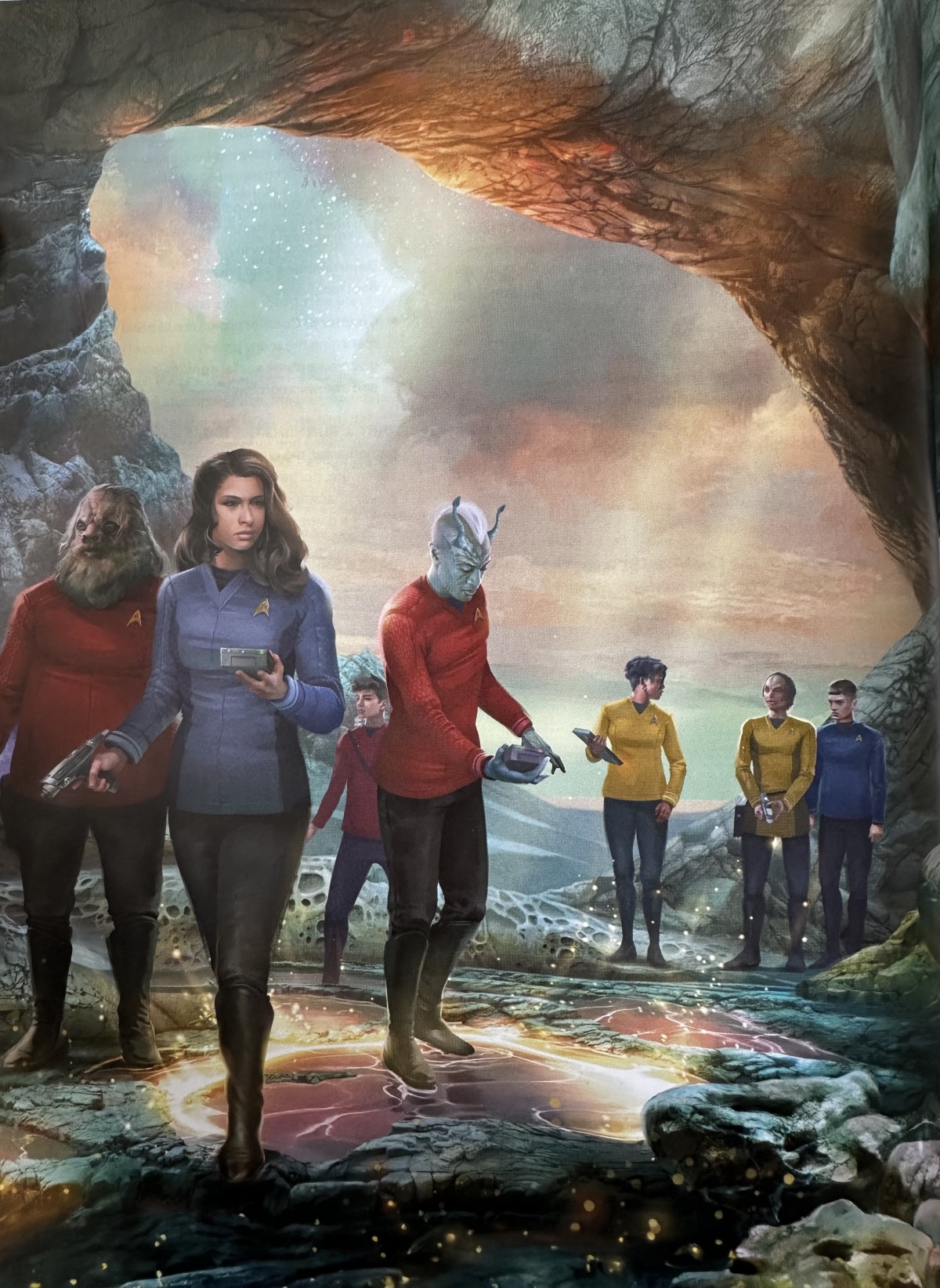
Write Your Own Star Trek Adventure

Star Base 343

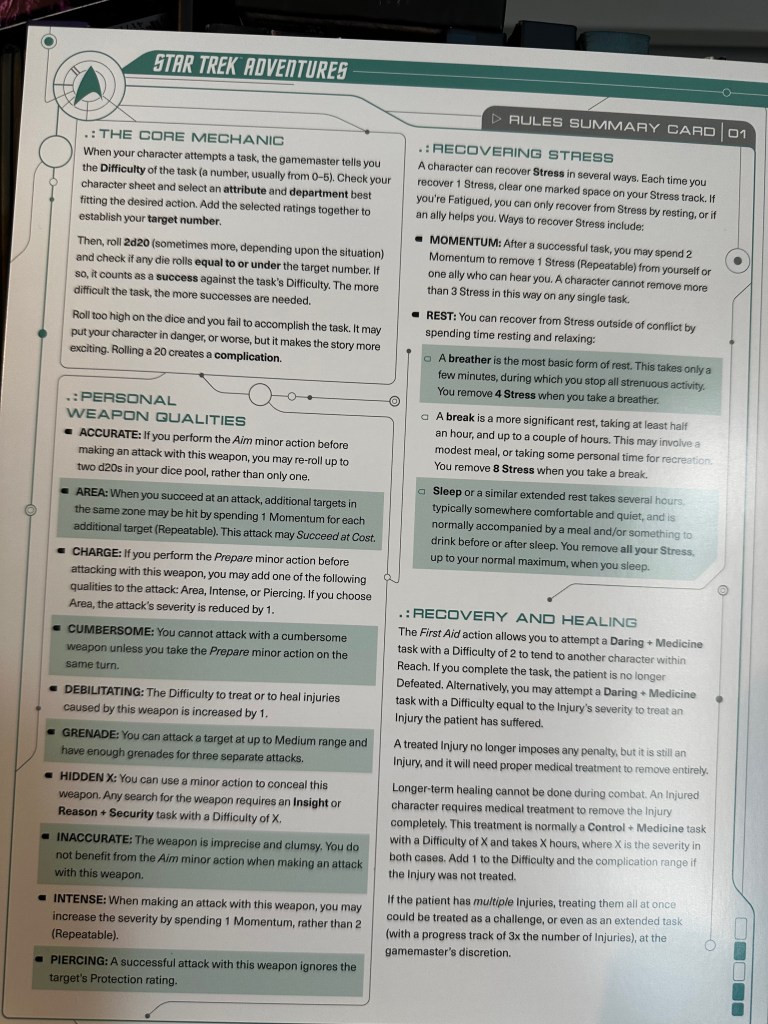
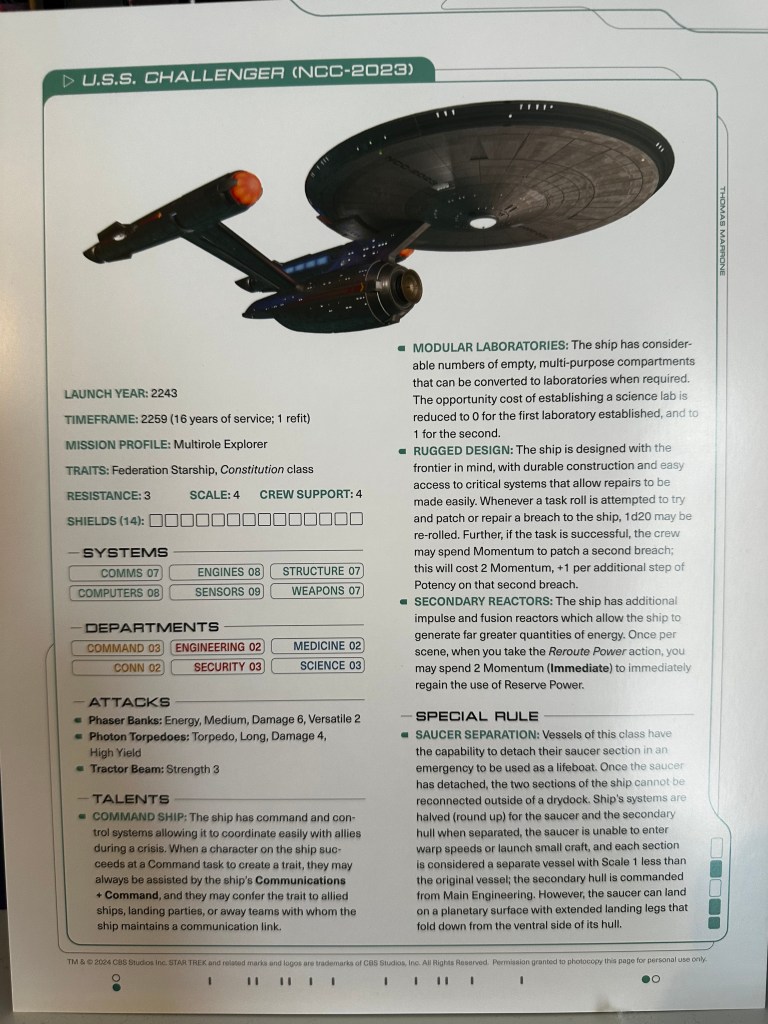
In between missions, the crew of the USS Challenger had time for some R&R on Star Base 343. This particular star base is mentioned only once in a TNG episode as a spot where Picard hinted Riker should take some rest after he had to disintegrate his not-girlfriend. So, I figured it must have something to recommend it for shore leave. It was also where our PCs transported the survivors of the Cressida disaster aboard the Challenger after their city plummeted into the heart of a gas giant, so it stood to reason there would be medical facilities there. Finally, I knew that it was a place where starships could seek repairs. So, when the party arrived on station for a bit of a break, I asked the players to paint the scene for me; how can we tell this star base is a centre for ship maintenance? What shows us that Star Base 343 is renowned for its medical care? What about the station lets us see that this is a good place for rest and relaxation?

And the players did not disappoint. Especially on that last question, I got plenty of detail. All of their answers allowed me to build a living, believable community and place and inspired me to write a short, station-based side-mission.
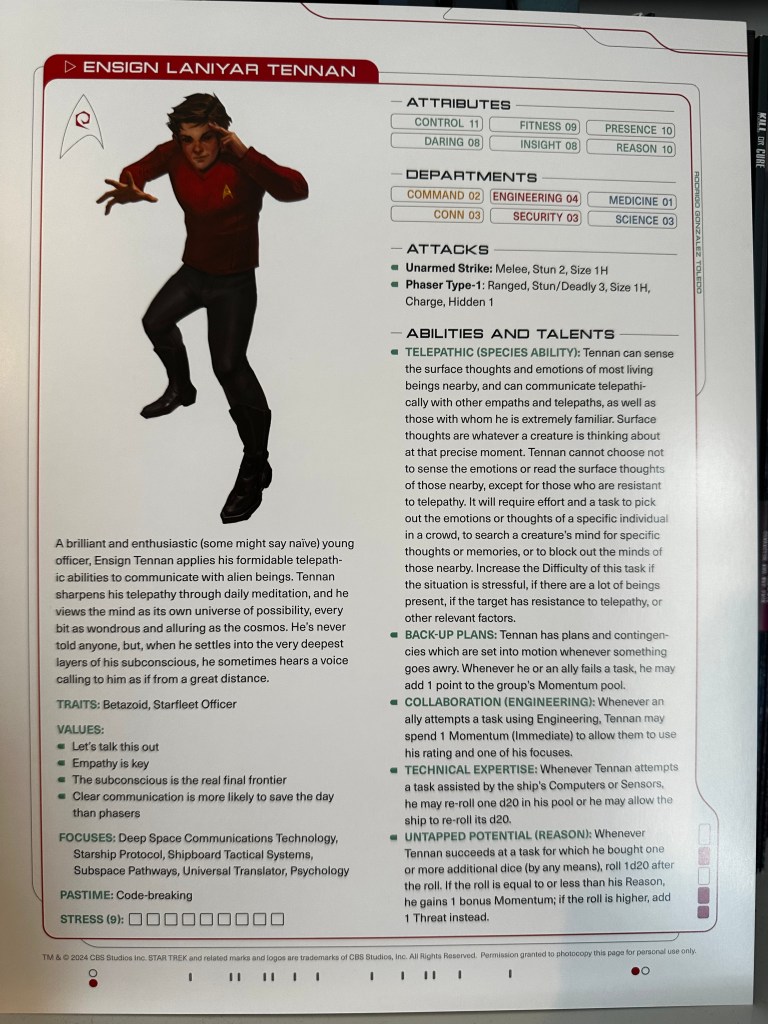
Laniyar Tennan, Betazoid technichian character sheet

Newly minted Lieutenant Junior Grade, Tennan, our Betazoid, felt the need to reflect on the events of the last mission at a sort of temple of his people that stood alongside other places of worship and meditation on the station’s central concourse. I imagined a place where the Betazoids that frequented it went naked as was their practice, and consulted elders for advice. Laniyar discovered a great shift in his outlook that urged him to change one of his own Values, in fact. After that, he got dressed up in his best shirt and went to the bar that he had also described when asked to paint the scene.
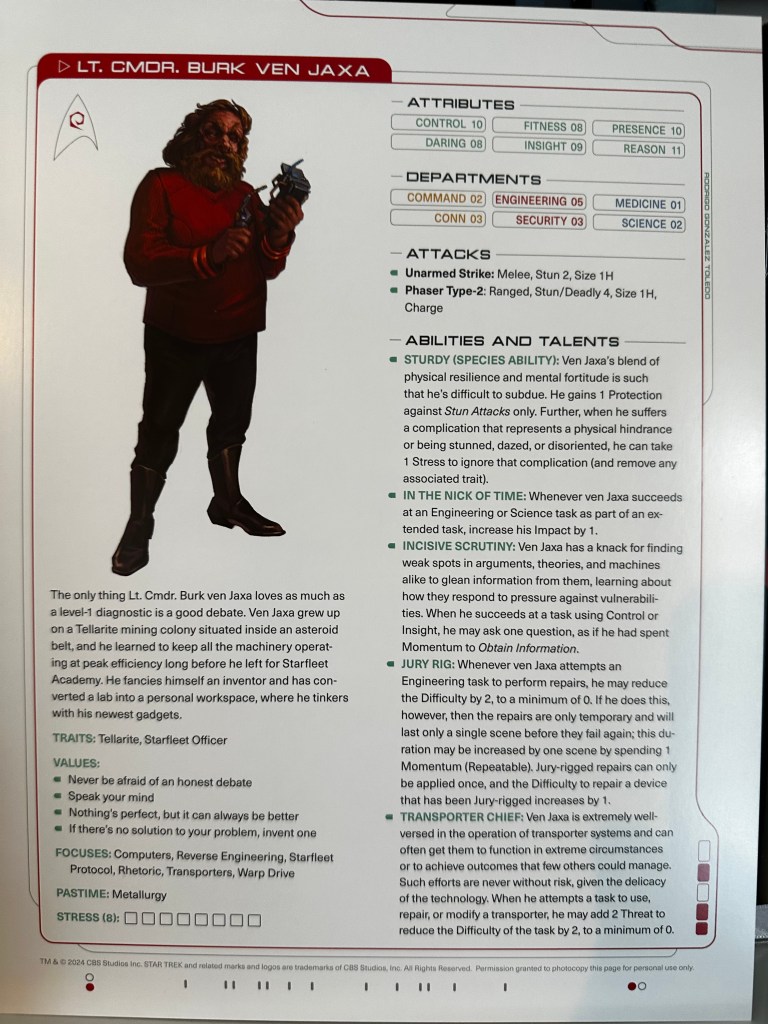
Burk ven Jaxa Tellerite engineer character sheet

Lieutenant Commander Burk ven Java, our Tellarite engineer, wanted to indulge his longing for a good debate as well as his pastime of metallurgy, by finding someone working on their ship at the docking ring and telling them what they were doing wrong. The Orion freighter captain, Bashorat was incensed, frustrated and, finally, exhausted by Commander ven Jaxa’s arguments. He allowed him to make the necessary modifications to his ship and declared them life-changing! Bashorat took Burk by the arm and dragged him to the bar, insisting on buying him a drink.
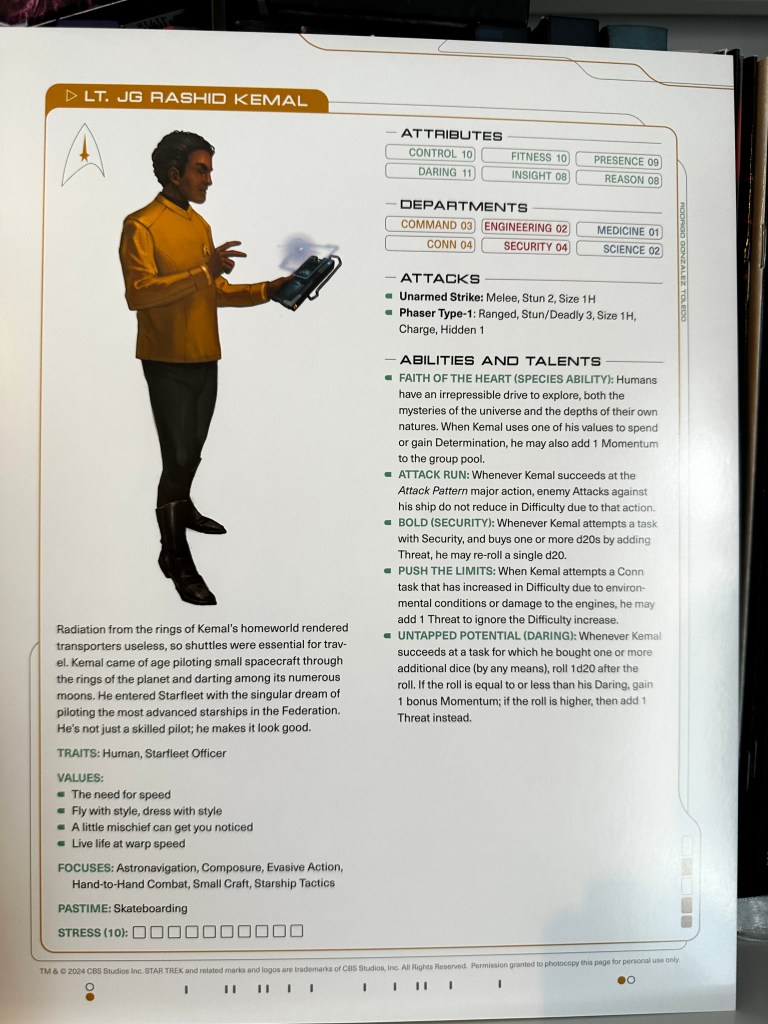
Rashid Kemal, human pilot character sheet

Lieutenant Kemal, the pilot, had a personal connection on the station, an old roommate from the academy, a medical track colleague, who had been assigned to one of the star base’s many hospitals. Groznik was a Denobulan who had been taught the wonders of skate-boarding by Kemal at Star Fleet Academy. After a few drinks and some time to catch up he decided it was time to do some show-boating on the rails of the promenade. He replicated a couple of skate-boards and got his ass handed to him by Kemal in a contest of tricks. Kemal watched Groznik come acropper off a rail and they scarpered before station security picked them up for dangerous horse-play. They retreated to the bar, of course, and that’s where they ran into the others.

Bashorat took them all to meet his sister who had arrived on the Challenger as well. Administrator Damaad, who had tried to bribe the star fleet officers to let her use the transporter to beam up her clients’ valuables as Cressida fell, was not best pleased to see them, since they had refused her deal in order to help save the natives of Kizomic VI instead. But she soon came around enough to make them another offer…

Twenty Minute Trek

Here is exactly what I wrote for the short mission I wanted them to breeze through in a single session along with a few notes I took as the session progressed. Is it weird to block quote myself?

R&R on Starbase 343
What do they want to do here?
Passtimes
Consorting

Pike’s Place – the bar

They will run into Administrator Damaad again. She says she bears them no ill will but this is not true. She will ask them to help her recoup some of her losses. If they were to accompany her to complete a deal with a federation contact, it would lend her a sort of credibility that would be invaluable. She says she would owe them a favour. This could involve her contacts among the Klingons.

The deal is a for a shipment of medical supplies which she won in a game of chance. She says she needs this to repay several of her clients from Cressida. If she doesn’t, they may get the Orion Syndicate involved to collect from her in some other way. She is desperate for that not to happen.

But there is a complication: the supplies are aboard a ship that’s docked at the Starbase. It’s an old freighter named the Utah. She claims she won them in a game of chance but that the captain (Captain Ken Sato) of the ship since disappeared. This is true but sounds false.

She would like the PCs to help her get the supplies off the Utah and to the rendezvous that evening.

If they take her up on her offer and go to the Utah, they will find a mystery. None of the cargo is on board, but neither are the crew.

In fact, in order to avoid having to pay up, Captain Sato, desperate, tried to use the transporter’s pattern buffer to hide both the cargo and the crew. But patterns are beginning to break down and, in an attempt to rectify this, the ship’s main computer occasionally re-incorporates the crew in random parts of the ship for a few seconds to refresh their patterns. To the PCs, they will hear momentary noises, thumps and bumps from around corners or the deck above or below, cut off comms and screams of terror or frustration.

They will also discover that the Utah is having problems with both warp and impulse engines. It’s in no fit state to leave the station any time soon.

Ship traits: Engine Faults, Haunted, freighter, Unlocked, stabilise transporters

Captain Sato traits: Freighter captain, desperate, human

That’s it. It took far less time to write that up than it’s taken me to write this blogpost. Here’s how I approached it:

  1. Involve an NPC they already knew – the first part of their time on Star Base 343 all took place in one session. So, I was able to connect Bashorat (who had been improvised) to Damaad when I realised they were both Orion. This bit was not planned but it felt like it was.
  2. Think Star Trek episode – I wanted this to be a stand-alone Star Trek episode, like most of those from the franchise. I wanted it to involve a hapless, maybe unlikeable NPC or one who required help of some sort. I was thinking of characters like Mudd from Mudd’s Women or Vash, from the TNG episode, Captain’s Holiday.
  3. Mystery – I wanted to create a mystery for them to solve with the skills and advantages they had as characters and with the universe knowledge the players had.

Conclusion

This turned out really well. I was ready to just wrap up their downtime and continue with the campaign from the starter set if they didn’t bite. Their previous encounter with Administrator Damaad was less than friendly, so there was every chance they’d tell her to bugger off. But curiosity got the better of them. Well, mostly. Tennan, as the junior officer and the one most affected by the risks they took in the previous adventure added a necessary level of trepidation and desire to run everything past the Captain. The other two heard him out but just kept pushing forward until they were aboard the Utah, investigating the ship itself.

I like to think I brought some OSR sensibilities to this scenario as well. I created the problems but not the solutions. I also improvised a bunch during the session as the players came up with new and varied avenues of investigation. I had to imagine a crew for the Utah, rather than just the captain, and they were pissed off at him, let me tell you. I also had to round out Sato’s motivations and his reasons for taking such drastic measures. I had to figure out a lot on the fly, but since I had kept the framework loose and the details flexible, it worked pretty well.

Also, it turned out quite spooky! I was hoping for a haunted ship feel and that’s what it felt like on the night. I’m very proud of my descriptions of the quickly cut-off comms and the unexplained bumps in the dark and flashes of light on the ship, actually.

We’re taking a short break from Star Trek to facilitate the Tables & Tales Third Annual Talk Like a Pirate Day One Shot (probably a 3 shot this year) but I’m eager to get back into the stars!
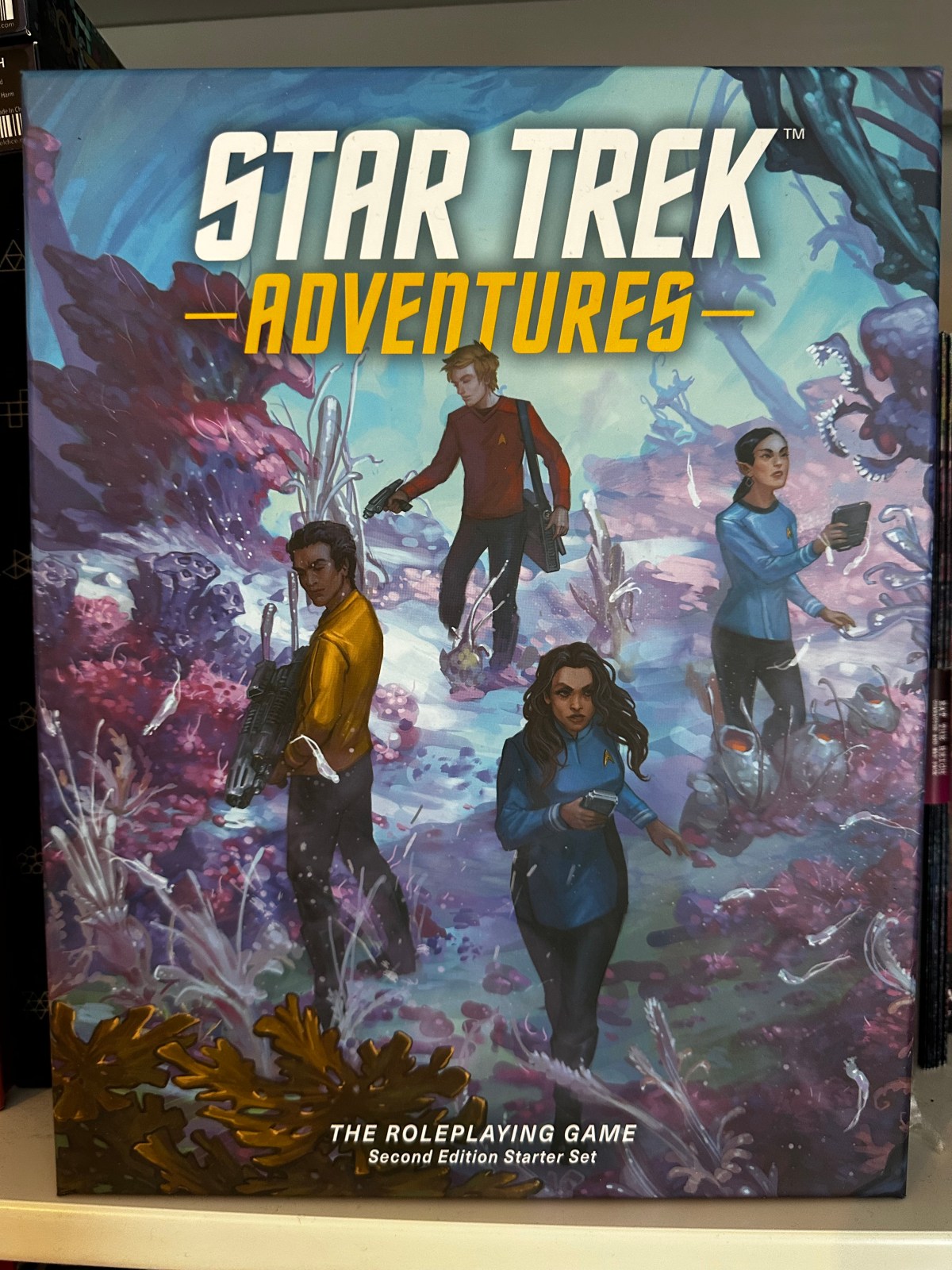
Star Trek Adventures 2E, Incursion Point

Starter Campaign

Dear reader, last week, I created a character for Star Trek Adventures 2E. His name was Mesh and he was an Orion Star Fleet Officer on the command track. The lifepath character generation system was satisfying and sufficiently different from other games that I felt it novel and enjoyable. But, the fact is, I’m unlikely to ever get to play a character in a Star Trek Adventures game, since I’m the one running it.

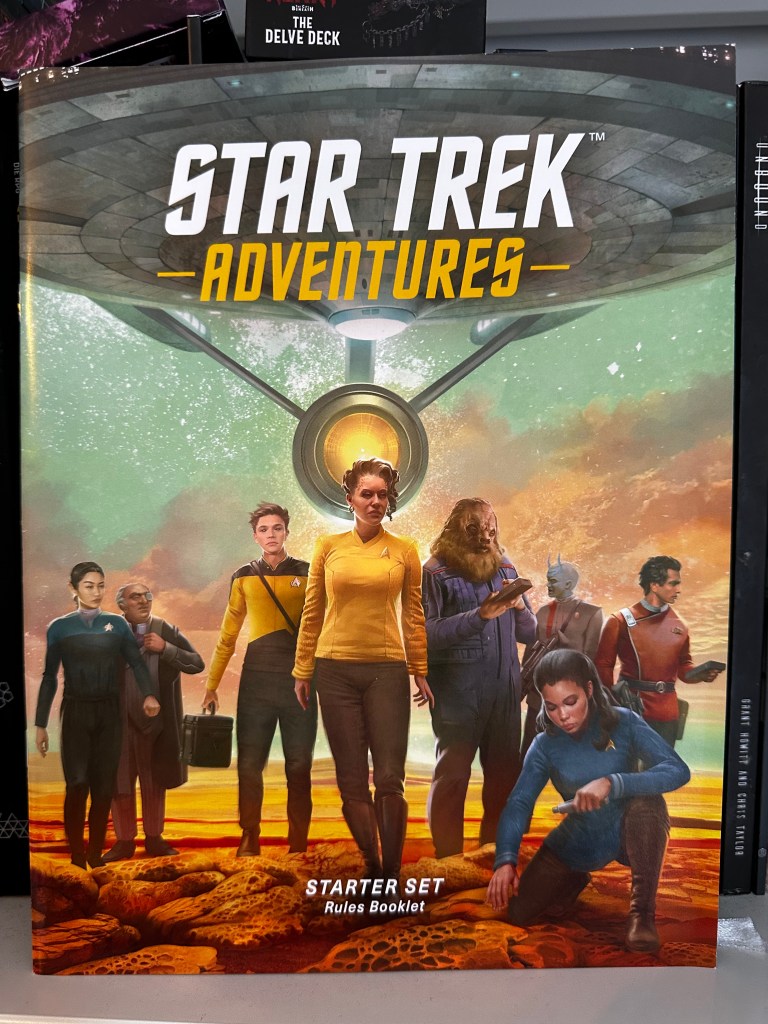
I picked up the Star Trek Adventures 2E Starter Set and Core Rulebook a couple of months ago when Modiphius was having a sale and I haven’t regretted it. Sometimes, when I buy the core rulebook for a game that I’m interested in along with its Starter Set, I wonder why. The starter set can feel like a waste of money. But, the truth is almost always contrary. The general quality of boxed starter sets recently has been really good. Free League are the masters of producing sets of such high quality and with such a wealth of content that I would generally always advise you to pick it up, even if you’re getting the core rules as well. I have played or run starter set adventures of the One Ring, Tales from the Loop and the Bladerunner RPG. All great quality adventures too! The Bladerunner one sticks out as a real highlight for me. The casefile, Electric Dreams was a brilliant intro to the game and the world but was also an engaging and evocative adventure in its own right. That’s a game you could run without ever reading the core rulebook, as long as you have the starter set and you don’t mind pregenerated PCs. We got four sessions out of that game, and I considered that extremely good value for money.

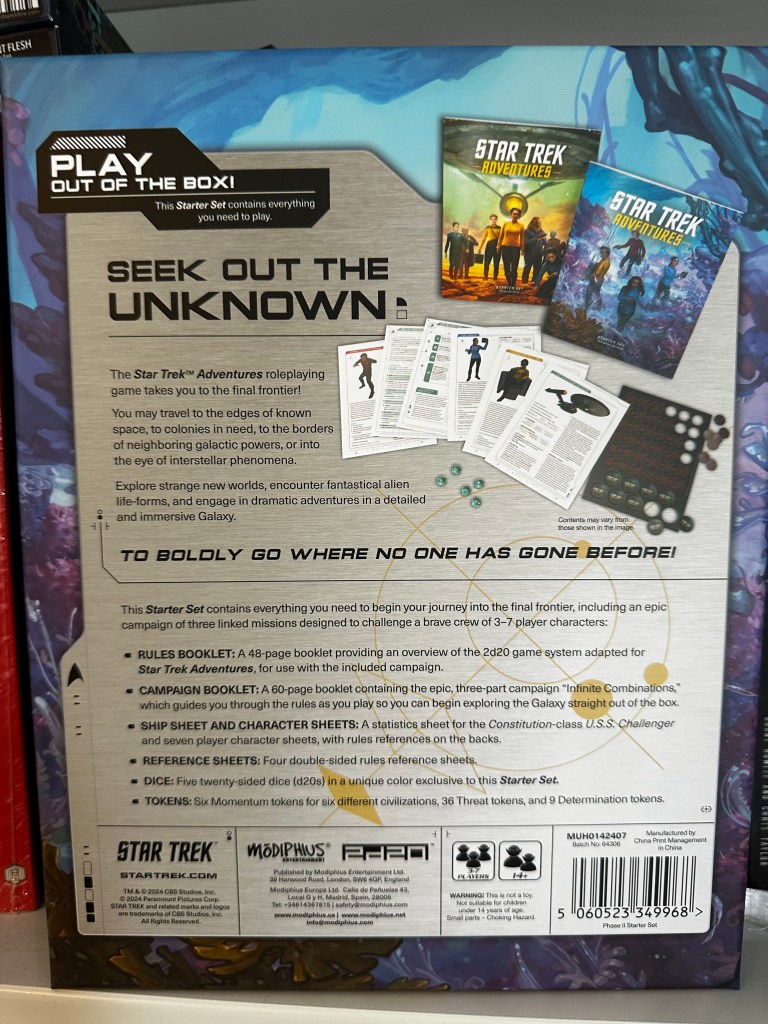
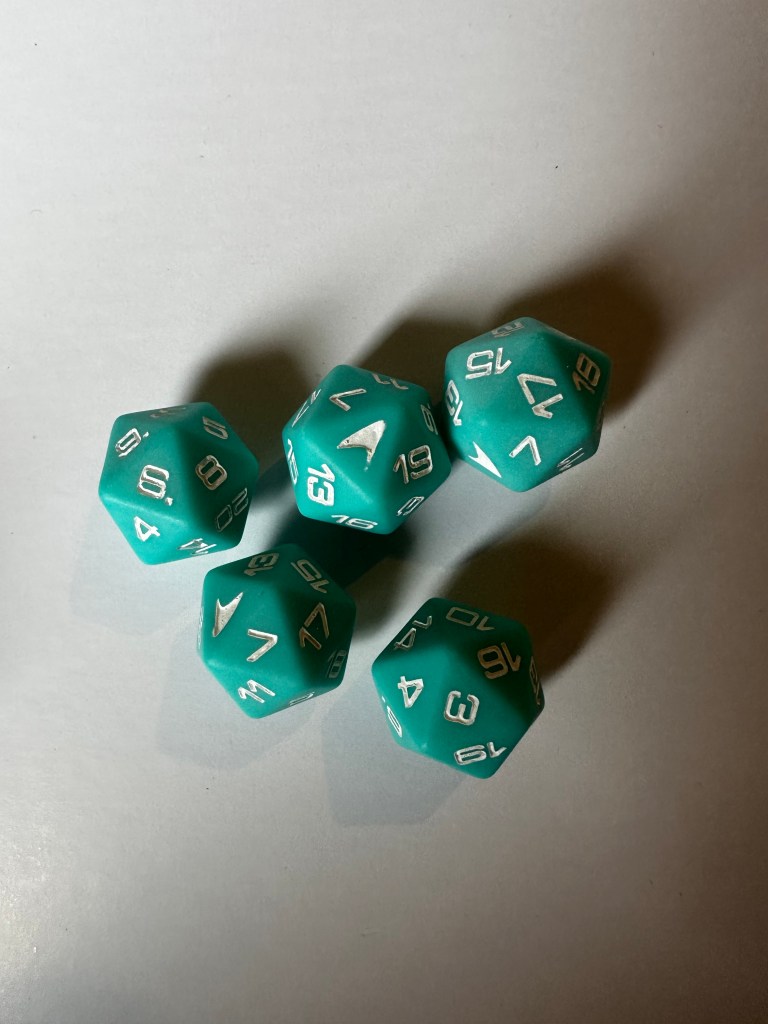
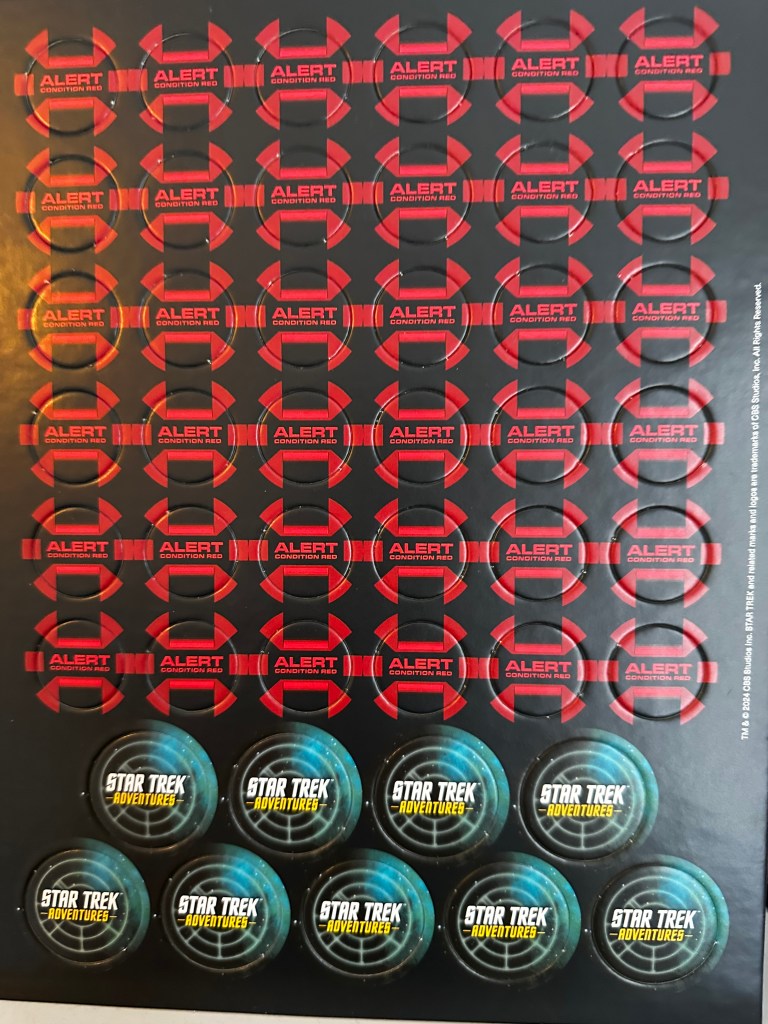
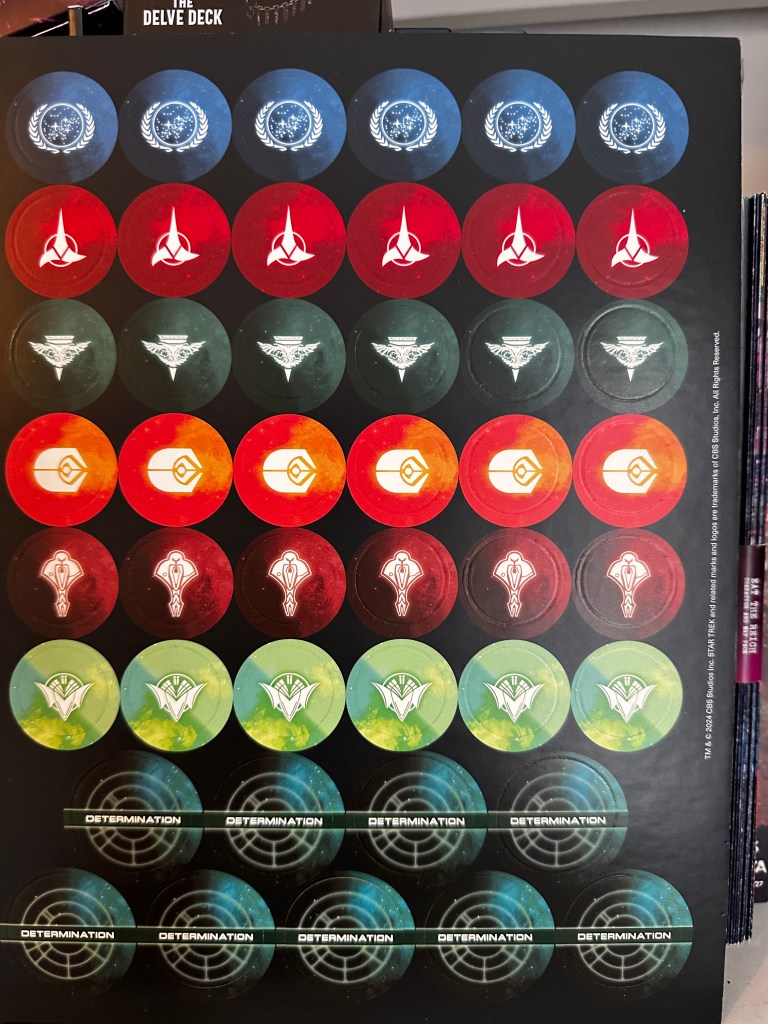
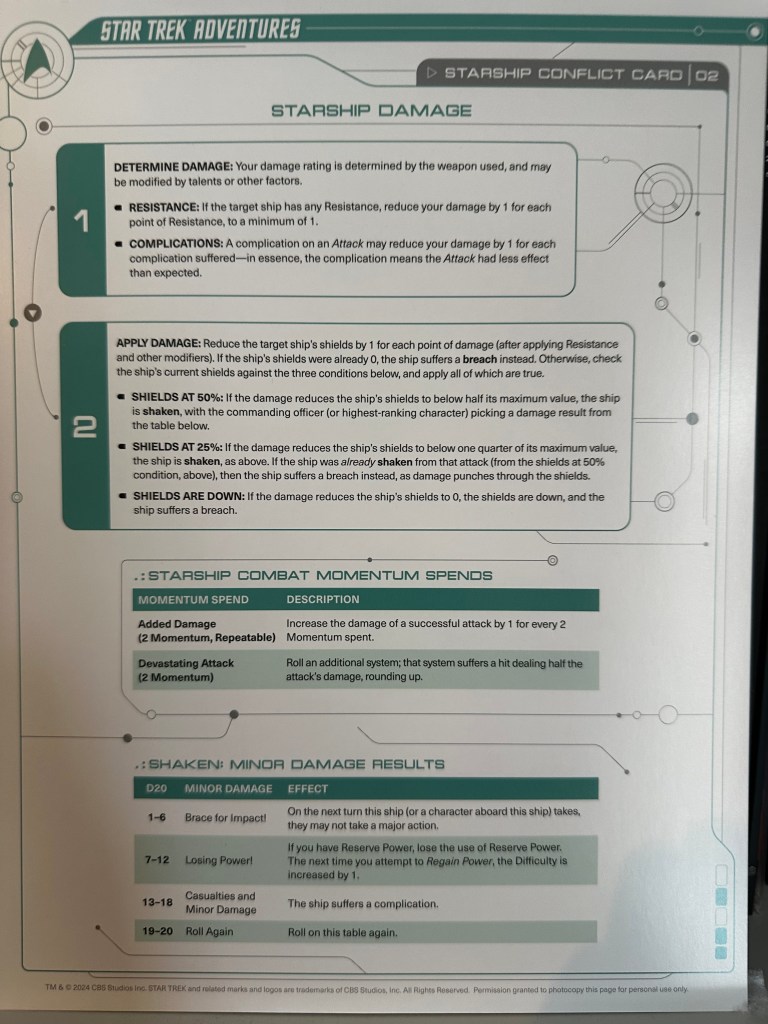
And then we have the Star Trek Adventures 2E Starter Set. In the box, you’ve got a set of five Star Fleet themed d20s, a sheet of tokens, a bunch of handouts which include pregens and rules references and, of course, a rules booklet. This booklet provides you with almost everything to run this game. The biggest omission is, of course, character creation rules. But, as I said above, if you don’t mind the pregens, that’s fine. The campaign booklet is just that: a booklet with a campaign in it. Inside the sixty pages are three interconnected adventures and three mission briefs, which act as adventure frameworks. After three sessions, I can confidently say, the Campaign Booklet, if played in full, is likely to bring you fifteen or sixteen sessions of play in the Star Trek universe. Now that’s making your latinum strips go a long way! Quark would be proud of you, Modiphius!

Rules

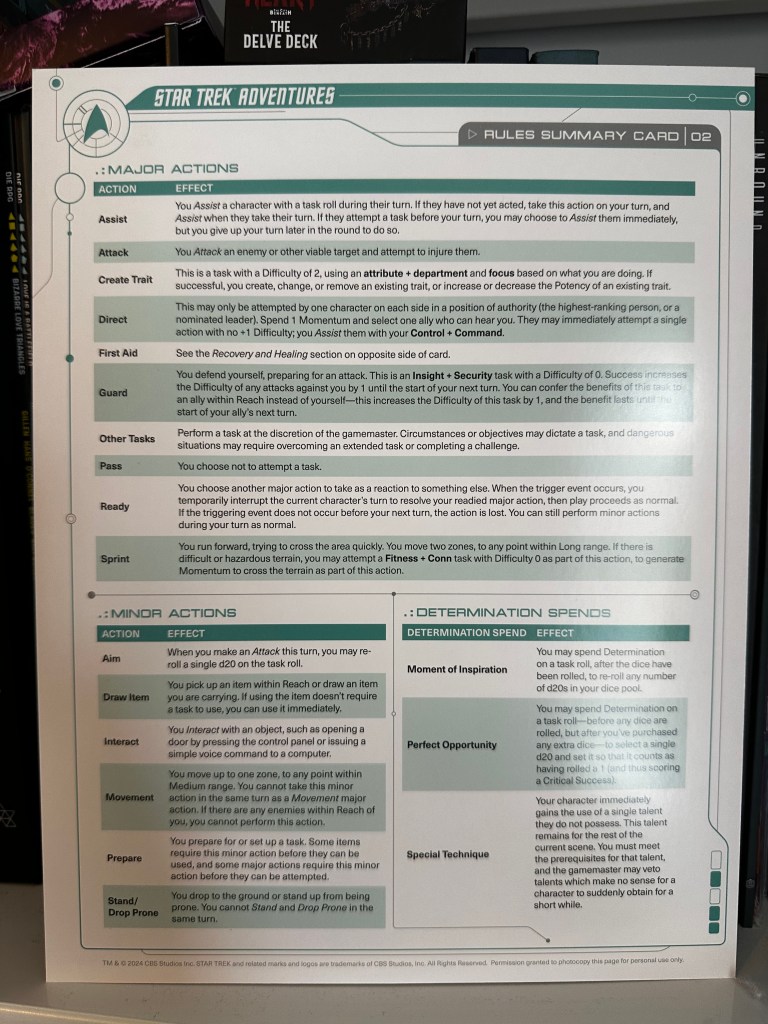
Star Trek Adventures 2E uses Modiphius’ own 2d20 system. Despite owning multiple Modiphius games, this is the first time I or, indeed, any of my players have had the pleasure of using it. I was expecting this to be a lot more trad than it is. It is actually really narrative-focused.

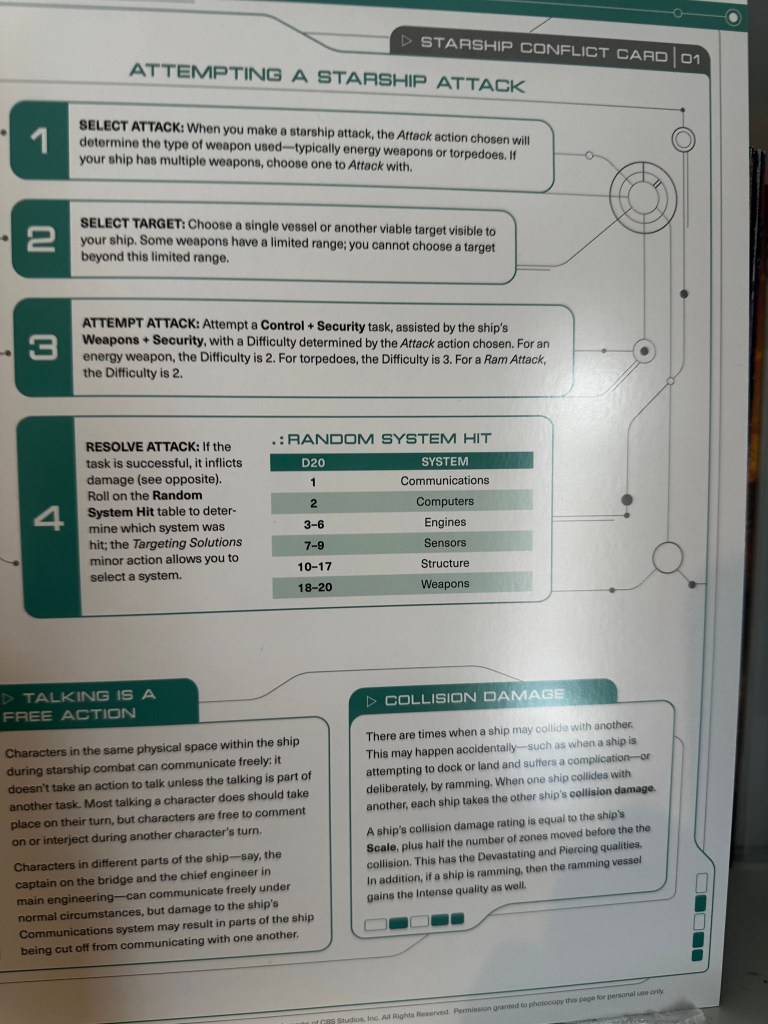
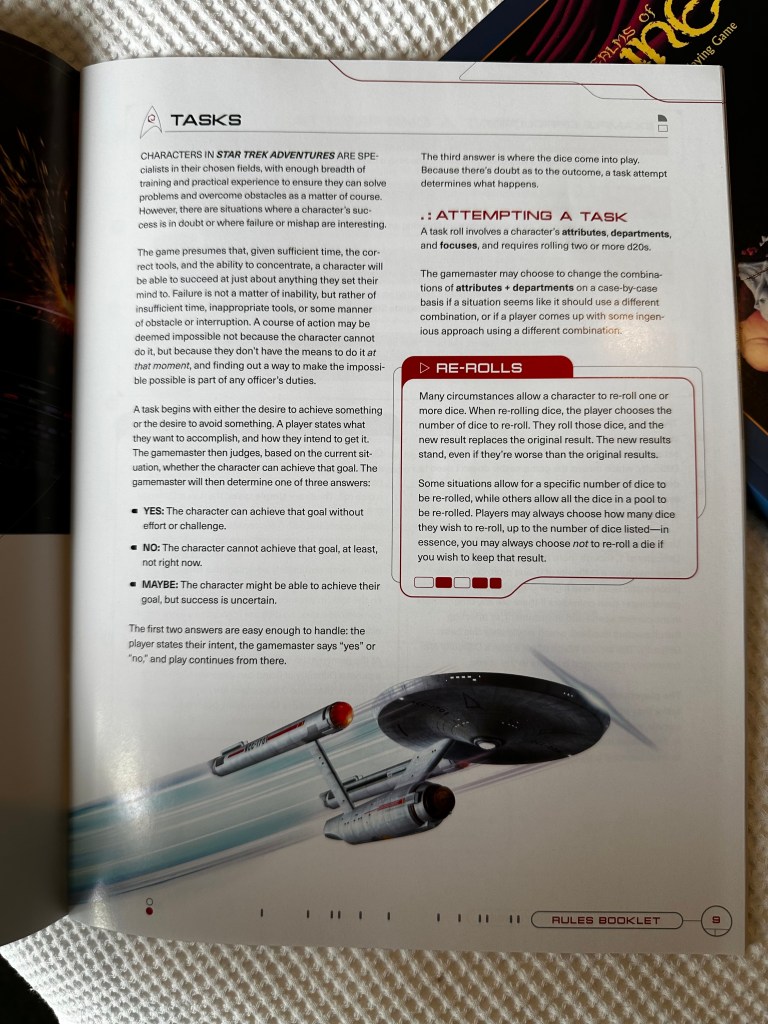
The core mechanic is simple. Every character has six attributes and six departments (see my last post for more detail on these.) When you are asked to perform a task, the GM will tell you which attribute and which department you need to use. So you might be using your Daring attribute of 9 and your Conn department of 3 to chase an enemy craft through an asteroid belt. You add the two scores to give you you target number. In this example, that would be 12. If you roll equal to or below that, that’s a success. You automatically get to roll at least 2d20, but you have various ways to add dice to that pool. A task’s Difficulty rating tells you how many successes you need to complete the task. So, for a Difficulty 3 task, you better get more dice, pray for a crit (a 1 counts as two success) or reduce the Difficulty somehow.

Momentum is a resource that the PCs share. They build it up by scoring more successes on rolls than they need. So, in the example above, if you managed to roll four successes on the Difficulty 3 task, you get to add 1 point of Momentum to your pool. That Momentum pool can’t go above 6 points so you are incentivised to use it up. They can use a point of Momentum to add a die to a pool, three points to add two dice and six points for three dice. There are other ways to spend this resource too, such as to get the GM to give you more info on a particular scene.

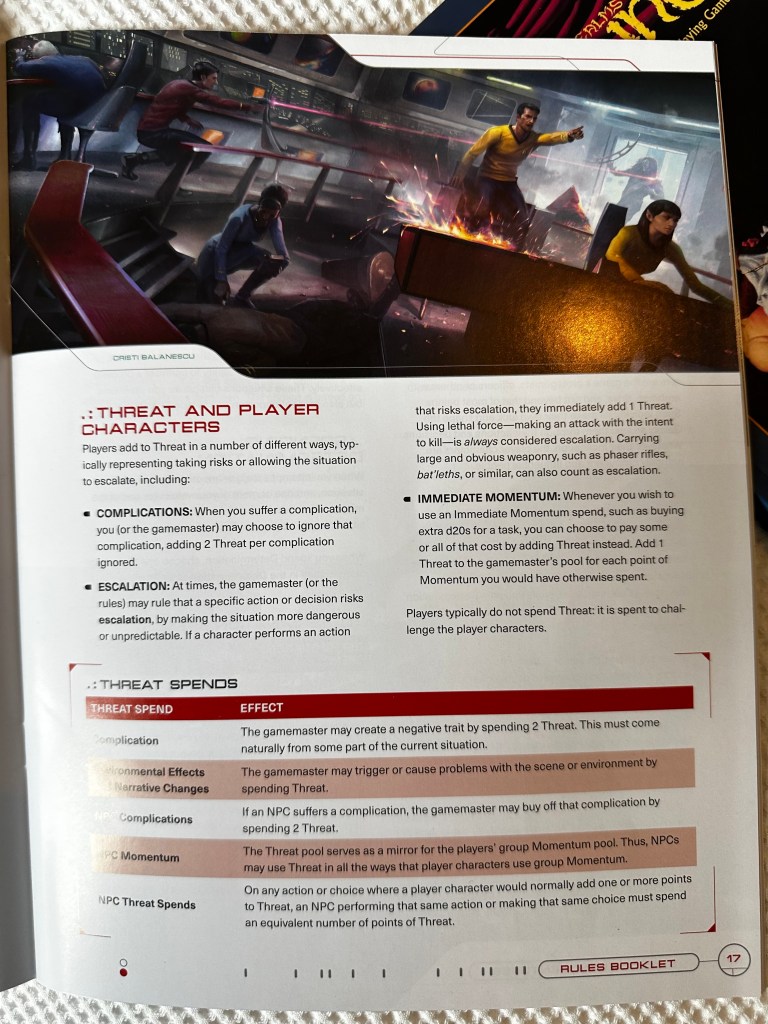
Threat is a resource for the GM to use that mirrors Momentum. The PCs can add a Threat for more dice in the same sort of way as spending Momentum. The GM gets to use threat to increase the likelihood of Complications occurring (this happens on the roll of a 20 usually.) Complications can come in many different forms. They might be a simple and mechanical as causing an injury. But they also might take the form of a massive narrative twist that really sticks spanner on the works of the PCs’ plans. This comes up way more often than I expected.

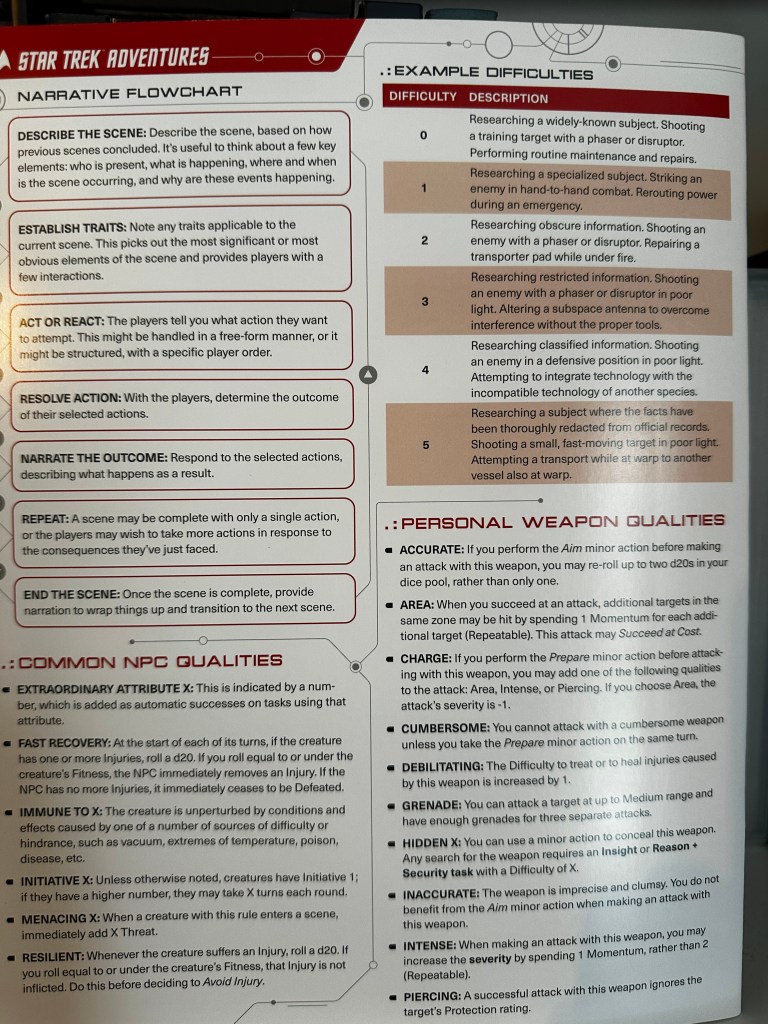
Those are the basics. There’s other stuff like taking Stress to Avoid Injury, Extended Tasks that use tracks, Resistance on tasks and in conflicts that absorb successes, but we don’t need to go into them here. If you are interested to learn more, check out the free Quickstart guide here.

Part One, Incursion Point

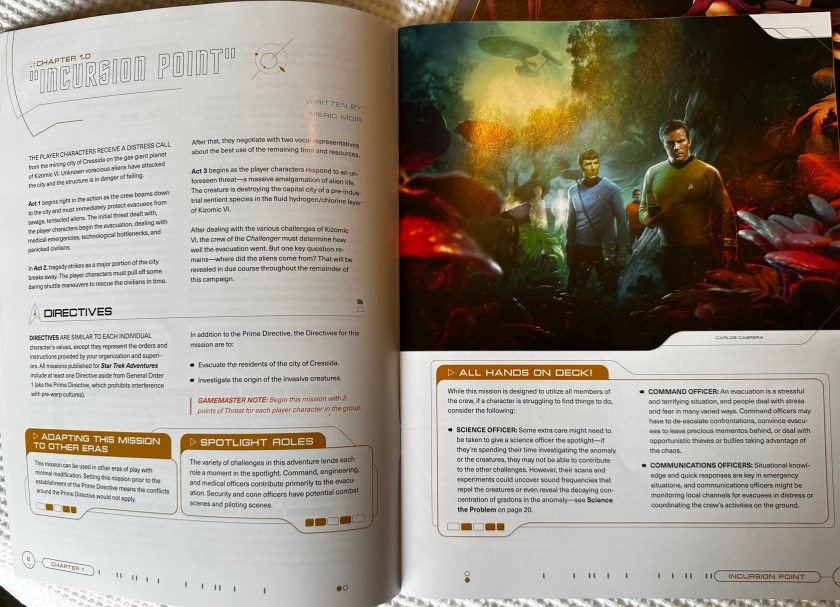
Opening page of the adventure, Incursion Point. Two page spread. One page features and illustration of Kirk and Spock.
Incursion Point

Incursion Point is the first adventure in the campaign contained in the Starter Set. The campaign is entitled “Infinite Combinations,” but the reasons for that are not really obvious from reading or playing this first part of it. It was written by Meric Moir.

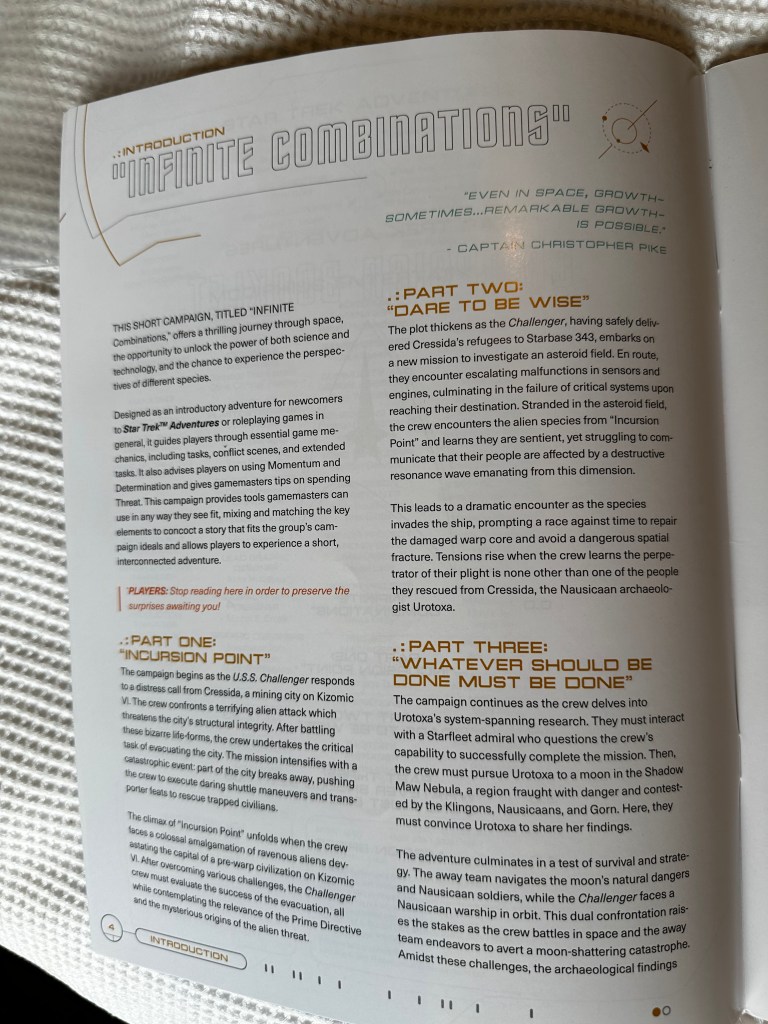
Summaries of each part of the campaign, Inifinite Combinations.

This is quite explicitly a teaching adventure. In fact, the whole campaign is there to teach you how to run and play this game. It has lots of callouts to help out the new GM, from suggestions on what each type of character might do in the current situation, to advice on what to do if your players roll real bad. Much of the text itself is also devoted to explaining how to handle each situation as and when it’s likely to come up. For instance, the first scene has a high likelihood of conflict so the text runs you through how to order actions, resolve and attack and what to do if a PC gets injured. Where necessary, it will direct you to the relevant part of the Rules Booklet. In my experience, it was incredibly effective in teaching me what to do in my first few sessions. Of course, my clever and adaptable players got the hang of it without the need for such hand-holding. Before the first session was over they were stacking and spending Momentum like they’d been doing it all their lives. By session two, the risk of adding more Threat points to my pool was outweighed by their ambition and they were using it to do just oh so much cool shit.

Dear reader, if you think you might be lucky enough to play in this adventure, stop reading now. I’ve got loads of other posts, go and read one of them. There’ll be SPOILERS below.

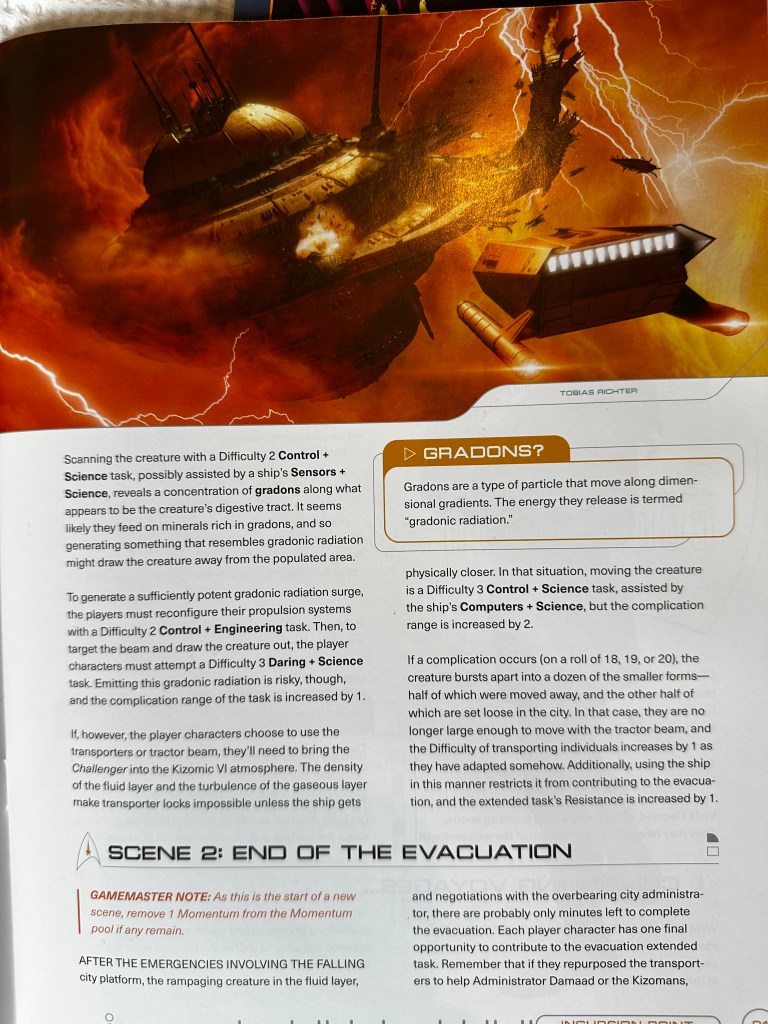
Stardate 3422.1: We have received an urgent distress call from the independent floating city of Cressida, a resource-gathering collective on the gaseous world Kizomic VI. Creatures of unknown origin have attacked, causing casualties as well as compromising the city’s superstructure. We have responded to the distress call and are proceeding to Kizomic VI at high warp.

When we arrive, we will have only a few short hours to evacuate the city’s 600 inhabitants before the structure fails entirely and sinks into the crushing gravitational depths of the planet. With the number of beings to be evacuated, our first order of business will be to set up pattern enhancers and then direct the locals to the beam-out sites.

The Captain or other commanding officer is supposed to read out this log entry to introduce us to the current situation. We didn’t really have such a PC in our group, so I read it, which was fine. I like the conceit of this as it immediately feels trekkie.

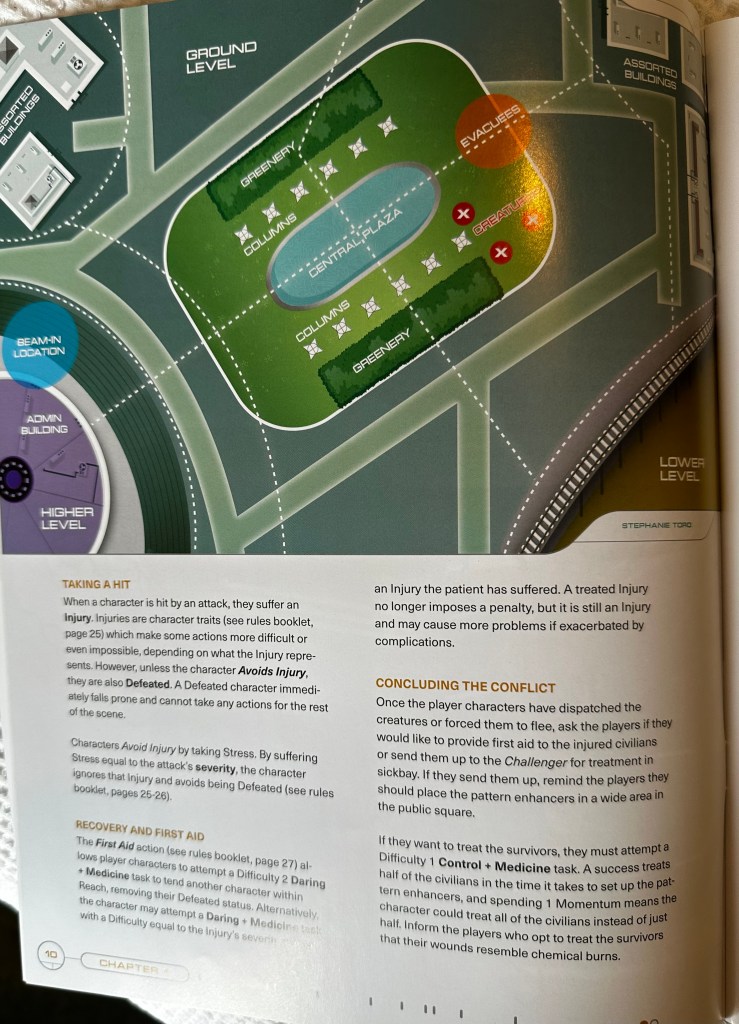
Map of the initial beam in point. Also has details on taking a hit, healing and concluding the conflict with the Bryozoans.
Map of the initial beam in point.

The situation is dire and quickly worsening. The PCs are left to come up with ways to evacuate the citizens as quickly as possible. And that’s when the plant-like aliens they will come to know as Bryozoans seem to attack the evacuees. This is the start of Act 1: Operation Evacuate! In our game, the PCs, Lieutenant Commander Burk ven Jaxa, the Tellarite engineer, Lieutenant Junior Grade Rashid Kemal, our hotshot pilot, and Ensign Laniyar Tennan, Betazoid technician, stunned one Bryyozoan and frightened off the other before quickly moving onto ways they could speed up evacuation. Everything from locating more survivors to constructing elaborate containers to transport more people at a time, (the human cattle container was the term, I believe) were put into practice. With each success, they ate away at an Extended Task track which continued for the rest of the adventure.

Cressida Falling apart - illustration shows a shuttle pursuing the plummetting dome that broke away from Cressida.
Cressida Falling

Act 2: The Fall of Cressida started with a huge chunk of city breaking off and falling into the lower atmosphere of the gas giant. The PCs hopped in a shuttle without so much as a call to the bridge of their ship, the USS Challenger. They shot down after the plummeting hunk of city and managed to land almost safely. This is when I started to really spend Threat and introduce Complications. The shuttle door was jammed and they began to be attacked by more Bryzoans. The PCs quickly took steps to uncomplicated matters and save the citizens who had been trapped on the falling district just before it broke up into so much debris. They brought them back to the ship and escorted them to Sick Bay. Here the PCs encountered some NPCs. This was really the first opportunity any of had to do a little roleplaying in this adventure, and this was session two. It’s a high-speed scenario that demands quick action and decisive play.

Anyway, a well-dressed Orion woman, Administrator Demaad wanted use of the transporters to beam up valuable trade goods. Meanwhile, Urotoxa, an older Nausiccan academic, wanted them to help the humanoid inhabitants of the planet’s fluidic layer far below by bringing them a shipment of phasers. She was sure they would be decimated by the Bryozoans, and, as she had been in communication with them, she wanted to help them.

During this three-sided interaction, they discovered a lot through the use of Tennant’s Betazoid telepathy. They found out that Demaad had an underhanded ulterior motive and that Urotoxa was probably the cause of the entire disaster befalling the planet and its inhabitants. Despite neither woman coming out of the conversation smelling like roses, the PCs decided to try to convince the Captain of the Challenger to let them help the Kizomans, although, perhaps not by breaking the Prime Directive to furnish them with advanced weapons.

In Act 3: The Fate of Kizomic VI, we saw our heroes contending with the Bryozoan Terror, a massive amalgamation of smaller aliens that they had detected swimming towards the main population centre of the Kizoman people in the fluidic layer. They boarded the shuttle Galileo with a probe ripe for jury-rigging and a trio of EVA suits. While Tennan and Burk worked to modify the probe to emit a high-level of gradonic radiation, (they had figured out earlier that that’s what the Bryozoans fed on, destroying the inanimate objects that contained it in the process) Kemal piloted the shuttle down, down, down until it became a submarine. In modifying the probe, they were too successful, as it turned out. It drew the Terror to them before they had even had a chance to launch the probe towards one of the few remaining rifts that the creatures had emerged through in the first place. The shuttle took corrosive damage that left it immobile and losing structural integrity. They eventually managed to launch the probe to draw the Terror away, but two of them had to exit the craft to effect repairs. They managed it with only moments to spare before their suits ruptured. Kemal got them to the gaseous layer before the hull gave out, just in time to be transported back to the ship. Whew! That was quite the finale! Except there was more.

Here’s where the PCs get one final opportunity to make some headway on that Evacuation Extended Task. They had to each take actions to try to help save some more citizens of Cressida. And they did fine, managing to rescue most of the inhabitants before the city crumbled away to nothing in the atmosphere of Kizomic VI. This felt anticlimactic, though, I won’t lie. I should have taken this part of the adventure and moved it to a point before they went to deal with the Bryozoan Terror.

Conclusion

This was a very well put together adventure. As I mentioned above, the teaching elements worked very well, at least when I got to use them. Actually the most gratifying part of it was that the players avoided doing most things the adventure expected of them. Generally, they avoided violence whenever possible, which felt very Star Trek, and this was great because it got me to engage fully with the mechanics and think on my feet as a GM too.

But also, each Act lasted exactly one session. No overlap, no worries about not getting it finished on the night. Nothing but net. They clearly play-tested the hell out of it.

It could maybe have done with a few more opportunities for role-play, but then again, that’s just not the type of adventure it was. In Act 2, there was that interaction between the PCs, Demaad and Urotoxa, which highlighted social conflict and it worked really well.

Honestly, the only real issue was that ending. The adventure directs you to ask the PCs for more tasks to help complete the evacuation once the finale had already occurred in my opinion. It was an anti-climax and the players agreed. If I had it to do over, I would have taken this and placed it before the Bryozoan Terror encounter.

We are looking forward to continuing the campaign! The players are looking for a bit more of a chance to role-play so I think we’ll have a Starbase episode next!

Stay Frosty

Obviously, a game like this is going to draw comparisons with the Alien RPG and Mothership given the subject matter but, from even a cursory look, it seems to be approaching the genre from a slightly different direction.

Not Over Yet

I had a great plan for today’s post. It was all coming together perfectly. We were due to finish of the Call of Cthulhu “one-shot,” the Derelict last night, but, due to various unforeseen circumstances, we were forced to postpone. So, the review of the scenario that I had been planning will have to wait too.

Still, I’m not short of subjects to write about.

Stay Frosty Remastered

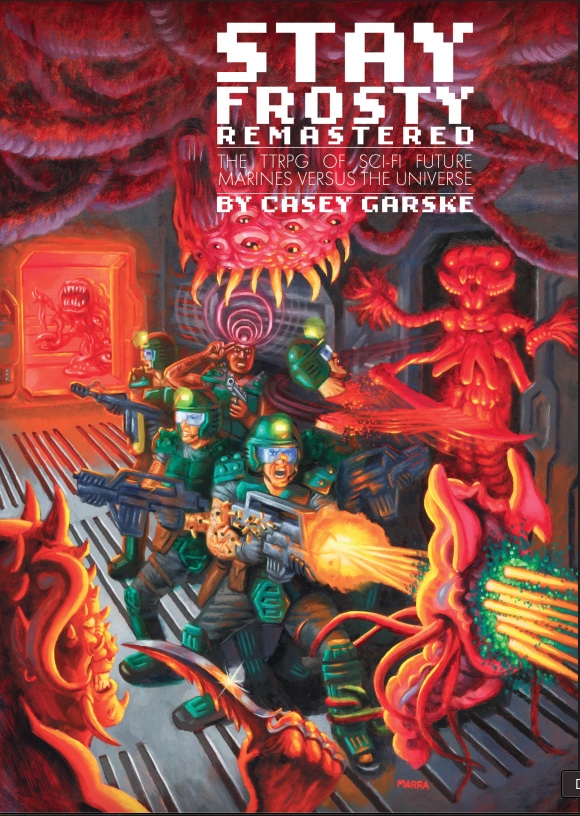
The cover of Stay Frosty Remastered by Casey Garske. Space Marines fighting aliens/demons
The cover of Stay Frosty Remasted

I’m going to take this opportunity to take a look at one of the games I received recently as a Kickstarter fulfilment. Stay Frosty Remastered from the Melsonian Arts Council and written by Casey Garske is an old school RPG of sci-fi marines in situations of extreme tension where they face monsters, demons and aliens with nothing but a shotgun and a bad attitude. Think Doom crossed with Aliens. Obviously, a game like this is going to draw comparisons with the Alien RPG and Mothership given the subject matter but, from even a cursory look, it seems to be approaching the genre from a slightly different direction.

It’s worth noting that “Remastered” in the title. Casey Garske first released Stay Frosty back in 2017 so it’s been around longer than either of the two games I mentioned above. I first learned about the original before I ever backed the remaster. Co-host of the Fear of a Black Dragon podcast, Tom McGrenery used it several times as the ruleset in which he ran some rather unlikely scenarios. I never read the original, though it is still possible to get it here.

Basics

Roll a d20 greater than or equal to your attribute for a success. Otherwise fail. Sometimes you get another die for advantage or disadvantage. That’s it.

Obviously, this implies that, even though you roll your attributes up the same way as you do in D&D, lower numbers are better!

Badassery

Scorpion fight
Scorpion fight

You get to play some of the galaxy’s badest asses in Stay Frosty. Character creation seems very straight forward. You get some attributes (Brains, Brawn, Dexterity and Willpower,) and MOS (military Operations Specialty,) hit points, rank and some equipment. Then it’s “Oorah” and into the bug’s nest to rend some carapace. Character creation starts on page 5 and just about stretches to page 8. All the better to roll up a new badass when the first one bites it.

Gear

I like that the rules around gear are abstracted so far as to make theatre of the mind nice and easy. Ranges, as they apply to combat and weapons are expressed by bands:

Hand-to-hand -> Close -> Short -> Medium -> Long -> Extreme

Your weapon’s description indicates its max range of course.

Another touch I appreciate is the use of supply dice for ammo that you use in a combat situation. If you used it, roll the ammo die for it at the end of the fight, If you roll a 1 or a 2, it reduces the die size until it’s gone. There is a similar rule for other gear that can be depleted.

Combat

Space marines fighting bug aliens
Riiiiip

I described the essentials of it in the Basics section above. But there are a few idiosyncracies that I enjoy:

One of the actions you can take in a round is called Battle of Wills. If you succeed on a Willpower roll against a chosen target, they will get disadvantage on their next attack. You just scare them into fucking up because of your badassness.

If you get a critical or a fumble, you roll on the appropriate FUBAR table. Either “Fuck Yes, Natural 20” or “Oh Fuck, Natural 1.”

Brain Bleed
Brain Bleed

There are Psi-powers. These are restricted to PCs with the Psi-ops MOS. There aren’t too many powers in the book but here’s a selection:

  • Brain Bleed (although the book seems to be missing the actual Effect of this one)
  • Interface – lets you take control of machines
  • Mind Stab – mind stab

There’s a little more to the system than just these points, but not much.

Mostly these other rules are introduced in the chapter,

Other Crap Every Game Has

Which has the sub-sub-title,

Jesus Christ, I guess we have to spell everything out.

Danger, Frostiness and Tension

These are the mechanics that make the game what it is. You will see some similarities to the Stress and Panic mechanics in both Mothership and the Alien RPG.

Firstly, the Danger die is rolled whenever the PCs move from one area to another, whenever they are in really dodgy locations or just whenever they’re dawdling. It’s a good way to ramp up the Tension. It works much like an encounter die in other games so can lead to location-appropriate baddies turning up, environmental challenges and loss of resources, but it can also add Tension or cause it to be released explosively!

Which brings us neatly on to the Tension mechanics. So, the PCs gain Tension through the Danger die rolls I described above.

Tension can be good for you. Forget simply staying frosty, Tension will actually build your frostiness level. It starts at “Warm” when your Tension is at a 1 and goes all the way up thru “Chill” (gives the agile tag to ranged attacks) and “Frozen” (Advantage on saves) to “Ice-Cold” (extra attack) when you reach 6 Tension points. There is a danger of course, when your that tense. When the Danger die comes up 6, “Tension Explodes!” And every PC has to make a Willpower save. If they succeed, they can reduce their Tension by one but if they fail, they take their Tension score x their level in damage. If this reduces them to 0 or lower HP, they roll on the Going Apeshit table. If you get a 1 on this table you’re on Overkill, advantage on damage rolls but having to roll your ammo die every round instead of after the combat. If you roll a 6, though, you’re on Last Stand, abandoning weapons and armour to face the enemy mano-a-mano.

This is pretty close to the stress mechanics in Alien, which is also all governed by tables. I’d be incredibly surprised if it wasn’t inspired by this game.

The Rest

A parade of bad guys from winged demons to little brain aliens
If it Bleeds…

Most of the rest of the book consists of a couple of missions to send your frosty fighters on. But there are also a couple of pages of random tables to allow you to easily and quickly construct your own missions and a few basic stat blocks for bad guys like Amoeboids, Demons and Robotic Assassins.

Conclusion

Isaac ran myself and Tom through a dungeon in the Black Hack the other night. None of us had ever played it before and even Isaac had barely looked at the rules. It was so easy, though, that we had characters created, hirelings hired and a dungeon explored before you could say the unlikely word, “Prolch” (my slow-witted fighter’s unfortunate name.) Stay Frosty gives me a very similar vibe. I only just opened it for the first time to write this post and I feel like I could run it now. Maybe I will! Unsurprisingly, the Black Hack is listed in Stay Frosty’s Appendix A: Influences. Garske tells us here that his game was originally a Black Hack hack but he ended up totally rewriting it. You can still see the Black bones of it though.

Alien RPG’s Hope’s Last Day: A Review

If you’re interested, go check out my post previewing this game here.

A Bad Call?

Burke, Carter J “confessed” to Ripley that he had made a bad call in sending them to a colony on the moon, LV-426. But did he mean it? No. He was a scumbag of the highest order. He was just fucking someone else over for a percentage. I sent my players to LV-426 too. I wasn’t looking to fuck them over for a percentage, but, at the very least, I expected most of their characters to get impregnated by facehuggers, ripped to shreds by drones or melted by acid blood. Did any of that happen? Did I make a bad call in choosing the Cinematic Alien RPG scenario, Hope’s Last Day, from the core book, rather than the one from the Starter Set? Well, dear reader, why not come with me on a trip through our one-shot and my thoughts on it, and you’ll find out.

Shake and Bake

These two scenarios couldn’t really be much more different. The one from the Starter Set, Chariot of the Gods, is set on a ship out in space, you know, where no-one can hear you scream? It’s also very much a full scenario with an entire three act structure. They say it would take three sessions to play but I have my doubts about that estimate, having played Hope’s Last Day.

Speaking of which, Hope’s Last Day is a scenario that’s set totally on the moon where Ripley and the Nostromo’s crew found the Alien eggs in the first movie and the setting for the action of the second. This scenario was not even a full Cinematic experience. It is billed as a taster, since it really only encompasses what would be the third act in a normal Cinematic scenario. The book confidently asserts that it could easily be played in under two hours.

Frankly, duration was the deciding factor for me. I only had one night to get through a whole scenario. I don’t have a lot of wiggle-room in my schedule due to the fact that I have at least seven other ongoing games at any given time, so it really had to get wrapped up in one shot. So, I shook it and baked it.

Shaking

Shaking, essentially, meant reading through the scenario a couple of times. It’s very short, so this was not a problem. I also took notes on the various major beats and summarised the contents of the various blocks and rooms into bullet points. Most of the scenario consists of these location descriptions so this was key for me. Also, they are all presented in what I consider to be unwieldy blocks of text in the book, and I prefer referring to bullet points at the table. This work helped me to keep things flowing a little more smoothly on the night. I also screenshot handed the pregenerated characters out to the players I thought they would suit best a couple of days before. This part was fun, and the players were left to wonder how I decided who should play which character. Each character had an agenda that was generally meant to be kept secret from the others. Now these were fun. Stuff like, being willing to sacrifice themselves for the others, wanting to acquire an alien and escape with it or just to keep the company’s actions a secret at all costs. You know, normal stuff. Anyway, I examined these agendas and assigned the characters purely out of a desire to see each player pursue that secret agenda. Other than this fairly sparse preparation, I got a couple of copies of the map of Hadley’s Hope printed and a few character sheets. I familiarised myself with the relevant rules as much as I could and that was it for the shaking.

Baking

At the table, we baked. And, I will say most of the time this one-shot spent in the oven, there were no issues at all. Was I ready to nuke the site from orbit by the end? Not quite, thankfully. I’m mixing my metaphors quite egregiously at this point so I’ll abandon them both and just tell you what happened.

I started exactly as the scenario suggests you start, with the four PCs inside the West airlock of Hadley’s Hope. They had just returned from a day or more outside the settlement and were not aware the Aliens had already decimated the population. I let them investigate a bit, try and get an intercom working, and generally futz around. The scenario calls for an Alien attack whenever the PCs dawdle but I didn’t want to lose anybody so early on. I think this was a mistake on my part. Their first encounter with an Alien occurred a little later after they had made their way to another block of the station and messed around looking at eggs and facehuggers and whatnot. This gave one character the opportunity to collect an egg and another to sacrifice himself to keep the others safe and made them all start running to find the way out. This was more like it. Things really started moving then. The one who sacrificed himself turned out to be an artificial person as Bishop would have us call them. So, the alien just left him, innards outed, on the floor and unable to move, but not dead. Luckily there was an extra pregen for that player to take over so we continued on.

Later they encountered a couple of facehuggers after finding a few weapons. They made short work of them and moved on again. They spent much of the last part of the session effectively split into two parties running from two different drones towards the only way off the planet, a shuttle. And you know what? They all made it! Except the android, who, I can only assume was caught in the conflagration when the nuclear reactor in the processing plant went up as Ripley and the others escaped. Also, they didn’t all make it, because the pilot turned out to be the company plant and she spaced everyone else as soon as they left the atmosphere. I guess that made her the winner?

Game Over, Man

So, what was the verdict? It’s a mixed bag, to be honest.

I think our main complaint was that this was mislabeled as an under-two-hour scenario. I mean, ok, it was our first time playing the Alien RPG so we did have to spend a little extra time referring to the rules and figuring out what all the stats meant, but that does not account for the fact that this thing took us almost four hours. Even then, I had to abandon some integral rules to allow us to make it to the end in that time. I don’t honestly know how anyone gets five people around a table, people who want to role-play, who want to fuck around and find out, people for whom the joy is in the playing, not in the finishing, and have them get through this scenario in anything less than four and a half hours if you stick to all the rules of the game.

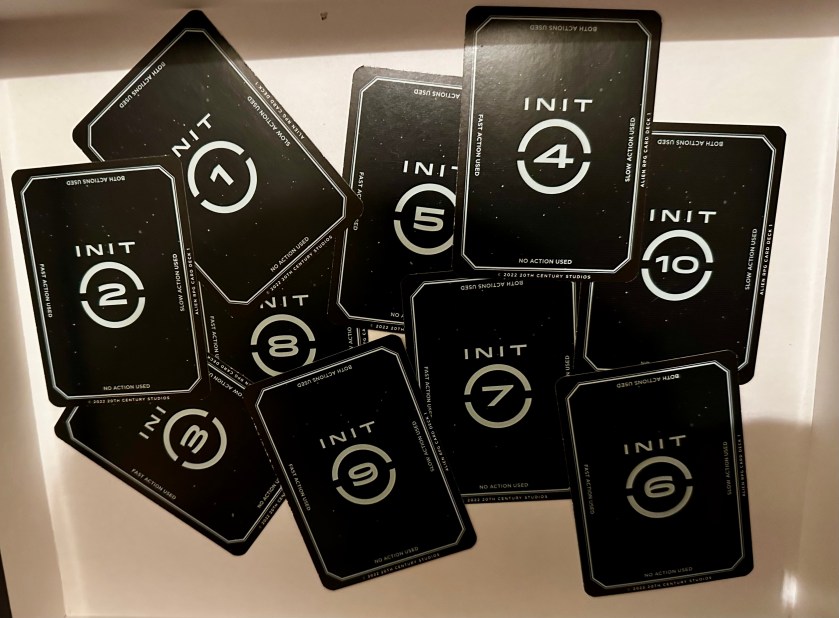
As for the rules. The main negative was the initiative system. Alien, like other Free League games, uses an initiative card system. We generally found it a little difficult to keep track of things using this and found it slowed the action down significantly. One of the main issues was that the PCs kept getting into initiative, running away from fights, getting out of initiative, getting caught again and getting into initiative again! So we were shuffling and picking those cards a lot. In fact, as time ran out on our session, I just left the cards to one side and did it narrative style. I got each player in turn to tell me what they were doing and told them how the Aliens or the environment reacted or acted against them. This really sped things up and drew the evening to a very exciting close, in fact. Would I use the initiative system as-is if I played again? I think I would give it a go as long as I had more time to play with but I would be ready to give up on it in a second if it started to get in the way again.

One more issue for me was the system used to figure out how the Aliens attack. Every time it’s their turn, the Game Mother has to roll on a table to determine which of their special attacks they use. This started off as a fun activity, but quickly got frustrating. It felt like each time the Alien had one of the PCs in their grasp, I would roll up an attack that allowed them the chance to escape. Now, if this happens a couple of times, it adds a nice dramatic element to the chase. But this is literally how they all managed to get away in the end. If I had been just choosing the attacks for the Aliens, there would not have been so many occupied seats on the shuttle when it took off. I feel like there is a better way to adjudicate the moves they make. Admittedly, you would not want every attack to be lethal, either, but it felt as though far too many of them were underpowered.

One element that worked well but felt like it was under-utilised or tacked on was the Stunt mechanic. Each skill had a stunt table that told you how you could spend your excess successes (each 6 you get when you roll your dice pool is a success and you gnerally only need one to succeed at your task,) but the players almost exclusively went for one of two options, at least in combat situations: they added extra damage or they pinned the enemy down to prevent them from taking as many actions on their next turn. This was fine but it feels like this needs more work. Perhaps the new edition will deal with this.

You know, there were plenty of mechanics we liked in the game too. The main mechanic in the Alien RPG, the thing you would lean on to sell the system, is Panic. Like other Year Zero Engine games, you roll a dice pool consisting of a number of dice equal to your score in a given skill plus the number of dice equal to your score in the related ability. So, if you have a 1 in Mobility and a 2 in Agility, you roll 3 dice. But, as you play, your character gains Stress for all sorts of awful reasons. For every point of Stress you gain, you get to add another die to every dice pool. This gives you a greater chance of success but also gives you a chance that you’ll have to roll on the Panic Table. This happens if you roll a facehugger (a 1) on the official Alien RPG Stress Dice. There are other ways of panicking. Usually, if one of your companions does something unhinged or crazy or if you see an Alien for the first time. That kind of thing. By the end of the session, everyone had so much Stress that they were rolling obscene numbers of dice and there were Panic rolls happening almost constantly. One Panic roll would often lead to another from someone else because of the result they would get. Also, because, each time you roll on the Panic table, you have to add your Stress Score to the roll and the shit at the bottom of the table is way worse than the shit at the top, the results got very bad as time went on. For example, this is what you get for rolling a 7 gets you:

NERVOUS TWITCH. Your STRESS LEVEL, and the STRESS LEVEL of all friendly PCs in SHORT range of you, increases by one.

This is what you get if you roll a 15+:

CATATONIC. You collapse to the floor and can’t talk or move, staring blankly into oblivion.

This did happen to one character but they were already at the shuttle at that stage and someone was able to drag them inside.

The feedback I got in stars and wishes from the session indicated that the players also loved the agendas they were given with their PCs. This was a worry for me before we started. I mean, not only did they not get to create their own characters, I didn’t even give them the choice of which one to pick. Obviously, this was because I didn’t want to reveal the secret agendas to everyone before play started. And I’m so glad I did it this way! Everyone had pretty much figured out who was the android in under an hour, but no-one, and I mean even me, because I forgot what the pilot’s agenda was, expected to be spaced by one of their own when they were on the verge of escape. Incredible scenes. This element of the game is specific to the short Cinematic Play scenarios. And, indeed, normally, in a full scenario, your PC’s agenda changes as you move through the three acts. I can’t account for how well this works, obviously, but it sounds great.

As for the scenario itself, there is not a lot to it. This is definitely a good thing. If you play it, you’re not going to get to most of the compound. A lot of those areas I summarised into bullet points remained completely unexplored. Once the drones were after them, the PCs soon discovered a sense of urgency and a definite goal, i.e. escaping on the shuttle. There was a bit more to it than that, but not much. Like I said, this was fine, especially as the PCs’ agendas took the place of a set plot most of the time anyway.

It was also cool that the scenario was so closely related to Aliens, the movie. I watched it the night before running the session, and that definitely helped me to picture the place and to describe it at the table. I’d recommend doing that if you do intend to run Hope’s Last Day. I’d also recommend leaving yourself at least four hours to do it justice.

So, was it a bad call? No, but if I went into it again, knowing what I know now, I would have made a few alterations to my expectations.

What about you, dear reader? Have you played this scenario or this RPG? Are you looking forward to the Alien Evolved Edition? Get in the comments?

Cosmic Dark: Assignment Report

Understanding the Assignment

What is the end goal of a game of weird space horror like Graham Walmsley’s Cosmic Dark? The answer seems obvious, I suppose. If you go to see a horror movie, you want to come out feeling like you got your money’s worth in spilled popcorn, whimpers, screams and nonodontgointhereyouidiots. So you should expect something similar from a game like this, right? Well, yes, of course. In fact, the rather ingenious conceit of a game like this, is that, knowing the style of play you’re looking for, as a player, you can go into it understanding what you can do to help push the themes, the jumps, the horror of it. There’s some strange, violet rock that appears to be moving? The character might be a geologist and know that it’s their job to go examine the rock, but the player knows they’re in a space horror game, which is why they should go and examine it. And this is pretty much how our one-shot of Cosmic Dark went last weekend.

But there’s more, of course, because let’s not forget the ‘Cosmic’ bit, the ‘weird’ bit. Because, although the body horror really hit hard at times, the dreamy (nightmarey maybe,) psychological horror felt all-encompassing. There is a section in the scenario that is aptly called “Dreaming and Waking.” Unpretentiously, it refers to the bizarre dreams the Employees experience during their first night on the assignment. It gave me more or less free rein to describe immersive dreams for the characters that related back to the answers they gave in psych evaluation questions earlier in the game. Of course, this served only to highlight the dreamlike atmosphere of everything on the assignment up to that point, in my opinion. Time was behaving differently, the rocks were undulating and growing, seemingly safe spaces were revealed to be anything but… The players and the characters were on edge, really from the start. And, thanks to the mechanics, they got closer and closer to that edge as the session went on.

Character Creation

We played the first Cosmic Dark Assignment, Extraction. Check out my preview blog post here, where I explain the way the players create their Employees as part of that scenario.

At the table, this went down a treat. Forcing players to choose their Employees’ specialisms only at the point where they are being asked to acknowledge over comms on the shuttle to the Assignment is clever and the players got a kick out of it.

But the real star of the show is the series of flashbacks they go through to get a picture of their characters. The flashback method creates memories, not just characters. The requirement for each PC to identify another as a rival or a figure of admiration or some other influence, and to include them in the flashback scenes, creates a shared history and a character dynamic that you simply can’t conjure from dry discussions over a character sheet. If you have played any PBTA games, dear reader, you might be aware that they usually include a section for bonds with other PCs. You and the other PC have to come up with some reason why you are blood-brothers or why you’re worried about the other’s survival or why you had a vision about them. But you do not act it out. You don’t, at least in my experience, role-play a scene together to elucidate the reason for the bond. That’s exactly what you do in Cosmic Dark. In fact, each player has a scene of their own and may choose any of the other characters to share it with. These scenes are supposed to be short, just a minute or two, but long enough for them to find their characters’ voices, outlooks, relationships. And the Director (GM) provides prompts to kick-start these scenes. The players are given a line of dialogue for one of them to say to begin. I was skeptical about how well this could work at a table of regular players. Up until now, I have only seen it done at a table of professional actors on Ain’t Slayed Nobody. But I needn’t have worried. Every one of my players took that single line of dialogue like the baton it was, and ran with it, inventing hurdles, falling and picking themselves up again. And the table I had? Four players with a wonderful mix of experience levels, some who have played a variety of RPGs for years, one with just a few months of play under their belts with Tables and Tales and even one for whom it was their very first role playing experience!

The aspect of character creation (it’s one of the parts that is ongoing throughout the game from what I understand) that I had a little difficulty in running and incorporating as intended is the psychological assessment. There is a moment, that also occurs in flashback, the night before the Assignment, when they are lying in their sleeping pods on the Extracsa transport vessel, the Exchange, and they are asked questions like “what scares you most about being alone?” Or “what is the most terrifying way to die?” You are supposed to. Push the PCs to answer truthfully, indicating that Extracsa will know if they are lying. This part was ok, actually. I was able to get some revealing and actionable answers from them. It was the re-incorporation of the answers into the later dream sequence that I struggled with. The idea is that you should take note of the PCs’ fears and worries so that you can create a tailored nightmare for them during the Dreaming and Waking section I mentioned above. I think this is something I would get better at in time and with practice. The main issue I had was just referring to my own notes and making sure I got the right nightmare for the right Employees in a way that made it feel like it flowed naturally.

The Assignment itself

I don’t want to go into too much detail here. Honestly, I could not do it justice. Go and listen to the Ain’t Slayed Nobody actual play instead!

But here’s what I will say. I presented an outline of the type of game Cosmic Dark was when I advertised it on our Discord. But I think there was still some misapprehension by the time we started playing. The main feedback I got in this respect was that they expected something more along the lines of physical threats. I believe this is, perhaps, the overriding influence of the Alien franchise. I did refer to Alien in the touchstones I mentioned when announcing the game, so that could explain it. There is nothing like an alien monster in this first Assignment. In fact, as they played through the scenario and uncovered one egregious corporate scheme and strategic lie after another, I think it became obvious that Extracsa are the real baddies here. And, it’s not like there aren’t ways for the Employees to die in the course of the Assignment (we had one death, caused mainly by the Team Leader hitting 6 Changed as he escaped. He flipped the rover he was driving.) And they felt as though they were in danger, clearly. As their Changed scores each hit 4 or 5 (out of 6) they all decided to run away! They witnessed what was in the future for them on this asteroid, a slow and horrific melding with the rock of the place, and they noped out of there before they even reached the finalé! Anyway, if I had any advice for prospective Directors, it would be to make sure you properly set expectations.

How about the scenario itself? So, I only had the text of the Extraction Assignment to work with. Now, this was fine. The rules are contained within it and the character creation occurs during the course of play, as I explained above. However, in the finished book, there will be useful extras to refer to. For instance, if and when an Employee rolls a 5, they are supposed to get a little bonus in the form of records, data from the Extracsa company servers that serve to shine a light on the mystery or, at least, show them how Extracsa is fucking them over. On the roll of a 6, they are supposed to experience an anomaly of some sort. Anomalies are supposed to alert them to the weirdness of the place or the situation or have a direct psychological effect that might prompt a Changed roll. Now, there are a few examples of appropriate records and anomalies in the scenario but the rest will be contained in cheat sheets that will appear in the final Cosmic Dark book. To fill this gap, I listened to the ASN actual play again and made a note of the records and anomalies Graham used in that.

The other thing I picked up in particular from Graham was the style of GMing he does in that AP. He keeps it light and breezy mainly, gently encouraging players to take unnecessary risks, reminding them about the Changed die, reassuring them that that little prick from that piece of weird violet rock is probably nothing to worry about… until the point where he informs them all they need to do to reduce their Changed score is remove that pesky limb… Listen and learn, dear reader! It worked a treat at the table!

As for the rules, I had one regret here. The rules are very light and easy to pick up, but, this opening Assignment is designed to introduce the rules in a specific order to ease the players into them. And it does a great job of that. The Changed die is the first thing that comes up, then investigation rolls and other types of actions. But I forgot to introduce the re-roll mechanic when I should have, thereby allowing the Employees a chance both to do better on certain checks and to increase their Changed score earlier on.

Conclusion

All in all, I highly recommend this game. I want to play more of it. I wanted to play more almost immediately. But I think my experience will be greatly improved by getting my hands on the full book. So, let’s make sure I can, shall we? Go and sign up for an alert on the Cosmic Dark Kickstarter!

Cosmic Dark

Ain’t Slayed Nobody

I have been a fan of the Ain’t Slayed Nobody podcast for as long as it’s been around. They launched back in 2020, right at the outset of the pandemic, which was a creative miracle in and of itself. The podcast, which started out as a Call of Cthulhu actual play, is the brainchild of Cuppycup. He started out running a few of his friends through a Down Darker Trails campaign. That’s the Old West setting for Call of Cthulhu. Apparently, not only was this the first time he had acted as Keeper, it was his first time playing any RPG! Go and listen to those early episodes now and I think you would be hard pushed to detect that level of inexperience. It was a fun listen too! The production quality has been consistently high from the beginning but the players and the laughs really make it.

Since then, ASN has had a rotating cast of players and characters in a range of short campaigns and one-shots. They have branched out with regards to systems too. They had a classic short run of Blade Runner, where cuppycup ran Electric Dreams, the case file from the Blade Runner Starter Set. Listening to this made me want to run it myself. This one had a great cast too: Ross Bryant, Nic Rosenberg and Danny Scott played the blade runners. Since then, both Ross and Nic have become regulars in the cast. I highly recommend this series, especially if you’re interested in running Blade Runner, the RPG.

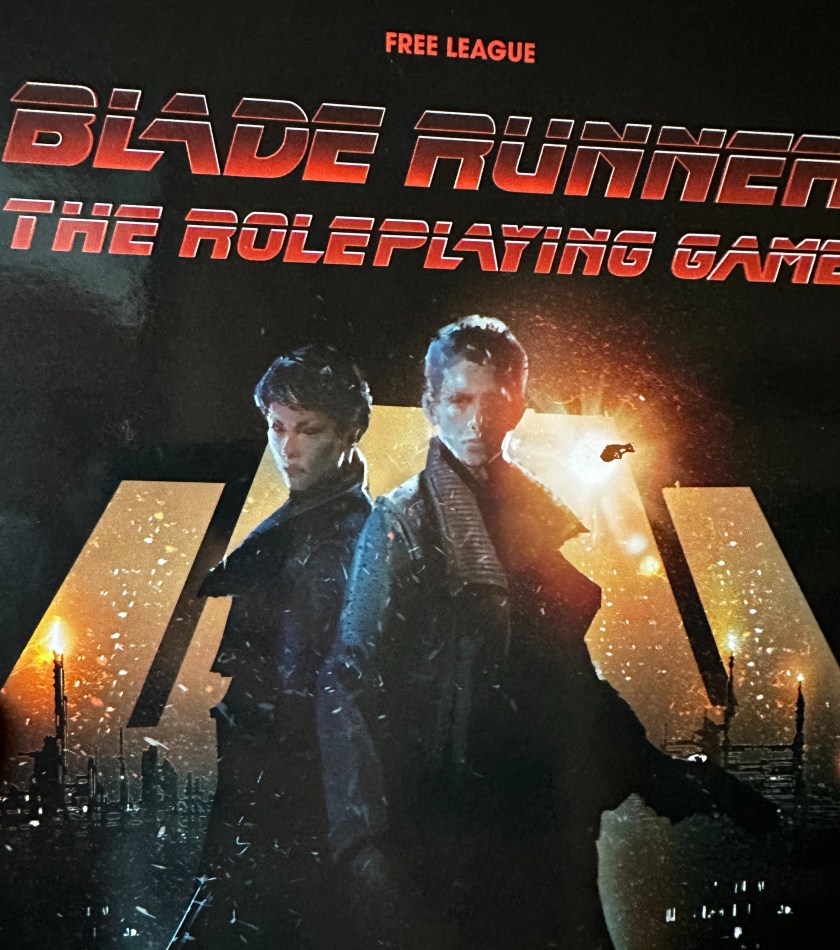
Two blade runners posing like neon noir heroes in front of a stylised Wallace Corp ziggurat beneath the title of the Blade Runner Role Playing Game.
A photo of the front of my copy of the Blade Runner Start Set box.

Another regular, Scott Dorward, is a renowned podcaster and game designer in his own right. His long-running show, The Good Friends of Jackson Elias is well worth a listen. When he first ran a game for Ain’t Slayed Nobody, it was his own Cthulhu Dark scenario, Fairyland. This was really the first time I had been exposed to Cthulhu Dark as a system. The impossible lightness of the rules and the effortless creepiness that Scott brought to it drew me in. I eventually did get to run Cthulhu Dark myself last halloween, though it was a different scenario.

Darker Still

Recently, Ain’t Slayed have piqued my interest yet again. This time, it’s with another game from Cthulhu Dark creator, Graham Walmsley, Cosmic Dark. Graham is the Director for this campaign too, in fact.

Cosmic Dark is a game of weird space horror that is Graham’s commentary on the times we live in, according to him. The PCs all work for an interstellar corporation called Extracsa. I feel like the name does a lot of the heavy lifting in conveying the type of company we’re talking about here. Each assignment is completed in an episode or two, which is very satisfying, but the characters do continue through the series, except when things go really wrong for them.

What have I liked about it so far?

The heavily anti-capitalist horror aspect is compelling to me at this point of my life and of human history. The themes and events of the game, despite taking place in some unknown future in space and on alien worlds, feel all too real, far too possible.

I love the character creation method. You don’t start this game by writing up a character sheet, you don’t even come up with a name or occupation like you might in Cthulhu Dark. No, you dive straight in:

This is the Extracsa transport ship. You are descending to the surface of C-151.
Medical officer, please acknowledge.

The first scenario asks the Director to read this to the players and then tells them to wait for one of them to respond. That player is then the Medical Officer. This continues until all players have chosen an Employee Specialism. You then continue with a quick overview of the very light rules before delving into a series of flashbacks from the PCs’ childhoods using prompts to sketch the sort of characters that you need for this game. It’s an ingenious method and extremely fun to listen to people improvise on the spot. And it doesn’t stop there. Character creation continues throughout the character’s Extracsa career, usually in the shape of flashbacks to their lives before their current job.

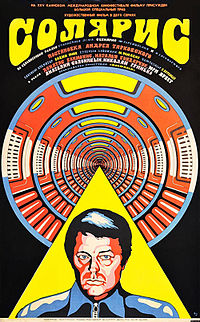
The scenarios themselves are weird and scary and psychologically affecting. They deal with things like the reliablity (or otherwise) of your own memory, machines treating humans like infestations, and, honestly, just good old-fashioned space madness in the best traditions of things like Solaris.

By The cover art can or could be obtained from MoviePosterDB or Goodtimes Enterprises, Fair use, https://en.wikipedia.org/w/index.php?curid=5075880

So, I joined Graham’s Patreon. Doing that got me access to the early versions of the rules for the game and the scenarios that have been written so far. I’m hoping to get a group together to play it in a couple of weeks.

Listening to this series gets me excited to play Cosmic Dark. As a lover of weird space fiction, it is exactly up my alley. And it is very different to the other games I am running at that moment, so it will make a nice change.

One last thing, Graham will be launching Cosmic Dark on Kickstarter soon! If you want to support the project you should follow it here!

Flash Fiction Challenge Week 2: Securing Destiny

Bloggies News

A couple of things before I get to this week’s flash. If you read my last post, you’ll know that thedicepool.com was up for a Bloggie for best debut blog of 2024 in the TTRPG space. To those who voted for me, thanks so much! Your support means a lot. It honestly motivates me to keep working on this site and it’s obviously nice to know that someone enjoys what I write. Unfortunately, it was not to be. Murkmail won by a country mile, and deservedly so. You should go check out their blog. I came in seventh place, lower than I’d hoped but higher than I expected. For the full results, here’s a link to sachagoat’s blog. While you’re there, go and vote in the current round! It’s the Advice category right now and it’s down to the last 8 entries. They are all well worth your time to read if you’re interested in RPGs.

I redecorated

There were a few things missing from the very minimalist theme I was using. I really always wanted a sidebar. Maybe I’m just old-fashioned. Anyway, I switched themes so I could have one. I like it because I can keep useful stuff there, like my archives, lists of categories and tags, a blogroll of other blogs that I like or am subscribed to. That sort of thing. What do you think of the new look, dear reader?

Week 2

This one started with my head in a very contemporary office space and ended with something in a much more far future space space, if you know what I mean. I gave this a bit more time than the last one, but I’m not convinced it’s better for it. I’m happy with the plot I got in there and even the level of character development, but I’m not as satisfied with the quality of the writing. Here are the random words I challenged myself to fit into this 500 word piece:

Nouns

measurement
consequence
desk
winner
employer

Verbs

echo
influence
enquire
mix
pin

Securing Destiny

by Ronan McNamee

“Let’s put a pin in that.” Mr Grogan locked eyes with Terry and dared him to voice another concern. Terry, shook, broke first. “And move on to the next item, shall we?” Timpani thundering in his ears, Terry inhaled through his one unblocked nostril. A trick of his Mum’s, to calm him. The meeting continued, the others focusing on Grogan’s drone. Terry exhaled through an o. His pressure regulated with the cabin’s.

Why? His ghostly face, reflected in the void-dark porthole by his desk, echoed his confusion. Why had he opened his mouth? If his employer worried about the security of the life-support system, he’d have addressed it. Right? His mum beamed at him from her little holo-plinth. She winked conspiratorially. Secrets were her strength. She always said, say nothing and let the fools sing. Good advice, he always thought. So why had he ignored it today? To reassure himself that he wasn’t paranoid, he re-checked the firewall. There: a weakness. A hacker would need to know what they were seeking, but, surely, a weakness is a weakness. The consequences of such a key ship system being compromised defied measurement. Catastrophic.

Maybe Mr Grogan hadn’t wanted it discussed openly at the stand-up. Terry mixed up a lunchtime bowl of blue kibble on the mezzanine, and nodded. Made sense. But why? Security reasons? The other staff were trusted. Too distracting? It was a serious issue. So why? There was his mum again, with one of her sayings. Who stands to gain from it? Grogan? A play for control? Would he gamble with the lives of everyone aboard the Destiny? Did he think he could come out of that eventuality a winner?

Terry overthought everything. Everyone said so. He was pushed to enquire, he struggled to come to decisions, he had a tendency to catastrophise. Of course he did. Every scenario ended in catastrophe on a long enough time-line. That’s why his job was security for the engineering crew. It was why he was trusted, too. He took that trust seriously. Over a thousand souls depended on him.

In the depths of the ship, later, doing his rounds, Terry still debated his options. Grogan found him there, wiped his upper lip and drew close. “I know you think it’s me,” he had to shout his secret over the din down there, “the captain says there’s too many mouths to feed. Wants an… accident. She has… influence over me.” Terry nodded. He had heard rumours about Grogan’s indiscretions. The man sweated before him now in the greasy, red dullness. Terry told him he wouldn’t open his mouth.

Terry stayed late. Got in the back way through the firewall exploit. He selected the captain’s quarters and Grogan’s. Glanced at his mum before hitting EXECUTE. When he took the job, he told her he worried about this sort of situation arising. She’d said, if they don’t deserve your trust, then they don’t deserve Destiny. He tapped the button and listened for the klaxon.

Next week’s words

Random nouns and random verbs to attract those muses.

Next week’s nouns

expenditure
entertain
tablet
morsel
leader

Next week’s verbs

announce
stand
reverse
sue
decline

Please do let me know if you have been writing along with me, dear reader. I’m going to do this anyway, but misery loves company and all that.

Flash Fiction Challenge: Habitant 1306

Week 1

Predictably, I spent absolutely no time thinking about this challenge until yesterday and then I knocked out the five hundred words in an evening. No matter how I did it, though, I have a sense of accomplishment. It’s been such a long time since I wrote for the pleasure of it, I forgot what it was like. That slow unfurling of the story in my mind, the careful (or not so careful) selection of the words, the freedom to make it what it wants to be. I enjoyed it.

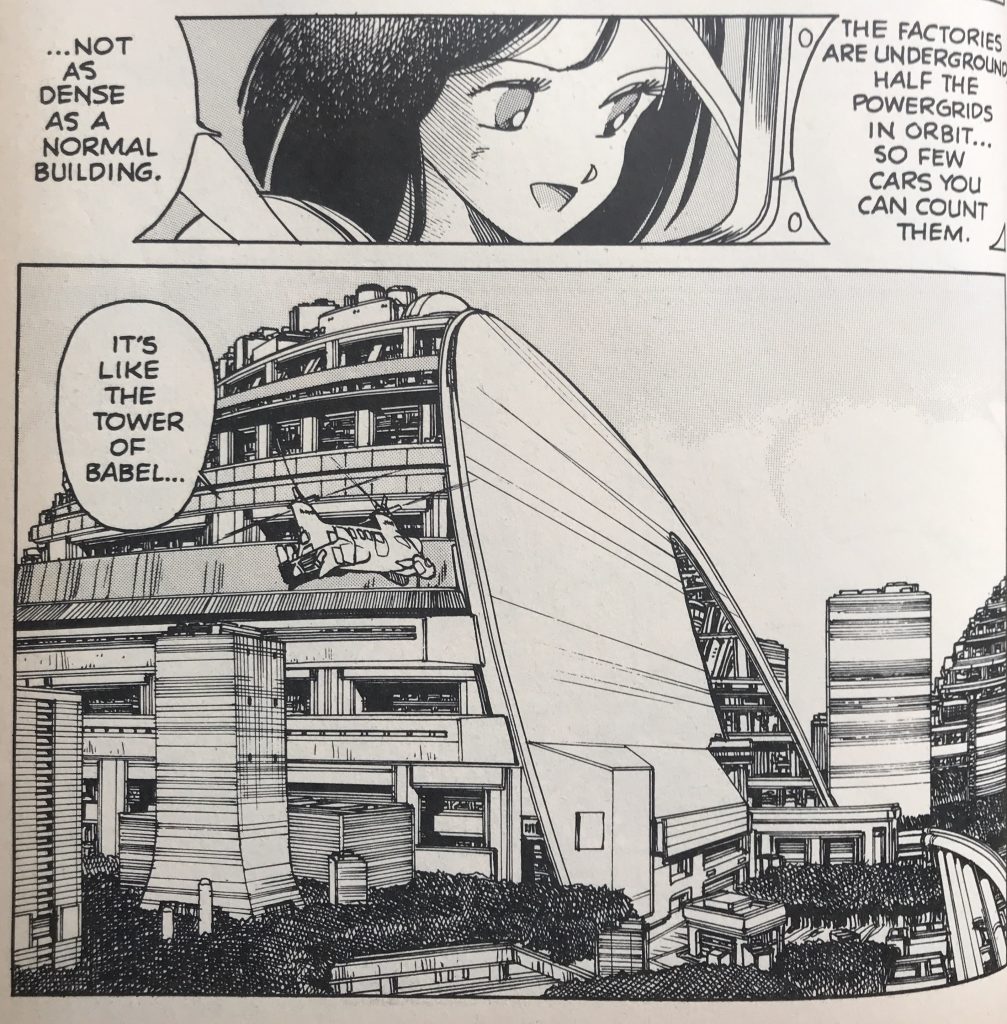
Anyway, the random words certainly helped get me started in this case. I had some images from other media in the forefront of my mind as I wrote. Aveena, the holographic assistant from the Citadel in the Mass Effect games was the first thing. But instead of a mysterious space station, it was the assistant for something like the arcologies in Appleseed, a manga that I read more than 30 years ago. I remember almost nothing about it except for the arcologies, which I thought were a pretty cool concept. Habitant 1306 is the result. Here’s the list of the random words that I managed to fit into it first.

Nouns

Development
Surgery
Union
Shopping
System

Verbs

Execute
Finish
Approve
Undertake
Take

Habitant 1306

By Ronan McNamee

“The System is here to fulfil all of your needs, Habitant 1306.” The hologram flickered and flashed, blinding me momentarily. Why had it designated me Habitant 1306? I thumbed my eyes and walked on past it. It felt like a haunting, but not the one I would want. The vastness of the Development’s central atrium bloomed around me, twilit and dripping. I pulled Aunty’s scarf tight.

Maybe it knew me? The cracked and mossy statue of a habitant, gaily swinging their shopping bags winked at me, I’m certain. Did the statue know me too, somehow? Spiders crawled up my spine. I whipped about but caught only the brief flicker of the hologram, awaiting the next habitant. It might wait forever.

What if it mistook me for someone else? Perhaps Habitant 1306 looked like me. What if 1306 was the designation, not just of habitant, but also habitation? An “i” towered, gallingly tall, above a booth, hunkered between ATM and escalator. A gentle glow beneath an encrustation of grime drew me in. With a wipe I discovered a map on a screen. Below, the development delved deep. Caverns occupied by industry, commerce, leisure. Above me, the habitations stretched high into the night sky.

Developers had undertaken the doomed project; the union of all aspects of life in a System-governed space. Self-sustaining, self-regulating, self-populating… 1306 was far above. There were elevators but I didn’t trust them not to take me where they wanted. A stairwell, housed in a tall glass tube, spiralled into the heavens. I stretched, knowing Aunty would approve, and started the climb. Every few landings, a gap in the Development’s titanic cladding allowed the Free City streets to shine out below. My home, where Aunty found me as a nipper, clad in my birthday suit, exploring, unworried and unhurried, she told me.

13 sounds doable, but each floor encompasses cities. Peach streaked the horizon as I finished with the stairs. 06 was on a low inter-level. The halls’ walls and ceilings had partially collapsed. Utility cabling and piping barricaded the way. The Development’s arteries blocking my path to the heart. I had surgery to perform. I hefted my idle crowbar and scrubbed in.

Shocked, soaked and stinking, I left the patient bleeding behind me, crawling to the end of the hall. Forty winks, Aunty found me. She scowled with that smile hiding behind. Only ever in the electrified darkness inside my eyelids, these days. I thumbed my eyes to clear them again, rose and stretched.

1306 said the door. “Everyone left you,” I said to the Development or the door, maybe. Touched, it swung sullenly open. Illumination blossomed. It was a home. Unobtrusive conveniences skulked, observing my steps. But still, a sort of habitation to be sure.

A closet? Located dead-centre, it buzzed and gurgled. Inside was a tall mirror. No, I switched the light on and saw me, in my birthday suit, watching Aunty. The pink water bubbled. A single word question blinked on the tank’s surface, “Execute?”

Next week’s words

And here are the random words generated for next week’s challenge.

Next week’s nouns

measurement
consequence
desk
winner
employer

Next week’s verbs

echo
influence
enquire
mix
pin

I’d love to hear from you if you took part in the challenge this week, dear reader, or if you wrote anything you’re satisfied with in the last few days, even. Get in the comments!

Flash Fiction: The Hunt

New year, old fiction

Happy new year, dear reader! I hope your 2025 is better than the year just passed. And thanks for your occasional glance at my humble blog in the last few months. If you are new here, although the dice pool dot com is normally an RPG-related blog, I also like to sometimes share the short and long form fiction that I have produced over the years. Since I have a splitting headache today and not much in the way of good ideas for original blogposts, it seemed like a good opportunity to post this piece of flash fiction. It’s exactly 500 words and came out of some randomly generated nouns and verbs as an exercise a few years ago. I hope you enjoy it.

The Hunt

by Ronan McNamee

I always think of my ambition as the gun I bring on a hunt. Continuing the analogy; job interviews, important proposals and meetings are everyday hunting expeditions.
But on today’s safari, we’re after really big game.

There he is, the prize: Dr Khan. I’ll call him the Great White Rhinoceros; I’m going to mount his head on the wall of my soon to be much larger corner-office. He is just as I pictured, minus the pocket protector; an irredeemable nerd; nervous,
slightly slovenly, side-parting.

My smile and greeting are genuine. I have never been so happy to meet anyone, to be staring down my sights at such a magnificent beast. My trigger finger twitches and I almost shoot early! He had been explaining his discovery, and I interrupted
like a rookie.

I check that my gun is correctly loaded and resume ambush position. He continues his boring explanation. I do glean a little important information, though. The
product he just developed, the product he is just about to sell to my company, enables the user not just to experience the world from the perspective of a bird or a tortoise or a duck-billed platypus, but to live it. No mere virtual reality headset, this.
This invention of Dr Khan’s will revolutionise humanity’s understanding of the natural world by literally allowing its users to become a part of it. It will also make my
company a metric shit-tonne of cash.

His explanations and interminable techno-babble proceed unabated for the entire walk through the university Physics Department until we are in his lab. I continue to nod and make the right noises. The hands holding my gun are becoming sweaty and my patience with the Great White Rhinoceros grows thin.

He stops talking, I level the barrel at him and fire.

I assure him that we would never try to influence him to use his invention for any purpose but the one it was meant for. I convince him we share his values; the welfare of animals, the preservation of Mother Earth, yadda, yadda, yadda. I watch the smile creep across his face when I mention remuneration, a seven figure sum. He nods excitedly. He shakes my hand as I wonder what to carve into that wonderful, big hunk of ivory.

Khan leaves me in the lab as he rushes off to spread the good news to his trophy team. I receive a text. Unknown number. “I’ve seen you on Facebook with that elephant’s corpse,” it reads.

My gun clatters to the red dirt of the savannah. I hear the door being locked. I rise and approach the window to the next room. The Great White Rhinoceros is in there. His finger is poised on a button. His phone is in his other hand. I receive another
text: “Time for you to see how it feels.” He pushes the button.

I run and run and hide, heart hammering, legs aching, tail bleeding. Another gunshot. I bleed.

Flash Fiction: Anthropology

Funerals

I used to have a hard time keeping a straight face at funerals. When I was young, the only kinds of funeral ceremonies I ever attended were Catholic ones. They are almost entirely devoid of light-hearted or even poignant moments, in my experience. Instead, such occasions are concerned mostly with priests warning you about the danger your immortal soul is in if you continue your sinful ways and telling you about Jesus. Anyway, the build-up of emotion caused by this unsatisfactory vehicle for sending off your loved one would inevitably explode in titters and giggles over silly little things. So this story is about, what if a time-traveler from a future free of permanent death attended a funeral like that? Without the necessary context? What would they think? Also, what if it was an assignment for an anthropology class?

Flash Fiction: Anthropology

By Ronan McNamee

Attendance at a funeral was felt to be the ideal introduction to a society. It was a shock, that’s what it was. Why did the man in the robes spend so much time talking about this Jesus fellow? I thought the death-victim’s name was Gary. Why did everyone keep sitting and standing and kneeling? Why was no-one attempting to revive the deceased? I honestly felt as though I should intervene when I realised they had locked the poor man in a little box. Call a Reviv Team!

When they informed us all we were to proceed to the graveyard outside the pointy building I grew truly scared. They intended to bury the poor man! Perhaps he had been a criminal; perhaps this was his punishment. What sort of crime could warrant such barbaric cruelty, though? How could these people (some of them
called themselves Gary’s family for crying out loud!) sustain such a desire for vengeance once the man had already died. He must have been a terrible dictator or CEO of some kind, like Aldorf Hipler or Donal Drumpf? Perhaps he deserved it?
Outside, I discovered many marked graves. By the dates of death many of the incarcerated had been buried for decades. Far past their sell-by dates; no chance of reviving them anymore. I felt sick. I gave my left clavicle a rub to release some Calm. I relaxed and smiled at the woman next to me. “Did he steal something valuable?” I asked her as we shuffled together out of the pointy building into the rain. Her eyes, previously quivering with sympathy and sadness, turned hard and grey, her mouth drooped and she shook her head, turning to speak to the man beside her.

“What did you say to my wife?” said the tall, shiny-headed man to me. I looked to either side but he was definitely looking at me. I pointed at myself. He glared, tears streaking his face.
“What did you say about Gary?”
“I simply wished to understand his crime,” I wished I had read the preparatory pamphlet before I got myself into this.
“Crime?! You little toerag,” said the man lunging at my face with his fist, his fist! I had been struck by a human being at a funeral. I felt that I was beginning to understand the culture. It was one of violence and vengeance and lies.
“I just wanted to understand this funeral ritual!” I screamed. I feared for my own life now. The bald man was gaining allies from the crowd of brutes collected there by the graveyard.
“Understand it? I’ll give you one of your own, you fucker!” I turned and ran down the lane with the mob following. I rounded a corner and whispered, out of breath and scared witless, “Return, please, please please, Return.

And here I am, making this report to you.
What do you mean, failed? You can’t fail me for that! They were out for blood! Unfair test!