Zero Prep
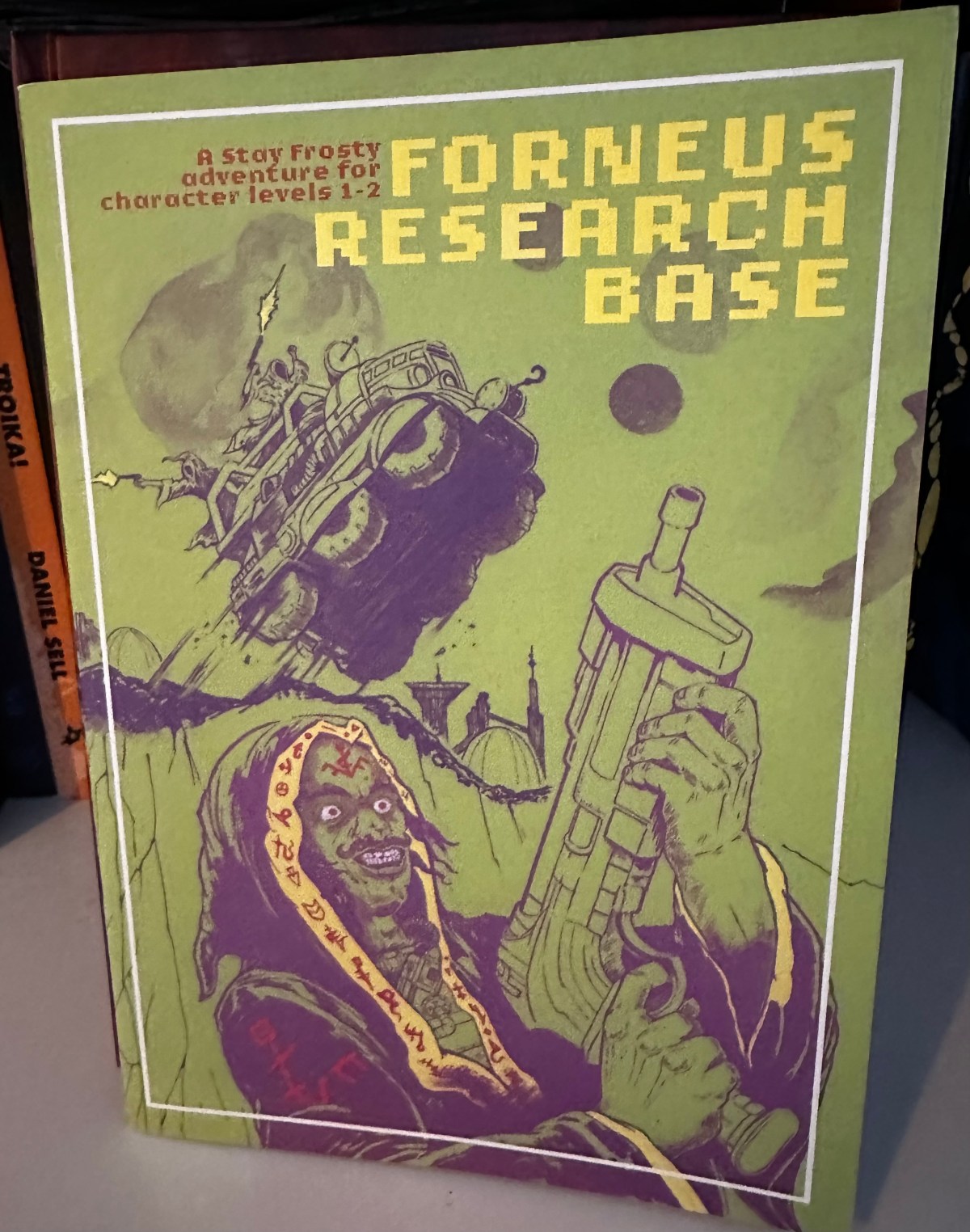
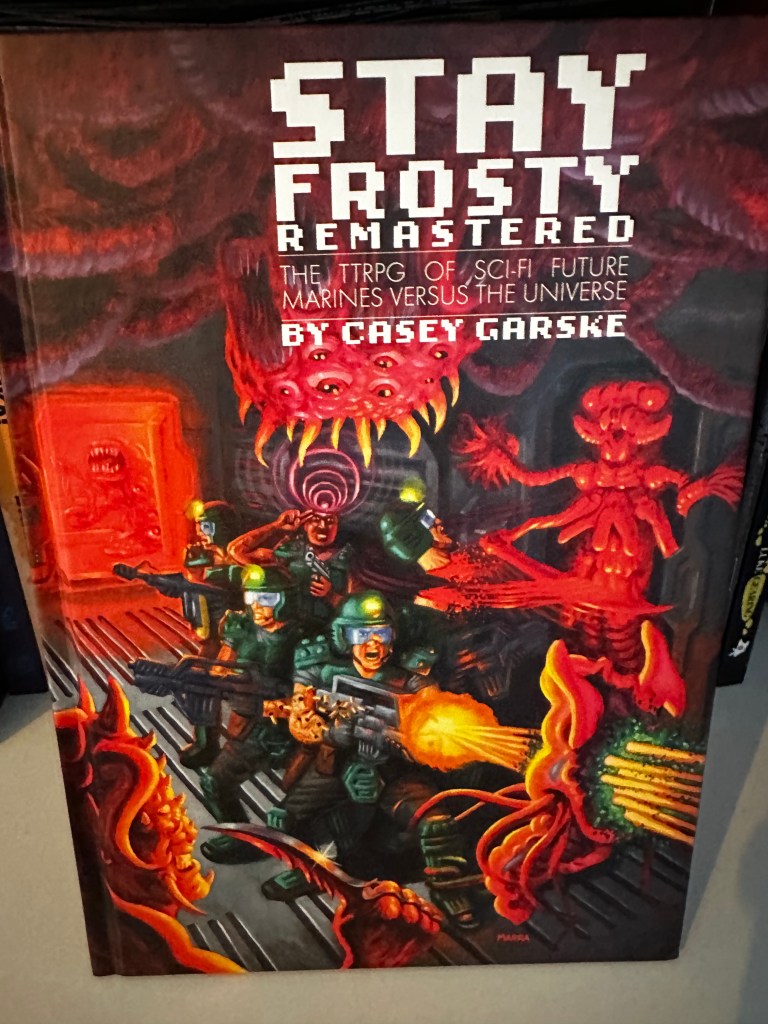
It’s the dream, wouldn’t you say, dear reader? Pick up and play. Many claim it, few deliver. One thing I’ll say about this Stay Frosty adventure, and, to be fair, any Stay Frosty adventure I’ve read (which isn’t many,) is that you can pick it up and play it with pretty much no preparation. I mean, that goes for Stay Frosty to a certain extent too. I discovered that when I reviewed the game itself last October.
But, of course, zero prep is not all you might want from an adventure. In fact, for some GMs, prep is as much fun as play. So what else has Andrew Walter’s Forneus Research Base got going for it?
Well, Tom, Isaac and I played it over the space of three sessions recently. In fact, we just finished it the other night. I have thoughts.
Action
There’s no fucking around with Stay Frosty, no long opening scene to allow for introductions of our characters, just a short summary for the PCs, of what they’re doing out there in space and an immediate crash landing at the eponymous Research Base. Oh, the crash landing was caused by black ooze exploding from the controls of their shuttle btw.
As I stated, there is a short read-aloud piece of text at the start. It explains that the PCs are private marines, employed by the United Universal Corporation to check in on its research colonies. As they are doing this, they are forced to crash land.
As I said, Stay Frosty is not really interested in your PCs feelings, unless they involve terror or going apeshit. At no point is anyone encouraged to take a moment to express their concern for their fellow marines or, for that matter, the colonists they were supposedly there to protect. This is a DOOM simulator. The PCs are there to shoot shotguns and blow up demons. And Forneus Research Base is all action from the get-go.
As soon as they emerged from the wreckage, the PCs realised they were not going to be able to take off again without significant work on the shuttle, so they decided to make their way to the base. Meanwhile, I’m rolling the Danger Die every time they move from one location to another, take a look around or stop to think, as intended by the rules. The Danger Die works a bit like a random encounter table. You roll a d6 and the result will give you one of the following:
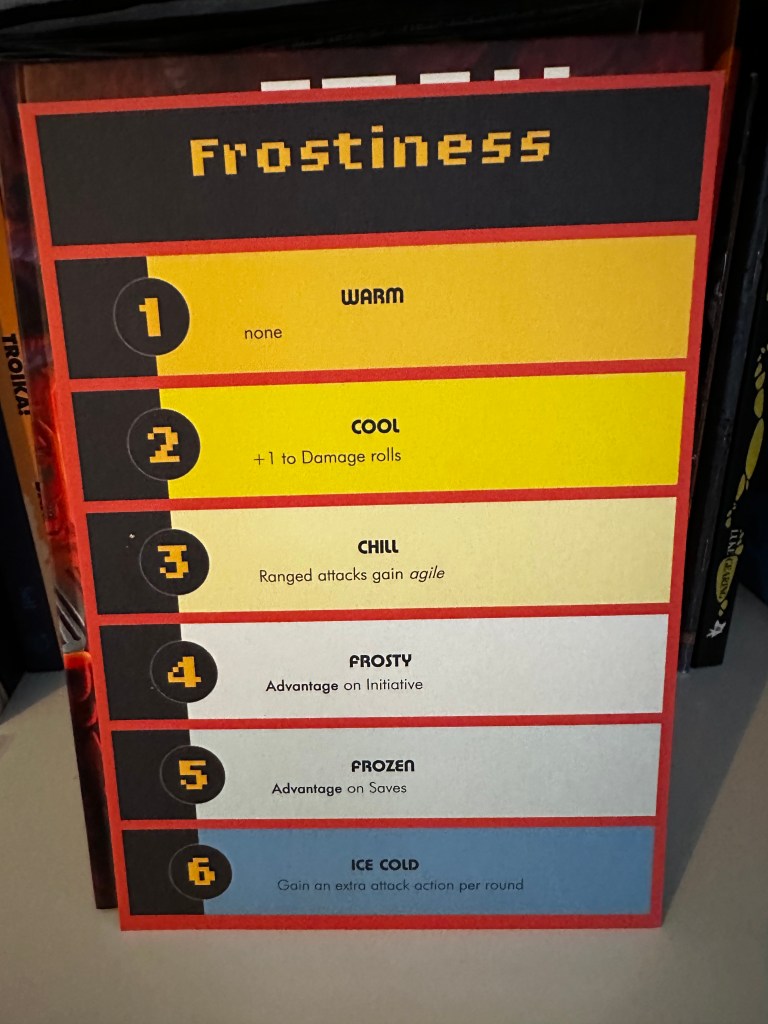
- Encounter and Stress – i.e. roll on the relevant encounter table. Forneus has one table for the moon’s surface and one for inside the base. Stress is added to the PCs to build Tension. Tension also equals Frostiness. They higher the Frostiness level the better as it gives PCs bonuses like advantage on initiative and even extra attacks. But Tension can also explode. See below for more on that.
- In dangerous areas, Encounter, otherwise, Environment – Forneus has its own Environment table also. But this didn’t come up too often, to be honest.
- Environment – as above
- Stress – see point 1
- Entropy – for some reason, I rolled this one a lot and it had no effect. It’s only relevant if the PCs are using a thing constantly that has its own Supply die. For instance, if they are using Combat Drugs or Fuel when they’re driving a vehicle. The idea is that when Entropy is rolled, the Supply Die for that thing goes down to the next lowest die size. But whenever this was rolled, they had nothing to decrease.
- TENSION EXPLODES! – Only rolled this once. The idea here is that when this comes up, the PCs make a Willpower Save. If they succeed, they get to reduce their Tension by one. If they fail though, they take Tension x level damage and reduce their Tension to 1. Then they roll on the Going Apeshit table if their HP are reduced to 0 by the damage. The effects of this can be anything from getting Advantage on damage rolls but constantly rolling your Ammo Die (like a Supply Die for your weapons,) to Last Stand: going down mano-a-mano with your enemies. I actually adjudicated this mechanic incorrectly at the table. I didn’t allow them the Willpower Save, I just rolled the Tension damage and gave it to every PC. Also, this damage is not supposed to be applied to attribute scores when all HP are gone, as normal damage is. Only one PC had to roll on the Going Apeshit table. She ran for her goddamn life and they had to manacle her to the ATV to stop her.
(I only just realised I was calling this the Doom Die the whole way through our game. Oops.)
The Danger Die is the mechanic that really keeps things interesting in Stay Frosty. Many of the locations in the Forneus Research Base, for instance, have no pre-written encounters or much of interest at all, so the random encounters, environmental hazards and ratcheting Tension from the Danger Die are doing a lot of the work. This works fairly successfully but I found I was rolling up Encounters a lot, since a third of the possible Danger Die results give you one most of the time, and after a certain event in Forneus, you actually get Encounters on a roll of 1 to 3. So the marines were drifting from one Encounter to another with only cursory exploration in between.
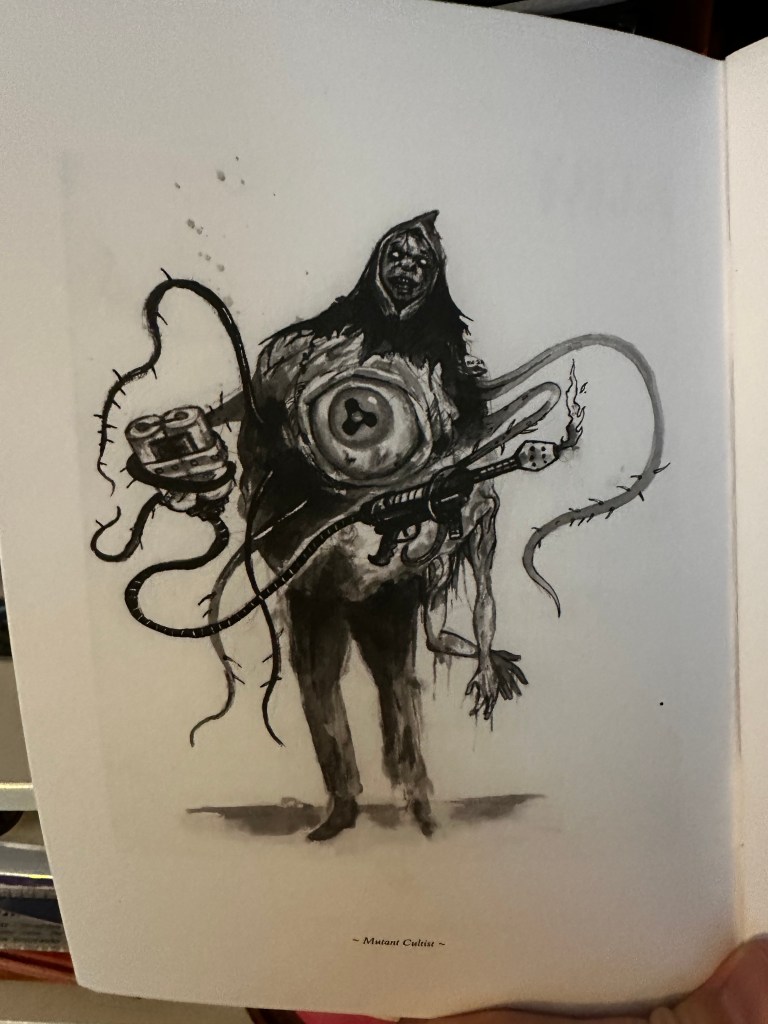
At least the variety of enemies is suitably gristly, demonic and fun. You have the obvious demons, like the Black Leathery Imps, that used poison to make their enemies fire on each other. Then you have the basic cultists who just have guns, the mutated cultists who have been transformed to allow them to fly with their fiendish lord Xithrabla through the cosmos, sucking from his hellish teats and the Centiservitor who is a cultist combined with a centipede with a plasma cannon in its chest. On top of that you have the real horrors like the Cadaverous Persecutor, a giant cyborg corpse with a rocket launcher, and the Fledgeling Pest (The Final Boss,) a sickening, enormous baby’s head with a partially exposed brain and a vicious bite.
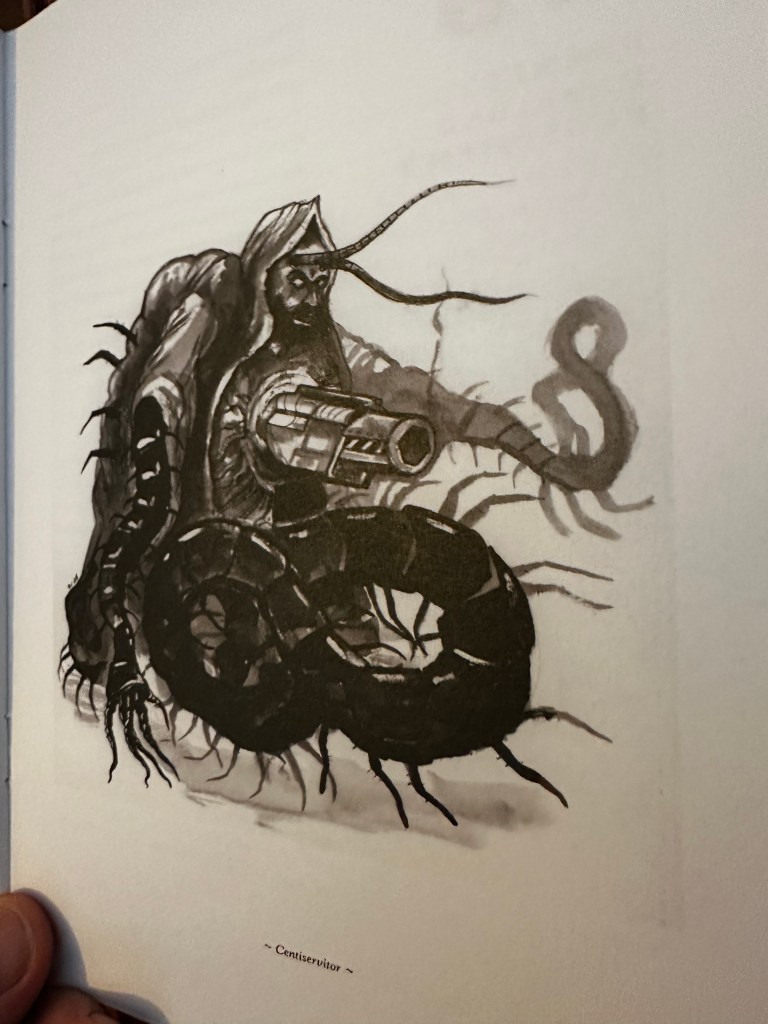
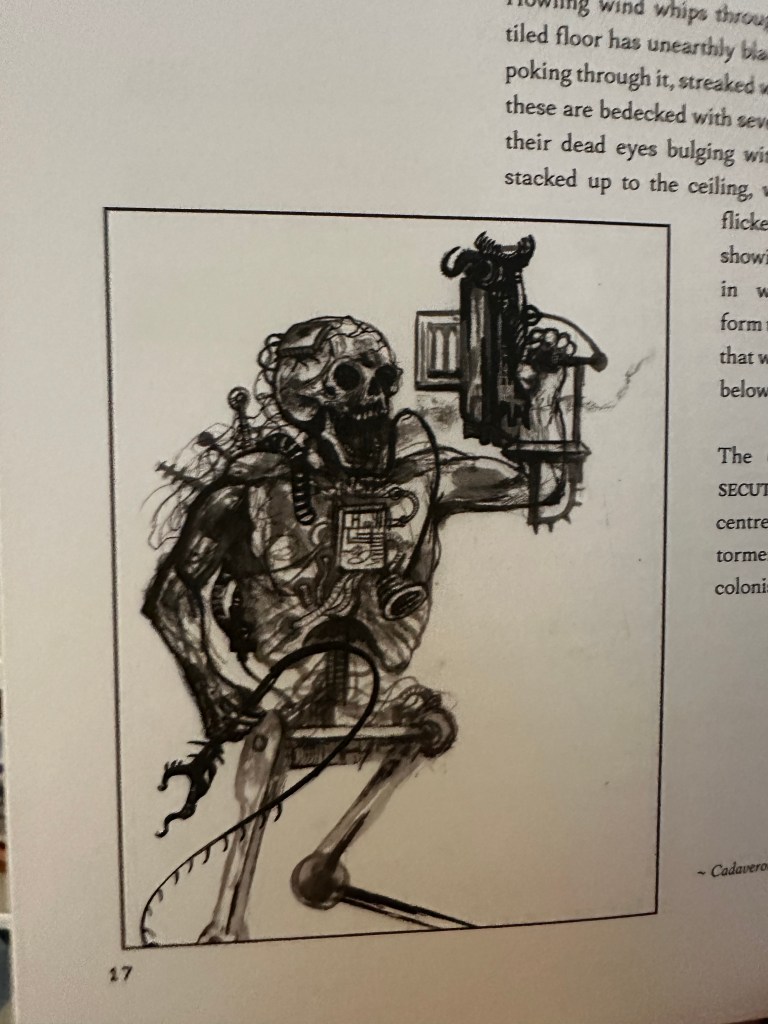
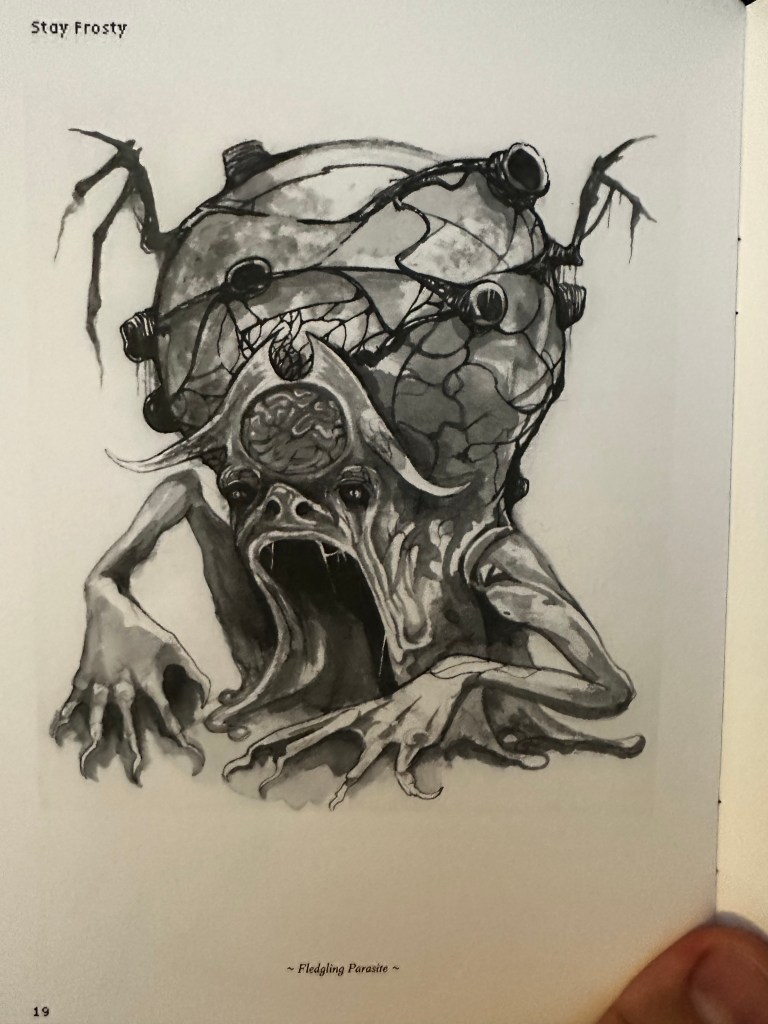
We found the lower level encounters were essentially just target practice. Since we only had two players, I gave them each three marines and decided to treat it a bit like a funnel. I think this was too many for this adventure. Four would have been a bit more balanced. The main reason I think this is because of the initiative roll in Stay Frosty. Whoever makes a successful Dexterity check gets to go before the enemy in this game. This generally meant that a significant portion of the six characters got to act before the demons and cultists. There were enough weapons between the marines that could do blast damage (flamers, grenades etc.) that they could wipe out the opposition before they ever got a shot off. It felt too easy at times. But, it also seemed to accurately emulate the feeling of playing a video game like Doom. At one point they were crossing a bridge over a chasm and being swarmed by imps and cultists. There were 26 opponents and the party defeated them in two rounds, just mowing them down in waves of gunfire and explosions. In only the second encounter, they came up against a group of six foaming cultists, one of whom was holding a grenade in each hand and standing near a leaky fuel tank. One well-placed shot from the grenade launcher took out the whole bunch with a mushroom cloud left in their wake. These moments felt hilarious, exhilarating and hilarious.
But when it comes to the more challenging opponents like the Centiservitor, the Cadaverous Persecutor and the Fledgeling Pest, I can’t stress how important it is to use the Powerful Opponents mechanic in Stay Frosty. That rule states that when there is a disparity on either side of a fight, the side with fewer Hit Dice, should subtract the difference between their HD and their Opponents’s HD from their attack rolls. For example, when my PCs were facing the Fledgeling Pest at the end of the adventure, the 1 HD/Level 1 marines had to subtract 3 from every one of their attacks against it because it had 4 HD. This meant that they were not able to overwhelm it by sheer numbers in the first round or two. Many shots that might have hit, did not, because of this nicely scaling rule. However, when they were up against the Centiservitor, I forgot to apply the Powerful Opponents rule and they slaughtered it before it ever got a chance to fire off its cool weapon.
My main complaint when it comes to the action in this adventure is that the Fledgeling Pest, labelled as the Final Boss, is quite avoidable. It is described as being attached to a wall by its very flesh in one of the Hangars, which have been converted to perform devilish rituals. But there is no reason for them to go to the Hangars in the adventure. I made one up, of course, to try and get them there. One of the NPCs they met told them there could be a working shuttle in one of them. This did lead them to the Hangars, but as soon as they got there, Tension Exploded and one of their number went running off across the moon’s surface so they hopped in the ATVs they had just found and booked it after her. After that, they decided to leg it as well. Since they had the ATVs, they were better able to make it back to their own shuttle. I had to think on my feet here or they were going to miss out on the best couple of encounters of the whole adventure. So, first, I had the Demon Arms (also restricted to the hangars) appear out of a hellish portal in the ground ahead of one of the ATVs, grabbing the driver and causing the vehicle to flip over. The mouth in the hand of one of the arms devoured one of the party but they won out. Then they moved on again and just as they were about to reach their shuttle the giant demonic archway (also found in the hangars) appeared in the air before them, with the Fledgeling Pest emerging out of it to attack them along with a few of its cultists. This was a genuinely tough fight and resulted in the death of a couple more party members. I might have just let them make it to the shuttle, I suppose, but I didn’t want to deprive the players of the Final Boss.
Non-action
Of course, it wasn’t all action. There was some exploration. This is done in a point-crawl style as you can see by the map here.
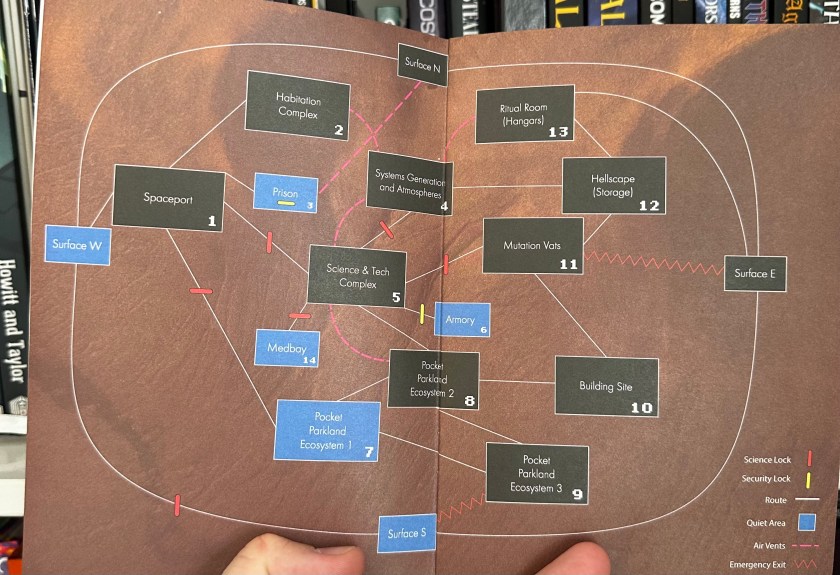
The descriptions of the locations in the adventure are pretty bare-bones. At times, I found I wanted a bit more. For instance, the Systems, Generator & Atmosphere area is supposed to be enormous and encapsulates everything from winding, labyrinthine machine rooms to massive bridges spanning deep chasms. To be honest, these feel like they should be separate, individual locations. Another point about this area in particular is that we’re told that the communications can be turned back on and full computer bank access can be gained here, but not what that might achieve. I had no idea what the computer banks might tell them and I had no idea who they might communicate with off-world. That’s a lot to leave in the lap of a GM, especially when the rest of this adventure is pretty much zero-prep, as I mentioned before.
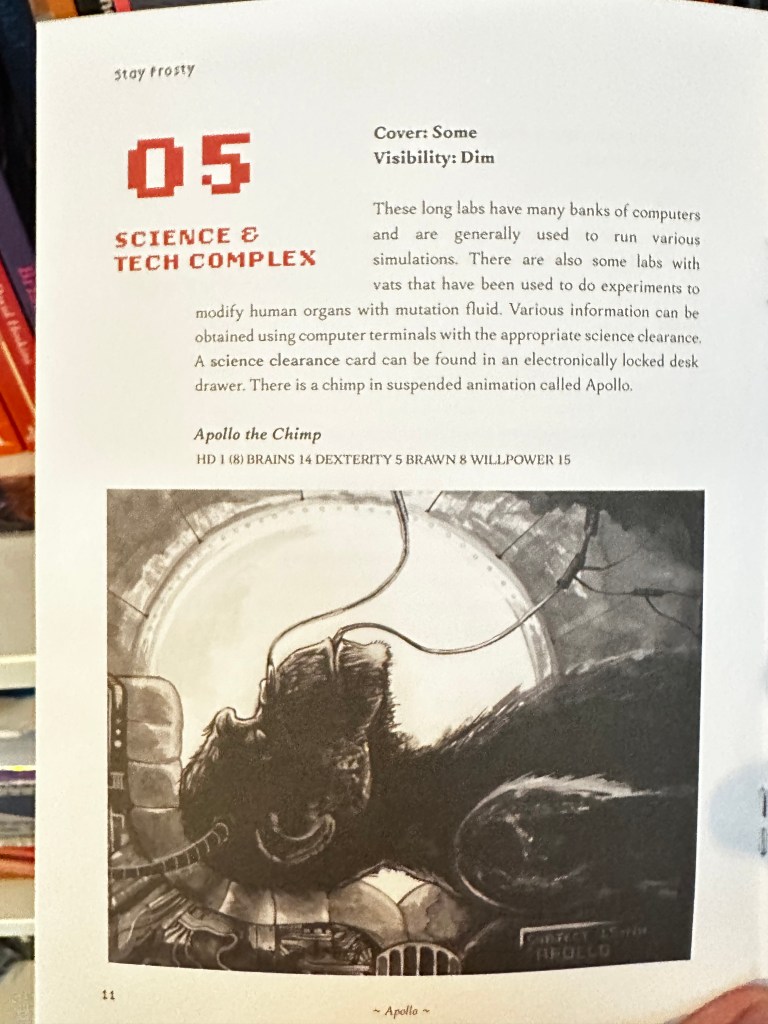
Actually, it is really hard for the PCs to get much information about what has happened here. Even the few living, rational NPCs they meet had no way of knowing what happened on the base, since one was a prisoner and had been kept out of the loop the whole time, one was in a coma and one was a talking chimp, named Apollo, who was in stasis the whole time. It would have been more interesting if at least one of these guys had the full story for the marines. I should have improvised that, in hindsight. Of course, the PCs did recruit both Apollo, the chimp, and Jamal, the prisoner, gave them guns and got them shooting, so that was fun.
Conclusion
I ran this, as I mentioned above, for two players with three PCs each. I think this was a mistake. I mean, once they had recruited the NPCs, they had a squad of eight and they were just mulching the hostiles at every turn, until the very end. Four PCs would have been about right to make it a challenge. Also, I thought I might be able to run it as a one-shot, but that was highly unrealistic. It took three sessions in all, and they did not explore any more than about half the locations.
If I had to do it over again, I might have seeded some of the locations or NPCs with a bit more information on the background of the adventure, but I would still keep preparation time to near zero.
All in all, it was a fun, exploding demon sort of romp as an adventure and a system that we all enjoyed, although I expected Tension to Explode more often.