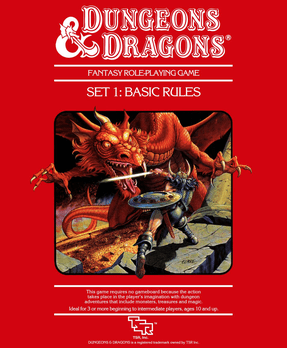
The Kept on the Borderlands
You see, it’s past tense because the game’s over now. Anyway… dear reader, if you are reading this and you don’t know what any of the words in the title or sub-heading mean, maybe go back and have a read of the entire collection of posts on the Editioning, our challenge to play every edition of the original fantasy RPG, and on this game of B/X or Basic D&D.
We finished up the game on session 11 a few of days ago and I have been thinking about it a lot since then. There’s a lot to consider! After all, this was the adventure that kicked off the role-playing lives of so many nerds from 1981 on, since it came with the Basic Set. Not only that; in the context of the Editioning, playing it now, in 2026, allows me to think about it in a way that players at the time could never have. As well, it’s the adventure that launched a thousand clones. Could Gary Gygax ever have foreseen the enduring popularity and desire to emulate this scenario, when he first designed it?
But, when it comes down to it, I want to take this game that we played at face value. That’s the real purpose of the Editioning as I see it. That, and comparison. I want to compare this experience with the experience of playing every other edition of D&D. And that’s something I can usefully begin to do now that two of them are done and another is under weigh.
Beginnings
One of the major attractions of Basic D&D for many will undoubtedly be the ease and speed with which you can create and even detail your PCs. You can easily roll up stats, choose a class and equip a level one character in about half an hour, maybe a bit more depending on your familiarity with the game and the genre. Genre is an important point here. There are no gonzo elements, really. It’s pretty straight-forward medieval Europe with dwarves, elves and goblins. Most anyone interested in playing D&D is going to have at least a passing cultural understanding of the broad strokes and tropes. This ease of character creation is a major bonus, from my point of view, it allowed us to have our session 0 and session 1 in the same evening. But, maybe more importantly, it allows you to roll up a new PC on the fly while the others mourn the loss of the one that just got an arrow through the eye. What this means, in many instances is that any particular PC can be easily substituted by another of the same class.
To compare this aspect of the game to OD&D all I can say is there is not a huge amount of difference, except to say you have slightly fewer decisions to make in Basic. OD&D allows you to choose race as well as class, so, for instance, we had a halfling thief and an elf magic user in our OD&D game. From this perspective, I often think of AD&D as the natural descendant of OD&D rather than Basic. AD&D 2nd Edition is determined to overwhelm the player with options, however, and requires multiple decisions to be made simultaneously. From alternative ability score rolling methods to the inclusion of kits, non-weapon proficiencies and schools of magic, the complexity is ramped up ten-fold from Basic. This is a matter of preference, I think. Some of my players enjoyed all the options quite a bit. While others would much rather get to the game more quickly, like you can with Basic or OSE or most OSR games these days.
As for the beginning of the adventure itself, The Keep on the Borderlands encourages the DM to take the Background section and expand on it or tailor it to their own campaign. Isaac did this for us by indicating that we were the last surviving members of a mercenary band that was returning from a failed campaign in the wilderness. This worked well to explain the relationship of the PCs, why they were traveling together and to give us a motivation to seek out gainful employment so we could get back on our feet.
My experience with OD&D and AD&D 2nd Ed is quite different. Of course, I created the OD&D adventure from scratch so I necessarily created the starting situation for them as well, but for the Eternal Boundary in 2nd Ed, the DM is presented with two options to start, and it’s quite proscriptive otherwise.
Middles
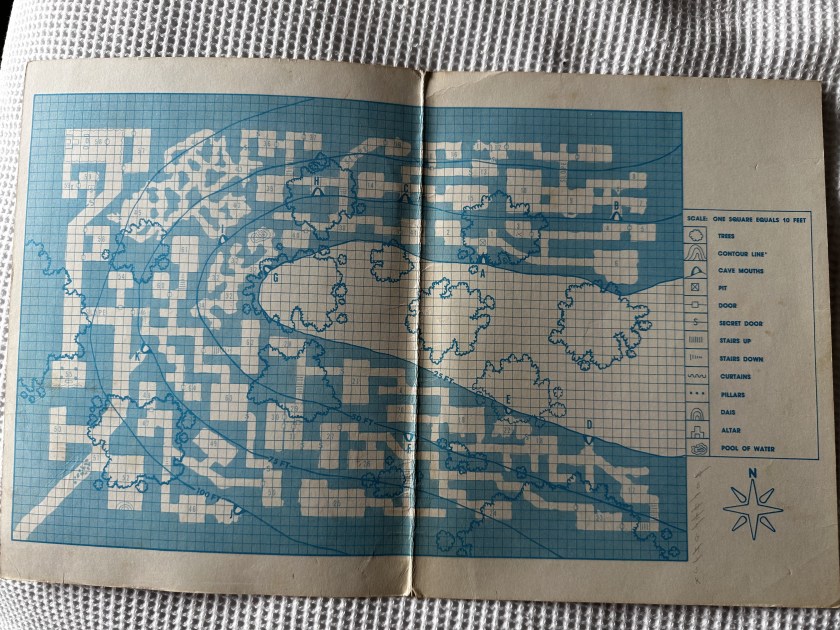
The Keep on the Borderlands adventure booklet consists largely of location descriptions. The “plot” such as it is, is contained within those. This is a familiar adventure design methodology for anyone who has been paying attention to the OSR. One of the first descriptions is of the Inner Bailey of the keep. In the two paragraphs devoted to it, the major points made regarding it are that the PCs must do a great service to the keep to gain entrance and if they do that, they’ll have a feast thrown in their honour, where the Castellan will gain the measure of them. If they impress him, he will send them on missions later, have them blessed on the way out and pay them a reasonable rate each time.
Isaac nicked a great little mechanic from the Root RPG for handling our reputations with the various factions involved in the adventure. Root uses reputation trackers to record how well liked or despised your PC is by the various woodland factions, with PC actions able to add points to or subtract them from the tracks. You can find a good description of that here on the Cannibal Halfling Gaming site. Gaining rep with the various factions and being aware of it definitely made us push our characters to make certain choices that we might otherwise not have. Mostly, we wanted to build reputations with factions we were already friendly with and tank all the others. The fact is, the way we ended up playing the adventure, it was about 75% impressing or pissing off factions, 15% dungeon crawl, 10% getting absolutely fucked by random encounters. So, the gaining of rep was at least as important as gaining experience. The module does refer to the possibility that the PCs might become aware of the conflicts between the denizens of the Caves of Chaos and use that as a way to set them against one another. But, it doesn’t provide any useful advice as to how to handle it beyond, “be careful to handle this whole thing properly,” which is genuinely worse than useless. What it does not do, at any stage is present the monsters as anything other than elements to be eliminated. We don’t need a name and background for every monster NPCs but at least the leaders should get that! Once again, Isaac took it upon himself to fill in those blanks, naming the leader of each faction, giving them personalities and motivations that we could attempt to work with or butt up against. He never managed it from a combat-first perspective, and I really appreciated that, because combat is exceedingly lethal and to be avoided at all costs. This might have just been the random encounters which included monsters of higher levels than us who were quite capable of one-shotting our toughest members, but it did feel more lethal than the other two games I’m comparing here.
Comparing all of this to OD&D, once again, in my own home-brew adventure, I actually felt there were some things I could have learned from it. I often felt I should have had more factions and even NPCs in general in my OD&D game, even though the concept I had for it did not require that. Combat-wise, OD&D and Basic both have a hitting problem, in that it’s really hard to do. We missed a lot and it was generally agreed that having a shit-load of hirelings was a necessity, if only so that the law of averages would be on our side. This was true of the enemies killing our party members too. We lost two PCs throughout the campaign, but oh so many more hirelings.
It’s harder for me to compare the middle of the adventure to 2nd ed, since we are not there yet, but I can compare the style of adventure. The Eternal Boundary is an entirely different beast. Of course, it does have the factions of Sigil baked into the adventure, and the factions the PCs belong to have a real effect on things, but they are not trying to ingratiate themselves to the factions, really. It involves a lot of investigations that may involve factions, but that’s about it. Actually, it would be interesting to include a Root-style rep track but, there are so many factions involved in the city, it might become like too much overhead. One thing is for sure, so far, it seems like a more diplomatic than combat-oriented adventure. Combat-wise, I can’t comment too much. We haven’t had any fighting yet, but, from what I remember, combat had the potential to take an age and to be very crunchy compared to Basic. Still quite lethal but with a lot less instant death. I’ll revisit this after we have a few more fights in Planescape.
Endings
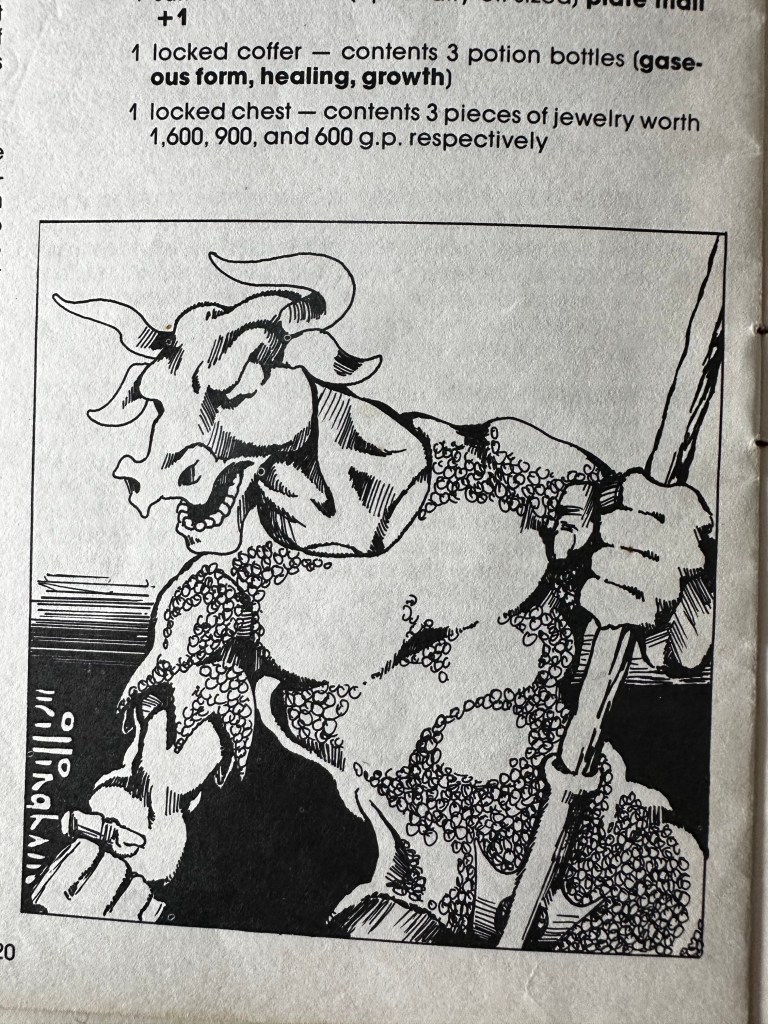
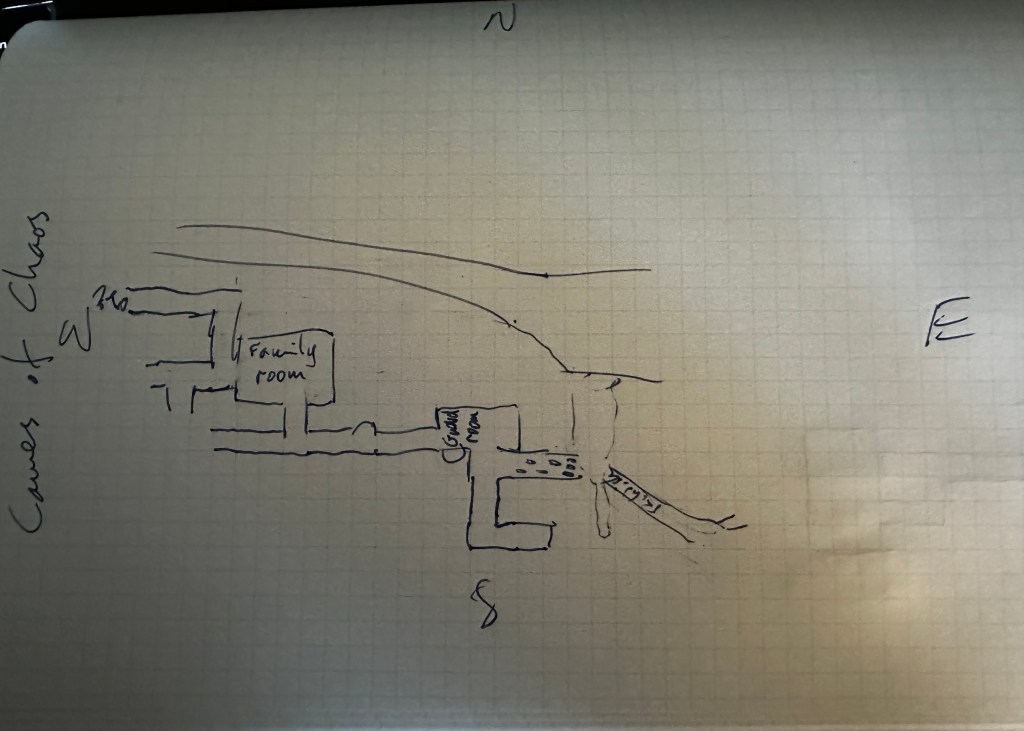
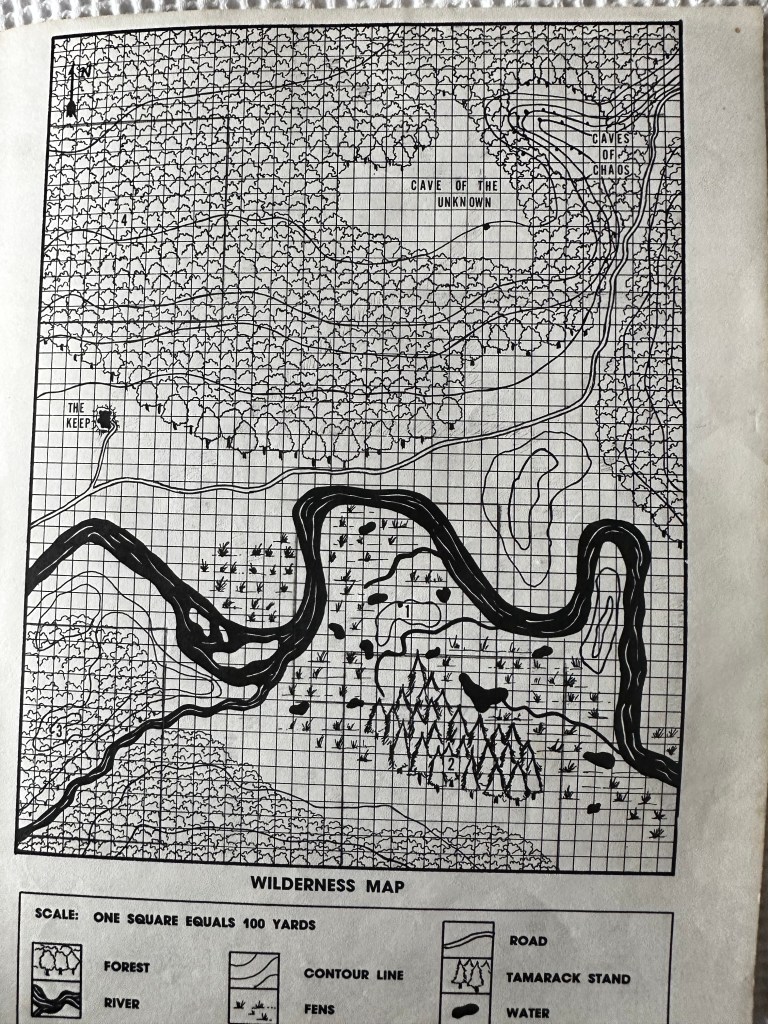
Isaac gave us an ending more because we had to move on to other games than because we came upon it naturally. The fact is, looking at the adventure now, we had barely scratched the surface of the Caves of Chaos. We missed the entire minotaur labyrinth! There are caves denoted by letters A to K and we only entered three of them. That third one, though, that was a doozy.
Isaac had been coming up with a variety of events through the course of the adventure, and we had no idea they weren’t detailed in it. The main area of his invention involved the Serpent Cult and its relation to the Curate of the church in the keep and his relation to the Castellan’s advisor, an elf. Now, we had immediately discovered the Curate’s elf-racism since one of our party was an elf, but it ran deeper. One day, we returned to the keep to find that the advisor had killed the curate when he accused him of being a spy for the Serpent Cult. We investigated and found no evidence that the elf had anything to do with the cult, but did discover evidence that the cult was operating from one of the Caves of Chaos. On our word, the Castellan released the imprisoned advisor and then promised us a permanent residence in the keep and his eternal gratitude if we would clear out the cult. In order to take on the cult, we recruited the assistance of the goblins we had previously made friends with and then marched on the evil cave.
This led us to the last session of play. As a cleric-heavy group, we turn-undeaded our way through the majority of the encounters leading to the final boss, the Chaos Priest hiding in his chamber beyond a chapel swarming with skeletons and zombies. We used Hold Person on him, he failed his Save against it and we stabbed him to death and cut off his head to bring back to the castellan. Hurrah! We lost the majority of the goblins on our team but otherwise came out a great deal richer and even more experienced.
Isaac had us do epilogues for our PCs, since we are unlikely to return to them and I will genuinely miss playing Thaddeus Nightbane. He finally proved that not everyone he cared about had to die and that felt like a good end to his arc. I will say that, as far as running this only in Basic D&D goes, I think it could be difficult. Thaddeus ended up as level 5 and, thechnically, Basic only goes to level 3. You would have had to have the Expert set on hand before you finished playing the adventure, I feel. Or, just make sure, as DM, that you don’t hand out too much treasure or encounter XP.
So that was the end for us. But, I’m quite sure you could continue playing in and around the Keep and Caves for twenty or more sessions if you wanted to explore every cave and every faction. It’s even got re-playability, especially with a different DM. Isaac put so much of himself and his ideas into it, I’m sure, if I ran it myself, for instance, it would be a very different game.
Comparing to OD&D’s end, it’s difficult, once again, but I can say that my adventure, the Woes of Sorrowfield had a very clear ending, although they might have approached it from different ways. This has nothing to do with the edition either, of course, more the adventure. Woes was a totally different type of adventure compared to Keep, so, like I said, it’s hard to compare.
As for the Eternal Boundary, although we are a long way from the end of that, I know, for sure, that the ending also be at a very definite time and place, although, once again, they might arrive at it in any one of a number of different ways.
The main difference, here is that Keep on the Borderlands is not really interested in telling a particular story, so much as presenting a situation, but both the AD&D 2nd Ed adventure and my own OD&D adventure, had a specific story to tell.
Conclusion
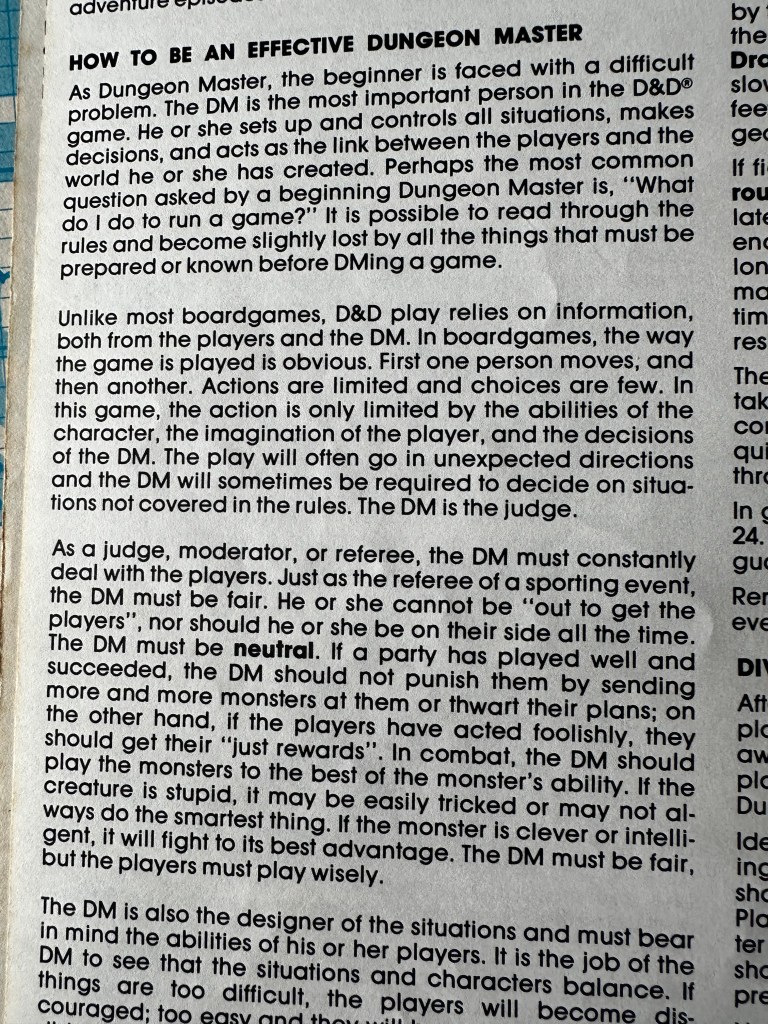
I liked it. I liked it a lot more than I expected to. This adventure tops a lot of people’s favourite adventures lists and I can see why now. Although, I would say a lot of my enjoyment came from the way in which Isaac ran it rather than from the contents of the module itself. But the module gives a DM the freedom to expand and improvise as they want, so that is a very cool aspect of it. As a teaching adventure, I can see its value.
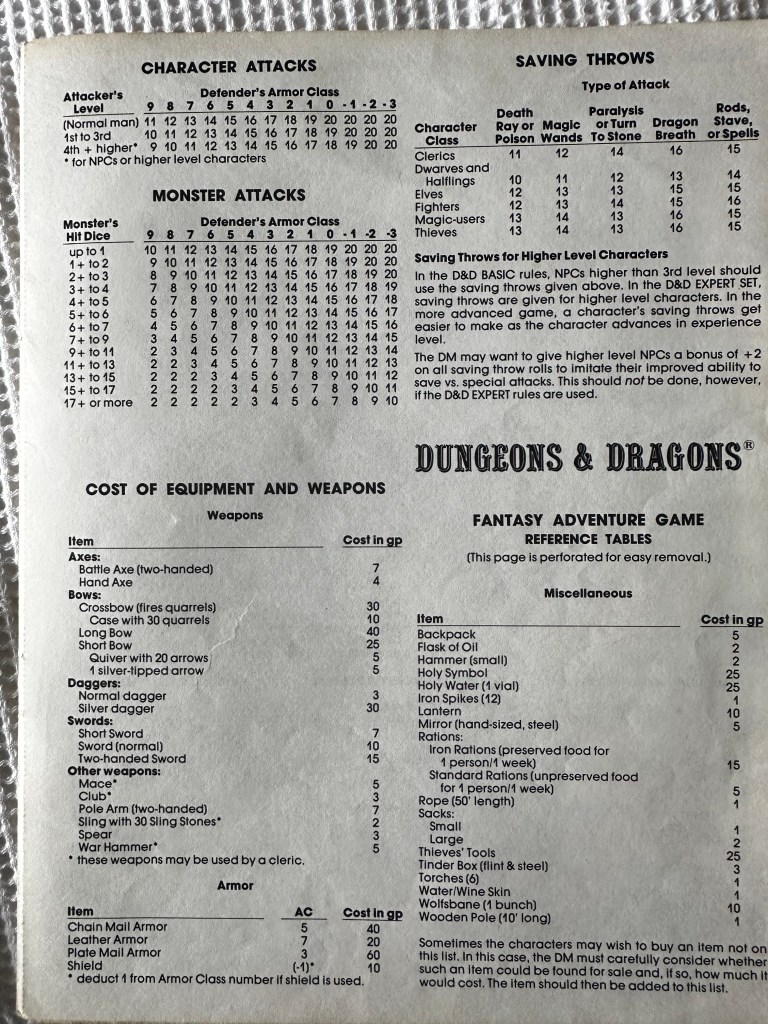

As for Basic D&D, I thoroughly enjoyed this pared-down version of the game. It’s freeing having no real skills and only a few stats you need to keep track of. Some things like saving throws and THAC0 still bother me but I look at them now as more of a nostalgic idiosyncrasy than a real bother. They are not difficult to get used to and they don’t get in the way too much in play.
The Editioning will continue, dear reader, but its time to leave the Keep on the Borderlands behind along with poor Edmund, my cleric who died in session 2 and whose corpse we found shambling around in the Chaos Cult’s lair. We put out his other eye and chopped off his head for good measure.