Downtime Discussion
I had a really interesting discussion last night with, friends of the blog, Tom and Isaac. They’ve both been along with me for the Editioning ride and have some great insights. We have started a monthly round-up of games in a Discord video chat. We’re calling it Tables & Tales Downtime. It’s a simple opportunity, that we don’t generally get at the table, to talk about the games we’re playing. We’ve only had two of these Downtimes and they have each turned out quite different. The first went into detail on the games themselves, what happened in the sessions of the previous month, how the systems and mechanics worked at the table, what surprised or delighted players, or what didn’t work for them. In this second one, it was just the three of us so we got into a fairly free-wheeling discussion of the things we had been thinking about games in general recently.
Isaac has been preparing to run the classic AD&D 1st Edition module, Ravenloft, grappling with its copious verbiage and unwanted levels of detail. Meanwhile, I have been reading a couple of OSE adventures and coming to grips with their house-style, which feels like the exact opposite. Tom’s perspective was unique in this mix as the DM of our Dungeon World game, coming up with all their adventure ideas off the dome, which presents its own challenges and opportunities.
The Keep on the Borderlands
I can’t comment too much on Ravenloft since I haven’t read it, but it sounds similar to many adventures of the time. It is arranged in paragraphs, long and wordy. It’s got stats and descriptions for NPCs and areas that are almost certainly never going to be needed. It makes a lot of assumptions about what the PCs are going to try to do and it provides the DM ways to thwart their idiotic plans.
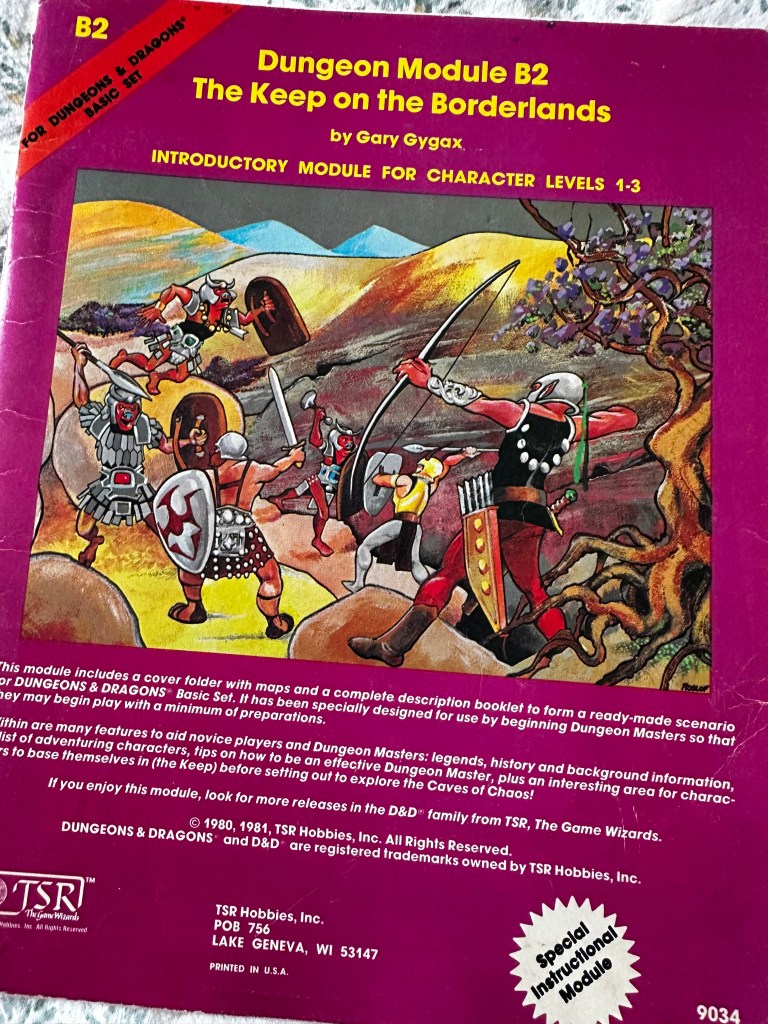
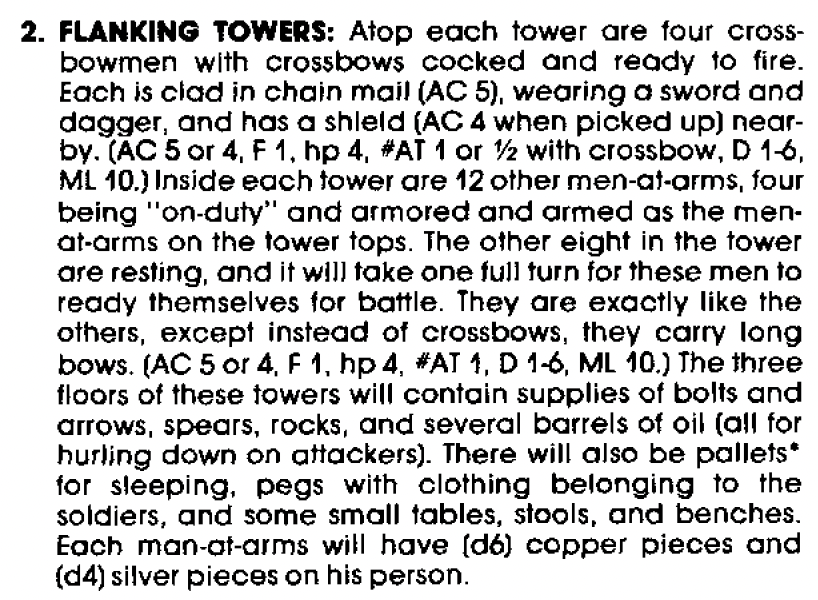
Another prime example is B2 The Keep on the Borderlands. As a beginner module, it has a lot of advice for the starting DM and even for players included. But it also spells out the consequences if the party decides to go on an anti-social rampage through the keep, the exact numbers and stats for the guards, their locations, how many are on duty and in armour, etc. etc. The cognitive load this requires of a DM is not to be underestimated.
We’re going back in time with adventure modules like this, of course. Maybe comparing them to more modern styles of adventure presentation is unfair. Every adventure produced relies on creators who learned from the mistakes and successes of those who came before, after all. But, in preparation for this post, I read some reviews of Holy Mountain Shaker, the OSE adventure I’m going to use as comparison. Some reviewers and commenters simply hated the OSE house style used to present it because its terse bullet points and single phrase descriptors didn’t include enough sentences or actual paragraphs. Some DMs feel like they need a piece of prose to get to grips with the atmosphere, the setting or the characters. Some people want to have to read through a module two or three times before they feel ready to bring it to the table. The Keep on the Borderlands suggests this approach in the “Preparation for the Use of the Module” section.
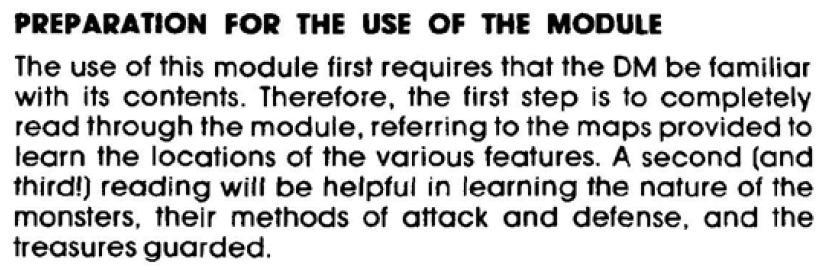
Now, up until this point in the text, Gary Gygax has been really bigging up the DM, Here’s an except. Sorry it’s so long. Gary needs an editor tbh:
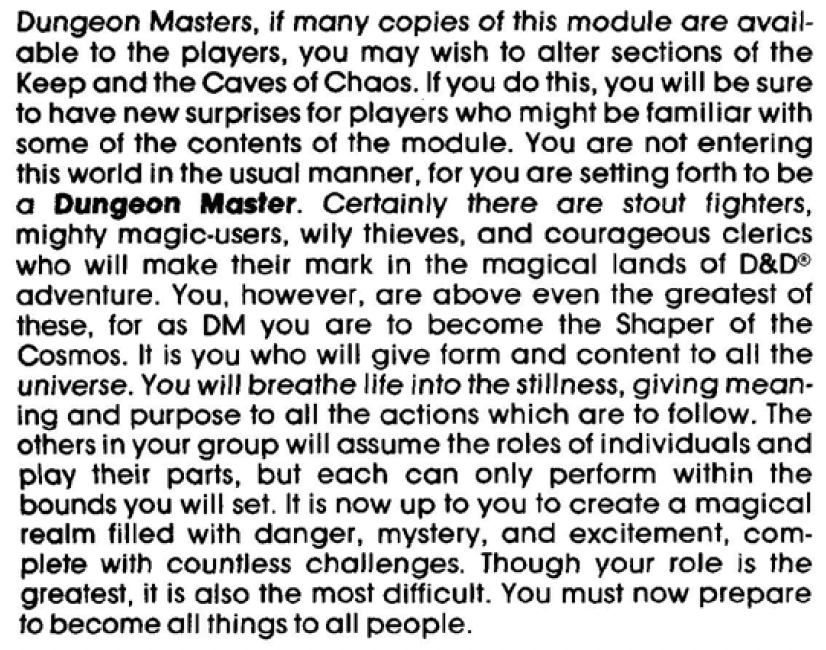
So, you can see that he has been buttering up the poor rube who agreed to run this classic adventure before telling them they have to learn the damn thing off by heart in preparation. And you can see that that would be no mean feat given the style of writing, the denseness of the prose and lack of distinction between description and stats.
I want to make one thing very clear at this stage; I played The Keep on the Borderlands recently and thoroughly enjoyed it. I thought it was a great module with lots of player freedom, options for the DM to customise and almost endless possibilities for how it might play out at the table. But its the reading of these older adventures that’s a chore. I don’t really want to read them through once, never mind three times. It takes a long time and it’s boring.
Adventures are for playing, not for reading. Is that controversial?
Holy Mountain Shaker
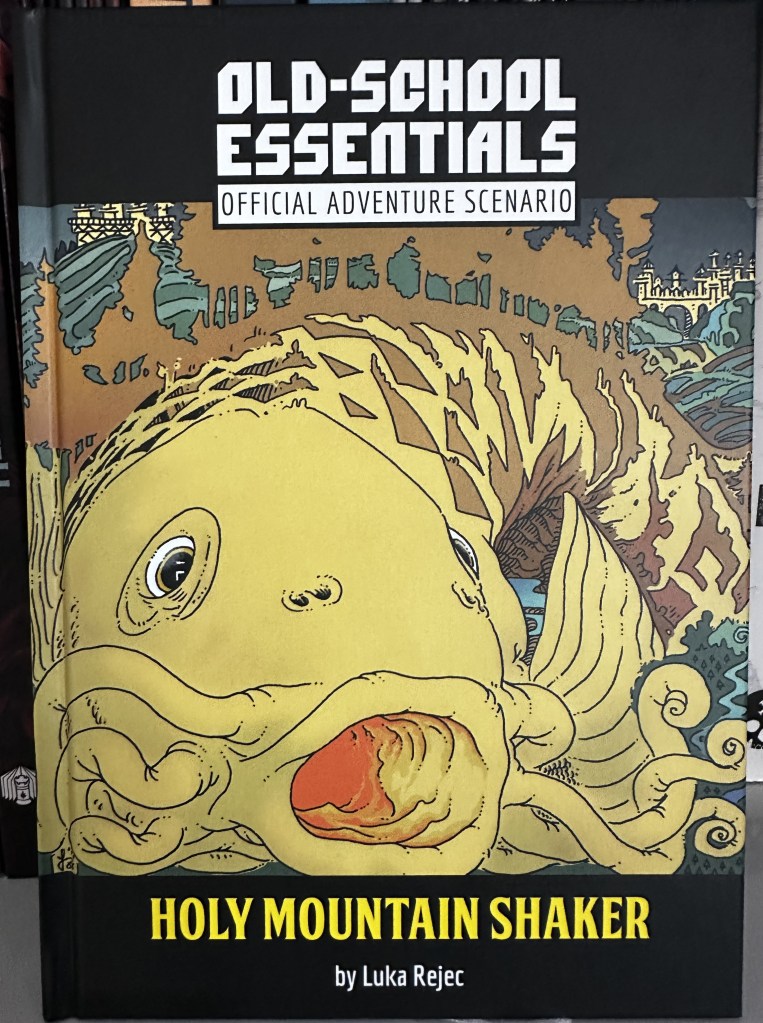
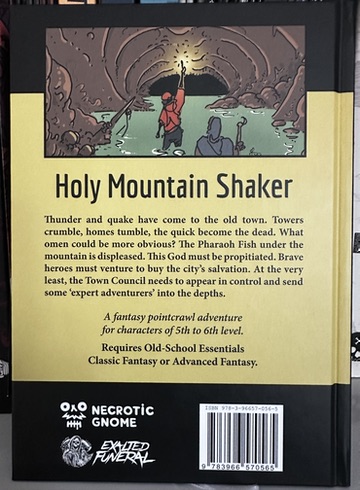
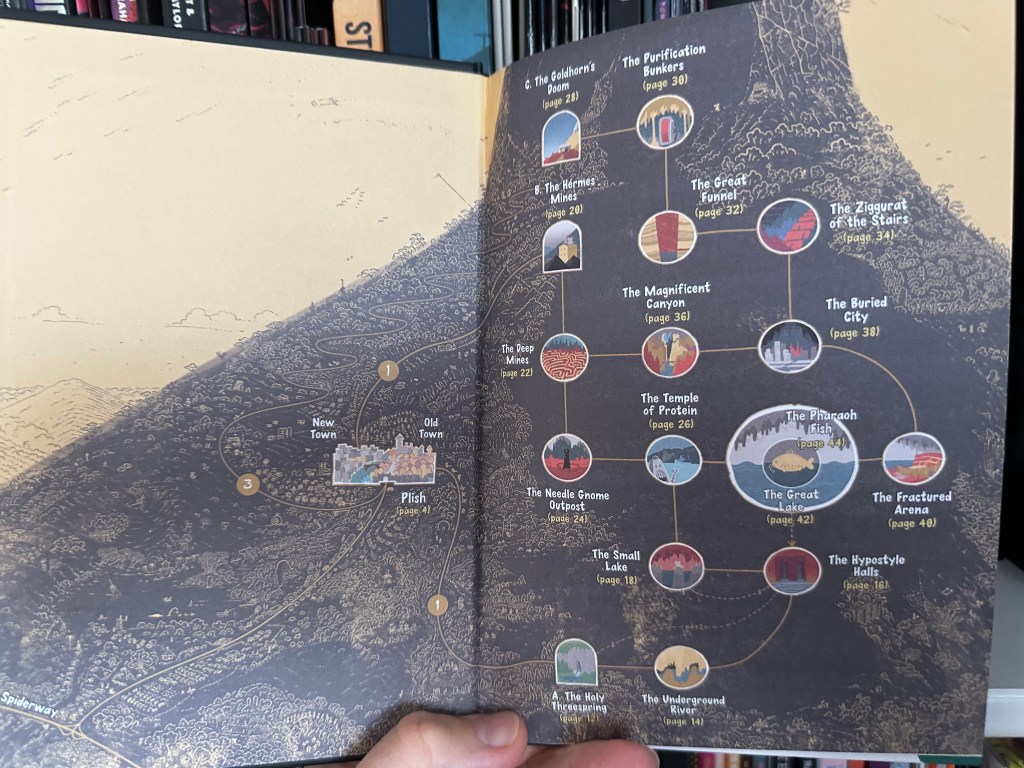
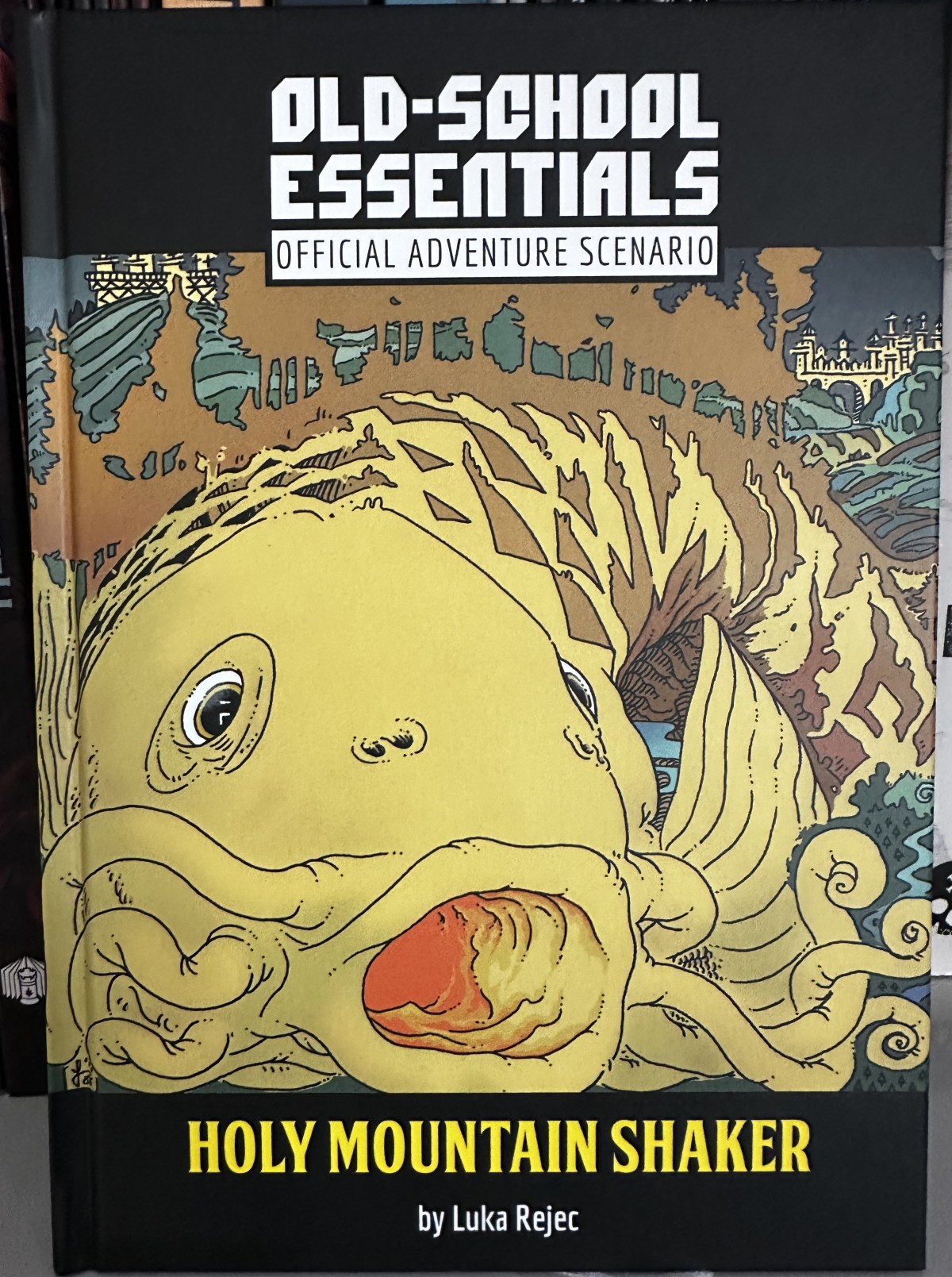
Holy Mountain Shaker is a 2021 adventure module for Old School Essentials by Luka Rejec of Ultraviolet Grasslands fame. I think it’s interesting that UVG was the first RPG book that got me to stop reading it so that I could start playing it. The longer I spent reading it the more it dawned on me that it was a reference book, not a work of fiction. Anyway, Holy Mountain Shaker is an ambitious adventure that includes a really large number of compelling and enormous locations as well as a town with a few relatively unimportant factions. This is a point crawl where each point is big, like a massive underground chasm, an enormous ziggurat under a mountain, an entire mine. That sort of thing. These are not accompanied by maps of the areas. This is only a 56 page adventure. Instead, the DM is given some of those terse descriptors, a few options for what a party might do in the locations, where their investigations might lead to and some encounters and events.
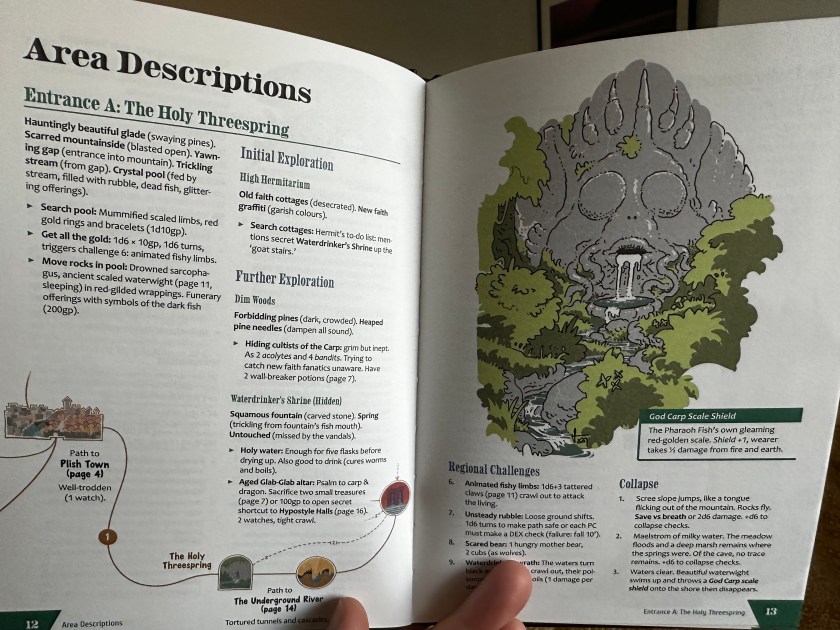
Sure, it might help if you read some of the location descriptions ahead of time to get an idea of what’s coming for the adventurers, but that won’t take very long and you could absolutely get away with not doing it. It’s easy to see, at a glance, what you need to give the players, what they will need to do some work to find, and what might happen if they do certain things. Personally, I think this gives you just enough to improvise with. We’re playing a use-your-imagination-game here, and I like being given the chance to use mine, even on the fly with minimum prep. Admittedly, having run UVG for a while, I have quite a bit of experience doing this, as it is laid out similarly. But, equally, if you play Blades in the Dark, Heart, the Between or any other story game, you are faced with making up locations, NPCs, items constantly. That’s part of the challenge and part of the fun.
The lack of location-specific maps is a little jarring. I get that. I wanted a map of the ziggurat like we got a (kind of) map of the Pharaoh Fish, but, ultimately, I understand that the exploration is meant to be abstracted, and occasionally cut with scenes of discovery where a PC finds one of those wonderful magic items, or by combat, where we zoom in on the action when a random encounter occurs with one of the creatures that is described at the beginning (and only at the beginning) of the book. It reminds me of a Final Fantasy game. Your little guy is travelling by map across country when you suddenly run into a rabid chocobo or whatever. The map disappears and your party are gathered there in a fully realised location facing that one poor flightless bird.
You don’t have to slog through descriptions of endless empty rooms or 30 ft long corridors. We’ve all done that. I get that that’s D&D and I also enjoy the sort of play that involves precise measurement, perfectly drawn maps and searching for traps with ten foot poles. But reading this was refreshing. It presented me with a different way to play even large-scale locations in a mega dungeon that won’t take the rest of your life to play through and was packaged in such a compact and attractive book.
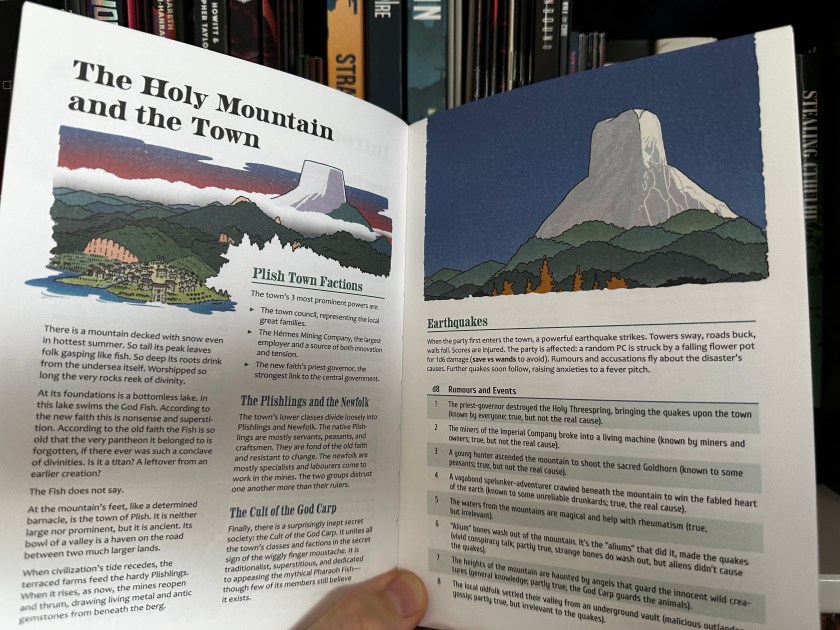
But, for the sake of comparison, we looked at the Keep from Keep on the Borderlands above so let’s look at the town in Holy Mountain Shaker. The town of Plish is described in two pages, both of which are half illustration. The factions get a bullet point each. This actually seems fair since they don’t come into the adventure itself much. Then you get a paragraph about the native Plishlings compared to the Newfolk who have come to mine the mountain. And lastly, there is another short paragraph describing the Cult of the God Carp. On the second page we have a couple of lines about the earthquakes plaguing the town and then a table of rumours. That’s it. No descriptions of fortifications, no guard stats, no structural engineering reports. What it’s doing is trusting that we all know the kinds of things you might find in a fantasy mining town at the foot of a holy mountain. And it’s giving us permission to come up with that stuff at the table (or for the DM to make it up before they start, I suppose.)
Conclusion
Now, I have a some issues with Holy Mountain Shaker as well. I think some of the descriptors used are too obscure for the average DM to know without looking them up. And that sort of stumbling block is a big deal if you only have one word to go on (what is a vitrine, anyway?) Some of the illustrations do not really illustrate what I would want them to illustrate about some of the locations. And I would actually like a bit more involvement from the factions. But I’m not really here to review this adventure, especially as I haven’t played it yet. I’m just here to compare these two styles.
I think it’s worth mentioning that the former style has not completely died out. Some trad games are still presented using dense paragraphs when, in my opinion, bullet points would be better (looking at you Dragon Age RPG, Call of Cthulhu, DCC) but, as I mentioned above, that style still has its fans and adherents. More power to ‘em. But, for me? Keep it minimal.

