Who Plays RAW Anyway?
AD&D is a famously crunchy system. It took the relative simplicity and, dare I say, elegance of OD&D, and started piling on subsystems for magic, combat, falling, drowning, encumbrance, surprise, skills and proficiencies, experience, encounters, etc. etc. It’s not an easy system to learn and I’m not sure anyone is really meant to learn the whole thing. Rulebooks are reference books, of course. That’s the case for any game, but it’s a necessity if you want to play AD&D rules-as-written.
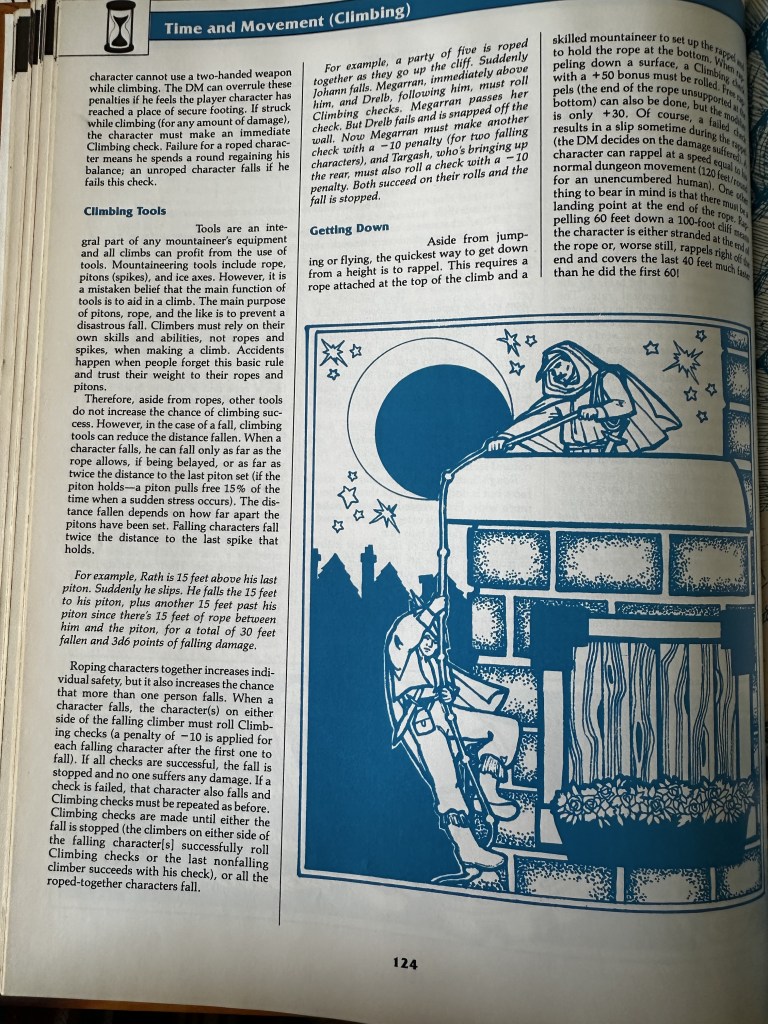
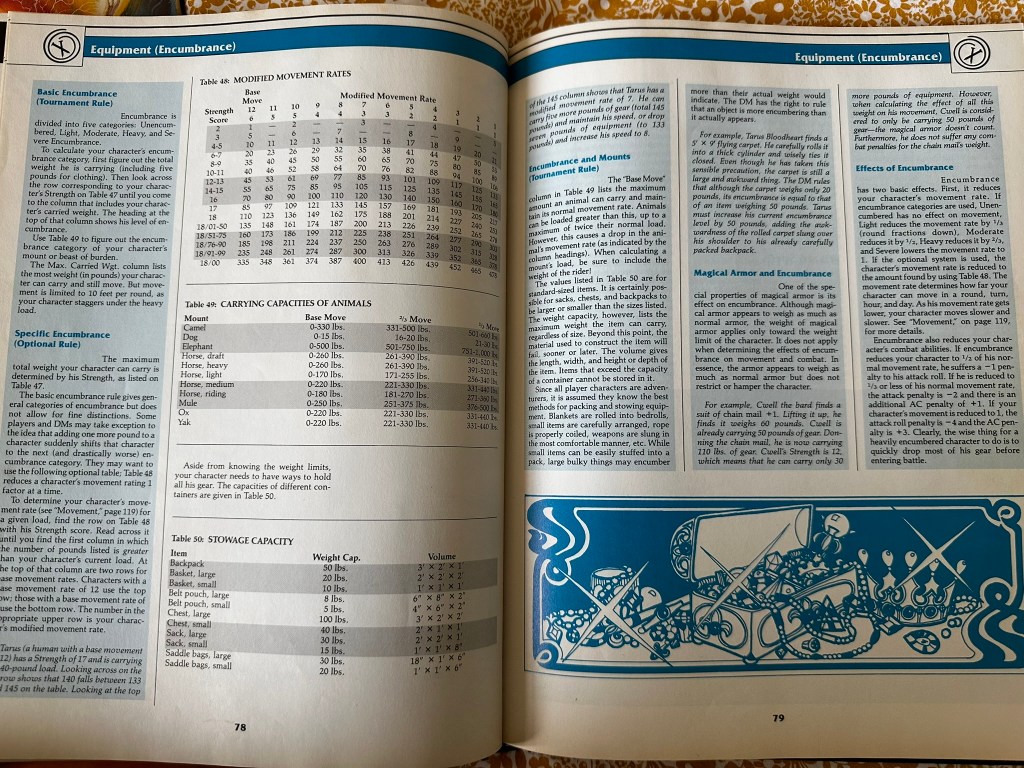
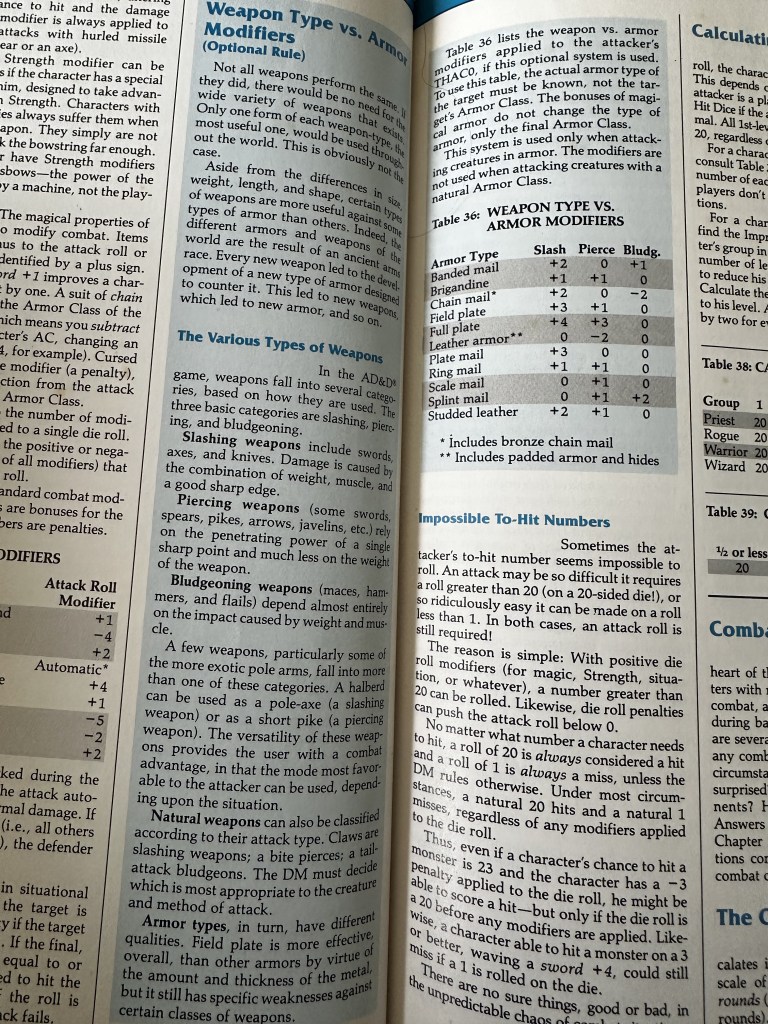
I played a lot of 2nd Edition in the 90s. I ran my own home-brew world campaign, I ran Dark Sun, Ravenloft and Planescape and played in some Forgotten Realms games too. I have a lot of experience with the game. But I don’t remember using a ton of the more nitty-gritty rules. Encumbrance is the obvious one that I think many groups would have hand-waved, and continue to. But things like specific rules for climbing (and getting down again,) and rules for specific weapon types vs specific armour types, were all just, well, too specific. I suspect that other groups handled things in a similar way. I don’t think our games suffered due to a lack of these rules. As DM, if the situations arose where a character needed to rappel down a castle wall, I would have made a ruling and we all would have moved on, instead of searching the DMG or PHB for the precise way to handle it according to Zeb Cook. I do remember doing that on occasion, usually when challenged by a player that something should be handled properly. Generally, this would bring the session to a grinding halt while we found the rule in one of the ten different books it might have appeared in, and then read it, read it again to understand it, and applied it to the situation. This would rarely be worthwhile, although, sometimes we uncovered a rule that actually made our play better.
RAW Editioning
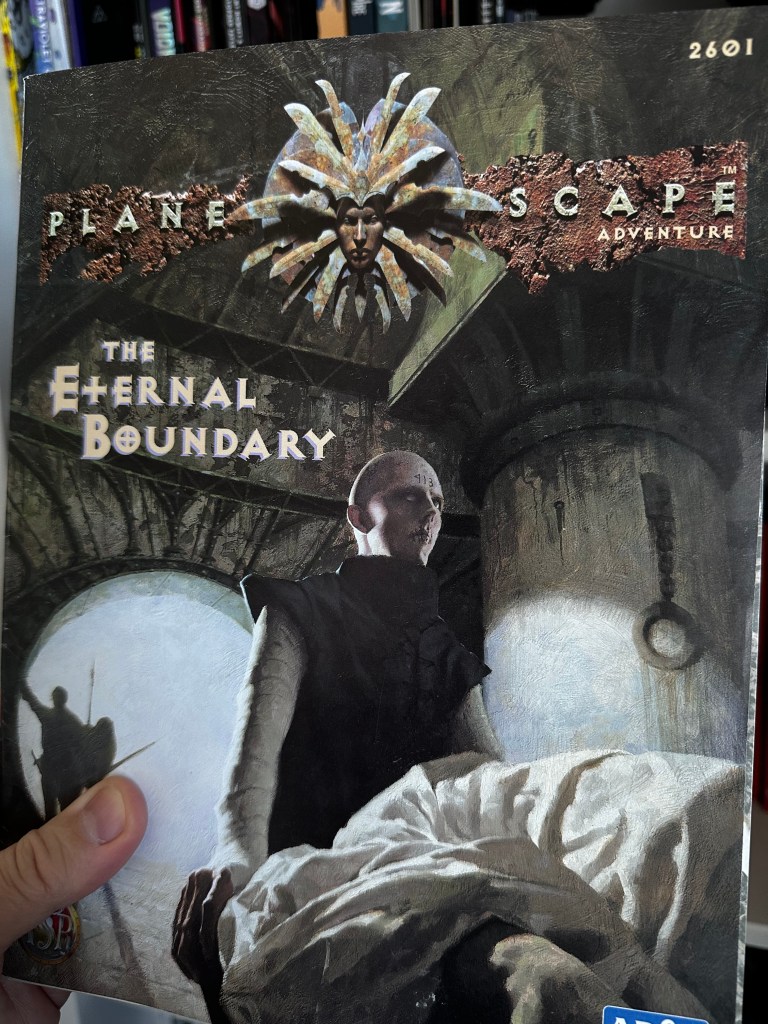
The Editioning, our challenge to play and adventure in every major D&D edition over about a 24 month period, has made it far more likely that I will deal with any given situation as the rules require. I am trying to play these adventures that way. But what I have discovered, playing the Eternal Boundary, is that the adventure doesn’t care about most of those rules. The writer got the 2nd Edition surprise rules wrong, the plot does not involve wilderness adventuring, dungeoneering or, really, any type of traditional D&D shit, and nobody has been required to rappel down anything. As I have stated here before, it is far more an investigation scenario than anything else. Each session has been an exercise in pushing the plot forward. When I think about it, many of the ‘90s adventures were like that. It was, I think, a side-effect of having settings with their own histories and stories, exemplified in hundreds of novels, rife with famous and powerful NPCs, where the canon events impacted the types of adventure modules written for them. The plot-heavy adventure became the norm for D&D.
The Eternal Boundary appeared very early in the life of the Planescape setting but well into AD&D 2E’s middle-age. So, although it had not been confined by published canon yet, you can tell that it was trying to define it. It establishes NPCs that could be involved in major events in the future of Sigil, it is more interested in establishing the setting, its factions and its political situation that in providing opportunities for the DM to apply the rules of the system to the situations the PCs get into. I don’t want to go to far into this area right now. I’ll save it for a more thorough review of the module when we are finished. I’m saying that, when it comes to adventure selection, I could have chosen better if I wanted a quintessential AD&D 2nd Edition experience. But then again, maybe such a thing doesn’t exist.
Plane-hopping
If you need a recap, please go and revisit my previous posts here.
Session 5 of the Eternal Boundary kicked off with another fight. The party, reunited and determined to get some answers, decided to take on Toranna the Gray on her own turf, ie, the portal room right at the top of the Mortuary, under the dome. It was a cool location and a cool set up. She was preparing, with the help of an assistant, to send another barmy’s corpse through the portal to the Elemental Plane of Fire, ostensibly for cremation. There were a few zombies lurching around the chamber doing odd-jobs as well. We rolled for surprise, which neither side got, and then initiative which the PCs won. Devansh, the Cleric, immediately turned the zombies, just in case, and Trance, the Thief, tried to use her grappling hook to swing of the chandelier and take down the assistant before they could act. She failed the grappling hook roll (used the Thief’s Climb ability for this) but hit with her attack, killing the 0 level assistant instantly. Meanwhile, Glaermond the Paladin ran into the fray, taking on one of the turned zombies, and Aurora, the Witch, sent her goat in to butt Toranna. What followed was a few rounds of Toranna running around, trying to escape while restricting the party’s movement as much as possible with her magic. Hold Person is a powerful spell in this edition, by the way. Mainly because it is hard to save vs Spells.
Hold Person
(Enchantment/Charm)
Sphere: Charm
Range: 120 yds. Components: V, S, M
Duration: 2 rds./level Casting Time: 5
Area of Effect: 1d4 persons Saving Throw: Neg.
in 20-ft. cube
This spell holds 1d4 humans, demihumans, or humanoid creatures
rigidly immobile and in place for a minimum of six rounds (the
spell lasts 2 rounds per caster level, and the priest must be of at least 3rd level to cast the spell).
The hold person spell affects any bipedal human, demihuman, or
humanoid of man size or smaller, including brownies, dryads,
dwarves, elves, gnolls, gnomes, goblins, half-elves, halflings, half-orcs, hobgoblins, humans, kobolds, lizard men, nixies, orcs, pixies, sprites, troglodytes, and others. Thus, a 10th-level fighter could be held, while an ogre could not.
The effect is centered on a point selected by the caster, and it
affects persons selected by the caster within the area of effect. If the spell is cast at three persons, each gets a normal saving throw; if only two persons are being enspelled, each rolls his saving throw with a –1 penalty; if the spell is cast at only one person, the saving throw die roll suffers a –2 penalty. Saving throws are adjusted for Wisdom.
Those who succeed on their saving throws are totally unaffected by the spell. Undead creatures cannot be held.
Held creatures cannot move or speak, but they remain aware of
events around them and can use abilities not requiring motion or
speech. Being held does not prevent the worsening of the subjects’ condition due to wounds, disease, or poison. The priest casting the hold person spell can end the spell with a single utterance at any time; otherwise, the duration is six rounds at 3rd level, eight rounds at 4th level, etc.
The spellcaster needs a small, straight piece of iron as the material component of this spell.
Also, bonus points for use the word “enspelled” there.
Anyway, this allowed her to last four rounds against the party. The had almost made it down the stairs to look for help when Glaermond jumped on her from the top of the stairs doing a shit ton of damage and leaving her at 0 HP.
They questioned her. Trance even used her Intimidation non-weapon proficiency to good effect. Eventually they got Toranna to tell them about the plan, or at least the part of it she knew. She was working for a faction called the Illuminated and a person call Green Marvent. Green Marvent had asked her to take the “bodies” with a mark behind the ear and send them through the portal to the Elemental Plane of Fire, just like the other corpses. But those ones would not be burned up, instead, they would be taken by the Illuminated on the Rock, the Citadel of Fire beyond the portal, and revive them. Now Toranna didn’t know what they did after that. But the PCs, having already run into Eliath and the Dancing Man, supposedly returned from death by “their own gods,” were already aware of what was happening afterwards. They are still not sure why, though, and they knew they needed to stop this plot so they grabbed Toranna, took her red glass beads, the key for the portal and jumped through…
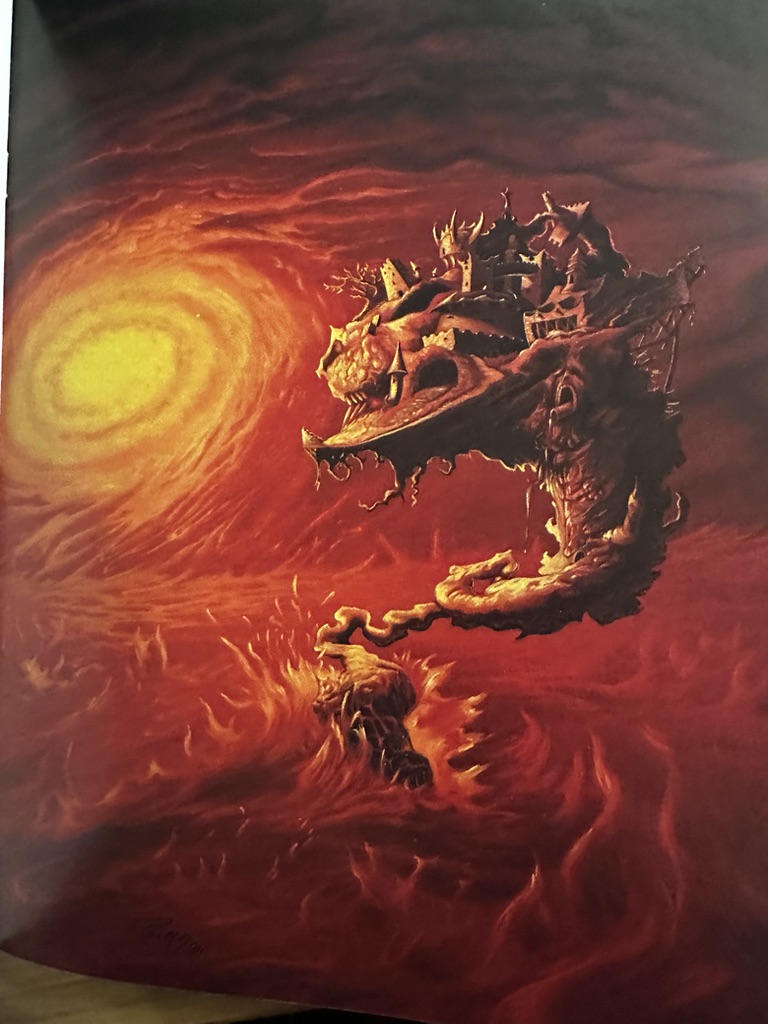
On the other side, they found themselves on a wide platform at the bottom of a long set of steps that clung to the side of a cyclopean rock, floating, impossibly unburned through the eternal flames of the Elemental Plane of Fire. They could hear the inferno raging just yards away, though muted, and they could even feel a portion of the hellish heat, but they were not in danger of being roasted. They were greeted by a number of Illuminated guards, led by a priest. The party’s fast-talking fell on deaf ears and another fight erupted. The Illuminated priest sent one of the guards to get help from the next guard post at the top of the stairs, but Trance, the thief was too quick for him, felling him with a backstab before he could get too far. The priest took his first action to cast Command on Aurora, forcing her to Jump. On her turn, she was going to be forced to jump off the edge of the platform into the flames below. This would have been instant death, but, Devansh, taking his turn before her, countered it with another Command to “Stay.” This was such an ingenious use of the spell and saved Aurora’s life, without question. Meanwhile, Glaermond cut one of the guards in half. The others didn’t last long after that. I realise now that I was rolling Morale for them wrong. This is the danger of playing so many editions. I rolled 2d6 for the Morale check instead of 2d10. I can’t say for sure if this would have made a difference now, but at the time this meant they did not run for their lives when they probably should have.
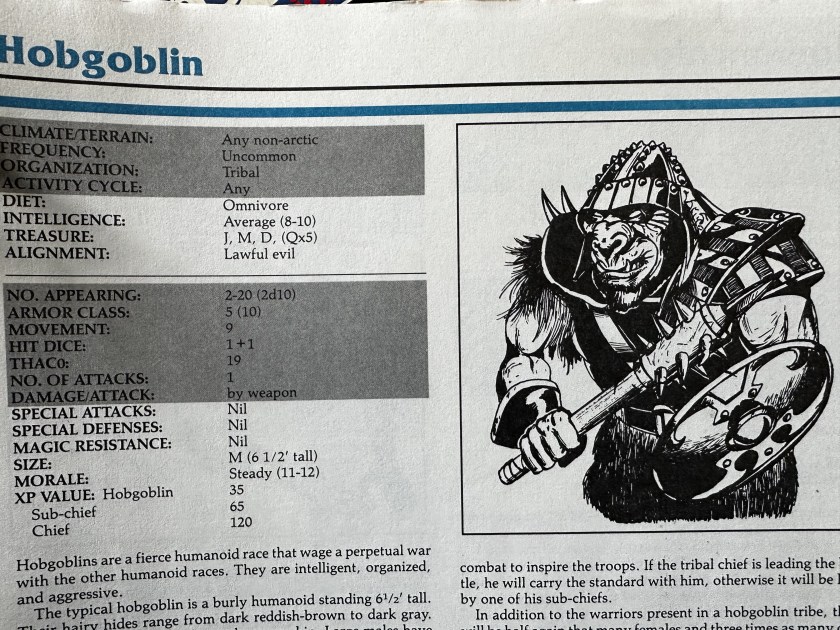
The party ascended the steps and got a better view of the Rock. A platform jutting out from the side of it held a couple of ballistae and a quintet of hobgoblin mercenaries. Up some more steps and rising into the fiery sky, a tower stood, and, to their left there was an opening into the interior of this asteroid-like floating citadel. Beyond, in the darkness, they were able to make out a forbidding, dark hallway, draped in ceremonial-looking finery and decorated with sinister carvings. The PCs were challenged by the hobgoblins, who seemed more clueless than the Illuminated guards below. The PCs convinced them that they were new recruits, hired by Green Marvent. Dropping the boss’ name did the trick. The party asked the mercs who they should report to and they were told to go to the Temple, up near that guard tower they could see.
So, off they went. At the tower, they attempted to just ignore the guards standing outside it and the archers on the top of it but Toranna, still their prisoner and reduced to a single hit point, called out for help from her Illuminated allies, who turned to take on the PCs…
And that’s where we left it.
Conclusion
I guess my conclusion from all this is that, if you interact with all of the rules, some of the rules or maybe even none of the rules, you will probably still have a good time. In the Eternal Boundary, the wondrous locations of the adventure, Sigil itself, the creepy Mortuary, the Citadel of Fire, are almost enough to make it a fun experience to play. The addition of the PCs, their idiosyncrasies and personalities, and the cleverness and excitement of the players is always going to elevate any adventure to the realm of actual fun.
Next time will probably be my final update on the AD&D 2E part of the Editioning as the Eternal Boundary is unlikely to go any longer. Will they uncover the truth of the Illuminated plot? Will they find and confront Green Marvent? Will they all go up in flames? You’ll have to wait and see, dear reader.
Discover more from The Dice Pool
Subscribe to get the latest posts sent to your email.


