Success at a Cost
This phrase comes up a lot in the second adventure from the Star Trek Adventures 2E Starter Set Campaign Book; success at a cost. What it boils down to is that, no matter how well or poorly the PCs do, this here train is going to stay on its rails. This is one of my main gripes with “Dare to Be Wise,” but not the only one.
Dear reader, if you’re following along with my Star Trek Adventures adventure, welcome back! If this is your first time aboard ship, that’s cool too. But you might want to go back and take a look at some of my other posts in this series. In fact, my review of the preceding adventure, Incursion Point, is probably where you want to start. It should give you context for both the game and the campaign.
Going back to “success at a cost;” I think it describes the adventure pretty well. This second of the three full adventures presented in the Campaign Book continues the mission of this boxed set to teach you how to play the game. But, I think it does that at the cost of something essential to a good adventure, something Incursion Point had, freedom. The freedom of the PCs to decide what their next steps would be, what tasks they wanted to try, what ends they wanted to pursue, what mistakes they were willing to make. There was an inevitability to the events of Incursion Point; that city was always going to fall into the core of the gas giant, after all. But the PCs were more or less free to decide what they were going to spend their time doing while that occurred. Dare to Be Wise, though, in two different acts, is trying to teach you how to use the linear challenge, a mechanic that requires the team to complete a series of key tasks in a particular order to achieve a greater goal. The tasks they are to complete are prescribed in the text, and there is a note at the end of several key tasks to say failure allows they to success at a cost. This was dull to run and the tasks themselves felt relatively inconsequential (at least to me; I didn’t tell the players that they would have succeeded at a cost even if they failed) so we sped through them, and the entire scene that they consisted of. Maybe it’s just this mechanic that I don’t like. But I feel as though there was a way to make these tasks feel more like they mattered, by simply giving the PCs the series of problems to solve, but leaving the solutions to them.
The Adventure
There’s a handy summary of the whole adventure on the first couple of pages, along with a callout that indicates that it can be easily adapted for other eras, even though it is meant for the mid-23rd century. There’s a short section on the spotlight roles of this adventure (engineers, flight controllers and communications officers) and another with suggestions on what sort of actions other types of officers might be able to take.
There is also a prelude section here, before the start of the adventure proper. It suggests a period of shore leave and that’s where I got the idea for our heroes to explore the starbase which got extended with my little haunted ship episode, both of which I detailed here. I really appreciated this suggestion and I suspect its the kind of thing I’ll come back to in future.
Spoilers from this point on for “Dare to Be Wise,” by Al Spader.
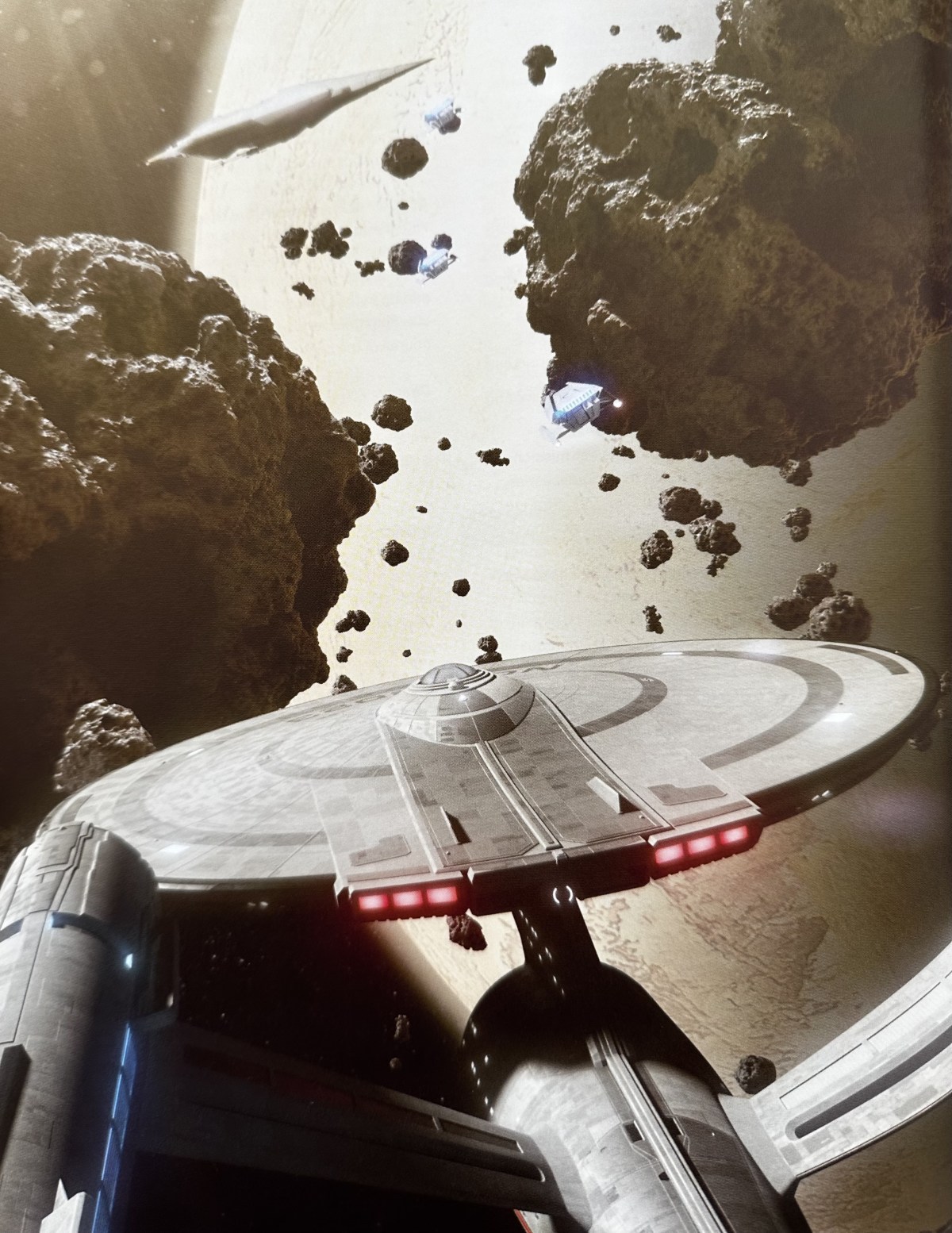
The USS Challenger received new orders. It was a nice, easy survey mission to an asteroid field that’d been rumoured to contain a lot of heavy metals. Leaving Starbase 343, they were looking forward to a quiet, scientific survey, but they were unaware that the ship had been sabotaged by Urotoxa, the Nausicaan archaeologist they rescued from Cressida in the last adventure. At first, the sabotage revealed itself only in a couple of negative traits, which the GM was supposed to apply to the ship. These traits made any navigational or sensor tasks more difficult. In play, I indicated to the players performing those tasks only that they seemed to be more complicated and difficult than normal. They noted that, but didn’t immediately pursue it.
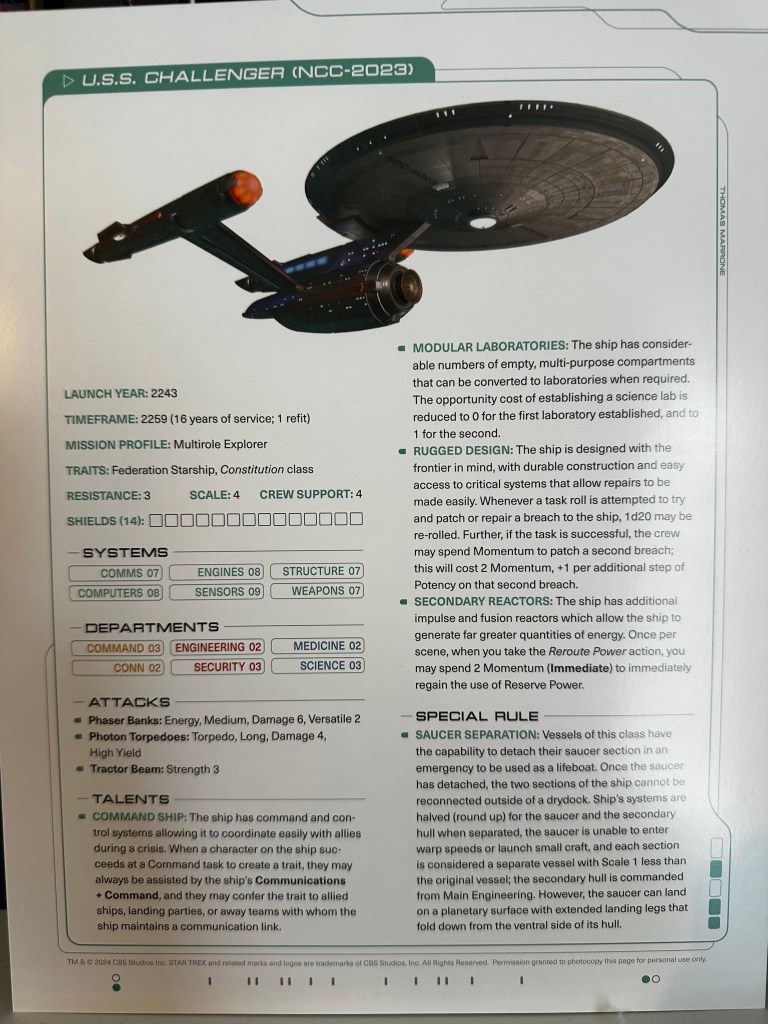
The first roll the text has a PC make is to create a trait. This is for the conn officer to plot a course to the asteroid field. This is a Difficulty 2 Reason + Conn task, but it has been raised to Difficulty 3 because of one of the negative traits I mentioned above. This roll also let the players practice getting assistance from the ship. I don’t think this should have been a roll at all, and, if had it to do again, I wouldn’t have made it one. There were no stakes, nothing interesting would have happened if they had failed. It did alert them to the fact of the extra difficulty, but this might have been done more dramatically later, when we were in the tick of the action. The other thing it did was give the conn officer -1 Difficulty to any Conn-related tasks for the rest of the adventure, which doesn’t make sense to me either.
Once they got to the asteroid field, they revealed the presence of gradon particles amongst the rocks through the use of a Sensor Sweep major action (also hampered by the sabotaged systems) and the spending of Momentum to Obtain Information. They also detected gradonic radiation around the trimetric spatial fractures that allowed Bryozoan beings to come through from another dimension during the Cressida disaster in the last adventure. I just don’t know what would have been gained if this sensor sweep failed. They would not have gotten this interesting piece of information and the adventure would have been the poorer for it. Anyway, at this point, the impulse drive kicks in of its own accord and they are launched into the first of two linear challenges in this adventure. I have already outlined my thoughts on these challenges above, so I won’t go into detail. Suffice it to say that the PCs had to fix the navigational controls, then the impulse drive and then modulate the fluctuations in the engines. Once they had done all that successfully, it was time for Act 2.

In Act 2, the crew were much freer to perform any tasks they wanted to try and determine what was happening. We had sensor sweeps, telepathic links, and computer searches. These revealed that a trimetric fracture had opened here, releasing large numbers of Bryozoan beings, which draining the Challenger’s shields. The longer this went on, the more danger they were in. So they had to figure out how to get away. With a Control + Engineering task success the Chief Engineer discovered a pulse in the warp core that aligned with the frequency of the pulses from the fracture.
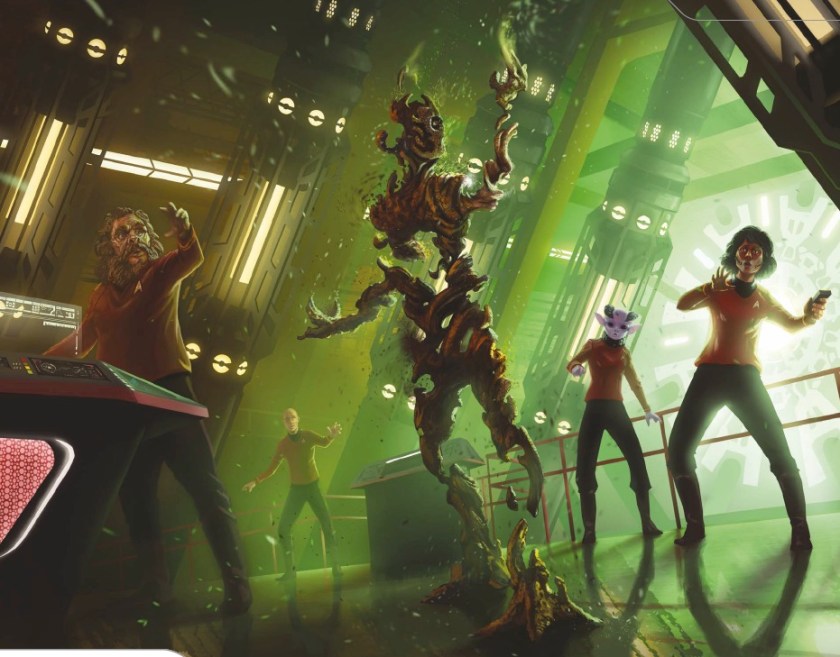
At that moment, a bunch of Bryozoans entered Engineering and formed themselves into a vaguely humanoid form. It was clear it was attempting to communicate with them, but the universal translator was not up to the task. Time for another Linear Challenge. This time they had to identify the manner of communication, modify the universal translator and, finally communicate. This suffered from the same issues as the first one, in my opinion. I think there is a way this mechanic can work better. I just need to think of it for the next time it comes up.
The final act had the crew getting some answers from this Bryozoan Conveyor, racing against time to repair the ship and escaping the trimetric fracture. They talked to the aliens and found that they were an ancient species which used to travel the dimensions, exploring. But, essentially, they got sick of everyone else’s bullshit and decided they would rather not be sentient. In their home dimension, it was possible to live separately, blissfully unaware of their own place in the universe. With the incursion of our dimension they were forced to combine into sentient colonies for some reason. Turns out the colonies voted and decided that the source of the pulses that created the fracture should be destroyed. That was the USS Challenger, of course. But this one colony dissented and came to warn the crew, which was nice. At this point, the PCs had a moment to determine what was causing the issues with the ship and to find the cause of the pulses in the warp core. With a bit of investigation, they discovered Urotoxa’s worm-like virus that she deposited at the starbase when she was aboard the Challenger. This virus affected the systems but also caused the resonance in the warp core that she knew would create a trimetric fracture under the right circumstances.
Armed with this information, the crew got to work on a Timed Extended Task. This was like the extended task to evacuate Cressida in the previous adventure, but with the added pressure of a timer. It was a 12 point progress track. But every time the PCs completed a task towards the goal of breaking free, it took two Intervals. Once they reached 10 intervals, they would have failed. Now, I had been doing the extended tasks wrong last time. Impact is the number of points of progress a PC makes against an extended task’s progress track. I thought they only got 1 Impact per task last time, even though that didn’t make sense because an extended task with a Resistance of 1, would mean they got no progress at all. I had thought that only every second task had any Impact at all last time. Looking back that was so obviously wrong that I wish I had just double-checked the rules in the core book. In fact, the Impact made is equal to the Department rating used by the PC in the performance of the task. So, if it was an Engineering task performed by our Chief Engineer, Burk ven Jaxa, the Impact would have been 5, reduced by the Resistance of 1, to 4. This made a lot of sense I was glad to have come to this realisation.
Anyway, an extended task like this allowed the PCs to do whatever sort of task they thought could be of help and they did. Lt. Kemal gunned the impasse drive to try to escape, Tennan, somewhat cursed by complications brought about by my spending of Threat points ran from pillar to post around the ship trying to find a working communications panel to let the aliens know they meat no harm, and finally Burk created a barrier around the warp core, to contain the pulses. The fracture collapsed, the Bryozoans retreated and the ship escaped.
Our session ended up with the PCs describing how they gained milestones, linking their actions in this adventure back to resonant moments in the last one. This allowed them all to improve in some way and then we totted up their Acclaim points so the could increase their reputations, gain awards, curry favours or earn promotions.
Conclusion
I had my problems with this adventure, as you will be aware, dear reader, if you made it this far. There was not enough freedom for PCs to do what they wanted. It should have presented more problems and fewer solutions. Some of the plot points felt like they were full of holes and still do. But, it did succeed in teaching some major mechanics of the game and linked the first adventure with the upcoming final one. Was it worth it? Sure. I mean we still had fun with it and there were parts that were genuinely dramatic.
Our trek through the stars will continue soon, dear reader. In the meantime, live long and prosper.
Discover more from The Dice Pool
Subscribe to get the latest posts sent to your email.


