UVG x Troika

Vibes

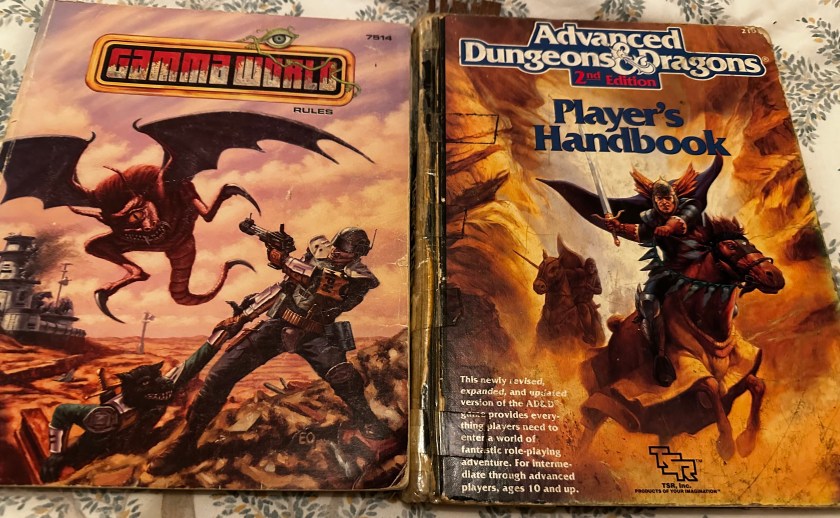
It’s easy to categorise RPGs by genre. Traveller is sci fi, D&D is fantasy, Cyberpunk Red is, well, cyberpunk, Call of Cthulhu is horror. There’s no real question about that. But, when you want to do an RPG medley, you’ve got to consider rulesets and vibes. D&D and Gamma World are basically the same ruleset, which makes it handy to mash ‘em up. But more importantly, their vibes are vibing on the same frequency. This has a lot to do with the art style in the books and the ways in which the games themselves are presented as well as the settings. I’m sure I’m not the only one to take their Gamma World players through a portal to a D&D fantasy world where they could blast dragons with their enormous radiation guns. It just made sense because of the vibes.
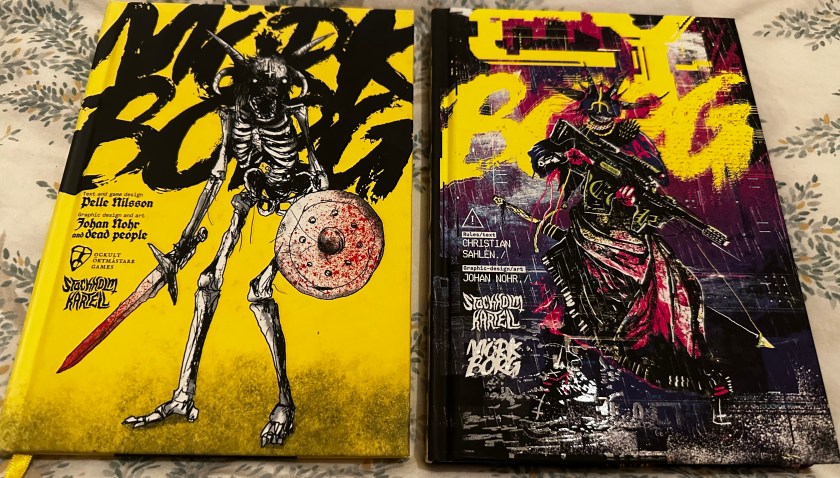
We finished a Mörk Borg campaign earlier this year. Got all the way to the end of the world, believe it or not. Cleverly, our GM, Isaac, ended that world and then woke us up from the the virtual reality game our Cy-Borg characters had all been immersed in. Someday, we’ll return to this game that’s also a new game. Now the vibes of these to are so obviously similar because they were both made by the Stockholm Kartell and designed by Johan Nohr. The art style is brash and neon and loud for both so you feel like they vibe together naturally.

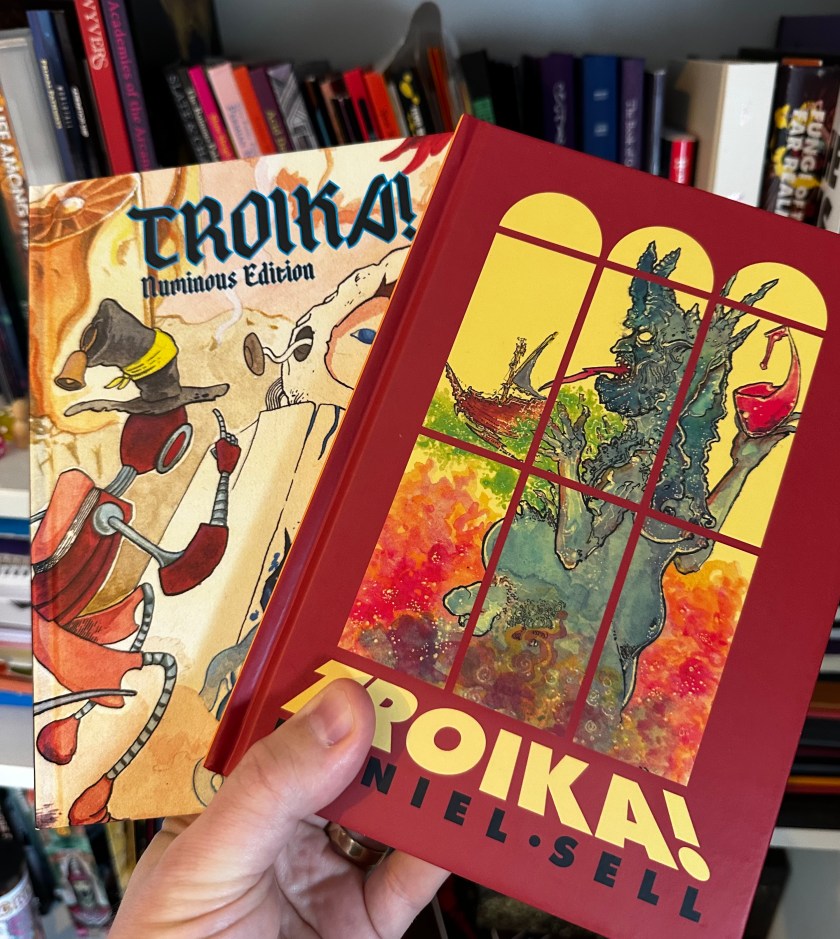
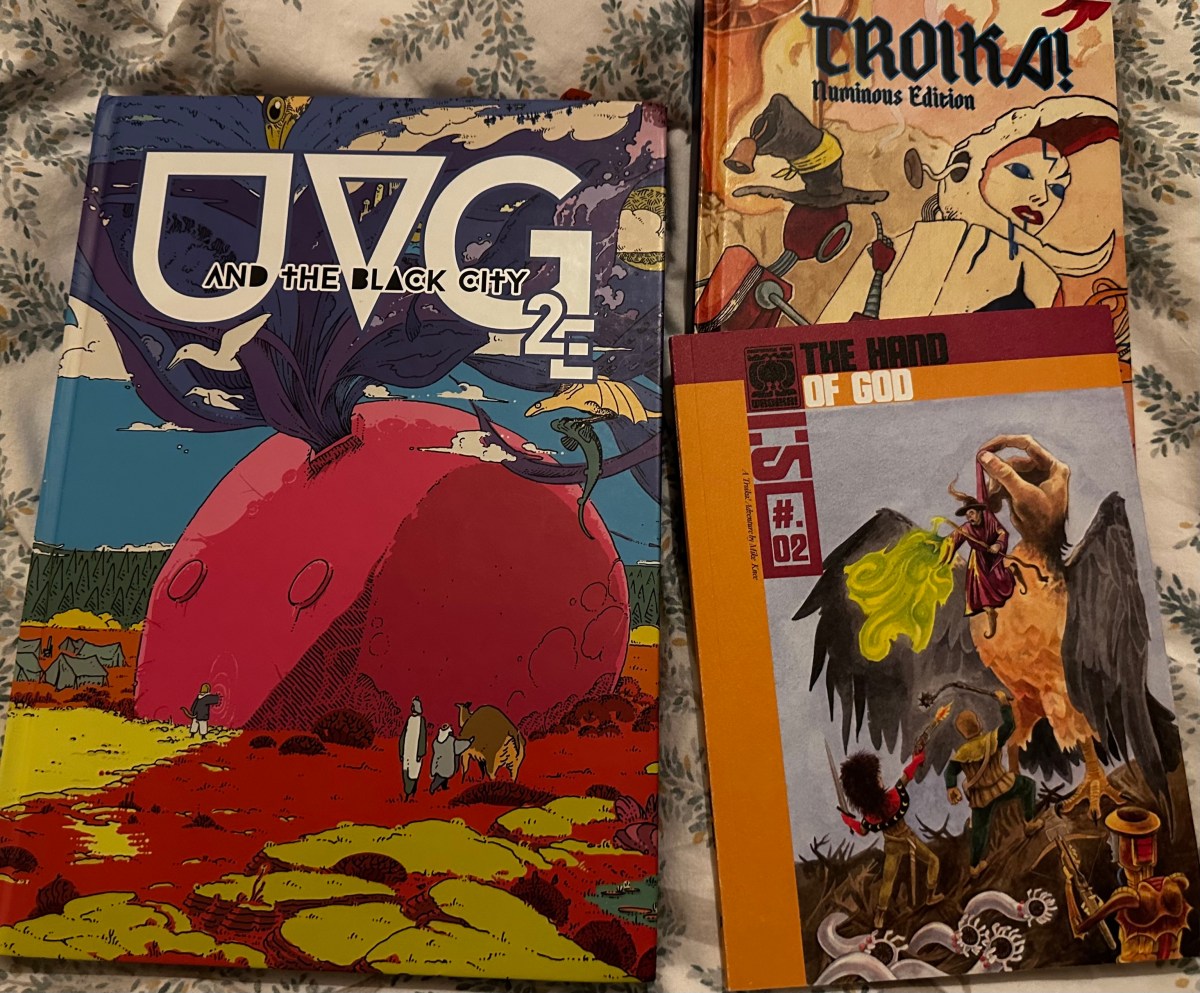
Today I want to discuss a couple of games that you might not automatically mention in the same breath, Ultraviolet Grasslands, Luka Rejec’s psychedelic, prog-rock fuelled old school trading simulator, and Troika, Daniel Sell’s Science Fantasy Moorcock/Wolfe mashup using the rules for Fighting Fantasy and the surreal art stylings of Shuyi Zhang and Andrew Walter among others. OK, you might mention them in the same breath, actually. They both tickle a very particular armpit, in between the arm of sci-fi and the torso of fantasy, and, to me, their vibes intersect perfectly. So much so that I decided to employ a Troika adventure in UVG.

The Adventure So Far

The PCs have been on the road for more than six weeks. From the Violet City on the shores of the Circle Sea they have traveled west through the Ultraviolet Grasslands. They’ve encountered Lime Nomads, giant mushroom-tending armadillos, cyborg-like bio-tech lifeforms called vomes, and even a furniture trader named Jonky Bonko so far. And at every point along the way they have gathered resources and items to trade, hopefully for a profit. This has been their over-riding motivation thus far in the campaign. The players are utterly invested in the success of their joint business venture, which they have named Isosceles Inc. Watching their Cash numbers go up has definitely been exciting for them, especially when they make a really good market research roll, or haggle their way into a selling price three times higher than their buying price. But I have been wanting a bit more old-school in it too. To that end, I’ve been seeding something in the otherwise completely randomly generated adventures. It originated in a random encounter, but I kept it running through a couple of other random encounters.

They rescued the daughter of a Lime Nomad clan chief and returned her to her mother. The mother, grateful and impressed, entrusted them with a message in the form of an item known as a portable illusion. She asked them to take it to her sponsor, a Porcelain Prince called Black Pot 5-Body at the Porcelain Citadel. Almost immediately, they rolled up another random encounter with a Porcelain Prince out on the road. A Porcelain Prince is an intelligence that’s distributed across a number of humanoid bodies that wear matching porcelain masks. The PCs, wary and out-numbered mentioned that they were on the way to see Black Pot 5-Body in the Porcelain Citadel in the hope that it would encourage this Prince to treat them favourably. On the contrary, the mention of Black Pot seemed to cause something of a stir. The Prince promptly sent a messenger off in the direction of the city. The PCs promptly killed the messenger in the grasslands and buried him in a shallow grave.

Later, at the Low Road and the High trading post, they heard a rumour that an ultra-conservative Porcelain Prince, Meissen 13-Unity had dedicated themself to restoring the Citadel to the unity of thought not exemplified since the end of the Properly Recorded Period. Not only that but that Sunfire 3-body, who they had met on the road, was an adherent of theirs. At this stage, the PCs were not able to put things together. But once they pushed on towards the Citadel they ran into a random encounter, the caravan of another Porcelain Prince, this time, an ally of Black Pot 5-body. This time, the Prince sold them a pass to get them into the Upper Citadel, where they could do business and find the Prince they were looking for.
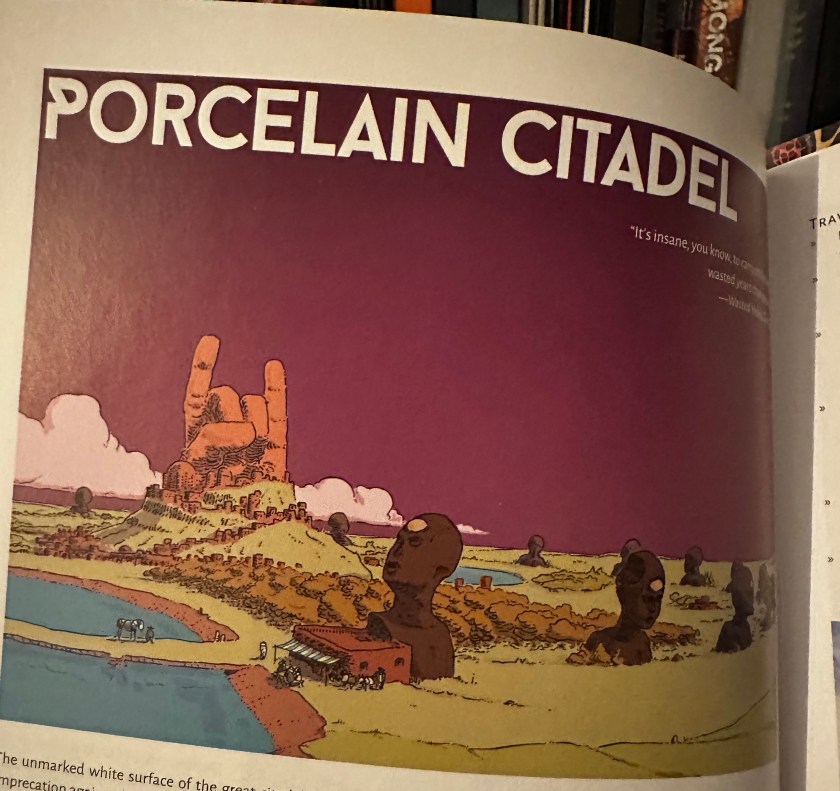
Finally, they reached the Porcelain Citadel, the great hand-shaped edifice towering over the grasslands doing devil’s horns. They had been eager to do some carousing here. The PCs had a taste of it in the Violet City at the start of the campaign and gained a lot of XP from it so they saw it as a short-cut. This time, one of their number got completely fucked up on drugs and managed to lose most of their Cash as a consequence of a particularly poor Carousing roll. So they needed to make some money quick. The next day they went to visit Black Pot 5-Body in their workshop. There they presented the eccentric Prince with the Portable Illusion. They activated it and they all witnessed a Porcelain Prince being abducted from a camp by an enormous winged creature with a hand where its head should have been. They were dumped in an enormous nest at the top of a massive index finger stretched up into the sky, as high as a mountaintop. From there the view within the illusion changed and they saw the Prince negotiating with a wizard in a black tower atop another digit of this huge hand. He exchanged a copy of a book for the wizard to help him escape back to the Grasslands. And then the illusion ended. Black Pot was very excited. This was their chance! They had finally found the evidence they had needed for so long. The original book that would prove that the laughable philosophy of their political rival, Meissen 13-Unity was based on nothing more than a work of fiction designed to satirise the exact sort of overtly conservative views they thought were espoused by it.

That’s a lot of backstory. Suffice it to say, Black Pot employed the PCs to get abducted from their dreams by the bird-with-a-hand-for-its-head so they could be taken to the mountainous hand and retrieve that book. They went into the grasslands and did just that. They woke up in the nest, just like in the Illusion. After avoiding the gaze of THOG, the bird-thing, they killed some worms escaped the nest and found themselves on the tip of that cyclopean index finger looking out on a wide green land and a cerulean blue sky. They knew immediately that they weren’t in Kansas anymore.

I loved this moment. At this point, the players did not know they had just transitioned from UVG-proper to the Troika adventure, The Hand of God, so they had no reason to suspect anything. Also, there have been hints of portals and other worlds dotted around the plains in our campaign so far, so they had no reason to think this was anything but more UVG weirdness. I kept up the pretence as long as I could. But, eventually I shared one of the illustrations from the adventure in our chat and Isaac was quickly able to identify the distinctive style of Andre Walter, so well known for his Troika work. He asked me if this was a Troika adventure and I answered honestly as is the law.

But that was ok! It helped me in fact. The players understood that I would have a little work to do to translate from one ruleset to the other when I had to spring things on them so they have been quite forgiving.

Conversion
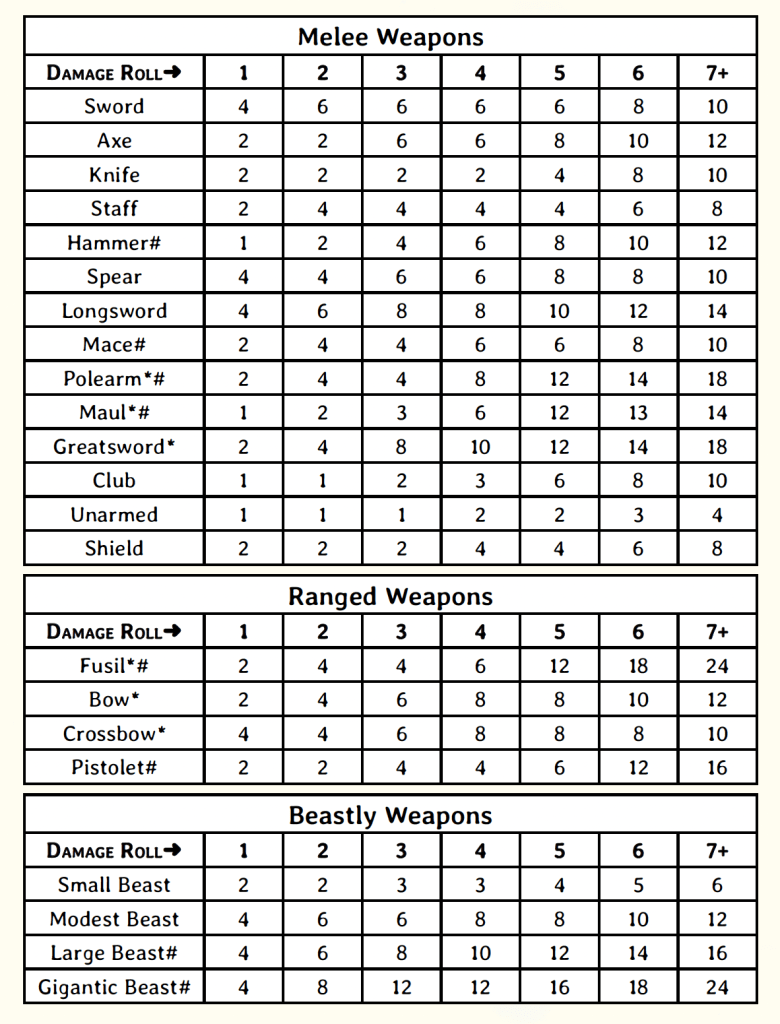
For the first session in the Hand of God, I didn’t even do any preparation of encounters in UVG terms. I winged it completely and that was fine. It would absolutely have been better if I had prepped, but it was ok. The nice thing about both rulesets is that they are light. A UVG creature’s strength is based largely on levels/hit dice, in a very D&D-esque way. So I was able to use the following table to work things out approximately while my players waited patiently.
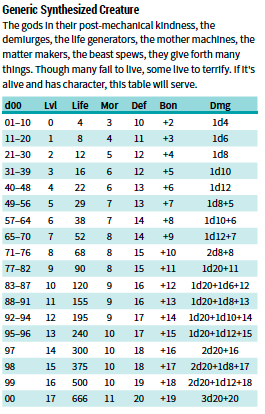
But the fact was, the only combat encounter they had was with a couple of weak and lowly Prayer Worms. In Troika terms, they had low Skill and medium Stamina and their only special was screaming when they died so it was was easy to look at that table and decide to make them level 0.

I rolled up another random encounter as two of the three PCs made their way down through the index finger’s stony interior. There, on the stair, they found a poor undead whose body had been crushed by a fallen boulder. She told them she would reward them if they would bring her to the undead village of Jigigji over on the Little Finger. So they re-reanimated her decimated body and brought her along with them. Meanwhile, the third member of Isosceles glided across the span to the next finger on his handy glider. He landed on the opposite side of the bridge long before the other two made it there. At this point I knew they would be running into a lot of potentially tricky encounters that I thought I should prepare better. So we left that till the next session. In between, I converted all the stats for all the potential encounters, whether random or planned. The conversion did not always fit neatly into the rows of the table above. Sometimes I would add more hit dice if they had more Stamina than Skill, and I would always look at the potential damage on the Troika damage tables to decide the dice and bonuses to give them in the UVG context. None of this was particularly taxing, although I’m sure some GMs would do the conversion differently to me, if they wanted something more or less balanced.
The next session they dealt with a bridge troll and his gremlin minions, but realised they were in for a tough time on this adventure quite quickly. Once they got across the bridge, they soon reached the black tower of the wizard as shown to them by the Portable Illusion. In the adventure, this is known as Rezkin’s Folly. All they would have to do is get into this powerful wizard’s abode, avoiding the fireballs being flung by the magical orb security system and all the weird shit inside, and they would get the chance to maybe retrieve that book!
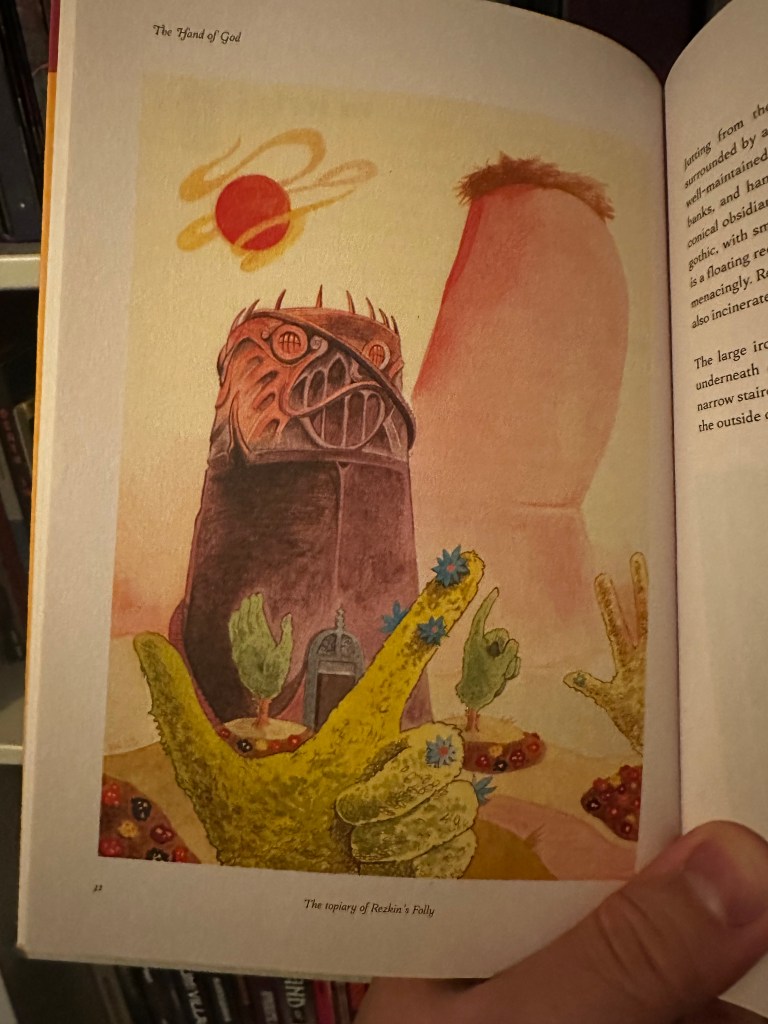
The Folly is presented as a mini dungeon within the context of the overall adventure. It has fourteen rooms and its spread over a mere eight pages. It is very easy to read and absorb and most of it is usable in any system, with only the creature stats requiring conversion.

There are some Wizard spells referenced in the adventure that are taken directly from the Troika core book. I had to spend a bit of time looking up UVG spells that worked as alternatives to their Troika counterparts. None of these were really done on a one-to-one basis. Troika spells are generally fairly D&Dish, but UVG spells might really do anything, conceivably. I used both the UVG core-book and the forthcoming Wastelands Guidebook to help with this.

Conclusion

Well, we haven’t concluded this adventure by any means. Isosceles Inc have only made it into the tower’s lowest floor. They have encountered a gossamer assassin creature and survived, but still have to make it to the treasure room and out again. They also need to bring their undead companion back to Jgigji and then escape this potential dreamworld to get back to the Grasslands!

So far, I am loving how well the Troika adventure vibes with UVG. There are some anachronisms, like trolls and gremlins, which seem a little too generic-fantasy for the weirdness of UVG, but, on the other hand (if you’ll excuse the pun) they’re on a ginormous hand and they were sent there by a weirdo who lives in a giant hand. This was obviously the thing that linked UVG and the Hand of God in my head. Somehow, this dreamworld leaked into the “real world” of UVG and led the Porcelain Princes to build their Citadel. And, perhaps, the item that same their citadel from repression is contained in it.

Anyway, this adventure will continue soon, hopefully. Our gaming has been dominated by the Editioning recently, but, hopefully, we’ll get some more UVG x Troika in soon!

Troika! Whalgravaak’s Warehouse Review

Here’s the story: hundreds of years ago, the city’s premier logistics wizard, Whalgravaak, abandoned his warehouse, having shredded the Manual of Operations for his Sphere Pool (a mechanism used to import and export goods across the cosmos) so that his rivals could never figure it out.

One-shot fun-shot to campaign of terror

You know what it’s like, dear reader: you want to introduce some noobs to RPGs or just to your group of players, you want to make a good impression but you don’t want to scare them off by plunging them into a multi-session campaign with a complicated, crunchy system. So you pick up a location-based adventure, thinking you can just use a small portion of it, just what you need, just enough for one session, one single shot. But, after that session, the curiosity gets the better of you all. That was a weird, but enjoyable experience, you tell each-other. I bet we could have fun exploring the rest of that odd locale, you tell the players, why not have some more sessions and see how it goes? So you do that. And then the bloodbath begins.

Whalgravaak’s Warehouse

SPOLIERS BELOW! If you are interested in being a player in Whalgravaak’s Warehouse, turn back now!

The covers of three Troika! 1:5 adventure modules, Whalgravaak's Warehouse, The Hand of God and Eye of the Aeons.
The 1:5 adventures that I own, Whalgravaak’s Warehouse, The Hand of God and Eye of the Aeons. All from Melsonian Arts Council

Whalgravaak’s Warehouse is a Location based adventure by Andrew Walter for Troika! The design is by Shuyi Zhang. It came out in 2023 and was the first of the Melsonian Arts Council’s 1:5, an ongoing series of location-based adventures for Troika! There are a couple more available now and another out very soon. You can find them all here. My somewhat rotating group of Tables and Tales members just had our last session in Whalgravaak’s Warehouse on Monday night, after spending a total of eight sessions there.

Here’s the story: hundreds of years ago, the city’s premier logistics wizard, Whalgravaak, abandoned his warehouse, having shredded the Manual of Operations for his Sphere Pool (a mechanism used to import and export goods across the cosmos) so that his rivals could never figure it out.

Since then, the strange nature of the warehouse, staffed by giants and stocked with oddities, has only grown stranger, and more dangerous. It houses a handful of physics defying, Tardis-like chambers, not least of which is the terrifying Deep Storage, a swirling mass containing several pocket dimensions and a wraith-like being who wants nothing more than to consume intruders. At least one cult has taken up residence, and they are often mutated into horrific Chaotic Spawnlets by the effects of the radiation still spilling from the Sphere Pool. The warehouse is sandwiched by a vast desert of dust occupying the roof, which is peopled by the descendants of Whalgravaak’s former employees and, underneath, the tunnels of a pack of unpredictable Worm-headed Hounds.

But entrance has been forbidden by the Autarch for centuries and, even if you were foolhardy enough to ignore a diktat like that, you would still need to be brave enough to face the unknown dangers within.

The Hook and the Party

The book suggests a few potential hooks for your PCs. Since my game started off as a one-shot, with brand new characters and no existing campaign to work it into, I went for one that seemed like the object might be achieved in one session. They, along with many other groups of mercenaries were contracted to return with the head of a Cacogen, known only as the Opportunist, to their patron, an Exultant of the Autarch’s court. But we dealt with that in flashback as they all sat in the weed-choked yard of the warehouse, dotted now with small encampments of adventurers and brigands all gathering their courage to gain entry. The PCs’ band consisted of a Monkey Monger (and monkeys), a Gremlin Catcher (and dog), a Wizard Hunter and a Landsknecht. They were, to put it bluntly, a motley crew.

That first session was all fun and games. Every encounter, except for the last one with the Cacogen, was resolved peacefully. This happened mainly due to the rolls I made on the Mien table for each encounter. The worm-headed Hounds they encountered wanted to play with the Monkey Mongers monkeys, they did not want to eat them. The Flat Serviceman was happy to follow the party around and clean up after them. The Segmented Crippler in the Pigeonholery, didn’t want to wake up, so they skipped that one entirely. This is a pretty standard mechanic in Troika but I think it gave the players a false sense of security. The session ended with this motley crew finding and defeating the Opportunist quite handily. And, at that point, we thought that would be it.

But a few months later we decided to continue with their explorations of the warehouse. Obviously, their original motivation to explore was gone. They had achieved their objective, but the players were all good sports. They decided between them that the motivation was purely one of curiosity and greed. They had spotted, through a bubble like window in one of the rooms they had traversed, a vast and terrifying pool of chaos and wonder in a room far too big to exist within the confines of the building. This was enough for them. Essentially, they went in search of adventure. Although, through the sessions that followed, I did introduce the idea that they might want to find that cult I mentioned earlier and that they should seek out the incredibly valuable Tome of the Sable Fields that was reported to be stored in the warehouse, somewhere. This gave them a little direction when I thought they might need it, but, honestly, I think my players just wanted to see what new wonder/horror the dungeon had in store in the next room.

The Dungeoncrawl

It was only from this point that I started to really treat this adventure like the dungeoncrawl it is very much meant to be. The book does a good job of introducing the concepts of tracking resources like lantern oil and provisions as the party explores. It also explains the concept of exploration turns and their effect on the game, i.e. the distance you can travel in that time, the amount of lantern oil you use per turn, and the likelihood of running into an encounter. I followed all these rules to the letter and they made for some interesting moments in the game. But, to be frank, the weirdness of the setting is the real draw here, not fiddling with rations and light levels. Also, few of the characters lived long enough for starvation or oil-skins to become a problem.

It also has rules for dealing with the spatially distorted, impossibly large areas within the warehouse. It suggests that the players should make Luck or Skill checks to avoid getting lost in these areas, but, in all honesty, I didn’t really require that sort of thing.

Mapping is also a part of the dungeon crawl format and this adventure does want the party to attempt to map the space for themselves. The thing is, when some rooms appear to be a kilometre wide and the next one is spatially normal, that map becomes effectively impossible for them to draw accurately after a relatively short period of time. Eventually, I gave up and just shared the one from the book with the players, trusting their ability to separate player knowledge and character knowledge. My advice, if you are doing this, try get your hands on the PDF version, since the one in the physical book stretches across two pages and the crease obscures part of it.

In fact, the adventure has four maps:

  • the warehouse floorpan, using 10ft squares to denote distance
  • a hex crawl for the desert on the roof, replete with points of interest
  • a map of the Worm-headed Hound tunnels beneath the warehouse, superimposed over the warehouse plan
  • a largely vibes-based map of Deep Storage

These are all great but usefulness will vary. In our game, the party spent several sessions trapped in Deep Storage but took one look at the desert and noped right out of there. This seems like a good point to note how good all the artwork is in this. There are plenty of colour and black and white illustrations but they leave me wanting even more!

Warehouse Workers and other Beasties

A warehouse is a dangerous place to work, especially when the correct safety protocols are not observed. It doesn’t help at all when you are trespassers and several of the residents are large enough to crush you with a single blow.

The crimson giant, Paude, the pipe-smoking, bearded giant, Arbuthnot and the blue, jelly giant, Gamtomerian.
The giants are not what you might expect.

The giants are the main NPCs of the adventure and Whalgravaak’s only remaining employees. Each one is fabulously interesting, diverse and well-drawn. They have their own motivations and desires. I was gratified that the party managed to encounter all of them during the eight sessions we played. In fact, one player had two different characters killed by two different giants. I will point out that it is entirely possible to avoid violence when dealing with the giants, it’s just that, sometimes, the Monkey Monger on the team has monkeys who decide to fuck with them and one thing leads to another.

The wraith-like Gulf Man Roamer from the swirling vortex of Deep Storage is a potentially lethal foe who has a chance to show up each time the party moves through that already dangerous room. If it captures you in its bag, it’s going to spirit you away to eat you in its extra-dimensional lair.

No warehouse is complete without forklifts. Whalgravaak’s forklifts are humanoid constructs with the face of the wizard himself. They treat intruders like stock, and will attempt to whack them and pack them. They hit very very hard.

Its a black and white dog, with a neck like an earthworm
When you read the words, Worm-headed Hound, is this what you imagined?

There are also a bunch of random encounters, including the Worm-headed Hounds I mentioned before, desert nomads from the roof, and Bandits/Burglars/Bastards. These only turn up on the roll of a 1 on a 1d6 for each turn the party travels. It didn’t occur very often in my game. The Roof and the tunnels have their own random encounter tables as well, but I never used them as the party never spent any appreciable time there.

This is just a selection of the possible encounters you can have in this setting. I haven’t even mentioned the tiny army guys, the sentient crane parts, the Onion God or the Mulled Dead.

The Rooms

I have hinted at rooms that defy physics and rooms with pocket dimensions, and those are usually the big-ticket locations that contain some of the greatest set-pieces in the adventure. Deep Storage alone evoked some of the most inventive use of skills and spells and a great degree of fear and tension from the PCs. It killed one of them (two if you count the Rhinoman eaten by the Gulf Man Roamer.) The Roof could act as an entire short hex-crawl campaign and the Sphere Pool has some truly memorable and dangerous elements to it.

However, many of the other rooms have weird and wonderful contents as well. Some of them, the party will glance at and move on, while others will capture their imaginations and encourage them to interact. I never really knew which reaction I was going to get from them, actually. The room full of melting rope? They had to spend an hour trying to figure out how to set it on fire, the eternal battle between tiny armies playing out across a battlefield seemingly larger than the whole warehouse? Just popped their heads in and left with some captured little men.

Some of the rooms were relatively mundane warehouse style rooms with shelves and containers. The book has tables in the back to help you identify the state those rooms are in and the contents of the containers, which is useful.

One of my over-riding impressions by the end of our game, was that in some ways, the great variety of bonkers content in the rooms served to detract from any unifying theme. There were some elements that went together, such as the warehouse’s disdain for traditional dimensions. If my PCs had explored the Roof or even encountered any of the nomads who dwelt there, they might have found a distinction between those descendants of the ancient striking workers and the giants who continued to obsessively do their jobs even long after their employer had passed on. But, none of that is to say that the rooms weren’t endlessly fun and inventive.

A Note on Lethality

I recently wrote a post sharing some of the obituaries of the characters who met their ends in Whalgravaak’s Warehouse. You can check it out here. There are only three of them in that post. A few months previous to that, I wrote this post, which contained the obituaries of two more. The mathematicians amongst you will have summed those already. That’s five. In the final session, we lost another one. That makes six. That was three character deaths each for two particularly unfortunate/reckless players. Warehouse work is dangerous. Only one of the original party survived to the end. You have been warned.

Conclusions

The covers of the two different versions of Troika! that I own.
Numinous or otherwise, its the same game.

There is so much to recommend in this adventure. It is endlessly entertaining, challenging and bonkers. It has such a variety of locations and such a diversity of encounters that you would need to work hard to get bored in Whalgravaak’s Warehouse. I think it works so well to show off Troika! as a system, too. The problems it asks the PCs to solve and the encounters they have to deal with utilise things like the Luck check really well and encourage players to invent their own unique Advanced Skills. But if they get into fights, especially with the incredibly random nature of Troika! initiative, there is a very high chance they are going to come out of it dead. There are a few opportunities for insta-kills throughout the warehouse too. I can’t overstate exactly how lethal this adventure is. Luckily, my players leaned into that, even when they were creating new characters to join in the same fight the original one died in (they got very quick at creating characters.)

I think it’s also flexible enough for many GMs to easily take it or part of it and fit it easily into their own ongoing Troika! campaign. As I said at the start, our game started as a one-shot and it could have ended there. But we were able to easily adapt it into a short campaign of its own.

Dear reader, let me know if you have played Whalgravaak’s Warehouse or if you would like to! I’d love to know your views on it.

Games I Got to Play This Year Part 2

Wrap-up

It’s an end of year wrap-up. Everyone’s doing one. Check out the last post for the campaigns I have been playing in the last few months. This one’s for the one-shots.

One-shots

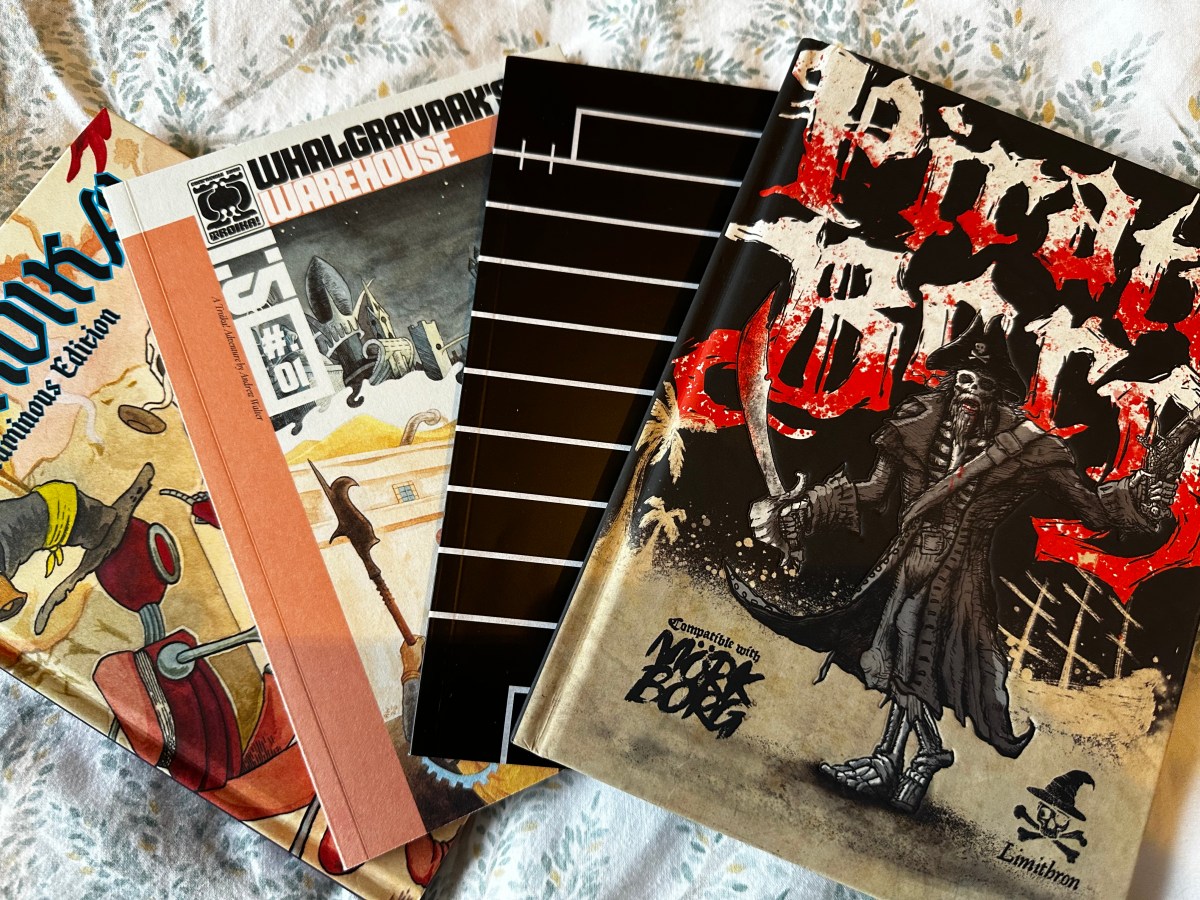
  1. Pirate Borg – the link above will take you to my post mortem on this one shot. It was a great time, in all honesty. My first foray into running any kind of Borg, and I was pleasantly surprised by how easy and instinctive every part of it was, even the ship-combat, which was new to everyone at the table. If you are interested in pirates, light cosmic horror, or just gnarly old school gaming in an alternate history version of our own 18th century, you’ll enjoy Pirate Borg in all likelihood. By the way, I also did a character creation post on this one.
  2. Troika! – Whalgravaak’s Warehouse – Ok, look, full disclosure, this is supposed to be a list of one-shots but this is technically more like a really spread out short campaign where we get together to play a one-shot of the same game every once in a while when we can all afford the time. Know what I mean? Anyway, in the first one-shot of these two consecutive one-shots, the PCs found two different ways into this warehouse, abandoned by its wizardly owner centuries previous. After crawling this “dungeon” for a bit, they made friends with a thin mutant, and their monkeys got to play with the worm-headed hounds that lived in a nest in the warehouse somewhere. They made short work of the Cacogen they’d been sent to murder and we wrapped up the session. In the second one-shot in this series of one-shots, three of the band decided to continue to explore, making more friends, this time with a large cadre of mercenaries who had been sent to deal with some cultists. They then set fire to some rope, captured some minuscule soldiers in gremlin-jars and climbed a mountain of onions. This is the kind of nonsense the PCs get up to in games of Troika to be honest. This is standard. If this sounds too gonzo or weird, you are in the wrong place. The Eternal City of Troika is not for you. You should probably try somewhere more normal. From my point of view, and, I think, that of the players, if you lean into the bonkers aspects of the setting and you are willing to go along with the more outré elements of the system (the random initiative mechanic stands out) you will probably have a very good time with this game. It’s great for one shots. Or two shots if that’s your thing. Might turn into three shots, actually.
  3. Honey Heist – this was another one of Isaac’s games. He ran it on a night when another game fell through. It was very last minute but we were still able to get a crew together. Jude, Tom and I rolled up some friggin’ bears with criminal backgrounds and went to do a heist at the biggest honey convention in the UK, in the NEC in Birmingham. We tried to do a TED talk, we disguised ourselves as massive bees and we crashed a van. You know, typical bear stuff. Another absolute belter of a one-shot, this one. It’s the definitive one-page RPG by Grant Howitt of Spire and Heart fame. Isaac and Tom had picked up the printed form of a bunch of these one-pagers at UKGE and Isaac had been looking for the opportunity to run one of them. This game was obviously made to create wild swings as you use either you Bear or Criminal stat and try to avoid going too far on the bear side or too far on the criminal side. This forces you to take risks and do stupid things to drive the heist forward or, more likely, sideways. Tom did a brilliant write-up of the session on their blog here.
  4. B.D.S.M. Below Dwelling Sewer Mutants – Yet another game run by Isaac at short notice. It is a mutie-eat-mutie game by Neonrot and you can get it here. The premise is pretty straight-forward. You are a mutant. You are probably unpleasant in some way. At the start, you have a mutation that may or may not be useful in certain situations. You can progress and grow by eating other mutants to gain new mutations along the way. If you like that idea, you’re in for a treat. I think it is probably a game that works best in one-shot play. We had fun with it and I think most tables will.
  5. Cthulhu Dark – Roadhouse Feast – I went into quite a lot of detail on this one in the post I linked above so I won’t go through it all again. Suffice it to say, I really enjoyed running the Cthulhu Dark game for the first time. The scenario itself was great but, to me, it is the simplicity and the ingenuity of the system that really shone. If you are into cosmic horror games and you haven’t tried Cthulhu Dark, you should give it a chance.
  6. Liminal_ – I promised a report on how this one-shot went some time ago and here it is. We had four players (known as the Disoriented) for this one-shot plus me as the the Architect. As I thought we would, rather than have the players play themselves in this Liminal Back-Room nightmare, I had them use the character generation tables in Death Match Island. This worked really well to come up with some distinctive, memorable characters quickly and with no fuss. They started off all in the same public building. Since one of them was a district attorney, we agreed it should be a court house. One of the others was there as a witness in a case and the other two were, in an unlikely turn of events, cousins who had been called for jury duty on the same jury. That is pretty much by-the-by, although it did come up in conversation later. Thy all stepped into a room together and found themselves in a building of nightmares. Now, you have to roll up the rooms as they open the doors. There are a couple of d100 tables in the book that are crammed with inventive and horrific room descriptions. The first door they opened led into some sort of creepy, dank cave system; the next into a mouldering bowling alley that was was canted at a 45 degree angle; the next opened onto the abandoned bridge of a ship, rocking in a dreadful storm and with a trail of blood leading off through one of the other doors. I made a mistake at the very start, where I allowed the players to open a couple of doors and then decide which one they would go through. The rules state that, if you open a door, you have to go through it. This felt a little restrictive to me, in a role-playing game, but we proceeded in this way and the players were good sports about it. As we progressed, rolling on the Room and Entity tables, it felt as though, at times, they really wanted to see what the hell was going to come next. Isaac said afterwards, that it felt a lot less subtle than he had thought it would and I have to agree with that. When you think of liminal space horror, it often is just empty corridors and abandoned hotels and the like. Sometimes a strange entity might make an appearance, but it’s the spaces themselves that are supposed to be innately creepy. Some of these rooms we rolled up on the tables felt that way, like the corridor with missing persons posters of the PCs on the walls but a lot of them were straight-up horror like the one with nurse-entity (I think?) chopping a guy up on a slab (it was ok, he was into it!) Also, I think this is something I would be careful with: when you roll a random entity, they sometimes don’t seem to fit, thematically, with the room that you just rolled up. I think it is ok to re-roll if that happens. I didn’t do that and once or twice, felt like they collided awkwardly. Now, these are nitpicks, really. In general, we had a good time with this, the players loved playing their pretty normal characters in these horrific scenarios, just running blindly from threat to dreadful threat. We used both the regular room table and the guest room table (the entries here were written by some industry luminaries like Johan Nohr and Tim Hutchings.) One of the best things about that experience for me was that I was just as surprised, horrified and disgusted as the players were! One of the challenges then, of course, was that it was my job to quickly read, interpret and present the room to the players without taking too long, stumbling over the words, reading them too much or generally fucking up. Unfortunately, we didn’t quite make it to the end of their mad dash through the back-rooms. The PCs still have a few squares of fatigue to be filled in. Hopefully we’ll be able to pick that up and finish it off someday.
  7. Mothership – Moonbase Blues I wish this wasn’t in the one-shot pile but heigh-ho. Sometimes your GM moves away and leaves your characters stuck on a moonbase that is probably trying to kill them. I mean, there was someone or something there trying to kill us. I was under no illusions that we were likely to all die out there, I just wanted to know how. Anyway, the one session we had of this game was great. Full props to Joel, our GM, for putting so much time and effort into he prep for it. He had a series of recordings that he played for us at key moments, he had handouts and provided us with cheat-sheets. It was a great experience. Also, I loved playing my character that I created in the post I linked above, Victoria Ibanez, the Corps’ finest. I’d love to get to play her again. Mothership is a great system with compelling mechanics and one of the best character creation experiences out there. If you need any more convincing, you should go and check out Quinns’ review of it.

Conclusion

So, that’s it. Those are all the one-shots that I got to play in the last few months. I didn’t get to play many of the games I wanted to, but I sure did have fun not playing them. Next year, I am continuing the theme of not playing the games I listed in that post by starting the year off with a one-shot of After the Mind, the World Again, a Disco Elysium-inspired, GMful mystery game and, Dragon Age, which, I have at least discussed at length on this very blog here and here. Honestly, I think it was useful to set out goals for the games I wanted to play. I may not have gotten to play any of them if I hadn’t done that. So I will continue to write about things I want to experience on the blog and see what happens.

I will be posting more intermittently as we come into the holiday period now. I will be travelling to visit friends and family a lot and won’t always have the chance to post as regularly as I would like. So, in case this is the last post before the end of the year, I wish you the very happiest Winter Solstice/Hogswatch/Western New Year.

BTW

Here are links for where to buy each of these games:
Pirate Borg
Troika!
Honey Heist
BDSM
Cthulhu Dark
Liminal_
Mothership

On Backerkit

Sutlers

Some friends bought me Troika as a birthday present several years ago. It took me a long time to get around to reading it and even longer to get around to playing it. Honestly, this was nothing but a scheduling problem. I was intrigued and delighted by it from the start. The absurdity of the character backgrounds, the looseness of the setting, the unhinged art style, even the strangeness of the initiative rules; it just tickled me the same way a Monty Python sketch does.
In the intervening time I have been building a decent little collection of Troika books. The Melsonian Arts Council summer sale really helped with that. I have a number of PDFs that I picked up in various bundles over the years too. But I really love the quality of the physical books. They’re mostly hardback, they have beautiful art that is about as far as you can get from the polished style you get in 5e books, for instance, and they are not too pricey, normally. I recently picked up Whalgravaak’s Warehouse in physical form and, even though it isn’t hardback, the quality of the printing, the texture of the paper and the form factor are all so pleasing that I couldn’t fault it (except for the double-page spread maps that are much easier to see and use in the PDF version. Lucky I have both I suppose…)

Get it at Sutlers: A Troika Adventure Generator is the third project from the Melsonian Arts Council I have backed this year. The first two were Swyvers and Fungi of the Far Realms. Neither of these are Troika related. In fact, Swyvers is its own brand new game that I will get into in another post, while Fungi is system-agnostic. Anyway, I was excited to see a Troika product come out on Backerkit and very happy to back it. It seemed like I was not alone either; it funded in about twenty minutes!

The blurb they added to the Backerkit page for this one says a lot in a short sentence:

An enormous retail adventure generator for inclusion in sandbox campaigns within the city of Troika. Get a job! Meet the locals! Don’t die!

So, you’re going to play characters who work retail? Doesn’t sound fantastical or exciting. If you have ever worked retail, though, you’ll know there is a certain draw to the idea of being a shop assistant with access to lethal spells and weaponry.

Also, here’s the other thing: I know from experience that Troika scenarios can make the most mundane of situations into an adventure. I won’t give anything away but “The Blancmange and Thistle” from the Troika core book is an excellent example of that.

I’m also really intrigued by the description of this book. They call it an “adventure generator.” I’m expecting to see a boat-load of tables for the most ridiculous things. I’m hoping that it will allow you to create and run a Troika adventure sans-prep, on the fly. I would love that. Part of the description on the Backerkit page has this to say:

The book starts with a structured adventure to get the party hired and serving their first day at work, and then it opens up into hundreds (!) of random encounters and micro adventures

So I’m rather hopeful. Can’t wait to get my mitts on this one.

SYMATYOV

Have you ever played one of those solo journaling RPGs? They are somewhat de reguer, don’t you know. It seems like every other ad I get on Instagram is for another solo journalling RPG. I never really imagined that this type of game might be so popular. After all, for many people, the singular attraction of RPGs is the social aspect, getting around a table (or at least a Zoom window) with your mates or even some strangers to act out situations that would, frankly, be absurdly dangerous or embarrassing in real life together. And for those moments when you want to immerse yourself in a different world all on your own, there are computer games. So, it was a long time before I tried one out. I believe the first one I played was actually The Treacherous Realm by friend of the blog, Isaac Wilcox. It uses the Wretched & Alone system to create an immersive and fascinating journey where you are being hunted through some labyrinthine fae realm. You will probably die but it will be fun getting to that point!

That opened the doors for me and so I tried out Thousand Year Old Vampire, by Tim Hutchings, which I had picked up in a Bundle of Holding and forgot about. I believe this caused a bit of a stir when it first came out. It was a hit amongst people who, otherwise, might not have played this sort of solo game and, I believe, was the game that opened the floodgates for all of those that have proliferated in the years since. That was only just in 2020 so, we’re not really talking that long. But man, have they proliferated.

Now, here’s the thing: Thousand Year Old Vampire is designed for essentially infinite re-playablity but I have only played it a couple of times. Once again, scheduling. It does take a while to play, although, I suppose you could set aside 15 minutes a day or something. I was left with a few main impressions:

  • the prompts you use to build your game and your vampire’s story are perfectly written to provide just enough detail to set your imagination aflame but not enough to seem as though it is rail-roading you in a particular direction
  • the mechanic where your vampire is forced to rid themself of memories due to their unwieldy long life is clever and leads to some fascinating outcomes
  • it’s a really great tool to get you writing if you are in a slump
  • I learned a lot about the Kingdom of Breifne that once existed where Counties Leitrim and Cavan in Ireland now lie along with some of their neighbouring counties. I did a lot of research about the area and the era and that was fun in and of itself
  • the design of the book is gorgeous and evocative. Go and check it out.

So You Met a Thousand Year Old Vampire is the sequel I don’t think anyone expected. But it certainly got plenty of attention. It’s at about five times its original goal at this point on Backerkit, so even if you don’t back it, it’s probably going to happen anyway. If you do want to get in on the ground floor, though, as they say, go back it anyway. Buy Tim Hutchings another fountain pen or cravat.

Here is an extract from the Backerkit page:

Congratulations, you’ve made a friend! A mysterious friend with a complicated past. That friend is a vampire and might be a thousand years old, but you probably don’t know that yet.

Interestingly, although the character you play in this game seems to be a pretty regular person, it seems as though a lot of the play will revolve around the creation of your vampire companion. Not so surprising, I suppose. If I had a vampire friend, they would probably be the most interesting thing about me too. So, I’ll be intrigued to see how this works and how it differs from its predecessor.

OGA

Ultra-Violet Grasslands is an absolute beaut of a book. It got two editions and it is full of incredible artwork and fantastical ideas all brought to you from the mind and pen of Luka Rejec. It’s also filled with tables and tables and tables that allow you to build a game at the table, as it were, using intriguing, fun and challenging results:

Encounters on the Steppe of the Line Nomads”

Vornish Birds (L0, stalking) with glass recording eyes and metal innards, otherwise indistinguishable from the regular kind.
Mind-burned megapede (L8 , alien) shaking the ground on its odd journey, corundum encrustations glittering on its massive segmented neural nodes

And there is so much more in it. I just picked those entries out at random. They’re just so unctuous!

Our Golden Age (OGA) : An Ultraviolet Grasslands RPG []equel is big. And the first book was already pretty big. This time they decided to bring us two books for good measure.
Here’s what they have to say about it on the Backerkit page:

Experience fantascience roleplaying at the end of time. Escape the end of history. The eternal civilization is perfect. So say the gods, the machines. Will you defy the endless circle of awakening and forgetting? Can you kick a hole through the sky?

I don’t really know what a “[]equel” is but it’s ok. Just take my money! They have already taken a lot of people’s money. As it stands they have raised $489,412 on Backerkit out of a $50,000 goal.

Anyone else backing these products? Are you maybe excited about any others right now?