Blades in the Dark, Thoughts

Set-up

I made quite a big deal, last year, about the process of choosing an RPG to play. For months, I perused books and created characters to get a feel for a selection of games. Most of these games I would put squarely in the story game or, at least, narratively focused category. Blades in the Dark beat out Triangle Agency, Slugblaster, Wildsea and Deathmatch Island to name a few.

Once I had decided on Blades, I wrote a bunch of posts relating to the advice presented in Blades and its recent expansion, Deep Cuts. Reading the books and absorbing the advice helped to boost my enthusiasm for it.

We got into Blades well. We had a regular game every three weeks and we found a natural rhythm of having a score session followed by a downtime session. I had always planned to have only six sessions in our Season 1 of the game. This seemed like a reasonable amount of time for all of us to get a good taste for the game, the setting, the system, the characters and the crew.

We had our sixth session last week, so I thought I would take this opportunity to gather my thoughts, lay them out and examine them.

Up-sides

The scores; it’s what it’s all about. Even in the instances where I had no time to prepare and found myself recycling old ideas, we got really into the scores. The players seemed to enjoy the freedom of the narrative-first style that allowed them to fully describe an entire action scene rather than just rolling a die to see if they hit a guy. This bred inventiveness both in-score and out so that they pushed the envelope of what was possible even during downtime.

I enjoyed them because I found I had a curious amount of control over the proceedings. If we had a full session for the score, it was easy and fun to allow the PCs as much leeway and time to describe and indulge in their scenes. Conversely, if time was against us, I was able to push things to a conclusion with the flick of a narrative switch. I used clocks in every score, which will be no surprise to anyone, but, for me, it was remarkable. Looking back, I feel like I could have utilised them more often and to better effect. Almost every score involved just one clock representing the PCs goal and one representing the potential negative consequences. Especially in the final score, it would have been fun to introduce other clocks representing minor peripheral goals or dangers as well, but I didn’t think of it at the time so it didn’t happen. But, what I’m saying is that I like the use of clocks to track eventualities and possibilities. They are easy for everyone to understand and impress on all players the urgencies and exigencies of their situations.

Secondly, I loved the player-characters. The playbooks are iconic and the players loved to lean into them in fun and notable ways. I think the players all became attached to their characters in short order, which was essential since we had only six sessions. The crew became almost a character of its own, especially with its reliable cohort of thugs. I liked that the crew had a sense of ambition. They wanted to become the number one gang in Crow’s Foot, and by the end of the season, they had made significant headway towards that goal, defeating the Red Sashes in a war and capturing their leader. But they also each had their own motivations, religious or “scientific” or naval(?) I think the game itself has something to do with that, with stress and heat and reputation all conspiring to drive them in certain directions. But, I also know that my incredible group of players would build memorable characters no matter the influence of a ruleset so I don’t want to overstate that.

Thirdly, the setting. Duskwall is such an evocative setting. The eternal darkness, the ghostly hauntings, the leviathans and the empire. The nobility, the workers, the weird science and the gangs. It is rich and deep and you would be hard-pressed to fail to come up with interesting things to do in it. But it is not oppressive in its richness. We never felt as though we had to stick to some Akorosi canon. There is a freedom to create parts of the world that you would never get in, for instance, a published D&D setting. But, on the other hand, the books provide a wonderful assortment of factions, places, NPCs and items that can come in handy when you need something specific or general in a pinch. I was rarely left scrabbling for a needed detail. There was always something close to hand.

Up-hill Climb
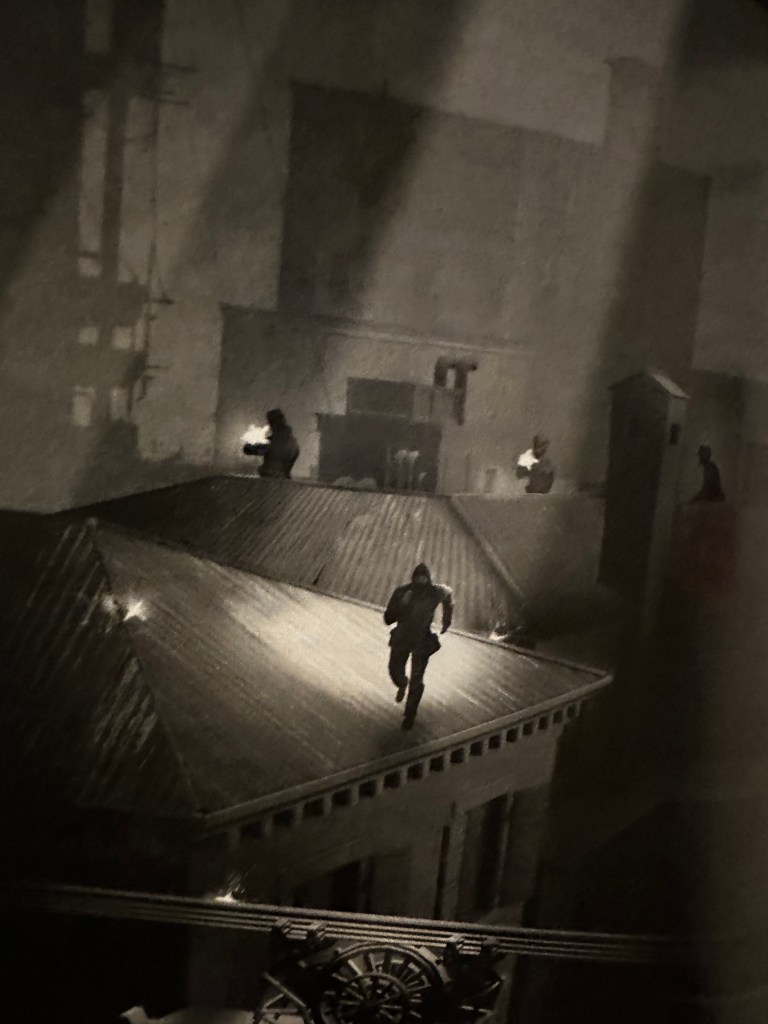
Light shines down from above on a scoundrel running acorss the rooftops of Doskvol
Light shines down from above on a scoundrel running across the rooftops of Doskvol

But we had some significant issues in our six sessions. Now, some of these are entirely my fault. Some of them are a symptom of having only six sessions to become familiar with the game and some arose because we sometimes struggled to keep our sessions regular. But still, they were there so I’ve got to discuss them.

Downtime was the biggest struggle for me. Now this was, perhaps, the part that I can take most responsibility for, but there are elements that we found just rubbed us up the wrong way. So, firstly, about half way through, I decided to start introducing downtime rules from Deep Cuts. I liked these alternate rules. They were largely diceless and gave the PCs a bunch of other things to spend Coin on. I thought they would speed things along a bit more, compared to the original downtime rules. But it introduced confusion more than anything else. Because we had had so little time to get used to the original rules, and I had an imperfect understanding of the Deep Cuts rules, we ended up often very confused about what was needed for any given downtime activity. We often ended up mixing the two rulesets into some unholy abomination that we could never remember at the next downtime. I wish now that I had started with the Deep Cuts rules and used them the whole way through. I think they are, comparatively, smoother and more interesting overall.

But the main issue I had with downtime was the idea of having a separate and overtly different phase of play. The fact that you need to use a completely different set of rules for it delineates it deliberately from the score. It slows things down, it deals with each PC so separately that they are largely on their own for long periods of the game. This meant that the only other person they were interacting with most of the time at the table during downtime was me. This is a significant increase in mental load for the GM. On top of that, each PC has a few notable NPCs and I was responsible for voicing, playing and inventing them almost from scratch. That’s a lot to remember and a lot to do at the table.

And, the mechanics themselves, to me, made this part of play feel like I was constantly explaining the rules of a board-game to the players. All those currencies and meta-currencies, Coin, Rep, XP, Heat, Wanted Level, Status, Stress. There is so much to keep track of and it often feels like shuffling tokens and cards around on a board. I am not a big player of board-games. Given a choice, I would choose an RPG any day. Combining the two in this manner did not endear the game to me. And all the sheets required to keep track of everything go to evidence exactly how much admin is involved in Blades in the Dark. Now, I understand that this is actually a positive for many people. It’s just not for me.

In general, I found that role-playing, as one might traditionally think of it, was difficult to work into sessions of such heavy admin. Even in the score sessions, there is little time for inter-character development, so focused is the whole crew on the goal of the thing. This is, perhaps, a symptom of the style of play I am used to. Generally, in OSR or more trad games, the players are often role-playing amongst themselves constantly and then with me, as the GM, whenever they need to interact with an NPC in the world. Blades requires the players to know what sort of scenes they might want to role-play, set them up with the GM and know when to end them as well. So, that might be our relative inexperience with this type of game showing. But, if I might be allowed to make a comparison, I never felt like this when playing Spire or Heart, which are hardly OSR or trad. It think they sit more firmly on the story-game side of the divide, but we never had any issue with fitting in role-play in our campaigns of those games. I think this is due to the fact there was so little admin in those games. They feel more streamlined to me. Not perfect, by any means, but, perhaps, more to my taste.

Everyone agreed the character sheets were an issue. This was more from the player side than from me. The design of the character sheets is too busy and the text is too small and the little boxes to fill in are fiddly. In general, there is far too much text on them, even though I know the idea is that the player has everything they need at their fingertips. Interestingly, one of the things some players said was that, even with the quantum equipment rule where you don’t have to mark a piece of gear until you say you’re using it, they found the item list restrictive. They would often look at that list when trying to figure out what to do with their turn. Too often, they could see nothing of use, and instead, just defaulted to the usual skirmish or shoot. I thought this was a very interesting observation, that the design of the character sheet or the item list, at least, conspired to stunt their creativity in the moment.

Up-shot

Now, like I said at the start of the last section, its possible that a lot of these negative views are due to the way I ran the game, the irregular nature of the sessions, the limited exposure to the game, but I think its equally possible that I bumped up against it because I have a particular preference for a different type of game.

I confess that most of my best and most memorable experiences with RPGs recently has been with the OSR. Mythic Bastionland, Mothership, Black Sword Hack, Old School D&D. I am rooted in old school play after all. But, then again, I have played other story-games, like Heart and Spire, like Trophy, Root and Dungeon World and I have enjoyed them immensely. I might be forced to come to the conclusion that Blades is just not for me…

I guess we’ll see when we go back for season 2 of the Death Knells.
Downtime in the Dark

My First Downtime

I’m taking a break from taking a break from Wednesday posts for this one. We had Session 2 of our Blades in the Dark campaign last week, and our first downtime. I also decided to start introducing a few elements from the latest Blades sourcebook, Deep Cuts, which came out earlier this year. So, I wanted to write about our experiences.

Deep Cuts Character Options

The head and shoulders of a person in portrait. They wear a metalic mask over the top half of their face and a hooded cloak. They are an Acolyte Spirit Warden
An Acolyte Spirit Warden by John Harper

Deep Cuts really expands on the options for your new scoundrels. It doesn’t replace what’s available in Blades, it just adds depth. For instance, if your PC is Akorosi, maybe your family served among the clergy for the Church of Ecstasy. If your scoundrel had a military background, maybe they were a Rifle Scout, serving in the Deathlands and harassing “enemies with sniper attacks.” Before we got into the session proper, I offered all of the players to not only select from these new options, but also to reassign any of the Action dots they had assigned to reflect their Heritages or Backgrounds. What I discovered was most of them had already formed a pretty solid image of their characters in their heads. Even the one player who did take me up on my offer, only took the two examples I laid out above for their Hound because they fit the picture they had imagined so well.

I’m still quite fond of a lot of these new Heritage and Background options. They might have been a lot more useful if I had offered them from the start.

Downtime by the Book

In Blades in the Dark, John Harper tells us there are two main purposes to having a separate downtime phase:

  • The first is that the players could do with a little break after the action of the score that just went down. To be honest, this one doesn’t ring very true for me, but that’s probably because it’s been six IRL weeks since the last session and the crew’s first score. I also get the impression that, once you get the hang of this game, you’re sometimes running a score and downtime in the one session, rather than a score session followed by a downtime session. If that were the case, I can see the advantage of breaking the action up.
  • Second, moving into downtime is a sign to all that we are changing the mechanics that will be needed in the game. To me, this seems like the more concrete of the two purposes. Blades in the Dark has tools for you to use during a score, and only during a score, and it has tools you only pull out during downtime. We don’t need to worry about divvying up the proceeds, dealing with the heat you’ve brought down on yourself or figuring out your long-term crew goals while you’re beating in some poor Red Sash’s head. Let that wait until you’ve got time and space for it.

Luckily for me, it’s easy to follow along with the Downtime chapter of BitD. Once again, I have to praise the usefulness and usability of the book. The layout of the chapter leads you by the hand through the phase, from one step to the next. Three of my players have taken responsibility for maintaining the various crew/campaign tracker/factions sheets without my even suggesting it so that made the job even easier.

Payoff was easy enough, just a simple matter of recording the Rep the Death Knells got and dividing up the 6 Coin they garnered from the last score. They took one each, popped one in the crew stash and paid their tithe to Lyssa, the new leader of the Crows, as their patron. I ran this moment as a scene. I don’t think I would have if it wasn’t for the fact that she was pissed off with them for raiding the Red Sashes’ drug dens on the Docks, and I wanted them to know. She also gave them the option to take a job to redeem themselves. The Hive have been a bit too active in Crow’s Foot for her liking. She wanted the Death Knells to do something about it.

I mentioned Deep Cuts earlier. New mechanics appear in the sourcebook for downtime. They make it diceless, and they would also definitely up the Coin our crew made from that score if we had been using them. In BitD, you are given a range from 2 Coin for a minor job to 10+ Coin for a major score. In Deep Cuts, the Coin the crew accrues is determined like this:

  • Score – 1 Coin per PC, plus Coin equal to the target’s Tier x3.
  • Seized Assets – 4-8 Coin for a vault of cash. Stolen items can be fenced for 1-8+ Coin, but you take Heat (see next page).
  • Claims – Collect payment from crew claims like a Vice Den.

Like I indicated above, we used the standard downtime rules from Blade in the Dark in this session. Now that we’ve experienced that, I’ll put it to the players to see if we want to make the switch. If and when we do that, I’ll come back and examine the other downtime changes then.

It was fun calculating Heat for that score. I’ll admit, I didn’t warn them that killing people on scores really hikes up the Heat. They started off the whole thing by murdering a bouncer, of course. In fact, I didn’t really explain the concept of Heat to them beforehand at all. This meant that they went in hard, loud and chaotic. I actually think this was for the best. The game is built on building up consequences, after all, as well as narrating big, exciting action sequences. Anyway, they ended up with 6 Heat, which was fast approaching a Wanted level. That put the shits up them.

In the book, the Heat section also includes the Incarceration section, which seems logical to me, but I didn’t need to refer to it, so I’m skipping it here.

Of course, due to all that Heat, they had to roll on the worst of the three Entanglements tables. These represent all the potential impacts of contacts, acquaintances, enemies and authorities getting wind of what the crew have been up to. Entanglements range from Gang Trouble, which can be dealt with internally, to Arrest! If you get that, it’s going to cost you Coin, a crew member or the effort to escape capture. The Death Knells rolled up Interrogation so our Hound was caught on her own and dragged down to the station for some “enhanced” questioning. We played this out in a fun scene where she went out to get beer to celebrate their big score and got ambushed out behind the pub by Sergeant Klellan and his boys. She wisely Resisted the level 2 Harm and the additional Heat, without incurring a single point of stress! All the others could do when she finally turned up was wonder where their beer was…

So then, we spent a bit of time going through what’s possible during the downtime phase in our last session. This can all be a little overwhelming the first time you do it. It can also take quite a while to get through each player’s turn as you talk through the possibilities and they negotiate amongst themselves to see who will spend their activities on reducing Heat for the whole crew. Sometimes it’s obvious who should do what. If a character has some Harm, it’s probably a good idea for them to get some treatment and Recover. If another scoundrel is a bit stressed out, they should go and Indulge their Vices to help them relax, but training, long term projects and acquiring assets are all more subjective. The chances are, they’ll turn out to be useful to the whole crew in the future, but they don’t feel quite as immediate in their effect as clearing Heat.

Anyway, I was gratified to see the PCs did all of the six possible downtime activities at least once. They managed to clear practically all their Heat. The Leech did this by studying the movements of the Bluecoats around the district so they could avoid them. The Whisper took an inventive approach, by losing a bar-room brawl in the King’s Salty Knuckles tavern, thus proving that he couldn’t be part of a crew of Bravos!

Our Cutter decided to acquire an asset, an old and worn-out little boat for use on a future score, perhaps. The players ad-libbed a scene in which they ribbed him about the state of the thing. But, of course, it only needs to be used once.

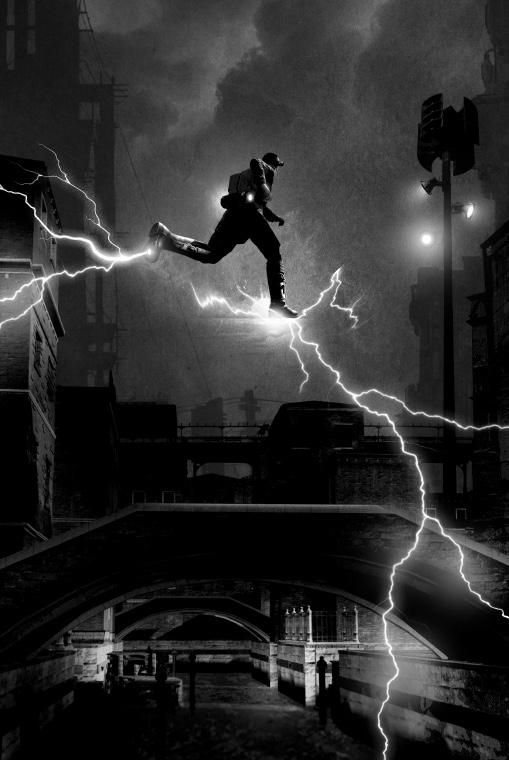
A person "walks" through the air above the darkened city,seemingly on lightning bolts emanating from their feet.
“I’m walking through the air!”

We had another scene when the Whisper’s strange friend Flint turned up on his canal boat with some electroplasm. Our Whisper needed it to build himself a lightning hammer as a Long Term Project. From Flint he also learned about the Sparkrunners, a gang of rogue scientists who are out there boosting government tech. This is one of the new factions from Deep Cuts, which “sparked” my imagination.

Just before we wrapped up for the evening, our Hound decided to deal with all her stress by visiting her local Temple of the Church of Ecstasy. She prayed and prayed, she prayed to hard and too much. She over-indulged in her vice and something bad happened. The bouncer she killed on the last score decided to haunt her!

Other Actions

Of course other actions are possible during downtime too. They decided to visit the ghost who had given them such good info during their Information Gathering phase in the previous session, because he said he would help them more if they really fucked those Sashes up good. From him, they discovered that Lyssa was responsible for the death of Roric, whose leadership of the Crows she then usurped. She had been backed up by the Red Sashes who had killed out ghost friend. He told them to go to Mardin Gull in Tangletown for the skinny on what all that was about. This wasn’t a downtime activity or an entanglement or anything. It was just something they wanted to do.

The Imperial Airship, the Covenant flies bove the darkened city streets, shining searchlights down to illuminate a meeting on a bridge.
Its the Fuzz!

I also introduced a few more Deep Cuts factions in a little news segment. They learned about the Sailors being press-ganged on the Docks, The Ironworks Labour-force pushing for unionisation, the arrival of the Imperial Airship, Covenant without her sister ship and the recent adoption of the new Unity calendar and maps. Any one of these could potentially lead the crew to their next score. Except, maybe for the calendar one, I suppose.

Conclusion

I was very happy to have left a full session aside for our first downtime. It needed it. In fact, I would say, we could have used even longer. They still haven’t decided on their next score. I will say, I am quite happy with how many potential score options I managed to sneak into the various scenes in the session. I was worried that I wouldn’t give them enough opportunities, but, in the end, they came up quite organically, much like the scenes themselves. These all proved to be fun and freeform, allowing us to dow some world-building and to introduce some fun new NPCs.

I’m now looking forward to the next session, and, hopefully, the Death Knells next score, the Big One.