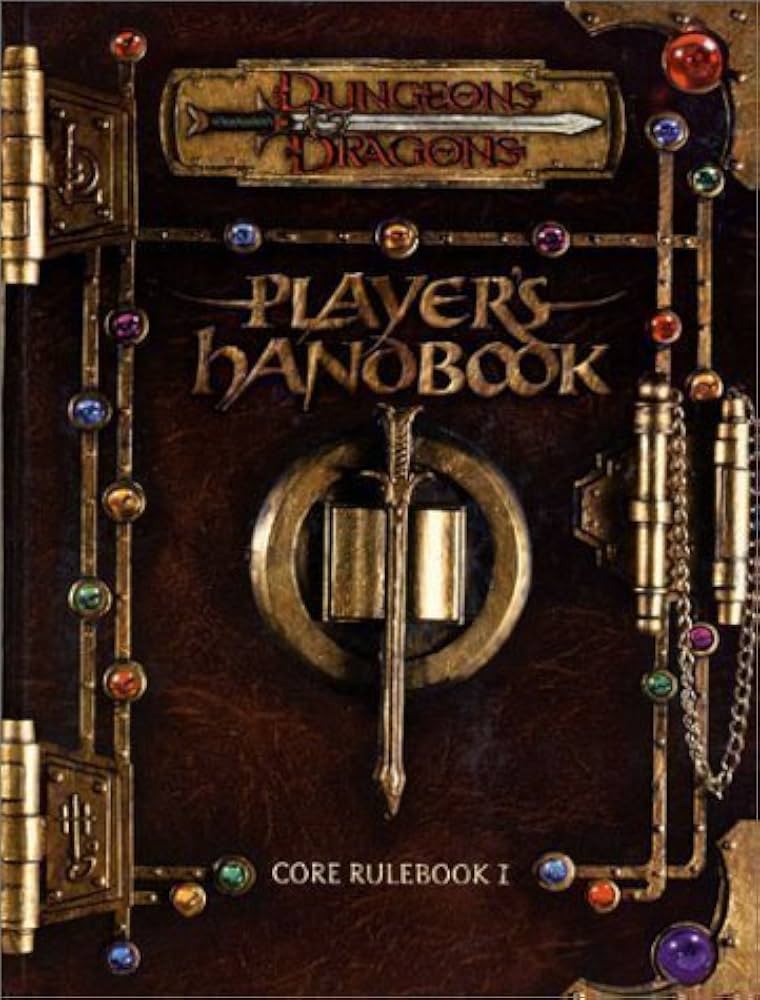
The Wizards Loom
Time marched ever on, TSR faded and went into the West. Wizards of the Coast loomed over Dungeons & Dragons as its new masters. It was a new millennium and it was time for a change.
The 3rd Edition of D&D brought with it many changes. Some were better received than others and the player base, it was fair to say, were divided over this new iteration.
It continued the 2nd edition obsessions with having a rule for every eventuality and providing endless optionality in character creation and development. But that list of saving throws was replaced by an even longer list of skills.
THAC0 was gone and Armour Class was finally ascending with the institution of the d20 system, which would define many mainstream RPGs for years.
We got Feats for the first time and the concept of a PC’s Spell Save value. You can see the embryo of 5E in this edition with mechanics like these and the Skills in particular.
It’s still very complicated compared to the Basic D&D or OD&D but it feels more refined than AD&D.
I have little practical experience with this edition or its later 3.5 version, but I do remember optionality in character creation being quite attractive. Now, looking at the character creation section of the 3E Player’s handbook, which runs for almost 90 pages, I’m a little intimidated. But, I’m here to drink beer and create a character for D&D 3E, and I’m all out of beer (that’s not true. I’m not sure I could attempt this without beer.)
This book is from the illustrious pens of Monte Cook, Jonathan Tweet and Skip Williams. Monte Cook has, of course, had an outsized influence on the direction of the hobby over the last 25 years so it’ll be interesting to see what he has produced here.
Character Creation Basics
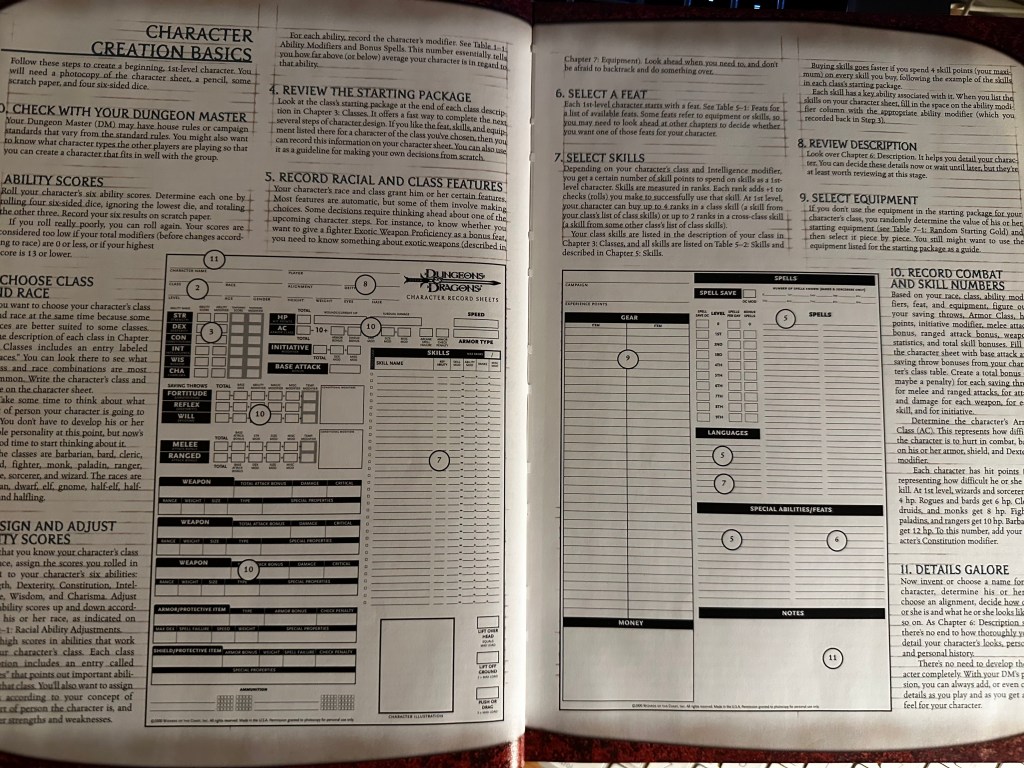
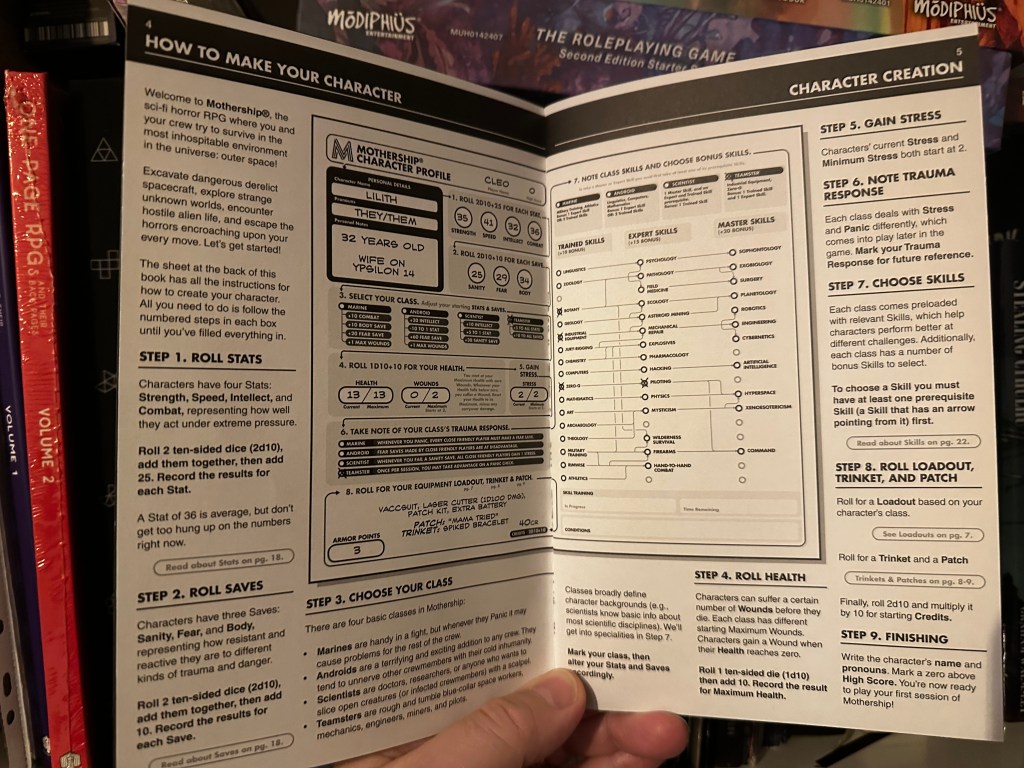
I quite like the way the couple of pages here is laid out around a character sheet, with each section numbered. It breaks it down and makes it feel a bit more manageable. Honestly, it reminds me a similar spread in the Mothership Player Survival Guide, which actually only involves two fewer steps than this. I actually like that it suggests, as a Step 0, to check with your DM before starting, in case there are any special limitations or house rules for your character.
After that, the steps are:
- Ability Scores (4d6 and drop the lowest six times, then assign as you like, probably in concert with your choice of race and class)
- Choose Class and Race (this might seem like it should be two separate steps but, from our experience in AD&D 2nd Edition, it just isn’t. The two are indivisible as race features and ability score modifications have such an effect on your choice of class, and vice versa. The ability scores you roll have a much lesser effect on the choices as they are, by default rolled and then assigned. In fact, the only problem I have with this step is that it should be combined with Step 1 because all three choices impact each other)
- Assign and Adjust Ability Scores (fact is, you already did this in that last step. If you didn’t, I don’t know how you made any decisions, tbh. This is another step that should be folded in with the previous two)
- Review the Starting Package (sounds like you’re having a look at an automobile brochure but it’s really just giving you a Quickstart option for your PC that details ideal starting Feats Skills and Equipment. You chan choose to take these if you want to speed up this whole process)
- Record Racial and Class Features (The writer concedes here that you will probably have to flick back and forth through the book to make choices regarding some of these features. This step includes Spells, btw, so prepare for this to take a while if you’re a spell-caster)
- Select a Feat (Same here. You might need to look at particular equipment of skill descriptions to make an informed choice here.)
- Select Skills (You get Skill Points from your class and your Inelligence modifier, and you have Class Skills and non-Class Skills so its a little similar to AD&D’s non-weapon proficiencies in that way, but the list of skills is more similar to 5E)
- Review Description (This step does not want you to do anything but homework. Just read Chapter 6: Description. Make some of those choices now if you want, but that’s what Step 11 is for, really)
- Select Equipment (honestly, since we are including this in character creation, it’s more like 113 pages rather than 89. You randomly determine the amount of gold you have to spend on equipment for your Level 1 PC)
- Record Combat and Skill Numbers (this will probably take a while. Just take a look at the character sheet!)
- Details Galore (describe your character using Alignment, height, weight, age, background etc.)
Ability Scores
We’ve got the standard D&D abilities, Strength, Dexterity, Constitution, Intelligence, Wisdom and Charisma.
Here are my rolls:
- 5, 3, 1,
1= 9 (what a start…) - 5, 3, 3,
2= 11 (a little better) - 6, 5, 1,
1= 12 (really just creeping up here) - 6, 6, 5,
5= 17 (now we’re talking) - 6, 4, 4,
3= 14 (not bad) - 6, 4, 2,
2= 12 (could have ended worse)
Now, I can choose to assign these to the six abilities as I see fit. Meaning, of course, that I would have to make choices normally. But, as is my won’t, I am going to keep things random. I’ll roll for both race and class and then choose how to match my scores to my abilities.
Choose Class and Race
This edition has the following races to pick from:
- Humans
- Dwarves
- Elves
- Gnomes
- Half-Elves
- Half-Orcs
- Halflings
I’m going to have to break out my D7 from one of my Zocchi Dice sets. And I rolled a 2! I’m a Dwarf! I like playing Dwarves. I was obsessed with them ever since reading the Hobbit.
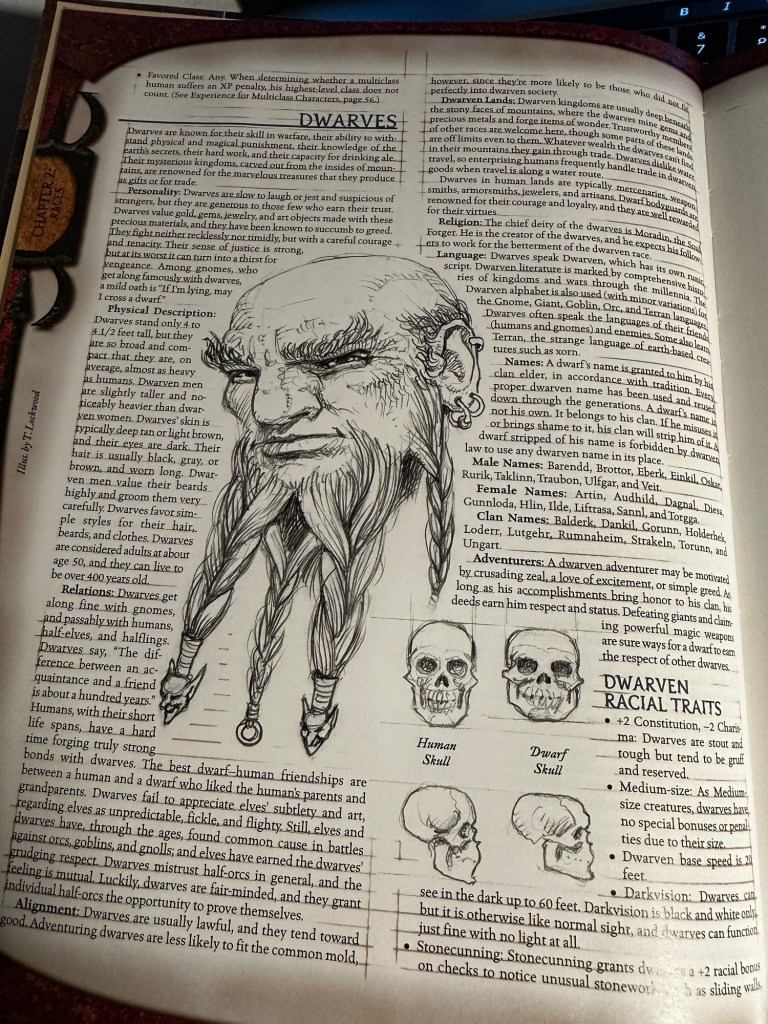
Dwarves in 3rd Ed get the following traits:
- +2 Constitution, -2 Charisma
- Medium Size
- Base speed of 20 feet
- Darkvision – its black and white but it reaches 60ft in total darkness
- Stonecutting – +2 bonus to notice unusual stonework (sliding walls, stonework traps, new construction etc.) It also allows them to use the Search skill to find stonework traps like a rogue might
- +2 on saves v poison, spells and spell-like effects
- +1 on attack rolls against goblinoids
- +4 dodge against giants. This does not represent their size, which we have established is medium, but their training
- +2 to Appraise rare and exotic items
- +2 to Craft checks related to stone or metal
- Automatic languages – Common, Dwarven. Bonus languages – Giant, Gnome, Orc, Terran and Undercommon
- Their favoured class is Fighter. This means that a multi class dwarf’s fighter class does not count when determining whether or not they suffer an XP penalty for multiclassing
This is already a huge number of features, but at least the book presents them in bullet points unlike older editions.
Now for the Classes. The Player’s Handbook presents the following:
- Barbarian
- Bard
- Cleric
- Druid
- Fighter
- Monk
- Paladin
- Ranger
- Rogue
- Sorcerer
- Wizard
Another fantastically uneven number. Not even a set of Zocchi dice comes with a d11 so I will roll a d12 and re-roll on a 12. I rolled a 4, so that’s a Druid!
The description of the class explains that “Dwarves, halflings and half-orcs are rarely druids.” But that’s not going to stop me. I’m not here to min-max this character.
This is not the first edition to include druids, OD&D, 1st and 2nd Edition had them as well. But in those, they were much more like a flavour of nature-cleric than a class of their own.
Here are some of the things I will need to keep in mind while I make this character now that I know the class:
- Alignment – I will have to be at least part Neutral to represent nature’s indifference
- Religion – some druids revere Obad-Hai, god of nature or Ehlonna, goddess of woodlands
- Background – there is a larger druidic society but most druids are loners with a charge of their own wild refuge
- Abilities – Wisdom is a Druid’s most important stat, what would have been called their prime requisite in previous editions. It determines how many spells they can cast and how powerful they can be. They need a Wisdom score of at least 10 + spell level. The spell save DC is 10 + spell level + Wis modifier. A good Dex is important as they only get to wear light or medium armour
- Hit die – D8
- Class Skills – Animal Empathy (Cha, Druid exclusive) Concentration (Con,) Craft (Int,) Diplomacy (Cha,) Handle Animal (Cha,) Heal (Wis,) Intuit Direction (Wis,) Knowledge (nature) (Int,) Profession (WIs,) Scry (Int, exclusive skill,) Spellcraft (Int,) Wilderness Lore (Wis)
- Skill points at Level 1 – 4 + Int modifier x4
- Skill points at each additional level – 4 + Int modifier
- Class Features
- Weapon Proficiencies – club, dagger, dart, long spear, quarterstaff, scimitar, sickle, short spear, sling
- Armour – padded, leather or hide only. A druid can also use a shield as long as it’s wooden. If they wear any other type of armour, they can’t use any of their magical powers or spells while they wear it and for 24 hours after!
- Spells – Druids can prepare and cast any spell from the druid spell-list. They don’t have to learn them like wizards. See the table below. They can’t cast spells of an alignment opposed to their own. I honestly didn’t remember spells being identified with alignments in this game.
- Bonus languages – They get to know the secret druidic language and can substitute out one of their bonus languages for Sylvan
- Nature Sense – Can tell you all about plants and animals. Also can identify poisoned or impure water
- Animal Companion – a druid gets to start with an animal companion or two! At first level the total HD of creatures you’ve befriended using the animal friendship spell cannot exceed 2. You can also cast the spell on other animals during play
- There are a bunch of features that druids get at higher levels, including Wild-shape, the ability to polymorph into animals. But I’m not going into them here since I’m making a 1st level character
- At level 1, a druid will get a 0 for base attack bonus
- Druid Saves at level 1 – Fort: +2, Ref: 0, Will: +2
Assign and Adjust Ability Scores
OK, it’s time to assign those ability scores, taking my Dwarven modifiers into account.
- Str – 9 (-1 to melee attacks and damage, Climb, Jump and Swim checks as well as general Strength checks)
- Dex – 14 (+2 to ranged attacks, AC, Reflex saves and a whole bunch of skill checks)
- Con – 14 (one of the 12s with a +2 from my Dwarven ancestry) (+2 to each hit die rolled, Fortitude saves, and Concentration checks)
- Int – 11 (A lot of my skills are Int based) (0 extra languages, 0 extra skill points/level)
- Wis – 17 (had to be) (+3 to Will saves and a bunch of skill checks. More importantly, it’ll mean an extra 1st level spell)
- Cha – 10 (the second 12 with Dwarven -2) (Another 0 modifier, which sucks since so many of my skills work on Cha)
Record Race and Class Features
I think this step is here rather than amalgamated with your choice of race and class above, is because you don’t know how many spells you might be able to choose or learn until your ability scores are settled…
The fact I’m coming to terms with here is that this series of steps is not particularly distinct or clear. You have to jump back and forth constantly. I actually think it’s worth asking why you are supposed to roll your Ability scores before selecting your race and class. Since you can assign them any way you want, they have no bearing on those choices. It would actually make more sense to choose the class and race first, then roll up your abilities with your race modifiers in mind and a much better idea of how you want to assign them.
Anyway, I’ve gone through the race and class features above. I only really need to choose spells
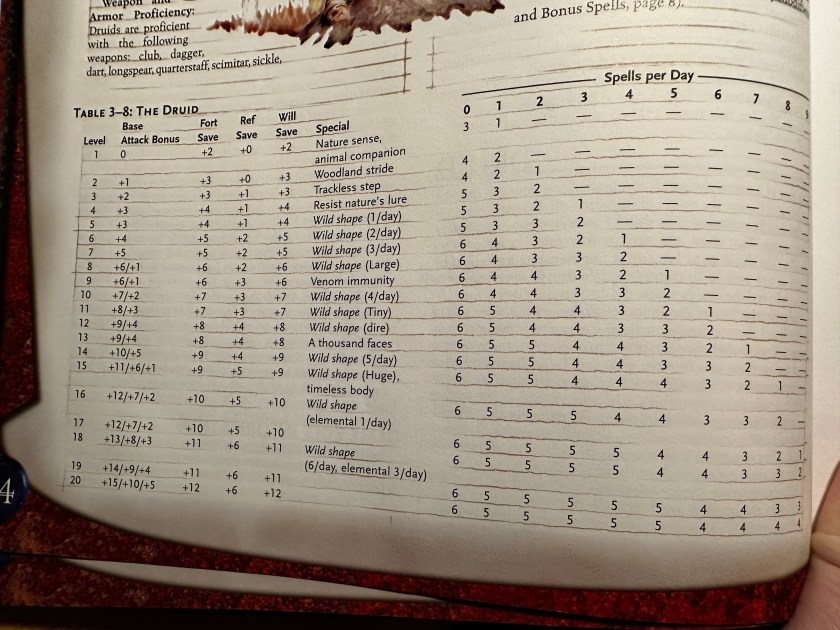
So, with my Wis sore of 17, I will get 3 0-level spells and 2 1st level spells.
I had forgotten there were 0-level spells or cantrips in this edition. I guess this is another first!
As I stated above, a druid can choose from all available spells but does have to prepare them at the start of each day. Here are my day 1 choices:
0 – Cure Minor Wounds (Cures 1 Point of Damage,) Guidance (+1 on one roll, throw or check,) Resistance (Subject gains +1 on saving throws)
1 – Animal Friendship (gains permanent animal companions)
I am going to pick a couple of badgers since a level 1 druid can have up to 2 HD worth of creatures as friends and badgers only have 1 HD each. They are tiny, can burrow and have the ability to fly into a rage in combat! I shall name them Eddie and Brock.
Select a Feat
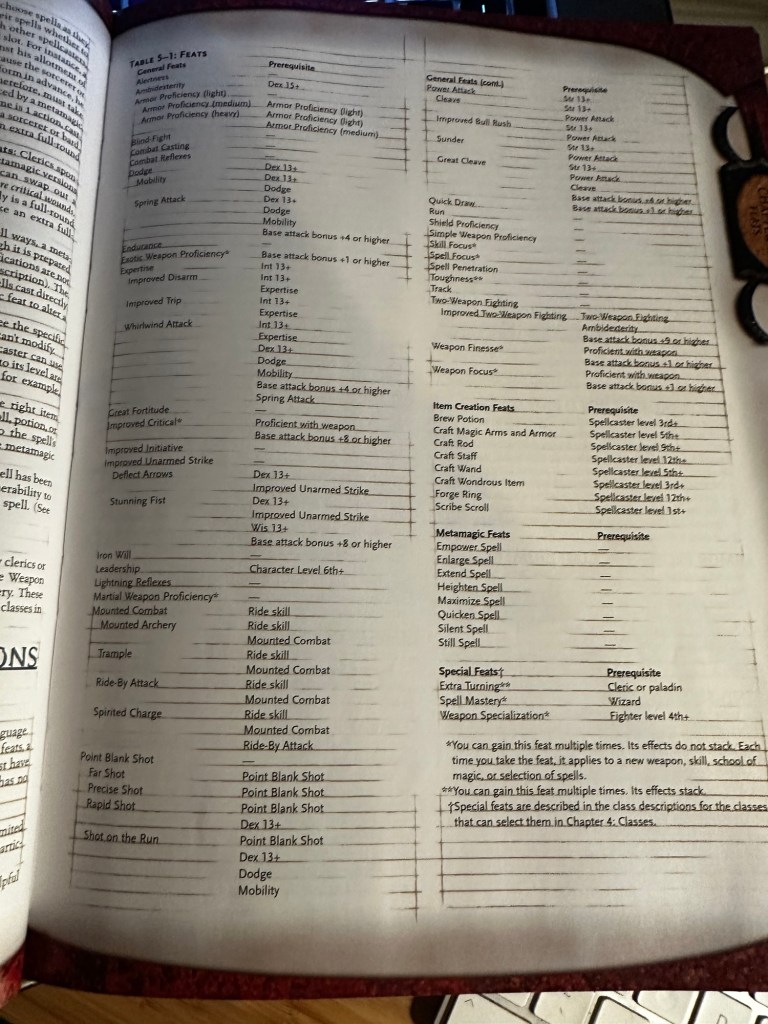
Feats are also new in this edition. They add yet another way to personalize your PC. I only get one at level 1, so I guess I should choose carefully. But even then, I do think it’s interesting that they made feats optional by 5e. Was this single choice adding just a little too much cognitive load to players? Or is it just because 5e characters already have enough going on?
Back to 3e. There’s a decent number of feats to choose from as you can see from the photo.
Here’s my choice:
Toughness – Gives me +3 HP and I can take this feat multiple times, which is nice.
Select Skills
I have 4 + Int Modifier x 4 skill points to spend at level 1. Since I have no Int modifier, this means 16 Skill Points. I have to spend all of them. Here’s how spending them works.
You can spend a point on buying a new Skill or on increasing the rank of one you already have. One aspect of the point-buy system I find confusing and strange is that you can spend one point to gain a rank in a Class Skill. But you can also spend a point to get half a rank in what they call a Cross-Class Skill, even though that half a point will do you no good. So why not just make is it so that you can only buy a single Cross-Class skill rank with two points instead?
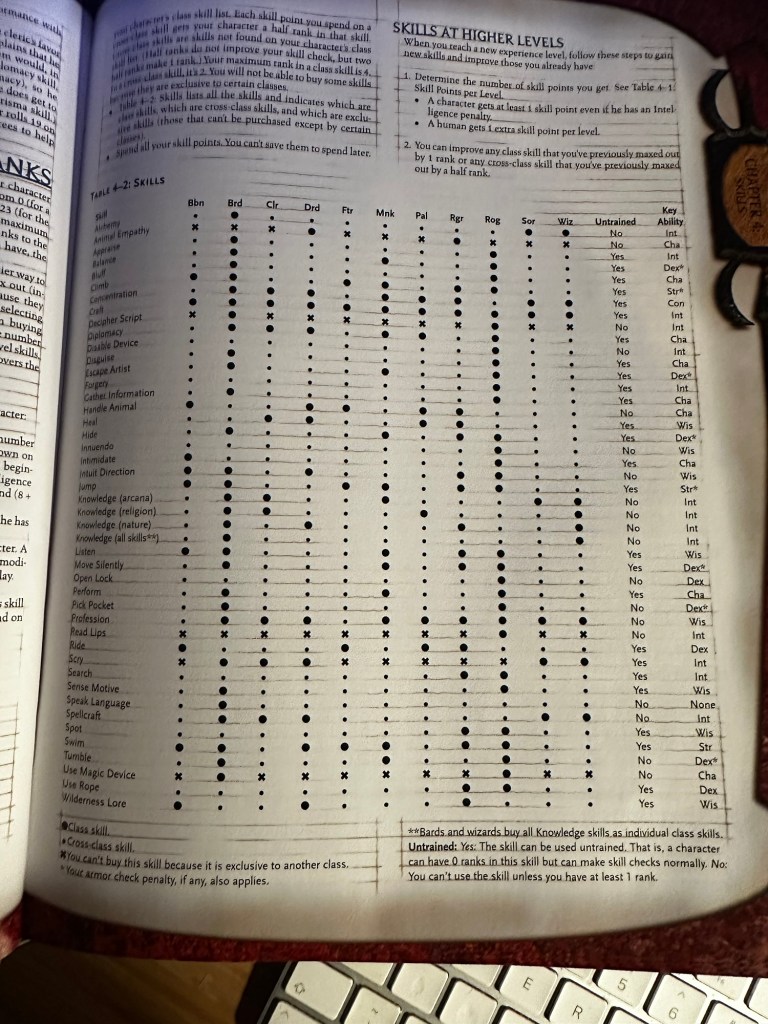
Anyway, as I mentioned above, there is a pretty long list of skills presented here in a table that is going me a headache.
Animal Empathy (Cha, exclusive skill,) – 2 ranks
Concentration (Con) – 2 ranks
Heal (Wis) – 2 ranks
Profession (Wis) – miner – 2 ranks
Knowledge (nature) (Int) – 2 ranks
Scry (Int, exclusive skill,) – 2 ranks
Spellcraft (Int) – 2 ranks
Wilderness Lore (Wis) – 2 ranks
I’m not specialising much but I think that’s appropriate for a low level character. They often grow in a particular direction after starting off as a generalist.
Review Description
If I’m reviewing it, I’m going to add the details now too.
This is an overly long section that goes into a lot of unnecessary detail on alignments, religion, gender, height, weight and eye colour…
I’m going to skip through it quickly as I have already tired of this process and this blog post has taken me almost a full week to get through:
- Alignment – Chaotic Neutral (this book gives a title to each alignment, which is bonkers. I hate D&D alignments at the best of times but this is making me dislike them even more. Anyway, Chaotic Neutral is known as the “Free Spirit.”)
- Religion – Obad-Hai, god of nature
- Name – Oskar Holderhek (got this from the dwarf names presented in Chapter 2)
- Gender/pronouns – he/him
- Age – there is a random starting age table here that has different possibilities based on your class… anyway, I rolled 7d6(!) and added to the starting age of 40 giving Oskar a starting age of 70. There is also a table of aging effects for middle, old, venerable and maximum ages that can give you minuses to Str, Con and Dex and bonuses to Int, Wis and Cha, which is bizarre, frankly.
- Height and Weight – another random table split along race and sex lines this time – Dwarf men start at 3’ 9” and add 2d4 inches. I rolled a 5 making Oskar 4’ 3”. Weightwise – the table is incredibly confusing but I think I’m supposed to roll 2d6 and multiply the 2d4 roll in order to add the result to the base weight for dwarf men… I got an 11 so that’s 55 + 130lbs making Oskar 185lbs. This absurd level of detail is bringing me to breaking point.
- Looks – He is a grimy little dwarf with a short cropped beard, thick brows and a hunchback. He’s constantly covered in dirt and wears leathers to protect himself as he digs tunnels.
- Personality – this dwarf is obsessed only with the fauna who occupy the underground along with him. He does not care for surface dwellers at all and will only emerge into the light under duress. He is stubborn, direct and frequently insulting.
- Background – Oskar escaped an underground work-gang that the dwarves authorities put him on to punish him for various infractions including insulting his thane’s son, keeping moles in the city and building a pit-trap to drop the guard down when they came to arrest him for the first two offences. When he escaped he found an ancient dwarf in a forgotten corner of the Underdark. Helga taught him how to be a druid and protect the mushroom grove of the myconids from their enemies. When they were attacked by surface dwellers, he vowed to find the perpetrators and kill them.
- This section also encourages you to customise your character but I think I have given him enough defining characteristics already.
Equipment
A druid starts with 2d4 x 10 gold – I rolled a 3, so that is a very poor, 30 GP. But, to save time, I have decided to go with the equipment from the Druid starting package described in the Class section:
Armour: Hide +3 AC, wooden shield +2 AC, speed 20ft, 35lbs, armour check penalty -5
Weapons: Scimitar (1d6, crit 18-20/x2, 4 lbs, Medium size, Slashing)
Club (oaken cudgel): 1d6, crit x2, 10ft., 3lbs, Medium size, bludgeoning
Sling (1d4, crit x2, 50ft., 0lbs, Small, Bludgeoning)
Gear: Backpack with waterski, one day’s trail rations, bedroll, sack, flint and steel, pouch with ten sling bullets, Holly and mistletoe, Three torches
Record Combat and Skill Numbers
I just can’t. This process has already taken sooooo long, and I don’t have the time or patience to continue. I have, at least, shown the workings of the character, you can see Oskar’s ability score bonuses and skill ranks above anyway, so I don’t think it’s necessary.
Conclusion
My main conclusion is that character creation in 3rd Edition takes too long. There are several steps which could be removed entirely, to be honest, and there are other steps that could be re-arranged to make the entire thing more efficient. There is far too much detail. It feels like D&D over-adjusted far too much to mechanising everything by this point and completely forgot the days when spells were there to be interpreted and you didn’t need to know a PCs exact weight in pounds before beginning play.
Nonetheless, I will be proceeding with a 3rd Edition game as part of the Editioning as planned. I’m thinking about taking one of the old Goodman Games modules. There are loads of them and they look a bit more fun than the official ones I have been able to lay my hands on.
Meanwhile, in other Editioning news, we will be starting the classic 1st Edition module, Ravenloft, next week, thanks to DM Isaac. Can’t wait for that!
Discover more from The Dice Pool
Subscribe to get the latest posts sent to your email.


