
Blades in the Dark Best Practices and Bad Habits

The bad habits that are listed here are fewer in number but oh so much greater in the size and capitalisation of their headings

It Begins!

Our Blades in the Dark campaign starts tonight! I’m excited. I played in a campaign before but this will be my first time GMing one. I’ve been taking a look at the GM advice presented in the book over the last few weeks. This post examines the GM toolkit in the Running the Game chapter, and this one looks at John Harper’s advice for Starting the Game. Right before starting seems like a good time to internalise the Best Practices espoused by the same chapter of Blades in the Dark, and to beware of the Bad Habits!

Best Practices

Angelic woman with a twinl=kle in her eye and a white bird projected on her dark clothing.
The spirit of best practices. J Harper

We’ve got a list of fourteen best practices for GMs here. Although I’m sure these were written very much with Blades in mind, most of them feel like the kinds of things a GM is well advised to utilise while running a lot of different RPGs. Just take a look at the list:

  • Earn the trust of the group
  • Lead an interesting conversation
  • Create an atmosphere of inquiry at the table
  • Help the players use the game system
  • Don’t block
  • Keep the meta channel open
  • Be a curious explorer of the game in play
  • Advocate for the interests and capabilities of the NPCs
  • Play Goal-Forward
  • Cut to the Action
  • Be aware of potential fiction vs. established fiction
  • Zoom the action in and out
  • Bring the elements of the game system to life on screen
  • Put it on a card

As in the last Blades post, I’m not going to go into each and every point in detail. Some of them are self explanatory. Put it on a card, for instance means exactly what it sounds like: use index cards to record the important things that are invented at the table. Cut to the Action is doing double-duty as both a GM principle and a best practice. You’ll find it listed in the last Blades post too. Keep the meta-channel open means that you, of necessity, have to describe the subtext to the players sometimes, to represent their characters’ full range of senses and intuitions and the like. Help the players with the game system, equally, means it’s your job to interpret their words and plans into a form the mechanics can handle without forcing them to figure it out themselves.

Anyway, you get the idea. I want to take a few that interest me the most and discuss them.

Be a curious explorer of the game in play

Just take a moment to digest that sentence. “A curious explorer.” Isn’t that sumptuous? There aren’t a lot of RPG books out there creating phrases as attractive as that, and I would like us to all appreciate John Harper’s work on it. As pleasing as the phrase is, the sentiment is truly important. Look, you’re the GM; you’d better be paying attention to what the PCs are doing, to what the players are saying at the table, to the NPCs that are being dicked over, or seduced or fucking created during a session, or they’ll come back to bite you in the arse later. But that’s not what this practice means. It just wants you to maintain a degree of curiosity in the events of the game, not because they are important, but because they are fun and interesting. Look up from your notes and index cards every once in a while and breathe it in. Your players and you are building an incredible story together. This is what it’s all about. So, get interested. Ask questions, not because you want to know stuff to prepare for but just because you are curious. Maybe you’ll wonder aloud why a PC is doing something, maybe your curiosity is to do with their choice of decor for the lair, maybe its just because they gave that one NPC a stupid nickname and you don’t know why. Doesn’t matter, just stay interested.

Play Goal-Forward

This is the practical side of the question-coin. It’s nice to think this game is all about the players after the initial stages. The idea is to get them to form their own ambitions for characters and crew, come up with their own scores, fulfilling their own whims and get into and out of their own trouble. But, if my experience as a GM is anything to go by, this can take a little cajoling. So, this practice says, lead that conversation. Get them thinking about their goals, not just in the moment, on the score, during their downtime, whenever, but also, on a long-term, grand scale. Yes, you need to know what their goal is when things begin to turn to shit on a score, they’re up to their ears in ghosts, the Bluecoats want their blood or their lair was just blown up by the Lampblacks. But if you get the players to tell you what they really want to be when they grow up? That’s gold. And make sure you check in to find out if their ambitions have changed from becoming the greatest electroplasm smugglers Duskwall has ever seen to just base survival because every score they have attempted has gone south and enemies are at the gates.

The pursuit of opportunities and positions to enable certain approaches, the acquisition of information and resources, and the nested conflicts that result will drive the action of the game.

This is what you want to get to. If you understand the opportunities they want to pursue, the actions they might take to unlock them, then you can better facilitate them and the effects will help build the game.

Harper repeatedly refers to the game as a cool tv show that you’re invested in. You can be invested in what happens to the characters and the city from the viewpoint of the audience but you are also in the enviable position of being able to help shape the story as a showrunner.

Be aware of potential fiction vs. established fiction

A city street in almost complete darkness. Vague outlines and sparse lights are all that describe the type of location it is.
Describe wht you need to, discard the rest. J Harper

You’re not taking the PCs on a tour of every room of your house. The PCs should be more like viewers watching an edited sequence of shots that carry them forward in the action of the game

We’re still talking about the game as a tv show then. Cool. I like it. It’s a little confusing, though, that this practice is about keeping details of the fiction nebulous until they need to be concrete. I suppose a good way to continue the analogy is to say that we begin a scene with a close-up on the darkly wrapped faces of our scoundrels, and, as the players ask questions or the GM makes decisions, the camera pulls away, revealing the canal-side they are standing on, then further out to show the line of moored canal boats. Then we follow the crew across the decks of the gathered boats as they rock and the occupants cry out. As they go, the players might ask if there is any rope on the decks to allow them to climb on to the bridge and you tell them there is. Meanwhile you fill in some more details, the twitching of curtains in the surrounding windows, the scuffling of feet from the nearby alleys and so on. Layers and layers of details. Harper calls this the potential fiction cloud. You pick them out as you build the scene and they gain concreteness, they become the established fiction. But you never need to establish absolutely everything. Instead, you yell “CUT,” and move on to the next scene, starting over again with a new potential fiction cloud.

GM Bad Habits

A man with a devilish face or mask points at us.
The demon of bad habits identified you as naughty! J Harper

The bad habits that are listed here are fewer in number but oh so much greater in the size and capitalisation of their headings:

  • DON’T CALL FOR A SPECIFIC ACTION ROLL
  • DON’T MAKE THE PCS LOOK INCOMPETENT
  • DON’T OVERCOMPLICATE THINGS
  • DON’T LET PLANNING GET OUT OF HAND
  • DON’T HOLD BACK ON WHAT THEY EARN
  • DON’T SAY NO
  • DON’T ROLL TWICE FOR THE SAME THING
  • DON’T GET CAUGHT UP IN MINUTIA

It is hard to avoid the conclusion that it is more important to ensure you don’t develop these bad habits than it is that you adhere to the best practices above. Let’s look at a few that I think I might be most susceptible to and see if that’s true.

DON’T OVERCOMPLICATE THINGS

It’s a heist. Or maybe an assassination attempt. Possibly a smuggling operation. There should be complexities to it! There should be bribes and double-crosses and traps and security systems and hidden lookouts and maybe a jilted lover or two. Right? Not necessarily. Its fun to introduce new narrative complications and consequences on a 1-3 or a 4/5 roll, of course, but not at the expense of the session’s pacing, or the players’ patience. You can’t be expected to come up with that stuff all the time. There are mechanics in place to help you deal with them quickly and in keeping with the spirit of the game. So this section is telling you to use the tools you have been given. If you can’t think of a new complication, just hit them with harm or tick a clock forward or slap some more HEAT on them. Keep it simple, stupid!

DON’T HOLD BACK ON WHAT THEY EARN

I have the potential to be stingy. After all, there is a lot they can do with Coin in Blades in the Dark. You can use it improve Downtime Projects, to reduce HEAT, to advance Crew Tiers! I could be the kind of GM who wants to limit their progress, to slow the pace. But John Harper says give them the money. He wants us to remember that they should get what they earned. After all, they have it hard enough as it is. And besides, they’re likely to have to spend it before it even has a chance to enrich their pockets.

My main observation here is that, in all likelihood, the GM is the one setting the Coin value of any given score. The PCs, of course, are free to accept or reject opportunities depending on how lucrative they are, and they will have to take the heightened risk associated with bigger paydays, but still, its up to the GM, in many ways to establish how much a given sort of score is worth. If I wanted a low scoring campaign, I could start off with big scores netting no more than 4 Coins and most average ones paying only 1 or 2. Of course the opposite is true too. And I guess Mr Harper wants us to lean that way.

I appreciate more the admonition to treat secrets and information the same way. If the PCs have earned the info, don’t hold back. Only new opportunities and a deeper investment in the world on the part of the players can come from the sharing of secrets. Bring them in on it! They’ll love it.

DON’T GET CAUGHT UP IN MINUTIA

Let’s keep thinking about this in terms of a television show. Sure, there might be some shows where an eye for detail and a quick thumb hovering over the pause button is rewarded, but usually, you can rely on directors/editors to skip from one location and situation to another without the need to dwell on every twist and turn on the way. Get to the good stuff. Speed through the opening credits, jump to the negotiation or the shoot-out or the incursion into the ghost field.

Although it’s not mentioned here, I believe it’s also important to combine this warning with the lesson to be aware of potential vs. established fiction. You want to try and hit that sweet spot where you have given the players enough details of a location, person or scene to allow them to make decisions without getting bogged down in unnecessary levels of photo-realism. Allow the imaginations of the players to fill in the blanks instead.

Conclusion

Look, it’s pretty obvious that if you occasionally forget to be a curious explorer of the game or sometimes stray into the weeds in describing minutiae, you’re not going to break your campaign. But it sure is nice to have these guide-rails to help us make the best damn dark victorian horror heist game we can! Both lists are incredibly useful and I’m sure to be referring back to them every once in a while as the campaign gets under way.

Next time

In my next Blades post I’m going to do a sort of post-mortem of our very first session! Watch this space, dear reader.

Blades in the Dark GM Tools

I’ll be honest, I don’t usually think about the games I run in terms of goals, beyond a vague desire to do my best to GM competently, engage the players and make them entertaining.

Good Advice

So, like I said in my last Blades in the Dark preview post, this book is full of great advice. Today, I’m going to take a closer look at some of the advice for GMs that is not directly related to the first session or two. This is the sort of thing that will help you create the best version of your game at the table every session.

GM Goals

I’ll be honest, I don’t usually think about the games I run in terms of goals, beyond a vague desire to do my best to GM competently, engage the players and make them entertaining. Many of the other games I’ve played don’t deal in these terms at all, but I find I appreciate the project-like manner Blades employs here. It’s good to state your goals before embarking on any sort of initiative, otherwise, how do you know if you manage to achieve them? What do you use to steer your efforts?

Here are the GM Goals as stated in Chapter 7, Running the Game:

  • “Play to find out what happens.” This is the primary guiding principle. A concept that was introduced by D. Vincent and Maguey Baker in Apocalypse World, “play to find out” is central to Blades in the Dark. The idea here is that you have no set narrative in mind, no list of occurrences that you’re waiting to introduce to outfox or defeat the PCs, no plan at all. Instead, you let the PCs lead the way. Their own plans, desires, vices, mistakes etc. will drive the story forward in a way you could never have imagined beforehand. The GM here is just as “in the dark” as the players are about what’s coming.
  • “Convey the fictional world honestly.” Honestly, I am struggling with this one. The advice here is to “make the world seem real, not contrived.” Of course, this is a reasonable suggestion, but much more difficult in practice, I imagine. It pre-supposes this “vision of Duskwall in your head.” But, in a game where the GM is largely just reacting to things the players invent or decide, the vision is probably changing constantly. You’re told here, though, “don’t play favourites,” as well, so I begin to see the purpose a little clearer. The idea is that, as GM, you should not be inventing elements of the world that exclusively benefit just your NPCs, or explicitly disadvantage the PCs in ways that seem unfair. I suppose it could also refer to a tendency some GMs might have to treat certain PCs better than others. Resist that urge! Play fair!
  • “Bring Doskvol to life. Give each location a specific aspect (crowded, cold, wet, dim, etc.). Give each important NPC a name, detail and a preferred method of problem solving (threats, bargaining, violence, charm, etc.). Give each action context—the knife fight is on rickety wooden stairs; the informant huddles among the wreckage of the statue of the Weeping Lady; the Lampblacks’ lair stinks of coal dust.” I wanted to quote this whole paragraph because it is filled with practical, actionable advice that I would struggle to paraphrase. I have to say that this is a reasonable goal for any RPG, not just this one.

GM Actions

Two dark silhouettes having a knife fight. The dark city streets are portrayed within their shadows.
Knife-fight City – J Harper

So this is one of the ways in which you, as the GM of Blades in the Dark, can endeavour to achieve your goals. I guess these are the story-game equivalent of an OSR GM’s Random Encounter tables, weather and misfortune tables and hex maps. Essentially, when it’s your turn, you can look at the list of GM actions and choose one to keep things interesting.

  • Ask questions
  • Provide opportunities & follow the player’s lead
  • Cut to the action
  • Telegraph trouble before it strikes
  • Follow through
  • Initiate action with an NPC
  • Tell them the consequences and ask
  • Tick a clock
  • Offer a Devil’s Bargain
  • Think off-screen

I like that these are presented as moves. These are all the types of things you might do a GM in any game to spice things up, to introduce complications if its all going a little too well, if the game is getting stale. But, in other types of RPGs, they aren’t treated like the action you get to do on your turn, in fact, they are rarely dealt with at all.

Now, I’m not going to deal with each and every action here. Some of them speak for themselves and their purpose is obvious. For instance, “Ask Questions,” is very broad, but I think its fairly clear that it can be used in almost any situation to gather information, provoke actions, or even get the players involved in creating situations and the world. “Cut to the action,” is a great way to take the reins briefly to prevent plan-spiralling or similar. But I do want to look at a couple of these a bit closer:

Provide opportunities, follow their lead

This is how “play to find out” works in practice. You can’t simply allow the players to create their characters, tell them a bit about the city and ask them what they want to do. I mean, you could, but they will proceed to have a million questions. The starting situation is designed in such a way as to provide the opportunities ready-made for them, but from that point on, it’s up to the players to find them. It’s the GM’s job to present them according to how the PCs went about it. So you follow their lead. If they go scouring the underworld for leads, they might hear of a secret cache of electroplasm in a poorly guarded warehouse near the docks, but it might be inferior quality information. Or, they might read about a prestigious visitor from the Iruvian embassy with a price on their head attending the opera form a report in the newspaper. They might take very different approaches to find these opportunities and it’s up to the GM to provide what’s appropriate.

Sometimes, though, the players will come up with an opportunity all of their own. Maybe their efforts were stymied by a rival crew during their last score and they’re looking for revenge. Maybe they want to expand their criminal empire and have an idea for a score against a gang in another district. Same thing, in this case, it just saves you the trouble of inventing the opportunity yourself.

This section also provides practical tips on how the players might handle these things mechanically, what difference the crew’s heat and resources make to this process and even a step by step guide to what constitutes an opportunity.

Think offscreen

This action makes you spin some more plates than you already are as GM, but it is useful to think about. Basically, the idea is to bear in mind what is happening elsewhere that might have consequences for the action of the current scene. Maybe there is a riot happening nearby and it’s getting closer, maybe the Bluecoats are out in force on patrol tonight, maybe there are some errant ghosts in the area that might want to get involved. This is the sort of thing I do tend to forget about when GMing normally. It generally feels too much to introduce another element to an encounter in a lot of games. But in a story game like this, you want complications, and, more importantly, you want to see how the PCs deal with them. In all likelihood, they’ll have to do something that drives the story forward even more!

GM Principles

A man in a high collar holding a skull in black and white
“I knew him, Horatio” – J Harper

This is the second set of tools for you to use to achieve those GM goals. If you play with these principles in mind at all times, you should get the most out of your experience GMing Blades in the Dark:

  • Be a fan of the PCs
  • Let everything flow from the fiction
  • Paint the world with a haunted brush
  • Surround them with industrial sprawl
  • Address the characters
  • Address the players
  • Consider the risk
  • Hold on lightly

“Paint the world with a haunted brush” and “surround them with industrial sprawl” are specific to Blades, in that they are concerned with describing the city and the situation in the appropriate vibe and tone. “Be a fan of the PCs” has become a standard piece of RPG advice but it is important, for sure. I’d like to go into more detail on two of these:

Let everything flow from the fiction

You don’t need to “manage” the game.

It can be hard to let go. Especially when you have been raised on a strict diet of stat blocks, challenge ratings, 6 second rounds and proscribed consequences. But much of the advice in this chapter is encouraging you to do exactly that. Stop planning. Nothing good can come of it. You have to let the story flow naturally from the actions of the players and the reactions of the world. In Blades, after the briefly described starting situation and opening scene, every element of the campaign should cascade down from there.

Hold on Lightly

This is not a “no take backs” kind of game.

When thinking about the PCs approach to a situation, remember that goal of portraying the fictional world honestly. If you do that and are forced to rethink how you described a scene, that’s fine, you can go back and retcon it. Maybe you first introduced them to a room crowded with ghosts, but, on reflection, considering how the players told you they spent time staking out the room as an entrance to a hideout, beforehand, you decide there is just one, lonely spirit, there. Not only that, you should not be afraid to allow the players the same sort of leeway when describing their actions.

Next time

In the next preview post, I want to write about the GM best practices and bad habits as presented by Mr Harper in the book. Till then, dear reader!

Beginnings in the Dark

I want to start by acknowledging that I think this entire section is fantastic. It’s full of gold. The advice presented here is the kind of thing I would love to see in every game.

My Own Advice

In my post on beginnings I suggested a few things. It’s a good idea to start in media res. Starting in the middle helps to introduce the world to your players and helps them to introduce their characters to the world, assuming you give them enough narrative freedom to do so. I suggested using flashbacks to fill in blanks as necessary. But I also suggested that, for a longer game, you might want to begin with some in-depth scenes of the PCs’ personal lives to give everyone a good idea of what drives them.

So, how does this hold up to the advice provided by John Harper in Blades in the Dark?

Starting the Game

A leaping scoundrel in black and white.
A leaping scoundrel in black and white by J Harper.

That’s the name of the section under the Running the Game chapter in the book. No confusion. I want to start by acknowledging that I think this entire section is fantastic. It’s full of gold. The advice presented here is the kind of thing I would love to see in every game. It was definitely the kind of thing I wanted from Spire before beginning it. I was so anxious about starting that game because I really was flying by the seat of my pants. Why? Well, because I had never played anything like it before. And in Blades in the Dark, Harper is perfectly aware that you’ve probably never played anything like this game before. So he takes your little hand and leads you gently into Duskwall, nodding reassuringly and telling you it’ll be alright.

Preparing for the First Session

A map of the coastal city of Doskvol which includes the names of each of the districts.
A map of the coastal city of Doskvol

Under the sub-heading, Preparing for the First Session, you get the advice to read through the character and crew creation sections again, assuming, I suppose, that you read them already. Here, it’s recognised that the GM is going to be the one leading on this and advising the players on how to create those scoundrels they’ve got in mind. Of course, this is good advice for any GM-led game but it’s good to have it in black and white here. Related to this is the fact that during these processes, the players are going to need answers about certain factions that will be relevant to their characters and the starting state of the city. So, you’re advised to pick a few factions you’re interested in or brush up on the ones mentioned in the starting situation, “War in Crow’s Foot.” To add to this, personally, I think you want to brush up on some of the factions, personalities and organisations that affect the entire city, like the Bluecoats, the Sparkwrights and the Spirit Wardens. You don’t need an exhaustive knowledge, but the basics will be helpful to allow you to answer some world-building questions, even if they’re not directly related to their characters or crew.

Harper states here that you should get through character and crew creation and, at least start the first score in your first session. This sets an expectation and, trusting that he has play-tested this a lot, its one that you have to assume is realistic. I also like the idea of taking these freshly minted scoundrels and throwing them straight into the action. I guess my in media res advice remains solid here.

There’s a short paragraph about what you can do to get yourself in the dark industrial fantasy mood of the game. Watch some Peaky Blinders, play some Dishonoured or read some Fafhrd and the Grey Mouser. I like this idea and it is something I do regularly to get me thinking the right way for an upcoming game with a very specific vibe.

Lastly, print out the character sheets and other reference sheets and get the gang together.

The First Session

A dark black and white illustration of several scoundrels on the canal, lit by a giant moon above.
Midnight on the Water, J Harper

The next section is entitled, “At the First Session: Setting Expectations.” This is always important. There are some formalised techniques to achieve this, of course. One of these is C.A.T.S. (Concept, Aim, Tone, Subject matter.) You can describe the type of game you’re going to play using CATS and, hopefully, that should help potential players to decide if they want to play it or not. Honestly, by the time you gather at the table, players should already be familiar with this stuff and know what to expect from your game. So this is not really what Harper is trying to achieve here. Instead, he’s trying to get you into, as he calls it, “let’s play mode.” He suggests a “punchy synopsis of the game” like this:

Okay, so you’re all daring scoundrels on the haunted streets of Duskwall, seeking your fortunes in the criminal underworld.

This is something I also love to do when starting a new game. I often take the blurb from the back of a book, or the summary from the first page and read it aloud, or paraphrase it to get the players in the right frame of mind so I would go further and remind them about what sort of dark, broken, victorian world this is, what the stakes are and the types of things they might be called upon to do.

Then continue:

Let’s make some characters and form a crew! Here are the playbooks. They’re the different types of scoundrels you can play. I’ll summarize them and then you can choose…

Harper goes on that the advise you to keep your explanations and rules-talk to a minimum at this stage. Introduce the players to concepts and answer questions but don’t get lost in the darkened alleys of Doskvol just yet. Instead, give a loose outline of the various playbooks and crew types, just enough to pique your players’ interests while they look through the options.

He then suggests saying something more like a sales-pitch at this point. The speech he includes in the book is real hearts-and-minds stuff,

This is a game, but it’s also something else—something really cool and unique. We’re gonna collaboratively create fiction together, by having a conversation about these characters and situations, without anyone having to plan it out or create a plot ahead of time. It’s like our very own TV series that we produce but we also get to watch it as a viewer and be surprised by what happens. You’ll say what your characters care about and what they do, and I’ll say how the world responds and just like that, a story will happen. It’s crazy. And fun.

I like this but I think I’d definitely come up with my own spiel. It’s just not me. I would definitely use this though:

play your character like you’re driving a stolen car.

Creating Characters and Crew

An Eldritch ball of light being released or cpatured by a crouching person in the foreground. Several scoundrels with a lantern in the background.
Eldritch light. J Harper

While the players work on their PCs, this section provides a set of questions to ask them. The text here does not suggest you ask all of the questions or that you ask everyone the same questions, or even that they should answer them out loud. Although I think I would try to get answers for at least a few of these to help me in making decisions as the game builds.

Here is a selection:

  • Why did you become a scoundrel?
  • The two of you have the same heritage. Do you want to be blood relatives? Do you know each other’s families?
  • When was the last time you used your blade? Why?
  • Who do you trust the most on the crew? Who do you trust the least? What’s that about? Or will we find out in play?

Harper points out here that we don’t need or really want to know everything about the characters before starting. A lot of the fun of playing a character is discovering them as you play, of course. The dynamic nature of Blades in the Dark and the degree of influence PCs can have over the world and, more importantly, the story, makes this particularly true of this game, from my experience.

You want the players to want to play their characters and to be excited about it. So Harper asks you to make sure, if anyone is not that enthused or is maybe frustrated by the process or any lack of detail that you spend a little time getting to the bottom of their dissatisfaction, providing more info if they need it, until they’re happy. You can also remind them that, if any of them find, after a few sessions that they wished they’d made a different choice here or there in character creation, then they can make the change, “no big deal.” An enlightened and realistic approach, I think, to what is, after all, just a game.

Once they reach the crew creation stage, they’ll have questions for you about the factions I mentioned earlier.

who gave them their hunting grounds, who helped with their upgrades, and who’s connected to their contact.

So, you’ll be happy at this point that you did that reading earlier. The advice here is, again, to use the factions in the starting situation to save yourself some work and associate the crew with the occurrences. This section ties things up by suggesting you skip crew creation for a one-shot, allowing the crew to develop organically during play instead.

Introduce Characters & Crew

Finally, it comes to the point the players will have been waiting for. They get to show off their cool new guys, their wee scoundrels! You get to use this to ask each player a few more questions to help clarify things or to get them thinking about how their PC might develop in play.

Some good advice here on how they should come up with their crew name. Even though they just put in a lot of work on crew type, upgrades, special abilities etc, the name can be elusive. So Harper suggests they leave that until after their first score at least. A suitable moniker is likely to come out of that.

The Starting Situation

A cityscape type view of Crow's Foot
A cityscape type view of Crow’s Foot

I love this bit the most. You could potentially run Blades in the Dark games over and over again for years, one campaign after another, and use this same formula for your starting situation, and it would never get old:

  • Set two factions directly at odds, with opposing goals. They’re already in conflict when the game begins. Both factions are eager to recruit help, and to hurt anyone who helps their foe.
  • Set a third faction poised to profit from this conflict or to be ruined by its continuation. This faction is eager to recruit help.

And that’s it. It’s not overly convoluted. Three factions and their goals shouldn’t be too much to burden the players with and there should be plenty of potential in the situation. “Keep
it simple at first—things will snowball from here.”

The main thing is to give them something to do right off the bat, rather than asking “more creative work” of them. Once again, I love this. This is the sort of advice I wanted when I first ran Spire. Instead, I think I left my players floundering right at the beginning, without a clear idea of what they should pursue straight away. We ended up really enjoying that campaign but it always involved an awful lot of talking about what they were going to do next, planning that thing and then changing minds and starting over. And I think that’s because it never recovered from that first session, and its lack of direction.

The Opening Scene

Now you get into the nitty-gritty. This is practical advice that I really wanted. What should that first scene look like? What should you give the players here? What kind of thing is being asked of them? What if they don’t want the jobs that are being asked or demanded of them?

The most important lesson I am getting from this section is that the ball is in the PCs’ court. You need to give them a decision to make and they need to make it right now! Whatever happens, they are going into their very first score right away. No hanging about, no ifs, ands or buts. Love it.

Conclusion

The section ends with an example starting situation, “War in Crow’s Foot.” I’m not going to go into it because I might just use it. But I can tell you that its exactly what I’m looking for here. It’s a concrete example of the way the GM gets things started and how you can hand it over to the players. It’s got sample scores from different NPCs and advice on how to play those NPCs too.

Having read this whole section and followed some or all of its advice, you should be more than prepared for the crew’s first big score.

Dragon Age RPG: Amber Rage Review

So, off they went, following a magic raven, through the rain and the swamp, fording rivers, defeating enemies and stabling horses, until they got to the appointed place and the raven dropped dead.

Blood in Ferelden

There have not been a lot of supplements for the Dragon Age RPG from Green Ronin. Other than a quickstart guide, a GM’s Kit and Faces of Thedas, a sourcebook filled with fan-favorite characters from the video game series, Blood in Ferelden is pretty much it. It’s a collection of adventures designed by Walt Ciechanowski, Kevin Kulp, T.S. Luikart and it came out in 2010. It contains three full scenarios and a few adventure seeds all of which take place in and showcase various regions of the land that played host to Dragon Age Origins.

It came out at a time before the Dragon Age core book collected all the rules from Dragon Age boxed sets 1, 2 and 3. Dragon Age set 1 only dealt with levels 1-5 and, indeed, Blood in Ferelden’s adventures are designed to get characters from 1st to 5th level.

I discussed another published adventure, Duty Unto Death previously. That was the first Dragon Age adventure I ran for my group and it assumed the PCs started at level 3. So that’s what we did. Not only that, but they progressed to level 4 and became fully fledged Grey Wardens before we moved on to the first adventure from Blood in Ferelden, Amber Rage. I made only a few adjustments to Target Numbers (like DCs in D&D) and enemy stats to increase the difficulty. Despite this, this level 1 adventure proved quite challenging enough at times.

SPOILER ALERT! This review is absolutely packed with spoilers. Turn back now, potential players!

Overview

Amber Rage!
Amber Rage!

Amber Rage is a 39 page adventure. It’s split into six distinct parts, each of which presents its own unique challenges for the PCs, a variety of enemies, NPCs and moral dilemmas for them to wrestle with. All of these are of varying quality.

Here’s the summary: The PCs find themselves in Sothmere, a village near the Korcari Wilds. Our group of newly minted Grey Wardens had been sent south by Duncan, their commander, to determine the strength of the Darkspawn force amassing in the south, preparing for the Fifth Blight. Sothmere was just a pitstop for them. There was a festival happening there to celebrate the building of a new fort, which gave the PCs a chance to take part in some axe-throwing, mud-wrestling, archery competition mini-games. While this was going on, the village was attacked by a band of crazed Chasind stalkers. These lads had been infected with the eponymous Amber Rage and were spreading it all over town. If no-one did anything about it, all the infected villagers were going to transform into mindless Ragers in three days! After some debate amongst the NPCs, it was decided that the Grey Wardens should go and find an ingredient in a grotto in the Korcari Wilds. This shadowmoss could be used to cure the infected.

So, off they went, following a magic raven, through the rain and the swamp, fording rivers, defeating enemies and stabling horses, until they got to the appointed place and the raven dropped dead. There they boiled up a stew and this attracted the firesprites. These guys lived in the grotto of the shadowmoss, so the PCs followed them home. Kind of creepy, when you think about it. Not only that, but they then went ahead and murdered the firesprites’ Guardian Serpent. I mean, the serpent didn’t leave them much choice, but they were invading its home after all. The real problem with this, as the wardens discovered in a sort of psychic vision provided by the firesprites later, was that the firesprites consumed the shadowmoss for sustenance, and the Serpent, ahem, excreted the shadowmoss. So, with the serpent dead, if the PCs collected all the shadowmoss they would need to cure the infected, they would be condemning the firesprites to starvation and extinction. But if they left them with the shadowmoss they had, that would give them enough time for a new Guardian Serpent to mature (this weird symbiotic arrangement was further compounded but the revelation that one of the firesprites would transform into the Serpent itself!) This was the central moral conundrum of the scenario, save the villagers or allow the firesprites to live.

The blackhaller and the burning of the villagers

Once this decision was made, they had to make their way back to Sothmere where a local judge, known as a blackhaller, had been helicoptered in to force the issue of the infected villagers. As the PCs got back to Sothmere, they had the sick ones tied to stakes, ready to be barbecued. The PCs had to make another big decision here, and, perhaps, try to convince the blackhaller to back down.

Thus ends the adventure. I skipped over some middle bits, but that is the essence of it.

Layout, artwork and maps

The layout of this thing is kind of all over the place. There are NPC descriptions separated from their stat blocks by entire pages in some instances. There are some which have the stat blocks of one NPC associated with the description of another, making it really hard to find what you need in a pinch. It’s the same with the enemy stat blocks, which are sometimes so far removed from the encounter descriptions as to make them seem as though they belong to another encounter altogether. I think one of the problems here is the massive parcels of real estate demanded by the standard Dragon Age RPG stat blocks, which presents some serious layout headaches. I had to do a lot of prep to make sure I had all of the relevant info and stat blocks on hand for any given encounter, social or combat.

Statblock Nightmares

The splitting of the adventure into parts, like chapters in a novel, was something I found useful. I tried to aim for completing one part each session. In the end, it did take 6 sessions to complete it.

The artwork is nice, although much of it was clearly supposed to be full colour but was presented in black and white, which was a shame.

The maps are great. I really liked the small regional map and the one of the grotto. I used both at the table, revealing parts of the grotto map to the players as they discovered more of it.

Decisions, Decisions

Dragon Age is built upon difficult decisions, choices that matter and have lasting consequences and you can see that’s what the writers are trying to present as the frame that Amber Rage is built on. Should they allow the little boy be killed by ragers, or his sister? Should they kill the leatherworker who’s been infected but hasn’t turned yet, or should they give him their brew that slows the infection, endangering themselves? And, ultimately, should they condemn the firesprites to extinction or save the villagers?

Josef the Leatherworker - poor bastard
Josef the Leatherworker – poor bastard

Now, this is an adventure that is written with some trad sensibilities. There are long paragraphs that examine each and every option available to the PCs in any given situation (or so the designers thought.) It presents you with the sorts of ability tests the PCs will need to make, their target numbers, the modifiers applied due to darkness or marshiness or stinkyness etc, etc. But, in almost every situation, my PCs found another alternative. They saved both children by the clever application of (checks notes) ranged weapons, They debated over the fate of the leatherworker so long that he turned Rager while they were still talking, and the shadowmoss problem? Well, they took the long view, what if they stole all the shadowmoss, killing all the firesprites in the process, and saved the villagers, but then there was another infection later and there was no Shadowmoss to help them? So they said, screw you Sothmere, we’ll only bring enough of this shit back to cure one individual fucking villager and then leave you to decide who should get it! The firesprites were happy, but no-one else was.

What particularly annoyed me about the text was this, it assumes that the party would choose to take the Shadowmoss. Almost all of the events described after the grotto involve the “fact” that they have a potential cure for the Amber Rage and others want it or others don’t want it used or something along those lines. So, those were largely useless to me. At least this allowed me to cut out swathes of what was always going to be the least interesting portion of the adventure, the trip back to town, which was staged as a series of encounters. There is a box on one page entitled, “Sustaining Drama and Varying Beats on the Journey Back.” The text in this is there to advise you to switch things up and vary the encounters because otherwise they might seem a bit samey… Could have just left them out, in my humble opinion.

They also present a number of NPCs that are either sympathetic or not, though. I can’t imagine anyone really liking Bogdan, the blacksmith, or even agreeing with him, in fact. Everyone is going to like the personable and honourable Sherrif Milo, though. So, when the players are asked to choose between the two, it’s no choice at all.

Some of the more sympathetic NPCs were the elven performers, the brother and sister duo, Oleg and Dielza. Our very own elven Grey Warden, Halvari, developed a closeness to them early on, so when Oleg was infected and Dielza was not, she promised to save him… But of course, in the end, she couldn’t. She had had to send over the single portion of shadowmoss and the good people of Sothmere were never going to cure the elf with it, so Halvari was left with no choice but to take Ole’g life before he turned and before the villagers could burn him. This was a truly sad moment that was always a possibility in the text but which was brought alive by the player in some outstanding role-play.

Conclusion

I loved the set-up for this, the festival, the mini-games (I forgot to mention a drinking mini-game from later in the adventure that was also very fun,) the moral dilemmas. But, throughout, I found myself wishing to be freed of the constraints of the text. I wanted to have been presented with the overall situation, the NPCs and some potential encounters and locations, and then let the PCs just go and figure it out. I guess I have been playing a lot of OSR recently, and it’s had an effect on my brain. In my thinking though, this would have solved the problem of the designers assuming the decisions the PCs would make, that I pointed out above.

I also don’t feel like it was quite Dragon Agey enough. It was missing abominating mages, darkspawn, spirits and demons. It could have been set in almost any generic fantasy setting without making almost any changes.

Finally, our crew of fourth level grey wardens had a very tough time with some of the only slightly upgraded combat encounters. They were lucky to have survived the evil giant crab attack and don’t even mention the marsh wolves, the mage went down twice… Actual 1st level characters would have been completely buggered, in my opinion.

Marsh Wolves – watch out!

Despite all my gripes with this adventure, we had a great time with it. This had a lot more to do with the fantastic bunch of Tables and Tales members and Dragon Age fans we’ve gathered, who have gotten into the game, the system, the stunts and the potential for heartache, than it had to do with the scenario itself.
My advice, dear reader, is, if you’re still interested in running this adventure, go through each part of it and prepare it your own way first. Think of potential consequences for decisions the PCs might make that the text does not prepare for, and feel free to cut out large parts of the journey back to the village.

One Shot to the Heart

Fallout is one of the most fun things about Heart. Players are sick little freaks who love getting lumbered with terrible burdens. Give them what they want, I say!

A Challenge

I have generally looked at Heart, The City Beneath as a campaign-play game. It’s made for it. It has a structure to the gameplay that rewards multi-session arcs. Your character’s beats beg you to spend time to seek out the opportunities to achieve them. And that Zenith ability; everyone perversely desires that big finale, their moment in the spotlight for one last time, that explosion of ‘themness’ right at the end so they can say they really went out in style.

So, when you are asked to run a Heart one-shot, what do you do? How can you replicate the uniquely satisfying journey that belongs to the delvers in a campaign, in just one session? The short answer, of course, is, you can’t. But, can you create a satisfactory one-shot with a slightly different feel? Yes, of course you can.

You will not be too surprised, dear reader, at this point, to discover that that was the exact situation I found myself in last week. I had a special request come from one of our founding Tables and Tales members to run a Heart one-shot, so I had to give it a go.

Heart Exam

The Butcher, replete with antlers, haunted expression and meal

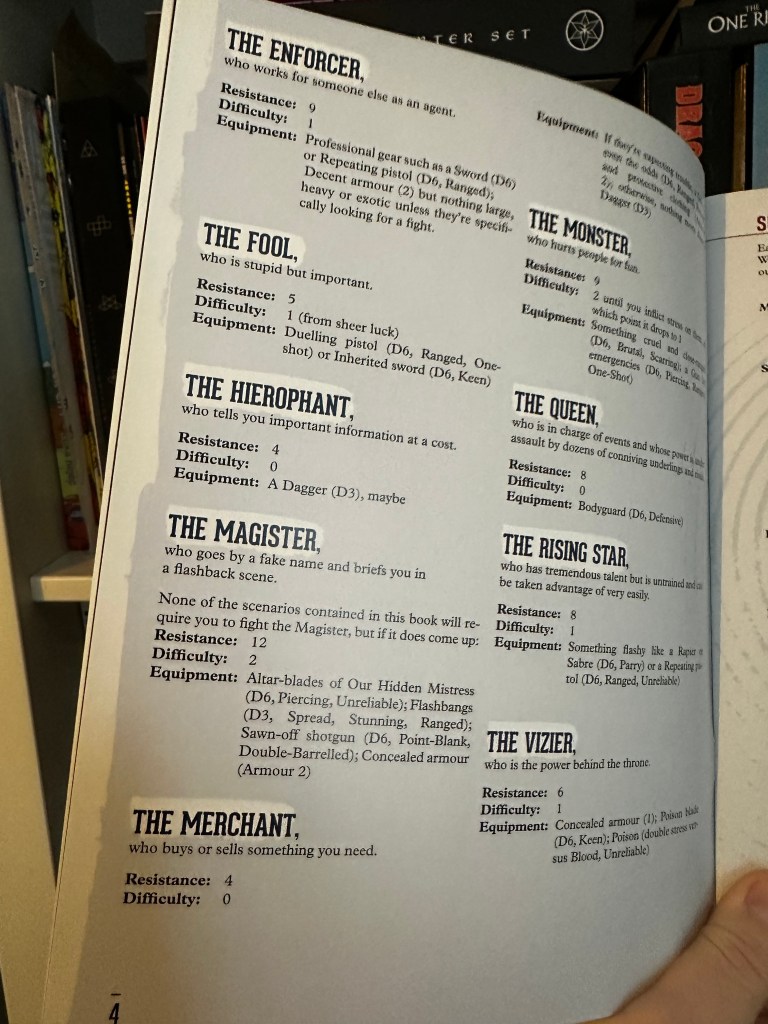
Grant Howitt and Chris Taylor know what they’re talking about when it comes to designing and running games, particularly their own games, I figured, so I started with them. Heart has a lot of useful tips for GMs in it. There’s advice for the novice and the veteran alike on how to run RPGs/story games/Heart. They also include separate sections for campaigns and one-shots. It’s worth noting that much of the general advice for running Heart is just as important in a one-shot context as in a campaign. The one-shot bit itself is minimal but useful.

Running Heart as a one-shot is straightforward enough. The only changes you’ll have to make are around pacing and how you inflict stress and fallout.

Pace-maker

The Heartsong Calling sitting on the edge of the bed wondering where that music is coming from.

The advice around pacing is as true for a Heart one-shot as it is for any game, you have to start fast and keep it moving. No long-winded expositions, no character-development heart-to-hearts that take thirty minutes, no hanging about. Start in media res or as close to it as possible. Provide the necessary information in summary or in flashback and get to the action. Also, you have to give them something they can do in one session, a goal, a destination, a creature to kill or a thing to retrieve. All this sounds easy enough, but it can be tricky. It has taken me quite a while to develop my one-shot technique to a point where I feel like I am almost guaranteed to get it done in one shot. You start to figure out where you need to kill your darlings to make up the time. Working that sort of thing out on the fly is a skill I have made gratuitous use of recently.

In this one-shot, I had the PCs escaping Redcap Grove as a sort of mini-delve on the way to the entrance of the actual delve which would take them to Hang Station. They had a simple job to deliver some psychoactive fungus to a Vermissian Sage in the station. But, woah, were they rolling badly… and also being little nut-jobs. The Cleaver, predictably, decided to hunt the Druids who were hunting them and it turned into a stress and fallout ridden combat. This was fun, and horrific and hilarious. Almost everyone in the combat hulked out at some point, the Witch into her True Form, the Deep Apiarist into her Awarm Form, the Cleaver into his Chimeric Form and the one remaining Druid into their Cave-dweller Form. The players understood the one-shot assignment and did not hold back. There’s no point in saving your cool power till the end… it’s all end. Anyway, because this took a little longer than expected, I ended up combining this mini-delve with the longer inter-landmark delve that I had prepared between Redcap and Hang. I essentially just combined the remaining resistance of the mini-delve and the delve-proper on the fly. This worked well, even though it meant I had to cut out an encounter with the Butcher…

Stress and Fallout

The Penitent Calling on their knees, praying for forgiveness

Mssrs Howitt and Taylor also mention stress and fallout in the extract above. You can’t be afraid to hit them hard. Fallout is one of the most fun things about Heart. Players are sick little freaks who love getting lumbered with terrible burdens. Give them what they want, I say! Fallout is one of the key ways to push PCs to act in certain ways and that pushes the game forward so it’s win-win, innit?

I took this quite literally. I made sure that the busted old crate they were transporting their dodgy mushrooms in was leaking the kind of spores that some sado-masochist might pay a large amount of coin for. Every time they rolled against the resistance of the delve or when they made any dangerous movements or just when nothing else was going on, I got them to roll Endure+Wild to resist the effects of the fungus. If they failed, they got Mind stress and if they got Fallout from that, they got one of the following:

FALLOUT: Traitor Brain, MINOR Mind – You relive a moment of regret ad nauseum. Always at the worst possible time. All actions increase in Difficulty by one step (ongoing.)

FALLOUT: What Did You Do? MAJOR Mind – You witness the effects of your worst mistake on those it affected. It is a gut-punch to the mind. When you mark Mind stress, roll two dice and take the highest (ongoing.)

This had exactly the effect I wanted. And if you engineer it right, you can use this sort of technique to bring about some really cool moments.

Pregens

Speaking of engineering things… making pregenerated characters for this game was the best decision I made. I had to combine it with a few tweaks to the rules, but, if I were to recommend doing one thing for your Heart one-shot, it would have to be creating and assigning pregens yourself as the GM.

I created three pregenerated characters, one Gnoll Cleaver with the Heartsong Calling, one Aelfir Deep Apiarist with the Enlightenment Calling and a Human Witch with the Penitent Calling. I gave them their starting abilities, picked their equipment, I even picked their names and answered some of the questions presented in the Calling and Ancestry sections that rounded them out as characters. I even chose their names and starting beats! I left a couple of answers up to the players, namely the ones to the questions about how their characters were associated with one another. Having them answer those gave them a sense of belonging and of fellowship with their adjacent weirdos.

Anyway, the character creation took the bulk of my prep-time, easily, but it was very much worth it. Here’s my thinking: I wanted to make sure we did this thing in one session so didn’t want anyone dithering over the details, and I didn’t want to have to explain all about every aspect of a Heart character before we even got started playing. I wanted to be able to have an inkling of the beats they would reach for to make it easier on myself to improvise them in the moment during play, I wanted to be able to plant connections to the PCs lives here and their and I wanted to be able to use the Heart itself, to make it feel like the Heart was reaching into their souls and coming out with their greatest desires. The Fallout that I wrote above? I wrote that with the idea in mind that the Penitent Witch might need that to confront her greatest regret, why? So I could introduce the last ace up a Heart GM’s sleeve, the Zenith Beats and Abilities.
The Zenith

They had been hitting both minor and major beats throughout the session and taking new abilities as appropriate. I allowed them to hit as many as they wanted. I had given them four each in their pregen character sheets. But that wasn’t enough for me.

Just as they were exiting the delve and entering Hang Station with their psychedelic cargo, I asked the players to refer to the book and take a look at their Zenith Beats and Abilities. I only pulled this out near the end so they wouldn’t know it was coming. Luckily each Calling only has two Zenith Beats available and each Class only has two or three abilities. So it wasn’t too much to look up in the moment, and, as soon as I told them this, I knew I had them (or two thirds of them anyway.)

I made it clear that I would be lenient in judging whether or not they met the conditions of the Beats because I know how good it is when a Heart PC hits their Zenith. So we made it happen. By the end of the session, each of them had brought about their own personal apocalypse and it was a thing of red, wet beauty. The Cleaver destroyed and replaced the Beast in the bottom of Hang Station, transforming the landmark into a swampy forest in the process, the Deep Apiarist summoned the Heart itself into the space just long enough to squash her into a red, wet stain and the Witch brought the Deep Apiarist back from the dead, sort of, as a clone made from the Heart itself, a clone that will always return no matter how many times it dies…

We wrapped the whole thing up neatly in about three hours. If I hadn’t cut the Butcher encounter and combined those two delves early on, it might have gone another half hour. Either way, a nice, diminutive package, I think you’ll agree.

Troika! Whalgravaak’s Warehouse Review

Here’s the story: hundreds of years ago, the city’s premier logistics wizard, Whalgravaak, abandoned his warehouse, having shredded the Manual of Operations for his Sphere Pool (a mechanism used to import and export goods across the cosmos) so that his rivals could never figure it out.

One-shot fun-shot to campaign of terror

You know what it’s like, dear reader: you want to introduce some noobs to RPGs or just to your group of players, you want to make a good impression but you don’t want to scare them off by plunging them into a multi-session campaign with a complicated, crunchy system. So you pick up a location-based adventure, thinking you can just use a small portion of it, just what you need, just enough for one session, one single shot. But, after that session, the curiosity gets the better of you all. That was a weird, but enjoyable experience, you tell each-other. I bet we could have fun exploring the rest of that odd locale, you tell the players, why not have some more sessions and see how it goes? So you do that. And then the bloodbath begins.

Whalgravaak’s Warehouse

SPOLIERS BELOW! If you are interested in being a player in Whalgravaak’s Warehouse, turn back now!

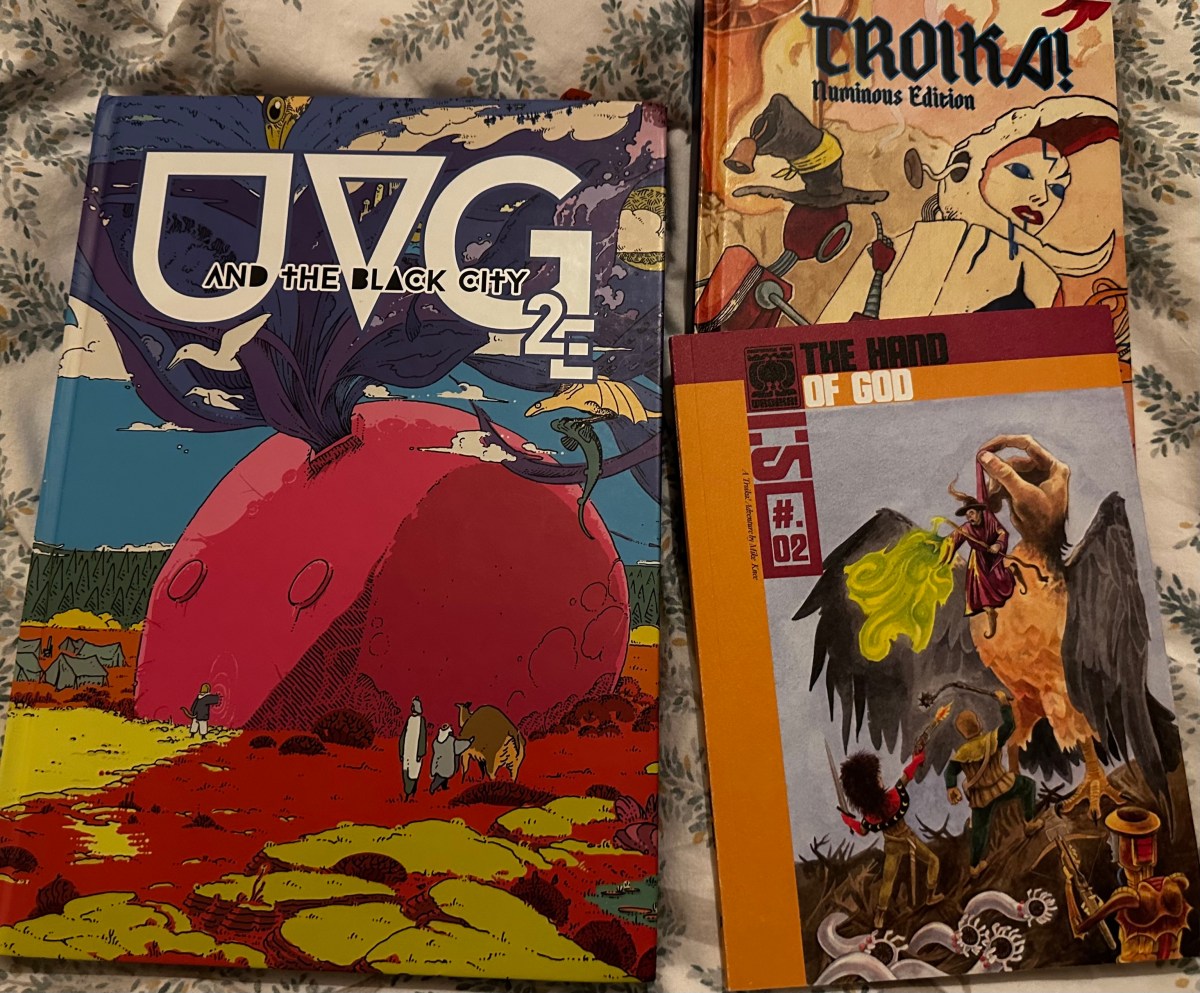
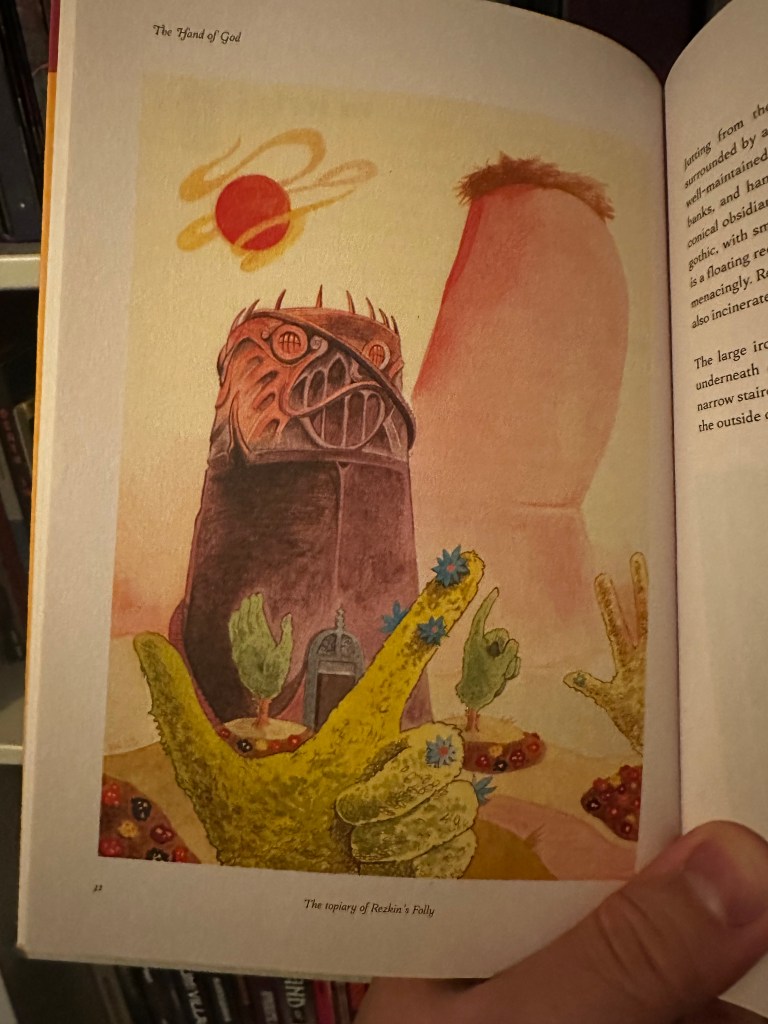
The covers of three Troika! 1:5 adventure modules, Whalgravaak's Warehouse, The Hand of God and Eye of the Aeons.
The 1:5 adventures that I own, Whalgravaak’s Warehouse, The Hand of God and Eye of the Aeons. All from Melsonian Arts Council

Whalgravaak’s Warehouse is a Location based adventure by Andrew Walter for Troika! The design is by Shuyi Zhang. It came out in 2023 and was the first of the Melsonian Arts Council’s 1:5, an ongoing series of location-based adventures for Troika! There are a couple more available now and another out very soon. You can find them all here. My somewhat rotating group of Tables and Tales members just had our last session in Whalgravaak’s Warehouse on Monday night, after spending a total of eight sessions there.

Here’s the story: hundreds of years ago, the city’s premier logistics wizard, Whalgravaak, abandoned his warehouse, having shredded the Manual of Operations for his Sphere Pool (a mechanism used to import and export goods across the cosmos) so that his rivals could never figure it out.

Since then, the strange nature of the warehouse, staffed by giants and stocked with oddities, has only grown stranger, and more dangerous. It houses a handful of physics defying, Tardis-like chambers, not least of which is the terrifying Deep Storage, a swirling mass containing several pocket dimensions and a wraith-like being who wants nothing more than to consume intruders. At least one cult has taken up residence, and they are often mutated into horrific Chaotic Spawnlets by the effects of the radiation still spilling from the Sphere Pool. The warehouse is sandwiched by a vast desert of dust occupying the roof, which is peopled by the descendants of Whalgravaak’s former employees and, underneath, the tunnels of a pack of unpredictable Worm-headed Hounds.

But entrance has been forbidden by the Autarch for centuries and, even if you were foolhardy enough to ignore a diktat like that, you would still need to be brave enough to face the unknown dangers within.

The Hook and the Party

The book suggests a few potential hooks for your PCs. Since my game started off as a one-shot, with brand new characters and no existing campaign to work it into, I went for one that seemed like the object might be achieved in one session. They, along with many other groups of mercenaries were contracted to return with the head of a Cacogen, known only as the Opportunist, to their patron, an Exultant of the Autarch’s court. But we dealt with that in flashback as they all sat in the weed-choked yard of the warehouse, dotted now with small encampments of adventurers and brigands all gathering their courage to gain entry. The PCs’ band consisted of a Monkey Monger (and monkeys), a Gremlin Catcher (and dog), a Wizard Hunter and a Landsknecht. They were, to put it bluntly, a motley crew.

That first session was all fun and games. Every encounter, except for the last one with the Cacogen, was resolved peacefully. This happened mainly due to the rolls I made on the Mien table for each encounter. The worm-headed Hounds they encountered wanted to play with the Monkey Mongers monkeys, they did not want to eat them. The Flat Serviceman was happy to follow the party around and clean up after them. The Segmented Crippler in the Pigeonholery, didn’t want to wake up, so they skipped that one entirely. This is a pretty standard mechanic in Troika but I think it gave the players a false sense of security. The session ended with this motley crew finding and defeating the Opportunist quite handily. And, at that point, we thought that would be it.
But a few months later we decided to continue with their explorations of the warehouse. Obviously, their original motivation to explore was gone. They had achieved their objective, but the players were all good sports. They decided between them that the motivation was purely one of curiosity and greed. They had spotted, through a bubble like window in one of the rooms they had traversed, a vast and terrifying pool of chaos and wonder in a room far too big to exist within the confines of the building. This was enough for them. Essentially, they went in search of adventure. Although, through the sessions that followed, I did introduce the idea that they might want to find that cult I mentioned earlier and that they should seek out the incredibly valuable Tome of the Sable Fields that was reported to be stored in the warehouse, somewhere. This gave them a little direction when I thought they might need it, but, honestly, I think my players just wanted to see what new wonder/horror the dungeon had in store in the next room.

The Dungeoncrawl

It was only from this point that I started to really treat this adventure like the dungeoncrawl it is very much meant to be. The book does a good job of introducing the concepts of tracking resources like lantern oil and provisions as the party explores. It also explains the concept of exploration turns and their effect on the game, i.e. the distance you can travel in that time, the amount of lantern oil you use per turn, and the likelihood of running into an encounter. I followed all these rules to the letter and they made for some interesting moments in the game. But, to be frank, the weirdness of the setting is the real draw here, not fiddling with rations and light levels. Also, few of the characters lived long enough for starvation or oil-skins to become a problem.

It also has rules for dealing with the spatially distorted, impossibly large areas within the warehouse. It suggests that the players should make Luck or Skill checks to avoid getting lost in these areas, but, in all honesty, I didn’t really require that sort of thing.

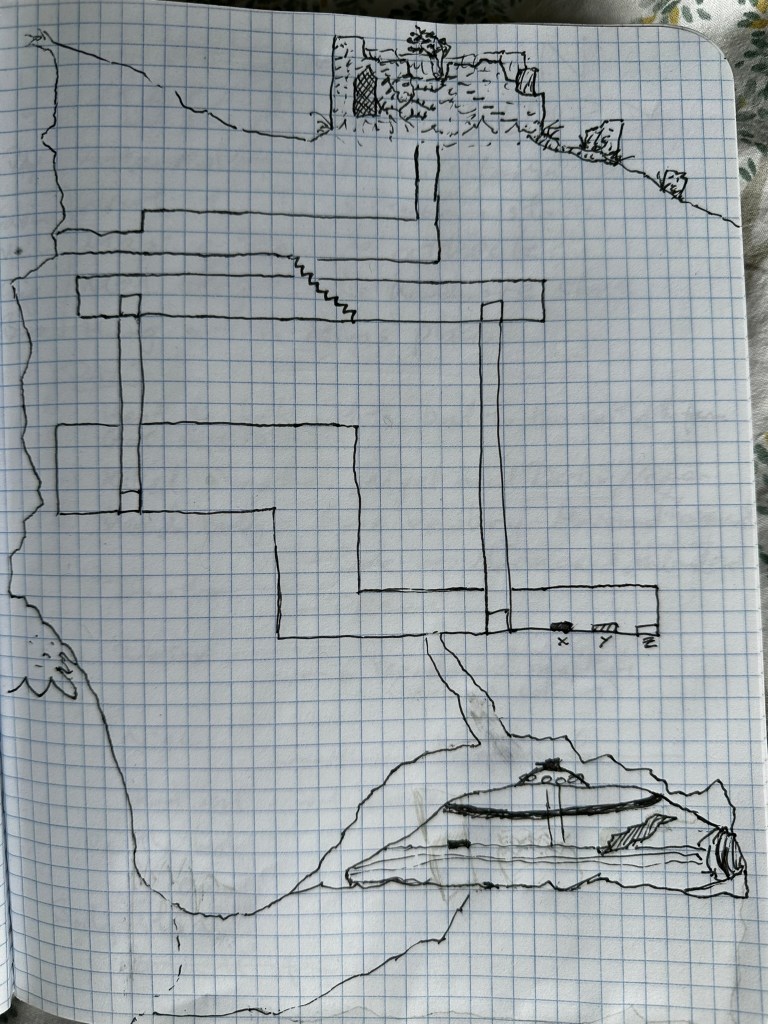
Mapping is also a part of the dungeon crawl format and this adventure does want the party to attempt to map the space for themselves. The thing is, when some rooms appear to be a kilometre wide and the next one is spatially normal, that map becomes effectively impossible for them to draw accurately after a relatively short period of time. Eventually, I gave up and just shared the one from the book with the players, trusting their ability to separate player knowledge and character knowledge. My advice, if you are doing this, try get your hands on the PDF version, since the one in the physical book stretches across two pages and the crease obscures part of it.
In fact, the adventure has four maps:

  • the warehouse floorpan, using 10ft squares to denote distance
  • a hex crawl for the desert on the roof, replete with points of interest
  • a map of the Worm-headed Hound tunnels beneath the warehouse, superimposed over the warehouse plan
  • a largely vibes-based map of Deep Storage

These are all great but usefulness will vary. In our game, the party spent several sessions trapped in Deep Storage but took one look at the desert and noped right out of there. This seems like a good point to note how good all the artwork is in this. There are plenty of colour and black and white illustrations but they leave me wanting even more!

Warehouse Workers and other Beasties

A warehouse is a dangerous place to work, especially when the correct safety protocols are not observed. It doesn’t help at all when you are trespassers and several of the residents are large enough to crush you with a single blow.

The crimson giant, Paude, the pipe-smoking, bearded giant, Arbuthnot and the blue, jelly giant, Gamtomerian.
The giants are not what you might expect.
The giants are the main NPCs of the adventure and Whalgravaak’s only remaining employees. Each one is fabulously interesting, diverse and well-drawn. They have their own motivations and desires. I was gratified that the party managed to encounter all of them during the eight sessions we played. In fact, one player had two different characters killed by two different giants. I will point out that it is entirely possible to avoid violence when dealing with the giants, it’s just that, sometimes, the Monkey Monger on the team has monkeys who decide to fuck with them and one thing leads to another.
The wraith-like Gulf Man Roamer from the swirling vortex of Deep Storage is a potentially lethal foe who has a chance to show up each time the party moves through that already dangerous room. If it captures you in its bag, it’s going to spirit you away to eat you in its extra-dimensional lair.

No warehouse is complete without forklifts. Whalgravaak’s forklifts are humanoid constructs with the face of the wizard himself. They treat intruders like stock, and will attempt to whack them and pack them. They hit very very hard.

Its a black and white dog, with a neck like an earthworm
When you read the words, Worm-headed Hound, is this what you imagined?

There are also a bunch of random encounters, including the Worm-headed Hounds I mentioned before, desert nomads from the roof, and Bandits/Burglars/Bastards. These only turn up on the roll of a 1 on a 1d6 for each turn the party travels. It didn’t occur very often in my game. The Roof and the tunnels have their own random encounter tables as well, but I never used them as the party never spent any appreciable time there.

This is just a selection of the possible encounters you can have in this setting. I haven’t even mentioned the tiny army guys, the sentient crane parts, the Onion God or the Mulled Dead.

The Rooms

I have hinted at rooms that defy physics and rooms with pocket dimensions, and those are usually the big-ticket locations that contain some of the greatest set-pieces in the adventure. Deep Storage alone evoked some of the most inventive use of skills and spells and a great degree of fear and tension from the PCs. It killed one of them (two if you count the Rhinoman eaten by the Gulf Man Roamer.) The Roof could act as an entire short hex-crawl campaign and the Sphere Pool has some truly memorable and dangerous elements to it.

However, many of the other rooms have weird and wonderful contents as well. Some of them, the party will glance at and move on, while others will capture their imaginations and encourage them to interact. I never really knew which reaction I was going to get from them, actually. The room full of melting rope? They had to spend an hour trying to figure out how to set it on fire, the eternal battle between tiny armies playing out across a battlefield seemingly larger than the whole warehouse? Just popped their heads in and left with some captured little men.

Some of the rooms were relatively mundane warehouse style rooms with shelves and containers. The book has tables in the back to help you identify the state those rooms are in and the contents of the containers, which is useful.

One of my over-riding impressions by the end of our game, was that in some ways, the great variety of bonkers content in the rooms served to detract from any unifying theme. There were some elements that went together, such as the warehouse’s disdain for traditional dimensions. If my PCs had explored the Roof or even encountered any of the nomads who dwelt there, they might have found a distinction between those descendants of the ancient striking workers and the giants who continued to obsessively do their jobs even long after their employer had passed on. But, none of that is to say that the rooms weren’t endlessly fun and inventive.

A Note on Lethality

I recently wrote a post sharing some of the obituaries of the characters who met their ends in Whalgravaak’s Warehouse. You can check it out here. There are only three of them in that post. A few months previous to that, I wrote this post, which contained the obituaries of two more. The mathematicians amongst you will have summed those already. That’s five. In the final session, we lost another one. That makes six. That was three character deaths each for two particularly unfortunate/reckless players. Warehouse work is dangerous. Only one of the original party survived to the end. You have been warned.

Conclusions

The covers of the two different versions of Troika! that I own.
Numinous or otherwise, its the same game.

There is so much to recommend in this adventure. It is endlessly entertaining, challenging and bonkers. It has such a variety of locations and such a diversity of encounters that you would need to work hard to get bored in Whalgravaak’s Warehouse. I think it works so well to show off Troika! as a system, too. The problems it asks the PCs to solve and the encounters they have to deal with utilise things like the Luck check really well and encourage players to invent their own unique Advanced Skills. But if they get into fights, especially with the incredibly random nature of Troika! initiative, there is a very high chance they are going to come out of it dead. There are a few opportunities for insta-kills throughout the warehouse too. I can’t overstate exactly how lethal this adventure is. Luckily, my players leaned into that, even when they were creating new characters to join in the same fight the original one died in (they got very quick at creating characters.)

I think it’s also flexible enough for many GMs to easily take it or part of it and fit it easily into their own ongoing Troika! campaign. As I said at the start, our game started as a one-shot and it could have ended there. But we were able to easily adapt it into a short campaign of its own.

Dear reader, let me know if you have played Whalgravaak’s Warehouse or if you would like to! I’d love to know your views on it.

DCC’s The Grinding Keep Review

At one stage, the Elf cast a Magic Missile and it caused a rain of frogs on the entire party and all their enemies, almost killing several on both sides!

DCC Day

I kind of knew it was DCC Day on the 19th of July. It had been advertised to me enough times on Instagram after all. But that was not why I had scheduled a DCC one-shot on the 20th of July. That just happened to be the best day for most of my players. As serendipity would have it, the module I planned to run was the Grinding Keep, an adventure designed by Marc Bruner, which appeared in the Adventure Pack for DCC Day 2024 along with the XCC RPG adventure, Tucson Death Storm!

Hook

I had introduced the hook for this adventure in our recent run of Sailors on the Starless Sea. The PCs discovered a map to a keep and a note hidden in the lining of a cloak in amongst the charnel remains of many butchered humanoids in that adventure’s tower. The note was from the patron of the poor unfortunate who lost their cloak and it indicated that their patron would pay 1000 gp for the safe return to them of a magical lantern. As budding adventurers, most of whom barely had two groats to rub together, this seemed to be motivation enough.

Each player had only one surviving character from the 0-level funnel and one of them was not able to make it to this latest game so I supplemented the four characters who advanced from 0-level to level 1 with a couple of pre-gens kindly provided for the Grinding Keep by Goodman Games themselves.

Big Party

So the party was made up of six level 1 PCs, a Warrior, a Wizard, a Cleric, a Dwarf, an Elf and a Halfling. Two of the players played two PCs each and two of them played one PC each. All of their abilities proved useful. I would say a varied party is very beneficial for this module. On the other hand, if I had to do it again, I probably would have left the players with one PC each even though the adventure calls for 4 to 6 level 1 PCs. They all survived easily enough, although there were a couple of close calls.

Starting the Adventure

SPOILERS! – If you are a player who might want to play this module, stop reading now!

To begin, I plonked them right at the door to the keep as the text suggests. The module wants you to do this. It is designed to be a one-shot by the gods, and it will be! No faffing around in town, shopping or gathering rumours. Just get them in there as quick as you can. I did have to utilise the handy, and essentially invulnerable Leaf Elemental that waits on the grounds of the estate for anyone foolish enough to hold up the proceedings of your one-shot by searching for herbs amongst the overgrown gardens which seem to be under the influence of all four seasons at once. The seasons are a recurring theme and I was gratified to note that the players realised this almost immediately.

Anyway, once they had been chased inside the keep, they were confronted by something that could only have been a magical effect that transformed the interior from a ruin to an immaculately decorated and lit hall. They were greeted by the white robed Host and eventually waited on at dinner by his veiled servants. All of this set up was important. It presented clues to the nature of the keep to the PCs and let their imaginations run with them. Enough strangenesses occur during dinner and upon their investigation of the ground floor of the keep that they should be suspicious. Indeed, before they had even left the dining room, one of my players joked, “the house is a mimic!” He didn’t know how spot on he was…

Of course, the keep is, in fact, an other planar entity who comes to the world to feed, in disguise. The PCs had seen windows and chimneys on the outside but could find no sign of them on the inside. The couldn’t get through any doors that the Host didn’t want them to enter, etc, etc. Clearly, there is enough evidence to allow your players to uncover the truth before things ever really get interesting.

One regret I have is how much time I allowed them to devote to this whole section before Event One occurs. They spent a lot of time searching, theorising, investigating, and it ate into the more adventuresome elements in the latter stages of the module. My advice would be to get them into the Guest Quarters and asleep as quickly as possible. The adventure does not provide much in the way of motivation for the characters to do this, however, so be prepared to improvise.

Event One

Event One is triggered when they wake up after a nights’ sleep in the keep. I was lucky enough that the players wanted to rest and one of them was rendered magically asleep, but without that, it would have been a struggle to get them to wait until the next morning. I probably would have triggered Event One early, if that had been a problem.

What “Event One” means is that the keep is waking up. It will soon be ready to consume a fresh meal of adventurers.

Mechanically, what it means is that every time they open a door, they will be confronted with an intersection of corridors that lead to two randomly determined rooms in the keep. These could be rooms they already visited in the first part of the adventure, or ones that would have been otherwise inaccessible up until this point.

The first room my players visited was the dining room again. This was satisfying as it gave them a chance to kill the Host and his servants from earlier (although, technically they just put the Host to sleep and dragged him around with them for the rest of the adventure.) After that, they encountered one of the three rooms that contained the organs of the keep. They had discovered the journal of a former prisoner/meal in their quarters that gave them hints as to how to deal with each of the organs; eyes, heart and lungs, and that proved useful in the encounter they had with the heart. It is significant that they identified several magic items that act as keys for the doors to these special rooms. But their first instinct was to destroy them if they could. Luckily they forgot about that plan and just kept ‘splorin’ instead. Eventually they managed to overcome the challenge in the heart room and at that point of our session, I realised I was running out of time to get my one-shot done in one shot so I focused things up a bit.

Event Two

The way it was supposed to work was this: every time they left a room, I would start marking that room off as no longer accessible on the random room table, until there was only one possible room left; the one that contained the Alien Intelligence itself. I didn’t have the time for all that. We were approaching the four hour mark at that point and people had work in the morning. So I just told them that, after they destroyed the fiery orb that acted as the keep’s heart, the entire place shook and when they re-opened the door to leave that place, the corridor beyond led to the last room. The players, unknowing, proceeded to their fate. Their fate, as it happened, was to murder the Alien Intelligence of the Grinding Keep, all its Animated Corpses and the Giant Animalcule Swarm that accompanied them. Destroying the heart had pretty much halved the creature’s HP so it wasn’t too difficult. In the end, they fled through the windows in the back of the room, utilising the Feather Fall spell (which two characters had, by coincidence) to safely land in the river at the bottom of the canyon beyond.

Conclusions

Perhaps you can see now why I think I should have made things a little harder for them by reducing their numbers. On the other hand, I am glad they all survived. They had all created and played such interesting and fun characters, even in the context of a game that is not RP-heavy, to say the least.

I was a little disappointed to reach the end of the adventure with so much cool content unexplored. They didn’t find the trap/treasure room where the magic lantern was stored, they didn’t find any of the other organ rooms, which all had really fun mechanics. On the other hand, I felt the adventure was designed to be flexible enough for a Judge to shortcut it exactly the way I did to get them to the end a little quicker, which seemed like good design to me.

This was only the second time any of us had played DCC and the first time with characters of anything other than 0-level. This was a different game to that first experience. PCs used magic and Mighty Deeds at every available opportunity and they got to roll on the crazy magic random tables a lot. At one stage, the Elf cast a Magic Missile and it caused a rain of frogs on the entire party and all their enemies, almost killing several on both sides! This is why we loved DCC. It’s the wonderful and potentially lethal randomness of it and the endless inventiveness of the adventures.

I would recommend the Grinding Keep as a one-shot DCC adventure, as long as you are willing to either cut out bits or extend it to two sessions.

The Quantum NPC

This works even better through the medium of TTRPGs than TV to be honest, because your imagination simply works around them, never focusing on their details.

Star Trek

I’ve been watching a lot of Star Trek the Next Generation lately. I hadn’t seen it in many years, although I watched the whole thing as it came out in the eighties and nineties. I have obviously been watching it with different eyes this time around. I have noticed things in it that I don’t think I could have seen before. I wonder, for instance, about Mr Data. Would he have been such a sympathetic character today, as an AI in humanoid form? I think about how many of the episodes had no action, how many were just talking heads and techno-babble and whether Sci-fi TV shows today could get away with that. I ponder the special effects and make-up and marvel at how well they stand up 35 years later. But I have also been looking at these episodes with TTRPGs in mind. Now, of course, Star Trek has been made into a number of role playing games. I have never played any of them and this post isn’t about them. This post is about the crew of the Enterprise. Not Picard and Riker and Troi and Worf, but the ones who you see occasionally pass the bridge crew on one of the ship’s many lushly carpeted corridors, the ones having their own conversations in the background in Ten Forward, even the ones who so consistently took the con after Wesley Crusher left. They would get names sometimes and every so often, they’d even get lines! There are a couple of those that are recurring characters, such as Ensign McKnight and Robin Lefler. The most iconic of these, Chief O’Brien, went on to enjoy a major role in two Star Trek shows. But when he first appeared on the Enterprise, he was an unnamed bridge officer. Total NPC. He only became someone when the show creators decided he had to be someone.

The Quantum NPC

So this is what I have started doing for crews in my Spelljammer campaign. I think it would work in any game where you have a lot of NPCs that hang around in close proximity to the PCs all the time. So it works particularly well for ship crews.

In the main campaign, the party lost their original crew in the best possible circumstances. The crew, a bunch of spirits who had lost their memories and were not initially aware they were dead at all, finally fulfilled their goals and were able to shuffle off to whichever outer plane would have them. So, the PCs were forced to hire a whole new crew to take care of rigging and swabbing and whatnot. Now, I did not want to spend an entire session where they press-ganged or interviewed eight or nine NPCs that I would then have to name, outline and give voices to. That kind of thing can be fun but I don’t want to spend two full hours at it. Instead I told them that they picked up eight new competent crew members and that we would come up with their characters as and when they were needed.

So this is how that works, you imagine the scene where the PCs are on deck, in the foreground talking about something like how to defeat the weird root creatures that have invaded the ship from some eldritch, otherworldly space. In the background, just like in Star Trek, you have a few crewmembers, maybe they are even in uniform, but they are ill-defined and unremarkable. This works even better through the medium of TTRPGs than TV to be honest, because your imagination simply works around them, never focusing on their details. But then! They need one of the NPCs to be good at something, a specialist, an expert. Or maybe they just need a buddy, someone to talk to, or someone to listen. That’s when the players get to stretch those imagination muscles!

Pulling the NPC Out of Their Quantum State

The NPC existed in theory but not in practice. They were always there as a number, but not as a person, not as a character. Until the players make them up. The GM asks a player who this NPC is, what their name is, their ancestry, their job, what their personality is like. The players generally end up working together to do this but I usually start by asking the player who decided they wanted one of the quantum NPCs to become real for some reason. I ask that particular player the type of character they want in this situation with the understanding that, once they have been defined, they will forever be part of the crew, taking up one of those eight spots. It’s just like Blades in the Dark items. You know how many slots you have to fill when your PC is out on a Score but you don’t define the items until you need them in the narrative. Once you have said you have “A Blade or Two,” though, those blades are filling one of those slots. Same-same but different.

In this manner we got these three NPCs:

Deckhand Dewey – kobold, he/him, spry and wiry and can fit in little places.

Cook – Barry Keoghan (this is the consequence of allowing the players to name NPCs) – orc, he/him, big guy with big arms, beer belly, loves food and loves cooking. His chef hat does not fit very well. Apron always slightly dirty. Has a space rat companion.

Mr Cannon – Halfling he/him – weapon-master.

As you can see some of them got more detailed description than others. Barry Keoghan was described thoroughly partly because of who I asked to describe him and partly because of the moment I asked for his description, i.e. a quiet moment aboard ship where they had some time to talk about provisions and joke about silly Disney movie references. Meanwhile, Mr Cannon was created in the literal heat of battle. But that was ok, because the idea was always to flesh these NPCs out as time went on. We did, for instance, in subsequent sessions, discover that Mr Cannon had a wife waiting for him at home and that Barry Keoghan had some sort of tragic love-affair in his past.

I think, in future I will bring Between the Skies to bear on the Quantum NPCs as they are being birthed by the players, giving them desires, bonuses, hindrances, quirks and all the rest. Time allowing, of course.

The Quantum NPC method has the added advantage of endearing the newly created NPCs to the players from the off. They are, after all, fully their own creations. From the players’ point of view, I believe it was also quite devastating when both Mr Cannon and Deckhand Dewey got breath weaponed into oblivion by a lunar dragon along with the rest of the NPC crew (apart for Barry Keoghan who was in the galley at the time of the attack.) Unforgettable.

Dad-quest

Dad-quest is getting under way tomorrow night. Our resident Giff Fighter-Paladin, Azimuth is rounding up a crew of misfits (the other players with their new characters that I discussed here) and a few more Quantum NPCs and spelljamming out to the Amos Expanse to find his Dad. Can’t wait to see what new crew-members the players come up with this time!

Revenge of the Giff

I’m considering an option that harks back to Dark Sun. In 2nd Edition Dark Sun, a player started, not with just one PC, but a whole stable of them, called a character tree.

Mid-season finale

The crew of the Cadabra were going home. After weeks of adventure across Scatterspace and all over the Rock of Bral, they have arrived back at First Home, the asteroid/inn/shipyard that was their first stop after leaving their world behind in the first place. They could justifiably expect a warm welcome since they freed the shipyard from a Neogi infestation last time. But they weren’t expecting to be confronted with a crew of kobolds from their home island to be there. Kobolds who probably thought the PCs had murdered their queen. They also weren’t expecting to find Becky Fullpockets’ personal spelljamming vessel there. They had been struggling against the machinations of the technomagical billionaire ever since they fled their planet. It looked like they were stuck between a rock and a hard place, with no escape!

No better place to end part of a season than on a cliffhanger. And that’s what we did right there. We have been on a break from our Spelljammer campaign for a couple of months now. It’s given me a break from 5E and allowed us to play some other great games in the meantime. But now, it’s time to come back, sort of.

Spin Off

A few months (IRL months, that is) before the crew of the Cadabra reached First Home for the second time, they said goodbye to one of their number. Giff Fighter-Paladin, Azimuth, who had to be rescued from two ship-wrecks in quick succession might have been labelled a Jonah by many crews, but the Cadabra was different. They welcomed him on board with open arms and he adventured with them for a while. But, eventually, he was always going to go back to look for the father who went missing from the first of those two ship-wrecks. Now, while his erstwhile comrades are heading back to their homeworld, Azimuth is armed with a little knowledge about the stretch of Wildspace Papa might be found in and a ship stolen from Becky Fullpockets. He’s preparing an expedition of his own to go find his real dad… Not that gnome who pretended to be his dad during that short period where he’d lost his memory (long story, dear reader.)

The rest of the players are coming back too, but they’ll be playing new characters for this spin-off. Azimuth needs a crew for his ship, after all. We are getting together tomorrow night for a session-0 type thing. I think everyone is looking forward to trying some different classes/backgrounds/species compared to the ones they have been playing for over two years in the main campaign. Although, Azimuth’s player, David, doesn’t get a new character, he does get to pursue his PC’s main drive and its a great welcome back to the group for him.

As for me; I’m looking forward to yet another shake-up in this game. I’m planning to use the progress-based travel rules that I mentioned in my Prep Part 2 post last week. And, as well as that, I have something very special up my sleeve for the meat of the adventure, which I can’t reveal here and now (my players read this blog sometimes.) I’m definitely going to write about it after the fact, though.

Change of Cast?

The introduction of new PCs into the campaign, even though its a spin-off, raises the question of what happens once Azimuth joins back up with the main crew again. I’m considering an option that harks back to Dark Sun. In 2nd Edition Dark Sun, a player started, not with just one PC, but a whole stable of them, called a character tree. I believe you were supposed to begin with four characters. This was to help counter the lethality of the setting, giving a player back-ups in the inevitable event of a PC death. This made a lot of sense, especially considering the amount of time it took to create characters. Go check out my Dark Sun character Creation series to witness exactly how long that took.

So, my thinking is that, once this spin-off is done, if they want, the players will be able to swap PCs in or out as they like. This should have the double benefit of providing the players with a bit of variety and allowing them to almost fully crew their ship with their own characters, rather than just NPCs. I’m currently thinking through how I’ll handle character advancement if I do allow this. In Dark Sun, if I remember correctly, the PC only gained experience when they were actually played. No vicarious levelling. I think this makes a lot of sense, but it might be more difficult to adjudicate with milestone levelling.

What do you think of these ideas, dear reader? Have you ever run a spin-off campaign like this? Would you be happy for your players to switch between active PCs like I’ve described?

Modular Gaming

Improbable hot-takes

“The Discourse (TM)” has been focusing on running published adventures/modules/campaigns as opposed to custom/homebrew/sandbox games for the last little while. First Quinns reviewed Impossible Landscapes, an epic and almost legendary campaign for the modern Cthulhu-ish game, Delta Green. This is the first time Quinns has reviewed a campaign/published adventure on his RPG review channel, Quinns’ Quest, so it was unusual enough to spark a significant amount of discussion all on its own. And then Thomas Manuel of the Indie RPG Newsletter and Rascal reviewed the same campaign. I believe this was purely coincidental, especially as Impossible Landscapes came out about five years ago now. Both are great reviews in their own right and are based on full play-throughs of the campaign so you know they’re of real value. You should check them both out.

Anyway, on Bluesky, Thomas Manuel went looking for recommendations of other modules to run and this spawned a lot of interesting answers and quote-bleets from RPG luminaries, such as this one, which I found interesting.

I have opinions on the conversation, of course. I have shared a lot of them in other posts from the last year or so, actually. If you want the summary, though, I had a lot of bad experiences running D&D scenarios in the past, especially from the AD&D 2nd edition era. I found they were difficult or impossible to just pick up and run. In fact, they required maybe more preparation time than adventures and campaigns I wrote myself. The one published 5E campaign that I ran, Storm King’s Thunder suffered from the same issues, actually. This made me feel like it was a “me” thing. But, it turns out, a lot of GMs feel the same way, according to Bluesky, at least.

However, I have had my mind changed somewhat by running pre-written adventures for some other games, particularly Free League’s Blade Runner, Dungeon Crawl Classics and, to a lesser extent, the Dragon Age RPG from Green Ronin.

This is a link to my first post on Electric Dreams, the introductory Case File for Blade Runner:

And this one compares the same module to a 5E murder mystery adventure I played in around the the same time:

Here’s my post about Sailor’s on the Starless Sea for DCC:

And this is my post on running Duty Unto Death, a short intro adventure for the Dragon Age RPG:

And finally, this post, although ostensibly an excuse to discuss DCC adventures, also includes my opinions on the one 5E campaign I ran:

I will say that, despite my generally favourable outlook on most of these modules, I still find I have to to do a lot of prep for them. The main fear I have is messing things up so bad that I essentially spoil the rest of the adventure. Although, I should really have more faith in my abilities as a GM at this stage. I feel like I can probably improv my way out of any hole, to be honest. But it does not change the fact that I spend hours rewriting long paragraphs presented in module texts into digestible bite-sized bullet-points. I am running another Dragon Age scenario right now. Amber Rage is from Blood in Ferelden, an anthology of scenarios for the game that came out in 2010. It suffers from verboseness and unnecessary detail and makes for a lot of work from the GM. I’m enjoying the contents of the scenario but its presentation is horrendously dated and needs a sprinkle of OSR magic to tighten it up, in my opinion.

I realise that none of the modules I have mentioned here are anywhere close to having the size and epic scope of something like Impossible Landscapes, but it doesn’t change the fact that they have largely changed my mind about running anything pre-published. The one I have my eye on right now is Dagger in the Heart for Heart: The City Beneath. Actually, I have a post about that right here too:

OK, I’m off to discuss the discourse on Discord of course!