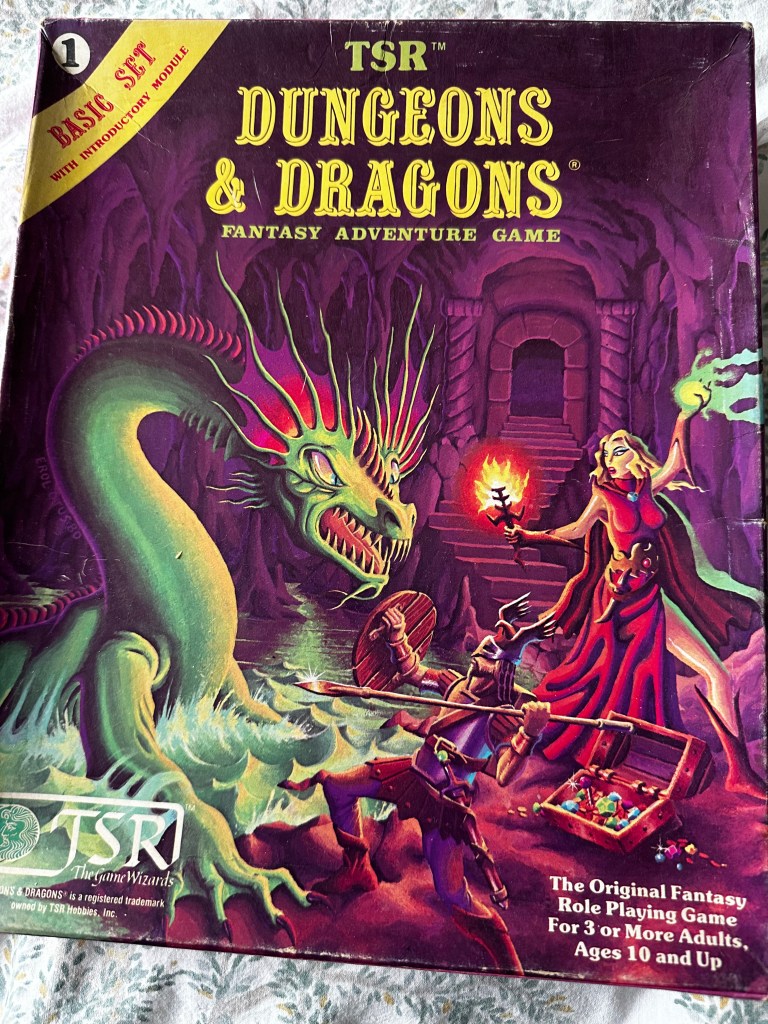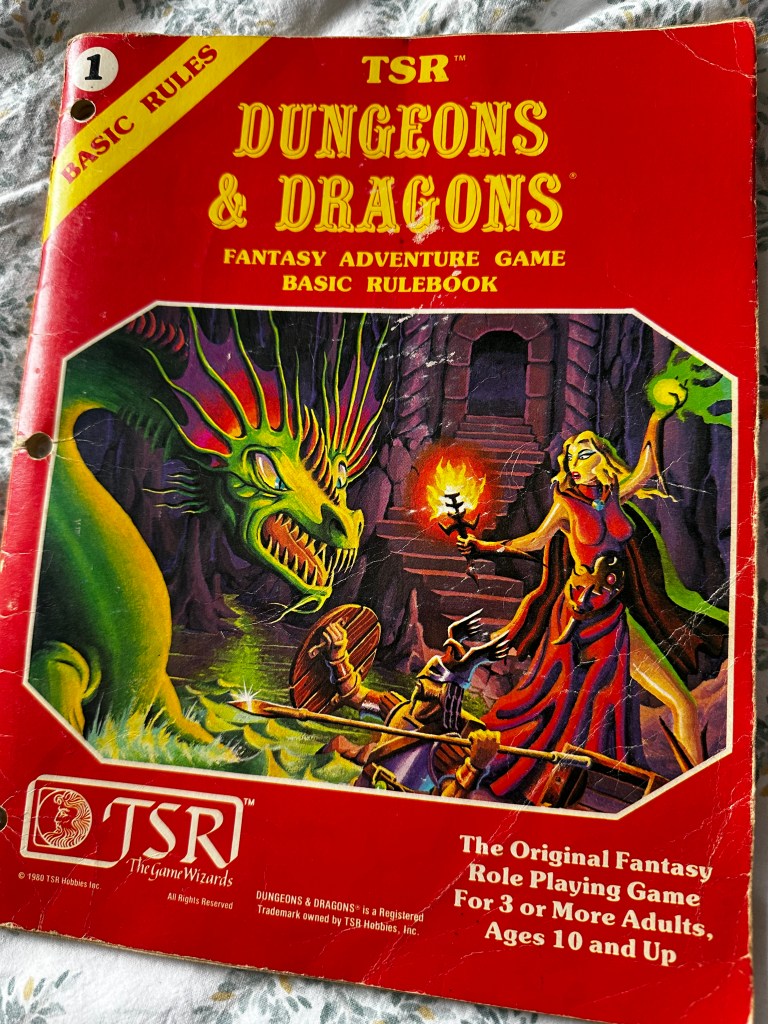
The Editioning: Week Three, OD&D

OD&D, The Woes of Sorrowfield, Session Two

Let me start by saying, if you’re one of my players, turn back now! Do not read! Danger! Danger!

The PCs gathered some hirelings. The town of East Barrens was not replete with adventuring types or even warriors, so I ruled that the only idiots available for hire were what OD&D refers to as “normal men.” This is a term from CHAINMAIL, I think, and means they are not fighters of any kind. Basically, they’re what later editions might call 0-level NPCs. Four of them showed up for duty. They did not all survive the session…

Hirelings are an interesting part of old D&D. You don’t really hear of a lot of 5e adventuring parties taking on a bunch of mercenaries as backup. But I remember playing AD&D particularly back in the olden days, the party would always want an extra NPC or two. They were often necessary to ensure survival. Playing OSR games like the Black Hack and Black Sword Hack, we have always employed hirelings for a variety of reasons in recent years too. Even in UVG, you probably won’t get very far without a crew of NPCs to keep your caravan running smoothly. UVG’s pretty old school in that respect. In the old games, they were pretty much just damage soaks, meat shields and extra carrying capacity. Even today, as a GM, I find I only role-play them when the players remember they exist as characters, which is not very often. In our Basic D&D game, the adventure we’re playing, Keep on the Borderlands, is designed for 6 to 9 players or something nuts like that, so we went all out of hirelings. Especially after my character got murdered by bandits in the first combat of the game. In oD&D and Basic, I think it’s easier to handle a larger number of characters, especially in combat. You don’t have to remember all those actions and complicated initiative order that you have in 5e and other more modern systems. Mostly, each character gets one actions/attack and they can move and that’s it. You roll initiative per side each round so you don’t have to keep the order in mind for a whole combat. This keeps it smooth. At least, that was our experience last week in both games.

The adventurers set off into the Barrenwood. They had to pass through it to find the source of the magical attacks the forest and the town had been coming under for weeks. It had not stopped raining and the road was a mucky morass. They trudged along the overgrown path into the dark, rotting woods and, before long encountered some trouble. A swarm of crystal infected arachnids had built a supernaturally strong web across the path in the dark, at just the height to trap unwary travellers. That’s what it did to our Fighting Man, Siward, who was leading the way. Abiss, the Halfling Thief set about cutting him free with her magical bronze sword while the others tried to scare off the spiders. Tadhg, the Cleric, made clever use of his lamp oil and torch, by blowing the oil out of his mouth at the flame to create a DIY breath weapon, incinerating a large part of the swarm and the webs as well, freeing Siward! They found some treasure on the ground below the webs, gold and some more magic items, a magic mace and a Staff of Striking.

I am running the Wilderness expedition as a hex-crawl. Here’s a picture of the hex map I drew in my “Pocket Dimension” from the Melsonian Arts Council. I bought a pack of ten of these a couple of years ago and I’m finally getting some use out of them.

A hex map in a hex-flower shape. It has letters from A to G along the top and numbers from 01 to 13 along the left hand side. There is a town in G-04 with a river flowing south and through it. a road goes from the town southeast and off the map. Another branches off into the forest that takes up the rest of the hex map. In the forest there is a lake B-05 and river winding south through the trees.
Barrenwood hexmap

Anyway, you can see the town in the north-east of the map and most of the rest of it is forest by design. I want the entire Wilderness portion of the adventure to take place in the Barrenwood. The area is not very large. I haven’t defined the exact size, but I’m thinking about an hour of travel per hex, with time added for encounters and rough terrain. Essentially, I ask the players to roll 2d6 on this encounter table each time they enter a new hex.

2Undead animals – crystalline growths – They won’t attack unless attacked. They make terrible noises while attempting to go on as if they were alive. Stats as Skeletons.
3Trapped merchant – stuck in a tree with strange crystalline chimeric creatures below. Stats as Zombies. Succesful attacks provoke a save vs Stone. Offers them 1000 GP to save him.
4Swarm of glowing crystalline spiders – trap! Treasure dropped amongst the webs – Staff of Striking, Mace +1, 560 GP, 300 SP, 500 CP. The spiders can do no damage but PCs will need to make saves vs Stone.
5Undead trees – crystalline branches. brittle and weak to fire – try to grab PCs. Treasure inside them – Total of 400 GP.
6Crystalline undead – one has a journal explaining how to find the entrance to the dungeon
7Pixies – frightened and angry – try to trick the pcs into swimming in the lake, diving for treasure
8Hermit’s shack – Breandan only drinks rain-water he collects himself in casks. Wagers the adventurers that they can’t kill the carnivorous crystal elk that he says has been stalking him. He will offer them an old silver amulet with a ruby in it (3000 GP.) Can also tell them the best way to reach the coast so they don’t have to roll on the encounter table anymore. Says he encountered another adventuring party returning from the tower ruins a while ago. Apparently they were frightened off by a horde of undead on the first subterranean level.
9Nothing but more sodden trees and undergrowth trying to trip them. Roll 1d6. On a 1, become lost. Roll 1d6 to determine the direction they go in.
10Crystalline briar patch. It takes up the whole hex. Will require ingenuity to traverse, or they can go around. If they brave the crystal thorns they will need to make one Save vs Stone per turn for six turns. They will find treasure, however. Roll on Type A table each turn.
11Roll on Wilderness Encounters tables in the Underworld and Wilderness Adventures page 18
12The rain stops and the sun comes out. Crystalline shards glisten upon every bough and underfoot. A lost Acolyte finds them. Grainne Bell, CL 1, AC5, HP3, THAC0 19, Turn Undead, Crystalline ear
Barrenwood Encounter Table.
I can’t figure out how to format this so it doesn’t look like crap on the blog. Sorry!

So far, this method has worked well and has been telling a story, which is what I wanted. I have struggled to stick exactly to the letter of the old OD&D books, mostly because so much is left to the referee in play. But there is also another point. The Underworld and Wilderness Adventures random encounter mechanic just didn’t work for me and the game I’m creating with the players at the table. There is a lot in the that book about castles in the wilderness, and a set number of hexes you can travel in a day and how far away you can be from a monster and still be surprised. There are no castles in the Barrenwood. It wouldn’t make sense in the context. Surprise will occur if no-one Hears Noise from the trees because it’s a forest and not open territory. And surely hexes can be any size one chooses? For all these reasons, I decided to go with my own hex-map + encounter table combo. It’s simple and effective.

The PCs escaped the spider webs with their loot and no casualties, although one of the NPCs got bit by a spider and failed her Save vs Stone so her index finger turned into crystal. She managed to keep it together enough to continue, though. They moved on into the next hex towards the river and they encountered a pair of mischievous pixies who flew around them laughing and invisible. The Magic user, Ilaina, used her own Ring of Invisibility and I ruled that she was able to to see the diminutive fairies in that state, because I thought it was a cool idea. She was able to identify what they were up against and get a good look at them (they had thought, perhaps, that these were talking crows that they’d heard tell of in the town.) This seemed to anger the pixies but they nonetheless agreed to show them the source of the magical bursts which had polluted the waters and damaged the town.

The mischievous pixies left the PCs on one side of the raging river that passed through the forest while they flew on and laughed at them from the opposite bank. Siward and one of the hirelings, Edmund, used their axes to chop down one of the more gargantuan stress on their side and I asked for an attack roll from Siward to hit the other side with it. I did this, mainly because there is not really a mechanic to test abilities and there are no skills at all, unless you mean thief skills. I briefly considered adopting the roll-under mechanic used in Basic D&D, but felt that I would rather use the mechanics as presented for this, as much as possible. I really am just picking and choosing which rules to employ here. So, with their makeshift bridge in place, the party clambered across to a an area relatively devoid of trees. Since they had entered a new hex, I asked for another encounter table roll. Sticking close to the riverside, Abbis was able to hear a rustling and cracking coming their way through the trees, giving the adventurers a heads-up to the emergence a moment later of a half-dozen undead trees! My idea for these monsters was basically, zombie treants, brittle and rotting and falling apart. I gave them the stats of a regular zombie from the Men & Monsters book, but made them extra susceptible to fire damage, not that that came up in the fight. It was a tough combat! Our thief was lucky that she had levelled up the previous session or she would have died when she got brained by a rotting tree limb and two of the NPCs, Edmund, who I had named for my dead Basic D&D PC, and Brianna of the crystal finger, went down. The party were victorious but it had been a costly battle. Luckily, the bole of one of the undead trees was filled with treasure!

That’s where we wrapped up the session. Everyone levelled up at the end of it, what with all the treasure I’d been throwing at them.

Conclusion

This week, more than the previous one, I have become aware exactly how difficult it is to stick to the idea of playing this game as it would have been in 1976. It’s really impossible. My gaming brain has been influenced for good or for ill by so many story-games, the OSR and even later editions of D&D that its essentially impossible not to feel their effects on what we’re doing.
But, then again, I’m sure there were as many ways of playing this game at the time, as there were groups playing it. You would have had you hard-core war-gamers that used it as fantasy set-dressing, your power gamers and min-maxers who wanted to do nothing but gain XP and influence, castles and followers and power and there were probably still others who played it as a fantasy romp with real role-playing elements and deep character backstories. So, I’m quitting my hand-wringing over it. As far as this Editioning challenge goes, it has to be secondary to the enjoyment of the players, including me. Otherwise, what’s the point?

The Editioning: Week One: OD&D

Highs and Lows

Oh boy, what a D&D week we had. The Editioning has well and truly begun! OK, technically, it began last week with OD&D character creation as I mentioned in the last post. As a note, you can find all the Editioning related posts here. Depending on when you read this post, there might be three others or, like, a dozen. I have no idea how long this experiment is going to go on for, tbh.

Anyway, We’ve had three sessions already! Isaac guided Tom and I through character creation and the first steps on our adventure in B/X D&D on Tuesday and Wednesday. And then I kicked off our OD&D adventure online with four members of Tables & Tales, which included the aforementioned Tom and Isaac.

Across the two games and the three sessions we have had victories and losses, death, and new life, fun and horror.

First up is my OD&D game, so let’s get into what it was like.

OD&D: The Woes of Sorrowfield

The first session of play for this game happened on Friday the 13th. In general, it was anything but unlucky for the PCs, who consist of Ilaina, the Elven Magic User, Abbis, the Halfling Thief, and the two humans, Tadhg, the Cleric of Brigantia and Siward, the lawful Fighting Man.

As I mentioned in a previous post, I’m not running a published adventure for OD&D. I had expected to run a classic adventure of the era for each edition, but the options were few and underwhelming. So, I decided to take the advice of the game and draw some maps. I started with a basic map of the dungeon and went from there. Although, I haven’t finished the dungeon yet. I realised I needed to be old school about the design: Town, Wilderness, Dungeon, in that order. You need a town for the PCs to resupply, hire hirelings, gather quests and hear rumours. The Wilderness is there to build them up before the dungeon and to add a little to the world, flavour, backstory, connections. And then the culmination should be the dungeon.

So, I went back and drew a map of the town, which the players had decided would be called East Barrens. You can see the map below.

The Town of East Barrens sits atop a defensible hill and is circular from above. Roads spread out in a star pattern from a grand oak in the centre. The Temple to Brigantia towers above the town in the north

We started the session with them arriving at the lower gate, in the south there, the only way through the town’s palisade. It was pissing rain and the guards were asking them for proof of a special invitation from the Bishop.

I told them, luckily, they had just such an invite from Bishop Cerys Williams of the town’s Temple to Brigantia. She had send messengers far and wide across the land of Sorrowfield to garner aid from adventuring types. And they had answered the call.

I instituted a flashback here. I asked the players how they thought their characters knew each other, making it a little easier on them by giving them the nearby city of Bailey as the venue for their meeting. Tadhg, a member of the same sect as Bishop Williams, suggested that the message was sent to him personally, since he had spent time in the town as a young priest, years before. But, knowing he would need more help, he went to the nearest tavern where adventurers gathered, and announced his intention to lend his aid to the town and that he was recruiting. Thus, did the other members of the party gather to him. Of course, they met in a tavern…

Flash forward again to East Barrens. In the town they made immediately for the Temple and the Bishop’s palace. Bishop Williams greeted them and asked them to investigate a series of terrifying bursts of magic that have come from the west, beyond the Barrenwood. Three of these bursts have been launched as though from some enormous catapult over the last three weeks. Two landed in the forest, but the third struck the town’s sturdy stone wall, reducing a section of it to melted, crystaline debris. At the promise of gold, the party agreed to help and then went to explore the town, including the damage to the wall.

Cleverly, Ilaina, the Magic User, decided to use her one spell, Detect Magic, on the wall and its rubble.

This is the text for the spell from the book, Men & Magic:

Detect Magic: A spell to determine if there has been some enchantment laid on a person, place or thing. It has a limited range and short duration. It is useful, for example, to discover if some item is magical, a door has been “held” or “wizard locked,” etc.

I found this, in D&D terms, almost refreshingly vague. This allowed me to describe what she discovered in broad but useful terms, i.e., it was powerful, transformative magic that she hadn’t seen before. And it was dangerous. I was gratified that the PCs were invested in investigation of the phenomena involved from the off! So much so, that, when the opportunity to cast Detect Magic arose again later that same session, and in the same day, I allowed her to do it, with the understanding that, if it were in a dungeon or wilderness setting, I wouldn’t allow it. It’s rough being a 1st level Magic User in these older D&Ds. What is obvious, also, is that far more of the available 1st level spells in OD&D are utility spells, rather than offensive of defensive, compared to later editions. This makes the Magic User much less useful in combat encounters in the early days. This, we discovered later in the session.

Ilaina warned the stone masons working to repair the wall that the debris could be dangerous to handle and they began to take precautions, with thanks.

As they made their rounds in the town, they discovered a couple of things. Another team of adventurers had set out a week ago to find the source of the magical blasts, but had not yet returned. This was of particular concern as that group was made up of locals, and the townsfolk were eager to get them home.

Before they could settle into the inn for the night the Bishop approached them again on the rain-soaked streets, with a request to investigate the cemetery by the temple. Reports had come to her of strange noises emanating from there and she was worried about grave-robbers. They readily agreed to check it out. When they got there, they opened the large gate and utilised an iron spike to wedge it open, leaving their vector of egress open, just in case. I admired the use of the iron spike by the players. It was old school as all get out. Then they entered to investigate. They heard the scraping and clacking of the skeletons before they saw them. But it was too late to do anything except roll initiative once they did…

Initiative in OD&D was nicked from Chainmail Miniature Wargaming rules. In fact, the whole combat system was, but thankfully Gary and Dave were kind enough to present an “alternative combat system” for those who didn’t have the patience for all that, in the Men & Magic book. I present it below:

The Alternative Combat System from Men & Magic:
Armor
Class Description
20-Sided Die Score to Hit by Level*
Level 1–3 4–6 7–9 10–12 13–15 16&+
2 Plate Armor & Shield 17 15 12 10 8 5
3 Plate Armor 16 14 11 9 7 4
4 Chain Mail & Shield 15 13 10 8 6 3
5 Chain Mail 14 12 9 7 5 2
6 Leather & Shield 13 11 8 6 4 1
7 Leather Armor 12 10 7 5 3 1
8 Shield Only 11 9 6 4 2 1
9 No Armor or Shield 10 8 5 3 1 1
*Fighting-Men: Magic-Users advance in steps based
on five levels/group (1–5, 6–10, etc.), and Clerics in steps
based on four levels/group (1–4, 5–8, etc.). Normal men
equal 1st-level fighters.
All attacks which score hits do 1–6 points damage unless otherwise noted.
Ronan McNamee (Order #51119631)
20
ATTACK MATRIX II.: MONSTERS ATTACKING
TARGET:
Armor
Class Description
20-Sided Die Score to Hit by Monster’s Dice #
Dice Up
to 1 1 + 1 2–3 3–4 4–6 6–8 9–10 11&+
2 All as in Table 17 16 15 13 12 11 9 7
3 1. above... 16 15 14 12 11 10 8 6
4 15 14 13 11 10 9 7 5
5 14 13 12 10 9 8 6 4
6 13 12 11 9 8 7 5 3
7 12 11 10 8 7 6 4 2
8 11 10 9 7 6 5 3 1
9 10 9 8 6 5 4 2 0
All base scores to hit will be modified by magic armor and weaponry. Missile
hits will be scored by using the above tables at long range and decreasing Armor
Class by 1 at medium and 2 at short range.
The Alternative Combat System from Men & Magic

That’s it. If you have any questions about it, ask your referee (they weren’t using the term Dungeon Master at this stage of the hobby.) If they don’t know, shrug. Make something up.

So, back to initiative. Each side rolls a D6 and compares results. If the rolls are equal, everything happens at once. Otherwise, the side with the higher roll gets to go first. If that’s the players, they can make some decisions about who acts before whom and what actions they’re going to take.

Technically, this is how a combat round should progress:

Chainmail Turn Sequence 1: TURN SEQUENCE THE MOVE/COUNTER MOVE SYSTEM 1. Both opponent's roll a die; the side with the higher score has the choice of electing to move first (Move) or last (Counter-move). 2. The side that has first move moves its figures and makes any split-moves and missile fire, taking any pass-through fire possible at the same time. 3. The side that has last move now moves its figures and makes any split-moves and missile fire, taking any pass-through fire possible at the same time. 4. Artillery fire is taken. 5. Missile fire is taken. 6. Melees are resolved. 7. Steps 1 through 6 are repeated throughout the remainder of the game. Note:Missile fire from split-moving troops is considered to take effect immediately during the movement portion of the turn, and the same is true of passthrough fire. All other fire, both artillery and missile, is considered to simultaneously take effect just prior to melee resolution.
The Move/Counter Move System from Chainmail

Or, alternatively, like this:

Chainmail Turn Sequence 2: THE SIMULTANEOUS MOVEMENT SYSTEM 1 . Both sides write orders for each of their units (groups of figures of like type), including direction of movement and facing. 2. Both sides move their units according to their written orders, making onehalf of the move, checking for unordered melee contact due to opponent movement, and conducting split-moves and missile fire and taking any pass-through fire; then the balance of movement is completed as ordered. 3. Artillery fire is taken. 4. Missile fire is taken. 5. Melees are resolved. Note: Exact orders for each unit (group of figures of like type) must be given. Cavalry may be given the order to "Charge if Charged" (CIC), either in their own behalf or in support of any nearby friendly unit. Such CIC movement begins at the one-half move and is only half of a normal charge, i.e., a unit of medium horse CIC to support a unit of archers would move up to 12" during the second half of the turn.
The Simultaneous Movement System from Chainmail

As you might have guessed, dear reader, these are screenshots from the Chainmail rules I mentioned earlier. That’s what OD&D rules were based on, after all.

In practice, there was really no need for all that. The combat was short. These were half hit-die skeletons (I’m using the optional rules for monster hit dice from the Greyhawk supplement for OD&D, which allows you to use d8s for hit dice. Previously, they were d6s with various bonuses.) Besides, there was a cleric who could turn them on the roll of a 7 on 2d6, which he did. Here’s the rules for turning undead:

The Turn Undead Table from Men & Magic: Clerics versus Undead Monsters: Monster Type Acolyte Adept Village Priest Vicar Curate Bishop Lama Patriarch Skeleton 7 T T D D D D D Zombie 9 7 T T D D D D Ghoul 11 9 7 T T D D D Wight N 11 9 7 T T D D Wraith N N 11 9 7 T T D Mummy N N N 11 9 7 T T Spectre N N N N 11 9 7 T Vampire N N N N N 11 9 7 Numbers are the score to match or exceed in order to turn away, rolled with two six-sided dice. T = Monster turned away, up to two dice in number. D = Dispelled/dissolved, up to two dice in number. N = No Effect.
The Turn Undead Table for Clerics. this is all the rules for that ability.

Yep, it’s just a table again. You’ll notice there is nothing about distance or duration of the turning so we kept that vague. Basically they were turned for as long as it took the PCs to do another action each and make for the gates.

Before that, though, the thief succeeded in a Hide in Shadows roll to go for a backstab. In OD&D, low level thieves’ chances to do anything with their skills are practically non-existent, so the success felt immense, as did the 8(!) damage from the backstab, utterly destroying one skelly! In OD&D, backstabbing gives the thief a +1 to hit and doubles the damage. Huge for a first level character. I would imagine it is much less satisfying at higher levels, as I don’t believe there is any way to increase those bonuses as they level up.

From Greyhawk. The tables for thief abilites and how they improve across levels. Also included is that table showing how demihumans benefit: Thief Open Locks*/ Remove Traps* Pickpocket* or Move Silently*/ Hide in Shadows* Hear Noise Apprentice 15%/10% 20%/10% 1–2 Footpad 20%/15% 25%/15% 1–2 Robber** 25%/20% 30%/20% 1–3 Burglar 35%/30% 35%/25% 1–3 Cutpurse 40%/35% 45%/35% 1–3 Sharper 45%/40% 55%/45% 1–3 Pilferer 55%/50% 60%/50% 1–4 Master Pilferer 65%/60% 65%/55% 1–4 Thief*** 75%/70% 75%/65% 1–4 Master Thief 85%/80% 85%/75% 1–4 Master Thief, 11th Level 95%/90% 95%/85% 1–5 Master Thief, 12th Level 100%/95% 100%/90% 1–5 Master Thief, 13th Level 100%/100% 100%/95% 1–6 Master Thief, 14th Level 100%/100% 100%/100% 1–6 Bonuses to Dwarves, Elves, and Halflings as Thieves: Type Open Locks Remove Traps Pick- Pocket Move Silently Hide in Shadows Hear Noise Dwarf 5% 15% - 5% 5% - Elf - - 5% 10% 15% - Halfling 10% 5% 5% 10% 10% + 1
The thief abilities.

Our Magic User helped by providing light, in the form of a lantern they borrowed from the front gates. I gave the PCs a +1 to hit for this.

Meanwhile the Fighting Man guarded the Magic User. But once the skeletons had been turned, the fight was effectively over. This is when I gave them the opportunity to use Detect Magic again. This time it was on the fountain, which was overflowing into the disturbed graves. The water was filled with the same magical crystal shards as they had seen at the damaged wall, leading them to believe the magic was what raised these skeletons. So they asked me if they could destroy the fountain, make it stop working. The thief failed a Detect Traps roll, which I allowed as a way to understand the workings of the fountain. The Fighting Man, however, was able to destroy it. Now, if this was a later edition, that would have been a Bend Bars/Lift Gates roll for the fighter, but since no such ability existed in OD&D, I was forced to go with the next best thing… Open Doors. As this is a feat of strength described under the Strength stat in the Greyhawk supplement, it seemed like the best thing to use, honestly. It’s a D6 roll, and Siward needed a 1 or a 2 to succeed. He rolled a 2! He used a rope to bring down he fountain and bent the pipe inside until it stopped flowing.

The Strength table from Greyhawk: Strength Hit Probability Damage Weight Allowed* Open Doors 3–4 –2 –1 –100 1 5–6 –1 NORMAL –50 1 7–9 NORMAL NORMAL NORMAL 1–2 10–12 NORMAL NORMAL +50 1–2 13–15 +1 NORMAL +100 1–2 16 +1 +1 +150 1–3 17 +2 +2 +300 1–4 18** +2 +3 +500 1–5 *this is an addition or subtraction to/from the normal carried without encumbrance **fighters with a strength score of 18 are entitled to make an additional roll with percentile dice in order to determine if their exceptional strength is highly extraordinary, consulting the table below: Dice Score Hit Probability Damage Weight Allowed Open Door*** 01–50 +2 +3 +500 1–5 51–75 +3 +3 +600 1–5 76–90 +3 +4 +700 1–6 (1) 91–99 +3 +5 +900 1–6 (1–2) 00 +4 +6 +1,200 1–6 (1–3) ***the numbers in parentheses represent the chance of a fighter with that particular score of opening wizard locked or magically held portals.
The Strength Table from Greyhawk. You’ll notice this table includes the percentile addition for fighters with 18 strength. They abandoned this for B/X D&D and then brought it back for AD&D.

Then they looted the opened graves and went back to the cemetery gate. They used some more iron spikes to keep it shut and called on the Bishop to go and destroy the undead with her far more powerful turn undead abilities. She rewarded them and then they went for a few well deserved pints in the inn where they informed a grateful populace that the water from the fountain and probably the wells in the town, which all came from the same underground river, was probably polluted. They immediately started gathering the plentiful rainwater and filled our heroes with drinks and rumours.

Now, I provided the PCs with plentiful loot from those opened graves. Thousands of silver and gold pieces, gems and magical items. It might seem like a lot, considering it was their first encounter, but gold = XP in this game. At one XP per gold piece, two of their number were able to level up at the end of the session. The thief and the cleric have to attain much lower numbers of XP to level up than the fighting man and the magic user. Since I knew I wanted this game to only last about six sessions and it would be a single adventure, I wanted to make sure they got the chance to level up. So I suspended the usual rule that they can’t gain levels until the end of an adventure, instead allowing it at the end of sessions. I may even allow it whenever they rest to account for the disparity in levelling rates.

Conclusion

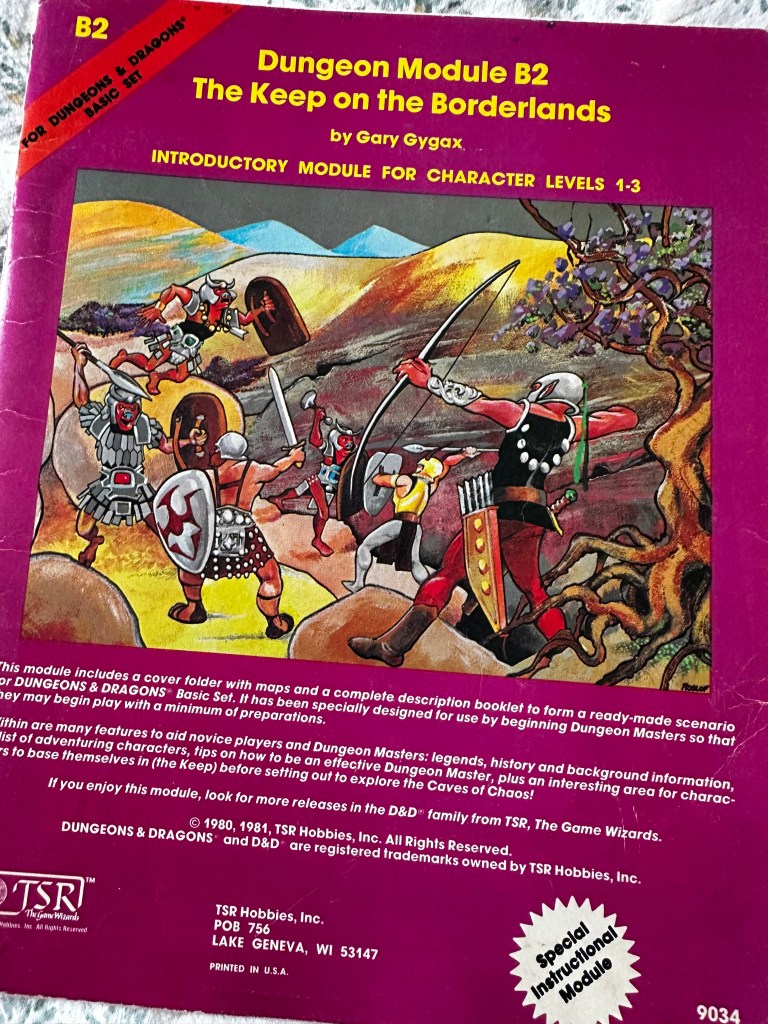
I’ll have to come back for another post on the B/X D&D game, dear reader. I didn’t expect this one to go so long! But, please come back for it. We’re playing the absolute classic, The Keep on the Borderlands!

The cover of B2, The Keep on the Borderlands. A purple cover with the name of the module and a colour illustraiton in the middle: a piched battle on the road between adventurers and monsters.
By Scanned by DM2ortiz, Fair use, https://en.wikipedia.org/w/index.php?curid=505624

As for the first session of OD&D; we had a brilliant time. As a note, we were playing online using Zoom and Roll20. Unsurprisingly, Roll20 does not have an OD&D character sheet option, so the player’s just used their own hard copies. We really just used the VTT for the maps. And, although I had a map of the cemetery drawn, we didn’t even place tokens on it. It ended up all theatre of the mind, which was just fine by me. There is no doubt that the game presents some challenges and relies on the referee to make a lot of rulings or to use the rules in unexpected ways, but that was actually part of its charm, I found.

Looking forward to the next session in two weeks.

The Editioning: How to OD&D

The Editioning Begins

The first session for our Tables & Tales OD&D game is set for next Friday. I think it’s just going to be a session 0 to introduce the game to the players and have them create characters. Part of the reason for this is the way I’m approaching it. It’s going to take a little longer to complete my preparations than I thought it might. Today, I’m taking you on the start of that prep journey with me. Click this link to check out all the posts on the Editioning, our challenge to play all the major editions of D&D in the next twelve months or so.

Step 1: the Map

I have made an important decision, dear reader. I’m not going to run a published adventure for OD&D in the Editioning. For one thing, there are precious few of them. For another, they are not very attractive. I considered running the adventure contained in the Blackmoor supplement, the Temple of the Frog. But then I listened to this review of it on the Between two Cairns podcast and I decided against it (yes, I know they were reviewing the 1986 version made for the D&D Expert Set, but I’m assuming a sufficient similarity that will allow me to make assumptions about the older version.)

Instead, I thought to myself, I thought, “you should just do what the OD&D core books assume you’re going to do, create your own dungeon, your own wilderness, your own NPCs and monsters and treasures. That’s the real OD&D experience, you idiot!” I then apologised to myself for calling me an idiot and got out some graph paper and a pencil, because Gary and Dave told me to start with a map.

Dungeons & Dragons, Book III, The Underworld & Wilderness Adventures by Gary Gaygax and Dave Arneson starts with a section entitled, “The Underworld.” Here’s the first page of that:

Sample side elevation of a dungeon from the Underworld section of OD&D volume III

OK, I don’t have a lot of time, and am only willing to expend a moderate amount of effort but I have a decent imagination. So, hopefully that’ll see me through. One advantage I have here is that I know I only want this game to last about six sessions, so I doubt I need to make anything very large.

Since I’m starting with this map, I’m hoping it will inspire me to come up with a theme for the adventure/dungeon. Let’s see.

If you are one of my players, TURN BACK NOW! SPOILERS AHEAD!

Levelling

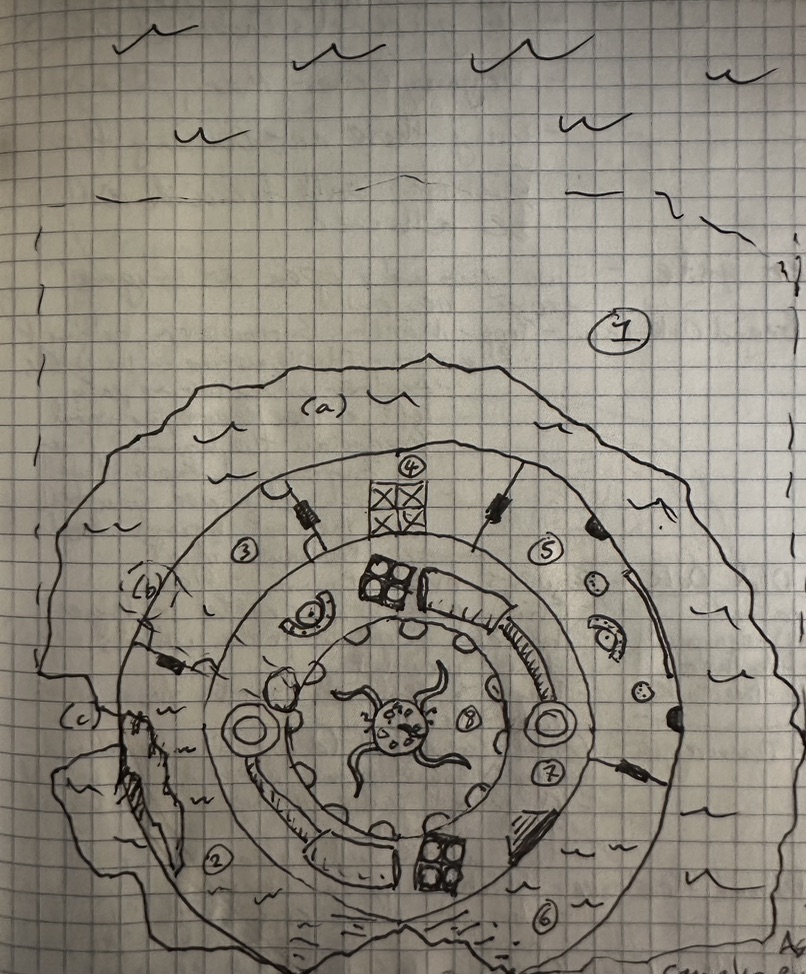
My dungeon - six levels including the ruined tower on the surface and the sea cave at the bottom with the flyig saucer crashed in it.
My dungeon – six levels including the ruined tower on the surface and the sea cave at the bottom with the flyig saucer crashed in it.

I’ve started by planning out six and a half levels of dungeon. My pen did provide some inspiration immediately by drawing the whole side elevation with a cliffside on the left. I hadn’t meant to do this, but a slight mistake led to it and then, it just felt right. I placed the ruined lower floor of a tower on the surface, near the cliff’s edge and drew a shaft dropping from the floor down to a subterranean level. That level also has an entrance on a ledge poking out from the cliffside.

At the book’s urging, I decided to mix up the methods by which an adventurer might move between each of the levels. The bare shaft between levels one and two gives way to a simple stairway between two and three. From three to four and from three to five there are lifts and you can only safely traverse the gap between levels four and five if you can fly. From level five, you can get to level six by the use of a rocky slide or a teleportation pad. You might also get to level six by descending from the ledge at level 2 above, although you would need a lot of rope and a swimming proficiency badge. I like this! It seems fun and means the players won’t always know what to be on the look out for when they decide it’s time to descend.

For the craic, level six is a submarine cavern, inside which is a crashed flying saucer. Well, looks like a theme is definitely coming together, although, it hasn’t fully crystallised yet.

Level One

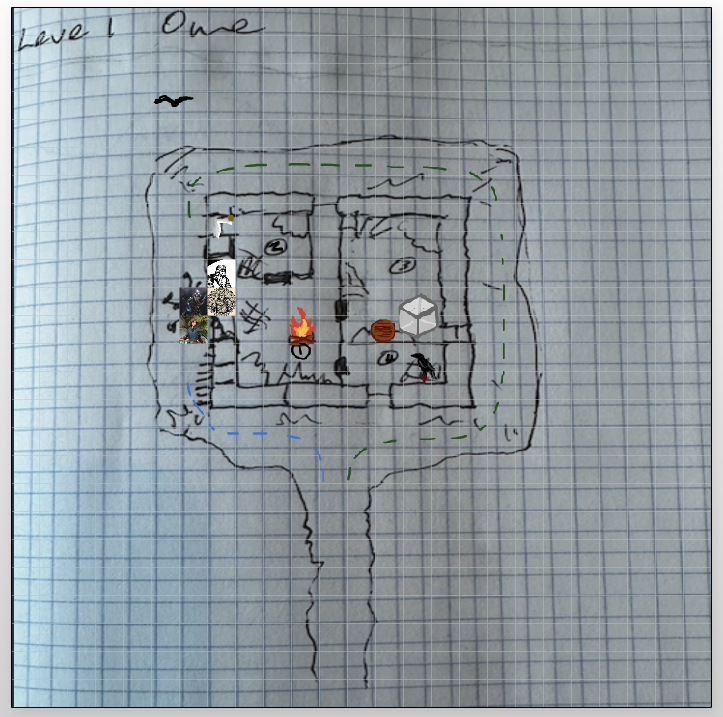
The ruins of the tower currently play host to a group of Dwarven mercenaries in need of shelter. There are four rooms, including the Dwarves’ camp. One room contains nothing of interest but a handle to the trapdoor that leads down to Level Two. Another has a riddling raven who keeps its hoard of shinies here. If they answer a riddle, they’ll get a prize but if they attack the bird, they’re getting cursed. The last room has the trapdoor to the next level and a Gray Ooze resting on top of it.

I’m having immense fun with this so far. I’m doing it all by hand; drawing the maps in a notebook and writing out descriptions on the opposite pages. I normally do session prep on my computer and I haven’t built a dungeon from scratch in maybe eight or nine years. It’s a real breath of fresh air!

Level Two

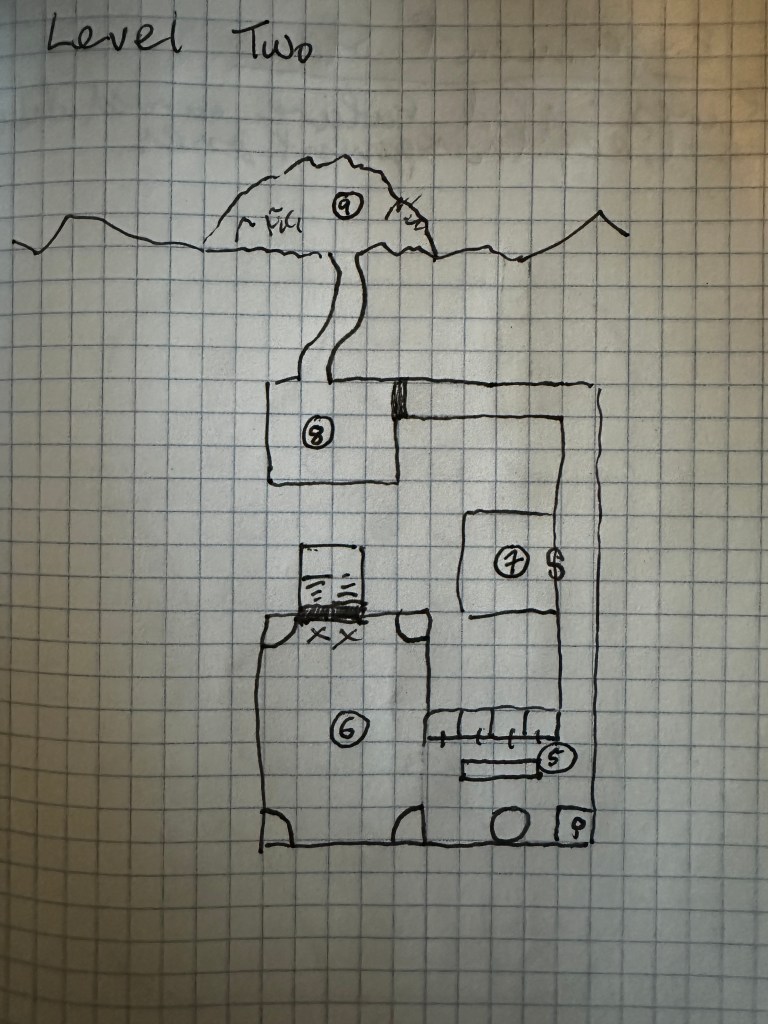
My thinking behind this level is that it is there to dissuade potential dungeon delvers. It will present wave after wave of undead, who will regularly appear, as if from nowhere, in the room adjacent to the one the adventurers emerge into from the level above, trying to force them back. The undead are not real. Rather, they are like characters generated by the holodeck in Star Trek. If the PCs explore other ares of the level, they will probably find the hidden control room which will allow them to turn off the hardlight illusion generator. Then they’ll be able to get through to the stairway leading to the next level down.

I am quite excited about this idea, especially as there is an alternative to fighting the undead or figuring out the illusion generator. They can escape to the ledge on the cliffside from this level, although the only option is to descend into the sea from there…

Levelled Out

A crude line drawing of a dragon with a bird flying at its face
Dragon

That’s as far as I have gotten so far. I need to knuckle down and expand on what I’ve done so far. So I’m going to leave this post here for now. I’ll keep you posted on my progress in a few days.

The Editioning: From OD&D to 5E 2024

Bloggies Inspiration

I have read a lot of TTRPG blogs in the last few weeks, dear reader. I imagine the chances are good that you have too, if you’ve been following the Bloggies awards over on Explorer’s Design. There have been so many wonderful reads, I really did find it hard to choose between many of them. What a I liked most of all were the posts that expressed their enthusiasm for the hobby in one way or another. You can feel it shine from a d66 table of carefully curated results as much as you can from the effusive prose of some bloggers. And there were blogs about every aspect of this weird pastime from story-telling to initiative methods and everything in between. So often, what I found is that writers went back to the source material for inspiration, those historical tomes that defined the RPG scene and continue to play an outsized part in it, whether we like it or not. Most of these we were OSR bloggers with a keen interest in the original D&D from 1974. But you would occasionally see other editions get a shout out. On top of this, I get a newsletter from the Shop on the Borderlands that tempts me weekly with a lot of old dragon game shit I don’t need… Unless, what if I did need it?

The Editioning

Now, I have some to lots of experience with most of the editions of the game, and I already have a bookshelf full of D&D, mostly AD&D 2nd Ed and 5E, but also several 4E books, a smattering of 3rd Ed and a couple of 1st Edition tomes. So, I figured, if I undertook a challenge to play a full adventure in every edition of D&D during the next twelve months, I wouldn’t need to supplement my collection too much to make it possible.

So, that’s where we are now. The Editioning is coming to pass. The plan is to play every edition of the D&D game, in order (although there may be some overlap) in our gaming community, Tables and Tales, between now and February next year. Isaac has agreed to take up DM duties for several editions. I will run OD&D, AD&D 2nd Ed, 3rd Edition and 3.5 and Isaac has said he would like to run B/X D&D, Ad&D 1st Edition and 4E. Someone else in the community might run 5E 2014 and 2024, but if not, I’ll probably do those too.

Pre-loved

The covers of the AD&D 1st Edition Dungoen Master's Guide and the D&D 3.5 E DMG.
Just arrived!

I’m trying to source second-hand copies of the main rule books of each edition where possible. It seems more like a real history project when you have relics, primary sources, legendary tomes. It’s part of the adventure. I like to think about others using the books to play their own campaigns twenty, thirty, forty years ago. It puts me in touch with my own teenaged self and allows me to tap into the enthusiasm I had for the game back in the day. Also, its just cool to have them.

I’ve been surprised to find that you can get most of them for prices that I don’t consider extortionate, either on Shop on the Borderland or Ebay. I started shopping for them last week and a couple of DMGs showed up on Friday, AD&D 1st Edition and D&D 3.5E. They’re in good condition considering how much I paid for them. But before we get to those editions, we need to take a look at OD&D and D&D Basic/Expert.

The Educationing

This undertaking has taken me to school. I had to figure out which editions were really distinct enough to deserve to be a part of it. I started by looking up the full list of editions here. I found this useful table:

A table nicked from the Wikipedia entry for Editions of Dungeons and Dragons. it shows all the versions from OD&D to 5E 2024.
From Wikipedia

You can see that it clearly shows the parallel evolution of Dungeons & Dragons and Advanced Dungeons & Dragons. I remember, as a young DM being quite dismissive of the non-Advanced version of the game. I had cut my teeth on the Basic Set but felt as though I had graduated past it to AD&D after a year or two. Never-the-less, I did play it in the nineties. A friend DMed it for us using the Rules Cyclopedia and the Hollow World campaign setting. Looking back at it now, I wish I had had more of an interest in it. Above any other version of the game, except, perhaps OD&D, it seems to have had the greatest influence on the modern OSR. Hindsight is 20/20 I suppose.

I have seen the terms B/X and BECMI and Blueholme and The Red Box and whatnot, for a long time. But this was the first time I bothered my arse to figure out the differences between them. This despite having actually played the using the Basic Set myself. I did not know that the confusing “abbreviation,” B/X referred to the first two boxed sets of the D&D rules, Basic and Expert, which allowed play from level 1 to level 14. I also had not known that the initialism, BECMI, referred to the full set of five rule-books, Basic, Expert (why is Expert shortened to ‘X’ in B/X but ‘E’ in BECMI? Make it make sense!) Companion, Master and Immortal. BECMI supported advancement all the way from 1st level to 36th!

Anyway, I made the executive decision to collapse all these versions into one, and just refer to it as B/X, since the main difference seems to be the extension of level caps with each successive book and we will not be playing long enough for that to be an issue. Nonetheless I have ordered both the Basic Set rule book and the Rules Cyclopedia, just to make sure we have all our bases covered.

Whither Adventure?

The cover of the Making of the Original Dungeons and Dragons. It has a red cover with a big gold ampersand on it.
The cover of the Making of the Original Dungeons and Dragons.

There are still a few decisions to make. And there is a lot of work to do to prepare.

I have a relatively easy task to begin with, and that’s the reading of the OD&D books. I picked up the PDFs of these from Drivethru for a song. I do have them in a a slightly unwieldy printed form in “The Making of the Original Dungeons & Dragons” book that a friend kindly gifted me at Christmas, so I am happy not to need to empty my bank account to purchase a vintage copy of those books. I’ve quickly realised that I would also need the Greyhawk supplement since, otherwise, I would need to use the Chainmail medieval miniature war-game to run combat, and that was a bridge too far for me. The Greyhawk supplement included the first iteration of the D&D combat system that we might recognise today.

On top of that, we have to decide on what adventure modules to run for each edition. I would like to use vintage adventures that were made for the particular edition that we’ll be playing. For B/X, AD&D etc. there are tonnes of options, which means we’ll have to narrow them down somehow. But for OD&D, we have a very different problem. Adventure design appears to have been mainly the domain of the DM. The main books give you rules and tables, monsters, treasures etc, but mainly they encourage the DM to create their own stuff. Which is great! But it leaves me with the question, is that what I should do? Since that’s the intention? Or, should I use the one adventure I could find in any of the OD&D supplements, Blackmoor? The adventure is “The Temple of the Frog,” and I haven’t finished reading it yet. But it does strike me as the sort of scenario that could be quite lethal unless the PCs turn up with an army of hirelings. If that’s what’s intended, maybe that’s just what we should go for.

Conclusion

I don’t yet know which way I’ll go with that decision, dear reader. I would welcome feedback from anyone with more experience of OD&D or the Temple of the Frog than me.

In general, this challenge has got me quite excited about playing D&D for the first time in quite a while. I wrote a few posts about maybe getting back into playing AD&D back in 2024, specifically I wanted to play Dark Sun. The experience of even making a character put me off it. But I now think that, with other players involved, it could be not only of historical interest, but it could be really fun! I know some of our players in Tables & Tales really like a bit of crunch, while others love the OSR principles of rulings above rules that OD&D might bring.

One thing you can be assured of, dear reader, is that I’ll be taking you with me along the way. I hope to have some interesting things to write about reading, prepping and playing these games, so stick around!

Downtime in the Dark

My First Downtime

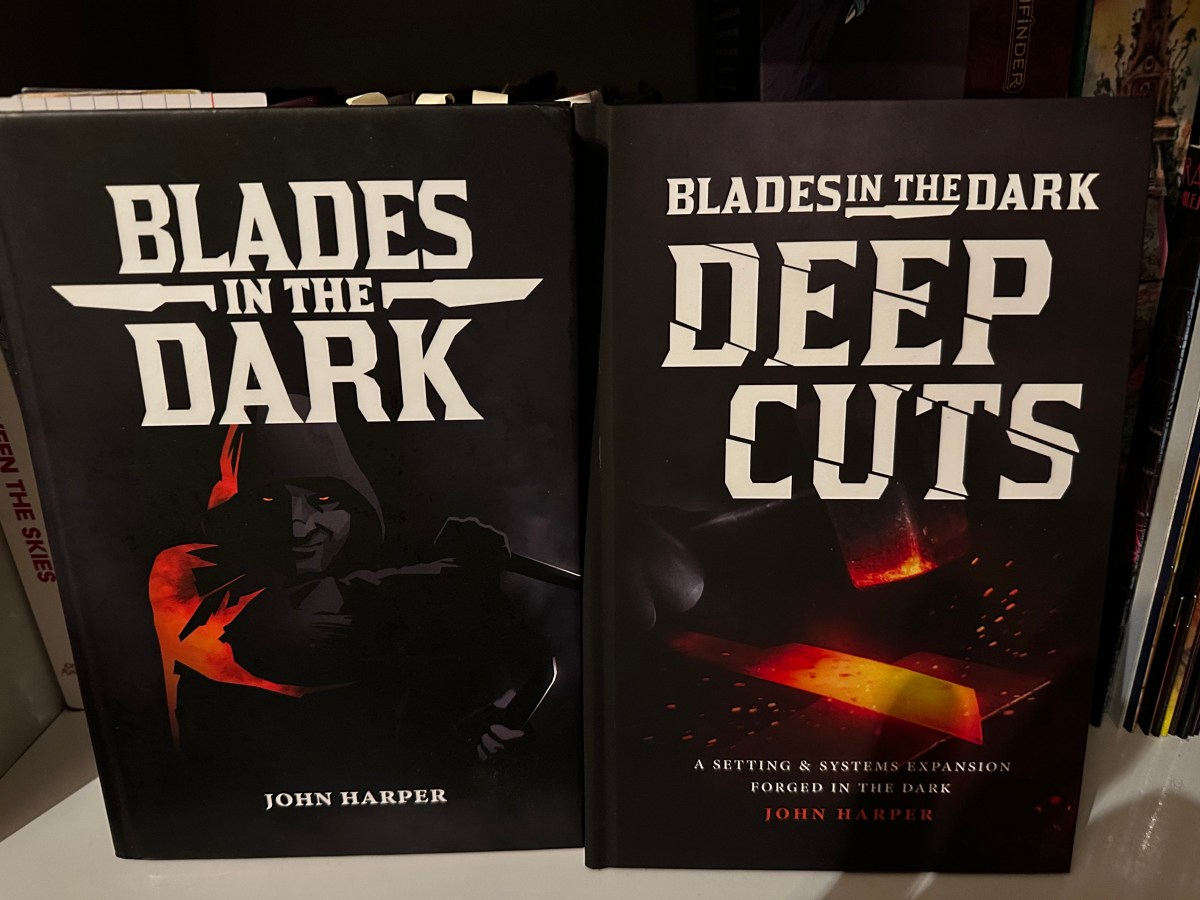
I’m taking a break from taking a break from Wednesday posts for this one. We had Session 2 of our Blades in the Dark campaign last week, and our first downtime. I also decided to start introducing a few elements from the latest Blades sourcebook, Deep Cuts, which came out earlier this year. So, I wanted to write about our experiences.

Deep Cuts Character Options

The head and shoulders of a person in portrait. They wear a metalic mask over the top half of their face and a hooded cloak. They are an Acolyte Spirit Warden
An Acolyte Spirit Warden by John Harper

Deep Cuts really expands on the options for your new scoundrels. It doesn’t replace what’s available in Blades, it just adds depth. For instance, if your PC is Akorosi, maybe your family served among the clergy for the Church of Ecstasy. If your scoundrel had a military background, maybe they were a Rifle Scout, serving in the Deathlands and harassing “enemies with sniper attacks.” Before we got into the session proper, I offered all of the players to not only select from these new options, but also to reassign any of the Action dots they had assigned to reflect their Heritages or Backgrounds. What I discovered was most of them had already formed a pretty solid image of their characters in their heads. Even the one player who did take me up on my offer, only took the two examples I laid out above for their Hound because they fit the picture they had imagined so well.

I’m still quite fond of a lot of these new Heritage and Background options. They might have been a lot more useful if I had offered them from the start.

Downtime by the Book

In Blades in the Dark, John Harper tells us there are two main purposes to having a separate downtime phase:

  • The first is that the players could do with a little break after the action of the score that just went down. To be honest, this one doesn’t ring very true for me, but that’s probably because it’s been six IRL weeks since the last session and the crew’s first score. I also get the impression that, once you get the hang of this game, you’re sometimes running a score and downtime in the one session, rather than a score session followed by a downtime session. If that were the case, I can see the advantage of breaking the action up.
  • Second, moving into downtime is a sign to all that we are changing the mechanics that will be needed in the game. To me, this seems like the more concrete of the two purposes. Blades in the Dark has tools for you to use during a score, and only during a score, and it has tools you only pull out during downtime. We don’t need to worry about divvying up the proceeds, dealing with the heat you’ve brought down on yourself or figuring out your long-term crew goals while you’re beating in some poor Red Sash’s head. Let that wait until you’ve got time and space for it.

Luckily for me, it’s easy to follow along with the Downtime chapter of BitD. Once again, I have to praise the usefulness and usability of the book. The layout of the chapter leads you by the hand through the phase, from one step to the next. Three of my players have taken responsibility for maintaining the various crew/campaign tracker/factions sheets without my even suggesting it so that made the job even easier.

Payoff was easy enough, just a simple matter of recording the Rep the Death Knells got and dividing up the 6 Coin they garnered from the last score. They took one each, popped one in the crew stash and paid their tithe to Lyssa, the new leader of the Crows, as their patron. I ran this moment as a scene. I don’t think I would have if it wasn’t for the fact that she was pissed off with them for raiding the Red Sashes’ drug dens on the Docks, and I wanted them to know. She also gave them the option to take a job to redeem themselves. The Hive have been a bit too active in Crow’s Foot for her liking. She wanted the Death Knells to do something about it.

I mentioned Deep Cuts earlier. New mechanics appear in the sourcebook for downtime. They make it diceless, and they would also definitely up the Coin our crew made from that score if we had been using them. In BitD, you are given a range from 2 Coin for a minor job to 10+ Coin for a major score. In Deep Cuts, the Coin the crew accrues is determined like this:

  • Score – 1 Coin per PC, plus Coin equal to the target’s Tier x3.
  • Seized Assets – 4-8 Coin for a vault of cash. Stolen items can be fenced for 1-8+ Coin, but you take Heat (see next page).
  • Claims – Collect payment from crew claims like a Vice Den.

Like I indicated above, we used the standard downtime rules from Blade in the Dark in this session. Now that we’ve experienced that, I’ll put it to the players to see if we want to make the switch. If and when we do that, I’ll come back and examine the other downtime changes then.

It was fun calculating Heat for that score. I’ll admit, I didn’t warn them that killing people on scores really hikes up the Heat. They started off the whole thing by murdering a bouncer, of course. In fact, I didn’t really explain the concept of Heat to them beforehand at all. This meant that they went in hard, loud and chaotic. I actually think this was for the best. The game is built on building up consequences, after all, as well as narrating big, exciting action sequences. Anyway, they ended up with 6 Heat, which was fast approaching a Wanted level. That put the shits up them.

In the book, the Heat section also includes the Incarceration section, which seems logical to me, but I didn’t need to refer to it, so I’m skipping it here.

Of course, due to all that Heat, they had to roll on the worst of the three Entanglements tables. These represent all the potential impacts of contacts, acquaintances, enemies and authorities getting wind of what the crew have been up to. Entanglements range from Gang Trouble, which can be dealt with internally, to Arrest! If you get that, it’s going to cost you Coin, a crew member or the effort to escape capture. The Death Knells rolled up Interrogation so our Hound was caught on her own and dragged down to the station for some “enhanced” questioning. We played this out in a fun scene where she went out to get beer to celebrate their big score and got ambushed out behind the pub by Sergeant Klellan and his boys. She wisely Resisted the level 2 Harm and the additional Heat, without incurring a single point of stress! All the others could do when she finally turned up was wonder where their beer was…

So then, we spent a bit of time going through what’s possible during the downtime phase in our last session. This can all be a little overwhelming the first time you do it. It can also take quite a while to get through each player’s turn as you talk through the possibilities and they negotiate amongst themselves to see who will spend their activities on reducing Heat for the whole crew. Sometimes it’s obvious who should do what. If a character has some Harm, it’s probably a good idea for them to get some treatment and Recover. If another scoundrel is a bit stressed out, they should go and Indulge their Vices to help them relax, but training, long term projects and acquiring assets are all more subjective. The chances are, they’ll turn out to be useful to the whole crew in the future, but they don’t feel quite as immediate in their effect as clearing Heat.

Anyway, I was gratified to see the PCs did all of the six possible downtime activities at least once. They managed to clear practically all their Heat. The Leech did this by studying the movements of the Bluecoats around the district so they could avoid them. The Whisper took an inventive approach, by losing a bar-room brawl in the King’s Salty Knuckles tavern, thus proving that he couldn’t be part of a crew of Bravos!

Our Cutter decided to acquire an asset, an old and worn-out little boat for use on a future score, perhaps. The players ad-libbed a scene in which they ribbed him about the state of the thing. But, of course, it only needs to be used once.

A person "walks" through the air above the darkened city,seemingly on lightning bolts emanating from their feet.
“I’m walking through the air!”

We had another scene when the Whisper’s strange friend Flint turned up on his canal boat with some electroplasm. Our Whisper needed it to build himself a lightning hammer as a Long Term Project. From Flint he also learned about the Sparkrunners, a gang of rogue scientists who are out there boosting government tech. This is one of the new factions from Deep Cuts, which “sparked” my imagination.

Just before we wrapped up for the evening, our Hound decided to deal with all her stress by visiting her local Temple of the Church of Ecstasy. She prayed and prayed, she prayed to hard and too much. She over-indulged in her vice and something bad happened. The bouncer she killed on the last score decided to haunt her!

Other Actions

Of course other actions are possible during downtime too. They decided to visit the ghost who had given them such good info during their Information Gathering phase in the previous session, because he said he would help them more if they really fucked those Sashes up good. From him, they discovered that Lyssa was responsible for the death of Roric, whose leadership of the Crows she then usurped. She had been backed up by the Red Sashes who had killed out ghost friend. He told them to go to Mardin Gull in Tangletown for the skinny on what all that was about. This wasn’t a downtime activity or an entanglement or anything. It was just something they wanted to do.

The Imperial Airship, the Covenant flies bove the darkened city streets, shining searchlights down to illuminate a meeting on a bridge.
Its the Fuzz!

I also introduced a few more Deep Cuts factions in a little news segment. They learned about the Sailors being press-ganged on the Docks, The Ironworks Labour-force pushing for unionisation, the arrival of the Imperial Airship, Covenant without her sister ship and the recent adoption of the new Unity calendar and maps. Any one of these could potentially lead the crew to their next score. Except, maybe for the calendar one, I suppose.

Conclusion

I was very happy to have left a full session aside for our first downtime. It needed it. In fact, I would say, we could have used even longer. They still haven’t decided on their next score. I will say, I am quite happy with how many potential score options I managed to sneak into the various scenes in the session. I was worried that I wouldn’t give them enough opportunities, but, in the end, they came up quite organically, much like the scenes themselves. These all proved to be fun and freeform, allowing us to dow some world-building and to introduce some fun new NPCs.

I’m now looking forward to the next session, and, hopefully, the Death Knells next score, the Big One.

Sleighed

You might remember a few weeks ago… I reviewed Slow Sleigh to Plankton Downs. Well, the disclaimer on that review, that I had not played or run it is no longer valid.

Nun too soon for an update

Just a short one this week, dear reader.

You might remember a few weeks ago, for my Halloween post, I reviewed Slow Sleigh to Plankton Downs. Well, the disclaimer on that review, that I had not played or run it is no longer valid. Sister Majid, the Misstep Monastic (a type of nun) and Lee Tuluk, the Scud Miller (meat grinder) formed an unlikely friendship through a misallocated cabin and a game of chance and before you know it they were investigating a murder!

We played one session on Halloween and just finished it up last night. It took about six hours altogether, although there was some time spent on character creation in the first session.

Take a butcher’s at this!

A nun with an ice adze dressed in gold

Here are some things I loved about running this adventure:

  1. The new backgrounds are great. Most of them are really far out there but the two that my players chose were obviously quite mundane. They still had some incredible Advanced Skills that got milked for all they were worth. Somehow, our nun used “Reconcile God’s Glory with the Failings of Mortals” constantly. Meanwhile, the Scud Miller managed to use “Fix Anything, Not Necessarily Well, Even with the Wrong Tools” on everything, including relationships. Use the backgrounds if you’re going to play this.
  2. It’s so easy to prepare and run. The keyed descriptions are short enough to easily use on the fly, the premise of the adventure is straight-forward and there are only a couple of unavoidable events that are not difficult to get to grips with. I read it through once, fully, and then reviewed particular sections such as basics of the adventure and the murders before actually running it. It doesn’t take long to do this; its a svelte little scenario.
  3. I really got into describing the aftermaths of the murders and the effects they had on the crew and other NPCs. As rumours spread I had nuns moving in pods and whispering about terrible occurences while blessing themselves, while the porters and mates dealt with grief at the passing of their colleague. Upon the discovery of the second victim, the security guards were puking in corners and staring blankly at blood-soaked toilet stalls. The creature has a silly name, which my players refused to say right, but the murders are gruesome and horrific. It felt important to play into that.
  4. The map of the Nantucket Sleigh Ride. We used this work of art throughout. It was so useful to help the players orient themselves on the hovercraft and it was a genuine pleasure to refer to it. Its beautiful.
  5. The Weather table. I got the players to roll for weather right before the final encounter and they rolled us up a storm. The ship was forced to drop its robotic anchors and ride it out just after the second murder. They figured out who the murderer was and that they were outside on the Observation Deck. What a setup for the final showdown. It was poetic.
A victim, missing its maxilla in a toilet stall. The Maxillary Uslurper in the air vent above.
Aftermath

Conclusion

Dear reader, I would highly recommend you take the Nantucket Sleigh Ride on a trip to Plankton Downs. If you have a couple of evenings to spare and a couple of friends who might enjoy a who-nunnit, as it were, you could do a lot worse. It’s not your typical Troika fare but I am beginning to think there may not be such a thing. You will have horror, you will have laughs and you will definitely have fun.

Call of Cthulhu: The Derelict Review

[My players] didn’t find the book of norse legends, the handwritten notes that presented possible ways to defeat the Sciapod, the silver items that would allow people to actually see the creature, etc, etc.

Two-part One-shot

SPOLIERS BELOW, ME HEARTIES! Turn back now if you want to be a player in the Derelict!

You know how it is, dear reader, when you board your luxury yacht and expect to make excellent time crossing the North Atlantic? And then you start to run into complications? Almost everyone gets drunk, you come across a seemingly abandoned reefer ship washed up on an iceberg, you decide to explore the possibility of rescuing anyone from it or maybe even salvaging it for vast profits, you board it and find its covered in blood and the controls have been deliberately sabotaged, you’re hunted by a towering monstrosity with a crystalline bow and only one weird leg, which is visible only to about half of your number, your own yacht’s controls are smashed to bits and the captain is eviscerated and several of your number begin to lose their grip on sanity?

Of course you do! Anyway, when I write it out like that, quite a lot did happen in the first session of the Derelict. It took so long, in fact, that we had to stretch it to two. We played it out in about five hours in total, I’d say, but there was plenty left undone as far as this scenario goes. You could easily stretch it out to three sessions of three hours each, I’d say.

The Scenario

A busted up dining room on the Groenland Tropisch.
What a mess!

In this post from about a month ago I introduced the premise of the Call of Cthulhu scenario I ran as part of our Tables & Tales October Event, during which we ran a bunch of horror/spooky/halloween themed games especially for our newbies. Today, I’m going to look at how it went and how I think it could have gone better.

The Derelict is a 28 page adventure for Call of Cthulhu. It appears in Petersen’s Abominations, published in 2015 by Chaosium. It was written by Sandy Petersen with Mike Mason.

It seems Petersen got the idea for this adventure while reading about Viking explorers and this particular encounter that was described quite matter-of-factly as a Sciapod, a one-legged creature with a crystal bow. The conceit is that such creatures were not necessarily taken as supernatural by people of by-gone ages so the encounter was recorded as a relatively mundane occurrence. I like that this theme jibes with Zedeck Siew’s observations about the attitude many Malaysians would have to signs of the Pontianak in his scenario, A Perfect Wife, as well as my own personal experience of growing up in Ireland. Of course, when the Investigators encounter the Sciapod in the Derelict, they are not likely to react the same way at all.

The portrait of Siren/Lori Washington, a femme presenting person with long dark hair and a bright dangling earring in one ear.
Siren/Lori Washinton

The Derelict was clearly designed as a one-shot or very short campaign. It would be hard to work it into an ongoing campaign, I think, given the rarefied circumstances and setting, so if you want to run it, I would suggest taking it at face value and go for something short and self-contained. I would also recommend using the pre-generated characters. They are all rich/famous arseholes of one stripe or another. You know, the type of people you would expect to have on a luxury yacht. But they also have their own motives, some are having money troubles, some are looking for sponsors, some are party animals, that sort of thing. They are relatively well painted and designed to be easy to pick up and play. There is a second option presented in the scenario: the PCs could be members of a rescue team sent to investigate the Derelict, but this option lacks the horror movie energy you get from the rich yachters, in my opinion.

The formatting is useable and fairly presentable. It starts with the intro and a brief description of our cast of characters before a short section on Starting the Scenario, under which we also get a useful Sequence of Events. I say “useful,” but my players exited the sequence pretty quickly and I was forced to improvise liberally from that point on.

The bulk of the scenario is taken up with descriptions of the main areas of the Derelict ship and the iceberg it’s stuck on. It does go into a fair amount of detail even about the areas that are of little or no interest. It will tell you where to find the clues and items of interest within these descriptions. This is the greatest weakness of the adventure, to be honest. My players spent almost no time exploring the ship. They were incredibly goal oriented, going to Engineering to find things to help them fix their own boat and to the radio room for a way to contact someone. So, they didn’t find the book of norse legends, the handwritten notes that presented possible ways to defeat the Sciapod, the silver items that would allow people to actually see the creature, etc, etc. I wish I had started just transplanting some of the more important clues and things to the rooms they did explore earlier. In the end, I did do that but we had played the bulk of the game by then.

It has some great maps and illustrations throughout. The maps of both boats were particularly useful. We were playing on Roll20. So I used the maps a lot. In the first session I used fog of war on the map of the Derelict, but I found this led to too much player confusion about the location of everything and too much time spent by me on descriptions. It was supposed to be a one-shot! So, in the second session I turned off fog of war under the pretence that they found a full map in Engineering. That made things a lot easier. The players were able to see where they might want to explore and they started to do that.

One of the strengths of this scenario is that, even though it provides you with a sequence of events, it encourages you to play it quite free-form. Simply allow the PCs to look around, discovering clues as to what happened here and maybe how to defeat the monster, and then start picking off characters with the Sciapod as they go, NPCs first. They’ll start getting injured and insane and the scenario should blossom from that. In many ways, this is what led to our game going quickly off the rails. The sequence of events expects the players to start trying to find ways to kill or drive off the Sciapod but that’s not what happened at all. As I started to kill them off and ship away at their sanity, they began to look only for alternative ways of escape. But, of course, along the way they saw some some pretty disturbing things and one of them lost the plot completely, going full axe-murderer before eventually getting it together while they all bundled into the last remaining lifeboat. Except for looking for firearms on board, they never considered finding a way to kill it. And, of course, this was great! I loved it and the players had fun. But I will admit to, at times, trying to get them to take the route that was expected of them. I think I would have had more fun if I had lust loosened my grip on the reins a bit more.

Still, if your players do get so far as to start coming up with ways to beat the bad guy, there is a useful section at the end of the scenario devoted to potential plans that they might come up with, using lots of things my player never even discovered. They could use the CO2 stores, the bulldozer or forklift that was in the hold, etc.

The Appendix

The Sciapod. A bluish tinged, armoured humanoid with only one thick leg, which ends in a wide, umbrella-like foot with claws all around the outside of it. it holds a crystaline bow and has a single green glowing eye.
Hawkeye? You’ve changed.

In the Appendix, you get stats for the two NPCs and the Sciapod itself.

The NPC stats could be particularly useful if a player loses their PC early and they need a replacement. This did happen in my game but only after both NPCs were already dead so it didn’t help.

When it comes to stats for the Sciapod, I don’t think it should matter really. It is designed to be undefeatable by normal means. The PCs are supposed to have to come up with some big, brash, loud plan to kill it, after all. But there are elements to the creature that are of real interest. For instance, it is visible only to those who have silver touching skin for some reason. This proved to be a weird and scary element of the PCs encounters with the monster. It directly led to the death of one of them but it is a strange addition to the abilities of what is already an odd adversary. It is utterly silent too, and it wields this weird crystalline bow with enormous glass like arrows. This last bit feels very un-Cthulhu to me. It adds more of a D&D flavour to this monster but it did allow it to attack from a distance, which I made use of. This led to two memorable moments of gameplay, in fact. First, our pop-star character, Siren stood on the deck and had a showdown with the Sciapod, she with her little .22 pistol and it with its giant glass bow. Second, the creature launched one of its enormous arrows into the hull of the lifeboat they were escaping on right at the end, ushering in their deaths and the end of the game.

Conclusion

This was a fun one-shot/two-shot. It had great pre-generated characters and a fascinating premise and setting. (Although I have to stop running one-shots on boats. Apparently its become a trend…) But I question whether the monster that’s central to it is really Cthulhu-mythosy enough. It’s strange but not necessarily horrific in and of itself. Also, the adventure involved a lot of prep for something that could be designed to be run with little or no preparation. But you have to read the descriptions to familiarise yourself with the setting, the clues, the origin stories, hidden history etc, etc. and that all takes time.

Blades Out!

Since I didn’t know for sure that the PCs would back the Lampblacks until the very moment they answered Baz in the opening scene, I couldn’t plan for what might come next.

Housekeeping

Dear reader, another change is afoot. I have been running this blog for about 17 months. In that time I have published 175 posts, including this one. That’s hundreds of thousands of words, some of them good words, some of them not so good, but all of them worthwhile. For the first month, I wrote one post a day! That seems incredible to me, looking back at it now. I soon dropped down to three a week and then to two. Even that has been a struggle lately. Partly that struggle comes from the fact that I’m playing more RPGs than ever, partly it’s the exigencies of life in general. What I’m getting at is that I’m planning to drop down to a single post a week, probably on a Saturday or Sunday. I still love doing this and I appreciate you, dear reader, for popping by to give some purpose to my ramblings, so I’m not going to stop. I’m just going to take it a bit easier on myself. I might revisit this decision in the new year and I reserve the right to post more often if I find a subject I absolutely must blog about. For now though, on to the meat of the post!

A Murder of Crows

We finally had session one of our Blades in the Dark campaign! Last Wednesday, five of us got together for our first score. To make things a little easier on myself as a first-time GM of this game, I decided to use the starting situation presented in the book. Roric, the leader of the premier gang in Crow’s Foot, has been murdered, and rumour has it, Lyssa, his erstwhile second-in-command, did the murdering. This has opened the floodgates to inter-gang rivalries across the district, that had previously been kept in check by Roric.

The Score

Guns and a knife.
Guns and a knife.

The Opening Scene was set in the old coal warehouse belonging to the Lampblacks. Bazso Baz wanted to know where they stood in the burgeoning turf-war between his gang and the Iruvian Sword-masters, the Red Sashes. The crew’s reputation with the Lampblacks started at 2 so it was a no-brainer for them to support Baz’s side in the war, at least for the time-being, until they see an opportunity to exploit and grab power for themselves, perhaps, later on…

This was the point where John Harper started to let go of my hand. The book provides several suggestions for the type of score Baz (or, indeed, Mylera, leader of the Red Sashes) could send the crew on. A couple of them are generic, other options are for particular crew types. I decided on the one expressly for the Bravos crew type.

If you’re Bravos: Maybe Bazso wants you to storm the drug dens of the Red Sashes down by the docks. Run off the clientele, smash up the places, grab any loose coin you find.

I like how the suggestion is kept very vague. The warning to not overcomplicate things comes to mind when I read that. Also the GM Best Practice to “Be aware of potential fiction vs. established fiction.” Since I didn’t know for sure that the PCs would back the Lampblacks until the very moment they answered Baz in the opening scene, I couldn’t plan for what might come next. As such, there was no point in taking any of those presented suggestions and elaborating on them. I had to put a lot of trust in my ability to improvise the score on the fly, with nothing but my own imagination, the vibes of Duskwall I had been soaking in from the book and John Harper’s advice to keep me right. I jumped in feet-first, a little nervous, but more than a little excited. Mr Harper had let go and told me to swim on my own.

I had a vague setting (the Docks,) a goal (destroy the drug dens) and a crew to act as my water wings, at least. I got the players to make an Engagement Roll. The crew’s Whisper decided to go the occult route with this, breaking into a house near the drug-dens and communing there with the spirit of a gangster who was murdered by the Red Sashes. I found it immense fun to play this unhinged, vengeful, but ultimately powerless ghost. With a 6 on the Engagement Roll, he was able to provide them with the numbers of Sashes in the dens, the best approach to attack and the location of the lockboxes full of coin. He also said if the crew really fucked them up, he’d give them some more information he’d learned in the Spirit Realm that might be of interest to them.

Unsurprisingly, they went for an Assault plan type and then chose as the detail to this plan, a point of attack, which was to go for two dens at once before moving on to the third and final one, where they would find the lockbox. This particular aspect of the Score took a little explanation. The six plan types, the vagueness of the plan and the specificity of the detail for that plan was all, not precisely anathema to trad or OSR players, but certainly an example of what sets this sort of story game apart form those kinds of games.

But once we got into it, the players took to Blades in the Dark like well, blades in the dark. I gave them a couple of clocks for each den they were hitting, one for their goal and one for reinforcements to show up for the Sashes. Some of us had games with clocks before. In Isaac’s Black Sword Hack campaign, he used them to great effect during a fantastic siege scene. But, I also used the example of the Resistance of a delve in Heart to explain how they would work, since most of us were also very familiar with that game. In the use of the clocks, I once again embraced the warning not to over-complicate. I wanted to make sure we got through the score in a single session so, rather than introduce new narrative consequences to every failed or partially successful roll, I just ticked a clock almost every time. I also ruled a couple of times that their actions would tick more than once on a clock, despite not getting a critical. This was largely due to the narrative effects of their actions, but also because of my awareness of time constraints. Despite this, I was delighted to introduce a new clock when the Hound shot a guy right in the head. The bells rang out across the district, tolling for the dead. They knew, at that point, it was only a matter of time before the Spirit Wardens showed up to deal with the newly minted ghost. The Hound kept on shooting, nonetheless, the death-knell kept pealing and I kept ticking that clock.

The players had fun with this score. They fell into their characters and their individual strengths very quickly. The Cutter called out the sword master boss and beat him down in the street while the Leech blew up his drug den. The Hound, sharpshooter that she was, started off sniping, but went in blasting. The Whisper, their mage-tank, had gone for a heavy load with a war-hammer and really had fun Wrecking the place. They rolled well and they got out of there with the Coin, leaving behind three former drug dens. Everyone enjoyed the depth of narrative control they felt they had and how the smoothness of the rules added to the story, rather than slowing it down or lumbering it with hit points and movement speeds and whatnot. As they said, every score their little crew had done so far was, “the Big One” but this one really felt like it.

Rules-wise, we found the character sheets incredibly useful. Almost everything a PC might do is described on the sheet. And for most of the other things, they were on cheat sheets which I had printed out for each player. A couple of times I had to look things up. I ran the rules for the Plan Types, the Plan Detail and the Engagement Roll straight out of the book, which was, thankfully pretty easy to do. The main sticking point, for me, was learning how to assign Position and Effect to Action Rolls. It feels like more art than science to me. There are some useful pieces of advice in the book, but it still feels like a process I will simply get used to, like figuring out DCs in D&D type games, or Resistances in Heart. I referred to the two pages below constantly through that first score and I imagine I’ll return to them again and again in coming sessions. Very useful indeed.

Conclusion

Naming the crew was left until after the first score, as per the advice in the book. It seems the ringing of those spirit bells struck a chord with the players because we had three options in the running:

  • The Deathbells
  • The Dead Ringers
  • The Death-knells

All great names, but it was the Death-knells that won out in the end. It’s a good name and one that is likely to put the fear of death in the other gangs of Crow’s Foot, and maybe the whole city of Doskvol in the weeks to come…

Blades in the Dark Player Best Practices

At this point, I’ve dealt, at length, with the GM advice, but what about the players? Surely they deserve a little guidance too!

Yep, they have not been forgotten.

Progress Clock

We started our Blades in the Dark campaign last Wednesday with a character creation session. I had hoped that we’d be able to get down to the first score as well, but it was not to be. Honestly, character creation, although pretty straight-forward, was rather time-consuming. When you have three or four people around a table making decisions on their own characters as they try to form a coherent picture of them in their minds, it can take a while. Add on the collaborative decisions required of them for Crew creation, and you can comfortably double the time required.

Anyway, current progress looks like this:

  • Three of four characters created, an Akorosi Cutter, an Akorosi Hound and a Whisper from the Dagger Isles
  • Crew created: It was a toss-up between Bravos and Smugglers but, with the general vibe of the crew so far, Bravos won out in the end.
  • Decided that their main sponsor faction will be the Crows of Crows Foot.

I’ll get a character creation session with our last player in the next week or so and then we’ll be ready to launch into the first score.

Creating Opportunities

That’s what this game is all about, right? Taking chances, building relationships, gathering information, making your own opportunities. Well, that’s what I’m doing today. Instead of the recap of the first score, I’m using this opportunity to discuss the advice levelled at the players in a Blades in the Dark campaign. At this point, I’ve dealt, at length, with the GM advice, but what about the players? Surely they deserve a little guidance too!

Yep, they have not been forgotten.

Starting on page 182 of the Blades in the Dark book, at the end of the How to Play chapter, we have the section entitled…

Player Best Practices

The Lurk, a light-skinned, femme character dressed in a dark hood.
The Lurk, by J Harper

We have a total of eight of these listed here. Not as many as for the GM, but there’s a lot in each one. Here’s what we’ve got:

  • Embrace the Scoundrel’s Life
  • Go into Danger, Fall in Love with Trouble
  • Don’t Be a Weasel
  • Take Responsibility
  • Use Your Stress
  • Don’t Talk Yourself out of Fun
  • Build Your Character through Play
  • Act Now, Plan Later

As usual, I’m not going to go into detail on all of these. This time, I’m going to group them.

Embrace the Scoundrel’s Life + Go into Danger, Fall in Love with Trouble + Don’t Talk Yourself out of Fun

These three best practices all relate generally to the same issue. You, as a player of Blades in the Dark, are not there to play it safe. You are not at the table to make optimised choices. Your character lives in a brutally unfair world and they have become adept at surviving it and even profiting from it. Lean into that! Will they have to make difficult choices that might lead them or their crew to harm? Yes! Will they have to take wildly risky actions to achieve their goals or create those opportunities? Yes! Will they have accept the consequences of their actions, which might include conflict with the highest powers int he city, imprisonment and death? Yes! This is the good stuff, in fact, not the downside. These are the parts of the game that keep it moving forward and allow you to craft scenes of kick-ass action, ice-cold espionage and even heart-breaking tragedy. This is why you want to play. If you’re playing to win, instead of to find out what happens, you won’t get the most out of this game.

Don’t Be a Weasel + Use Your Stress + Act Now, Plan Later

You know, there’s a common thread running through all the best practices for players, to be honest. I think it can best be described as “let go.” You have a say in what happens in the story, of course, but you should not be precious about your character. Push them as far and as fast as you can, drive them like that proverbial stolen car. These three practices are about doing that within the rules of the game. You do stuff by rolling with Actions, not skills. It’s important to choose the right action for the job, even if it’s not your best. That’s where stress comes in! One of your companions can spend stress to help your actions succeed with an assist, or you can spend it to push yourself. It’s invaluable for resisting consequences that would be otherwise inevitable. You can even use it to work in a flashback and do a setup action to get you out of a particularly sticky spot. You will build up the stress, of course. You’re going to have to indulge your vices to shed it or you’re going to find yourself traumatised. That’s where these stories end up sometimes. Your PC might build up a weakness or two, they might be brought to the end of their tale through the extremities of stress. But what a tale it will have been!

Take Responsibility + Build Your Character through Play

Blades in the Dark is a story game. You are telling a story at the table with your friends and you want it to be the best it can be. You want it to have ups and downs, ins, outs and what-have-yous. Dark, tragic, thrilling, horrific comedic, action-packed, whatever you want it to be, you can contribute to it. You have the option to add as much or as little as you like. Some players are going to invent new NPCs, locales, factions, street-vendors, family-members, ghosts, you get the idea. This is all good. But a player’s greatest power to contribute to the story is through their own character. The actions they take, the things they say, these things can add as much to a session as the NPCs invented by the GM, probably far more. Maybe you are already delighted with the general atmosphere and vibe the rest of the table is bringing, so you don’t feel like you need to add too much, you still have a responsibility to your own character, to have them grow from their beginnings into fuller, more alive beings. You start with a “sketch” but, through the actions you choose for your PC, how they comport themselves in various situations, the risks they are willing to take, you’ll make an unforgettable character and story.

Conclusion

The Shade. A floppy-haired dandy in a Victorian gentleman’s clothing.
The Shade, by J Harper

Like I stated above, there is a strong theme across all of these best practices: don’t be boring. In a game like this where the story evolves collaboratively at the table and is not even slightly left up to a published campaign frame or the GM, the choices you make as a player will dictate the sort of experience you have. Be bold, don’t behave.

Pirate Borg: The Repentant Review

To be clear, the ship is the whole adventure. You could easily work it into an ongoing campaign, I think. It could be a random encounter or the goal of a mission. But, for me, it worked perfectly as a one-shot. It gives you everything you need in those eleven pages.

Talk Like a Pirate Delay

I was really excited about this year’s Second Annual Tables and Tales Talk Like a Pirate Day Pirate Borg One Shot on September 19th but I was, unfortunately, overcome by some malady that day. We postponed it only to have a massive storm roll in off the Atlantic, forcing us to delay the departure of this vessel yet again. Finally, last Sunday the players’ pirates were ready to board the Repentant come hell or high water…

OK, I say they boarded it but it would be more correct to say they were taken aboard. I started them off in the expanded brig, area 1 on the map of the ship. They awoke, captured, stinking and hurting and minus all their stuff. Nevertheless, with a few improvised weapons they found lying around the cabin and the assistance of a skeleton thrall raised by the skeletal sorcerer, they managed to overpower their demon guard. This was the first of many obstacles to their defeat of the Ashen Priest commanding the ship and taking the Repentant for themselves.

The Scenario

The cover of Cabin Fever, a skeletal pirate with a tricorn hat and the words "Cabin Fever" erupting in fire from his eyesockets
The cover of Cabin Fever

The Repentant is an 11 page one-shot scenario for Pirate Borg by Zac Goins. It is published in the forthcoming sourcebook for that game, Cabin Fever, via KNOWN CONSPIRATORS, Limithron’s subtable for third-party creators. Cabin Fever is a treasure chest of extras for Pirate Borg including new PC classes, GM tools, a Bestiary, no fewer than six adventures as well as solo rules. I am one of the backers of the Kickstarter project so I got access to the PDF through that. I’m hoping to receive the physical rewards for that soon.

This scenario is presented in a typical Borg-ish style, with maps, and illustrations taking the lead in establishing the atmosphere. It’s almost all in grey and black, emphasising the theme of ASH. The layout is also typical with lots of tables, stat-blocks, keyed area descriptions etc being worked into the spaces between and around the artwork. I occasionally had to take a few extra seconds to find what I was looking for due to this but it was never a major disruption. In general it looks great and ewers relatively easy to use.

The Premise

The Repentant is a charnel ship, an unkempt brigantine with tattered sails and a crew of demons and cultists, commanded by a cadre of Ashen Clergy. Their goal is spelled out clearly in the three step plan on the second page. In summary, the plan is to summon demons, form an unholy pact with the Dark One, raid some settlements to take captives, kill ‘em, raise them as undead and then grind them up to make Brimstone ASH. This is a type of cursed and arcane narcotic on which the crew plan to make lots and lots of pieces of eight.

To be clear, the ship is the whole adventure. You could easily work it into an ongoing campaign, I think. It could be a random encounter or the goal of a mission. But, for me, it worked perfectly as a one-shot. It gives you everything you need in those eleven pages.

The Reality

A genuine, fire and brimstone demon

There is a fun variety of enemies for such a short scenario. You have seven different types of possible demon (one for each deadly sin, with commensurate sinful powers,) the emaciated crew, the Ashen Vicars and the Ashen Priest who has a variety of fun powers. And if you deal with all those, there is a hold full of Brimstone Zombies, who have the power to promise your soul to the Dark One with a bite.

Although not every encounter ended in combat, almost all did. It felt inevitable in general. I started the players off where I did, in the brig because of the restrictions of a one-shot session. I wanted them in the thick of it from the start and escape gave them a powerful motivation to attack the terrifying demon, even without real weapons. Also, I figured the brig is area 1 on the map for a reason. The scenario does not explicitly indicate where or how you should start it as a one-shot, but if you take the hint, here, you’re probably not going to go wrong. It definitely got them into the action immediately. Without the timely and repeated use of Devil’s Luck and mystical powers in the first two encounters, at least one of the party would have gone down. The only thing is that it led to two mostly combat encounters in quick succession. Starting with them boarding over the rails or some other way might have engendered a totally different kind of adventure.

The map was fine. I was a little put off that three of the four decks had one side of the map cut off but it was of no practical disadvantage in play.

Tables, tables, tables. The tables are great, from the effects of the Brimstone ASH (different to the regular ASH introduced in Pirate Borg) to the “What did I just step in?” Table which I underused criminally.

My players only used the Brimstone ASH on their enemies, which was a shame. I think it’s because when they rolled on the table for those uses, they got 1s and 2s, which are very very bad. After I told them what else was on the table, they regretted not trying it!

6 The Devil’s inside ye. Immune to fire. All weapons’ dice size increases.

The Finale

The ASH grinder. Looks like a meat grinder, with a big funnel on top, a mincer on one side and a cranking wheel on the other. Has steps up to allow you the zombies to feed themselves into it.
The ASH grinder.

I saved the Ashen Priest, the scenario’s main villain, for the end. He might have been found in either the captain’s quarters or the hold, according to the keyed locations, but, honestly, you could locate him anywhere to suit your own game. The PCs had done away with almost everyone else aboard when they descended into the cargo hold found him there, feeding zombies into the ASH Grinder. There were a lot of undead down there with him but the PCs made such short work of him that it hardly mattered. Then they got to take the ship as plunder, not to mention the undead and the grinder so they could enact the plan themselves!

Conclusion

This was one of the most well-crafted one-shot scenarios I’ve run. We played it in about three and a half hours, though, if things had gone badly, it might have been over after less than an hour! I did give them a couple of NPCs for back-up and in case anyone lost their first PC (there were two deaths.) This might have given them a slight advantage, if I’m honest, but everyone had a good time. Looking forward to trying out some more scenarios from Cabin Fever and the rest of the slew of new books from Limithron!