The First Ending
Last night we finished up the first of our games within the Editioning, our challenge to play all the major editions of D&D from Original Dungeons & Dragons (1974) to Dungeons & Dragon 5.5 (2024) over about 24 months or so.
I thoroughly enjoyed creating, running and playing this game as referee. I think the ending worked well, and I have gotten generally good feedback from the players.
Playing this very first iteration of the venerable old man of roleplaying games has taught me a few lessons about RPGs in general, D&D in particular and gave me many insights into the OSR.
First though, let’s do a quick recap of the final session.
Malfunction
Last we left off, the PCs had discovered the holo-log belonging to the captain of the alien space-ship they had just teleported to. The captain appeared as the hologram of a crystal humanoid and spoke to them. The log described the dire straits the ship found itself in, crash-landed, engines damaged so badly all they produced was the crystalline by-product of their fuel. They had taken the decision to hand responsibility for their escape or rescue to the main computer while the crew went into stasis. Of course, they had already discovered that the computer had re-interpreted its orders to ‘crystal-form’ the surrounding planet to suit the physiology of its makers as, perhaps, escape and rescue were deemed impossible. I didn’t write much in the way of plot for this adventure. In fact, this about sums it up! You can read more about my methods in this respect in my previous post.
Armed with this knowledge about the computer, the adventurers were more determined than ever to find and destroy it. So, they girded their collective loins and prepared to move on through the ship. The next door was jammed so they spent some time using tools to wedge it open. While they did this, another information Assistant appeared to them. They asked it to open the door for them, which it did, but, more importantly, it showed them a map of the whole ship and its current surroundings. In practical terms, this allowed me to reveal the full map to the players on Roll20. This was a blessing as the partial-reveal functionality in Roll20 does not work very well in my experience. It has a rectangular reveal and a polygonal reveal option but, quite often, I find the polygonal one simply doesn’t work. Revealing a curved area with the rectangular tool is frustrating and time-consuming.
The Information Assistant was able to help them further by describing the adjoining chambers, the engine room and the computer and stasis chamber. It told them they could enter that final chamber by “simply passing through the wall.” They didn’t push the assistant on this point. Instead, I guess they decided they would pass through that wall when they got to it.
Having emptied and passed through the partially submerged chamber next to the bridge, they descended to the engine room. Here they discovered a number of crystalline golems running the engines to produce the fuel by-product which they were using to crystalform the surrounding countryside. The golems in this room were not fooled by the bio-hazard suits as the other ones had been so they attacked the entire party. Here they lost another dwarf hireling, leaving then with just one of the humans who’d accompanied them from the start of the adventure and one Dwarf, the leader, Gilda. While the melee progressed around them, Abbiss, the halfling thief and Ilaina, the elven magic user, tried to find a way through the wall, as they heard the approach of yet more golems from the other side of the engine room. Eventually, their listen and Intelligence checks paid off when Ilaina realised there was a connection between the frequency of the sound they could hear emanating from the wall and the ccredential crystals they recovered from the lockers on level 2. They downed the last of the golems held hands and pushed through the wall, crystals first.
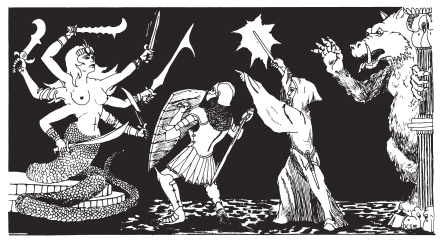
On the other side they discovered a circular chamber. The wall was dotted at regular intervals with stasis pods. Each one contained a grey and brittle crystalline being, clearly long dead. In the centre of the room, the computer loomed. It was a 12ft tall, 10ft diameter, iPod-white, capsule-shaped machine with four long tentacles protruding from its carapace. It ‘spoke’ them in a loud and high-pitched form of crystalline speech they could not understand and then it attacked.
Tadhg, the cleric started off strong, throwing a lit oil skin at it. The fire licked at the outer shell and seemed to ignite some wires emerging from a gap in the casing at the top of the computer, but otherwise did no damage. As Siward the fighting man and the hirelings went in to attack the outer casing, Abbiss decided to climb up and examine the cracked area. Meanwhile, Ilaina used her last flying crystal to get up there as well.
The computer was able to use some spells during the fight. I gave it Charm Person, Phantasmal Forces and Confusion but only got to use the first two. It used Charm person on their remaining dwarf, Gilda, to get her to attack the ground based PCs. Ever the gallant, Siward refused to fight back, instead focusing on defeating the computer in the hope that that would end the effect. Siward was also the subject of the Phantasmal Forces. Spells in this game are interesting because they are so imprecisely described that, in some cases, even their effects are not obvious. Look at this description of the Slow Spell, for instance:
Slow Spell: A broad-area spell which affects up to 24 creatures in a maximum area of 6” × 12”. Duration: 3 turns. Range: 24”.
That’s great Gary, but what does it do?
This one stood out to me because I was going to give this to the computer as well before I read it.
Also, our cleric, Tadhg, had reason to use his last spell slot to heal Abbiss at one point. That was interesting for a few reasons. The first reason was that, after Abbiss widened the crack in the computer’s casing even further, Ilaina stuck a few fingers in there and let the innards have the full blast of a fifth level fireball. Unable to contain the full power of that, the casing belched flames out of the crack on top. Luckily, I decided to give them a Save vs Spell to avoid half the damage but this still hit Abbiss for 12 points. (This is another point about spells. Fireball has no Save mentioned in its description, so I had to home-rule that.) Our thief, already hurt from the precious fight and a couple of whacks from the tentacles, needed some healing. Now, in later versions of D&D, Cure Light Wounds, or any Cure Woulds spell, in fact, required the caster to touch the subject. Not so in OD&D:
Cure Light Wounds: During the course of one full turn this spell will remove hits from a wounded character (including elves, dwarves, etc.). A die is rolled, one pip added, and the resultant total subtracted from the hit points the character has taken. Thus from 2–7 hit points of damage can be removed.
Leaving to one side the mercurial and perverse wording of this description, you will note the complete omission of any sort of range. So, I ruled that Tadhg could, effectively use it to heal anyone on the face of the planet. Lucky too, as Abbiss was still on top of the computer and he was on the floor.
The combat continued, both sides hit and missed, but in the final round, all actions were resolved simultaneously so, even as the tentacles reached out to reduce our halfling once more to just one HP, and the Gilda the dwarf pressed the attack against Siward, our heroes hit it till it cracked open, finally reducing the crystal inside to a dull, grey ruin. They discovered treasure in some shiny lockers there in the computer room, and then they used the teleportation pads in the dungeon to take them back to the village.
After that, we did what I always like to do to wrap up a campaign, I asked them for epilogues for each of their character s. I asked one what they would be doing a week from the end of the adventure, one what they would be up to a month later, then a year and finally a decade. I loved what they came up with but I won’t go into it here. I recommend this as a nice way to wrap things up as it puts the final words in the mouths of the players and allows them free rein.
Conclusion
So, I ran this game while being very conscious of the history behind it. It’s hard to overstate the impact this game has had. It is, arguably, the origin of our hobby, the starting point for the world-beating phenomenon that is D&D today and, as well as that, its the kind of wonky, imprecise, strange love-child of a war-game and nerdy obsession with fantasy and myth.
DD&D never tried to be all things to all people, even though it did include a couple of different options for your combat rules, ie, the combat table in Men & Magic, the first booklet, or the detailed and labyrinthine war-game rules from Chainmail. It gave options but it never pretended to have all the answers. It is the very epitome of the OSR pillar, rulings, not rules. Sure, it has “rules,” but these are clearly only there as guidelines. Just look at those spell descriptions above. Look at the complete lack of mechanics for ability tests. In the end, I imported the roll-under mechanic from Basic D&D to allow for things like Intelligence and Dexterity checks. I resisted doing this sort of thing in the first few sessions. Instead I wanted to try to resolve situations using only the mechanics in the books. But, I quickly realised that, even at the time, OD&D was a work in progress. So many sourcebooks were released to clarify, overwrite, or even ridicule the rules from the first three booklets that it is impossible to ignore the fact that, even those people using the books to play in 1974, were not sticking to rules as written. They were house-ruling it, they were hacking the system and they were adding their own tweaks and options constantly. So that’s the way I began to treat it too. And it only got better as I did that.
One of the things I wanted to reveal in the Editioning was exactly how the game has changed over the decades and how it changed from one edition to the next. I suspect I will find that, over time, the rules became more exacting and less flexible. Of course, that is yet to be seen as we play through the editions. So come back for more insights into D&D and its evolution, dear reader. The Editioning is still in its infancy so there’s plenty more to come.
Discover more from The Dice Pool
Subscribe to get the latest posts sent to your email.

 The Dice Pool