Obviously, a game like this is going to draw comparisons with the Alien RPG and Mothership given the subject matter but, from even a cursory look, it seems to be approaching the genre from a slightly different direction.
Not Over Yet
I had a great plan for today’s post. It was all coming together perfectly. We were due to finish of the Call of Cthulhu “one-shot,” the Derelict last night, but, due to various unforeseen circumstances, we were forced to postpone. So, the review of the scenario that I had been planning will have to wait too.
Still, I’m not short of subjects to write about.
Stay Frosty Remastered
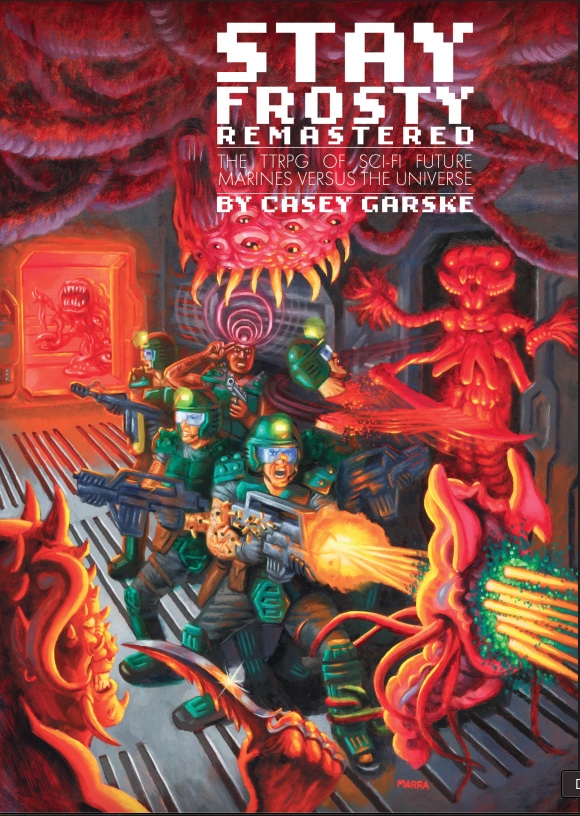
The cover of Stay Frosty Remasted
I’m going to take this opportunity to take a look at one of the games I received recently as a Kickstarter fulfilment. Stay Frosty Remastered from the Melsonian Arts Council and written by Casey Garske is an old school RPG of sci-fi marines in situations of extreme tension where they face monsters, demons and aliens with nothing but a shotgun and a bad attitude. Think Doom crossed with Aliens. Obviously, a game like this is going to draw comparisons with the Alien RPG and Mothership given the subject matter but, from even a cursory look, it seems to be approaching the genre from a slightly different direction.
It’s worth noting that “Remastered” in the title. Casey Garske first released Stay Frosty back in 2017 so it’s been around longer than either of the two games I mentioned above. I first learned about the original before I ever backed the remaster. Co-host of the Fear of a Black Dragon podcast, Tom McGrenery used it several times as the ruleset in which he ran some rather unlikely scenarios. I never read the original, though it is still possible to get it here.
Basics
Roll a d20 greater than or equal to your attribute for a success. Otherwise fail. Sometimes you get another die for advantage or disadvantage. That’s it.
Obviously, this implies that, even though you roll your attributes up the same way as you do in D&D, lower numbers are better!
Badassery
Scorpion fight
You get to play some of the galaxy’s badest asses in Stay Frosty. Character creation seems very straight forward. You get some attributes (Brains, Brawn, Dexterity and Willpower,) and MOS (military Operations Specialty,) hit points, rank and some equipment. Then it’s “Oorah” and into the bug’s nest to rend some carapace. Character creation starts on page 5 and just about stretches to page 8. All the better to roll up a new badass when the first one bites it.
Gear
I like that the rules around gear are abstracted so far as to make theatre of the mind nice and easy. Ranges, as they apply to combat and weapons are expressed by bands:
Hand-to-hand -> Close -> Short -> Medium -> Long -> Extreme
Your weapon’s description indicates its max range of course.
Another touch I appreciate is the use of supply dice for ammo that you use in a combat situation. If you used it, roll the ammo die for it at the end of the fight, If you roll a 1 or a 2, it reduces the die size until it’s gone. There is a similar rule for other gear that can be depleted.
Combat
Riiiiip
I described the essentials of it in the Basics section above. But there are a few idiosyncracies that I enjoy:
One of the actions you can take in a round is called Battle of Wills. If you succeed on a Willpower roll against a chosen target, they will get disadvantage on their next attack. You just scare them into fucking up because of your badassness.
If you get a critical or a fumble, you roll on the appropriate FUBAR table. Either “Fuck Yes, Natural 20” or “Oh Fuck, Natural 1.”
Brain Bleed
There are Psi-powers. These are restricted to PCs with the Psi-ops MOS. There aren’t too many powers in the book but here’s a selection:
Brain Bleed (although the book seems to be missing the actual Effect of this one)
Interface – lets you take control of machines
Mind Stab – mind stab
There’s a little more to the system than just these points, but not much.
Mostly these other rules are introduced in the chapter,
Other Crap Every Game Has
Which has the sub-sub-title,
Jesus Christ, I guess we have to spell everything out.
Danger, Frostiness and Tension
These are the mechanics that make the game what it is. You will see some similarities to the Stress and Panic mechanics in both Mothership and the Alien RPG.
Firstly, the Danger die is rolled whenever the PCs move from one area to another, whenever they are in really dodgy locations or just whenever they’re dawdling. It’s a good way to ramp up the Tension. It works much like an encounter die in other games so can lead to location-appropriate baddies turning up, environmental challenges and loss of resources, but it can also add Tension or cause it to be released explosively!
Which brings us neatly on to the Tension mechanics. So, the PCs gain Tension through the Danger die rolls I described above.
Tension can be good for you. Forget simply staying frosty, Tension will actually build your frostiness level. It starts at “Warm” when your Tension is at a 1 and goes all the way up thru “Chill” (gives the agile tag to ranged attacks) and “Frozen” (Advantage on saves) to “Ice-Cold” (extra attack) when you reach 6 Tension points. There is a danger of course, when your that tense. When the Danger die comes up 6, “Tension Explodes!” And every PC has to make a Willpower save. If they succeed, they can reduce their Tension by one but if they fail, they take their Tension score x their level in damage. If this reduces them to 0 or lower HP, they roll on the Going Apeshit table. If you get a 1 on this table you’re on Overkill, advantage on damage rolls but having to roll your ammo die every round instead of after the combat. If you roll a 6, though, you’re on Last Stand, abandoning weapons and armour to face the enemy mano-a-mano.
This is pretty close to the stress mechanics in Alien, which is also all governed by tables. I’d be incredibly surprised if it wasn’t inspired by this game.
The Rest
If it Bleeds…
Most of the rest of the book consists of a couple of missions to send your frosty fighters on. But there are also a couple of pages of random tables to allow you to easily and quickly construct your own missions and a few basic stat blocks for bad guys like Amoeboids, Demons and Robotic Assassins.
Conclusion
Isaac ran myself and Tom through a dungeon in the Black Hack the other night. None of us had ever played it before and even Isaac had barely looked at the rules. It was so easy, though, that we had characters created, hirelings hired and a dungeon explored before you could say the unlikely word, “Prolch” (my slow-witted fighter’s unfortunate name.) Stay Frosty gives me a very similar vibe. I only just opened it for the first time to write this post and I feel like I could run it now. Maybe I will! Unsurprisingly, the Black Hack is listed in Stay Frosty’s Appendix A: Influences. Garske tells us here that his game was originally a Black Hack hack but he ended up totally rewriting it. You can still see the Black bones of it though.
To be clear, the ship is the whole adventure. You could easily work it into an ongoing campaign, I think. It could be a random encounter or the goal of a mission. But, for me, it worked perfectly as a one-shot. It gives you everything you need in those eleven pages.
Talk Like a Pirate Delay
I was really excited about this year’s Second Annual Tables and Tales Talk Like a Pirate Day Pirate Borg One Shot on September 19th but I was, unfortunately, overcome by some malady that day. We postponed it only to have a massive storm roll in off the Atlantic, forcing us to delay the departure of this vessel yet again. Finally, last Sunday the players’ pirates were ready to board the Repentant come hell or high water…
OK, I say they boarded it but it would be more correct to say they were taken aboard. I started them off in the expanded brig, area 1 on the map of the ship. They awoke, captured, stinking and hurting and minus all their stuff. Nevertheless, with a few improvised weapons they found lying around the cabin and the assistance of a skeleton thrall raised by the skeletal sorcerer, they managed to overpower their demon guard. This was the first of many obstacles to their defeat of the Ashen Priest commanding the ship and taking the Repentant for themselves.
The Scenario
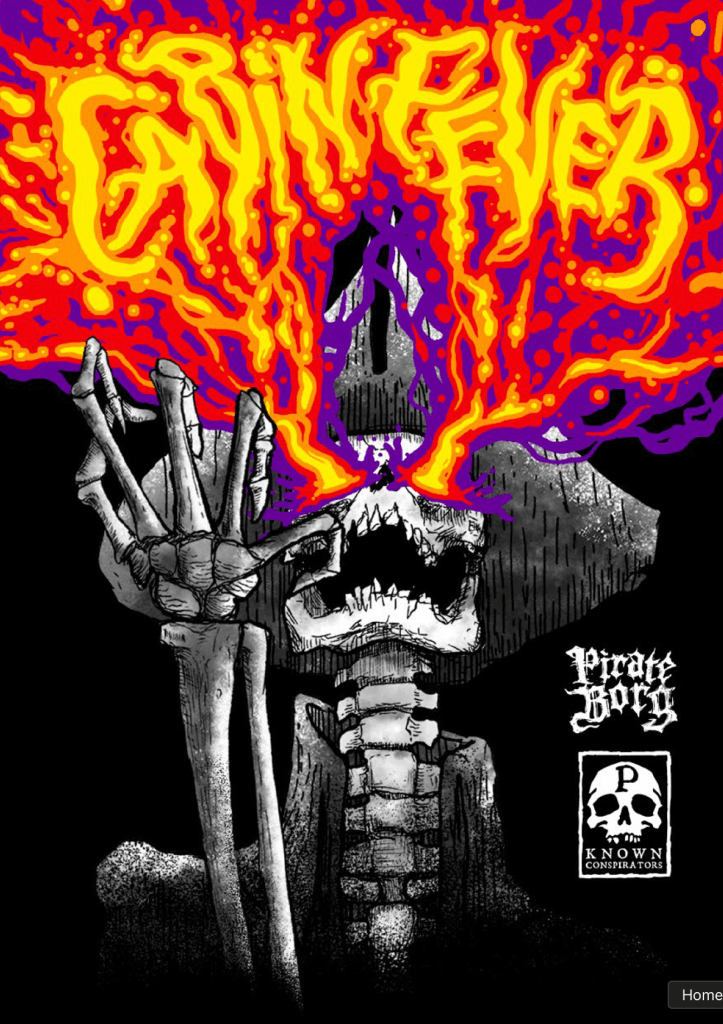
The cover of Cabin Fever
The Repentant is an 11 page one-shot scenario for Pirate Borg by Zac Goins. It is published in the forthcoming sourcebook for that game, Cabin Fever, via KNOWN CONSPIRATORS, Limithron’s subtable for third-party creators. Cabin Fever is a treasure chest of extras for Pirate Borg including new PC classes, GM tools, a Bestiary, no fewer than six adventures as well as solo rules. I am one of the backers of the Kickstarter project so I got access to the PDF through that. I’m hoping to receive the physical rewards for that soon.
This scenario is presented in a typical Borg-ish style, with maps, and illustrations taking the lead in establishing the atmosphere. It’s almost all in grey and black, emphasising the theme of ASH. The layout is also typical with lots of tables, stat-blocks, keyed area descriptions etc being worked into the spaces between and around the artwork. I occasionally had to take a few extra seconds to find what I was looking for due to this but it was never a major disruption. In general it looks great and ewers relatively easy to use.
The Premise
The Repentant is a charnel ship, an unkempt brigantine with tattered sails and a crew of demons and cultists, commanded by a cadre of Ashen Clergy. Their goal is spelled out clearly in the three step plan on the second page. In summary, the plan is to summon demons, form an unholy pact with the Dark One, raid some settlements to take captives, kill ‘em, raise them as undead and then grind them up to make Brimstone ASH. This is a type of cursed and arcane narcotic on which the crew plan to make lots and lots of pieces of eight.
To be clear, the ship is the whole adventure. You could easily work it into an ongoing campaign, I think. It could be a random encounter or the goal of a mission. But, for me, it worked perfectly as a one-shot. It gives you everything you need in those eleven pages.
The Reality
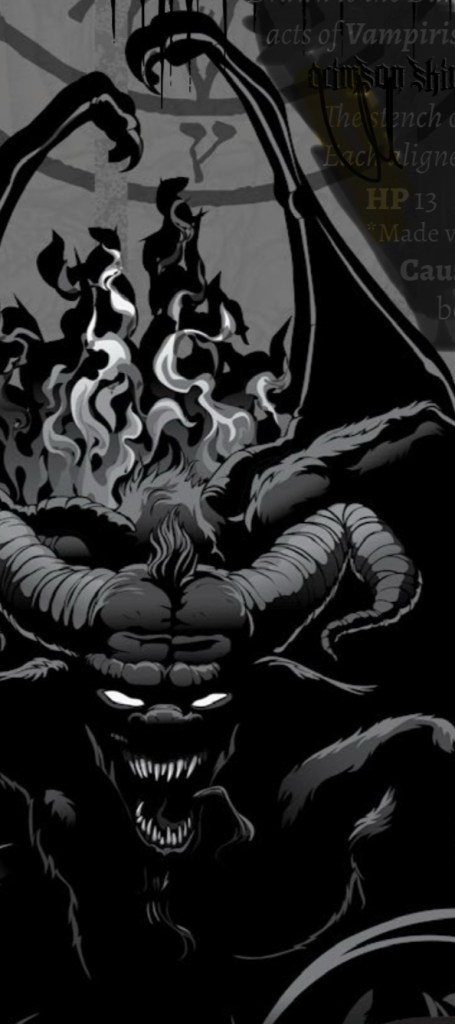
A genuine, fire and brimstone demon
There is a fun variety of enemies for such a short scenario. You have seven different types of possible demon (one for each deadly sin, with commensurate sinful powers,) the emaciated crew, the Ashen Vicars and the Ashen Priest who has a variety of fun powers. And if you deal with all those, there is a hold full of Brimstone Zombies, who have the power to promise your soul to the Dark One with a bite.
Although not every encounter ended in combat, almost all did. It felt inevitable in general. I started the players off where I did, in the brig because of the restrictions of a one-shot session. I wanted them in the thick of it from the start and escape gave them a powerful motivation to attack the terrifying demon, even without real weapons. Also, I figured the brig is area 1 on the map for a reason. The scenario does not explicitly indicate where or how you should start it as a one-shot, but if you take the hint, here, you’re probably not going to go wrong. It definitely got them into the action immediately. Without the timely and repeated use of Devil’s Luck and mystical powers in the first two encounters, at least one of the party would have gone down. The only thing is that it led to two mostly combat encounters in quick succession. Starting with them boarding over the rails or some other way might have engendered a totally different kind of adventure.
The map was fine. I was a little put off that three of the four decks had one side of the map cut off but it was of no practical disadvantage in play.
Tables, tables, tables. The tables are great, from the effects of the Brimstone ASH (different to the regular ASH introduced in Pirate Borg) to the “What did I just step in?” Table which I underused criminally.
My players only used the Brimstone ASH on their enemies, which was a shame. I think it’s because when they rolled on the table for those uses, they got 1s and 2s, which are very very bad. After I told them what else was on the table, they regretted not trying it!
6 The Devil’s inside ye. Immune to fire. All weapons’ dice size increases.
The Finale
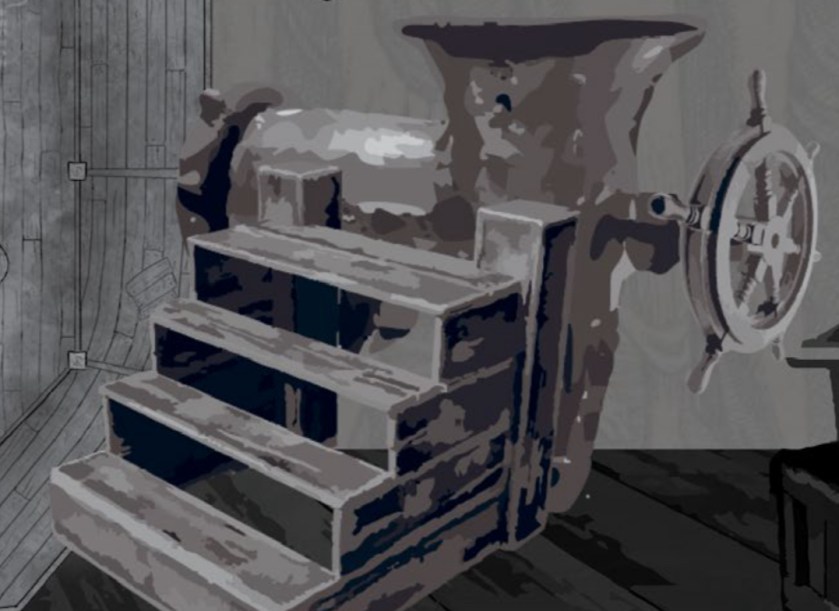
The ASH grinder.
I saved the Ashen Priest, the scenario’s main villain, for the end. He might have been found in either the captain’s quarters or the hold, according to the keyed locations, but, honestly, you could locate him anywhere to suit your own game. The PCs had done away with almost everyone else aboard when they descended into the cargo hold found him there, feeding zombies into the ASH Grinder. There were a lot of undead down there with him but the PCs made such short work of him that it hardly mattered. Then they got to take the ship as plunder, not to mention the undead and the grinder so they could enact the plan themselves!
Conclusion
This was one of the most well-crafted one-shot scenarios I’ve run. We played it in about three and a half hours, though, if things had gone badly, it might have been over after less than an hour! I did give them a couple of NPCs for back-up and in case anyone lost their first PC (there were two deaths.) This might have given them a slight advantage, if I’m honest, but everyone had a good time. Looking forward to trying out some more scenarios from Cabin Fever and the rest of the slew of new books from Limithron!
There’s a pumpkin-headed but polite creature stalking the prison who will, every once in a while, grab one of the PCs and pop them in his gob
In Summary
There are SPOILERS below! You have been warned.
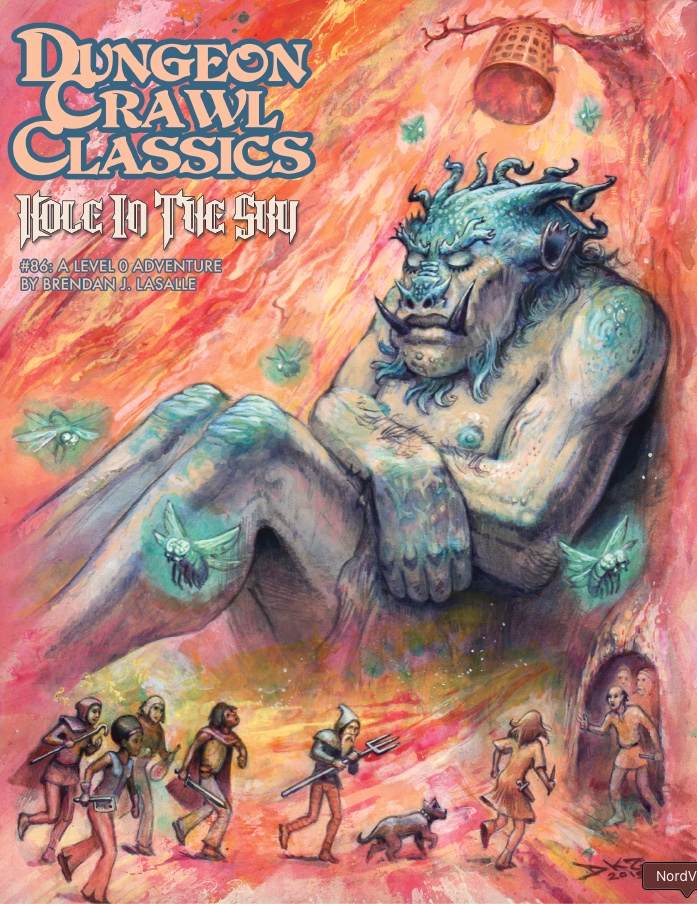
Sometimes you feel like things aren’t as they should be. It feels like you’re living in the wrong timeline, or like you were born under the wrong stars. That’s the extraordinarily loose hook for Hole in the Sky, the 0-Level Funnel adventure for Dungeon Crawl Classics by Brendan LaSalle. I say it’s a hook, but it’s not as if the large band of peasants you gather for this adventure really get a choice in whether or not to go to the starting location. All of that is taken care of in flashback and by dint of read-aloud text. Which is great. Don’t get me wrong. All the players came to play this scenario so, I think that makes sense.
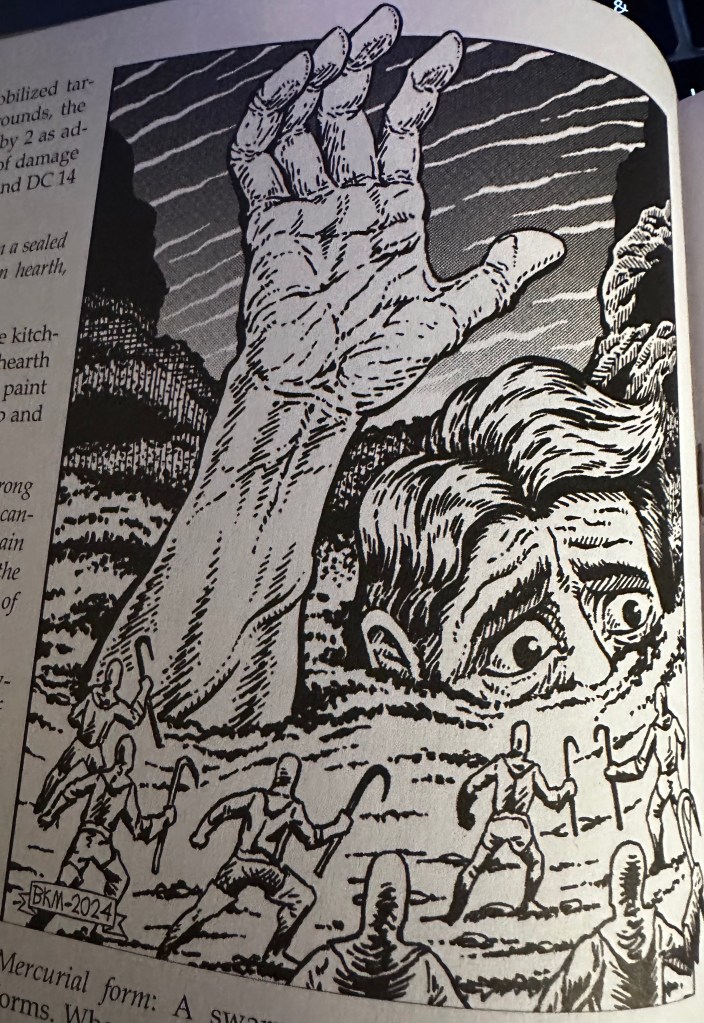
Here’s the setup, the PCs, peasants, normal Joes, ordinary slobs all, start dreaming that they have had their true place in the universe stolen from them. They should have ben heroes! The dreams coalesce into a drive to dander, cross-country until they reach the edge of a cliff, days and days later, convinced that their destinies will be restored as a result. In this place, they encounter the Lady in Blue (there is more than meets the eye to the Lady but I’m not going to go into that here. It seems to be the kind of thing that might become important in a longer campaign that could feature her as a patron or maybe even an antagonist), a giant of a woman, floating in the air with five heads gripped in her two hands. The heads speak for her. She tells the peasants that, if they would just go and free her ally, imprisoned by her enemies long ago, they will be rewarded with a spin of the Wheel of Destiny. And this would set their destinies to rights.
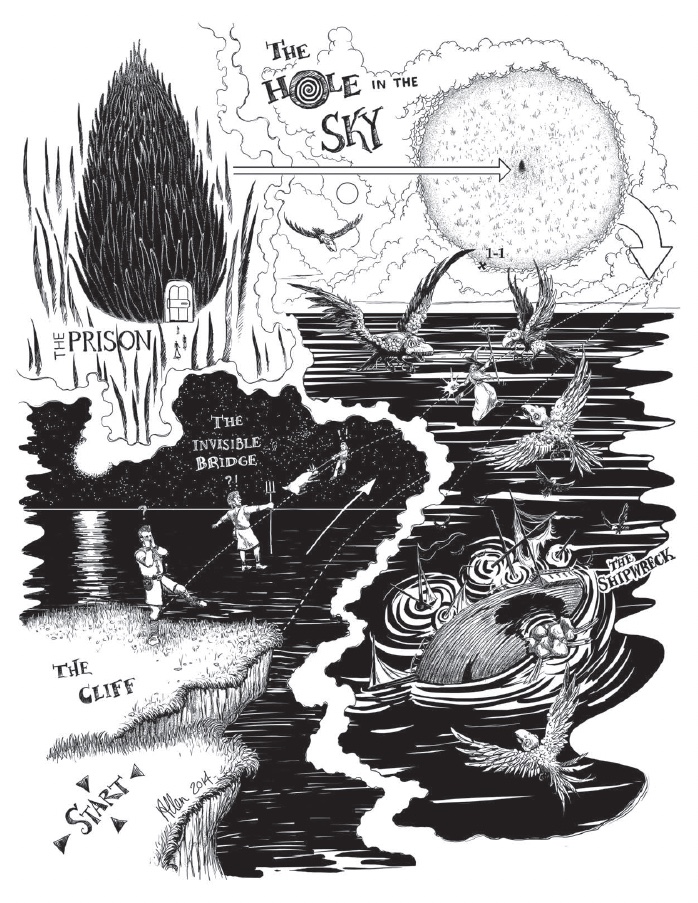
Actually, after she feeds them a meal, she does give them an out, so what I said above is not entirely true. If any of the PCs wish to abandon the quest at this stage, they can, but they will meet an unfortunate end before too long. Anyway, there is a period of waiting here that is strange to me. The scenario indicates that the PCs could use the time to visit the nearby village of Mherkin to stock up on gear and provisions. This is not even the last period of waiting baked into the scenario. Anyway, after hours of waiting for the right time, the PCs can step gingerly onto the invisible bridge that will take them from the cliff to the Hole in the Sky, the entrance to Lady’s ally’s prison.
For days they walk, sticking together to avoid the edges. The PCs are buffeted and soaked by a terrible storm as they cross the bridge far above the waves of the sea. They will lose some of their number in the storm, no doubt. They will lose even more as they are attacked by Sea Shrikes. Only after three days of traveling will they reach the end of the bridge, worn out, freezing and much reduced. Here is the second period of waiting. They must wait a further two entire days, slowly starving and shivering, until the Hole in the Sky aligns perfectly with the bridge. Why? Good question.
Once it appears, however, they are able to leap through and into the Prison Vale, a strange and unique extra-dimensional pocket universe designed for one purpose and one purpose only, the imprisonment of the Lady’s ally, Drezzta. The place seems to be made for giants, even the blades of grass stand tall as trees. There are a variety of potential random encounters in the Vale, 1 in 6 chance per hour for four hours if they go straight to the prison proper. Some of these look very fun and quite thematic.
Nice they make it to the prison they discover a cyclopean gate and find their way in. Inside they will discover a few things in quick succession:
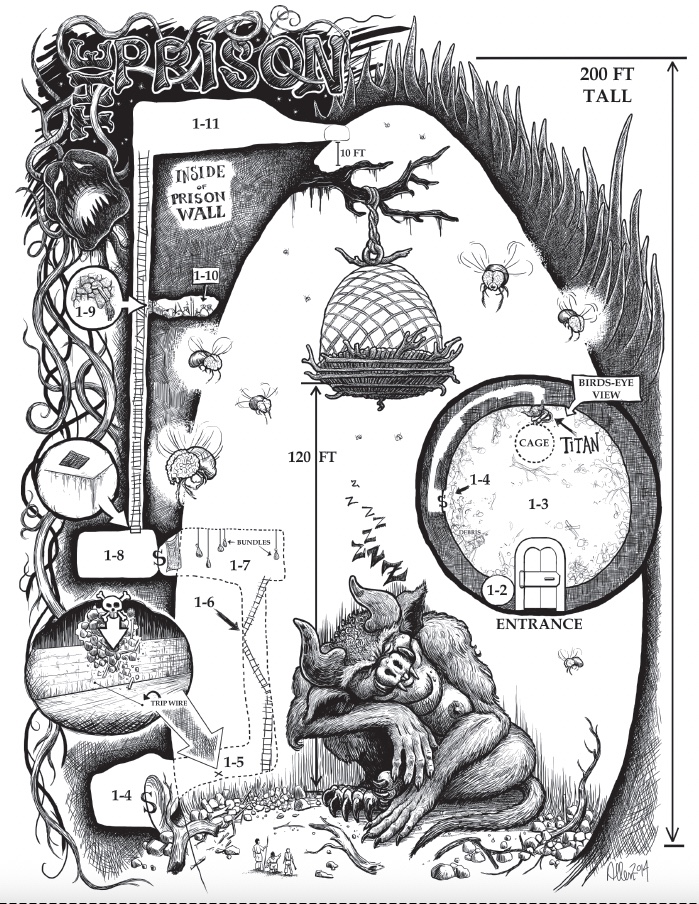
There’s a massive titan, sleeping on the job, but clearly here as a warden for this prison
There’s a cage hanging from a branch maybe 200 feet up
There’s a pumpkin-headed but polite creature stalking the prison who will, every once in a while, grab one of the PCs and pop them in his gob, where they will slowly burn to death in his jack o’ lantern flames, before gently encouraging the rest of them to leave
Of course, they are not going to leave empty handed. The continue on, finding a way up inside the walls themselves. On the way they encounter lethal traps, dangerous lunatics, mutants and lots of ladders. They will get a little more of the story from some of the other weirdoes who live here and they will probably find a cache of treasure, which includes a magic spear to destroy the sleeping titan.
It should end up with them reaching the top level of the prison, dizzyingly high up. They should risk life and limb to free the poor, emaciated form of Drezzta trapped in the hanging cage. One of them will need to sacrifice either a little blood or a lot more to open the door, but that will lead to her flying free, destroying the pumpkin guy and fleeing as the very dimension crumbles around the escaping PCs.
Those who make it back through the Hole in the Sky find themselves once more on the cliffside. The survivors are each given a chance to spin the wheel. Some may find themselves thrown back into the mundane lives they left, others might find themselves destroyed, killed in favour of one of the poor wretches who died during the course of the adventure. Still others might find themselves utterly changed in almost every conceivable way… Potentially a great reward for a 0-level character who is about to progress to the dizzy heights of Level 1!
Our Experience
Chaos pig burrowing out of the ground with its little claws.
I played this funnel over two sessions of about three hours each. We played online using Roll 20 and Zoom with a group of six players, all members of our ever-expanding RPG community, Tables and Tales. With six players, of course, we had 24 0-level PCs leaping through that hole in the sky! This seemed like it might be too much. I was afraid that each player’s turn might take an age, but, in actuality, the numbers started to get whittled down quite quickly.
Like I stated above, in the half of the adventure that takes place before they enter the Hole in the Sky, there are two pretty lengthy period of waiting baked in, first on the cliffside and again at the end of the bridge. I didn’t give the players the option of visiting the village of Mherkin, despite its funny name, because the last thing I wanted to do was spoil the momentum before it even got started by introducing a shopping scene! Also, the PCs should have what they need, more-or-less, so I didn’t think it was necessary. That second period of waiting, for two entire days before they could enter the Hole is fairly inexplicable though. It exposed the PCs to the freezing temperatures and the possibility of getting sick but it felt a bit like ti took the wind out of our sails just as things were about to really kick off. I think, if I ran it again, I might remove that wait entirely.
As for the invisible bridge, I loved this as a conceit and the players did too, even if it led to a lot of deaths right off the bat. The storm was brutal to one particular player who was reduced to a single PC in one terrible gust. The Sea Shrikes’ attack was less lethal than expected but that was a matter of luck, I think. What we felt, as a group, after playing this part was that the imagery, the situation and the danger of it were all quite palpable, not to mention unique.
Moving on to the Prison dimension itself, with the giant blades of grass and the enormous gate, some of the players mentioned that it made them feel like they were in Honey I Shrunk the Kids. I think that is the vibe the place is going for so that was cool. The random encounters in the wilds of the dimension looked good but we didn’t interact with them. They simply never rolled a 1 on the encounter die. But I particularly enjoyed the Chaos Pig, a burrowing porcine nightmare, and the Woven Women, camouflaged guardian plant creatures.
On to the Prison itself:
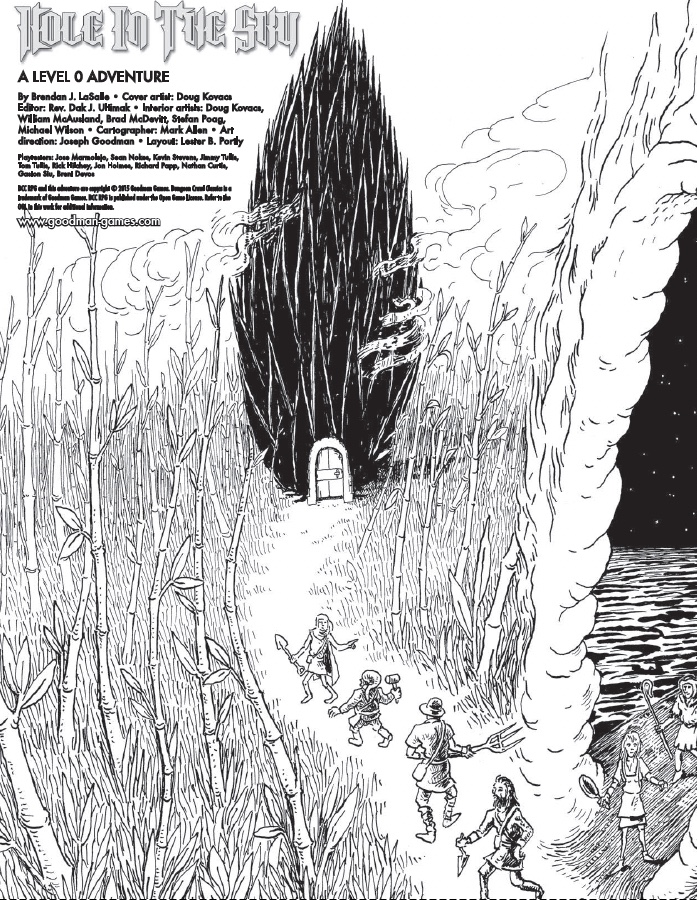
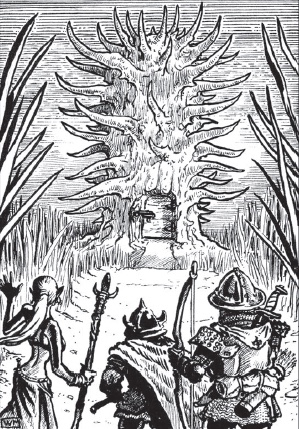
a three hundred foot monolith covered in fifty-foot long thorns. It looks not so much constructed as grown, like some kind of massive seed pod.
This is pretty metal and I enjoy the fact that the adventure contains no fewer than two different artists’ depictions of it. Both so different and yet both awesome in their own way.
Prison 1Prison 2
Luckily, there is no waking that titan who has been ensorcelled to want to exist in his dream realm. It would take something fairly cataclysmic to wake him up. And it does, of course, near the end of the adventure. After freeing Drezzta, the surviving peasants hoped into the cage and cut the rope holding it up. It fell on the titan’s head and rolled off him down to the floor where they were able to escape. They managed to kill him before they went though, as there is a magic titan killing spear to be found in the treasure cache, conveniently enough.
Cur Maxima
The pumpkin-headed lunatic is fun. I can’t quite make out the reason why it’s a jack o’ lantern creature, to be honest. It doesn’t seem particularly thematic to me or anything. But he it is a pest. The judge is encouraged to chuck him at the PCs whenever they least expect it to take just one of them and kill them in the most awful way, just put the shits up them. It works. Every time that guy turned up there wrecked groans. It was a guaranteed death every time.
There are abandoned ones who live in the walls. They were former servants of the Lady in Blue who had been sent under the same pretences as out heroes but failed or refused to carry out her orders. They longer they spent there the madder they got and the more mutated. There is one dwarf who the pCs might try to talk to but they are not likely to get much from the others. It’s not a big talking scenario this one. My PCs ended up murdering most of these wretches and burning the living quarters of the abandoned ones, sending the survivors fleeing as a result.
This is the only proper fight in the second half of the adventure and it’s not great. It’s just 12 pretty boring, emaciated enemies against a similar number of peasants. Now, the players made it memorable in several ways, but it does feel like an encounter that could have started off more interesting. At least most hits were an instant kill.
Their final reward, the Wheel of Destiny was a fun addition, although it’s a little redundant if playing as a one-shot. Each survivor gets to make a Luck roll. As soon as I told my table that, they erupted in groans and curses aimed at me. I had been encouraging them to spend their Luck liberally towards the end after all… Anyway, I’d imagine, if you were planning to play the characters in further adventures it would have been more engaging.
Conclusion
Prison mapScenario Map
This is very engaging adventure with a great, bonkers concept. Its executed so well too. The art and maps are fantastic, as an always with DCC products. I am never that crazy about their layout or presentation of information but I’m willing to overlook that given the quality of the experience.
It’s definitely worth trying out if you are looking for a 0-level funnel that has lots of hooks built in for further adventures but it worked very well as a one-shot also.
Disclaimer: I have only read this adventure. It’s unusual enough for me to review something that I haven’t actually played but I thought it was worth doing anyway.
Quests from the Infinite Staircase
I don’t know at what point WOTC decided that every D&D book they released had to be titled Noun from the Adjective Noun or some derivative thereof but they got deep into it there for quite a while. Anyway, today I’m looking at the first adventure presented in their anthology for D&D 5e, Quests from the Infinite Staircase. This book uses an unlikely framing device known as the Infinite Staircase, along which you can find portals to all sorts of adventuresome and slightly retro locales. It’s a sort of extraplanar locus inhabited by a genie who will send you and your pals to any of these spots for whatever reason. It’s a bit like the Radiant Citadel, which they made up as an extraplanar locus to allow you to easily travel to a bunch of disparate regions on, presumably, different worlds for that other anthology, Journeys through the Radiant Citadel. Come to think of it, it’s a bit like that other famous extraplanar locus, the City of Doors, Sigil, which has been in existence in the D&D universe for decades. So why do they keep inventing new loci? Do you even really need this conceit to join this collection of otherwise standalone adventures together?
The alternate cover of Journeys through the Radiant CitadelThe cover of the boxed set of Planescape for AD&D 2e. The inifinite staircase
The Lost City
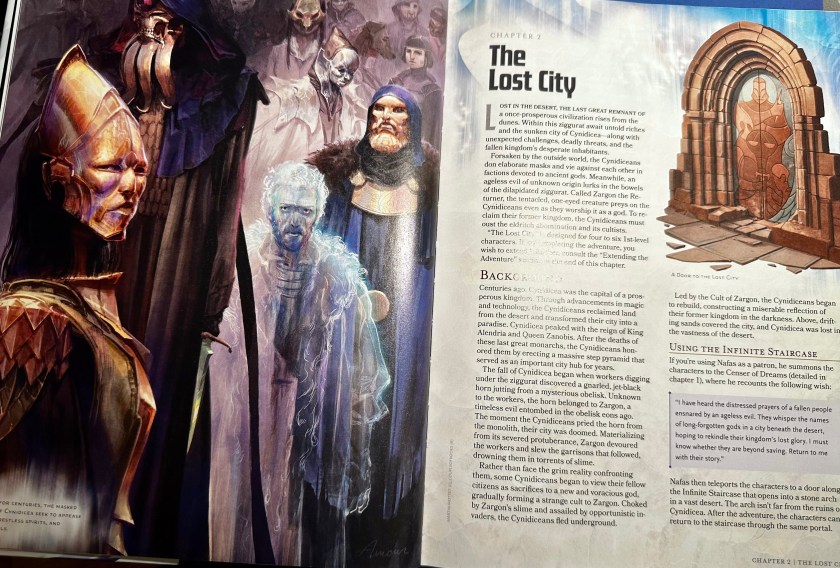
The opening illustration and first page of the Lost City.
Disclaimer: I have only read this adventure. It’s unusual enough for me to review something that I haven’t actually played but I thought it was worth doing anyway.
I’ll keep this relatively spoiler free but there may be a few points you’d rather not know in advance if you’re interested in being a player in the Lost City.
This adventure, along with all the adventures collected in this book, is an updated version of a classic one from D&D’s history. The original Lost City was published in 1982 and was written by Tom Moldvay as an introductory adventure for the Dungeons & Dragons Basic Set. I confess, I have not read the original so I won’t be comparing the two here.
This is the first adventure in the collection. It’s meant for 1st level characters. It’s a dungeon crawl in the very classic sense with up to six levels to it and a factional element that is close to the heart of the module.
Background
The lost desert city of Cynidicea was once a prosperous and powerful place. but they delved too greedily and too deep when building a ziggurat to honour their deceased monarchs. Oops. This was the downfall of the city of course. As an answer to this, the people split into four disparate sects. None of them got along but one was definitely worse than the others. The worst of these sects led the people underground to rebuild in the darkness beneath the ziggurat as the desert reclaimed their city above.
Getting There
At the start; how to get your PCs here from the Infinite Staircase, where to locate it on three D&D worlds and a couple of adventure hooks to get them to go. The hooks are fine. Get hired by an anthropological expedition or get separated from your desert caravan. If you wanted to incorporate this into an ongoing campaign, I feel like you could do better yourself.
Advancement
There is a handy section that spells out for you at which points you should let the PCs level up if you’re using milestone levelling. By the end of the adventure, your characters should hit level 4.
About the Original
About the Original
There is a nice little sidebar here and in every adventure in the book, which tells you about the original. It gives you some info on the edition it was meant for, a few details on how it was supposed to be used and the credits. I like that here, they tell you that The Lost City was meant to be used to teach new DMs how to run and design a dungeon, allowing them to come up with the lower levels of the dungeon themselves.
People and Factions
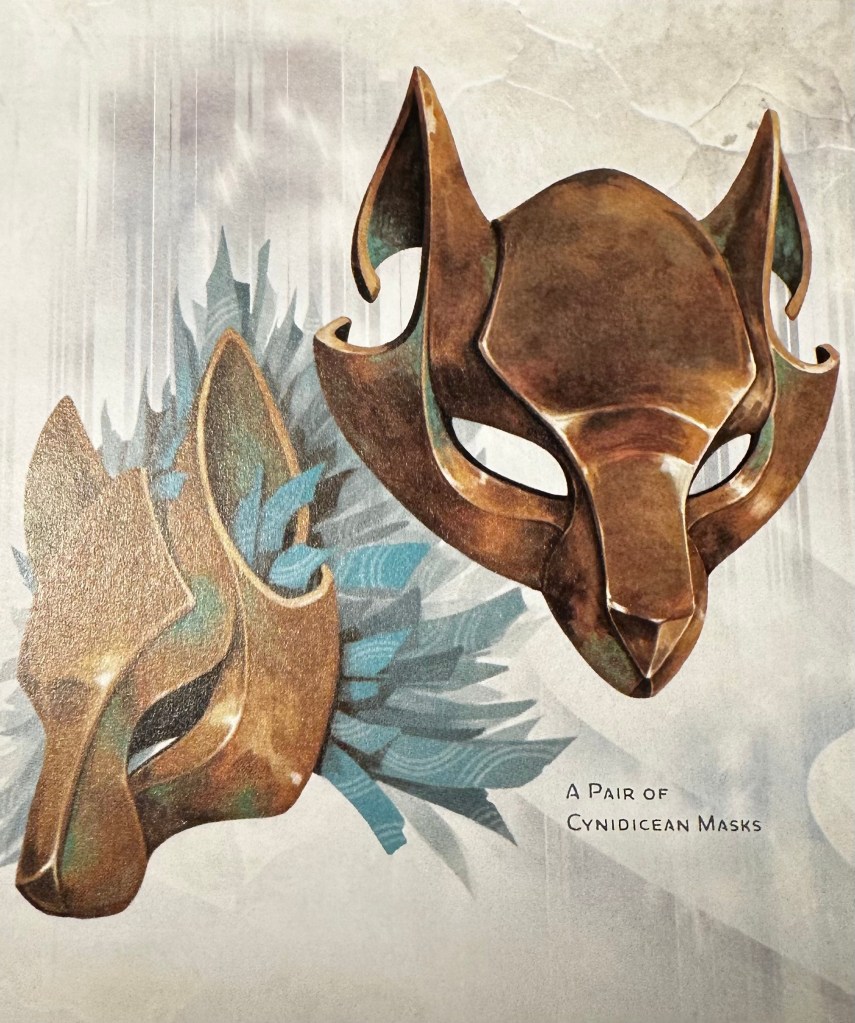
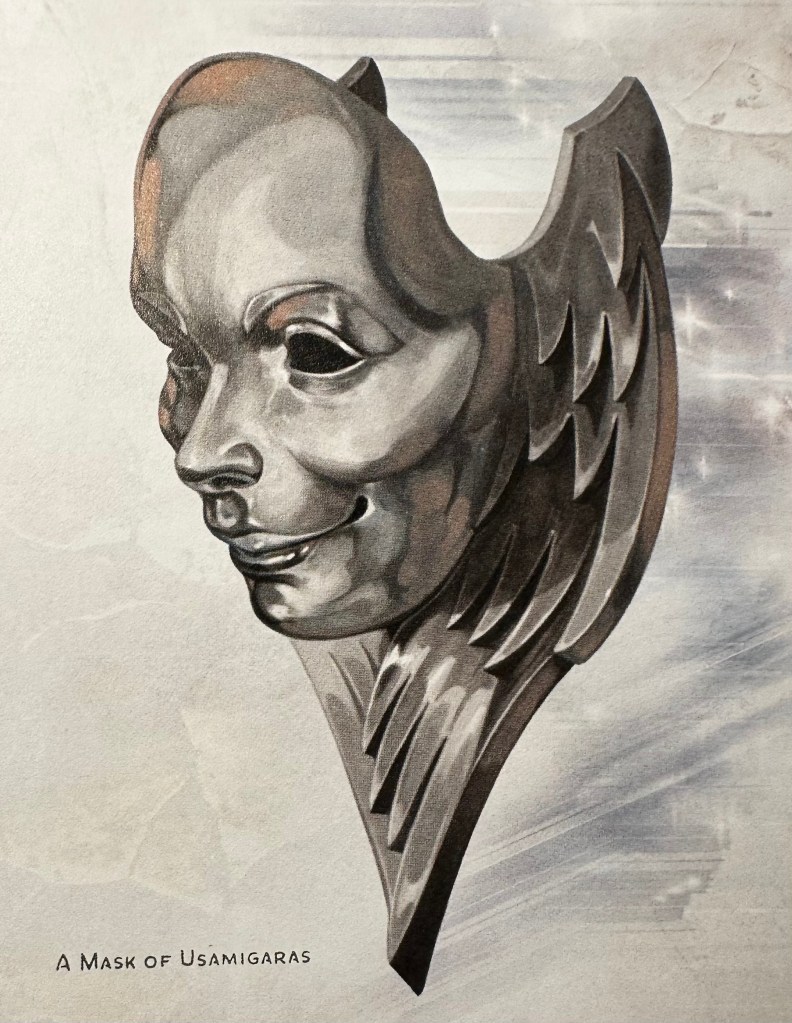
Animal masksGorm maskUsamigaras maskMadarua mask
The Cynidiceans all wear masks, usually some sort of animal mask, and they generally don the shabby left-overs of their once glorious past. Also, sometimes, they act like the animal depicted on the mask. Fun!
As I noted above, the factions are often at the heart of the adventure. They are detailed here. Each of them worships a different god, with their own portfolio, of course. Thematically, they are each quite distinct and have a look all their own, exemplified by a particular type of mask that they wear and a tattoo that they sport.
The paragraph or so that each faction gets here leans heavily on the ways they will pursue their goals, which are, unsurprisingly, influenced by the type of god they follow. We are told they all want to preside over the rebuilding of their city in their own way. They all want the same thing but they will not co-operate. This leaves me wanting a bit more, maybe some aim that’s a bit more immediate would help.
Random Encounters
Roll a d6 for every hour spent in the Ziggurat. If you get a 1, it’s encounter time. There’s a d12 table with a preponderance of cultists and other Cynidiceans, which makes sense, and an owlbear, which doesn’t (did I mention it was in a desert?)
The Ziggurat
The PCs have to enter from the top and work their way down. They’ll be sealed in once they enter, like a common hobbit and his eight fellows in a mine. The goal of the entire adventure is basically to survive long enough to find another way out. This might change during the delve, of course, once you meet the factions. But probably not.
I want to point out a cool thing right at the entrance where they can use ladders to either climb down into tier 2 of the ziggurat or up into the hollow interior of a set of statues on the roof of it. They can use levers that allow them to move the statues’ limbs and there’s a speaking tube. I like the idea of this but there is no practical use for this feature. They are not likely to encounter anyone outside on the top of the Ziggurat to impress with this display and it’s not going to do them any good once they’re on the inside so it seems a bit pointless?
Anyway, as I stated above, there are up to six levels to the Ziggurat. To be fair, the first level is just a single room right at the top, and hardly counts. But, as you would expect from a ziggurat, each level gets bigger as you go down. Even level 1 (or tier 1 as it’s called) has a pretty gnarly trap right from the get go. At worst, though, it will result in all of the PCs being rendered unconscious. If this happens, they’ll be taken by the first of the factions, the Guardians of Gorm, who will question them and try to recruit them. There are moments like this for each of the factions, partly because the place is positively riddled with traps and partly because the adventure does not want them to miss out on meeting each of the factions. It also wants them to join one or maybe more than one of them. this will, of course, complicate things for them if and when they try to interact with any of the others.
A magic joining ritual for one of the factions.
Once they meet the leader of a faction, the PCs will generally be judged in some way, and, if they are judged worthy, will be given the option to join the sect. If they do, they’ll get some advice and some kind of reward for it. But, if they refuse, there’s not much of a downside, to be honest. They won’t get to use the factions quarters to rest and they won’t get the aforementioned rewards but that’s it. And the other thing is, you would expect the faction leader to ask something of the new recruits. Maybe an attack on one of the rival factions or a quest to retrieve a sacred relic from the levels beneath, but no, nothing like that. You join and then you go about your business, pretty much. Seems like a missed opportunity.
All of the faction stuff happens on levels two and three of the dungeon. That’s where they will encounter all the sect leaders and probably learn a few things about the levels below that might help them out a bit.
Tier 4 has a bunch of undead encounters. This is where the royals were buried along with members of their court. There is a good variety of undead featured here and a nice through-line of a story involving the king, the queen and a handmaiden. There are zombies, skeletons, a ghost, a banshee and a wight, as well as a mummy (which seems an unusually unbalanced encounter for 5e.) With any luck, the PCs will be able to see the entirety of the story of the royals through. If they don’t, there isn’t much else in the dungeon to satisfy them and it will lead to a bit of an anticlimax.
Tier 5 has a fun encounter with a possessed robe, the main entrance/exit of the ziggurat and a grab-bag of traps and encounters of varying levels of fascination and challenge including a drunk owlbear. As I mentioned above, the main goal of the PCs was probably to find a way out of this crazy dungeon and this is where they will find it. There is a great big door behind which the sands have conveniently shifted to unblock it. There is literally nothing here to prevent them from doing opening it and escaping.
However, there is possibly a plainly visible trapdoor in one corner that leads down to the next level. This, I think is the level that, if you were a DM back in 1982, you would have had the opportunity to create yourself. As it is, WOTC have decided to relieve of that particular creative opportunity/burden and do it for you.
Story mosaic
Level 6, also referred to as the Expanded Ziggurat, is an unfinished tier that has been occupied by the demonic force that brought about the ruin of Cynidicea so long ago. I quite like this level, it’s thematically foul with lots of bile and slime and the like. As well as the demon itself, there are lots of its loyal servants, a black pudding and a gibbering mouther to encounter. There is warning at the start of the section that this tier is much more difficult than the others and is meant for higher level characters. The fact is, if the party of 4th level PCs makes it to the demon, they’re not going to survive. Its got a challenge rating of 17 and a set of legendary resistances and actions. I do have to ask why. I am thinking now of the excellent Sailors on the Starless Sea DCC adventure. The 20 or so level-0 peasants who enter that dungeon probably didn’t expect to come across some elder evil at the end of it, but there is was beneath that chaos keep, awakening from an ageless slumber. They killed it. It was statted out so that it could be killed by these peasants. And it gave them such a sense of achievement and heroism to do it! So why can’t the Lost City do that with the big bad at the bottom of the ziggurat?
By way of some sort of explanation, perhaps the idea is to make a much longer campaign of this situation with the factions and the demon lord and the Underground City which is presented very briefly at the end of the adventure. The demon would then be the ultimate BBEG of the piece and the PCs might have had many adventures rated to it and its cultists along the way to gaining the sorts of levels that might allow them to face it. The problems for me are that the factions were not compelling enough in the adventure to start with, the information on the city that you do get is too sparse to be of much use and there is every chance the PCs fucked off home when they found the exit back on tier 5 anyway.
Conclusion
I actually think that, with a bit of work on the factions, the NPCs and some editing for theme, I would enjoy running this dungeon-crawl. As it stands, the factions are underutilised, some of the encounters make no thematic sense and the NPCs are quite one-dimensional. It also feels like it needs more of an ending. But that doesn’t change the fact that there are some fun traps and challenging combat encounters, which is nice in a dungeon.
One of my main reservations is its size. It’s quite long, with over 60 keyed locations in the dungeon. I would worry about maintaining interest in a dungeon crawl of that length. I would imagine it would run for quite a few sessions.
Although it is obviously presented for 5e it could be very easily translated for use with any OSR ruleset, DCC or Dungeon World. I found myself thinking about how to convert it for Trophy as I read through it too.
So, off they went, following a magic raven, through the rain and the swamp, fording rivers, defeating enemies and stabling horses, until they got to the appointed place and the raven dropped dead.
Blood in Ferelden
There have not been a lot of supplements for the Dragon Age RPG from Green Ronin. Other than a quickstart guide, a GM’s Kit and Faces of Thedas, a sourcebook filled with fan-favorite characters from the video game series, Blood in Ferelden is pretty much it. It’s a collection of adventures designed by Walt Ciechanowski, Kevin Kulp, T.S. Luikart and it came out in 2010. It contains three full scenarios and a few adventure seeds all of which take place in and showcase various regions of the land that played host to Dragon Age Origins.
It came out at a time before the Dragon Age core book collected all the rules from Dragon Age boxed sets 1, 2 and 3. Dragon Age set 1 only dealt with levels 1-5 and, indeed, Blood in Ferelden’s adventures are designed to get characters from 1st to 5th level.
I discussed another published adventure, Duty Unto Death previously. That was the first Dragon Age adventure I ran for my group and it assumed the PCs started at level 3. So that’s what we did. Not only that, but they progressed to level 4 and became fully fledged Grey Wardens before we moved on to the first adventure from Blood in Ferelden, Amber Rage. I made only a few adjustments to Target Numbers (like DCs in D&D) and enemy stats to increase the difficulty. Despite this, this level 1 adventure proved quite challenging enough at times.
SPOILER ALERT! This review is absolutely packed with spoilers. Turn back now, potential players!
Overview
Amber Rage!
Amber Rage is a 39 page adventure. It’s split into six distinct parts, each of which presents its own unique challenges for the PCs, a variety of enemies, NPCs and moral dilemmas for them to wrestle with. All of these are of varying quality.
Here’s the summary: The PCs find themselves in Sothmere, a village near the Korcari Wilds. Our group of newly minted Grey Wardens had been sent south by Duncan, their commander, to determine the strength of the Darkspawn force amassing in the south, preparing for the Fifth Blight. Sothmere was just a pitstop for them. There was a festival happening there to celebrate the building of a new fort, which gave the PCs a chance to take part in some axe-throwing, mud-wrestling, archery competition mini-games. While this was going on, the village was attacked by a band of crazed Chasind stalkers. These lads had been infected with the eponymous Amber Rage and were spreading it all over town. If no-one did anything about it, all the infected villagers were going to transform into mindless Ragers in three days! After some debate amongst the NPCs, it was decided that the Grey Wardens should go and find an ingredient in a grotto in the Korcari Wilds. This shadowmoss could be used to cure the infected.
So, off they went, following a magic raven, through the rain and the swamp, fording rivers, defeating enemies and stabling horses, until they got to the appointed place and the raven dropped dead. There they boiled up a stew and this attracted the firesprites. These guys lived in the grotto of the shadowmoss, so the PCs followed them home. Kind of creepy, when you think about it. Not only that, but they then went ahead and murdered the firesprites’ Guardian Serpent. I mean, the serpent didn’t leave them much choice, but they were invading its home after all. The real problem with this, as the wardens discovered in a sort of psychic vision provided by the firesprites later, was that the firesprites consumed the shadowmoss for sustenance, and the Serpent, ahem, excreted the shadowmoss. So, with the serpent dead, if the PCs collected all the shadowmoss they would need to cure the infected, they would be condemning the firesprites to starvation and extinction. But if they left them with the shadowmoss they had, that would give them enough time for a new Guardian Serpent to mature (this weird symbiotic arrangement was further compounded but the revelation that one of the firesprites would transform into the Serpent itself!) This was the central moral conundrum of the scenario, save the villagers or allow the firesprites to live.
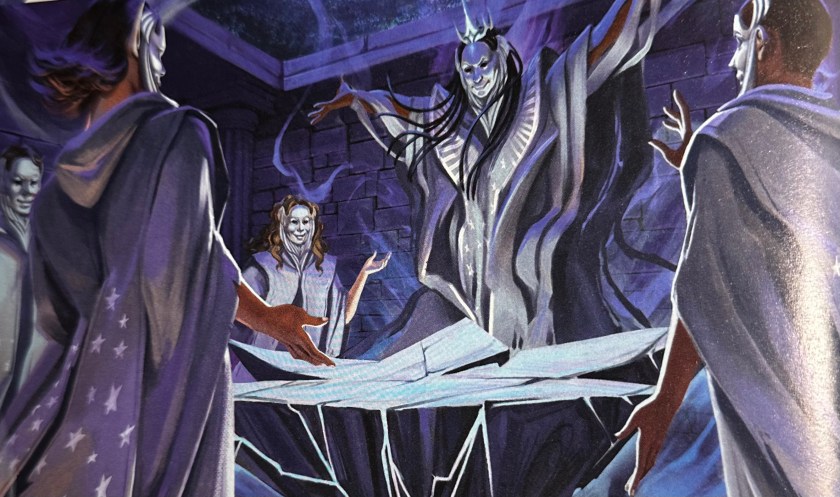
The blackhaller and the burning of the villagers
Once this decision was made, they had to make their way back to Sothmere where a local judge, known as a blackhaller, had been helicoptered in to force the issue of the infected villagers. As the PCs got back to Sothmere, they had the sick ones tied to stakes, ready to be barbecued. The PCs had to make another big decision here, and, perhaps, try to convince the blackhaller to back down.
Thus ends the adventure. I skipped over some middle bits, but that is the essence of it.
Layout, artwork and maps
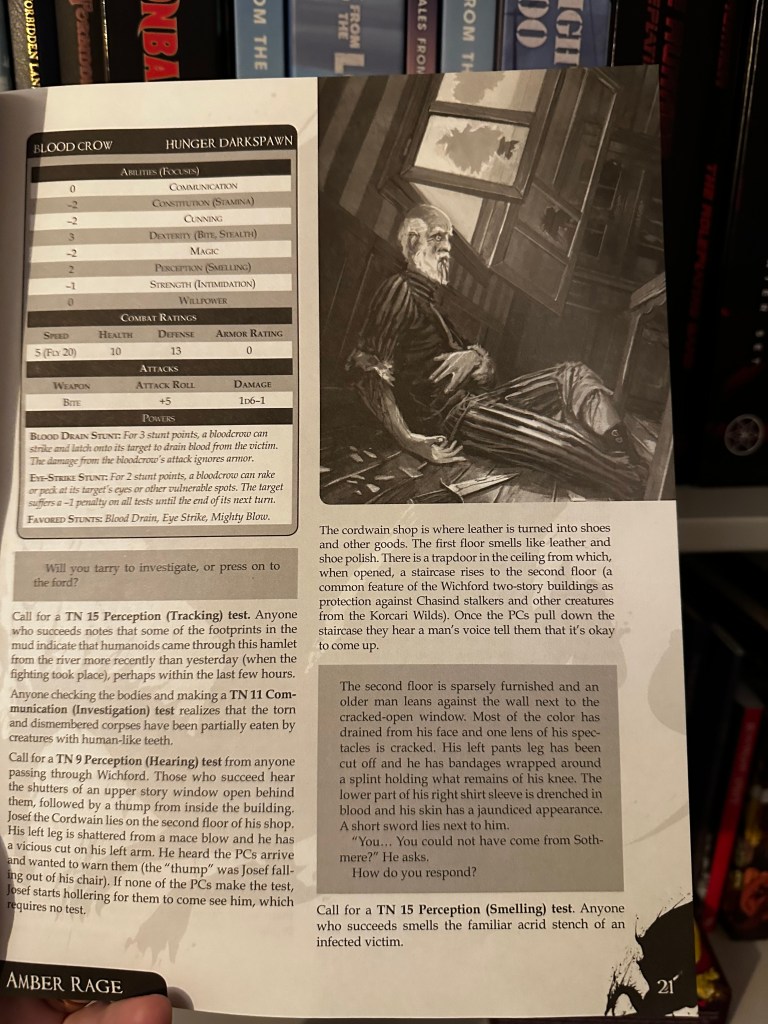
The layout of this thing is kind of all over the place. There are NPC descriptions separated from their stat blocks by entire pages in some instances. There are some which have the stat blocks of one NPC associated with the description of another, making it really hard to find what you need in a pinch. It’s the same with the enemy stat blocks, which are sometimes so far removed from the encounter descriptions as to make them seem as though they belong to another encounter altogether. I think one of the problems here is the massive parcels of real estate demanded by the standard Dragon Age RPG stat blocks, which presents some serious layout headaches. I had to do a lot of prep to make sure I had all of the relevant info and stat blocks on hand for any given encounter, social or combat.
Statblock Nightmares
The splitting of the adventure into parts, like chapters in a novel, was something I found useful. I tried to aim for completing one part each session. In the end, it did take 6 sessions to complete it.
The artwork is nice, although much of it was clearly supposed to be full colour but was presented in black and white, which was a shame.
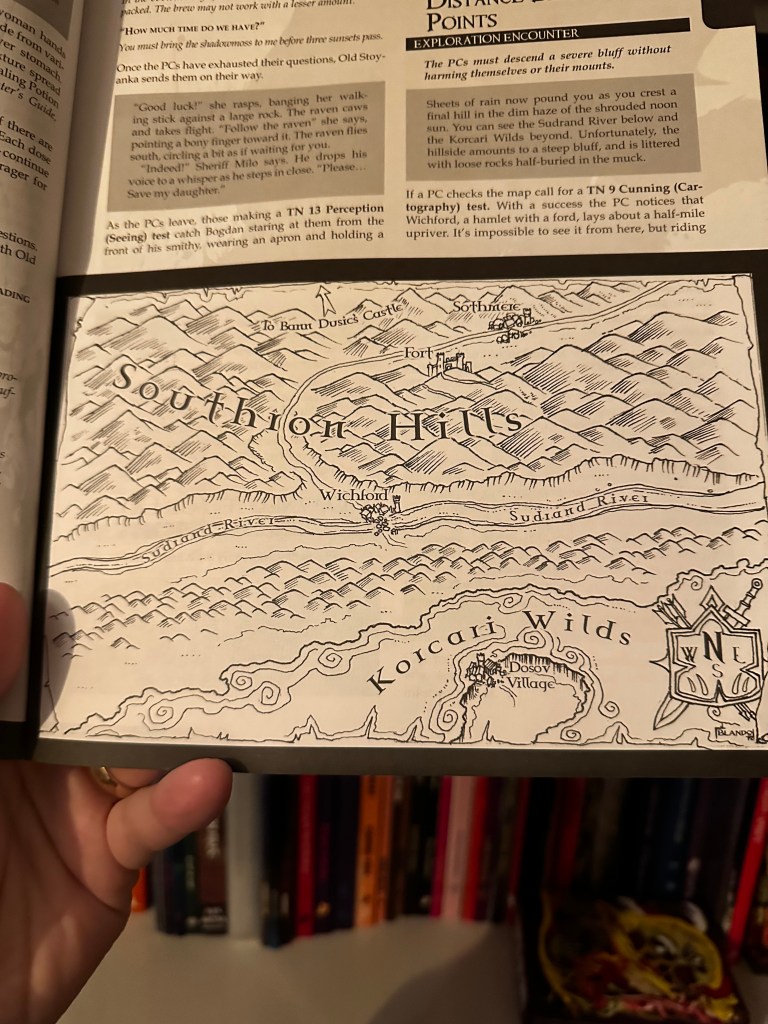
Shadowmoss Grotto MapSouthron Hills map
The maps are great. I really liked the small regional map and the one of the grotto. I used both at the table, revealing parts of the grotto map to the players as they discovered more of it.
Decisions, Decisions
Dragon Age is built upon difficult decisions, choices that matter and have lasting consequences and you can see that’s what the writers are trying to present as the frame that Amber Rage is built on. Should they allow the little boy be killed by ragers, or his sister? Should they kill the leatherworker who’s been infected but hasn’t turned yet, or should they give him their brew that slows the infection, endangering themselves? And, ultimately, should they condemn the firesprites to extinction or save the villagers?
Josef the Leatherworker – poor bastard
Now, this is an adventure that is written with some trad sensibilities. There are long paragraphs that examine each and every option available to the PCs in any given situation (or so the designers thought.) It presents you with the sorts of ability tests the PCs will need to make, their target numbers, the modifiers applied due to darkness or marshiness or stinkyness etc, etc. But, in almost every situation, my PCs found another alternative. They saved both children by the clever application of (checks notes) ranged weapons, They debated over the fate of the leatherworker so long that he turned Rager while they were still talking, and the shadowmoss problem? Well, they took the long view, what if they stole all the shadowmoss, killing all the firesprites in the process, and saved the villagers, but then there was another infection later and there was no Shadowmoss to help them? So they said, screw you Sothmere, we’ll only bring enough of this shit back to cure one individual fucking villager and then leave you to decide who should get it! The firesprites were happy, but no-one else was.
What particularly annoyed me about the text was this, it assumes that the party would choose to take the Shadowmoss. Almost all of the events described after the grotto involve the “fact” that they have a potential cure for the Amber Rage and others want it or others don’t want it used or something along those lines. So, those were largely useless to me. At least this allowed me to cut out swathes of what was always going to be the least interesting portion of the adventure, the trip back to town, which was staged as a series of encounters. There is a box on one page entitled, “Sustaining Drama and Varying Beats on the Journey Back.” The text in this is there to advise you to switch things up and vary the encounters because otherwise they might seem a bit samey… Could have just left them out, in my humble opinion.
They also present a number of NPCs that are either sympathetic or not, though. I can’t imagine anyone really liking Bogdan, the blacksmith, or even agreeing with him, in fact. Everyone is going to like the personable and honourable Sherrif Milo, though. So, when the players are asked to choose between the two, it’s no choice at all.
Some of the more sympathetic NPCs were the elven performers, the brother and sister duo, Oleg and Dielza. Our very own elven Grey Warden, Halvari, developed a closeness to them early on, so when Oleg was infected and Dielza was not, she promised to save him… But of course, in the end, she couldn’t. She had had to send over the single portion of shadowmoss and the good people of Sothmere were never going to cure the elf with it, so Halvari was left with no choice but to take Ole’g life before he turned and before the villagers could burn him. This was a truly sad moment that was always a possibility in the text but which was brought alive by the player in some outstanding role-play.
Conclusion
I loved the set-up for this, the festival, the mini-games (I forgot to mention a drinking mini-game from later in the adventure that was also very fun,) the moral dilemmas. But, throughout, I found myself wishing to be freed of the constraints of the text. I wanted to have been presented with the overall situation, the NPCs and some potential encounters and locations, and then let the PCs just go and figure it out. I guess I have been playing a lot of OSR recently, and it’s had an effect on my brain. In my thinking though, this would have solved the problem of the designers assuming the decisions the PCs would make, that I pointed out above.
I also don’t feel like it was quite Dragon Agey enough. It was missing abominating mages, darkspawn, spirits and demons. It could have been set in almost any generic fantasy setting without making almost any changes.
Finally, our crew of fourth level grey wardens had a very tough time with some of the only slightly upgraded combat encounters. They were lucky to have survived the evil giant crab attack and don’t even mention the marsh wolves, the mage went down twice… Actual 1st level characters would have been completely buggered, in my opinion.
Marsh Wolves – watch out!
Despite all my gripes with this adventure, we had a great time with it. This had a lot more to do with the fantastic bunch of Tables and Tales members and Dragon Age fans we’ve gathered, who have gotten into the game, the system, the stunts and the potential for heartache, than it had to do with the scenario itself.
My advice, dear reader, is, if you’re still interested in running this adventure, go through each part of it and prepare it your own way first. Think of potential consequences for decisions the PCs might make that the text does not prepare for, and feel free to cut out large parts of the journey back to the village.
Here’s the story: hundreds of years ago, the city’s premier logistics wizard, Whalgravaak, abandoned his warehouse, having shredded the Manual of Operations for his Sphere Pool (a mechanism used to import and export goods across the cosmos) so that his rivals could never figure it out.
One-shot fun-shot to campaign of terror
You know what it’s like, dear reader: you want to introduce some noobs to RPGs or just to your group of players, you want to make a good impression but you don’t want to scare them off by plunging them into a multi-session campaign with a complicated, crunchy system. So you pick up a location-based adventure, thinking you can just use a small portion of it, just what you need, just enough for one session, one single shot. But, after that session, the curiosity gets the better of you all. That was a weird, but enjoyable experience, you tell each-other. I bet we could have fun exploring the rest of that odd locale, you tell the players, why not have some more sessions and see how it goes? So you do that. And then the bloodbath begins.
Whalgravaak’s Warehouse
SPOLIERS BELOW! If you are interested in being a player in Whalgravaak’s Warehouse, turn back now!
The 1:5 adventures that I own, Whalgravaak’s Warehouse, The Hand of God and Eye of the Aeons. All from Melsonian Arts Council
Whalgravaak’s Warehouse is a Location based adventure by Andrew Walter for Troika! The design is by Shuyi Zhang. It came out in 2023 and was the first of the Melsonian Arts Council’s 1:5, an ongoing series of location-based adventures for Troika! There are a couple more available now and another out very soon. You can find them all here. My somewhat rotating group of Tables and Tales members just had our last session in Whalgravaak’s Warehouse on Monday night, after spending a total of eight sessions there.
Here’s the story: hundreds of years ago, the city’s premier logistics wizard, Whalgravaak, abandoned his warehouse, having shredded the Manual of Operations for his Sphere Pool (a mechanism used to import and export goods across the cosmos) so that his rivals could never figure it out.
Since then, the strange nature of the warehouse, staffed by giants and stocked with oddities, has only grown stranger, and more dangerous. It houses a handful of physics defying, Tardis-like chambers, not least of which is the terrifying Deep Storage, a swirling mass containing several pocket dimensions and a wraith-like being who wants nothing more than to consume intruders. At least one cult has taken up residence, and they are often mutated into horrific Chaotic Spawnlets by the effects of the radiation still spilling from the Sphere Pool. The warehouse is sandwiched by a vast desert of dust occupying the roof, which is peopled by the descendants of Whalgravaak’s former employees and, underneath, the tunnels of a pack of unpredictable Worm-headed Hounds.
But entrance has been forbidden by the Autarch for centuries and, even if you were foolhardy enough to ignore a diktat like that, you would still need to be brave enough to face the unknown dangers within.
The Hook and the Party
The book suggests a few potential hooks for your PCs. Since my game started off as a one-shot, with brand new characters and no existing campaign to work it into, I went for one that seemed like the object might be achieved in one session. They, along with many other groups of mercenaries were contracted to return with the head of a Cacogen, known only as the Opportunist, to their patron, an Exultant of the Autarch’s court. But we dealt with that in flashback as they all sat in the weed-choked yard of the warehouse, dotted now with small encampments of adventurers and brigands all gathering their courage to gain entry. The PCs’ band consisted of a Monkey Monger (and monkeys), a Gremlin Catcher (and dog), a Wizard Hunter and a Landsknecht. They were, to put it bluntly, a motley crew.
That first session was all fun and games. Every encounter, except for the last one with the Cacogen, was resolved peacefully. This happened mainly due to the rolls I made on the Mien table for each encounter. The worm-headed Hounds they encountered wanted to play with the Monkey Mongers monkeys, they did not want to eat them. The Flat Serviceman was happy to follow the party around and clean up after them. The Segmented Crippler in the Pigeonholery, didn’t want to wake up, so they skipped that one entirely. This is a pretty standard mechanic in Troika but I think it gave the players a false sense of security. The session ended with this motley crew finding and defeating the Opportunist quite handily. And, at that point, we thought that would be it.
But a few months later we decided to continue with their explorations of the warehouse. Obviously, their original motivation to explore was gone. They had achieved their objective, but the players were all good sports. They decided between them that the motivation was purely one of curiosity and greed. They had spotted, through a bubble like window in one of the rooms they had traversed, a vast and terrifying pool of chaos and wonder in a room far too big to exist within the confines of the building. This was enough for them. Essentially, they went in search of adventure. Although, through the sessions that followed, I did introduce the idea that they might want to find that cult I mentioned earlier and that they should seek out the incredibly valuable Tome of the Sable Fields that was reported to be stored in the warehouse, somewhere. This gave them a little direction when I thought they might need it, but, honestly, I think my players just wanted to see what new wonder/horror the dungeon had in store in the next room.
The Dungeoncrawl
It was only from this point that I started to really treat this adventure like the dungeoncrawl it is very much meant to be. The book does a good job of introducing the concepts of tracking resources like lantern oil and provisions as the party explores. It also explains the concept of exploration turns and their effect on the game, i.e. the distance you can travel in that time, the amount of lantern oil you use per turn, and the likelihood of running into an encounter. I followed all these rules to the letter and they made for some interesting moments in the game. But, to be frank, the weirdness of the setting is the real draw here, not fiddling with rations and light levels. Also, few of the characters lived long enough for starvation or oil-skins to become a problem.
It also has rules for dealing with the spatially distorted, impossibly large areas within the warehouse. It suggests that the players should make Luck or Skill checks to avoid getting lost in these areas, but, in all honesty, I didn’t really require that sort of thing.
Mapping is also a part of the dungeon crawl format and this adventure does want the party to attempt to map the space for themselves. The thing is, when some rooms appear to be a kilometre wide and the next one is spatially normal, that map becomes effectively impossible for them to draw accurately after a relatively short period of time. Eventually, I gave up and just shared the one from the book with the players, trusting their ability to separate player knowledge and character knowledge. My advice, if you are doing this, try get your hands on the PDF version, since the one in the physical book stretches across two pages and the crease obscures part of it.
In fact, the adventure has four maps:
the warehouse floorpan, using 10ft squares to denote distance
a hex crawl for the desert on the roof, replete with points of interest
a map of the Worm-headed Hound tunnels beneath the warehouse, superimposed over the warehouse plan
a largely vibes-based map of Deep Storage
These are all great but usefulness will vary. In our game, the party spent several sessions trapped in Deep Storage but took one look at the desert and noped right out of there. This seems like a good point to note how good all the artwork is in this. There are plenty of colour and black and white illustrations but they leave me wanting even more!
Warehouse Workers and other Beasties
A warehouse is a dangerous place to work, especially when the correct safety protocols are not observed. It doesn’t help at all when you are trespassers and several of the residents are large enough to crush you with a single blow.
The giants are not what you might expect.
The giants are the main NPCs of the adventure and Whalgravaak’s only remaining employees. Each one is fabulously interesting, diverse and well-drawn. They have their own motivations and desires. I was gratified that the party managed to encounter all of them during the eight sessions we played. In fact, one player had two different characters killed by two different giants. I will point out that it is entirely possible to avoid violence when dealing with the giants, it’s just that, sometimes, the Monkey Monger on the team has monkeys who decide to fuck with them and one thing leads to another.
The wraith-like Gulf Man Roamer from the swirling vortex of Deep Storage is a potentially lethal foe who has a chance to show up each time the party moves through that already dangerous room. If it captures you in its bag, it’s going to spirit you away to eat you in its extra-dimensional lair.
No warehouse is complete without forklifts. Whalgravaak’s forklifts are humanoid constructs with the face of the wizard himself. They treat intruders like stock, and will attempt to whack them and pack them. They hit very very hard.
When you read the words, Worm-headed Hound, is this what you imagined?
There are also a bunch of random encounters, including the Worm-headed Hounds I mentioned before, desert nomads from the roof, and Bandits/Burglars/Bastards. These only turn up on the roll of a 1 on a 1d6 for each turn the party travels. It didn’t occur very often in my game. The Roof and the tunnels have their own random encounter tables as well, but I never used them as the party never spent any appreciable time there.
This is just a selection of the possible encounters you can have in this setting. I haven’t even mentioned the tiny army guys, the sentient crane parts, the Onion God or the Mulled Dead.
The Rooms
I have hinted at rooms that defy physics and rooms with pocket dimensions, and those are usually the big-ticket locations that contain some of the greatest set-pieces in the adventure. Deep Storage alone evoked some of the most inventive use of skills and spells and a great degree of fear and tension from the PCs. It killed one of them (two if you count the Rhinoman eaten by the Gulf Man Roamer.) The Roof could act as an entire short hex-crawl campaign and the Sphere Pool has some truly memorable and dangerous elements to it.
However, many of the other rooms have weird and wonderful contents as well. Some of them, the party will glance at and move on, while others will capture their imaginations and encourage them to interact. I never really knew which reaction I was going to get from them, actually. The room full of melting rope? They had to spend an hour trying to figure out how to set it on fire, the eternal battle between tiny armies playing out across a battlefield seemingly larger than the whole warehouse? Just popped their heads in and left with some captured little men.
Some of the rooms were relatively mundane warehouse style rooms with shelves and containers. The book has tables in the back to help you identify the state those rooms are in and the contents of the containers, which is useful.
One of my over-riding impressions by the end of our game, was that in some ways, the great variety of bonkers content in the rooms served to detract from any unifying theme. There were some elements that went together, such as the warehouse’s disdain for traditional dimensions. If my PCs had explored the Roof or even encountered any of the nomads who dwelt there, they might have found a distinction between those descendants of the ancient striking workers and the giants who continued to obsessively do their jobs even long after their employer had passed on. But, none of that is to say that the rooms weren’t endlessly fun and inventive.
A Note on Lethality
I recently wrote a post sharing some of the obituaries of the characters who met their ends in Whalgravaak’s Warehouse. You can check it out here. There are only three of them in that post. A few months previous to that, I wrote this post, which contained the obituaries of two more. The mathematicians amongst you will have summed those already. That’s five. In the final session, we lost another one. That makes six. That was three character deaths each for two particularly unfortunate/reckless players. Warehouse work is dangerous. Only one of the original party survived to the end. You have been warned.
Conclusions
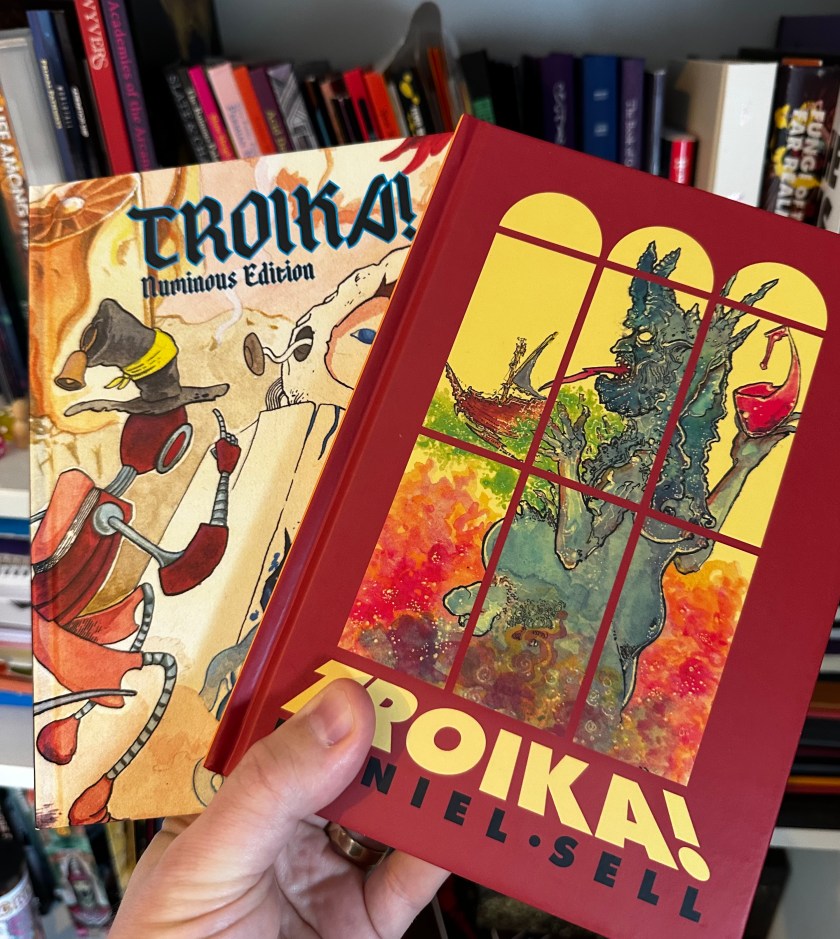
Numinous or otherwise, its the same game.
There is so much to recommend in this adventure. It is endlessly entertaining, challenging and bonkers. It has such a variety of locations and such a diversity of encounters that you would need to work hard to get bored in Whalgravaak’s Warehouse. I think it works so well to show off Troika! as a system, too. The problems it asks the PCs to solve and the encounters they have to deal with utilise things like the Luck check really well and encourage players to invent their own unique Advanced Skills. But if they get into fights, especially with the incredibly random nature of Troika! initiative, there is a very high chance they are going to come out of it dead. There are a few opportunities for insta-kills throughout the warehouse too. I can’t overstate exactly how lethal this adventure is. Luckily, my players leaned into that, even when they were creating new characters to join in the same fight the original one died in (they got very quick at creating characters.)
I think it’s also flexible enough for many GMs to easily take it or part of it and fit it easily into their own ongoing Troika! campaign. As I said at the start, our game started as a one-shot and it could have ended there. But we were able to easily adapt it into a short campaign of its own.
Dear reader, let me know if you have played Whalgravaak’s Warehouse or if you would like to! I’d love to know your views on it.
At one stage, the Elf cast a Magic Missile and it caused a rain of frogs on the entire party and all their enemies, almost killing several on both sides!
DCC Day
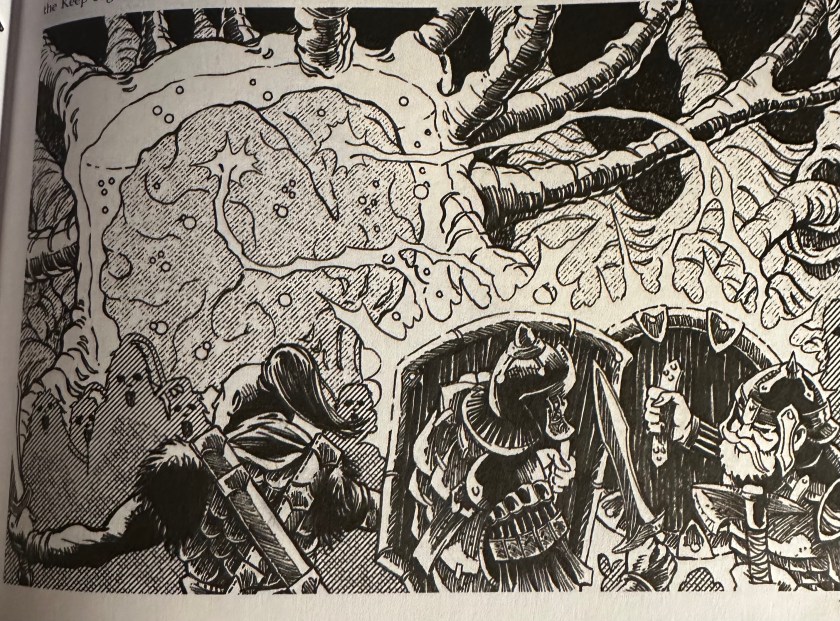
I kind of knew it was DCC Day on the 19th of July. It had been advertised to me enough times on Instagram after all. But that was not why I had scheduled a DCC one-shot on the 20th of July. That just happened to be the best day for most of my players. As serendipity would have it, the module I planned to run was the Grinding Keep, an adventure designed by Marc Bruner, which appeared in the Adventure Pack for DCC Day 2024 along with the XCC RPG adventure, Tucson Death Storm!
Hook
I had introduced the hook for this adventure in our recent run of Sailors on the Starless Sea. The PCs discovered a map to a keep and a note hidden in the lining of a cloak in amongst the charnel remains of many butchered humanoids in that adventure’s tower. The note was from the patron of the poor unfortunate who lost their cloak and it indicated that their patron would pay 1000 gp for the safe return to them of a magical lantern. As budding adventurers, most of whom barely had two groats to rub together, this seemed to be motivation enough.
Each player had only one surviving character from the 0-level funnel and one of them was not able to make it to this latest game so I supplemented the four characters who advanced from 0-level to level 1 with a couple of pre-gens kindly provided for the Grinding Keep by Goodman Games themselves.
Big Party
So the party was made up of six level 1 PCs, a Warrior, a Wizard, a Cleric, a Dwarf, an Elf and a Halfling. Two of the players played two PCs each and two of them played one PC each. All of their abilities proved useful. I would say a varied party is very beneficial for this module. On the other hand, if I had to do it again, I probably would have left the players with one PC each even though the adventure calls for 4 to 6 level 1 PCs. They all survived easily enough, although there were a couple of close calls.
Starting the Adventure
SPOILERS! – If you are a player who might want to play this module, stop reading now!
To begin, I plonked them right at the door to the keep as the text suggests. The module wants you to do this. It is designed to be a one-shot by the gods, and it will be! No faffing around in town, shopping or gathering rumours. Just get them in there as quick as you can. I did have to utilise the handy, and essentially invulnerable Leaf Elemental that waits on the grounds of the estate for anyone foolish enough to hold up the proceedings of your one-shot by searching for herbs amongst the overgrown gardens which seem to be under the influence of all four seasons at once. The seasons are a recurring theme and I was gratified to note that the players realised this almost immediately.
Anyway, once they had been chased inside the keep, they were confronted by something that could only have been a magical effect that transformed the interior from a ruin to an immaculately decorated and lit hall. They were greeted by the white robed Host and eventually waited on at dinner by his veiled servants. All of this set up was important. It presented clues to the nature of the keep to the PCs and let their imaginations run with them. Enough strangenesses occur during dinner and upon their investigation of the ground floor of the keep that they should be suspicious. Indeed, before they had even left the dining room, one of my players joked, “the house is a mimic!” He didn’t know how spot on he was…
Of course, the keep is, in fact, an other planar entity who comes to the world to feed, in disguise. The PCs had seen windows and chimneys on the outside but could find no sign of them on the inside. The couldn’t get through any doors that the Host didn’t want them to enter, etc, etc. Clearly, there is enough evidence to allow your players to uncover the truth before things ever really get interesting.
One regret I have is how much time I allowed them to devote to this whole section before Event One occurs. They spent a lot of time searching, theorising, investigating, and it ate into the more adventuresome elements in the latter stages of the module. My advice would be to get them into the Guest Quarters and asleep as quickly as possible. The adventure does not provide much in the way of motivation for the characters to do this, however, so be prepared to improvise.
Event One
Event One is triggered when they wake up after a nights’ sleep in the keep. I was lucky enough that the players wanted to rest and one of them was rendered magically asleep, but without that, it would have been a struggle to get them to wait until the next morning. I probably would have triggered Event One early, if that had been a problem.
What “Event One” means is that the keep is waking up. It will soon be ready to consume a fresh meal of adventurers.
Mechanically, what it means is that every time they open a door, they will be confronted with an intersection of corridors that lead to two randomly determined rooms in the keep. These could be rooms they already visited in the first part of the adventure, or ones that would have been otherwise inaccessible up until this point.
The first room my players visited was the dining room again. This was satisfying as it gave them a chance to kill the Host and his servants from earlier (although, technically they just put the Host to sleep and dragged him around with them for the rest of the adventure.) After that, they encountered one of the three rooms that contained the organs of the keep. They had discovered the journal of a former prisoner/meal in their quarters that gave them hints as to how to deal with each of the organs; eyes, heart and lungs, and that proved useful in the encounter they had with the heart. It is significant that they identified several magic items that act as keys for the doors to these special rooms. But their first instinct was to destroy them if they could. Luckily they forgot about that plan and just kept ‘splorin’ instead. Eventually they managed to overcome the challenge in the heart room and at that point of our session, I realised I was running out of time to get my one-shot done in one shot so I focused things up a bit.
Event Two
The way it was supposed to work was this: every time they left a room, I would start marking that room off as no longer accessible on the random room table, until there was only one possible room left; the one that contained the Alien Intelligence itself. I didn’t have the time for all that. We were approaching the four hour mark at that point and people had work in the morning. So I just told them that, after they destroyed the fiery orb that acted as the keep’s heart, the entire place shook and when they re-opened the door to leave that place, the corridor beyond led to the last room. The players, unknowing, proceeded to their fate. Their fate, as it happened, was to murder the Alien Intelligence of the Grinding Keep, all its Animated Corpses and the Giant Animalcule Swarm that accompanied them. Destroying the heart had pretty much halved the creature’s HP so it wasn’t too difficult. In the end, they fled through the windows in the back of the room, utilising the Feather Fall spell (which two characters had, by coincidence) to safely land in the river at the bottom of the canyon beyond.
Conclusions
Perhaps you can see now why I think I should have made things a little harder for them by reducing their numbers. On the other hand, I am glad they all survived. They had all created and played such interesting and fun characters, even in the context of a game that is not RP-heavy, to say the least.
I was a little disappointed to reach the end of the adventure with so much cool content unexplored. They didn’t find the trap/treasure room where the magic lantern was stored, they didn’t find any of the other organ rooms, which all had really fun mechanics. On the other hand, I felt the adventure was designed to be flexible enough for a Judge to shortcut it exactly the way I did to get them to the end a little quicker, which seemed like good design to me.
This was only the second time any of us had played DCC and the first time with characters of anything other than 0-level. This was a different game to that first experience. PCs used magic and Mighty Deeds at every available opportunity and they got to roll on the crazy magic random tables a lot. At one stage, the Elf cast a Magic Missile and it caused a rain of frogs on the entire party and all their enemies, almost killing several on both sides! This is why we loved DCC. It’s the wonderful and potentially lethal randomness of it and the endless inventiveness of the adventures.
I would recommend the Grinding Keep as a one-shot DCC adventure, as long as you are willing to either cut out bits or extend it to two sessions.