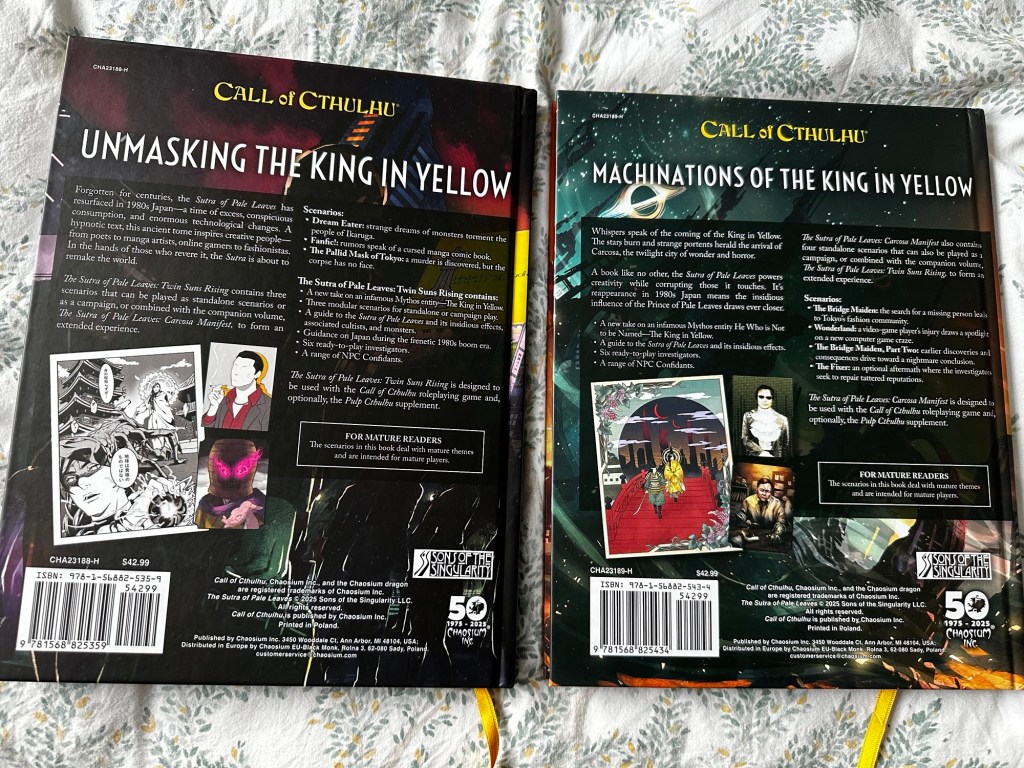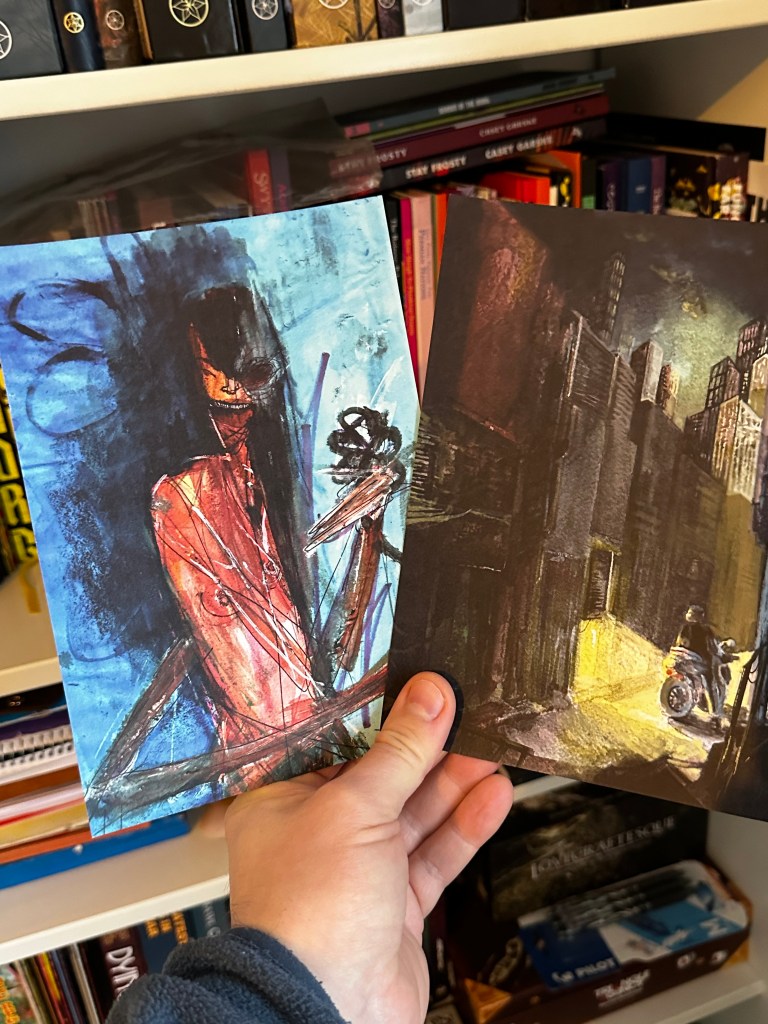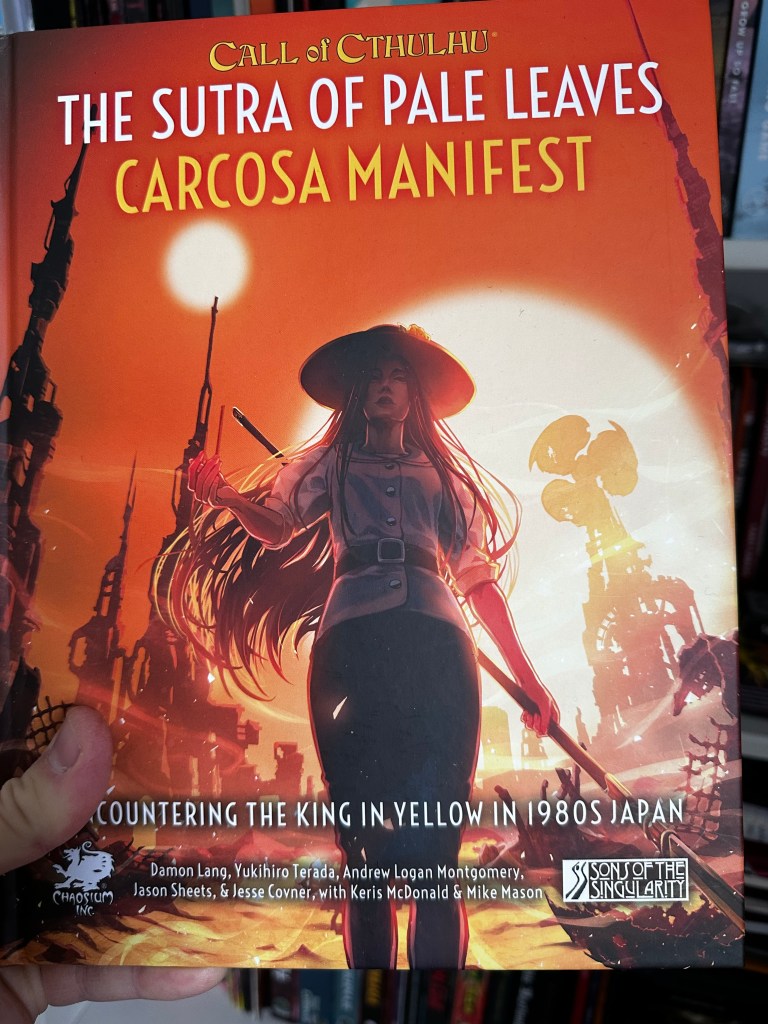
The Sutra of Pale Leaves, The Pallid Masks of Tokyo

The Sutra Continues

This is the fourth in a series of posts on the Sutra of Pale Leaves, the Call of Cthulhu campaign set in 1980s Japan. Go check out my previous posts on the subject here.

Insanity

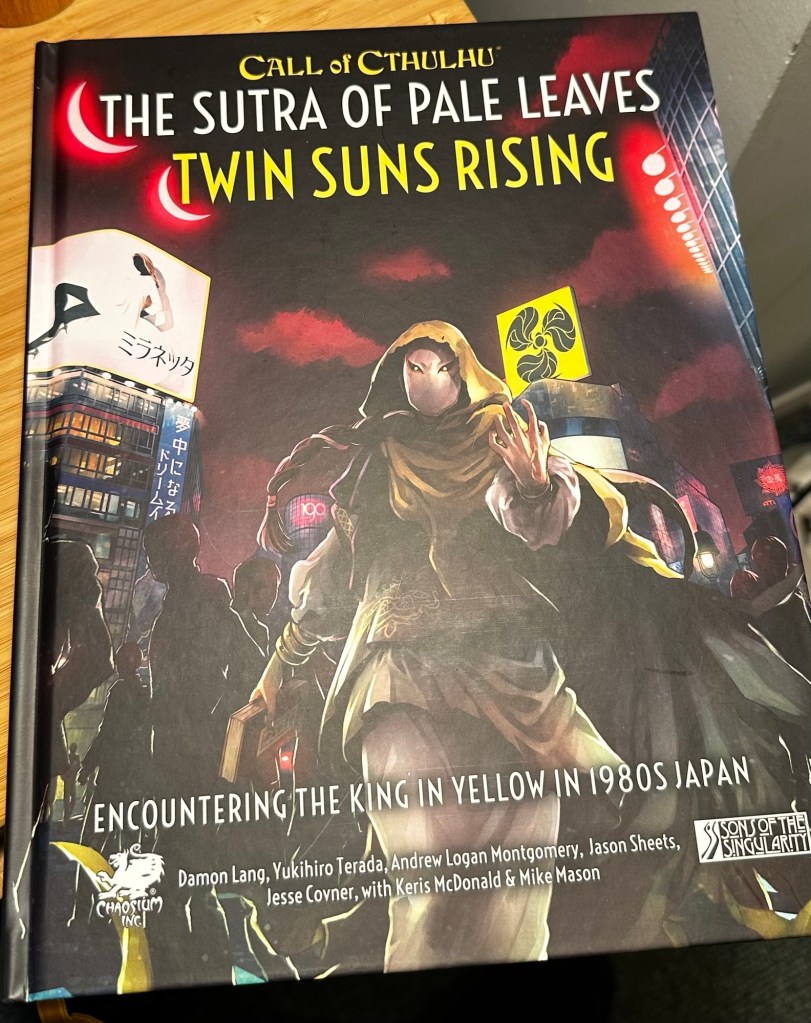
This is the third scenario in Twin Suns Rising, the first of two books that make up the Sutra of Pale Leaves Rising campaign for Call of Cthulhu. Its written by Jason Sheets.

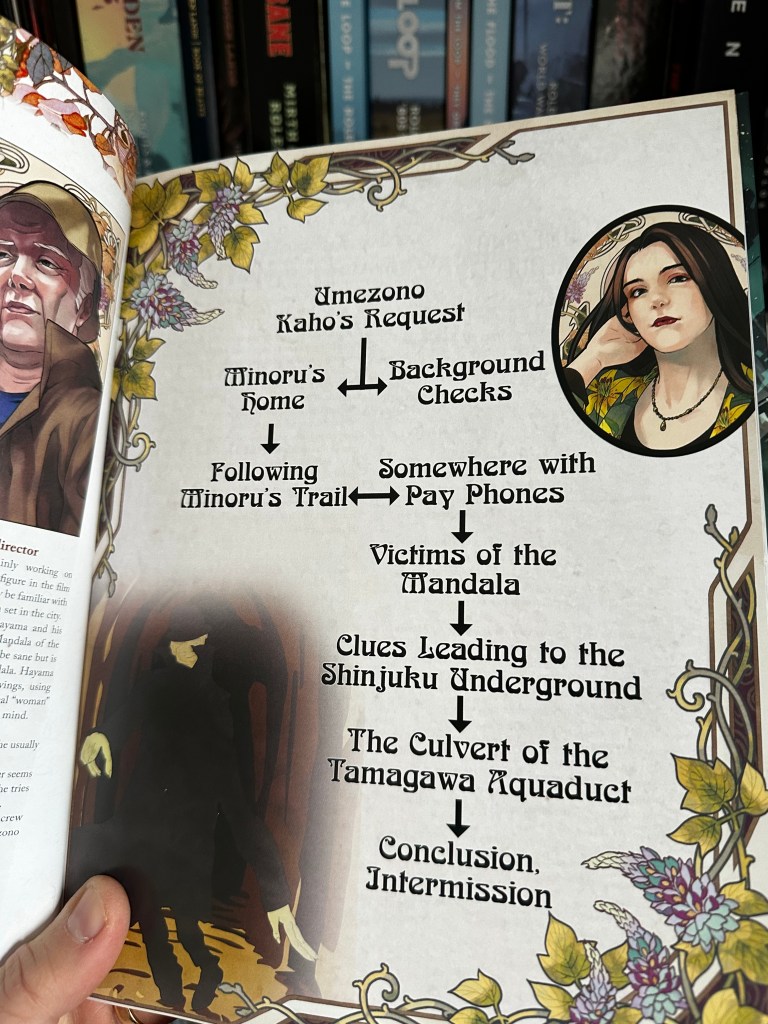
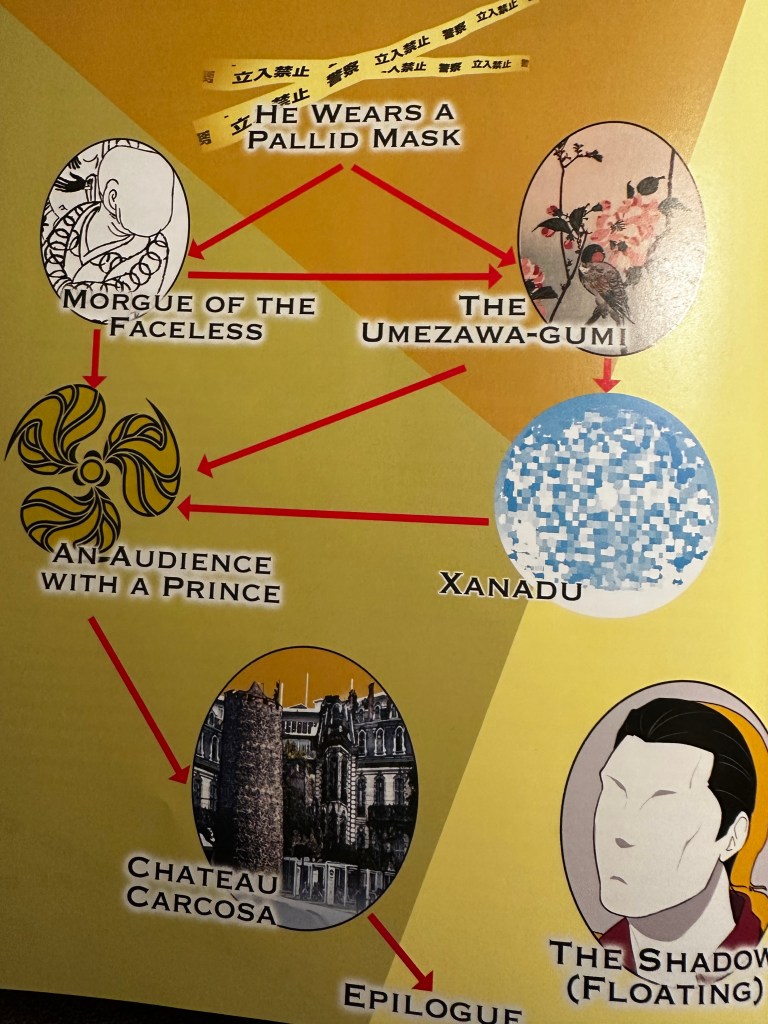
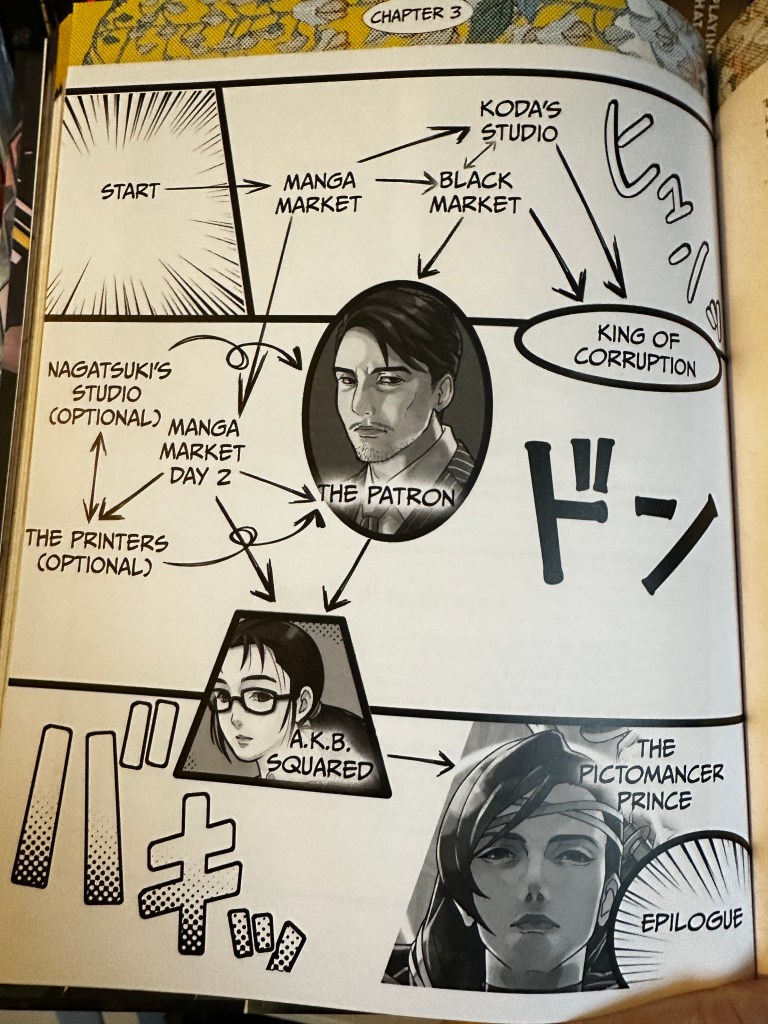
This scenario is somewhat shorter than Fanfic, coming in at only 32 pages. Its format more-or-less matches the other adventures in this book. It has a scenario flow diagram, although it is less easily identifiable in theme this time. We get a larger number of NPCs introduced near the start than in previous scenarios. The plot feels like it’s quite reliant on the actions and reactions of these NPCs and some of them act as redundancies should the more important ones meet their end prematurely. Some of them can also be used as fill-in PCs, in case the worst should happen.

Graphical display of the flow of the scenario
Scenario flowchart

WARNING! Spoilers ahead! If you want to take part in the Sutra of Pale Leaves campaign or even just this scenario as a player, you might want to refrain from reading further. I’m going to write about stuff you would rather was revealed during the course of play.

Appropriately for a Call of Cthulhu scenario, The Pallid Masks of Tokyo partially takes place in a psychiatric facility. It also involves that perennial favourite of Japanese 1980s stories, the Yakuza. Crime and insanity seem to be the two main themes of this scenario, which also makes a lot of assumptions regarding the PCs occupations. It really wants them to be cops or cop-adjacent, at the very least. We are told this in the “Involving the investigators” section, which presents three hooks. Only the first one assumes your PCs are police and we are told, if you don’t use this one it will make, “dealing with officialdom considerably more difficult.” The Campaign Background section at the start of the book told us that it was not necessary to play the same investigators the whole way through, and the Pallid Masks of Tokyo seem to actively encourage your players to switch their old PCs out for a more law-enforcement based character. Perhaps the authors did not expect any of the investigators from earlier scenarios to survive, or expected them to be assimilated by the Prince by now. After all, one of the notes presented in the opening pages of this one suggests switching out the main villain of the piece, a psychiatric patient called Yamamoto Minoru for a PC that had been taken by the Prince of Pale Leaves in an earlier scenario. I love this idea. If anything, I think it would be far preferable to using Yamamoto, but, of course, there’s no guarantee that you’ve lost an investigator in this manner so its good to have the NPC instead.

Beginnings

Like I stated above, it’ll be a lot easier to involve the investigators if they’re cops in this instance, because it starts with a murder scene. A body with no face has been found in a Tokyo back-alley, so, obviously, if they have badges, it’ll be a cinch to go there and inspect body and crime-scene. But there are ways around this if they are just librarians or salary-men or whatever.

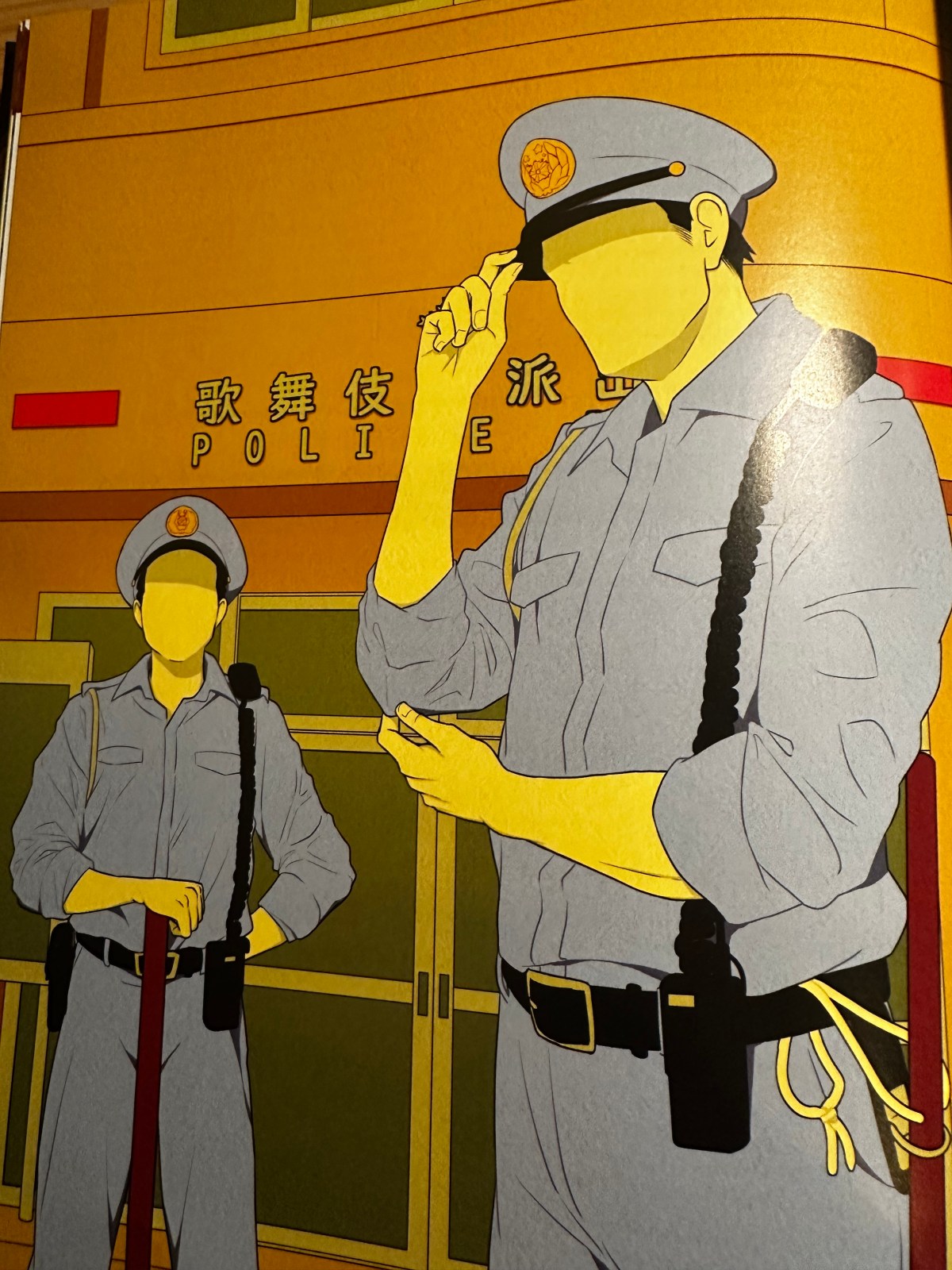
Anyway, one of the beat cops will immediately tell the PCs he thinks the body is that of a Noppera-bō, a type of mythical Japanese monster with no face.

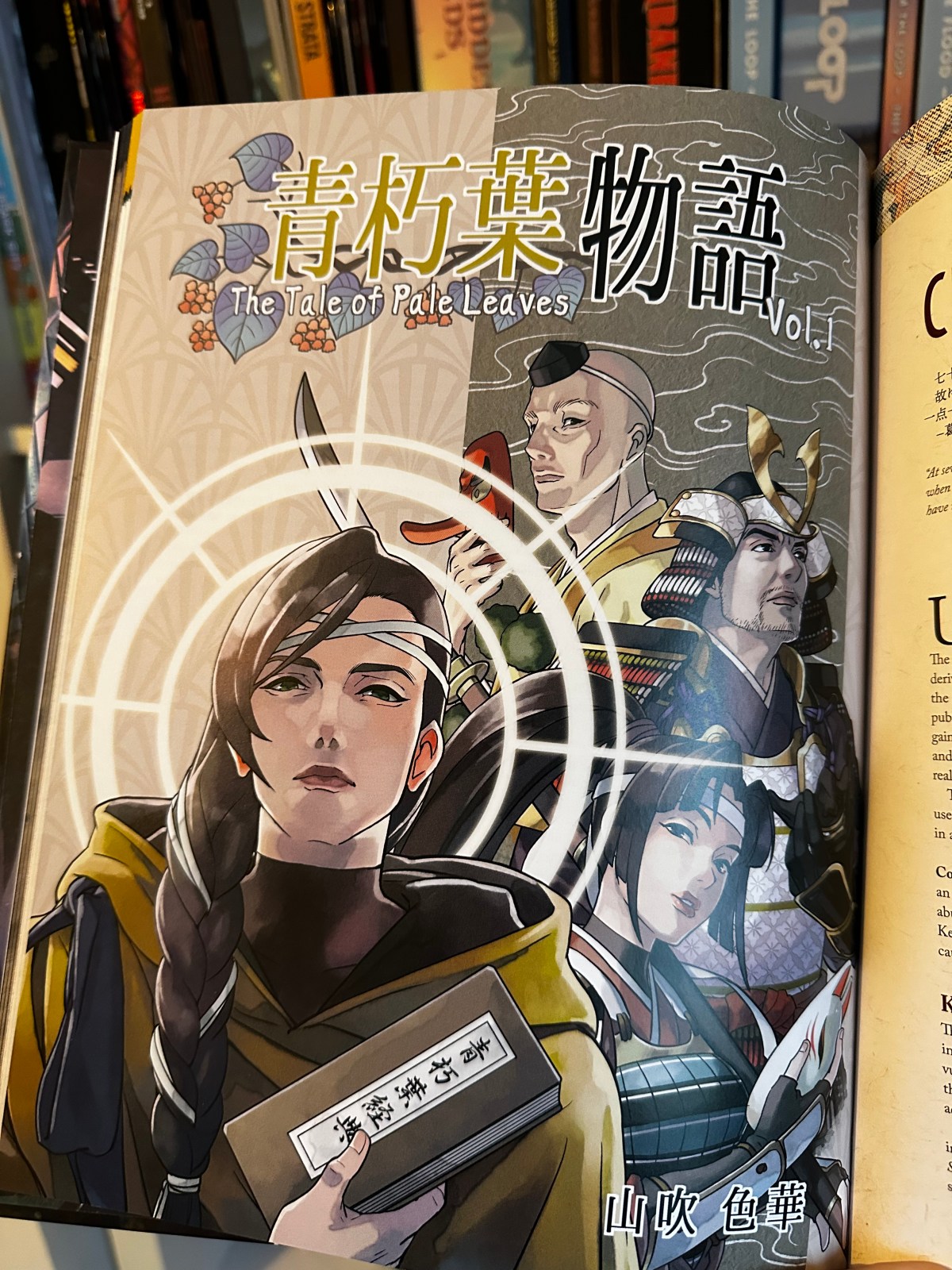
And, he’s not wrong. Yamamoto and his pal, Crazy Kazu (a member of the Yakuza) have been tattooing gangsters with part of the Tale of Pale Leaves (The manga from Fanfic.) This allows the Prince to take them over completely and all in one go. These lads have all been turned into these Noppera-bō. Kazu was the first, and he has gone rogue from his clan, conducting business of his own. Thematically, this is all great. It retains the relationship to Japanese mythology while tying it to the Mythos and the Yakuza and the loss of self and sanity.

Anyway, I love this as a starting point. It’s iconic and designed to draw the investigators in immediately.

Leads

This scenario has a very investigatory nature. Most of the rolls that are called for are in that vein and involve interrogation or detecting in one way or another. While this is true for many Call of Cthulhu adventures, the format, the theme and the major NPCs in this one add up to give it the feeling of a police procedural or an episode of the X-Files.

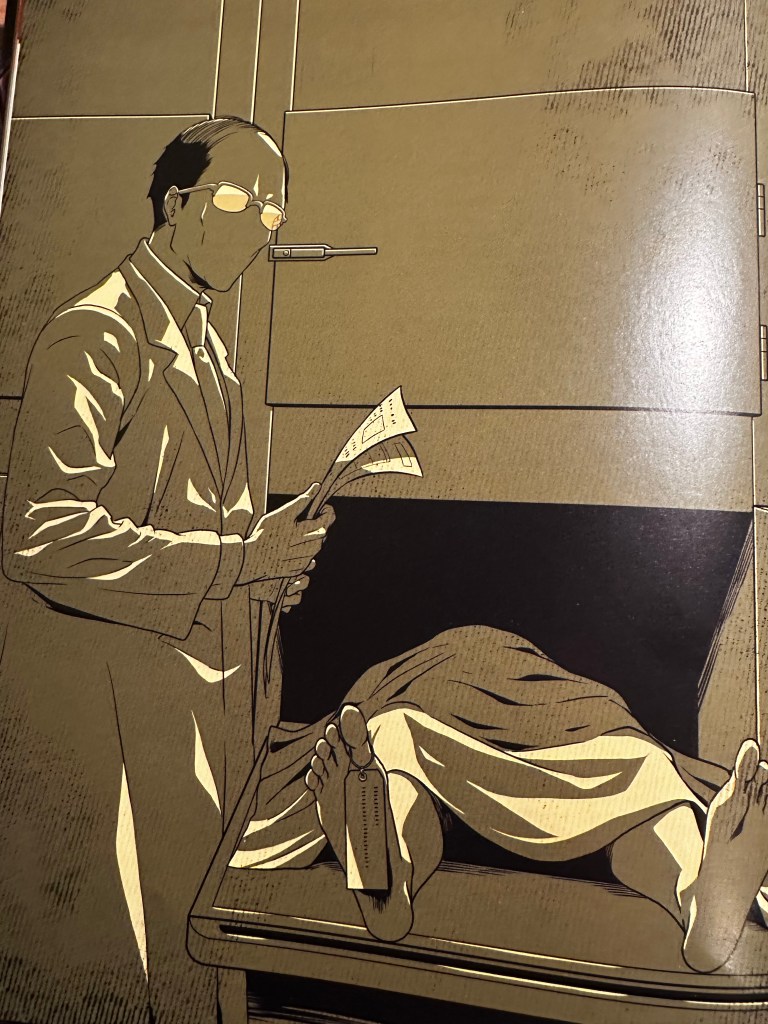
A medical examiner stands by a body in a morgue freezer. The doctor has not face but wears glasses.
Noppera-bo ME

So, from the crime scene, leads can take the investigators to the morgue where they will encounter a medical examiner who is being repeatedly exposed to the sutra via the tattoos of the dead Yakuza, or to the headquarters of the the Umezawa-gumi clan, where they can question the head of the Yakuza group. There is even a scene in the nightclub, Xanadu, run by Crazy Kazu, where my former profession gets a shout-out.

…the clubbers, who include a mix of subcultures, from college students and Japan Exchange Teachers (JET) to newly minted salarymen.

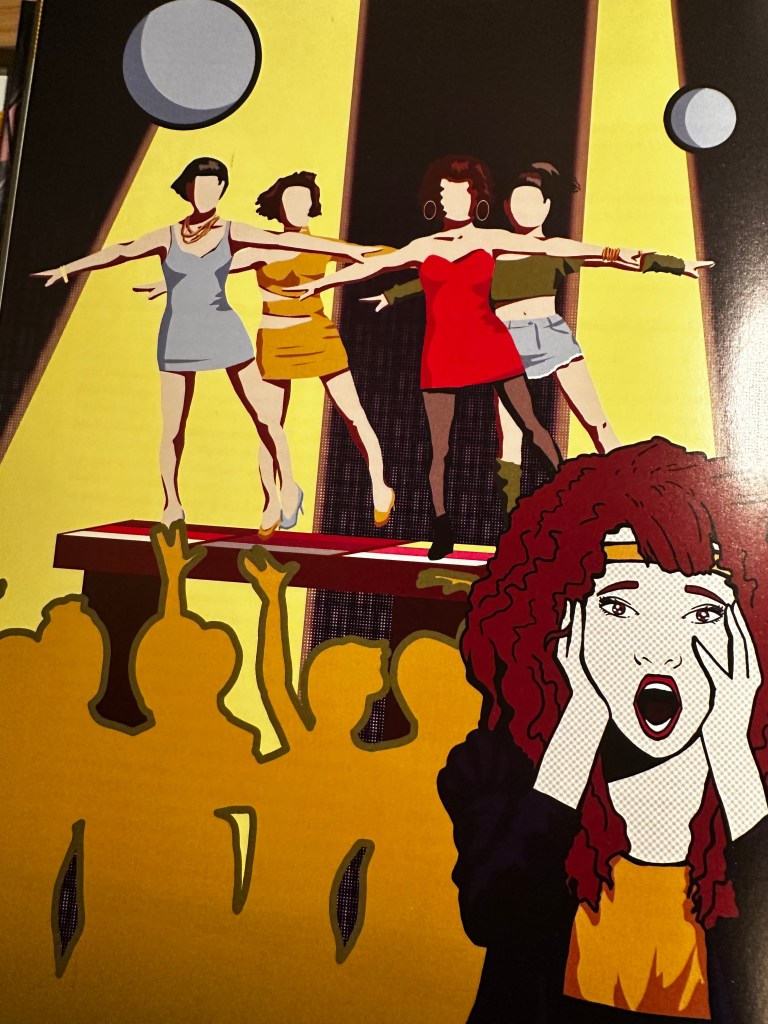
Much later than the time this adventure is set, I was in the Japan Exchange Teachers (JET) program. And it’s quite true to say that we partied a lot in places, if not exactly like the club, Xanadu, then very much like it, every weekend. (Those in the know will also remember a night-club in my hometown of Sligo in the 90s called Xanadu, in another surprising cross-contamination with my own life!) The nightclub scene, of course, is a classic staple of ’80s detective and action fiction, and this one is special. A dance troupe of Noppera-bō ladies take to the stage, constantly changing their faces, sometimes appearing without any features at all, moving to the backing track of “the Litany of Wearing the Empty Mask,” thus exposing the club-goers to the Sutra.

Four faceless dancers in short dresses dance on a nightclub stage while one woman freaks out in the front.
Noppera-bo dancers

But eventually, they will be led to the central location of the scenario, the Tokyo Metropolitan Psychiatric Hospital Secure Unit. Here they will encounter Yamamoto or or that former PC who was over-exposed to the Sutra. In either case, if an investigator has sufficient EP themselves, they will see this person as an embodiment of the Pale Prince, on a throne, surrounded by his Yojimbo warriors, rather than the shaven-headed psychiatric patient on a hospital chair looked over by orderlies. I love this vignette, especially if only some of the investigators see the Prince in this instant. It’s possible, in this instant that those PCs might be overcome by devotion to the Prince. They could even give themselves over to become a Noppera-Bō themselves.

The Shadow

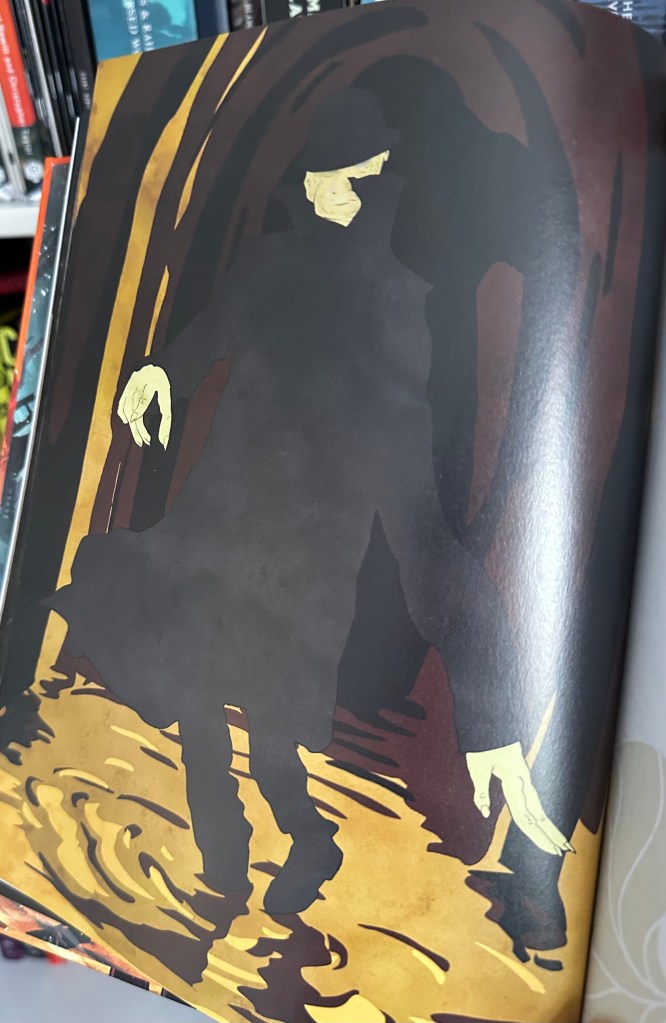
This is a special scene for the Keeper to drop into the scenario at an appropriate point. Essentially, it should act as the retelling of the classic Noppera-bō story from legends, with the PCs as the victims. Essentially, this would involve them interacting with someone who reveals themselves to have no face, only to run, looking for help from someone like a police officer who then reveals themselves to also have no face.

The Keeper would have to take notes and do some prep to make this encounter work in the context of their game. I also think that, if it were perpetrated on a full team of investigators, it would be unlikely to work the way the text wants it to. An individual confronted by this would be far more likely to run and look for help. But if you can pull it off it would be be awesome.

The scenario does give you some advice on how to run it and provides a table of Nopper-bō encounter locations and individuals who could fulfil the necessary roles. So, it’s definitely doable!

Château Carcosa

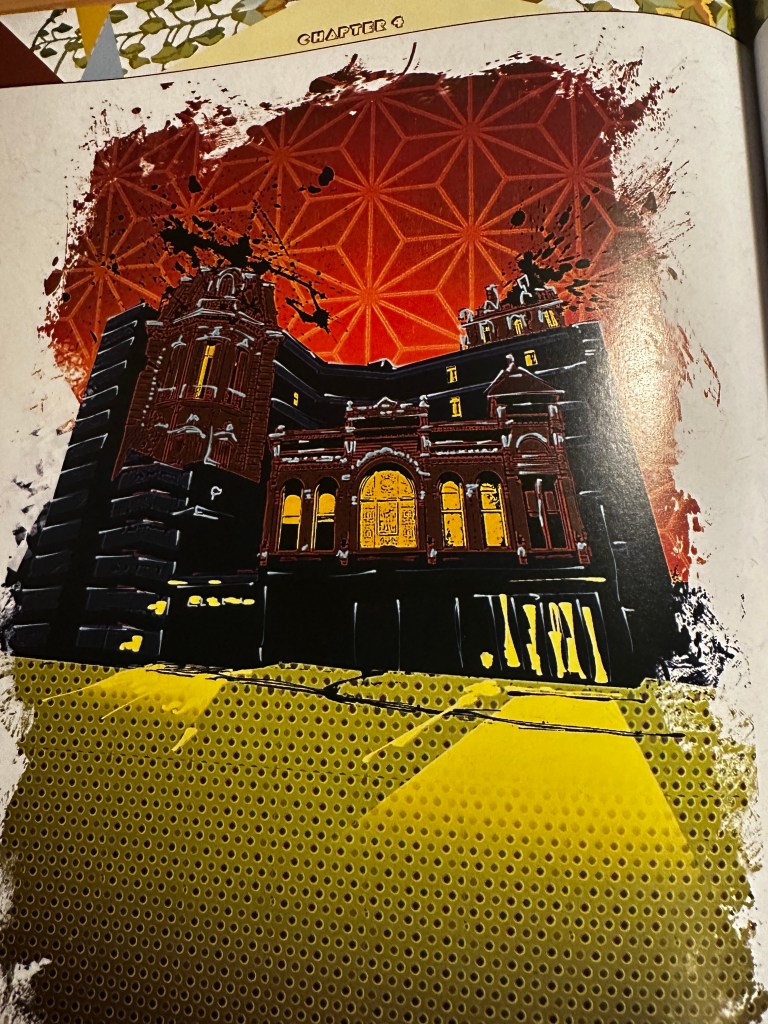
The psychiatric hospital transformed into Chateau Carcosa. It is a scary blak edifice. There is a stylised red sky above and a yellow ground below, representing Carcosa
Chateau Carcosa

This is the location for the finale of our scenario. It’s actually the same psychiatric facility the investigators visited earlier, but transformed. Now, it’s the residence of the Prince of Pale Leaves, transplanted from Carcosa. The Royal Palace is very different from the building the PCs will remember:

The floor is polished rosewood. The scent of spring blossom fills the air, but the sweet scent occasionally shifts to that of rotting leaves. Yellow-furred bats roost in the angles of ancient roof-beams. Plaintive music, played on traditional stringed instruments, wafts through doorways, while the faint sound of laughter, and then a scream, can sometimes be heard.

From what I know of the second book of this campaign, Carcosa Manifest, this section is an appropriate pre-cursor to some of the events in the scenarios contained within that. The investigators can get a glimpse at the alien world of Carcosa through the windows of Château Carcosa, while two of the later scenarios, the Bridge Maiden, Parts 1 and 2, involve the cult building a literal bridge between our world and that dark one.

Endings

The investigators are likely to end up in three different situations:

  1. Defeated completely by the Noppera-bō, by whom they are utterly out-numbered in the palace. Even PCs who die in the final confrontation may, however, awaken later, as patients in the hospital themselves and might even see action in later scenarios!
  2. Some of them will become Noppera-bō themselves, unbeknownst to the other players, and will attempt a Noppera-bō scare (as described in The Shadow section above) on their fellow investigators in later sessions. Love this one.
  3. They defeat Yamamoto somehow, killing him or stopping him in some other way. In this case, the hospital immediately reverts, as do the people who had been transformed by his tattoos.

Conclusion

The Pallid Masks of Tokyo is probably my favourite of the three scenarios presented in this book. It has some great locations, fascinating and horrifying monsters and well-realised themes and motifs. I do feel like Yamamoto/The Pale Prince, could be better drawn, though. Even the final confrontation with him in the Château seems hastily wrapped up. I was expecting more from the scene in the throne room than we’re given here.

I think this is a great concluding scenario for the Twin Suns Rising portion of the campaign and a great bridge into the next part, which I will discuss in coming posts about the scenarios contained in Carcosa Manifest.

The Sutra of Pale Leaves: Fanfic

The Sutra Continues

This is the third in a series of posts on the Sutra of Pale Leaves, the Call of Cthulhu campaign set in 1980s Japan. Go check out my previous posts on the subject here.

Adaptation

In Fanfic, by Damon Lang, the Prince moves to the big city and tries to make a name for himself. But some bullies don’t want him to succeed. Those damned investigators!

The scenario flow chart drawn in manga style with lots of sound effects reverberating around the page and portraits of the main NPCs
Scenario Flow Chart

This is a long scenario, 53 pages, in total, so I’ll just note at this point that its format is practically identical to Dream Eater’s, which you can read about here. Similar to the first scenario, it also has a really nice, manga-themed scenario flow diagram, which seems very helpful. It also makes use of several of the same NPCs who act as the Confidants to the investigators and plot hook facilitators, which I touch on here.

From this point on, THERE WILL BE SPOILERS! If you intend to take part in this scenario or campaign as a player, turn back now! You have been warned.

The Prince of Pale Leaves wants to find new media to help spread his influence around Japan. Since he turns out to be a big nerd, he decides to use manga as his chosen medium. This makes for a fun, tongue-in-cheek romp across the seedy underworld of the independent Tokyo manga scene. Everyone here seems to be obsessed by the new, groundbreaking graphic novel, the Tale of Pale Leaves, and its author Yamabuki Iroha (a pseudonym.) This is the setup for this scenario. I like that it has taken us from the small town setting of Dream Eater, to The streets of Akihabara and Ota in Tokyo. And I also like the manga-themed conceit of it because, although I joke about our antagonist being a nerd, it’s true that manga was and is an incredibly popular and culturally important source of entertainment and information in Japan. Also, it makes sense in the way the adaptation is described in the scenario. It seems like a far more efficient way to expose more readers to the power of the sutra than an esoteric work of semi-religious literature written in a form of ancient Japanese could ever be. Of course, it’s also just fun.

At times, though, it loses its Call of Cthulhu flavour as it dances around Tokyo with its magical girls… I’m willing to question whether or not that’s really a bad thing. It certainly feels like it might work better as a Pulp Cthulhu scenario than a traditional one at times (the scenario text even provides suggestions of changes to make if you do want to do that.) Still, I think it’s fair to ask if eldritch horror can’t take the shape of a young woman with a magic paint brush.

Beginnings

A page from the Tale of Pale Leaves manga. The Pince is confronted by someone transforming into some sort of mnoster in the courtyard of a pagoda.
The heroic Prince of Place Leaves

Hooks? We got ‘em. Five in total. These have been thoughtfully crafted to involve investigators depending on their background with the campaign. There’s also one to use in the event that you’re playing Fanfic as a standalone scenario, or as the first one of the campaign. I think this would work beautifully as an adventure all on its own. It’s very much self-contained, thematically coherent and has the potential for some very significant consequences. But as I read through these scenarios, I am starting to feel that this could also be a weakness with the campaign. There is a loose through-line with the Confidant NPCs who act as quest-givers and, of course, the elusive and menacing antagonist in the form of the Prince, but these first two scenarios, at least, don’t feel very connected, from my point of view. Perhaps they will as I get further through the scenarios, but I guess we’ll see. Also, from the start, we are told that we can run the scenarios in any order (despite the existence of a clear chronology to them) and that we can even leave some of them out altogether. I think this very flexibility may hurt its ability to work as a campaign. But, once again, I can’t say that for sure without running it, so take that opinion with a pinch of salt.

Whatever hook you use to get the investigators involved, they start off on a train going to the Winter Manga Market in Tokyo. They encounter some weirdos in Pale Prince cosplay and then immediately encounter the person who will become the scenario’s main antagonist, the manga artist Nagatsuki Kaede, who is secretly the author of the manga adaptation of the Sutra of Pale Leaves. I quite like this conceit as she is almost entirely unassuming as an NPC, and they are incredibly unlikely to be suspicious of her until much later in the scenario.

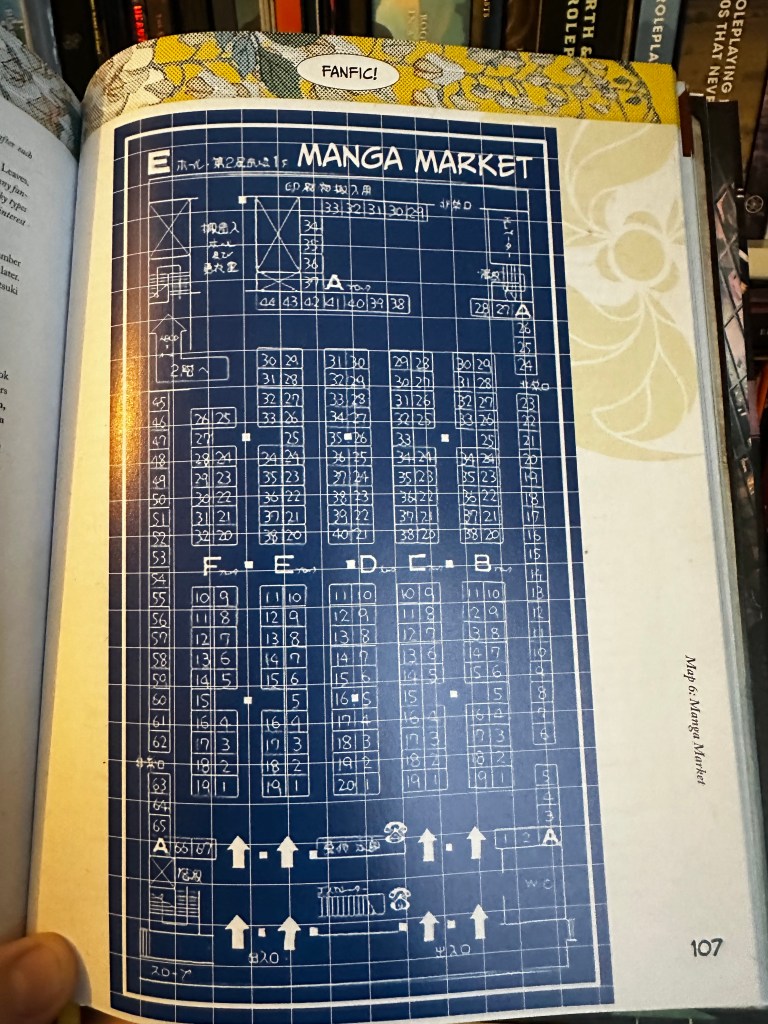
Tokyo Manga Market blueprint map

The entire first act of the adventure takes place in the Manga Market, so it’s nice to get a blueprint style map to use for it. I like that, so far, the maps produced for each scenario have been unique and interesting in format. The investigators are expected to visit several stalls, talk to randomers and plot-significant NPCs alike here. As they do, they will gain some info on the Tale of Pale Leaves and its author. The majority of the clues they get will lead them down the wrong path.

Two Halves

There is an interesting departure, here, from the format of Dream Eater. It is very much a game of two halves.

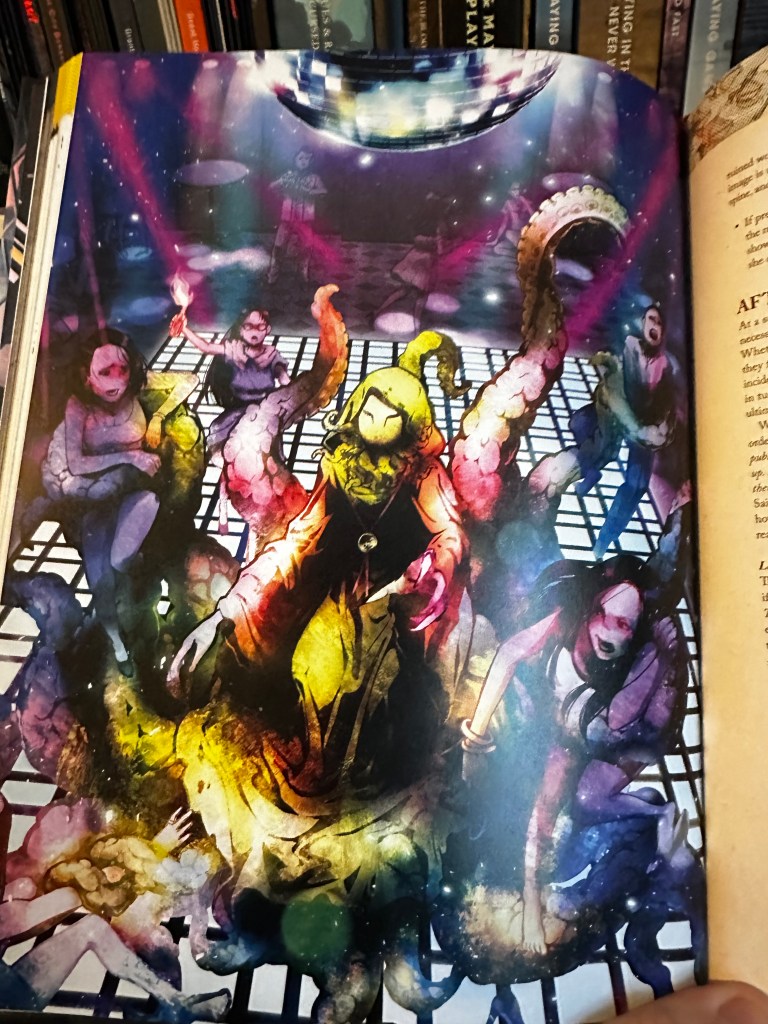
The Alabaster Archfiend on the dancefloor of death

In the first half, the investigators will likely find themselves on the trail of Kōda Tsutomu, a mediocre manga artist who ripped off the ideas from the Tale of Pale Leaves and, in some instances, the artwork itself. In so doing, he has become a vessel for a supernatural entity of his own creation, albeit one without the power or subtlety of the Pale Prince himself. This entity is known as the Alabaster Archfiend, and it is horrible and murderous. This allows for the introduction a new memetic “infection,” similar to the Prince, but separate, and with its own mechanics. This one is not based on the Exposure Points the PCs have been building up since the previous scenario, but on Sanity loss. The first half ends with “an old-fashioned boss fight” where the investigators square off against the Alabaster Archfiend in all his tentacled glory. This will probably feel climactic. The fight itself looks difficult, even if the PCs try to avoid direct combat, and the setting for it is quite nightmarish. So, they could be forgiven for believing they’re done. But of course, there are loose ends, and they should know that Kōda was not the true author of the Tale of Pale Leaves, as he had claimed. So, they go back to the Manga Market for Day Two.

And that’s where the second half of the adventure starts. Now, without the red herring of the Alabaster Archfiend, they can focus all their efforts into finding the true culprit. The investigation will almost certainly take them to see the mastermind behind the Association of Pale Leaves, a charming politician and patron of the arts, Mr Matsushima, who seems like he would be fun to play for the Keeper. This is an NPC who should turn up repeatedly in these scenarios, I would think, if he survives this one. They might also go to visit the printers where the comic is being printed. If they do, they will discover one of the scenes that has really stuck with me after reading Fanfic. Everyone in the building is dead, dying or passed out due to the effect of so much concentrated Sutra emanating from the manga.

The workers closest to the print machinery are dead or dying, their internal organs pulped

The Pictomancer Prince page from Fanfic includes the details of the scene and a manga style illustration of Tokyo Tower in black and white
The Pictomancer Prince scene takes place on top of Tokyo Tower.

They are also likely to finally get the full story when they visit the private party organised by Matsushima for the joined, those who have read the Tale of Pale Leaves and are now inhabited by the Prince. Here they will witness an horrific but ultimately successful ritual involving the ever-suffering Saito Tomoko, Kōda’s girlfriend, performed by Nagatsuki Kaede, using her magical paint brush (yep, that’s right.) This brush gets used for all sorts of things from this point on. Essentially it is a tool to allow her to edit reality. (Come to think of it, this is a nice way to tie the finale of this adventure to the one in Dream Eater. In Dream Eater, the investigators had the ability to edit the the dream in the final confrontation, and had the potential to effect reality from that too.) She then draws a portal in the wall to take her to the top of Tokyo Tower where she starts drawing scenes on the great windows of the observation deck to alter Tokyo subtly, allowing the spread of the Pale Prince even more easily. She undergoes a literal magical girl transformation in this confrontation, which elicits a Sanity Roll from the investigators. This is so funny to me. The idea that Sailor Moon might tip some poor occultist over the edge is just priceless. Less funny (but still quite amusing) is her ability to paint out body parts if it comes to a fight with the PCs. She can even just erase someone’s head! Needless to say, it is in their interests to deal with this situation with social skills or sabotage rather than fists and weapons, because they are likely to lose a stand up fight.

Endings

Just like Dream Eater we’ve got a list of potential ending states for this scenario. My feelings about this detail are still up in the air. I don’t think I’ll really know for certain util I play this campaign. We have seven Endings ranging from “Party Wipe” to “Save Game,” which is a “Surprise Ending,” the surprise being that the PCs managed to kill Nagatsuki Kaede in the finale. Number three is “God of the New World” and is described as the “Bad Ending.” Here’s an excerpt from its description:

When all her drawings on the windows of Tokyo Tower are completed, Nagatsuki announces that victory is hers, twirls her spear around, and sends out an invisible pulse of energy.

This is so goofy and she sounds like such a cartoon villain that I have to give Damon Lang props for really leaning into the manga tropes.

Conclusion

There are things about this scenario that I love. The general theming is great and consistent throughout, the NPCs are interesting and the tongue-in-cheek aspects are funny. But I do wonder if it might be difficult to maintain the delicate balance between comedy and horror when running this. It might work fine. In fact, it might work great. I can imagine my players laughing their heads off at the magical girl transformation right up until the point where she actually deletes one of their heads… I still feel like a lot of the dialogue for the NPCs is overdone. It feels like I’m reading the answers in dialogue trees in a computer game sometimes. Once again, I wonder if it might have been better presented with guides on how to play the characters and some bullet points on the info they have and what motivates them. If I ran it, I might even do the work to try and run them that way.

All in all, though, I enjoyed reading Fanfic and I think it would be a blast to run.

Happy Holidays

This is my last post before Christmas, dear reader, although I might get in before the end of the year for a round up post of come sort. If you are celebrating with family or friends, I hope you have a wonderful holiday, and if you’re not, I still wish you all the best. Happy solstice!

The Sutra of Pale Leaves: Dream Eater

I think it’s interesting that each of the scenarios is styled as being possible to run as a one-shot but I can see Dream Eater’s potential in the context of the greater campaign.

Format of the Sutra

This is the second post in my exploration of the 1980s Japan Call of Cthulhu campaign, the Sutra of Pale Leaves. Go here for the first one, which deals with the overall premise and the Campaign Background chapter from Twin Suns Rising. Although the text suggests that you can play the constituent scenarios in any order, they are presented chronologically and I can’t imagine running them any other way. They are also presented in two different books, of which Twin Suns Rising is obviously the first, with its three scenarios taking place between July 1986 and Spring 1987. I thought I’d be able to write about all the scenarios in this book in a single post, but it turns out, I can’t read that fast. Each scenario is long, between 35 and about 50 pages of dense, small-font-size text. So, instead, I’ll just be examining the first of them today, Dream Eater, written by Damon Lang. Please note that I haven’t played or run this scenario, I have only read it. So, take my conclusions and thoughts on it with that in mind.

WARNING: SPOILERS!

I would find it very difficult to write about Dream Eater without massive spoilers, so I am giving you a warning, right now: if you want to be a player in this scenario or the wider campaign, its probably best to skip this post. Come back later! I’ll probably have something for you then. Or check out my ever-growing back-catalog of posts.

Dream Eater

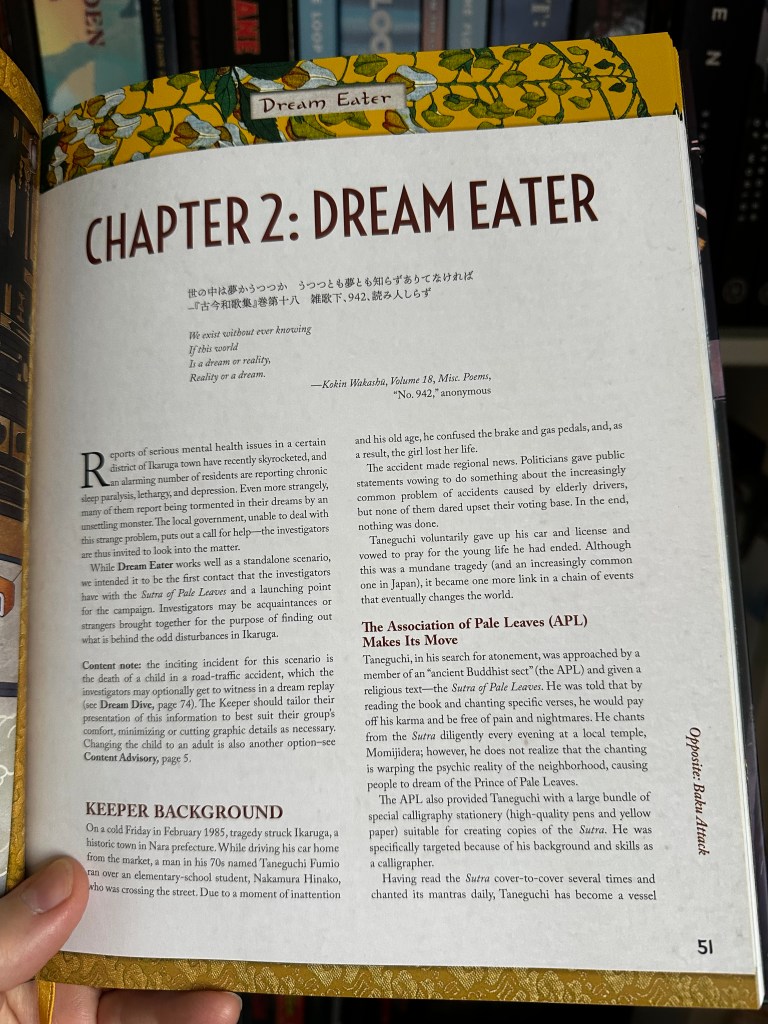
The first page of  Chapter 2: Dream Eater introduces Keeper Background and the Association of Pale Leaves.
We exist without ever knowing
If this world
Is a dream or reality,
Reality or a dream.

I once wrote two novels about the adventures of a twelve year old Japanese boy who moved to Ireland with his family. In them, he discovered that he was able to use his cat as a conduit to enter the dreams of others. This allowed him to reconnect with his friends at home but his consciousness became trapped in the kitten! Various hijinks and drama ensue. Anyway, suffice it to say, I was very quickly on board with the premise of this scenario given teh Japan and dream-related elements of it.

The premise is that a small, rural Japanese town is beset by sleeplessness and terrifying dreams of monsters. The longer it goes on, the more the citizens worry for their safety and sanity. The authorities have offered financial rewards to anyone who can help them solve the problem or take care of the afflicted.

That’s where the Investigators come in. Perhaps they are from this small town of Ikaruga, or maybe they just heard of their troubles and have come from the city to look into them. Either way, their assistance is greatly welcomed.

Indeed, their investigations are likely to take them quite quickly to the door of an old man, Mr Taneguchi, who was responsible for the death of a young girl in a traffic accident recently. From there, they will visit other sites in the town, and other potentially recurring NPCs, and they will learn of the Baku. This Yokai is the eponymous Dream Eater, and the cause, it would seem, of the town’s problems. The Investigators will have to find a way to defeat, satisfy or neutralise this creature if they are to help.

But, of course, there is another layer to this story, just below the almost obvious one. The Prince of Pale Leaves has worked through one of his recruits to use Mr Taneguchi to spread the Sutra of Pale Leaves. The Prince has been invading the dreams of the people of Ikaruga, through the old man’s chanting of its mantras at night. It has been creeping through the town, insidiously and terribly. This is what has drawn the Baku to this place. It finds dreams of the Prince the most delicious. The Baku is known as a benevolent yokai in Japanese legends, one that takes your nightmares away and lets you sleep soundly. And that is what it’s attempting to do. The thing is, as it eats the dreams of the Prince, erasing them from the memories of the dreamers, the only image they are left with is of a scary looking ,purple, tapir monster, the Baku. And so, it becomes the scape-goat. The Prince attempts to use this misunderstanding and the Investigators’ intervention to defeat the Baku, thus allowing his influence to grow all the faster.

The question is, will the investigators figure this out? Will they destroy the Baku? Will they leave this town better or worse than they found it?

The Flow of the Scenario

The flow of the Dream Eater scenario in visual form. From Ikaruga Town to Talking with Townspeople to Meeting Taneguchi to Horyuji temple or Nightly Prayers to Unpleasant Dreams to The Fortune Teller to Research in the Sutra to Dream Dive to the Final Encounter and finally to the Epilogue.
Dream Eater Scenario Structure

Take a look at this flowchart. This is useful in a scenario like this for a game like this. Call of Cthulhu is a trad game, and, as such, its scenarios rely on these sorts of stepping stones to get you from hook to ending. So I really appreciate it when you get something like this that cleanly represents that idea visually.

So, after a lengthy preamble giving us Keeper background, an intro to the main NPCs and a few PC hooks, we start with Ikaruga town, a place that’s renowned for its truly ancient buddhist temples, which contain the oldest wooden buildings in the entire world. I like that the section on the town asks the Keeper to get in media res and kick things off with a shared dream sequence. Something weird is happening from the off and it gives PCs who don’t know each other yet a good reason to seek each other out.

You get a basic map of Ikaruga in the style of a roadmap, which is a nice touch. Along with this, we have an “Exploring the Town” section, which spells out stuff like population, transport, amenities and accommodation but the only real subheading to this is the Shepherd Bar: A Foreshadowing, the purpose of which is a little too subtle for my tastes.

The scenario, and indeed, the campaign is sprinkled with “Lore Sheets,” which detail elements of Japanese cultural, societal or mythical knowledge that the average Investigator might be expected to know without having to make a Know roll for it. The Keeper is supposed to hand them out as and when the subjects come up. In this section, we have one on Hōryūji Temple, for instance. Each of these includes a little snippet of “Personal Background,” which the player given the lore sheet might adopt for they own character. It’s a nice way to weave the PCs in with the place and the lore of the place.

The Investigators are expected to visit the Town Hall to begin their investigations. The Town Hall section, as is the case with each of the major plot points of the scenario, begins with a handy summary that looks like this:

  • Location: Ikaruga town.
  • Leads In: Hooks One, Two, and Four
  • Leads Out: Meeting Taneguchi (page 62); Talking to Townsfolk (page 61).
  • Purpose: investigators learn about the case.

This is another incredibly useful tool to assist the Keeper at the table, allowing them to see, at a glance, if they are at the right section, where they should be looking next and the overall purpose of the scene. This last is important to let you figure out where a scene should end, which is not always obvious.

As we get into this section, we notice that precise and exacting answers are provided to every relevant question the PCs might ask Mr Maeda, the Vice-Chairman of the Public Welfare Committee. This is common to most of the NPC interactions in the scenario, which will keep you, as the Keeper, on track with regards to what each of them knows. Once again, it’s a trad scenario. Rather than summarising the things they know and letting you play them as you see fit, things are a little more proscribed here. Of course, if you want to run these interactions differently, you can. It will just mean you spending more time prepping.

We get some general knowledge and descriptions of half-remembered dreams from talking to the townsfolk, but we really get into it when the Investigators go to meet Taneguchi, the old man who is secretly harbouring the Prince of Pale Leaves in his mind. He was approached by a representative of the Association of Pale Leaves and told that, by chanting from he Sutra of Pale Leaves nightly, he would pay off his karmic debt from running over the little girl on the road. Unbeknownst even to himself, he has been making beautiful and elaborate copies of the Sutra at night, when the Prince takes over his body. The APL is planning to use these to spread the Prince’s influence even further across Japan. It is in this section where the Investigators are likely to gain their first exposure to the Sutra, thus beginning their journey towards recruitment by the Prince, themselves.

From here, the investigations might lead to Hōryūji Temple, where they might encounter another recruit, Ukami, a former monk, who is also a martial arts master. Or they might go to the Momijidera Temple, where Taneguchi recites his prayers each night, But eventually, we come to one of the more interesting parts of this scenario, Unpleasant Dreams, where the Keeper can tailor nightmares to individual investigators’ personalities, backgrounds and memories. This is the first time they will encounter the Baku. There will be different outcomes depending on the levels of exposure they have had to the Sutra so far. It could lead to significant Sanity loss, but, on the bright side, it could also lead to Exposure Point (the points which track how exposed you are to the Sutra and how much influence the Prince has over you) reduction.

Lore Sheet 3: Fortune-Telling in Japan and the Fortune-Teller, Madam Inaba.
Lore sheet

After this, they are likely to visit Madam Inaba, the Fortune Teller or go to the aforementioned Hōryūji Temple to find out more about the Baku and how to defeat it. Importantly, they should then go and do some research in the Sutra itself, exposing them once agian to the Princes influence. This will lead them inevitably to the Dream Dive section. The scenario takes us back into dreams here, this time, a shared, lucid dream, which they will have learned how to perform from their research in the Sutra, of course. Rather than have the Keeper craft the dreamscapes they encounter this time, they are put through a “Gauntlet of Nightmares.” I like the nightmares that have been described in this section, they are Japanese-flavoured (I have definitely had nightmares about the mukade myself) and they’re scary, but they seem a little random. They’re not as thematically coherent as other parts of this scenario. At least, until you get to Taneguchi’s Dream: The Accident. In this one, you relive, along with Mr Taneguchi, the night he killed Nakamura Hinako on the road. The scenario presents several ways the Investigators might deal with the situation, from doing nothing to showing some humanity to the dying girl, to rewriting history!

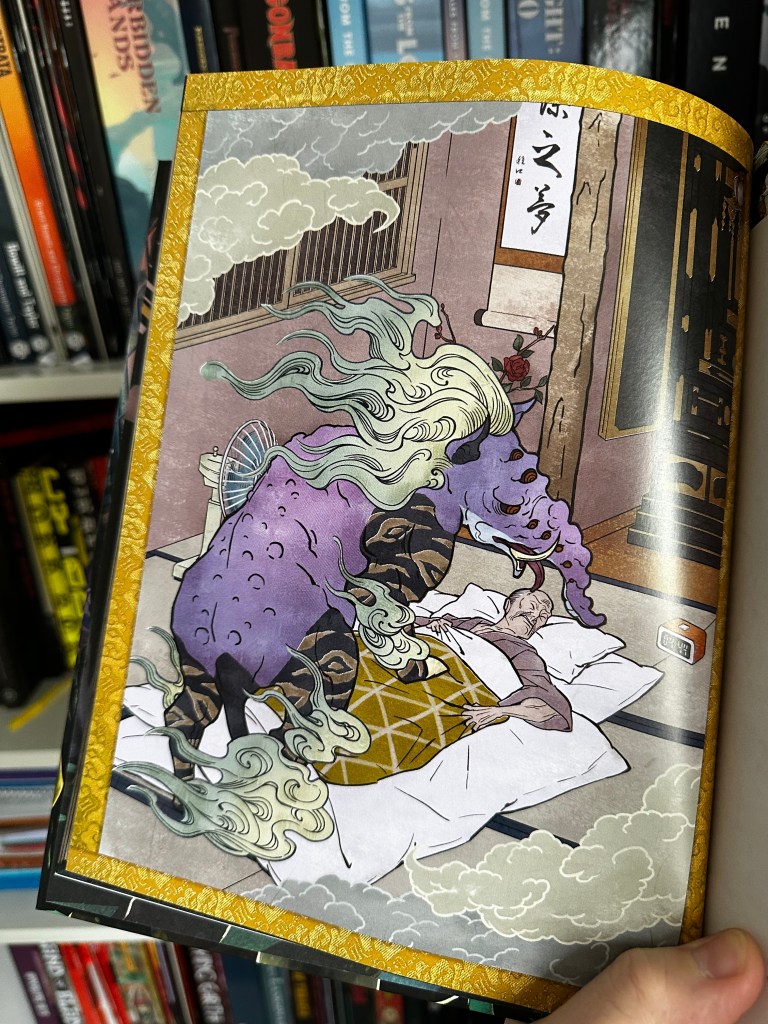
The baku, a big, purple, tapir-like creature, feeding on a n old man who is sleeping on a futon in a tatami room.
Yum Yum

The only thing left to do is to face the Baku itself. By now, the PCs might have learned enough to know that the Baku is not the real threat here. Rather, it comes from the Pale Monk haunting the dreams of Taneguchi, the representation of the Pale Prince. Or they might play right into the Prince’s hands and attempt to defeat the creature, clearing a path for the Sutra to capture more recruits. Whatever they decide, there is a good chance they will have to use signs and magics learned from the Sutra itself to do battle in the Final Encounter. The scenario introduces mechanics by which they can spend Magic Points to summon useful items or weapons to help them, but their opponents can do the same or worse. The Baku can fully transform the dreamscape allowing it easier access to Taneguchi, which is all it wants. It wants to gorge itself on the old man’s Sutra-ridden mind. If the Investigators allow that to happen, it is one of the best endings you can achieve, leaving Taneguchi in a state of extreme dementia, but freeing the town of the Prince’s influence.

Endings

The first page of Endings, includes 0. party Wipe (Failure), 1. We Do Nothing (Taoist Ending), and Yokai Busters (Bad Ending.)
Endings

Note that the endings presented here and in later scenarios are labeled and numbered, as is common for indie scenarios in Japan. This enables players to tell others how their game went on social media while avoiding spoilers for everyone else.

I understand this concept and the reason for it. But I don’t particularly enjoy the implication that you can’t have your game end any other way than one of the six potential endings provided here. I am not going to judge it without playing it out, but I will say they are described in terms of one ending being a “failure” and others being “Bad Ending,” “Good Ending,” and “Best Ending.” Of course, these are value judgements. Just because you TPK, doesn’t necessarily mean it was a bad ending for your party, and, to be fair, the text does describe this one as “something of an achievement.”

The inclusion of “Optional Post-credit Scenes” is interesting too. These each present a little vignette of how the Investigators might have changed reality during their adventure through dreams. It explains that they work better if the scenario was run as a one-shot but that they might just serve to show the sheer power of the Sutra over reality.

Conclusion

This feels like a great scenario to start off this campaign dealing with the Prince of Pale Leaves as the antagonist. It immediately introduces the players to the idea that this is a being that exists in the mind of others and is spread through the dissemination of the Sutra, or it should. I can’t say for sure if it does it effectively without playing it. Overall, I like the structure, which is designed to keep the Keeper on track, no matter which way the players decide to go from one scene to the next. I do find the extreme levels of detail in the NPC encounters a little unnecessary. I still think it’s possible to summarise a character’s personality and the things they know in a much shorter manner, that would work just as well, if not better.

I think it’s interesting that each of the scenarios is styled as being possible to run as a one-shot but I can see Dream Eater’s potential in the context of the greater campaign. I’m looking forward to reading the next one, Fanfic, where the APL hatches a plan to recreate the Sutra as an action manga.

The Sutra of Pale Leaves: Cthulhu in Japan

Japanese Series

It looks like I have stumbled into a Japan-related games series, what with my recent posts about Kanabo and my visit to a Japanese Friendly Local Game Store in Fukuoka during my recent holiday. Combine it with a couple of posts on Call of Cthulhu in the last couple of months and this one fits right in.

The Sutra of Pale Leaves

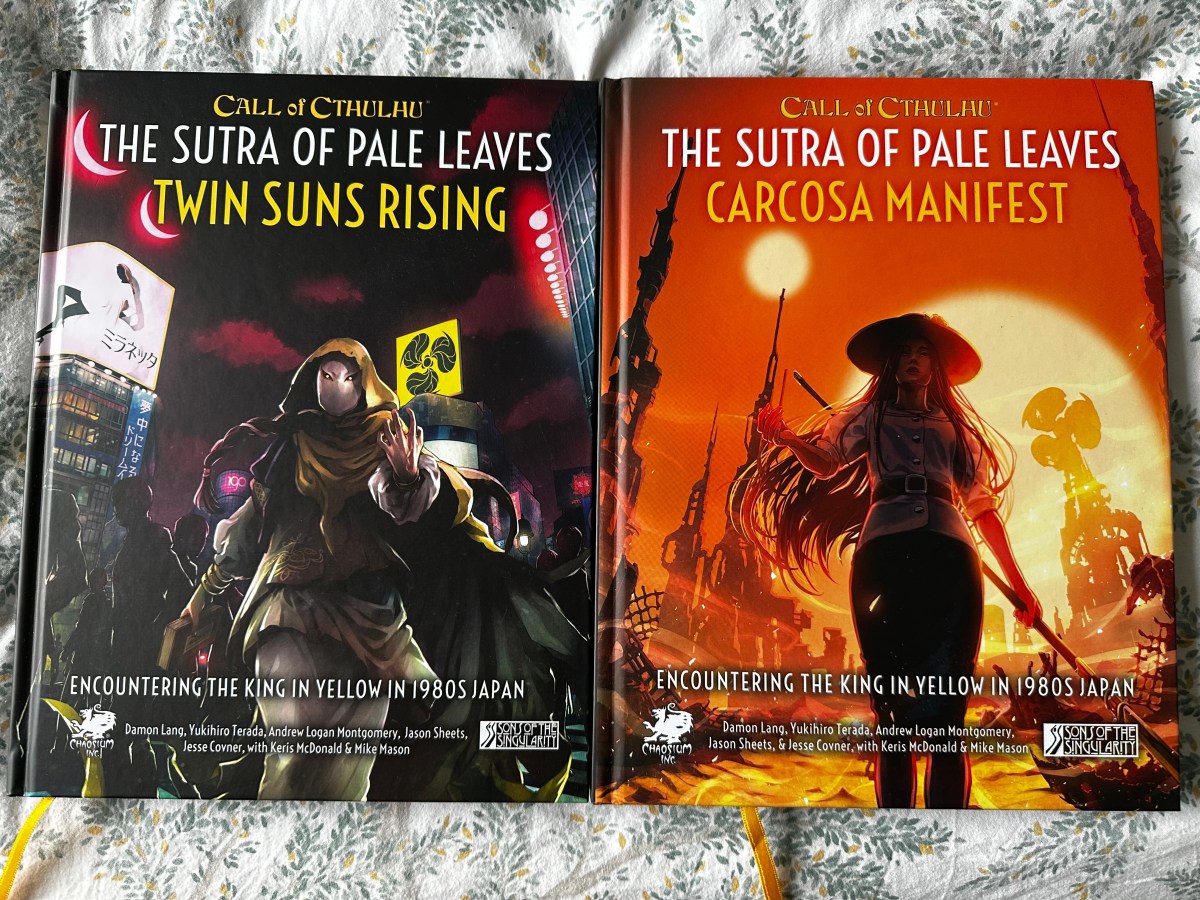
The Sutra of Pale Leaves is a 1980s campaign for Call of Cthulhu set in Japan, which is presented in the two books, Twin Suns Rising and Carcosa Manifest. Both were published by Chaosium in 2025. They have a number of main authors, Damon Lang, Yukihiro Terada, Andrew Logan Montgomery, Jason Sheets, and Jesse Covner for Sons of the Singularity LLC. Its good to see at least one Japanese name in there. The fact is, although there is just the one Japanese person credited in the main credits, there are other Japanese contributors in many other aspects of the production of this campaign, from artists to cultural consultants. A particualarly stand-out section of the credits is in the playtesters, where most of them are Japanese. I don’t think this project could even have the potential to reach any level of authenticity in the setting without all of that input from native Japanese.

What I’d like to do with this, and coming posts is take a look at the two books and see what they offer in terms of a campaign, how it might scratch an itch to play in a Japanese setting and how it might be used at the table. Needless to say, I have not run this or any part of it yet, though I fully intend to, once I find a bit of time. Still, I will be delving occasionally into SPOILER territory so, if you want to be a player in the Sutra of Pale Leaves, maybe give the next couple of posts a miss.

The Premise

The investigators are residents of Japan in the economic bubble-period of the 1980s. They are not necessarily Japanese, but, at least, have a passable fluency in the language. Through the events of the scenarios in the two books, they will uncover the some truths about, and perhaps even work to counter the goals of the Prince of Pale Leaves. Who, you ask, dear reader, is the Prince of Pale Leaves? Well, perhaps you know him by his more Western appellation, the King in Yellow? The Prince is the re-imagining of the being known as Hastur in Robert W Chambers’ King in Yellow stories, in a Japanese context. Although I have long been aware of those stories, I have only become more familiar with them through the work of Harlan Guthrie on the Malevolent podcast. If you’re unfamiliar, you could do worse than checking that out. It is a pretty different take on the King in Yellow, itself, but it’s a really entertaining one. If you fancy, you can get the book for free from Project Gutenberg, here. Otherwise, here’s a link to the Wikipedia entry. Essentially, the title refers to a play, which links the first four stories in the collection. The reading and performance of this play leads to it spreading like some sort of memetic virus. In the campaign, the eponymous Sutra of Pale Leaves plays the same role as that play.

There are a couple of interesting points made in the introduction section of the books.

First, they describe it as a modular campaign, meaning you can run each of the scenarios as presented, chronologically from July 1986 to November 1990 across both books. Or, you can run them in any order. There is not even a need to run all of them if you don’t want to and it is not a requirement to retain the same investigators through the scenarios, if you don’t want. Not having read all the scenarios yet, I can’t really say how will this would work, or how it would work at all. That’ll be one of the things I assess as I go through them.

Second, the nature of the Prince of Pale Leaves as an “ever-evolving antagonist” that exists outside reality as we know it gives him “the ability to metagame.“ What does this mean? Well, within the fiction, it means that he can take part in and observe the events of infinite branching timelines and use this ability to respond to events with preternatural knowledge, as though he knows what’s about to happen. In game terms, it means that if you replay the Sutra of Pale Leaves with the same players, or maybe just some of the same players, you can play him as if he knows what happened in the last playthrough… Which is wild. For the Keeper to use this ability might seem incredibly unfair to the players, who might accuse them of cheating. In that instance, the Keeper is encouraged to “show them this page of the book, and then laugh maniacally (!)” I love this but, as someone who has a chronic problem of trying to fit in too many new games into his schedule, the idea of replaying one feels almost ridiculous. So, I can’t imagine taking advantage of this particular little trick.

Japan

Both books begin with a bit of an intro to the place and time. Japan in the 1980s was a very special place. The country was rich and society was transformed by the money flowing into and around its cities and towns. It was the culmination of the post-war rebuilding of a country that had been utterly decimated. The Campaign Background chapter goes into just enough detail on everything from pagers and phones to organised crime. It gives you a glimpse into the everyday life of working people and students, enumerates some of the most popular pop culture of the period and even gives a short introduction to the pronunciation of Japanese words. Interestingly, it goes to some lengths to explain how this is a non-violent society where guns are nigh-on impossible to get your hands on, swords and other such weapons are just as prohibited and ninjas are just not a thing. This all serves to reinforce the idea that PCs are, perhaps, better off pursuing solutions that don’t involve direct conflict throughout.

The Sutra and the Prince

Since ancient times, there has been a cultural belief in Japan called kotodama (言霊, literally the “spirit of words”), a belief that mystical power dwells in words and names, and expressing them can influence the environment, body, mind, and soul.

And that’s the essence of the Sutra of Pale Leaves. The Campaign Background chapter continues with a description of what, exactly, it is, though. It also tells us how it works and the effects it has on people. Suffice it to say here that it is a text that has been around for centuries in many forms and which has travelled from beginnings in ancient India, only to be largely purged in Japan in the 12th century before re-emerging during the events of this campaign. It has the ability to quite literally imprint the personality of the Prince of Pale Leaves onto those who read it. In a mechanical sense, this is achieved through the accumulation of EP, Exposure Points. The Keeper is encouraged to keep the exact nature of EP from the players, perhaps referring to them as “Ethereal Power” or “Energy Points” instead. The default situation, however, has the Keeper tracking the EP for each investigator themselves, at least until it becomes obvious what effects they are having.

Of course, the more your Investigator reads, the more EP they gain and the more EP they gain, the more influence the Prince has over them. They might be subject, at the lowest levels of exposure, to convincing hallucinations brought on by their nascent Pale Personality. At the very highest level, 100, they are fully consumed by the Prince. “Game. Over.”

This is an extra, and fairly central mechanic to this campaign that seems like it could really add a lot in play. As one highly exposed character begins to betray signs of full domination by their hitch-hiker personality, others with less exposure, who are just beginning to see and hear things that aren’t there, might begin to fear for their own selves. There’s potential drama alright.

This section takes some time to usefully describe how each of the effects might manifest in characters and how these should be role-played (essentially meaning how should the Prince be role-played.) It also explains that there are some benefits to the exposed PC, such as “unexplained luck” and a “sanity safeguard.” With any luck, when the Keeper starts handing out freebies like these to exposed investigators, it should put the players on their guard, perhaps even making them paranoid about the motive behind such unexpected generosity.

The Prince of Pale Leaves himself gets a long section all to himself, as is appropriate given his central role in the campaign.

The Prince manifests as a viral artificial intelligence implanted in the minds of humans by full exposure to the effects of the Sutra of Pale Leaves. After exposure to the majority of the Sutra of Pale Leaves or its various adaptations, a portion of the victim’s brain is forcibly partitioned and systematically reprogrammed. From three individual hosts a network is born, and each one acts as a node for the singular mind that is the Prince.

Throughout this chapter the Sutra is referred to in terms of a computer programme or virus, the results of which are the over-writing of human minds with the software that is the Prince. I can see how this is a useful analogy but it seems like an odd one for this time. In a campaign set in the modern day, such comparisons might make more sense, but in terms of the 1980s, there was little or no general knowledge among the public of computer viruses or even networks. Still, it works to impart the concepts of both Sutra and Prince to a modern reader, and I suppose that is what’s most important.

The Cult and the Confidants

There is a very useful section on Roleplaying as the Prince, which gives some great tips on how to present him to various types of characters. He will deal with religious people by appealing to their faith while using reason and logic to appeal to skeptics, for instance. He is described as a “complex antagonist” and that certainly seems to be the case. Roleplaying NPCs like this is always a real challenge for GMs, since the Prince is a cosmic being with vast knowledge across multiple realities and timelines, but I, to put it bluntly, am just a pleb. So, any and all assistance is gratefully accepted.

In this section, we also have his powers, abilities and weaknesses enumerated. Finally, there is “the unspeakable truth” behind this being, where he “is,” what his physical existence looks like and what might be the answer to how he became this way. Importantly, it is revealed here that “patient zero” is sealed along with the rest of the population beneath Lake Hali in Carcosa, a world separate from our own, but one which is surprisingly close…

The rest of the Campaign Background chapter is used to introduce us to the obligatory cult, the Association of Pale Leaves and the most influential NPCs of the campaign. The Association is presented quite comprehensively with sections relating to their goals and doctrine, structure, and inner circle. There is also a very handy Cult Worksheet on one page for the times when you need a quick reference.

Confidants - "The Fed" Mizutani Shogo - portrait and statblock
Confidants – “The Fed” Mizutani Shogo – portrait and statblock

As for other NPCs, several are described under the section, Confidants: Plot Hook Facilitators. These NPCs, such as Mizutani Shogo, an intelligence agent, and Murakami Tsubasa, the abbot of the Kuroishi-ji temple, can be used to link one scenario to the next, to provide information to investigators to help them connect the dots and to assist them in regaining sanity between scenarios. The description of each gives you a few lines on the flavour of campaign they might add to, the sorts of connections they might have with investigators, where you might encounter them and the best scenarios they might act as confidants for.

Conclusion

It feels too soon for a conclusion, to be honest. I expect there to be at least two more posts about these campaign books. In the next post, I’ll be looking at the three scenarios in Twin Suns Rising. I’m really looking forward to sinking my teeth into them. Metaphorically, of course.

Sleighed

You might remember a few weeks ago… I reviewed Slow Sleigh to Plankton Downs. Well, the disclaimer on that review, that I had not played or run it is no longer valid.

Nun too soon for an update

Just a short one this week, dear reader.

You might remember a few weeks ago, for my Halloween post, I reviewed Slow Sleigh to Plankton Downs. Well, the disclaimer on that review, that I had not played or run it is no longer valid. Sister Majid, the Misstep Monastic (a type of nun) and Lee Tuluk, the Scud Miller (meat grinder) formed an unlikely friendship through a misallocated cabin and a game of chance and before you know it they were investigating a murder!

We played one session on Halloween and just finished it up last night. It took about six hours altogether, although there was some time spent on character creation in the first session.

Take a butcher’s at this!

A nun with an ice adze dressed in gold

Here are some things I loved about running this adventure:

  1. The new backgrounds are great. Most of them are really far out there but the two that my players chose were obviously quite mundane. They still had some incredible Advanced Skills that got milked for all they were worth. Somehow, our nun used “Reconcile God’s Glory with the Failings of Mortals” constantly. Meanwhile, the Scud Miller managed to use “Fix Anything, Not Necessarily Well, Even with the Wrong Tools” on everything, including relationships. Use the backgrounds if you’re going to play this.
  2. It’s so easy to prepare and run. The keyed descriptions are short enough to easily use on the fly, the premise of the adventure is straight-forward and there are only a couple of unavoidable events that are not difficult to get to grips with. I read it through once, fully, and then reviewed particular sections such as basics of the adventure and the murders before actually running it. It doesn’t take long to do this; its a svelte little scenario.
  3. I really got into describing the aftermaths of the murders and the effects they had on the crew and other NPCs. As rumours spread I had nuns moving in pods and whispering about terrible occurences while blessing themselves, while the porters and mates dealt with grief at the passing of their colleague. Upon the discovery of the second victim, the security guards were puking in corners and staring blankly at blood-soaked toilet stalls. The creature has a silly name, which my players refused to say right, but the murders are gruesome and horrific. It felt important to play into that.
  4. The map of the Nantucket Sleigh Ride. We used this work of art throughout. It was so useful to help the players orient themselves on the hovercraft and it was a genuine pleasure to refer to it. Its beautiful.
  5. The Weather table. I got the players to roll for weather right before the final encounter and they rolled us up a storm. The ship was forced to drop its robotic anchors and ride it out just after the second murder. They figured out who the murderer was and that they were outside on the Observation Deck. What a setup for the final showdown. It was poetic.
A victim, missing its maxilla in a toilet stall. The Maxillary Uslurper in the air vent above.
Aftermath

Conclusion

Dear reader, I would highly recommend you take the Nantucket Sleigh Ride on a trip to Plankton Downs. If you have a couple of evenings to spare and a couple of friends who might enjoy a who-nunnit, as it were, you could do a lot worse. It’s not your typical Troika fare but I am beginning to think there may not be such a thing. You will have horror, you will have laughs and you will definitely have fun.

Call of Cthulhu: The Derelict Review

[My players] didn’t find the book of norse legends, the handwritten notes that presented possible ways to defeat the Sciapod, the silver items that would allow people to actually see the creature, etc, etc.

Two-part One-shot

SPOLIERS BELOW, ME HEARTIES! Turn back now if you want to be a player in the Derelict!

You know how it is, dear reader, when you board your luxury yacht and expect to make excellent time crossing the North Atlantic? And then you start to run into complications? Almost everyone gets drunk, you come across a seemingly abandoned reefer ship washed up on an iceberg, you decide to explore the possibility of rescuing anyone from it or maybe even salvaging it for vast profits, you board it and find its covered in blood and the controls have been deliberately sabotaged, you’re hunted by a towering monstrosity with a crystalline bow and only one weird leg, which is visible only to about half of your number, your own yacht’s controls are smashed to bits and the captain is eviscerated and several of your number begin to lose their grip on sanity?

Of course you do! Anyway, when I write it out like that, quite a lot did happen in the first session of the Derelict. It took so long, in fact, that we had to stretch it to two. We played it out in about five hours in total, I’d say, but there was plenty left undone as far as this scenario goes. You could easily stretch it out to three sessions of three hours each, I’d say.

The Scenario

A busted up dining room on the Groenland Tropisch.
What a mess!

In this post from about a month ago I introduced the premise of the Call of Cthulhu scenario I ran as part of our Tables & Tales October Event, during which we ran a bunch of horror/spooky/halloween themed games especially for our newbies. Today, I’m going to look at how it went and how I think it could have gone better.

The Derelict is a 28 page adventure for Call of Cthulhu. It appears in Petersen’s Abominations, published in 2015 by Chaosium. It was written by Sandy Petersen with Mike Mason.

It seems Petersen got the idea for this adventure while reading about Viking explorers and this particular encounter that was described quite matter-of-factly as a Sciapod, a one-legged creature with a crystal bow. The conceit is that such creatures were not necessarily taken as supernatural by people of by-gone ages so the encounter was recorded as a relatively mundane occurrence. I like that this theme jibes with Zedeck Siew’s observations about the attitude many Malaysians would have to signs of the Pontianak in his scenario, A Perfect Wife, as well as my own personal experience of growing up in Ireland. Of course, when the Investigators encounter the Sciapod in the Derelict, they are not likely to react the same way at all.

The portrait of Siren/Lori Washington, a femme presenting person with long dark hair and a bright dangling earring in one ear.
Siren/Lori Washinton

The Derelict was clearly designed as a one-shot or very short campaign. It would be hard to work it into an ongoing campaign, I think, given the rarefied circumstances and setting, so if you want to run it, I would suggest taking it at face value and go for something short and self-contained. I would also recommend using the pre-generated characters. They are all rich/famous arseholes of one stripe or another. You know, the type of people you would expect to have on a luxury yacht. But they also have their own motives, some are having money troubles, some are looking for sponsors, some are party animals, that sort of thing. They are relatively well painted and designed to be easy to pick up and play. There is a second option presented in the scenario: the PCs could be members of a rescue team sent to investigate the Derelict, but this option lacks the horror movie energy you get from the rich yachters, in my opinion.

The formatting is useable and fairly presentable. It starts with the intro and a brief description of our cast of characters before a short section on Starting the Scenario, under which we also get a useful Sequence of Events. I say “useful,” but my players exited the sequence pretty quickly and I was forced to improvise liberally from that point on.

The bulk of the scenario is taken up with descriptions of the main areas of the Derelict ship and the iceberg it’s stuck on. It does go into a fair amount of detail even about the areas that are of little or no interest. It will tell you where to find the clues and items of interest within these descriptions. This is the greatest weakness of the adventure, to be honest. My players spent almost no time exploring the ship. They were incredibly goal oriented, going to Engineering to find things to help them fix their own boat and to the radio room for a way to contact someone. So, they didn’t find the book of norse legends, the handwritten notes that presented possible ways to defeat the Sciapod, the silver items that would allow people to actually see the creature, etc, etc. I wish I had started just transplanting some of the more important clues and things to the rooms they did explore earlier. In the end, I did do that but we had played the bulk of the game by then.

It has some great maps and illustrations throughout. The maps of both boats were particularly useful. We were playing on Roll20. So I used the maps a lot. In the first session I used fog of war on the map of the Derelict, but I found this led to too much player confusion about the location of everything and too much time spent by me on descriptions. It was supposed to be a one-shot! So, in the second session I turned off fog of war under the pretence that they found a full map in Engineering. That made things a lot easier. The players were able to see where they might want to explore and they started to do that.

One of the strengths of this scenario is that, even though it provides you with a sequence of events, it encourages you to play it quite free-form. Simply allow the PCs to look around, discovering clues as to what happened here and maybe how to defeat the monster, and then start picking off characters with the Sciapod as they go, NPCs first. They’ll start getting injured and insane and the scenario should blossom from that. In many ways, this is what led to our game going quickly off the rails. The sequence of events expects the players to start trying to find ways to kill or drive off the Sciapod but that’s not what happened at all. As I started to kill them off and ship away at their sanity, they began to look only for alternative ways of escape. But, of course, along the way they saw some some pretty disturbing things and one of them lost the plot completely, going full axe-murderer before eventually getting it together while they all bundled into the last remaining lifeboat. Except for looking for firearms on board, they never considered finding a way to kill it. And, of course, this was great! I loved it and the players had fun. But I will admit to, at times, trying to get them to take the route that was expected of them. I think I would have had more fun if I had lust loosened my grip on the reins a bit more.

Still, if your players do get so far as to start coming up with ways to beat the bad guy, there is a useful section at the end of the scenario devoted to potential plans that they might come up with, using lots of things my player never even discovered. They could use the CO2 stores, the bulldozer or forklift that was in the hold, etc.

The Appendix

The Sciapod. A bluish tinged, armoured humanoid with only one thick leg, which ends in a wide, umbrella-like foot with claws all around the outside of it. it holds a crystaline bow and has a single green glowing eye.
Hawkeye? You’ve changed.

In the Appendix, you get stats for the two NPCs and the Sciapod itself.

The NPC stats could be particularly useful if a player loses their PC early and they need a replacement. This did happen in my game but only after both NPCs were already dead so it didn’t help.

When it comes to stats for the Sciapod, I don’t think it should matter really. It is designed to be undefeatable by normal means. The PCs are supposed to have to come up with some big, brash, loud plan to kill it, after all. But there are elements to the creature that are of real interest. For instance, it is visible only to those who have silver touching skin for some reason. This proved to be a weird and scary element of the PCs encounters with the monster. It directly led to the death of one of them but it is a strange addition to the abilities of what is already an odd adversary. It is utterly silent too, and it wields this weird crystalline bow with enormous glass like arrows. This last bit feels very un-Cthulhu to me. It adds more of a D&D flavour to this monster but it did allow it to attack from a distance, which I made use of. This led to two memorable moments of gameplay, in fact. First, our pop-star character, Siren stood on the deck and had a showdown with the Sciapod, she with her little .22 pistol and it with its giant glass bow. Second, the creature launched one of its enormous arrows into the hull of the lifeboat they were escaping on right at the end, ushering in their deaths and the end of the game.

Conclusion

This was a fun one-shot/two-shot. It had great pre-generated characters and a fascinating premise and setting. (Although I have to stop running one-shots on boats. Apparently its become a trend…) But I question whether the monster that’s central to it is really Cthulhu-mythosy enough. It’s strange but not necessarily horrific in and of itself. Also, the adventure involved a lot of prep for something that could be designed to be run with little or no preparation. But you have to read the descriptions to familiarise yourself with the setting, the clues, the origin stories, hidden history etc, etc. and that all takes time.

Kanabo

The best part of the whole How to Play section is the list of Best Practices…We have gems like, “Ask questions. Take Notes. Draw diagrams. Write in pen” and “Fight unfairly. Lay ambushes. Hit below the belt. Run away.” And familiar old favourites like “Play to find out what happens, and how it happens” and “Strive for victory, but revel in your defeats.”

Waku Waku

Dear reader, my excitement is threatening to overwhelm me. As some of you may know, I studied Japanese in university and lived and worked in Japan for about three years in total. It’s hard to put into words exactly how I feel knowing that, this weekend (probably yesterday by the time I publish this post), I’ll be going to see the Ireland vs Japan rugby match in Dublin and next weekend I’ll be finally going back to Japan for the first time in eight years! I think the right word is probably わくわく (waku waku, loosely translated as excited.)

Anyway, as a build up to that, I thought I would look at an RPG based on a Japanese historical period.

Kanabo: Fantasy Role-Playing Adventure in Tokugawa-Era Japan

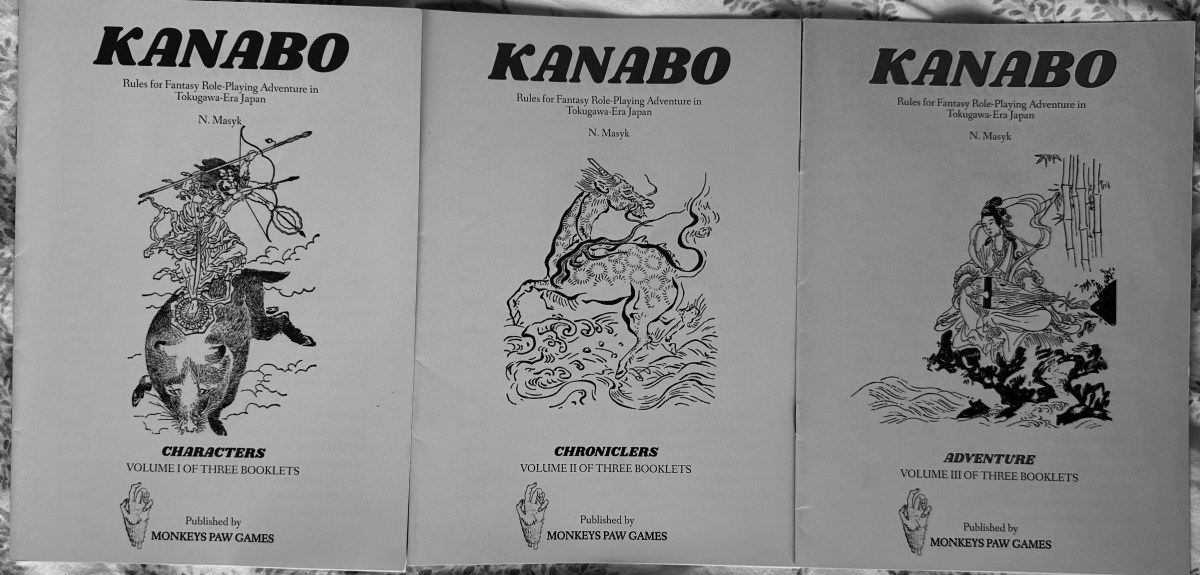
A Kanabo is a Japanese weapon, a long metal club, adorned with spikes or studs. The game, Kanabo by N Masyk, is an RPG published by Monkey’s Paw Games. It comes in the form of three neat booklets, Volume 1, Characters, Volume 2, Chroniclers and Volume 3, Adventure. It was gifted to me by friends and all round good eggs, Tom and Isaac several years ago. I can’t remember which year exactly and I don’t see a publication date on any of the booklets so I am going to guess and say it was sometime between 2020 and 2022.

These booklets truly are only wee. The longest of them is 21 pages of A5. But they pack a lot into each one.

Volume 1, Characters

The cover of Kanabo, Volume 1, Characters. It has a mythical Japanese warrior wielding a spear and a bow at once, while dancing on the back of a great black boar, possibly in the clouds.
Magic Man on Magic Boar

This booklet, as is the case for each one, begins with the credits. N Masyk did the words and the layout, “Dead People” did the artwork and the Hexmap uses the Highland Paranormal Society Cartography Kit, by Nate Treme. Finally, consulting was done by James Mendez Hodes. I think you will notice a peculiarly Western bent to the people associated with this project, other than the Dead People who are all Japanese (by the looks of their artistic styles) but remain conspicuously unnamed.

It starts off with an intro section that explains briefly what the game is about and suggests the use of safety tools such as Lines and Veils and the X Card. The “What is this?” section tells us that this is a game set in the Tokugawa period of Japanese history. It informs us that this is the time after the Warring States Period when the country is united but many wandering Travelers are abroad, “seeking fame, fortune, justice, revenge, or simply the freedom to roam.” That’s the PCs! I like this as a time period and setting. The Tokugawa era was long, more than 250 years. It was a time when Japan was cut off from the rest of the world, guarded its coast jealously and avoided the great changes that engulfed the other regions during the same time. The role of the Samurai was slowly being eroded, nobles were forced to pilgrimage from their lands to the capital under their own expense to keep them in line, the Shogun ruled the land and Japanese culture deepened. But I also like that there is a paragraph here on historical accuracy. Masyk takes pains to explain that, despite the potential realities of the place and time, as players of a game, we must strive to be inclusive before being accurate. Japan of this time was a place of terrible inequality, Kanabo at the table does not have to be.

The introduction section is reprinted in Volume 2, Chroniclers and Volume 3, Adventure. I wonder, in a set of booklets of such limited page-count, if this was necessary. Perhaps it was felt that the Characters booklet, meant largely for the players, and the Chroniclers booklet, meant only for the Chronicler had to both have it to refer back to regularly, but I would question that, especially as the Adventure booklet is also meant for the Chronicler exclusively. Maybe its so the kid who finds one of these booklets all on its own, tucked into a box in the dark reaches of a secondhand bookshop thirty years from now, knows what it is they’ve found.

Stats

The Stats section actually introduces the entire character creation process. Stats themselves are only one part of that. You roll 2d10+20 for each stat, for a maximum of 40.

I was expecting this ruleset to be a D&D clone or maybe an Odd-like but I was surprised to discover this is a percentile system. When you want to do something you roll a d100 and hope for a result equal to or under the stat you are rolling on. You will notice that this makes it necessary to roll really rather low to succeed, but there are several ways to gain a +10 to your rolls, such as using the right piece of equipment, possessing just the right skill, spending a filled segment of your Fate Clock or, in battle, gaining Advantage. There are three specific ways to accumulate +10s in a battle. If you want to disengage from combat safely, you can expend all of them and do so.

The Stats themselves are incredibly and deliberately abstract:

  • Fire: confrontation, aggression, force
  • Water: tranquility, inquisitiveness, exploration
  • Earth: stoicism, calculation, discipline
  • Wind: intuition, reflection, grace

As such, there is a lot of potential leeway in the decision on which stat to roll in any given situation. I like this sort of thing. I imagine Blades in the Dark style negotiations occurring as to how they might work out in play. However, I struggle a little with the whimsicality of the naming convention. It has a sort of mah-jong flavour to it, I’ll admit, which is not, in itself a bad thing. But, if you were to choose particular Chinese characters from the available mah-jong tiles, there are others that really describe human traits that might work better. I am thinking of things like 力, chikara (strength,) 心, kokoro (heart) etc. The use of the four elements makes it feel a little more like Avatar than any of the sword-fighting movies that inspired this game. It is a stylistic choice, though, and I’m sure it would work just fine at the table.

There are other elements to character creation, of course. Some of them remind me, quite delightfully of making a DCC character. Others have an Into the Odd feeling which I enjoy.

You can roll for your Chinese Zodiac sign. Whatever sign you roll, you can take it and apply a +5 to a stat that you think it reflects positively on. It would have been fun to have to apply a -5 to a different stat in this step I think.

When you roll on the Birthplace table, you will get somewhere like “Fishing Village,” “Hill Fort,” or even “Haunted Ruin.” Depending on what you get here, you will start with a different piece of equipment, such as a “fishing rod,” “spear,” or “lucky charm.”

Next up you roll on the Career table, which will give you another piece of equipment. Soldiers start with a matchlock pistol but Farmers only get a straw hat!

Your birthplace and career also allow you to list two things you know about or are skilled in. These can give you +10 to rolls in certain situations.

By rolling on the Curio table you might find yourself starting with a lucky cricket, a mask or maybe some rice balls. Each curio comes with a question that might help to round out your character.

After this you have a bunch of tables that will help you describe your PC. You have Mannerisms, Clothes, Face, Names etc. There should be plenty here to give you a very clear picture of your Traveler.

How to Play

This section lays out the rules quite economically. I’ve given you the basics already and there isn’t too much more to them than that, which is great.

There is a PBTA element to the rolls. You only roll when there is some risk, of course, but if you succeed, you do so without consequence. If you fail, you can still succeed, but with consequences. In combat, this means that you trade harm.

Kanabo character sheet on the back of the Characters booklet. There are spaces for Name, stats, zodia, career, birthplace, curio, description, Knowledge & Skills, Inventory, Wounds and a Fate clock split into eight wedges.
Kanabo Character Sheet

You get a Fate Clock on your character sheet. It has eight segments, which you will be filling and erasing as you gain and spend them. You gain a segment whenever you roll doubles on a d100 roll. I choose to interpret this as 11, 22, 33 etc. You can choose to erase a segment to give yourself +10 to a roll, prevent 1 Harm, recover 1d10 wounds or survive past your 5th wound. It’s a bit like stress in Blades in the Dark, a superpower that these Travelers have that allows them to contend against terrible odds and powerful forces.

Some few paragraphs are devoted to the idea of Travel. Kanabo assumes you will be hex-crawling and lays out the rules for that in relation to time, encounters, foraging, rest & healing etc. This is presented in a way that is player friendly and does not blind anyone with science. I appreciate it.

Character Advancement gets one very short section. Characters can choose one of two options at the end of each session, “increase a stat by 1” or “write down a new skill or piece of knowledge.” It’s neat and lacks frills. No room for confusion at all.

The booklet is rounded off with sections on hiring help, common equipment and refreshments. They are presented in several short and entirely non-exhaustive lists that are merely starting points for the interested player to do some research on what stuff might have been available in Tokugawa-era Japan.

The best part of the whole How to Play section is the list of Best Practices. Many of these will be familiar to the those of you who have been reading my series on Blades in the Dark recently. We have gems like, “Ask questions. Take Notes. Draw diagrams. Write in pen” and “Fight unfairly. Lay ambushes. Hit below the belt. Run away.” And familiar old favourites like “Play to find out what happens, and how it happens” and “Strive for victory, but revel in your defeats.”

Volume 2, Chroniclers

Kanabo Volume 2, Chroniclers has the image of mythical Japanese creature, the Kirin, across between a dragon, a horse and a giraffe, dancing across the waves.
This is a Kirin. Interestingly, the Japanese word for giraffe is also Kirin. It’s also a good beer.

After the repeated intro section we get straight into a section on how to run the game. Let me reproduce here the entirety of that section:

You control the world around the Travelers and the people within in, and the places they have built for themselves. Fill that world with adventure, danger and magic.
There are no further words by witch I might describe or prepare you for the journey ahead.
The contents of this tome, much like the contents of the Universe, are mostly lies.

I think this is probably one of the most uniquely unhelpful such sections I have ever read. I understand that the author is trying for poetry instead of boring old instruction, but it reads as though they want you to think there is no advice that might help a prospective Chronicler. There is something to be said for the idea that a GM/referee/judge/whatever should trust their instincts, but it is certainly not always true. Also, there is an enormous wealth of real advice out there, both in printed books and for free on the internet. I understand the author had limited room here, so, perhaps they could have directed the newbie GM to the blogosphere, or a particular publication that they thought aligned with their own design ethos.

Anyway, as soon as they have described everything in the “tome” as lies, they go on to provide guidance on how to run the game… and it’s useful! It’s practical and answers the sorts of questions that would definitely come up at the table when playing Kanabo! Things like discussing the possible consequences of rolls before making them, determining the effectiveness of successes etc. So, my main takeaway from all this is don’t believe the bit that tells you its lying to you…

There are a couple of pages here devoted to describing very Japanese-themed encounters, we have Kappa, Oni, Kitsune etc, without ever using those words. I like the pared down descriptions and the minimal stats presented, and I can see the idea of removing the Japanese names so as to allow a Chronicler to set their game of Kanabo in a non-Japanese context. Or maybe it’s done to for localisation purposes. I don’t know really, but, personally, I would prefer to use the Japanese names. It feels wrong to me to do otherwise.

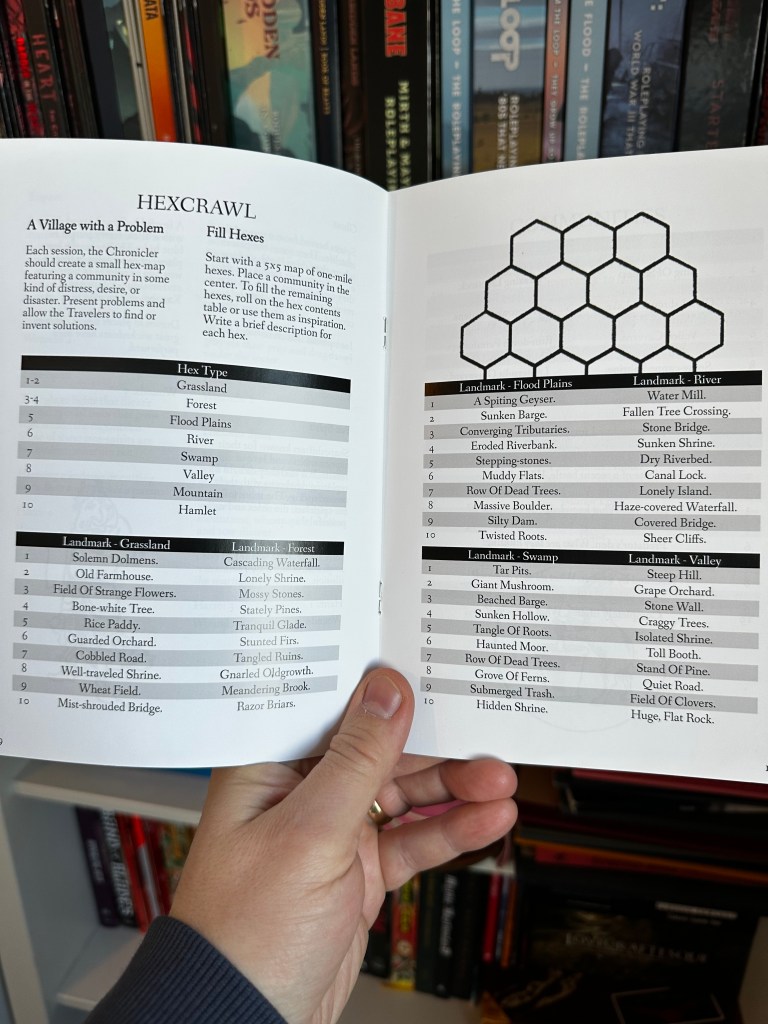
Hexcrawl section from Chroniclers booklet. There are several landmark and terrain tables and the top half of a hex rose here.
Hexcrawl

I think another very interesting element to this game is that, despite its semi-PBTA roots, you are expected to run it Old School. We have Weather tables, advice on rolling for encounters, an encounter reaction table and a whole bunch of tables to help you build your once-a-session hex map. These are, honestly, great. They are extremely practical and useful with lots of tables of landmarks for a variety of terrain types from Grassland to Hamlet. There are more tables for Factions, Communities, and Adventure Sites that would allow a Chronicler to build an engaging monster-of-the-week-style adventure with little to no prep required.

But, the advice for doing all this is limited within the booklet itself. The third of the the three booklets, however, serves to illustrate how it should work!

Volume 3, Adventure

The cover of Kanabo Volume 3, Adventure. It shows the image of a woman, or maybe a bodhisatva playing a shamisen on the edge of a cliff.
Magic music

This one if incredibly short, only eight pages, two of which have the intro again. After that, we get a bunch of ten point lists, which come together to create Peach Trees Village. The list of Locals describes each one in a single line, provides a piece of their dialogue and outlines an adventure hook. Here’s the first one:

Asuka. A farmer. So forgetful; “did my apprentice bring the cattle in?” Needs someone to go check. Something’s been at the cattle.

I love this way of presenting information. It’s incredibly efficient and is just enough to spark the imagination. You get something similar from the Shops and the Rumours lists.

Next, we have The Surrounding Wilderness section. This kicks off with a hex rose, already filled in to give the Chronicler an idea of how it’s done. Each of the 19 hexes is described in a similar way to the Locals above. Here’s no. 10:

Frozen wood. Snow-blanketed trees. A dead mile where nothing grows. Strange lights at night. What is causing the lights?

Once again, it’s just enough to spark the imaginations of both Chronicler and Travelers to perhaps pursue the mystery of the lights in the woods, without bogging you down with established fiction.

A “Searching, you find…” D100 table rounds this adventure booklet out.

Conclusion

All in all, I think this little RPG punches above its weight. I question some of the choices made regarding naming conventions, use of space and GM advice but otherwise, I am quietly impressed. I would like to try running it, but it will have to wait till after my own adventure in Japan!

Slow Sleigh to Plankton Downs

There are two stars of this adventure. The first is the murderous creature itself. It’s unique, insidious and gross in a bonkers sort of way. The second is the artwork, which you can find examples of above.

Horror gaming in Troika!

Troika! Would not be my first call for a game of horror this Halloween, but I think Slow Sleigh to Plankton Downs, the 33 page adventure by Ezra Claverie, illustrated by Dirk Detweiler Leichty could be the thing to change my mind.

Disclaimer

I have not played or run this adventure. I just wanted to review it because A Perfect Wife reminded me a bit of it. Not necessarily in its themes or anything like that, more because of the creature at the heart of it and the murders. Also, the incredible artwork.

There are minimal spoilers ahead but, even so, if you are planning to be a player in it, maybe skip this review. I will say there are some conversations to be had with your table before playing. You should let them know that it is an investigative scenario and you should also discuss the body-horror and brutal murder aspects of it.

The Basics

The PCs are aboard a ship of sorts, a hovercraft called the Nantucket Sleigh Ride, transporting them from Out of Order, the site of the moon, Myung’s Misstep’s space elevator. They are on their way to Plankton Downs, a water-farm town along with a motley assortment of Macramé Owls, Ice Miners and Martian Orthodox Christian nuns among others.

The adventure opens with a short history and geographic treatment for Myung’s Misstep as well as the function of ships like the Nantucket Sleigh Ride. It also lays out the scenarios thoroughly for the GM.

The PCs themselves could be a regular set of Troika! characters (by regular, of course, I mean utterly bonkers.) But I think, if I ran this, I would get them to choose one of the nine new backgrounds presented in the back. You have a wild variety from the aforementioned Ice Miner, whose greatest Advanced Skill is to “Exert Oneself Alone without Hope of Assistance,” to the Astropithecus Truckensis, a Martian cyborg described as “a six-wheeled, motorised Standard Habitat Truck, slightly larger than a wheelchair.”

There is a description of the keyed locations from the, frankly, resplendent, map of the Nantucket Sleigh Ride on the inside front cover, and a section on the general characteristics of it. It’s important to note that most of the vessel is off limits to passengers such as the characters, however, once the murders start, they are likely to find ways to explore.

We also have a bunch of very handy random tables including but not restricted to NPC names (a selection of pretty standard human names from all over the world), NPC Preoccupation (from “Professional Opportunities” to “Impending Masturbation”), NPC Distinctive Feature (Loving “Head Small for Body”)

The PCs are going to be aboard the Nantucket Sleigh Ride for at least 72 hours but that’s likely to be extended through the liberal and recommended use of the weather table in the back (2d6, if you roll a 12, its a Catastrophic Storm and you better pray to whatever deity most aligns with your beliefs that the anchors hold or the ship is truly fucked.) With that in mind, it would be pretty terrible if someone on board were, in fact some sort of vampire disguised as one of the passengers or crew with an irrepressible hunger for a very particular human body part every 36 hours or so, wouldn’t it?

The Murders

This is mostly an investigation scenario. After the first murder causes a stir on the upper decks and the lower, the PCs might very well decide to start asking questions and investigating the scene of the crime. After all, the crew do nothing about it except arm themselves. However, it is not likely that they will discover the identity of the murderer until after the second or maybe even the third one.

The murders are gristly and disgusting in a very particular way. The creature has a method of killing their victim that can only be described as brutal and bizarre. If this were a Call of Cthulhu adventure, witnessing the aftermath would certainly be enough to elicit sanity rolls all around. They are described in relative detail in a matter of three pages. This, along with location and NPC descriptions is all you get to guide you in running this scenario. I do think it’s enough, especially as it feels as though the PCs are not really supposed to discover the truth until after the second murder reveals something important.

Conclusion

This short and sweet adventure is a definite departure for Troika! lovers. You may not get the chance to do the strange combat hijinks you’d be used to in most of the other adventures presented for the world’s other favourite RPG but it will present a set of very particular challenges. Several of the PC backgrounds have Advanced Skills that, while not exactly “investigation,” as such, will still be very useful in specific situations that you could imagine coming up. But there is no getting away from the fact that this system is not designed for investigation and I can imagine the GM having to make a lot of rulings while playing this.

There are two stars of this adventure. The first is the murderous creature itself. It’s unique, insidious and gross in a bonkers sort of way. The second is the artwork, which you can find examples of above.

If you’re interested, dear reader, you can go and pick the adventure up from Melsonia.com here. And maybe consider it for your Halloween game this year!

A Perfect Wife

The writing is subtle and considered and evocative, the layout is spare but adds so much to the adventure as a thing to read and there is beautiful, idiosyncratic artwork throughout.

Weird Hope Engines

Earlier this year, in Nottingham, England, David Blandy, Rebecca Edwards and Jamie Sutcliffe brought together a selection of RPG creatives and artists to make an exhibition.

From the Bonington Gallery website:

Weird Hope Engines embraces the culture of tabletop roleplaying games (TTRPGs) to explore play as a site of projection, simulation, communal myth-making, distorted temporality, and alternate possibility.

Zedeck Siew, Amanda Lee Franck and Scrapworld were all major contributors to the exhibition but they lived far, far away from Nottingham. The trip would be costly. So, being TTRPG creators, they launched a project in the hopes that it would fund well enough to pay their way. It worked, and A Perfect Wife is the result.

Disclaimers

Dear reader, I have not run or played in this adventure. I received it recently in the post and I wanted to write about it. This is a review but only from a read-through.

There will be some spoilers so if you think you might want to be a player in this adventure, turn back now! Or don’t, I’m not the boss of you.

The Product

Two art prints: On the left, a spiky, crimson femme creature with wide open mouth, long black hair against a blue background. On the right, a person on a motorbike stopped in a pool of yellow light from a doorway in the backstreet of a city. The cityscape rises above and behind.
City Streets and Scary Beasts

A Perfect Wife is a 43 page OSR-style adventure from Copy/paste Co-op. I backed the Kickstarter for it and received a physical copy, along with a printed map of the adventure location and some art prints.

Speaking of art, that’s what this is. The writing is subtle and considered and evocative, the layout is spare but adds so much to the adventure as a thing to read and there is beautiful, idiosyncratic artwork throughout. All three creators contributed illustrations and all three styles are distinct but never clashing.

The Adventure

Inside cover of A Perfect Wife by Zedeck Siew, Amanda Lee Franck and Scrap World. Illustration shows an owl-like bird in white against a dark background.
Bay Owl

We start with an explanation of the recent disappearances in this inner-city Malaysian (actually I don’t think its explicitly spelled out anywhere in the body of the adventure that its set in Malaysia but its heavily implied) neighbourhood. What it boils down to is the following three points, what the locals have learned:

Head indoors if dogs are whining
Walk on by if your name is called
Do not search for the baby crying

It’s pretty clear that something unusual is happening in the area. Already the mood, the setting, the premise are very different to any other OSR adventure I’ve ever read.

We move on to character creation next. The PC outlines are based on how they know Sara, the woman they’re meeting in front of the Desa Damai Wet Market. They know they are meeting her before they even know who they’re playing.

They get six choices. There’s a journalist (interesting skill: speed-reading), a social worker (eavesdropping), a private investigator (knife use), a security consultant (joking), a faith healer (bargaining) and a barrister (drinking.) Each has a few skills, and maybe a weapon or a useful contact, not to mention a wonderful line-drawn portrait.

So, the players choose their PCs and the opening scene moves on…

Basic rules are included on page 9. These are almost identical to Into the Odd. In the front of the adventure there is a “Mechanically Inspired by” section that lists Into the Odd but also includes Liminal Horror and the Lost Bay. I don’t know those games and I am not sure how they inspired the mechanics but there is no doubt that, essentially, rolling works the same as in Chris McDowell’s game.

The next scene introduces two major NPCs at the Peaceful Heart Community Centre. It is not spelled out, but assumed that Sara led the PCs there to meet Yinyin. Then we learn what the PCs are being recruited for. Sara wants them to find out what happened to Tet, a refugee and father to young Yinyin. Sara and Yinyin are described in their own NPC section, but the mysteries only deepen…

This adventure deals with some themes of supernatural horror, class inequality, the plight of refugees, violence against women and children, pregnancy and miscarriage. You get the first hints of these, let’s be honest, pretty heavy subjects here. A GM and their players will have to have a frank discussion about this before starting to play A Perfect Wife.
Beautiful keyed map and encounter tables (day and night) for Desa Damai. Point crawl location.

The daytime encounters are a delight. I’ve been to Malaysia only once and that was on holiday on Lankawi Island. I can only imagine how different an inner city neighbourhood of a metropolis like Kuala Lumpur is to that so I don’t have any real frame of reference for this, but the occurrences in this table have feel genuine. I can picture the old man feeding the stray dogs from styrofoam containers on the side of a crowded, narrow street with no footpaths and not enough shade. I can feel the tension created by gang kids surrounding you and shaking you down for whatever cash you’ve got on you, while you sweat and make excuses.
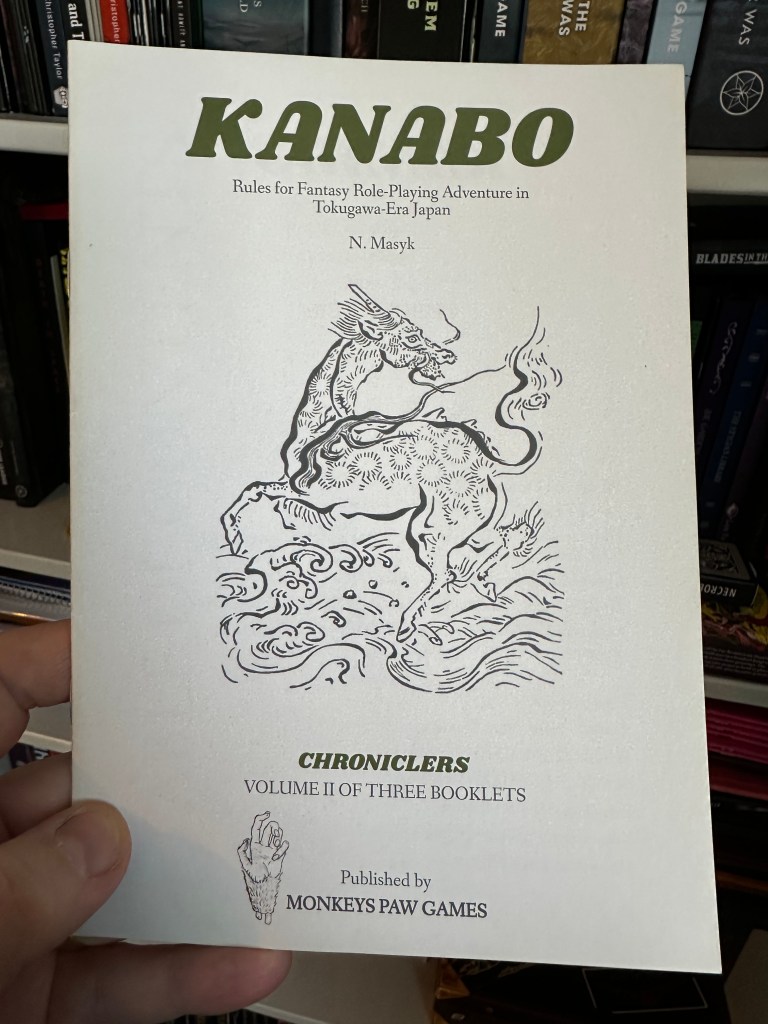
These encounters also serve to also introduce factions and NPCs of note although they are described in greater detail later.

The nighttime encounters are far more threatening and sad. Even the direction on how to use the table seems designed to put you on edge. In the daytime, you roll whenever you walk down a new street. But at night…
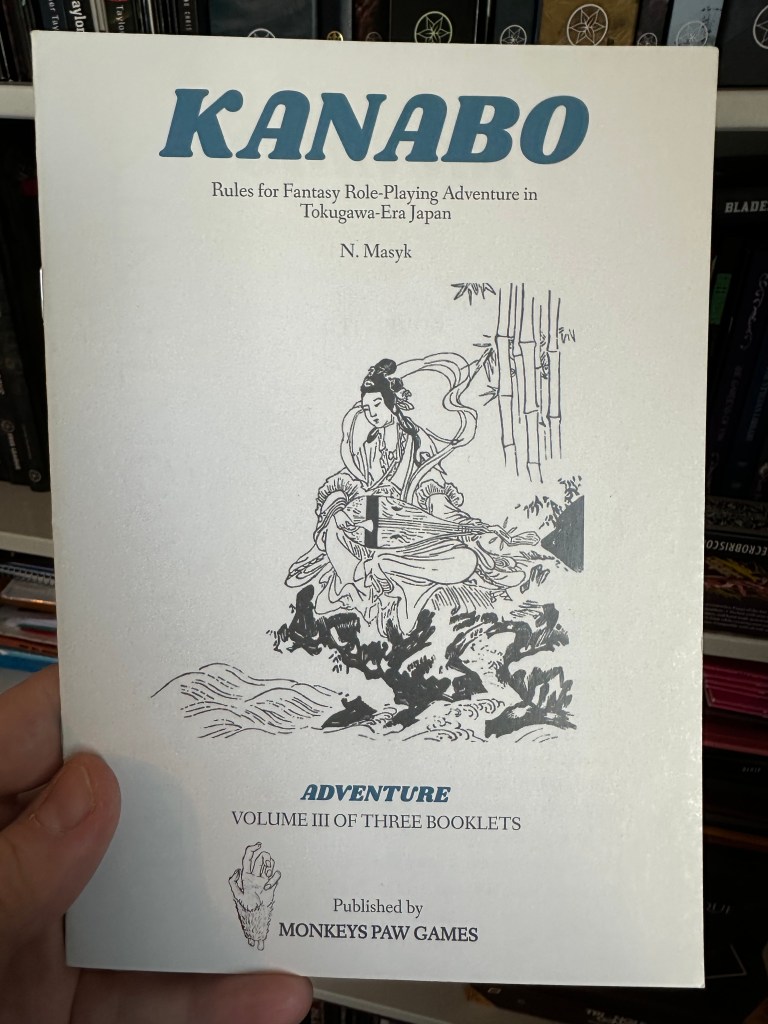
Whenever you turn a corner, roll

Just reading them makes me uncomfortable. Machete wielding, motorbike riding gang members are so much worse than the kids from earlier in the day. And what is a baby doing crying behind that pile of rubbish in the middle of the night?

Straight fter a short description of the two main gangs, the combat rules crop up… just in time. The gangs are described beautifully and succinctly. The combat rules are brief and equally Odd-like. They include more than one admonition regarding the dangers of violence, especially gun-violence, which is likely to draw the attention of the authorities.

The next ten pages are devoted to introducing us to the people and locations of Desa Damai. We get a gorgeously illustrated selection of refugees, police, witnesses, thieves and one particularly supernatural and disturbing infant. These represent the people you might run into on the encounter table as well as those your PCs might want to talk to in relation to their investigation. Each of them can help or hinder in some way and they all have their own motivations.

Sara’s baby, illustrated on page 23 with thick, black, childlike lines over a wash of dirty scarlet, is a true horror, the kind of creature that could only have sprung from the collective trauma of folk beset by the tragedies and indignities experienced by generations of women and children. It is both heartbreakingly sad and terrifyingly obscene at once. It only serves to illustrate, yet again, the importance of discussing tone and content as a group before setting out on this adventure. Be warned.

Pages 30 to 33 describe the Pontianak, the nightmare creature at the heart of the adventure as well as the initial encounter with her. Where the baby is a tragic and sadly pathetic entity, the Pontianak herself is actively menacing, dangerous and hidden in plain sight. She also has a tragic origin of course, and that’s central to the adventure, but there is no doubt this is an enemy to fear too. There’s more creepy and horrific illustrations here, one depicting the creature in her human guise and one showing her monstrous form. Again, the art in this module is doing a lot of the heavy lifting. Its remarkable.

As terrible as the Pontianak is, oh so much worse is the husband, the architect of this situation. Rich, well educated, greedy, I imagine him a delight for a lucky GM to get to role-play.

In the appendix, Siew introduces the non-Malaysian reader to the concept of the Pontianak, the symbology that is inherent in the creature, how she has been portrayed in media, the way she is perceived in Malaysia and the role of the weird and supernatural in Malaysian life. This is all fascinating stuff and feels incredibly useful in allowing the GM especially to do justice to playing the NPCs in this adventure. It is of the utmost importance to understand that locals would not be rolling sanity checks when encountering ghosts.

Here, ghost stories do not function as supernatural or speculative fiction. Ghost stories are realist. They do not belong to the Weird; they are not designed to arouse a sense of the uncanny or numinous.

I feel like I can sympathise with this point of view to an extent. Growing up in Ireland, no matter how atheist you are or scientific you claim your brain to be, deep down, you would still instinctively avoid a Fairy Fort and take tales of banshee wails predicting deaths at face value.

Tucked away at the back are the optional gods. I guess I can see why they are optional; they introduce a level of spiritual and religious superstition that some tables might prefer to avoid. But, in my opinion these gods and offerings are all gold, some of the best stuff in the adventure. It has the potential to heighten the PCs’ dedication to the plot and may even provide ways for them to boost a flagging investigation.

Conclusion

The back cover of A Perfect Wife. It reads, “Welcome to Desa Damai. The first disappearance was over a year ago. Now it happens with vicious regularity—every fortnight. The neighbourhood is tense. Most agree the following precautions work: 
- Head indoors if dogs are whining. 
- walk on by if your name is called. 
- Do not search for the baby crying. 
Illustration of an owl like bird in white against a dark forest.
A Bay Owl Again

I really want to run this now that I’ve read it fully. It’s different enough from the normal sorts of scenarios I would play that it has greatly piqued my interest. The NPCs, the creature and the situation are compelling and fascinating. Also, the real-world setting is incredibly evocative and, though presented and described sparsely by these artists, I feel like it still shines.

My players and I definitely enjoy a set of pre-generated characters that are tailor-made for the game we’re going to play. You get that in this, but you also get the pleasure of rolling up elements of them and defining important personal characteristics yourself.

I’m a fan of the incredibly rules-lite mechanics at use in A Perfect Wife, and, although I think they can be used to conduct an investigation like this, I’m not certain that a system designed for investigators wouldn’t have been better. A lot of the work is left up to the GM to ensure the leads keep coming as many of the connections between NPCs, locations and events are implied rather than fully spelled out, but I would like to think that also allows for a great deal of leeway to be given and for flexibility when necessary.

Finally, I’ll reiterate the need to discuss safety tools and tone and content before starting. I know several players, me included, who have been personally affected by themes in this adventure. Some will be happy to play anyway, some won’t, but we’ll have to talk it out first.

Stay Frosty

Obviously, a game like this is going to draw comparisons with the Alien RPG and Mothership given the subject matter but, from even a cursory look, it seems to be approaching the genre from a slightly different direction.

Not Over Yet

I had a great plan for today’s post. It was all coming together perfectly. We were due to finish of the Call of Cthulhu “one-shot,” the Derelict last night, but, due to various unforeseen circumstances, we were forced to postpone. So, the review of the scenario that I had been planning will have to wait too.

Still, I’m not short of subjects to write about.

Stay Frosty Remastered

The cover of Stay Frosty Remastered by Casey Garske. Space Marines fighting aliens/demons
The cover of Stay Frosty Remasted

I’m going to take this opportunity to take a look at one of the games I received recently as a Kickstarter fulfilment. Stay Frosty Remastered from the Melsonian Arts Council and written by Casey Garske is an old school RPG of sci-fi marines in situations of extreme tension where they face monsters, demons and aliens with nothing but a shotgun and a bad attitude. Think Doom crossed with Aliens. Obviously, a game like this is going to draw comparisons with the Alien RPG and Mothership given the subject matter but, from even a cursory look, it seems to be approaching the genre from a slightly different direction.

It’s worth noting that “Remastered” in the title. Casey Garske first released Stay Frosty back in 2017 so it’s been around longer than either of the two games I mentioned above. I first learned about the original before I ever backed the remaster. Co-host of the Fear of a Black Dragon podcast, Tom McGrenery used it several times as the ruleset in which he ran some rather unlikely scenarios. I never read the original, though it is still possible to get it here.

Basics

Roll a d20 greater than or equal to your attribute for a success. Otherwise fail. Sometimes you get another die for advantage or disadvantage. That’s it.

Obviously, this implies that, even though you roll your attributes up the same way as you do in D&D, lower numbers are better!

Badassery

Scorpion fight
Scorpion fight

You get to play some of the galaxy’s badest asses in Stay Frosty. Character creation seems very straight forward. You get some attributes (Brains, Brawn, Dexterity and Willpower,) and MOS (military Operations Specialty,) hit points, rank and some equipment. Then it’s “Oorah” and into the bug’s nest to rend some carapace. Character creation starts on page 5 and just about stretches to page 8. All the better to roll up a new badass when the first one bites it.

Gear

I like that the rules around gear are abstracted so far as to make theatre of the mind nice and easy. Ranges, as they apply to combat and weapons are expressed by bands:

Hand-to-hand -> Close -> Short -> Medium -> Long -> Extreme

Your weapon’s description indicates its max range of course.

Another touch I appreciate is the use of supply dice for ammo that you use in a combat situation. If you used it, roll the ammo die for it at the end of the fight, If you roll a 1 or a 2, it reduces the die size until it’s gone. There is a similar rule for other gear that can be depleted.

Combat

Space marines fighting bug aliens
Riiiiip

I described the essentials of it in the Basics section above. But there are a few idiosyncracies that I enjoy:

One of the actions you can take in a round is called Battle of Wills. If you succeed on a Willpower roll against a chosen target, they will get disadvantage on their next attack. You just scare them into fucking up because of your badassness.

If you get a critical or a fumble, you roll on the appropriate FUBAR table. Either “Fuck Yes, Natural 20” or “Oh Fuck, Natural 1.”

Brain Bleed
Brain Bleed

There are Psi-powers. These are restricted to PCs with the Psi-ops MOS. There aren’t too many powers in the book but here’s a selection:

  • Brain Bleed (although the book seems to be missing the actual Effect of this one)
  • Interface – lets you take control of machines
  • Mind Stab – mind stab

There’s a little more to the system than just these points, but not much.

Mostly these other rules are introduced in the chapter,

Other Crap Every Game Has

Which has the sub-sub-title,

Jesus Christ, I guess we have to spell everything out.

Danger, Frostiness and Tension

These are the mechanics that make the game what it is. You will see some similarities to the Stress and Panic mechanics in both Mothership and the Alien RPG.

Firstly, the Danger die is rolled whenever the PCs move from one area to another, whenever they are in really dodgy locations or just whenever they’re dawdling. It’s a good way to ramp up the Tension. It works much like an encounter die in other games so can lead to location-appropriate baddies turning up, environmental challenges and loss of resources, but it can also add Tension or cause it to be released explosively!

Which brings us neatly on to the Tension mechanics. So, the PCs gain Tension through the Danger die rolls I described above.

Tension can be good for you. Forget simply staying frosty, Tension will actually build your frostiness level. It starts at “Warm” when your Tension is at a 1 and goes all the way up thru “Chill” (gives the agile tag to ranged attacks) and “Frozen” (Advantage on saves) to “Ice-Cold” (extra attack) when you reach 6 Tension points. There is a danger of course, when your that tense. When the Danger die comes up 6, “Tension Explodes!” And every PC has to make a Willpower save. If they succeed, they can reduce their Tension by one but if they fail, they take their Tension score x their level in damage. If this reduces them to 0 or lower HP, they roll on the Going Apeshit table. If you get a 1 on this table you’re on Overkill, advantage on damage rolls but having to roll your ammo die every round instead of after the combat. If you roll a 6, though, you’re on Last Stand, abandoning weapons and armour to face the enemy mano-a-mano.

This is pretty close to the stress mechanics in Alien, which is also all governed by tables. I’d be incredibly surprised if it wasn’t inspired by this game.

The Rest

A parade of bad guys from winged demons to little brain aliens
If it Bleeds…

Most of the rest of the book consists of a couple of missions to send your frosty fighters on. But there are also a couple of pages of random tables to allow you to easily and quickly construct your own missions and a few basic stat blocks for bad guys like Amoeboids, Demons and Robotic Assassins.

Conclusion

Isaac ran myself and Tom through a dungeon in the Black Hack the other night. None of us had ever played it before and even Isaac had barely looked at the rules. It was so easy, though, that we had characters created, hirelings hired and a dungeon explored before you could say the unlikely word, “Prolch” (my slow-witted fighter’s unfortunate name.) Stay Frosty gives me a very similar vibe. I only just opened it for the first time to write this post and I feel like I could run it now. Maybe I will! Unsurprisingly, the Black Hack is listed in Stay Frosty’s Appendix A: Influences. Garske tells us here that his game was originally a Black Hack hack but he ended up totally rewriting it. You can still see the Black bones of it though.