Showing Character
I think most people are only mildly or politely interested in your TTRPG player character. They’ll listen to your back story, but only for so long; they’ll feign interest in what you did in your latest session; they’ll tell “that sounds cool,” but are not likely to ask you any follow up questions about them. And that’s fair, to be honest. That’s as it should be.
Even the other players in the same game are unlikely to be too interested in what your little guy is like, what happened to them in the past or what you maybe have in mind for them. They are probably more pre-occupied with their own little guy. It’s this part that I often think is a bit of a shame. Invested players often put a lot of work into crafting a well-rounded PC with a full and rich history, family ties, friends, enemies and drama. Histories like this are meant to inform the way the play the character, the choices they make during play and the relationships they have with PCs and NPCs. But, in your traditional game, like D&D, it can be hard to bring those histories into the light. So often, the players wants to keep their PCs’ pasts secret and mysterious, waiting for the perfect moment to reveal all, and that moment might never come. In fact, the GM might have such a different idea about the campaign that they have no room for PCs’ troubled pasts to come back to haunt them. The GM might even want to incorporate the back story but the PC dies before it can happen!
I think this is an inescapable quality of the medium. In general, time in traditional RPGs moves forward, from the start of the adventure or dungeon or investigation to the end. Flashbacks are not often used or encouraged in the rulebooks I’ve read. Even in a game where flashbacks are a core mechanic, such as Blades in the Dark, they are not being used to elucidate the hypothetical viewer regarding the PC’s problematic past, they’re used to set up something cool for the scene that’s going on in the present.
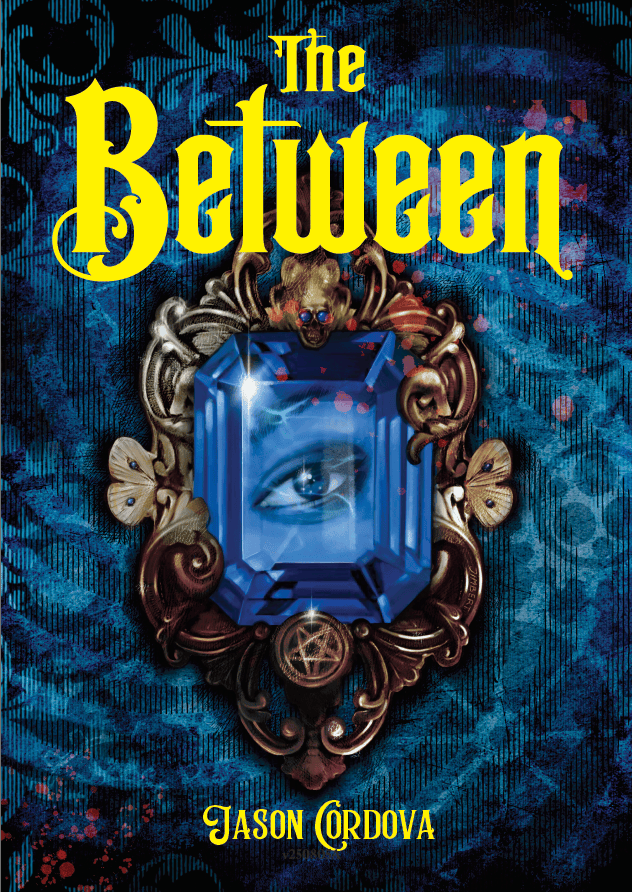
I think Jason Cordova realised that and invented a mechanic to scratch that itch. You can see it in play in the Between. I’m currently a player in a campaign of the Between. We’re about eight sessions in and I’ve been delighted and ever so slightly shocked by the lurid inventiveness this mechanic has brought out in me with regards to my character, Dr Robert Swindrake.
Masks
Ostensibly, The Between is a game about monster hunters at work in a version of victorian London. They pursue threats by following leads and collecting clues. With enough clues they can try to answer questions posed by the threat and eventually, answer the one that will lead them to deal with the threat in some way. This part of the game is great. It uses the Carved from Brindlewood system, which allows the PCs to determine the truth behind the mysteries. There is no set answer to any questions, you just gather your clues, present a story that fits the clues and then roll the dice to see if you’re right. It leaves everything in the hands of the players, and that’s satisfying.
But, honestly, the real game (for me) is in the drip feeding of the hunters’ back stories. Bear in mind that the players are not allowed to discuss their characters’ pasts outside very specific contexts. This is key! In the extract from the introduction below, you can see how central this concept is to the game:
THE MOST IMPORTANT THING
The Hunters are intentionally occluded; the game is called The Between because we find these characters caught between a very dark, mysterious past and an equally dark, possibly tragic, future. We aim to explore these dark pasts, but only at the right time—dramatically-speaking—and only when the game’s rules tell us to. As a player, you must always avoid speaking about your character’s past—in character or out of character—unless a specific mechanic in the game demands it (such as The Vulnerable Move or the Janus Mask, both of which will be discussed later in this text). If a Side Character asks your Hunter about their past, you must always demure or change the subject; if another player asks about your Hunter’s past, you must remind them that you’re not allowed to say.
The Vulnerable Move is used by PCs to recover from negative Conditions. This involves indulging in the character’s vice with another PC present, where it is allowed to talk about some element of their past in an effort at catharsis. A Janus Mask can be used in the the event that a roll does not go as well as you might like. The Between uses a Powered By the Apocalypse resolution system. You roll 2d6 and add any modifiers you might have. On a 1-6 you fail, on a 7-9, you succeed at a cost and on a 10+ you get a full success. If you don a Janus Mask, you can increase a 1-6 result to a 7-9 or you can increase a 7-9 to a 10+. There is a limit to the number of times you can do this, however. There are two types of Janus Mask, the Mask of the Past and the Mask of the Future. The Mask of the Future can generally have a big impact on the PC’s future. But it’s the Mask of the Past I want to discuss here.
In our latest session, I was forced to use a series of Masks of the Past to avoid certain death among other things. You can see the prompts for each mask below. It’s important to note that you have to don the Masks of the Past in Order from top to bottom. This has the staying effect of forcing you to narrate or present the story of your character’s life in snippets from good times to hard times to very bad times. At least in the case of my character.
The Mother
I chose the playbook known as “the Mother,” for my character. Here’s a summary of the playbook from the book:
Few understand the mysteries of human anatomy like you do. You are one of the most brilliant medical minds in London and could take your place as a lecturer at any number of esteemed academies. But you have different ideas, different plans; you are no longer interested in merely preserving life, but creating it! And so you’ll do what you must to survive—tending to the prostitutes dying of consumption, assisting Scotland Yard with grisly, forensic inquiry, and creeping about in the dark with these new people, these Hunters with whom you share a home—but always you are focused on the new life growing in your secret womb, your child, the one you hope will capture even the faintest reflection of the person you loved and lost.
My character is Dr Robert Swindrake, a medical man who has found himself working with the weirdos of Hargrave House, often providing forensic and medical expertise in the their investigations. But, when not working on these mysteries or working for Scotland Yard, he spends his off-hours in his secret lab beneath the house. There, he is suturing together a variety of limbs and organs, gathered during his adventures, to make a construct. Obviously, this playbook is inspired by by Frankenstein. But, the motivation of the character is clearly to do with the loss of someone close to them, a loved one. In Robert’s case, it was his daughter. We discovered this in the second session when I was forced to don a mask to avoid getting arrested by the police in a graveyard. He became lost in the memory of his young daughter, when he came upon her gravestone. Until the last session, I had only had to don two Masks of the Past. So, I had explained that Robert had lost his daughter, Dorothea, and narrated a scene of extraordinary love for her. In one session, though, I had to use three more of them.
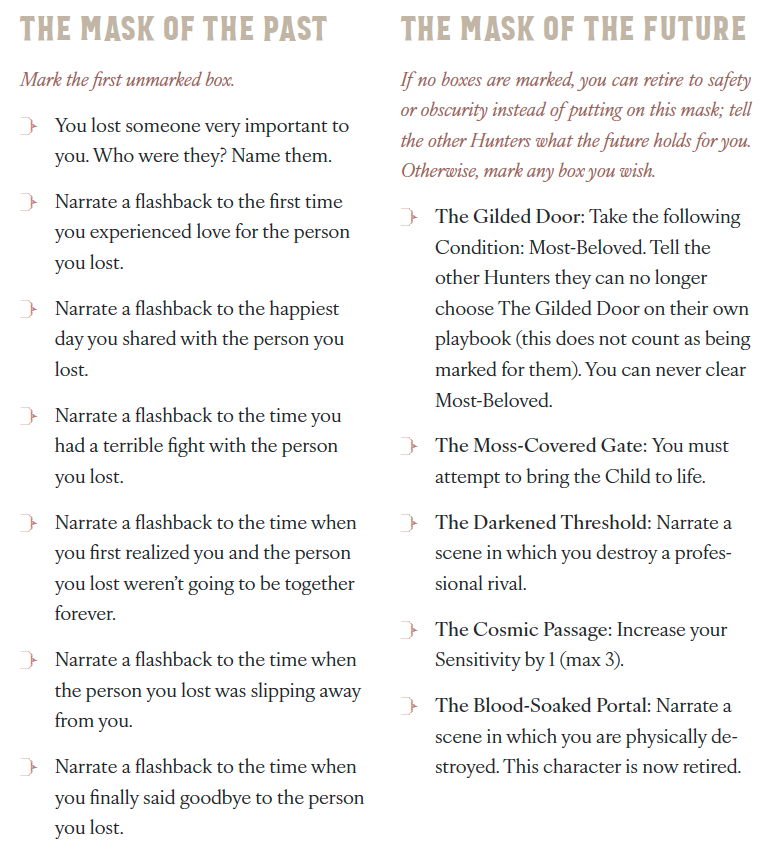
Throughout the course of the session I was able to narrate a series of scenes from Robert’s life with Dorothea.
The happiest day he shared with her: Using his wife’s organ’s he was able to restore Dorothea from a terrible illness. It looked as though Dorothea had been beaten and abused. The implication was that, with his wife dead, and his daughter cured, they could finally be happy together forever.
A terrible fight with her: She persisted in asking about her mother as she grew older and one day in the parlour, he insisted that her mother’s life went to save her own and it was the best thing that could have happened. Dorothes ran from the house straight into the street where she was run over by a Hansom cab.
Realisation that we would not be together forever: Back in his surgery, we see Robert again, removing an organ from the body of a young woman on one operating table and transplanting it to the broken body of Dorothea, now maimed horribly by her accident. It is obvious that he has been preying on people in the London night for the organs he needs to keep his daughter alive. But he begins to understand that cannot keep this up forever.
I had been thinking about the first answer above for several weeks, as I had used that Mask in the previous session but never got the chance to resolve it. So I knew I wanted him to kill his wife. But as the session went on and things got worse and worse for him, I felt I had to build on that and really turn him into a very bad man. I thought, what if Dr Frankenstein and Jack the Ripper were the same guy? And it wasn’t a stretch to get there. One of the coolest things about the Mother playbook is the fact that, at some stage, you have to play the defining move, The Child, meaning you have to roll the dice and hope for the best as you imbue your Child with life. This could very easily result in the outcome that the Mother PC is retired, and the Orphan playbook becomes available. I love the idea that, upon the “retirement” of the Robert Swindrake, I could continue playing the construct he made. It would be a totally different experience that is informed by the Mother’s actions, but with completely different motivations.
It’s also possible that the Child will wake and be “consumed by anger and fear.” In this case, the contract becomes a new threat that the PCs will have to deal with. That’s another exciting prospect! But, given what I have revealed about Robert at this point, I am not sure I could continue to play him in good conscience.
Conclusion
I think you can see, dear reader, that this is a great way to make your character’s back story the focus of an RPG campaign. These days, I don’t normally expend too much energy on constructing complex histories for my PCs these days and I don’t spend too much time thinking about them. But I often find myself thinking about what I can add to spice up Robert’s story a but more in quiet moments, dreaming up new horrors. I haven’t even gotten into the stories the other PCs have been coming up with during the course of play but I also look forward to learning more about their stories every session. Its all fun! I recommend this game if that’s the kind of thing you enjoy thinking about.

