Character Creation – Advanced Dungeons & Dragons 2nd Edition, Dark Sun

Showing some character

So the character creation posts have had some good feedback. People mainly seem to like it when it goes disastrously wrong for some reason. Schadenfreude maybe? Anyway, I thought I would continue the series with another one. This time, I thought I would go back to the game I think of when I think of my teenage years, AD&D 2nd Edition (TSR 1989), and, more specifically, the Dark Sun setting (TSR 1991). I have never been a player in a Dark Sun game, I was always the DM, so this will be interesting. Also, Dark Sun characters need to be pretty hardy to survive the scorching wastes of the magic-blasted world of Athas. So, if I roll bad, you sadists out there should get a kick out of it.

Step 1 – Ability scores

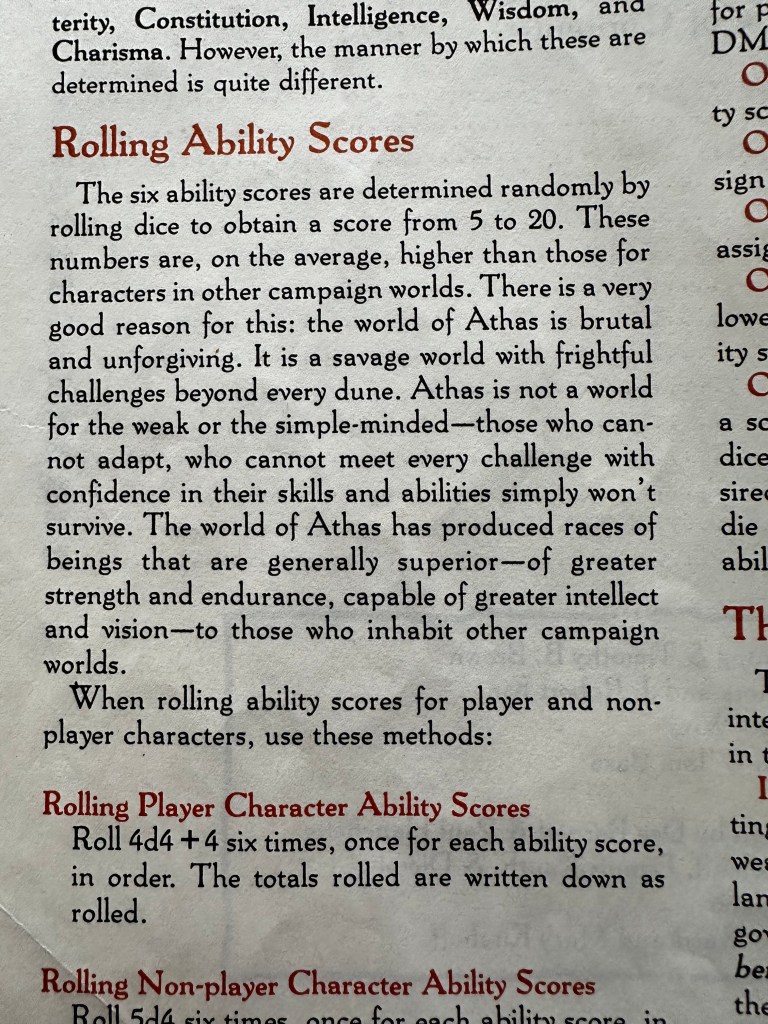
A photo of the “Rolling Ability Scores” section of the AD&D 2nd Edition Dark Sun Rules Book.

We see an immediate departure from AD&D norms with rolling your ability scores in Dark Sun. Because the setting is so brutal, your PCs get higher than average scores to reflect the hardness of life there. So, instead of the usual 3d6 for each score, you roll 4d4+4 for a minimum of 8 (even though the book claims the minimum is 5, which is numerically impossible) and a maximum of 20, unmodified. There are a bunch of optional methods for rolling included in the Dark Sun Rules Book but I am going to stick with the basic one. So, here we go:

  • Strength: 13
  • Dexterity: 16
  • Constitution: 19 (Suck it Canon Fodder)
  • Intelligence: 17
  • Wisdom: 16
  • Charisma: 10 (Oh well, they can’t all be winners)

First thoughts; obviously this method produces some high results. Also, I was very lucky. Also, these rolls mean that this character could choose almost any race or class.
Second thoughts; now that it comes to it, this is one of the reasons my players really liked this setting. They got to create some very powerful characters, even without cheating on their rolls (which was, I must be honest, the norm at the time)!

Step 2 – Player character race

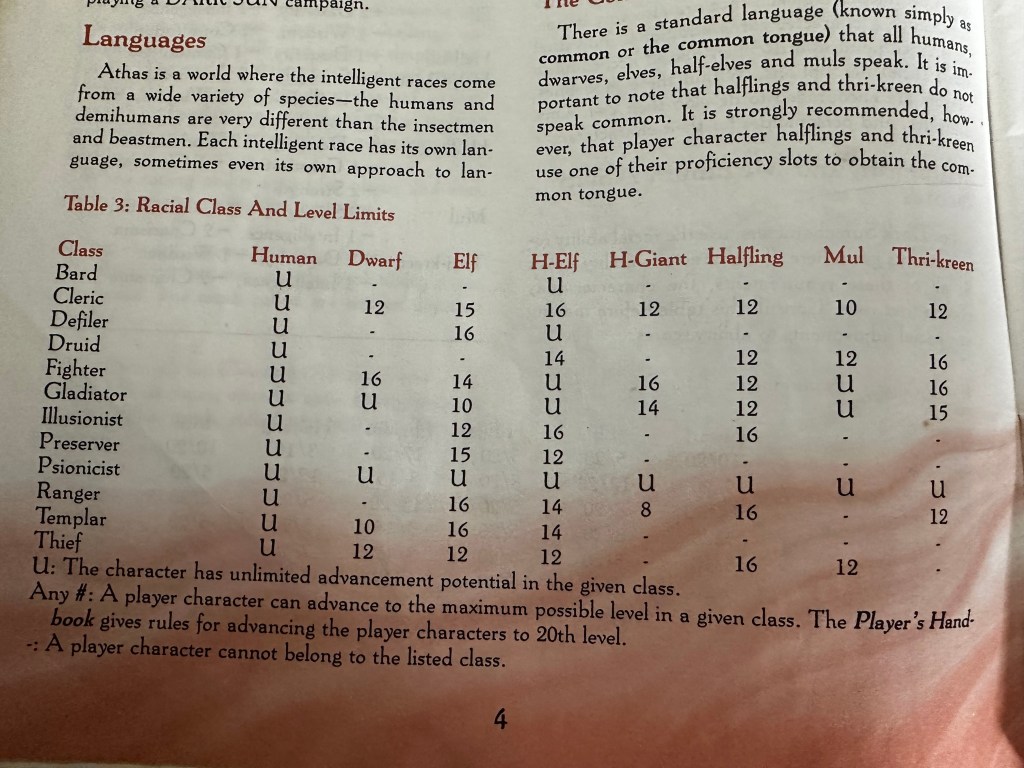
A photo of Table 3: Racial Class and Level Limits from the AD&D 2nd Dark Sun Rules Book.

There are Racial Ability Requirements in this setting as there are in the base game, but some of them are very tough to achieve. The only one I think is ruled out is the Half-giant. If you want to be one of those big lads, you need to have a minimum strength score of 17. So here are the races I get to choose from:

  • Dwarf
  • Elf
  • Half-elf
  • Halfling
  • Human
  • Mul
  • Thri-kreen

Pretty much none of the races in Dark Sun bear any resemblance to the standard D&D ones, with the possible exception of bland old humans. There are also a few new ones here.

Dwarves are all hairless and obsessed with a focus that gives them bonuses to saves and proficiencies when performing them in pursuit of that goal. They can choose to be Clerics, Fighters, Gladiators, Psioicists, Templars or Thieves. Although all of these have level caps below 20 except for Gladiator and Psionicists. Some of them are really low. A Dwarf can only get to level 10 as a Templar for instance! But they can multi-class. They get a +2 to CON, +1 to STR, -1 to DEX and -2 to CHA.

Elves are tall and lanky and weather-worn with an incredible stamina needed for running long distances across the Athasian deserts. They are very insular and tribal. They get bonuses with long swords and longbows made by their own tribes and to surprise rolls in the wilds. They can choose to be any class except Bard or Druid. They get +2 to DEX, +1 To INT, -1 to WIS and -2 to CON.

Half-elves have to deal with terrible intolerance from both elves and humans and have to do without basic connections or friends (this shit is in the text, ugh.) Anyway, it makes them very much self-reliant loners. They get a free Survival proficiency at 3rd level and can make a pet friend at 5th level! All classes are open to them and they get to multi-class if they want. They get a +1 bonus to DEX and a -1 to CON.

Half-giants are a thing in this setting. And, although I can’t choose them, here is a little bit about them. They are up to 12 feet tall and weigh up to 1600 lbs! They have no culture of their own as a very young and dull-witted race. Once again, the text is pretty bad about this kind of thing. It really underlines for me the need for the push-back this sort of thing rightly received in more recent times. Anyway, they getting bonuses to STR and CON and minuses to INT, WIS and CHA. They can only choose from 5 classes.

A photo of the Halflings section of the AD&D 2nd Edition Dark Sun Rules Book including an illustration by Brom depicting two tattooed halflings with long, wild hair emerging from a cave.

Halflings are small humanoids from the jungles at the fringes of civilisation in the Tablelands of Athas. Their culture is concerned mainly with appreciating their local natural world and complex interactions of a social sort between their various villages and clans. They are not really into war and wealth. They get bonuses to use slings and thrown weapons, to surprise opponents and to save against magic and poisons. They get a -2 to STR, -1 to CON, -1 to CHA, +2 to DEX and +2 to WIS. They can choose any class except Bard, Defiler, Preserver and Templar. They can choose to multi-class.
As a side note, I had a memory of Halflings all being cannibals in this setting but it is not mentioned in the character creation section so it might have just come up in certain adventures or something. Not sure.

Humans are much like humans in other settings except they generally have some weird little traits, like mutations. This is a post-apocalyptic setting after all. So players are given latitude to come up with some little physical idiosyncrasy that is purely for flavour. They can choose any class and can be dual-class, but cannot multi-class.

Muls are yet another “half-race.” Its genuinely so distasteful, this whole business. Anyway, here we are, they are half human, half dwarf. They are the product of slave-owners “ordering their births” for gladiatorial or labourers. They are born sterile. FFS. My stomach truly turns at this description of this race. It’s just so cruel. They also “live out their lives in servitude, driven by hatred and spite.” Give them a break! They are tall and well built. They get a +2 to STR and +1 to CON, but a -1 to INT and a -2 to CHA. They can work longer and harder than others as well. They have to choose, at the time of creation if they are considered human or Demi-human. If considered human they can have unlimited advancement in any class and become dual-classed. If the player chooses demi-human, they can, instead become multi-classed and can only choose from Cleric, Druid, Fighter, Gladiator, Psionicist and Thief. This really puts a great big question mark over the entire idea of class restrictions on Demi-human races, if you ask me. This suggests that the reason a demi-human can’t choose any class or get all the way to 20th level in it, is not because of a physiological, racial impediment, it’s only because human society says they can’t… I mean, what?

Finally, Thri-kreen. They’re big mantis guys who have a base AC of 5 but never wear armour. They don’t need to sleep but they can’t use most magical items as they are generally designed for use by human shaped people. Their hunting packs control much of the Tablelands. They have a well-known taste for elves (maybe I was mixing up the Thri-kreen and the Halflings.) They get natural bite and claw attacks and a powerful leap. They get venomous saliva at 5th level as well as a bonus proficiency with the Chatkcha, a thrown weapon. They can also dodge missiles at 7th level. They get a +1 to WIS and +2 to DEX, but -1 to INT and -2 to CHA. They can choose to be Clerics, Druids, Fighters, Gladiators, Psionicists or Rangers and they can multi-class too.

This post is already much longer than I had intended. I started going through the races and couldn’t stop commenting on them. It was like watching a car-crash in slow motion.

Anyway, I think I will have to continue this character creation process in another post tomorrow. But, before I go, I think I will have to complete the choice. Obviously, as always, the race you select will have a direct effect on the choice of class due to the ability score modifiers. But, since we have a tradition of randomness in the character creation posts, I think I will stick with it and roll for it. There are seven races available to me and, luckily, I do have a d7 to hand thanks to DCC. Here goes:

I rolled a 6 on a d7, dear reader, but I just can’t accept it because that would have been a Mul and that makes me too sad. So I re-rolled and got a 4, Halfling!

So, that leaves me with ability scores as follow:

  • Strength: 11
    • Hit probability: Normal, Dmg Adjustment: None, Weight allow.: 40lbs, Max press: 115lbs, Open Doors: 6, Bend Bars/Lift Gates: 2%
  • Dexterity: 18
    • Reaction Adj.: +2, Missile Attack Adj.: +2, Def Adj.: -4
  • Constitution: 18
    • HP Adj.: +2 (+4 for Warriors. This means Fighters, Rangers and Gladiators in Dark Sun), System Shock: 99%, Resurrection Survival: 100%, Poison Save: 0, Regeneration: Nil
  • Intelligence: 17
    • # of Lang: 6, Spell Level: 8th, Chance to learn spell: 75%, Max. # of Spells/Lvl: 14, Spell Immunity: –
  • Wisdom: 18
    • Magical Def Adj.: +4, Bonus Spells: 4th, Chance of Spell Failure: 0%, Spell Immunity: –
  • Charisma: 9
    • Max # of Henchmen: 4, Loyalty Base: 0, Reaction Adj.: 0

The final task for today is to flesh out this Halfling a bit. I am giving her the pronouns she/her and calling her Rezina.

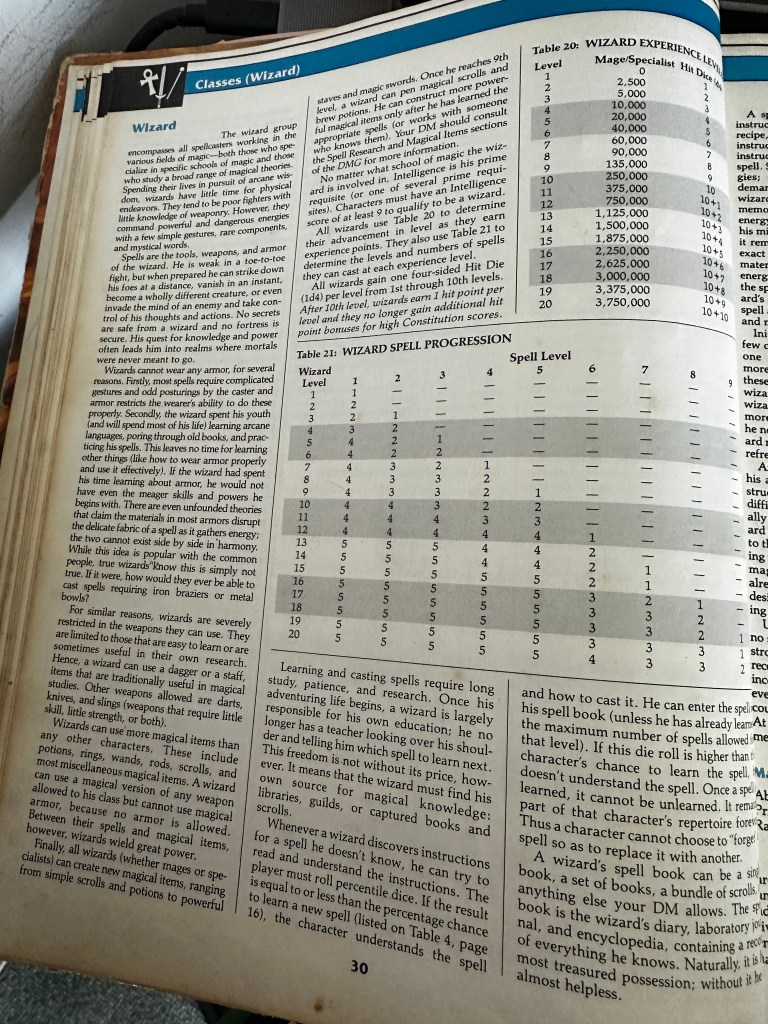
A page from the AD&D 2nd Edition Dark Sun Rules Book showing the Height, Weight, Age and Aging Effects tables for PC races.

She is 3ft 3in tall, 59lbs in weight, and 41 years of age.

Back tomorrow with the choice of class and probably everything else. See you then!

Old School Essentials – Character Creation

Make an OSE character with me

So, in my last post, I was chatting about the fact that I’ll hopefully be taking part in an Old School Essentials game sometime soon. I thought I would familiarise myself with it by creating a character. Come and join me!

In the Creating a Character section of the OSE Rules Compendium it’s got a step by step guide to rolling up your new character. So I am going to follow that as best I can.

1. Roll Ability Scores

Just 3D6 for each one. No fancy alternative ability score rolling options here! Although there is a subheading here that says the referee might allow you to dump your sub-par character if you have less than 8 in every ability. I should frigging hope so!
Anyway, let’s see what I get:

  • STR 11
  • DEX 7
  • CON 8 (not looking brilliant at this point is it, dear reader?)
  • INT 11
  • WIS 13
  • CHA 14
    OK, it ended up not quite as bad as I feared, but this guy ain’t no Conan.

2. Choose a Class

I have to skip ahead a few pages to choose from the full list of classes. So, the available classes in this basic rules compendium that I have are Cleric, Dwarf, Elf, Fighter, Halfling, Magic-User and Thief. You will notice that some of these classes are races/species/bloodlines/ancestries. That’s taken directly from the basic D&D rules and they decided to stick with it. Now, it is important to note that there are ability score minimums for these classes so, I would imagine, with my less than stellar rolls, I’m going to be locked out of several options straight away.

  • Dwarf: CON 9
  • Elf: INT 9
  • Halfling: CON 9

The other classes do not have requirements, technically, but, let’s be honest, a Thief with a Dexterity score of 7 is going to spend a lot of time in prison.

Each class also has a prime requisite, or a most important ability to put it another way. My highest one is Charisma but, guess what? None of these classes have CHA as a prime requisite! No bards here. So, I think it is clear that I will have to go for the Cleric, which is the only one with Wisdom as a prime requisite, and that is my next highest ability.

3. Adjust Ability Scores

In this step, you can raise your prime requisite by one or more points. You do this by lowering another ability by two points for every one you want to give your prime. The only three abilities you can lower in this way are Strength, Intelligence and Wisdom though, and you can’t lower any below 9. Oof. I don’t think I can afford to lower any of those, really, and I couldn’t adjust Wisdom up high enough to achieve better than the +1 modifier that my 13 already gives me. So, forget it.

Speaking of which.

4. Note Ability Score Modifiers

  • STR 11 No melee modifier and a 2-in-6 chance to Open Doors
  • DEX 7 -1 to AC, Missile Attacks and Initiative
  • CON 8 -1 to Hit Points
  • INT 11 Spoken Languages – Native only, Literate? Yes
  • WIS 13 +1 to Magic Saves
  • CHA 14 +1 to NPC Reactions, Max # Retainers – 5 with a loyalty of 8

Also, as my Prime Requisite, Wisdom, is 13, I get +5% increase to all XP awards. Not bad.

5. Note Attack Values

I did not realise they used THAC0 in this game until just this very moment, dear reader. For the, mercifully, uninitiated, THAC0 stands for “To Hit Armour Class 0 (zero)” and it is represented by a number that you need to get on a d20 roll + your attack modifier, in order to hit an enemy with an AC value of 0, where the lower your AC is, the better. So, this was also the way things worked in the olden days of D&D and AD&D, so I guess they are sticking with that too. Okidoke.

So, at 1st level, my poor little Cleric has a THAC0 of 19. Meaning I would need a modified roll of 19 to hit AC 0, 18 to hit and AC of 1, 17 to hit an AC of 2 etc.

6. Note Saving Throws and Class Abilities

I have to say, I am not a big fan of using the word ability for both the character’s basic attributes and the classes’ features, but that’s just nit-picking.

Right, anyway, Saving Throws first

In the handy table you get in your class description it lists them thusly for a 1st level Cleric:

  • D: 11
  • W: 12
  • P: 14
  • B: 16
  • S: 15
    The key at the bottom of the table indicates what the letters stand for: D: Death/poison, W: Wands, P: Paralysis/petrify, B: Breath attacks, S: Spells/rods/staves. These are, once again, representative of the saving throws from the original D&D. Incredibly specific, aren’t they?

As far as abilities go, Clerics get access to Divine Magic:

  • Holy Symbol: yup
  • Deity Disfavour: not exactly an ability but good to know that can happen.
  • Magical Research: you can research new spells, effects and magic items!
  • Spell casting: Uh oh. I don’t get any Cleric spells at 1st level. Only 1 1st level spell at 2nd level. This guy is in serious trouble here.
  • Using Magic Items: can use magic scrolls as long as the spell is a cleric one.

Turning the Undead:

To turn undead, you roll 2D6 and the referee compares the roll against the monster hit dice on a table to see the number affected. It is possible to turn or just fully destroy undead this way, depending on the level of the Cleric.

That’s about it for “abilities” at 1st level.

7. Roll Hit Points

Generously, they tell me, my character has to start with at least one hit point. So, if I roll a 1 or a two, that’s what I will be starting on. Clerics roll 1D6 for this. Here we go!

  • Hit Points: rolled a 2 so due to my truly dreadful CON score, that’s a 1. Fuck.

Now, there is an option to re-roll 1s or 2s at the referee’s say-so. But my referee ain’t here. Going to just stick to the basic rules and hope I don’t kick any rubbish bins and die.

8. Choose Alignment

Illustration from the Alignment section of the OSE Rules Tome. It depicts a sphinx-like god on the left-hand side, holding a sword out towards a party of adventurers and a bearded, four-armed, muscle-bound god on the right, holding out a spike mace.

OSE don’t have no truck with your good and evil dichotomy. It’s Lawful, Neutral or Chaotic. Given this Cleric’s start in life, physically at a disadvantage, frail and weak prone to sickness, I think he is leaning towards Chaos. He is railing against the world and the laws of man and nature.

  • Alignment: Chaotic

There is a note in the Alignment section that if the referee does not think you are role-playing your alignment, then they can give you one that better suits your character. Interesting.

9. Note Known Languages

  • Known Languages: Common, Chaotic (Alignment Language)
    Another language, with my intelligence? No way buddy. I think the inclusion of the secret languages of gestures, signs and code words, known by all peoples of a given alignment is kind of cool and appropriate for the genre. Weird though.

10. By Equipment

I get 3D6 x 10 GP to start:

  • GP: 50 (that was two 1s and a 3 on 3d6. FML)
    Going to flip to p42 to check out the Equipment list. I must bear in mind what Clerics can use: any armour and shields but only blunt weapons.

Time to go shopping

  • Club 3GP (1d4 Dmg)
  • Leather Armour 20GP (AC 7 (12 this is if you decide to use ascending AC instead of the standard descending))
  • Holy Symbol 25GP
  • Sack (Small) 1GP
  • Torches (6) 1GP
  • Waterskin 1GP

So, because I have to buy a Holy Symbol, and I really want to have some armour to protect my 1 Hit Point, I cannot even afford rations. I feel as though my Cleric must have taken a vow of poverty.

11. Note Armour Class

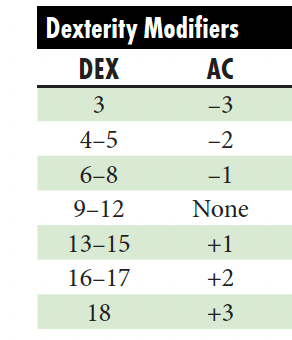
The Dex Modifiers table from the OSE Rules Tome. I am using it here to illustrate how odd it is to use negative numbers to indicate that a character's low Dex score can make their AC worse, when using a THAC0 system.
The Dex Modifiers table from the OSE Rules Tome. I am using it here to illustrate how odd it is to use negative numbers to indicate that a character’s low Dex score can make their AC worse, when using a THAC0 system.

Well, my Cleric, broke and pitiful as he is, is also clumsy as fuck. His Dexterity score is 7 and that gives him a -1 to his Armour Class. Now the wording here is extremely confusing. And I don’t know why they did this. So, as we discovered earlier, the lower your AC, the better when you are using THAC0, right? OK, in that case, if you get a negative modifier to your AC, that should be a good thing! But it is not. In the description of the Dexterity Ability Score they write: “a bonus lowers AC, a penalty raises it.” ! Like, what!? Why not just change the table so that a lower DEX score gives a +1 or +2 and a high score gives a -1 or -2?! Baffling. I need to point out that this is not the way they did it in my extremely old and battered copy of the AD&D 2nd Edition Player’s Handbook. As the picture below proves:

Table 2: Dexterity from the AD&D 2nd Edition Player's Handbook. I am using this to show how the AC modifiers in the OSE Dex Modifiers table above should have appeared, in my opinion.
Table 2: Dexterity from the AD&D 2nd Edition Player’s Handbook. I am using this to show how the AC modifiers in the OSE Dex Modifiers table above should have appeared, in my opinion.

Anyway, what this means is that my Cleric, in his leather armour has:

  • AC: 8

12. Note Level and XP

Pretty straight forward:

  • Level: 1
  • XP: 0

13. Name Character

  • Canon Fodder

That is all.
This disastrous character creation post has been brought to you by Old School Essentials and very bad luck.

Anyone else got a truly desperate OSE character to share?

Turbo Tokens

Failure is failure

Nobody wants to fail, right? We frown on failure. We take it personally, even when it is no fault of our own. It is hard not to feel that way. It might even keep you awake some nights, remembering how you fucked up that one thing and someone blamed you for your failure, even though it was largely a matter of chance. It sucks, but here’s the thing, your brain will never let you forget that one time you messed up. You will almost certainly never make the same mistake again if it’s something you can avoid, right? You will avoid similar situations, you will learn to do the thing properly or you will let someone qualified do it.

But this is not the case in D&D and other similar games. If you roll a 12 and add your +3 bonus and you miss that guy with his 16 AC, that’s it. It’s over. There is nothing you can learn except that you better roll higher next time or hit him with Magic Missile. This feels so much worse than regular failure. This is failure with no upside. There is not even a fun narrative element to it, really, unless you shoehorn one in.

So, how do you fix this? I think the answer is pretty simple actually, and it was brought to my attention by Aabriya Iyengar and Brennan Lee Mulligan.

Adding interest to failure

In the latest season of Dimension 20, Never Stop Blowing Up, the gang are playing people stuck in an 80s action movie. They are not playing D&D this time. Instead they are using a version of the Kids on Bikes system that they have previously hacked for Mentopolis and Misfits and Magic.

I really enjoy the system and it suits the seasons they use it in really well. In particular, the exploding dice element of the mechanics makes a lot of sense for a show called Never Stop Blowing Up and it makes for some brilliant cast reactions when it happens.

But the mechanic I am interested in here is the Turbo Tokens they receive when they fail at an action. In the base game, they are called Adversity Tokens and they represent the lessons learned from failure and contribute to real swings of momentum during high-stress situations.

Kids on dragons

So, I am going to try it out in D&D. Not sure what name I will give the tokens yet. I might just start with Adversity Tokens and see what the players end up calling them. The idea I have is to use them the same way as they do in Kids on Bikes, basically. They will earn one token each time they fail at something, whether it’s an attack roll or a stealth check or an effort to wow the crowd in the inn with their musical genius. That way, failure won’t feel quite so bad and they will be able to spend them later to effect other rolls. I think a +/- 1 modifier for each token spent is appropriate. They will be allowed to spend them to add to or subtract from any roll happening in the situation they are involved in. So they could add a bonus to their own attack roll, help out a fellow PC when the chips are down or subtract from an enemy’s saving throw or attack roll for instance. I foresee some interesting behaviours when it comes to the saving and spending of these. I am thinking I might need to cap the number of tokens a player can have at 10, although I doubt they’ll be able to save up that many of them really.

What do you think, dear reader? Have you ever tried doing something like this in D&D. If so, how did it go?

More Troika! – One-shots

Appendectomy

When was the last time your mind was genuinely blown by an idea, a concept, a creature or a situation presented to you when you played a fantasy role playing game? Because I don’t think D&D is providing opportunities for that sort of thing these days. I don’t necessarily blame the writers of D&D books for that; Wizards of the Coast has painted themselves into a corner that they are very comfortable occupying. In fact, because D&D is responsible for much of the public image of fantasy games for the last half century, they have dragged a lot of the hobby with them. As a result you have endless polished and glittering iterations of elves and dwarves and dragons and wizards with spell levels and clerics with devotion to individual deities and all the same monsters repeated ad nauseam. It is particularly interesting when you look at Appendix N, the appendix to the original D&D, in which Gary Gygaxstated his inspirations for the game. It has a few names you would expect to see: JRR Tolkien, Robert E Howard, Fritz Leiber and Poul Anderson but you also have a few that might make you wonder about the connection to the D&D of today.

HP Lovecraft is well known as the author of The Call of Cthulhu and other cosmic horror stories but his influence on D&D might not be obvious to all. Jack Vance wrote fantasy novels but they were tinged with an element of science fiction and gonzo world building in his Dying Earth books. In fact, many of the authors represented in Appendix N were famous for science fantasy rather than straight fantasy books, just look at Roger Zelazny and Edgar Rice Burroughs. You can still see bits of that influence in Wizards of the Coast’s D&D if you think of Spelljammer and Eberron but they always feel little too clean and sanitised compared to the books those ideas came from.

What I am getting at is that the true spiritual successors to the game developed with Appendix N in mind are part of the OSR. I wrote just yesterday on this very blog about Dungeon Crawl Classics and that very much embraces those influences, but it’s Troika! from the Melsonian Arts Council that truly embodies them for me.

Stretching those imagination muscles

The cover of my copy of Troika! Numinous Edition.

From Acid Death Fantasy by Luke Gearing:
“To the East lies the Plastic Sea, a miraculous main of liquid plastic. Upon contact with living skin it solidifies, covering the coast with Coated Men dueling each other in elegant, fatal contests, having made the choice to die young and glorious, sealed in flexible plastic armour.”

From Fronds of Benevolence by Andrew Walter:
Fletherfalloon is a floating Thinking Engine of a very basic sort, dating from a bygone age. Festooned with rotting ribbons and rusty curlicues, it hovers at varying altitudes burbling and whistling to itself.”

From Slow Sleigh to Plankton Downs by Ezra Claverie:
“Water: three billion years old, frozen by the perpetual
night at the edge of the Galaxy, compressed into glaciers
of midnight blue. Taste the weight of time and solitude,
darkness and purity. With Djajadiningrat.
Hear it crackle in your favorite spirit. The sound of time
calving into an ocean of premium flavor.
Cut by natural-born hand, never by machine, never by clone.
At night’s edge, taste the infinity. Only from Djajadiningrat.
— advertisement in Ice Tomorrow (trade magazine)”

Troika! Is a city at the centre of everything, and around it gathers a host of bizarre and fantastical settings dotted throughout the cosmos. Perhaps you traverse this universe in a space-ship, perhaps it’s a Golden Barge you use. Maybe your character is a Displacement Prosthesist, maybe they are a Hyenaman Scavenger. The possibilities are truly endless and the strangenesses abound.

A page from Acid Death Fantasy by Luke Gearing. It details of the background you can choose to play in that setting, the Hyenaman Scavenger.

We had the chance to play a single one-shot of Troika! A couple of months ago and it did nothing but whet my appetite for more oddness. The adventure we played was a published one, The Blancmange and Thistle, in which the PCs encounter a hotel. Saying any more would involve spoilers but suffice it to say, if you are a fan of the unusual, that hotel is the place to stay.

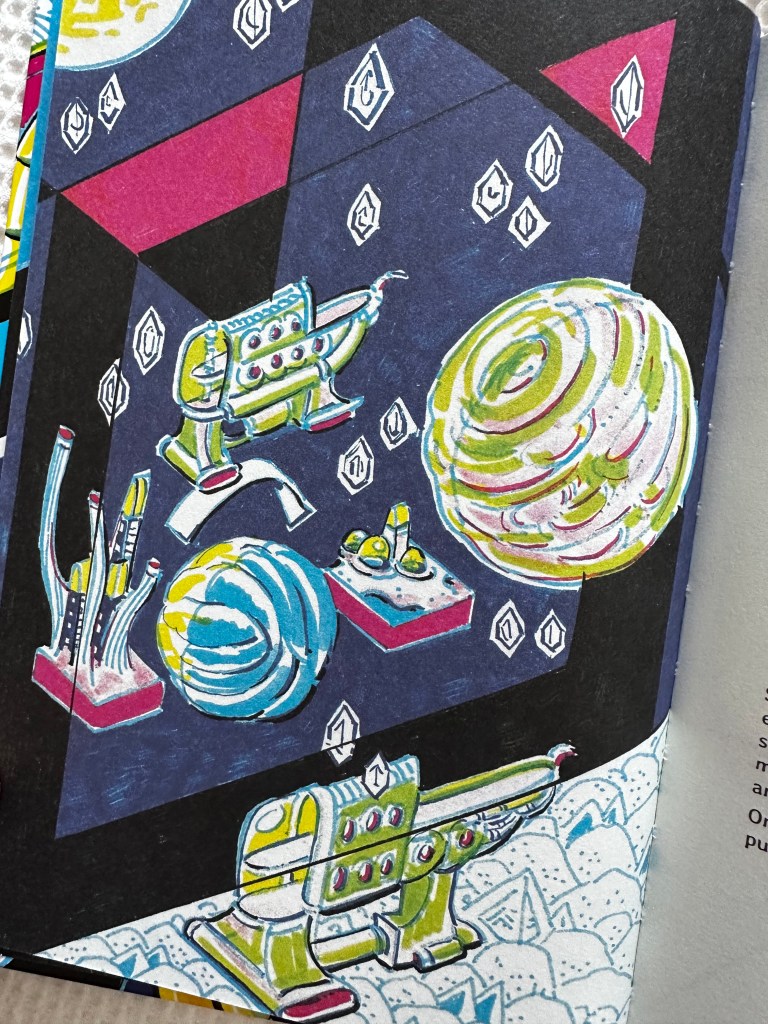
The inside front cover of my copy of Slow Sleigh to Plankton Downs by Ezra Claverie.

From that, I fed the PCs a hook that should, someday, when I find the time, lead them to the world of Myung’s Mis-step and the whodunnit adventure at the centre of Slow Sleigh to Plankton Downs.

But I have a few others too:

Some lads on a page from Frond of Benevolence by Andrew Walter.
  • Fronds of Benevolence is a short, point-crawl where the PCs journey in search of an item of great importance to their friend/ruler/patron/deity, Duke DeCorticus, which will lead them “to the Rainbow Badlands, across the precipitous face of The Wall and in the very vaults of the hump-backed sky!
  • Acid Death Fantasy is more of a setting book but could equally be used as a point-crawl adventure. It contains elements from Dune, Planet of the Apes, others from dying earth genre books and still others from classic fantasy.
  • Whalgravaak’s Warehouse also by Andrew Walter is an adventure “that centres the play experience on the classic tenets of danger, resource management, exploration and player engagement agency.”

And given the fact that I will probably only get to run these once every few months, these will no doubt last me a while!

Have you had any experience playing Troika!? If you met a Slug Monarch in an awkward situation, would you help them or attack them?

Dungeon Crawl Classics – Individual Modules

Dropped modules

I have a few adventure modules from the early days of my D&D career. A couple that hark back all the way to AD&D first edition and several more for specific settings like Dark Sun, Ravenloft and Planescape. I have a few for D&D 5E as well. But the thing is, I have never been that enamoured of them. Almost from the start I found it too restrictive to run a pre-written adventure. I had the feeling that I had to get everything right, according to the text and that, if I put a foot wrong, I would mess up the whole experience for the players. To be fair, that was absolutely the case in some instances.

Instead, after I had read a few published modules and run some of them, I was able to see how it was done. So, I wrote my own adventures. Usually these were pretty loose things with nothing but a beginning, a main villain and some encounters filling the middle but only a vague idea of where it was going. Honestly, my method has not changed all that much in the intervening years. Anyway, this approach allowed me to improvise much more freely and I think my players generally felt they could do as they wished, within the constraints of the setting, rather than the strictures of a preset narrative.

I still don’t run published D&D scenarios or campaigns much, even if I do occasionally buy them. I ran Storm King’s Thunder a few years ago and was equal parts appalled and underwhelmed by it. It’s a full campaign that took us the guts of two years to finish. During that time much of our play-time was spent farting around the Sword Coast, trying to remember what the PCs’ motivation was while having more-or-less random encounters and a few pre-written, essential ones. It was meant to be a sandbox but the area felt too vast and the individual locations too ill-explained to be easily useable without a huge amount of work by the DM. And so little of it felt important to the overall plot! On the other hand, when it gave me the chance to be creative, and come up with content that was entirely my own, I loved it. And, generally, those were the most memorable moments from that campaign, even if I do say so myself.

Modular construction

A photo of the front cover of my copy of the Dungeon Crawl Classics RPG.

So why do I want to run individual modules for the Dungeon Crawl Classics RPG from Goodman Games? More masochism? Could be, oh reader mine, could be. It might actually be a mistake. I probably won’t know until I try it out.

But here’s the thing, the modules I am thinking of have been written some time in the last ten years for the most part. They are modern, with modern themes and sensibilities in mind. They are structured for a modern RPG player and they are, generally, nice and short.

So, they are modern, meaning they have plenty of opportunities for the PCs to make important and potentially game-changing choices and very few instances of railroading. Also, they assume that the players, at least, have all agreed to be there to play the game and so they are not written with the utmost consideration given to how to get the PCs to do what the adventure wants them to do.

Themes and sensibilities are important. A lot of the older adventures make colonialism look good and normalise a sort of fantasy racism that is simply unacceptable. It wasn’t acceptable then and it isn’t now. But now, at least, the consumer won’t put up with it.

Structure and length kind of work hand-in-hand. A lot of these have a fairly loose structure where many events can occur at any time within the beginning middle and end portions of the modules. And they are short enough to play in an evening or two for the most part. Here are the page lengths for a sampling of the DCC adventures I own:

The Sorcerer’s Tower of Sanguine Slant – 25 pages
The Laughing Idol of Lar-Shan – 17 pages
Blades Against Death – a massive 32 pages
The Croaking Fane – 16 pages

Easy to read and easy to prepare with great maps and fun artwork too.

Also, these things are metal AF.
Here are a few extracts:

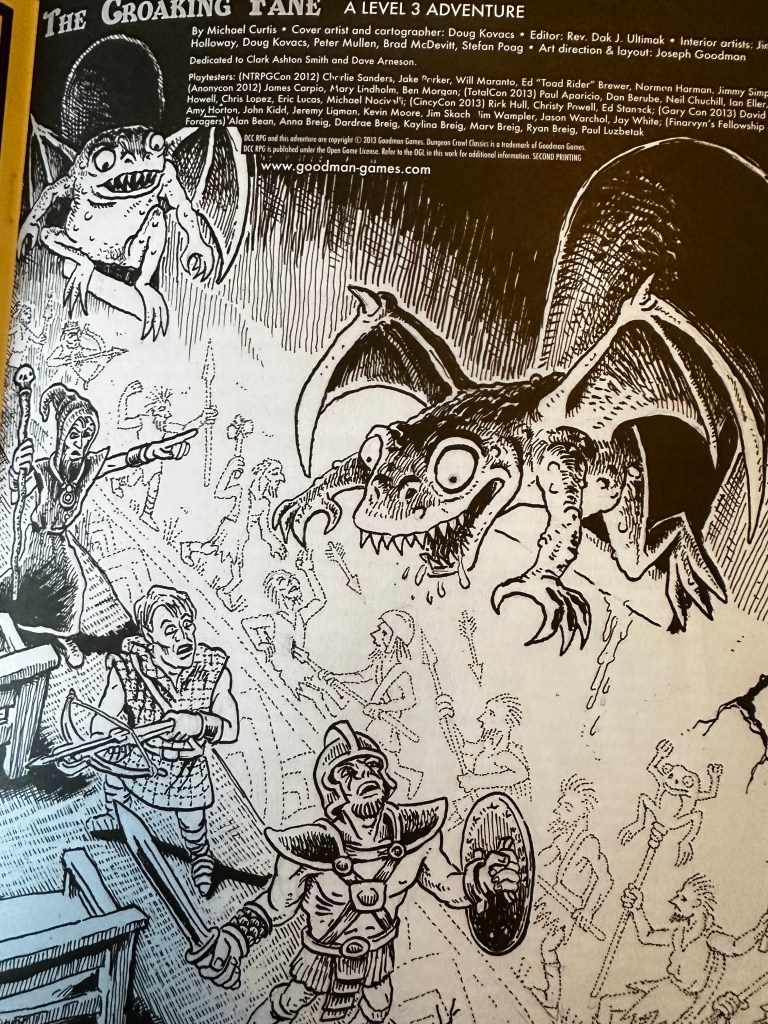
From DCC # 77 The Croaking Fane

A page from the DCC adventure module, The Croaking Fane.

“The transept ends in a small altar, atop which sits an idol depicting a grotesque frog with razor-sharp teeth and talons. Its mouth is full of the mangled bodies of sentient races – humans, elves, dwarves, orcs, and even ogres hang askew in it maw; limbs dangling between the giant’s teeth.”

From DCC # 74 Blades Against Death

A page from the DCC adventure module, Blades Against Death.

“You draw aside the clacking curtain to reveal an emaciated crone, her white eyes staring into nothingness. A third eye is tattooed on her forehead and seems to blink when she wrinkles her face.

From DCC # 77.5 The Tower Out of Time

“A grotesque wonder occupies this bright chamber. Three fleshy slabs stand at acute angles around a monstrous, bulbous mass that resembles an exotic jungle flower. Each slab bears a small, hairy anthropoid creature. Numerous crimson tubes extend from the horrible flower, greedily siphoning the life blood from these creatures.”

Finally, DCC has this rather unique phenomenon called Level 0 Funnels. I am mildly obsessed with them and am itching to get one to the table. You play one of these adventures in lieu of traditional character creation. Your players each roll up 4 or 5 0 level characters, essentially peasants with no special abilities or magic or anything (they might have a pitchfork or a pig) and you send them all into a dungeon. Any that survive the experience get promoted to first level. And some of these modules are pitting 0 level characters against the sort of things the average D&D party might think about facing at like, 10th level.

I haven’t even gotten into the rules of DCC really. Suffice it to say that they are close enough to D&D that most players will not have a hard time learning them. I’ll probably do a deeper dive on the rules another time.

So, have you played DCC? If you did, did you play any of the published modules for it? What did you think?

Psycho-analyse Your Players for Fun

Sorry for the monsters

The murder-hobo days are largely done, I think. Although I’m sure there are still plenty of tables out there slaying every poor goblin that crosses their paths, it seems to be a pretty old-fashioned play style, uniquely and deliberately violent, especially when the “monsters” are sentient creatures with cultures and desires and rich inner lives. I didn’t know it when I was a kid but there’s no doubt that the impetus to enter an underground lair and kill every orc you found in there was a product of some highly colonial cultural fallout. Those guys are green so it’s ok to take their treasure and their lives, right? Or, my king/lord/boss/priest told me those guys were evil; better get them before they get us!
You are far more likely to be able to deal with an encounter without violence, and that’s cool.

Harpin’ on

Do my players do this? you ask, reader. Well, yes and no. The Deadwalker from our Heart game made friends with a Heartsblood beast the other night. It was a giant snail with the face of a drow (except for the eye stalks and the rows of sharp little teeth.) his name was Shelby. Of course, they sort of bonded over the killing of a harpy couple. Harpies in Heart are very interesting, by the way. They remind me of the Khepri in China Mieville’s Bas Lag books. The male harpy is just a big bird, about the size of a cat. Now, when he is looking for a mate, he’ll collect up a load of trinkets, bones, body parts, small creatures and occult relics and place them in a circle while, like a minah-bird, he speaks words he has heard others say. These tend to be words they have heard recently from people like the PCs, which is fun. Anyway, this ritual summons his potential mate through a portal from some dreadful, hellish dimension. And she is the terrifying figure of a woman but with talons where feet should be and wings instead of arms and the intestines of some poor bugger dripping, bloody from her beak-like maw. She is very violent and hungry. This encounter was only going to end one way. Luckily, it was the PCs who came out the victors, although it was touch and go. And hey, Seeker made a new friend in the process! Cute little Shelby.

Surprised to see it turn weird

The subtitle there is a reference to a star I got from Isaac in our last D&D session when they discovered the brainless hobgoblin body and the triplets with gossamer threads attaching them to something else in this dungeon they have just entered. They have been encountering a lot of other sailors, mostly humanoids and their servants recently. That’s often the type of game it is because they are dealing with other ships and their crews a lot. They have usually resorted to violence in most instances in this campaign so far. Maybe that’s my doing since the encounters have often started off violent from the monster side. And they did try to befriend that one Neogi sailor who had been left behind by his mates. So they get humanitarian points for that.

So, in this dungeon, I thought I would take the opportunity to make it a bit weirder. After all there should be alien things in a space game. I can’t go into too much detail, but suffice it to state that I am excited to see how the players and their characters react and what they do.

Spiteful owls and slug monarchs

What I find, in general, is that the weirder the monster you introduce, the more likely violence is gonna to be the answer. This is, I think, often a fear response. Or maybe it’s an assumption that, the weirder the monster looks, the less likely it is to be reasoned with. These are often understandable impulses, actually. I mean, there are also the monsters that are totally mundane, like the flock of owls in the Troika! Adventure, The Blancmange and Thistle. They had come in through a window and were harassing a hotel employee. My players did not hesitate to cull those wild birds. To be fair to them though, the text does name them “spiteful owls” and they attacked anyone who entered their stairwell. So maybe they deserved it.

A couple of floors further up in the. Blancmange and Thistle, they encountered a Slug Monarch trapped in the stairs, embarrassed and very much in the way. They used some demonic water to awake a terrible hunger in him and that got him moving. He was a bit more dangerous in this state so they did have to fight him off but then they just escaped up the stairs where he couldn’t follow. It was a relatively non-violent solution to a simple problem involving a rather gonzo monster. But maybe they just treated him better than the average slug because he was a monarch?

Maybe I should stop psycho-analysing my players and their characters.

Anybody else psycho-analyse their players?

Forged in the Dungeon, Part 2

Engage!

This is an update on how my last session of Spelljammer went. More specifically how it went when implementing some mechanics I nicked, unapologetically from Blades in the Dark. If you don’t know what I’m updating you about, oh valued and discerning reader, go take a look at this post right here.

It was touch-and-go last night, to be honest. We only had about 2 hours to play and we were on course for the session to fully be a shopping episode. But, in the last 45 minutes or so, we managed to get into the new technique of using information gathering rolls and an engagement roll before interacting with the dungeon.

I think it worked pretty well, once we got into it. I briefly explained the concept and everyone was on board with it. So we went ahead and they started making up the ways they would use their specialties to help boost their chances with the engagement roll. One character described a trip to the pub to try and identify some locals who might know the way to this secret hideout they were looking for, one followed a potential gang member to the entrance, one questioned some dock workers they were helping out, one went to ask her sister for help and one staked out the most likely spots along the docks. They all used different skills and only one of them failed the information gathering roll. I set the Information gathering DC pretty low for this first time, a mere DC 10. I gave them +2 to the engagement roll for each success so they ended up with a +8 for a total of 18 on the engagement roll.

Now, I had prepared three maps on Roll20 and a bunch of potential encounters, both combat and social, traps and dangerous environments. I did not regret dumping two of those locations in favour of jumping straight to the dungeon entrance. Did the old dump and jump, as it were.

I narrated their discovery of and arrival at the building that hid the staircase to the hideout. I explained how the intelligence they had gotten in their information gathering phase had allowed them to figure out the best time to enter. I described the way they were warned to avoid dangers and possible traps on the stairs and then, satisfyingly, they got to the front door. And that’s where the action started.

Straight Dunjin’

I asked for some feedback on the technique at the end of the session and it was broadly positive. There was a definite consensus that, if we had simply role-played each of the scenes I described above with multiple rolls in each scene for stealth, deception, persuasion, etc, it would have taken hours and they would not have gotten anywhere near the entrance to the dungeon last night.

One player, Thomas, told me today that, because there tends to be a lot of “admin” in this campaign (ship stuff, money stuff, shopping stuff etc.) that it was refreshing to get to the action without a lot of rigmarole. I agreed that it felt good to use the precious time we have together (only 2 hours every fortnight) in as fun a way as possible. Last night, that involved sending them to an underground lair where they discovered a guy with the top of his head sawn off and a bunch of identical hobgoblins with gossamer threads attached to their necks. You know, good old fashioned fun!

We also talked about how they were able to retain a sense of having achieved this “easier” path to the entrance of Ozamata’s hideout. Since we went around the “table” and every character had input to how they wanted to help gather information and got to narrate and role-play within those short scenes, it felt earned more than given.

On the more measured side, I did get some feedback from Trevor that, although it worked well in that particular situation, it might be more difficult to apply in others. I have to agree with that assessment too. It is easy to apply this method when the PCs are aware of the exact job they have to do, when they have time to seek out information about it and to prepare in lots of different ways. It is not going to work so well when an encounter is meant to take them by surprise. Maybe that’s ok though. It’s not Blades in the Dark that we’re playing and it never will be. D&D isn’t supposed to feel like that. But that doesn’t mean that we can’t try to make it feel less like a grind and more narratively satisfying whenever possible.

I’m very well aware that, for most gamers who are used to the story-game play style, all I’m describing is maybe some half-arsed version of their regular RPG experience. Maybe it’s not even that. But I will say that, for me, it is fixing a distinct issue in a campaign that I very much want to continue playing but definitely want to speed up bit. I mean they have been playing the last day and a half on the Rock of Bral since last November… so, I want to move things along without making my players feel like I’m rushing them or demanding they do something they don’t want to. Hopefully, this technique will help to accomplish that.

Has anyone else tried something like this with any degree of success in D&D?

AD&D 2nd Edition

Masochism?

I have a hankering, beloved reader. I crave a little old school. Not revived or anything. No renaissance here. I’m talking, the original (at least for me.) I have been thinking about running an honest to goodness AD&D 2E campaign. That’s the system I cut my teeth on as a DM and I have a lot of the old books lying about on shelves, rarely picked up for any reason other than curiosity. I have a trio of my favourite settings from the old days, Planescape, Ravenloft and Dark Sun. But, is having them a good enough reason to want to run them? The rule set in 2E still involved THAC0, for crying out loud. Only certain races and certain alignments could play certain classes. Every rule seems over the top and over-worked when you look at them. So why? Why would I want to run it?

Nostalgia?

I ran the most successful campaign of my teenaged years in Dark Sun. I loved the setting. It was gritty and made life very difficult for your player characters. They had to start at 3rd level because a first level character wasn’t going to survive in the deserts of Athas too long. You were encouraged to create a “stable” of 5 characters and switch between them to level them all up, just because it was quite lethal. Most mages actively destroyed the land by casting spells and the Halflings were cannibals. It was fucking hardcore and we loved it. So, when I think about running AD&D again, I think I’m channeling the feelings from that time.

But I will admit there is also a sort of morbid curiosity to try it out. More as a historical research project than anything else. How would it compare to more modern systems like 5E or the Year Zero engine or even actual OSR systems?
And I think at least one of my players shares this sense of curiosity about this game and the legacy it spawned. He didn’t get to experience it so maybe it’s just his curiosity too. I mean, people really did love it, right? So, why?

Dark Sun

There is also another point, though. It might even be the main reason I want to do it. Dark Sun itself. WOTC have indicated in the past that they are never likely to revive Dark Sun as a setting for D&D. It just has too many slightly problematic elements. There is a lot about slavery in it. There’s a very strong theme of climate disaster and despotism and evil capitalists. I think it is generally safe to say that Wizards is not interested in picking up any political hot potatoes these days. They will keep it light and breezy whenever possible. So Dark Sun is never likely to come back. Now, I know that enterprising individuals have made some impressive 5E conversions of the setting and I have explored that option. But they don’t give me what the original did. I think Dark Sun benefits from the cruel and crunchy 2E system as much as it does from the grittiness of its world building. And I think that is the main reason I want to run it again.

Anyone out there running any old versions of D&D? If so, why?

Forged in the Dungeon

Engage

I mentioned in my post about my ongoing Spelljammer D&D 5E campaign that I get frustrated by the vast swathes of time demanded by the system, particularly for combat. It’s so involved and requires the application of so many sub-systems, the knowledge of so many specific abilities such as spells and feats that even a small scale fight can take up the guts of an average session. Player patience is tested during the parts they are not involved in and when it does come to their turn it can be difficult for them to know the current state of play because they have, quite understandably, tuned out. So then you have to rehash the last few turns before they take their go.

Some have suggested ways around this, such as removing the roll to hit or limiting the time a player can take on their turn. I understand the impetus to use these workarounds. But one option feels too much like it’s removing a core element of the gameplay and the other is going to end up with some players rushing and resentful and others just giving up on doing anything cool and instead just hitting the thing with their sword every time.
So, what’s the answer? Sorry, good reader, I don’t claim to have one. But here’s what I am going to try:

Blades in the Dark has a mechanic that allows the crew to make a single roll before they get into the action. This is known as the engagement roll and the level of success you achieve with this roll essentially determines how far into a score the action starts. So, in a D&D context, if you roll poorly, you might have to begin the dungeon before you even find the entrance: you’re wandering the wilderness, risking random encounters and suffering exhaustion in the freezing cold while you search, relentlessly for the right damn tree stump that the tunnel is hidden under. But if you roll well? Well, then you come prepared; you knew the weather was going to turn nasty so you dressed for it, you knew it was going to be a long way so you hired some dog sleds, you bought a map from a local trapper and you read a book about the dungeon that told you how to bypass the traps in the entrance hall. In the second case, you start your delve right in the meat of the dungeon, ready to face the fun puzzles and fights and escape with all the coin you can eat as a reward.
Each option sounds like it could be fun to play, to be honest, but option 2 gets the PCs closer to the goal with the least amount of danger, thereby saving time and, moving them towards that tasty dungeon meat I was talking about earlier.

Information is power

Now, another element of this mechanic is that, in Blades in the Dark, to add or remove dice to or from your engagement roll pool, you would take into account many in-world mechanical elements that simply do not apply to my D&D space-galleon game. But there is another mechanic from Blades that I think could work instead. Players could each make a “gather information” roll before the engagement roll. They could use any skill they like for this; arcana, history, religion, stealth, anything that makes sense in the fiction. And they could also use their spells and abilities to improve their chances with their chosen rolls. Success on these rolls could improve their chances of scoring high in the engagement roll.

Normally, in Blades in the Dark, successful information gathering attempts will inform the type of plan the crew comes up with, thereby potentially adding extra dice to the engagement roll pool. In D&D, I am considering my options, advantage or bonuses. Advantage is my preferred way of rewarding players for clever or ingenuous play, but if I offer a +1 or +2 bonus to the engagement roll for each successful gather information roll it means they can stack. I mean, I suppose I could just chuck out the PHB altogether and allow them to have multiple d20s for the engagement roll but, as I mentioned previously, I am not trying to mess with the core rules of the game, just add a little spice to them.

Hot dam

Now, this method could work really well in an instance like I described above where they plan to visit a dungeon and a lot of information and luck could help them to get there quickly and painlessly. But, if all I have planned is a big encounter that doesn’t really involve a lot of build-up or mystery or travel to get to it, I am not sure it helps at all. The problem with D&D combat is still present.

One method I have considered is increasing the damage output of an encounter while decreasing the enemies’ hit points. This would keep the essential rules of the system in play and the sense of danger and high stakes, without the fantastic outlay of time.

So, I am not finished with this idea by any means. If I get a chance, I am going to test out the engagement roll and gather information roll tomorrow night when we return to the Rock of Bral. But I suspect I will need to tweak it and workshop it before it works as well as I want it to.

Does anyone else do this sort of thing? Does anyone have any good ideas for speeding up D&D combat? Should I really try?

Games I Have Played So Far this Year, Part 2

Lists part 2.2

You will notice a trend in this list. More than half of them are Open Hearth one-shot games. I just joined the community in January of this year and I thought the best way to ease my way into it would be to sign up for a short game or two. So I started with Alien Dark. Not long after that another member in a similar timezone started posting one-shots of a bunch of games I wanted to try out, and that accounts for almost all the other Open Hearth one-shots listed below. I wasn’t new to Mörk Borg, admittedly, but it is usually a gritty good time and it was at a time that suited me so I joined up. Honestly, sometimes, that’s all the impetus you need.

Games I have played in so far this year

  • Root – The Nightmare Before Winterfest – Concluded Campaign. Root is the PBTA RPG of the board game where you play anthropomorphic denizens of the forest, traveling from Clearing to Clearing getting into trouble, making friends and enemies of various factions and having prolonged Christmas episodes. Good friend and esteemed character-actor, Thomas GMed this “festive” campaign for our little Tables and Tales gaming crew. The quotes are only partially ironic. It did start around Christmas but then it kept going right through Easter and out the other side! Don’t get me wrong, I’m not complaining. This campaign was a laugh. I got to play a German badger named Beagan, known to one and all in the Clearing of Lindor. Beagan and his companions busted open the people-in-the-chocolate mystery, demolished the local police station, repelled the siege of Lindor’s famous Winterfest market from the branches of its festive tree and unmasked Ebenmeowser Scrooge as the ultimate villain of the piece. Good times.

  • Remembrance – Open Hearth one-shot. Remembrance is a GMless story game designed by a fellow Open Hearth member and this was a play-test of it. All the characters start off as members of the Irish Republican Army during the Irish War of Independence, brothers in arms and valued friends too. But, as those who know about Irish history of the early twentieth century will be able to tell you, the War of Independence was followed quickly by the Irish Civil War. This was fought between those forces who wanted to accept independence for all but the six counties in the North of Ireland and those who would only accept freedom for all thirty-two counties. The three act structure of this one-shot was split between the time of fraternity in the first act, the tragic split into two opposing camps in the second act and a sort of epilogue, or maybe denouement in the third. The story we constructed over the space of three hours is something I won’t soon forget and an experience that stuck with me as an Irish person and someone who lives in those six counties.

  • Mörk Borg – Rot Black Sludge – Open Hearth one-shot. Open Hearth community member, Dom ran this one. This was actually the second time I had played through this scenario. The second time went significantly better than the first, partly because of the very limited time-slot we had to play it in, I think. Rather than stupidly investigating every bloody thing that was definitely a trap of some kind, we pressed on looking for the ultimate goal, finding some kid or something. My character was Joachim the Devoted, a Dead God’s Prophet, who, paradoxically, was a nihilist who insisted on telling everyone he was a nihilist. He survived this scenario despite being largely useless!

  • Mothership – Sandalphon and the Sleeping Angels – Open Hearth one-shot. The second one-shot I was a part of that was run by Dom. This was my first taste of Mothership. In this scenario, you dock with an asteroid/space station and try to discover what is going on there. Spoiler: it gets fucked up and scary pretty fast. The Mothership system is mostly based on d100 rolls and, if you are familiar with Call of Cthulhu at all, you will know that that means you fail, a lot. This leads to horror in a good way of course, setting up scenes of panic and fear as you face the increasingly unsettling and gross realities of the setting. Somehow, my character Burt Connery, ever-suffering Teamster from New York City survived this one too!

  • Cohors Cthulhu – Rude Awakening – Open Hearth one-shot. The third and final one-shot that Dom ran in the list. Cohors Cthulhu is a game that imagines Cthulhu type mysteries and scenarios set in the Roman Empire. Out of all of the one-shots we played this year, I found that this one possibly suited the format the least. It is definitely interesting as a game and a setting but is more designed for campaign play I think. Each character was pre-generated but a little too complex to really get to grips with over the course of a single three hour session. That being said, I enjoyed the speed run we did of this scenario where my character, Herodion the Schemer narrowly avoided being ritually sacrificed to an old god and had fun with the other players. I’d be interested to try the game in a longer form.

  • The Quiet Year – one-shot. This is an unusual game to put on this list really. It is not an RPG to be honest but it is RPG-adjacent. It is a map-making game that uses cards and lists of prompts to allow a group of players to design a settlement that is recovering from some sort of apocalypse or disaster. You have one year to do it and the game is split into four periods represented by the seasons represented by the suits in a pack of regular old playing cards. It was so interesting that each of the players around our table started to embody certain sections of the fledgeling community that had often conflicting priorities and ideas about how to build it. I enjoyed this as an exercise in understanding the difficulties in being one part of a community that is, ostensibly, working towards common goals where other factions have very different plans to you. It has conflict built in to it due to requirements for always having some level of scarcity of necessary resources and this can lead to some, surprisingly fraught interactions above the table. I have heard of a lot of people using this game to create the starting state of a setting for a new RPG and I love that idea.

So, that’s it for my list of games played so far this year. I am looking forward to adding a few more to this list in the coming months. I’ll probably do a post about that in fact. How about you? What games have you played/enjoyed this year?