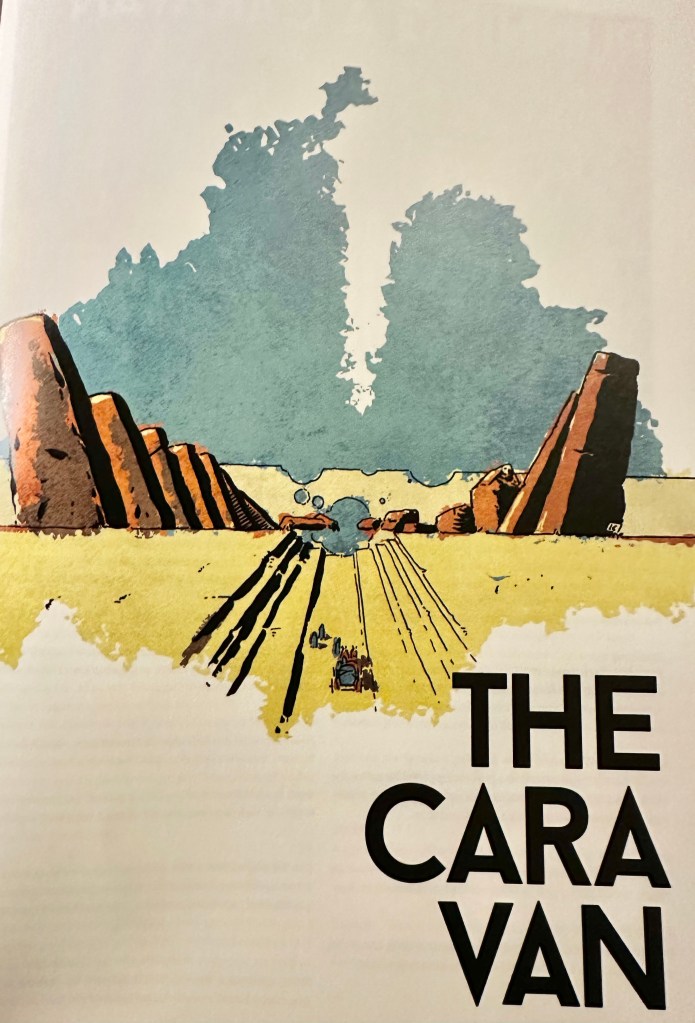
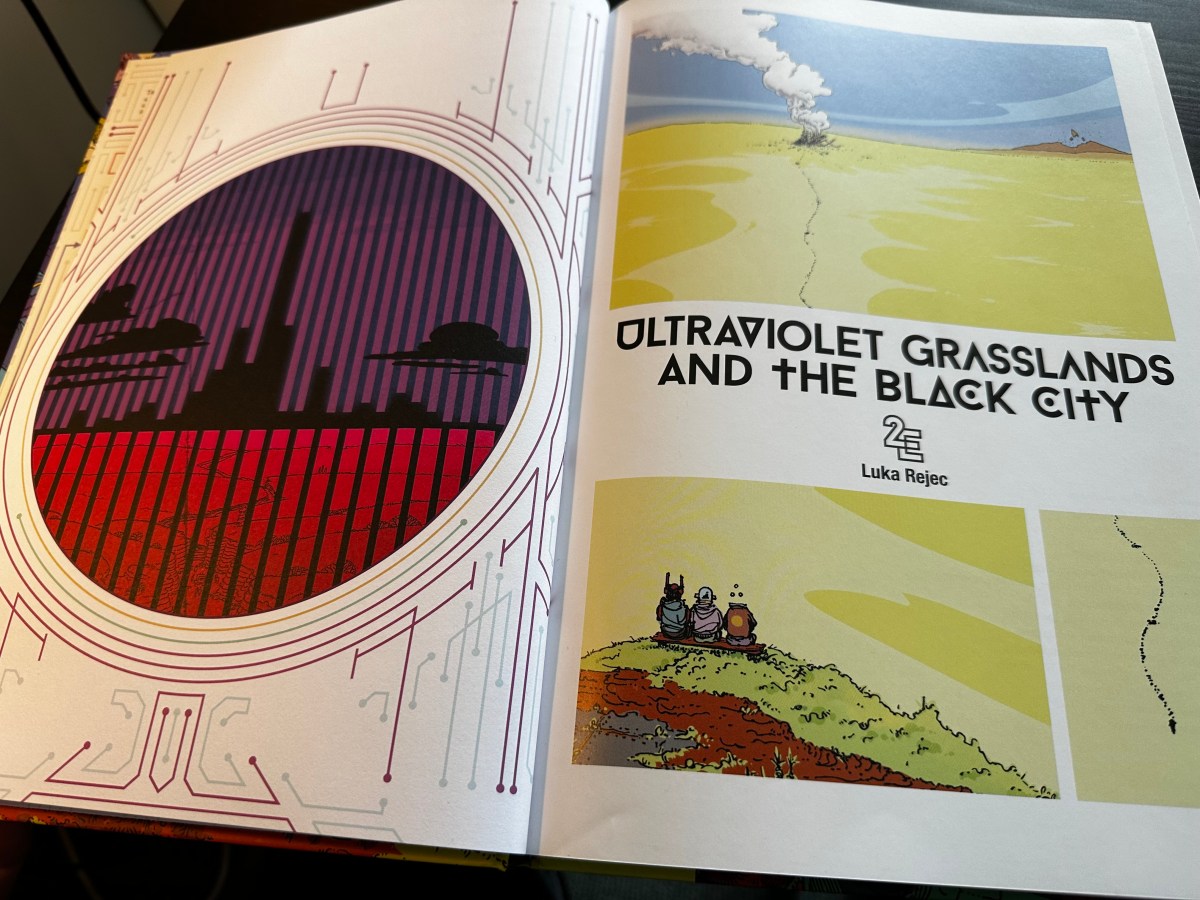
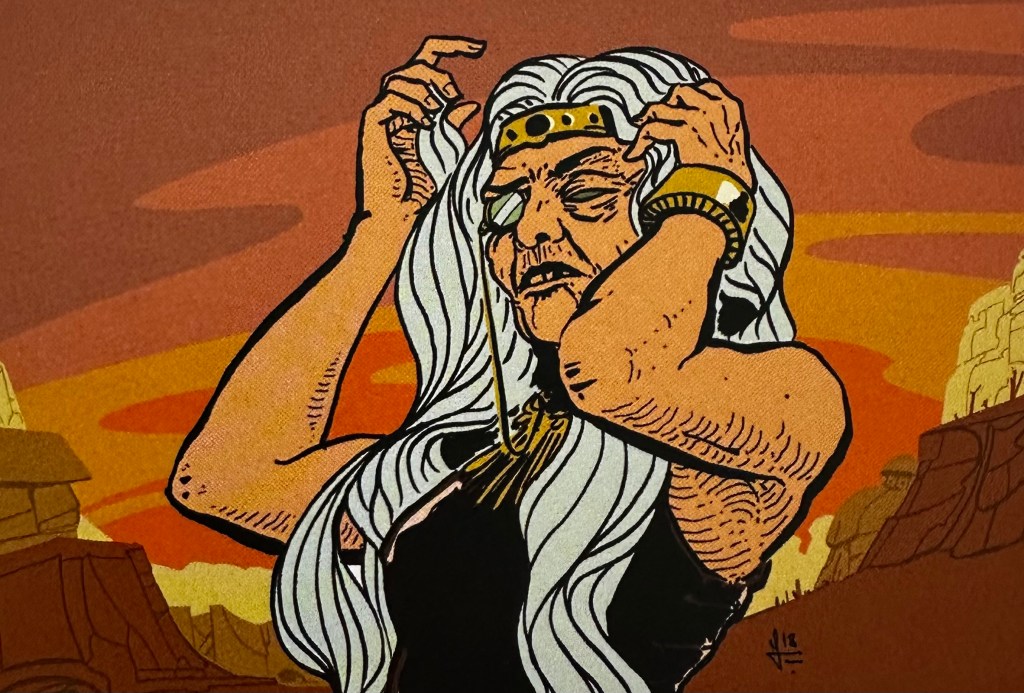
I mentioned recently that I had been reading Luka Rejec’s Ultraviolet Grasslands. I had, in fact, just been reading it for fun, but, about 50 pages in, I decided the best use for all its tables was in some sort of role-playing game. So, I got my trusty team together and started a campaign. We’ve had a session 0 and two sessions of play so far. It’s still early days. The caravan has not even managed to complete a full week of travel yet but we’re all enjoying the psychedelic vibes and the raw potential of the game and the setting.
I also wrote up character creation and caravan creation posts, which were not directly related to the campaign but were useful to me in getting to grips with some of the rules and the setting.
This post is about one element of the game that gets only a cursory mention in the book, and how I approached its use. That’s Caravan Quests.
Needy Naturalists
It might be a little ungenerous to suggest that the Caravan Quests section gets any less treatment than it deserved in the core UVG 2E book. It has a full page to itself, including illustration. Ten quests grace the page, everything from “Big Game Hunting” to “Ascending into the Sky Like the Shamans of Old.” And there are some great ideas there to spark events in your campaign. Since UVG is very much a play-to-find-out sort of game, very few things are explicitly labelled as quests. The encounter tables and the randomly discovered locations generally contain all the inspiration or trouble or opportunity the players or referee need to fill a session without picking up tasks from question-mark bedecked NPCs.
But I liked the idea of using one of them to further spur the PCs to do stuff on the road that wasn’t just trading and foraging. The one I settled on was 3. Glorious Naturalists. So, before their caravan ever set off, I had them encounter a band of scientists in L’ultim Gastrognôme, one of the most exclusive eateries in the Violet City. These scientists had been hanging around in the city for a while, looking for a group just like the PCs. They had been assigned a task by their Decapolitan university to discover a bunch of new plants, animals and minerals. They had a decent budget but, as academics, had little taste for roughing it in the trackless steppes and Vome-ridden wilderness of the Ultraviolet Grasslands. So obviously, our caravaners, Imssi, Stebra and Phaedred were the ideal choice to get out there and collect evidence of some undiscovered species! This coincided nicely with the drive of one PC. Stebra Osta, a forager and surgeon, is on the hunt for a special vegetable or fungus with incredible curative properties. She’s sure it’s out in the Grasslands somewhere so she wanted to take the scientists’ job as the perfect one to fund her own search. It also added quite a bit to their funds.
Were there more interesting or weirder quests in the list? Absolutely. Would it have been fun for them to have to 8. Witness the End of Time? Well, of course. But then, I wouldn’t have had such a good excuse to crack open a new prized possession.
Fungi of the Far Realms
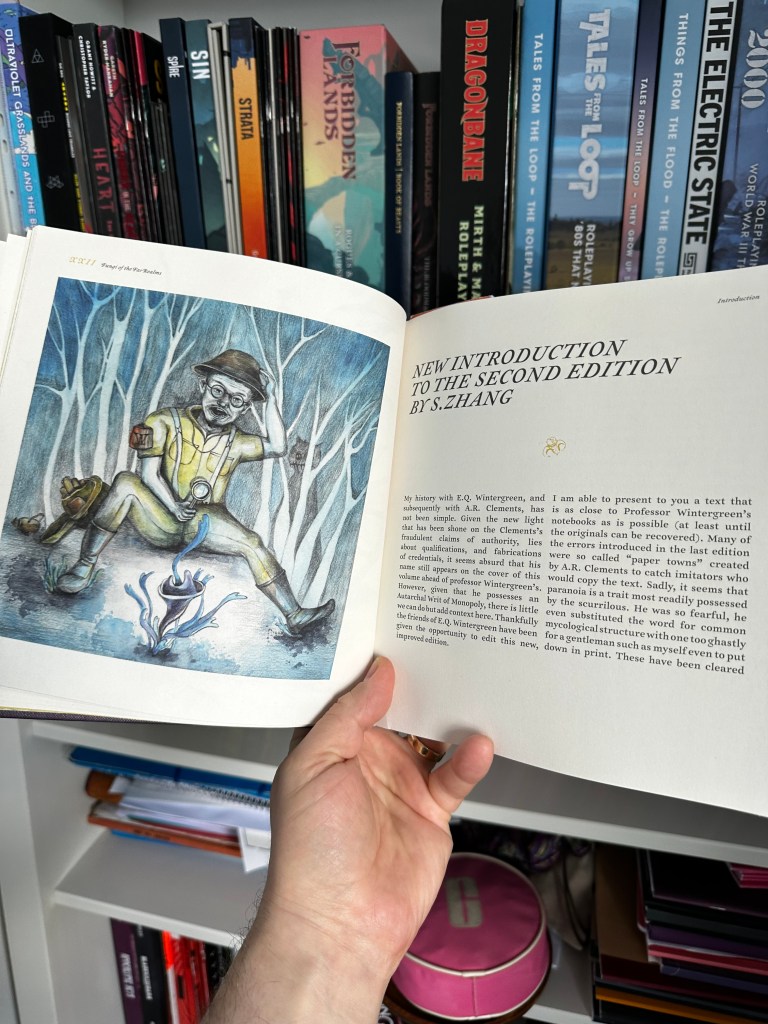
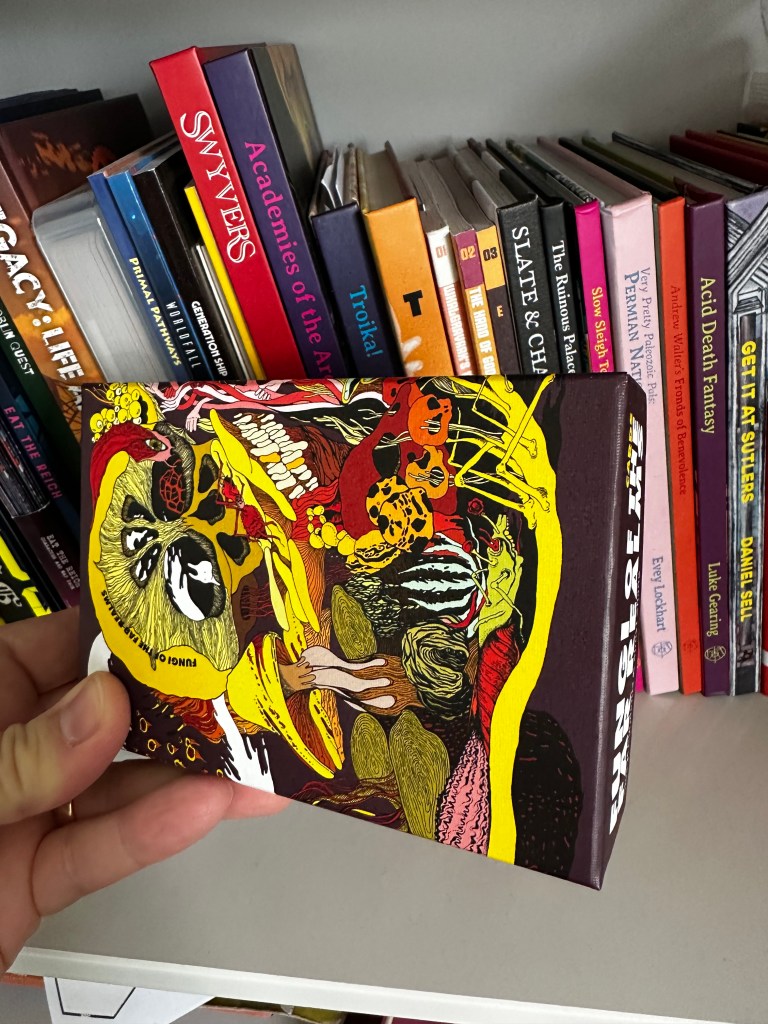
Just look at this book… Go on. Look at it. These illustrations by Shuyi Zhang are just breath-taking. The concepts of some of these funguses, written by Alex R Clements, are fun and bonkers. I remember thinking to myself, how am I ever going to use this in a game? before backing it. Idiotic question. I backed it because it is a work of art, not for its usefulness. But, I guess a thing can be both useful and beautiful.
The Caravan Quest in UVG never mentioned anything about fungi. I added that myself, just so I could get Fungi of the Far Realms and its attendant cards out at the table and have my players oooh and aaah at it. I was able to hand them their very first fungus card last weekend. They discovered a ka-zombie beneath The Last Chair Salon. It was feeding Crystal Puffballs to an imprisoned, limbless Vome-Mother. The Vome-Mother was hooked up by rubber tubing to a Fermentation Golem which turned her milk(?) into Yellow Beer, which the Salon’s unscrupulous proprietor was selling to her customers. Once they had dealt with that whole situation they discovered a nearby lush garden of tulip-like flowers, which was also dotted with dozens of the puffball fungi. I was able to hand over the relevant card to Stebra the Forager and let her know that a sack of these was worth quite bit to the right customer. What a wonderful alternative to the usual type of treasure!
There are a few valid ways to use this book at the table in many different games. I utilised the wonderful fold-out map that I received as a crowd-funding reward. I knew the type of environment I wanted the PCs to find the fungus in, so I used the grid system pictured above to locate a similar habitat. Unfortunately, there does not seem to be an index of fungus per grid-square but each entry in the book highlights the areas of the map that you might find them in. You could also just make a d666 roll and see which entry turns up for you! That’s fun, even if it doesn’t match your needs. The appendices also have tables for afflictions like hallucinogenic effects and fungal infections. If you don’t feel like freaking the PCs out or make them sick, every entry has practical world-building notes like flavour/mouthfeel and aroma. I loved these details in our recent session because it allowed the PCs to know that they had been consuming the fermented Vome-mother milk flavoured with the Crystal Puffball (Flavour/mouthfeel: rotten apples, Aroma: fresh rain.)
And there is another fungus-related adventure afoot already! Stebra, ever on the lookout for foraging opportunities, heard a rumour from a fellow Lime Nomad, that the Great Armadilloids of the Steppes were cultivating mushrooms. Then, as their caravan pushed on across those self-same Steppes they rolled a random encounter. Guess who? That’s right! Armadilloids!
If you’re interested, go check out my post previewing this game here.
A Bad Call?
Burke, Carter J “confessed” to Ripley that he had made a bad call in sending them to a colony on the moon, LV-426. But did he mean it? No. He was a scumbag of the highest order. He was just fucking someone else over for a percentage. I sent my players to LV-426 too. I wasn’t looking to fuck them over for a percentage, but, at the very least, I expected most of their characters to get impregnated by facehuggers, ripped to shreds by drones or melted by acid blood. Did any of that happen? Did I make a bad call in choosing the Cinematic Alien RPG scenario, Hope’s Last Day, from the core book, rather than the one from the Starter Set? Well, dear reader, why not come with me on a trip through our one-shot and my thoughts on it, and you’ll find out.
Shake and Bake
These two scenarios couldn’t really be much more different. The one from the Starter Set, Chariot of the Gods, is set on a ship out in space, you know, where no-one can hear you scream? It’s also very much a full scenario with an entire three act structure. They say it would take three sessions to play but I have my doubts about that estimate, having played Hope’s Last Day.
Speaking of which, Hope’s Last Day is a scenario that’s set totally on the moon where Ripley and the Nostromo’s crew found the Alien eggs in the first movie and the setting for the action of the second. This scenario was not even a full Cinematic experience. It is billed as a taster, since it really only encompasses what would be the third act in a normal Cinematic scenario. The book confidently asserts that it could easily be played in under two hours.
Frankly, duration was the deciding factor for me. I only had one night to get through a whole scenario. I don’t have a lot of wiggle-room in my schedule due to the fact that I have at least seven other ongoing games at any given time, so it really had to get wrapped up in one shot. So, I shook it and baked it.
Shaking
Shaking, essentially, meant reading through the scenario a couple of times. It’s very short, so this was not a problem. I also took notes on the various major beats and summarised the contents of the various blocks and rooms into bullet points. Most of the scenario consists of these location descriptions so this was key for me. Also, they are all presented in what I consider to be unwieldy blocks of text in the book, and I prefer referring to bullet points at the table. This work helped me to keep things flowing a little more smoothly on the night. I also screenshot handed the pregenerated characters out to the players I thought they would suit best a couple of days before. This part was fun, and the players were left to wonder how I decided who should play which character. Each character had an agenda that was generally meant to be kept secret from the others. Now these were fun. Stuff like, being willing to sacrifice themselves for the others, wanting to acquire an alien and escape with it or just to keep the company’s actions a secret at all costs. You know, normal stuff. Anyway, I examined these agendas and assigned the characters purely out of a desire to see each player pursue that secret agenda. Other than this fairly sparse preparation, I got a couple of copies of the map of Hadley’s Hope printed and a few character sheets. I familiarised myself with the relevant rules as much as I could and that was it for the shaking.
Baking
At the table, we baked. And, I will say most of the time this one-shot spent in the oven, there were no issues at all. Was I ready to nuke the site from orbit by the end? Not quite, thankfully. I’m mixing my metaphors quite egregiously at this point so I’ll abandon them both and just tell you what happened.
I started exactly as the scenario suggests you start, with the four PCs inside the West airlock of Hadley’s Hope. They had just returned from a day or more outside the settlement and were not aware the Aliens had already decimated the population. I let them investigate a bit, try and get an intercom working, and generally futz around. The scenario calls for an Alien attack whenever the PCs dawdle but I didn’t want to lose anybody so early on. I think this was a mistake on my part. Their first encounter with an Alien occurred a little later after they had made their way to another block of the station and messed around looking at eggs and facehuggers and whatnot. This gave one character the opportunity to collect an egg and another to sacrifice himself to keep the others safe and made them all start running to find the way out. This was more like it. Things really started moving then. The one who sacrificed himself turned out to be an artificial person as Bishop would have us call them. So, the alien just left him, innards outed, on the floor and unable to move, but not dead. Luckily there was an extra pregen for that player to take over so we continued on.
Later they encountered a couple of facehuggers after finding a few weapons. They made short work of them and moved on again. They spent much of the last part of the session effectively split into two parties running from two different drones towards the only way off the planet, a shuttle. And you know what? They all made it! Except the android, who, I can only assume was caught in the conflagration when the nuclear reactor in the processing plant went up as Ripley and the others escaped. Also, they didn’t all make it, because the pilot turned out to be the company plant and she spaced everyone else as soon as they left the atmosphere. I guess that made her the winner?
Game Over, Man
So, what was the verdict? It’s a mixed bag, to be honest.
I think our main complaint was that this was mislabeled as an under-two-hour scenario. I mean, ok, it was our first time playing the Alien RPG so we did have to spend a little extra time referring to the rules and figuring out what all the stats meant, but that does not account for the fact that this thing took us almost four hours. Even then, I had to abandon some integral rules to allow us to make it to the end in that time. I don’t honestly know how anyone gets five people around a table, people who want to role-play, who want to fuck around and find out, people for whom the joy is in the playing, not in the finishing, and have them get through this scenario in anything less than four and a half hours if you stick to all the rules of the game.
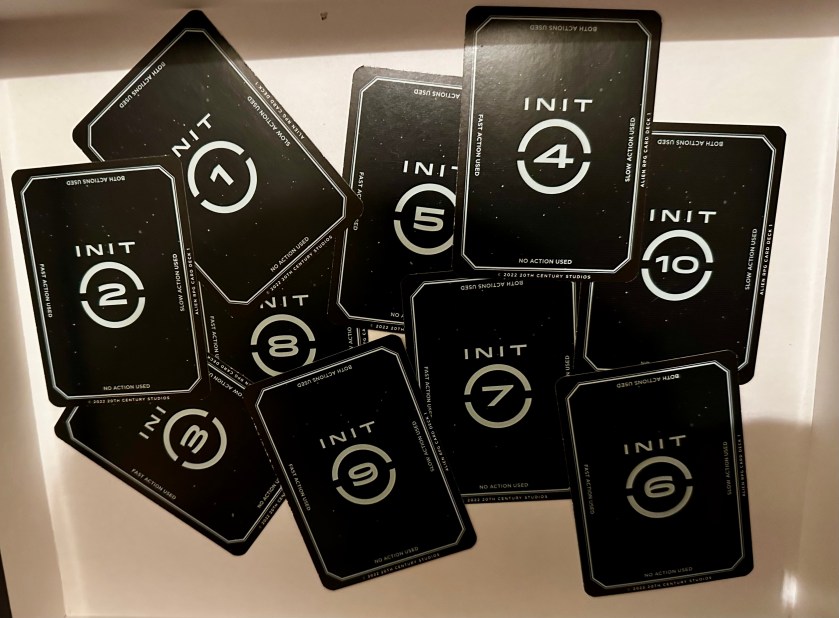
As for the rules. The main negative was the initiative system. Alien, like other Free League games, uses an initiative card system. We generally found it a little difficult to keep track of things using this and found it slowed the action down significantly. One of the main issues was that the PCs kept getting into initiative, running away from fights, getting out of initiative, getting caught again and getting into initiative again! So we were shuffling and picking those cards a lot. In fact, as time ran out on our session, I just left the cards to one side and did it narrative style. I got each player in turn to tell me what they were doing and told them how the Aliens or the environment reacted or acted against them. This really sped things up and drew the evening to a very exciting close, in fact. Would I use the initiative system as-is if I played again? I think I would give it a go as long as I had more time to play with but I would be ready to give up on it in a second if it started to get in the way again.
One more issue for me was the system used to figure out how the Aliens attack. Every time it’s their turn, the Game Mother has to roll on a table to determine which of their special attacks they use. This started off as a fun activity, but quickly got frustrating. It felt like each time the Alien had one of the PCs in their grasp, I would roll up an attack that allowed them the chance to escape. Now, if this happens a couple of times, it adds a nice dramatic element to the chase. But this is literally how they all managed to get away in the end. If I had been just choosing the attacks for the Aliens, there would not have been so many occupied seats on the shuttle when it took off. I feel like there is a better way to adjudicate the moves they make. Admittedly, you would not want every attack to be lethal, either, but it felt as though far too many of them were underpowered.
One element that worked well but felt like it was under-utilised or tacked on was the Stunt mechanic. Each skill had a stunt table that told you how you could spend your excess successes (each 6 you get when you roll your dice pool is a success and you gnerally only need one to succeed at your task,) but the players almost exclusively went for one of two options, at least in combat situations: they added extra damage or they pinned the enemy down to prevent them from taking as many actions on their next turn. This was fine but it feels like this needs more work. Perhaps the new edition will deal with this.
You know, there were plenty of mechanics we liked in the game too. The main mechanic in the Alien RPG, the thing you would lean on to sell the system, is Panic. Like other Year Zero Engine games, you roll a dice pool consisting of a number of dice equal to your score in a given skill plus the number of dice equal to your score in the related ability. So, if you have a 1 in Mobility and a 2 in Agility, you roll 3 dice. But, as you play, your character gains Stress for all sorts of awful reasons. For every point of Stress you gain, you get to add another die to every dice pool. This gives you a greater chance of success but also gives you a chance that you’ll have to roll on the Panic Table. This happens if you roll a facehugger (a 1) on the official Alien RPG Stress Dice. There are other ways of panicking. Usually, if one of your companions does something unhinged or crazy or if you see an Alien for the first time. That kind of thing. By the end of the session, everyone had so much Stress that they were rolling obscene numbers of dice and there were Panic rolls happening almost constantly. One Panic roll would often lead to another from someone else because of the result they would get. Also, because, each time you roll on the Panic table, you have to add your Stress Score to the roll and the shit at the bottom of the table is way worse than the shit at the top, the results got very bad as time went on. For example, this is what you get for rolling a 7 gets you:
NERVOUS TWITCH. Your STRESS LEVEL, and the STRESS LEVEL of all friendly PCs in SHORT range of you, increases by one.
This is what you get if you roll a 15+:
CATATONIC. You collapse to the floor and can’t talk or move, staring blankly into oblivion.
This did happen to one character but they were already at the shuttle at that stage and someone was able to drag them inside.
The feedback I got in stars and wishes from the session indicated that the players also loved the agendas they were given with their PCs. This was a worry for me before we started. I mean, not only did they not get to create their own characters, I didn’t even give them the choice of which one to pick. Obviously, this was because I didn’t want to reveal the secret agendas to everyone before play started. And I’m so glad I did it this way! Everyone had pretty much figured out who was the android in under an hour, but no-one, and I mean even me, because I forgot what the pilot’s agenda was, expected to be spaced by one of their own when they were on the verge of escape. Incredible scenes. This element of the game is specific to the short Cinematic Play scenarios. And, indeed, normally, in a full scenario, your PC’s agenda changes as you move through the three acts. I can’t account for how well this works, obviously, but it sounds great.
As for the scenario itself, there is not a lot to it. This is definitely a good thing. If you play it, you’re not going to get to most of the compound. A lot of those areas I summarised into bullet points remained completely unexplored. Once the drones were after them, the PCs soon discovered a sense of urgency and a definite goal, i.e. escaping on the shuttle. There was a bit more to it than that, but not much. Like I said, this was fine, especially as the PCs’ agendas took the place of a set plot most of the time anyway.
It was also cool that the scenario was so closely related to Aliens, the movie. I watched it the night before running the session, and that definitely helped me to picture the place and to describe it at the table. I’d recommend doing that if you do intend to run Hope’s Last Day. I’d also recommend leaving yourself at least four hours to do it justice.
So, was it a bad call? No, but if I went into it again, knowing what I know now, I would have made a few alterations to my expectations.
What about you, dear reader? Have you played this scenario or this RPG? Are you looking forward to the Alien Evolved Edition? Get in the comments?
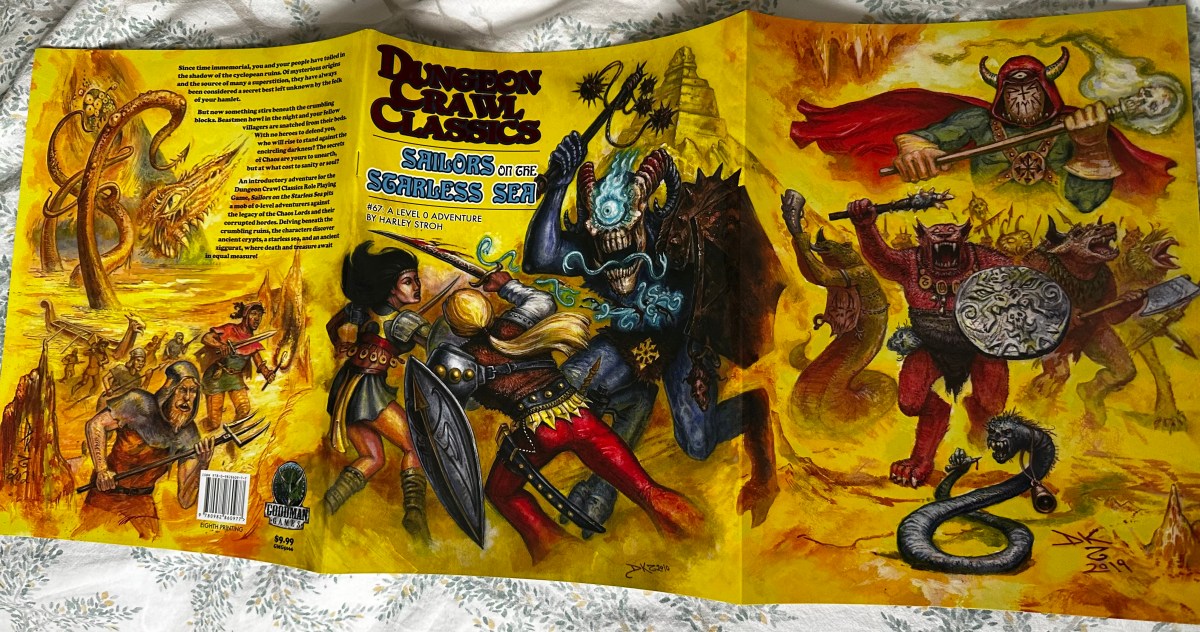
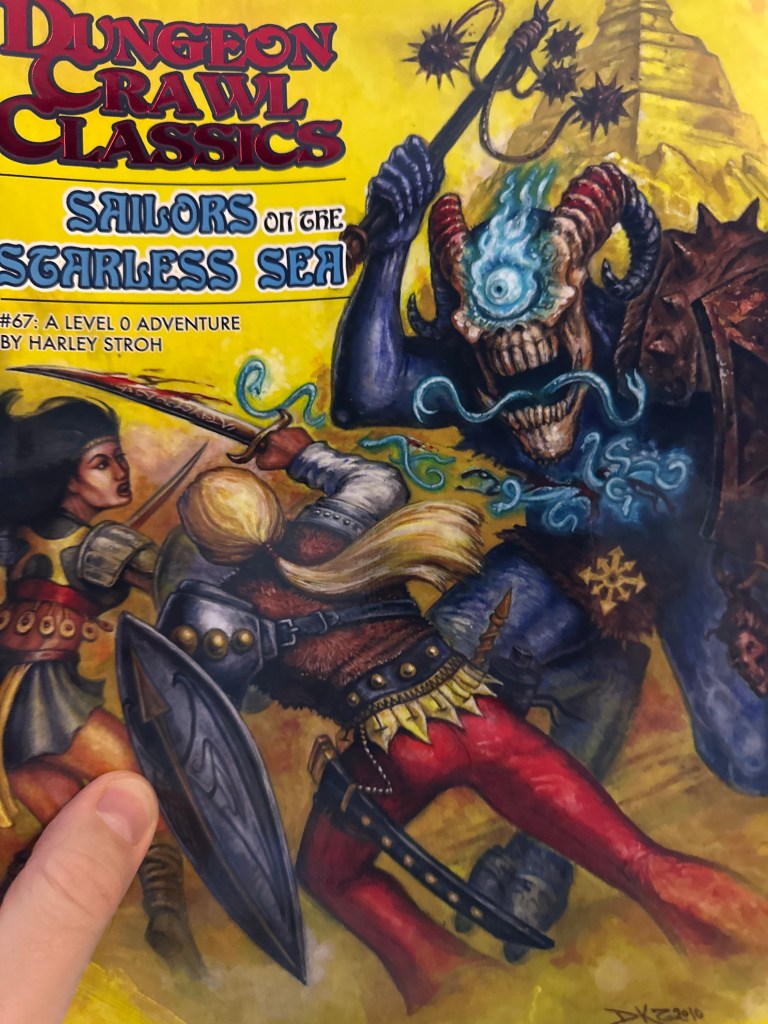
A few weeks back, I wrote up the fictionalised version of the events that occurred in the first session of Sailors on the Starless Sea, as played by the incredible members of our local in-person RPG community, Tables and Tales. They had just defeated the Beastman menace aboveground and were girding their collective loins to delve below the Keep of Chaos. Here’s part 2. Spoilers ahead if you plan to be a player in this module in the future!
The Starless Sea
In and in the darkness settled about the invaders and their new recruits, the doughtier of the captives they released from their chains in the charnel tower above. From the first landing in the stairwell, they gazed down and some saw the gleam of gold upon the steps below. Guðlaf, ever in pursuit of greater treasures, descended and found only a trio of lonely coins dropped and left where they lay. But, too, he noticed a curiosity in the one wall of the second landing. It appeared to stand…ajar. He and several of the others pushed through the revealed entrance to a chamber bedecked in antique cobwebs and festooned in the emptied carcasses of a treasure horde’s chests. While Marquis and some of the others gathered up what little coin still graced the grey stone floor, Hilda the Herbalist went to inspect the chests. One, she discovered, easily enough, had a hidden compartment in the bottom. Delighted with her discovery, she levered it open. The treasures inside were roundly ignored as a blade swung out, slicing away two of her earthy fingers. She cried out and bandaged the wounds as the others examined the find, tarnished silver jewelery, glittering emeralds of great worth, and a tabard of black, bearing upon it, the sigil of Chaos. As well, a brace of potions, oil of the black lotus according to Hilda. Imbibe it and gain great fortitude for a short time, but suffer for it later if found too weak to bear it.
Across the landing, another contingent of brave souls had found a great rend in the rocky wall. They had entered and found only another door. This one was surrounded in evil-looking runes. None of them could decipher their meaning, but they proceeded to attempt to enter nonetheless. They shoved and heaved and, eventually, shifted the great stone doors on their hinges. As they did, the magical wards fulfilled their fell purpose, exploding in unholy fire. Immediately, Ealdwine Dwerryhouse, the recently recruited Pádraig, elephant-eared Dainn and Ropert the rope maker were roasted like swine on spits, leaving only the girl known as Bear and Darik to enter the frozen tomb of the Chaos Lord Felan. He lay there still after years uncounted, perfectly preserved with his enormous axe and his glittering armour frozen with him in translucent funereal garb, a thick sheet of magical ice. Daric entered and tried his best to break through to retrieve the weapon but to no avail. Fearing for his life in the ice-clad chamber, he retreated.
Re-united on the fateful stair, the survivors gathered their courage and continued down into the darkness. They had come to rescue their neighbours and kinsmen and by the gods, they were going to do it.
Soon they found a new chamber, this one richly decorated in tile mosaics. In the centre a long, deep pool stretched almost to the other end. Almost all of the survivors were gripped by an undeniable drive to gaze into the waters of that pool. They simply found themselves there, as though transported by an invisible hand. And as they looked, the skulls of men and women rose, like glowing, hideous bubbles until they floated there, awaiting their new owners. The villagers took the skulls offered by the pool and were released, then, from their compulsions. Free to examine the rest of the chamber they found several nooks containing the mouldering old robes of some sort of Chaos cultists. Two of their number, Lydia and Roric took the robes and donned them, perhaps to fool some future enemies. Others looked upon the mosaics. They depicted several subjects. The first was a hooded figure standing atop a tall, stone monument, seven tentacles waving from the dark waters of the lake below it. The second showed a pair of armour-clad warriors clutching a single flail and commanding an army of bestial fighters. The third revealed a golden ziggurat atop a small island and a tall figure atop it, in the process of sacrificing a maiden.
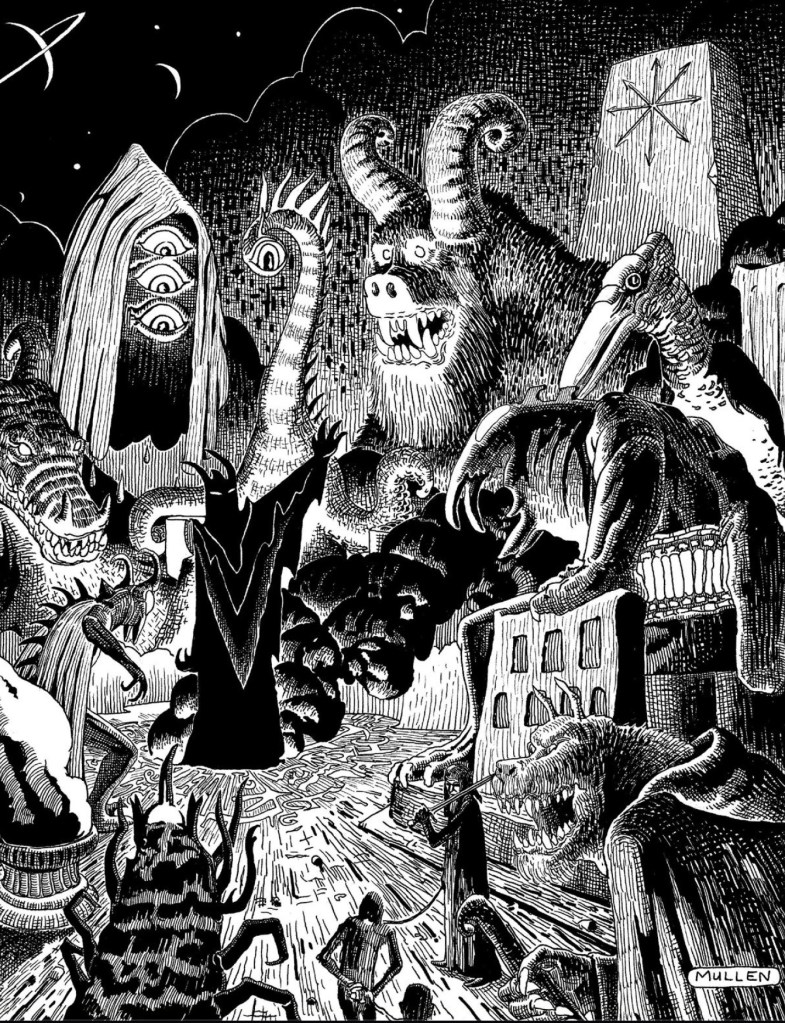
Leaving the Dread Hall behind, they went on, down and down a long set of wide stone steps all the way to an incongruous beach of black sand, occupied by a massive menhir and, beyond, in the misty waters of some starless sea, the majestic, draconic prow of a proud longship.
Marquis decided to take the reins, doffing his heavier clothes and items so he could swim out to the ship unburdened. The others tied rope to him and chain to that, to allow him to swim the whole way. The water froze him almost to paralysis, but he persisted, as though crawling through the blackness of the void where the Chaos Gods dwell. Almost had he reached the forbidding hull of the longship when he felt something even frostier than the waters wrap around first one leg then the other. Bubbles escaped his mouth as he was pulled down, down, down into the deep and the dark. Those left on the beach could only notice the rope streaking through their hands at a speed Marquis would be incapable of. They tried to hold on but soon gave up when they saw first Marquis’ left side and then his right, dangling from a pair of gargantuan tentacles, then dropped into the water, never to be seen again.
Determined to find a way to the ship, Peggy, the well-known, one-legged beggar of their village, led the rest across the sands towards the cursed obelisk, and attempted to decipher the meaning of the swirling, mystical carvings that adorned it. Anger, violence and a compulsion to cut out his companions hearts and sacrifice them to a being of pure chaos beneath the still, black waters washed over Peggy, but he pushed away, he resisted and, instead, climbed the narrow stairway that led to the top of the menhir. Already, Lydia, ever faithful and sworn to carry the burdens of others, stood on top, examining the melted remains of a red candle set into a stone bowl that she found there. “No more room up here, cripple. Go back down,” she said, heeding the beggar but little. This was enough to send the traumatised man into a rage. “Do not call me that!” he screamed, lashing out with his crutch and knocking Lydia from the summit of the stone. She fell and hit the sand with a sickening crunch. Peggy looked down from above as the others gathered around their neckbroke companion. He felt no regret, he felt no remorse. Instead, he lit the stump of the crimson candle and watched as the ship approached the shore.
If the others thought of vengeance or justice for the murdered Lydia, perhaps they decided it would be best to address the matter after their fellows were rescued from this hellish sea. They all climbed aboard the boat and it turned to face a golden glow out in the murk of the great cavern. Mu set the pace and the strongest of them took an oar each, rowing for their lives and the lives of their loved ones. On they went until they could easily make out the shape of an imposing golden ziggurat atop an island out there in the waters. It appeared just like in the mosaic. The subject of human sacrifice entered the minds of many of the villagers so they redoubled their pace.
Until the tentacles re-appeared. One wrapped itself quite securely around the stern of the ship and another attached itself with its strong, wine dark suckers to the gunwale, as five more burst from the water ahead, thrashing and threatening.
Guðlaf thought of the censer he carried in his bag, the one from the chapel of chaos in the keep above. Perhaps, if it could be used, the creature would recognise fellow worshippers of the Choas Lords and allow them passage. He retrieved the item, opened it up and remembered… he did not possess the incense. The rope maker, Ropert had it on his person when he was roasted by the flame ward trap in the tomb of the Chaos Lord, Felan. Curse his greed! He called for aid, holding up the useless censer and Hilda noticed. Cleverly, she carried always in her satchel a collection and mixture of herbs and ingredients that might come in useful in many situations. Here she attempted to recollect the smell of the incense Ropert had recovered from the chest in the chapel, and praying to the spirits of her fore-mothers, sprinkled them into the censer. Guðlaf sparked the herbs to flame and swung the censer madly on its chain across the deck of the ship and over the inky waters. The tentacles reacted immediately, retreating into the depths, their owner remembering, perhaps, the ancient compact between it and the Chaos Lords Felan and Molan.
On they rowed until they landed at a narrow strip of beach below the lowest steps of the great golden ziggurat. A hellish orange light burned through the cracks between its huge stone blocks. A ramp, long and straight, led up to the very utmost of the pyramid, flanked by beastmen of all varieties, baying and howling and crowing and hissing as a steady stream of villagers, tied and chained and gagged were forced up to their doom.
Realising their time was now very short, the sailors sent out a sortie to see what they could see, Bear and Lindon Lyndone crept around the outside of the imposing golden edifice and then up they went to spy on the top. Up there they could see several more Beastmen, shoving humans and treasure into a glowing pit, overseen by the effigy of a tall, one-eyed armour clad warrior with a flail. They went back to report what they had discovered and the sailors decided to break into two groups. The first would be led by those with the chaos cultist robes on, taking the others as sacrifices up the ramp, in the hope that they would not be noticed by the Beastmen who were so rampant in their worship. Meanwhile, the other team would creep around the ziggurat once again, in an attempt to make it all the way to the top and stop the sacrifices without angering the entire crowd of Beastmen.
In preparation, Mu and Guðlaf consumed the black lotus oil, danger of death be damned! Danger was all around!
And so they set off. The two in the robes, pushing and prodding their companions ahead to give the impression they were the capturers. All seemed to be going well until, Mu, unable to witness the cruelties being heaped on his people in silence uttered a single “mu,” and raised his head to better perceive the situation and a great, pug-faced beastman, noticing Mu’s human features, barked and yipped and grappled Mu. Then, the battle was truly joined. Around the other side of the ziggurat, Guðlaf, one of the stealthy team, dropped a bag of the coins he had been dutifully collecting through the keep and below it. It clanged and jingled with surprising volume, attracting the attention of a contingent of Beastmen from those lining the ramp. They wasted no time in attacking.
Combat proceeded and for a while, it looked hopeful for the villagers. They felled one unholy chaos creature after another, but when the Beastmen gathered their wits enough to launch a significant counter attack, peasant after peasant began to go down. Several of them were dragged to the top of the ziggurat where the great Beastman shaman was hurrying the end of the ritual to summon the Great Chaos Lord, Molan into the effigy set above all. But there, they managed to escape their fate at the bottom of the molten pit. Instead they attacked the shaman and his acolytes who fought back like animals. Bear, so lucky so far, found herself disembowelled on the end of the shaman’s blade as she bravely went into battle with him.
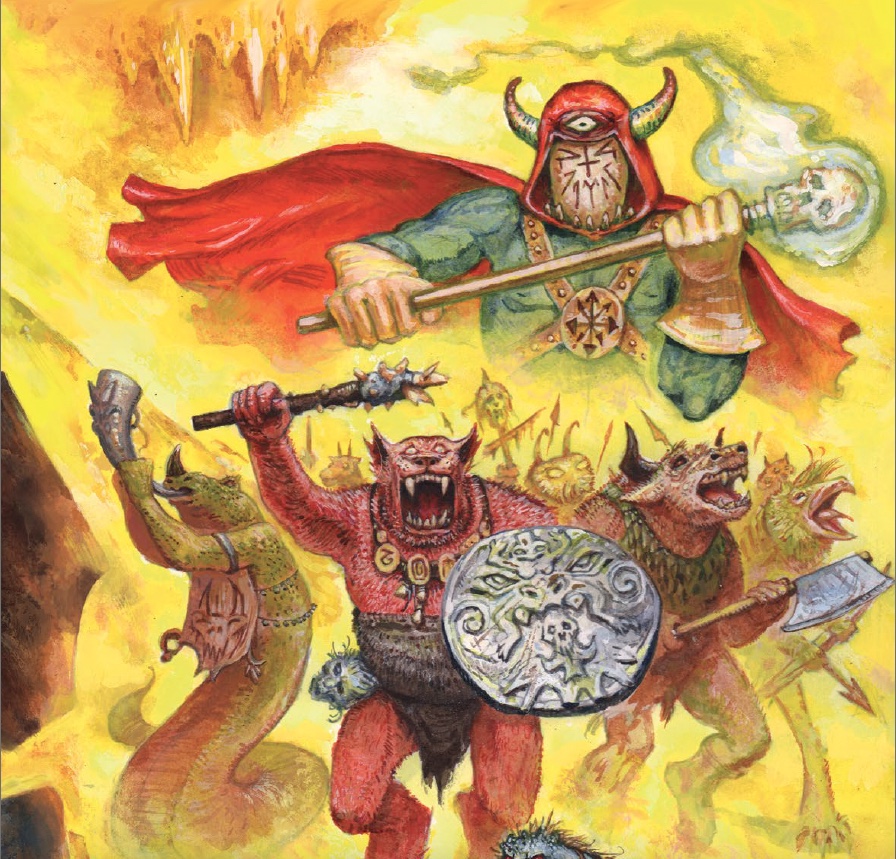
But the ritual had been completed now, the Chaos Lord inhabited a physical form once more. His skull-like head bore only a single blazing eye, his dark armour glistened in the remaining light now that the magma in the pit had been consumed by the ritual. His flail, glowed with a demonic fire, lashed out at all that approached. He laughed at the attempts to bring him down. But those who still stood, those not occupied by the Beastmen on the ramp, joined forces to do just that. Around him his forces dwindled as the villagers, urged on now that their fellows had been found and saved from sacrifice, brought low the shaman, his bestial acolytes and many of the forces on the pyramid below. Roric charged and was crushed by Molan’s flail, the halfling, Hamfast Harfoot, but recently rescued from the tower of the keep was undone by the skewer-like spear of a beastman, likewise, Lindon Lyndone found himself run through.
The attacks to the great Chaos Lord went on and on, many utilising the glowing skulls they had retrieved from the Dread Hall, which exploded in green fire when they struck. They had demanded to be used, glowing now more fiercely than ever in the presence of the hated Molan. It was one of these, flung by the wily and murderous Peggy that struck the Chaos Lord in the eye, setting his whole head ablaze and finally bringing him low. I cheer of triumph went up from the assembled villagers, both fighters and captives alike, as his body melted leaving only his accoutrements, flail and armour. Peggy wasted no time in lunging for the great flail, but it was a mistake. The hero of the hour found himself burned and destroyed by a magma golem’s fiery pseudopod as it generated from the Chaos Lord’s remains. Vargan, also, greedy to the last was left a burning husk by the golem as he had reached for the armour.
The rest of the villagers gathered some of the fallen coins that littered the top of the ziggurat and then ran for their lives. The cavern was collapsing around them and a great tidal wave rose from the west side of it, threatening to destroy them all in moments. All but Daric reached the ship in time and climbed aboard. He had insisted on remaining to gather even more riches and he was forced at the last moment, as the ship pushed off and the rowers began to row, to leap across the churning black waters of the Starless Sea, into the waiting hands of his comrades, forgiving as they were of his greed and foolishness.
The titanic wave hit them, drowning the evil island and propelled the dragon-prowed longship across to the far side of the sea and down a narrow tunnel and on and out into the waiting river beyond. They had escaped.
Guðlaf lay on the deck in the sunshine, breathing ragged and baleful breaths. He looked into the eyes of Mu, who was sprawled beside him and spoke the words “It is well.” Both had taken the black lotus oil knowing the risks. Mu looked into his companion’s eyes as the light left them. He shed a silent tear for him and looked about at his remaining friends, Dave, Hilda, Daric and Helfgott Hoffman, wondering where they would go from here. They had come through so much death and loss but had achieved the impossible. Surely they could more return to their old dull lives in their village than Guðlaf could return to life of any kind. Perhaps this ship would take them on to more adventure. He managed to express all this in a single elegant syllable as the sun blazed down upon him, “Mu.”
If you’re anything like me, dear reader you buy a lot of RPG books that you are unlikely to ever pick up and play. Sometimes, that’s the intention or at least, you don’t have a plan to plan to use it, you know? I have some in both categories. Some books I backed in their crowdfunding phases because I want their creators to continue to create cool stuff, even though I know it will be impossible to fit the actual final product into my ongoing campaigns or their new game into my frankly ridiculous gaming schedule. Some I picked up in PDF format through Bundle of Holding or Humble Bundle because the deal was so good I would have been stupid not to buy them. Some I purchased with the knowledge that they might enrich an ongoing campaign but then just never fit in anywhere.
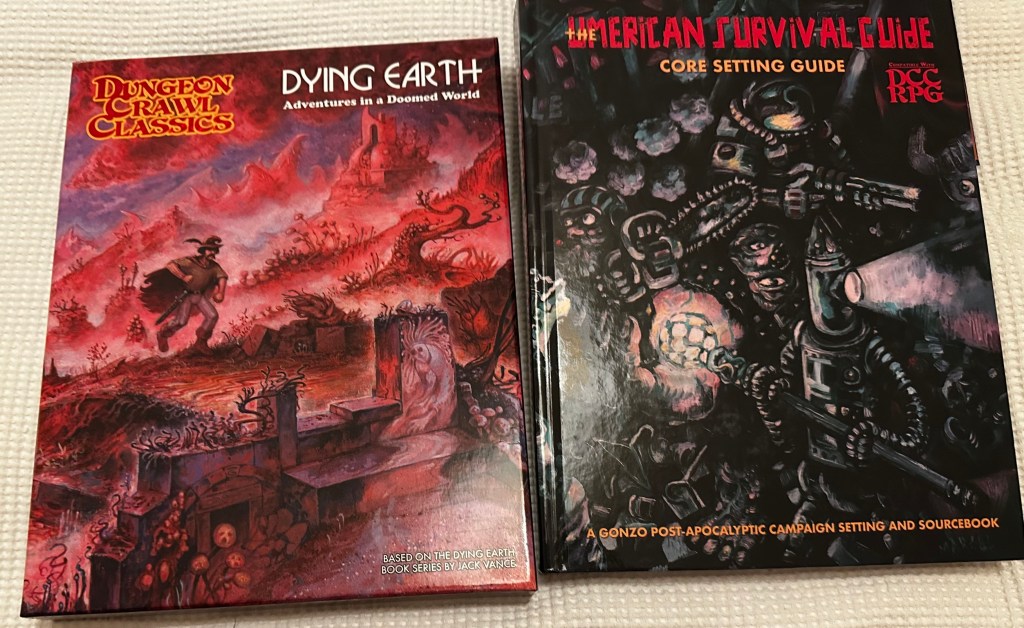
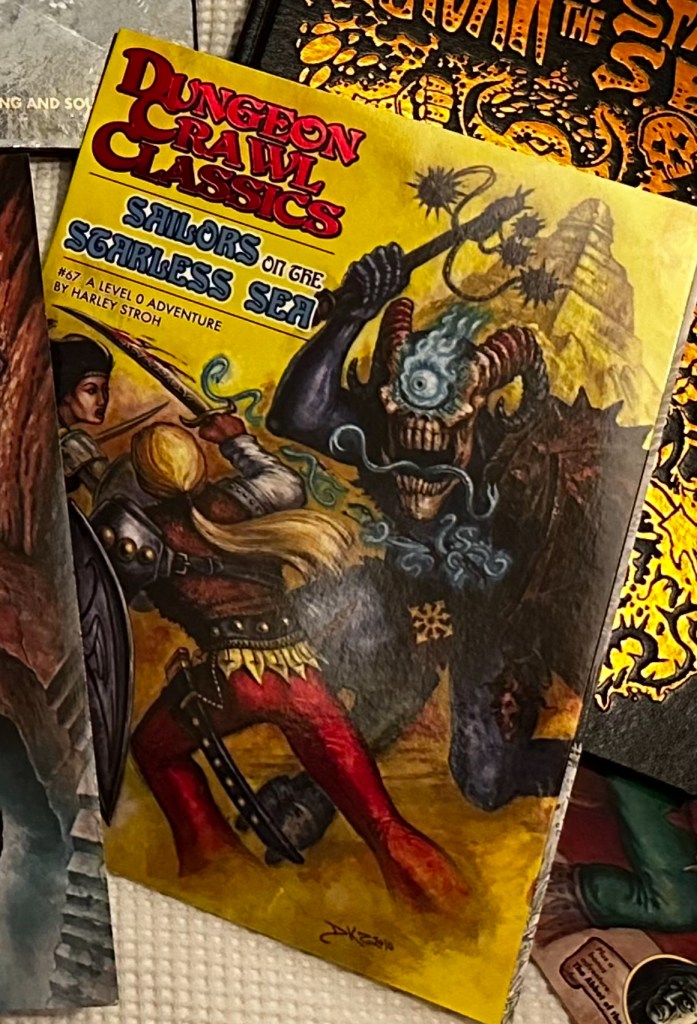
But DCC adventures are in a slightly different category. I have bought a truly obscene number of them, mostly as PDFs. I think this started after listening to a few of the reviews of DCC adventures by Fear of the a Black Dragon. Then I started to collect physical copies. My local independent game shop had copies of their Dying Earth setting box and the Umerica setting book, both of which I purchased. You know, a lot of the time, this was purely due to aesthetics. They are beautiful works of art, frankly. I love their style and their content, even if I hate their layout. But the real reason is because these have always been aspirational adventures for me to play. Genuinely, I feel at this point that, if I could, I would abandon D&D for DCC. Why? The adventures I have read are just effortlessly lacking in D&D’s corporatised humourlessness. They are not written in comedic fashion but in the last two sessions of DCC playing Sailors on the Starless Sea, I have had more genuine laughs and gasps of outrage and tears of sorrow and joy than I have had playing D&D since 2014. And that is not to demean the efforts of many of the wonderful creators of 5E products, it is simply to praise the work of the designers who created a game that I expected to bounce off due to crunchiness but which I, instead, embraced due to its flexibility. The philosophy of the adventure design also has a lot to do with this new attitude. To discuss that, let’s talk specifically about the module I just finished with my players tonight, Sailors on the Starless Sea.
Sailors on the Starless Sea: Endings and Beginnings
The surviving sailors sailed off to parts unknown at the end of our session tonight, each player with one remaining character. This is the ideal ending to a DCC 0 Level Funnel adventure. I am guessing that sometimes players end up with more than one 1st level character to begin their true career as a proper DCC adventurer, but it seems like the best possible outcome if you’re only looking after the one.
It was the getting there that was so much fun though. I wrote recently about character creation in Cosmic Dark being so much fun because the players play it, they role play the most developmentally significant moments of their PC’s lives up to that point in snippets and flashbacks with other players. The DCC funnel is surprisingly like that except its also involves a dungeon crawl, horrific death on a brutal scale and a boat load of shared trauma. Every one of the characters left at the end of the funnel knows precisely what the rest of the survivors are capable of and what they are not capable of. They know some terrible secrets about them and they know that they are keeping some terrible secrets about their own character too.
The survivors were not necessarily the ones you might have predicted at the start as 20 peasants ranged about before the Chaos Keep’s rusted portcullis, but they were the ones Luck favoured in the end. They survived traps, vine horrors, a shit-tonne of beastmen, a cursed well, a fire trap, a Chaos Leviathan, the return of a Chaos Lord to the plane of mortals and a literal tsunami… Someone powerful was smiling on them. And their players knew that by the end, that’s for sure. This made every death so much more terrible and every survival so much more precious. If it hadn’t been for that one critical hit that time, they might not have destroyed the Chaos Lord; if it hadn’t been for that fumble, maybe Gwydion would have made it past the chapel; if it hadn’t been for that successful Luck check, maybe Thomas would have been left with no surviving characters instead of the four he started the session with. There are so many of these death or glory moments woven into the text of this adventure that it is hard to overstate how much every roll and action seems loaded with meaning and significance, especially when the PCs generally have no more than 2 or 3 HP.
It’s easy to say that there were just so many PCs that their existence was cheapened. I even allowed them to restock a few peasants at one point. The adventure allows for this about half way through because they know exactly how lethal it is about to become on the second level of the dungeon. 23 PCs went into the dungeon in total. Six emerged alive, one succumbed to the effects of a potion once they had escaped, a poignant and fitting end point to the whole story. Every one of those deaths had an effect on the player who played the character.
They wondered from the start who might survive. Maybe they would be different. Maybe all their little darlings would make it through. Perhaps only the weakest would be culled. Repeatedly, tonight, the characters that the players expected to survive went down. It was still shocking to them, it was still sad to say goodbye to them, even though time was of the essence. It made for some of the most effective drama I have had the pleasure of being part of at a gaming table in years. And it was a DCC funnel adventure. An adventure designed as a way to whittle down your choices of character to play in a campaign in the most Darwinian fashion.
Harley Stroh wrote a great adventure filled with mystery and danger and conflict and true significance and then they play-tested the shit out of this thing. This is how I know: There was a moment at the very end when the last PC, who had stayed behind to loot some corpses, had to make a Luck check to secure his place on the Dragon Ship to escape the dungeon. This was the second last element of high drama in this game and it was all down to a single roll, DC 17 to leap to safety from the shore to the boat. Thomas thought he’d whiffed it. Thought he rolled a 9. But it was just one of those dice, white text on light background… turned out it was a 19. His character grabbed the gunwale of the longship and Hilda dragged him aboard just time for them to be ejected from the cavern by a tidal wave. The highs and lows! The regret and the relief!
Sailors was genuinely one of the highlights of my recent gaming experiences and the feedback I’ve had from the players so far has also been glowingly positive. If you haven’t played it, dear reader, do yourself a favour, go and find yourself 15 to 20 drunk peasants and get them to invade the ruined keep of the Chaos Lords, you won’t regret it.
Characters created! Caravan stocked! My players are ready to head off from the outlying barrio of the Violet City into the trackless expanse of the Ultraviolet Grasslands. Honestly, between characters and caravan, our session went over time quite significantly. I did not expect to get any actual travelling done during the session, having gone through the character creation process myself already and having listened to the first couple of sessions of this Open Hearth Actual Play refereed by Marc Majcer. It took them the full three hours or so of the first session to do the same. In fact, they were still settling caravan details for the first part of the second session too.
I actually do regret not creating my own caravan before we had session 0 too. I think it would have helped the process go smoother. But not to worry! It went well enough and, indeed, the players enjoyed both processes. They particularly liked the sheer off-the-wall nature of everything about their characters, the anti-canon nature of the game and the setting and the randomness of almost every step. As for the caravan creation section, specifically; I have noted in a post from last year that I like to give the PCs a home that I can fuck with and I have done it repeatedly in various campaigns. But, in previous games, the creation of that home was never as involved or player -focused as it was in UVG. They immediately got into it. They understood the importance of the caravan, the supplies, the capacity of the vehicles, the types of animals they chose and the cost of everything of course. It took very little urging from me for them to get attached. They now have three carts and 9 mounts, all of which have names, some of which have favourite plushies and foods, a few hired cart drivers, also named and probably with tragic backstories. They have made it exceedingly easy for me to manipulate their little emotions when I fuck with the caravan almost immediately.
My approach
Anyway, today, I’m going to take a slightly different approach to caravan creation than they did. They opted for the “first caravan” package that is presented in the UVG core book. This is honestly a great option that does a lot of the work for you. It takes several key decisions out of the players’ hands and does all the cash calculations for them. Each of them took this package and added a few more animals. That’s how they ended up with so many carts and such a menagerie of pony-analogues.
I’m going to start from scratch, deciding on the method of transportation, the types of animals or animal alternatives, the trade goods and travelling gear. The caravan is going to be run by the character I created a few days ago, my D.W.A.R.F. Tumult Fisher Wizard, Del ‘Machinist. But I’m adding a couple more characters to their company of traders so that I’ve got more money to play around with. The caravan rules state that each character begins with a €1000 loan from a financier (with 100% annual interest!) so, I thought it would be more fun to start with €3000 than just the €1000 that Del would have had access to on their own. I’m not creating these characters in their entirety, I’m just going to roll on the background, strange item, motivation, path and name tables for them.
Hero Number 2: Oï Yu, the Timelost undercover Rainbow Inquisitor. He’s taken the Traveler path. He’s tracking a missing ledger. Oï Yu has brought with him his special carmine cactus that secretes drops of blood.
Hero Number 3: Maria bra Salsur, the bluelander pueblo heretic rancher. She has taken the path of the Fighter. She is following visions of glory and rebirth into the grasslands. She brings with her a self-playing zither with seventy tunes.
My caravan
Financier
You have to start somewhere. When you are trying to kickstart your dream of outfitting and running your very own grasslands-going caravan like Del and their friends are doing, you have to start with money.
Outfitting a caravan is expensive. The PCs should start with a loan of €1,000 per character. The financier is dubious and there’s 100% annual interest, but it beats scrabbling for pennies.
I’m going to go with the book’s advice here and get a loan of €1000 for each hero, so that makes €3000. That will, of course lead to a final debt of €6000, a nice round number, I think you’ll agree. Also, it’s future-Del’s problem, right?
The first step is to decide a few things about our financier. There are a couple of handy d20 tables in the back of the book for this very purpose:
Who are they? – Cat witch faction leader
What do they want? – Acquire forbidden magic
Their Organisation – Cat-first society
Their opponents – Savage capitalist scions
Weaknesses and oddities – appears only as a hologram
But Who’s really behind the patron?
Who’s coughing up? – Under-funded second-tier military complex
How do they hope to benefit? – Practical evidence to justify continued funding
What extra help can they send along? – Annoying but capable administrator
The beginning part of the Caravan section of the book goes into a lot of detail on trade goods, trade routes, the measurement of time, consumption of supplies etc. I’m going to maybe come back to some of this stuff later. For now, I’m going to establish the constituent parts of my caravan.
Vehicles and animals
Bearing in mind that I’ve only got six grand to play with, options are limited here. But this is what I would like to go with. We can’t really afford anything actually mechanical or biomechanical (which I would like as I feel like that would be Del’s jam,) despite their being some beautifully weird and desirable options such as the Road Yacht, the Porcelain Walker, the Autogolem and the Meat Crawler (yes, meat crawler.) But I can’t afford any of those! Instead, for vehicles, I’m going to go with a pair of Solid Coaches. They can each carry 12 sacks, with is pretty good, and they are less likely to suffer catastrophic damage on the road as they are level 7.
As an aside, most things are measured in sacks when it comes to hauling things across country. A sack is the basic unit for trade goods. A sack is equal to 10 stones. A stone is equal to 10 soaps. A sack is also about the same amount of space that a human takes up. Usefully, a sack of supplies is also just enough to keep one human fed, watered and otherwise relatively comfortable on the road for a week.
A week, as it happens, is the basic unit of travel in UVG. Journeys from one destination on the Grand Long Map of the Ultraviolet Grasslands to the next are said to take one week or two or more. This is adjusted for things like the relative speed of your vehicles, the types of misfortune you meet along the way, and whether or not you need to stop to forage when you inevitably run out of supplies half way to your destination.
Solid Coach x2 – €600 each – €1200 total bringing my cash down to 1800.
Each of these coaches needs a couple of draft animals to pull it. So, I guess we’ll need to roll on a table to determine exactly the type of pony-analogues we’ll be purchasing.
I rolled a 5 on this d6 table. It’s Goatelopes… I think we can all imagine what those look like, graceful antelope legs with a shaggy furred body, the ability to eat almost anything and the terrifying devils’ eyes of a billy-goat. Del is not going to fall into he trap of naming these poor beasts but the Timelost Oï Yu can’t resist. We have
Hopper whose favourite fruit is mango
Famante who has the genetic heirloom of utter baldness – requires liberal lashings of sunscreen.
Fiodor who has a wise move. He always lets you know when rain is coming by stopping and refusing to move until you cover his head.
Korven has a cute trick. She can stand on just her forelegs as though she’s doing a handstand.
Anyway, each draft animal costs €70, so that’s another €280. Down to €1520 now.
More humans
Next, we need to consider who will drive these coaches while the PCs galavant about pretending to know anything about running a caravan. As I am on a budget, I am going to hire a couple of people for this, or, as they are described on the Vehicles & Mounts table, Human, Common-ass. It is Wirth noting that the table also provides options for simply buying slaves but does take pains to point out that this sort of thing would be perfect for evil caravans and that they might be resentful, which its probably putting it mildly.
Human, common-ass x2 – €7 per week. I’ll reserve two weeks wages for them so that’ll take me down to €1492
Del, not wanting to get attached would not wish to name these lads either, but, being humans, they come furnished with their own names:
Torron Valpin is a Redlander
Ulfis i’Bosc is from the Greenlands
Supplies and other stuff
Right, now, let’s consider the supplies we need to keep us alive out there without having to stop all the time to hunt and forage. You need a sack of supplies per person per week. So, including our drivers, Torron and Ulfis, that makes five people. So that’s five sacks of supplies per week. Let’s make sure we are covered for a little while and get two weeks worth of supplies.
5×2 = 10. Each sack of supplies costs €10, so that makes €100 on supplies. This brings me down to €1392. It also brings the total number of sacks we have to 18.
How did I come to this number you might ask, dear reader?
5 humans +
the 3 useful kitbags that the heroes come with (each one takes up a sack of space) +
10 supplies
So, this leaves only 6 sacks of space for trade goods! Except it doesn’t. I’m going to refer back to the standard first caravan package and pick up a “bog-standard Pro-Hiker (TM) kit” for each hero as well. This will include a bunch of generally useful traveling gear like tents, sunscreen, schnapps and wine skins and a hat. Each pack of gear takes up one sack of space and costs €50. Most importantly, though, I get to roll on the hat table for each hero.
This hat-table-excuse brings the cash reserves down to €1370 and available sack space down to just 3!
More capacity, please!
Well, that seems like a shame to me. We could afford a few more mounts for the PCs to ride alongside the coaches and free up, not just the space the PCs take up, but also the space their kit occupies, since riding animals can bear 2 sacks. That opens up another 6 sacks on the coaches, meaning we can transport 6 more sacks of trade goods. Of course these mounts do cost €70 each too:
3 riding mounts – €70 x 3 = €210. This takes my total cash down to €1160
Oï Yu’s mount – Blinki the pony (dances with Oï Yu when the zither is played)
Maria bra Salsur’s mount – Pander the llama (a rare pedigree whose hair is soft as merino wool)
Del ‘Machinist’s mount – unnamed donkey (favourite fruit is dragon fruit)
But leaves enough space to transport 9 sacks of trade goods.
Trade goods
I rolled on the table on the first caravan package and got
“Vampire Wines,” which is just blood, right? I mean, right? (Actually wrong. The Trade Goods table says they are just made from grapes that are grown in soil rich in the flesh of creation)
These cost €100 each so that’s another €900 down, leaving us with €260
I’ll spend €68 to get bows and spears for each of the heroes and another €30 to get nomad robes for them. That brings my cash down to €162. I think it’s probably wise to keep that for the journey. Never know when you’re going to need to stop for burgers and milkshakes on the Steppes of the Lime Nomads.
Legalities and marketing
This caravan is established as a company in a legal sense and so it will need a logo/symbol, a name and a company motto.
The symbol is a stylised coach based on the first two owned by the company, speeding across the grasslands in silhouette
The name of the company is Ultraviolet Lopers
Their motto is “From the Circle to the Sea”
Conclusion
In conclusion, I think I may have enjoyed making this caravan that is probably going nowhere, at least as much as my players enjoyed making their actual caravan that they’ll be bravely shepherding into the Ultraviolet Grasslands in a week or two. There are so many great options to choose from or to roll up randomly. There’s usually a laugh to be had during the process and you get to name mounts and humans and stuff. Honestly, great craic; would do again.
I have been reading Luka Rejec’s polychromatic point crawl, Ultraviolet Grasslands and the Black City 2E for a while now. It’s a remarkably attractive and inspirational piece of work. Luka is responsible for the artwork, writing and design. He really brought his vision to life in this book and he has continued to support it for the last six or seven years since the first edition came out. Most recently, in the form of a massive crowd funder for no fewer than two books to expand the world, Our Golden Age and the Vastlands Guidebook, which I wrote about last year, here. But, there have also been a number of other supplements in the meantime. I picked up a bunch of them on a recent Bundle of Holding deal. The files included the invaluable UVG Guidebook. This details the Synthetic Dream Machine rules devised by Luka. Most useful for my purposes here, is the guide to character creation for UVG 2E. So, I’m going to use it to create my own character, and my own caravan too!
Here’s a little bit about the setting, taken from the UVG Guidebook:
The UVG is a point-crawl setting inspired by psychedelic heavy metal, the Dying Earth genre, and Oregon Trail games. It is a world colored by new wave science fiction and inspired by artists from Moebius to Miyazaki.
The characters, referred to as “heroes,” begin, generally, in the Violet City. This place is ruled by Cat Lords with little human hands and big human servants/pets. It is also the last outpost of human dominion on the shores of the Circle Sea. Beyond the city, to the East, stretch the irradiated, largely uninhabited, weird, vome-infested Ultraviolet Grasslands. The PCs are headed out there, probably at the head of their own caravan, hopefully with some goods to trade at the next stop, which might be the Porcelain Citadel or the Last Serai or some other magical-sounding destination along the Low Road and the High, which, if you follow it long enough, will take you all the way to the eternal sunset and the Black City.
New Campaign, New Character Creation Post
This is all in preparation for starting a new campaign of UVG on Sunday. It’ll be a small caravan of just three PCs and it’ll be a tight, friendly group, but I always find the experience of creating a character myself helps me to guide them through the process so, here we go!
My Hero
So, in the finest tradition of, well, my other character creation posts, I’m going to roll this one up as randomly as possible. Anticipating my requirements in this respect, Mr Rejec has helpfully furnished me with many a table in this book. So, without further ado:
Ability Scores – SEACAT
That stands for Strength, Endurance, Agility, Charisma, Aura and Thought. I have a few options for this process but I am going to take the most random, the d100 roll.
Strength – I rolled an 18 on the d100. This translates to an entirely unremarkable 0. I guess I should be grateful there are no negative attributes in this system
Endurance – 96! This translates to an excellent and amazing 4!
Agility – 62. This gives me a talented 2
Charisma – interestingly, this is not like D&D Charisma, more like the Ancient Greek meaning, which encompasses fortune. Anyway, I rolled a 49, giving my character a promising 1 in this ability
Aura – This can help your character “to use powers beyond mortal ken longer than usual.” I got a 19, giving my second 0.
Thought – “the mental dynamic ability. It captures how a character absorbs, processes, and manipulates information.” I rolled a 47. This makes my score another 1.
So, at this point my ability scores are:
Strength – 0
Endurance – 4
Agility – 2
Charisma – 1
Aura – 0
Thought – 1
Background Trait
I like the method of determining your capacity for learning traits. You get an inventory for this, just like for physical objects. You can’t overload your trait inventory without suffering from encumbrance, anymore than you can physically carry too much without the same issue arising. I get 7 + Thought inventory slots for traits. So that’s 8 slots then. It won’t come into it at this stage, of course. As a level 1 character, my hero will only have three traits.
A starting trait gives you a +3 bonus to actions that can utilise it. Although you can upgrade it from Skilled, which is the starting point for all traits, to Expert, which provides a +6 and Master, which bumps you up to a +9.
Now to the fun part. Rolling a d50 to determine my Background. (So, in the UVG Guidebook, this table is actually a d40 one. But there is another version of it in the core UVG 2E book, so I’m using that for this bit, as well as to answer the following two questions below.) For this unusual die roll, I’m going to roll another d100 and divide by 2.
I rolled a 65, so half that and round down, I get a 32:
“Tumult Fisher Wizard” (?) This acts as my first trait and, I guess determines my Path (see below)
Why are they on the Road?
What is my Tumult Fishing WIzard’s motivation for heading off into the dangers of the Ultraviolet Grasslands? Well, the same table is going to tell me that. I rolled a 29, making it 14 this time:
“Pursued by Loving Enemies.” This sparks a lot of potential background stories for my wizard.
What Do They Bear?
You always start off with one strange item. It might be valuable or it might be important or it might be sentimental. I guess we’ll find out. I rolled a 6, so that’s 3 on the table:
“Green brick with the light and warmth of a candle.” Some sort of Oldtech item maybe?
Path Trait
So, in the UVG Guidebook, you do things a bit differently than you do if you’re just using the core book to make your character. If you use the Guidebook you will be led, carefully and systematically through the process, starting with ability scores, moving onto background traits and then to path traits. In these rules, your characters path can one of three broad categories, Wizard, Traveller and Fighter. They are not classes; they’re only used to determine one of your starting traits. After that, you are free to choose traits from any path you like as you level up.
The whole character creation section of the core book is quite compact, and, in fact, the entirety of the rules are squeezed onto a single page. The core book is, first and foremost, a setting book. It can easily be adapted for use with almost any OSR or D20 system and, indeed, with just a little work, could work very well with a PBTA or other ruleset too. So, I think the decision to pare down the rules, particularly for character creation, makes sense, especially when the Synthetic Dream Machine rules were already available in other publications.
Anyway, what I’m getting at here is that the core book does not refer to Paths at all. Instead, it seems to fold them into many of the backgrounds on its d50 “Who is this Hero?” table. A good example is my “Tumult Fisher Wizard” result from the d50 table earlier. It includes something that could be a background trait, i.e. Tumult Fisher as well as one of the paths, wizard.
So, by default, my first Path trait will be from the Wizard path list in the UVG Guidebook. There is a list of six options so I’ll roll a d6 for it.
That’s a 3. “Exuberant. Each of your life points is worth double when paying for powers.” It’s worth noting at this point, that Life is analogous to hit points and you spend Life to cast spells, so this is quite handy.
Generate a Third Trait
So, you then get to choose one more trait. There is a random trait table. Depending on the result of the roll, you could get another background trait, a wizard trait, a traveller trait or a fighter trait. So, here we go, it’s 5! Which means a Traveller Path trait. Another d6 roll on that table, and that’s a 6!
“Swift, Spend one life or one hero die to get one more action this round.” That is an amazing trait for any hero!
Equip your Character
Similar to trait inventory slots, I get 7 + Strength inventory slots for items. With my 0 strength, that’s going to make it a 7…
You start at level one having two items and some cash (denoted with a €, pronounced cash, not euro.) One of your two items is a kit useful to one of your background traits. In this case, I guess it might contain fishing rod, net, lures, wizarding items, that sort of thing. But, as the guidebook states, “You don’t need to choose in advance exactly what is in your character’s kit — the items are in a quantum superposition until you define them as you play.” This should include a civilian weapon that deals no more than 1d6 damage.
The other thing you get is the Strange item I rolled up earlier, “Green brick with the light and warmth of a candle.”
I also automatically start off with €100 in cash. This sounds like a lot but a week of carousing will cost the average character 1d6 x €100!
It’s also worth mentioning Burdens at this stage. It is possible to take items or traits as burdens rather than have them in your regular inventory, perhaps because those inventories or full or for some other narrative reason. Each Burden you carry (you can have up to 20) gives you a -1 to all checks though.
Last Few Attributes
Level: 1 Life: 8 (all level 1 characters start with 8 Life.) Hero Dice: 1d6 (these come and go quite often in play. You can use them to adjust a die roll or recover Life. You also get one per session and every couple of hours of play!) Save: 13 (all level 1 characters get a Save of 13. You have to roll over your Save score in dire situations. You can add an ability bonus from Endurance or Aura to help you out. Interestingly, you can’t use Agility to save. Instead, it is considered an action roll.) Melee Attack: d20 + ability (strength) + skill (if applicable.) I’ve got a 0 here. Ranged Attack: d20 + ability (agility) + skill (if applicable.) My agility gives me a +2 to ranged attacks Oldtech Attack: d20 + ability (thought) + skill (if applicable.) My Thought score gives me a +1 for Oldtech attacks Fantascience Attack: d20 + ability (charisma) + skill (if applicable.) Another +1 here. Damage: I imagine my fishing wizard has a little fishing knife. That’s 1d4 damage. Defense: Here’s the formula, 7 + ability (agility) + bonus (if skill applies) + armour. No armour yet, so it’s going to be a 9 for now.
Name Your Character
The Guidebook has a table of names. The table lists them under particular cultures of the Vastlands, so, in all likelihood, the name you choose will also decide the culture you’re from. It’s a 12 point list so I’m going to roll a d12 on it. That’s a 10.
D.W.A.R.F. Names: There are 8 listed. Let’s roll a d8. That’s a 2 – Del ‘Machinist. Very practical, I’m sure. Lets also give them the pronouns they/them. Here’s the Dwarf glossary entry from the UVG 2E core book:
Dwarf: Backronym from ‘De Werker Aristocratiscee Revolutie Fraternitie,’ Dwarfs are a distinct culture-class of selectively biomanced people. They have effectively fought the traditional aristoi of the Red and Orange lands to a standstill and now form a major industrialist society of the Rainbowlands. A famously bureaucratic and collectivist faction, they are the only one staunchly opposing the bureaucratic and individualist Emerald City Cogflower Corporation (actually a coin church).
Looks like my fisher wizard is a communist. Love it.
Conclusion
So, that’s my D.W.A.R.F. Tumult Fisher Wizard, Del ‘Machinist. They have great endurance and very average strength. Despite having rather low Aura, they have a wizard trait which allows them to double the effectiveness of the Life points they spend on their spells and another trait from the Traveller path that allows them to spend a Hero die or Life point to get a second action in a round. And he comes with a green brick that has the light and heat of a candle. I have a pretty good idea of them in my head.
I will say that, if I were to do it all over again, I would have just stuck to the UVG Guidebook to shepherd me through the character creation process. Switching to the UVG core book for that one table roll complicated things unnecessarily. My advice would be to do the same, if you are determined to use the Synthetic Dream Machine rules for your game of UVG. Otherwise, use a different system and utilise the tables in the core book for flavour.
I think the next post will be Caravan creation so tune back in then, dear reader!
What is the end goal of a game of weird space horror like Graham Walmsley’s Cosmic Dark? The answer seems obvious, I suppose. If you go to see a horror movie, you want to come out feeling like you got your money’s worth in spilled popcorn, whimpers, screams and nonodontgointhereyouidiots. So you should expect something similar from a game like this, right? Well, yes, of course. In fact, the rather ingenious conceit of a game like this, is that, knowing the style of play you’re looking for, as a player, you can go into it understanding what you can do to help push the themes, the jumps, the horror of it. There’s some strange, violet rock that appears to be moving? The character might be a geologist and know that it’s their job to go examine the rock, but the player knows they’re in a space horror game, which is why they should go and examine it. And this is pretty much how our one-shot of Cosmic Dark went last weekend.
But there’s more, of course, because let’s not forget the ‘Cosmic’ bit, the ‘weird’ bit. Because, although the body horror really hit hard at times, the dreamy (nightmarey maybe,) psychological horror felt all-encompassing. There is a section in the scenario that is aptly called “Dreaming and Waking.” Unpretentiously, it refers to the bizarre dreams the Employees experience during their first night on the assignment. It gave me more or less free rein to describe immersive dreams for the characters that related back to the answers they gave in psych evaluation questions earlier in the game. Of course, this served only to highlight the dreamlike atmosphere of everything on the assignment up to that point, in my opinion. Time was behaving differently, the rocks were undulating and growing, seemingly safe spaces were revealed to be anything but… The players and the characters were on edge, really from the start. And, thanks to the mechanics, they got closer and closer to that edge as the session went on.
Character Creation
We played the first Cosmic Dark Assignment, Extraction. Check out my preview blog post here, where I explain the way the players create their Employees as part of that scenario.
At the table, this went down a treat. Forcing players to choose their Employees’ specialisms only at the point where they are being asked to acknowledge over comms on the shuttle to the Assignment is clever and the players got a kick out of it.
But the real star of the show is the series of flashbacks they go through to get a picture of their characters. The flashback method creates memories, not just characters. The requirement for each PC to identify another as a rival or a figure of admiration or some other influence, and to include them in the flashback scenes, creates a shared history and a character dynamic that you simply can’t conjure from dry discussions over a character sheet. If you have played any PBTA games, dear reader, you might be aware that they usually include a section for bonds with other PCs. You and the other PC have to come up with some reason why you are blood-brothers or why you’re worried about the other’s survival or why you had a vision about them. But you do not act it out. You don’t, at least in my experience, role-play a scene together to elucidate the reason for the bond. That’s exactly what you do in Cosmic Dark. In fact, each player has a scene of their own and may choose any of the other characters to share it with. These scenes are supposed to be short, just a minute or two, but long enough for them to find their characters’ voices, outlooks, relationships. And the Director (GM) provides prompts to kick-start these scenes. The players are given a line of dialogue for one of them to say to begin. I was skeptical about how well this could work at a table of regular players. Up until now, I have only seen it done at a table of professional actors on Ain’t Slayed Nobody. But I needn’t have worried. Every one of my players took that single line of dialogue like the baton it was, and ran with it, inventing hurdles, falling and picking themselves up again. And the table I had? Four players with a wonderful mix of experience levels, some who have played a variety of RPGs for years, one with just a few months of play under their belts with Tables and Tales and even one for whom it was their very first role playing experience!
The aspect of character creation (it’s one of the parts that is ongoing throughout the game from what I understand) that I had a little difficulty in running and incorporating as intended is the psychological assessment. There is a moment, that also occurs in flashback, the night before the Assignment, when they are lying in their sleeping pods on the Extracsa transport vessel, the Exchange, and they are asked questions like “what scares you most about being alone?” Or “what is the most terrifying way to die?” You are supposed to. Push the PCs to answer truthfully, indicating that Extracsa will know if they are lying. This part was ok, actually. I was able to get some revealing and actionable answers from them. It was the re-incorporation of the answers into the later dream sequence that I struggled with. The idea is that you should take note of the PCs’ fears and worries so that you can create a tailored nightmare for them during the Dreaming and Waking section I mentioned above. I think this is something I would get better at in time and with practice. The main issue I had was just referring to my own notes and making sure I got the right nightmare for the right Employees in a way that made it feel like it flowed naturally.
The Assignment itself
I don’t want to go into too much detail here. Honestly, I could not do it justice. Go and listen to the Ain’t Slayed Nobody actual play instead!
But here’s what I will say. I presented an outline of the type of game Cosmic Dark was when I advertised it on our Discord. But I think there was still some misapprehension by the time we started playing. The main feedback I got in this respect was that they expected something more along the lines of physical threats. I believe this is, perhaps, the overriding influence of the Alien franchise. I did refer to Alien in the touchstones I mentioned when announcing the game, so that could explain it. There is nothing like an alien monster in this first Assignment. In fact, as they played through the scenario and uncovered one egregious corporate scheme and strategic lie after another, I think it became obvious that Extracsa are the real baddies here. And, it’s not like there aren’t ways for the Employees to die in the course of the Assignment (we had one death, caused mainly by the Team Leader hitting 6 Changed as he escaped. He flipped the rover he was driving.) And they felt as though they were in danger, clearly. As their Changed scores each hit 4 or 5 (out of 6) they all decided to run away! They witnessed what was in the future for them on this asteroid, a slow and horrific melding with the rock of the place, and they noped out of there before they even reached the finalé! Anyway, if I had any advice for prospective Directors, it would be to make sure you properly set expectations.
How about the scenario itself? So, I only had the text of the Extraction Assignment to work with. Now, this was fine. The rules are contained within it and the character creation occurs during the course of play, as I explained above. However, in the finished book, there will be useful extras to refer to. For instance, if and when an Employee rolls a 5, they are supposed to get a little bonus in the form of records, data from the Extracsa company servers that serve to shine a light on the mystery or, at least, show them how Extracsa is fucking them over. On the roll of a 6, they are supposed to experience an anomaly of some sort. Anomalies are supposed to alert them to the weirdness of the place or the situation or have a direct psychological effect that might prompt a Changed roll. Now, there are a few examples of appropriate records and anomalies in the scenario but the rest will be contained in cheat sheets that will appear in the final Cosmic Dark book. To fill this gap, I listened to the ASN actual play again and made a note of the records and anomalies Graham used in that.
The other thing I picked up in particular from Graham was the style of GMing he does in that AP. He keeps it light and breezy mainly, gently encouraging players to take unnecessary risks, reminding them about the Changed die, reassuring them that that little prick from that piece of weird violet rock is probably nothing to worry about… until the point where he informs them all they need to do to reduce their Changed score is remove that pesky limb… Listen and learn, dear reader! It worked a treat at the table!
As for the rules, I had one regret here. The rules are very light and easy to pick up, but, this opening Assignment is designed to introduce the rules in a specific order to ease the players into them. And it does a great job of that. The Changed die is the first thing that comes up, then investigation rolls and other types of actions. But I forgot to introduce the re-roll mechanic when I should have, thereby allowing the Employees a chance both to do better on certain checks and to increase their Changed score earlier on.
Conclusion
All in all, I highly recommend this game. I want to play more of it. I wanted to play more almost immediately. But I think my experience will be greatly improved by getting my hands on the full book. So, let’s make sure I can, shall we? Go and sign up for an alert on the Cosmic Dark Kickstarter!
Here’s my fictionalisation of our first session of the classic DCC 0-level funnel, Sailors on the Starless Sea. Six of us, members of Tables and Tales gathered last Sunday evening to play through the first half of the adventure. We had an absolute blast, both with the adventure and the DCC rules.
I may have taken a few liberties and used some artistic license here and there but the major beats are all as they occurred. Spoiler warning if you have not played or read Sailors on the Starless Sea and you want to be a player in a game of it, stop reading now!
The Keep of Chaos
The villagers gathered before the rusting gate of the ancient keep, as a blasphemous banner snapped above the crumbling, ebon walls. Behind the shivering mob, Betsy released a single, unenthusiastic moo as she shuffled in her protective circle. They had made surprisingly short work of the vine choked corpses on the causeway below. The burgeoning corpses of their fellows had shocked some into sobriety while only awakening a greed and opportunism in others that they had previously, perhaps, just imagined they possessed.
Only the half-raised portcullis stood between the no-longer inebriated gang and the rescue of their abducted friends and family. Edgar Hayward Blackburn Hathaway IV, assuming a leadership position, urged his fellows on into the black keep, while the gnoll-reared urchin, Bear scampered in and out, as though possessed by a great desire to poop. Stopping for nothing, most of them marched through, all but the three dwarves doubling over or crawling beneath the spiked portcullis. A few waited on the outside, curious perhaps to see how this entrance worked out for the majority. These were, perhaps, the clever few… just as the final row crossed the threshold, someone above released the portcullis to fall the rest of the way, pinning two of their number beneath. The renowned and beloved corn farmer, Maize, died instantly, skewered by one of the rusty spikes. The survivors would, for ever after, recall his broad, smiling face and his impaled body whenever they munched on a sweet, buttery cob. His little goat ran, unfettered and bleating into the be-brambled courtyard, as the remaining villagers heaved the portcullis up to release the cheesemaker, Gorgonzola, who had somehow survived the portcullis trap. Meanwhile, a bell rang out from above the gatehouse, pealing briefly, but alarmingly. The final few peasants, who had waited out front, joined the mob as they began to explore their hateful new surroundings.
Several of them circumnavigated the overgrown clearing contained within the castle’s broken and burnt walls. But two explored the well. The well seemed to call to Dáinn, his curiosity growing to almost physical strength, pulled him to it. Meanwhile, his companion pulled on the well’s sturdy chain to see what might be lurking below. Dáinn could not resist a peek over the edge, and, before he knew had pitched, headlong, into the darkness below! His companion scrambled to catch him, but it was too late… Luckily, Dáinn came to his senses as he plummeted and managed to grab the chain before he hit the undulating ooze at the bottom. The others pulled him up, but he was not exactly himself anymore… he now sported the flapping ears of a pinkish pachyderm.
Meanwhile, other villagers discovered part of the old wall in the back had utterly collapsed. They decided to leave it alone, nothing a potential for further collapse and possibly fatal accidents.
Nearby, an ancient capstone of some sort, runed and glowing slightly, was discovered. It had been concealed, deliberately or otherwise by thorny vines and scrubby grasses for years. Uncovered, the group’s scribe was able to take a look at it, but, unable to decipher the meaning of the rune, they decided it was best left as it was.
As this occurred, Mu, the monosyllabic Dwarven mushroom farmer, investigated the forbidding portal of the nearby chapel. The terrifying visages of hundreds of demons, screaming and howling had been hammered into its heavy bronze doors, which had been barred from the outside. Mu, heedless of possible dangers, tossed aside the ancient wooden bar and swung wide the doors. Inside, resting impossibly on a floor carpeted in crackling, glowing embers, a half-dozen skeletons still roasted, slowly, in their blackened chain hauberks. A charred chest, padlocked and tempting stood to one side of an elaborately carved fountain. The hellish amphibian likeness of a stone frog belched forth an endless spring of tarry ooze from a mouth seemingly filled with precious gems. Gwydion, the elven artisan, fascinated by the construction of the fountain approached, heedless of the embers. The ooze reacted, raising its undulating bulk up and over the lip of the fountain. It landed on the fiery floor and burst all into devilish flames as it flung a pseudopod, greasy and burning, in the direction of the elf! But Edgar Hayward Blackborne Hathaway IV, always on hand to defend his companions, leapt into the chapel and attempted to fling a dart at the fiery monstrosity. His aim failed him, the strength of his arm directing his attack, instead, to his own unarmored wrist as it escaped his grasp in the worst possible way. His blood gushed, hissing and dancing over the hot embers as he collapsed, lifeless into the sizzling coals. A moment later, despite several fine hits from the other gathered villagers, the ooze’s pseudopod finally connected with his elven target, immolating him. As Gwydion fell, the others fell upon the tar ooze, dousing it and destroying it. Weary now of all the senseless killing, the peasants armed and armoured themselves in what they could recover from the dead ones in the chapel and discovered a curious item of some chaotic deity, a blackened censer and several bales of unwholesome incense that had been locked in the chest. They stowed them for later use and proceeded with their explorations.
A sinkhole dominated the northeastern corner of the courtyard, spewing forth vapours that formed terrible shapes of writhing beasts and men in the air above it. Perhaps this was the way forward? Attaching a rope to the chain retrieved from he well, Darik the hunter braved the uneven and dangerous ground about the edge of the steaming pit to get a better look, his fellows holding on to keep him safe from falling to his death. The ground, indeed, collapsed below him and he dropped seventy feet into the poisonous spume, seemingly still nowhere near the bottom. His investigations revealed nothing of the bottom nor the source of the vapours. He climbed back out and the villagers continued on to the tower in the south east corner, the only area left to investigate…
Sir Chopsalot, the woodcutter, finding the door to the tower guarded by hideous gargoyles and locked tight against their attempts to enter, hoisted his axe and got to work. He worked up a sweat and brought down the portal. McTavish, the blacksmith, his blood up, charged into the tower and was a confronted with a sight and stench of charnel destruction unlike the worst tanner’s pit. The discarded hides and skins of beasts and humans covered the sticky, malodourous floor. Mites and flies buzzed about, biting and swarming over everything. High on the walls of the tower, hanging by their tied wrists from spikes, some of the abducted wriggled and thrashed when they saw him enter, eager for freedom. But he did not have time to act, From the steps above his head, an enormous brute of a beastman, cursed with the head and sharpened horns of a great bull, jumped onto McTavish’s back, crushing him into the ground with his dreadful battle-axe. Then he turned to the villagers arrayed outside and snorted while his beastmen approached from behind. The remaining peasants quickly formed a plan to distract the beastmen while Mira ran to the chapel to fill a steel helmet with scorching embers. Combined with the oil from a flask they had brought, this could cause a conflagration in the tower, destroying the arrayed abominations. As she ran to gather the coals, Sir Chopsalot, the woodcutter, found himself in the way of the charging, bovine beastman champion and was impaled on his great horns. Another monster, with the hideous head of a beagle, speared Gorgonzola, the cheesemaker, finishing the job the portcullis had earlier begun. Mira returned just in time to prevent the rest of the beastmen from emerging into the blood-soaked courtyard. She flung the embers into the awful tower where they set alight the lantern oil. The villagers took some satisfaction in watching the demons burn.
Victorious, the survivors doused the flames and rescued several of their neighbours from their captivity. They searched through the detritus in the tower and were able to discover a map to another keep along with a letter of employment, stitched into the hem of some poor unfortunate adventurer’s cloak. But, before long, they knew it was time to proceed once more. This time, the only way on was down a set of ancient, worn stone steps, down into the darkness below the keep…
It’s been quite a while since I’ve done one of these posts. I think my Dragon Age Character Creation post was the last one. And it was very useful to me in figuring out how that game worked before I started a campaign of it (which is ongoing. The PCs have all just become Grey Wardens without dying during the Joining!) Well, I’ve got a short game of Dungeon Crawl Classics coming up this weekend so I thought this would be a good opportunity to create a character using the DCC rules to help familiarise myself with them.
I’ll be running the iconic DCC #67 Sailors on the Starless Sea for a group of four or five players. To be honest, I don’t expect any of the PCs who survive this 0-level funnel (this is a module where the players play three or four 0-level peasants who delve into a dungeon. Whichever of their PCs survive get to advance to 1st level in their chosen class, normally) to go on to choose a class or progress to 1st level as its more of a one-shot deal. But, you never know! If it proves to be popular or any of them get particularly attached to one of their characters, maybe I’ll brew up a campaign for them. I certainly have enough DCC resources and modules to run campaigns for the next ten years straight! Anyway, the point is, I think I’ll still get something out of creating an actual character using these rules. So here we go!
Funnelling
For the purposes of this post, I am going to roll up four 0-level characters and then roll 1d20 for each of them. The character that rolls the highest will progress to 1st level while the rest are assumed to have died a gristly and unfortunate death in some stinking hole beneath a castle or in the gullet of some demon lord. To roll up the 0-level characters, I’m going to use the fabulously useful purple sorcerer, which will do it automatically for me. This is what I expect my players to use when generating their own PCs.
But first, a note on what’s being generated:
Ability Scores – These are Strength, Agility, Stamina, Personality, Intelligence and Luck. All DCC ability scores are generated by rolling 3d6. There are no alternate methods of generating them, no point-buy, no 4d6 and drop the lowest… it’s brutal.
0-level Occupation – there is a d100 table that covers a page and a half of the book to determine this. Your Occupation also determines your starting Trained Weapon and which Trade Goods you begin with. It will also indicate the type of skills you are trained in.
Money and Purchased Equipment – a 0-level character starts with 5d12 copper pieces. On top of the weapon they start with, they can use these to purchase other stuff
1d4 hit points, modified by Stamina
A +0 modifier to attack rolls and saving throws
A Lucky Sign – DCC characters begin with a Lucky Sign, which you roll for on a table. This can give the character a +1 to a particular type of roll forever!
One thing that’s not generated is alignment. For D&D type games, I don’t normally bother with alignment. But I think it is so integral to so many of the mechanics of DCC, that I can’t avoid it. The available alignments are Chaotic, Neutral and Lawful. I am going to roll for this on 1d3. I rolled a 2, so this character, whoever they turn out to be is going to be Neutral in alignment. So, without further ado:
I rolled up one Dwarven blacksmith, a Minstrel, a Herbalist and a Butcher. I’ll quickly go through the high points and low points of each:
Dwarven blacksmith – I’ll name them Grund. Grund has a Personality score of 13! That’s his highest. However, his Strength, which would be one of the main abilities of the Dwarf class, is just an 8. Even more alarming is that they have the approximate intelligence of a fence-post, with a score of just 3. Since their Luck modifier is 0 they don’t get any Lucky Sign bonus
Minstrel – I’ll name them Flor. Flor’s ability scores are generally very high, strength 12, stamina 14, personality 14 and Luck 15. Only Agility lets them down with a score of 7. They start with 5 HP! Also, Flor as the Lucky Sign, Raised by Wolves, which gives them a +1 to Unarmed Attacks.
Herbalist – I’ll name them Bud. Bud’s ability scores are incredibly average. Only Luck gives any kind of bonus (+1) and only Agility gives a minus (-1.) They do have the Four Leafed Clover Lucky Sign, which provides a +1 to Find secret doors. Only starting with 1 hit point, though…
Butcher – I’ll name them Cutter. Cutter is weak, (strength 7) clumsy, (agility 8) and unpleasant to be around, (personality 5) but is pretty smart, (intelligence 15) so they’re probably pretty annoying. Luck provides a 0 modifier so no Lucky Sign bonus here.
OK, I’m not going to lie, I’m holding out for Flor to survive the funnel but it’s entirely random so there’s really no telling…
“Funnel” Rolls
So, it all comes down to a single d20 roll for each PC. In case of a tie, I’ll just re-roll both.
Grund the Dwarven blacksmith – 17 (oh no)
Flor the Minstrel – 4 (wah!)
Bud the Herbalist – 18 (a reprieve!)
Cutter the butcher – 6
So, Bud, alone, bleeding and traumatised, crawls out of the crumbling remains of the ancient temple having, with the help of the heroic and now deceased Grund, Flor and Cutter, defeated the ancient evil beneath it. Grabs some treasure on the way out too!
Choosing a Class
So, since Bud is a human (all 0-level characters are assumed to be human unless it’s clearly stated in their title, i.e. Dwarven blacksmith) they can choose from any of the classes except Elf, Dwarf and Halfling, for obvious reasons. Yes, this is another one of those old school games in which “Demi-human” races are treated as classes, kind of like in Old School Essentials. You can check out my disastrous OSE character creation post here.
Anyway, that leaves the following classes to choose from:
Cleric
Thief
Warrior
Wizard
Now, Bud’s ability scores are as follows:
Str: 9 (0)
Agi: 8 (-1)
Sta: 12 (0)
Per: 11 (0)
Int: 9 (0)
Luck: 13 (+1)
Normally you would go with the class that matches your highest ability score, right? Well, I could do that, but Bud’s highest is 13 for Luck, which is useful for all classes. Next is Stamina, on 12, but, once again, no one class relies on that. You could argue for Warrior there, but with a Strength score of 9, I don’t think it makes sense. So, instead, I think I will go for Cleric, since they use Personality to cast their spells and that’s Bud’s next highest Ability score, at 11. They don’t get a bonus from it, but it’s as good a reason as any to choose a class, I think. Oh, also, the Herbalist already started with a Holy Symbol, so it seems fitting.
From the DCC book:
An adventuring cleric is a militant servant of a god, often part of a larger order the faithful, they wield the weapons of their faith: physical, spiritual, and magical. Physically, they are a skilled fighter when using their god’s chosen weapons. Spiritually, they are a vessel for the expression of their god’s ideals, able to channel holy powers that harm their god’s enemies. Magically, they are able to call upon their god to perform amazing feats.
Hit Points
Each class rolls a different die for hit points, just like in D&D and OSE. If you’re a Cleric, you roll 1d8 per level.
Bud rolls a 6 on their 1d8 and adds it to their 1 hit point from level 0 to make 9.
HP: 9
Choosing a God
If you choose to be a Cleric, you have to choose to worship a God of similar alignment to you. In Bud’s case, that Neutral. I am going to consult the Gods of Eternal Struggle table and choose one of the Neutral deities from that. I have recreated the Neutral gods section of the table below:
Alignment
Gods
Weapons
Unholy Creatures
Neutral
Amun Tor, god of mysteries and riddles. Ildavir, goddess of nature. Pelagia, goddess of the sea. Cthulhu, priest of the Old Ones
Dagger, mace, sling, staff, sword (any)
Mundane animals, un-dead, demons, devils, monsters (e.g., basilisk or medusa), lycanthropes, perversions of nature (e.g., otyughs and slimes)
With their background in herbalism, I feel as though Bud would lean towards the worship of Ildavir, goddess of nature. As you can see from the table above, they get a semi-decent selection of weapons they can use. It is also interesting to note at this point that Clerics can wear any armour and it won’t affect their spell-checks. Finally, you can see they are able to turn an array of interesting creatures, not just undead.
Magic
In DCC, when you want to cast a spell, you have to roll a spell-check. This is an obvious departure from D&D. Another difference is that they don’t get spell slots. However, there is a downside here. If you fail in your spell-check roll, you risk the ire of your deity. In the normal state of affairs, if you are trying to cast a spell and you roll a nat 1 on your spell-check, the spell auto-fails and you get to roll on the Disapproval Table. This can lead to consequences ranging from this:
The cleric must atone for their sins. They must do nothing but utter chants and intonations for the next 10 minutes, starting as soon as they are able (i.e., if they are in combat, they can wait until the danger is over).
To this
The cleric’s ability to lay on hands is restricted. The ability works only once per day per creature healed – no single character can be healed more than once per day. After 24 hours, the ability’s use reverts to normal.
Worse still, your chance of auto-failing goes up by one, meaning auto-failure and a Disapproval Table roll on a 1 or a 2. It gets worse; for every spell-check failure in the same day after this, that auto-failure range increases by another 1, with no real upper limit.
You can also piss off your deity by “sinning,” e.g. acting in a way that contradicts the god’s teachings or benefits one of their enemies.
Now, there is a way to offset these consequences: sacrifice. Yep, all you have to do is destroy or give away 50gp worth of wealth in your god’s name to reduce the failure range by 1 point. They might also accept a great quest of undertaking of faith instead.
Spells
Anyway, back to the spells! Bud starts knowing four Level 1 Cleric Spells, according to Table 1-5: Cleric. So, let’s choose them!
Blessing – this can be used to bestow all sorts of boons on the cleric themself, an ally or even an object. Since every spell in the game comes with its own table to determine the exact results, I’m not going to get into it here. Suffice it to state that you can get anything from a +1 to attack rolls for a round, right up to getting a permanent +1 for the whole party to any actions to do with a sacred endeavour they have undertaken.
Holy Sanctuary – this creates a place of safety for the Cleric and their allies. It might simply make it harder for enemies to hit them in that space, or it might allow the Cleric to create a permanent place of sanctuary, such as a temple, where powerful enemies cannot attack the faithful at all.
Second Sight – the Cleric gains divine insights into the results of their own actions. It might be a +4 bonus to a single action roll or it might be able to divine the outcomes of great events for a month and also receive a +1 bonus to all actions taken during that period!
Word of Command – Use a single word to command a creature to do something. The effects range from just that to it targeting all desired creatures they can see, who must obey it for a number of days.
All Cleric spell checks are made like this: 1d20 + Personality modifier + caster level
Turn Unholy
You saw above the range of creatures that Bud can turn with a Turn Unholy roll. This roll works the same as a spell check, so 1d20 + Personality Modifier + caster level. However, when Turning, the cleric can also add their Luck modifier. In Bud’s case, this is good because they have a +1 in that.
Failing a check can incur the Disapproval of their deity just like failing to cast a spell.
On a success, there is a fairly complicated set of potential outcomes depending on your turn check roll and the Hit Dice of the creatures you’re trying to turn.
Lay on Hands
Bud is a healer as well, of course. In fact, the Lay on Hands power is the only real way they have to heal anyone. But! They can use that to heal them of hit point damage, disease, poison, broken limbs etc. They can use it to deal with pretty much any condition.
Of course, just like with Turn Unholy, you have to make a spell check to use this power, 1d20 + Personality modifier + caster level.
The dice you use to heal someone depends on their class/type of hit dice they use. So, for a Warrior, who uses a d12 for their HD, healing is also rolled on a d12, which I think is neat. Although you can never roll more dice to heal than your target has in HD already.
Alignment is a factor in healing. If you try to heal someone of different or even opposing alignment to your character, you are going to probably do less healing than if you were healing someone of a similar alignment. As a Neutral Cleric, Bud is probably in the best position in this respect, as both Chaotic and Lawful creatures are considered adjacent to him on the alignment table, which I have reproduced below:
Spell check
Same
Adjacent
Opposed
1-11
Failure
Failure
Failure
12-13
2 dice
1 die
1 die
14-19
3 dice
2 dice
1 die
20-21
4 dice
3 dice
2 dice
22+
5 dice
4 dice
3 dice
Divine Aid
You can just ask your god for anything really. But it must be a truly extraordinary act to get them to intervene on your behalf so directly, when they are already giving you spells and other powers. So, to achieve this, you make a spell check as normal, and, even if you succeed, you are lumped with a cumulative +10 penalty to future Disapproval range… the Judge (DM) gets to decide the exact DC and effect of the request depending on what the intention was, what the god might want and how big the intervention needs to be. This seems like it could be used in some really clutch moments though.
There are a couple of notes right at the end of the Cleric class description. One relates to Luck and how their Luck modifier can be added to Turn Unholy rolls. The other indicates that their Action Dice can be used to attack or cast spells.
Equipment
The Equipment Chapter starts with a table that indicates how much gold your character stats with if you decide not to opt for the 0-level funnel method of character creation. If a Cleric starts at level 1, they get 4d20 gp. So let’s roll that:
20 (yep, out of a possible 60 gp)
At least I can add the 48cp I rolled up on their level-0 character sheet. Well, let’s make the best of it. I am going to buy a decent weapon, since Bud started with nothing but a club, and hopefully some armour.
I think I am going to go for a modest
mace (1d6 dmg)
and back it up with a
sling (1d4 dmg)
That’s a total of 7gp. I had also better get some
sling stones
for another 1gp.
Finally, the only armour poor Bud can afford is
padded armour (+1 AC) That makes Bud’s AC 10 because of the -1 Agility modifier.
That costs 5gp. So, Bud has 7gp and 48cp left.
So, let’s grab a
Backpack for 2gp
Flint and steel for 15cp
10 torches for 10cp
5 days of rations for 25cp
a waterskin for 5sp
50’ rope for 25cp
A grappling hook for 1gp
For a total cost of 3gp, 5sp and 75cp. Which leaves Bud with 3gp 2sp and 3cp.
So, that’s pretty much it for Bud the Witness (that’s their title as per the Cleric Table) I like Bud. They’re a survivor and a true devotee of Ildavir, goddess of nature, but they will never forget their humble beginnings as a herbalist, nor their old companions, Grund, Flor and Cutter.
Thanks to Soxzilla2 on reddit for the form fillable character sheet! You can find that here.
Orlen, dusty, wide-brimmed chapeau drowning her alarming eyes in shadow, holds aloft her trophy, beaming. The bag of coin, pleasingly hefty, dangling from her dextrous digits. “‘Aah ‘baht ‘at ‘en?” Her companions, ensorcelled by something above her sturdy, sinister shoulder, point. A hiss, as a punctured bladder, sounds in her ear. Speculative, her left hand shoots up, ready to throttle the looming serpent. It narrowly misses losing its ring finger as a dagger, recently released by Rasei, skewers the snake to the formerly coin-concealing statue. Orlen chances a glance. The cold blood dribbles down the stone man’s shoulder, over the sickle he holds dramatically crossing his sword over his chest. Nima cries, “More snakes!” Time to go. The treasure hunters scarper down the path of the sickle, ignoring the sword’s point and the keep slouching beyond it on the horizon, hoping for Hester’s Mill.
A dramatic retelling of the opening scene of our recent game of Trophy Gold, run by friend of the blog, Isaac. To those who were there, apologies. I’m sure I got a few details wrong, either deliberately or by mistake. Drama seems appropriate for this fascinating game, defined as it is, within Sets.
Trophy
So, as you probably know, dear reader, if you have been with me for a while, here on the dice pool dot com, I am a more-or-less avid listener of the Fear of a Black Dragon podcast from the Gauntlet. I wrote a post on my appreciation for it and the Indie RPG Podcast last Summer. Our path to playing this incursion (as Trophy scenarios are called) leads very much from that. Jason Cordova, one of the podcast’s capable hosts, rarely ventures into the OSR’s hex-defined landscapes. Rather, you can generally find him in the narrative woods and trails of story-based games. On the podcast, he often discusses his experiences in running OSR (or just old tbh) modules in other systems. Back in the olden days of Fear of a Black Dragon, this generally meant either the incredibly rules-lite World of Dungeons or Dungeon World My last post on this blog was about the feelings Dungeon World made me feel. Go and have a look!) These both have PBTA DNA. Their mechanics lend themselves more to the application of imagined narrative than cut-and-dried, D&D-esque, result-binary systems. And this is really only because of the inclusion of a third option, a mixed success, or success at a cost. Since the implied consequence cannot be defined outside the context of the situation, it is usually left up to those at the table to invent it (although Dungeon World generally provides far more pre-written options than does the baldly efficient text of World of Dungeons.) And look, if you’re a PBTA maven, my deepest apologies for what is, no doubt, a faintly condescending and largely inaccurate paring down of a game system that is probably the most influential in the indie game space of the last decade and a half. But if you were raised on a distilled diet of Borgs in your old schools, you’re welcome.
I have gotten off track. The point I was trying to get to was that, a few years ago, Jason switched to running pretty much every module in Trophy Dark or Trophy Gold instead. Mostly Trophy Gold, in fact. Obviously, this got me very interested in the game. The idea of running D&D style modules in a more narrative style highlights a whole new facet of the hobby that I always thought would be very fun to explore. And, after reading a bit about the game and learning of its mechanical descent from Blades in the Dark I wanted to try it even more. It just turns out that, much like Tom (with Dungeon World,) before him, Isaac got there before me. I’m not complaining. I love being a player in these games.
So, to put it briefly, both Trophy games were written by Jesse Ross and published by Gauntlet Publishing. Elements of the rules have been adapted from Blades in the Dark by John Harper, who is also responsible for World of Dungeons and other elements were cribbed from Graham Walmsley’s seminal Cthulhu Dark. They are games about treasure hunters going out into the dark forest to find gold and bring it home so they can continue to survive in a hostile world. In Trophy Dark, your vile little adventurer is a goner; you’re not making it past the end of the session. Sorry. That’s the point of Trophy Dark. But in Trophy Gold you make a treasure hunter who might live to the end of the incursion if you’re lucky. They might even weasel their way through to another one. Speaking of which, I wrote a blog post about making a Trophy Gold character last summer. You may find it illuminating if you’re interested. Do bear in mind, though, the game I used in that post is not quite the same as the one presented in the book published in 2022. I used the game from the Codex Gold magazine, which you can pick up for a steal over on Drivethru. I don’t think there are any really drastic rule changes but we noticed some discrepancies in a few of the tables.
The cover of Codex Gold from Gauntlet Publishing
Hester’s Mill
So, what’s all this about Sets? You didn’t think I remembered mentioning that earlier, did you, dear reader? Well, Incursions are formatted in a very particular way. Trophy Gold helpfully breaks it up and introduces the format like this:
Theme – much like any dramatic work that might be presented on the stage, a Trophy Gold incursion should be built around a theme, even if you are adapting it from another type of module. I would call the broad theme of Hester’s Mill to be “Harvest”
Sets – these are particular locations in which the treasure hunters will be presented with clear goals. I find it fascinating that the rules tell the GM to make the goal explicit to the players. I’m not giving away too much by telling you that the goal in the opening Set I wrote up in the intro is to find the way to Hester’s Mill. You complete the Set by achieving this goal and this is eminently important to the cycle of play. You may not wish to complete the goal of every Set. It might not be clever or necessary for you. Your character’s overall goal is to earn enough Gold to relieve them of their Burden, both of which are abstract scores on the character sheet. In other words, you know from the start how much you need to take home so you don’t die on the streets or get consumed by the evils of the world. I don’t think anyone would blame you for trying to convince the party to get the heck out of there once you had managed to collect enough money. But, just because you got your Benjamins, doesn’t mean everyone else did. This can lead to inter-personal conflict, unsurprisingly. But it might also lead to moments of support and kindness in these Sets. Drama, gettit? And guess what you call the things you find within the Sets… Yep, Props. It’s obvious, really. So the statue of the man with the sickle and sword in the intro? Yep, that’s a Prop. You also have Treasure and Traps as defined elements within Sets
Flowchart – What the holy business-process, Batman? Yep, it makes so much sense, when you think about it. When you are trying to play something like an OSR module, you might have a map which visually represents the location but that does not necessarily represent the decisions, actions and repercussions that might lead the PCs from one Set to the next. In many ways, the Flowchart is the more useful of the two. I’d like to give it a go in any game where I’m running a particular scenario, honestly. Not very theatrical though, disappointingly
Monsters – these are specifically mentioned because the section I am referring to in the Trophy Gold rules from Codex Gold is there to explain how you might convert an OSR module to be played using Trophy Gold instead. So, Jesse Ross has helpfully provided a lot of advice on converting Monsters, a staple of the genre, to be used in that system. One of the most fascinating aspects of the game is that the monsters do not come pre-named. That is left up to the party. This can be either cool AF or disastrous. The monsters we encountered in Hester’s Mill so far have been both bonkers and horrifying. And if it had been left up to me, they would have been called something stupid
Magic – Similar to Monsters, this includes advice on conversion. But, I will say that there is a very useful table of already converted D&D style spells presented in the rules for you to use.
Anyway, it should be clear that the Set is the main denomination of organisational structure within an Incursion. So far, I think we have interacted with three or four Sets in Hester’s Mill and achieved the Goal in two or three of them. You can use another highly abstracted currency, the Hunt Token, to complete a Set without having to actually face its dangers. You can receive (and also lose) these tokens on a Hunt Roll, one of the three types of rolls in the game. If you spend three Hunt Tokens like that, you simply draw the curtain across the stage and open again on the next Set and get to work on the new goal.
In general, rolls, of which you have Hunt, Combat and Risk, are made using a dice pool mechanic much like that used in Blades in the Dark. The D6 is the only die you need but you will need them in Dark and Light varieties. You will always roll a Dark Die in Combat and you can roll one to give you a better chance of success on a Risk Roll if you’re willing to risk mind or body… More drama.
The Combat Roll is particularly fascinating because it doesn’t work like a regular success/failure roll at all. Instead, you describe how your character exposes themselves to harm in the battle and then roll your Light Die. That number is your Weak Point. You then roll a Dark Die for each of the treasure hunters in the fight. Ostensibly, you’re rolling against the Endurance of the Monster, but, if any of them roll your Weak Point, that increases your Ruin, which is like a harm track. One you hit 6 Ruin, you are Lost… So dramaaaatic, right?
Add to this the Devil’s Bargain, nicked from Blades in the Dark and you have a recipe for some real dark character moments in Trophy games. You crowdsource the possible options for both Devil’s Bargains and unfortunate consequences of failed rolls from everyone around the table and this makes for some extremely fucked up inevitabilities on a lot of rolls.
In conclusion
We have yet to finish Hester’s Mill. I know we have at least one more Set to get to. I’m really looking forward to going back to it. We’ll be dealing with the aftermath of something pretty messed up and, hopefully, finding some more goodies. I have to say, the Incursion has been very pleasing in introducing us to a lot of lore and cool fantasy history while also giving us the opportunity to get into fights and burn down shrines so far. With any luck, there’ll be more of that as we wrap it up next time.
How about you, dear reader? Have you played Trophy Gold? Or Hester’s Mill? What did you think?