Old School Essentials – Character Creation

Make an OSE character with me

So, in my last post, I was chatting about the fact that I’ll hopefully be taking part in an Old School Essentials game sometime soon. I thought I would familiarise myself with it by creating a character. Come and join me!

In the Creating a Character section of the OSE Rules Compendium it’s got a step by step guide to rolling up your new character. So I am going to follow that as best I can.

1. Roll Ability Scores

Just 3D6 for each one. No fancy alternative ability score rolling options here! Although there is a subheading here that says the referee might allow you to dump your sub-par character if you have less than 8 in every ability. I should frigging hope so!
Anyway, let’s see what I get:

  • STR 11
  • DEX 7
  • CON 8 (not looking brilliant at this point is it, dear reader?)
  • INT 11
  • WIS 13
  • CHA 14
    OK, it ended up not quite as bad as I feared, but this guy ain’t no Conan.

2. Choose a Class

I have to skip ahead a few pages to choose from the full list of classes. So, the available classes in this basic rules compendium that I have are Cleric, Dwarf, Elf, Fighter, Halfling, Magic-User and Thief. You will notice that some of these classes are races/species/bloodlines/ancestries. That’s taken directly from the basic D&D rules and they decided to stick with it. Now, it is important to note that there are ability score minimums for these classes so, I would imagine, with my less than stellar rolls, I’m going to be locked out of several options straight away.

  • Dwarf: CON 9
  • Elf: INT 9
  • Halfling: CON 9

The other classes do not have requirements, technically, but, let’s be honest, a Thief with a Dexterity score of 7 is going to spend a lot of time in prison.

Each class also has a prime requisite, or a most important ability to put it another way. My highest one is Charisma but, guess what? None of these classes have CHA as a prime requisite! No bards here. So, I think it is clear that I will have to go for the Cleric, which is the only one with Wisdom as a prime requisite, and that is my next highest ability.

3. Adjust Ability Scores

In this step, you can raise your prime requisite by one or more points. You do this by lowering another ability by two points for every one you want to give your prime. The only three abilities you can lower in this way are Strength, Intelligence and Wisdom though, and you can’t lower any below 9. Oof. I don’t think I can afford to lower any of those, really, and I couldn’t adjust Wisdom up high enough to achieve better than the +1 modifier that my 13 already gives me. So, forget it.

Speaking of which.

4. Note Ability Score Modifiers

  • STR 11 No melee modifier and a 2-in-6 chance to Open Doors
  • DEX 7 -1 to AC, Missile Attacks and Initiative
  • CON 8 -1 to Hit Points
  • INT 11 Spoken Languages – Native only, Literate? Yes
  • WIS 13 +1 to Magic Saves
  • CHA 14 +1 to NPC Reactions, Max # Retainers – 5 with a loyalty of 8

Also, as my Prime Requisite, Wisdom, is 13, I get +5% increase to all XP awards. Not bad.

5. Note Attack Values

I did not realise they used THAC0 in this game until just this very moment, dear reader. For the, mercifully, uninitiated, THAC0 stands for “To Hit Armour Class 0 (zero)” and it is represented by a number that you need to get on a d20 roll + your attack modifier, in order to hit an enemy with an AC value of 0, where the lower your AC is, the better. So, this was also the way things worked in the olden days of D&D and AD&D, so I guess they are sticking with that too. Okidoke.

So, at 1st level, my poor little Cleric has a THAC0 of 19. Meaning I would need a modified roll of 19 to hit AC 0, 18 to hit and AC of 1, 17 to hit an AC of 2 etc.

6. Note Saving Throws and Class Abilities

I have to say, I am not a big fan of using the word ability for both the character’s basic attributes and the classes’ features, but that’s just nit-picking.

Right, anyway, Saving Throws first

In the handy table you get in your class description it lists them thusly for a 1st level Cleric:

  • D: 11
  • W: 12
  • P: 14
  • B: 16
  • S: 15
    The key at the bottom of the table indicates what the letters stand for: D: Death/poison, W: Wands, P: Paralysis/petrify, B: Breath attacks, S: Spells/rods/staves. These are, once again, representative of the saving throws from the original D&D. Incredibly specific, aren’t they?

As far as abilities go, Clerics get access to Divine Magic:

  • Holy Symbol: yup
  • Deity Disfavour: not exactly an ability but good to know that can happen.
  • Magical Research: you can research new spells, effects and magic items!
  • Spell casting: Uh oh. I don’t get any Cleric spells at 1st level. Only 1 1st level spell at 2nd level. This guy is in serious trouble here.
  • Using Magic Items: can use magic scrolls as long as the spell is a cleric one.

Turning the Undead:

To turn undead, you roll 2D6 and the referee compares the roll against the monster hit dice on a table to see the number affected. It is possible to turn or just fully destroy undead this way, depending on the level of the Cleric.

That’s about it for “abilities” at 1st level.

7. Roll Hit Points

Generously, they tell me, my character has to start with at least one hit point. So, if I roll a 1 or a two, that’s what I will be starting on. Clerics roll 1D6 for this. Here we go!

  • Hit Points: rolled a 2 so due to my truly dreadful CON score, that’s a 1. Fuck.

Now, there is an option to re-roll 1s or 2s at the referee’s say-so. But my referee ain’t here. Going to just stick to the basic rules and hope I don’t kick any rubbish bins and die.

8. Choose Alignment

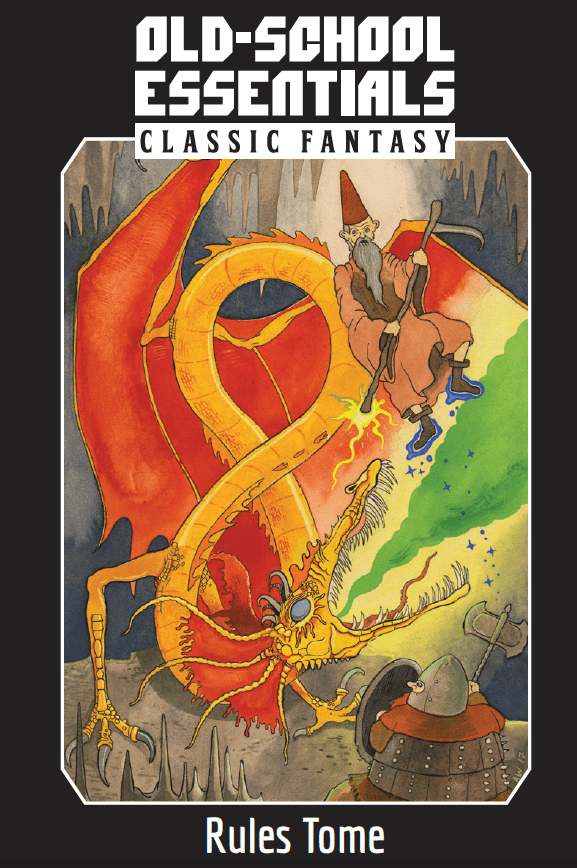
Illustration from the Alignment section of the OSE Rules Tome. It depicts a sphinx-like god on the left-hand side, holding a sword out towards a party of adventurers and a bearded, four-armed, muscle-bound god on the right, holding out a spike mace.

OSE don’t have no truck with your good and evil dichotomy. It’s Lawful, Neutral or Chaotic. Given this Cleric’s start in life, physically at a disadvantage, frail and weak prone to sickness, I think he is leaning towards Chaos. He is railing against the world and the laws of man and nature.

  • Alignment: Chaotic

There is a note in the Alignment section that if the referee does not think you are role-playing your alignment, then they can give you one that better suits your character. Interesting.

9. Note Known Languages

  • Known Languages: Common, Chaotic (Alignment Language)
    Another language, with my intelligence? No way buddy. I think the inclusion of the secret languages of gestures, signs and code words, known by all peoples of a given alignment is kind of cool and appropriate for the genre. Weird though.

10. By Equipment

I get 3D6 x 10 GP to start:

  • GP: 50 (that was two 1s and a 3 on 3d6. FML)
    Going to flip to p42 to check out the Equipment list. I must bear in mind what Clerics can use: any armour and shields but only blunt weapons.

Time to go shopping

  • Club 3GP (1d4 Dmg)
  • Leather Armour 20GP (AC 7 (12 this is if you decide to use ascending AC instead of the standard descending))
  • Holy Symbol 25GP
  • Sack (Small) 1GP
  • Torches (6) 1GP
  • Waterskin 1GP

So, because I have to buy a Holy Symbol, and I really want to have some armour to protect my 1 Hit Point, I cannot even afford rations. I feel as though my Cleric must have taken a vow of poverty.

11. Note Armour Class

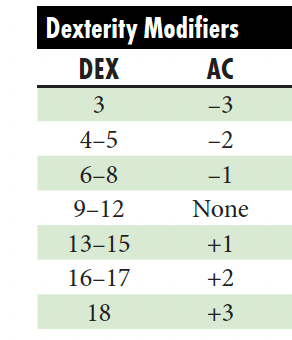
The Dex Modifiers table from the OSE Rules Tome. I am using it here to illustrate how odd it is to use negative numbers to indicate that a character's low Dex score can make their AC worse, when using a THAC0 system.
The Dex Modifiers table from the OSE Rules Tome. I am using it here to illustrate how odd it is to use negative numbers to indicate that a character’s low Dex score can make their AC worse, when using a THAC0 system.

Well, my Cleric, broke and pitiful as he is, is also clumsy as fuck. His Dexterity score is 7 and that gives him a -1 to his Armour Class. Now the wording here is extremely confusing. And I don’t know why they did this. So, as we discovered earlier, the lower your AC, the better when you are using THAC0, right? OK, in that case, if you get a negative modifier to your AC, that should be a good thing! But it is not. In the description of the Dexterity Ability Score they write: “a bonus lowers AC, a penalty raises it.” ! Like, what!? Why not just change the table so that a lower DEX score gives a +1 or +2 and a high score gives a -1 or -2?! Baffling. I need to point out that this is not the way they did it in my extremely old and battered copy of the AD&D 2nd Edition Player’s Handbook. As the picture below proves:

Table 2: Dexterity from the AD&D 2nd Edition Player's Handbook. I am using this to show how the AC modifiers in the OSE Dex Modifiers table above should have appeared, in my opinion.
Table 2: Dexterity from the AD&D 2nd Edition Player’s Handbook. I am using this to show how the AC modifiers in the OSE Dex Modifiers table above should have appeared, in my opinion.

Anyway, what this means is that my Cleric, in his leather armour has:

  • AC: 8

12. Note Level and XP

Pretty straight forward:

  • Level: 1
  • XP: 0

13. Name Character

  • Canon Fodder

That is all.
This disastrous character creation post has been brought to you by Old School Essentials and very bad luck.

Anyone else got a truly desperate OSE character to share?

Player vs GM

Not what you think

I have an easier time writing about the games I am GMing or the ones I am going to GM in the future, compared to those I play in. I think the reasons for this are pretty obvious, right? I have an a behind-the-scenes view of the games I GM, I have read widely on the games, maybe I have home-brewed the world, I probably have a better handle on the rules than most others at the table. As well as that, I set up the game, I send out the invites, I normally host the game, so, it makes sense.

As for the ones I play in, I am still invested in them, or at least in my character, I have usually made some effort with a backstory and personality and I want them to experience cool stuff in the game world with a bunch of other weirdos. There are probably a couple of my characters that I could spend an entire post discussing (and probably will, now that I think about it) but not before they are even made.

Anyway, that’s why I am taking the last few games from my Games I want to Play this Year list and pop them all into this one post.

Old School Essentials – campaign I think

My friend, Isaac of Black Sword Hack fame has been working his way steadily through all the OSE books he could get his hands on. He’s almost ready to kick off that campaign! Very exciting! It will be my fist time playing this system and having been a part of Isaac’s Black Sword Hack game for the last couple of years, I know how he likes to construct a grubby, fun, weird campaign world for us to muck around in.

I am not all that familiar with the ruleset of OSE, but from what I understand, it took the rules from Basic D&D and some of those from AD&D and took out all the stuff that people tended to ignore. I know it does have a race-as-class idea that is similar to the way DCC does it but, overall, it gives me much more old school D&D vibes than DCC does.

I might just go and roll up a few little guys using the OSE rules to get an idea of how it works and get in the mood for it.

Heart: The City Beneath – Open Hearth campaign

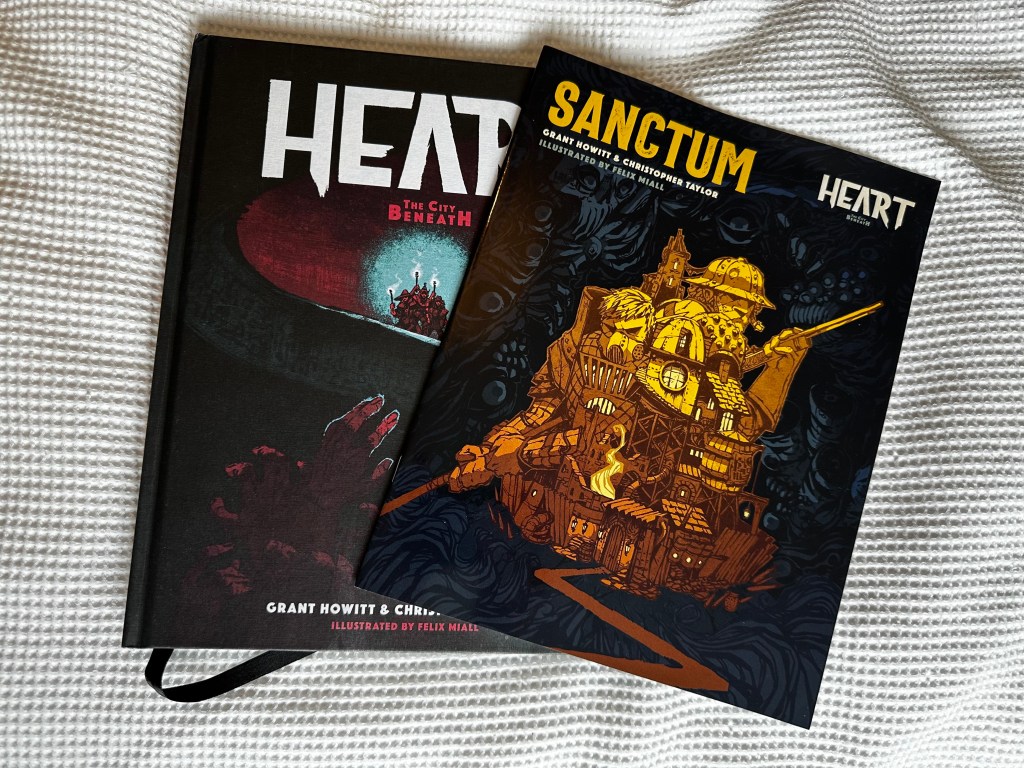
This game technically already started; I am achieving my goals, dear reader! We have only had a session 0 in which I created my aelfir Incarnadine, Forgotten-Frost-Remembered. He is called to the Heart in search of adventure (also he had to flee the City Above due to his crass and embarrassing obsession with money, not to mention his astronomical levels of debt.) He and his fellow delvers are on a mission to help a haven that we created together using the rules from Sanctum, a sourcebook for Heart that is meant for this very purpose. The haven has no name as it was deleted by a Deadwalker some time earlier. The aim is to build it up while pursuing more selfish goals before we all blow up in a conclusion of zenith ability fuelled glory.

All credit to our GM, Mike, for having the presence of mind and session 0 nous to figure out our group’s haven-based goal and get us to create it together in under an hour.

Can’t wait to start getting weird in the Heart.

Call of Cthulhu – Masks of Nyarlathotep – campaign

This one is probably a long-shot. This is actually an ongoing campaign but has been on semi-permanent hiatus since, I want to say 2022? Not sure. Anyway, this is another of Isaac’s campaigns. It was one of those things, playing with adults can mean that sometimes, real life stuff takes precedence and there’s not much you can do about it. Since then we got into other games and other campaigns and Masks has been on the back burner for a long time. Every time we get to chatting about Call of Cthulhu, we end up saying we would love to get this classic campaign started up again.

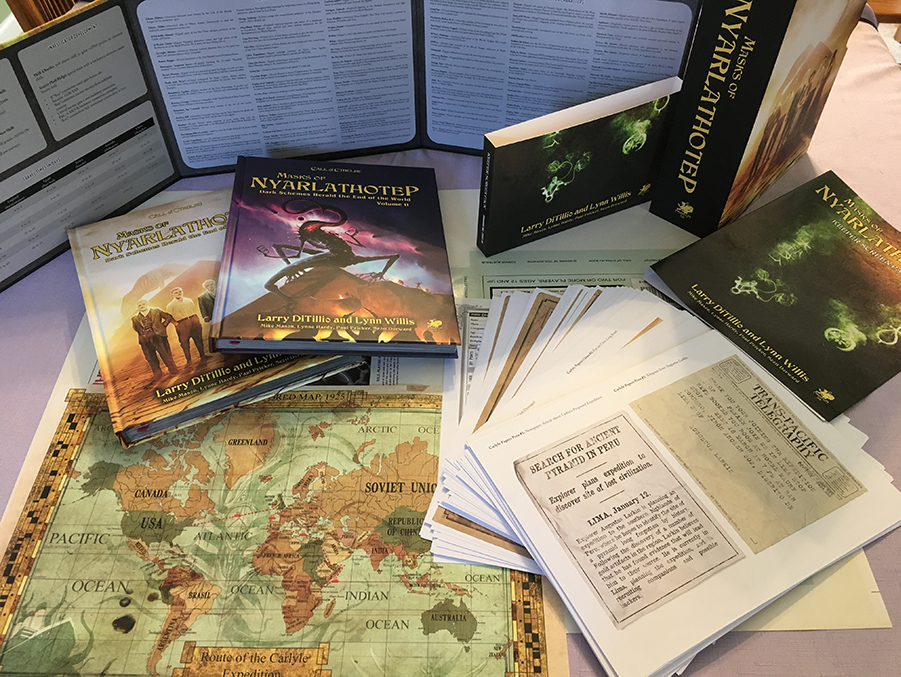
Last we left our intrepid investigators (I was playing a gangland boss from London named Grant Mitchell) they had faced down other worldly terrors in the basement of an occult shop and proved the innocence of a man falsely accused of murder. They also uncovered some evidence and information that drew them to various other places around the world in their pursuit of answers to the question of who was responsible for the murder of their good friend, Jackson Elias. Anyway, they had concluded their snooping in New York and were on a slow boat to London. It has been a very slow boat at this stage…

Magus, Pike and Drum – Playtest

It’s Isaac again! This time with an early playtest for a game that he is very much still developing. I don’t want to go into any detail here but I think I can say at least that it is a semi-historical setting and it will be using the Resistance system, created for Spire. Can’t wait to try it out. What I have read of the character classes and abilities so far makes it sound very fun and interesting to play.

OK, that about wraps it up for today. See you tomorrow with more from the Dice Pool.

Turbo Tokens

Failure is failure

Nobody wants to fail, right? We frown on failure. We take it personally, even when it is no fault of our own. It is hard not to feel that way. It might even keep you awake some nights, remembering how you fucked up that one thing and someone blamed you for your failure, even though it was largely a matter of chance. It sucks, but here’s the thing, your brain will never let you forget that one time you messed up. You will almost certainly never make the same mistake again if it’s something you can avoid, right? You will avoid similar situations, you will learn to do the thing properly or you will let someone qualified do it.

But this is not the case in D&D and other similar games. If you roll a 12 and add your +3 bonus and you miss that guy with his 16 AC, that’s it. It’s over. There is nothing you can learn except that you better roll higher next time or hit him with Magic Missile. This feels so much worse than regular failure. This is failure with no upside. There is not even a fun narrative element to it, really, unless you shoehorn one in.

So, how do you fix this? I think the answer is pretty simple actually, and it was brought to my attention by Aabriya Iyengar and Brennan Lee Mulligan.

Adding interest to failure

In the latest season of Dimension 20, Never Stop Blowing Up, the gang are playing people stuck in an 80s action movie. They are not playing D&D this time. Instead they are using a version of the Kids on Bikes system that they have previously hacked for Mentopolis and Misfits and Magic.

I really enjoy the system and it suits the seasons they use it in really well. In particular, the exploding dice element of the mechanics makes a lot of sense for a show called Never Stop Blowing Up and it makes for some brilliant cast reactions when it happens.

But the mechanic I am interested in here is the Turbo Tokens they receive when they fail at an action. In the base game, they are called Adversity Tokens and they represent the lessons learned from failure and contribute to real swings of momentum during high-stress situations.

Kids on dragons

So, I am going to try it out in D&D. Not sure what name I will give the tokens yet. I might just start with Adversity Tokens and see what the players end up calling them. The idea I have is to use them the same way as they do in Kids on Bikes, basically. They will earn one token each time they fail at something, whether it’s an attack roll or a stealth check or an effort to wow the crowd in the inn with their musical genius. That way, failure won’t feel quite so bad and they will be able to spend them later to effect other rolls. I think a +/- 1 modifier for each token spent is appropriate. They will be allowed to spend them to add to or subtract from any roll happening in the situation they are involved in. So they could add a bonus to their own attack roll, help out a fellow PC when the chips are down or subtract from an enemy’s saving throw or attack roll for instance. I foresee some interesting behaviours when it comes to the saving and spending of these. I am thinking I might need to cap the number of tokens a player can have at 10, although I doubt they’ll be able to save up that many of them really.

What do you think, dear reader? Have you ever tried doing something like this in D&D. If so, how did it go?

Wildsea – Campaign

Give your players a home

It’s pretty difficult to give your journeying adventurers a particular place they need to look after. They are always schlepping off to the next dungeon or haunted house or wizard’s tower or whatever. There are ways around this. In one D&D campaign that we finished last year, the PC’s hometown was plonked right on top of a sort of nexus of worlds, an ancient tower, buried beneath a hill, containing dozens of portals to many different planes and other prime material locations. So, even when they popped off to Sigil or Mechanus or the Astral Plane or wherever, they were always going home eventually. Indeed, the focus of that campaign was to save their little island.

But I often find it gratifying to make the home they care about quite mobile. In the first of several interconnected campaigns, the PCs stole and adopted their own “turtling” vessel (like a whaling vessel but for giant turtles. You get the idea.) as the setting was a vast archipelago they needed the transport. Of course they took it and made it their home. Not much of their adventures revolved around that boat but I liked the idea that they had somewhere to return to, no matter where their travels took them.

A-thing-to-fuck-with

It was also a-thing-to-fuck-with. I never got the chance to seriously fuck with that boat since the campaign has been on a semi-permanent hiatus for a few years, but more recently, I got an opportunity to hassle their casino. I mean, this was a different set of characters but some of the same players and it was in Spire, not D&D. The Ministry of Our Hidden Mistress bequeathed to our “heroes” the poisoned chalice of a casino called the Manticore in the Silver Quarter. They put a lot of effort into it, hired entertainment and a succession of unlucky security guards. It did not end well for the Manticore or the staff. Threats to it made for real motivation and the fact that it was a public place meant their enemies could just walk in. That was a dream. Great stuff. But it veers wide of the mobile home to care about topic.

The most recent version of the mobile home in one of my campaigns is the Cadabra, a mirror-hulled squid ship in our Spelljammer game. It’s got a ready-made crew of spirits and a checkered past itself. They have had this ship since session 3 and they are now at the point where they are repairing it and upgrading it and even adding more boats! They’re going to have a frikkin’ armada! This is great because boats are a money-pit. They answer the question, “what are my characters going to do with all that gold?” As well as the “how shall I fuck with them?” question.

And I know the feeling of home-ownership within a game. In the Black Sword Hack game I’m in, we have a flying boat, called a slater. We are unreasonably paranoid about this thing getting stolen or burnt or otherwise becoming unusable by our characters. We park it miles from the locations we are trying to get to so no-one sees it. We always leave NPCs to guard it. It is our home and it’s where we store all our opium and it’s our greatest asset. I’ll be damned if any asshole wizard is going to take it from us!

A home in the canopy

A photo of a page from my copy of The Wildsea by Felix Isaac's. It shows a picture of a ship from the game.

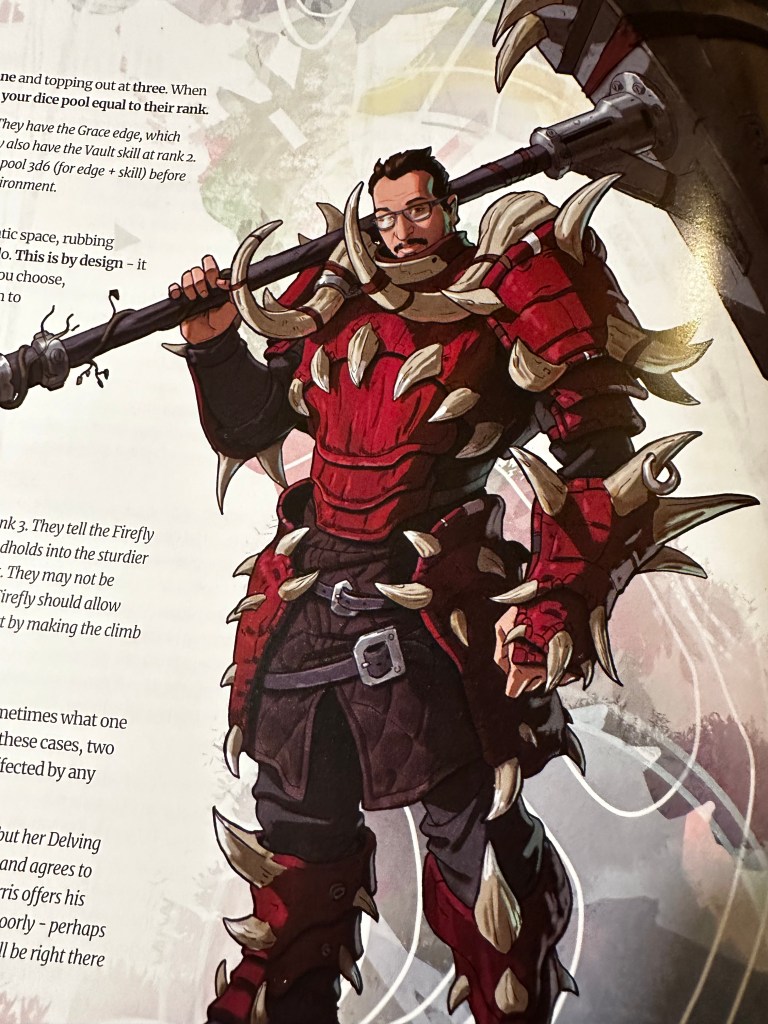
So Wildsea is a good fit for me and my group. In it, the players make characters who crew a ship that plies the canopy of a world-blanketing forest under the power of chainsaws! Below the leafy waves, the poisonous substance, crezzerin makes descending into it just as dangerous as diving into watery sea. The characters are made up of a wild variety of bloodlines like the beings made up of a colony of spiders, cactus folk, spirits inhabiting the ruins of ship-parts and regular old humans. It is possible to start a campaign of Wildsea where the PCs do not have a ship, but I don’t think I would. In fact, the designer of the game, Felix Isaacs, recently suggested that the best way to start is by making your ship first, before your characters even! That way, the thinking goes, you can imagine them in place , posing upon the prow or hanging from the gunwale or climbing the mast. Also, the classes in this game equate to posts on a ship so it makes even more sense when you take that into account. I really like this idea and will probably ask my players to take this approach in session 0.

A photo of a picture of a Mesmer, one of the posts from the Wildsea book.

There is no doubt that this is a weird setting. In some ways, it should act like any other setting where you get around on a vehicle of some sort across a trackless expanse. There are plenty of sci-fi games where you have a spaceship to build and look after. Death in Space is like that. Then, of course, I have given a few examples in D&D above already. But this is pretty alien. Even the concept of the post-apocalypse that is so impossibly verdant that sentient life has had to scrabble for a foothold amongst all the greenery is unique and bold. Add to that the oddness of the playable bloodlines and the really setting-specific hazards and you would be hard-pressed to compare Wildsea usefully to any other single game on the market.

A photo of a picture an Ardent character from The Wildsea book.

On top of that, the mechanics are really interesting. It is known as the Wild Words Engine

From Wildsea, Chapter 2, Mechanics:
“It’s low on crunch, focusing instead on letting narrative, character and setting develop during play.”

Isaacs has said that, despite the similarity to certain other game systems, he came up with a lot of the rules independently or was influenced more by video games than other RPGs. The basic dice-rolling mechanic is very Blades in the Dark and he has, to be fair, indicated that he got it from that game. So, you build a dice pool to roll and take the highest roll (or two rolls in the case of a Twist). But there are elements such as the Twist, which happens when you roll doubles and adds a special little something to the effects of the roll, that feel new and fun.

Finally, it feels like the GM (or Firefly) and the players get to create the world together as they play, making a place with little magic or lots of it, with high technology levels or very low, with strictly faith based societies or entirely atheist ones. This is very appealing to me.

How about you? Have you had a chance to play Wildsea? If so, what were your favourite aspects of it?

Death Match Island – Short Campaign

Postponed

So, when I wrote the post listing the games I wanted to play during the remainder of this year, I had Deathmatch Island pencilled in for this Friday. I only had one session in my calendar so I thought, “oh! It must have been a one-shot that I had planned.” But no, reader, no.

First of all, I have had to put this one on the back burner for now. I only had three players for it and one is unable to attend so I decided it’s best to leave it to a more convenient time for everybody. These are the iniquities of arranging to play RPGs with adults. Thus has it ever been. I am determined to get to it at some point soon but it’s not happening this weekend, that’s for sure.

Second of all, Looking back at the original invitation I sent out to players within our little, local RPG community, Tables & Tales, I realised I had advertised it as a three session game with the possibility of stretching to six more sessions if the players were into it. Now this makes perfect sense. The core book suggests that you can complete a satisfying arc in three sessions but, if you wanted to make it to the end of the Death Match, as it were, you would probably need nine in total, if not more. It does provide guidance for making one-shots using the system and the structure of the game but I think it would be far less meaningful to do so.

Inspirations

A still from the movie Battle Royale

No-one, I think, is going to be terribly surprised by the inspirations behind Deathmatch Island. You’ve got Battle Royale, The Hunger Games, Squid Game, even Survivor of course, but, slightly less predictably, Tim Denee, the designer, also references Severance and The White Lotus, two of my very favourite TV shows from the last few years. A couple of touchstones that are, surprisingly, absent from the list are the video games, Portal and Portal 2. Many of the design choices and even the arguably, most important, decision the player characters need to make align with the choices your character makes in those games, “play to win,” or “break the game.” Of course, in all of these pieces of media, this is the central and most important choice.

The game, not the-game-within-the-game

What I am trying to say is that I was always going to back a game like this when it popped up on Backerkit. I am a fan of all of those properties to one extent or another. And, to me, the themes are never going to get old. And, although I haven’t had a chance to actually play it yet, I think that, if you feel the same about any of the media I listed above, you could do a lot worse than picking up this game.

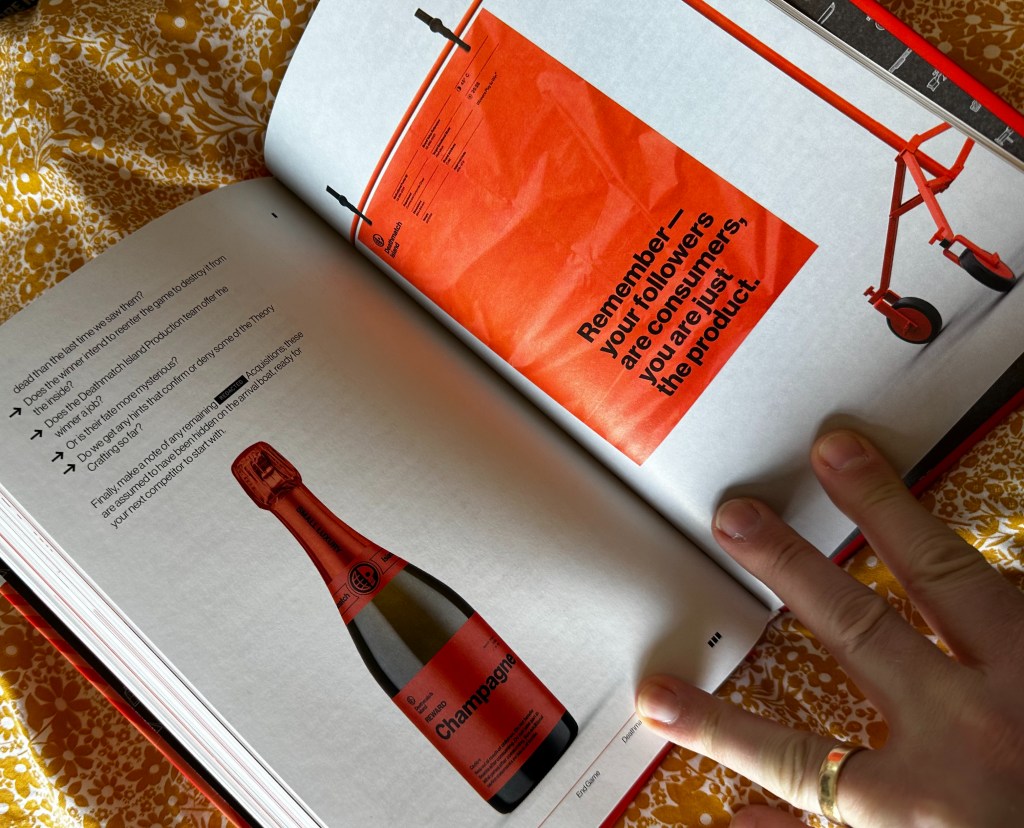
A photo of a two page spread from my copy of the Deathmatch Island core book.
Remember – your followers are consumers, you are just the product.

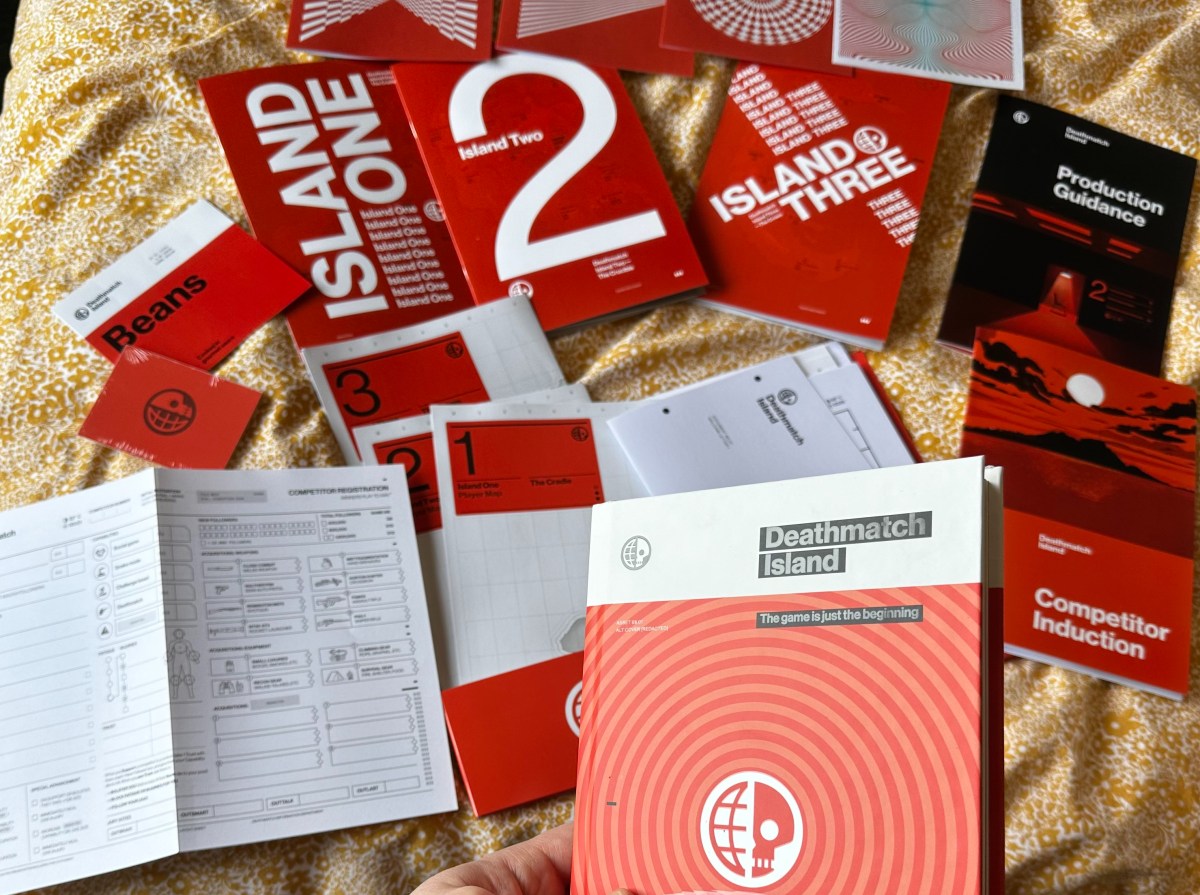
Apart from anything else, it is slick. The production quality is high, as you would expect from Evil Hat Productions, and all of the extras I got from my pledge tier are great. They include booklets describing each of the Islands and each of the Casts (which, to a large extent determine the type of scenario you’ll be playing,) official-looking Competitor Registration forms that act as character sheets, player maps of each of the islands as well as rules glossaries for both Competitors (players) and Production (GM.)

Mechanically, Deathmatch Island is based on the Paragon system developed by John Harper of Blades in the Dark fame and Sean Nittner. I knew nothing about this system before I read the Deathmatch Island book, except that it originated with another game called AGON.

It is highly structured, with play occurring in clearly defined phases. It starts with Competitor Registration, in which the players create their characters, largely through rolling on a series of tables. Then you proceed to the first island.
Each island is split into Phase One, where the Competitors explore, interact and collect resources and Phase Two which is the climax, in which the Battle Royale itself occurs. Even within each phase, there are only a few set actions that can be taken. There is a fair amount of leeway regarding how you achieve the actions within the narrative, but it essentially comes down to opposed rolls from the teams as they stand on the island. Although, the rolls themselves are of utmost importance to the outcome, the players get to do a Confessional after the rolls are all done, giving them each narrative control, as if describing their actions to a camera on a reality TV show. It’s a fun conceit and one I’d like to see in action.

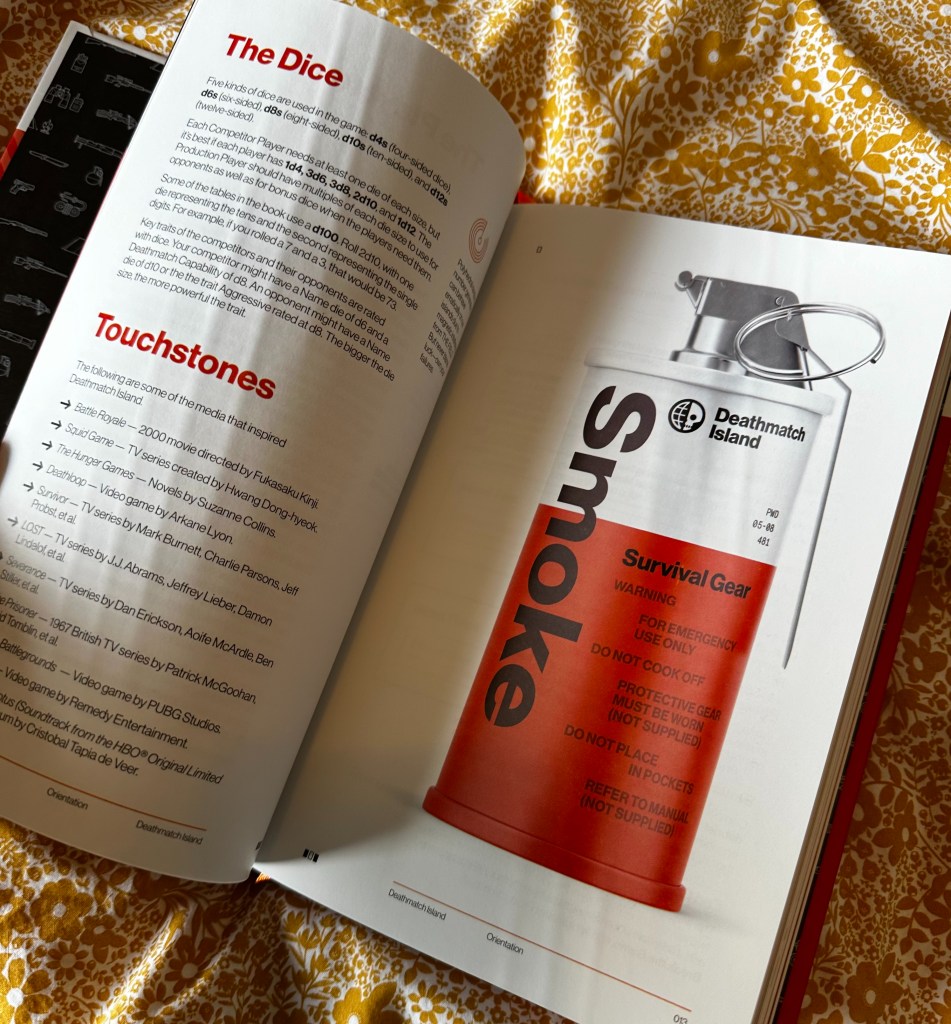
A photo of a two page spread from my copy of the Deathmatch Island core book.
Survival Gear

You play up to three islands. There is a phase of play between each island. This works a bit like downtime in Blades in the Dark and gives the PCs a chance to improve their characters, debrief, and come up with some theories about what the hell is going on. And then there is the End Game. I’m not going to go into that here.

From reading the book, the system feels sufficiently different from anything I have played before to have me really interested to find out how it plays at the table. One of the most fascinating parts is that I feel like you could replay this game on the same islands, with the same players, but choose different casts and have a very different experience each time.

I hope I get to try it out soon!
Have any of my readers played Deathmatch Island? If so, what did you think?

Tales from the Loop​ – Mascots and Murder

Indie mascot horror

Maybe I’m giving away a bit too much with the title of this scenario. What do you think? I mean, look, here’s the thing; when we set up Tables and Tales a few months ago, I was curious about the kinds of things new members were into. One of them said they liked Indie Mascot Horror. Now, let me tell you, dear reader, I did not know what that was. Since then, I have learned that it refers to video games like Five Nights at Freddie’s and Poppy’s Playtime. I had obviously not played these games but I looked into them a bit and got the vibe. I thought about the types of RPGs that would be good for those themes and tropes. It did not take me long to decide on Tales from the Loop.

Tales from the Loop

If you have never seen the artworks of Simon Stålenhag, do yourself a favour and go check them out. I have taken some photos of his work from his art book, Tales from the Loop and embedded them here but they don’t do the work justice. When I first encountered his work several years ago, it filed me with wonder. He created such a realistic depiction of a past that was largely recognisable to me from my own childhood, interspersed with or shockingly dominated by futuristic architectures and sci-fi wonders. His work excited my imagination like only RPGs had in the past. So when I discovered that Free League were producing a Tales From the Loop game, it didn’t take me long to pick it up. It took a little longer to get it to the table but when I did I discovered that the players loved it.

## Indie mascot horror
Maybe I’m giving away a bit too much with the title of this scenario. What do you think? I mean, look, here’s the thing; when we set up Tables and Tales a few months ago, I was curious about the kinds of things new members were into. One of them said they liked Indie Mascot Horror. Now, let me tell you, dear reader, I did not know what that was. Since then, I have learned that it refers to video games like Five Nights at Freddie’s and Poppy’s Playtime. I had obviously not played these games but I looked into them a bit and got the vibe. I thought about the types of RPGs that would be good for those themes and tropes. It did not take me long to decide on Tales from the Loop.

## Tales from the Loop
If you have never seen the artworks of [Simon Stålenhag](https://www.simonstalenhag.se/), do yourself a favour and go check them out. When I first encountered his work several years ago, it filed me with wonder. He created such a realistic depiction of a past that was largely recognisable to me from my own childhood, interspersed with or shockingly dominated by futuristic architectures and sci-fi wonders. His work excited my imagination like only RPGs had in the past. So when I discovered that Free League were producing a [Tales From the Loop game](https://freeleaguepublishing.com/games/tales-from-the-loop-rpg/), it didn’t take me long to pick it up. It took a little longer to get it to the table but when I did I discovered that the players loved it. 

Tales from the Loop is a game about the 1980s that never was. It posits a world in which some astounding scientific breakthroughs occurred in the ‘50s and ‘60s so that, by the time in which the game is set, they are not considered so strange. You have your robots and your hovercraft and your infinitely renewable energy. But most of that stuff is considered mundane in Stålenhag’s world. Not only that, they exist alongside the ‘80s mainstay technologies like Walkmans, cassette tapes, VCRs and Soda Stream. In Stålenhag’s artwork this created some beautifully uncanny images. Most were set in the region of Sweden known as Mälaröarna, where the Loop project was based. This is where the world’s largest particle accelerator was built. Though it is not necessarily directly responsible for the many strange occurrences in the region, the people who populate such a scientifically rarified place usually are. Scientists and administrators and students flocked to the region and started families there. So many of Stålenhag’s paintings involved kids; a toe-headed child threatening an old Volkswagen van marked “Polis” with a giant robot under his control; a pair of woolly-hatted kids digging in the Swedish snow and gazing back at their homes, dwarfed by the cyclopean, other-worldly cooling towers used to release heat from the core of the Loop itself, the Gravitron; a little kid in cold weather coveralls leading his grandfather through the snow to a mysterious sphere, left abandoned in the countryside, its purpose and provenance forgotten. These were the inspirations for the RPG.

The game came out at the height of the popularity of Stranger Things, which helped it gain a lot of traction I think, and then it even had its own, unfortunately not so popular, spinoff [TV series](https://en.wikipedia.org/wiki/Tales_from_the_Loop), which I, at least, loved.

In the RPG you play kids between 10 and 15 years old. You get to choose a Type from such classics as the Computer Geek, the Hick and the Weirdo. You also have to choose some really fun things like your Iconic Item, your key relationships and your favourite 1980s song.

Once you have your Kid, you and your friends can go out and investigate weird shit on your bikes. Stuff like, where are all the birds gone? What are all the adults doing gathered around that weird machine in the field? What’s that dinosaur looking claw print in the snow? You know, normal kid shit.

## Roll mechanics
Tales from the Loop uses a version of the Year Zero engine, and, in fact, it was the first game I played using that system. It’s really straight-forward and intuitive, easy to learn and resolves situations quickly. “Situations” are generally and collectively referred to in the text as “Trouble” with a capital “T,” appropriately enough. For many, the Trouble you got into and out of when they were kids are some of the most enduring and treasured memories. In the game, you combine your ability dice and your skill dice into one dice pool and roll them all to try and get at least one 6. Since you only use d6s in this game, that’s the highest you can roll. The more 6s you roll the better, generally.

The only issue my players and I had with the rules is the Extended Trouble mechanic. The way this works is that, during the final showdown, encounter or whatever, every kid says what they are going to do and the GM tells them how many successes they will need to succeed fully. Then one player rolls all the dice in one enormous pool. Generally, if they don’t succeed fully but they still have a few successes, they might achieve what they were trying to but one or more kids will earn conditions or even become Broken. But, in play, we found this approach to be unsatisfying. Each player wanted their own cool moment to roll for and the all-or-nothing approach meant that they couldn’t attempt to take any rectifying actions if and when they saw things going wrong. Anyway, suffice it to say, we won’t be using the Extended Trouble rule next time.

## Mascots and Murder
Here are the very basics of the scenario I have planned:
Although the first Loop was in Sweden and much of the book is written as though it is the default setting, they do actually provide a second potential setting in it. That’s Boulder City, Nevada, the “Best city by a dam site,” which is a reference to its proximity to the Hoover Dam. There is another Loop in this region and all of the scenarios presented in the core book can be transposed very easily to the desert, believe it or not. This is where the kids in this scenario will be from. It is summer in Boulder City so it’s going to be so sizzling hot that you can fry an egg on the sidewalk. This will be a nice change as all the other Tales from the Loop games I have played were set in Sweden in autumn and winter.

Some teens have gone missing from Boulder City. Although their parents don’t seem too worried about it, our intrepid Kids are going to solve this mystery as they track down the source of the eerie, carnival-like music out in the Nevada desert and figure out what the connection is.

I have had fun writing this scenario, even though I have gone over it and over it to get it right. So, it’ll be ready to play in a few weeks.

The Tales from the Loop core book has some very useful advice for writing and structuring a scenario for it yourself. As long as you stick to that, you’re unlikely to go wrong. This is not actually the first one I have written myself, using these guidelines and, I can tell you, it works really well.

Have you played Tales from the Loop? What did you think of it? If you had to run a particular game for Indie Mascot Horror vibes, what would it be?

Tales from the Loop is a game about the 1980s that never was. It posits a world in which some astounding scientific breakthroughs occurred in the ‘50s and ‘60s so that, by the time in which the game is set, they are not considered so strange. You have your robots and your hovercraft and your infinitely renewable energy. But most of that stuff is considered mundane in Stålenhag’s world. Not only that, they exist alongside the ‘80s mainstay technologies like Walkmans, cassette tapes, VCRs and Soda Stream. In Stålenhag’s artwork this created some beautifully uncanny images. Most were set in the region of Sweden known as Mälaröarna, where the Loop project was based. This is where the world’s largest particle accelerator was built. Though it is not necessarily directly responsible for the many strange occurrences in the region, the people who populate such a scientifically rarified place usually are. Scientists and administrators and students flocked to the region and started families there. So many of Stålenhag’s paintings involved kids; a toe-headed child threatening an old Volkswagen van marked “Polis” with a giant robot under his control; a pair of woolly-hatted kids digging in the Swedish snow and gazing back at their homes, dwarfed by the cyclopean, other-worldly cooling towers used to release heat from the core of the Loop itself, the Gravitron; a little kid in cold weather coveralls leading his grandfather through the snow to a mysterious sphere, left abandoned in the countryside, its purpose and provenance forgotten. These were the inspirations for the RPG.

## Indie mascot horror
Maybe I’m giving away a bit too much with the title of this scenario. What do you think? I mean, look, here’s the thing; when we set up Tables and Tales a few months ago, I was curious about the kinds of things new members were into. One of them said they liked Indie Mascot Horror. Now, let me tell you, dear reader, I did not know what that was. Since then, I have learned that it refers to video games like Five Nights at Freddie’s and Poppy’s Playtime. I had obviously not played these games but I looked into them a bit and got the vibe. I thought about the types of RPGs that would be good for those themes and tropes. It did not take me long to decide on Tales from the Loop.

## Tales from the Loop
If you have never seen the artworks of [Simon Stålenhag](https://www.simonstalenhag.se/), do yourself a favour and go check them out. When I first encountered his work several years ago, it filed me with wonder. He created such a realistic depiction of a past that was largely recognisable to me from my own childhood, interspersed with or shockingly dominated by futuristic architectures and sci-fi wonders. His work excited my imagination like only RPGs had in the past. So when I discovered that Free League were producing a [Tales From the Loop game](https://freeleaguepublishing.com/games/tales-from-the-loop-rpg/), it didn’t take me long to pick it up. It took a little longer to get it to the table but when I did I discovered that the players loved it. 

Tales from the Loop is a game about the 1980s that never was. It posits a world in which some astounding scientific breakthroughs occurred in the ‘50s and ‘60s so that, by the time in which the game is set, they are not considered so strange. You have your robots and your hovercraft and your infinitely renewable energy. But most of that stuff is considered mundane in Stålenhag’s world. Not only that, they exist alongside the ‘80s mainstay technologies like Walkmans, cassette tapes, VCRs and Soda Stream. In Stålenhag’s artwork this created some beautifully uncanny images. Most were set in the region of Sweden known as Mälaröarna, where the Loop project was based. This is where the world’s largest particle accelerator was built. Though it is not necessarily directly responsible for the many strange occurrences in the region, the people who populate such a scientifically rarified place usually are. Scientists and administrators and students flocked to the region and started families there. So many of Stålenhag’s paintings involved kids; a toe-headed child threatening an old Volkswagen van marked “Polis” with a giant robot under his control; a pair of woolly-hatted kids digging in the Swedish snow and gazing back at their homes, dwarfed by the cyclopean, other-worldly cooling towers used to release heat from the core of the Loop itself, the Gravitron; a little kid in cold weather coveralls leading his grandfather through the snow to a mysterious sphere, left abandoned in the countryside, its purpose and provenance forgotten. These were the inspirations for the RPG.

The game came out at the height of the popularity of Stranger Things, which helped it gain a lot of traction I think, and then it even had its own, unfortunately not so popular, spinoff [TV series](https://en.wikipedia.org/wiki/Tales_from_the_Loop), which I, at least, loved.

In the RPG you play kids between 10 and 15 years old. You get to choose a Type from such classics as the Computer Geek, the Hick and the Weirdo. You also have to choose some really fun things like your Iconic Item, your key relationships and your favourite 1980s song.

Once you have your Kid, you and your friends can go out and investigate weird shit on your bikes. Stuff like, where are all the birds gone? What are all the adults doing gathered around that weird machine in the field? What’s that dinosaur looking claw print in the snow? You know, normal kid shit.

## Roll mechanics
Tales from the Loop uses a version of the Year Zero engine, and, in fact, it was the first game I played using that system. It’s really straight-forward and intuitive, easy to learn and resolves situations quickly. “Situations” are generally and collectively referred to in the text as “Trouble” with a capital “T,” appropriately enough. For many, the Trouble you got into and out of when they were kids are some of the most enduring and treasured memories. In the game, you combine your ability dice and your skill dice into one dice pool and roll them all to try and get at least one 6. Since you only use d6s in this game, that’s the highest you can roll. The more 6s you roll the better, generally.

The only issue my players and I had with the rules is the Extended Trouble mechanic. The way this works is that, during the final showdown, encounter or whatever, every kid says what they are going to do and the GM tells them how many successes they will need to succeed fully. Then one player rolls all the dice in one enormous pool. Generally, if they don’t succeed fully but they still have a few successes, they might achieve what they were trying to but one or more kids will earn conditions or even become Broken. But, in play, we found this approach to be unsatisfying. Each player wanted their own cool moment to roll for and the all-or-nothing approach meant that they couldn’t attempt to take any rectifying actions if and when they saw things going wrong. Anyway, suffice it to say, we won’t be using the Extended Trouble rule next time.

## Mascots and Murder
Here are the very basics of the scenario I have planned:
Although the first Loop was in Sweden and much of the book is written as though it is the default setting, they do actually provide a second potential setting in it. That’s Boulder City, Nevada, the “Best city by a dam site,” which is a reference to its proximity to the Hoover Dam. There is another Loop in this region and all of the scenarios presented in the core book can be transposed very easily to the desert, believe it or not. This is where the kids in this scenario will be from. It is summer in Boulder City so it’s going to be so sizzling hot that you can fry an egg on the sidewalk. This will be a nice change as all the other Tales from the Loop games I have played were set in Sweden in autumn and winter.

Some teens have gone missing from Boulder City. Although their parents don’t seem too worried about it, our intrepid Kids are going to solve this mystery as they track down the source of the eerie, carnival-like music out in the Nevada desert and figure out what the connection is.

I have had fun writing this scenario, even though I have gone over it and over it to get it right. So, it’ll be ready to play in a few weeks.

The Tales from the Loop core book has some very useful advice for writing and structuring a scenario for it yourself. As long as you stick to that, you’re unlikely to go wrong. This is not actually the first one I have written myself, using these guidelines and, I can tell you, it works really well.

Have you played Tales from the Loop? What did you think of it? If you had to run a particular game for Indie Mascot Horror vibes, what would it be?

The game came out at the height of the popularity of Stranger Things, which helped it gain a lot of traction I think, and then it even had its own, unfortunately not so popular, spinoff TV series, which I, at least, loved.

In the RPG you play kids between 10 and 15 years old. You get to choose a Type from such classics as the Computer Geek, the Hick and the Weirdo. You also have to choose some really fun things like your Iconic Item, your key relationships and your favourite 1980s song.

Once you have your Kid, you and your friends can go out and investigate weird shit on your bikes. Stuff like, where are all the birds gone? What are all the adults doing gathered around that weird machine in the field? What’s that dinosaur looking claw print in the snow? You know, normal kid shit.

Roll mechanics

Tales from the Loop uses a version of the Year Zero engine, and, in fact, it was the first game I played using that system. It’s really straight-forward and intuitive, easy to learn and resolves situations quickly. “Situations” are generally and collectively referred to in the text as “Trouble” with a capital “T,” appropriately enough. For many, the Trouble you got into and out of when they were kids are some of the most enduring and treasured memories. In the game, you combine your ability dice and your skill dice into one dice pool and roll them all to try and get at least one 6. Since you only use d6s in this game, that’s the highest you can roll. The more 6s you roll the better, generally.

The only issue my players and I had with the rules is the Extended Trouble mechanic. The way this works is that, during the final showdown, encounter or whatever, every kid says what they are going to do and the GM tells them how many successes they will need to succeed fully. Then one player rolls all the dice in one enormous pool. Generally, if they don’t succeed fully but they still have a few successes, they might achieve what they were trying to but one or more kids will earn conditions or even become Broken. But, in play, we found this approach to be unsatisfying. Each player wanted their own cool moment to roll for and the all-or-nothing approach meant that they couldn’t attempt to take any rectifying actions if and when they saw things going wrong. Anyway, suffice it to say, we won’t be using the Extended Trouble rule next time.

Mascots and Murder

Here are the very basics of the scenario I have planned:
Although the first Loop was in Sweden and much of the book is written as though it is the default setting, they do actually provide a second potential setting in it. That’s Boulder City, Nevada, the “Best city by a dam site,” which is a reference to its proximity to the Hoover Dam. There is another Loop in this region and all of the scenarios presented in the core book can be transposed very easily to the desert, believe it or not. This is where the kids in this scenario will be from. It is summer in Boulder City so it’s going to be so sizzling hot that you can fry an egg on the sidewalk. This will be a nice change as all the other Tales from the Loop games I have played were set in Sweden in autumn and winter.

Photo from the book, Tales from the Loop by Simon Stålenhag.

Some teens have gone missing from Boulder City. Although their parents don’t seem too worried about it, our intrepid Kids are going to solve this mystery as they track down the source of the eerie, carnival-like music out in the Nevada desert and figure out what the connection is.

I have had fun writing this scenario, even though I have gone over it and over it to get it right. So, it’ll be ready to play in a few weeks.

The Tales from the Loop core book has some very useful advice for writing and structuring a scenario for it yourself. As long as you stick to that, you’re unlikely to go wrong. This is not actually the first one I have written myself, using these guidelines and, I can tell you, it works really well.

Have you played Tales from the Loop? What did you think of it? If you had to run a particular game for Indie Mascot Horror vibes, what would it be?

Investigations

The detective dichotomy

We have been enjoying the Blade Runner RPG immensely in the last few weeks. The blade runners are into the second day of their investigation of the murder of Sandor, another member of the LAPD Rep Detect Unit who happened to be a Nexus 9 replicant. So far, it has gone pretty well for them. They have had some incredible luck with dice rolls that even revealed certain clues I was surprised about. Due to uncovering these, I think they are coming up with the basis of a solid theory for what happened.

Here’s the thing: this is an official case file, produced by Free League. I would imagine most people playing Blade Runner have run this scenario; it comes in the starter set. And the details of the scenario, the NPCs, the locations, even the events, to a certain extent, are set. There is a lot of freedom for the PCs to pursue leads when and how they want but the perpetrator/s, their reasons and motivations and the major players in the case are the same for every table.

Now don’t get me wrong, we are really enjoying this format. The setting and the themes and the ways the scenario intersects with them are very well done. But it is hard not to feel like it’s on rails, right? The answers will always be the same although each group might do something different with them.

Of course, maybe that’s true of any prewritten scenario, no matter the genre. There is always a lich at the end of Tomb of Horrors. Strahd is the big bad in Ravenloft. That kind of thing goes without saying. So, what is it about the mystery that makes this seem less free-form? I guess it’s that finding the answers is the whole point. In Ravenloft, the point for the players is probably the fun of exploring Barovia and the castle. They are enjoying the scares and the combat and all of that.

But in the end maybe it doesn’t matter. Of course, my players don’t know the ins and outs of the clues or the perps or the mystery until they find them. So it’s still mysterious to them.

Building with Brindlewood

Of course, there are other ways to do mystery games. The one that comes to mind is Brindlewood Bay by Jason Cordova, of course, and the games that have been Carved from Brindlewood, like Public Access and others. In these games, there are plenty of pre-written and published mysteries but, significantly, they don’t have solutions.

In an inventive and fascinating twist of game design, Brindlewood Bay’s solutions emerge during play. There are elements of investigation, role playing, narrative building and straight up dice rolling that result in your characters either coming up with the right answer or the wrong answer. Or, you have the familiar PBTA option of a correct answer but with some complication on a middling roll of the dice.

I have not yet had the chance to play one of these games but I would love to. I want to see if it is more satisfying than the sort of game where your solution is written in stone.

Have you played any mystery games that made you excited to play them again? Send me some recommendations!

Forged in the Dungeon, Part 2

Engage!

This is an update on how my last session of Spelljammer went. More specifically how it went when implementing some mechanics I nicked, unapologetically from Blades in the Dark. If you don’t know what I’m updating you about, oh valued and discerning reader, go take a look at this post right here.

It was touch-and-go last night, to be honest. We only had about 2 hours to play and we were on course for the session to fully be a shopping episode. But, in the last 45 minutes or so, we managed to get into the new technique of using information gathering rolls and an engagement roll before interacting with the dungeon.

I think it worked pretty well, once we got into it. I briefly explained the concept and everyone was on board with it. So we went ahead and they started making up the ways they would use their specialties to help boost their chances with the engagement roll. One character described a trip to the pub to try and identify some locals who might know the way to this secret hideout they were looking for, one followed a potential gang member to the entrance, one questioned some dock workers they were helping out, one went to ask her sister for help and one staked out the most likely spots along the docks. They all used different skills and only one of them failed the information gathering roll. I set the Information gathering DC pretty low for this first time, a mere DC 10. I gave them +2 to the engagement roll for each success so they ended up with a +8 for a total of 18 on the engagement roll.

Now, I had prepared three maps on Roll20 and a bunch of potential encounters, both combat and social, traps and dangerous environments. I did not regret dumping two of those locations in favour of jumping straight to the dungeon entrance. Did the old dump and jump, as it were.

I narrated their discovery of and arrival at the building that hid the staircase to the hideout. I explained how the intelligence they had gotten in their information gathering phase had allowed them to figure out the best time to enter. I described the way they were warned to avoid dangers and possible traps on the stairs and then, satisfyingly, they got to the front door. And that’s where the action started.

Straight Dunjin’

I asked for some feedback on the technique at the end of the session and it was broadly positive. There was a definite consensus that, if we had simply role-played each of the scenes I described above with multiple rolls in each scene for stealth, deception, persuasion, etc, it would have taken hours and they would not have gotten anywhere near the entrance to the dungeon last night.

One player, Thomas, told me today that, because there tends to be a lot of “admin” in this campaign (ship stuff, money stuff, shopping stuff etc.) that it was refreshing to get to the action without a lot of rigmarole. I agreed that it felt good to use the precious time we have together (only 2 hours every fortnight) in as fun a way as possible. Last night, that involved sending them to an underground lair where they discovered a guy with the top of his head sawn off and a bunch of identical hobgoblins with gossamer threads attached to their necks. You know, good old fashioned fun!

We also talked about how they were able to retain a sense of having achieved this “easier” path to the entrance of Ozamata’s hideout. Since we went around the “table” and every character had input to how they wanted to help gather information and got to narrate and role-play within those short scenes, it felt earned more than given.

On the more measured side, I did get some feedback from Trevor that, although it worked well in that particular situation, it might be more difficult to apply in others. I have to agree with that assessment too. It is easy to apply this method when the PCs are aware of the exact job they have to do, when they have time to seek out information about it and to prepare in lots of different ways. It is not going to work so well when an encounter is meant to take them by surprise. Maybe that’s ok though. It’s not Blades in the Dark that we’re playing and it never will be. D&D isn’t supposed to feel like that. But that doesn’t mean that we can’t try to make it feel less like a grind and more narratively satisfying whenever possible.

I’m very well aware that, for most gamers who are used to the story-game play style, all I’m describing is maybe some half-arsed version of their regular RPG experience. Maybe it’s not even that. But I will say that, for me, it is fixing a distinct issue in a campaign that I very much want to continue playing but definitely want to speed up bit. I mean they have been playing the last day and a half on the Rock of Bral since last November… so, I want to move things along without making my players feel like I’m rushing them or demanding they do something they don’t want to. Hopefully, this technique will help to accomplish that.

Has anyone else tried something like this with any degree of success in D&D?

Forged in the Dungeon

Engage

I mentioned in my post about my ongoing Spelljammer D&D 5E campaign that I get frustrated by the vast swathes of time demanded by the system, particularly for combat. It’s so involved and requires the application of so many sub-systems, the knowledge of so many specific abilities such as spells and feats that even a small scale fight can take up the guts of an average session. Player patience is tested during the parts they are not involved in and when it does come to their turn it can be difficult for them to know the current state of play because they have, quite understandably, tuned out. So then you have to rehash the last few turns before they take their go.

Some have suggested ways around this, such as removing the roll to hit or limiting the time a player can take on their turn. I understand the impetus to use these workarounds. But one option feels too much like it’s removing a core element of the gameplay and the other is going to end up with some players rushing and resentful and others just giving up on doing anything cool and instead just hitting the thing with their sword every time.
So, what’s the answer? Sorry, good reader, I don’t claim to have one. But here’s what I am going to try:

Blades in the Dark has a mechanic that allows the crew to make a single roll before they get into the action. This is known as the engagement roll and the level of success you achieve with this roll essentially determines how far into a score the action starts. So, in a D&D context, if you roll poorly, you might have to begin the dungeon before you even find the entrance: you’re wandering the wilderness, risking random encounters and suffering exhaustion in the freezing cold while you search, relentlessly for the right damn tree stump that the tunnel is hidden under. But if you roll well? Well, then you come prepared; you knew the weather was going to turn nasty so you dressed for it, you knew it was going to be a long way so you hired some dog sleds, you bought a map from a local trapper and you read a book about the dungeon that told you how to bypass the traps in the entrance hall. In the second case, you start your delve right in the meat of the dungeon, ready to face the fun puzzles and fights and escape with all the coin you can eat as a reward.
Each option sounds like it could be fun to play, to be honest, but option 2 gets the PCs closer to the goal with the least amount of danger, thereby saving time and, moving them towards that tasty dungeon meat I was talking about earlier.

Information is power

Now, another element of this mechanic is that, in Blades in the Dark, to add or remove dice to or from your engagement roll pool, you would take into account many in-world mechanical elements that simply do not apply to my D&D space-galleon game. But there is another mechanic from Blades that I think could work instead. Players could each make a “gather information” roll before the engagement roll. They could use any skill they like for this; arcana, history, religion, stealth, anything that makes sense in the fiction. And they could also use their spells and abilities to improve their chances with their chosen rolls. Success on these rolls could improve their chances of scoring high in the engagement roll.

Normally, in Blades in the Dark, successful information gathering attempts will inform the type of plan the crew comes up with, thereby potentially adding extra dice to the engagement roll pool. In D&D, I am considering my options, advantage or bonuses. Advantage is my preferred way of rewarding players for clever or ingenuous play, but if I offer a +1 or +2 bonus to the engagement roll for each successful gather information roll it means they can stack. I mean, I suppose I could just chuck out the PHB altogether and allow them to have multiple d20s for the engagement roll but, as I mentioned previously, I am not trying to mess with the core rules of the game, just add a little spice to them.

Hot dam

Now, this method could work really well in an instance like I described above where they plan to visit a dungeon and a lot of information and luck could help them to get there quickly and painlessly. But, if all I have planned is a big encounter that doesn’t really involve a lot of build-up or mystery or travel to get to it, I am not sure it helps at all. The problem with D&D combat is still present.

One method I have considered is increasing the damage output of an encounter while decreasing the enemies’ hit points. This would keep the essential rules of the system in play and the sense of danger and high stakes, without the fantastic outlay of time.

So, I am not finished with this idea by any means. If I get a chance, I am going to test out the engagement roll and gather information roll tomorrow night when we return to the Rock of Bral. But I suspect I will need to tweak it and workshop it before it works as well as I want it to.

Does anyone else do this sort of thing? Does anyone have any good ideas for speeding up D&D combat? Should I really try?