Games I Got to Play This Year Part 2

Wrap-up

It’s an end of year wrap-up. Everyone’s doing one. Check out the last post for the campaigns I have been playing in the last few months. This one’s for the one-shots.

One-shots

  1. Pirate Borg – the link above will take you to my post mortem on this one shot. It was a great time, in all honesty. My first foray into running any kind of Borg, and I was pleasantly surprised by how easy and instinctive every part of it was, even the ship-combat, which was new to everyone at the table. If you are interested in pirates, light cosmic horror, or just gnarly old school gaming in an alternate history version of our own 18th century, you’ll enjoy Pirate Borg in all likelihood. By the way, I also did a character creation post on this one.
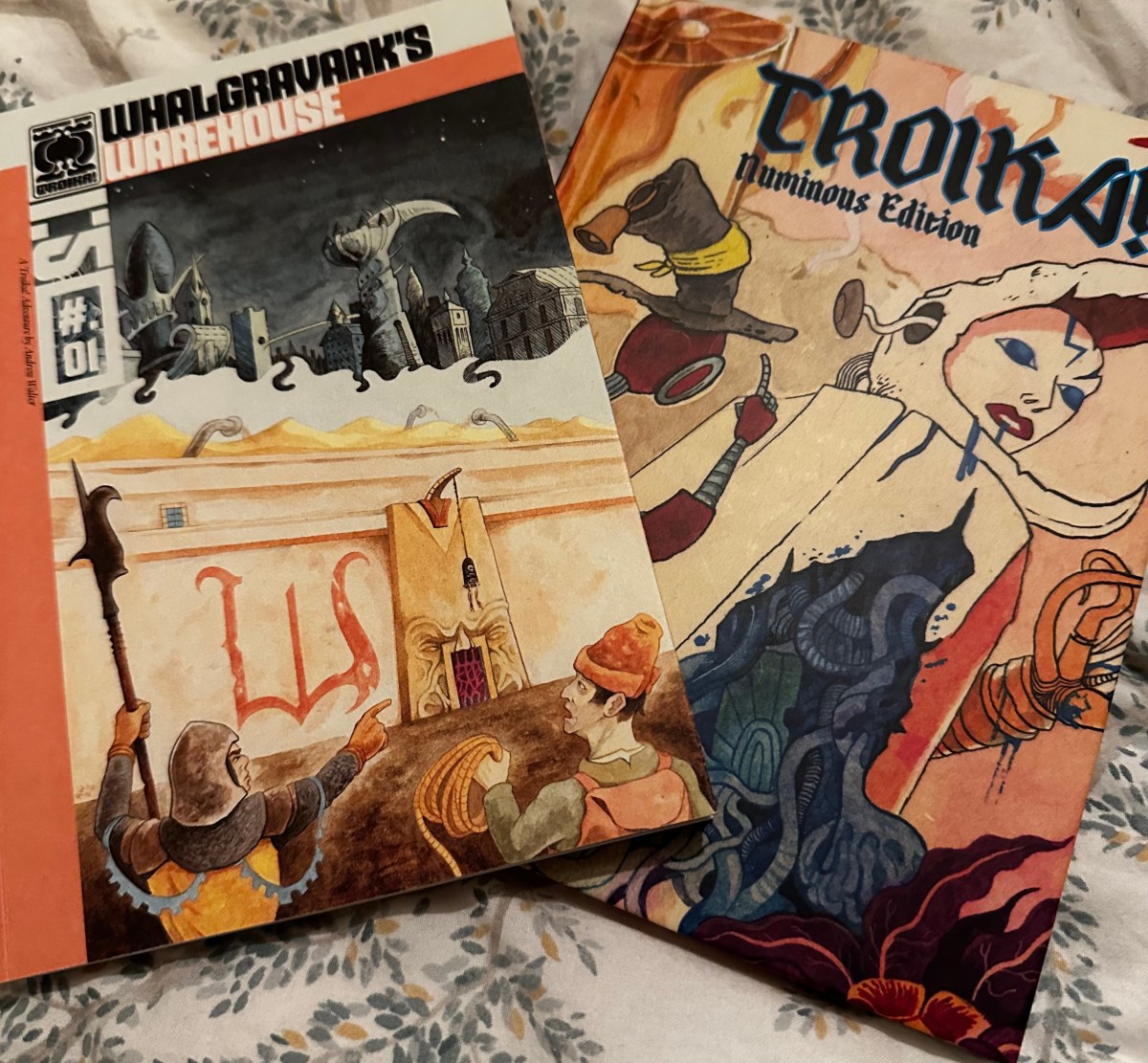
  2. Troika! – Whalgravaak’s Warehouse – Ok, look, full disclosure, this is supposed to be a list of one-shots but this is technically more like a really spread out short campaign where we get together to play a one-shot of the same game every once in a while when we can all afford the time. Know what I mean? Anyway, in the first one-shot of these two consecutive one-shots, the PCs found two different ways into this warehouse, abandoned by its wizardly owner centuries previous. After crawling this “dungeon” for a bit, they made friends with a thin mutant, and their monkeys got to play with the worm-headed hounds that lived in a nest in the warehouse somewhere. They made short work of the Cacogen they’d been sent to murder and we wrapped up the session. In the second one-shot in this series of one-shots, three of the band decided to continue to explore, making more friends, this time with a large cadre of mercenaries who had been sent to deal with some cultists. They then set fire to some rope, captured some minuscule soldiers in gremlin-jars and climbed a mountain of onions. This is the kind of nonsense the PCs get up to in games of Troika to be honest. This is standard. If this sounds too gonzo or weird, you are in the wrong place. The Eternal City of Troika is not for you. You should probably try somewhere more normal. From my point of view, and, I think, that of the players, if you lean into the bonkers aspects of the setting and you are willing to go along with the more outré elements of the system (the random initiative mechanic stands out) you will probably have a very good time with this game. It’s great for one shots. Or two shots if that’s your thing. Might turn into three shots, actually.
  3. Honey Heist – this was another one of Isaac’s games. He ran it on a night when another game fell through. It was very last minute but we were still able to get a crew together. Jude, Tom and I rolled up some friggin’ bears with criminal backgrounds and went to do a heist at the biggest honey convention in the UK, in the NEC in Birmingham. We tried to do a TED talk, we disguised ourselves as massive bees and we crashed a van. You know, typical bear stuff. Another absolute belter of a one-shot, this one. It’s the definitive one-page RPG by Grant Howitt of Spire and Heart fame. Isaac and Tom had picked up the printed form of a bunch of these one-pagers at UKGE and Isaac had been looking for the opportunity to run one of them. This game was obviously made to create wild swings as you use either you Bear or Criminal stat and try to avoid going too far on the bear side or too far on the criminal side. This forces you to take risks and do stupid things to drive the heist forward or, more likely, sideways. Tom did a brilliant write-up of the session on their blog here.
  4. B.D.S.M. Below Dwelling Sewer Mutants – Yet another game run by Isaac at short notice. It is a mutie-eat-mutie game by Neonrot and you can get it here. The premise is pretty straight-forward. You are a mutant. You are probably unpleasant in some way. At the start, you have a mutation that may or may not be useful in certain situations. You can progress and grow by eating other mutants to gain new mutations along the way. If you like that idea, you’re in for a treat. I think it is probably a game that works best in one-shot play. We had fun with it and I think most tables will.
  5. Cthulhu Dark – Roadhouse Feast – I went into quite a lot of detail on this one in the post I linked above so I won’t go through it all again. Suffice it to say, I really enjoyed running the Cthulhu Dark game for the first time. The scenario itself was great but, to me, it is the simplicity and the ingenuity of the system that really shone. If you are into cosmic horror games and you haven’t tried Cthulhu Dark, you should give it a chance.
  6. Liminal_ – I promised a report on how this one-shot went some time ago and here it is. We had four players (known as the Disoriented) for this one-shot plus me as the the Architect. As I thought we would, rather than have the players play themselves in this Liminal Back-Room nightmare, I had them use the character generation tables in Death Match Island. This worked really well to come up with some distinctive, memorable characters quickly and with no fuss. They started off all in the same public building. Since one of them was a district attorney, we agreed it should be a court house. One of the others was there as a witness in a case and the other two were, in an unlikely turn of events, cousins who had been called for jury duty on the same jury. That is pretty much by-the-by, although it did come up in conversation later. Thy all stepped into a room together and found themselves in a building of nightmares. Now, you have to roll up the rooms as they open the doors. There are a couple of d100 tables in the book that are crammed with inventive and horrific room descriptions. The first door they opened led into some sort of creepy, dank cave system; the next into a mouldering bowling alley that was was canted at a 45 degree angle; the next opened onto the abandoned bridge of a ship, rocking in a dreadful storm and with a trail of blood leading off through one of the other doors. I made a mistake at the very start, where I allowed the players to open a couple of doors and then decide which one they would go through. The rules state that, if you open a door, you have to go through it. This felt a little restrictive to me, in a role-playing game, but we proceeded in this way and the players were good sports about it. As we progressed, rolling on the Room and Entity tables, it felt as though, at times, they really wanted to see what the hell was going to come next. Isaac said afterwards, that it felt a lot less subtle than he had thought it would and I have to agree with that. When you think of liminal space horror, it often is just empty corridors and abandoned hotels and the like. Sometimes a strange entity might make an appearance, but it’s the spaces themselves that are supposed to be innately creepy. Some of these rooms we rolled up on the tables felt that way, like the corridor with missing persons posters of the PCs on the walls but a lot of them were straight-up horror like the one with nurse-entity (I think?) chopping a guy up on a slab (it was ok, he was into it!) Also, I think this is something I would be careful with: when you roll a random entity, they sometimes don’t seem to fit, thematically, with the room that you just rolled up. I think it is ok to re-roll if that happens. I didn’t do that and once or twice, felt like they collided awkwardly. Now, these are nitpicks, really. In general, we had a good time with this, the players loved playing their pretty normal characters in these horrific scenarios, just running blindly from threat to dreadful threat. We used both the regular room table and the guest room table (the entries here were written by some industry luminaries like Johan Nohr and Tim Hutchings.) One of the best things about that experience for me was that I was just as surprised, horrified and disgusted as the players were! One of the challenges then, of course, was that it was my job to quickly read, interpret and present the room to the players without taking too long, stumbling over the words, reading them too much or generally fucking up. Unfortunately, we didn’t quite make it to the end of their mad dash through the back-rooms. The PCs still have a few squares of fatigue to be filled in. Hopefully we’ll be able to pick that up and finish it off someday.
  7. Mothership – Moonbase Blues I wish this wasn’t in the one-shot pile but heigh-ho. Sometimes your GM moves away and leaves your characters stuck on a moonbase that is probably trying to kill them. I mean, there was someone or something there trying to kill us. I was under no illusions that we were likely to all die out there, I just wanted to know how. Anyway, the one session we had of this game was great. Full props to Joel, our GM, for putting so much time and effort into he prep for it. He had a series of recordings that he played for us at key moments, he had handouts and provided us with cheat-sheets. It was a great experience. Also, I loved playing my character that I created in the post I linked above, Victoria Ibanez, the Corps’ finest. I’d love to get to play her again. Mothership is a great system with compelling mechanics and one of the best character creation experiences out there. If you need any more convincing, you should go and check out Quinns’ review of it.

Conclusion

So, that’s it. Those are all the one-shots that I got to play in the last few months. I didn’t get to play many of the games I wanted to, but I sure did have fun not playing them. Next year, I am continuing the theme of not playing the games I listed in that post by starting the year off with a one-shot of After the Mind, the World Again, a Disco Elysium-inspired, GMful mystery game and, Dragon Age, which, I have at least discussed at length on this very blog here and here. Honestly, I think it was useful to set out goals for the games I wanted to play. I may not have gotten to play any of them if I hadn’t done that. So I will continue to write about things I want to experience on the blog and see what happens.

I will be posting more intermittently as we come into the holiday period now. I will be travelling to visit friends and family a lot and won’t always have the chance to post as regularly as I would like. So, in case this is the last post before the end of the year, I wish you the very happiest Winter Solstice/Hogswatch/Western New Year.

BTW

Here are links for where to buy each of these games:
Pirate Borg
Troika!
Honey Heist
BDSM
Cthulhu Dark
Liminal_
Mothership

The Heart of the Matter

Not entirely seat of your pants

A portion of the inside cover of my copy of Heart: The City Beneath from Rowan Rook and Decard. Illustrations by Felix Miall

The philosophy for some Heart GMs seems to be, don’t you dare plan your Heart campaign or sessions. Like, just sit down with your players, make some weirdos to do some delves and then decide on a starting place. That might be in media res, as the PCs meet one another while hopelessly lost in Labyrinth or it might be at home in their shabby-chic apartment in Derelictus. From there you might just ask them what they want to do next and, when they tell you, just try to keep up with them! This is a valid way to play the game, I think, as long as you have either an exhaustive knowledge of the landmarks, adversaries, plot hooks and people of the Heart, or an effective and suitably weird set of random tables. If you approach it from this direction, the players are going to have the most input but the GM is going to have to improv a lot and do a great deal of work on the fly. It also presupposes a certain degree of setting knowledge on the players’ part, I think. This can be stressful and a lot to expect of everyone but I am pretty sure this is the preferred method of a lot of Heart GMs.

A portion of an illustration of Derelictus, the City Between by Felix Miall. Heart: The City Beneath, page 136.

Another option, of course, is to plan everything, start, middle and end. This is totally do-able. The book provides plenty of fodder to feed your hungry campaign. It describes dozens of landmarks and provides you with lots of plot hooks to get the PCs interested in pursuing the thing you want them to. So you can have them all meet in a Derelictus tavern where they overhear something about a plot by some Gryndel to pursue a valuable quarry into the Heart, plan the first delve to take them after the Gryndels only to find the quarry in Grip Station, near death but with a dire warning for the whole city that an army of Angels rises from below and a request for the delvers to spread the news to the Temple of the Moon Beneath, plan out the next delve to there, etc. etc. This sounds very much like a traditional adventure module for the likes of D&D. And that is all well and good. It allows a very strict control on the part of the GM and makes for a plot the PCs can uncover. But it will certainly lead to some railroading and could well make for potential dissatisfaction for the players and the PCs as they feel they have taken a back seat to the narrative planned out so perfectly by the GM. This method will ignore the great strength of Heart, it’s freeform potential, the loose structure inherent in the Beats system and the story being told by the delvers’ choices and their rolls and the Fallout that comes out of them.

A portion of an illustration of delvers planning a delve by Felix Miall. From Heart: The City Beneath, page 103.

So, how about somewhere in between? It seems sensible to meet in the middle. You make your weirdos, then you all discuss what sort of game you would like for them, GM and players together. Or you could take those two steps the other way around. Either way, you have an idea of the sort of story you all want to tell together and you all take responsibility for making that happen. This is with the understanding that what you think you want at the start might very well change after one or two or five sessions. That’s when you realise that, while you thought you wanted to help out that Haven you came across at the end of your first delve, it turned out what you actually wanted all along was to physically explode in such a way as to take out as much of the surrounding entities as possible so you could all travel to the afterlife together, an offering to your Goddess. And in pursuit of these elastic goals, the GM comes up with a loose web of places, people and objects that the PCs might have a chance to interact with. The GM will probably do this, at most, in between each session, with several ideas of where the story might go in the two or three sessions afterwards, but with no expectations.

A portion of an illustration by Felix Miall, of Grip Station, a Tier 1 Landmark. From Heart: The City Beneath, page 138.

Here’s what Messrs Howitt and Taylor have to say about it under the section entitled, “Stop Planning” on page 109 of the Heart core book:

Flexibility and adaptiveness are the keys to success. When you prepare, think in terms of characters, broad concepts, motivations, snatches of ideas that you want to play with. The world doesn’t exist until you speak about it at the table. Sure, you might have thought about it – you might even have written it down in a notebook – but until the players interact with it, it’s in total flux. The players just turn up every week and make it up as they go along. Why can’t you?

The quantum campaign made up of Shrödinger’s delves. And this about sums up the type and degree of prep I have been doing before each Heart session more recently. It’s more fun for me to do it this way too. I get to be surprised by what the players do and I get to discover the Heart along with them a lot of the time.

From Haven to Terminus

Yeah, that’s the name of our Heart campaign. It’s coming to an end this week. I guess the name gives away quite a lot of my thinking behind it. I was finding it hard to let go of the traditional module style of prep at the start. Yep, I decided to make a bold statement about, not only where the campaign would start, but also where it would end up. Now, this wasn’t as bad as it sounded. I had a very vague idea of a Campaign Frame for the game, that’s all. I used one of the plot hooks described in the Derelictus section of the Heart core book. Verrex, a retro-technologist with his tumble-down workshop situated on one of the platforms of Haven Station wanted the delvers to track down his robotic double, V01. The construct had expressed an interest in visiting all the Vermissian stations in the City Beneath, so he suggested the PCs use that as a guide to finding him. That was it. Everything in between was entirely up in the air, but it gave them a loose path and a potential final goal.

A portion of the illustration of a Gnoll Incursion Team by Felix Miall. From Heart: The City Beneath, page 188.

That was, of course, until I decided to employ the adventure presented in the Heart Quickstart guide, Drowned. Now, I am not going to spoil any of this adventure here but what I will say is that it lays out a very particular path ahead of the PCs, with the havens they will reach at the end of each of the numbered delves, the NPCs that will push them on from one place to the next and a big old final set piece. Now, since all I had before making this decision was a loose Campaign Frame, a little concreteness was actually welcome. It allowed me to see how to do things like come up with my own delves, use Haven NPCs to best advantage to help drive narrative and try to attach the PCs to someone or something only for them to find a way to betray or deceive them. But, after five or six sessions of following the adventure, I became aware of how the campaign had ended up on rails. I wasn’t providing them with options, I was forcing them down the path laid out by Drowned. I have found it hard to get out of this frame of mind since then, although I have tried to follow the advice from the book that I quoted above.

The delvers just reached Terminus, having taken a near-lethal shortcut through The Source, one of the Eight Heavens. The Junk Mage is banking everything on a meeting with a gnoll in Terminus who can teach them how to use the Nexus Device there to enact their will upon the entire city, The Vermissian Knight has pumped his mystical train armour full of soul power, the better to resurrect the entire inter-dimensional subway network, and the Deadwalker has just had his Zenith wish to combine his essence with that of the Heart itself thwarted by the Vermissian Knight who says he will not stand for his “human servants” abandoning him until his work is done (he’s an aelfir obvs.)

How will it end up? We’ll find out soon. But whatever happens, I am now pretty sure that these amazing players are going to surprise me yet again.

Liminal_

Survivin’

It is the kind of thing people around here might say when you ask them how they are getting on, “Survivin’.” It is the sort of bleak answer to an innocuous question that is probably played for laughs. At least, if it isn’t, you laugh anyway, because, otherwise, you are likely to get drawn into a conversation.

But you know what it means, even if they are being facetious. They are probably struggling in some way. Maybe they are just tired, maybe they have a hang-over, but maybe, the world has been having its way with them. Perhaps their car broke down and they don’t have the money to get it repaired right now. Maybe they were on the way to the hospital to visit their sick mother when they broke down and they missed the visiting hours. And their phone died before they could call someone to collect them and they had to walk for miles along the hard-shoulder. They caught a terrible cold and now they can’t breathe right and sleeping is impossible and they can’t enjoy anything because merely existing has become uncomfortable. All they’re doing is survivin’.

So wouldn’t it be fun to play a game where that’s the only aim? Surprisingly enough, I think it might.

Of course, survival horror is nothing new. It is a major video game genre. People love Silent Hill! The last game I wrote about on this very blog was a survival horror TTRPG, even though it was wrapped in a cosmic horror disguise. But the game I want to write about today feels a little different. Not totally, you understand. It sticks to the same themes of helplessness, despair and terror in the face of an indifferent or downright hostile environment (part of the reason I wanted to discuss it at this time.) But it has a few indiosyncrasies that help it to stand out.

Liminal_

Pretty sure that’s pronounced “Liminal Space.” The name does make it uniquely difficult to google but that is maybe why the book is called Liminal_Survival Guide. I picked it up from Iglootree here. The creative team is Alexei Vella and Neonrot/Willow Jay. The illustrations are fun/disturbing and are all done with ASCII characters by Alexei Vella.

There are elements of the layout and graphic design (also done by Vella) that remind me of the recently released Death Match Island. The liberal use of redaction with the suggestion that parts of this “survival guide” are from some sort of real world manual, written for the employees of some institution or shadowy company is the main through line.

This survival guide is for the eyes of _ personnel only.

Imagine my surprise when I discovered that Alexei Vella has also contributed to a new island for that game!

Anyway, back to Liminal_. It is a map-making game at its core. You are probably going to be the GM (or Architect) if you own the book. You’ll need at least two other players and a large piece of graph paper. On it, the players (known as the Disoriented in this game) will be drawing rooms as you roll for them. There are lots of rooms to roll from. More than half the book is made up of room prompts!

The basics of the game go like this. The Disoriented start in a square room with a door in each wall. They roll off for initiative and the first one to go decides which door to choose. They can move into it at the cost of Fatigue, their only stat. The first one to enter a room is likely to take more Fatigue than those who follow, but every time anyone takes any kind of action, they are going to incur a Fatigue cost. Once they get 100 Fatigue, they’re screwed, they get Absorbed by these Back Rooms they have found themselves inhabiting.

There are rooms of different shapes and sizes, there are rooms that have items in them. Carrying items adds to Fatigue but they might help the PCs in some way. They might help them get away from Entities that occupy some of the rooms. Like Cthulhu Dark, you can’t fight them, all you can do is run. There is no fighting in this game. The Disoriented make a Fatigue Test to evade them by escaping from the room. They roll a d100 and if they get equal to or higher than their current Fatigue they succeed. If they fail, they take more Fatigue. They might also garner Injuries. Injuries cause a continuous rise in Fatigue and may have other adverse effects.

Sometimes, depending on the room prompt, a room vanishes and you better hope you are not trapped in there when that happens. Other times, you might enter a Dead Room, which is just a room with only one door, i.e. the one you came in. There are, luckily, Rest Rooms to allow the PCs to recover some of their Fatigue. And there are Escape Rooms. If you are lucky enough to keep your Fatigue low enough through your harrowing journey through the Rooms, and you avoid being Absorbed by what must surely be a sentient labyrinth, you might just escape! Seems unlikely…

The entity prompts and room prompts are well-thought out, appropriate and fun in the most despicable way possible. Here are a couple of examples:

Entity prompt: A mass of mulch, organic green material and mosses rapidly grows into a human man, a skeleton briefly visible inside it. The creatures eyes are blood red as it reaches for players, roaring.
Room prompt: Players enter a short, dimly-lit hallway. Yellowing wallpaper covers the walls, and rotting, off-white carpet covers the floor. There are several missing persons posters covering the walls. Some of them bear the faces of the players.

I do not want to give too much away here since I want to play this game and my players read this blog, but, honestly, there are so many good prompts in this book! I imagine a bloody good time rolling up these rooms and horrors.

And, on top of all those, there are even more than a hundred “Guestroom Prompts” written up by such RPG luminaries as Grant Howitt (Spire, Heart etc.), Tim Hutchings (Thousand Year Old Vampire), Tim Denee (Death Match Island) and Chris McDowall (Electric Bastionland, Into the Odd).

One of the more interesting things about the game is the lack of any kind of character creation rules or processes in it. After all, no-one has any particular defining stats. In the Roleplay section, the authors suggest that the players might just play themselves. Now, I have done this before in a Call of Cthulhu game and, while it was an interesting experience, it was, perhaps, just not for me. I immediately considered having my players use the character generation tables in Death Match Island instead. These are specifically designed to come up with contemporary sorts of characters plonked into a desperate, life-or-death situation that they have to escape from. I also considered using at least parts of the methods described in Between the Skies. Finally, maybe the Cthulhu Dark option is the best, just give the poor bastards a name and an occupation and release them into the Liminal_.

Conclusion

This feels like the ideal one-shot to me. It’s rules-lite, with a simple premise and no real character creation to speak of. There is no prep and you only need a few items like graph paper and pencils to play it. Its procedurally generated nature and its absolute mountain of prompts are likely to ensure that you never have the same room twice. My only worry is that it might be a little too one-note, that the singular motivation for the characters to survive might not be enough to keep them interested the whole time. I guess I’ll find out when I get it to the table!

What about you dear reader, do you like the idea of this Back-Roomy, SCP-like game? Have you played it? Let me know in the comments!

Change and the Dark

Another schedule change

They say that procrastination is the thief of time. Nope; its work. Work is stealing my time and there ain’t no time cops coming to recover my purloined hours or to clap Work in cuffs. This is the true crime of late-stage capitalism!

Seriously, though, I have a full time day job that has nothing to do with gaming, writing fun stuff or pretending to be other people. That’s how I can afford this luxury website (ooh la la) and all these RPGs I keep backing. Unfortunately, it does take up the majority of my waking hours. Very recently, I mentioned that I would be posting once every three days from now on. I have found this awkward in a few ways. Firstly, I often get mixed up as to what day I am supposed to be posting on this schedule. Secondly, it has meant a lack of a consistent day of the week that my posts appear. Lastly, it is still a bit of a struggle to keep up with this, I am finding, thanks to work and, you know, actually playing games.

So, instead, I have decided to switch to posting on Wednesdays and Sundays. I love writing this blog and do it mainly for my own satisfaction and I am going to continue to do that, just on a twice-weekly basis. To those of you who are regulars around here, thanks for bearing with my struggle to find the perfect schedule. I think this might be the one!

Anyway, on to the meat of the post. Our Halloween one-shot.

Roadhouse Feast

The trees loom above the rutted country road illuminated only by the staccato shudder of your headlights. This road will be the death of us, you say to your companions in the back seat of your Ford motor car. Just concentrate on getting back to Arkham, you think to yourself, as you trundle past Laura’s Roadhouse. A good, god-fearing woman, Laura. You know the family. You grew up not so far from here. You wonder how they’re doing now.

Crash, badump, badump

You shouldn’t have let your mind wander. You’ve hit something! The automobile! No! The Ford is pitched forward at an unnatural angle. The others have already bailed out. They’ve gone to inspect the carcass left on the road behind. One of them screams.

This is the opening, in my words, of the Cthulhu Dark module, Roadhouse Feast. It was written in 2023 by Linus Weber, with Monster-art by artgeek09 on Fiverr and cover-art by Eneida Nieves on Pexels although, the version I downloaded from itch.io did not have a cover to speak of.

I won’t go into the details of the module, the characters, the plot or the ending. Instead I want to write about our experience with it and general vibes.

The one-shot

There were four of us at the table on Halloween night for this one-shot, including me as Keeper. This was the ideal number, I believe. Numbers for a one-shot are critical to actually getting to the end of it. Any more than four and we would have struggled with that all-important goal. Instead, we played the module from start to finish with a little time over for epilogues. This is what I had been hoping for when I picked this module to run. The author designed it to be run in a single session of two to three hours and that’s exactly what it was. Tick!

The setup is pretty much as I narrated above. The investigators (this is a catch-all term for PCs in Cthulhu Dark. It does not necessarily imply that they are, in fact, in any way, detectives) are driving home to Arkham from a place called Thompson Village, late at night on 31st March 1923. They hit a deer on the road, damaging their car enough that they need to go and get help. This is all classic horror story setup stuff. The 1920s era and forest setting helps by removing the technological advantages of the present day and exuding a creepy, dark, dangerous atmosphere. Tick!

What do you want from a Cthulhu game of any kind? You want your PCs to experience some fucked up shit that has the potential to send them swirling down the plughole of madness at any moment. You want monstrous entities, cultists, forbidden philosophies and the mundane warped and twisted into something otherworldly and inconceivable. Roadhouse Feast has all this in a tidy little package. Tick!

The system

This was our first proper foray into a Cthulhu Dark game. This despite actually owning the book. Since we couldn’t actually find the book in time, I fell back on the original, playtest-style rules that Graham Walmsley published back in 2010 in the form of a 4 page pamphlet. All of the rules fit easily on those 4 pages with room to spare. It is the lightest of systems. I don’t think I have ever played anything lighter. Honey Heist approaches it, but I think Cthulhu Dark wins this contest by virtue of the fact that you only have one stat and no abilities of any kind. The one stat you have is called Insight (although in those original rules that I was using, it was called Insanity.) You can play this game sans character sheet by simply placing a d6 in front of you. It should show the 1 at the start of the game but every time you fail an Insight check, brought on mainly by seeing Mythos shit or using your Insight die to help succeed at actions, you gain a point and flip your die to the appropriate number. If it ever gets to 6, you’re screwed. Your investigator loses their marbles and is removed from the game. We had one investigator hit 6 Insight. She started a forest fire and stood in the road, worshiping the flames. It was a good time.

This mechanic was so good in a one-shot. It works perfectly to keep your investigators worried about what is just around the corner, or about having to use their Insight die to succeed at a check. Of course, the other great strength of the system is that, if they ever face an actual Cthulhu Mythos monster, they’re goners. They will not survive. This gives them the feeling of victims in a horror movie. You cannot fight, you can only run or hide or delay. In this scenario, delaying is a major part of survival and it led to some ingenious moments from the players.

In general, the lightness of the ruleset made for exceptional roleplaying throughout. There were no long breaks to add up dice rolls, no-one ever had to stop to look up rules and there were no character sheets or monster stats to worry about.

All in all, I would recommend the system and the scenario for a horrific one-shot experience, dear reader. Go pick them up if you would like that sort of thing.

Ravenloft

Something’s gotta give

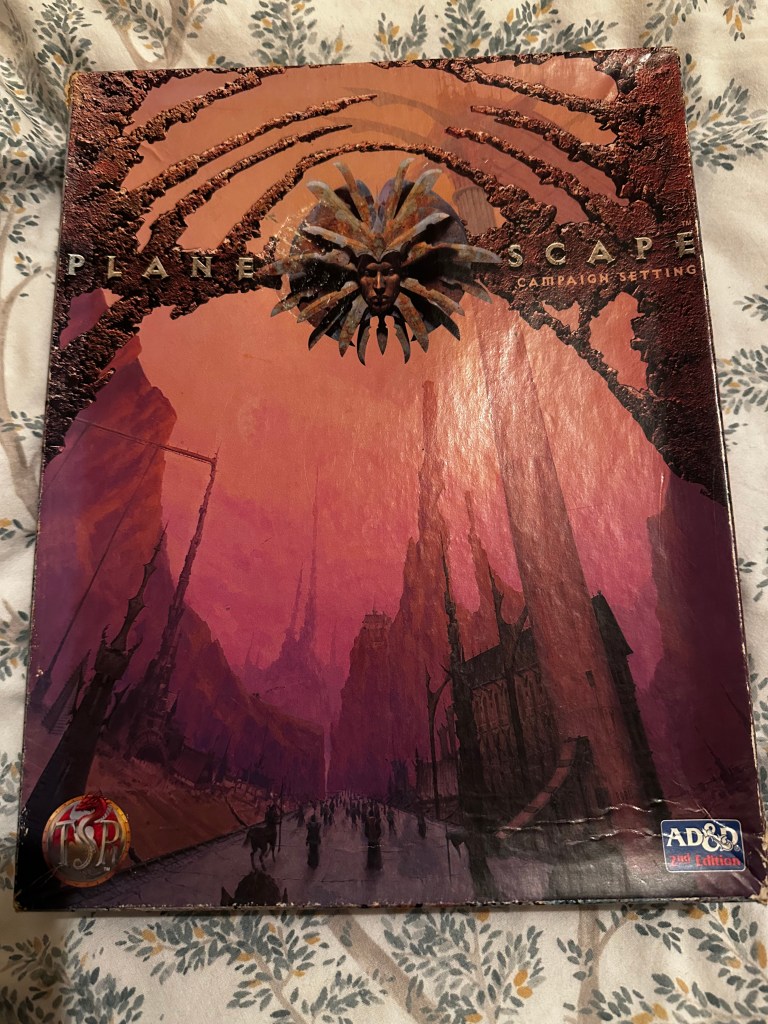
I thought I would play Ravenloft around Halloween this year. My friend returned all my Ravenloft books and boxed sets to me back in the spring after about 25 years, and since then I have been thinking it would be cool to run something in the Domain of Dread as a Halloween one-shot. But, in the meantime, I have played a lot of different games, mostly one-shots, mostly a lot easier to play in that format than any version of D&D. So I did consider starting a campaign or a multi-session adventure, but, to be honest, I didn’t have it in me to do all the reading and conversion that was necessary. I may be playing more RPGs than I ever have before in my life but that has an unlooked for side-effect: I have less time to prepare for games! This is a dilemma that has been exacerbated by my blog schedule and I have been thinking that I might have to make a change there too. I am switching to posting once every three days for the foreseeable future.

The Demiplane of Dread

So, I am not talking about the original Ravenloft adventure from AD&D 1st Edition or the Curse of Strahd released for 5E, but the setting released by TSR for AD&D 2nd Edition in 1990. It is by Bruce Nesmith and Andria Hayday. I think I have mentioned in another post that my friends and I played most of our AD&D in the Dark Sun setting but I would imagine Ravenloft comes a close second. I just loved having them create regular old characters in my home-brewed standard fantasy world and then dumping them, unceremoniously and with no warning through the mists into the forests of Barovia or the mountains of Forlorn and hitting them with monsters that drained levels and abilities and where there was no escape from he darkness and the terror. Although, I confess, the games were probably not very terrifying. I did my best, but I have always found horror a difficult genre to emulate around the table, especially with a system like D&D. The authors did their best to assist the Ravenloft DM with sections in the main book about the “Techniques of Terror,” where they discuss “Assaults on the Mind,” “Assaults on the Body,” “A Villain in Control,” and that sort of thing. But, the fact was, we were a gang of teenaged boys who mostly just wanted to hit things until they died so those were usually the kinds of adventures we got.

Looking at it from a more mature standpoint now, I would love to try to run it with a real sense of gothic horror. I think I am better equipped now to attempt it. Although I still think it would be a challenge and I might refrain from running it in a D&D-like system. Why? Well, the products for Ravenloft, while not all gold, are still some of the highest quality items I think TSR produced. Just look at all these handouts! Each one of them has something useful on the back of a beautifully illustrated card.

5E products are usually produced to a high standard, but they don’t have the variety and versatility that the 2nd Edition boxed sets did. They also don’t have the quality or usefulness of content. These boxes and sourcebooks are stuffed with useable materials; details on lands, villains, monsters, new spells, effects, encounter tables, maps, maps, maps. 5E setting guides of late, excepting maybe Planescape are very short on this sort of detail.

Adventures in Ravenloft

I usually wrote my own adventures back in the day. Or at least I would pick and choose liberally from the pre-written modules and combine them with my own scribblings to make them fit into an overarching campaign. Or that’s what I told myself I was doing. I have a funny feeling that, mostly, I was just trying o murder the PCs. This is another aspect of my style that has, thankfully, changed, since the good old days.

I do have a few Ravenloft adventures that might be fun to convert or even to just run in the original 2nd Edition ruleset.

Feast of Goblyns is a very flexible module that is designed to be run for characters of levels 4 to 7. It is presented in a format that allows many different paths to be taken through it, with the PCs potentially ignoring some major and minor plots depending on how they decide to play it. This one was designed to be the adventure that draws PCs into the Demiplane, which is always fun. I think I remember playing parts of this module but my memory is not good enough to recall which parts. At 96 pages, though, it would require a bit of commitment to play through the whole thing.

From the Shadows is written for rather high level characters, levels 9 to 12. It is based around the plots of Azalin the lich, lord of the domain of Darkon and his eternal conflict with Strahd Von Zarovich, famed ruler of Barovia and OG Ravenloft BBEG. A great deal of it takes place in Castle Avernus, the lich’s home, and that is pretty cool. I definitely played this but I don’t think the characters survived the whole way through.

Finally, I have the Book of Crypts, which is similar to the Book of Lairs but has 8 full adventures in it! This seems the most suitable for a shorter game or campaign and I might just take a look at running something from here before the spooky season is fully through.

Dear reader, have you ever played this version of Ravenloft? Do you yearn for the mists? Or would you rather play a game actually made for horror?

Between the Skies Part 3

How to begin

I’ve written about beginnings in RPGs before. I think they are crucial to establishing tone, theme, genre and expectations to the whole game, long or short. Many RPG books lay out pretty well, the genre and themes they explore, many providing starting adventures or scenarios to help you set the tone. Few do as good a job at helping you to begin as Between the Skies.

Now, as I’ve written in the previous entries in this series, Between the Skies by Huffa provides a whole lot of advice and options collected into a loosely defined game. It exists to help the players (including the GM) create the play-style and world they want. The text assumes that you will be using a set of rules that suits your table so, by necessity, the advice and tools it provides to help you begin playing are applicable in almost any game. Having read the Beginning Your Travels chapter, I can say it’s brimming with what is just plain good advice.

How and why

The why is an often overlooked element of an RPG character. What the hell are they doing any of this crazy shit for? Why are they travelling across the planes or through wild-space, in the specific example of Between the Skies. I wrote more about character motivation here. Obviously, this book has tables that help you to answer that question. They are wonderfully vague, as you might have come to expect. The vagueness allows your own imagination to combine with the generalities of the game already established by you and your group.

The How and Why do You Travel tables from Between the Skies. These include a "Who are you Traveling For? " d6 table, a "How do you travel?" d66 table and a "why are you traveling" d66 table
The How and Why do You Travel tables from Between the Skies. These include a “Who are you Traveling For? ” d6 table, a “How do you travel?” d66 table and a “why are you traveling” d66 table

You will notice there are three sub-tables there.

  • Who are you Traveling for?
  • How do you travel?
  • Why are you traveling?

Once again, it is important that they are incredibly general. You will find yourself building your world as you fill in the gaps around the results of this table.

It’s telling, isn’t it, that the how is also considered here? And that it’s randomised? This is one of the most fundamental questions to answer in establishing the setting, and, in many ways, the type of game you’re preparing to play and it’s left up to random chance. If you think of it from the perspective of a D&D game, there are not too many tables who are rolling the dice on running a Planescape, Spelljammer, Dark Sun or Forgotten Realms campaign next. But using this table gives you all the power. It allows you and your group to put down roots in the world you are going to play together in, and grow whatever you want out of them. You’re going to need a lot more than just the single result from the table but Huffa trusts that you can come up with that, and not only that you can do that, but that you will enjoy doing it. Luckily there are also a butt-load more tables in here to fire the imagination and get you moving in a direction.

How about this for a situation?

The Starting Site Recipe list from Between the Skies. It has 7 points.

Huffa would like you to start your first session in media res. That’s also what I always say. Clearly, she’s a genius. The great thing about the advice as presented in the Starting Situation section is that, once again, the in media res beginning has been formalised into a procedure. You are presented here with a series of steps required to create your Starting Site, what is called the “Starting Site Recipe.” After that you have bevvy of tables to help you in sorting out what type of situation it’s to be, what or who precipitated it, what type of site it is, its inhabitants and a some more trickle down tables that allow you to flesh out the various site types.

The Starting Situation tables from between the Skies. There is a "Starting Situation Type" d6 table with "precipitated by" 2d6 table attached. There are also two more 2d6 tables, "PCs aligned with..." and "PCs antagonistic towards..."
The Starting Situation tables from between the Skies. There is a “Starting Situation Type” d6 table with “precipitated by” 2d6 table attached. There are also two more 2d6 tables, “PCs aligned with…” and “PCs antagonistic towards…”

It makes it feel like, if you used this method, you would have your starting situation and location prepared in minutes and only need to write a short description of a few of the items you rolled up. As usual, when I read any part of this book, it just makes me want to give it a go.

How it looks

Luckily, there is a great little example Starting Situation presented in this chapter as well. It has been generated using the method described earlier and it is called “The Godshambles.” The entire situation is described in only a few short paragraphs, a couple of handy tables, a route map and particularly evocative illustration by Coll Acopian.

If you wanted, you could just use the Godshambles as your own starting situation and no-one could blame you. But, I think one of the beautiful things about the Starting Site Recipe is that the prompts you roll up on the tables will help you to imagine a situation that is fitting for the kind of game you have conjured together when you were creating characters and rolling on the how and why tables before. So, it is likely to feel a little loose around the hips or too baggy around the ankles compared to one you generated yourselves.

How it goes

A full colour illustration from Between the Skies. It shows a star-shped being that seems to be made of an entaglement of vines and other plants floating through a multicoloured, psychadelic dreamscape.

Like I stated earlier, I am a big fan of the methods described in this chapter for beginning your game. I am excited to try it out and invite my players to be as big as part of the world building as I am, or bigger, from the very get-go.

Between the Skies has a lot more to offer. I have not even made it half way yet. But I think, for now, at least until I start actually playing it, I will pause this series of posts for now. I’ll bring them back when I have some more practical experience I think. See you then, dear reader!

Hex-jammer

Messin’ with 5E

I’m sure those of you who have been around for a while are aware of how much I enjoy mucking around with my D&D campaign. It is a Spelljammer campaign of the 5E variety and it has been running for quite some time. About 25 sessions, I think. That makes it one of the longest running campaigns I have ever had. That’s probably what makes me want to keep messing with it. A while ago, I introduced the very FitD idea of Engagement rolls before big jobs/dungeons and that has worked pretty well. I also brought in the adversity token, which have come in handy for our heroes in a few clutch moments, let me tell you!

1E Throwback

This post is not so much introducing yet another rules hack or even anything home-brew. It’s more about utilising a style of play that went out of fashion in D&D a long time ago. Hexcrawling! A couple of the oldest D&D publications I own are from AD&D 1st Edition. One of those is UK5 Eye of the Serpent, written by Graeme Morris and released in 1984. This was designed for one DM and one PC! Specifically, it was made to be the first adventure for a druid, ranger or monk character. This is besides the point. I just thought it was unusual. Also, it reminds me of a Troika! adventure I just read, The Hand of God, mainly because it starts much the same way, with the characters being abducted by a powerful winged creature and dumped in their nest at the top of something very, very high up.

Anyway, the point is the hex map of the outdoor region, Hardway Mountain (the name of which, I think we can all agree, is a little on the nose.) Now, the use of this map was incredibly restricted in the text. If your PC was playing a druid, not only did they have to have a prescribed set of three NPCs with them, they should also be forced to take a particular selection of the marked “routings.” These would be distinct from the routings a ranger or monk character would be forced down. You can see this laid out in the unfeasibly complicated two-page spread below.

Now, I think this is really interesting in comparison to what you might deem a hexcrawl style game today. I think most OSR games that use a hex map are thinking along the lines of open-world or sandbox play where you go to a certain hex on the map to explore, with the understanding that the whole thing will be open to your PCs. There might be geographical or other obstacles they have to overcome but that’s up to them, they can either try them out or forget about them.

When it comes to encounters, places of interest, etc. a lot of the time these will be generated randomly and the GM is discovering along with the players in many cases. Even if the GM is the one who came up with the encounter table they’re rolling on, they are not to know what the roll will turn up in the moment or what the PCs will do with them! I realise I am probably teaching my grandmother to suck eggs here, but I want to point out that, although the hexcrawl is a pretty old school style, it wasn’t always necessarily as free a style as it is generally taken to be today.

One last thing. That Eye of the Serpent module has some fantastic art by Tim Sell. Just check these out.

Hexing the Rock

The Spelljammer campaign may have gotten a bit bogged down on the Rock of Bral. Why? Is it because it is the only location described at all in the Spelljammer 5E set? Maybe. Is it because all the plot threads of the campaign led there? Partly. Is it because it takes a life age of the earth to get through a round of 5E combat? That’s a distinct possibility. Anyway, the crew have spent a lot of time exploring, murdering, stealing, negotiating, shopping, drinking and dating on the topside of the Rock already. But one of them has had a literal ooze-heart pulling them to the underside since they got there and they finally made it down. Now, to get them there, I invented a little something I like to call the Shaft of Bral. Stop sniggering! It is a shaft of pure void half a mile wide through which you can reach not just the top and under sides of the Rock but everything in between too. So they took a little row-boat called a spell-rudder down to the bottom and now they are crawling through the hexes underneath. I threw a few random encounters at them on the way down as well. I invented a few encounters for the Shaft of Bral and put them in a d6 table. I got the players to roll for those and they had fun getting hit by another spell-rudder in a hit-and-run and avoiding the sickly air of a boat full of corpses on their way down.

So far, using the encounter table in Boo’s Astral Menagerie (the Spelljammer Monster Manual,) I have been unimpressed. The first time I used it they got an encounter with a ship of aggressive Vampirates. Then there was a fight that lasted three full sessions. It wasn’t all bad, it just derailed things in a less than ideal way. So, I thought I would just make my own encounter tables from now on.

Once they were finally on the Underside of the Rock, I had to think about how I was going to handle it. It is a very large area, made up largely of farmland and forest and they were there to find one wee gnome. I could have just given them directions, but I wanted it to feel like they were exploring and finding their own way, so I took the map of the Underside of Bral and popped it into Roll 20. We are playing this game online so this worked out well. Then I set the map layer to have a hex grid, instead of the standard square one. Now, as they travel, each time they pass from one hex to another, we roll for an encounter. Some of these encounters are designed to beneficial, some are quite the opposite and others are what they make of them. They have been using their own skills, abilities and traits to push on towards their goals while getting the impression of uncovering things about this place as they move through it. I’m not sure how the creators of this version of the Rock imagined people using this map. Maybe this is exactly what they thought we would do! But, I doubt it. It doesn’t feel as though any thought went into that, in fact. As it is with so many recent D&D 5E products, you are given the bare minimum and expected to figure the rest out for yourself. Even a little advice to go along with the map would have been useful. I mean, even Eye of the Serpent did that in 1984.

Anyway, the last session we had was one of these hex crawl sessions and I can’t remember a funnier time. Genuinely laughed the whole way through. Now, I am incredibly loathe to take any credit for that. It was entirely the hilarious antics of the fantastic players I am blessed with. A couple of highlights:

  • Our Giff Charisma-Fighter/Paladin climbing a tree to hide from a patrol with his trousers ‘round his ankles because he thought his hairy grey arse-cheeks would help disguise him as a bunch of coconuts (didn’t work, it was an oak tree.)
  • Encountering a bunch of Hadozee who were on the run from the nearby prison but didn’t know how to escape the Underside. The party told them all about the secret hatch in that stump over there which led to the Shaft of Bral. What’s that? Do we have a boat there? Yep! On, ok, bye then! Good luck in the shaft!
  • Herbert Gũsfacher, ornithologist, the latest identity adopted by the party’s resident illusionist, Balthazar.
  • Gary, Son of Gary. Oh, are you based in the Garrison, Mr Gary-son? No, the Citadel, actually.

Anyway, these random encounters did help along the good times and, I hope, gave the players a sense of active exploration. They haven’t found what they were looking for yet (it’s Eccta, the plasmoid Mum) So I can’t go into any detail about what is in store but I will be using a lot more of my own home made hexcrawls and random encounter tables, that’s for sure.

Between the Skies Part 1

Formalising the informal

We introduce informal rules on the fly in our games all the time. You need to figure out if someone can find a newspaper stand around here somewhere? Sure: odds, you find one, evens, you’re out of luck. Oh, you rolled a nat 20 on your investigation check? Well, that means you also get advantage on your next Thieves’ Tools check. You know what I’m saying. It’s not unusual. So, is it unusual to formalise this informality? Maybe, I suppose. But that is exactly what Huffa has done in her new book, Between the Skies.

I heard about this game from the Yes Indie’d podcast from Thomas Manuel. On the episode I linked above, you can hear him interviewing the writer and creator of Between the Skies, Huffa. You can get most of the background of the game from the podcast, if you’re interested, but if you need a TLDR, it started off as a digital release and then a series of zines you could get on itch.io until Exalted Funeral got involved and made it into a book. You can still get those there in free PDF format, by the way.

A couple of things struck me while listening to Huffa talk about her work. First was the subject matter of the game, which seemed rather Planescapey to me, the nineties one. Maybe cross that with some AD&D Spelljammer, a wee sprinkling of Troika! and just a little bit of Black Sword Hack. Strangeness in the spheres and across the planes of existence is the overall theme. It sounded both very old school and incredibly fresh at the same time. Where does the freshness come from, I hear you cry, dear reader! Well, that would be from the other thing that struck me about the interview; the ideas Huffa espouses when it comes to rules.

Why restrict yourself to one ruleset when there are so many out there to choose from?

A badly taken photo of the double-page spread before the At Play Between the Skies chapter of Between the Skies. There is an abstract monochrome picture in it.

So, like my very wordy sub-heading says, why go full Forged in the Dark all the time when certain situations might call for a Resistance System style roll with pre-established fallouts to hit them with? Why limit your game to using only Powered by the Apocalypse rules when you might also want to use adversity tokens sometimes? The point is, you should be able to play almost any game you want, using almost any rules that suit, not just the game but any given situation within a game. Is this dangerously anarchist? Maybe, but it also sounds like excellent fun. If you have been around here for a few months you’ll know that I like a good ludicrous mash-up. See my various attempts to introduce new and exciting elements to my D&D 5E game here and here. You might also remember me going on and on about how cool it was to use other games to establish the world and the city in a Blades in the Dark campaign I recently took part in.

If you’re interested in games and the rules of games and how they interact with the players, the setting, the events, this is an approach I think you might be able to appreciate.

Now, I will say that Huffa is not necessarily suggesting that you should abandon a single ruleset play style, but that you should open your mind to the idea of using the ruleset that most appeals to you when you pick up Between the Skies to play it.

Playtime is the name Huffa uses for the set of procedures presented in the book to allow for the style of play it espouses. It’s all about the “shared understanding of a fictional world.” And really, however you achieve that is the way to do it, with the understanding that this might look different for literally every table. Here are a couple of relevant quotes from the introduction:
“Judgement based on shared common sense is the fundamental ‘rule.’”
“All rules, methods and procedures can be used or ignored.”
This type of play is related to the FKR or Free Kriegspiel Revolution. This is a movement that rejects the cumbersome mechanics prevalent in so many games, particularly from the war-game or “Kriegspiel” side of the hobby. In FKR, the game is very much a conversation, where a player may suggest a way of overcoming an obstacle and the referee or someone in a similar role will make a judgement, based very much on the table’s shared understanding of the world they are creating together, as to whether or not it would work. Dice rolls may occur but they will be minimal.

And yet, Huffa has provided here, in the At Play Between the Skies chapter, a plethora of potential rules. Here’s a brief collection of some of the suggestions.

All time is tracked by Turns but the time scale of the Turn is dependent on the situation, longer for travel and exploration, shorter for investigation and shorter still for combat.

The Occurrences table on page 46 feels like the most basic denomination of the tables in this book. It is incredibly general but its presence and usage suggests at the way the whole game is to be played.

The Occurences table from Between the Skies. It is a d6 table. The possibilities are "Encounter," "Complication," "Hint of what is nearby," "Environmental Change" and "Boon/opportunity/Progress." There is also a small illustration of a well dressed mouse with a rapier above the table.
The Occurences table from Between the Skies. It is a d6 table. The possibilities are “Encounter,” “Complication,” “Hint of what is nearby,” “Environmental Change” and “Boon/opportunity/Progress.” There is also a small illustration of a well dressed mouse with a rapier above the table.

Use tokens to succeed at risky actions or extraordinary actions. Or! Choose a dice rolling mechanic from any of the bunch described in the book (coming from games like Blades in the Dark, Apocalypse World, Traveller, Electric Bastionland etc.) and see if you succeed, or if you succeed with consequences or if you just fail.

Or you can just play without dice!

Give your characters Conditions when they should get them. Let these conditions affect the riskiness of actions.

Injuries! Roll on the Injury table to really fuck them up. It’s a 1d6 table and the 6 is death or fatal wounds… So use this sparingly, I guess!

The Injury Die table from Between the Skies. it is a d6 table. the potential injuries are: "Superficial, "Cosmetic," "Hindering," "Treatment required, not debilitating," "Treament required, partially debilitating," "Debilitating, mortal injury or death."
The Injury Die table from Between the Skies. it is a d6 table. the potential injuries are: “Superficial, “Cosmetic,” “Hindering,” “Treatment required, not debilitating,” “Treament required, partially debilitating,” “Debilitating, mortal injury or death.”

You can, as Huffa suggests, use all of these rules or none of them or you can add any other systems or subsystems you can think of where appropriate.

Approaches to Weirdness

In the Setting Up Your Worlds Chapter it is time to decide how strange you want this game to be.

“Between the Skies is filled with weirdness. Its tables, and its author, revel in the strange.”

Huffa provides some options here, broad categories of weirdness that will help to define exactly how weird things are likely to get. Of course, this might change during the course of play, depending on how you and your players get into it.

Go “All the Weird” for a setting and game where the characters are probably at home in a very strange and out-there place. The sky is not even the limit here.

With the “Venturing Out into the Weird” approach you play humans with a limited but very much real knowledge of other planes and spheres but who have never left their homes before. Everything will be new to them but high levels of weird are ok.

If you want to be the weird in everyone else’s world, take up the “Playing he Monsters” approach. Your characters will be the only magical, non-human, truly strange things in an otherwise normal world. You will probably be feared and hated.

In a “Through the Looking Glass” style game your characters will start the game having found themselves in a strange and magical new realm. But they themselves are relatively mundane and must figure things out as they go along.

The approach you decide on will also have an influence on the character creation method you use. So it is of primary importance to the type of game you are looking to play.

A photo of one of the black and white illustrations from Between the Skies. it depicts a forested land and a starry sky overwhelmed by a nebula of some sort.

This section of the book asks a lot of questions about how the planes and space work in the universe of your game. There are familiar touchstones here with Planescape and Spelljammer being the obvious ones. But it tries to get you to really think about important things like how PCs might travel through this weird space, how gravity works and the real difference between worlds, space and the planes, if any.

Next time, I am going to get into the Between the Skies approach to character generation, which is exactly as lassaiz faire as you might have come to expect by now.

Dragon Age Rules

Basics

So, it looks pretty straightforward as a system, if I am honest. The basics, at least. I do believe that, from what I have read in the past, there is one major innovation in the AGE system and I will get to that later. For now, let’s just get a grip of the basis of the whole thing, ability tests.

Ability tests

You need to roll an ability test to do any sort of action in the game. In general, you can try to do anything, even if you don’t have the appropriate ability focus, which is kind of like a skill or proficiency in D&D and similar games. Sometimes, the fiction of the game or the situation might require you to have a particular ability focus to even attempt a roll, but this seems to be the exception and not the rule.

Anyway, the way it works out is you roll 3d6 when you want to try to do something. One of these dice needs to be identified as the Dragon Die, more on that later. Then you add the ability you are rolling and another 2 if you have the right focus.

3d6 + Ability + 2 for Focus

Obviously, the intention is to roll high. The GM sets a Target Number depending on difficulty and circumstances. The higher that number is, the harder the action is. If you roll the Target Number or higher, you succeed. Simple enough.

They identify the Opposed Test as a separate type in the rules but essentially they work the same way, except, instead of having a Target Number, both characters roll their opposing ability tests to see who rolls higher. Also, if your scores are tied, you use the number on the Dragon Die to decide who wins.

It also makes it clear that you will need to use tests, in some situations, as if they are saving throws. So, you would make a Dexterity test to avoid falling off an unexpected cliff. That sort of thing.

There is a short section here on degrees of success. But, honestly, it doesn’t make an awful lot of sense and I would be loath to include it. Essentially, it seems to be a narrative tool, only. It allows you to show off how well you succeeded in a test, or how you only just scraped by. You do this by referring to the result on the Dragon Die. The higher the Dragon Die roll, the more spectacular the action. But, from my point of view, it’s still a success and, if you want to see how well a character did in their success, can’t you just look at the number you beat the Target Number by? (Since I wrote this, I was chatting with a mutual on Instagram, @otherstuffrpg about this very subject. They were a big fan of this mechanic! They felt it was a unique aspect of the rules that added a lot to the game. It might be one of those things that comes alive in play.)

Time and Actions

So, time is explicitly divided into Narrative Time and Action Time. It’s pretty much always Narrative Time until the Action starts, is more or less how they put it in the book. There’s not a lot to explore regarding Narrative Time, to be honest.

Action Time happens when you get into any scene that requires the rolling of initiative. Once that happens you are dealing with rounds. Each round is 15 seconds. Within a round you can take one Major Action and one Minor Action or two minor actions. There is a list of major and minor actions that are possible within a round. Major ones include stuff like All-out Attack, Heal, Melee Attack and Ranged Attack. Meanwhile, Minor Action examples are Aim, Guard Up, Ready and Press the Attack. I’m not going to get into the description of each and every action. Suffice it to say there is quite a lot of detail here. I imagine a cheat-sheet would be all but essential at the table to help players remember what they can do in a round and how each action works.

Initiative is sorted by everyone making a Dexterity (Initiative) roll. Ties are broken by the result on the Dragon Die and only PCs and major NPCs get their own individual initiative rolls. Minor NPCs act together in a group. You only roll initiative at the top of an encounter, not every turn.

Combat

I realise I already started the combat stuff above but that is the way it’s presented in the book. Also, it does suggest that the initiative and Action Time rules can be used in any situation that could be an action scene in a movie. You could lump chases, hunts, and other similar activities in there too.

Anyway, here’s how you do violence in Dragon Age:

  • Make and attack roll. That’s a test using the ability associated with your weapon type, Strength or Dexterity.
  • Add any bonuses from focuses, magic etc
  • Compare the result to your enemy’s Defense rating
  • If your roll is equal to or higher than that Defense rating, you hit! Well done!
  • Then you inflict damage. Everyone’s favourite part
  • You roll the damage dice of your weapon and add the relevant ability to it. This is usually Strength, but, interestingly, you add your Perception score to a ranged attack roll, rather than your Dexterity.
  • If your attack is Penetrating skip this step, otherwise, subtract your opponents armour rating from the damage roll
  • The result is the damage you do to the enemy’s Health

@Otherstuffrpg suggested an interesting house rule for damage, which I thought was a pretty fun way to speed up combat a little and beef up the Dragon Die. Instead of rolling damage for every hit, you take the result of the Dragon die and add a +4 for each damage die your weapon normally has. So, if you roll a 3 on your Dragon Die on your attack roll and you are using a longsword, which normally does 2d6 damage, you get 11 damage, 3 + 4 + 4 (plus whatever other miscellaneous bonuses you might have.) Sounds good, right?

There are a bunch of other rules around how you deal with dying characters, pulling killing plows and coups-de-grace but I am not going to get into them here. Most of them are the sorts of things you are more likely to tackle using your own judgement at as a GM anyway.

Stunts

This is the part I was most interested in getting to. It is also the mechanic that I feel provides the most uniqueness to the system, was I hinted at earlier.

Here, I am only referring to Combat Stunts but the game has Exploration, Roleplaying and Magic Stunts too, which is interesting.

Essentially, in combat, if you roll doubles on any of your dice in your attack roll, you get Stunt Points. You get a number of Stunt Points equal to the number on your Dragon Die, so, you want to roll high on that too. If you want to do a stunt, you have to use those points immediately or they disappear. Now, different stunts cost different numbers of points. There is a table of stunts and their SP costs.

You can see from the table that it includes some pretty cool little tricks and actions. I particularly like the Set Up one, that allows you to help another PC on the battlefield and Seize the Initiative, which means you literally move to the top of the initiative table.

But, when I first heard about stunts I was imagining something a lot more freeform. I guess, even when restricted to the items on this table, you are relatively free to describe how you achieve the results. I think I would almost certainly play stunts much looser at the table, allowing players to come up with their own stunts on the fly and assigning the required stunt points to what they are trying to do.

Healing

You can recover a few Health points by taking a Breather, like a five minute break, you can recover more by sleeping for a solid 6 hours or you can gain some back instantly by using the Heal action or the wizard spell of the same name.

Magic

I am skipping the chapters on focuses, talents, specialisations and equipment, mainly because I touched on them in the character creation post, but also because I just want to get to the section on Magic.

Magic in Dragon Age the video games, while not necessarily very different o to other games in how it is presented on screen, is such an interesting and integral part of the lore and story of the setting. With most mages being controlled by the Chantry, or church, due to their volatility and the potential for them to become possessed by demons and turned into violent abominations, you have a fascinating dynamic in place already. If you then throw in the apostate mages on the run for the chantry and their enforcers, the Templars, the existence of the Magocracy in the Tevinter Imperium and the fully enslaved and tightly controlled magic users of the Qunari, things get pretty explosive. It is always at the centre of the stories in Dragon Age games and I am hoping they have retained a lot of that flavour here.

The chapter on Magic does take quite a few pages to cement your understanding of the subject in the setting, which is good, although, once again, potentially a bit too much for the beginner.

It then gets into the rules, starting by suggesting several basic mage builds that equate largely to those from the video games, Creation Mage, Entropy Mage, Spirit Mage etc. These are essentially just the selection of three spells that you should start off with if you have a preference for the type of magic you would like your mage to cast.

Mana

We then get into Mana Points. Once again, I got into this a little during character creation. A mage gets a 10 + Magic + 1d6 MP to start. You have to spend MP to cast spells. Each spell has a set cost but this cost can be increased if you are wearing armour, the heavier the armour, the higher the cost. Once you run out of MP, you are done casting spells until you recover some. Resting/meditation or sleeping will regain you some or all of your MP. Pretty straightforward there.

Casting Spells

You have to make a Magic ability test to cast any spell. Every spell will have a Target Number in the spell block and you have to hit that number or the spell fizzles, taking your mana with it. This seems pretty rough. You only have so many MP and even if your spell fails you lose them. This smacks of the spell casting rules in Dungeon Crawl Classics. There are even a number of tables in here describing specific Spell Stunts and Magical Mishaps that might happen depending on the results of your rolls. Magical Mishaps happen on a failed casting roll where the Dragon Die shows a 1. Here’s the table:

You can see there, that the mage risks becoming an abomination on a roll of 6!

Spellpower

This is another one of those rules that makes me wonder why they have bothered with it. Some spells will require a character to make a test against your Spellpower. Now your Spellpower is calculated like this:

10 + Magic + Focus (if applicable)

So, it is not a constant, like a D&D magic user’s Spell Save DC. What I don’t understand is, why not just use the roll you made to cast the spell and make your opponent roll against that? This whole Spellpower business seems like an unnecessary mechanic.

Spell Stunts

These work just like Combat Stunts. If you roll doubles on your spell casting test, you get the number of spell stunt points that shows on the Dragon Die. You have to use them straight away and you do so by spending them according to the cost of the spell stunt. See the table below:

I really like Fast Casting and Imposing Casting. No surprise really since they are the most powerful.

There are also Spell Stunt tables for each type of magic, like Creation, Primal, Spirit etc. And, if you want, you can include the optional Advanced Spell Stunts but only at higher levels.

I like the stunts a lot. It feels like something really special that I could imagine players hoping and praying for sometimes. I can imagine the burst of excitement at the table whenever doubles are rolled!

Spells

The spells themselves, I am not going to get into. I think it’s enough to state that the spells accurately reflect those presented in the video games. As a piece of flavour and lore, I really appreciate that. Spells like, Death Magic, Crushing Prison, Frost Weapons and others are very evocative of the Dragon Age games for me so I am glad they have chosen to stick so closely to them.

Also, the most iconic of the magic specialisations in Dragon Age, Blood Magic, is very much an option here, but to emphasise its otherness, the Blood Magic spells have all been listed separately. They’re pretty horrific, most of them, too.

Although there is no level requirement for the spells, as such, many of them have another spell as a requirement. I like this as it will force mage players to take a certain path through the spell lists if they want powerful, top tier ones. Just like in the video games, once again.

Conclusion

So, thems the rules for Dragon Age, pretty much. They are not as crunchy as I was expecting given the size of the tome but there are definitely a few mechanics that I would probably just not use. I would also definitely consider @Otherstuffrpg’s home-brew damage rules.
I am a fan of the stunt mechanic overall, but I would probably be quite happy to allow a lot of improvisation of stunts at the table too.

I didn’t expect this, but getting to grips with the rules has made me excited to play it!

How about you, dear reader, have you ever played this game? Would you be interested to give it a try now that you know a bit more about the rules?

Non-standard Holidays

Celebrations

I’ve begun to realise recently that I would much prefer to celebrate a fictional or “made-up” holiday than a real one. At least a real western one. I have had to interrogate the reasons for that, of course. But, let me tell you, dear reader, it did not take me very long to hit upon the answers.

Religion is, naturally, the top reason. It’s been a long time since the church and I parted ways. We had a fundamental philosophical conflict that was irreconcilable. Anyway, as a result, I don’t feel I’m a part of the religious side of any of our really major holidays. Christmas and Easter are the ones I am thinking of but in Ireland, at least, there are plenty of other saints’ names attached to days throughout the year. Of course, I know that these holidays, and even some of the saints have been recycled from pagan ones by the church. Same with a lot of the traditions. I’m sure dominant religions have been doing that throughout history as a clever way to stamp their authority on a people or place. You can see it happening in real time to our big holidays too, of course, as they are co-opted by consumerism. The original meanings have become mixed up and diluted and lost. What even is the meaning of Christmas? (there’s a saccharine Christmas movie in there somewhere.)

The second reason is related to the first in that rampant consumerism is the focus of these big holidays that we tend to celebrate in the West. So, as diluted as the pagan purposes of the holidays have become, even the Christian meanings of more recent centuries have been co-opted by Black-Fridayism. These times, when families and communities come together, are often the most stressful and worrisome occasions for those struggling financially in the first place. It just doesn’t feel worth it…

So why not celebrate occasions where the meaning is as clear and sparkling as Caribbean waters, and as fun and uncomplicated as a Hobbit’s birthday party? And let’s not forget, themes worthy of really kick-ass RPGs.

Talk Like a Pirate Day

Those of you have been around a couple of weeks might remember that I made a character using Pirate Borg a while back. That was by way of familiarising myself with the game, the setting, the character classes and the general rules. And all of that was in the service of a Talk Like a Pirate Day one-shot on September 19th.

I was the GM for this game so I never ended up using Isabella “Butcher” Fernando, the buccaneer I created for that other post. However, we did have another buccaneer in the party, recently returned from hell, where the devil didn’t want her, was Eliza “Bad Omen” Rackham. She made an incredible entrance (her player was unavoidably detained so she appeared about an hour and a half into the action.) As though rising from Davy Jones’ Locker, she emerged from he water by the other characters’ little row-boat and hoisted herself into it by grabbing their oars, shocking her companions who all knew she was dead. Eliza was, surprisingly enough, the most normal member of this cursed crew. As well as “Bad Omen,” we had a couple of skeletons, one a swashbuckler and one a zealot, a vampiric rapscallion and, a mutant great old one from another reality who also happened to be a sorcerer with a taste for human flesh. So, I decided to skip any town-based interactions with NPCs and start them off in medias res, facing down a British naval vessel who wanted to kill or capture at least three members of the small crew. Raymond, our vampire took the role of captain, despite being disadvantaged by the glaring Caribbean sunlight, while Jolly Roger, the Great Old One Mutant and our skeletons, All Bones McKeown and Hector blasted off broadsides.

After they escaped that fight, we did a smash cut to them rowing ashore, greeting the resurrected Eliza and then to the carved door of a lost temple in the jungles of Black Coral Bay. That’s the island presented in the core Pirate Borg book as a place to start your adventures. I took three of the dungeons (Shrine of the Nameless Skull, Sanctum of Nameless Blood and the Lake of the Nameless One, which are all a part of the larger Temple of the Nameless One but are distinct nonetheless) described in the book and used those for the one-shot. It might seem counterintuitive to use three dungeons where one would have been more than enough for a one-shot, but, for the Pirates of the Caribbean type theme and for the satisfaction it would bring, I thought it was important. So, I did the first dungeon entirely in montage, finally describing how the PCs figured out the way through the temple door and let play begin there. For, the second dungeon I took out all but two main rooms, putting several major items and encounters into those rooms instead. The third dungeon, I left in its entirety and I’m glad I did because it had so many cool moments. These were topped off with a bunch of curses handed out by an ancient golden idol in the hold of a sunken Spanish galleon in an underground lake, the skeletons regaining their flesh, and All Bones McKeown being eaten by the giant Cthulhoid monster from the home-dimension of Jolly Roger. The survivors escaped through a maze of flooded underground tunnels and emerged into the creepy and atmospheric Black Coral Reef.

I loved it. It was a very good time and I think the players liked it too. One of them announced that they would happily play a full campaign of Pirate Borg, in fact. Their roleplaying was fantastic, because, as game designer and mutual on Instagram, sean_f_smith recently commented on one of my posts “everyone knows how to play a pirate.” I was worried about the strangeness of the PCs at the start, but the madcap elements introduced by their weirdo characters only heightened the atmosphere. Add in some pirate tunes and a few glasses of grog and we had a whale of a time. 10/10, might just go back to it before next Talk Like a Pirate Day.

Bilbo and Frodo’s Birthday

Did you know that it was Bilbo and Frodo’s birthday on September 22nd? The Bagginses of Bag End? Well, I didn’t. Not until the day before at least (although, I’m sure a younger me would have known it.) Anyway, I got in the Discord for Tables and Tales, our local TTRPG community and requested a Lord of the Rings flavoured game. It was incredibly short notice but our resident Tolkienite, Isaac of Lost Path Publishing did not shirk. He suggested a one-shot of a scenario that came in the core rules of The One Ring 2E from Free League. In no time at all we had swords, bows and axes being proferred in the comments and a full fellowship was formed.

In fact, we had five players and Isaac in total so it was a very fun table. We started off, on the night, with a spot of light character creation. Now, you need a bit of time for this in The One Ring. It’s not as time-consuming as D&D 5E character creation but it’s somewhat more involved, than say, Pirate Borg. Even then, with Pirate Borg, we had plenty of prep time and we had all met for a session 0 online a few days before so everyone had their characters ready to go. Since I had given Isaac only a single night to pull this together, (sorry Isaac) we had to include it in the session. By this point, we already knew this was going to take longer than one night to get through but we were all alright with that.

Actually, by the time we all had out characters ready we still had plenty of time to get into “the Star of the Mist.” The scenario began with our Player Heroes meeting Gandalf in the Prancing Pony! How my nerdy heart swooned! Isaac, producing an Oscar worthy performance as Ian McKellen as the old wizard, sent us off on a quest into southern Eriador where some folk had been going missing.

Our party consisted of two Dwarves of the Lonely Mountain, one of which was played by me. I said I was going to go full Nesbitt (as in Jimmy who played Bofur in the Hobbit movies) But I think I was more Belfast than that in the end. My guy is Frár, the Champion. The other dwarf is Berfa, a Treasure Hunter. We have a second Treasure Hunter, Porro, one of our two Hobbits. The second Hobbit is, Rollo, a Messenger and finally, our Barding, Dagstan, is a Warden. We set off into the wilds to find the source of the trouble and we managed to get a fair way into the scenario despite our time constraints. I don’t want to give anything away but it has Dwarves ruins, monsters in the water and a mysterious “she” who has so far remained unnamed. That’s a trio of Tolkien ticks right there.

As I said to the rest of the players, this session was special to me. It felt like the realisation of the dream of Tables and Tales; the ability to get a game together at a day’s notice for people to enjoy and to celebrate an important occasion, Bilbo’s onehundredandeleventh birthday!

I’m so looking forward to continuing this adventure. It had been a long time since any of us had played the system so there was a fair amount of scrabbling through the book for rules by all concerned. I feel like next time, we’ll know what we’re doing a lot better and, from recent experience, I find Free League games to pretty intuitive once you grasp the basics.

Other festivities

These are just the latest games played with a particular non-standard festival in mind. On May the Fourth, we played a Never Tell Me the Odds one-shot set during the events of Star Wars Episode Four, A New Hope. The PCs had to infiltrate the Death Star to rescue a certain Princess before the storm troopers got them, or indeed, before anyone else could rescue her!

Obviously, we are coming into the season for horror and spooky games as Halloween approaches. This is one holiday I can get behind. There are so many games that could suit this season that I am excited to start coming up with a few ideas.

How about you, dear reader, are there any occasions, events or holidays that you like to mark with a festive game? Let me know in the comments!