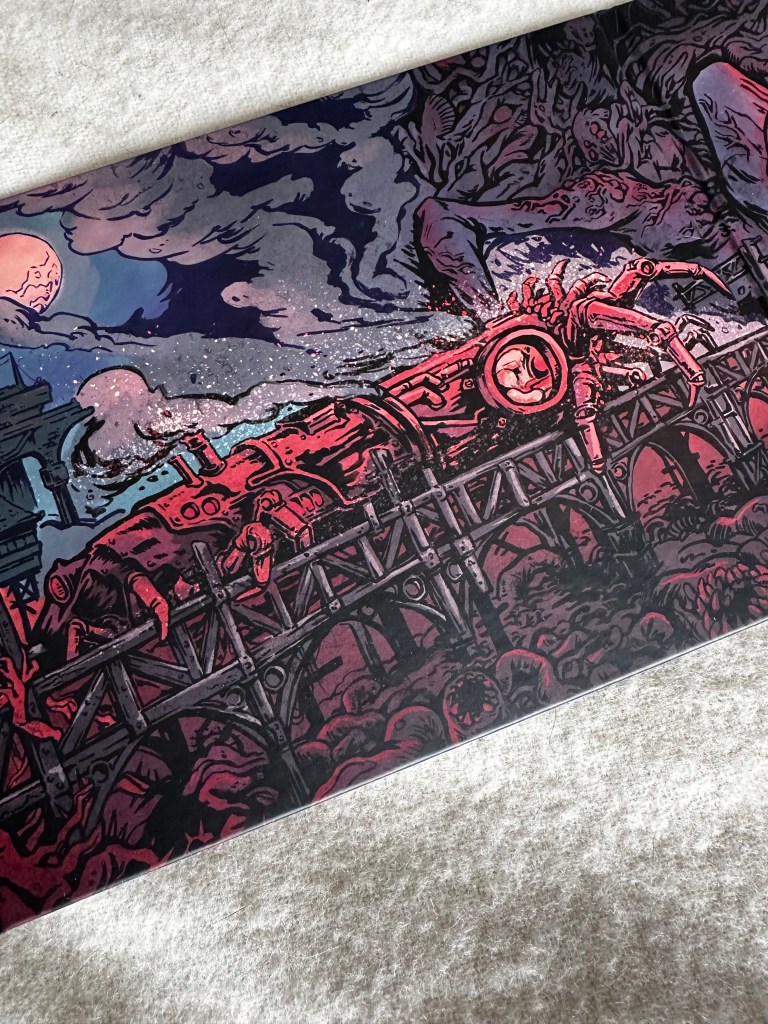
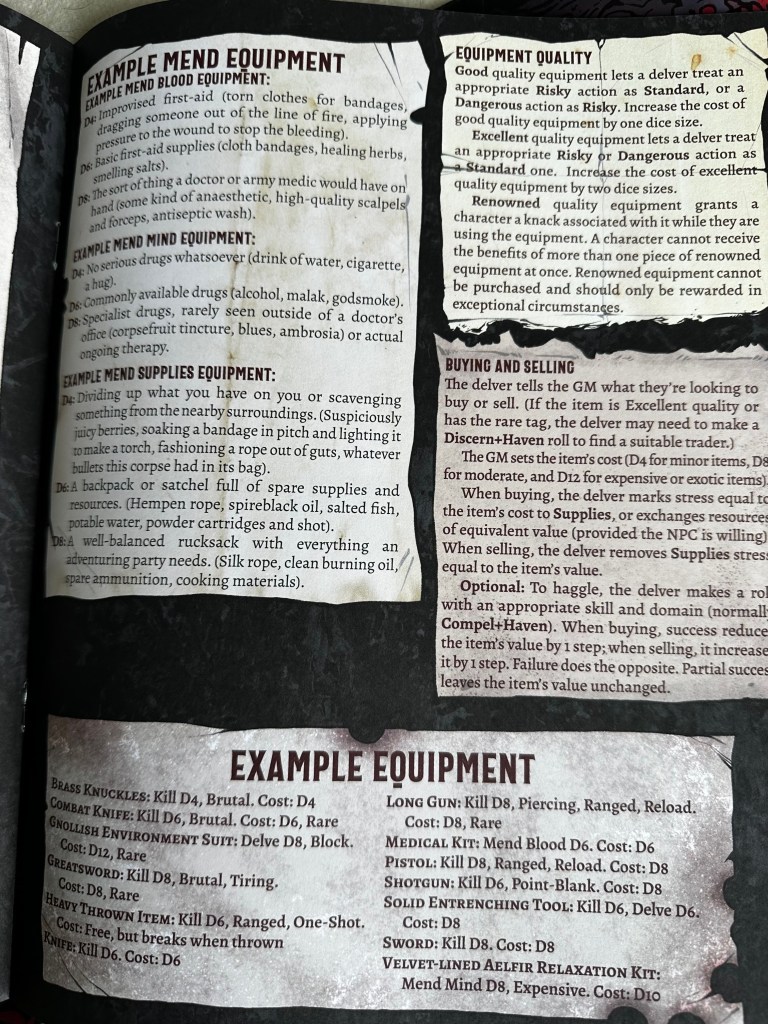
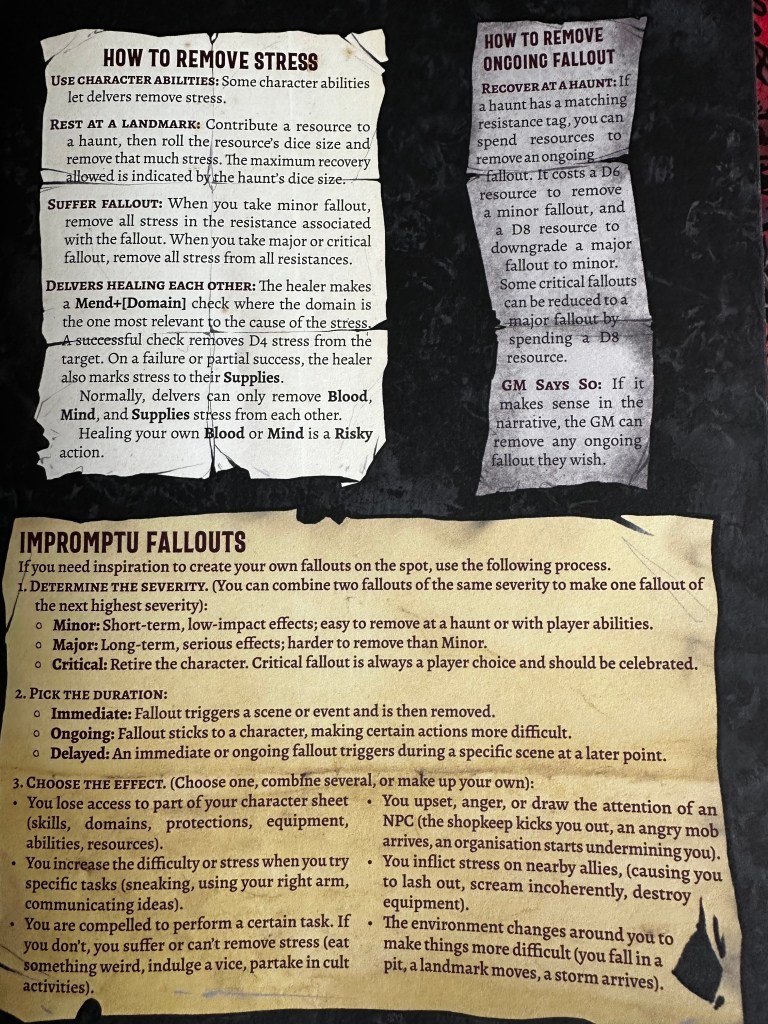
Alien RPG(s)

World’s first Alien RPG

Imagine you’re twelve years old and you have an obsession with something. I would imagine this is a relatively trivial task for most of the nerds reading this blog post. Anyway, You have an obsession and you generally want to express your love for your obsessions through the medium of role playing games. Once again, I’m sure you’re all still on board. I had several of these, Lord of the Rings x MERP, check, Star Wars x West End Games Star Wars the RPG, check, Robotech x Palladium’s Robotech RPG, check. You get the idea. But there was one missing. It was an important one. It related to a sci-fi movie series that I was far too young to watch legally (sorry Mum!) It was Alien(s.) The first I even heard about this franchise was from a friend on the playground. He and his brother had managed to stay up way past their bedtime and watch it with the sound turned way down so as not to wake up their parents, on a satellite TV channel (which I did not have.) Anyway, he told me literally the entire plot of Aliens from start to finish during break time one morning, leaving pretty much nothing out. And I knew I had to see it. It was some time later that I managed to get someone to rent me a VHS copy to watch myself. And thus was the obsession kindled. The hardware, the badasses, the gunfire, the nuclear explosion, the Xenomorph itself. It was all perfectly concocted to appeal to the mind of a twelve year old boy. It was frankly cruel to prevent me from seeing it! It wasn’t until quite some time later that I even got to watch Alien. And seeing it, that first John Hurt chestburster scene, the slow whittling of the crew, the hiss and the creep of the monster, the silence and the horror of it. Still gives me goosebumps to watch that film.

By that point, I was well into RPGs, had been playing D&D for a couple of years, had played Gamma World, Twilight 2000, Shadowrun, all the games I mentioned above and more. But there was one missing, an Alien(s) game. Why? Because it did not exist at that point. It was still a couple of years before the Aliens Adventure Game would be published by Leading Edge Games. Even with how badly that game was received, I would have taken it. But it didn’t exist, so I made my own…

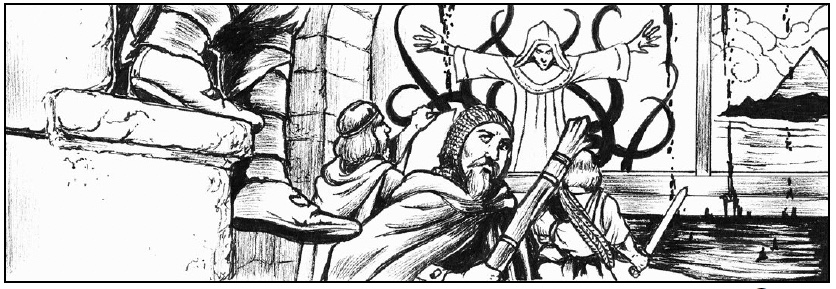
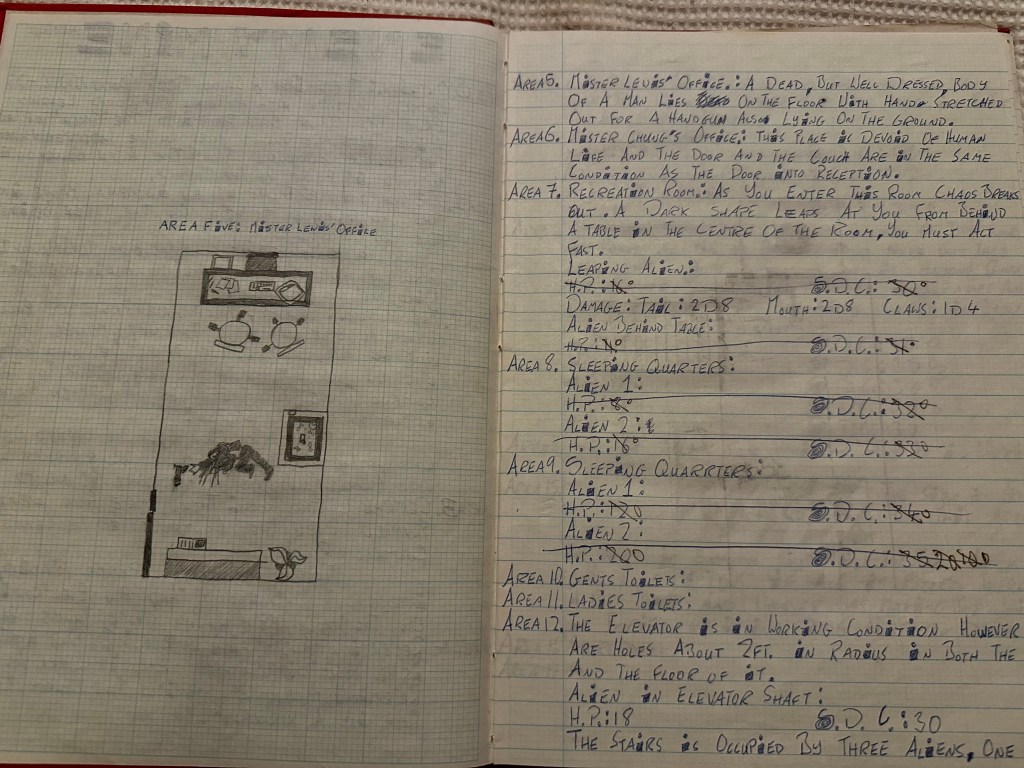
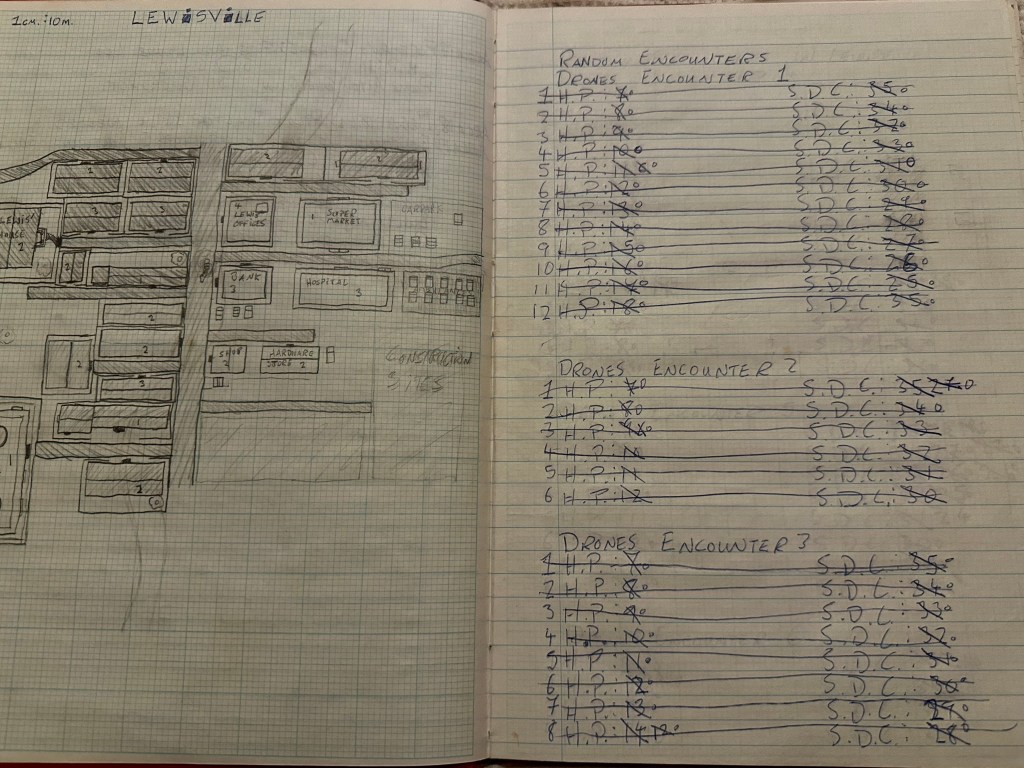
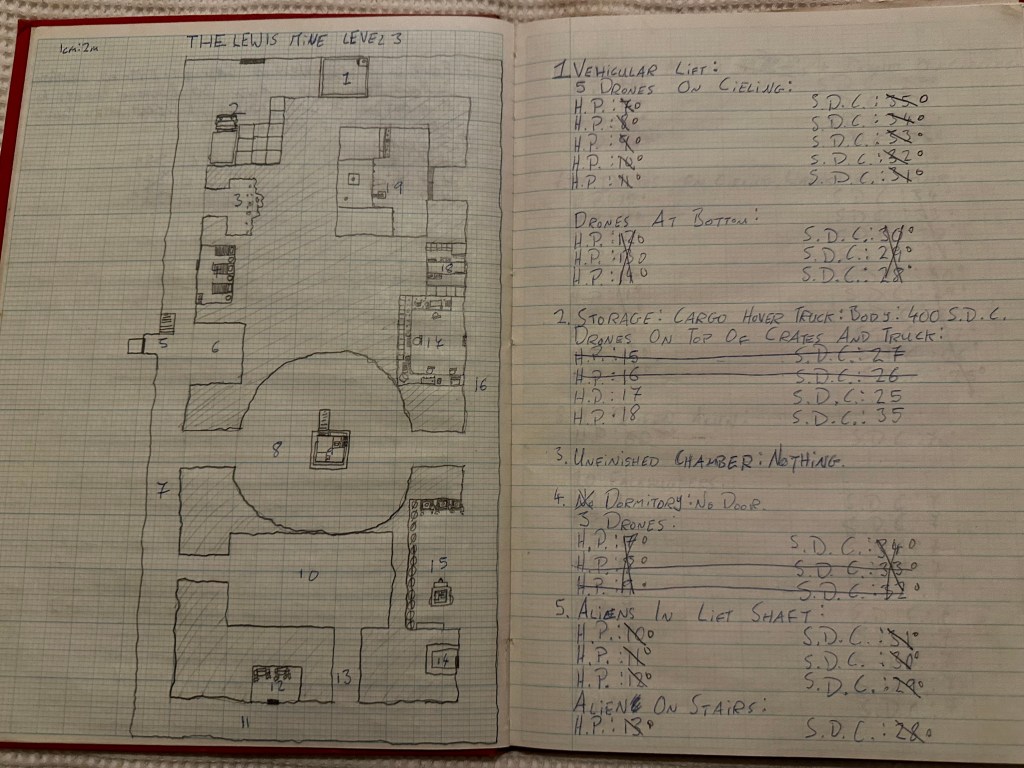
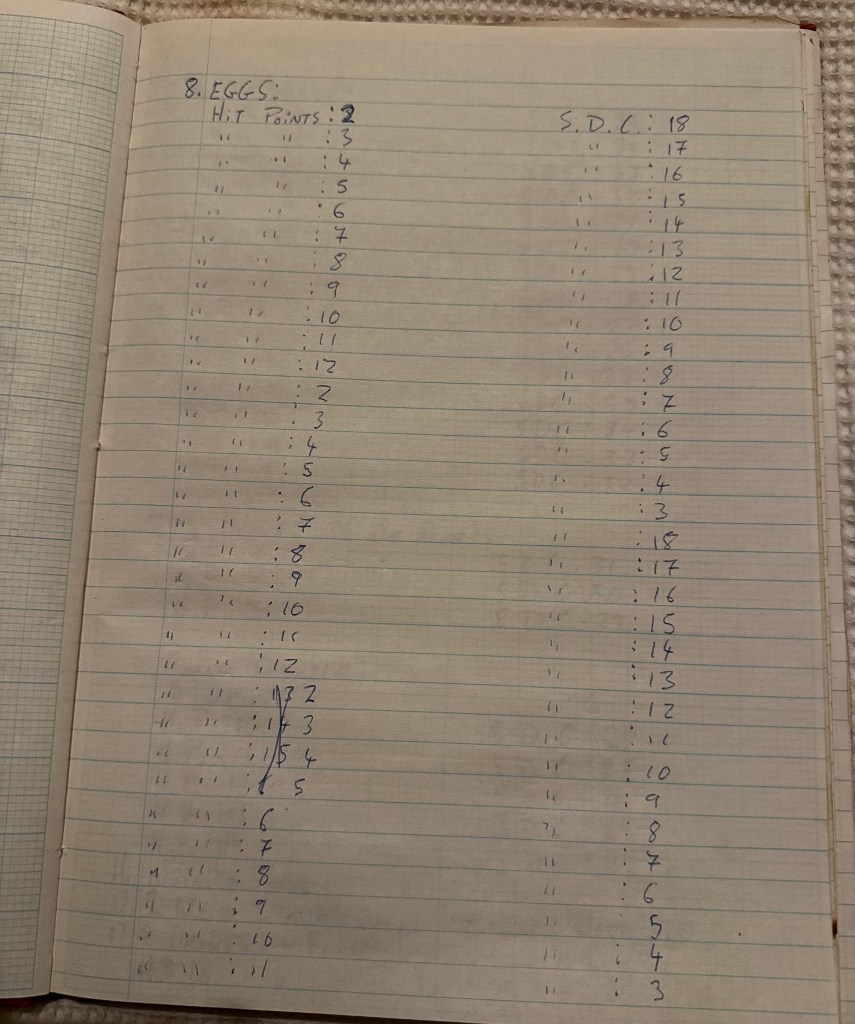
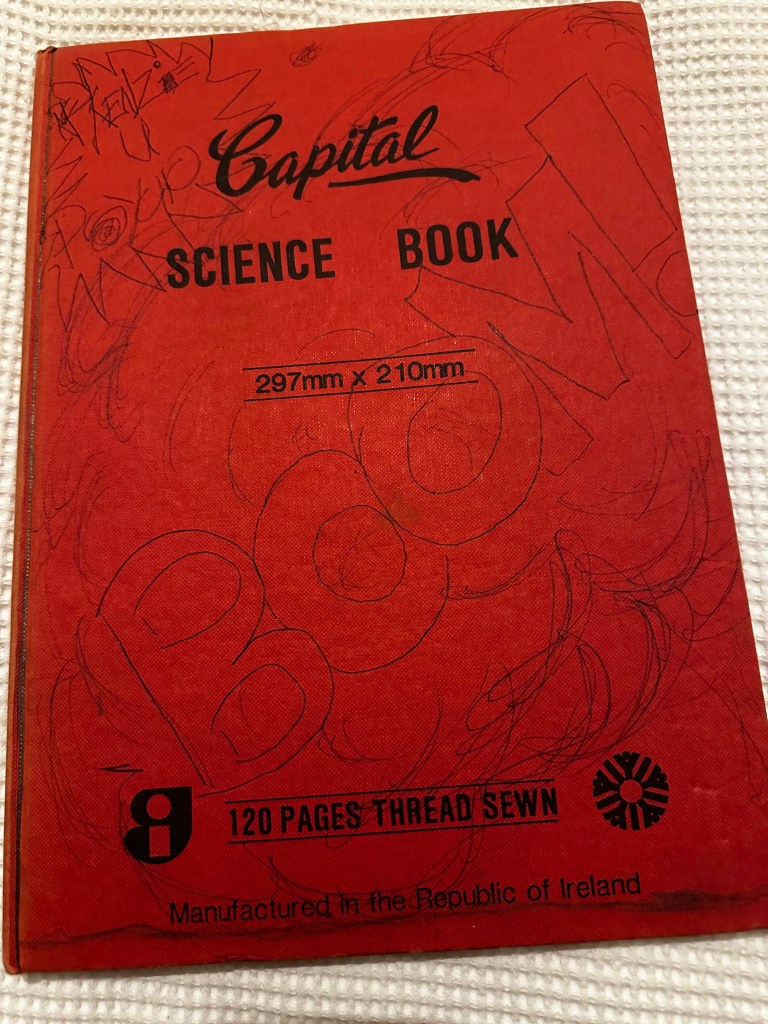
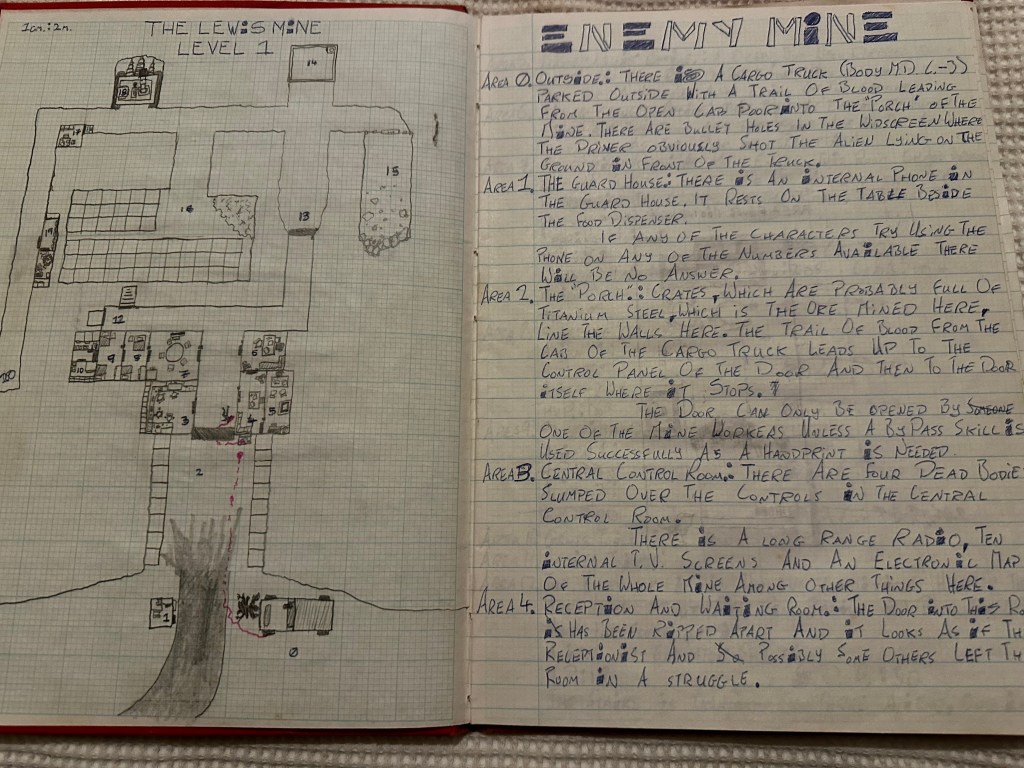
I actually remember writing a full rule-book for it. I did some drawings and cut and pasted some movie stills from magazines for the more complicated stuff. I remember being quite proud of my work, which was contained in a three ring binder and held together otherwise by sellotape and glue. I can’t find that binder now. It’s been more than thirty-five years, so I was particularly pleased to be able to discover even a small piece of evidence of this first Alien RPG. I found a hardback science notebook that contained the first (and, I think, only) adventure for my Alien RPG. Here are some pages from it.

Unsurprisingly, it was a sort of dungeon crawl set in a “titanium steel” mine (the irony that I wrote this in a science notebook, of all things, is not lost on me), with a point crawl in a town called Lewisville attached to it. I used a sort of cursed chimera of D&D and Palladium rulesets to run it. As I remember, this worked well for my friends and me. We had played so much of both, they were second nature to us. The PCs were all colonial marines on a bug hunt. It didn’t lean into the themes of the movies or evoke much of an atmosphere BUT, the marines got to shoot a LOT of Xenomorphs. And that, for us, at that age, was all that mattered.

World’s latest Alien RPG

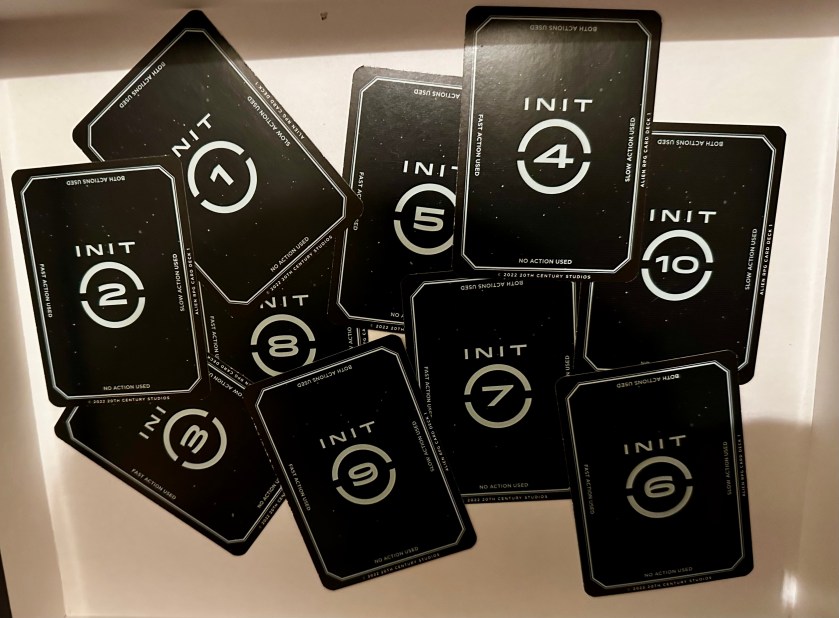
Alien Evolved Edition is Free League’s latest incarnation of their 2019 Alien RPG. It had a really successful kickstarter, which I backed at the last minute. I wasn’t going to. I mean, I still had the first edition on my shelf, it’s only a few years old, and I hadn’t even played it yet. Not only that, they were at pains to point out that this is not a big overhaul of the game, more like some rules-clarification, the addition of solo rules, and a glow-up. But then, they showed me the special edition of the core book… and I caved.

I don’t regret it though. Free League is almost guaranteed to produce a true piece of art every time. And this book has art and design by Johann Nohr of Mörk Borg and Into the Odd fame. I received the Beta versions of the PDFs today and I am not disappointed.

Anyway, I thought it was probably about time I pulled the first edition off my bookcase and dusted it off. I have been reading it for a few days, prompted, I think by the fact that it was Alien Day on April 26th.

Much of this RPG will be very familiar to anyone who has played any of Free League’s Year Zero Engine games over the last few years. When you try to do something, you make a dice pool from your ability score and your skill score with additions from items or circumstances. Alien uses exclusively D6s so all you’re looking for is a single 6 for a success. But there are a couple of differences with Blade Runner and Tales from the Loop, with which I’m more familiar.

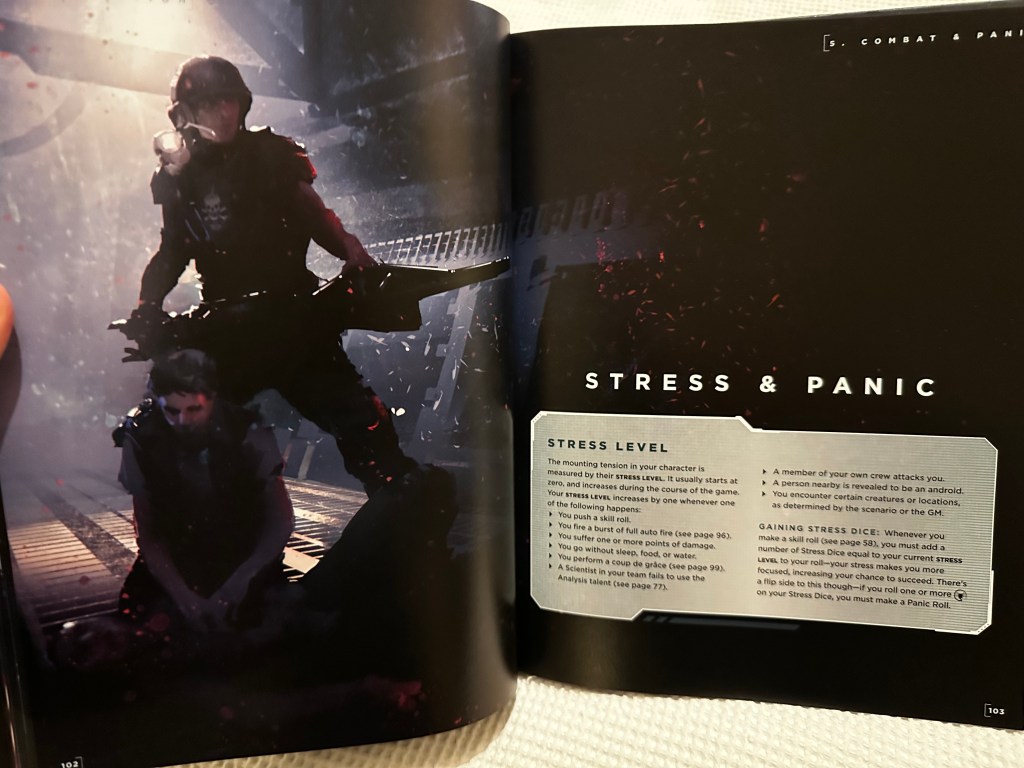
Firstly, you also add to your pool, Stress Dice equal to your current Stress score (which you can gain mainly from pushing rolls.) This gives you a better chance at success but also introduces the potential for your character to Panic, if you roll a 1 on one of those dice. This is usually not good for you. The effects can range from a mere tremble in the extremities, to a berserker rage or full catatonia. Sounds fun, right?

Secondly, you get to add stunt effects when you score more than one 6 on your roll. This feels like it was yoinked directly from Green Ronin’s Fantasy AGE game system, which Dragon Age uses. However, it utilises specific stunts for each skill. I imagine this necessitates a lot of book-checking when stunts come up, but its still a nice feature, which I appreciate.

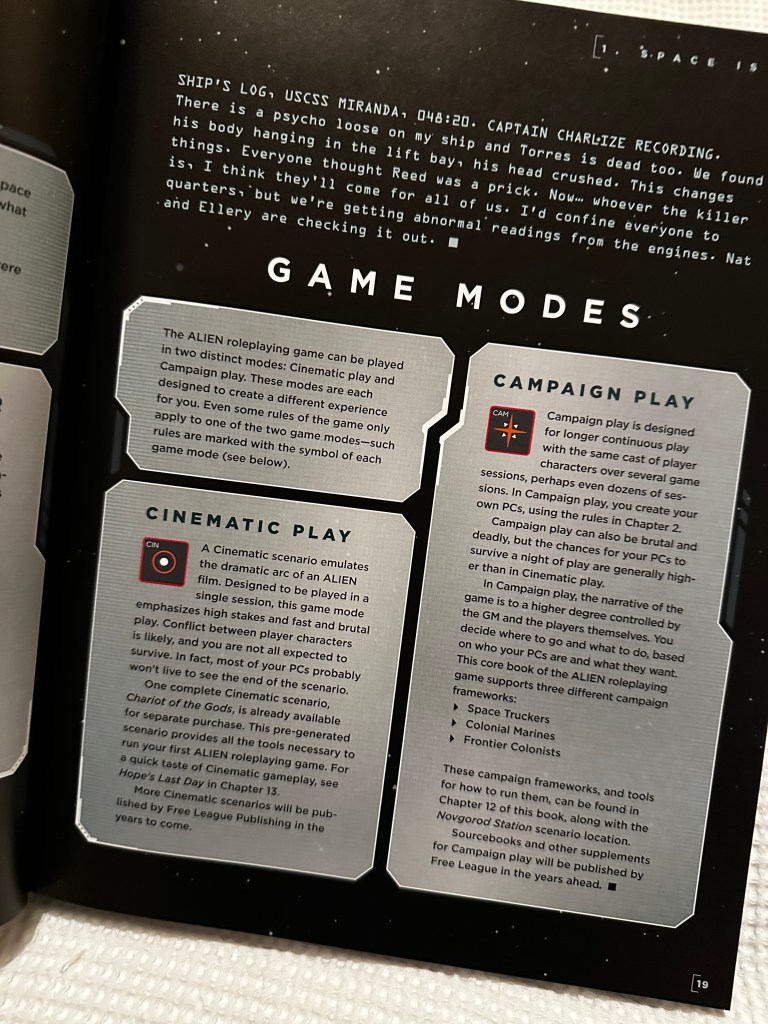
There is another attractive element to the game as well. I like the very clear delineation between Campaign and “Cinematic” play. Campaign play is exactly what it sounds like. You create your character as you would in any other RPG and you and your friends hope they survive through a multi-session story as things probably spiral slowly out of control. The book includes some useful resources for creating planets and start systems, as well as thematic NPCs to help with this style of game. Cinematic play is designed for one-shots, or, at least a short series of sessions. The events of it are probably a little less flexible and fit into an appropriate three-act structure. The PCs are chosen from a few pregenerated characters. And let’s face it, if you’re talking about Cinematic and Alien, you are not expecting them to survive, or, at least, not very many of them.

Alien Day delayed

I was so annoyed that I had missed an opportunity to play an RPG on a non-standard holiday that relates to it, that I felt like I had to play it anyway, in penance. So, I announced a one-shot of the first edition of the Alien RPG today on our Tables and Tales Discord, and I have a couple of sign-ups already. I have a few published Cinematic options and a few days to decide which one to play. I am leaning towards the one from the core book, which relates directly to the events of the movies, as an introduction for the players. But there are also the scenarios in the Starter Set and the Destroyer of Worlds boxed set that could be contenders.

I’ll be back probably next week with a report on how it went! I might just do a round up of that and our Star Wars themed Vaults of Vaarn one-shot from May the fourth. See you then, dear reader.

Cosmic Dark: Assignment Report

Understanding the Assignment

What is the end goal of a game of weird space horror like Graham Walmsley’s Cosmic Dark? The answer seems obvious, I suppose. If you go to see a horror movie, you want to come out feeling like you got your money’s worth in spilled popcorn, whimpers, screams and nonodontgointhereyouidiots. So you should expect something similar from a game like this, right? Well, yes, of course. In fact, the rather ingenious conceit of a game like this, is that, knowing the style of play you’re looking for, as a player, you can go into it understanding what you can do to help push the themes, the jumps, the horror of it. There’s some strange, violet rock that appears to be moving? The character might be a geologist and know that it’s their job to go examine the rock, but the player knows they’re in a space horror game, which is why they should go and examine it. And this is pretty much how our one-shot of Cosmic Dark went last weekend.

But there’s more, of course, because let’s not forget the ‘Cosmic’ bit, the ‘weird’ bit. Because, although the body horror really hit hard at times, the dreamy (nightmarey maybe,) psychological horror felt all-encompassing. There is a section in the scenario that is aptly called “Dreaming and Waking.” Unpretentiously, it refers to the bizarre dreams the Employees experience during their first night on the assignment. It gave me more or less free rein to describe immersive dreams for the characters that related back to the answers they gave in psych evaluation questions earlier in the game. Of course, this served only to highlight the dreamlike atmosphere of everything on the assignment up to that point, in my opinion. Time was behaving differently, the rocks were undulating and growing, seemingly safe spaces were revealed to be anything but… The players and the characters were on edge, really from the start. And, thanks to the mechanics, they got closer and closer to that edge as the session went on.

Character Creation

We played the first Cosmic Dark Assignment, Extraction. Check out my preview blog post here, where I explain the way the players create their Employees as part of that scenario.

At the table, this went down a treat. Forcing players to choose their Employees’ specialisms only at the point where they are being asked to acknowledge over comms on the shuttle to the Assignment is clever and the players got a kick out of it.

But the real star of the show is the series of flashbacks they go through to get a picture of their characters. The flashback method creates memories, not just characters. The requirement for each PC to identify another as a rival or a figure of admiration or some other influence, and to include them in the flashback scenes, creates a shared history and a character dynamic that you simply can’t conjure from dry discussions over a character sheet. If you have played any PBTA games, dear reader, you might be aware that they usually include a section for bonds with other PCs. You and the other PC have to come up with some reason why you are blood-brothers or why you’re worried about the other’s survival or why you had a vision about them. But you do not act it out. You don’t, at least in my experience, role-play a scene together to elucidate the reason for the bond. That’s exactly what you do in Cosmic Dark. In fact, each player has a scene of their own and may choose any of the other characters to share it with. These scenes are supposed to be short, just a minute or two, but long enough for them to find their characters’ voices, outlooks, relationships. And the Director (GM) provides prompts to kick-start these scenes. The players are given a line of dialogue for one of them to say to begin. I was skeptical about how well this could work at a table of regular players. Up until now, I have only seen it done at a table of professional actors on Ain’t Slayed Nobody. But I needn’t have worried. Every one of my players took that single line of dialogue like the baton it was, and ran with it, inventing hurdles, falling and picking themselves up again. And the table I had? Four players with a wonderful mix of experience levels, some who have played a variety of RPGs for years, one with just a few months of play under their belts with Tables and Tales and even one for whom it was their very first role playing experience!

The aspect of character creation (it’s one of the parts that is ongoing throughout the game from what I understand) that I had a little difficulty in running and incorporating as intended is the psychological assessment. There is a moment, that also occurs in flashback, the night before the Assignment, when they are lying in their sleeping pods on the Extracsa transport vessel, the Exchange, and they are asked questions like “what scares you most about being alone?” Or “what is the most terrifying way to die?” You are supposed to. Push the PCs to answer truthfully, indicating that Extracsa will know if they are lying. This part was ok, actually. I was able to get some revealing and actionable answers from them. It was the re-incorporation of the answers into the later dream sequence that I struggled with. The idea is that you should take note of the PCs’ fears and worries so that you can create a tailored nightmare for them during the Dreaming and Waking section I mentioned above. I think this is something I would get better at in time and with practice. The main issue I had was just referring to my own notes and making sure I got the right nightmare for the right Employees in a way that made it feel like it flowed naturally.

The Assignment itself

I don’t want to go into too much detail here. Honestly, I could not do it justice. Go and listen to the Ain’t Slayed Nobody actual play instead!

But here’s what I will say. I presented an outline of the type of game Cosmic Dark was when I advertised it on our Discord. But I think there was still some misapprehension by the time we started playing. The main feedback I got in this respect was that they expected something more along the lines of physical threats. I believe this is, perhaps, the overriding influence of the Alien franchise. I did refer to Alien in the touchstones I mentioned when announcing the game, so that could explain it. There is nothing like an alien monster in this first Assignment. In fact, as they played through the scenario and uncovered one egregious corporate scheme and strategic lie after another, I think it became obvious that Extracsa are the real baddies here. And, it’s not like there aren’t ways for the Employees to die in the course of the Assignment (we had one death, caused mainly by the Team Leader hitting 6 Changed as he escaped. He flipped the rover he was driving.) And they felt as though they were in danger, clearly. As their Changed scores each hit 4 or 5 (out of 6) they all decided to run away! They witnessed what was in the future for them on this asteroid, a slow and horrific melding with the rock of the place, and they noped out of there before they even reached the finalé! Anyway, if I had any advice for prospective Directors, it would be to make sure you properly set expectations.

How about the scenario itself? So, I only had the text of the Extraction Assignment to work with. Now, this was fine. The rules are contained within it and the character creation occurs during the course of play, as I explained above. However, in the finished book, there will be useful extras to refer to. For instance, if and when an Employee rolls a 5, they are supposed to get a little bonus in the form of records, data from the Extracsa company servers that serve to shine a light on the mystery or, at least, show them how Extracsa is fucking them over. On the roll of a 6, they are supposed to experience an anomaly of some sort. Anomalies are supposed to alert them to the weirdness of the place or the situation or have a direct psychological effect that might prompt a Changed roll. Now, there are a few examples of appropriate records and anomalies in the scenario but the rest will be contained in cheat sheets that will appear in the final Cosmic Dark book. To fill this gap, I listened to the ASN actual play again and made a note of the records and anomalies Graham used in that.

The other thing I picked up in particular from Graham was the style of GMing he does in that AP. He keeps it light and breezy mainly, gently encouraging players to take unnecessary risks, reminding them about the Changed die, reassuring them that that little prick from that piece of weird violet rock is probably nothing to worry about… until the point where he informs them all they need to do to reduce their Changed score is remove that pesky limb… Listen and learn, dear reader! It worked a treat at the table!

As for the rules, I had one regret here. The rules are very light and easy to pick up, but, this opening Assignment is designed to introduce the rules in a specific order to ease the players into them. And it does a great job of that. The Changed die is the first thing that comes up, then investigation rolls and other types of actions. But I forgot to introduce the re-roll mechanic when I should have, thereby allowing the Employees a chance both to do better on certain checks and to increase their Changed score earlier on.

Conclusion

All in all, I highly recommend this game. I want to play more of it. I wanted to play more almost immediately. But I think my experience will be greatly improved by getting my hands on the full book. So, let’s make sure I can, shall we? Go and sign up for an alert on the Cosmic Dark Kickstarter!

Cosmic Dark

Ain’t Slayed Nobody

I have been a fan of the Ain’t Slayed Nobody podcast for as long as it’s been around. They launched back in 2020, right at the outset of the pandemic, which was a creative miracle in and of itself. The podcast, which started out as a Call of Cthulhu actual play, is the brainchild of Cuppycup. He started out running a few of his friends through a Down Darker Trails campaign. That’s the Old West setting for Call of Cthulhu. Apparently, not only was this the first time he had acted as Keeper, it was his first time playing any RPG! Go and listen to those early episodes now and I think you would be hard pushed to detect that level of inexperience. It was a fun listen too! The production quality has been consistently high from the beginning but the players and the laughs really make it.

Since then, ASN has had a rotating cast of players and characters in a range of short campaigns and one-shots. They have branched out with regards to systems too. They had a classic short run of Blade Runner, where cuppycup ran Electric Dreams, the case file from the Blade Runner Starter Set. Listening to this made me want to run it myself. This one had a great cast too: Ross Bryant, Nic Rosenberg and Danny Scott played the blade runners. Since then, both Ross and Nic have become regulars in the cast. I highly recommend this series, especially if you’re interested in running Blade Runner, the RPG.

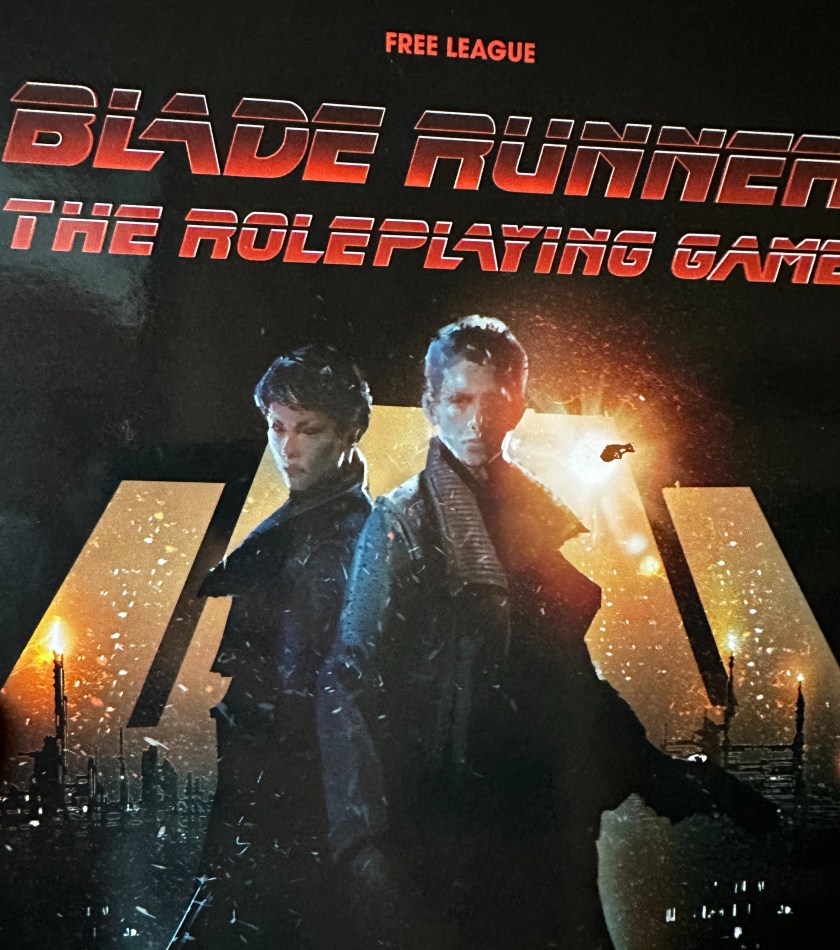
Two blade runners posing like neon noir heroes in front of a stylised Wallace Corp ziggurat beneath the title of the Blade Runner Role Playing Game.
A photo of the front of my copy of the Blade Runner Start Set box.

Another regular, Scott Dorward, is a renowned podcaster and game designer in his own right. His long-running show, The Good Friends of Jackson Elias is well worth a listen. When he first ran a game for Ain’t Slayed Nobody, it was his own Cthulhu Dark scenario, Fairyland. This was really the first time I had been exposed to Cthulhu Dark as a system. The impossible lightness of the rules and the effortless creepiness that Scott brought to it drew me in. I eventually did get to run Cthulhu Dark myself last halloween, though it was a different scenario.

Darker Still

Recently, Ain’t Slayed have piqued my interest yet again. This time, it’s with another game from Cthulhu Dark creator, Graham Walmsley, Cosmic Dark. Graham is the Director for this campaign too, in fact.

Cosmic Dark is a game of weird space horror that is Graham’s commentary on the times we live in, according to him. The PCs all work for an interstellar corporation called Extracsa. I feel like the name does a lot of the heavy lifting in conveying the type of company we’re talking about here. Each assignment is completed in an episode or two, which is very satisfying, but the characters do continue through the series, except when things go really wrong for them.
What have I liked about it so far?

The heavily anti-capitalist horror aspect is compelling to me at this point of my life and of human history. The themes and events of the game, despite taking place in some unknown future in space and on alien worlds, feel all too real, far too possible.

I love the character creation method. You don’t start this game by writing up a character sheet, you don’t even come up with a name or occupation like you might in Cthulhu Dark. No, you dive straight in:

This is the Extracsa transport ship. You are descending to the surface of C-151.
Medical officer, please acknowledge.

The first scenario asks the Director to read this to the players and then tells them to wait for one of them to respond. That player is then the Medical Officer. This continues until all players have chosen an Employee Specialism. You then continue with a quick overview of the very light rules before delving into a series of flashbacks from the PCs’ childhoods using prompts to sketch the sort of characters that you need for this game. It’s an ingenious method and extremely fun to listen to people improvise on the spot. And it doesn’t stop there. Character creation continues throughout the character’s Extracsa career, usually in the shape of flashbacks to their lives before their current job.
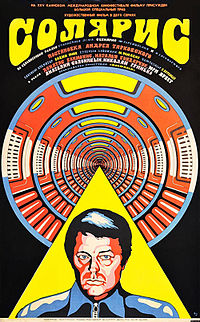
The scenarios themselves are weird and scary and psychologically affecting. They deal with things like the reliablity (or otherwise) of your own memory, machines treating humans like infestations, and, honestly, just good old-fashioned space madness in the best traditions of things like Solaris.

By The cover art can or could be obtained from MoviePosterDB or Goodtimes Enterprises, Fair use, https://en.wikipedia.org/w/index.php?curid=5075880

So, I joined Graham’s Patreon. Doing that got me access to the early versions of the rules for the game and the scenarios that have been written so far. I’m hoping to get a group together to play it in a couple of weeks.

Listening to this series gets me excited to play Cosmic Dark. As a lover of weird space fiction, it is exactly up my alley. And it is very different to the other games I am running at that moment, so it will make a nice change.

One last thing, Graham will be launching Cosmic Dark on Kickstarter soon! If you want to support the project you should follow it here!

Dagger in the Heart

On Rails?

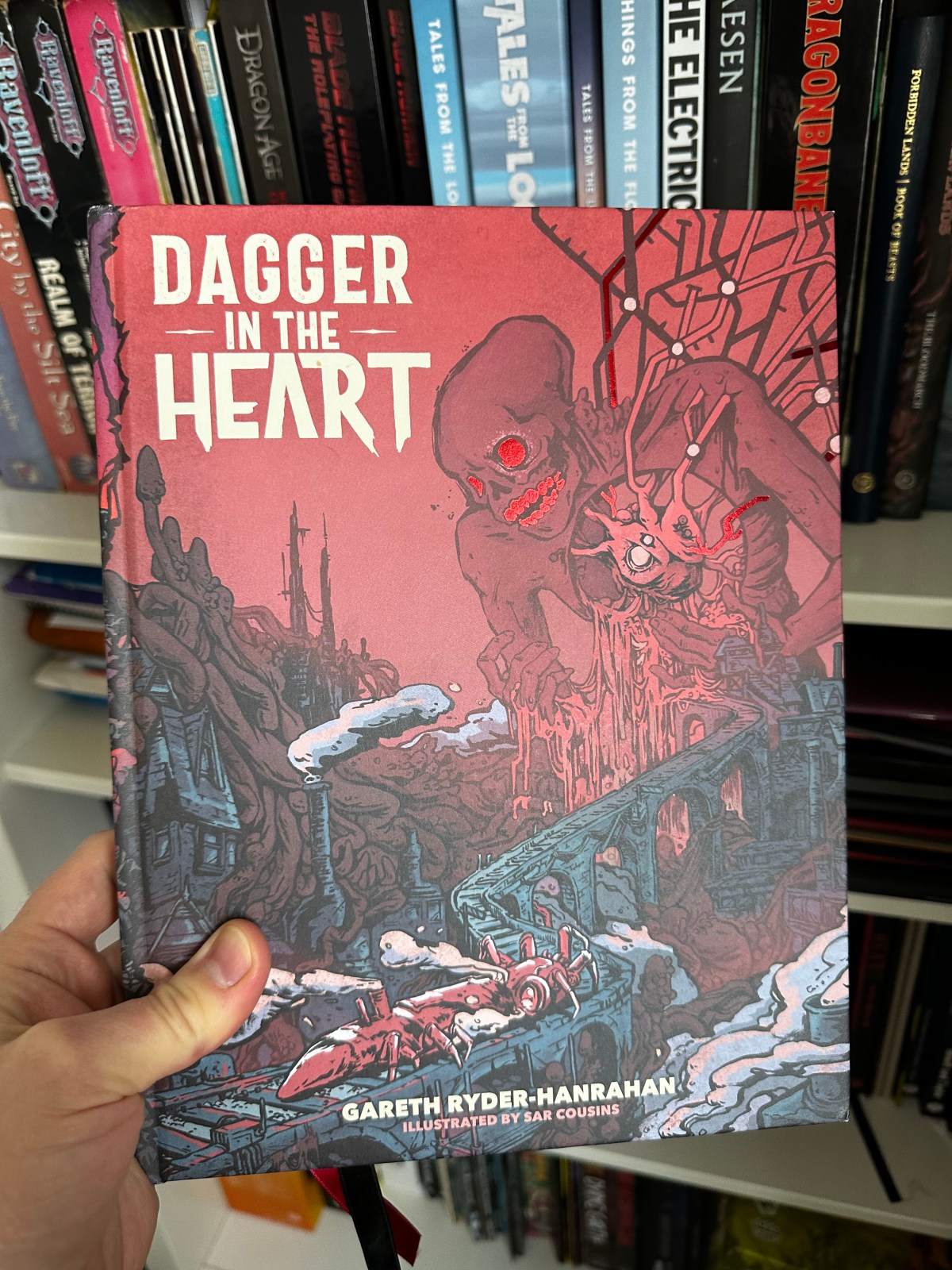
I recently finished reading through the new campaign book for Heart, the City Beneath. Dagger in the Heart from Rowan Rook and Decard was written by Gareth Ryder-Hanrahan and illustrated by Sar Cousins and came after a very successful crowdfunding effort last year. I backed it because I back everything from RRD but also because I was curious about how they were going to go about constructing a campaign for a game like Heart. In my experience, A campaign for Heart is something best dealt with one session at a time. Looseness and improvisational ability are qualities you will benefit from when GMing this game. The character beats that drive the events and the plot and the characters forward might have one PC searching for someone to kick off a tall building while another might be looking to get into a situation that’ll garner them some major Echo Fallout. So, maintaining any sort of direction can be a challenge. This is one of the game’s great strengths, of course. It makes it feel quite organic at the table and allows your players to feel as though they are the focus of the evolving story.

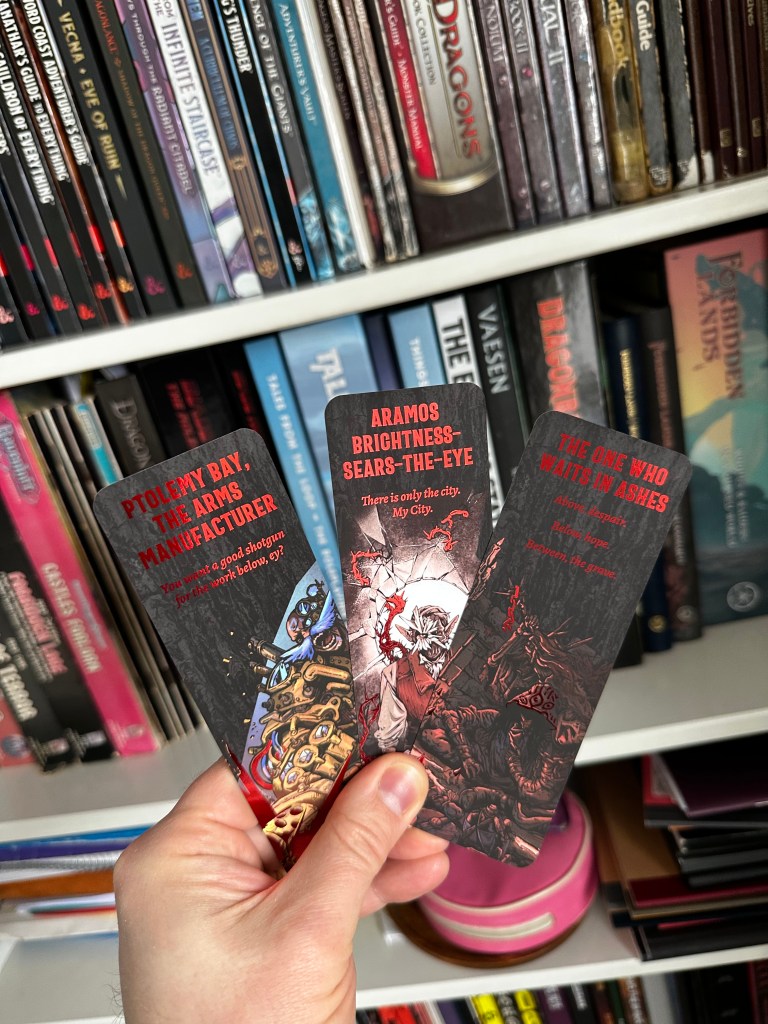
So, how to you translate that style of play into a coherent campaign? Well, you get Gareth Ryder-Hanrahan to write it for you, obviously. What he has done with Dagger in the Heart is provide the GM with a trio of inspired villains that I can imagine the PCs will love to hate and built the campaign around their plots and goals. In the introduction, he also gives you a guide on how to use these villains, depending on the length of campaign you want to run and some other factors. You don’t need to use them all, and, indeed, you are encouraged not to. Importantly, the campaign will work no matter which ones you use. They mostly act as foils to the PCs plans and actions and you are given suggestions, throughout the book, on how to use them in each area and during each major event. In Dagger in the Heart, the villains have their own beats they’re working towards, which helps in keeping track of what they are doing most of the time.

After the intro, you get seven chapters, each of which focuses on the areas of the Heart (or, indeed, the City Above) that are important at different points in the campaign. A chapter features an overview section which briefly explains what is contained in it and what the PCs are expected to be doing while they interact with the places, people and events contained in it. After that, you have a Staging section, which gives you options on how to get the PCs to move the overall plot forward while they do the usual Heart stuff of delving and hitting their Beats. This might include descriptions of major NPCs or stat blocks for enemies. After this, you get your Landmark and Delve descriptions. There are so many Landmarks in this book. I am pretty sure there are more Landmarks in this than in the Heart core book. But the delvers are not required to visit all of them. Instead there are just a lot of options. Indeed, because of the very loose nature of the campaign, the Landmarks can occur in any order, within any given Tier of the Heart, at least. In fact, they can mostly move quite freely between Tiers as well. So, despite the plot focusing so heavily on the occult and defunct underground train system known as the Vermissian, Dagger in the Heart is anything but Railroady. What it does, is provide you and your players with a plethora of options for how the story of the campaign could play out at your table and, indeed, how it might end, taking into account what your delvers might do.

After reading it, I was energised and inspired. I wanted to get some players around the table and send them back into the Heart as soon as possible. It will have to wait a little while, though, while other games come to an end. In the meantime, I get to read it again and prepare something really special.

Heart GM Screen

I also got the new Heart GM Screen from the Backerkit. It’s exactly what you would expect from RRD. Very high quality and totally over the top. There are no useful tables or common rules on the screen itself. Instead it comes with a booklet that you can rip the particular pages out of or, I suppose, photocopy and attach to the screen as you like. That way you can switch out the items you most need, when you most need them. It’s a nice idea and I think it will be useful.

Backin’ Up

List

It might be hard to believe but I have another six, no seven entries in the list of projects I’m backing on Backerkit. Now, absolutely all of these are fully funded, their pledges have been called in and they’ve charged my card. I’m just waiting on their delivery at this stage.

So, let’s get into it:

  1. Caverns of Thracia Legendary Adventure 5E+DCC
  2. The Expanse Roleplaying Game: Transport Union Edition
  3. The Between
  4. Welcome to Night Vale Roleplaying Game
  5. Stay Frosty REMASTERED
  6. 321RPG 5th Anniversary Expanded Rule Book + Encyclopedia Monstergoria
  7. Terror from the Underdeep: A Giant Box of 5E Adventure

If you’re interested in seeing what I have currently backed on Kickstarter, click here.

1. Caverns of Thracia Legendary Adventure 5E+DCC

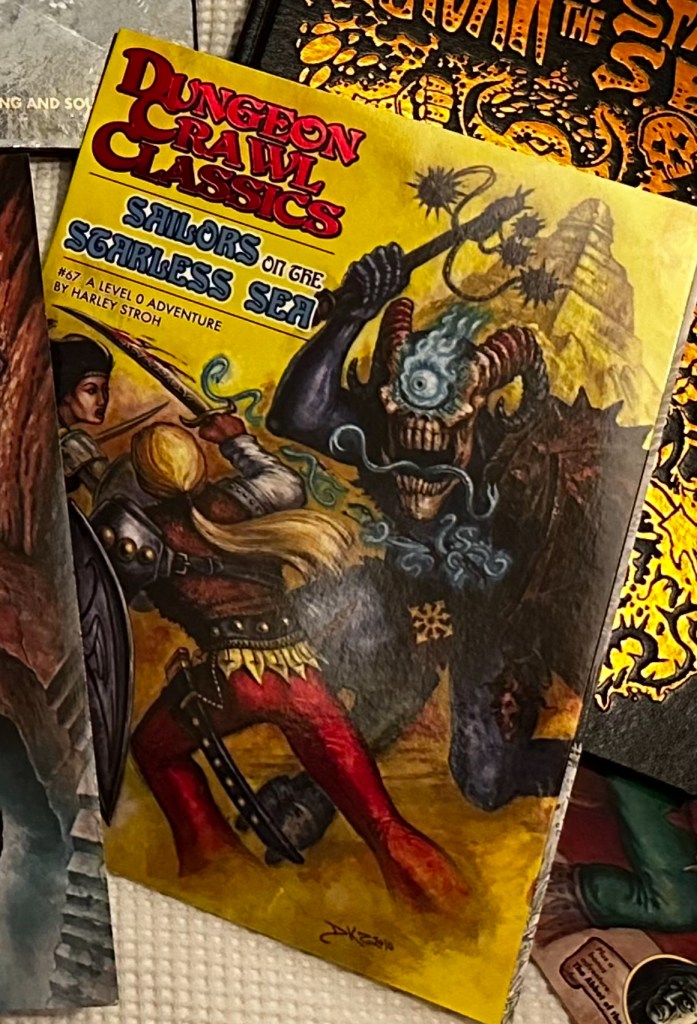
Goodman games produce some of the highest quality books and other products in the TTRPG industry. Anyone who has glanced admiringly at the Doug Kovacs covers of any of their five million adventure modules for Dungeon Crawl Classics will know what I’m talking about. They’re also incredibly interesting artefacts that look like they were first published in the seventies but have a modern OSR sensibility when you get into them usually.

Anyway, last year, I was beginning to build a small collection of DCC books and other paraphernalia when this project was launched on Backerkit. Their timing was impeccable if they were specifically looking for my support. I didn’t hesitate. Since they were bringing out both a DCC and a 5E version of the boxed set, I went with the DCC one.

The Caverns of Thracia is a remake of an original and iconic module by Jennell Jacquays. It was a Greek myth-based scenario and it was published by Judges Guild in 1979. The Goodman Games version promises you a year long campaign from the boxed set, at least. It should take DCC characters from level 1 to level 5 and it contains a whole mega-dungeon along with all the new monsters, magic items, spells etc. that you might expect from something a big as this.

I splashed out on a dice set and a few extra books when it came to my pledge so I am expecting something very special when this arrives at my door in a month or two! You can check out the campaign page here. Also, if you’re interested you can go and pre-order it from a store near you if you look it up online.
2. The Expanse Roleplaying Game: Transport Union Edition
Get ready to decelerate towards the Ring. And maybe charge your rail guns while you’re at it. You never know what Inaros and his Free Navy might have in store for an inners’ freighter on a mission of peace out past the Belt.

I got into the Expanse with the TV show. It was a relatively hard sci-fi look at how our solar system might look in a couple of hundred years but with an alien mystery at its centre. Unfortunately, the TV show got cancelled, so I started reading, nay, devouring the books by James SA Corey. There are 9 Behemoth sized books and they take our heroes, privateers aboard the Independent freighter, Rocinante, across more about forty years and from lowly jobs on a gas hauler to the centre of the greatest events across three wars and dozens of solar systems.

It gets big.

Which is a cool premise for a sci-fi RPG. You know?

Green Ronin produced the Expanse Roleplaying Game a few years ago, but it was brought out before either the TV show or the books were finished so it did not include rules or details to cover some of the most important and universe-defining events, factions and tech that turns up in the latter half of the story. The new version sets the action in the thirty year gap between the sixth book, Babylon’s Ashes and the seventh book, Persepolis Rising. This is a very convenient gap for an RPG writer to place a lot of major events. These will be based around the activities of the newly minted Transport Union, established to take care of trade and exploration across the solar systems recently opened up by the activation of the Ring Gate Network left behind by an enigmatic and lost civilisation.

It uses the same AGE (Adventure Game Engine) as Dragon Age so should be familiar to a lot of gamers already. I can say, it is very easy to learn and pretty intuitive. I’m excited to see how it has been modified for this setting.

They’re also producing both character and ship minis for this campaign! I doubt it is something I would use in this sort of game, but it would still be very nice to have.

Check out the campaign page here.

3. The Between

I have written a bit about some of my favourite RPG related podcasts and actual plays in the past. But I don’t think I have mentioned Ain’t Slayed Nobody’s current run of the Between on the blog before. I love this show. The players are great, as always, the production values are exceptional, the GM, also the game’s creator, Jason Cordova, couldn’t be better, and the game itself is entertaining and dark and creepy and fun in equal measure. It is one of those shows that I queue up and listen to as soon as it drops.

This game has actually been around for a while too. The Backerkit campaign was to fund the production of a physical version. If I’m honest, it’s not really the type of game I would usually be drawn to. Victoriana, rarified conversations in drawing rooms and illicit trysts in haunted houses are not really my thing. Or at least, I didn’t think they were until I listened to the actual play of paragraph-before-this-one fame. Turns out, I enjoy those things quite a bit. It reminded me, unsurprisingly of The League of Extraordinary Gentlemen by the late, great Kev O’Neill and Alan Moore (not the dreadful movie of the same name.) And I love that comic book.

Not only that, its based on the same ruleset as Brindlewood Bay, also from Jason Cordova and the Gauntlet, which I have discussed to some small extent here. And though I still haven’t had the chance to play it, I would love to. I think it’s one of the greatest innovations in RPG mechanics in the last decade and deserves all the plaudits it gets.

Anyway, the game looks great, the book looks great. You should go and order it when it’s possible to do that. In the meantime, go and check out the campaign page here.

4. Welcome to Night Vale Roleplaying Game

Silence is golden. Words are vibrations. Thoughts are magic. Welcome to Nightvale

The cold open Welcome to Nightvale, episode 8, “The Lights in Radon Canyon” seemed an appropriate way to open this one.

I have been listening to Welcome to Nightvale for almost as long as it’s been around. It hooked me, originally, with its unique blend of weirdness, horror and humour. It kept me coming back as the desert town grew and changed along with its residents, like Cecil Gershwin Palmer, the Voice of Nightvale, John Peters (you know, the farmer?) and the Almighty Glow Cloud. I love the writing so much. The podcast’s co-creators, Jeffrey Craynor and Joseph Fink have been so prolific over these last 13 years, producing the podcast, related books, live shows (one of which I have even been to see. I got to meet Jeffrey Craynor there!) and lots of other Nightvale stuff. So it was about time we got a roleplaying game, right?

The game will use the Essence 20 system, which I am not even a little bit familiar with. It seems to be a system developed by Renegade Game Studios who are publishing this game. But, it looks like you roll a d20 to resolve actions, while adding another die depending on the skill you’re using and the proficiency you have with it. This all seems fine. But it’s not the mechanics that worry me here. Much like the Discworld game that I mentioned in the last post, I am just not sure how the RPG will retain and exemplify some of the core aspects of the podcast, its weird and uncomfortable hilarity, for instance. You do get something called “Weird Points” to effect situations in particular ways, apparently and according to Becca Scott in this How to Play Nightvale video and I’m sure they will have other mechanical and character options to keep it strange. I’m still not fully convinced this will come together in the right way at the table but I am obviously willing to get it and find out later.

If you’re interested in picking this one up, I believe there is a link to pre-order on their campaign page.

5. Stay Frosty REMASTERED

Look, I’ll be honest, I didn’t know much about this game before backing it. I have heard Tom McGrenery on the Fear of a Black Dragon podcast mention that he used a previous version for several of the modules that they reviewed on there. It’s a pared down, old school ruleset for running Aliens style sci-fi games and Tom has used it in some unlikely but interesting scenarios.
That, along with the fact that it was launched by the Melsonian Arts Council was enough to get me to back it. This is another company I would always back. Well, except that I won’t need to anymore now that I have become one of their subscribers. They recently launched this initiative, which means you pay them £10 a month and you get everything they publish along with special editions with limited covers and that sort of thing. This might mean they never have to run another crowd-funding campaign again!

This is a small snippet of the blurb from the Stay Frosty Backerkit page:

The system is perfect for point-crawls and dungeon-crawls where clearing rooms, blasting bugs, descending into hell, flying through space, and defeating hordes of monsters is on the table. Supports campaign length play and one-shot horror-tinged bug hunts.

You can find the original by Casey Garske here on DrivethruRPG for a steal.
And you can find the campaign page for the new version, also by Casey Garske, here. If you become a Friend of Melsonia, it is one of the books you will receive from them this year, also.

6. 321RPG 5th Anniversary Expanded Rule Book + Encyclopedia Monstergoria

Yet another one I am not terribly familiar with, 321RPG is something I backed on something of a whim to support John “Hambone” Maguire, of the Vintage RPG Podcast and his creative efforts.

This is the yet another one that’s not brand new. In this case, it’s an expanded edition, rather than a 2E or physical print edition. This is in celebration of the fifth anniversary of its original publication. The original game was designed to be flexible. They wanted it to be of use to any table in any genre and any play style, which are all incredibly difficult and lofty goals. Here’s what the campaign page says about the new version:

This expanded rule book is the culmination of four years of growth, a lifetime of gaming, and the incredible enthusiasm of our players. If there’s one rule for DMing that always holds true, it’s that you can never anticipate what the players will do. And that’s precisely what makes it all so exciting.

It’s also going to come with four new adventures, and an “Encyclopedia Monstergoria.”

Here’s the campaign page!

7. Terror from the Underdeep: A Giant Box of 5E Adventure

I think I fell for the marketing with this one. I am not really one for backing purely 5E based projects. If I had my druthers, I would probably move away from 5E altogether and maybe, someday, I will. But today is not that day.

I basically backed this Goodman Games project because it looked really really nice. Also, it’s massive in scale with more than 450 pages of content, new monsters, spells, magic items, fold-out maps and really exceptional artwork.

The version I decided to go for also comes with a bunch of DCC modules converted to 5E as well.

Here’s what the main adventure campaign for PCs of levels 8 to 16, is about, according to the Backerkit page:

The giant clans have allied – and no one knows why. Hill, stone, frost, fire, cloud and storm giants now work together to collect electrum. Their tracks lead to an abandoned city of the UnderDeep. In these lightless caverns, sinister cultists give the giants’ offerings to a misshapen kraken lord. Can your adventurers uncover the secrets behind this wicked alliance before it’s too late?

There’s a PDF preview on the campaign page.

Conclusions

Having covered each of the projects I am currently backing, I have come to the conclusion that I back too many things. There are, undoubtedly, a couple of these that I could have done without. I mean, I’m quite sure I will never even get to play most of them. But, as the old saying goes, playing games and collecting games are two different hobbies.

What are you backing right now, dear reader? Do we have any of these in common? Which ones are you most excited about? Get in the comments!

Kickin’ it

Round up

It’s been a little while since I did a list. It’s a good format to use when you are not totally sure what you want to write. And, yep, that’s how I’m using it today.

So, what’ve I been backing and kicking? Since the last one of these sorts of posts back in September 2024, quite a lot, actually.

On Kickstarter

Here’s the list. I’m going to write a bit about each of them down below.

  1. Solarcrawl
  2. A Perfect Wife: TTRPG Adventure + Fundraiser
  3. Glumdark
  4. A Feast for a Sphinx
  5. Terry Pratchett’s Discworld RPG: Adventures in Ankh-Morpork
  6. Royal Blood – A Tarot Heist RPG

1. Solarcrawl

Let’s start with the one that is still available to back on Kickstarter. Solarcrawl is an OSR exploration game set in a fantastic space age. It’s created by Galen Pejeau, an “illustrator and occasional game designer” according to their itch page.

I absolutely love the look of this one. The artwork seems to suit the subject matter so perfectly, its’ clean lines and definite, scientific style give it the right sort of vibe for a planet exploration game. I am excited to try it with the Death in Space rules but it is designed for any OSR game.

The idea is that your homeworld is dying and you are needed to go out and explore beyond the gravity well. So off you go to try to find new planets to explore and help you to revive your own.

The game is split into two phases, Mission Phase and Homeworld Phase. Mission allows you to go out and find planets, explore them and hopefully avoid their unique dangers. Afterwards, you have the Homeworld phase, when you do research, build and improve your ships, “regreening their world.” That sort of thing.

Take on dual roles: as the astronauts journeying forth to the other worlds within their solar system, and as the heads of the space agency that builds their rockets, chooses their destinations, and hopefully, work together in hopes of rekindling their fading world.

It funded very fast but I am sure the creator will appreciate any and all further backers. Go check out the campaign here. There’s still 10 days to go.

2. A Perfect Wife

One of the big Zine Month projects, this one caught my eye almost immediately. The project was created by David Blandy of Eco Mofos fame, but the creators of this scenario zine are Zedeck Siew, Amanda Lee Franck and Scrapworld.

It’s another OSR project. One of their stretch goals was to make it specifically compatible with the Liminal Horror RPG but, as I understand it, it should still be easily useable in any other OSR game.

The adventure is described as “urban horror” and explicitly involves a Malaysian mythical creature known as the Pontianak. This is the spirit of a woman who died in childbirth. According tot he wiki I have linked to, the spirit seeks out her victims by sniffing out their drying laundry. Apparently this is why Malays will not leave clothes out to dry at night.

This one is very interesting since the main aim of it was to pay the airfare and living expenses of the creators on a trip to Nottingham, England.

The purpose of this campaign is twofold. It seeks to fund:

1: The publication of a tabletop RPG adventure zine in print and PDF.
2: The air tickets and living expenses for Amanda Lee Franck, Scrap World, and Zedeck Siew to spend one week in Nottingham.

With the former, we hope to entice you to help us with the latter.

You get: a complete mystery- and horror-themed adventure with evocative art based on an iconic-but-underrepresented Southeast Asian monster.

We get: an opportunity for three TTRPG designers to cross oceans and meet their peers, and each other, for the first time.

This will give them the opportunity to attend the Weird Hope Engines art exhibition, focusing attention on indie game creators, in Nottingham. They will be exhibiting works there themselves.

Curated by Dying Earth Catalogue (David Blandy, Rebecca Edwards, Jamie Sutcliffe), running from March to May 2025 at Bonington Gallery, Nottingham, UK.

In fact, you can already get the online version of the scenario published by Zedeck on his blog.

But the campaign was a success and it should fund both the publications and the trip. I can’t wait to get the physical object.

I’m sorry I didn’t write a bit about this one a lot sooner as it is such a worthy campaign but I am glad to see they were completely successful and I would even hope to get over to see the exhibition in Nottingham during its run between March and May this year.

3. Glumdark

You know, there are a few companies/creators that I would probably back no matter what the project. In the case of Glumdark, it wasn’t the creators themselves but the company, Exalted Funeral. I’ve gotten a few things from them in the past, although I don’t buy from them much because of the shipping. They published Between the Skies, for instance, and I think it’s pretty clear that I like that a lot. So, when the Glumdark Kickstarter was repeatedly slung at my face from Instagram, I paid attention. I knew nothing about it but I took a punt. I am quite glad I did.

Glumdark started as a website. It was built as a resource for GMs running dark fantasy games. It’s got a plethora of useful tables . You can go and check them out right here, at glumdark.com. What’s nice is that you have tables for GMs, of course, but also for players.

As a dungeon master, you may choose to punish your players with some fresh doom, or just amuse yourself with the joy of randomness. As a player, you can expand your backstory or seek inspiration for new adventures.

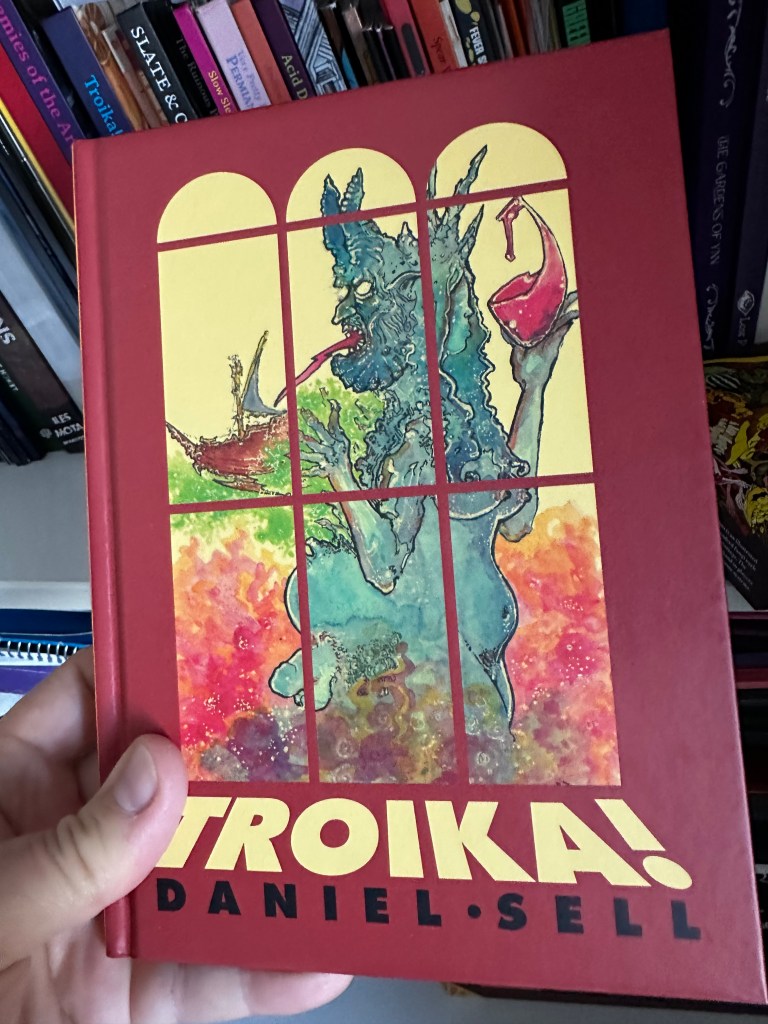
It’s system-agnostic, making it equally useful as a resource to players of D&D 5e and Troikans alike.

Here’s a few of my favourite things from the site:

  • The Location Generator is probably the best bit for me. You can click on a location name such as, “A Mysterious Tower,” and you will get three paragraphs about such a place under the headings of “The tower,” “The access,” and “The occupants.” If you are not a big fan of any given paragraph, for instance, if you don’t like the description of the tower itself, “A tower built from stacked round stones in a dense, loamy forest,” then you can just click on it to generate a new one. Or you can just click on the Location name again to generate a whole new tower. Go and try it out!
  • The “Bad Omens” table starts with this entry at number 1: “A black cat starts to cross your path, but is crushed by a falling ladder.”
  • Number 13 on the d20 “Defining Life Events” table is: “You bear the mark of Goonfun, the savior.”

So, now they’re making a book with similar goodies in it, along with some art that is very pretty indeed, in a nasty sort of way. It’s also going to come with a soundtrack! Here’s the Kickstarter page.

4. A Feast for a Sphinx

I just really like Evelyn Moreau’s art style. I have been following her on Instagram for a while and now on Bluesky and I’m always delighted by the work she shares. And she has been pretty prolific. Just go have a look at her itch.io page here. The only piece of TTRPG work I knew, though, was Goblin Mail, for Troika! And it is a really original work with a fun premise and beautiful design elements. So, when she announced her new Kickstarter project with the same collaborators, Sofia Ramos (writing) and Luna P (layout,) I obviously backed it.

A Feast for a Sphinx is an adventure for Mörk Borg. Now, I have yet to run a Mörk Borg game but that didn’t stop me. It is a revamp of a dungeon formerly published on itch and the promise is that

Everything was rewritten, balanced or added to make this the best version of the module while keeping the central idea the same.

It is going to be produced in a zine format of 30 to 40 pages (which is on the long side for a zine.) It will describe the dungeon and deliver some new creatures, adventure seeds and a bunch of tables for randomly generating encounters, rumours, etc. Go have a look at the campaign page here.

5. Terry Pratchett’s Discworld RPG: Adventures in Ankh-Morpork

So, I was very suspicious of this one, I’ll be honest. I’ve read most of the Discworld novels, and I know the irreverent, comedic, satirical tone Terry Pratchett set. I never felt like you could really replicate that at the gaming table, exactly. No, that’s not true. It’s one of my favourite ways to play RPGs, in fact. I like to have fun with them. Puns come as second nature on dungeon crawls, silly NPC names are my bread and butter. My worry was more that it would seem somehow forced or unnatural if that’s what the game was explicitly trying to get you to do.

As the campaign went on, though, I began to think the creators understood that worry. To prove it, Modiphius did one of the bravest things I have seen in some time, they made an actual play to show off the game. It couldn’t have been in any sort of finished format at the time they released the video, but clearly they had enough to make a fun and funny one-shot. Now, they had some of the more recognisable faces on the RPG actual play scene involved, which helped. Quinns of Quinns Quest was the GM and the players were Josephine McAdam, Abubakar Salim and Liv Kennedy. Go and check out the video on Youtube here. They really managed to highlight the ways in which the rules encourage play that will generate genuinely comedic moments without it feeling like you’re being fed a bunch of “hilarious” prompts.

Anyway, that got me to back this one. And I wasn’t the only one to back it, dear reader, oh no. They raised almost two and a half million pounds! Whew! Can’t wait to get my hands on it in the summer. In the meantime, go take a look at its Kickstarter page here.

6. Royal Blood – A Tarot Heist RPG

I wrote that I would back almost anything from some creators. This is another one of those. It’s Rowan Rook and Decard. I’m an unashamed shill for Grant Howitt and don’t really need any reasons to buy something he’s involved with. But this game looks so beautiful as well. It’s a tarot based game.

Royal Blood is a tabletop roleplaying game about heists, tarot cards, magic, fate and desperation. It uses a deck of tarot cards to build characters, plan a heist and determine opposition, and to resolve every risky action the players make in an attempt to claim power.

This game has actually been around since 2016 but it was not crowdfunded or given much support by RRD either for that matter. This time, the kickstarter campaign did really well so they have some money to throw at it and they have a partnership with Mana Project Studio, the Italian TTRPG creators who are responsible for some of the best looking games out there, including Cowboy Bebop.

As for all of these projects but Solarcrawl, the Royal Blood campaign is over but you should still go and check out the Kickstart page here. You can actually pre-order it there now too.

The Theatre of Trophy Gold

Getting my flash in

Orlen, dusty, wide-brimmed chapeau drowning her alarming eyes in shadow, holds aloft her trophy, beaming. The bag of coin, pleasingly hefty, dangling from her dextrous digits. “‘Aah ‘baht ‘at ‘en?” Her companions, ensorcelled by something above her sturdy, sinister shoulder, point. A hiss, as a punctured bladder, sounds in her ear. Speculative, her left hand shoots up, ready to throttle the looming serpent. It narrowly misses losing its ring finger as a dagger, recently released by Rasei, skewers the snake to the formerly coin-concealing statue. Orlen chances a glance. The cold blood dribbles down the stone man’s shoulder, over the sickle he holds dramatically crossing his sword over his chest. Nima cries, “More snakes!” Time to go. The treasure hunters scarper down the path of the sickle, ignoring the sword’s point and the keep slouching beyond it on the horizon, hoping for Hester’s Mill.

A dramatic retelling of the opening scene of our recent game of Trophy Gold, run by friend of the blog, Isaac. To those who were there, apologies. I’m sure I got a few details wrong, either deliberately or by mistake. Drama seems appropriate for this fascinating game, defined as it is, within Sets.

Trophy

So, as you probably know, dear reader, if you have been with me for a while, here on the dice pool dot com, I am a more-or-less avid listener of the Fear of a Black Dragon podcast from the Gauntlet. I wrote a post on my appreciation for it and the Indie RPG Podcast last Summer. Our path to playing this incursion (as Trophy scenarios are called) leads very much from that. Jason Cordova, one of the podcast’s capable hosts, rarely ventures into the OSR’s hex-defined landscapes. Rather, you can generally find him in the narrative woods and trails of story-based games. On the podcast, he often discusses his experiences in running OSR (or just old tbh) modules in other systems. Back in the olden days of Fear of a Black Dragon, this generally meant either the incredibly rules-lite World of Dungeons or Dungeon World My last post on this blog was about the feelings Dungeon World made me feel. Go and have a look!) These both have PBTA DNA. Their mechanics lend themselves more to the application of imagined narrative than cut-and-dried, D&D-esque, result-binary systems. And this is really only because of the inclusion of a third option, a mixed success, or success at a cost. Since the implied consequence cannot be defined outside the context of the situation, it is usually left up to those at the table to invent it (although Dungeon World generally provides far more pre-written options than does the baldly efficient text of World of Dungeons.) And look, if you’re a PBTA maven, my deepest apologies for what is, no doubt, a faintly condescending and largely inaccurate paring down of a game system that is probably the most influential in the indie game space of the last decade and a half. But if you were raised on a distilled diet of Borgs in your old schools, you’re welcome.

I have gotten off track. The point I was trying to get to was that, a few years ago, Jason switched to running pretty much every module in Trophy Dark or Trophy Gold instead. Mostly Trophy Gold, in fact. Obviously, this got me very interested in the game. The idea of running D&D style modules in a more narrative style highlights a whole new facet of the hobby that I always thought would be very fun to explore. And, after reading a bit about the game and learning of its mechanical descent from Blades in the Dark I wanted to try it even more. It just turns out that, much like Tom (with Dungeon World,) before him, Isaac got there before me. I’m not complaining. I love being a player in these games.

So, to put it briefly, both Trophy games were written by Jesse Ross and published by Gauntlet Publishing. Elements of the rules have been adapted from Blades in the Dark by John Harper, who is also responsible for World of Dungeons and other elements were cribbed from Graham Walmsley’s seminal Cthulhu Dark. They are games about treasure hunters going out into the dark forest to find gold and bring it home so they can continue to survive in a hostile world. In Trophy Dark, your vile little adventurer is a goner; you’re not making it past the end of the session. Sorry. That’s the point of Trophy Dark. But in Trophy Gold you make a treasure hunter who might live to the end of the incursion if you’re lucky. They might even weasel their way through to another one. Speaking of which, I wrote a blog post about making a Trophy Gold character last summer. You may find it illuminating if you’re interested. Do bear in mind, though, the game I used in that post is not quite the same as the one presented in the book published in 2022. I used the game from the Codex Gold magazine, which you can pick up for a steal over on Drivethru. I don’t think there are any really drastic rule changes but we noticed some discrepancies in a few of the tables.

A gold and black illustration of an adventurer being lowered on a rope into a dark cave where a giant spider awaits. the cover is framed by stylised black spiders on a gold background. The words, Codex, The Gauntlet's monthly RPG zine appear in the top left of the cover.
The cover of Codex Gold from Gauntlet Publishing

Hester’s Mill

So, what’s all this about Sets? You didn’t think I remembered mentioning that earlier, did you, dear reader? Well, Incursions are formatted in a very particular way. Trophy Gold helpfully breaks it up and introduces the format like this:

  • Theme – much like any dramatic work that might be presented on the stage, a Trophy Gold incursion should be built around a theme, even if you are adapting it from another type of module. I would call the broad theme of Hester’s Mill to be “Harvest”
  • Sets – these are particular locations in which the treasure hunters will be presented with clear goals. I find it fascinating that the rules tell the GM to make the goal explicit to the players. I’m not giving away too much by telling you that the goal in the opening Set I wrote up in the intro is to find the way to Hester’s Mill. You complete the Set by achieving this goal and this is eminently important to the cycle of play. You may not wish to complete the goal of every Set. It might not be clever or necessary for you. Your character’s overall goal is to earn enough Gold to relieve them of their Burden, both of which are abstract scores on the character sheet. In other words, you know from the start how much you need to take home so you don’t die on the streets or get consumed by the evils of the world. I don’t think anyone would blame you for trying to convince the party to get the heck out of there once you had managed to collect enough money. But, just because you got your Benjamins, doesn’t mean everyone else did. This can lead to inter-personal conflict, unsurprisingly. But it might also lead to moments of support and kindness in these Sets. Drama, gettit? And guess what you call the things you find within the Sets… Yep, Props. It’s obvious, really. So the statue of the man with the sickle and sword in the intro? Yep, that’s a Prop. You also have Treasure and Traps as defined elements within Sets
  • Flowchart – What the holy business-process, Batman? Yep, it makes so much sense, when you think about it. When you are trying to play something like an OSR module, you might have a map which visually represents the location but that does not necessarily represent the decisions, actions and repercussions that might lead the PCs from one Set to the next. In many ways, the Flowchart is the more useful of the two. I’d like to give it a go in any game where I’m running a particular scenario, honestly. Not very theatrical though, disappointingly
  • Monsters – these are specifically mentioned because the section I am referring to in the Trophy Gold rules from Codex Gold is there to explain how you might convert an OSR module to be played using Trophy Gold instead. So, Jesse Ross has helpfully provided a lot of advice on converting Monsters, a staple of the genre, to be used in that system. One of the most fascinating aspects of the game is that the monsters do not come pre-named. That is left up to the party. This can be either cool AF or disastrous. The monsters we encountered in Hester’s Mill so far have been both bonkers and horrifying. And if it had been left up to me, they would have been called something stupid
  • Magic – Similar to Monsters, this includes advice on conversion. But, I will say that there is a very useful table of already converted D&D style spells presented in the rules for you to use.

Anyway, it should be clear that the Set is the main denomination of organisational structure within an Incursion. So far, I think we have interacted with three or four Sets in Hester’s Mill and achieved the Goal in two or three of them. You can use another highly abstracted currency, the Hunt Token, to complete a Set without having to actually face its dangers. You can receive (and also lose) these tokens on a Hunt Roll, one of the three types of rolls in the game. If you spend three Hunt Tokens like that, you simply draw the curtain across the stage and open again on the next Set and get to work on the new goal.

In general, rolls, of which you have Hunt, Combat and Risk, are made using a dice pool mechanic much like that used in Blades in the Dark. The D6 is the only die you need but you will need them in Dark and Light varieties. You will always roll a Dark Die in Combat and you can roll one to give you a better chance of success on a Risk Roll if you’re willing to risk mind or body… More drama.

The Combat Roll is particularly fascinating because it doesn’t work like a regular success/failure roll at all. Instead, you describe how your character exposes themselves to harm in the battle and then roll your Light Die. That number is your Weak Point. You then roll a Dark Die for each of the treasure hunters in the fight. Ostensibly, you’re rolling against the Endurance of the Monster, but, if any of them roll your Weak Point, that increases your Ruin, which is like a harm track. One you hit 6 Ruin, you are Lost… So dramaaaatic, right?

Add to this the Devil’s Bargain, nicked from Blades in the Dark and you have a recipe for some real dark character moments in Trophy games. You crowdsource the possible options for both Devil’s Bargains and unfortunate consequences of failed rolls from everyone around the table and this makes for some extremely fucked up inevitabilities on a lot of rolls.

In conclusion

We have yet to finish Hester’s Mill. I know we have at least one more Set to get to. I’m really looking forward to going back to it. We’ll be dealing with the aftermath of something pretty messed up and, hopefully, finding some more goodies. I have to say, the Incursion has been very pleasing in introducing us to a lot of lore and cool fantasy history while also giving us the opportunity to get into fights and burn down shrines so far. With any luck, there’ll be more of that as we wrap it up next time.

How about you, dear reader? Have you played Trophy Gold? Or Hester’s Mill? What did you think?

The Feeling of Dungeon World

Hirelings to Heroes

My good friend Tom. recently kicked off a Dungeon World campaign. I’m a player in it. It’s got a very particular flavour and premise that places the players in the position of being the hirelings of the “real” adventuring party. And so it was at the start. But, before we had a chance to yell, “WATCH OUT FOR THAT FLESHY BOI MAN THING” the tables were turned and the PCs had to dig deep and find something heroic inside themselves or have the entire group die horrible deaths in the depths of the first dungeon. I would like to give a big shout-out to Tom’s awesome in media res beginning in a massive organic mouth with eyes on the inside and little flesh monsters. It rocked.

My character is Craobh Beag (pronounced something like Kreev Byug), a Kyrfolk (think minotaur whose bull half was a Highland) druid. Had a lot of fun with the shapeshifting and his generally chaotic nature. You can check out Tom’s post about how they built the world we’re playing in here.

A shaggy, red-haired straight horned cow in a field.
This is what my Dungeon World character looks like except with two legs and more vines. Highland cow by Nilfanion – Own work, CC BY-SA 3.0, https://commons.wikimedia.org/w/index.php?curid=7868883

Old School?

But what I want to write about today is what the game evoked for me. As a player of a certain age, my first introduction to RPGs was the red D&D boxed set back in the late eighties. This was fairly normal at the time, as I understand it. It really was magic. I don’t remember too much of the mechanics of playing that game. My memory is reliably questionable. But I have a distinct memory of the feeling of it. The wonder of imagining my little dwarf swinging his wee hammer at monsters in some unnamed dungeon, having real adventures! I’d played choose your own adventure books like Fighting Fantasy and Zork before but this was entirely different. There was no way of save-scumming by keeping a finger on the decision entry page so you could go back if you didn’t like the outcome. The consequences felt consequential and the world was wide open. No limits!

When I think of old school games, I think these are the feelings they should elicit. Fear of threat, concern for real consequences, appreciation of truly impactful decisions, a sense of freedom in an open world and an enjoyment of the fantastic. I want to be fearful for the life of my character. I need to know that the decisions I make can have a truly terrible or wonderful impact on the world in some way. Now, there are a lot of differing opinions out there as to what constitutes an OSR principle. Some of them involve the inclusion of resource management, others disregard that as non-essential but insist that they should be ‘rules-lite.’ Anyway, let’s take this list I lifted from Wikipedia that comes originally from Matthew Finch’s A Quick Primer for Old School Gaming (2008.)

  • Rulings from the gamemaster are more important than rule books. Concoct a clever plan and let the gamemaster rule on it.
  • Player skill is more important than character abilities. Outwit the enemy, don’t simply out-fight them.
  • Emphasize the heroic, not the superheroic. Success lies in experience, not superpowers.
  • Game balance is not important. If the characters meet a more powerful opponent, either think of a clever plan or run away.

I think we can see that these four pillars of OSR games cover a lot of the feelings I want to get out of them. A sense of the fantastic is noticeably absent. But that might be something specific to me.

Dungeon World (2012) by Sage LaTorra and Adam Koebel supports this type of play so well. It ticks all these OSR boxes! Now, obviously, I have only played the one session of it so far, but I have to tell you, the first of the stars I sent to Tom after that session was this:

right at the top I have to say that this is the closest I feel I’ve gotten to experiencing the feeling of playing old school dnd in a very long time. Despite the system being slightly different, it’s close enough that it feels familiar. More importantly, it’s the overall atmosphere [Tom] has created with a pretty traditional dungeon scenario with puzzles and traps in a recognizable fantasy setting. It really brought me back.

It’s an odd duck, Dungeon World. It is very much a PBTA game. You have bonds and moves and holds and degrees of success/success with consequences when you roll your 2d6. But you also have D&D’s core abilities, alignment, HP and magic spells. You even have classes like Dungeons & Dragons. The standard races are human, elf, dwarf and halfling (Tom has tweaked the list of available races or cultures in their campaign. Once again, you can read more about that in their own words here.) So, this is how it retains the flavour of D&D without the ruleset. LaTorra and Koebel could have made a dungeon exploration game that was far more Apocalypse Worldy. I mean, do you really need the D&D style stats? No. Is alignment necessary? No. But we are trained to understand that the fiction presented by those things is reminiscent of a particular type of game that we want to experience the feeling of again. Well, that goes for those of us who have had that feeling before. For others, who maybe never played anything but PBTA games and are loathe to dip their toes into OSE or DCC or even actual D&D, it offers them a chance to do that.

So we were on a storm-wreathed cliff-side, and we were being led by a ghost dog we had just befriended. The ghost dog walked through the air to the other side of the cliffs as though the rope-bridge was still standing. But the bridge had been cut in the middle. Still, we knew the undead doggie was trying to direct us to where we needed to be, so we used a combination of moves (shapeshifting into a forest bird), equipment (lots of rope, which our paladin ended up losing as a consequence of his actions) and luck (mixed success) to make it across to the other side (even though the self-same paladin decided it would be clever to tightrope walk across and nearly plummeted to a nasty death as a result.) This one scene involved most of the pillars of the OSR that I quoted above.

Old as new

Sometimes I find I just have to write about games like this, that are brand new to me, even though they have been out for over a decade. I’ve done it with OSE and Dragon Age too. This might seem a little redundant to some, but the way I look at it is that, if it’s new to me, it’s new to someone else too. I have to remind myself that somebody discovers OD&D every day. I only first tried a PBTA game about three years ago. When it comes to RPGs, there are trends and movements and there is always something new coming out. And there are quite a few people publishing articles on them. But I don’t think that any reason not to write about games like this that I am enjoying and enthusiastic about right now, no matter how old.

Dear reader, we have literally, only just begun our Dungeon World adventure and I am hoping to write more about it and the other games I’m currently involved in over the next few weeks. There are so many! I am looking forward, next, to discussing Trophy Gold, run by Isaac, and a new project/event that Tables and Tales is cooking up too. So stick around for more!

The Dice Pool at One Hundred (Posts)

Progress

The last time I wrote a post like this one was waaaaay back on post number 30. That was a mere month after I started thedicepool.com. I used it as a sort of check-in with myself. I decided, at that point to quit posting daily as a way to make this more sustainable and to increase quality at the expense of quantity. I thought, at the time, that I would be able to spend days working on a single blog-post, researching, editing and polishing. In practice, that has happened only rarely. Normally, I spend most of the week skiving and then, with my self-imposed deadline looming I pull on my blogger’s hat, think of a topic and wheel my office chair up to my desk to actually write it in an hour or two.

I do wish I could more consistently plan, write, edit and post. Mainly because, the posts where I have done that are usually the ones I’ve been most proud of. I would include my series on Between the Skies, and the post about my experience with After the Mind the World Again. Both of these prompted their creators to contact me directly and After the Mind the World Again got a mention from Thomas Manuel on the Indie RPG Newsletter making it my most viewed post by a pretty wide margin. So, I’m going to redouble my efforts to spend more time on posts to produce something I can be more proud of.

Saying that, I am happy with some of the progress I have made with the Dice Pool Dot Com. Joining the Wood-paneled Web Ring run by Stu Horvath or Vintage RPG fame, was really cool. I would love to see more sites join Wood-paneled actually, as I really believe in it as a less corporate form of online community-building. If you’re reading this, dear reader, and you have a site that you think would be a good fit, go check out the web ring at the link above and contact Stu for an invite. I know he’d be thrilled to add a new member.

As well as that, I may not have won any prizes, but I was happy to be a part of the 2024 Bloggies. I think the dice pool came in about 7th place in the Debut Blog category, which, having read the other entrants who came higher than me, felt about right, to be honest. In fact, it was the exposure to all of these amazing blogs by people with similar interests and the desire to write about them was the best part of the Bloggies adventure for me. It got me thinking about the sorts of topics I’d like to write about, gave me ideas for riffing off other bloggers’ posts and made me think about the value of blogging in general. By the way, Clayton Notestine of the Explorer’s Design blog won the overall Platinum Medal for this post: The 1 HP Dragon. You should go and read that and subscribe to his awesome blog. Some really thought-provoking ideas in it. While you’re at it, go and check out Murkmail, who won the Debut Blog prize. They have grown enormously during 2024 and the blog is well worth a read.

What a week!

I say I want to spend more time working on blog posts, but, if I continue to have week’s like this one, I’m not sure how I could. Here was my gaming schedule for the past week:

  • Monday: The Darkest Dungeon board-game campaign in person
  • Tuesday: Dungeon World: Hirelings to Heroes Session 0 – on Discord
  • Wednesday: Dragon Age RPG, Duty Unto Death in person in our local game shop, Replay
  • Thursday: Dungeons and Dragons: Scatterjammer online
  • Friday: Dungeon World: Hirelings to Heroes Session 1 in person
  • Saturday: Trophy Gold: Hester’s Mill Session 0/1 in person

That’s six gaming sessions in the last week if you include the Darkest Dungeon game, which, obviously, is not an RPG. But I make the rules around here and I say it counts. I have loved it, honestly. It’s obviously not sustainable and something’s got to give, but I got so much from all of these. Some nights I might have been a bit tired or just not feeling it. But here’s a thing I learned a long time ago: playing games is a form of relaxation. It’s fun, or, at least, it’s supposed to be. Even on nights where I was at a low ebb, the game would actually make me feel a whole lot better than just sitting in front of the TV.

This sort of week would not be possible without Tables and Tales. All of these games were with members of our small but dedicated local RPG community. If I look back at the last year and consider the best thing I have achieved it would be Tables and Tales. Obviously, while acknowledging the fact that this was a team effort from the start and not even my idea. That credit goes to Isaac and Tom. I have been very proud of whatever meagre contributions I have managed to add. Dear reader, if you are an RPG enthusiast and you don’t feel like you get enough opportunities to get a group around an actual table I can’t recommend this enough. We started with a small group of friends but then I advertised for players for a game on the local game shop’s Discord. That was the proto-community along with Tom and Isaac and some of their own friends and workmates. We set up our own Discord to announce games and get members to sign up. From that point members invited other friends and family and before we knew it, we had enough people to allow us to play games six nights a week.

As for the games themselves, I have discussed some of them at length already. My experiments continue with my Spelljammer campaign. Most recently, I have started to use the tables in Between the Skies to come up with some weird space shit to throw at the PCs. I’ll write about that once I give it a chance to percolate a little bit. I just recently wrote about our Dragon Age game. It is likely to be wrapped up in a couple of weeks. Might see about continuing into a campaign with this band of Grey Warden recruits though. As for Trophy Gold and Dungeon World; these are both brand new to me and the group. So far, after one full session of each, I can say I’ve thoroughly enjoyed them. I have a lot of thoughts and I’ll definitely be blogging about them soon. The Darkest Dungeon campaign has had trouble getting going but we’re trying to stick to a schedule now. It’s tough and unforgiving and gives me a lot of OSRy ideas.

Dear reader, if you have stuck around for the last one hundred posts, thanks! I appreciate your patronage. Go tell a friend about thedicepool.com and then come back to enjoy the next hundred.

Dragon Age: Duty Unto Death

The Basics

You might recall, dear reader, that last year, I threatened to put together a game of the Dragon Age RPG. I even wrote a couple of blog posts about the game which you can find here. Well, I’m back to tell you that I’m not just all talk. Sometimes I really follow through on plans to play games. Myself and four other members of Tables and Tales started playing the short scenario, Duty unto Death for the Dragon Age RPG a couple of weeks ago. We’ve had two sessions so far.

The first was mostly session 0 stuff. Only three of the players were able to make it to that one, but those that did make it all created their own characters. My post on Dragon Age Character Creation stood me in pretty good stead for this. We ended up with an Antivan Wayfarer warrior, a Dalish Elf (which my computer keeps autocorrecting to Danish Elf) rogue and a human Apostate Mage (who is short and hairy enough to pass for a dwarf, thus fooling the silly templars.) Our final player joined us for this week’s session so, in order to allow us to get started as quickly as possible, he selected one of the four pregens that came with the scenario. He chose another warrior, this time a Surface Dwarf who makes a decent tank.

The group has a varied experience of both RPGs and Dragon Age. We have at least one super-fan of the video games. They know the lore inside-out and knew exactly what they wanted to play when they signed up for the game. The others all have some knowledge and several have played Dragon Age Origins recently. As it turns out, the scenario I chose is set right before the events of that game and features at least one major character from it, so that’s worked out really well.

We’re using our newly renovated independent game store, Replay as the venue. I haven’t been back there with a group since about this time last year, but since they have greatly expanded their gaming space recently, and because they are open late on Wednesday nights I wanted to give it a go. As always, the staff were welcoming and the place was great. The renovations are still under way but they have done all they can to accommodate players all the same. I can’t wait to see it when it’s done.

Tabletop

Wil Wheaton's head and shoulders in front of the Tabletop logo on a red brick wall. He is a guy in his thirties with brown, short hair and beard. He is wearing a brown t-shirt with "the Guild" on it. The closed caption on the screen reads: "WIL WHEATON: In 1983, I played my first role playing game and"
A screenshot from the intro to Tabletop with Wil Wheaton.

Does anyone remember the Wil Wheaton Youtube show, Tabletop? It was part of the Geek and Sundry network for quite a while but it looks like the last video is about seven years old now. Anyway, it mainly focused on introducing people to board games but this one time, they got Chris Pramas, the creator of the Dragon Age RPG to write a scenario they could play on the show. So Wheaton wrangled up a bunch of his show-biz pals and they made two half-hour videos of it. This was eleven years ago so it was a pretty early example of an actual play. And it was really good! It taught you the basics of how to play the game and entertained you at the same time. You can find the first episode here, Tabletop: Dragon Age RPG. If you are one of my players and you’re reading this right now, please don’t click on that link!

The illustration is of three heroes, an elf with a bow, a dwarf with an axe and a human mage battling a horde of undead. The words Dragon Age are at the top and the title of the scenario, Duty unto Death is at the bottom where it also indicates that it is an adventure for characters of level 2-4.
The cover of the Duty unto Death adventure for the Dragon Age RPG.

So, the scenario he wrote for it was Duty unto Death. They released it sometime after the show went live. He has included in the published version a few notes on how the game went on the Tabletop show, where the players surprised him, how he improvised certain encounters, that sort of thing. They are fun and possibly useful little asides. It’s short, teaches the basics of the game’s rules well and has lots of Dragon Age flavour in it so it was perfect for my purposes. There are quite a few other published adventures for Dragon Age, but most of them were much longer and would have required a lot more prep time on my part, which I don’t have right now. Duty unto Death is about 8 pages long. It’s not especially involved and doesn’t get into some of the tenets of the game. There is not much in the way of exploration or, indeed, social encounters. But, I feel like it’s doing what it sets out to do very well.

So far, our heroes, a group of Grey Warden recruits, traveling in Ferelden, have been left to their own devices by their leader, Duncan. Fans of DAO will know the name. It was fun to drop it in the intro. Anyway, he had introduced them to the duties of the wardens, gave them a few lessons about darkspawn and the blight and that buggered of to the Circle of Magi. He asked the recruits to head to a village to meet another Warden from Orlais. On the way, they got into a fight with a couple of darkspawn, tipping them off to the possibility of a coming Blight.

Cunning stunts

The Combat Stunts table from the Dragon Age RPG. It has 15 entries including "Skirkish - You can move yourself or the target of your attack 2 yards in any direction for each SP you spend," "Defensive Stance - You attack sets you up for defense. You gain a +2 bonus to Defense until the beginning of your next turn," and "lethal bloW: You inflict an extra 2d6 damage on your attack." The table shows the Stunt Point cost of each stunt on the left hand side and has the descriptions on the right.
The Combat Stunts table from the Dragon Age RPG.

That first battle was very instructive. It was the first time any of us had really interacted with the rules so we were all learning a little. After the first round, they had barely scratched these two Shrieks. It felt bad, like the worst sort of D&D, attritional combat, except for the highlight of the mage casting Walking Bomb on one of the bad guys. In the second round, people started rolling doubles and the stunts started coming. Sandor, the Surface Dwarf, added two extra dice to his damage with a Lethal Blow, almost smashing one of the darkspawn, and we were away. The players started to play more tactically, utilising their minor actions to add bonuses to their attacks by aiming, or bonuses to their defence by getting their guard up. They were utilising their class features almost immediately. I was surprised and genuinely impressive to see how instinctively my, admittedly very savvy and clever players, took to the mechanics. The combat ended with that Walking Bomb paying off, the Shriek went boom and took the other one with it, covering the entire party in black gore.

By the time they got to their destination, and found themselves in another fight, this time with some Devouring Corpses making a nuisance of themselves in the inn, it felt like they were old hands. We had to leave it in the middle of that battle since Replay was closing and we all had to go home. All in all, it has left me wanting more! Can’t wait for the next session.