Make an OSE character with me
So, in my last post, I was chatting about the fact that I’ll hopefully be taking part in an Old School Essentials game sometime soon. I thought I would familiarise myself with it by creating a character. Come and join me!
In the Creating a Character section of the OSE Rules Compendium it’s got a step by step guide to rolling up your new character. So I am going to follow that as best I can.
1. Roll Ability Scores
Just 3D6 for each one. No fancy alternative ability score rolling options here! Although there is a subheading here that says the referee might allow you to dump your sub-par character if you have less than 8 in every ability. I should frigging hope so!
Anyway, let’s see what I get:
- STR 11
- DEX 7
- CON 8 (not looking brilliant at this point is it, dear reader?)
- INT 11
- WIS 13
- CHA 14
OK, it ended up not quite as bad as I feared, but this guy ain’t no Conan.
2. Choose a Class
I have to skip ahead a few pages to choose from the full list of classes. So, the available classes in this basic rules compendium that I have are Cleric, Dwarf, Elf, Fighter, Halfling, Magic-User and Thief. You will notice that some of these classes are races/species/bloodlines/ancestries. That’s taken directly from the basic D&D rules and they decided to stick with it. Now, it is important to note that there are ability score minimums for these classes so, I would imagine, with my less than stellar rolls, I’m going to be locked out of several options straight away.
- Dwarf: CON 9
- Elf: INT 9
- Halfling: CON 9
The other classes do not have requirements, technically, but, let’s be honest, a Thief with a Dexterity score of 7 is going to spend a lot of time in prison.
Each class also has a prime requisite, or a most important ability to put it another way. My highest one is Charisma but, guess what? None of these classes have CHA as a prime requisite! No bards here. So, I think it is clear that I will have to go for the Cleric, which is the only one with Wisdom as a prime requisite, and that is my next highest ability.
3. Adjust Ability Scores
In this step, you can raise your prime requisite by one or more points. You do this by lowering another ability by two points for every one you want to give your prime. The only three abilities you can lower in this way are Strength, Intelligence and Wisdom though, and you can’t lower any below 9. Oof. I don’t think I can afford to lower any of those, really, and I couldn’t adjust Wisdom up high enough to achieve better than the +1 modifier that my 13 already gives me. So, forget it.
Speaking of which.
4. Note Ability Score Modifiers
- STR 11 No melee modifier and a 2-in-6 chance to Open Doors
- DEX 7 -1 to AC, Missile Attacks and Initiative
- CON 8 -1 to Hit Points
- INT 11 Spoken Languages – Native only, Literate? Yes
- WIS 13 +1 to Magic Saves
- CHA 14 +1 to NPC Reactions, Max # Retainers – 5 with a loyalty of 8
Also, as my Prime Requisite, Wisdom, is 13, I get +5% increase to all XP awards. Not bad.
5. Note Attack Values
I did not realise they used THAC0 in this game until just this very moment, dear reader. For the, mercifully, uninitiated, THAC0 stands for “To Hit Armour Class 0 (zero)” and it is represented by a number that you need to get on a d20 roll + your attack modifier, in order to hit an enemy with an AC value of 0, where the lower your AC is, the better. So, this was also the way things worked in the olden days of D&D and AD&D, so I guess they are sticking with that too. Okidoke.
So, at 1st level, my poor little Cleric has a THAC0 of 19. Meaning I would need a modified roll of 19 to hit AC 0, 18 to hit and AC of 1, 17 to hit an AC of 2 etc.
6. Note Saving Throws and Class Abilities
I have to say, I am not a big fan of using the word ability for both the character’s basic attributes and the classes’ features, but that’s just nit-picking.
Right, anyway, Saving Throws first
In the handy table you get in your class description it lists them thusly for a 1st level Cleric:
- D: 11
- W: 12
- P: 14
- B: 16
- S: 15
The key at the bottom of the table indicates what the letters stand for: D: Death/poison, W: Wands, P: Paralysis/petrify, B: Breath attacks, S: Spells/rods/staves. These are, once again, representative of the saving throws from the original D&D. Incredibly specific, aren’t they?
As far as abilities go, Clerics get access to Divine Magic:
- Holy Symbol: yup
- Deity Disfavour: not exactly an ability but good to know that can happen.
- Magical Research: you can research new spells, effects and magic items!
- Spell casting: Uh oh. I don’t get any Cleric spells at 1st level. Only 1 1st level spell at 2nd level. This guy is in serious trouble here.
- Using Magic Items: can use magic scrolls as long as the spell is a cleric one.
Turning the Undead:
To turn undead, you roll 2D6 and the referee compares the roll against the monster hit dice on a table to see the number affected. It is possible to turn or just fully destroy undead this way, depending on the level of the Cleric.
That’s about it for “abilities” at 1st level.
7. Roll Hit Points
Generously, they tell me, my character has to start with at least one hit point. So, if I roll a 1 or a two, that’s what I will be starting on. Clerics roll 1D6 for this. Here we go!
- Hit Points: rolled a 2 so due to my truly dreadful CON score, that’s a 1. Fuck.
Now, there is an option to re-roll 1s or 2s at the referee’s say-so. But my referee ain’t here. Going to just stick to the basic rules and hope I don’t kick any rubbish bins and die.
8. Choose Alignment

OSE don’t have no truck with your good and evil dichotomy. It’s Lawful, Neutral or Chaotic. Given this Cleric’s start in life, physically at a disadvantage, frail and weak prone to sickness, I think he is leaning towards Chaos. He is railing against the world and the laws of man and nature.
- Alignment: Chaotic
There is a note in the Alignment section that if the referee does not think you are role-playing your alignment, then they can give you one that better suits your character. Interesting.
9. Note Known Languages
- Known Languages: Common, Chaotic (Alignment Language)
Another language, with my intelligence? No way buddy. I think the inclusion of the secret languages of gestures, signs and code words, known by all peoples of a given alignment is kind of cool and appropriate for the genre. Weird though.
10. By Equipment
I get 3D6 x 10 GP to start:
- GP: 50 (that was two 1s and a 3 on 3d6. FML)
Going to flip to p42 to check out the Equipment list. I must bear in mind what Clerics can use: any armour and shields but only blunt weapons.
Time to go shopping
- Club 3GP (1d4 Dmg)
- Leather Armour 20GP (AC 7 (12 this is if you decide to use ascending AC instead of the standard descending))
- Holy Symbol 25GP
- Sack (Small) 1GP
- Torches (6) 1GP
- Waterskin 1GP
So, because I have to buy a Holy Symbol, and I really want to have some armour to protect my 1 Hit Point, I cannot even afford rations. I feel as though my Cleric must have taken a vow of poverty.
11. Note Armour Class
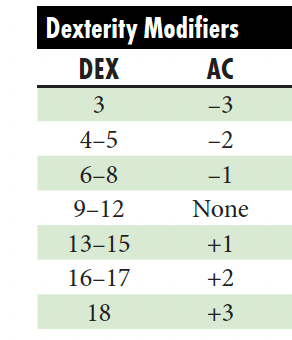
Well, my Cleric, broke and pitiful as he is, is also clumsy as fuck. His Dexterity score is 7 and that gives him a -1 to his Armour Class. Now the wording here is extremely confusing. And I don’t know why they did this. So, as we discovered earlier, the lower your AC, the better when you are using THAC0, right? OK, in that case, if you get a negative modifier to your AC, that should be a good thing! But it is not. In the description of the Dexterity Ability Score they write: “a bonus lowers AC, a penalty raises it.” ! Like, what!? Why not just change the table so that a lower DEX score gives a +1 or +2 and a high score gives a -1 or -2?! Baffling. I need to point out that this is not the way they did it in my extremely old and battered copy of the AD&D 2nd Edition Player’s Handbook. As the picture below proves:

Anyway, what this means is that my Cleric, in his leather armour has:
- AC: 8
12. Note Level and XP
Pretty straight forward:
- Level: 1
- XP: 0
13. Name Character
- Canon Fodder
That is all.
This disastrous character creation post has been brought to you by Old School Essentials and very bad luck.
Anyone else got a truly desperate OSE character to share?
Discover more from The Dice Pool
Subscribe to get the latest posts sent to your email.

 The Dice Pool
This was a thoroughly entertaining read. More character creation content, please!
LikeLiked by 1 person
Your wish is my command. Go check out today’s post.
LikeLike
Canon Fodder is absolutely brilliant name for this poor little guy 😂😭
brilliant read!
LikeLiked by 1 person