Cosmic Dark: Assignment Report

Understanding the Assignment

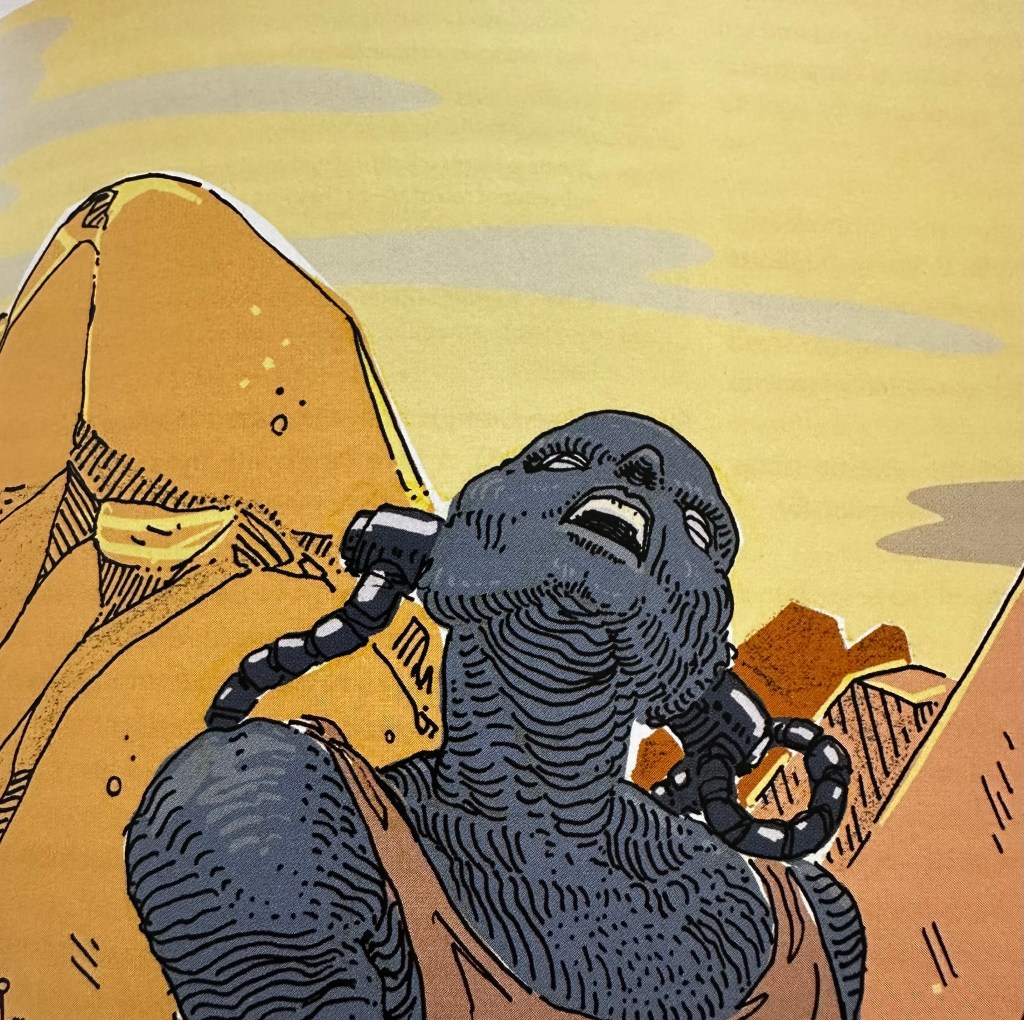
What is the end goal of a game of weird space horror like Graham Walmsley’s Cosmic Dark? The answer seems obvious, I suppose. If you go to see a horror movie, you want to come out feeling like you got your money’s worth in spilled popcorn, whimpers, screams and nonodontgointhereyouidiots. So you should expect something similar from a game like this, right? Well, yes, of course. In fact, the rather ingenious conceit of a game like this, is that, knowing the style of play you’re looking for, as a player, you can go into it understanding what you can do to help push the themes, the jumps, the horror of it. There’s some strange, violet rock that appears to be moving? The character might be a geologist and know that it’s their job to go examine the rock, but the player knows they’re in a space horror game, which is why they should go and examine it. And this is pretty much how our one-shot of Cosmic Dark went last weekend.

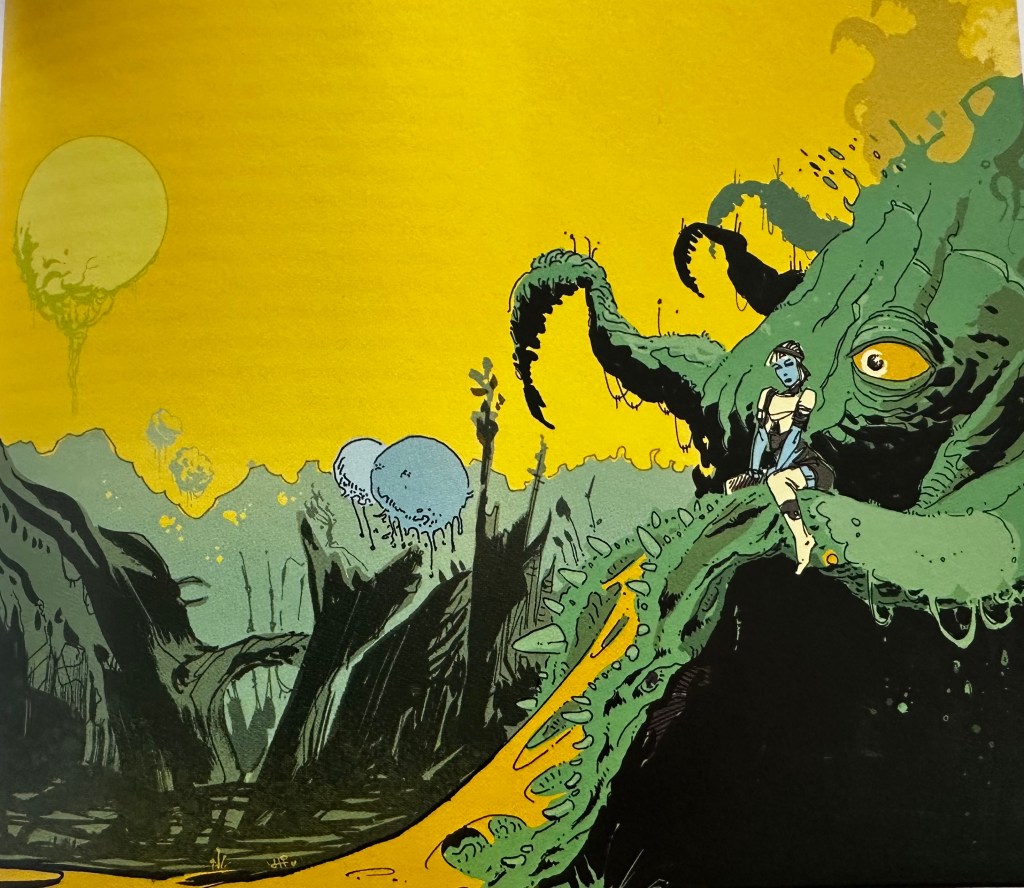
But there’s more, of course, because let’s not forget the ‘Cosmic’ bit, the ‘weird’ bit. Because, although the body horror really hit hard at times, the dreamy (nightmarey maybe,) psychological horror felt all-encompassing. There is a section in the scenario that is aptly called “Dreaming and Waking.” Unpretentiously, it refers to the bizarre dreams the Employees experience during their first night on the assignment. It gave me more or less free rein to describe immersive dreams for the characters that related back to the answers they gave in psych evaluation questions earlier in the game. Of course, this served only to highlight the dreamlike atmosphere of everything on the assignment up to that point, in my opinion. Time was behaving differently, the rocks were undulating and growing, seemingly safe spaces were revealed to be anything but… The players and the characters were on edge, really from the start. And, thanks to the mechanics, they got closer and closer to that edge as the session went on.

Character Creation

We played the first Cosmic Dark Assignment, Extraction. Check out my preview blog post here, where I explain the way the players create their Employees as part of that scenario.

At the table, this went down a treat. Forcing players to choose their Employees’ specialisms only at the point where they are being asked to acknowledge over comms on the shuttle to the Assignment is clever and the players got a kick out of it.

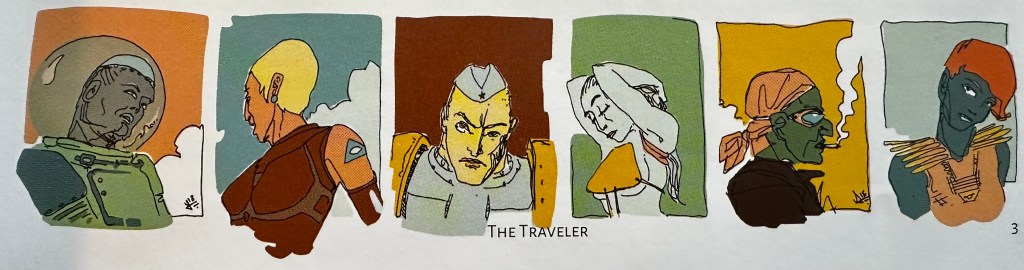
But the real star of the show is the series of flashbacks they go through to get a picture of their characters. The flashback method creates memories, not just characters. The requirement for each PC to identify another as a rival or a figure of admiration or some other influence, and to include them in the flashback scenes, creates a shared history and a character dynamic that you simply can’t conjure from dry discussions over a character sheet. If you have played any PBTA games, dear reader, you might be aware that they usually include a section for bonds with other PCs. You and the other PC have to come up with some reason why you are blood-brothers or why you’re worried about the other’s survival or why you had a vision about them. But you do not act it out. You don’t, at least in my experience, role-play a scene together to elucidate the reason for the bond. That’s exactly what you do in Cosmic Dark. In fact, each player has a scene of their own and may choose any of the other characters to share it with. These scenes are supposed to be short, just a minute or two, but long enough for them to find their characters’ voices, outlooks, relationships. And the Director (GM) provides prompts to kick-start these scenes. The players are given a line of dialogue for one of them to say to begin. I was skeptical about how well this could work at a table of regular players. Up until now, I have only seen it done at a table of professional actors on Ain’t Slayed Nobody. But I needn’t have worried. Every one of my players took that single line of dialogue like the baton it was, and ran with it, inventing hurdles, falling and picking themselves up again. And the table I had? Four players with a wonderful mix of experience levels, some who have played a variety of RPGs for years, one with just a few months of play under their belts with Tables and Tales and even one for whom it was their very first role playing experience!

The aspect of character creation (it’s one of the parts that is ongoing throughout the game from what I understand) that I had a little difficulty in running and incorporating as intended is the psychological assessment. There is a moment, that also occurs in flashback, the night before the Assignment, when they are lying in their sleeping pods on the Extracsa transport vessel, the Exchange, and they are asked questions like “what scares you most about being alone?” Or “what is the most terrifying way to die?” You are supposed to. Push the PCs to answer truthfully, indicating that Extracsa will know if they are lying. This part was ok, actually. I was able to get some revealing and actionable answers from them. It was the re-incorporation of the answers into the later dream sequence that I struggled with. The idea is that you should take note of the PCs’ fears and worries so that you can create a tailored nightmare for them during the Dreaming and Waking section I mentioned above. I think this is something I would get better at in time and with practice. The main issue I had was just referring to my own notes and making sure I got the right nightmare for the right Employees in a way that made it feel like it flowed naturally.

The Assignment itself

I don’t want to go into too much detail here. Honestly, I could not do it justice. Go and listen to the Ain’t Slayed Nobody actual play instead!

But here’s what I will say. I presented an outline of the type of game Cosmic Dark was when I advertised it on our Discord. But I think there was still some misapprehension by the time we started playing. The main feedback I got in this respect was that they expected something more along the lines of physical threats. I believe this is, perhaps, the overriding influence of the Alien franchise. I did refer to Alien in the touchstones I mentioned when announcing the game, so that could explain it. There is nothing like an alien monster in this first Assignment. In fact, as they played through the scenario and uncovered one egregious corporate scheme and strategic lie after another, I think it became obvious that Extracsa are the real baddies here. And, it’s not like there aren’t ways for the Employees to die in the course of the Assignment (we had one death, caused mainly by the Team Leader hitting 6 Changed as he escaped. He flipped the rover he was driving.) And they felt as though they were in danger, clearly. As their Changed scores each hit 4 or 5 (out of 6) they all decided to run away! They witnessed what was in the future for them on this asteroid, a slow and horrific melding with the rock of the place, and they noped out of there before they even reached the finalé! Anyway, if I had any advice for prospective Directors, it would be to make sure you properly set expectations.

How about the scenario itself? So, I only had the text of the Extraction Assignment to work with. Now, this was fine. The rules are contained within it and the character creation occurs during the course of play, as I explained above. However, in the finished book, there will be useful extras to refer to. For instance, if and when an Employee rolls a 5, they are supposed to get a little bonus in the form of records, data from the Extracsa company servers that serve to shine a light on the mystery or, at least, show them how Extracsa is fucking them over. On the roll of a 6, they are supposed to experience an anomaly of some sort. Anomalies are supposed to alert them to the weirdness of the place or the situation or have a direct psychological effect that might prompt a Changed roll. Now, there are a few examples of appropriate records and anomalies in the scenario but the rest will be contained in cheat sheets that will appear in the final Cosmic Dark book. To fill this gap, I listened to the ASN actual play again and made a note of the records and anomalies Graham used in that.

The other thing I picked up in particular from Graham was the style of GMing he does in that AP. He keeps it light and breezy mainly, gently encouraging players to take unnecessary risks, reminding them about the Changed die, reassuring them that that little prick from that piece of weird violet rock is probably nothing to worry about… until the point where he informs them all they need to do to reduce their Changed score is remove that pesky limb… Listen and learn, dear reader! It worked a treat at the table!

As for the rules, I had one regret here. The rules are very light and easy to pick up, but, this opening Assignment is designed to introduce the rules in a specific order to ease the players into them. And it does a great job of that. The Changed die is the first thing that comes up, then investigation rolls and other types of actions. But I forgot to introduce the re-roll mechanic when I should have, thereby allowing the Employees a chance both to do better on certain checks and to increase their Changed score earlier on.

Conclusion

All in all, I highly recommend this game. I want to play more of it. I wanted to play more almost immediately. But I think my experience will be greatly improved by getting my hands on the full book. So, let’s make sure I can, shall we? Go and sign up for an alert on the Cosmic Dark Kickstarter!

Sailors on the Starless Sea Part 1

The Peasants are Revolting

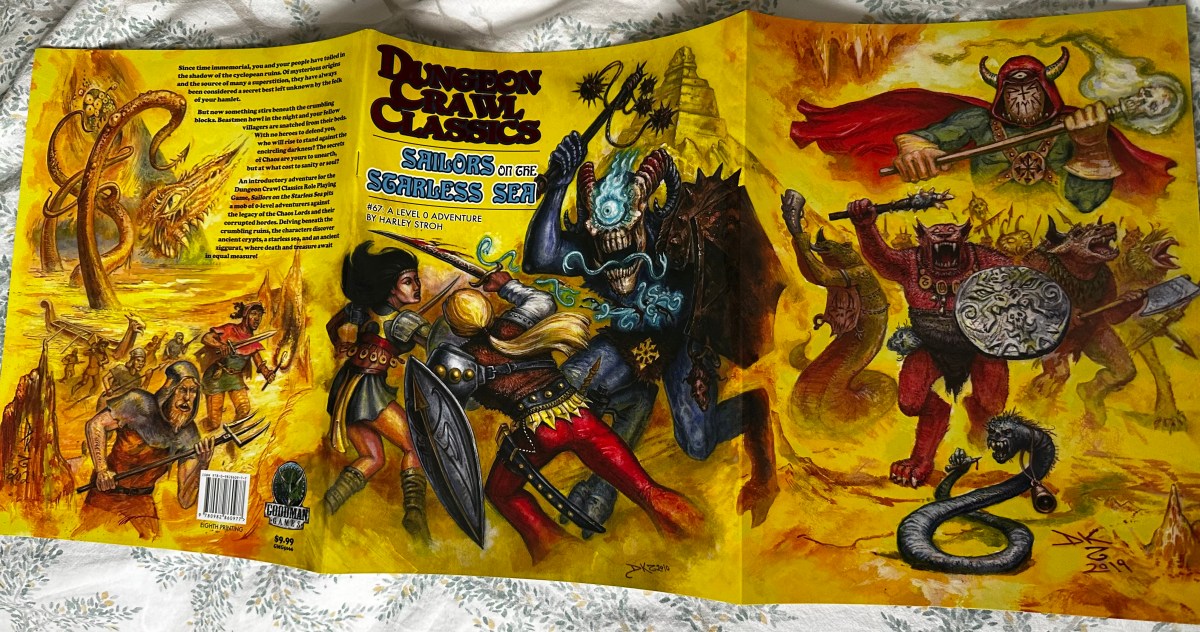
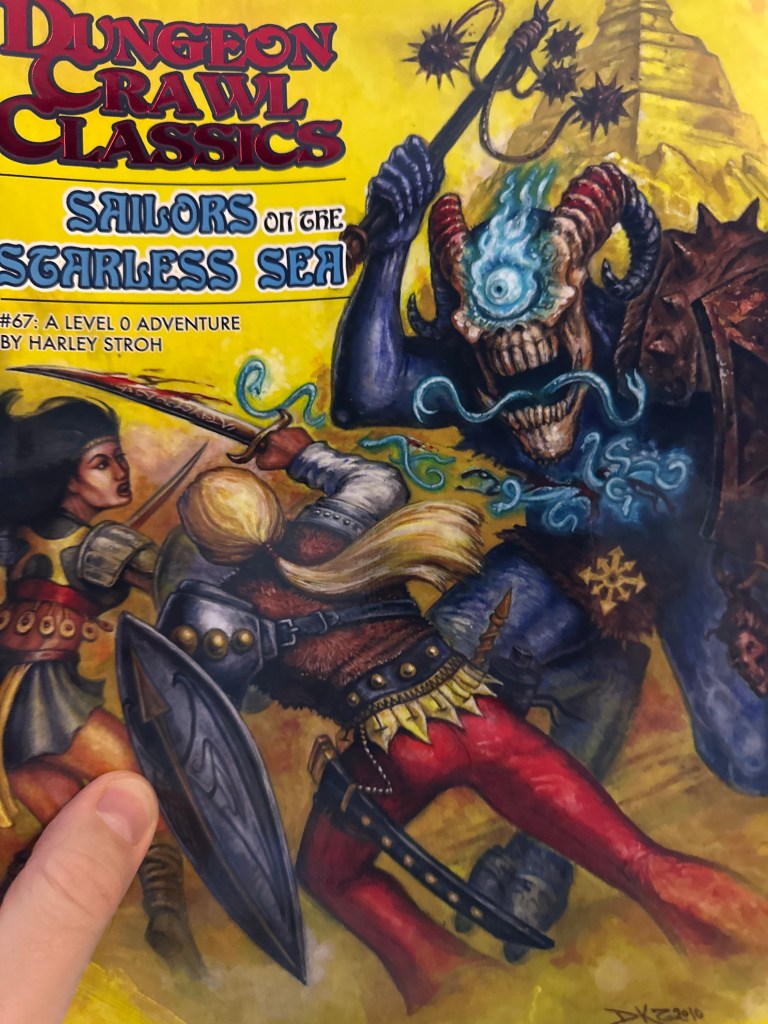
Here’s my fictionalisation of our first session of the classic DCC 0-level funnel, Sailors on the Starless Sea. Six of us, members of Tables and Tales gathered last Sunday evening to play through the first half of the adventure. We had an absolute blast, both with the adventure and the DCC rules.

I may have taken a few liberties and used some artistic license here and there but the major beats are all as they occurred. Spoiler warning if you have not played or read Sailors on the Starless Sea and you want to be a player in a game of it, stop reading now!

The Keep of Chaos

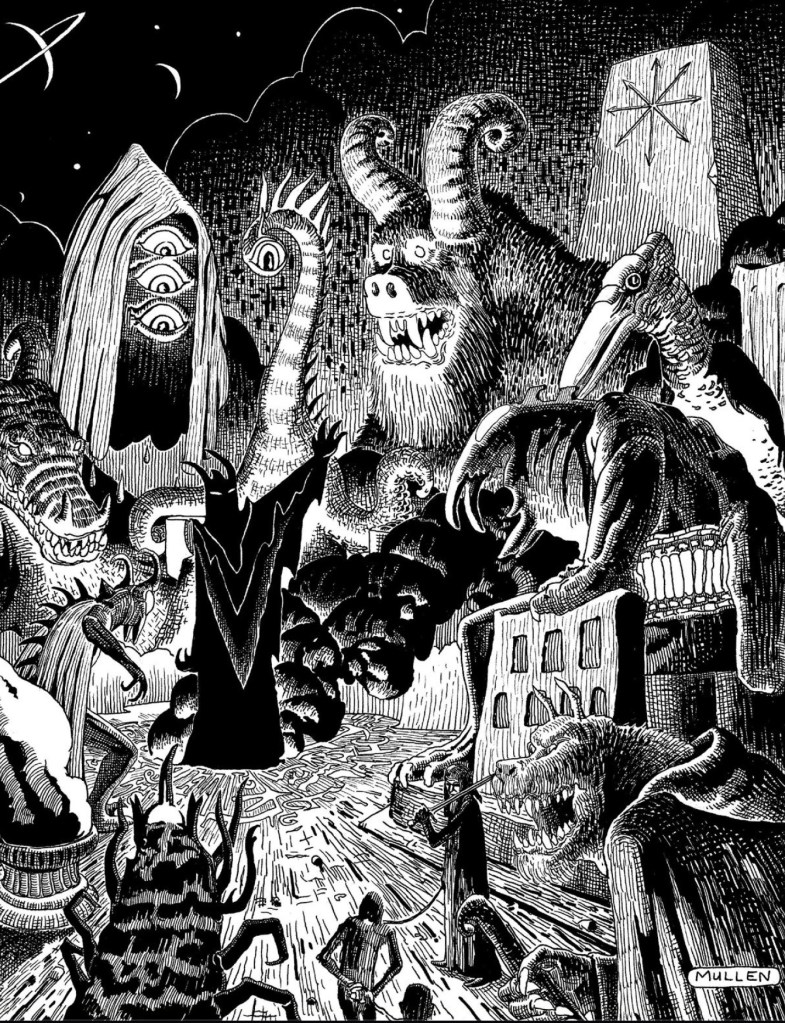
The villagers gathered before the rusting gate of the ancient keep, as a blasphemous banner snapped above the crumbling, ebon walls. Behind the shivering mob, Betsy released a single, unenthusiastic moo as she shuffled in her protective circle. They had made surprisingly short work of the vine choked corpses on the causeway below. The burgeoning corpses of their fellows had shocked some into sobriety while only awakening a greed and opportunism in others that they had previously, perhaps, just imagined they possessed.

Only the half-raised portcullis stood between the no-longer inebriated gang and the rescue of their abducted friends and family. Edgar Hayward Blackburn Hathaway IV, assuming a leadership position, urged his fellows on into the black keep, while the gnoll-reared urchin, Bear scampered in and out, as though possessed by a great desire to poop. Stopping for nothing, most of them marched through, all but the three dwarves doubling over or crawling beneath the spiked portcullis. A few waited on the outside, curious perhaps to see how this entrance worked out for the majority. These were, perhaps, the clever few… just as the final row crossed the threshold, someone above released the portcullis to fall the rest of the way, pinning two of their number beneath. The renowned and beloved corn farmer, Maize, died instantly, skewered by one of the rusty spikes. The survivors would, for ever after, recall his broad, smiling face and his impaled body whenever they munched on a sweet, buttery cob. His little goat ran, unfettered and bleating into the be-brambled courtyard, as the remaining villagers heaved the portcullis up to release the cheesemaker, Gorgonzola, who had somehow survived the portcullis trap. Meanwhile, a bell rang out from above the gatehouse, pealing briefly, but alarmingly. The final few peasants, who had waited out front, joined the mob as they began to explore their hateful new surroundings.

Several of them circumnavigated the overgrown clearing contained within the castle’s broken and burnt walls. But two explored the well. The well seemed to call to Dáinn, his curiosity growing to almost physical strength, pulled him to it. Meanwhile, his companion pulled on the well’s sturdy chain to see what might be lurking below. Dáinn could not resist a peek over the edge, and, before he knew had pitched, headlong, into the darkness below! His companion scrambled to catch him, but it was too late… Luckily, Dáinn came to his senses as he plummeted and managed to grab the chain before he hit the undulating ooze at the bottom. The others pulled him up, but he was not exactly himself anymore… he now sported the flapping ears of a pinkish pachyderm.

Meanwhile, other villagers discovered part of the old wall in the back had utterly collapsed. They decided to leave it alone, nothing a potential for further collapse and possibly fatal accidents.

Nearby, an ancient capstone of some sort, runed and glowing slightly, was discovered. It had been concealed, deliberately or otherwise by thorny vines and scrubby grasses for years. Uncovered, the group’s scribe was able to take a look at it, but, unable to decipher the meaning of the rune, they decided it was best left as it was.

As this occurred, Mu, the monosyllabic Dwarven mushroom farmer, investigated the forbidding portal of the nearby chapel. The terrifying visages of hundreds of demons, screaming and howling had been hammered into its heavy bronze doors, which had been barred from the outside. Mu, heedless of possible dangers, tossed aside the ancient wooden bar and swung wide the doors. Inside, resting impossibly on a floor carpeted in crackling, glowing embers, a half-dozen skeletons still roasted, slowly, in their blackened chain hauberks. A charred chest, padlocked and tempting stood to one side of an elaborately carved fountain. The hellish amphibian likeness of a stone frog belched forth an endless spring of tarry ooze from a mouth seemingly filled with precious gems. Gwydion, the elven artisan, fascinated by the construction of the fountain approached, heedless of the embers. The ooze reacted, raising its undulating bulk up and over the lip of the fountain. It landed on the fiery floor and burst all into devilish flames as it flung a pseudopod, greasy and burning, in the direction of the elf! But Edgar Hayward Blackborne Hathaway IV, always on hand to defend his companions, leapt into the chapel and attempted to fling a dart at the fiery monstrosity. His aim failed him, the strength of his arm directing his attack, instead, to his own unarmored wrist as it escaped his grasp in the worst possible way. His blood gushed, hissing and dancing over the hot embers as he collapsed, lifeless into the sizzling coals. A moment later, despite several fine hits from the other gathered villagers, the ooze’s pseudopod finally connected with his elven target, immolating him. As Gwydion fell, the others fell upon the tar ooze, dousing it and destroying it. Weary now of all the senseless killing, the peasants armed and armoured themselves in what they could recover from the dead ones in the chapel and discovered a curious item of some chaotic deity, a blackened censer and several bales of unwholesome incense that had been locked in the chest. They stowed them for later use and proceeded with their explorations.

A sinkhole dominated the northeastern corner of the courtyard, spewing forth vapours that formed terrible shapes of writhing beasts and men in the air above it. Perhaps this was the way forward? Attaching a rope to the chain retrieved from he well, Darik the hunter braved the uneven and dangerous ground about the edge of the steaming pit to get a better look, his fellows holding on to keep him safe from falling to his death. The ground, indeed, collapsed below him and he dropped seventy feet into the poisonous spume, seemingly still nowhere near the bottom. His investigations revealed nothing of the bottom nor the source of the vapours. He climbed back out and the villagers continued on to the tower in the south east corner, the only area left to investigate…

Sir Chopsalot, the woodcutter, finding the door to the tower guarded by hideous gargoyles and locked tight against their attempts to enter, hoisted his axe and got to work. He worked up a sweat and brought down the portal. McTavish, the blacksmith, his blood up, charged into the tower and was a confronted with a sight and stench of charnel destruction unlike the worst tanner’s pit. The discarded hides and skins of beasts and humans covered the sticky, malodourous floor. Mites and flies buzzed about, biting and swarming over everything. High on the walls of the tower, hanging by their tied wrists from spikes, some of the abducted wriggled and thrashed when they saw him enter, eager for freedom. But he did not have time to act, From the steps above his head, an enormous brute of a beastman, cursed with the head and sharpened horns of a great bull, jumped onto McTavish’s back, crushing him into the ground with his dreadful battle-axe. Then he turned to the villagers arrayed outside and snorted while his beastmen approached from behind. The remaining peasants quickly formed a plan to distract the beastmen while Mira ran to the chapel to fill a steel helmet with scorching embers. Combined with the oil from a flask they had brought, this could cause a conflagration in the tower, destroying the arrayed abominations. As she ran to gather the coals, Sir Chopsalot, the woodcutter, found himself in the way of the charging, bovine beastman champion and was impaled on his great horns. Another monster, with the hideous head of a beagle, speared Gorgonzola, the cheesemaker, finishing the job the portcullis had earlier begun. Mira returned just in time to prevent the rest of the beastmen from emerging into the blood-soaked courtyard. She flung the embers into the awful tower where they set alight the lantern oil. The villagers took some satisfaction in watching the demons burn.

Victorious, the survivors doused the flames and rescued several of their neighbours from their captivity. They searched through the detritus in the tower and were able to discover a map to another keep along with a letter of employment, stitched into the hem of some poor unfortunate adventurer’s cloak. But, before long, they knew it was time to proceed once more. This time, the only way on was down a set of ancient, worn stone steps, down into the darkness below the keep…

Dungeon Crawl Classics Character Creation

Learning to Crawl

It’s been quite a while since I’ve done one of these posts. I think my Dragon Age Character Creation post was the last one. And it was very useful to me in figuring out how that game worked before I started a campaign of it (which is ongoing. The PCs have all just become Grey Wardens without dying during the Joining!) Well, I’ve got a short game of Dungeon Crawl Classics coming up this weekend so I thought this would be a good opportunity to create a character using the DCC rules to help familiarise myself with them.

I’ll be running the iconic DCC #67 Sailors on the Starless Sea for a group of four or five players. To be honest, I don’t expect any of the PCs who survive this 0-level funnel (this is a module where the players play three or four 0-level peasants who delve into a dungeon. Whichever of their PCs survive get to advance to 1st level in their chosen class, normally) to go on to choose a class or progress to 1st level as its more of a one-shot deal. But, you never know! If it proves to be popular or any of them get particularly attached to one of their characters, maybe I’ll brew up a campaign for them. I certainly have enough DCC resources and modules to run campaigns for the next ten years straight!
Anyway, the point is, I think I’ll still get something out of creating an actual character using these rules. So here we go!

Funnelling

For the purposes of this post, I am going to roll up four 0-level characters and then roll 1d20 for each of them. The character that rolls the highest will progress to 1st level while the rest are assumed to have died a gristly and unfortunate death in some stinking hole beneath a castle or in the gullet of some demon lord.
To roll up the 0-level characters, I’m going to use the fabulously useful purple sorcerer, which will do it automatically for me. This is what I expect my players to use when generating their own PCs.

But first, a note on what’s being generated:

  1. Ability Scores – These are Strength, Agility, Stamina, Personality, Intelligence and Luck. All DCC ability scores are generated by rolling 3d6. There are no alternate methods of generating them, no point-buy, no 4d6 and drop the lowest… it’s brutal.
  2. 0-level Occupation – there is a d100 table that covers a page and a half of the book to determine this. Your Occupation also determines your starting Trained Weapon and which Trade Goods you begin with. It will also indicate the type of skills you are trained in.
  3. Money and Purchased Equipment – a 0-level character starts with 5d12 copper pieces. On top of the weapon they start with, they can use these to purchase other stuff
  4. 1d4 hit points, modified by Stamina
  5. A +0 modifier to attack rolls and saving throws
  6. A Lucky Sign – DCC characters begin with a Lucky Sign, which you roll for on a table. This can give the character a +1 to a particular type of roll forever!

One thing that’s not generated is alignment. For D&D type games, I don’t normally bother with alignment. But I think it is so integral to so many of the mechanics of DCC, that I can’t avoid it. The available alignments are Chaotic, Neutral and Lawful. I am going to roll for this on 1d3. I rolled a 2, so this character, whoever they turn out to be is going to be Neutral in alignment.
So, without further ado:

I rolled up one Dwarven blacksmith, a Minstrel, a Herbalist and a Butcher. I’ll quickly go through the high points and low points of each:

  • Dwarven blacksmith – I’ll name them Grund. Grund has a Personality score of 13! That’s his highest. However, his Strength, which would be one of the main abilities of the Dwarf class, is just an 8. Even more alarming is that they have the approximate intelligence of a fence-post, with a score of just 3. Since their Luck modifier is 0 they don’t get any Lucky Sign bonus
  • Minstrel – I’ll name them Flor. Flor’s ability scores are generally very high, strength 12, stamina 14, personality 14 and Luck 15. Only Agility lets them down with a score of 7. They start with 5 HP! Also, Flor as the Lucky Sign, Raised by Wolves, which gives them a +1 to Unarmed Attacks.
  • Herbalist – I’ll name them Bud. Bud’s ability scores are incredibly average. Only Luck gives any kind of bonus (+1) and only Agility gives a minus (-1.) They do have the Four Leafed Clover Lucky Sign, which provides a +1 to Find secret doors. Only starting with 1 hit point, though…
  • Butcher – I’ll name them Cutter. Cutter is weak, (strength 7) clumsy, (agility 8) and unpleasant to be around, (personality 5) but is pretty smart, (intelligence 15) so they’re probably pretty annoying. Luck provides a 0 modifier so no Lucky Sign bonus here.

OK, I’m not going to lie, I’m holding out for Flor to survive the funnel but it’s entirely random so there’s really no telling…

“Funnel” Rolls

So, it all comes down to a single d20 roll for each PC. In case of a tie, I’ll just re-roll both.

  1. Grund the Dwarven blacksmith – 17 (oh no)
  2. Flor the Minstrel – 4 (wah!)
  3. Bud the Herbalist – 18 (a reprieve!)
  4. Cutter the butcher – 6

So, Bud, alone, bleeding and traumatised, crawls out of the crumbling remains of the ancient temple having, with the help of the heroic and now deceased Grund, Flor and Cutter, defeated the ancient evil beneath it. Grabs some treasure on the way out too!

Choosing a Class

So, since Bud is a human (all 0-level characters are assumed to be human unless it’s clearly stated in their title, i.e. Dwarven blacksmith) they can choose from any of the classes except Elf, Dwarf and Halfling, for obvious reasons. Yes, this is another one of those old school games in which “Demi-human” races are treated as classes, kind of like in Old School Essentials. You can check out my disastrous OSE character creation post here.

Anyway, that leaves the following classes to choose from:

  • Cleric
  • Thief
  • Warrior
  • Wizard

Now, Bud’s ability scores are as follows:

  • Str: 9 (0)
  • Agi: 8 (-1)
  • Sta: 12 (0)
  • Per: 11 (0)
  • Int: 9 (0)
  • Luck: 13 (+1)

Normally you would go with the class that matches your highest ability score, right? Well, I could do that, but Bud’s highest is 13 for Luck, which is useful for all classes. Next is Stamina, on 12, but, once again, no one class relies on that. You could argue for Warrior there, but with a Strength score of 9, I don’t think it makes sense. So, instead, I think I will go for Cleric, since they use Personality to cast their spells and that’s Bud’s next highest Ability score, at 11. They don’t get a bonus from it, but it’s as good a reason as any to choose a class, I think. Oh, also, the Herbalist already started with a Holy Symbol, so it seems fitting.

From the DCC book:

An adventuring cleric is a militant servant of a god,
often part of a larger order the faithful, they wield the
weapons of their faith: physical, spiritual, and magical.
Physically, they are a skilled fighter when using their
god’s chosen weapons. Spiritually, they are a vessel for
the expression of their god’s ideals, able to channel holy
powers that harm their god’s enemies. Magically, they
are able to call upon their god to perform amazing feats.

Hit Points

Each class rolls a different die for hit points, just like in D&D and OSE. If you’re a Cleric, you roll 1d8 per level.

Bud rolls a 6 on their 1d8 and adds it to their 1 hit point from level 0 to make 9.

  • HP: 9

Choosing a God

If you choose to be a Cleric, you have to choose to worship a God of similar alignment to you. In Bud’s case, that Neutral. I am going to consult the Gods of Eternal Struggle table and choose one of the Neutral deities from that.
I have recreated the Neutral gods section of the table below:

AlignmentGodsWeaponsUnholy Creatures
NeutralAmun Tor, god of mysteries and riddles. Ildavir, goddess of nature. Pelagia, goddess of the sea. Cthulhu, priest of the Old OnesDagger, mace, sling, staff, sword (any)Mundane animals, un-dead, demons, devils, monsters (e.g., basilisk or medusa), lycanthropes, perversions of nature (e.g., otyughs and slimes)

With their background in herbalism, I feel as though Bud would lean towards the worship of Ildavir, goddess of nature. As you can see from the table above, they get a semi-decent selection of weapons they can use. It is also interesting to note at this point that Clerics can wear any armour and it won’t affect their spell-checks. Finally, you can see they are able to turn an array of interesting creatures, not just undead.

Magic

In DCC, when you want to cast a spell, you have to roll a spell-check. This is an obvious departure from D&D. Another difference is that they don’t get spell slots. However, there is a downside here. If you fail in your spell-check roll, you risk the ire of your deity. In the normal state of affairs, if you are trying to cast a spell and you roll a nat 1 on your spell-check, the spell auto-fails and you get to roll on the Disapproval Table. This can lead to consequences ranging from this:

The cleric must atone for their sins. They must do nothing but utter chants and intonations for the next 10 minutes, starting as soon as they are able (i.e., if they are in combat, they can wait until the danger is over).

To this

The cleric’s ability to lay on hands is restricted. The ability works only once per day per creature healed – no single character can be healed more than once per day. After 24 hours, the ability’s use reverts to normal.

Worse still, your chance of auto-failing goes up by one, meaning auto-failure and a Disapproval Table roll on a 1 or a 2. It gets worse; for every spell-check failure in the same day after this, that auto-failure range increases by another 1, with no real upper limit.

You can also piss off your deity by “sinning,” e.g. acting in a way that contradicts the god’s teachings or benefits one of their enemies.

Now, there is a way to offset these consequences: sacrifice. Yep, all you have to do is destroy or give away 50gp worth of wealth in your god’s name to reduce the failure range by 1 point. They might also accept a great quest of undertaking of faith instead.

Spells

Anyway, back to the spells! Bud starts knowing four Level 1 Cleric Spells, according to Table 1-5: Cleric. So, let’s choose them!

  1. Blessing – this can be used to bestow all sorts of boons on the cleric themself, an ally or even an object. Since every spell in the game comes with its own table to determine the exact results, I’m not going to get into it here. Suffice it to state that you can get anything from a +1 to attack rolls for a round, right up to getting a permanent +1 for the whole party to any actions to do with a sacred endeavour they have undertaken.
  2. Holy Sanctuary – this creates a place of safety for the Cleric and their allies. It might simply make it harder for enemies to hit them in that space, or it might allow the Cleric to create a permanent place of sanctuary, such as a temple, where powerful enemies cannot attack the faithful at all.
  3. Second Sight – the Cleric gains divine insights into the results of their own actions. It might be a +4 bonus to a single action roll or it might be able to divine the outcomes of great events for a month and also receive a +1 bonus to all actions taken during that period!
  4. Word of Command – Use a single word to command a creature to do something. The effects range from just that to it targeting all desired creatures they can see, who must obey it for a number of days.

All Cleric spell checks are made like this: 1d20 + Personality modifier + caster level

Turn Unholy

You saw above the range of creatures that Bud can turn with a Turn Unholy roll. This roll works the same as a spell check, so 1d20 + Personality Modifier + caster level. However, when Turning, the cleric can also add their Luck modifier. In Bud’s case, this is good because they have a +1 in that.

Failing a check can incur the Disapproval of their deity just like failing to cast a spell.

On a success, there is a fairly complicated set of potential outcomes depending on your turn check roll and the Hit Dice of the creatures you’re trying to turn.

Lay on Hands

Bud is a healer as well, of course. In fact, the Lay on Hands power is the only real way they have to heal anyone. But! They can use that to heal them of hit point damage, disease, poison, broken limbs etc. They can use it to deal with pretty much any condition.

Of course, just like with Turn Unholy, you have to make a spell check to use this power, 1d20 + Personality modifier + caster level.

The dice you use to heal someone depends on their class/type of hit dice they use. So, for a Warrior, who uses a d12 for their HD, healing is also rolled on a d12, which I think is neat. Although you can never roll more dice to heal than your target has in HD already.

Alignment is a factor in healing. If you try to heal someone of different or even opposing alignment to your character, you are going to probably do less healing than if you were healing someone of a similar alignment. As a Neutral Cleric, Bud is probably in the best position in this respect, as both Chaotic and Lawful creatures are considered adjacent to him on the alignment table, which I have reproduced below:

Spell checkSameAdjacentOpposed
1-11FailureFailureFailure
12-132 dice1 die1 die
14-193 dice2 dice1 die
20-214 dice3 dice2 dice
22+5 dice4 dice3 dice

Divine Aid

You can just ask your god for anything really. But it must be a truly extraordinary act to get them to intervene on your behalf so directly, when they are already giving you spells and other powers. So, to achieve this, you make a spell check as normal, and, even if you succeed, you are lumped with a cumulative +10 penalty to future Disapproval range… the Judge (DM) gets to decide the exact DC and effect of the request depending on what the intention was, what the god might want and how big the intervention needs to be. This seems like it could be used in some really clutch moments though.

There are a couple of notes right at the end of the Cleric class description. One relates to Luck and how their Luck modifier can be added to Turn Unholy rolls. The other indicates that their Action Dice can be used to attack or cast spells.

Equipment

The Equipment Chapter starts with a table that indicates how much gold your character stats with if you decide not to opt for the 0-level funnel method of character creation. If a Cleric starts at level 1, they get 4d20 gp. So let’s roll that:

  • 20 (yep, out of a possible 60 gp)

At least I can add the 48cp I rolled up on their level-0 character sheet. Well, let’s make the best of it. I am going to buy a decent weapon, since Bud started with nothing but a club, and hopefully some armour.

I think I am going to go for a modest

  • mace (1d6 dmg)

and back it up with a

  • sling (1d4 dmg)

That’s a total of 7gp. I had also better get some

  • sling stones

for another 1gp.

Finally, the only armour poor Bud can afford is

  • padded armour (+1 AC)
    That makes Bud’s AC 10 because of the -1 Agility modifier.

That costs 5gp. So, Bud has 7gp and 48cp left.

So, let’s grab a

  • Backpack for 2gp
  • Flint and steel for 15cp
  • 10 torches for 10cp
  • 5 days of rations for 25cp
  • a waterskin for 5sp
  • 50’ rope for 25cp
  • A grappling hook for 1gp

For a total cost of 3gp, 5sp and 75cp.
Which leaves Bud with 3gp 2sp and 3cp.

So, that’s pretty much it for Bud the Witness (that’s their title as per the Cleric Table) I like Bud. They’re a survivor and a true devotee of Ildavir, goddess of nature, but they will never forget their humble beginnings as a herbalist, nor their old companions, Grund, Flor and Cutter.

Thanks to Soxzilla2 on reddit for the form fillable character sheet! You can find that here.

The Theatre of Trophy Gold

Getting my flash in

Orlen, dusty, wide-brimmed chapeau drowning her alarming eyes in shadow, holds aloft her trophy, beaming. The bag of coin, pleasingly hefty, dangling from her dextrous digits. “‘Aah ‘baht ‘at ‘en?” Her companions, ensorcelled by something above her sturdy, sinister shoulder, point. A hiss, as a punctured bladder, sounds in her ear. Speculative, her left hand shoots up, ready to throttle the looming serpent. It narrowly misses losing its ring finger as a dagger, recently released by Rasei, skewers the snake to the formerly coin-concealing statue. Orlen chances a glance. The cold blood dribbles down the stone man’s shoulder, over the sickle he holds dramatically crossing his sword over his chest. Nima cries, “More snakes!” Time to go. The treasure hunters scarper down the path of the sickle, ignoring the sword’s point and the keep slouching beyond it on the horizon, hoping for Hester’s Mill.

A dramatic retelling of the opening scene of our recent game of Trophy Gold, run by friend of the blog, Isaac. To those who were there, apologies. I’m sure I got a few details wrong, either deliberately or by mistake. Drama seems appropriate for this fascinating game, defined as it is, within Sets.

Trophy

So, as you probably know, dear reader, if you have been with me for a while, here on the dice pool dot com, I am a more-or-less avid listener of the Fear of a Black Dragon podcast from the Gauntlet. I wrote a post on my appreciation for it and the Indie RPG Podcast last Summer. Our path to playing this incursion (as Trophy scenarios are called) leads very much from that. Jason Cordova, one of the podcast’s capable hosts, rarely ventures into the OSR’s hex-defined landscapes. Rather, you can generally find him in the narrative woods and trails of story-based games. On the podcast, he often discusses his experiences in running OSR (or just old tbh) modules in other systems. Back in the olden days of Fear of a Black Dragon, this generally meant either the incredibly rules-lite World of Dungeons or Dungeon World My last post on this blog was about the feelings Dungeon World made me feel. Go and have a look!) These both have PBTA DNA. Their mechanics lend themselves more to the application of imagined narrative than cut-and-dried, D&D-esque, result-binary systems. And this is really only because of the inclusion of a third option, a mixed success, or success at a cost. Since the implied consequence cannot be defined outside the context of the situation, it is usually left up to those at the table to invent it (although Dungeon World generally provides far more pre-written options than does the baldly efficient text of World of Dungeons.) And look, if you’re a PBTA maven, my deepest apologies for what is, no doubt, a faintly condescending and largely inaccurate paring down of a game system that is probably the most influential in the indie game space of the last decade and a half. But if you were raised on a distilled diet of Borgs in your old schools, you’re welcome.

I have gotten off track. The point I was trying to get to was that, a few years ago, Jason switched to running pretty much every module in Trophy Dark or Trophy Gold instead. Mostly Trophy Gold, in fact. Obviously, this got me very interested in the game. The idea of running D&D style modules in a more narrative style highlights a whole new facet of the hobby that I always thought would be very fun to explore. And, after reading a bit about the game and learning of its mechanical descent from Blades in the Dark I wanted to try it even more. It just turns out that, much like Tom (with Dungeon World,) before him, Isaac got there before me. I’m not complaining. I love being a player in these games.

So, to put it briefly, both Trophy games were written by Jesse Ross and published by Gauntlet Publishing. Elements of the rules have been adapted from Blades in the Dark by John Harper, who is also responsible for World of Dungeons and other elements were cribbed from Graham Walmsley’s seminal Cthulhu Dark. They are games about treasure hunters going out into the dark forest to find gold and bring it home so they can continue to survive in a hostile world. In Trophy Dark, your vile little adventurer is a goner; you’re not making it past the end of the session. Sorry. That’s the point of Trophy Dark. But in Trophy Gold you make a treasure hunter who might live to the end of the incursion if you’re lucky. They might even weasel their way through to another one. Speaking of which, I wrote a blog post about making a Trophy Gold character last summer. You may find it illuminating if you’re interested. Do bear in mind, though, the game I used in that post is not quite the same as the one presented in the book published in 2022. I used the game from the Codex Gold magazine, which you can pick up for a steal over on Drivethru. I don’t think there are any really drastic rule changes but we noticed some discrepancies in a few of the tables.

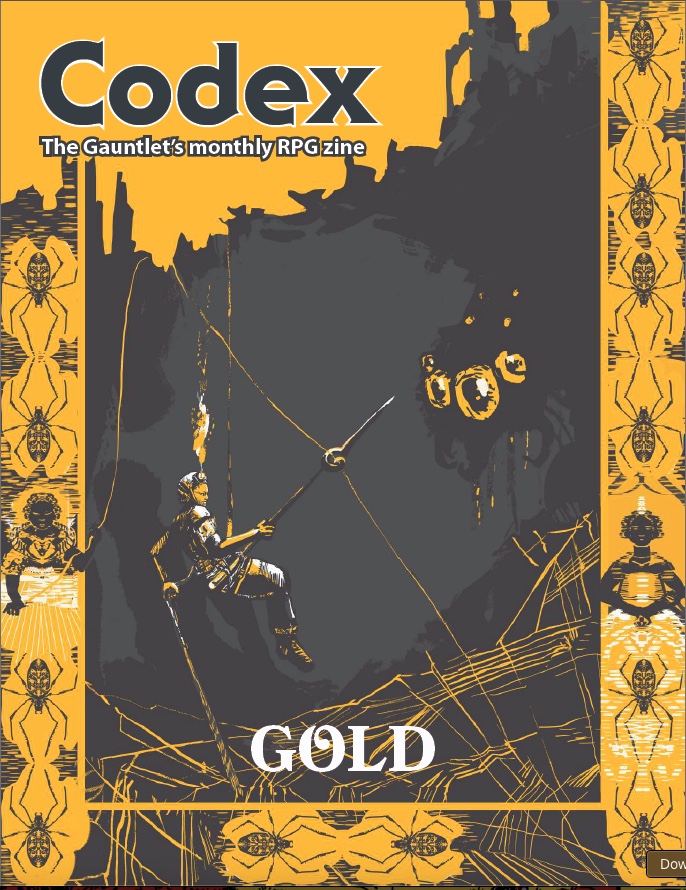
A gold and black illustration of an adventurer being lowered on a rope into a dark cave where a giant spider awaits. the cover is framed by stylised black spiders on a gold background. The words, Codex, The Gauntlet's monthly RPG zine appear in the top left of the cover.
The cover of Codex Gold from Gauntlet Publishing

Hester’s Mill

So, what’s all this about Sets? You didn’t think I remembered mentioning that earlier, did you, dear reader? Well, Incursions are formatted in a very particular way. Trophy Gold helpfully breaks it up and introduces the format like this:

  • Theme – much like any dramatic work that might be presented on the stage, a Trophy Gold incursion should be built around a theme, even if you are adapting it from another type of module. I would call the broad theme of Hester’s Mill to be “Harvest”
  • Sets – these are particular locations in which the treasure hunters will be presented with clear goals. I find it fascinating that the rules tell the GM to make the goal explicit to the players. I’m not giving away too much by telling you that the goal in the opening Set I wrote up in the intro is to find the way to Hester’s Mill. You complete the Set by achieving this goal and this is eminently important to the cycle of play. You may not wish to complete the goal of every Set. It might not be clever or necessary for you. Your character’s overall goal is to earn enough Gold to relieve them of their Burden, both of which are abstract scores on the character sheet. In other words, you know from the start how much you need to take home so you don’t die on the streets or get consumed by the evils of the world. I don’t think anyone would blame you for trying to convince the party to get the heck out of there once you had managed to collect enough money. But, just because you got your Benjamins, doesn’t mean everyone else did. This can lead to inter-personal conflict, unsurprisingly. But it might also lead to moments of support and kindness in these Sets. Drama, gettit? And guess what you call the things you find within the Sets… Yep, Props. It’s obvious, really. So the statue of the man with the sickle and sword in the intro? Yep, that’s a Prop. You also have Treasure and Traps as defined elements within Sets
  • Flowchart – What the holy business-process, Batman? Yep, it makes so much sense, when you think about it. When you are trying to play something like an OSR module, you might have a map which visually represents the location but that does not necessarily represent the decisions, actions and repercussions that might lead the PCs from one Set to the next. In many ways, the Flowchart is the more useful of the two. I’d like to give it a go in any game where I’m running a particular scenario, honestly. Not very theatrical though, disappointingly
  • Monsters – these are specifically mentioned because the section I am referring to in the Trophy Gold rules from Codex Gold is there to explain how you might convert an OSR module to be played using Trophy Gold instead. So, Jesse Ross has helpfully provided a lot of advice on converting Monsters, a staple of the genre, to be used in that system. One of the most fascinating aspects of the game is that the monsters do not come pre-named. That is left up to the party. This can be either cool AF or disastrous. The monsters we encountered in Hester’s Mill so far have been both bonkers and horrifying. And if it had been left up to me, they would have been called something stupid
  • Magic – Similar to Monsters, this includes advice on conversion. But, I will say that there is a very useful table of already converted D&D style spells presented in the rules for you to use.

Anyway, it should be clear that the Set is the main denomination of organisational structure within an Incursion. So far, I think we have interacted with three or four Sets in Hester’s Mill and achieved the Goal in two or three of them. You can use another highly abstracted currency, the Hunt Token, to complete a Set without having to actually face its dangers. You can receive (and also lose) these tokens on a Hunt Roll, one of the three types of rolls in the game. If you spend three Hunt Tokens like that, you simply draw the curtain across the stage and open again on the next Set and get to work on the new goal.

In general, rolls, of which you have Hunt, Combat and Risk, are made using a dice pool mechanic much like that used in Blades in the Dark. The D6 is the only die you need but you will need them in Dark and Light varieties. You will always roll a Dark Die in Combat and you can roll one to give you a better chance of success on a Risk Roll if you’re willing to risk mind or body… More drama.

The Combat Roll is particularly fascinating because it doesn’t work like a regular success/failure roll at all. Instead, you describe how your character exposes themselves to harm in the battle and then roll your Light Die. That number is your Weak Point. You then roll a Dark Die for each of the treasure hunters in the fight. Ostensibly, you’re rolling against the Endurance of the Monster, but, if any of them roll your Weak Point, that increases your Ruin, which is like a harm track. One you hit 6 Ruin, you are Lost… So dramaaaatic, right?

Add to this the Devil’s Bargain, nicked from Blades in the Dark and you have a recipe for some real dark character moments in Trophy games. You crowdsource the possible options for both Devil’s Bargains and unfortunate consequences of failed rolls from everyone around the table and this makes for some extremely fucked up inevitabilities on a lot of rolls.

In conclusion

We have yet to finish Hester’s Mill. I know we have at least one more Set to get to. I’m really looking forward to going back to it. We’ll be dealing with the aftermath of something pretty messed up and, hopefully, finding some more goodies. I have to say, the Incursion has been very pleasing in introducing us to a lot of lore and cool fantasy history while also giving us the opportunity to get into fights and burn down shrines so far. With any luck, there’ll be more of that as we wrap it up next time.

How about you, dear reader? Have you played Trophy Gold? Or Hester’s Mill? What did you think?

The Feeling of Dungeon World

Hirelings to Heroes

My good friend Tom. recently kicked off a Dungeon World campaign. I’m a player in it. It’s got a very particular flavour and premise that places the players in the position of being the hirelings of the “real” adventuring party. And so it was at the start. But, before we had a chance to yell, “WATCH OUT FOR THAT FLESHY BOI MAN THING” the tables were turned and the PCs had to dig deep and find something heroic inside themselves or have the entire group die horrible deaths in the depths of the first dungeon. I would like to give a big shout-out to Tom’s awesome in media res beginning in a massive organic mouth with eyes on the inside and little flesh monsters. It rocked.

My character is Craobh Beag (pronounced something like Kreev Byug), a Kyrfolk (think minotaur whose bull half was a Highland) druid. Had a lot of fun with the shapeshifting and his generally chaotic nature. You can check out Tom’s post about how they built the world we’re playing in here.

A shaggy, red-haired straight horned cow in a field.
This is what my Dungeon World character looks like except with two legs and more vines. Highland cow by Nilfanion – Own work, CC BY-SA 3.0, https://commons.wikimedia.org/w/index.php?curid=7868883

Old School?

But what I want to write about today is what the game evoked for me. As a player of a certain age, my first introduction to RPGs was the red D&D boxed set back in the late eighties. This was fairly normal at the time, as I understand it. It really was magic. I don’t remember too much of the mechanics of playing that game. My memory is reliably questionable. But I have a distinct memory of the feeling of it. The wonder of imagining my little dwarf swinging his wee hammer at monsters in some unnamed dungeon, having real adventures! I’d played choose your own adventure books like Fighting Fantasy and Zork before but this was entirely different. There was no way of save-scumming by keeping a finger on the decision entry page so you could go back if you didn’t like the outcome. The consequences felt consequential and the world was wide open. No limits!

When I think of old school games, I think these are the feelings they should elicit. Fear of threat, concern for real consequences, appreciation of truly impactful decisions, a sense of freedom in an open world and an enjoyment of the fantastic. I want to be fearful for the life of my character. I need to know that the decisions I make can have a truly terrible or wonderful impact on the world in some way. Now, there are a lot of differing opinions out there as to what constitutes an OSR principle. Some of them involve the inclusion of resource management, others disregard that as non-essential but insist that they should be ‘rules-lite.’ Anyway, let’s take this list I lifted from Wikipedia that comes originally from Matthew Finch’s A Quick Primer for Old School Gaming (2008.)

  • Rulings from the gamemaster are more important than rule books. Concoct a clever plan and let the gamemaster rule on it.
  • Player skill is more important than character abilities. Outwit the enemy, don’t simply out-fight them.
  • Emphasize the heroic, not the superheroic. Success lies in experience, not superpowers.
  • Game balance is not important. If the characters meet a more powerful opponent, either think of a clever plan or run away.

I think we can see that these four pillars of OSR games cover a lot of the feelings I want to get out of them. A sense of the fantastic is noticeably absent. But that might be something specific to me.

Dungeon World (2012) by Sage LaTorra and Adam Koebel supports this type of play so well. It ticks all these OSR boxes! Now, obviously, I have only played the one session of it so far, but I have to tell you, the first of the stars I sent to Tom after that session was this:

right at the top I have to say that this is the closest I feel I’ve gotten to experiencing the feeling of playing old school dnd in a very long time. Despite the system being slightly different, it’s close enough that it feels familiar. More importantly, it’s the overall atmosphere [Tom] has created with a pretty traditional dungeon scenario with puzzles and traps in a recognizable fantasy setting. It really brought me back.

It’s an odd duck, Dungeon World. It is very much a PBTA game. You have bonds and moves and holds and degrees of success/success with consequences when you roll your 2d6. But you also have D&D’s core abilities, alignment, HP and magic spells. You even have classes like Dungeons & Dragons. The standard races are human, elf, dwarf and halfling (Tom has tweaked the list of available races or cultures in their campaign. Once again, you can read more about that in their own words here.) So, this is how it retains the flavour of D&D without the ruleset. LaTorra and Koebel could have made a dungeon exploration game that was far more Apocalypse Worldy. I mean, do you really need the D&D style stats? No. Is alignment necessary? No. But we are trained to understand that the fiction presented by those things is reminiscent of a particular type of game that we want to experience the feeling of again. Well, that goes for those of us who have had that feeling before. For others, who maybe never played anything but PBTA games and are loathe to dip their toes into OSE or DCC or even actual D&D, it offers them a chance to do that.

So we were on a storm-wreathed cliff-side, and we were being led by a ghost dog we had just befriended. The ghost dog walked through the air to the other side of the cliffs as though the rope-bridge was still standing. But the bridge had been cut in the middle. Still, we knew the undead doggie was trying to direct us to where we needed to be, so we used a combination of moves (shapeshifting into a forest bird), equipment (lots of rope, which our paladin ended up losing as a consequence of his actions) and luck (mixed success) to make it across to the other side (even though the self-same paladin decided it would be clever to tightrope walk across and nearly plummeted to a nasty death as a result.) This one scene involved most of the pillars of the OSR that I quoted above.

Old as new

Sometimes I find I just have to write about games like this, that are brand new to me, even though they have been out for over a decade. I’ve done it with OSE and Dragon Age too. This might seem a little redundant to some, but the way I look at it is that, if it’s new to me, it’s new to someone else too. I have to remind myself that somebody discovers OD&D every day. I only first tried a PBTA game about three years ago. When it comes to RPGs, there are trends and movements and there is always something new coming out. And there are quite a few people publishing articles on them. But I don’t think that any reason not to write about games like this that I am enjoying and enthusiastic about right now, no matter how old.

Dear reader, we have literally, only just begun our Dungeon World adventure and I am hoping to write more about it and the other games I’m currently involved in over the next few weeks. There are so many! I am looking forward, next, to discussing Trophy Gold, run by Isaac, and a new project/event that Tables and Tales is cooking up too. So stick around for more!

The Dice Pool at One Hundred (Posts)

Progress

The last time I wrote a post like this one was waaaaay back on post number 30. That was a mere month after I started thedicepool.com. I used it as a sort of check-in with myself. I decided, at that point to quit posting daily as a way to make this more sustainable and to increase quality at the expense of quantity. I thought, at the time, that I would be able to spend days working on a single blog-post, researching, editing and polishing. In practice, that has happened only rarely. Normally, I spend most of the week skiving and then, with my self-imposed deadline looming I pull on my blogger’s hat, think of a topic and wheel my office chair up to my desk to actually write it in an hour or two.

I do wish I could more consistently plan, write, edit and post. Mainly because, the posts where I have done that are usually the ones I’ve been most proud of. I would include my series on Between the Skies, and the post about my experience with After the Mind the World Again. Both of these prompted their creators to contact me directly and After the Mind the World Again got a mention from Thomas Manuel on the Indie RPG Newsletter making it my most viewed post by a pretty wide margin. So, I’m going to redouble my efforts to spend more time on posts to produce something I can be more proud of.

Saying that, I am happy with some of the progress I have made with the Dice Pool Dot Com. Joining the Wood-paneled Web Ring run by Stu Horvath or Vintage RPG fame, was really cool. I would love to see more sites join Wood-paneled actually, as I really believe in it as a less corporate form of online community-building. If you’re reading this, dear reader, and you have a site that you think would be a good fit, go check out the web ring at the link above and contact Stu for an invite. I know he’d be thrilled to add a new member.

As well as that, I may not have won any prizes, but I was happy to be a part of the 2024 Bloggies. I think the dice pool came in about 7th place in the Debut Blog category, which, having read the other entrants who came higher than me, felt about right, to be honest. In fact, it was the exposure to all of these amazing blogs by people with similar interests and the desire to write about them was the best part of the Bloggies adventure for me. It got me thinking about the sorts of topics I’d like to write about, gave me ideas for riffing off other bloggers’ posts and made me think about the value of blogging in general. By the way, Clayton Notestine of the Explorer’s Design blog won the overall Platinum Medal for this post: The 1 HP Dragon. You should go and read that and subscribe to his awesome blog. Some really thought-provoking ideas in it. While you’re at it, go and check out Murkmail, who won the Debut Blog prize. They have grown enormously during 2024 and the blog is well worth a read.

What a week!

I say I want to spend more time working on blog posts, but, if I continue to have week’s like this one, I’m not sure how I could. Here was my gaming schedule for the past week:

  • Monday: The Darkest Dungeon board-game campaign in person
  • Tuesday: Dungeon World: Hirelings to Heroes Session 0 – on Discord
  • Wednesday: Dragon Age RPG, Duty Unto Death in person in our local game shop, Replay
  • Thursday: Dungeons and Dragons: Scatterjammer online
  • Friday: Dungeon World: Hirelings to Heroes Session 1 in person
  • Saturday: Trophy Gold: Hester’s Mill Session 0/1 in person

That’s six gaming sessions in the last week if you include the Darkest Dungeon game, which, obviously, is not an RPG. But I make the rules around here and I say it counts. I have loved it, honestly. It’s obviously not sustainable and something’s got to give, but I got so much from all of these. Some nights I might have been a bit tired or just not feeling it. But here’s a thing I learned a long time ago: playing games is a form of relaxation. It’s fun, or, at least, it’s supposed to be. Even on nights where I was at a low ebb, the game would actually make me feel a whole lot better than just sitting in front of the TV.

This sort of week would not be possible without Tables and Tales. All of these games were with members of our small but dedicated local RPG community. If I look back at the last year and consider the best thing I have achieved it would be Tables and Tales. Obviously, while acknowledging the fact that this was a team effort from the start and not even my idea. That credit goes to Isaac and Tom. I have been very proud of whatever meagre contributions I have managed to add. Dear reader, if you are an RPG enthusiast and you don’t feel like you get enough opportunities to get a group around an actual table I can’t recommend this enough. We started with a small group of friends but then I advertised for players for a game on the local game shop’s Discord. That was the proto-community along with Tom and Isaac and some of their own friends and workmates. We set up our own Discord to announce games and get members to sign up. From that point members invited other friends and family and before we knew it, we had enough people to allow us to play games six nights a week.

As for the games themselves, I have discussed some of them at length already. My experiments continue with my Spelljammer campaign. Most recently, I have started to use the tables in Between the Skies to come up with some weird space shit to throw at the PCs. I’ll write about that once I give it a chance to percolate a little bit. I just recently wrote about our Dragon Age game. It is likely to be wrapped up in a couple of weeks. Might see about continuing into a campaign with this band of Grey Warden recruits though. As for Trophy Gold and Dungeon World; these are both brand new to me and the group. So far, after one full session of each, I can say I’ve thoroughly enjoyed them. I have a lot of thoughts and I’ll definitely be blogging about them soon. The Darkest Dungeon campaign has had trouble getting going but we’re trying to stick to a schedule now. It’s tough and unforgiving and gives me a lot of OSRy ideas.

Dear reader, if you have stuck around for the last one hundred posts, thanks! I appreciate your patronage. Go tell a friend about thedicepool.com and then come back to enjoy the next hundred.

Death and Troika!

Whole-Hearted goodbye

The death of a PC in a role playing game might be something to mourn, it might be something to celebrate, it might be something assiduously avoided, it might even be something to seek out. But I think there’s one thing for certain: it’s almost always memorable.

When I think about the death of a PC there is a high-water mark for me. Heart is a game that builds up to that ultimate beat from the get-go. Your character’s death (or end at least) baked into the character creation system. The Zenith Abilities generally come in only two or three flavors and one of those is going to be the way your fucked-up little guy says goodbye. And yes, I know it‘s possible for a Heart character to die before their Zenith Ability goes off, but that’s only with the consent of the player. And, from my experience, the player really wants to make it to that finale. It is the greatest treasure they can obtain in the game. It is truly, all about them and how they do it. As the endgame hoves into view in Heart, the players are planning how they will work their big moment into the fiction and the GM is paddling away frantically like a murderous swan, to ensure it happens for them. And when the two meet in the middle? When player and GM both realize the ambition to achieve the perfect end? Chef’s kiss. One of the best feelings I have had playing any RPG, honestly.

And then there’s Troika!

Three adventurers protected by a magic shield against a hail of arrows. One of them takes an arrow to the back of the head though…
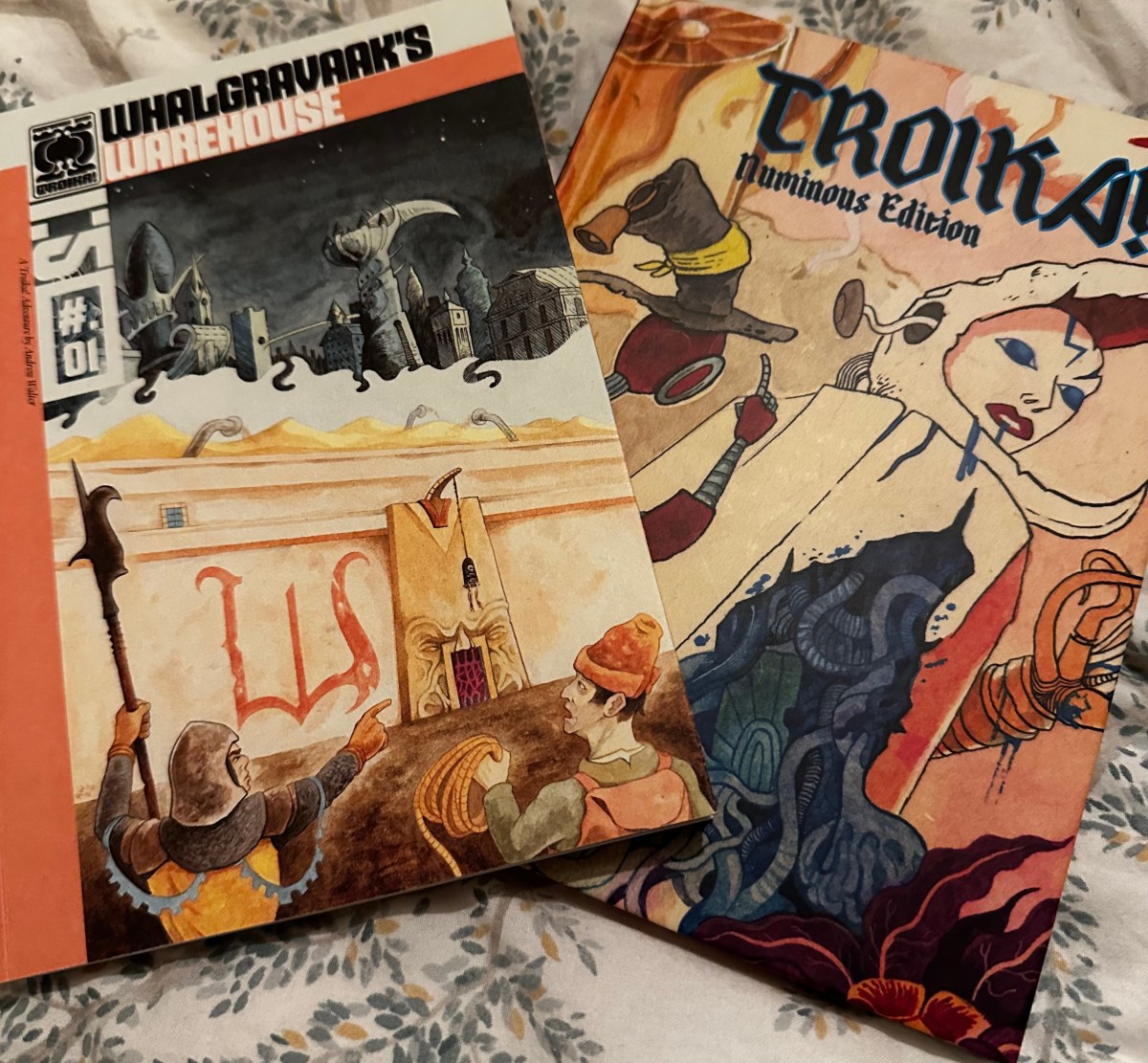
That’s gotta hurt. Art by Andrew Walken from Whalgravaak’s Warehouse.

We haven’t played much Troika. I ran three players through the hotel-based adventure, the Blancmange and Thistle, from the core Troika book last year. We did it as a one-shot and it was so surreal and hilarious that I knew I wanted to play more. So, in the summer, I thought I would give Whalgravaak’s Warehouse a go. Since then, we have lost one player (who moved to Spain, don’t worry) and two PCs. Please bear in mind, there have only been four sessions exploring the chaotic and bizarre workplace so far. We have lost one PC in each of the last two sessions! Tim got smashed and burned in an encounter with a blood sucking crimson giant (one of the warehouse staff) and Borrowick Grimpkin got got in an encounter with some wizardly loaders. So, this seems like a high lethality rate, right?

I think Troika has a fairly tough rule for character death. Essentially, if you go to zero Stamina (Health) and another PC comes to your aid in the same round, you have a chance of survival. This is particularly nerve-wracking for the incapacitated PC since Troika initiative is random. Each player and enemy gets a certain number of tokens and they all go into a bag at the start of each round along with one other token that, when drawn, means the end of the round. So you never know when it’s going to be your turn or when it’s going to be the end of the round! Add to this the fact that, if you go into negative stamina, you’re instantly killed, and I think you can see what I mean. On top of that, there is no way to increase your Stamina so you will always be exactly as squishy as you are at the start of the game, unless you add armor.

A warrior bleeds from the eyes and mouth as he is assaulted by some other dimensional horror.
I don’t know how to describe this one.

For poor Tim and Borrowick, they were beyond help, insta-dead, no coming back. Some of the enemies in Troika can do so much damage that they are not unlikely to one-shot the average adventurer. And that is the way the game is built. At least, that’s what I am coming to understand. You have to make the most of the time you have with your characters because it’s going to be a good time, not a long time.

Another thing I have come to understand is that, even in a game where your character’s end is not necessarily the goal, and not something you plan for, you can still have a good one that feels right and satisfying. After their character’s death, each of the players highlighted it as a major star of the session! The shock and the surprise element of their endings, in fights that seemed both unexpected and momentous, not to mention, in true Troika fashion, bizarre and unique, left them happy with how they went out.

I’d like to take this opportunity to share the obituaries I wrote up for each of them. I shared these in the general chat on our Tables and Tales Discord. After the second one in a row went up, we all agreed we needed a new channel entitled Fallen Heroes Obituaries. And that has been a big hit!

Tim

We lost a good one last night. Tim leaves behind his beloved gremlin-terrier, Brutus and fellow worthy adventurers, Ba’Naana and Borrowick Grimpkin. He had an illustrious career as a gremlin catcher before ever setting foot into Whalgravaak’s Warehouse. He had once managed to trip up one of Troika’s oversized citizens in the city’s renowned Gianttown district. This caused massive property damage but he still managed to capture the gremlin he was chasing at the time. In the warehouse Tim faithfully executed the wishes of his erstwhile patron, Exultant Wulf Memnemenoch by bludgeoning to death the alien cacogen known only as the Opportunist. Unfortunately, it was a member of staff of the warehouse that laid low the heroic gremlin catcher. He died bravely clubbing another giant, an enormous, crimson, vampiric one named Paude. And no doubt, his sacrifice was deeply appreciated by Ba’Naana and Borrowick Grimpkin as they accidentally but poignantly cremated his body just as the ancient warriors did for their honoured dead.

Borrowick Grimpkin

We lost another brave soul last night. Borrowick Grimpkin, Wizard-hunter extraordinaire, known across Troika City for his exploits in infiltrating and despatching an entire wizarding cult of Muhtrenex the Rufescent, Gulper of Blood, met his end. Despite having fulfilled his mission to slay the cacogen Opportunist, he and his team-mates continued in their exploration of Whalgravaak’s Warehouse. It was there that he was predeceased by his companion Tim in the battle with Paude the vampire giant. The circumstances of Borrowick Grimpkin’s passing were, in many ways, that of a workplace accident, impaled, as he was by the forklift arm of a rusty humanoid loader with the oxidised face of the wizard who created it. If it were not for the fact that, by his actions, his crate pilfering friends, Ba’Naana and Sticky Nicky were afforded the opportunity to escape, that might be how his death was recorded. Instead we can proudly state that Borrowick Grimpkin died as he lived, performing a dangerously acrobatic jumping sword attack from two stories up on a man made entirely of metal. RIP.

How does your group handle PC death, dear reader? Do they celebrate it? Do they rage against it? Are they forgiving or do they hold a grudge?

Dragon Age: Duty Unto Death

The Basics

You might recall, dear reader, that last year, I threatened to put together a game of the Dragon Age RPG. I even wrote a couple of blog posts about the game which you can find here. Well, I’m back to tell you that I’m not just all talk. Sometimes I really follow through on plans to play games. Myself and four other members of Tables and Tales started playing the short scenario, Duty unto Death for the Dragon Age RPG a couple of weeks ago. We’ve had two sessions so far.

The first was mostly session 0 stuff. Only three of the players were able to make it to that one, but those that did make it all created their own characters. My post on Dragon Age Character Creation stood me in pretty good stead for this. We ended up with an Antivan Wayfarer warrior, a Dalish Elf (which my computer keeps autocorrecting to Danish Elf) rogue and a human Apostate Mage (who is short and hairy enough to pass for a dwarf, thus fooling the silly templars.) Our final player joined us for this week’s session so, in order to allow us to get started as quickly as possible, he selected one of the four pregens that came with the scenario. He chose another warrior, this time a Surface Dwarf who makes a decent tank.

The group has a varied experience of both RPGs and Dragon Age. We have at least one super-fan of the video games. They know the lore inside-out and knew exactly what they wanted to play when they signed up for the game. The others all have some knowledge and several have played Dragon Age Origins recently. As it turns out, the scenario I chose is set right before the events of that game and features at least one major character from it, so that’s worked out really well.

We’re using our newly renovated independent game store, Replay as the venue. I haven’t been back there with a group since about this time last year, but since they have greatly expanded their gaming space recently, and because they are open late on Wednesday nights I wanted to give it a go. As always, the staff were welcoming and the place was great. The renovations are still under way but they have done all they can to accommodate players all the same. I can’t wait to see it when it’s done.

Tabletop

Wil Wheaton's head and shoulders in front of the Tabletop logo on a red brick wall. He is a guy in his thirties with brown, short hair and beard. He is wearing a brown t-shirt with "the Guild" on it. The closed caption on the screen reads: "WIL WHEATON: In 1983, I played my first role playing game and"
A screenshot from the intro to Tabletop with Wil Wheaton.

Does anyone remember the Wil Wheaton Youtube show, Tabletop? It was part of the Geek and Sundry network for quite a while but it looks like the last video is about seven years old now. Anyway, it mainly focused on introducing people to board games but this one time, they got Chris Pramas, the creator of the Dragon Age RPG to write a scenario they could play on the show. So Wheaton wrangled up a bunch of his show-biz pals and they made two half-hour videos of it. This was eleven years ago so it was a pretty early example of an actual play. And it was really good! It taught you the basics of how to play the game and entertained you at the same time. You can find the first episode here, Tabletop: Dragon Age RPG. If you are one of my players and you’re reading this right now, please don’t click on that link!

The illustration is of three heroes, an elf with a bow, a dwarf with an axe and a human mage battling a horde of undead. The words Dragon Age are at the top and the title of the scenario, Duty unto Death is at the bottom where it also indicates that it is an adventure for characters of level 2-4.
The cover of the Duty unto Death adventure for the Dragon Age RPG.

So, the scenario he wrote for it was Duty unto Death. They released it sometime after the show went live. He has included in the published version a few notes on how the game went on the Tabletop show, where the players surprised him, how he improvised certain encounters, that sort of thing. They are fun and possibly useful little asides. It’s short, teaches the basics of the game’s rules well and has lots of Dragon Age flavour in it so it was perfect for my purposes. There are quite a few other published adventures for Dragon Age, but most of them were much longer and would have required a lot more prep time on my part, which I don’t have right now. Duty unto Death is about 8 pages long. It’s not especially involved and doesn’t get into some of the tenets of the game. There is not much in the way of exploration or, indeed, social encounters. But, I feel like it’s doing what it sets out to do very well.

So far, our heroes, a group of Grey Warden recruits, traveling in Ferelden, have been left to their own devices by their leader, Duncan. Fans of DAO will know the name. It was fun to drop it in the intro. Anyway, he had introduced them to the duties of the wardens, gave them a few lessons about darkspawn and the blight and that buggered of to the Circle of Magi. He asked the recruits to head to a village to meet another Warden from Orlais. On the way, they got into a fight with a couple of darkspawn, tipping them off to the possibility of a coming Blight.

Cunning stunts

The Combat Stunts table from the Dragon Age RPG. It has 15 entries including "Skirkish - You can move yourself or the target of your attack 2 yards in any direction for each SP you spend," "Defensive Stance - You attack sets you up for defense. You gain a +2 bonus to Defense until the beginning of your next turn," and "lethal bloW: You inflict an extra 2d6 damage on your attack." The table shows the Stunt Point cost of each stunt on the left hand side and has the descriptions on the right.
The Combat Stunts table from the Dragon Age RPG.

That first battle was very instructive. It was the first time any of us had really interacted with the rules so we were all learning a little. After the first round, they had barely scratched these two Shrieks. It felt bad, like the worst sort of D&D, attritional combat, except for the highlight of the mage casting Walking Bomb on one of the bad guys. In the second round, people started rolling doubles and the stunts started coming. Sandor, the Surface Dwarf, added two extra dice to his damage with a Lethal Blow, almost smashing one of the darkspawn, and we were away. The players started to play more tactically, utilising their minor actions to add bonuses to their attacks by aiming, or bonuses to their defence by getting their guard up. They were utilising their class features almost immediately. I was surprised and genuinely impressive to see how instinctively my, admittedly very savvy and clever players, took to the mechanics. The combat ended with that Walking Bomb paying off, the Shriek went boom and took the other one with it, covering the entire party in black gore.

By the time they got to their destination, and found themselves in another fight, this time with some Devouring Corpses making a nuisance of themselves in the inn, it felt like they were old hands. We had to leave it in the middle of that battle since Replay was closing and we all had to go home. All in all, it has left me wanting more! Can’t wait for the next session.

Making Room for Roleplaying

Pay off

Twelve days into 2025 and I find two of my Gaming Resolutions are already paying off. Numbers 1 and 2 on my list went like this:

  1. Make those stars sparkle and make those wishes come true: I was first exposed to Stars and Wishes this year when I took part in my first Open Hearth games. For the uninitiated, at the end of a session, a GM might ask their players for their Stars, i.e. stand out moments, moves, characters, players etc. and Wishes, in other words, what they would like to have seen happen in the session, what they wanted more of or less of or what they would like to see in future sessions. For a GM, this is an incredibly useful tool. It allows you to see what your players like and what they dislike. But, I find, too often, I don’t always re-integrate the stuff that came up in players’ Stars and Wishes. And I know, for certain, that when I do manage to apply what I learned from feedback, it has made my games better. So, how am I going to do this? I have an idea, that I literally just came up with, to create a spreadsheet to record each player’s Stars and each player’s Wishes from every session of every game. I’ll add in some columns to record potential ways to add more of the good stuff and ways to fix the problems that were revealed. Another column will summarise players’ reactions to the solutions. If it needs more tweaking, another column will detail that. I think this could be an invaluable tool to improve my games and will be there as a record so I don’t forget.
  2. Brighter stars, wiser wishes: Sticking with the Stars and Wishes theme, I’d like to get more useful feedback from it. One of Tables and Tales’ fantastic founding members, Shannen, used a few methods to get more valuable feedback from her players in a game earlier this year. She requested feedback through DMs on our Discord. Why? Well, most people are pretty nice, actually. They tend to not want to offend anyone or say something in front of a group that might embarrass somebody. So, if you take the process away from the table, they might be more likely to tell you what they really think in private. We were just discussing this last night and, along with that, we all agreed that Stars and Wishes in the Discord chat for the game is way more valuable than having people just tell you them at the end of a session, when players are often pushed for time, or before they have had a chance to think about it and provide something really useful. So, my second resolution is to get written and private Stars and Wishes from now on.

Well, we had our fortnightly D&D game on Thursday night for the first time since our December break and everyone had great stars and wishes. They shared them on Zoom with everyone (it’s an online game.) But later some of them also shared theirs in our Discord chat as well. Tommy brought up a couple of really important points. One related to one of their favourite experiences of Wildspace in the game recently and how they would like to see more of that. This is the sort of thing that is easily actionable for me. With solid examples of the type of play people want to see more of, I can work to emulate that in the future. That was the easy one, and I am most grateful for it. More difficult might be their other wish: how do you get more meaningly relationships between PCs, as a GM?

Hands off

A halfling rogue, a femme elf druid and a masc human ranger in a forest presented at a slightly dutch angle.
An illustration of three adventurers from the D&D 5E 2014 Dungeon Master’s Guide. They’re probably just about to have a long talk about their feelings. Little Bombo, there, is sick of Lilithidella’s owl always trying to fly off with him as a snack and Roger has been pissing off Lilithidella ’cause he keeps using all her shampoo.

Just butt out? Right? I could just stay out of it. I don’t need to always be sticking my oar in, do I? I think that’s fair. GMs have a lot of jobs to do already, so if the PCs start getting into a conversation that might very well help to build or break their relationship, the GM should just take their big nose and get it out of those PCs’ business. But, of course, listen, eavesdrop and take note. You never know what you might be able to use later.

Sounds simple, right? But to be able to do this, it means leaving room for it to happen. Even if you don’t necessarily encourage this sort of relationship-building exercise, you still need to make time where it could potentially happen. This is one of those unintended consequences of having a game based on a ship. You have built-in downtime while they travel. In fact, the first time they set off on their squid ship, I asked them if they wanted to take some time to get to know one another. Now, this was a band of adventurers who had been thrown together by the vagaries of chance and the unseen hand of powerful NPCs. None of them knew each other at all mere hours before lift off. And some of them had dark secrets. So, the suggestion was met with muted trivialities and outright lies, largely.

Instead, they got to know each other through their actions and words during their adventures, often in the most hilarious ways! Personal relationships were formed between certain of them in a pretty natural way. But there is a clear desire to make similar connections between other PCs. So, I am wondering how to leave space for that. There is an extended wild-space journey coming up, starting in the next session. This might be the best opportunity I have had to hand them that chance. My current plan is to simply ask how they are spending their time aboard ship during the voyage and hope they grab the reins themselves.

Hands on

Large white block letters spell out the name of the book, THE ELECTRIC STATE. They are overlaid on top of an illustration of a huge cartoon-cat-headed robotic drone, damaged and smoking hanging over an overpass beneath a slate grey sky.
a portion of the front cover of the Electric State RPG from Free League. The massive cartoon-cat-headed drone is so pooped after dealing with all the Tension in his party that he decided to take a break by hanging over this here overpass. Illustration by Simon Stålenhag.

But I can’t help thinking about the mechanic in a game I recently read, The Electric State. The Electric State is a road-trip game, so it has the journeying aspect in common with our little jaunt across fantasy space, if not much else. I think the designers looked at this genre and wondered how to bring recurring NPCs into it. I might be totally off the mark with this supposition but there is something about an adversarial or beloved NPC that comes up repeatedly in a campaign that players just love and the “on the move” nature of a road-trip game means that you might have to really shoe-horn in those characters to an extent that might feel very un-natural. So, instead of relying on your NPCs to cause stress and interpersonal drama, the game makes it so that the PCs have to be creating the Tension themselves. Tension is the name of the mechanic and it is required to allow your PCs to recover lost Hope (one of an Electric State character’s two tracks, along with Health that measures how they’re getting on.) Your PC has a Tension rating with each other PC, and vice versa. These ratings are likely to be unbalanced, i.e. Viv might have Tension 0 with Juan, but Juan has Tension 2 with Viv. This extract is from the core Electric State book:

To each of the other Travelers, you have a Tension score ranging from 0 to 2.
0 No tension, no question marks or unspoken thoughts or feelings.
1 Suppressed or contained irritation, love, interest, or other feelings and thoughts.
2 Uncontained strong emotions, such as rage, love, or even fear.

When you lose Hope points through play and you want them back, you have to contrive a scene with another PC with whom you have Tension. This might be an argument or a heart-to-heart talk or an emotional breakdown, but whatever form it takes, you both reduce Tension with the other PC by 1 point (if possible) and you regain a point of lost Hope. Of course, this means that, if your character does not have any Tension with any other PC, they have no way of regaining Hope points. So it is in your best interest to ensure you have some interpersonal drama at all times.

Dave Thaumavore, in his review of the Electric State, tended to think that this Hope-Tension feedback loop did little more than encourage manufactured drama between PCs. Of course, that’s the idea. The game is made to do that. It is certainly no coincidence that the mechanics work that way. But I can see his point. Will it feel too contrived? Will it be a pain for players to try and come up with new ways that one of the other characters has pissed off their own character all the time? Not sure. Haven’t played the game yet, but I’d willing to bet it would get bothersome if the campaign went on too long. Now, I will say that the Electric State is designed for short campaign play, so maybe it would be fine.

My question now is, if I wanted to try and tack on yet another non-D&D sub-system to this game, how would I do it with something like Tension? I could just take the Tension mechanic wholesale and give everyone a Tension score with everyone else. And then ask them to work out there shit in their downtime hours, so building more interesting and deeper relationships. But what motivation could I give them to do this? There ain’t no Hope points in D&D. But, maybe if two PCs deliberately get together to have a scene in which they reduced their tension, they could each take a boon, like a point of inspiration or temporary hit points or some other special effect only available to them when they work together next time.

Maybe the real question is, should I adopt this sort of mechanic just to encourage intra-party roleplaying? Or should I just keep out of the way?

Any thoughts or suggestions will be greatly received, dear reader!

Games I Got to Play This Year Part 2

Wrap-up

It’s an end of year wrap-up. Everyone’s doing one. Check out the last post for the campaigns I have been playing in the last few months. This one’s for the one-shots.

One-shots

  1. Pirate Borg – the link above will take you to my post mortem on this one shot. It was a great time, in all honesty. My first foray into running any kind of Borg, and I was pleasantly surprised by how easy and instinctive every part of it was, even the ship-combat, which was new to everyone at the table. If you are interested in pirates, light cosmic horror, or just gnarly old school gaming in an alternate history version of our own 18th century, you’ll enjoy Pirate Borg in all likelihood. By the way, I also did a character creation post on this one.
  2. Troika! – Whalgravaak’s Warehouse – Ok, look, full disclosure, this is supposed to be a list of one-shots but this is technically more like a really spread out short campaign where we get together to play a one-shot of the same game every once in a while when we can all afford the time. Know what I mean? Anyway, in the first one-shot of these two consecutive one-shots, the PCs found two different ways into this warehouse, abandoned by its wizardly owner centuries previous. After crawling this “dungeon” for a bit, they made friends with a thin mutant, and their monkeys got to play with the worm-headed hounds that lived in a nest in the warehouse somewhere. They made short work of the Cacogen they’d been sent to murder and we wrapped up the session. In the second one-shot in this series of one-shots, three of the band decided to continue to explore, making more friends, this time with a large cadre of mercenaries who had been sent to deal with some cultists. They then set fire to some rope, captured some minuscule soldiers in gremlin-jars and climbed a mountain of onions. This is the kind of nonsense the PCs get up to in games of Troika to be honest. This is standard. If this sounds too gonzo or weird, you are in the wrong place. The Eternal City of Troika is not for you. You should probably try somewhere more normal. From my point of view, and, I think, that of the players, if you lean into the bonkers aspects of the setting and you are willing to go along with the more outré elements of the system (the random initiative mechanic stands out) you will probably have a very good time with this game. It’s great for one shots. Or two shots if that’s your thing. Might turn into three shots, actually.
  3. Honey Heist – this was another one of Isaac’s games. He ran it on a night when another game fell through. It was very last minute but we were still able to get a crew together. Jude, Tom and I rolled up some friggin’ bears with criminal backgrounds and went to do a heist at the biggest honey convention in the UK, in the NEC in Birmingham. We tried to do a TED talk, we disguised ourselves as massive bees and we crashed a van. You know, typical bear stuff. Another absolute belter of a one-shot, this one. It’s the definitive one-page RPG by Grant Howitt of Spire and Heart fame. Isaac and Tom had picked up the printed form of a bunch of these one-pagers at UKGE and Isaac had been looking for the opportunity to run one of them. This game was obviously made to create wild swings as you use either you Bear or Criminal stat and try to avoid going too far on the bear side or too far on the criminal side. This forces you to take risks and do stupid things to drive the heist forward or, more likely, sideways. Tom did a brilliant write-up of the session on their blog here.
  4. B.D.S.M. Below Dwelling Sewer Mutants – Yet another game run by Isaac at short notice. It is a mutie-eat-mutie game by Neonrot and you can get it here. The premise is pretty straight-forward. You are a mutant. You are probably unpleasant in some way. At the start, you have a mutation that may or may not be useful in certain situations. You can progress and grow by eating other mutants to gain new mutations along the way. If you like that idea, you’re in for a treat. I think it is probably a game that works best in one-shot play. We had fun with it and I think most tables will.
  5. Cthulhu Dark – Roadhouse Feast – I went into quite a lot of detail on this one in the post I linked above so I won’t go through it all again. Suffice it to say, I really enjoyed running the Cthulhu Dark game for the first time. The scenario itself was great but, to me, it is the simplicity and the ingenuity of the system that really shone. If you are into cosmic horror games and you haven’t tried Cthulhu Dark, you should give it a chance.
  6. Liminal_ – I promised a report on how this one-shot went some time ago and here it is. We had four players (known as the Disoriented) for this one-shot plus me as the the Architect. As I thought we would, rather than have the players play themselves in this Liminal Back-Room nightmare, I had them use the character generation tables in Death Match Island. This worked really well to come up with some distinctive, memorable characters quickly and with no fuss. They started off all in the same public building. Since one of them was a district attorney, we agreed it should be a court house. One of the others was there as a witness in a case and the other two were, in an unlikely turn of events, cousins who had been called for jury duty on the same jury. That is pretty much by-the-by, although it did come up in conversation later. Thy all stepped into a room together and found themselves in a building of nightmares. Now, you have to roll up the rooms as they open the doors. There are a couple of d100 tables in the book that are crammed with inventive and horrific room descriptions. The first door they opened led into some sort of creepy, dank cave system; the next into a mouldering bowling alley that was was canted at a 45 degree angle; the next opened onto the abandoned bridge of a ship, rocking in a dreadful storm and with a trail of blood leading off through one of the other doors. I made a mistake at the very start, where I allowed the players to open a couple of doors and then decide which one they would go through. The rules state that, if you open a door, you have to go through it. This felt a little restrictive to me, in a role-playing game, but we proceeded in this way and the players were good sports about it. As we progressed, rolling on the Room and Entity tables, it felt as though, at times, they really wanted to see what the hell was going to come next. Isaac said afterwards, that it felt a lot less subtle than he had thought it would and I have to agree with that. When you think of liminal space horror, it often is just empty corridors and abandoned hotels and the like. Sometimes a strange entity might make an appearance, but it’s the spaces themselves that are supposed to be innately creepy. Some of these rooms we rolled up on the tables felt that way, like the corridor with missing persons posters of the PCs on the walls but a lot of them were straight-up horror like the one with nurse-entity (I think?) chopping a guy up on a slab (it was ok, he was into it!) Also, I think this is something I would be careful with: when you roll a random entity, they sometimes don’t seem to fit, thematically, with the room that you just rolled up. I think it is ok to re-roll if that happens. I didn’t do that and once or twice, felt like they collided awkwardly. Now, these are nitpicks, really. In general, we had a good time with this, the players loved playing their pretty normal characters in these horrific scenarios, just running blindly from threat to dreadful threat. We used both the regular room table and the guest room table (the entries here were written by some industry luminaries like Johan Nohr and Tim Hutchings.) One of the best things about that experience for me was that I was just as surprised, horrified and disgusted as the players were! One of the challenges then, of course, was that it was my job to quickly read, interpret and present the room to the players without taking too long, stumbling over the words, reading them too much or generally fucking up. Unfortunately, we didn’t quite make it to the end of their mad dash through the back-rooms. The PCs still have a few squares of fatigue to be filled in. Hopefully we’ll be able to pick that up and finish it off someday.
  7. Mothership – Moonbase Blues I wish this wasn’t in the one-shot pile but heigh-ho. Sometimes your GM moves away and leaves your characters stuck on a moonbase that is probably trying to kill them. I mean, there was someone or something there trying to kill us. I was under no illusions that we were likely to all die out there, I just wanted to know how. Anyway, the one session we had of this game was great. Full props to Joel, our GM, for putting so much time and effort into he prep for it. He had a series of recordings that he played for us at key moments, he had handouts and provided us with cheat-sheets. It was a great experience. Also, I loved playing my character that I created in the post I linked above, Victoria Ibanez, the Corps’ finest. I’d love to get to play her again. Mothership is a great system with compelling mechanics and one of the best character creation experiences out there. If you need any more convincing, you should go and check out Quinns’ review of it.

Conclusion

So, that’s it. Those are all the one-shots that I got to play in the last few months. I didn’t get to play many of the games I wanted to, but I sure did have fun not playing them. Next year, I am continuing the theme of not playing the games I listed in that post by starting the year off with a one-shot of After the Mind, the World Again, a Disco Elysium-inspired, GMful mystery game and, Dragon Age, which, I have at least discussed at length on this very blog here and here. Honestly, I think it was useful to set out goals for the games I wanted to play. I may not have gotten to play any of them if I hadn’t done that. So I will continue to write about things I want to experience on the blog and see what happens.

I will be posting more intermittently as we come into the holiday period now. I will be travelling to visit friends and family a lot and won’t always have the chance to post as regularly as I would like. So, in case this is the last post before the end of the year, I wish you the very happiest Winter Solstice/Hogswatch/Western New Year.

BTW

Here are links for where to buy each of these games:
Pirate Borg
Troika!
Honey Heist
BDSM
Cthulhu Dark
Liminal_
Mothership