
This is the second in a series of character creation posts I’m using to figure out which game I want to schedule of our next campaign. You can find the last one here.
Kick-flip Over a Quantum Centipede
That’s it. That’s the game. This is the kind of weird shit your character should be doing, or, at least, trying to be doing. “What is a Quantum Centipede?” I hear you ask. If you have to ask, you’re just proving you’re a dork. Not like me and my crew. We’re Slugblasters and we go Slugblasting across the frikkin’ multiverse on our boards. Or, like, it will be me, after I get finished making this character.
Slugblaster

Slugblaster is a game by Mikey Hamm. It was released by Mythworks in 2024. It uses a Forged in the Dark system which means it’s based on Blades in the Dark. I will be making a Blades character as part of this series too, but for some perverse reason, I decided to do this one first.
Essentially, in a Forged in the Dark system you build a dice pool of D6s through various means. When you roll your dice pool to try and achieve something, the highest roll is generally the only one that counts. A 6 is a full success (and, actually, if you get more than one 6, in Slugblaster, it gives you 1 Style point.) A 4 or a 5 means you succeed but introduce a problem of some kind. Anything else is a failure.
There are other rules, of course, but that is the essence of it.
But what is the aim of this game? Well, its to be the most teen teen you can been. You have to do kick-ass tricks on your board, hack gear, get into drama with your teammates and rivals, and have “touching narrative downtime arcs.”
And the “classes” available to us reflect all of that so well.
Pick Your Personality
In this game, Personality is the closest thing to a character class or playbook. Here are the available Personalities:
- The Grit
- The Guts
- The Smarts
- The Heart
- The Chill
As the book tells us, “Your personality isn’t about what you can do, it’s about how.” Which seems appropriate in a game about teenagers. It also means that any PC can do anything, as long as they describe it in terms of the way their Personality would handle it. I like this a lot. It’s a strong foundation for a heavily narrative game. Anyway, I’m going to roll a d5 to see which Personality I go with. I got a 5, which makes my character the Chill. This is, by far the most important decision/roll you make regarding your character. The Personality itself defines most of the things that make you you.
The Chill


“Play as the Chill if you want to crack jokes, eat some snacks, let problems solve themselves, and not think too much.”
Maybe the Chill is just lucky or maybe they notice things the others never do. Things work out for the Chill, that’s all.
Here are some of the things the Chill gets:
Extra Gear
1-2 Something You Found on Your Way Here
or
3-4 A Pet
I rolled a 2 on a d4 so I’m going to take Something I Found on My Way Here. That is incredibly wide open. Could be anything at all. I’m going to say it’s something that all adventurers should have, a long length of cabling. It was just lying there on the pavement in front of Old Swenson’s ‘shop, wrapped in plastic and taped up. It took a while to get it open with my Swiss Army knife to see what it was. It adorns my shoulder, cross-body.
I think, technically, this item is whatever you need at the time during the Run. I don’t think you need to actually decide what the item is until its needed.
Style Bonus
I get 1 Style after a run in which I express “ease or flow.”
Style is a currency that you gain by doing cool stuff and playing to character. You can spend it during downtime to gain Beats, propelling the story in the way you want it to go.
Attitude
I get to add an extra d6 to all actions! Ad infinitum! This is massive. If I could otherwise only manage 1d6 for an action, this immediately doubles my chances of a favourable outcome. Don’t forget, it’s only the top result on your dice that matters.
Traits
You only get to pick one of these to start with. As you hit your Trait Beats, you get to choose more. For now, let’s take a look at what’s available. There are five to choose from:
- Steezey – Gets me an extra style if I roll doubles
- Umm… Guys – I happen across the stuff nobody else does
- Button Masher – I can utilise a “locked mod” but only for one action. You can normally only mod your devices when you have the correct set of components for them. You can also normally only use mods that you have on your own Signature gear. This would let me momentarily yoink a crewmate’s mod and use it for my own nefarious purposes
- Lucky – I can use this to have one thing go my way that otherwise would have gone south. But I could only use it once per Run
- Quirk – I would get to choose one thing that I’m inexplicably proficient in doing. If I can relate it to the action I am taking, I can upgrade any 1-3 roll to a 4/5 instead. What am I good at? Could be practically anything.
It would obviously be better to choose the perfect starting trait for the character you want to build, but I’m going to roll for it again. I rolled a 4 on my d5! That makes me Lucky! I’m quite happy with that. It is very thematic for this Personality and can be used in almost any situation.
Beats
So, you don’t start with any of these, since they are all about the advancement of your Slugblaster. But, I thought it would be fun to introduce the concept and some of the Arcs they can lead to. This system of Beats is heavily inspired by its namesake in Heart the City Beneath, which I discussed in this post last year. In Slugblaster, the Beats are a little more focused and you have to spend currencies like Style and Trouble to buy them. That allows you to play out a scene and send the story off in a way that you and your character want it to. This might be something to do with your Traits, like introducing your Origin Story, it might be something to do with your Family, showing your Trouble at Home or the Final Straw for your parents. It might be more to do with your Personality. Here is the Chill Arc:
- Caught in a Plot – this costs 1 Style. Wrong place at the wrong time? Right place at the right time? Somehow your luck makes sure you discover some sort of plot.
- Serendipity – this costs 2 Style. The plot thickens. Your crew might have something to say about it. This one gives you +1 Legacy. Legacy goes towards your ultimate Epilogue, deciding the type of life your teen will have in the future.
- In Too Deep – This one costs 4 Trouble, which is quite a lot. The corner you painted yourself into with this case of mistaken identity has gotten very narrow and claustrophobic. You get found out. Things are going bad and one of your teammates notices how bad. This one gives you +1 Doom, which has a similar, if more negative effect on your Epilogue.
- Somehow Works Out – The last Beat in the Chill Arc costs 3 Style. As the Chill, everything always works out in the end. Why were you ever worried? -1 Doom, +1 Legacy and +1 Trait.
Like I said, I can’t pick any of these at this stage, I just wanted you to get a feel for the types of Beats available to a Slugblaster character, dear reader.
Vibes
This one is an actual d6 table. Nice.
Here are the options:
“
- Space cadet
- Just woke up
- Laundry day
- deadpan
- Always eating a bag of chips
- Kisses their mom on the lips and isn’t weird about it” (!)
Here we go! That’s a 3 on a d6. That gives my Laundry Day. Just out there wearing the punishment underwear and the ripped jeans.
Look
There is another table, this time a d6xd6 table that will help me define this Slugblaster’s looks. The first roll is a 1 and the second roll is a 5. That gives me the result, “ballcap.” I think this a baseball cap given to me by my brother, who has left for college.
I’m going to roll again on this table, because just “ballcap” isn’t much of a look. This time I get a 4 and a 4. That’s “chains.” I’m imaging a lot of different sized chains hanging off a thick leather belt connected to a bunch of different things like keys, that Swiss Army knife, a little flashlight, an oversized Garbage Pail Kid keyring.
Family
Another d6xd6 roll here: I get a 5 and a 4, which gives me “sheltered.” Maybe that means they are a family who distrusts the rest of society, and they just want to be left alone to do things their own way. I imagine this could lead to an interesting Family arc! You are supposed to roll on this table twice, so I rolled again and got a 6 and a 2, “relaxed.” This seems to be at odds with the first one, but maybe it just refines the story a bit. Maybe the family has been sheltered for so long that they have become complacent about the outside world. Maybe, when to comes back to bite them, things will change.
Bond
This one is not really possible for right now. It requires there to be other actual players. The book suggests that everyone should choose the PC of the player sitting to their right to have a bond with. This is a nice random way to conduct this sort of thing. Sometimes, you find that a player is most likely to choose the other player that they already know best for this sort of bond. In my car, I am going to just roll a d4 to decide the other Personality type that I am Bonded with. I rolled a 2, which gives me the Guts. That’s the Personality with lots of confidence and “sass.” There is a d6 table here that you can roll on to better define the type of relationship you both have. I rolled a 1, which means we were childhood friends.
Gear

Everyone starts with a phone, a raygun and a hoverboard as well as the extra gear provided in your Personality description.
Since the Phone section suggests that it doesn’t need to be phone shaped, I think I will go for a wrist-console
I get a Raygun… There are two steps to making it. Step A and Step B, each of which involves a d6xd6 table. I got a 1 and a 3 for Step A and a 3 and a 5 for Step B. This gives me a Particle Blaster.
And then there’s the Board. Obviously the average Slugblaster’s most price piece of kit. The “Your Board” section of the book has a nice intro to the origin of the Nth Gear Hoverboard and how it revolutionised the world. The section also has several tables to help you design your board. So here we go!:
Grip Colour – 2 and 3 gives me “red.” I’m thinking gaudy, tie-dyed red
Grip Cut – 4 and 3 gives me “logo.” The stylised face of a little gremlin
Deck Graphic – 2 and 5 give me “name of a sponsor.” The sponsor is called “Gremling”
Type of board – I got a 5 and a 1, “oldschool”
You also get two pieces of gear from the list on page 66 of the book. I’m going to check that out right now.
Here are the two items I have selected from page 66:
- Grappling Hook – it has 100 feet of cable, can stick to almost anything and has a handy winch
- Pro Camera Gear – This could be anything from a decent DSLR camera and tripod to “shoulder-mounted 3D rigs”
Pick Your Signature
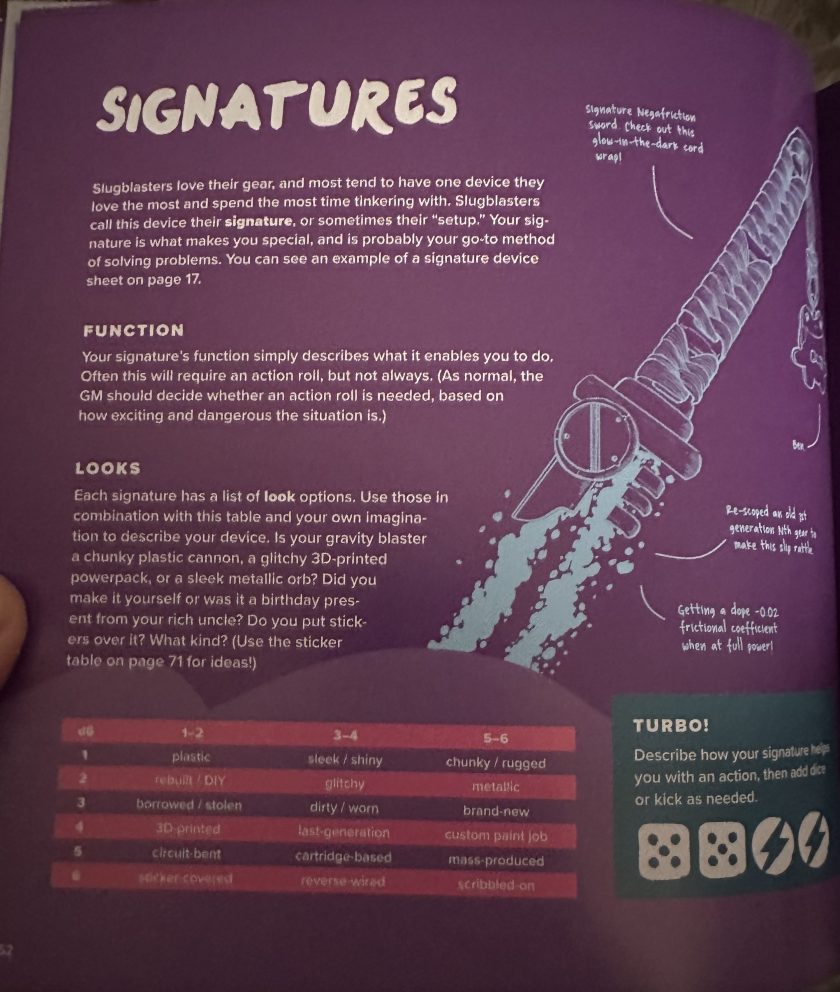
This is the item you are probably going to use to solve most of your problems given half a chance. People know you by this item and it’s your most prized possession. I’m going to use the table to help me describe it! 3 and 3 means its dirty/worn.
But, what exactly is the item? There are twelve listed so I’m going to roll a d12 for it obviously. That’s a 10, which gives me a Kinetic Deck, which allows my oldschool board to go faster over solid ground and make it super-heavy at will.
I get one mod to start with, although there are five listed. I’m going to go for the Stasis Anchor which can make the board totally immovable until its deactivated.
You get some more tables to add flavour to your Signature.
- Origin – 4 – made it myself
- Form – 3 – There’s an enamel pin made by my best friend, the Guts, stuck to the front of the board
- Slogan – 26 – “ALT” and its got a holographic face that keeps changing as the angle changes
Name Yourself
My parents know me as Benji McWhirter. My friends call me Bench and I call myself Alter.
Conclusion
And that’s it, that’s the whole character creation process. I imagine, if you’re not writing about every step, it is probably quite quick to roll up a new character. There are a lot of fun ways to customise the base character but the fun seems to be in advancing, gaining Beats and Traits, Doom and Legacy and Fracture (another type of currency which is used to break up the crew!) But it starts you off with the tools to make things really awesome and dramatic as the game goes on, and that’s what it’s all about. I have a couple of gripes and they involve the gear. What you get to start with is stated in a couple of different places, but in each one, the list of things you start with is different. Also, there is an element of confusion around the Signature still. I am not sure if my Signature is my oldschool board that has this Kinetic Deck upgrade, or is that another piece of equipment on top of my board? It’s not super clear.
Otherwise, I have one more mechanics-related complaint and that is about the jargon used in place of more (for me) understandable terms. Boost, kick, turbo, slam… is it because I’m not a skater? The meaning of these slides off my brain, unlike the terms used in Blades in the Dark: goal, action rating, position, effect, harm.
Maybe I would get used it in play.
It is a gorgeous book, I have to say. The artwork is colourful and creative and inspiring and the writing is witty and just right, theme-wise.
Have you any experience with Slugblasting, dear reader? I’d love to hear your thoughts.


















 The Dice Pool