Downtime in the Dark

My First Downtime

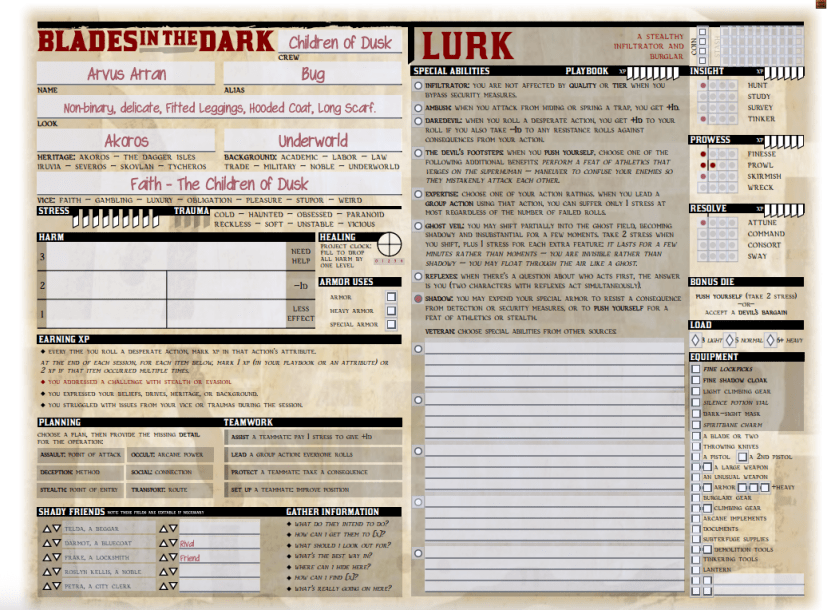
I’m taking a break from taking a break from Wednesday posts for this one. We had Session 2 of our Blades in the Dark campaign last week, and our first downtime. I also decided to start introducing a few elements from the latest Blades sourcebook, Deep Cuts, which came out earlier this year. So, I wanted to write about our experiences.

Deep Cuts Character Options

The head and shoulders of a person in portrait. They wear a metalic mask over the top half of their face and a hooded cloak. They are an Acolyte Spirit Warden
An Acolyte Spirit Warden by John Harper

Deep Cuts really expands on the options for your new scoundrels. It doesn’t replace what’s available in Blades, it just adds depth. For instance, if your PC is Akorosi, maybe your family served among the clergy for the Church of Ecstasy. If your scoundrel had a military background, maybe they were a Rifle Scout, serving in the Deathlands and harassing “enemies with sniper attacks.” Before we got into the session proper, I offered all of the players to not only select from these new options, but also to reassign any of the Action dots they had assigned to reflect their Heritages or Backgrounds. What I discovered was most of them had already formed a pretty solid image of their characters in their heads. Even the one player who did take me up on my offer, only took the two examples I laid out above for their Hound because they fit the picture they had imagined so well.

I’m still quite fond of a lot of these new Heritage and Background options. They might have been a lot more useful if I had offered them from the start.

Downtime by the Book

In Blades in the Dark, John Harper tells us there are two main purposes to having a separate downtime phase:

  • The first is that the players could do with a little break after the action of the score that just went down. To be honest, this one doesn’t ring very true for me, but that’s probably because it’s been six IRL weeks since the last session and the crew’s first score. I also get the impression that, once you get the hang of this game, you’re sometimes running a score and downtime in the one session, rather than a score session followed by a downtime session. If that were the case, I can see the advantage of breaking the action up.
  • Second, moving into downtime is a sign to all that we are changing the mechanics that will be needed in the game. To me, this seems like the more concrete of the two purposes. Blades in the Dark has tools for you to use during a score, and only during a score, and it has tools you only pull out during downtime. We don’t need to worry about divvying up the proceeds, dealing with the heat you’ve brought down on yourself or figuring out your long-term crew goals while you’re beating in some poor Red Sash’s head. Let that wait until you’ve got time and space for it.

Luckily for me, it’s easy to follow along with the Downtime chapter of BitD. Once again, I have to praise the usefulness and usability of the book. The layout of the chapter leads you by the hand through the phase, from one step to the next. Three of my players have taken responsibility for maintaining the various crew/campaign tracker/factions sheets without my even suggesting it so that made the job even easier.

Payoff was easy enough, just a simple matter of recording the Rep the Death Knells got and dividing up the 6 Coin they garnered from the last score. They took one each, popped one in the crew stash and paid their tithe to Lyssa, the new leader of the Crows, as their patron. I ran this moment as a scene. I don’t think I would have if it wasn’t for the fact that she was pissed off with them for raiding the Red Sashes’ drug dens on the Docks, and I wanted them to know. She also gave them the option to take a job to redeem themselves. The Hive have been a bit too active in Crow’s Foot for her liking. She wanted the Death Knells to do something about it.

I mentioned Deep Cuts earlier. New mechanics appear in the sourcebook for downtime. They make it diceless, and they would also definitely up the Coin our crew made from that score if we had been using them. In BitD, you are given a range from 2 Coin for a minor job to 10+ Coin for a major score. In Deep Cuts, the Coin the crew accrues is determined like this:

  • Score – 1 Coin per PC, plus Coin equal to the target’s Tier x3.
  • Seized Assets – 4-8 Coin for a vault of cash. Stolen items can be fenced for 1-8+ Coin, but you take Heat (see next page).
  • Claims – Collect payment from crew claims like a Vice Den.

Like I indicated above, we used the standard downtime rules from Blade in the Dark in this session. Now that we’ve experienced that, I’ll put it to the players to see if we want to make the switch. If and when we do that, I’ll come back and examine the other downtime changes then.

It was fun calculating Heat for that score. I’ll admit, I didn’t warn them that killing people on scores really hikes up the Heat. They started off the whole thing by murdering a bouncer, of course. In fact, I didn’t really explain the concept of Heat to them beforehand at all. This meant that they went in hard, loud and chaotic. I actually think this was for the best. The game is built on building up consequences, after all, as well as narrating big, exciting action sequences. Anyway, they ended up with 6 Heat, which was fast approaching a Wanted level. That put the shits up them.

In the book, the Heat section also includes the Incarceration section, which seems logical to me, but I didn’t need to refer to it, so I’m skipping it here.

Of course, due to all that Heat, they had to roll on the worst of the three Entanglements tables. These represent all the potential impacts of contacts, acquaintances, enemies and authorities getting wind of what the crew have been up to. Entanglements range from Gang Trouble, which can be dealt with internally, to Arrest! If you get that, it’s going to cost you Coin, a crew member or the effort to escape capture. The Death Knells rolled up Interrogation so our Hound was caught on her own and dragged down to the station for some “enhanced” questioning. We played this out in a fun scene where she went out to get beer to celebrate their big score and got ambushed out behind the pub by Sergeant Klellan and his boys. She wisely Resisted the level 2 Harm and the additional Heat, without incurring a single point of stress! All the others could do when she finally turned up was wonder where their beer was…

So then, we spent a bit of time going through what’s possible during the downtime phase in our last session. This can all be a little overwhelming the first time you do it. It can also take quite a while to get through each player’s turn as you talk through the possibilities and they negotiate amongst themselves to see who will spend their activities on reducing Heat for the whole crew. Sometimes it’s obvious who should do what. If a character has some Harm, it’s probably a good idea for them to get some treatment and Recover. If another scoundrel is a bit stressed out, they should go and Indulge their Vices to help them relax, but training, long term projects and acquiring assets are all more subjective. The chances are, they’ll turn out to be useful to the whole crew in the future, but they don’t feel quite as immediate in their effect as clearing Heat.

Anyway, I was gratified to see the PCs did all of the six possible downtime activities at least once. They managed to clear practically all their Heat. The Leech did this by studying the movements of the Bluecoats around the district so they could avoid them. The Whisper took an inventive approach, by losing a bar-room brawl in the King’s Salty Knuckles tavern, thus proving that he couldn’t be part of a crew of Bravos!

Our Cutter decided to acquire an asset, an old and worn-out little boat for use on a future score, perhaps. The players ad-libbed a scene in which they ribbed him about the state of the thing. But, of course, it only needs to be used once.
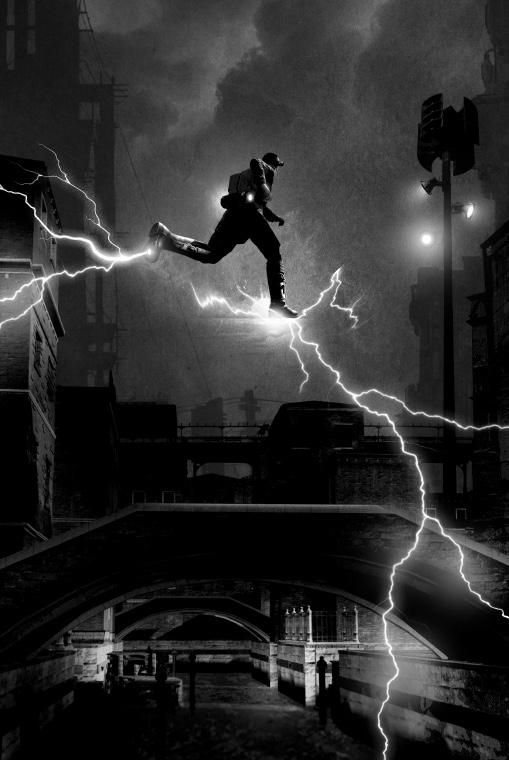
A person "walks" through the air above the darkened city,seemingly on lightning bolts emanating from their feet.
“I’m walking through the air!”

We had another scene when the Whisper’s strange friend Flint turned up on his canal boat with some electroplasm. Our Whisper needed it to build himself a lightning hammer as a Long Term Project. From Flint he also learned about the Sparkrunners, a gang of rogue scientists who are out there boosting government tech. This is one of the new factions from Deep Cuts, which “sparked” my imagination.

Just before we wrapped up for the evening, our Hound decided to deal with all her stress by visiting her local Temple of the Church of Ecstasy. She prayed and prayed, she prayed to hard and too much. She over-indulged in her vice and something bad happened. The bouncer she killed on the last score decided to haunt her!

Other Actions

Of course other actions are possible during downtime too. They decided to visit the ghost who had given them such good info during their Information Gathering phase in the previous session, because he said he would help them more if they really fucked those Sashes up good. From him, they discovered that Lyssa was responsible for the death of Roric, whose leadership of the Crows she then usurped. She had been backed up by the Red Sashes who had killed out ghost friend. He told them to go to Mardin Gull in Tangletown for the skinny on what all that was about. This wasn’t a downtime activity or an entanglement or anything. It was just something they wanted to do.

The Imperial Airship, the Covenant flies bove the darkened city streets, shining searchlights down to illuminate a meeting on a bridge.
Its the Fuzz!

I also introduced a few more Deep Cuts factions in a little news segment. They learned about the Sailors being press-ganged on the Docks, The Ironworks Labour-force pushing for unionisation, the arrival of the Imperial Airship, Covenant without her sister ship and the recent adoption of the new Unity calendar and maps. Any one of these could potentially lead the crew to their next score. Except, maybe for the calendar one, I suppose.

Conclusion

I was very happy to have left a full session aside for our first downtime. It needed it. In fact, I would say, we could have used even longer. They still haven’t decided on their next score. I will say, I am quite happy with how many potential score options I managed to sneak into the various scenes in the session. I was worried that I wouldn’t give them enough opportunities, but, in the end, they came up quite organically, much like the scenes themselves. These all proved to be fun and freeform, allowing us to dow some world-building and to introduce some fun new NPCs.

I’m now looking forward to the next session, and, hopefully, the Death Knells next score, the Big One.
Kanabo

The best part of the whole How to Play section is the list of Best Practices…We have gems like, “Ask questions. Take Notes. Draw diagrams. Write in pen” and “Fight unfairly. Lay ambushes. Hit below the belt. Run away.” And familiar old favourites like “Play to find out what happens, and how it happens” and “Strive for victory, but revel in your defeats.”

Waku Waku

Dear reader, my excitement is threatening to overwhelm me. As some of you may know, I studied Japanese in university and lived and worked in Japan for about three years in total. It’s hard to put into words exactly how I feel knowing that, this weekend (probably yesterday by the time I publish this post), I’ll be going to see the Ireland vs Japan rugby match in Dublin and next weekend I’ll be finally going back to Japan for the first time in eight years! I think the right word is probably わくわく (waku waku, loosely translated as excited.)

Anyway, as a build up to that, I thought I would look at an RPG based on a Japanese historical period.

Kanabo: Fantasy Role-Playing Adventure in Tokugawa-Era Japan

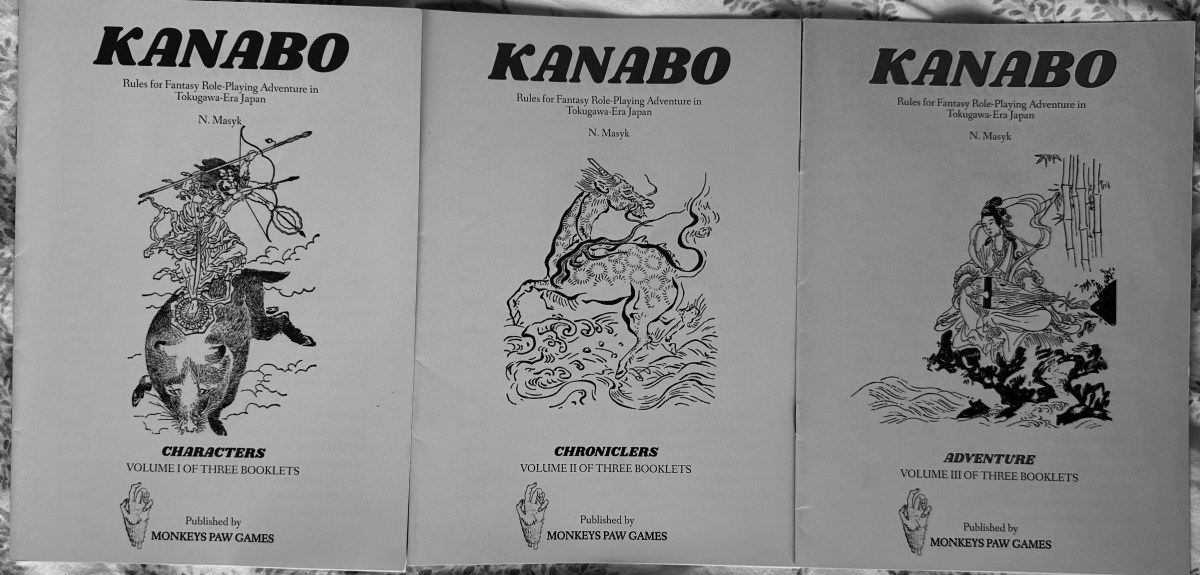
A Kanabo is a Japanese weapon, a long metal club, adorned with spikes or studs. The game, Kanabo by N Masyk, is an RPG published by Monkey’s Paw Games. It comes in the form of three neat booklets, Volume 1, Characters, Volume 2, Chroniclers and Volume 3, Adventure. It was gifted to me by friends and all round good eggs, Tom and Isaac several years ago. I can’t remember which year exactly and I don’t see a publication date on any of the booklets so I am going to guess and say it was sometime between 2020 and 2022.

These booklets truly are only wee. The longest of them is 21 pages of A5. But they pack a lot into each one.
Volume 1, Characters

The cover of Kanabo, Volume 1, Characters. It has a mythical Japanese warrior wielding a spear and a bow at once, while dancing on the back of a great black boar, possibly in the clouds.
Magic Man on Magic Boar

This booklet, as is the case for each one, begins with the credits. N Masyk did the words and the layout, “Dead People” did the artwork and the Hexmap uses the Highland Paranormal Society Cartography Kit, by Nate Treme. Finally, consulting was done by James Mendez Hodes. I think you will notice a peculiarly Western bent to the people associated with this project, other than the Dead People who are all Japanese (by the looks of their artistic styles) but remain conspicuously unnamed.
It starts off with an intro section that explains briefly what the game is about and suggests the use of safety tools such as Lines and Veils and the X Card. The “What is this?” section tells us that this is a game set in the Tokugawa period of Japanese history. It informs us that this is the time after the Warring States Period when the country is united but many wandering Travelers are abroad, “seeking fame, fortune, justice, revenge, or simply the freedom to roam.” That’s the PCs! I like this as a time period and setting. The Tokugawa era was long, more than 250 years. It was a time when Japan was cut off from the rest of the world, guarded its coast jealously and avoided the great changes that engulfed the other regions during the same time. The role of the Samurai was slowly being eroded, nobles were forced to pilgrimage from their lands to the capital under their own expense to keep them in line, the Shogun ruled the land and Japanese culture deepened. But I also like that there is a paragraph here on historical accuracy. Masyk takes pains to explain that, despite the potential realities of the place and time, as players of a game, we must strive to be inclusive before being accurate. Japan of this time was a place of terrible inequality, Kanabo at the table does not have to be.

The introduction section is reprinted in Volume 2, Chroniclers and Volume 3, Adventure. I wonder, in a set of booklets of such limited page-count, if this was necessary. Perhaps it was felt that the Characters booklet, meant largely for the players, and the Chroniclers booklet, meant only for the Chronicler had to both have it to refer back to regularly, but I would question that, especially as the Adventure booklet is also meant for the Chronicler exclusively. Maybe its so the kid who finds one of these booklets all on its own, tucked into a box in the dark reaches of a secondhand bookshop thirty years from now, knows what it is they’ve found.

Stats

The Stats section actually introduces the entire character creation process. Stats themselves are only one part of that. You roll 2d10+20 for each stat, for a maximum of 40.

I was expecting this ruleset to be a D&D clone or maybe an Odd-like but I was surprised to discover this is a percentile system. When you want to do something you roll a d100 and hope for a result equal to or under the stat you are rolling on. You will notice that this makes it necessary to roll really rather low to succeed, but there are several ways to gain a +10 to your rolls, such as using the right piece of equipment, possessing just the right skill, spending a filled segment of your Fate Clock or, in battle, gaining Advantage. There are three specific ways to accumulate +10s in a battle. If you want to disengage from combat safely, you can expend all of them and do so.

The Stats themselves are incredibly and deliberately abstract:

  • Fire: confrontation, aggression, force
  • Water: tranquility, inquisitiveness, exploration
  • Earth: stoicism, calculation, discipline
  • Wind: intuition, reflection, grace

As such, there is a lot of potential leeway in the decision on which stat to roll in any given situation. I like this sort of thing. I imagine Blades in the Dark style negotiations occurring as to how they might work out in play. However, I struggle a little with the whimsicality of the naming convention. It has a sort of mah-jong flavour to it, I’ll admit, which is not, in itself a bad thing. But, if you were to choose particular Chinese characters from the available mah-jong tiles, there are others that really describe human traits that might work better. I am thinking of things like 力, chikara (strength,) 心, kokoro (heart) etc. The use of the four elements makes it feel a little more like Avatar than any of the sword-fighting movies that inspired this game. It is a stylistic choice, though, and I’m sure it would work just fine at the table.

There are other elements to character creation, of course. Some of them remind me, quite delightfully of making a DCC character. Others have an Into the Odd feeling which I enjoy.

You can roll for your Chinese Zodiac sign. Whatever sign you roll, you can take it and apply a +5 to a stat that you think it reflects positively on. It would have been fun to have to apply a -5 to a different stat in this step I think.

When you roll on the Birthplace table, you will get somewhere like “Fishing Village,” “Hill Fort,” or even “Haunted Ruin.” Depending on what you get here, you will start with a different piece of equipment, such as a “fishing rod,” “spear,” or “lucky charm.”

Next up you roll on the Career table, which will give you another piece of equipment. Soldiers start with a matchlock pistol but Farmers only get a straw hat!

Your birthplace and career also allow you to list two things you know about or are skilled in. These can give you +10 to rolls in certain situations.

By rolling on the Curio table you might find yourself starting with a lucky cricket, a mask or maybe some rice balls. Each curio comes with a question that might help to round out your character.

After this you have a bunch of tables that will help you describe your PC. You have Mannerisms, Clothes, Face, Names etc. There should be plenty here to give you a very clear picture of your Traveler.

How to Play

This section lays out the rules quite economically. I’ve given you the basics already and there isn’t too much more to them than that, which is great.

There is a PBTA element to the rolls. You only roll when there is some risk, of course, but if you succeed, you do so without consequence. If you fail, you can still succeed, but with consequences. In combat, this means that you trade harm.

Kanabo character sheet on the back of the Characters booklet. There are spaces for Name, stats, zodia, career, birthplace, curio, description, Knowledge & Skills, Inventory, Wounds and a Fate clock split into eight wedges.
Kanabo Character Sheet

You get a Fate Clock on your character sheet. It has eight segments, which you will be filling and erasing as you gain and spend them. You gain a segment whenever you roll doubles on a d100 roll. I choose to interpret this as 11, 22, 33 etc. You can choose to erase a segment to give yourself +10 to a roll, prevent 1 Harm, recover 1d10 wounds or survive past your 5th wound. It’s a bit like stress in Blades in the Dark, a superpower that these Travelers have that allows them to contend against terrible odds and powerful forces.

Some few paragraphs are devoted to the idea of Travel. Kanabo assumes you will be hex-crawling and lays out the rules for that in relation to time, encounters, foraging, rest & healing etc. This is presented in a way that is player friendly and does not blind anyone with science. I appreciate it.

Character Advancement gets one very short section. Characters can choose one of two options at the end of each session, “increase a stat by 1” or “write down a new skill or piece of knowledge.” It’s neat and lacks frills. No room for confusion at all.

The booklet is rounded off with sections on hiring help, common equipment and refreshments. They are presented in several short and entirely non-exhaustive lists that are merely starting points for the interested player to do some research on what stuff might have been available in Tokugawa-era Japan.

The best part of the whole How to Play section is the list of Best Practices. Many of these will be familiar to the those of you who have been reading my series on Blades in the Dark recently. We have gems like, “Ask questions. Take Notes. Draw diagrams. Write in pen” and “Fight unfairly. Lay ambushes. Hit below the belt. Run away.” And familiar old favourites like “Play to find out what happens, and how it happens” and “Strive for victory, but revel in your defeats.”

Volume 2, Chroniclers

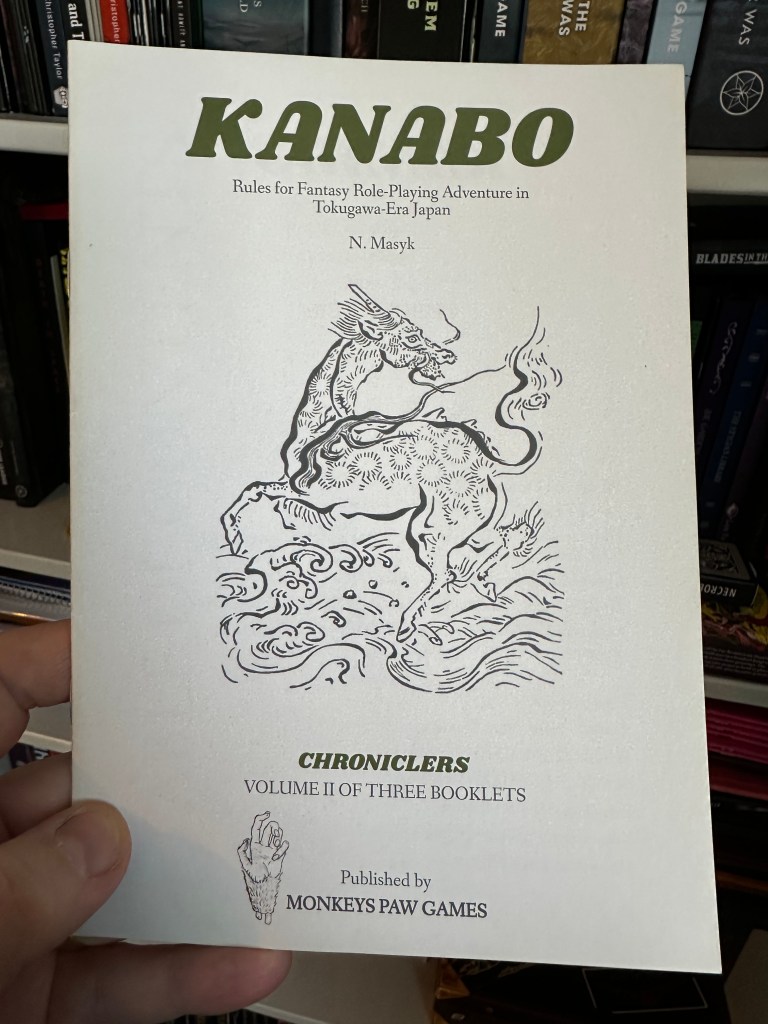
Kanabo Volume 2, Chroniclers has the image of mythical Japanese creature, the Kirin, across between a dragon, a horse and a giraffe, dancing across the waves.
This is a Kirin. Interestingly, the Japanese word for giraffe is also Kirin. It’s also a good beer.

After the repeated intro section we get straight into a section on how to run the game. Let me reproduce here the entirety of that section:

You control the world around the Travelers and the people within in, and the places they have built for themselves. Fill that world with adventure, danger and magic.
There are no further words by witch I might describe or prepare you for the journey ahead.
The contents of this tome, much like the contents of the Universe, are mostly lies.

I think this is probably one of the most uniquely unhelpful such sections I have ever read. I understand that the author is trying for poetry instead of boring old instruction, but it reads as though they want you to think there is no advice that might help a prospective Chronicler. There is something to be said for the idea that a GM/referee/judge/whatever should trust their instincts, but it is certainly not always true. Also, there is an enormous wealth of real advice out there, both in printed books and for free on the internet. I understand the author had limited room here, so, perhaps they could have directed the newbie GM to the blogosphere, or a particular publication that they thought aligned with their own design ethos.

Anyway, as soon as they have described everything in the “tome” as lies, they go on to provide guidance on how to run the game… and it’s useful! It’s practical and answers the sorts of questions that would definitely come up at the table when playing Kanabo! Things like discussing the possible consequences of rolls before making them, determining the effectiveness of successes etc. So, my main takeaway from all this is don’t believe the bit that tells you its lying to you…

There are a couple of pages here devoted to describing very Japanese-themed encounters, we have Kappa, Oni, Kitsune etc, without ever using those words. I like the pared down descriptions and the minimal stats presented, and I can see the idea of removing the Japanese names so as to allow a Chronicler to set their game of Kanabo in a non-Japanese context. Or maybe it’s done to for localisation purposes. I don’t know really, but, personally, I would prefer to use the Japanese names. It feels wrong to me to do otherwise.

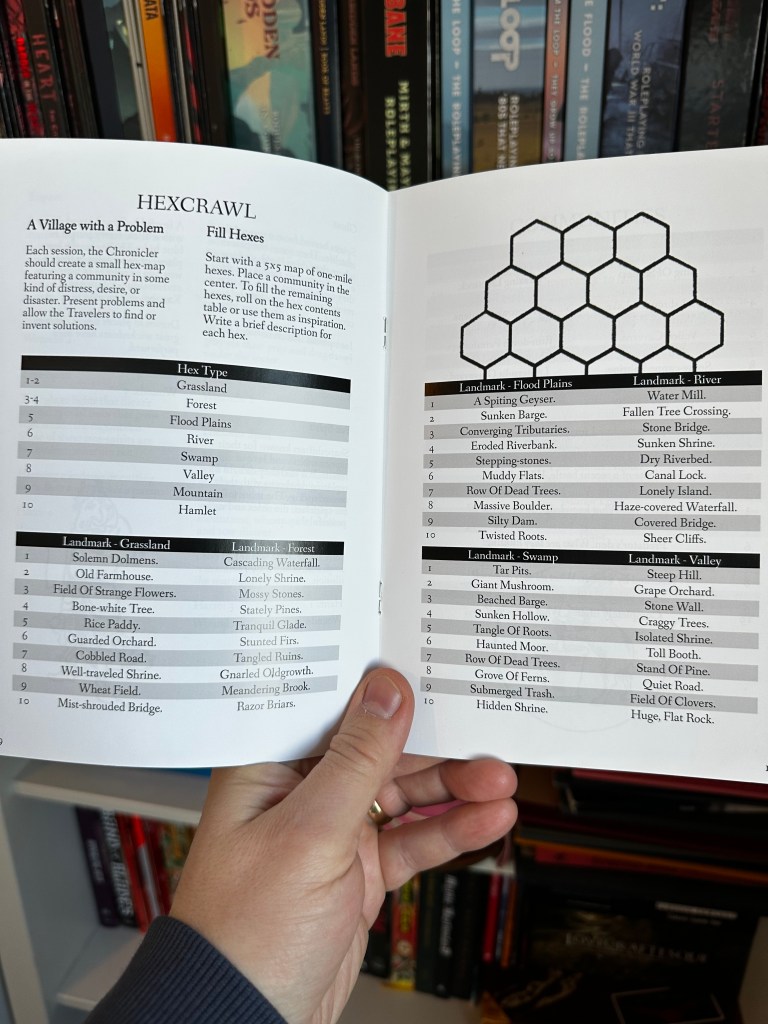
Hexcrawl section from Chroniclers booklet. There are several landmark and terrain tables and the top half of a hex rose here.
Hexcrawl

I think another very interesting element to this game is that, despite its semi-PBTA roots, you are expected to run it Old School. We have Weather tables, advice on rolling for encounters, an encounter reaction table and a whole bunch of tables to help you build your once-a-session hex map. These are, honestly, great. They are extremely practical and useful with lots of tables of landmarks for a variety of terrain types from Grassland to Hamlet. There are more tables for Factions, Communities, and Adventure Sites that would allow a Chronicler to build an engaging monster-of-the-week-style adventure with little to no prep required.

But, the advice for doing all this is limited within the booklet itself. The third of the the three booklets, however, serves to illustrate how it should work!

Volume 3, Adventure

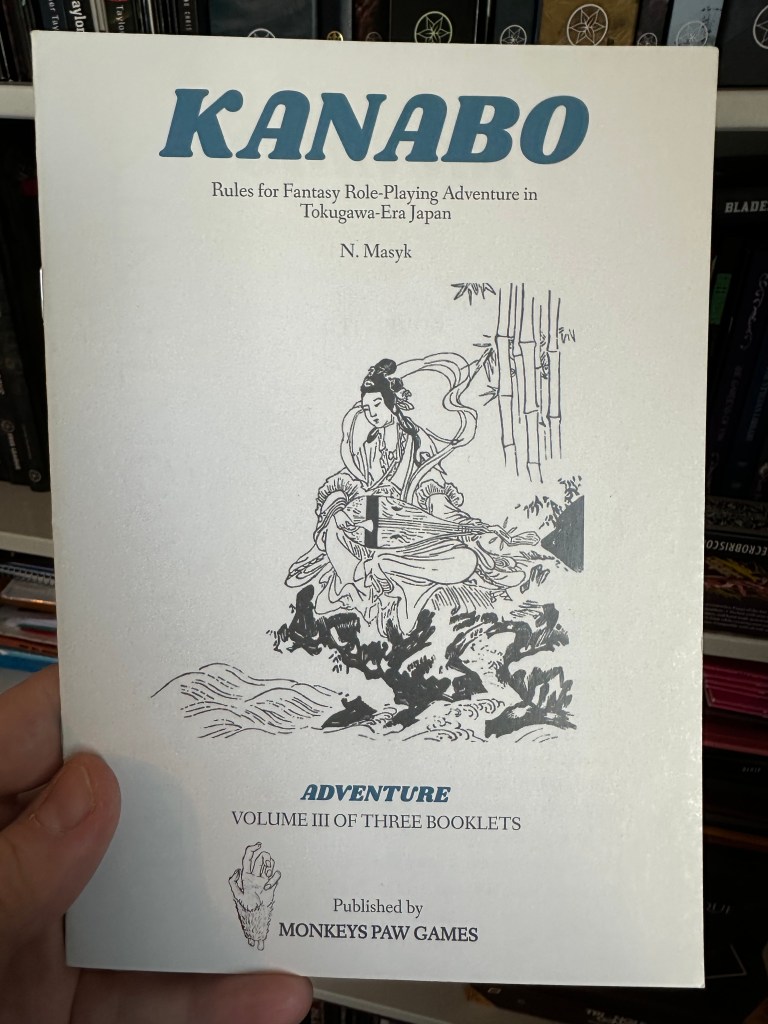
The cover of Kanabo Volume 3, Adventure. It shows the image of a woman, or maybe a bodhisatva playing a shamisen on the edge of a cliff.
Magic music

This one if incredibly short, only eight pages, two of which have the intro again. After that, we get a bunch of ten point lists, which come together to create Peach Trees Village. The list of Locals describes each one in a single line, provides a piece of their dialogue and outlines an adventure hook. Here’s the first one:

Asuka. A farmer. So forgetful; “did my apprentice bring the cattle in?” Needs someone to go check. Something’s been at the cattle.

I love this way of presenting information. It’s incredibly efficient and is just enough to spark the imagination. You get something similar from the Shops and the Rumours lists.

Next, we have The Surrounding Wilderness section. This kicks off with a hex rose, already filled in to give the Chronicler an idea of how it’s done. Each of the 19 hexes is described in a similar way to the Locals above. Here’s no. 10:

Frozen wood. Snow-blanketed trees. A dead mile where nothing grows. Strange lights at night. What is causing the lights?

Once again, it’s just enough to spark the imaginations of both Chronicler and Travelers to perhaps pursue the mystery of the lights in the woods, without bogging you down with established fiction.

A “Searching, you find…” D100 table rounds this adventure booklet out.

Conclusion

All in all, I think this little RPG punches above its weight. I question some of the choices made regarding naming conventions, use of space and GM advice but otherwise, I am quietly impressed. I would like to try running it, but it will have to wait till after my own adventure in Japan!

Stay Frosty

Obviously, a game like this is going to draw comparisons with the Alien RPG and Mothership given the subject matter but, from even a cursory look, it seems to be approaching the genre from a slightly different direction.

Not Over Yet

I had a great plan for today’s post. It was all coming together perfectly. We were due to finish of the Call of Cthulhu “one-shot,” the Derelict last night, but, due to various unforeseen circumstances, we were forced to postpone. So, the review of the scenario that I had been planning will have to wait too.

Still, I’m not short of subjects to write about.

Stay Frosty Remastered

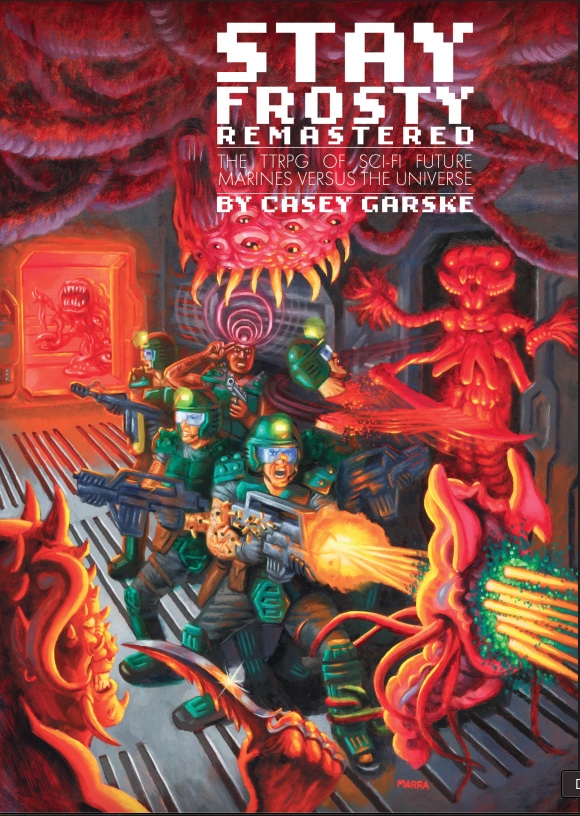
The cover of Stay Frosty Remastered by Casey Garske. Space Marines fighting aliens/demons
The cover of Stay Frosty Remasted

I’m going to take this opportunity to take a look at one of the games I received recently as a Kickstarter fulfilment. Stay Frosty Remastered from the Melsonian Arts Council and written by Casey Garske is an old school RPG of sci-fi marines in situations of extreme tension where they face monsters, demons and aliens with nothing but a shotgun and a bad attitude. Think Doom crossed with Aliens. Obviously, a game like this is going to draw comparisons with the Alien RPG and Mothership given the subject matter but, from even a cursory look, it seems to be approaching the genre from a slightly different direction.

It’s worth noting that “Remastered” in the title. Casey Garske first released Stay Frosty back in 2017 so it’s been around longer than either of the two games I mentioned above. I first learned about the original before I ever backed the remaster. Co-host of the Fear of a Black Dragon podcast, Tom McGrenery used it several times as the ruleset in which he ran some rather unlikely scenarios. I never read the original, though it is still possible to get it here.

Basics

Roll a d20 greater than or equal to your attribute for a success. Otherwise fail. Sometimes you get another die for advantage or disadvantage. That’s it.

Obviously, this implies that, even though you roll your attributes up the same way as you do in D&D, lower numbers are better!

Badassery

Scorpion fight
Scorpion fight

You get to play some of the galaxy’s badest asses in Stay Frosty. Character creation seems very straight forward. You get some attributes (Brains, Brawn, Dexterity and Willpower,) and MOS (military Operations Specialty,) hit points, rank and some equipment. Then it’s “Oorah” and into the bug’s nest to rend some carapace. Character creation starts on page 5 and just about stretches to page 8. All the better to roll up a new badass when the first one bites it.

Gear

I like that the rules around gear are abstracted so far as to make theatre of the mind nice and easy. Ranges, as they apply to combat and weapons are expressed by bands:

Hand-to-hand -> Close -> Short -> Medium -> Long -> Extreme

Your weapon’s description indicates its max range of course.

Another touch I appreciate is the use of supply dice for ammo that you use in a combat situation. If you used it, roll the ammo die for it at the end of the fight, If you roll a 1 or a 2, it reduces the die size until it’s gone. There is a similar rule for other gear that can be depleted.

Combat

Space marines fighting bug aliens
Riiiiip

I described the essentials of it in the Basics section above. But there are a few idiosyncracies that I enjoy:

One of the actions you can take in a round is called Battle of Wills. If you succeed on a Willpower roll against a chosen target, they will get disadvantage on their next attack. You just scare them into fucking up because of your badassness.

If you get a critical or a fumble, you roll on the appropriate FUBAR table. Either “Fuck Yes, Natural 20” or “Oh Fuck, Natural 1.”

Brain Bleed
Brain Bleed

There are Psi-powers. These are restricted to PCs with the Psi-ops MOS. There aren’t too many powers in the book but here’s a selection:

  • Brain Bleed (although the book seems to be missing the actual Effect of this one)
  • Interface – lets you take control of machines
  • Mind Stab – mind stab

There’s a little more to the system than just these points, but not much.

Mostly these other rules are introduced in the chapter,

Other Crap Every Game Has

Which has the sub-sub-title,

Jesus Christ, I guess we have to spell everything out.

Danger, Frostiness and Tension

These are the mechanics that make the game what it is. You will see some similarities to the Stress and Panic mechanics in both Mothership and the Alien RPG.

Firstly, the Danger die is rolled whenever the PCs move from one area to another, whenever they are in really dodgy locations or just whenever they’re dawdling. It’s a good way to ramp up the Tension. It works much like an encounter die in other games so can lead to location-appropriate baddies turning up, environmental challenges and loss of resources, but it can also add Tension or cause it to be released explosively!

Which brings us neatly on to the Tension mechanics. So, the PCs gain Tension through the Danger die rolls I described above.

Tension can be good for you. Forget simply staying frosty, Tension will actually build your frostiness level. It starts at “Warm” when your Tension is at a 1 and goes all the way up thru “Chill” (gives the agile tag to ranged attacks) and “Frozen” (Advantage on saves) to “Ice-Cold” (extra attack) when you reach 6 Tension points. There is a danger of course, when your that tense. When the Danger die comes up 6, “Tension Explodes!” And every PC has to make a Willpower save. If they succeed, they can reduce their Tension by one but if they fail, they take their Tension score x their level in damage. If this reduces them to 0 or lower HP, they roll on the Going Apeshit table. If you get a 1 on this table you’re on Overkill, advantage on damage rolls but having to roll your ammo die every round instead of after the combat. If you roll a 6, though, you’re on Last Stand, abandoning weapons and armour to face the enemy mano-a-mano.

This is pretty close to the stress mechanics in Alien, which is also all governed by tables. I’d be incredibly surprised if it wasn’t inspired by this game.

The Rest

A parade of bad guys from winged demons to little brain aliens
If it Bleeds…

Most of the rest of the book consists of a couple of missions to send your frosty fighters on. But there are also a couple of pages of random tables to allow you to easily and quickly construct your own missions and a few basic stat blocks for bad guys like Amoeboids, Demons and Robotic Assassins.

Conclusion

Isaac ran myself and Tom through a dungeon in the Black Hack the other night. None of us had ever played it before and even Isaac had barely looked at the rules. It was so easy, though, that we had characters created, hirelings hired and a dungeon explored before you could say the unlikely word, “Prolch” (my slow-witted fighter’s unfortunate name.) Stay Frosty gives me a very similar vibe. I only just opened it for the first time to write this post and I feel like I could run it now. Maybe I will! Unsurprisingly, the Black Hack is listed in Stay Frosty’s Appendix A: Influences. Garske tells us here that his game was originally a Black Hack hack but he ended up totally rewriting it. You can still see the Black bones of it though.

Blades in the Dark GM Tools

I’ll be honest, I don’t usually think about the games I run in terms of goals, beyond a vague desire to do my best to GM competently, engage the players and make them entertaining.

Good Advice

So, like I said in my last Blades in the Dark preview post, this book is full of great advice. Today, I’m going to take a closer look at some of the advice for GMs that is not directly related to the first session or two. This is the sort of thing that will help you create the best version of your game at the table every session.

GM Goals

I’ll be honest, I don’t usually think about the games I run in terms of goals, beyond a vague desire to do my best to GM competently, engage the players and make them entertaining. Many of the other games I’ve played don’t deal in these terms at all, but I find I appreciate the project-like manner Blades employs here. It’s good to state your goals before embarking on any sort of initiative, otherwise, how do you know if you manage to achieve them? What do you use to steer your efforts?

Here are the GM Goals as stated in Chapter 7, Running the Game:

  • “Play to find out what happens.” This is the primary guiding principle. A concept that was introduced by D. Vincent and Maguey Baker in Apocalypse World, “play to find out” is central to Blades in the Dark. The idea here is that you have no set narrative in mind, no list of occurrences that you’re waiting to introduce to outfox or defeat the PCs, no plan at all. Instead, you let the PCs lead the way. Their own plans, desires, vices, mistakes etc. will drive the story forward in a way you could never have imagined beforehand. The GM here is just as “in the dark” as the players are about what’s coming.
  • “Convey the fictional world honestly.” Honestly, I am struggling with this one. The advice here is to “make the world seem real, not contrived.” Of course, this is a reasonable suggestion, but much more difficult in practice, I imagine. It pre-supposes this “vision of Duskwall in your head.” But, in a game where the GM is largely just reacting to things the players invent or decide, the vision is probably changing constantly. You’re told here, though, “don’t play favourites,” as well, so I begin to see the purpose a little clearer. The idea is that, as GM, you should not be inventing elements of the world that exclusively benefit just your NPCs, or explicitly disadvantage the PCs in ways that seem unfair. I suppose it could also refer to a tendency some GMs might have to treat certain PCs better than others. Resist that urge! Play fair!
  • “Bring Doskvol to life. Give each location a specific aspect (crowded, cold, wet, dim, etc.). Give each important NPC a name, detail and a preferred method of problem solving (threats, bargaining, violence, charm, etc.). Give each action context—the knife fight is on rickety wooden stairs; the informant huddles among the wreckage of the statue of the Weeping Lady; the Lampblacks’ lair stinks of coal dust.” I wanted to quote this whole paragraph because it is filled with practical, actionable advice that I would struggle to paraphrase. I have to say that this is a reasonable goal for any RPG, not just this one.

GM Actions

Two dark silhouettes having a knife fight. The dark city streets are portrayed within their shadows.
Knife-fight City – J Harper

So this is one of the ways in which you, as the GM of Blades in the Dark, can endeavour to achieve your goals. I guess these are the story-game equivalent of an OSR GM’s Random Encounter tables, weather and misfortune tables and hex maps. Essentially, when it’s your turn, you can look at the list of GM actions and choose one to keep things interesting.

  • Ask questions
  • Provide opportunities & follow the player’s lead
  • Cut to the action
  • Telegraph trouble before it strikes
  • Follow through
  • Initiate action with an NPC
  • Tell them the consequences and ask
  • Tick a clock
  • Offer a Devil’s Bargain
  • Think off-screen

I like that these are presented as moves. These are all the types of things you might do a GM in any game to spice things up, to introduce complications if its all going a little too well, if the game is getting stale. But, in other types of RPGs, they aren’t treated like the action you get to do on your turn, in fact, they are rarely dealt with at all.

Now, I’m not going to deal with each and every action here. Some of them speak for themselves and their purpose is obvious. For instance, “Ask Questions,” is very broad, but I think its fairly clear that it can be used in almost any situation to gather information, provoke actions, or even get the players involved in creating situations and the world. “Cut to the action,” is a great way to take the reins briefly to prevent plan-spiralling or similar. But I do want to look at a couple of these a bit closer:

Provide opportunities, follow their lead

This is how “play to find out” works in practice. You can’t simply allow the players to create their characters, tell them a bit about the city and ask them what they want to do. I mean, you could, but they will proceed to have a million questions. The starting situation is designed in such a way as to provide the opportunities ready-made for them, but from that point on, it’s up to the players to find them. It’s the GM’s job to present them according to how the PCs went about it. So you follow their lead. If they go scouring the underworld for leads, they might hear of a secret cache of electroplasm in a poorly guarded warehouse near the docks, but it might be inferior quality information. Or, they might read about a prestigious visitor from the Iruvian embassy with a price on their head attending the opera form a report in the newspaper. They might take very different approaches to find these opportunities and it’s up to the GM to provide what’s appropriate.

Sometimes, though, the players will come up with an opportunity all of their own. Maybe their efforts were stymied by a rival crew during their last score and they’re looking for revenge. Maybe they want to expand their criminal empire and have an idea for a score against a gang in another district. Same thing, in this case, it just saves you the trouble of inventing the opportunity yourself.

This section also provides practical tips on how the players might handle these things mechanically, what difference the crew’s heat and resources make to this process and even a step by step guide to what constitutes an opportunity.

Think offscreen

This action makes you spin some more plates than you already are as GM, but it is useful to think about. Basically, the idea is to bear in mind what is happening elsewhere that might have consequences for the action of the current scene. Maybe there is a riot happening nearby and it’s getting closer, maybe the Bluecoats are out in force on patrol tonight, maybe there are some errant ghosts in the area that might want to get involved. This is the sort of thing I do tend to forget about when GMing normally. It generally feels too much to introduce another element to an encounter in a lot of games. But in a story game like this, you want complications, and, more importantly, you want to see how the PCs deal with them. In all likelihood, they’ll have to do something that drives the story forward even more!

GM Principles

A man in a high collar holding a skull in black and white
“I knew him, Horatio” – J Harper

This is the second set of tools for you to use to achieve those GM goals. If you play with these principles in mind at all times, you should get the most out of your experience GMing Blades in the Dark:

  • Be a fan of the PCs
  • Let everything flow from the fiction
  • Paint the world with a haunted brush
  • Surround them with industrial sprawl
  • Address the characters
  • Address the players
  • Consider the risk
  • Hold on lightly

“Paint the world with a haunted brush” and “surround them with industrial sprawl” are specific to Blades, in that they are concerned with describing the city and the situation in the appropriate vibe and tone. “Be a fan of the PCs” has become a standard piece of RPG advice but it is important, for sure. I’d like to go into more detail on two of these:

Let everything flow from the fiction

You don’t need to “manage” the game.

It can be hard to let go. Especially when you have been raised on a strict diet of stat blocks, challenge ratings, 6 second rounds and proscribed consequences. But much of the advice in this chapter is encouraging you to do exactly that. Stop planning. Nothing good can come of it. You have to let the story flow naturally from the actions of the players and the reactions of the world. In Blades, after the briefly described starting situation and opening scene, every element of the campaign should cascade down from there.

Hold on Lightly

This is not a “no take backs” kind of game.

When thinking about the PCs approach to a situation, remember that goal of portraying the fictional world honestly. If you do that and are forced to rethink how you described a scene, that’s fine, you can go back and retcon it. Maybe you first introduced them to a room crowded with ghosts, but, on reflection, considering how the players told you they spent time staking out the room as an entrance to a hideout, beforehand, you decide there is just one, lonely spirit, there. Not only that, you should not be afraid to allow the players the same sort of leeway when describing their actions.

Next time

In the next preview post, I want to write about the GM best practices and bad habits as presented by Mr Harper in the book. Till then, dear reader!

Apocalypse Keys Character Creation

it has a very specific flavour. The PCs are monsters in the vein of Doom Patrol or the X-men. There is a lot of significance to the emotions of the characters and there is a fair bit of angst and drama involved from what I can tell.

This is the eighth in a series of character creation posts I’m using to figure out which game I want to schedule for our next campaign. You can find the Triangle Agency one here. And you can find the Slugblaster one here. You can find the Blades in the Dark one here. We took a slight detour for this one, here’s the Wildsea Ship Creation post. And then got back on track with the Wildsea Character Creation post. This is where you can find the Deathmatch Island one. You will find the Orbital Blues character creation post here. Back in this post I named Apocalypse Keys as an outside contender for the new campaign. This will be the last post in the series so I’ll be forced to make a decision on the next campaign soon.

DIVISION and Conquer

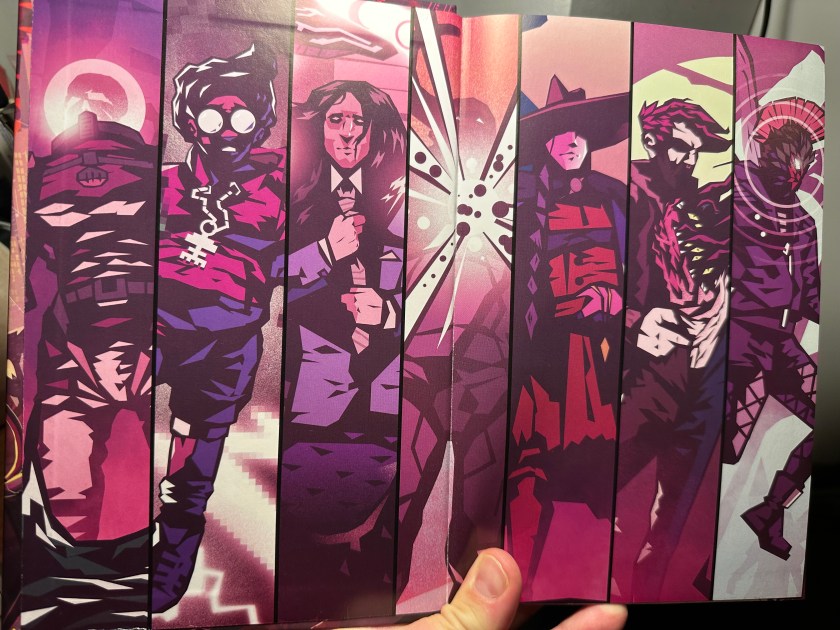
The illustrations of each of the Playbooks all together.

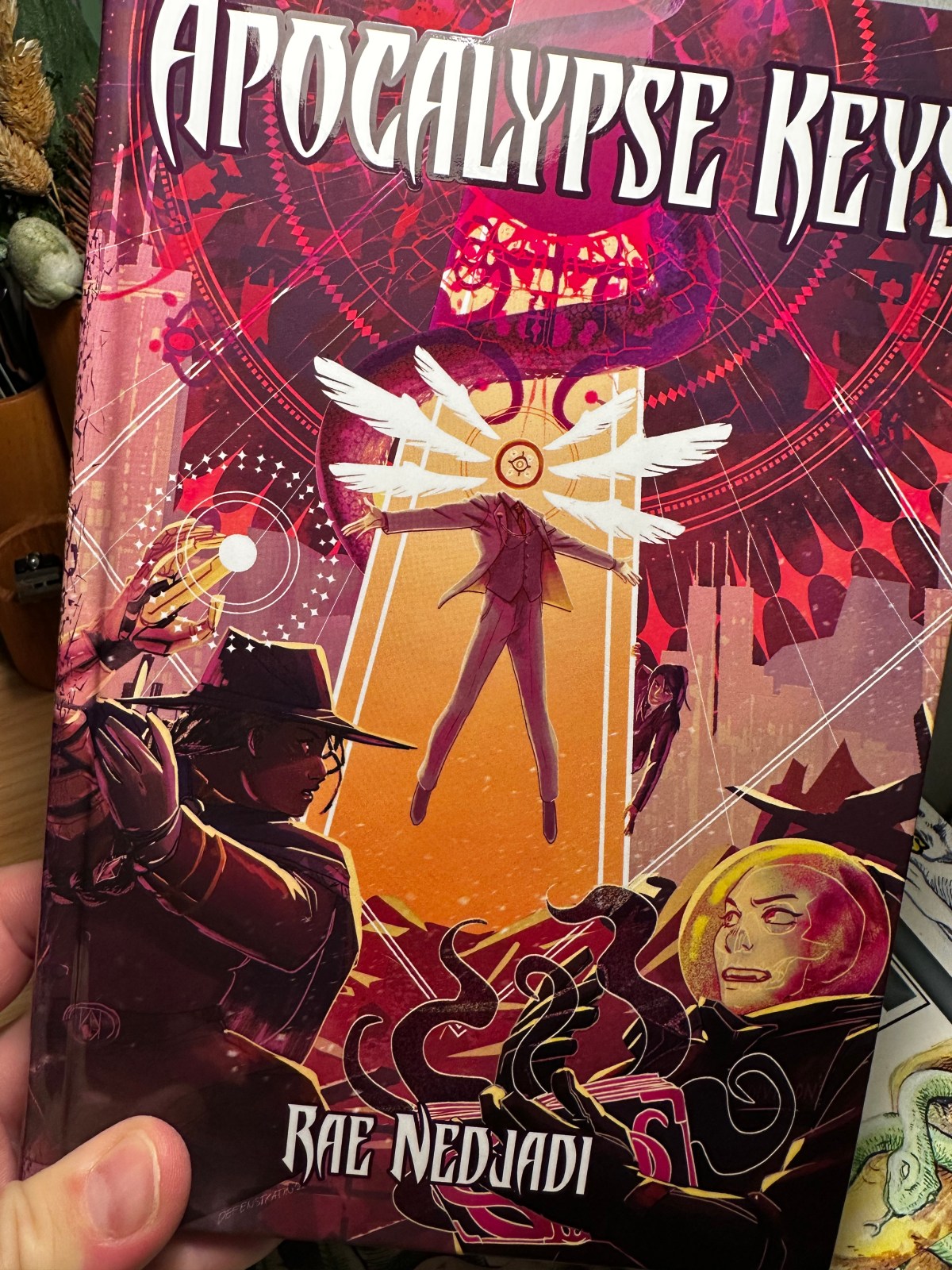
Apocalypse Keys by Rae Nedjadi is a Powered by the Apocalypse game in which you play members of a super-team of sorts. You are wielded like weapons by a shadowy organisation called DIVISION (which is an initialism, kinda like S.H.I.E.L.D.) in an effort to prevent apocalypses. How? Well, you gather Keys, which are essentially clues you will use to find and open Doom’s Door before the bad guy can. The bad guys are known as Harbingers and they are Omens, like you, but more world-endy.

The game is very much PBTA in its design, with a few extras. Although you roll 2d6 for most things, if you roll an 11 or higher, you overshoot, you blow the whole warehouse up instead of just the gates, your powers leave the security guard a blubbering mess instead of just plucking some thoughts from his head, you get the idea.

Also, it has some Carved from Brindlewood flavour to it too. The Keys you gather improve your chances of finding the Doom’s Door you’re looking for. For each one you get, you increase your chance that the theory you have come up with is correct and you know where to find it.

Ruin seems to have been taken from Trophy. Although it’s used a little differently. As you gain it, you get closer to becoming one of those bad guys, the Harbingers. It can also give you special Advances (abilities.)

One last thing: PCs gain Darkness Tokens as they make particular types of narrative choices that align with the emotional themes of the playbook. You spend these tokens to give you modifiers to rolls.

I think it’s important to know these things as we go into character creation for this game. Also, it has a very specific flavour. The PCs are monsters in the vein of Doom Patrol or the X-men. There is a lot of significance to the emotions of the characters and there is a fair bit of angst and drama involved from what I can tell.

Creating Monsters of DIVISION

The book provides us with a step by step guide to character creation which I love to see. It was something I missed from the process in Orbital Blues. Lets take a look:

  • Step 1: Choose a Playbook
  • Step 2: Bring Your Character to Life
  • Step 3: Refine Your Abilities
  • Step 4: Introduce Your Character to the Other Players
  • Step 5: Create Your Starting Bonds

As this is purely an exercise the last couple of steps probably won’t happen.

Choose a Playbook

Like other PBTA games, you choose a playbook to get started. Your character might decide to switch playbooks further down the line, depending on the narrative choices that are made at the table but most are likely to select one and stick with it. It’s like a character class in other games.

Here are the available playbooks in Apocalypse Keys:

  • The Summoned: a being summoned from another place. Violent, aggressive, antagonistic to prophecy, wants love more than anything
  • The Surge: Massively powerful but not in control. Wants help to contain it. “Explosive, uncontrollable and alienating.” Friendly fire and collateral damage and toxic relationships are the themes
  • The Found: Psychic amnesiac. They are very odd, but curious and highly emotional. They can have surprisingly intimate knowledge of other peoples’ inner lives and thoughts but do they know what’s best for others?
  • The Shade: A super intellect who cheated death. Thematically, they are for players who want to forge a difficult relationship with death and struggle with the costs of great knowledge
  • The Last: The last of their kind from another world. “Their power is reflective, sorrowful and hopeful.” Unsurprisingly the themes here are heavy, loss, tragedy and how these things are inevitable.
  • The Fallen: Elements of Lucifer, a fallen angel. “Their power is intoxicating, damaged, deceitful.” Thematically, hubris, the two sides of worship and an over-riding want for what was lost.
  • The Hungry: It is what it says. “Their power is intimate, transformative, and harrowing.” Getting big vampire vibes here. They are looking to feed, get truly close to someone and deal with the idea of body horror, unsurprisingly.

I could roll 1d7 to pick here, but there is one I’m drawn to most. That is the Fallen. They are all pretty goth but it feels gothiest to me.

The Fallen

The Fallen illustration from the book. A man in a suit with long, dark hair, a suit and tie ad a dragon coiled around him.
The Fallen illustration from the book

I am a pale reflection of the glory I once was
I embody the hubris and volatility of the Apocalypse
My power is faded, cracked, and deceitful
My heart yearns to worship and be worshipped

Bring Your Character to Life

I’ll be using a series of prompts provided in the playbook description to do this next part.

Your Name

There are four options here:

  • A name god gave me with love
  • a name I earned through fear and terror
  • a name that can never be said out loud
  • a name you need to give someone else one day

I choose the third one, because it’s cool, honestly. The name is Duma, after the Angel of Silence. In fact, I think this character will only communicate through signing.

Your Look

There are several options here. I won’t list them all, just the three I’m taking:

  • a multitude of wings made of light and sound
  • a cracked halo that bleeds
  • mismatched clothing hastily thrown together

I love these touches. I imagine the halo just constantly dripping blood onto Duma’s face, forcing him to close his eyes to the horrors of the world. The wings, once flapping silently, feathery and white, now buzz and flicker like an insect’s. The clothing, whatever he could find, an old army surplus jacket, some discarded cream chinos and a pair of scuffed tennis shoes.

Your Origin

I have to choose one of these four options for Duma’s origin:

  • I was once a mighty god of this Earth but I was killed by my worshipers
  • I once claimed hell for my own but I was betrayed
  • I was an angelic creature destroyed by my jealous god
  • something else that describes how far I have truly fallen and all I have lost

It’s nice to have that last option there for anyone who has their own idea of their character’s origin. For me, though, it has to be the third one. I think Duma was silent before as a way to show his devotion to his god, but is silent now because he has vowed never to speak until he regains the trust of his god or destroys him.

Who are the Gods Who Taunt You?

I only choose one of these:

  • those who I betrayed seek to destroy me once and for all
  • ancient gods who have lost their power and ache for what is left of my divinity
  • twisted gods I corrupted who are now monsters of myth and legend
  • divine servants who grow in power as I have weakened
  • something else that feeds my spite and sharpens my hubris

I like the idea of other bully angels coming down to tease Duma while he seethes and silently curses them so I’ll go for the fourth one.

Your Impulse

This is an interesting departure from other PBTA games I’ve played. Usually, you have particular character goals that mostly remain static, and if you manage to achieve them in a session, you gain 1 XP. In Apocalypse Keys, you choose one of the listed Impulses each session and work to explore it. If you do, you can gain 1 XP OR 1 Ruin. I’m not going to list them all, but here are a couple that I like:

  • Did you bless the weak with the immeasurable glory of your presence?
  • Did you taunt or seduce those who would seek to destroy you?

I think, as a starting Impulse, I would go with the first of those two, just to start things off as I meant to go on.

Your Powers of Darkness

These are largely thematic flavour for your character to throw on a standard move. They are pretty much open to interpretation every time you use them.
I can choose two from the following:

  • Soul Venom
  • Fae Glamour – Just so Duma can walk around town.
  • Fear Manipulation
  • Weapons of Light and Sound – This seems very angelic.
  • Many Forms of Mythic Animals

I’ll take Fae Glamour and Weapons of Light and Sound

What Does the Darkness Demand of You?

This is such an important question to the character and for the Keeper to know how to interact with them. There are quite a few, so I’m going to only list the two I am choosing:

  • To storm heaven
  • to curse the one I love

Man, that’s melodramatic!

Gaining Darkness Tokens

This is an important part of the process. It will define the way I play the character to a large extent. Duma will get 2-4 Darkness Tokens every time he does any of the following:

  • Feel others are beneath me
  • React with spite or arrogance
  • Ask someone to worship me
  • Ask someone to betray another
  • Embody a condition that effects me

Interestingly, the Conditions I might gain as the Fallen are different to those other playbooks might get.
Here are mine:

  • Lustful
  • Raging
  • Forlorn
  • Obsessed

All extremes of emotion. Unsurprising really.

Breaking Point

The Fallen's Breaking Point page. Also includes the Call Me Master move and an illustration of a glowing person bringing people under their control.
The Fallen’s Breaking Point page.

This is what happens when you are full up on Conditions. If you mark all four, you hit your Breaking Point. It is unique for each playbook and it serves to illustrate your character at their most emotionally overwhelmed. You just can’t take it anymore. You must have a scene to describe what happens. For your troubles you get to clear your Conditions and get a point of Ruin.

You were once beautiful and loved, perfect and beyond despair. You are gripped with how far you have fallen, how much of your glory was ripped away from you. You are unworthy of love, and your heart screams in anguish
Describe how you use what little power you have left to bring you painfully close to your former divinity, and how it twists and consumes everything around you. The Keeper will tell you what horrors you birth and what twisted shadow of a god escapes quietly into the world.

Ooof.

Playbook Moves

Each Playbook gets one move that is only for them. Normally when you advance, you can take moves from other playbooks, but not the signature one. The Fallen gets:

Call Me Master

This is a move designed to snare other beings into worshiping you, or at the very least, doing your bidding. If it goes wrong, it might make an old enemy act against the Fallen or maybe make you display your real being, forcing you to lose a Bond, or, at worst, awaken a sleeping horror.

One More

Other than Call Me Master, I get to choose one more from the playbook description. Here is a list of those I can choose from:

  • Mother of Monsters – Just imagine what could go wrong…
  • Fleeting Divinity – Relics with your power contained in them. Use them for modifiers to rolls
  • Honeyed Tongue and Clouded Minds – Use this to get extras when you Unleash the Dark, such as gaining more knowledge or making lies truth
  • You Loved Me Once – Make an NPC one of your former worshipers. They might still be, or they might serve your ancient enemies
  • The Lies that Serve Me – Your mistruths can become real for a time but if you fail… you might lose that part of you that made it.

I love the idea of just declaring a new NPC or faction were once your devotees and seeing what happens. Wow, that could go so wrong in so many interesting ways. But the ways it might go right are equally interesting so I am going for “You Loved Me Once.”

Ruin Moves

I only get to choose one of these. Another option is to choose a DIVISION move instead. And, although that is of interest, I’d rather stick to the stuff that’s specific to the playbook. Also, Ruin is just more interesting to me. Here are the Ruin Moves for the Fallen:

  • Tremble Before Me – One of the basic moves is Unleash the Dark. It is used when imposing your will on someone. Tremble Before Me allows you to mark a point of Ruin to get a better result when you do that.
  • My Beloved Nemesis – When you do this, you have two options, mark one Ruin and get to clear your Conditions while explaining how your betrayer is out in the world, or mark two Ruin and have them appear in the scene! You form a Bond with them either way. If you choose the second one you form a Bond with What the Darkness Demands of You.
  • Desire Dressed as Faith – You can make people want to do something or possess someone. Spend one or two Ruin for varying extremes of desire.
  • I Will Rise Again – When you work towards regaining your old glory, you make this Move. You get to choose from a long list of steps forward you can take which include doing things like avoiding all notice, imbuing your forces with magic weapons and killing the only one who could stop you. But the Keeper gets to screw you for it.

For me, the one that works most for the playbook and the character is that last one. It feels like the kind of thing the Fallen should be working towards from the start. So I will take I Will Rise Again as Duma’s Ruin Move.

Conclusion

This has turned into another monster post, pun very much intended. So I am going to skip the Bonds for this character, mainly because I don’t have any other PCs to Bond with anyway.

There are things about this game that I find too overwrought, too melodramatic for my tastes. But there are things in the character creation process that I enjoy. The moves are great and so imaginative and evocative of the genres this game is inspired by. But it’s similar enough to Triangle Agency to put them into direct competition with each other. Also, I’d like to actually play Duma, but I don’t know if I want to GM this game…

Deathmatch Island Character Creation

Today, I’ll be making a competitor for Deathmatch Island, a regular person with a normal-arse job, someone you might meet at the gym or in the supermarket.

This is the sixth in a series of character creation posts I’m using to figure out which game I want to schedule for our next campaign. You can find the Triangle Agency one here. And you can find the Slugblaster one here. You can find the Blades in the Dark one here. We took a slight detour for this one, here’s the Wildsea Ship Creation post. And then got back on track with the Wildsea Character Creation post.

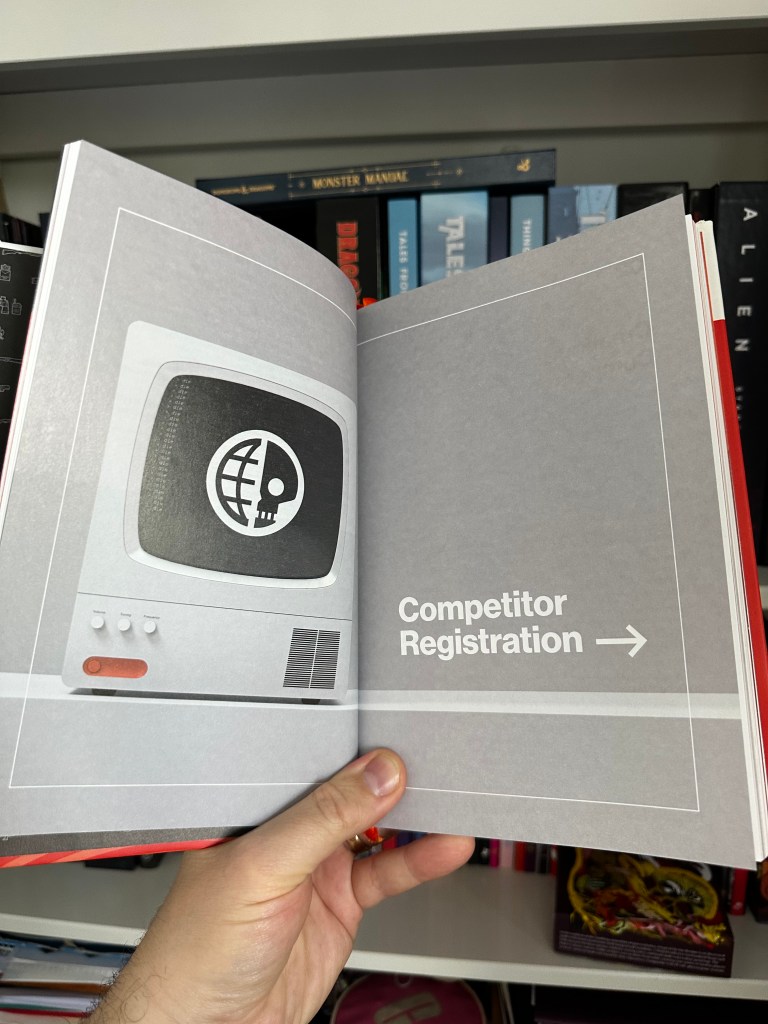
Competitor Registration

Competitor Registration

Today, I’ll be making a competitor for Deathmatch Island, a regular person with a normal-arse job, someone you might meet at the gym or in the supermarket. This is not going to be a superhero, or a secret agent or a wizard. This totally ordinary person is going to be thrown into a situation unimaginable to most of us, having to fight for their lives, form alliances recruit followers and solve puzzles, with the reward of nothing more complicated than survival. And they will have to do all this with an enormous gap in their memories that relate to their lives before the competition.

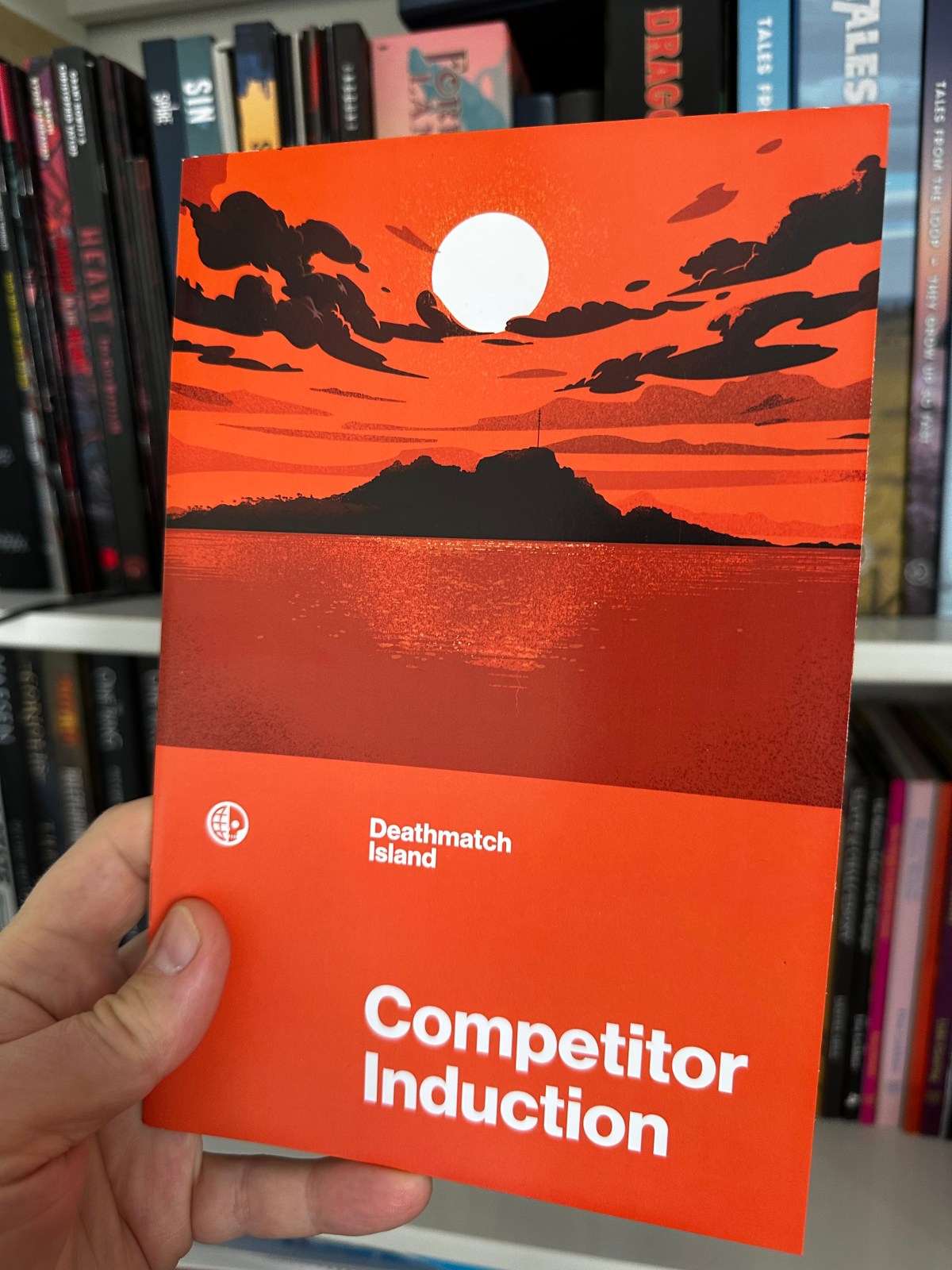
I wrote a piece about the game, which will give you the basics. You can read it here. So I am going to push straight on with Competitor Registration. One of my Kickstarter rewards was a Competitor Induction booklet. This holds a player’s hand through the relatively painless registration process and also provides some tips for Competitor Players in playing Death Match island. So, let’s open it up and get started.

Occupation

Occupation tables
Occupation tables

The first step is rolling up my Occupation. This part MUST be rolled randomly. It will allow me to add a die to my dice pool in contests if I believe my Occupation would be relevant. The Occupation will also determine my Competitor’s Favoured Capability (the type of contests the Competitor is specialised in.) All Competitors have the following Capabilities:

  • Social Game – using charm and social bonds to resolve contests
  • Snake Mode – solving contests using deception, stealth and straight-up lies
  • Challenge Beast – Not just physical ability but also a talent for puzzle solving
  • Deathmatch – The violent option: tactics, firearms and ruthlessness
  • Redacted – This is the one used when the Player Competitor strays out of the bounds of the game and into restricted areas. The Production Player (GM) has ways to counter these methods…

The Favoured Capability gets a d8, all the rest get d6s. These can be improved through gameplay later.

So, let’s roll on the tables. There are four Occupation tables, so I’ll start by rolling 1d4 to determine which one I roll on. That’s a 2! Then I roll 2d8 on Occupation Table 2. That’s a 7 and a 4. That gives me:

  • Firefighter (Challenge Beast)

So, with this Occupation, I’m imagining someone physically fit but also intelligent in spatial awareness, environmental hazards and safety concerns.

Name and Competitor Number

Name tables
Name tables

The name of a Player Competitor is more than just what the other characters call them. It has a mechanical impact. Part of the game is attracting followers, getting your name out there and increasing your popularity. This is so important that you add a Name die to every Contest roll in the game. It starts as a d6 but gets bigger as you accumulate followers.

You don’t have to roll for your name. If you want to play a Competitor with a specific nationality, ethnicity etc, you might want to choose the name for yourself. But, in the tradition of my character creation posts, I’m going to roll for as much as I can. There are three first name tables so I’ll start by rolling a d3 to pick the one I’ll roll on. That’s a 3! Now I’ll roll 2d8 to determine my first name. That’s a 5 and a 7, giving me:

  • Sakae – a Japanese name, normally male but sometimes female. It usually means, glory or prosperity, which seems auspicious. I think I will go with he/him pronouns for Sakae

The surnames are a little more straight-forward. I just roll 1d8 and 1d20 to figure it out. That’s a 4 and a 5, which gives me:

  • Kogoya – an Indonesian name. Egianus Kogoya is a military leader in the “Free Papua” movement

Sakae Kogoya is, I think, a civilian firefighter from the island of Okinawa (a place I actually lived for a year in the nineties.) His mother is Okinawan Japanese and his father is an Indonesian American who came with the American military forces but stayed when he found love. He opened an Indonesian restaurant in the city of Ginowan where Sakae grew up.

Next, I just roll a d100 to get Sakae’s competitor number. That’s 095.

Distinguishing Features

Uniform and Characters

There are a few random tables to determine some random features for your Competitor in the booklet. Once again, the player is free to choose from these tables or make up their own if they have a clear idea of them already. These features have no mechanical effects at all, unlike Name and Occupation. They are just to help distinguish the character. I’m going to roll on each table for the sake of randomness.

  • Eyes (1d20) – 19 – Beady (could also have had the likes of Glacial, Twitchy and my personal fave, Haunted)
  • Build – (1d20) – 20! – Willowy (other possibilities include Beefy, Towering and Average)
  • Hair – (1d20) – 5 – Striking (I’m imaging something that takes a lot of product and looks like something from an anime. I could also have rolled up Nest, Bangs or Boring)
  • Detail – (1d20) – Another frikking nat 20! – Strong hands (other options here included Unusual face, Eye-patch and Pleasant scent)

Uniform

Uniform tables
Uniform tables

All the Competitors start with the same uniform when you begin a game of Deathmatch Island. This also has no mechanical impact. There are six style options presented and six colours. I would say a lot of groups would want to discuss this amongst themselves and select the one that most appeals to them but, obviously, I’m going to roll for it.

  • Uniform Type (1d6) – 4 – Blazer and turtleneck!
  • Uniform Colour (1d6) – 4 – Goldenrod!

Wow! That’s quite a combo. Seems incredibly impractical. Not much stretch in a blazer and that colour is going to make sneaking extra challenging! But that’s what I rolled, so that’s what Sakae Kogoya and his fellow contestants are stuck with.

Please see below, the welcome letter that Sakae is presented with when he first wakes up on the boat taking him the ISLAND ONE.

Welcome to ISLAND ONE letter

Conclusion

Sakae Kogoya Competitor Registration sheet

And that’s it! That was refreshingly fast. You’ll notice, from the screenshot of Sakae’s character sheet, that there is a lot of empty space on it. There’s a lot that you only get in play in Deathmatch Island, so, even though I’m finished character creation, there’s a lot of room for growth, improvement and notes. I like this approach a lot. It leaves much of the character building to happen in the context of the game, rather than before you even start. It’s particularly appropriate in the scenario where your character is suffering from selective amnesia. I feel like, with this quick Competitor Registration and the relatively simple rules, you could get some people around a table and run a session of Deathmatch Island with little or no hassle or delay. The structure of the game and the way the Production player chooses casts allows you to run it with very little prep, also. This is a big tick in the pro column for me these days.

So, dear reader, what do you think of the Deathmatch Island character creation process in comparison to the other games in the series? I still have a few more I could fit in here, like Apocalypse Keys and Orbital Blues, which I listed as outside contenders way back here, in the post that started it all. But right now, I think Deathmatch Island is a strong contender, if only for the fact that I could get it off the ground so quickly and potentially complete a campaign in 3 or 6 sessions.

Death Match Island: Postponed Again?

I’m not traveling this time, dear reader, but I have a pretty busy week on my hands. Tonight, I have a Heart one-shot, specially requested by fellow Tables and Tales GM, Shannen. I have been beavering away at the preparations for that the last couple of days. This weekend, my nieces are visiting and I’m planning another one-shot for them, too. Also, honestly, after the last mammoth character creation post for the Wildsea, I was simply not able to dive right into another one straight away, anyway. So, I took a break, and decided to focus on the important things in life, finding ever more inventive ways of allowing the PCs in this Heart one-shot to bring poetic ends to themselves.

Death Match Throwback

The next character creation post on the agenda is for Death Match Island. So, as a consolation, please take a look at this post from last year where I go into the rewards from the Death Match Island crowdfunder and also the rules and stuff:

The Wildsea Character Creation

The book presents many, many options in each step, and that’s even using the Quickstart kits. Without the Quickstart rules, you can really choose any options from any bloodlines, origins and posts, to truly customise your character as you like.

This is the fifth in a series of character creation posts I’m using to figure out which game I want to schedule for our next campaign. You can find the Triangle Agency one here. And you can find the Slugblaster one here. You can find the Blades in the Dark one here. And most relevant to today’s post, here’s the Wildsea Ship Creation post.

A Character to Fit the Beacon

In my last post, I created a ship for my Wildsea character to pilot across the Thrash. The ship, it turned out, is a research vessel, fast and dangerous, but not very manoeuvrable or stealthy. It’s got a beehive for an engine and an acid-cannon for protection. It also has a colony of glow bugs that follow the crew around illuminating their surroundings for them. I named the ship the Beacon.

So, what kind of wildsailor am I going to come up with to match the vibes of the Beacon? Let’s find out, dear reader!

Character Creation Steps

Character Creation chapter illustration

There are three important choices to be made in this process:

  • Your Bloodline
  • Your Origin
  • Your Post

Now, while these choices are minimally restrictive, the beginning of the Character Elements chapter encourages you to build a narrative background around the framework of the mechanical choices. In fact, throughout character creation, you are encouraged to be creative and to make unique wildsailors that no-one else has ever made before.

Also, there are many other elements to a Wildsea character, it’s just that most of them hang off these three choices. All of these are explained in the Character Elements chapter.

At this point, I think it’s important to point out that the Character Elements chapter is there only to explain those elements, not to help you create your actual character. That’s all in the following chapter. One thing I have found with the Wildsea is that it devotes a lot of space to explaining everything. Occasionally, I find that this is at the expense of functionality. The book goes to some lengths to inform you what the Cook skill allows you to do, when, in a storytelling game, this could usefully just be left up to the players around the table. It’s also because so many of the terms used in play are quite unique, Twist, Edges, Whispers, Cut etc. Although most of these bear some resemblance to elements of other games, the resistance to using those better known terms means they require more explanation. I found this also in Slugblaster, an ostensibly Forged in the Dark game that uses a lot of setting/genre-specific terminology for concepts that are more functionally named in Blades in the Dark.

Anyway, I’m going to move on from the Character Elements chapter immediately. If I need to explain anything, I’ll do it as I build the character.

Young Guns or Old Dogs

This is a welcome choice to start with. It reflects the type of game you’re preparing for. If you go for a Young Gun, you start with fewer skills, aspects and resources, leaving the character more room to grow. The Old Dog has more going for them, but is meant for one-shots or short campaigns. For my purposes, I’m going to create an Old Dog, to show off more of the character elements in this blog post.
So, an Old Dog starts with the following:

  • 1 Bloodline, 1 Origin, and 1 Post
  • 3 edges
  • 15 skill / language ranks (maximum starting rank 3)
  • 6 aspects taken from any bloodlines, origins, or posts
  • 6 resources
  • 3 drives and 3 mires
Ardent Quickstart Kit

For ease of one-shot character creation, there is a Quickstart Kit presented in the section for each bloodline, origin and post. These break it down to a selection of easy choices.

In the interests of keeping this post below 2000 words, I’m going to use the Quickstart kits as and when I feel its appropriate.

Bloodline

Here are the options for Bloodline:

  • Ardent – human
  • Ektus – cactus-folk
  • Gau- fungus-folk
  • Ironbound – ship-ghosts with bodies of salvage
  • Ketra – gelatinous humanoids
  • Mothryn – moth people
  • Tzelicrae – hive-mind spider colonies in a human skin
A Ketra with a chart

Remember this is a Researcher we’re making here, so I think it would be useful for them to be good with technology. The Ketra are described in the book as “tech-savvy.” So, I think that’s what I will go for.

The ketra are the descendants of those fragments of ancient humanity trapped in tunnels and sturdy temple complexes, mineshafts, and mountain-seams. Like the ardent, they have adapted to face the post-Verdant world, but with a far more dramatic biological change – tentacular mantles, translucent fl esh, and swirling, ever-moving inkblot patternings are common. Many ketra reinforce their malleable forms with selfmade skeletons of salvaged driftwood or repurposed scrap-metal.

Questions

The first thing to do with your new ketra is answer the following questions:

Q: Have you spent any time in the ‘ancestral’ ketra places and, if so, how did you find their dark, crampled confines?
A: Yes, my character spent the early part of their life below the waves. Only as a young adult did they venture above the Thrash where they were discovered by the original owner of the Beacon, an Ardent named Benida Hoffspring

Q: How original is your skeleton, and if you’ve replaced parts of it yourself, what new materials do you rely on for support?
A: Many parts of their skeleton have been replaced, most notably, the lower jaw is shaped by a perfectly formed piece of Ironwood. It juts out more than it should. Other bones have been replaced with sturdy pieces of salvaged metal and ceramic.

Q: Were you passed down any stories of your family’s old human days, or is your preverdant lineage lost to history?
A: There was an old album of photos, preserved in plastic. It revealed a world long gone, of Ardent cities and water-going ships. Their ancestors were sailors…

Bloodline Aspects

Aspects differentiate your character from another one with the same bloodline, origin or post. They make them unique. They can take the form of a physical trait, a companion, or a piece of gear. So, with the Old Gun type of character, you can choose 6 Aspects from bloodline, origin or post. As a Quickstart character, I’ll choose two from each step.
If I list off every Aspect from every step, this post will be another giant. Instead, I am going to list only those that catch my eye for the character. Here are the bloodline aspects I want to choose from:

Scrapper Enzymes 3-Track Trait
You can use salvage as a component when concocting a potion or chemical mixture, no matter its form.

Scrap-Metal Skeleton 3-Track Gear
The internal structures you’ve collected can store biovoltaic energy. Use a task to create a resource, Scrap-Bone Battery.

Drone Attendant 3-Track Companion
A simple punchcard-driven repair construct. Increase impact when repairing or tinkering with other machines.

From these three, I love the idea of this character brewing up potions and stuff on the fly so I am going choose Scrapper Enzymes for that. I also have simply got to choose a companion when available and narratively fitting, so Drone Attendant is coming too.

Bloodline Edges

Edges are areas of talent. They literally give your character an edge in certain situations, meaning you get an extra 1d6 in your dice pool if appropriate. They are rather poetically named, but mostly speak for themselves nonetheless. Here are the edges presented in the Ketra Quickstart kit:

  • Iron – “An edge of force, determination, & willpower”
  • Sharps – “An edge of logic, wit, & planning”
  • Veils – “An edge of shadows, ciphers, & secrecy”

For this ketra researcher who crawled out of the depths on their own, I’m going to choose Iron and Sharps.

Bloodline Skills and Languages

These get ranks. You start at rank one and go up to rank three. You get an extra d6 in your dice pool for each rank in the skill you are using when appropriate. I have to choose five of these.
Here are the available skills in the Quickstart Kit:

Concoct, Delve, Outwit, Scavenge, Sense, Sway, Vault

I’m going to take Concoct, for sure, to go with the Scrapper Enzymes Aspect. I’m also going to take Delve, as someone show used to live in the ruins beneath the wildsea. And for my final Skill, I will take Scavenge, an important one for a scientific researcher/person who replaces their bones with random stuff.

And here are the available languages (you get a certain amount of lore with these too):

  • Chthonic – old human
  • Raka Spit – “The rapid patter of hunting-families and leviathaneers”
  • Signalling – inter-ship communication

Got to take Chthonic, probably their native tongue. Also, I just love the name of the language, Raka Spit, so I’ve got to take that too. Everyone gets a rank three skill in the trade-tongue, Low Sour, also.

Bloodline Resources

Resources can be used to get advantage on an action roll. They come in four different types as you can see below. I have to choose two of these to start with:

Salvage: Ceremonial Dynamite, Old Driftwood
Specimens: Luminescent Bone, Curled Centipede
Whispers: The Comforting Dark, All Tunnels End
Charts: A Faded Schematic

As a researcher, I think I have to take at least one specimen and the “Luminescent Bone” is the most thematic for this character. Perhaps it’s one of their own old bones?

I love the concept of Whispers in this game. They are like memes that can be passed on, inherited or sold, but once they are used, they are gone forever. I’ll take “the Comforting Dark.”

Bloodline Drives and Mires

Before making this decision, we need to understand the concept of Milestones in this game. They come in minor and major flavours and you write them for yourself. They work a bit like Beats in Heart. Achieving a major milestone allows you to improve your character more than a minor one.

So Drives, then, are the goals your character works towards to gain milestones. You can also gain a Whisper, or clear a mark of Mire when you move towards your drive goals. It’s important to note that they can change over time too, particularly if and when you achieve one of them.

Mires, then, are the negative psychological and physical effects of long-term exposure to the Wildsea. They will cut one or two dice from your rolls whenever you act against the effect of the mire.

Here are my options:
Drives

  • “Raise a pre-verdant structure” – this makes the most sense to me as a curious scientist
  • “Hoard treasures of the wider waves”Mires
  • “Sparks and jolts course through your extremities” – got metal bones, will take this one
  • “Your inkblot patterns whirl dizzyingly”

Origin

What were you before you were a wild sailor?
The options:

  • Amberclad – like Captain America but in amber
  • Anchored – ghosts of the Wildsea returned to life
  • Ridgeback – mountain folk
  • Rootless – born on the waves
  • Shankling – raised in the tallest trees
  • Spit-Born – brought up in the safety of an island or ruin

For this scientifically minded wild sailor, with the sort of backstory I have already incorporated, I think it would be very fun if they were an Anchored!

An Ardent Anchored
An Ardent Anchored

the anchored, a tangible, physical presence on the waves despite being, by almost all definitions, very much dead. These souls are given substance by their anchor, a single physical object that was left at the surface when their body fell. It might be a memento, a favoured weapon, a chart pointing the way home – whatever it is, it was enough of a tether to keep them from passing over, and to confer a level of impressive material control.

Normally, this would mean they came from above and their body was lost below, but for this ketra, I think it would be the opposite. When their original body died, just as they first emerged from above the surface, they reformed around a tether, something they brought with them from home. That was when they were brought aboard the Beacon for the first time. Their Anchor was the only thing left of them when they died, that wooden jaw.

Anchored Questions

Q: Do you remember your death? If so, what caused it?
A: No. The exact circumstances are hazy and plot-relevant
Q: To what extent do you feel connected to the world around you, now that you don’t follow quite the same rules of physicality as most?
A: They constantly strive to understand the world around them, scientifically, intellectually, and emotionally
Q: Have you ever come close to losing your anchor? If so, what happened?
A: No, as an integral part of the body, it has never been removed.

Anchored Aspects

Spectral Variance 3-Track Trait
Mark to become insubstantial for a short time, allowing you to float and pass through solid objects.

Geist Hand 3-Track Trait
You can manipulate nearby objects without touching them, though the heavier they are, the harder it is.

Tempered Anchor 5-Track Gear
Your anchor to the world is reinforced against damage and tampering, a wise move for a fleeting ghost.

I’m going to go for Geist Hand as suitably spooky and Tempered Anchor for purely practical purposes.

Anchored Edges

Here are the options:
Iron – already took this one
Tides – “An edge of exploration, learning, & lore”
Veils – “An edge of shadows, ciphers, & secrecy”

I guess it has to be Tides and Veils. Tides is particularly fitting for the researcher, I think.

Anchored Skills and Languages

Skills: Brace, Delve, Hack, Hunt, Outwit,
Sense, Wavewalk
Languages: Old Hand, Signalling

Going to take lots of skills this time. Brace is a defensive skill that will be generally useful. Outwit is a good one for a ghost, Sense seems equally appropriate for the Anchored. Also Wavewalk, normally meaning the ability to navigate the wildsea without a ship, could mean gliding along it spectrally. Also going to take Old hand (sign language) as a language.

Anchored Resources

Salvage: Old Memento, Broken Locket
Specimens: Glowing Plasm, Spectral Flower
Whispers: Back from Beyond, Drowned and Not
Charts: A Sketch of Shadowed Paths

Absolutely must take Back from Beyond as one of these. Also, a Broken Locket from Benida Hoffspring.

Anchored Drives and Mires

Drives

  • “Send other spirits to a peaceful rest”
  • “Reconnect with your friends and family” – This could be a fun adventure beneath the waves. I’ll take it!

Mires

  • “Your material control wavers erratically” – classic ghost-trope. Thanks.
  • “Visions of your past death are difficult to banish”

Post

Your Post is essentially your job on the ship. There are a lot of options here:
Alchemist – speaks for itself
Char – cook (sorta)
Corsair – swashbuckler
Crash – demolitions expert
Dredger – scavenger
Hacker – hacking through the wildsea
Horizoneer – adventurer
Hunter – ‘nuff said
Mesmer – mind-controllers
Navigator – yep
Rattlehand – engineer
Screw – Magnetos
Slinger – ranged attackers
Steep – tea-brewers
Surgeon – you know what this is
Tempest – Electro
Wordbearer – postman

There are several that are very tempting, like the Tempest, the Mesmer and the Char, but I think there is only one logical answer here, Alchemist. Right?

Alchemist
Alchemist

Alchemists are masters of concoction and reaction, able to combine chemicals and arconautic knowledge with unexpected (and occasionally unstable) results. Some alchemists focus on the healing arts, some on transformation and understanding, and others on more… explosive pursuits.

Alchemist Questions

Q: Do you specialise in certain ingredients, or take whatever you find and do your best?
A: They are curious about everything. Experimentation is key
Q: What was the worst unexpected side-effect you (or an unfortunate crewmember) ever experienced from one of your alchemical creations?
A: For a brief time, a crew mate died and became spectral like them, but just for a few minutes
Q: What draws you to such a specialised field of study? The lure of knowledge and understanding, or the power to change the world to your own design?
A: They are obsessed with the building of knowledge to understand this world and what they are doing in it still.

Alchemist Aspects

I will choose two from the following three:

Ulcerous Alembic 3-Track Trait
You can swallow two alchemical components, keeping them safely in your stomach. You can concoct them internally when you choose, benefitting immediately from the results or spitting the resulting solution out.

Baseline 3-Track Trait
Mark to briefly ignore any positive or negative effects stemming from a temporary benefit or injury. You are always immune to the negative effects of crezzerin.

Explosive Vials 3-Track Gear
Not an endless supply, but potent and disorienting. Mark to deal LR Blast, Salt, Acid, or Toxin damage to multiple nearby foes.

I’m going to take Baseline, since it makes sense due to my bloodline and origins. I’m also going to take Explosive Vials for fun.

Alchemist Edges

These are the options:

  • Grace – “An edge of elegance, precision, & agility”
  • Sharps – got it
  • Tides – and this

So I will take Grace, but I will need to choose another that isn’t listed. There are only two more that I don’t already have. I will go with:
Instinct – “An edge of sense, intuition, & reaction.” Which just feels right.

Alchemist Skills and Languages

Skills: Brace, Break, Concoct, Harvest, Scavenge, Study, Tend
Languages: Highvin, Brasstongue

No doubt I’m taking Break, Harvest and Study as skills. And with my last two skill ranks, I am going to upgrade Concoct and Study to Rank 2.

Alchemist Resources

Salvage: Pouch of Vials, Rust Extract
Specimens: Dried Locusts, Draketongue Root, Beast
Blood, Poison Glands
Whispers: A Tale of Choking Mists
Charts: A Stained Snapograph

I will take one Salvage this time, Pouch of Vials, and also another Specimen, Poison Glands.

Alchemist Drives and Mires

Drives

  • “Discover a previously unknown alchemical effect”
  • “Gather bile from an ancient leviathan” – maybe on the way down to visit their family?

Mires

  • “You’re the perfect test subject for your own work”
  • “Explosives are unstable around you” – this is too funny to pass up.

Final Touches

Name: Dhalsim Goodbottle
Pronouns: They/Them

Lets put it all together

Background

Bloodline: Ketra
Origin: Anchored
Post: Alchemist

Edges

  • Grace
  • Iron
  • Instinct
  • Sharps
  • Tides
  • Veils

Skills

  • Brace 1
  • Break 1
  • Concoct 2
  • Delve 1
  • Harvest 1
  • Outwit 1
  • Sense 1
  • Study 2
  • Wavewalk 1

Languages

  • Low Sour 3
  • Chthonic 1
  • Raka Spit 1
  • Old Hand 1

Resources

  • Salvage: A Broken Locket, a Pouch of Vials
  • Specimens: Luminescent Bone, Poison Glands
  • Whispers: The Comforting Dark, Back from Beyond

Aspects

Scrapper Enzymes 3-Track Trait
You can use salvage as a component when concocting a potion or chemical mixture, no matter its form.

Drone Attendant 3-Track Companion
A simple punchcard-driven repair construct. Increase impact when repairing or tinkering with other machines.

Geist Hand 3-Track Trait
You can manipulate nearby objects without touching them, though the heavier they are, the harder it is.

Tempered Anchor 5-Track Gear
Your anchor to the world is reinforced against damage and tampering, a wise move for a fleeting ghost.

Baseline 3-Track Trait
Mark to briefly ignore any positive or negative effects stemming from a temporary benefit or injury. You are always immune to the negative effects of crezzerin.

Explosive Vials 3-Track Gear
Not an endless supply, but potent and disorienting. Mark to deal LR Blast, Salt, Acid, or Toxin damage to multiple nearby foes.

Drives

“Raise a pre-verdant structure”
“Reconnect with your friends and family”
“Gather bile from an ancient leviathan”

Mires

“Sparks and jolts course through your extremities”
“Your material control wavers erratically”
“Explosives are unstable around you”

Conclusion

Well, that was pretty epic, wasn’t it, dear reader? Excepting only the Dark Sun character creation post, that was the longest one I’ve ever done. There are a lot of choices to be made in this process. The book presents many, many options in each step, and that’s even using the Quickstart kits. Without the Quickstart rules, you can really choose any options from any bloodlines, origins and posts, to truly customise your character as you like. I imagine that would be nigh on impossible to do without an encyclopaedic knowledge of the options presented in about 60 pages. I would not even attempt to do it without having made a Quickstart character or two first.
On the plus side, it was quite fun. The options presented are incredibly evocative and helped me envision my character aboard the Beacon. The drives and mires, in particular gave me a peek into the heart of Dhalsim Goodbottle. The other options gave me an exceptionally good look into the world of this game.

Dear reader, have you had any experience with the Wildsea? Have you sailed its verdant waves? Have you plumbed its leafy depths?

The Wildsea Ship Creation

Felix Isaacs has suggested that you start by creating your ship and only then move on to the creation of the characters who will crew it. And who am I to argue with Mr Isaacs?

This is the fourth in a series of character creation posts I’m using to figure out which game I want to schedule for our next campaign. You can find the Triangle Agency one here. And you can find the Slugblaster one here. You can find the Blades in the Dark one here.

Shipbuilding

I recently reposted a piece I wrote last year about the Wildsea and how it exemplifies the tradition of giving your PCs something to care about and then fucking with it. Please check it out for the basics of the game, the setting, and the ruleset. In that post, I pointed out that, creator of the Wildsea, Felix Isaacs, has suggested that you start by creating your ship and only then move on to the creation of the characters who will crew it. And who am I to argue with Mr Isaacs?

Stakes

How much do you have to spend on your new ship? Well, the buying process is abstracted out to a number of stakes. You don’t need to worry about defining the exact amount of currency required to outfit a new boat, you just split it up like a pie. Each crew starts with 6 stakes to spend on ship creation, with an additional 3 per PC who will be crewing it. Most options will cost a single stake but some more powerful ones will cost two or three. Since I don’t have a real party, I’m going to pretend I have a full compliment of three, leaving me with a total of 15 stakes.

You can’t get any more Stakes to improve your ship during play, but it is possible to trade cargo for the same upgrades later.

Next, in the Ships & Shipbuilding chapter, it has a short section on “Personal Touches.” I think these are important to making a ship feel like your own, but I think I’ll keep them to the end of the process.

Creating Your Ship

A Wildsea ship
A Wildsea ship

The next page tells us about the steps to make your ship. There are three overall stages:

  • Design – you have to choose an option for each of the following:
    • Size
    • Frame
    • Hull
    • Bite
    • Engine
  • Fittings – these are all optional but they come in the following categories:
    • Motifs
    • Additions
    • Rooms
    • Armaments
    • Outriders
  • Undercrew – optional choices that come in the following types:
    • Officers
    • Gangs
    • Packs

On the same page, there is a helpful example ship statted out for us. It is essentially just a list of chosen options beneath each of the three stages. Beside each option is the cost in Stakes and the benefit it provides for the ship if appropriate.

It also lists the Ratings for the ship.

Ratings

These are tracks (tracks are like clocks in Blades in the Dark, in some instances and like health bars in others) that are used to record the current status of various aspects of the ship. Every ship will have all six of these:

  • Armour – speaks for itself
  • Seals – How well your ship keeps out the nastiness from the Wildsea
  • Speed – ‘nuff said
  • Saws – most ships use giant chainsaws or something similar to power their way through the waves of leaves and branches.
  • Stealth – how well can your ship pass undetected?
  • Tilt – this is your ship’s manoeuvrability

Each one of these Ratings starts as a 1-track but we’ll be adding to that as we progress.
Keep these Ratings in mind as we go through the process!

Step One – Design

Normally, this would be done by committee. Every player should be involved in the decisions on which the foundations of the ship are built. But, obviously, in my case, that’s not possible. Anyway, here we go!

Size

There are four sizes available and they each cost 1 Stake:

  • Nano – big enough for one person and maybe a passenger. +1 Stealth
  • Small – can easily accommodate between two and four sailors. A good starter ship. +1 Speed
  • Standard – perfect for five to ten people. +1 Armour
  • Large – ideal for ten to twenty people. +1 Armour and -1 Stealth

I have a limited number of Stakes so I feel like a Small ship is the way to go. Also, it’s for a crew of up to four, so it’s just right.

Frame

The Frame, the book tells us, betrays a certain attitude that you want your ship to give off to other wild sailors. Your choice will also give Rating modifiers like Size does. Here are the six available Frames:

  • Sturdy – meant to weather storms and bombardments both. +1 Armour
  • Moulded – somehow constructed from a single piece of some material. +1 Seals
  • Light – lightweight and dainty. +1 Speed
  • Scything – all about cutting through the treetops as well as they can. +1 Saws
  • Sleek – Keeps you “low to the waves,” and as quiet as possible. +1 Stealth
  • Flexible – bend before breaking. +1 Tilt

I personally think that one of the coolest aspects of these wildsea vessels is the fact that they use enormous chainsaws to cut through the canopy. So, I’m going to lean into that and choose the Scything Frame, giving +1 Saws and costing 1 Stake.

Hull

Interestingly, you can have more than one of these, if you like, but you must have at least one, for obvious reasons. There are twelve Common Hulls and three more Unique ones listed here. The cost ranges from free to 3 Stakes. Here are the Common ones:

  • Reef-Iron – 1 Stake, +1 Armour
  • Leviathan Bone – 1 Stake, +1 Seals
  • Broadwood – 1 Stake, +1 Tilt
  • Rough Bark – 1 Stake, +1 Stealth
  • Chitinous – 1 Stake, +1 Speed
  • Razorscale – 1 Stake, +1 Saws
  • Beastback – 2 Stakes, +1 Seals, +1 Tilt, “A half-living hull of flesh and bone, flexible and unsettlingly warm.”
  • Ceramic – 2 Stakes, +1 Armour, +1 Seals
  • Chrysalid – 2 Stakes, +1 Seals, +1 Stealth, “A hull adapted from the cast-off chrysalis of a massive insect, excellent protection against the sea’s incursion.”
  • Ghost-Oak – 2 Stakes, +1 Armour, +1 Stealth
  • Arachnesque – 2 Stakes, +1 Tilt, +1 Stealth, “Less of a hull and more of a giant insect grown to fit the specifications of your frame, usually something spider-like.
  • Exile’s Copper – 2 Stakes, +1 Armour, +1 Speed

Here are the three Unique Hulls:

  • Junk-Strung – Free, +1 Armour, -1 Seals, can salvage parts from it
  • Floraflage – 2 Stakes, +2 Stealth, -1 Armour, undetectable while stopped
  • Monument – 3 Stakes, +2 Armour, +2 Seals, made from mountain stone so can’t “Forge-ahead during a journey”

I like the idea of adding a little Armour Rating at this stage but also building on the Speed I improved before so I am going to go with Exile’s Copper for the Hull giving me a +1 Armour and +1 Speed. It will cost 2 Stakes but I think its worth it.

Bite

This determines the way your ship is propelled. It will also have an effect on your ramming damage and the ease by which others might track you. There are twelve Common Bites listed, as well as several different types of sails and a trio of Unique Bites as well. Here are the Common ones:

  • Sawprow – 1 Stake, +1 Saws, big chainsaws! Close Quarters (CQ) Serrated damage
  • Impellers – 1 Stake, +1 Speed, outboard engines. CQ Blast damage
  • Crawler – 1 Stake, +1 Tilt, kinda like crab legs? CQ Blunt damage
  • Underscales – 1 Stake, +1 Stealth, snakey. CQ Keen damage
  • Jag-Tracks – 1 Stake, +1 Armour, “Motorised grapple tracks.” CQ Hewing damage
  • Sluicejets – 1 Stake, +1 Seals, chemicals that push you along. CQ Acid damage
  • Longjaw – 2 Stakes, +1 Saws, +1 Speed, “An underslung chainsaw arrangement.” CQ Serrated damage
  • Propeller-Cage – 2 Stakes, +1 Speed, +1 Armour. CQ Blunt damage
  • Navapede Limbs – 2 Stakes, +1 Tilt, +1 Stealth. Like a centipede. CQ Spike damage
  • Voltaic Runners – 2 Stakes, +2 Seals, like the electric ships in the Matrix, I imagine? CQ Volt damage
  • Mulcher – 2 Stakes, +2 Saws, +1 Armour, -1 Stealth, “grinding teeth in a lamprey-style mouth.” CQ Serrated damage
  • Tentaculari – 2 Stakes, +2 Tilt, it’s tentacles. CQ Salt(!) damage

I am not going to go into all the Sail and Unique options here because there are too many already, to be honest, and I know I don’t want any of them. I need to stick to my guns, or my chainsaws in this instance. As I am worried about the number of Stakes I have left to spend, I won’t go for the Longjaw. Instead I’ll go for option number one, Sawprow, for 1 Stake, giving me +1 Saws.

Engine

This is the last bit in the Design stage. A few things to note about the ship’s Engine:

  • It can be used for more than just propulsion
  • It will require a specific type of fuel
  • In most instances, don’t worry about tracking the fuel

There are eleven Common Engines and four more Unique ones. Here are the Common ones:

  • Chemical Compressor – 1 Stake, +1 Speed. Fuel – crushed fruit and insect husks
  • Springwork – 1 Stake, +1 Saws. Fuel – manual labour
  • Parasite Pitcher (Plant) – 1 Stake, +1 Stealth. Fuel – living matter
  • Steam Piping – 1 Stake, +1 Seals. Fuel – water
  • Ratwheel Exchange – 1 Stake, +1 Tilt. Fuel – feed the rats
  • Pulsing Cocoon – 1 Stake, +1 Armour. Fuel – dreams
  • Jawbox – 1 Stake, +1 Saws, +1 Speed, -1 Stealth. Fuel – wood
  • Solar Compressor – 2 Stakes, +1 Speed, +1 Stealth. Fuel – sunlight
  • Magnetic Coils – 2 Stakes, +1 Tilt, +1 Stealth. Fuel – magnetic scrap
  • Ceramic Batteries – 2 Stakes, +1 Saws, +1 Seals. Fuel – lightning strikes
  • Acid Maw – 2 Stakes, +2 Saws. Fuel – salvage and scrap

The Unique Engines are fun too. One of them is this:

  • Tamed Hive – 2 Stakes, +1 Speed, +1 Seals. It’s a massive hive and can produce honey. Fuel – flowers and pollen

I love the whimsy of the Tamed Hive so much that I must have it! That’s 2 Stakes but it adds +1 Speed and +1 Seals

There won’t be any more changes to the Ratings from the remaining steps so our final Ratings are:

  • Armour – 2
  • Seals – 2
  • Speed – 4
  • Saws – 3
  • Stealth – 1
  • Tilt – 1
A weird looking wildsea ship

Step Two – Fittings

Pretty much every part of this is optional, which is just as well because I only have eight Stakes left…

Motif

So this is the general theme and purpose of the ship. Choosing one can help the whole crew get a clear vision of the vessel and will also influence how others see you and it. They provide specific things like emergency medicine, gaudy appearance or a reinforced engine room. They do not provide mechanical effects but they may play a part narratively.

Here are the available Motifs. They each cost two Stakes:

  • Transport
  • Hauling
  • Hunting
  • Salvaging
  • Pathfinding
  • Raiding
  • Rescue
  • Research
  • Entertainment

You don’t have to choose a Motif for your ship but I am enamoured by the idea of a Research vessel out there on the wild waves. Perhaps the unconventional engine was something we discovered during a past expedition and we figured out how to make our ship go with it through the power of research!

A Research vessel:

  • has better tech on show than most ships
  • contains a research library
  • houses a snapograph arrangement. Its a sort of big camera

Additions

There are so many of these, most of them costing a single Stake. We’ve got Firefly Lanterns, a Cargo Crane, a Steam Whistle and lots more. But, as I am getting worried about how much I’ve spent already, I am only going to pick up:

  • Anchor System – Its Free!
  • Tethered Kitesail – 1 Stake – its a glider that is hooked to the deck. Lets us go up and get a bird’s eye view when the wind’s up

Rooms

On a Small Size vessel it’s not a great idea to split your already limited space up any further. You already have the following rooms on your ship:

  • A Pilot’s Cabin
  • A Main Deck
  • Crew Quarters
  • An Engine Room
  • A Cargo Bay

You can add a lot of different types of rooms like a Galley, a Navigational Suite, a Tap-Room or a Brig and they are all optional.

But this is a Research vessel now and I feel like we need a good way to observe stuff. We have the glider to allow us to watch from above. I would like to add a Cupola to the hull, near the rear of the ship, giving a great view of the Underthrash. That costs one Stake. I am down to just four Stakes left.

Armaments

Weapons are next on the Fittings list. These, too, are optional. In this case, they are either placed on deck or fixed to the Hull. I’m not crazy about the idea of armaments for a Research vessel, however, since our Stealth sucks, I think it’s prudent.

We have a lot of choices, from Trebuchet to Storm-Rail to Broadside Cannons and a Bladed Prow. But I’m going to pick up something suitably sciencey:

  • Viper’s Tooth – 2 Stakes, sprays an acid of some sort dealing Long Range Acid Damage.

Outriders

This is another option for defence. Honestly, with a Small ship, I don’t have the space for this and I also don’t have the Stakes to spend on it. You have to build an Outrider much like a ship, although it only has two components. You will also then need to add a way to store and deploy it from your actual ship. It seems like a fun extra but I can’t afford it.

Step Three – Undercrew

Octopus crew
Octopus crew

These come in three varieties: Officers, Gangs and Packs. I’m not going to go into detail on each variety as this post is already way too long. Suffice it to say, the officers are Skilled, Experienced or Well-Travelled, the Gangs are not necessarily what you might think of when you think of Gangs (some of them are Tinkers, some are Spear-Fishers, but some are actual Marauders) and the Packs are animals…

You can have Spring-Foxes which leap along beside your ship to warn of danger, Rig-Ferrets who can do knots, Squirrel Flingers who will fight to defend your vessel. But what I want is one of the Insect Packs:

  • Glowbug Parade – 2 Stakes, they follow the crew members around and illuminate their surroundings for them!

Personal Touches

And so, with all Stakes spent, we come back to the start and our little idiosyncrasies. The book suggests describing the following, so I will:

  • Colour and Style – I think it was once a scientific grey and white, all straight lines but now it is a dark shade of honey as the insects crawled all over it. It’s all smeared and waxy. The crew have left it that way as they think it protects from parasites
  • Shape and Construction – I think this ship is quite blocky, almost as though it was constructed from prefab elements. But, once again, the engine bees have shored up all the joints and seams with wax and honey, making it look far more organic
  • Quarters Decoration – I don’t have my character created yet so I am going to revisit this when I have made them. I expect that all the crew sleep in a single chamber, though. They might each have a personalised corner
  • Quirk – Sometimes the bees go to sleep at night and we can’t get the engine to start
  • History – This has always been our ship. It has been on a mission of discovery and research for several years now. We were originally led by an old eccentric who built it and funded it. Now she’s gone, we carry on in her place

The final step? A name of course!

I name this good ship, The Beacon…

And here is a list of the options I have taken:

The Beacon

Design

Small Size (1 Stake, +1 Speed)
Scything Frame (1 Stake, +1 Saws)
Exile’s Copper Hull (2 Stakes, +1 Armour, +1 Speed)
Sawprow Bite (1 Stake, +1 Saws, Massive CQ Serrated Damage)
Tamed Hive Engine (2 Stakes, +1 Speed, +1 Seals, honey)

Fittings

Research Motif (2 Stakes)
Anchor System Addition (Free)
Tethered Kitesail Addition (1 Stake)
Cupola Room (1 Stake)
Viper’s Tooth Armament (2 Stakes, Massive LR Acid Damage)
No Outriders

Undercrew

No Officers
No Gangs
Glowing Parade Insect Pack (2 Stakes)

Conclusion

I’ll keep this short as that was very long. You should set aside a session just for this process, dear reader. There are a lot of choices and I can only imagine how much longer it would take with four or five people trying to come to agreement on it! However, it has given me a very clear idea of the Ship I just created and a few ideas for the type of character who might crew it.

On to character creation!

Blades in the Dark Character Creation

You play a scoundrel…doing [heists] with your crew. The setting is Doskvol, a city in perpetual darkness beset by inter-faction strife, corrupt leaders, and supernatural entities. The end goal for the character is usually to retire from that life with enough coin in their stash to live safely and securely without worrying about rivals or the authorities.

This is the third in a series of character creation posts I’m using to figure out which game I want to schedule of our next campaign. You can find the Triangle Agency one here. And you can find the Slugblaster one here.

Forging a New Era

From top left, clockwise, the covers of Bump in the Dark, Band of Blades, The Wildsea and Slugblaster

Blades in the Dark, by John Harper has had such a profound impact on the TTRPG landscape since its release in 2017, that it’s hard to overstate it. It has a devoted following, it consistently appears on top ten RPG lists and it has spawned a bewildering array of games based on its system and setting. Forged in the Dark games like Band of Blades, Girl by Moonlight, Bump in the Dark, Slugblaster and Wildsea (debatably.) You can find a non-exhaustive list here.

The system is story-focused, encouraging players as well as GM to take a hand in building the narrative. Near the start of the book, it is pointed out that, “no-one is in charge of the story.” If I were to encourage you to take anything from this short summary, it would be that.

As in Slugblaster, you roll a D6 when attempting something. 1-3 is a failure, 4/5 is a success with consequences and 6 is a full success. The consequences from a failure or mixed success can come in the form of Stress, and thereby Harm and Trauma Conditions, which have more of an narrative effect on the story than a mechanical one (although they certainly have that too.) You can also add more dice to your roll and build a dice pool to give you more chance of rolling higher. You do this in several ways, by using pushing yourself, getting assistance or taking a Devil’s Bargain.

In all of these Forged in the Dark games, the rolls you make are highly abstracted. Instead of making a stealth roll, an investigation roll or a thieves’ tools roll, you describe what your character wants to do and then roll with the appropriate Action Rating. In most cases the Action encompasses a character’s whole part in a scene, rather than a single, explicit skill or combat thing like in D&D and similar games. The choice of the Action Rating used is explicitly left up to the player, but if the GM thinks it might be more effective to use a different one, they can reduce the impact of the action or increase the danger of the PC’s position, making the consequences for failure more severe.

Blades has several really cool mechanics, like the Flashback to go back and prepare something for the situation you find yourself in, but I don’t have the space to go into every rule here. Maybe I’ll do more of a deep-dive into the rules in another post. For now, let’s go about creating my Scoundrel.

Dark Heists

It’s important to remember the setting and the type of game this is. You play a scoundrel of some sort, doing jobs/heists/cons with your crew. The setting is Doskvol (or Duskwall), a city in perpetual darkness beset by inter-faction strife, corrupt leaders, and supernatural entities. The end goal for the character is usually to retire from that life with enough coin in their stash to live safely and securely without worrying about rivals or the authorities.

Blades in the Dark character creation steps

Playbooks

The types of characters available to play are suitably goth.

  1. Cutter – violent and intimidating
  2. Hound – crack-shot tracker
  3. Leech – explosive alchemist
  4. Lurk – shadowy sneak-thief
  5. Slide – social and manipulative
  6. Spider – factional mastermind
  7. Whisper – magic and ghosts

There are seven of them, as you will have noticed. So, I’m breaking out the DCC zocchi dice again. I got a 4 on the d7 making this character a Lurk.

The Lurk

The Lurk playbook in Blades in the Dark

There is no longer any sunlight — the world is plunged into eternal night. There are scoundrels who live in the darkness, who prowl the underworld unseen, trespassing where they will. They are the burglars, the spies, the infiltrators, the cut-throats — commonly called Lurks.

After this pleasing intro, the playbook description tells me that my Lurk will gain xp whenever they “address a challenge with stealth or evasion.” Each of the playbooks have a different way to earn xp that’s individual to them.

Here also, it asks a couple of questions to get the player thinking, not just about the mechanics of the playbook, but about the personality and background of their character:

Q. How did you learn the stealthy arts of the Lurk?
A. I was taken in at a young age by a band of pickpockets and sneak-thieves.

Q. Which Aspect are you drawn to most? The invisible watcher, spying on the unwary? The adroit acrobat, racing across rooftops? The deadly ambush predator, waiting for a victim in the darkness?
A. The intimate knowledge of the city’s underworld, its back alleys and interconnected cellars, its rooftops and sewers. Where to spy from, where to approach a potential mark/victim from and how.

Starting Actions

Everyone has three Attributes:

  • Insight
  • Prowess
  • Resolve

Each of these has four Action Ratings hanging off it.
Insight has

  • Hunt
  • Study
  • Survey
  • Tinker

Prowess has

  • Finesse
  • Prowl
  • Skirmish
  • Wreck

Resolve has

  • Attune
  • Command
  • Consort
  • Sway

You can have up to four points, or dots, in each Action Rating although you can only have up to two dots at the start.
The Attribute Ratings will equal the number of associated Action Ratings they have any score in. So if you have any dots in Attune and any dots in Command, you will have a Resolve of 2. You use the Attribute Ratings to resist different types of stress.

In the case of the Lurk, I start off with 1 point in Finesse and 2 in Prowl. I will add four more points to Action Ratings at a later step.

Shady Friends/Rivals

Your connections to NPCs can be key to a successful or disastrous career as a scoundrel. There is a list of five in a table here. I’m going to roll my d5 once for a Friend and once for a Rival

  • Friend – 3 – Frake. This is a locksmith who has taught me everything I know about lock-picking. He has an encyclopaedic knowledge of every type of lock, chest, safe and safe room in the city
  • Rival – 2 – Darmot. Once, he was one of our band of pickpockets, now, he uses his knowledge against them. He’s busted me many times

Lurk Special Abilities

You only get one of the eight listed abilities to start with.

  1. Infiltrator – you don’t suffer negative effects due to higher quality security measures employed by higher Tier enemies
  2. Ambush – Gives you an extra d6 when attacking from hiding
  3. Daredevil – get a bonus die if you take a desperate action as long as you take -1d6 to resist any consequences of it
  4. The Devil’s Footsteps – push yourself to do the impossible. This ability has a variety of effects
  5. Expertise – you have to choose an action rating and when you lead a group action with that, you can only take a maximum of 1 stress
  6. Ghost Veil – go completely invisible by shifting into the ghost field. Just take some stress to do it
  7. Reflexes – who should act first? You should, of course!
  8. Shadow – use your special armour to resist consequences from security measures or pushing yourself in physical endeavours

The book suggests taking the first one listed if you can’t decide between them. However, I am going to roll a d8 to make the decision for me. That’s an 8!

Shadow

You may expend your special armor to resist a consequence from detection or security measures, or to push yourself for a feat of athletics or stealth.
When you use this ability, tick the special armor box on your playbook sheet. If you “resist a consequence” of the appropriate type, you avoid it completely. If you use this ability to push yourself, you get one of the benefits (+1d, +1 effect, act despite severe harm) but you don’t take 2 stress. Your special armor is restored at the beginning of downtime.

I like this a lot. It matches the growing image of this character that I have in my mind.

Lurk Items

There is a section in the playbook description for items specific to the Lurk, but there is no need to choose anything at this stage. In Blades in the Dark, you simply indicate at the start of a Score how heavy a Loadout you have on you. That gives you a number of Load points to assign as the Score progresses. When you come across a situation in which you need “Dark-sight goggles” for instance, you write them down and mark the 1 Load that they take up. You never need to describe the items you have in your pack beforehand.

Heritages

The Shattered Isles map and description

There are six options here. Your Heritage is more akin to a real-world ethnicity or national background than a race or species. It is quite likely to shape your character’s politics, social circles and general way of thinking. It is unlikely to have any mechanical effect.
Here are the Heritages:

  1. Akoros – big, industrialised land. Like Europe. Duskwall is here.
  2. Dagger Isles – peopled by corsairs and merchants who sail the seas between their isles and beyond
  3. Iruvia – a desert kingdom to the south. Think Egypt.
  4. Severos – a wild place with nomadic people who survive in the ruins of ages past
  5. Skovlan – recently colonised by Doskvol. Many refugees from here have come to the city to look for opportunity
  6. Tycheros – a far-away land where the people are part demon. These characters get demonic telltales that mark them physically

Rolling a d6 for this as well: That’s a 1! Akoros. This is a local person whose family fell on hard times. While their parents were out looking for work, this guy was out running around with their gang, stealing and sneaking.

Backgrounds

What did this character do before going their crew? There are 7 options:

  1. Academic
  2. Labour
  3. Law
  4. Trade
  5. Military
  6. Noble
  7. Underworld

I would normally roll for this but I feel like I already have such a solid picture of this Lurk in my head that I am going to have to go for Underworld here. They were a street kid, a pickpocket within a network of urchins that spanned the city.

Assigning Action Dots

There are only a couple of rules to the way you can assign these dots (points) on your character sheet. You can’t start with more than two points in any one Action Rating. Also you should add one dot to an Action rating that reflects your Heritage and one dot to an Action Rating that reflects your Background.

I think, as a local in this industrial city, this character would get a dot in Tinker and as a wee guttersnipe, they would need a dot in Skirmish. I get two more dots to spend freely so I would like to add one to Hunt and one to Attune.

Vices

In your downtime between Scores, you might want to blow off some steam to relieve stress. That’s why you need a good vice!

Here are the options:

  1. Faith
  2. Gambling
  3. Luxury
  4. Obligation
  5. Pleasure
  6. Stupor
  7. Weird

There is a great deal of leeway to describe the specifics of your vice within the confines of the category. I’m going to roll a d7 for this. That’s a 1, Faith. I think my Scoundrel has found his place amongst an underground cult in the city. In fact, I think the band of urchins they have been part of since childhood is led by a prophet, a visionary with the ability to speak to god through the dead.

Name, Alias and Look

Name: Arvus Arran (I chose this from the long list of names in the book)
Alias: Bug (small, sneaky, seems to fly)
Looks: Non-binary, delicate, Fitted Leggings, Hooded Coat, Long Scarf.

Arvus Arran Lurk Character Sheet
Arvus Arran Lurk Character Sheet: Get yours here: https://ad1066.com/bens-character-sheets/blades-in-the-dark-playbooks

Crew Creation

Just like in Slugblaster, you really need a crew to finish out a Blades in the Dark character, but this isn’t really possible here, except to say there are a few crew types:

  • Assassins
  • Bravos
  • Cult
  • Hawkers
  • Shadows
  • Smugglers

And Cult seems to make sense here, imagining that the rest of the crew are also members of Arvus’ gang.

Conclusion

This is such a straight-forward character creation process that involves very little flipping between sections of the book. With a new character, you don’t have too many decisions to make and you can begin to get a feel for the character you’re creating very quickly. You can also see the potential for future stories and drama in elements of the process such as the friends and rivals.

I have only played the one campaign of Blades in the Dark but writing this post has whetted my appetite for more!