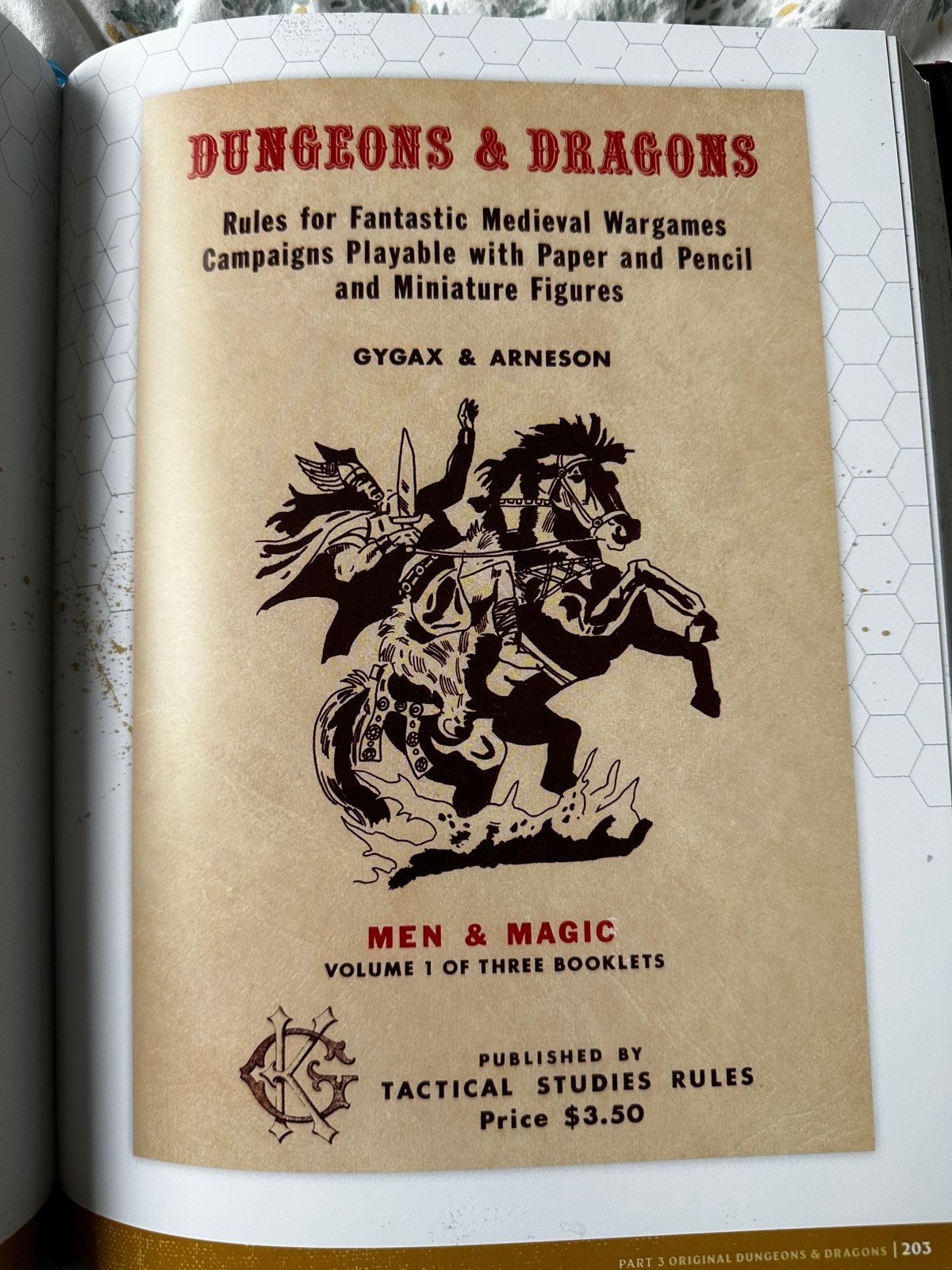
The Editioning: From OD&D to 5E 2024

Bloggies Inspiration

I have read a lot of TTRPG blogs in the last few weeks, dear reader. I imagine the chances are good that you have too, if you’ve been following the Bloggies awards over on Explorer’s Design. There have been so many wonderful reads, I really did find it hard to choose between many of them. What a I liked most of all were the posts that expressed their enthusiasm for the hobby in one way or another. You can feel it shine from a d66 table of carefully curated results as much as you can from the effusive prose of some bloggers. And there were blogs about every aspect of this weird pastime from story-telling to initiative methods and everything in between. So often, what I found is that writers went back to the source material for inspiration, those historical tomes that defined the RPG scene and continue to play an outsized part in it, whether we like it or not. Most of these we were OSR bloggers with a keen interest in the original D&D from 1974. But you would occasionally see other editions get a shout out. On top of this, I get a newsletter from the Shop on the Borderlands that tempts me weekly with a lot of old dragon game shit I don’t need… Unless, what if I did need it?

The Editioning

Now, I have some to lots of experience with most of the editions of the game, and I already have a bookshelf full of D&D, mostly AD&D 2nd Ed and 5E, but also several 4E books, a smattering of 3rd Ed and a couple of 1st Edition tomes. So, I figured, if I undertook a challenge to play a full adventure in every edition of D&D during the next twelve months, I wouldn’t need to supplement my collection too much to make it possible.

So, that’s where we are now. The Editioning is coming to pass. The plan is to play every edition of the D&D game, in order (although there may be some overlap) in our gaming community, Tables and Tales, between now and February next year. Isaac has agreed to take up DM duties for several editions. I will run OD&D, AD&D 2nd Ed, 3rd Edition and 3.5 and Isaac has said he would like to run B/X D&D, Ad&D 1st Edition and 4E. Someone else in the community might run 5E 2014 and 2024, but if not, I’ll probably do those too.

Pre-loved
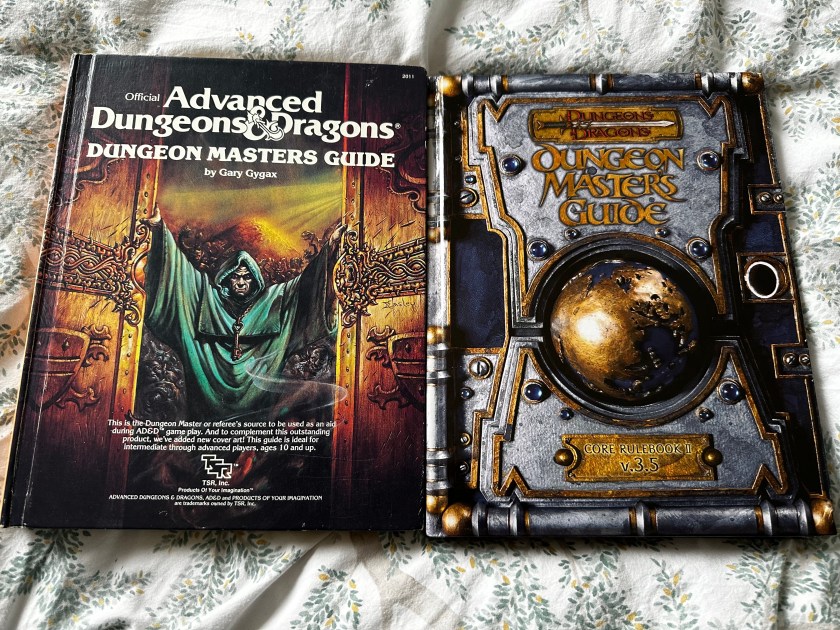
The covers of the AD&D 1st Edition Dungoen Master's Guide and the D&D 3.5 E DMG.
Just arrived!

I’m trying to source second-hand copies of the main rule books of each edition where possible. It seems more like a real history project when you have relics, primary sources, legendary tomes. It’s part of the adventure. I like to think about others using the books to play their own campaigns twenty, thirty, forty years ago. It puts me in touch with my own teenaged self and allows me to tap into the enthusiasm I had for the game back in the day. Also, its just cool to have them.
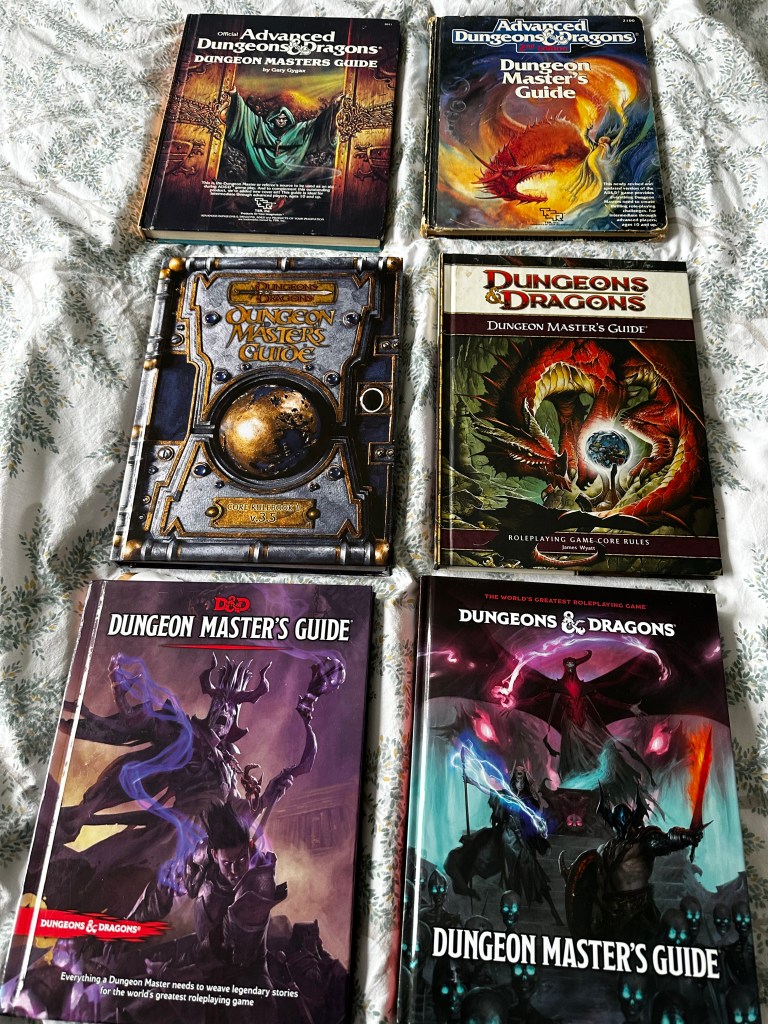
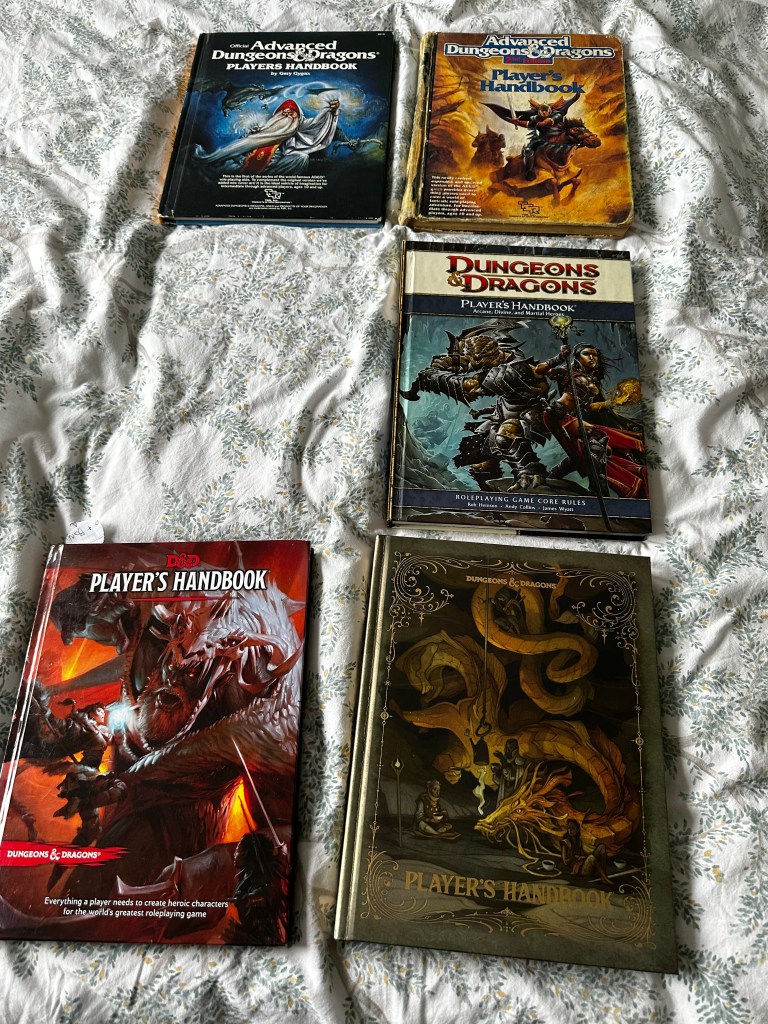
I’ve been surprised to find that you can get most of them for prices that I don’t consider extortionate, either on Shop on the Borderland or Ebay. I started shopping for them last week and a couple of DMGs showed up on Friday, AD&D 1st Edition and D&D 3.5E. They’re in good condition considering how much I paid for them. But before we get to those editions, we need to take a look at OD&D and D&D Basic/Expert.

The Educationing
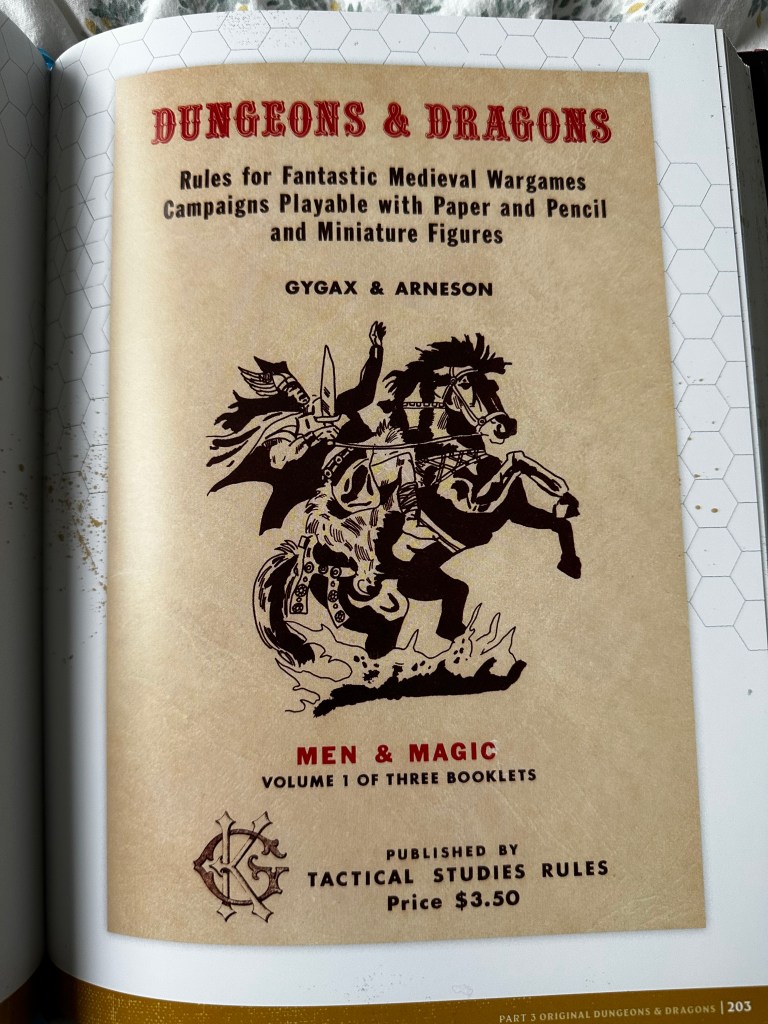
This undertaking has taken me to school. I had to figure out which editions were really distinct enough to deserve to be a part of it. I started by looking up the full list of editions here. I found this useful table:
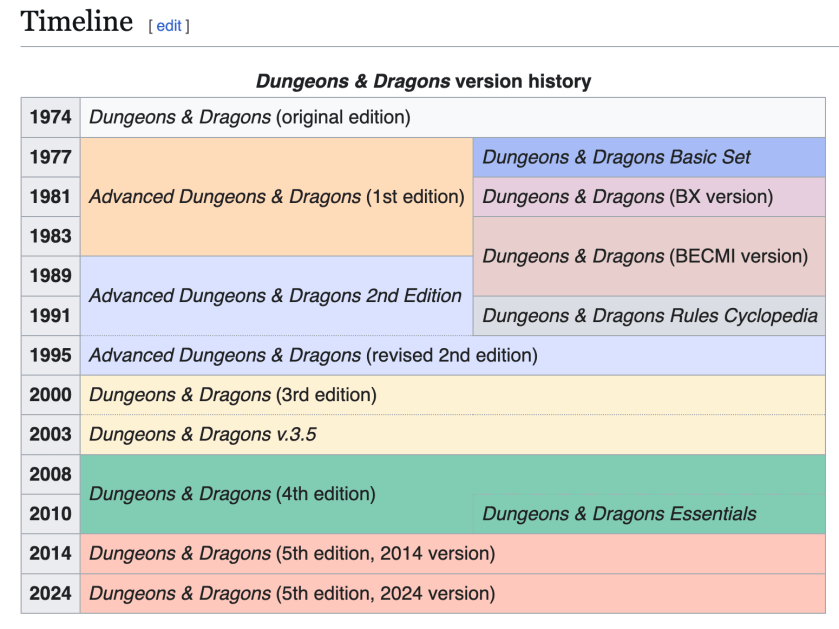
A table nicked from the Wikipedia entry for Editions of Dungeons and Dragons. it shows all the versions from OD&D to 5E 2024.
From Wikipedia

You can see that it clearly shows the parallel evolution of Dungeons & Dragons and Advanced Dungeons & Dragons. I remember, as a young DM being quite dismissive of the non-Advanced version of the game. I had cut my teeth on the Basic Set but felt as though I had graduated past it to AD&D after a year or two. Never-the-less, I did play it in the nineties. A friend DMed it for us using the Rules Cyclopedia and the Hollow World campaign setting. Looking back at it now, I wish I had had more of an interest in it. Above any other version of the game, except, perhaps OD&D, it seems to have had the greatest influence on the modern OSR. Hindsight is 20/20 I suppose.

I have seen the terms B/X and BECMI and Blueholme and The Red Box and whatnot, for a long time. But this was the first time I bothered my arse to figure out the differences between them. This despite having actually played the using the Basic Set myself. I did not know that the confusing “abbreviation,” B/X referred to the first two boxed sets of the D&D rules, Basic and Expert, which allowed play from level 1 to level 14. I also had not known that the initialism, BECMI, referred to the full set of five rule-books, Basic, Expert (why is Expert shortened to ‘X’ in B/X but ‘E’ in BECMI? Make it make sense!) Companion, Master and Immortal. BECMI supported advancement all the way from 1st level to 36th!

Anyway, I made the executive decision to collapse all these versions into one, and just refer to it as B/X, since the main difference seems to be the extension of level caps with each successive book and we will not be playing long enough for that to be an issue. Nonetheless I have ordered both the Basic Set rule book and the Rules Cyclopedia, just to make sure we have all our bases covered.

Whither Adventure?
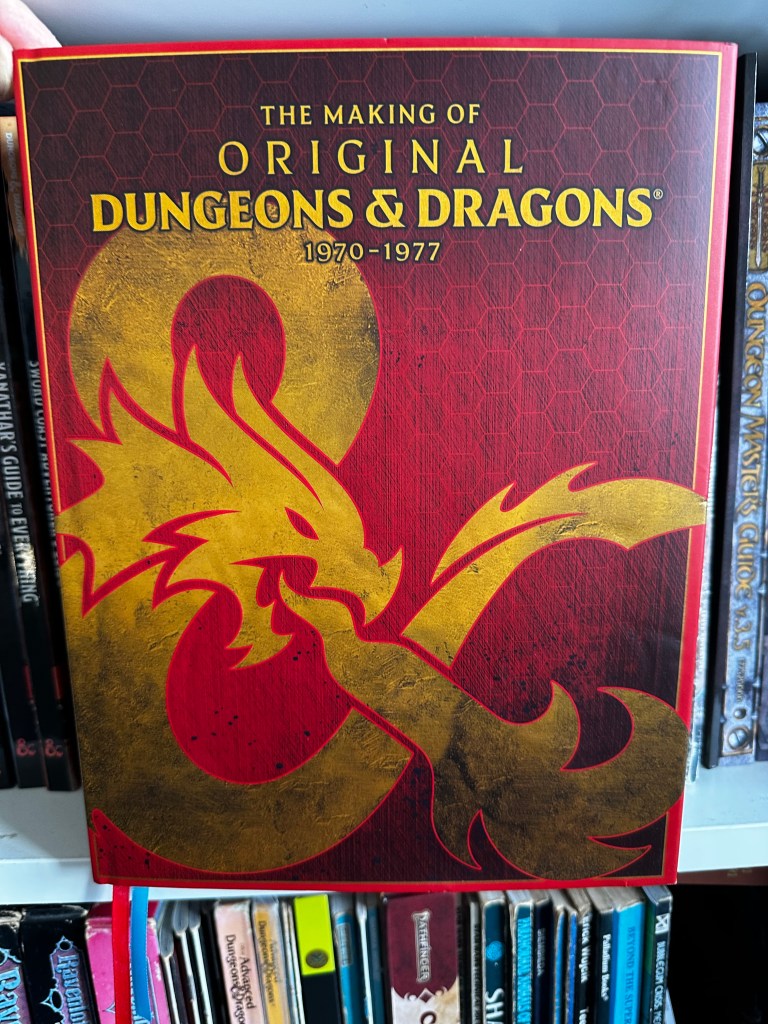
The cover of the Making of the Original Dungeons and Dragons. It has a red cover with a big gold ampersand on it.
The cover of the Making of the Original Dungeons and Dragons.

There are still a few decisions to make. And there is a lot of work to do to prepare.

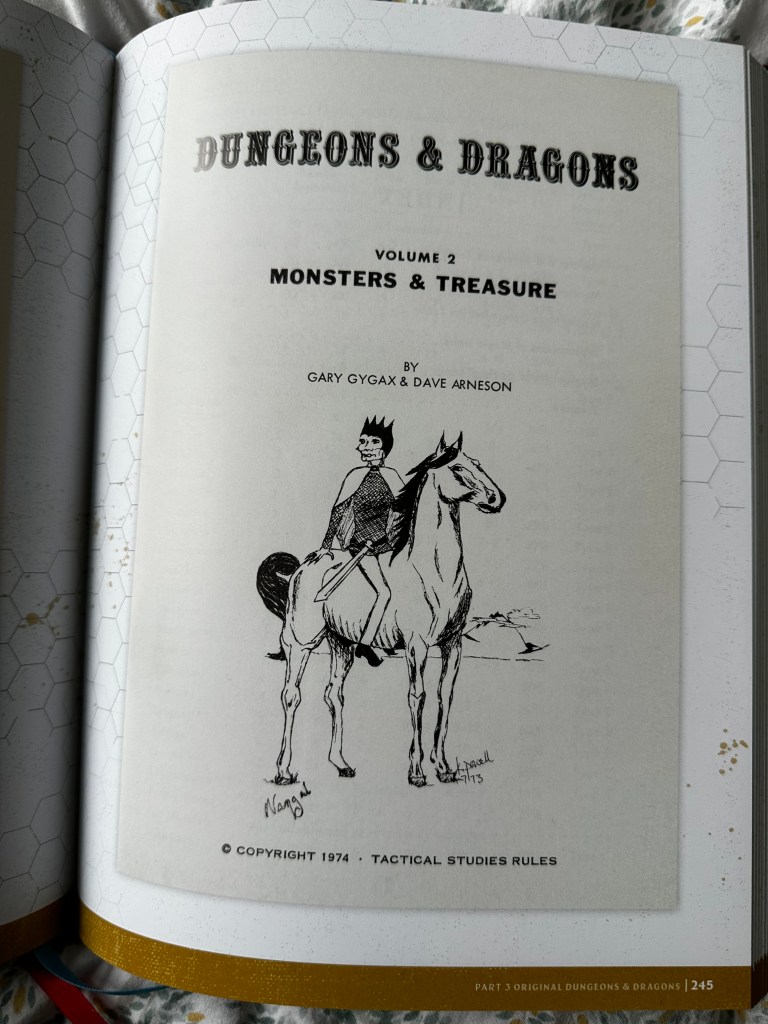
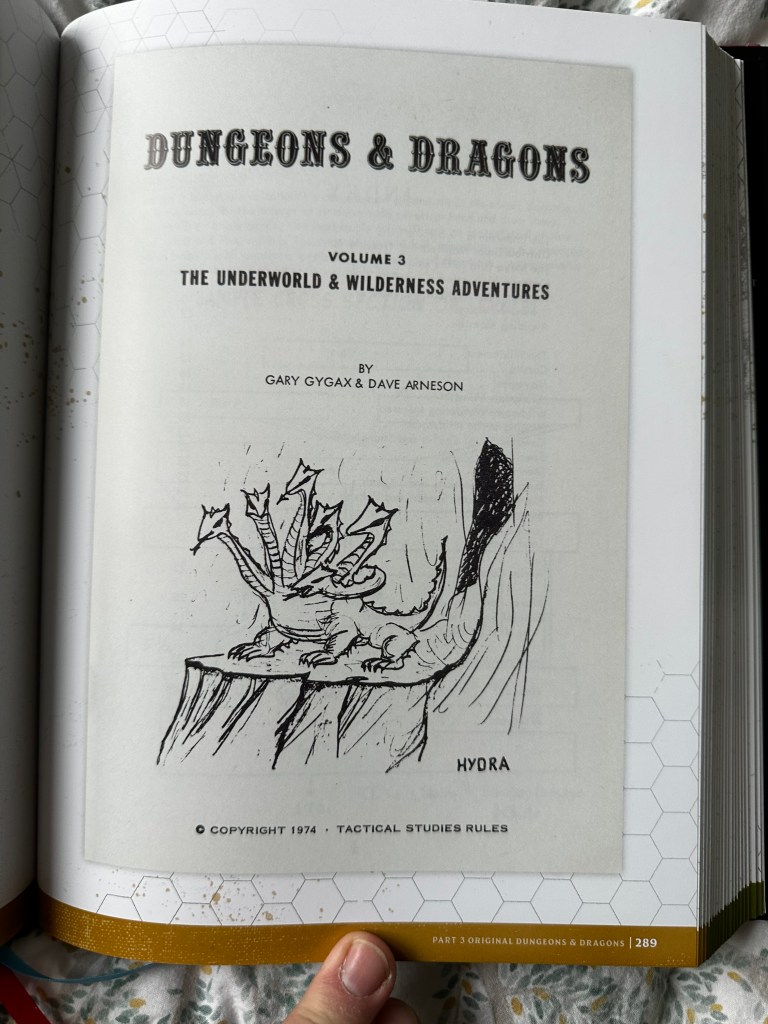
I have a relatively easy task to begin with, and that’s the reading of the OD&D books. I picked up the PDFs of these from Drivethru for a song. I do have them in a a slightly unwieldy printed form in “The Making of the Original Dungeons & Dragons” book that a friend kindly gifted me at Christmas, so I am happy not to need to empty my bank account to purchase a vintage copy of those books. I’ve quickly realised that I would also need the Greyhawk supplement since, otherwise, I would need to use the Chainmail medieval miniature war-game to run combat, and that was a bridge too far for me. The Greyhawk supplement included the first iteration of the D&D combat system that we might recognise today.

On top of that, we have to decide on what adventure modules to run for each edition. I would like to use vintage adventures that were made for the particular edition that we’ll be playing. For B/X, AD&D etc. there are tonnes of options, which means we’ll have to narrow them down somehow. But for OD&D, we have a very different problem. Adventure design appears to have been mainly the domain of the DM. The main books give you rules and tables, monsters, treasures etc, but mainly they encourage the DM to create their own stuff. Which is great! But it leaves me with the question, is that what I should do? Since that’s the intention? Or, should I use the one adventure I could find in any of the OD&D supplements, Blackmoor? The adventure is “The Temple of the Frog,” and I haven’t finished reading it yet. But it does strike me as the sort of scenario that could be quite lethal unless the PCs turn up with an army of hirelings. If that’s what’s intended, maybe that’s just what we should go for.

Conclusion

I don’t yet know which way I’ll go with that decision, dear reader. I would welcome feedback from anyone with more experience of OD&D or the Temple of the Frog than me.

In general, this challenge has got me quite excited about playing D&D for the first time in quite a while. I wrote a few posts about maybe getting back into playing AD&D back in 2024, specifically I wanted to play Dark Sun. The experience of even making a character put me off it. But I now think that, with other players involved, it could be not only of historical interest, but it could be really fun! I know some of our players in Tables & Tales really like a bit of crunch, while others love the OSR principles of rulings above rules that OD&D might bring.

One thing you can be assured of, dear reader, is that I’ll be taking you with me along the way. I hope to have some interesting things to write about reading, prepping and playing these games, so stick around!

The Bloggies 2026

It’s Bloggies time again! This year, I’m not nominated, mainly because I didn’t nominate myself, which is what I did last year. But there are lots of great blog posts involved. I recommend you go and treat yourself to some of them.

This year, it’s being run by Clayton Notestine, last years’ winner over on the Explorer’s Design blog. It’s a lot of work! The honour of winning is tempered by the commitment of time and effort it requires to run it the next year. But he’s doing a brilliant job so far.

Today, I’m going to highlight one of my favourite posts from each category. The categories are:

  • Advice
  • Critique
  • Gameable
  • Meta
  • Theory
  • Debut Blog
  • Blog Series

For voting purposes, the posts are all paired, so they’ll be pitted against each other in a brutal gladiatorial blog-off. There can be only one!

You can read them all using the links provided on this page. Or you can join me in listening to them via the We Read the Bloggies podcast, to which many members of the TTRPG/blogging community have so generously donated their time.

Advice

This is my pick from the Advice category:

Just Tell Them What They Need! by Nate Whittington of the Grinning Rat blog. It was published on December 9th 2025.

If you have ever read a TTRPG adventure and screamed at it to provide you with the relevant information on a dungeon room, an NPC or a situation, this one’s for you.

Critique

This review of Mausritter, and, more specifically, the campaign set, The Estate, for that game, is really interesting. Recently, Quinns was on the Dice Exploder podcast talking about his love of the tactile, chit-based inventory system Mausritter uses. But, in this review, although the author, Malmuria, likes the way the system works, they point out that it’s a lot of work just to keep track of all those little pieces.

Gameable

On the d4 Caltrops blog, we have a very short but incredibly useful post on the stocking of wilderness hexes in OSR games. The main resource here is a d66 table which identifies discoveries as:

  • Landmarks
  • Lairs
  • Resources
  • Special
  • Hazard

Or some combination of these. Mostly, it provides sparks of inspiration to allow a GM to come up with discoveries that make sense in their campaigns/worlds. Here’s an example:

Hazard/Resource: Consider a Hazard that renders the Resource invaluable or inaccessible in some way.

Doesn’t that get your little GM brain whirring?

Theory

I love this post about Making Hacking an OSR Style Problem from the goblin.zone blog. I don’t play a lot of cyberpunk games or even games set in the modern day so this is not a subject that comes up very often in my gaming life. I am, however, in my day job, responsible for system security and data protection so I particularly clicked with Part 2: Useful Real World Concepts

Meta

I write RPG reviews here on the dice pool dot com. Some are better than others, but I do always try to make them useful to the reader, the potential player/GM or the prospective buyer. I don’t often think about how I go about doing this. But, if I did, it would probably be encapsulated in this post from The Dodecahedron blog. It references another post from one of my go-to reviewers, Idle Cartulary, on the Playful Void blog, which also did a lot to lay out what reviews should do. I appreciate any writing that makes me consider what it is that I’m doing and both of these posts did that.

Best Debut Blog

My pick in this category is the Valeria Loves blog. Here’s the post that got me hooked. Valeria has a compelling and entertaining voice:

I am a priestess of Blorb. Just as the map is not the territory, the rules are not the fiction. You do not need a codified movement speed to permit player characters to move.

And there is a satisfying assortment of blog posts so you’re sure to find something to your liking.

Best Blog Series

It’s the Playful Void again. Over the Christmas/New Years period Idle Cartulary reviewed a truly staggering number of games/modules for Critique Navidad. It was one a day for thirty days. I wrote a blog a day during my first month on the dice pool dot com. I can tell you, that’s a lot of work! And I was only prattling away about the shit the occurred to me, not reading, critiquing and writing about the work of others in a thoughtful and fair manner. That’s what this series is. Go check it out.

The Sutra of Pale Leaves, The Fixer

Goodbye Carcosa

Dear reader, last week, we took a look at the final part of the Sutra of Pale Leaves campaign. Today, we’re looking at the Fixer, the final scenario in Carcosa Manifest, the second book in the series. Its part of the Sutra of Pale Leaves, but its not necessarily part of a campaign. You could play it as a stand-alone module, but you could also play it as a coda to your SoPL game. It makes as much sense as the very loose way the campaign is presented, if not the way you might actually find yourself playing it.

The Repairer of Reputations

The Fixer is based on the short story by Robert W Chambers, the Repairer of Reputations. I’ve just listened to it on Youtube. It’s a story of insanity, ambition and murder, which is told from the point of view of a man who has come under the influence of the King in Yellow and a deformed, yellow Repairer of Reputations named Mr Wilde. Go listen to it or read it here. It’s not very long and I think it’s worth reading. The story and the scenario share a few major scenes and themes, but the Fixer is resembles the Repairer of Reputations only loosely. For one thing, the original was set in a then future New York City, while the scenario is based in 1990s Tokyo. The main thing, of course, is that it’s an RPG scenario for a number of players, and that necessitates a few things. The PCs need to have something to do, there has to be room for all of them to be the “main character” and it has to have enough meat on its bones to keep them going for a few sessions of play. I think the Fixer is quite successful at doing these things.

Beginnings

There is an interesting conceit here, that the investigators are down on their luck. They are members of Tokyo’s growing homeless community and are lacking money and respect. It’s possible that they are the same investigators that played through the full Sutra of Pale Leaves campaign. In fact it’s suggested that that’s the reason for their current predicament. Perhaps the things they were forced to do to fight the Pale Prince got them arrested or sent to a psych ward. Maybe they became social outcasts due to their talk about mind viruses and Carcosa and faceless people. Whatever the reason, they have ended up on the streets.

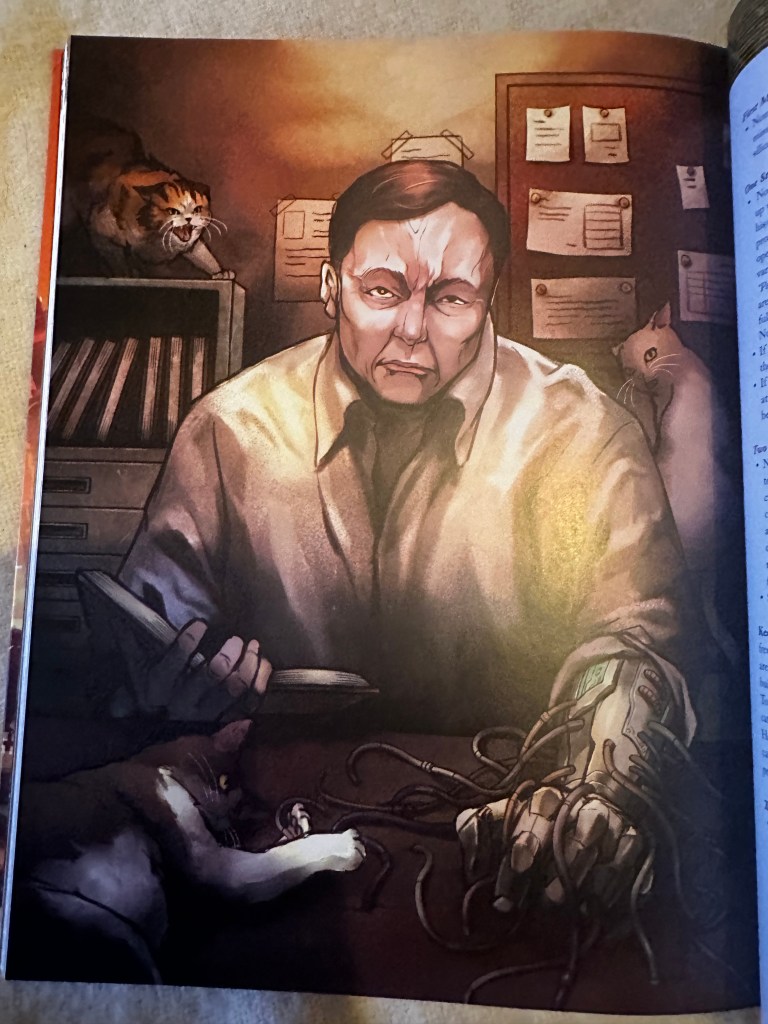
But then they’re given an opportunity by Mr Nomura to make some good money and repair their reputations, restoring their lot in life. Nomura is a strange man with terrible disfigurements and an ever-increasing number of cats. He acts as a wakaresaseya, a breaker-upper, if you will. This is a real business in Japan, and it fits in the scenario perfectly. In fact, in the short story, we never discover what it is that Mr Wilde actually does to Repair Reputations and I’m not sure that such a job ever truly existed in history. So, I like this logical adaptation in the scenario. He calls on the PCs to target several “wrong-doers who have made it into his ledgers.” These include a politician, a dirty cop, a buddhist abbott, a yakuza gangster and a fashion CEO. These are known as the Strawmen. He doesn’t want them killed or physically harmed. Rather, he would like the investigators to humiliate and humble them in particular ways.

Episodic

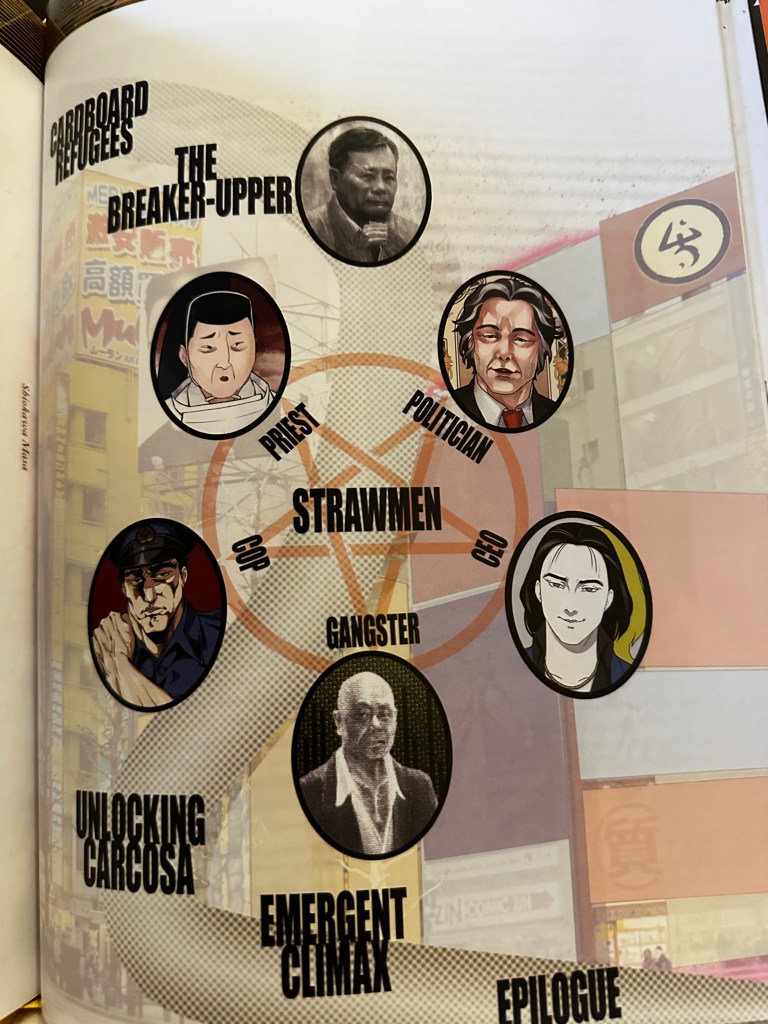
The visual flow chart of the scenario features the five portraits of the strwmen from the scenario at each of the points of a pentagram with a portait of the Fixer, Nomura above them all.
The Fixer Flow Chart

This scenario bucks the trend when it comes to format. Rather than simply following leads from location to location as the other SoPL scenarios, the investigators need to deal with each of the Strawmen one by one. Now, these people are all assholes in one way or another, even the buddhist abbott is a drug-addict who tricked his way into inheriting his title from his father by convincing the old man that his brother was actually the junkie. So, the investigators are unlikely to feel too bad about bringing them down. In fact, each of the strawman sections details the exact kind of shitheel each one is, their background, their weaknesses and where they’re most likely to be found. For instance, the politician can usually be intercepted at the National Diet (Japanese parliament) or on the golf course. Most useful is the “possible approaches” part in each strawman section. Obviously, this is Keeper-facing information, but it can be used to confirm that the investigators are on the right track. Generally, they are going to have to overcome things like getting onto a golf course or into parliament buildings while being homeless person. But once they get there, they get to do fun things like blackmail, or just straight-up releasing blackmail material to destroy them.

I can see each of the strawmen maybe taking a single session, with an episodic, strawman of the week type game. This would be interspersed with the results of the investigators’ efforts. You see, the truth is that targeting these individuals is essential to the completion of a ritual that will succeed in bringing Carcosa into our world. Nomura wants to overwrite Akihabara with the home of the Prince of Pale Leaves. They will start to see changes such as the police station being turned into changed into a castle looming over the town market square of Carcosa, or the National Diet transforming into the Royal Ballroom. As the city changes, so too does Nomura himself. His simple silicone prosthetic fingers become a cybernetic arm, and eventually he wears a porcelain mask and he is completely subsumed in some sort of cloak of scales with odd protuberances. I really like the gradual change in this villain and in the world. The investigators must assume their actions have something to do with these changes. The become more extreme with each strawman they bring low. And yet, the scenario assumes they continue to do what they have been employed to do.

Endings

Nomura, the Fixer pictured with his cybernetic arms on the table in front of him. He is otherwise a normal enough looking Japanese man wearing a light coloured shirt. There are cats in both the foreground and the background.
Nomura, the Fixer

Once Carcosa has been fully unlocked by the actions of the PCs, Nomura will attempt to fulfil their bargain by offering them positions of authority in his new city. The scenario provides us with a number of lore sheets, which the Keeper can give to any investigators that agree to this. These include, the Rightful Crown Prince, the Royal Matchmaker and the Judge of the Star Chamber. These are to be assigned to particular investigators, not randomly. For instance, the Rightful Crown Prince is supposed to be given to a PC with a good reason to despise the politician strawman so that they can rightfully exceed his level of political power. Even if the PCs don’t want to take on these roles in Nomura’s new world, they might anyway, if they enter into a period of underlying insanity, or if their Exposure Points get high enough, which is fun.

As a truly standalone scenario, we are told that the Fixer is not proscriptive on how it might end. It provides a couple of potential climaxes but it could really go any way. It does, however, still have the numbered Endings common to all these scenarios. I don’t know how we square that circle, to be honest. Anyway, here are the Endings:

  1. Party Wipe (Failure)
  2. Carcosa Manifests (Bad Ending)
  3. Reality prevails (Good Ending)
  4. Split Decision (Umwelt Ending)

Conclusion

I like this scenario. It’s weird and contains some potentially amazing scenes and revelations for the players. The NPCs are well drawn and the events are memorable. I think it would be a perfect way to wrap up your time with the Sutra of Pale Leaves and would act as a fun epilogue to the campaign.

All in all, I’m happy I took this deep dive into these books. I haven’t all that much experience running Call of Cthulhu but I think I would run this full campaign because it resonates with me personally. I think the Prince of Pale Leaves is an insidious and threatening unbeatable villain. The setting is one that I think will fascinate many people and the themes revolving around elements of Japanese culture and society work really well. The variety in the scenarios would, I think, keep it compelling and interesting for both Keeper and players. But I don’t think I would take their advice on running the scenarios in any order other than the one they are presented in and I can’t imagine myself playing it more than once, as they suggest is possible in the intro.