After the Mind the World Again

Disco Elysium

Have you played Disco Elysium from the much lamented Za/um studio, dear reader? It’s one of those seminal, cult-classic games that shifted my thinking on what video games could be. It’s a mystery game but, is it, really? Even if it is, is the mystery the one presented? Is the goal to find out who killed that guy hanging from the tree in the yard behind the Whirling-in-Rags? I suppose it is, but only up to a point. When playing it, you quickly meet and pass that point, much to the frustration of your ever-suffering partner, Kim Kitsuragi. Psychologically freed of the mundane requirements of your character’s job as a police detective, you can finally get to work on the real mystery; finding yourself. In many ways, the game is a protracted character creation session. You have to do everything from defining his political and romantic persuasions, coming to understand his opinions on art, exploring his relationship with vices of all kinds to just figuring out his name. How does the game handle these revelations? Well, largely through the personification of various aspects of your Detective’s personality. These take the form of his stats, Intellect, Psyche, Fysique and Motorics and the various skills associated with them. They speak to you, often in deranged or idiosyncratic voices representative of their own, niche fragment of his personality, and try to get you to look at the world from their highly rarified perspective or to act based on it.

It’s a unique game. It’s also a unique experience that left me with so many interesting thoughts and questions. One such question was, could you make a TTRPG out of this? The answer is, you can certainly try.

After the Mind…
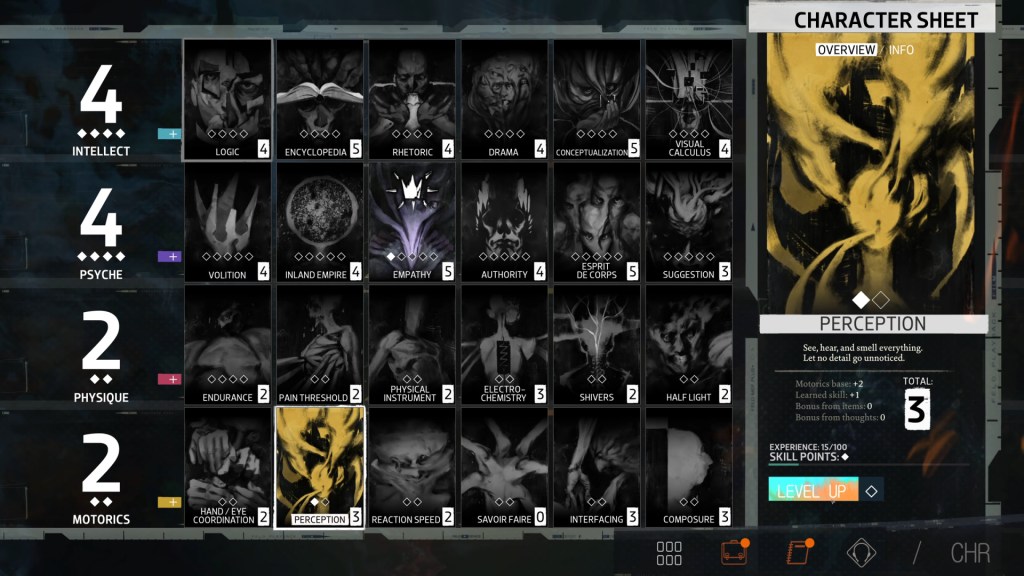
The Character Sheet screen from Disco Elysium. It shows each of the four main stats, Intellect, Psyche, Physique and Motorics and all of the skills that are associated with them in a grid on a black screen with white text.
The Character Sheet screen from Disco Elysium. The TTRPG stats are not as complicated as this.

Last night, I got together with four other members of Tables and Tales to play a session of After the Mind the World Again by Aster Fialla. The front cover of the game uses the tagline, ‘A murder mystery role-playing game.’ This is not an inaccurate description. However, I feel like the subheading on the next page is getting closer to the facts:

A Disco Elysium-inspired murder mystery TTRPG about a
detective and the voices in his head

In this TTRPG, the inspiration comes not from the fascinating world or the city of Revachol, it doesn’t come from the richly drawn characters of the video game, or even its ubiquitous politics. It comes, instead, from the essentials of the gameplay. In other words, the shit that’s going on in the Detective’s head and how it affects the world around him. You see, this is a GMful game that requires five people exactly, one of which is the lone player with the other four acting as GMs. Each GM represents one of the four stats from Disco Elysium, Intellect, Psyche, Fysique and Motorics. They are collectively referred to as the Facets. One of their responsibilities is to describe various features of the world the Detective moves through. Intellect has responsibility for nerdy people, art pieces, journals, etc. Meanwhile, Fysique gets stuff like buildings, a good strong state, and brawny folks.

At the start of the game, the player comes up with a name, pronouns and presentation for their Detective, as well as their role (they might not be a cop, but a PI or an insurance adjuster or something else.) Each of the Facets also gets a turn here, though. Psyche gets to describe the Detective’s face, while Motorics comes up with aspects of their style and an unusual object in their possession, for instance. I found this very fun, as did everyone else at the table, I think. I even commented that having others make your character for you in other RPGs could be just as fun!

Once that’s done, each of the Facets answers a couple of questions designed to form a baseline for their relationships with other Facets at the table. After the Mind the World Again is Powered by the Apocalypse, so this sort of character building question should be familiar to anyone who has played a game like that before.

Then they get started making the Neighbourhood. You go around the table, starting with the person who most recently played Disco Elysium, and get everyone to answer one of the five questions presented in the book that should give you an idea of the type of area this murder has taken place in.

Once you’re done with that, the Detective tells us a little about the victim and then each of the Facets introduces a piece of evidence from the crime scene. Intellect tells us about any Prior knowledge that’s relevant to the situation, Psyche describes a Person of Interest at the scene, Fysique comes up with a Landmark, in this case, where the murder occurred, and Motorics gets to reveal a clue, something tangible at the scene.

From that point, the Detective starts the investigation, describing what they are doing in the fiction, triggering particular Moves, using the Facets’ stats to make rolls and making Deductions in an effort to solve the murder. This is in line with the Detective’s Agenda:

  1. Explore the world to its fullest.
  2. Make the most of your Facets.
  3. Play to find out the truth.

This is complicated by the fact that each of the Facets wants the Detective to act in different ways, offering sometimes conflicting options and sabotaging each-others’ efforts as they try to have the greater influence on the sleuth and the investigation. Facets’ stats can be boosted or reduced in various ways, often by the actions of the other Facets. Its important to note that the Facets’ Agenda is not focused on solving the murder, rather than constructing an interesting experience:

  1. Create an intriguing world for The Detective to explore.
  2. Highlight the differences between the Facets.
  3. Play to find out what happens.

The Detective investigates, and the Facets Declare Evidence as particular features are described in the world. It’s up to the Detective to combine two pieces of evidence to Make a Deduction. When it comes to that point, they ask the Facets for explanations as to how they fit together. Whichever Facet’s explanation is chosen is the truth and the Facet gets a +1 to their stat, while also getting the opportunity to reduce the stat of another Facet by the same amount.

The investigation is structured into a Deduction Pyramid, which is split into four tiers. On the bottom tier, there should be eight pieces of evidence. These should be combined when the Detective Makes a Deduction so that, you end up with four Minor Deductions on the next tier up. These Minor Deductions should then be combined to come up with two Major Deductions on the penultimate tier. Finally, those Majors need to be combined to come up with the Solution to the murder, sitting right there at the top of the Pyramid.

There are several other mechanics in the game, including one to ensure that the Detective does not simply always choose the explanation of the same Facet all the time, which is clever. A Facet’s stat cannot go above +3 or below -1. If that does happen, the Facet gives the Detective a Condition and goes back to the default value of 1.

…the World Again

A screenshot of the aftermath of the Detective from Disco Elysium punching a twelve year old kid. The scene is in the yard of the Whirling in Rags hostel. A man in a green jacket and yellow flares stands over a prone kid who he just punched. Kim Kitsuragi, dressed in an orange jacket and brown baggy, tapered trousers looks on.
A screenshot of the aftermath of the Detective from Disco Elysium punching a twelve year old kid.

None of us had ever played a game quite like this one before. Obviously, some of us had played PBTA games in the past, so the mechanics were nothing frighteningly new. At points, I even felt echoes of a game of Avery Adler’s The Quiet Year that most of us played last year as we took turns describing the world around our Detective. That Detective was an amateur sleuth named Bruce with a fabulous moustache, a flight jacket, an obsession with whiskey and a curious ability to identify any wooden model aircraft he might come across.

But, sharing GMing duties with three others at the table is a unique and sort of chaotic experience. At the start, it’s actually a little difficult to get into gear. I was playing Motorics and I found I had to be constantly checking my playbook sheet to remind myself what features of the world were within my domain, what my GM Moves were and when I should use them. There are features in there that you might not expect so you have to watch it and you can’t use your GM Moves just whenever. Since all four of us Facets were feeling like this, it kind of stuttered into life as a session, once the character creation bit and the initial set-up of the mystery were done. Meanwhile, Bruce, played ably by relative TTRPG noob, Jude, had to come to terms with the fact that, when it came to any of the really important decisions, he had to give up control and ask the Facets for options before settling on one version of the truth or selecting a course of action.

As we got into the flow of it, though, and as some of us became more lubricated by the liberal application of fine Spanish lager, we found the conversation that was the game began to come much more instinctively. We were interacting with the mechanics and deliberately fucking each other over for stat points, while Bruce began to explore the small, dead silent village of Battersfield and investigate the murder of local baker, Barbara Devons. Evidence has been declared in abundance and two deductions have been made! Bruce managed to finally make it out of the Bakery to explore the office, the bare flour cellar and even the gay bar across the road. Unfortunately, we had to leave the case unsolved after the four hour session. Hopefully we’ll be able to pick the trail back up again soon.

We ended up having a really fun time with After the Mind the World again. The stand out scene for me was when Bruce was interrogating Jenny at the crime scene and all four GMs jumped in to answer in particular ways that they thought reflected their own domain within the one NPC. It worked surprisingly well, even though I’m not sure that’s how it’s supposed to work at all.

I would say that there is no way to play a full investigation in a single three hour session without rushing through scenes and maintaining the sort of laser-focus that Harry Dubois does not exemplify in any way. The character creation and making the mystery section took over an hour alone before Bruce ever rolled a die in anger. If you’re going to give it a go, plan it for two sessions.

Do you think you would like to give this game a try, dear reader? Or would you rather go back to Martinaise and collect some tare in a plastic bag while pondering that old wall again?


Gaming Resolutions 2025

New Years’ Resolutions

‘What do I want to change about myself?’
That’s the question I think most people are trying to answer when they come up with their New Years’ resolutions. The answers? Invariably, they are something like, I want to lose weight, I want to be healthier, I want to learn a new skill, I want to pick up a good habit, I want to read more, I want to watch less TV. Right?

For me, this kind of thing rarely works. The failure has little, if anything, to do with the challenge itself, usually. It’s about the arbitrary nature of it. You decide to make this change on New Years Day because its a new year, not due to any external or internal catalyst. To me, it robs the resolution of the weight of a meaningful promise to myself. And it’s not just me. By the the second or third week of January, the ruins of broken and abandoned resolutions litter the landscapes of our lives.

So, here’s another question, that you might be asking at this stage?
‘Why are you writing a blogpost entitled “Gaming Resolutions 2025” then, Ronan?’
It’s a very good question, dear reader, and you deserve an answer. To answer, I’m going to examine my gaming resolution of 2024. It was, in fact, my only resolution. At the close of the year I had been working on a Resistance System game for a few months. It didn’t have a name but the idea was that players would play magic users in the modern era. They would form a party and work together to achieve certain goals for their secret magical society while also attempting to outdo each other in power, reputation and knowledge. The central mechanic was centred around sacrifice and I was going to design Fallouts appropriate to that. I’d come up with some classes, skills, domains, resistances and the idea for unique mechanics by December 2023. So, my resolution was to finish working on that game and move on to the next one. That was, pretty much, the death-knell of my work on that game. I think the last work I did on that was in April, 2024. And that work was token, cursory at best. One thing I know for certain is that that promise to myself was too big. The game was too big, the amount of work it demanded of me was too much and the prospect of doing it was a little too stressful.

So, instead, this year, I am going to commit to getting a bit better at certain things, instead of committing a lot of time and effort to complete a project I didn’t even really know how to start. And these are all things that I have been thinking about for some time, stuff I have wanted to implement for a while to improve my play and the games I am involved in. So, it doesn’t feel so arbitrary.

So, without further ado, here are my…

Gaming Resolutions 2025

  1. Make those stars sparkle and make those wishes come true: I was first exposed to Stars and Wishes this year when I took part in my first Open Hearth games. For the uninitiated, at the end of a session, a GM might ask their players for their Stars, i.e. stand out moments, moves, characters, players etc. and Wishes, in other words, what they would like to have seen happen in the session, what they wanted more of or less of or what they would like to see in future sessions. For a GM, this is an incredibly useful tool. It allows you to see what your players like and what they dislike. But, I find, too often, I don’t always re-integrate the stuff that came up in players’ Stars and Wishes. And I know, for certain, that when I do manage to apply what I learned from feedback, it has made my games better. So, how am I going to do this? I have an idea, that I literally just came up with, to create a spreadsheet to record each player’s Stars and each player’s Wishes from every session of every game. I’ll add in some columns to record potential ways to add more of the good stuff and ways to fix the problems that were revealed. Another column will summarise players’ reactions to the solutions. If it needs more tweaking, another column will detail that. I think this could be an invaluable tool to improve my games and will be there as a record so I don’t forget.
  2. Brighter stars, wiser wishes: Sticking with the Stars and Wishes theme, I’d like to get more useful feedback from it. One of Tables and Tales’ fantastic founding members, Shannen, used a few methods to get more valuable feedback from her players in a game earlier this year. She requested feedback through DMs on our Discord. Why? Well, most people are pretty nice, actually. They tend to not want to offend anyone or say something in front of a group that might embarrass somebody. So, if you take the process away from the table, they might be more likely to tell you what they really think in private. We were just discussing this last night and, along with that, we all agreed that Stars and Wishes in the Discord chat for the game is way more valuable than having people just tell you them at the end of a session, when players are often pushed for time, or before they have had a chance to think about it and provide something really useful. So, my second resolution is to get written and private Stars and Wishes from now on.
  3. Summaries in the chat: I don’t know why I don’t already do this for every game. It proved pretty useful in the Blade Runner game I ran earlier this year. In that one, I had a single document that I updated after each session so the players could easily keep track of what happened session by session. I always write up a summary after every session anyway, so taking the extra step to share it with the players is obvious really.
  4. Take bigger swings: As a player, it can be tempting to take the safe route. After all, you don’t want your precious little guy to get hurt, right? WRONG! I have decided that it is far more interesting if your character makes the decision to put themselves on the line to save a friend in dire need, or to make the foolish decision to prioritise monetary gain over their own safety or to just do something cool instead of something sensible. I don’t necessarily think this style works in every game (I’m thinking of our current game of the One Ring, for instance) but where it does fit, I think it’s far more rewarding.
  5. Get out of my comfort zone: I have a type; the gruff voiced, slightly grizzled veteran. That’s who I’m playing in two different ongoing campaigns right now and I am beginning to think I’m predictable. I don’t always play that, but it happens often enough that I can recognise it as a pattern. So, I have decided to make a conscious effort to play other types of characters. I am convinced it will lead to more fun and surprising experience for me and hopefully for my fellow players.

What about you, dear reader? Do you have any habits you want to break or strings you’d like to add to you role-playing bow? Let me know in the chat!

And finally, Happy New Year! Here’s to many more sessions and great experiences around the gaming table in 2025!

The Bloggies 2024

The Dicepool

At the start, 87 posts ago, all the way back in July of this year, I wrote this:

I think I’ll write how I feel about some of the things I consume as a way to digest them (not the food and drink, I’ll do that in the traditional way.) But, mostly, I’ll be writing about my main creative outlet, playing, running and making things for tabletop role playing games. Let’s not be coy about this; the internet is not lacking for nerds going on about their games, or someone else’s games or games they watched other people play or games they hate or games they actually quite like, surprisingly enough. So, even knowing this, why would I have the gall to add to it? Good question, good question indeed. Maybe I will figure that out as I do it. The adventure is the journey and all that.

And, that’s pretty much what I’ve been doing. I am still doing it. I have learned a lot by doing it. This blog has genuinely been an enjoyable and useful outlet for me. It has allowed me to work through some game-related ideas that might otherwise have floated freely around my brain, temptingly close but always oh-so frustratingly out of reach. It has also given me the opportunity to express my feelings on more personal matters. Mainly, though, it has provided me the chance to write regularly about one of my favourite subjects, RPGs.

I have made a few changes over the last six months. I went from posting daily to every two days to every three days and then to twice a week. I feel like I have found the ideal schedule now and hope to continue with it. Thedicepool.com joined the woodpanelled.org web ring. I hope to see Woodpanelled grow even more in the new year. I started posting some of my own fiction pieces as well as the RPG-related posts. I’m hoping this will encourage me to write some new fiction soon! Finally, I have been sharing my posts more on social media, both Instagram and Bluesky. where I have made some connections with other people in the TTRPG sphere. I have had some great feedback from some of these interactions and that has encouraged me to put the blog out there a bit more.

The Bloggies Awards and a request

So here we are, it’s the end of the year and a good time to consider some of the things we liked from 2024. In this incredibly niche corner of the internet I find myself tucked away in, there is a way to show your appreciation for those things you liked, or that you found useful or inspirational or that just tickled your fancy. You can nominate a blogpost for the Bloggies Awards, which originated in 2022 on the Prismatic Wasteland blog.

The 2023 winner was Sacha (or sachagoat.) He won for the first part of an excellent series of posts about Re-inventing the Wilderness. You can check it out here along with an introduction to the Bloggies themselves. Basically, people nominate their favourite TTRPG blogposts within four categories:

  1. Theory – I don’t really get into this area too much on the blog, although I may in time
  2. Gameable – I also don’t have a lot of this sort of thing here. I have considered sharing some of my home-brew stuff, but I would need to do some more work on most of it first
  3. Advice – I have a fair few posts of this kind. I’m thinking of those on world-building, beginnings, endings, combining systems and mechanics, session prep, building community, etc.
  4. Review – I would hesitate to call myself a proper reviewer of RPGs but there are several posts that fit into this category. I am thinking particularly of the posts on Liminal_, Cthulhu Dark, and the series on Between the Skies and Dragon Age. But a lot of my other posts dealing with games I have played would probably fit into this category too.

Sacha has introduced a couple of new categories for this year too:

  1. Debut Series – This is me! Despite having 87 posts under my belt, this is still my debut year.
  2. Blog Series – I have several of these, including my series of character creation posts, the Between the Skies and Dragon Age series as well as those on combining D&D and Blades in the Dark mechanics

I won’t go into any more detail here. Sacha explains it all on his blog. Suffice it to say, if there are any of my posts from the past six months that have resonated with you I would appreciate a nomination. You can use this Google form to do it before December 31st. It only takes a couple of minutes and is pretty straight-forward.

Thanks

I appreciate all your support during the last six months, dear reader. At the start, I pretended like I would do this whether or not anyone read it, but the fact is, I do take great encouragement and motivation from the fact that others have read and gotten something from this blog. I would like to extend my gratitude to all of you who have taken a few minutes out of your day to read even a few of my words since July.

Happy holidays!

Games I Got to Play This Year Part 2

Wrap-up

It’s an end of year wrap-up. Everyone’s doing one. Check out the last post for the campaigns I have been playing in the last few months. This one’s for the one-shots.

One-shots

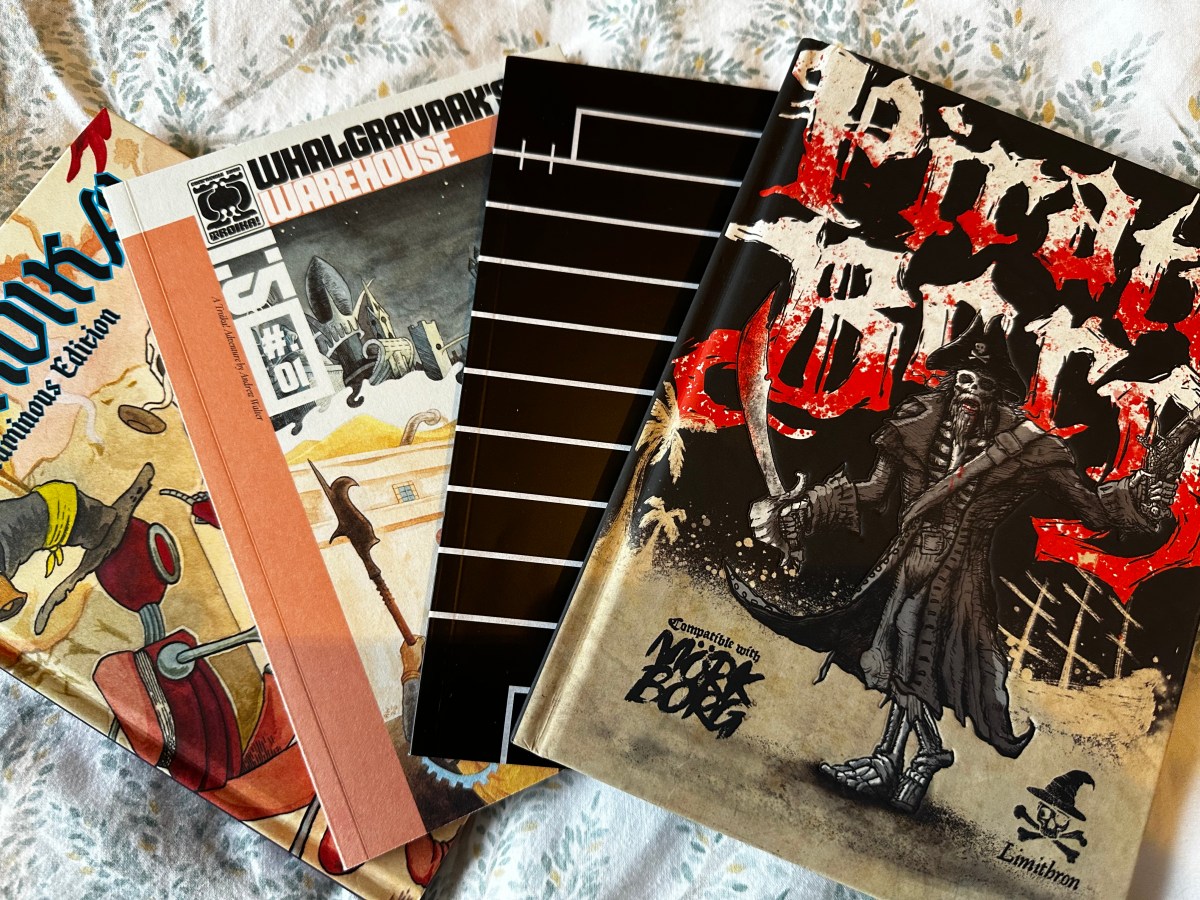
  1. Pirate Borg – the link above will take you to my post mortem on this one shot. It was a great time, in all honesty. My first foray into running any kind of Borg, and I was pleasantly surprised by how easy and instinctive every part of it was, even the ship-combat, which was new to everyone at the table. If you are interested in pirates, light cosmic horror, or just gnarly old school gaming in an alternate history version of our own 18th century, you’ll enjoy Pirate Borg in all likelihood. By the way, I also did a character creation post on this one.
  2. Troika! – Whalgravaak’s Warehouse – Ok, look, full disclosure, this is supposed to be a list of one-shots but this is technically more like a really spread out short campaign where we get together to play a one-shot of the same game every once in a while when we can all afford the time. Know what I mean? Anyway, in the first one-shot of these two consecutive one-shots, the PCs found two different ways into this warehouse, abandoned by its wizardly owner centuries previous. After crawling this “dungeon” for a bit, they made friends with a thin mutant, and their monkeys got to play with the worm-headed hounds that lived in a nest in the warehouse somewhere. They made short work of the Cacogen they’d been sent to murder and we wrapped up the session. In the second one-shot in this series of one-shots, three of the band decided to continue to explore, making more friends, this time with a large cadre of mercenaries who had been sent to deal with some cultists. They then set fire to some rope, captured some minuscule soldiers in gremlin-jars and climbed a mountain of onions. This is the kind of nonsense the PCs get up to in games of Troika to be honest. This is standard. If this sounds too gonzo or weird, you are in the wrong place. The Eternal City of Troika is not for you. You should probably try somewhere more normal. From my point of view, and, I think, that of the players, if you lean into the bonkers aspects of the setting and you are willing to go along with the more outré elements of the system (the random initiative mechanic stands out) you will probably have a very good time with this game. It’s great for one shots. Or two shots if that’s your thing. Might turn into three shots, actually.
  3. Honey Heist – this was another one of Isaac’s games. He ran it on a night when another game fell through. It was very last minute but we were still able to get a crew together. Jude, Tom and I rolled up some friggin’ bears with criminal backgrounds and went to do a heist at the biggest honey convention in the UK, in the NEC in Birmingham. We tried to do a TED talk, we disguised ourselves as massive bees and we crashed a van. You know, typical bear stuff. Another absolute belter of a one-shot, this one. It’s the definitive one-page RPG by Grant Howitt of Spire and Heart fame. Isaac and Tom had picked up the printed form of a bunch of these one-pagers at UKGE and Isaac had been looking for the opportunity to run one of them. This game was obviously made to create wild swings as you use either you Bear or Criminal stat and try to avoid going too far on the bear side or too far on the criminal side. This forces you to take risks and do stupid things to drive the heist forward or, more likely, sideways. Tom did a brilliant write-up of the session on their blog here.
  4. B.D.S.M. Below Dwelling Sewer Mutants – Yet another game run by Isaac at short notice. It is a mutie-eat-mutie game by Neonrot and you can get it here. The premise is pretty straight-forward. You are a mutant. You are probably unpleasant in some way. At the start, you have a mutation that may or may not be useful in certain situations. You can progress and grow by eating other mutants to gain new mutations along the way. If you like that idea, you’re in for a treat. I think it is probably a game that works best in one-shot play. We had fun with it and I think most tables will.
  5. Cthulhu Dark – Roadhouse Feast – I went into quite a lot of detail on this one in the post I linked above so I won’t go through it all again. Suffice it to say, I really enjoyed running the Cthulhu Dark game for the first time. The scenario itself was great but, to me, it is the simplicity and the ingenuity of the system that really shone. If you are into cosmic horror games and you haven’t tried Cthulhu Dark, you should give it a chance.
  6. Liminal_ – I promised a report on how this one-shot went some time ago and here it is. We had four players (known as the Disoriented) for this one-shot plus me as the the Architect. As I thought we would, rather than have the players play themselves in this Liminal Back-Room nightmare, I had them use the character generation tables in Death Match Island. This worked really well to come up with some distinctive, memorable characters quickly and with no fuss. They started off all in the same public building. Since one of them was a district attorney, we agreed it should be a court house. One of the others was there as a witness in a case and the other two were, in an unlikely turn of events, cousins who had been called for jury duty on the same jury. That is pretty much by-the-by, although it did come up in conversation later. Thy all stepped into a room together and found themselves in a building of nightmares. Now, you have to roll up the rooms as they open the doors. There are a couple of d100 tables in the book that are crammed with inventive and horrific room descriptions. The first door they opened led into some sort of creepy, dank cave system; the next into a mouldering bowling alley that was was canted at a 45 degree angle; the next opened onto the abandoned bridge of a ship, rocking in a dreadful storm and with a trail of blood leading off through one of the other doors. I made a mistake at the very start, where I allowed the players to open a couple of doors and then decide which one they would go through. The rules state that, if you open a door, you have to go through it. This felt a little restrictive to me, in a role-playing game, but we proceeded in this way and the players were good sports about it. As we progressed, rolling on the Room and Entity tables, it felt as though, at times, they really wanted to see what the hell was going to come next. Isaac said afterwards, that it felt a lot less subtle than he had thought it would and I have to agree with that. When you think of liminal space horror, it often is just empty corridors and abandoned hotels and the like. Sometimes a strange entity might make an appearance, but it’s the spaces themselves that are supposed to be innately creepy. Some of these rooms we rolled up on the tables felt that way, like the corridor with missing persons posters of the PCs on the walls but a lot of them were straight-up horror like the one with nurse-entity (I think?) chopping a guy up on a slab (it was ok, he was into it!) Also, I think this is something I would be careful with: when you roll a random entity, they sometimes don’t seem to fit, thematically, with the room that you just rolled up. I think it is ok to re-roll if that happens. I didn’t do that and once or twice, felt like they collided awkwardly. Now, these are nitpicks, really. In general, we had a good time with this, the players loved playing their pretty normal characters in these horrific scenarios, just running blindly from threat to dreadful threat. We used both the regular room table and the guest room table (the entries here were written by some industry luminaries like Johan Nohr and Tim Hutchings.) One of the best things about that experience for me was that I was just as surprised, horrified and disgusted as the players were! One of the challenges then, of course, was that it was my job to quickly read, interpret and present the room to the players without taking too long, stumbling over the words, reading them too much or generally fucking up. Unfortunately, we didn’t quite make it to the end of their mad dash through the back-rooms. The PCs still have a few squares of fatigue to be filled in. Hopefully we’ll be able to pick that up and finish it off someday.
  7. Mothership – Moonbase Blues I wish this wasn’t in the one-shot pile but heigh-ho. Sometimes your GM moves away and leaves your characters stuck on a moonbase that is probably trying to kill them. I mean, there was someone or something there trying to kill us. I was under no illusions that we were likely to all die out there, I just wanted to know how. Anyway, the one session we had of this game was great. Full props to Joel, our GM, for putting so much time and effort into he prep for it. He had a series of recordings that he played for us at key moments, he had handouts and provided us with cheat-sheets. It was a great experience. Also, I loved playing my character that I created in the post I linked above, Victoria Ibanez, the Corps’ finest. I’d love to get to play her again. Mothership is a great system with compelling mechanics and one of the best character creation experiences out there. If you need any more convincing, you should go and check out Quinns’ review of it.

Conclusion

So, that’s it. Those are all the one-shots that I got to play in the last few months. I didn’t get to play many of the games I wanted to, but I sure did have fun not playing them. Next year, I am continuing the theme of not playing the games I listed in that post by starting the year off with a one-shot of After the Mind, the World Again, a Disco Elysium-inspired, GMful mystery game and, Dragon Age, which, I have at least discussed at length on this very blog here and here. Honestly, I think it was useful to set out goals for the games I wanted to play. I may not have gotten to play any of them if I hadn’t done that. So I will continue to write about things I want to experience on the blog and see what happens.

I will be posting more intermittently as we come into the holiday period now. I will be travelling to visit friends and family a lot and won’t always have the chance to post as regularly as I would like. So, in case this is the last post before the end of the year, I wish you the very happiest Winter Solstice/Hogswatch/Western New Year.

BTW

Here are links for where to buy each of these games:
Pirate Borg
Troika!
Honey Heist
BDSM
Cthulhu Dark
Liminal_
Mothership

Games I Got to Play This Year Part 1

A game at the table is worth two on the shelf

So, in the last post we discovered that I had played only three of the ten games I had wanted to in the last five months of the year. But, as everyone knows, it’s not about the number of games you play, it’s about the quality of them and the fun you have while playing (even if the fun is terror or sorrow.)

In this post, I’m going to get into the games I actually took part in in the last few months instead (apart from those I wrote about in the last post.) There were actually quite a few, mainly one-shots and mainly GMed by Isaac of Lost Path Publishing. By the by, Isaac is blogging again on his own site, linked above. Go and read the words he writes.

Ongoing Campaigns

  1. D&D 5E – Spelljammer. I’ve written quite a bit about this campaign. I like to mess around with the rules and try new things to keep it fresh. Here’s a post about hexcrawling the Rock of Bral. Here’s one about using an engagement roll type mechanic to improve the dungeon experience. We have recently finished a major campaign arc and it looks like the crew is about ready to take off into Wildspace again. They’ve had an extended shore leave on the Rock. After a short hiatus through the holiday season, the next session we play will be number 30 and they have been on the Rock since session number 11…that was over a year ago in real time. One of my players recently dropped the timely hint that they did not want to end up stuck on the Rock of Bral for the rest of the campaign and that prompted me to get them spelljamming again. Listen to your players, GMs!
  2. D&D 5E – An Unexpected Wedding Invitation – Finished. My first foray into D&D as a player in many years was a murder mystery set at a wedding populated with beautiful and complicated NPCs. We had some issues with the use of 5E as a system for this one but we had a ball role-playing our characters. The link above will take you to my post-mortem of the game.
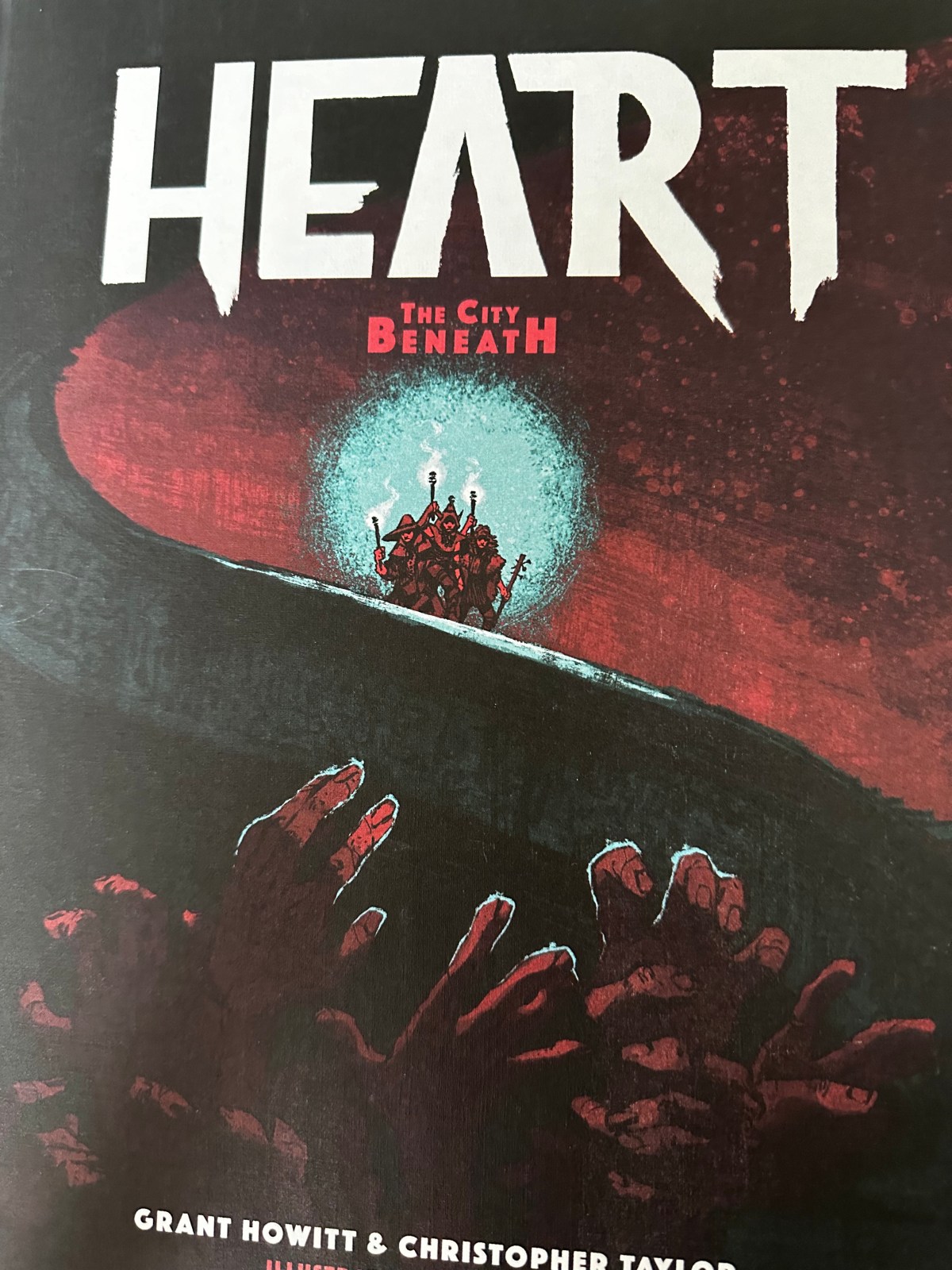
  3. Heart: The City Beneath – Home game, GM. Finished. Man, I miss this game already. The PCs all activated their Zenith Abilities in the last session and it was a thing of beauty. After 12 sessions of delving, the android they were searching for turned up in Terminus, and they discovered that he was a sort of proxy for the Heart. He was trying to make their Heart’s desire come true. But he was bound to do the same for another denizen of the City Beneath, The Drowned Queen, whom our heroes had trapped in the Grey in session 8. The Android freed her and released her into Terminus, which she quickly began to drown in salt water. The PCs realised she could drown, not only this one Landmark but both the City Beneath and the City Above as well, linked as it was to every line in the Vermissian network. And so the delvers combined their newly acquired Zenith abilities to defeat her, imprison her and ensure themselves a place in heaven afterwards. So satisfying.
  4. Black Sword Hack – Three of Blades. This is one of Isaac’s games. It is another long running campaign. I went into some detail about it in the post I linked above. Recently, it has been hard to find time to get together for more sessions of this. Can’t wait to get back into it. In the last few months, our group has discovered that if we recover three legendary weapons from the most unlikely of places (one of them is on the friggin’ moon, but that’s OK, because we nicked a spaceship/big sphere off a bunch of cultists a while ago) we can use them to defeat the Queen of the Dead. As players, however, we have realised that, if we want to advance, we have to complete more “stories,” or adventures, so pursuing these weapons has taken a back seat recently. Instead we had a moral crisis about killing a big ol’ wyvern, we dithered over how to rescue a town of people from the mercenaries we were, ostensibly, working for and we argued over how to deal with a native woman who was summoning harpies to murder the invaders who had killed her lover (apologies to Isaac if I am misremebering that one.) Isaac says we’re the ones inventing the ethical conundrums when all he does is lay out the situations, but I’m pretty sure he plans them that way.
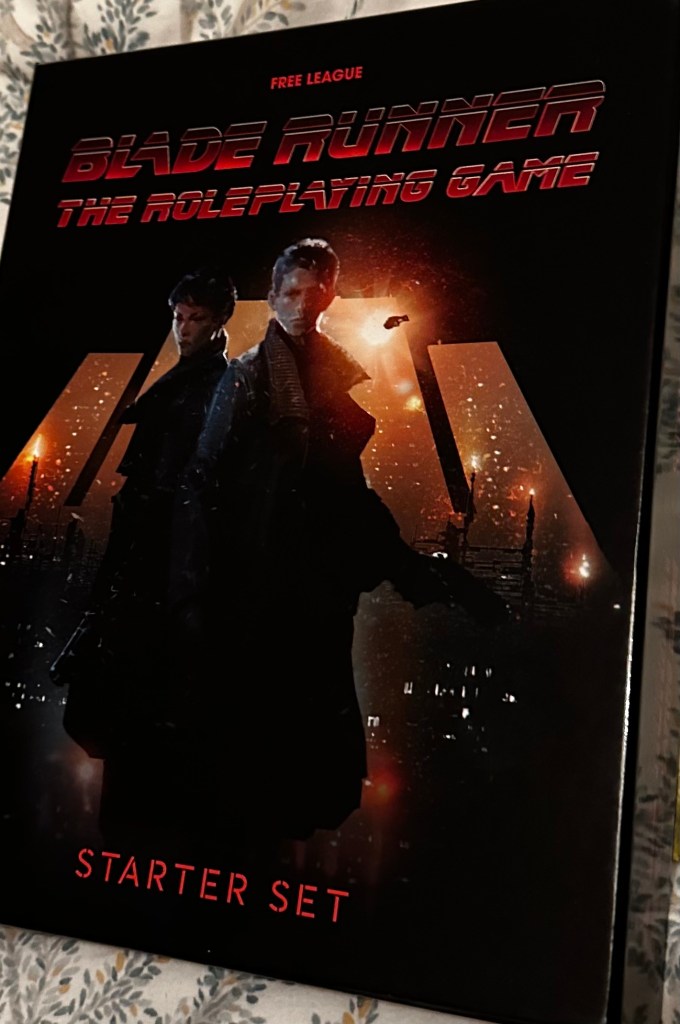
  5. Blade Runner – Electric Dreams – Finished. The link will take you to the first post I wrote about this short campaign. I was enjoying it immensely at that time. Once we got to the end, I feel like it really shone, though. That last session had a proper climax. Both of the players found the ending satisfying and sort of unexpected and I found it fascinating to see how they dealt with everything the case file threw at them. It’s hard to go into specifics without spoilers here, so I won’t. Suffice it to say, the investigation took some twists in the best way. I wrote a bit more in this post, where I compared the experience of playing this game with the Unexpected Wedding Invitation. TLDR, I think Free League have done a great job creating an investigative game that is a lot more that just a cop simulator and that works significantly better than the 5E system for this sort of thing.

New Campaigns

  1. The One Ring – The Star of the Mist. I wrote briefly about this one in the post I linked above. It’s a shame that we have not played much more of it since that first session. Basically, unless it is not entirely clear from the long list of games in this post, we have been busy in Tables and Tales! Sometimes it is hard to schedule sessions around all the other sessions. Anyway, session 2 brought us very, very close to a TPK. We learned a few things about this game. Thing the first: it’s not like D&D 5E, your characters are tough, but they are not super heroes. Thing the second: some times you should run away when you keep getting knocked prone and you can’t seem to hit anything and you are surrounded by marsh zombies. Thing the third: use your head. We beat the zombies with brains instead of axes in the end, partly because Isaac, who also runs this game, was very generous to us. I think the next session, we’ll be a lot more circumspect about approaching encounters and I can’t wait to see how we get on.
  2. Mörk Borg – The Great Borgin’ Campaign. Isaac sure is running a lot of campaigns, isn’t he? The ones I have listed on this page aren’t even all of them, just the ones I’m in. This has been great fun. We have a regular every-second Wednesday game of Mörk Borg going now. It is a sort of a drop-in, drop-out game but the playership has actually remained fairly consistent. My character is a Sacrilegious Songbird, a class from the Heretic sourcebook. Coincidentally, that’s also where our first adventure was from. Merkari the Magnificent and his weird companions managed to survive Graven-Tosk, the sprawling graveyard setting of “Graves Left Wanting.” I loved this module. It was dark and filthy and involved some brilliantly shitty situations. I mean, we started the game by waking up in a charnel pit. Anyway, once we got out of there, we moved on and played through “Death Ziggurat.” This was a (mostly) hex-crawl that I found equal parts foul and hilarious. This was partly due to Isaac’s amazing character work and partly due to the non-stop comedy from the other players at the table who included friend of the blog and local Media Goblin, Tom, in one of their most brilliant roles yet. The wildly unhinged scatological, pyromaniac shit from Shannen and Jude has been an absolute delight too.

And I haven’t even gotten to the many one-shots I was part of in the last five months. If you have been hanging around the dice pool for a while, you have probably read about some of them, at least. But they deserve a proper review in this series as we approach the end of the year so tune in to the next post, dear reader.

Games I Wanted to Play this Year

Review

So, how have I done with that list from earlier in the year? At the time I wrote that, on the 28th July, I thought, Time-shmime! Who needs it?! Not me, that’s who. I’ll breeze through this entire list of ten frikkin’ games. But, of course, that was assuming a lot.

Assumptions

The first assumption that was happily crushed was that we had a smaller number of GMs willing to run sessions in our little community, Tables and Tales. Up until then, only three of us had run anything so I assumed that would continue. When a fourth and even fifth GM raised their hands to take the helm, I was delighted. That’s what I had always wanted in our space. From what I can see, if GMs were water, most RPG communities would be dying of thirst. Even in the much larger Open Hearth community, you tend to see the same dozen or so members announcing new games all the time, despite there being a membership in the hundreds. Given the size of Tables and Tales, five active GMs represents a pretty large percentage of our total player-base. On top of that we have had a couple of board game nights too. The long awaited and pretty fun Darkest Dungeon board game is, honestly, very close to the video game (actually, I’m told by friend of the blog, Media Goblin it’s closer to Darkest Dungeon 2 in rules) but also pretty close to an RPG so we gave it a go.

Assumption number 2: I have a pretty stable schedule, which meant that I could run games almost every night of the week if I had the wherewithal. And there were weeks there when I was playing, either as GM or player, in four or five sessions. Turns out that was not sustainable. For one thing, obviously, I started writing this blog, dear reader. Now, don’t get me wrong, I love doing this and it’s not like it takes that long, but if I want to blog, I need to do it in the evening (even though I am typing this on the train to work right now because its a busy week for me and my evenings are taken up with pre-Christmas socialising.) Between that and various other work and family commitments that came up, it was simply impossible to maintain that sort of schedule.

Reality

Even taking these points into account, I managed to play a lot of games in the last few months, just mostly not the ones I expected to. So, let’s have another look at that list:

GM

  • Tales from the Loop – Mascots and Murder – Short Campaign – Nope, didn’t happen. This one is still simmering away on that back-burner, ready for promotion to the front of the stove-top any time now. It had to be shelved to make way for other games and other GMs. Like I said earlier, I was perfectly happy to do it.
  • Dungeon Crawl Classics – individual modules – Haven’t managed to get any of these to the table yet, I’m afraid. But, I have a plan for this one. I have had to re-arrange my schedule a bit to allow it. Our local game shop, Replay, has been undergoing a big refurbishment in the last few months. Once it’s done, they will expand their number of gaming tables a lot and I am hoping to get in there on a Wednesday night to run some DCC Level 0 funnels. My preference would be to get some newbies to sign up for these sessions and hopefully gain some new members for Tables and Tales in the process. The new year will be the perfect time for this, I think.
  • More Troika! – one-shots – Achievement unlocked! Although, technically, it was more like two sessions of the same game, rather than multiple one-shots. I did a blogpost on it! We went to Whalgravaak’s Warehouse, one of the Location based adventures made for Troika. So far it has been very fun. It’s a dungeon crawl, there’s no doubt about that, but it’s a warehouse. And the rooms and creatures and general vibe are beautifully weird in the way only Troika can do it. So far, the PCs, a Monkey Monger, a Wizard Hunter and a Gremlin Catcher (there was also a Landsknecht who has since moved to Spain) have murdered the Cacogen they were sent there to murder, made friends with a thin mutant, captured entire detachments of microscopic soldiers in gremlin catching jars, discovered a desert other-world on top of the warehouse and, um, set fire to a load of old rope. Brilliant craic altogether.
  • Death Match Island – one-shot – You know what, I just completed a rewatch (maybe not “rewatch” since I never watched the entire thing in the first place) of Lost, the whole thing. All six seasons. All 5000 episodes. I think I was in mourning for the lost Death Match Island one-shot that should have been. This one was a scheduling issue. Those of you out there who play RPGs (and if you don’t and you’re here, welcome! You must be confused…) will be aware of the difficulties one often encounters in getting four or five adults together in the same room at the same time. Honestly, I am surprised this problem doesn’t come up more often in Tables and Tales. Anyway, having just finished that Lost marathon, I am 1000% ready to play this game. It’s not quite the same and it would definitely not run for 678 sessions like Lost would if it were an RPG but it has the same heart and the same mystery box feel to it. And I want that. That’s what I want.
  • The Wildsea – campaign – Just go read my blogpost on My First Dungeon’s campaign of the Wildsea. I desperately want to play this game. Honestly, whether I got to be a player or a Firefly, I would be excited. But, really? I’m not sure when I was going to fit this one in this year. Another campaign? Dunno what I was thinking.
  • DIE RPG – one-shot – I finished listening to the My First Dungeon Wildsea campaign and just started listening to the DIE one. They have a great episode that is mainly Kieron Gillon being effusive for an hour about his, admittedly very cool, game and I enjoyed it. But then I got into the Session Zero episode and I immediately wanted to play it. I want to run this for my friends and have them play real-world people with real-world problems working it all out it in a fucked-up fantasy world of their own creation as characters of their own creation. I really want it. Maybe next year.

Player

  • Old School Essentials – campaign I think – So this one has not happened yet. I think it is, at least partly, due to the fact that Isaac, of Lost Path Publishing has been running other shit like crazy in the last few months instead. I hope it wasn’t my OSE character creation post that put him off running the game (I’m pretty sure it wasn’t. I’d really be flattering myself to imagine I had that much influence on anyone.)
  • Heart: The City Beneath – Open Hearth campaign – Our GM, Mike, brought a whole bunch of us together (There were six PCs at the start) to hopefully save the landmark known as Nowhere from being consumed by the Heart. This was a real learning experience for me as it was only my second time as a player in the Resistance System (see the section on Magus, Pike and Drum below for my first experience.) I discovered that, if left to our own devices, players (for “players” read “Ronan” but not just “Ronan”) are apt to take the hand when there is no form of initiative to govern the order or frequency of actions in combat. It was a lesson learned early in the campaign due to one player’s proper and timely use of Stars and Wishes after the very first session. Saying that, I had a brilliant time playing my Incarnadine, Priest of the God of Debt, alongside a Heretic, a Cleaver, a Deep Apiarist, a Vermissian Knight and a Deadwalker. We often had opposing desires and drives, which made the role-play fun, and the GM came up with lots of weird and interesting situations, NPCs, enemies and locations for us. Forgotten-Frost-Remembered, my Aelfir Incarnadine, got to reach Tier 4 of the Heart and retire(!) at least in his head.
  • Call of CthulhuMasks of Nyarlathotep – campaign – Not really sure if this was anything other than wishful thinking when I wrote this, to be honest. This post explains that it was always going to be a long shot to get this campaign started again. But someday, I would love to get Grant Mitchell back on the trail of the mystery in this thoroughly classic campaign.
  • Magus, Pike and Drum – Playtest – This is Isaac again. He has a great basis for a Resistance System game set in the English Civil War that never was, and this is it. There were four of us gathered around the table for this playtest at the end of the summer. I genuinely had so much fun with it. Gráinne was my character. She was an Irish noble and she had some very fun abilities (some of them were a bit too fun with a few too restrictions, it was decided, as a result of this playtest.) What was important in the game is that we solved the mystery in very short order, after scaring the shit out of the mayor and not blowing up the town. But what’s really important is that we provided Isaac a lot of valuable feedback to feed back into his new game. Can’t wait to play this one again, hopefully in the near future. I hope to write a lot more about this game as it develops.

Conclusions

So there you go. Three out of ten. Not great. But! I experienced so many other games instead of the ones I didn’t get to in that post! And I got something out of all of them. I’ll tell you about them in the next post (or the one after if I don’t have time to write the rest of the week and just post some more old fiction on Sunday instead.)

My First Dungeon

Actual Plays

My experience with actual plays comes from an unexpected angle. D&D is for Nerds by the Australian Sanspants Radio network was the first one I listened to. I had heard tell of Critical Role but, even then, it intimidated me with its sheer length and the fact that it was in a visual medium. Listening to podcasts while out walking or commuting is one thing, sitting down to watch a four-hour episode is something entirely different. Although, during lockdown and the long period where I was working from home and didn’t go out much I did start to get into Dimension 20 on Dropout.tv. Honestly, it was the clips on Tik Tok that got me started on that. I’m glad I did get a Dropout subscription, in fact; it’s still the best value streaming service I’ve got. Anyway, The D&D is for Nerds nerds put together something much more manageable in length, that I could listen to on my pod-catcher of choice. It helped that it was funny and that I quickly developed an appreciation of the characters and the world that they inhabited. I don’t listen to these so much anymore. In fact, I don’t listen to a lot of actual play podcasts these days. I am far more likely to stick on a show about TTRPGs instead. I have introduced two of my favourites in the past, in a blog post. But here’s another, Talk of the Table is a production of Many Sided Media, who also produce Bitcherton.

Talk of the Table is presented by Brian Flaherty and Elliot Davis. These guys are RPG professionals and creators in their own right (Elliot Davis has a game on backerkit right now! Go check out, The Time We Have) but they use this platform, normally, to interview other creatives in the industry, whether they are game makers, artists, actual play performers or something else related to the hobby. Some of those I have enjoyed recently were episodes where they interviewed, Mörk Borg design genius, Johan Nohr, TTRPG video essayist and creator, Aaron Voigt, and Blades in the Dark forger, John Harper. Flaherty and Davis have a pleasant, approachable style and a genuine and excited interest in the works of their guests. It makes for a great “podcast hug,” as Blindboy Boatclub would put it.

My First Dungeon: The Wildsea

The Cover of the Wildsea Corebook by Felix Isaac

Anyway, listening to this show made me aware that they had an actual play podcast called My First Dungeon on their network. So, I thought to myself, I could listen to these guys playing RPGs, probably. It turned out they had a few seasons available when I went looking. These include seasons of DIE (which I will definitely be going back to listen to,) Orbital Blues, the sad space cowboy game, and Paint the Town Red, their most recent offering. But the one that caught my eye was their relatively recent season of the Wildsea.

If you have been around for a while on the blog, you might remember that the Wildsea was one of the games I was hoping to play before the end of this year. This vain hope has been utterly dashed at this stage of the year, but I am still interested in running it at some point. I have been reading through the book, on and off for a few months. What I have discovered while doing this is that it’s got a lot to it! There are so many different parts that go up to make each character, and each one of these parts brings with it a whole plethora of aspects and there’s a lot of new terminology to learn and the world is so wild and different… So, it has felt daunting to even know where to start with it.

Now, there’s one thing I think a good actual play can do, and that is teach the game. If they do it well, they can even tell a compelling story at the same time. Or maybe the compelling story is what helps you to learn. I feel like Dimension 20 had that effect on me when it came to learning to play 5E better. I knew it pretty well before I started watching those shows but by the time I had consumed like two or three seasons, I had a much more intimate knowledge of minutiae like spells and abilities that I did not previously feel I needed to have a keen grasp of as the DM. So, I went into My First Dungeon thinking I might, at the very least, get that experience from it. And you know what? I did.

From Session Zero of the Wildsea campaign, I was taking the elements I had only read about, the things that had seemed quite abstract, and I was applying them to the frame of the characters and the basics of the world.

From Session One, I already felt like I had a pretty good grasp on the way the mechanics worked. Tracks, aspects, dice pools, advantages, cut, twist: I understood them at a more than intellectual level.

And here’s the other thing about this series that grabbed me from the get-go, I liked these characters! I was invested in their rolls and the ways in which they used their aspects to express themselves and to succeed. I appreciated the players’ willingness to play to their characters’ weaknesses as well as their strengths, and the way they used the mechanics to bring about their failure when they thought that was narratively appropriate or necessary.

Finally, I think that each of the players in this actual play brought this game to life together. All of them put a lot of effort into building not only their characters, but also the shared world, through dialogue and backstory and by narrating the outcomes of their actions or negotiating with the other players for the best Twists. They do all this while maintaining a seemingly instinctive focus on the overall themes of the game, past lives, secrets of the lost world and secrets of the characters themselves, resurfacing.

I’m sure editing and production have a lot to do with this, too. If every table had an editor we could make it feel like our narrative beats and adherence to theme were foremost in our minds at all times. But seriously, I have to give a lot of credit to producer, Shenuque Tissera and Brian Flaherty who did the editing and sound design, while also being one of the players! There’s additional music and SFX courtesy of Artlist.io too. The voice effects and leitmotifs for the various characters are incredible and really work to spotlight individuals when that’s needed. Interestingly, this is a core part of gameplay in the Wildsea that has gone unmentioned on the show, as far as I remember, at least. Focus, “a sort of narrative spotlight,” according to the book, is a basic element of the Wild Words Engine and it is there to make players remember to pass the torch on to other players. I am sure the main reason it’s not mentioned is that these pros don’t need the reminder and that the sound design, editing and production are to such a high standard that it renders the concept unnecessary. Speaking of sound, there is also a musical surprise in every episode that I won’t spoil…

Here’s the full cast:

Firefly (GM): Elliot Davis

Brian Flaherty

Abby Hepworth

Noordin Ali Kadir

Kendrick Smith

J Strautman

Go check them out!

The Heart of the Matter

Not entirely seat of your pants

A portion of the inside cover of my copy of Heart: The City Beneath from Rowan Rook and Decard. Illustrations by Felix Miall

The philosophy for some Heart GMs seems to be, don’t you dare plan your Heart campaign or sessions. Like, just sit down with your players, make some weirdos to do some delves and then decide on a starting place. That might be in media res, as the PCs meet one another while hopelessly lost in Labyrinth or it might be at home in their shabby-chic apartment in Derelictus. From there you might just ask them what they want to do next and, when they tell you, just try to keep up with them! This is a valid way to play the game, I think, as long as you have either an exhaustive knowledge of the landmarks, adversaries, plot hooks and people of the Heart, or an effective and suitably weird set of random tables. If you approach it from this direction, the players are going to have the most input but the GM is going to have to improv a lot and do a great deal of work on the fly. It also presupposes a certain degree of setting knowledge on the players’ part, I think. This can be stressful and a lot to expect of everyone but I am pretty sure this is the preferred method of a lot of Heart GMs.

A portion of an illustration of Derelictus, the City Between by Felix Miall. Heart: The City Beneath, page 136.

Another option, of course, is to plan everything, start, middle and end. This is totally do-able. The book provides plenty of fodder to feed your hungry campaign. It describes dozens of landmarks and provides you with lots of plot hooks to get the PCs interested in pursuing the thing you want them to. So you can have them all meet in a Derelictus tavern where they overhear something about a plot by some Gryndel to pursue a valuable quarry into the Heart, plan the first delve to take them after the Gryndels only to find the quarry in Grip Station, near death but with a dire warning for the whole city that an army of Angels rises from below and a request for the delvers to spread the news to the Temple of the Moon Beneath, plan out the next delve to there, etc. etc. This sounds very much like a traditional adventure module for the likes of D&D. And that is all well and good. It allows a very strict control on the part of the GM and makes for a plot the PCs can uncover. But it will certainly lead to some railroading and could well make for potential dissatisfaction for the players and the PCs as they feel they have taken a back seat to the narrative planned out so perfectly by the GM. This method will ignore the great strength of Heart, it’s freeform potential, the loose structure inherent in the Beats system and the story being told by the delvers’ choices and their rolls and the Fallout that comes out of them.

A portion of an illustration of delvers planning a delve by Felix Miall. From Heart: The City Beneath, page 103.

So, how about somewhere in between? It seems sensible to meet in the middle. You make your weirdos, then you all discuss what sort of game you would like for them, GM and players together. Or you could take those two steps the other way around. Either way, you have an idea of the sort of story you all want to tell together and you all take responsibility for making that happen. This is with the understanding that what you think you want at the start might very well change after one or two or five sessions. That’s when you realise that, while you thought you wanted to help out that Haven you came across at the end of your first delve, it turned out what you actually wanted all along was to physically explode in such a way as to take out as much of the surrounding entities as possible so you could all travel to the afterlife together, an offering to your Goddess. And in pursuit of these elastic goals, the GM comes up with a loose web of places, people and objects that the PCs might have a chance to interact with. The GM will probably do this, at most, in between each session, with several ideas of where the story might go in the two or three sessions afterwards, but with no expectations.

A portion of an illustration by Felix Miall, of Grip Station, a Tier 1 Landmark. From Heart: The City Beneath, page 138.

Here’s what Messrs Howitt and Taylor have to say about it under the section entitled, “Stop Planning” on page 109 of the Heart core book:

Flexibility and adaptiveness are the keys to success. When you prepare, think in terms of characters, broad concepts, motivations, snatches of ideas that you want to play with. The world doesn’t exist until you speak about it at the table. Sure, you might have thought about it – you might even have written it down in a notebook – but until the players interact with it, it’s in total flux. The players just turn up every week and make it up as they go along. Why can’t you?

The quantum campaign made up of Shrödinger’s delves. And this about sums up the type and degree of prep I have been doing before each Heart session more recently. It’s more fun for me to do it this way too. I get to be surprised by what the players do and I get to discover the Heart along with them a lot of the time.

From Haven to Terminus

Yeah, that’s the name of our Heart campaign. It’s coming to an end this week. I guess the name gives away quite a lot of my thinking behind it. I was finding it hard to let go of the traditional module style of prep at the start. Yep, I decided to make a bold statement about, not only where the campaign would start, but also where it would end up. Now, this wasn’t as bad as it sounded. I had a very vague idea of a Campaign Frame for the game, that’s all. I used one of the plot hooks described in the Derelictus section of the Heart core book. Verrex, a retro-technologist with his tumble-down workshop situated on one of the platforms of Haven Station wanted the delvers to track down his robotic double, V01. The construct had expressed an interest in visiting all the Vermissian stations in the City Beneath, so he suggested the PCs use that as a guide to finding him. That was it. Everything in between was entirely up in the air, but it gave them a loose path and a potential final goal.

A portion of the illustration of a Gnoll Incursion Team by Felix Miall. From Heart: The City Beneath, page 188.

That was, of course, until I decided to employ the adventure presented in the Heart Quickstart guide, Drowned. Now, I am not going to spoil any of this adventure here but what I will say is that it lays out a very particular path ahead of the PCs, with the havens they will reach at the end of each of the numbered delves, the NPCs that will push them on from one place to the next and a big old final set piece. Now, since all I had before making this decision was a loose Campaign Frame, a little concreteness was actually welcome. It allowed me to see how to do things like come up with my own delves, use Haven NPCs to best advantage to help drive narrative and try to attach the PCs to someone or something only for them to find a way to betray or deceive them. But, after five or six sessions of following the adventure, I became aware of how the campaign had ended up on rails. I wasn’t providing them with options, I was forcing them down the path laid out by Drowned. I have found it hard to get out of this frame of mind since then, although I have tried to follow the advice from the book that I quoted above.

The delvers just reached Terminus, having taken a near-lethal shortcut through The Source, one of the Eight Heavens. The Junk Mage is banking everything on a meeting with a gnoll in Terminus who can teach them how to use the Nexus Device there to enact their will upon the entire city, The Vermissian Knight has pumped his mystical train armour full of soul power, the better to resurrect the entire inter-dimensional subway network, and the Deadwalker has just had his Zenith wish to combine his essence with that of the Heart itself thwarted by the Vermissian Knight who says he will not stand for his “human servants” abandoning him until his work is done (he’s an aelfir obvs.)

How will it end up? We’ll find out soon. But whatever happens, I am now pretty sure that these amazing players are going to surprise me yet again.

Woodpaneled

Vintage RPG

Do you listen to the Vintage RPG podcast, dear reader? Do you follow VintageRPG on Instagram? If you are reading this blog, the chances are good that you do both of those things. But, in case you have somehow never come across it, the podcast is presented by Stu Horvath and John “Hambone” McGuire. On it the lads chat about lots of RPG related subjects. As the name implies, they do talk about older games, like Fighting Fantasy and Beyond the Supernatural, which, as a gamer of a certain vintage, I very much appreciate. But many of the most interesting episodes involve newer games like Swyvers. They often have fascinating interviews with game makers. Their conversation with Swyvers creators, Luke Gearing and David Hoskins, convinced me to back the project and I’m so glad I did!

And on Instagram, Stu posts at least five days a week with details of old modules, game systems, books, accessories etc. It’s the exact kind of nostalgia I can enjoy. I am of the general opinion that most types of nostalgia are just gateway drugs to the sort of opinions that lead many people to vote for tangerine demagogues. But, Stu is under no illusions. He takes a critical look at each of the products he features and calls it out when they are problematic, poor quality or just nasty.

The point is, Vintage RPG is a wonderful source for news on the RPG scene, historical gaming facts and deep delves and has acted as an outlet for game creators and enthusiasts to push themselves, their work and their passions.

Webring

So anyway, on their recent show, ostensibly about Eat the Reich, Stu and Hambone introduced their listeners to the Woodpaneled webring. For those of you who haven’t heard of this phenomenon, this is how Wikipedia defines a webring:

A webring (or web ring) is a collection of websites linked together in a circular structure, and usually organized around a specific theme, often educational or social

Woodpaneled

The Woodpaneled Webring was founded by Stu to help those participating in it to have an internet experience that is not entirely governed by the algorithms of social media companies or the advertisement driven peccadilloes of search engines. He put the call out on the show for artists, writers and designers with websites related in some way to a broad theme. Most of the sites that are part of the ring now are to do with RPGs or at least RPG-adjacent but some are more broadly about culture and art. Here is a link to the a short piece Stu wrote to explain why he started this thing. He explains it far better than I could, especially as I am pretty sure I have a very different relationship with wood panelling than he does!

Now, I don’t have much of a presence on social media. I have an Instagram account that I am fairly active on and I just started a Bluesky account @thedicepool.bsky.social which I have yet to even post on. I gave up on Facebook many years ago for the same reasons that I view nostalgia with suspicion, and I abandoned Twitter when the fash started to take over. Basically, the idea of a smaller, slower, less shouty and more contemplative internet appealed greatly to me. I thought this sounded like a perfect home for The Dice Pool, to be honest. So I contacted Stu to ask him about joining and he was so enthusiastic and sound about it! And so helpful. I am not terribly experienced when it comes to the technical side of running this website so I needed his assistance to jury-rig a solution to allow me to embed the Woodpaneled widget that you can see at the top of my main page (I am working on getting that to appear on every page. Like I said, I’m more of a tortoise than a hare when it comes to the backend stuff, but I’ll get there in the end.)

So, dear reader, I want to encourage you to go hit those “Next” and “Previous” buttons on the widget and have a dive into other sites on the webring. There are some fascinating and creative people involved!

Liminal_

Survivin’

It is the kind of thing people around here might say when you ask them how they are getting on, “Survivin’.” It is the sort of bleak answer to an innocuous question that is probably played for laughs. At least, if it isn’t, you laugh anyway, because, otherwise, you are likely to get drawn into a conversation.

But you know what it means, even if they are being facetious. They are probably struggling in some way. Maybe they are just tired, maybe they have a hang-over, but maybe, the world has been having its way with them. Perhaps their car broke down and they don’t have the money to get it repaired right now. Maybe they were on the way to the hospital to visit their sick mother when they broke down and they missed the visiting hours. And their phone died before they could call someone to collect them and they had to walk for miles along the hard-shoulder. They caught a terrible cold and now they can’t breathe right and sleeping is impossible and they can’t enjoy anything because merely existing has become uncomfortable. All they’re doing is survivin’.

So wouldn’t it be fun to play a game where that’s the only aim? Surprisingly enough, I think it might.

Of course, survival horror is nothing new. It is a major video game genre. People love Silent Hill! The last game I wrote about on this very blog was a survival horror TTRPG, even though it was wrapped in a cosmic horror disguise. But the game I want to write about today feels a little different. Not totally, you understand. It sticks to the same themes of helplessness, despair and terror in the face of an indifferent or downright hostile environment (part of the reason I wanted to discuss it at this time.) But it has a few indiosyncrasies that help it to stand out.

Liminal_

Pretty sure that’s pronounced “Liminal Space.” The name does make it uniquely difficult to google but that is maybe why the book is called Liminal_Survival Guide. I picked it up from Iglootree here. The creative team is Alexei Vella and Neonrot/Willow Jay. The illustrations are fun/disturbing and are all done with ASCII characters by Alexei Vella.

There are elements of the layout and graphic design (also done by Vella) that remind me of the recently released Death Match Island. The liberal use of redaction with the suggestion that parts of this “survival guide” are from some sort of real world manual, written for the employees of some institution or shadowy company is the main through line.

This survival guide is for the eyes of _ personnel only.

Imagine my surprise when I discovered that Alexei Vella has also contributed to a new island for that game!

Anyway, back to Liminal_. It is a map-making game at its core. You are probably going to be the GM (or Architect) if you own the book. You’ll need at least two other players and a large piece of graph paper. On it, the players (known as the Disoriented in this game) will be drawing rooms as you roll for them. There are lots of rooms to roll from. More than half the book is made up of room prompts!

The basics of the game go like this. The Disoriented start in a square room with a door in each wall. They roll off for initiative and the first one to go decides which door to choose. They can move into it at the cost of Fatigue, their only stat. The first one to enter a room is likely to take more Fatigue than those who follow, but every time anyone takes any kind of action, they are going to incur a Fatigue cost. Once they get 100 Fatigue, they’re screwed, they get Absorbed by these Back Rooms they have found themselves inhabiting.

There are rooms of different shapes and sizes, there are rooms that have items in them. Carrying items adds to Fatigue but they might help the PCs in some way. They might help them get away from Entities that occupy some of the rooms. Like Cthulhu Dark, you can’t fight them, all you can do is run. There is no fighting in this game. The Disoriented make a Fatigue Test to evade them by escaping from the room. They roll a d100 and if they get equal to or higher than their current Fatigue they succeed. If they fail, they take more Fatigue. They might also garner Injuries. Injuries cause a continuous rise in Fatigue and may have other adverse effects.

Sometimes, depending on the room prompt, a room vanishes and you better hope you are not trapped in there when that happens. Other times, you might enter a Dead Room, which is just a room with only one door, i.e. the one you came in. There are, luckily, Rest Rooms to allow the PCs to recover some of their Fatigue. And there are Escape Rooms. If you are lucky enough to keep your Fatigue low enough through your harrowing journey through the Rooms, and you avoid being Absorbed by what must surely be a sentient labyrinth, you might just escape! Seems unlikely…

The entity prompts and room prompts are well-thought out, appropriate and fun in the most despicable way possible. Here are a couple of examples:

Entity prompt: A mass of mulch, organic green material and mosses rapidly grows into a human man, a skeleton briefly visible inside it. The creatures eyes are blood red as it reaches for players, roaring.
Room prompt: Players enter a short, dimly-lit hallway. Yellowing wallpaper covers the walls, and rotting, off-white carpet covers the floor. There are several missing persons posters covering the walls. Some of them bear the faces of the players.

I do not want to give too much away here since I want to play this game and my players read this blog, but, honestly, there are so many good prompts in this book! I imagine a bloody good time rolling up these rooms and horrors.

And, on top of all those, there are even more than a hundred “Guestroom Prompts” written up by such RPG luminaries as Grant Howitt (Spire, Heart etc.), Tim Hutchings (Thousand Year Old Vampire), Tim Denee (Death Match Island) and Chris McDowall (Electric Bastionland, Into the Odd).

One of the more interesting things about the game is the lack of any kind of character creation rules or processes in it. After all, no-one has any particular defining stats. In the Roleplay section, the authors suggest that the players might just play themselves. Now, I have done this before in a Call of Cthulhu game and, while it was an interesting experience, it was, perhaps, just not for me. I immediately considered having my players use the character generation tables in Death Match Island instead. These are specifically designed to come up with contemporary sorts of characters plonked into a desperate, life-or-death situation that they have to escape from. I also considered using at least parts of the methods described in Between the Skies. Finally, maybe the Cthulhu Dark option is the best, just give the poor bastards a name and an occupation and release them into the Liminal_.

Conclusion

This feels like the ideal one-shot to me. It’s rules-lite, with a simple premise and no real character creation to speak of. There is no prep and you only need a few items like graph paper and pencils to play it. Its procedurally generated nature and its absolute mountain of prompts are likely to ensure that you never have the same room twice. My only worry is that it might be a little too one-note, that the singular motivation for the characters to survive might not be enough to keep them interested the whole time. I guess I’ll find out when I get it to the table!

What about you dear reader, do you like the idea of this Back-Roomy, SCP-like game? Have you played it? Let me know in the comments!