Pirate Borg: The Repentant Review

To be clear, the ship is the whole adventure. You could easily work it into an ongoing campaign, I think. It could be a random encounter or the goal of a mission. But, for me, it worked perfectly as a one-shot. It gives you everything you need in those eleven pages.

Talk Like a Pirate Delay

I was really excited about this year’s Second Annual Tables and Tales Talk Like a Pirate Day Pirate Borg One Shot on September 19th but I was, unfortunately, overcome by some malady that day. We postponed it only to have a massive storm roll in off the Atlantic, forcing us to delay the departure of this vessel yet again. Finally, last Sunday the players’ pirates were ready to board the Repentant come hell or high water…

OK, I say they boarded it but it would be more correct to say they were taken aboard. I started them off in the expanded brig, area 1 on the map of the ship. They awoke, captured, stinking and hurting and minus all their stuff. Nevertheless, with a few improvised weapons they found lying around the cabin and the assistance of a skeleton thrall raised by the skeletal sorcerer, they managed to overpower their demon guard. This was the first of many obstacles to their defeat of the Ashen Priest commanding the ship and taking the Repentant for themselves.

The Scenario

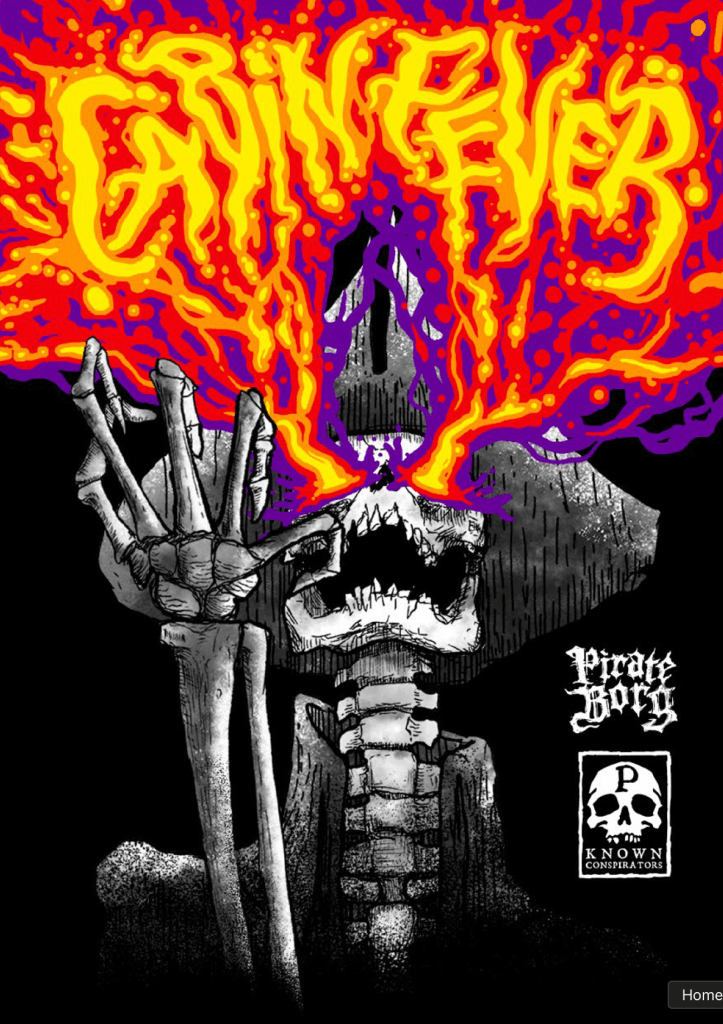
The cover of Cabin Fever, a skeletal pirate with a tricorn hat and the words "Cabin Fever" erupting in fire from his eyesockets
The cover of Cabin Fever

The Repentant is an 11 page one-shot scenario for Pirate Borg by Zac Goins. It is published in the forthcoming sourcebook for that game, Cabin Fever, via KNOWN CONSPIRATORS, Limithron’s subtable for third-party creators. Cabin Fever is a treasure chest of extras for Pirate Borg including new PC classes, GM tools, a Bestiary, no fewer than six adventures as well as solo rules. I am one of the backers of the Kickstarter project so I got access to the PDF through that. I’m hoping to receive the physical rewards for that soon.

This scenario is presented in a typical Borg-ish style, with maps, and illustrations taking the lead in establishing the atmosphere. It’s almost all in grey and black, emphasising the theme of ASH. The layout is also typical with lots of tables, stat-blocks, keyed area descriptions etc being worked into the spaces between and around the artwork. I occasionally had to take a few extra seconds to find what I was looking for due to this but it was never a major disruption. In general it looks great and ewers relatively easy to use.

The Premise

The Repentant is a charnel ship, an unkempt brigantine with tattered sails and a crew of demons and cultists, commanded by a cadre of Ashen Clergy. Their goal is spelled out clearly in the three step plan on the second page. In summary, the plan is to summon demons, form an unholy pact with the Dark One, raid some settlements to take captives, kill ‘em, raise them as undead and then grind them up to make Brimstone ASH. This is a type of cursed and arcane narcotic on which the crew plan to make lots and lots of pieces of eight.

To be clear, the ship is the whole adventure. You could easily work it into an ongoing campaign, I think. It could be a random encounter or the goal of a mission. But, for me, it worked perfectly as a one-shot. It gives you everything you need in those eleven pages.

The Reality

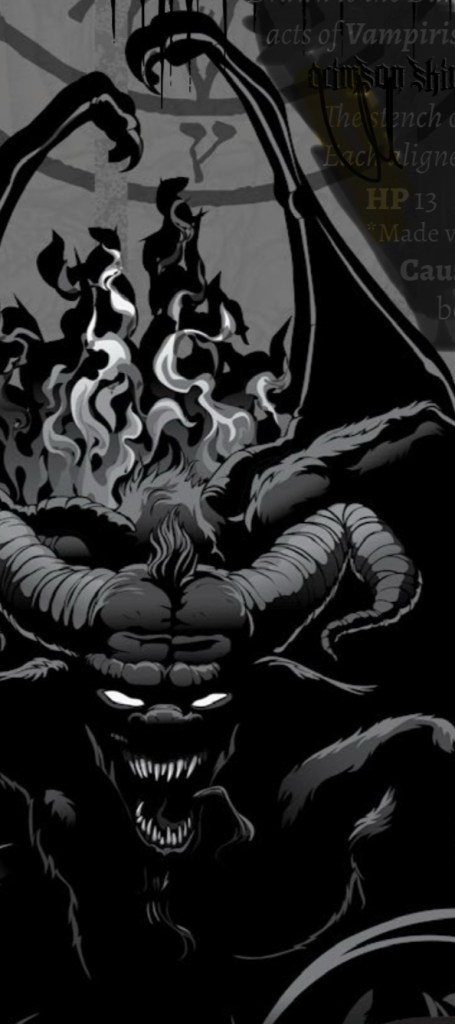
A genuine, fire and brimstone demon

There is a fun variety of enemies for such a short scenario. You have seven different types of possible demon (one for each deadly sin, with commensurate sinful powers,) the emaciated crew, the Ashen Vicars and the Ashen Priest who has a variety of fun powers. And if you deal with all those, there is a hold full of Brimstone Zombies, who have the power to promise your soul to the Dark One with a bite.

Although not every encounter ended in combat, almost all did. It felt inevitable in general. I started the players off where I did, in the brig because of the restrictions of a one-shot session. I wanted them in the thick of it from the start and escape gave them a powerful motivation to attack the terrifying demon, even without real weapons. Also, I figured the brig is area 1 on the map for a reason. The scenario does not explicitly indicate where or how you should start it as a one-shot, but if you take the hint, here, you’re probably not going to go wrong. It definitely got them into the action immediately. Without the timely and repeated use of Devil’s Luck and mystical powers in the first two encounters, at least one of the party would have gone down. The only thing is that it led to two mostly combat encounters in quick succession. Starting with them boarding over the rails or some other way might have engendered a totally different kind of adventure.

The map was fine. I was a little put off that three of the four decks had one side of the map cut off but it was of no practical disadvantage in play.

Tables, tables, tables. The tables are great, from the effects of the Brimstone ASH (different to the regular ASH introduced in Pirate Borg) to the “What did I just step in?” Table which I underused criminally.

My players only used the Brimstone ASH on their enemies, which was a shame. I think it’s because when they rolled on the table for those uses, they got 1s and 2s, which are very very bad. After I told them what else was on the table, they regretted not trying it!

6 The Devil’s inside ye. Immune to fire. All weapons’ dice size increases.

The Finale

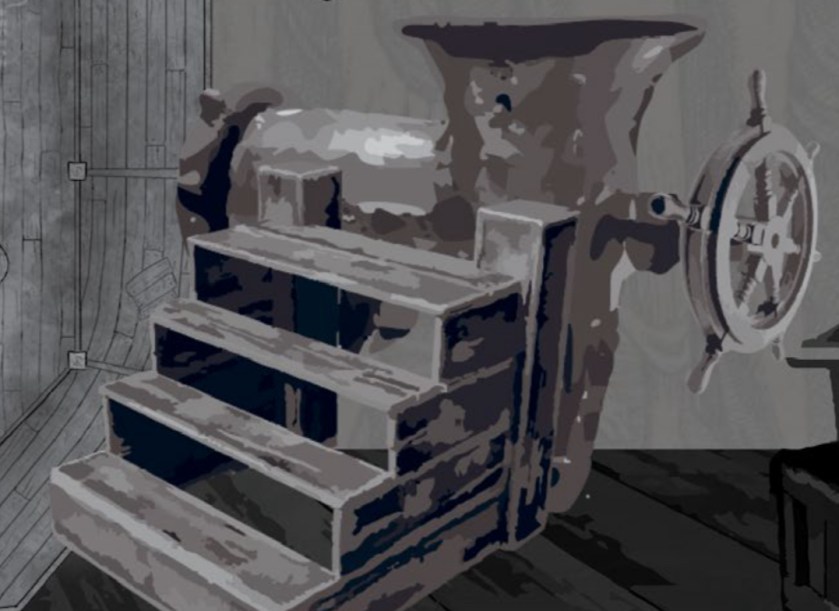
The ASH grinder. Looks like a meat grinder, with a big funnel on top, a mincer on one side and a cranking wheel on the other. Has steps up to allow you the zombies to feed themselves into it.
The ASH grinder.

I saved the Ashen Priest, the scenario’s main villain, for the end. He might have been found in either the captain’s quarters or the hold, according to the keyed locations, but, honestly, you could locate him anywhere to suit your own game. The PCs had done away with almost everyone else aboard when they descended into the cargo hold found him there, feeding zombies into the ASH Grinder. There were a lot of undead down there with him but the PCs made such short work of him that it hardly mattered. Then they got to take the ship as plunder, not to mention the undead and the grinder so they could enact the plan themselves!

Conclusion

This was one of the most well-crafted one-shot scenarios I’ve run. We played it in about three and a half hours, though, if things had gone badly, it might have been over after less than an hour! I did give them a couple of NPCs for back-up and in case anyone lost their first PC (there were two deaths.) This might have given them a slight advantage, if I’m honest, but everyone had a good time. Looking forward to trying out some more scenarios from Cabin Fever and the rest of the slew of new books from Limithron!

Dragon Age RPG: Amber Rage Review

So, off they went, following a magic raven, through the rain and the swamp, fording rivers, defeating enemies and stabling horses, until they got to the appointed place and the raven dropped dead.

Blood in Ferelden

There have not been a lot of supplements for the Dragon Age RPG from Green Ronin. Other than a quickstart guide, a GM’s Kit and Faces of Thedas, a sourcebook filled with fan-favorite characters from the video game series, Blood in Ferelden is pretty much it. It’s a collection of adventures designed by Walt Ciechanowski, Kevin Kulp, T.S. Luikart and it came out in 2010. It contains three full scenarios and a few adventure seeds all of which take place in and showcase various regions of the land that played host to Dragon Age Origins.

It came out at a time before the Dragon Age core book collected all the rules from Dragon Age boxed sets 1, 2 and 3. Dragon Age set 1 only dealt with levels 1-5 and, indeed, Blood in Ferelden’s adventures are designed to get characters from 1st to 5th level.

I discussed another published adventure, Duty Unto Death previously. That was the first Dragon Age adventure I ran for my group and it assumed the PCs started at level 3. So that’s what we did. Not only that, but they progressed to level 4 and became fully fledged Grey Wardens before we moved on to the first adventure from Blood in Ferelden, Amber Rage. I made only a few adjustments to Target Numbers (like DCs in D&D) and enemy stats to increase the difficulty. Despite this, this level 1 adventure proved quite challenging enough at times.

SPOILER ALERT! This review is absolutely packed with spoilers. Turn back now, potential players!

Overview

Amber Rage!
Amber Rage!

Amber Rage is a 39 page adventure. It’s split into six distinct parts, each of which presents its own unique challenges for the PCs, a variety of enemies, NPCs and moral dilemmas for them to wrestle with. All of these are of varying quality.

Here’s the summary: The PCs find themselves in Sothmere, a village near the Korcari Wilds. Our group of newly minted Grey Wardens had been sent south by Duncan, their commander, to determine the strength of the Darkspawn force amassing in the south, preparing for the Fifth Blight. Sothmere was just a pitstop for them. There was a festival happening there to celebrate the building of a new fort, which gave the PCs a chance to take part in some axe-throwing, mud-wrestling, archery competition mini-games. While this was going on, the village was attacked by a band of crazed Chasind stalkers. These lads had been infected with the eponymous Amber Rage and were spreading it all over town. If no-one did anything about it, all the infected villagers were going to transform into mindless Ragers in three days! After some debate amongst the NPCs, it was decided that the Grey Wardens should go and find an ingredient in a grotto in the Korcari Wilds. This shadowmoss could be used to cure the infected.

So, off they went, following a magic raven, through the rain and the swamp, fording rivers, defeating enemies and stabling horses, until they got to the appointed place and the raven dropped dead. There they boiled up a stew and this attracted the firesprites. These guys lived in the grotto of the shadowmoss, so the PCs followed them home. Kind of creepy, when you think about it. Not only that, but they then went ahead and murdered the firesprites’ Guardian Serpent. I mean, the serpent didn’t leave them much choice, but they were invading its home after all. The real problem with this, as the wardens discovered in a sort of psychic vision provided by the firesprites later, was that the firesprites consumed the shadowmoss for sustenance, and the Serpent, ahem, excreted the shadowmoss. So, with the serpent dead, if the PCs collected all the shadowmoss they would need to cure the infected, they would be condemning the firesprites to starvation and extinction. But if they left them with the shadowmoss they had, that would give them enough time for a new Guardian Serpent to mature (this weird symbiotic arrangement was further compounded but the revelation that one of the firesprites would transform into the Serpent itself!) This was the central moral conundrum of the scenario, save the villagers or allow the firesprites to live.

The blackhaller and the burning of the villagers

Once this decision was made, they had to make their way back to Sothmere where a local judge, known as a blackhaller, had been helicoptered in to force the issue of the infected villagers. As the PCs got back to Sothmere, they had the sick ones tied to stakes, ready to be barbecued. The PCs had to make another big decision here, and, perhaps, try to convince the blackhaller to back down.

Thus ends the adventure. I skipped over some middle bits, but that is the essence of it.

Layout, artwork and maps

The layout of this thing is kind of all over the place. There are NPC descriptions separated from their stat blocks by entire pages in some instances. There are some which have the stat blocks of one NPC associated with the description of another, making it really hard to find what you need in a pinch. It’s the same with the enemy stat blocks, which are sometimes so far removed from the encounter descriptions as to make them seem as though they belong to another encounter altogether. I think one of the problems here is the massive parcels of real estate demanded by the standard Dragon Age RPG stat blocks, which presents some serious layout headaches. I had to do a lot of prep to make sure I had all of the relevant info and stat blocks on hand for any given encounter, social or combat.

Statblock Nightmares

The splitting of the adventure into parts, like chapters in a novel, was something I found useful. I tried to aim for completing one part each session. In the end, it did take 6 sessions to complete it.

The artwork is nice, although much of it was clearly supposed to be full colour but was presented in black and white, which was a shame.

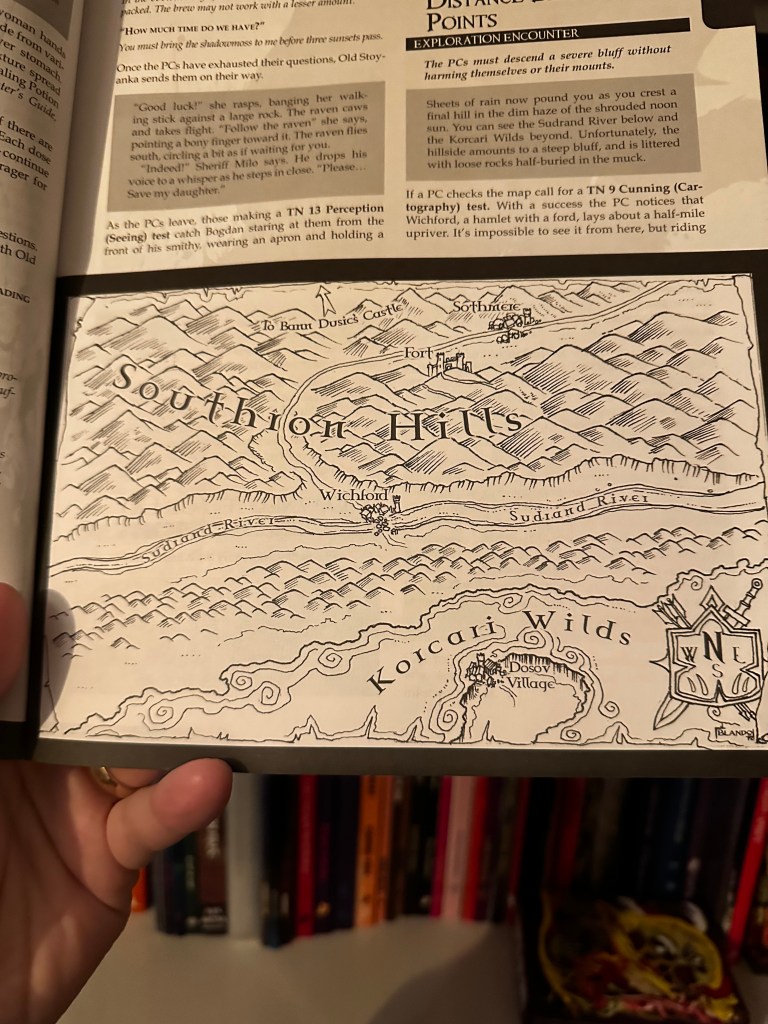
The maps are great. I really liked the small regional map and the one of the grotto. I used both at the table, revealing parts of the grotto map to the players as they discovered more of it.

Decisions, Decisions

Dragon Age is built upon difficult decisions, choices that matter and have lasting consequences and you can see that’s what the writers are trying to present as the frame that Amber Rage is built on. Should they allow the little boy be killed by ragers, or his sister? Should they kill the leatherworker who’s been infected but hasn’t turned yet, or should they give him their brew that slows the infection, endangering themselves? And, ultimately, should they condemn the firesprites to extinction or save the villagers?

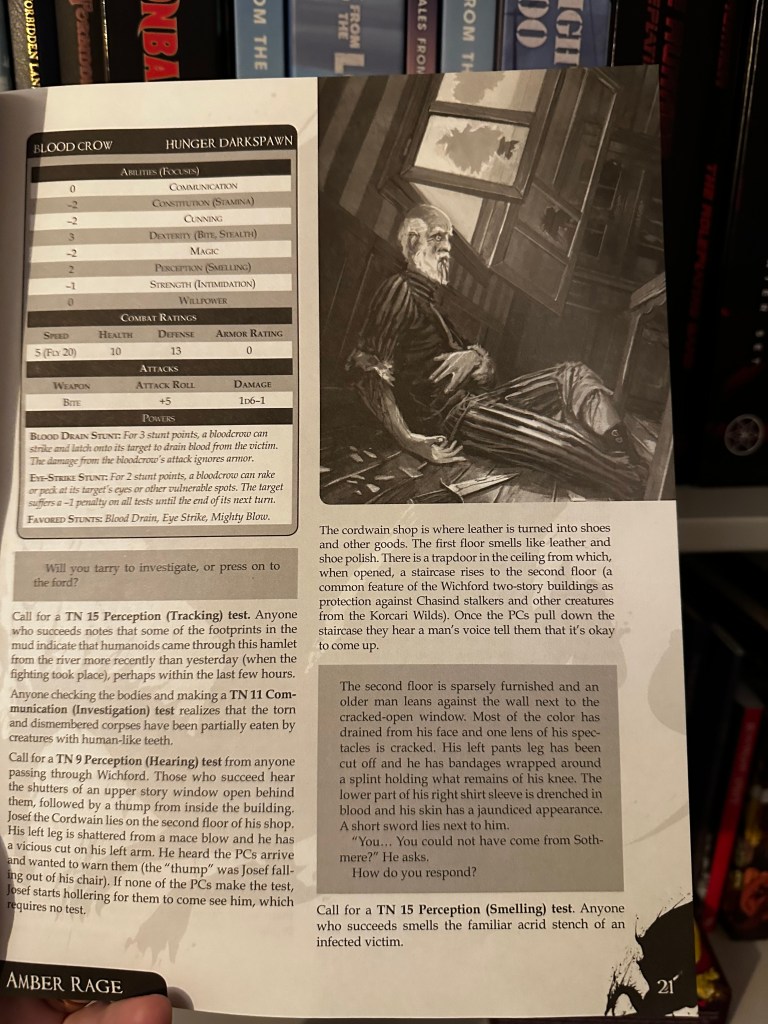
Josef the Leatherworker - poor bastard
Josef the Leatherworker – poor bastard

Now, this is an adventure that is written with some trad sensibilities. There are long paragraphs that examine each and every option available to the PCs in any given situation (or so the designers thought.) It presents you with the sorts of ability tests the PCs will need to make, their target numbers, the modifiers applied due to darkness or marshiness or stinkyness etc, etc. But, in almost every situation, my PCs found another alternative. They saved both children by the clever application of (checks notes) ranged weapons, They debated over the fate of the leatherworker so long that he turned Rager while they were still talking, and the shadowmoss problem? Well, they took the long view, what if they stole all the shadowmoss, killing all the firesprites in the process, and saved the villagers, but then there was another infection later and there was no Shadowmoss to help them? So they said, screw you Sothmere, we’ll only bring enough of this shit back to cure one individual fucking villager and then leave you to decide who should get it! The firesprites were happy, but no-one else was.

What particularly annoyed me about the text was this, it assumes that the party would choose to take the Shadowmoss. Almost all of the events described after the grotto involve the “fact” that they have a potential cure for the Amber Rage and others want it or others don’t want it used or something along those lines. So, those were largely useless to me. At least this allowed me to cut out swathes of what was always going to be the least interesting portion of the adventure, the trip back to town, which was staged as a series of encounters. There is a box on one page entitled, “Sustaining Drama and Varying Beats on the Journey Back.” The text in this is there to advise you to switch things up and vary the encounters because otherwise they might seem a bit samey… Could have just left them out, in my humble opinion.

They also present a number of NPCs that are either sympathetic or not, though. I can’t imagine anyone really liking Bogdan, the blacksmith, or even agreeing with him, in fact. Everyone is going to like the personable and honourable Sherrif Milo, though. So, when the players are asked to choose between the two, it’s no choice at all.

Some of the more sympathetic NPCs were the elven performers, the brother and sister duo, Oleg and Dielza. Our very own elven Grey Warden, Halvari, developed a closeness to them early on, so when Oleg was infected and Dielza was not, she promised to save him… But of course, in the end, she couldn’t. She had had to send over the single portion of shadowmoss and the good people of Sothmere were never going to cure the elf with it, so Halvari was left with no choice but to take Ole’g life before he turned and before the villagers could burn him. This was a truly sad moment that was always a possibility in the text but which was brought alive by the player in some outstanding role-play.

Conclusion

I loved the set-up for this, the festival, the mini-games (I forgot to mention a drinking mini-game from later in the adventure that was also very fun,) the moral dilemmas. But, throughout, I found myself wishing to be freed of the constraints of the text. I wanted to have been presented with the overall situation, the NPCs and some potential encounters and locations, and then let the PCs just go and figure it out. I guess I have been playing a lot of OSR recently, and it’s had an effect on my brain. In my thinking though, this would have solved the problem of the designers assuming the decisions the PCs would make, that I pointed out above.

I also don’t feel like it was quite Dragon Agey enough. It was missing abominating mages, darkspawn, spirits and demons. It could have been set in almost any generic fantasy setting without making almost any changes.

Finally, our crew of fourth level grey wardens had a very tough time with some of the only slightly upgraded combat encounters. They were lucky to have survived the evil giant crab attack and don’t even mention the marsh wolves, the mage went down twice… Actual 1st level characters would have been completely buggered, in my opinion.

Marsh Wolves – watch out!

Despite all my gripes with this adventure, we had a great time with it. This had a lot more to do with the fantastic bunch of Tables and Tales members and Dragon Age fans we’ve gathered, who have gotten into the game, the system, the stunts and the potential for heartache, than it had to do with the scenario itself.

My advice, dear reader, is, if you’re still interested in running this adventure, go through each part of it and prepare it your own way first. Think of potential consequences for decisions the PCs might make that the text does not prepare for, and feel free to cut out large parts of the journey back to the village.

Troika! Whalgravaak’s Warehouse Review

Here’s the story: hundreds of years ago, the city’s premier logistics wizard, Whalgravaak, abandoned his warehouse, having shredded the Manual of Operations for his Sphere Pool (a mechanism used to import and export goods across the cosmos) so that his rivals could never figure it out.

One-shot fun-shot to campaign of terror

You know what it’s like, dear reader: you want to introduce some noobs to RPGs or just to your group of players, you want to make a good impression but you don’t want to scare them off by plunging them into a multi-session campaign with a complicated, crunchy system. So you pick up a location-based adventure, thinking you can just use a small portion of it, just what you need, just enough for one session, one single shot. But, after that session, the curiosity gets the better of you all. That was a weird, but enjoyable experience, you tell each-other. I bet we could have fun exploring the rest of that odd locale, you tell the players, why not have some more sessions and see how it goes? So you do that. And then the bloodbath begins.

Whalgravaak’s Warehouse

SPOLIERS BELOW! If you are interested in being a player in Whalgravaak’s Warehouse, turn back now!

The covers of three Troika! 1:5 adventure modules, Whalgravaak's Warehouse, The Hand of God and Eye of the Aeons.
The 1:5 adventures that I own, Whalgravaak’s Warehouse, The Hand of God and Eye of the Aeons. All from Melsonian Arts Council

Whalgravaak’s Warehouse is a Location based adventure by Andrew Walter for Troika! The design is by Shuyi Zhang. It came out in 2023 and was the first of the Melsonian Arts Council’s 1:5, an ongoing series of location-based adventures for Troika! There are a couple more available now and another out very soon. You can find them all here. My somewhat rotating group of Tables and Tales members just had our last session in Whalgravaak’s Warehouse on Monday night, after spending a total of eight sessions there.

Here’s the story: hundreds of years ago, the city’s premier logistics wizard, Whalgravaak, abandoned his warehouse, having shredded the Manual of Operations for his Sphere Pool (a mechanism used to import and export goods across the cosmos) so that his rivals could never figure it out.

Since then, the strange nature of the warehouse, staffed by giants and stocked with oddities, has only grown stranger, and more dangerous. It houses a handful of physics defying, Tardis-like chambers, not least of which is the terrifying Deep Storage, a swirling mass containing several pocket dimensions and a wraith-like being who wants nothing more than to consume intruders. At least one cult has taken up residence, and they are often mutated into horrific Chaotic Spawnlets by the effects of the radiation still spilling from the Sphere Pool. The warehouse is sandwiched by a vast desert of dust occupying the roof, which is peopled by the descendants of Whalgravaak’s former employees and, underneath, the tunnels of a pack of unpredictable Worm-headed Hounds.

But entrance has been forbidden by the Autarch for centuries and, even if you were foolhardy enough to ignore a diktat like that, you would still need to be brave enough to face the unknown dangers within.

The Hook and the Party

The book suggests a few potential hooks for your PCs. Since my game started off as a one-shot, with brand new characters and no existing campaign to work it into, I went for one that seemed like the object might be achieved in one session. They, along with many other groups of mercenaries were contracted to return with the head of a Cacogen, known only as the Opportunist, to their patron, an Exultant of the Autarch’s court. But we dealt with that in flashback as they all sat in the weed-choked yard of the warehouse, dotted now with small encampments of adventurers and brigands all gathering their courage to gain entry. The PCs’ band consisted of a Monkey Monger (and monkeys), a Gremlin Catcher (and dog), a Wizard Hunter and a Landsknecht. They were, to put it bluntly, a motley crew.

That first session was all fun and games. Every encounter, except for the last one with the Cacogen, was resolved peacefully. This happened mainly due to the rolls I made on the Mien table for each encounter. The worm-headed Hounds they encountered wanted to play with the Monkey Mongers monkeys, they did not want to eat them. The Flat Serviceman was happy to follow the party around and clean up after them. The Segmented Crippler in the Pigeonholery, didn’t want to wake up, so they skipped that one entirely. This is a pretty standard mechanic in Troika but I think it gave the players a false sense of security. The session ended with this motley crew finding and defeating the Opportunist quite handily. And, at that point, we thought that would be it.

But a few months later we decided to continue with their explorations of the warehouse. Obviously, their original motivation to explore was gone. They had achieved their objective, but the players were all good sports. They decided between them that the motivation was purely one of curiosity and greed. They had spotted, through a bubble like window in one of the rooms they had traversed, a vast and terrifying pool of chaos and wonder in a room far too big to exist within the confines of the building. This was enough for them. Essentially, they went in search of adventure. Although, through the sessions that followed, I did introduce the idea that they might want to find that cult I mentioned earlier and that they should seek out the incredibly valuable Tome of the Sable Fields that was reported to be stored in the warehouse, somewhere. This gave them a little direction when I thought they might need it, but, honestly, I think my players just wanted to see what new wonder/horror the dungeon had in store in the next room.

The Dungeoncrawl

It was only from this point that I started to really treat this adventure like the dungeoncrawl it is very much meant to be. The book does a good job of introducing the concepts of tracking resources like lantern oil and provisions as the party explores. It also explains the concept of exploration turns and their effect on the game, i.e. the distance you can travel in that time, the amount of lantern oil you use per turn, and the likelihood of running into an encounter. I followed all these rules to the letter and they made for some interesting moments in the game. But, to be frank, the weirdness of the setting is the real draw here, not fiddling with rations and light levels. Also, few of the characters lived long enough for starvation or oil-skins to become a problem.

It also has rules for dealing with the spatially distorted, impossibly large areas within the warehouse. It suggests that the players should make Luck or Skill checks to avoid getting lost in these areas, but, in all honesty, I didn’t really require that sort of thing.

Mapping is also a part of the dungeon crawl format and this adventure does want the party to attempt to map the space for themselves. The thing is, when some rooms appear to be a kilometre wide and the next one is spatially normal, that map becomes effectively impossible for them to draw accurately after a relatively short period of time. Eventually, I gave up and just shared the one from the book with the players, trusting their ability to separate player knowledge and character knowledge. My advice, if you are doing this, try get your hands on the PDF version, since the one in the physical book stretches across two pages and the crease obscures part of it.

In fact, the adventure has four maps:

  • the warehouse floorpan, using 10ft squares to denote distance
  • a hex crawl for the desert on the roof, replete with points of interest
  • a map of the Worm-headed Hound tunnels beneath the warehouse, superimposed over the warehouse plan
  • a largely vibes-based map of Deep Storage

These are all great but usefulness will vary. In our game, the party spent several sessions trapped in Deep Storage but took one look at the desert and noped right out of there. This seems like a good point to note how good all the artwork is in this. There are plenty of colour and black and white illustrations but they leave me wanting even more!

Warehouse Workers and other Beasties

A warehouse is a dangerous place to work, especially when the correct safety protocols are not observed. It doesn’t help at all when you are trespassers and several of the residents are large enough to crush you with a single blow.

The crimson giant, Paude, the pipe-smoking, bearded giant, Arbuthnot and the blue, jelly giant, Gamtomerian.
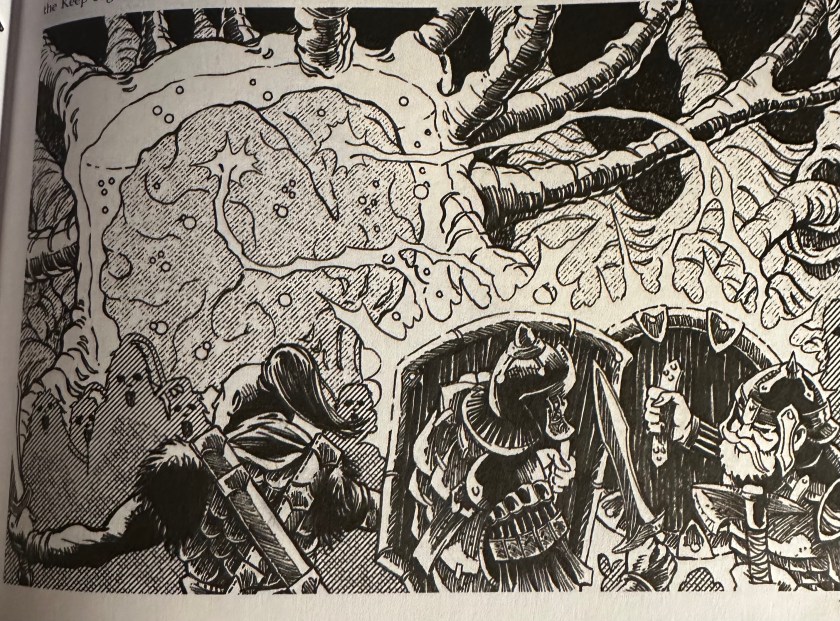
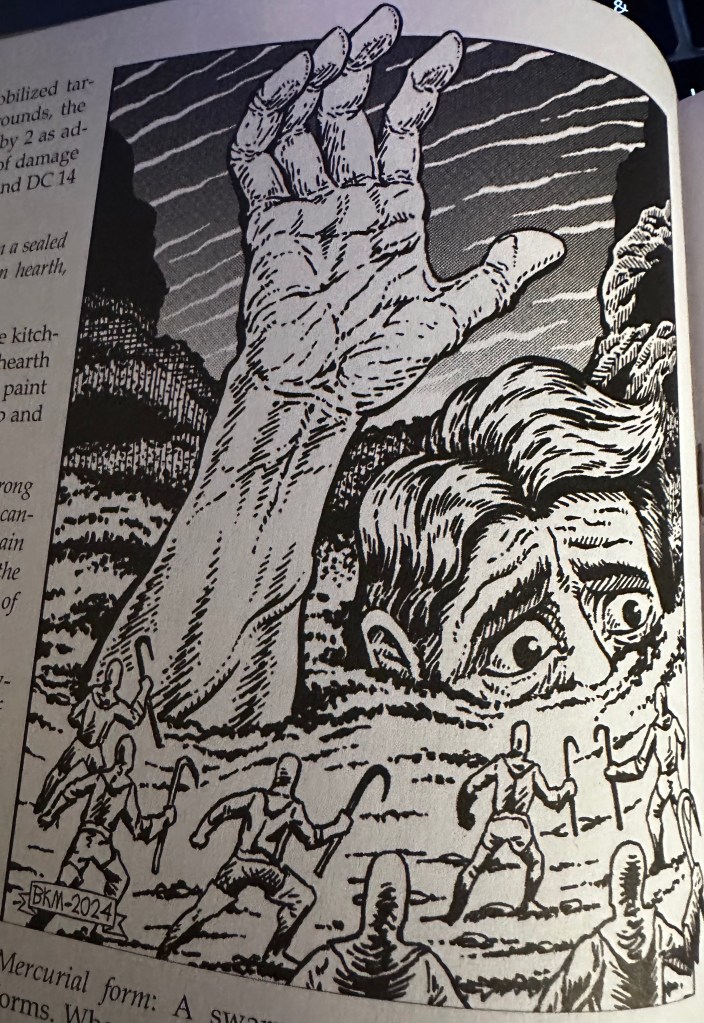
The giants are not what you might expect.

The giants are the main NPCs of the adventure and Whalgravaak’s only remaining employees. Each one is fabulously interesting, diverse and well-drawn. They have their own motivations and desires. I was gratified that the party managed to encounter all of them during the eight sessions we played. In fact, one player had two different characters killed by two different giants. I will point out that it is entirely possible to avoid violence when dealing with the giants, it’s just that, sometimes, the Monkey Monger on the team has monkeys who decide to fuck with them and one thing leads to another.

The wraith-like Gulf Man Roamer from the swirling vortex of Deep Storage is a potentially lethal foe who has a chance to show up each time the party moves through that already dangerous room. If it captures you in its bag, it’s going to spirit you away to eat you in its extra-dimensional lair.

No warehouse is complete without forklifts. Whalgravaak’s forklifts are humanoid constructs with the face of the wizard himself. They treat intruders like stock, and will attempt to whack them and pack them. They hit very very hard.

Its a black and white dog, with a neck like an earthworm
When you read the words, Worm-headed Hound, is this what you imagined?

There are also a bunch of random encounters, including the Worm-headed Hounds I mentioned before, desert nomads from the roof, and Bandits/Burglars/Bastards. These only turn up on the roll of a 1 on a 1d6 for each turn the party travels. It didn’t occur very often in my game. The Roof and the tunnels have their own random encounter tables as well, but I never used them as the party never spent any appreciable time there.

This is just a selection of the possible encounters you can have in this setting. I haven’t even mentioned the tiny army guys, the sentient crane parts, the Onion God or the Mulled Dead.

The Rooms

I have hinted at rooms that defy physics and rooms with pocket dimensions, and those are usually the big-ticket locations that contain some of the greatest set-pieces in the adventure. Deep Storage alone evoked some of the most inventive use of skills and spells and a great degree of fear and tension from the PCs. It killed one of them (two if you count the Rhinoman eaten by the Gulf Man Roamer.) The Roof could act as an entire short hex-crawl campaign and the Sphere Pool has some truly memorable and dangerous elements to it.

However, many of the other rooms have weird and wonderful contents as well. Some of them, the party will glance at and move on, while others will capture their imaginations and encourage them to interact. I never really knew which reaction I was going to get from them, actually. The room full of melting rope? They had to spend an hour trying to figure out how to set it on fire, the eternal battle between tiny armies playing out across a battlefield seemingly larger than the whole warehouse? Just popped their heads in and left with some captured little men.

Some of the rooms were relatively mundane warehouse style rooms with shelves and containers. The book has tables in the back to help you identify the state those rooms are in and the contents of the containers, which is useful.

One of my over-riding impressions by the end of our game, was that in some ways, the great variety of bonkers content in the rooms served to detract from any unifying theme. There were some elements that went together, such as the warehouse’s disdain for traditional dimensions. If my PCs had explored the Roof or even encountered any of the nomads who dwelt there, they might have found a distinction between those descendants of the ancient striking workers and the giants who continued to obsessively do their jobs even long after their employer had passed on. But, none of that is to say that the rooms weren’t endlessly fun and inventive.

A Note on Lethality

I recently wrote a post sharing some of the obituaries of the characters who met their ends in Whalgravaak’s Warehouse. You can check it out here. There are only three of them in that post. A few months previous to that, I wrote this post, which contained the obituaries of two more. The mathematicians amongst you will have summed those already. That’s five. In the final session, we lost another one. That makes six. That was three character deaths each for two particularly unfortunate/reckless players. Warehouse work is dangerous. Only one of the original party survived to the end. You have been warned.

Conclusions

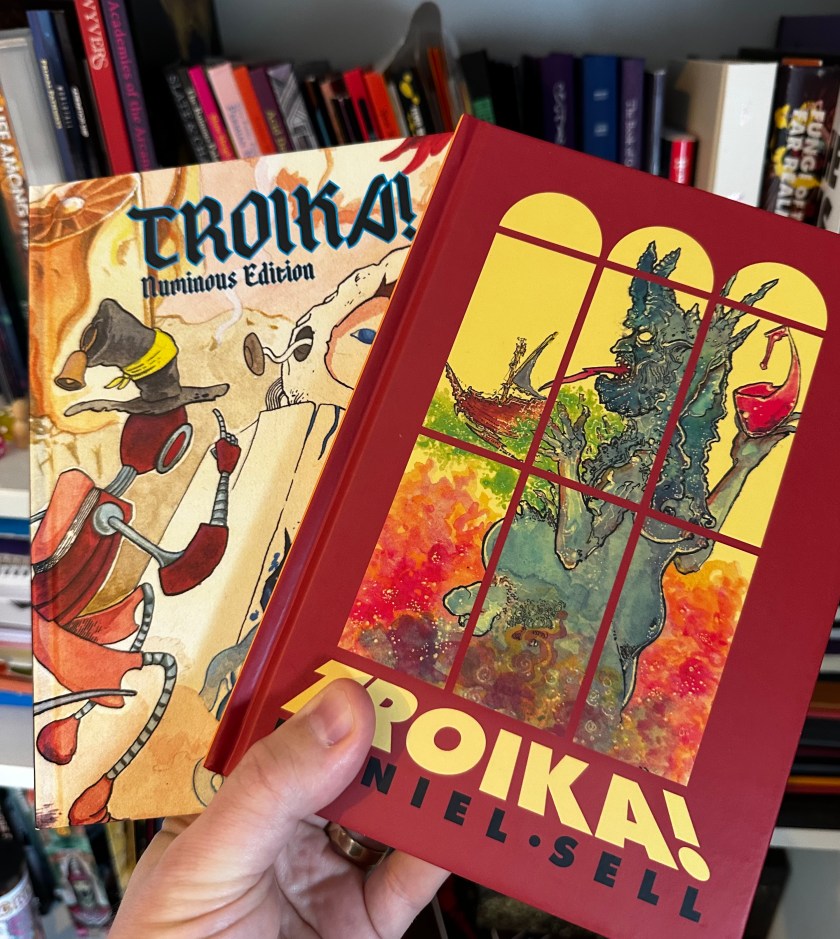
The covers of the two different versions of Troika! that I own.
Numinous or otherwise, its the same game.

There is so much to recommend in this adventure. It is endlessly entertaining, challenging and bonkers. It has such a variety of locations and such a diversity of encounters that you would need to work hard to get bored in Whalgravaak’s Warehouse. I think it works so well to show off Troika! as a system, too. The problems it asks the PCs to solve and the encounters they have to deal with utilise things like the Luck check really well and encourage players to invent their own unique Advanced Skills. But if they get into fights, especially with the incredibly random nature of Troika! initiative, there is a very high chance they are going to come out of it dead. There are a few opportunities for insta-kills throughout the warehouse too. I can’t overstate exactly how lethal this adventure is. Luckily, my players leaned into that, even when they were creating new characters to join in the same fight the original one died in (they got very quick at creating characters.)

I think it’s also flexible enough for many GMs to easily take it or part of it and fit it easily into their own ongoing Troika! campaign. As I said at the start, our game started as a one-shot and it could have ended there. But we were able to easily adapt it into a short campaign of its own.

Dear reader, let me know if you have played Whalgravaak’s Warehouse or if you would like to! I’d love to know your views on it.

DCC’s The Grinding Keep Review

At one stage, the Elf cast a Magic Missile and it caused a rain of frogs on the entire party and all their enemies, almost killing several on both sides!

DCC Day

I kind of knew it was DCC Day on the 19th of July. It had been advertised to me enough times on Instagram after all. But that was not why I had scheduled a DCC one-shot on the 20th of July. That just happened to be the best day for most of my players. As serendipity would have it, the module I planned to run was the Grinding Keep, an adventure designed by Marc Bruner, which appeared in the Adventure Pack for DCC Day 2024 along with the XCC RPG adventure, Tucson Death Storm!

Hook

I had introduced the hook for this adventure in our recent run of Sailors on the Starless Sea. The PCs discovered a map to a keep and a note hidden in the lining of a cloak in amongst the charnel remains of many butchered humanoids in that adventure’s tower. The note was from the patron of the poor unfortunate who lost their cloak and it indicated that their patron would pay 1000 gp for the safe return to them of a magical lantern. As budding adventurers, most of whom barely had two groats to rub together, this seemed to be motivation enough.

Each player had only one surviving character from the 0-level funnel and one of them was not able to make it to this latest game so I supplemented the four characters who advanced from 0-level to level 1 with a couple of pre-gens kindly provided for the Grinding Keep by Goodman Games themselves.

Big Party

So the party was made up of six level 1 PCs, a Warrior, a Wizard, a Cleric, a Dwarf, an Elf and a Halfling. Two of the players played two PCs each and two of them played one PC each. All of their abilities proved useful. I would say a varied party is very beneficial for this module. On the other hand, if I had to do it again, I probably would have left the players with one PC each even though the adventure calls for 4 to 6 level 1 PCs. They all survived easily enough, although there were a couple of close calls.

Starting the Adventure

SPOILERS! – If you are a player who might want to play this module, stop reading now!

To begin, I plonked them right at the door to the keep as the text suggests. The module wants you to do this. It is designed to be a one-shot by the gods, and it will be! No faffing around in town, shopping or gathering rumours. Just get them in there as quick as you can. I did have to utilise the handy, and essentially invulnerable Leaf Elemental that waits on the grounds of the estate for anyone foolish enough to hold up the proceedings of your one-shot by searching for herbs amongst the overgrown gardens which seem to be under the influence of all four seasons at once. The seasons are a recurring theme and I was gratified to note that the players realised this almost immediately.

Anyway, once they had been chased inside the keep, they were confronted by something that could only have been a magical effect that transformed the interior from a ruin to an immaculately decorated and lit hall. They were greeted by the white robed Host and eventually waited on at dinner by his veiled servants. All of this set up was important. It presented clues to the nature of the keep to the PCs and let their imaginations run with them. Enough strangenesses occur during dinner and upon their investigation of the ground floor of the keep that they should be suspicious. Indeed, before they had even left the dining room, one of my players joked, “the house is a mimic!” He didn’t know how spot on he was…

Of course, the keep is, in fact, an other planar entity who comes to the world to feed, in disguise. The PCs had seen windows and chimneys on the outside but could find no sign of them on the inside. The couldn’t get through any doors that the Host didn’t want them to enter, etc, etc. Clearly, there is enough evidence to allow your players to uncover the truth before things ever really get interesting.

One regret I have is how much time I allowed them to devote to this whole section before Event One occurs. They spent a lot of time searching, theorising, investigating, and it ate into the more adventuresome elements in the latter stages of the module. My advice would be to get them into the Guest Quarters and asleep as quickly as possible. The adventure does not provide much in the way of motivation for the characters to do this, however, so be prepared to improvise.

Event One

Event One is triggered when they wake up after a nights’ sleep in the keep. I was lucky enough that the players wanted to rest and one of them was rendered magically asleep, but without that, it would have been a struggle to get them to wait until the next morning. I probably would have triggered Event One early, if that had been a problem.

What “Event One” means is that the keep is waking up. It will soon be ready to consume a fresh meal of adventurers.

Mechanically, what it means is that every time they open a door, they will be confronted with an intersection of corridors that lead to two randomly determined rooms in the keep. These could be rooms they already visited in the first part of the adventure, or ones that would have been otherwise inaccessible up until this point.

The first room my players visited was the dining room again. This was satisfying as it gave them a chance to kill the Host and his servants from earlier (although, technically they just put the Host to sleep and dragged him around with them for the rest of the adventure.) After that, they encountered one of the three rooms that contained the organs of the keep. They had discovered the journal of a former prisoner/meal in their quarters that gave them hints as to how to deal with each of the organs; eyes, heart and lungs, and that proved useful in the encounter they had with the heart. It is significant that they identified several magic items that act as keys for the doors to these special rooms. But their first instinct was to destroy them if they could. Luckily they forgot about that plan and just kept ‘splorin’ instead. Eventually they managed to overcome the challenge in the heart room and at that point of our session, I realised I was running out of time to get my one-shot done in one shot so I focused things up a bit.

Event Two

The way it was supposed to work was this: every time they left a room, I would start marking that room off as no longer accessible on the random room table, until there was only one possible room left; the one that contained the Alien Intelligence itself. I didn’t have the time for all that. We were approaching the four hour mark at that point and people had work in the morning. So I just told them that, after they destroyed the fiery orb that acted as the keep’s heart, the entire place shook and when they re-opened the door to leave that place, the corridor beyond led to the last room. The players, unknowing, proceeded to their fate. Their fate, as it happened, was to murder the Alien Intelligence of the Grinding Keep, all its Animated Corpses and the Giant Animalcule Swarm that accompanied them. Destroying the heart had pretty much halved the creature’s HP so it wasn’t too difficult. In the end, they fled through the windows in the back of the room, utilising the Feather Fall spell (which two characters had, by coincidence) to safely land in the river at the bottom of the canyon beyond.

Conclusions

Perhaps you can see now why I think I should have made things a little harder for them by reducing their numbers. On the other hand, I am glad they all survived. They had all created and played such interesting and fun characters, even in the context of a game that is not RP-heavy, to say the least.

I was a little disappointed to reach the end of the adventure with so much cool content unexplored. They didn’t find the trap/treasure room where the magic lantern was stored, they didn’t find any of the other organ rooms, which all had really fun mechanics. On the other hand, I felt the adventure was designed to be flexible enough for a Judge to shortcut it exactly the way I did to get them to the end a little quicker, which seemed like good design to me.

This was only the second time any of us had played DCC and the first time with characters of anything other than 0-level. This was a different game to that first experience. PCs used magic and Mighty Deeds at every available opportunity and they got to roll on the crazy magic random tables a lot. At one stage, the Elf cast a Magic Missile and it caused a rain of frogs on the entire party and all their enemies, almost killing several on both sides! This is why we loved DCC. It’s the wonderful and potentially lethal randomness of it and the endless inventiveness of the adventures.

I would recommend the Grinding Keep as a one-shot DCC adventure, as long as you are willing to either cut out bits or extend it to two sessions.

Modular Gaming

Improbable hot-takes

“The Discourse (TM)” has been focusing on running published adventures/modules/campaigns as opposed to custom/homebrew/sandbox games for the last little while. First Quinns reviewed Impossible Landscapes, an epic and almost legendary campaign for the modern Cthulhu-ish game, Delta Green. This is the first time Quinns has reviewed a campaign/published adventure on his RPG review channel, Quinns’ Quest, so it was unusual enough to spark a significant amount of discussion all on its own. And then Thomas Manuel of the Indie RPG Newsletter and Rascal reviewed the same campaign. I believe this was purely coincidental, especially as Impossible Landscapes came out about five years ago now. Both are great reviews in their own right and are based on full play-throughs of the campaign so you know they’re of real value. You should check them both out.

Anyway, on Bluesky, Thomas Manuel went looking for recommendations of other modules to run and this spawned a lot of interesting answers and quote-bleets from RPG luminaries, such as this one, which I found interesting.

I have opinions on the conversation, of course. I have shared a lot of them in other posts from the last year or so, actually. If you want the summary, though, I had a lot of bad experiences running D&D scenarios in the past, especially from the AD&D 2nd edition era. I found they were difficult or impossible to just pick up and run. In fact, they required maybe more preparation time than adventures and campaigns I wrote myself. The one published 5E campaign that I ran, Storm King’s Thunder suffered from the same issues, actually. This made me feel like it was a “me” thing. But, it turns out, a lot of GMs feel the same way, according to Bluesky, at least.

However, I have had my mind changed somewhat by running pre-written adventures for some other games, particularly Free League’s Blade Runner, Dungeon Crawl Classics and, to a lesser extent, the Dragon Age RPG from Green Ronin.

This is a link to my first post on Electric Dreams, the introductory Case File for Blade Runner:

And this one compares the same module to a 5E murder mystery adventure I played in around the the same time:

Here’s my post about Sailor’s on the Starless Sea for DCC:

And this is my post on running Duty Unto Death, a short intro adventure for the Dragon Age RPG:

And finally, this post, although ostensibly an excuse to discuss DCC adventures, also includes my opinions on the one 5E campaign I ran:

I will say that, despite my generally favourable outlook on most of these modules, I still find I have to to do a lot of prep for them. The main fear I have is messing things up so bad that I essentially spoil the rest of the adventure. Although, I should really have more faith in my abilities as a GM at this stage. I feel like I can probably improv my way out of any hole, to be honest. But it does not change the fact that I spend hours rewriting long paragraphs presented in module texts into digestible bite-sized bullet-points. I am running another Dragon Age scenario right now. Amber Rage is from Blood in Ferelden, an anthology of scenarios for the game that came out in 2010. It suffers from verboseness and unnecessary detail and makes for a lot of work from the GM. I’m enjoying the contents of the scenario but its presentation is horrendously dated and needs a sprinkle of OSR magic to tighten it up, in my opinion.

I realise that none of the modules I have mentioned here are anywhere close to having the size and epic scope of something like Impossible Landscapes, but it doesn’t change the fact that they have largely changed my mind about running anything pre-published. The one I have my eye on right now is Dagger in the Heart for Heart: The City Beneath. Actually, I have a post about that right here too:

OK, I’m off to discuss the discourse on Discord of course!

Alien RPG’s Hope’s Last Day: A Review

If you’re interested, go check out my post previewing this game here.

A Bad Call?

Burke, Carter J “confessed” to Ripley that he had made a bad call in sending them to a colony on the moon, LV-426. But did he mean it? No. He was a scumbag of the highest order. He was just fucking someone else over for a percentage. I sent my players to LV-426 too. I wasn’t looking to fuck them over for a percentage, but, at the very least, I expected most of their characters to get impregnated by facehuggers, ripped to shreds by drones or melted by acid blood. Did any of that happen? Did I make a bad call in choosing the Cinematic Alien RPG scenario, Hope’s Last Day, from the core book, rather than the one from the Starter Set? Well, dear reader, why not come with me on a trip through our one-shot and my thoughts on it, and you’ll find out.

Shake and Bake

These two scenarios couldn’t really be much more different. The one from the Starter Set, Chariot of the Gods, is set on a ship out in space, you know, where no-one can hear you scream? It’s also very much a full scenario with an entire three act structure. They say it would take three sessions to play but I have my doubts about that estimate, having played Hope’s Last Day.

Speaking of which, Hope’s Last Day is a scenario that’s set totally on the moon where Ripley and the Nostromo’s crew found the Alien eggs in the first movie and the setting for the action of the second. This scenario was not even a full Cinematic experience. It is billed as a taster, since it really only encompasses what would be the third act in a normal Cinematic scenario. The book confidently asserts that it could easily be played in under two hours.

Frankly, duration was the deciding factor for me. I only had one night to get through a whole scenario. I don’t have a lot of wiggle-room in my schedule due to the fact that I have at least seven other ongoing games at any given time, so it really had to get wrapped up in one shot. So, I shook it and baked it.

Shaking

Shaking, essentially, meant reading through the scenario a couple of times. It’s very short, so this was not a problem. I also took notes on the various major beats and summarised the contents of the various blocks and rooms into bullet points. Most of the scenario consists of these location descriptions so this was key for me. Also, they are all presented in what I consider to be unwieldy blocks of text in the book, and I prefer referring to bullet points at the table. This work helped me to keep things flowing a little more smoothly on the night. I also screenshot handed the pregenerated characters out to the players I thought they would suit best a couple of days before. This part was fun, and the players were left to wonder how I decided who should play which character. Each character had an agenda that was generally meant to be kept secret from the others. Now these were fun. Stuff like, being willing to sacrifice themselves for the others, wanting to acquire an alien and escape with it or just to keep the company’s actions a secret at all costs. You know, normal stuff. Anyway, I examined these agendas and assigned the characters purely out of a desire to see each player pursue that secret agenda. Other than this fairly sparse preparation, I got a couple of copies of the map of Hadley’s Hope printed and a few character sheets. I familiarised myself with the relevant rules as much as I could and that was it for the shaking.

Baking

At the table, we baked. And, I will say most of the time this one-shot spent in the oven, there were no issues at all. Was I ready to nuke the site from orbit by the end? Not quite, thankfully. I’m mixing my metaphors quite egregiously at this point so I’ll abandon them both and just tell you what happened.

I started exactly as the scenario suggests you start, with the four PCs inside the West airlock of Hadley’s Hope. They had just returned from a day or more outside the settlement and were not aware the Aliens had already decimated the population. I let them investigate a bit, try and get an intercom working, and generally futz around. The scenario calls for an Alien attack whenever the PCs dawdle but I didn’t want to lose anybody so early on. I think this was a mistake on my part. Their first encounter with an Alien occurred a little later after they had made their way to another block of the station and messed around looking at eggs and facehuggers and whatnot. This gave one character the opportunity to collect an egg and another to sacrifice himself to keep the others safe and made them all start running to find the way out. This was more like it. Things really started moving then. The one who sacrificed himself turned out to be an artificial person as Bishop would have us call them. So, the alien just left him, innards outed, on the floor and unable to move, but not dead. Luckily there was an extra pregen for that player to take over so we continued on.

Later they encountered a couple of facehuggers after finding a few weapons. They made short work of them and moved on again. They spent much of the last part of the session effectively split into two parties running from two different drones towards the only way off the planet, a shuttle. And you know what? They all made it! Except the android, who, I can only assume was caught in the conflagration when the nuclear reactor in the processing plant went up as Ripley and the others escaped. Also, they didn’t all make it, because the pilot turned out to be the company plant and she spaced everyone else as soon as they left the atmosphere. I guess that made her the winner?

Game Over, Man

So, what was the verdict? It’s a mixed bag, to be honest.

I think our main complaint was that this was mislabeled as an under-two-hour scenario. I mean, ok, it was our first time playing the Alien RPG so we did have to spend a little extra time referring to the rules and figuring out what all the stats meant, but that does not account for the fact that this thing took us almost four hours. Even then, I had to abandon some integral rules to allow us to make it to the end in that time. I don’t honestly know how anyone gets five people around a table, people who want to role-play, who want to fuck around and find out, people for whom the joy is in the playing, not in the finishing, and have them get through this scenario in anything less than four and a half hours if you stick to all the rules of the game.

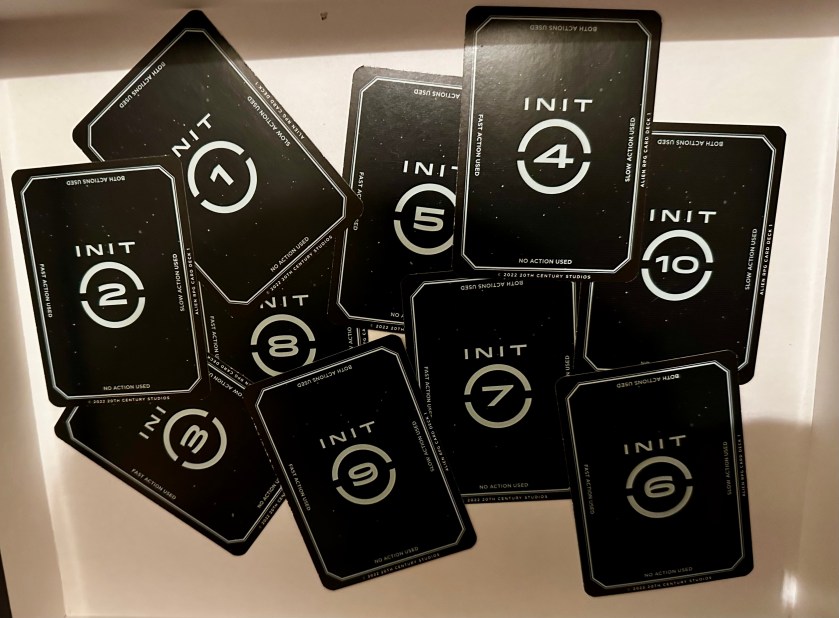
As for the rules. The main negative was the initiative system. Alien, like other Free League games, uses an initiative card system. We generally found it a little difficult to keep track of things using this and found it slowed the action down significantly. One of the main issues was that the PCs kept getting into initiative, running away from fights, getting out of initiative, getting caught again and getting into initiative again! So we were shuffling and picking those cards a lot. In fact, as time ran out on our session, I just left the cards to one side and did it narrative style. I got each player in turn to tell me what they were doing and told them how the Aliens or the environment reacted or acted against them. This really sped things up and drew the evening to a very exciting close, in fact. Would I use the initiative system as-is if I played again? I think I would give it a go as long as I had more time to play with but I would be ready to give up on it in a second if it started to get in the way again.

One more issue for me was the system used to figure out how the Aliens attack. Every time it’s their turn, the Game Mother has to roll on a table to determine which of their special attacks they use. This started off as a fun activity, but quickly got frustrating. It felt like each time the Alien had one of the PCs in their grasp, I would roll up an attack that allowed them the chance to escape. Now, if this happens a couple of times, it adds a nice dramatic element to the chase. But this is literally how they all managed to get away in the end. If I had been just choosing the attacks for the Aliens, there would not have been so many occupied seats on the shuttle when it took off. I feel like there is a better way to adjudicate the moves they make. Admittedly, you would not want every attack to be lethal, either, but it felt as though far too many of them were underpowered.

One element that worked well but felt like it was under-utilised or tacked on was the Stunt mechanic. Each skill had a stunt table that told you how you could spend your excess successes (each 6 you get when you roll your dice pool is a success and you gnerally only need one to succeed at your task,) but the players almost exclusively went for one of two options, at least in combat situations: they added extra damage or they pinned the enemy down to prevent them from taking as many actions on their next turn. This was fine but it feels like this needs more work. Perhaps the new edition will deal with this.

You know, there were plenty of mechanics we liked in the game too. The main mechanic in the Alien RPG, the thing you would lean on to sell the system, is Panic. Like other Year Zero Engine games, you roll a dice pool consisting of a number of dice equal to your score in a given skill plus the number of dice equal to your score in the related ability. So, if you have a 1 in Mobility and a 2 in Agility, you roll 3 dice. But, as you play, your character gains Stress for all sorts of awful reasons. For every point of Stress you gain, you get to add another die to every dice pool. This gives you a greater chance of success but also gives you a chance that you’ll have to roll on the Panic Table. This happens if you roll a facehugger (a 1) on the official Alien RPG Stress Dice. There are other ways of panicking. Usually, if one of your companions does something unhinged or crazy or if you see an Alien for the first time. That kind of thing. By the end of the session, everyone had so much Stress that they were rolling obscene numbers of dice and there were Panic rolls happening almost constantly. One Panic roll would often lead to another from someone else because of the result they would get. Also, because, each time you roll on the Panic table, you have to add your Stress Score to the roll and the shit at the bottom of the table is way worse than the shit at the top, the results got very bad as time went on. For example, this is what you get for rolling a 7 gets you:

NERVOUS TWITCH. Your STRESS LEVEL, and the STRESS LEVEL of all friendly PCs in SHORT range of you, increases by one.

This is what you get if you roll a 15+:

CATATONIC. You collapse to the floor and can’t talk or move, staring blankly into oblivion.

This did happen to one character but they were already at the shuttle at that stage and someone was able to drag them inside.

The feedback I got in stars and wishes from the session indicated that the players also loved the agendas they were given with their PCs. This was a worry for me before we started. I mean, not only did they not get to create their own characters, I didn’t even give them the choice of which one to pick. Obviously, this was because I didn’t want to reveal the secret agendas to everyone before play started. And I’m so glad I did it this way! Everyone had pretty much figured out who was the android in under an hour, but no-one, and I mean even me, because I forgot what the pilot’s agenda was, expected to be spaced by one of their own when they were on the verge of escape. Incredible scenes. This element of the game is specific to the short Cinematic Play scenarios. And, indeed, normally, in a full scenario, your PC’s agenda changes as you move through the three acts. I can’t account for how well this works, obviously, but it sounds great.

As for the scenario itself, there is not a lot to it. This is definitely a good thing. If you play it, you’re not going to get to most of the compound. A lot of those areas I summarised into bullet points remained completely unexplored. Once the drones were after them, the PCs soon discovered a sense of urgency and a definite goal, i.e. escaping on the shuttle. There was a bit more to it than that, but not much. Like I said, this was fine, especially as the PCs’ agendas took the place of a set plot most of the time anyway.

It was also cool that the scenario was so closely related to Aliens, the movie. I watched it the night before running the session, and that definitely helped me to picture the place and to describe it at the table. I’d recommend doing that if you do intend to run Hope’s Last Day. I’d also recommend leaving yourself at least four hours to do it justice.

So, was it a bad call? No, but if I went into it again, knowing what I know now, I would have made a few alterations to my expectations.

What about you, dear reader? Have you played this scenario or this RPG? Are you looking forward to the Alien Evolved Edition? Get in the comments?

Cosmic Dark: Assignment Report

Understanding the Assignment

What is the end goal of a game of weird space horror like Graham Walmsley’s Cosmic Dark? The answer seems obvious, I suppose. If you go to see a horror movie, you want to come out feeling like you got your money’s worth in spilled popcorn, whimpers, screams and nonodontgointhereyouidiots. So you should expect something similar from a game like this, right? Well, yes, of course. In fact, the rather ingenious conceit of a game like this, is that, knowing the style of play you’re looking for, as a player, you can go into it understanding what you can do to help push the themes, the jumps, the horror of it. There’s some strange, violet rock that appears to be moving? The character might be a geologist and know that it’s their job to go examine the rock, but the player knows they’re in a space horror game, which is why they should go and examine it. And this is pretty much how our one-shot of Cosmic Dark went last weekend.

But there’s more, of course, because let’s not forget the ‘Cosmic’ bit, the ‘weird’ bit. Because, although the body horror really hit hard at times, the dreamy (nightmarey maybe,) psychological horror felt all-encompassing. There is a section in the scenario that is aptly called “Dreaming and Waking.” Unpretentiously, it refers to the bizarre dreams the Employees experience during their first night on the assignment. It gave me more or less free rein to describe immersive dreams for the characters that related back to the answers they gave in psych evaluation questions earlier in the game. Of course, this served only to highlight the dreamlike atmosphere of everything on the assignment up to that point, in my opinion. Time was behaving differently, the rocks were undulating and growing, seemingly safe spaces were revealed to be anything but… The players and the characters were on edge, really from the start. And, thanks to the mechanics, they got closer and closer to that edge as the session went on.

Character Creation

We played the first Cosmic Dark Assignment, Extraction. Check out my preview blog post here, where I explain the way the players create their Employees as part of that scenario.

At the table, this went down a treat. Forcing players to choose their Employees’ specialisms only at the point where they are being asked to acknowledge over comms on the shuttle to the Assignment is clever and the players got a kick out of it.

But the real star of the show is the series of flashbacks they go through to get a picture of their characters. The flashback method creates memories, not just characters. The requirement for each PC to identify another as a rival or a figure of admiration or some other influence, and to include them in the flashback scenes, creates a shared history and a character dynamic that you simply can’t conjure from dry discussions over a character sheet. If you have played any PBTA games, dear reader, you might be aware that they usually include a section for bonds with other PCs. You and the other PC have to come up with some reason why you are blood-brothers or why you’re worried about the other’s survival or why you had a vision about them. But you do not act it out. You don’t, at least in my experience, role-play a scene together to elucidate the reason for the bond. That’s exactly what you do in Cosmic Dark. In fact, each player has a scene of their own and may choose any of the other characters to share it with. These scenes are supposed to be short, just a minute or two, but long enough for them to find their characters’ voices, outlooks, relationships. And the Director (GM) provides prompts to kick-start these scenes. The players are given a line of dialogue for one of them to say to begin. I was skeptical about how well this could work at a table of regular players. Up until now, I have only seen it done at a table of professional actors on Ain’t Slayed Nobody. But I needn’t have worried. Every one of my players took that single line of dialogue like the baton it was, and ran with it, inventing hurdles, falling and picking themselves up again. And the table I had? Four players with a wonderful mix of experience levels, some who have played a variety of RPGs for years, one with just a few months of play under their belts with Tables and Tales and even one for whom it was their very first role playing experience!

The aspect of character creation (it’s one of the parts that is ongoing throughout the game from what I understand) that I had a little difficulty in running and incorporating as intended is the psychological assessment. There is a moment, that also occurs in flashback, the night before the Assignment, when they are lying in their sleeping pods on the Extracsa transport vessel, the Exchange, and they are asked questions like “what scares you most about being alone?” Or “what is the most terrifying way to die?” You are supposed to. Push the PCs to answer truthfully, indicating that Extracsa will know if they are lying. This part was ok, actually. I was able to get some revealing and actionable answers from them. It was the re-incorporation of the answers into the later dream sequence that I struggled with. The idea is that you should take note of the PCs’ fears and worries so that you can create a tailored nightmare for them during the Dreaming and Waking section I mentioned above. I think this is something I would get better at in time and with practice. The main issue I had was just referring to my own notes and making sure I got the right nightmare for the right Employees in a way that made it feel like it flowed naturally.

The Assignment itself

I don’t want to go into too much detail here. Honestly, I could not do it justice. Go and listen to the Ain’t Slayed Nobody actual play instead!

But here’s what I will say. I presented an outline of the type of game Cosmic Dark was when I advertised it on our Discord. But I think there was still some misapprehension by the time we started playing. The main feedback I got in this respect was that they expected something more along the lines of physical threats. I believe this is, perhaps, the overriding influence of the Alien franchise. I did refer to Alien in the touchstones I mentioned when announcing the game, so that could explain it. There is nothing like an alien monster in this first Assignment. In fact, as they played through the scenario and uncovered one egregious corporate scheme and strategic lie after another, I think it became obvious that Extracsa are the real baddies here. And, it’s not like there aren’t ways for the Employees to die in the course of the Assignment (we had one death, caused mainly by the Team Leader hitting 6 Changed as he escaped. He flipped the rover he was driving.) And they felt as though they were in danger, clearly. As their Changed scores each hit 4 or 5 (out of 6) they all decided to run away! They witnessed what was in the future for them on this asteroid, a slow and horrific melding with the rock of the place, and they noped out of there before they even reached the finalé! Anyway, if I had any advice for prospective Directors, it would be to make sure you properly set expectations.

How about the scenario itself? So, I only had the text of the Extraction Assignment to work with. Now, this was fine. The rules are contained within it and the character creation occurs during the course of play, as I explained above. However, in the finished book, there will be useful extras to refer to. For instance, if and when an Employee rolls a 5, they are supposed to get a little bonus in the form of records, data from the Extracsa company servers that serve to shine a light on the mystery or, at least, show them how Extracsa is fucking them over. On the roll of a 6, they are supposed to experience an anomaly of some sort. Anomalies are supposed to alert them to the weirdness of the place or the situation or have a direct psychological effect that might prompt a Changed roll. Now, there are a few examples of appropriate records and anomalies in the scenario but the rest will be contained in cheat sheets that will appear in the final Cosmic Dark book. To fill this gap, I listened to the ASN actual play again and made a note of the records and anomalies Graham used in that.

The other thing I picked up in particular from Graham was the style of GMing he does in that AP. He keeps it light and breezy mainly, gently encouraging players to take unnecessary risks, reminding them about the Changed die, reassuring them that that little prick from that piece of weird violet rock is probably nothing to worry about… until the point where he informs them all they need to do to reduce their Changed score is remove that pesky limb… Listen and learn, dear reader! It worked a treat at the table!

As for the rules, I had one regret here. The rules are very light and easy to pick up, but, this opening Assignment is designed to introduce the rules in a specific order to ease the players into them. And it does a great job of that. The Changed die is the first thing that comes up, then investigation rolls and other types of actions. But I forgot to introduce the re-roll mechanic when I should have, thereby allowing the Employees a chance both to do better on certain checks and to increase their Changed score earlier on.

Conclusion

All in all, I highly recommend this game. I want to play more of it. I wanted to play more almost immediately. But I think my experience will be greatly improved by getting my hands on the full book. So, let’s make sure I can, shall we? Go and sign up for an alert on the Cosmic Dark Kickstarter!

The Feeling of Dungeon World

Hirelings to Heroes

My good friend Tom. recently kicked off a Dungeon World campaign. I’m a player in it. It’s got a very particular flavour and premise that places the players in the position of being the hirelings of the “real” adventuring party. And so it was at the start. But, before we had a chance to yell, “WATCH OUT FOR THAT FLESHY BOI MAN THING” the tables were turned and the PCs had to dig deep and find something heroic inside themselves or have the entire group die horrible deaths in the depths of the first dungeon. I would like to give a big shout-out to Tom’s awesome in media res beginning in a massive organic mouth with eyes on the inside and little flesh monsters. It rocked.

My character is Craobh Beag (pronounced something like Kreev Byug), a Kyrfolk (think minotaur whose bull half was a Highland) druid. Had a lot of fun with the shapeshifting and his generally chaotic nature. You can check out Tom’s post about how they built the world we’re playing in here.

A shaggy, red-haired straight horned cow in a field.
This is what my Dungeon World character looks like except with two legs and more vines. Highland cow by Nilfanion – Own work, CC BY-SA 3.0, https://commons.wikimedia.org/w/index.php?curid=7868883

Old School?

But what I want to write about today is what the game evoked for me. As a player of a certain age, my first introduction to RPGs was the red D&D boxed set back in the late eighties. This was fairly normal at the time, as I understand it. It really was magic. I don’t remember too much of the mechanics of playing that game. My memory is reliably questionable. But I have a distinct memory of the feeling of it. The wonder of imagining my little dwarf swinging his wee hammer at monsters in some unnamed dungeon, having real adventures! I’d played choose your own adventure books like Fighting Fantasy and Zork before but this was entirely different. There was no way of save-scumming by keeping a finger on the decision entry page so you could go back if you didn’t like the outcome. The consequences felt consequential and the world was wide open. No limits!

When I think of old school games, I think these are the feelings they should elicit. Fear of threat, concern for real consequences, appreciation of truly impactful decisions, a sense of freedom in an open world and an enjoyment of the fantastic. I want to be fearful for the life of my character. I need to know that the decisions I make can have a truly terrible or wonderful impact on the world in some way. Now, there are a lot of differing opinions out there as to what constitutes an OSR principle. Some of them involve the inclusion of resource management, others disregard that as non-essential but insist that they should be ‘rules-lite.’ Anyway, let’s take this list I lifted from Wikipedia that comes originally from Matthew Finch’s A Quick Primer for Old School Gaming (2008.)

  • Rulings from the gamemaster are more important than rule books. Concoct a clever plan and let the gamemaster rule on it.
  • Player skill is more important than character abilities. Outwit the enemy, don’t simply out-fight them.
  • Emphasize the heroic, not the superheroic. Success lies in experience, not superpowers.
  • Game balance is not important. If the characters meet a more powerful opponent, either think of a clever plan or run away.

I think we can see that these four pillars of OSR games cover a lot of the feelings I want to get out of them. A sense of the fantastic is noticeably absent. But that might be something specific to me.

Dungeon World (2012) by Sage LaTorra and Adam Koebel supports this type of play so well. It ticks all these OSR boxes! Now, obviously, I have only played the one session of it so far, but I have to tell you, the first of the stars I sent to Tom after that session was this:

right at the top I have to say that this is the closest I feel I’ve gotten to experiencing the feeling of playing old school dnd in a very long time. Despite the system being slightly different, it’s close enough that it feels familiar. More importantly, it’s the overall atmosphere [Tom] has created with a pretty traditional dungeon scenario with puzzles and traps in a recognizable fantasy setting. It really brought me back.

It’s an odd duck, Dungeon World. It is very much a PBTA game. You have bonds and moves and holds and degrees of success/success with consequences when you roll your 2d6. But you also have D&D’s core abilities, alignment, HP and magic spells. You even have classes like Dungeons & Dragons. The standard races are human, elf, dwarf and halfling (Tom has tweaked the list of available races or cultures in their campaign. Once again, you can read more about that in their own words here.) So, this is how it retains the flavour of D&D without the ruleset. LaTorra and Koebel could have made a dungeon exploration game that was far more Apocalypse Worldy. I mean, do you really need the D&D style stats? No. Is alignment necessary? No. But we are trained to understand that the fiction presented by those things is reminiscent of a particular type of game that we want to experience the feeling of again. Well, that goes for those of us who have had that feeling before. For others, who maybe never played anything but PBTA games and are loathe to dip their toes into OSE or DCC or even actual D&D, it offers them a chance to do that.

So we were on a storm-wreathed cliff-side, and we were being led by a ghost dog we had just befriended. The ghost dog walked through the air to the other side of the cliffs as though the rope-bridge was still standing. But the bridge had been cut in the middle. Still, we knew the undead doggie was trying to direct us to where we needed to be, so we used a combination of moves (shapeshifting into a forest bird), equipment (lots of rope, which our paladin ended up losing as a consequence of his actions) and luck (mixed success) to make it across to the other side (even though the self-same paladin decided it would be clever to tightrope walk across and nearly plummeted to a nasty death as a result.) This one scene involved most of the pillars of the OSR that I quoted above.

Old as new

Sometimes I find I just have to write about games like this, that are brand new to me, even though they have been out for over a decade. I’ve done it with OSE and Dragon Age too. This might seem a little redundant to some, but the way I look at it is that, if it’s new to me, it’s new to someone else too. I have to remind myself that somebody discovers OD&D every day. I only first tried a PBTA game about three years ago. When it comes to RPGs, there are trends and movements and there is always something new coming out. And there are quite a few people publishing articles on them. But I don’t think that any reason not to write about games like this that I am enjoying and enthusiastic about right now, no matter how old.

Dear reader, we have literally, only just begun our Dungeon World adventure and I am hoping to write more about it and the other games I’m currently involved in over the next few weeks. There are so many! I am looking forward, next, to discussing Trophy Gold, run by Isaac, and a new project/event that Tables and Tales is cooking up too. So stick around for more!

Dragon Age: Duty Unto Death

The Basics

You might recall, dear reader, that last year, I threatened to put together a game of the Dragon Age RPG. I even wrote a couple of blog posts about the game which you can find here. Well, I’m back to tell you that I’m not just all talk. Sometimes I really follow through on plans to play games. Myself and four other members of Tables and Tales started playing the short scenario, Duty unto Death for the Dragon Age RPG a couple of weeks ago. We’ve had two sessions so far.

The first was mostly session 0 stuff. Only three of the players were able to make it to that one, but those that did make it all created their own characters. My post on Dragon Age Character Creation stood me in pretty good stead for this. We ended up with an Antivan Wayfarer warrior, a Dalish Elf (which my computer keeps autocorrecting to Danish Elf) rogue and a human Apostate Mage (who is short and hairy enough to pass for a dwarf, thus fooling the silly templars.) Our final player joined us for this week’s session so, in order to allow us to get started as quickly as possible, he selected one of the four pregens that came with the scenario. He chose another warrior, this time a Surface Dwarf who makes a decent tank.

The group has a varied experience of both RPGs and Dragon Age. We have at least one super-fan of the video games. They know the lore inside-out and knew exactly what they wanted to play when they signed up for the game. The others all have some knowledge and several have played Dragon Age Origins recently. As it turns out, the scenario I chose is set right before the events of that game and features at least one major character from it, so that’s worked out really well.

We’re using our newly renovated independent game store, Replay as the venue. I haven’t been back there with a group since about this time last year, but since they have greatly expanded their gaming space recently, and because they are open late on Wednesday nights I wanted to give it a go. As always, the staff were welcoming and the place was great. The renovations are still under way but they have done all they can to accommodate players all the same. I can’t wait to see it when it’s done.

Tabletop

Wil Wheaton's head and shoulders in front of the Tabletop logo on a red brick wall. He is a guy in his thirties with brown, short hair and beard. He is wearing a brown t-shirt with "the Guild" on it. The closed caption on the screen reads: "WIL WHEATON: In 1983, I played my first role playing game and"
A screenshot from the intro to Tabletop with Wil Wheaton.

Does anyone remember the Wil Wheaton Youtube show, Tabletop? It was part of the Geek and Sundry network for quite a while but it looks like the last video is about seven years old now. Anyway, it mainly focused on introducing people to board games but this one time, they got Chris Pramas, the creator of the Dragon Age RPG to write a scenario they could play on the show. So Wheaton wrangled up a bunch of his show-biz pals and they made two half-hour videos of it. This was eleven years ago so it was a pretty early example of an actual play. And it was really good! It taught you the basics of how to play the game and entertained you at the same time. You can find the first episode here, Tabletop: Dragon Age RPG. If you are one of my players and you’re reading this right now, please don’t click on that link!

The illustration is of three heroes, an elf with a bow, a dwarf with an axe and a human mage battling a horde of undead. The words Dragon Age are at the top and the title of the scenario, Duty unto Death is at the bottom where it also indicates that it is an adventure for characters of level 2-4.
The cover of the Duty unto Death adventure for the Dragon Age RPG.

So, the scenario he wrote for it was Duty unto Death. They released it sometime after the show went live. He has included in the published version a few notes on how the game went on the Tabletop show, where the players surprised him, how he improvised certain encounters, that sort of thing. They are fun and possibly useful little asides. It’s short, teaches the basics of the game’s rules well and has lots of Dragon Age flavour in it so it was perfect for my purposes. There are quite a few other published adventures for Dragon Age, but most of them were much longer and would have required a lot more prep time on my part, which I don’t have right now. Duty unto Death is about 8 pages long. It’s not especially involved and doesn’t get into some of the tenets of the game. There is not much in the way of exploration or, indeed, social encounters. But, I feel like it’s doing what it sets out to do very well.

So far, our heroes, a group of Grey Warden recruits, traveling in Ferelden, have been left to their own devices by their leader, Duncan. Fans of DAO will know the name. It was fun to drop it in the intro. Anyway, he had introduced them to the duties of the wardens, gave them a few lessons about darkspawn and the blight and that buggered of to the Circle of Magi. He asked the recruits to head to a village to meet another Warden from Orlais. On the way, they got into a fight with a couple of darkspawn, tipping them off to the possibility of a coming Blight.

Cunning stunts

The Combat Stunts table from the Dragon Age RPG. It has 15 entries including "Skirkish - You can move yourself or the target of your attack 2 yards in any direction for each SP you spend," "Defensive Stance - You attack sets you up for defense. You gain a +2 bonus to Defense until the beginning of your next turn," and "lethal bloW: You inflict an extra 2d6 damage on your attack." The table shows the Stunt Point cost of each stunt on the left hand side and has the descriptions on the right.
The Combat Stunts table from the Dragon Age RPG.

That first battle was very instructive. It was the first time any of us had really interacted with the rules so we were all learning a little. After the first round, they had barely scratched these two Shrieks. It felt bad, like the worst sort of D&D, attritional combat, except for the highlight of the mage casting Walking Bomb on one of the bad guys. In the second round, people started rolling doubles and the stunts started coming. Sandor, the Surface Dwarf, added two extra dice to his damage with a Lethal Blow, almost smashing one of the darkspawn, and we were away. The players started to play more tactically, utilising their minor actions to add bonuses to their attacks by aiming, or bonuses to their defence by getting their guard up. They were utilising their class features almost immediately. I was surprised and genuinely impressive to see how instinctively my, admittedly very savvy and clever players, took to the mechanics. The combat ended with that Walking Bomb paying off, the Shriek went boom and took the other one with it, covering the entire party in black gore.

By the time they got to their destination, and found themselves in another fight, this time with some Devouring Corpses making a nuisance of themselves in the inn, it felt like they were old hands. We had to leave it in the middle of that battle since Replay was closing and we all had to go home. All in all, it has left me wanting more! Can’t wait for the next session.

After the Mind the World Again

Disco Elysium

Have you played Disco Elysium from the much lamented Za/um studio, dear reader? It’s one of those seminal, cult-classic games that shifted my thinking on what video games could be. It’s a mystery game but, is it, really? Even if it is, is the mystery the one presented? Is the goal to find out who killed that guy hanging from the tree in the yard behind the Whirling-in-Rags? I suppose it is, but only up to a point. When playing it, you quickly meet and pass that point, much to the frustration of your ever-suffering partner, Kim Kitsuragi. Psychologically freed of the mundane requirements of your character’s job as a police detective, you can finally get to work on the real mystery; finding yourself. In many ways, the game is a protracted character creation session. You have to do everything from defining his political and romantic persuasions, coming to understand his opinions on art, exploring his relationship with vices of all kinds to just figuring out his name. How does the game handle these revelations? Well, largely through the personification of various aspects of your Detective’s personality. These take the form of his stats, Intellect, Psyche, Fysique and Motorics and the various skills associated with them. They speak to you, often in deranged or idiosyncratic voices representative of their own, niche fragment of his personality, and try to get you to look at the world from their highly rarified perspective or to act based on it.

It’s a unique game. It’s also a unique experience that left me with so many interesting thoughts and questions. One such question was, could you make a TTRPG out of this? The answer is, you can certainly try.

After the Mind…

The Character Sheet screen from Disco Elysium. It shows each of the four main stats, Intellect, Psyche, Physique and Motorics and all of the skills that are associated with them in a grid on a black screen with white text.
The Character Sheet screen from Disco Elysium. The TTRPG stats are not as complicated as this.

Last night, I got together with four other members of Tables and Tales to play a session of After the Mind the World Again by Aster Fialla. The front cover of the game uses the tagline, ‘A murder mystery role-playing game.’ This is not an inaccurate description. However, I feel like the subheading on the next page is getting closer to the facts:

A Disco Elysium-inspired murder mystery TTRPG about a
detective and the voices in his head

In this TTRPG, the inspiration comes not from the fascinating world or the city of Revachol, it doesn’t come from the richly drawn characters of the video game, or even its ubiquitous politics. It comes, instead, from the essentials of the gameplay. In other words, the shit that’s going on in the Detective’s head and how it affects the world around him. You see, this is a GMful game that requires five people exactly, one of which is the lone player with the other four acting as GMs. Each GM represents one of the four stats from Disco Elysium, Intellect, Psyche, Fysique and Motorics. They are collectively referred to as the Facets. One of their responsibilities is to describe various features of the world the Detective moves through. Intellect has responsibility for nerdy people, art pieces, journals, etc. Meanwhile, Fysique gets stuff like buildings, a good strong state, and brawny folks.

At the start of the game, the player comes up with a name, pronouns and presentation for their Detective, as well as their role (they might not be a cop, but a PI or an insurance adjuster or something else.) Each of the Facets also gets a turn here, though. Psyche gets to describe the Detective’s face, while Motorics comes up with aspects of their style and an unusual object in their possession, for instance. I found this very fun, as did everyone else at the table, I think. I even commented that having others make your character for you in other RPGs could be just as fun!

Once that’s done, each of the Facets answers a couple of questions designed to form a baseline for their relationships with other Facets at the table. After the Mind the World Again is Powered by the Apocalypse, so this sort of character building question should be familiar to anyone who has played a game like that before.

Then they get started making the Neighbourhood. You go around the table, starting with the person who most recently played Disco Elysium, and get everyone to answer one of the five questions presented in the book that should give you an idea of the type of area this murder has taken place in.

Once you’re done with that, the Detective tells us a little about the victim and then each of the Facets introduces a piece of evidence from the crime scene. Intellect tells us about any Prior knowledge that’s relevant to the situation, Psyche describes a Person of Interest at the scene, Fysique comes up with a Landmark, in this case, where the murder occurred, and Motorics gets to reveal a clue, something tangible at the scene.

From that point, the Detective starts the investigation, describing what they are doing in the fiction, triggering particular Moves, using the Facets’ stats to make rolls and making Deductions in an effort to solve the murder. This is in line with the Detective’s Agenda:

  1. Explore the world to its fullest.
  2. Make the most of your Facets.
  3. Play to find out the truth.

This is complicated by the fact that each of the Facets wants the Detective to act in different ways, offering sometimes conflicting options and sabotaging each-others’ efforts as they try to have the greater influence on the sleuth and the investigation. Facets’ stats can be boosted or reduced in various ways, often by the actions of the other Facets. Its important to note that the Facets’ Agenda is not focused on solving the murder, rather than constructing an interesting experience:

  1. Create an intriguing world for The Detective to explore.
  2. Highlight the differences between the Facets.
  3. Play to find out what happens.

The Detective investigates, and the Facets Declare Evidence as particular features are described in the world. It’s up to the Detective to combine two pieces of evidence to Make a Deduction. When it comes to that point, they ask the Facets for explanations as to how they fit together. Whichever Facet’s explanation is chosen is the truth and the Facet gets a +1 to their stat, while also getting the opportunity to reduce the stat of another Facet by the same amount.

The investigation is structured into a Deduction Pyramid, which is split into four tiers. On the bottom tier, there should be eight pieces of evidence. These should be combined when the Detective Makes a Deduction so that, you end up with four Minor Deductions on the next tier up. These Minor Deductions should then be combined to come up with two Major Deductions on the penultimate tier. Finally, those Majors need to be combined to come up with the Solution to the murder, sitting right there at the top of the Pyramid.

There are several other mechanics in the game, including one to ensure that the Detective does not simply always choose the explanation of the same Facet all the time, which is clever. A Facet’s stat cannot go above +3 or below -1. If that does happen, the Facet gives the Detective a Condition and goes back to the default value of 1.

…the World Again

A screenshot of the aftermath of the Detective from Disco Elysium punching a twelve year old kid. The scene is in the yard of the Whirling in Rags hostel. A man in a green jacket and yellow flares stands over a prone kid who he just punched. Kim Kitsuragi, dressed in an orange jacket and brown baggy, tapered trousers looks on.
A screenshot of the aftermath of the Detective from Disco Elysium punching a twelve year old kid.

None of us had ever played a game quite like this one before. Obviously, some of us had played PBTA games in the past, so the mechanics were nothing frighteningly new. At points, I even felt echoes of a game of Avery Adler’s The Quiet Year that most of us played last year as we took turns describing the world around our Detective. That Detective was an amateur sleuth named Bruce with a fabulous moustache, a flight jacket, an obsession with whiskey and a curious ability to identify any wooden model aircraft he might come across.

But, sharing GMing duties with three others at the table is a unique and sort of chaotic experience. At the start, it’s actually a little difficult to get into gear. I was playing Motorics and I found I had to be constantly checking my playbook sheet to remind myself what features of the world were within my domain, what my GM Moves were and when I should use them. There are features in there that you might not expect so you have to watch it and you can’t use your GM Moves just whenever. Since all four of us Facets were feeling like this, it kind of stuttered into life as a session, once the character creation bit and the initial set-up of the mystery were done. Meanwhile, Bruce, played ably by relative TTRPG noob, Jude, had to come to terms with the fact that, when it came to any of the really important decisions, he had to give up control and ask the Facets for options before settling on one version of the truth or selecting a course of action.

As we got into the flow of it, though, and as some of us became more lubricated by the liberal application of fine Spanish lager, we found the conversation that was the game began to come much more instinctively. We were interacting with the mechanics and deliberately fucking each other over for stat points, while Bruce began to explore the small, dead silent village of Battersfield and investigate the murder of local baker, Barbara Devons. Evidence has been declared in abundance and two deductions have been made! Bruce managed to finally make it out of the Bakery to explore the office, the bare flour cellar and even the gay bar across the road. Unfortunately, we had to leave the case unsolved after the four hour session. Hopefully we’ll be able to pick the trail back up again soon.

We ended up having a really fun time with After the Mind the World again. The stand out scene for me was when Bruce was interrogating Jenny at the crime scene and all four GMs jumped in to answer in particular ways that they thought reflected their own domain within the one NPC. It worked surprisingly well, even though I’m not sure that’s how it’s supposed to work at all.

I would say that there is no way to play a full investigation in a single three hour session without rushing through scenes and maintaining the sort of laser-focus that Harry Dubois does not exemplify in any way. The character creation and making the mystery section took over an hour alone before Bruce ever rolled a die in anger. If you’re going to give it a go, plan it for two sessions.

Do you think you would like to give this game a try, dear reader? Or would you rather go back to Martinaise and collect some tare in a plastic bag while pondering that old wall again?