Oh Mother!

Moonbase Blues

New member of the Tables and Tales crew, and experienced GM, Joel, is going to be holding our hands and releasing them when we reach the airlock, only to lock the door and start the cycle sequence while we batter our fists raw on the glass. He will watch us, impassive and seemingly unaware of our distress. Is that a hint of reptilian hunger in his eyes?
If this is how Moonbase Blues actually goes down, I’d honestly be ok with that.

Mothership character creation

Any excuse for a character creation post, eh?

Mothership has a very handy method of guiding the prospective victim through the process. The third paragraph in the Player’s Survival Guide tells you to turn to the sheet in the back of the book as it leads you through character creation. And, guess what? It does! All the instructions are right there on pages 5 and 6 as well though.

Our thoughtful and wise GM has also provided us a lovely form-fillable character sheet. That’s what I will be using tonight.

A screenshot of the Mothership Character Profile. It is a form-fillable character sheet, which also includes almost all the instructions you need to create a Mothership character.

We are five-by-five. Let’s go.

Step 1 – Roll Stats

We have four stats: strength, speed, intellect and combat. For each one we will roll 2d10 and add 25. Just watch me fuck this up:

Strength: 31
Speed: 28
Intellect: 32
Combat: 36

It’s not a total shit-show but it’s not great. I only got one roll above ten and that was eleven.

Moving swiftly on to leave this debacle behind!

Step 2 – Roll Saves

You have three types of saves in this game: sanity, fear and body. I think they pretty much speak for themselves, no?
For the saves I am rolling 2d10 and adding 10.

Sanity: 21
Fear: 14
Body: 25

I feel like having a low fear save score in a horror game is a distinct and unfortunate disadvantage. I just have to remember to milk it for role-playing opportunities, I suppose.

Step 3 – Choose Class

I like the choice of Class you have here. They are the classic Alien archetypes after all:

Marine
Android
Scientist
Teamster

I very much like the description each one gets in the intro.

A screenshot of the "Step 3. Choose Your Class" table from the Mothership Player's Survival Guide. It shows the available classes, Marines, Androids, Scientists, Teamsters, and describes them.
A screenshot of the “Step 3. Choose Your Class” table from the Mothership Player’s Survival Guide. It shows the available classes, Marines, Androids, Scientists, Teamsters, and describes them.

I am leaning towards marine, mainly because my Fear save is so low and there is that crack about marines being a danger to everybody when they panic. Heh. This is why I like one-shots. No fucker is getting out alive.

Yeah, marine it is.

“How do I get outta this chicken-shit outfit?”

You actually do also get some mechanical effects through your choice of class, it’s not all planned panic and movie quotes.

A Marine gets:

  • +10 Combat
  • +10 Body Save
  • +20 Fear Save
  • +1 Max Wounds

Sounds good.
That makes my Combat now a more respectable 46, my Fear Save a 34 and my Body Save a 35.

Step 4 – Roll Health

Health is rolled with 1d10 and you add 10 to it. I’m sure this roll will go just fine.
It’s a 7! I genuinely expected so much worse.

Anyway, that makes it

Health: 17

So, the way it works is that, once you drop below zero health, you get a wound. Most people start with 2 max wounds before things start getting more permanent. Marines, as noted above, get 3 max wounds. Once you mark a wound, you reset your health to its max minus any damage that carried over.

Step 5 – Gain Stress

What? Already?
I start with 2 minimum.

Step 6 – Trauma Response

“They’re all around us, man…Jesus…They’re comin’ outta the goddamn walls!”

Yep, this is a fun bit of Mothership specific stuff here. The Marine’s trauma response is:

Whenever you panic, every close friendly player must make a Fear Save.

Just stay outta my way.

Step 7 – Note Class Skills and Choose Bonus Skills

So, my class skills as a marine are no big surprise. Military Training and Athletics.
My Bonus Skills, though, I get to choose one Expert Skill or two Trained Skills. There is a sort of skill tree that you can see in the screenshot of the character sheet above. To choose a skill you have to have at least one pre-requisite skill. In other words, if you don’t have an arrow coming out of your trained skill and into the skill you want, you can’t have that one.

I’m realising that Marines have a very narrow range of potential specialities here. But that’s ok, do you really need any more than Firearms and Hand-to-Hand Combat? Nope.
“Check it out. I am the ULTIMATE badass.”

Step 8 – Equipment, Loadout, Trinket and Patch

We have got some tables on page 7 of the Player’s Survival Guide. There is one for each class. I am going to roll on the Marine one with a d10 to see what shit I have.

A screenshot of the "Marine Loadouts" table from the Mothership Player's Survival Guide. It is a d10 table. Each entry has a different set of equipment for a marine character to start with.
A screenshot of the “Marine Loadouts” table from the Mothership Player’s Survival Guide. It is a d10 table. Each entry has a different set of equipment for a marine character to start with.

I rolled a 3. So this is what that gives me:
Standard Battle Dress (AP7 (that’s short for Armour Points, yw,)) Pulse Rifle (3 mags (that’s short for magazines)) and Infrared Goggles.

I’m quite happy with that.

On page 8, we have a d100 table of trinkets. Let’s see what I get.

That’s a 005.
Ok, this guy is a total jarhead. That’s a necklace of shell casings. Cool. Cool, cool, cool.

Page 9 has another d100 table, this time for your patch. And that is exactly what it sounds like. It’s a patch that is sewn into your clothes, somewhere.

I rolled a 72 which means I have a patch of a black widow spider. I’m beginning to feel a character coming on.

I am pretty sure this marine is super serious about the job, really does consider themself a badass and is weird about it. Collects spent bullet casings and makes jewellery out of them, has a patch of the black widow spider because they truly respect her ruthlessness. But they are faintly ridiculous to their fellow crew and anyone who meets them, probably.

I am going to roll up my starting Credits. It’s 2d10 multiplied by 10. Here we go:

I rolled a 3 so that’s 30 credits. Clearly this marine has spent too much money on bullet casing jewellery courses. Should not be in charge of their own finances.

Step 9 – Finishing touches

That means name and stuff.

She is Corporal Victoria Ibanez, she/her.

Despite all those Hudson quotes, I think this marine is more like Vasquez. She knows she is the greatest marine to grace the corps in all the years it has existed and she doesn’t mind letting people know.
She has two brothers and a girlfriend at home on Theseus IV. She keeps promising to send credits to them but she somehow never has any left at the end of the month.
Victoria is 28 years old. She has a shaved head but it shows ginger when it’s growing out. She is stocky and broad and sports a lot of scars that she tells everyone she got in combat.

Also, I have to mark a zero above High Score on my character sheet. That’s because this records the number of sessions your character has survived!
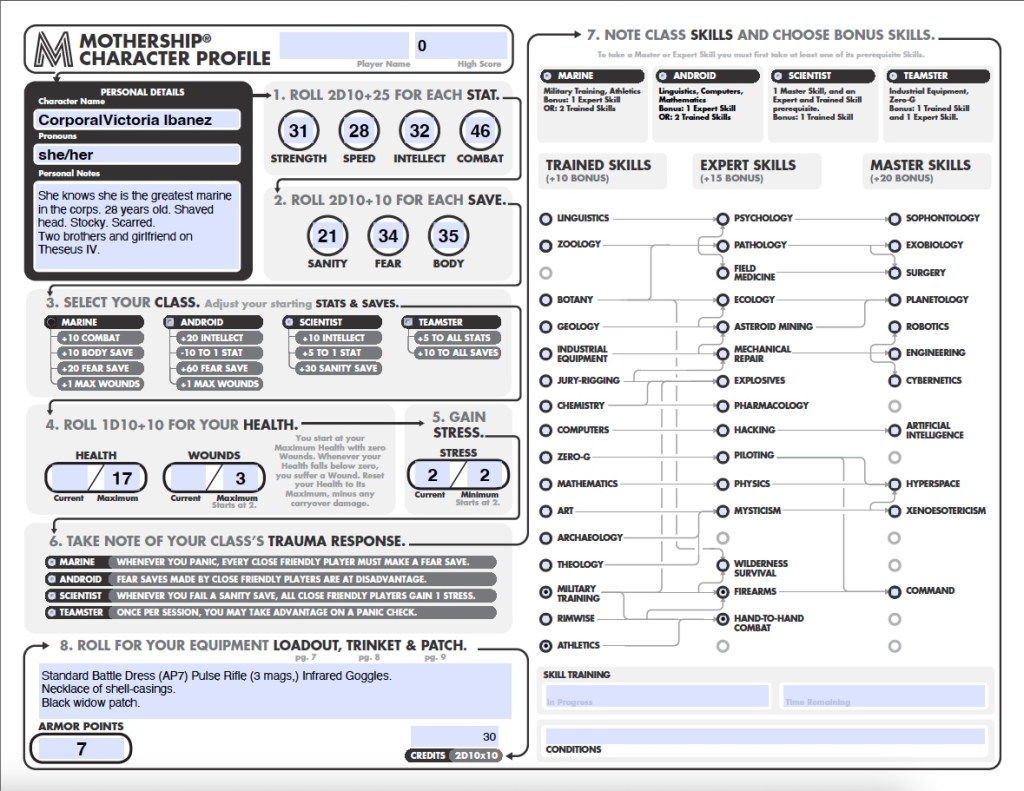
The final chacter profile for Corporal Victoria Ibanez, she/her, my Mothership PC. She has a relatively high Combat score, mostly quite low Saves and is specialised in Firearms and Hand-toHand Combat. She knows she is the greated marine in the corps.
The final chacter profile for Corporal Victoria Ibanez, she/her, my Mothership PC. She has a relatively high Combat score, mostly quite low Saves and is specialised in Firearms and Hand-to-Hand Combat. She knows she is the greatest marine in the corps.

So there we go, Victoria Ibanez, Corporal in the Marine Corps, all ‘round badass and potential cautionary tale. Can’t wait to start playing this PC at the table tomorrow night!

Festive one-shot

Celebrate

It’s almost that time of year again, everyone’s favourite holiday where we all dress up as our favourite characters and talk funny. That’s right! Talk Like a Pirate Day is fast approaching! It falls on September 19th, as I am sure you all know. As is traditional, we’ll all be renting a parrot, donning an eyepatch, practicing our “yaaaar” and contracting scurvy to commemorate the joy and wonder brought to the world by that most under-rated of historical figures, the lowly pirate.

As well as that, this year, I thought it would be fun to run a pirate themed one-shot. Since an RPG named Pirate Borg exists, it seemed like the notions of a landlubber to choose any other game to use for the occasion.

There has been an unsettling number of Borgs released over the past number of years, certainly more than enough to make Jean-Luc Picard lose his temper. It can be hard to see the hacks as anything other than cashing in, however, and I will confess to thinking that way myself. But I hear very good things about Cy-Borg and Pirate Borg has been a pleasant surprise as I read through it. It is genuinely more fun and more entertaining than I was expecting. The art, design and layout are good and the vibe is perfect if you are looking for a horror pirate game.

I have really only just gotten into the character creation section so I thought I would do another character creation post! Everybody loves those, right?

Random pirate

I’m gonna roll for everything as is traditional around here. Luckily, this game is well set up to allow for that.

Here’s the step by step guide provided on page 27 of the core book:

A photo of the table from the Pirate Borg core book that illustrates the 5 steps to Create a Player Character (PC.)

Random tables

So, when it says to roll on the tables on this page, this is what it means:

  • Container table (d6) I rolled a 6! That means I get a friggin’ dinghy! Good start.
  • Cheap gear table (d12) Got a 4. That’s a shovel. Should be useful for digging up buried treasure or my own grave.
  • Fancy gear table (d12) 9 on a d12 = a worn out book. I imagine it to be the well-thumbed guide to the manners of the gentry in Paris and London 50 years ago.

Random scores

A pirate has 5 abilities, Strength, Agility, Presence, Toughness, Spirit. You roll 3d6 for each one and consult another table to determine what your score is. Here we go!

  • Strength: I rolled an 8 so that gives me a -1 (it could be worse)
  • Agility: That’s a 7, which is also a -1 (a pattern is forming)
  • Presence: 12! Phew! That makes the score an incredible 0!
  • Toughness: 6. Shit. That’s -2. This pirate is not an olympic athlete
  • Spirit: 10. OK, OK. That’s also a score of 0.
    Things might start to look up as I move on to a

Random class

You can choose to be a landlubber if you don’t want to take one of the 6 standard or two optional classes. But half the fun of this exercise is rolling everything up, I’m going to roll a d8 and take whatever class it gives me. In this case, I am including the optional classes.

Here are a list of the classes:

  1. Brute
  2. Rapscallion
  3. Buccaneer
  4. Swashbuckler
  5. Zealot
  6. Sorcerer
  7. Haunted Soul – there is another d6 roll here to decide the type of supernatural entity you might be. Includes vampire, zombie, skeleton. All the classics
  8. Tall Tale – if you get this one, you roll another d6 to determine what sort of tall tale your character is
    1-2. Merfolk
    3-4. Aquatic Mutant – this gets broken down even further. Lots of potential mutants out there, folks. If I roll this up, I’ll have to roll another d8 to find out which type of mutant I’ll be. Suffice it to state, Anglerfish is an option
    5-6. Sentient Animal – this one will involve another d6 roll to decide what animal my pirate is going to be…

Well, I rolled a 3. That means my character is going to be a Buccaneer.

Skilled trackers and survivalists. Expert sharpshooters, especially with muskets and rifles

Buccaneers get a +2 to Presence, a -1 to Agility and a -1 to Spirit.
So that makes my Ability Scores:

  • Strength: -1
  • Agility: -2
  • Presence: +2
  • Toughness: -2
  • Spirit: -1
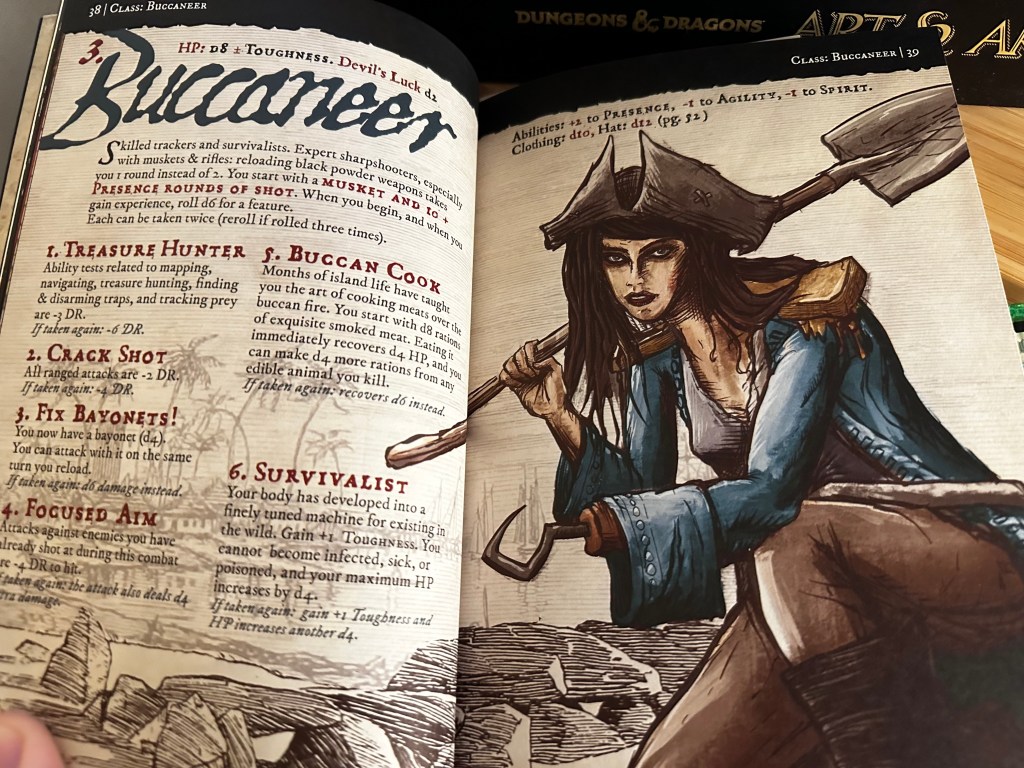
A photo of the two-page spread for the Buccaneer class in the Pirate Borg core book. The illustration on the second page shows a femme person wearing pirate gardb, including a tricorm hat. They have a hook instrad of a left hand and have a spade slung over the right shoulder.

For a Buccaneer, reloading a black powder weapon only takes one round instead of the usual two. I guess the hope is that you are far enough away from the bad guys that you have a round before they kill you or that they don’t have ranged weapons themselves.
I also start with a Musket and 10 + Presence rounds of shot. So that would be 12, then!

Random feature

I am going to now roll a d6 for my class feature. You do this when you first begin and then again each time you gain experience. Each feature can be taken twice, or so it says here in this book.

I rolled a 2! That is the feature, Crack Shot. That reduces the Difficulty Rating (DR) of all ranged attacks by 2. That’s pretty great actually. If taken again, the feature reduces that DR by another 2 points.

Random hit points

A Buccaneer gets to roll a d8 for hit points and add (or, in my case, subtract) my Toughness. Looks like d8 is the most common die for HP across the classes. I rolled a 7 so that leaves me with 5 HP. I am pleasantly surprised!

Random clothing and hat!

Now we’re on to the really important shit.
Buccaneers get to roll a d10 on the clothing table. The options range from Tier 0 rags to Tier 3 conquistador plate!

I rolled a frigging 10!! That’s the conquistador plate! -d6 damage. But it does add 4 to the DR for all agility tests and 2 to all defence test DRs. Also, the text goes out of its way to tell you you’re going to drown if you end up in the water…

Now for Hat! Have to roll a d12 for this.
You can get anything from “none” to “morion” on a d12.
I got a 6, bandanna, which I find acceptably piratical.

Random… Luck

A photo of the Devil's Luck page of the Pirate Borg core book. It shows an upsidedown five-pointed star with text describing the ways you can use a PC's Devil's Luck points in each of the five points and a pirate's skull in the middle. You can tell it belongs to a pirate because of the eyepatch over the left eye.
A photo of the Devil’s Luck page of the Pirate Borg core book. It shows an upsidedown five-pointed star with text describing the ways you can use a PC’s Devil’s Luck points in each of the five points and a pirate’s skull in the middle. You can tell it belongs to a pirate because of the eyepatch over the left eye.

Devil’s Luck is a resource that your character can use in Pirate Borg for the purposes of dealing max damage with an attack, lowering the damage done to you by d6, rerolling any die, neutralising a crit/fumble or lowering a test’s DR by 4. So it works like Omens in Mõrk Borg, basically.

Your class determines what you roll for your starting Devil’s Luck. The Buccaneer gets d2. For my purposes, I plucked the first die out of my dice bag and it turned out to be a glittery, turquoise d6. I rolled a 6! So that means I get 2 Devil’s Luck. Not too shabby, but not too great really, eh?

Random background

The next thing the step by step guide says to do is roll on the tables on pages 55 to 61. The first of those is a d100 table of backgrounds. These are more than just back story. They also determine your starting money and provide you with something significant like items, important NPCs and motivations.

I rolled a 97! That gives my pirate the “victim” background. That’s broad but might give me a spark for my actual backstory. It also gives me 2d6 x10 silver pieces and a haunted past (obvs.)

I rolled a 7 on my 2d6 so that’s 70 silver to begin. Along with the 200 I am likely to get for the conquistador armour, this buccaneer will be laughing all the way to the X.

Random flaw

Page 56 has the Distinctive Flaws table. It’s a d20 table of generally one-word personality traits. Some of these are only subjectively to be considered flaws in my opinion. I rolled a 9 and got “aggressive.” I would imagine that that is considered a good trait for a pirate in many situations. I’ll take it!

Equally, “2. Stubborn,” “6. Coward,” and “17. Paranoid” might all be considered beneficial to people in the pirating business at least some of the time.

Random trademark

I am rolling here for a Physical Trademark, rather than some sort of copyright or patent type deal. That would be a weird thing to include in the character creation section of a pirate game.

Another d20, here we go!
I rolled a 5… shit, I’m missing a hand; hook or claw instead. I’m thinking claw? Might be easier to handle my gun that way. Importantly, there is nothing in here about this causing any sort of mechanical drawback to your character, which I like.

Random idiosyncrasy

The full title of the table on page 58 is:

Idiosyncrasies one might have developed and will certainly never be rid of…Yet that certainly won’t stop you from trying.

It’s another d20 table. I have been using a different die for every single roll and I don’t see a reason to stop that now. It has been serving me semi-well thus far after all.
That’s a 12. Now this result might very well feed into the victim background I rolled up earlier:

You wronged and infamous pirate lord

I am beginning to think that the two are connected. My Buccaneer’s cat, Milly, tore out the throat of Captain Tall John Copper’s parrot, Butch. Milly jumped from the gunwale and swiped the emaciated bird off the shoulder of the famously bad-tempered pirate captain who had had men flayed alive and keel-hauled for less. As some sort of poetic justice, he made my pirate cook and eat poor Milly while the whole crew looked on, and then he chopped my hand off.

Random incidents

A photo of the Unfortunate Incidents & Conditions table from the Pirate Borg core book.  It includes a black and white illustration of an overloaded lifeboat on rough seas surrounded by debris and a d20 table beneath that.
A photo of the Unfortunate Incidents & Conditions table from the Pirate Borg core book. It includes a black and white illustration of an overloaded lifeboat on rough seas surrounded by debris and a d20 table beneath that.

This one has an incredibly long full title as well:

Unfortunate incidents & conditions having occurred or developed with or without one’s express consent, desire knowledge or general understanding

Guess what! It’s another d20 table. I rolled a 9 on this table. The result is unfortunate:

Your last crew was killed by undead. They left you alive on purpose

Shit. I hope my new crew doesn’t learn of this…
I am thinking that I made a deal with a necromancer to send his vitality-challenged minions to do in Captain Tall John Copper but they got a bit enthusiastic and did the whole ship instead, leaving me to take a dinghy (call back to the first roll of the character creation process!) to the nearest port and find some new gainful employment.

Random things

The last table in the list stretches right across from page 60 to page 61. It is entitled “Thing of Importance.” It is another d100 table.

I rolled a 79:

A long scar on your face

I think it is only fair that Milly gave me that just before I popped her in the stock pot.

Random name

There is only one thing left to do as part of this process, and that is the all important name. Now there is a table for names on the inside cover of the book so I think I will use that. It is a d12 table with three columns. I shall roll a d12 3 times and combine the names as I see fit:

Roll the first: 7 – Sam(uel) or Butch(er) or Philip
Roll the second: 3 – Robert(s) or Jack or Fernando
Roll the third: 11 – Genny or Isabel(la) or Jean

I imagine the name Butcher came from the Milly incident. It should go in the middle. So, it’s Isabella “Butcher” Fernando. That’s a bloody good pirate name if I do say so myself.

Random conclusion

Not really.
I thoroughly enjoyed the process of making his character. I am used, in more recent games of Mõrk Borg, to using their Skum Birther site to come up with a random character and that can be fun too, although I do think, when you are that far-removed from the process, you don’t have that strong an attachment to them. So, spending the time rolling up this pirate with you, dear reader, has been rewarding and has taught me quite a bit about the game as well. And that, after all, was the whole point of the exercise.

Have you played Pirate Borg, dear reader? Will you be celebrating Talk Like a Pirate Day this year? If so, what will you be doing for it?

On Kickstarter

Kicking things off

I mean that’s what it was all about, yeah? Just, like, getting things started? Kickstarter might have changed its policies enough that more and more creators are jumping ship to Backerkit but it doesn’t change the impact it has had on the RPG scene (as well as many other indie scenes.) Many, many projects would not have existed without Kickstarter connecting their instigators with people who wanted them to instigate. I think we can all be grateful for that.

Swedish Machines

This is not the first Free League product that I have backed on Kickstarter and it probably won’t be the last. Right now, I’m waiting for the Replicant Rebellion Blade Runner boxed set and, another Simon Stålenhag project, the Electric State Roleplaying Game, for which I am rather excited.

But Swedish Machines is not an RPG book at all. In fact, if it is anything like the Tales from the Loop art book I received as a Christmas gift a few years ago, it is going to be a loose narrative related to the artworks presented in it. Together, in Tales from the Loop, at least, the art and the text tell the story of this strange, alternate 1980s where technology developed in a very different way than in the real world. That fact leads to some fascinating and terrifying occurrences that appear in a kind if vignette consisting of art and short fictional pieces.

I have every reason to believe that’s exactly what it will be. And I can’t wait to see what his mind has come up with this time.

Here is a short extract from the Kickstarter page to give us an idea:

Stålenhag’s most personal work yet, Swedish Machines explores masculinity, friendship, and sexuality in a queer science fiction tale about two young men stuck in the past – and in each other’s orbit. Their story spans decades, as fleeting moments become defining memories, and they set out to explore a mysterious forbidden zone together.

Set in his native Sweden and based in an alternate version of Mälaröarna outside of Stockholm, the place where he grew up, and still lives to this day, Swedish Machines juxtaposes giant futuristic machines and vehicles against the inner turmoil of the characters facing a social dystopia.

It makes me think Tales from the Loop and his other books must be related to this one. The setting, Mälaröarna, is also the setting for the Tales from the Loop RPG if you set your game in Sweden, rather than Nevada (the other option from the core book.) And, as well as that, the existence of giant futuristic machines makes it sound like this is in the same universe. I think it’s also really exciting that the book is focusing on this queer couple and their story. I have not read all of his books, but, certainly, Tales from the Loop had a much more ensemble tinge to its cast of characters.

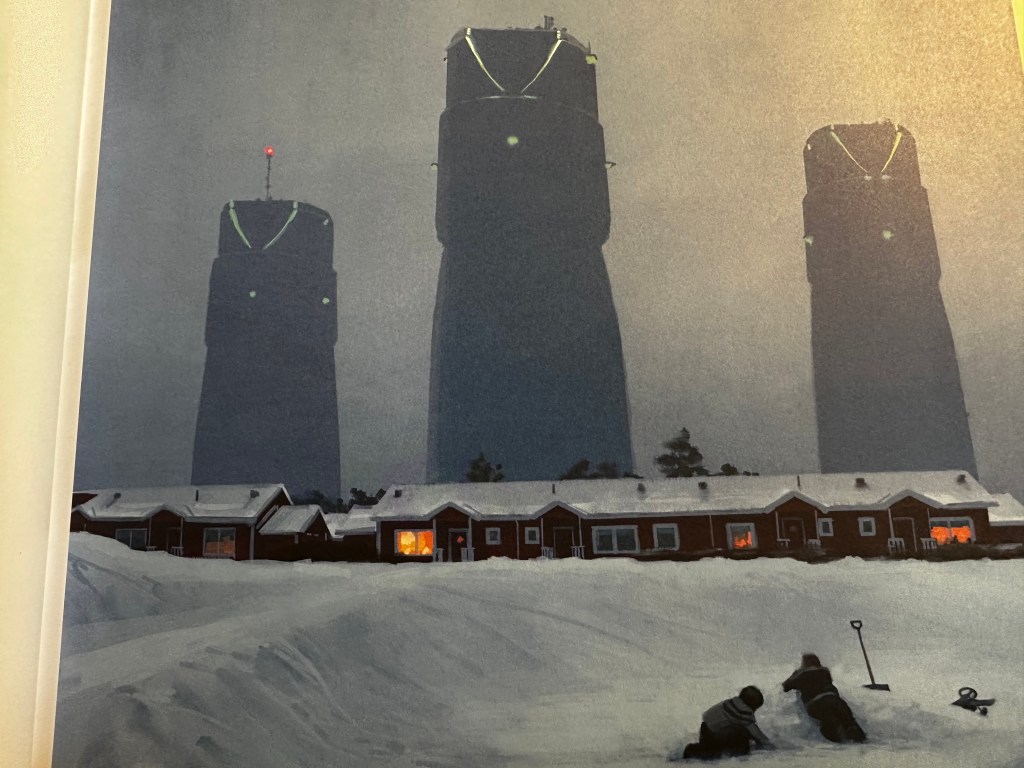
And let’s just focus on the art for a moment. I don’t have the vocabulary to fully do it justice but I love how Stålenhag goes for realistic depictions of the world at a very specific time and in a very specific place but inserts the impossible into them. These impossible things, like the huge cooling towers with blinking lights in Tales from the Loop, or the giant cat mascot collapsing an overpass in Electric State are ignored or, at the very most, treated as mundane, by the characters in it. And the characters? Almost all have their backs to you, encouraging you to see the world through their eyes or to take their place in it. It’s great.

I believe that, once again, I am just a day too late posting this as the Kickstarter campaign finished up on September 5th. Still, it’s worth keeping an eye out for and picking up a copy when it is released more generally.

Kal-Arath

Slaps the roof of Kal-Arath This baby’s got everything your average OSR gamer could ever want or need. You want to drive Kal-Arath solo? No problemo. You want a co-driver, just you and them out on the open hexes? Kal-Arath’s got you. You want to take a group of four or five passengers out on a road-trip to who-knows-where with no preparation and hankering for some adventure on the highway of fantasy? DONE!

I became aware of Kal-Arath as a project by following Castle Grief on Instagram. And it is one of the projects I am most excited to receive. It has a wonderfully indie, hand-made quality to it and it’s telling us it’s going to do a lot of the work for us at the table:

Oracles, Starting Adventure Seeds, Points of Interest, Encounters, Settlements, NPCs, Dungeons, Items – all of these have their own tables for generation, and combined together create a setting flavorful setting that emerges from the tables themselves

That was actually an extract from the Castle Grief itch page, which you should also go and check out, dear reader!

The rules are purportedly a combo of elements from a number of other games. It uses 2d6 and employs at least some aspects from two games I have played before, Mörk Borg and Black Sword Hack. I am a big fan of both of these OSR games and really enjoy a 2d6 system in general. I know the actual dice you chuck don’t really make that much difference at the table, but 2d6 just feels good. OK?

Also, it’s got a lot of gnarly hand-drawn art too. It fits the idea of this game so well. I love it.

Anyway, Kal-Arath is definitely still live so go back it!

And, if you’re interested in Simon Ståhlenhag’s art, you should still be able to pick up a copy of Tales from the Loop.

On Backerkit

Sutlers

Some friends bought me Troika as a birthday present several years ago. It took me a long time to get around to reading it and even longer to get around to playing it. Honestly, this was nothing but a scheduling problem. I was intrigued and delighted by it from the start. The absurdity of the character backgrounds, the looseness of the setting, the unhinged art style, even the strangeness of the initiative rules; it just tickled me the same way a Monty Python sketch does.
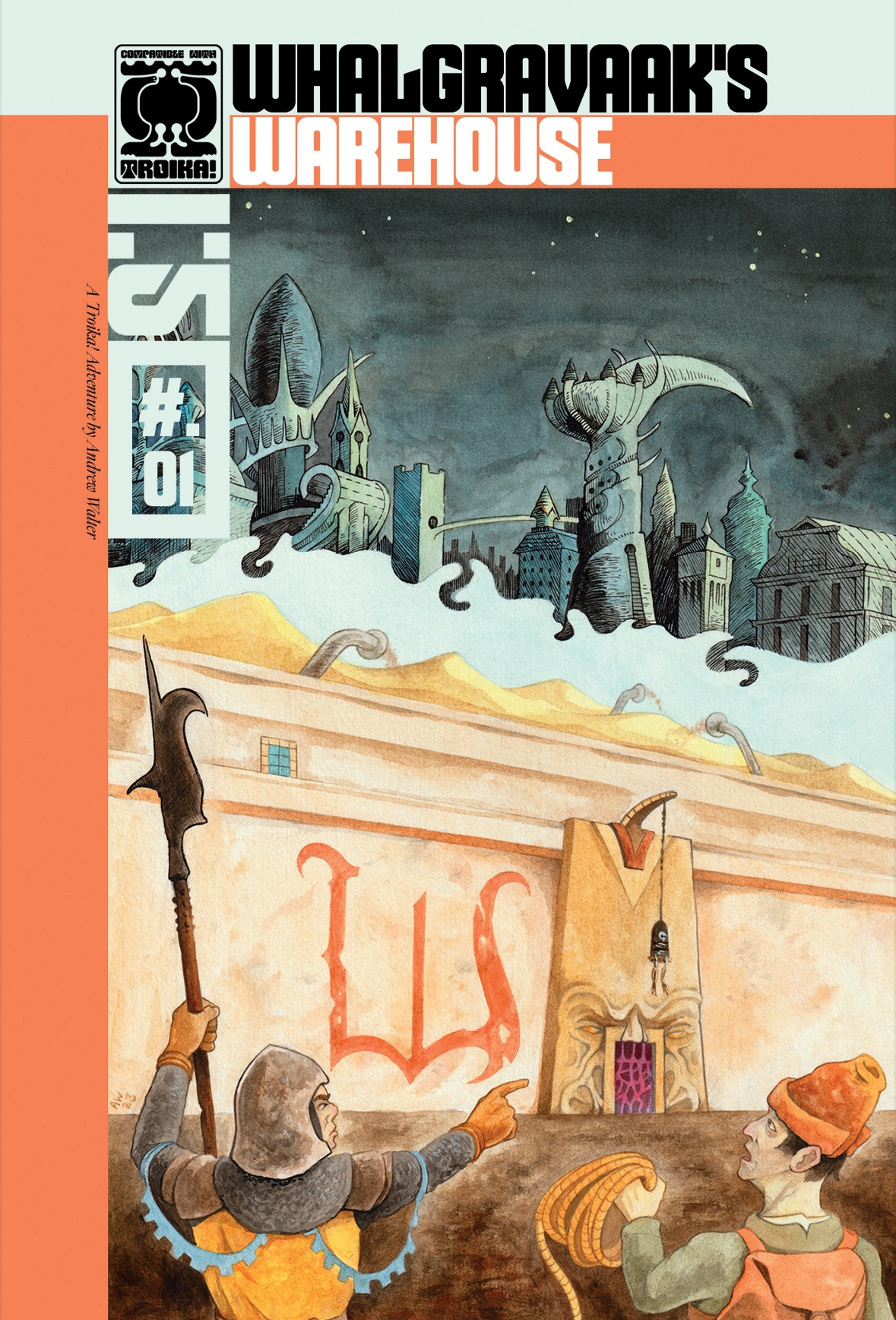
In the intervening time I have been building a decent little collection of Troika books. The Melsonian Arts Council summer sale really helped with that. I have a number of PDFs that I picked up in various bundles over the years too. But I really love the quality of the physical books. They’re mostly hardback, they have beautiful art that is about as far as you can get from the polished style you get in 5e books, for instance, and they are not too pricey, normally. I recently picked up Whalgravaak’s Warehouse in physical form and, even though it isn’t hardback, the quality of the printing, the texture of the paper and the form factor are all so pleasing that I couldn’t fault it (except for the double-page spread maps that are much easier to see and use in the PDF version. Lucky I have both I suppose…)

Get it at Sutlers: A Troika Adventure Generator is the third project from the Melsonian Arts Council I have backed this year. The first two were Swyvers and Fungi of the Far Realms. Neither of these are Troika related. In fact, Swyvers is its own brand new game that I will get into in another post, while Fungi is system-agnostic. Anyway, I was excited to see a Troika product come out on Backerkit and very happy to back it. It seemed like I was not alone either; it funded in about twenty minutes!

The blurb they added to the Backerkit page for this one says a lot in a short sentence:

An enormous retail adventure generator for inclusion in sandbox campaigns within the city of Troika. Get a job! Meet the locals! Don’t die!

So, you’re going to play characters who work retail? Doesn’t sound fantastical or exciting. If you have ever worked retail, though, you’ll know there is a certain draw to the idea of being a shop assistant with access to lethal spells and weaponry.

Also, here’s the other thing: I know from experience that Troika scenarios can make the most mundane of situations into an adventure. I won’t give anything away but “The Blancmange and Thistle” from the Troika core book is an excellent example of that.

I’m also really intrigued by the description of this book. They call it an “adventure generator.” I’m expecting to see a boat-load of tables for the most ridiculous things. I’m hoping that it will allow you to create and run a Troika adventure sans-prep, on the fly. I would love that. Part of the description on the Backerkit page has this to say:

The book starts with a structured adventure to get the party hired and serving their first day at work, and then it opens up into hundreds (!) of random encounters and micro adventures

So I’m rather hopeful. Can’t wait to get my mitts on this one.

SYMATYOV

Have you ever played one of those solo journaling RPGs? They are somewhat de reguer, don’t you know. It seems like every other ad I get on Instagram is for another solo journalling RPG. I never really imagined that this type of game might be so popular. After all, for many people, the singular attraction of RPGs is the social aspect, getting around a table (or at least a Zoom window) with your mates or even some strangers to act out situations that would, frankly, be absurdly dangerous or embarrassing in real life together. And for those moments when you want to immerse yourself in a different world all on your own, there are computer games. So, it was a long time before I tried one out. I believe the first one I played was actually The Treacherous Realm by friend of the blog, Isaac Wilcox. It uses the Wretched & Alone system to create an immersive and fascinating journey where you are being hunted through some labyrinthine fae realm. You will probably die but it will be fun getting to that point!

That opened the doors for me and so I tried out Thousand Year Old Vampire, by Tim Hutchings, which I had picked up in a Bundle of Holding and forgot about. I believe this caused a bit of a stir when it first came out. It was a hit amongst people who, otherwise, might not have played this sort of solo game and, I believe, was the game that opened the floodgates for all of those that have proliferated in the years since. That was only just in 2020 so, we’re not really talking that long. But man, have they proliferated.

Now, here’s the thing: Thousand Year Old Vampire is designed for essentially infinite re-playablity but I have only played it a couple of times. Once again, scheduling. It does take a while to play, although, I suppose you could set aside 15 minutes a day or something. I was left with a few main impressions:

  • the prompts you use to build your game and your vampire’s story are perfectly written to provide just enough detail to set your imagination aflame but not enough to seem as though it is rail-roading you in a particular direction
  • the mechanic where your vampire is forced to rid themself of memories due to their unwieldy long life is clever and leads to some fascinating outcomes
  • it’s a really great tool to get you writing if you are in a slump
  • I learned a lot about the Kingdom of Breifne that once existed where Counties Leitrim and Cavan in Ireland now lie along with some of their neighbouring counties. I did a lot of research about the area and the era and that was fun in and of itself
  • the design of the book is gorgeous and evocative. Go and check it out.

So You Met a Thousand Year Old Vampire is the sequel I don’t think anyone expected. But it certainly got plenty of attention. It’s at about five times its original goal at this point on Backerkit, so even if you don’t back it, it’s probably going to happen anyway. If you do want to get in on the ground floor, though, as they say, go back it anyway. Buy Tim Hutchings another fountain pen or cravat.

Here is an extract from the Backerkit page:

Congratulations, you’ve made a friend! A mysterious friend with a complicated past. That friend is a vampire and might be a thousand years old, but you probably don’t know that yet.

Interestingly, although the character you play in this game seems to be a pretty regular person, it seems as though a lot of the play will revolve around the creation of your vampire companion. Not so surprising, I suppose. If I had a vampire friend, they would probably be the most interesting thing about me too. So, I’ll be intrigued to see how this works and how it differs from its predecessor.

OGA

Ultra-Violet Grasslands is an absolute beaut of a book. It got two editions and it is full of incredible artwork and fantastical ideas all brought to you from the mind and pen of Luka Rejec. It’s also filled with tables and tables and tables that allow you to build a game at the table, as it were, using intriguing, fun and challenging results:

Encounters on the Steppe of the Line Nomads”

Vornish Birds (L0, stalking) with glass recording eyes and metal innards, otherwise indistinguishable from the regular kind.
Mind-burned megapede (L8 , alien) shaking the ground on its odd journey, corundum encrustations glittering on its massive segmented neural nodes

And there is so much more in it. I just picked those entries out at random. They’re just so unctuous!

Our Golden Age (OGA) : An Ultraviolet Grasslands RPG []equel is big. And the first book was already pretty big. This time they decided to bring us two books for good measure.
Here’s what they have to say about it on the Backerkit page:

Experience fantascience roleplaying at the end of time. Escape the end of history. The eternal civilization is perfect. So say the gods, the machines. Will you defy the endless circle of awakening and forgetting? Can you kick a hole through the sky?

I don’t really know what a “[]equel” is but it’s ok. Just take my money! They have already taken a lot of people’s money. As it stands they have raised $489,412 on Backerkit out of a $50,000 goal.

Anyone else backing these products? Are you maybe excited about any others right now?

Kickstarters/Backerkits I’m Excited About Part 1

Making things people want

In Business Studies class we learned that market research was crucial to the successful launch of a new product or service. Back in those days that meant doing a lot of time-consuming leg-work. Methods of market research included surveys posted to homes and businesses, cold-calling people to find out what type of toilet paper they used or which newspaper they read, talking to supermarket customers, that sort of thing. The results of your market research could very well determine whether or not your idea got to market. If it was received poorly by a majority or respondents, forget it!

Of course, the internet has made all of this work a lot easier and quicker. Not only that, with the arrival of platforms like Kickstarter and Backerkit, it feels like the process is reversed to some extent. What I mean by that is that now, you can launch your idea on Backerkit and see how popular it is. If it makes enough money for you to be able to make the thing, you know that, at the very least, just enough people want it. If it fails to fund, back to square one. There is the other possibility that you end up with a run-away hit on your hands, of course, and that seems to lead to its own problems sometimes. I think we have all been stung by a campaign that promises so much but drags on for years with little or nothing to show for it.

Do take my words with advisement, dear reader, I have never launched one of these projects so I am merely an interested observer.

The topic of this post, though is the projects I am excited to have backed and the ones I am most looking forward to seeing come to fruition.

Golden age

There is no doubt in my mind that we are living through a golden age of indie RPGs. In large part, this has been made possible by the existence of Kickstarter and similar sites, where indie gamers can go and geek out about the incredibly niche story-game or gnarly OSR module that they never knew they always wanted, even if there are only 237 of them. Those 237 people will get something that would not have been produced without their excitement, their enthusiasm and their money.

Of course, it’s not just your independent gamers using the service. You see Free League and Goodman Games using them to launch products even when it is probably fair to say they would have been perfectly successful without them. But what a way it is to build hype for the launch! When you sign up for one of these things you are getting communications from them almost every day as they hit stretch-goal after stretch-goal. They get to big-up their new thing to a captive audience of people who they know want it. What a perfect way to be able to flog you some more addons! Dice, tote bags, t-shirts, entire other games and supplements…
I don’t necessarily feel great about this. Mainly because I am so susceptible to it. But I do feel very good about being able to support truly independent creators for whom this is the only way they would be able to produce the games they do.

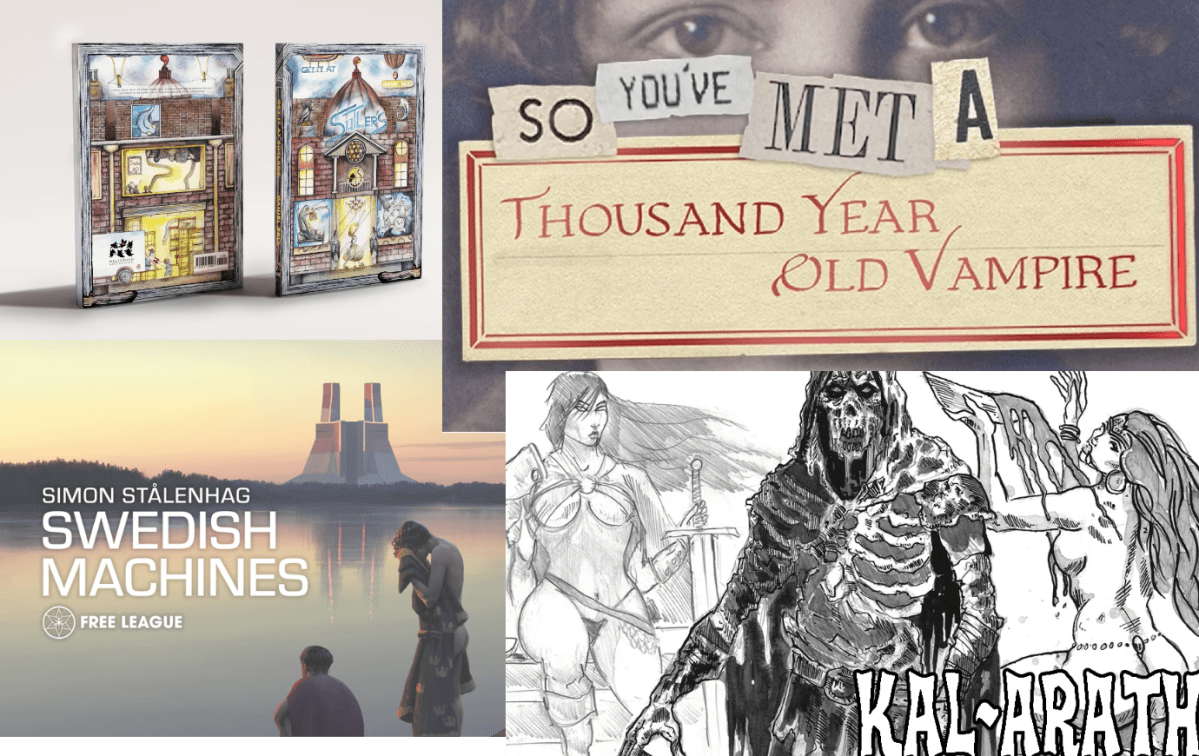
Anyway, here’s a list of the stuff I have currently backed that is still live. These are things I can’t wait to get my hands on and that I would recommend others support:

On Backerkit

  • Get it at Sutlers: A Troika Adventure Generator. The first adventure/sourcebook/something to provide any real detail on the fabled city of Troika itself, in particular, a department store that your adventurers can get jobs at in between jaunts into the hump-backed sky.
  • So You’ve Met a Thousand Year Old Vampire. The sequel to the incredibly popular “Thousand Year Old Vampire” solo RPG. I’m not usually big into solo games but the original really grabbed me.
  • Our Golden Age (OGA) : An Ultraviolet Grasslands RPG []equel (This one might be over by the time I post this. Sorry!) This “[]equel” has done incredibly well in its campaign. As the follow up to a book that I heard about on a podcast and immediately bought but have not read yet, this was a pretty speculative back for me but just look at it!

On Kickstarter

  • Simon Ståhlenhag’s Swedish Machines. I have been fascinated with Stålenhag’s art for years. It tickles a little part of my brain labeled “This Could be Real.” I love the Tales From the Loop RPG and I have the art book for that too. I held off backing this one for a while but eventually decided I had to have it.
  • Kal-Arath: Sword and Sorcery by Castle Grief. Kal-Arath is a truly independent game and setting being made by a mutual I discovered on Instagram. It looks fun and old school as all get out.

Back up

Like I said, all of these are still live (or if not, they just finished before I posted this.) Over the next few days, I’m going to go into detail on some or all of them and give you a reason, dear reader, to go and back them like I did. For now, why not go and have a look at their campaign pages to see if they can tempt you!

What are you backing right now, oh reader? Or what is a project you are so glad or so sad you backed?

Drop it in the comments!

Motivation part 2

Motivating characters

So, in the last post, I went on at some length about how you might be able to motivate players in your game, focusing mainly on what you do between sessions to get them excited to come back and do it all again. There were also times, I decided, when you shouldn’t overdo it, when you should just let people be.

When you do get them to the table, though, your work ain’t over. Obviously, I’m talking to the GMs out there, but this goes for players too. Because now it’s time to figure out why your character is out there smashing skulls or investigating murders or trying not to be sacrificed by some bloodthirsty, cthonic cult or whatever their weird job is.

Seems like an easy answer, doesn’t it? But it’s not. Your character’s motivation is a strange, ephemeral thing that you need to keep in your mind at almost all times to figure out what they are going to do in any given situation. You can keep your alignment, in my humble opinion. Alignment is such an archaic and ill-defined concept, it barely even begins to answer any of the questions raised by the “character” aspect of the sheet. It can be manipulated to mean almost anything. So it doesn’t really help to direct you when you are trying to decide whether you should back the werewolves or the elves (Dragon Age: Origins fans, yo!)

New characters

Games have all sorts of ways to help you figure out what your character’s motivation is going to be. At the creation stage you are picking things like backgrounds, bonds, ideals and flaws if you’re playing 5e, your drive, problem and pride if you’re playing Tales from the Loop, your Calling if you’re playing Heart. The game is usually trying to help you out. Sometimes it doesn’t have to do any more than describe your race and class, in fact. That’s often enough to set a player’s imagination alight. Before you know it, your dwarven barbarian has figured out that her driving force is a desire to put as much space between herself and the darkspawn riddled Deep Roads (I’ve been replaying Dragon Age: Origins recently, ok?) as she can, and to have fun doing it. Of course this motivation is likely to change many times during play, but if Bianca remembers that she never wants to set foot in the Deep Roads again from that moment on, all of her decisions are likely to be coloured by it, especially when she finally faces her fears and delves back down to Orzammar and the lost Thaigs to help out her party-mates in their quest to track down the origin of the darkspawn outbreak in the Korcari Wilds.

Here’s a question though. How much influence should the GM have on a player-character’s motivation. Well, like most things PC-related, I would say that there is a conversation to be had. This is often something I forget to do with my players at character creation to be honest. Especially in games where motivations are less well defined or less tied to the plot. In fact, I have received feedback in the past that I should be more willing to guide players in their choices of class in case they choose something inappropriate for the campaign, never mind motivations! But basically, what I’m trying to say is that you should always talk about it, especially if a player is interested in talking about it.

I messed this up recently and definitely reduced at least one player’s enjoyment of the first session of a new game as a result. Motivation is important! It colours everything so you should always be available to talk about what a character is doing this stuff for? Why would they want to? It’s not that they player is being awkward or a prima donna or making the game about them, they just want to feel a connection to the game through their character and they need a reason for that. Help them out, eh?

In gameplay

As I mentioned before, character motivations can change during the course of play. In fact, I would go so far as to say that if they don’t the game there is probably not much going on in it. Most sessions it is a good idea to make their most immediate motivation become “I don’t want to die!” At least once.

But this goes for long-term motivations as well. I think it is absolutely possible to retain your character’s initial motivation of “never wanting to go bak to the Deep Roads again,” while subverting that, undermining it, overcoming it. Maybe, once Bianca follows her companions back into the Deep Roads, she realises that, without here, they would have died down there, that actually, her Deep Roads survival skills are valuable and that she should help others by teaching them. I think GMs should be prepared for these shifts but players, equally, should be ready to make changes like this to their characters. Turn it on its head, fail forward if that’s what happens in the game. Push your character to do what is explicitly against their motivations sometimes and see what happens to them and the game as a result. Do the unexpected!

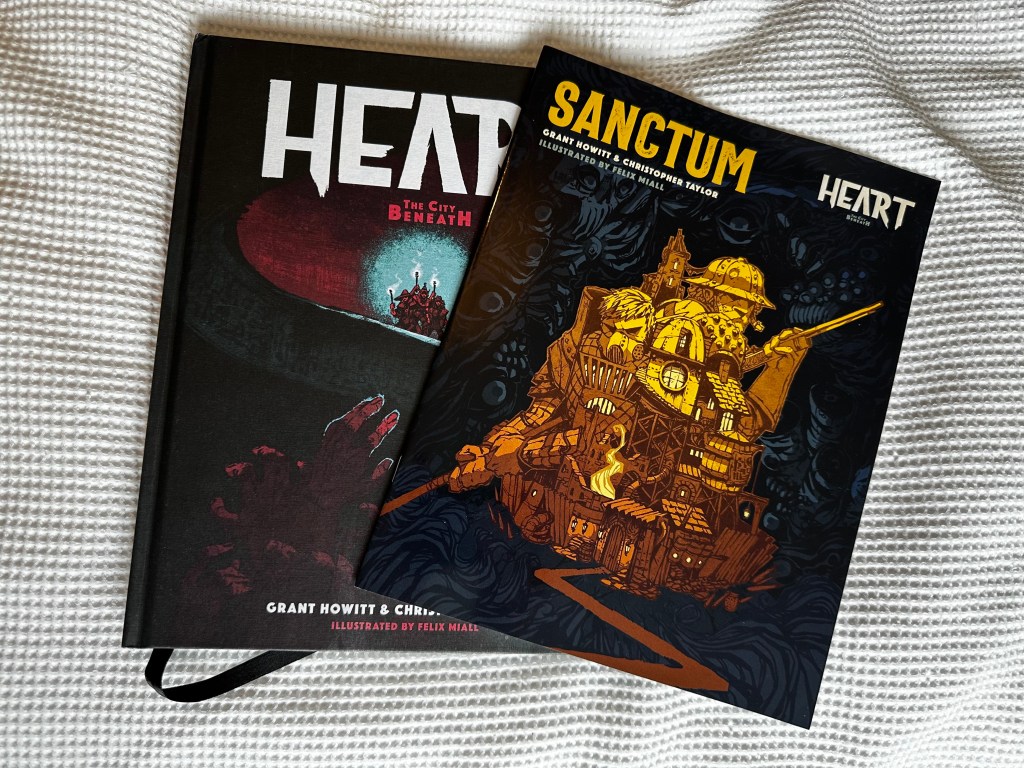
Heart

It always comes back to Heart these days it seems. Well, that’s because it has these great little systems built into it. The granddaddy of these systems is the Character Callings. You have a handful of them. Not too many to choose from: Adventure, Forced, Heartsong, Enlightenment and Penitent. They speak for themselves really, except maybe for Heartsong, which is the weird one that wants your weird character to follow the weird as deep as it will go into the weird subterranean other-world until you find some insight into the weirdness that’ll probably kill you or transform you beyond all recognition.

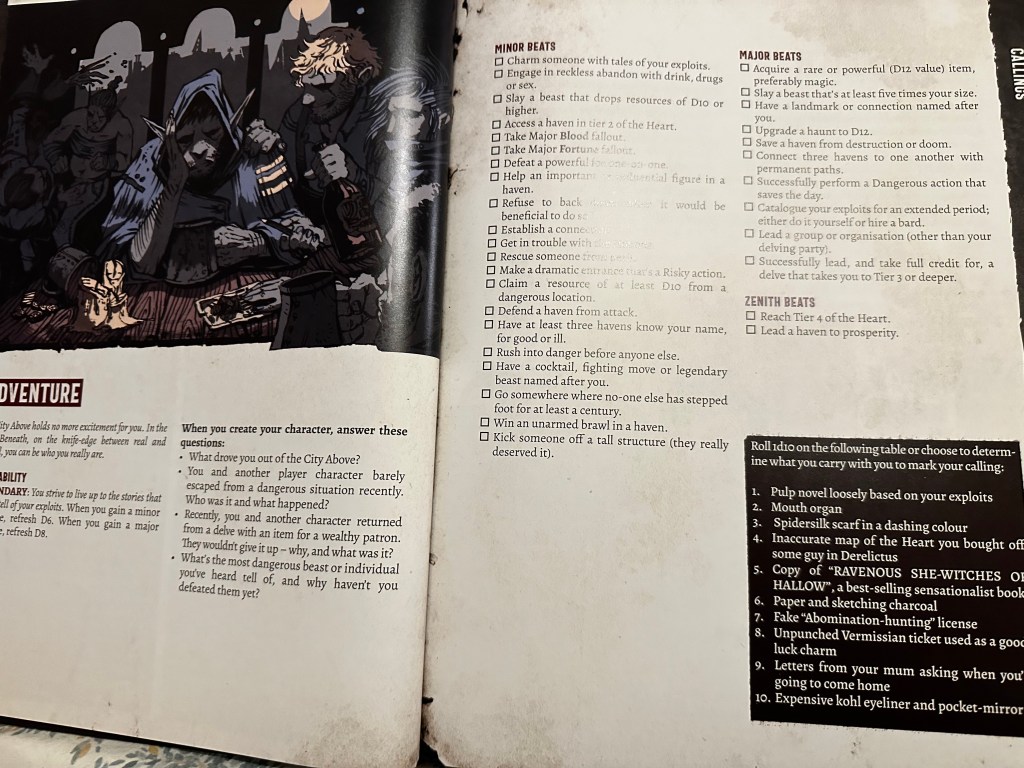
Essentially these are all the motivations your character might need in Heart. Their descriptions spell out the kind of thing in keeping with the theme of the Calling, that might have led you to delve into the red, wet Heaven. It also gives you a fun ability to reward you for choosing it, a few questions to answer to help you flesh out your character and focus you on the type of adventure/enlightenment/penitence etc you are espousing, and most usefully, both for the player and the GM, an absolute raft-load of beats, narrative or mechanical milestones you want your character to hit as your delves go on. The beat system is so useful for building a session and a story at the table together. It is particularly fun when one PC’s beat synergises with another PC’s completely separate beat or when the object of the beat comes up organically in play, without the GM being aware that it’s happening. It is motivation given mechanical and narrative form and I love it.

Seriously, go check out Heart if you haven’t already. It’s a good game. And it’s fun and gross.

That’s me for now. My motivation to write has ebbed and waned. It’s you time now. How do you like to motivate your players and characters?

Back to Troika with Tables and Tales

Whalgravaak’s Warehouse

We’re going back to Troika for another one-shot tonight! I’m very excited for a couple of reasons.
The first is that I finished reading through the Whalgravaak’s Warehouse book last night and it seems like a lot of (potentially very lethal) fun. I don’t think it was necessary to read the whole thing before beginning play, actually, but I was enjoying it so I kept going. That can rarely be said of RPG products so that’s a big tick in the plus column already.
How does it play? Only time, and my players, will tell, dear reader. But I will say, I love the setup of it. I think it has done enough, to lay the groundwork for a session full of strange and dangerous settings, fun and dangerous encounters and weird and dangerous NPCs.

They call it a Location-based adventure and, in the intro they admonish the DM to pay attention to
“the classic tenets of danger, resource management, exploration and player agency.”
This says a lot in just a few words I think. But it neglects to mention that it also involves elements of the classic dungeon crawl and a hex crawl in too!

New Tables and Tales members

The second reason for excitement is the introduction of a couple of new members to our little, local RPG community, Tables and Tales. We have been in existence only since February and after a small initial influx, recruitment died down somewhat. Our aim is to be able to have a few different games going on, in person, that interested players can get involved in and to continue to grow in our relatively small local community.
Although our growth has been modest, it has meant a lot to me, personally, to get to play with lots of people I would otherwise never even have games with. As a blow-in to the place I live, it’s also a great way to get to know people with similar interests and meet up face to face.
So, I love when I am able to share a table with some new tablers. Maybe talers is a better moniker? Hmmm. We’ll have to workshop that one.
I met these new recruits at the recent celebrated birthday party of one of our founding members. One was a friend of hers who has never tried TTRPGs before and one was the bar-tender, who just overheard me nerdily chatting about D&D while standing at the bar.

I think that shows that the RPG nerds are everywhere. If you want to find your people, just announce yourself loudly at the bar.

So it’s an exciting evening ahead. I hope I don’t end up frightening off the newbs…

Endings

It’s hard to say goodbye

It’s so exciting to start something new. There’s the anticipation for what’s to come, the tingling nervousness that transforms to delight in the beginning, the wonder at sights never before seen and actions never before taken. Beginnings are full of possibility and the feeling of freedom.

The end of something, though, can be just as exciting, but in a different way. Do you ever rush to the end of a novel when you’re about three quarters of the way through, eager to find out what happens? Maybe you’ve waited on tenterhooks for the final film in a long running series to be released, because you have spent so long with those characters and know their stories so well and you want the best ending possible for them.

That’s a lot to live up to, that pressure. And I think, in an RPG context, everyone at the table feels it to one extent or another. At least in the situation when you know the end of the game is coming. TPKs notwithstanding, achieving a narratively satisfying ending to a game, particularly a campaign that you have potentially been playing together for months or years, is hard. Of course it is. There is a pressure to tie up all those loose threads, make sure that big bad is confronted, achieve emotional closure for your characters and their arcs, maybe even leave a space for a sequel.

Not only that, but the real struggle is making it all the way to the end of a campaign! Sometimes your friends move away or have kids or there’s a global pandemic or whatever. Stuff happens. Understandable stuff, but stuff nonetheless. The thing is, of course, that just means the endings you do get are that much more precious.

How to part on good terms

One-shots

You’re there for a good time, not a long time. But that presents its own challenges to fitting in a great ending. If you have a suitably magnificent finale planned, how do you make sure you get your PCs to it in time?

Time

My answer here is easy; take a reading every thirty minutes or so to see if they are cracking through the adventure rightly or if they haven’t made it out of the frikking tavern yet. If they need it, push them along, end that scene and do a hard cut to the next one, bring in a major NPC from another scene to move things along. And if all else fails? Cheat! One-shots benefit from a breakneck pace in my opinion, and no-one will blame you if you bend a few rules to keep the action moving along. They probably won’t even realise.

Possibilities

Another good idea for a one-shot is to come up with a few possible big endings. This is obvious, of course, but it helps to think about where you might want the PCs to end up and if you have a couple of big set-pieces to choose from, that really helps with engineering the big ending.

Epilogues (1)

And if all else fails and you run out of time while they are nowhere near a satisfactory endpoint, epilogues can be a fun way to go. Just get each player to narrate the life of their character five minutes after the last scene of play, or five weeks or five years! Just as long as the events of the game have a major effect on their epilogues.

Campaigns

It’s really hard to give any advice on this. Let’s be honest, every campaign is going to be so different, even if they are published campaigns played by thousands of groups, no two of those ends will end up being the same. But, we’re here to discuss it so let’s do it.

Arcs

Character arcs are important in campaigns, long and short. Players want to see growth in their characters and not just the kind where they level up. They want to find the thing they had been searching for and figuring out that what they really found was the friends they made along the way. Sometimes they want to gain power and prestige and property to make them feel successful. Other characters change drastically due to the events of the campaign and come out quite different to the farm girl they were at the start. My advice on these is to make sure they are wrapped up in advance of the big finale if you are planning something like that. Give each character their moment in the spotlight in the sessions leading up to the end so they know they are all just as important in the building of the story together and that everyone can see them in all their glory/misery. Players remember that kind of thing forever. Its good to involve character stories in the finale too, if you can, but if you leave their big moment to then, they will rarely get the time to revel in it too much. I could be wrong about this but such has been my approach in recent times and it has tended to work out fairly well.

Threads

Loose threads can be left loose, in my opinion. There is an impulse in some games to ensure that the players get to experience everything. But, by the very nature of RPGs, it’s simply not always possible.

So, the party ran into an itinerant wizard in the third session. She asked them to explore her phantasm-infested old tower and return with certain writings that might have relevance to the overall campaign plot. But they never had time to do it or they got sidetracked. That’s just an answer they are never going to get! At least not in game. The GM could always explain where that was going after the end of the game I guess.

Of course, for narratively integral beats, I endeavour to bring them all home at the end. If they lost track of a vampire servant of the Big Bad that they were hunting through the Deep Dark Forest, bring him back in the last fight as backup for the big bad, maybe. If one of the PCs’ parents went missing earlier and they didn’t find them, have them in the cultist temple as a sacrifice to the evil demon they are summoning in the final scene. Complicate the scene! Make it so they have to rescue them!

Fights

As for the final battle, if you are even running the kind of game where you would have such a thing, elaborate set pieces, evocative or emotionally resonant locations and big fucking monsters usually do the trick. I would say, though, difficulty-wise, more enemies is usually harder than bigger enemies. One or two big monsters with lots of hit points and abilities will go down much quicker than one big guy and ten small guys. I guess I am mainly talking about D&D finale battles and other set pieces here. This is because action economy is king in D&D. So this piece of advice should be taken with advisement.

One thing that I always try to encourage is for the players to talk and cry out and banter during these bigger fights. Makes the whole thing way more exciting and personal and funny.

Epilogues (2)

I think epilogues for the PCs really work well at the end of a long campaign as well. For these ones, I generally want to know what the characters are doing a year or two down the line. How have their day-to-day lives been affected by the events of the campaign? Where are they? Who are they with?

End games

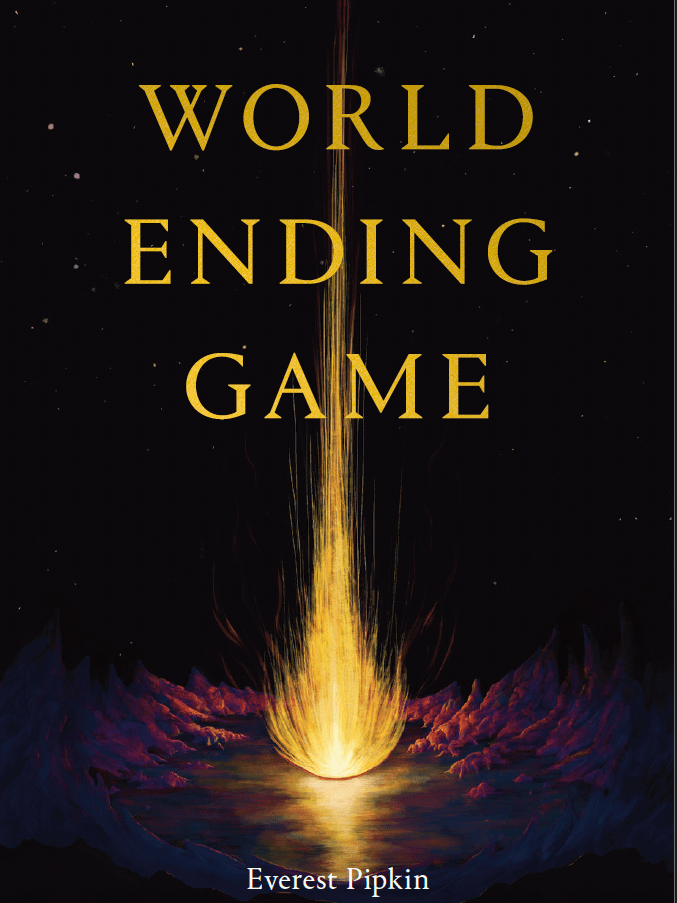
At the end of the Blades in the Dark campaign I played in recently, our GM ran us through a different game to give us a chance to ask some questions of our characters to see how things ended up for them. The World Ending Game is by Everest Pipkin. It is a cinematic game that imagines the last scene or episode of a movie or TV show. It frames a bunch of different types of ending scenes called things like “the Confession,” “the Reveal,” “the Revision,” “Tableaux.” It was a fun and alternative way to treat the ending of a game that felt really personal to players and characters both and I would encourage others to use it to wrap things up for their own games.

Conclusion

I still find endings hard but I like them more and more. I have become much fonder of shorter more contained games of specific numbers of sessions. So it is a little easier to plan for. Also, sometimes, a character’s end is the best part, just look at Heart and its Zenith abilities, they will end the character, but they will also achieve the seemingly impossible. I love this idea for a couple of reasons, it brings the character and probably the campaign to a hard stop in the most amazing fashion and it is player driven. They have gotten themselves to the point where they want to use that ability, it is their choice to use it and it makes for the best ending for their character from their point of view.

How do you like to end dear readers? Do you like to go out in a blaze of glory or do you prefer to sail off into the West and remain Galadriel?

Beginnings

Where shall we start?

This is always the first question I ask myself when starting a new game. It doesn’t really matter if it’s a one-shot, a short series of sessions or an open-ended campaign; the beginning sets the tone for the whole thing. If you start your PCs off trapped in a haunted house with no prospect of escape and a murderous ghost hunting them, you have made a pretty firm statement about the kind of game you are all there to play (or your players will see it that way at least.) Equally, if you start with a scene from each character’s home life, interacting with their family members and discussing their everyday problems, you are establishing a sense that this is the type of game where that kind of thing will happen again (or you should be.)

You can use the start of your game to establish a theme too. Maybe its a horror game involving frog mutants who want to feed your players souls to their unholy tadpoles, you could start in their camp at night, describing a croaking, ribbiting chorus that grows in intensity and volume through the night, ensuring that none of the party get any rest. Embed in the cacophony the true name of a PC and you have the potential for fear and suspicion if not outright horror.

Control

Three sessions in, there’s one PC who has decided to attempt a bloodless coup on the streets of the town at the centre of your adventure, another who has set their heart on wooing one of your NPCs of lesser importance and a third who just wants to sit in the tavern and spread rumours about the sheriff being a cannibal. It can feel like you are out of the picture sometimes (and that’s not necessarily a bad thing, dear reader. The best sessions happen at the whims of the players.) At the start, though, you, as the GM, have control. It relates a little bit to the world building work you’ve been doing, or not doing. After all, you made up the place they start in, or at least, you read about it in a published sourcebook or module and interpreted it as you saw fit. You know the places involved, you know the relevant NPCs, you know the setup, even if you have no preconceived notions about how it’s all going to go down in the sessions to come. With that knowledge, you start with an advantage, for the time being, at least. Before long, you have to hand things over to your clever and inventive players and they’ll have burnt down half the Silver Quarter while introducing the roller skate to Spire.

But, more important than your behind the scenes knowledge, is the situation they start in. I’ve mentioned in medias res beginnings in the past. Frame the scene they find themselves in and make it tense or truly fantastical or horrific or action-packed or just evocative. Start in the middle! It is the one opportunity you have to do this. You set it all up and see how they react to it.

In the Death in Space one-shot I ran a few months ago, I started them off being ejected from cryo-sleep as they approached the main adventure location, a mysterious space-station. They each got to have a moment to describe their characters and I explained they were seeing the debris field surrounding the remains of a planet that was destroyed in the recently ended wars and that they had to guide the ship through it! But then I used a series of flash-back scenes to explain what they were even doing there. I don’t think that’s even the first time I have used the in-medias-res/flashback combo to get into the action as quickly as possible while also providing some much-needed context. It worked pretty well as I recall…

It’s a fun way to get them all rolling dice quickly and failing quickly too, which is usually pretty important in a one-shot horror game.

Intros

Tales from the Loop wants you to put the kids, the players’ characters, at the fore from the get-go. And deservedly so. These kids are created to have people who are important to them, problems that consume them in their regular lives, drives that motivate them and things they’re proud of. They’re rich and three dimensional characters before they ever get to the table. So, the game insists that you start a mystery (what TftL calls adventures) with a scene belonging to each and every kid in their home life or at school, with NPCs that are important to them, family, friends, mentors, that sort of thing. This is where the players get really invested in their characters. They have genuine and heartfelt interactions with the people of significance to them and they begin, immediately, to find their voice and their personality. It’s probably the best thing about a game that has a lot of good things going for it.

I stole the technique for the second campaign I ran in my Scatterhome world. It took place on the northern island of Erlendheim. The PCs all knew each other at the start since they began at 8th level and, in the fiction, had an adventuring party for many years, long ago. The adventuring life long behind them, I asked them to describe their mundane lives as a farmer, an advisor to the Jarl, a guard sergeant and a village priest and made sure to include people and places that were important to them. I focused on who and what they loved because I knew I was about to fuck with all that.
I had learned a lesson, you see, dear reader. Oh yes. For those of you keeping studious notes, you will recall I described the start to the first campaign in Scatterhome, when I drowned the island nation and erstwhile homeland of the PCs, Galliver, off-screen, before the start of the game. They didn’t care about it, and I can’t blame them. I had never given them a reason to.
In Erlendheim, they were more focused on saving the druid’s kids, ensuring the safety of their families and homes, protecting their futures.
Tug on those heart-strings, GMs.

Scenic

There is a subtle art to the transition from the start of an adventure to the meat of it. Or there is if you don’t subscribe to the philosophy that adventures should happen in scenes.

Usually, the end of a scene is obvious in a movie or tv show. It normally shifts perspective or location or time. So, if you want to do something similar in a game, someone needs to just say it’s over and move to a new scene. Sometimes that’s the palyer who wanted the scene but usually its the GM. I would rarely have done something so bold as to declare the end of a scene in a game of D&D as a more trad DM but it’s so freeing to do it! Just like you framed that first scene at the beginning of your game, you soon realise that you can frame and end any scene at any time (within reason.)

Looking back at the Tales from the Loop example from earlier, I noted that each kid gets a scene about their home life. Together with the player, you describe the kind of scene it is going to be, improvise it and end it when it feels right. When you move on to the investigation part, you can cut to a scene with all the kids in it, where they are staking out the suspicious machine that appeared in the nearby field overnight to see who is responsible for it and end that scene when they have gotten everything from it they can. Easy.

Using scene structure is even built into some games. Spire and Heart use scenes, situations and sessions like other games use rounds, days and long-rests. They are left deliberately vague but some powers and abilities work only within the current scene or situation. I have embraced the vagueness and it didn’t even take any adjustment. It was instinctive.

In the next post I am going to write a bit about endings, which, in my experience, are so much more difficult.

How do you like to start your games, dear reader? Let me know in the comments.

World Building Part 2

A new approach

First of all, I struggle to get out of my old way of building a campaign world and, even a campaign. I recognised in my last post that there are definite draw-backs to it, but still, I find it hard not to do a whole bunch of preparation. I do still think that a certain amount of prep is advisable but I have been actively trying to limit the amount I do. This doesn’t work as well in some games as others. In D&D, if you don’t do a lot of prep, you might be alright but it is a real pain if you don’t have the right stats to hand when your PCs decide they are going to enter the local gladiatorial games or they want to go ankheg hunting. It slows things down a lot and hurts the overall flow of the session. But it does feel like you are pushing the plot and your PCs in a very particular direction when you do it! Is this an inherent issue with D&D? Probably not just D&D if we’re honest.

In other games, I find it can be freeing and fascinating to see how a session goes when you genuinely have no preconceptions about what is going to happen in it.

Heart

In the game of Heart I am currently running, I used a loosely written adventure that came in the Heart Quickstart Rules. We have just come to the culmination of that adventure and suddenly, the PCs are more-or-less free agents! They have done what a few NPCs have asked of them and more. They followed the breadcrumbs and now, now they are ready to take the training wheels off and head into the Heart to pursue their own dreams and nightmares. They have a couple of other leads but I am looking forwards to leaving the progress up to them from now on. I intend to largely take my hands off the wheel and, instead, rely on their own motivations to provide direction, their own relationships with NPCs to perhaps push them one way or another, even their own ideas for how the new and terrifying delves they go on might look and feel. I want to create our Heart together now that the leash is off.

Im-prompt-u

There are lots of tools out there that you can use to bring a world to life together with your players at the table. I mentioned on this blog before that we had a game of The Quiet Year by Avery Adler a while ago. In it, you get together and make a couple of establishing decisions regarding what sort of community you want to build together and what sort of genre or setting it might be in. After that, you proceed through the seasons of a year after the end of some cataclysm and before the coming of some other terror. The players use a regular deck of cards to draw on prompts from the book. Each prompt gives you an occurrence or an important decision that must be made. This way, you all draw a map together and you develop a community that includes important factions, elements of religion and social orders, abundances and scarcities, fears and loves of the populace.

I was surprised when we finished, by what a fleshed out place we had created in concert. It felt like we had the basis of a fascinating setting to start something else in. I could imagine beginning a more traditional RPG there with the same players. These players would all have had a hand in building the place, the world, its people, their relationships. And wouldn’t they be so much more invested in it?

I mentioned last time that I had made a mistake in the very beginning of the Scatterhome campaign because I had tried to play on the PCs’ devotion to their decimated homeland when they had no experience of it. They couldn’t even picture this diverse paradise island that I had in my mind. But if we had used a method like The Quiet Year to make it, we would have had the fun of playing The Quiet Year, for starters, and also, we would have a place they might have mourned as their characters.

Scale

You can go much smaller of course. In the Blades in the Dark campaign I played in recently, our GM had us use a different game called Clean Spirits to build our hideout. At the start we had to make some decisions about what sort of place it was going to be. We decided on a beached canal boat and then we worked through a series of prompts and exercises to create various parts of it. We each got to claim our own section and also collaborated to make it a place that we treasured as players and characters with its own little mushroom farm and the spirit of its former captain trapped in a bottle. Later, when we were attacked in our hideout, this made the stakes seem so much higher!

Of course, you could go even bigger instead of smaller. I know the game, Microscope, is used to create a whole history for a world that is separated into periods and events. I have no experience with it though so I don’t know how well it works.

At the table

The type of world building I like the most is the collaborative kind, I have decided. One of my players in that Scatterhome game, Tom of the Media Goblin’s Hoard blog wrote an incredible history for their character, who was a Dragonborn. Now, I had never given too much thought to the origins or current situation of Dragonborn in the setting but that was ok, because Tom had been considering it deeply. It was all couched in the back-story of their character, but it added a huge amount to the world straight away, including the fact there was an under-class of Dragonborn within the empire who were raised to be weapons at the command of their human masters, how they were raised from eggs to obey and how some escaped and went on the run. How there were bands of pirates that sometimes took on runaways like their character and how they impacted the archipelago. It was great and, although we didn’t get around to using too much of that in the game itself, the knowledge of it made a big difference to how I thought about the empire and the world as a whole.

Later in the same game, we gained some new players who decided to take their PC races from the D&D setting of Theros so we had a new island nation on our hands then, one that looked a lot like Ancient Greece and contained leonines and satyrs. Once again, their choices made that change to the world happen.

Another new character added a whole new vassal kingdom of elves to the Vitrean empire, for whom social hierarchy and feudal concerns were incredibly important. So much so that they caused a rift between his character and his siblings.

Character backstory is world-building when you leave the details of the world vague enough for players to have free rein when coming up with them. It adds to the shared world and gives them a greater feeling of ownership of it.

I personally love it, though, when someone, simply, confidently states the existence of a particular item, a specific shop or an individual NPC right there at the table. That item is going to help them get through that window, that shop sells the exact thing they are looking for or the NPC has the contact details they need. This sort of flavour is invaluable and often becomes far more than flavour. This happened in Spire a lot because you have to ask your players to make rolls to resolve situations but then leave the details up to them. They made up the dugguerrotypist, Reggie, who worked for the local tabloids and he later became an important bond to them. Same with every aspect of their casino, the Manticore, which quickly filled with important NPCs and locations that were largely player-created. It is the best feeling when these instantly generated details come into play right there and then at the table. It’s like magic.

How do you prefer to world-build, dear reader? Do you do all the work beforehand and let the players loose in it at the table? Do you build a world together first and go and play in it after? Do you let it all just happen at the table?