The first session for our Tables & Tales OD&D game is set for next Friday. I think it’s just going to be a session 0 to introduce the game to the players and have them create characters. Part of the reason for this is the way I’m approaching it. It’s going to take a little longer to complete my preparations than I thought it might. Today, I’m taking you on the start of that prep journey with me. Click this link to check out all the posts on the Editioning, our challenge to play all the major editions of D&D in the next twelve months or so.
Step 1: the Map
I have made an important decision, dear reader. I’m not going to run a published adventure for OD&D in the Editioning. For one thing, there are precious few of them. For another, they are not very attractive. I considered running the adventure contained in the Blackmoor supplement, the Temple of the Frog. But then I listened to this review of it on the Between two Cairns podcast and I decided against it (yes, I know they were reviewing the 1986 version made for the D&D Expert Set, but I’m assuming a sufficient similarity that will allow me to make assumptions about the older version.)
Instead, I thought to myself, I thought, “you should just do what the OD&D core books assume you’re going to do, create your own dungeon, your own wilderness, your own NPCs and monsters and treasures. That’s the real OD&D experience, you idiot!” I then apologised to myself for calling me an idiot and got out some graph paper and a pencil, because Gary and Dave told me to start with a map.
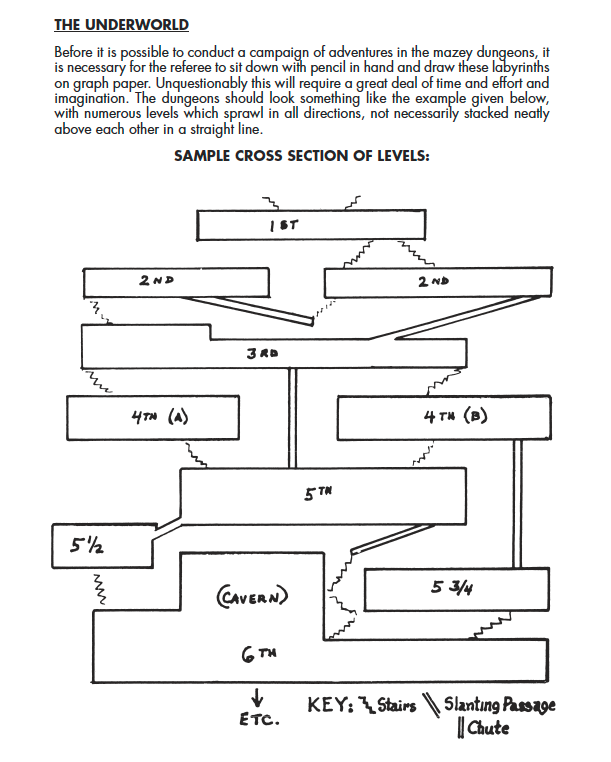
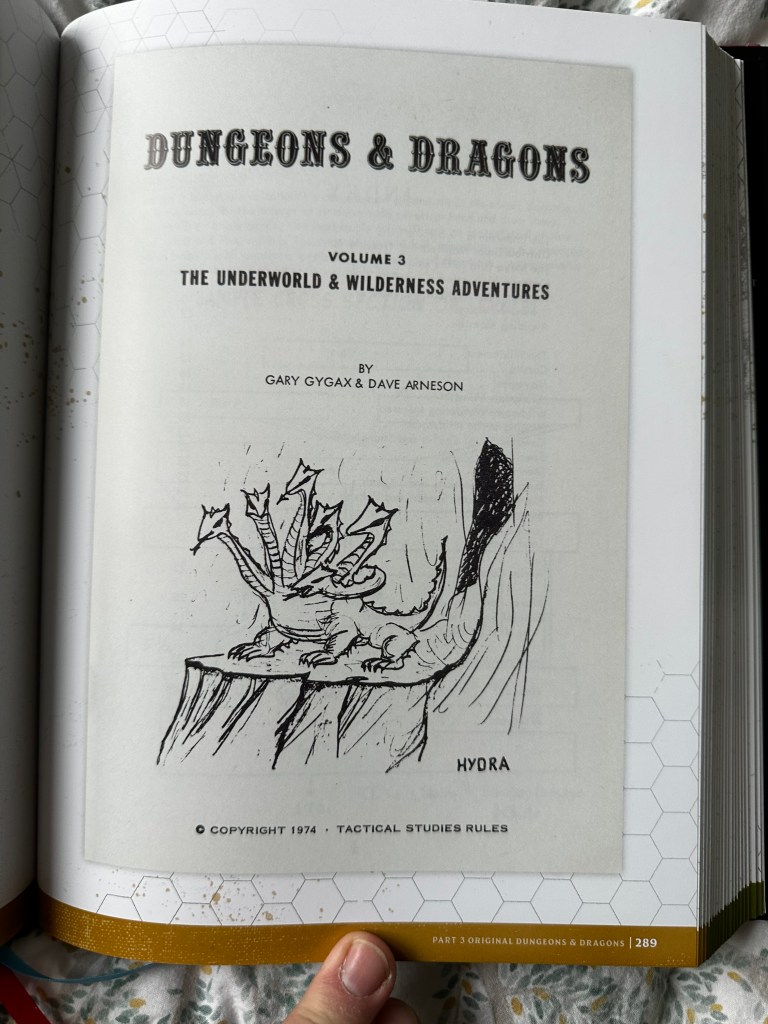
Dungeons & Dragons, Book III, The Underworld & Wilderness Adventures by Gary Gaygax and Dave Arneson starts with a section entitled, “The Underworld.” Here’s the first page of that:
Sample side elevation of a dungeon from the Underworld section of OD&D volume III
OK, I don’t have a lot of time, and am only willing to expend a moderate amount of effort but I have a decent imagination. So, hopefully that’ll see me through. One advantage I have here is that I know I only want this game to last about six sessions, so I doubt I need to make anything very large.
Since I’m starting with this map, I’m hoping it will inspire me to come up with a theme for the adventure/dungeon. Let’s see.
If you are one of my players, TURN BACK NOW! SPOILERS AHEAD!
Levelling
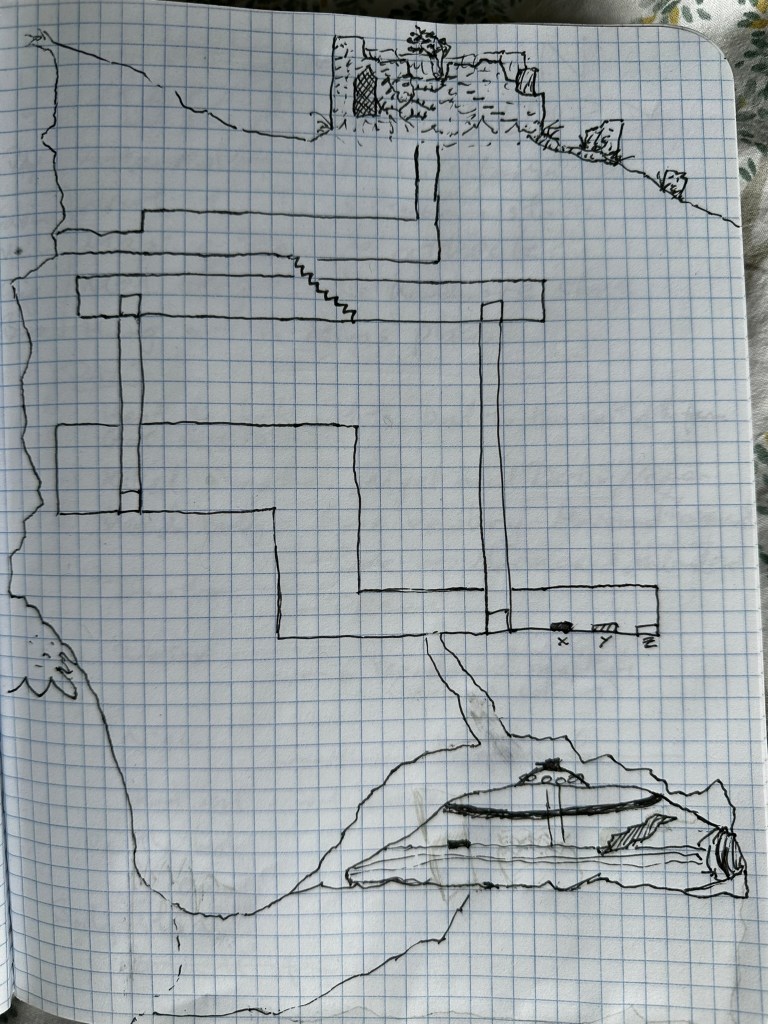
My dungeon – six levels including the ruined tower on the surface and the sea cave at the bottom with the flyig saucer crashed in it.
I’ve started by planning out six and a half levels of dungeon. My pen did provide some inspiration immediately by drawing the whole side elevation with a cliffside on the left. I hadn’t meant to do this, but a slight mistake led to it and then, it just felt right. I placed the ruined lower floor of a tower on the surface, near the cliff’s edge and drew a shaft dropping from the floor down to a subterranean level. That level also has an entrance on a ledge poking out from the cliffside.
At the book’s urging, I decided to mix up the methods by which an adventurer might move between each of the levels. The bare shaft between levels one and two gives way to a simple stairway between two and three. From three to four and from three to five there are lifts and you can only safely traverse the gap between levels four and five if you can fly. From level five, you can get to level six by the use of a rocky slide or a teleportation pad. You might also get to level six by descending from the ledge at level 2 above, although you would need a lot of rope and a swimming proficiency badge. I like this! It seems fun and means the players won’t always know what to be on the look out for when they decide it’s time to descend.
For the craic, level six is a submarine cavern, inside which is a crashed flying saucer. Well, looks like a theme is definitely coming together, although, it hasn’t fully crystallised yet.
Level One
The ruins of the tower currently play host to a group of Dwarven mercenaries in need of shelter. There are four rooms, including the Dwarves’ camp. One room contains nothing of interest but a handle to the trapdoor that leads down to Level Two. Another has a riddling raven who keeps its hoard of shinies here. If they answer a riddle, they’ll get a prize but if they attack the bird, they’re getting cursed. The last room has the trapdoor to the next level and a Gray Ooze resting on top of it.
I’m having immense fun with this so far. I’m doing it all by hand; drawing the maps in a notebook and writing out descriptions on the opposite pages. I normally do session prep on my computer and I haven’t built a dungeon from scratch in maybe eight or nine years. It’s a real breath of fresh air!
Level Two
My thinking behind this level is that it is there to dissuade potential dungeon delvers. It will present wave after wave of undead, who will regularly appear, as if from nowhere, in the room adjacent to the one the adventurers emerge into from the level above, trying to force them back. The undead are not real. Rather, they are like characters generated by the holodeck in Star Trek. If the PCs explore other ares of the level, they will probably find the hidden control room which will allow them to turn off the hardlight illusion generator. Then they’ll be able to get through to the stairway leading to the next level down.
I am quite excited about this idea, especially as there is an alternative to fighting the undead or figuring out the illusion generator. They can escape to the ledge on the cliffside from this level, although the only option is to descend into the sea from there…
Levelled Out
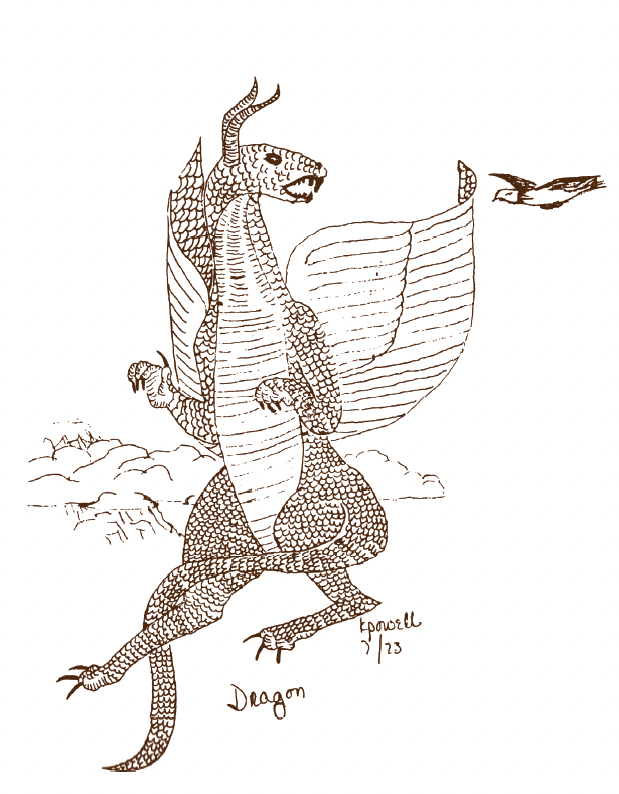
Dragon
That’s as far as I have gotten so far. I need to knuckle down and expand on what I’ve done so far. So I’m going to leave this post here for now. I’ll keep you posted on my progress in a few days.
I have read a lot of TTRPG blogs in the last few weeks, dear reader. I imagine the chances are good that you have too, if you’ve been following the Bloggies awards over on Explorer’s Design. There have been so many wonderful reads, I really did find it hard to choose between many of them. What a I liked most of all were the posts that expressed their enthusiasm for the hobby in one way or another. You can feel it shine from a d66 table of carefully curated results as much as you can from the effusive prose of some bloggers. And there were blogs about every aspect of this weird pastime from story-telling to initiative methods and everything in between. So often, what I found is that writers went back to the source material for inspiration, those historical tomes that defined the RPG scene and continue to play an outsized part in it, whether we like it or not. Most of these we were OSR bloggers with a keen interest in the original D&D from 1974. But you would occasionally see other editions get a shout out. On top of this, I get a newsletter from the Shop on the Borderlands that tempts me weekly with a lot of old dragon game shit I don’t need… Unless, what if I did need it?
The Editioning
Now, I have some to lots of experience with most of the editions of the game, and I already have a bookshelf full of D&D, mostly AD&D 2nd Ed and 5E, but also several 4E books, a smattering of 3rd Ed and a couple of 1st Edition tomes. So, I figured, if I undertook a challenge to play a full adventure in every edition of D&D during the next twelve months, I wouldn’t need to supplement my collection too much to make it possible.
So, that’s where we are now. The Editioning is coming to pass. The plan is to play every edition of the D&D game, in order (although there may be some overlap) in our gaming community, Tables and Tales, between now and February next year. Isaac has agreed to take up DM duties for several editions. I will run OD&D, AD&D 2nd Ed, 3rd Edition and 3.5 and Isaac has said he would like to run B/X D&D, Ad&D 1st Edition and 4E. Someone else in the community might run 5E 2014 and 2024, but if not, I’ll probably do those too.
Pre-loved
Just arrived!
I’m trying to source second-hand copies of the main rule books of each edition where possible. It seems more like a real history project when you have relics, primary sources, legendary tomes. It’s part of the adventure. I like to think about others using the books to play their own campaigns twenty, thirty, forty years ago. It puts me in touch with my own teenaged self and allows me to tap into the enthusiasm I had for the game back in the day. Also, its just cool to have them.
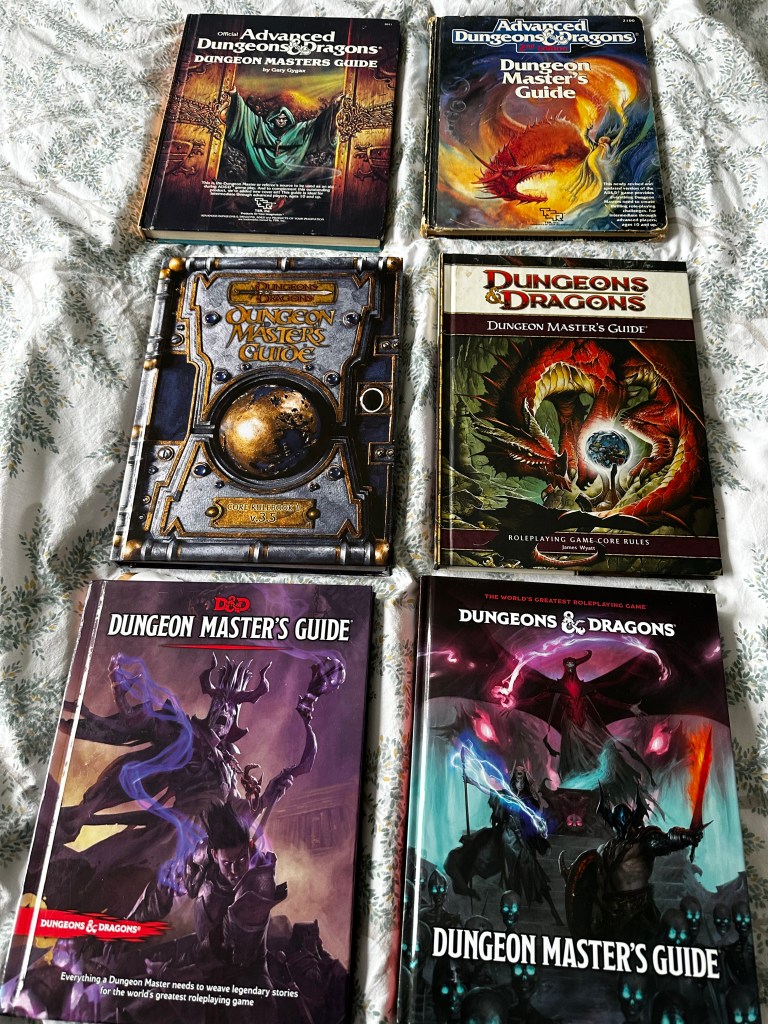
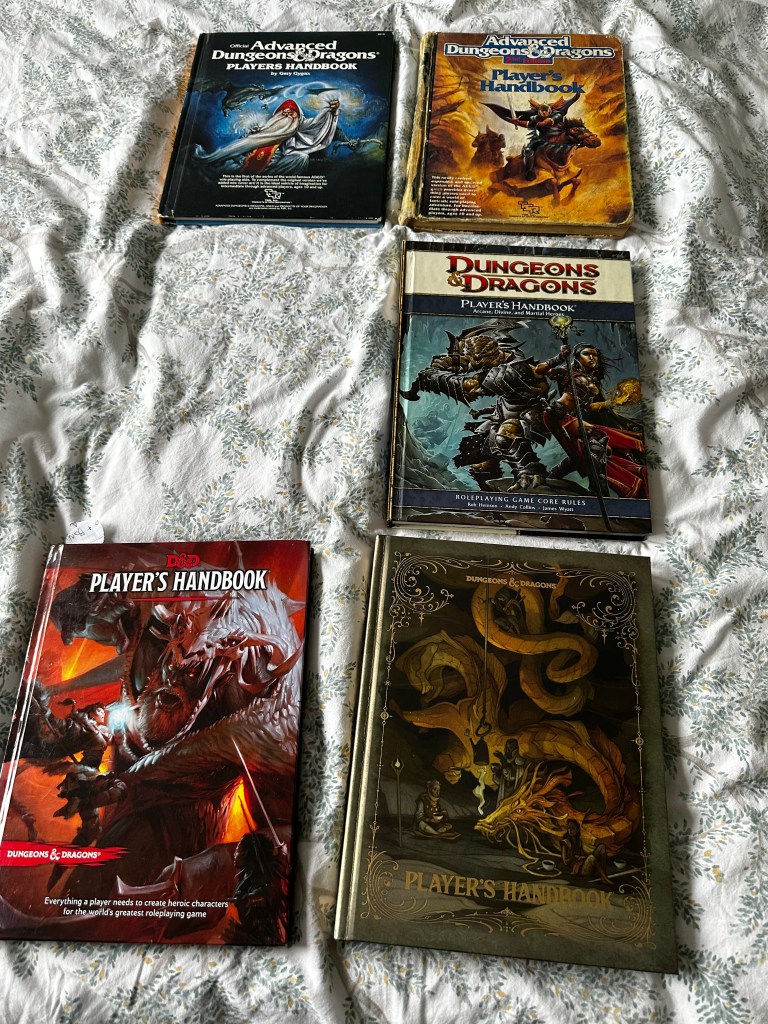
The covers of the DMGs from AD&D 1st Ed, 2nd Ed, 3.5E, 4E and 5E 2014 and 2024The covers of the Player’s Handbooks for Ad&D 1st Ed, 2nd Ed, 4E, and 5E 2014 and 2024. I am missing a representative from either 3 or 3.5.
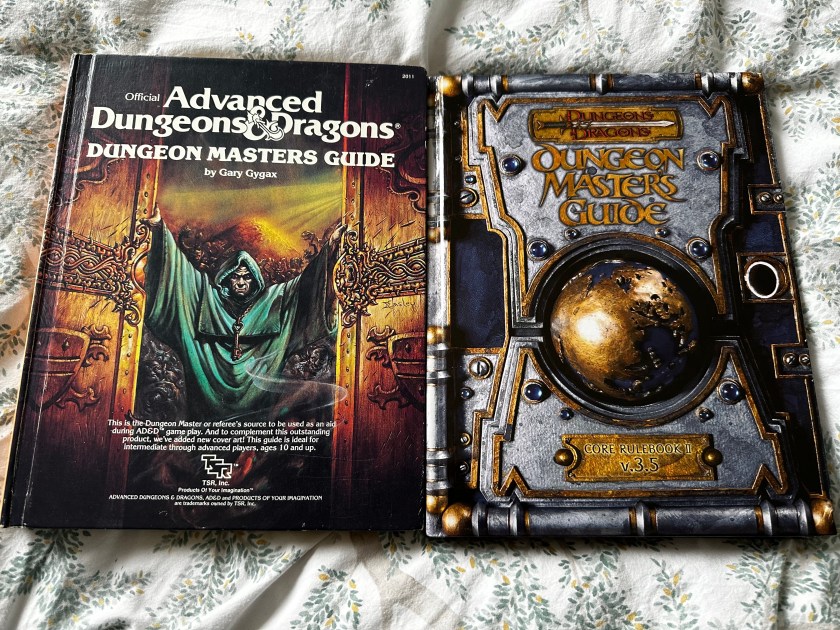
I’ve been surprised to find that you can get most of them for prices that I don’t consider extortionate, either on Shop on the Borderland or Ebay. I started shopping for them last week and a couple of DMGs showed up on Friday, AD&D 1st Edition and D&D 3.5E. They’re in good condition considering how much I paid for them. But before we get to those editions, we need to take a look at OD&D and D&D Basic/Expert.
The Educationing
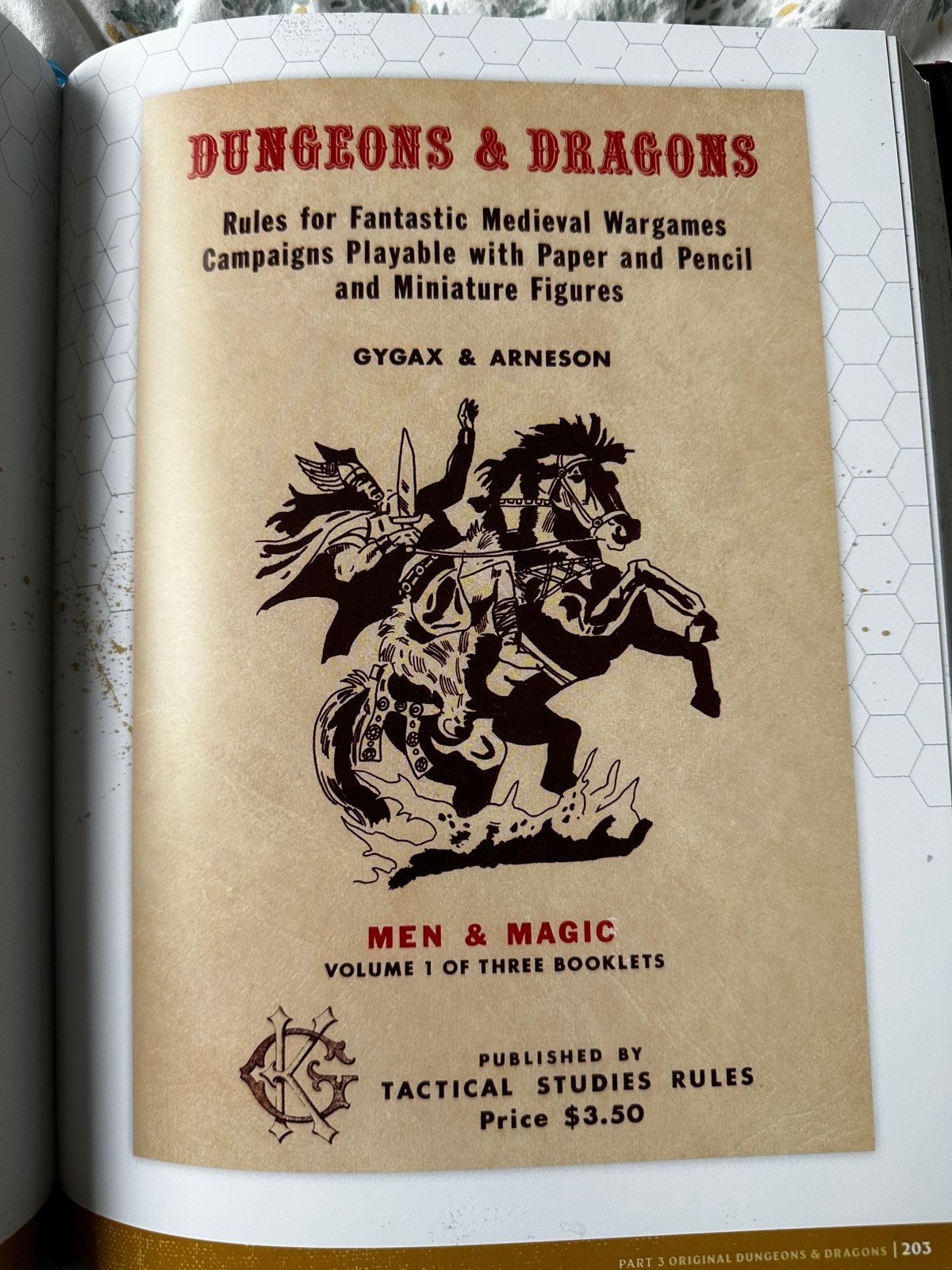
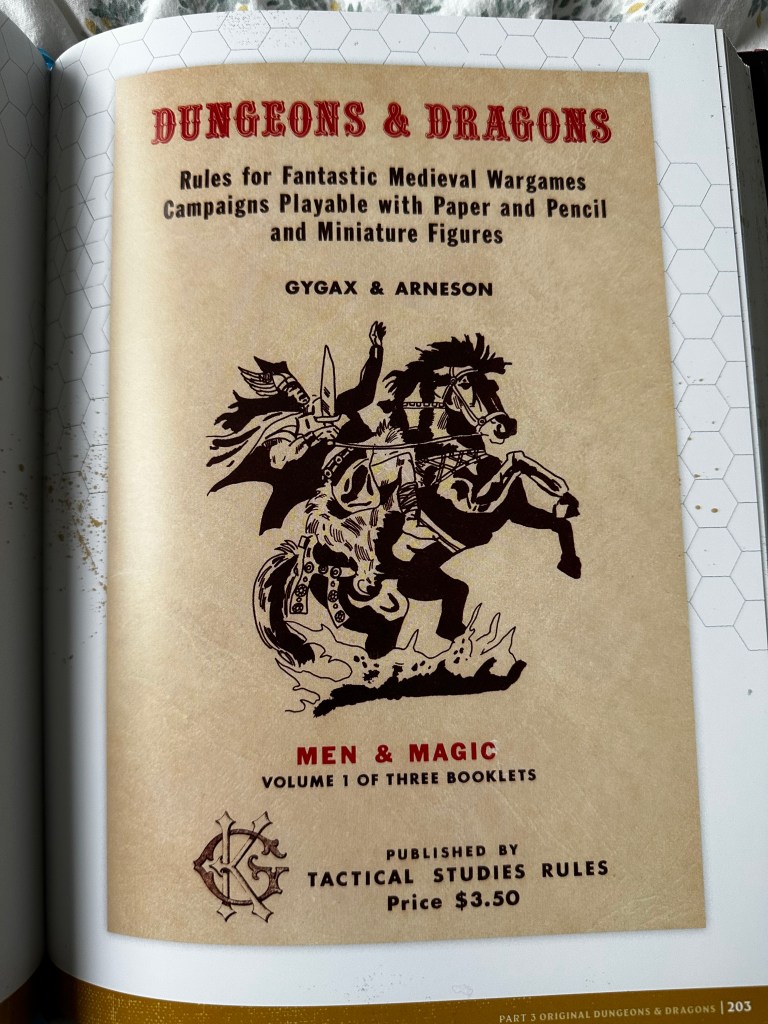
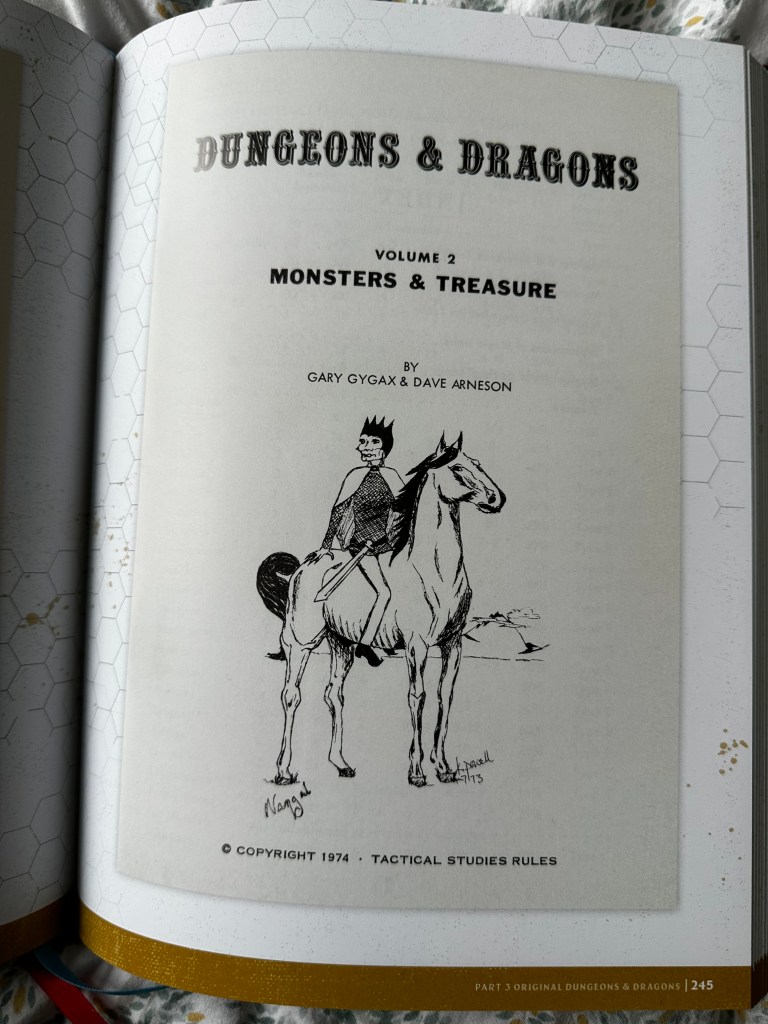
From the Making of the Original Dungeon’s & Dragons Book.From the Making of the Original Dungeon’s & Dragons Book.From the Making of the Original Dungeon’s & Dragons Book.
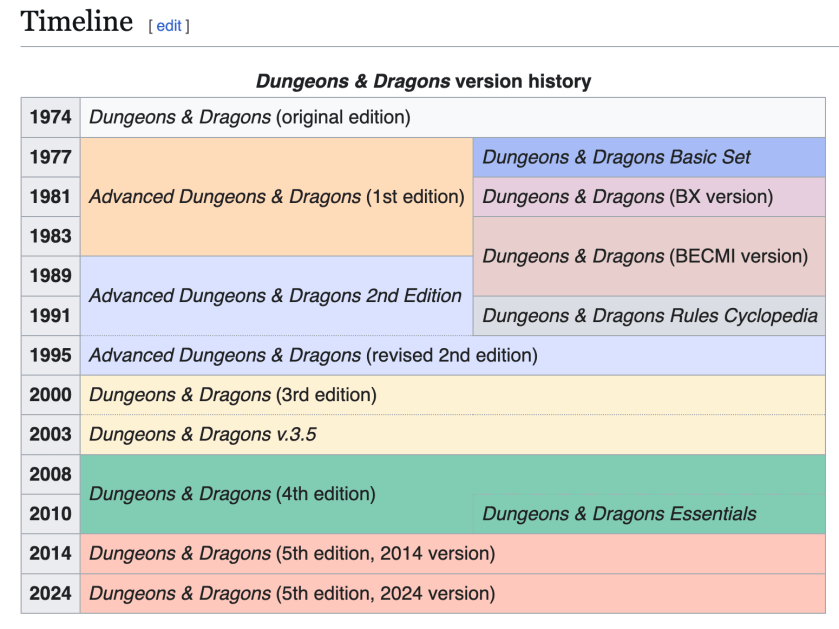
This undertaking has taken me to school. I had to figure out which editions were really distinct enough to deserve to be a part of it. I started by looking up the full list of editions here. I found this useful table:
From Wikipedia
You can see that it clearly shows the parallel evolution of Dungeons & Dragons and Advanced Dungeons & Dragons. I remember, as a young DM being quite dismissive of the non-Advanced version of the game. I had cut my teeth on the Basic Set but felt as though I had graduated past it to AD&D after a year or two. Never-the-less, I did play it in the nineties. A friend DMed it for us using the Rules Cyclopedia and the Hollow World campaign setting. Looking back at it now, I wish I had had more of an interest in it. Above any other version of the game, except, perhaps OD&D, it seems to have had the greatest influence on the modern OSR. Hindsight is 20/20 I suppose.
I have seen the terms B/X and BECMI and Blueholme and The Red Box and whatnot, for a long time. But this was the first time I bothered my arse to figure out the differences between them. This despite having actually played the using the Basic Set myself. I did not know that the confusing “abbreviation,” B/X referred to the first two boxed sets of the D&D rules, Basic and Expert, which allowed play from level 1 to level 14. I also had not known that the initialism, BECMI, referred to the full set of five rule-books, Basic, Expert (why is Expert shortened to ‘X’ in B/X but ‘E’ in BECMI? Make it make sense!) Companion, Master and Immortal. BECMI supported advancement all the way from 1st level to 36th!
Anyway, I made the executive decision to collapse all these versions into one, and just refer to it as B/X, since the main difference seems to be the extension of level caps with each successive book and we will not be playing long enough for that to be an issue. Nonetheless I have ordered both the Basic Set rule book and the Rules Cyclopedia, just to make sure we have all our bases covered.
Whither Adventure?
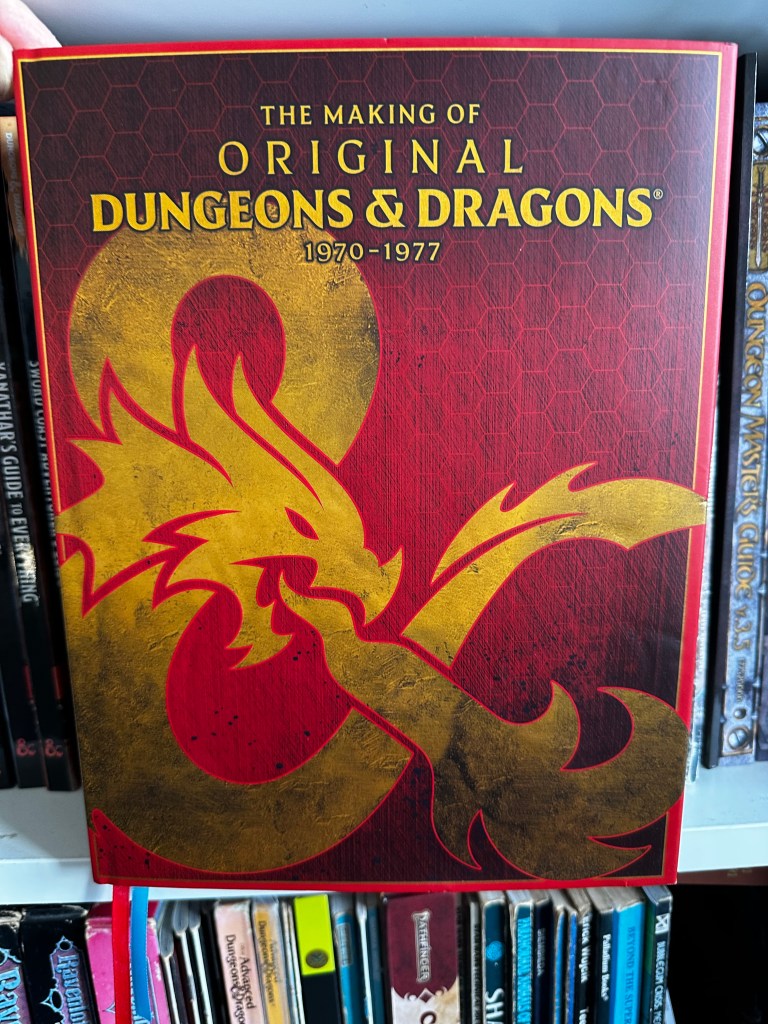
The cover of the Making of the Original Dungeons and Dragons.
There are still a few decisions to make. And there is a lot of work to do to prepare.
I have a relatively easy task to begin with, and that’s the reading of the OD&D books. I picked up the PDFs of these from Drivethru for a song. I do have them in a a slightly unwieldy printed form in “The Making of the Original Dungeons & Dragons” book that a friend kindly gifted me at Christmas, so I am happy not to need to empty my bank account to purchase a vintage copy of those books. I’ve quickly realised that I would also need the Greyhawk supplement since, otherwise, I would need to use the Chainmail medieval miniature war-game to run combat, and that was a bridge too far for me. The Greyhawk supplement included the first iteration of the D&D combat system that we might recognise today.
On top of that, we have to decide on what adventure modules to run for each edition. I would like to use vintage adventures that were made for the particular edition that we’ll be playing. For B/X, AD&D etc. there are tonnes of options, which means we’ll have to narrow them down somehow. But for OD&D, we have a very different problem. Adventure design appears to have been mainly the domain of the DM. The main books give you rules and tables, monsters, treasures etc, but mainly they encourage the DM to create their own stuff. Which is great! But it leaves me with the question, is that what I should do? Since that’s the intention? Or, should I use the one adventure I could find in any of the OD&D supplements, Blackmoor? The adventure is “The Temple of the Frog,” and I haven’t finished reading it yet. But it does strike me as the sort of scenario that could be quite lethal unless the PCs turn up with an army of hirelings. If that’s what’s intended, maybe that’s just what we should go for.
Conclusion
I don’t yet know which way I’ll go with that decision, dear reader. I would welcome feedback from anyone with more experience of OD&D or the Temple of the Frog than me.
In general, this challenge has got me quite excited about playing D&D for the first time in quite a while. I wrote a few posts about maybe getting back into playing AD&D back in 2024, specifically I wanted to play Dark Sun. The experience of even making a character put me off it. But I now think that, with other players involved, it could be not only of historical interest, but it could be really fun! I know some of our players in Tables & Tales really like a bit of crunch, while others love the OSR principles of rulings above rules that OD&D might bring.
One thing you can be assured of, dear reader, is that I’ll be taking you with me along the way. I hope to have some interesting things to write about reading, prepping and playing these games, so stick around!
Disclaimer: I have only read this adventure. It’s unusual enough for me to review something that I haven’t actually played but I thought it was worth doing anyway.
Quests from the Infinite Staircase
I don’t know at what point WOTC decided that every D&D book they released had to be titled Noun from the Adjective Noun or some derivative thereof but they got deep into it there for quite a while. Anyway, today I’m looking at the first adventure presented in their anthology for D&D 5e, Quests from the Infinite Staircase. This book uses an unlikely framing device known as the Infinite Staircase, along which you can find portals to all sorts of adventuresome and slightly retro locales. It’s a sort of extraplanar locus inhabited by a genie who will send you and your pals to any of these spots for whatever reason. It’s a bit like the Radiant Citadel, which they made up as an extraplanar locus to allow you to easily travel to a bunch of disparate regions on, presumably, different worlds for that other anthology, Journeys through the Radiant Citadel. Come to think of it, it’s a bit like that other famous extraplanar locus, the City of Doors, Sigil, which has been in existence in the D&D universe for decades. So why do they keep inventing new loci? Do you even really need this conceit to join this collection of otherwise standalone adventures together?
The alternate cover of Journeys through the Radiant CitadelThe cover of the boxed set of Planescape for AD&D 2e. The inifinite staircase
The Lost City
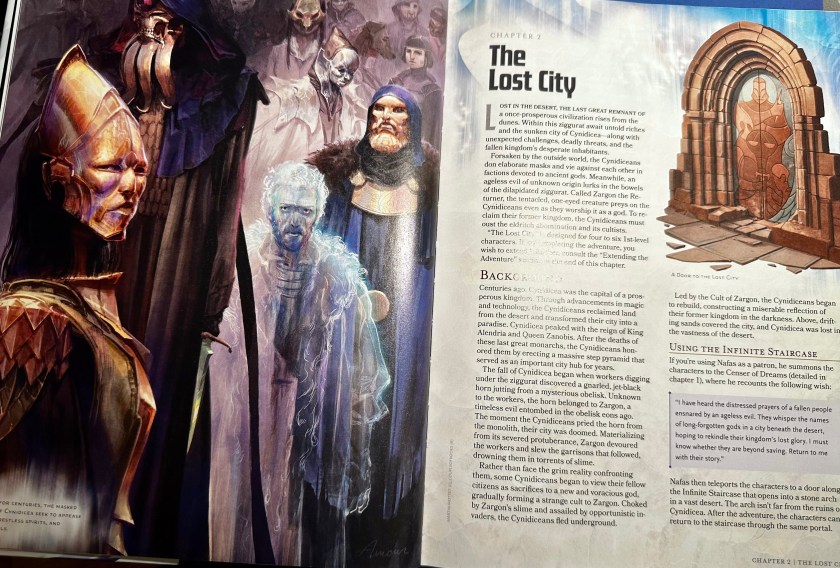
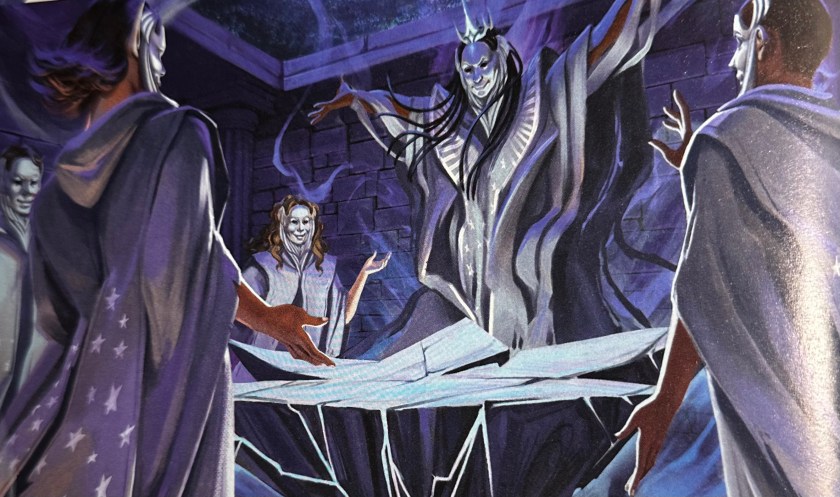
The opening illustration and first page of the Lost City.
Disclaimer: I have only read this adventure. It’s unusual enough for me to review something that I haven’t actually played but I thought it was worth doing anyway.
I’ll keep this relatively spoiler free but there may be a few points you’d rather not know in advance if you’re interested in being a player in the Lost City.
This adventure, along with all the adventures collected in this book, is an updated version of a classic one from D&D’s history. The original Lost City was published in 1982 and was written by Tom Moldvay as an introductory adventure for the Dungeons & Dragons Basic Set. I confess, I have not read the original so I won’t be comparing the two here.
This is the first adventure in the collection. It’s meant for 1st level characters. It’s a dungeon crawl in the very classic sense with up to six levels to it and a factional element that is close to the heart of the module.
Background
The lost desert city of Cynidicea was once a prosperous and powerful place. but they delved too greedily and too deep when building a ziggurat to honour their deceased monarchs. Oops. This was the downfall of the city of course. As an answer to this, the people split into four disparate sects. None of them got along but one was definitely worse than the others. The worst of these sects led the people underground to rebuild in the darkness beneath the ziggurat as the desert reclaimed their city above.
Getting There
At the start; how to get your PCs here from the Infinite Staircase, where to locate it on three D&D worlds and a couple of adventure hooks to get them to go. The hooks are fine. Get hired by an anthropological expedition or get separated from your desert caravan. If you wanted to incorporate this into an ongoing campaign, I feel like you could do better yourself.
Advancement
There is a handy section that spells out for you at which points you should let the PCs level up if you’re using milestone levelling. By the end of the adventure, your characters should hit level 4.
About the Original
About the Original
There is a nice little sidebar here and in every adventure in the book, which tells you about the original. It gives you some info on the edition it was meant for, a few details on how it was supposed to be used and the credits. I like that here, they tell you that The Lost City was meant to be used to teach new DMs how to run and design a dungeon, allowing them to come up with the lower levels of the dungeon themselves.
People and Factions
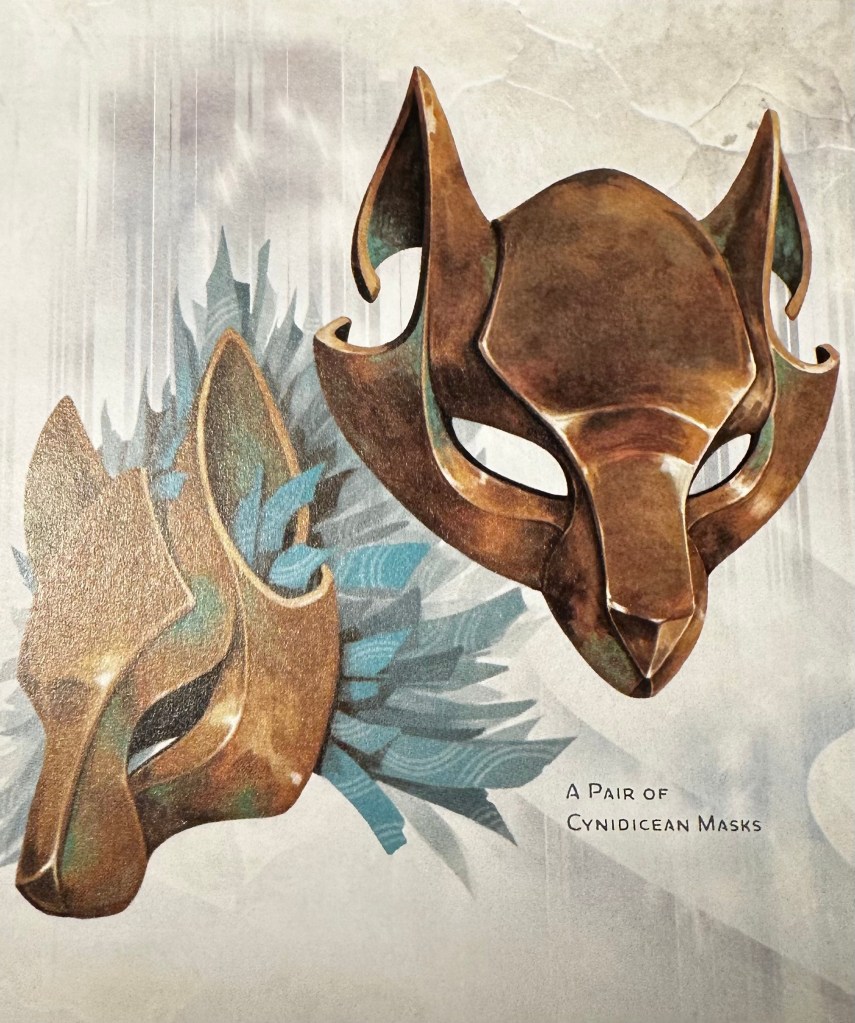
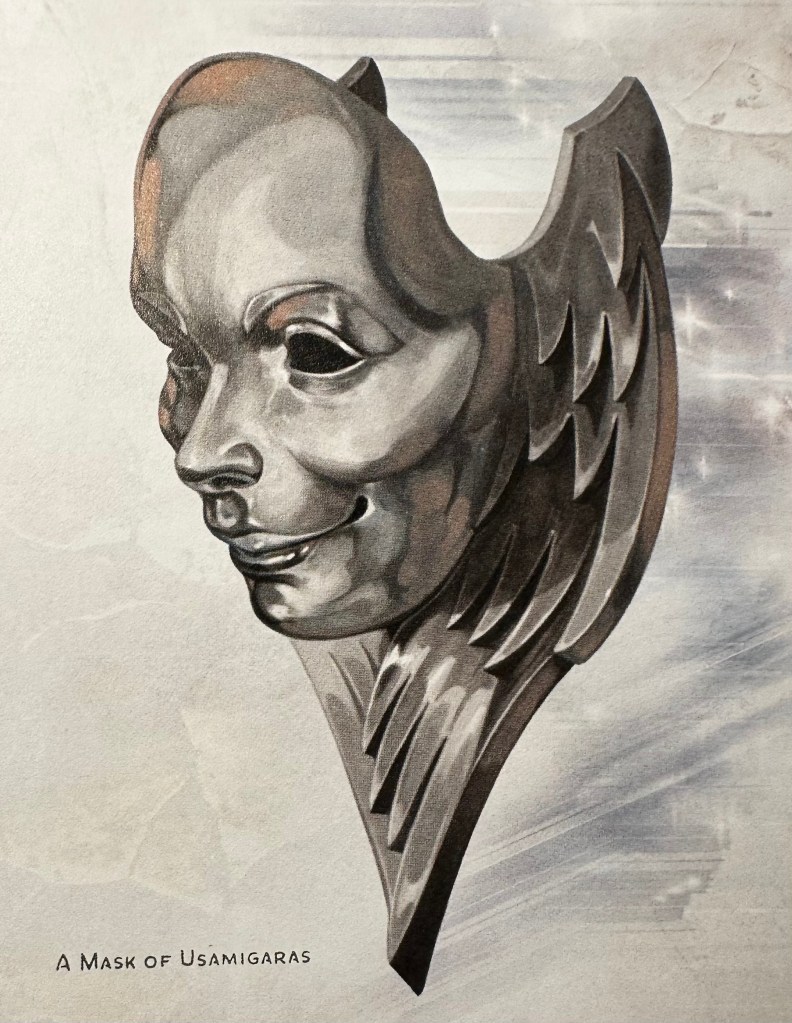
Animal masksGorm maskUsamigaras maskMadarua mask
The Cynidiceans all wear masks, usually some sort of animal mask, and they generally don the shabby left-overs of their once glorious past. Also, sometimes, they act like the animal depicted on the mask. Fun!
As I noted above, the factions are often at the heart of the adventure. They are detailed here. Each of them worships a different god, with their own portfolio, of course. Thematically, they are each quite distinct and have a look all their own, exemplified by a particular type of mask that they wear and a tattoo that they sport.
The paragraph or so that each faction gets here leans heavily on the ways they will pursue their goals, which are, unsurprisingly, influenced by the type of god they follow. We are told they all want to preside over the rebuilding of their city in their own way. They all want the same thing but they will not co-operate. This leaves me wanting a bit more, maybe some aim that’s a bit more immediate would help.
Random Encounters
Roll a d6 for every hour spent in the Ziggurat. If you get a 1, it’s encounter time. There’s a d12 table with a preponderance of cultists and other Cynidiceans, which makes sense, and an owlbear, which doesn’t (did I mention it was in a desert?)
The Ziggurat
The PCs have to enter from the top and work their way down. They’ll be sealed in once they enter, like a common hobbit and his eight fellows in a mine. The goal of the entire adventure is basically to survive long enough to find another way out. This might change during the delve, of course, once you meet the factions. But probably not.
I want to point out a cool thing right at the entrance where they can use ladders to either climb down into tier 2 of the ziggurat or up into the hollow interior of a set of statues on the roof of it. They can use levers that allow them to move the statues’ limbs and there’s a speaking tube. I like the idea of this but there is no practical use for this feature. They are not likely to encounter anyone outside on the top of the Ziggurat to impress with this display and it’s not going to do them any good once they’re on the inside so it seems a bit pointless?
Anyway, as I stated above, there are up to six levels to the Ziggurat. To be fair, the first level is just a single room right at the top, and hardly counts. But, as you would expect from a ziggurat, each level gets bigger as you go down. Even level 1 (or tier 1 as it’s called) has a pretty gnarly trap right from the get go. At worst, though, it will result in all of the PCs being rendered unconscious. If this happens, they’ll be taken by the first of the factions, the Guardians of Gorm, who will question them and try to recruit them. There are moments like this for each of the factions, partly because the place is positively riddled with traps and partly because the adventure does not want them to miss out on meeting each of the factions. It also wants them to join one or maybe more than one of them. this will, of course, complicate things for them if and when they try to interact with any of the others.
A magic joining ritual for one of the factions.
Once they meet the leader of a faction, the PCs will generally be judged in some way, and, if they are judged worthy, will be given the option to join the sect. If they do, they’ll get some advice and some kind of reward for it. But, if they refuse, there’s not much of a downside, to be honest. They won’t get to use the factions quarters to rest and they won’t get the aforementioned rewards but that’s it. And the other thing is, you would expect the faction leader to ask something of the new recruits. Maybe an attack on one of the rival factions or a quest to retrieve a sacred relic from the levels beneath, but no, nothing like that. You join and then you go about your business, pretty much. Seems like a missed opportunity.
All of the faction stuff happens on levels two and three of the dungeon. That’s where they will encounter all the sect leaders and probably learn a few things about the levels below that might help them out a bit.
Tier 4 has a bunch of undead encounters. This is where the royals were buried along with members of their court. There is a good variety of undead featured here and a nice through-line of a story involving the king, the queen and a handmaiden. There are zombies, skeletons, a ghost, a banshee and a wight, as well as a mummy (which seems an unusually unbalanced encounter for 5e.) With any luck, the PCs will be able to see the entirety of the story of the royals through. If they don’t, there isn’t much else in the dungeon to satisfy them and it will lead to a bit of an anticlimax.
Tier 5 has a fun encounter with a possessed robe, the main entrance/exit of the ziggurat and a grab-bag of traps and encounters of varying levels of fascination and challenge including a drunk owlbear. As I mentioned above, the main goal of the PCs was probably to find a way out of this crazy dungeon and this is where they will find it. There is a great big door behind which the sands have conveniently shifted to unblock it. There is literally nothing here to prevent them from doing opening it and escaping.
However, there is possibly a plainly visible trapdoor in one corner that leads down to the next level. This, I think is the level that, if you were a DM back in 1982, you would have had the opportunity to create yourself. As it is, WOTC have decided to relieve of that particular creative opportunity/burden and do it for you.
Story mosaic
Level 6, also referred to as the Expanded Ziggurat, is an unfinished tier that has been occupied by the demonic force that brought about the ruin of Cynidicea so long ago. I quite like this level, it’s thematically foul with lots of bile and slime and the like. As well as the demon itself, there are lots of its loyal servants, a black pudding and a gibbering mouther to encounter. There is warning at the start of the section that this tier is much more difficult than the others and is meant for higher level characters. The fact is, if the party of 4th level PCs makes it to the demon, they’re not going to survive. Its got a challenge rating of 17 and a set of legendary resistances and actions. I do have to ask why. I am thinking now of the excellent Sailors on the Starless Sea DCC adventure. The 20 or so level-0 peasants who enter that dungeon probably didn’t expect to come across some elder evil at the end of it, but there is was beneath that chaos keep, awakening from an ageless slumber. They killed it. It was statted out so that it could be killed by these peasants. And it gave them such a sense of achievement and heroism to do it! So why can’t the Lost City do that with the big bad at the bottom of the ziggurat?
By way of some sort of explanation, perhaps the idea is to make a much longer campaign of this situation with the factions and the demon lord and the Underground City which is presented very briefly at the end of the adventure. The demon would then be the ultimate BBEG of the piece and the PCs might have had many adventures rated to it and its cultists along the way to gaining the sorts of levels that might allow them to face it. The problems for me are that the factions were not compelling enough in the adventure to start with, the information on the city that you do get is too sparse to be of much use and there is every chance the PCs fucked off home when they found the exit back on tier 5 anyway.
Conclusion
I actually think that, with a bit of work on the factions, the NPCs and some editing for theme, I would enjoy running this dungeon-crawl. As it stands, the factions are underutilised, some of the encounters make no thematic sense and the NPCs are quite one-dimensional. It also feels like it needs more of an ending. But that doesn’t change the fact that there are some fun traps and challenging combat encounters, which is nice in a dungeon.
One of my main reservations is its size. It’s quite long, with over 60 keyed locations in the dungeon. I would worry about maintaining interest in a dungeon crawl of that length. I would imagine it would run for quite a few sessions.
Although it is obviously presented for 5e it could be very easily translated for use with any OSR ruleset, DCC or Dungeon World. I found myself thinking about how to convert it for Trophy as I read through it too.
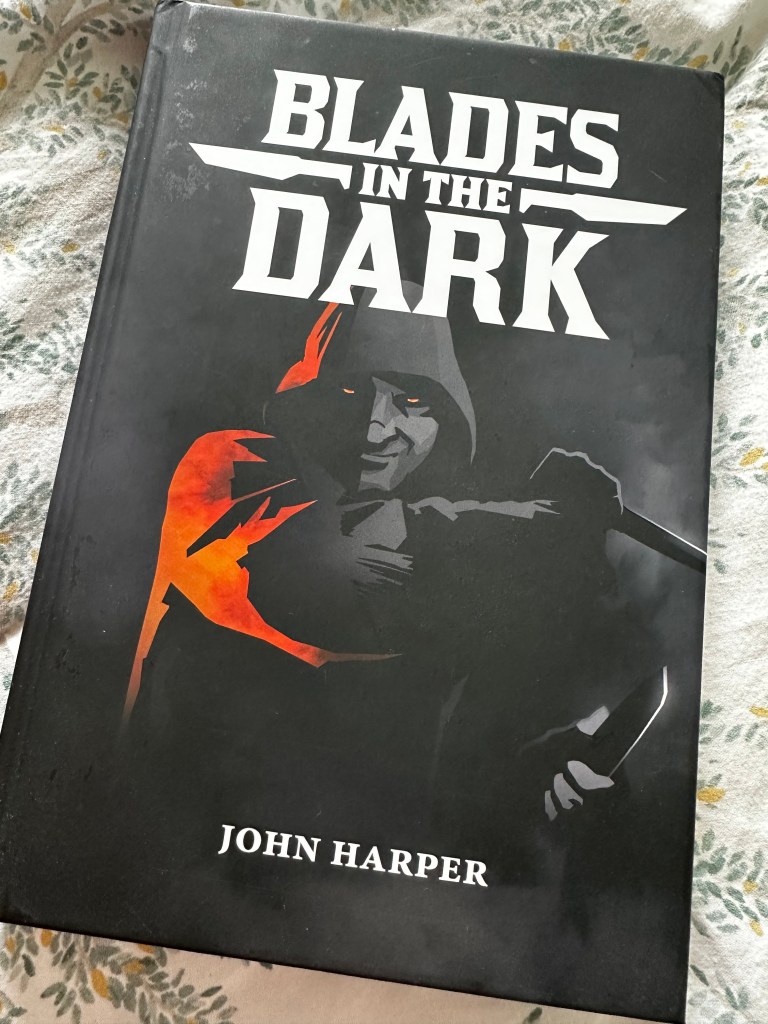
Instead of a new post, please enjoy this one from last August. It deals with beginnings and how to manage them in RPGs. Its got some advice I must take into account as I embark on my recently decided upon campaign of Blades in the Dark.
A Short Rest
Once again, dear reader, I find myself a little under the weather. Maybe I just overindulged at the weekend, maybe I have been working too hard, maybe it’s the current wave of ‘rona. Whatever it is, I feel like I’ve been struck by a nasty disease and I failed my resistance check/saving throw etc. etc. So, I’m taking a break today.
Instead of a new post, please enjoy this one from last August. It deals with beginnings and how to manage them in RPGs. Its got some advice I must take into account as I embark on my recently decided upon campaign of Blades in the Dark.
Each one of these moments brought tears to my eyes and became a part of the scene itself.
HBD TDP
That’s Happy Birth Day The Dice Pool, in case you’re wondering. Today is the dice pool dot com’s first birthday and I have invited a few friends over to jump in. It’s a pool party and a pot luck. So today, I have something a little different. For the first time ever, I have invited a guest author to the blog. Next week, I’ll have another. I’m hoping this will become a more regular occurrence as the blog grows and changes.
I’ll introduce the guest blogger in a moment but I just wanted to first take the opportunity to thank everyone who has supported this blog in the last year. A few of you have been here since day one and some of you are more recent readers; either way, I appreciate you. If you have only ever read a few words or if you somehow have the patience to peruse every post, you’re a scholar and a gentlebeing, in my book. I am still doing this for me, mainly. If that weren’t the case, I would have packed it in about eleven months ago. I find that, sometimes, when I’m writing for the blog, it focuses my thoughts about certain subjects like in my last post about the Quantum NPC. I refine my opinions while I type, like I did while writing my review of After the Mind the World Again. Doing this has been a challenge but in a good way. Still, it’s nice to feel the love sometimes too.
Now on to today’s special guest blogpost. Tom of the Media Goblin’s Hoard is a great friend and has been a stalwart of my gaming table for the last six years or so. They jumped at the chance to write a special anniversary blogpost for the dice pool dot com and they have chosen a wonderful subject for it, weaving an emotional narrative through retellings of some very memorable gaming moments. I also want to draw your attention to the artwork in this post, all of which was created by the talented and amazing members of our little RPG community, Tables and Tales.
Crying at the Table
by Tom Ball
Every week I will sit around the table with a group of friends, bring out the snacks and drinks, and live out some of the greatest stories I’ve ever heard. It’s in sharing and creating these stories that I feel a most genuine and strong connection with the others around the table, and it grows with each game played. Playing TTRPGs, I feel, has elevated my bond with my friends in a way I previously would not have known. It sounds cheesy but in the moments we play I feel myself step away from my own life and inhabit the life of my characters. Their ambitions, their bonds, their goal on the horizon and their friends and foes, all become real. For an evening we all step out of our lives into the stories of a shared adventure. Like all good things, it eventually comes to an end for the night and we step back into ourselves, the same as before except now with another shared experience together.
There’s a common phrase repeated by players in TTRPGs “never split the party” because we’re all stronger together. Our characters won’t make it to the end without each other no matter what background they come from, what they have done in their past, or even who they are as a person. In the end, they will rely on those closest to them in order to achieve the impossible. I feel this is a good analogy for life itself, I wouldn’t be where I am now without those closest to me and every week I get to see those I hold dear do the most incredible and creative feats.
Throughout the many stories told, there have been cheers of joy where what was thought to be an impossible feat becomes reality, and moments of tension so strong it’s impossible to cut through. Hidden between these are the instances of tender and emotional impacts that shake me to the core and have brought me to tears on multiple occasions. I am quite an emotional person as it is, and in the moments where the story shifts I look around and see everyone else, eyes glistening like a quiet lake on a star-filled night moments before the waters fall over the edge of the eyelid in a wave. We are all there riding that surf together. I’d like to mention below some of these highlights where I have been brought to tears and felt my bond with my friends grow ever stronger still.
A High Elf and his Humans
Art by Isaac Wilcox @lostpathpublishing
Deep underneath the towering city of Spire is The Heart and an Aelfir, Crowns-Under-Heaven, suited in armour of scavenged trains, steaming and pumping to keep him alive. He was obsessed with the hopes of bringing back the ancient Vermissian transport network and he teamed up with two humans to complete this task. Though he loathed it, it seemed these two were just as close to the brink of insanity as he was. Perhaps they would make handy tools or servants, at least?
The Seeker, an esoteric man who spoke of prophecy in between mad ramblings. Once dead, now back alive dancing between purgatory and the mortal world, his own death now a forever companion, both of them cursed with an intoxicating song sung by The Heart itself beckoning him ever closer.
Riley Rollins, an eccentric person whose pursuit of arcane majesty and wanderlust for the winding deep corridors and depths of The Heart could take them and their companions to the very end, witness the impossible and entangle them with a Queen from another world…
The trio’s companionship was rocky, Crowns-Under-Heaven would expect the other two to act a lot like cannon fodder. Seeker would often vanish into The Gray, abandoning the group. On top of that, Riley had a connection to the Drowned Queen, an ancient and ferocious being hellbent on flooding the depths claiming The Heart as her own domain, becoming ever stronger. The team had a lot of growing to do together.
When the finale came around Riley went to face the Drowned Queen and Seeker went with Crowns-Under-Heaven to reactivate the network. However, he came face to face with his obsession and the truth. The Vermissian Network was doomed to die and fall into ancient myth. In a long forgotten city where the Heart lay just a cave away Crowns was gifted with the Heartseed for his travels, the last source of energy for the doomed network system. This source of wild and limitless power was able to power his armour and by extension himself to a status beyond living. His adventures underground and with his companions had changed his old steam powered heart. He would become an unstoppable force within the cities and tunnels below. travelling the winding depths saving those on the brink of Death and becoming a figure of myth and legend. He looked to his human companion and said his heartfelt goodbyes. Knowing this would be the last time that Crowns-Under-Heaven would lay eyes on his friends.
A Goblin and a Minotaur fall in love
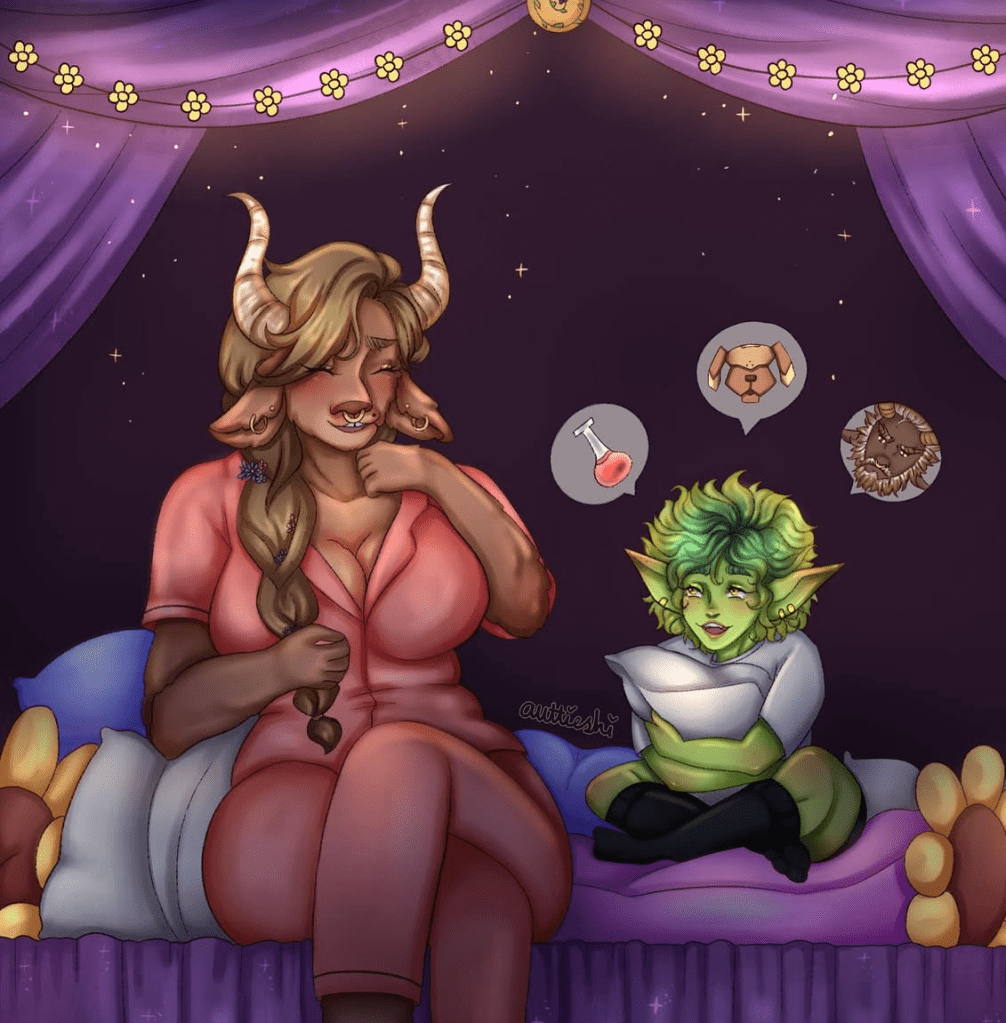
Art by @auttieshi (Instagram)
In the early days of her adventures, Vidris Pipp, a bombastic and spontaneous little Goblin, locked eyes for the first time with Birch Burley, a quiet, reserved and dignified Minotaur, and she knew she had fallen in love. The problem? Birch was the daughter of the leader of their town, Undercroft. Worse still, Vidris and her friends discovered that that self-same leader, Bryne Burley, had secrets to hide. He quickly became an adversary in their lives. The hope of a happily ever after between the two was far off. However, after a chance encounter of Vidris falling through the manor’s chimney and landing in Birch’s bedroom, they were able to have a one on one and quickly became close. It did not take long for the Minotaur to find that she shared the same feelings for the Goblin.
From there Birch became a part-time member of the party and ally to the group. However, their love for each other was to be kept secret. Vidris’ mother and grandfather already plotted to revolt against the leader alongside other citizens and Bryne was, at this time, not best pleased with Vidris’ meddling in his town and livelihood.
Months later dangerous secrets, far beyond the leader’s knowledge, of ancient cities were revealed far beneath the town of Undercroft. Birch was there side by side with Vidris as the party delved deep underground to face an ancient wizard that brought death to the world millennia ago. Meanwhile, the town of Undercroft and their new found allies in the peoples of the world around them prepared to face the encroaching wizard’s army of automatons.
Believing this could have been the last time Birch and Vidris might see their parents alive, they approached their parents, hand in hand and revealed their love for each other. Their parents accepted and acknowledged their love. Bryne gave Vidris his blessing and Vidris’s mother and Grandfather buried the hatchet with their leader and pulled them both in for a hug that felt to last a lifetime.
A family brought together
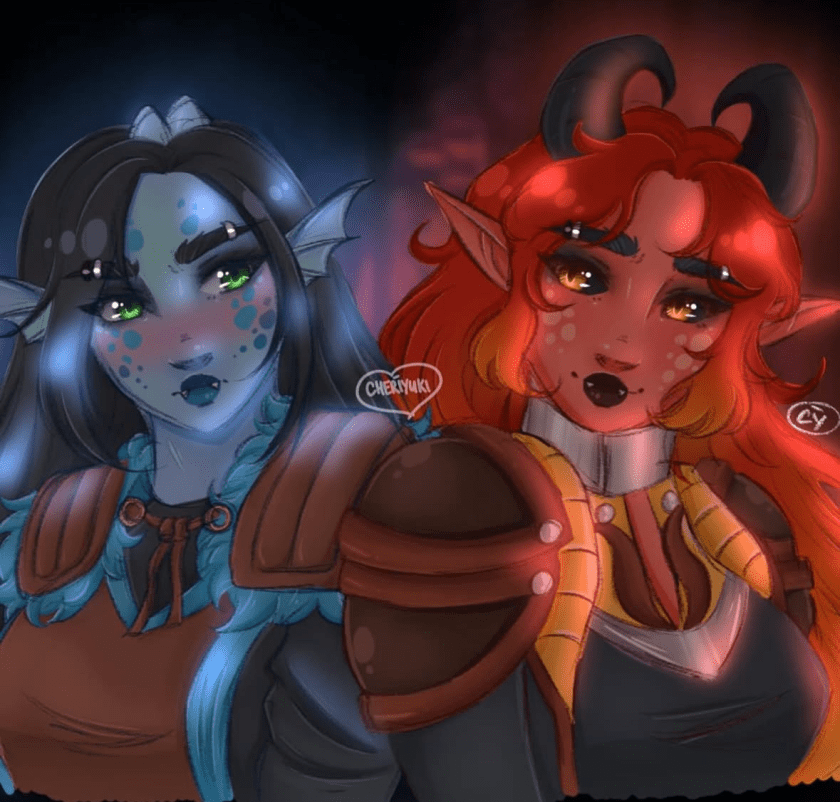
Art by @cheriyuki (Instagram)
Yulla Odasdottir nearly met her death at an incredibly young age when her father and mother wished to escape the forever storm that circled the island of Erlendheim. Believing the storm would destroy the island one day, they fled and were never seen again. Yulla, however, was saved by a mysterious entity from the deep dark depths of the ocean and sent back to the shores of Erlendheim, alongside the wreckage of her family’s boat. Her skin forever changed by this eldritch touch. What was once a rich scarlet topped with little black horns now shone blue, her face glistening with aquamarine scales and a large dorsal fin protruding from her head.
She was accepted by a fisherman and his wife who came across the wreckage and then raised Yulla as their own. Yulla grew up knowing she was not blood bound to her human parents. Her adventure would take place years later and through a series of extraordinary events the party would hear of a portal that lay on the seabed floor. This portal would be able to lead the party to Sigil, the city of doors, where the answers to their mysteries at the time would unravel further.
Once there, Yulla happened to hear the names of her parents. They were alive and were high up in a faction called The Believers of the Source. After a long search she was finally able to lay eyes on them, donned in the robes of The Source. There was a shocked moment of silence and they all slowly stepped forward, all of them in disbelief. Before the family embraced and wept.
Each one of these moments brought tears to my eyes and became a part of the scene itself. If I was crying real tears then my characters certainly were too. I like to think I put my whole heart into my characters and I wear that on my sleeve. I get lost in these stories and love every moment. It’s both a testament to the DMs who bring to life the world and to the players I’m with who build the most believable and real characters. I love being brought to tears by a game and I love sharing that moment with my friends.
I’m so thankful for those I get to share these adventures with.
This works even better through the medium of TTRPGs than TV to be honest, because your imagination simply works around them, never focusing on their details.
Star Trek
I’ve been watching a lot of Star Trek the Next Generation lately. I hadn’t seen it in many years, although I watched the whole thing as it came out in the eighties and nineties. I have obviously been watching it with different eyes this time around. I have noticed things in it that I don’t think I could have seen before. I wonder, for instance, about Mr Data. Would he have been such a sympathetic character today, as an AI in humanoid form? I think about how many of the episodes had no action, how many were just talking heads and techno-babble and whether Sci-fi TV shows today could get away with that. I ponder the special effects and make-up and marvel at how well they stand up 35 years later. But I have also been looking at these episodes with TTRPGs in mind. Now, of course, Star Trek has been made into a number of role playing games. I have never played any of them and this post isn’t about them. This post is about the crew of the Enterprise. Not Picard and Riker and Troi and Worf, but the ones who you see occasionally pass the bridge crew on one of the ship’s many lushly carpeted corridors, the ones having their own conversations in the background in Ten Forward, even the ones who so consistently took the con after Wesley Crusher left. They would get names sometimes and every so often, they’d even get lines! There are a couple of those that are recurring characters, such as Ensign McKnight and Robin Lefler. The most iconic of these, Chief O’Brien, went on to enjoy a major role in two Star Trek shows. But when he first appeared on the Enterprise, he was an unnamed bridge officer. Total NPC. He only became someone when the show creators decided he had to be someone.
The Quantum NPC
So this is what I have started doing for crews in my Spelljammer campaign. I think it would work in any game where you have a lot of NPCs that hang around in close proximity to the PCs all the time. So it works particularly well for ship crews.
In the main campaign, the party lost their original crew in the best possible circumstances. The crew, a bunch of spirits who had lost their memories and were not initially aware they were dead at all, finally fulfilled their goals and were able to shuffle off to whichever outer plane would have them. So, the PCs were forced to hire a whole new crew to take care of rigging and swabbing and whatnot. Now, I did not want to spend an entire session where they press-ganged or interviewed eight or nine NPCs that I would then have to name, outline and give voices to. That kind of thing can be fun but I don’t want to spend two full hours at it. Instead I told them that they picked up eight new competent crew members and that we would come up with their characters as and when they were needed.
So this is how that works, you imagine the scene where the PCs are on deck, in the foreground talking about something like how to defeat the weird root creatures that have invaded the ship from some eldritch, otherworldly space. In the background, just like in Star Trek, you have a few crewmembers, maybe they are even in uniform, but they are ill-defined and unremarkable. This works even better through the medium of TTRPGs than TV to be honest, because your imagination simply works around them, never focusing on their details. But then! They need one of the NPCs to be good at something, a specialist, an expert. Or maybe they just need a buddy, someone to talk to, or someone to listen. That’s when the players get to stretch those imagination muscles!
Pulling the NPC Out of Their Quantum State
The NPC existed in theory but not in practice. They were always there as a number, but not as a person, not as a character. Until the players make them up. The GM asks a player who this NPC is, what their name is, their ancestry, their job, what their personality is like. The players generally end up working together to do this but I usually start by asking the player who decided they wanted one of the quantum NPCs to become real for some reason. I ask that particular player the type of character they want in this situation with the understanding that, once they have been defined, they will forever be part of the crew, taking up one of those eight spots. It’s just like Blades in the Dark items. You know how many slots you have to fill when your PC is out on a Score but you don’t define the items until you need them in the narrative. Once you have said you have “A Blade or Two,” though, those blades are filling one of those slots. Same-same but different.
In this manner we got these three NPCs:
Deckhand Dewey – kobold, he/him, spry and wiry and can fit in little places.
Cook – Barry Keoghan (this is the consequence of allowing the players to name NPCs) – orc, he/him, big guy with big arms, beer belly, loves food and loves cooking. His chef hat does not fit very well. Apron always slightly dirty. Has a space rat companion.
Mr Cannon – Halfling he/him – weapon-master.
As you can see some of them got more detailed description than others. Barry Keoghan was described thoroughly partly because of who I asked to describe him and partly because of the moment I asked for his description, i.e. a quiet moment aboard ship where they had some time to talk about provisions and joke about silly Disney movie references. Meanwhile, Mr Cannon was created in the literal heat of battle. But that was ok, because the idea was always to flesh these NPCs out as time went on. We did, for instance, in subsequent sessions, discover that Mr Cannon had a wife waiting for him at home and that Barry Keoghan had some sort of tragic love-affair in his past.
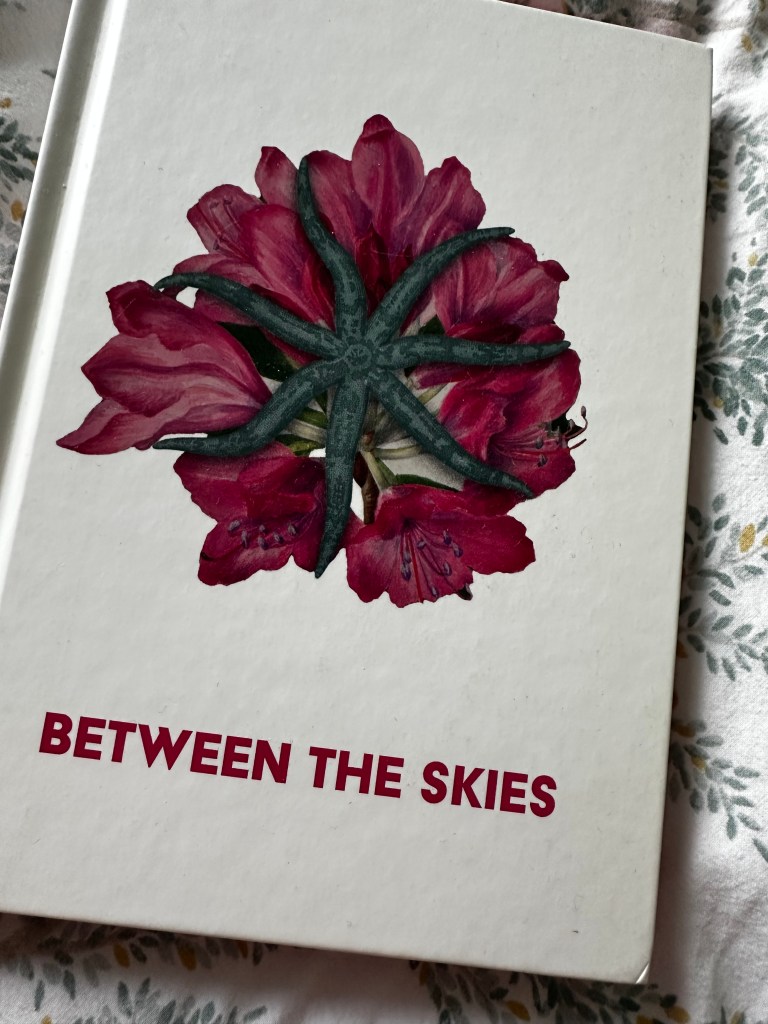
I think, in future I will bring Between the Skies to bear on the Quantum NPCs as they are being birthed by the players, giving them desires, bonuses, hindrances, quirks and all the rest. Time allowing, of course.
The Quantum NPC method has the added advantage of endearing the newly created NPCs to the players from the off. They are, after all, fully their own creations. From the players’ point of view, I believe it was also quite devastating when both Mr Cannon and Deckhand Dewey got breath weaponed into oblivion by a lunar dragon along with the rest of the NPC crew (apart for Barry Keoghan who was in the galley at the time of the attack.) Unforgettable.
Dad-quest
Dad-quest is getting under way tomorrow night. Our resident Giff Fighter-Paladin, Azimuth is rounding up a crew of misfits (the other players with their new characters that I discussed here) and a few more Quantum NPCs and spelljamming out to the Amos Expanse to find his Dad. Can’t wait to see what new crew-members the players come up with this time!
I’m off to Cork for the weekend so I won’t have time to come up with anything new today. Instead I thought I would share a couple of posts from last year. I wrote these at a time when I was first experimenting with some homespun rules and borrowed mechanics for our D&D 5E campaign.
This first post is preparatory to introducing a Blades in the Dark style engagement roll to our Spelljammer game.
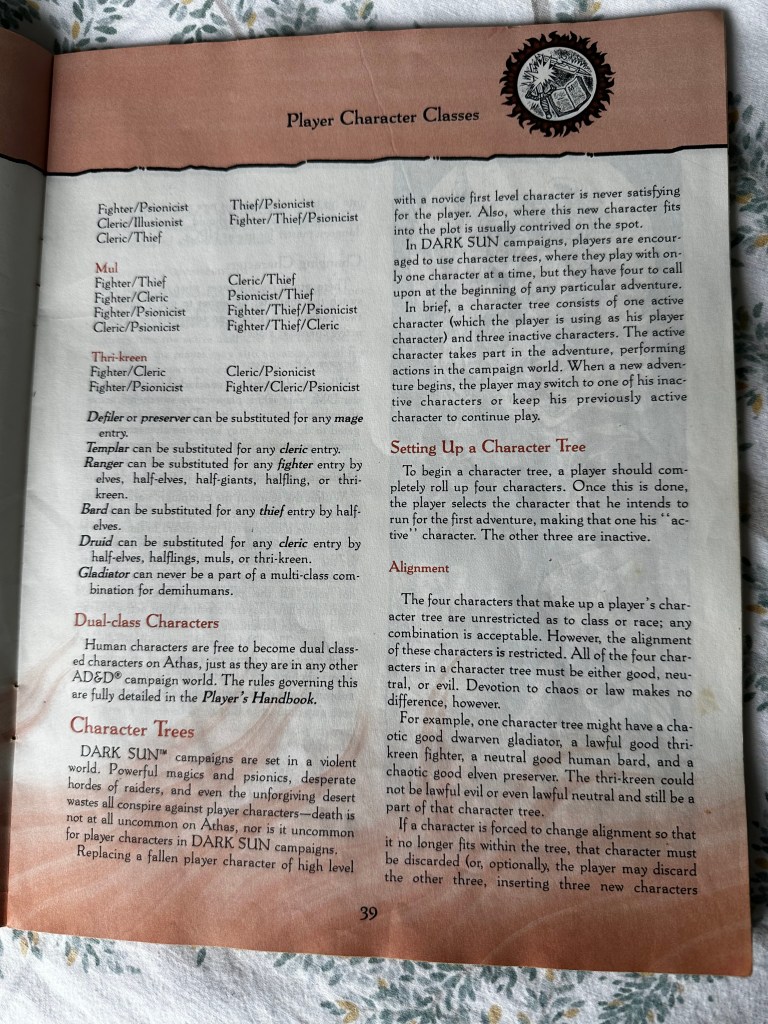
I’m considering an option that harks back to Dark Sun. In 2nd Edition Dark Sun, a player started, not with just one PC, but a whole stable of them, called a character tree.
Mid-season finale
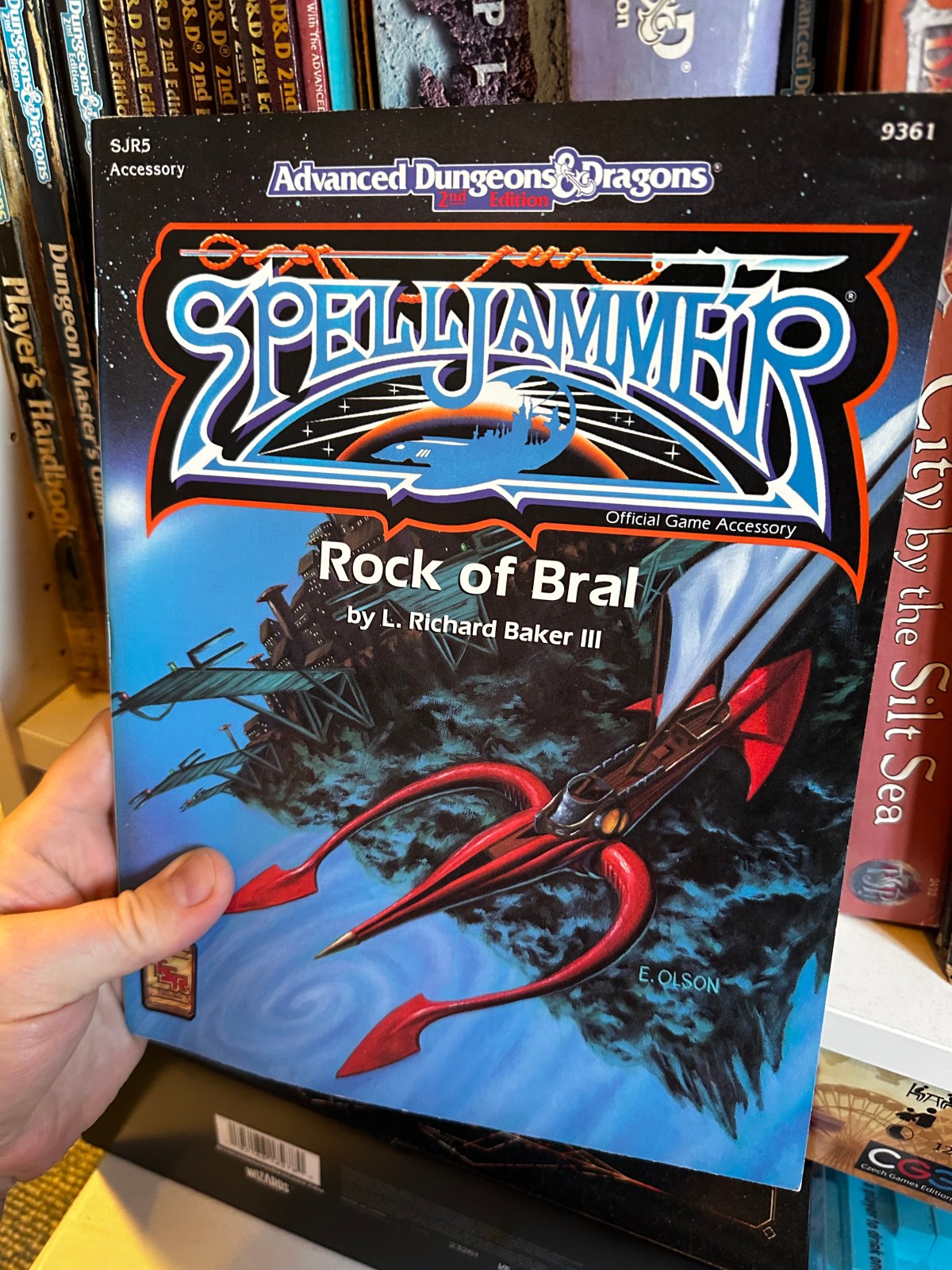
The crew of the Cadabra were going home. After weeks of adventure across Scatterspace and all over the Rock of Bral, they have arrived back at First Home, the asteroid/inn/shipyard that was their first stop after leaving their world behind in the first place. They could justifiably expect a warm welcome since they freed the shipyard from a Neogi infestation last time. But they weren’t expecting to be confronted with a crew of kobolds from their home island to be there. Kobolds who probably thought the PCs had murdered their queen. They also weren’t expecting to find Becky Fullpockets’ personal spelljamming vessel there. They had been struggling against the machinations of the technomagical billionaire ever since they fled their planet. It looked like they were stuck between a rock and a hard place, with no escape!
No better place to end part of a season than on a cliffhanger. And that’s what we did right there. We have been on a break from our Spelljammer campaign for a couple of months now. It’s given me a break from 5E and allowed us to play some other great games in the meantime. But now, it’s time to come back, sort of.
Spin Off
A few months (IRL months, that is) before the crew of the Cadabra reached First Home for the second time, they said goodbye to one of their number. Giff Fighter-Paladin, Azimuth, who had to be rescued from two ship-wrecks in quick succession might have been labelled a Jonah by many crews, but the Cadabra was different. They welcomed him on board with open arms and he adventured with them for a while. But, eventually, he was always going to go back to look for the father who went missing from the first of those two ship-wrecks. Now, while his erstwhile comrades are heading back to their homeworld, Azimuth is armed with a little knowledge about the stretch of Wildspace Papa might be found in and a ship stolen from Becky Fullpockets. He’s preparing an expedition of his own to go find his real dad… Not that gnome who pretended to be his dad during that short period where he’d lost his memory (long story, dear reader.)
The rest of the players are coming back too, but they’ll be playing new characters for this spin-off. Azimuth needs a crew for his ship, after all. We are getting together tomorrow night for a session-0 type thing. I think everyone is looking forward to trying some different classes/backgrounds/species compared to the ones they have been playing for over two years in the main campaign. Although, Azimuth’s player, David, doesn’t get a new character, he does get to pursue his PC’s main drive and its a great welcome back to the group for him.
As for me; I’m looking forward to yet another shake-up in this game. I’m planning to use the progress-based travel rules that I mentioned in my Prep Part 2 post last week. And, as well as that, I have something very special up my sleeve for the meat of the adventure, which I can’t reveal here and now (my players read this blog sometimes.) I’m definitely going to write about it after the fact, though.
Change of Cast?
The introduction of new PCs into the campaign, even though its a spin-off, raises the question of what happens once Azimuth joins back up with the main crew again. I’m considering an option that harks back to Dark Sun. In 2nd Edition Dark Sun, a player started, not with just one PC, but a whole stable of them, called a character tree. I believe you were supposed to begin with four characters. This was to help counter the lethality of the setting, giving a player back-ups in the inevitable event of a PC death. This made a lot of sense, especially considering the amount of time it took to create characters. Go check out my Dark Sun character Creation series to witness exactly how long that took.
So, my thinking is that, once this spin-off is done, if they want, the players will be able to swap PCs in or out as they like. This should have the double benefit of providing the players with a bit of variety and allowing them to almost fully crew their ship with their own characters, rather than just NPCs. I’m currently thinking through how I’ll handle character advancement if I do allow this. In Dark Sun, if I remember correctly, the PC only gained experience when they were actually played. No vicarious levelling. I think this makes a lot of sense, but it might be more difficult to adjudicate with milestone levelling.
What do you think of these ideas, dear reader? Have you ever run a spin-off campaign like this? Would you be happy for your players to switch between active PCs like I’ve described?
I am an unapologetic shill for Huffa’s Between the Skies. It’s one of my most used and most valuable RPG books. I use it constantly in lots of contexts. But I love using it to prepare for sessions.
Still Prepping
This post is part of a blog bandwagon started on the Roll to Doubt blog.
Click on the link above to take in the blogpost that’s piloting this bandwagon. Wagon-jumpers abound. You can find a very nice read on the same topic and a handy list of related blogposts on the Among Cats and Books blog.
And here’s a link to the first post on this topic on the dice pool dot com.
Between the Sessions
I am an unapologetic shill for Huffa’s Between the Skies. It’s one of my most used and most valuable RPG books. I use it constantly in lots of contexts. But I love using it to prepare for sessions. Its approach to random encounters in particular is one I highly recommend. The encounters are built, not just to make your session interesting, but to introduce potential allies and enemies, recurring characters, locations, objects. In short, they help you to truly build your campaign without relying on GM-written plots that the players may or may not want to interact with.
The methods and tables introduced in the book make for interesting, impactful characters and occurrences. And they have depth, too, enough to hook your players and keep them hooked. You know that old story that your players would die for the unnamed goblin you just made up on the spot but won’t give a shit about the NPC you spent two weeks crafting an elaborate back story for? I feel like the techniques in Between the Skies are almost designed to prevent that. Why? Well, firstly because, if used as your main way to drive the game forward, you are not going to be spending so long lovingly hand-crafting those NPCs, you are just going to roll them up on the tables provided and not worry about whether or not the PCs run into them, because whatever they run into will be interesting and fun enough to capture their imaginations. So, all the NPCs are more like the loveable nameless goblin and you don’t feel the need to make sure the PCs interact with any of them in particular. This has the effect of allowing the players to dictate the direction of the game to a large extent. This is a good thing!
Let’s Interact with the Mechanics
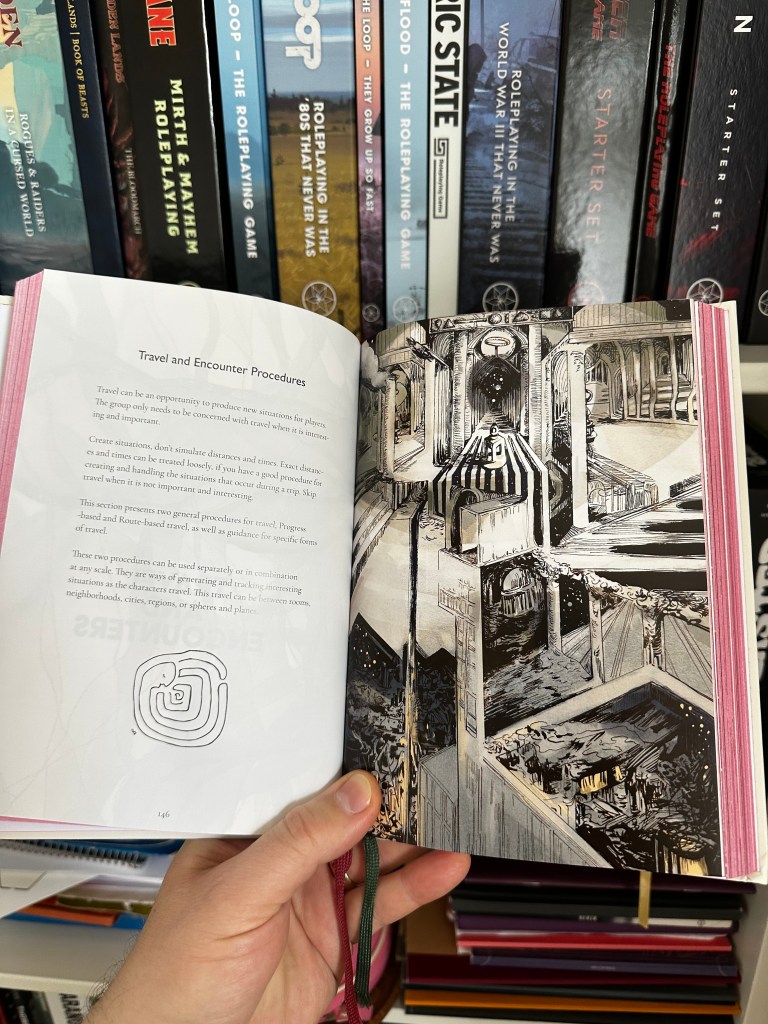
So, Huffa’s advice when it comes to travel is that, unless it is going to be interesting or important, skip it. I can get behind this approach. Recently, I have tended towards the idea of the journey being the game, but sometimes, when you know the next scene you need to play is across the city and its a relatively safe place, just skip to it, or montage it if there is something interesting to see along the way or if its a good opportunity for conversation between characters.
If and when you want to play the travel, though, Between the Skies presents you with two options, progress-based travel and route-based travel.
Route-based travel
Using this method, you use a map, just a basic one that includes routes and locations along them. You roll once on the Encounter die between locations and resolve that before arriving at the next place. Simple. The book includes several ways to generate route maps and destinations but I won’t concern myself with that here.
Your route map should have options, different ways of getting from A to B with more locations in between your starting point and the final destination depending on how long you want the journey to last.
This gives me the impression of beating the resistance of a delve in Heart. Before the journey starts, determine the journey length. There is a helpful table that indicates the amount of Progress points required to reach the destination depending on how long the journey is. You record progress through the resolution of Encounter Die rolls.
The Encounter die works as follows:
Encounter
Something Approaches
Environmental hazard
Complication
Hint as to what is nearby
Progress/breakthrough/boon
So you only get progress points on a 6.
What I did
As with everything in Between the Skies, you can take it or leave it. I have used a combination of the two methods, where I decided that a spelljammer ship journey from the Rock of Bral to the First Home asteroid would take three days and I would have them roll on an encounter table once per day. So this is the table I used:
Wildspace encounter table d6
1-2 No encounter 3 Environmental/Ship Hazard 4 Ship Problem 5-6 Encounter
When you only have three days and so, three possible rolls on the table, I felt it was better to increase the chances of actual encounters/problems/hazards occurring. If it was a more exploratory journey, I would use the progress-based method as described in the book.
Now, using the tables in this book, of which there are many, you should be able to create a fascinating encounter on the fly, but, if you can, I think its nice to prepare a few beforehand, at least one of each kind. So let’s do that here.
I thought it would be a good idea to roll up some options on the spark tables in the book and add them to a d4 table for each encounter type (environmental/ship hazard, ship problem and ship travel encounter.)
Environmental/Ship Hazard
We’ll start with the hazards. For each hazard you want to prepare, you roll 1d6 to determine the hazard type and then d66 to generate a hazard keyword on the Environmental Hazards during ship travel table in Between the Skies.
I shared this table in the last post so lets use the results I rolled up on that.
3 Ship Hazards
Roll 1d4
Hazard 1 – Storm, Flood
Hazard 2 – Disorientation, Sphere
Hazard 3 – Obstruction, Cold
Hazard 4 – Trap, Haunting
I then go ahead and prepare a few details of the hazards. Here’s the first one as an example.
Hazard 1
A solar storm rolls in from the direction of the sun.
The gusts of solar winds batter the ship
The deck is flooded in light and other solar radiation
All those on deck risk blindness
There is also a chance of taking radiant damage
All on deck must make a Dexterity save, DC 15 to avoid blindness
If they are afflicted with blindness it lasts 1d4-1 days. If you roll a 1, Roll 2d12-1 for the number of hours it lasts
Even if they saved against blindness they must make a Constitution save, DC 15, against radiant damage. If they fail they take 4d6 radiant damage. If they succeed they take none.
This goes for the ship too, if the damage roll beats the damage threshold
You can see that I took the hazard type fairly literally but moved it into a wildspace context. A solar storm seemed obvious but also pretty cool. The keyword, “flood,” took me a little while to work out but I thought flooding the deck with light seemed both like a cool, spacey event and something that could present a real problem for the PCs.
Obviously, you can prepare the details for each entry in the table. They don’t have to involve a lot of work but putting a little extra preparation in at this stage can remove the need for it at the table.
Ship Problem
Similar to the hazards, you simply roll up a problem type and a problem keyword on the Ship Problems tables in Between the Skies. I did this four times and created the d4 table below.
4 Ship Problems
Roll 1d4
Problem 1 – Armament, Separation
Problem 2 – Quarters, Shrinkage
Problem 3 – Cargo, Disappearance
Problem 4 – Bridge (spelljammer helm), Error
Here’s the detail on one of these entries:
Problem 2
One of the crew has stowed something large and awkward in the crew quarters. It is limiting the amount of space available to sling hammocks and the rest of the NPC crew is unhappy about it. This crew member refuses to be parted from their huge steamer chest as it contains something of extreme personal significance. The PCs will need to resolve the interpersonal issue.
You can see that the details here are left deliberately vague. You Ould ask the players to decide which member of the crew is the problem, what’s in the chest that’s so important and, most importantly, how the resolve the issue.
Encounters
And finally we have encounters. There are a lot of different encounter tables in the book. You can choose the one that best describes the surroundings of the PCs at the time. There are two space encounter tables, one for known space and one for wildspace. They are d66 tables. Once you have done rolled on them, you can get some more inspiration by rolling on the encounter keyword, detail and related entities tables. Once you have rolled on the Encounter distance and awareness tables in Between the Skies to determine how far away the encounter is and how much attention they are paying to the PCs you can roll on the d4 table below.
You’ll note that the results on the table below are not all similar. For instance, encounter 2 doesn’t have a related entity. In general, such entities, as generated by the tables in Between the Skies, are sentient NPCs so I didn’t think it necessary for the parasite I rolled up. But mostly each of them includes an encounter keyword, a related entity, and two encounter details.
5-6 Encounters
Isolationists – Confusion, Related Entity – Unknown NPC, Glittering, Prayers
Ship Parasite – Loss, Scales, Experiments
Ruins, Ancient – Mourning, Related Entity – Petty God, Knots, Miscommunications
Stowaway – Battle, Related Entity – Creature, Eggs, Blindspots
Stowaway
Size, substance and form table: Very small biota, piecemeal. Weakness: True name Needs: Brains Characteristics and details: Pacifist, stalks Behaviour: Social: Family: 5 appearing Demeanor and current behaviour: Protective, healing Attacks: Blast – teleporting
For the final example, I’m using the creature generation tables in the Entities chapter of Between the Skies. You can see all the details and keywords that I rolled up above.
Along with the keywords, battle, eggs and blindspots, that came from the original encounter detail rolls, these will make for a fascinating encounter with some sort of very small fungal entity that has escaped a battle to find refuge aboard the PCs’ ship. The mushroom creature has a desperate need for brains to help heal its young but will not take them by force. Perhaps they only consume the brains of dead beings. Perhaps they have a blindspot that means they cannot sense constructs. And maybe, also, they have crawled into the ship’s stores to try to feed on the eggs, mistaking them for heads containing brains. I like the idea of them lashing out with a teleporting blast to deposit attackers some way off the deck of the ship, leaving them to perish in wildspace. If the PCs can figure out the creatures’ true names, they’ll be able to get them off the ship, but how?
Conclusion
I think you can see the fun you can have preparing encounters and encounter tables using Between the Skies. Once again, dear reader, I can only urge you to go and purchase it. It’s so useful and you won’t regret it!
“The Discourse (TM)” has been focusing on running published adventures/modules/campaigns as opposed to custom/homebrew/sandbox games for the last little while. First Quinns reviewed Impossible Landscapes, an epic and almost legendary campaign for the modern Cthulhu-ish game, Delta Green. This is the first time Quinns has reviewed a campaign/published adventure on his RPG review channel, Quinns’ Quest, so it was unusual enough to spark a significant amount of discussion all on its own. And then Thomas Manuel of the Indie RPG Newsletter and Rascal reviewed the same campaign. I believe this was purely coincidental, especially as Impossible Landscapes came out about five years ago now. Both are great reviews in their own right and are based on full play-throughs of the campaign so you know they’re of real value. You should check them both out.
I have opinions on the conversation, of course. I have shared a lot of them in other posts from the last year or so, actually. If you want the summary, though, I had a lot of bad experiences running D&D scenarios in the past, especially from the AD&D 2nd edition era. I found they were difficult or impossible to just pick up and run. In fact, they required maybe more preparation time than adventures and campaigns I wrote myself. The one published 5E campaign that I ran, Storm King’s Thunder suffered from the same issues, actually. This made me feel like it was a “me” thing. But, it turns out, a lot of GMs feel the same way, according to Bluesky, at least.
However, I have had my mind changed somewhat by running pre-written adventures for some other games, particularly Free League’s Blade Runner, Dungeon Crawl Classics and, to a lesser extent, the Dragon Age RPG from Green Ronin.
This is a link to my first post on Electric Dreams, the introductory Case File for Blade Runner:
I will say that, despite my generally favourable outlook on most of these modules, I still find I have to to do a lot of prep for them. The main fear I have is messing things up so bad that I essentially spoil the rest of the adventure. Although, I should really have more faith in my abilities as a GM at this stage. I feel like I can probably improv my way out of any hole, to be honest. But it does not change the fact that I spend hours rewriting long paragraphs presented in module texts into digestible bite-sized bullet-points. I am running another Dragon Age scenario right now. Amber Rage is from Blood in Ferelden, an anthology of scenarios for the game that came out in 2010. It suffers from verboseness and unnecessary detail and makes for a lot of work from the GM. I’m enjoying the contents of the scenario but its presentation is horrendously dated and needs a sprinkle of OSR magic to tighten it up, in my opinion.
I realise that none of the modules I have mentioned here are anywhere close to having the size and epic scope of something like Impossible Landscapes, but it doesn’t change the fact that they have largely changed my mind about running anything pre-published. The one I have my eye on right now is Dagger in the Heart for Heart: The City Beneath. Actually, I have a post about that right here too:












 The Dice Pool