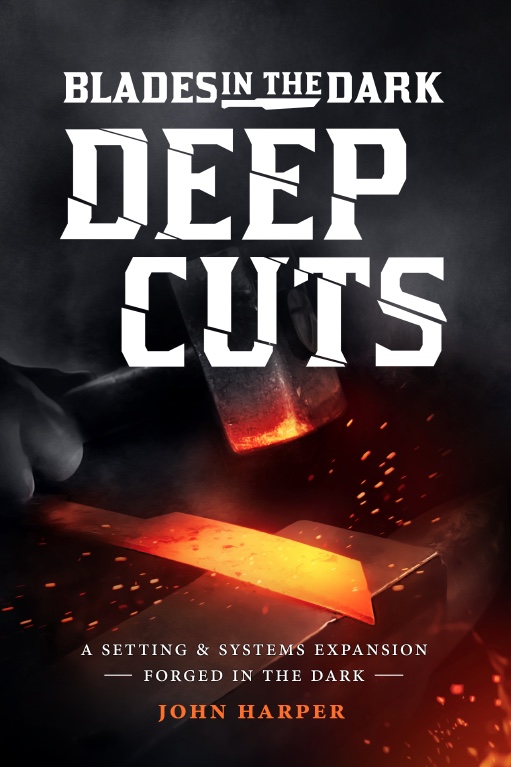
Blades Out!

Since I didn’t know for sure that the PCs would back the Lampblacks until the very moment they answered Baz in the opening scene, I couldn’t plan for what might come next.

Housekeeping

Dear reader, another change is afoot. I have been running this blog for about 17 months. In that time I have published 175 posts, including this one. That’s hundreds of thousands of words, some of them good words, some of them not so good, but all of them worthwhile. For the first month, I wrote one post a day! That seems incredible to me, looking back at it now. I soon dropped down to three a week and then to two. Even that has been a struggle lately. Partly that struggle comes from the fact that I’m playing more RPGs than ever, partly it’s the exigencies of life in general. What I’m getting at is that I’m planning to drop down to a single post a week, probably on a Saturday or Sunday. I still love doing this and I appreciate you, dear reader, for popping by to give some purpose to my ramblings, so I’m not going to stop. I’m just going to take it a bit easier on myself. I might revisit this decision in the new year and I reserve the right to post more often if I find a subject I absolutely must blog about. For now though, on to the meat of the post!
A Murder of Crows

We finally had session one of our Blades in the Dark campaign! Last Wednesday, five of us got together for our first score. To make things a little easier on myself as a first-time GM of this game, I decided to use the starting situation presented in the book. Roric, the leader of the premier gang in Crow’s Foot, has been murdered, and rumour has it, Lyssa, his erstwhile second-in-command, did the murdering. This has opened the floodgates to inter-gang rivalries across the district, that had previously been kept in check by Roric.

The Score

Guns and a knife.
Guns and a knife.

The Opening Scene was set in the old coal warehouse belonging to the Lampblacks. Bazso Baz wanted to know where they stood in the burgeoning turf-war between his gang and the Iruvian Sword-masters, the Red Sashes. The crew’s reputation with the Lampblacks started at 2 so it was a no-brainer for them to support Baz’s side in the war, at least for the time-being, until they see an opportunity to exploit and grab power for themselves, perhaps, later on…

This was the point where John Harper started to let go of my hand. The book provides several suggestions for the type of score Baz (or, indeed, Mylera, leader of the Red Sashes) could send the crew on. A couple of them are generic, other options are for particular crew types. I decided on the one expressly for the Bravos crew type.

If you’re Bravos: Maybe Bazso wants you to storm the drug dens of the Red Sashes down by the docks. Run off the clientele, smash up the places, grab any loose coin you find.

I like how the suggestion is kept very vague. The warning to not overcomplicate things comes to mind when I read that. Also the GM Best Practice to “Be aware of potential fiction vs. established fiction.” Since I didn’t know for sure that the PCs would back the Lampblacks until the very moment they answered Baz in the opening scene, I couldn’t plan for what might come next. As such, there was no point in taking any of those presented suggestions and elaborating on them. I had to put a lot of trust in my ability to improvise the score on the fly, with nothing but my own imagination, the vibes of Duskwall I had been soaking in from the book and John Harper’s advice to keep me right. I jumped in feet-first, a little nervous, but more than a little excited. Mr Harper had let go and told me to swim on my own.

I had a vague setting (the Docks,) a goal (destroy the drug dens) and a crew to act as my water wings, at least. I got the players to make an Engagement Roll. The crew’s Whisper decided to go the occult route with this, breaking into a house near the drug-dens and communing there with the spirit of a gangster who was murdered by the Red Sashes. I found it immense fun to play this unhinged, vengeful, but ultimately powerless ghost. With a 6 on the Engagement Roll, he was able to provide them with the numbers of Sashes in the dens, the best approach to attack and the location of the lockboxes full of coin. He also said if the crew really fucked them up, he’d give them some more information he’d learned in the Spirit Realm that might be of interest to them.

Unsurprisingly, they went for an Assault plan type and then chose as the detail to this plan, a point of attack, which was to go for two dens at once before moving on to the third and final one, where they would find the lockbox. This particular aspect of the Score took a little explanation. The six plan types, the vagueness of the plan and the specificity of the detail for that plan was all, not precisely anathema to trad or OSR players, but certainly an example of what sets this sort of story game apart form those kinds of games.

But once we got into it, the players took to Blades in the Dark like well, blades in the dark. I gave them a couple of clocks for each den they were hitting, one for their goal and one for reinforcements to show up for the Sashes. Some of us had games with clocks before. In Isaac’s Black Sword Hack campaign, he used them to great effect during a fantastic siege scene. But, I also used the example of the Resistance of a delve in Heart to explain how they would work, since most of us were also very familiar with that game. In the use of the clocks, I once again embraced the warning not to over-complicate. I wanted to make sure we got through the score in a single session so, rather than introduce new narrative consequences to every failed or partially successful roll, I just ticked a clock almost every time. I also ruled a couple of times that their actions would tick more than once on a clock, despite not getting a critical. This was largely due to the narrative effects of their actions, but also because of my awareness of time constraints. Despite this, I was delighted to introduce a new clock when the Hound shot a guy right in the head. The bells rang out across the district, tolling for the dead. They knew, at that point, it was only a matter of time before the Spirit Wardens showed up to deal with the newly minted ghost. The Hound kept on shooting, nonetheless, the death-knell kept pealing and I kept ticking that clock.

The players had fun with this score. They fell into their characters and their individual strengths very quickly. The Cutter called out the sword master boss and beat him down in the street while the Leech blew up his drug den. The Hound, sharpshooter that she was, started off sniping, but went in blasting. The Whisper, their mage-tank, had gone for a heavy load with a war-hammer and really had fun Wrecking the place. They rolled well and they got out of there with the Coin, leaving behind three former drug dens. Everyone enjoyed the depth of narrative control they felt they had and how the smoothness of the rules added to the story, rather than slowing it down or lumbering it with hit points and movement speeds and whatnot. As they said, every score their little crew had done so far was, “the Big One” but this one really felt like it.

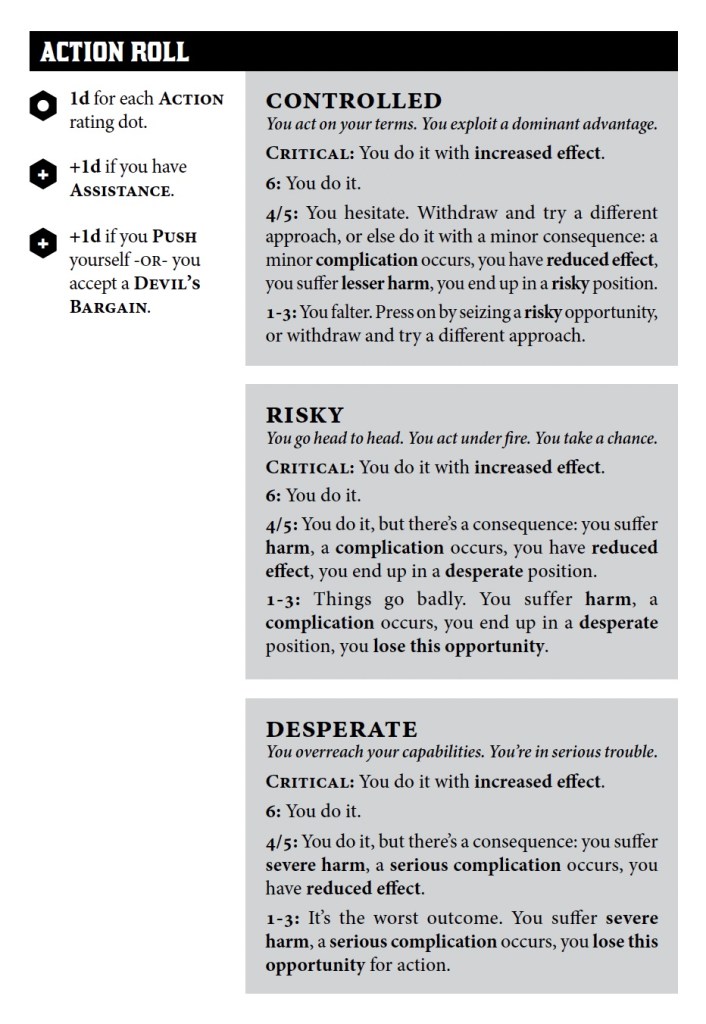
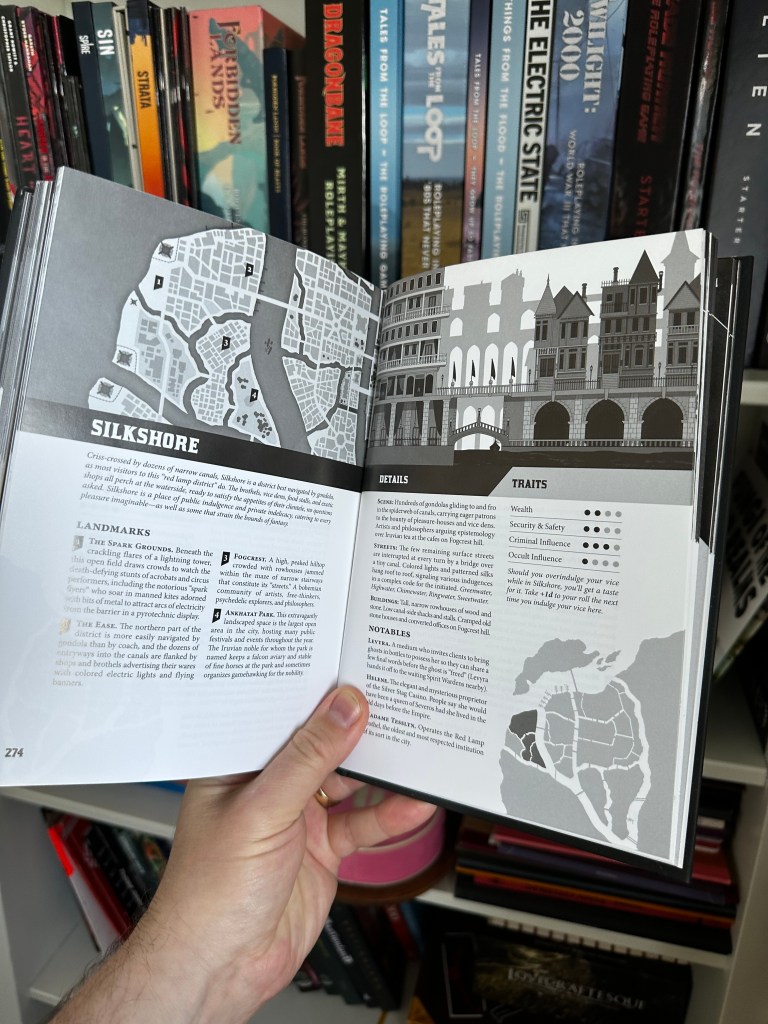
Rules-wise, we found the character sheets incredibly useful. Almost everything a PC might do is described on the sheet. And for most of the other things, they were on cheat sheets which I had printed out for each player. A couple of times I had to look things up. I ran the rules for the Plan Types, the Plan Detail and the Engagement Roll straight out of the book, which was, thankfully pretty easy to do. The main sticking point, for me, was learning how to assign Position and Effect to Action Rolls. It feels like more art than science to me. There are some useful pieces of advice in the book, but it still feels like a process I will simply get used to, like figuring out DCs in D&D type games, or Resistances in Heart. I referred to the two pages below constantly through that first score and I imagine I’ll return to them again and again in coming sessions. Very useful indeed.

Conclusion

Naming the crew was left until after the first score, as per the advice in the book. It seems the ringing of those spirit bells struck a chord with the players because we had three options in the running:

  • The Deathbells
  • The Dead Ringers
  • The Death-knells

All great names, but it was the Death-knells that won out in the end. It’s a good name and one that is likely to put the fear of death in the other gangs of Crow’s Foot, and maybe the whole city of Doskvol in the weeks to come…

Blades in the Dark Player Best Practices

At this point, I’ve dealt, at length, with the GM advice, but what about the players? Surely they deserve a little guidance too!

Yep, they have not been forgotten.

Progress Clock

We started our Blades in the Dark campaign last Wednesday with a character creation session. I had hoped that we’d be able to get down to the first score as well, but it was not to be. Honestly, character creation, although pretty straight-forward, was rather time-consuming. When you have three or four people around a table making decisions on their own characters as they try to form a coherent picture of them in their minds, it can take a while. Add on the collaborative decisions required of them for Crew creation, and you can comfortably double the time required.

Anyway, current progress looks like this:

  • Three of four characters created, an Akorosi Cutter, an Akorosi Hound and a Whisper from the Dagger Isles
  • Crew created: It was a toss-up between Bravos and Smugglers but, with the general vibe of the crew so far, Bravos won out in the end.
  • Decided that their main sponsor faction will be the Crows of Crows Foot.

I’ll get a character creation session with our last player in the next week or so and then we’ll be ready to launch into the first score.

Creating Opportunities

That’s what this game is all about, right? Taking chances, building relationships, gathering information, making your own opportunities. Well, that’s what I’m doing today. Instead of the recap of the first score, I’m using this opportunity to discuss the advice levelled at the players in a Blades in the Dark campaign. At this point, I’ve dealt, at length, with the GM advice, but what about the players? Surely they deserve a little guidance too!

Yep, they have not been forgotten.

Starting on page 182 of the Blades in the Dark book, at the end of the How to Play chapter, we have the section entitled…

Player Best Practices

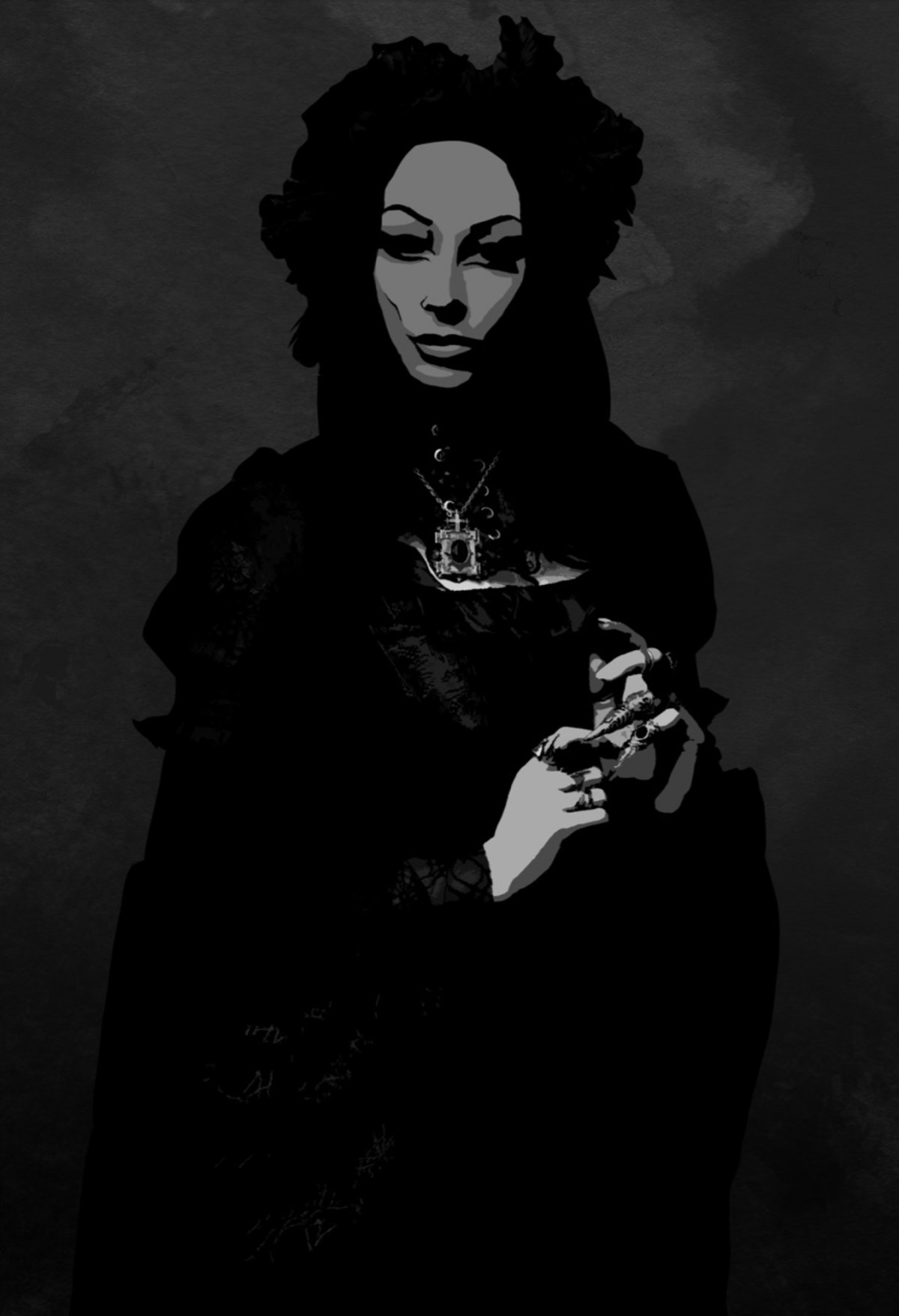
The Lurk, a light-skinned, femme character dressed in a dark hood.
The Lurk, by J Harper

We have a total of eight of these listed here. Not as many as for the GM, but there’s a lot in each one. Here’s what we’ve got:

  • Embrace the Scoundrel’s Life
  • Go into Danger, Fall in Love with Trouble
  • Don’t Be a Weasel
  • Take Responsibility
  • Use Your Stress
  • Don’t Talk Yourself out of Fun
  • Build Your Character through Play
  • Act Now, Plan Later

As usual, I’m not going to go into detail on all of these. This time, I’m going to group them.

Embrace the Scoundrel’s Life + Go into Danger, Fall in Love with Trouble + Don’t Talk Yourself out of Fun

These three best practices all relate generally to the same issue. You, as a player of Blades in the Dark, are not there to play it safe. You are not at the table to make optimised choices. Your character lives in a brutally unfair world and they have become adept at surviving it and even profiting from it. Lean into that! Will they have to make difficult choices that might lead them or their crew to harm? Yes! Will they have to take wildly risky actions to achieve their goals or create those opportunities? Yes! Will they have accept the consequences of their actions, which might include conflict with the highest powers int he city, imprisonment and death? Yes! This is the good stuff, in fact, not the downside. These are the parts of the game that keep it moving forward and allow you to craft scenes of kick-ass action, ice-cold espionage and even heart-breaking tragedy. This is why you want to play. If you’re playing to win, instead of to find out what happens, you won’t get the most out of this game.

Don’t Be a Weasel + Use Your Stress + Act Now, Plan Later

You know, there’s a common thread running through all the best practices for players, to be honest. I think it can best be described as “let go.” You have a say in what happens in the story, of course, but you should not be precious about your character. Push them as far and as fast as you can, drive them like that proverbial stolen car. These three practices are about doing that within the rules of the game. You do stuff by rolling with Actions, not skills. It’s important to choose the right action for the job, even if it’s not your best. That’s where stress comes in! One of your companions can spend stress to help your actions succeed with an assist, or you can spend it to push yourself. It’s invaluable for resisting consequences that would be otherwise inevitable. You can even use it to work in a flashback and do a setup action to get you out of a particularly sticky spot. You will build up the stress, of course. You’re going to have to indulge your vices to shed it or you’re going to find yourself traumatised. That’s where these stories end up sometimes. Your PC might build up a weakness or two, they might be brought to the end of their tale through the extremities of stress. But what a tale it will have been!

Take Responsibility + Build Your Character through Play

Blades in the Dark is a story game. You are telling a story at the table with your friends and you want it to be the best it can be. You want it to have ups and downs, ins, outs and what-have-yous. Dark, tragic, thrilling, horrific comedic, action-packed, whatever you want it to be, you can contribute to it. You have the option to add as much or as little as you like. Some players are going to invent new NPCs, locales, factions, street-vendors, family-members, ghosts, you get the idea. This is all good. But a player’s greatest power to contribute to the story is through their own character. The actions they take, the things they say, these things can add as much to a session as the NPCs invented by the GM, probably far more. Maybe you are already delighted with the general atmosphere and vibe the rest of the table is bringing, so you don’t feel like you need to add too much, you still have a responsibility to your own character, to have them grow from their beginnings into fuller, more alive beings. You start with a “sketch” but, through the actions you choose for your PC, how they comport themselves in various situations, the risks they are willing to take, you’ll make an unforgettable character and story.

Conclusion

The Shade. A floppy-haired dandy in a Victorian gentleman’s clothing.
The Shade, by J Harper

Like I stated above, there is a strong theme across all of these best practices: don’t be boring. In a game like this where the story evolves collaboratively at the table and is not even slightly left up to a published campaign frame or the GM, the choices you make as a player will dictate the sort of experience you have. Be bold, don’t behave.

Blades in the Dark Best Practices and Bad Habits

The bad habits that are listed here are fewer in number but oh so much greater in the size and capitalisation of their headings

It Begins!

Our Blades in the Dark campaign starts tonight! I’m excited. I played in a campaign before but this will be my first time GMing one. I’ve been taking a look at the GM advice presented in the book over the last few weeks. This post examines the GM toolkit in the Running the Game chapter, and this one looks at John Harper’s advice for Starting the Game. Right before starting seems like a good time to internalise the Best Practices espoused by the same chapter of Blades in the Dark, and to beware of the Bad Habits!

Best Practices

Angelic woman with a twinl=kle in her eye and a white bird projected on her dark clothing.
The spirit of best practices. J Harper

We’ve got a list of fourteen best practices for GMs here. Although I’m sure these were written very much with Blades in mind, most of them feel like the kinds of things a GM is well advised to utilise while running a lot of different RPGs. Just take a look at the list:

  • Earn the trust of the group
  • Lead an interesting conversation
  • Create an atmosphere of inquiry at the table
  • Help the players use the game system
  • Don’t block
  • Keep the meta channel open
  • Be a curious explorer of the game in play
  • Advocate for the interests and capabilities of the NPCs
  • Play Goal-Forward
  • Cut to the Action
  • Be aware of potential fiction vs. established fiction
  • Zoom the action in and out
  • Bring the elements of the game system to life on screen
  • Put it on a card

As in the last Blades post, I’m not going to go into each and every point in detail. Some of them are self explanatory. Put it on a card, for instance means exactly what it sounds like: use index cards to record the important things that are invented at the table. Cut to the Action is doing double-duty as both a GM principle and a best practice. You’ll find it listed in the last Blades post too. Keep the meta-channel open means that you, of necessity, have to describe the subtext to the players sometimes, to represent their characters’ full range of senses and intuitions and the like. Help the players with the game system, equally, means it’s your job to interpret their words and plans into a form the mechanics can handle without forcing them to figure it out themselves.

Anyway, you get the idea. I want to take a few that interest me the most and discuss them.

Be a curious explorer of the game in play

Just take a moment to digest that sentence. “A curious explorer.” Isn’t that sumptuous? There aren’t a lot of RPG books out there creating phrases as attractive as that, and I would like us to all appreciate John Harper’s work on it. As pleasing as the phrase is, the sentiment is truly important. Look, you’re the GM; you’d better be paying attention to what the PCs are doing, to what the players are saying at the table, to the NPCs that are being dicked over, or seduced or fucking created during a session, or they’ll come back to bite you in the arse later. But that’s not what this practice means. It just wants you to maintain a degree of curiosity in the events of the game, not because they are important, but because they are fun and interesting. Look up from your notes and index cards every once in a while and breathe it in. Your players and you are building an incredible story together. This is what it’s all about. So, get interested. Ask questions, not because you want to know stuff to prepare for but just because you are curious. Maybe you’ll wonder aloud why a PC is doing something, maybe your curiosity is to do with their choice of decor for the lair, maybe its just because they gave that one NPC a stupid nickname and you don’t know why. Doesn’t matter, just stay interested.

Play Goal-Forward

This is the practical side of the question-coin. It’s nice to think this game is all about the players after the initial stages. The idea is to get them to form their own ambitions for characters and crew, come up with their own scores, fulfilling their own whims and get into and out of their own trouble. But, if my experience as a GM is anything to go by, this can take a little cajoling. So, this practice says, lead that conversation. Get them thinking about their goals, not just in the moment, on the score, during their downtime, whenever, but also, on a long-term, grand scale. Yes, you need to know what their goal is when things begin to turn to shit on a score, they’re up to their ears in ghosts, the Bluecoats want their blood or their lair was just blown up by the Lampblacks. But if you get the players to tell you what they really want to be when they grow up? That’s gold. And make sure you check in to find out if their ambitions have changed from becoming the greatest electroplasm smugglers Duskwall has ever seen to just base survival because every score they have attempted has gone south and enemies are at the gates.

The pursuit of opportunities and positions to enable certain approaches, the acquisition of information and resources, and the nested conflicts that result will drive the action of the game.

This is what you want to get to. If you understand the opportunities they want to pursue, the actions they might take to unlock them, then you can better facilitate them and the effects will help build the game.

Harper repeatedly refers to the game as a cool tv show that you’re invested in. You can be invested in what happens to the characters and the city from the viewpoint of the audience but you are also in the enviable position of being able to help shape the story as a showrunner.

Be aware of potential fiction vs. established fiction

A city street in almost complete darkness. Vague outlines and sparse lights are all that describe the type of location it is.
Describe wht you need to, discard the rest. J Harper

You’re not taking the PCs on a tour of every room of your house. The PCs should be more like viewers watching an edited sequence of shots that carry them forward in the action of the game

We’re still talking about the game as a tv show then. Cool. I like it. It’s a little confusing, though, that this practice is about keeping details of the fiction nebulous until they need to be concrete. I suppose a good way to continue the analogy is to say that we begin a scene with a close-up on the darkly wrapped faces of our scoundrels, and, as the players ask questions or the GM makes decisions, the camera pulls away, revealing the canal-side they are standing on, then further out to show the line of moored canal boats. Then we follow the crew across the decks of the gathered boats as they rock and the occupants cry out. As they go, the players might ask if there is any rope on the decks to allow them to climb on to the bridge and you tell them there is. Meanwhile you fill in some more details, the twitching of curtains in the surrounding windows, the scuffling of feet from the nearby alleys and so on. Layers and layers of details. Harper calls this the potential fiction cloud. You pick them out as you build the scene and they gain concreteness, they become the established fiction. But you never need to establish absolutely everything. Instead, you yell “CUT,” and move on to the next scene, starting over again with a new potential fiction cloud.

GM Bad Habits

A man with a devilish face or mask points at us.
The demon of bad habits identified you as naughty! J Harper

The bad habits that are listed here are fewer in number but oh so much greater in the size and capitalisation of their headings:

  • DON’T CALL FOR A SPECIFIC ACTION ROLL
  • DON’T MAKE THE PCS LOOK INCOMPETENT
  • DON’T OVERCOMPLICATE THINGS
  • DON’T LET PLANNING GET OUT OF HAND
  • DON’T HOLD BACK ON WHAT THEY EARN
  • DON’T SAY NO
  • DON’T ROLL TWICE FOR THE SAME THING
  • DON’T GET CAUGHT UP IN MINUTIA

It is hard to avoid the conclusion that it is more important to ensure you don’t develop these bad habits than it is that you adhere to the best practices above. Let’s look at a few that I think I might be most susceptible to and see if that’s true.

DON’T OVERCOMPLICATE THINGS

It’s a heist. Or maybe an assassination attempt. Possibly a smuggling operation. There should be complexities to it! There should be bribes and double-crosses and traps and security systems and hidden lookouts and maybe a jilted lover or two. Right? Not necessarily. Its fun to introduce new narrative complications and consequences on a 1-3 or a 4/5 roll, of course, but not at the expense of the session’s pacing, or the players’ patience. You can’t be expected to come up with that stuff all the time. There are mechanics in place to help you deal with them quickly and in keeping with the spirit of the game. So this section is telling you to use the tools you have been given. If you can’t think of a new complication, just hit them with harm or tick a clock forward or slap some more HEAT on them. Keep it simple, stupid!

DON’T HOLD BACK ON WHAT THEY EARN

I have the potential to be stingy. After all, there is a lot they can do with Coin in Blades in the Dark. You can use it improve Downtime Projects, to reduce HEAT, to advance Crew Tiers! I could be the kind of GM who wants to limit their progress, to slow the pace. But John Harper says give them the money. He wants us to remember that they should get what they earned. After all, they have it hard enough as it is. And besides, they’re likely to have to spend it before it even has a chance to enrich their pockets.

My main observation here is that, in all likelihood, the GM is the one setting the Coin value of any given score. The PCs, of course, are free to accept or reject opportunities depending on how lucrative they are, and they will have to take the heightened risk associated with bigger paydays, but still, its up to the GM, in many ways to establish how much a given sort of score is worth. If I wanted a low scoring campaign, I could start off with big scores netting no more than 4 Coins and most average ones paying only 1 or 2. Of course the opposite is true too. And I guess Mr Harper wants us to lean that way.

I appreciate more the admonition to treat secrets and information the same way. If the PCs have earned the info, don’t hold back. Only new opportunities and a deeper investment in the world on the part of the players can come from the sharing of secrets. Bring them in on it! They’ll love it.

DON’T GET CAUGHT UP IN MINUTIA

Let’s keep thinking about this in terms of a television show. Sure, there might be some shows where an eye for detail and a quick thumb hovering over the pause button is rewarded, but usually, you can rely on directors/editors to skip from one location and situation to another without the need to dwell on every twist and turn on the way. Get to the good stuff. Speed through the opening credits, jump to the negotiation or the shoot-out or the incursion into the ghost field.

Although it’s not mentioned here, I believe it’s also important to combine this warning with the lesson to be aware of potential vs. established fiction. You want to try and hit that sweet spot where you have given the players enough details of a location, person or scene to allow them to make decisions without getting bogged down in unnecessary levels of photo-realism. Allow the imaginations of the players to fill in the blanks instead.

Conclusion

Look, it’s pretty obvious that if you occasionally forget to be a curious explorer of the game or sometimes stray into the weeds in describing minutiae, you’re not going to break your campaign. But it sure is nice to have these guide-rails to help us make the best damn dark victorian horror heist game we can! Both lists are incredibly useful and I’m sure to be referring back to them every once in a while as the campaign gets under way.

Next time

In my next Blades post I’m going to do a sort of post-mortem of our very first session! Watch this space, dear reader.

Blades in the Dark GM Tools

I’ll be honest, I don’t usually think about the games I run in terms of goals, beyond a vague desire to do my best to GM competently, engage the players and make them entertaining.

Good Advice

So, like I said in my last Blades in the Dark preview post, this book is full of great advice. Today, I’m going to take a closer look at some of the advice for GMs that is not directly related to the first session or two. This is the sort of thing that will help you create the best version of your game at the table every session.

GM Goals

I’ll be honest, I don’t usually think about the games I run in terms of goals, beyond a vague desire to do my best to GM competently, engage the players and make them entertaining. Many of the other games I’ve played don’t deal in these terms at all, but I find I appreciate the project-like manner Blades employs here. It’s good to state your goals before embarking on any sort of initiative, otherwise, how do you know if you manage to achieve them? What do you use to steer your efforts?

Here are the GM Goals as stated in Chapter 7, Running the Game:

  • “Play to find out what happens.” This is the primary guiding principle. A concept that was introduced by D. Vincent and Maguey Baker in Apocalypse World, “play to find out” is central to Blades in the Dark. The idea here is that you have no set narrative in mind, no list of occurrences that you’re waiting to introduce to outfox or defeat the PCs, no plan at all. Instead, you let the PCs lead the way. Their own plans, desires, vices, mistakes etc. will drive the story forward in a way you could never have imagined beforehand. The GM here is just as “in the dark” as the players are about what’s coming.
  • “Convey the fictional world honestly.” Honestly, I am struggling with this one. The advice here is to “make the world seem real, not contrived.” Of course, this is a reasonable suggestion, but much more difficult in practice, I imagine. It pre-supposes this “vision of Duskwall in your head.” But, in a game where the GM is largely just reacting to things the players invent or decide, the vision is probably changing constantly. You’re told here, though, “don’t play favourites,” as well, so I begin to see the purpose a little clearer. The idea is that, as GM, you should not be inventing elements of the world that exclusively benefit just your NPCs, or explicitly disadvantage the PCs in ways that seem unfair. I suppose it could also refer to a tendency some GMs might have to treat certain PCs better than others. Resist that urge! Play fair!
  • “Bring Doskvol to life. Give each location a specific aspect (crowded, cold, wet, dim, etc.). Give each important NPC a name, detail and a preferred method of problem solving (threats, bargaining, violence, charm, etc.). Give each action context—the knife fight is on rickety wooden stairs; the informant huddles among the wreckage of the statue of the Weeping Lady; the Lampblacks’ lair stinks of coal dust.” I wanted to quote this whole paragraph because it is filled with practical, actionable advice that I would struggle to paraphrase. I have to say that this is a reasonable goal for any RPG, not just this one.

GM Actions

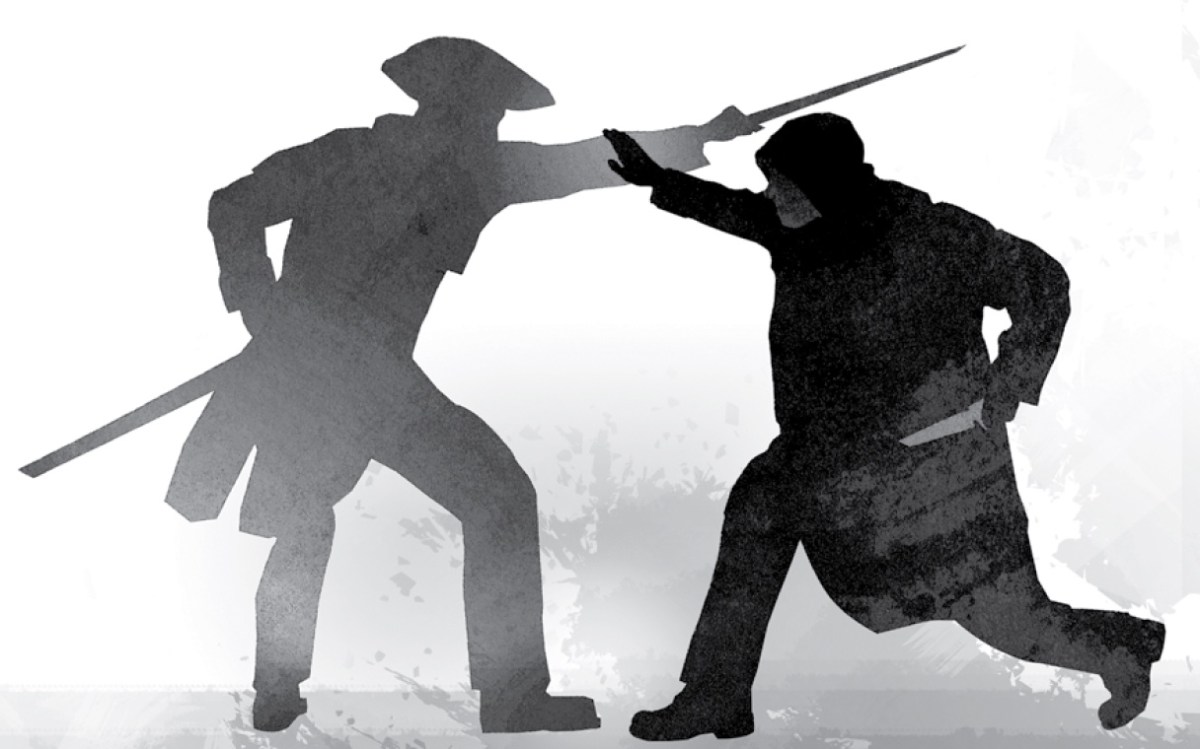
Two dark silhouettes having a knife fight. The dark city streets are portrayed within their shadows.
Knife-fight City – J Harper

So this is one of the ways in which you, as the GM of Blades in the Dark, can endeavour to achieve your goals. I guess these are the story-game equivalent of an OSR GM’s Random Encounter tables, weather and misfortune tables and hex maps. Essentially, when it’s your turn, you can look at the list of GM actions and choose one to keep things interesting.

  • Ask questions
  • Provide opportunities & follow the player’s lead
  • Cut to the action
  • Telegraph trouble before it strikes
  • Follow through
  • Initiate action with an NPC
  • Tell them the consequences and ask
  • Tick a clock
  • Offer a Devil’s Bargain
  • Think off-screen

I like that these are presented as moves. These are all the types of things you might do a GM in any game to spice things up, to introduce complications if its all going a little too well, if the game is getting stale. But, in other types of RPGs, they aren’t treated like the action you get to do on your turn, in fact, they are rarely dealt with at all.

Now, I’m not going to deal with each and every action here. Some of them speak for themselves and their purpose is obvious. For instance, “Ask Questions,” is very broad, but I think its fairly clear that it can be used in almost any situation to gather information, provoke actions, or even get the players involved in creating situations and the world. “Cut to the action,” is a great way to take the reins briefly to prevent plan-spiralling or similar. But I do want to look at a couple of these a bit closer:

Provide opportunities, follow their lead

This is how “play to find out” works in practice. You can’t simply allow the players to create their characters, tell them a bit about the city and ask them what they want to do. I mean, you could, but they will proceed to have a million questions. The starting situation is designed in such a way as to provide the opportunities ready-made for them, but from that point on, it’s up to the players to find them. It’s the GM’s job to present them according to how the PCs went about it. So you follow their lead. If they go scouring the underworld for leads, they might hear of a secret cache of electroplasm in a poorly guarded warehouse near the docks, but it might be inferior quality information. Or, they might read about a prestigious visitor from the Iruvian embassy with a price on their head attending the opera form a report in the newspaper. They might take very different approaches to find these opportunities and it’s up to the GM to provide what’s appropriate.

Sometimes, though, the players will come up with an opportunity all of their own. Maybe their efforts were stymied by a rival crew during their last score and they’re looking for revenge. Maybe they want to expand their criminal empire and have an idea for a score against a gang in another district. Same thing, in this case, it just saves you the trouble of inventing the opportunity yourself.

This section also provides practical tips on how the players might handle these things mechanically, what difference the crew’s heat and resources make to this process and even a step by step guide to what constitutes an opportunity.

Think offscreen

This action makes you spin some more plates than you already are as GM, but it is useful to think about. Basically, the idea is to bear in mind what is happening elsewhere that might have consequences for the action of the current scene. Maybe there is a riot happening nearby and it’s getting closer, maybe the Bluecoats are out in force on patrol tonight, maybe there are some errant ghosts in the area that might want to get involved. This is the sort of thing I do tend to forget about when GMing normally. It generally feels too much to introduce another element to an encounter in a lot of games. But in a story game like this, you want complications, and, more importantly, you want to see how the PCs deal with them. In all likelihood, they’ll have to do something that drives the story forward even more!

GM Principles

A man in a high collar holding a skull in black and white
“I knew him, Horatio” – J Harper

This is the second set of tools for you to use to achieve those GM goals. If you play with these principles in mind at all times, you should get the most out of your experience GMing Blades in the Dark:

  • Be a fan of the PCs
  • Let everything flow from the fiction
  • Paint the world with a haunted brush
  • Surround them with industrial sprawl
  • Address the characters
  • Address the players
  • Consider the risk
  • Hold on lightly

“Paint the world with a haunted brush” and “surround them with industrial sprawl” are specific to Blades, in that they are concerned with describing the city and the situation in the appropriate vibe and tone. “Be a fan of the PCs” has become a standard piece of RPG advice but it is important, for sure. I’d like to go into more detail on two of these:

Let everything flow from the fiction

You don’t need to “manage” the game.

It can be hard to let go. Especially when you have been raised on a strict diet of stat blocks, challenge ratings, 6 second rounds and proscribed consequences. But much of the advice in this chapter is encouraging you to do exactly that. Stop planning. Nothing good can come of it. You have to let the story flow naturally from the actions of the players and the reactions of the world. In Blades, after the briefly described starting situation and opening scene, every element of the campaign should cascade down from there.

Hold on Lightly

This is not a “no take backs” kind of game.

When thinking about the PCs approach to a situation, remember that goal of portraying the fictional world honestly. If you do that and are forced to rethink how you described a scene, that’s fine, you can go back and retcon it. Maybe you first introduced them to a room crowded with ghosts, but, on reflection, considering how the players told you they spent time staking out the room as an entrance to a hideout, beforehand, you decide there is just one, lonely spirit, there. Not only that, you should not be afraid to allow the players the same sort of leeway when describing their actions.

Next time

In the next preview post, I want to write about the GM best practices and bad habits as presented by Mr Harper in the book. Till then, dear reader!

Beginnings in the Dark

I want to start by acknowledging that I think this entire section is fantastic. It’s full of gold. The advice presented here is the kind of thing I would love to see in every game.

My Own Advice

In my post on beginnings I suggested a few things. It’s a good idea to start in media res. Starting in the middle helps to introduce the world to your players and helps them to introduce their characters to the world, assuming you give them enough narrative freedom to do so. I suggested using flashbacks to fill in blanks as necessary. But I also suggested that, for a longer game, you might want to begin with some in-depth scenes of the PCs’ personal lives to give everyone a good idea of what drives them.

So, how does this hold up to the advice provided by John Harper in Blades in the Dark?

Starting the Game

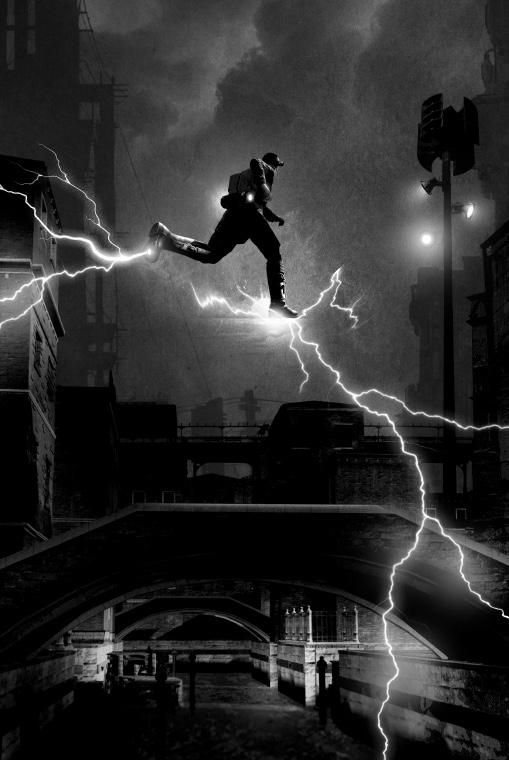
A leaping scoundrel in black and white.
A leaping scoundrel in black and white by J Harper.

That’s the name of the section under the Running the Game chapter in the book. No confusion. I want to start by acknowledging that I think this entire section is fantastic. It’s full of gold. The advice presented here is the kind of thing I would love to see in every game. It was definitely the kind of thing I wanted from Spire before beginning it. I was so anxious about starting that game because I really was flying by the seat of my pants. Why? Well, because I had never played anything like it before. And in Blades in the Dark, Harper is perfectly aware that you’ve probably never played anything like this game before. So he takes your little hand and leads you gently into Duskwall, nodding reassuringly and telling you it’ll be alright.

Preparing for the First Session

A map of the coastal city of Doskvol which includes the names of each of the districts.
A map of the coastal city of Doskvol

Under the sub-heading, Preparing for the First Session, you get the advice to read through the character and crew creation sections again, assuming, I suppose, that you read them already. Here, it’s recognised that the GM is going to be the one leading on this and advising the players on how to create those scoundrels they’ve got in mind. Of course, this is good advice for any GM-led game but it’s good to have it in black and white here. Related to this is the fact that during these processes, the players are going to need answers about certain factions that will be relevant to their characters and the starting state of the city. So, you’re advised to pick a few factions you’re interested in or brush up on the ones mentioned in the starting situation, “War in Crow’s Foot.” To add to this, personally, I think you want to brush up on some of the factions, personalities and organisations that affect the entire city, like the Bluecoats, the Sparkwrights and the Spirit Wardens. You don’t need an exhaustive knowledge, but the basics will be helpful to allow you to answer some world-building questions, even if they’re not directly related to their characters or crew.

Harper states here that you should get through character and crew creation and, at least start the first score in your first session. This sets an expectation and, trusting that he has play-tested this a lot, its one that you have to assume is realistic. I also like the idea of taking these freshly minted scoundrels and throwing them straight into the action. I guess my in media res advice remains solid here.

There’s a short paragraph about what you can do to get yourself in the dark industrial fantasy mood of the game. Watch some Peaky Blinders, play some Dishonoured or read some Fafhrd and the Grey Mouser. I like this idea and it is something I do regularly to get me thinking the right way for an upcoming game with a very specific vibe.

Lastly, print out the character sheets and other reference sheets and get the gang together.

The First Session

A dark black and white illustration of several scoundrels on the canal, lit by a giant moon above.
Midnight on the Water, J Harper

The next section is entitled, “At the First Session: Setting Expectations.” This is always important. There are some formalised techniques to achieve this, of course. One of these is C.A.T.S. (Concept, Aim, Tone, Subject matter.) You can describe the type of game you’re going to play using CATS and, hopefully, that should help potential players to decide if they want to play it or not. Honestly, by the time you gather at the table, players should already be familiar with this stuff and know what to expect from your game. So this is not really what Harper is trying to achieve here. Instead, he’s trying to get you into, as he calls it, “let’s play mode.” He suggests a “punchy synopsis of the game” like this:

Okay, so you’re all daring scoundrels on the haunted streets of Duskwall, seeking your fortunes in the criminal underworld.

This is something I also love to do when starting a new game. I often take the blurb from the back of a book, or the summary from the first page and read it aloud, or paraphrase it to get the players in the right frame of mind so I would go further and remind them about what sort of dark, broken, victorian world this is, what the stakes are and the types of things they might be called upon to do.

Then continue:

Let’s make some characters and form a crew! Here are the playbooks. They’re the different types of scoundrels you can play. I’ll summarize them and then you can choose…

Harper goes on that the advise you to keep your explanations and rules-talk to a minimum at this stage. Introduce the players to concepts and answer questions but don’t get lost in the darkened alleys of Doskvol just yet. Instead, give a loose outline of the various playbooks and crew types, just enough to pique your players’ interests while they look through the options.

He then suggests saying something more like a sales-pitch at this point. The speech he includes in the book is real hearts-and-minds stuff,

This is a game, but it’s also something else—something really cool and unique. We’re gonna collaboratively create fiction together, by having a conversation about these characters and situations, without anyone having to plan it out or create a plot ahead of time. It’s like our very own TV series that we produce but we also get to watch it as a viewer and be surprised by what happens. You’ll say what your characters care about and what they do, and I’ll say how the world responds and just like that, a story will happen. It’s crazy. And fun.

I like this but I think I’d definitely come up with my own spiel. It’s just not me. I would definitely use this though:

play your character like you’re driving a stolen car.

Creating Characters and Crew

An Eldritch ball of light being released or cpatured by a crouching person in the foreground. Several scoundrels with a lantern in the background.
Eldritch light. J Harper

While the players work on their PCs, this section provides a set of questions to ask them. The text here does not suggest you ask all of the questions or that you ask everyone the same questions, or even that they should answer them out loud. Although I think I would try to get answers for at least a few of these to help me in making decisions as the game builds.

Here is a selection:

  • Why did you become a scoundrel?
  • The two of you have the same heritage. Do you want to be blood relatives? Do you know each other’s families?
  • When was the last time you used your blade? Why?
  • Who do you trust the most on the crew? Who do you trust the least? What’s that about? Or will we find out in play?

Harper points out here that we don’t need or really want to know everything about the characters before starting. A lot of the fun of playing a character is discovering them as you play, of course. The dynamic nature of Blades in the Dark and the degree of influence PCs can have over the world and, more importantly, the story, makes this particularly true of this game, from my experience.

You want the players to want to play their characters and to be excited about it. So Harper asks you to make sure, if anyone is not that enthused or is maybe frustrated by the process or any lack of detail that you spend a little time getting to the bottom of their dissatisfaction, providing more info if they need it, until they’re happy. You can also remind them that, if any of them find, after a few sessions that they wished they’d made a different choice here or there in character creation, then they can make the change, “no big deal.” An enlightened and realistic approach, I think, to what is, after all, just a game.

Once they reach the crew creation stage, they’ll have questions for you about the factions I mentioned earlier.

who gave them their hunting grounds, who helped with their upgrades, and who’s connected to their contact.

So, you’ll be happy at this point that you did that reading earlier. The advice here is, again, to use the factions in the starting situation to save yourself some work and associate the crew with the occurrences. This section ties things up by suggesting you skip crew creation for a one-shot, allowing the crew to develop organically during play instead.

Introduce Characters & Crew

Finally, it comes to the point the players will have been waiting for. They get to show off their cool new guys, their wee scoundrels! You get to use this to ask each player a few more questions to help clarify things or to get them thinking about how their PC might develop in play.

Some good advice here on how they should come up with their crew name. Even though they just put in a lot of work on crew type, upgrades, special abilities etc, the name can be elusive. So Harper suggests they leave that until after their first score at least. A suitable moniker is likely to come out of that.

The Starting Situation

A cityscape type view of Crow's Foot
A cityscape type view of Crow’s Foot

I love this bit the most. You could potentially run Blades in the Dark games over and over again for years, one campaign after another, and use this same formula for your starting situation, and it would never get old:

  • Set two factions directly at odds, with opposing goals. They’re already in conflict when the game begins. Both factions are eager to recruit help, and to hurt anyone who helps their foe.
  • Set a third faction poised to profit from this conflict or to be ruined by its continuation. This faction is eager to recruit help.

And that’s it. It’s not overly convoluted. Three factions and their goals shouldn’t be too much to burden the players with and there should be plenty of potential in the situation. “Keep
it simple at first—things will snowball from here.”

The main thing is to give them something to do right off the bat, rather than asking “more creative work” of them. Once again, I love this. This is the sort of advice I wanted when I first ran Spire. Instead, I think I left my players floundering right at the beginning, without a clear idea of what they should pursue straight away. We ended up really enjoying that campaign but it always involved an awful lot of talking about what they were going to do next, planning that thing and then changing minds and starting over. And I think that’s because it never recovered from that first session, and its lack of direction.

The Opening Scene

Now you get into the nitty-gritty. This is practical advice that I really wanted. What should that first scene look like? What should you give the players here? What kind of thing is being asked of them? What if they don’t want the jobs that are being asked or demanded of them?

The most important lesson I am getting from this section is that the ball is in the PCs’ court. You need to give them a decision to make and they need to make it right now! Whatever happens, they are going into their very first score right away. No hanging about, no ifs, ands or buts. Love it.

Conclusion

The section ends with an example starting situation, “War in Crow’s Foot.” I’m not going to go into it because I might just use it. But I can tell you that its exactly what I’m looking for here. It’s a concrete example of the way the GM gets things started and how you can hand it over to the players. It’s got sample scores from different NPCs and advice on how to play those NPCs too.

Having read this whole section and followed some or all of its advice, you should be more than prepared for the crew’s first big score.

Time for a Choice

From each genre, I’ll take a look at the games, their appeal, and, of course, their character creation posts to eliminate some. Hopefully, once I’ve done that, I’ll be able to come to a well-informed decision.

Decisions, Decisions

So, the characters have been created, the conclusions have been drawn, I am as familiar with the 7 games on offer as I’m going to get before actually playing them—its time to make a decision.

Before getting to that, though, I think it’s worth pointing out that this is, far and away, the most effort I’ve ever put into a decision of what game to play next. Since starting to write this blog I’ve spent a lot of time and not a little cash on new games. I’ve never had so many to choose from before. And I’m not even including the ones I’ve only got in PDF form. Long ago, as a teenager, I actually did run a variety of games; AD&D, of course, but also Gamma World, TMNT and Other Strangeness, Beyond the Supernatural, Robotech, Shadowrun. Back then, I just wanted to run the newest thing, the shiniest game, whatever had the bulk of my attention. But, I didn’t have so many to choose from, of course. There was no such thing as buying a game and never running it! I didn’t have that sort of money! These days, we are living in a golden age of tabletop games. There are so many RPGs of so many genres, utilising such an array of play styles and rulesets that it can be bewildering, overwhelming and paralysing. So, as I sail out of my majority-D&D era, navigate my way through the OSR and explore the unknown waters of the story-game, I have found this process incredibly helpful, if time-consuming. It has also been educational, interesting and fun. But there’s another aspect to this too: whatever game I choose, it’s one that my players and I will be with for weeks, hours of play and hours in between sessions thinking about. I want that to be good, or, hopefully, great!

The Competition

There are seven games to choose from, as laid out back in the original post. I could just take them one by one, as I did when writing their character creation posts, but, instead, I will separate them into genre groups. From each genre, I’ll take a look at the games, their appeal, and, of course, their character creation posts to eliminate some. Hopefully, once I’ve done that, I’ll be able to come to a well-informed decision.

Supernatural Investigations

We’ve got two games in this genre (I suppose this is more a of a sub-genre, but heigh-ho, it’s my blog-post.)

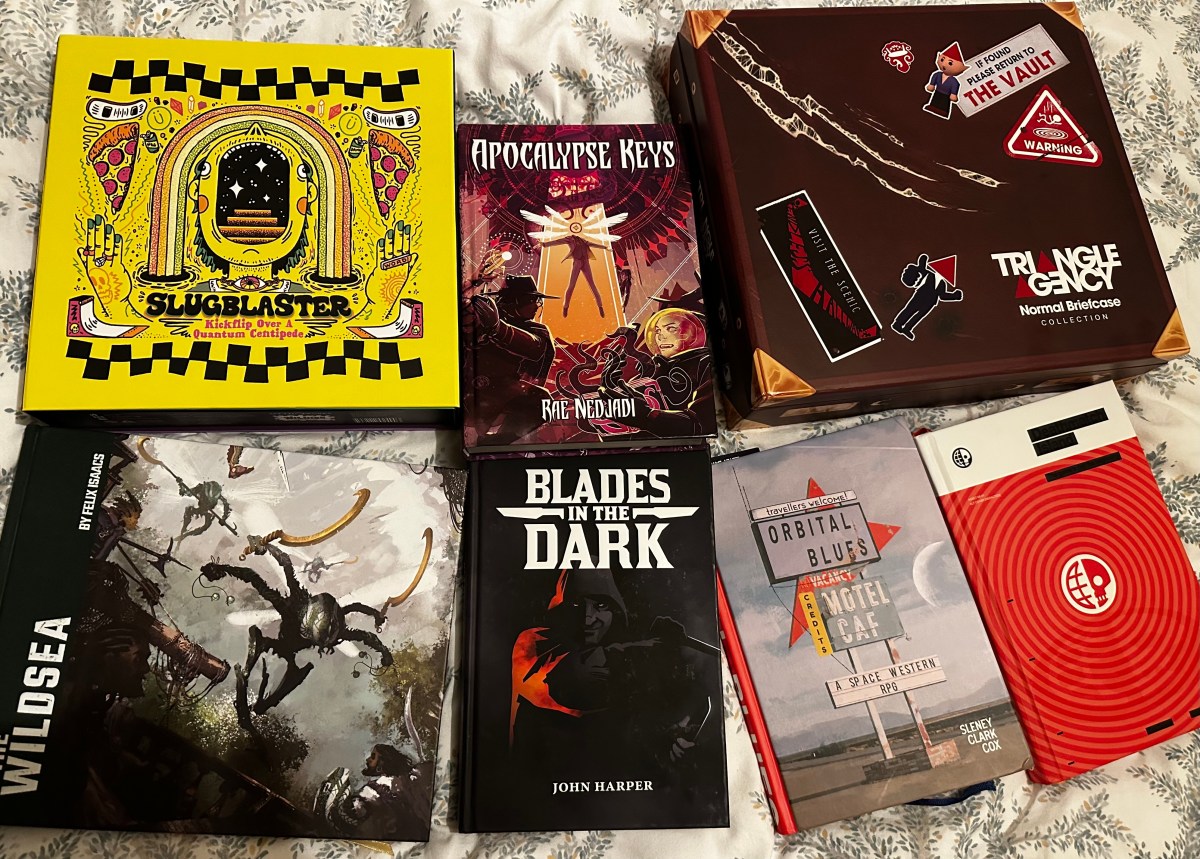
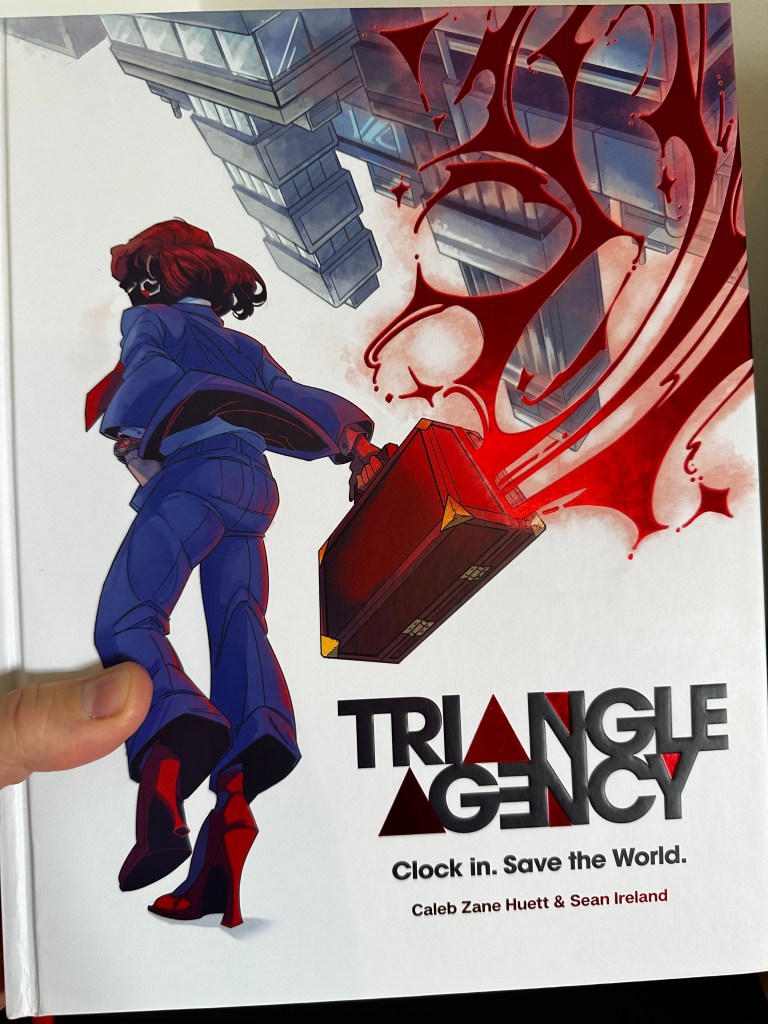
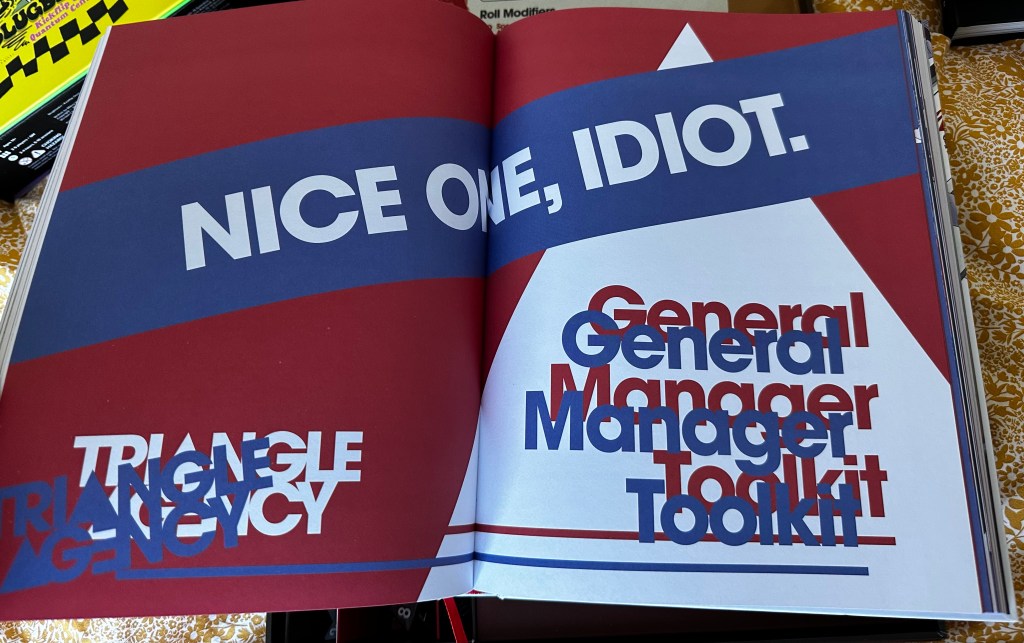
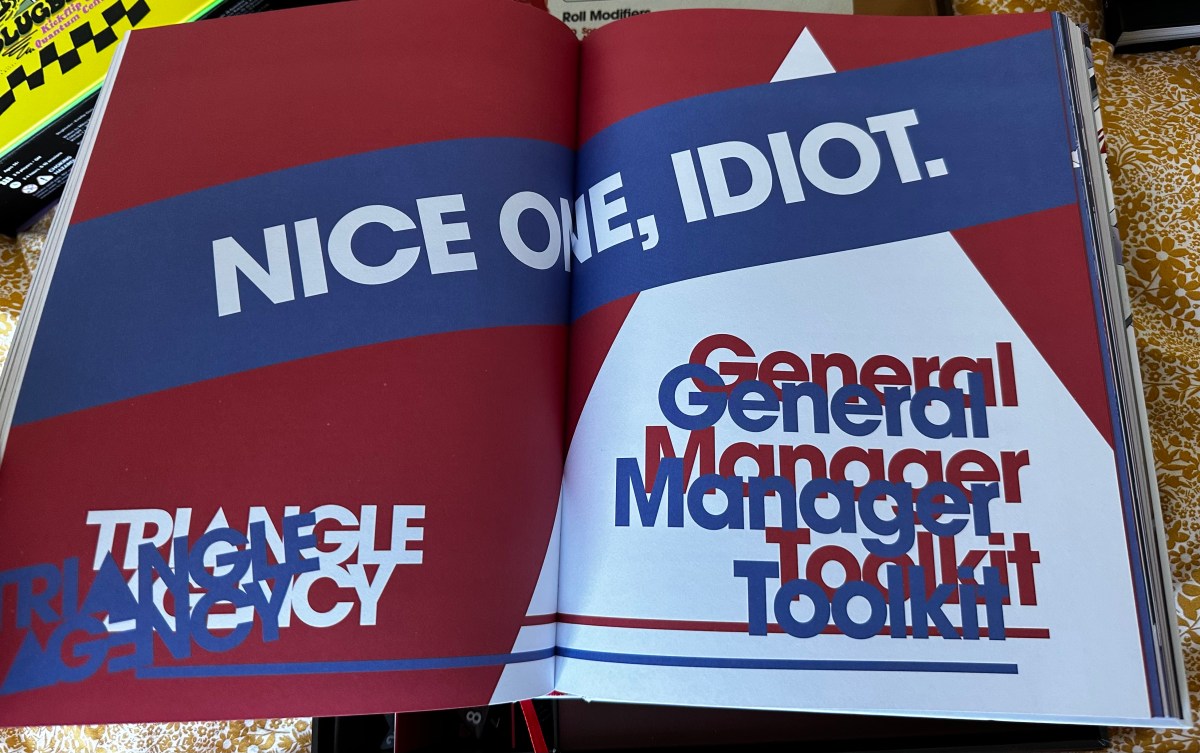
  • Triangle Agency – this was the first character creation post I made as part of this series. I think, at the time, that was because it was the game I was most interested in. It didn’t hurt that it came in a very impressive box. The presentation is altogether impeccable. This applies also to the text itself, which styles itself as the manual to a game to be played by actual agents of the Triangle Agency. The character creation process taught me a lot about how the game would be played and was particularly successful at making, not just a character, but a personality, history and motivation.
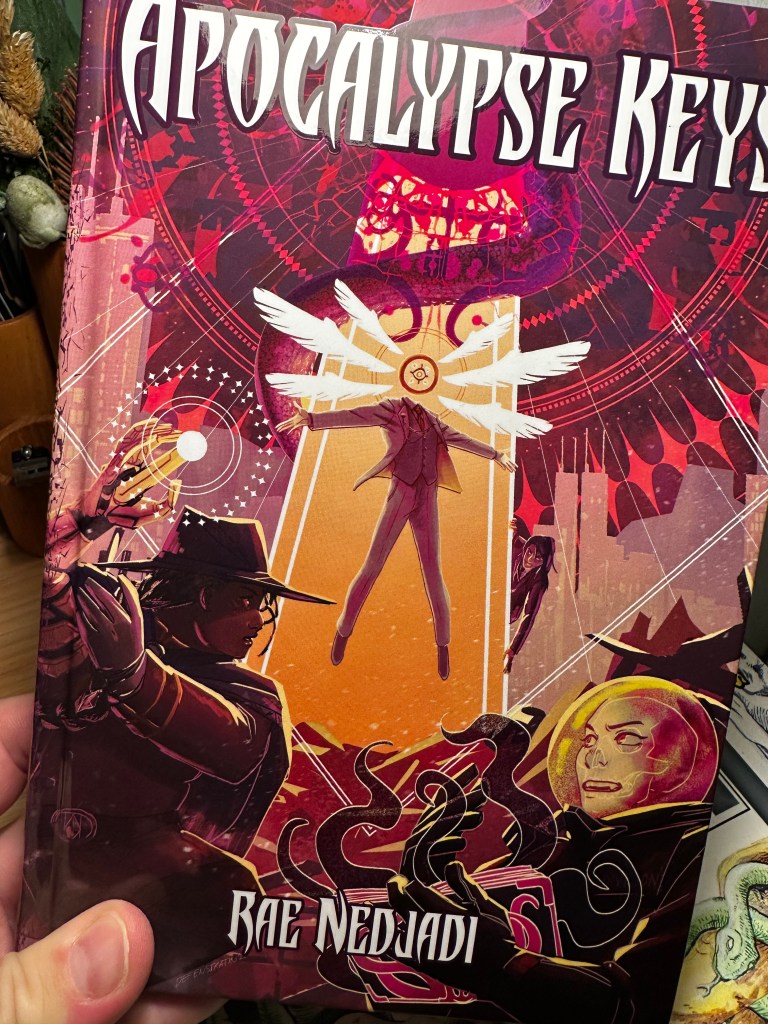
  • Apocalypse Keys – this, was the last of the character creation posts I did. I’m going to cut to the chase with Apocalypse Keys; I don’t think it’s for me. It might suit some of my players, but not others. I would rather the Triangle Agency’s tongue-in-cheek take on the genre than the melodrama inherent in Apocalypse Keys.

Triangle Agency wins!

Fantastic Voyages

I’m stretching the term ‘genre’ here once again. But I’m adding two games to this one anyway. Both of these involve ship creation as part of the character creation process, and a crew of misfits to go with it.

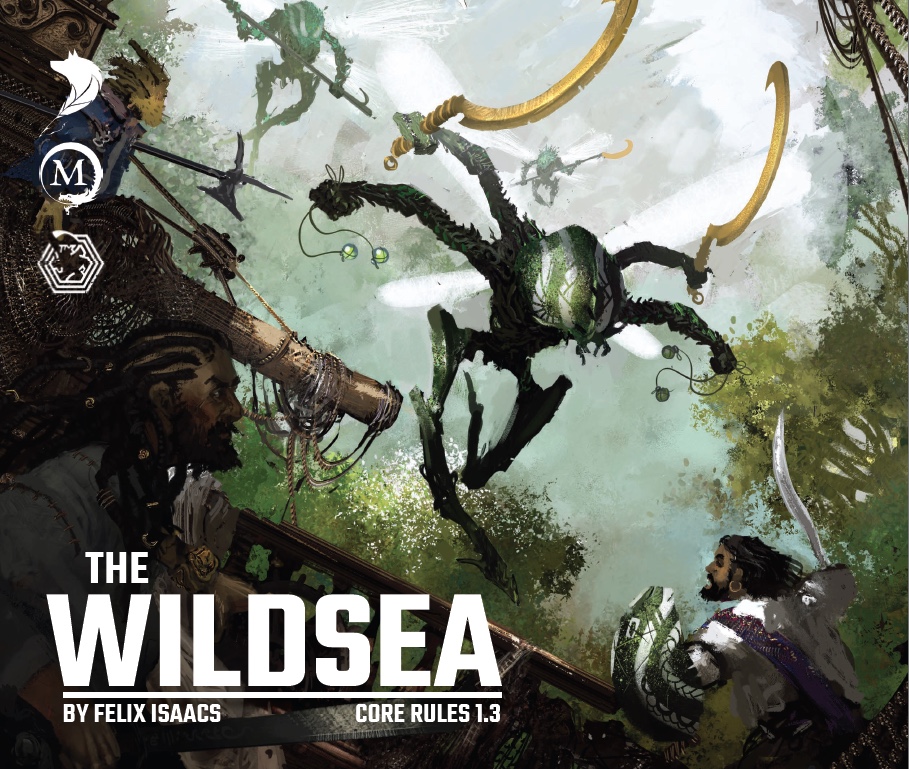
  • The Wildsea – Its got a fascinating setting, a rich and engrossing vibe and a beautiful presentation. This is very much a fantasy game that’s determined to get you into trouble out on the emerald waves of the Wildsea. You will spend a long time making your character, as evidenced by the length of my character creation post. There are many, many choices to be made at every step and that doesn’t even take into account the ship creation process. For the campaign I’m imagining, a maximum of about ten sessions, I feel like this is too much. I’d rather spend the time playing than making Wildsailors. But, its definitely one that I might return to someday.
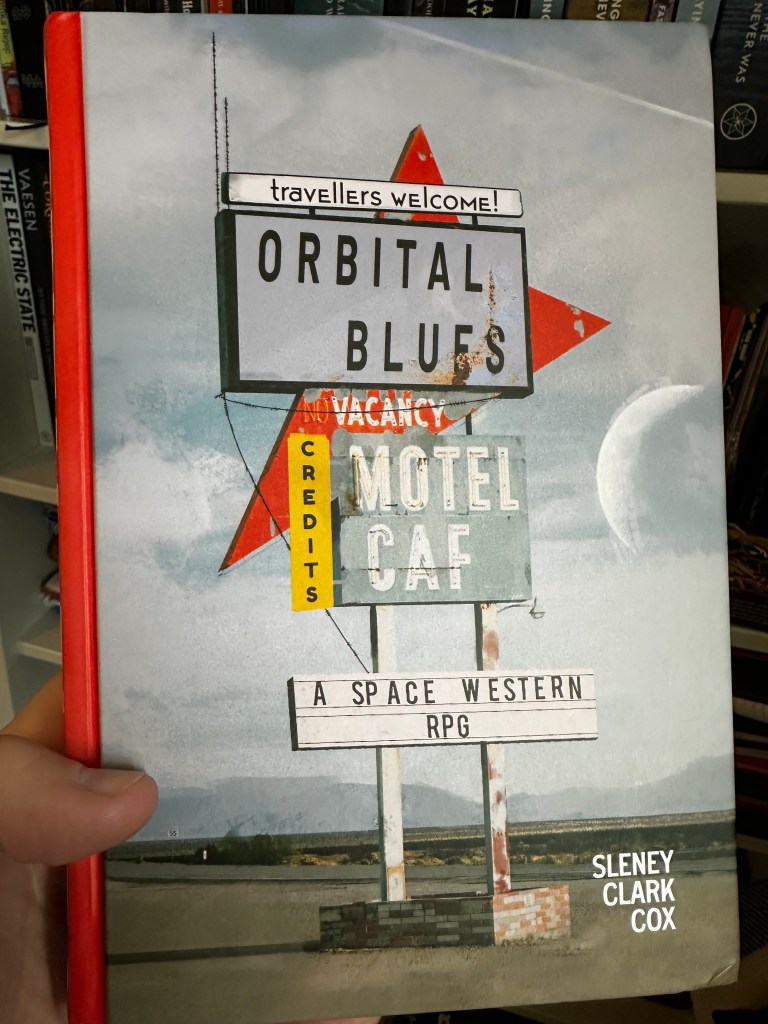
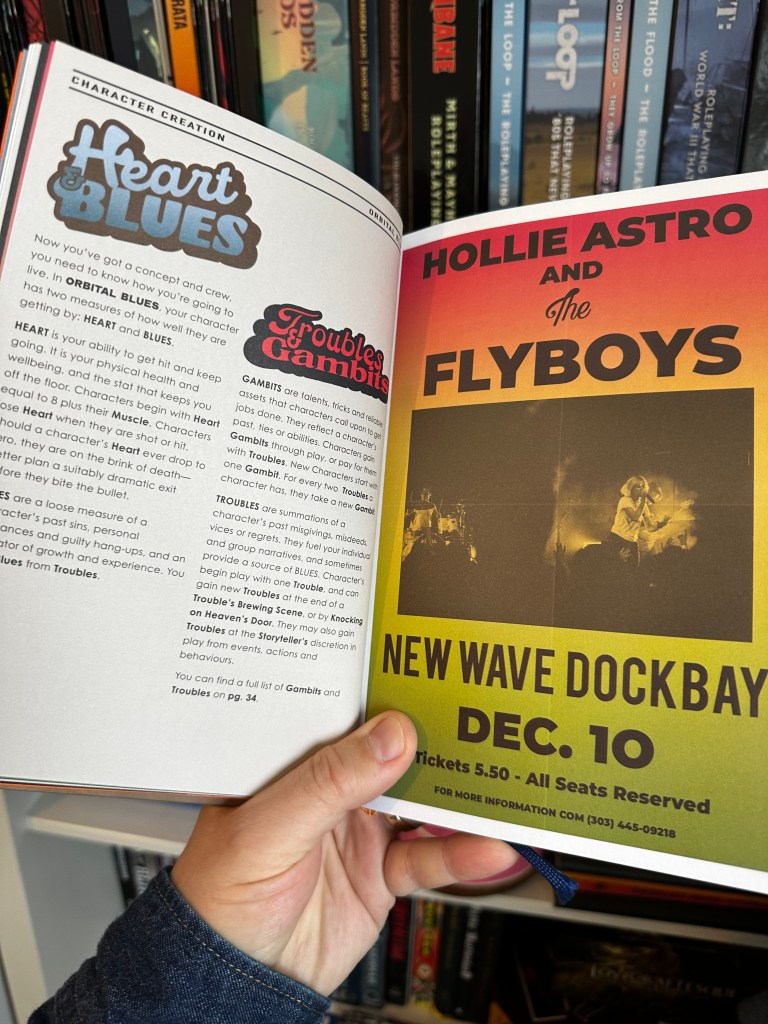
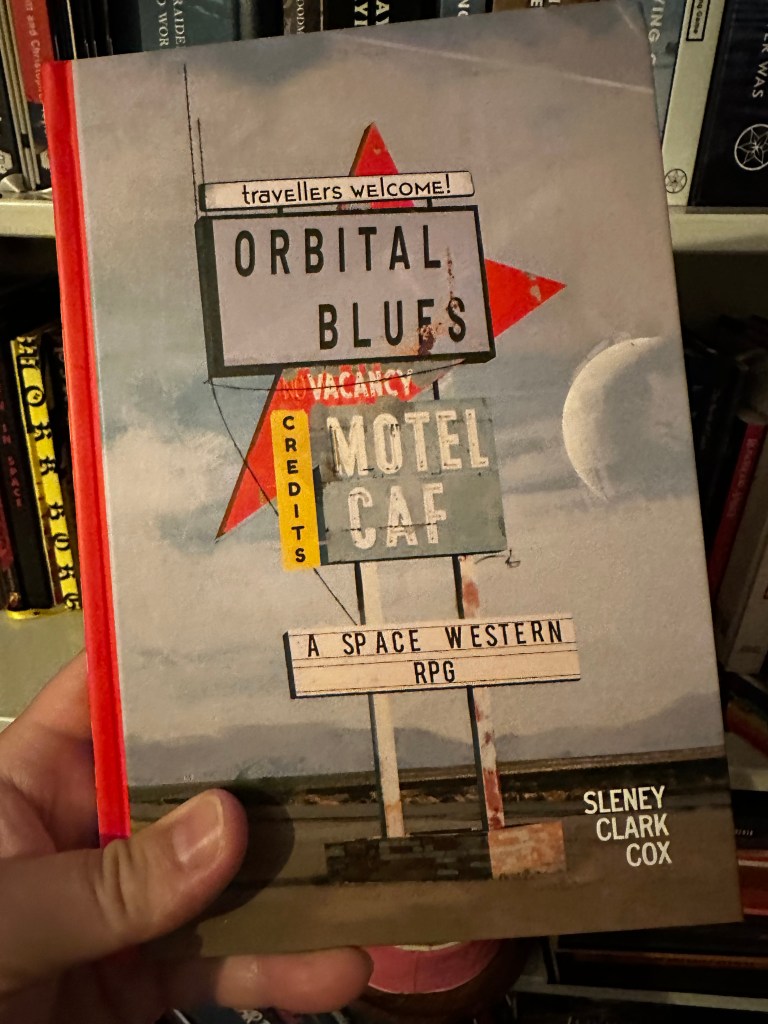
  • Orbital Blues – This is a game set in a far flung future where everyone has spaceships but its grimy, debt-ridden and kind of sad. Its a game that’s underpinned by themes that we can easily all understand, the hell of living in a late-stage capitalist economy, the mental health toll taken by the struggle to just survive from day-to-day in the gig economy etc. The character creation really stoked my imagination and conjured images of my sad space cowboy. And it was the exact opposite of the Wildsea in that it was just so quick and easy.

Orbital Blues wins!

The Others!

I gave up trying to come up with a way to link these final three games. Slugblaster and Blades in the Dark share a system, sort of, and Deathmatch Island is based on a system that was originally created by the author of Blades in the Dark, but that’s pretty tenuous. They all do have an important similarity in the way they are played in distinct phases, though.

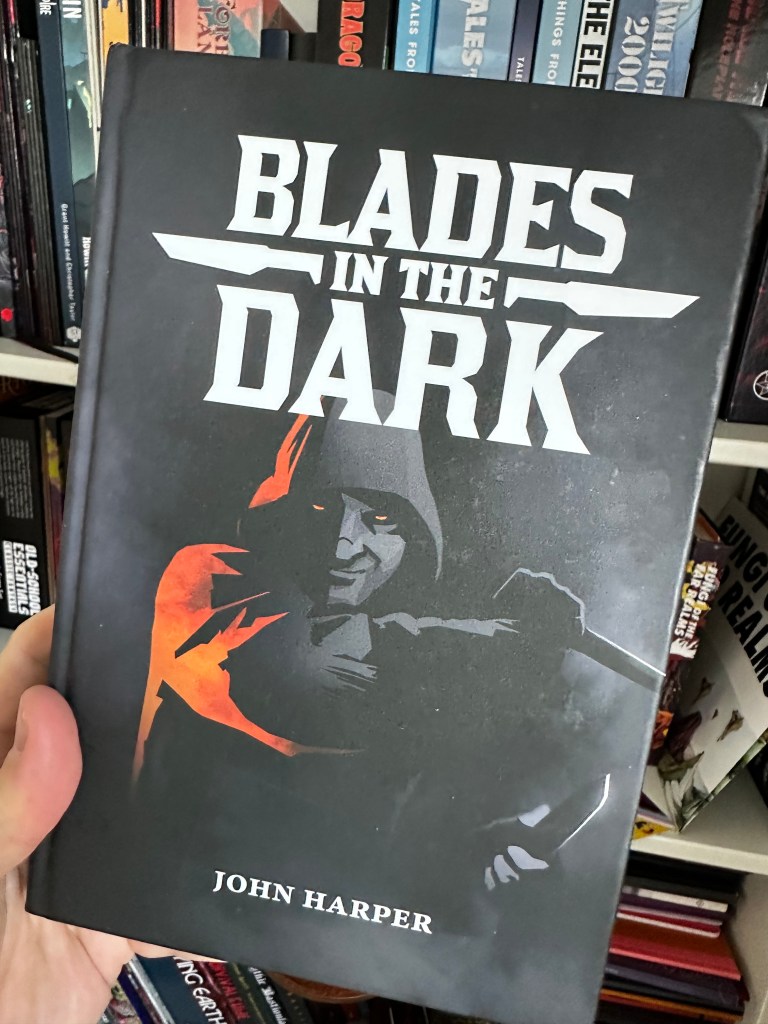
  • Blades in the Dark – This is such an iconic game and its the favourite of many an RPG enthusiast whose opinions I respect. The vibes of Blades are also perfect. Dark city, supernatural threats and heists. I think my players would love that shit. Also, the character creation is comparatively straight-forward and gives you a good idea of your character before you even start playing. This is the only game on the list that I have actually played before and, I’m not going to lie, it has an advantage because of that.
  • Deathmatch Island – This game is on the list because I finished a rewatch of Lost this year and because I backed it and got a lot of really cool materials for it. But it has so much more to recommend it. The premise is great, the fundamental decisions your characters have to make about the nature of their realities are compelling and the rules are simple enough to require very little time to master. However, its strength in this respect is also a weakness. I think I could easily get a small group together at short notice to play this game as a one-shot or very short campaign and I might consider it for that. But I’m not sure I want to run it for longer. Which is pretty much the conclusion I came to the first time I looked at it on this blog.
  • Slugblaster – Another gorgeously presented book. It has world-building oozing from every paragraph, illustration and fictional ad. The subject matter is not quite my bag though. I have no idea about skater culture. Although I am inspired by many of the touchstones Mikey Hamm names for Slugblaster, it doesn’t seem quite enough for me, I’m afraid. I also had some issues with the character creation process which I went into in that post. Maybe I’ll come back to this one someday. But, for now, it’s a no from me.

Blades in the Dark wins!

The Semis

I’m glad to be dealing with a semifinal now after Ireland went out of the Women’s Rugby World Cup in devastating fashion at the quarter final stage earlier today. We’ll see a semifinal one day!

Anyway, we have three games left:

  • Triangle Agency – A unique take on the genre of supernatural investigation with an original ruleset and a lightly comedic vibe
  • Orbital Blues – A space cowboy sci-fi game of disillusionment with the universe and characters who grow through expressions of depression as they journey through the stars
  • Blades in the Dark – a classic supernatural, victorian heist game that has launched a thousand other games.

I have to eliminate Orbital Blues here. This is a bit disappointing, to be honest, but I have a good reason. I’m already running a Spelljammer game at the moment, as well as Ultraviolet Grasslands. That’s a lot of journeying from one place to another in a ship/caravan. I don’t want to start a new game with a similar format. Maybe if and when either of those two games comes to a conclusion, I’ll come back to Orbital Blues. But for now, it’s got to go, I’m afraid.

The Final

So we have two games to choose from in the end, as it should be.

  • Triangle Agency
  • Blades in the Dark

I can’t choose between them. I’d be very excited to run either one. If I could find the time, I would run both. If I could find the time, I’d run every game on this list! But as they say in Highlander, there can be only one. Fittingly, It’s going to come down to a dice roll. 1d6. 1 to 3, its Triangle Agency, 4 to 6, Blades in the Dark.

Here we go!

Its a 4!

It’s time to sharpen your blades and take that Devil’s Bargain with the rest of the crew. We’re off to Doskvol…

Blades in the Dark Character Creation

You play a scoundrel…doing [heists] with your crew. The setting is Doskvol, a city in perpetual darkness beset by inter-faction strife, corrupt leaders, and supernatural entities. The end goal for the character is usually to retire from that life with enough coin in their stash to live safely and securely without worrying about rivals or the authorities.

This is the third in a series of character creation posts I’m using to figure out which game I want to schedule of our next campaign. You can find the Triangle Agency one here. And you can find the Slugblaster one here.

Forging a New Era

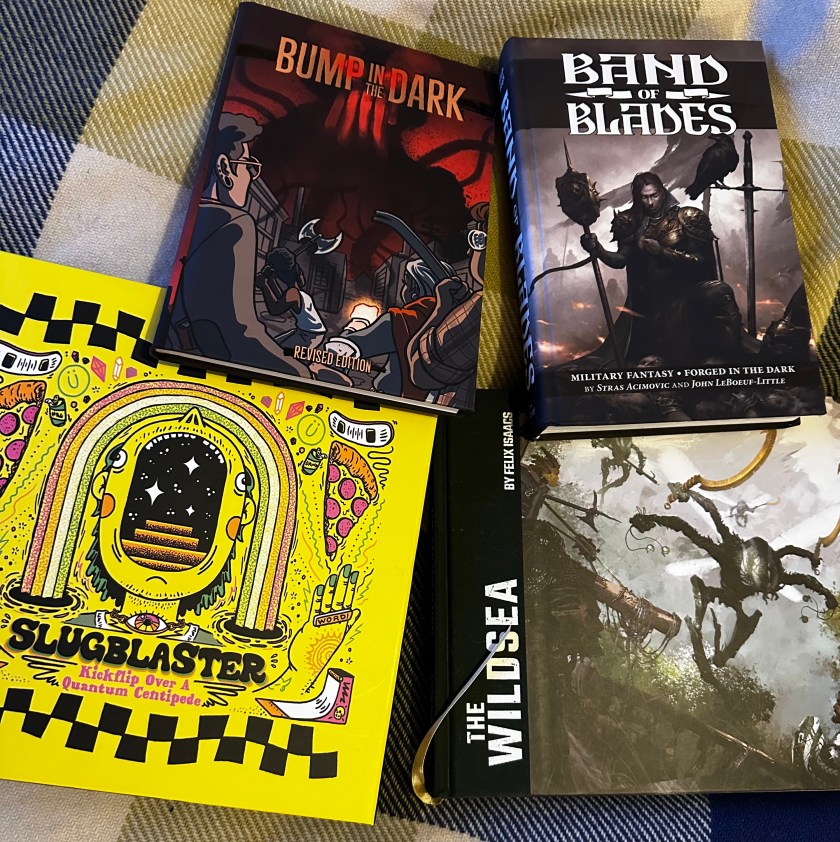
From top left, clockwise, the covers of Bump in the Dark, Band of Blades, The Wildsea and Slugblaster

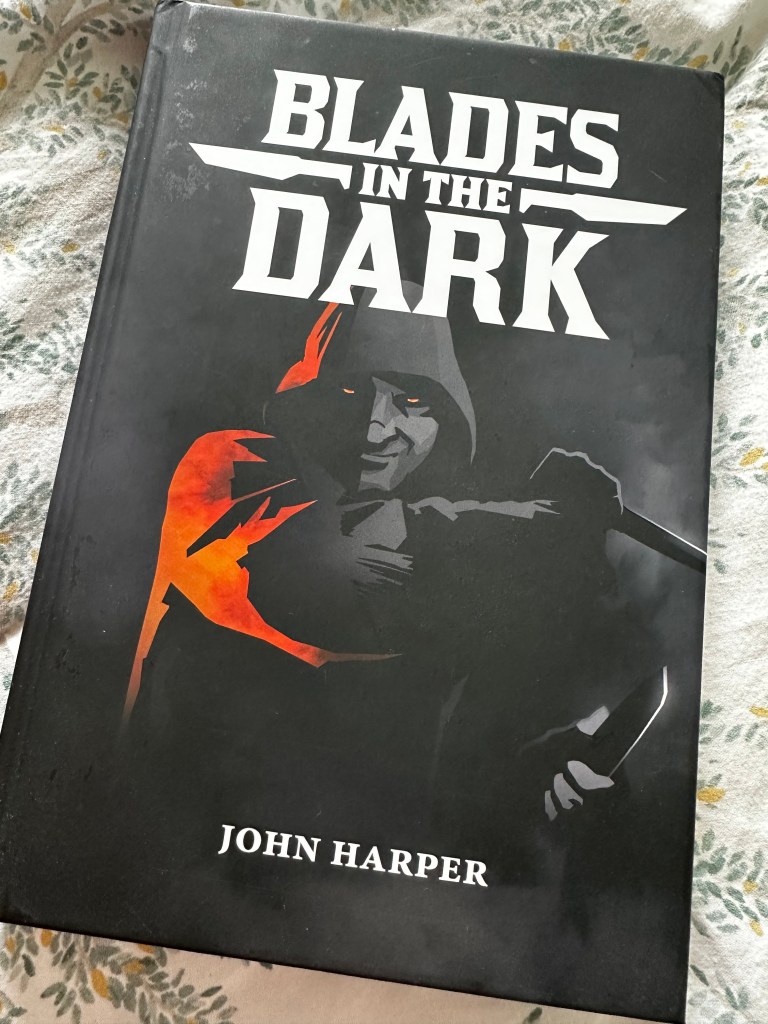
Blades in the Dark, by John Harper has had such a profound impact on the TTRPG landscape since its release in 2017, that it’s hard to overstate it. It has a devoted following, it consistently appears on top ten RPG lists and it has spawned a bewildering array of games based on its system and setting. Forged in the Dark games like Band of Blades, Girl by Moonlight, Bump in the Dark, Slugblaster and Wildsea (debatably.) You can find a non-exhaustive list here.

The system is story-focused, encouraging players as well as GM to take a hand in building the narrative. Near the start of the book, it is pointed out that, “no-one is in charge of the story.” If I were to encourage you to take anything from this short summary, it would be that.

As in Slugblaster, you roll a D6 when attempting something. 1-3 is a failure, 4/5 is a success with consequences and 6 is a full success. The consequences from a failure or mixed success can come in the form of Stress, and thereby Harm and Trauma Conditions, which have more of an narrative effect on the story than a mechanical one (although they certainly have that too.) You can also add more dice to your roll and build a dice pool to give you more chance of rolling higher. You do this in several ways, by using pushing yourself, getting assistance or taking a Devil’s Bargain.

In all of these Forged in the Dark games, the rolls you make are highly abstracted. Instead of making a stealth roll, an investigation roll or a thieves’ tools roll, you describe what your character wants to do and then roll with the appropriate Action Rating. In most cases the Action encompasses a character’s whole part in a scene, rather than a single, explicit skill or combat thing like in D&D and similar games. The choice of the Action Rating used is explicitly left up to the player, but if the GM thinks it might be more effective to use a different one, they can reduce the impact of the action or increase the danger of the PC’s position, making the consequences for failure more severe.

Blades has several really cool mechanics, like the Flashback to go back and prepare something for the situation you find yourself in, but I don’t have the space to go into every rule here. Maybe I’ll do more of a deep-dive into the rules in another post. For now, let’s go about creating my Scoundrel.

Dark Heists

It’s important to remember the setting and the type of game this is. You play a scoundrel of some sort, doing jobs/heists/cons with your crew. The setting is Doskvol (or Duskwall), a city in perpetual darkness beset by inter-faction strife, corrupt leaders, and supernatural entities. The end goal for the character is usually to retire from that life with enough coin in their stash to live safely and securely without worrying about rivals or the authorities.

Blades in the Dark character creation steps

Playbooks

The types of characters available to play are suitably goth.

  1. Cutter – violent and intimidating
  2. Hound – crack-shot tracker
  3. Leech – explosive alchemist
  4. Lurk – shadowy sneak-thief
  5. Slide – social and manipulative
  6. Spider – factional mastermind
  7. Whisper – magic and ghosts

There are seven of them, as you will have noticed. So, I’m breaking out the DCC zocchi dice again. I got a 4 on the d7 making this character a Lurk.

The Lurk

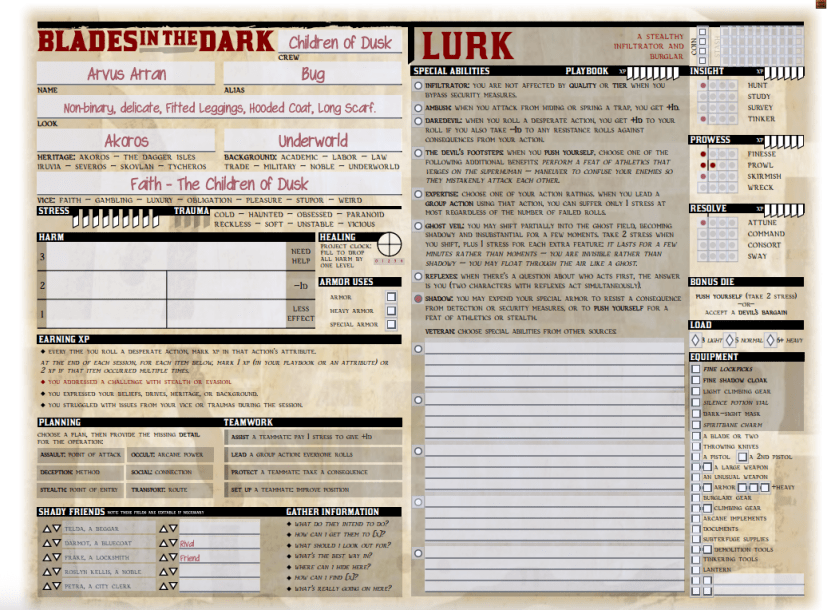
The Lurk playbook in Blades in the Dark

There is no longer any sunlight — the world is plunged into eternal night. There are scoundrels who live in the darkness, who prowl the underworld unseen, trespassing where they will. They are the burglars, the spies, the infiltrators, the cut-throats — commonly called Lurks.

After this pleasing intro, the playbook description tells me that my Lurk will gain xp whenever they “address a challenge with stealth or evasion.” Each of the playbooks have a different way to earn xp that’s individual to them.

Here also, it asks a couple of questions to get the player thinking, not just about the mechanics of the playbook, but about the personality and background of their character:

Q. How did you learn the stealthy arts of the Lurk?
A. I was taken in at a young age by a band of pickpockets and sneak-thieves.

Q. Which Aspect are you drawn to most? The invisible watcher, spying on the unwary? The adroit acrobat, racing across rooftops? The deadly ambush predator, waiting for a victim in the darkness?
A. The intimate knowledge of the city’s underworld, its back alleys and interconnected cellars, its rooftops and sewers. Where to spy from, where to approach a potential mark/victim from and how.

Starting Actions

Everyone has three Attributes:

  • Insight
  • Prowess
  • Resolve

Each of these has four Action Ratings hanging off it.
Insight has

  • Hunt
  • Study
  • Survey
  • Tinker

Prowess has

  • Finesse
  • Prowl
  • Skirmish
  • Wreck

Resolve has

  • Attune
  • Command
  • Consort
  • Sway

You can have up to four points, or dots, in each Action Rating although you can only have up to two dots at the start.
The Attribute Ratings will equal the number of associated Action Ratings they have any score in. So if you have any dots in Attune and any dots in Command, you will have a Resolve of 2. You use the Attribute Ratings to resist different types of stress.

In the case of the Lurk, I start off with 1 point in Finesse and 2 in Prowl. I will add four more points to Action Ratings at a later step.

Shady Friends/Rivals

Your connections to NPCs can be key to a successful or disastrous career as a scoundrel. There is a list of five in a table here. I’m going to roll my d5 once for a Friend and once for a Rival

  • Friend – 3 – Frake. This is a locksmith who has taught me everything I know about lock-picking. He has an encyclopaedic knowledge of every type of lock, chest, safe and safe room in the city
  • Rival – 2 – Darmot. Once, he was one of our band of pickpockets, now, he uses his knowledge against them. He’s busted me many times

Lurk Special Abilities

You only get one of the eight listed abilities to start with.

  1. Infiltrator – you don’t suffer negative effects due to higher quality security measures employed by higher Tier enemies
  2. Ambush – Gives you an extra d6 when attacking from hiding
  3. Daredevil – get a bonus die if you take a desperate action as long as you take -1d6 to resist any consequences of it
  4. The Devil’s Footsteps – push yourself to do the impossible. This ability has a variety of effects
  5. Expertise – you have to choose an action rating and when you lead a group action with that, you can only take a maximum of 1 stress
  6. Ghost Veil – go completely invisible by shifting into the ghost field. Just take some stress to do it
  7. Reflexes – who should act first? You should, of course!
  8. Shadow – use your special armour to resist consequences from security measures or pushing yourself in physical endeavours

The book suggests taking the first one listed if you can’t decide between them. However, I am going to roll a d8 to make the decision for me. That’s an 8!

Shadow

You may expend your special armor to resist a consequence from detection or security measures, or to push yourself for a feat of athletics or stealth.
When you use this ability, tick the special armor box on your playbook sheet. If you “resist a consequence” of the appropriate type, you avoid it completely. If you use this ability to push yourself, you get one of the benefits (+1d, +1 effect, act despite severe harm) but you don’t take 2 stress. Your special armor is restored at the beginning of downtime.

I like this a lot. It matches the growing image of this character that I have in my mind.

Lurk Items

There is a section in the playbook description for items specific to the Lurk, but there is no need to choose anything at this stage. In Blades in the Dark, you simply indicate at the start of a Score how heavy a Loadout you have on you. That gives you a number of Load points to assign as the Score progresses. When you come across a situation in which you need “Dark-sight goggles” for instance, you write them down and mark the 1 Load that they take up. You never need to describe the items you have in your pack beforehand.

Heritages

The Shattered Isles map and description

There are six options here. Your Heritage is more akin to a real-world ethnicity or national background than a race or species. It is quite likely to shape your character’s politics, social circles and general way of thinking. It is unlikely to have any mechanical effect.
Here are the Heritages:

  1. Akoros – big, industrialised land. Like Europe. Duskwall is here.
  2. Dagger Isles – peopled by corsairs and merchants who sail the seas between their isles and beyond
  3. Iruvia – a desert kingdom to the south. Think Egypt.
  4. Severos – a wild place with nomadic people who survive in the ruins of ages past
  5. Skovlan – recently colonised by Doskvol. Many refugees from here have come to the city to look for opportunity
  6. Tycheros – a far-away land where the people are part demon. These characters get demonic telltales that mark them physically

Rolling a d6 for this as well: That’s a 1! Akoros. This is a local person whose family fell on hard times. While their parents were out looking for work, this guy was out running around with their gang, stealing and sneaking.

Backgrounds

What did this character do before going their crew? There are 7 options:

  1. Academic
  2. Labour
  3. Law
  4. Trade
  5. Military
  6. Noble
  7. Underworld

I would normally roll for this but I feel like I already have such a solid picture of this Lurk in my head that I am going to have to go for Underworld here. They were a street kid, a pickpocket within a network of urchins that spanned the city.

Assigning Action Dots

There are only a couple of rules to the way you can assign these dots (points) on your character sheet. You can’t start with more than two points in any one Action Rating. Also you should add one dot to an Action rating that reflects your Heritage and one dot to an Action Rating that reflects your Background.

I think, as a local in this industrial city, this character would get a dot in Tinker and as a wee guttersnipe, they would need a dot in Skirmish. I get two more dots to spend freely so I would like to add one to Hunt and one to Attune.

Vices

In your downtime between Scores, you might want to blow off some steam to relieve stress. That’s why you need a good vice!

Here are the options:

  1. Faith
  2. Gambling
  3. Luxury
  4. Obligation
  5. Pleasure
  6. Stupor
  7. Weird

There is a great deal of leeway to describe the specifics of your vice within the confines of the category. I’m going to roll a d7 for this. That’s a 1, Faith. I think my Scoundrel has found his place amongst an underground cult in the city. In fact, I think the band of urchins they have been part of since childhood is led by a prophet, a visionary with the ability to speak to god through the dead.

Name, Alias and Look

Name: Arvus Arran (I chose this from the long list of names in the book)
Alias: Bug (small, sneaky, seems to fly)
Looks: Non-binary, delicate, Fitted Leggings, Hooded Coat, Long Scarf.

Arvus Arran Lurk Character Sheet
Arvus Arran Lurk Character Sheet: Get yours here: https://ad1066.com/bens-character-sheets/blades-in-the-dark-playbooks

Crew Creation

Just like in Slugblaster, you really need a crew to finish out a Blades in the Dark character, but this isn’t really possible here, except to say there are a few crew types:

  • Assassins
  • Bravos
  • Cult
  • Hawkers
  • Shadows
  • Smugglers

And Cult seems to make sense here, imagining that the rest of the crew are also members of Arvus’ gang.

Conclusion

This is such a straight-forward character creation process that involves very little flipping between sections of the book. With a new character, you don’t have too many decisions to make and you can begin to get a feel for the character you’re creating very quickly. You can also see the potential for future stories and drama in elements of the process such as the friends and rivals.

I have only played the one campaign of Blades in the Dark but writing this post has whetted my appetite for more!

Time for a Change

If you had to choose one, dear reader, which one would it be? If you are one of my potential players, which one would you like to play?

Anniversary Posts

More anniversary guest posts coming soon. In the meantime, have some musings.

Old School Rut?

I’m not sure how it happened but, recently, all I have been playing is OSR, trad and adjacent games. With the exception of Dungeon World, which is about as close to D&D as you can get while also flying the PBTA banner, its been wall-to-wall, dragon games, Borgs and Troikas. And this week? It’s Dragon Age, DCC and maybe some Black Sword Hack or UVG (which is pretty trad in its ruleset to be quite honest.) Am I in a rut or have I just naturally gravitated towards these games? Maybe I have found my niche and I’m occupying it. I don’t think that’s it. I think it has more to do with the ease with which I can roll out one of these games, if I’m the GM, at least. It’s also pretty easy to fall into one of them as a player when you’re familiar with the overall concepts, rulesets and themes. And, don’t get me wrong, it’s not that I’m not enjoying them. But it is time for a change, I think.

Options

So, I have a few options of non-OSR, non-D&D, non-trad games to try out in the near future. My current game of Troika! will be coming to an end next week and Dragon Age probably only has a couple of sessions left in it, for a while. So, some calendar spots are opening up! I’d like to fill them with something completely different.

Triangle Agency – I’m reading this at the moment. I have to say, so far, I’m loving the way the game is presented, the really original ideas, the surprisingly bare-bones ruleset and the way it treats the GM (General Manager) as as much of a player as the Agents. It has gotten me excited to play it and I am trying to get potential players excited about it too. The downside is that I feel like I still have a lot to read before I can think about getting it to the table.

    Slugblaster – I got this great boxed set for Christmas and have yet to crack the spine of the rulebook in anger. But I have been listening to the excellent My First Dungeon actual play of the game over the last several weeks. It has made me want to try it out despite having little to no understanding of skate culture. I know at least one player who would be very interested in playing so I’m sure I could get a few more. Once again, the difficulty is that I have not even skimmed the rules yet. This is somewhat ameliorated by the fact that I’ve been learning how to play while listening to the podcast.

      Blades in the Dark – Although I was a player in a campaign of Blades last year, I still haven’t run it as the GM. I think I would enjoy doing it and it is such a classic, it would be a shame not to put a game of it together. And it is the basis for games like Slugblaster and The Wildsea, which also feature on this list. I have been nicking enough rules from it for my D&D game, also, that I feel confident I would mesh quite well with the ruleset. At least I have read this one cover to cover and played it before, so that’s a big tick in the “pro” column for Blades.

      The Wildsea – I wrote about this already last year and still haven’t managed to run it! Essentially, this game imagines a world where the entire surface has been covered in a vast forest and your players are sailors across the canopy, using boats with giant chainsaws attached to sail. Take a look at the last post about it if you want more info. I have rad a lot of this and could probably run it ok, but I am afraid of doing another game where my players are sailors as I am already doing that with Spelljammer and kind of, with UVG.

      Deathmatch Island – I also wrote about wanting to play this around this time last year. I having been feeling the urge to scratch the Lost, Severance type itch over the last few months. I watched both of those shows in the last half a year and they have stuck with me a lot. I think Deathmatch Island would be perfect for that. Also, I have read it completely and would be very excited to try out its mechanics. Here’s my post about it from last year.

        There are a couple of outsiders as well, Orbital Blues and Apocalypse Keys, both of which I purchased on something of a whim (and a sale.) I’m curious about them but have barely opened either. I know Apocalypse Keys is a PBTA game and that it is beautifully illustrated, but that’s about it. And I know Orbital Blues is a game of sad space cowboys ála Cowboy Bebop and Firefly so that is a big tick in its favour as far as I am concerned.

        If you had to choose one, dear reader, which one would it be? If you are one of my potential players, which one would you like to play?

        Motivation Part 1

        Player vs character

        Are you always wanting to play an RPG? I’m not. I mean, I like them, I write about them, I talk about them and post about them on social media, but do I always want to play them? No, of course not. Sometimes I’d prefer to be cooking, or walking or reading. Sometimes I’d rather be doing literally anything else.

        So, how do we ever end up getting everybody to the table all at the same time? When at least one of the players in your group who isn’t busy or sick or traveling is probably just not feeling it that night? Oof…

        And when you do get them all there to your table and you have this great idea for an adventure, a couple of hooks to get the PCs to take interest and some of the smartest, most memorable NPCs they are ever likely to meet in store for them, how do you make sure that they take the bait and go the way you are hoping they will? How do you ensure that the motivations of the PCs align with the goals of the adventure?

        OK, so these are two different problems, really. The first suggests that the players may not want to be playing at all, and the second suggests that they want to play, they just can’t see their characters doing what you hoped they would. Still, we are going to discuss both because that is the central conceit of this short series of posts.

        Player motivation

        Open door

        This is so tricky that, I am tempted to say, don’t try to tackle it at all. I mean, if you don’t want to be at a party and someone drags you along to it anyway, there are only two potential outcomes, really. Either you do that thing that your mum always said, i.e. enjoy it once you get there, or you will have a terrible time, confirm your own biases and bring down the average vibe score of the entire occasion just enough that you feel even worse about it and leave early.

        An RPG session is not likely to be this drastic. In most cases, if you are not feeling it, you probably just don’t contribute as much as usual. Of course, the other players will notice this and maybe try to draw you into it a bit more or make more allowances for you than you really want. After all, you are probably happy being a bit quieter that day.

        This is one of the reasons I appreciate one of the Open Hearth community’s policies. The Open Door policy says that you can drop out at any time from any session without the need to explain or excuse yourself. They only ask that you let the game facilitator know that you won’t be there or, if it’s mid-session, that you won’t be coming back. I think this policy is more to account for unforeseen life shit but it works equally well for those who are just not feeling it that day. And let’s be clear, mental health has to be a priority too. Some of us struggle with mental health issues of all stripes and on days where those issues flare up or are particularly serious, you have to take care of yourself first. I, myself, have struggled more with physical ailments a lot, in the last couple of years post-Covid and I have had to take advantage of the Open Door more than once, and was always grateful when, upon my return, that no-one had any blame to dish out for my not being there or any guilt to trip me with.

        I guess, what this comes down to for me is, if you are not feeling it on a particular day, don’t do it! Go do the thing you really want to do instead or just curl up in the foetal position on the couch with a steady stream of rom-coms and popcorn being fed intravenously into you. You don’t need to make any excuses. You don’t even have to provide an explanation. In fact, I don’t think you should. After all, it’s just a game. We should all treat it as such.

        Hype

        All of that being said, I don’t think it’s impossible to hype people up to play the next session of a game. We do this in lots of ways, don’t we? In our Tables and Tales community we use the discord chat to chat about what happened in the last session, dissect the events, talk shit about the NPCs behind their backs, develop plans and share stupid memes and puns. I love this sort of inter-session banter. It definitely makes me excited to play the next session and, if I’m the GM, it often gives me ideas for stupid bits to introduce into the game itself, just for laughs or tears.

        Homework

        Our DM in An Unexpected Wedding Invitation 5E game likes to give us homework! She has asked us to do things like:

        • have a conversation with another player, in character, in DMs, that you haven’t had much interaction with yet
        • provide feedback privately to her that you wouldn’t in front of the whole group
        • discuss our theories about what is going on in the plot.

        This has made the discord chat really entertaining and makes me want to get back to the table to keep going.

        World-building on discord

        Another GM, this time from Blades in the Dark, went above and beyond. He would not only write up a summary of the events of each session in an entertaining and enjoyable narrative style, but he would also compose entire articles from the Duskwall Observer, the city’s Newspaper of record, letting us know about the happenings in the rest of the city both in the heights of the ruling classes and the depths of the crime-ridden underworld. On top of all that, he would come up with new rumours after every session so that we had something to work with when planning with our own scores and downtime activities. Truly herculean efforts there, and they certainly made me excited to meet up with the rest of my crew every Friday evening and start inhabiting the, very much living, city that he so adroitly created under our feet.

        I’m afraid this is not an area that I excel at as a GM. The most I am likely to do in between sessions is ask if people are free to come on the usual evening or share a social media post that seemed summed up a character or event from the game. There are definitely techniques I can learn from my learned GMs. Maybe I should start handing out homework too!

        Tune in to the next post in a couple of days if you’re interested in character motivation within the game.

        Meanwhile, is there anything you do to motivate your fellow players in between sessions or even before the first one? Let me know in the comments so I can steal your ideas!

        World Building Part 2

        A new approach

        First of all, I struggle to get out of my old way of building a campaign world and, even a campaign. I recognised in my last post that there are definite draw-backs to it, but still, I find it hard not to do a whole bunch of preparation. I do still think that a certain amount of prep is advisable but I have been actively trying to limit the amount I do. This doesn’t work as well in some games as others. In D&D, if you don’t do a lot of prep, you might be alright but it is a real pain if you don’t have the right stats to hand when your PCs decide they are going to enter the local gladiatorial games or they want to go ankheg hunting. It slows things down a lot and hurts the overall flow of the session. But it does feel like you are pushing the plot and your PCs in a very particular direction when you do it! Is this an inherent issue with D&D? Probably not just D&D if we’re honest.

        In other games, I find it can be freeing and fascinating to see how a session goes when you genuinely have no preconceptions about what is going to happen in it.

        Heart

        In the game of Heart I am currently running, I used a loosely written adventure that came in the Heart Quickstart Rules. We have just come to the culmination of that adventure and suddenly, the PCs are more-or-less free agents! They have done what a few NPCs have asked of them and more. They followed the breadcrumbs and now, now they are ready to take the training wheels off and head into the Heart to pursue their own dreams and nightmares. They have a couple of other leads but I am looking forwards to leaving the progress up to them from now on. I intend to largely take my hands off the wheel and, instead, rely on their own motivations to provide direction, their own relationships with NPCs to perhaps push them one way or another, even their own ideas for how the new and terrifying delves they go on might look and feel. I want to create our Heart together now that the leash is off.

        Im-prompt-u

        There are lots of tools out there that you can use to bring a world to life together with your players at the table. I mentioned on this blog before that we had a game of The Quiet Year by Avery Adler a while ago. In it, you get together and make a couple of establishing decisions regarding what sort of community you want to build together and what sort of genre or setting it might be in. After that, you proceed through the seasons of a year after the end of some cataclysm and before the coming of some other terror. The players use a regular deck of cards to draw on prompts from the book. Each prompt gives you an occurrence or an important decision that must be made. This way, you all draw a map together and you develop a community that includes important factions, elements of religion and social orders, abundances and scarcities, fears and loves of the populace.

        I was surprised when we finished, by what a fleshed out place we had created in concert. It felt like we had the basis of a fascinating setting to start something else in. I could imagine beginning a more traditional RPG there with the same players. These players would all have had a hand in building the place, the world, its people, their relationships. And wouldn’t they be so much more invested in it?

        I mentioned last time that I had made a mistake in the very beginning of the Scatterhome campaign because I had tried to play on the PCs’ devotion to their decimated homeland when they had no experience of it. They couldn’t even picture this diverse paradise island that I had in my mind. But if we had used a method like The Quiet Year to make it, we would have had the fun of playing The Quiet Year, for starters, and also, we would have a place they might have mourned as their characters.

        Scale

        You can go much smaller of course. In the Blades in the Dark campaign I played in recently, our GM had us use a different game called Clean Spirits to build our hideout. At the start we had to make some decisions about what sort of place it was going to be. We decided on a beached canal boat and then we worked through a series of prompts and exercises to create various parts of it. We each got to claim our own section and also collaborated to make it a place that we treasured as players and characters with its own little mushroom farm and the spirit of its former captain trapped in a bottle. Later, when we were attacked in our hideout, this made the stakes seem so much higher!

        Of course, you could go even bigger instead of smaller. I know the game, Microscope, is used to create a whole history for a world that is separated into periods and events. I have no experience with it though so I don’t know how well it works.

        At the table

        The type of world building I like the most is the collaborative kind, I have decided. One of my players in that Scatterhome game, Tom of the Media Goblin’s Hoard blog wrote an incredible history for their character, who was a Dragonborn. Now, I had never given too much thought to the origins or current situation of Dragonborn in the setting but that was ok, because Tom had been considering it deeply. It was all couched in the back-story of their character, but it added a huge amount to the world straight away, including the fact there was an under-class of Dragonborn within the empire who were raised to be weapons at the command of their human masters, how they were raised from eggs to obey and how some escaped and went on the run. How there were bands of pirates that sometimes took on runaways like their character and how they impacted the archipelago. It was great and, although we didn’t get around to using too much of that in the game itself, the knowledge of it made a big difference to how I thought about the empire and the world as a whole.

        Later in the same game, we gained some new players who decided to take their PC races from the D&D setting of Theros so we had a new island nation on our hands then, one that looked a lot like Ancient Greece and contained leonines and satyrs. Once again, their choices made that change to the world happen.

        Another new character added a whole new vassal kingdom of elves to the Vitrean empire, for whom social hierarchy and feudal concerns were incredibly important. So much so that they caused a rift between his character and his siblings.

        Character backstory is world-building when you leave the details of the world vague enough for players to have free rein when coming up with them. It adds to the shared world and gives them a greater feeling of ownership of it.

        I personally love it, though, when someone, simply, confidently states the existence of a particular item, a specific shop or an individual NPC right there at the table. That item is going to help them get through that window, that shop sells the exact thing they are looking for or the NPC has the contact details they need. This sort of flavour is invaluable and often becomes far more than flavour. This happened in Spire a lot because you have to ask your players to make rolls to resolve situations but then leave the details up to them. They made up the dugguerrotypist, Reggie, who worked for the local tabloids and he later became an important bond to them. Same with every aspect of their casino, the Manticore, which quickly filled with important NPCs and locations that were largely player-created. It is the best feeling when these instantly generated details come into play right there and then at the table. It’s like magic.

        How do you prefer to world-build, dear reader? Do you do all the work beforehand and let the players loose in it at the table? Do you build a world together first and go and play in it after? Do you let it all just happen at the table?