Dwarven Strongholds

The Complete Player’s Handbook Series

Character options in D&D 5e have always felt pretty thin on the ground to me. Official ones at least. Of course there are hundreds of subclasses, species/races, backgrounds etc. out there from third party creators but it has always seemed as though WotC have deliberately limited the number of official options they put out. I sometimes wonder if I only feel that way because 5e is not my first edition of the game. Because, in comparison 2e, the various classes and species are woefully underserved in my opinion.

In the late 80s and early 90s TSR released a set of books designed to complement the basic character options presented in the 1989 Player’s Handbook for 2nd Edition Ad&d. there was one for each of the classes. These generally focused on fleshing out the possibilities for the classes with “kits” background options, class-based campaigns, new abilities and features, class-based organisations like thieve’s guilds. There were also several supplements that dealt with AD&D races. The elves got one, the gnomes and the halflings got lumped together in their own book and they even had one called The Complete Book of Humanoids, which featured a plethora of “monstrous” races as PC options.

Back in those days, my table got a lot of use out of most of these books. The character kits from the class books became standard choices in many cases and the extra racial options were very popular for rounding out PCs.
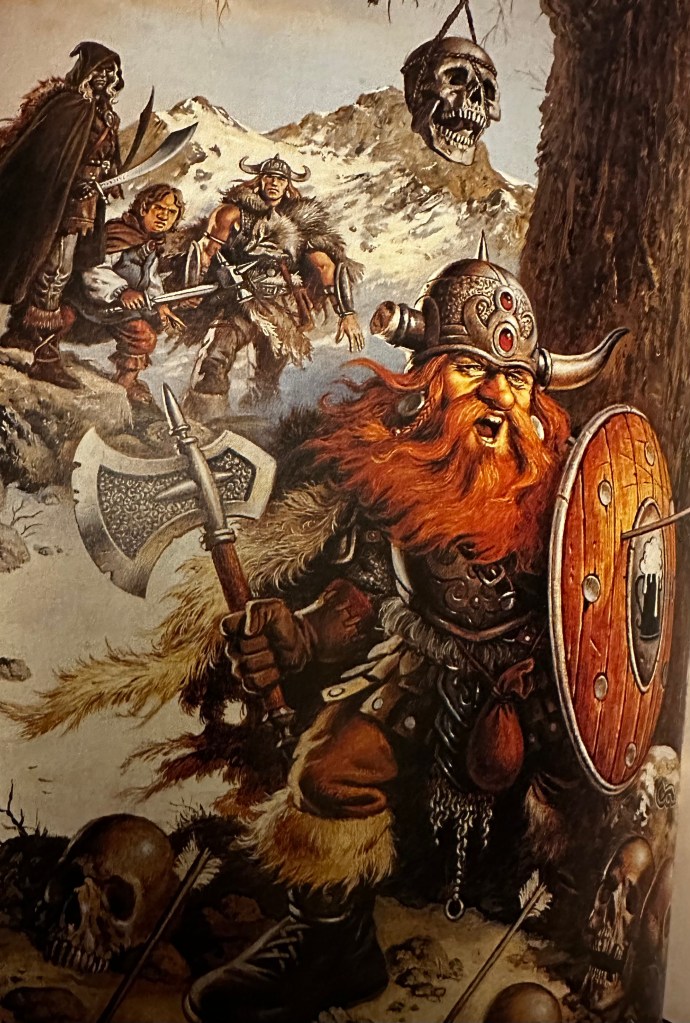
But my favourite, by a pretty long way, was the Complete Book of Dwarves. I had been a fully paid up member of team-dwarf since I read the Hobbit as a kid. I loved their aesthetic, their toughness, their curmudgeonliness, and, of course, their beards. I had a few dwarven characters over the years across multiple games and systems but I don’t think I ever got to have one in AD&D as I was almost always the DM. So, instead, I used the Complete Book of Dwarves to make up Dwarven societies, kingdoms, mythologies, NPCs and Strongholds. The book contains chapters on the mythical origins of the dwarves, dwarven subraces, “Your Life as a Dwarf,” Character Creation, Proficiencies, Dwarf Kits, Role Playing and Personalities, Mining, Equipment and Designing Dwarf Campaigns. I remember getting fully immersed in dwarven world-building in a way that my players probably did not entirely appreciate. But, if I’m honest, that was for me anyway, not for them.

Stronghold Creation

So the Complete Book of Dwarves has a whole chapter devoted to generating your own Dwarven Strongholds and I have a distinct memory of being wrapped up, sick, in a duvet on the couch rolling up stronghold after stronghold. I must have recorded them somewhere but those records have been lost to the mists of time along with Cold War and white dog poop.

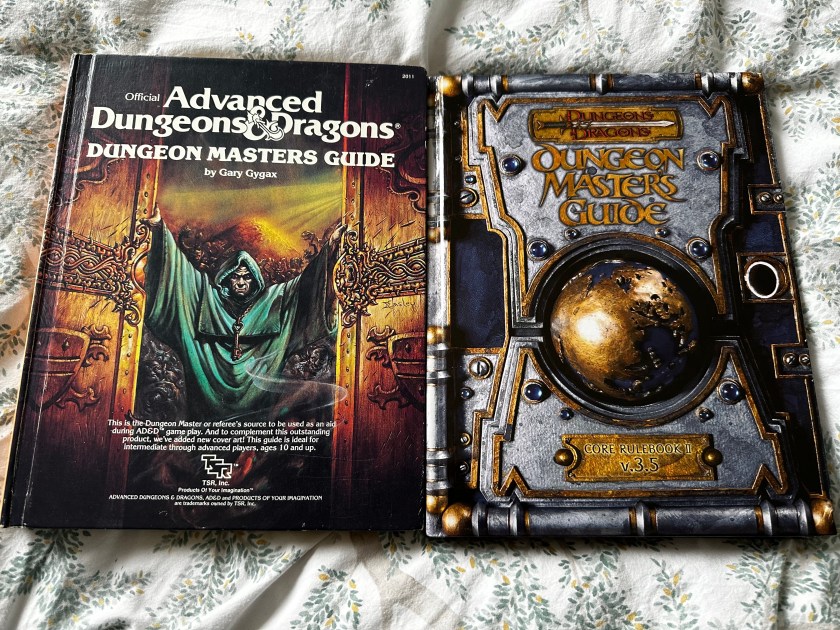
Now, I haven’t had a copy of the book in years. I’m not really sure what happened to the one I had, but there is a good chance it was borrowed by one of my good friends a mere thirty years ago and they haven’t gotten around to returning it yet. Understandable. Anyway, it was my birthday on Tuesday and my friends Tom and Isaac gifted me a copy of it! I had recently been going on about my particular love for this book and they’d actually listened to me!! True, true friends.

So I thought we could create a stronghold together now that I’ve got it. Strap in!
According to the opening section of the chapter:

Strongholds are the homes and workplaces of the dwarves. They can range from simple family residences to huge subterranean cities. The stronghold design sequence allows you to design a stronghold, either by making a series of choices, or by random die rolling. You may also combine the two methods.

Dear reader, if you have been here for any of my character creation posts, I think you will know which way we are going. Random all the way!

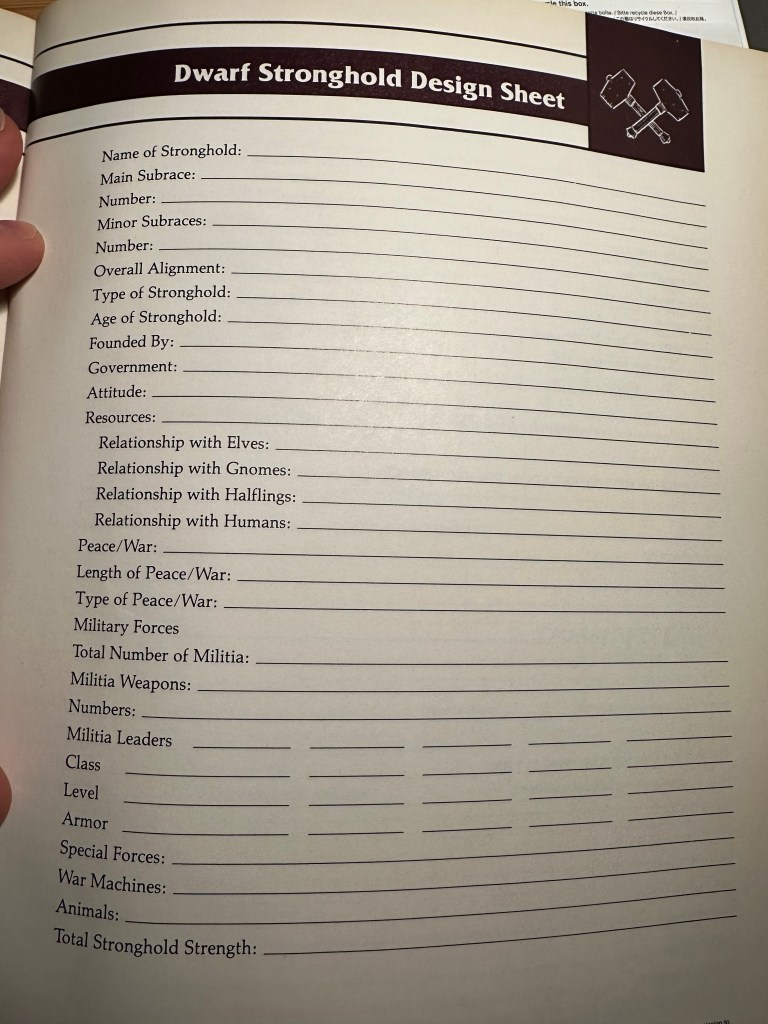
Here’s the Dwarf Stronghold Design Sheet:

You can see that we are going to start with the name. Now this actually requires us to turn back to Chapter 4 first and locate the Dwarf Name Generator.

  • We then roll 1d4 to determine the number of syllables in the stronghold’s name – that’s a 2.
  • That means we roll 1d20 twice on the Dwarf Name Generator Prefixes table – that’s a 7, Dal- and a 16, Nor-
  • We go ahead and combine those in the most pleasing sounding configuration, I think that would have to be “Nordal” for me
  • Then we flip back to Chapter Ten and roll 1d20 once more on the Stronghold Suffix Table – 15, -lode
  • Put em all together! Nordallode! It definitely has the sound of a place name made up for D&D but we are going with it

Next! Subraces Present. Ugh. Yep. This is the bit where it becomes a little problematic. Obviously, the whole subrace business in D&D is slightly odd. If you applied it to humans you would be talking about different ethnicities, but D&D doesn’t do that with humans, does it (I mean thank fuck, right?) (I’m deliberately skirting around the variant human unearthed arcana options because I think it’s best to do that.) Anyway, the Subraces Present section wants us to make sure we know which is the main subrace (i.e. the most numerous,) the dominant subrace, and which other subraces exist there. This section also includes a table that tells you how many of the dominant subrace are in your stronghold, while pointing out that this only refers to the number of male dwarves. The number of females is, for some reason, half this number and the number of wee dwarflings is half that again. Look, I don’t know. How they came to such decisions is beyond me and clearly did not even strike my tweenaged mind as something noteworthy at the time.

OK, so, I’m going to roll on the Subrace Table to figure out which is the Main Subrace in Nordallode. The same table determines their numbers. Once again, the table has different potential populations of subrace for each (Deep Dwarves can have 3d100+50, whereas Gully Dwarves can only have 1d100+50.) As for numbers of males to females, I see no reason to abide by the nutty, unexplained logic in this section. I’m not even going to split them up.

  • Ok, Subrace Table, roll 1 – 32 – Gully Dwarves.
  • Number – 1d100+50 = 108

Now to find out which is the dominant subrace and how many other dwarves subraces live in the stronghold. Let’s roll on the Dominant Subraces Table.

  • 61, Hill Dwarves
  • This means there are 1d4 Other Subraces in the stronghold according to this table. I rolled a 2.

I’m beginning to get confused and frustrated by this whole subrace business. The first table got me to roll to determine which was the main subrace and how many of them were in the stronghold. Now, I’m told to roll on a different table to find out which is the dominant subrace (is this not the main subrace?) and then roll to find out how many other sub races are in the stronghold? But, so far, I have rolled two different types of dwarf for main and dominant…

If I continue on to the next page, it tells me to reduce the number of the dominant subrace by a percentage depending on how many other subraces are present. But, I have not actually rolled the number of the dominant subrace yet.

Forget it. I am scrapping the Hill Dwarves. Long stand Nordallode, home of the Gully Dwarves!

I will keep everything else the same. Now, with 2 other sub races sharing their home with them, the Gully Dwarves must reduce their numbers by 25%. That brings them down to a mere 81.

I’m now going to find out how many and what type of other subraces are present.

  • I roll 1d100 on the Gully Dwarves Subraces Table and get 74 – Mountain Dwarves. I roll 2d10 to determine their numbers and get 14.
  • I roll again for the second minor subrace and get 52 – Hill Dwarves. There are 3d12 of these beardoes – 20
  • New population of Nordallode – 115

From the book:

Hill and mountain dwarves may be found at any depth and living with any other subrace. They are clannish and keep to themselves. They are likely to be the employers of other sub races. While these others will likely be in the stronghold on a fixed term contract, it is not unusual for a stronghold to have enclaves of other dwarves who have been there for generations.

Time to figure out the stronghold’s overall alignment. This does not determine the alignment of every member, just the general outlook.

  • 2d6 – Obviously this table has each of the sub races along the top as some of them are more likely to be evil than others (aaaagh.) Nordallode turns out to be Chaotic Neutral.

Let’s move swiftly on from all that nonsense.

Let’s figure out the Type of Stronghold we are building:

  • Another d100 roll and I get a 14, which means it is a Secondary Stronghold and gets to increase its population by 100%
  • New population of Nordallode – 230
  • Secondary Strongholds are second only to Major Strongholds and can be independent or allied with a Major one. I think we will call Nordallode an independent stronghold!

How old is our stronghold? Good question!

  • For Secondary Strongholds we roll 2d6 to find out how many generations of age Nordallode is – That’s 8. Pretty old… except, there is a Racial Modifier. Gully Dwarves subtract 2 from that number. So its 6 generations (no fucking idea.)

And how old can the dwarves of Nordallode live to be? No roll here:

  • Gully Dwarves – 250 years (this is the lowest possible life expectancy and its determined entirely by subrace…)

What type of government does our stronghold have?

  • It’s back to the d100 rolls – 89 – Oligarchy! Why, of course! How fitting! (Wah!) Oh wait, there are more modifiers here. Gully Dwarves add 10 (for whatever reason) and we have to add another 10 for being of Chaotic alignment! That makes it 109. It’s Anarchy baby!

Time to roll on the Attitude Table to find out what our problem is.

  • It’s a d20 roll this time. That’s a 112 – Isolationist. Lock those gates!
  • This means that 75 – 100% of the population is in the frikking militia.

What are our major resources in Nordallode? Well, the book shies away from telling you exactly what you’re rich in, instead, just giving you an idea of its monetary value.

  • It’s 1d20 on the Stronghold Resources Table and I got a natural 20! WOOHOO! Things are looking up for my poor little Gullies. That means it’s Rich!
  • There is an optional part of this table – the starting gold modifier, that applies to PCs who come from this stronghold. So, if your character did come from Nordallode, they would start with an extra 1d10x10gp. Pretty sweet. But wait! Another racial modifier means that you take away 10 from the original d20 roll because Nordallode is a Gully Dwarf stronghold… Born to lose. So, this actually means that my downtrodden dwarves start at Average Resources and so get no starting gold modifier at all. FFS. There is a +1 to the roll for being a Secondary Stronghold, but that doesn’t improve it from Average anyway.

OK, time to find out what Nordallode’s Relationship with Other PC Races is. We need to roll 1d20 four times on the table of that name. I am going to factor in the modifiers at the start this time. I get a +1 for being Chaotic Neutral and, for being Isolationist, I must treat any roll of 4 or less as a 9:

  • Elves – 12 – Threatening
  • Gnomes – 13 – Cautious
  • Halflings – Nat 20, becomes 21 – AT WAR!
  • Humans – 12 – Cautious
  • Nordallode, not friendly to outsiders.
  • Properly, this should only be rolled for the races that live nearby but since this is entirely experimental, I rolled for all of them

OK, we have figured out who we hate above ground, time to go to war or peace with someone underground too. Love the War/Peace Table:

  • Its another d20 roll – That’s a 1 which actually means Nordallode is at peace!
  • The next table allows us to see how long that unlikely situation has persisted
  • Peace Table – 1d10 – 7 – 2d6 generations! – That’s 4 generations of peace! Just not with those fucking Halflings obvs.
  • There is a War table as well but I think we have just determined that we don’t need to roll on that.

Nordallode has to defend itself from the depredations of those vicious, hairy-toed bastards. How do we do that?
With our Military Forces!

  • Gully Dwarves have an Unsteady Morale (7)
  • Apparently the first reaction of Gully Dwarves to danger or conflict is to run away, whether they are members of the militia or not…
  • Their weapons are… “any they can scavenge,” which is not great for a militia but may make sense in a stronghold where anarchy reigns
  • With 230 dwarves in the stronghold, I’ll assume that 200 are in the armed forces. That means that, of their Leaders, there are 50 Thieves (level 2-6), 40 Warriors (level 2-4), 20 Warriors (level 2-6), 4 Warriors (level 8), 2 Warriors (level 10) and 2 Priests (level 1-10)
  • Special Forces – It says 10 to 20% of the militia have some of the specialised Class Kits from the book. I’m not going to get into that right now though as it would require the sort of dive into more general AD%D rules that I’m not prepared for. But, numbers wise, that’s at least 20.
  • War Machine Table! – We get 4 rolls on this because of the size of the militia and we get a +1 to our rolls because of our cool Isolationist attitude. It’s a d10 table – that makes 11 for the first roll giving Nordallode 3 War Machines, 8 for the second roll for another 1 War Machine and finally a 6 for 1 more. That’s 5 War Machines, total. Noice.
  • You can have Animals to defend your stronghold. The specific animal depends on your subrace, unsurprisingly. Let’s a have a cadre of Giant Beetles for the Gully Dwarves of Nordallode. That’ll scare the bejeezus out of those pipe-smoking tyrants!
  • let’s figure out our Total Strength
  • That’s Number of Leaders in the Military (118) + Special Forces (20) + Number of Dwarves in the stronghold (230) = 458. I am not sure what this number means. It seems incredibly abstract.

Conclusion

Every time I revisit one of these old AD&D 2E books, the realities of the western world, the industry, our polluted minds and questionable thought-processes of the writers of game materials largely marketed to children, smack me around the face again.
When I first read this, I didn’t see anything wrong with it. In fact, I specifically remember deriding the mere idea of playing a Gully Dwarf when I was 12 years old. But I am giving that me a pass. He was a child. So, it’s harder to hand out the get-out-of-jail-free card to the creators of the books. They, perhaps unthinkingly, used their creations to perpetuate racist ideas. And I know they are fantasy races but there’s no excuse. Those subraces, as I wrote above, are the same as human ethnicities. According to the writers of this material, only some of them are fit to be the employers of the others, some of them consort with beetles and are cowardly and some are inherently evil… Need I say more?

I had a lot less fun with this process than I remembered having when I was a kid but there are still elements that spark the imagination. I like to imagine the Gully Dwarf heroes! Those few high level Thieves, Warriors and Priests, perhaps riding out on their War Beetles. It makes me wonder about the generations that came before, the founders of Nordallode, and what their lofty goals were. Would they be disappointed in their descendents or proud?

What’s your opinion on these old, race obsessed books, dear reader? Do you just shake it off or do you embrace the stereotyping and run with it?

New Character Options from Erlendheim Part 1

D&D Superheroes

There’s no doubt in my mind that the creators of the current version of D&D meant to make the PCs into superheroes. This goes for 5E 2014 as well as 2024.

You can have opinions about this. There are times when it frustrates the hell out of me as a DM just trying to introduce potentially deadly situations to our games. I usually overestimate the lethality of these situations, whether they might be traps, encounters or particularly difficult episodes of exploration. The players normally trounce these situations readily. They always have a feature or a spell or a power or a magic item or a special friend who will come to their rescue so that they emerge largely unscathed and only further emboldened. On the other hand, I do feel bad when a PC dies in one of my campaigns. I mean, of course! They spent hours designing and imagining and embodying this person… and they died… it can be devastating. It should be devastating. Not just for the player in question, but for every player in the game, including the DM. So I get it. I understand why the average D&D PC’s life expectancy has sky-rocketed in the last couple of decades. I also understand that if you want something more lethal, Troika! is right there. So, if you want more lethal play, there are plenty of options.

Anyway, when I finally realised the superheroness of the characters, we were playing one of my long-time RPG group’s more iconic campaigns. It was called Erlendheim and it was based on my home-brew world of Scatterhome. Here’s the TLDR for the campaign:

The PCs were all former adventurers living in or around their hometown of Dor’s Hill on the island of Erlendheim. The island was surrounded by a terrible and eternal storm meaning no-one could leave and no-one new ever turned up. The PCs started at level 8, but their adventuring days were behind them. Until one day, they were asked by the powers that be in Dor’s Hill to investigate some strange reports from an outlying fishing village. While they were off fighting what turned out to be Yugoloth fiends there, all six of the Druid’s kids were kidnapped by some more extraplanar beings. This, eventually and after much adventuring, roleplaying, schmoozing and drama, led them to Sigil, The City of Doors, The Cage. For the uninitiated, Sigil is the city at the centre of the Outlands, the plane at the centre of the Outer Planes in the D&D cosmology.

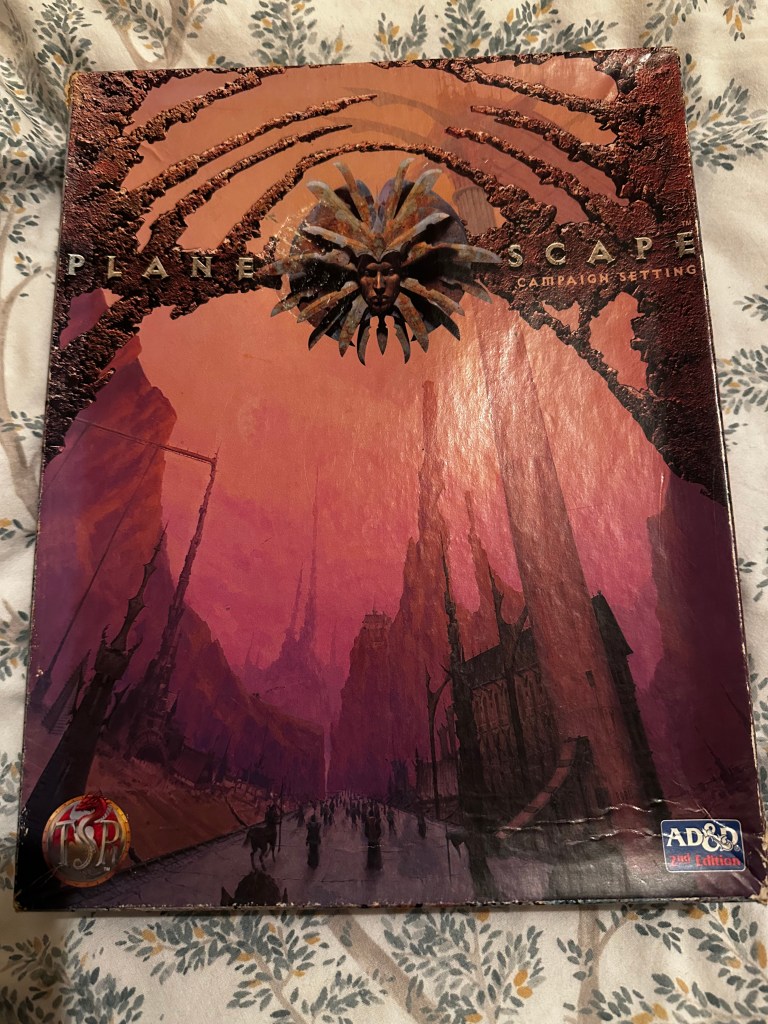
Now, as a die-hard AD&D 2nd Edition player of old, I was a massive fan of the original Planescape setting, the new shit it introduced to the game and the way it expanded our horizons as both DM and players when it came out in the nineties. But, I’ll be honest, I don’t think I knew how to use it as a 14 or 15 year old DM. It was just too massive. I wrote and ran adventures that were pretty much standard AD&D adventures except in a place in the Outlands instead of on the bog-standard fantasy world I had devised. So, in 2021, when I got the chance to send these PCs to Sigil!!! I grabbed that bull by both horns. It was so much better than I could have hoped. Even just the act of getting there was a major campaign milestone. And before long, both the players and the characters were knee-deep in planar weirdness. They didn’t know it, they didn’t understand most of it, but they still had goals. They were there for a reason (they had to find a book that explained the keys to all the planar doors in a mysterious tower beneath the town of Dor’s Hill back home.) So they pursued that. On the way, they all gained even more super powers than they already possessed. Why? Because, once you understand that D&D 5E is a superhero game, it’s a good idea to lean into it.

The first PC to get blessed in this manner was our warlock, Yulla (played by Tom.) Now, it just so happened that Yulla, up until this point, had a patron named Aegir, an elemental spirit that turned out to be the baddest guy of the entire campaign. So, when she went to Sigil her confidence in their patronage had taken a few knocks. When she then discovered her long lost, presumed dead parents there she was open to new possibilities. Now I was using the gorgeous, unimpeachable original version of the Planescape setting for this game. It was made for AD&D 2nd Edition but that was no impediment at all. (When I got the new 5E version I was a little shocked and affronted to find that they had done away with one of my favourite Sigil factions, the Believers of the Source. I understand that this actually happened way back in one of the nineties Planescape novels but I never read those so I had no way of knowing.) Anyway, the entirety of my Erlendheim campaign had been built around the Believers, their doctrines, their headquarters, etc. And it turned out that Yulla’s birth-parents had been members of the believers for decades since their supposed deaths. Anyway, this led Yulla to seek the Source as a patron, instead of the untrustworthy and, frankly quite evil Aegir.

And this is where the extra super powers come in. Tom and I designed a new Warlock Patron for Yulla, the Source itself. I based it around the philosophy of the Believers: you must try to reach your potential, your existence should be evolved as much as possible within your own lifetime, etc. Here is the result. If you like the look of it and you can find a way or reason to use this in your own campaign, please feel free.

New Warlock Patron – The Source V 2.1

Description

You have have made a pact with the ultimate creative and destructive power in the multiverse. The Source is that from which all things come and which all will someday rejoin. The members of Sigil’s faction, The Believers of the Source understand that all beings should be striving to evolve within their lifetimes to become one with the Source. To this patron, time and space have little meaning; sentients are beings of pure potential and a deep understanding of the planes of existence is essential.

Expanded Spell List

Spell LevelSpells
1stFind Familiar, Inflict Wounds
2ndWither and Bloom, Vortex Warp
3rdMotivational Speech, Life Transference
4thAura of Life, Vitriolic Sphere
5thDestructive Wave, Legend Lore

Features

1st Level Feature

Burst of Potential

From 1st level, as an action the warlock becomes a silhouette of themselves and emits a brief burst of soft yellow light. They draw on a fraction of the unlimited potential of the Source and grant it to those allies in a ten foot cube around them. Until the end of the Warlock’s next turn all within the aura gain advantage on a single ability check, attack roll or saving throw of their choice.
Once you use this feature you cannot use it again until you finish a short or long rest.

1st Level Feature

Fragment of the Source

From 1st level, using a bonus action, the Warlock of the Source gains the ability to summon a fragment of the Source in the shape of a softly glowing orb. It will appear at a chosen point anywhere within 60ft of the Warlock. The Fragment of the Source will remain for a number of rounds equal to the Warlock’s Charisma modifier. The Fragment can use its potential energy to allow a creature within 5 feet of it to roll with advantage or force a creature within 5 feet of it to roll with disadvantage on any attack roll, saving throw or ability check. As a bonus action on their turn, the Warlock can move the Fragment up to thirty feet. The Warlock can summon the Fragment a number of times equal to their proficiency bonus and regains all expended uses when they finish a long rest. The Fragment of the Source will act on the same initiative as the Warlock.

6th Level Feature

Aura of Potential

From 6th level, the Warlock of the Source’s Burst of Potential feature becomes an aura. The effects are the same as the Burst but apply to each ally that starts their turn in the aura. Also, the effect can be used to ensure maximum damage on an attack roll.
The Aura of Potential lasts a number of rounds equal to the Warlock’s Charisma modifier.
Once you use this feature you cannot use it again until you finish a short or long rest.

6th Level Feature

Wasted Potential

From 6th Level, as a reaction, the Warlock of the Source may fire a sparkling yellow orb at any creature taking an action, making an attack roll or rolling a saving throw within a 30ft range. The creature must make a Charisma saving throw against the Warlock’s spell save DC or apply disadvantage to their roll.

10th Level Feature

Mark of Potential

From 10th Level, the Warlock of the Source begins to gain benefits from the potential bestowed or denied by the Aura of Potential and Wasted potential features. Each time an ally succeeds on a roll which benefits from the advantage bestowed by the Aura of Potential the Warlock gains a Mark of Potential. Each time a creature fails on a roll affected by Wasted Potential, the Warlock gains a Mark of Potential. Gained Marks spark briefly into being around the Warlock’s head before fading into invisibility.
At 10th level the Warlock can hold up to a maximum of nine Marks of Potential. At 14th level the Warlock can hold up to ten Marks of Potential (See the “Evolution” feature below for how ten marks can be spent.)
The appearance of the Marks is up to the individual Warlock.
Marks of Potential may be held until spent.
Marks of Potential can be used in the following ways:

Marks SpentEffect 1Effect 2Effect 3
1Apply advantage to any attack roll, saving throw or ability checkDouble the range of Fragment of Potential
2Roll a hit die plus your Charisma modifier to regain hit points
3Maximise any damage effectInduce a critical success
4Roll two hit dice plus your Charisma modifier to regain hit points
5Double the area of Aura of PotentialDouble the number of targets affected by Wasted PotentialDouble the number of Fragments of Potential Summoned
6Roll three hit dice plus your Charisma modifier to regain hit points
7Increase the casting level of any appropriate spell by one
8Roll four hit dice plus your Charisma modifier to regain hit points
9Regain a Spell Slot

14th Level Feature

Evolution

At 14th level the Warlock of the Source gains the ability to use ten Marks of Potential to evolve into a form which brings them closer to the Source for a number of rounds equal to the Warlock’s Charisma modifier. For each level the Warlock gains above 14th, the duration of the evolution is increased by one round.
In their evolved form, the Warlock gains the following features:

  • 5 hit dice plus Charisma modifier of temporary hit points
  • Makes all attack rolls, ability checks and saving throws with advantage
  • Triples the area of Aura of Potential

The appearance of the evolved form is up to the individual Warlock.
Once you use this feature you cannot use it again until you finish a long rest.

Ravenloft

Something’s gotta give

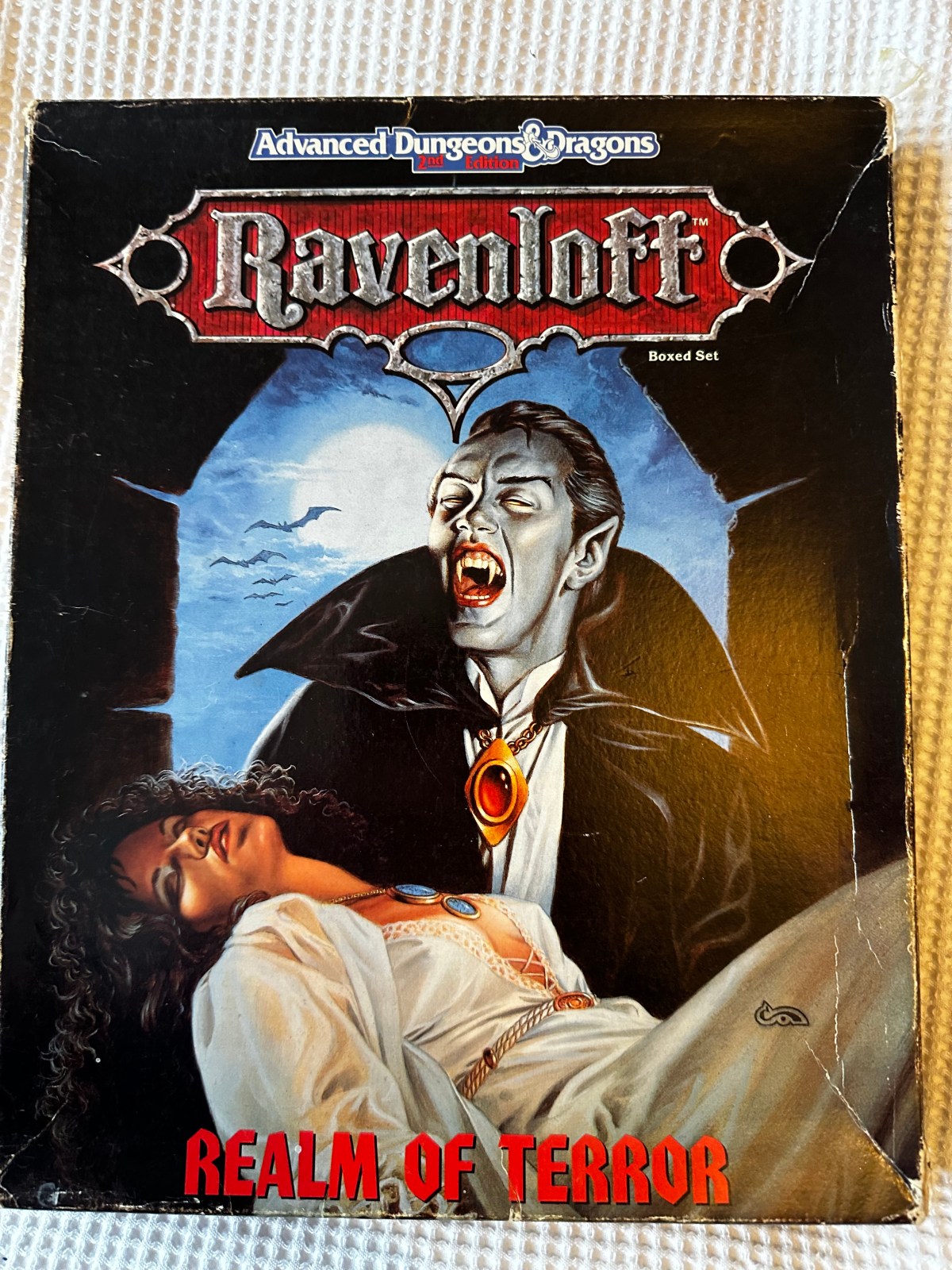
I thought I would play Ravenloft around Halloween this year. My friend returned all my Ravenloft books and boxed sets to me back in the spring after about 25 years, and since then I have been thinking it would be cool to run something in the Domain of Dread as a Halloween one-shot. But, in the meantime, I have played a lot of different games, mostly one-shots, mostly a lot easier to play in that format than any version of D&D. So I did consider starting a campaign or a multi-session adventure, but, to be honest, I didn’t have it in me to do all the reading and conversion that was necessary. I may be playing more RPGs than I ever have before in my life but that has an unlooked for side-effect: I have less time to prepare for games! This is a dilemma that has been exacerbated by my blog schedule and I have been thinking that I might have to make a change there too. I am switching to posting once every three days for the foreseeable future.

The Demiplane of Dread

So, I am not talking about the original Ravenloft adventure from AD&D 1st Edition or the Curse of Strahd released for 5E, but the setting released by TSR for AD&D 2nd Edition in 1990. It is by Bruce Nesmith and Andria Hayday. I think I have mentioned in another post that my friends and I played most of our AD&D in the Dark Sun setting but I would imagine Ravenloft comes a close second. I just loved having them create regular old characters in my home-brewed standard fantasy world and then dumping them, unceremoniously and with no warning through the mists into the forests of Barovia or the mountains of Forlorn and hitting them with monsters that drained levels and abilities and where there was no escape from he darkness and the terror. Although, I confess, the games were probably not very terrifying. I did my best, but I have always found horror a difficult genre to emulate around the table, especially with a system like D&D. The authors did their best to assist the Ravenloft DM with sections in the main book about the “Techniques of Terror,” where they discuss “Assaults on the Mind,” “Assaults on the Body,” “A Villain in Control,” and that sort of thing. But, the fact was, we were a gang of teenaged boys who mostly just wanted to hit things until they died so those were usually the kinds of adventures we got.

Looking at it from a more mature standpoint now, I would love to try to run it with a real sense of gothic horror. I think I am better equipped now to attempt it. Although I still think it would be a challenge and I might refrain from running it in a D&D-like system. Why? Well, the products for Ravenloft, while not all gold, are still some of the highest quality items I think TSR produced. Just look at all these handouts! Each one of them has something useful on the back of a beautifully illustrated card.

5E products are usually produced to a high standard, but they don’t have the variety and versatility that the 2nd Edition boxed sets did. They also don’t have the quality or usefulness of content. These boxes and sourcebooks are stuffed with useable materials; details on lands, villains, monsters, new spells, effects, encounter tables, maps, maps, maps. 5E setting guides of late, excepting maybe Planescape are very short on this sort of detail.

Adventures in Ravenloft

I usually wrote my own adventures back in the day. Or at least I would pick and choose liberally from the pre-written modules and combine them with my own scribblings to make them fit into an overarching campaign. Or that’s what I told myself I was doing. I have a funny feeling that, mostly, I was just trying o murder the PCs. This is another aspect of my style that has, thankfully, changed, since the good old days.

I do have a few Ravenloft adventures that might be fun to convert or even to just run in the original 2nd Edition ruleset.

Feast of Goblyns is a very flexible module that is designed to be run for characters of levels 4 to 7. It is presented in a format that allows many different paths to be taken through it, with the PCs potentially ignoring some major and minor plots depending on how they decide to play it. This one was designed to be the adventure that draws PCs into the Demiplane, which is always fun. I think I remember playing parts of this module but my memory is not good enough to recall which parts. At 96 pages, though, it would require a bit of commitment to play through the whole thing.

From the Shadows is written for rather high level characters, levels 9 to 12. It is based around the plots of Azalin the lich, lord of the domain of Darkon and his eternal conflict with Strahd Von Zarovich, famed ruler of Barovia and OG Ravenloft BBEG. A great deal of it takes place in Castle Avernus, the lich’s home, and that is pretty cool. I definitely played this but I don’t think the characters survived the whole way through.

Finally, I have the Book of Crypts, which is similar to the Book of Lairs but has 8 full adventures in it! This seems the most suitable for a shorter game or campaign and I might just take a look at running something from here before the spooky season is fully through.

Dear reader, have you ever played this version of Ravenloft? Do you yearn for the mists? Or would you rather play a game actually made for horror?

Character Creation – Advanced Dungeons & Dragons 2nd Edition, Dark Sun

Showing some character

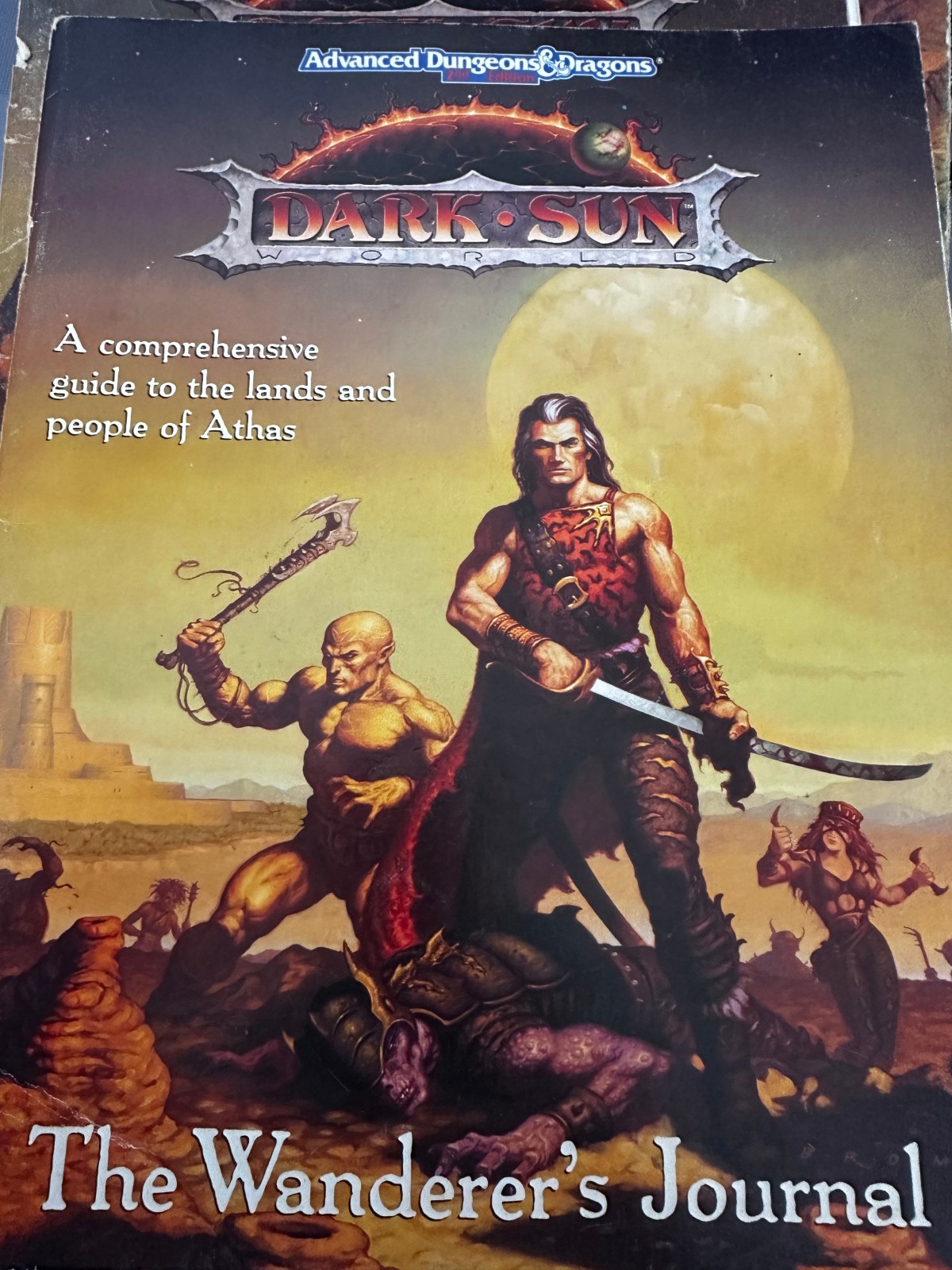
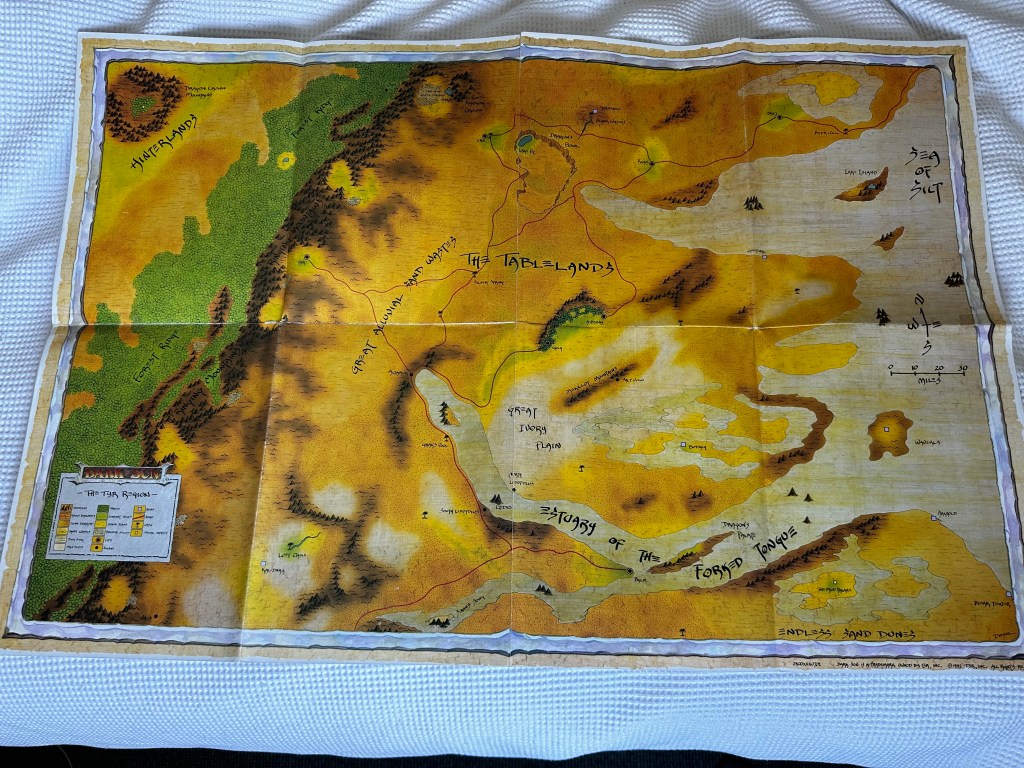
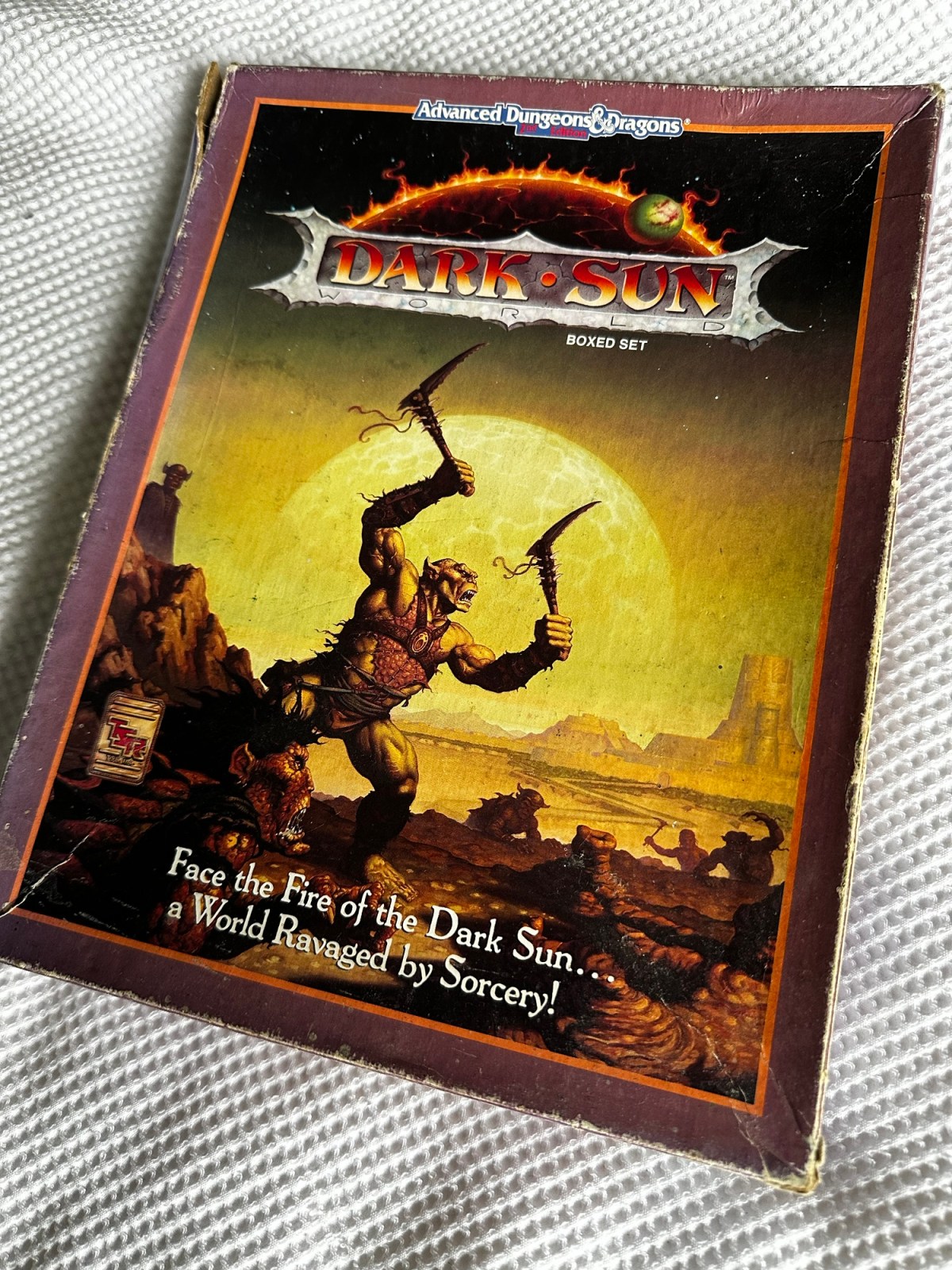
So the character creation posts have had some good feedback. People mainly seem to like it when it goes disastrously wrong for some reason. Schadenfreude maybe? Anyway, I thought I would continue the series with another one. This time, I thought I would go back to the game I think of when I think of my teenage years, AD&D 2nd Edition (TSR 1989), and, more specifically, the Dark Sun setting (TSR 1991). I have never been a player in a Dark Sun game, I was always the DM, so this will be interesting. Also, Dark Sun characters need to be pretty hardy to survive the scorching wastes of the magic-blasted world of Athas. So, if I roll bad, you sadists out there should get a kick out of it.

Step 1 – Ability scores

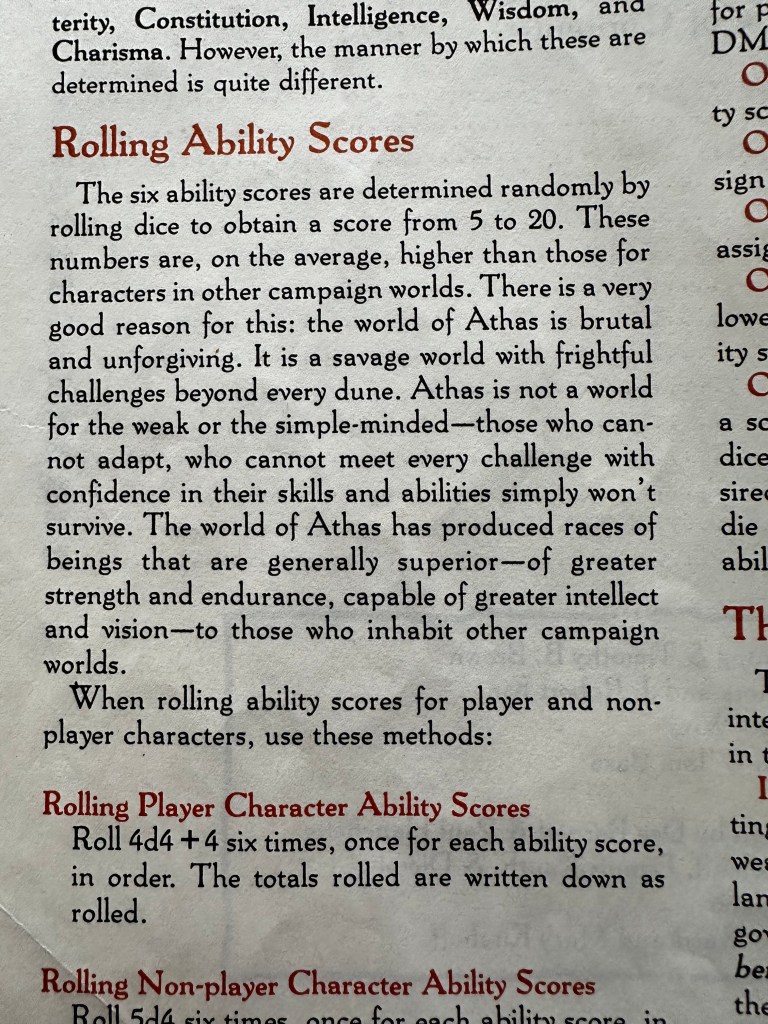
A photo of the “Rolling Ability Scores” section of the AD&D 2nd Edition Dark Sun Rules Book.

We see an immediate departure from AD&D norms with rolling your ability scores in Dark Sun. Because the setting is so brutal, your PCs get higher than average scores to reflect the hardness of life there. So, instead of the usual 3d6 for each score, you roll 4d4+4 for a minimum of 8 (even though the book claims the minimum is 5, which is numerically impossible) and a maximum of 20, unmodified. There are a bunch of optional methods for rolling included in the Dark Sun Rules Book but I am going to stick with the basic one. So, here we go:

  • Strength: 13
  • Dexterity: 16
  • Constitution: 19 (Suck it Canon Fodder)
  • Intelligence: 17
  • Wisdom: 16
  • Charisma: 10 (Oh well, they can’t all be winners)

First thoughts; obviously this method produces some high results. Also, I was very lucky. Also, these rolls mean that this character could choose almost any race or class.
Second thoughts; now that it comes to it, this is one of the reasons my players really liked this setting. They got to create some very powerful characters, even without cheating on their rolls (which was, I must be honest, the norm at the time)!

Step 2 – Player character race

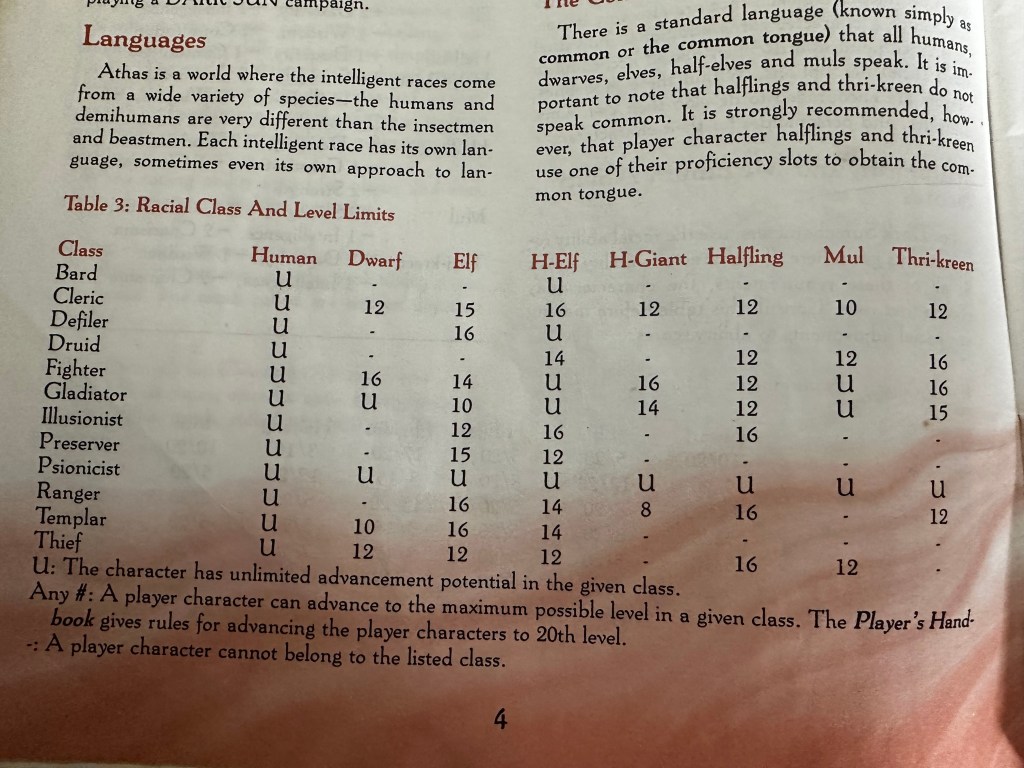
A photo of Table 3: Racial Class and Level Limits from the AD&D 2nd Dark Sun Rules Book.

There are Racial Ability Requirements in this setting as there are in the base game, but some of them are very tough to achieve. The only one I think is ruled out is the Half-giant. If you want to be one of those big lads, you need to have a minimum strength score of 17. So here are the races I get to choose from:

  • Dwarf
  • Elf
  • Half-elf
  • Halfling
  • Human
  • Mul
  • Thri-kreen

Pretty much none of the races in Dark Sun bear any resemblance to the standard D&D ones, with the possible exception of bland old humans. There are also a few new ones here.

Dwarves are all hairless and obsessed with a focus that gives them bonuses to saves and proficiencies when performing them in pursuit of that goal. They can choose to be Clerics, Fighters, Gladiators, Psioicists, Templars or Thieves. Although all of these have level caps below 20 except for Gladiator and Psionicists. Some of them are really low. A Dwarf can only get to level 10 as a Templar for instance! But they can multi-class. They get a +2 to CON, +1 to STR, -1 to DEX and -2 to CHA.

Elves are tall and lanky and weather-worn with an incredible stamina needed for running long distances across the Athasian deserts. They are very insular and tribal. They get bonuses with long swords and longbows made by their own tribes and to surprise rolls in the wilds. They can choose to be any class except Bard or Druid. They get +2 to DEX, +1 To INT, -1 to WIS and -2 to CON.

Half-elves have to deal with terrible intolerance from both elves and humans and have to do without basic connections or friends (this shit is in the text, ugh.) Anyway, it makes them very much self-reliant loners. They get a free Survival proficiency at 3rd level and can make a pet friend at 5th level! All classes are open to them and they get to multi-class if they want. They get a +1 bonus to DEX and a -1 to CON.

Half-giants are a thing in this setting. And, although I can’t choose them, here is a little bit about them. They are up to 12 feet tall and weigh up to 1600 lbs! They have no culture of their own as a very young and dull-witted race. Once again, the text is pretty bad about this kind of thing. It really underlines for me the need for the push-back this sort of thing rightly received in more recent times. Anyway, they getting bonuses to STR and CON and minuses to INT, WIS and CHA. They can only choose from 5 classes.

A photo of the Halflings section of the AD&D 2nd Edition Dark Sun Rules Book including an illustration by Brom depicting two tattooed halflings with long, wild hair emerging from a cave.

Halflings are small humanoids from the jungles at the fringes of civilisation in the Tablelands of Athas. Their culture is concerned mainly with appreciating their local natural world and complex interactions of a social sort between their various villages and clans. They are not really into war and wealth. They get bonuses to use slings and thrown weapons, to surprise opponents and to save against magic and poisons. They get a -2 to STR, -1 to CON, -1 to CHA, +2 to DEX and +2 to WIS. They can choose any class except Bard, Defiler, Preserver and Templar. They can choose to multi-class.
As a side note, I had a memory of Halflings all being cannibals in this setting but it is not mentioned in the character creation section so it might have just come up in certain adventures or something. Not sure.

Humans are much like humans in other settings except they generally have some weird little traits, like mutations. This is a post-apocalyptic setting after all. So players are given latitude to come up with some little physical idiosyncrasy that is purely for flavour. They can choose any class and can be dual-class, but cannot multi-class.

Muls are yet another “half-race.” Its genuinely so distasteful, this whole business. Anyway, here we are, they are half human, half dwarf. They are the product of slave-owners “ordering their births” for gladiatorial or labourers. They are born sterile. FFS. My stomach truly turns at this description of this race. It’s just so cruel. They also “live out their lives in servitude, driven by hatred and spite.” Give them a break! They are tall and well built. They get a +2 to STR and +1 to CON, but a -1 to INT and a -2 to CHA. They can work longer and harder than others as well. They have to choose, at the time of creation if they are considered human or Demi-human. If considered human they can have unlimited advancement in any class and become dual-classed. If the player chooses demi-human, they can, instead become multi-classed and can only choose from Cleric, Druid, Fighter, Gladiator, Psionicist and Thief. This really puts a great big question mark over the entire idea of class restrictions on Demi-human races, if you ask me. This suggests that the reason a demi-human can’t choose any class or get all the way to 20th level in it, is not because of a physiological, racial impediment, it’s only because human society says they can’t… I mean, what?

Finally, Thri-kreen. They’re big mantis guys who have a base AC of 5 but never wear armour. They don’t need to sleep but they can’t use most magical items as they are generally designed for use by human shaped people. Their hunting packs control much of the Tablelands. They have a well-known taste for elves (maybe I was mixing up the Thri-kreen and the Halflings.) They get natural bite and claw attacks and a powerful leap. They get venomous saliva at 5th level as well as a bonus proficiency with the Chatkcha, a thrown weapon. They can also dodge missiles at 7th level. They get a +1 to WIS and +2 to DEX, but -1 to INT and -2 to CHA. They can choose to be Clerics, Druids, Fighters, Gladiators, Psionicists or Rangers and they can multi-class too.

This post is already much longer than I had intended. I started going through the races and couldn’t stop commenting on them. It was like watching a car-crash in slow motion.

Anyway, I think I will have to continue this character creation process in another post tomorrow. But, before I go, I think I will have to complete the choice. Obviously, as always, the race you select will have a direct effect on the choice of class due to the ability score modifiers. But, since we have a tradition of randomness in the character creation posts, I think I will stick with it and roll for it. There are seven races available to me and, luckily, I do have a d7 to hand thanks to DCC. Here goes:

I rolled a 6 on a d7, dear reader, but I just can’t accept it because that would have been a Mul and that makes me too sad. So I re-rolled and got a 4, Halfling!

So, that leaves me with ability scores as follow:

  • Strength: 11
    • Hit probability: Normal, Dmg Adjustment: None, Weight allow.: 40lbs, Max press: 115lbs, Open Doors: 6, Bend Bars/Lift Gates: 2%
  • Dexterity: 18
    • Reaction Adj.: +2, Missile Attack Adj.: +2, Def Adj.: -4
  • Constitution: 18
    • HP Adj.: +2 (+4 for Warriors. This means Fighters, Rangers and Gladiators in Dark Sun), System Shock: 99%, Resurrection Survival: 100%, Poison Save: 0, Regeneration: Nil
  • Intelligence: 17
    • # of Lang: 6, Spell Level: 8th, Chance to learn spell: 75%, Max. # of Spells/Lvl: 14, Spell Immunity: –
  • Wisdom: 18
    • Magical Def Adj.: +4, Bonus Spells: 4th, Chance of Spell Failure: 0%, Spell Immunity: –
  • Charisma: 9
    • Max # of Henchmen: 4, Loyalty Base: 0, Reaction Adj.: 0

The final task for today is to flesh out this Halfling a bit. I am giving her the pronouns she/her and calling her Rezina.

A page from the AD&D 2nd Edition Dark Sun Rules Book showing the Height, Weight, Age and Aging Effects tables for PC races.

She is 3ft 3in tall, 59lbs in weight, and 41 years of age.

Back tomorrow with the choice of class and probably everything else. See you then!