Call of Cthulhu: The Derelict Review

[My players] didn’t find the book of norse legends, the handwritten notes that presented possible ways to defeat the Sciapod, the silver items that would allow people to actually see the creature, etc, etc.

Two-part One-shot

SPOLIERS BELOW, ME HEARTIES! Turn back now if you want to be a player in the Derelict!

You know how it is, dear reader, when you board your luxury yacht and expect to make excellent time crossing the North Atlantic? And then you start to run into complications? Almost everyone gets drunk, you come across a seemingly abandoned reefer ship washed up on an iceberg, you decide to explore the possibility of rescuing anyone from it or maybe even salvaging it for vast profits, you board it and find its covered in blood and the controls have been deliberately sabotaged, you’re hunted by a towering monstrosity with a crystalline bow and only one weird leg, which is visible only to about half of your number, your own yacht’s controls are smashed to bits and the captain is eviscerated and several of your number begin to lose their grip on sanity?

Of course you do! Anyway, when I write it out like that, quite a lot did happen in the first session of the Derelict. It took so long, in fact, that we had to stretch it to two. We played it out in about five hours in total, I’d say, but there was plenty left undone as far as this scenario goes. You could easily stretch it out to three sessions of three hours each, I’d say.

The Scenario

A busted up dining room on the Groenland Tropisch.
What a mess!

In this post from about a month ago I introduced the premise of the Call of Cthulhu scenario I ran as part of our Tables & Tales October Event, during which we ran a bunch of horror/spooky/halloween themed games especially for our newbies. Today, I’m going to look at how it went and how I think it could have gone better.

The Derelict is a 28 page adventure for Call of Cthulhu. It appears in Petersen’s Abominations, published in 2015 by Chaosium. It was written by Sandy Petersen with Mike Mason.

It seems Petersen got the idea for this adventure while reading about Viking explorers and this particular encounter that was described quite matter-of-factly as a Sciapod, a one-legged creature with a crystal bow. The conceit is that such creatures were not necessarily taken as supernatural by people of by-gone ages so the encounter was recorded as a relatively mundane occurrence. I like that this theme jibes with Zedeck Siew’s observations about the attitude many Malaysians would have to signs of the Pontianak in his scenario, A Perfect Wife, as well as my own personal experience of growing up in Ireland. Of course, when the Investigators encounter the Sciapod in the Derelict, they are not likely to react the same way at all.

The portrait of Siren/Lori Washington, a femme presenting person with long dark hair and a bright dangling earring in one ear.
Siren/Lori Washinton

The Derelict was clearly designed as a one-shot or very short campaign. It would be hard to work it into an ongoing campaign, I think, given the rarefied circumstances and setting, so if you want to run it, I would suggest taking it at face value and go for something short and self-contained. I would also recommend using the pre-generated characters. They are all rich/famous arseholes of one stripe or another. You know, the type of people you would expect to have on a luxury yacht. But they also have their own motives, some are having money troubles, some are looking for sponsors, some are party animals, that sort of thing. They are relatively well painted and designed to be easy to pick up and play. There is a second option presented in the scenario: the PCs could be members of a rescue team sent to investigate the Derelict, but this option lacks the horror movie energy you get from the rich yachters, in my opinion.

The formatting is useable and fairly presentable. It starts with the intro and a brief description of our cast of characters before a short section on Starting the Scenario, under which we also get a useful Sequence of Events. I say “useful,” but my players exited the sequence pretty quickly and I was forced to improvise liberally from that point on.

The bulk of the scenario is taken up with descriptions of the main areas of the Derelict ship and the iceberg it’s stuck on. It does go into a fair amount of detail even about the areas that are of little or no interest. It will tell you where to find the clues and items of interest within these descriptions. This is the greatest weakness of the adventure, to be honest. My players spent almost no time exploring the ship. They were incredibly goal oriented, going to Engineering to find things to help them fix their own boat and to the radio room for a way to contact someone. So, they didn’t find the book of norse legends, the handwritten notes that presented possible ways to defeat the Sciapod, the silver items that would allow people to actually see the creature, etc, etc. I wish I had started just transplanting some of the more important clues and things to the rooms they did explore earlier. In the end, I did do that but we had played the bulk of the game by then.

It has some great maps and illustrations throughout. The maps of both boats were particularly useful. We were playing on Roll20. So I used the maps a lot. In the first session I used fog of war on the map of the Derelict, but I found this led to too much player confusion about the location of everything and too much time spent by me on descriptions. It was supposed to be a one-shot! So, in the second session I turned off fog of war under the pretence that they found a full map in Engineering. That made things a lot easier. The players were able to see where they might want to explore and they started to do that.

One of the strengths of this scenario is that, even though it provides you with a sequence of events, it encourages you to play it quite free-form. Simply allow the PCs to look around, discovering clues as to what happened here and maybe how to defeat the monster, and then start picking off characters with the Sciapod as they go, NPCs first. They’ll start getting injured and insane and the scenario should blossom from that. In many ways, this is what led to our game going quickly off the rails. The sequence of events expects the players to start trying to find ways to kill or drive off the Sciapod but that’s not what happened at all. As I started to kill them off and ship away at their sanity, they began to look only for alternative ways of escape. But, of course, along the way they saw some some pretty disturbing things and one of them lost the plot completely, going full axe-murderer before eventually getting it together while they all bundled into the last remaining lifeboat. Except for looking for firearms on board, they never considered finding a way to kill it. And, of course, this was great! I loved it and the players had fun. But I will admit to, at times, trying to get them to take the route that was expected of them. I think I would have had more fun if I had lust loosened my grip on the reins a bit more.

Still, if your players do get so far as to start coming up with ways to beat the bad guy, there is a useful section at the end of the scenario devoted to potential plans that they might come up with, using lots of things my player never even discovered. They could use the CO2 stores, the bulldozer or forklift that was in the hold, etc.

The Appendix

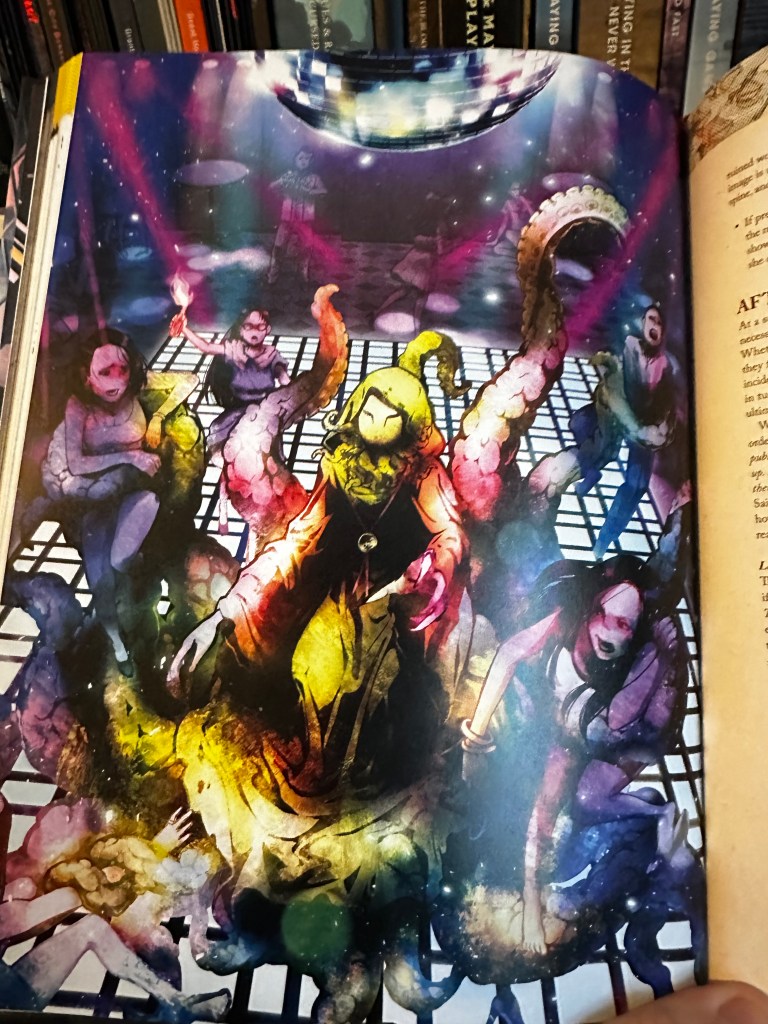
The Sciapod. A bluish tinged, armoured humanoid with only one thick leg, which ends in a wide, umbrella-like foot with claws all around the outside of it. it holds a crystaline bow and has a single green glowing eye.
Hawkeye? You’ve changed.

In the Appendix, you get stats for the two NPCs and the Sciapod itself.

The NPC stats could be particularly useful if a player loses their PC early and they need a replacement. This did happen in my game but only after both NPCs were already dead so it didn’t help.

When it comes to stats for the Sciapod, I don’t think it should matter really. It is designed to be undefeatable by normal means. The PCs are supposed to have to come up with some big, brash, loud plan to kill it, after all. But there are elements to the creature that are of real interest. For instance, it is visible only to those who have silver touching skin for some reason. This proved to be a weird and scary element of the PCs encounters with the monster. It directly led to the death of one of them but it is a strange addition to the abilities of what is already an odd adversary. It is utterly silent too, and it wields this weird crystalline bow with enormous glass like arrows. This last bit feels very un-Cthulhu to me. It adds more of a D&D flavour to this monster but it did allow it to attack from a distance, which I made use of. This led to two memorable moments of gameplay, in fact. First, our pop-star character, Siren stood on the deck and had a showdown with the Sciapod, she with her little .22 pistol and it with its giant glass bow. Second, the creature launched one of its enormous arrows into the hull of the lifeboat they were escaping on right at the end, ushering in their deaths and the end of the game.

Conclusion

This was a fun one-shot/two-shot. It had great pre-generated characters and a fascinating premise and setting. (Although I have to stop running one-shots on boats. Apparently its become a trend…) But I question whether the monster that’s central to it is really Cthulhu-mythosy enough. It’s strange but not necessarily horrific in and of itself. Also, the adventure involved a lot of prep for something that could be designed to be run with little or no preparation. But you have to read the descriptions to familiarise yourself with the setting, the clues, the origin stories, hidden history etc, etc. and that all takes time.

Kanabo

The best part of the whole How to Play section is the list of Best Practices…We have gems like, “Ask questions. Take Notes. Draw diagrams. Write in pen” and “Fight unfairly. Lay ambushes. Hit below the belt. Run away.” And familiar old favourites like “Play to find out what happens, and how it happens” and “Strive for victory, but revel in your defeats.”

Waku Waku

Dear reader, my excitement is threatening to overwhelm me. As some of you may know, I studied Japanese in university and lived and worked in Japan for about three years in total. It’s hard to put into words exactly how I feel knowing that, this weekend (probably yesterday by the time I publish this post), I’ll be going to see the Ireland vs Japan rugby match in Dublin and next weekend I’ll be finally going back to Japan for the first time in eight years! I think the right word is probably わくわく (waku waku, loosely translated as excited.)
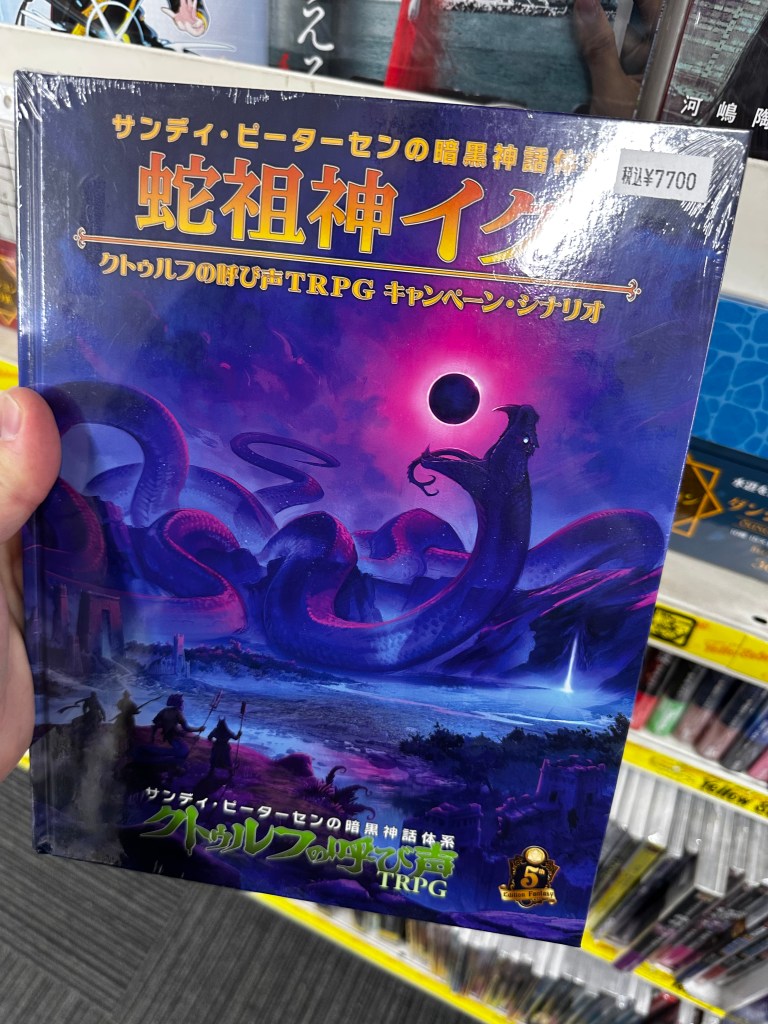
Anyway, as a build up to that, I thought I would look at an RPG based on a Japanese historical period.

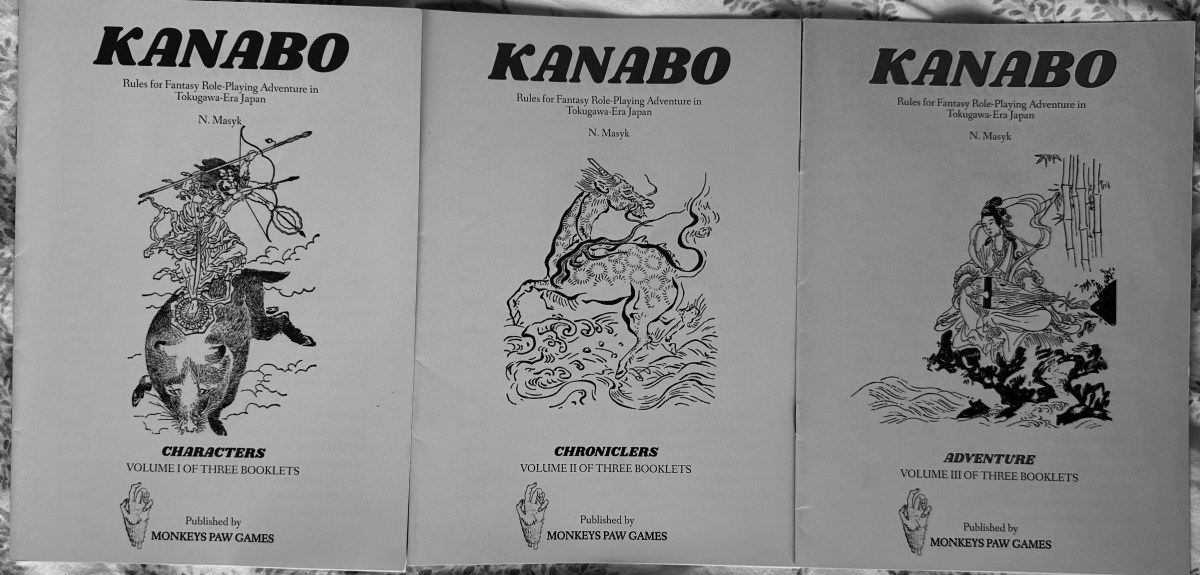
Kanabo: Fantasy Role-Playing Adventure in Tokugawa-Era Japan

A Kanabo is a Japanese weapon, a long metal club, adorned with spikes or studs. The game, Kanabo by N Masyk, is an RPG published by Monkey’s Paw Games. It comes in the form of three neat booklets, Volume 1, Characters, Volume 2, Chroniclers and Volume 3, Adventure. It was gifted to me by friends and all round good eggs, Tom and Isaac several years ago. I can’t remember which year exactly and I don’t see a publication date on any of the booklets so I am going to guess and say it was sometime between 2020 and 2022.

These booklets truly are only wee. The longest of them is 21 pages of A5. But they pack a lot into each one.

Volume 1, Characters

The cover of Kanabo, Volume 1, Characters. It has a mythical Japanese warrior wielding a spear and a bow at once, while dancing on the back of a great black boar, possibly in the clouds.
Magic Man on Magic Boar

This booklet, as is the case for each one, begins with the credits. N Masyk did the words and the layout, “Dead People” did the artwork and the Hexmap uses the Highland Paranormal Society Cartography Kit, by Nate Treme. Finally, consulting was done by James Mendez Hodes. I think you will notice a peculiarly Western bent to the people associated with this project, other than the Dead People who are all Japanese (by the looks of their artistic styles) but remain conspicuously unnamed.

It starts off with an intro section that explains briefly what the game is about and suggests the use of safety tools such as Lines and Veils and the X Card. The “What is this?” section tells us that this is a game set in the Tokugawa period of Japanese history. It informs us that this is the time after the Warring States Period when the country is united but many wandering Travelers are abroad, “seeking fame, fortune, justice, revenge, or simply the freedom to roam.” That’s the PCs! I like this as a time period and setting. The Tokugawa era was long, more than 250 years. It was a time when Japan was cut off from the rest of the world, guarded its coast jealously and avoided the great changes that engulfed the other regions during the same time. The role of the Samurai was slowly being eroded, nobles were forced to pilgrimage from their lands to the capital under their own expense to keep them in line, the Shogun ruled the land and Japanese culture deepened. But I also like that there is a paragraph here on historical accuracy. Masyk takes pains to explain that, despite the potential realities of the place and time, as players of a game, we must strive to be inclusive before being accurate. Japan of this time was a place of terrible inequality, Kanabo at the table does not have to be.
The introduction section is reprinted in Volume 2, Chroniclers and Volume 3, Adventure. I wonder, in a set of booklets of such limited page-count, if this was necessary. Perhaps it was felt that the Characters booklet, meant largely for the players, and the Chroniclers booklet, meant only for the Chronicler had to both have it to refer back to regularly, but I would question that, especially as the Adventure booklet is also meant for the Chronicler exclusively. Maybe its so the kid who finds one of these booklets all on its own, tucked into a box in the dark reaches of a secondhand bookshop thirty years from now, knows what it is they’ve found.

Stats

The Stats section actually introduces the entire character creation process. Stats themselves are only one part of that. You roll 2d10+20 for each stat, for a maximum of 40.

I was expecting this ruleset to be a D&D clone or maybe an Odd-like but I was surprised to discover this is a percentile system. When you want to do something you roll a d100 and hope for a result equal to or under the stat you are rolling on. You will notice that this makes it necessary to roll really rather low to succeed, but there are several ways to gain a +10 to your rolls, such as using the right piece of equipment, possessing just the right skill, spending a filled segment of your Fate Clock or, in battle, gaining Advantage. There are three specific ways to accumulate +10s in a battle. If you want to disengage from combat safely, you can expend all of them and do so.

The Stats themselves are incredibly and deliberately abstract:

  • Fire: confrontation, aggression, force
  • Water: tranquility, inquisitiveness, exploration
  • Earth: stoicism, calculation, discipline
  • Wind: intuition, reflection, grace

As such, there is a lot of potential leeway in the decision on which stat to roll in any given situation. I like this sort of thing. I imagine Blades in the Dark style negotiations occurring as to how they might work out in play. However, I struggle a little with the whimsicality of the naming convention. It has a sort of mah-jong flavour to it, I’ll admit, which is not, in itself a bad thing. But, if you were to choose particular Chinese characters from the available mah-jong tiles, there are others that really describe human traits that might work better. I am thinking of things like 力, chikara (strength,) 心, kokoro (heart) etc. The use of the four elements makes it feel a little more like Avatar than any of the sword-fighting movies that inspired this game. It is a stylistic choice, though, and I’m sure it would work just fine at the table.

There are other elements to character creation, of course. Some of them remind me, quite delightfully of making a DCC character. Others have an Into the Odd feeling which I enjoy.

You can roll for your Chinese Zodiac sign. Whatever sign you roll, you can take it and apply a +5 to a stat that you think it reflects positively on. It would have been fun to have to apply a -5 to a different stat in this step I think.

When you roll on the Birthplace table, you will get somewhere like “Fishing Village,” “Hill Fort,” or even “Haunted Ruin.” Depending on what you get here, you will start with a different piece of equipment, such as a “fishing rod,” “spear,” or “lucky charm.”

Next up you roll on the Career table, which will give you another piece of equipment. Soldiers start with a matchlock pistol but Farmers only get a straw hat!
Your birthplace and career also allow you to list two things you know about or are skilled in. These can give you +10 to rolls in certain situations.

By rolling on the Curio table you might find yourself starting with a lucky cricket, a mask or maybe some rice balls. Each curio comes with a question that might help to round out your character.

After this you have a bunch of tables that will help you describe your PC. You have Mannerisms, Clothes, Face, Names etc. There should be plenty here to give you a very clear picture of your Traveler.

How to Play

This section lays out the rules quite economically. I’ve given you the basics already and there isn’t too much more to them than that, which is great.

There is a PBTA element to the rolls. You only roll when there is some risk, of course, but if you succeed, you do so without consequence. If you fail, you can still succeed, but with consequences. In combat, this means that you trade harm.

Kanabo character sheet on the back of the Characters booklet. There are spaces for Name, stats, zodia, career, birthplace, curio, description, Knowledge & Skills, Inventory, Wounds and a Fate clock split into eight wedges.
Kanabo Character Sheet

You get a Fate Clock on your character sheet. It has eight segments, which you will be filling and erasing as you gain and spend them. You gain a segment whenever you roll doubles on a d100 roll. I choose to interpret this as 11, 22, 33 etc. You can choose to erase a segment to give yourself +10 to a roll, prevent 1 Harm, recover 1d10 wounds or survive past your 5th wound. It’s a bit like stress in Blades in the Dark, a superpower that these Travelers have that allows them to contend against terrible odds and powerful forces.

Some few paragraphs are devoted to the idea of Travel. Kanabo assumes you will be hex-crawling and lays out the rules for that in relation to time, encounters, foraging, rest & healing etc. This is presented in a way that is player friendly and does not blind anyone with science. I appreciate it.

Character Advancement gets one very short section. Characters can choose one of two options at the end of each session, “increase a stat by 1” or “write down a new skill or piece of knowledge.” It’s neat and lacks frills. No room for confusion at all.

The booklet is rounded off with sections on hiring help, common equipment and refreshments. They are presented in several short and entirely non-exhaustive lists that are merely starting points for the interested player to do some research on what stuff might have been available in Tokugawa-era Japan.

The best part of the whole How to Play section is the list of Best Practices. Many of these will be familiar to the those of you who have been reading my series on Blades in the Dark recently. We have gems like, “Ask questions. Take Notes. Draw diagrams. Write in pen” and “Fight unfairly. Lay ambushes. Hit below the belt. Run away.” And familiar old favourites like “Play to find out what happens, and how it happens” and “Strive for victory, but revel in your defeats.”

Volume 2, Chroniclers

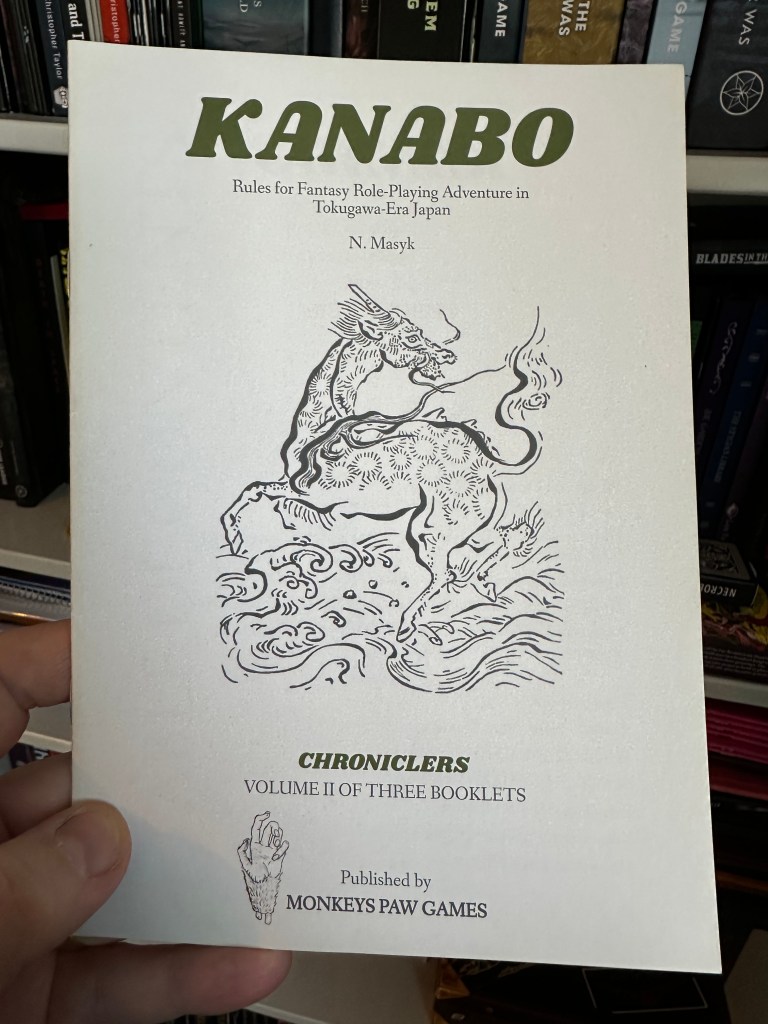
Kanabo Volume 2, Chroniclers has the image of mythical Japanese creature, the Kirin, across between a dragon, a horse and a giraffe, dancing across the waves.
This is a Kirin. Interestingly, the Japanese word for giraffe is also Kirin. It’s also a good beer.

After the repeated intro section we get straight into a section on how to run the game. Let me reproduce here the entirety of that section:

You control the world around the Travelers and the people within in, and the places they have built for themselves. Fill that world with adventure, danger and magic.
There are no further words by witch I might describe or prepare you for the journey ahead.
The contents of this tome, much like the contents of the Universe, are mostly lies.

I think this is probably one of the most uniquely unhelpful such sections I have ever read. I understand that the author is trying for poetry instead of boring old instruction, but it reads as though they want you to think there is no advice that might help a prospective Chronicler. There is something to be said for the idea that a GM/referee/judge/whatever should trust their instincts, but it is certainly not always true. Also, there is an enormous wealth of real advice out there, both in printed books and for free on the internet. I understand the author had limited room here, so, perhaps they could have directed the newbie GM to the blogosphere, or a particular publication that they thought aligned with their own design ethos.

Anyway, as soon as they have described everything in the “tome” as lies, they go on to provide guidance on how to run the game… and it’s useful! It’s practical and answers the sorts of questions that would definitely come up at the table when playing Kanabo! Things like discussing the possible consequences of rolls before making them, determining the effectiveness of successes etc. So, my main takeaway from all this is don’t believe the bit that tells you its lying to you…

There are a couple of pages here devoted to describing very Japanese-themed encounters, we have Kappa, Oni, Kitsune etc, without ever using those words. I like the pared down descriptions and the minimal stats presented, and I can see the idea of removing the Japanese names so as to allow a Chronicler to set their game of Kanabo in a non-Japanese context. Or maybe it’s done to for localisation purposes. I don’t know really, but, personally, I would prefer to use the Japanese names. It feels wrong to me to do otherwise.

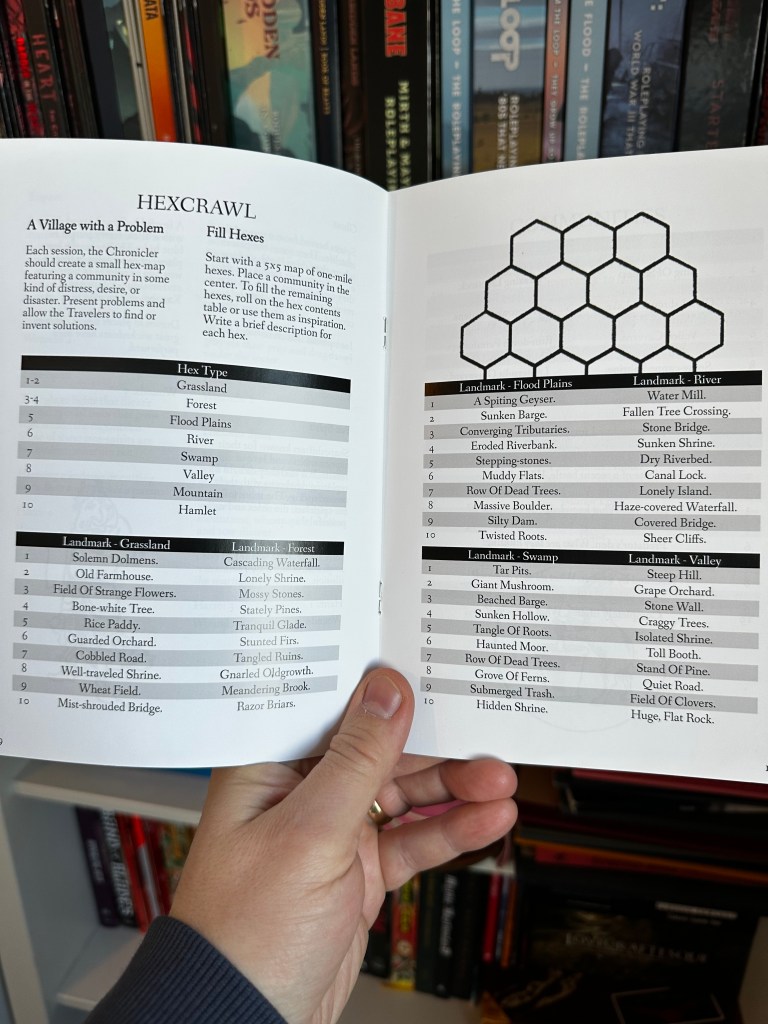
Hexcrawl section from Chroniclers booklet. There are several landmark and terrain tables and the top half of a hex rose here.
Hexcrawl

I think another very interesting element to this game is that, despite its semi-PBTA roots, you are expected to run it Old School. We have Weather tables, advice on rolling for encounters, an encounter reaction table and a whole bunch of tables to help you build your once-a-session hex map. These are, honestly, great. They are extremely practical and useful with lots of tables of landmarks for a variety of terrain types from Grassland to Hamlet. There are more tables for Factions, Communities, and Adventure Sites that would allow a Chronicler to build an engaging monster-of-the-week-style adventure with little to no prep required.

But, the advice for doing all this is limited within the booklet itself. The third of the the three booklets, however, serves to illustrate how it should work!

Volume 3, Adventure

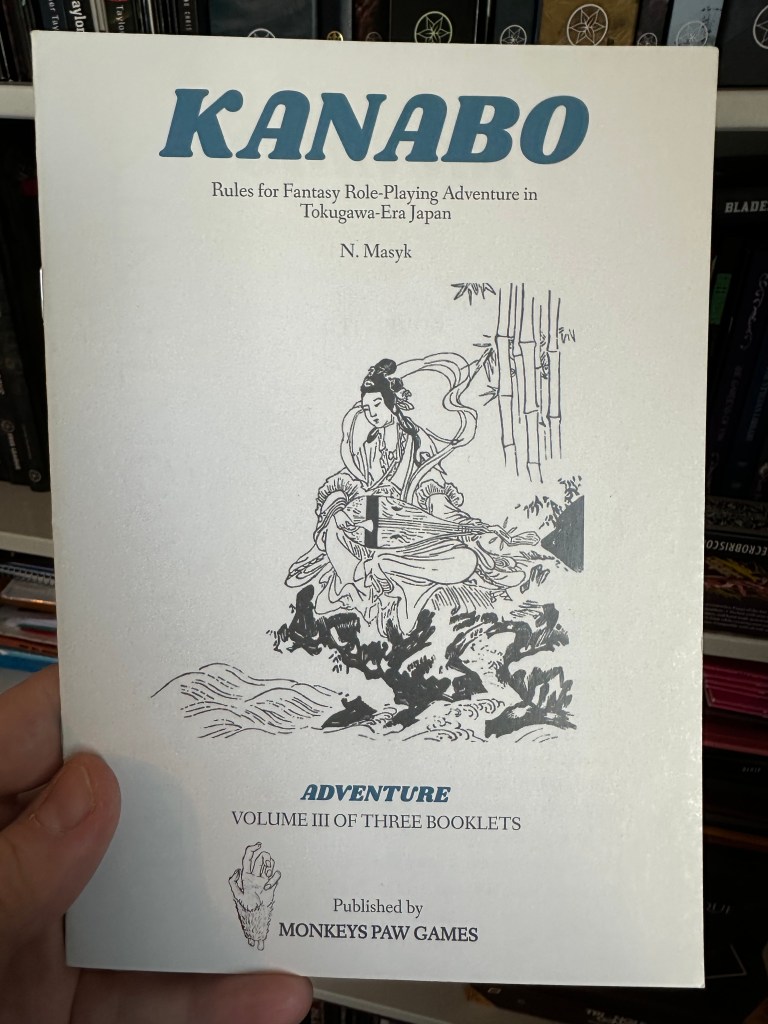
The cover of Kanabo Volume 3, Adventure. It shows the image of a woman, or maybe a bodhisatva playing a shamisen on the edge of a cliff.
Magic music

This one if incredibly short, only eight pages, two of which have the intro again. After that, we get a bunch of ten point lists, which come together to create Peach Trees Village. The list of Locals describes each one in a single line, provides a piece of their dialogue and outlines an adventure hook. Here’s the first one:

Asuka. A farmer. So forgetful; “did my apprentice bring the cattle in?” Needs someone to go check. Something’s been at the cattle.

I love this way of presenting information. It’s incredibly efficient and is just enough to spark the imagination. You get something similar from the Shops and the Rumours lists.

Next, we have The Surrounding Wilderness section. This kicks off with a hex rose, already filled in to give the Chronicler an idea of how it’s done. Each of the 19 hexes is described in a similar way to the Locals above. Here’s no. 10:

Frozen wood. Snow-blanketed trees. A dead mile where nothing grows. Strange lights at night. What is causing the lights?

Once again, it’s just enough to spark the imaginations of both Chronicler and Travelers to perhaps pursue the mystery of the lights in the woods, without bogging you down with established fiction.

A “Searching, you find…” D100 table rounds this adventure booklet out.

Conclusion

All in all, I think this little RPG punches above its weight. I question some of the choices made regarding naming conventions, use of space and GM advice but otherwise, I am quietly impressed. I would like to try running it, but it will have to wait till after my own adventure in Japan!

Blades Out!

Since I didn’t know for sure that the PCs would back the Lampblacks until the very moment they answered Baz in the opening scene, I couldn’t plan for what might come next.

Housekeeping

Dear reader, another change is afoot. I have been running this blog for about 17 months. In that time I have published 175 posts, including this one. That’s hundreds of thousands of words, some of them good words, some of them not so good, but all of them worthwhile. For the first month, I wrote one post a day! That seems incredible to me, looking back at it now. I soon dropped down to three a week and then to two. Even that has been a struggle lately. Partly that struggle comes from the fact that I’m playing more RPGs than ever, partly it’s the exigencies of life in general. What I’m getting at is that I’m planning to drop down to a single post a week, probably on a Saturday or Sunday. I still love doing this and I appreciate you, dear reader, for popping by to give some purpose to my ramblings, so I’m not going to stop. I’m just going to take it a bit easier on myself. I might revisit this decision in the new year and I reserve the right to post more often if I find a subject I absolutely must blog about. For now though, on to the meat of the post!

A Murder of Crows

We finally had session one of our Blades in the Dark campaign! Last Wednesday, five of us got together for our first score. To make things a little easier on myself as a first-time GM of this game, I decided to use the starting situation presented in the book. Roric, the leader of the premier gang in Crow’s Foot, has been murdered, and rumour has it, Lyssa, his erstwhile second-in-command, did the murdering. This has opened the floodgates to inter-gang rivalries across the district, that had previously been kept in check by Roric.

The Score

Guns and a knife.
Guns and a knife.

The Opening Scene was set in the old coal warehouse belonging to the Lampblacks. Bazso Baz wanted to know where they stood in the burgeoning turf-war between his gang and the Iruvian Sword-masters, the Red Sashes. The crew’s reputation with the Lampblacks started at 2 so it was a no-brainer for them to support Baz’s side in the war, at least for the time-being, until they see an opportunity to exploit and grab power for themselves, perhaps, later on…

This was the point where John Harper started to let go of my hand. The book provides several suggestions for the type of score Baz (or, indeed, Mylera, leader of the Red Sashes) could send the crew on. A couple of them are generic, other options are for particular crew types. I decided on the one expressly for the Bravos crew type.

If you’re Bravos: Maybe Bazso wants you to storm the drug dens of the Red Sashes down by the docks. Run off the clientele, smash up the places, grab any loose coin you find.

I like how the suggestion is kept very vague. The warning to not overcomplicate things comes to mind when I read that. Also the GM Best Practice to “Be aware of potential fiction vs. established fiction.” Since I didn’t know for sure that the PCs would back the Lampblacks until the very moment they answered Baz in the opening scene, I couldn’t plan for what might come next. As such, there was no point in taking any of those presented suggestions and elaborating on them. I had to put a lot of trust in my ability to improvise the score on the fly, with nothing but my own imagination, the vibes of Duskwall I had been soaking in from the book and John Harper’s advice to keep me right. I jumped in feet-first, a little nervous, but more than a little excited. Mr Harper had let go and told me to swim on my own.

I had a vague setting (the Docks,) a goal (destroy the drug dens) and a crew to act as my water wings, at least. I got the players to make an Engagement Roll. The crew’s Whisper decided to go the occult route with this, breaking into a house near the drug-dens and communing there with the spirit of a gangster who was murdered by the Red Sashes. I found it immense fun to play this unhinged, vengeful, but ultimately powerless ghost. With a 6 on the Engagement Roll, he was able to provide them with the numbers of Sashes in the dens, the best approach to attack and the location of the lockboxes full of coin. He also said if the crew really fucked them up, he’d give them some more information he’d learned in the Spirit Realm that might be of interest to them.

Unsurprisingly, they went for an Assault plan type and then chose as the detail to this plan, a point of attack, which was to go for two dens at once before moving on to the third and final one, where they would find the lockbox. This particular aspect of the Score took a little explanation. The six plan types, the vagueness of the plan and the specificity of the detail for that plan was all, not precisely anathema to trad or OSR players, but certainly an example of what sets this sort of story game apart form those kinds of games.

But once we got into it, the players took to Blades in the Dark like well, blades in the dark. I gave them a couple of clocks for each den they were hitting, one for their goal and one for reinforcements to show up for the Sashes. Some of us had games with clocks before. In Isaac’s Black Sword Hack campaign, he used them to great effect during a fantastic siege scene. But, I also used the example of the Resistance of a delve in Heart to explain how they would work, since most of us were also very familiar with that game. In the use of the clocks, I once again embraced the warning not to over-complicate. I wanted to make sure we got through the score in a single session so, rather than introduce new narrative consequences to every failed or partially successful roll, I just ticked a clock almost every time. I also ruled a couple of times that their actions would tick more than once on a clock, despite not getting a critical. This was largely due to the narrative effects of their actions, but also because of my awareness of time constraints. Despite this, I was delighted to introduce a new clock when the Hound shot a guy right in the head. The bells rang out across the district, tolling for the dead. They knew, at that point, it was only a matter of time before the Spirit Wardens showed up to deal with the newly minted ghost. The Hound kept on shooting, nonetheless, the death-knell kept pealing and I kept ticking that clock.

The players had fun with this score. They fell into their characters and their individual strengths very quickly. The Cutter called out the sword master boss and beat him down in the street while the Leech blew up his drug den. The Hound, sharpshooter that she was, started off sniping, but went in blasting. The Whisper, their mage-tank, had gone for a heavy load with a war-hammer and really had fun Wrecking the place. They rolled well and they got out of there with the Coin, leaving behind three former drug dens. Everyone enjoyed the depth of narrative control they felt they had and how the smoothness of the rules added to the story, rather than slowing it down or lumbering it with hit points and movement speeds and whatnot. As they said, every score their little crew had done so far was, “the Big One” but this one really felt like it.

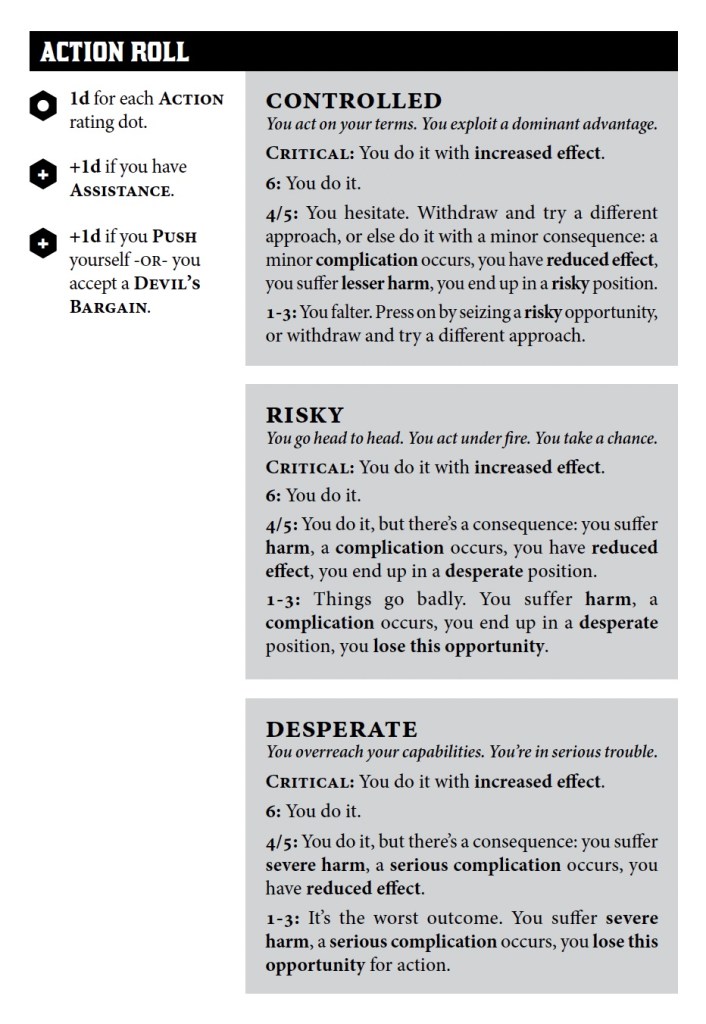
Rules-wise, we found the character sheets incredibly useful. Almost everything a PC might do is described on the sheet. And for most of the other things, they were on cheat sheets which I had printed out for each player. A couple of times I had to look things up. I ran the rules for the Plan Types, the Plan Detail and the Engagement Roll straight out of the book, which was, thankfully pretty easy to do. The main sticking point, for me, was learning how to assign Position and Effect to Action Rolls. It feels like more art than science to me. There are some useful pieces of advice in the book, but it still feels like a process I will simply get used to, like figuring out DCs in D&D type games, or Resistances in Heart. I referred to the two pages below constantly through that first score and I imagine I’ll return to them again and again in coming sessions. Very useful indeed.

Conclusion

Naming the crew was left until after the first score, as per the advice in the book. It seems the ringing of those spirit bells struck a chord with the players because we had three options in the running:

  • The Deathbells
  • The Dead Ringers
  • The Death-knells

All great names, but it was the Death-knells that won out in the end. It’s a good name and one that is likely to put the fear of death in the other gangs of Crow’s Foot, and maybe the whole city of Doskvol in the weeks to come…

Slow Sleigh to Plankton Downs

There are two stars of this adventure. The first is the murderous creature itself. It’s unique, insidious and gross in a bonkers sort of way. The second is the artwork, which you can find examples of above.

Horror gaming in Troika!

Troika! Would not be my first call for a game of horror this Halloween, but I think Slow Sleigh to Plankton Downs, the 33 page adventure by Ezra Claverie, illustrated by Dirk Detweiler Leichty could be the thing to change my mind.

Disclaimer

I have not played or run this adventure. I just wanted to review it because A Perfect Wife reminded me a bit of it. Not necessarily in its themes or anything like that, more because of the creature at the heart of it and the murders. Also, the incredible artwork.

There are minimal spoilers ahead but, even so, if you are planning to be a player in it, maybe skip this review. I will say there are some conversations to be had with your table before playing. You should let them know that it is an investigative scenario and you should also discuss the body-horror and brutal murder aspects of it.

The Basics

The PCs are aboard a ship of sorts, a hovercraft called the Nantucket Sleigh Ride, transporting them from Out of Order, the site of the moon, Myung’s Misstep’s space elevator. They are on their way to Plankton Downs, a water-farm town along with a motley assortment of Macramé Owls, Ice Miners and Martian Orthodox Christian nuns among others.

The adventure opens with a short history and geographic treatment for Myung’s Misstep as well as the function of ships like the Nantucket Sleigh Ride. It also lays out the scenarios thoroughly for the GM.

The PCs themselves could be a regular set of Troika! characters (by regular, of course, I mean utterly bonkers.) But I think, if I ran this, I would get them to choose one of the nine new backgrounds presented in the back. You have a wild variety from the aforementioned Ice Miner, whose greatest Advanced Skill is to “Exert Oneself Alone without Hope of Assistance,” to the Astropithecus Truckensis, a Martian cyborg described as “a six-wheeled, motorised Standard Habitat Truck, slightly larger than a wheelchair.”

There is a description of the keyed locations from the, frankly, resplendent, map of the Nantucket Sleigh Ride on the inside front cover, and a section on the general characteristics of it. It’s important to note that most of the vessel is off limits to passengers such as the characters, however, once the murders start, they are likely to find ways to explore.

We also have a bunch of very handy random tables including but not restricted to NPC names (a selection of pretty standard human names from all over the world), NPC Preoccupation (from “Professional Opportunities” to “Impending Masturbation”), NPC Distinctive Feature (Loving “Head Small for Body”)

The PCs are going to be aboard the Nantucket Sleigh Ride for at least 72 hours but that’s likely to be extended through the liberal and recommended use of the weather table in the back (2d6, if you roll a 12, its a Catastrophic Storm and you better pray to whatever deity most aligns with your beliefs that the anchors hold or the ship is truly fucked.) With that in mind, it would be pretty terrible if someone on board were, in fact some sort of vampire disguised as one of the passengers or crew with an irrepressible hunger for a very particular human body part every 36 hours or so, wouldn’t it?

The Murders

This is mostly an investigation scenario. After the first murder causes a stir on the upper decks and the lower, the PCs might very well decide to start asking questions and investigating the scene of the crime. After all, the crew do nothing about it except arm themselves. However, it is not likely that they will discover the identity of the murderer until after the second or maybe even the third one.

The murders are gristly and disgusting in a very particular way. The creature has a method of killing their victim that can only be described as brutal and bizarre. If this were a Call of Cthulhu adventure, witnessing the aftermath would certainly be enough to elicit sanity rolls all around. They are described in relative detail in a matter of three pages. This, along with location and NPC descriptions is all you get to guide you in running this scenario. I do think it’s enough, especially as it feels as though the PCs are not really supposed to discover the truth until after the second murder reveals something important.

Conclusion

This short and sweet adventure is a definite departure for Troika! lovers. You may not get the chance to do the strange combat hijinks you’d be used to in most of the other adventures presented for the world’s other favourite RPG but it will present a set of very particular challenges. Several of the PC backgrounds have Advanced Skills that, while not exactly “investigation,” as such, will still be very useful in specific situations that you could imagine coming up. But there is no getting away from the fact that this system is not designed for investigation and I can imagine the GM having to make a lot of rulings while playing this.

There are two stars of this adventure. The first is the murderous creature itself. It’s unique, insidious and gross in a bonkers sort of way. The second is the artwork, which you can find examples of above.

If you’re interested, dear reader, you can go and pick the adventure up from Melsonia.com here. And maybe consider it for your Halloween game this year!

A Perfect Wife

The writing is subtle and considered and evocative, the layout is spare but adds so much to the adventure as a thing to read and there is beautiful, idiosyncratic artwork throughout.

Weird Hope Engines

Earlier this year, in Nottingham, England, David Blandy, Rebecca Edwards and Jamie Sutcliffe brought together a selection of RPG creatives and artists to make an exhibition.

From the Bonington Gallery website:

Weird Hope Engines embraces the culture of tabletop roleplaying games (TTRPGs) to explore play as a site of projection, simulation, communal myth-making, distorted temporality, and alternate possibility.

Zedeck Siew, Amanda Lee Franck and Scrapworld were all major contributors to the exhibition but they lived far, far away from Nottingham. The trip would be costly. So, being TTRPG creators, they launched a project in the hopes that it would fund well enough to pay their way. It worked, and A Perfect Wife is the result.

Disclaimers

Dear reader, I have not run or played in this adventure. I received it recently in the post and I wanted to write about it. This is a review but only from a read-through.

There will be some spoilers so if you think you might want to be a player in this adventure, turn back now! Or don’t, I’m not the boss of you.

The Product

Two art prints: On the left, a spiky, crimson femme creature with wide open mouth, long black hair against a blue background. On the right, a person on a motorbike stopped in a pool of yellow light from a doorway in the backstreet of a city. The cityscape rises above and behind.
City Streets and Scary Beasts

A Perfect Wife is a 43 page OSR-style adventure from Copy/paste Co-op. I backed the Kickstarter for it and received a physical copy, along with a printed map of the adventure location and some art prints.

Speaking of art, that’s what this is. The writing is subtle and considered and evocative, the layout is spare but adds so much to the adventure as a thing to read and there is beautiful, idiosyncratic artwork throughout. All three creators contributed illustrations and all three styles are distinct but never clashing.

The Adventure

Inside cover of A Perfect Wife by Zedeck Siew, Amanda Lee Franck and Scrap World. Illustration shows an owl-like bird in white against a dark background.
Bay Owl

We start with an explanation of the recent disappearances in this inner-city Malaysian (actually I don’t think its explicitly spelled out anywhere in the body of the adventure that its set in Malaysia but its heavily implied) neighbourhood. What it boils down to is the following three points, what the locals have learned:

Head indoors if dogs are whining
Walk on by if your name is called
Do not search for the baby crying

It’s pretty clear that something unusual is happening in the area. Already the mood, the setting, the premise are very different to any other OSR adventure I’ve ever read.

We move on to character creation next. The PC outlines are based on how they know Sara, the woman they’re meeting in front of the Desa Damai Wet Market. They know they are meeting her before they even know who they’re playing.

They get six choices. There’s a journalist (interesting skill: speed-reading), a social worker (eavesdropping), a private investigator (knife use), a security consultant (joking), a faith healer (bargaining) and a barrister (drinking.) Each has a few skills, and maybe a weapon or a useful contact, not to mention a wonderful line-drawn portrait.

So, the players choose their PCs and the opening scene moves on…

Basic rules are included on page 9. These are almost identical to Into the Odd. In the front of the adventure there is a “Mechanically Inspired by” section that lists Into the Odd but also includes Liminal Horror and the Lost Bay. I don’t know those games and I am not sure how they inspired the mechanics but there is no doubt that, essentially, rolling works the same as in Chris McDowell’s game.

The next scene introduces two major NPCs at the Peaceful Heart Community Centre. It is not spelled out, but assumed that Sara led the PCs there to meet Yinyin. Then we learn what the PCs are being recruited for. Sara wants them to find out what happened to Tet, a refugee and father to young Yinyin. Sara and Yinyin are described in their own NPC section, but the mysteries only deepen…

This adventure deals with some themes of supernatural horror, class inequality, the plight of refugees, violence against women and children, pregnancy and miscarriage. You get the first hints of these, let’s be honest, pretty heavy subjects here. A GM and their players will have to have a frank discussion about this before starting to play A Perfect Wife.
Beautiful keyed map and encounter tables (day and night) for Desa Damai. Point crawl location.

The daytime encounters are a delight. I’ve been to Malaysia only once and that was on holiday on Lankawi Island. I can only imagine how different an inner city neighbourhood of a metropolis like Kuala Lumpur is to that so I don’t have any real frame of reference for this, but the occurrences in this table have feel genuine. I can picture the old man feeding the stray dogs from styrofoam containers on the side of a crowded, narrow street with no footpaths and not enough shade. I can feel the tension created by gang kids surrounding you and shaking you down for whatever cash you’ve got on you, while you sweat and make excuses.
These encounters also serve to also introduce factions and NPCs of note although they are described in greater detail later.

The nighttime encounters are far more threatening and sad. Even the direction on how to use the table seems designed to put you on edge. In the daytime, you roll whenever you walk down a new street. But at night…

Whenever you turn a corner, roll

Just reading them makes me uncomfortable. Machete wielding, motorbike riding gang members are so much worse than the kids from earlier in the day. And what is a baby doing crying behind that pile of rubbish in the middle of the night?

Straight fter a short description of the two main gangs, the combat rules crop up… just in time. The gangs are described beautifully and succinctly. The combat rules are brief and equally Odd-like. They include more than one admonition regarding the dangers of violence, especially gun-violence, which is likely to draw the attention of the authorities.

The next ten pages are devoted to introducing us to the people and locations of Desa Damai. We get a gorgeously illustrated selection of refugees, police, witnesses, thieves and one particularly supernatural and disturbing infant. These represent the people you might run into on the encounter table as well as those your PCs might want to talk to in relation to their investigation. Each of them can help or hinder in some way and they all have their own motivations.

Sara’s baby, illustrated on page 23 with thick, black, childlike lines over a wash of dirty scarlet, is a true horror, the kind of creature that could only have sprung from the collective trauma of folk beset by the tragedies and indignities experienced by generations of women and children. It is both heartbreakingly sad and terrifyingly obscene at once. It only serves to illustrate, yet again, the importance of discussing tone and content as a group before setting out on this adventure. Be warned.

Pages 30 to 33 describe the Pontianak, the nightmare creature at the heart of the adventure as well as the initial encounter with her. Where the baby is a tragic and sadly pathetic entity, the Pontianak herself is actively menacing, dangerous and hidden in plain sight. She also has a tragic origin of course, and that’s central to the adventure, but there is no doubt this is an enemy to fear too. There’s more creepy and horrific illustrations here, one depicting the creature in her human guise and one showing her monstrous form. Again, the art in this module is doing a lot of the heavy lifting. Its remarkable.

As terrible as the Pontianak is, oh so much worse is the husband, the architect of this situation. Rich, well educated, greedy, I imagine him a delight for a lucky GM to get to role-play.

In the appendix, Siew introduces the non-Malaysian reader to the concept of the Pontianak, the symbology that is inherent in the creature, how she has been portrayed in media, the way she is perceived in Malaysia and the role of the weird and supernatural in Malaysian life. This is all fascinating stuff and feels incredibly useful in allowing the GM especially to do justice to playing the NPCs in this adventure. It is of the utmost importance to understand that locals would not be rolling sanity checks when encountering ghosts.

Here, ghost stories do not function as supernatural or speculative fiction. Ghost stories are realist. They do not belong to the Weird; they are not designed to arouse a sense of the uncanny or numinous.

I feel like I can sympathise with this point of view to an extent. Growing up in Ireland, no matter how atheist you are or scientific you claim your brain to be, deep down, you would still instinctively avoid a Fairy Fort and take tales of banshee wails predicting deaths at face value.

Tucked away at the back are the optional gods. I guess I can see why they are optional; they introduce a level of spiritual and religious superstition that some tables might prefer to avoid. But, in my opinion these gods and offerings are all gold, some of the best stuff in the adventure. It has the potential to heighten the PCs’ dedication to the plot and may even provide ways for them to boost a flagging investigation.

Conclusion

The back cover of A Perfect Wife. It reads, “Welcome to Desa Damai. The first disappearance was over a year ago. Now it happens with vicious regularity—every fortnight. The neighbourhood is tense. Most agree the following precautions work: 
- Head indoors if dogs are whining. 
- walk on by if your name is called. 
- Do not search for the baby crying. 
Illustration of an owl like bird in white against a dark forest.
A Bay Owl Again

I really want to run this now that I’ve read it fully. It’s different enough from the normal sorts of scenarios I would play that it has greatly piqued my interest. The NPCs, the creature and the situation are compelling and fascinating. Also, the real-world setting is incredibly evocative and, though presented and described sparsely by these artists, I feel like it still shines.

My players and I definitely enjoy a set of pre-generated characters that are tailor-made for the game we’re going to play. You get that in this, but you also get the pleasure of rolling up elements of them and defining important personal characteristics yourself.

I’m a fan of the incredibly rules-lite mechanics at use in A Perfect Wife, and, although I think they can be used to conduct an investigation like this, I’m not certain that a system designed for investigators wouldn’t have been better. A lot of the work is left up to the GM to ensure the leads keep coming as many of the connections between NPCs, locations and events are implied rather than fully spelled out, but I would like to think that also allows for a great deal of leeway to be given and for flexibility when necessary.

Finally, I’ll reiterate the need to discuss safety tools and tone and content before starting. I know several players, me included, who have been personally affected by themes in this adventure. Some will be happy to play anyway, some won’t, but we’ll have to talk it out first.

Stay Frosty

Obviously, a game like this is going to draw comparisons with the Alien RPG and Mothership given the subject matter but, from even a cursory look, it seems to be approaching the genre from a slightly different direction.

Not Over Yet

I had a great plan for today’s post. It was all coming together perfectly. We were due to finish of the Call of Cthulhu “one-shot,” the Derelict last night, but, due to various unforeseen circumstances, we were forced to postpone. So, the review of the scenario that I had been planning will have to wait too.

Still, I’m not short of subjects to write about.

Stay Frosty Remastered

The cover of Stay Frosty Remastered by Casey Garske. Space Marines fighting aliens/demons
The cover of Stay Frosty Remasted

I’m going to take this opportunity to take a look at one of the games I received recently as a Kickstarter fulfilment. Stay Frosty Remastered from the Melsonian Arts Council and written by Casey Garske is an old school RPG of sci-fi marines in situations of extreme tension where they face monsters, demons and aliens with nothing but a shotgun and a bad attitude. Think Doom crossed with Aliens. Obviously, a game like this is going to draw comparisons with the Alien RPG and Mothership given the subject matter but, from even a cursory look, it seems to be approaching the genre from a slightly different direction.

It’s worth noting that “Remastered” in the title. Casey Garske first released Stay Frosty back in 2017 so it’s been around longer than either of the two games I mentioned above. I first learned about the original before I ever backed the remaster. Co-host of the Fear of a Black Dragon podcast, Tom McGrenery used it several times as the ruleset in which he ran some rather unlikely scenarios. I never read the original, though it is still possible to get it here.

Basics

Roll a d20 greater than or equal to your attribute for a success. Otherwise fail. Sometimes you get another die for advantage or disadvantage. That’s it.

Obviously, this implies that, even though you roll your attributes up the same way as you do in D&D, lower numbers are better!

Badassery

Scorpion fight
Scorpion fight

You get to play some of the galaxy’s badest asses in Stay Frosty. Character creation seems very straight forward. You get some attributes (Brains, Brawn, Dexterity and Willpower,) and MOS (military Operations Specialty,) hit points, rank and some equipment. Then it’s “Oorah” and into the bug’s nest to rend some carapace. Character creation starts on page 5 and just about stretches to page 8. All the better to roll up a new badass when the first one bites it.

Gear

I like that the rules around gear are abstracted so far as to make theatre of the mind nice and easy. Ranges, as they apply to combat and weapons are expressed by bands:

Hand-to-hand -> Close -> Short -> Medium -> Long -> Extreme

Your weapon’s description indicates its max range of course.

Another touch I appreciate is the use of supply dice for ammo that you use in a combat situation. If you used it, roll the ammo die for it at the end of the fight, If you roll a 1 or a 2, it reduces the die size until it’s gone. There is a similar rule for other gear that can be depleted.

Combat

Space marines fighting bug aliens
Riiiiip

I described the essentials of it in the Basics section above. But there are a few idiosyncracies that I enjoy:

One of the actions you can take in a round is called Battle of Wills. If you succeed on a Willpower roll against a chosen target, they will get disadvantage on their next attack. You just scare them into fucking up because of your badassness.

If you get a critical or a fumble, you roll on the appropriate FUBAR table. Either “Fuck Yes, Natural 20” or “Oh Fuck, Natural 1.”

Brain Bleed
Brain Bleed

There are Psi-powers. These are restricted to PCs with the Psi-ops MOS. There aren’t too many powers in the book but here’s a selection:

  • Brain Bleed (although the book seems to be missing the actual Effect of this one)
  • Interface – lets you take control of machines
  • Mind Stab – mind stab

There’s a little more to the system than just these points, but not much.

Mostly these other rules are introduced in the chapter,

Other Crap Every Game Has

Which has the sub-sub-title,

Jesus Christ, I guess we have to spell everything out.

Danger, Frostiness and Tension

These are the mechanics that make the game what it is. You will see some similarities to the Stress and Panic mechanics in both Mothership and the Alien RPG.

Firstly, the Danger die is rolled whenever the PCs move from one area to another, whenever they are in really dodgy locations or just whenever they’re dawdling. It’s a good way to ramp up the Tension. It works much like an encounter die in other games so can lead to location-appropriate baddies turning up, environmental challenges and loss of resources, but it can also add Tension or cause it to be released explosively!

Which brings us neatly on to the Tension mechanics. So, the PCs gain Tension through the Danger die rolls I described above.

Tension can be good for you. Forget simply staying frosty, Tension will actually build your frostiness level. It starts at “Warm” when your Tension is at a 1 and goes all the way up thru “Chill” (gives the agile tag to ranged attacks) and “Frozen” (Advantage on saves) to “Ice-Cold” (extra attack) when you reach 6 Tension points. There is a danger of course, when your that tense. When the Danger die comes up 6, “Tension Explodes!” And every PC has to make a Willpower save. If they succeed, they can reduce their Tension by one but if they fail, they take their Tension score x their level in damage. If this reduces them to 0 or lower HP, they roll on the Going Apeshit table. If you get a 1 on this table you’re on Overkill, advantage on damage rolls but having to roll your ammo die every round instead of after the combat. If you roll a 6, though, you’re on Last Stand, abandoning weapons and armour to face the enemy mano-a-mano.

This is pretty close to the stress mechanics in Alien, which is also all governed by tables. I’d be incredibly surprised if it wasn’t inspired by this game.

The Rest

A parade of bad guys from winged demons to little brain aliens
If it Bleeds…

Most of the rest of the book consists of a couple of missions to send your frosty fighters on. But there are also a couple of pages of random tables to allow you to easily and quickly construct your own missions and a few basic stat blocks for bad guys like Amoeboids, Demons and Robotic Assassins.

Conclusion

Isaac ran myself and Tom through a dungeon in the Black Hack the other night. None of us had ever played it before and even Isaac had barely looked at the rules. It was so easy, though, that we had characters created, hirelings hired and a dungeon explored before you could say the unlikely word, “Prolch” (my slow-witted fighter’s unfortunate name.) Stay Frosty gives me a very similar vibe. I only just opened it for the first time to write this post and I feel like I could run it now. Maybe I will! Unsurprisingly, the Black Hack is listed in Stay Frosty’s Appendix A: Influences. Garske tells us here that his game was originally a Black Hack hack but he ended up totally rewriting it. You can still see the Black bones of it though.

Blades in the Dark Player Best Practices

At this point, I’ve dealt, at length, with the GM advice, but what about the players? Surely they deserve a little guidance too!

Yep, they have not been forgotten.

Progress Clock

We started our Blades in the Dark campaign last Wednesday with a character creation session. I had hoped that we’d be able to get down to the first score as well, but it was not to be. Honestly, character creation, although pretty straight-forward, was rather time-consuming. When you have three or four people around a table making decisions on their own characters as they try to form a coherent picture of them in their minds, it can take a while. Add on the collaborative decisions required of them for Crew creation, and you can comfortably double the time required.

Anyway, current progress looks like this:

  • Three of four characters created, an Akorosi Cutter, an Akorosi Hound and a Whisper from the Dagger Isles
  • Crew created: It was a toss-up between Bravos and Smugglers but, with the general vibe of the crew so far, Bravos won out in the end.
  • Decided that their main sponsor faction will be the Crows of Crows Foot.

I’ll get a character creation session with our last player in the next week or so and then we’ll be ready to launch into the first score.

Creating Opportunities

That’s what this game is all about, right? Taking chances, building relationships, gathering information, making your own opportunities. Well, that’s what I’m doing today. Instead of the recap of the first score, I’m using this opportunity to discuss the advice levelled at the players in a Blades in the Dark campaign. At this point, I’ve dealt, at length, with the GM advice, but what about the players? Surely they deserve a little guidance too!

Yep, they have not been forgotten.

Starting on page 182 of the Blades in the Dark book, at the end of the How to Play chapter, we have the section entitled…

Player Best Practices

The Lurk, a light-skinned, femme character dressed in a dark hood.
The Lurk, by J Harper

We have a total of eight of these listed here. Not as many as for the GM, but there’s a lot in each one. Here’s what we’ve got:

  • Embrace the Scoundrel’s Life
  • Go into Danger, Fall in Love with Trouble
  • Don’t Be a Weasel
  • Take Responsibility
  • Use Your Stress
  • Don’t Talk Yourself out of Fun
  • Build Your Character through Play
  • Act Now, Plan Later

As usual, I’m not going to go into detail on all of these. This time, I’m going to group them.

Embrace the Scoundrel’s Life + Go into Danger, Fall in Love with Trouble + Don’t Talk Yourself out of Fun

These three best practices all relate generally to the same issue. You, as a player of Blades in the Dark, are not there to play it safe. You are not at the table to make optimised choices. Your character lives in a brutally unfair world and they have become adept at surviving it and even profiting from it. Lean into that! Will they have to make difficult choices that might lead them or their crew to harm? Yes! Will they have to take wildly risky actions to achieve their goals or create those opportunities? Yes! Will they have accept the consequences of their actions, which might include conflict with the highest powers int he city, imprisonment and death? Yes! This is the good stuff, in fact, not the downside. These are the parts of the game that keep it moving forward and allow you to craft scenes of kick-ass action, ice-cold espionage and even heart-breaking tragedy. This is why you want to play. If you’re playing to win, instead of to find out what happens, you won’t get the most out of this game.

Don’t Be a Weasel + Use Your Stress + Act Now, Plan Later

You know, there’s a common thread running through all the best practices for players, to be honest. I think it can best be described as “let go.” You have a say in what happens in the story, of course, but you should not be precious about your character. Push them as far and as fast as you can, drive them like that proverbial stolen car. These three practices are about doing that within the rules of the game. You do stuff by rolling with Actions, not skills. It’s important to choose the right action for the job, even if it’s not your best. That’s where stress comes in! One of your companions can spend stress to help your actions succeed with an assist, or you can spend it to push yourself. It’s invaluable for resisting consequences that would be otherwise inevitable. You can even use it to work in a flashback and do a setup action to get you out of a particularly sticky spot. You will build up the stress, of course. You’re going to have to indulge your vices to shed it or you’re going to find yourself traumatised. That’s where these stories end up sometimes. Your PC might build up a weakness or two, they might be brought to the end of their tale through the extremities of stress. But what a tale it will have been!

Take Responsibility + Build Your Character through Play

Blades in the Dark is a story game. You are telling a story at the table with your friends and you want it to be the best it can be. You want it to have ups and downs, ins, outs and what-have-yous. Dark, tragic, thrilling, horrific comedic, action-packed, whatever you want it to be, you can contribute to it. You have the option to add as much or as little as you like. Some players are going to invent new NPCs, locales, factions, street-vendors, family-members, ghosts, you get the idea. This is all good. But a player’s greatest power to contribute to the story is through their own character. The actions they take, the things they say, these things can add as much to a session as the NPCs invented by the GM, probably far more. Maybe you are already delighted with the general atmosphere and vibe the rest of the table is bringing, so you don’t feel like you need to add too much, you still have a responsibility to your own character, to have them grow from their beginnings into fuller, more alive beings. You start with a “sketch” but, through the actions you choose for your PC, how they comport themselves in various situations, the risks they are willing to take, you’ll make an unforgettable character and story.

Conclusion

The Shade. A floppy-haired dandy in a Victorian gentleman’s clothing.
The Shade, by J Harper

Like I stated above, there is a strong theme across all of these best practices: don’t be boring. In a game like this where the story evolves collaboratively at the table and is not even slightly left up to a published campaign frame or the GM, the choices you make as a player will dictate the sort of experience you have. Be bold, don’t behave.

Pirate Borg: The Repentant Review

To be clear, the ship is the whole adventure. You could easily work it into an ongoing campaign, I think. It could be a random encounter or the goal of a mission. But, for me, it worked perfectly as a one-shot. It gives you everything you need in those eleven pages.

Talk Like a Pirate Delay

I was really excited about this year’s Second Annual Tables and Tales Talk Like a Pirate Day Pirate Borg One Shot on September 19th but I was, unfortunately, overcome by some malady that day. We postponed it only to have a massive storm roll in off the Atlantic, forcing us to delay the departure of this vessel yet again. Finally, last Sunday the players’ pirates were ready to board the Repentant come hell or high water…

OK, I say they boarded it but it would be more correct to say they were taken aboard. I started them off in the expanded brig, area 1 on the map of the ship. They awoke, captured, stinking and hurting and minus all their stuff. Nevertheless, with a few improvised weapons they found lying around the cabin and the assistance of a skeleton thrall raised by the skeletal sorcerer, they managed to overpower their demon guard. This was the first of many obstacles to their defeat of the Ashen Priest commanding the ship and taking the Repentant for themselves.

The Scenario

The cover of Cabin Fever, a skeletal pirate with a tricorn hat and the words "Cabin Fever" erupting in fire from his eyesockets
The cover of Cabin Fever

The Repentant is an 11 page one-shot scenario for Pirate Borg by Zac Goins. It is published in the forthcoming sourcebook for that game, Cabin Fever, via KNOWN CONSPIRATORS, Limithron’s subtable for third-party creators. Cabin Fever is a treasure chest of extras for Pirate Borg including new PC classes, GM tools, a Bestiary, no fewer than six adventures as well as solo rules. I am one of the backers of the Kickstarter project so I got access to the PDF through that. I’m hoping to receive the physical rewards for that soon.

This scenario is presented in a typical Borg-ish style, with maps, and illustrations taking the lead in establishing the atmosphere. It’s almost all in grey and black, emphasising the theme of ASH. The layout is also typical with lots of tables, stat-blocks, keyed area descriptions etc being worked into the spaces between and around the artwork. I occasionally had to take a few extra seconds to find what I was looking for due to this but it was never a major disruption. In general it looks great and ewers relatively easy to use.

The Premise

The Repentant is a charnel ship, an unkempt brigantine with tattered sails and a crew of demons and cultists, commanded by a cadre of Ashen Clergy. Their goal is spelled out clearly in the three step plan on the second page. In summary, the plan is to summon demons, form an unholy pact with the Dark One, raid some settlements to take captives, kill ‘em, raise them as undead and then grind them up to make Brimstone ASH. This is a type of cursed and arcane narcotic on which the crew plan to make lots and lots of pieces of eight.

To be clear, the ship is the whole adventure. You could easily work it into an ongoing campaign, I think. It could be a random encounter or the goal of a mission. But, for me, it worked perfectly as a one-shot. It gives you everything you need in those eleven pages.

The Reality

A genuine, fire and brimstone demon

There is a fun variety of enemies for such a short scenario. You have seven different types of possible demon (one for each deadly sin, with commensurate sinful powers,) the emaciated crew, the Ashen Vicars and the Ashen Priest who has a variety of fun powers. And if you deal with all those, there is a hold full of Brimstone Zombies, who have the power to promise your soul to the Dark One with a bite.

Although not every encounter ended in combat, almost all did. It felt inevitable in general. I started the players off where I did, in the brig because of the restrictions of a one-shot session. I wanted them in the thick of it from the start and escape gave them a powerful motivation to attack the terrifying demon, even without real weapons. Also, I figured the brig is area 1 on the map for a reason. The scenario does not explicitly indicate where or how you should start it as a one-shot, but if you take the hint, here, you’re probably not going to go wrong. It definitely got them into the action immediately. Without the timely and repeated use of Devil’s Luck and mystical powers in the first two encounters, at least one of the party would have gone down. The only thing is that it led to two mostly combat encounters in quick succession. Starting with them boarding over the rails or some other way might have engendered a totally different kind of adventure.

The map was fine. I was a little put off that three of the four decks had one side of the map cut off but it was of no practical disadvantage in play.

Tables, tables, tables. The tables are great, from the effects of the Brimstone ASH (different to the regular ASH introduced in Pirate Borg) to the “What did I just step in?” Table which I underused criminally.

My players only used the Brimstone ASH on their enemies, which was a shame. I think it’s because when they rolled on the table for those uses, they got 1s and 2s, which are very very bad. After I told them what else was on the table, they regretted not trying it!

6 The Devil’s inside ye. Immune to fire. All weapons’ dice size increases.

The Finale

The ASH grinder. Looks like a meat grinder, with a big funnel on top, a mincer on one side and a cranking wheel on the other. Has steps up to allow you the zombies to feed themselves into it.
The ASH grinder.

I saved the Ashen Priest, the scenario’s main villain, for the end. He might have been found in either the captain’s quarters or the hold, according to the keyed locations, but, honestly, you could locate him anywhere to suit your own game. The PCs had done away with almost everyone else aboard when they descended into the cargo hold found him there, feeding zombies into the ASH Grinder. There were a lot of undead down there with him but the PCs made such short work of him that it hardly mattered. Then they got to take the ship as plunder, not to mention the undead and the grinder so they could enact the plan themselves!

Conclusion

This was one of the most well-crafted one-shot scenarios I’ve run. We played it in about three and a half hours, though, if things had gone badly, it might have been over after less than an hour! I did give them a couple of NPCs for back-up and in case anyone lost their first PC (there were two deaths.) This might have given them a slight advantage, if I’m honest, but everyone had a good time. Looking forward to trying out some more scenarios from Cabin Fever and the rest of the slew of new books from Limithron!

Answering the Call of Cthulhu

Seasonal Event

Our local RPG community, Tables and Tales, has just kicked off a month-long event to help introduce some of our newer members to the joys of halloween/spooky/goblin themed games through the timeless medium of the one-shot horror in which you play some dreadful miscreant and revel in their inevitable and total annihilation.

So far so good! We kicked things off last night with Another Bug Hunt, Mothership’s introductory scenario, immediately breaking with the format for the event by not finishing it in a single session. Following rules is for squares, says our Warden, Isaac. I’m playing an absolutely jacked exobioligist who should not have been trusted with the submachine gun he was issued for the mission. None of the PCs have died yet, although, the NPCs haven’t been so lucky.

We have a few more sessions lined up in the coming weeks, Shannen is acting as the chaperone for Goblin Prom which is a Honey Heist hack that’s pretty much exactly what it sounds like. Tom is planning a Thirsty Sword Lesbians one-shot with a creepy flavour too! I have a couple of games lined up for the event. Later in the month, I’ll be facilitating the move of the family Balfour to the Scottish Borders in the late 19th century for Scott Dorward’s excellent Cthulhu Dark scenario, Fairyland (check out the actual play run by Dorward himself on the Ain’t Slayed Nobody podcast here. It’s one of my favourites.) But before that, I’ll be acting as Keeper for the first time in a Call of Cthulhu game.

The Game

Push the Roll with Ross Bryant

Call of Cthulhu is a phenomenon. A horror game made by Chaosium and based on the works of HP Lovecraft, its been around almost as long as RPGs have and has had an enduring legacy and impact on not just the TTRPG space but the wider culture in general (although I understand that it is difficult to truly assess its cultural effects separately from its literary inspirations.) It’s the single most popular TTRPG in Japan and it has a dedicated following and niche actual play market that seems to have been thriving in recent years. You should check out the brand spanking new and fully improvised Push the Roll with Ross Bryant as soon as possible. Isaac and Tom have run several scenarios for us, which have gone down as some of the founding lore of our RPG group. And yet, I have never run a session of it.

I’m going to change that next Friday. Honestly, I think my interest in doing this is largely down to Mr Bryant’s new podcast, which I’ve been eagerly devouring. As a pretty traditional game, it’s a little crunchy but when you listen to the podcast, you get the impression that the mechanics can be left behind if and when they get in the way, especially with an enthusiastic and role-play-focused party. I remember getting frustrated with the truly execrable skill scores of my PCs in past CoC games until I realised that was by design. As ordinary civilians facing up against the terrifying reality of cosmic horror, you are supposed to fail and there are supposed to be serious consequences for those failures. That is what makes it horror. Well, that and the Sanity rolls. So, the mechanics can also be used to reinforce the themes of the game, when they need to. If you want fantasy heroes, you’re in the wrong place. If you want the thrill of terror when confronted by your inevitable and immediate doom, Call of Cthulhu is the game for you. Listening to Push the Roll has given me the taste of that again so I thought it was about time I put myself on the obverse of the Keeper’s screen to see what that felt like.

The Scenario

The cover of Petersen's Abominations showing a mouthy and betentacled horror alongside several tv screens showing the faces of people.
Petersen’s Abominations

My Call of Cthulhu library isn’t huge so I went out to my local game shop, Replay and picked up the anthology of short scenarios, Petersen’s Abominations written by Sandy Petersen, the creator of the Call of Cthulhu roleplaying game. It’s a nicely presented book with five “tales of modern horror.” This is one of the reasons I chose this anthology. I have been craving a game set in the modern world recently, and this scratches that itch. It also contains a set of pregenerated investigators for each scenario. This is a pre-requisite since I have so little time to work with. Finally, there is a nice selection of player facing maps and handouts in the back of the book for every adventure.

I chose the Derelict, for my one-shot. I decided on this one for a few reasons. First, it seems like the one I could most reliably start and finish in a single session of three hours or so. Second, I love the pregens presented for it because I think the players will easily get into them. Finally, the setting, a luxury yacht sailing the North Atlantic, is unique and I know its enticing for a couple of the players so it’s good for sign-ups!

The premise is a simple one: the yacht’s owner, a stock-broker (see my opening paragraph!) who lost his fortune in the 2008 financial crisis (its set in that time-period) is taking his rich and famous friends on one final voyage on the Delilah. He’s taking it to Liverpool to sell it. But on the way, they encounter the Derelict… I don’t want to give too much away at this stage in case my players decide to read this, but I’ll be back afterwards for a full report!

Blades in the Dark Best Practices and Bad Habits

The bad habits that are listed here are fewer in number but oh so much greater in the size and capitalisation of their headings

It Begins!

Our Blades in the Dark campaign starts tonight! I’m excited. I played in a campaign before but this will be my first time GMing one. I’ve been taking a look at the GM advice presented in the book over the last few weeks. This post examines the GM toolkit in the Running the Game chapter, and this one looks at John Harper’s advice for Starting the Game. Right before starting seems like a good time to internalise the Best Practices espoused by the same chapter of Blades in the Dark, and to beware of the Bad Habits!

Best Practices

Angelic woman with a twinl=kle in her eye and a white bird projected on her dark clothing.
The spirit of best practices. J Harper

We’ve got a list of fourteen best practices for GMs here. Although I’m sure these were written very much with Blades in mind, most of them feel like the kinds of things a GM is well advised to utilise while running a lot of different RPGs. Just take a look at the list:

  • Earn the trust of the group
  • Lead an interesting conversation
  • Create an atmosphere of inquiry at the table
  • Help the players use the game system
  • Don’t block
  • Keep the meta channel open
  • Be a curious explorer of the game in play
  • Advocate for the interests and capabilities of the NPCs
  • Play Goal-Forward
  • Cut to the Action
  • Be aware of potential fiction vs. established fiction
  • Zoom the action in and out
  • Bring the elements of the game system to life on screen
  • Put it on a card

As in the last Blades post, I’m not going to go into each and every point in detail. Some of them are self explanatory. Put it on a card, for instance means exactly what it sounds like: use index cards to record the important things that are invented at the table. Cut to the Action is doing double-duty as both a GM principle and a best practice. You’ll find it listed in the last Blades post too. Keep the meta-channel open means that you, of necessity, have to describe the subtext to the players sometimes, to represent their characters’ full range of senses and intuitions and the like. Help the players with the game system, equally, means it’s your job to interpret their words and plans into a form the mechanics can handle without forcing them to figure it out themselves.

Anyway, you get the idea. I want to take a few that interest me the most and discuss them.

Be a curious explorer of the game in play

Just take a moment to digest that sentence. “A curious explorer.” Isn’t that sumptuous? There aren’t a lot of RPG books out there creating phrases as attractive as that, and I would like us to all appreciate John Harper’s work on it. As pleasing as the phrase is, the sentiment is truly important. Look, you’re the GM; you’d better be paying attention to what the PCs are doing, to what the players are saying at the table, to the NPCs that are being dicked over, or seduced or fucking created during a session, or they’ll come back to bite you in the arse later. But that’s not what this practice means. It just wants you to maintain a degree of curiosity in the events of the game, not because they are important, but because they are fun and interesting. Look up from your notes and index cards every once in a while and breathe it in. Your players and you are building an incredible story together. This is what it’s all about. So, get interested. Ask questions, not because you want to know stuff to prepare for but just because you are curious. Maybe you’ll wonder aloud why a PC is doing something, maybe your curiosity is to do with their choice of decor for the lair, maybe its just because they gave that one NPC a stupid nickname and you don’t know why. Doesn’t matter, just stay interested.

Play Goal-Forward

This is the practical side of the question-coin. It’s nice to think this game is all about the players after the initial stages. The idea is to get them to form their own ambitions for characters and crew, come up with their own scores, fulfilling their own whims and get into and out of their own trouble. But, if my experience as a GM is anything to go by, this can take a little cajoling. So, this practice says, lead that conversation. Get them thinking about their goals, not just in the moment, on the score, during their downtime, whenever, but also, on a long-term, grand scale. Yes, you need to know what their goal is when things begin to turn to shit on a score, they’re up to their ears in ghosts, the Bluecoats want their blood or their lair was just blown up by the Lampblacks. But if you get the players to tell you what they really want to be when they grow up? That’s gold. And make sure you check in to find out if their ambitions have changed from becoming the greatest electroplasm smugglers Duskwall has ever seen to just base survival because every score they have attempted has gone south and enemies are at the gates.

The pursuit of opportunities and positions to enable certain approaches, the acquisition of information and resources, and the nested conflicts that result will drive the action of the game.

This is what you want to get to. If you understand the opportunities they want to pursue, the actions they might take to unlock them, then you can better facilitate them and the effects will help build the game.

Harper repeatedly refers to the game as a cool tv show that you’re invested in. You can be invested in what happens to the characters and the city from the viewpoint of the audience but you are also in the enviable position of being able to help shape the story as a showrunner.

Be aware of potential fiction vs. established fiction

A city street in almost complete darkness. Vague outlines and sparse lights are all that describe the type of location it is.
Describe wht you need to, discard the rest. J Harper

You’re not taking the PCs on a tour of every room of your house. The PCs should be more like viewers watching an edited sequence of shots that carry them forward in the action of the game

We’re still talking about the game as a tv show then. Cool. I like it. It’s a little confusing, though, that this practice is about keeping details of the fiction nebulous until they need to be concrete. I suppose a good way to continue the analogy is to say that we begin a scene with a close-up on the darkly wrapped faces of our scoundrels, and, as the players ask questions or the GM makes decisions, the camera pulls away, revealing the canal-side they are standing on, then further out to show the line of moored canal boats. Then we follow the crew across the decks of the gathered boats as they rock and the occupants cry out. As they go, the players might ask if there is any rope on the decks to allow them to climb on to the bridge and you tell them there is. Meanwhile you fill in some more details, the twitching of curtains in the surrounding windows, the scuffling of feet from the nearby alleys and so on. Layers and layers of details. Harper calls this the potential fiction cloud. You pick them out as you build the scene and they gain concreteness, they become the established fiction. But you never need to establish absolutely everything. Instead, you yell “CUT,” and move on to the next scene, starting over again with a new potential fiction cloud.

GM Bad Habits

A man with a devilish face or mask points at us.
The demon of bad habits identified you as naughty! J Harper

The bad habits that are listed here are fewer in number but oh so much greater in the size and capitalisation of their headings:

  • DON’T CALL FOR A SPECIFIC ACTION ROLL
  • DON’T MAKE THE PCS LOOK INCOMPETENT
  • DON’T OVERCOMPLICATE THINGS
  • DON’T LET PLANNING GET OUT OF HAND
  • DON’T HOLD BACK ON WHAT THEY EARN
  • DON’T SAY NO
  • DON’T ROLL TWICE FOR THE SAME THING
  • DON’T GET CAUGHT UP IN MINUTIA

It is hard to avoid the conclusion that it is more important to ensure you don’t develop these bad habits than it is that you adhere to the best practices above. Let’s look at a few that I think I might be most susceptible to and see if that’s true.

DON’T OVERCOMPLICATE THINGS

It’s a heist. Or maybe an assassination attempt. Possibly a smuggling operation. There should be complexities to it! There should be bribes and double-crosses and traps and security systems and hidden lookouts and maybe a jilted lover or two. Right? Not necessarily. Its fun to introduce new narrative complications and consequences on a 1-3 or a 4/5 roll, of course, but not at the expense of the session’s pacing, or the players’ patience. You can’t be expected to come up with that stuff all the time. There are mechanics in place to help you deal with them quickly and in keeping with the spirit of the game. So this section is telling you to use the tools you have been given. If you can’t think of a new complication, just hit them with harm or tick a clock forward or slap some more HEAT on them. Keep it simple, stupid!

DON’T HOLD BACK ON WHAT THEY EARN

I have the potential to be stingy. After all, there is a lot they can do with Coin in Blades in the Dark. You can use it improve Downtime Projects, to reduce HEAT, to advance Crew Tiers! I could be the kind of GM who wants to limit their progress, to slow the pace. But John Harper says give them the money. He wants us to remember that they should get what they earned. After all, they have it hard enough as it is. And besides, they’re likely to have to spend it before it even has a chance to enrich their pockets.

My main observation here is that, in all likelihood, the GM is the one setting the Coin value of any given score. The PCs, of course, are free to accept or reject opportunities depending on how lucrative they are, and they will have to take the heightened risk associated with bigger paydays, but still, its up to the GM, in many ways to establish how much a given sort of score is worth. If I wanted a low scoring campaign, I could start off with big scores netting no more than 4 Coins and most average ones paying only 1 or 2. Of course the opposite is true too. And I guess Mr Harper wants us to lean that way.

I appreciate more the admonition to treat secrets and information the same way. If the PCs have earned the info, don’t hold back. Only new opportunities and a deeper investment in the world on the part of the players can come from the sharing of secrets. Bring them in on it! They’ll love it.

DON’T GET CAUGHT UP IN MINUTIA

Let’s keep thinking about this in terms of a television show. Sure, there might be some shows where an eye for detail and a quick thumb hovering over the pause button is rewarded, but usually, you can rely on directors/editors to skip from one location and situation to another without the need to dwell on every twist and turn on the way. Get to the good stuff. Speed through the opening credits, jump to the negotiation or the shoot-out or the incursion into the ghost field.

Although it’s not mentioned here, I believe it’s also important to combine this warning with the lesson to be aware of potential vs. established fiction. You want to try and hit that sweet spot where you have given the players enough details of a location, person or scene to allow them to make decisions without getting bogged down in unnecessary levels of photo-realism. Allow the imaginations of the players to fill in the blanks instead.

Conclusion

Look, it’s pretty obvious that if you occasionally forget to be a curious explorer of the game or sometimes stray into the weeds in describing minutiae, you’re not going to break your campaign. But it sure is nice to have these guide-rails to help us make the best damn dark victorian horror heist game we can! Both lists are incredibly useful and I’m sure to be referring back to them every once in a while as the campaign gets under way.

Next time

In my next Blades post I’m going to do a sort of post-mortem of our very first session! Watch this space, dear reader.