Woodpaneled

Vintage RPG

Do you listen to the Vintage RPG podcast, dear reader? Do you follow VintageRPG on Instagram? If you are reading this blog, the chances are good that you do both of those things. But, in case you have somehow never come across it, the podcast is presented by Stu Horvath and John “Hambone” McGuire. On it the lads chat about lots of RPG related subjects. As the name implies, they do talk about older games, like Fighting Fantasy and Beyond the Supernatural, which, as a gamer of a certain vintage, I very much appreciate. But many of the most interesting episodes involve newer games like Swyvers. They often have fascinating interviews with game makers. Their conversation with Swyvers creators, Luke Gearing and David Hoskins, convinced me to back the project and I’m so glad I did!

And on Instagram, Stu posts at least five days a week with details of old modules, game systems, books, accessories etc. It’s the exact kind of nostalgia I can enjoy. I am of the general opinion that most types of nostalgia are just gateway drugs to the sort of opinions that lead many people to vote for tangerine demagogues. But, Stu is under no illusions. He takes a critical look at each of the products he features and calls it out when they are problematic, poor quality or just nasty.

The point is, Vintage RPG is a wonderful source for news on the RPG scene, historical gaming facts and deep delves and has acted as an outlet for game creators and enthusiasts to push themselves, their work and their passions.

Webring

So anyway, on their recent show, ostensibly about Eat the Reich, Stu and Hambone introduced their listeners to the Woodpaneled webring. For those of you who haven’t heard of this phenomenon, this is how Wikipedia defines a webring:

A webring (or web ring) is a collection of websites linked together in a circular structure, and usually organized around a specific theme, often educational or social

Woodpaneled

The Woodpaneled Webring was founded by Stu to help those participating in it to have an internet experience that is not entirely governed by the algorithms of social media companies or the advertisement driven peccadilloes of search engines. He put the call out on the show for artists, writers and designers with websites related in some way to a broad theme. Most of the sites that are part of the ring now are to do with RPGs or at least RPG-adjacent but some are more broadly about culture and art. Here is a link to the a short piece Stu wrote to explain why he started this thing. He explains it far better than I could, especially as I am pretty sure I have a very different relationship with wood panelling than he does!

Now, I don’t have much of a presence on social media. I have an Instagram account that I am fairly active on and I just started a Bluesky account @thedicepool.bsky.social which I have yet to even post on. I gave up on Facebook many years ago for the same reasons that I view nostalgia with suspicion, and I abandoned Twitter when the fash started to take over. Basically, the idea of a smaller, slower, less shouty and more contemplative internet appealed greatly to me. I thought this sounded like a perfect home for The Dice Pool, to be honest. So I contacted Stu to ask him about joining and he was so enthusiastic and sound about it! And so helpful. I am not terribly experienced when it comes to the technical side of running this website so I needed his assistance to jury-rig a solution to allow me to embed the Woodpaneled widget that you can see at the top of my main page (I am working on getting that to appear on every page. Like I said, I’m more of a tortoise than a hare when it comes to the backend stuff, but I’ll get there in the end.)

So, dear reader, I want to encourage you to go hit those “Next” and “Previous” buttons on the widget and have a dive into other sites on the webring. There are some fascinating and creative people involved!

Liminal_

Survivin’

It is the kind of thing people around here might say when you ask them how they are getting on, “Survivin’.” It is the sort of bleak answer to an innocuous question that is probably played for laughs. At least, if it isn’t, you laugh anyway, because, otherwise, you are likely to get drawn into a conversation.

But you know what it means, even if they are being facetious. They are probably struggling in some way. Maybe they are just tired, maybe they have a hang-over, but maybe, the world has been having its way with them. Perhaps their car broke down and they don’t have the money to get it repaired right now. Maybe they were on the way to the hospital to visit their sick mother when they broke down and they missed the visiting hours. And their phone died before they could call someone to collect them and they had to walk for miles along the hard-shoulder. They caught a terrible cold and now they can’t breathe right and sleeping is impossible and they can’t enjoy anything because merely existing has become uncomfortable. All they’re doing is survivin’.

So wouldn’t it be fun to play a game where that’s the only aim? Surprisingly enough, I think it might.

Of course, survival horror is nothing new. It is a major video game genre. People love Silent Hill! The last game I wrote about on this very blog was a survival horror TTRPG, even though it was wrapped in a cosmic horror disguise. But the game I want to write about today feels a little different. Not totally, you understand. It sticks to the same themes of helplessness, despair and terror in the face of an indifferent or downright hostile environment (part of the reason I wanted to discuss it at this time.) But it has a few indiosyncrasies that help it to stand out.

Liminal_

Pretty sure that’s pronounced “Liminal Space.” The name does make it uniquely difficult to google but that is maybe why the book is called Liminal_Survival Guide. I picked it up from Iglootree here. The creative team is Alexei Vella and Neonrot/Willow Jay. The illustrations are fun/disturbing and are all done with ASCII characters by Alexei Vella.

There are elements of the layout and graphic design (also done by Vella) that remind me of the recently released Death Match Island. The liberal use of redaction with the suggestion that parts of this “survival guide” are from some sort of real world manual, written for the employees of some institution or shadowy company is the main through line.

This survival guide is for the eyes of _ personnel only.

Imagine my surprise when I discovered that Alexei Vella has also contributed to a new island for that game!

Anyway, back to Liminal_. It is a map-making game at its core. You are probably going to be the GM (or Architect) if you own the book. You’ll need at least two other players and a large piece of graph paper. On it, the players (known as the Disoriented in this game) will be drawing rooms as you roll for them. There are lots of rooms to roll from. More than half the book is made up of room prompts!

The basics of the game go like this. The Disoriented start in a square room with a door in each wall. They roll off for initiative and the first one to go decides which door to choose. They can move into it at the cost of Fatigue, their only stat. The first one to enter a room is likely to take more Fatigue than those who follow, but every time anyone takes any kind of action, they are going to incur a Fatigue cost. Once they get 100 Fatigue, they’re screwed, they get Absorbed by these Back Rooms they have found themselves inhabiting.

There are rooms of different shapes and sizes, there are rooms that have items in them. Carrying items adds to Fatigue but they might help the PCs in some way. They might help them get away from Entities that occupy some of the rooms. Like Cthulhu Dark, you can’t fight them, all you can do is run. There is no fighting in this game. The Disoriented make a Fatigue Test to evade them by escaping from the room. They roll a d100 and if they get equal to or higher than their current Fatigue they succeed. If they fail, they take more Fatigue. They might also garner Injuries. Injuries cause a continuous rise in Fatigue and may have other adverse effects.

Sometimes, depending on the room prompt, a room vanishes and you better hope you are not trapped in there when that happens. Other times, you might enter a Dead Room, which is just a room with only one door, i.e. the one you came in. There are, luckily, Rest Rooms to allow the PCs to recover some of their Fatigue. And there are Escape Rooms. If you are lucky enough to keep your Fatigue low enough through your harrowing journey through the Rooms, and you avoid being Absorbed by what must surely be a sentient labyrinth, you might just escape! Seems unlikely…

The entity prompts and room prompts are well-thought out, appropriate and fun in the most despicable way possible. Here are a couple of examples:

Entity prompt: A mass of mulch, organic green material and mosses rapidly grows into a human man, a skeleton briefly visible inside it. The creatures eyes are blood red as it reaches for players, roaring.
Room prompt: Players enter a short, dimly-lit hallway. Yellowing wallpaper covers the walls, and rotting, off-white carpet covers the floor. There are several missing persons posters covering the walls. Some of them bear the faces of the players.

I do not want to give too much away here since I want to play this game and my players read this blog, but, honestly, there are so many good prompts in this book! I imagine a bloody good time rolling up these rooms and horrors.

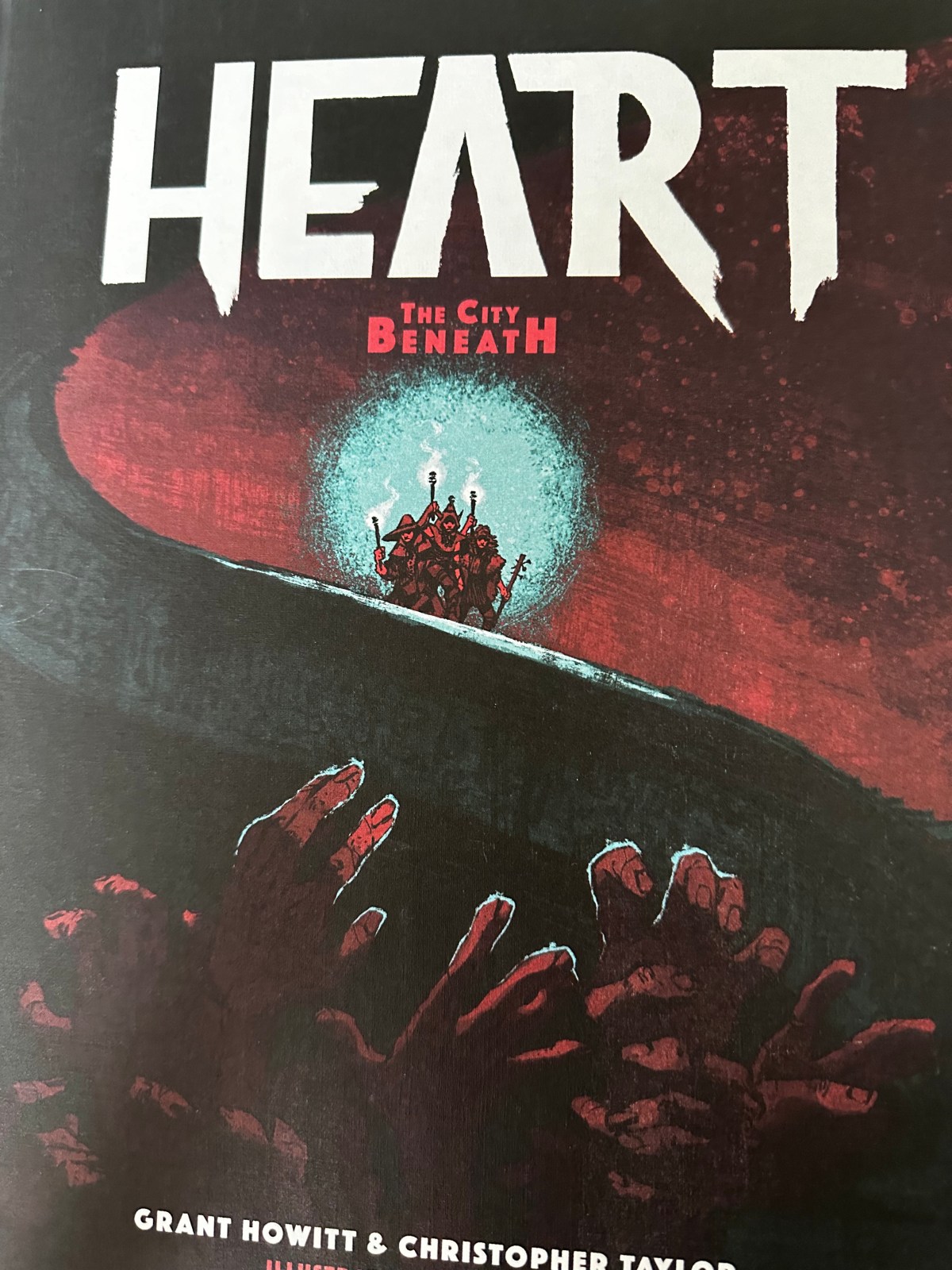
And, on top of all those, there are even more than a hundred “Guestroom Prompts” written up by such RPG luminaries as Grant Howitt (Spire, Heart etc.), Tim Hutchings (Thousand Year Old Vampire), Tim Denee (Death Match Island) and Chris McDowall (Electric Bastionland, Into the Odd).

One of the more interesting things about the game is the lack of any kind of character creation rules or processes in it. After all, no-one has any particular defining stats. In the Roleplay section, the authors suggest that the players might just play themselves. Now, I have done this before in a Call of Cthulhu game and, while it was an interesting experience, it was, perhaps, just not for me. I immediately considered having my players use the character generation tables in Death Match Island instead. These are specifically designed to come up with contemporary sorts of characters plonked into a desperate, life-or-death situation that they have to escape from. I also considered using at least parts of the methods described in Between the Skies. Finally, maybe the Cthulhu Dark option is the best, just give the poor bastards a name and an occupation and release them into the Liminal_.

Conclusion

This feels like the ideal one-shot to me. It’s rules-lite, with a simple premise and no real character creation to speak of. There is no prep and you only need a few items like graph paper and pencils to play it. Its procedurally generated nature and its absolute mountain of prompts are likely to ensure that you never have the same room twice. My only worry is that it might be a little too one-note, that the singular motivation for the characters to survive might not be enough to keep them interested the whole time. I guess I’ll find out when I get it to the table!

What about you dear reader, do you like the idea of this Back-Roomy, SCP-like game? Have you played it? Let me know in the comments!

Eyes Open

“You see over yonder, Ollie?” Ollie’s father roughly jabbed him with his bony elbow. the man’s digit described the glowing tree-line at the foot of the hill. “That’s where they are. Should’ve burned it down years ago.”
His dad shook his head. “Never should’ve let them in in the first place!”
“Someone has to act, and it’s going to be us, boy!” Ollie stepped back as his father stepped forward, lighting a torch and holding it aloft in the night air. It illuminated the burning shield tattooed on his neck.
Like moths Ollie’s eyes were drawn to the flame. Its white-hot heart drew a memory on his retinas:

The Folk were caught off-guard by the attack of their allies, the people of the Kingdom. The Folk had cured their poxes and healed their wounds. They had promised they always would in return for peace. But the King’s subjects feared the Folk more than they valued peace. The Folk and their woods burned as the people howled and chopped and marshalled the inferno.

Ollie followed his father a few yards behind out of fear.
“They’re an infection, son! We have to burn them out of our community!”
Ollie stepped in a puddle near the foot of the hill. The water’s dark mirror reflected another memory:

A woman of the Folk, aglow with forest magic, laid hands on the ruined leg of a warrior. A woman of the Kingdom loomed behind her. As the knight’s limb was made whole the woman shoved the healer back into the city’s dirt where they had found her, spat and laughed.

Ollie stumbled in his father’s wake.
“Come along, boy! We took them into our civilisation when they had nowhere else to go. What did we get for our troubles? Knives in the back! Why wouldn’t they want our great Kingdom leading them, protecting them, showing them the right path? Eh?”
Ollie no longer heard. He rose and peered into the clouds above. Their wisps revealed a new memory:

A man of the Folk, all but invisible in black, dropped from ornate rafters onto the King’s throne. He roared in pent-up rage as he sucked the life from the monarch. The man’s body, pustulating and poxy, tumbled to the floor beside the King’s, just as dead.
The Kingdom drowned all the Folks’ children.

Ollie’s father approached the trees.
“The last of them live in this fairy-ring, Ollie. We’ll be heroes when we cure this infection!”
Ollie ran to the first great ash. His eyes peered into the swirl of an ancient knot:

A slender hand reached through a window to enact a terrible trade, one tiny boy of the kingdom for another identical one. The be-glamoured and bundled cuckoo screamed and a man came to attend. He held the child tenderly to his face, right by the flaming buckler emblazoned below his ear.

“No, Dad. We’ll cure you instead.” Ollie began to glow with forest light.

Inevitable

Maneater, Arthurian Western Bestial Godsman

This is my new character for the Inevitable game I am starting this evening. I drew him with pencil on paper while one of the other players was creating his very cool Taleweaver character who tells a tale of how Maneater averted a war by channeling his god, the Beast.

Can’t wait to start playing!

Change and the Dark

Another schedule change

They say that procrastination is the thief of time. Nope; its work. Work is stealing my time and there ain’t no time cops coming to recover my purloined hours or to clap Work in cuffs. This is the true crime of late-stage capitalism!

Seriously, though, I have a full time day job that has nothing to do with gaming, writing fun stuff or pretending to be other people. That’s how I can afford this luxury website (ooh la la) and all these RPGs I keep backing. Unfortunately, it does take up the majority of my waking hours. Very recently, I mentioned that I would be posting once every three days from now on. I have found this awkward in a few ways. Firstly, I often get mixed up as to what day I am supposed to be posting on this schedule. Secondly, it has meant a lack of a consistent day of the week that my posts appear. Lastly, it is still a bit of a struggle to keep up with this, I am finding, thanks to work and, you know, actually playing games.

So, instead, I have decided to switch to posting on Wednesdays and Sundays. I love writing this blog and do it mainly for my own satisfaction and I am going to continue to do that, just on a twice-weekly basis. To those of you who are regulars around here, thanks for bearing with my struggle to find the perfect schedule. I think this might be the one!

Anyway, on to the meat of the post. Our Halloween one-shot.

Roadhouse Feast

The trees loom above the rutted country road illuminated only by the staccato shudder of your headlights. This road will be the death of us, you say to your companions in the back seat of your Ford motor car. Just concentrate on getting back to Arkham, you think to yourself, as you trundle past Laura’s Roadhouse. A good, god-fearing woman, Laura. You know the family. You grew up not so far from here. You wonder how they’re doing now.

Crash, badump, badump

You shouldn’t have let your mind wander. You’ve hit something! The automobile! No! The Ford is pitched forward at an unnatural angle. The others have already bailed out. They’ve gone to inspect the carcass left on the road behind. One of them screams.

This is the opening, in my words, of the Cthulhu Dark module, Roadhouse Feast. It was written in 2023 by Linus Weber, with Monster-art by artgeek09 on Fiverr and cover-art by Eneida Nieves on Pexels although, the version I downloaded from itch.io did not have a cover to speak of.

I won’t go into the details of the module, the characters, the plot or the ending. Instead I want to write about our experience with it and general vibes.

The one-shot

There were four of us at the table on Halloween night for this one-shot, including me as Keeper. This was the ideal number, I believe. Numbers for a one-shot are critical to actually getting to the end of it. Any more than four and we would have struggled with that all-important goal. Instead, we played the module from start to finish with a little time over for epilogues. This is what I had been hoping for when I picked this module to run. The author designed it to be run in a single session of two to three hours and that’s exactly what it was. Tick!

The setup is pretty much as I narrated above. The investigators (this is a catch-all term for PCs in Cthulhu Dark. It does not necessarily imply that they are, in fact, in any way, detectives) are driving home to Arkham from a place called Thompson Village, late at night on 31st March 1923. They hit a deer on the road, damaging their car enough that they need to go and get help. This is all classic horror story setup stuff. The 1920s era and forest setting helps by removing the technological advantages of the present day and exuding a creepy, dark, dangerous atmosphere. Tick!

What do you want from a Cthulhu game of any kind? You want your PCs to experience some fucked up shit that has the potential to send them swirling down the plughole of madness at any moment. You want monstrous entities, cultists, forbidden philosophies and the mundane warped and twisted into something otherworldly and inconceivable. Roadhouse Feast has all this in a tidy little package. Tick!

The system

This was our first proper foray into a Cthulhu Dark game. This despite actually owning the book. Since we couldn’t actually find the book in time, I fell back on the original, playtest-style rules that Graham Walmsley published back in 2010 in the form of a 4 page pamphlet. All of the rules fit easily on those 4 pages with room to spare. It is the lightest of systems. I don’t think I have ever played anything lighter. Honey Heist approaches it, but I think Cthulhu Dark wins this contest by virtue of the fact that you only have one stat and no abilities of any kind. The one stat you have is called Insight (although in those original rules that I was using, it was called Insanity.) You can play this game sans character sheet by simply placing a d6 in front of you. It should show the 1 at the start of the game but every time you fail an Insight check, brought on mainly by seeing Mythos shit or using your Insight die to help succeed at actions, you gain a point and flip your die to the appropriate number. If it ever gets to 6, you’re screwed. Your investigator loses their marbles and is removed from the game. We had one investigator hit 6 Insight. She started a forest fire and stood in the road, worshiping the flames. It was a good time.

This mechanic was so good in a one-shot. It works perfectly to keep your investigators worried about what is just around the corner, or about having to use their Insight die to succeed at a check. Of course, the other great strength of the system is that, if they ever face an actual Cthulhu Mythos monster, they’re goners. They will not survive. This gives them the feeling of victims in a horror movie. You cannot fight, you can only run or hide or delay. In this scenario, delaying is a major part of survival and it led to some ingenious moments from the players.

In general, the lightness of the ruleset made for exceptional roleplaying throughout. There were no long breaks to add up dice rolls, no-one ever had to stop to look up rules and there were no character sheets or monster stats to worry about.

All in all, I would recommend the system and the scenario for a horrific one-shot experience, dear reader. Go pick them up if you would like that sort of thing.

Flash Fiction – Finnabar’s Relative Reconciliation

500 Words

For a while there, I was a part of a small writing group. We used to come up with random prompts or a selection of nouns and verbs and make flash fiction story out of them. They generally had to be 500 words long andinclude those randomly selcted words. It was a fun and interesting challenge and the results were always fascinating because each of us would end up with such different and idiosyncratic pieces. This was good practice for a series of flash fiction contests I entered on the Escape Artists forums. Escape Artists produce such long-running and luminary genre fiction podcasts as Podcastle, Escape Pod and Pseudopod. You should check them out. Anyway, if you were a contest winner, the prize was usually to be published and read on one of the shows. I also just really enjoyed reading all the submissions in the contests and voting on them too. I never did that great in the contests, I think the best I got was a quarter-final place, but taking part taught me a lot. The main lesson was editing. In 500 words, there is nowhere to hide. You have to choose every word deliberately and you must be brutal towards your own work. I also discovered that originality of story and format proved popular among the voters on the forums.

So this work is an attempt at both. But it is also one that I never submitted to a contest. I don’t precisely remember why. But anyway, maybe you will be able to enjoy it here, dear reader.

Finnabar’s Relative Reconciliation: A spell used to bring accord between two riven kin.

Material Components

  1. The two subjects of the spell. They must be present in the same room as the performer of the spell. (Convincing both parties to do this may be the single thorniest aspect of this spell. I suggest deception. If that is not your forte recruit the aid of one more suited to the task. If all else fails, refer to a spell of my own composition, Finnabar’s Enchanting Eyebrows, also published in this compendium. I used this method to draw my siblings together against their wills. I reiterate that it should be used only as a last resort.)
  2. Three hairs, two feet long, plucked from the human heads of three were-creatures, a fox representing deception and adaptability, a rat to represent betrayal and creativity and a wolf as a symbol of both fear and path-finding. Please note that these must be given with consent. You will find a sample consent form overleaf. It is wise to expect to pay a price for these components. I was not so wise and now dread the inevitable waxing of the moon.
  3. An article of significance to the family as a focus. The painting of a respected ancestor, a piece of jewellery belonging to a beloved relation or an ancient heirloom. Personally, I chose a bust of our esteemed father. A poor choice. I was previously unaware of one sibling’s true feelings regarding our patriarch so it served to disrupt the spell rather than focus it.

Performance

  1. The first step of the performance rests in the hands of the subjects, rather than the performer. They begin by standing eighteen inches apart and greeting each other. Their resistance to this may be strong. In my case it was strong enough to break the suggestion caused by my eyebrows when the greetings were uttered. Once that had occurred, however, they both remained close enough that I was able to proceed with the next step.
  2. Tie the fox hair around the wrists of one subject and the rat hair around the wrists of the other. Join the two together with the wolf hair. I had great difficulty in completing this step while both siblings stood over me, shoving fingers in my face and yelling. I was forced to use another spell, Finnabar’s Restrictive Rope, from my first grimoire.
  3. Finally, perform a simple Shanahan’s shuffle and produce an eldritch flame from the focus object to engulf the binding hairs. There will be peace between your subjects. In my case, I assume the use of the wrong focus caused a rift between my siblings and I, for should they not have appreciated my help?

NB – I cannot over-emphasise that you should heed the warnings I have peppered in the text of this spell. If you do not, the consequences can be monstrous. Also, if a fellow mage wishes to practice the performance of the spell a couple of times while assisting me, please contact me with urgency.

Ravenloft

Something’s gotta give

I thought I would play Ravenloft around Halloween this year. My friend returned all my Ravenloft books and boxed sets to me back in the spring after about 25 years, and since then I have been thinking it would be cool to run something in the Domain of Dread as a Halloween one-shot. But, in the meantime, I have played a lot of different games, mostly one-shots, mostly a lot easier to play in that format than any version of D&D. So I did consider starting a campaign or a multi-session adventure, but, to be honest, I didn’t have it in me to do all the reading and conversion that was necessary. I may be playing more RPGs than I ever have before in my life but that has an unlooked for side-effect: I have less time to prepare for games! This is a dilemma that has been exacerbated by my blog schedule and I have been thinking that I might have to make a change there too. I am switching to posting once every three days for the foreseeable future.

The Demiplane of Dread

So, I am not talking about the original Ravenloft adventure from AD&D 1st Edition or the Curse of Strahd released for 5E, but the setting released by TSR for AD&D 2nd Edition in 1990. It is by Bruce Nesmith and Andria Hayday. I think I have mentioned in another post that my friends and I played most of our AD&D in the Dark Sun setting but I would imagine Ravenloft comes a close second. I just loved having them create regular old characters in my home-brewed standard fantasy world and then dumping them, unceremoniously and with no warning through the mists into the forests of Barovia or the mountains of Forlorn and hitting them with monsters that drained levels and abilities and where there was no escape from he darkness and the terror. Although, I confess, the games were probably not very terrifying. I did my best, but I have always found horror a difficult genre to emulate around the table, especially with a system like D&D. The authors did their best to assist the Ravenloft DM with sections in the main book about the “Techniques of Terror,” where they discuss “Assaults on the Mind,” “Assaults on the Body,” “A Villain in Control,” and that sort of thing. But, the fact was, we were a gang of teenaged boys who mostly just wanted to hit things until they died so those were usually the kinds of adventures we got.

Looking at it from a more mature standpoint now, I would love to try to run it with a real sense of gothic horror. I think I am better equipped now to attempt it. Although I still think it would be a challenge and I might refrain from running it in a D&D-like system. Why? Well, the products for Ravenloft, while not all gold, are still some of the highest quality items I think TSR produced. Just look at all these handouts! Each one of them has something useful on the back of a beautifully illustrated card.

5E products are usually produced to a high standard, but they don’t have the variety and versatility that the 2nd Edition boxed sets did. They also don’t have the quality or usefulness of content. These boxes and sourcebooks are stuffed with useable materials; details on lands, villains, monsters, new spells, effects, encounter tables, maps, maps, maps. 5E setting guides of late, excepting maybe Planescape are very short on this sort of detail.

Adventures in Ravenloft

I usually wrote my own adventures back in the day. Or at least I would pick and choose liberally from the pre-written modules and combine them with my own scribblings to make them fit into an overarching campaign. Or that’s what I told myself I was doing. I have a funny feeling that, mostly, I was just trying o murder the PCs. This is another aspect of my style that has, thankfully, changed, since the good old days.

I do have a few Ravenloft adventures that might be fun to convert or even to just run in the original 2nd Edition ruleset.

Feast of Goblyns is a very flexible module that is designed to be run for characters of levels 4 to 7. It is presented in a format that allows many different paths to be taken through it, with the PCs potentially ignoring some major and minor plots depending on how they decide to play it. This one was designed to be the adventure that draws PCs into the Demiplane, which is always fun. I think I remember playing parts of this module but my memory is not good enough to recall which parts. At 96 pages, though, it would require a bit of commitment to play through the whole thing.

From the Shadows is written for rather high level characters, levels 9 to 12. It is based around the plots of Azalin the lich, lord of the domain of Darkon and his eternal conflict with Strahd Von Zarovich, famed ruler of Barovia and OG Ravenloft BBEG. A great deal of it takes place in Castle Avernus, the lich’s home, and that is pretty cool. I definitely played this but I don’t think the characters survived the whole way through.

Finally, I have the Book of Crypts, which is similar to the Book of Lairs but has 8 full adventures in it! This seems the most suitable for a shorter game or campaign and I might just take a look at running something from here before the spooky season is fully through.

Dear reader, have you ever played this version of Ravenloft? Do you yearn for the mists? Or would you rather play a game actually made for horror?

The Apprentice, Chapter 16 and Epilogue

The end

I’m under no illusions about what this story is. It was my very first attempt at writing anything log form. The quality of the writing (or lack thereof,) the self-indulgence and the repetition of tropes and cliches are all too clear to me. In fact, it’s been so long since I wrote this (more than 12 or 13 years, I think) that it no longer feels like I was the one who wrote it. This makes it easier for me to be critical of it, but it also allows me to see the parts that shine. The plot and the character of Maryk still work for me, and there are elements of the world I built here that I used in later writings too.

I decided to share the story here as something of an exercise, but also as a form of motivation. I would like to be a better writer, and I think, laying this book out here for the world to see (or whatever tiny proportion of the world visit my humble blog at any rate) has forced me to look at my writing from a very different perspective. And I can see the flaws and the areas for improvement. And, hopefully, that will push me to write more and to write better.

Anyway, dear reader, I hope you enjoy this finalé to the Apprentice. Let me know what you thought of the story in the comments if you like.

Chapter 16: Dead is Dead

Delegation of duties for the dead was surprisingly easy. I had already discovered in my work with the ancient dead that talents and predispositions still existed within their decaying bodies. Therefore, some were excellent farmers, some builders of notable skill and others natural warriors. In the case of the skeletons I had to just figure out which were which by assigning them the tasks and ascertaining whether they did them well or poorly. In the case of the recent dead of Pitch Springs they were readily categorised for me. The graveyard was already split into guilds’ sections so all the masons were buried together, all the smiths were in one section, all the cooks in another. Of course, a corpse’s previous profession was not the only consideration. Stage of decomposition as well as completeness or otherwise of body were also important. I separated them as best I could, sending a hundred or more farmer’s corpses into the countryside to begin working on the land, a trio of dead smiths into town to begin working at the forge, a score of shambling masons to begin construction of a much needed wall for the town, two dozen ex-quarrymen to the quarry to begin extracting stone for the wall, a baker’s dozen of deceased coachmen to liberate some of the town’s carts and start transporting the stone from the quarry. There were a few other small groups and individuals: I put Grey Greta back to work but not before I’d had her picked of all her flesh (a rotting, stinky washerwoman would never do.) Ditto the three cooks I found and sent to start cooking up a feast in the Town Square. A single sculptor’s corpse I put to work sculpting a statue of my father in the middle of Saint Frackas’ Square. My father’s empty corpse did end up at my side after all, grasping his bastard sword in two hands and standing to attention as much as one can when one’s head is lolling over one’s right shoulder like the knot on a tied up sack.

Duties assigned, I returned to my fortress to make plans for the next stage of my plan. I walked with my last skeleton guard and my father flanking me all the way back. By the time I reached my home the sun had come up and I could see many of my new servants out in the fields, hard at work. I knew there would be a backlash against them but I decided I would not allow it. Hurrying back to the fortress I gathered the remaining ancient skeletons and ordered them to wound anyone who tried to interfere with the work of the newer dead and then I sent them out to guard the workers wherever they were. This left the fortress all but undefended. I was not worried about an attack from town. There was a force of peace-keepers, certainly, but they were not particularly well regarded. The constabulary of Pitch Springs was never trained to a very high standard and were generally considered to be layabouts. I could not imagine them planning and executing a siege or infiltration, in fact, I doubt they could imagine it themselves. They had seemed to work effectively enough during the incident when I returned the mayor to town, to be fair to them, but even then it was my father who had landed the fatal blow. The only man I might have feared now stood at my side. I felt perfectly safe ensconced, once more, in my study.

I watched the happenings in the town and the surrounding country by the use of several Farsee mirrors all hung side by side on the wall of my study. There was unrest. The Pitch Springers mostly stayed indoors and avoided the few of the dead that I had sent to work there. I wondered if any of them would partake of the feast being prepared in the centre of town. When I saw a pair of constables attack the cooks I was appalled. Couldn’t they see that all they were trying to do was prepare a meal? Why would you assault cooks, whether living or dead? The skeleton guard made short work of the constables, though it was, perhaps, a little too efficient, removing a whole hand from one and shattering the kneecap of the other. On the Markinson’s farm, Old Father Markinson launched a single-handed assault on the rotting corpse of his former neighbour, Farmer Yantzi which had been cleaning his farmyard while the dogs cowered under the chicken coop. An attempted defense by the skeleton guard went awry and it ended up with a shattered skull at the end of the spade in Markinson’s hands. it crumbled into bones and dust and then the head came off Farmer Yantzi’s corpse too. I watched as the old man burned the body and the head. A number of other such incidents ended up with the dismemberment, decapitation or cremation of the dead servants I had sent out to help. The skeletons that were left after my father’s ambush were not warriors and it showed.

Most folk on the farms simply left the dead servants to it, however, and I began to hope that they were coming around to my way of thinking. Then I noticed that they were not just leaving the dead to their work, they were leaving the farms to the dead. A congregation had begun in the Temple of Mictus where it had all started. All the people of the town had gathered there and as the farmers arrived in Pitch Springs they made straight for it too. Undoubtedly, they were plotting against me. They thought me some sort of villain and they did not see the truth behind my actions. With them all gathered in one place, I was tempted to launch an assault of my own. After all, it seemed the only people I could trust and rely on were the dead ones. I looked at my father’s corpse standing nearby and wondered what the man would have done in my position. I laughed then, “You would never have been in this situation, would you?” Wholesale slaughter, though? No. There was no situation in which he would have condoned it. None. I would have to achieve my goals the hard way, as if any of this had been easy.

Before proceeding, however, I had to find out what they were doing in the temple. I could not penetrate its walls, however. I imagined it was the power of Mictus which kept me out. I consulted the Book of Royal Magic to find out what alternatives to Farsee were available to me. Every few moments, I looked up at the mirrors to see if anything had changed. It took about an hour, but eventually, there was movement. Six constables emerged from the temple’s front doors and saddled up the horses that they had left outside before riding off towards the bridge out of town. A pair of burly townsmen, bearing torches despite the bright daylight pulled the doors shut again after they had gone. Undoubtedly, the constables were coming to me. Maybe they had a plan to infiltrate the fortress and kill me. They would find that exceedingly difficult. I considered calling in some of the remaining ancient dead but quickly decided against it and sent the corpse of my father out to defend the gate and the walls. I was sure he would be more than capable, and so it proved. In fact, if the attack I was expecting had come from where I expected it to, I would be safe and well today.

I returned to my search for the spell I needed, secure in the knowledge that I was well defended. Some time later I heard the clatter of hooves on the paving stones of the little road up to the fortress gates and I knew the constables had arrived. Out of my window I could see nothing but the corpse of Korl Scharpetzi atop the battlements, looking down at his enemy as they shouted vowels at him from below.

Turning my back on the window, I returned to the book and the mirrors. “I have often wished, Maryk, that this was not you,” said a very familiar voice. I raised my hands and turned, “Master Gedholdt!” He was slowly walking towards me now, skinny as ever but much greyer than I remembered him and had he always had that limp? I do not think I had spared this man more than a passing thought since I ran away, taking his most prized possession with me. I certainly never expected him to turn up here, with an expression of sadness and determination on his face. “It is you, though, Maryk. What happened that transformed you into this?” He gestured to me and then the surrounding study and, by implication, the fortress. “I met someone and she opened my eyes to my responsibilities. Someone of my great abilities has an obligation to help others. That is all I have been trying to do: to improve my people’s lives.” Looking down at his boots he shook his head, “Improve your people’s lives by raising their dearly departed relatives to build armies of the dead?! You’re talking madness. You learned nothing when you were apprenticed to me! I taught you to use magic sparingly and for the best of reasons.” He was angry now, he felt betrayed. “Master I-” “Don’t call me that! I was never your master. I was just your mark, wasn’t I? You drew me in until you saw the opportunity to take what you wanted and go. You’re a trickster, a thief and a murderer.” He shouted the last word and threw out his hands in a magical movement. A wall hit me, I felt my nose burst and my chest crack and my legs lift off the floor; another wall hit me from behind, this time the real, solid wall of the study. I knocked the back of my head off it and my vision took a break again. Falling to the floor, I hurt all over but particularly in my chest where I was quite certain one of my lungs had deflated. I sucked breaths in at a rapid pace without much success in obtaining air from them. I looked up at my attacker. Never had I seen the man look like this, he looked dangerous. I inhaled deeply, once and shouted as best as my one remaining lung would allow, “Poppa!”

My father’s corpse would be coming but it would take time. How was I going to survive this? I had to think quickly and act quickly. The fastest spell I could remember was the first one I had ever performed, the first one that Master Gedholdt had taught me to perform. I said the word quietly and made the movements painfully. A sphere of light encapsulated the head of my old master, causing him to stumble back and fall over an ornate cherry-wood chair. I made for the door while he was blinded. I heard him roar the words of a cancellation spell as he struggled back to his feet behind me. I hobbled down the corridor and then down the stairs to my father and his protection. Where was he anyway? It should not have taken him so long to respond to the summons. I had expected to meet him on the stair but he was not there, nor was he in the entrance hall of the keep. Master Gedholdt had regained his feet and his vision, at least partially. I heard him cry out as he came to the stairs and fall down several of them before catching the bannister and regaining his balance. “Maryk! Maryk, this is pointless. You cannot escape this fate. You are accursed. This is the final fulfilment of those curses. Stop running and accept it.” I ran on. “Maryk! You don’t understand! I’m not alone here!” What did he mean by that? The constables posed no danger, that was for sure. Who else, then? Who-

I exited the great main doors of the keep and looked into the courtyard. The third of my masters stood there before the gates on the opposite side: the Fae-Mother. She stood at her full height, the hair on her head fluttering around the brickwork on the underside of the gate’s arch. A glow of dark, living green emanated from her uncovered face and hands, but her eyes, looking through me as usual were black holes in the glow and seemed to belong to the shadows behind her. My father’s headless body lay on the flagstones before her, broken and twisted bastard sword beneath it. I sobbed, it felt more like losing a father this time for some reason. Also, her presence filled me with an unconquerable fear. I fell to my knees at the top of the steps. Gedholdt stumbled awkwardly out the main door behind me. “I tried to warn you Maryk. I did not come here on my own,” he said as he came to stand beside me, “She sought me out.”
“I will speak for myself, Gedholdt.” The sound of her voice made all the stones which constituted my fortress vibrate at an incredible frequency, it made my eyes feel like they were being crushed. Even Gedholdt was having difficulty staying upright under the assault of the ancient Fae’s words. “You mentioned Gedholdt to me, do you remember?” I nodded. Pain in my chest and nose made it impossible to speak. “I knew he would understand what you were doing much better than I. I realised and released your potential and perhaps even pushed you in the direction you eventually took. I watched you and listened to your voices, inner and outer, for a time before you met me. I knew you already then, much better than you did yourself, and I saw a waste of a mind and a life. You humans and your butterfly lives, you must live them fully every second to make them worth while. The Fae can sit and contemplate or sleep for hundreds of years if we like but you…your people are different. I saw what you could become with the right desires in place and a sense of responsibility. I gave you those things when I touched you. When you started to raise the dead, your logic, I thought, was faultless. It was the perfect solution for all your people. When I saw the reaction of the townspeople to your creations, I was surprised. Why? Why could they not accept the servants you sent them? I had no inkling. That is why I sought out your Master Gedholdt. He explained it to me.” The Fae-Mother nodded to Gedholdt who started down the steps even as I cowered there at the top of them. “Folk should stay dead. Human folk that is,” he bowed to the Fae-Mother who tipped her head at him demurely. “We cannot come back whole from the other side. We cannot stop the progress of time on our bodies. No-one wants to see their dead wife or child or grandfather walking about town, faces rotting, stinking to high heaven. Dead is dead, Maryk. It is an unwritten rule and you broke it. But it’s even worse than that. So much worse.” Gedholdt had taken up a position at the right hand of the Fae-Mother and looked up the two feet to her eyes.
“Your servants. Their souls yet inhabit their bodies. Or rather, they were pulled back from the Aether to fill the empty spaces in their rotting corpses by your spell. This spell of yours required the revived bodies to have a force within them. But, cleverly, you changed the spell too, did you not? You altered it so that they would have to obey you or someone like you. So, even though these souls occupied their old bodies they could do nothing to control them.” She stopped talking, mercifully and looked down at the body of my father, sprawled on the ground before her.

I reeled and and covered my eyes as I lay on my back trying to breathe, trying to talk, trying to refute this, trying not to imagine the existence suffered by a mind trapped in a body it could not control. “No,” was all I could manage. “On the contrary. Where do you think the energy came from to do what you did? You? You are more foolish than I realised or I would not have given you my gift. Progress is all I ever strove for, as you know, for my people and yours. It is too late for my people now. Yet I thought you could do what I could not. But I cannot condone this. You have corrupted the very notion of progress by trying to achieve it in this way.” I heard her coming closer, both of them approaching.

“I didn’t know,” I wheezed.
“Ignorance is no excuse.” She was heartless. “The souls you stole to power the corpses which were at the very heart of your plans did not know what you had in store for them and yet you trapped them and used their energy without their consent.” The Fae-Mother stood over me now, her power rolling off her in terrible waves. I uncovered my eyes and looked up at her and Gedholdt beside her.

“There is only one punishment fit for the crime you have committed, Maryk,” Gedholdt’s voice cracked as he knelt by my shoulder, “ I think you know what it is.” A tear in his eye made my breathing catch. He turned away then and the Fae-Mother reached down to touch me again with her glowing fingertip, as she had done that day in my little cabin in Creakwood. That day she gave my life purpose, this day, she took it away.

Epilogue

So I died. I died and yet my life went on. Life, perhaps is not the correct word for this state. I exist as a presence inside my own rotting corpse. I can see after a fashion through the eyes of this body, well, eye, there is only the one left. If it were not for that, I think this existence might just be bearable.
The Fae-Mother briefly became my mistress again, well the mistress of my animated corpse. On the first day of my death, after she killed me on the steps of my fortress, she ordered me into my study. My body climbed the stairs back to the room where I had spent so much of my time doing such wondrous work and discovering such amazing things in my studies. I felt like a passenger on a carriage-ride on the way there. When I got there the Fae-Mother ordered my body to stop in front of one of the larger mirrors I used to use to Farsee. I stood there and then she left and Gedholdt went with her. I have not seen them or anyone else for a very long time.

I often used to wonder how long it had been since they left me there alone. I drove myself to distraction trying to keep track of the passing of the days. My mind went away for a while and when you are just mind, that is a serious thing. When finally I came back I knew not how long it had been so I gave up measuring days and weeks and months and years. I measured the passage of time, instead, by the rotting of limbs, the nibbling of rats, the decomposition of the body I was trapped in. There is no escaping it. But to try, I started to entertain myself with stories.

As I explained, my favourite one is the tale of the Man who Killed Sheep with a Stare and I told myself that one often, embellishing the tale in a variety of ways, adding more excitement or a new twist now and again. I had taken, more recently, to reciting to myself the tale of my own life. Once again I often changed it to please myself but it always began the same way. Perhaps I’ll start it again now and this time maybe I’ll let Cobbles live.

I don’t remember it, of course, but I killed my mother as a newborn. I did not learn this from my father. I was not aware of it at all until my sister told me. She has never forgiven me for it.

Between the Skies Part 3

How to begin

I’ve written about beginnings in RPGs before. I think they are crucial to establishing tone, theme, genre and expectations to the whole game, long or short. Many RPG books lay out pretty well, the genre and themes they explore, many providing starting adventures or scenarios to help you set the tone. Few do as good a job at helping you to begin as Between the Skies.

Now, as I’ve written in the previous entries in this series, Between the Skies by Huffa provides a whole lot of advice and options collected into a loosely defined game. It exists to help the players (including the GM) create the play-style and world they want. The text assumes that you will be using a set of rules that suits your table so, by necessity, the advice and tools it provides to help you begin playing are applicable in almost any game. Having read the Beginning Your Travels chapter, I can say it’s brimming with what is just plain good advice.

How and why

The why is an often overlooked element of an RPG character. What the hell are they doing any of this crazy shit for? Why are they travelling across the planes or through wild-space, in the specific example of Between the Skies. I wrote more about character motivation here. Obviously, this book has tables that help you to answer that question. They are wonderfully vague, as you might have come to expect. The vagueness allows your own imagination to combine with the generalities of the game already established by you and your group.

The How and Why do You Travel tables from Between the Skies. These include a "Who are you Traveling For? " d6 table, a "How do you travel?" d66 table and a "why are you traveling" d66 table
The How and Why do You Travel tables from Between the Skies. These include a “Who are you Traveling For? ” d6 table, a “How do you travel?” d66 table and a “why are you traveling” d66 table

You will notice there are three sub-tables there.

  • Who are you Traveling for?
  • How do you travel?
  • Why are you traveling?

Once again, it is important that they are incredibly general. You will find yourself building your world as you fill in the gaps around the results of this table.

It’s telling, isn’t it, that the how is also considered here? And that it’s randomised? This is one of the most fundamental questions to answer in establishing the setting, and, in many ways, the type of game you’re preparing to play and it’s left up to random chance. If you think of it from the perspective of a D&D game, there are not too many tables who are rolling the dice on running a Planescape, Spelljammer, Dark Sun or Forgotten Realms campaign next. But using this table gives you all the power. It allows you and your group to put down roots in the world you are going to play together in, and grow whatever you want out of them. You’re going to need a lot more than just the single result from the table but Huffa trusts that you can come up with that, and not only that you can do that, but that you will enjoy doing it. Luckily there are also a butt-load more tables in here to fire the imagination and get you moving in a direction.

How about this for a situation?

The Starting Site Recipe list from Between the Skies. It has 7 points.

Huffa would like you to start your first session in media res. That’s also what I always say. Clearly, she’s a genius. The great thing about the advice as presented in the Starting Situation section is that, once again, the in media res beginning has been formalised into a procedure. You are presented here with a series of steps required to create your Starting Site, what is called the “Starting Site Recipe.” After that you have bevvy of tables to help you in sorting out what type of situation it’s to be, what or who precipitated it, what type of site it is, its inhabitants and a some more trickle down tables that allow you to flesh out the various site types.

The Starting Situation tables from between the Skies. There is a "Starting Situation Type" d6 table with "precipitated by" 2d6 table attached. There are also two more 2d6 tables, "PCs aligned with..." and "PCs antagonistic towards..."
The Starting Situation tables from between the Skies. There is a “Starting Situation Type” d6 table with “precipitated by” 2d6 table attached. There are also two more 2d6 tables, “PCs aligned with…” and “PCs antagonistic towards…”

It makes it feel like, if you used this method, you would have your starting situation and location prepared in minutes and only need to write a short description of a few of the items you rolled up. As usual, when I read any part of this book, it just makes me want to give it a go.

How it looks

Luckily, there is a great little example Starting Situation presented in this chapter as well. It has been generated using the method described earlier and it is called “The Godshambles.” The entire situation is described in only a few short paragraphs, a couple of handy tables, a route map and particularly evocative illustration by Coll Acopian.

If you wanted, you could just use the Godshambles as your own starting situation and no-one could blame you. But, I think one of the beautiful things about the Starting Site Recipe is that the prompts you roll up on the tables will help you to imagine a situation that is fitting for the kind of game you have conjured together when you were creating characters and rolling on the how and why tables before. So, it is likely to feel a little loose around the hips or too baggy around the ankles compared to one you generated yourselves.

How it goes

A full colour illustration from Between the Skies. It shows a star-shped being that seems to be made of an entaglement of vines and other plants floating through a multicoloured, psychadelic dreamscape.

Like I stated earlier, I am a big fan of the methods described in this chapter for beginning your game. I am excited to try it out and invite my players to be as big as part of the world building as I am, or bigger, from the very get-go.

Between the Skies has a lot more to offer. I have not even made it half way yet. But I think, for now, at least until I start actually playing it, I will pause this series of posts for now. I’ll bring them back when I have some more practical experience I think. See you then, dear reader!

The Apprentice, Chapter 15

Dad’s home

Guess who’s back in town?

Chapter 15: Taking Control

Gentleness and graciousness had not worked. I was trying to better the lives of everyone and they were blinkered by base fear and ignorance. How could I have imagined anything other than this reaction from these people? Their lives were so black and white, good and evil, alive and dead. It was disheartening. Yet I was not ready to give up on my plans; if they would not see the future I would make them see. The mayor would have his part to play though I would have to do some spell modification again before I could make that happen.

I set my servants to the task of cleaning up the courtyard. It was only then that I noticed the child. A girl of thirteen or maybe fourteen (yes, I realise the irony of me calling her a child but the fact was I felt and looked a great deal older.) It seemed she had fallen to the ground in the rush and scrum as folks panicked. Then one of the tables must have fallen on top of her, depositing chicken bones, corn husks and greens to cover her further. At some point she had been knocked unconscious. As the skeletons lifted the toppled table off her she stirred.
“Hide quickly!” I ordered them. As she pushed herself up off the flagstones I went to her side, “are you hurt?” I asked. “I don’t think so, at least not badly. What happened? Where is everyone? Where is my father? My father left me!” She was becoming distraught. Her head was whipping from side to side in search of a familiar face. Tears dropped from her cheeks and her lips quivered. “Shush now. They have not abandoned you. There was an emergency and they all had to flee. You may have been overlooked in the chaos but you will be returned to them. Here take a seat on the bench and have some water.” I stepped away to fetch a water jug from the table behind us and quickly performed Calm. When I returned, she gratefully accepted the cup from me and gave me a pretty smile in return.

“Now, someone at the party spoke to me of something odd. Perhaps you can illuminate the matter for me. This gentleman told me that the dead had risen in Pitch Springs once. Could this be true?” I asked. “Oh yes! It was the worst day I can remember. It was four years ago. There were three of them. One of them was Pretty Primmy Sharpetzi, one was this poor farmer who had walked under a plough and the last one was a little girl who died in a fire at her family’s farmhouse. I don’t know the names of the other two but I remember Primmy, all the girls do. We all wanted to look like Primmy when we grew up.”
“We live on Mictus Square so I saw the whole thing, well, when they came out of the temple anyways. I saw a little man or a boy leaving first, I don’t think he was one of the dead so I don’t know how he got away from them but they found Hindryk Scheimtzi inside the temple near the altar. There wasn’t much of him left, my Poppa said, but his Momma recognised his clothes. Anyways, it looks like maybe the dead ones had been too busy eating poor Hindryk to worry about this fellow who escaped. It’s funny, I remember seeing this little man pushing something ahead of him like it was on wheels, though I didn’t see any wheels on it. It might have been a big book or a little casket, it was hard to see. He pushed it all the way out of the square and not long after that the dead came out, I screamed when I saw the farmer. He came out first and ran off across the bridge.”
“I heard later that he had gone home to his farm, ate four chickens and a little puppy before his widow came outside to see what was happening. They say he almost chewed her head clean off before his son plucked up the courage to take him on with a pitch-fork, impaled his dead Poppa on it and stuck him to the wall of their stable. My Poppa, who’s one of the mayor’s men, said he was still struggling and writhing when he got out there to see what had happened. They burned the whole stable to do him in. It took a long time for him to stop moving and moaning, Poppa said.”
“The little burned girl went home too, I was told. Of course no-one was home. All her people died in the fire too, you see. I heard she lived for a few days after it happened and that’s why she wasn’t with them in the temple. So she went to the house but it was a burned down wreck. She went inside and just stayed there. It was a few days before anyone noticed there was someone in there. It was her old neighbour, a boy she used to play with, only six years old. I don’t know exactly what happened but she made short work of him by all accounts. After that she ran out of the house and into the town, attacking everyone she saw. A lot of folks got bit and scratched but she didn’t manage to kill anyone else before a constable rode her down on his horse. Even after that, she was still thrashing about though she was so broken she couldn’t get up. They caught her in a net and dragged her off outside town. Knowing about the fat farmer already, they burned her up and finished the job the house fire had started.”
“Primmy…poor Primmy. Guess where she went to. That’s right, she went home too, to her house on Saint Frackas’ Square but not before she visited the old washer woman she used to work for. Grey Greta got dragged out of that place and into the street. She was screaming and hollering so much half the town turned out to see what was happening. It was well past my bedtime but I snuck out wrapped in a blanket to find out what had happened. I saw Primmy there with her black eyes and blood all over her, tearing great chunks out of Greta with her teeth. By the time the constables arrived The woman was long dead and Primmy was just eating her! Everyone stayed well back, standing in doorways and behind anything they could find. I was hiding behind an old watering trough in front of the inn there when they came. When she saw them she hissed like a demon and spat the washerwoman’s blood at them. They charged her and forced her back into the house and then they threw lit torches in after her. We all watched it go up and everyone pitched in to put the fire out. When the constables went inside after it had cooled down, though, there was no sign of Primmy. She had escaped out the back. It was a few hours later when a constable went to check her house and he found what was left of her old governess in bits on the floor of the parlour. The whole place was covered in blood and Primmy, they said, was upstairs in her room, just sitting there on her bed. She tried to attack them when they found her but they hacked her to pieces and then burned the pieces in the square in front of the house.”
“It was all so scary and sad. I can’t believe that poor Primmy, Pretty Primmy ended up one of the walking dead.”
The girl fell silent then, her story done.
“Its time for you to go home now,” I said to her. I went and fetched one of the horses from the stables and lifted her up into the saddle. “Just tell your father you fell asleep after everything that happened and then took this horse home. Just pat him on the rump when you get there and he’ll make his own way back to me.” And away she went.

“She was not like you, my servant,” I said to the nearest of my skeletal minions, “her curse was unbalanced by a lack of control. You know your place and what you should do.” I looked down again at the corpse of the mayor, “although you do it a little over-zealously on occasion. I must bring control to Pitch Springs if this is ever to work anywhere else. You and you: take the body inside and leave it in my study,” I said, pointing at two of the ancient dead.

The next day, the mayor was up and about again. Dressed in a new shirt and jacket it was even difficult to tell that he had been speared through the chest and was missing a vital organ. He still looked dead, of course, but I had given him an ability unknown to the others; he could speak. Well, he could speak after a fashion. His mouth, undamaged and undecayed could still form words and I made it so that he could draw air into his lungs and release it to give his mouth’s words volume. I myself would give him the words to speak through a magical connection.
Back to Pitch Springs went its mayor with me following him all the way through the use of Farsee. I watched as he crossed the bridge and entered the town. An elderly man, his eyes no doubt, weakened by the years, approached to greet him. I could not hear what was said but as he drew nearer the old man slowed and peered harder before stopping, pointing at my mayor and running back into town, waving his hands about in the air. Panic ensued and all ran before the dead mayor. He continued on at a measured pace until he reached the town hall where he stood on the steps. The Town Square was deserted but I began to speak anyway.
“Folk of Pitch Springs, please come out to hear my words. I wish you no harm.” Nothing happened. Unsurprisingly, they did not believe me. “If you are so fearful then come and destroy this body…” This time there was movement on the far side of the square. A brace of mounted constables arrived followed by a few cowering townspeople brandishing torches. One constable started to shout something. I do not know what. I continued. “Finally, an audience. Please lend me your kind ears.” I noticed a few curtains flick in the windows around the square. I was getting their attention. “I have sent your former mayor here to tell you what I have to tell you. I am the occupier of the fortress on the Scharpetzi farm…Davus lu Fae, and I am speaking to you through this body for two reasons. One, I think you will take it better coming from the mouth of someone you know and trust; and two, to show you that the dead can be made to work for us. I raised this corpse from the dead to be a tool. It is a tool of communication, this one. Imagine a world where we used such tools to perform the manual tasks that we normally must spend hours of our time doing ourselves. They can farm, as they have on my land, resurrecting a farm from the dead. They can build and cook and wash and fetch and deliver and fight if necessary but all at our command. This is an opportunity that you can grab now! Imagine what your lives could become with the time to do as you please, when you please. Our people could progress culturally and academically and economically in great leaps!” I stopped speaking. The constables were very close now, right at the foot of the steps but their horses reared and shied away from the mayor’s animated corpse. The townspeople with their torches hung back and watched the mayor warily. Others had come out of their doors and stood around the edges of the square, hands covering mouths, eyes creased with disgust and dismay. “You still do not see the potential!” I shouted, angry now at their refusal to see my great vision for them. “You would prefer to fester in your pathetic little homes, toiling every day to earn a crust of bread when I am offering you a life of leisure and a feast! You do no-”

A man emerged from the town hall and walked around to look in the mayor’s drooping, pallid face. He was a big, broad, grey-haired, clean-shaven man, wearing a cuirass of banded mail and a bastard sword strapped to his back. I commanded the mirror to focus on the man as he spoke to the corpse. I fell to the floor when I saw his face as his achingly familiar lips and teeth and tongue formed the words, I – am – coming – for – you. I sat there, trembling as my father, Korl Sharpetzi, drew his enormous sword from its sheath and hacked the head off the mayor. He dragged body and head into the middle of the square. The townspeople closed in and threw their torches on it. I ended the Farsee spell and put my face in my hands. I wept as I had not done since I was just a babe. He was home and he wanted to kill me. He did not understand my plans. If there was one person in all the world I would have wanted to understand, it was my father, and I was sure he would. My certainty was misplaced, it seemed. Now, I had to make a plan to defend myself from him. He was war-hardened now, perhaps like he had been before he had ever had a family. He was a seasoned warrior and he had every reason to want to kill me: I had killed his daughter and then returned her to life as an abomination, I had caused the death of our governess who had been his own governess as a boy and he thought I was a menace to his town. I was afraid. I had never before been afraid of my father. When my sister and I were small children he never struck us and never raised his voice to us. Poppa always looked on us with kindness and understanding even though I had killed Momma and Primmy was always doing stupid things. The face of my father that I saw in the mirror had the look of someone possessed by hate and vengeance. He had earned some scars in the wars, I could see a jagged one running across his forehead and a crescent under his right eye but most of them were behind his bloodshot eyes.

I banished my fear, telling myself that if only I could meet him in person and he saw it was me I could talk to him rationally and make him see things my way. I dreamt of a tearful reunion, the two Scharpetzi men together again at long last. I imagined him at my right hand as my plans and my servants transformed the world. I was sure everything would turn out as I wanted it to; no, even better than that. Poppa wouldn’t hurt me, he would join me. So I decided to continue as if nothing had changed.
Now, graveyards, boneyards, cemeteries, mass graves, catacombs; these would all cease to be needed in the long run as corpses would be raised almost as soon as their souls had departed in the future that I pictured. So all those burial places would become plots of land that could be reclaimed in the name of progress. Until then, however, they were to be my primary source of new labour. I had to go recruiting that night, in fact and the most populous graveyard in the region was right on the edge of Pitch Springs. There were hundreds of corpses there, many of them would be too decomposed to be of any practical use but a great number would be relatively intact and could once again be made into productive members of society. It was time to go on an outing. A dozen of my skeletal servants accompanied me to the Pitch Springs Town Graveyard. The words were embossed on a metallic arch over the gate. It was the dead of night and the place was locked up so I had four of the skeletons pull the gates off their hinges to allow us entry. The gates clattered and clunked heavily onto the pavement outside and lay there resembling ornate cattle grids. I walked in after the gate wreckers, trailing skeletal minions. They formed a protective circle around me once I had come to a stop on the path in the centre of the graveyard.

I began the spell, the amalgam of spells which gave me control over the dead ones that I had raised. I sang the words and performed the movements perfectly but was interrupted when the skeleton directly to my right toppled over into a pile of bones and roots. It’s head had exploded. The circle had only just tightened around me when I saw the next one in line to the right collapse. What is happening to them? I thought. Is it magic? But then I saw it. An arrow streaked past my face, only a rib’s width from my nose, and exploded the skull of another skeleton directly to my left. I was under attack.

The area was covered in ancient, brittle bones. The magic that animated the skeletons also toughened and strengthened them but losing their heads seemed to break the spell and all its effects. Stepping backwards in an attempt to avoid the next arrow the sole of my boot connected with a leg bone which rolled and then crunched underfoot. The back of my head hit a paving stone with enough force to fill my eyes with black holes and bright stars. I was unable to arise immediately. While I lay there I could hear the swipe and swish of a heavy sword as it sang its way through my skeleton guard. I was showered with bone shards. Flinging my arms over my face I saved myself from blinding by that terrible rain. I shook my head painfully until my vision returned almost to normal and I saw him there, beheading the last of my skeleton guards. My father raised his enormous bastard sword in both hands and looked about him with practiced motions, wary, alert, ready to fight. From the corner of my eye I saw what he could not have from his vantage point; one of the skeletons, head battered sideways and crooked as a five-ace pack, trying to gain his feet behind a gravestone nearby where it had been knocked by the sheer force of one of my father’s terrific blows.

What would you do? I was not to have the chance to convince him of the rightness of my plans, his plan was to kill me, as quickly as he could. I could not, in good conscience, allow my father to murder his son after all that had happened to me in my life due to the murder of family members. What would you do? Well, that’s a question that does not matter. I was the one in this situation and I cannot imagine that anyone else has ever been in a predicament exactly like it before. Looking back now, however, I can see that, although I take responsibility for my actions like an adult, I know I was under the Fae-Mother’s influence still. I see it all so clearly…now that it is too late.

I called to him. He had not recognised me by my features alone since my features had changed so drastically in the years and months since last we had encountered one another. I called him, “Poppa! Poppa! Its me!” He looked towards me without a trace of the hate or anger that I had seen in his face when he was speaking to the mayor’s corpse. He wore the expression of focus and seriousness he always wore when working, no matter if he was pounding fence posts, writing a letter or teaching me a lesson. I knew what I was doing. I knew what was going to happen. I knew, even, a little of what I would have to live with later. But I was committed to my cause, to the betterment of all people, no matter the cost. “Maryk?” his whole face squinted and his forehead scar rippled in the folds of his brow, “It can’t be. Maryk is dead!” I levered myself up onto my elbows and said, “I’m not dead, Poppa. I’m Davus lu Fae. It is me. Just look. I know I have changed but you must know your own son.”

My Poppa leaned down, dropping his massive sword until the point rested on the ground. “By all the Saints…Maryk…What have you done here? Why do you look as if you are an older man than I? Was it…was it you that killed your sister? How could you do all this!? Didn’t I raise you better than this? Why, Maryk? Why? Why? Why?” I gazed up into his face. He was weeping. I had never seen him do that before. I remembered my sister saying that Old Aggie came to collect jars of his tears because they were magic. I remembered seeing his face smiling and at peace, sitting in his rocking chair following a long day’s work, puffing on his pipe and telling us all about goblin bakers and talking dogs and then his two bony hands grabbed each side of his grey head and snapped it sharply all the way around until he faced backwards. My father’s corpse fell on top of me and I screamed until the last remaining skeleton lifted it off and I was able to rise.
I finished the job I had come to the graveyard to do. More committed than ever before, that’s how I felt then. I had just killed my own father for the sake of it and now even he became just another dead servant along with everyone who had died in the town of Pitch Springs in the last hundred years.