Case Closed

The suspects

I finished up two investigative scenarios in the last week or so. The experiences could not have been more different. I was the GM for one and a player in the other. They were in very different genres and systems too. I am going to have a go at dissecting them and trying to compare them, nonetheless.

D&D 5E – An Unexpected Wedding Invitation

I wrote a little about this short campaign here. At the time I wrote that, I didn’t even know it was a murder mystery, to be honest. It is a published, third-party 5E scenario so I could have looked it up, but I avoided reading anything about it online. Our wonderful DM was also the consummate host and was always wonderfully welcoming. She was a great DM too. We met in person over the space of eight sessions, more-or-less every two weeks. Our DM, who has run this scenario more than once previously, informed us afterwards that we took far longer to get through the scenario than other groups. Personally, I think that’s probably because of a couple of very important factors. Firstly, we had a fairly large group, five players and the DM. But, I think the second factor is what really pushed it so far beyond the normal length for the scenario. We were all chewing the scenery at every available opportunity. This group of players does not shy away from the first person, expansive, full-chested role-playing and it honestly does my withered heart good to see it every time we get together. We all had reasons for going ham as well. There was the promise of romance and, failing that, friendship. The possibility for court intrigue and drama was there as well. But, certain sections of the table were there to get their kisses in (in the infamous words of Lou Wilson.) The mystery was almost secondary to those folks.

As for the mystery itself; I won’t go into details. No spoilers except to say that there is a murder and we were not aware of that aspect going in. I don’t know if the DM advice is to keep that from the players until it happens but that was the case for us. Anyway, that was quite exciting actually. To discover there was an actual crime to figure out gave us all a shot in the arm! Up until then we had been essentially casing the wedding for curses and harassing the guests with weird, cryptic questions about the nature of one family’s bad luck. So, when we had a specific thing to investigate, it filled us with the sort of motivation that, I feel, the scenario failed to provide up to that point.

As for the investigation itself, it’s all about the NPCs in this adventure. That seems appropriate for a mystery game and this particular scenario was replete with well drawn NPCs who had distinct personalities, motivations, idiosyncrasies and voices (provided quite expertly by our DM.) You have the bride and groom, of course but you also have a cast of characters drawn mainly from the families on both sides. There are several set-piece scenes that are designed to allow the PCs to get to know the cast and our DM graciously provided us with portraits for all the main NPCs, hanging them on her DM screen. This was very helpful as there were a lot of them and without that constant visual aid, it would have been much harder to keep track. Our interactions with the NPCs seemed to give us positive or negative standing with them, leading to later conversations being more or less difficult for us.

The setting was integral, of course. An opulent country manse belonging to one of the families involved, surrounded by a generous estate on which they enjoyed hunting and picnicking. The adventure provided a couple of maps; more for reference than anything else as there was not a fight to be had at this affair.

As I said, I am not going into spoilers here about the murder, the suspects or the ending but there are a few things I can say. It seems as though the adventure comes with several prepared possible endings. The actions of the players, their standing with the major NPCs and their final pronouncement of who they figure did the murder all seemed to have an effect on that. This served to give it a slightly video-gamey feel, which was neither good nor bad but certainly leant a lot to the idea that everything was laid out in the adventure quite prescriptively.

Speaking of which, the actions of the PCs throughout felt a little restricted. This was purely a result of playing D&D 5E characters in a genre they were never meant to exist in. Few of our powers or abilities were of much use in this milieu and that felt a little frustrating at times.

Equally, there were several timed events that could not be prevented or changed in any real way by the PCs. Once again, this had the effect of making us feel more like spectators than active participants.

Questioning the NPCs, the most important part of the scenario, by far, and the only one where you could make inroads in your romantic or duelling ambitions, was difficult to say the least. Pretty much all of them could have done it, to be honest. That, by itself, is ok, but failing certain rolls here and there made the process feel fruitless at times. Without some mechanic to allow you to fail forward, it was always going to feel like this.

In the end, we failed to catch the killer. We fingered the wrong guy for the crime. This was due, in large part, to us interacting less with the killer than we might have, failing s couple of clutch rolls in interacting with them and the fact that we were left with too many potential culprits at the end that we couldn’t whittle down further with the evidence we had. Our failure was revealed to us in a sort of cut-scene right at the end. After all the effort we had put in, this felt like losing even though we had all enjoyed playing together around the table. The overall consensus from the players was that 5E was not the system for this scenario. It is not built for this sort of investigation and it led to an unsatisfying feeling from the result of the game even if we had a good time playing together, as we always do.

Blade Runner, Electric Dreams

Two blade runners posing like neon noir heroes in front of a stylised Wallace Corp ziggurat beneath the title of the Blade Runner Role Playing Game.
A photo of the front of my copy of the Blade Runner Start Set box.

I wrote a little about this game here while we were still playing it. At the time of writing that, we were only two sessions in and I was greatly looking forward to the next one. There were two players, playing Detective Novak and Fenna. We did this online, using Zoom and Roll20. It took five sessions of two and a half to three hours each. Having checked out other groups’ experiences with the same case file, I can say that’s about average. I could absolutely see it taking both less or more time since it would be dependent on how quickly the blade runners discover the key clues and how quickly they act.

Electric Dreams is also a pre-written scenario but, I think, importantly, it was produced by Free League as the intro to the Blade Runner RPG. There was never going to be a mismatch of scenario and system like we saw in An Unexpected Wedding Invitation. In fact, it felt as though this scenario was close to perfectly designed to bring players into the world and the system at the same time.

If you are a Blade Runner fan but not familiar with the Year Zero engine or RPGs in general, its got elements from the movies for you to geek out over and allow you to feel part of the megacity of LA by referencing the media you know and love. Meanwhile, it holds your hand through the early interactions with the mechanics, kicking things off with a few basic Observation and Manipulation rolls, teaching you that the more successes you get on your dice rolls, the better the result. As time goes on, the references to the movies remain strong, keeping the whole thing feeling like a natural continuation of or bridge between those stories and establishing a consistent and immersive tone and atmosphere. But you get more and more in-depth interactions with the rules as it introduces you to chase mechanics, combat, use of more complicated investigative techniques and character advancement.

And if you are an old hand at Free League’s signature rules engine, you will be good to go from the start. I was somewhere in between when we started playing. I am a big fan of Blade Runner and I have run Tales from the Loop before so I knew how the system worked well enough. But it was a long time since I had played it and I definitely had to look some rules up in play. This was generally fine, and didn’t take too long. What we also found, was that, once we looked up those rules once, we grokked them and didn’t have to keep referring to the rulebook, which was a refreshing change of pace for a group of players who have mainly only played D&D 5E together before (at least in recent years.)

Now, down to the scenario itself. As with the Wedding mystery, this was largely based around really well drawn NPCs, all of whom were potentially important to the plot. But, from the start, it felt as though the PCs knew who their main suspect was. They were rarely dissuaded from that notion, despite (or perhaps because of) the powers-that-be forcefully reminding them about the way they would like to see the investigation go. Since the characters were playing blade runners, cops in the LAPD, there were a number of NPCs that were there purely to back them up or chivvy them along. You had Coco, the medical examiner (who you also meet in Blade Runner 2049) and Deputy Chief Holden (who got his chest punctured in an interaction with Leon the replicant in Blade Runner) as well as any number of ad-libbed beat cops and the AI LAPD Despatch. The Wallace Corp is represented by one of their replicant executives who was immense fun to play. You also had a few NPCs that were witnesses and were never going to be anything but witnesses. The investigation was not designed to send the detectives off on the wrong path. There was no more than one red herring and that was there more to reinforce a theme than as a real way of derailing things.

What we found was that most of the sessions involved them trying to track the one suspect and discover their motivations and whereabouts. This led them into a web of corporate intrigue and moral dilemmas. That’s what Blade Runner should be about, of course, and Free League nailed that. The PCs were able to use the abilities of their pregenerated characters to do that pretty well. In fact, I would say that they were implausibly successful most of the time. On a couple of occasions they rolled so well that I felt compelled to reward them with information that would not, otherwise, have come up until later in the investigation. Moments like these allowed them to make incredibly effective leaps. What I liked about this scenario is that it allowed for that. There is a timeline of events that will happen at particular points of the investigation, but only if the PCs do nothing to prevent them. So, that doesn’t stop you moving them two steps forward, instead of the usual one. I think it actually encourages that sort of thing, in fact, as the timed events are generally pretty bad for the investigators or the other major characters.

We got an ending that was equal parts satisfying and open-ended, with the PCs making the moral, rather than the legal choice after the corporation took the law into its own hands one too many times. We might return to Novak and Fenna someday, maybe in the next published case file, Fiery Angels. The first one ran so well that I would definitely be confident to play the next one.

Conclusion

It is almost unfair to compare these two games, but it has been impossible for me to do anything else. In blade runner, you had a scenario where any outcome the PCs reached was likely to be satisfying and a system that supported the sort of game you were playing, investigative, character driven and darkly themed. In the other, the scenario felt a little too restrictive and was hampered further by a system that was never designed to support the investigative nature or the regency feel. I had fun with both, but I know where I would turn first if someone asked to play a mystery game.

Festive one-shot

Celebrate

It’s almost that time of year again, everyone’s favourite holiday where we all dress up as our favourite characters and talk funny. That’s right! Talk Like a Pirate Day is fast approaching! It falls on September 19th, as I am sure you all know. As is traditional, we’ll all be renting a parrot, donning an eyepatch, practicing our “yaaaar” and contracting scurvy to commemorate the joy and wonder brought to the world by that most under-rated of historical figures, the lowly pirate.

As well as that, this year, I thought it would be fun to run a pirate themed one-shot. Since an RPG named Pirate Borg exists, it seemed like the notions of a landlubber to choose any other game to use for the occasion.

There has been an unsettling number of Borgs released over the past number of years, certainly more than enough to make Jean-Luc Picard lose his temper. It can be hard to see the hacks as anything other than cashing in, however, and I will confess to thinking that way myself. But I hear very good things about Cy-Borg and Pirate Borg has been a pleasant surprise as I read through it. It is genuinely more fun and more entertaining than I was expecting. The art, design and layout are good and the vibe is perfect if you are looking for a horror pirate game.

I have really only just gotten into the character creation section so I thought I would do another character creation post! Everybody loves those, right?

Random pirate

I’m gonna roll for everything as is traditional around here. Luckily, this game is well set up to allow for that.

Here’s the step by step guide provided on page 27 of the core book:

A photo of the table from the Pirate Borg core book that illustrates the 5 steps to Create a Player Character (PC.)

Random tables

So, when it says to roll on the tables on this page, this is what it means:

  • Container table (d6) I rolled a 6! That means I get a friggin’ dinghy! Good start.
  • Cheap gear table (d12) Got a 4. That’s a shovel. Should be useful for digging up buried treasure or my own grave.
  • Fancy gear table (d12) 9 on a d12 = a worn out book. I imagine it to be the well-thumbed guide to the manners of the gentry in Paris and London 50 years ago.

Random scores

A pirate has 5 abilities, Strength, Agility, Presence, Toughness, Spirit. You roll 3d6 for each one and consult another table to determine what your score is. Here we go!

  • Strength: I rolled an 8 so that gives me a -1 (it could be worse)
  • Agility: That’s a 7, which is also a -1 (a pattern is forming)
  • Presence: 12! Phew! That makes the score an incredible 0!
  • Toughness: 6. Shit. That’s -2. This pirate is not an olympic athlete
  • Spirit: 10. OK, OK. That’s also a score of 0.
    Things might start to look up as I move on to a

Random class

You can choose to be a landlubber if you don’t want to take one of the 6 standard or two optional classes. But half the fun of this exercise is rolling everything up, I’m going to roll a d8 and take whatever class it gives me. In this case, I am including the optional classes.

Here are a list of the classes:

  1. Brute
  2. Rapscallion
  3. Buccaneer
  4. Swashbuckler
  5. Zealot
  6. Sorcerer
  7. Haunted Soul – there is another d6 roll here to decide the type of supernatural entity you might be. Includes vampire, zombie, skeleton. All the classics
  8. Tall Tale – if you get this one, you roll another d6 to determine what sort of tall tale your character is
    1-2. Merfolk
    3-4. Aquatic Mutant – this gets broken down even further. Lots of potential mutants out there, folks. If I roll this up, I’ll have to roll another d8 to find out which type of mutant I’ll be. Suffice it to state, Anglerfish is an option
    5-6. Sentient Animal – this one will involve another d6 roll to decide what animal my pirate is going to be…

Well, I rolled a 3. That means my character is going to be a Buccaneer.

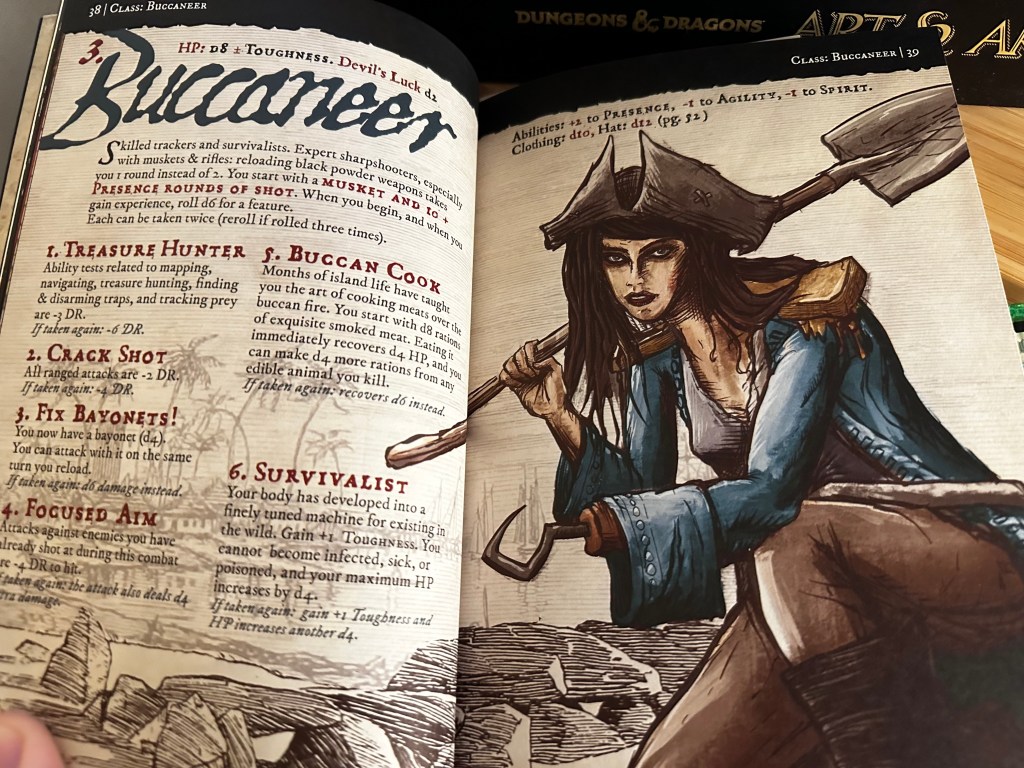
Skilled trackers and survivalists. Expert sharpshooters, especially with muskets and rifles

Buccaneers get a +2 to Presence, a -1 to Agility and a -1 to Spirit.
So that makes my Ability Scores:

  • Strength: -1
  • Agility: -2
  • Presence: +2
  • Toughness: -2
  • Spirit: -1
A photo of the two-page spread for the Buccaneer class in the Pirate Borg core book. The illustration on the second page shows a femme person wearing pirate gardb, including a tricorm hat. They have a hook instrad of a left hand and have a spade slung over the right shoulder.

For a Buccaneer, reloading a black powder weapon only takes one round instead of the usual two. I guess the hope is that you are far enough away from the bad guys that you have a round before they kill you or that they don’t have ranged weapons themselves.
I also start with a Musket and 10 + Presence rounds of shot. So that would be 12, then!

Random feature

I am going to now roll a d6 for my class feature. You do this when you first begin and then again each time you gain experience. Each feature can be taken twice, or so it says here in this book.

I rolled a 2! That is the feature, Crack Shot. That reduces the Difficulty Rating (DR) of all ranged attacks by 2. That’s pretty great actually. If taken again, the feature reduces that DR by another 2 points.

Random hit points

A Buccaneer gets to roll a d8 for hit points and add (or, in my case, subtract) my Toughness. Looks like d8 is the most common die for HP across the classes. I rolled a 7 so that leaves me with 5 HP. I am pleasantly surprised!

Random clothing and hat!

Now we’re on to the really important shit.
Buccaneers get to roll a d10 on the clothing table. The options range from Tier 0 rags to Tier 3 conquistador plate!

I rolled a frigging 10!! That’s the conquistador plate! -d6 damage. But it does add 4 to the DR for all agility tests and 2 to all defence test DRs. Also, the text goes out of its way to tell you you’re going to drown if you end up in the water…

Now for Hat! Have to roll a d12 for this.
You can get anything from “none” to “morion” on a d12.
I got a 6, bandanna, which I find acceptably piratical.

Random… Luck

A photo of the Devil's Luck page of the Pirate Borg core book. It shows an upsidedown five-pointed star with text describing the ways you can use a PC's Devil's Luck points in each of the five points and a pirate's skull in the middle. You can tell it belongs to a pirate because of the eyepatch over the left eye.
A photo of the Devil’s Luck page of the Pirate Borg core book. It shows an upsidedown five-pointed star with text describing the ways you can use a PC’s Devil’s Luck points in each of the five points and a pirate’s skull in the middle. You can tell it belongs to a pirate because of the eyepatch over the left eye.

Devil’s Luck is a resource that your character can use in Pirate Borg for the purposes of dealing max damage with an attack, lowering the damage done to you by d6, rerolling any die, neutralising a crit/fumble or lowering a test’s DR by 4. So it works like Omens in Mõrk Borg, basically.

Your class determines what you roll for your starting Devil’s Luck. The Buccaneer gets d2. For my purposes, I plucked the first die out of my dice bag and it turned out to be a glittery, turquoise d6. I rolled a 6! So that means I get 2 Devil’s Luck. Not too shabby, but not too great really, eh?

Random background

The next thing the step by step guide says to do is roll on the tables on pages 55 to 61. The first of those is a d100 table of backgrounds. These are more than just back story. They also determine your starting money and provide you with something significant like items, important NPCs and motivations.

I rolled a 97! That gives my pirate the “victim” background. That’s broad but might give me a spark for my actual backstory. It also gives me 2d6 x10 silver pieces and a haunted past (obvs.)

I rolled a 7 on my 2d6 so that’s 70 silver to begin. Along with the 200 I am likely to get for the conquistador armour, this buccaneer will be laughing all the way to the X.

Random flaw

Page 56 has the Distinctive Flaws table. It’s a d20 table of generally one-word personality traits. Some of these are only subjectively to be considered flaws in my opinion. I rolled a 9 and got “aggressive.” I would imagine that that is considered a good trait for a pirate in many situations. I’ll take it!

Equally, “2. Stubborn,” “6. Coward,” and “17. Paranoid” might all be considered beneficial to people in the pirating business at least some of the time.

Random trademark

I am rolling here for a Physical Trademark, rather than some sort of copyright or patent type deal. That would be a weird thing to include in the character creation section of a pirate game.

Another d20, here we go!
I rolled a 5… shit, I’m missing a hand; hook or claw instead. I’m thinking claw? Might be easier to handle my gun that way. Importantly, there is nothing in here about this causing any sort of mechanical drawback to your character, which I like.

Random idiosyncrasy

The full title of the table on page 58 is:

Idiosyncrasies one might have developed and will certainly never be rid of…Yet that certainly won’t stop you from trying.

It’s another d20 table. I have been using a different die for every single roll and I don’t see a reason to stop that now. It has been serving me semi-well thus far after all.
That’s a 12. Now this result might very well feed into the victim background I rolled up earlier:

You wronged and infamous pirate lord

I am beginning to think that the two are connected. My Buccaneer’s cat, Milly, tore out the throat of Captain Tall John Copper’s parrot, Butch. Milly jumped from the gunwale and swiped the emaciated bird off the shoulder of the famously bad-tempered pirate captain who had had men flayed alive and keel-hauled for less. As some sort of poetic justice, he made my pirate cook and eat poor Milly while the whole crew looked on, and then he chopped my hand off.

Random incidents

A photo of the Unfortunate Incidents & Conditions table from the Pirate Borg core book.  It includes a black and white illustration of an overloaded lifeboat on rough seas surrounded by debris and a d20 table beneath that.
A photo of the Unfortunate Incidents & Conditions table from the Pirate Borg core book. It includes a black and white illustration of an overloaded lifeboat on rough seas surrounded by debris and a d20 table beneath that.

This one has an incredibly long full title as well:

Unfortunate incidents & conditions having occurred or developed with or without one’s express consent, desire knowledge or general understanding

Guess what! It’s another d20 table. I rolled a 9 on this table. The result is unfortunate:

Your last crew was killed by undead. They left you alive on purpose

Shit. I hope my new crew doesn’t learn of this…
I am thinking that I made a deal with a necromancer to send his vitality-challenged minions to do in Captain Tall John Copper but they got a bit enthusiastic and did the whole ship instead, leaving me to take a dinghy (call back to the first roll of the character creation process!) to the nearest port and find some new gainful employment.

Random things

The last table in the list stretches right across from page 60 to page 61. It is entitled “Thing of Importance.” It is another d100 table.

I rolled a 79:

A long scar on your face

I think it is only fair that Milly gave me that just before I popped her in the stock pot.

Random name

There is only one thing left to do as part of this process, and that is the all important name. Now there is a table for names on the inside cover of the book so I think I will use that. It is a d12 table with three columns. I shall roll a d12 3 times and combine the names as I see fit:

Roll the first: 7 – Sam(uel) or Butch(er) or Philip
Roll the second: 3 – Robert(s) or Jack or Fernando
Roll the third: 11 – Genny or Isabel(la) or Jean

I imagine the name Butcher came from the Milly incident. It should go in the middle. So, it’s Isabella “Butcher” Fernando. That’s a bloody good pirate name if I do say so myself.

Random conclusion

Not really.
I thoroughly enjoyed the process of making his character. I am used, in more recent games of Mõrk Borg, to using their Skum Birther site to come up with a random character and that can be fun too, although I do think, when you are that far-removed from the process, you don’t have that strong an attachment to them. So, spending the time rolling up this pirate with you, dear reader, has been rewarding and has taught me quite a bit about the game as well. And that, after all, was the whole point of the exercise.

Have you played Pirate Borg, dear reader? Will you be celebrating Talk Like a Pirate Day this year? If so, what will you be doing for it?

Motivation part 2

Motivating characters

So, in the last post, I went on at some length about how you might be able to motivate players in your game, focusing mainly on what you do between sessions to get them excited to come back and do it all again. There were also times, I decided, when you shouldn’t overdo it, when you should just let people be.

When you do get them to the table, though, your work ain’t over. Obviously, I’m talking to the GMs out there, but this goes for players too. Because now it’s time to figure out why your character is out there smashing skulls or investigating murders or trying not to be sacrificed by some bloodthirsty, cthonic cult or whatever their weird job is.

Seems like an easy answer, doesn’t it? But it’s not. Your character’s motivation is a strange, ephemeral thing that you need to keep in your mind at almost all times to figure out what they are going to do in any given situation. You can keep your alignment, in my humble opinion. Alignment is such an archaic and ill-defined concept, it barely even begins to answer any of the questions raised by the “character” aspect of the sheet. It can be manipulated to mean almost anything. So it doesn’t really help to direct you when you are trying to decide whether you should back the werewolves or the elves (Dragon Age: Origins fans, yo!)

New characters

Games have all sorts of ways to help you figure out what your character’s motivation is going to be. At the creation stage you are picking things like backgrounds, bonds, ideals and flaws if you’re playing 5e, your drive, problem and pride if you’re playing Tales from the Loop, your Calling if you’re playing Heart. The game is usually trying to help you out. Sometimes it doesn’t have to do any more than describe your race and class, in fact. That’s often enough to set a player’s imagination alight. Before you know it, your dwarven barbarian has figured out that her driving force is a desire to put as much space between herself and the darkspawn riddled Deep Roads (I’ve been replaying Dragon Age: Origins recently, ok?) as she can, and to have fun doing it. Of course this motivation is likely to change many times during play, but if Bianca remembers that she never wants to set foot in the Deep Roads again from that moment on, all of her decisions are likely to be coloured by it, especially when she finally faces her fears and delves back down to Orzammar and the lost Thaigs to help out her party-mates in their quest to track down the origin of the darkspawn outbreak in the Korcari Wilds.

Here’s a question though. How much influence should the GM have on a player-character’s motivation. Well, like most things PC-related, I would say that there is a conversation to be had. This is often something I forget to do with my players at character creation to be honest. Especially in games where motivations are less well defined or less tied to the plot. In fact, I have received feedback in the past that I should be more willing to guide players in their choices of class in case they choose something inappropriate for the campaign, never mind motivations! But basically, what I’m trying to say is that you should always talk about it, especially if a player is interested in talking about it.

I messed this up recently and definitely reduced at least one player’s enjoyment of the first session of a new game as a result. Motivation is important! It colours everything so you should always be available to talk about what a character is doing this stuff for? Why would they want to? It’s not that they player is being awkward or a prima donna or making the game about them, they just want to feel a connection to the game through their character and they need a reason for that. Help them out, eh?

In gameplay

As I mentioned before, character motivations can change during the course of play. In fact, I would go so far as to say that if they don’t the game there is probably not much going on in it. Most sessions it is a good idea to make their most immediate motivation become “I don’t want to die!” At least once.

But this goes for long-term motivations as well. I think it is absolutely possible to retain your character’s initial motivation of “never wanting to go bak to the Deep Roads again,” while subverting that, undermining it, overcoming it. Maybe, once Bianca follows her companions back into the Deep Roads, she realises that, without here, they would have died down there, that actually, her Deep Roads survival skills are valuable and that she should help others by teaching them. I think GMs should be prepared for these shifts but players, equally, should be ready to make changes like this to their characters. Turn it on its head, fail forward if that’s what happens in the game. Push your character to do what is explicitly against their motivations sometimes and see what happens to them and the game as a result. Do the unexpected!

Heart

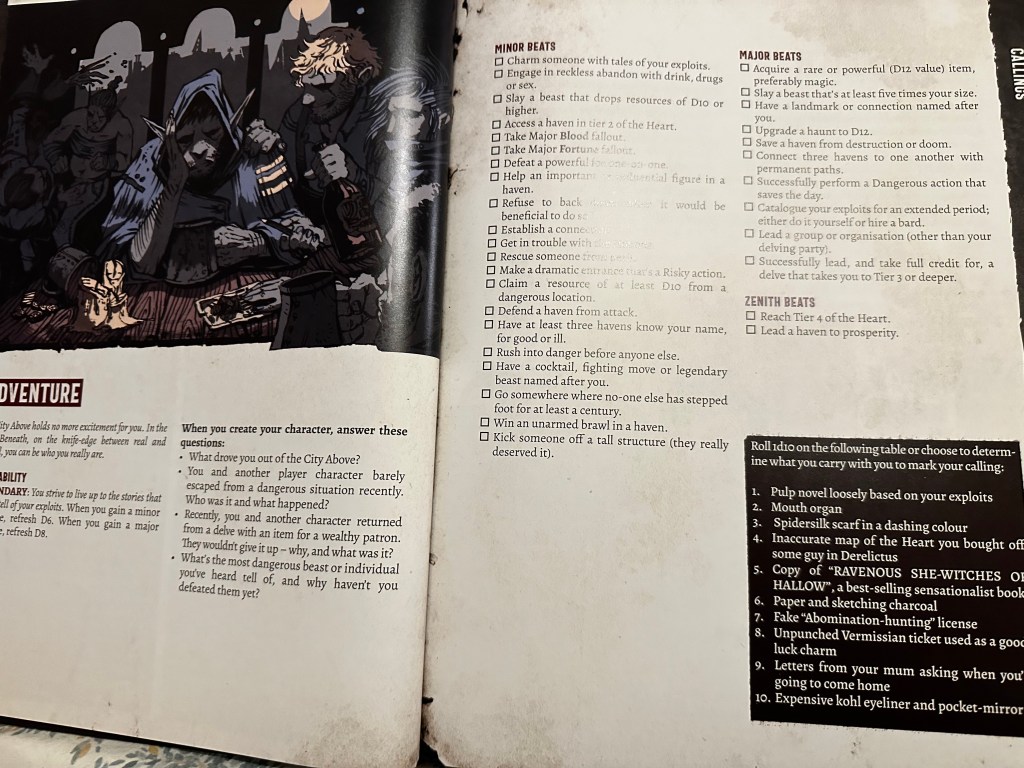
It always comes back to Heart these days it seems. Well, that’s because it has these great little systems built into it. The granddaddy of these systems is the Character Callings. You have a handful of them. Not too many to choose from: Adventure, Forced, Heartsong, Enlightenment and Penitent. They speak for themselves really, except maybe for Heartsong, which is the weird one that wants your weird character to follow the weird as deep as it will go into the weird subterranean other-world until you find some insight into the weirdness that’ll probably kill you or transform you beyond all recognition.

Essentially these are all the motivations your character might need in Heart. Their descriptions spell out the kind of thing in keeping with the theme of the Calling, that might have led you to delve into the red, wet Heaven. It also gives you a fun ability to reward you for choosing it, a few questions to answer to help you flesh out your character and focus you on the type of adventure/enlightenment/penitence etc you are espousing, and most usefully, both for the player and the GM, an absolute raft-load of beats, narrative or mechanical milestones you want your character to hit as your delves go on. The beat system is so useful for building a session and a story at the table together. It is particularly fun when one PC’s beat synergises with another PC’s completely separate beat or when the object of the beat comes up organically in play, without the GM being aware that it’s happening. It is motivation given mechanical and narrative form and I love it.

Seriously, go check out Heart if you haven’t already. It’s a good game. And it’s fun and gross.

That’s me for now. My motivation to write has ebbed and waned. It’s you time now. How do you like to motivate your players and characters?

Beginnings

Where shall we start?

This is always the first question I ask myself when starting a new game. It doesn’t really matter if it’s a one-shot, a short series of sessions or an open-ended campaign; the beginning sets the tone for the whole thing. If you start your PCs off trapped in a haunted house with no prospect of escape and a murderous ghost hunting them, you have made a pretty firm statement about the kind of game you are all there to play (or your players will see it that way at least.) Equally, if you start with a scene from each character’s home life, interacting with their family members and discussing their everyday problems, you are establishing a sense that this is the type of game where that kind of thing will happen again (or you should be.)

You can use the start of your game to establish a theme too. Maybe its a horror game involving frog mutants who want to feed your players souls to their unholy tadpoles, you could start in their camp at night, describing a croaking, ribbiting chorus that grows in intensity and volume through the night, ensuring that none of the party get any rest. Embed in the cacophony the true name of a PC and you have the potential for fear and suspicion if not outright horror.

Control

Three sessions in, there’s one PC who has decided to attempt a bloodless coup on the streets of the town at the centre of your adventure, another who has set their heart on wooing one of your NPCs of lesser importance and a third who just wants to sit in the tavern and spread rumours about the sheriff being a cannibal. It can feel like you are out of the picture sometimes (and that’s not necessarily a bad thing, dear reader. The best sessions happen at the whims of the players.) At the start, though, you, as the GM, have control. It relates a little bit to the world building work you’ve been doing, or not doing. After all, you made up the place they start in, or at least, you read about it in a published sourcebook or module and interpreted it as you saw fit. You know the places involved, you know the relevant NPCs, you know the setup, even if you have no preconceived notions about how it’s all going to go down in the sessions to come. With that knowledge, you start with an advantage, for the time being, at least. Before long, you have to hand things over to your clever and inventive players and they’ll have burnt down half the Silver Quarter while introducing the roller skate to Spire.

But, more important than your behind the scenes knowledge, is the situation they start in. I’ve mentioned in medias res beginnings in the past. Frame the scene they find themselves in and make it tense or truly fantastical or horrific or action-packed or just evocative. Start in the middle! It is the one opportunity you have to do this. You set it all up and see how they react to it.

In the Death in Space one-shot I ran a few months ago, I started them off being ejected from cryo-sleep as they approached the main adventure location, a mysterious space-station. They each got to have a moment to describe their characters and I explained they were seeing the debris field surrounding the remains of a planet that was destroyed in the recently ended wars and that they had to guide the ship through it! But then I used a series of flash-back scenes to explain what they were even doing there. I don’t think that’s even the first time I have used the in-medias-res/flashback combo to get into the action as quickly as possible while also providing some much-needed context. It worked pretty well as I recall…

It’s a fun way to get them all rolling dice quickly and failing quickly too, which is usually pretty important in a one-shot horror game.

Intros

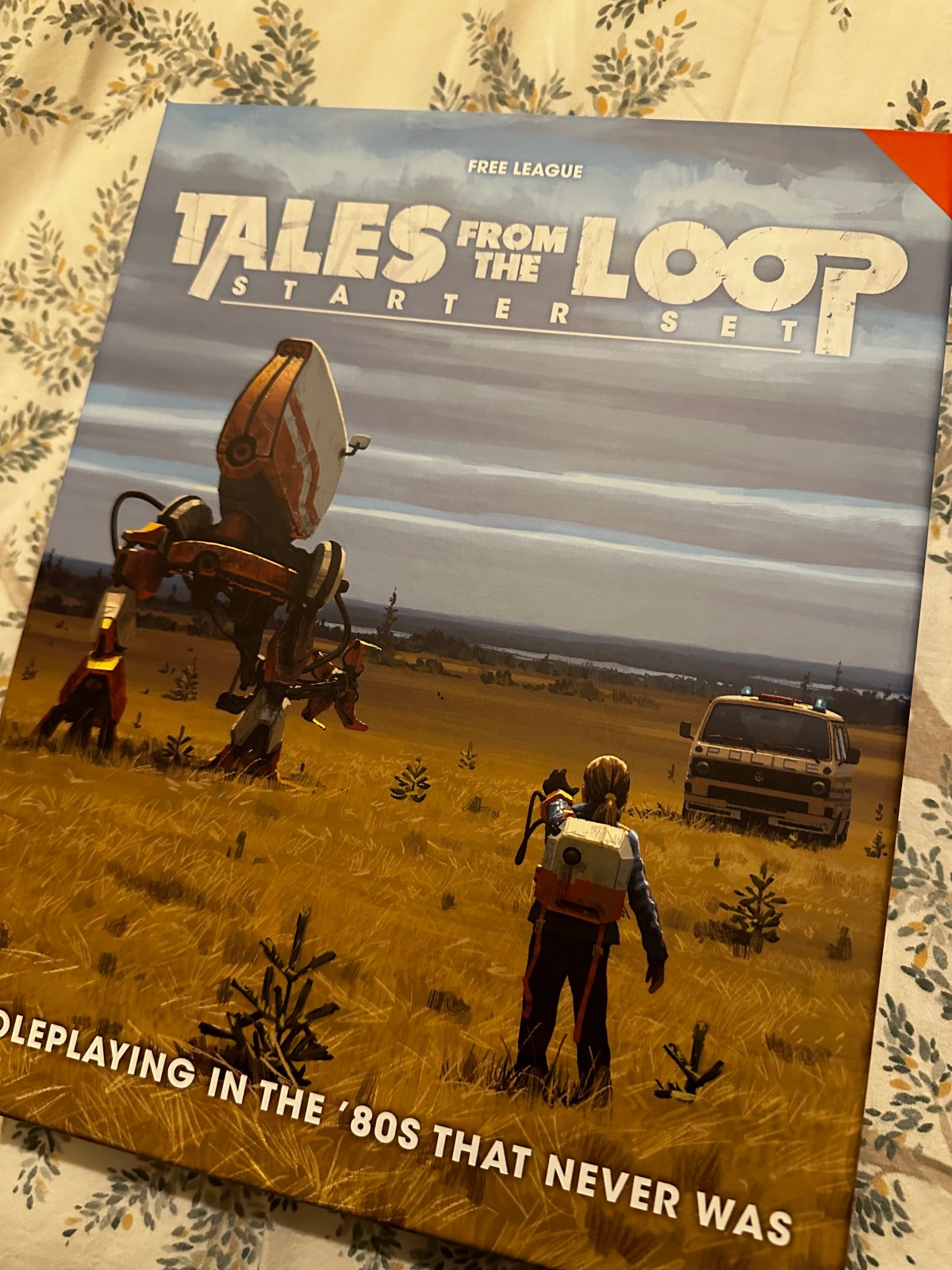
Tales from the Loop wants you to put the kids, the players’ characters, at the fore from the get-go. And deservedly so. These kids are created to have people who are important to them, problems that consume them in their regular lives, drives that motivate them and things they’re proud of. They’re rich and three dimensional characters before they ever get to the table. So, the game insists that you start a mystery (what TftL calls adventures) with a scene belonging to each and every kid in their home life or at school, with NPCs that are important to them, family, friends, mentors, that sort of thing. This is where the players get really invested in their characters. They have genuine and heartfelt interactions with the people of significance to them and they begin, immediately, to find their voice and their personality. It’s probably the best thing about a game that has a lot of good things going for it.

I stole the technique for the second campaign I ran in my Scatterhome world. It took place on the northern island of Erlendheim. The PCs all knew each other at the start since they began at 8th level and, in the fiction, had an adventuring party for many years, long ago. The adventuring life long behind them, I asked them to describe their mundane lives as a farmer, an advisor to the Jarl, a guard sergeant and a village priest and made sure to include people and places that were important to them. I focused on who and what they loved because I knew I was about to fuck with all that.
I had learned a lesson, you see, dear reader. Oh yes. For those of you keeping studious notes, you will recall I described the start to the first campaign in Scatterhome, when I drowned the island nation and erstwhile homeland of the PCs, Galliver, off-screen, before the start of the game. They didn’t care about it, and I can’t blame them. I had never given them a reason to.
In Erlendheim, they were more focused on saving the druid’s kids, ensuring the safety of their families and homes, protecting their futures.
Tug on those heart-strings, GMs.

Scenic

There is a subtle art to the transition from the start of an adventure to the meat of it. Or there is if you don’t subscribe to the philosophy that adventures should happen in scenes.

Usually, the end of a scene is obvious in a movie or tv show. It normally shifts perspective or location or time. So, if you want to do something similar in a game, someone needs to just say it’s over and move to a new scene. Sometimes that’s the palyer who wanted the scene but usually its the GM. I would rarely have done something so bold as to declare the end of a scene in a game of D&D as a more trad DM but it’s so freeing to do it! Just like you framed that first scene at the beginning of your game, you soon realise that you can frame and end any scene at any time (within reason.)

Looking back at the Tales from the Loop example from earlier, I noted that each kid gets a scene about their home life. Together with the player, you describe the kind of scene it is going to be, improvise it and end it when it feels right. When you move on to the investigation part, you can cut to a scene with all the kids in it, where they are staking out the suspicious machine that appeared in the nearby field overnight to see who is responsible for it and end that scene when they have gotten everything from it they can. Easy.

Using scene structure is even built into some games. Spire and Heart use scenes, situations and sessions like other games use rounds, days and long-rests. They are left deliberately vague but some powers and abilities work only within the current scene or situation. I have embraced the vagueness and it didn’t even take any adjustment. It was instinctive.

In the next post I am going to write a bit about endings, which, in my experience, are so much more difficult.

How do you like to start your games, dear reader? Let me know in the comments.

Character Creation – Advanced Dungeons & Dragons 2nd Edition, Dark Sun, Part 2

What has come before

Well, yesterday I started by creating a brand new character to be played in Dark Sun, the AD&D 2nd Edition setting. Here’s what we’ve hot so far:

  • Name: Rezina
  • Pronouns: she/her
  • Race: Halfling
  • Ability Scores:
    • Strength: 11
    • Dexterity: 18
    • Constitution: 18
    • Intelligence: 17
    • Wisdom: 18
    • Charisma: 9
  • 3ft 3in tall
  • 59lbs in weight
  • 41 years of age

What have we learned? Race is problem in these older books. The ways they refer to characters as “half-breeds” or inherently unintelligent or bred to be sterile are incredibly distasteful. It is all couched in very racist and unsympathetic language and I am glad that that sort of writing is a thing of the past.
Also, Dark Sun characters come out powerful, with the new way of rolling up your ability scores and some really useful racial traits.

Stay classy

It’s time to look at classes in Dark Sun. There are many changes to the classes compared to the AD&D 2nd Ed Player’s Handbook. There are also a few new ones here. Dark Sun introduced the Defiler, the Gladiator, the Preserver, the Psionicist and the Templar to the game. Technically, Psionics were introduced in the Complete Psionics Handbook, though. I mentioned yesterday that Halflings can choose from the following classes: Cleric, Druid, Fighter, Gladiator, Illusionist, Psionicist, Ranger and Thief. But I will take a look at each of the new ones and the major changes to the existing classes too.

The Dark Sun Rules Book splits the classes into their categories of Warrior, Wizard, Priest and Rogue with Psionicist sort of tacked onto the end.

A photo of the AD&D 2nd Edition Battlesystem Skirmishes Miniatures Rules from TSR.

TSR really wanted you to use their Battle System mass-combat rules with Dark Sun. If I remember correctly, parts of the opening few official adventures contained full-scale battles where it expected you to have armies of miniatures fielded against each other. I don’t remember ever using them, despite having the book. Anyway, as a result of that, one of the main things that Fighters got in Dark Sun was a whole bunch of automatic followers. These people would just flock to you as a successful Fighter as you gained levels. They can also teach weapon proficiencies from 3rd level, operate heavy war machines from 4th level, supervise the construction of defences from 6th level, command large number of troops from 7th level and construct heavy war machines from 9th level. All of these very Battle System related abilities are in addition to the stuff they get in the PHB. Fighters have an ability requirement of 9 STR so Rezina could, technically take this class. Hit Dice: D10.

The Gladiator is a new class. They are the slave warriors of the Sorcerer Kings. The arena is a big part of life in the City States of the Tablelands. It is the main form of entertainment and a system of control for the masses. It’s also big industry as the slave trade is key to the economy of the region. Gladiators get a few nice benefits. They gain proficiency in all weapons and can specialise in multiple weapons too. Not only that, but they are expert in unarmed combat and get to optimise their armour, reducing their AC by 1 for every five levels. From 9th level, Gladiators also gain followers like the Fighter. They have some harsh ability score requirements though, STR 13, DEX 12 and CON 15. The Strength requirement disqualifies Rezina, I’m afraid. Hit Dice: D10.

Rangers are mostly unchanged from how they are described in the PHB. They have to decide on an elemental plane of worship at 8th level and can only cast cleric spells from that sphere and they gain followers of animal and humanoid type from 10th level. Required STR 13 means I can’t choose to be a Ranger. Hit Dice: D10.

Onto the Wizards! Rezina can choose only Illusionist from this list but we’ll have a look at them anyway as they are so important to the overall lore of the world. Wizards work quite differently on Athas. The default magic user is the Defiler. These guys drain the life from the world around them to power their magic and, as a result of their disdain for the environment, they gain levels much faster than their Preserver counterparts. Preservers balance their consumption of magical energy to minimise or chancel the damage they do. Of course, this course makes them level up much slower. Finally, there is the Illusionist, a specialist wizard class who are treated exactly as they are in the PHB except that they have to choose to be either a preserver or defiler. Regular Preservers and Defilers only have an ability score requirement of INT 9, but if you want to be an Illusionist, you also need to have DEX 16. So, this is, in fact, an option for Rezina.

Priests are split into Clerics, Druids and Templars.
The Clerics are worshipers of a particular elemental plane, rather than of a deity or pantheon. Athas does not have its own gods and is considered separated somehow from the influence of the Outer Planes. It is very hard to get to and from Athas, in fact, through planar magic, portals or even spelljamming vessels. So, Clerics, although they may be flavoured differently depending on their backgrounds, gain power from the Inner Planes, the elements, instead. Their weapon restrictions are based on the elemental plane they worship, they can ignore the presence of the element they worship from level 5, they can gate material form their chosen plane at level 7. You need a WIS 9 to be a Cleric so that is an option.

Druids are out for Rezina due to their ability score requirements, WIS 12 and CHA 15. She’s just ain’t got that rizz. Druids have to choose an area known as their Guarded Lands and from 12th level on, they have to spend half their time there. They gain their powers from the spirits there. Usually, their spells are restricted to one or two spheres related to their guarded lands. They can speak with animals and plants as they gain levels, and get a whole bunch of powers from their lands.

Clerics and Druids are really only a thing outside the City States themselves. Inside, the priests who matter are the Templars, the priests of the Sorcerer-kings. They’re not good guys. In fact, a Templar PC has to be either Neutral or Evil. They enforce the edicts and laws of the Sorcerer-kings and are not above a little corruption. They have access to vast libraries that allow them to use spells from all spheres, though they progress slower than Clerics at lower levels. Unlike the other priests, Templars get their spells directly from their Sorcerer-king. They can raise and ally with undead but cannot turn them, they have the power of life and death over slaves (this is a class benefit…) they can legally enter the house of a free man and accuse them of disloyalty from 4th level and pass judgement on them from 7th level. They can start throwing their weight around with nobles from 10th level. They can can requisition soldiers from 3rd level, gain access to all areas of palaces from 5th level and draw on the city treasury for official investigations. From 17th level, they can pardon any condemned person, though, which is nice. Rarely do you see a class in RPGs that is as focused on civic matters and accusing people of shit to get their way. It’s a weird one and I don’t think anyone in my games ever chose to play one. Anyway, Rezina can’t be one because she is a Halfling.

Onto the Rogues.

Bards are out for Rezina as she is a Halfling. But they are pretty cool in Dark Sun. They are renowned, not only as entertainers, but also, assassins, blackmailers and thieves. They have all the benefits of the original Bard from the PHB but they also have a mastery of Poisons. One big difference is that they don’t get access to spells at all.

Thieves work basically the same as they do in the PHB but they also can find a patron from 10th level. These guys can give them jobs or protect them from others. With the only pre-requisite being DEX 9, Rezina could choose this class.

A photo of the front cover of the Advanced Dungeons & Dragons 2nd Edition of the Complete Psionics Handbook from TSR.

Finally, the Psionicist. Every character in Dark Sun rolls on a table to get a Wild Talent, an innate psionic ability that may or may not be particularly useful so the class is open to all races. But Psionicists have a whole raft of abilities that come with the class. Luckily I have a copy the Complete Psionics Handbook (TSR 1991.) Psionics were based on the idea that the powers were split into separate disciplines within which you get major powers called sciences and minor ones called devotions. Your character gets a pool of Psionic Strength Points, based on a relatively complicated equation involving WIS score and CON and INT modifiers. You spend these to use powers. They also learn Defense Modes which are used in psionic battles. They gain followers from 9th level. The ability requirements are CON 11, INT 12 and WIS 15 so Rezina could choose this class.

There are a few other points to consider before making the choice here. Halflings can choose to multiclass and Dark Sun characters start at 3rd level by default. I won’t multiclass, just to keep this a bit simpler.

Another characteristic of Dark Sun is that you are supposed to have a character tree, ie, a selection of 4 characters to choose from in between adventures or so there is backup in case one character dies in this very lethal setting. I won’t be doing this as I have spent so long making just a single character already!

Time to choose

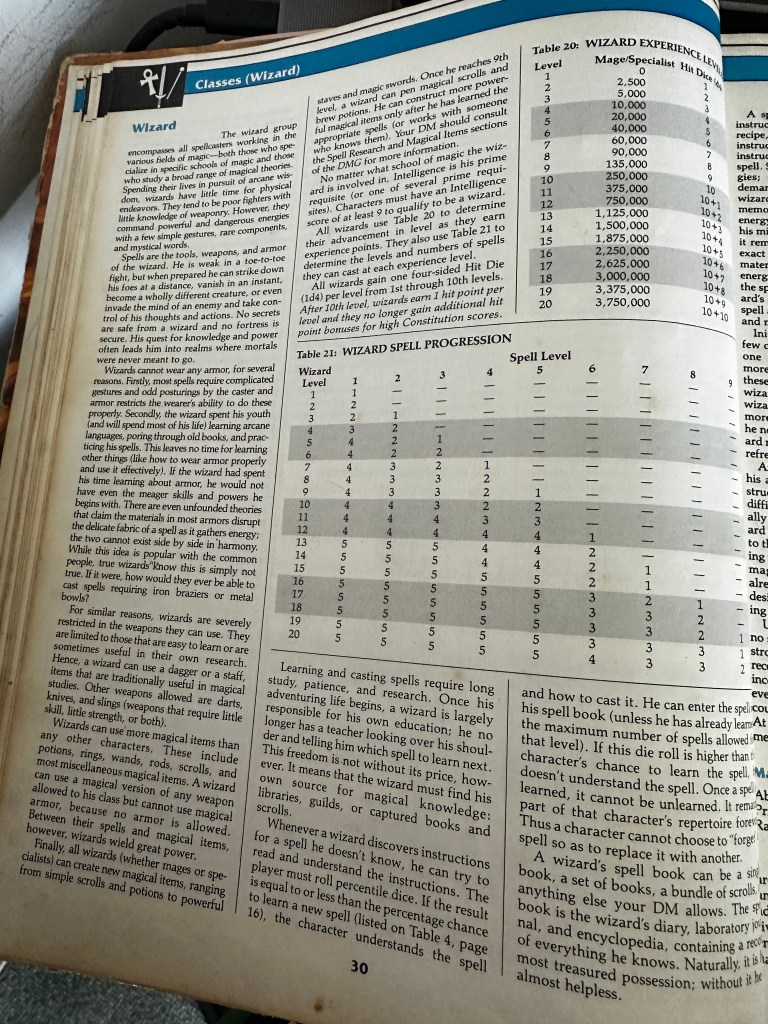
A photo of page 30 of the AD&D 2nd Edition Player’s Handbook. It contains the description of the Wizard class, including Wizard level progression and Spell Progression tables.
A photo of the Illusionist section from the AD&D 2nd Edition Player’s Handbook.

My options are Fighter, Illusionist, Cleric, Thief and Psionicist. Should I roll for it? Yep. On a d5 (thanks again DCC) I rolled a 2. Illusionist!

Illusionists get a +1 on saves vs illusion spells and others get a -1 against their spells. They also get to memorise an extra illusion spell at each level. Researching new illusion spells is easier but conversely, researching the spells of other schools is harder. Of course, it also means that they can’t learn spells from Schools directly opposed by illusion, ie, necromancy, invocation/evocation and abjuration.

Ok, I am going to have to wrap this up here. This character creation process in Ad&d is pretty time intensive, especially when I go through every potential class candidate and critique them I will have to finish this off tomorrow. See you then!

Character Creation – Advanced Dungeons & Dragons 2nd Edition, Dark Sun

Showing some character

So the character creation posts have had some good feedback. People mainly seem to like it when it goes disastrously wrong for some reason. Schadenfreude maybe? Anyway, I thought I would continue the series with another one. This time, I thought I would go back to the game I think of when I think of my teenage years, AD&D 2nd Edition (TSR 1989), and, more specifically, the Dark Sun setting (TSR 1991). I have never been a player in a Dark Sun game, I was always the DM, so this will be interesting. Also, Dark Sun characters need to be pretty hardy to survive the scorching wastes of the magic-blasted world of Athas. So, if I roll bad, you sadists out there should get a kick out of it.

Step 1 – Ability scores

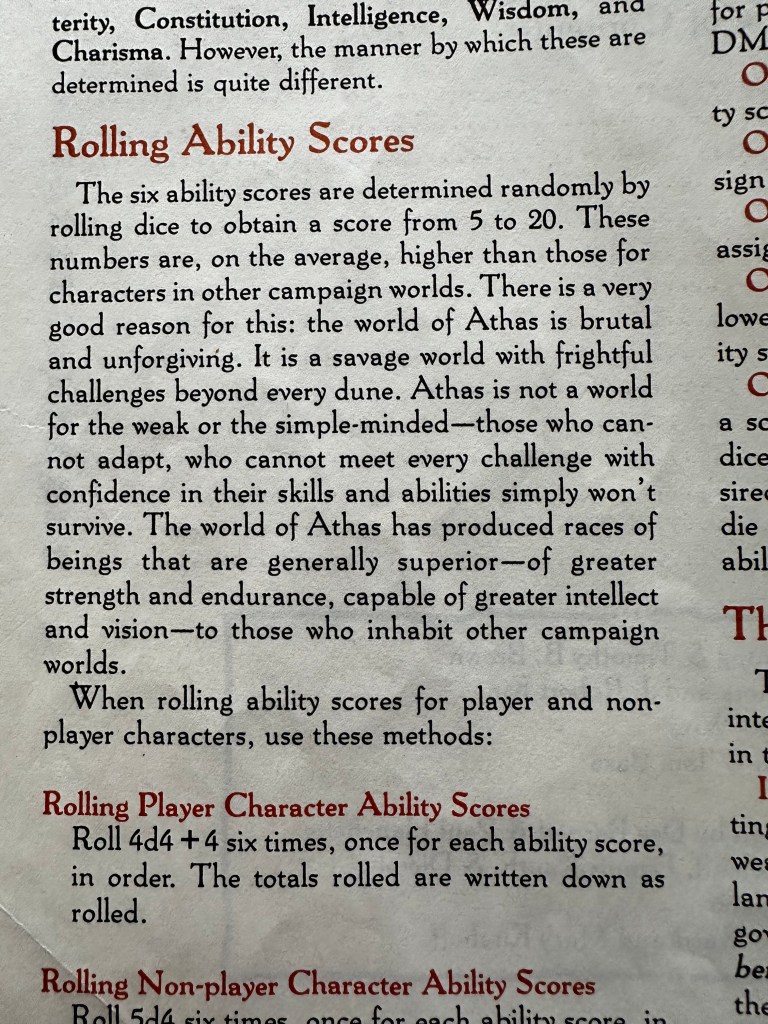
A photo of the “Rolling Ability Scores” section of the AD&D 2nd Edition Dark Sun Rules Book.

We see an immediate departure from AD&D norms with rolling your ability scores in Dark Sun. Because the setting is so brutal, your PCs get higher than average scores to reflect the hardness of life there. So, instead of the usual 3d6 for each score, you roll 4d4+4 for a minimum of 8 (even though the book claims the minimum is 5, which is numerically impossible) and a maximum of 20, unmodified. There are a bunch of optional methods for rolling included in the Dark Sun Rules Book but I am going to stick with the basic one. So, here we go:

  • Strength: 13
  • Dexterity: 16
  • Constitution: 19 (Suck it Canon Fodder)
  • Intelligence: 17
  • Wisdom: 16
  • Charisma: 10 (Oh well, they can’t all be winners)

First thoughts; obviously this method produces some high results. Also, I was very lucky. Also, these rolls mean that this character could choose almost any race or class.
Second thoughts; now that it comes to it, this is one of the reasons my players really liked this setting. They got to create some very powerful characters, even without cheating on their rolls (which was, I must be honest, the norm at the time)!

Step 2 – Player character race

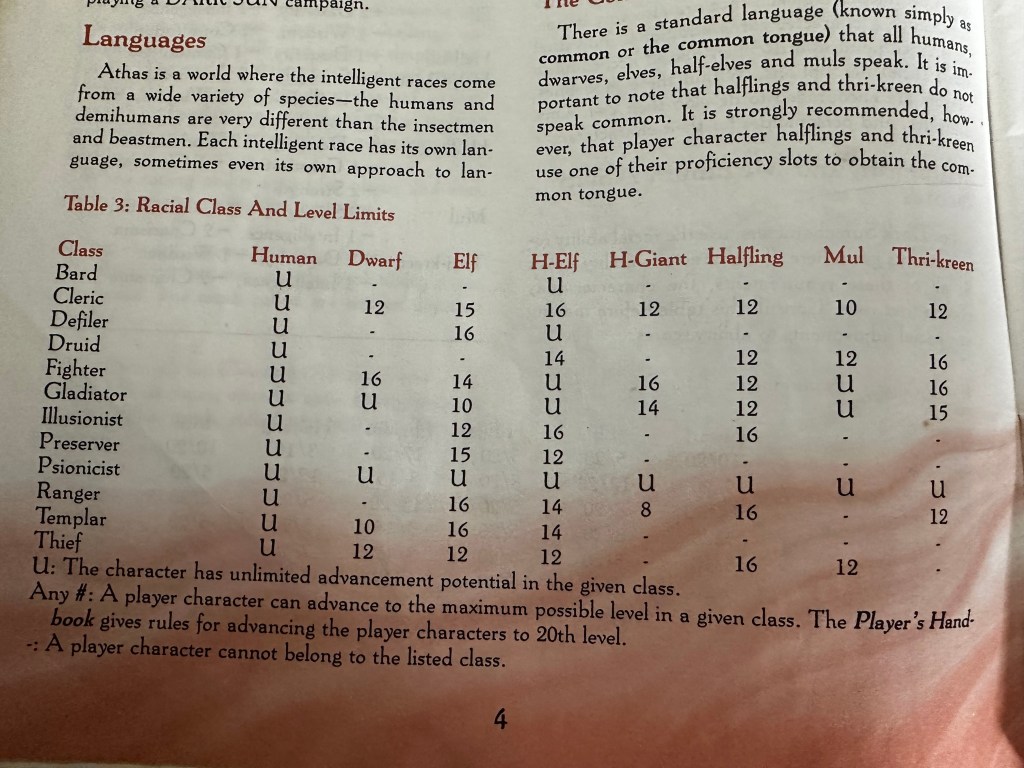
A photo of Table 3: Racial Class and Level Limits from the AD&D 2nd Dark Sun Rules Book.

There are Racial Ability Requirements in this setting as there are in the base game, but some of them are very tough to achieve. The only one I think is ruled out is the Half-giant. If you want to be one of those big lads, you need to have a minimum strength score of 17. So here are the races I get to choose from:

  • Dwarf
  • Elf
  • Half-elf
  • Halfling
  • Human
  • Mul
  • Thri-kreen

Pretty much none of the races in Dark Sun bear any resemblance to the standard D&D ones, with the possible exception of bland old humans. There are also a few new ones here.

Dwarves are all hairless and obsessed with a focus that gives them bonuses to saves and proficiencies when performing them in pursuit of that goal. They can choose to be Clerics, Fighters, Gladiators, Psioicists, Templars or Thieves. Although all of these have level caps below 20 except for Gladiator and Psionicists. Some of them are really low. A Dwarf can only get to level 10 as a Templar for instance! But they can multi-class. They get a +2 to CON, +1 to STR, -1 to DEX and -2 to CHA.

Elves are tall and lanky and weather-worn with an incredible stamina needed for running long distances across the Athasian deserts. They are very insular and tribal. They get bonuses with long swords and longbows made by their own tribes and to surprise rolls in the wilds. They can choose to be any class except Bard or Druid. They get +2 to DEX, +1 To INT, -1 to WIS and -2 to CON.

Half-elves have to deal with terrible intolerance from both elves and humans and have to do without basic connections or friends (this shit is in the text, ugh.) Anyway, it makes them very much self-reliant loners. They get a free Survival proficiency at 3rd level and can make a pet friend at 5th level! All classes are open to them and they get to multi-class if they want. They get a +1 bonus to DEX and a -1 to CON.

Half-giants are a thing in this setting. And, although I can’t choose them, here is a little bit about them. They are up to 12 feet tall and weigh up to 1600 lbs! They have no culture of their own as a very young and dull-witted race. Once again, the text is pretty bad about this kind of thing. It really underlines for me the need for the push-back this sort of thing rightly received in more recent times. Anyway, they getting bonuses to STR and CON and minuses to INT, WIS and CHA. They can only choose from 5 classes.

A photo of the Halflings section of the AD&D 2nd Edition Dark Sun Rules Book including an illustration by Brom depicting two tattooed halflings with long, wild hair emerging from a cave.

Halflings are small humanoids from the jungles at the fringes of civilisation in the Tablelands of Athas. Their culture is concerned mainly with appreciating their local natural world and complex interactions of a social sort between their various villages and clans. They are not really into war and wealth. They get bonuses to use slings and thrown weapons, to surprise opponents and to save against magic and poisons. They get a -2 to STR, -1 to CON, -1 to CHA, +2 to DEX and +2 to WIS. They can choose any class except Bard, Defiler, Preserver and Templar. They can choose to multi-class.
As a side note, I had a memory of Halflings all being cannibals in this setting but it is not mentioned in the character creation section so it might have just come up in certain adventures or something. Not sure.

Humans are much like humans in other settings except they generally have some weird little traits, like mutations. This is a post-apocalyptic setting after all. So players are given latitude to come up with some little physical idiosyncrasy that is purely for flavour. They can choose any class and can be dual-class, but cannot multi-class.

Muls are yet another “half-race.” Its genuinely so distasteful, this whole business. Anyway, here we are, they are half human, half dwarf. They are the product of slave-owners “ordering their births” for gladiatorial or labourers. They are born sterile. FFS. My stomach truly turns at this description of this race. It’s just so cruel. They also “live out their lives in servitude, driven by hatred and spite.” Give them a break! They are tall and well built. They get a +2 to STR and +1 to CON, but a -1 to INT and a -2 to CHA. They can work longer and harder than others as well. They have to choose, at the time of creation if they are considered human or Demi-human. If considered human they can have unlimited advancement in any class and become dual-classed. If the player chooses demi-human, they can, instead become multi-classed and can only choose from Cleric, Druid, Fighter, Gladiator, Psionicist and Thief. This really puts a great big question mark over the entire idea of class restrictions on Demi-human races, if you ask me. This suggests that the reason a demi-human can’t choose any class or get all the way to 20th level in it, is not because of a physiological, racial impediment, it’s only because human society says they can’t… I mean, what?

Finally, Thri-kreen. They’re big mantis guys who have a base AC of 5 but never wear armour. They don’t need to sleep but they can’t use most magical items as they are generally designed for use by human shaped people. Their hunting packs control much of the Tablelands. They have a well-known taste for elves (maybe I was mixing up the Thri-kreen and the Halflings.) They get natural bite and claw attacks and a powerful leap. They get venomous saliva at 5th level as well as a bonus proficiency with the Chatkcha, a thrown weapon. They can also dodge missiles at 7th level. They get a +1 to WIS and +2 to DEX, but -1 to INT and -2 to CHA. They can choose to be Clerics, Druids, Fighters, Gladiators, Psionicists or Rangers and they can multi-class too.

This post is already much longer than I had intended. I started going through the races and couldn’t stop commenting on them. It was like watching a car-crash in slow motion.

Anyway, I think I will have to continue this character creation process in another post tomorrow. But, before I go, I think I will have to complete the choice. Obviously, as always, the race you select will have a direct effect on the choice of class due to the ability score modifiers. But, since we have a tradition of randomness in the character creation posts, I think I will stick with it and roll for it. There are seven races available to me and, luckily, I do have a d7 to hand thanks to DCC. Here goes:

I rolled a 6 on a d7, dear reader, but I just can’t accept it because that would have been a Mul and that makes me too sad. So I re-rolled and got a 4, Halfling!

So, that leaves me with ability scores as follow:

  • Strength: 11
    • Hit probability: Normal, Dmg Adjustment: None, Weight allow.: 40lbs, Max press: 115lbs, Open Doors: 6, Bend Bars/Lift Gates: 2%
  • Dexterity: 18
    • Reaction Adj.: +2, Missile Attack Adj.: +2, Def Adj.: -4
  • Constitution: 18
    • HP Adj.: +2 (+4 for Warriors. This means Fighters, Rangers and Gladiators in Dark Sun), System Shock: 99%, Resurrection Survival: 100%, Poison Save: 0, Regeneration: Nil
  • Intelligence: 17
    • # of Lang: 6, Spell Level: 8th, Chance to learn spell: 75%, Max. # of Spells/Lvl: 14, Spell Immunity: –
  • Wisdom: 18
    • Magical Def Adj.: +4, Bonus Spells: 4th, Chance of Spell Failure: 0%, Spell Immunity: –
  • Charisma: 9
    • Max # of Henchmen: 4, Loyalty Base: 0, Reaction Adj.: 0

The final task for today is to flesh out this Halfling a bit. I am giving her the pronouns she/her and calling her Rezina.

A page from the AD&D 2nd Edition Dark Sun Rules Book showing the Height, Weight, Age and Aging Effects tables for PC races.

She is 3ft 3in tall, 59lbs in weight, and 41 years of age.

Back tomorrow with the choice of class and probably everything else. See you then!

Trophy Gold – Character Creation

Old school play, new school rules

I have a post in which I write a little about a couple of the podcasts that most inspire me to play and write about RPGs. One of them is Fear of a Black Dragon from the Gauntlet. In it, Tom and Jason review a different OSR module each episode (more-or-less.) What I discovered early on, while listening to it was that they often did not use OSR rulesets to play the modules. Instead, they usually used Dungeon World, World of Dungeons or Trophy Gold. These are much more modern RPGs and, I think, they tend to use Powered by the Apocalypse and Forged in the Dark style rules. I have only just picked up Trophy Gold in the Codex-Gold magazine published by the Gauntlet back in 2019. So, I thought I would have a go at creating a character in this much more rules-lite game (compared to OSE anyway. To see how character creation went in that, go take a look at yesterday’s post.)

About the game

Essentially, Trophy Gold is doing the same stuff as Old School Essentials or D&D for that matter. It allows you to play an adventurer or treasure seeker who is drawn to dangerous, forbidden or haunted locales. The locales will push back. Unlike its predecessors, Trophy and Trophy Dark, which were made to play one-shots and tended towards the horror genre, Gold is more geared towards campaign play. It just doesn’t worry so much about your encumbrance or confuse you with bonuses that are actually negatives. It uses elements of Forged in the Dark games in its ruleset. It is described thus in the opening paragraph:
“Trophy Gold is a collaborative storytelling game about a group of treasure-hunters on an expedition to a haunted environment that doesn’t want them there.”

Character creation

So your character is called a Treasure Hunter in this game. This is because treasure is the aim of it. Your character is there to emerge from the dungeon or forest or ruins with heaps of Gold. But is it worth it? Will they even survive it?

A blank Trophy Gold character sheet from Codex Gold magazine, 2019, The Gauntlet.

Step 1 – Choose your Name, Occupation and Background

So, in direct opposition to OSE, we are starting with our name. I like this since, we all get named long before we know anything about ourselves, don’t we? The rules include tables for names, occupations (what you do in the party) and backgrounds (what you did before your treasure hunting days) So I am going to use them.

  • Name: Valen
  • Occupation: Smuggler. Skilled in dexterity, spontaneity, stealth
  • Background: Retired Soldier. Skilled in tactics.

The rules encourage you to think about your background profession, why you left it and why you can’t go back. As a retired soldier, I think Valen has tired of killing at the behest of others. He left to put his skills to work for his own enrichment instead. He could never go back to taking orders now that he has tasted independence.

Step 2 – Choose your Drive

This aspect has an element of Blades in the Dark peeking through. Each character will have their own motivation for treasure seeking and I am going to roll on a table for it. But first it explains that you can stash the gold you earn from it in your Hoard. Once you get to 100GP, you can retire your treasure hunter. Blades in the Dark has a similar conceit where you get to hide away your coin in a stash until you have enough to comfortably get out of the game for good.
So, here’s my roll:

  • Drive: Free the serfs of Bandung Prefecture

So, I don’t know where Bandung Prefecture is but it has fired my imagination. Perhaps my ex-soldier, while on a recent excursion to Bandung, discovered a village where the people were down-trodden and despairing due to the conditions caused by their lord’s treatment of them. There Valen met a man, a former soldier, who reminded him of himself to such an extent that he felt as though saving him and bringing down the cruel and selfish lord was essential. He just needs some funds to raise a rebellion.

Step 3 – Backpack Equipment and, if desired, Combat Equipment

There is an interesting approach to equipment here. You have three different categories, Backpack, Combat and Found equipment. You can roll on a table to see what your backpack starts with or you can choose from the table if you want stuff that suits your character. Importantly, your backpack starts with three items and three free slots. If and when you need something in a given situation, you check the table of Additional Backpack Equipment presented in the rules, and, if what you need is there, simply say it is occupying one of these slots. Then you write it down and mark off another slot. This reminds me of the loadout rules in blades in the Dark. These state that, when you are going on a score, you decide if you take a light, medium or heavy loadout. This determines how many items you can carry and also how much you stand out. But, importantly, you don’t have to say exactly what your items are until you need them in the fiction.

Anyway, I’m going to roll on the table for my

  • Backpack Equipment: Fishing net woven of silver (!), Bottles, lead (6), Magnet

When it comes to choosing Combat Equipment, there is another rule that comes into play. That is Burdens. You start the game with a Burdens score of 1. That’s the amount of Gold you need to keep yourself on a day-to-day basis in between incursions (that’s what Trophy calls adventures.) However, it increases for every piece of Combat Equipment you choose. It will go up further as you are playing too. What an interesting mechanic this is! Yes, your armour will hale to keep you alive on an incursion but you have to spend money to repair and maintain it. Can you afford that? I like it. But after yesterday’s debate, I am definitely getting Valen some nicer stuff.

  • Combat Equipment:
    • Armour – Breastplate, Helmet
    • Weapons – Crossbow, Dagger

So, I guess that increases my Burdens score to 5.

Step 4 – Choose your Rituals, if any

You don’t have to be a wizard or anything to perform these, all treasure hunters can learn and use rituals, dangerous magic that can perform “miraculous feats.” Now, I can have as many as three Rituals to start, but, it says here that, for each one I know, I must increase my starting Ruin by 1. Let’s see what that means, exactly.
Cryptically, the rules describe Ruin as:
“…how much the world has dug its claws into you, including the physical and mental harm you’ve suffered.”
Similar to Burdens, it starts at 1 but, as stated above, it increases commensurate with the number of Rituals known.

I have no experience playing this game so I don’t know the true consequences of choosing to increase my Ruin like this, but for fun, I’m going to take three random Rituals:

  • Beacon – nearby invisible beings or hidden objects shine with a fiery glow
  • Enliven – give flesh and breath to a human effigy (!)
  • Germinate – compel plants to furious growth

This, I suppose, increases my Ruin score to 4.

Finally, set your Ruin, Burdens and Hoard

Easy.

  • Ruin: 4
  • Burdens: 5
  • Hoard: 0 (this number is always 0 at the start.)

Comparison

It’s possibly unfair to compare this experience with that of making the OSE character yesterday since they are based on two such mechanically different games. But that’s what I am going to do.

Over all, I found that the character I created in the Trophy Gold system was never going to be compared negatively, or indeed, positively, to other characters in the same system. And that is purely because it does not rely on numbers so much. You will have noticed that Valen does not have attribute scores or hit points, for instance. Despite this, the Trophy Gold character is just as unique as the OSE character. It’s just that the differences between my ex-soldier/smuggler are more descriptive than numerical.

You will also have noticed that the character creation process encouraged me to think about the character’s background while making my treasure hunter. I don’t remember this ever coming up in the OSE process.

I did a lot of rolling on tables for this process, which I didn’t foresee when I went into it. In fact, I ended up with altogether more on the character sheet than I expected from such a rules-lite system. But I enjoyed the process and found the details provided by the tables fun and interesting.

One aspect that I liked, though, was that I had to choose the Combat Equipment and Rituals. These directly affected my Burdens and Ruin scores. These are the scores that will have the most impact on the way you play the character. I read on a bit and discovered that, if Valen does not come back from his incursion with Gold equal in value to his Burdens score, he’s done… He is left in penury or sent to the workhouse. As good as dead. Not only that, but, if his Ruin ever reaches 6, he is lost to the darkness, transforming into a monstrosity himself, or he is simply dead. Makes my decision to take three Rituals look a bit foolhardy now, eh?

Conclusion

Anyway, as I said, it is not really fair to compare the two systems. One is deliberate in its devotion to the OSR and its historical roots. It made a character that probably won’t last too long but mainly due to luck. The other is more interested in the story the players tell and the narrative beats produced by the characters created. My treasure hunter also probably won’t last long, but this time it is due to my choices.

Dear reader, do you have any experience playing Trophy Gold? How did you like it?

Old School Essentials – Character Creation

Make an OSE character with me

So, in my last post, I was chatting about the fact that I’ll hopefully be taking part in an Old School Essentials game sometime soon. I thought I would familiarise myself with it by creating a character. Come and join me!

In the Creating a Character section of the OSE Rules Compendium it’s got a step by step guide to rolling up your new character. So I am going to follow that as best I can.

1. Roll Ability Scores

Just 3D6 for each one. No fancy alternative ability score rolling options here! Although there is a subheading here that says the referee might allow you to dump your sub-par character if you have less than 8 in every ability. I should frigging hope so!
Anyway, let’s see what I get:

  • STR 11
  • DEX 7
  • CON 8 (not looking brilliant at this point is it, dear reader?)
  • INT 11
  • WIS 13
  • CHA 14
    OK, it ended up not quite as bad as I feared, but this guy ain’t no Conan.

2. Choose a Class

I have to skip ahead a few pages to choose from the full list of classes. So, the available classes in this basic rules compendium that I have are Cleric, Dwarf, Elf, Fighter, Halfling, Magic-User and Thief. You will notice that some of these classes are races/species/bloodlines/ancestries. That’s taken directly from the basic D&D rules and they decided to stick with it. Now, it is important to note that there are ability score minimums for these classes so, I would imagine, with my less than stellar rolls, I’m going to be locked out of several options straight away.

  • Dwarf: CON 9
  • Elf: INT 9
  • Halfling: CON 9

The other classes do not have requirements, technically, but, let’s be honest, a Thief with a Dexterity score of 7 is going to spend a lot of time in prison.

Each class also has a prime requisite, or a most important ability to put it another way. My highest one is Charisma but, guess what? None of these classes have CHA as a prime requisite! No bards here. So, I think it is clear that I will have to go for the Cleric, which is the only one with Wisdom as a prime requisite, and that is my next highest ability.

3. Adjust Ability Scores

In this step, you can raise your prime requisite by one or more points. You do this by lowering another ability by two points for every one you want to give your prime. The only three abilities you can lower in this way are Strength, Intelligence and Wisdom though, and you can’t lower any below 9. Oof. I don’t think I can afford to lower any of those, really, and I couldn’t adjust Wisdom up high enough to achieve better than the +1 modifier that my 13 already gives me. So, forget it.

Speaking of which.

4. Note Ability Score Modifiers

  • STR 11 No melee modifier and a 2-in-6 chance to Open Doors
  • DEX 7 -1 to AC, Missile Attacks and Initiative
  • CON 8 -1 to Hit Points
  • INT 11 Spoken Languages – Native only, Literate? Yes
  • WIS 13 +1 to Magic Saves
  • CHA 14 +1 to NPC Reactions, Max # Retainers – 5 with a loyalty of 8

Also, as my Prime Requisite, Wisdom, is 13, I get +5% increase to all XP awards. Not bad.

5. Note Attack Values

I did not realise they used THAC0 in this game until just this very moment, dear reader. For the, mercifully, uninitiated, THAC0 stands for “To Hit Armour Class 0 (zero)” and it is represented by a number that you need to get on a d20 roll + your attack modifier, in order to hit an enemy with an AC value of 0, where the lower your AC is, the better. So, this was also the way things worked in the olden days of D&D and AD&D, so I guess they are sticking with that too. Okidoke.

So, at 1st level, my poor little Cleric has a THAC0 of 19. Meaning I would need a modified roll of 19 to hit AC 0, 18 to hit and AC of 1, 17 to hit an AC of 2 etc.

6. Note Saving Throws and Class Abilities

I have to say, I am not a big fan of using the word ability for both the character’s basic attributes and the classes’ features, but that’s just nit-picking.

Right, anyway, Saving Throws first

In the handy table you get in your class description it lists them thusly for a 1st level Cleric:

  • D: 11
  • W: 12
  • P: 14
  • B: 16
  • S: 15
    The key at the bottom of the table indicates what the letters stand for: D: Death/poison, W: Wands, P: Paralysis/petrify, B: Breath attacks, S: Spells/rods/staves. These are, once again, representative of the saving throws from the original D&D. Incredibly specific, aren’t they?

As far as abilities go, Clerics get access to Divine Magic:

  • Holy Symbol: yup
  • Deity Disfavour: not exactly an ability but good to know that can happen.
  • Magical Research: you can research new spells, effects and magic items!
  • Spell casting: Uh oh. I don’t get any Cleric spells at 1st level. Only 1 1st level spell at 2nd level. This guy is in serious trouble here.
  • Using Magic Items: can use magic scrolls as long as the spell is a cleric one.

Turning the Undead:

To turn undead, you roll 2D6 and the referee compares the roll against the monster hit dice on a table to see the number affected. It is possible to turn or just fully destroy undead this way, depending on the level of the Cleric.

That’s about it for “abilities” at 1st level.

7. Roll Hit Points

Generously, they tell me, my character has to start with at least one hit point. So, if I roll a 1 or a two, that’s what I will be starting on. Clerics roll 1D6 for this. Here we go!

  • Hit Points: rolled a 2 so due to my truly dreadful CON score, that’s a 1. Fuck.

Now, there is an option to re-roll 1s or 2s at the referee’s say-so. But my referee ain’t here. Going to just stick to the basic rules and hope I don’t kick any rubbish bins and die.

8. Choose Alignment

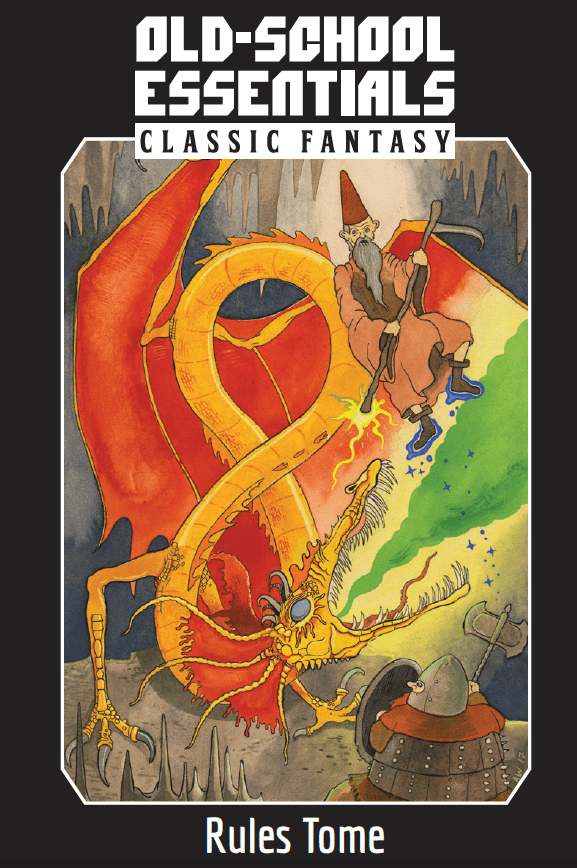
Illustration from the Alignment section of the OSE Rules Tome. It depicts a sphinx-like god on the left-hand side, holding a sword out towards a party of adventurers and a bearded, four-armed, muscle-bound god on the right, holding out a spike mace.

OSE don’t have no truck with your good and evil dichotomy. It’s Lawful, Neutral or Chaotic. Given this Cleric’s start in life, physically at a disadvantage, frail and weak prone to sickness, I think he is leaning towards Chaos. He is railing against the world and the laws of man and nature.

  • Alignment: Chaotic

There is a note in the Alignment section that if the referee does not think you are role-playing your alignment, then they can give you one that better suits your character. Interesting.

9. Note Known Languages

  • Known Languages: Common, Chaotic (Alignment Language)
    Another language, with my intelligence? No way buddy. I think the inclusion of the secret languages of gestures, signs and code words, known by all peoples of a given alignment is kind of cool and appropriate for the genre. Weird though.

10. By Equipment

I get 3D6 x 10 GP to start:

  • GP: 50 (that was two 1s and a 3 on 3d6. FML)
    Going to flip to p42 to check out the Equipment list. I must bear in mind what Clerics can use: any armour and shields but only blunt weapons.

Time to go shopping

  • Club 3GP (1d4 Dmg)
  • Leather Armour 20GP (AC 7 (12 this is if you decide to use ascending AC instead of the standard descending))
  • Holy Symbol 25GP
  • Sack (Small) 1GP
  • Torches (6) 1GP
  • Waterskin 1GP

So, because I have to buy a Holy Symbol, and I really want to have some armour to protect my 1 Hit Point, I cannot even afford rations. I feel as though my Cleric must have taken a vow of poverty.

11. Note Armour Class

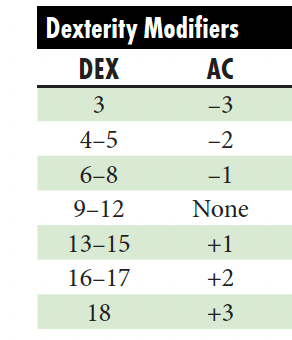
The Dex Modifiers table from the OSE Rules Tome. I am using it here to illustrate how odd it is to use negative numbers to indicate that a character's low Dex score can make their AC worse, when using a THAC0 system.
The Dex Modifiers table from the OSE Rules Tome. I am using it here to illustrate how odd it is to use negative numbers to indicate that a character’s low Dex score can make their AC worse, when using a THAC0 system.

Well, my Cleric, broke and pitiful as he is, is also clumsy as fuck. His Dexterity score is 7 and that gives him a -1 to his Armour Class. Now the wording here is extremely confusing. And I don’t know why they did this. So, as we discovered earlier, the lower your AC, the better when you are using THAC0, right? OK, in that case, if you get a negative modifier to your AC, that should be a good thing! But it is not. In the description of the Dexterity Ability Score they write: “a bonus lowers AC, a penalty raises it.” ! Like, what!? Why not just change the table so that a lower DEX score gives a +1 or +2 and a high score gives a -1 or -2?! Baffling. I need to point out that this is not the way they did it in my extremely old and battered copy of the AD&D 2nd Edition Player’s Handbook. As the picture below proves:

Table 2: Dexterity from the AD&D 2nd Edition Player's Handbook. I am using this to show how the AC modifiers in the OSE Dex Modifiers table above should have appeared, in my opinion.
Table 2: Dexterity from the AD&D 2nd Edition Player’s Handbook. I am using this to show how the AC modifiers in the OSE Dex Modifiers table above should have appeared, in my opinion.

Anyway, what this means is that my Cleric, in his leather armour has:

  • AC: 8

12. Note Level and XP

Pretty straight forward:

  • Level: 1
  • XP: 0

13. Name Character

  • Canon Fodder

That is all.
This disastrous character creation post has been brought to you by Old School Essentials and very bad luck.

Anyone else got a truly desperate OSE character to share?

Player vs GM

Not what you think

I have an easier time writing about the games I am GMing or the ones I am going to GM in the future, compared to those I play in. I think the reasons for this are pretty obvious, right? I have an a behind-the-scenes view of the games I GM, I have read widely on the games, maybe I have home-brewed the world, I probably have a better handle on the rules than most others at the table. As well as that, I set up the game, I send out the invites, I normally host the game, so, it makes sense.

As for the ones I play in, I am still invested in them, or at least in my character, I have usually made some effort with a backstory and personality and I want them to experience cool stuff in the game world with a bunch of other weirdos. There are probably a couple of my characters that I could spend an entire post discussing (and probably will, now that I think about it) but not before they are even made.

Anyway, that’s why I am taking the last few games from my Games I want to Play this Year list and pop them all into this one post.

Old School Essentials – campaign I think

My friend, Isaac of Black Sword Hack fame has been working his way steadily through all the OSE books he could get his hands on. He’s almost ready to kick off that campaign! Very exciting! It will be my fist time playing this system and having been a part of Isaac’s Black Sword Hack game for the last couple of years, I know how he likes to construct a grubby, fun, weird campaign world for us to muck around in.

I am not all that familiar with the ruleset of OSE, but from what I understand, it took the rules from Basic D&D and some of those from AD&D and took out all the stuff that people tended to ignore. I know it does have a race-as-class idea that is similar to the way DCC does it but, overall, it gives me much more old school D&D vibes than DCC does.

I might just go and roll up a few little guys using the OSE rules to get an idea of how it works and get in the mood for it.

Heart: The City Beneath – Open Hearth campaign

This game technically already started; I am achieving my goals, dear reader! We have only had a session 0 in which I created my aelfir Incarnadine, Forgotten-Frost-Remembered. He is called to the Heart in search of adventure (also he had to flee the City Above due to his crass and embarrassing obsession with money, not to mention his astronomical levels of debt.) He and his fellow delvers are on a mission to help a haven that we created together using the rules from Sanctum, a sourcebook for Heart that is meant for this very purpose. The haven has no name as it was deleted by a Deadwalker some time earlier. The aim is to build it up while pursuing more selfish goals before we all blow up in a conclusion of zenith ability fuelled glory.

All credit to our GM, Mike, for having the presence of mind and session 0 nous to figure out our group’s haven-based goal and get us to create it together in under an hour.

Can’t wait to start getting weird in the Heart.

Call of Cthulhu – Masks of Nyarlathotep – campaign

This one is probably a long-shot. This is actually an ongoing campaign but has been on semi-permanent hiatus since, I want to say 2022? Not sure. Anyway, this is another of Isaac’s campaigns. It was one of those things, playing with adults can mean that sometimes, real life stuff takes precedence and there’s not much you can do about it. Since then we got into other games and other campaigns and Masks has been on the back burner for a long time. Every time we get to chatting about Call of Cthulhu, we end up saying we would love to get this classic campaign started up again.

Last we left our intrepid investigators (I was playing a gangland boss from London named Grant Mitchell) they had faced down other worldly terrors in the basement of an occult shop and proved the innocence of a man falsely accused of murder. They also uncovered some evidence and information that drew them to various other places around the world in their pursuit of answers to the question of who was responsible for the murder of their good friend, Jackson Elias. Anyway, they had concluded their snooping in New York and were on a slow boat to London. It has been a very slow boat at this stage…

Magus, Pike and Drum – Playtest

It’s Isaac again! This time with an early playtest for a game that he is very much still developing. I don’t want to go into any detail here but I think I can say at least that it is a semi-historical setting and it will be using the Resistance system, created for Spire. Can’t wait to try it out. What I have read of the character classes and abilities so far makes it sound very fun and interesting to play.

OK, that about wraps it up for today. See you tomorrow with more from the Dice Pool.

Turbo Tokens

Failure is failure

Nobody wants to fail, right? We frown on failure. We take it personally, even when it is no fault of our own. It is hard not to feel that way. It might even keep you awake some nights, remembering how you fucked up that one thing and someone blamed you for your failure, even though it was largely a matter of chance. It sucks, but here’s the thing, your brain will never let you forget that one time you messed up. You will almost certainly never make the same mistake again if it’s something you can avoid, right? You will avoid similar situations, you will learn to do the thing properly or you will let someone qualified do it.

But this is not the case in D&D and other similar games. If you roll a 12 and add your +3 bonus and you miss that guy with his 16 AC, that’s it. It’s over. There is nothing you can learn except that you better roll higher next time or hit him with Magic Missile. This feels so much worse than regular failure. This is failure with no upside. There is not even a fun narrative element to it, really, unless you shoehorn one in.

So, how do you fix this? I think the answer is pretty simple actually, and it was brought to my attention by Aabriya Iyengar and Brennan Lee Mulligan.

Adding interest to failure

In the latest season of Dimension 20, Never Stop Blowing Up, the gang are playing people stuck in an 80s action movie. They are not playing D&D this time. Instead they are using a version of the Kids on Bikes system that they have previously hacked for Mentopolis and Misfits and Magic.

I really enjoy the system and it suits the seasons they use it in really well. In particular, the exploding dice element of the mechanics makes a lot of sense for a show called Never Stop Blowing Up and it makes for some brilliant cast reactions when it happens.

But the mechanic I am interested in here is the Turbo Tokens they receive when they fail at an action. In the base game, they are called Adversity Tokens and they represent the lessons learned from failure and contribute to real swings of momentum during high-stress situations.

Kids on dragons

So, I am going to try it out in D&D. Not sure what name I will give the tokens yet. I might just start with Adversity Tokens and see what the players end up calling them. The idea I have is to use them the same way as they do in Kids on Bikes, basically. They will earn one token each time they fail at something, whether it’s an attack roll or a stealth check or an effort to wow the crowd in the inn with their musical genius. That way, failure won’t feel quite so bad and they will be able to spend them later to effect other rolls. I think a +/- 1 modifier for each token spent is appropriate. They will be allowed to spend them to add to or subtract from any roll happening in the situation they are involved in. So they could add a bonus to their own attack roll, help out a fellow PC when the chips are down or subtract from an enemy’s saving throw or attack roll for instance. I foresee some interesting behaviours when it comes to the saving and spending of these. I am thinking I might need to cap the number of tokens a player can have at 10, although I doubt they’ll be able to save up that many of them really.

What do you think, dear reader? Have you ever tried doing something like this in D&D. If so, how did it go?