Downtime in the Dark

My First Downtime

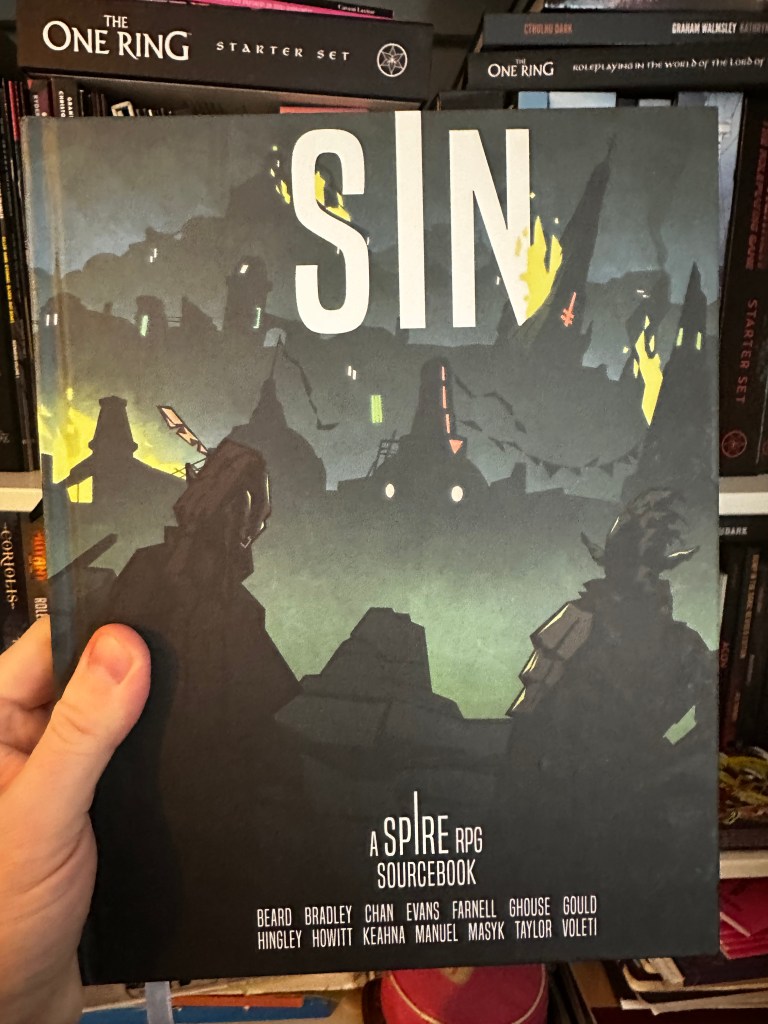
I’m taking a break from taking a break from Wednesday posts for this one. We had Session 2 of our Blades in the Dark campaign last week, and our first downtime. I also decided to start introducing a few elements from the latest Blades sourcebook, Deep Cuts, which came out earlier this year. So, I wanted to write about our experiences.

Deep Cuts Character Options

The head and shoulders of a person in portrait. They wear a metalic mask over the top half of their face and a hooded cloak. They are an Acolyte Spirit Warden
An Acolyte Spirit Warden by John Harper

Deep Cuts really expands on the options for your new scoundrels. It doesn’t replace what’s available in Blades, it just adds depth. For instance, if your PC is Akorosi, maybe your family served among the clergy for the Church of Ecstasy. If your scoundrel had a military background, maybe they were a Rifle Scout, serving in the Deathlands and harassing “enemies with sniper attacks.” Before we got into the session proper, I offered all of the players to not only select from these new options, but also to reassign any of the Action dots they had assigned to reflect their Heritages or Backgrounds. What I discovered was most of them had already formed a pretty solid image of their characters in their heads. Even the one player who did take me up on my offer, only took the two examples I laid out above for their Hound because they fit the picture they had imagined so well.

I’m still quite fond of a lot of these new Heritage and Background options. They might have been a lot more useful if I had offered them from the start.

Downtime by the Book

In Blades in the Dark, John Harper tells us there are two main purposes to having a separate downtime phase:

  • The first is that the players could do with a little break after the action of the score that just went down. To be honest, this one doesn’t ring very true for me, but that’s probably because it’s been six IRL weeks since the last session and the crew’s first score. I also get the impression that, once you get the hang of this game, you’re sometimes running a score and downtime in the one session, rather than a score session followed by a downtime session. If that were the case, I can see the advantage of breaking the action up.
  • Second, moving into downtime is a sign to all that we are changing the mechanics that will be needed in the game. To me, this seems like the more concrete of the two purposes. Blades in the Dark has tools for you to use during a score, and only during a score, and it has tools you only pull out during downtime. We don’t need to worry about divvying up the proceeds, dealing with the heat you’ve brought down on yourself or figuring out your long-term crew goals while you’re beating in some poor Red Sash’s head. Let that wait until you’ve got time and space for it.

Luckily for me, it’s easy to follow along with the Downtime chapter of BitD. Once again, I have to praise the usefulness and usability of the book. The layout of the chapter leads you by the hand through the phase, from one step to the next. Three of my players have taken responsibility for maintaining the various crew/campaign tracker/factions sheets without my even suggesting it so that made the job even easier.

Payoff was easy enough, just a simple matter of recording the Rep the Death Knells got and dividing up the 6 Coin they garnered from the last score. They took one each, popped one in the crew stash and paid their tithe to Lyssa, the new leader of the Crows, as their patron. I ran this moment as a scene. I don’t think I would have if it wasn’t for the fact that she was pissed off with them for raiding the Red Sashes’ drug dens on the Docks, and I wanted them to know. She also gave them the option to take a job to redeem themselves. The Hive have been a bit too active in Crow’s Foot for her liking. She wanted the Death Knells to do something about it.

I mentioned Deep Cuts earlier. New mechanics appear in the sourcebook for downtime. They make it diceless, and they would also definitely up the Coin our crew made from that score if we had been using them. In BitD, you are given a range from 2 Coin for a minor job to 10+ Coin for a major score. In Deep Cuts, the Coin the crew accrues is determined like this:

  • Score – 1 Coin per PC, plus Coin equal to the target’s Tier x3.
  • Seized Assets – 4-8 Coin for a vault of cash. Stolen items can be fenced for 1-8+ Coin, but you take Heat (see next page).
  • Claims – Collect payment from crew claims like a Vice Den.

Like I indicated above, we used the standard downtime rules from Blade in the Dark in this session. Now that we’ve experienced that, I’ll put it to the players to see if we want to make the switch. If and when we do that, I’ll come back and examine the other downtime changes then.

It was fun calculating Heat for that score. I’ll admit, I didn’t warn them that killing people on scores really hikes up the Heat. They started off the whole thing by murdering a bouncer, of course. In fact, I didn’t really explain the concept of Heat to them beforehand at all. This meant that they went in hard, loud and chaotic. I actually think this was for the best. The game is built on building up consequences, after all, as well as narrating big, exciting action sequences. Anyway, they ended up with 6 Heat, which was fast approaching a Wanted level. That put the shits up them.

In the book, the Heat section also includes the Incarceration section, which seems logical to me, but I didn’t need to refer to it, so I’m skipping it here.

Of course, due to all that Heat, they had to roll on the worst of the three Entanglements tables. These represent all the potential impacts of contacts, acquaintances, enemies and authorities getting wind of what the crew have been up to. Entanglements range from Gang Trouble, which can be dealt with internally, to Arrest! If you get that, it’s going to cost you Coin, a crew member or the effort to escape capture. The Death Knells rolled up Interrogation so our Hound was caught on her own and dragged down to the station for some “enhanced” questioning. We played this out in a fun scene where she went out to get beer to celebrate their big score and got ambushed out behind the pub by Sergeant Klellan and his boys. She wisely Resisted the level 2 Harm and the additional Heat, without incurring a single point of stress! All the others could do when she finally turned up was wonder where their beer was…
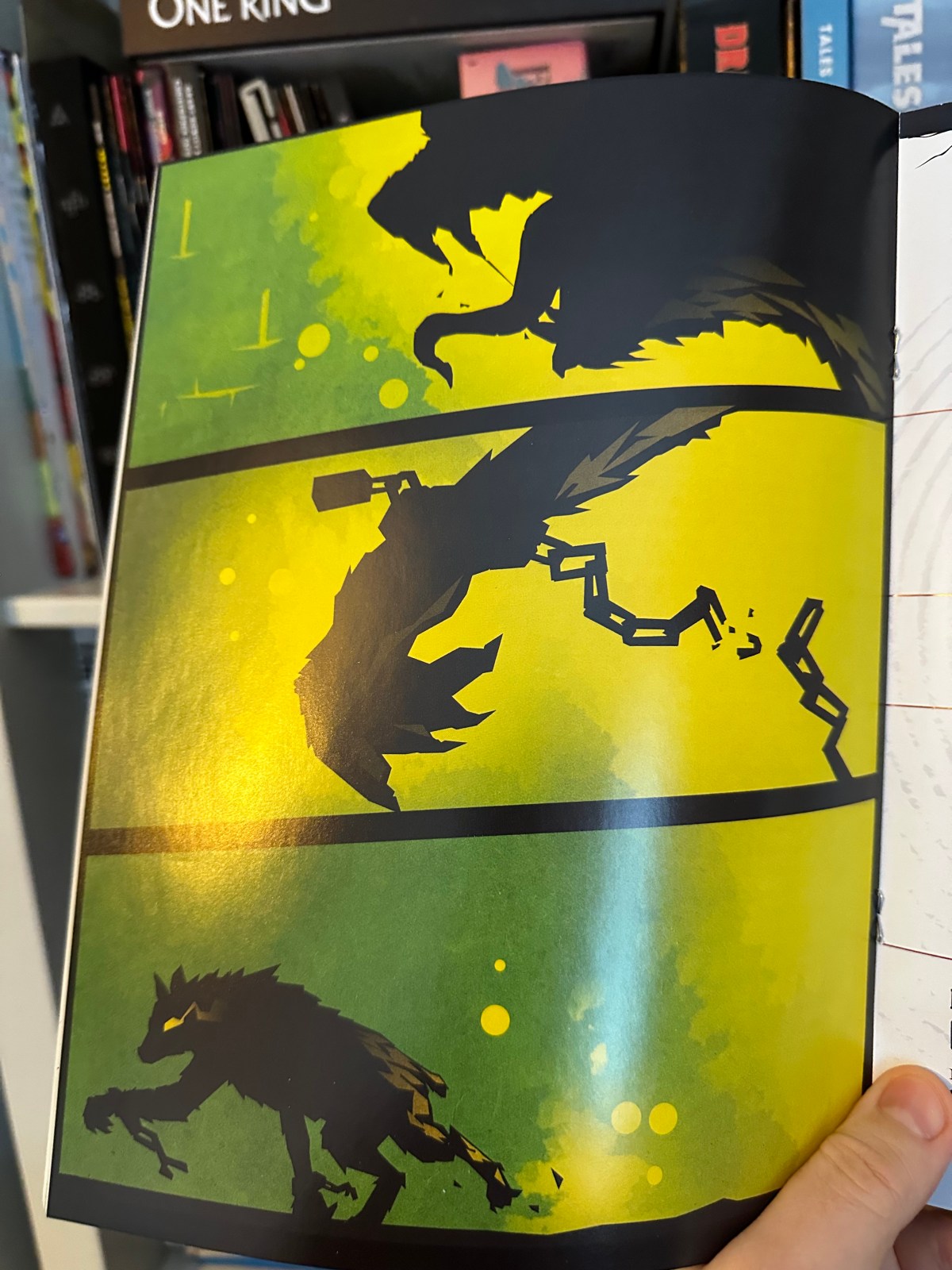
So then, we spent a bit of time going through what’s possible during the downtime phase in our last session. This can all be a little overwhelming the first time you do it. It can also take quite a while to get through each player’s turn as you talk through the possibilities and they negotiate amongst themselves to see who will spend their activities on reducing Heat for the whole crew. Sometimes it’s obvious who should do what. If a character has some Harm, it’s probably a good idea for them to get some treatment and Recover. If another scoundrel is a bit stressed out, they should go and Indulge their Vices to help them relax, but training, long term projects and acquiring assets are all more subjective. The chances are, they’ll turn out to be useful to the whole crew in the future, but they don’t feel quite as immediate in their effect as clearing Heat.

Anyway, I was gratified to see the PCs did all of the six possible downtime activities at least once. They managed to clear practically all their Heat. The Leech did this by studying the movements of the Bluecoats around the district so they could avoid them. The Whisper took an inventive approach, by losing a bar-room brawl in the King’s Salty Knuckles tavern, thus proving that he couldn’t be part of a crew of Bravos!

Our Cutter decided to acquire an asset, an old and worn-out little boat for use on a future score, perhaps. The players ad-libbed a scene in which they ribbed him about the state of the thing. But, of course, it only needs to be used once.

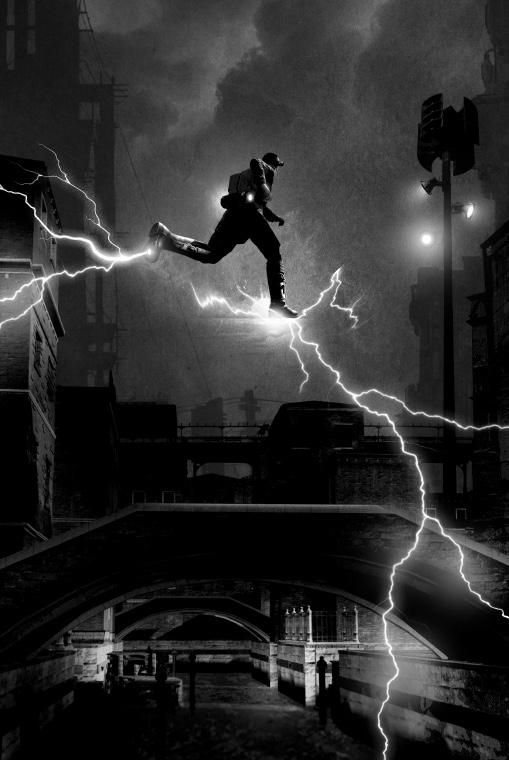
A person "walks" through the air above the darkened city,seemingly on lightning bolts emanating from their feet.
“I’m walking through the air!”

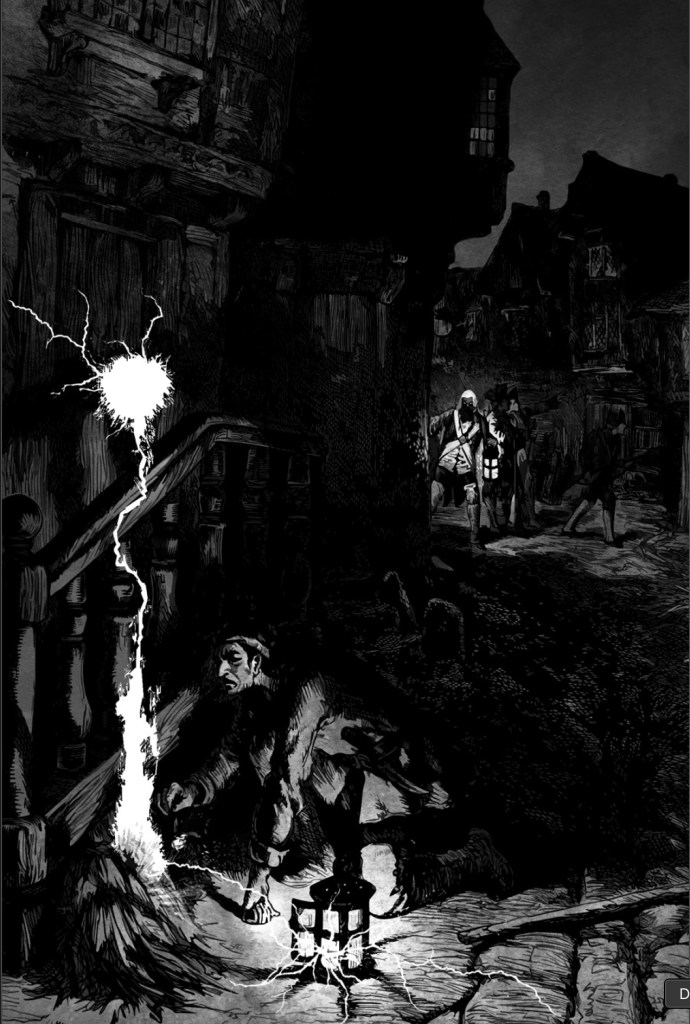
We had another scene when the Whisper’s strange friend Flint turned up on his canal boat with some electroplasm. Our Whisper needed it to build himself a lightning hammer as a Long Term Project. From Flint he also learned about the Sparkrunners, a gang of rogue scientists who are out there boosting government tech. This is one of the new factions from Deep Cuts, which “sparked” my imagination.

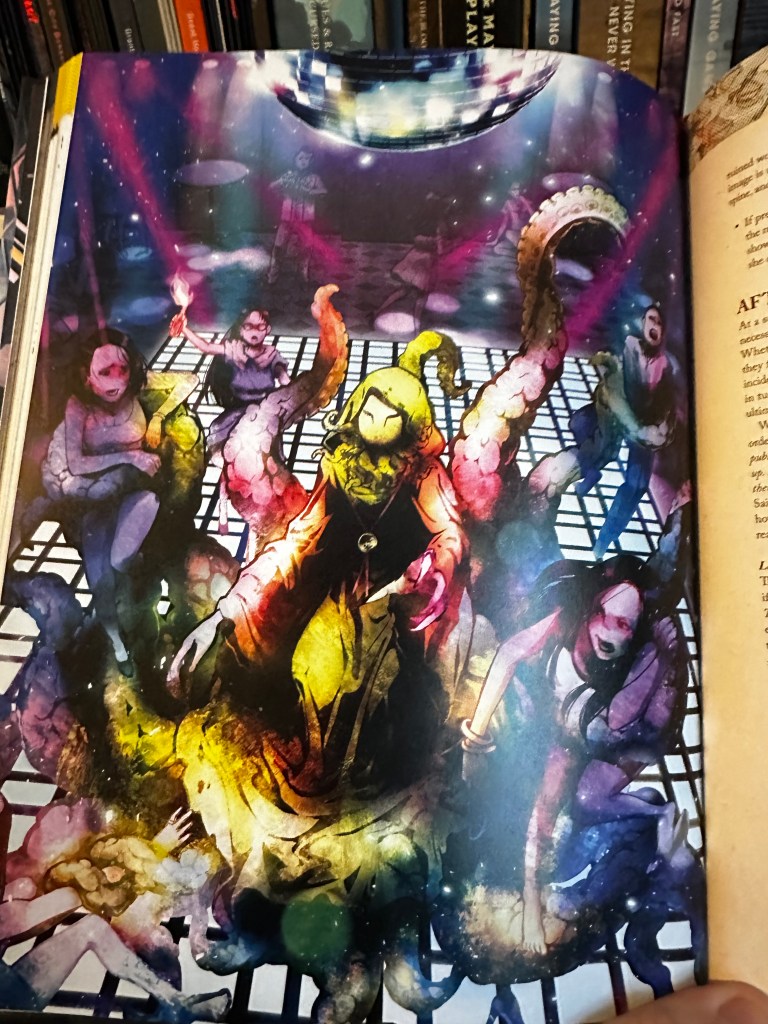
Just before we wrapped up for the evening, our Hound decided to deal with all her stress by visiting her local Temple of the Church of Ecstasy. She prayed and prayed, she prayed to hard and too much. She over-indulged in her vice and something bad happened. The bouncer she killed on the last score decided to haunt her!

Other Actions

Of course other actions are possible during downtime too. They decided to visit the ghost who had given them such good info during their Information Gathering phase in the previous session, because he said he would help them more if they really fucked those Sashes up good. From him, they discovered that Lyssa was responsible for the death of Roric, whose leadership of the Crows she then usurped. She had been backed up by the Red Sashes who had killed out ghost friend. He told them to go to Mardin Gull in Tangletown for the skinny on what all that was about. This wasn’t a downtime activity or an entanglement or anything. It was just something they wanted to do.

The Imperial Airship, the Covenant flies bove the darkened city streets, shining searchlights down to illuminate a meeting on a bridge.
Its the Fuzz!

I also introduced a few more Deep Cuts factions in a little news segment. They learned about the Sailors being press-ganged on the Docks, The Ironworks Labour-force pushing for unionisation, the arrival of the Imperial Airship, Covenant without her sister ship and the recent adoption of the new Unity calendar and maps. Any one of these could potentially lead the crew to their next score. Except, maybe for the calendar one, I suppose.

Conclusion

I was very happy to have left a full session aside for our first downtime. It needed it. In fact, I would say, we could have used even longer. They still haven’t decided on their next score. I will say, I am quite happy with how many potential score options I managed to sneak into the various scenes in the session. I was worried that I wouldn’t give them enough opportunities, but, in the end, they came up quite organically, much like the scenes themselves. These all proved to be fun and freeform, allowing us to dow some world-building and to introduce some fun new NPCs.

I’m now looking forward to the next session, and, hopefully, the Death Knells next score, the Big One.

The Sutra of Pale Leaves: Dream Eater

I think it’s interesting that each of the scenarios is styled as being possible to run as a one-shot but I can see Dream Eater’s potential in the context of the greater campaign.

Format of the Sutra

This is the second post in my exploration of the 1980s Japan Call of Cthulhu campaign, the Sutra of Pale Leaves. Go here for the first one, which deals with the overall premise and the Campaign Background chapter from Twin Suns Rising. Although the text suggests that you can play the constituent scenarios in any order, they are presented chronologically and I can’t imagine running them any other way. They are also presented in two different books, of which Twin Suns Rising is obviously the first, with its three scenarios taking place between July 1986 and Spring 1987. I thought I’d be able to write about all the scenarios in this book in a single post, but it turns out, I can’t read that fast. Each scenario is long, between 35 and about 50 pages of dense, small-font-size text. So, instead, I’ll just be examining the first of them today, Dream Eater, written by Damon Lang. Please note that I haven’t played or run this scenario, I have only read it. So, take my conclusions and thoughts on it with that in mind.

WARNING: SPOILERS!

I would find it very difficult to write about Dream Eater without massive spoilers, so I am giving you a warning, right now: if you want to be a player in this scenario or the wider campaign, its probably best to skip this post. Come back later! I’ll probably have something for you then. Or check out my ever-growing back-catalog of posts.

Dream Eater

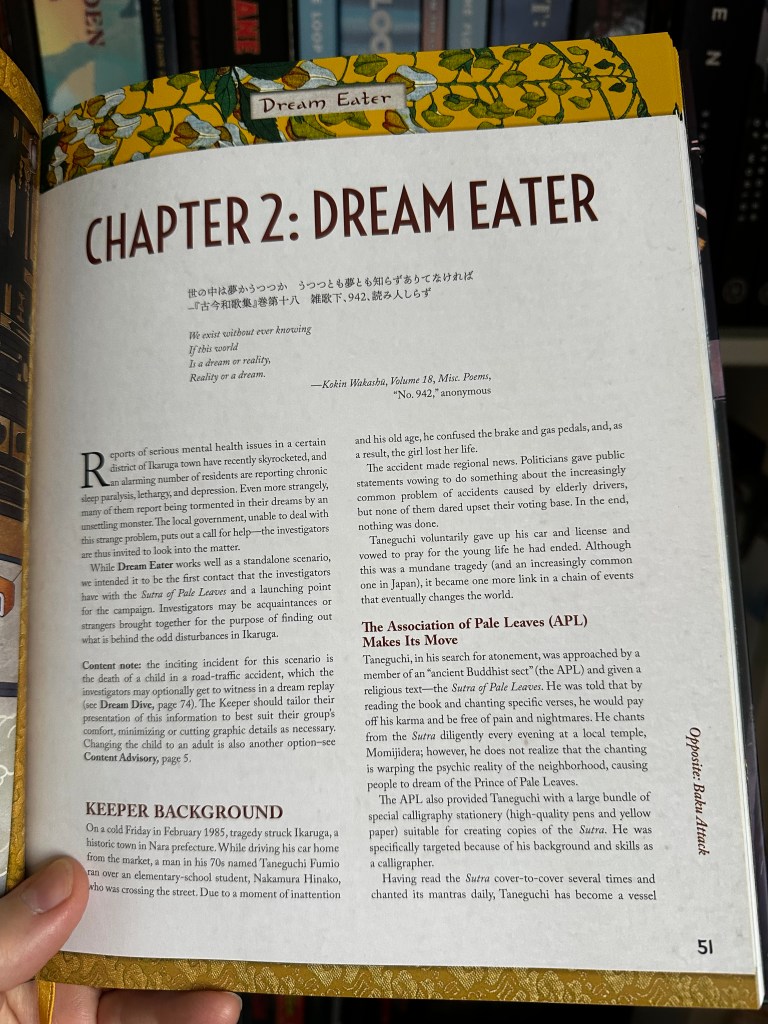
The first page of  Chapter 2: Dream Eater introduces Keeper Background and the Association of Pale Leaves.
We exist without ever knowing
If this world
Is a dream or reality,
Reality or a dream.

I once wrote two novels about the adventures of a twelve year old Japanese boy who moved to Ireland with his family. In them, he discovered that he was able to use his cat as a conduit to enter the dreams of others. This allowed him to reconnect with his friends at home but his consciousness became trapped in the kitten! Various hijinks and drama ensue. Anyway, suffice it to say, I was very quickly on board with the premise of this scenario given teh Japan and dream-related elements of it.

The premise is that a small, rural Japanese town is beset by sleeplessness and terrifying dreams of monsters. The longer it goes on, the more the citizens worry for their safety and sanity. The authorities have offered financial rewards to anyone who can help them solve the problem or take care of the afflicted.

That’s where the Investigators come in. Perhaps they are from this small town of Ikaruga, or maybe they just heard of their troubles and have come from the city to look into them. Either way, their assistance is greatly welcomed.

Indeed, their investigations are likely to take them quite quickly to the door of an old man, Mr Taneguchi, who was responsible for the death of a young girl in a traffic accident recently. From there, they will visit other sites in the town, and other potentially recurring NPCs, and they will learn of the Baku. This Yokai is the eponymous Dream Eater, and the cause, it would seem, of the town’s problems. The Investigators will have to find a way to defeat, satisfy or neutralise this creature if they are to help.

But, of course, there is another layer to this story, just below the almost obvious one. The Prince of Pale Leaves has worked through one of his recruits to use Mr Taneguchi to spread the Sutra of Pale Leaves. The Prince has been invading the dreams of the people of Ikaruga, through the old man’s chanting of its mantras at night. It has been creeping through the town, insidiously and terribly. This is what has drawn the Baku to this place. It finds dreams of the Prince the most delicious. The Baku is known as a benevolent yokai in Japanese legends, one that takes your nightmares away and lets you sleep soundly. And that is what it’s attempting to do. The thing is, as it eats the dreams of the Prince, erasing them from the memories of the dreamers, the only image they are left with is of a scary looking ,purple, tapir monster, the Baku. And so, it becomes the scape-goat. The Prince attempts to use this misunderstanding and the Investigators’ intervention to defeat the Baku, thus allowing his influence to grow all the faster.

The question is, will the investigators figure this out? Will they destroy the Baku? Will they leave this town better or worse than they found it?

The Flow of the Scenario

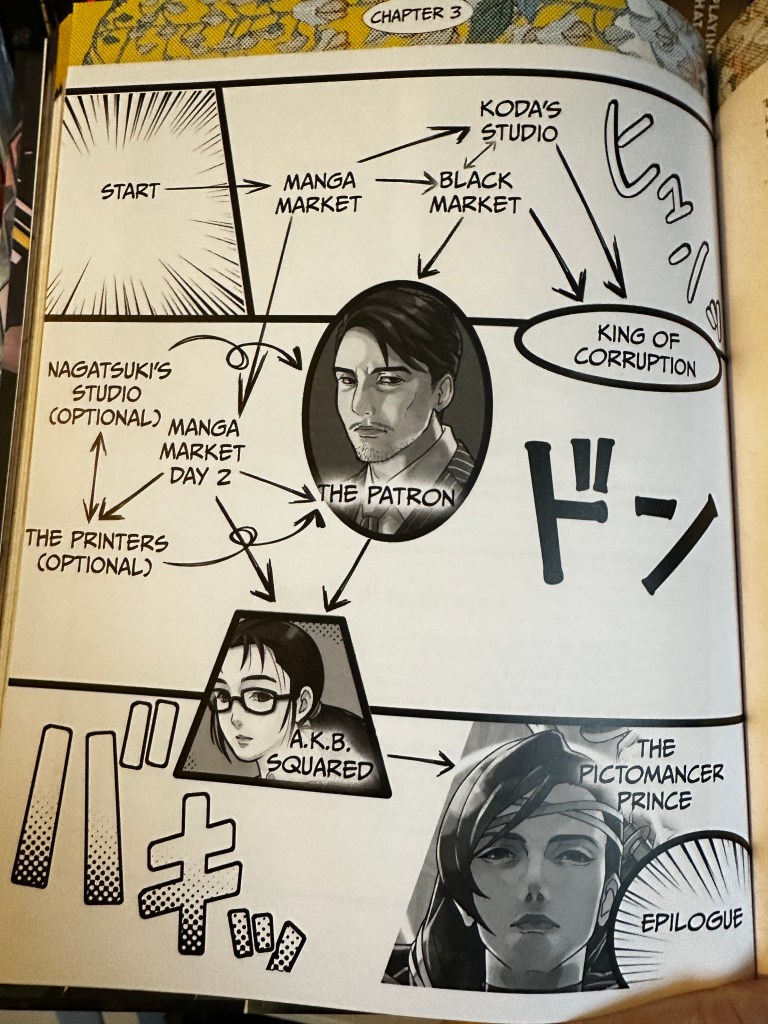
The flow of the Dream Eater scenario in visual form. From Ikaruga Town to Talking with Townspeople to Meeting Taneguchi to Horyuji temple or Nightly Prayers to Unpleasant Dreams to The Fortune Teller to Research in the Sutra to Dream Dive to the Final Encounter and finally to the Epilogue.
Dream Eater Scenario Structure

Take a look at this flowchart. This is useful in a scenario like this for a game like this. Call of Cthulhu is a trad game, and, as such, its scenarios rely on these sorts of stepping stones to get you from hook to ending. So I really appreciate it when you get something like this that cleanly represents that idea visually.

So, after a lengthy preamble giving us Keeper background, an intro to the main NPCs and a few PC hooks, we start with Ikaruga town, a place that’s renowned for its truly ancient buddhist temples, which contain the oldest wooden buildings in the entire world. I like that the section on the town asks the Keeper to get in media res and kick things off with a shared dream sequence. Something weird is happening from the off and it gives PCs who don’t know each other yet a good reason to seek each other out.

You get a basic map of Ikaruga in the style of a roadmap, which is a nice touch. Along with this, we have an “Exploring the Town” section, which spells out stuff like population, transport, amenities and accommodation but the only real subheading to this is the Shepherd Bar: A Foreshadowing, the purpose of which is a little too subtle for my tastes.

The scenario, and indeed, the campaign is sprinkled with “Lore Sheets,” which detail elements of Japanese cultural, societal or mythical knowledge that the average Investigator might be expected to know without having to make a Know roll for it. The Keeper is supposed to hand them out as and when the subjects come up. In this section, we have one on Hōryūji Temple, for instance. Each of these includes a little snippet of “Personal Background,” which the player given the lore sheet might adopt for they own character. It’s a nice way to weave the PCs in with the place and the lore of the place.

The Investigators are expected to visit the Town Hall to begin their investigations. The Town Hall section, as is the case with each of the major plot points of the scenario, begins with a handy summary that looks like this:

  • Location: Ikaruga town.
  • Leads In: Hooks One, Two, and Four
  • Leads Out: Meeting Taneguchi (page 62); Talking to Townsfolk (page 61).
  • Purpose: investigators learn about the case.

This is another incredibly useful tool to assist the Keeper at the table, allowing them to see, at a glance, if they are at the right section, where they should be looking next and the overall purpose of the scene. This last is important to let you figure out where a scene should end, which is not always obvious.

As we get into this section, we notice that precise and exacting answers are provided to every relevant question the PCs might ask Mr Maeda, the Vice-Chairman of the Public Welfare Committee. This is common to most of the NPC interactions in the scenario, which will keep you, as the Keeper, on track with regards to what each of them knows. Once again, it’s a trad scenario. Rather than summarising the things they know and letting you play them as you see fit, things are a little more proscribed here. Of course, if you want to run these interactions differently, you can. It will just mean you spending more time prepping.

We get some general knowledge and descriptions of half-remembered dreams from talking to the townsfolk, but we really get into it when the Investigators go to meet Taneguchi, the old man who is secretly harbouring the Prince of Pale Leaves in his mind. He was approached by a representative of the Association of Pale Leaves and told that, by chanting from he Sutra of Pale Leaves nightly, he would pay off his karmic debt from running over the little girl on the road. Unbeknownst even to himself, he has been making beautiful and elaborate copies of the Sutra at night, when the Prince takes over his body. The APL is planning to use these to spread the Prince’s influence even further across Japan. It is in this section where the Investigators are likely to gain their first exposure to the Sutra, thus beginning their journey towards recruitment by the Prince, themselves.

From here, the investigations might lead to Hōryūji Temple, where they might encounter another recruit, Ukami, a former monk, who is also a martial arts master. Or they might go to the Momijidera Temple, where Taneguchi recites his prayers each night, But eventually, we come to one of the more interesting parts of this scenario, Unpleasant Dreams, where the Keeper can tailor nightmares to individual investigators’ personalities, backgrounds and memories. This is the first time they will encounter the Baku. There will be different outcomes depending on the levels of exposure they have had to the Sutra so far. It could lead to significant Sanity loss, but, on the bright side, it could also lead to Exposure Point (the points which track how exposed you are to the Sutra and how much influence the Prince has over you) reduction.

Lore Sheet 3: Fortune-Telling in Japan and the Fortune-Teller, Madam Inaba.
Lore sheet

After this, they are likely to visit Madam Inaba, the Fortune Teller or go to the aforementioned Hōryūji Temple to find out more about the Baku and how to defeat it. Importantly, they should then go and do some research in the Sutra itself, exposing them once agian to the Princes influence. This will lead them inevitably to the Dream Dive section. The scenario takes us back into dreams here, this time, a shared, lucid dream, which they will have learned how to perform from their research in the Sutra, of course. Rather than have the Keeper craft the dreamscapes they encounter this time, they are put through a “Gauntlet of Nightmares.” I like the nightmares that have been described in this section, they are Japanese-flavoured (I have definitely had nightmares about the mukade myself) and they’re scary, but they seem a little random. They’re not as thematically coherent as other parts of this scenario. At least, until you get to Taneguchi’s Dream: The Accident. In this one, you relive, along with Mr Taneguchi, the night he killed Nakamura Hinako on the road. The scenario presents several ways the Investigators might deal with the situation, from doing nothing to showing some humanity to the dying girl, to rewriting history!

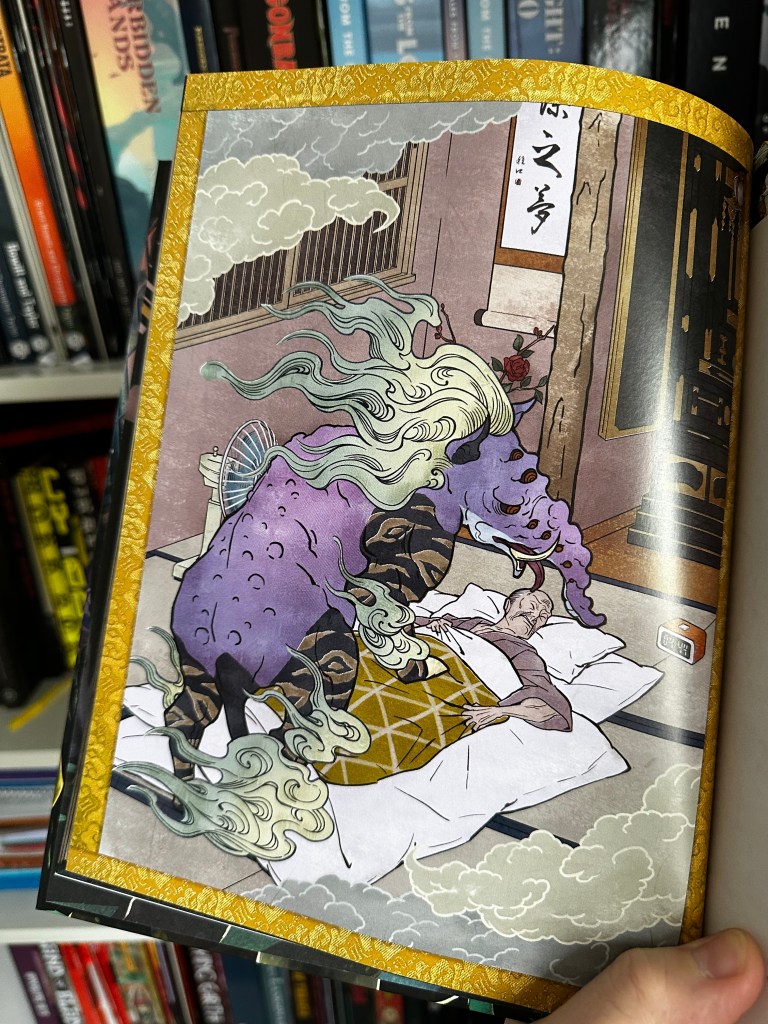
The baku, a big, purple, tapir-like creature, feeding on a n old man who is sleeping on a futon in a tatami room.
Yum Yum

The only thing left to do is to face the Baku itself. By now, the PCs might have learned enough to know that the Baku is not the real threat here. Rather, it comes from the Pale Monk haunting the dreams of Taneguchi, the representation of the Pale Prince. Or they might play right into the Prince’s hands and attempt to defeat the creature, clearing a path for the Sutra to capture more recruits. Whatever they decide, there is a good chance they will have to use signs and magics learned from the Sutra itself to do battle in the Final Encounter. The scenario introduces mechanics by which they can spend Magic Points to summon useful items or weapons to help them, but their opponents can do the same or worse. The Baku can fully transform the dreamscape allowing it easier access to Taneguchi, which is all it wants. It wants to gorge itself on the old man’s Sutra-ridden mind. If the Investigators allow that to happen, it is one of the best endings you can achieve, leaving Taneguchi in a state of extreme dementia, but freeing the town of the Prince’s influence.

Endings

The first page of Endings, includes 0. party Wipe (Failure), 1. We Do Nothing (Taoist Ending), and Yokai Busters (Bad Ending.)
Endings

Note that the endings presented here and in later scenarios are labeled and numbered, as is common for indie scenarios in Japan. This enables players to tell others how their game went on social media while avoiding spoilers for everyone else.

I understand this concept and the reason for it. But I don’t particularly enjoy the implication that you can’t have your game end any other way than one of the six potential endings provided here. I am not going to judge it without playing it out, but I will say they are described in terms of one ending being a “failure” and others being “Bad Ending,” “Good Ending,” and “Best Ending.” Of course, these are value judgements. Just because you TPK, doesn’t necessarily mean it was a bad ending for your party, and, to be fair, the text does describe this one as “something of an achievement.”

The inclusion of “Optional Post-credit Scenes” is interesting too. These each present a little vignette of how the Investigators might have changed reality during their adventure through dreams. It explains that they work better if the scenario was run as a one-shot but that they might just serve to show the sheer power of the Sutra over reality.

Conclusion

This feels like a great scenario to start off this campaign dealing with the Prince of Pale Leaves as the antagonist. It immediately introduces the players to the idea that this is a being that exists in the mind of others and is spread through the dissemination of the Sutra, or it should. I can’t say for sure if it does it effectively without playing it. Overall, I like the structure, which is designed to keep the Keeper on track, no matter which way the players decide to go from one scene to the next. I do find the extreme levels of detail in the NPC encounters a little unnecessary. I still think it’s possible to summarise a character’s personality and the things they know in a much shorter manner, that would work just as well, if not better.

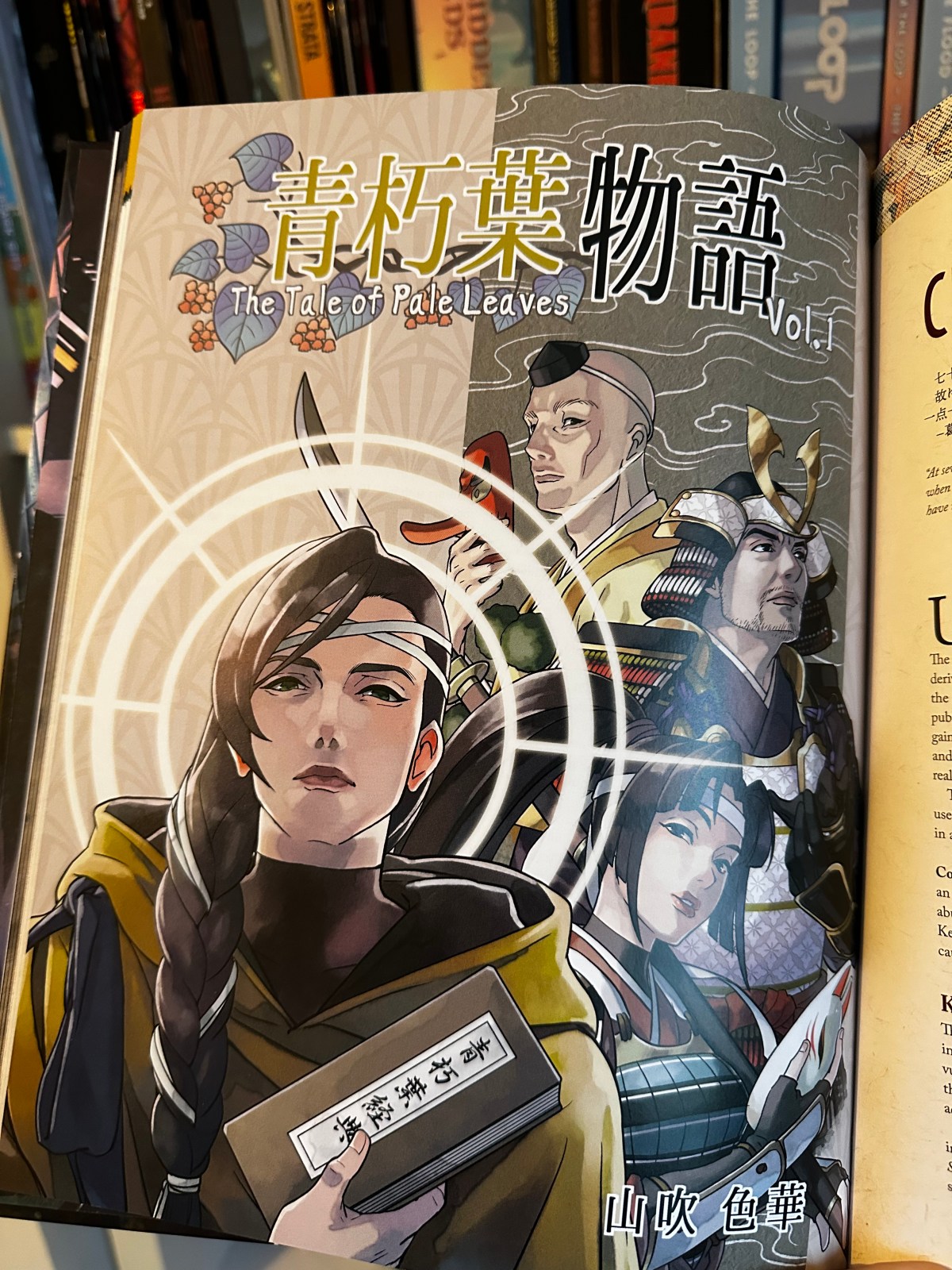
I think it’s interesting that each of the scenarios is styled as being possible to run as a one-shot but I can see Dream Eater’s potential in the context of the greater campaign. I’m looking forward to reading the next one, Fanfic, where the APL hatches a plan to recreate the Sutra as an action manga.

Sleighed

You might remember a few weeks ago… I reviewed Slow Sleigh to Plankton Downs. Well, the disclaimer on that review, that I had not played or run it is no longer valid.

Nun too soon for an update

Just a short one this week, dear reader.

You might remember a few weeks ago, for my Halloween post, I reviewed Slow Sleigh to Plankton Downs. Well, the disclaimer on that review, that I had not played or run it is no longer valid. Sister Majid, the Misstep Monastic (a type of nun) and Lee Tuluk, the Scud Miller (meat grinder) formed an unlikely friendship through a misallocated cabin and a game of chance and before you know it they were investigating a murder!

We played one session on Halloween and just finished it up last night. It took about six hours altogether, although there was some time spent on character creation in the first session.

Take a butcher’s at this!

A nun with an ice adze dressed in gold

Here are some things I loved about running this adventure:

  1. The new backgrounds are great. Most of them are really far out there but the two that my players chose were obviously quite mundane. They still had some incredible Advanced Skills that got milked for all they were worth. Somehow, our nun used “Reconcile God’s Glory with the Failings of Mortals” constantly. Meanwhile, the Scud Miller managed to use “Fix Anything, Not Necessarily Well, Even with the Wrong Tools” on everything, including relationships. Use the backgrounds if you’re going to play this.
  2. It’s so easy to prepare and run. The keyed descriptions are short enough to easily use on the fly, the premise of the adventure is straight-forward and there are only a couple of unavoidable events that are not difficult to get to grips with. I read it through once, fully, and then reviewed particular sections such as basics of the adventure and the murders before actually running it. It doesn’t take long to do this; its a svelte little scenario.
  3. I really got into describing the aftermaths of the murders and the effects they had on the crew and other NPCs. As rumours spread I had nuns moving in pods and whispering about terrible occurences while blessing themselves, while the porters and mates dealt with grief at the passing of their colleague. Upon the discovery of the second victim, the security guards were puking in corners and staring blankly at blood-soaked toilet stalls. The creature has a silly name, which my players refused to say right, but the murders are gruesome and horrific. It felt important to play into that.
  4. The map of the Nantucket Sleigh Ride. We used this work of art throughout. It was so useful to help the players orient themselves on the hovercraft and it was a genuine pleasure to refer to it. Its beautiful.
  5. The Weather table. I got the players to roll for weather right before the final encounter and they rolled us up a storm. The ship was forced to drop its robotic anchors and ride it out just after the second murder. They figured out who the murderer was and that they were outside on the Observation Deck. What a setup for the final showdown. It was poetic.
A victim, missing its maxilla in a toilet stall. The Maxillary Uslurper in the air vent above.
Aftermath

Conclusion

Dear reader, I would highly recommend you take the Nantucket Sleigh Ride on a trip to Plankton Downs. If you have a couple of evenings to spare and a couple of friends who might enjoy a who-nunnit, as it were, you could do a lot worse. It’s not your typical Troika fare but I am beginning to think there may not be such a thing. You will have horror, you will have laughs and you will definitely have fun.

Slow Sleigh to Plankton Downs

There are two stars of this adventure. The first is the murderous creature itself. It’s unique, insidious and gross in a bonkers sort of way. The second is the artwork, which you can find examples of above.

Horror gaming in Troika!

Troika! Would not be my first call for a game of horror this Halloween, but I think Slow Sleigh to Plankton Downs, the 33 page adventure by Ezra Claverie, illustrated by Dirk Detweiler Leichty could be the thing to change my mind.

Disclaimer

I have not played or run this adventure. I just wanted to review it because A Perfect Wife reminded me a bit of it. Not necessarily in its themes or anything like that, more because of the creature at the heart of it and the murders. Also, the incredible artwork.

There are minimal spoilers ahead but, even so, if you are planning to be a player in it, maybe skip this review. I will say there are some conversations to be had with your table before playing. You should let them know that it is an investigative scenario and you should also discuss the body-horror and brutal murder aspects of it.

The Basics

The PCs are aboard a ship of sorts, a hovercraft called the Nantucket Sleigh Ride, transporting them from Out of Order, the site of the moon, Myung’s Misstep’s space elevator. They are on their way to Plankton Downs, a water-farm town along with a motley assortment of Macramé Owls, Ice Miners and Martian Orthodox Christian nuns among others.

The adventure opens with a short history and geographic treatment for Myung’s Misstep as well as the function of ships like the Nantucket Sleigh Ride. It also lays out the scenarios thoroughly for the GM.

The PCs themselves could be a regular set of Troika! characters (by regular, of course, I mean utterly bonkers.) But I think, if I ran this, I would get them to choose one of the nine new backgrounds presented in the back. You have a wild variety from the aforementioned Ice Miner, whose greatest Advanced Skill is to “Exert Oneself Alone without Hope of Assistance,” to the Astropithecus Truckensis, a Martian cyborg described as “a six-wheeled, motorised Standard Habitat Truck, slightly larger than a wheelchair.”

There is a description of the keyed locations from the, frankly, resplendent, map of the Nantucket Sleigh Ride on the inside front cover, and a section on the general characteristics of it. It’s important to note that most of the vessel is off limits to passengers such as the characters, however, once the murders start, they are likely to find ways to explore.

We also have a bunch of very handy random tables including but not restricted to NPC names (a selection of pretty standard human names from all over the world), NPC Preoccupation (from “Professional Opportunities” to “Impending Masturbation”), NPC Distinctive Feature (Loving “Head Small for Body”)

The PCs are going to be aboard the Nantucket Sleigh Ride for at least 72 hours but that’s likely to be extended through the liberal and recommended use of the weather table in the back (2d6, if you roll a 12, its a Catastrophic Storm and you better pray to whatever deity most aligns with your beliefs that the anchors hold or the ship is truly fucked.) With that in mind, it would be pretty terrible if someone on board were, in fact some sort of vampire disguised as one of the passengers or crew with an irrepressible hunger for a very particular human body part every 36 hours or so, wouldn’t it?

The Murders

This is mostly an investigation scenario. After the first murder causes a stir on the upper decks and the lower, the PCs might very well decide to start asking questions and investigating the scene of the crime. After all, the crew do nothing about it except arm themselves. However, it is not likely that they will discover the identity of the murderer until after the second or maybe even the third one.

The murders are gristly and disgusting in a very particular way. The creature has a method of killing their victim that can only be described as brutal and bizarre. If this were a Call of Cthulhu adventure, witnessing the aftermath would certainly be enough to elicit sanity rolls all around. They are described in relative detail in a matter of three pages. This, along with location and NPC descriptions is all you get to guide you in running this scenario. I do think it’s enough, especially as it feels as though the PCs are not really supposed to discover the truth until after the second murder reveals something important.

Conclusion

This short and sweet adventure is a definite departure for Troika! lovers. You may not get the chance to do the strange combat hijinks you’d be used to in most of the other adventures presented for the world’s other favourite RPG but it will present a set of very particular challenges. Several of the PC backgrounds have Advanced Skills that, while not exactly “investigation,” as such, will still be very useful in specific situations that you could imagine coming up. But there is no getting away from the fact that this system is not designed for investigation and I can imagine the GM having to make a lot of rulings while playing this.

There are two stars of this adventure. The first is the murderous creature itself. It’s unique, insidious and gross in a bonkers sort of way. The second is the artwork, which you can find examples of above.

If you’re interested, dear reader, you can go and pick the adventure up from Melsonia.com here. And maybe consider it for your Halloween game this year!

A Perfect Wife

The writing is subtle and considered and evocative, the layout is spare but adds so much to the adventure as a thing to read and there is beautiful, idiosyncratic artwork throughout.

Weird Hope Engines

Earlier this year, in Nottingham, England, David Blandy, Rebecca Edwards and Jamie Sutcliffe brought together a selection of RPG creatives and artists to make an exhibition.

From the Bonington Gallery website:

Weird Hope Engines embraces the culture of tabletop roleplaying games (TTRPGs) to explore play as a site of projection, simulation, communal myth-making, distorted temporality, and alternate possibility.

Zedeck Siew, Amanda Lee Franck and Scrapworld were all major contributors to the exhibition but they lived far, far away from Nottingham. The trip would be costly. So, being TTRPG creators, they launched a project in the hopes that it would fund well enough to pay their way. It worked, and A Perfect Wife is the result.

Disclaimers

Dear reader, I have not run or played in this adventure. I received it recently in the post and I wanted to write about it. This is a review but only from a read-through.

There will be some spoilers so if you think you might want to be a player in this adventure, turn back now! Or don’t, I’m not the boss of you.

The Product

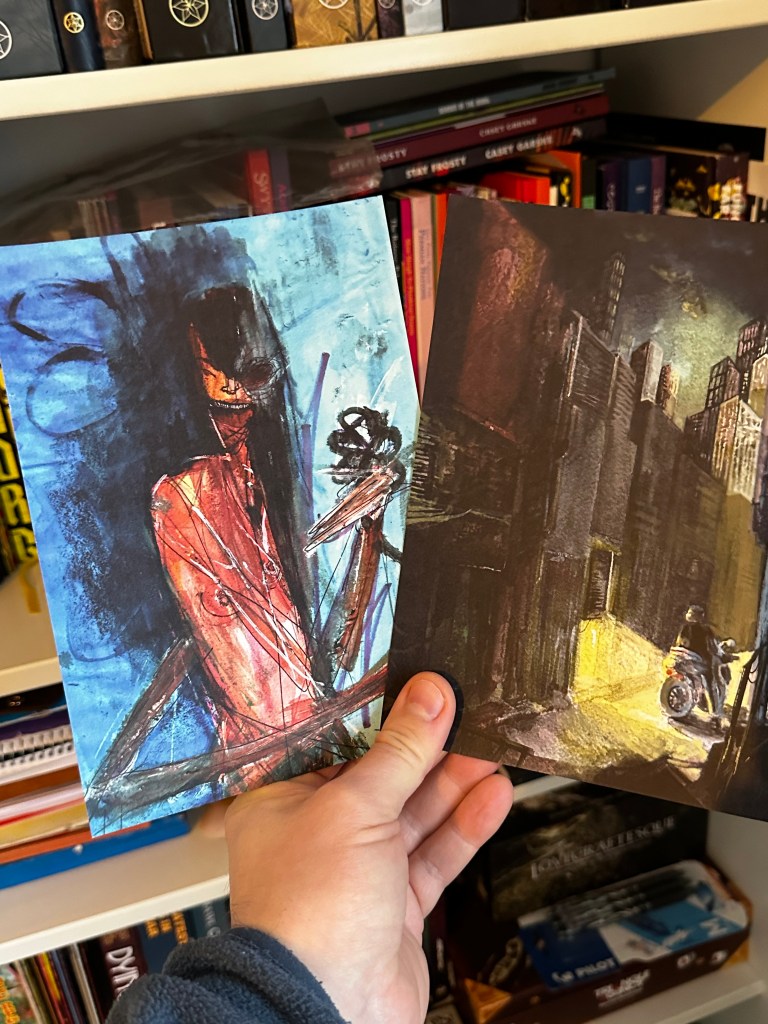
Two art prints: On the left, a spiky, crimson femme creature with wide open mouth, long black hair against a blue background. On the right, a person on a motorbike stopped in a pool of yellow light from a doorway in the backstreet of a city. The cityscape rises above and behind.
City Streets and Scary Beasts

A Perfect Wife is a 43 page OSR-style adventure from Copy/paste Co-op. I backed the Kickstarter for it and received a physical copy, along with a printed map of the adventure location and some art prints.

Speaking of art, that’s what this is. The writing is subtle and considered and evocative, the layout is spare but adds so much to the adventure as a thing to read and there is beautiful, idiosyncratic artwork throughout. All three creators contributed illustrations and all three styles are distinct but never clashing.

The Adventure

Inside cover of A Perfect Wife by Zedeck Siew, Amanda Lee Franck and Scrap World. Illustration shows an owl-like bird in white against a dark background.
Bay Owl

We start with an explanation of the recent disappearances in this inner-city Malaysian (actually I don’t think its explicitly spelled out anywhere in the body of the adventure that its set in Malaysia but its heavily implied) neighbourhood. What it boils down to is the following three points, what the locals have learned:

Head indoors if dogs are whining
Walk on by if your name is called
Do not search for the baby crying

It’s pretty clear that something unusual is happening in the area. Already the mood, the setting, the premise are very different to any other OSR adventure I’ve ever read.

We move on to character creation next. The PC outlines are based on how they know Sara, the woman they’re meeting in front of the Desa Damai Wet Market. They know they are meeting her before they even know who they’re playing.

They get six choices. There’s a journalist (interesting skill: speed-reading), a social worker (eavesdropping), a private investigator (knife use), a security consultant (joking), a faith healer (bargaining) and a barrister (drinking.) Each has a few skills, and maybe a weapon or a useful contact, not to mention a wonderful line-drawn portrait.

So, the players choose their PCs and the opening scene moves on…

Basic rules are included on page 9. These are almost identical to Into the Odd. In the front of the adventure there is a “Mechanically Inspired by” section that lists Into the Odd but also includes Liminal Horror and the Lost Bay. I don’t know those games and I am not sure how they inspired the mechanics but there is no doubt that, essentially, rolling works the same as in Chris McDowell’s game.

The next scene introduces two major NPCs at the Peaceful Heart Community Centre. It is not spelled out, but assumed that Sara led the PCs there to meet Yinyin. Then we learn what the PCs are being recruited for. Sara wants them to find out what happened to Tet, a refugee and father to young Yinyin. Sara and Yinyin are described in their own NPC section, but the mysteries only deepen…

This adventure deals with some themes of supernatural horror, class inequality, the plight of refugees, violence against women and children, pregnancy and miscarriage. You get the first hints of these, let’s be honest, pretty heavy subjects here. A GM and their players will have to have a frank discussion about this before starting to play A Perfect Wife.
Beautiful keyed map and encounter tables (day and night) for Desa Damai. Point crawl location.

The daytime encounters are a delight. I’ve been to Malaysia only once and that was on holiday on Lankawi Island. I can only imagine how different an inner city neighbourhood of a metropolis like Kuala Lumpur is to that so I don’t have any real frame of reference for this, but the occurrences in this table have feel genuine. I can picture the old man feeding the stray dogs from styrofoam containers on the side of a crowded, narrow street with no footpaths and not enough shade. I can feel the tension created by gang kids surrounding you and shaking you down for whatever cash you’ve got on you, while you sweat and make excuses.
These encounters also serve to also introduce factions and NPCs of note although they are described in greater detail later.

The nighttime encounters are far more threatening and sad. Even the direction on how to use the table seems designed to put you on edge. In the daytime, you roll whenever you walk down a new street. But at night…

Whenever you turn a corner, roll

Just reading them makes me uncomfortable. Machete wielding, motorbike riding gang members are so much worse than the kids from earlier in the day. And what is a baby doing crying behind that pile of rubbish in the middle of the night?

Straight fter a short description of the two main gangs, the combat rules crop up… just in time. The gangs are described beautifully and succinctly. The combat rules are brief and equally Odd-like. They include more than one admonition regarding the dangers of violence, especially gun-violence, which is likely to draw the attention of the authorities.

The next ten pages are devoted to introducing us to the people and locations of Desa Damai. We get a gorgeously illustrated selection of refugees, police, witnesses, thieves and one particularly supernatural and disturbing infant. These represent the people you might run into on the encounter table as well as those your PCs might want to talk to in relation to their investigation. Each of them can help or hinder in some way and they all have their own motivations.

Sara’s baby, illustrated on page 23 with thick, black, childlike lines over a wash of dirty scarlet, is a true horror, the kind of creature that could only have sprung from the collective trauma of folk beset by the tragedies and indignities experienced by generations of women and children. It is both heartbreakingly sad and terrifyingly obscene at once. It only serves to illustrate, yet again, the importance of discussing tone and content as a group before setting out on this adventure. Be warned.

Pages 30 to 33 describe the Pontianak, the nightmare creature at the heart of the adventure as well as the initial encounter with her. Where the baby is a tragic and sadly pathetic entity, the Pontianak herself is actively menacing, dangerous and hidden in plain sight. She also has a tragic origin of course, and that’s central to the adventure, but there is no doubt this is an enemy to fear too. There’s more creepy and horrific illustrations here, one depicting the creature in her human guise and one showing her monstrous form. Again, the art in this module is doing a lot of the heavy lifting. Its remarkable.

As terrible as the Pontianak is, oh so much worse is the husband, the architect of this situation. Rich, well educated, greedy, I imagine him a delight for a lucky GM to get to role-play.

In the appendix, Siew introduces the non-Malaysian reader to the concept of the Pontianak, the symbology that is inherent in the creature, how she has been portrayed in media, the way she is perceived in Malaysia and the role of the weird and supernatural in Malaysian life. This is all fascinating stuff and feels incredibly useful in allowing the GM especially to do justice to playing the NPCs in this adventure. It is of the utmost importance to understand that locals would not be rolling sanity checks when encountering ghosts.

Here, ghost stories do not function as supernatural or speculative fiction. Ghost stories are realist. They do not belong to the Weird; they are not designed to arouse a sense of the uncanny or numinous.

I feel like I can sympathise with this point of view to an extent. Growing up in Ireland, no matter how atheist you are or scientific you claim your brain to be, deep down, you would still instinctively avoid a Fairy Fort and take tales of banshee wails predicting deaths at face value.

Tucked away at the back are the optional gods. I guess I can see why they are optional; they introduce a level of spiritual and religious superstition that some tables might prefer to avoid. But, in my opinion these gods and offerings are all gold, some of the best stuff in the adventure. It has the potential to heighten the PCs’ dedication to the plot and may even provide ways for them to boost a flagging investigation.

Conclusion

The back cover of A Perfect Wife. It reads, “Welcome to Desa Damai. The first disappearance was over a year ago. Now it happens with vicious regularity—every fortnight. The neighbourhood is tense. Most agree the following precautions work: 
- Head indoors if dogs are whining. 
- walk on by if your name is called. 
- Do not search for the baby crying. 
Illustration of an owl like bird in white against a dark forest.
A Bay Owl Again

I really want to run this now that I’ve read it fully. It’s different enough from the normal sorts of scenarios I would play that it has greatly piqued my interest. The NPCs, the creature and the situation are compelling and fascinating. Also, the real-world setting is incredibly evocative and, though presented and described sparsely by these artists, I feel like it still shines.

My players and I definitely enjoy a set of pre-generated characters that are tailor-made for the game we’re going to play. You get that in this, but you also get the pleasure of rolling up elements of them and defining important personal characteristics yourself.

I’m a fan of the incredibly rules-lite mechanics at use in A Perfect Wife, and, although I think they can be used to conduct an investigation like this, I’m not certain that a system designed for investigators wouldn’t have been better. A lot of the work is left up to the GM to ensure the leads keep coming as many of the connections between NPCs, locations and events are implied rather than fully spelled out, but I would like to think that also allows for a great deal of leeway to be given and for flexibility when necessary.

Finally, I’ll reiterate the need to discuss safety tools and tone and content before starting. I know several players, me included, who have been personally affected by themes in this adventure. Some will be happy to play anyway, some won’t, but we’ll have to talk it out first.

Blades in the Dark Player Best Practices

At this point, I’ve dealt, at length, with the GM advice, but what about the players? Surely they deserve a little guidance too!

Yep, they have not been forgotten.

Progress Clock

We started our Blades in the Dark campaign last Wednesday with a character creation session. I had hoped that we’d be able to get down to the first score as well, but it was not to be. Honestly, character creation, although pretty straight-forward, was rather time-consuming. When you have three or four people around a table making decisions on their own characters as they try to form a coherent picture of them in their minds, it can take a while. Add on the collaborative decisions required of them for Crew creation, and you can comfortably double the time required.

Anyway, current progress looks like this:

  • Three of four characters created, an Akorosi Cutter, an Akorosi Hound and a Whisper from the Dagger Isles
  • Crew created: It was a toss-up between Bravos and Smugglers but, with the general vibe of the crew so far, Bravos won out in the end.
  • Decided that their main sponsor faction will be the Crows of Crows Foot.

I’ll get a character creation session with our last player in the next week or so and then we’ll be ready to launch into the first score.

Creating Opportunities

That’s what this game is all about, right? Taking chances, building relationships, gathering information, making your own opportunities. Well, that’s what I’m doing today. Instead of the recap of the first score, I’m using this opportunity to discuss the advice levelled at the players in a Blades in the Dark campaign. At this point, I’ve dealt, at length, with the GM advice, but what about the players? Surely they deserve a little guidance too!

Yep, they have not been forgotten.

Starting on page 182 of the Blades in the Dark book, at the end of the How to Play chapter, we have the section entitled…

Player Best Practices

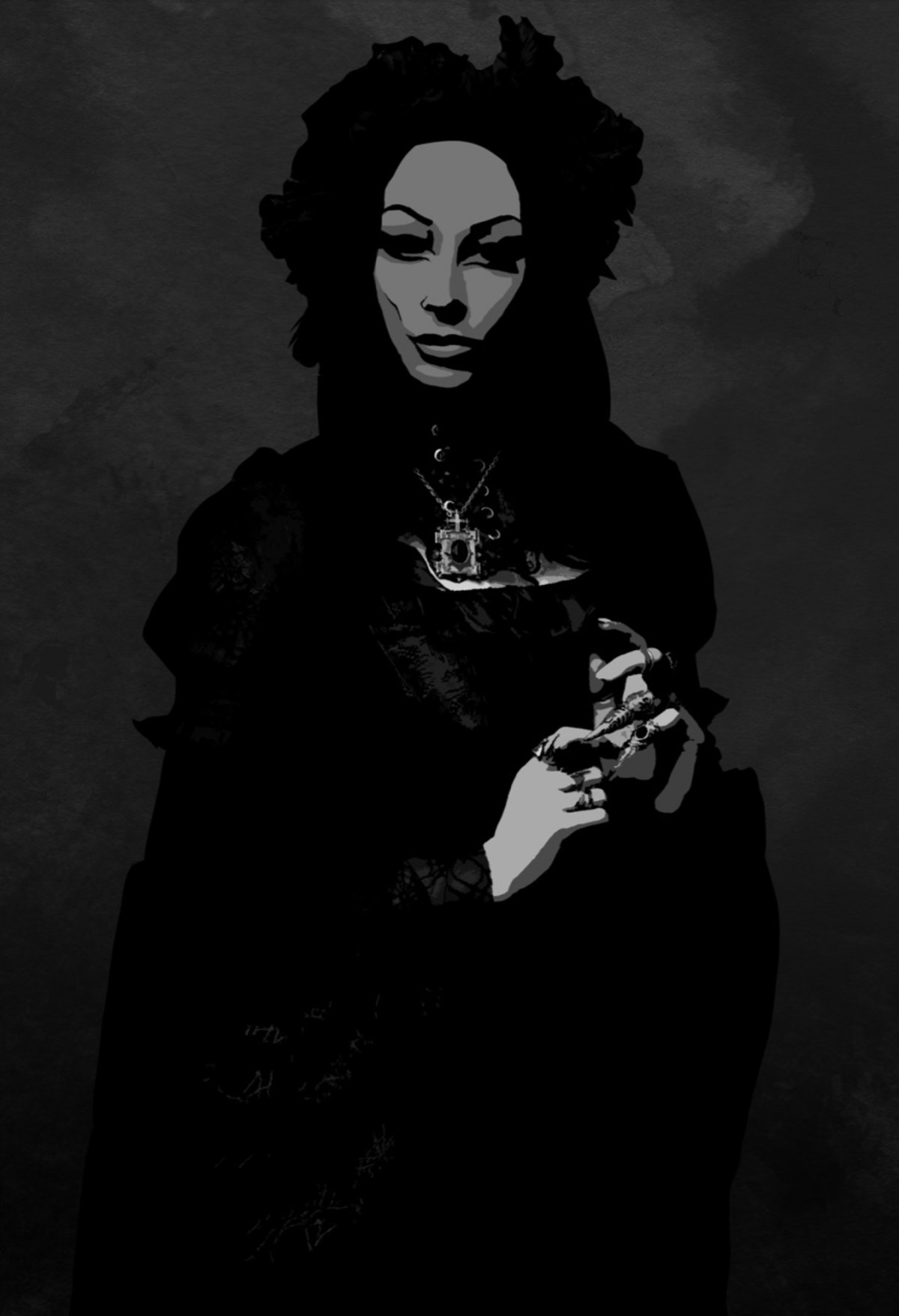
The Lurk, a light-skinned, femme character dressed in a dark hood.
The Lurk, by J Harper

We have a total of eight of these listed here. Not as many as for the GM, but there’s a lot in each one. Here’s what we’ve got:

  • Embrace the Scoundrel’s Life
  • Go into Danger, Fall in Love with Trouble
  • Don’t Be a Weasel
  • Take Responsibility
  • Use Your Stress
  • Don’t Talk Yourself out of Fun
  • Build Your Character through Play
  • Act Now, Plan Later

As usual, I’m not going to go into detail on all of these. This time, I’m going to group them.

Embrace the Scoundrel’s Life + Go into Danger, Fall in Love with Trouble + Don’t Talk Yourself out of Fun

These three best practices all relate generally to the same issue. You, as a player of Blades in the Dark, are not there to play it safe. You are not at the table to make optimised choices. Your character lives in a brutally unfair world and they have become adept at surviving it and even profiting from it. Lean into that! Will they have to make difficult choices that might lead them or their crew to harm? Yes! Will they have to take wildly risky actions to achieve their goals or create those opportunities? Yes! Will they have accept the consequences of their actions, which might include conflict with the highest powers int he city, imprisonment and death? Yes! This is the good stuff, in fact, not the downside. These are the parts of the game that keep it moving forward and allow you to craft scenes of kick-ass action, ice-cold espionage and even heart-breaking tragedy. This is why you want to play. If you’re playing to win, instead of to find out what happens, you won’t get the most out of this game.

Don’t Be a Weasel + Use Your Stress + Act Now, Plan Later

You know, there’s a common thread running through all the best practices for players, to be honest. I think it can best be described as “let go.” You have a say in what happens in the story, of course, but you should not be precious about your character. Push them as far and as fast as you can, drive them like that proverbial stolen car. These three practices are about doing that within the rules of the game. You do stuff by rolling with Actions, not skills. It’s important to choose the right action for the job, even if it’s not your best. That’s where stress comes in! One of your companions can spend stress to help your actions succeed with an assist, or you can spend it to push yourself. It’s invaluable for resisting consequences that would be otherwise inevitable. You can even use it to work in a flashback and do a setup action to get you out of a particularly sticky spot. You will build up the stress, of course. You’re going to have to indulge your vices to shed it or you’re going to find yourself traumatised. That’s where these stories end up sometimes. Your PC might build up a weakness or two, they might be brought to the end of their tale through the extremities of stress. But what a tale it will have been!

Take Responsibility + Build Your Character through Play

Blades in the Dark is a story game. You are telling a story at the table with your friends and you want it to be the best it can be. You want it to have ups and downs, ins, outs and what-have-yous. Dark, tragic, thrilling, horrific comedic, action-packed, whatever you want it to be, you can contribute to it. You have the option to add as much or as little as you like. Some players are going to invent new NPCs, locales, factions, street-vendors, family-members, ghosts, you get the idea. This is all good. But a player’s greatest power to contribute to the story is through their own character. The actions they take, the things they say, these things can add as much to a session as the NPCs invented by the GM, probably far more. Maybe you are already delighted with the general atmosphere and vibe the rest of the table is bringing, so you don’t feel like you need to add too much, you still have a responsibility to your own character, to have them grow from their beginnings into fuller, more alive beings. You start with a “sketch” but, through the actions you choose for your PC, how they comport themselves in various situations, the risks they are willing to take, you’ll make an unforgettable character and story.

Conclusion

The Shade. A floppy-haired dandy in a Victorian gentleman’s clothing.
The Shade, by J Harper

Like I stated above, there is a strong theme across all of these best practices: don’t be boring. In a game like this where the story evolves collaboratively at the table and is not even slightly left up to a published campaign frame or the GM, the choices you make as a player will dictate the sort of experience you have. Be bold, don’t behave.

Blades in the Dark GM Tools

I’ll be honest, I don’t usually think about the games I run in terms of goals, beyond a vague desire to do my best to GM competently, engage the players and make them entertaining.

Good Advice

So, like I said in my last Blades in the Dark preview post, this book is full of great advice. Today, I’m going to take a closer look at some of the advice for GMs that is not directly related to the first session or two. This is the sort of thing that will help you create the best version of your game at the table every session.

GM Goals

I’ll be honest, I don’t usually think about the games I run in terms of goals, beyond a vague desire to do my best to GM competently, engage the players and make them entertaining. Many of the other games I’ve played don’t deal in these terms at all, but I find I appreciate the project-like manner Blades employs here. It’s good to state your goals before embarking on any sort of initiative, otherwise, how do you know if you manage to achieve them? What do you use to steer your efforts?

Here are the GM Goals as stated in Chapter 7, Running the Game:

  • “Play to find out what happens.” This is the primary guiding principle. A concept that was introduced by D. Vincent and Maguey Baker in Apocalypse World, “play to find out” is central to Blades in the Dark. The idea here is that you have no set narrative in mind, no list of occurrences that you’re waiting to introduce to outfox or defeat the PCs, no plan at all. Instead, you let the PCs lead the way. Their own plans, desires, vices, mistakes etc. will drive the story forward in a way you could never have imagined beforehand. The GM here is just as “in the dark” as the players are about what’s coming.
  • “Convey the fictional world honestly.” Honestly, I am struggling with this one. The advice here is to “make the world seem real, not contrived.” Of course, this is a reasonable suggestion, but much more difficult in practice, I imagine. It pre-supposes this “vision of Duskwall in your head.” But, in a game where the GM is largely just reacting to things the players invent or decide, the vision is probably changing constantly. You’re told here, though, “don’t play favourites,” as well, so I begin to see the purpose a little clearer. The idea is that, as GM, you should not be inventing elements of the world that exclusively benefit just your NPCs, or explicitly disadvantage the PCs in ways that seem unfair. I suppose it could also refer to a tendency some GMs might have to treat certain PCs better than others. Resist that urge! Play fair!
  • “Bring Doskvol to life. Give each location a specific aspect (crowded, cold, wet, dim, etc.). Give each important NPC a name, detail and a preferred method of problem solving (threats, bargaining, violence, charm, etc.). Give each action context—the knife fight is on rickety wooden stairs; the informant huddles among the wreckage of the statue of the Weeping Lady; the Lampblacks’ lair stinks of coal dust.” I wanted to quote this whole paragraph because it is filled with practical, actionable advice that I would struggle to paraphrase. I have to say that this is a reasonable goal for any RPG, not just this one.

GM Actions

Two dark silhouettes having a knife fight. The dark city streets are portrayed within their shadows.
Knife-fight City – J Harper

So this is one of the ways in which you, as the GM of Blades in the Dark, can endeavour to achieve your goals. I guess these are the story-game equivalent of an OSR GM’s Random Encounter tables, weather and misfortune tables and hex maps. Essentially, when it’s your turn, you can look at the list of GM actions and choose one to keep things interesting.

  • Ask questions
  • Provide opportunities & follow the player’s lead
  • Cut to the action
  • Telegraph trouble before it strikes
  • Follow through
  • Initiate action with an NPC
  • Tell them the consequences and ask
  • Tick a clock
  • Offer a Devil’s Bargain
  • Think off-screen

I like that these are presented as moves. These are all the types of things you might do a GM in any game to spice things up, to introduce complications if its all going a little too well, if the game is getting stale. But, in other types of RPGs, they aren’t treated like the action you get to do on your turn, in fact, they are rarely dealt with at all.

Now, I’m not going to deal with each and every action here. Some of them speak for themselves and their purpose is obvious. For instance, “Ask Questions,” is very broad, but I think its fairly clear that it can be used in almost any situation to gather information, provoke actions, or even get the players involved in creating situations and the world. “Cut to the action,” is a great way to take the reins briefly to prevent plan-spiralling or similar. But I do want to look at a couple of these a bit closer:

Provide opportunities, follow their lead

This is how “play to find out” works in practice. You can’t simply allow the players to create their characters, tell them a bit about the city and ask them what they want to do. I mean, you could, but they will proceed to have a million questions. The starting situation is designed in such a way as to provide the opportunities ready-made for them, but from that point on, it’s up to the players to find them. It’s the GM’s job to present them according to how the PCs went about it. So you follow their lead. If they go scouring the underworld for leads, they might hear of a secret cache of electroplasm in a poorly guarded warehouse near the docks, but it might be inferior quality information. Or, they might read about a prestigious visitor from the Iruvian embassy with a price on their head attending the opera form a report in the newspaper. They might take very different approaches to find these opportunities and it’s up to the GM to provide what’s appropriate.

Sometimes, though, the players will come up with an opportunity all of their own. Maybe their efforts were stymied by a rival crew during their last score and they’re looking for revenge. Maybe they want to expand their criminal empire and have an idea for a score against a gang in another district. Same thing, in this case, it just saves you the trouble of inventing the opportunity yourself.

This section also provides practical tips on how the players might handle these things mechanically, what difference the crew’s heat and resources make to this process and even a step by step guide to what constitutes an opportunity.

Think offscreen

This action makes you spin some more plates than you already are as GM, but it is useful to think about. Basically, the idea is to bear in mind what is happening elsewhere that might have consequences for the action of the current scene. Maybe there is a riot happening nearby and it’s getting closer, maybe the Bluecoats are out in force on patrol tonight, maybe there are some errant ghosts in the area that might want to get involved. This is the sort of thing I do tend to forget about when GMing normally. It generally feels too much to introduce another element to an encounter in a lot of games. But in a story game like this, you want complications, and, more importantly, you want to see how the PCs deal with them. In all likelihood, they’ll have to do something that drives the story forward even more!

GM Principles

A man in a high collar holding a skull in black and white
“I knew him, Horatio” – J Harper

This is the second set of tools for you to use to achieve those GM goals. If you play with these principles in mind at all times, you should get the most out of your experience GMing Blades in the Dark:

  • Be a fan of the PCs
  • Let everything flow from the fiction
  • Paint the world with a haunted brush
  • Surround them with industrial sprawl
  • Address the characters
  • Address the players
  • Consider the risk
  • Hold on lightly

“Paint the world with a haunted brush” and “surround them with industrial sprawl” are specific to Blades, in that they are concerned with describing the city and the situation in the appropriate vibe and tone. “Be a fan of the PCs” has become a standard piece of RPG advice but it is important, for sure. I’d like to go into more detail on two of these:

Let everything flow from the fiction

You don’t need to “manage” the game.

It can be hard to let go. Especially when you have been raised on a strict diet of stat blocks, challenge ratings, 6 second rounds and proscribed consequences. But much of the advice in this chapter is encouraging you to do exactly that. Stop planning. Nothing good can come of it. You have to let the story flow naturally from the actions of the players and the reactions of the world. In Blades, after the briefly described starting situation and opening scene, every element of the campaign should cascade down from there.

Hold on Lightly

This is not a “no take backs” kind of game.

When thinking about the PCs approach to a situation, remember that goal of portraying the fictional world honestly. If you do that and are forced to rethink how you described a scene, that’s fine, you can go back and retcon it. Maybe you first introduced them to a room crowded with ghosts, but, on reflection, considering how the players told you they spent time staking out the room as an entrance to a hideout, beforehand, you decide there is just one, lonely spirit, there. Not only that, you should not be afraid to allow the players the same sort of leeway when describing their actions.

Next time

In the next preview post, I want to write about the GM best practices and bad habits as presented by Mr Harper in the book. Till then, dear reader!

Beginnings in the Dark

I want to start by acknowledging that I think this entire section is fantastic. It’s full of gold. The advice presented here is the kind of thing I would love to see in every game.

My Own Advice

In my post on beginnings I suggested a few things. It’s a good idea to start in media res. Starting in the middle helps to introduce the world to your players and helps them to introduce their characters to the world, assuming you give them enough narrative freedom to do so. I suggested using flashbacks to fill in blanks as necessary. But I also suggested that, for a longer game, you might want to begin with some in-depth scenes of the PCs’ personal lives to give everyone a good idea of what drives them.

So, how does this hold up to the advice provided by John Harper in Blades in the Dark?

Starting the Game

A leaping scoundrel in black and white.
A leaping scoundrel in black and white by J Harper.

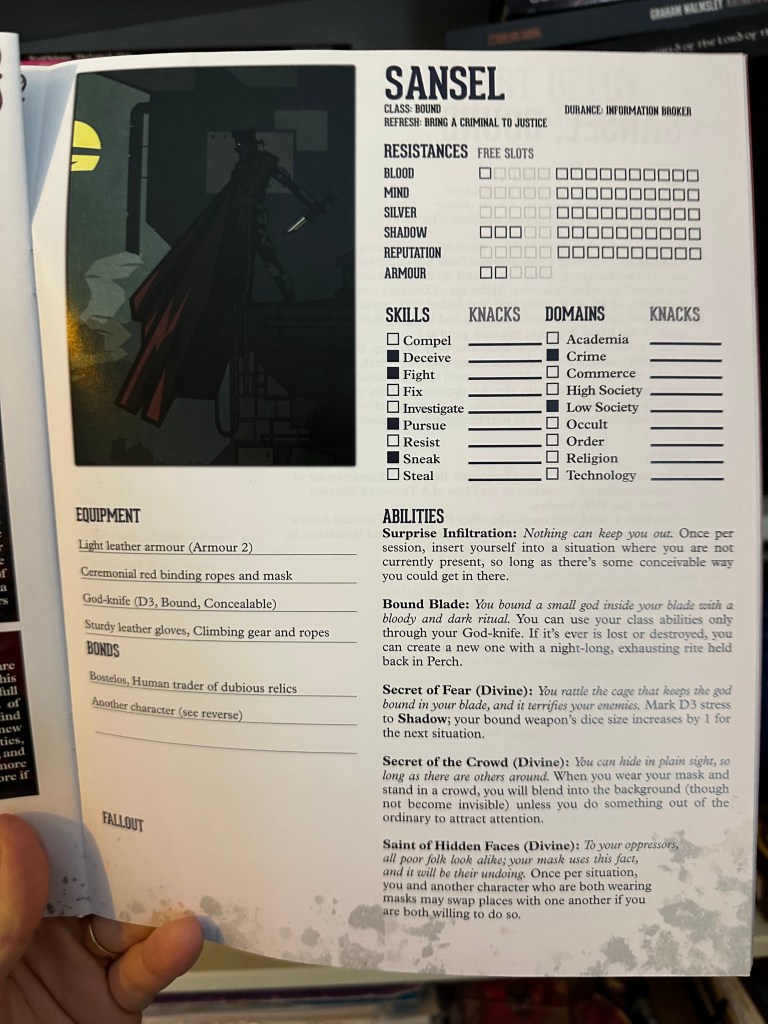
That’s the name of the section under the Running the Game chapter in the book. No confusion. I want to start by acknowledging that I think this entire section is fantastic. It’s full of gold. The advice presented here is the kind of thing I would love to see in every game. It was definitely the kind of thing I wanted from Spire before beginning it. I was so anxious about starting that game because I really was flying by the seat of my pants. Why? Well, because I had never played anything like it before. And in Blades in the Dark, Harper is perfectly aware that you’ve probably never played anything like this game before. So he takes your little hand and leads you gently into Duskwall, nodding reassuringly and telling you it’ll be alright.

Preparing for the First Session

A map of the coastal city of Doskvol which includes the names of each of the districts.
A map of the coastal city of Doskvol

Under the sub-heading, Preparing for the First Session, you get the advice to read through the character and crew creation sections again, assuming, I suppose, that you read them already. Here, it’s recognised that the GM is going to be the one leading on this and advising the players on how to create those scoundrels they’ve got in mind. Of course, this is good advice for any GM-led game but it’s good to have it in black and white here. Related to this is the fact that during these processes, the players are going to need answers about certain factions that will be relevant to their characters and the starting state of the city. So, you’re advised to pick a few factions you’re interested in or brush up on the ones mentioned in the starting situation, “War in Crow’s Foot.” To add to this, personally, I think you want to brush up on some of the factions, personalities and organisations that affect the entire city, like the Bluecoats, the Sparkwrights and the Spirit Wardens. You don’t need an exhaustive knowledge, but the basics will be helpful to allow you to answer some world-building questions, even if they’re not directly related to their characters or crew.

Harper states here that you should get through character and crew creation and, at least start the first score in your first session. This sets an expectation and, trusting that he has play-tested this a lot, its one that you have to assume is realistic. I also like the idea of taking these freshly minted scoundrels and throwing them straight into the action. I guess my in media res advice remains solid here.

There’s a short paragraph about what you can do to get yourself in the dark industrial fantasy mood of the game. Watch some Peaky Blinders, play some Dishonoured or read some Fafhrd and the Grey Mouser. I like this idea and it is something I do regularly to get me thinking the right way for an upcoming game with a very specific vibe.

Lastly, print out the character sheets and other reference sheets and get the gang together.

The First Session

A dark black and white illustration of several scoundrels on the canal, lit by a giant moon above.
Midnight on the Water, J Harper

The next section is entitled, “At the First Session: Setting Expectations.” This is always important. There are some formalised techniques to achieve this, of course. One of these is C.A.T.S. (Concept, Aim, Tone, Subject matter.) You can describe the type of game you’re going to play using CATS and, hopefully, that should help potential players to decide if they want to play it or not. Honestly, by the time you gather at the table, players should already be familiar with this stuff and know what to expect from your game. So this is not really what Harper is trying to achieve here. Instead, he’s trying to get you into, as he calls it, “let’s play mode.” He suggests a “punchy synopsis of the game” like this:

Okay, so you’re all daring scoundrels on the haunted streets of Duskwall, seeking your fortunes in the criminal underworld.

This is something I also love to do when starting a new game. I often take the blurb from the back of a book, or the summary from the first page and read it aloud, or paraphrase it to get the players in the right frame of mind so I would go further and remind them about what sort of dark, broken, victorian world this is, what the stakes are and the types of things they might be called upon to do.

Then continue:

Let’s make some characters and form a crew! Here are the playbooks. They’re the different types of scoundrels you can play. I’ll summarize them and then you can choose…

Harper goes on that the advise you to keep your explanations and rules-talk to a minimum at this stage. Introduce the players to concepts and answer questions but don’t get lost in the darkened alleys of Doskvol just yet. Instead, give a loose outline of the various playbooks and crew types, just enough to pique your players’ interests while they look through the options.

He then suggests saying something more like a sales-pitch at this point. The speech he includes in the book is real hearts-and-minds stuff,

This is a game, but it’s also something else—something really cool and unique. We’re gonna collaboratively create fiction together, by having a conversation about these characters and situations, without anyone having to plan it out or create a plot ahead of time. It’s like our very own TV series that we produce but we also get to watch it as a viewer and be surprised by what happens. You’ll say what your characters care about and what they do, and I’ll say how the world responds and just like that, a story will happen. It’s crazy. And fun.

I like this but I think I’d definitely come up with my own spiel. It’s just not me. I would definitely use this though:

play your character like you’re driving a stolen car.

Creating Characters and Crew

An Eldritch ball of light being released or cpatured by a crouching person in the foreground. Several scoundrels with a lantern in the background.
Eldritch light. J Harper

While the players work on their PCs, this section provides a set of questions to ask them. The text here does not suggest you ask all of the questions or that you ask everyone the same questions, or even that they should answer them out loud. Although I think I would try to get answers for at least a few of these to help me in making decisions as the game builds.

Here is a selection:

  • Why did you become a scoundrel?
  • The two of you have the same heritage. Do you want to be blood relatives? Do you know each other’s families?
  • When was the last time you used your blade? Why?
  • Who do you trust the most on the crew? Who do you trust the least? What’s that about? Or will we find out in play?

Harper points out here that we don’t need or really want to know everything about the characters before starting. A lot of the fun of playing a character is discovering them as you play, of course. The dynamic nature of Blades in the Dark and the degree of influence PCs can have over the world and, more importantly, the story, makes this particularly true of this game, from my experience.

You want the players to want to play their characters and to be excited about it. So Harper asks you to make sure, if anyone is not that enthused or is maybe frustrated by the process or any lack of detail that you spend a little time getting to the bottom of their dissatisfaction, providing more info if they need it, until they’re happy. You can also remind them that, if any of them find, after a few sessions that they wished they’d made a different choice here or there in character creation, then they can make the change, “no big deal.” An enlightened and realistic approach, I think, to what is, after all, just a game.

Once they reach the crew creation stage, they’ll have questions for you about the factions I mentioned earlier.

who gave them their hunting grounds, who helped with their upgrades, and who’s connected to their contact.

So, you’ll be happy at this point that you did that reading earlier. The advice here is, again, to use the factions in the starting situation to save yourself some work and associate the crew with the occurrences. This section ties things up by suggesting you skip crew creation for a one-shot, allowing the crew to develop organically during play instead.

Introduce Characters & Crew

Finally, it comes to the point the players will have been waiting for. They get to show off their cool new guys, their wee scoundrels! You get to use this to ask each player a few more questions to help clarify things or to get them thinking about how their PC might develop in play.

Some good advice here on how they should come up with their crew name. Even though they just put in a lot of work on crew type, upgrades, special abilities etc, the name can be elusive. So Harper suggests they leave that until after their first score at least. A suitable moniker is likely to come out of that.

The Starting Situation

A cityscape type view of Crow's Foot
A cityscape type view of Crow’s Foot

I love this bit the most. You could potentially run Blades in the Dark games over and over again for years, one campaign after another, and use this same formula for your starting situation, and it would never get old:

  • Set two factions directly at odds, with opposing goals. They’re already in conflict when the game begins. Both factions are eager to recruit help, and to hurt anyone who helps their foe.
  • Set a third faction poised to profit from this conflict or to be ruined by its continuation. This faction is eager to recruit help.

And that’s it. It’s not overly convoluted. Three factions and their goals shouldn’t be too much to burden the players with and there should be plenty of potential in the situation. “Keep
it simple at first—things will snowball from here.”

The main thing is to give them something to do right off the bat, rather than asking “more creative work” of them. Once again, I love this. This is the sort of advice I wanted when I first ran Spire. Instead, I think I left my players floundering right at the beginning, without a clear idea of what they should pursue straight away. We ended up really enjoying that campaign but it always involved an awful lot of talking about what they were going to do next, planning that thing and then changing minds and starting over. And I think that’s because it never recovered from that first session, and its lack of direction.

The Opening Scene

Now you get into the nitty-gritty. This is practical advice that I really wanted. What should that first scene look like? What should you give the players here? What kind of thing is being asked of them? What if they don’t want the jobs that are being asked or demanded of them?

The most important lesson I am getting from this section is that the ball is in the PCs’ court. You need to give them a decision to make and they need to make it right now! Whatever happens, they are going into their very first score right away. No hanging about, no ifs, ands or buts. Love it.

Conclusion

The section ends with an example starting situation, “War in Crow’s Foot.” I’m not going to go into it because I might just use it. But I can tell you that its exactly what I’m looking for here. It’s a concrete example of the way the GM gets things started and how you can hand it over to the players. It’s got sample scores from different NPCs and advice on how to play those NPCs too.

Having read this whole section and followed some or all of its advice, you should be more than prepared for the crew’s first big score.

Throwback Wednesday: Beginnings

Instead of a new post, please enjoy this one from last August. It deals with beginnings and how to manage them in RPGs. Its got some advice I must take into account as I embark on my recently decided upon campaign of Blades in the Dark.

A Short Rest

Once again, dear reader, I find myself a little under the weather. Maybe I just overindulged at the weekend, maybe I have been working too hard, maybe it’s the current wave of ‘rona. Whatever it is, I feel like I’ve been struck by a nasty disease and I failed my resistance check/saving throw etc. etc. So, I’m taking a break today.

Instead of a new post, please enjoy this one from last August. It deals with beginnings and how to manage them in RPGs. Its got some advice I must take into account as I embark on my recently decided upon campaign of Blades in the Dark.

See you with a new post soon!

Troika! Whalgravaak’s Warehouse Review

Here’s the story: hundreds of years ago, the city’s premier logistics wizard, Whalgravaak, abandoned his warehouse, having shredded the Manual of Operations for his Sphere Pool (a mechanism used to import and export goods across the cosmos) so that his rivals could never figure it out.

One-shot fun-shot to campaign of terror

You know what it’s like, dear reader: you want to introduce some noobs to RPGs or just to your group of players, you want to make a good impression but you don’t want to scare them off by plunging them into a multi-session campaign with a complicated, crunchy system. So you pick up a location-based adventure, thinking you can just use a small portion of it, just what you need, just enough for one session, one single shot. But, after that session, the curiosity gets the better of you all. That was a weird, but enjoyable experience, you tell each-other. I bet we could have fun exploring the rest of that odd locale, you tell the players, why not have some more sessions and see how it goes? So you do that. And then the bloodbath begins.

Whalgravaak’s Warehouse

SPOLIERS BELOW! If you are interested in being a player in Whalgravaak’s Warehouse, turn back now!

The covers of three Troika! 1:5 adventure modules, Whalgravaak's Warehouse, The Hand of God and Eye of the Aeons.
The 1:5 adventures that I own, Whalgravaak’s Warehouse, The Hand of God and Eye of the Aeons. All from Melsonian Arts Council

Whalgravaak’s Warehouse is a Location based adventure by Andrew Walter for Troika! The design is by Shuyi Zhang. It came out in 2023 and was the first of the Melsonian Arts Council’s 1:5, an ongoing series of location-based adventures for Troika! There are a couple more available now and another out very soon. You can find them all here. My somewhat rotating group of Tables and Tales members just had our last session in Whalgravaak’s Warehouse on Monday night, after spending a total of eight sessions there.

Here’s the story: hundreds of years ago, the city’s premier logistics wizard, Whalgravaak, abandoned his warehouse, having shredded the Manual of Operations for his Sphere Pool (a mechanism used to import and export goods across the cosmos) so that his rivals could never figure it out.

Since then, the strange nature of the warehouse, staffed by giants and stocked with oddities, has only grown stranger, and more dangerous. It houses a handful of physics defying, Tardis-like chambers, not least of which is the terrifying Deep Storage, a swirling mass containing several pocket dimensions and a wraith-like being who wants nothing more than to consume intruders. At least one cult has taken up residence, and they are often mutated into horrific Chaotic Spawnlets by the effects of the radiation still spilling from the Sphere Pool. The warehouse is sandwiched by a vast desert of dust occupying the roof, which is peopled by the descendants of Whalgravaak’s former employees and, underneath, the tunnels of a pack of unpredictable Worm-headed Hounds.

But entrance has been forbidden by the Autarch for centuries and, even if you were foolhardy enough to ignore a diktat like that, you would still need to be brave enough to face the unknown dangers within.

The Hook and the Party

The book suggests a few potential hooks for your PCs. Since my game started off as a one-shot, with brand new characters and no existing campaign to work it into, I went for one that seemed like the object might be achieved in one session. They, along with many other groups of mercenaries were contracted to return with the head of a Cacogen, known only as the Opportunist, to their patron, an Exultant of the Autarch’s court. But we dealt with that in flashback as they all sat in the weed-choked yard of the warehouse, dotted now with small encampments of adventurers and brigands all gathering their courage to gain entry. The PCs’ band consisted of a Monkey Monger (and monkeys), a Gremlin Catcher (and dog), a Wizard Hunter and a Landsknecht. They were, to put it bluntly, a motley crew.

That first session was all fun and games. Every encounter, except for the last one with the Cacogen, was resolved peacefully. This happened mainly due to the rolls I made on the Mien table for each encounter. The worm-headed Hounds they encountered wanted to play with the Monkey Mongers monkeys, they did not want to eat them. The Flat Serviceman was happy to follow the party around and clean up after them. The Segmented Crippler in the Pigeonholery, didn’t want to wake up, so they skipped that one entirely. This is a pretty standard mechanic in Troika but I think it gave the players a false sense of security. The session ended with this motley crew finding and defeating the Opportunist quite handily. And, at that point, we thought that would be it.

But a few months later we decided to continue with their explorations of the warehouse. Obviously, their original motivation to explore was gone. They had achieved their objective, but the players were all good sports. They decided between them that the motivation was purely one of curiosity and greed. They had spotted, through a bubble like window in one of the rooms they had traversed, a vast and terrifying pool of chaos and wonder in a room far too big to exist within the confines of the building. This was enough for them. Essentially, they went in search of adventure. Although, through the sessions that followed, I did introduce the idea that they might want to find that cult I mentioned earlier and that they should seek out the incredibly valuable Tome of the Sable Fields that was reported to be stored in the warehouse, somewhere. This gave them a little direction when I thought they might need it, but, honestly, I think my players just wanted to see what new wonder/horror the dungeon had in store in the next room.

The Dungeoncrawl

It was only from this point that I started to really treat this adventure like the dungeoncrawl it is very much meant to be. The book does a good job of introducing the concepts of tracking resources like lantern oil and provisions as the party explores. It also explains the concept of exploration turns and their effect on the game, i.e. the distance you can travel in that time, the amount of lantern oil you use per turn, and the likelihood of running into an encounter. I followed all these rules to the letter and they made for some interesting moments in the game. But, to be frank, the weirdness of the setting is the real draw here, not fiddling with rations and light levels. Also, few of the characters lived long enough for starvation or oil-skins to become a problem.

It also has rules for dealing with the spatially distorted, impossibly large areas within the warehouse. It suggests that the players should make Luck or Skill checks to avoid getting lost in these areas, but, in all honesty, I didn’t really require that sort of thing.

Mapping is also a part of the dungeon crawl format and this adventure does want the party to attempt to map the space for themselves. The thing is, when some rooms appear to be a kilometre wide and the next one is spatially normal, that map becomes effectively impossible for them to draw accurately after a relatively short period of time. Eventually, I gave up and just shared the one from the book with the players, trusting their ability to separate player knowledge and character knowledge. My advice, if you are doing this, try get your hands on the PDF version, since the one in the physical book stretches across two pages and the crease obscures part of it.

In fact, the adventure has four maps:

  • the warehouse floorpan, using 10ft squares to denote distance
  • a hex crawl for the desert on the roof, replete with points of interest
  • a map of the Worm-headed Hound tunnels beneath the warehouse, superimposed over the warehouse plan
  • a largely vibes-based map of Deep Storage

These are all great but usefulness will vary. In our game, the party spent several sessions trapped in Deep Storage but took one look at the desert and noped right out of there. This seems like a good point to note how good all the artwork is in this. There are plenty of colour and black and white illustrations but they leave me wanting even more!

Warehouse Workers and other Beasties

A warehouse is a dangerous place to work, especially when the correct safety protocols are not observed. It doesn’t help at all when you are trespassers and several of the residents are large enough to crush you with a single blow.

The crimson giant, Paude, the pipe-smoking, bearded giant, Arbuthnot and the blue, jelly giant, Gamtomerian.
The giants are not what you might expect.

The giants are the main NPCs of the adventure and Whalgravaak’s only remaining employees. Each one is fabulously interesting, diverse and well-drawn. They have their own motivations and desires. I was gratified that the party managed to encounter all of them during the eight sessions we played. In fact, one player had two different characters killed by two different giants. I will point out that it is entirely possible to avoid violence when dealing with the giants, it’s just that, sometimes, the Monkey Monger on the team has monkeys who decide to fuck with them and one thing leads to another.

The wraith-like Gulf Man Roamer from the swirling vortex of Deep Storage is a potentially lethal foe who has a chance to show up each time the party moves through that already dangerous room. If it captures you in its bag, it’s going to spirit you away to eat you in its extra-dimensional lair.

No warehouse is complete without forklifts. Whalgravaak’s forklifts are humanoid constructs with the face of the wizard himself. They treat intruders like stock, and will attempt to whack them and pack them. They hit very very hard.

Its a black and white dog, with a neck like an earthworm
When you read the words, Worm-headed Hound, is this what you imagined?

There are also a bunch of random encounters, including the Worm-headed Hounds I mentioned before, desert nomads from the roof, and Bandits/Burglars/Bastards. These only turn up on the roll of a 1 on a 1d6 for each turn the party travels. It didn’t occur very often in my game. The Roof and the tunnels have their own random encounter tables as well, but I never used them as the party never spent any appreciable time there.

This is just a selection of the possible encounters you can have in this setting. I haven’t even mentioned the tiny army guys, the sentient crane parts, the Onion God or the Mulled Dead.

The Rooms

I have hinted at rooms that defy physics and rooms with pocket dimensions, and those are usually the big-ticket locations that contain some of the greatest set-pieces in the adventure. Deep Storage alone evoked some of the most inventive use of skills and spells and a great degree of fear and tension from the PCs. It killed one of them (two if you count the Rhinoman eaten by the Gulf Man Roamer.) The Roof could act as an entire short hex-crawl campaign and the Sphere Pool has some truly memorable and dangerous elements to it.

However, many of the other rooms have weird and wonderful contents as well. Some of them, the party will glance at and move on, while others will capture their imaginations and encourage them to interact. I never really knew which reaction I was going to get from them, actually. The room full of melting rope? They had to spend an hour trying to figure out how to set it on fire, the eternal battle between tiny armies playing out across a battlefield seemingly larger than the whole warehouse? Just popped their heads in and left with some captured little men.

Some of the rooms were relatively mundane warehouse style rooms with shelves and containers. The book has tables in the back to help you identify the state those rooms are in and the contents of the containers, which is useful.

One of my over-riding impressions by the end of our game, was that in some ways, the great variety of bonkers content in the rooms served to detract from any unifying theme. There were some elements that went together, such as the warehouse’s disdain for traditional dimensions. If my PCs had explored the Roof or even encountered any of the nomads who dwelt there, they might have found a distinction between those descendants of the ancient striking workers and the giants who continued to obsessively do their jobs even long after their employer had passed on. But, none of that is to say that the rooms weren’t endlessly fun and inventive.

A Note on Lethality

I recently wrote a post sharing some of the obituaries of the characters who met their ends in Whalgravaak’s Warehouse. You can check it out here. There are only three of them in that post. A few months previous to that, I wrote this post, which contained the obituaries of two more. The mathematicians amongst you will have summed those already. That’s five. In the final session, we lost another one. That makes six. That was three character deaths each for two particularly unfortunate/reckless players. Warehouse work is dangerous. Only one of the original party survived to the end. You have been warned.

Conclusions

The covers of the two different versions of Troika! that I own.
Numinous or otherwise, its the same game.

There is so much to recommend in this adventure. It is endlessly entertaining, challenging and bonkers. It has such a variety of locations and such a diversity of encounters that you would need to work hard to get bored in Whalgravaak’s Warehouse. I think it works so well to show off Troika! as a system, too. The problems it asks the PCs to solve and the encounters they have to deal with utilise things like the Luck check really well and encourage players to invent their own unique Advanced Skills. But if they get into fights, especially with the incredibly random nature of Troika! initiative, there is a very high chance they are going to come out of it dead. There are a few opportunities for insta-kills throughout the warehouse too. I can’t overstate exactly how lethal this adventure is. Luckily, my players leaned into that, even when they were creating new characters to join in the same fight the original one died in (they got very quick at creating characters.)

I think it’s also flexible enough for many GMs to easily take it or part of it and fit it easily into their own ongoing Troika! campaign. As I said at the start, our game started as a one-shot and it could have ended there. But we were able to easily adapt it into a short campaign of its own.

Dear reader, let me know if you have played Whalgravaak’s Warehouse or if you would like to! I’d love to know your views on it.