To be clear, the ship is the whole adventure. You could easily work it into an ongoing campaign, I think. It could be a random encounter or the goal of a mission. But, for me, it worked perfectly as a one-shot. It gives you everything you need in those eleven pages.
Talk Like a Pirate Delay
I was really excited about this year’s Second Annual Tables and Tales Talk Like a Pirate Day Pirate Borg One Shot on September 19th but I was, unfortunately, overcome by some malady that day. We postponed it only to have a massive storm roll in off the Atlantic, forcing us to delay the departure of this vessel yet again. Finally, last Sunday the players’ pirates were ready to board the Repentant come hell or high water…
OK, I say they boarded it but it would be more correct to say they were taken aboard. I started them off in the expanded brig, area 1 on the map of the ship. They awoke, captured, stinking and hurting and minus all their stuff. Nevertheless, with a few improvised weapons they found lying around the cabin and the assistance of a skeleton thrall raised by the skeletal sorcerer, they managed to overpower their demon guard. This was the first of many obstacles to their defeat of the Ashen Priest commanding the ship and taking the Repentant for themselves.
The Scenario
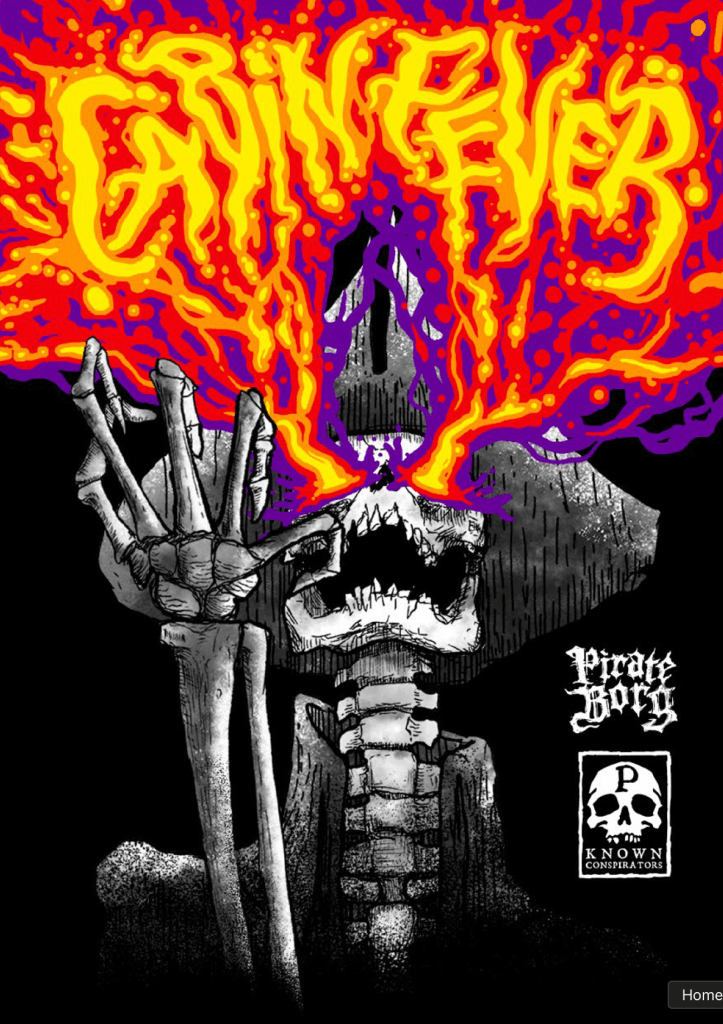
The cover of Cabin Fever
The Repentant is an 11 page one-shot scenario for Pirate Borg by Zac Goins. It is published in the forthcoming sourcebook for that game, Cabin Fever, via KNOWN CONSPIRATORS, Limithron’s subtable for third-party creators. Cabin Fever is a treasure chest of extras for Pirate Borg including new PC classes, GM tools, a Bestiary, no fewer than six adventures as well as solo rules. I am one of the backers of the Kickstarter project so I got access to the PDF through that. I’m hoping to receive the physical rewards for that soon.
This scenario is presented in a typical Borg-ish style, with maps, and illustrations taking the lead in establishing the atmosphere. It’s almost all in grey and black, emphasising the theme of ASH. The layout is also typical with lots of tables, stat-blocks, keyed area descriptions etc being worked into the spaces between and around the artwork. I occasionally had to take a few extra seconds to find what I was looking for due to this but it was never a major disruption. In general it looks great and ewers relatively easy to use.
The Premise
The Repentant is a charnel ship, an unkempt brigantine with tattered sails and a crew of demons and cultists, commanded by a cadre of Ashen Clergy. Their goal is spelled out clearly in the three step plan on the second page. In summary, the plan is to summon demons, form an unholy pact with the Dark One, raid some settlements to take captives, kill ‘em, raise them as undead and then grind them up to make Brimstone ASH. This is a type of cursed and arcane narcotic on which the crew plan to make lots and lots of pieces of eight.
To be clear, the ship is the whole adventure. You could easily work it into an ongoing campaign, I think. It could be a random encounter or the goal of a mission. But, for me, it worked perfectly as a one-shot. It gives you everything you need in those eleven pages.
The Reality
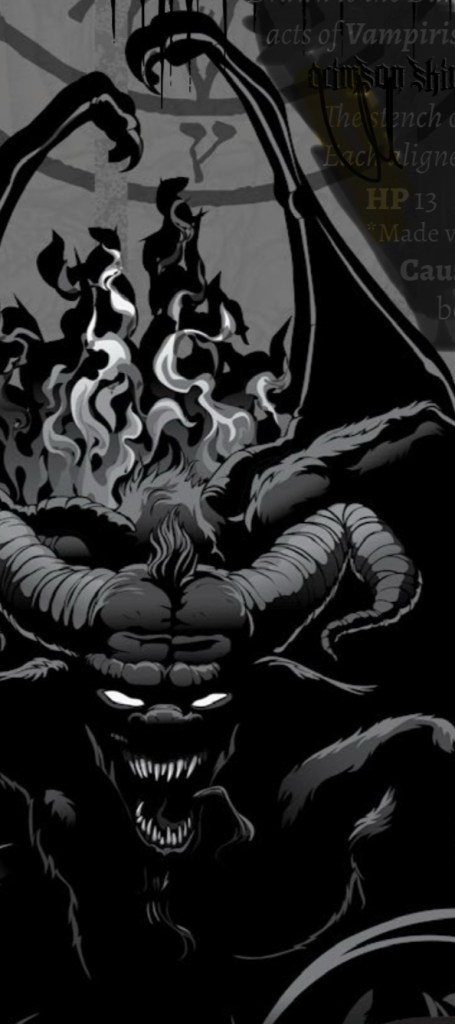
A genuine, fire and brimstone demon
There is a fun variety of enemies for such a short scenario. You have seven different types of possible demon (one for each deadly sin, with commensurate sinful powers,) the emaciated crew, the Ashen Vicars and the Ashen Priest who has a variety of fun powers. And if you deal with all those, there is a hold full of Brimstone Zombies, who have the power to promise your soul to the Dark One with a bite.
Although not every encounter ended in combat, almost all did. It felt inevitable in general. I started the players off where I did, in the brig because of the restrictions of a one-shot session. I wanted them in the thick of it from the start and escape gave them a powerful motivation to attack the terrifying demon, even without real weapons. Also, I figured the brig is area 1 on the map for a reason. The scenario does not explicitly indicate where or how you should start it as a one-shot, but if you take the hint, here, you’re probably not going to go wrong. It definitely got them into the action immediately. Without the timely and repeated use of Devil’s Luck and mystical powers in the first two encounters, at least one of the party would have gone down. The only thing is that it led to two mostly combat encounters in quick succession. Starting with them boarding over the rails or some other way might have engendered a totally different kind of adventure.
The map was fine. I was a little put off that three of the four decks had one side of the map cut off but it was of no practical disadvantage in play.
Tables, tables, tables. The tables are great, from the effects of the Brimstone ASH (different to the regular ASH introduced in Pirate Borg) to the “What did I just step in?” Table which I underused criminally.
My players only used the Brimstone ASH on their enemies, which was a shame. I think it’s because when they rolled on the table for those uses, they got 1s and 2s, which are very very bad. After I told them what else was on the table, they regretted not trying it!
6 The Devil’s inside ye. Immune to fire. All weapons’ dice size increases.
The Finale
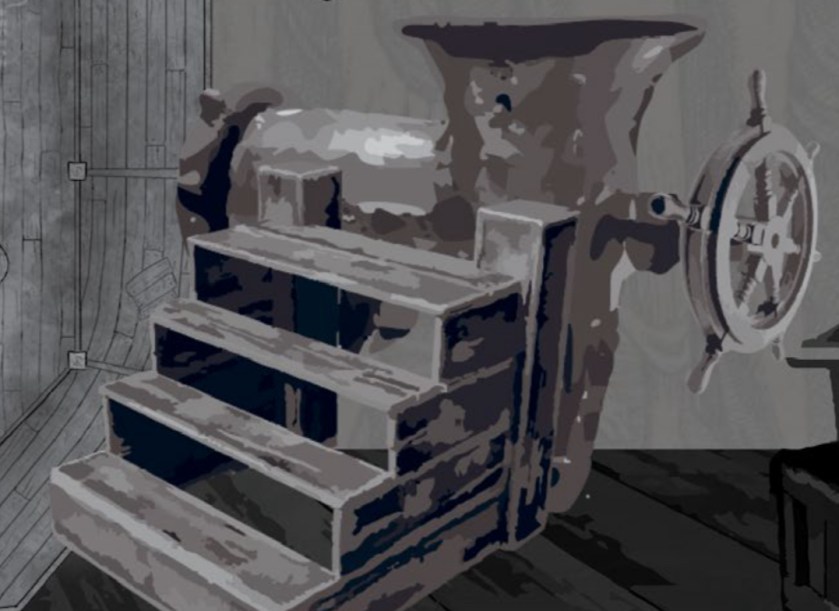
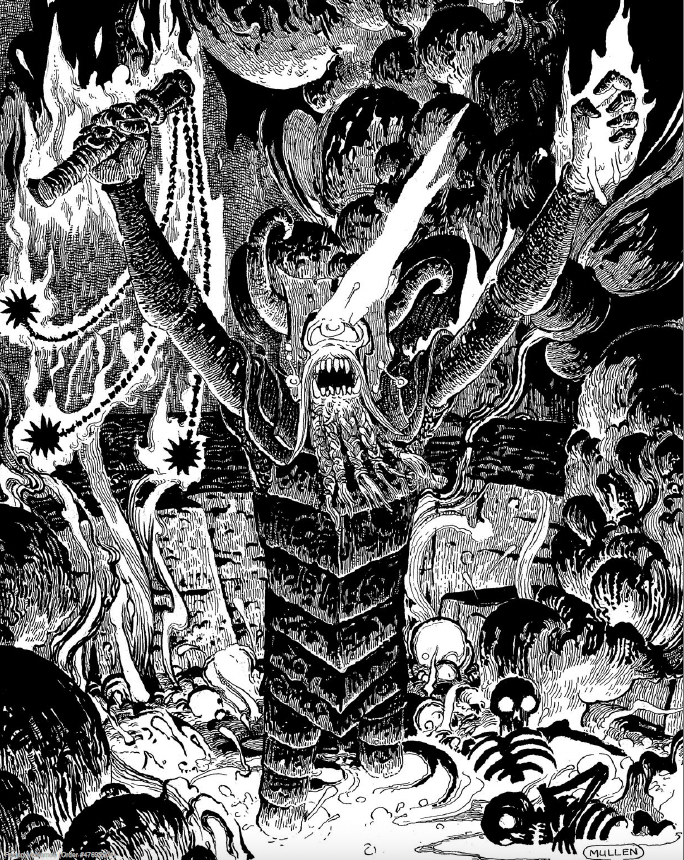
The ASH grinder.
I saved the Ashen Priest, the scenario’s main villain, for the end. He might have been found in either the captain’s quarters or the hold, according to the keyed locations, but, honestly, you could locate him anywhere to suit your own game. The PCs had done away with almost everyone else aboard when they descended into the cargo hold found him there, feeding zombies into the ASH Grinder. There were a lot of undead down there with him but the PCs made such short work of him that it hardly mattered. Then they got to take the ship as plunder, not to mention the undead and the grinder so they could enact the plan themselves!
Conclusion
This was one of the most well-crafted one-shot scenarios I’ve run. We played it in about three and a half hours, though, if things had gone badly, it might have been over after less than an hour! I did give them a couple of NPCs for back-up and in case anyone lost their first PC (there were two deaths.) This might have given them a slight advantage, if I’m honest, but everyone had a good time. Looking forward to trying out some more scenarios from Cabin Fever and the rest of the slew of new books from Limithron!
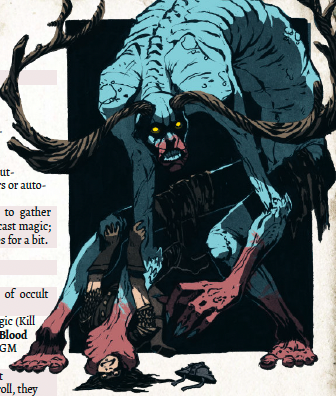
There’s a pumpkin-headed but polite creature stalking the prison who will, every once in a while, grab one of the PCs and pop them in his gob
In Summary
There are SPOILERS below! You have been warned.
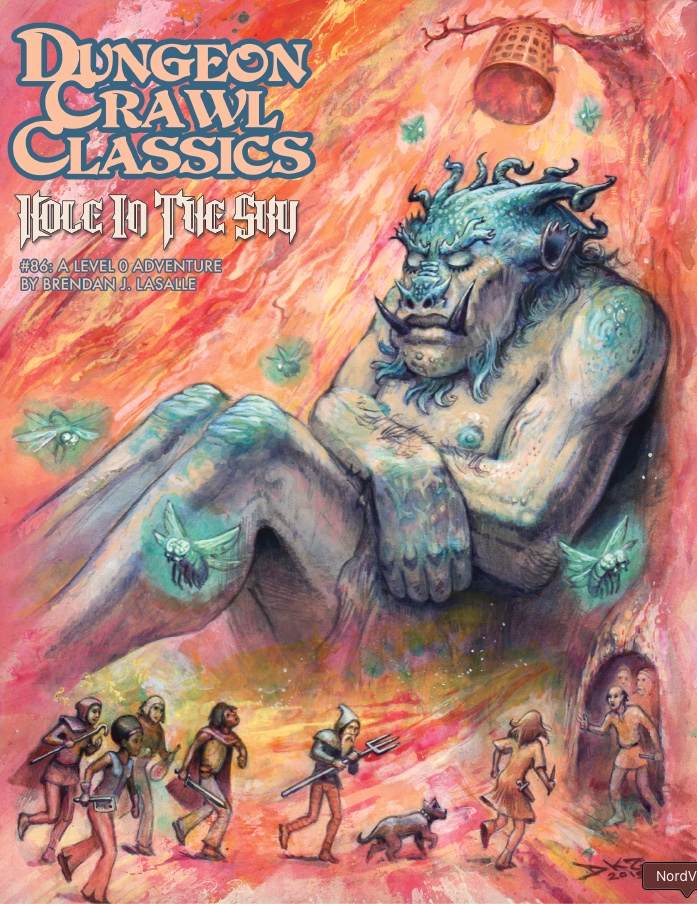
Sometimes you feel like things aren’t as they should be. It feels like you’re living in the wrong timeline, or like you were born under the wrong stars. That’s the extraordinarily loose hook for Hole in the Sky, the 0-Level Funnel adventure for Dungeon Crawl Classics by Brendan LaSalle. I say it’s a hook, but it’s not as if the large band of peasants you gather for this adventure really get a choice in whether or not to go to the starting location. All of that is taken care of in flashback and by dint of read-aloud text. Which is great. Don’t get me wrong. All the players came to play this scenario so, I think that makes sense.
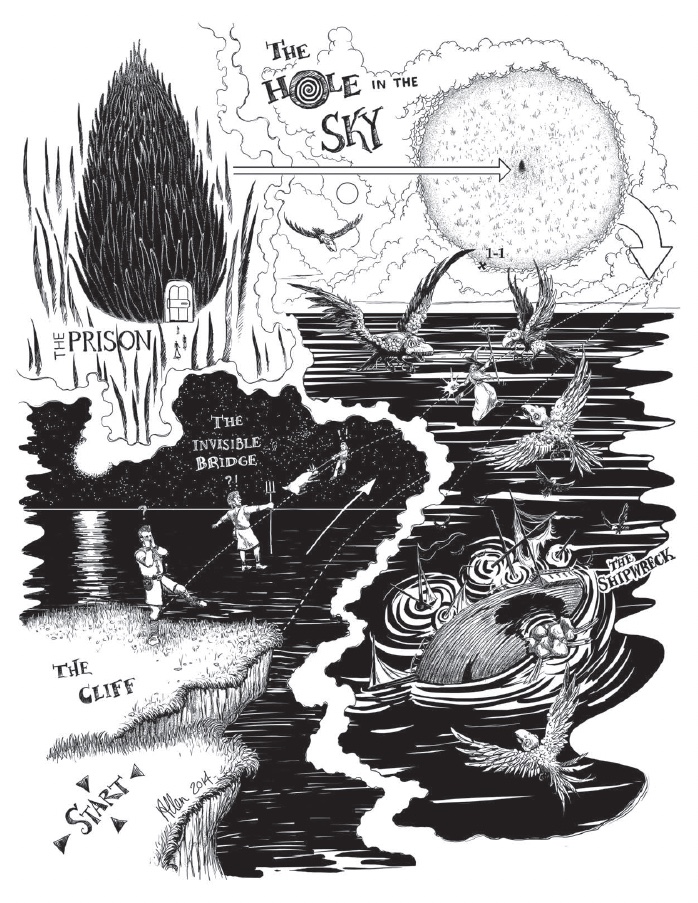
Here’s the setup, the PCs, peasants, normal Joes, ordinary slobs all, start dreaming that they have had their true place in the universe stolen from them. They should have ben heroes! The dreams coalesce into a drive to dander, cross-country until they reach the edge of a cliff, days and days later, convinced that their destinies will be restored as a result. In this place, they encounter the Lady in Blue (there is more than meets the eye to the Lady but I’m not going to go into that here. It seems to be the kind of thing that might become important in a longer campaign that could feature her as a patron or maybe even an antagonist), a giant of a woman, floating in the air with five heads gripped in her two hands. The heads speak for her. She tells the peasants that, if they would just go and free her ally, imprisoned by her enemies long ago, they will be rewarded with a spin of the Wheel of Destiny. And this would set their destinies to rights.
Actually, after she feeds them a meal, she does give them an out, so what I said above is not entirely true. If any of the PCs wish to abandon the quest at this stage, they can, but they will meet an unfortunate end before too long. Anyway, there is a period of waiting here that is strange to me. The scenario indicates that the PCs could use the time to visit the nearby village of Mherkin to stock up on gear and provisions. This is not even the last period of waiting baked into the scenario. Anyway, after hours of waiting for the right time, the PCs can step gingerly onto the invisible bridge that will take them from the cliff to the Hole in the Sky, the entrance to Lady’s ally’s prison.
For days they walk, sticking together to avoid the edges. The PCs are buffeted and soaked by a terrible storm as they cross the bridge far above the waves of the sea. They will lose some of their number in the storm, no doubt. They will lose even more as they are attacked by Sea Shrikes. Only after three days of traveling will they reach the end of the bridge, worn out, freezing and much reduced. Here is the second period of waiting. They must wait a further two entire days, slowly starving and shivering, until the Hole in the Sky aligns perfectly with the bridge. Why? Good question.
Once it appears, however, they are able to leap through and into the Prison Vale, a strange and unique extra-dimensional pocket universe designed for one purpose and one purpose only, the imprisonment of the Lady’s ally, Drezzta. The place seems to be made for giants, even the blades of grass stand tall as trees. There are a variety of potential random encounters in the Vale, 1 in 6 chance per hour for four hours if they go straight to the prison proper. Some of these look very fun and quite thematic.
Nice they make it to the prison they discover a cyclopean gate and find their way in. Inside they will discover a few things in quick succession:
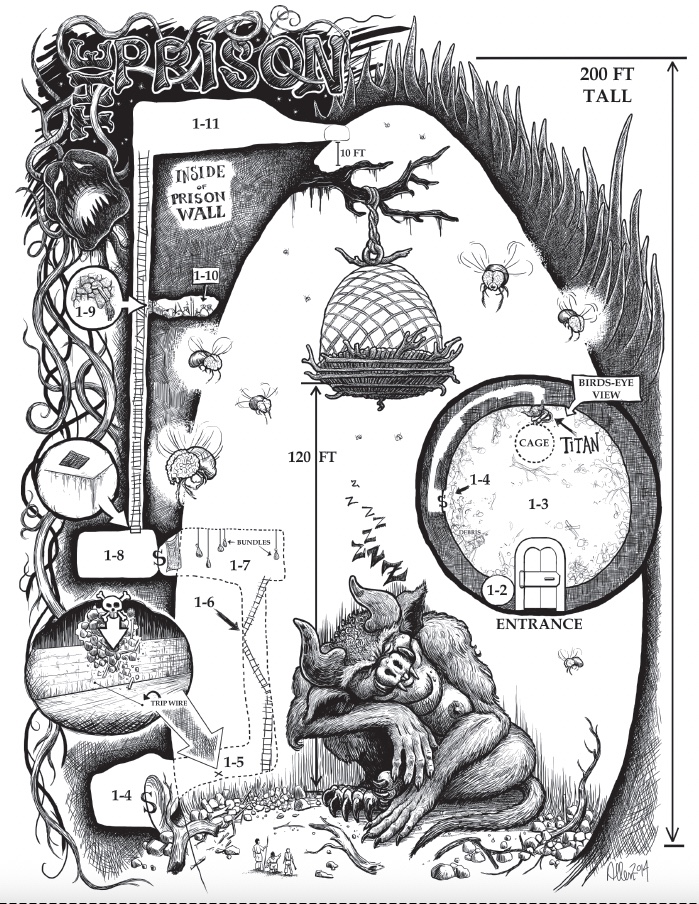
There’s a massive titan, sleeping on the job, but clearly here as a warden for this prison
There’s a cage hanging from a branch maybe 200 feet up
There’s a pumpkin-headed but polite creature stalking the prison who will, every once in a while, grab one of the PCs and pop them in his gob, where they will slowly burn to death in his jack o’ lantern flames, before gently encouraging the rest of them to leave
Of course, they are not going to leave empty handed. The continue on, finding a way up inside the walls themselves. On the way they encounter lethal traps, dangerous lunatics, mutants and lots of ladders. They will get a little more of the story from some of the other weirdoes who live here and they will probably find a cache of treasure, which includes a magic spear to destroy the sleeping titan.
It should end up with them reaching the top level of the prison, dizzyingly high up. They should risk life and limb to free the poor, emaciated form of Drezzta trapped in the hanging cage. One of them will need to sacrifice either a little blood or a lot more to open the door, but that will lead to her flying free, destroying the pumpkin guy and fleeing as the very dimension crumbles around the escaping PCs.
Those who make it back through the Hole in the Sky find themselves once more on the cliffside. The survivors are each given a chance to spin the wheel. Some may find themselves thrown back into the mundane lives they left, others might find themselves destroyed, killed in favour of one of the poor wretches who died during the course of the adventure. Still others might find themselves utterly changed in almost every conceivable way… Potentially a great reward for a 0-level character who is about to progress to the dizzy heights of Level 1!
Our Experience
Chaos pig burrowing out of the ground with its little claws.
I played this funnel over two sessions of about three hours each. We played online using Roll 20 and Zoom with a group of six players, all members of our ever-expanding RPG community, Tables and Tales. With six players, of course, we had 24 0-level PCs leaping through that hole in the sky! This seemed like it might be too much. I was afraid that each player’s turn might take an age, but, in actuality, the numbers started to get whittled down quite quickly.
Like I stated above, in the half of the adventure that takes place before they enter the Hole in the Sky, there are two pretty lengthy period of waiting baked in, first on the cliffside and again at the end of the bridge. I didn’t give the players the option of visiting the village of Mherkin, despite its funny name, because the last thing I wanted to do was spoil the momentum before it even got started by introducing a shopping scene! Also, the PCs should have what they need, more-or-less, so I didn’t think it was necessary. That second period of waiting, for two entire days before they could enter the Hole is fairly inexplicable though. It exposed the PCs to the freezing temperatures and the possibility of getting sick but it felt a bit like ti took the wind out of our sails just as things were about to really kick off. I think, if I ran it again, I might remove that wait entirely.
As for the invisible bridge, I loved this as a conceit and the players did too, even if it led to a lot of deaths right off the bat. The storm was brutal to one particular player who was reduced to a single PC in one terrible gust. The Sea Shrikes’ attack was less lethal than expected but that was a matter of luck, I think. What we felt, as a group, after playing this part was that the imagery, the situation and the danger of it were all quite palpable, not to mention unique.
Moving on to the Prison dimension itself, with the giant blades of grass and the enormous gate, some of the players mentioned that it made them feel like they were in Honey I Shrunk the Kids. I think that is the vibe the place is going for so that was cool. The random encounters in the wilds of the dimension looked good but we didn’t interact with them. They simply never rolled a 1 on the encounter die. But I particularly enjoyed the Chaos Pig, a burrowing porcine nightmare, and the Woven Women, camouflaged guardian plant creatures.
On to the Prison itself:
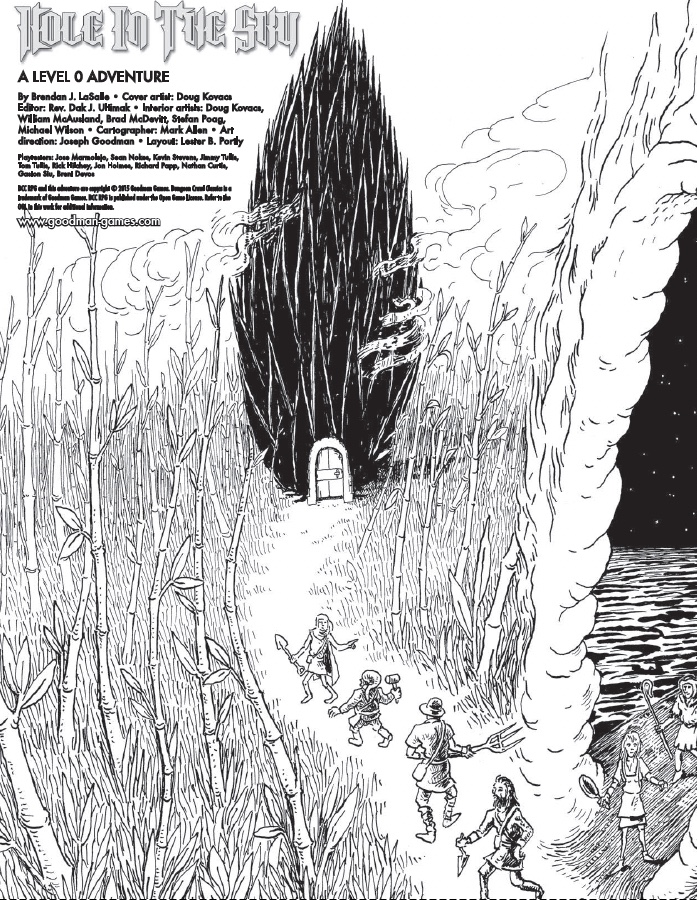
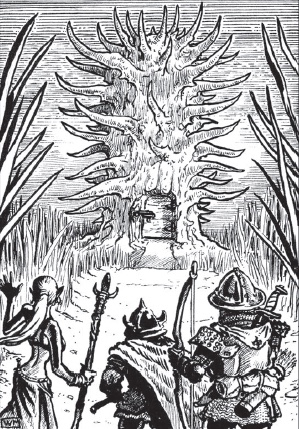
a three hundred foot monolith covered in fifty-foot long thorns. It looks not so much constructed as grown, like some kind of massive seed pod.
This is pretty metal and I enjoy the fact that the adventure contains no fewer than two different artists’ depictions of it. Both so different and yet both awesome in their own way.
Prison 1Prison 2
Luckily, there is no waking that titan who has been ensorcelled to want to exist in his dream realm. It would take something fairly cataclysmic to wake him up. And it does, of course, near the end of the adventure. After freeing Drezzta, the surviving peasants hoped into the cage and cut the rope holding it up. It fell on the titan’s head and rolled off him down to the floor where they were able to escape. They managed to kill him before they went though, as there is a magic titan killing spear to be found in the treasure cache, conveniently enough.
Cur Maxima
The pumpkin-headed lunatic is fun. I can’t quite make out the reason why it’s a jack o’ lantern creature, to be honest. It doesn’t seem particularly thematic to me or anything. But he it is a pest. The judge is encouraged to chuck him at the PCs whenever they least expect it to take just one of them and kill them in the most awful way, just put the shits up them. It works. Every time that guy turned up there wrecked groans. It was a guaranteed death every time.
There are abandoned ones who live in the walls. They were former servants of the Lady in Blue who had been sent under the same pretences as out heroes but failed or refused to carry out her orders. They longer they spent there the madder they got and the more mutated. There is one dwarf who the pCs might try to talk to but they are not likely to get much from the others. It’s not a big talking scenario this one. My PCs ended up murdering most of these wretches and burning the living quarters of the abandoned ones, sending the survivors fleeing as a result.
This is the only proper fight in the second half of the adventure and it’s not great. It’s just 12 pretty boring, emaciated enemies against a similar number of peasants. Now, the players made it memorable in several ways, but it does feel like an encounter that could have started off more interesting. At least most hits were an instant kill.
Their final reward, the Wheel of Destiny was a fun addition, although it’s a little redundant if playing as a one-shot. Each survivor gets to make a Luck roll. As soon as I told my table that, they erupted in groans and curses aimed at me. I had been encouraging them to spend their Luck liberally towards the end after all… Anyway, I’d imagine, if you were planning to play the characters in further adventures it would have been more engaging.
Conclusion
Prison mapScenario Map
This is very engaging adventure with a great, bonkers concept. Its executed so well too. The art and maps are fantastic, as an always with DCC products. I am never that crazy about their layout or presentation of information but I’m willing to overlook that given the quality of the experience.
It’s definitely worth trying out if you are looking for a 0-level funnel that has lots of hooks built in for further adventures but it worked very well as a one-shot also.
It’s almost time again for the second annual Tables and Tales Talk Like a Pirate Day Pirate Borg One-Shot or the TTTLPDPBOS as I like to call it.
TTTLPDPBOS
It’s almost time again for the second annual Tables and Tales Talk Like a Pirate Day Pirate Borg One-Shot or the TTTLPDPBOS as I like to call it. Friday September 19th is the big day, of course!
Illustration of a circuler door of gold with a skull in it.
We had a great time last year playing a pared down version of one of the adventures in the Pirate Borg core book. I did a Pirate Borg character creation post beforehand and I gave a run-down of the one-shot in this post later.
New Options
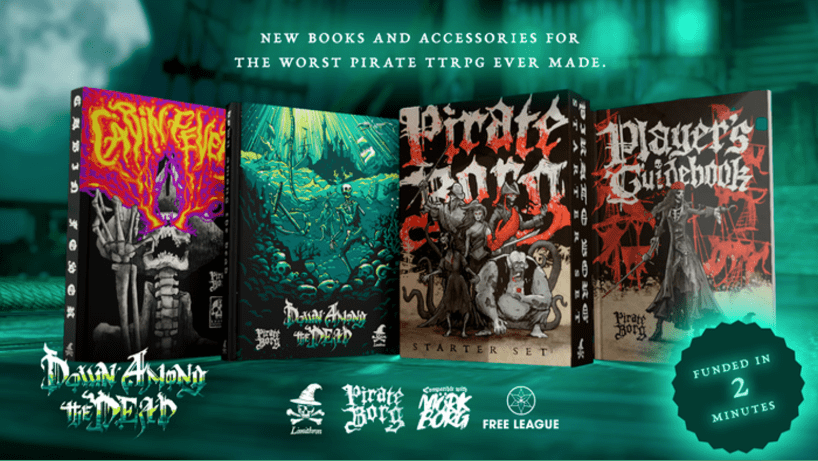
The covers of Cabin Fever, Down Among the Dead, the Pirate Borg Starter Set and the Player’s Guidebook. From the Kickstarter page
Last year all I had was the core Pirate Borg book, which I’d picked up from my friendly local game store, Replay. Since then Limithron had a Kickstarter campaign to launch a starter set, Down Among the Dead, a proper expansion with new player options, monsters and adventures and Cabin Fever, a book of third-party creator classes, options, rules and scenarios, all great new products for their flagship game. They recently released the beta PDFs for these items to the backers and I’m so glad they did because I am going to get so much use out of them for this year’s one-shot. Check out the whole kit and caboodle here. You can still pre-order it if you feel so-inclined. I would encourage you, of course, to go and support these small indie creators trying to produce quality products during an incredibly volatile and unfriendly trading climate. On that Kickstarter page, you can also read a little about the challenges they are facing in production and shipping, if you need any more reason to support them.
Trapped in the Tropics
The cover of trapped in the tropics. undead in a jungle with a smoking volcano in the background
The Starter Set includes a bunch of maps, character creation guides, dice, tokens, reference cards, a Player’s Guidebook, and a starting adventure, Trapped in the Tropics. I really wish I had all of those little physical extras to play with at the table but they are not going to be here in time for the I’ve been looking at the TTTLPDPBOS, so I’ll have to wait. I have been reading through Trapped in the Tropics. It’s designed as a teaching adventure with great tips for both beginner GM and players. It lays out the structure of the adventure in a very easy to understand format, includes notes on tone, style and inspiration and includes advice on how to use it at the table in both multi-session and one-shot forms.
As an adventure, it’s set very much in the OSR mould. It provides potential hooks, interesting locations, important NPCs, encounter tables and enemies, without a strict plot or step by step list of occurrences. I’d love to play it as a longer form game. It looks like the sort of relatively free-form OSR module that players could really sink their teeth into and make their own. However, the one-shot option is not as interesting to me. I like parts of it, but I’m struggling to come up with anything from it that might make for a memorable finale.
Cabin Fever
The cover of Cabin Fever
Then we’ve got Cabin Fever, a standalone book of content from third-party creators that was kickstarted along with the Starter Set. This is a treasure chest of a book, brimming over with little gems like new player classes (e.g. the Angler, the Barnacle, the Sulphur,) a bone construct dice drop boss generator, some truly Forlorn Encounters (e.g. Stowaway Imp, Baroness Malaria, Parasitic Beard,) and most importantly for my purposes, a selection of excellent Pirate Borg adventures. My appetite was whetted as I realised that one of these was specifically designed as a one-shot. It’s largely a location-based, exploration adventure in the mould of Pirate Borg, with a central ship, a large number of undead and a crew full of scum. And, importantly, the adventure includes elements that I feel could make for a really great finale to our TTTLPDPBOS. It’s ideal, really. So, I’ll be breaking out the tiny fake spyglasses, eyepatches, and plastic doubloons to help us get in the spirit for “the Repentant” by Zac Goins on September 19th.
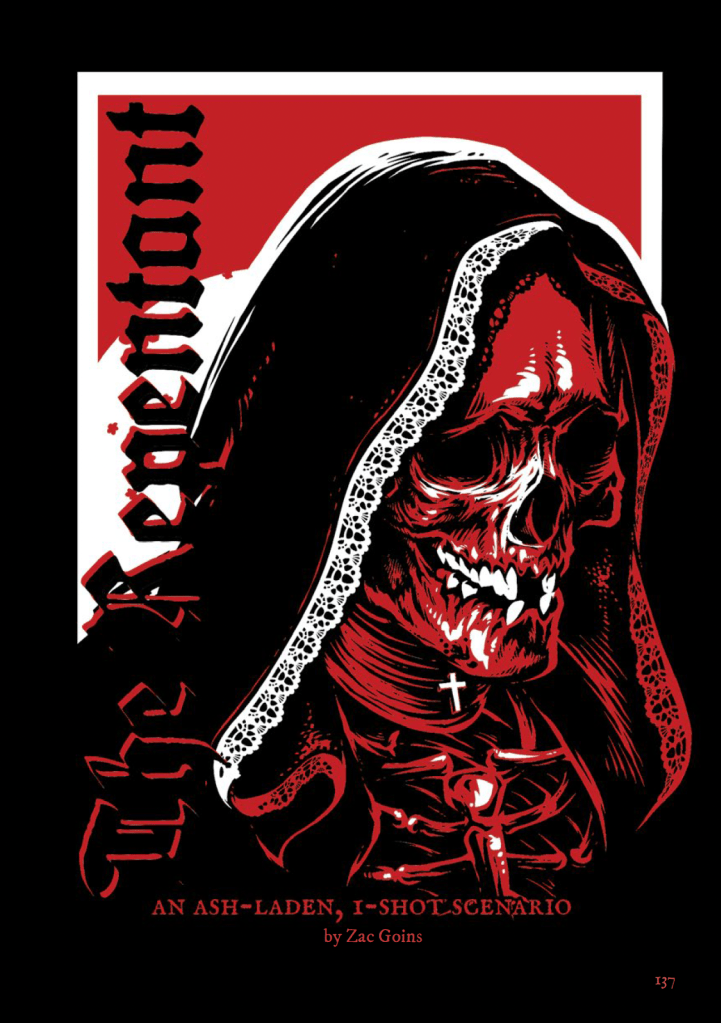
The main illustration for the adventure, “the Repentant.” A skeletal head in a hood with a cricifix around at its throat. All in red, white and black.
What about you, dear reader? How will you be celebrating Talk Like a Pirate Day this year?
Fallout is one of the most fun things about Heart. Players are sick little freaks who love getting lumbered with terrible burdens. Give them what they want, I say!
A Challenge
I have generally looked at Heart, The City Beneath as a campaign-play game. It’s made for it. It has a structure to the gameplay that rewards multi-session arcs. Your character’s beats beg you to spend time to seek out the opportunities to achieve them. And that Zenith ability; everyone perversely desires that big finale, their moment in the spotlight for one last time, that explosion of ‘themness’ right at the end so they can say they really went out in style.
So, when you are asked to run a Heart one-shot, what do you do? How can you replicate the uniquely satisfying journey that belongs to the delvers in a campaign, in just one session? The short answer, of course, is, you can’t. But, can you create a satisfactory one-shot with a slightly different feel? Yes, of course you can.
You will not be too surprised, dear reader, at this point, to discover that that was the exact situation I found myself in last week. I had a special request come from one of our founding Tables and Tales members to run a Heart one-shot, so I had to give it a go.
Heart Exam
The Butcher, replete with antlers, haunted expression and meal
Grant Howitt and Chris Taylor know what they’re talking about when it comes to designing and running games, particularly their own games, I figured, so I started with them. Heart has a lot of useful tips for GMs in it. There’s advice for the novice and the veteran alike on how to run RPGs/story games/Heart. They also include separate sections for campaigns and one-shots. It’s worth noting that much of the general advice for running Heart is just as important in a one-shot context as in a campaign. The one-shot bit itself is minimal but useful.
Running Heart as a one-shot is straightforward enough. The only changes you’ll have to make are around pacing and how you inflict stress and fallout.
Pace-maker
The Heartsong Calling sitting on the edge of the bed wondering where that music is coming from.
The advice around pacing is as true for a Heart one-shot as it is for any game, you have to start fast and keep it moving. No long-winded expositions, no character-development heart-to-hearts that take thirty minutes, no hanging about. Start in media res or as close to it as possible. Provide the necessary information in summary or in flashback and get to the action. Also, you have to give them something they can do in one session, a goal, a destination, a creature to kill or a thing to retrieve. All this sounds easy enough, but it can be tricky. It has taken me quite a while to develop my one-shot technique to a point where I feel like I am almost guaranteed to get it done in one shot. You start to figure out where you need to kill your darlings to make up the time. Working that sort of thing out on the fly is a skill I have made gratuitous use of recently.
In this one-shot, I had the PCs escaping Redcap Grove as a sort of mini-delve on the way to the entrance of the actual delve which would take them to Hang Station. They had a simple job to deliver some psychoactive fungus to a Vermissian Sage in the station. But, woah, were they rolling badly… and also being little nut-jobs. The Cleaver, predictably, decided to hunt the Druids who were hunting them and it turned into a stress and fallout ridden combat. This was fun, and horrific and hilarious. Almost everyone in the combat hulked out at some point, the Witch into her True Form, the Deep Apiarist into her Awarm Form, the Cleaver into his Chimeric Form and the one remaining Druid into their Cave-dweller Form. The players understood the one-shot assignment and did not hold back. There’s no point in saving your cool power till the end… it’s all end. Anyway, because this took a little longer than expected, I ended up combining this mini-delve with the longer inter-landmark delve that I had prepared between Redcap and Hang. I essentially just combined the remaining resistance of the mini-delve and the delve-proper on the fly. This worked well, even though it meant I had to cut out an encounter with the Butcher…
Stress and Fallout
The Penitent Calling on their knees, praying for forgiveness
Mssrs Howitt and Taylor also mention stress and fallout in the extract above. You can’t be afraid to hit them hard. Fallout is one of the most fun things about Heart. Players are sick little freaks who love getting lumbered with terrible burdens. Give them what they want, I say! Fallout is one of the key ways to push PCs to act in certain ways and that pushes the game forward so it’s win-win, innit?
I took this quite literally. I made sure that the busted old crate they were transporting their dodgy mushrooms in was leaking the kind of spores that some sado-masochist might pay a large amount of coin for. Every time they rolled against the resistance of the delve or when they made any dangerous movements or just when nothing else was going on, I got them to roll Endure+Wild to resist the effects of the fungus. If they failed, they got Mind stress and if they got Fallout from that, they got one of the following:
FALLOUT: Traitor Brain, MINOR Mind – You relive a moment of regret ad nauseum. Always at the worst possible time. All actions increase in Difficulty by one step (ongoing.)
FALLOUT: What Did You Do? MAJOR Mind – You witness the effects of your worst mistake on those it affected. It is a gut-punch to the mind. When you mark Mind stress, roll two dice and take the highest (ongoing.)
This had exactly the effect I wanted. And if you engineer it right, you can use this sort of technique to bring about some really cool moments.
Pregens
Shellaine Dawn-Breaks-Darkly Character SheetRedeye the Cleaver Character SheetDolwyn Oldshire, the Witch Character Sheet
Speaking of engineering things… making pregenerated characters for this game was the best decision I made. I had to combine it with a few tweaks to the rules, but, if I were to recommend doing one thing for your Heart one-shot, it would have to be creating and assigning pregens yourself as the GM.
I created three pregenerated characters, one Gnoll Cleaver with the Heartsong Calling, one Aelfir Deep Apiarist with the Enlightenment Calling and a Human Witch with the Penitent Calling. I gave them their starting abilities, picked their equipment, I even picked their names and answered some of the questions presented in the Calling and Ancestry sections that rounded them out as characters. I even chose their names and starting beats! I left a couple of answers up to the players, namely the ones to the questions about how their characters were associated with one another. Having them answer those gave them a sense of belonging and of fellowship with their adjacent weirdos.
Anyway, the character creation took the bulk of my prep-time, easily, but it was very much worth it. Here’s my thinking: I wanted to make sure we did this thing in one session so didn’t want anyone dithering over the details, and I didn’t want to have to explain all about every aspect of a Heart character before we even got started playing. I wanted to be able to have an inkling of the beats they would reach for to make it easier on myself to improvise them in the moment during play, I wanted to be able to plant connections to the PCs lives here and their and I wanted to be able to use the Heart itself, to make it feel like the Heart was reaching into their souls and coming out with their greatest desires. The Fallout that I wrote above? I wrote that with the idea in mind that the Penitent Witch might need that to confront her greatest regret, why? So I could introduce the last ace up a Heart GM’s sleeve, the Zenith Beats and Abilities.
The Zenith
They had been hitting both minor and major beats throughout the session and taking new abilities as appropriate. I allowed them to hit as many as they wanted. I had given them four each in their pregen character sheets. But that wasn’t enough for me.
Just as they were exiting the delve and entering Hang Station with their psychedelic cargo, I asked the players to refer to the book and take a look at their Zenith Beats and Abilities. I only pulled this out near the end so they wouldn’t know it was coming. Luckily each Calling only has two Zenith Beats available and each Class only has two or three abilities. So it wasn’t too much to look up in the moment, and, as soon as I told them this, I knew I had them (or two thirds of them anyway.)
I made it clear that I would be lenient in judging whether or not they met the conditions of the Beats because I know how good it is when a Heart PC hits their Zenith. So we made it happen. By the end of the session, each of them had brought about their own personal apocalypse and it was a thing of red, wet beauty. The Cleaver destroyed and replaced the Beast in the bottom of Hang Station, transforming the landmark into a swampy forest in the process, the Deep Apiarist summoned the Heart itself into the space just long enough to squash her into a red, wet stain and the Witch brought the Deep Apiarist back from the dead, sort of, as a clone made from the Heart itself, a clone that will always return no matter how many times it dies…
We wrapped the whole thing up neatly in about three hours. If I hadn’t cut the Butcher encounter and combined those two delves early on, it might have gone another half hour. Either way, a nice, diminutive package, I think you’ll agree.
Here’s the story: hundreds of years ago, the city’s premier logistics wizard, Whalgravaak, abandoned his warehouse, having shredded the Manual of Operations for his Sphere Pool (a mechanism used to import and export goods across the cosmos) so that his rivals could never figure it out.
One-shot fun-shot to campaign of terror
You know what it’s like, dear reader: you want to introduce some noobs to RPGs or just to your group of players, you want to make a good impression but you don’t want to scare them off by plunging them into a multi-session campaign with a complicated, crunchy system. So you pick up a location-based adventure, thinking you can just use a small portion of it, just what you need, just enough for one session, one single shot. But, after that session, the curiosity gets the better of you all. That was a weird, but enjoyable experience, you tell each-other. I bet we could have fun exploring the rest of that odd locale, you tell the players, why not have some more sessions and see how it goes? So you do that. And then the bloodbath begins.
Whalgravaak’s Warehouse
SPOLIERS BELOW! If you are interested in being a player in Whalgravaak’s Warehouse, turn back now!
The 1:5 adventures that I own, Whalgravaak’s Warehouse, The Hand of God and Eye of the Aeons. All from Melsonian Arts Council
Whalgravaak’s Warehouse is a Location based adventure by Andrew Walter for Troika! The design is by Shuyi Zhang. It came out in 2023 and was the first of the Melsonian Arts Council’s 1:5, an ongoing series of location-based adventures for Troika! There are a couple more available now and another out very soon. You can find them all here. My somewhat rotating group of Tables and Tales members just had our last session in Whalgravaak’s Warehouse on Monday night, after spending a total of eight sessions there.
Here’s the story: hundreds of years ago, the city’s premier logistics wizard, Whalgravaak, abandoned his warehouse, having shredded the Manual of Operations for his Sphere Pool (a mechanism used to import and export goods across the cosmos) so that his rivals could never figure it out.
Since then, the strange nature of the warehouse, staffed by giants and stocked with oddities, has only grown stranger, and more dangerous. It houses a handful of physics defying, Tardis-like chambers, not least of which is the terrifying Deep Storage, a swirling mass containing several pocket dimensions and a wraith-like being who wants nothing more than to consume intruders. At least one cult has taken up residence, and they are often mutated into horrific Chaotic Spawnlets by the effects of the radiation still spilling from the Sphere Pool. The warehouse is sandwiched by a vast desert of dust occupying the roof, which is peopled by the descendants of Whalgravaak’s former employees and, underneath, the tunnels of a pack of unpredictable Worm-headed Hounds.
But entrance has been forbidden by the Autarch for centuries and, even if you were foolhardy enough to ignore a diktat like that, you would still need to be brave enough to face the unknown dangers within.
The Hook and the Party
The book suggests a few potential hooks for your PCs. Since my game started off as a one-shot, with brand new characters and no existing campaign to work it into, I went for one that seemed like the object might be achieved in one session. They, along with many other groups of mercenaries were contracted to return with the head of a Cacogen, known only as the Opportunist, to their patron, an Exultant of the Autarch’s court. But we dealt with that in flashback as they all sat in the weed-choked yard of the warehouse, dotted now with small encampments of adventurers and brigands all gathering their courage to gain entry. The PCs’ band consisted of a Monkey Monger (and monkeys), a Gremlin Catcher (and dog), a Wizard Hunter and a Landsknecht. They were, to put it bluntly, a motley crew.
That first session was all fun and games. Every encounter, except for the last one with the Cacogen, was resolved peacefully. This happened mainly due to the rolls I made on the Mien table for each encounter. The worm-headed Hounds they encountered wanted to play with the Monkey Mongers monkeys, they did not want to eat them. The Flat Serviceman was happy to follow the party around and clean up after them. The Segmented Crippler in the Pigeonholery, didn’t want to wake up, so they skipped that one entirely. This is a pretty standard mechanic in Troika but I think it gave the players a false sense of security. The session ended with this motley crew finding and defeating the Opportunist quite handily. And, at that point, we thought that would be it.
But a few months later we decided to continue with their explorations of the warehouse. Obviously, their original motivation to explore was gone. They had achieved their objective, but the players were all good sports. They decided between them that the motivation was purely one of curiosity and greed. They had spotted, through a bubble like window in one of the rooms they had traversed, a vast and terrifying pool of chaos and wonder in a room far too big to exist within the confines of the building. This was enough for them. Essentially, they went in search of adventure. Although, through the sessions that followed, I did introduce the idea that they might want to find that cult I mentioned earlier and that they should seek out the incredibly valuable Tome of the Sable Fields that was reported to be stored in the warehouse, somewhere. This gave them a little direction when I thought they might need it, but, honestly, I think my players just wanted to see what new wonder/horror the dungeon had in store in the next room.
The Dungeoncrawl
It was only from this point that I started to really treat this adventure like the dungeoncrawl it is very much meant to be. The book does a good job of introducing the concepts of tracking resources like lantern oil and provisions as the party explores. It also explains the concept of exploration turns and their effect on the game, i.e. the distance you can travel in that time, the amount of lantern oil you use per turn, and the likelihood of running into an encounter. I followed all these rules to the letter and they made for some interesting moments in the game. But, to be frank, the weirdness of the setting is the real draw here, not fiddling with rations and light levels. Also, few of the characters lived long enough for starvation or oil-skins to become a problem.
It also has rules for dealing with the spatially distorted, impossibly large areas within the warehouse. It suggests that the players should make Luck or Skill checks to avoid getting lost in these areas, but, in all honesty, I didn’t really require that sort of thing.
Mapping is also a part of the dungeon crawl format and this adventure does want the party to attempt to map the space for themselves. The thing is, when some rooms appear to be a kilometre wide and the next one is spatially normal, that map becomes effectively impossible for them to draw accurately after a relatively short period of time. Eventually, I gave up and just shared the one from the book with the players, trusting their ability to separate player knowledge and character knowledge. My advice, if you are doing this, try get your hands on the PDF version, since the one in the physical book stretches across two pages and the crease obscures part of it.
In fact, the adventure has four maps:
the warehouse floorpan, using 10ft squares to denote distance
a hex crawl for the desert on the roof, replete with points of interest
a map of the Worm-headed Hound tunnels beneath the warehouse, superimposed over the warehouse plan
a largely vibes-based map of Deep Storage
These are all great but usefulness will vary. In our game, the party spent several sessions trapped in Deep Storage but took one look at the desert and noped right out of there. This seems like a good point to note how good all the artwork is in this. There are plenty of colour and black and white illustrations but they leave me wanting even more!
Warehouse Workers and other Beasties
A warehouse is a dangerous place to work, especially when the correct safety protocols are not observed. It doesn’t help at all when you are trespassers and several of the residents are large enough to crush you with a single blow.
The giants are not what you might expect.
The giants are the main NPCs of the adventure and Whalgravaak’s only remaining employees. Each one is fabulously interesting, diverse and well-drawn. They have their own motivations and desires. I was gratified that the party managed to encounter all of them during the eight sessions we played. In fact, one player had two different characters killed by two different giants. I will point out that it is entirely possible to avoid violence when dealing with the giants, it’s just that, sometimes, the Monkey Monger on the team has monkeys who decide to fuck with them and one thing leads to another.
The wraith-like Gulf Man Roamer from the swirling vortex of Deep Storage is a potentially lethal foe who has a chance to show up each time the party moves through that already dangerous room. If it captures you in its bag, it’s going to spirit you away to eat you in its extra-dimensional lair.
No warehouse is complete without forklifts. Whalgravaak’s forklifts are humanoid constructs with the face of the wizard himself. They treat intruders like stock, and will attempt to whack them and pack them. They hit very very hard.
When you read the words, Worm-headed Hound, is this what you imagined?
There are also a bunch of random encounters, including the Worm-headed Hounds I mentioned before, desert nomads from the roof, and Bandits/Burglars/Bastards. These only turn up on the roll of a 1 on a 1d6 for each turn the party travels. It didn’t occur very often in my game. The Roof and the tunnels have their own random encounter tables as well, but I never used them as the party never spent any appreciable time there.
This is just a selection of the possible encounters you can have in this setting. I haven’t even mentioned the tiny army guys, the sentient crane parts, the Onion God or the Mulled Dead.
The Rooms
I have hinted at rooms that defy physics and rooms with pocket dimensions, and those are usually the big-ticket locations that contain some of the greatest set-pieces in the adventure. Deep Storage alone evoked some of the most inventive use of skills and spells and a great degree of fear and tension from the PCs. It killed one of them (two if you count the Rhinoman eaten by the Gulf Man Roamer.) The Roof could act as an entire short hex-crawl campaign and the Sphere Pool has some truly memorable and dangerous elements to it.
However, many of the other rooms have weird and wonderful contents as well. Some of them, the party will glance at and move on, while others will capture their imaginations and encourage them to interact. I never really knew which reaction I was going to get from them, actually. The room full of melting rope? They had to spend an hour trying to figure out how to set it on fire, the eternal battle between tiny armies playing out across a battlefield seemingly larger than the whole warehouse? Just popped their heads in and left with some captured little men.
Some of the rooms were relatively mundane warehouse style rooms with shelves and containers. The book has tables in the back to help you identify the state those rooms are in and the contents of the containers, which is useful.
One of my over-riding impressions by the end of our game, was that in some ways, the great variety of bonkers content in the rooms served to detract from any unifying theme. There were some elements that went together, such as the warehouse’s disdain for traditional dimensions. If my PCs had explored the Roof or even encountered any of the nomads who dwelt there, they might have found a distinction between those descendants of the ancient striking workers and the giants who continued to obsessively do their jobs even long after their employer had passed on. But, none of that is to say that the rooms weren’t endlessly fun and inventive.
A Note on Lethality
I recently wrote a post sharing some of the obituaries of the characters who met their ends in Whalgravaak’s Warehouse. You can check it out here. There are only three of them in that post. A few months previous to that, I wrote this post, which contained the obituaries of two more. The mathematicians amongst you will have summed those already. That’s five. In the final session, we lost another one. That makes six. That was three character deaths each for two particularly unfortunate/reckless players. Warehouse work is dangerous. Only one of the original party survived to the end. You have been warned.
Conclusions
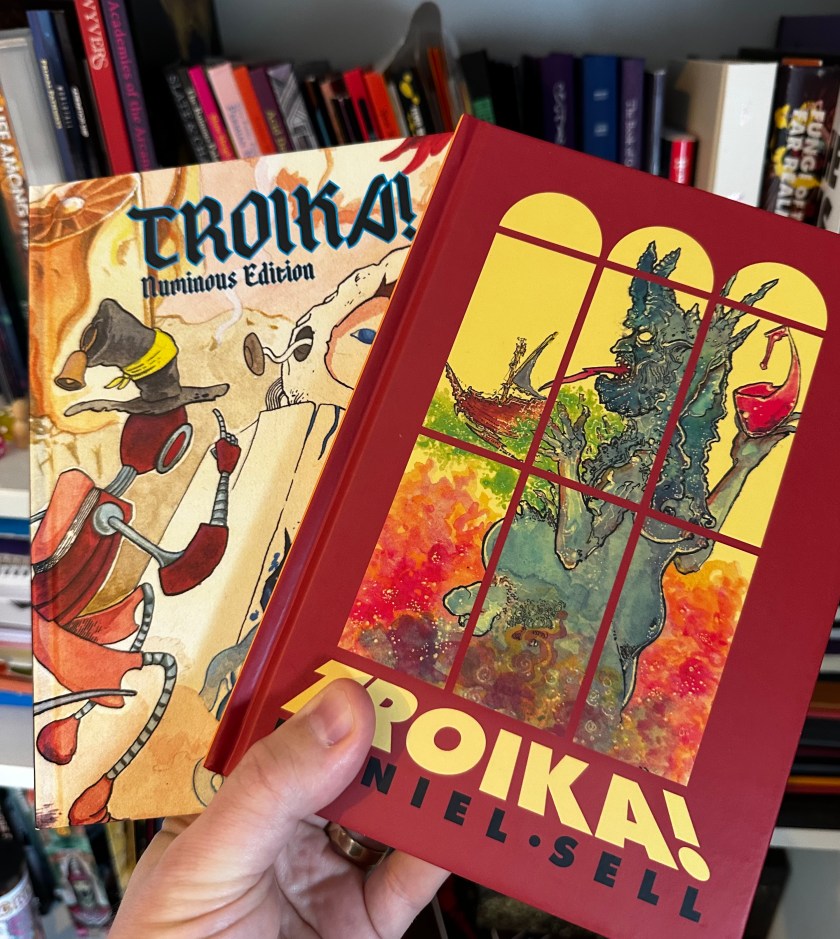
Numinous or otherwise, its the same game.
There is so much to recommend in this adventure. It is endlessly entertaining, challenging and bonkers. It has such a variety of locations and such a diversity of encounters that you would need to work hard to get bored in Whalgravaak’s Warehouse. I think it works so well to show off Troika! as a system, too. The problems it asks the PCs to solve and the encounters they have to deal with utilise things like the Luck check really well and encourage players to invent their own unique Advanced Skills. But if they get into fights, especially with the incredibly random nature of Troika! initiative, there is a very high chance they are going to come out of it dead. There are a few opportunities for insta-kills throughout the warehouse too. I can’t overstate exactly how lethal this adventure is. Luckily, my players leaned into that, even when they were creating new characters to join in the same fight the original one died in (they got very quick at creating characters.)
I think it’s also flexible enough for many GMs to easily take it or part of it and fit it easily into their own ongoing Troika! campaign. As I said at the start, our game started as a one-shot and it could have ended there. But we were able to easily adapt it into a short campaign of its own.
Dear reader, let me know if you have played Whalgravaak’s Warehouse or if you would like to! I’d love to know your views on it.
If you’re interested, go check out my post previewing this game here.
A Bad Call?
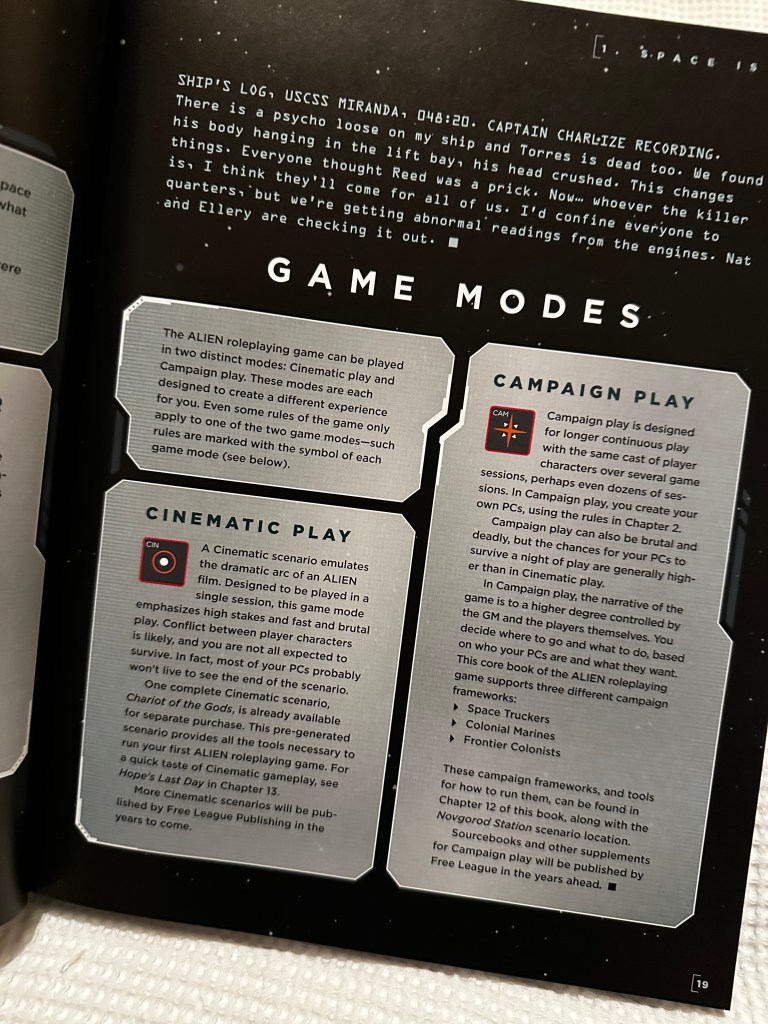
Burke, Carter J “confessed” to Ripley that he had made a bad call in sending them to a colony on the moon, LV-426. But did he mean it? No. He was a scumbag of the highest order. He was just fucking someone else over for a percentage. I sent my players to LV-426 too. I wasn’t looking to fuck them over for a percentage, but, at the very least, I expected most of their characters to get impregnated by facehuggers, ripped to shreds by drones or melted by acid blood. Did any of that happen? Did I make a bad call in choosing the Cinematic Alien RPG scenario, Hope’s Last Day, from the core book, rather than the one from the Starter Set? Well, dear reader, why not come with me on a trip through our one-shot and my thoughts on it, and you’ll find out.
Shake and Bake
These two scenarios couldn’t really be much more different. The one from the Starter Set, Chariot of the Gods, is set on a ship out in space, you know, where no-one can hear you scream? It’s also very much a full scenario with an entire three act structure. They say it would take three sessions to play but I have my doubts about that estimate, having played Hope’s Last Day.
Speaking of which, Hope’s Last Day is a scenario that’s set totally on the moon where Ripley and the Nostromo’s crew found the Alien eggs in the first movie and the setting for the action of the second. This scenario was not even a full Cinematic experience. It is billed as a taster, since it really only encompasses what would be the third act in a normal Cinematic scenario. The book confidently asserts that it could easily be played in under two hours.
Frankly, duration was the deciding factor for me. I only had one night to get through a whole scenario. I don’t have a lot of wiggle-room in my schedule due to the fact that I have at least seven other ongoing games at any given time, so it really had to get wrapped up in one shot. So, I shook it and baked it.
Shaking
Shaking, essentially, meant reading through the scenario a couple of times. It’s very short, so this was not a problem. I also took notes on the various major beats and summarised the contents of the various blocks and rooms into bullet points. Most of the scenario consists of these location descriptions so this was key for me. Also, they are all presented in what I consider to be unwieldy blocks of text in the book, and I prefer referring to bullet points at the table. This work helped me to keep things flowing a little more smoothly on the night. I also screenshot handed the pregenerated characters out to the players I thought they would suit best a couple of days before. This part was fun, and the players were left to wonder how I decided who should play which character. Each character had an agenda that was generally meant to be kept secret from the others. Now these were fun. Stuff like, being willing to sacrifice themselves for the others, wanting to acquire an alien and escape with it or just to keep the company’s actions a secret at all costs. You know, normal stuff. Anyway, I examined these agendas and assigned the characters purely out of a desire to see each player pursue that secret agenda. Other than this fairly sparse preparation, I got a couple of copies of the map of Hadley’s Hope printed and a few character sheets. I familiarised myself with the relevant rules as much as I could and that was it for the shaking.
Baking
At the table, we baked. And, I will say most of the time this one-shot spent in the oven, there were no issues at all. Was I ready to nuke the site from orbit by the end? Not quite, thankfully. I’m mixing my metaphors quite egregiously at this point so I’ll abandon them both and just tell you what happened.
I started exactly as the scenario suggests you start, with the four PCs inside the West airlock of Hadley’s Hope. They had just returned from a day or more outside the settlement and were not aware the Aliens had already decimated the population. I let them investigate a bit, try and get an intercom working, and generally futz around. The scenario calls for an Alien attack whenever the PCs dawdle but I didn’t want to lose anybody so early on. I think this was a mistake on my part. Their first encounter with an Alien occurred a little later after they had made their way to another block of the station and messed around looking at eggs and facehuggers and whatnot. This gave one character the opportunity to collect an egg and another to sacrifice himself to keep the others safe and made them all start running to find the way out. This was more like it. Things really started moving then. The one who sacrificed himself turned out to be an artificial person as Bishop would have us call them. So, the alien just left him, innards outed, on the floor and unable to move, but not dead. Luckily there was an extra pregen for that player to take over so we continued on.
Later they encountered a couple of facehuggers after finding a few weapons. They made short work of them and moved on again. They spent much of the last part of the session effectively split into two parties running from two different drones towards the only way off the planet, a shuttle. And you know what? They all made it! Except the android, who, I can only assume was caught in the conflagration when the nuclear reactor in the processing plant went up as Ripley and the others escaped. Also, they didn’t all make it, because the pilot turned out to be the company plant and she spaced everyone else as soon as they left the atmosphere. I guess that made her the winner?
Game Over, Man
So, what was the verdict? It’s a mixed bag, to be honest.
I think our main complaint was that this was mislabeled as an under-two-hour scenario. I mean, ok, it was our first time playing the Alien RPG so we did have to spend a little extra time referring to the rules and figuring out what all the stats meant, but that does not account for the fact that this thing took us almost four hours. Even then, I had to abandon some integral rules to allow us to make it to the end in that time. I don’t honestly know how anyone gets five people around a table, people who want to role-play, who want to fuck around and find out, people for whom the joy is in the playing, not in the finishing, and have them get through this scenario in anything less than four and a half hours if you stick to all the rules of the game.
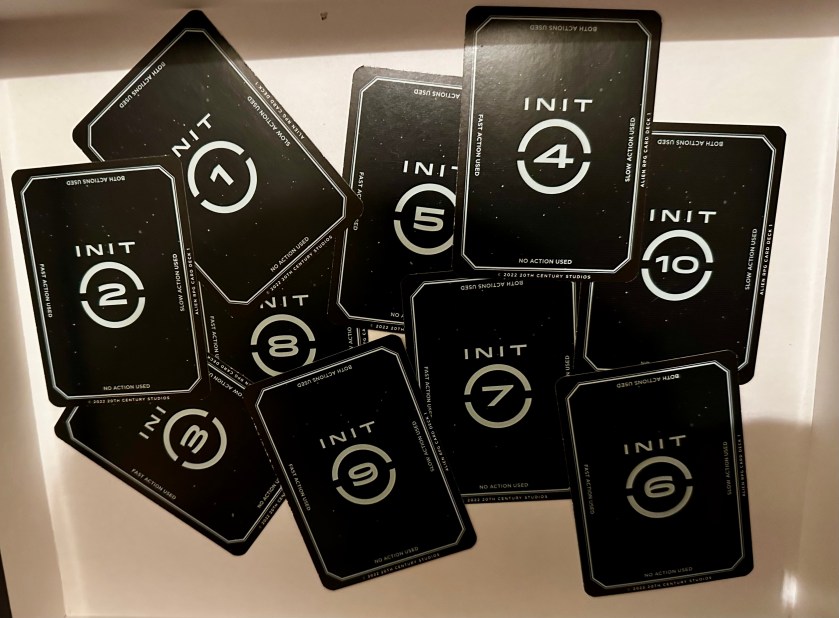
As for the rules. The main negative was the initiative system. Alien, like other Free League games, uses an initiative card system. We generally found it a little difficult to keep track of things using this and found it slowed the action down significantly. One of the main issues was that the PCs kept getting into initiative, running away from fights, getting out of initiative, getting caught again and getting into initiative again! So we were shuffling and picking those cards a lot. In fact, as time ran out on our session, I just left the cards to one side and did it narrative style. I got each player in turn to tell me what they were doing and told them how the Aliens or the environment reacted or acted against them. This really sped things up and drew the evening to a very exciting close, in fact. Would I use the initiative system as-is if I played again? I think I would give it a go as long as I had more time to play with but I would be ready to give up on it in a second if it started to get in the way again.
One more issue for me was the system used to figure out how the Aliens attack. Every time it’s their turn, the Game Mother has to roll on a table to determine which of their special attacks they use. This started off as a fun activity, but quickly got frustrating. It felt like each time the Alien had one of the PCs in their grasp, I would roll up an attack that allowed them the chance to escape. Now, if this happens a couple of times, it adds a nice dramatic element to the chase. But this is literally how they all managed to get away in the end. If I had been just choosing the attacks for the Aliens, there would not have been so many occupied seats on the shuttle when it took off. I feel like there is a better way to adjudicate the moves they make. Admittedly, you would not want every attack to be lethal, either, but it felt as though far too many of them were underpowered.
One element that worked well but felt like it was under-utilised or tacked on was the Stunt mechanic. Each skill had a stunt table that told you how you could spend your excess successes (each 6 you get when you roll your dice pool is a success and you gnerally only need one to succeed at your task,) but the players almost exclusively went for one of two options, at least in combat situations: they added extra damage or they pinned the enemy down to prevent them from taking as many actions on their next turn. This was fine but it feels like this needs more work. Perhaps the new edition will deal with this.
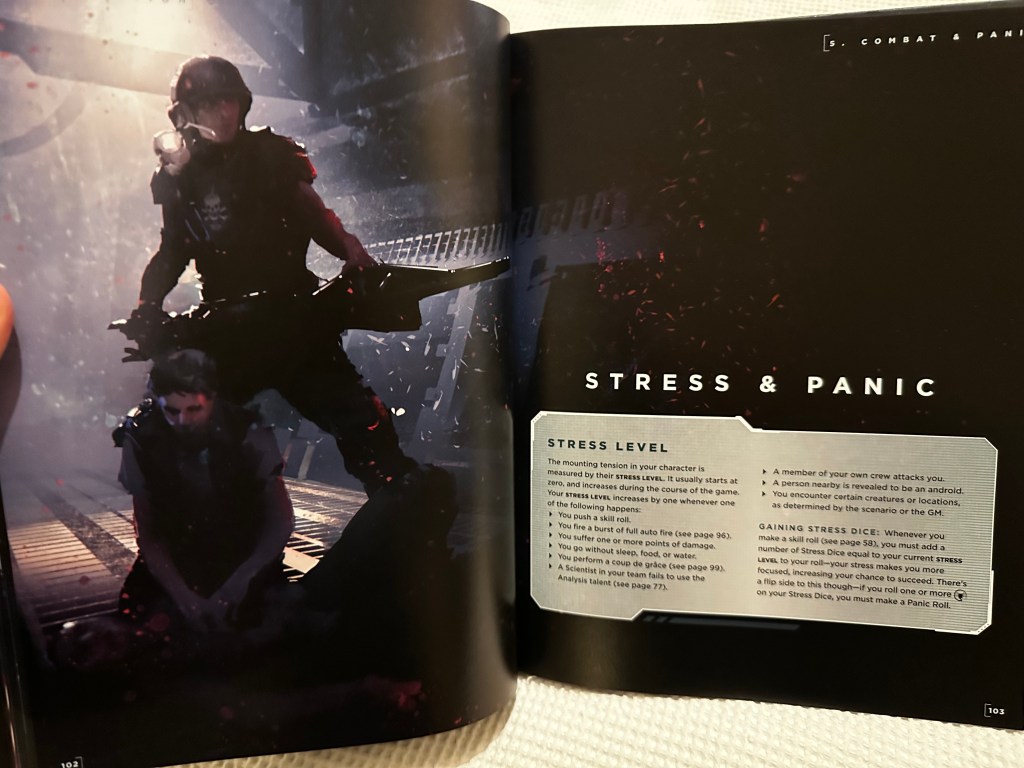
You know, there were plenty of mechanics we liked in the game too. The main mechanic in the Alien RPG, the thing you would lean on to sell the system, is Panic. Like other Year Zero Engine games, you roll a dice pool consisting of a number of dice equal to your score in a given skill plus the number of dice equal to your score in the related ability. So, if you have a 1 in Mobility and a 2 in Agility, you roll 3 dice. But, as you play, your character gains Stress for all sorts of awful reasons. For every point of Stress you gain, you get to add another die to every dice pool. This gives you a greater chance of success but also gives you a chance that you’ll have to roll on the Panic Table. This happens if you roll a facehugger (a 1) on the official Alien RPG Stress Dice. There are other ways of panicking. Usually, if one of your companions does something unhinged or crazy or if you see an Alien for the first time. That kind of thing. By the end of the session, everyone had so much Stress that they were rolling obscene numbers of dice and there were Panic rolls happening almost constantly. One Panic roll would often lead to another from someone else because of the result they would get. Also, because, each time you roll on the Panic table, you have to add your Stress Score to the roll and the shit at the bottom of the table is way worse than the shit at the top, the results got very bad as time went on. For example, this is what you get for rolling a 7 gets you:
NERVOUS TWITCH. Your STRESS LEVEL, and the STRESS LEVEL of all friendly PCs in SHORT range of you, increases by one.
This is what you get if you roll a 15+:
CATATONIC. You collapse to the floor and can’t talk or move, staring blankly into oblivion.
This did happen to one character but they were already at the shuttle at that stage and someone was able to drag them inside.
The feedback I got in stars and wishes from the session indicated that the players also loved the agendas they were given with their PCs. This was a worry for me before we started. I mean, not only did they not get to create their own characters, I didn’t even give them the choice of which one to pick. Obviously, this was because I didn’t want to reveal the secret agendas to everyone before play started. And I’m so glad I did it this way! Everyone had pretty much figured out who was the android in under an hour, but no-one, and I mean even me, because I forgot what the pilot’s agenda was, expected to be spaced by one of their own when they were on the verge of escape. Incredible scenes. This element of the game is specific to the short Cinematic Play scenarios. And, indeed, normally, in a full scenario, your PC’s agenda changes as you move through the three acts. I can’t account for how well this works, obviously, but it sounds great.
As for the scenario itself, there is not a lot to it. This is definitely a good thing. If you play it, you’re not going to get to most of the compound. A lot of those areas I summarised into bullet points remained completely unexplored. Once the drones were after them, the PCs soon discovered a sense of urgency and a definite goal, i.e. escaping on the shuttle. There was a bit more to it than that, but not much. Like I said, this was fine, especially as the PCs’ agendas took the place of a set plot most of the time anyway.
It was also cool that the scenario was so closely related to Aliens, the movie. I watched it the night before running the session, and that definitely helped me to picture the place and to describe it at the table. I’d recommend doing that if you do intend to run Hope’s Last Day. I’d also recommend leaving yourself at least four hours to do it justice.
So, was it a bad call? No, but if I went into it again, knowing what I know now, I would have made a few alterations to my expectations.
What about you, dear reader? Have you played this scenario or this RPG? Are you looking forward to the Alien Evolved Edition? Get in the comments?
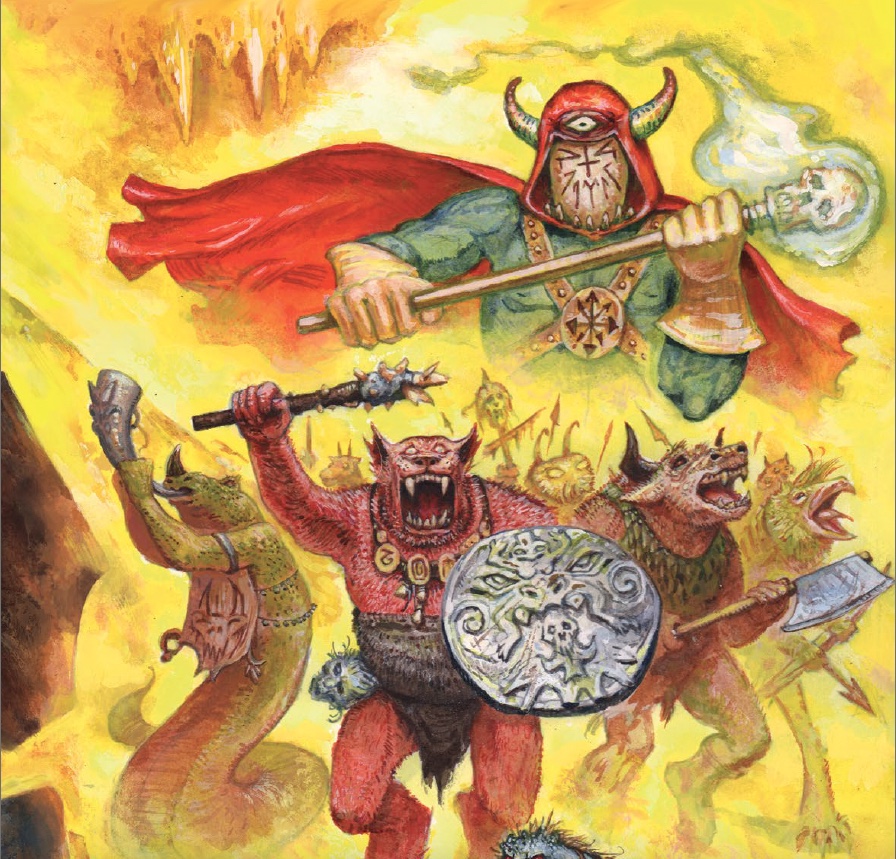
A few weeks back, I wrote up the fictionalised version of the events that occurred in the first session of Sailors on the Starless Sea, as played by the incredible members of our local in-person RPG community, Tables and Tales. They had just defeated the Beastman menace aboveground and were girding their collective loins to delve below the Keep of Chaos. Here’s part 2. Spoilers ahead if you plan to be a player in this module in the future!
The Starless Sea
In and in the darkness settled about the invaders and their new recruits, the doughtier of the captives they released from their chains in the charnel tower above. From the first landing in the stairwell, they gazed down and some saw the gleam of gold upon the steps below. Guðlaf, ever in pursuit of greater treasures, descended and found only a trio of lonely coins dropped and left where they lay. But, too, he noticed a curiosity in the one wall of the second landing. It appeared to stand…ajar. He and several of the others pushed through the revealed entrance to a chamber bedecked in antique cobwebs and festooned in the emptied carcasses of a treasure horde’s chests. While Marquis and some of the others gathered up what little coin still graced the grey stone floor, Hilda the Herbalist went to inspect the chests. One, she discovered, easily enough, had a hidden compartment in the bottom. Delighted with her discovery, she levered it open. The treasures inside were roundly ignored as a blade swung out, slicing away two of her earthy fingers. She cried out and bandaged the wounds as the others examined the find, tarnished silver jewelery, glittering emeralds of great worth, and a tabard of black, bearing upon it, the sigil of Chaos. As well, a brace of potions, oil of the black lotus according to Hilda. Imbibe it and gain great fortitude for a short time, but suffer for it later if found too weak to bear it.
Across the landing, another contingent of brave souls had found a great rend in the rocky wall. They had entered and found only another door. This one was surrounded in evil-looking runes. None of them could decipher their meaning, but they proceeded to attempt to enter nonetheless. They shoved and heaved and, eventually, shifted the great stone doors on their hinges. As they did, the magical wards fulfilled their fell purpose, exploding in unholy fire. Immediately, Ealdwine Dwerryhouse, the recently recruited Pádraig, elephant-eared Dainn and Ropert the rope maker were roasted like swine on spits, leaving only the girl known as Bear and Darik to enter the frozen tomb of the Chaos Lord Felan. He lay there still after years uncounted, perfectly preserved with his enormous axe and his glittering armour frozen with him in translucent funereal garb, a thick sheet of magical ice. Daric entered and tried his best to break through to retrieve the weapon but to no avail. Fearing for his life in the ice-clad chamber, he retreated.
Re-united on the fateful stair, the survivors gathered their courage and continued down into the darkness. They had come to rescue their neighbours and kinsmen and by the gods, they were going to do it.
Soon they found a new chamber, this one richly decorated in tile mosaics. In the centre a long, deep pool stretched almost to the other end. Almost all of the survivors were gripped by an undeniable drive to gaze into the waters of that pool. They simply found themselves there, as though transported by an invisible hand. And as they looked, the skulls of men and women rose, like glowing, hideous bubbles until they floated there, awaiting their new owners. The villagers took the skulls offered by the pool and were released, then, from their compulsions. Free to examine the rest of the chamber they found several nooks containing the mouldering old robes of some sort of Chaos cultists. Two of their number, Lydia and Roric took the robes and donned them, perhaps to fool some future enemies. Others looked upon the mosaics. They depicted several subjects. The first was a hooded figure standing atop a tall, stone monument, seven tentacles waving from the dark waters of the lake below it. The second showed a pair of armour-clad warriors clutching a single flail and commanding an army of bestial fighters. The third revealed a golden ziggurat atop a small island and a tall figure atop it, in the process of sacrificing a maiden.
Leaving the Dread Hall behind, they went on, down and down a long set of wide stone steps all the way to an incongruous beach of black sand, occupied by a massive menhir and, beyond, in the misty waters of some starless sea, the majestic, draconic prow of a proud longship.
Marquis decided to take the reins, doffing his heavier clothes and items so he could swim out to the ship unburdened. The others tied rope to him and chain to that, to allow him to swim the whole way. The water froze him almost to paralysis, but he persisted, as though crawling through the blackness of the void where the Chaos Gods dwell. Almost had he reached the forbidding hull of the longship when he felt something even frostier than the waters wrap around first one leg then the other. Bubbles escaped his mouth as he was pulled down, down, down into the deep and the dark. Those left on the beach could only notice the rope streaking through their hands at a speed Marquis would be incapable of. They tried to hold on but soon gave up when they saw first Marquis’ left side and then his right, dangling from a pair of gargantuan tentacles, then dropped into the water, never to be seen again.
Determined to find a way to the ship, Peggy, the well-known, one-legged beggar of their village, led the rest across the sands towards the cursed obelisk, and attempted to decipher the meaning of the swirling, mystical carvings that adorned it. Anger, violence and a compulsion to cut out his companions hearts and sacrifice them to a being of pure chaos beneath the still, black waters washed over Peggy, but he pushed away, he resisted and, instead, climbed the narrow stairway that led to the top of the menhir. Already, Lydia, ever faithful and sworn to carry the burdens of others, stood on top, examining the melted remains of a red candle set into a stone bowl that she found there. “No more room up here, cripple. Go back down,” she said, heeding the beggar but little. This was enough to send the traumatised man into a rage. “Do not call me that!” he screamed, lashing out with his crutch and knocking Lydia from the summit of the stone. She fell and hit the sand with a sickening crunch. Peggy looked down from above as the others gathered around their neckbroke companion. He felt no regret, he felt no remorse. Instead, he lit the stump of the crimson candle and watched as the ship approached the shore.
If the others thought of vengeance or justice for the murdered Lydia, perhaps they decided it would be best to address the matter after their fellows were rescued from this hellish sea. They all climbed aboard the boat and it turned to face a golden glow out in the murk of the great cavern. Mu set the pace and the strongest of them took an oar each, rowing for their lives and the lives of their loved ones. On they went until they could easily make out the shape of an imposing golden ziggurat atop an island out there in the waters. It appeared just like in the mosaic. The subject of human sacrifice entered the minds of many of the villagers so they redoubled their pace.
Until the tentacles re-appeared. One wrapped itself quite securely around the stern of the ship and another attached itself with its strong, wine dark suckers to the gunwale, as five more burst from the water ahead, thrashing and threatening.
Guðlaf thought of the censer he carried in his bag, the one from the chapel of chaos in the keep above. Perhaps, if it could be used, the creature would recognise fellow worshippers of the Choas Lords and allow them passage. He retrieved the item, opened it up and remembered… he did not possess the incense. The rope maker, Ropert had it on his person when he was roasted by the flame ward trap in the tomb of the Chaos Lord, Felan. Curse his greed! He called for aid, holding up the useless censer and Hilda noticed. Cleverly, she carried always in her satchel a collection and mixture of herbs and ingredients that might come in useful in many situations. Here she attempted to recollect the smell of the incense Ropert had recovered from the chest in the chapel, and praying to the spirits of her fore-mothers, sprinkled them into the censer. Guðlaf sparked the herbs to flame and swung the censer madly on its chain across the deck of the ship and over the inky waters. The tentacles reacted immediately, retreating into the depths, their owner remembering, perhaps, the ancient compact between it and the Chaos Lords Felan and Molan.
On they rowed until they landed at a narrow strip of beach below the lowest steps of the great golden ziggurat. A hellish orange light burned through the cracks between its huge stone blocks. A ramp, long and straight, led up to the very utmost of the pyramid, flanked by beastmen of all varieties, baying and howling and crowing and hissing as a steady stream of villagers, tied and chained and gagged were forced up to their doom.
Realising their time was now very short, the sailors sent out a sortie to see what they could see, Bear and Lindon Lyndone crept around the outside of the imposing golden edifice and then up they went to spy on the top. Up there they could see several more Beastmen, shoving humans and treasure into a glowing pit, overseen by the effigy of a tall, one-eyed armour clad warrior with a flail. They went back to report what they had discovered and the sailors decided to break into two groups. The first would be led by those with the chaos cultist robes on, taking the others as sacrifices up the ramp, in the hope that they would not be noticed by the Beastmen who were so rampant in their worship. Meanwhile, the other team would creep around the ziggurat once again, in an attempt to make it all the way to the top and stop the sacrifices without angering the entire crowd of Beastmen.
In preparation, Mu and Guðlaf consumed the black lotus oil, danger of death be damned! Danger was all around!
And so they set off. The two in the robes, pushing and prodding their companions ahead to give the impression they were the capturers. All seemed to be going well until, Mu, unable to witness the cruelties being heaped on his people in silence uttered a single “mu,” and raised his head to better perceive the situation and a great, pug-faced beastman, noticing Mu’s human features, barked and yipped and grappled Mu. Then, the battle was truly joined. Around the other side of the ziggurat, Guðlaf, one of the stealthy team, dropped a bag of the coins he had been dutifully collecting through the keep and below it. It clanged and jingled with surprising volume, attracting the attention of a contingent of Beastmen from those lining the ramp. They wasted no time in attacking.
Combat proceeded and for a while, it looked hopeful for the villagers. They felled one unholy chaos creature after another, but when the Beastmen gathered their wits enough to launch a significant counter attack, peasant after peasant began to go down. Several of them were dragged to the top of the ziggurat where the great Beastman shaman was hurrying the end of the ritual to summon the Great Chaos Lord, Molan into the effigy set above all. But there, they managed to escape their fate at the bottom of the molten pit. Instead they attacked the shaman and his acolytes who fought back like animals. Bear, so lucky so far, found herself disembowelled on the end of the shaman’s blade as she bravely went into battle with him.
But the ritual had been completed now, the Chaos Lord inhabited a physical form once more. His skull-like head bore only a single blazing eye, his dark armour glistened in the remaining light now that the magma in the pit had been consumed by the ritual. His flail, glowed with a demonic fire, lashed out at all that approached. He laughed at the attempts to bring him down. But those who still stood, those not occupied by the Beastmen on the ramp, joined forces to do just that. Around him his forces dwindled as the villagers, urged on now that their fellows had been found and saved from sacrifice, brought low the shaman, his bestial acolytes and many of the forces on the pyramid below. Roric charged and was crushed by Molan’s flail, the halfling, Hamfast Harfoot, but recently rescued from the tower of the keep was undone by the skewer-like spear of a beastman, likewise, Lindon Lyndone found himself run through.
The attacks to the great Chaos Lord went on and on, many utilising the glowing skulls they had retrieved from the Dread Hall, which exploded in green fire when they struck. They had demanded to be used, glowing now more fiercely than ever in the presence of the hated Molan. It was one of these, flung by the wily and murderous Peggy that struck the Chaos Lord in the eye, setting his whole head ablaze and finally bringing him low. I cheer of triumph went up from the assembled villagers, both fighters and captives alike, as his body melted leaving only his accoutrements, flail and armour. Peggy wasted no time in lunging for the great flail, but it was a mistake. The hero of the hour found himself burned and destroyed by a magma golem’s fiery pseudopod as it generated from the Chaos Lord’s remains. Vargan, also, greedy to the last was left a burning husk by the golem as he had reached for the armour.
The rest of the villagers gathered some of the fallen coins that littered the top of the ziggurat and then ran for their lives. The cavern was collapsing around them and a great tidal wave rose from the west side of it, threatening to destroy them all in moments. All but Daric reached the ship in time and climbed aboard. He had insisted on remaining to gather even more riches and he was forced at the last moment, as the ship pushed off and the rowers began to row, to leap across the churning black waters of the Starless Sea, into the waiting hands of his comrades, forgiving as they were of his greed and foolishness.
The titanic wave hit them, drowning the evil island and propelled the dragon-prowed longship across to the far side of the sea and down a narrow tunnel and on and out into the waiting river beyond. They had escaped.
Guðlaf lay on the deck in the sunshine, breathing ragged and baleful breaths. He looked into the eyes of Mu, who was sprawled beside him and spoke the words “It is well.” Both had taken the black lotus oil knowing the risks. Mu looked into his companion’s eyes as the light left them. He shed a silent tear for him and looked about at his remaining friends, Dave, Hilda, Daric and Helfgott Hoffman, wondering where they would go from here. They had come through so much death and loss but had achieved the impossible. Surely they could more return to their old dull lives in their village than Guðlaf could return to life of any kind. Perhaps this ship would take them on to more adventure. He managed to express all this in a single elegant syllable as the sun blazed down upon him, “Mu.”
If you’re anything like me, dear reader you buy a lot of RPG books that you are unlikely to ever pick up and play. Sometimes, that’s the intention or at least, you don’t have a plan to plan to use it, you know? I have some in both categories. Some books I backed in their crowdfunding phases because I want their creators to continue to create cool stuff, even though I know it will be impossible to fit the actual final product into my ongoing campaigns or their new game into my frankly ridiculous gaming schedule. Some I picked up in PDF format through Bundle of Holding or Humble Bundle because the deal was so good I would have been stupid not to buy them. Some I purchased with the knowledge that they might enrich an ongoing campaign but then just never fit in anywhere.
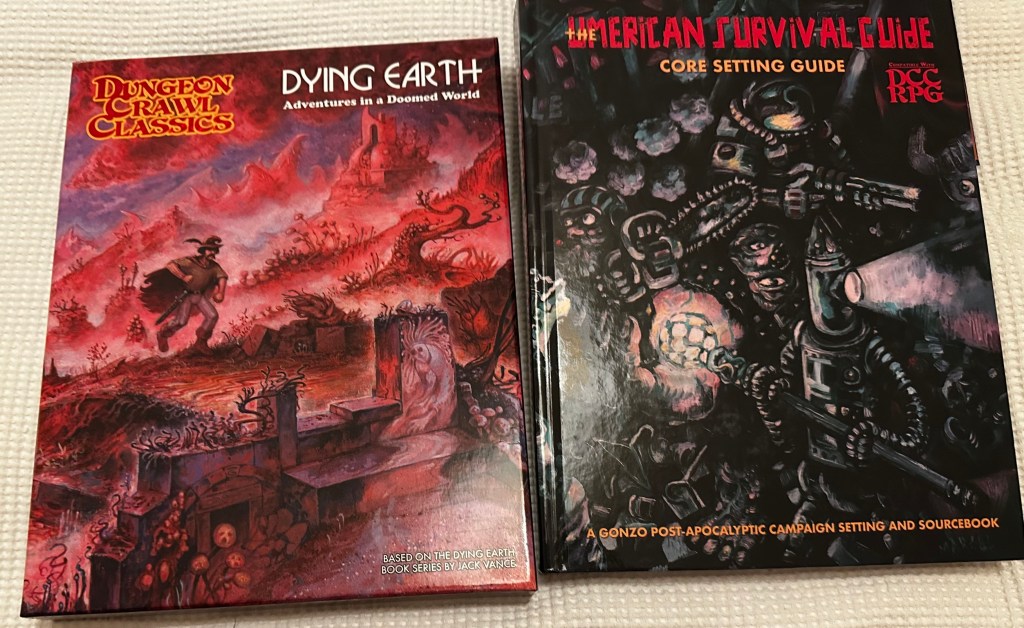
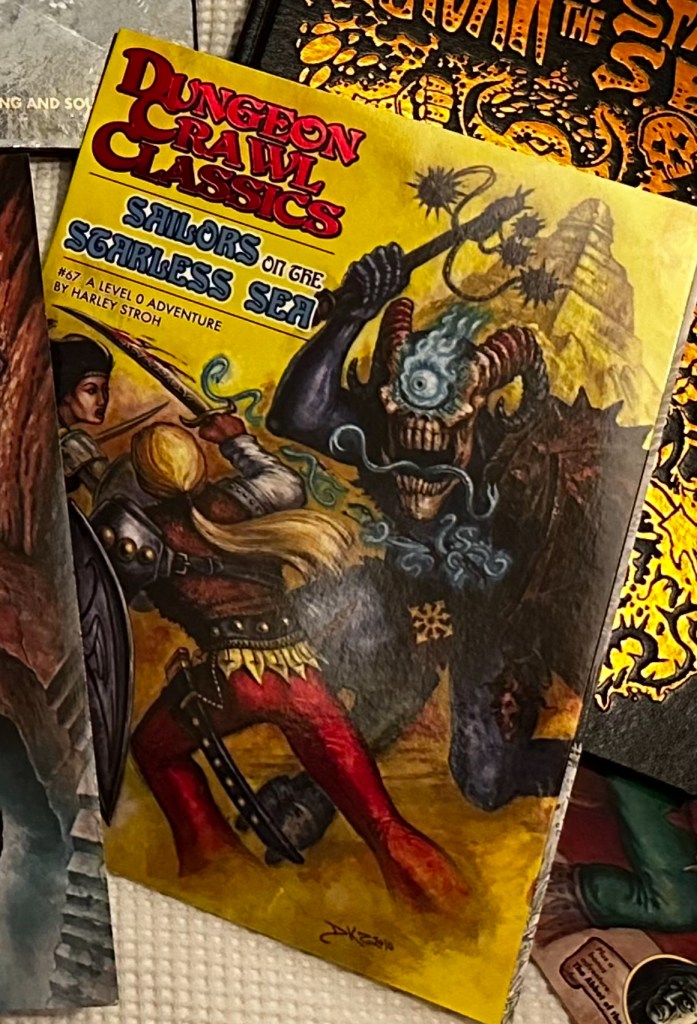
But DCC adventures are in a slightly different category. I have bought a truly obscene number of them, mostly as PDFs. I think this started after listening to a few of the reviews of DCC adventures by Fear of the a Black Dragon. Then I started to collect physical copies. My local independent game shop had copies of their Dying Earth setting box and the Umerica setting book, both of which I purchased. You know, a lot of the time, this was purely due to aesthetics. They are beautiful works of art, frankly. I love their style and their content, even if I hate their layout. But the real reason is because these have always been aspirational adventures for me to play. Genuinely, I feel at this point that, if I could, I would abandon D&D for DCC. Why? The adventures I have read are just effortlessly lacking in D&D’s corporatised humourlessness. They are not written in comedic fashion but in the last two sessions of DCC playing Sailors on the Starless Sea, I have had more genuine laughs and gasps of outrage and tears of sorrow and joy than I have had playing D&D since 2014. And that is not to demean the efforts of many of the wonderful creators of 5E products, it is simply to praise the work of the designers who created a game that I expected to bounce off due to crunchiness but which I, instead, embraced due to its flexibility. The philosophy of the adventure design also has a lot to do with this new attitude. To discuss that, let’s talk specifically about the module I just finished with my players tonight, Sailors on the Starless Sea.
Sailors on the Starless Sea: Endings and Beginnings
The surviving sailors sailed off to parts unknown at the end of our session tonight, each player with one remaining character. This is the ideal ending to a DCC 0 Level Funnel adventure. I am guessing that sometimes players end up with more than one 1st level character to begin their true career as a proper DCC adventurer, but it seems like the best possible outcome if you’re only looking after the one.
It was the getting there that was so much fun though. I wrote recently about character creation in Cosmic Dark being so much fun because the players play it, they role play the most developmentally significant moments of their PC’s lives up to that point in snippets and flashbacks with other players. The DCC funnel is surprisingly like that except its also involves a dungeon crawl, horrific death on a brutal scale and a boat load of shared trauma. Every one of the characters left at the end of the funnel knows precisely what the rest of the survivors are capable of and what they are not capable of. They know some terrible secrets about them and they know that they are keeping some terrible secrets about their own character too.
The survivors were not necessarily the ones you might have predicted at the start as 20 peasants ranged about before the Chaos Keep’s rusted portcullis, but they were the ones Luck favoured in the end. They survived traps, vine horrors, a shit-tonne of beastmen, a cursed well, a fire trap, a Chaos Leviathan, the return of a Chaos Lord to the plane of mortals and a literal tsunami… Someone powerful was smiling on them. And their players knew that by the end, that’s for sure. This made every death so much more terrible and every survival so much more precious. If it hadn’t been for that one critical hit that time, they might not have destroyed the Chaos Lord; if it hadn’t been for that fumble, maybe Gwydion would have made it past the chapel; if it hadn’t been for that successful Luck check, maybe Thomas would have been left with no surviving characters instead of the four he started the session with. There are so many of these death or glory moments woven into the text of this adventure that it is hard to overstate how much every roll and action seems loaded with meaning and significance, especially when the PCs generally have no more than 2 or 3 HP.
It’s easy to say that there were just so many PCs that their existence was cheapened. I even allowed them to restock a few peasants at one point. The adventure allows for this about half way through because they know exactly how lethal it is about to become on the second level of the dungeon. 23 PCs went into the dungeon in total. Six emerged alive, one succumbed to the effects of a potion once they had escaped, a poignant and fitting end point to the whole story. Every one of those deaths had an effect on the player who played the character.
They wondered from the start who might survive. Maybe they would be different. Maybe all their little darlings would make it through. Perhaps only the weakest would be culled. Repeatedly, tonight, the characters that the players expected to survive went down. It was still shocking to them, it was still sad to say goodbye to them, even though time was of the essence. It made for some of the most effective drama I have had the pleasure of being part of at a gaming table in years. And it was a DCC funnel adventure. An adventure designed as a way to whittle down your choices of character to play in a campaign in the most Darwinian fashion.
Harley Stroh wrote a great adventure filled with mystery and danger and conflict and true significance and then they play-tested the shit out of this thing. This is how I know: There was a moment at the very end when the last PC, who had stayed behind to loot some corpses, had to make a Luck check to secure his place on the Dragon Ship to escape the dungeon. This was the second last element of high drama in this game and it was all down to a single roll, DC 17 to leap to safety from the shore to the boat. Thomas thought he’d whiffed it. Thought he rolled a 9. But it was just one of those dice, white text on light background… turned out it was a 19. His character grabbed the gunwale of the longship and Hilda dragged him aboard just time for them to be ejected from the cavern by a tidal wave. The highs and lows! The regret and the relief!
Sailors was genuinely one of the highlights of my recent gaming experiences and the feedback I’ve had from the players so far has also been glowingly positive. If you haven’t played it, dear reader, do yourself a favour, go and find yourself 15 to 20 drunk peasants and get them to invade the ruined keep of the Chaos Lords, you won’t regret it.
Imagine you’re twelve years old and you have an obsession with something. I would imagine this is a relatively trivial task for most of the nerds reading this blog post. Anyway, You have an obsession and you generally want to express your love for your obsessions through the medium of role playing games. Once again, I’m sure you’re all still on board. I had several of these, Lord of the Rings x MERP, check, Star Wars x West End Games Star Wars the RPG, check, Robotech x Palladium’s Robotech RPG, check. You get the idea. But there was one missing. It was an important one. It related to a sci-fi movie series that I was far too young to watch legally (sorry Mum!) It was Alien(s.) The first I even heard about this franchise was from a friend on the playground. He and his brother had managed to stay up way past their bedtime and watch it with the sound turned way down so as not to wake up their parents, on a satellite TV channel (which I did not have.) Anyway, he told me literally the entire plot of Aliens from start to finish during break time one morning, leaving pretty much nothing out. And I knew I had to see it. It was some time later that I managed to get someone to rent me a VHS copy to watch myself. And thus was the obsession kindled. The hardware, the badasses, the gunfire, the nuclear explosion, the Xenomorph itself. It was all perfectly concocted to appeal to the mind of a twelve year old boy. It was frankly cruel to prevent me from seeing it! It wasn’t until quite some time later that I even got to watch Alien. And seeing it, that first John Hurt chestburster scene, the slow whittling of the crew, the hiss and the creep of the monster, the silence and the horror of it. Still gives me goosebumps to watch that film.
By that point, I was well into RPGs, had been playing D&D for a couple of years, had played Gamma World, Twilight 2000, Shadowrun, all the games I mentioned above and more. But there was one missing, an Alien(s) game. Why? Because it did not exist at that point. It was still a couple of years before the Aliens Adventure Game would be published by Leading Edge Games. Even with how badly that game was received, I would have taken it. But it didn’t exist, so I made my own…
I actually remember writing a full rule-book for it. I did some drawings and cut and pasted some movie stills from magazines for the more complicated stuff. I remember being quite proud of my work, which was contained in a three ring binder and held together otherwise by sellotape and glue. I can’t find that binder now. It’s been more than thirty-five years, so I was particularly pleased to be able to discover even a small piece of evidence of this first Alien RPG. I found a hardback science notebook that contained the first (and, I think, only) adventure for my Alien RPG. Here are some pages from it.
Unsurprisingly, it was a sort of dungeon crawl set in a “titanium steel” mine (the irony that I wrote this in a science notebook, of all things, is not lost on me), with a point crawl in a town called Lewisville attached to it. I used a sort of cursed chimera of D&D and Palladium rulesets to run it. As I remember, this worked well for my friends and me. We had played so much of both, they were second nature to us. The PCs were all colonial marines on a bug hunt. It didn’t lean into the themes of the movies or evoke much of an atmosphere BUT, the marines got to shoot a LOT of Xenomorphs. And that, for us, at that age, was all that mattered.
World’s latest Alien RPG
Alien Evolved Edition is Free League’s latest incarnation of their 2019 Alien RPG. It had a really successful kickstarter, which I backed at the last minute. I wasn’t going to. I mean, I still had the first edition on my shelf, it’s only a few years old, and I hadn’t even played it yet. Not only that, they were at pains to point out that this is not a big overhaul of the game, more like some rules-clarification, the addition of solo rules, and a glow-up. But then, they showed me the special edition of the core book… and I caved.
I don’t regret it though. Free League is almost guaranteed to produce a true piece of art every time. And this book has art and design by Johann Nohr of Mörk Borg and Into the Odd fame. I received the Beta versions of the PDFs today and I am not disappointed.
Anyway, I thought it was probably about time I pulled the first edition off my bookcase and dusted it off. I have been reading it for a few days, prompted, I think by the fact that it was Alien Day on April 26th.
Much of this RPG will be very familiar to anyone who has played any of Free League’s Year Zero Engine games over the last few years. When you try to do something, you make a dice pool from your ability score and your skill score with additions from items or circumstances. Alien uses exclusively D6s so all you’re looking for is a single 6 for a success. But there are a couple of differences with Blade Runner and Tales from the Loop, with which I’m more familiar.
Firstly, you also add to your pool, Stress Dice equal to your current Stress score (which you can gain mainly from pushing rolls.) This gives you a better chance at success but also introduces the potential for your character to Panic, if you roll a 1 on one of those dice. This is usually not good for you. The effects can range from a mere tremble in the extremities, to a berserker rage or full catatonia. Sounds fun, right?
Secondly, you get to add stunt effects when you score more than one 6 on your roll. This feels like it was yoinked directly from Green Ronin’s Fantasy AGE game system, which Dragon Age uses. However, it utilises specific stunts for each skill. I imagine this necessitates a lot of book-checking when stunts come up, but its still a nice feature, which I appreciate.
There is another attractive element to the game as well. I like the very clear delineation between Campaign and “Cinematic” play. Campaign play is exactly what it sounds like. You create your character as you would in any other RPG and you and your friends hope they survive through a multi-session story as things probably spiral slowly out of control. The book includes some useful resources for creating planets and start systems, as well as thematic NPCs to help with this style of game. Cinematic play is designed for one-shots, or, at least a short series of sessions. The events of it are probably a little less flexible and fit into an appropriate three-act structure. The PCs are chosen from a few pregenerated characters. And let’s face it, if you’re talking about Cinematic and Alien, you are not expecting them to survive, or, at least, not very many of them.
Alien Day delayed
I was so annoyed that I had missed an opportunity to play an RPG on a non-standard holiday that relates to it, that I felt like I had to play it anyway, in penance. So, I announced a one-shot of the first edition of the Alien RPG today on our Tables and Tales Discord, and I have a couple of sign-ups already. I have a few published Cinematic options and a few days to decide which one to play. I am leaning towards the one from the core book, which relates directly to the events of the movies, as an introduction for the players. But there are also the scenarios in the Starter Set and the Destroyer of Worlds boxed set that could be contenders.
I’ll be back probably next week with a report on how it went! I might just do a round up of that and our Star Wars themed Vaults of Vaarn one-shot from May the fourth. See you then, dear reader.
What is the end goal of a game of weird space horror like Graham Walmsley’s Cosmic Dark? The answer seems obvious, I suppose. If you go to see a horror movie, you want to come out feeling like you got your money’s worth in spilled popcorn, whimpers, screams and nonodontgointhereyouidiots. So you should expect something similar from a game like this, right? Well, yes, of course. In fact, the rather ingenious conceit of a game like this, is that, knowing the style of play you’re looking for, as a player, you can go into it understanding what you can do to help push the themes, the jumps, the horror of it. There’s some strange, violet rock that appears to be moving? The character might be a geologist and know that it’s their job to go examine the rock, but the player knows they’re in a space horror game, which is why they should go and examine it. And this is pretty much how our one-shot of Cosmic Dark went last weekend.
But there’s more, of course, because let’s not forget the ‘Cosmic’ bit, the ‘weird’ bit. Because, although the body horror really hit hard at times, the dreamy (nightmarey maybe,) psychological horror felt all-encompassing. There is a section in the scenario that is aptly called “Dreaming and Waking.” Unpretentiously, it refers to the bizarre dreams the Employees experience during their first night on the assignment. It gave me more or less free rein to describe immersive dreams for the characters that related back to the answers they gave in psych evaluation questions earlier in the game. Of course, this served only to highlight the dreamlike atmosphere of everything on the assignment up to that point, in my opinion. Time was behaving differently, the rocks were undulating and growing, seemingly safe spaces were revealed to be anything but… The players and the characters were on edge, really from the start. And, thanks to the mechanics, they got closer and closer to that edge as the session went on.
Character Creation
We played the first Cosmic Dark Assignment, Extraction. Check out my preview blog post here, where I explain the way the players create their Employees as part of that scenario.
At the table, this went down a treat. Forcing players to choose their Employees’ specialisms only at the point where they are being asked to acknowledge over comms on the shuttle to the Assignment is clever and the players got a kick out of it.
But the real star of the show is the series of flashbacks they go through to get a picture of their characters. The flashback method creates memories, not just characters. The requirement for each PC to identify another as a rival or a figure of admiration or some other influence, and to include them in the flashback scenes, creates a shared history and a character dynamic that you simply can’t conjure from dry discussions over a character sheet. If you have played any PBTA games, dear reader, you might be aware that they usually include a section for bonds with other PCs. You and the other PC have to come up with some reason why you are blood-brothers or why you’re worried about the other’s survival or why you had a vision about them. But you do not act it out. You don’t, at least in my experience, role-play a scene together to elucidate the reason for the bond. That’s exactly what you do in Cosmic Dark. In fact, each player has a scene of their own and may choose any of the other characters to share it with. These scenes are supposed to be short, just a minute or two, but long enough for them to find their characters’ voices, outlooks, relationships. And the Director (GM) provides prompts to kick-start these scenes. The players are given a line of dialogue for one of them to say to begin. I was skeptical about how well this could work at a table of regular players. Up until now, I have only seen it done at a table of professional actors on Ain’t Slayed Nobody. But I needn’t have worried. Every one of my players took that single line of dialogue like the baton it was, and ran with it, inventing hurdles, falling and picking themselves up again. And the table I had? Four players with a wonderful mix of experience levels, some who have played a variety of RPGs for years, one with just a few months of play under their belts with Tables and Tales and even one for whom it was their very first role playing experience!
The aspect of character creation (it’s one of the parts that is ongoing throughout the game from what I understand) that I had a little difficulty in running and incorporating as intended is the psychological assessment. There is a moment, that also occurs in flashback, the night before the Assignment, when they are lying in their sleeping pods on the Extracsa transport vessel, the Exchange, and they are asked questions like “what scares you most about being alone?” Or “what is the most terrifying way to die?” You are supposed to. Push the PCs to answer truthfully, indicating that Extracsa will know if they are lying. This part was ok, actually. I was able to get some revealing and actionable answers from them. It was the re-incorporation of the answers into the later dream sequence that I struggled with. The idea is that you should take note of the PCs’ fears and worries so that you can create a tailored nightmare for them during the Dreaming and Waking section I mentioned above. I think this is something I would get better at in time and with practice. The main issue I had was just referring to my own notes and making sure I got the right nightmare for the right Employees in a way that made it feel like it flowed naturally.
The Assignment itself
I don’t want to go into too much detail here. Honestly, I could not do it justice. Go and listen to the Ain’t Slayed Nobody actual play instead!
But here’s what I will say. I presented an outline of the type of game Cosmic Dark was when I advertised it on our Discord. But I think there was still some misapprehension by the time we started playing. The main feedback I got in this respect was that they expected something more along the lines of physical threats. I believe this is, perhaps, the overriding influence of the Alien franchise. I did refer to Alien in the touchstones I mentioned when announcing the game, so that could explain it. There is nothing like an alien monster in this first Assignment. In fact, as they played through the scenario and uncovered one egregious corporate scheme and strategic lie after another, I think it became obvious that Extracsa are the real baddies here. And, it’s not like there aren’t ways for the Employees to die in the course of the Assignment (we had one death, caused mainly by the Team Leader hitting 6 Changed as he escaped. He flipped the rover he was driving.) And they felt as though they were in danger, clearly. As their Changed scores each hit 4 or 5 (out of 6) they all decided to run away! They witnessed what was in the future for them on this asteroid, a slow and horrific melding with the rock of the place, and they noped out of there before they even reached the finalé! Anyway, if I had any advice for prospective Directors, it would be to make sure you properly set expectations.
How about the scenario itself? So, I only had the text of the Extraction Assignment to work with. Now, this was fine. The rules are contained within it and the character creation occurs during the course of play, as I explained above. However, in the finished book, there will be useful extras to refer to. For instance, if and when an Employee rolls a 5, they are supposed to get a little bonus in the form of records, data from the Extracsa company servers that serve to shine a light on the mystery or, at least, show them how Extracsa is fucking them over. On the roll of a 6, they are supposed to experience an anomaly of some sort. Anomalies are supposed to alert them to the weirdness of the place or the situation or have a direct psychological effect that might prompt a Changed roll. Now, there are a few examples of appropriate records and anomalies in the scenario but the rest will be contained in cheat sheets that will appear in the final Cosmic Dark book. To fill this gap, I listened to the ASN actual play again and made a note of the records and anomalies Graham used in that.
The other thing I picked up in particular from Graham was the style of GMing he does in that AP. He keeps it light and breezy mainly, gently encouraging players to take unnecessary risks, reminding them about the Changed die, reassuring them that that little prick from that piece of weird violet rock is probably nothing to worry about… until the point where he informs them all they need to do to reduce their Changed score is remove that pesky limb… Listen and learn, dear reader! It worked a treat at the table!
As for the rules, I had one regret here. The rules are very light and easy to pick up, but, this opening Assignment is designed to introduce the rules in a specific order to ease the players into them. And it does a great job of that. The Changed die is the first thing that comes up, then investigation rolls and other types of actions. But I forgot to introduce the re-roll mechanic when I should have, thereby allowing the Employees a chance both to do better on certain checks and to increase their Changed score earlier on.
Conclusion
All in all, I highly recommend this game. I want to play more of it. I wanted to play more almost immediately. But I think my experience will be greatly improved by getting my hands on the full book. So, let’s make sure I can, shall we? Go and sign up for an alert on the Cosmic Dark Kickstarter!