Troika! Whalgravaak’s Warehouse Review

Here’s the story: hundreds of years ago, the city’s premier logistics wizard, Whalgravaak, abandoned his warehouse, having shredded the Manual of Operations for his Sphere Pool (a mechanism used to import and export goods across the cosmos) so that his rivals could never figure it out.

One-shot fun-shot to campaign of terror

You know what it’s like, dear reader: you want to introduce some noobs to RPGs or just to your group of players, you want to make a good impression but you don’t want to scare them off by plunging them into a multi-session campaign with a complicated, crunchy system. So you pick up a location-based adventure, thinking you can just use a small portion of it, just what you need, just enough for one session, one single shot. But, after that session, the curiosity gets the better of you all. That was a weird, but enjoyable experience, you tell each-other. I bet we could have fun exploring the rest of that odd locale, you tell the players, why not have some more sessions and see how it goes? So you do that. And then the bloodbath begins.

Whalgravaak’s Warehouse

SPOLIERS BELOW! If you are interested in being a player in Whalgravaak’s Warehouse, turn back now!

The covers of three Troika! 1:5 adventure modules, Whalgravaak's Warehouse, The Hand of God and Eye of the Aeons.
The 1:5 adventures that I own, Whalgravaak’s Warehouse, The Hand of God and Eye of the Aeons. All from Melsonian Arts Council

Whalgravaak’s Warehouse is a Location based adventure by Andrew Walter for Troika! The design is by Shuyi Zhang. It came out in 2023 and was the first of the Melsonian Arts Council’s 1:5, an ongoing series of location-based adventures for Troika! There are a couple more available now and another out very soon. You can find them all here. My somewhat rotating group of Tables and Tales members just had our last session in Whalgravaak’s Warehouse on Monday night, after spending a total of eight sessions there.

Here’s the story: hundreds of years ago, the city’s premier logistics wizard, Whalgravaak, abandoned his warehouse, having shredded the Manual of Operations for his Sphere Pool (a mechanism used to import and export goods across the cosmos) so that his rivals could never figure it out.

Since then, the strange nature of the warehouse, staffed by giants and stocked with oddities, has only grown stranger, and more dangerous. It houses a handful of physics defying, Tardis-like chambers, not least of which is the terrifying Deep Storage, a swirling mass containing several pocket dimensions and a wraith-like being who wants nothing more than to consume intruders. At least one cult has taken up residence, and they are often mutated into horrific Chaotic Spawnlets by the effects of the radiation still spilling from the Sphere Pool. The warehouse is sandwiched by a vast desert of dust occupying the roof, which is peopled by the descendants of Whalgravaak’s former employees and, underneath, the tunnels of a pack of unpredictable Worm-headed Hounds.

But entrance has been forbidden by the Autarch for centuries and, even if you were foolhardy enough to ignore a diktat like that, you would still need to be brave enough to face the unknown dangers within.

The Hook and the Party

The book suggests a few potential hooks for your PCs. Since my game started off as a one-shot, with brand new characters and no existing campaign to work it into, I went for one that seemed like the object might be achieved in one session. They, along with many other groups of mercenaries were contracted to return with the head of a Cacogen, known only as the Opportunist, to their patron, an Exultant of the Autarch’s court. But we dealt with that in flashback as they all sat in the weed-choked yard of the warehouse, dotted now with small encampments of adventurers and brigands all gathering their courage to gain entry. The PCs’ band consisted of a Monkey Monger (and monkeys), a Gremlin Catcher (and dog), a Wizard Hunter and a Landsknecht. They were, to put it bluntly, a motley crew.

That first session was all fun and games. Every encounter, except for the last one with the Cacogen, was resolved peacefully. This happened mainly due to the rolls I made on the Mien table for each encounter. The worm-headed Hounds they encountered wanted to play with the Monkey Mongers monkeys, they did not want to eat them. The Flat Serviceman was happy to follow the party around and clean up after them. The Segmented Crippler in the Pigeonholery, didn’t want to wake up, so they skipped that one entirely. This is a pretty standard mechanic in Troika but I think it gave the players a false sense of security. The session ended with this motley crew finding and defeating the Opportunist quite handily. And, at that point, we thought that would be it.

But a few months later we decided to continue with their explorations of the warehouse. Obviously, their original motivation to explore was gone. They had achieved their objective, but the players were all good sports. They decided between them that the motivation was purely one of curiosity and greed. They had spotted, through a bubble like window in one of the rooms they had traversed, a vast and terrifying pool of chaos and wonder in a room far too big to exist within the confines of the building. This was enough for them. Essentially, they went in search of adventure. Although, through the sessions that followed, I did introduce the idea that they might want to find that cult I mentioned earlier and that they should seek out the incredibly valuable Tome of the Sable Fields that was reported to be stored in the warehouse, somewhere. This gave them a little direction when I thought they might need it, but, honestly, I think my players just wanted to see what new wonder/horror the dungeon had in store in the next room.

The Dungeoncrawl

It was only from this point that I started to really treat this adventure like the dungeoncrawl it is very much meant to be. The book does a good job of introducing the concepts of tracking resources like lantern oil and provisions as the party explores. It also explains the concept of exploration turns and their effect on the game, i.e. the distance you can travel in that time, the amount of lantern oil you use per turn, and the likelihood of running into an encounter. I followed all these rules to the letter and they made for some interesting moments in the game. But, to be frank, the weirdness of the setting is the real draw here, not fiddling with rations and light levels. Also, few of the characters lived long enough for starvation or oil-skins to become a problem.

It also has rules for dealing with the spatially distorted, impossibly large areas within the warehouse. It suggests that the players should make Luck or Skill checks to avoid getting lost in these areas, but, in all honesty, I didn’t really require that sort of thing.

Mapping is also a part of the dungeon crawl format and this adventure does want the party to attempt to map the space for themselves. The thing is, when some rooms appear to be a kilometre wide and the next one is spatially normal, that map becomes effectively impossible for them to draw accurately after a relatively short period of time. Eventually, I gave up and just shared the one from the book with the players, trusting their ability to separate player knowledge and character knowledge. My advice, if you are doing this, try get your hands on the PDF version, since the one in the physical book stretches across two pages and the crease obscures part of it.

In fact, the adventure has four maps:

  • the warehouse floorpan, using 10ft squares to denote distance
  • a hex crawl for the desert on the roof, replete with points of interest
  • a map of the Worm-headed Hound tunnels beneath the warehouse, superimposed over the warehouse plan
  • a largely vibes-based map of Deep Storage

These are all great but usefulness will vary. In our game, the party spent several sessions trapped in Deep Storage but took one look at the desert and noped right out of there. This seems like a good point to note how good all the artwork is in this. There are plenty of colour and black and white illustrations but they leave me wanting even more!

Warehouse Workers and other Beasties

A warehouse is a dangerous place to work, especially when the correct safety protocols are not observed. It doesn’t help at all when you are trespassers and several of the residents are large enough to crush you with a single blow.

The crimson giant, Paude, the pipe-smoking, bearded giant, Arbuthnot and the blue, jelly giant, Gamtomerian.
The giants are not what you might expect.

The giants are the main NPCs of the adventure and Whalgravaak’s only remaining employees. Each one is fabulously interesting, diverse and well-drawn. They have their own motivations and desires. I was gratified that the party managed to encounter all of them during the eight sessions we played. In fact, one player had two different characters killed by two different giants. I will point out that it is entirely possible to avoid violence when dealing with the giants, it’s just that, sometimes, the Monkey Monger on the team has monkeys who decide to fuck with them and one thing leads to another.

The wraith-like Gulf Man Roamer from the swirling vortex of Deep Storage is a potentially lethal foe who has a chance to show up each time the party moves through that already dangerous room. If it captures you in its bag, it’s going to spirit you away to eat you in its extra-dimensional lair.

No warehouse is complete without forklifts. Whalgravaak’s forklifts are humanoid constructs with the face of the wizard himself. They treat intruders like stock, and will attempt to whack them and pack them. They hit very very hard.

Its a black and white dog, with a neck like an earthworm
When you read the words, Worm-headed Hound, is this what you imagined?

There are also a bunch of random encounters, including the Worm-headed Hounds I mentioned before, desert nomads from the roof, and Bandits/Burglars/Bastards. These only turn up on the roll of a 1 on a 1d6 for each turn the party travels. It didn’t occur very often in my game. The Roof and the tunnels have their own random encounter tables as well, but I never used them as the party never spent any appreciable time there.

This is just a selection of the possible encounters you can have in this setting. I haven’t even mentioned the tiny army guys, the sentient crane parts, the Onion God or the Mulled Dead.

The Rooms

I have hinted at rooms that defy physics and rooms with pocket dimensions, and those are usually the big-ticket locations that contain some of the greatest set-pieces in the adventure. Deep Storage alone evoked some of the most inventive use of skills and spells and a great degree of fear and tension from the PCs. It killed one of them (two if you count the Rhinoman eaten by the Gulf Man Roamer.) The Roof could act as an entire short hex-crawl campaign and the Sphere Pool has some truly memorable and dangerous elements to it.

However, many of the other rooms have weird and wonderful contents as well. Some of them, the party will glance at and move on, while others will capture their imaginations and encourage them to interact. I never really knew which reaction I was going to get from them, actually. The room full of melting rope? They had to spend an hour trying to figure out how to set it on fire, the eternal battle between tiny armies playing out across a battlefield seemingly larger than the whole warehouse? Just popped their heads in and left with some captured little men.

Some of the rooms were relatively mundane warehouse style rooms with shelves and containers. The book has tables in the back to help you identify the state those rooms are in and the contents of the containers, which is useful.

One of my over-riding impressions by the end of our game, was that in some ways, the great variety of bonkers content in the rooms served to detract from any unifying theme. There were some elements that went together, such as the warehouse’s disdain for traditional dimensions. If my PCs had explored the Roof or even encountered any of the nomads who dwelt there, they might have found a distinction between those descendants of the ancient striking workers and the giants who continued to obsessively do their jobs even long after their employer had passed on. But, none of that is to say that the rooms weren’t endlessly fun and inventive.

A Note on Lethality

I recently wrote a post sharing some of the obituaries of the characters who met their ends in Whalgravaak’s Warehouse. You can check it out here. There are only three of them in that post. A few months previous to that, I wrote this post, which contained the obituaries of two more. The mathematicians amongst you will have summed those already. That’s five. In the final session, we lost another one. That makes six. That was three character deaths each for two particularly unfortunate/reckless players. Warehouse work is dangerous. Only one of the original party survived to the end. You have been warned.

Conclusions
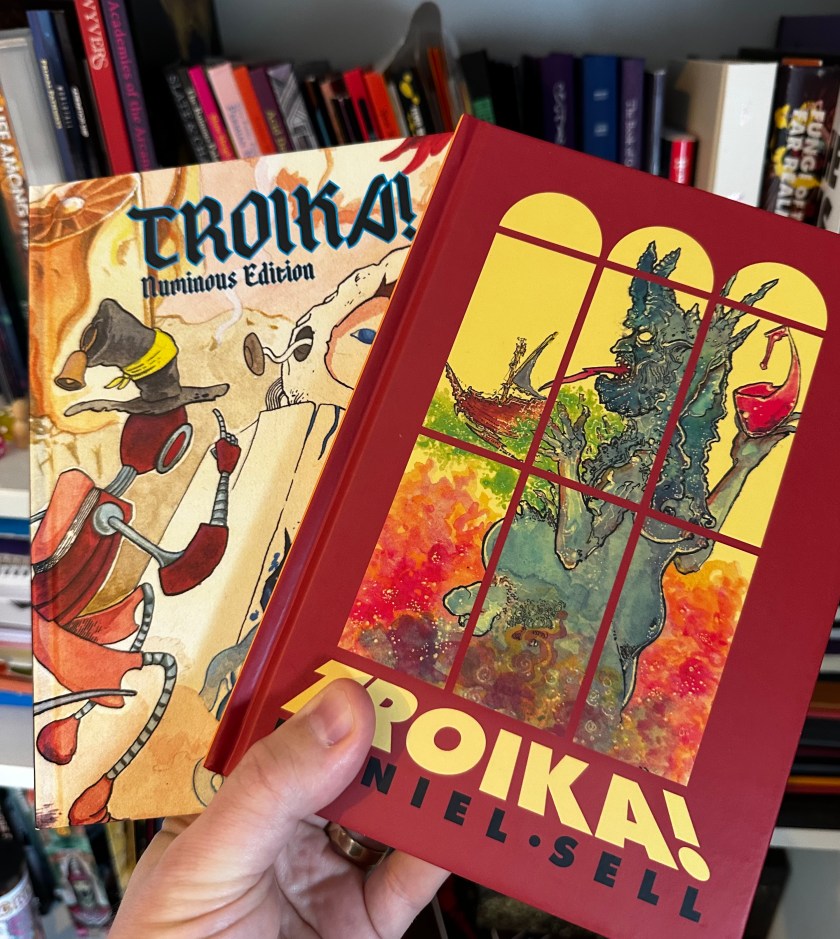
The covers of the two different versions of Troika! that I own.
Numinous or otherwise, its the same game.

There is so much to recommend in this adventure. It is endlessly entertaining, challenging and bonkers. It has such a variety of locations and such a diversity of encounters that you would need to work hard to get bored in Whalgravaak’s Warehouse. I think it works so well to show off Troika! as a system, too. The problems it asks the PCs to solve and the encounters they have to deal with utilise things like the Luck check really well and encourage players to invent their own unique Advanced Skills. But if they get into fights, especially with the incredibly random nature of Troika! initiative, there is a very high chance they are going to come out of it dead. There are a few opportunities for insta-kills throughout the warehouse too. I can’t overstate exactly how lethal this adventure is. Luckily, my players leaned into that, even when they were creating new characters to join in the same fight the original one died in (they got very quick at creating characters.)

I think it’s also flexible enough for many GMs to easily take it or part of it and fit it easily into their own ongoing Troika! campaign. As I said at the start, our game started as a one-shot and it could have ended there. But we were able to easily adapt it into a short campaign of its own.

Dear reader, let me know if you have played Whalgravaak’s Warehouse or if you would like to! I’d love to know your views on it.

First Anniversary Blogpost: Crying at the Table

Each one of these moments brought tears to my eyes and became a part of the scene itself.

HBD TDP

That’s Happy Birth Day The Dice Pool, in case you’re wondering. Today is the dice pool dot com’s first birthday and I have invited a few friends over to jump in. It’s a pool party and a pot luck. So today, I have something a little different. For the first time ever, I have invited a guest author to the blog. Next week, I’ll have another. I’m hoping this will become a more regular occurrence as the blog grows and changes.

I’ll introduce the guest blogger in a moment but I just wanted to first take the opportunity to thank everyone who has supported this blog in the last year. A few of you have been here since day one and some of you are more recent readers; either way, I appreciate you. If you have only ever read a few words or if you somehow have the patience to peruse every post, you’re a scholar and a gentlebeing, in my book. I am still doing this for me, mainly. If that weren’t the case, I would have packed it in about eleven months ago. I find that, sometimes, when I’m writing for the blog, it focuses my thoughts about certain subjects like in my last post about the Quantum NPC. I refine my opinions while I type, like I did while writing my review of After the Mind the World Again. Doing this has been a challenge but in a good way. Still, it’s nice to feel the love sometimes too.

Now on to today’s special guest blogpost. Tom of the Media Goblin’s Hoard is a great friend and has been a stalwart of my gaming table for the last six years or so. They jumped at the chance to write a special anniversary blogpost for the dice pool dot com and they have chosen a wonderful subject for it, weaving an emotional narrative through retellings of some very memorable gaming moments. I also want to draw your attention to the artwork in this post, all of which was created by the talented and amazing members of our little RPG community, Tables and Tales.

Crying at the Table

by Tom Ball

Every week I will sit around the table with a group of friends, bring out the snacks and drinks, and live out some of the greatest stories I’ve ever heard. It’s in sharing and creating these stories that I feel a most genuine and strong connection with the others around the table, and it grows with each game played. Playing TTRPGs, I feel, has elevated my bond with my friends in a way I previously would not have known. It sounds cheesy but in the moments we play I feel myself step away from my own life and inhabit the life of my characters. Their ambitions, their bonds, their goal on the horizon and their friends and foes, all become real. For an evening we all step out of our lives into the stories of a shared adventure. Like all good things, it eventually comes to an end for the night and we step back into ourselves, the same as before except now with another shared experience together.

There’s a common phrase repeated by players in TTRPGs “never split the party” because we’re all stronger together. Our characters won’t make it to the end without each other no matter what background they come from, what they have done in their past, or even who they are as a person. In the end, they will rely on those closest to them in order to achieve the impossible. I feel this is a good analogy for life itself, I wouldn’t be where I am now without those closest to me and every week I get to see those I hold dear do the most incredible and creative feats.

Throughout the many stories told, there have been cheers of joy where what was thought to be an impossible feat becomes reality, and moments of tension so strong it’s impossible to cut through. Hidden between these are the instances of tender and emotional impacts that shake me to the core and have brought me to tears on multiple occasions. I am quite an emotional person as it is, and in the moments where the story shifts I look around and see everyone else, eyes glistening like a quiet lake on a star-filled night moments before the waters fall over the edge of the eyelid in a wave. We are all there riding that surf together. I’d like to mention below some of these highlights where I have been brought to tears and felt my bond with my friends grow ever stronger still.

A High Elf and his Humans

A High Elf Vermissian Knight, masked, sword by his side. Face unmasked in the top left corner.
Art by Isaac Wilcox @lostpathpublishing

Deep underneath the towering city of Spire is The Heart and an Aelfir, Crowns-Under-Heaven, suited in armour of scavenged trains, steaming and pumping to keep him alive. He was obsessed with the hopes of bringing back the ancient Vermissian transport network and he teamed up with two humans to complete this task. Though he loathed it, it seemed these two were just as close to the brink of insanity as he was. Perhaps they would make handy tools or servants, at least?

The Seeker, an esoteric man who spoke of prophecy in between mad ramblings. Once dead, now back alive dancing between purgatory and the mortal world, his own death now a forever companion, both of them cursed with an intoxicating song sung by The Heart itself beckoning him ever closer.

Riley Rollins, an eccentric person whose pursuit of arcane majesty and wanderlust for the winding deep corridors and depths of The Heart could take them and their companions to the very end, witness the impossible and entangle them with a Queen from another world…

The trio’s companionship was rocky, Crowns-Under-Heaven would expect the other two to act a lot like cannon fodder. Seeker would often vanish into The Gray, abandoning the group. On top of that, Riley had a connection to the Drowned Queen, an ancient and ferocious being hellbent on flooding the depths claiming The Heart as her own domain, becoming ever stronger. The team had a lot of growing to do together.

When the finale came around Riley went to face the Drowned Queen and Seeker went with Crowns-Under-Heaven to reactivate the network. However, he came face to face with his obsession and the truth. The Vermissian Network was doomed to die and fall into ancient myth. In a long forgotten city where the Heart lay just a cave away Crowns was gifted with the Heartseed for his travels, the last source of energy for the doomed network system. This source of wild and limitless power was able to power his armour and by extension himself to a status beyond living. His adventures underground and with his companions had changed his old steam powered heart. He would become an unstoppable force within the cities and tunnels below. travelling the winding depths saving those on the brink of Death and becoming a figure of myth and legend. He looked to his human companion and said his heartfelt goodbyes. Knowing this would be the last time that Crowns-Under-Heaven would lay eyes on his friends.

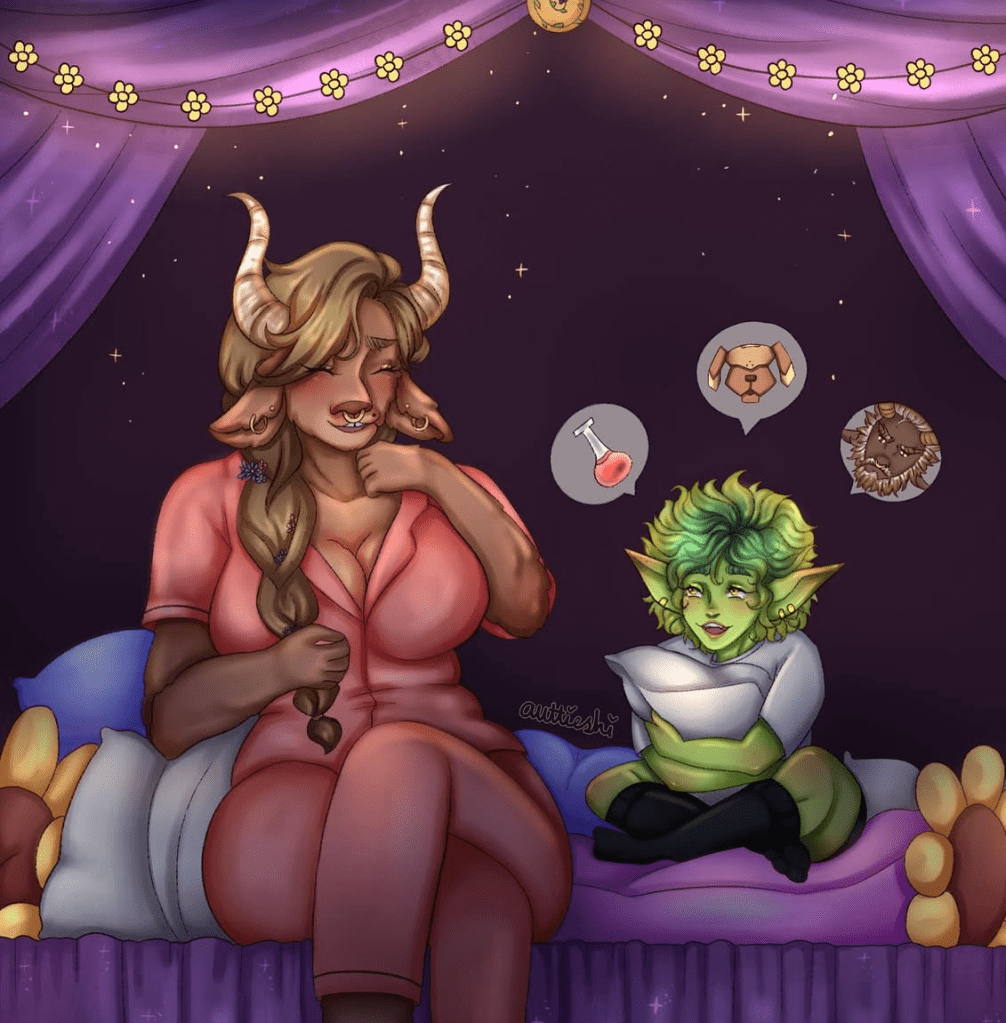
A Goblin and a Minotaur fall in love

A goblin with big hair and a minotaur seated on a loveseat in a tent under the stars.
Art by @auttieshi (Instagram)

In the early days of her adventures, Vidris Pipp, a bombastic and spontaneous little Goblin, locked eyes for the first time with Birch Burley, a quiet, reserved and dignified Minotaur, and she knew she had fallen in love. The problem? Birch was the daughter of the leader of their town, Undercroft. Worse still, Vidris and her friends discovered that that self-same leader, Bryne Burley, had secrets to hide. He quickly became an adversary in their lives. The hope of a happily ever after between the two was far off. However, after a chance encounter of Vidris falling through the manor’s chimney and landing in Birch’s bedroom, they were able to have a one on one and quickly became close. It did not take long for the Minotaur to find that she shared the same feelings for the Goblin.

From there Birch became a part-time member of the party and ally to the group. However, their love for each other was to be kept secret. Vidris’ mother and grandfather already plotted to revolt against the leader alongside other citizens and Bryne was, at this time, not best pleased with Vidris’ meddling in his town and livelihood.

Months later dangerous secrets, far beyond the leader’s knowledge, of ancient cities were revealed far beneath the town of Undercroft. Birch was there side by side with Vidris as the party delved deep underground to face an ancient wizard that brought death to the world millennia ago. Meanwhile, the town of Undercroft and their new found allies in the peoples of the world around them prepared to face the encroaching wizard’s army of automatons.

Believing this could have been the last time Birch and Vidris might see their parents alive, they approached their parents, hand in hand and revealed their love for each other. Their parents accepted and acknowledged their love. Bryne gave Vidris his blessing and Vidris’s mother and Grandfather buried the hatchet with their leader and pulled them both in for a hug that felt to last a lifetime.

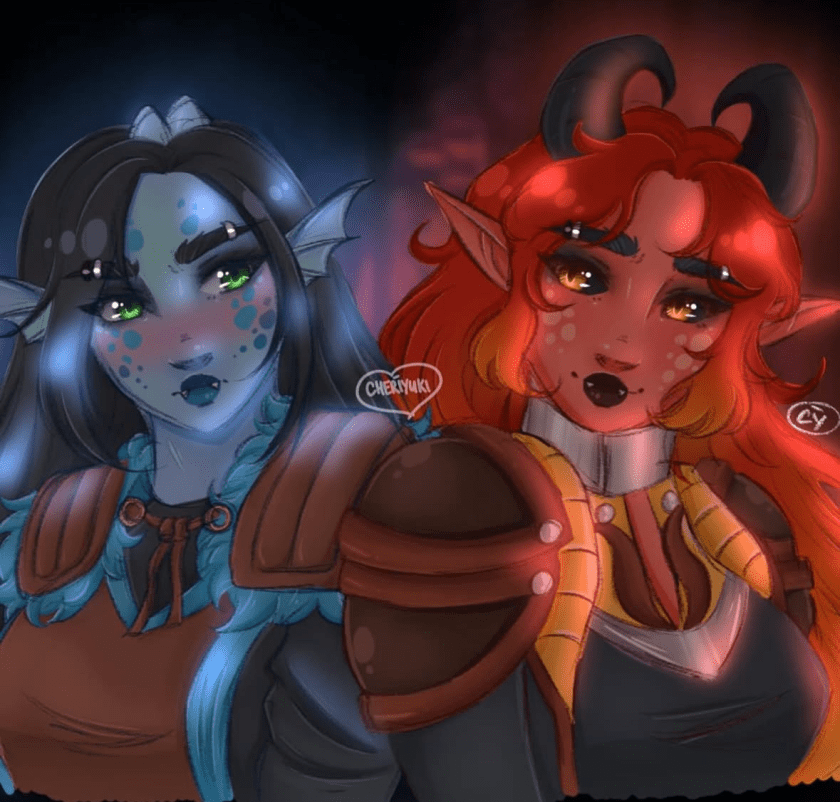
A family brought together

A femme tielfling in her two forms, one blue and aquatic, one red and demonic.
Art by @cheriyuki (Instagram)

Yulla Odasdottir nearly met her death at an incredibly young age when her father and mother wished to escape the forever storm that circled the island of Erlendheim. Believing the storm would destroy the island one day, they fled and were never seen again. Yulla, however, was saved by a mysterious entity from the deep dark depths of the ocean and sent back to the shores of Erlendheim, alongside the wreckage of her family’s boat. Her skin forever changed by this eldritch touch. What was once a rich scarlet topped with little black horns now shone blue, her face glistening with aquamarine scales and a large dorsal fin protruding from her head.

She was accepted by a fisherman and his wife who came across the wreckage and then raised Yulla as their own. Yulla grew up knowing she was not blood bound to her human parents. Her adventure would take place years later and through a series of extraordinary events the party would hear of a portal that lay on the seabed floor. This portal would be able to lead the party to Sigil, the city of doors, where the answers to their mysteries at the time would unravel further.

Once there, Yulla happened to hear the names of her parents. They were alive and were high up in a faction called The Believers of the Source. After a long search she was finally able to lay eyes on them, donned in the robes of The Source. There was a shocked moment of silence and they all slowly stepped forward, all of them in disbelief. Before the family embraced and wept.

Each one of these moments brought tears to my eyes and became a part of the scene itself. If I was crying real tears then my characters certainly were too. I like to think I put my whole heart into my characters and I wear that on my sleeve. I get lost in these stories and love every moment. It’s both a testament to the DMs who bring to life the world and to the players I’m with who build the most believable and real characters. I love being brought to tears by a game and I love sharing that moment with my friends.

I’m so thankful for those I get to share these adventures with.

Dungeon Crawls are Classic

DCC Adventures

If you’re anything like me, dear reader you buy a lot of RPG books that you are unlikely to ever pick up and play. Sometimes, that’s the intention or at least, you don’t have a plan to plan to use it, you know? I have some in both categories. Some books I backed in their crowdfunding phases because I want their creators to continue to create cool stuff, even though I know it will be impossible to fit the actual final product into my ongoing campaigns or their new game into my frankly ridiculous gaming schedule. Some I picked up in PDF format through Bundle of Holding or Humble Bundle because the deal was so good I would have been stupid not to buy them. Some I purchased with the knowledge that they might enrich an ongoing campaign but then just never fit in anywhere.

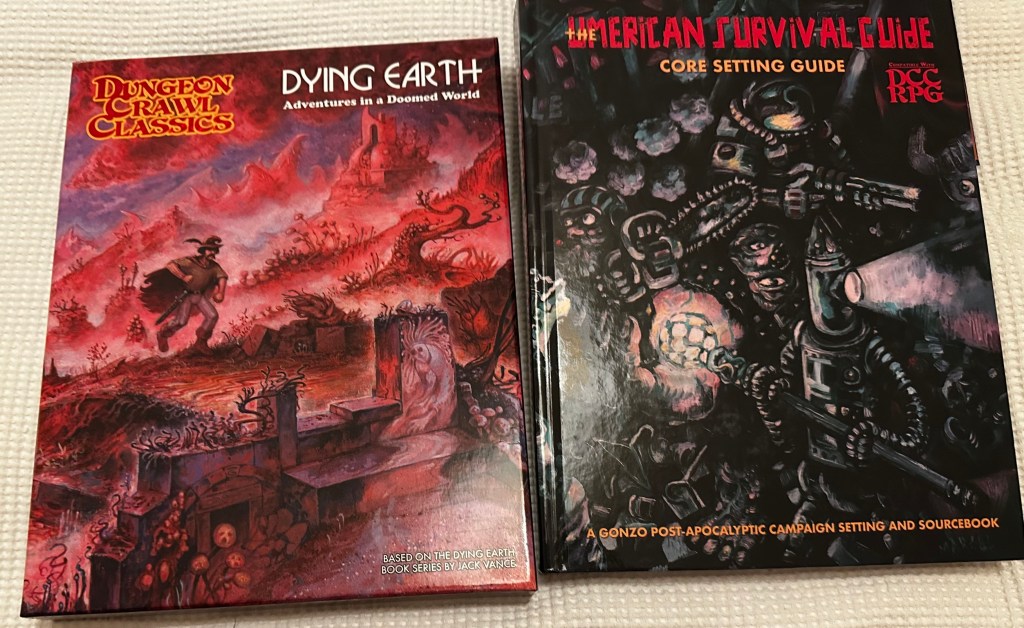
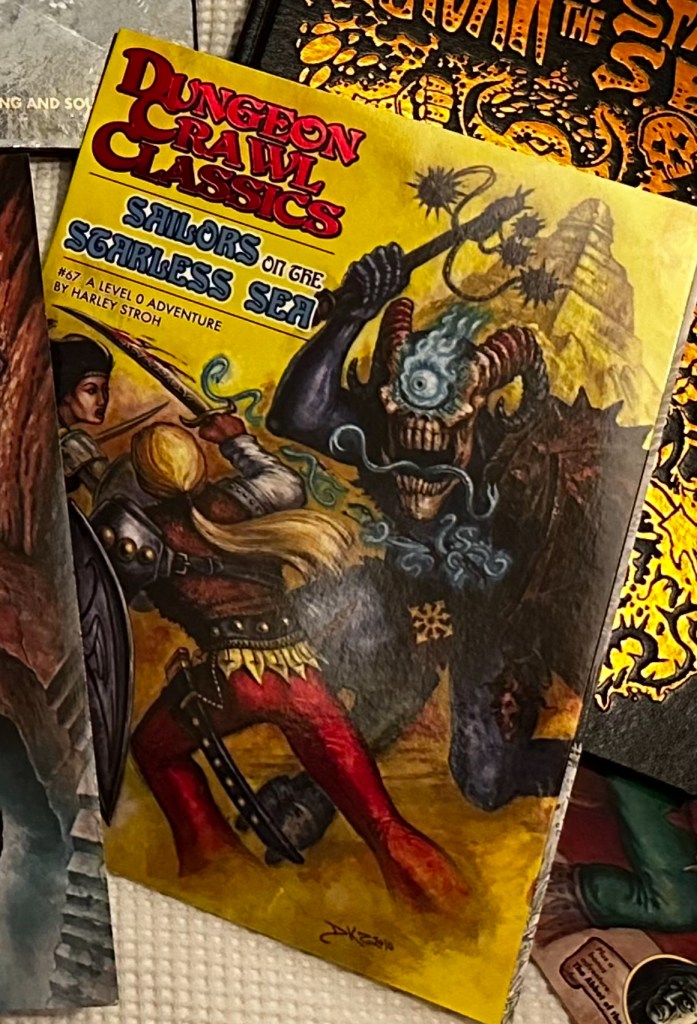
But DCC adventures are in a slightly different category. I have bought a truly obscene number of them, mostly as PDFs. I think this started after listening to a few of the reviews of DCC adventures by Fear of the a Black Dragon. Then I started to collect physical copies. My local independent game shop had copies of their Dying Earth setting box and the Umerica setting book, both of which I purchased. You know, a lot of the time, this was purely due to aesthetics. They are beautiful works of art, frankly. I love their style and their content, even if I hate their layout. But the real reason is because these have always been aspirational adventures for me to play. Genuinely, I feel at this point that, if I could, I would abandon D&D for DCC. Why? The adventures I have read are just effortlessly lacking in D&D’s corporatised humourlessness. They are not written in comedic fashion but in the last two sessions of DCC playing Sailors on the Starless Sea, I have had more genuine laughs and gasps of outrage and tears of sorrow and joy than I have had playing D&D since 2014. And that is not to demean the efforts of many of the wonderful creators of 5E products, it is simply to praise the work of the designers who created a game that I expected to bounce off due to crunchiness but which I, instead, embraced due to its flexibility. The philosophy of the adventure design also has a lot to do with this new attitude. To discuss that, let’s talk specifically about the module I just finished with my players tonight, Sailors on the Starless Sea.

Sailors on the Starless Sea: Endings and Beginnings

The surviving sailors sailed off to parts unknown at the end of our session tonight, each player with one remaining character. This is the ideal ending to a DCC 0 Level Funnel adventure. I am guessing that sometimes players end up with more than one 1st level character to begin their true career as a proper DCC adventurer, but it seems like the best possible outcome if you’re only looking after the one.

It was the getting there that was so much fun though. I wrote recently about character creation in Cosmic Dark being so much fun because the players play it, they role play the most developmentally significant moments of their PC’s lives up to that point in snippets and flashbacks with other players. The DCC funnel is surprisingly like that except its also involves a dungeon crawl, horrific death on a brutal scale and a boat load of shared trauma. Every one of the characters left at the end of the funnel knows precisely what the rest of the survivors are capable of and what they are not capable of. They know some terrible secrets about them and they know that they are keeping some terrible secrets about their own character too.

The survivors were not necessarily the ones you might have predicted at the start as 20 peasants ranged about before the Chaos Keep’s rusted portcullis, but they were the ones Luck favoured in the end. They survived traps, vine horrors, a shit-tonne of beastmen, a cursed well, a fire trap, a Chaos Leviathan, the return of a Chaos Lord to the plane of mortals and a literal tsunami… Someone powerful was smiling on them. And their players knew that by the end, that’s for sure. This made every death so much more terrible and every survival so much more precious. If it hadn’t been for that one critical hit that time, they might not have destroyed the Chaos Lord; if it hadn’t been for that fumble, maybe Gwydion would have made it past the chapel; if it hadn’t been for that successful Luck check, maybe Thomas would have been left with no surviving characters instead of the four he started the session with. There are so many of these death or glory moments woven into the text of this adventure that it is hard to overstate how much every roll and action seems loaded with meaning and significance, especially when the PCs generally have no more than 2 or 3 HP.

It’s easy to say that there were just so many PCs that their existence was cheapened. I even allowed them to restock a few peasants at one point. The adventure allows for this about half way through because they know exactly how lethal it is about to become on the second level of the dungeon. 23 PCs went into the dungeon in total. Six emerged alive, one succumbed to the effects of a potion once they had escaped, a poignant and fitting end point to the whole story. Every one of those deaths had an effect on the player who played the character.

They wondered from the start who might survive. Maybe they would be different. Maybe all their little darlings would make it through. Perhaps only the weakest would be culled. Repeatedly, tonight, the characters that the players expected to survive went down. It was still shocking to them, it was still sad to say goodbye to them, even though time was of the essence. It made for some of the most effective drama I have had the pleasure of being part of at a gaming table in years. And it was a DCC funnel adventure. An adventure designed as a way to whittle down your choices of character to play in a campaign in the most Darwinian fashion.

Harley Stroh wrote a great adventure filled with mystery and danger and conflict and true significance and then they play-tested the shit out of this thing. This is how I know: There was a moment at the very end when the last PC, who had stayed behind to loot some corpses, had to make a Luck check to secure his place on the Dragon Ship to escape the dungeon. This was the second last element of high drama in this game and it was all down to a single roll, DC 17 to leap to safety from the shore to the boat. Thomas thought he’d whiffed it. Thought he rolled a 9. But it was just one of those dice, white text on light background… turned out it was a 19. His character grabbed the gunwale of the longship and Hilda dragged him aboard just time for them to be ejected from the cavern by a tidal wave. The highs and lows! The regret and the relief!

Sailors was genuinely one of the highlights of my recent gaming experiences and the feedback I’ve had from the players so far has also been glowingly positive. If you haven’t played it, dear reader, do yourself a favour, go and find yourself 15 to 20 drunk peasants and get them to invade the ruined keep of the Chaos Lords, you won’t regret it.

Flash Fiction Challenge: Habitant 1306

Week 1

Predictably, I spent absolutely no time thinking about this challenge until yesterday and then I knocked out the five hundred words in an evening. No matter how I did it, though, I have a sense of accomplishment. It’s been such a long time since I wrote for the pleasure of it, I forgot what it was like. That slow unfurling of the story in my mind, the careful (or not so careful) selection of the words, the freedom to make it what it wants to be. I enjoyed it.

Anyway, the random words certainly helped get me started in this case. I had some images from other media in the forefront of my mind as I wrote. Aveena, the holographic assistant from the Citadel in the Mass Effect games was the first thing. But instead of a mysterious space station, it was the assistant for something like the arcologies in Appleseed, a manga that I read more than 30 years ago. I remember almost nothing about it except for the arcologies, which I thought were a pretty cool concept. Habitant 1306 is the result. Here’s the list of the random words that I managed to fit into it first.

Nouns

Development
Surgery
Union
Shopping
System

Verbs

Execute
Finish
Approve
Undertake
Take

Habitant 1306

By Ronan McNamee

“The System is here to fulfil all of your needs, Habitant 1306.” The hologram flickered and flashed, blinding me momentarily. Why had it designated me Habitant 1306? I thumbed my eyes and walked on past it. It felt like a haunting, but not the one I would want. The vastness of the Development’s central atrium bloomed around me, twilit and dripping. I pulled Aunty’s scarf tight.

Maybe it knew me? The cracked and mossy statue of a habitant, gaily swinging their shopping bags winked at me, I’m certain. Did the statue know me too, somehow? Spiders crawled up my spine. I whipped about but caught only the brief flicker of the hologram, awaiting the next habitant. It might wait forever.

What if it mistook me for someone else? Perhaps Habitant 1306 looked like me. What if 1306 was the designation, not just of habitant, but also habitation? An “i” towered, gallingly tall, above a booth, hunkered between ATM and escalator. A gentle glow beneath an encrustation of grime drew me in. With a wipe I discovered a map on a screen. Below, the development delved deep. Caverns occupied by industry, commerce, leisure. Above me, the habitations stretched high into the night sky.

Developers had undertaken the doomed project; the union of all aspects of life in a System-governed space. Self-sustaining, self-regulating, self-populating… 1306 was far above. There were elevators but I didn’t trust them not to take me where they wanted. A stairwell, housed in a tall glass tube, spiralled into the heavens. I stretched, knowing Aunty would approve, and started the climb. Every few landings, a gap in the Development’s titanic cladding allowed the Free City streets to shine out below. My home, where Aunty found me as a nipper, clad in my birthday suit, exploring, unworried and unhurried, she told me.

13 sounds doable, but each floor encompasses cities. Peach streaked the horizon as I finished with the stairs. 06 was on a low inter-level. The halls’ walls and ceilings had partially collapsed. Utility cabling and piping barricaded the way. The Development’s arteries blocking my path to the heart. I had surgery to perform. I hefted my idle crowbar and scrubbed in.

Shocked, soaked and stinking, I left the patient bleeding behind me, crawling to the end of the hall. Forty winks, Aunty found me. She scowled with that smile hiding behind. Only ever in the electrified darkness inside my eyelids, these days. I thumbed my eyes to clear them again, rose and stretched.

1306 said the door. “Everyone left you,” I said to the Development or the door, maybe. Touched, it swung sullenly open. Illumination blossomed. It was a home. Unobtrusive conveniences skulked, observing my steps. But still, a sort of habitation to be sure.

A closet? Located dead-centre, it buzzed and gurgled. Inside was a tall mirror. No, I switched the light on and saw me, in my birthday suit, watching Aunty. The pink water bubbled. A single word question blinked on the tank’s surface, “Execute?”

Next week’s words

And here are the random words generated for next week’s challenge.

Next week’s nouns

measurement
consequence
desk
winner
employer

Next week’s verbs

echo
influence
enquire
mix
pin

I’d love to hear from you if you took part in the challenge this week, dear reader, or if you wrote anything you’re satisfied with in the last few days, even. Get in the comments!

Short Fiction Challenge

These are not resolutions, okay?

Yes, I wrote all the way back last year, that I don’t really believe in New Year’s resolutions. So much so that I then proceeded to list five of them, with the proviso that they were “gaming resolutions,” not real ones. So, I may as well continue along Self-Delusion Avenue into 2025, I thought.

So! There are a couple of non-RPG things I’d like to try to do more often:

  1. Practice my Japanese and improve my fluency before our big trip to Japan in the autumn
  2. Write more fiction that is not related to games
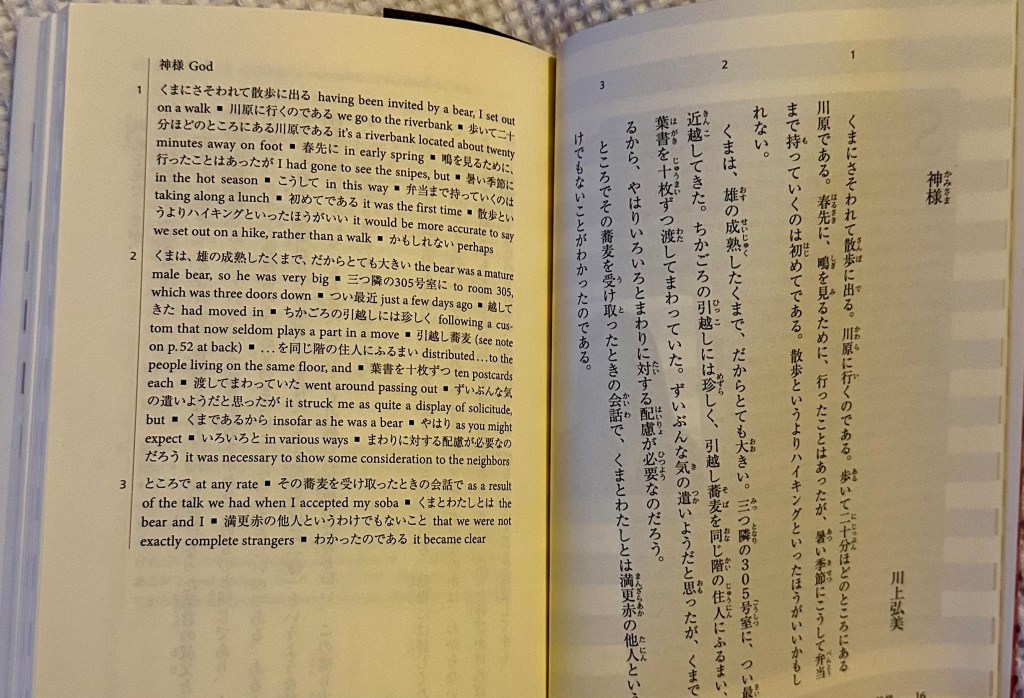
The cover of the book, Read Real Japanese Fiction, Edited by Michael Emmerich and featuring the writing of Hiromi Kawaguchi, Otsuichi, Sinji Ishii, Banana Yoshimoto, Kaoru Kitamura and Yoko Tawada. It also features the illustration of a small, angry, barefoot child with a light blue dress on.

日本語の練習は大変だけど楽しいです。最近 Read Real Japanese Fiction という本を読み始まりました。その本の中には日本の著者六人のすばらしい短編小説が読めます。一文ずつ、英語の説明もあるから分かりやすいです。それ以外、Netflixで日本のテレビ番組をよく見て日本語のリスニングの練習もできます。日本語を話すことの練習もできればいいな。

A double-page spread from the book “Read Real Japanese Fiction.” This shows a page of the short story, Kamisama by Hiromi Kawaguchi and the opposite page with explanations in English for each sentence.

For the second point, I thought I might use this very blog, dear reader… and perhaps, dear fellow writer…

Random Word Generator

In a now defunct writing group I was once a part of, we often used a random word generator to get our minds working on new short pieces of fiction. In fact, some of the short stories and flash fiction I posted here came from that group. I think we can all agree that I had mixed success. But, there is no doubt about one thing: it got me writing. I always found that, when my brain was working on the practical problem of fitting those randomly selected words into whatever it was I was writing, I was not focusing so much on the fact that I didn’t have any ideas. I let the words guide me into something resembling a story. After a while, I found the ideas for short fiction coming without the aid of the random words and so I would have to shoe-horn them in, which is an interesting exercise in itself. But the random words were the kickstart that I needed.

So I decided to use the same method again. Here is my first effort. I used this random word generator to come up with five nouns and five verbs:

Nouns I used

  • Engine
  • Clothes
  • Thought
  • Employer
  • Investment

Verbs I used

  • Summon
  • Chase
  • Determine
  • Cheer
  • Assess

This time, I thought I would challenge myself to write in a format I don’t think I have ever attempted before, a hundred word flash.

Present Imperative

by Ronan McNamee

Swim. Up to the air. Breathe. Curse your clothes. They catch every eddy, urging a return to drowning. Locate your employer. She bobs there on the surface; regards the depths. Consider her investment in you. Learn from her mistakes. Recognise the ice of the sea in your bones. Move. Chase survival, success. Stroke past her and her solitary Chu. Welcome the deep-freeze motivation. Summon your future. Allow it to cheer you, sustain you. Pause, paddle. Resist the chill in your blood. Hear the engine enter earshot. Determine the direction. Assess difficulty and distance. Chatter a grin. Swim.

Next Challenge

Five verbs: execute, finish, approve, undertake, take. Five nouns: development, surgery, union, shopping, system
The Randomly Generated words to use in writing the 500 word flash fiction due on Wednesday, 15th January, 2025.

Here’s the plan. I’m going to generate five more nouns and five more verbs right now. I am going to take these words and come up with a 500 word piece of flash fiction. If you’re interested, dear reader, I would invite you to do the same. I’m going to post my piece on this here blog next Wednesday. If you want, you can leave yours as a comment under this post or under my post next week or on your own blog and link to it, or you can write it in that little notebook you keep just for yourself, or you can write it on the wind so only the birds and the gods can read it.

Here are the words for next week:

Nouns for next week

  • development
  • surgery
  • union
  • shopping
  • system

Verbs for next week

  • execute
  • finish
  • approve
  • undertake
  • take

And this is the best part: I’m going to do this every Wednesday until I decide I’ve done enough. Feel free to join me in this weekly writing challenge, dear reader. Or maybe just try it this once and see if you like it. One way or the other、 よろしくお願いします。

The Bloggies 2024

The Dicepool

At the start, 87 posts ago, all the way back in July of this year, I wrote this:

I think I’ll write how I feel about some of the things I consume as a way to digest them (not the food and drink, I’ll do that in the traditional way.) But, mostly, I’ll be writing about my main creative outlet, playing, running and making things for tabletop role playing games. Let’s not be coy about this; the internet is not lacking for nerds going on about their games, or someone else’s games or games they watched other people play or games they hate or games they actually quite like, surprisingly enough. So, even knowing this, why would I have the gall to add to it? Good question, good question indeed. Maybe I will figure that out as I do it. The adventure is the journey and all that.

And, that’s pretty much what I’ve been doing. I am still doing it. I have learned a lot by doing it. This blog has genuinely been an enjoyable and useful outlet for me. It has allowed me to work through some game-related ideas that might otherwise have floated freely around my brain, temptingly close but always oh-so frustratingly out of reach. It has also given me the opportunity to express my feelings on more personal matters. Mainly, though, it has provided me the chance to write regularly about one of my favourite subjects, RPGs.

I have made a few changes over the last six months. I went from posting daily to every two days to every three days and then to twice a week. I feel like I have found the ideal schedule now and hope to continue with it. Thedicepool.com joined the woodpanelled.org web ring. I hope to see Woodpanelled grow even more in the new year. I started posting some of my own fiction pieces as well as the RPG-related posts. I’m hoping this will encourage me to write some new fiction soon! Finally, I have been sharing my posts more on social media, both Instagram and Bluesky. where I have made some connections with other people in the TTRPG sphere. I have had some great feedback from some of these interactions and that has encouraged me to put the blog out there a bit more.

The Bloggies Awards and a request

So here we are, it’s the end of the year and a good time to consider some of the things we liked from 2024. In this incredibly niche corner of the internet I find myself tucked away in, there is a way to show your appreciation for those things you liked, or that you found useful or inspirational or that just tickled your fancy. You can nominate a blogpost for the Bloggies Awards, which originated in 2022 on the Prismatic Wasteland blog.

The 2023 winner was Sacha (or sachagoat.) He won for the first part of an excellent series of posts about Re-inventing the Wilderness. You can check it out here along with an introduction to the Bloggies themselves. Basically, people nominate their favourite TTRPG blogposts within four categories:

  1. Theory – I don’t really get into this area too much on the blog, although I may in time
  2. Gameable – I also don’t have a lot of this sort of thing here. I have considered sharing some of my home-brew stuff, but I would need to do some more work on most of it first
  3. Advice – I have a fair few posts of this kind. I’m thinking of those on world-building, beginnings, endings, combining systems and mechanics, session prep, building community, etc.
  4. Review – I would hesitate to call myself a proper reviewer of RPGs but there are several posts that fit into this category. I am thinking particularly of the posts on Liminal_, Cthulhu Dark, and the series on Between the Skies and Dragon Age. But a lot of my other posts dealing with games I have played would probably fit into this category too.

Sacha has introduced a couple of new categories for this year too:

  1. Debut Series – This is me! Despite having 87 posts under my belt, this is still my debut year.
  2. Blog Series – I have several of these, including my series of character creation posts, the Between the Skies and Dragon Age series as well as those on combining D&D and Blades in the Dark mechanics

I won’t go into any more detail here. Sacha explains it all on his blog. Suffice it to say, if there are any of my posts from the past six months that have resonated with you I would appreciate a nomination. You can use this Google form to do it before December 31st. It only takes a couple of minutes and is pretty straight-forward.

Thanks

I appreciate all your support during the last six months, dear reader. At the start, I pretended like I would do this whether or not anyone read it, but the fact is, I do take great encouragement and motivation from the fact that others have read and gotten something from this blog. I would like to extend my gratitude to all of you who have taken a few minutes out of your day to read even a few of my words since July.

Happy holidays!

Between the Skies Part 3

How to begin

I’ve written about beginnings in RPGs before. I think they are crucial to establishing tone, theme, genre and expectations to the whole game, long or short. Many RPG books lay out pretty well, the genre and themes they explore, many providing starting adventures or scenarios to help you set the tone. Few do as good a job at helping you to begin as Between the Skies.

Now, as I’ve written in the previous entries in this series, Between the Skies by Huffa provides a whole lot of advice and options collected into a loosely defined game. It exists to help the players (including the GM) create the play-style and world they want. The text assumes that you will be using a set of rules that suits your table so, by necessity, the advice and tools it provides to help you begin playing are applicable in almost any game. Having read the Beginning Your Travels chapter, I can say it’s brimming with what is just plain good advice.

How and why

The why is an often overlooked element of an RPG character. What the hell are they doing any of this crazy shit for? Why are they travelling across the planes or through wild-space, in the specific example of Between the Skies. I wrote more about character motivation here. Obviously, this book has tables that help you to answer that question. They are wonderfully vague, as you might have come to expect. The vagueness allows your own imagination to combine with the generalities of the game already established by you and your group.

The How and Why do You Travel tables from Between the Skies. These include a "Who are you Traveling For? " d6 table, a "How do you travel?" d66 table and a "why are you traveling" d66 table
The How and Why do You Travel tables from Between the Skies. These include a “Who are you Traveling For? ” d6 table, a “How do you travel?” d66 table and a “why are you traveling” d66 table

You will notice there are three sub-tables there.

  • Who are you Traveling for?
  • How do you travel?
  • Why are you traveling?

Once again, it is important that they are incredibly general. You will find yourself building your world as you fill in the gaps around the results of this table.

It’s telling, isn’t it, that the how is also considered here? And that it’s randomised? This is one of the most fundamental questions to answer in establishing the setting, and, in many ways, the type of game you’re preparing to play and it’s left up to random chance. If you think of it from the perspective of a D&D game, there are not too many tables who are rolling the dice on running a Planescape, Spelljammer, Dark Sun or Forgotten Realms campaign next. But using this table gives you all the power. It allows you and your group to put down roots in the world you are going to play together in, and grow whatever you want out of them. You’re going to need a lot more than just the single result from the table but Huffa trusts that you can come up with that, and not only that you can do that, but that you will enjoy doing it. Luckily there are also a butt-load more tables in here to fire the imagination and get you moving in a direction.

How about this for a situation?

The Starting Site Recipe list from Between the Skies. It has 7 points.

Huffa would like you to start your first session in media res. That’s also what I always say. Clearly, she’s a genius. The great thing about the advice as presented in the Starting Situation section is that, once again, the in media res beginning has been formalised into a procedure. You are presented here with a series of steps required to create your Starting Site, what is called the “Starting Site Recipe.” After that you have bevvy of tables to help you in sorting out what type of situation it’s to be, what or who precipitated it, what type of site it is, its inhabitants and a some more trickle down tables that allow you to flesh out the various site types.

The Starting Situation tables from between the Skies. There is a "Starting Situation Type" d6 table with "precipitated by" 2d6 table attached. There are also two more 2d6 tables, "PCs aligned with..." and "PCs antagonistic towards..."
The Starting Situation tables from between the Skies. There is a “Starting Situation Type” d6 table with “precipitated by” 2d6 table attached. There are also two more 2d6 tables, “PCs aligned with…” and “PCs antagonistic towards…”

It makes it feel like, if you used this method, you would have your starting situation and location prepared in minutes and only need to write a short description of a few of the items you rolled up. As usual, when I read any part of this book, it just makes me want to give it a go.

How it looks

Luckily, there is a great little example Starting Situation presented in this chapter as well. It has been generated using the method described earlier and it is called “The Godshambles.” The entire situation is described in only a few short paragraphs, a couple of handy tables, a route map and particularly evocative illustration by Coll Acopian.

If you wanted, you could just use the Godshambles as your own starting situation and no-one could blame you. But, I think one of the beautiful things about the Starting Site Recipe is that the prompts you roll up on the tables will help you to imagine a situation that is fitting for the kind of game you have conjured together when you were creating characters and rolling on the how and why tables before. So, it is likely to feel a little loose around the hips or too baggy around the ankles compared to one you generated yourselves.

How it goes

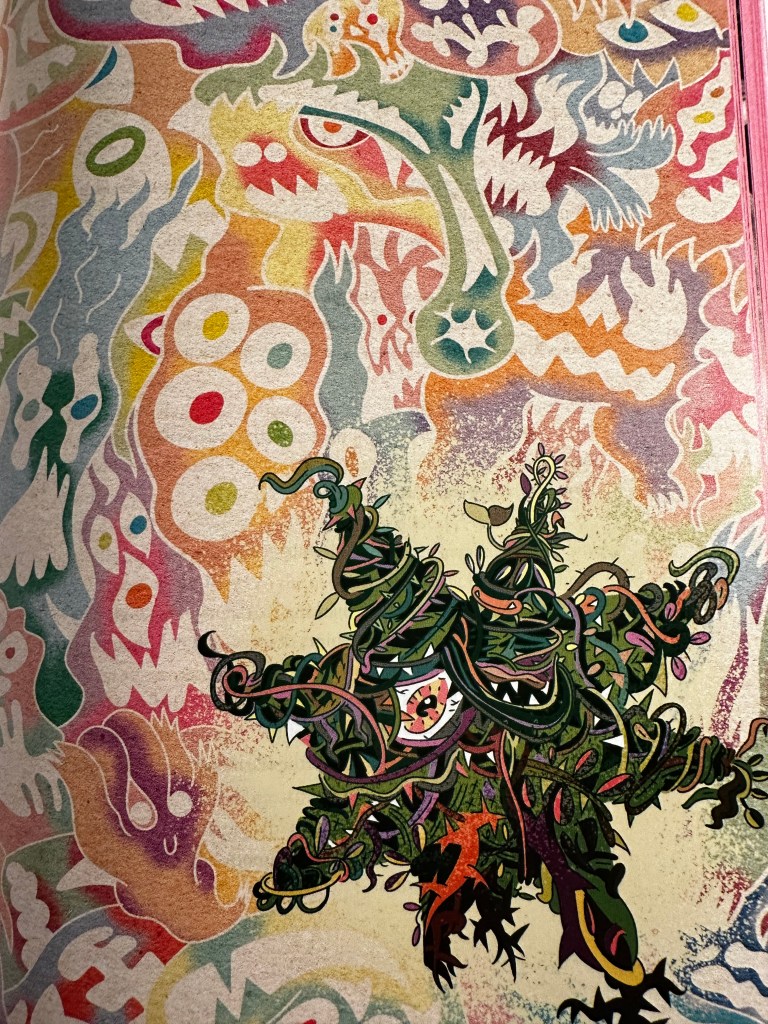
A full colour illustration from Between the Skies. It shows a star-shped being that seems to be made of an entaglement of vines and other plants floating through a multicoloured, psychadelic dreamscape.

Like I stated earlier, I am a big fan of the methods described in this chapter for beginning your game. I am excited to try it out and invite my players to be as big as part of the world building as I am, or bigger, from the very get-go.

Between the Skies has a lot more to offer. I have not even made it half way yet. But I think, for now, at least until I start actually playing it, I will pause this series of posts for now. I’ll bring them back when I have some more practical experience I think. See you then, dear reader!

Between the Skies, Part 2

Back to the skies

Between the Skies is such a beautiful and fascinating book that it is a pleasure just to read it. If anything, all this writing about it is just slowing me down! But I do feel the need to evangelise a bit more. So join me, dear reader in an exploration of the character generation options. Or, if you haven’t read the first of these posts, you can catch up here.

Character Generation

The “Approaches to Character Generation” section encourages you to decide on the approach you want to use and then to roll on the relevant tables to flesh out the description. It’s important to note that your interpretation of the table results is what’s important, rather than having a strict set of attributes or traits that have specific meanings in the game.

It also tells you to note all of the things you want known about your character. I love this point, actually. Rather than waiting till it comes up in play, when a GM might casually bring up an element of your character that you don’t want the other PCs to know, you make it clear at the outset the only parts of your character or background that others would be aware of. Or maybe it just means that there are things about your character that no-one knows and that will come up organically during play, at which point they will become a part of them. Either way, it is an important point.

Character sheet with character generation question page no.1. This is for a "Through the Looking Glass" type character.
Character sheet with character generation question page no.1. This is for a “Through the Looking Glass” type character.

This section also directs you to go and take a look at the character sheets in the back of the book. There are three types, which I will get into below. But, notably, on the page before each actual character sheet, you’ve got a few questions printed in large font, taking up an entire page, to build a basis for your character. For the Lifepath and Spark procedures these are:

“Who are you?”
“What can you do?”
“What do you have?”
“What do you want?”
“Who do you know?”

And for the Through the Looking Glass procedure they are:

“Who are you?”
“What can you do?”
“How did you get here?”
“What are you searching for?”
“What have you brought with you?”

It’s almost as if their significance cannot be over-stated. It feels like these big old questions and the spaces for you to fill with your own answers to them on these pages could act as the character sheets themselves. Perhaps, if you don’t want to be too bothered with specifics, if you don’t want to use numbers and die types and the like to describe your character, you could just write a few answers to the best of your ability beneath each of the questions. That would be a good basis for a character in a fictional story. Would it be a good character in an RPG? In the very loosest of story-games, I feel like that’s more-or-less the approach and it works well, but it does depend on the type of story you and your table are trying to tell. In a space-pirate, treasure-seeking, swashbuckling adventure game, it might not hold up. But if your aim is to tell the story of a group of people caught in a difficult situation, informed by their backgrounds and desires, complicated by their relationships and inner lives, and their development as people over the course of the game, sure, it would be perfect. Writing about this makes me want to try it…

Character sheet with character generation question page no.1. This is for a "Through the Looking Glass" type character.
Character sheet with character generation question page no.1. This is for a “Through the Looking Glass” type character.

So, next to each question page is a “Worksheet.” Even the word-choice here is significant. It indicates that this is where you will be performing the admin for your character. Filling it in will be an exercise that you may find tedious or satisfying, very much depending on the type of person you, the player, are.

Each worksheet helps us to encapsulate a character designed according to one of three (four, kind of) procedures.

I mentioned in the last Between the Skies post that the procedure you use here is related to your approach to weirdness. So, if you have decided to go with “All the Weird” you can probably use any of the methods described, but if you are going with a “Venturing Out Into the Weird” approach, and you want mundane characters, you should think about going with the Spark character creation procedure (with a few modifications.) Once again, it’s important to note, all of this is advice, none of it is mandated. Choose and use what you like and discard the rest.

Lifepath character generation

I have never played it but I have heard about this character creation method being used in Traveller. Essentially, you map out your character’s life up to the point of the start of the game and this process creates the PC. You roll on the tables provided for this character generation method to establish events in your character’s life that lead to the accumulation of “Skills, allies, enemies, Mutations and Debt, among other things.”

Let’s take a look at some of the tables used for Lifepath character creation.

You have a Type table that contains a pretty wide array of permutations. I rolled up a Swimming Avian. I’m thinking seagull.

The Descriptor tables are d66 so have a lot of options in them too. You might be described as Huge, Transformed, Dead, Nomadic, Staunch or Minimal. These single adjectives should ignite the imagination and lead you down paths to fill in the blanks on your character sheet, or just in your mind.

You roll twice on the Aptitude table (also d66) and take the adverb form first and then the adjective form. So a roll of 54 and 45 (which I genuinely just rolled) would be Inspiringly Commanding.

After this you enter the Life Events section. It explains the basics of using this method and then tells you to go and roll on the Life Events tables. There are three tables to roll on depending on whether you want have your major life events on a Surface (I guess like a planet or something similar,) in Space or out in the Planes. You can switch between them and sometimes have to depending on the events you roll.
A sampling:

  • Quest for NPC completed, harmed – Roll powerful NPC for patron; Gain problem related to injury suffered by PC
  • Death, became undead – Create one Extraordinary Ability related to undeath; Create one Problem related to undeath; If already undead when this result is rolled, PC is destroyed, create new PC who has dead PC’s possessions.
  • Joined heresy – Joined heretical religious organisation; Gained ire of opposed religious organisation; Gained skill related to heresy
  • Became Hermit – Cannot roll any further life events; Gain skill related to hermeticism
  • Lost in the Planes – Cannot roll further life events
  • Became petty god – Roll or describe Focus; Gain Extraordinary Ability related to petty godhood; Petty gods are not necessarily more powerful than mortals

After this you have a bunch of tables to help you determine your Extraordinary Abilities, Skills, Mutations and Problems all of which will help to round out your character. There are some great entries in these tables but this blog post has already gotten away from me so I am going to have to skip on to the next method of character creation.

Spark character generation

ANother black and white illustration from Between the Skies. It shows a creepy person with no face except for two blank, white eyes. They open theirlong black coat as though they were selling hot watches, but inside are only toothy grins and gaping maws.

This is an entirely table based method, but, as the title suggests, the results you get from the tables should be used to spark the imagination of the player. As Huffa takes pains to point out more than once in the characters creation section, the tables might give you powers and abilities and they might even describe what you can do but they don’t tell you how your character does it. I think most of us assume this point without thinking about it in our games most of the time (my Magic Missile looks like three paper planes that explode when they hit!) but it’s a good thing to have it called out here formally. So the tables used for this method are very much based around the questions I listed above. Under the “Who are you?” section we have table after d666 table of descriptors to roll or choose from.
Here are a few nice ones:

  • Sickle mender – fixing what cuts
  • Messmaker – joyous entropy
  • False smile – feelings turned inside out
  • Babysitter

For “What can you do?” you can go back and use the tables under the Lifepath method for Abilities, Aptitudes and Skills.

“What do you want?” – There are a couple of tables here. You are encouraged to use these to “inspire a few sentences describing what your character wants.”
Examples:

  • Objects of Desire – Redemption, Surprise, More
  • Related to… – past self, rulers, daemons

When it comes to “Who do you know?” we have another trio of tables. These can be used to make two or three entities with whom you have a relationship of some kind. For instance:

  • Entity type – Creature
  • Relationship type – Debt holder
  • Relationship detail – Yearning

Once again, use these results as prompts to describe these relationships in a little more detail.

Finally, in the “What do you have?” section, you use the Starting Resources procedure with some changes. Generally this involves you having an alright weapon and some semi-decent armour, equipment needed for skills and maybe even a ship if that’s the sort of game you’ll be playing. You get to roll up an interesting object too! You will also possibly have some Assets or Debt to start with. There is, unsurprisingly, a table for that. Assets, Debt and Petty Cash are all rather abstracted in Between the Skies. You measure them in units where a unit of Petty Cash might buy you a nice meal and a unit of Asset or Debt would be the equivalent value of a house. I appreciate a system like this as counting gold pieces holds little or no interest for me. Also, Debt implies a Debt-holder and that could be an important relationship and could be used as motivation at some point.

Through the Looking Glass character generation

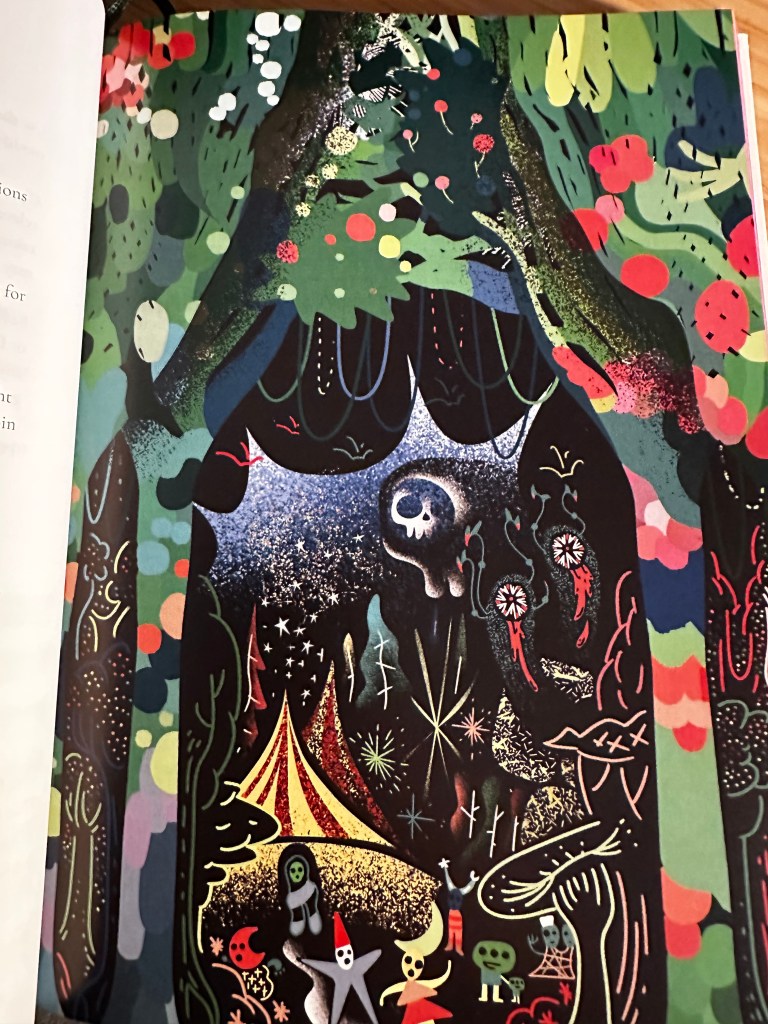
A full colour illustration from Between the Skies. The picture is of some strange characters, drawn in a deliberately childish style with funny hats heading towards some circus tents and away from a colourful bu threatening forest in the foreground.

Your character has done a full Alice and is now in a freaky other-world. Why are they there? What sort of personal disaster has led them to this point? What are they looking for in this isekai nightmare/dream realm? These are things you need to know about your Through the Looking Glass character.

Once again we have some tables to roll on. But interestingly,

It is assumed that Through the Looking Glass characters are mundane people from a world like our own, and that results are interpreted accordingly

A few sample descriptors from the tables:

  • Vengeful
  • Loopy
  • Ostentatious
  • Firefighter
  • Hack
  • Paparazzi
  • Avante Garde Hobby
  • Entrancing Dancing

On the “You (were) recently…” table we have a little more to shape your mundane character. You can roll on the d66 table to get these sorts of results:

  • Retired
  • Transitioned
  • Canceled

Under the “What can you do?” section, the abilities are a lot more “normal” than some of those in the previous character generation methods. They include stuff like:

  • Untapped Scholarly Education
  • Precocious Performative Love
  • Charming Spiritual Profession

One of the different questions belonging to this character generation method is “How did you get here?” This is, of course, of utmost importance to this type of character. Maybe you were trapped by an entity from another world. Perhaps you stumbled into it while intoxicated, seeking pleasure. Or was it that you were reincarnated after dying by a catastrophic event?

Even just reading the entries in these tables has my imagination all aglow with possibilities. They make me want to run this sort of game. I don’t think I have ever done that, not for such mundane PCs, at least. I want to see how such characters would be changed by such an impossible journey! Yum yum.

Another question that is specific to this character generation method is, “What are you searching for?” Ruby slippers? Aslan? That damned white rabbit? I suppose it could be any of those but why not roll on some tables instead?

The tables, interestingly, do not tell you exactly what you are looking for, just the type of thing you might be looking for (knowledge, person, object etc,) what that thing will provide (relief, comfort, affirmation) and what complicates it as a goal (explosive, famous, moving.) You should then get together and discuss the precise nature of the thing. The text suggests that, if you are all of a similar type of character, you should maybe all be striving for the same object but that you might each have a different motivation. This sounds like a wonderfully interesting potential grenade to throw into the works whenever the characters finally find the item they have wanted all this time. It smells like interpersonal conflict. Yum yum yum.

Lastly, for the Through the Looking Glass method, we are looking at the “What have you brought with you?” question. This is different to the “What do you have?” question common to the other two methods because your character is assumed to have been yoinked out of their own reality with only the items on their person. So they don’t get to have any Assets or Debt or any of the other starting equipment other types of characters might begin with, which is totally fair. Instead, they get a few basic items and maybe one Special Item. There is, as you might have guessed, a set of tables for that. Once again, these provide inspiration rather than outright answers to what that Special Item might be. So you might have an Alien Secret or a Mythical Key… This idea of only having what you had on you makes the prospect of the first few hours in a new world particularly enticing from a game perspective. How does one survive in a desert otherworld with nothing but a mobile phone, a wallet full of loyalty cards and used tissue? The answer could be that the locals are enchanted by the Spectral Device that you were handed just before being shoved through a portal.

Character generation using other games

There is a very interesting and useful section near the end of the Character Generation chapter. It provides a loose guide to using another system’s character creation method to make your Between the Skies character. Essentially, if you use this procedure, you will end up with a blended character. They will still consider the questions from the first two character generation methods but you will do your best to apply the answers to the character you have created using the other system. In some cases, this will mean that you are adding bits entirely from the question answering method as many systems do not consider things like what you want and who you know at the character creation step.

I am a big fan of Troika! so I am happy to see the practical example of using a Troika! background as the basis for a Between the Skies character here too. It makes it easier for me to picture using this method and elucidates the process in a practical way.

Character generation conclusions

All in all, I am impressed with the breadth of options presented in the chapter. You have no fewer than four different ways of making your character (and many more if you consider you could technically use the fourth method to use any other game’s mechanics to do it) a plethora of interesting tables to create some really weird or terribly mundane characters and a whole bunch of world-building before you have ever started playing the game in anger. The results you are likely to roll on things like the Life Events tables are going to haunt your game if the GM is paying any attention at all. You’re likely to establish the existence of certain NPCs, gods and demons, places, objects and catastrophic events that effect the whole world while rolling up your PC. I love this! It starts the whole table off with so many potential plots, grudges, vendettas, desires, loves, hates and motivations that the game should practically run itself from the moment you finish character creation.

As a process(es) it makes me excited to take part in it and even more excited to play the game, either as a GM or as a player.

What do you think, dear reader? Does this make you interested in Between the Skies? If not, perhaps I will continue to pursue this subject in another post in the near future so I can convince you. If so, maybe I’ll keep entertaining you with details and opinions of a subject you clearly enjoy! It’s a win-win!

Inspiration

Anniversary

Today is the first anniversary of my big brother’s passing. We interred his ashes in the local graveyard yesterday. It has been a tough week for my family and me. It’s been a tough year.

He died after a short but vicious illness that we could not have predicted. He was only 53 years old. His death came far, far too soon. And even during the years he had, much of his time was spent contending with the draining, exhausting illness known as M.E. But he had made his life so rich and so full in the short time he had that he has been an incredible inspiration to me, particularly over the last twelve months, but through all the years of his life as well.

Lorcan McNamee

Lorcan McNamee was a teacher first and foremost. Most of his working life he spent teaching languages; English, Spanish, Portuguese. He was a polyglot, obviously. Even at the time he died, he was working on learning French and German. But he taught other things too. Most notably, salsa! He taught salsa dancing to all comers in a church hall in our home town.

We, his family, stood for two hours greeting those who had come to grieve with us at his funeral. Many, many of the hundreds who came were his students or his former students, including his dance students and a host of people from Ukraine and many other parts of the world. And so many people from Spanish speaking countries who had been welcomed to our town and helped by Lorcan and the Sligo Spanish Society, which he was instrumental in organising.

I will be honest with you, dear reader, the sheer numbers and the obvious and genuine emotion expressed by these people was something of a shock to me. I knew, of course that he was an excellent teacher, that was not the shock. But I had known so little of the key part he played in the lives of so many through his involvement in all of these different activities, organisations and communities. To me, of course, he was just my big brother. He always would be that to me and always will and I think that prevented me from seeing all the rest. Additionally, he was never one to toot his own horn, except when it was beneficial to a cause. For instance when he led the charge to gain fuller rights and benefits from the government and unions for language tutors. Indeed, a representative of his union spoke at his funeral, reading a glowing tribute from the union’s president. Lorcan had told everyone about the fact that he would be protesting at Government Buildings and that he was interviewed for the news. Such pride I felt then, especially as someone also working in an education sector ravaged by real-terms cuts for decades.

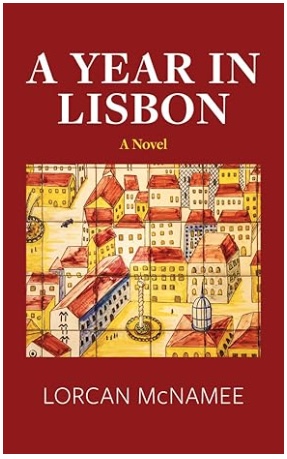
The Front cover of A Year in Lisbon, by Lorcan McNamee

Lorcan was an author. He published two novels and several poems in collections over the years. You can find his novels, A Year in Lisbon and Be Do Go Have here. He had a blog, on which he liked to post things about media he had enjoyed or wanted to to talk about. Never would he be lost for something interesting to say about the latest movies he had seen and the books he had been reading. This man had a first class honours degree in English and three more degrees that he had picked up over the years so you know the blog is worth a read. We’re currently working on getting that back up and running. When we do, I’ll post a link to it here.

You might be starting to see a pattern now.

I think some of the connections are genetic. Both he and I love to travel, are crazy about all sorts of food, enjoy really good science fiction (Iain M Banks was a particular shared pleasure,) we’re both really bald. I was told by his neighbour yesterday that, if I just lost some weight, I would look just like him. All this is true. But why I am writing this post today is the effect he has had on me over the last few years.

This blog would not exist without Lorcan. I started it because I was looking for a creative outlet, mainly for me but for anyone else who might have an interest in the same things as me. That’s very much how Lorcan approached his blog.

I have written several books. I don’t think I would have done that if not for him, his encouragement and his example. I should probably get around to publishing them too… Still you can check at least one of them out here on this blog, serialised with a chapter coming out every few days. Lorcan self-published his books because he very much wanted to see his own work in print. I think it took a lot of guts to do that, have them printed, arrange his own launch parties (I was very proud to introduce him at a couple of those even though no-one knew who I was) and everything else that goes into it. And of course, to write them in the first place. I feel very close to him when I think about these things.

Most recently, after the funeral and the avalanche of grief and love from all of these people who had been brought together by my brother in different ways, who had been made into little communities and who came to learning and creativity because of him, I thought, I could try a bit of that. So, in the smallest way possible, I did.

I started off by joining the discord server of my local game shop here in Bangor, Replay. There, I started looking for players who might want to try out a new RPG. Because I’m not a salsa dancer, I’m a GM at heart. From that, five mostly strangers came together to play a few sessions of Spire in the wonderfully welcoming Replay store where they have lots of gaming tables that you can use for free. That was Tables and Tales in a proto-community form. Not long after that, friends of the blog, Isaac and Tommy, suggested that we set up a local TTRPG community and I leaped at the chance, knowing that that is what I had been wanting all along. I wanted to try to emulate my brother in that all important way; by connecting people and helping in some small way to bring them together to do a thing they love. We are still a relatively small group but have been growing bit by bit and I genuinely love to see it.

A photo of the front cover of City of Thieves, A Fighting Fantasy Adventure book by Ian Livingstone.

You know, it just occurred to me that I might owe Lorcan more when it comes to my RPG interests. He might even have been instrumental in getting me into RPGs in the first place. Probably the first game I played that had any RPG elements was City of Thieves, by Ian Livingstone, a Fighting Fantasy Gamebook from 1983. Of course, I nicked off Lorcan’s bookshelf, didn’t I?

I have not done my brother justice in this short post at all. He was far more amazing than my meagre powers are able to convey, I didn’t even mention that he was the most incredible uncle to our two nieces, that he was an accomplished translator, that he earned a Master’s Degree in Spanish Studies posthumously, that he was an art lover and the origin of all my best musical tastes, that he was a podcaster, that he was the first in our family to get a tattoo, that he will be missed forever by all of those who knew him and that the world is better for having had him in it.

Thanks for reading about my brother today, dear reader. Normal service will resume in the next post.

Case Closed

The suspects

I finished up two investigative scenarios in the last week or so. The experiences could not have been more different. I was the GM for one and a player in the other. They were in very different genres and systems too. I am going to have a go at dissecting them and trying to compare them, nonetheless.

D&D 5E – An Unexpected Wedding Invitation

I wrote a little about this short campaign here. At the time I wrote that, I didn’t even know it was a murder mystery, to be honest. It is a published, third-party 5E scenario so I could have looked it up, but I avoided reading anything about it online. Our wonderful DM was also the consummate host and was always wonderfully welcoming. She was a great DM too. We met in person over the space of eight sessions, more-or-less every two weeks. Our DM, who has run this scenario more than once previously, informed us afterwards that we took far longer to get through the scenario than other groups. Personally, I think that’s probably because of a couple of very important factors. Firstly, we had a fairly large group, five players and the DM. But, I think the second factor is what really pushed it so far beyond the normal length for the scenario. We were all chewing the scenery at every available opportunity. This group of players does not shy away from the first person, expansive, full-chested role-playing and it honestly does my withered heart good to see it every time we get together. We all had reasons for going ham as well. There was the promise of romance and, failing that, friendship. The possibility for court intrigue and drama was there as well. But, certain sections of the table were there to get their kisses in (in the infamous words of Lou Wilson.) The mystery was almost secondary to those folks.

As for the mystery itself; I won’t go into details. No spoilers except to say that there is a murder and we were not aware of that aspect going in. I don’t know if the DM advice is to keep that from the players until it happens but that was the case for us. Anyway, that was quite exciting actually. To discover there was an actual crime to figure out gave us all a shot in the arm! Up until then we had been essentially casing the wedding for curses and harassing the guests with weird, cryptic questions about the nature of one family’s bad luck. So, when we had a specific thing to investigate, it filled us with the sort of motivation that, I feel, the scenario failed to provide up to that point.

As for the investigation itself, it’s all about the NPCs in this adventure. That seems appropriate for a mystery game and this particular scenario was replete with well drawn NPCs who had distinct personalities, motivations, idiosyncrasies and voices (provided quite expertly by our DM.) You have the bride and groom, of course but you also have a cast of characters drawn mainly from the families on both sides. There are several set-piece scenes that are designed to allow the PCs to get to know the cast and our DM graciously provided us with portraits for all the main NPCs, hanging them on her DM screen. This was very helpful as there were a lot of them and without that constant visual aid, it would have been much harder to keep track. Our interactions with the NPCs seemed to give us positive or negative standing with them, leading to later conversations being more or less difficult for us.

The setting was integral, of course. An opulent country manse belonging to one of the families involved, surrounded by a generous estate on which they enjoyed hunting and picnicking. The adventure provided a couple of maps; more for reference than anything else as there was not a fight to be had at this affair.

As I said, I am not going into spoilers here about the murder, the suspects or the ending but there are a few things I can say. It seems as though the adventure comes with several prepared possible endings. The actions of the players, their standing with the major NPCs and their final pronouncement of who they figure did the murder all seemed to have an effect on that. This served to give it a slightly video-gamey feel, which was neither good nor bad but certainly leant a lot to the idea that everything was laid out in the adventure quite prescriptively.

Speaking of which, the actions of the PCs throughout felt a little restricted. This was purely a result of playing D&D 5E characters in a genre they were never meant to exist in. Few of our powers or abilities were of much use in this milieu and that felt a little frustrating at times.

Equally, there were several timed events that could not be prevented or changed in any real way by the PCs. Once again, this had the effect of making us feel more like spectators than active participants.

Questioning the NPCs, the most important part of the scenario, by far, and the only one where you could make inroads in your romantic or duelling ambitions, was difficult to say the least. Pretty much all of them could have done it, to be honest. That, by itself, is ok, but failing certain rolls here and there made the process feel fruitless at times. Without some mechanic to allow you to fail forward, it was always going to feel like this.

In the end, we failed to catch the killer. We fingered the wrong guy for the crime. This was due, in large part, to us interacting less with the killer than we might have, failing s couple of clutch rolls in interacting with them and the fact that we were left with too many potential culprits at the end that we couldn’t whittle down further with the evidence we had. Our failure was revealed to us in a sort of cut-scene right at the end. After all the effort we had put in, this felt like losing even though we had all enjoyed playing together around the table. The overall consensus from the players was that 5E was not the system for this scenario. It is not built for this sort of investigation and it led to an unsatisfying feeling from the result of the game even if we had a good time playing together, as we always do.

Blade Runner, Electric Dreams

Two blade runners posing like neon noir heroes in front of a stylised Wallace Corp ziggurat beneath the title of the Blade Runner Role Playing Game.
A photo of the front of my copy of the Blade Runner Start Set box.

I wrote a little about this game here while we were still playing it. At the time of writing that, we were only two sessions in and I was greatly looking forward to the next one. There were two players, playing Detective Novak and Fenna. We did this online, using Zoom and Roll20. It took five sessions of two and a half to three hours each. Having checked out other groups’ experiences with the same case file, I can say that’s about average. I could absolutely see it taking both less or more time since it would be dependent on how quickly the blade runners discover the key clues and how quickly they act.

Electric Dreams is also a pre-written scenario but, I think, importantly, it was produced by Free League as the intro to the Blade Runner RPG. There was never going to be a mismatch of scenario and system like we saw in An Unexpected Wedding Invitation. In fact, it felt as though this scenario was close to perfectly designed to bring players into the world and the system at the same time.

If you are a Blade Runner fan but not familiar with the Year Zero engine or RPGs in general, its got elements from the movies for you to geek out over and allow you to feel part of the megacity of LA by referencing the media you know and love. Meanwhile, it holds your hand through the early interactions with the mechanics, kicking things off with a few basic Observation and Manipulation rolls, teaching you that the more successes you get on your dice rolls, the better the result. As time goes on, the references to the movies remain strong, keeping the whole thing feeling like a natural continuation of or bridge between those stories and establishing a consistent and immersive tone and atmosphere. But you get more and more in-depth interactions with the rules as it introduces you to chase mechanics, combat, use of more complicated investigative techniques and character advancement.

And if you are an old hand at Free League’s signature rules engine, you will be good to go from the start. I was somewhere in between when we started playing. I am a big fan of Blade Runner and I have run Tales from the Loop before so I knew how the system worked well enough. But it was a long time since I had played it and I definitely had to look some rules up in play. This was generally fine, and didn’t take too long. What we also found, was that, once we looked up those rules once, we grokked them and didn’t have to keep referring to the rulebook, which was a refreshing change of pace for a group of players who have mainly only played D&D 5E together before (at least in recent years.)

Now, down to the scenario itself. As with the Wedding mystery, this was largely based around really well drawn NPCs, all of whom were potentially important to the plot. But, from the start, it felt as though the PCs knew who their main suspect was. They were rarely dissuaded from that notion, despite (or perhaps because of) the powers-that-be forcefully reminding them about the way they would like to see the investigation go. Since the characters were playing blade runners, cops in the LAPD, there were a number of NPCs that were there purely to back them up or chivvy them along. You had Coco, the medical examiner (who you also meet in Blade Runner 2049) and Deputy Chief Holden (who got his chest punctured in an interaction with Leon the replicant in Blade Runner) as well as any number of ad-libbed beat cops and the AI LAPD Despatch. The Wallace Corp is represented by one of their replicant executives who was immense fun to play. You also had a few NPCs that were witnesses and were never going to be anything but witnesses. The investigation was not designed to send the detectives off on the wrong path. There was no more than one red herring and that was there more to reinforce a theme than as a real way of derailing things.

What we found was that most of the sessions involved them trying to track the one suspect and discover their motivations and whereabouts. This led them into a web of corporate intrigue and moral dilemmas. That’s what Blade Runner should be about, of course, and Free League nailed that. The PCs were able to use the abilities of their pregenerated characters to do that pretty well. In fact, I would say that they were implausibly successful most of the time. On a couple of occasions they rolled so well that I felt compelled to reward them with information that would not, otherwise, have come up until later in the investigation. Moments like these allowed them to make incredibly effective leaps. What I liked about this scenario is that it allowed for that. There is a timeline of events that will happen at particular points of the investigation, but only if the PCs do nothing to prevent them. So, that doesn’t stop you moving them two steps forward, instead of the usual one. I think it actually encourages that sort of thing, in fact, as the timed events are generally pretty bad for the investigators or the other major characters.

We got an ending that was equal parts satisfying and open-ended, with the PCs making the moral, rather than the legal choice after the corporation took the law into its own hands one too many times. We might return to Novak and Fenna someday, maybe in the next published case file, Fiery Angels. The first one ran so well that I would definitely be confident to play the next one.

Conclusion

It is almost unfair to compare these two games, but it has been impossible for me to do anything else. In blade runner, you had a scenario where any outcome the PCs reached was likely to be satisfying and a system that supported the sort of game you were playing, investigative, character driven and darkly themed. In the other, the scenario felt a little too restrictive and was hampered further by a system that was never designed to support the investigative nature or the regency feel. I had fun with both, but I know where I would turn first if someone asked to play a mystery game.