Woodpaneled

Vintage RPG

Do you listen to the Vintage RPG podcast, dear reader? Do you follow VintageRPG on Instagram? If you are reading this blog, the chances are good that you do both of those things. But, in case you have somehow never come across it, the podcast is presented by Stu Horvath and John “Hambone” McGuire. On it the lads chat about lots of RPG related subjects. As the name implies, they do talk about older games, like Fighting Fantasy and Beyond the Supernatural, which, as a gamer of a certain vintage, I very much appreciate. But many of the most interesting episodes involve newer games like Swyvers. They often have fascinating interviews with game makers. Their conversation with Swyvers creators, Luke Gearing and David Hoskins, convinced me to back the project and I’m so glad I did!

And on Instagram, Stu posts at least five days a week with details of old modules, game systems, books, accessories etc. It’s the exact kind of nostalgia I can enjoy. I am of the general opinion that most types of nostalgia are just gateway drugs to the sort of opinions that lead many people to vote for tangerine demagogues. But, Stu is under no illusions. He takes a critical look at each of the products he features and calls it out when they are problematic, poor quality or just nasty.

The point is, Vintage RPG is a wonderful source for news on the RPG scene, historical gaming facts and deep delves and has acted as an outlet for game creators and enthusiasts to push themselves, their work and their passions.

Webring

So anyway, on their recent show, ostensibly about Eat the Reich, Stu and Hambone introduced their listeners to the Woodpaneled webring. For those of you who haven’t heard of this phenomenon, this is how Wikipedia defines a webring:

A webring (or web ring) is a collection of websites linked together in a circular structure, and usually organized around a specific theme, often educational or social

Woodpaneled

The Woodpaneled Webring was founded by Stu to help those participating in it to have an internet experience that is not entirely governed by the algorithms of social media companies or the advertisement driven peccadilloes of search engines. He put the call out on the show for artists, writers and designers with websites related in some way to a broad theme. Most of the sites that are part of the ring now are to do with RPGs or at least RPG-adjacent but some are more broadly about culture and art. Here is a link to the a short piece Stu wrote to explain why he started this thing. He explains it far better than I could, especially as I am pretty sure I have a very different relationship with wood panelling than he does!

Now, I don’t have much of a presence on social media. I have an Instagram account that I am fairly active on and I just started a Bluesky account @thedicepool.bsky.social which I have yet to even post on. I gave up on Facebook many years ago for the same reasons that I view nostalgia with suspicion, and I abandoned Twitter when the fash started to take over. Basically, the idea of a smaller, slower, less shouty and more contemplative internet appealed greatly to me. I thought this sounded like a perfect home for The Dice Pool, to be honest. So I contacted Stu to ask him about joining and he was so enthusiastic and sound about it! And so helpful. I am not terribly experienced when it comes to the technical side of running this website so I needed his assistance to jury-rig a solution to allow me to embed the Woodpaneled widget that you can see at the top of my main page (I am working on getting that to appear on every page. Like I said, I’m more of a tortoise than a hare when it comes to the backend stuff, but I’ll get there in the end.)

So, dear reader, I want to encourage you to go hit those “Next” and “Previous” buttons on the widget and have a dive into other sites on the webring. There are some fascinating and creative people involved!

Between the Skies Part 3

How to begin

I’ve written about beginnings in RPGs before. I think they are crucial to establishing tone, theme, genre and expectations to the whole game, long or short. Many RPG books lay out pretty well, the genre and themes they explore, many providing starting adventures or scenarios to help you set the tone. Few do as good a job at helping you to begin as Between the Skies.

Now, as I’ve written in the previous entries in this series, Between the Skies by Huffa provides a whole lot of advice and options collected into a loosely defined game. It exists to help the players (including the GM) create the play-style and world they want. The text assumes that you will be using a set of rules that suits your table so, by necessity, the advice and tools it provides to help you begin playing are applicable in almost any game. Having read the Beginning Your Travels chapter, I can say it’s brimming with what is just plain good advice.

How and why

The why is an often overlooked element of an RPG character. What the hell are they doing any of this crazy shit for? Why are they travelling across the planes or through wild-space, in the specific example of Between the Skies. I wrote more about character motivation here. Obviously, this book has tables that help you to answer that question. They are wonderfully vague, as you might have come to expect. The vagueness allows your own imagination to combine with the generalities of the game already established by you and your group.

The How and Why do You Travel tables from Between the Skies. These include a "Who are you Traveling For? " d6 table, a "How do you travel?" d66 table and a "why are you traveling" d66 table
The How and Why do You Travel tables from Between the Skies. These include a “Who are you Traveling For? ” d6 table, a “How do you travel?” d66 table and a “why are you traveling” d66 table

You will notice there are three sub-tables there.

  • Who are you Traveling for?
  • How do you travel?
  • Why are you traveling?

Once again, it is important that they are incredibly general. You will find yourself building your world as you fill in the gaps around the results of this table.

It’s telling, isn’t it, that the how is also considered here? And that it’s randomised? This is one of the most fundamental questions to answer in establishing the setting, and, in many ways, the type of game you’re preparing to play and it’s left up to random chance. If you think of it from the perspective of a D&D game, there are not too many tables who are rolling the dice on running a Planescape, Spelljammer, Dark Sun or Forgotten Realms campaign next. But using this table gives you all the power. It allows you and your group to put down roots in the world you are going to play together in, and grow whatever you want out of them. You’re going to need a lot more than just the single result from the table but Huffa trusts that you can come up with that, and not only that you can do that, but that you will enjoy doing it. Luckily there are also a butt-load more tables in here to fire the imagination and get you moving in a direction.

How about this for a situation?

The Starting Site Recipe list from Between the Skies. It has 7 points.

Huffa would like you to start your first session in media res. That’s also what I always say. Clearly, she’s a genius. The great thing about the advice as presented in the Starting Situation section is that, once again, the in media res beginning has been formalised into a procedure. You are presented here with a series of steps required to create your Starting Site, what is called the “Starting Site Recipe.” After that you have bevvy of tables to help you in sorting out what type of situation it’s to be, what or who precipitated it, what type of site it is, its inhabitants and a some more trickle down tables that allow you to flesh out the various site types.

The Starting Situation tables from between the Skies. There is a "Starting Situation Type" d6 table with "precipitated by" 2d6 table attached. There are also two more 2d6 tables, "PCs aligned with..." and "PCs antagonistic towards..."
The Starting Situation tables from between the Skies. There is a “Starting Situation Type” d6 table with “precipitated by” 2d6 table attached. There are also two more 2d6 tables, “PCs aligned with…” and “PCs antagonistic towards…”

It makes it feel like, if you used this method, you would have your starting situation and location prepared in minutes and only need to write a short description of a few of the items you rolled up. As usual, when I read any part of this book, it just makes me want to give it a go.

How it looks

Luckily, there is a great little example Starting Situation presented in this chapter as well. It has been generated using the method described earlier and it is called “The Godshambles.” The entire situation is described in only a few short paragraphs, a couple of handy tables, a route map and particularly evocative illustration by Coll Acopian.

If you wanted, you could just use the Godshambles as your own starting situation and no-one could blame you. But, I think one of the beautiful things about the Starting Site Recipe is that the prompts you roll up on the tables will help you to imagine a situation that is fitting for the kind of game you have conjured together when you were creating characters and rolling on the how and why tables before. So, it is likely to feel a little loose around the hips or too baggy around the ankles compared to one you generated yourselves.

How it goes

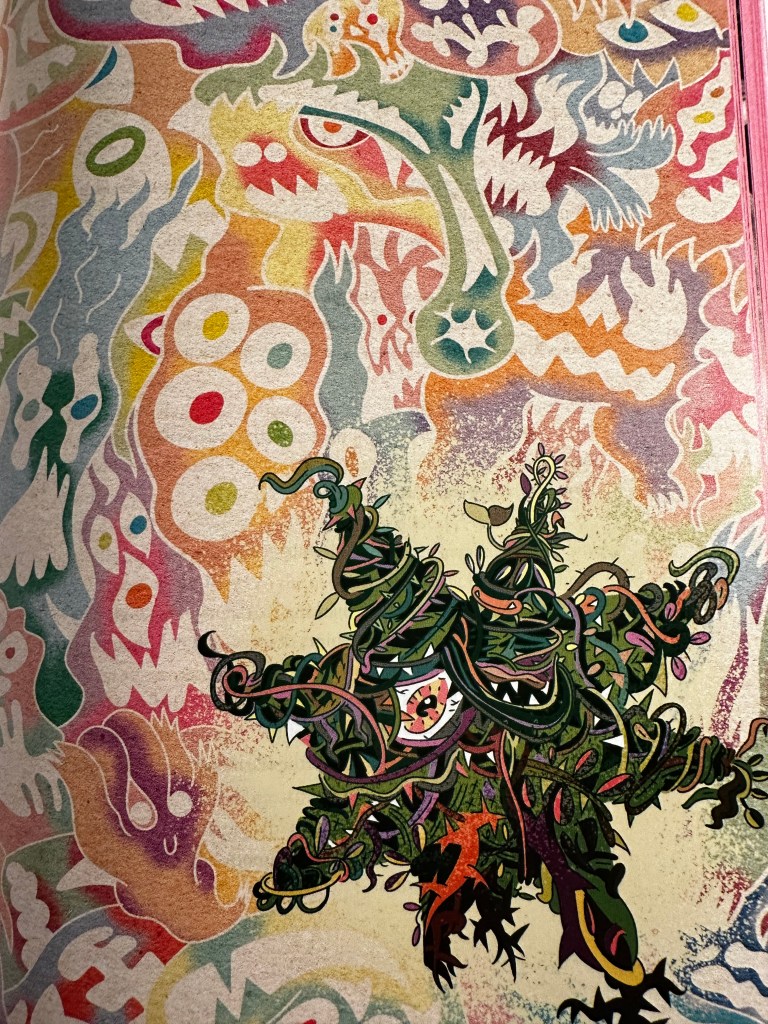
A full colour illustration from Between the Skies. It shows a star-shped being that seems to be made of an entaglement of vines and other plants floating through a multicoloured, psychadelic dreamscape.

Like I stated earlier, I am a big fan of the methods described in this chapter for beginning your game. I am excited to try it out and invite my players to be as big as part of the world building as I am, or bigger, from the very get-go.

Between the Skies has a lot more to offer. I have not even made it half way yet. But I think, for now, at least until I start actually playing it, I will pause this series of posts for now. I’ll bring them back when I have some more practical experience I think. See you then, dear reader!

Inspiration

Anniversary

Today is the first anniversary of my big brother’s passing. We interred his ashes in the local graveyard yesterday. It has been a tough week for my family and me. It’s been a tough year.

He died after a short but vicious illness that we could not have predicted. He was only 53 years old. His death came far, far too soon. And even during the years he had, much of his time was spent contending with the draining, exhausting illness known as M.E. But he had made his life so rich and so full in the short time he had that he has been an incredible inspiration to me, particularly over the last twelve months, but through all the years of his life as well.

Lorcan McNamee

Lorcan McNamee was a teacher first and foremost. Most of his working life he spent teaching languages; English, Spanish, Portuguese. He was a polyglot, obviously. Even at the time he died, he was working on learning French and German. But he taught other things too. Most notably, salsa! He taught salsa dancing to all comers in a church hall in our home town.

We, his family, stood for two hours greeting those who had come to grieve with us at his funeral. Many, many of the hundreds who came were his students or his former students, including his dance students and a host of people from Ukraine and many other parts of the world. And so many people from Spanish speaking countries who had been welcomed to our town and helped by Lorcan and the Sligo Spanish Society, which he was instrumental in organising.

I will be honest with you, dear reader, the sheer numbers and the obvious and genuine emotion expressed by these people was something of a shock to me. I knew, of course that he was an excellent teacher, that was not the shock. But I had known so little of the key part he played in the lives of so many through his involvement in all of these different activities, organisations and communities. To me, of course, he was just my big brother. He always would be that to me and always will and I think that prevented me from seeing all the rest. Additionally, he was never one to toot his own horn, except when it was beneficial to a cause. For instance when he led the charge to gain fuller rights and benefits from the government and unions for language tutors. Indeed, a representative of his union spoke at his funeral, reading a glowing tribute from the union’s president. Lorcan had told everyone about the fact that he would be protesting at Government Buildings and that he was interviewed for the news. Such pride I felt then, especially as someone also working in an education sector ravaged by real-terms cuts for decades.

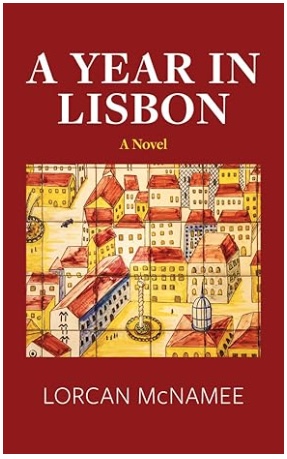
The Front cover of A Year in Lisbon, by Lorcan McNamee

Lorcan was an author. He published two novels and several poems in collections over the years. You can find his novels, A Year in Lisbon and Be Do Go Have here. He had a blog, on which he liked to post things about media he had enjoyed or wanted to to talk about. Never would he be lost for something interesting to say about the latest movies he had seen and the books he had been reading. This man had a first class honours degree in English and three more degrees that he had picked up over the years so you know the blog is worth a read. We’re currently working on getting that back up and running. When we do, I’ll post a link to it here.

You might be starting to see a pattern now.

I think some of the connections are genetic. Both he and I love to travel, are crazy about all sorts of food, enjoy really good science fiction (Iain M Banks was a particular shared pleasure,) we’re both really bald. I was told by his neighbour yesterday that, if I just lost some weight, I would look just like him. All this is true. But why I am writing this post today is the effect he has had on me over the last few years.

This blog would not exist without Lorcan. I started it because I was looking for a creative outlet, mainly for me but for anyone else who might have an interest in the same things as me. That’s very much how Lorcan approached his blog.

I have written several books. I don’t think I would have done that if not for him, his encouragement and his example. I should probably get around to publishing them too… Still you can check at least one of them out here on this blog, serialised with a chapter coming out every few days. Lorcan self-published his books because he very much wanted to see his own work in print. I think it took a lot of guts to do that, have them printed, arrange his own launch parties (I was very proud to introduce him at a couple of those even though no-one knew who I was) and everything else that goes into it. And of course, to write them in the first place. I feel very close to him when I think about these things.

Most recently, after the funeral and the avalanche of grief and love from all of these people who had been brought together by my brother in different ways, who had been made into little communities and who came to learning and creativity because of him, I thought, I could try a bit of that. So, in the smallest way possible, I did.

I started off by joining the discord server of my local game shop here in Bangor, Replay. There, I started looking for players who might want to try out a new RPG. Because I’m not a salsa dancer, I’m a GM at heart. From that, five mostly strangers came together to play a few sessions of Spire in the wonderfully welcoming Replay store where they have lots of gaming tables that you can use for free. That was Tables and Tales in a proto-community form. Not long after that, friends of the blog, Isaac and Tommy, suggested that we set up a local TTRPG community and I leaped at the chance, knowing that that is what I had been wanting all along. I wanted to try to emulate my brother in that all important way; by connecting people and helping in some small way to bring them together to do a thing they love. We are still a relatively small group but have been growing bit by bit and I genuinely love to see it.

A photo of the front cover of City of Thieves, A Fighting Fantasy Adventure book by Ian Livingstone.

You know, it just occurred to me that I might owe Lorcan more when it comes to my RPG interests. He might even have been instrumental in getting me into RPGs in the first place. Probably the first game I played that had any RPG elements was City of Thieves, by Ian Livingstone, a Fighting Fantasy Gamebook from 1983. Of course, I nicked off Lorcan’s bookshelf, didn’t I?

I have not done my brother justice in this short post at all. He was far more amazing than my meagre powers are able to convey, I didn’t even mention that he was the most incredible uncle to our two nieces, that he was an accomplished translator, that he earned a Master’s Degree in Spanish Studies posthumously, that he was an art lover and the origin of all my best musical tastes, that he was a podcaster, that he was the first in our family to get a tattoo, that he will be missed forever by all of those who knew him and that the world is better for having had him in it.

Thanks for reading about my brother today, dear reader. Normal service will resume in the next post.

Dragon Age Rules

Basics

So, it looks pretty straightforward as a system, if I am honest. The basics, at least. I do believe that, from what I have read in the past, there is one major innovation in the AGE system and I will get to that later. For now, let’s just get a grip of the basis of the whole thing, ability tests.

Ability tests

You need to roll an ability test to do any sort of action in the game. In general, you can try to do anything, even if you don’t have the appropriate ability focus, which is kind of like a skill or proficiency in D&D and similar games. Sometimes, the fiction of the game or the situation might require you to have a particular ability focus to even attempt a roll, but this seems to be the exception and not the rule.

Anyway, the way it works out is you roll 3d6 when you want to try to do something. One of these dice needs to be identified as the Dragon Die, more on that later. Then you add the ability you are rolling and another 2 if you have the right focus.

3d6 + Ability + 2 for Focus

Obviously, the intention is to roll high. The GM sets a Target Number depending on difficulty and circumstances. The higher that number is, the harder the action is. If you roll the Target Number or higher, you succeed. Simple enough.

They identify the Opposed Test as a separate type in the rules but essentially they work the same way, except, instead of having a Target Number, both characters roll their opposing ability tests to see who rolls higher. Also, if your scores are tied, you use the number on the Dragon Die to decide who wins.

It also makes it clear that you will need to use tests, in some situations, as if they are saving throws. So, you would make a Dexterity test to avoid falling off an unexpected cliff. That sort of thing.

There is a short section here on degrees of success. But, honestly, it doesn’t make an awful lot of sense and I would be loath to include it. Essentially, it seems to be a narrative tool, only. It allows you to show off how well you succeeded in a test, or how you only just scraped by. You do this by referring to the result on the Dragon Die. The higher the Dragon Die roll, the more spectacular the action. But, from my point of view, it’s still a success and, if you want to see how well a character did in their success, can’t you just look at the number you beat the Target Number by? (Since I wrote this, I was chatting with a mutual on Instagram, @otherstuffrpg about this very subject. They were a big fan of this mechanic! They felt it was a unique aspect of the rules that added a lot to the game. It might be one of those things that comes alive in play.)

Time and Actions

So, time is explicitly divided into Narrative Time and Action Time. It’s pretty much always Narrative Time until the Action starts, is more or less how they put it in the book. There’s not a lot to explore regarding Narrative Time, to be honest.

Action Time happens when you get into any scene that requires the rolling of initiative. Once that happens you are dealing with rounds. Each round is 15 seconds. Within a round you can take one Major Action and one Minor Action or two minor actions. There is a list of major and minor actions that are possible within a round. Major ones include stuff like All-out Attack, Heal, Melee Attack and Ranged Attack. Meanwhile, Minor Action examples are Aim, Guard Up, Ready and Press the Attack. I’m not going to get into the description of each and every action. Suffice it to say there is quite a lot of detail here. I imagine a cheat-sheet would be all but essential at the table to help players remember what they can do in a round and how each action works.

Initiative is sorted by everyone making a Dexterity (Initiative) roll. Ties are broken by the result on the Dragon Die and only PCs and major NPCs get their own individual initiative rolls. Minor NPCs act together in a group. You only roll initiative at the top of an encounter, not every turn.

Combat

I realise I already started the combat stuff above but that is the way it’s presented in the book. Also, it does suggest that the initiative and Action Time rules can be used in any situation that could be an action scene in a movie. You could lump chases, hunts, and other similar activities in there too.

Anyway, here’s how you do violence in Dragon Age:

  • Make and attack roll. That’s a test using the ability associated with your weapon type, Strength or Dexterity.
  • Add any bonuses from focuses, magic etc
  • Compare the result to your enemy’s Defense rating
  • If your roll is equal to or higher than that Defense rating, you hit! Well done!
  • Then you inflict damage. Everyone’s favourite part
  • You roll the damage dice of your weapon and add the relevant ability to it. This is usually Strength, but, interestingly, you add your Perception score to a ranged attack roll, rather than your Dexterity.
  • If your attack is Penetrating skip this step, otherwise, subtract your opponents armour rating from the damage roll
  • The result is the damage you do to the enemy’s Health

@Otherstuffrpg suggested an interesting house rule for damage, which I thought was a pretty fun way to speed up combat a little and beef up the Dragon Die. Instead of rolling damage for every hit, you take the result of the Dragon die and add a +4 for each damage die your weapon normally has. So, if you roll a 3 on your Dragon Die on your attack roll and you are using a longsword, which normally does 2d6 damage, you get 11 damage, 3 + 4 + 4 (plus whatever other miscellaneous bonuses you might have.) Sounds good, right?

There are a bunch of other rules around how you deal with dying characters, pulling killing plows and coups-de-grace but I am not going to get into them here. Most of them are the sorts of things you are more likely to tackle using your own judgement at as a GM anyway.

Stunts

This is the part I was most interested in getting to. It is also the mechanic that I feel provides the most uniqueness to the system, was I hinted at earlier.

Here, I am only referring to Combat Stunts but the game has Exploration, Roleplaying and Magic Stunts too, which is interesting.

Essentially, in combat, if you roll doubles on any of your dice in your attack roll, you get Stunt Points. You get a number of Stunt Points equal to the number on your Dragon Die, so, you want to roll high on that too. If you want to do a stunt, you have to use those points immediately or they disappear. Now, different stunts cost different numbers of points. There is a table of stunts and their SP costs.

You can see from the table that it includes some pretty cool little tricks and actions. I particularly like the Set Up one, that allows you to help another PC on the battlefield and Seize the Initiative, which means you literally move to the top of the initiative table.

But, when I first heard about stunts I was imagining something a lot more freeform. I guess, even when restricted to the items on this table, you are relatively free to describe how you achieve the results. I think I would almost certainly play stunts much looser at the table, allowing players to come up with their own stunts on the fly and assigning the required stunt points to what they are trying to do.

Healing

You can recover a few Health points by taking a Breather, like a five minute break, you can recover more by sleeping for a solid 6 hours or you can gain some back instantly by using the Heal action or the wizard spell of the same name.

Magic

I am skipping the chapters on focuses, talents, specialisations and equipment, mainly because I touched on them in the character creation post, but also because I just want to get to the section on Magic.

Magic in Dragon Age the video games, while not necessarily very different o to other games in how it is presented on screen, is such an interesting and integral part of the lore and story of the setting. With most mages being controlled by the Chantry, or church, due to their volatility and the potential for them to become possessed by demons and turned into violent abominations, you have a fascinating dynamic in place already. If you then throw in the apostate mages on the run for the chantry and their enforcers, the Templars, the existence of the Magocracy in the Tevinter Imperium and the fully enslaved and tightly controlled magic users of the Qunari, things get pretty explosive. It is always at the centre of the stories in Dragon Age games and I am hoping they have retained a lot of that flavour here.

The chapter on Magic does take quite a few pages to cement your understanding of the subject in the setting, which is good, although, once again, potentially a bit too much for the beginner.

It then gets into the rules, starting by suggesting several basic mage builds that equate largely to those from the video games, Creation Mage, Entropy Mage, Spirit Mage etc. These are essentially just the selection of three spells that you should start off with if you have a preference for the type of magic you would like your mage to cast.

Mana

We then get into Mana Points. Once again, I got into this a little during character creation. A mage gets a 10 + Magic + 1d6 MP to start. You have to spend MP to cast spells. Each spell has a set cost but this cost can be increased if you are wearing armour, the heavier the armour, the higher the cost. Once you run out of MP, you are done casting spells until you recover some. Resting/meditation or sleeping will regain you some or all of your MP. Pretty straightforward there.

Casting Spells

You have to make a Magic ability test to cast any spell. Every spell will have a Target Number in the spell block and you have to hit that number or the spell fizzles, taking your mana with it. This seems pretty rough. You only have so many MP and even if your spell fails you lose them. This smacks of the spell casting rules in Dungeon Crawl Classics. There are even a number of tables in here describing specific Spell Stunts and Magical Mishaps that might happen depending on the results of your rolls. Magical Mishaps happen on a failed casting roll where the Dragon Die shows a 1. Here’s the table:

You can see there, that the mage risks becoming an abomination on a roll of 6!

Spellpower

This is another one of those rules that makes me wonder why they have bothered with it. Some spells will require a character to make a test against your Spellpower. Now your Spellpower is calculated like this:

10 + Magic + Focus (if applicable)

So, it is not a constant, like a D&D magic user’s Spell Save DC. What I don’t understand is, why not just use the roll you made to cast the spell and make your opponent roll against that? This whole Spellpower business seems like an unnecessary mechanic.

Spell Stunts

These work just like Combat Stunts. If you roll doubles on your spell casting test, you get the number of spell stunt points that shows on the Dragon Die. You have to use them straight away and you do so by spending them according to the cost of the spell stunt. See the table below:

I really like Fast Casting and Imposing Casting. No surprise really since they are the most powerful.

There are also Spell Stunt tables for each type of magic, like Creation, Primal, Spirit etc. And, if you want, you can include the optional Advanced Spell Stunts but only at higher levels.

I like the stunts a lot. It feels like something really special that I could imagine players hoping and praying for sometimes. I can imagine the burst of excitement at the table whenever doubles are rolled!

Spells

The spells themselves, I am not going to get into. I think it’s enough to state that the spells accurately reflect those presented in the video games. As a piece of flavour and lore, I really appreciate that. Spells like, Death Magic, Crushing Prison, Frost Weapons and others are very evocative of the Dragon Age games for me so I am glad they have chosen to stick so closely to them.

Also, the most iconic of the magic specialisations in Dragon Age, Blood Magic, is very much an option here, but to emphasise its otherness, the Blood Magic spells have all been listed separately. They’re pretty horrific, most of them, too.

Although there is no level requirement for the spells, as such, many of them have another spell as a requirement. I like this as it will force mage players to take a certain path through the spell lists if they want powerful, top tier ones. Just like in the video games, once again.

Conclusion

So, thems the rules for Dragon Age, pretty much. They are not as crunchy as I was expecting given the size of the tome but there are definitely a few mechanics that I would probably just not use. I would also definitely consider @Otherstuffrpg’s home-brew damage rules.
I am a fan of the stunt mechanic overall, but I would probably be quite happy to allow a lot of improvisation of stunts at the table too.

I didn’t expect this, but getting to grips with the rules has made me excited to play it!

How about you, dear reader, have you ever played this game? Would you be interested to give it a try now that you know a bit more about the rules?

Case Closed

The suspects

I finished up two investigative scenarios in the last week or so. The experiences could not have been more different. I was the GM for one and a player in the other. They were in very different genres and systems too. I am going to have a go at dissecting them and trying to compare them, nonetheless.

D&D 5E – An Unexpected Wedding Invitation

I wrote a little about this short campaign here. At the time I wrote that, I didn’t even know it was a murder mystery, to be honest. It is a published, third-party 5E scenario so I could have looked it up, but I avoided reading anything about it online. Our wonderful DM was also the consummate host and was always wonderfully welcoming. She was a great DM too. We met in person over the space of eight sessions, more-or-less every two weeks. Our DM, who has run this scenario more than once previously, informed us afterwards that we took far longer to get through the scenario than other groups. Personally, I think that’s probably because of a couple of very important factors. Firstly, we had a fairly large group, five players and the DM. But, I think the second factor is what really pushed it so far beyond the normal length for the scenario. We were all chewing the scenery at every available opportunity. This group of players does not shy away from the first person, expansive, full-chested role-playing and it honestly does my withered heart good to see it every time we get together. We all had reasons for going ham as well. There was the promise of romance and, failing that, friendship. The possibility for court intrigue and drama was there as well. But, certain sections of the table were there to get their kisses in (in the infamous words of Lou Wilson.) The mystery was almost secondary to those folks.

As for the mystery itself; I won’t go into details. No spoilers except to say that there is a murder and we were not aware of that aspect going in. I don’t know if the DM advice is to keep that from the players until it happens but that was the case for us. Anyway, that was quite exciting actually. To discover there was an actual crime to figure out gave us all a shot in the arm! Up until then we had been essentially casing the wedding for curses and harassing the guests with weird, cryptic questions about the nature of one family’s bad luck. So, when we had a specific thing to investigate, it filled us with the sort of motivation that, I feel, the scenario failed to provide up to that point.

As for the investigation itself, it’s all about the NPCs in this adventure. That seems appropriate for a mystery game and this particular scenario was replete with well drawn NPCs who had distinct personalities, motivations, idiosyncrasies and voices (provided quite expertly by our DM.) You have the bride and groom, of course but you also have a cast of characters drawn mainly from the families on both sides. There are several set-piece scenes that are designed to allow the PCs to get to know the cast and our DM graciously provided us with portraits for all the main NPCs, hanging them on her DM screen. This was very helpful as there were a lot of them and without that constant visual aid, it would have been much harder to keep track. Our interactions with the NPCs seemed to give us positive or negative standing with them, leading to later conversations being more or less difficult for us.

The setting was integral, of course. An opulent country manse belonging to one of the families involved, surrounded by a generous estate on which they enjoyed hunting and picnicking. The adventure provided a couple of maps; more for reference than anything else as there was not a fight to be had at this affair.

As I said, I am not going into spoilers here about the murder, the suspects or the ending but there are a few things I can say. It seems as though the adventure comes with several prepared possible endings. The actions of the players, their standing with the major NPCs and their final pronouncement of who they figure did the murder all seemed to have an effect on that. This served to give it a slightly video-gamey feel, which was neither good nor bad but certainly leant a lot to the idea that everything was laid out in the adventure quite prescriptively.

Speaking of which, the actions of the PCs throughout felt a little restricted. This was purely a result of playing D&D 5E characters in a genre they were never meant to exist in. Few of our powers or abilities were of much use in this milieu and that felt a little frustrating at times.

Equally, there were several timed events that could not be prevented or changed in any real way by the PCs. Once again, this had the effect of making us feel more like spectators than active participants.

Questioning the NPCs, the most important part of the scenario, by far, and the only one where you could make inroads in your romantic or duelling ambitions, was difficult to say the least. Pretty much all of them could have done it, to be honest. That, by itself, is ok, but failing certain rolls here and there made the process feel fruitless at times. Without some mechanic to allow you to fail forward, it was always going to feel like this.

In the end, we failed to catch the killer. We fingered the wrong guy for the crime. This was due, in large part, to us interacting less with the killer than we might have, failing s couple of clutch rolls in interacting with them and the fact that we were left with too many potential culprits at the end that we couldn’t whittle down further with the evidence we had. Our failure was revealed to us in a sort of cut-scene right at the end. After all the effort we had put in, this felt like losing even though we had all enjoyed playing together around the table. The overall consensus from the players was that 5E was not the system for this scenario. It is not built for this sort of investigation and it led to an unsatisfying feeling from the result of the game even if we had a good time playing together, as we always do.

Blade Runner, Electric Dreams

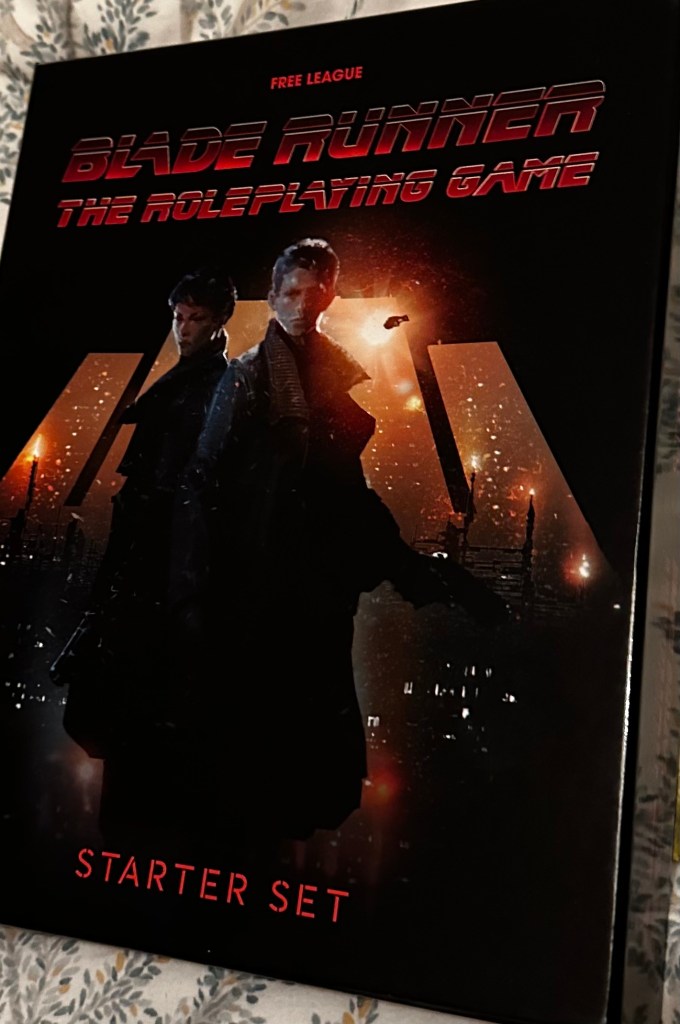
Two blade runners posing like neon noir heroes in front of a stylised Wallace Corp ziggurat beneath the title of the Blade Runner Role Playing Game.
A photo of the front of my copy of the Blade Runner Start Set box.

I wrote a little about this game here while we were still playing it. At the time of writing that, we were only two sessions in and I was greatly looking forward to the next one. There were two players, playing Detective Novak and Fenna. We did this online, using Zoom and Roll20. It took five sessions of two and a half to three hours each. Having checked out other groups’ experiences with the same case file, I can say that’s about average. I could absolutely see it taking both less or more time since it would be dependent on how quickly the blade runners discover the key clues and how quickly they act.

Electric Dreams is also a pre-written scenario but, I think, importantly, it was produced by Free League as the intro to the Blade Runner RPG. There was never going to be a mismatch of scenario and system like we saw in An Unexpected Wedding Invitation. In fact, it felt as though this scenario was close to perfectly designed to bring players into the world and the system at the same time.

If you are a Blade Runner fan but not familiar with the Year Zero engine or RPGs in general, its got elements from the movies for you to geek out over and allow you to feel part of the megacity of LA by referencing the media you know and love. Meanwhile, it holds your hand through the early interactions with the mechanics, kicking things off with a few basic Observation and Manipulation rolls, teaching you that the more successes you get on your dice rolls, the better the result. As time goes on, the references to the movies remain strong, keeping the whole thing feeling like a natural continuation of or bridge between those stories and establishing a consistent and immersive tone and atmosphere. But you get more and more in-depth interactions with the rules as it introduces you to chase mechanics, combat, use of more complicated investigative techniques and character advancement.

And if you are an old hand at Free League’s signature rules engine, you will be good to go from the start. I was somewhere in between when we started playing. I am a big fan of Blade Runner and I have run Tales from the Loop before so I knew how the system worked well enough. But it was a long time since I had played it and I definitely had to look some rules up in play. This was generally fine, and didn’t take too long. What we also found, was that, once we looked up those rules once, we grokked them and didn’t have to keep referring to the rulebook, which was a refreshing change of pace for a group of players who have mainly only played D&D 5E together before (at least in recent years.)

Now, down to the scenario itself. As with the Wedding mystery, this was largely based around really well drawn NPCs, all of whom were potentially important to the plot. But, from the start, it felt as though the PCs knew who their main suspect was. They were rarely dissuaded from that notion, despite (or perhaps because of) the powers-that-be forcefully reminding them about the way they would like to see the investigation go. Since the characters were playing blade runners, cops in the LAPD, there were a number of NPCs that were there purely to back them up or chivvy them along. You had Coco, the medical examiner (who you also meet in Blade Runner 2049) and Deputy Chief Holden (who got his chest punctured in an interaction with Leon the replicant in Blade Runner) as well as any number of ad-libbed beat cops and the AI LAPD Despatch. The Wallace Corp is represented by one of their replicant executives who was immense fun to play. You also had a few NPCs that were witnesses and were never going to be anything but witnesses. The investigation was not designed to send the detectives off on the wrong path. There was no more than one red herring and that was there more to reinforce a theme than as a real way of derailing things.

What we found was that most of the sessions involved them trying to track the one suspect and discover their motivations and whereabouts. This led them into a web of corporate intrigue and moral dilemmas. That’s what Blade Runner should be about, of course, and Free League nailed that. The PCs were able to use the abilities of their pregenerated characters to do that pretty well. In fact, I would say that they were implausibly successful most of the time. On a couple of occasions they rolled so well that I felt compelled to reward them with information that would not, otherwise, have come up until later in the investigation. Moments like these allowed them to make incredibly effective leaps. What I liked about this scenario is that it allowed for that. There is a timeline of events that will happen at particular points of the investigation, but only if the PCs do nothing to prevent them. So, that doesn’t stop you moving them two steps forward, instead of the usual one. I think it actually encourages that sort of thing, in fact, as the timed events are generally pretty bad for the investigators or the other major characters.

We got an ending that was equal parts satisfying and open-ended, with the PCs making the moral, rather than the legal choice after the corporation took the law into its own hands one too many times. We might return to Novak and Fenna someday, maybe in the next published case file, Fiery Angels. The first one ran so well that I would definitely be confident to play the next one.

Conclusion

It is almost unfair to compare these two games, but it has been impossible for me to do anything else. In blade runner, you had a scenario where any outcome the PCs reached was likely to be satisfying and a system that supported the sort of game you were playing, investigative, character driven and darkly themed. In the other, the scenario felt a little too restrictive and was hampered further by a system that was never designed to support the investigative nature or the regency feel. I had fun with both, but I know where I would turn first if someone asked to play a mystery game.

The Apprentice, Chapter 6

Time

I don’t have any this week. Had to cancel D&D this evening and all! So, here is the next chapter of the Apprentice. Enjoy!

Chapter 6: Gedholdt the Sage

A year passed. I continued to attend the classes of Mr Schpugelmann, irregularly at least. I assisted Mrs Blanintzi in the running of our small household and I did not sleep. For this last I discovered a solution, at least. Not a sleeping draft as you might imagine (such potions are unreliable, at best, and highly addictive at worst) but an infusion which allowed me to resist the ill effects of sleeping little or not at all. No-one suspected that I spent most of the nighttime hours experimenting in my attic laboratory or writing in my journals.

One winter’s day, while out wandering the town, avoiding school, I spied a man I had never seen before. His appearance was striking. His hair was brown and red but turning grey in streaks and he sported a beard which had never experienced the pleasure of being introduced to a comb. His spectacles were so thick that the precise colour of his eyes was not perceptible. He wore a long brown coat punctuated with burn marks and curiously coloured stains and a pair of boots, the soles of which stayed in place, presumably, through the power of wishful thinking alone. Most notably, however, he bore a book; an enormous tome at least two feet long and five inches thick. In fact, he was having some trouble with it, it was so large. The book was flattened against his scrawny chest and he was supporting it with two hands by its spine underneath. I did not know his destination but I would have been surprised to see him make it. This, I took to be an opportunity. Even though, as I indicated previously, my stature was not great, I had spent most of my life to that point as an unpaid farmhand so my arms and back were strong. I jinked across the muddy street, avoiding dung and carriages and hoisted up the left hand side of the great book, smiling up at the scraggly man.

“What do you think you are doing, you little urchin? What do you want with a libram like this? Let go, you diminutive beast!” He cried. There were folks watching and laughing. I laughed too, and answered with, “You misunderstand, Master. I wish only to assist you with the burden of knowledge you bear! Please, Wise Master, allow me the pleasure of helping you.” “Oh, well, perhaps you’re not the scallywag I took you for. Very well, you may continue to hold your side of the “burden of knowledge,” ha! Very droll!” He laughed and so did I.

Arriving at his home he bid me enter. I considered this a formality since he would not have managed the three steps up to his front door on his own with the titanic tome but I said nothing except, “How gracious, Master. I would be honoured.” We shuffled up the steps with some difficulty and two breaks for him to rest and one for him to unlock the Iron bound, thick oak front door. The house was a large, two storey affair, made solidly of granite bricks and long wooden beams. It stood on the edge of the town’s only park, a postage stamp of greenery (mostly weeds) grandly called the Lord Belintzi Memorial Garden and in between the town’s garrison and a blacksmith by the unlikely name of Smitzi. It was a handsome place in a respectable part of town. Inside was a different matter.
Likening the inside of this man’s home to a cave was to be ungenerous to caves and accurate only in the aspect of light and the lack thereof. Comparing it to a library would, perhaps have been more useful but libraries, I was led to believe, had a great deal of order to them whereas the books, papers and leaflets which occupied the lion’s share of space in the house’s interior appeared to do so in a manner that was totally random and inconsiderate of household appropriateness.

“Bring the book over here to the desk,” I followed him, though I could not find the desk he spoke of amongst the general disarray. He momentarily released one hand from its duty holding the book and used it to sweep away a pair of long unrolled scrolls which had contrived to hide the aforementioned desk beneath themselves. A space finally prepared for it, we slid the tome, spine first, up onto the desk and both sighed a long relieved breath. “You must have a cup of tea to revive you after your efforts and by way of thanks. I’m certain I would not have been capable of hefting this monstrous thing all the way home alone.” He exited through a door in the north wall and presently began clattering in the other room. Finally alone with the book I peered through the gloom at the title, written delicately in gold along the spine, and found I could not read it. “Master,” I called. “What is this book? I cannot read its title.” Poking his head back through the doorway he asked, “You can read?” “Of course, Master,” I answered. He shook his head and walked off, muttering into the kitchen again.

He returned momentarily after a kettle’s whistle and the rattle of cups and tray being readied. He served me tea at a table wholly covered in tiny notes which were, in turn, covered in words in a language I did not know. This was the second time in five minutes that I had encountered writing in a foreign tongue and the second time in my life. It was a revelation to me. There was so much to know just in the language I had been born to, but considering all the many languages of the world, there must be just as much to learn from books written in their scripts too. I was fascinated and I asked him about it. “How many languages do you know, Master…?” “You may call me Master Gedholdt. They call me Gedholdt the Sage in this town though so few of the townsfolk ever come seeking my “sage advice” that you would wonder why. I know ten different languages and perhaps thirty different dialects within those. Most of the work I perform in the town is translation; mercantile contracts; letters from abroad; diplomatic missives, that sort of thing. Not my only work, though, no, no, no.” I held my tongue. I could already see that this reclusive, intelligent man would need no prodding to let me in on the secret of his “other” work. Frankly, he could not wait to tell and had been waiting for just such an opportunity to talk to a like-minded individual about it, even if he was a short-arsed eleven-year-old boy. “I work most often for the garrison. They often need my assistance in matters martial and strategic. Though, they have asked me to keep my involvement with them secret I feel that I have no reason to mistrust you, my young scallywag, eh?” “Of course, Master. And it’s Maryk by the way.” “Young Maryk, of course. Well, Maryk, I can see things at a great distance in my mind’s eye through the application of magical spells…” with this he paused and peered at me as though challenging me to refute his preposterous claims. I did no such thing of course. “…and I have the ability to direct troops on the field of battle with no more than a thought. Such powers and more have I gleaned from the ancient writings of the lost Fomorin people whose empire once spanned the continent and was based entirely on the mastery of the magical arts. Theirs is not an easy language to master, not least because it is a dead one but also because of its arcane writing system which requires of the reader an understanding of the magical arts. It is like trying to read sheet music without the benefit of knowledge of musical notation. Impossible.” He sipped his steaming black tea and scrutinised me over his glasses for a moment. “Could you…I mean, excuse the impertinence, Master Gedholdt, but would you teach someone this Fomoron tongue?” I dipped my toe in the water with this question. “You have the look of knowledge-hunger in your eyes, alright. I knew it. I am not surprised by your question. I could be persuaded to impart my years of experience and wisdom to you, young Maryk, but there would be a price…” He arose from his seat, still grasping his teacup, and walked into the centre of the room. I turned in my chair to follow his movements. What might he demand of me? I tried not to think of the possibilities. “I need a… perhaps valet would be the best way to describe the position I have in mind.” He indicated with his teacup, the whole room and inferred the apocalyptic mess. I was to be his cleaner, of course. Valet, ha! “In return, I would be willing to apprentice you. But only…only with the express written consent of your parents.”

Damn. “My parents, Master Gedholdt…are no longer with us.” A technical white lie, at worst. “Indeed? An orphan are you? Well, then, who is your guardian? It is important to me that your presence here is sanctioned by the appropriate adult. You do have one? You certainly don’t have the air of one of those beastly street urchins who congregate in the market square.” “No, Master, not a street urchin. I have a governess. Perhaps she can provide the permission you require,” said I. “Indeed, there we have it. Return tomorrow with a note of permission. I will know if it is a forgery,” he pointed at me. I looked left and right and finally just nodded. “Off you go, then. I have work to do and you must leave. Goodbye.” With that, I was dismissed. I thought about protesting and telling him that as long as I was already there, I might as well make a start on the tidying but he had already been swallowed by an archway in the west wall, his mind made up.

It seemed there was no way around this. If he could, as he insisted, tell a forgery from the genuine article and I did try it anyway Gedholdt would never take me on as an apprentice and apprenticing to him was the only possible way I could advance my knowledge of the magical arts and escape the drudgery of Pitch Springs Elementary School for Boys. There was no way that Mrs Blanintzi would allow it, however. She wanted for me nothing more adventurous than a solid career in the bank or possibly the town hall. A life in leadership held some appeal to me, even at that early age and I thought that perhaps I could make a difference in the lives of everyday people in the town and the countryside if provided the opportunity, but I was driven to learn all I could about the magical arts. In comparison, taxes, town-planning, budgets felt too mundane and unfulfilling. I knew where my potential lay and I did not want anyone to endanger that. No, Mrs Blanintzi could not be allowed to spoil my chance at real knowledge, the knowledge of the Great Fomori Empire. However, my father would support me in this, I was sure of it. By the time I had reached our slender house I had figured out what to do. I sat down to write a letter.

I had to wait longer than the single day Master Gedholdt had envisioned but eventually my permission came. My father’s reply came a week later. He was waist deep in infidels, it seemed, commanding a garrison in a hellish little border town known as Three Towers. I read his news with impatience, never once stopping to think that this letter might very well be the last time I ever heard from him (It was not, but the possibility certainly existed. My father was invincible in my eyes. I never worried that he might come home dead.) Finally he got to his response to my request, an affirmative one! I showed Mrs Blanintzi the letter and told her briefly of its contents before rushing out the door and running all the way to the house by the Lord Belintzi Memorial Garden. When I arrived, I did not stop to knock, I swung the door open and, waving my father’s letter in the air about my head shouted, “I have it! I have it! My father’s permission, Master, it came!” Master Gedholdt turned to me and, puzzled, replied, “Didn’t you say you were an orphan?”
Damn. “Not exactly, Master Gedholdt, you said that. I simply neglected to correct you as I thought it might seem impertinent.” His eyebrows shot up, “Indeed! Impertinent! Well, perhaps it would have been but it would have been not half so impertinent as bursting into a gentleman’s home uninvited and unannounced, eh?” He clicked his finger and waved towards the letter. “Your father is a military man, is he? Well, I’m surprised he didn’t teach you more discipline, then.” “Yes, Master, you’re correct, of course, Master Gedholdt,” I mumbled, head hung low inspecting my brogues. “I am not a school master, lad, and I am not a slave driver either. You will learn a thing or two here, you may count on that but you must watch me closely when I tell you too and note everything. Nothing is unimportant. We shall start with the basics…tomorrow. First, tidy up this dreadful mess, I can’t find a blasted thing.”

The Apprentice, Chapter 5

Link

I realise I should have been sharing a link to all the previous chapters of the Apprentice at the start of each new one. So, I will start doing that today, Here it is:

The Apprentice Chapters

I won’t go on in the introduction this time as it is a long instalment. Let’s get into it:

Chapter 5: Mistress Aggie

Even before we left my world behind at the farm I knew I wanted to know things. At first, almost anything would do: wildlife lore; plant lore; astronomy; languages; money; weather; medicine; gambling; food and cooking; anything, as I said.

My father taught me what he could but his lack of education was an obvious stumbling block. He taught himself to read and write, though his handwriting was abominable and barely legible and he had no feel for spelling. Still, what he knew in this regard, he helped me to learn. I had surpassed his reading and writing abilities by the time I was seven years old although there was precious little to practice on. Most of the time, when I wanted to write something I would choose a dried up patch of mud out in the farmyard and make my marks with a sharpened stick or the end of a farming implement of some kind. The next rain would wash it away but the mere act of writing would always help me to illustrate a problem for myself and to solve it or simply to memorise a thing. As I scraped a verse or a formula or a passage of prose into the ground, it was scraped also into my memory forever. The memorisation of more private things would take me up to the mud in the western field where I would use my stick or pitchfork to scribble. Once I had written my private meanderings or recorded my feelings in the glutinous mess of earth and water and sheep-shit I would just walk through it in my bare feet and erase it for good now that it was etched on my mind.

Eventually, father noticed my dirt scribbles and perhaps thought that that was no proper use for a farmyard. As a result he fashioned me a chalkboard by fixing some old pieces of rubbish wood to the edges of a roof slate. To write on it, I was told, I would have to venture down to the quarry on the eastern edge of the farm and wrest some chalk from it. I dutifully did as I was bid and brought back from the quarry a basket full of crumbling chalk blocks. It had been lying around on the floor of the old quarry and was yellow and brown in patches and had scraggles of dirt and grass attached to it in many places. It was the best present my father had ever given me, even though he had made me fetch half of it myself and the chalk broke so quickly and produced a choking cloud of dust once dried and used. I went to the quarry after that to scavenge hunks of chalk whenever I needed them, which was often. I could finally jot and scribble and work at my leisure in and out of the house. My sister made fun of my writing and complained of the chalk-dust constantly but it made no difference to me, I already knew she hated me at that point and I realised she was but jealous of my intelligence and knowledge.

I had learned a lot and memorised a lot in this way, I had even taught myself many of the natural laws that I would later read of in old tomes and new treatises, though, perhaps, I did not have quite the vocabulary necessary to record them as the sages did. I made up for that later in life. I wrote volumes later in my life on all subjects from the most efficacious practices in agriculture to the most terrible spells of the occult. Had I led a different sort of life I would have been a famous sage, advisor to kings or provost of a university perhaps. My fame was not to be derived in such mean and mundane pursuits though…I am getting too far ahead of myself now. I must rein in my errant thoughts and focus on the tale and task at hand.

There was, of course, a whole world outside my world of which I knew absolutely nothing. While back on the farm I could progress no further. I had not books nor teachers nor knowledgeable company of any kind. I often wondered if the most well educated being in my life other than myself was the owl, which I often heard hoo-hooing outside my window at night as it hunted around the barn and the great oak which gnarled its way around the east and north sides of our farmhouse. I discovered this was not the case when one night I saw the owl caught in a net after it was fooled by a fake mouse on the ground in the Markinson’s yard. I remember weeping that the evil and thick-headed young Markinson boys should trap and keep the owl as a pet. Soon, I realised that if the bird was stupid enough to be snared by a Markinson then it deserved to be caged.

Not long after this incident we were forced to move from the farm, Greysteel was made bird-feed, father left and Primula and I were lumped on old Mrs Blanintzi. All of these things seemed terrible to me but soon I determined that it was not such a heinous fate after all. For I was in a town. I had not dreamt that there could be advantages to this. I had never considered that wise people made their homes in towns because there were other, not so wise people in towns who always seemed to need advice or mechanisms or tinctures or money or even, in the most extreme circumstances, magic. Real magic was not what most of these idiots wanted but the kind that fooled them into believing in wishes and good fairies and healing touches and love. I could see that most of the folks who claimed to be purveyors of such powerful magicks were nothing more than charlatans. Still, I admired them for the way they took advantage of those who were easily parted from their silver crowns. I had little interest in learning their ways, though. There were two people only in the town from whom I desired knowledge but they had no notion of imparting their hard-won secrets to the likes of me, I am sure, even had they known I existed.

Old Aggie, as you will, no doubt, recall was called Old Aggie even on the fateful day of my birth, now almost nine years previous. She was, as you might also recall, a “mad, old biddy,” as my sister so eloquently put it. But I had seen things that you would not believe, feats performed by Old Aggie that would have been described as unnatural and blasphemous by the stupid and pious of the town.

Once, I crept out my bedroom window at extreme personal risk. My room was on the second floor and its window accessed the ground only by a poorly maintained and rusting drainpipe. I did this foolish thing and survived it in order to go and spy on the “Wise-woman” (this was the euphemism applied to Aggie in her presence. Everyone obviously just called her “The Witch” when she wasn’t within earshot.) This was more difficult an adventure than I had anticipated. Old Aggie resided in a dilapidated pig-shit and wattle hovel on the edge of town and the edge of a tanner’s pit. The stench was close to unbearable, I remember. I came close to fainting away on two occasions as I attempted to hold my breath (I find this quite amusing now considering the olfactory calumnies I would be subjected to in my later life.) Her windows were tiny portholes placed high on the wall even though the place was, of necessity, a one floor affair. I was short. Even for a boy of almost nine, I was considered improperly short (is there no end to the ignominies of my existence?) so I was forced to find something to stand upon to see through her window into the torch lit space beyond. It was pitch dark outside the house so I felt about me and connected with something more or less solid that seemed about the right height for me to stand upon. It felt, I recall, as though it were perhaps a lichen-covered wooden frame of some kind. It was solid but slippery to the touch. I dragged it just below the window and climbed atop it to spy on the Witch.

A museum of the grotesque I always felt was a good title for Old Aggie’s house. Every inch of spare floor and wall was occupied by a basket, jar, phial, bottle, amphora, tank, sack or pouch of something. I would never discover what most of them contained but I could see clearly enough what the glass vessels had in them. There were homunculi; deformed, two-headed, horned, broken creatures (of course, now, I know that they were the formaldehyde pickled aborted foetuses from ashamed or deceased mothers. At the time, though, they seemed to me to be goblin children or perhaps deformed fairies. The uses she found for them would one day repel me and force me to abandon her as a mistress.) One contained black liquid with a hint of crimson when the torchlight played on it. I assumed this to be blood, though, it’s provenance, I could not have guessed at. Another trapped a clear liquid which I immediately took to be the tears of my father (in this assumption I was correct. How she had managed to prevent them from evaporating, I am not certain. It is a magic I was never made privy to or else the magical properties of the fresh tears of a widowed father preserved them. It is not important now, anyway.) There was dung, fangberries, elephant’s tail seaweed, a quart of an unidentified white fluid, live wasps, a grass-snake, fermented beans, half a brain (possibly human,) no fewer than twelve pairs of disembodied testicles and a number of other internal organs which, at the time, I possessed not the education to allow me to identify. Some of the more opaque containers moved of their own accord and one of them was animated all about its rim with the popping bubbles of some black liquid I took to be tar but might just as well have been demon’s blood. The smoke-blackened ceiling with its chimney-hole in the centre was festooned all about with skins of mammal and reptile, ruined nets, sticks of varying length and girth, giant black and grey feathers, bloodied rags and seemingly ancient cobwebs.
Old Aggie herself must have taken her rest on furs and blankets on the minuscule patch of clear floor space in the centre of the one-roomed hut.

Right now, however, she was not sleeping. Her eyes were shut in a dreamy, heavy-lidded, trance-like way and she swayed side to side, forwards and backwards to no particular rhythm but as if she were standing, chest deep, in the water of a gently lapping lake. Even her filth-matted hair seemed to drift weightlessly in the stinking air of her home. As odd as these facts may seem they were not what instantly caught my attention in this scene: she was bare from pate to sole. The sight, I will not deny it, came close to making me retch, what with the sensory hurricane to which I was already being subjected. I controlled myself, however, and my rebellious digestive system, so as to avoid the attention of my erstwhile subject. Although she was unclothed, she was covered by something: something which resembled a mixture of horse-shit and blue paint. My nose was so assaulted by the tanner’s pit that it was of no use in identifying the concoction she was wearing. Aggie was moaning, a low monotonous tone. She did this without moving her lips in the slightest. In the benighted back of the hut a bird squawked, the noise of it becoming louder and, to my ears, more insistent as the moaning continued.

As I watched I could see something happening to the air above the great clay jar over which Old Aggie stood; it became illuminated, gently at first but brighter and brighter as, gradually, the witch’s moaning rose in pitch and speed and volume. The bird’s squawking was now quite fevered and desperate too. And then it was finished. Aggie fell silent, the unidentified bird ceased carking, and the illumination from the jar’s mouth disappeared. Then, I watched in astonishment as the jar rocked a little, scraping its bottom on the dirty clay floor, before it expectorated from its belly a monkey. A monkey emerged from the jar. An orange furred, pug-nosed, eighteen inch tall monkey was now sitting on the edge of the clay jar which had just given birth to it. It looked up, adoringly, at the gnarled and naked witch. She simply said, “You’re here to help me, Monkey, eh? You’ll help Old Aggie with whatever she needs, won’t you?” The monkey did not reply (I had fully expected it to also have been blessed with the power of speech given, normally, only to us lucky humans. I could not have been any more surprised than I already was.) but he did wave his hands and waggle his fingers at the old woman. “No, I don’t think so. I go naming you and before you know it, you’ll have gone and freed yourself and made all sorts of trouble for me, no doubt. I know all your little tricks, and don’t you forget it.” Mercifully, Aggie dressed as she spoke, throwing an old robe over the blue shit on her skin. “Now, fetch me my slippers, they’re over yonder there, under the box with the thing in it.” The newly conjured monkey scampered off to the far corner of the hut and I heard a rattle and squawk from the bird but could see nothing. I tried peering around the window frame but still could make nothing out. “No, no, not that thing the other th-” Then, I crashed with a crack and a slip through my impromptu step and found myself, very quickly, in a fleshy, stinking, rotting nightmare. When I opened my eyes after the fall, I found myself, like a common lung or heart, trapped in a cow’s ribcage and, of course, I screamed. I remember that scream as having been shrill and piercing, like that of a small girl. Aggie came hobbling out, Monkey in tow. “What are you up to there, hiding in that there cow’s chest? What?” So, that’s how I met the first of my teachers.

Aggie, as a teacher, left one wanting. Her ways were her ways and she was desperately set in them. She would always do a full circle of her house before she ever entered it, even in the most inclement of weather. She always woke before dawn and prepared herself a single fried egg and ate it on a piece of dry, white toast. As far as I could tell she never then ate another thing until well after the sun had gone down. She was incredibly messy but always knew where she had put everything and she flat out refused to learn to read and write. She actually said to me once when I offered to show her how to write, “Why are you trying to steal my spirit? Your spirit leaks out of your writing hand and into the those damned squiggles you draw.”

For the first couple of years my illicit visits to the Wise Woman’s home led to me being just as much the helper monkey as the helper monkey was. It was, “Maryk, fetch me water from the well, I need it to make some grub soup (which was exactly what it sounded like,) “Maryk, I need a sparrow’s egg. Didn’t I see some nesting in the eaves of your house?” (I broke my arm that time,) “Maryk, I spotted a pair of pig’s trotters in the tanner’s pit. I need them. Fetch them out of there, will you? Good lad.” (I puked all the way down the side of the pit and all the way back up it again.) I had my own chores to do in my own house. Why would I want to go to her house to do more? I said as much to her one day so she told me to leave. I was back the next morning with my sleeves rolled up and she took me back. “Why?” you ask. Well, even, you see, if I only saw the witch perform a minor cantrip or she taught me one of the basic building blocks of the natural magic that she practised or told me of one of the world’s magical beasts, it was worth every hour of chores. I was learning magic. I was able to perform a couple of insignificant but impressive tricks. I was becoming a magician.

As I mentioned, these visits were unsanctioned. Mrs Blanintzi saw me conversing with Aggie on our square one evening before dark. Later, she said to me at the dinner table, “You know, don’t you, what that Aggie is? You know what she is and you know what she does, eh? I heard that she once destroyed the mayor’s dog and that she used a spell to make young Lena Hedtzi run off on her husband. She is evil, boy and is not fit company for a lad from a respectable family.” It was the first I had heard that we were known as a respectable family but it was not the first time I had heard of these accusations thrown at the feet of my magic mistress. Aggie had explained both of these incidents to me. First, the mayor destroyed his own dog one night when he had drunk so much wine that he fell unconscious in the middle of a dance step, fell and flattened poor Lucky (a misnomer if ever I heard one.) Second, Lena had been beaten so badly and so often by her abusive and ignorant spouse that she had been left with no choice but to take her baby daughter and move somewhere far away. Aggie had had nothing to do with either incident but the majority of human failings are more palatable for folks when they can attribute them to witches. “Its an important public service that we provide!” Aggie used to often say (I later discovered that she was not totally blameless, though.)

So, I was left with no choice but to sneak off to see her whenever I was able. This was difficult because our governess had her eye planted firmly on me at almost all times. I had to escape very often from the town’s school. I hated the school, I had few friends there and the teachers were generally more ignorant than the students. Fortunately the teacher for my class was Mr Schpugelmann, a moustachioed foreigner with a gambling addiction so pronounced that it generally led to him missing more days of school than I did.

I picked it up quickly, magic. Old Aggie said so. She said that I picked it up much quicker than she had and she had been even younger than me when she started to learn at the foot of her mother. Aggie’s mother was still remembered in the Pitch Springs area for having poisoned the water on the Raventzi Farm, stopped the heart in the chest of the high priest in the temple and murdered a whole classroom of children in a terrible explosion. Aggie had loved her mother dearly and still spoke about her whenever I would listen. Sometimes I even enjoyed her stories. Mostly, when I went to the hut, I was impatient to learn something new and never really listened to the rambling of the mad old biddy until I heard the sound of precious knowledge rasping through her puckered and hairy lips.

She might not have agreed with writing but at least she didn’t try to prevent me from doing it. I filled volumes as I followed her every movement, wrote down everything and sometimes made crude diagrams or drawings. We started with potions. At first, all I was permitted to do was fetch ingredients and occasionally stir the cauldron. Soon, however, I started to anticipate my mistress’ needs, bringing the reagents she required before she had asked for them, preparing them to the correct proportions and even suggesting subtle alterations in order to achieve a stronger or lengthier effect. Before long, she had left the preparation of potions, lotions, ointments and unguents, entirely in my hands, leaving her, she said, to worry about the more important work of curses, summonings and healings.

I was proud of the swiftness of my progress under Old Aggie’s unorthodox tutelage. I had mastered the creation of more than a dozen different potions in less time than it took my sister to master the art of eating with her mouth closed. But at the same time, I was unhappy that she seemed content to let me stagnate like a batch of unwanted hair-growth ointment slowly developing a crust in her cauldron.

“Show me how you summoned Monkey,” I demanded one day. “Not today, Maryk, not today. I am drained and you still have a quart of that eyesight potion to whip up. Perhaps if you come tomorrow, eh?” But tomorrow came and she was still too tired and besides she would always find another task to occupy me. I was still young by now, ten years old, but I was beginning to be able to sense things, perhaps in a similar way to father’s “feelings.” I was getting the feeling that Old Aggie feared me. She knew that, if she allowed it, she would quickly be surpassed by me and she was desperately afraid of that. If I wanted to learn any more from Aggie, I would have to do it by stealth.

So, stealing a few reagents from her macabre larder I decided to use Old Aggie’s knowledge against her. I had set up a tiny kitchen for the creation of my own potions in the attic space of our house on Saint Frackas Square. I knew that my sister would have no interest in invading this space and that Mrs Blanintzi was too frail to consider climbing the short but ill constructed ladder which connected it to the first floor. So, sneaking up to my cramped laboratory one autumn night long after everyone else was sound asleep, I brewed up a potion of invisibility. This was one of the recipes which I had learned from Aggie but which I had perfected through the accurate measurement of the ingredients and the obtaining of higher quality reagents than Aggie had ever used (I had estimated that Aggie was actually quite wealthy due to obsessive thriftiness and a general fear among the citizens of Pitch Springs that cheating a witch could have dire consequences.) Due to my improvements its effects lasted twice as long as Aggie’s recipe so I knew I would have at least thirty minutes, possibly up to forty, of total invisibility. It bothered me that there was such a margin for error and it gave me one of those feelings of my father’s when I thought about it.

I knew that this night she was planning on performing a summoning, much like last time when she she made a Monkey come out of her jar. She had asked me to prepare a few items she would need for the spell and to clear a space on the floor for her. Normally, she would not have allowed my presence at such a casting but on that night, she was not going to have the option to exclude me. Having brewed up my potion I tipped it into a little vial which I stored safely away in my satchel, wrapped in a rag. Then I wrapped myself up warm and set off to the edge of town and the Witch’s house. I arrived and waited outside until I heard the squawking of her bird. This usually meant she was beginning a spell. That’s when I necked the potion. I felt it tingle from my scalp to my big toes. It was as though I had grown a halo of super-fine hairs which extended out straight from my body in all directions, hiding me. It seemed also to heighten my senses of touch and vision. Once I was sure I was completely invisible I crept slowly, sure-footed, beneath the curtain which acted as Aggie’s front door, careful not to disturb it at all and then hunkered down in the corner by the doorway, holding my breath and watching the shit-daubed witch go about her witching business. I was not prepared for what I was about to be witness too.

Aggie stood there in the same blue excrement, over her large cauldron. I listened to her begin her low moan, slowly adding all the reagents I had set out earlier to the mixture. The fire was roaring below and every addition was met with a hiss. I made a mental note of the order in which she added all the items and then she picked up an item which I had not prepared for her earlier. It was one of the jar-bound homunculi, the tiniest of them which had a horn growing from its misshapen head and a tail as long as my little finger. She removed this thing from its confinement and held it two-handed above the cauldron. She ceased her moaning and spoke,
“On the body of this baby,
unborn and unloved,
I curse Jana’s child-bearing,
in the name of her husband,
and in your name Great Lord Shuggotz.”
and then dropped the body into the cauldron, the last ingredient. There was a plop and a hiss and gurgle and then a burst of sickeningly black and oily smoke from an enormous bubble which burst at the top of the mixture. the smoke dispersed about the hut and languidly circled until it escaped through the chimney hole.

I was shocked and disgusted. I was appalled that the woman with whom I had been spending so much time, the woman who was a teacher to me and who had encouraged me at the start, was a murderer, an assassin. I knew the couple she mentioned in her spell. Jana was heavily pregnant and infectiously happy with it but her husband was a layabout and a ne’erdowell. He would not want another mouth to feed. I had underestimated the depth of the man’s depravity, it seems. I wondered what he must have paid or promised Aggie for this service. It didn’t matter, I realised. I couldn’t kneel there on the hut’s dirt floor and allow this to continue any further. I had to act before Aggie finished her ritual and the curse was complete. I crept, still invisible, but more conscious than ever of the tracks I would be leaving on the dusty floor. I stayed low and moved directly towards the cauldron. Praying to Saint Volga, patron saint of alchemists that my potion would last long enough for me to perform my sabotage and escape, I took the rag I had wrapped my vial in and tied my right hand in it. Then I pushed on the underside of the cauldron. The rag was thin and did not cover my hand completely, I scalded myself quite badly and lost my fingerprints on that hand but it was as nothing compared to the injuries I inflicted on my mistress. The contents of the cauldron poured over the floor and Old Aggie’s feet, she screamed in agony as the boiling liquid blistered her skin and worse, I suspect. But soon, the pain of her cooked feet would become lost in the searing agony as her hut burned down around her. It might be truer to say it exploded around her. I watched as a few drops of the, as it turns out, highly flammable liquid splattered into the fire. It suddenly grew to twice its previous size and began to spread through the witch’s dangerously overfilled home, blowing up jars of volatile substances as it did so. I ran, and just as I did, my potion wore off. “Maryk! You killed me! I curse you! I curse you! I curse you!” cried Old Aggie as I slid under the burning curtain and ran home, never looking back.

So, there you have it, accursed twice by the age of ten. Not to mention the fact that I had murdered yet again. Greysteel did not count as murder perhaps, except to my father. Still, I imagined I had done a good thing by disrupting the witch’s spell. Perhaps one day, Jana’s child would do some great good in the world and my actions would be vindicated. Such were the arguments corkscrewing my mind in the nighttime for months afterwards. I have never slept soundly since that night, though the thoughts which occupied my consciousness naturally changed, their effects did not. These days I don’t sleep at all, not really.

The Apprentice, Chapter 3

This poor kid

I’m back today with another instalment of the Apprentice, the fantasy novel that I wrote a number of years ago. Our protagonist is in the throes of a difficult childhood, which he compares to the life of a cursed Count, surrounded by death and being the cause of the misfortunes of his loved ones. We all feel a bit like that sometimes, I think. It can seem like, no matter what we do, everything turns out badly, or that disaster follows in our wake. That is certainly how this poor kid sees things. Is he right?

Chapter 3: Greysteel and the Birds

We moved to the town of Pitch Springs when I was nine years old. I had a hand in the reason for that too. As I explained earlier, the farm where we lived in my youth was my whole world and it really was big enough to seem like that to a little boy. My world began to decay around the time of my eighth birthday.

When I arrived back to the farmyard after one of my daily chores, feeding the sheep in the western field, I came upon my father arguing hotly with a man I knew only as the Meat Man. He was the man who would normally pay my father for the sheep who were ready for slaughter. He came around several times during the season to pay my father for the sheep that had been driven to him. He was holding a bag of coins up to my father and my father was shaking his head. The Meat Man indicated one of the scrawny beasts which stared through the fence at them, chewing, chewing, chewing. Then he pointed to the yellow and brown pastures beyond the yard and proffered the bag again. My father’s gaze followed his pointing finger and then he looked up to heaven, closed his eyes and held out his hand to receive his meagre payment.

The Meat Man left that day and we did not see him again. The state of the farm declined further and further after that. The very grass died and the fields dried up and blew away. The animals had to be sold off piecemeal just to keep body and soul together. My father began to sell off the farm field by field in the end, until all we had left was our farmhouse and no form of income other than that brought in by my sister working for a local washerwoman. My world was falling apart and so was my father. A man weaker than he might have turned to gambling or drink but his belief in justice and the law was so absolute that he accepted the misfortunes that had befallen him since the death of his beloved wife and my murderous birth; he accepted it and found a way to support his family without his farm.

It emerged that there were many things that I did not know about my father’s past. It became clear that my father was not always the meek farmer and caring husband and parent the casual glance might mistake him for. It transpired that my father was a warrior of some skill and renown who had hacked, shot and strategised his way in and out of the worst battles of the War of the Twins long before I or even my sister was born. He had hidden this well. There was not a single weapon in our house used to fight anything more sinister than a fox or a bail of hay. There were no ornamental shields or plundered loot. He never once spoke of this former life to us. When he determined that he would return to soldiering after all these years and told us of his decision, I could not have been more gobsmacked if he had told me he intended to take a fish for a bride and honeymoon under the waves.

The last day of our lives as farmers was marked by a terrible event. My father had been transporting all our worldly possessions on a wagon to our newly purchased townhouse for the last three days. The final load was a large and precarious one containing a dresser, father’s rocking chair, several crates of crockery and metal goods, a saddle, four candlesticks and the kitchen sink. I was to sit atop it all the way to town, a great adventure which I had been eagerly anticipating. When I attempted to place my foot on a candlestick to heft myself up on top of the rocking chair which sat on the top of the load it shifted and caused the sink to fall off the back of the wagon. It took an hour to rearrange the contents of the wagon to a state of stability and father told me I could not sit on top. I was downcast and walked around the farmyard that was no longer ours, lightly kicking stones and fences and troughs. My father, noting my reaction, decided to make it up to me.

“Come up on Greysteel with me. We shall ride into town, father and son together on my stallion. You will be the tallest boy in Pitch Springs when you arrive. The other boys will never forget such an entrance.” My jaw dropped. My father had previously never even allowed me to touch his great grey mount. He was his prize possession. His compassion overcame his protectiveness, I suppose. I never felt more love for him than I did then. So, he reached down to me and hoisted me up onto the horse’s back, just in front of him on the saddle. I felt like a knight atop his proud steed. I remember looking back and up at my father, grinning as though I had just found my sister’s stash of boiled sweets. My father looked on, head held high. Even after everything, he never lost his sense of pride in himself and his family. I don’t think he ever did, at least not until the very end.

Now Greysteel was a well trained beast. He had trotted and galloped through everything from summer breezes to a tornado once. He never lost his nerve. I had never seen it happen and my father described him as the least skittish horse he had ever had. So why did he rear up on the road to Pitch Springs? What caused him to lose his fabled nerve? Me…it was always me. The old curse. The life of death. The Dead Count wandering the halls of his dead castle could tell you how that felt, feeling that everything bad that happened was his own fault.

Here is what happened. The day was fair and warm despite it being autumn now. We had left farmland behind and trotted steadily along the forest road, the last leg of the trip to Pitch Springs. My backside was sore from the saddle and I could not feel my thighs but I did not even consider complaining when my father had done me such a great service. So, to distract myself from the pain I started to whistle. It was a tuneless sort of whistle but melodic enough. I have always had a certain flair for music and even have a rather fetching tenor singing voice that some have admired. “Listen,” my father said as he stopped Greysteel under a darkening canopy. I stopped my noise and listened to that of the forest. A bird was mimicking my amateurish whistle, note for note. I started again when the bird’s call stopped. Once again the bird made an exact copy of my tune and another one took it up afterwards and another and another. It was quite the most wonderful thing I had ever heard. I began to whistle again when my father clamped a callused hand over my mouth. It smelled of leather and oil. That is how I always remember my father smelling even now. “Quiet,” he whispered. “That is the call of the razor-beaked minah. They are in numbers in these trees and you have woken them.”

Of course I had heard stories of this bird. One of the genuinely frightening stories that my father told us at the fireside was about the razor-beaked minah and how they would lure unsuspecting wood-walkers off the path by imitating human sounds and even speech. Once they were good and lost, the flock would attack. They were as large as a house-cat but much more ferocious and they hid in the all-year cover of evergreens until they swooped down to slice their prey to bloody gobs before feasting on the flesh, even as the victims still breathed. It was their common strategy to slice the tendons and peck out the eyes of their dinner to prevent escape. I had never even considered the possibility that the stories could be true and yet here we were faced by that very mythical beast.

“Just be quiet, now, son. They have failed to fool us but when they realise that we are on to them they may try to attack…if they are hungry enough.” He removed his hand from my mouth and I actually slapped my own over my face to stop a single sound from escaping. Tears streamed from my eyes in grief and terror, so certain was I that we were done for. My father felt me convulse as I tried to suppress the sobs. “We are not dead yet, lad. Greysteel here will spirit us away from this trouble faster than you can say “lickety-split.”” He was almost right.
He drove his heels into the stallion’s sides and Greysteel threw himself down the forest path and us, of course, with him. On and on we went, faster and ever faster. Greysteel’s acceleration seemed impossible as did the length of this minah bedevilled forest road. They whistled away, taunting me, I felt, with the childishness of my own inane whistle and then they attacked! They dove and swooped and plummeted in some cases, straight down from the forest. But they were all too slow for my father’s great beast. Greysteel was just about to beat them and emerge into dazzling sunlight when a razorbeak passed right beneath him. It took the little toe from my own left foot but more seriously, it took the tendons from the backs of Greysteel’s front legs. The horse reared up in an effort to stay upright but he had had it. My father tried to hang on but the weight of the two of us forced us off the stallion’s back. I watched the horse fall, ever so slowly, it seemed. maybe it was just in comparison to the impossibly swift escape run he had just attempted. His head hit the muddy ground with a heart-breaking thud and it was followed by the rest of his body. in seconds, the minah birds had swarmed all over my father’s prize stallion and consumed him.

Greysteel’s transformation from steed to meal provided us the distraction we required to escape. My father lifted me as though I were a rag, threw me over his shoulder and ran as fast as though he were unburdened by his treacherous son. When we stopped running, we were not far from the town. It was dark but the road was torchlit. He had let me down to make my own hobbling way. He said nothing but I looked at his face and saw the tracks in the dirt caking it, from his eyes to his clean-shaven jaw.

The Apprentice, Chapter 2

A break from out regular programming

I know I said that I would get into some detail on each of the projects I’m backing right now and I will! I promise! For now, if you are interested in that, go check out this post here.

But can I tempt you to hang around here and enjoy a tale of the macabre? This is chapter 2 of the Apprentice. If you want to get caught up, this is the post you’re looking for. But, honestly, you could probably read this one as a short story and never know it was part of a wider story.

It’s quite a bit longer than most of my posts so go get yourself a nice cuppa and take it easy for a little while, why don’t you. So, here it is,

Chapter 2: The Tale of the Dead Count

An old count once lived in a far away land. People called this land “the Land of Gold” it was so rich. Count Ravetzi had an enormous castle on the top of a steep hill overlooking the town of Hopefield. The commoners all loved the Count, the Countess and their two brave and handsome sons, Bors and Lors (I always thought these were the worst made-up names I had ever heard in any of my father’s stories. He always just winked at me and said, “That’s how you know it’s true! Who would make up such ridiculous names?”) The noble family often gave to the poor of the village, the two sons brought glory to the town and the province in tourneys from Arabella to Zoarfrost, the Countess sponsored the education of many of the town’s second-born sons in the Great University of Spirehall, and the Count; Count Ravetzi was the most extraordinary of all; it is said he had healing hands. Stories abounded; Count Ravetzi had cured Old Nan Mercer of the pox, the warts fell off the hands of Fat Harolt when he touched them, he made Grandpa Gorenson see again, and a leper that lived in the ravine had his curse lifted after the Count paid him a visit. Hopefielders called him The Marvellous Count Ravetzi.

Now, as I’ve explained, this land was incredibly rich. Even the beggars on the streets used bowls of gold, it was rumoured. It had been able to remain rich because it was in a fertile valley bordered on three sides by steep mountains of great stature stretching all the way to the sea, a sea of such renowned ferocity and danger that not even the finest navigators of the age would dare to attempt a landing at the small harbour there with anything larger than a row-boat. In other words they were secure against invaders, sheltered from extreme weather and just generally safe from harm.

One day the brothers, Bors and Lors (laughable monikers!) went to the southern end of the valley near the mouth of the great River Arga which had carved it. There was an ancient forest there, famous for the size of its wild boar. The birthday of their father approached and it was always celebrated with the finest boar of the season roasted on a spit in the courtyard of the Count’s great castle. They would once again prove their skills as the greatest hunters in the Land of Gold and bag the boar for the spit.

Stalking their prey for three days and nights was not too much for them and they were rewarded finally with the sight of the most enormous boar either of them had ever encountered. The beast’s tusks were as long as Bors’ arm from wrist to shoulder and its bristles could have been used as daggers. They circled the beast as it drank from the shallows of the river and they were about to spear it when a volley of shafts streaked from the trees hanging over the riverbank, felling the beast and dashing the hopes of the brothers. When a shout came from the leader of the bowmen in the trees to drop their weapons and surrender, Lors and Bors, brave and mighty warriors though they were, had no choice but to comply.

Back in the castle, the Count and Countess knew nothing of the events in the forest and when the Count’s birthday arrived they had no doubt that their two sons would make it back in time with a prize beast for the feast. All preparations were made by the castle’s servants and the Countess herself oversaw them. Bunting was hung, banners were flown, helmets and trumpets were polished and a magnificent cake, seven tiers high was brought up from Hopefield’s proud master baker’s shop.

Everything was in readiness when Lors led his retinue through the gates and entered the courtyard. He was scarlet-faced and he did not cheer as he entered and he did not perform a lap of victory around the courtyard as was he was wont to do after a successful hunt. Most importantly, however, he was not accompanied by his brother.

“Where is Bors, where is your brother?” called the Countess. “He will be along shortly, Mother. You will see him soon.” Seemingly, the Count and Countess accepted this vague explanation and left the remaining preparations, those of the spit-roast, to Lors and his retinue.

Now, when my father told me the Tale of the Dead Count I was only seven years old and even I knew the fate that lay in store for poor old Bors. Must I actually relate it to you? I suppose I must.

That evening, all of the land’s worthies were gathered at the castle and many of the not-so-worthies as well. The Count’s generosity was well known and he displayed it particularly on the feast of his birthday. He would grant a boon to all who came to his feast. As a result, many folk who had not even received an invitation turned up at the castle or, if they did not manage to gain entry by bluff or stealth, waited outside the gates on the off-chance the Count or Countess would take pity on them and invite them in.

The boons granted by Count Ravetzi ranged from prize livestock to tales of wonder but, although there were no formal rules surrounding the requesting of boons it was simply not done to request money. No-one ever had, of course, so it was not certain that he would not grant it. The unspoken rule existed all the same and it never had to be tested as everyone in the Land of Gold was, as has been made abundantly clear, perfectly well off.

The final touches had been made to the courtyard and gardens where the party was to take place. All of the guests mingled freely in the courtyard, dressed in their very finest finery. They enjoyed the valley’s cherriest red wine, which had been perfected over centuries by the growers of the northern slopes; they nibbled on the fruit of the southern forests and cheese of the lowlands where they bred the most fertile and productive cattle in the known world. And everything was served on glittering gilt platters and from gem-studded goblets delicately crafted by the Land’s most famous artisans, whose skills were sought after from the frozen wastes of the North to the sizzling deserts in the South. The Land of Gold and all its riches were on display in that courtyard and dinner had not even been served.

The Count and his lady wife greeted their guests at the summit of the steps leading into the keep, he dressed in a specially tailored suit of azure silk and gold trim, and she in a shimmering golden gown and a stole of mountaintop-mink.

When they had greeted everyone and surveyed the party, again they asked Lors, “Where is your brother? Where is Bors?” Lors, eyes downcast and feet shifting answered, “You will see him at dinner.” Once again the noble couple simply accepted the answer and called for the feast to move to the garden for dinner.

The entire three hundred strong party followed their hosts around the keep to the torch-lit gardens and were seated at the feast-tables which were already groaning under the strain.

They had all followed the Count and Countess but they might as easily have followed their noses. The spit-roast had obviously been glazed in honey and spiced and the aroma hooked the hungry guests like prize-trout on the end of a line. The roasting pit itself was hidden behind a painted caravan, awaiting the serving-time when it would be revealed in all its glory. Once all guests had settled and all goblets were refilled the Count tapped his glass and rose to give his speech:

“Tradition has made this land the richest and happiest in all of Mittern. Tradition has led us here today to celebrate as we do each year. You have asked your boons when we met earlier, as tradition dictates, and they shall be granted, from century-old tokay to impossible riddle, when our evening’s feasting comes to an end. I have been asked one boon this year, however, that I cannot grant as it is not wholly for me to do so. My loyal and learned peer, the Duke of Minia Prima, has proposed a joining of our two proud houses through the marriage of his enchanting and radiant daughter, Suskia, to my first-born son and heir, Bors.”

The party-goers grew giddy with excitement and wine and a round of raucous applause had to be settled by the Count, still standing, speech unfinished.

“I, personally, would not even afford the answer a second thought. If it were my decision alone I would reply wholeheartedly, ‘yes!’”

More applause was once again settled by the Count who continued, “My son, Bors, is his own man and I have always trusted his instincts and his decisions. Someday he will make a fine Count and I would have him choose his own Countess. What say you Bors?” he raised his voice now to the crowd, as his eyes roamed over it, in a vain attempt to pick out his son. “Lors! You said your brother would be here for dinner! Where is he now? He has an important decision to make.” The Count still suspected nothing, Lors replied, “I believe he is ready, Lord Father.” With that, the caravan driver whipped the horses into action revealing the spit roast behind it.

Of course it was no great boar, it was the Great Bors. Now, as I explained earlier, I had guessed at the fate of poor Bors as soon as I heard that young Lors had returned alone. By the time my father reached this moment in the story, I think the impact of the mental image of the young man, crackling and spinning and popping and browning, his own body-fat hissing into the flames below and his face caught in a dripping-candle rictus had been lessened somewhat. Nonetheless, I never felt quite the same about the smoky rich smell of roasting meat after hearing the tale for the first time.

The Count’s face turned immediately ashen and then, quickly, began to redden. The Countess collapsed into a dead faint when, eventually, she realised the true nature of the spit-roast. Guests stood and shed napkins and goblets as they stared in horrified fascination at the roasted young man spinning, slowly spinning as he was turned by a man of Lors’ retinue.

“What are you playing at, man! Don’t you realise what you’re doing?” cried one of the stupider young nobles to the cook.
“Of course I knows what I’m doin’ Your Graciousness. If I don’t keep turnin’ this ‘ere spit, ol’ Bors ‘ere, ‘e won’t get done even-like on all sides,” a wretched human being, to be sure, but a dedicated cook I think you’ll agree. The stupid nobleman flung his goblet onto the lawn and grasped his sabre’s jewelled hilt. In a moment he sprouted four arrows, back, throat, belly and eye before collapsing to the lawn.

Panic gripped the assembled dignitaries and commoners alike. The ladies screamed and the gentlemen roared their indignation. The retinue emerged from behind hedge and wall and outhouse and took aim at the feasters with bows and crossbows. Of course, the retinue was made up of none other than the forest-ambushers, as you may have guessed.

“Great Count Ravetzi, Thank you for your hospitality on this, your birthday.” A crone emerged from behind Lors where, it seems, she had been lurking, unnoticed, the entire time. She was a shrunken, balding, ancient creature who was short one eyeball and all her teeth. She gripped a stick of willow in one hand, pointed at Lors. “Your youngest son, here, has been most accommodating. We came a long, long way from our homeland over the mountains and we were lost in the southern forest of your beautiful valley when we came across your two sons hunting. As I said, we had journeyed far and they welcomed us as kin. We camped together and supped together and I explained to them how we had heard of the fabulous wealth of the Land of Gold and the Count Ravetzi, it’s master. We had heard the stories so we decided to come and see it for ourselves.”
“We discovered a long forgotten mine which connects our barren, war-ravished land to your sun-blessed and lucky one. It was a difficult trek through the roots of the mountains and many of our number were lost to rockfalls and pale, saucer-eyed beasts but the sight of your verdant valley made all of our hardships seem worthwhile.”
“When we met your boys, why, they offered the hospitality of your own good house. They also explained that we could each ask a boon of you since we have arrived here on your birthday. Such generosity has been absent in the people on the other side of these mountains for generations, so we felt we had to come and witness it first hand. So! Here we are! Let me introduce myself, I am Valenna Gretzi and I am the mother of these boys…and their sorceress.” With that she tweaked her stick in the direction of the count’s remaining son who collapsed in a mess on the grass.

“What have you done to him?!” screamed Ravetzi, “My son! My son!”

“Your son! Your son! He yet lives but only as long as I decide to prolong his miserable, envious existence. I had to nudge him, but only ever such a little, to have him agree to our plans for Bors. He may have played the devoted brother and son very well but he was a jealous little bastard really. He wanted nothing more than to be the Count when you finally dropped dead but he also could never have done what his ambition required of him without my help. He did a fine job on Bors here, don’t you think? When I release him from my hold, he will, no doubt, suffer great remorse for his actions. It would not surprise me if he took his own life…”

“No!” The Count had dropped to his knees on the lawn in front of the witch. “Please do not take another son from me. Why? Why are you doing this? What have we done to you?”
This was, of course, typical of a blue-blood. They never really understand what drives the peasants and the commoners. Admittedly, the average tenant farmer does not go around cooking people and casting spells, but the principle is the same. This is neither here nor there, of course. What is important is her answer.

“What did you do? Well you woke up this morning in a magnificent castle beside your beautiful wife, threw back your satin sheets and pulled back your heavy curtains to reveal these well manicured gardens, My Lord. You sat down for a breakfast of quail’s eggs and pastries with fruit juice all prepared by your servants. You wore that ridiculous outfit because you can. You do all of these despicable things because you can, because you’re rich, because you have more gold under this castle than anyone could count in a lifetime. I hate you for that, my boys hate you for that just as much as I do and we want it. We want to take it away from you and leave you as broken and miserable as our lives are beyond those black mountains to the east. And we want to show all of these good people that we can do it whenever we want because we are willing to do what our ambitions require of us. That is why we are here. So, it is time to request my boon.”

“Boon…?” Ha!” Impossibly, the Count laughed, his voice cracked and his eyes bulged but he definitely laughed. “You want a boon from me after you forced my youngest son to murder and cook his own brother? You are mad?”

“What of your tradition?”

“Damn you.”

“You will be cursed. If you do not uphold the tradition of your family, you will fall under a curse so foul, you will wish you had granted me whatever I asked. You will live a life of death.”

“You have made me a life of death. How could it be worse? You are the curse upon my life, you foetid crone. I will grant you no boon. If you wish to take anything from me, you must take it by violence!”

With that the Count shouted for his guards and drew his sword. He leapt at the old witch and swung his gold-plated ceremonial sword in the direction of her wisp-haired head. It passed through a thick smoke pall instead. He lurched about, swinging wildly and roaring with wordless ferocity like a beast. His guests sat and stood where they had been, still surrounded by the Crone’s Boys.

And the Boys themselves? They laughed to see the great man torn down. Their laughter seemed to push Ravetzi over the edge of madness and he ran at the nearest bowman. He charged through a gaggle of jewel-laden ladies and flung them to the ground in his attempt to reach the guffawing intruder. He did not make it ten paces before the man’s colleagues made a quiver of him. Shafts emerging from his chest and stomach snapped with a terrible cracking as he fell, the only audible noise, it seemed to the assembled guests. He lay face down on the lawn for a moment, still but for his flowing blood. One last thing came to his ears before his heart stopped. “Your life of death, it didn’t last very long, eh, dearie? Never mind. You’ll have no more cares now. I’ve won and you have lost but I’ll take care of your beautiful home for you now you’re gone.”

Was this all for Count Ravetzi, do you think? Of course not, don’t be stupid. The tale, in case you are memory-deficient, is entitled “The Tale of the Dead Count.” We are approaching the end of the story but we have not seen the end of the Count. So I will continue and speed us to the finish lest you become weary of this.

The Count’s eyes cleared. It was as if a film had been lifted from them. It was not like awakening from sleep for he had not fallen asleep; he had died. He knew that. His heart no longer beat, his chest did not rise and it did not fall; it was still. His arms and legs felt as though they had fallen asleep, but once again, this was not the case; they were dead. He determined all of this in the few seconds since the clearing of his eyes but decided to try rising, despite having come to the conclusion that he was no longer amongst the living. It seemed to work though not as he remembered from his many days spent alive. He knew he was moving but he did not feel it. Looking about him he did feel something, however, and it was anger.

He surveyed the destruction that Valenna Gretzi and her Boys had wrought in the wake of his demise. His first-born son, Bors, spinning, spinning, like a pig on a spit; his younger son a broken heap lying on the ground, alive but dead to the world; all his guests were running now from the Boys who were using them for target practice; the ancient witch stood by the head table with the silken hair of the Countess grasped tightly in one gnarled talon and a shining steel dagger clutched in the other. He reached out his dead fingers towards his beloved wife and wheezed in a breath that he would need to make a shout. It was not loud when it came but it sounded like nails scraping on the inside of a coffin and the whispers of temple-mourners.

Everyone looked to him. A woman screamed, another arrow struck him, a dog howled and even Valenna Gretzi stared at the Late Count Ravetzi in horror. She struck anyway. A fountain bloomed from the throat of his love and before he could blink he was beside her. The Crone began to speak, “You were accursed. This is my-” She was cut short, however, by the lightest of touches from the Count’s hand on her face. She dropped dead, not before time, it might be argued. However, he had no time to celebrate the defeat of his enemy, the Countess lay dying at his feet. He was still a healer, was he not? He tried to heal her as he had Fat Harolt, Old Nan Mercer and Grandpa Gorenson, by laying on his hands.

The bleeding did stop almost immediately but when he took his hands away from the wound and examined his wife he could see that all else had stopped too, sight, breath, feeling, all gone. Grief gripped him and he screamed a coffin-nail scream clutching lamely at the stars. All those who heard it took to their heels. All those except his last remaining family, Lors, who had seen what his dead father had wrought on his mother and desired the same treatment. Lors was just shy of seventeen but the guilt he felt for the spit-roasting of his brother was enough for a lifetime. The young man threw himself into his father’s arms as the count knelt on the grass by his dead mother. When the Count looked down at his son, only a grey-faced corpse remained. As he looked into his son’s lifeless eyes. The Dead Count dropped the body beside his wife’s and walked to the castle, the screams of party guests and Mother’s Boys still filling the air around him, he closed the door of his home behind him and no-one has entered that place since that night.

So that was the Tale of the Dead Count. I related it for a reason. It was not that it was one of my favourite childhood stories, in fact I found it too predictable and full of holes. It was certainly not because my father claimed it was the story which turned his hair flour-white, I knew for a fact that that had occurred on the day of my birth and the day of my mother’s death. It was because I grew to know how the Dead Count fell at the end of the tale. I knew what it was like to be the death of people and want to hide away from the world. I will explain this eventually but first you will have to read of my years in the town of Pitch Springs.

On Backerkit

Sutlers

Some friends bought me Troika as a birthday present several years ago. It took me a long time to get around to reading it and even longer to get around to playing it. Honestly, this was nothing but a scheduling problem. I was intrigued and delighted by it from the start. The absurdity of the character backgrounds, the looseness of the setting, the unhinged art style, even the strangeness of the initiative rules; it just tickled me the same way a Monty Python sketch does.
In the intervening time I have been building a decent little collection of Troika books. The Melsonian Arts Council summer sale really helped with that. I have a number of PDFs that I picked up in various bundles over the years too. But I really love the quality of the physical books. They’re mostly hardback, they have beautiful art that is about as far as you can get from the polished style you get in 5e books, for instance, and they are not too pricey, normally. I recently picked up Whalgravaak’s Warehouse in physical form and, even though it isn’t hardback, the quality of the printing, the texture of the paper and the form factor are all so pleasing that I couldn’t fault it (except for the double-page spread maps that are much easier to see and use in the PDF version. Lucky I have both I suppose…)

Get it at Sutlers: A Troika Adventure Generator is the third project from the Melsonian Arts Council I have backed this year. The first two were Swyvers and Fungi of the Far Realms. Neither of these are Troika related. In fact, Swyvers is its own brand new game that I will get into in another post, while Fungi is system-agnostic. Anyway, I was excited to see a Troika product come out on Backerkit and very happy to back it. It seemed like I was not alone either; it funded in about twenty minutes!

The blurb they added to the Backerkit page for this one says a lot in a short sentence:

An enormous retail adventure generator for inclusion in sandbox campaigns within the city of Troika. Get a job! Meet the locals! Don’t die!

So, you’re going to play characters who work retail? Doesn’t sound fantastical or exciting. If you have ever worked retail, though, you’ll know there is a certain draw to the idea of being a shop assistant with access to lethal spells and weaponry.

Also, here’s the other thing: I know from experience that Troika scenarios can make the most mundane of situations into an adventure. I won’t give anything away but “The Blancmange and Thistle” from the Troika core book is an excellent example of that.

I’m also really intrigued by the description of this book. They call it an “adventure generator.” I’m expecting to see a boat-load of tables for the most ridiculous things. I’m hoping that it will allow you to create and run a Troika adventure sans-prep, on the fly. I would love that. Part of the description on the Backerkit page has this to say:

The book starts with a structured adventure to get the party hired and serving their first day at work, and then it opens up into hundreds (!) of random encounters and micro adventures

So I’m rather hopeful. Can’t wait to get my mitts on this one.

SYMATYOV

Have you ever played one of those solo journaling RPGs? They are somewhat de reguer, don’t you know. It seems like every other ad I get on Instagram is for another solo journalling RPG. I never really imagined that this type of game might be so popular. After all, for many people, the singular attraction of RPGs is the social aspect, getting around a table (or at least a Zoom window) with your mates or even some strangers to act out situations that would, frankly, be absurdly dangerous or embarrassing in real life together. And for those moments when you want to immerse yourself in a different world all on your own, there are computer games. So, it was a long time before I tried one out. I believe the first one I played was actually The Treacherous Realm by friend of the blog, Isaac Wilcox. It uses the Wretched & Alone system to create an immersive and fascinating journey where you are being hunted through some labyrinthine fae realm. You will probably die but it will be fun getting to that point!

That opened the doors for me and so I tried out Thousand Year Old Vampire, by Tim Hutchings, which I had picked up in a Bundle of Holding and forgot about. I believe this caused a bit of a stir when it first came out. It was a hit amongst people who, otherwise, might not have played this sort of solo game and, I believe, was the game that opened the floodgates for all of those that have proliferated in the years since. That was only just in 2020 so, we’re not really talking that long. But man, have they proliferated.

Now, here’s the thing: Thousand Year Old Vampire is designed for essentially infinite re-playablity but I have only played it a couple of times. Once again, scheduling. It does take a while to play, although, I suppose you could set aside 15 minutes a day or something. I was left with a few main impressions:

  • the prompts you use to build your game and your vampire’s story are perfectly written to provide just enough detail to set your imagination aflame but not enough to seem as though it is rail-roading you in a particular direction
  • the mechanic where your vampire is forced to rid themself of memories due to their unwieldy long life is clever and leads to some fascinating outcomes
  • it’s a really great tool to get you writing if you are in a slump
  • I learned a lot about the Kingdom of Breifne that once existed where Counties Leitrim and Cavan in Ireland now lie along with some of their neighbouring counties. I did a lot of research about the area and the era and that was fun in and of itself
  • the design of the book is gorgeous and evocative. Go and check it out.

So You Met a Thousand Year Old Vampire is the sequel I don’t think anyone expected. But it certainly got plenty of attention. It’s at about five times its original goal at this point on Backerkit, so even if you don’t back it, it’s probably going to happen anyway. If you do want to get in on the ground floor, though, as they say, go back it anyway. Buy Tim Hutchings another fountain pen or cravat.

Here is an extract from the Backerkit page:

Congratulations, you’ve made a friend! A mysterious friend with a complicated past. That friend is a vampire and might be a thousand years old, but you probably don’t know that yet.

Interestingly, although the character you play in this game seems to be a pretty regular person, it seems as though a lot of the play will revolve around the creation of your vampire companion. Not so surprising, I suppose. If I had a vampire friend, they would probably be the most interesting thing about me too. So, I’ll be intrigued to see how this works and how it differs from its predecessor.

OGA

Ultra-Violet Grasslands is an absolute beaut of a book. It got two editions and it is full of incredible artwork and fantastical ideas all brought to you from the mind and pen of Luka Rejec. It’s also filled with tables and tables and tables that allow you to build a game at the table, as it were, using intriguing, fun and challenging results:

Encounters on the Steppe of the Line Nomads”

Vornish Birds (L0, stalking) with glass recording eyes and metal innards, otherwise indistinguishable from the regular kind.
Mind-burned megapede (L8 , alien) shaking the ground on its odd journey, corundum encrustations glittering on its massive segmented neural nodes

And there is so much more in it. I just picked those entries out at random. They’re just so unctuous!

Our Golden Age (OGA) : An Ultraviolet Grasslands RPG []equel is big. And the first book was already pretty big. This time they decided to bring us two books for good measure.
Here’s what they have to say about it on the Backerkit page:

Experience fantascience roleplaying at the end of time. Escape the end of history. The eternal civilization is perfect. So say the gods, the machines. Will you defy the endless circle of awakening and forgetting? Can you kick a hole through the sky?

I don’t really know what a “[]equel” is but it’s ok. Just take my money! They have already taken a lot of people’s money. As it stands they have raised $489,412 on Backerkit out of a $50,000 goal.

Anyone else backing these products? Are you maybe excited about any others right now?