The Quantum NPC

This works even better through the medium of TTRPGs than TV to be honest, because your imagination simply works around them, never focusing on their details.

Star Trek

I’ve been watching a lot of Star Trek the Next Generation lately. I hadn’t seen it in many years, although I watched the whole thing as it came out in the eighties and nineties. I have obviously been watching it with different eyes this time around. I have noticed things in it that I don’t think I could have seen before. I wonder, for instance, about Mr Data. Would he have been such a sympathetic character today, as an AI in humanoid form? I think about how many of the episodes had no action, how many were just talking heads and techno-babble and whether Sci-fi TV shows today could get away with that. I ponder the special effects and make-up and marvel at how well they stand up 35 years later. But I have also been looking at these episodes with TTRPGs in mind. Now, of course, Star Trek has been made into a number of role playing games. I have never played any of them and this post isn’t about them. This post is about the crew of the Enterprise. Not Picard and Riker and Troi and Worf, but the ones who you see occasionally pass the bridge crew on one of the ship’s many lushly carpeted corridors, the ones having their own conversations in the background in Ten Forward, even the ones who so consistently took the con after Wesley Crusher left. They would get names sometimes and every so often, they’d even get lines! There are a couple of those that are recurring characters, such as Ensign McKnight and Robin Lefler. The most iconic of these, Chief O’Brien, went on to enjoy a major role in two Star Trek shows. But when he first appeared on the Enterprise, he was an unnamed bridge officer. Total NPC. He only became someone when the show creators decided he had to be someone.

The Quantum NPC

So this is what I have started doing for crews in my Spelljammer campaign. I think it would work in any game where you have a lot of NPCs that hang around in close proximity to the PCs all the time. So it works particularly well for ship crews.

In the main campaign, the party lost their original crew in the best possible circumstances. The crew, a bunch of spirits who had lost their memories and were not initially aware they were dead at all, finally fulfilled their goals and were able to shuffle off to whichever outer plane would have them. So, the PCs were forced to hire a whole new crew to take care of rigging and swabbing and whatnot. Now, I did not want to spend an entire session where they press-ganged or interviewed eight or nine NPCs that I would then have to name, outline and give voices to. That kind of thing can be fun but I don’t want to spend two full hours at it. Instead I told them that they picked up eight new competent crew members and that we would come up with their characters as and when they were needed.

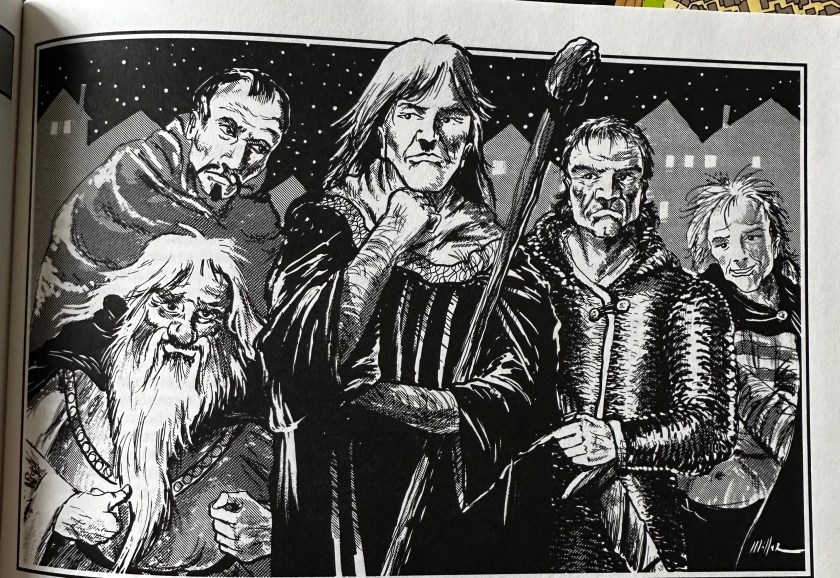
So this is how that works, you imagine the scene where the PCs are on deck, in the foreground talking about something like how to defeat the weird root creatures that have invaded the ship from some eldritch, otherworldly space. In the background, just like in Star Trek, you have a few crewmembers, maybe they are even in uniform, but they are ill-defined and unremarkable. This works even better through the medium of TTRPGs than TV to be honest, because your imagination simply works around them, never focusing on their details. But then! They need one of the NPCs to be good at something, a specialist, an expert. Or maybe they just need a buddy, someone to talk to, or someone to listen. That’s when the players get to stretch those imagination muscles!

Pulling the NPC Out of Their Quantum State

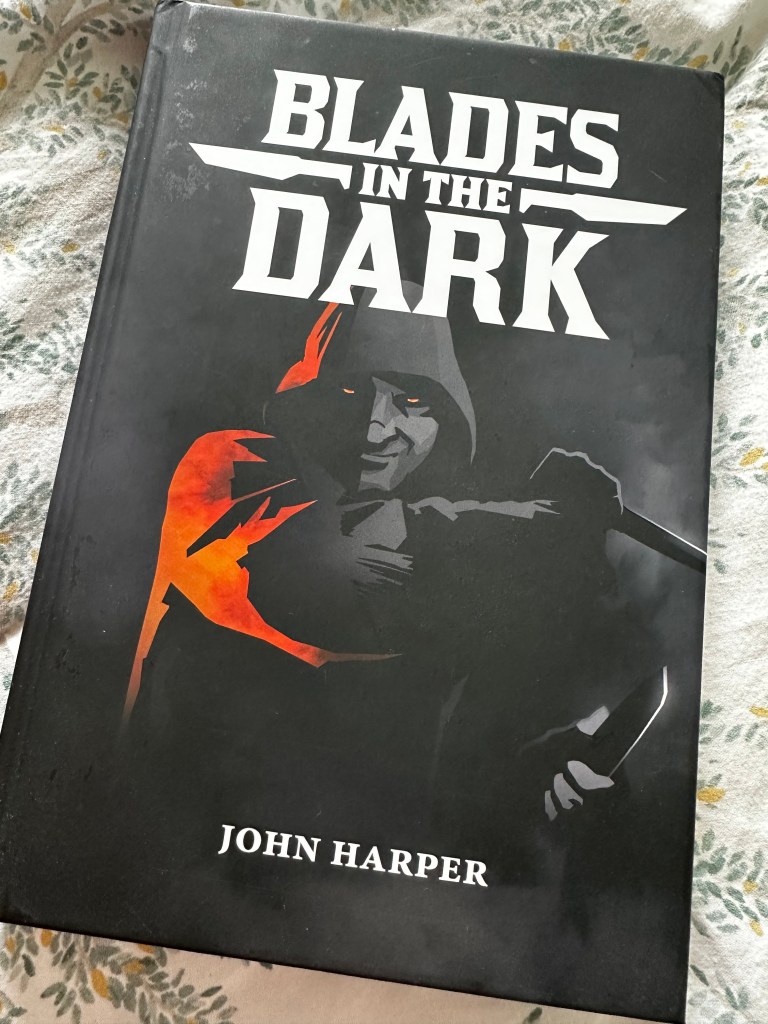
The NPC existed in theory but not in practice. They were always there as a number, but not as a person, not as a character. Until the players make them up. The GM asks a player who this NPC is, what their name is, their ancestry, their job, what their personality is like. The players generally end up working together to do this but I usually start by asking the player who decided they wanted one of the quantum NPCs to become real for some reason. I ask that particular player the type of character they want in this situation with the understanding that, once they have been defined, they will forever be part of the crew, taking up one of those eight spots. It’s just like Blades in the Dark items. You know how many slots you have to fill when your PC is out on a Score but you don’t define the items until you need them in the narrative. Once you have said you have “A Blade or Two,” though, those blades are filling one of those slots. Same-same but different.

In this manner we got these three NPCs:

Deckhand Dewey – kobold, he/him, spry and wiry and can fit in little places.

Cook – Barry Keoghan (this is the consequence of allowing the players to name NPCs) – orc, he/him, big guy with big arms, beer belly, loves food and loves cooking. His chef hat does not fit very well. Apron always slightly dirty. Has a space rat companion.

Mr Cannon – Halfling he/him – weapon-master.

As you can see some of them got more detailed description than others. Barry Keoghan was described thoroughly partly because of who I asked to describe him and partly because of the moment I asked for his description, i.e. a quiet moment aboard ship where they had some time to talk about provisions and joke about silly Disney movie references. Meanwhile, Mr Cannon was created in the literal heat of battle. But that was ok, because the idea was always to flesh these NPCs out as time went on. We did, for instance, in subsequent sessions, discover that Mr Cannon had a wife waiting for him at home and that Barry Keoghan had some sort of tragic love-affair in his past.

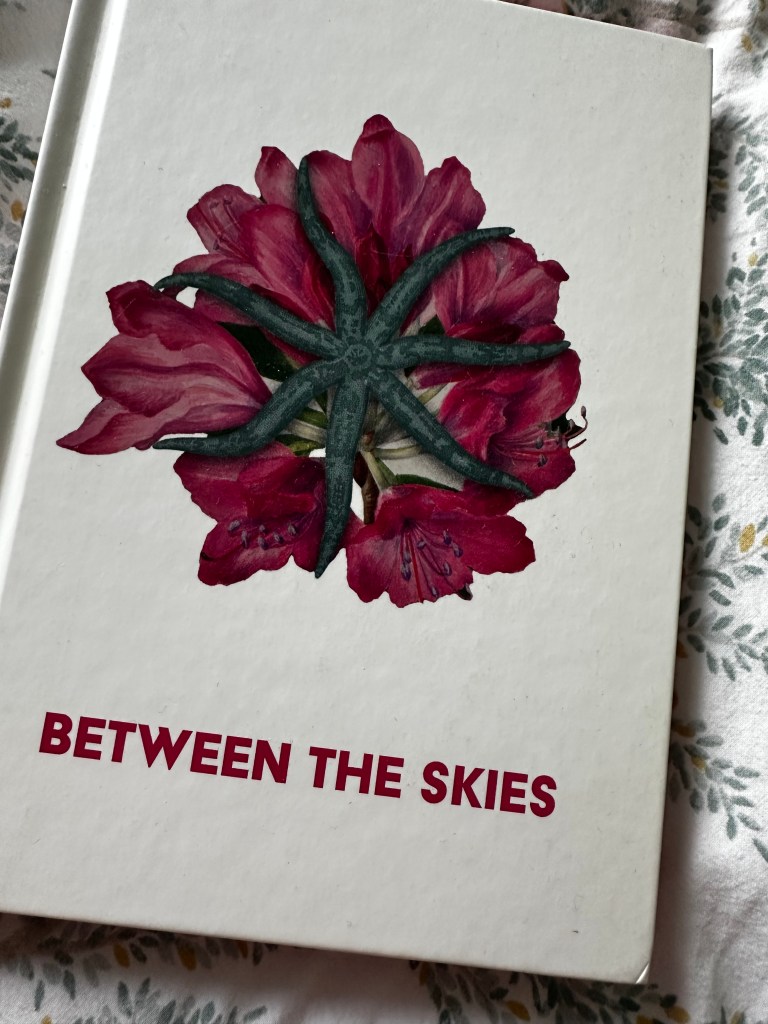
I think, in future I will bring Between the Skies to bear on the Quantum NPCs as they are being birthed by the players, giving them desires, bonuses, hindrances, quirks and all the rest. Time allowing, of course.

The Quantum NPC method has the added advantage of endearing the newly created NPCs to the players from the off. They are, after all, fully their own creations. From the players’ point of view, I believe it was also quite devastating when both Mr Cannon and Deckhand Dewey got breath weaponed into oblivion by a lunar dragon along with the rest of the NPC crew (apart for Barry Keoghan who was in the galley at the time of the attack.) Unforgettable.

Dad-quest

Dad-quest is getting under way tomorrow night. Our resident Giff Fighter-Paladin, Azimuth is rounding up a crew of misfits (the other players with their new characters that I discussed here) and a few more Quantum NPCs and spelljamming out to the Amos Expanse to find his Dad. Can’t wait to see what new crew-members the players come up with this time!

Revenge of the Giff

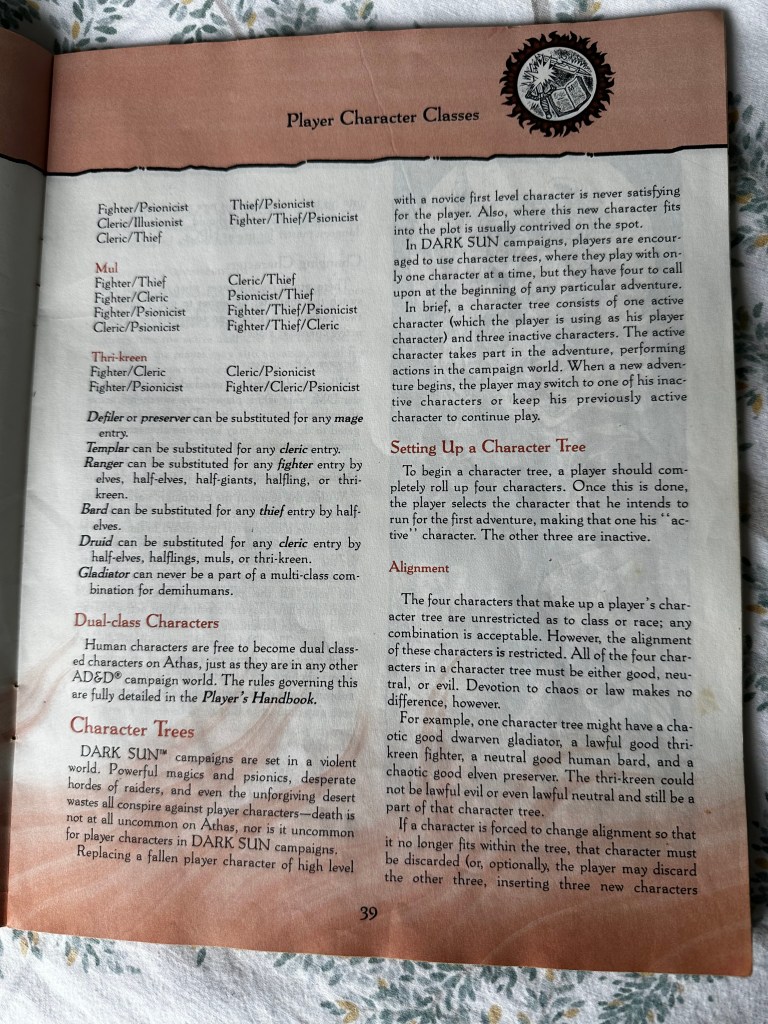
I’m considering an option that harks back to Dark Sun. In 2nd Edition Dark Sun, a player started, not with just one PC, but a whole stable of them, called a character tree.

Mid-season finale

The crew of the Cadabra were going home. After weeks of adventure across Scatterspace and all over the Rock of Bral, they have arrived back at First Home, the asteroid/inn/shipyard that was their first stop after leaving their world behind in the first place. They could justifiably expect a warm welcome since they freed the shipyard from a Neogi infestation last time. But they weren’t expecting to be confronted with a crew of kobolds from their home island to be there. Kobolds who probably thought the PCs had murdered their queen. They also weren’t expecting to find Becky Fullpockets’ personal spelljamming vessel there. They had been struggling against the machinations of the technomagical billionaire ever since they fled their planet. It looked like they were stuck between a rock and a hard place, with no escape!

No better place to end part of a season than on a cliffhanger. And that’s what we did right there. We have been on a break from our Spelljammer campaign for a couple of months now. It’s given me a break from 5E and allowed us to play some other great games in the meantime. But now, it’s time to come back, sort of.

Spin Off

A few months (IRL months, that is) before the crew of the Cadabra reached First Home for the second time, they said goodbye to one of their number. Giff Fighter-Paladin, Azimuth, who had to be rescued from two ship-wrecks in quick succession might have been labelled a Jonah by many crews, but the Cadabra was different. They welcomed him on board with open arms and he adventured with them for a while. But, eventually, he was always going to go back to look for the father who went missing from the first of those two ship-wrecks. Now, while his erstwhile comrades are heading back to their homeworld, Azimuth is armed with a little knowledge about the stretch of Wildspace Papa might be found in and a ship stolen from Becky Fullpockets. He’s preparing an expedition of his own to go find his real dad… Not that gnome who pretended to be his dad during that short period where he’d lost his memory (long story, dear reader.)

The rest of the players are coming back too, but they’ll be playing new characters for this spin-off. Azimuth needs a crew for his ship, after all. We are getting together tomorrow night for a session-0 type thing. I think everyone is looking forward to trying some different classes/backgrounds/species compared to the ones they have been playing for over two years in the main campaign. Although, Azimuth’s player, David, doesn’t get a new character, he does get to pursue his PC’s main drive and its a great welcome back to the group for him.

As for me; I’m looking forward to yet another shake-up in this game. I’m planning to use the progress-based travel rules that I mentioned in my Prep Part 2 post last week. And, as well as that, I have something very special up my sleeve for the meat of the adventure, which I can’t reveal here and now (my players read this blog sometimes.) I’m definitely going to write about it after the fact, though.

Change of Cast?

The introduction of new PCs into the campaign, even though its a spin-off, raises the question of what happens once Azimuth joins back up with the main crew again. I’m considering an option that harks back to Dark Sun. In 2nd Edition Dark Sun, a player started, not with just one PC, but a whole stable of them, called a character tree. I believe you were supposed to begin with four characters. This was to help counter the lethality of the setting, giving a player back-ups in the inevitable event of a PC death. This made a lot of sense, especially considering the amount of time it took to create characters. Go check out my Dark Sun character Creation series to witness exactly how long that took.

So, my thinking is that, once this spin-off is done, if they want, the players will be able to swap PCs in or out as they like. This should have the double benefit of providing the players with a bit of variety and allowing them to almost fully crew their ship with their own characters, rather than just NPCs. I’m currently thinking through how I’ll handle character advancement if I do allow this. In Dark Sun, if I remember correctly, the PC only gained experience when they were actually played. No vicarious levelling. I think this makes a lot of sense, but it might be more difficult to adjudicate with milestone levelling.

What do you think of these ideas, dear reader? Have you ever run a spin-off campaign like this? Would you be happy for your players to switch between active PCs like I’ve described?

Modular Gaming

Improbable hot-takes

“The Discourse (TM)” has been focusing on running published adventures/modules/campaigns as opposed to custom/homebrew/sandbox games for the last little while. First Quinns reviewed Impossible Landscapes, an epic and almost legendary campaign for the modern Cthulhu-ish game, Delta Green. This is the first time Quinns has reviewed a campaign/published adventure on his RPG review channel, Quinns’ Quest, so it was unusual enough to spark a significant amount of discussion all on its own. And then Thomas Manuel of the Indie RPG Newsletter and Rascal reviewed the same campaign. I believe this was purely coincidental, especially as Impossible Landscapes came out about five years ago now. Both are great reviews in their own right and are based on full play-throughs of the campaign so you know they’re of real value. You should check them both out.

Anyway, on Bluesky, Thomas Manuel went looking for recommendations of other modules to run and this spawned a lot of interesting answers and quote-bleets from RPG luminaries, such as this one, which I found interesting.

I have opinions on the conversation, of course. I have shared a lot of them in other posts from the last year or so, actually. If you want the summary, though, I had a lot of bad experiences running D&D scenarios in the past, especially from the AD&D 2nd edition era. I found they were difficult or impossible to just pick up and run. In fact, they required maybe more preparation time than adventures and campaigns I wrote myself. The one published 5E campaign that I ran, Storm King’s Thunder suffered from the same issues, actually. This made me feel like it was a “me” thing. But, it turns out, a lot of GMs feel the same way, according to Bluesky, at least.

However, I have had my mind changed somewhat by running pre-written adventures for some other games, particularly Free League’s Blade Runner, Dungeon Crawl Classics and, to a lesser extent, the Dragon Age RPG from Green Ronin.

This is a link to my first post on Electric Dreams, the introductory Case File for Blade Runner:

And this one compares the same module to a 5E murder mystery adventure I played in around the the same time:

Here’s my post about Sailor’s on the Starless Sea for DCC:

And this is my post on running Duty Unto Death, a short intro adventure for the Dragon Age RPG:

And finally, this post, although ostensibly an excuse to discuss DCC adventures, also includes my opinions on the one 5E campaign I ran:

I will say that, despite my generally favourable outlook on most of these modules, I still find I have to to do a lot of prep for them. The main fear I have is messing things up so bad that I essentially spoil the rest of the adventure. Although, I should really have more faith in my abilities as a GM at this stage. I feel like I can probably improv my way out of any hole, to be honest. But it does not change the fact that I spend hours rewriting long paragraphs presented in module texts into digestible bite-sized bullet-points. I am running another Dragon Age scenario right now. Amber Rage is from Blood in Ferelden, an anthology of scenarios for the game that came out in 2010. It suffers from verboseness and unnecessary detail and makes for a lot of work from the GM. I’m enjoying the contents of the scenario but its presentation is horrendously dated and needs a sprinkle of OSR magic to tighten it up, in my opinion.

I realise that none of the modules I have mentioned here are anywhere close to having the size and epic scope of something like Impossible Landscapes, but it doesn’t change the fact that they have largely changed my mind about running anything pre-published. The one I have my eye on right now is Dagger in the Heart for Heart: The City Beneath. Actually, I have a post about that right here too:

OK, I’m off to discuss the discourse on Discord of course!

Paint the Scene

Painting the Ultraviolet Grasslands

I’m still feeling unwell, dear reader. It’s a feeling that returns me, quite unwanted, to the bad old years of the pandemic. So, I would rather think and write about something more recent and more delightful. Even if my current malady will not allow me to produce anything terribly beautiful or very long, I can rely on my players to help me out.

In our most recent session of Ultraviolet Grasslands, our caravan, Isosceles Inc., made it as far as their first proper destination, the Steppe of the Lime Nomads. I knew they were going to reach this place a week in advance so I had time to prepare for it. But what I ended up focusing my preparations on was not that destination but a couple of discoveries that they had rolled for the previous session. I had only the vaguest idea of what they might encounter at the watering hole I assigned as the current gathering place of the Lime Nomads. I knew they would have somewhere to trade, some way to perform market research and that was about it. The descriptions, I left to the three players, using a method called “paint the scene.”

Now anyone who has ever listened to a Jason Cordova podcast or read one of his games, knows this term. It’s a method he developed for use as a GM but is something he has since incorporated beautifully into several games. Go check out the current run of the Between on the Ain’t Slayed Nobody podcast for some truly wonderful examples of it.

Paint the scene serves several purposes at the table. The most important of these are allowing the GM to share the load of world building and description with the rest of the table and, related to that, allowing the other players into the fun and responsibility of bringing the world to life. Why should the GM have all the fun/work?

It’s a simple technique. You ask the players something about a person place or thing that helps bring them to life. It is important to craft the questions you ask to reinforce the theme you are trying to bring to the fore, though. It’s not enough to simply ask them, “what do you see in the village square?” Rather you should ask, “what about the village square shows us that this place was recently abandoned?”

Here are a few of the answers I got from my paint the scene questions when the caravan approached the great camp of the Lime Nomads last weekend:

What about this place shows us that the nomads return here year after year?
This one was answered by Stebra, the Lime Nomad character. She was able to tell us a lot about her people and homeland:
A river flows down from the mountains at this time of year, though it is often dried up – the nomads settle at the river for a while. They construct their temporary accommodations on stilts for safety. They transport these buildings around with them by folding them up into flatpack.
There are larger towers that they use as shelter and to gather around. these towers are relics of ancient times and they stand tall, much higher than anything else in the region.
The nomads migrate east to west take advantage of seasonal grazing and foraging.
They use water wheels for power and they fish for particular little river fish while they can, cooking them on a spit. A seasonal speciality.

What evidence of the the misty time known by the Saffron City Opiate Priests as the Best Forgotten Ages can be seen in this land?
Imssi, the tactician and puppet actor answered this one:
Out of the ground the only occasional rock formations in this otherwise grassy plain, are the tips of fingers and toes of colossal statues or calcified giants. In the oasis, when the waters are low and the day is clear, you can see the great nose poking up from the azure depths.

How do you know the nomads welcome traders here?
Phaedred Ping-noun, our Acolyte of the Business answered this one, as seemed appropriate:
Such a gathering of the Lime Nomads is a moment for traders from all over to get in there and sell. There is a marketplace that is bustling and busy. There are lots of colourful wagons and colourful people gathered. Travellers, not just from the Lime Nomads clans, but from all over the Ultraviolet Grasslands have come to attend the markets.

Conclusion

I am trying to make more liberal use of the technique at the table these days. I find it really gets everyone more involved and engaged in the world. They feel an ownership of their little parts of it and I feel a deep gratitude for them adding the sort of little details and flair that I would never have thought of. If you haven’t given it a go, dear reader, I encourage you to!

Check out this blog post from 2018 on the Gauntlet for an explanation of the techniques from the man himself.

Between the Ultraviolet Skies

Armadilloid Encounter

At the end of the last post I wrote about my current Ultraviolet Grasslands campaign, I noted that the caravaners were on the cusp of an encounter with some Armadilloids. The section of the book describing the Steppe of the Lime Nomads has a list of random encounters just like all the other sections do. And, just like the other ones, the detail you get about an encounter is minimal, to say the very least. You might get a level for the creatures or NPCs encountered, and maybe a word or two of description. This leaves quite a lot in the hands of the GM and, potentially, the other players at the table. Perhaps the characteristics of the encountered entity would emerge organically in play. Maybe the GM will have prepared specifics for each potential encounter, with regards to physical descriptions, motivations, weaknesses and strengths for instance. In the case of this encounter. I knew I did not want it to be an automatically violent one. I wanted the Armadilloids to be sentient but different enough as to be inscrutable. I could probably have just written a description, but I have Between the Skies, so why should I?

I took to the Entities chapter of the book and started rolling. I started with a roll on the Size, substance and form table. I rolled a 7 for size. That gave me Very large (giant-size.) I liked this. It immediately brought to mind the Armadillo super villain first encountered way back in Marvel Secret Wars II some time in the 80s. So I had a picture in my mind.

Next, I rolled a 6 on the Substance table, meaning they were Animal. That corresponded with my general idea so far, which was cool. On the Form table, I got a 13 on the d66 roll. That made them Bipedal (which is a word, that, when you say it out loud, sounds weird, we discovered.) It was still matching the picture I had in my head at this stage, except for the fact that these bipeds also had wings. For my purposes I thought it best that they be stubby vestigial wings. It’s the Grasslands, it’s not safe to fly there.

This next bit was so good. On the Weaknesses and Needs tables, I started to see the situation emerge. I rolled a 34 on the Weakness table, which meant they were Confined. Now in the previous session the players had rolled on the encounter tables in UVG and we had established already that there were ten or so of them and they were merely silhouettes on the horizon. They could see the Armadilloids so they were not obscured by any sort of physical trap. But a pretty cool phenomenon in UVG is “stuck-force.” These are invisible barriers and shapes and containers of nothing but force. They litter mainly the skies of the UVG, left over from a time long gone, when fantascience and magic dominated and their practitioners left these eternal artefacts dotted all over, making flying an incredibly dangerous prospect (as I hinted at above.) So, I came up with the situation where the Armadilloids had been trapped in a sphere of this stuck-force and had been unable to free themselves. The next table was Needs. I rolled a 62 on that, which gave me Directions. But I didn’t like this one so I opted for 26 instead, Escape. Perfect.

Next was Characteristics and details. These tables round out the looks and important idiosynchacies of these creatures. First I rolled a 21 on the Notable characteristics table. You know those big ol’ Armadilloids are rolling around like Sonic (I know Sonic is a hedgehog, ok? Just roll with it.) On the detail table, I got a 34, Tatooed. Adding a little more to this, we see that they are tattooed all over with the pictographic stories of their lives. I love this detail.

Next come a pair of Behaviour tables. I rolled on the Social behaviour table, which indicates their numbers, even though I already knew how many there were from our roll on the UVG tables. Why? Well, it also suggests the type of groups they habitually congregate in: Couple, Family, Herd, etc. I rolled a 6 and got Pack. This fit perfectly as well. I actually skipped the behaviour and current demeanour tables because I already had a good idea that they would be eager to be freed, some of them going stir crazy, rolling around inside the sphere, some simply sitting in the grass, and one of them standing with his hands raised against the stuck-force sphere trying to will his way out.

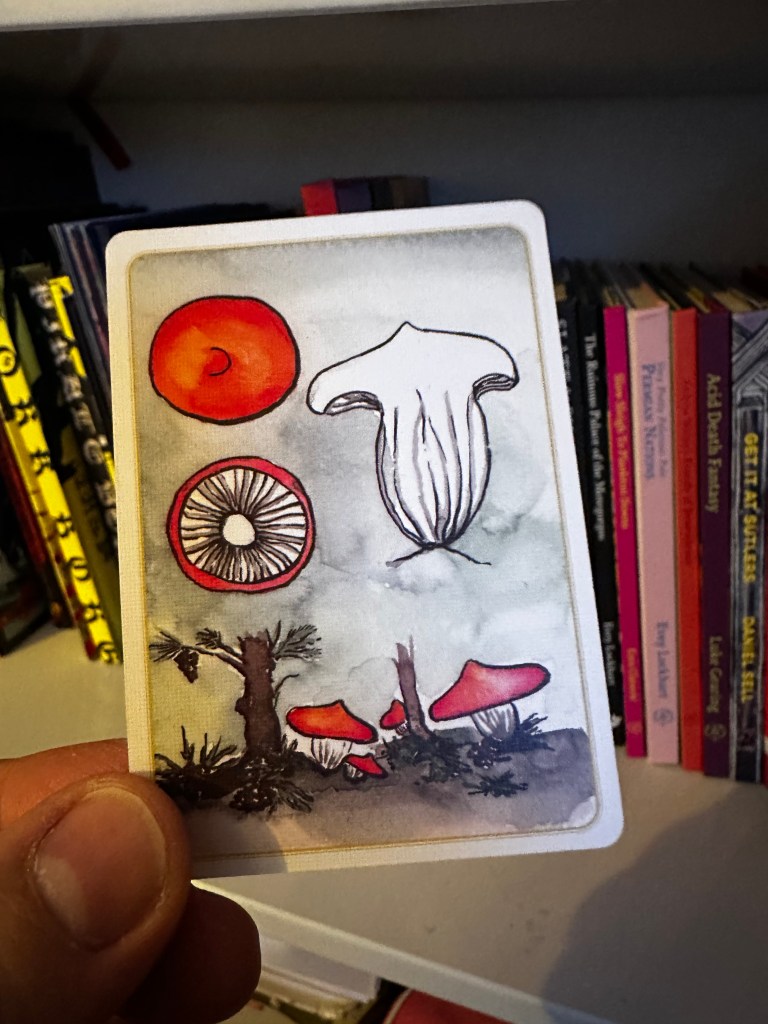
This next one was fun: Attacks! I rolled a 6 on the Mechanism of attack table, making it a Blast. The Attack keyword I rolled up was 33, Draining. So, from these words, I decided they would have a Charisma Draining Psychic Blast power. It never came up in play, thankfully. Why? Because the PCs figured out how to free them and then were invited back to their mushroom growing burros where they were rewarded with three sacks of Regular Mushrooms.

They also spent the night there around the Armadilloids fire, despite the fact the big orange guys could only speak in some brand of “meep meep” language. They all consumed copious amounts of magic mushrooms and got high as fuck using the wonderful tables in the appendix of Fungi of the Far Realms.

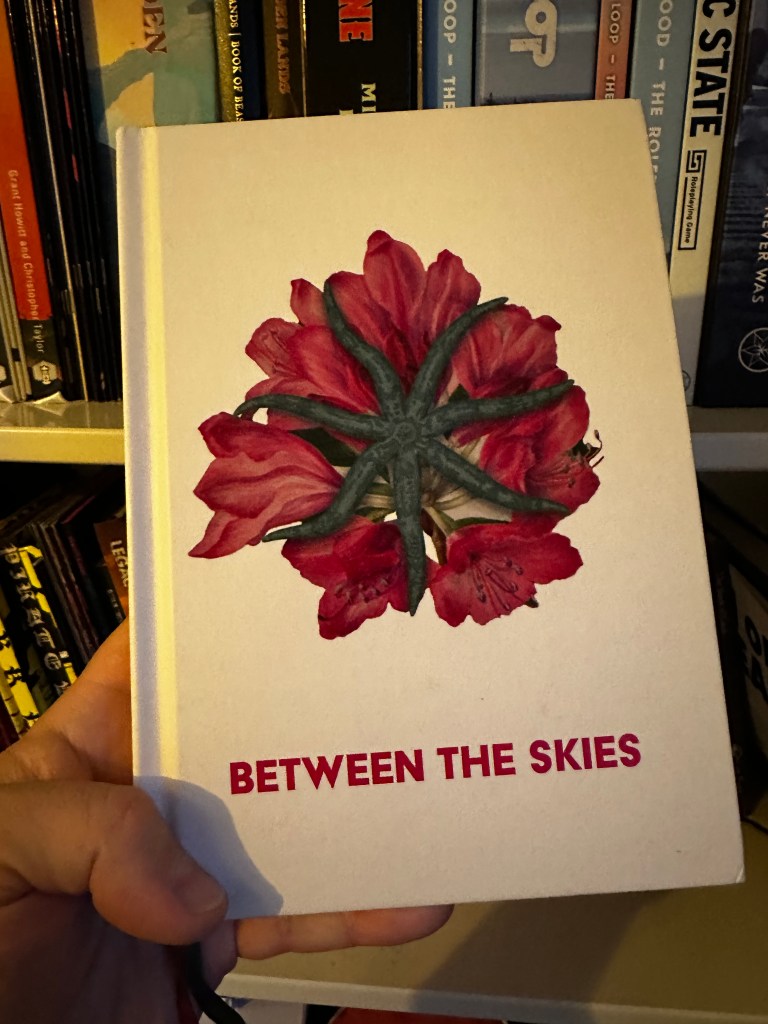
Since I rarely get much time to prep sessions these days, this method was really valuable. It allowed me to do what I needed to do on the train on the way to work, using the pdf of Between the Skies, an online dice roller and the word processor on my phone. I have been using Between the Skies for some other games too in the last few months, most notably our Spelljammer campaign. It has made for enormously memorable and unique encounters in that case. I can’t recommend it highly enough. Go get it on itchio or on Exalted Funeral!

Final Plug: Shadows Return

I backed a project from Ian Hickey of Gravity Realms last year, The Price of Apocrypha. It was a really successful Kickstarter, especially for a small, indie, Irish creator, and it was fulfilled and delivered incredibly promptly.

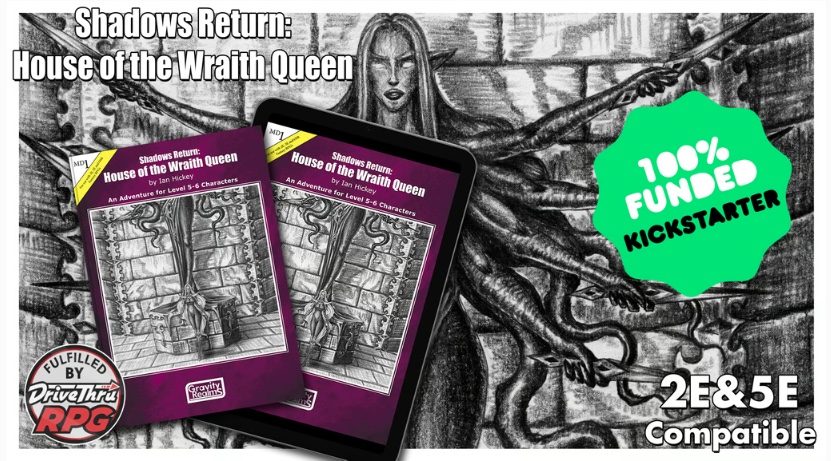
Well, Ian has another great project in the works on Kickstarter right now, Shadows Return: House of the Wraith Queen. Its a mega dungeon style adventure for use with Ad&D 2nd Edition, D&D 5E and OSR games. It’s fully funded but there are only a couple of days left of the campaign and you could still help it reach some stretch goals! Go back it!

As a final note, I have recommended a lot of books and products recently and I like to think I always do here on the dice pool dot com. I do this purely because I believe in the books, the products, the creators, not for monetary or other rewards!

Alien RPG’s Hope’s Last Day: A Review

If you’re interested, go check out my post previewing this game here.

A Bad Call?

Burke, Carter J “confessed” to Ripley that he had made a bad call in sending them to a colony on the moon, LV-426. But did he mean it? No. He was a scumbag of the highest order. He was just fucking someone else over for a percentage. I sent my players to LV-426 too. I wasn’t looking to fuck them over for a percentage, but, at the very least, I expected most of their characters to get impregnated by facehuggers, ripped to shreds by drones or melted by acid blood. Did any of that happen? Did I make a bad call in choosing the Cinematic Alien RPG scenario, Hope’s Last Day, from the core book, rather than the one from the Starter Set? Well, dear reader, why not come with me on a trip through our one-shot and my thoughts on it, and you’ll find out.

Shake and Bake

These two scenarios couldn’t really be much more different. The one from the Starter Set, Chariot of the Gods, is set on a ship out in space, you know, where no-one can hear you scream? It’s also very much a full scenario with an entire three act structure. They say it would take three sessions to play but I have my doubts about that estimate, having played Hope’s Last Day.

Speaking of which, Hope’s Last Day is a scenario that’s set totally on the moon where Ripley and the Nostromo’s crew found the Alien eggs in the first movie and the setting for the action of the second. This scenario was not even a full Cinematic experience. It is billed as a taster, since it really only encompasses what would be the third act in a normal Cinematic scenario. The book confidently asserts that it could easily be played in under two hours.

Frankly, duration was the deciding factor for me. I only had one night to get through a whole scenario. I don’t have a lot of wiggle-room in my schedule due to the fact that I have at least seven other ongoing games at any given time, so it really had to get wrapped up in one shot. So, I shook it and baked it.

Shaking

Shaking, essentially, meant reading through the scenario a couple of times. It’s very short, so this was not a problem. I also took notes on the various major beats and summarised the contents of the various blocks and rooms into bullet points. Most of the scenario consists of these location descriptions so this was key for me. Also, they are all presented in what I consider to be unwieldy blocks of text in the book, and I prefer referring to bullet points at the table. This work helped me to keep things flowing a little more smoothly on the night. I also screenshot handed the pregenerated characters out to the players I thought they would suit best a couple of days before. This part was fun, and the players were left to wonder how I decided who should play which character. Each character had an agenda that was generally meant to be kept secret from the others. Now these were fun. Stuff like, being willing to sacrifice themselves for the others, wanting to acquire an alien and escape with it or just to keep the company’s actions a secret at all costs. You know, normal stuff. Anyway, I examined these agendas and assigned the characters purely out of a desire to see each player pursue that secret agenda. Other than this fairly sparse preparation, I got a couple of copies of the map of Hadley’s Hope printed and a few character sheets. I familiarised myself with the relevant rules as much as I could and that was it for the shaking.

Baking

At the table, we baked. And, I will say most of the time this one-shot spent in the oven, there were no issues at all. Was I ready to nuke the site from orbit by the end? Not quite, thankfully. I’m mixing my metaphors quite egregiously at this point so I’ll abandon them both and just tell you what happened.

I started exactly as the scenario suggests you start, with the four PCs inside the West airlock of Hadley’s Hope. They had just returned from a day or more outside the settlement and were not aware the Aliens had already decimated the population. I let them investigate a bit, try and get an intercom working, and generally futz around. The scenario calls for an Alien attack whenever the PCs dawdle but I didn’t want to lose anybody so early on. I think this was a mistake on my part. Their first encounter with an Alien occurred a little later after they had made their way to another block of the station and messed around looking at eggs and facehuggers and whatnot. This gave one character the opportunity to collect an egg and another to sacrifice himself to keep the others safe and made them all start running to find the way out. This was more like it. Things really started moving then. The one who sacrificed himself turned out to be an artificial person as Bishop would have us call them. So, the alien just left him, innards outed, on the floor and unable to move, but not dead. Luckily there was an extra pregen for that player to take over so we continued on.

Later they encountered a couple of facehuggers after finding a few weapons. They made short work of them and moved on again. They spent much of the last part of the session effectively split into two parties running from two different drones towards the only way off the planet, a shuttle. And you know what? They all made it! Except the android, who, I can only assume was caught in the conflagration when the nuclear reactor in the processing plant went up as Ripley and the others escaped. Also, they didn’t all make it, because the pilot turned out to be the company plant and she spaced everyone else as soon as they left the atmosphere. I guess that made her the winner?

Game Over, Man

So, what was the verdict? It’s a mixed bag, to be honest.

I think our main complaint was that this was mislabeled as an under-two-hour scenario. I mean, ok, it was our first time playing the Alien RPG so we did have to spend a little extra time referring to the rules and figuring out what all the stats meant, but that does not account for the fact that this thing took us almost four hours. Even then, I had to abandon some integral rules to allow us to make it to the end in that time. I don’t honestly know how anyone gets five people around a table, people who want to role-play, who want to fuck around and find out, people for whom the joy is in the playing, not in the finishing, and have them get through this scenario in anything less than four and a half hours if you stick to all the rules of the game.

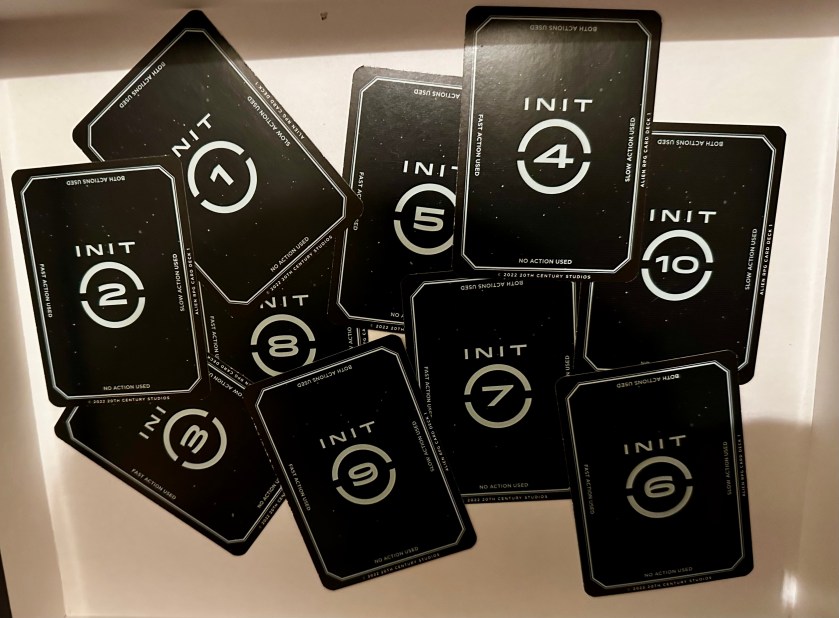
As for the rules. The main negative was the initiative system. Alien, like other Free League games, uses an initiative card system. We generally found it a little difficult to keep track of things using this and found it slowed the action down significantly. One of the main issues was that the PCs kept getting into initiative, running away from fights, getting out of initiative, getting caught again and getting into initiative again! So we were shuffling and picking those cards a lot. In fact, as time ran out on our session, I just left the cards to one side and did it narrative style. I got each player in turn to tell me what they were doing and told them how the Aliens or the environment reacted or acted against them. This really sped things up and drew the evening to a very exciting close, in fact. Would I use the initiative system as-is if I played again? I think I would give it a go as long as I had more time to play with but I would be ready to give up on it in a second if it started to get in the way again.

One more issue for me was the system used to figure out how the Aliens attack. Every time it’s their turn, the Game Mother has to roll on a table to determine which of their special attacks they use. This started off as a fun activity, but quickly got frustrating. It felt like each time the Alien had one of the PCs in their grasp, I would roll up an attack that allowed them the chance to escape. Now, if this happens a couple of times, it adds a nice dramatic element to the chase. But this is literally how they all managed to get away in the end. If I had been just choosing the attacks for the Aliens, there would not have been so many occupied seats on the shuttle when it took off. I feel like there is a better way to adjudicate the moves they make. Admittedly, you would not want every attack to be lethal, either, but it felt as though far too many of them were underpowered.

One element that worked well but felt like it was under-utilised or tacked on was the Stunt mechanic. Each skill had a stunt table that told you how you could spend your excess successes (each 6 you get when you roll your dice pool is a success and you gnerally only need one to succeed at your task,) but the players almost exclusively went for one of two options, at least in combat situations: they added extra damage or they pinned the enemy down to prevent them from taking as many actions on their next turn. This was fine but it feels like this needs more work. Perhaps the new edition will deal with this.

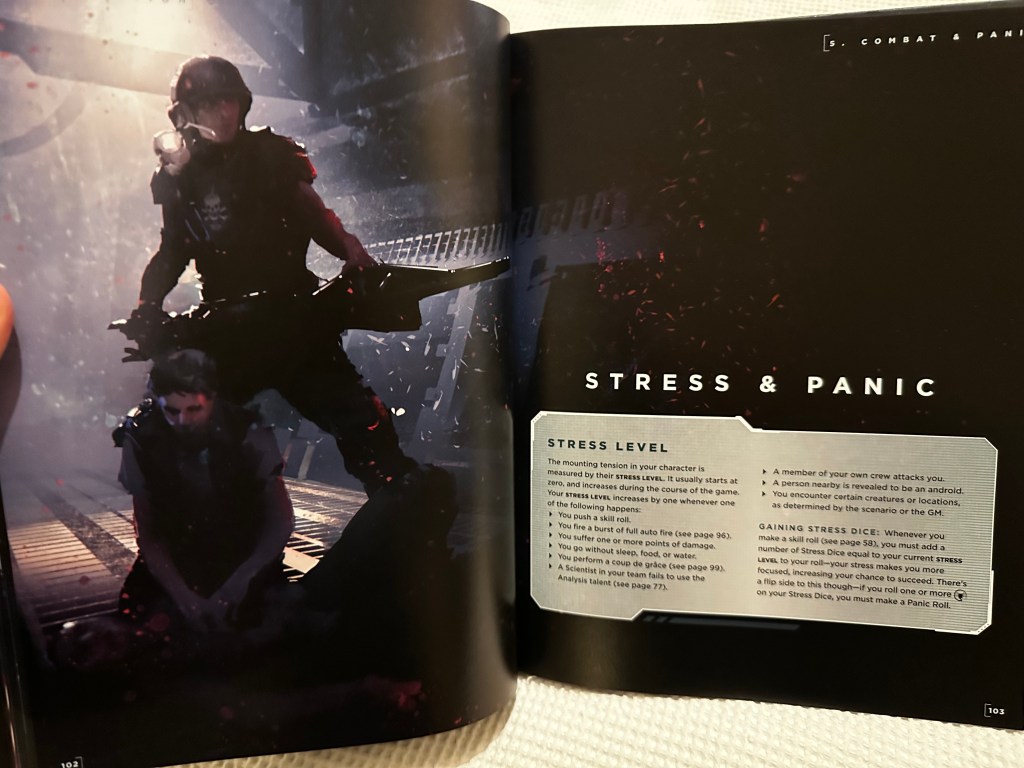
You know, there were plenty of mechanics we liked in the game too. The main mechanic in the Alien RPG, the thing you would lean on to sell the system, is Panic. Like other Year Zero Engine games, you roll a dice pool consisting of a number of dice equal to your score in a given skill plus the number of dice equal to your score in the related ability. So, if you have a 1 in Mobility and a 2 in Agility, you roll 3 dice. But, as you play, your character gains Stress for all sorts of awful reasons. For every point of Stress you gain, you get to add another die to every dice pool. This gives you a greater chance of success but also gives you a chance that you’ll have to roll on the Panic Table. This happens if you roll a facehugger (a 1) on the official Alien RPG Stress Dice. There are other ways of panicking. Usually, if one of your companions does something unhinged or crazy or if you see an Alien for the first time. That kind of thing. By the end of the session, everyone had so much Stress that they were rolling obscene numbers of dice and there were Panic rolls happening almost constantly. One Panic roll would often lead to another from someone else because of the result they would get. Also, because, each time you roll on the Panic table, you have to add your Stress Score to the roll and the shit at the bottom of the table is way worse than the shit at the top, the results got very bad as time went on. For example, this is what you get for rolling a 7 gets you:

NERVOUS TWITCH. Your STRESS LEVEL, and the STRESS LEVEL of all friendly PCs in SHORT range of you, increases by one.

This is what you get if you roll a 15+:

CATATONIC. You collapse to the floor and can’t talk or move, staring blankly into oblivion.

This did happen to one character but they were already at the shuttle at that stage and someone was able to drag them inside.

The feedback I got in stars and wishes from the session indicated that the players also loved the agendas they were given with their PCs. This was a worry for me before we started. I mean, not only did they not get to create their own characters, I didn’t even give them the choice of which one to pick. Obviously, this was because I didn’t want to reveal the secret agendas to everyone before play started. And I’m so glad I did it this way! Everyone had pretty much figured out who was the android in under an hour, but no-one, and I mean even me, because I forgot what the pilot’s agenda was, expected to be spaced by one of their own when they were on the verge of escape. Incredible scenes. This element of the game is specific to the short Cinematic Play scenarios. And, indeed, normally, in a full scenario, your PC’s agenda changes as you move through the three acts. I can’t account for how well this works, obviously, but it sounds great.

As for the scenario itself, there is not a lot to it. This is definitely a good thing. If you play it, you’re not going to get to most of the compound. A lot of those areas I summarised into bullet points remained completely unexplored. Once the drones were after them, the PCs soon discovered a sense of urgency and a definite goal, i.e. escaping on the shuttle. There was a bit more to it than that, but not much. Like I said, this was fine, especially as the PCs’ agendas took the place of a set plot most of the time anyway.

It was also cool that the scenario was so closely related to Aliens, the movie. I watched it the night before running the session, and that definitely helped me to picture the place and to describe it at the table. I’d recommend doing that if you do intend to run Hope’s Last Day. I’d also recommend leaving yourself at least four hours to do it justice.

So, was it a bad call? No, but if I went into it again, knowing what I know now, I would have made a few alterations to my expectations.

What about you, dear reader? Have you played this scenario or this RPG? Are you looking forward to the Alien Evolved Edition? Get in the comments?

Alien RPG(s)

World’s first Alien RPG

Imagine you’re twelve years old and you have an obsession with something. I would imagine this is a relatively trivial task for most of the nerds reading this blog post. Anyway, You have an obsession and you generally want to express your love for your obsessions through the medium of role playing games. Once again, I’m sure you’re all still on board. I had several of these, Lord of the Rings x MERP, check, Star Wars x West End Games Star Wars the RPG, check, Robotech x Palladium’s Robotech RPG, check. You get the idea. But there was one missing. It was an important one. It related to a sci-fi movie series that I was far too young to watch legally (sorry Mum!) It was Alien(s.) The first I even heard about this franchise was from a friend on the playground. He and his brother had managed to stay up way past their bedtime and watch it with the sound turned way down so as not to wake up their parents, on a satellite TV channel (which I did not have.) Anyway, he told me literally the entire plot of Aliens from start to finish during break time one morning, leaving pretty much nothing out. And I knew I had to see it. It was some time later that I managed to get someone to rent me a VHS copy to watch myself. And thus was the obsession kindled. The hardware, the badasses, the gunfire, the nuclear explosion, the Xenomorph itself. It was all perfectly concocted to appeal to the mind of a twelve year old boy. It was frankly cruel to prevent me from seeing it! It wasn’t until quite some time later that I even got to watch Alien. And seeing it, that first John Hurt chestburster scene, the slow whittling of the crew, the hiss and the creep of the monster, the silence and the horror of it. Still gives me goosebumps to watch that film.

By that point, I was well into RPGs, had been playing D&D for a couple of years, had played Gamma World, Twilight 2000, Shadowrun, all the games I mentioned above and more. But there was one missing, an Alien(s) game. Why? Because it did not exist at that point. It was still a couple of years before the Aliens Adventure Game would be published by Leading Edge Games. Even with how badly that game was received, I would have taken it. But it didn’t exist, so I made my own…

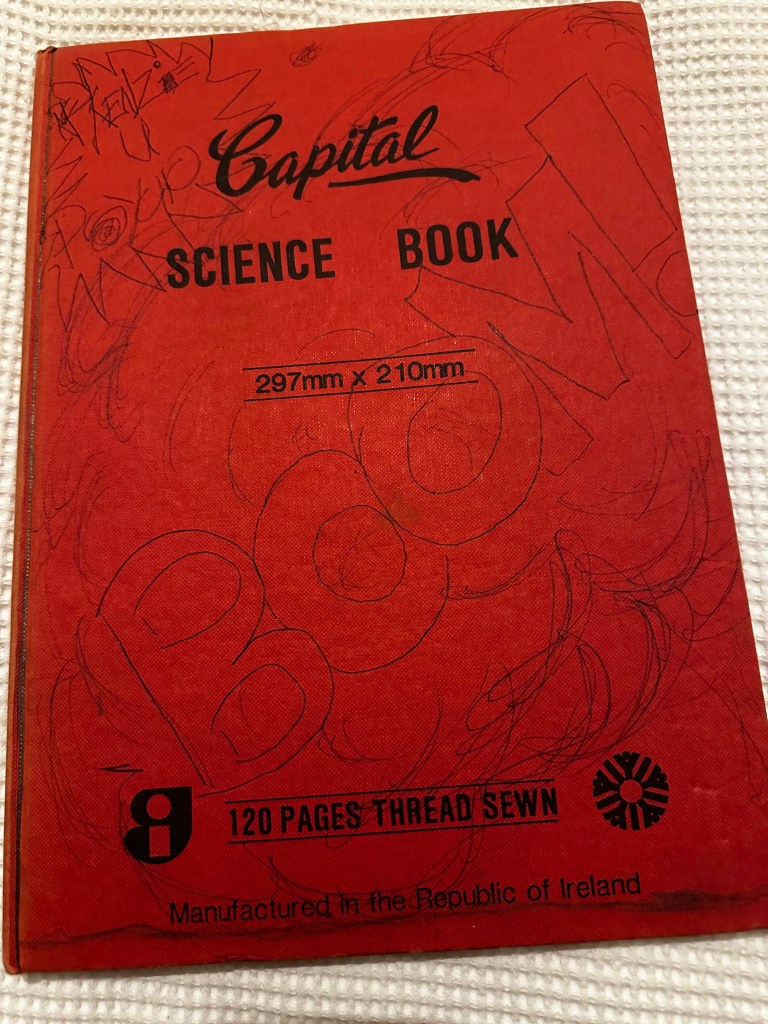
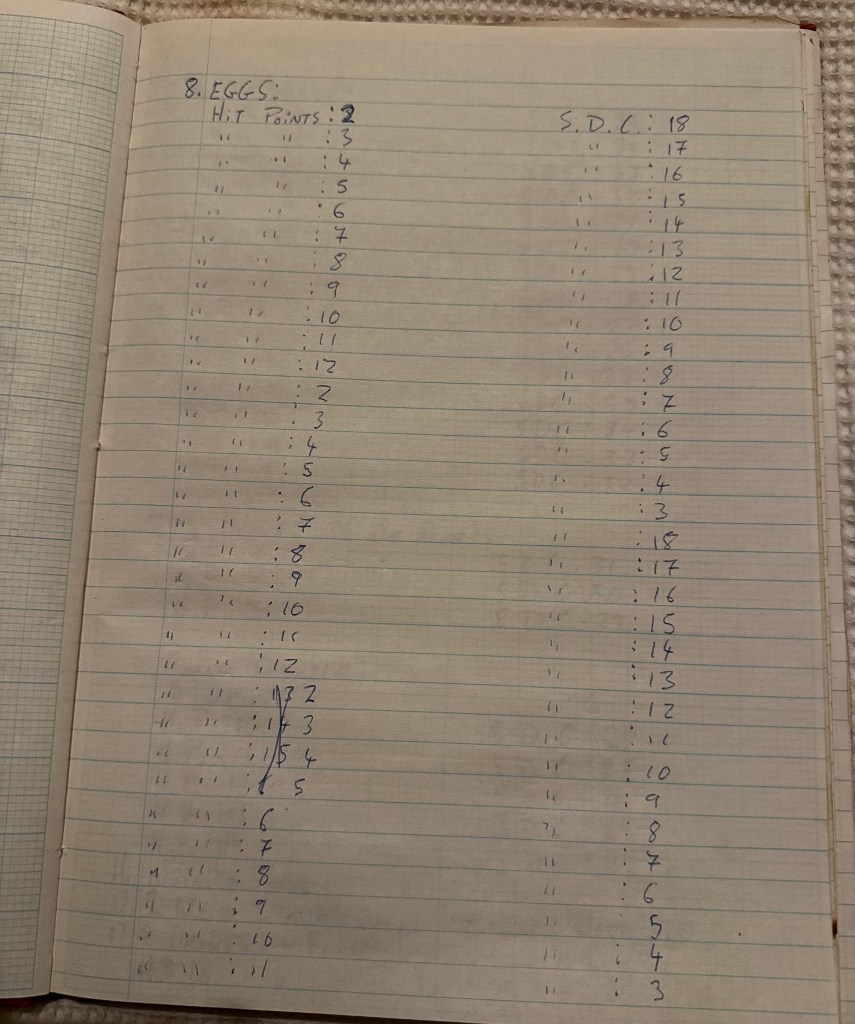
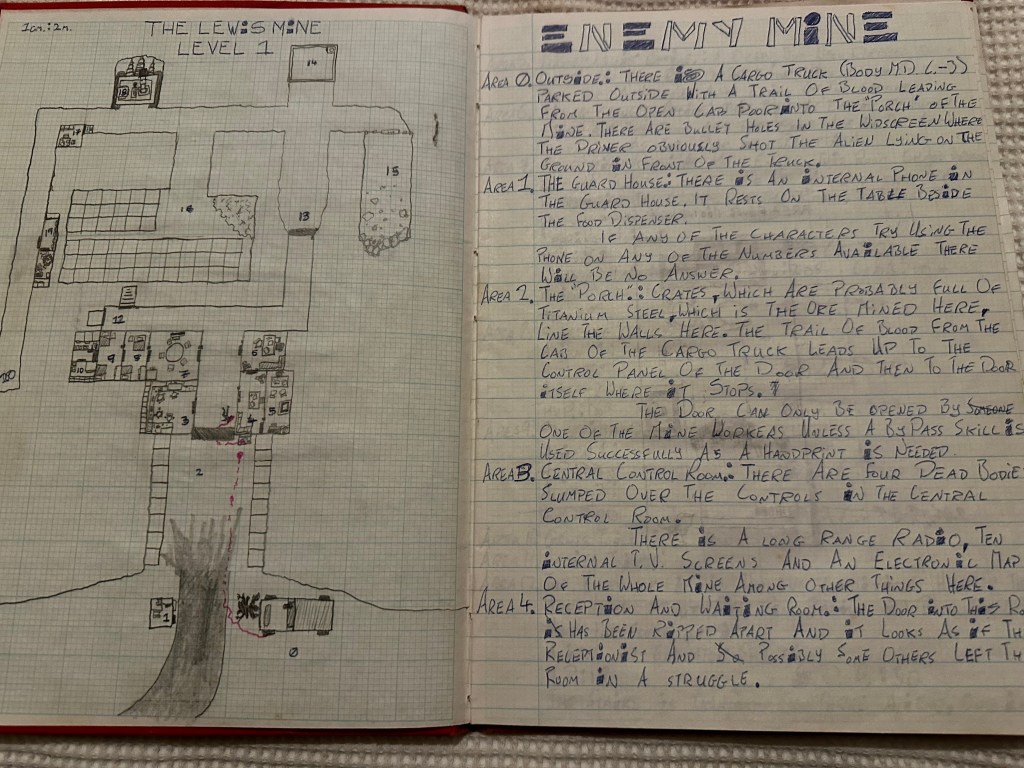
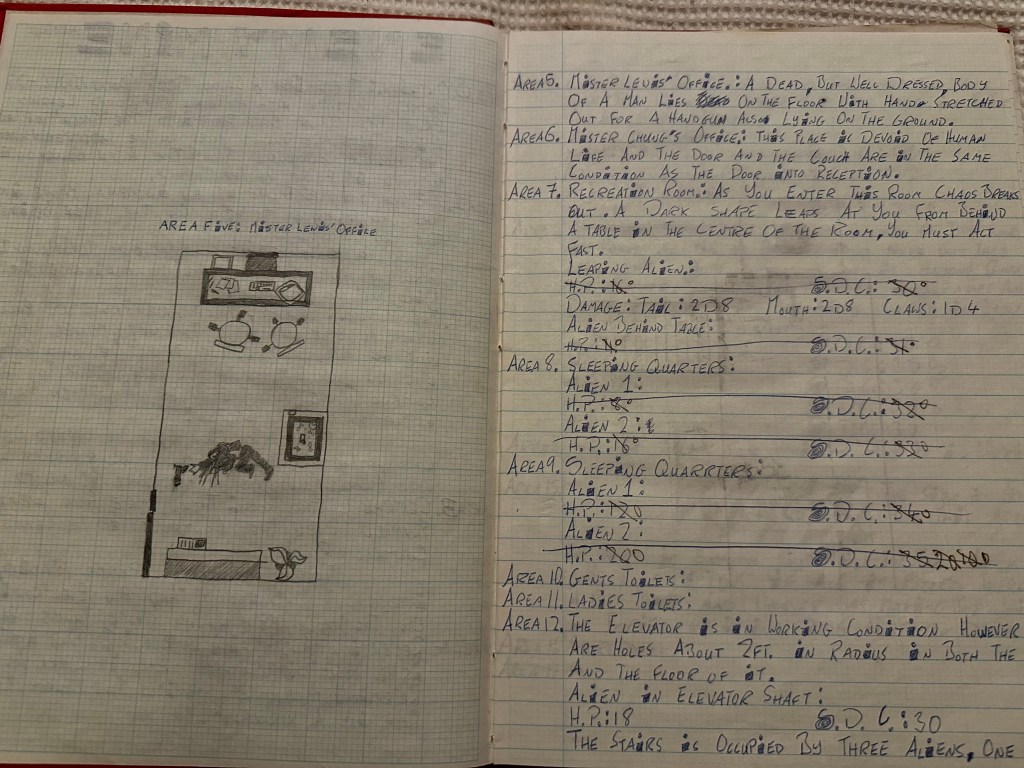
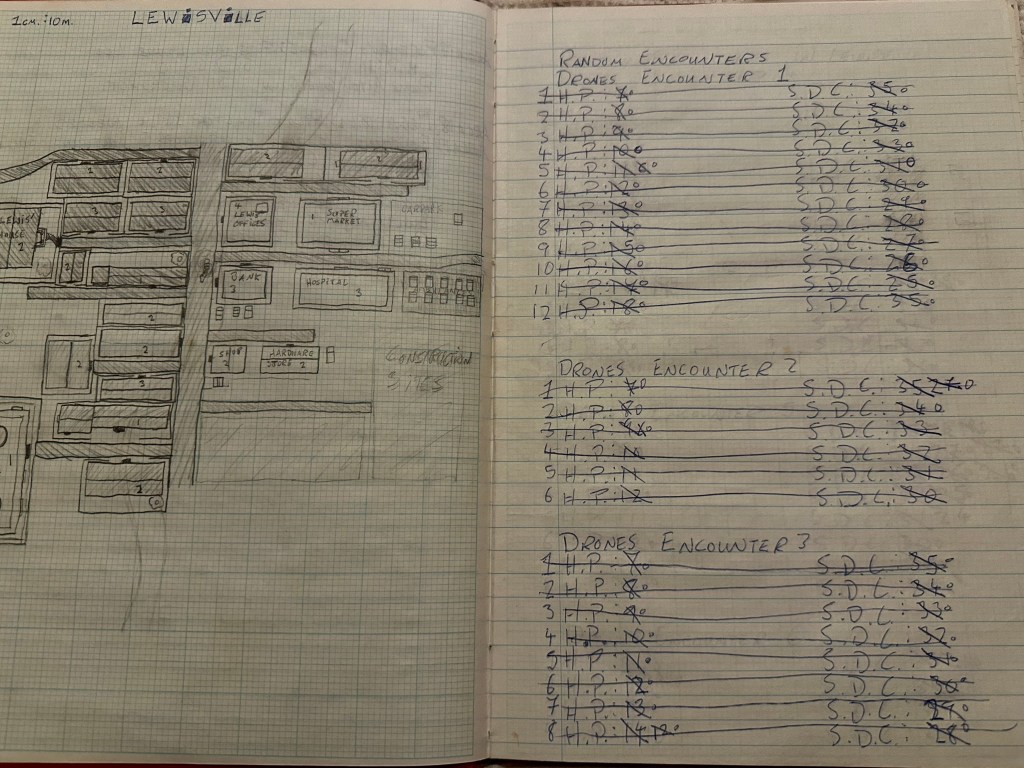
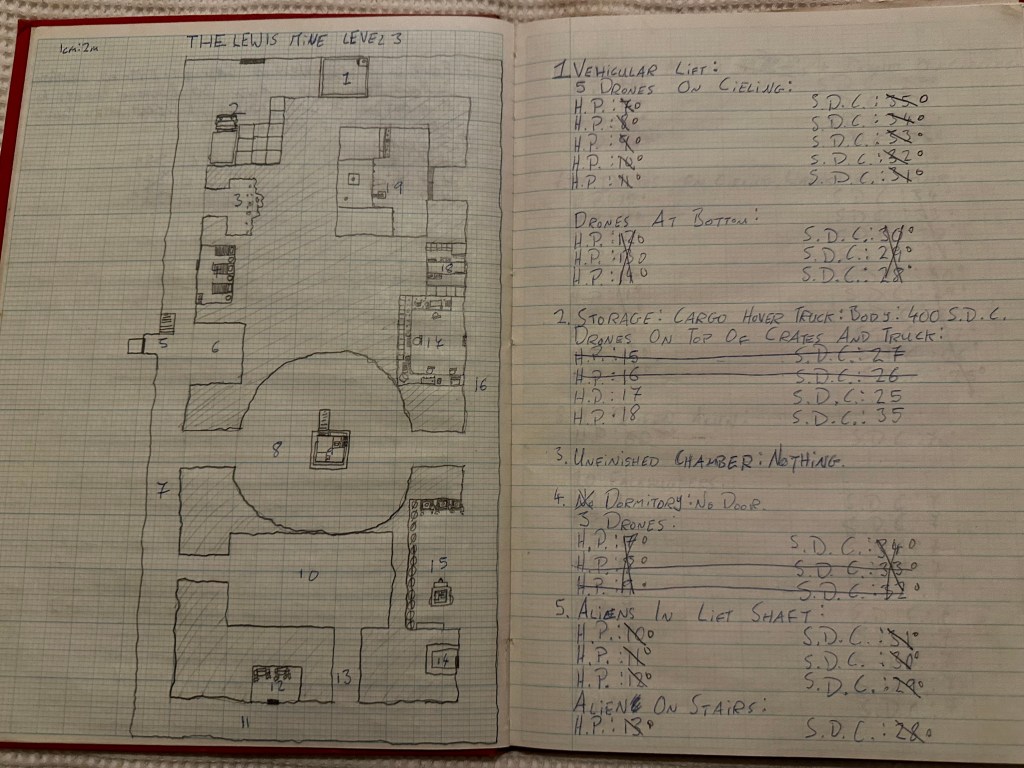
I actually remember writing a full rule-book for it. I did some drawings and cut and pasted some movie stills from magazines for the more complicated stuff. I remember being quite proud of my work, which was contained in a three ring binder and held together otherwise by sellotape and glue. I can’t find that binder now. It’s been more than thirty-five years, so I was particularly pleased to be able to discover even a small piece of evidence of this first Alien RPG. I found a hardback science notebook that contained the first (and, I think, only) adventure for my Alien RPG. Here are some pages from it.

Unsurprisingly, it was a sort of dungeon crawl set in a “titanium steel” mine (the irony that I wrote this in a science notebook, of all things, is not lost on me), with a point crawl in a town called Lewisville attached to it. I used a sort of cursed chimera of D&D and Palladium rulesets to run it. As I remember, this worked well for my friends and me. We had played so much of both, they were second nature to us. The PCs were all colonial marines on a bug hunt. It didn’t lean into the themes of the movies or evoke much of an atmosphere BUT, the marines got to shoot a LOT of Xenomorphs. And that, for us, at that age, was all that mattered.

World’s latest Alien RPG

Alien Evolved Edition is Free League’s latest incarnation of their 2019 Alien RPG. It had a really successful kickstarter, which I backed at the last minute. I wasn’t going to. I mean, I still had the first edition on my shelf, it’s only a few years old, and I hadn’t even played it yet. Not only that, they were at pains to point out that this is not a big overhaul of the game, more like some rules-clarification, the addition of solo rules, and a glow-up. But then, they showed me the special edition of the core book… and I caved.

I don’t regret it though. Free League is almost guaranteed to produce a true piece of art every time. And this book has art and design by Johann Nohr of Mörk Borg and Into the Odd fame. I received the Beta versions of the PDFs today and I am not disappointed.

Anyway, I thought it was probably about time I pulled the first edition off my bookcase and dusted it off. I have been reading it for a few days, prompted, I think by the fact that it was Alien Day on April 26th.

Much of this RPG will be very familiar to anyone who has played any of Free League’s Year Zero Engine games over the last few years. When you try to do something, you make a dice pool from your ability score and your skill score with additions from items or circumstances. Alien uses exclusively D6s so all you’re looking for is a single 6 for a success. But there are a couple of differences with Blade Runner and Tales from the Loop, with which I’m more familiar.

Firstly, you also add to your pool, Stress Dice equal to your current Stress score (which you can gain mainly from pushing rolls.) This gives you a better chance at success but also introduces the potential for your character to Panic, if you roll a 1 on one of those dice. This is usually not good for you. The effects can range from a mere tremble in the extremities, to a berserker rage or full catatonia. Sounds fun, right?

Secondly, you get to add stunt effects when you score more than one 6 on your roll. This feels like it was yoinked directly from Green Ronin’s Fantasy AGE game system, which Dragon Age uses. However, it utilises specific stunts for each skill. I imagine this necessitates a lot of book-checking when stunts come up, but its still a nice feature, which I appreciate.

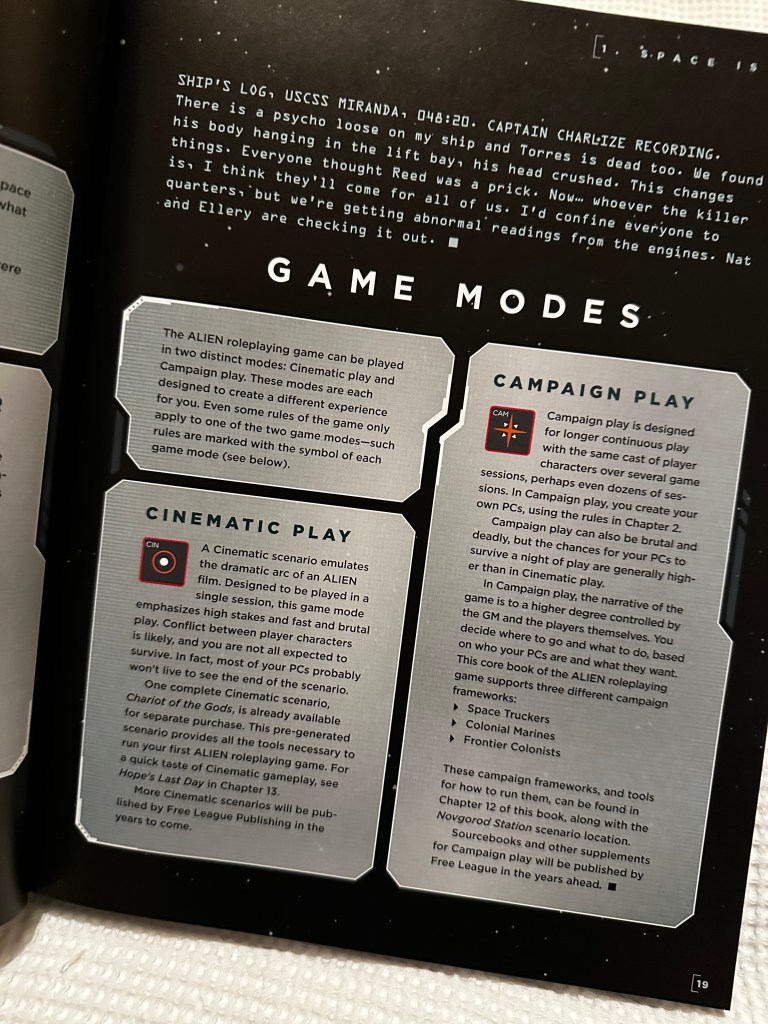
There is another attractive element to the game as well. I like the very clear delineation between Campaign and “Cinematic” play. Campaign play is exactly what it sounds like. You create your character as you would in any other RPG and you and your friends hope they survive through a multi-session story as things probably spiral slowly out of control. The book includes some useful resources for creating planets and start systems, as well as thematic NPCs to help with this style of game. Cinematic play is designed for one-shots, or, at least a short series of sessions. The events of it are probably a little less flexible and fit into an appropriate three-act structure. The PCs are chosen from a few pregenerated characters. And let’s face it, if you’re talking about Cinematic and Alien, you are not expecting them to survive, or, at least, not very many of them.

Alien Day delayed

I was so annoyed that I had missed an opportunity to play an RPG on a non-standard holiday that relates to it, that I felt like I had to play it anyway, in penance. So, I announced a one-shot of the first edition of the Alien RPG today on our Tables and Tales Discord, and I have a couple of sign-ups already. I have a few published Cinematic options and a few days to decide which one to play. I am leaning towards the one from the core book, which relates directly to the events of the movies, as an introduction for the players. But there are also the scenarios in the Starter Set and the Destroyer of Worlds boxed set that could be contenders.

I’ll be back probably next week with a report on how it went! I might just do a round up of that and our Star Wars themed Vaults of Vaarn one-shot from May the fourth. See you then, dear reader.

Cosmic Dark: Assignment Report

Understanding the Assignment

What is the end goal of a game of weird space horror like Graham Walmsley’s Cosmic Dark? The answer seems obvious, I suppose. If you go to see a horror movie, you want to come out feeling like you got your money’s worth in spilled popcorn, whimpers, screams and nonodontgointhereyouidiots. So you should expect something similar from a game like this, right? Well, yes, of course. In fact, the rather ingenious conceit of a game like this, is that, knowing the style of play you’re looking for, as a player, you can go into it understanding what you can do to help push the themes, the jumps, the horror of it. There’s some strange, violet rock that appears to be moving? The character might be a geologist and know that it’s their job to go examine the rock, but the player knows they’re in a space horror game, which is why they should go and examine it. And this is pretty much how our one-shot of Cosmic Dark went last weekend.

But there’s more, of course, because let’s not forget the ‘Cosmic’ bit, the ‘weird’ bit. Because, although the body horror really hit hard at times, the dreamy (nightmarey maybe,) psychological horror felt all-encompassing. There is a section in the scenario that is aptly called “Dreaming and Waking.” Unpretentiously, it refers to the bizarre dreams the Employees experience during their first night on the assignment. It gave me more or less free rein to describe immersive dreams for the characters that related back to the answers they gave in psych evaluation questions earlier in the game. Of course, this served only to highlight the dreamlike atmosphere of everything on the assignment up to that point, in my opinion. Time was behaving differently, the rocks were undulating and growing, seemingly safe spaces were revealed to be anything but… The players and the characters were on edge, really from the start. And, thanks to the mechanics, they got closer and closer to that edge as the session went on.

Character Creation

We played the first Cosmic Dark Assignment, Extraction. Check out my preview blog post here, where I explain the way the players create their Employees as part of that scenario.

At the table, this went down a treat. Forcing players to choose their Employees’ specialisms only at the point where they are being asked to acknowledge over comms on the shuttle to the Assignment is clever and the players got a kick out of it.

But the real star of the show is the series of flashbacks they go through to get a picture of their characters. The flashback method creates memories, not just characters. The requirement for each PC to identify another as a rival or a figure of admiration or some other influence, and to include them in the flashback scenes, creates a shared history and a character dynamic that you simply can’t conjure from dry discussions over a character sheet. If you have played any PBTA games, dear reader, you might be aware that they usually include a section for bonds with other PCs. You and the other PC have to come up with some reason why you are blood-brothers or why you’re worried about the other’s survival or why you had a vision about them. But you do not act it out. You don’t, at least in my experience, role-play a scene together to elucidate the reason for the bond. That’s exactly what you do in Cosmic Dark. In fact, each player has a scene of their own and may choose any of the other characters to share it with. These scenes are supposed to be short, just a minute or two, but long enough for them to find their characters’ voices, outlooks, relationships. And the Director (GM) provides prompts to kick-start these scenes. The players are given a line of dialogue for one of them to say to begin. I was skeptical about how well this could work at a table of regular players. Up until now, I have only seen it done at a table of professional actors on Ain’t Slayed Nobody. But I needn’t have worried. Every one of my players took that single line of dialogue like the baton it was, and ran with it, inventing hurdles, falling and picking themselves up again. And the table I had? Four players with a wonderful mix of experience levels, some who have played a variety of RPGs for years, one with just a few months of play under their belts with Tables and Tales and even one for whom it was their very first role playing experience!

The aspect of character creation (it’s one of the parts that is ongoing throughout the game from what I understand) that I had a little difficulty in running and incorporating as intended is the psychological assessment. There is a moment, that also occurs in flashback, the night before the Assignment, when they are lying in their sleeping pods on the Extracsa transport vessel, the Exchange, and they are asked questions like “what scares you most about being alone?” Or “what is the most terrifying way to die?” You are supposed to. Push the PCs to answer truthfully, indicating that Extracsa will know if they are lying. This part was ok, actually. I was able to get some revealing and actionable answers from them. It was the re-incorporation of the answers into the later dream sequence that I struggled with. The idea is that you should take note of the PCs’ fears and worries so that you can create a tailored nightmare for them during the Dreaming and Waking section I mentioned above. I think this is something I would get better at in time and with practice. The main issue I had was just referring to my own notes and making sure I got the right nightmare for the right Employees in a way that made it feel like it flowed naturally.

The Assignment itself

I don’t want to go into too much detail here. Honestly, I could not do it justice. Go and listen to the Ain’t Slayed Nobody actual play instead!

But here’s what I will say. I presented an outline of the type of game Cosmic Dark was when I advertised it on our Discord. But I think there was still some misapprehension by the time we started playing. The main feedback I got in this respect was that they expected something more along the lines of physical threats. I believe this is, perhaps, the overriding influence of the Alien franchise. I did refer to Alien in the touchstones I mentioned when announcing the game, so that could explain it. There is nothing like an alien monster in this first Assignment. In fact, as they played through the scenario and uncovered one egregious corporate scheme and strategic lie after another, I think it became obvious that Extracsa are the real baddies here. And, it’s not like there aren’t ways for the Employees to die in the course of the Assignment (we had one death, caused mainly by the Team Leader hitting 6 Changed as he escaped. He flipped the rover he was driving.) And they felt as though they were in danger, clearly. As their Changed scores each hit 4 or 5 (out of 6) they all decided to run away! They witnessed what was in the future for them on this asteroid, a slow and horrific melding with the rock of the place, and they noped out of there before they even reached the finalé! Anyway, if I had any advice for prospective Directors, it would be to make sure you properly set expectations.
How about the scenario itself? So, I only had the text of the Extraction Assignment to work with. Now, this was fine. The rules are contained within it and the character creation occurs during the course of play, as I explained above. However, in the finished book, there will be useful extras to refer to. For instance, if and when an Employee rolls a 5, they are supposed to get a little bonus in the form of records, data from the Extracsa company servers that serve to shine a light on the mystery or, at least, show them how Extracsa is fucking them over. On the roll of a 6, they are supposed to experience an anomaly of some sort. Anomalies are supposed to alert them to the weirdness of the place or the situation or have a direct psychological effect that might prompt a Changed roll. Now, there are a few examples of appropriate records and anomalies in the scenario but the rest will be contained in cheat sheets that will appear in the final Cosmic Dark book. To fill this gap, I listened to the ASN actual play again and made a note of the records and anomalies Graham used in that.

The other thing I picked up in particular from Graham was the style of GMing he does in that AP. He keeps it light and breezy mainly, gently encouraging players to take unnecessary risks, reminding them about the Changed die, reassuring them that that little prick from that piece of weird violet rock is probably nothing to worry about… until the point where he informs them all they need to do to reduce their Changed score is remove that pesky limb… Listen and learn, dear reader! It worked a treat at the table!

As for the rules, I had one regret here. The rules are very light and easy to pick up, but, this opening Assignment is designed to introduce the rules in a specific order to ease the players into them. And it does a great job of that. The Changed die is the first thing that comes up, then investigation rolls and other types of actions. But I forgot to introduce the re-roll mechanic when I should have, thereby allowing the Employees a chance both to do better on certain checks and to increase their Changed score earlier on.
Conclusion

All in all, I highly recommend this game. I want to play more of it. I wanted to play more almost immediately. But I think my experience will be greatly improved by getting my hands on the full book. So, let’s make sure I can, shall we? Go and sign up for an alert on the Cosmic Dark Kickstarter!

Homebrew Heart Landmarks 2

Guess the inspiration

I don’t think it will be difficult to see where I drew inspiration from this week. It’s a story I have mixed feelings about but still, it introduced the world to one of the most enduring and influential fictional universes ever. Just remember, desire is the mind-killer.

The Heart Worm

Name: The Heart Worm
Domains: Warren, Wild
Tier: 2 and 3
Default Stress: d6
Haunts: The Waters of Life (Blood D8)
Bernie Gallac, Terrible Warrior-Bard (Mind D6)
The Prophet, AKA Moonlight-Falling-On-Glaciers (Fortune D6)
The Herb, Mischung (Echo D8)

Description:
Travellers in the deeper levels of the Heart, where all is flesh and warm and wet, sometimes pass from an artery into a wide open tunnel, resembling a damp cave with masses of tooth-like protrusions projecting from ceiling, walls and floor at the entrance. Many need no more excuse than that to run from the place, but many others know better. They have heard of the Heart Worm, and they know of the life-giving properties of its vital juices. Usually, these are the type of fool-hardy adventurers who have nothing to lose and who find the prospect of burrowing through the flesh of the Heart only to be deposited in another, unknown location, “exciting.” For that is what the Heart Worm does. A giant, parasitic entity that feeds off the multidimensional matter and energy of the Heart itself while digging through it and leaving cyclopean tunnels in its wake, the Worm picks up passengers and ejects them wherever it wants, seemingly randomly.

The Heart Worm has swallowed a few people and never let them go, however, perhaps due to the understanding that its passengers need support and services during their sojourn.

Bernie Gallac, a drow former soldier of the Allied Defence Forces, has been trapped for so long, he has forgotten the world outside. He spends his days composing sarcastic little ditties to comically roast the visitors who come his way. He has been surviving on the Herb, Mischung, which grows in abundance around the depths of the great worm’s mouth. It, along with his long imprisonment, has made him strange, one-dimensional, lacking anything but the desire to do what he does in the service of the Heart Worm and its passengers. His eyes and the eyes of all the inhabitants of the Heart Worm, are crimson from consuming the wine-dark Herb.

A passenger can gather and consume the Herb too. It must be cooked down until it is in the form of a red paste in order for it to be edible. It will slowly change the colour of their eyes to a deep red, but it will also make them feel more at home in the Heart as they become one with it (see Special Rules.)

The Prophet, Moonlight-Falling-On-Glaciers, is an aelfir noble scion, trapped these many years in the gullet of the Heart Worm. They desperately wish to exit and spread the news about the Worm to all the inhabitants of the Cities Above and Below. But, for whatever reason, the Worm has not allowed it. Perhaps it is not their time yet? Perhaps they do not wish to be worshipped like a god, maybe they do not want their presence truly confirmed. The Heart Worm does not confide in anyone its plans or reasons. The mask the Prophet wears resembles the face of the worm but for the two crimson eyes visible through the slits in it. They will speak to passengers in a voice to deep and resonant to be understood, to increase their fortune.
The flesh of the Heart, eaten by the Worm, travels down the peristalsis of the great gullet almost constantly. Those who exist inside, stick to the walls of the giant being. Some have tried to take parts of the Heart meat to sustain themselves. These unfortunates are invariably ejected by the Heart Worm at its first opportunity, in the most dangerous of regions. Passengers who wish to benefit from the Worm’s diet must travel further down its throat until they discover the crimson lake of the Waters of Life, the digestive juices caused by the enormous creature’s Heart-burn. If they can endure its acidic nature, a passenger who immerses themselves in the lake will have their old skin stripped away, only for it to be replaced with a new, deeply red skin. It will heal them of physical ailments. (See Special Rules.)
Eventually, the Heart Worm will find the perfect spot to deposit its passengers. When that time comes, they will be physically ejected by irresistible waves of muscular force, which leads to them being spat out at their destination. This could be anywhere in Tier 2 or 3 of the Heart.

Special Rules:
Eating the Herb, Mischung has its dangers. It has the effect of bringing you closer to the Heart but this can also have the effect of making you like the Heart. When you consume the Herb, you must make an Endure/Wild or Warren roll or gain D6 Echo Stress. If this leads to fallout:
Fallout: Heart’s Desire (Minor Echo.) The next time anyone voices a desire in your presence, you must do everything in your power to fulfil it for them.

Bathing in the Waters of Life can also be very dangerous. Roll Endure/Warren or Wild or take d8 Blood stress. If this leads to fallout:
Fallout: Worm body (Major Blood) Your body begins to transform. Your new red skin sloughs off to reveal a ridged, wormlike one and you develop a taste for the Flesh of the Heart. If this is upgraded to critical, you fully change into a worm and disappear off into the Heart.

Resources:
The Herb Mischung (D8, Echo)
The Waters of Life (D8, Blood)

April Fools

My dirtiest trick

I’m not really a big fan of “tricks.” The word gives me the feeling of something rather mean. And, as a GM, I would rather not be mean to the PCs. Challenging, sure, occasionally lethal when called for, absolutely. But not mean. The closest I have come in recent years was when I had the corpse of a recently deceased player-character possessed by a demon in order to wreak havoc at their own funeral.

The Death

Merideth, played by Isaac was the sort of tiefling barbarian that every D&D party needs: utterly heedless of danger, first into the fray every time, usually naked with naught but a bevy of rotting heads dangling from her belt. She was one of an intrepid crew of adventurers who had recently turned up on the shores of the great orcish nation of Tír na nOrc. They were convinced by a patron to assault the hideout of one of the capital’s under-city gangs. There, Merideth was murdered, predictably enough, as she charged headlong into the guards in the entrance hall. Slightly less predictably, it was a stray crossbow bolt from one of her own companions that really did for her in the end.

Merideth’s companions continued on regardless and explored the rest of the gang headquarters, as well as the maze of traps below it. There they uncovered a secret pact between the gang, An Fiacla Dubh, and the Demon Lord of the Hunt, Baphomet. This would soon bring the eternal Blood War of the Lower Planes to the streets of the city. While they were at it, they released a dybbuk that had been imprisoned in the burnt and blackened body of a prisoner chained in the maze. It escaped, but that would not be the last they would see of it.

The Funeral

The dungeon over and done with, the next session we agreed that it would be a nice gesture if the PCs, along with a collection of major NPCs from the city of Ráth an Croí gathered at a private dock to bear tearful witness to the funeral of Merideth. A Priest of, Kaigun, God of the Sea, was employed to complete the ceremony. The barbarian was laid out on a raft and pushed off after everyone had said their words of tribute and farewell. Then, viking style they shot flaming arrows at her to send her off in fire and glory to the after life.

But, just before any arrows managed to hit, the dybbuk emerged from the waters of the dock, shadowy and incorporeal. It seized the body of the tiefling and propelled her at her former comrades. Isaac, represented in this scene in his new, bardish guise, was forced to fight off his former character as were her former companions. As moments of surprise and shock go, I have rarely been prouder to present this one to the PCs. It was only improved by the nature of the dybbuk. The demon, (the 5e version can be found in Mordenkainen’s Tome of Foes) which appears as a translucent, flying jellyfish in its natural form almost always appears, instead, in possession of a corpse. One of its features is that it can plunder the mind of the dead one for details of its life, memories and bonds to mess with their loved-ones. I used this to good effect, particularly on her long-time adventuring pal, Antoinette, and the poor PC who accidentally killed her, the Outlaw, Josie Wales (yes, really.) Another of its features is that it gets to use the abilities of the body it possesses, meaning they had to face the formidable might of the undead/possessed barbarian as well as a plethora of other enemies who showed up for the fun.

Luckily, they other PCs all survived and they got to kill Merideth all over again. Ah, good times!

What about you, dear reader? What was the dirtiest trick you ever perpetrated in the context of an RPG… or otherwise?