Games I Got to Play This Year Part 2

Wrap-up

It’s an end of year wrap-up. Everyone’s doing one. Check out the last post for the campaigns I have been playing in the last few months. This one’s for the one-shots.

One-shots

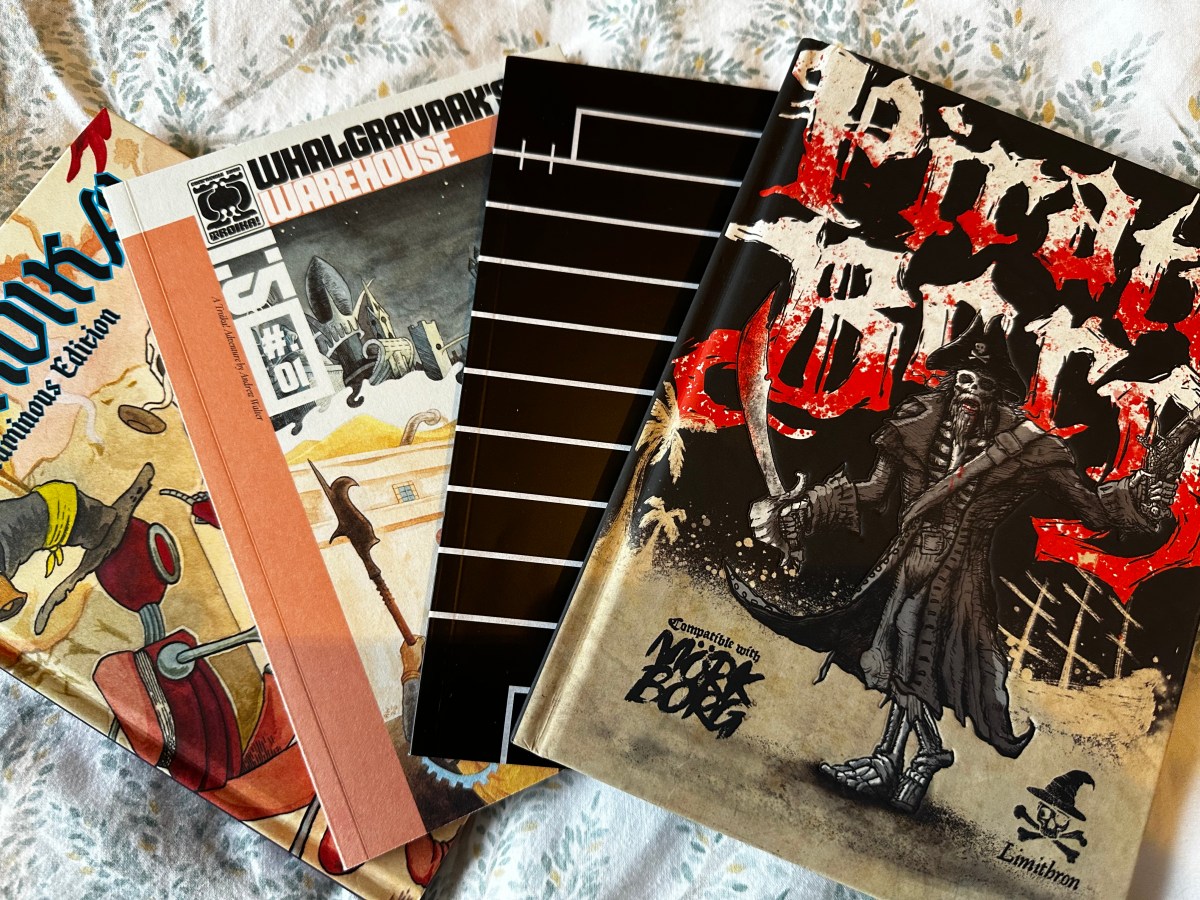
  1. Pirate Borg – the link above will take you to my post mortem on this one shot. It was a great time, in all honesty. My first foray into running any kind of Borg, and I was pleasantly surprised by how easy and instinctive every part of it was, even the ship-combat, which was new to everyone at the table. If you are interested in pirates, light cosmic horror, or just gnarly old school gaming in an alternate history version of our own 18th century, you’ll enjoy Pirate Borg in all likelihood. By the way, I also did a character creation post on this one.
  2. Troika! – Whalgravaak’s Warehouse – Ok, look, full disclosure, this is supposed to be a list of one-shots but this is technically more like a really spread out short campaign where we get together to play a one-shot of the same game every once in a while when we can all afford the time. Know what I mean? Anyway, in the first one-shot of these two consecutive one-shots, the PCs found two different ways into this warehouse, abandoned by its wizardly owner centuries previous. After crawling this “dungeon” for a bit, they made friends with a thin mutant, and their monkeys got to play with the worm-headed hounds that lived in a nest in the warehouse somewhere. They made short work of the Cacogen they’d been sent to murder and we wrapped up the session. In the second one-shot in this series of one-shots, three of the band decided to continue to explore, making more friends, this time with a large cadre of mercenaries who had been sent to deal with some cultists. They then set fire to some rope, captured some minuscule soldiers in gremlin-jars and climbed a mountain of onions. This is the kind of nonsense the PCs get up to in games of Troika to be honest. This is standard. If this sounds too gonzo or weird, you are in the wrong place. The Eternal City of Troika is not for you. You should probably try somewhere more normal. From my point of view, and, I think, that of the players, if you lean into the bonkers aspects of the setting and you are willing to go along with the more outré elements of the system (the random initiative mechanic stands out) you will probably have a very good time with this game. It’s great for one shots. Or two shots if that’s your thing. Might turn into three shots, actually.
  3. Honey Heist – this was another one of Isaac’s games. He ran it on a night when another game fell through. It was very last minute but we were still able to get a crew together. Jude, Tom and I rolled up some friggin’ bears with criminal backgrounds and went to do a heist at the biggest honey convention in the UK, in the NEC in Birmingham. We tried to do a TED talk, we disguised ourselves as massive bees and we crashed a van. You know, typical bear stuff. Another absolute belter of a one-shot, this one. It’s the definitive one-page RPG by Grant Howitt of Spire and Heart fame. Isaac and Tom had picked up the printed form of a bunch of these one-pagers at UKGE and Isaac had been looking for the opportunity to run one of them. This game was obviously made to create wild swings as you use either you Bear or Criminal stat and try to avoid going too far on the bear side or too far on the criminal side. This forces you to take risks and do stupid things to drive the heist forward or, more likely, sideways. Tom did a brilliant write-up of the session on their blog here.
  4. B.D.S.M. Below Dwelling Sewer Mutants – Yet another game run by Isaac at short notice. It is a mutie-eat-mutie game by Neonrot and you can get it here. The premise is pretty straight-forward. You are a mutant. You are probably unpleasant in some way. At the start, you have a mutation that may or may not be useful in certain situations. You can progress and grow by eating other mutants to gain new mutations along the way. If you like that idea, you’re in for a treat. I think it is probably a game that works best in one-shot play. We had fun with it and I think most tables will.
  5. Cthulhu Dark – Roadhouse Feast – I went into quite a lot of detail on this one in the post I linked above so I won’t go through it all again. Suffice it to say, I really enjoyed running the Cthulhu Dark game for the first time. The scenario itself was great but, to me, it is the simplicity and the ingenuity of the system that really shone. If you are into cosmic horror games and you haven’t tried Cthulhu Dark, you should give it a chance.
  6. Liminal_ – I promised a report on how this one-shot went some time ago and here it is. We had four players (known as the Disoriented) for this one-shot plus me as the the Architect. As I thought we would, rather than have the players play themselves in this Liminal Back-Room nightmare, I had them use the character generation tables in Death Match Island. This worked really well to come up with some distinctive, memorable characters quickly and with no fuss. They started off all in the same public building. Since one of them was a district attorney, we agreed it should be a court house. One of the others was there as a witness in a case and the other two were, in an unlikely turn of events, cousins who had been called for jury duty on the same jury. That is pretty much by-the-by, although it did come up in conversation later. Thy all stepped into a room together and found themselves in a building of nightmares. Now, you have to roll up the rooms as they open the doors. There are a couple of d100 tables in the book that are crammed with inventive and horrific room descriptions. The first door they opened led into some sort of creepy, dank cave system; the next into a mouldering bowling alley that was was canted at a 45 degree angle; the next opened onto the abandoned bridge of a ship, rocking in a dreadful storm and with a trail of blood leading off through one of the other doors. I made a mistake at the very start, where I allowed the players to open a couple of doors and then decide which one they would go through. The rules state that, if you open a door, you have to go through it. This felt a little restrictive to me, in a role-playing game, but we proceeded in this way and the players were good sports about it. As we progressed, rolling on the Room and Entity tables, it felt as though, at times, they really wanted to see what the hell was going to come next. Isaac said afterwards, that it felt a lot less subtle than he had thought it would and I have to agree with that. When you think of liminal space horror, it often is just empty corridors and abandoned hotels and the like. Sometimes a strange entity might make an appearance, but it’s the spaces themselves that are supposed to be innately creepy. Some of these rooms we rolled up on the tables felt that way, like the corridor with missing persons posters of the PCs on the walls but a lot of them were straight-up horror like the one with nurse-entity (I think?) chopping a guy up on a slab (it was ok, he was into it!) Also, I think this is something I would be careful with: when you roll a random entity, they sometimes don’t seem to fit, thematically, with the room that you just rolled up. I think it is ok to re-roll if that happens. I didn’t do that and once or twice, felt like they collided awkwardly. Now, these are nitpicks, really. In general, we had a good time with this, the players loved playing their pretty normal characters in these horrific scenarios, just running blindly from threat to dreadful threat. We used both the regular room table and the guest room table (the entries here were written by some industry luminaries like Johan Nohr and Tim Hutchings.) One of the best things about that experience for me was that I was just as surprised, horrified and disgusted as the players were! One of the challenges then, of course, was that it was my job to quickly read, interpret and present the room to the players without taking too long, stumbling over the words, reading them too much or generally fucking up. Unfortunately, we didn’t quite make it to the end of their mad dash through the back-rooms. The PCs still have a few squares of fatigue to be filled in. Hopefully we’ll be able to pick that up and finish it off someday.
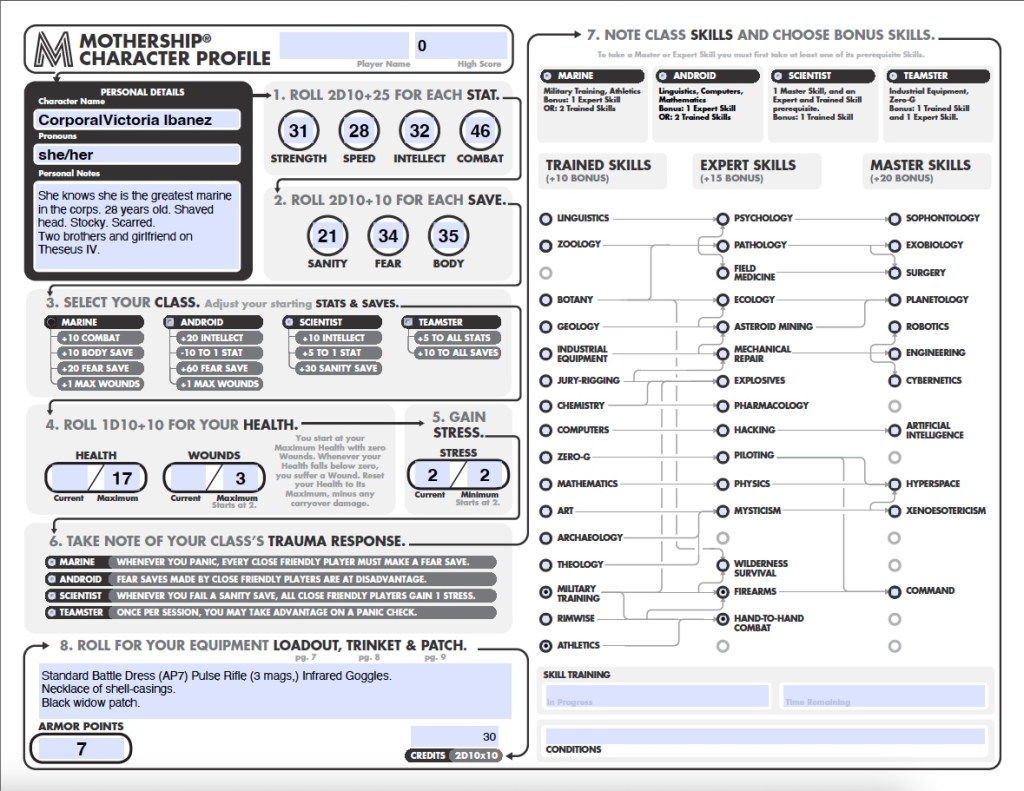
  7. Mothership – Moonbase Blues I wish this wasn’t in the one-shot pile but heigh-ho. Sometimes your GM moves away and leaves your characters stuck on a moonbase that is probably trying to kill them. I mean, there was someone or something there trying to kill us. I was under no illusions that we were likely to all die out there, I just wanted to know how. Anyway, the one session we had of this game was great. Full props to Joel, our GM, for putting so much time and effort into he prep for it. He had a series of recordings that he played for us at key moments, he had handouts and provided us with cheat-sheets. It was a great experience. Also, I loved playing my character that I created in the post I linked above, Victoria Ibanez, the Corps’ finest. I’d love to get to play her again. Mothership is a great system with compelling mechanics and one of the best character creation experiences out there. If you need any more convincing, you should go and check out Quinns’ review of it.

Conclusion

So, that’s it. Those are all the one-shots that I got to play in the last few months. I didn’t get to play many of the games I wanted to, but I sure did have fun not playing them. Next year, I am continuing the theme of not playing the games I listed in that post by starting the year off with a one-shot of After the Mind, the World Again, a Disco Elysium-inspired, GMful mystery game and, Dragon Age, which, I have at least discussed at length on this very blog here and here. Honestly, I think it was useful to set out goals for the games I wanted to play. I may not have gotten to play any of them if I hadn’t done that. So I will continue to write about things I want to experience on the blog and see what happens.

I will be posting more intermittently as we come into the holiday period now. I will be travelling to visit friends and family a lot and won’t always have the chance to post as regularly as I would like. So, in case this is the last post before the end of the year, I wish you the very happiest Winter Solstice/Hogswatch/Western New Year.

BTW

Here are links for where to buy each of these games:
Pirate Borg
Troika!
Honey Heist
BDSM
Cthulhu Dark
Liminal_
Mothership

Liminal_

Survivin’

It is the kind of thing people around here might say when you ask them how they are getting on, “Survivin’.” It is the sort of bleak answer to an innocuous question that is probably played for laughs. At least, if it isn’t, you laugh anyway, because, otherwise, you are likely to get drawn into a conversation.

But you know what it means, even if they are being facetious. They are probably struggling in some way. Maybe they are just tired, maybe they have a hang-over, but maybe, the world has been having its way with them. Perhaps their car broke down and they don’t have the money to get it repaired right now. Maybe they were on the way to the hospital to visit their sick mother when they broke down and they missed the visiting hours. And their phone died before they could call someone to collect them and they had to walk for miles along the hard-shoulder. They caught a terrible cold and now they can’t breathe right and sleeping is impossible and they can’t enjoy anything because merely existing has become uncomfortable. All they’re doing is survivin’.

So wouldn’t it be fun to play a game where that’s the only aim? Surprisingly enough, I think it might.

Of course, survival horror is nothing new. It is a major video game genre. People love Silent Hill! The last game I wrote about on this very blog was a survival horror TTRPG, even though it was wrapped in a cosmic horror disguise. But the game I want to write about today feels a little different. Not totally, you understand. It sticks to the same themes of helplessness, despair and terror in the face of an indifferent or downright hostile environment (part of the reason I wanted to discuss it at this time.) But it has a few indiosyncrasies that help it to stand out.

Liminal_

Pretty sure that’s pronounced “Liminal Space.” The name does make it uniquely difficult to google but that is maybe why the book is called Liminal_Survival Guide. I picked it up from Iglootree here. The creative team is Alexei Vella and Neonrot/Willow Jay. The illustrations are fun/disturbing and are all done with ASCII characters by Alexei Vella.

There are elements of the layout and graphic design (also done by Vella) that remind me of the recently released Death Match Island. The liberal use of redaction with the suggestion that parts of this “survival guide” are from some sort of real world manual, written for the employees of some institution or shadowy company is the main through line.

This survival guide is for the eyes of _ personnel only.

Imagine my surprise when I discovered that Alexei Vella has also contributed to a new island for that game!

Anyway, back to Liminal_. It is a map-making game at its core. You are probably going to be the GM (or Architect) if you own the book. You’ll need at least two other players and a large piece of graph paper. On it, the players (known as the Disoriented in this game) will be drawing rooms as you roll for them. There are lots of rooms to roll from. More than half the book is made up of room prompts!

The basics of the game go like this. The Disoriented start in a square room with a door in each wall. They roll off for initiative and the first one to go decides which door to choose. They can move into it at the cost of Fatigue, their only stat. The first one to enter a room is likely to take more Fatigue than those who follow, but every time anyone takes any kind of action, they are going to incur a Fatigue cost. Once they get 100 Fatigue, they’re screwed, they get Absorbed by these Back Rooms they have found themselves inhabiting.

There are rooms of different shapes and sizes, there are rooms that have items in them. Carrying items adds to Fatigue but they might help the PCs in some way. They might help them get away from Entities that occupy some of the rooms. Like Cthulhu Dark, you can’t fight them, all you can do is run. There is no fighting in this game. The Disoriented make a Fatigue Test to evade them by escaping from the room. They roll a d100 and if they get equal to or higher than their current Fatigue they succeed. If they fail, they take more Fatigue. They might also garner Injuries. Injuries cause a continuous rise in Fatigue and may have other adverse effects.

Sometimes, depending on the room prompt, a room vanishes and you better hope you are not trapped in there when that happens. Other times, you might enter a Dead Room, which is just a room with only one door, i.e. the one you came in. There are, luckily, Rest Rooms to allow the PCs to recover some of their Fatigue. And there are Escape Rooms. If you are lucky enough to keep your Fatigue low enough through your harrowing journey through the Rooms, and you avoid being Absorbed by what must surely be a sentient labyrinth, you might just escape! Seems unlikely…

The entity prompts and room prompts are well-thought out, appropriate and fun in the most despicable way possible. Here are a couple of examples:

Entity prompt: A mass of mulch, organic green material and mosses rapidly grows into a human man, a skeleton briefly visible inside it. The creatures eyes are blood red as it reaches for players, roaring.
Room prompt: Players enter a short, dimly-lit hallway. Yellowing wallpaper covers the walls, and rotting, off-white carpet covers the floor. There are several missing persons posters covering the walls. Some of them bear the faces of the players.

I do not want to give too much away here since I want to play this game and my players read this blog, but, honestly, there are so many good prompts in this book! I imagine a bloody good time rolling up these rooms and horrors.

And, on top of all those, there are even more than a hundred “Guestroom Prompts” written up by such RPG luminaries as Grant Howitt (Spire, Heart etc.), Tim Hutchings (Thousand Year Old Vampire), Tim Denee (Death Match Island) and Chris McDowall (Electric Bastionland, Into the Odd).

One of the more interesting things about the game is the lack of any kind of character creation rules or processes in it. After all, no-one has any particular defining stats. In the Roleplay section, the authors suggest that the players might just play themselves. Now, I have done this before in a Call of Cthulhu game and, while it was an interesting experience, it was, perhaps, just not for me. I immediately considered having my players use the character generation tables in Death Match Island instead. These are specifically designed to come up with contemporary sorts of characters plonked into a desperate, life-or-death situation that they have to escape from. I also considered using at least parts of the methods described in Between the Skies. Finally, maybe the Cthulhu Dark option is the best, just give the poor bastards a name and an occupation and release them into the Liminal_.

Conclusion

This feels like the ideal one-shot to me. It’s rules-lite, with a simple premise and no real character creation to speak of. There is no prep and you only need a few items like graph paper and pencils to play it. Its procedurally generated nature and its absolute mountain of prompts are likely to ensure that you never have the same room twice. My only worry is that it might be a little too one-note, that the singular motivation for the characters to survive might not be enough to keep them interested the whole time. I guess I’ll find out when I get it to the table!

What about you dear reader, do you like the idea of this Back-Roomy, SCP-like game? Have you played it? Let me know in the comments!

Inevitable

Maneater, Arthurian Western Bestial Godsman

This is my new character for the Inevitable game I am starting this evening. I drew him with pencil on paper while one of the other players was creating his very cool Taleweaver character who tells a tale of how Maneater averted a war by channeling his god, the Beast.

Can’t wait to start playing!

Between the Skies, Part 2

Back to the skies

Between the Skies is such a beautiful and fascinating book that it is a pleasure just to read it. If anything, all this writing about it is just slowing me down! But I do feel the need to evangelise a bit more. So join me, dear reader in an exploration of the character generation options. Or, if you haven’t read the first of these posts, you can catch up here.

Character Generation

The “Approaches to Character Generation” section encourages you to decide on the approach you want to use and then to roll on the relevant tables to flesh out the description. It’s important to note that your interpretation of the table results is what’s important, rather than having a strict set of attributes or traits that have specific meanings in the game.

It also tells you to note all of the things you want known about your character. I love this point, actually. Rather than waiting till it comes up in play, when a GM might casually bring up an element of your character that you don’t want the other PCs to know, you make it clear at the outset the only parts of your character or background that others would be aware of. Or maybe it just means that there are things about your character that no-one knows and that will come up organically during play, at which point they will become a part of them. Either way, it is an important point.

Character sheet with character generation question page no.1. This is for a "Through the Looking Glass" type character.
Character sheet with character generation question page no.1. This is for a “Through the Looking Glass” type character.

This section also directs you to go and take a look at the character sheets in the back of the book. There are three types, which I will get into below. But, notably, on the page before each actual character sheet, you’ve got a few questions printed in large font, taking up an entire page, to build a basis for your character. For the Lifepath and Spark procedures these are:

“Who are you?”
“What can you do?”
“What do you have?”
“What do you want?”
“Who do you know?”

And for the Through the Looking Glass procedure they are:

“Who are you?”
“What can you do?”
“How did you get here?”
“What are you searching for?”
“What have you brought with you?”

It’s almost as if their significance cannot be over-stated. It feels like these big old questions and the spaces for you to fill with your own answers to them on these pages could act as the character sheets themselves. Perhaps, if you don’t want to be too bothered with specifics, if you don’t want to use numbers and die types and the like to describe your character, you could just write a few answers to the best of your ability beneath each of the questions. That would be a good basis for a character in a fictional story. Would it be a good character in an RPG? In the very loosest of story-games, I feel like that’s more-or-less the approach and it works well, but it does depend on the type of story you and your table are trying to tell. In a space-pirate, treasure-seeking, swashbuckling adventure game, it might not hold up. But if your aim is to tell the story of a group of people caught in a difficult situation, informed by their backgrounds and desires, complicated by their relationships and inner lives, and their development as people over the course of the game, sure, it would be perfect. Writing about this makes me want to try it…

Character sheet with character generation question page no.1. This is for a "Through the Looking Glass" type character.
Character sheet with character generation question page no.1. This is for a “Through the Looking Glass” type character.

So, next to each question page is a “Worksheet.” Even the word-choice here is significant. It indicates that this is where you will be performing the admin for your character. Filling it in will be an exercise that you may find tedious or satisfying, very much depending on the type of person you, the player, are.

Each worksheet helps us to encapsulate a character designed according to one of three (four, kind of) procedures.

I mentioned in the last Between the Skies post that the procedure you use here is related to your approach to weirdness. So, if you have decided to go with “All the Weird” you can probably use any of the methods described, but if you are going with a “Venturing Out Into the Weird” approach, and you want mundane characters, you should think about going with the Spark character creation procedure (with a few modifications.) Once again, it’s important to note, all of this is advice, none of it is mandated. Choose and use what you like and discard the rest.

Lifepath character generation

I have never played it but I have heard about this character creation method being used in Traveller. Essentially, you map out your character’s life up to the point of the start of the game and this process creates the PC. You roll on the tables provided for this character generation method to establish events in your character’s life that lead to the accumulation of “Skills, allies, enemies, Mutations and Debt, among other things.”

Let’s take a look at some of the tables used for Lifepath character creation.

You have a Type table that contains a pretty wide array of permutations. I rolled up a Swimming Avian. I’m thinking seagull.

The Descriptor tables are d66 so have a lot of options in them too. You might be described as Huge, Transformed, Dead, Nomadic, Staunch or Minimal. These single adjectives should ignite the imagination and lead you down paths to fill in the blanks on your character sheet, or just in your mind.

You roll twice on the Aptitude table (also d66) and take the adverb form first and then the adjective form. So a roll of 54 and 45 (which I genuinely just rolled) would be Inspiringly Commanding.

After this you enter the Life Events section. It explains the basics of using this method and then tells you to go and roll on the Life Events tables. There are three tables to roll on depending on whether you want have your major life events on a Surface (I guess like a planet or something similar,) in Space or out in the Planes. You can switch between them and sometimes have to depending on the events you roll.
A sampling:

  • Quest for NPC completed, harmed – Roll powerful NPC for patron; Gain problem related to injury suffered by PC
  • Death, became undead – Create one Extraordinary Ability related to undeath; Create one Problem related to undeath; If already undead when this result is rolled, PC is destroyed, create new PC who has dead PC’s possessions.
  • Joined heresy – Joined heretical religious organisation; Gained ire of opposed religious organisation; Gained skill related to heresy
  • Became Hermit – Cannot roll any further life events; Gain skill related to hermeticism
  • Lost in the Planes – Cannot roll further life events
  • Became petty god – Roll or describe Focus; Gain Extraordinary Ability related to petty godhood; Petty gods are not necessarily more powerful than mortals

After this you have a bunch of tables to help you determine your Extraordinary Abilities, Skills, Mutations and Problems all of which will help to round out your character. There are some great entries in these tables but this blog post has already gotten away from me so I am going to have to skip on to the next method of character creation.

Spark character generation

ANother black and white illustration from Between the Skies. It shows a creepy person with no face except for two blank, white eyes. They open theirlong black coat as though they were selling hot watches, but inside are only toothy grins and gaping maws.

This is an entirely table based method, but, as the title suggests, the results you get from the tables should be used to spark the imagination of the player. As Huffa takes pains to point out more than once in the characters creation section, the tables might give you powers and abilities and they might even describe what you can do but they don’t tell you how your character does it. I think most of us assume this point without thinking about it in our games most of the time (my Magic Missile looks like three paper planes that explode when they hit!) but it’s a good thing to have it called out here formally. So the tables used for this method are very much based around the questions I listed above. Under the “Who are you?” section we have table after d666 table of descriptors to roll or choose from.
Here are a few nice ones:

  • Sickle mender – fixing what cuts
  • Messmaker – joyous entropy
  • False smile – feelings turned inside out
  • Babysitter

For “What can you do?” you can go back and use the tables under the Lifepath method for Abilities, Aptitudes and Skills.

“What do you want?” – There are a couple of tables here. You are encouraged to use these to “inspire a few sentences describing what your character wants.”
Examples:

  • Objects of Desire – Redemption, Surprise, More
  • Related to… – past self, rulers, daemons

When it comes to “Who do you know?” we have another trio of tables. These can be used to make two or three entities with whom you have a relationship of some kind. For instance:

  • Entity type – Creature
  • Relationship type – Debt holder
  • Relationship detail – Yearning

Once again, use these results as prompts to describe these relationships in a little more detail.

Finally, in the “What do you have?” section, you use the Starting Resources procedure with some changes. Generally this involves you having an alright weapon and some semi-decent armour, equipment needed for skills and maybe even a ship if that’s the sort of game you’ll be playing. You get to roll up an interesting object too! You will also possibly have some Assets or Debt to start with. There is, unsurprisingly, a table for that. Assets, Debt and Petty Cash are all rather abstracted in Between the Skies. You measure them in units where a unit of Petty Cash might buy you a nice meal and a unit of Asset or Debt would be the equivalent value of a house. I appreciate a system like this as counting gold pieces holds little or no interest for me. Also, Debt implies a Debt-holder and that could be an important relationship and could be used as motivation at some point.

Through the Looking Glass character generation

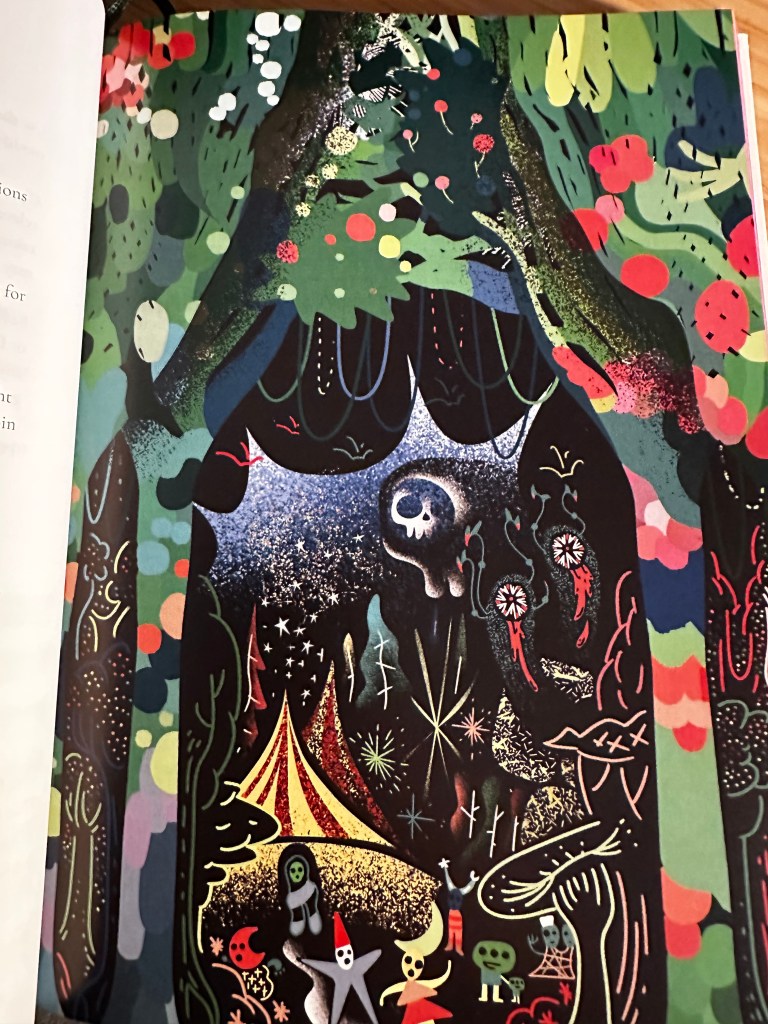
A full colour illustration from Between the Skies. The picture is of some strange characters, drawn in a deliberately childish style with funny hats heading towards some circus tents and away from a colourful bu threatening forest in the foreground.

Your character has done a full Alice and is now in a freaky other-world. Why are they there? What sort of personal disaster has led them to this point? What are they looking for in this isekai nightmare/dream realm? These are things you need to know about your Through the Looking Glass character.

Once again we have some tables to roll on. But interestingly,

It is assumed that Through the Looking Glass characters are mundane people from a world like our own, and that results are interpreted accordingly

A few sample descriptors from the tables:

  • Vengeful
  • Loopy
  • Ostentatious
  • Firefighter
  • Hack
  • Paparazzi
  • Avante Garde Hobby
  • Entrancing Dancing

On the “You (were) recently…” table we have a little more to shape your mundane character. You can roll on the d66 table to get these sorts of results:

  • Retired
  • Transitioned
  • Canceled

Under the “What can you do?” section, the abilities are a lot more “normal” than some of those in the previous character generation methods. They include stuff like:

  • Untapped Scholarly Education
  • Precocious Performative Love
  • Charming Spiritual Profession

One of the different questions belonging to this character generation method is “How did you get here?” This is, of course, of utmost importance to this type of character. Maybe you were trapped by an entity from another world. Perhaps you stumbled into it while intoxicated, seeking pleasure. Or was it that you were reincarnated after dying by a catastrophic event?

Even just reading the entries in these tables has my imagination all aglow with possibilities. They make me want to run this sort of game. I don’t think I have ever done that, not for such mundane PCs, at least. I want to see how such characters would be changed by such an impossible journey! Yum yum.

Another question that is specific to this character generation method is, “What are you searching for?” Ruby slippers? Aslan? That damned white rabbit? I suppose it could be any of those but why not roll on some tables instead?

The tables, interestingly, do not tell you exactly what you are looking for, just the type of thing you might be looking for (knowledge, person, object etc,) what that thing will provide (relief, comfort, affirmation) and what complicates it as a goal (explosive, famous, moving.) You should then get together and discuss the precise nature of the thing. The text suggests that, if you are all of a similar type of character, you should maybe all be striving for the same object but that you might each have a different motivation. This sounds like a wonderfully interesting potential grenade to throw into the works whenever the characters finally find the item they have wanted all this time. It smells like interpersonal conflict. Yum yum yum.

Lastly, for the Through the Looking Glass method, we are looking at the “What have you brought with you?” question. This is different to the “What do you have?” question common to the other two methods because your character is assumed to have been yoinked out of their own reality with only the items on their person. So they don’t get to have any Assets or Debt or any of the other starting equipment other types of characters might begin with, which is totally fair. Instead, they get a few basic items and maybe one Special Item. There is, as you might have guessed, a set of tables for that. Once again, these provide inspiration rather than outright answers to what that Special Item might be. So you might have an Alien Secret or a Mythical Key… This idea of only having what you had on you makes the prospect of the first few hours in a new world particularly enticing from a game perspective. How does one survive in a desert otherworld with nothing but a mobile phone, a wallet full of loyalty cards and used tissue? The answer could be that the locals are enchanted by the Spectral Device that you were handed just before being shoved through a portal.

Character generation using other games

There is a very interesting and useful section near the end of the Character Generation chapter. It provides a loose guide to using another system’s character creation method to make your Between the Skies character. Essentially, if you use this procedure, you will end up with a blended character. They will still consider the questions from the first two character generation methods but you will do your best to apply the answers to the character you have created using the other system. In some cases, this will mean that you are adding bits entirely from the question answering method as many systems do not consider things like what you want and who you know at the character creation step.

I am a big fan of Troika! so I am happy to see the practical example of using a Troika! background as the basis for a Between the Skies character here too. It makes it easier for me to picture using this method and elucidates the process in a practical way.

Character generation conclusions

All in all, I am impressed with the breadth of options presented in the chapter. You have no fewer than four different ways of making your character (and many more if you consider you could technically use the fourth method to use any other game’s mechanics to do it) a plethora of interesting tables to create some really weird or terribly mundane characters and a whole bunch of world-building before you have ever started playing the game in anger. The results you are likely to roll on things like the Life Events tables are going to haunt your game if the GM is paying any attention at all. You’re likely to establish the existence of certain NPCs, gods and demons, places, objects and catastrophic events that effect the whole world while rolling up your PC. I love this! It starts the whole table off with so many potential plots, grudges, vendettas, desires, loves, hates and motivations that the game should practically run itself from the moment you finish character creation.

As a process(es) it makes me excited to take part in it and even more excited to play the game, either as a GM or as a player.

What do you think, dear reader? Does this make you interested in Between the Skies? If not, perhaps I will continue to pursue this subject in another post in the near future so I can convince you. If so, maybe I’ll keep entertaining you with details and opinions of a subject you clearly enjoy! It’s a win-win!

Dragon Age Character Creation

Dragon AGE

I’ve recently been playing through Dragon Age Origins again. It’s been a long time since I have played that particular game although, I have played a lot of Inquisition and even Dragon Age II since then. Playing Origins has put me in a nostalgic frame of mind but also, I thought it might be a good incentive to try something new, TTRPG-wise. The Dragon Age RPG has been out for some time, about ten years I think. Green Ronin published it and it is based on the AGE (Adventure Game Engine,) which is maybe better known for being used by their Fantasy AGE game. I got both of those on a Bundle of Holding years ago but have never even gotten around to reading them. So, I asked in the Tables and Tales discord if anyone would be interested in trying the Dragon Age RPG and I was surprised and delighted to discover that I am not the only DA fan in the community!

If I needed an excuse, I could also say this is all in preparation for the new DA game, “Veilguard,” which is due out soon. But, honestly, it has more to do with replaying the old game than waiting for the new one.

Anyway, I have had some decent success in getting to know new systems by creating characters on here in recent posts, so I thought I would do that again today. Off to Thedas with us!

The steps

So, I am doing this using the Dragon Age RPG Core Rulebook published in 2015. I have it in PDF format. I would like to start by praising it for having a comprehensive set of internal links from the table of contents. For a book of over 400 pages, this is invaluable.

So, what are the steps to creating a Dragon Age character? Having a quick look at them, there are similarities with the video games but with some flourishes and differences presented by the AGE system.

A screenshot of the Dragon Age Character Creation Steps table from the Daraon Age RPG core book. The table includes the 8 steps you need to complete to create a PC for the game.

As you can see from the screenshot, the first step is coming up with your character concept. I quite like this as a starting point, although, I do wonder if it might be rather a tall first hurdle for some players. I often find myself coming to know the concept of my characters in other games during the process of creating them. But, let’s give the game and its designers the benefit of the doubt and go with it.

1. Step 1: Character concept

This section in the book urges you to go and read through Chapter 7: Welcome to Thedas, if you’re not terribly familiar with the setting, and maybe haven’t played the video games. Now, chapter 7 is almost fifty pages long and covers everything from the major nations and races to the cultural significance of the Dwarven Paragons. You would want to be pretty invested in the game before you ever start to read that whole thing, as interesting and even pleasurable as it might be to do so (the writing is not bad but the illustrations are very good indeed.) As I have played through all the games multiple times, and even stopped to read all the books I picked up off bookshelves and desks as I played, I feel like I am already well enough equipped to get away with not reading it before embarking on the character concept step here.

  • An adventurous youth who has finally found a way to escape their home.

That’s it, that’s the concept. I will say, I don’t think a thorough knowledge of the game’s setting is required to make this sort of thing up. Most of the example concepts they provide in the book are vague enough that they could belong in any traditional fantasy setting, in fact.

Step 2: Determine abilities

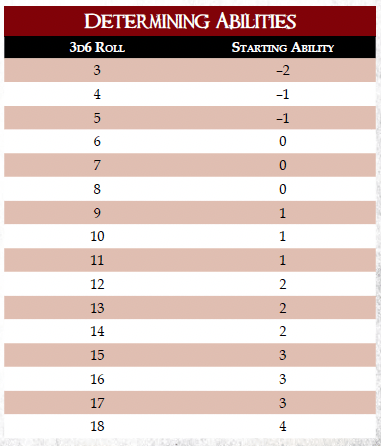
You’ve got a whopping eight abilities in this system: Communication, Constitution, Cunning, Dexterity, Magic, Perception, Strength and Willpower. Other than Perception and Communication these match up pretty well with the stats in Origins. We are rolling 3d6 for each one of these and then we record the modifier from the table below, not the sum of the dice, much like your average Borg game.

A screenshot of the Determining Abilities table from the Dragon Age RPG core book. It is a 3d6 table, which indicates what your starting ability score will be depanding on your roll. It goes from -3 to 4.

Communication: Rolled an 8 so that’s a score of 0
Constitution: Rolled a 13 so that’s a score of 2
Cunning: Another 13 for this one, so, 2 again
Dexterity: That’s a 10, which equates to a 1 on the table
Magic: I rolled a 12, so that is 2 yet again
Perception: Not wonderful. That’s a 6, which is another 0
Strength: A below average 9. Still, it gives me a 1
Willpower: That’s a 7 on the dice. And that gives me my third 0

The book does give options to either roll the scores and assign them to abilities as you see fit, or to do use point buy system instead. But, I think I will continue the tradition of randomising the process that I started way back in the OSE character creation post.

Step 3: Backgrounds

So, in this game, your choice of background also determines your race and has some pretty major mechanical effects, as well as the obvious cementing of your character concept from earlier. Here are the effects they generally have:

A screenshot of the list of features a PC's Background gives them in the Dragon Age RPG. These include ability score increses, ability focuses, race, class choices and languages.
A screenshot of the list of features a PC’s Background gives them in the Dragon Age RPG. These include ability score increses, ability focuses, race, class choices and languages.

Now, the book says nothing about rolling for your background randomly. In fact, I believe it encourages you to choose based on your original character concept and the ability scores you rolled. But I’m not here to play by the book (actually, that’s not true, really. I just enjoy the thrill of the roll!)

So, there are a total of thirty, 30, backgrounds (!) in the core book. It just so happens that I have a 30-sided die thanks to my flirtation with Dungeon Crawl Classics. So here we go!

That’s a 28! This means my character’s background will be:

Tevinter Laetan

And that is pretty cool! So, it means that I will necessarily take the mage class as the Laetans in Tevinter society are magic users from the mundane classes who are identified at a young age and trained to serve the Imperium. It fits quite nicely with my character concept, too. I can imagine a young Tevinter mage, disillusioned with the unfair system under which their own class of people toils while the upper class mages reap all the benefits. Not to mention the binding of so many elven slaves in general society.

Here are the benefits gained from this background.

  • +1 to Cunning – this makes my Cunning score 3 now!
  • One ability focus, either Communication (Deception,) or Cunning (Arcane Lore) – I rolled again on a d2 for this and got Cunning (Arcane Lore)
  • Languages – Tevinter and the Trade Tongue
  • Take the Mage class
  • Roll twice on the Tevinter Laetan table:
The Tevinter Laetan Benefit table from the Dragon Age RPG core book. It is a 2d6 table. Depending on wht you roll you will get a particular benefit such as +1 Consititution, Focus: Communication (Deception) and +1 Magic.

First roll – 11 Focus: Cunning (Cultural Lore)
Second roll – 9 Focus: Communication (Persuasion)

Step 4: Classes

A screenshot of the page from the Dragon Age core book that describes the Mage class. It includes an illustration of a femme human in red robes with long blonde hair, a staff with a blue stone on top, three bluish potions at her hip and some magical enegy emanating from her outstretched fingertips.

This game, much like the video games, only has three classes:

  • Mage
  • Rogue
  • Warrior

But within these classes you have a selection of specialisation options. I often wonder that there is no Priest class in this relatively traditional fantasy world. They gave the healing duties to mages and that is one specialisation option you can take as a mage. You can’t take Bard as a class but if you are a Rogue, you can choose to specialise as a Bard. And Barbarian isn’t an option in the Class list, but Warriors can go down that sort of route if they want.

Anyway, all that is academic as I am required to choose the mage class due the background I rolled.

The Class section starts off with an explanation of the broadness of the classes as I said above and then tells us a little about character advancement. You start at Level 1 and can get up to Level 20. There are options for XP and milestone leveling and it explains how you improve with a new level. Suffice it to say, ability score improvement is one of the main ways you gain in power, but you also get more Health, new ability focuses (which I don’t understand yet,) new class powers and “stunt points” (which I also don’t understand yet.) I just know you start with 6 Stunt Points. Everybody does.

It’s important to note that you don’t get a specialization until level 6.

As a mage, my character starts with three spells but can’t wear armour or use many types of weapons.

They have three Primary Abilities (as do all classes.) For a mage that’s Cunning, Magic and Willpower. The first two are not bad for me but that last one is a 0. Oh well.

All the others are Secondary Abilities.

Starting health is 20 + Con + 1d6. I rolled a 5 so that means it’s 27! Not too shabby.

My Weapon Groups are Brawling and Staves.

At Level 1, my Class Powers are

  • Arcane Lance, which means I can send a burst of magical energy from a staff
  • Magic Training allows me to cast spells. Here are the spells I’ve got:
    • Arcane Bolt
    • Arcane Shield
    • Daze
  • Mana Points. I start with 10 + Magic + 1d6. That’s a 4 on the d6 so a total of 16.
  • Starting Talent. I choose one talent from Chirurgy, Linguistics and Lore. Can’t get Chirurgy because it has a requirement that I don’t have. Gonna go for Lore, which seems the most generally useful.

Step 5: Equipment

You don’t get a lot to start with to be honest. I’ve got a backpack, some traveling clothes and a water skin as well as a staff and another weapon. I can only use staves or Brawling weapons. The Staves group includes clubs and morning-stars, I guess I’ll take a morning star then!
I also get 50 + 3d6 silver pieces to buy other gear. I rolled 10 on the 3d6. So that’s 60 silver.

I guess I’ll pick up a bedroll for 10 sp and a blanket for 6 sp. I’m not going to get into any more shopping right now.

Step 6: Defense and Speed

Your Defense score is, unsurprisingly, a measure of how hard it is to hit your character. It is 10 + Dex + Shield Bonus (if you have one.) So, that’s an 11 for me.

You can move up to a number of yards equal to your Speed when taking move actions. For a human, that’s 10 + Dex – Armour Penalty. I don’t have any armour so that’s not an issue. So essentially my Speed and Defense are the same, 11.

Step 7: Name

They have a long list of sample names in the book. Not just for Dwarves, Elves, Qunari and Humans but for the full variety of cultures and backgrounds (actually this mainly applies to the various human cultures) that they might come from. First, I need to decide what this character’s pronouns might be. I think I will go with he/him this time. As a Tevinter character, I can choose from some pretty cool names, including Dorian, Florian and Ether. But I have decided to go with Amatus. Amatus the Tevinter Laetan Mage.

Step 8: Goals and Ties

I like that they have included this step in character creation. Just go and take a look at my Motivation post to see why I think that, at least about Goals.
Anyway, I have to pick three Goals, a mix of long a shorter term ones.

  • Find the only friend I ever knew, an Elf named, Adanna, who was once a slave who belonged to his family in Tevinter, but escaped to Ferelden a year ago.
  • Try to make a name as an adventurer in Ferelden while staying out of the hands of the Templars.
  • To earn some coin and find some companions.

The other part of this is the Ties part. Now this specifically refers to other PCs. Since I don’t have any of those, I’ll have to skip that part.

I think I will have to do another post on the general AGE system and particularly how it relates to this game as there are still several elements that are a mystery to me but I feel like I have gone on long enough for one post.

Non-standard Holidays

Celebrations

I’ve begun to realise recently that I would much prefer to celebrate a fictional or “made-up” holiday than a real one. At least a real western one. I have had to interrogate the reasons for that, of course. But, let me tell you, dear reader, it did not take me very long to hit upon the answers.

Religion is, naturally, the top reason. It’s been a long time since the church and I parted ways. We had a fundamental philosophical conflict that was irreconcilable. Anyway, as a result, I don’t feel I’m a part of the religious side of any of our really major holidays. Christmas and Easter are the ones I am thinking of but in Ireland, at least, there are plenty of other saints’ names attached to days throughout the year. Of course, I know that these holidays, and even some of the saints have been recycled from pagan ones by the church. Same with a lot of the traditions. I’m sure dominant religions have been doing that throughout history as a clever way to stamp their authority on a people or place. You can see it happening in real time to our big holidays too, of course, as they are co-opted by consumerism. The original meanings have become mixed up and diluted and lost. What even is the meaning of Christmas? (there’s a saccharine Christmas movie in there somewhere.)

The second reason is related to the first in that rampant consumerism is the focus of these big holidays that we tend to celebrate in the West. So, as diluted as the pagan purposes of the holidays have become, even the Christian meanings of more recent centuries have been co-opted by Black-Fridayism. These times, when families and communities come together, are often the most stressful and worrisome occasions for those struggling financially in the first place. It just doesn’t feel worth it…

So why not celebrate occasions where the meaning is as clear and sparkling as Caribbean waters, and as fun and uncomplicated as a Hobbit’s birthday party? And let’s not forget, themes worthy of really kick-ass RPGs.

Talk Like a Pirate Day

Those of you have been around a couple of weeks might remember that I made a character using Pirate Borg a while back. That was by way of familiarising myself with the game, the setting, the character classes and the general rules. And all of that was in the service of a Talk Like a Pirate Day one-shot on September 19th.

I was the GM for this game so I never ended up using Isabella “Butcher” Fernando, the buccaneer I created for that other post. However, we did have another buccaneer in the party, recently returned from hell, where the devil didn’t want her, was Eliza “Bad Omen” Rackham. She made an incredible entrance (her player was unavoidably detained so she appeared about an hour and a half into the action.) As though rising from Davy Jones’ Locker, she emerged from he water by the other characters’ little row-boat and hoisted herself into it by grabbing their oars, shocking her companions who all knew she was dead. Eliza was, surprisingly enough, the most normal member of this cursed crew. As well as “Bad Omen,” we had a couple of skeletons, one a swashbuckler and one a zealot, a vampiric rapscallion and, a mutant great old one from another reality who also happened to be a sorcerer with a taste for human flesh. So, I decided to skip any town-based interactions with NPCs and start them off in medias res, facing down a British naval vessel who wanted to kill or capture at least three members of the small crew. Raymond, our vampire took the role of captain, despite being disadvantaged by the glaring Caribbean sunlight, while Jolly Roger, the Great Old One Mutant and our skeletons, All Bones McKeown and Hector blasted off broadsides.

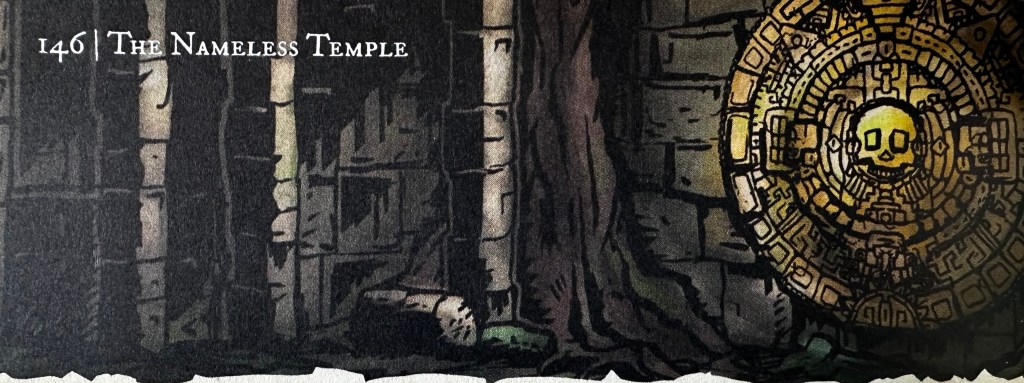
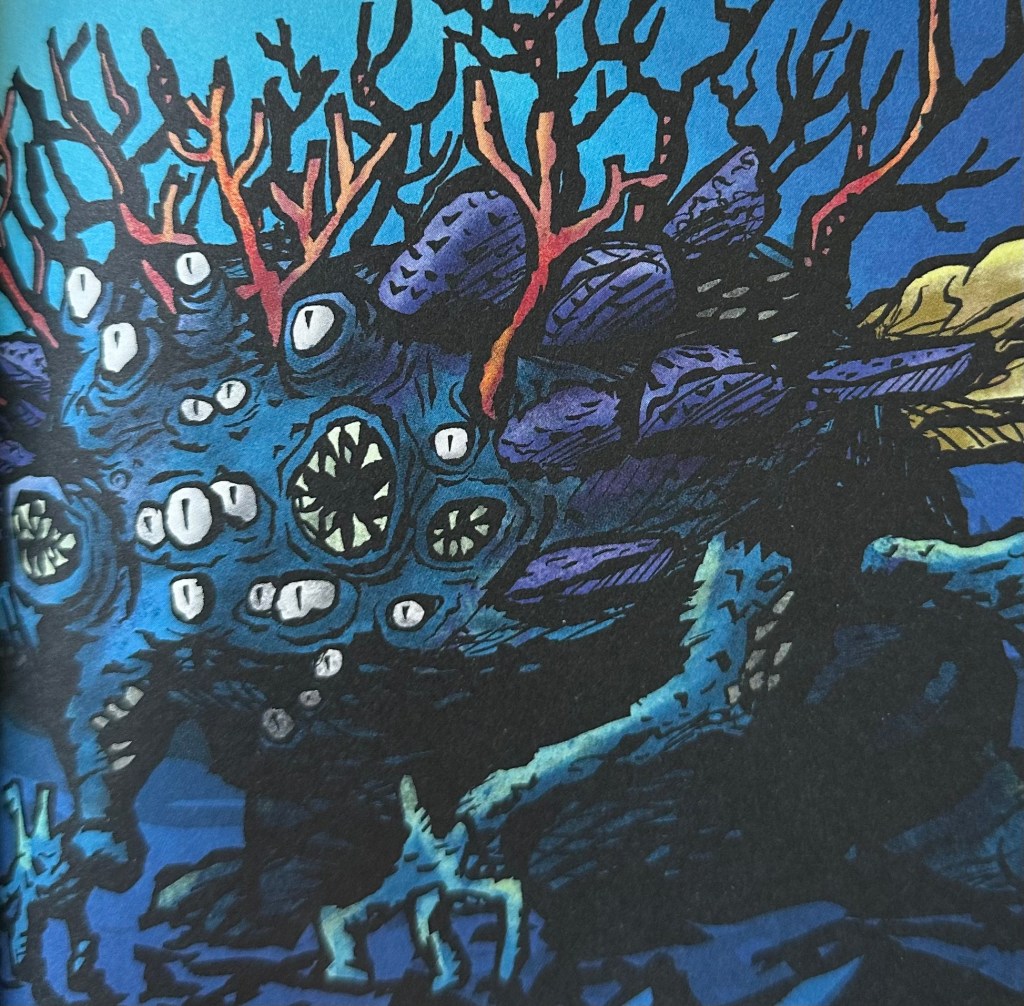
After they escaped that fight, we did a smash cut to them rowing ashore, greeting the resurrected Eliza and then to the carved door of a lost temple in the jungles of Black Coral Bay. That’s the island presented in the core Pirate Borg book as a place to start your adventures. I took three of the dungeons (Shrine of the Nameless Skull, Sanctum of Nameless Blood and the Lake of the Nameless One, which are all a part of the larger Temple of the Nameless One but are distinct nonetheless) described in the book and used those for the one-shot. It might seem counterintuitive to use three dungeons where one would have been more than enough for a one-shot, but, for the Pirates of the Caribbean type theme and for the satisfaction it would bring, I thought it was important. So, I did the first dungeon entirely in montage, finally describing how the PCs figured out the way through the temple door and let play begin there. For, the second dungeon I took out all but two main rooms, putting several major items and encounters into those rooms instead. The third dungeon, I left in its entirety and I’m glad I did because it had so many cool moments. These were topped off with a bunch of curses handed out by an ancient golden idol in the hold of a sunken Spanish galleon in an underground lake, the skeletons regaining their flesh, and All Bones McKeown being eaten by the giant Cthulhoid monster from the home-dimension of Jolly Roger. The survivors escaped through a maze of flooded underground tunnels and emerged into the creepy and atmospheric Black Coral Reef.

I loved it. It was a very good time and I think the players liked it too. One of them announced that they would happily play a full campaign of Pirate Borg, in fact. Their roleplaying was fantastic, because, as game designer and mutual on Instagram, sean_f_smith recently commented on one of my posts “everyone knows how to play a pirate.” I was worried about the strangeness of the PCs at the start, but the madcap elements introduced by their weirdo characters only heightened the atmosphere. Add in some pirate tunes and a few glasses of grog and we had a whale of a time. 10/10, might just go back to it before next Talk Like a Pirate Day.

Bilbo and Frodo’s Birthday

Did you know that it was Bilbo and Frodo’s birthday on September 22nd? The Bagginses of Bag End? Well, I didn’t. Not until the day before at least (although, I’m sure a younger me would have known it.) Anyway, I got in the Discord for Tables and Tales, our local TTRPG community and requested a Lord of the Rings flavoured game. It was incredibly short notice but our resident Tolkienite, Isaac of Lost Path Publishing did not shirk. He suggested a one-shot of a scenario that came in the core rules of The One Ring 2E from Free League. In no time at all we had swords, bows and axes being proferred in the comments and a full fellowship was formed.

In fact, we had five players and Isaac in total so it was a very fun table. We started off, on the night, with a spot of light character creation. Now, you need a bit of time for this in The One Ring. It’s not as time-consuming as D&D 5E character creation but it’s somewhat more involved, than say, Pirate Borg. Even then, with Pirate Borg, we had plenty of prep time and we had all met for a session 0 online a few days before so everyone had their characters ready to go. Since I had given Isaac only a single night to pull this together, (sorry Isaac) we had to include it in the session. By this point, we already knew this was going to take longer than one night to get through but we were all alright with that.

Actually, by the time we all had out characters ready we still had plenty of time to get into “the Star of the Mist.” The scenario began with our Player Heroes meeting Gandalf in the Prancing Pony! How my nerdy heart swooned! Isaac, producing an Oscar worthy performance as Ian McKellen as the old wizard, sent us off on a quest into southern Eriador where some folk had been going missing.

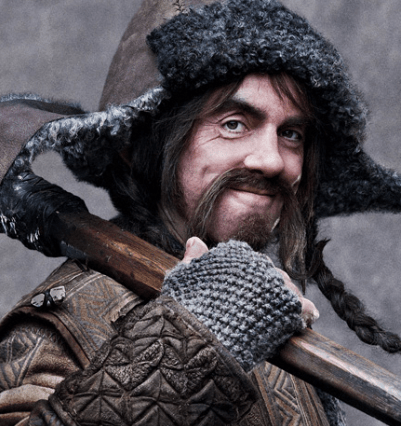
Our party consisted of two Dwarves of the Lonely Mountain, one of which was played by me. I said I was going to go full Nesbitt (as in Jimmy who played Bofur in the Hobbit movies) But I think I was more Belfast than that in the end. My guy is Frár, the Champion. The other dwarf is Berfa, a Treasure Hunter. We have a second Treasure Hunter, Porro, one of our two Hobbits. The second Hobbit is, Rollo, a Messenger and finally, our Barding, Dagstan, is a Warden. We set off into the wilds to find the source of the trouble and we managed to get a fair way into the scenario despite our time constraints. I don’t want to give anything away but it has Dwarves ruins, monsters in the water and a mysterious “she” who has so far remained unnamed. That’s a trio of Tolkien ticks right there.

As I said to the rest of the players, this session was special to me. It felt like the realisation of the dream of Tables and Tales; the ability to get a game together at a day’s notice for people to enjoy and to celebrate an important occasion, Bilbo’s onehundredandeleventh birthday!

I’m so looking forward to continuing this adventure. It had been a long time since any of us had played the system so there was a fair amount of scrabbling through the book for rules by all concerned. I feel like next time, we’ll know what we’re doing a lot better and, from recent experience, I find Free League games to pretty intuitive once you grasp the basics.

Other festivities

These are just the latest games played with a particular non-standard festival in mind. On May the Fourth, we played a Never Tell Me the Odds one-shot set during the events of Star Wars Episode Four, A New Hope. The PCs had to infiltrate the Death Star to rescue a certain Princess before the storm troopers got them, or indeed, before anyone else could rescue her!

Obviously, we are coming into the season for horror and spooky games as Halloween approaches. This is one holiday I can get behind. There are so many games that could suit this season that I am excited to start coming up with a few ideas.

How about you, dear reader, are there any occasions, events or holidays that you like to mark with a festive game? Let me know in the comments!

Oh Mother!

Moonbase Blues

New member of the Tables and Tales crew, and experienced GM, Joel, is going to be holding our hands and releasing them when we reach the airlock, only to lock the door and start the cycle sequence while we batter our fists raw on the glass. He will watch us, impassive and seemingly unaware of our distress. Is that a hint of reptilian hunger in his eyes?
If this is how Moonbase Blues actually goes down, I’d honestly be ok with that.

Mothership character creation

Any excuse for a character creation post, eh?

Mothership has a very handy method of guiding the prospective victim through the process. The third paragraph in the Player’s Survival Guide tells you to turn to the sheet in the back of the book as it leads you through character creation. And, guess what? It does! All the instructions are right there on pages 5 and 6 as well though.

Our thoughtful and wise GM has also provided us a lovely form-fillable character sheet. That’s what I will be using tonight.

A screenshot of the Mothership Character Profile. It is a form-fillable character sheet, which also includes almost all the instructions you need to create a Mothership character.

We are five-by-five. Let’s go.

Step 1 – Roll Stats

We have four stats: strength, speed, intellect and combat. For each one we will roll 2d10 and add 25. Just watch me fuck this up:

Strength: 31
Speed: 28
Intellect: 32
Combat: 36

It’s not a total shit-show but it’s not great. I only got one roll above ten and that was eleven.

Moving swiftly on to leave this debacle behind!

Step 2 – Roll Saves

You have three types of saves in this game: sanity, fear and body. I think they pretty much speak for themselves, no?
For the saves I am rolling 2d10 and adding 10.

Sanity: 21
Fear: 14
Body: 25

I feel like having a low fear save score in a horror game is a distinct and unfortunate disadvantage. I just have to remember to milk it for role-playing opportunities, I suppose.

Step 3 – Choose Class

I like the choice of Class you have here. They are the classic Alien archetypes after all:

Marine
Android
Scientist
Teamster

I very much like the description each one gets in the intro.

A screenshot of the "Step 3. Choose Your Class" table from the Mothership Player's Survival Guide. It shows the available classes, Marines, Androids, Scientists, Teamsters, and describes them.
A screenshot of the “Step 3. Choose Your Class” table from the Mothership Player’s Survival Guide. It shows the available classes, Marines, Androids, Scientists, Teamsters, and describes them.
I am leaning towards marine, mainly because my Fear save is so low and there is that crack about marines being a danger to everybody when they panic. Heh. This is why I like one-shots. No fucker is getting out alive.

Yeah, marine it is.

“How do I get outta this chicken-shit outfit?”

You actually do also get some mechanical effects through your choice of class, it’s not all planned panic and movie quotes.

A Marine gets:

  • +10 Combat
  • +10 Body Save
  • +20 Fear Save
  • +1 Max Wounds

Sounds good.
That makes my Combat now a more respectable 46, my Fear Save a 34 and my Body Save a 35.

Step 4 – Roll Health

Health is rolled with 1d10 and you add 10 to it. I’m sure this roll will go just fine.
It’s a 7! I genuinely expected so much worse.

Anyway, that makes it

Health: 17

So, the way it works is that, once you drop below zero health, you get a wound. Most people start with 2 max wounds before things start getting more permanent. Marines, as noted above, get 3 max wounds. Once you mark a wound, you reset your health to its max minus any damage that carried over.

Step 5 – Gain Stress

What? Already?
I start with 2 minimum.

Step 6 – Trauma Response

“They’re all around us, man…Jesus…They’re comin’ outta the goddamn walls!”

Yep, this is a fun bit of Mothership specific stuff here. The Marine’s trauma response is:

Whenever you panic, every close friendly player must make a Fear Save.

Just stay outta my way.

Step 7 – Note Class Skills and Choose Bonus Skills

So, my class skills as a marine are no big surprise. Military Training and Athletics.
My Bonus Skills, though, I get to choose one Expert Skill or two Trained Skills. There is a sort of skill tree that you can see in the screenshot of the character sheet above. To choose a skill you have to have at least one pre-requisite skill. In other words, if you don’t have an arrow coming out of your trained skill and into the skill you want, you can’t have that one.

I’m realising that Marines have a very narrow range of potential specialities here. But that’s ok, do you really need any more than Firearms and Hand-to-Hand Combat? Nope.
“Check it out. I am the ULTIMATE badass.”

Step 8 – Equipment, Loadout, Trinket and Patch

We have got some tables on page 7 of the Player’s Survival Guide. There is one for each class. I am going to roll on the Marine one with a d10 to see what shit I have.

A screenshot of the "Marine Loadouts" table from the Mothership Player's Survival Guide. It is a d10 table. Each entry has a different set of equipment for a marine character to start with.
A screenshot of the “Marine Loadouts” table from the Mothership Player’s Survival Guide. It is a d10 table. Each entry has a different set of equipment for a marine character to start with.

I rolled a 3. So this is what that gives me:
Standard Battle Dress (AP7 (that’s short for Armour Points, yw,)) Pulse Rifle (3 mags (that’s short for magazines)) and Infrared Goggles.

I’m quite happy with that.

On page 8, we have a d100 table of trinkets. Let’s see what I get.

That’s a 005.
Ok, this guy is a total jarhead. That’s a necklace of shell casings. Cool. Cool, cool, cool.

Page 9 has another d100 table, this time for your patch. And that is exactly what it sounds like. It’s a patch that is sewn into your clothes, somewhere.

I rolled a 72 which means I have a patch of a black widow spider. I’m beginning to feel a character coming on.

I am pretty sure this marine is super serious about the job, really does consider themself a badass and is weird about it. Collects spent bullet casings and makes jewellery out of them, has a patch of the black widow spider because they truly respect her ruthlessness. But they are faintly ridiculous to their fellow crew and anyone who meets them, probably.

I am going to roll up my starting Credits. It’s 2d10 multiplied by 10. Here we go:

I rolled a 3 so that’s 30 credits. Clearly this marine has spent too much money on bullet casing jewellery courses. Should not be in charge of their own finances.

Step 9 – Finishing touches

That means name and stuff.

She is Corporal Victoria Ibanez, she/her.

Despite all those Hudson quotes, I think this marine is more like Vasquez. She knows she is the greatest marine to grace the corps in all the years it has existed and she doesn’t mind letting people know.
She has two brothers and a girlfriend at home on Theseus IV. She keeps promising to send credits to them but she somehow never has any left at the end of the month.
Victoria is 28 years old. She has a shaved head but it shows ginger when it’s growing out. She is stocky and broad and sports a lot of scars that she tells everyone she got in combat.

Also, I have to mark a zero above High Score on my character sheet. That’s because this records the number of sessions your character has survived!

The final chacter profile for Corporal Victoria Ibanez, she/her, my Mothership PC. She has a relatively high Combat score, mostly quite low Saves and is specialised in Firearms and Hand-toHand Combat. She knows she is the greated marine in the corps.
The final chacter profile for Corporal Victoria Ibanez, she/her, my Mothership PC. She has a relatively high Combat score, mostly quite low Saves and is specialised in Firearms and Hand-to-Hand Combat. She knows she is the greatest marine in the corps.

So there we go, Victoria Ibanez, Corporal in the Marine Corps, all ‘round badass and potential cautionary tale. Can’t wait to start playing this PC at the table tomorrow night!

Festive one-shot

Celebrate

It’s almost that time of year again, everyone’s favourite holiday where we all dress up as our favourite characters and talk funny. That’s right! Talk Like a Pirate Day is fast approaching! It falls on September 19th, as I am sure you all know. As is traditional, we’ll all be renting a parrot, donning an eyepatch, practicing our “yaaaar” and contracting scurvy to commemorate the joy and wonder brought to the world by that most under-rated of historical figures, the lowly pirate.

As well as that, this year, I thought it would be fun to run a pirate themed one-shot. Since an RPG named Pirate Borg exists, it seemed like the notions of a landlubber to choose any other game to use for the occasion.

There has been an unsettling number of Borgs released over the past number of years, certainly more than enough to make Jean-Luc Picard lose his temper. It can be hard to see the hacks as anything other than cashing in, however, and I will confess to thinking that way myself. But I hear very good things about Cy-Borg and Pirate Borg has been a pleasant surprise as I read through it. It is genuinely more fun and more entertaining than I was expecting. The art, design and layout are good and the vibe is perfect if you are looking for a horror pirate game.

I have really only just gotten into the character creation section so I thought I would do another character creation post! Everybody loves those, right?

Random pirate

I’m gonna roll for everything as is traditional around here. Luckily, this game is well set up to allow for that.

Here’s the step by step guide provided on page 27 of the core book:

A photo of the table from the Pirate Borg core book that illustrates the 5 steps to Create a Player Character (PC.)

Random tables

So, when it says to roll on the tables on this page, this is what it means:

  • Container table (d6) I rolled a 6! That means I get a friggin’ dinghy! Good start.
  • Cheap gear table (d12) Got a 4. That’s a shovel. Should be useful for digging up buried treasure or my own grave.
  • Fancy gear table (d12) 9 on a d12 = a worn out book. I imagine it to be the well-thumbed guide to the manners of the gentry in Paris and London 50 years ago.

Random scores

A pirate has 5 abilities, Strength, Agility, Presence, Toughness, Spirit. You roll 3d6 for each one and consult another table to determine what your score is. Here we go!

  • Strength: I rolled an 8 so that gives me a -1 (it could be worse)
  • Agility: That’s a 7, which is also a -1 (a pattern is forming)
  • Presence: 12! Phew! That makes the score an incredible 0!
  • Toughness: 6. Shit. That’s -2. This pirate is not an olympic athlete
  • Spirit: 10. OK, OK. That’s also a score of 0.
    Things might start to look up as I move on to a

Random class

You can choose to be a landlubber if you don’t want to take one of the 6 standard or two optional classes. But half the fun of this exercise is rolling everything up, I’m going to roll a d8 and take whatever class it gives me. In this case, I am including the optional classes.

Here are a list of the classes:

  1. Brute
  2. Rapscallion
  3. Buccaneer
  4. Swashbuckler
  5. Zealot
  6. Sorcerer
  7. Haunted Soul – there is another d6 roll here to decide the type of supernatural entity you might be. Includes vampire, zombie, skeleton. All the classics
  8. Tall Tale – if you get this one, you roll another d6 to determine what sort of tall tale your character is
    1-2. Merfolk
    3-4. Aquatic Mutant – this gets broken down even further. Lots of potential mutants out there, folks. If I roll this up, I’ll have to roll another d8 to find out which type of mutant I’ll be. Suffice it to state, Anglerfish is an option
    5-6. Sentient Animal – this one will involve another d6 roll to decide what animal my pirate is going to be…

Well, I rolled a 3. That means my character is going to be a Buccaneer.

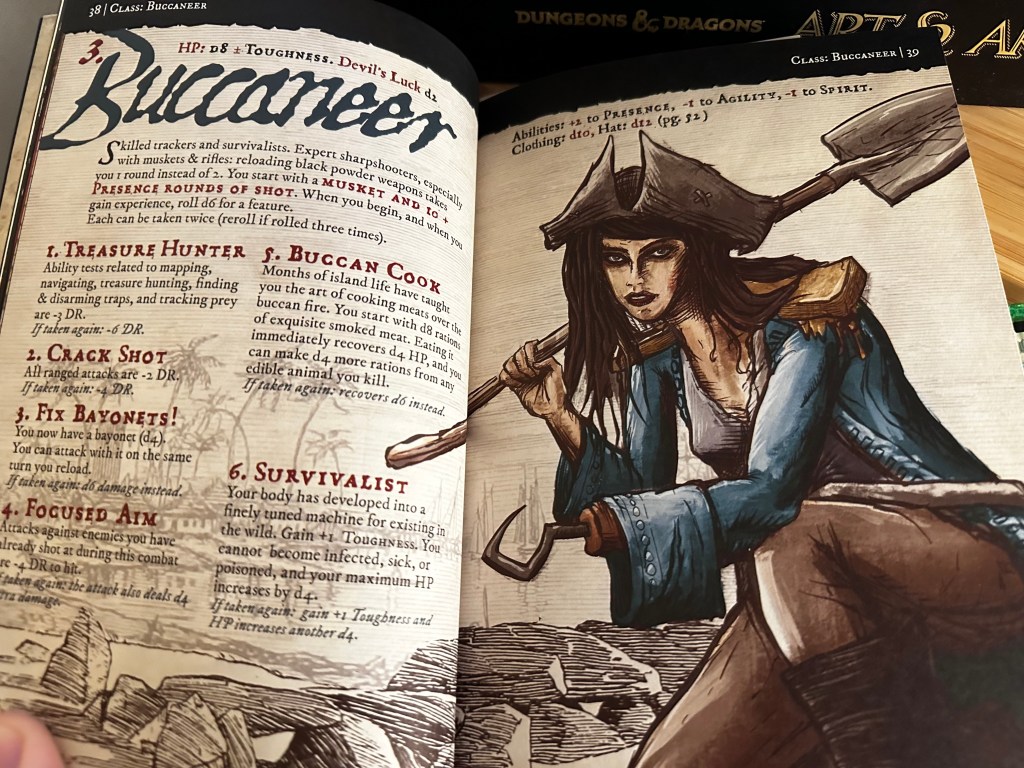
Skilled trackers and survivalists. Expert sharpshooters, especially with muskets and rifles

Buccaneers get a +2 to Presence, a -1 to Agility and a -1 to Spirit.
So that makes my Ability Scores:

  • Strength: -1
  • Agility: -2
  • Presence: +2
  • Toughness: -2
  • Spirit: -1
A photo of the two-page spread for the Buccaneer class in the Pirate Borg core book. The illustration on the second page shows a femme person wearing pirate gardb, including a tricorm hat. They have a hook instrad of a left hand and have a spade slung over the right shoulder.

For a Buccaneer, reloading a black powder weapon only takes one round instead of the usual two. I guess the hope is that you are far enough away from the bad guys that you have a round before they kill you or that they don’t have ranged weapons themselves.
I also start with a Musket and 10 + Presence rounds of shot. So that would be 12, then!

Random feature

I am going to now roll a d6 for my class feature. You do this when you first begin and then again each time you gain experience. Each feature can be taken twice, or so it says here in this book.

I rolled a 2! That is the feature, Crack Shot. That reduces the Difficulty Rating (DR) of all ranged attacks by 2. That’s pretty great actually. If taken again, the feature reduces that DR by another 2 points.

Random hit points

A Buccaneer gets to roll a d8 for hit points and add (or, in my case, subtract) my Toughness. Looks like d8 is the most common die for HP across the classes. I rolled a 7 so that leaves me with 5 HP. I am pleasantly surprised!

Random clothing and hat!

Now we’re on to the really important shit.
Buccaneers get to roll a d10 on the clothing table. The options range from Tier 0 rags to Tier 3 conquistador plate!

I rolled a frigging 10!! That’s the conquistador plate! -d6 damage. But it does add 4 to the DR for all agility tests and 2 to all defence test DRs. Also, the text goes out of its way to tell you you’re going to drown if you end up in the water…

Now for Hat! Have to roll a d12 for this.
You can get anything from “none” to “morion” on a d12.
I got a 6, bandanna, which I find acceptably piratical.

Random… Luck

A photo of the Devil's Luck page of the Pirate Borg core book. It shows an upsidedown five-pointed star with text describing the ways you can use a PC's Devil's Luck points in each of the five points and a pirate's skull in the middle. You can tell it belongs to a pirate because of the eyepatch over the left eye.
A photo of the Devil’s Luck page of the Pirate Borg core book. It shows an upsidedown five-pointed star with text describing the ways you can use a PC’s Devil’s Luck points in each of the five points and a pirate’s skull in the middle. You can tell it belongs to a pirate because of the eyepatch over the left eye.

Devil’s Luck is a resource that your character can use in Pirate Borg for the purposes of dealing max damage with an attack, lowering the damage done to you by d6, rerolling any die, neutralising a crit/fumble or lowering a test’s DR by 4. So it works like Omens in Mõrk Borg, basically.

Your class determines what you roll for your starting Devil’s Luck. The Buccaneer gets d2. For my purposes, I plucked the first die out of my dice bag and it turned out to be a glittery, turquoise d6. I rolled a 6! So that means I get 2 Devil’s Luck. Not too shabby, but not too great really, eh?

Random background

The next thing the step by step guide says to do is roll on the tables on pages 55 to 61. The first of those is a d100 table of backgrounds. These are more than just back story. They also determine your starting money and provide you with something significant like items, important NPCs and motivations.

I rolled a 97! That gives my pirate the “victim” background. That’s broad but might give me a spark for my actual backstory. It also gives me 2d6 x10 silver pieces and a haunted past (obvs.)

I rolled a 7 on my 2d6 so that’s 70 silver to begin. Along with the 200 I am likely to get for the conquistador armour, this buccaneer will be laughing all the way to the X.

Random flaw

Page 56 has the Distinctive Flaws table. It’s a d20 table of generally one-word personality traits. Some of these are only subjectively to be considered flaws in my opinion. I rolled a 9 and got “aggressive.” I would imagine that that is considered a good trait for a pirate in many situations. I’ll take it!

Equally, “2. Stubborn,” “6. Coward,” and “17. Paranoid” might all be considered beneficial to people in the pirating business at least some of the time.

Random trademark

I am rolling here for a Physical Trademark, rather than some sort of copyright or patent type deal. That would be a weird thing to include in the character creation section of a pirate game.

Another d20, here we go!
I rolled a 5… shit, I’m missing a hand; hook or claw instead. I’m thinking claw? Might be easier to handle my gun that way. Importantly, there is nothing in here about this causing any sort of mechanical drawback to your character, which I like.

Random idiosyncrasy

The full title of the table on page 58 is:

Idiosyncrasies one might have developed and will certainly never be rid of…Yet that certainly won’t stop you from trying.

It’s another d20 table. I have been using a different die for every single roll and I don’t see a reason to stop that now. It has been serving me semi-well thus far after all.
That’s a 12. Now this result might very well feed into the victim background I rolled up earlier:

You wronged and infamous pirate lord

I am beginning to think that the two are connected. My Buccaneer’s cat, Milly, tore out the throat of Captain Tall John Copper’s parrot, Butch. Milly jumped from the gunwale and swiped the emaciated bird off the shoulder of the famously bad-tempered pirate captain who had had men flayed alive and keel-hauled for less. As some sort of poetic justice, he made my pirate cook and eat poor Milly while the whole crew looked on, and then he chopped my hand off.

Random incidents

A photo of the Unfortunate Incidents & Conditions table from the Pirate Borg core book.  It includes a black and white illustration of an overloaded lifeboat on rough seas surrounded by debris and a d20 table beneath that.
A photo of the Unfortunate Incidents & Conditions table from the Pirate Borg core book. It includes a black and white illustration of an overloaded lifeboat on rough seas surrounded by debris and a d20 table beneath that.

This one has an incredibly long full title as well:

Unfortunate incidents & conditions having occurred or developed with or without one’s express consent, desire knowledge or general understanding

Guess what! It’s another d20 table. I rolled a 9 on this table. The result is unfortunate:

Your last crew was killed by undead. They left you alive on purpose

Shit. I hope my new crew doesn’t learn of this…
I am thinking that I made a deal with a necromancer to send his vitality-challenged minions to do in Captain Tall John Copper but they got a bit enthusiastic and did the whole ship instead, leaving me to take a dinghy (call back to the first roll of the character creation process!) to the nearest port and find some new gainful employment.

Random things

The last table in the list stretches right across from page 60 to page 61. It is entitled “Thing of Importance.” It is another d100 table.

I rolled a 79:

A long scar on your face

I think it is only fair that Milly gave me that just before I popped her in the stock pot.

Random name

There is only one thing left to do as part of this process, and that is the all important name. Now there is a table for names on the inside cover of the book so I think I will use that. It is a d12 table with three columns. I shall roll a d12 3 times and combine the names as I see fit:

Roll the first: 7 – Sam(uel) or Butch(er) or Philip
Roll the second: 3 – Robert(s) or Jack or Fernando
Roll the third: 11 – Genny or Isabel(la) or Jean

I imagine the name Butcher came from the Milly incident. It should go in the middle. So, it’s Isabella “Butcher” Fernando. That’s a bloody good pirate name if I do say so myself.

Random conclusion

Not really.
I thoroughly enjoyed the process of making his character. I am used, in more recent games of Mõrk Borg, to using their Skum Birther site to come up with a random character and that can be fun too, although I do think, when you are that far-removed from the process, you don’t have that strong an attachment to them. So, spending the time rolling up this pirate with you, dear reader, has been rewarding and has taught me quite a bit about the game as well. And that, after all, was the whole point of the exercise.

Have you played Pirate Borg, dear reader? Will you be celebrating Talk Like a Pirate Day this year? If so, what will you be doing for it?

Motivation part 2

Motivating characters

So, in the last post, I went on at some length about how you might be able to motivate players in your game, focusing mainly on what you do between sessions to get them excited to come back and do it all again. There were also times, I decided, when you shouldn’t overdo it, when you should just let people be.

When you do get them to the table, though, your work ain’t over. Obviously, I’m talking to the GMs out there, but this goes for players too. Because now it’s time to figure out why your character is out there smashing skulls or investigating murders or trying not to be sacrificed by some bloodthirsty, cthonic cult or whatever their weird job is.

Seems like an easy answer, doesn’t it? But it’s not. Your character’s motivation is a strange, ephemeral thing that you need to keep in your mind at almost all times to figure out what they are going to do in any given situation. You can keep your alignment, in my humble opinion. Alignment is such an archaic and ill-defined concept, it barely even begins to answer any of the questions raised by the “character” aspect of the sheet. It can be manipulated to mean almost anything. So it doesn’t really help to direct you when you are trying to decide whether you should back the werewolves or the elves (Dragon Age: Origins fans, yo!)

New characters

Games have all sorts of ways to help you figure out what your character’s motivation is going to be. At the creation stage you are picking things like backgrounds, bonds, ideals and flaws if you’re playing 5e, your drive, problem and pride if you’re playing Tales from the Loop, your Calling if you’re playing Heart. The game is usually trying to help you out. Sometimes it doesn’t have to do any more than describe your race and class, in fact. That’s often enough to set a player’s imagination alight. Before you know it, your dwarven barbarian has figured out that her driving force is a desire to put as much space between herself and the darkspawn riddled Deep Roads (I’ve been replaying Dragon Age: Origins recently, ok?) as she can, and to have fun doing it. Of course this motivation is likely to change many times during play, but if Bianca remembers that she never wants to set foot in the Deep Roads again from that moment on, all of her decisions are likely to be coloured by it, especially when she finally faces her fears and delves back down to Orzammar and the lost Thaigs to help out her party-mates in their quest to track down the origin of the darkspawn outbreak in the Korcari Wilds.

Here’s a question though. How much influence should the GM have on a player-character’s motivation. Well, like most things PC-related, I would say that there is a conversation to be had. This is often something I forget to do with my players at character creation to be honest. Especially in games where motivations are less well defined or less tied to the plot. In fact, I have received feedback in the past that I should be more willing to guide players in their choices of class in case they choose something inappropriate for the campaign, never mind motivations! But basically, what I’m trying to say is that you should always talk about it, especially if a player is interested in talking about it.

I messed this up recently and definitely reduced at least one player’s enjoyment of the first session of a new game as a result. Motivation is important! It colours everything so you should always be available to talk about what a character is doing this stuff for? Why would they want to? It’s not that they player is being awkward or a prima donna or making the game about them, they just want to feel a connection to the game through their character and they need a reason for that. Help them out, eh?

In gameplay

As I mentioned before, character motivations can change during the course of play. In fact, I would go so far as to say that if they don’t the game there is probably not much going on in it. Most sessions it is a good idea to make their most immediate motivation become “I don’t want to die!” At least once.

But this goes for long-term motivations as well. I think it is absolutely possible to retain your character’s initial motivation of “never wanting to go bak to the Deep Roads again,” while subverting that, undermining it, overcoming it. Maybe, once Bianca follows her companions back into the Deep Roads, she realises that, without here, they would have died down there, that actually, her Deep Roads survival skills are valuable and that she should help others by teaching them. I think GMs should be prepared for these shifts but players, equally, should be ready to make changes like this to their characters. Turn it on its head, fail forward if that’s what happens in the game. Push your character to do what is explicitly against their motivations sometimes and see what happens to them and the game as a result. Do the unexpected!

Heart

It always comes back to Heart these days it seems. Well, that’s because it has these great little systems built into it. The granddaddy of these systems is the Character Callings. You have a handful of them. Not too many to choose from: Adventure, Forced, Heartsong, Enlightenment and Penitent. They speak for themselves really, except maybe for Heartsong, which is the weird one that wants your weird character to follow the weird as deep as it will go into the weird subterranean other-world until you find some insight into the weirdness that’ll probably kill you or transform you beyond all recognition.

Essentially these are all the motivations your character might need in Heart. Their descriptions spell out the kind of thing in keeping with the theme of the Calling, that might have led you to delve into the red, wet Heaven. It also gives you a fun ability to reward you for choosing it, a few questions to answer to help you flesh out your character and focus you on the type of adventure/enlightenment/penitence etc you are espousing, and most usefully, both for the player and the GM, an absolute raft-load of beats, narrative or mechanical milestones you want your character to hit as your delves go on. The beat system is so useful for building a session and a story at the table together. It is particularly fun when one PC’s beat synergises with another PC’s completely separate beat or when the object of the beat comes up organically in play, without the GM being aware that it’s happening. It is motivation given mechanical and narrative form and I love it.

Seriously, go check out Heart if you haven’t already. It’s a good game. And it’s fun and gross.

That’s me for now. My motivation to write has ebbed and waned. It’s you time now. How do you like to motivate your players and characters?

World Building Part 2

A new approach

First of all, I struggle to get out of my old way of building a campaign world and, even a campaign. I recognised in my last post that there are definite draw-backs to it, but still, I find it hard not to do a whole bunch of preparation. I do still think that a certain amount of prep is advisable but I have been actively trying to limit the amount I do. This doesn’t work as well in some games as others. In D&D, if you don’t do a lot of prep, you might be alright but it is a real pain if you don’t have the right stats to hand when your PCs decide they are going to enter the local gladiatorial games or they want to go ankheg hunting. It slows things down a lot and hurts the overall flow of the session. But it does feel like you are pushing the plot and your PCs in a very particular direction when you do it! Is this an inherent issue with D&D? Probably not just D&D if we’re honest.

In other games, I find it can be freeing and fascinating to see how a session goes when you genuinely have no preconceptions about what is going to happen in it.

Heart

In the game of Heart I am currently running, I used a loosely written adventure that came in the Heart Quickstart Rules. We have just come to the culmination of that adventure and suddenly, the PCs are more-or-less free agents! They have done what a few NPCs have asked of them and more. They followed the breadcrumbs and now, now they are ready to take the training wheels off and head into the Heart to pursue their own dreams and nightmares. They have a couple of other leads but I am looking forwards to leaving the progress up to them from now on. I intend to largely take my hands off the wheel and, instead, rely on their own motivations to provide direction, their own relationships with NPCs to perhaps push them one way or another, even their own ideas for how the new and terrifying delves they go on might look and feel. I want to create our Heart together now that the leash is off.

Im-prompt-u

There are lots of tools out there that you can use to bring a world to life together with your players at the table. I mentioned on this blog before that we had a game of The Quiet Year by Avery Adler a while ago. In it, you get together and make a couple of establishing decisions regarding what sort of community you want to build together and what sort of genre or setting it might be in. After that, you proceed through the seasons of a year after the end of some cataclysm and before the coming of some other terror. The players use a regular deck of cards to draw on prompts from the book. Each prompt gives you an occurrence or an important decision that must be made. This way, you all draw a map together and you develop a community that includes important factions, elements of religion and social orders, abundances and scarcities, fears and loves of the populace.

I was surprised when we finished, by what a fleshed out place we had created in concert. It felt like we had the basis of a fascinating setting to start something else in. I could imagine beginning a more traditional RPG there with the same players. These players would all have had a hand in building the place, the world, its people, their relationships. And wouldn’t they be so much more invested in it?

I mentioned last time that I had made a mistake in the very beginning of the Scatterhome campaign because I had tried to play on the PCs’ devotion to their decimated homeland when they had no experience of it. They couldn’t even picture this diverse paradise island that I had in my mind. But if we had used a method like The Quiet Year to make it, we would have had the fun of playing The Quiet Year, for starters, and also, we would have a place they might have mourned as their characters.

Scale

You can go much smaller of course. In the Blades in the Dark campaign I played in recently, our GM had us use a different game called Clean Spirits to build our hideout. At the start we had to make some decisions about what sort of place it was going to be. We decided on a beached canal boat and then we worked through a series of prompts and exercises to create various parts of it. We each got to claim our own section and also collaborated to make it a place that we treasured as players and characters with its own little mushroom farm and the spirit of its former captain trapped in a bottle. Later, when we were attacked in our hideout, this made the stakes seem so much higher!

Of course, you could go even bigger instead of smaller. I know the game, Microscope, is used to create a whole history for a world that is separated into periods and events. I have no experience with it though so I don’t know how well it works.

At the table

The type of world building I like the most is the collaborative kind, I have decided. One of my players in that Scatterhome game, Tom of the Media Goblin’s Hoard blog wrote an incredible history for their character, who was a Dragonborn. Now, I had never given too much thought to the origins or current situation of Dragonborn in the setting but that was ok, because Tom had been considering it deeply. It was all couched in the back-story of their character, but it added a huge amount to the world straight away, including the fact there was an under-class of Dragonborn within the empire who were raised to be weapons at the command of their human masters, how they were raised from eggs to obey and how some escaped and went on the run. How there were bands of pirates that sometimes took on runaways like their character and how they impacted the archipelago. It was great and, although we didn’t get around to using too much of that in the game itself, the knowledge of it made a big difference to how I thought about the empire and the world as a whole.

Later in the same game, we gained some new players who decided to take their PC races from the D&D setting of Theros so we had a new island nation on our hands then, one that looked a lot like Ancient Greece and contained leonines and satyrs. Once again, their choices made that change to the world happen.

Another new character added a whole new vassal kingdom of elves to the Vitrean empire, for whom social hierarchy and feudal concerns were incredibly important. So much so that they caused a rift between his character and his siblings.

Character backstory is world-building when you leave the details of the world vague enough for players to have free rein when coming up with them. It adds to the shared world and gives them a greater feeling of ownership of it.

I personally love it, though, when someone, simply, confidently states the existence of a particular item, a specific shop or an individual NPC right there at the table. That item is going to help them get through that window, that shop sells the exact thing they are looking for or the NPC has the contact details they need. This sort of flavour is invaluable and often becomes far more than flavour. This happened in Spire a lot because you have to ask your players to make rolls to resolve situations but then leave the details up to them. They made up the dugguerrotypist, Reggie, who worked for the local tabloids and he later became an important bond to them. Same with every aspect of their casino, the Manticore, which quickly filled with important NPCs and locations that were largely player-created. It is the best feeling when these instantly generated details come into play right there and then at the table. It’s like magic.

How do you prefer to world-build, dear reader? Do you do all the work beforehand and let the players loose in it at the table? Do you build a world together first and go and play in it after? Do you let it all just happen at the table?