OD&D, The Woes of Sorrowfield, Session Two
Let me start by saying, if you’re one of my players, turn back now! Do not read! Danger! Danger!
The PCs gathered some hirelings. The town of East Barrens was not replete with adventuring types or even warriors, so I ruled that the only idiots available for hire were what OD&D refers to as “normal men.” This is a term from CHAINMAIL, I think, and means they are not fighters of any kind. Basically, they’re what later editions might call 0-level NPCs. Four of them showed up for duty. They did not all survive the session…
Hirelings are an interesting part of old D&D. You don’t really hear of a lot of 5e adventuring parties taking on a bunch of mercenaries as backup. But I remember playing AD&D particularly back in the olden days, the party would always want an extra NPC or two. They were often necessary to ensure survival. Playing OSR games like the Black Hack and Black Sword Hack, we have always employed hirelings for a variety of reasons in recent years too. Even in UVG, you probably won’t get very far without a crew of NPCs to keep your caravan running smoothly. UVG’s pretty old school in that respect. In the old games, they were pretty much just damage soaks, meat shields and extra carrying capacity. Even today, as a GM, I find I only role-play them when the players remember they exist as characters, which is not very often. In our Basic D&D game, the adventure we’re playing, Keep on the Borderlands, is designed for 6 to 9 players or something nuts like that, so we went all out of hirelings. Especially after my character got murdered by bandits in the first combat of the game. In oD&D and Basic, I think it’s easier to handle a larger number of characters, especially in combat. You don’t have to remember all those actions and complicated initiative order that you have in 5e and other more modern systems. Mostly, each character gets one actions/attack and they can move and that’s it. You roll initiative per side each round so you don’t have to keep the order in mind for a whole combat. This keeps it smooth. At least, that was our experience last week in both games.
The adventurers set off into the Barrenwood. They had to pass through it to find the source of the magical attacks the forest and the town had been coming under for weeks. It had not stopped raining and the road was a mucky morass. They trudged along the overgrown path into the dark, rotting woods and, before long encountered some trouble. A swarm of crystal infected arachnids had built a supernaturally strong web across the path in the dark, at just the height to trap unwary travellers. That’s what it did to our Fighting Man, Siward, who was leading the way. Abiss, the Halfling Thief set about cutting him free with her magical bronze sword while the others tried to scare off the spiders. Tadhg, the Cleric, made clever use of his lamp oil and torch, by blowing the oil out of his mouth at the flame to create a DIY breath weapon, incinerating a large part of the swarm and the webs as well, freeing Siward! They found some treasure on the ground below the webs, gold and some more magic items, a magic mace and a Staff of Striking.
I am running the Wilderness expedition as a hex-crawl. Here’s a picture of the hex map I drew in my “Pocket Dimension” from the Melsonian Arts Council. I bought a pack of ten of these a couple of years ago and I’m finally getting some use out of them.
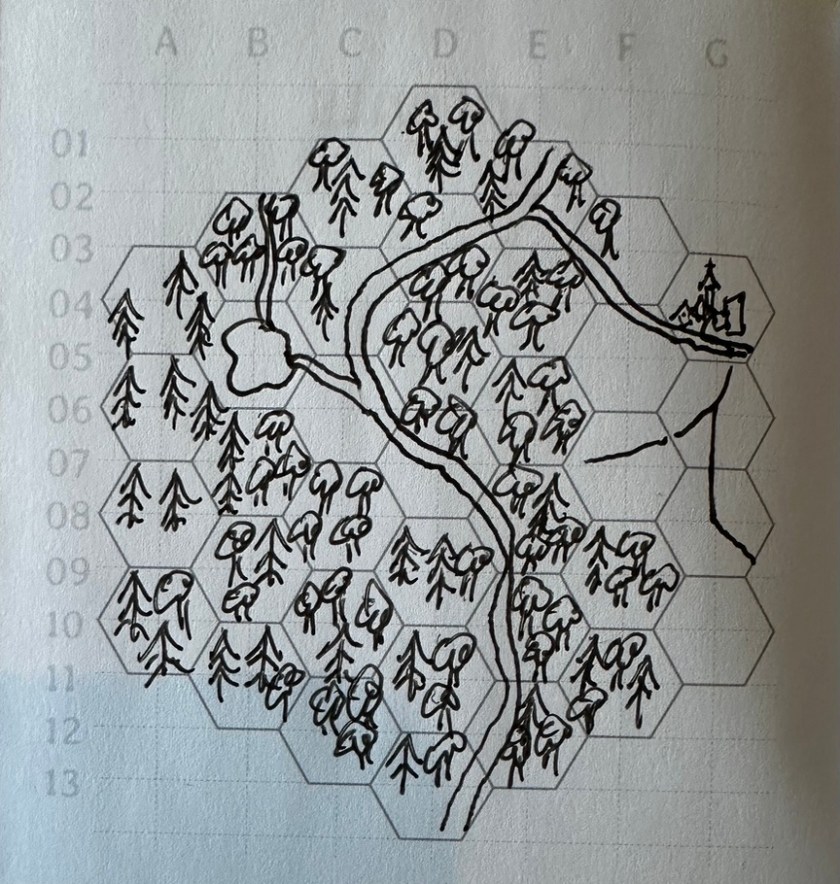
Anyway, you can see the town in the north-east of the map and most of the rest of it is forest by design. I want the entire Wilderness portion of the adventure to take place in the Barrenwood. The area is not very large. I haven’t defined the exact size, but I’m thinking about an hour of travel per hex, with time added for encounters and rough terrain. Essentially, I ask the players to roll 2d6 on this encounter table each time they enter a new hex.
| 2 | Undead animals – crystalline growths – They won’t attack unless attacked. They make terrible noises while attempting to go on as if they were alive. Stats as Skeletons. |
| 3 | Trapped merchant – stuck in a tree with strange crystalline chimeric creatures below. Stats as Zombies. Succesful attacks provoke a save vs Stone. Offers them 1000 GP to save him. |
| 4 | Swarm of glowing crystalline spiders – trap! Treasure dropped amongst the webs – Staff of Striking, Mace +1, 560 GP, 300 SP, 500 CP. The spiders can do no damage but PCs will need to make saves vs Stone. |
| 5 | Undead trees – crystalline branches. brittle and weak to fire – try to grab PCs. Treasure inside them – Total of 400 GP. |
| 6 | Crystalline undead – one has a journal explaining how to find the entrance to the dungeon |
| 7 | Pixies – frightened and angry – try to trick the pcs into swimming in the lake, diving for treasure |
| 8 | Hermit’s shack – Breandan only drinks rain-water he collects himself in casks. Wagers the adventurers that they can’t kill the carnivorous crystal elk that he says has been stalking him. He will offer them an old silver amulet with a ruby in it (3000 GP.) Can also tell them the best way to reach the coast so they don’t have to roll on the encounter table anymore. Says he encountered another adventuring party returning from the tower ruins a while ago. Apparently they were frightened off by a horde of undead on the first subterranean level. |
| 9 | Nothing but more sodden trees and undergrowth trying to trip them. Roll 1d6. On a 1, become lost. Roll 1d6 to determine the direction they go in. |
| 10 | Crystalline briar patch. It takes up the whole hex. Will require ingenuity to traverse, or they can go around. If they brave the crystal thorns they will need to make one Save vs Stone per turn for six turns. They will find treasure, however. Roll on Type A table each turn. |
| 11 | Roll on Wilderness Encounters tables in the Underworld and Wilderness Adventures page 18 |
| 12 | The rain stops and the sun comes out. Crystalline shards glisten upon every bough and underfoot. A lost Acolyte finds them. Grainne Bell, CL 1, AC5, HP3, THAC0 19, Turn Undead, Crystalline ear |
I can’t figure out how to format this so it doesn’t look like crap on the blog. Sorry!
So far, this method has worked well and has been telling a story, which is what I wanted. I have struggled to stick exactly to the letter of the old OD&D books, mostly because so much is left to the referee in play. But there is also another point. The Underworld and Wilderness Adventures random encounter mechanic just didn’t work for me and the game I’m creating with the players at the table. There is a lot in the that book about castles in the wilderness, and a set number of hexes you can travel in a day and how far away you can be from a monster and still be surprised. There are no castles in the Barrenwood. It wouldn’t make sense in the context. Surprise will occur if no-one Hears Noise from the trees because it’s a forest and not open territory. And surely hexes can be any size one chooses? For all these reasons, I decided to go with my own hex-map + encounter table combo. It’s simple and effective.
The PCs escaped the spider webs with their loot and no casualties, although one of the NPCs got bit by a spider and failed her Save vs Stone so her index finger turned into crystal. She managed to keep it together enough to continue, though. They moved on into the next hex towards the river and they encountered a pair of mischievous pixies who flew around them laughing and invisible. The Magic user, Ilaina, used her own Ring of Invisibility and I ruled that she was able to to see the diminutive fairies in that state, because I thought it was a cool idea. She was able to identify what they were up against and get a good look at them (they had thought, perhaps, that these were talking crows that they’d heard tell of in the town.) This seemed to anger the pixies but they nonetheless agreed to show them the source of the magical bursts which had polluted the waters and damaged the town.
The mischievous pixies left the PCs on one side of the raging river that passed through the forest while they flew on and laughed at them from the opposite bank. Siward and one of the hirelings, Edmund, used their axes to chop down one of the more gargantuan stress on their side and I asked for an attack roll from Siward to hit the other side with it. I did this, mainly because there is not really a mechanic to test abilities and there are no skills at all, unless you mean thief skills. I briefly considered adopting the roll-under mechanic used in Basic D&D, but felt that I would rather use the mechanics as presented for this, as much as possible. I really am just picking and choosing which rules to employ here. So, with their makeshift bridge in place, the party clambered across to a an area relatively devoid of trees. Since they had entered a new hex, I asked for another encounter table roll. Sticking close to the riverside, Abbis was able to hear a rustling and cracking coming their way through the trees, giving the adventurers a heads-up to the emergence a moment later of a half-dozen undead trees! My idea for these monsters was basically, zombie treants, brittle and rotting and falling apart. I gave them the stats of a regular zombie from the Men & Monsters book, but made them extra susceptible to fire damage, not that that came up in the fight. It was a tough combat! Our thief was lucky that she had levelled up the previous session or she would have died when she got brained by a rotting tree limb and two of the NPCs, Edmund, who I had named for my dead Basic D&D PC, and Brianna of the crystal finger, went down. The party were victorious but it had been a costly battle. Luckily, the bole of one of the undead trees was filled with treasure!
That’s where we wrapped up the session. Everyone levelled up at the end of it, what with all the treasure I’d been throwing at them.
Conclusion
This week, more than the previous one, I have become aware exactly how difficult it is to stick to the idea of playing this game as it would have been in 1976. It’s really impossible. My gaming brain has been influenced for good or for ill by so many story-games, the OSR and even later editions of D&D that its essentially impossible not to feel their effects on what we’re doing.
But, then again, I’m sure there were as many ways of playing this game at the time, as there were groups playing it. You would have had you hard-core war-gamers that used it as fantasy set-dressing, your power gamers and min-maxers who wanted to do nothing but gain XP and influence, castles and followers and power and there were probably still others who played it as a fantasy romp with real role-playing elements and deep character backstories. So, I’m quitting my hand-wringing over it. As far as this Editioning challenge goes, it has to be secondary to the enjoyment of the players, including me. Otherwise, what’s the point?
Discover more from The Dice Pool
Subscribe to get the latest posts sent to your email.

 The Dice Pool