Highs and Lows
Oh boy, what a D&D week we had. The Editioning has well and truly begun! OK, technically, it began last week with OD&D character creation as I mentioned in the last post. As a note, you can find all the Editioning related posts here. Depending on when you read this post, there might be three others or, like, a dozen. I have no idea how long this experiment is going to go on for, tbh.
Anyway, We’ve had three sessions already! Isaac guided Tom and I through character creation and the first steps on our adventure in B/X D&D on Tuesday and Wednesday. And then I kicked off our OD&D adventure online with four members of Tables & Tales, which included the aforementioned Tom and Isaac.
Across the two games and the three sessions we have had victories and losses, death, and new life, fun and horror.
First up is my OD&D game, so let’s get into what it was like.
OD&D: The Woes of Sorrowfield
The first session of play for this came happened on Friday the 13th. In general, it was anything but unlucky for the PCs, who consist of Ilaina, the Elven Magic User, Abbis, the Halfling Thief, and the two humans, Tadhg, the Cleric of Brigantia and Siward, the lawful Fighting Man.
As I mentioned in a previous post, I’m not running a published adventure for OD&D. I had expected to run a classic adventure of the era for each edition, but the options were few and underwhelming. So, I decided to take the advice of the game and draw some maps. I started with a basic map of the dungeon and went from there. Although, I haven’t finished the dungeon yet. I realised I needed to be old school about the design: Town, Wilderness, Dungeon, in that order. You need a town for the PCs to resupply, hire hirelings, gather quests and hear rumours. The Wilderness is there to build them up before the dungeon and to add a little to the world, flavour, backstory, connections. And then the culmination should be the dungeon.
So, I went back and drew a map of the town, which the players had decided would be called East Barrens. You can see the map below.
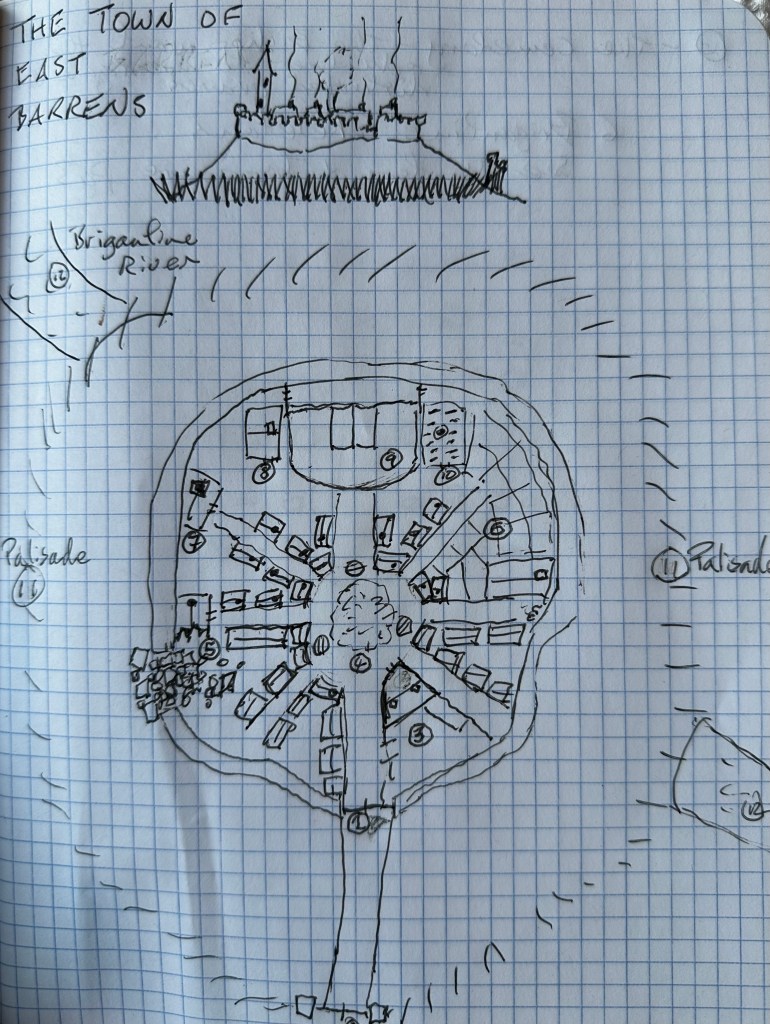
We started the session with them arriving at the lower gate, in the south there, the only way through the town’s palisade. It was pissing rain and the guards were asking them for proof of a special invitation from the Bishop.
I told them, luckily, they had just such an invite from Bishop Cerys Williams of the town’s Temple to Brigantia. She had send messengers far and wide across the land of Sorrowfield to garner aid from adventuring types. And they had answered the call.
I instituted a flashback here. I asked the players how they thought their characters knew each other, making it a little easier on them by giving them the nearby city of Bailey as the venue for their meeting. Tadhg, a member of the same sect as Bishop Williams, suggested that the message was sent to him personally, since he had spent time in the town as a young priest, years before. But, knowing he would need more help, he went to the nearest tavern where adventurers gathered, and announced his intention to lend his aid to the town and that he was recruiting. Thus, did the other members of the party gather to him. Of course, they met in a tavern…
Flash forward again to East Barrens. In the town they made immediately for the Temple and the Bishop’s palace. Bishop Williams greeted them and asked them to investigate a series of terrifying bursts of magic that have come from the west, beyond the Barrenwood. Three of these bursts have been launched as though from some enormous catapult over the last three weeks. Two landed in the forest, but the third struck the town’s sturdy stone wall, reducing a section of it to melted, crystaline debris. At the promise of gold, the party agreed to help and then went to expose the town, including the damage to the wall.
Cleverly, Ilaina, the Magic User, decided to use her one spell, Detect Magic, on the wall and its rubble.
This is the text for the spell from the book, Men & Magic:
Detect Magic: A spell to determine if there has been some enchantment laid on a person, place or thing. It has a limited range and short duration. It is useful, for example, to discover if some item is magical, a door has been “held” or “wizard locked,” etc.
I found this, in D&D terms, almost refreshingly vague. This allowed me to describe what she discovered in broad but useful terms, ie, it was powerful, transformative magic that she hadn’t seen before. And it’s dangerous. I was gratified that the PCs were invested in investigation of the phenomena involved from the off! So much so, that, when the opportunity to cast Detect Magic arose again later that same session, and in the same day, I allowed her to do it, with the understanding that, if it were in a dungeon or wilderness setting, I wouldn’t allow it. It’s rough being a 1st level Magic User in these older D&Ds. What is obvious, also, is that far more of the available 1st level spells in OD&D are utility spells, rather than offensive of defensive, compared to later editions. This makes the Magic User much less useful in combat encounters in the early days. This, we discovered later in the session.
Ilaina warned the stone masons working to repair the wall that the debris could be dangerous to handle and they began to take precautions, with thanks.
As they made their rounds in the town, they discovered a couple of things. Another team of adventurers had set out a week ago to find the source of the magical blasts, but had not yet returned. This was of particular concern as that group was made up of locals, and the townsfolk were eager to get them home.
Before they could settle into the inn for the night the Bishop approached them again on the rain-soaked streets, with a request to investigate the cemetery by the temple. Reports had come to her of strange noises emanating from there and she was worried about grave-robbers. They readily agreed to check it out. When they got there, the opened the large gate and utilised an iron spike to wedge it open, leaving their vector of egress open, just in case. I admired the use of the iron spike by the players. It was old school as all get out. Then they entered to investigate. They heard the scraping and clacking of the skeletons before they saw them. But it was too late to do anything except roll initiative once they did…
Initiative in OD&D was nicked from Chainmail Miniature Wargaming rules. In fact, the whole combat system was, but thankfully Gary and Dave were kind enough to present an “alternative combat system” for those who didn’t have the patience for all that, in the Men & Magic book. I present it below:
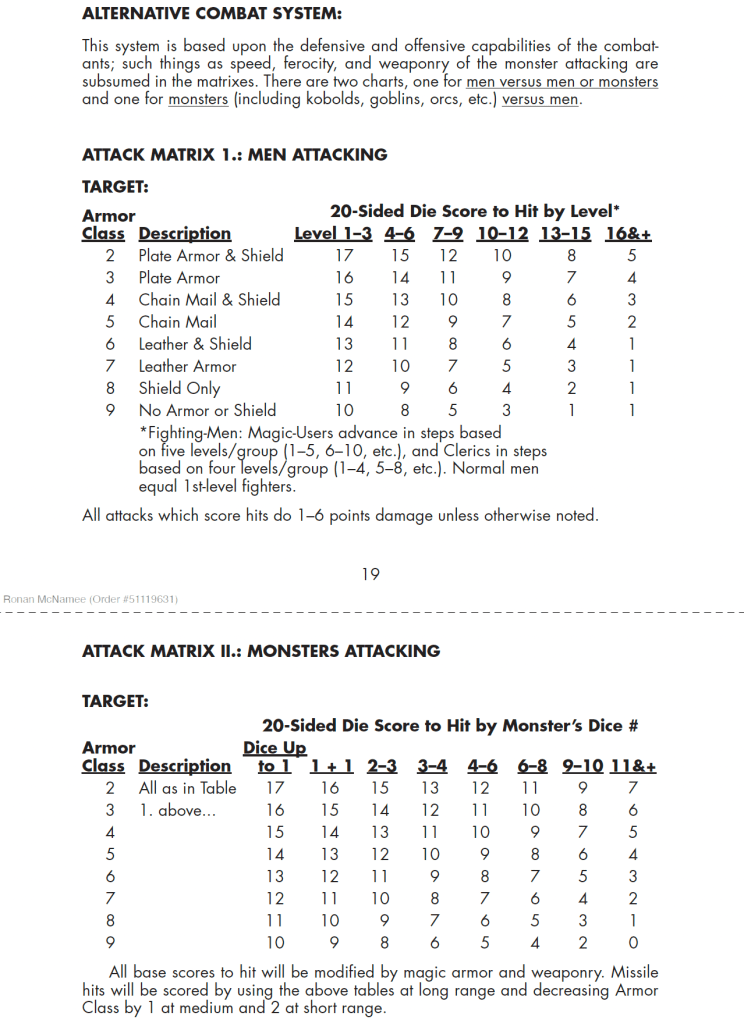
That’s it. If you have any questions about it, ask your referee (they weren’t using the term Dungeon Master at this stage of the hobby.) If they don’t know, shrug. Make something up.
So, back to initiative. Each side rolls a D6 and compares results. If the rolls are equal, everything happens at once. Otherwise, the side with the higher roll gets to go first. If that’s the players, they can make some decisions about who acts before whom and what actions they’re going to take.
Technically, this is how a combat round should progress:
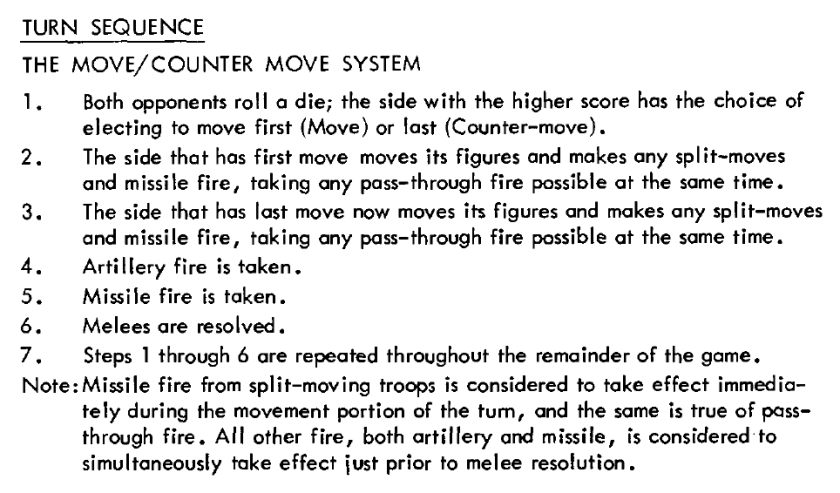
Or, alternatively, like this:
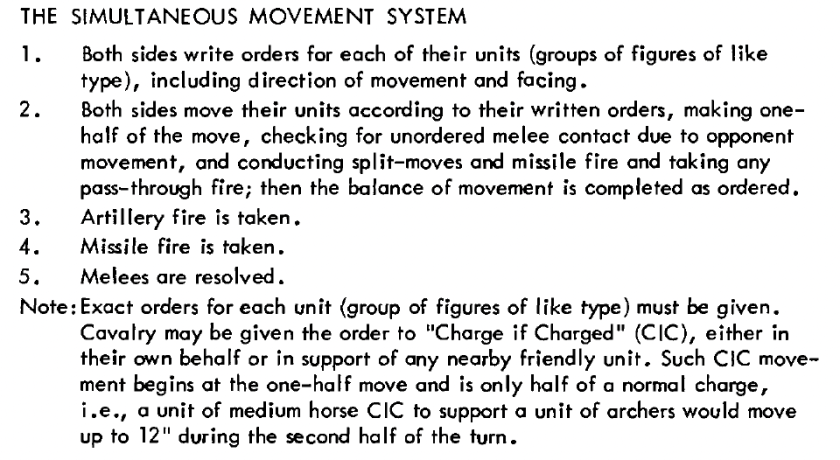
As you might have guessed, dear reader, these are screenshots from the Chainmail rules I mentioned earlier. That’s what OD&D rules were based on, after all.
In practice, there was really no need for all that. The combat was short. These were half hit-die skeletons (I’m using the optional rules for monster hit dice from the Greyhawk supplement for OD&D, which allows you to use d8s for hit dice. Previously, they were d6s with various bonuses.) Besides, there was a cleric who could turn them on the roll of a 7 on 2d6, which he did. Here’s the rules for turning undead:
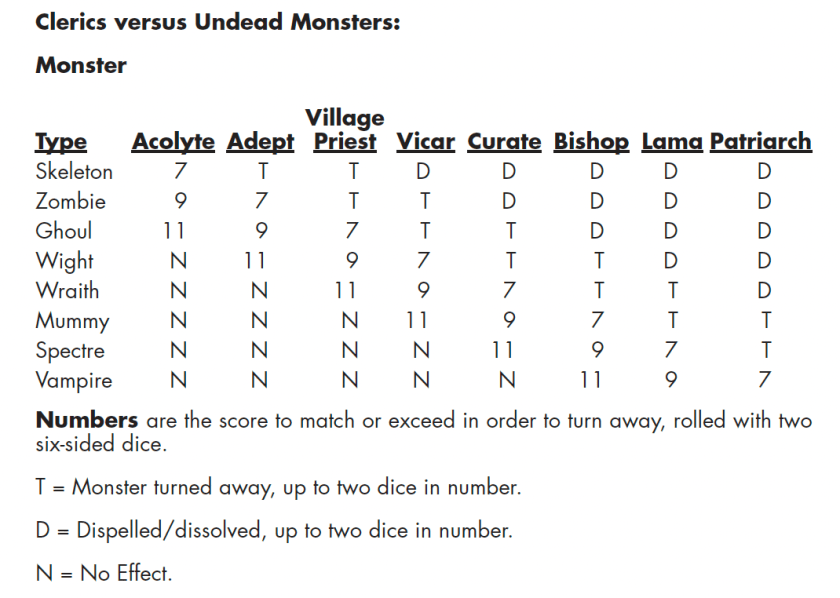
Yep, it’s just a table again. You’ll notice there is nothing about distance or duration of the turning so we kept that vague. Basically they were turned for as long as it took the PCs to do another action each and make for the gates.
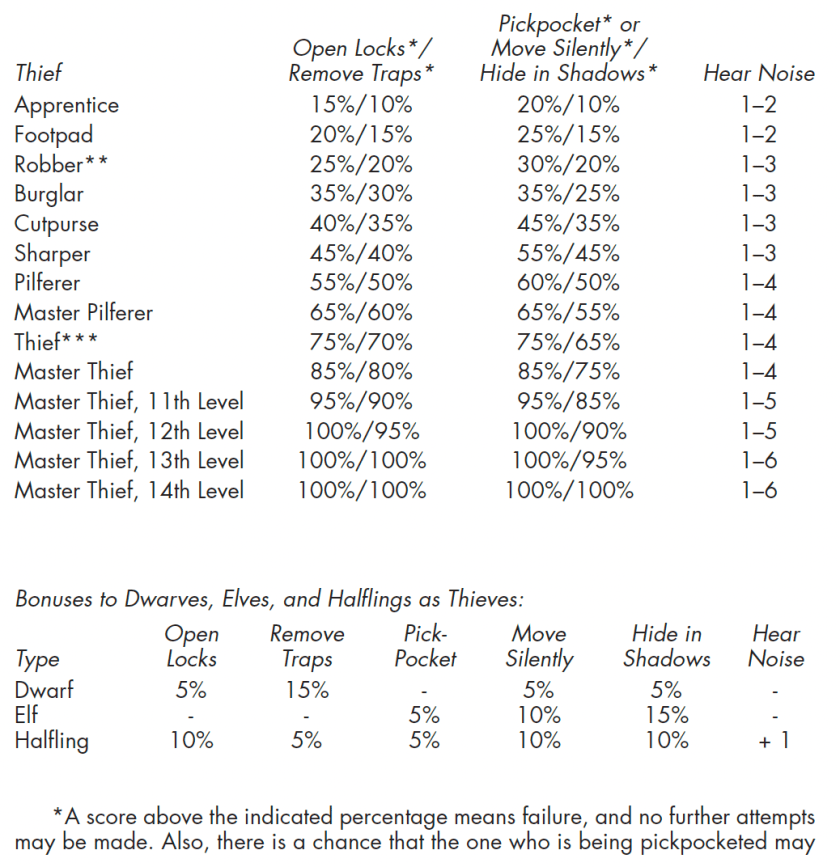
Before that, though, the thief succeeded in a Hide in Shadows roll to go for a backstab. In Od&D, low level thieves’ chances to do anything with their skills are practically non-existent, so the success felt immense, as did the 8(!) damage from the backstab, utterly destroying one skelly! In OD&D, backstabbing gives the thief a +1 to hit and doubles the damage. Huge for a first level character. I would imagine it is much less satisfying at higher levels, as I don’t believe there is any way to increase those bonuses as they level up.
Our Magic User helped by providing light, in the form of a lantern they borrowed from the front gates. I gave the PCs a +1 to hit for this.
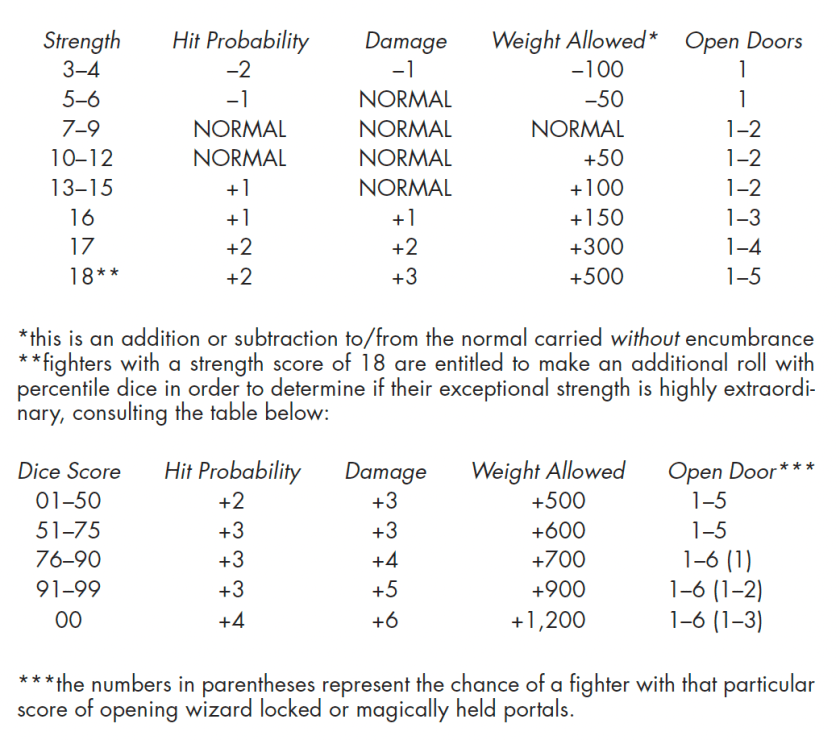
Meanwhile the Fighting Man guarded the Magic User. But once the skeletons had been turned, the fight was effectively over. This is when I gave them the opportunity to use Detect Magic again. This time it was on the fountain, which was overflowing into the disturbed graves. The water was filled with the same magical crystal shards as they had seen at the damaged wall, leading them to believe the magic was what raised these Skeltons. So they asked me if they could destroy the fountain, make it stop working. The thief failed a Detect Traps roll, which I allowed as a way to understand the workings of the fountain. The Fighting Man, however, was able to destroy it. Now, if this was a later edition, that would have been a Bend Bars/Lift Gates roll for the fighter, but since no such ability existed in OD&D, I was forced to go with the next best thing… Open Doors. As this is a feat of strength described under the Strength stat in the Greyhawk supplement, it seemed like the best thing to use, honestly. It’s a D6 roll, and Siward needed a 1 or a 2 to succeed. He rolled a 2! He used a rope to bring down he fountain and bent the pipe inside until it stopped flowing.
Then they looted the opened graves and went back to the cemetery gate. They used some more iron spikes to keep it shut and called on the Bishop to go and destroy the undead with her far more powerful turn undead abilities. She rewarded them and then they went for a few well deserved pints in the inn where they informed a grateful populace that the water from the fountain and probably the wells in the town, which all came from the same underground river, was probably polluted. They immediately started gathering the plentiful rainwater and filled our heroes with drinks and rumours.
Now, I provided the PCs with plentiful loot from those opened graves. Thousands of silver and gold pieces, gems and magical items. It might seem like a lot, considering it was their first encounter, but gold = XP in this game. At one XP per gold piece, two of their number were able to level up at the end of the session. The thief and the cleric have to attain much lower numbers of XP to level up than the fighting man and the magic user. Since I knew I wanted this game to only last about six sessions and it would be a single adventure, I wanted to make sure they got the chance to level up. So I suspended the usual rule that they can’t gain levels until the end of an adventure, instead allowing it at the end of sessions. I may even allow it whenever they rest to account for the disparity in levelling rates.
Conclusion
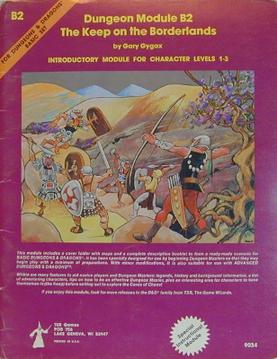
I’ll have to come back for another post on the B/X D&D game, dear reader. I didn’t expect this one to go so long! But, please come back for it. We’re playing the absolute classic, The Keep on the Borderlands!
As for the first session of OD&D; we had a brilliant time. As a note, we were playing online using Zoom and Roll20. Unsurprisingly, Roll20 does not have an OD&D character sheet option, so the player’s just used their own hard copies. We really just used the VTT for the maps. And, although I had a map of the cemetery drawn, we didn’t even place tokens on it. It ended up all theatre of the mind, which was just fine by me. There is no doubt that it presents some challenges and relies on the referee to make a lot of rulings or to use the rules in unexpected ways, but that was actually part of its charm, I found.
Looking forward to the next session in two weeks.
Discover more from The Dice Pool
Subscribe to get the latest posts sent to your email.

 The Dice Pool