
One-shot fun-shot to campaign of terror
You know what it’s like, dear reader: you want to introduce some noobs to RPGs or just to your group of players, you want to make a good impression but you don’t want to scare them off by plunging them into a multi-session campaign with a complicated, crunchy system. So you pick up a location-based adventure, thinking you can just use a small portion of it, just what you need, just enough for one session, one single shot. But, after that session, the curiosity gets the better of you all. That was a weird, but enjoyable experience, you tell each-other. I bet we could have fun exploring the rest of that odd locale, you tell the players, why not have some more sessions and see how it goes? So you do that. And then the bloodbath begins.
Whalgravaak’s Warehouse
SPOLIERS BELOW! If you are interested in being a player in Whalgravaak’s Warehouse, turn back now!

Whalgravaak’s Warehouse is a Location based adventure by Andrew Walter for Troika! The design is by Shuyi Zhang. It came out in 2023 and was the first of the Melsonian Arts Council’s 1:5, an ongoing series of location-based adventures for Troika! There are a couple more available now and another out very soon. You can find them all here. My somewhat rotating group of Tables and Tales members just had our last session in Whalgravaak’s Warehouse on Monday night, after spending a total of eight sessions there.
Here’s the story: hundreds of years ago, the city’s premier logistics wizard, Whalgravaak, abandoned his warehouse, having shredded the Manual of Operations for his Sphere Pool (a mechanism used to import and export goods across the cosmos) so that his rivals could never figure it out.
Since then, the strange nature of the warehouse, staffed by giants and stocked with oddities, has only grown stranger, and more dangerous. It houses a handful of physics defying, Tardis-like chambers, not least of which is the terrifying Deep Storage, a swirling mass containing several pocket dimensions and a wraith-like being who wants nothing more than to consume intruders. At least one cult has taken up residence, and they are often mutated into horrific Chaotic Spawnlets by the effects of the radiation still spilling from the Sphere Pool. The warehouse is sandwiched by a vast desert of dust occupying the roof, which is peopled by the descendants of Whalgravaak’s former employees and, underneath, the tunnels of a pack of unpredictable Worm-headed Hounds.
But entrance has been forbidden by the Autarch for centuries and, even if you were foolhardy enough to ignore a diktat like that, you would still need to be brave enough to face the unknown dangers within.
The Hook and the Party
The book suggests a few potential hooks for your PCs. Since my game started off as a one-shot, with brand new characters and no existing campaign to work it into, I went for one that seemed like the object might be achieved in one session. They, along with many other groups of mercenaries were contracted to return with the head of a Cacogen, known only as the Opportunist, to their patron, an Exultant of the Autarch’s court. But we dealt with that in flashback as they all sat in the weed-choked yard of the warehouse, dotted now with small encampments of adventurers and brigands all gathering their courage to gain entry. The PCs’ band consisted of a Monkey Monger (and monkeys), a Gremlin Catcher (and dog), a Wizard Hunter and a Landsknecht. They were, to put it bluntly, a motley crew.
That first session was all fun and games. Every encounter, except for the last one with the Cacogen, was resolved peacefully. This happened mainly due to the rolls I made on the Mien table for each encounter. The worm-headed Hounds they encountered wanted to play with the Monkey Mongers monkeys, they did not want to eat them. The Flat Serviceman was happy to follow the party around and clean up after them. The Segmented Crippler in the Pigeonholery, didn’t want to wake up, so they skipped that one entirely. This is a pretty standard mechanic in Troika but I think it gave the players a false sense of security. The session ended with this motley crew finding and defeating the Opportunist quite handily. And, at that point, we thought that would be it.
But a few months later we decided to continue with their explorations of the warehouse. Obviously, their original motivation to explore was gone. They had achieved their objective, but the players were all good sports. They decided between them that the motivation was purely one of curiosity and greed. They had spotted, through a bubble like window in one of the rooms they had traversed, a vast and terrifying pool of chaos and wonder in a room far too big to exist within the confines of the building. This was enough for them. Essentially, they went in search of adventure. Although, through the sessions that followed, I did introduce the idea that they might want to find that cult I mentioned earlier and that they should seek out the incredibly valuable Tome of the Sable Fields that was reported to be stored in the warehouse, somewhere. This gave them a little direction when I thought they might need it, but, honestly, I think my players just wanted to see what new wonder/horror the dungeon had in store in the next room.
The Dungeoncrawl
It was only from this point that I started to really treat this adventure like the dungeoncrawl it is very much meant to be. The book does a good job of introducing the concepts of tracking resources like lantern oil and provisions as the party explores. It also explains the concept of exploration turns and their effect on the game, i.e. the distance you can travel in that time, the amount of lantern oil you use per turn, and the likelihood of running into an encounter. I followed all these rules to the letter and they made for some interesting moments in the game. But, to be frank, the weirdness of the setting is the real draw here, not fiddling with rations and light levels. Also, few of the characters lived long enough for starvation or oil-skins to become a problem.
It also has rules for dealing with the spatially distorted, impossibly large areas within the warehouse. It suggests that the players should make Luck or Skill checks to avoid getting lost in these areas, but, in all honesty, I didn’t really require that sort of thing.
Mapping is also a part of the dungeon crawl format and this adventure does want the party to attempt to map the space for themselves. The thing is, when some rooms appear to be a kilometre wide and the next one is spatially normal, that map becomes effectively impossible for them to draw accurately after a relatively short period of time. Eventually, I gave up and just shared the one from the book with the players, trusting their ability to separate player knowledge and character knowledge. My advice, if you are doing this, try get your hands on the PDF version, since the one in the physical book stretches across two pages and the crease obscures part of it.
In fact, the adventure has four maps:
- the warehouse floorpan, using 10ft squares to denote distance
- a hex crawl for the desert on the roof, replete with points of interest
- a map of the Worm-headed Hound tunnels beneath the warehouse, superimposed over the warehouse plan
- a largely vibes-based map of Deep Storage
These are all great but usefulness will vary. In our game, the party spent several sessions trapped in Deep Storage but took one look at the desert and noped right out of there. This seems like a good point to note how good all the artwork is in this. There are plenty of colour and black and white illustrations but they leave me wanting even more!
Warehouse Workers and other Beasties
A warehouse is a dangerous place to work, especially when the correct safety protocols are not observed. It doesn’t help at all when you are trespassers and several of the residents are large enough to crush you with a single blow.

The giants are the main NPCs of the adventure and Whalgravaak’s only remaining employees. Each one is fabulously interesting, diverse and well-drawn. They have their own motivations and desires. I was gratified that the party managed to encounter all of them during the eight sessions we played. In fact, one player had two different characters killed by two different giants. I will point out that it is entirely possible to avoid violence when dealing with the giants, it’s just that, sometimes, the Monkey Monger on the team has monkeys who decide to fuck with them and one thing leads to another.
The wraith-like Gulf Man Roamer from the swirling vortex of Deep Storage is a potentially lethal foe who has a chance to show up each time the party moves through that already dangerous room. If it captures you in its bag, it’s going to spirit you away to eat you in its extra-dimensional lair.
No warehouse is complete without forklifts. Whalgravaak’s forklifts are humanoid constructs with the face of the wizard himself. They treat intruders like stock, and will attempt to whack them and pack them. They hit very very hard.

There are also a bunch of random encounters, including the Worm-headed Hounds I mentioned before, desert nomads from the roof, and Bandits/Burglars/Bastards. These only turn up on the roll of a 1 on a 1d6 for each turn the party travels. It didn’t occur very often in my game. The Roof and the tunnels have their own random encounter tables as well, but I never used them as the party never spent any appreciable time there.
This is just a selection of the possible encounters you can have in this setting. I haven’t even mentioned the tiny army guys, the sentient crane parts, the Onion God or the Mulled Dead.
The Rooms
I have hinted at rooms that defy physics and rooms with pocket dimensions, and those are usually the big-ticket locations that contain some of the greatest set-pieces in the adventure. Deep Storage alone evoked some of the most inventive use of skills and spells and a great degree of fear and tension from the PCs. It killed one of them (two if you count the Rhinoman eaten by the Gulf Man Roamer.) The Roof could act as an entire short hex-crawl campaign and the Sphere Pool has some truly memorable and dangerous elements to it.
However, many of the other rooms have weird and wonderful contents as well. Some of them, the party will glance at and move on, while others will capture their imaginations and encourage them to interact. I never really knew which reaction I was going to get from them, actually. The room full of melting rope? They had to spend an hour trying to figure out how to set it on fire, the eternal battle between tiny armies playing out across a battlefield seemingly larger than the whole warehouse? Just popped their heads in and left with some captured little men.
Some of the rooms were relatively mundane warehouse style rooms with shelves and containers. The book has tables in the back to help you identify the state those rooms are in and the contents of the containers, which is useful.
One of my over-riding impressions by the end of our game, was that in some ways, the great variety of bonkers content in the rooms served to detract from any unifying theme. There were some elements that went together, such as the warehouse’s disdain for traditional dimensions. If my PCs had explored the Roof or even encountered any of the nomads who dwelt there, they might have found a distinction between those descendants of the ancient striking workers and the giants who continued to obsessively do their jobs even long after their employer had passed on. But, none of that is to say that the rooms weren’t endlessly fun and inventive.
A Note on Lethality
I recently wrote a post sharing some of the obituaries of the characters who met their ends in Whalgravaak’s Warehouse. You can check it out here. There are only three of them in that post. A few months previous to that, I wrote this post, which contained the obituaries of two more. The mathematicians amongst you will have summed those already. That’s five. In the final session, we lost another one. That makes six. That was three character deaths each for two particularly unfortunate/reckless players. Warehouse work is dangerous. Only one of the original party survived to the end. You have been warned.
Conclusions
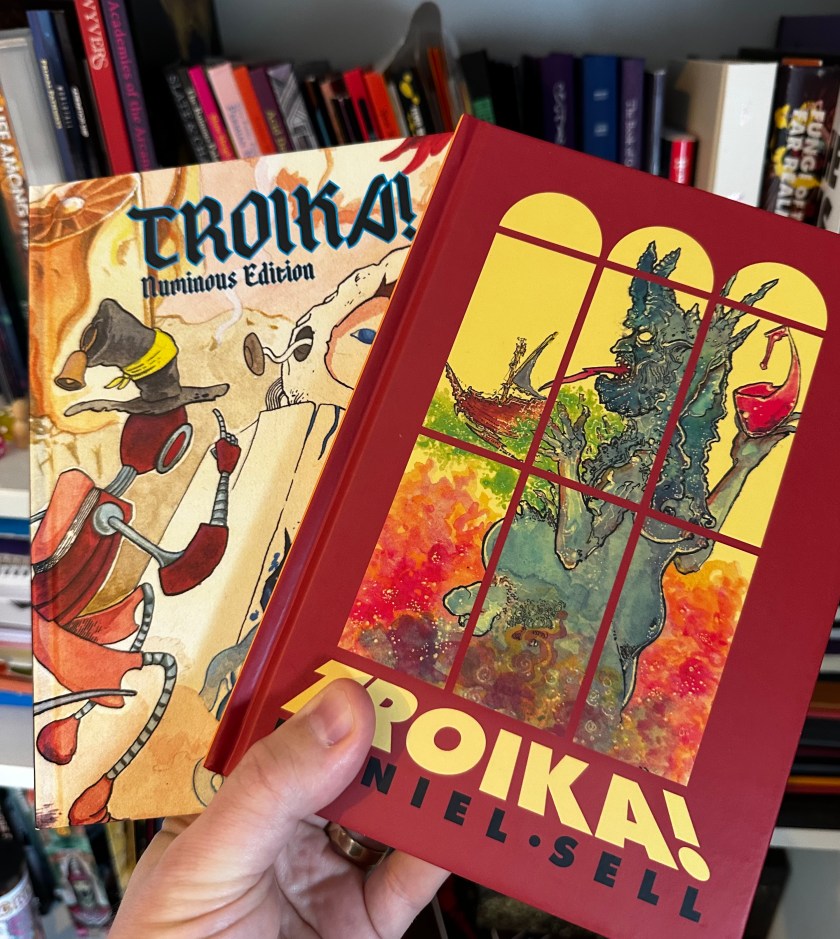
There is so much to recommend in this adventure. It is endlessly entertaining, challenging and bonkers. It has such a variety of locations and such a diversity of encounters that you would need to work hard to get bored in Whalgravaak’s Warehouse. I think it works so well to show off Troika! as a system, too. The problems it asks the PCs to solve and the encounters they have to deal with utilise things like the Luck check really well and encourage players to invent their own unique Advanced Skills. But if they get into fights, especially with the incredibly random nature of Troika! initiative, there is a very high chance they are going to come out of it dead. There are a few opportunities for insta-kills throughout the warehouse too. I can’t overstate exactly how lethal this adventure is. Luckily, my players leaned into that, even when they were creating new characters to join in the same fight the original one died in (they got very quick at creating characters.)
I think it’s also flexible enough for many GMs to easily take it or part of it and fit it easily into their own ongoing Troika! campaign. As I said at the start, our game started as a one-shot and it could have ended there. But we were able to easily adapt it into a short campaign of its own.
Dear reader, let me know if you have played Whalgravaak’s Warehouse or if you would like to! I’d love to know your views on it.
Discover more from The Dice Pool
Subscribe to get the latest posts sent to your email.

 The Dice Pool
Cracking module this! You might notice a familiar name on the playtester list…
LikeLiked by 1 person
I did! It must have been great craic play-testing it!
LikeLike